In this section, we conduct experiments on two real-world SAR ATR datasets and compare the proposed DTAC method with state-of-the-art few-shot class incremental learning approaches. We introduce the datasets, baselines, network architecture and then report the performance.
5.1. Dataset Preparation and Experimental Settings
In the experiment, we construct two SAR ATR datasets with diversity in target categories and sizes, imaging platform diversity, and observation environment diversity, for comprehensive evaluation of the performance of our proposed DTAC model.
(1) SAR-Aircraft-1.0-FSCIL: We constructed the SAR-Aircraft-1.0 FSCIL dataset based on the SAR-Aircraft-1.0 dataset [
56] for evaluation purposes. SAR-Aircraft-1.0 was released by the Chinese Academy of Sciences for fine-grained aircraft detection and recognition in SAR imagery, covering three airports with data acquired by China’s Gaofen-3 satellite in C-band single-polarization spotlight mode at 1-meter spatial resolution. This dataset contains 4368 image chips and 16,463 aircraft instances categorized into seven classes (A220, A320, A330, ARJ21, Boeing 737, Boeing 787, and Others). For FSCIL in SAR ATR, we selected the four most populous classes as base session data
, with the remaining three classes serving as incremental data
; base and incremental classes contain 2000 and 5 training samples respectively, with 200 test samples per class (
Table 1).
(2) MSTAR-FSCIL: Complementing the target datasets captured by spaceborne SAR payloads mentioned above, and considering their distinct imaging conditions and targets (namely airborne platforms and fine-grained ground vehicles), we formulated the MSTAR-FSCIL dataset derived from MSTAR V1.7.0 [
25]. Similarly, we selected four classes (BTR70, 2S1, BRDM2, BMP2) containing full-aspect samples imaged at 17° depression angle as base session data
; the remaining six classes utilize randomly chosen few-shot samples for incremental learning and model evaluation (
Table 2).
The experimental environment comprised a Windows 10 operating system, Core i7-12800HX CPU, and NVIDIA RTX A3000 GPU, utilizing Python 3.8 programming language with PyTorch version 1.9.1; optimization was performed using Adam. The model was trained for 150 epochs with a batch size of 32. The inner-loop update steps (3 iterations), and the outer-loop update frequency (1 update per 2 task batches). Finally, we set inner-loop learning rate and outer-loop learning rate to 0.005 and 0.001.
5.3. Performance Evaluation
In our experiments, four evaluation metrics are employed: classification accuracy (Acc.)—the most prevalent metric—assesses comparative methods on seen classes during each session; average accuracy (Avg.Acc) reports the mean across all sessions; harmonic accuracy (HA) equitably accounts for model performance on both base and incremental classes Acc(base) and Acc(inc) by balancing their contributions per incremental session, with the average across sessions denoted as Avg.HA; finally, performance degradation rate (PD) quantifies absolute performance decline by subtracting the last session’s accuracy from the first session’s.
In this section, we conduct extensive experiments on FSCIL for two distinct SAR ATR datasets to evaluate the performance of our method against baseline approaches. Results and comprehensive analyses are presented from both quantitative and qualitative perspectives.
(1) Quantitative Results and Analyses
The quantitative results of our method across both aforementioned scenarios, along with comparative benchmark evaluations, are presented in
Table 3 and
Table 4. We first conduct detailed analyses of all benchmarks according to standard metrics—namely average accuracy (Avg.Acc) and performance degradation (PD), wherein smaller PD values indicate superior model performance. This is followed by a concise comparison with task-specific state-of-the-art methods in terms of harmonic accuracy (HA).
(a) Compared to traditional DL-based solutions: The performance of traditional CNN-based classifiers is presented in the first two rows of
Table 3 and
Table 4. Notably, our proposed DTAC model outperforms both Ft-CNN and Oracle. Due to the absence of specialized modules and strategies tailored for FSCIL in SAR ATR, Ft-CNN suffers from severe catastrophic forgetting and yields the poorest results, achieving Avg.Acc of 77.38% and 59.70% across the two datasets, respectively. While the Oracle model incorporates offline training on seen samples, it fails to acquire useful knowledge from limited data, consequently underperforming our method (e.g., Avg.Acc of 78.71% vs. 86.30% and 78.68% vs. 82.12% on the two datasets).
(b) Compared to Incremental learning solutions: The performance of incremental learning (IL) methods is reported in rows 3–5 of
Table 3 and
Table 4. By employing techniques such as feature alignment and regularization, example replay, and non-parametric classification to address catastrophic forgetting, these approaches achieve more competitive results than conventional methods. Among them, LUCIR utilizes cosine-based criteria for target classification, attaining the most competitive performance with Avg.Acc scores of 82.86% and 76.77% across the two datasets. Nevertheless, while IL methods demonstrate enhanced recognition capabilities for new classes in SAR ATR FSCIL scenarios, their learning and discriminative capacities remain constrained during incremental learning due to the limited samples available for novel classes in FSCIL tasks; consequently, they still underperform our proposed method.
(c) Compared to FSCIL solutions: We analyze the performance of compared FSCIL benchmarks for general and SAR ATR tasks separately.
The comprehensive results for FSCIL methods are reported in rows 6–12 of
Table 3 and
Table 4. Collectively, these approaches incorporate specialized techniques addressing inherent FSCIL challenges, such as neural gas (TOPIC), exemplar-relation graph for knowledge replay (ERDIL), meta-learning for fast adaption (CEC), and virtual-class augmentation for forward transferring (FACT, ALICE, and SAVC), yielding competitive outcomes. For instance, compared to IL methods like iCaRL and EEIL, ERDIL, CEC, ALICE, and SAVC demonstrate enhanced performance when handling imbalanced base-class and novel-class samples. Notably, SAVC exhibits competitive advantages over most general FSCIL solutions, achieving Avg.Acc scores of 81.05% and 78.20% on the two datasets, respectively, evidencing its representation capabilities rooted in SSL and hallucinative feature construction.
Row 13 of
Table 3 and
Table 4 reports the performance of the FSCIL model CPL for SAR ATR. By thoroughly incorporating intrinsic relationships among structural features of SAR targets and designing specialized modules with tailored loss functions, CPL achieves advanced performance metrics—attaining Avg.Acc of 84.49% and 78.56% alongside PD rates of 27.31% and 36.23% across both datasets—outperforming all comparative FSCIL solutions. Nevertheless, our proposed DTAC model realizes further substantial performance improvements by leveraging task-specific mechanisms and dynamic classifier modules, demonstrating its effectiveness for FSCIL in SAR ATR.
Furthermore, the harmonic accuracy (HA) of our method alongside four state-of-the-art approaches, namely Oracle, LUCIR, SAVC, and CPL, is reported at the bottom of both tables. Since no novel classes exist during the base phase, only HA results per incremental session and their average (Avg.HA) are presented. Notably, among the four baseline methods, the FSCIL model CPL achieves competitive outcomes. In contrast, our proposed DTAC model, incorporating task-specific adaptability and dynamic classifier discriminability across diverse classes, attains the most competitive HA in every incremental session comparison. Consequently, it yields optimal average results of 63.16% and 75.95% across the two constructed SAR ATR datasets for FSCIL.
Finaly, we evaluate the practical application potential of the proposed DTAC method and baselines (Oracle, LUCIR, SAVC, and CPL). All models are tested on SAR images with a unified size of 3 × 512 × 512 (consistent with the training input format), covering representative samples from both SAR-Aircraft-1.0-FSCIL and MSTAR-FSCIL datasets.
Table 4 summarizes the inference time per sample of the proposed DTAC and four representative baselines (Oracle, LUCIR, SAVC, CPL) on the two datasets. Oracle and LUCIR adopt relatively simple network architectures. Their inference times are the shortest (9.7 ms and 11.3 ms, respectively), which is attributed to fewer network parameters and simplified decision logic. However, their recognition performance is suboptimal. SAVC and CPL employ more complex designs to enhance recognition accuracy. Compared to Oracle and LUCIR, their Avg.Acc and Avg.HA are significantly improved. However, their inference times increase substantially: SAVC takes 19.2 ms per sample, and CPL’s inference time is 28.6 ms, which is due to additional feature enhancement modules and complex prototype optimization processes that increase computational overhead. Despite integrating three core modules (feature extraction, task information encoding, dynamic classifier generation), the proposed DTAC’s inference time (23.5 ms) is well within the acceptable range for practical applications. This balance is enabled by the efficient task-adaptive mechanism: the dynamic classifier generation module avoids redundant parameter updates, and the task information encoding module adopts a three-layer MLP, minimizing computational overhead while maximizing recognition performance.
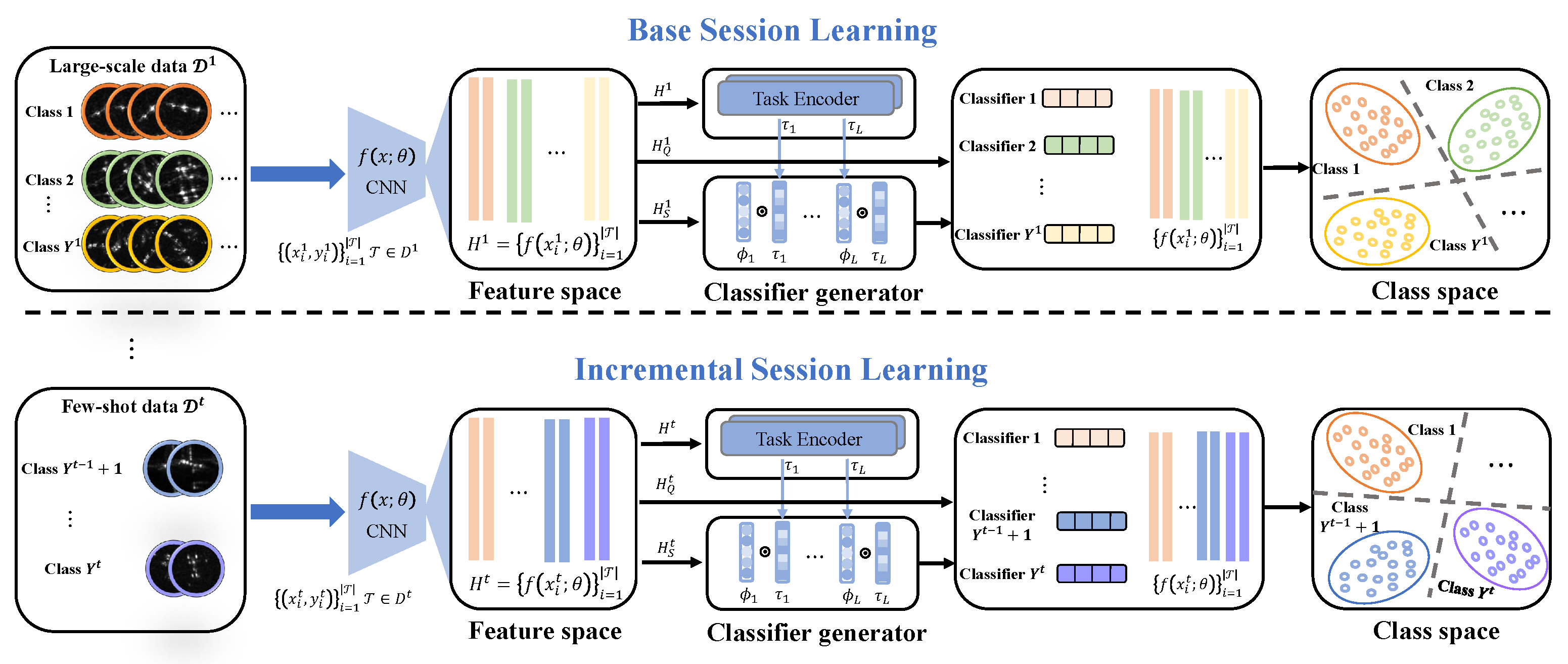
In the proposed algorithmic framework, we conduct comprehensive ablation studies on the task encoder and the classifier generation network. All experiments are conducted under strictly controlled settings—using identical training and testing datasets, fixed hyperparameters, and consistent implementation environments—to ensure result reproducibility and eliminate performance variability due to random factors. We adopt a convolutional neural network (CNN)-based feature extractor as the baseline architecture. Incremental enhancements are then introduced by sequentially incorporating the task encoder (TE) and the classifier generator (CG). The performance evolution across these variants is systematically evaluated and summarized in
Table 5 and
Table 6, clearly demonstrating the individual and combined impacts of the added components on model efficacy.
As can be clearly observed from
Table 5 and
Table 6, the recognition accuracy of the proposed model remains at an extremely low level when only the backbone network is deployed, thus failing to achieve target recognition in a reliable manner. With the incremental integration of each functional module, the target recognition accuracy undergoes a substantial improvement. Notably, the task encoder exerts the most prominent effect on performance enhancement. When all modules are integrated into the framework, the model attains its optimal performance, which fully validates the effectiveness of each constituent module in the proposed DTAC model.
(2) Qualitative Results and Analyses
In this section, we present qualitative exploration outcomes, including performance curves and histograms, confusion matrices, and t-SNE visualizations for comprehensive assessment.
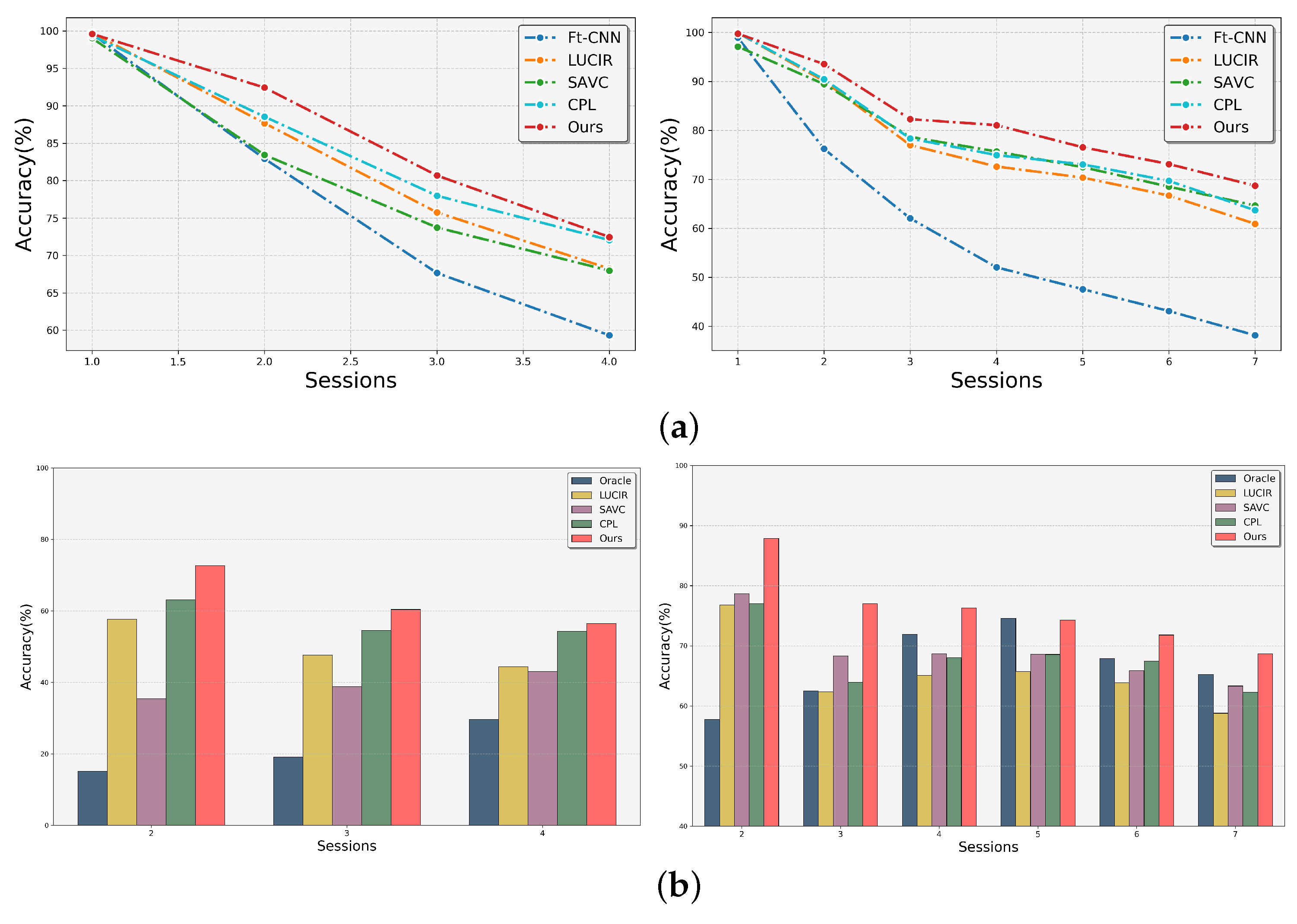
(a) Performance curves and histograms: Beyond classification accuracy comparisons with baseline methods, we present performance curves and histograms of comparative benchmarks.
Figure 2 reveals three distinct advantages of our proposed DTAC approach: First, it achieves optimal comprehensive performance in mid-session accuracy across all FSCIL datasets (as illustrated by the red curve); Second, our method effectively mitigates catastrophic forgetting, attaining the lowest PD rates across all learning scenarios (evidenced by curve endpoints); Third, DTAC optimally balances model stability for prior knowledge and plasticity for new information, consequently achieving the highest HA in every incremental session (demonstrated by the crimson histogram bars).
(b) Confusion matrices:
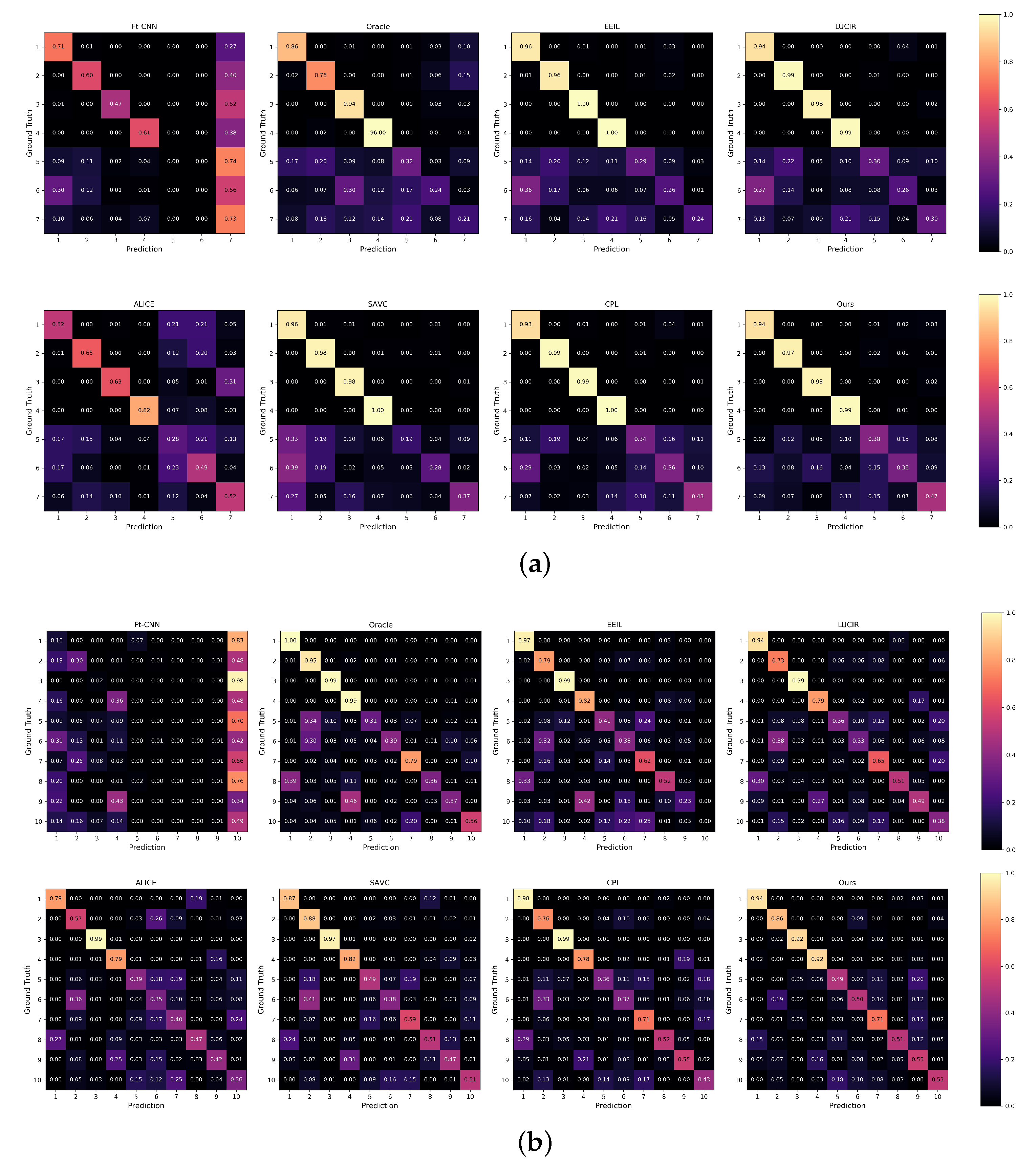
Figure 3 displays the confusion matrix between predicted and ground-truth labels for the final session. Due to repeated experimental trials, results are aggregated and normalized to ensure equitable evaluation; consequently, each row sums to unity, with diagonal values representing correct classification probabilities. Key observations reveal: First, traditional recognition methods like Ft-CNN exhibit pronounced bias toward base classes owing to limited training samples for novel categories, failing to learn discriminative features for new classes—demonstrating severe catastrophic forgetting of prior knowledge; Second, incremental learning and FSCIL methods (excluding FACT) yield more balanced confusion matrices by addressing novel-class classification and few-sample challenges, indicating partial mitigation of inherent difficulties; however, their weak exploration of domain-specific SAR target knowledge results in inadequate representation and discriminative capabilities for novel classes, falling short of expected efficacy. For the SAR-Aircraft-1.0-FSCIL dataset, the most prominent misclassification occurs between the incremental classes “A320” and “A330”. This error arises from the inherent similarity of the two aircraft types in SAR images: both belong to large civil jetliners with similar fuselage length and wingspan. Under the few-shot incremental learning setting, limited training samples (only 5 samples per class) make it difficult for traditional models to capture fine-grained discriminative features, leading to higher misclassification rates. For the MSTAR-FSCIL dataset, the main misclassification occurs between the incremental classes “ZIL131” (a military truck) and “BTR60” (an armored personnel carrier). The root cause of this error is the similar RCS characteristics of the two targets under specific depression angles: both have a long and narrow overall structure, and the scattering centers of the body and wheels overlap in SAR images, leading to ambiguous feature representations; Third, owing to simultaneous consideration of stability–plasticity trade-offs and domain-specific characteristics, both CPL and our proposed method outperform alternatives—particularly, our method’s matrix exhibits higher contrast and intensity in most diagonal blocks, signifying enhanced compatibility between transferability and discriminability during few-shot incremental learning for SAR ATR.
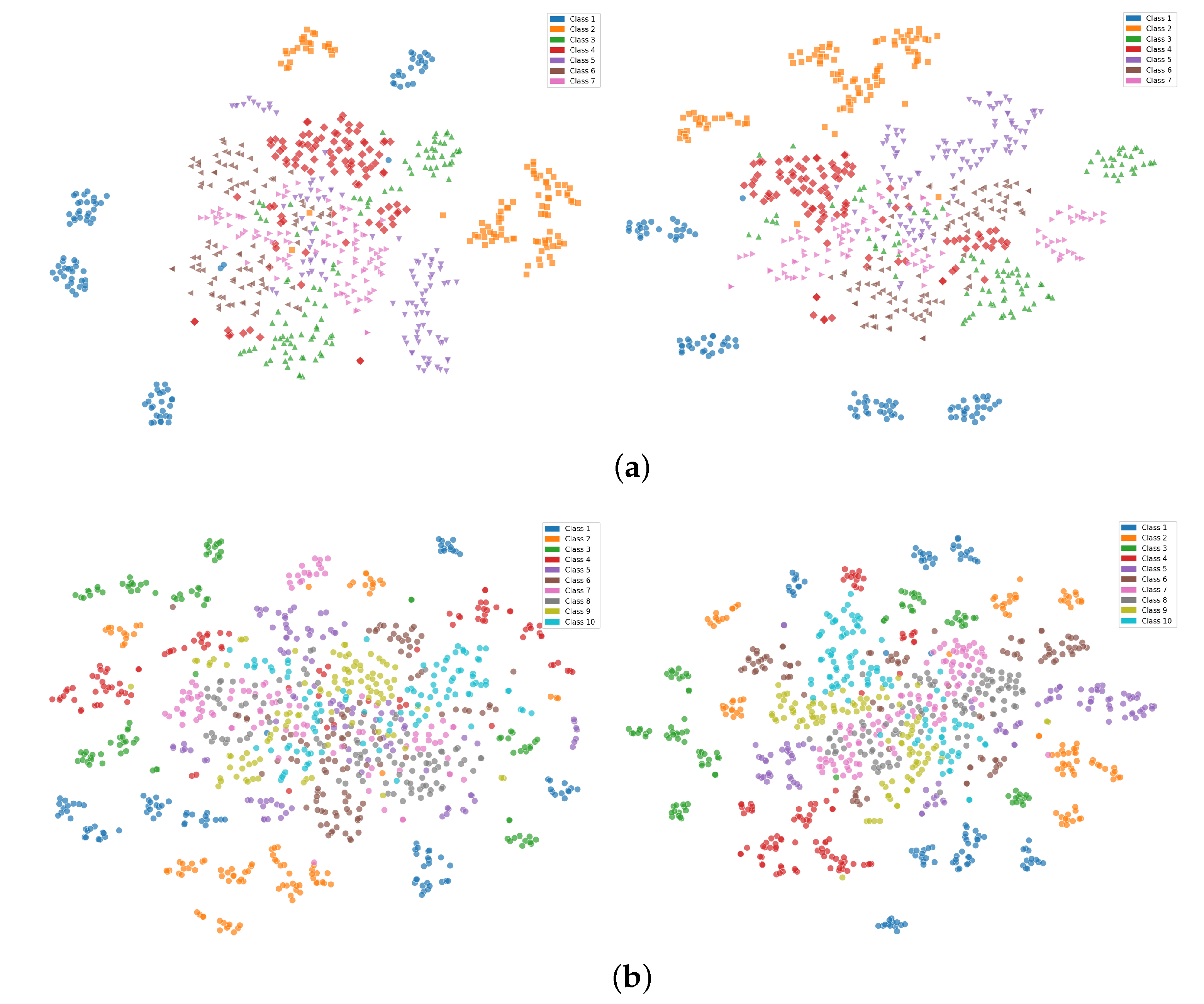
(c) t-SNE results: The t-SNE results are investigated in this part. The results for targets in the SAR-Aircraft-1.0-FSCIL and the MSTAR-FSCIL datasets are presented in
Figure 4. We observe that features extracted by our method exhibit greater inter-class discriminability. Compared to novel-class features extracted by baseline approaches, those generated by our method manifest reduced feature-space overlap with previously learned classes and enhanced independence.