Article

Few-Shot Class-Incremental SAR Target Recognition Based on Dynamic Task-Adaptive Classifier

by
Dan Li
1,
Feng Zhao
2,
Yong Li
1,* and
Wei Cheng
1
1
Department of Electronic Engineering, Northwestern Polytechnical University, Xi’an 710129, China
2
School of Electronics and Information Engineering, Beihang University, Beijing 100191, China
*
Author to whom correspondence should be addressed.
Remote Sens. 2026, 18(3), 527; https://doi.org/10.3390/rs18030527
Submission received: 27 December 2025 / Revised: 28 January 2026 / Accepted: 2 February 2026 / Published: 6 February 2026

Highlights

What are the main findings?
  • The proposed DTAC method outperforms 13 baseline models (covering traditional deep learning, incremental learning, and FSCIL methods) on two self-constructed SAR datasets (SAR-Aircraft-1.0-FSCIL and MSTAR-FSCIL), achieving average accuracies of 86.30% and 82.12% respectively, with the lowest performance degradation rate (PD) and highest harmonic accuracy (Avg.HA of 63.16% and 75.95%).
  • Ablation experiments confirm that the task information encoding module and classifier generation module are critical to the model’s performance: integrating both modules significantly mitigates catastrophic forgetting and overfitting, with the task encoder contributing the most prominently to performance improvement.
What is the implication of the main finding?
  • For the field of SAR ATR, the dynamic task-adaptive mechanism provides a new solution to the “stability-plasticity dilemma” in few-shot class-incremental scenarios, enabling reliable recognition of new classes with limited samples while preserving prior knowledge—addressing the practical pain point of scarce annotated SAR data and evolving target classes.
  • The modular design of DTAC (feature extraction + task encoding + dynamic classifier generation) offers a scalable framework for related incremental learning tasks, inspiring the development of task-aware adaptive models in other remote sensing image recognition fields (e.g., optical remote sensing, LiDAR) facing similar few-shot and incremental learning challenges.

Abstract

Current synthetic aperture radar automatic target recognition (SAR ATR) tasks face challenges including limited training samples and poor generalization capability to novel classes. To address these issues, few-shot class-incremental learning (FSCIL) has emerged as a promising research direction. Few-shot learning facilitates the expedited adaptation to novel tasks utilizing a limited number of labeled samples, whereas incremental learning concentrates on the continuous refinement of the model as new categories are incorporated without eradicating previously learned knowledge. Although both methodologies present potential resolutions to the challenges of sample scarcity and class evolution in SAR target recognition, they are not without their own set of difficulties. Fine-tuning with emerging classes can perturb the feature distribution of established classes, culminating in catastrophic forgetting, while training exclusively on a handful of new samples can induce bias towards older classes, leading to distribution collapse and overfitting. To surmount these limitations and satisfy practical application requirements, we propose a Few-Shot Class-Incremental SAR Target Recognition method based on a Dynamic Task-Adaptive Classifier (DTAC). This approach underscores task adaptability through a feature extraction module, a task information encoding module, and a classifier generation module. The feature extraction module discerns both target-specific and task-specific characteristics, while the task information encoding module modulates the network parameters of the classifier generation module based on pertinent task information, thereby improving adaptability. Our innovative classifier generation module, honed with task-specific insights, dynamically assembles classifiers tailored to the current task, effectively accommodating a variety of scenarios and novel class samples. Our extensive experiments on SAR datasets demonstrate that our proposed method generally outperforms the baselines in few-shot class incremental SAR target recognition.

1. Introduction

Synthetic Aperture Radar represents an active microwave remote sensing modality, distinguished by its all-weather, high-resolution imaging capabilities across all temporal domains. Its ability to furnish detailed terrestrial information and effectively navigate complex and variable environmental conditions underscores its significant utility in a multitude of sectors, including military intelligence [1,2], disaster surveillance [3], maritime governance, agricultural valuation, and urban planning [4,5,6]. Within this framework, synthetic aperture radar automatic target recognition (SAR ATR) technology emerges as a pivotal element in facilitating intelligent analysis, attracting considerable academic and industrial attention in recent years. ATR is dedicated to the expedient and precise identification and categorization of specific targets within extensive SAR image datasets, a capability that holds transformative implications for augmenting decision-making processes and reducing human resource dependencies [7,8]. The advent of deep learning and its pervasive integration into the realm of computer vision has catalyzed extraordinary opportunities for SAR ATR, with cutting-edge innovations continuously emerging to address challenges previously insurmountable by conventional methodologies [9,10,11].
Deep learning has undeniably propelled the field of SAR ATR forward, yet several significant challenges persist [12,13,14,15]. A primary concern is the scarcity of high-quality annotated data. The exorbitant costs and intricate processes involved in acquiring SAR images, coupled with the substantial variability in target characteristics across diverse situations, render the creation of large-scale, varied annotated datasets incredibly challenging. Additionally, as the scope of application scenarios broadens, the number of target classes requiring identification grows, complicating model training and increasing the likelihood of catastrophic forgetting, a phenomenon where models slowly lose their proficiency in older tasks as they acquire new ones. To tackle these issues, few-shot learning and incremental learning have emerged as viable solutions. Few-shot learning strives to rapidly grasp the features of new categories using limited data, allowing models to perform well even with minimal information. Incremental learning, on the other hand, concentrates on preserving previously acquired knowledge while seamlessly integrating fresh data, ensuring that models can keep building on their experience without sacrificing previously learned abilities. In essence, these methodologies are vital for bolstering the robustness and adaptability of SAR ATR systems and play a pivotal role in further advancing the field [16,17,18,19,20].
In practical scenarios, few-shot class-incremental learning (FSCIL) methods encounter two primary obstacles: catastrophic forgetting and overfitting. Catastrophic forgetting arises when the model, while learning new tasks, rapidly displaces previously learned knowledge, causing a sharp drop in performance on earlier tasks. This issue is particularly pressing in incremental learning, where there is a constant need to refine the knowledge base to encompass new target categories. Conversely, overfitting occurs when the model absorbs too much detail from the training data, leading to inadequate generalization to new data points. This problem is exacerbated in few-shot learning environments, where limited sample availability can result in an over-reliance on specific sample features, thereby obscuring the broader spectral traits of the targets. In response to these challenges, scholars have devised numerous strategies [21,22,23,24]. To tackle catastrophic forgetting, techniques such as regularization, memory replay, and parameter isolation have been suggested. To address overfitting, approaches like data augmentation, transfer learning, and the incorporation of appropriate regularization terms have been advocated to lessen its impact.
Despite the extensive efforts of many scholars to address the issues of catastrophic forgetting and overfitting, these challenges remain largely unresolved. This paper builds upon prior research to tackle the problems of catastrophic forgetting and overfitting in the context of FSCIL. We introduce a few-shot class-incremental SAR target recognition method based on dynamic task-adaptive classifier, which innovatively incorporates task adaptability module and category adaptability module. In contrast to conventional FSCIL methods, the DTAC model emphasizes adaptability to the current task. It dynamically generates classifiers based on the number of categories requiring identification for the current task. Moreover, we utilize a meta-learning approach to develop a training and optimization framework, which effectively addresses the few-shot problem.
The main contributions of this paper can be summarized as follows:
  • We propose an innovative Task Adaptability Module, departing from traditional models that employ a single network structure to adapt to different tasks. Our approach involves learning the encodable information pertinent to the current task and utilizing it to adjust the weights of the classifier generation network. This methodology allows the model to focus more effectively on the current task, thereby enhancing overall performance.
  • Traditional few-shot incremental learning techniques utilize methods like experience replay to combat catastrophic forgetting, thereby increasing storage and computational demands. Our approach avoids reliance on a static classifier network for different tasks. Instead, we employ a dynamic classifier generation network that generates task-specific classifiers, effectively addressing inter-task category differences.
  • We experimentally verify the importance of different modules and evaluate our method on real-world datasets. Extensive experiments on real-world datasets demonstrate the effectiveness of our method in few-shot class-incremental SAR target recognition.

2. Related Work

In this section, we summarize the related works into three categories, i.e., SAR target recognition, class-incremental learning, and few-shot class-incremental learning.

2.1. SAR Target Recognition

SAR target recognition has evolved through decades of research, with methodological frameworks broadly categorized into three paradigms reflecting distinct technical progression. Early template-based approaches classified unknown targets by matching predefined templates utilizing low-level handcrafted features (e.g., intensity, edges, region moments) [25,26,27]. These methods offered intuitive simplicity but suffered from environmental sensitivity, limited generalization, and dependency on extensive template libraries—resulting in inadequate robustness under complex backgrounds and pose variations. With deeper research, model-based methods introduced parametric electromagnetic scattering models incorporating rigorous physical priors (e.g., geometric diffraction, ray tracing) to analytically resolve target scattering structures for similarity comparison [28,29,30,31,32,33,34], significantly enhancing interpretability; however, inherent complexities in SAR imaging mechanisms (e.g., speckle noise, pose sensitivity) rendered model construction and solution procedures prohibitively intricate, constraining practical applicability. In recent years, machine learning—particularly deep learning—has dominated the field, where models like deep convolutional neural networks (CNNs) autonomously learn hierarchical abstract features, demonstrating superior discriminative capabilities and high accuracy on benchmark datasets (e.g., MSTAR) [35,36,37]; yet such methods typically require large-scale annotated data for training and are predominantly designed for closed-world scenarios, exhibiting performance limitations when confronting real-world challenges like few-shot and open-set recognition, thus urgently requiring integration with transfer learning and domain adaptation techniques to enhance practicality.

2.2. Class-Incremental Learning (CIL)

In recent years, sustained advancements in SAR imaging technology have driven significant growth in high-resolution SAR data volume, necessitating ATR algorithms capable of dynamically adapting to new data. Traditional deep learning models based on closed-world assumptions struggle to accommodate the on-demand incremental expansion of target categories in practical scenarios, particularly for time-sensitive missions like military reconnaissance and disaster response, where novel-class targets are frequently misclassified as known categories due to sample scarcity or historical data gaps. To overcome this limitation, research has increasingly focused on SAR target incremental recognition, leveraging class-incremental learning (CIL) frameworks [38,39,40,41]. These methods allow models to continuously update their knowledge bases while preserving recognition performance on previously learned classes, even with only limited novel-class samples. In doing so, they seek to resolve the stability-plasticity dilemma: retaining historical knowledge while adapting to new tasks.

2.3. Few-Shot Class-Incremental Learning (FSCIL)

Few-shot class incremental learning has emerged as a pivotal research focus, with its core objective being to enable models to continuously acquire new-class knowledge using only minimal labeled samples while strictly preventing catastrophic forgetting of previously learned classes. However, the extreme scarcity of training data exacerbates the stability-plasticity dilemma in incremental learning. Specifically, it makes it more difficult to balance the retention of prior knowledge with the assimilation of new information. To address this, existing FSCIL methodologies primarily pursue four technical pathways: replay-based mechanisms (exemplar or feature replay), weight regularization (constraining critical parameter drift), dynamic network (adapting model capacity to new tasks), and meta-learning approaches (leveraging learning experiences to optimize rapid adaptation to novel tasks) [42,43].
The core strategy of replay-based Few-Shot Class Incremental Learning methods involves storing a minimal number of representative samples for each previously learned class; during model training with limited new-class data, these stored old-class samples and their generated supervisory signals (including intermediate-layer or output-layer information such as feature activations and prediction logits) are synchronously replayed, thereby providing direct regularization constraints for prior classes during parameter updates. This effectively mitigates catastrophic forgetting of historical knowledge when assimilating new information, achieving optimized stability-plasticity balance under extreme data constraints [44,45,46,47].
Weight regularization-based few-shot class incremental learning algorithms aim to constrain excessive neural network parameter updates [48,49]. Their core mechanism involves identifying and quantifying the importance of critical weights for prior tasks (e.g., through path integrals of weights or output sensitivity metrics), imposing penalty constraints during new-task optimization to compel maximal preservation of discriminative capabilities for old classes while assimilating new-class knowledge. This approach directly operates in parameter space to counteract catastrophic forgetting without storing raw samples, progressively enabling diverse, efficient FSCIL implementation strategies grounded in importance weighting, knowledge distillation, and related design paradigms [50,51].
Dynamic network-based few-shot class incremental learning algorithms adaptively expand or adjust neural network structures during incremental learning methods such as progressively increasing network width/depth, task-specific path routing, or dynamically activated sparse subnetworks to allocate additional model capacity exclusively for new-task requirements while meticulously safeguarding existing structures and parameters serving prior tasks against perturbations. This achieves spatial decoupling of stability and plasticity at the parameter level, ultimately establishing an optimal balance between flexible adaptation to novel classes and robust anti-forgetting capabilities for established classes [52,53].
Meta-learning aims to leverage existing knowledge for solving novel problems. During the meta-training phase, models simulate multiple few-shot tasks to progressively learn target recognition strategies under data scarcity. In the meta-testing phase, novel samples are identified by formulating few-shot incremental tasks analogous to those encountered during training. Within the metalearning framework, researchers have proposed various FSCIL algorithms [54,55].

3. Problem Formulation

Few-shot class incremental SAR target recognition is the process of recognizing new target classes in SAR imagery with only a small number of labeled samples. At the same time, the model needs to be updated to include new categories without forgetting the knowledge learned from previously identified classes. Let D 1 = ( x i , y i ) i = 1 N denote the initial training dataset, where x i represents an SAR image and y i denotes its corresponding label. Each label y i is associated with one of the initial set of classes C 1 . As additional target classes emerge, supplementary datasets D 2 , D 3 , , D t are introduced, each containing a limited number of labeled samples from new classes C 2 , C 3 , , C t , respectively. Notably, for j , k t , j k , C j C k = holds. The base session dataset D 1 contains large-scale training samples per class. For each incremental session t , t > 1 , D t comprises several new classes with few-shot examples, providing as an N-way K-shot task with small N and K. In this paper, for each session t, we sample multiple FSCIL tasks T = ( X , Y ) from D t (comprising support sets S and query sets Q) and train our FSCIL model accordingly.
At session t, given a FSCIL tasks T = ( X , Y ) , we predict the labels Y ˜ of the support set samples through FSCIL model f ( · ; θ ) ,
Y ˜ = f ( X ; θ ) , X S t ,
where W L denotes the weight parameter of the l-th network layer , θ = { W 1 , , W L } represents the set of all weight parameters in the model. Each W is adjusted with the gradient update in inner-loop:
W ^ W α θ L t ( θ , S t ) ,
again, θ ^ = { W ^ 1 , , W ^ L } . The meta-learner improves it self with the gradient update in outer-loop:
θ θ β θ T D t L t ( θ ^ , Q t ) ,
α and β are inner-loop learning rate and outer-loop learning rate, respectively.

4. Methodology

4.1. Overall Framework

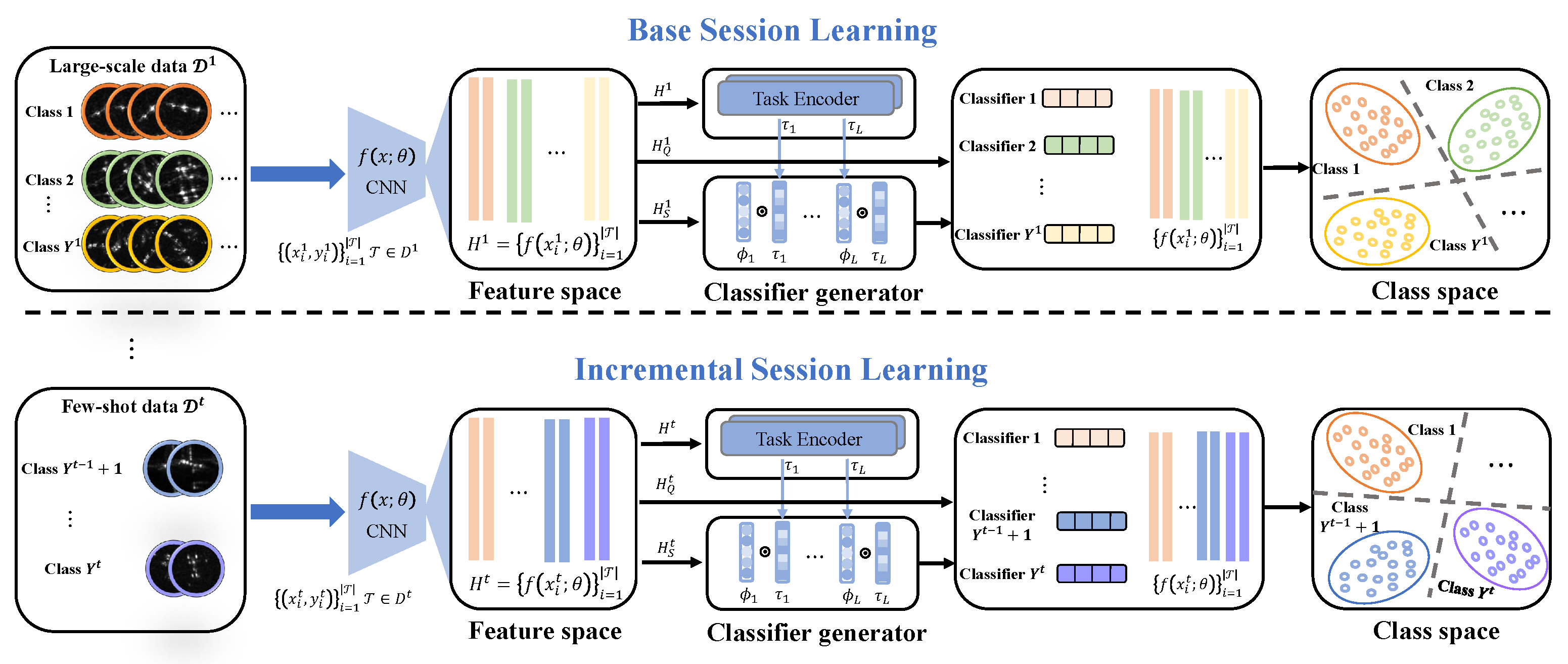
In this section, we introduce the details of DTAC model, as shown in Figure 1, our proposed model consists of three modules: feature extraction module, task information encoding module and classifier generation module. Given a FSCIL task T , feature extraction module learns the embedding of target. The task information coding module encodes FSCIL task information to generate task-aware network modulation parameters, and uses it to modulate the network parameters of the classifier generated network. The modulated classifier generator encodes the feature of support set to generate classifiers that can be used to classify targets of different classes. Compared with the traditional FSCIL method, instead of using a unified classifier to distinguish new class samples, we generate new classifiers for new classes, which effectively solves the problem of few-shot class incremental learning.

4.2. Task Information Encoding Module

Firstly, we employ a CNN-based feature extractor f ( · ; θ ) , parameterized by θ , to represent target features in SAR images. The feature extractor f ( · ; θ ) adopts a modified ResNet-18 backbone, with the first convolutional layer adjusted to adapt to SAR image input dimensions. At different session, new categories of FSCIL tasks continue to appear. For example, C t is the class set of training data D t and | C t | refers to the number of categories in C t , for j , k t , j k , C j C k = and | C j | | C k | . In order to enhance the adaptability of the model to FSCIL tasks at different session, we propose task information encoding module. Given a FSCIL task T = ( x i t , y i t ) i = 1 | T | , the task embedding H t , t 1 can be calculated by
H t = f ( X ; θ ) , X = { x i t } i = 1 | T | ,
and then, the modulation parameter τ can be obtained by encoding task information
τ j = f ( H t ; ψ j ) , j = 1 , 2 , , L ,
where L is the number of classifier generator network layers, ψ j represents the network parameter of the j-th task encoder, which is used to generate modulation parameters τ j for the j-th layer network of the classifier generator as shown in Figure 1.
In this paper, we set the number of network layers in the classifier generator as L = 3 , which dictates the design of three parallel task encoders. Each task encoder is dedicated to generating modulation parameters τ j for the j-th layer of the classifier generator, enabling layer-wise adaptive adjustment of the classifier’s weight parameters to match the feature distribution of the current few-shot incremental task. Each task encoder adopts a unified multi-layer perceptron (MLP) architecture consisting of three consecutive fully connected layers. A critical design constraint is that the output dimension of j-th task encoder is strictly consistent with the parameter dimension of the j-th layer in the classifier generator. This consistency ensures that the modulation parameters τ j can directly modulate the weight parameters of the corresponding layer in the classifier generator without dimensional mismatch.
The task encoder enhances the sensitivity of the model to FSCIL tasks and can generate specific network parameters based on task information, which improves the model’s adaptability to new class.

4.3. Classifier Generation Module

After encoding task information in the previous module, we proceed to the classifier generation stage. Traditional FSCIL models try to train a deep learning model so that it can map all classes of samples to the same feature space and be distinguishable. This puts a high demand on model design and training data volume, especially in few-shot settings. Rather than relying on a solitary classifier for the discrimination of all samples, including those from emerging classes, we introduce a classifier generation module. This module is designed to encode labeled support samples and subsequently learn distinctive classifiers tailored to each class, thereby enhancing classification accuracy and adaptability.
After encoding task information to obtain layer-wise modulation parameters, the classifier generation module dynamically constructs a task-specific classifier to match the current few-shot incremental task. Consistent with the design of the task encoder ( L = 3 ), the classifier generator adopts a three-layer MLP architecture, where each layer’s weight parameters are modulated by the corresponding task encoder’s output τ j , ensuring the classifier’s structure is adaptive to task characteristics:
ϕ ^ = { ϕ 1 τ 1 , , ϕ L τ L } .
Then, using the embedding H S t of the support set sample as the input, the classifier dedicated to the current FSCIL task is dynamically obtained through the modulated classifier generator
c l s k = f ( H k t ; ϕ ^ ) , H k t H S t ,
where c l s k represents the classifier parameter of the k-th class. At the different session, we can generate corresponding classifier based on the number of class.

4.4. Model Optimization

To this end, after constructing task-specific classifiers in the previous module, we proceed to optimize the proposed DTAC model. At session t, we sample the FSCIL task T from the training data D t , which serves as an input to train our proposed DTAC model. For all FSCIL tasks, the support set and query set are split at a ratio of 1:4. Specifically, in N-way K-shot tasks, each class contributes K samples to the support set and 4 K samples to the query set (e.g., 5-shot tasks use 5 support samples and 20 query samples per class). As mentioned earlier, we generate unique classifiers for different classes, and the predicted class label can be represented as
y i ˜ = S o f t m a x ( H i t c l s ) , i = 1 , 2 , , | H t | ,
where c l s = c l s k | k = 1 , 2 , | C t | represents the generated classifier set, • represents the inner product operation.
Within this work, we optimize the proposed model under a meta-learning paradigm, leveraging cross-entropy loss to guide the training process. Therefore, the update of the network parameters in inner-loop will be formulated as
θ ^ , ψ ^ , ϕ ^ = θ , ψ , ϕ α L T ( θ , ψ , ϕ , S T ) ,
where θ , ψ , ϕ are the network parameters of DTAC model, S T is the support set data in FSCIL task T .
Finally, we will update all the network parameters in the outer-loop:
θ , ψ , ϕ = θ , ψ , ϕ β L T ( θ ^ , ψ ^ , ϕ ^ , Q T ) ,
where Q T is the query set data in FSCIL task T .
The whole scheme of DTAC can be summarized in Algorithm 1.
Algorithm 1: Training Procedure of DTAC
Input: Training Data D t  Input:  α , β
  1:
Randomly initialize θ , ψ , ϕ
  2:
while not done do
  3:    
Sample batch of FSCIL task T D t .
  4:    
for all session t do
  5:        
Given a FSCIL task T = ( x i t , y i t ) i = 1 | T | , calculating the task embedding H t , t 1 by Equation (4).
  6:        
Calculate modulation parameter τ by Equation (5).
  7:        
Calculate modulated weight parameters ϕ ^ of the classifier generator by Equation (6).
  8:        
Calculate the parameters c l s of the classifier for each category by Equation (7).
  9:        
Calculate the prediction label y ˜ by Equation (8).
10:        
Update the network parameters θ , ψ , ϕ in inner-loop: θ ^ , ψ ^ , ϕ ^ = θ , ψ , ϕ α L T ( θ , ψ , ϕ , S T ) .
11:    
end for
12:    
Update all the network parameters in the outer-loop: θ , ψ , ϕ = θ , ψ , ϕ β L T ( θ ^ , ψ ^ , ϕ ^ , Q T ) .
13:
end while

5. Experiments

In this section, we conduct experiments on two real-world SAR ATR datasets and compare the proposed DTAC method with state-of-the-art few-shot class incremental learning approaches. We introduce the datasets, baselines, network architecture and then report the performance.

5.1. Dataset Preparation and Experimental Settings

In the experiment, we construct two SAR ATR datasets with diversity in target categories and sizes, imaging platform diversity, and observation environment diversity, for comprehensive evaluation of the performance of our proposed DTAC model.
(1) SAR-Aircraft-1.0-FSCIL: We constructed the SAR-Aircraft-1.0 FSCIL dataset based on the SAR-Aircraft-1.0 dataset [56] for evaluation purposes. SAR-Aircraft-1.0 was released by the Chinese Academy of Sciences for fine-grained aircraft detection and recognition in SAR imagery, covering three airports with data acquired by China’s Gaofen-3 satellite in C-band single-polarization spotlight mode at 1-meter spatial resolution. This dataset contains 4368 image chips and 16,463 aircraft instances categorized into seven classes (A220, A320, A330, ARJ21, Boeing 737, Boeing 787, and Others). For FSCIL in SAR ATR, we selected the four most populous classes as base session data D 1 , with the remaining three classes serving as incremental data D t , t > 1 ; base and incremental classes contain 2000 and 5 training samples respectively, with 200 test samples per class (Table 1).
(2) MSTAR-FSCIL: Complementing the target datasets captured by spaceborne SAR payloads mentioned above, and considering their distinct imaging conditions and targets (namely airborne platforms and fine-grained ground vehicles), we formulated the MSTAR-FSCIL dataset derived from MSTAR V1.7.0 [25]. Similarly, we selected four classes (BTR70, 2S1, BRDM2, BMP2) containing full-aspect samples imaged at 17° depression angle as base session data D 1 ; the remaining six classes utilize randomly chosen few-shot samples for incremental learning and model evaluation (Table 2).
The experimental environment comprised a Windows 10 operating system, Core i7-12800HX CPU, and NVIDIA RTX A3000 GPU, utilizing Python 3.8 programming language with PyTorch version 1.9.1; optimization was performed using Adam. The model was trained for 150 epochs with a batch size of 32. The inner-loop update steps (3 iterations), and the outer-loop update frequency (1 update per 2 task batches). Finally, we set inner-loop learning rate α and outer-loop learning rate β to 0.005 and 0.001.

5.2. Baselines

Our methodology undergoes extensive task-specific evaluations as detailed below.
(1) Traditional deep learning-based solutions: We employ Ft-CNN and Oracle as comparative methods. The former directly optimizes a CNN-based classifier on current session data via cross-entropy loss, while the latter constitutes an offline learner trained on all available data from seen classes.
(2) Incremental learning solutions: We employ three representative incremental learning classifiers iCaRL [57], EEIL [58], and LUCIR [59] as baselines. Specifically, since these methods adhere to a replay-based paradigm, all samples from new classes are preserved to facilitate learning in subsequent stages, thereby ensuring fair comparison.
(3) FSCIL solutions: We incorporate eight methods, TOPIC [60], ERDIL [45], IDLVQC [61], CEC [62], FACT [50], ALICE [63], SAVC [48], and CPL [42] for comprehensive evaluation. Notably, SAVC, driven by extensive semi-supervised learning tasks, achieves state-of-the-art performance on natural datasets as reported in its original publication. CPL is specifically designed for FSCIL in the SAR ATR tasks, thoroughly exploiting potential connections between cosine-based criteria and target azimuth prior knowledge.

5.3. Performance Evaluation

In our experiments, four evaluation metrics are employed: classification accuracy (Acc.)—the most prevalent metric—assesses comparative methods on seen classes during each session; average accuracy (Avg.Acc) reports the mean across all sessions; harmonic accuracy (HA) equitably accounts for model performance on both base and incremental classes Acc(base) and Acc(inc) by balancing their contributions per incremental session, with the average across sessions denoted as Avg.HA; finally, performance degradation rate (PD) quantifies absolute performance decline by subtracting the last session’s accuracy from the first session’s.
H A = 2 × A C C ( b a s e ) × A C C ( i n c ) A C C ( b a s e ) + A C C ( i n c ) .
In this section, we conduct extensive experiments on FSCIL for two distinct SAR ATR datasets to evaluate the performance of our method against baseline approaches. Results and comprehensive analyses are presented from both quantitative and qualitative perspectives.
(1) Quantitative Results and Analyses
The quantitative results of our method across both aforementioned scenarios, along with comparative benchmark evaluations, are presented in Table 3 and Table 4. We first conduct detailed analyses of all benchmarks according to standard metrics—namely average accuracy (Avg.Acc) and performance degradation (PD), wherein smaller PD values indicate superior model performance. This is followed by a concise comparison with task-specific state-of-the-art methods in terms of harmonic accuracy (HA).
(a) Compared to traditional DL-based solutions: The performance of traditional CNN-based classifiers is presented in the first two rows of Table 3 and Table 4. Notably, our proposed DTAC model outperforms both Ft-CNN and Oracle. Due to the absence of specialized modules and strategies tailored for FSCIL in SAR ATR, Ft-CNN suffers from severe catastrophic forgetting and yields the poorest results, achieving Avg.Acc of 77.38% and 59.70% across the two datasets, respectively. While the Oracle model incorporates offline training on seen samples, it fails to acquire useful knowledge from limited data, consequently underperforming our method (e.g., Avg.Acc of 78.71% vs. 86.30% and 78.68% vs. 82.12% on the two datasets).
(b) Compared to Incremental learning solutions: The performance of incremental learning (IL) methods is reported in rows 3–5 of Table 3 and Table 4. By employing techniques such as feature alignment and regularization, example replay, and non-parametric classification to address catastrophic forgetting, these approaches achieve more competitive results than conventional methods. Among them, LUCIR utilizes cosine-based criteria for target classification, attaining the most competitive performance with Avg.Acc scores of 82.86% and 76.77% across the two datasets. Nevertheless, while IL methods demonstrate enhanced recognition capabilities for new classes in SAR ATR FSCIL scenarios, their learning and discriminative capacities remain constrained during incremental learning due to the limited samples available for novel classes in FSCIL tasks; consequently, they still underperform our proposed method.
(c) Compared to FSCIL solutions: We analyze the performance of compared FSCIL benchmarks for general and SAR ATR tasks separately.
  • The comprehensive results for FSCIL methods are reported in rows 6–12 of Table 3 and Table 4. Collectively, these approaches incorporate specialized techniques addressing inherent FSCIL challenges, such as neural gas (TOPIC), exemplar-relation graph for knowledge replay (ERDIL), meta-learning for fast adaption (CEC), and virtual-class augmentation for forward transferring (FACT, ALICE, and SAVC), yielding competitive outcomes. For instance, compared to IL methods like iCaRL and EEIL, ERDIL, CEC, ALICE, and SAVC demonstrate enhanced performance when handling imbalanced base-class and novel-class samples. Notably, SAVC exhibits competitive advantages over most general FSCIL solutions, achieving Avg.Acc scores of 81.05% and 78.20% on the two datasets, respectively, evidencing its representation capabilities rooted in SSL and hallucinative feature construction.
  • Row 13 of Table 3 and Table 4 reports the performance of the FSCIL model CPL for SAR ATR. By thoroughly incorporating intrinsic relationships among structural features of SAR targets and designing specialized modules with tailored loss functions, CPL achieves advanced performance metrics—attaining Avg.Acc of 84.49% and 78.56% alongside PD rates of 27.31% and 36.23% across both datasets—outperforming all comparative FSCIL solutions. Nevertheless, our proposed DTAC model realizes further substantial performance improvements by leveraging task-specific mechanisms and dynamic classifier modules, demonstrating its effectiveness for FSCIL in SAR ATR.
Furthermore, the harmonic accuracy (HA) of our method alongside four state-of-the-art approaches, namely Oracle, LUCIR, SAVC, and CPL, is reported at the bottom of both tables. Since no novel classes exist during the base phase, only HA results per incremental session and their average (Avg.HA) are presented. Notably, among the four baseline methods, the FSCIL model CPL achieves competitive outcomes. In contrast, our proposed DTAC model, incorporating task-specific adaptability and dynamic classifier discriminability across diverse classes, attains the most competitive HA in every incremental session comparison. Consequently, it yields optimal average results of 63.16% and 75.95% across the two constructed SAR ATR datasets for FSCIL.
Finaly, we evaluate the practical application potential of the proposed DTAC method and baselines (Oracle, LUCIR, SAVC, and CPL). All models are tested on SAR images with a unified size of 3 × 512 × 512 (consistent with the training input format), covering representative samples from both SAR-Aircraft-1.0-FSCIL and MSTAR-FSCIL datasets. Table 4 summarizes the inference time per sample of the proposed DTAC and four representative baselines (Oracle, LUCIR, SAVC, CPL) on the two datasets. Oracle and LUCIR adopt relatively simple network architectures. Their inference times are the shortest (9.7 ms and 11.3 ms, respectively), which is attributed to fewer network parameters and simplified decision logic. However, their recognition performance is suboptimal. SAVC and CPL employ more complex designs to enhance recognition accuracy. Compared to Oracle and LUCIR, their Avg.Acc and Avg.HA are significantly improved. However, their inference times increase substantially: SAVC takes 19.2 ms per sample, and CPL’s inference time is 28.6 ms, which is due to additional feature enhancement modules and complex prototype optimization processes that increase computational overhead. Despite integrating three core modules (feature extraction, task information encoding, dynamic classifier generation), the proposed DTAC’s inference time (23.5 ms) is well within the acceptable range for practical applications. This balance is enabled by the efficient task-adaptive mechanism: the dynamic classifier generation module avoids redundant parameter updates, and the task information encoding module adopts a three-layer MLP, minimizing computational overhead while maximizing recognition performance.
In the proposed algorithmic framework, we conduct comprehensive ablation studies on the task encoder and the classifier generation network. All experiments are conducted under strictly controlled settings—using identical training and testing datasets, fixed hyperparameters, and consistent implementation environments—to ensure result reproducibility and eliminate performance variability due to random factors. We adopt a convolutional neural network (CNN)-based feature extractor as the baseline architecture. Incremental enhancements are then introduced by sequentially incorporating the task encoder (TE) and the classifier generator (CG). The performance evolution across these variants is systematically evaluated and summarized in Table 5 and Table 6, clearly demonstrating the individual and combined impacts of the added components on model efficacy.
As can be clearly observed from Table 5 and Table 6, the recognition accuracy of the proposed model remains at an extremely low level when only the backbone network is deployed, thus failing to achieve target recognition in a reliable manner. With the incremental integration of each functional module, the target recognition accuracy undergoes a substantial improvement. Notably, the task encoder exerts the most prominent effect on performance enhancement. When all modules are integrated into the framework, the model attains its optimal performance, which fully validates the effectiveness of each constituent module in the proposed DTAC model.
(2) Qualitative Results and Analyses
In this section, we present qualitative exploration outcomes, including performance curves and histograms, confusion matrices, and t-SNE visualizations for comprehensive assessment.
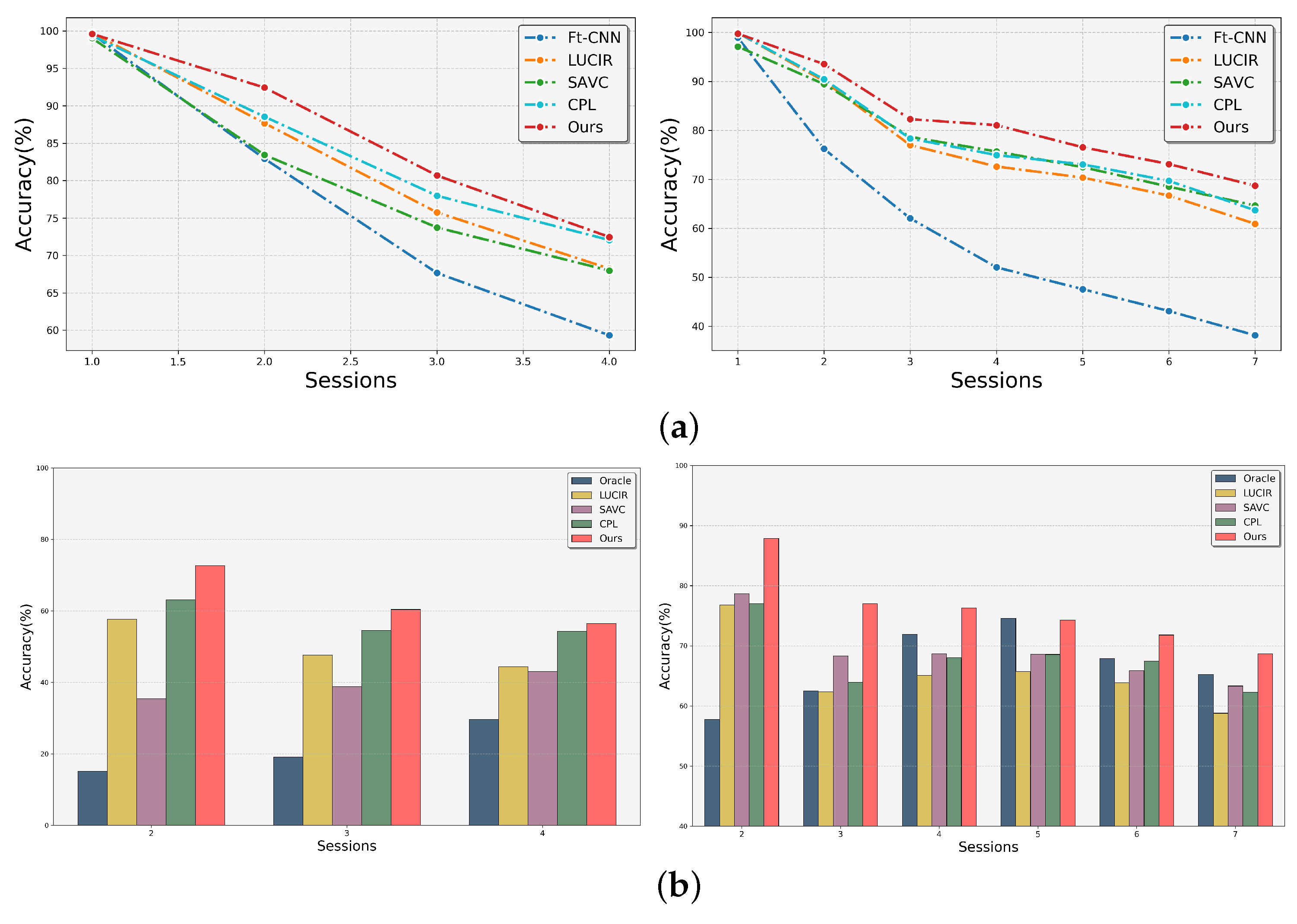
(a) Performance curves and histograms: Beyond classification accuracy comparisons with baseline methods, we present performance curves and histograms of comparative benchmarks. Figure 2 reveals three distinct advantages of our proposed DTAC approach: First, it achieves optimal comprehensive performance in mid-session accuracy across all FSCIL datasets (as illustrated by the red curve); Second, our method effectively mitigates catastrophic forgetting, attaining the lowest PD rates across all learning scenarios (evidenced by curve endpoints); Third, DTAC optimally balances model stability for prior knowledge and plasticity for new information, consequently achieving the highest HA in every incremental session (demonstrated by the crimson histogram bars).
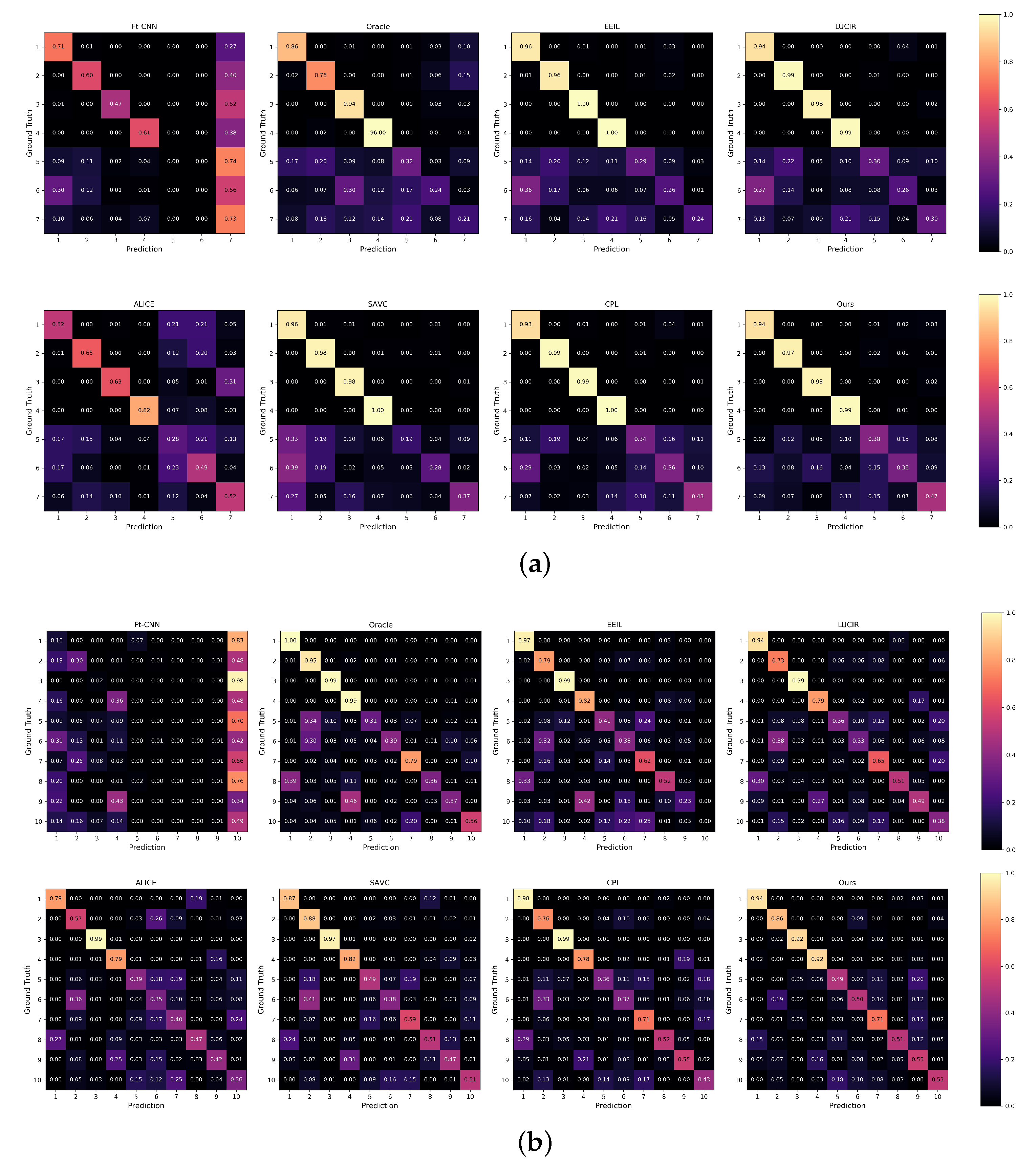
(b) Confusion matrices: Figure 3 displays the confusion matrix between predicted and ground-truth labels for the final session. Due to repeated experimental trials, results are aggregated and normalized to ensure equitable evaluation; consequently, each row sums to unity, with diagonal values representing correct classification probabilities. Key observations reveal: First, traditional recognition methods like Ft-CNN exhibit pronounced bias toward base classes owing to limited training samples for novel categories, failing to learn discriminative features for new classes—demonstrating severe catastrophic forgetting of prior knowledge; Second, incremental learning and FSCIL methods (excluding FACT) yield more balanced confusion matrices by addressing novel-class classification and few-sample challenges, indicating partial mitigation of inherent difficulties; however, their weak exploration of domain-specific SAR target knowledge results in inadequate representation and discriminative capabilities for novel classes, falling short of expected efficacy. For the SAR-Aircraft-1.0-FSCIL dataset, the most prominent misclassification occurs between the incremental classes “A320” and “A330”. This error arises from the inherent similarity of the two aircraft types in SAR images: both belong to large civil jetliners with similar fuselage length and wingspan. Under the few-shot incremental learning setting, limited training samples (only 5 samples per class) make it difficult for traditional models to capture fine-grained discriminative features, leading to higher misclassification rates. For the MSTAR-FSCIL dataset, the main misclassification occurs between the incremental classes “ZIL131” (a military truck) and “BTR60” (an armored personnel carrier). The root cause of this error is the similar RCS characteristics of the two targets under specific depression angles: both have a long and narrow overall structure, and the scattering centers of the body and wheels overlap in SAR images, leading to ambiguous feature representations; Third, owing to simultaneous consideration of stability–plasticity trade-offs and domain-specific characteristics, both CPL and our proposed method outperform alternatives—particularly, our method’s matrix exhibits higher contrast and intensity in most diagonal blocks, signifying enhanced compatibility between transferability and discriminability during few-shot incremental learning for SAR ATR.
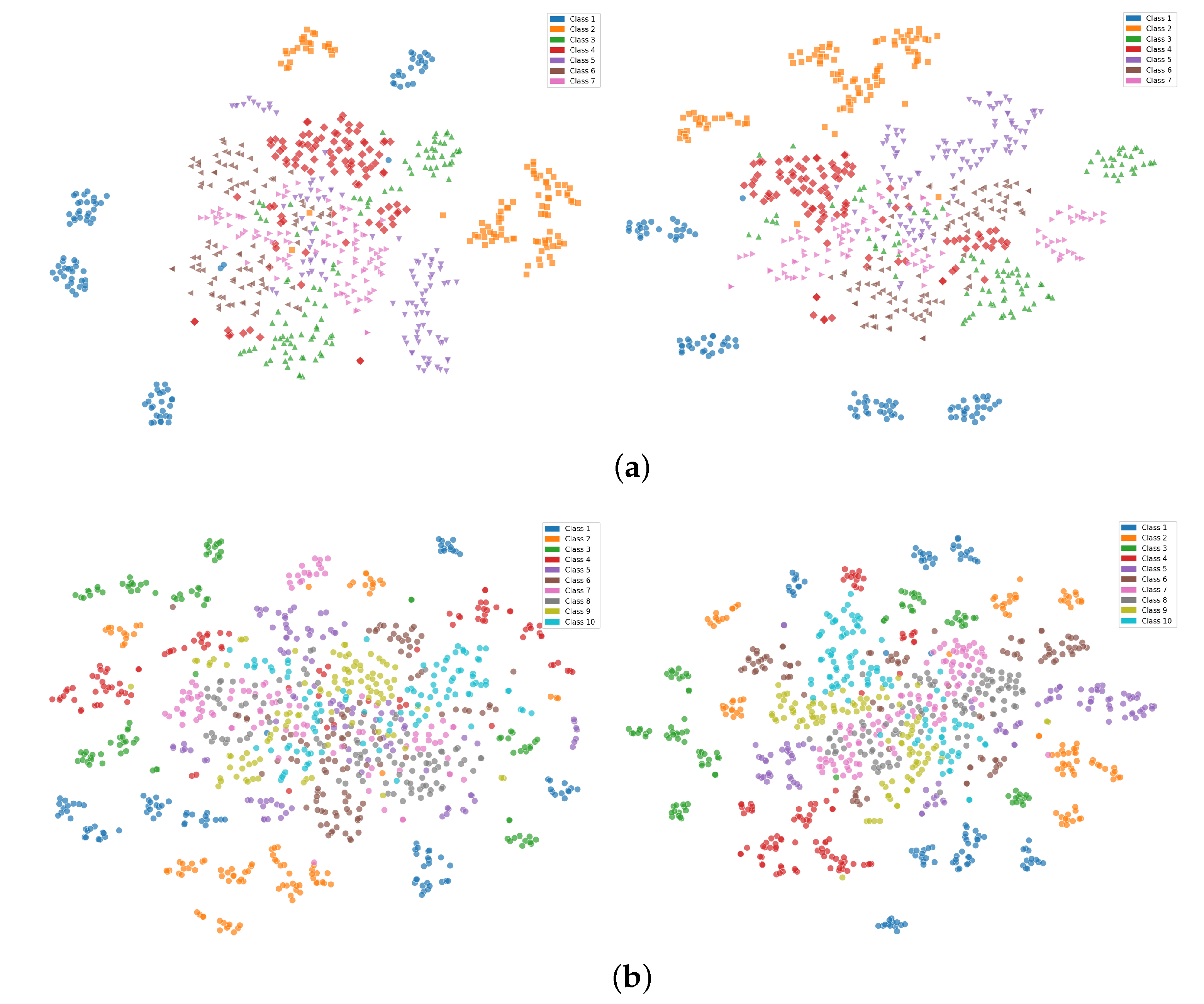
(c) t-SNE results: The t-SNE results are investigated in this part. The results for targets in the SAR-Aircraft-1.0-FSCIL and the MSTAR-FSCIL datasets are presented in Figure 4. We observe that features extracted by our method exhibit greater inter-class discriminability. Compared to novel-class features extracted by baseline approaches, those generated by our method manifest reduced feature-space overlap with previously learned classes and enhanced independence.


6. Conclusions

In this paper, to address the problems of class-incremental learning and few-shot learning in the field of SAR image target recognition, we propose a Few-Shot Class-Incremental SAR Target Recognition method based on a Dynamic Task-Adaptive Classifier (DTAC). This method emphasizes task adaptability through a feature extraction module, a task information encoding module, and a classifier generation module. The feature extraction module identifies both target-specific features and task-specific features, while the task information encoding module adjusts the network parameters of the classifier generation module based on relevant task information to enhance adaptability. Our innovative classifier generation module, incorporating task-specific insights, can dynamically assemble classifiers suitable for the current task, effectively adapting to various scenarios and samples of new categories. Our experimental evaluation demonstrates state-of-the-art performance on two FSCIL benchmarks derived from SAR-Aircraft-1.0 and MSTAR datasets, encompassing diverse target categories captured by both airborne and spaceborne SAR systems. Comprehensive comparisons with multiple contemporary baselines across these datasets consistently validate the superiority of our approach for SAR ATR in FSCIL scenarios.

Author Contributions

Conceptualization, D.L., F.Z. and Y.L.; methodology, D.L., F.Z. and W.C.; software, D.L. and F.Z.; validation, D.L., F.Z., W.C. and Y.L.; formal analysis, Y.L.; investigation, D.L.; resources, D.L. and W.C.; data curation, D.L. and F.Z.; writing—original draft preparation, D.L.; writing—review and editing, F.Z., W.C. and Y.L.; visualization, D.L. and F.Z.; supervision, W.C. and Y.L.; project administration, W.C. and Y.L. All authors have read and agreed to the published version of the manuscript.

Funding

This research received no external funding.

Data Availability Statement

All relevant data supporting the findings of this study are available in the Journal of Radars (doi: 10.12000/JR23043) and Sensor Data Management System (https://www.sdms.afrl.af.mil/index.php?collection=mstar, accessed on 1 February 2026).

Conflicts of Interest

The authors declare no conflict of interest.

References

  1. Haloho, L.S.; Supriyadi, A.A. Utilization of satellite technology in communication systems, disaster monitoring, border surveillance, and military intelligence: A literature review. Remote Sens. Technol. Def. Environ. 2024, 1, 36–44. [Google Scholar] [CrossRef] [Scilit]
  2. An, S.; Han, S.; Kim, D.J. Enhancing SAR ATR Accuracy for Military Targets: A Novel Approach Using XTI and Amplitude Data Integration. IEEE Geosci. Remote Sens. Lett. 2024, 22, 4001705. [Google Scholar] [CrossRef] [Scilit]
  3. Pawar, S.; Gandhe, S. SAR (Synthetic Aperture Radar) image study and analysis for object recognition in surveillance. Int. J. Intell. Syst. Appl. Eng. 2023, 11, 552–573. [Google Scholar]
  4. Yin, J.; Duan, C.; Wang, H.; Yang, J. A review on the few-shot SAR target recognition. IEEE J. Sel. Top. Appl. Earth Obs. Remote Sens. 2024, 17, 16411–16425. [Google Scholar] [CrossRef] [Scilit]
  5. Wen, Z.; Liu, Z.; Zhang, S.; Pan, Q. Rotation awareness based self-supervised learning for SAR target recognition with limited training samples. IEEE Trans. Image Process. 2021, 30, 7266–7279. [Google Scholar] [CrossRef] [Scilit]
  6. Sun, Y.; Jiang, W.; Yang, J.; Li, W. SAR target recognition using cGAN-based SAR-to-optical image translation. Remote Sens. 2022, 14, 1793. [Google Scholar] [CrossRef] [Scilit]
  7. Li, C.; Du, L.; Li, Y.; Song, J. A novel SAR target recognition method combining electromagnetic scattering information and GCN. IEEE Geosci. Remote Sens. Lett. 2022, 19, 4508705. [Google Scholar] [CrossRef] [Scilit]
  8. Zhang, Y.; Guo, X.; Ren, H.; Li, L. Multi-view classification with semi-supervised learning for SAR target recognition. Signal Process. 2021, 183, 108030. [Google Scholar] [CrossRef] [Scilit]
  9. Choi, J.H.; Lee, M.J.; Jeong, N.H.; Lee, G.; Kim, K.T. Fusion of target and shadow regions for improved SAR ATR. IEEE Trans. Geosci. Remote Sens. 2022, 60, 5226217. [Google Scholar] [CrossRef] [Scilit]
  10. Ai, J.; Mao, Y.; Luo, Q.; Jia, L.; Xing, M. SAR target classification using the multikernel-size feature fusion-based convolutional neural network. IEEE Trans. Geosci. Remote Sens. 2021, 60, 5214313. [Google Scholar] [CrossRef] [Scilit]
  11. Li, K.; Yu, H.; Li, S.; Chen, S.; Wang, B. PFARN: Pyramid fusion attention and refinement network for multiscale ship detection in SAR images. IEEE J. Sel. Top. Appl. Earth Obs. Remote Sens. 2025, 18, 9821–9836. [Google Scholar] [CrossRef] [Scilit]
  12. Geng, Z.; Xu, Y.; Wang, B.N.; Yu, X.; Zhu, D.Y.; Zhang, G. Target recognition in SAR images by deep learning with training data augmentation. Sensors 2023, 23, 941. [Google Scholar] [CrossRef] [Scilit] [PubMed]
  13. Feng, S.; Ji, K.; Zhang, L.; Ma, X.; Kuang, G. SAR target classification based on integration of ASC parts model and deep learning algorithm. IEEE J. Sel. Top. Appl. Earth Obs. Remote Sens. 2021, 14, 10213–10225. [Google Scholar] [CrossRef] [Scilit]
  14. Song, F.; Li, Y.; Cheng, W.; Dong, L. An improved dynamic programming tracking-before-detection algorithm based on LSTM network value function. Syst. Sci. Control Eng. 2023, 11, 2223227. [Google Scholar] [CrossRef] [Scilit]
  15. Akhtar, M.M.; Li, Y.; Cheng, W.; Dong, L.; Tan, Y. OHDL: Radar target detection using optimized hybrid deep learning for automotive FMCW. Digit. Signal Process. 2025, 158, 104962. [Google Scholar] [CrossRef] [Scilit]
  16. Guan, J.; Liu, J.; Feng, P.; Wang, W. Multiscale deep neural network with two-stage loss for SAR target recognition with small training set. IEEE Geosci. Remote Sens. Lett. 2021, 19, 4011405. [Google Scholar] [CrossRef] [Scilit]
  17. Ni, P.; Xu, G.; Pei, H.; Qiao, Y.; Yu, H.; Hong, W. Dual-Stream Manifold Multiscale Network for Target Recognition in Complex-Valued SAR Image With Electromagnetic Feature Fusion. IEEE Trans. Geosci. Remote Sens. 2025, 63, 5217215. [Google Scholar] [CrossRef] [Scilit]
  18. Zhang, J.; Xing, M.; Xie, Y. FEC: A feature fusion framework for SAR target recognition based on electromagnetic scattering features and deep CNN features. IEEE Trans. Geosci. Remote Sens. 2020, 59, 2174–2187. [Google Scholar] [CrossRef] [Scilit]
  19. Zhang, Y.; Guo, X.; Leung, H.; Li, L. Cross-task and cross-domain SAR target recognition: A meta-transfer learning approach. Pattern Recognit. 2023, 138, 109402. [Google Scholar] [CrossRef] [Scilit]
  20. Chen, S.; Wu, M.; Wen, P.; Xu, F.; Zhao, S. A Multimode Anomaly Detection Method Based on OC-ELM for Aircraft Engine System. IEEE Access 2021, 9, 28842–28855. [Google Scholar] [CrossRef] [Scilit]
  21. Wang, L.; Yang, X.; Tan, H.; Bai, X.; Zhou, F. Few-shot class-incremental SAR target recognition based on hierarchical embedding and incremental evolutionary network. IEEE Trans. Geosci. Remote Sens. 2023, 61, 5204111. [Google Scholar]
  22. Kong, L.; Gao, F.; He, X.; Wang, J.; Sun, J.; Zhou, H.; Hussain, A. Few-shot class-incremental SAR target recognition via orthogonal distributed features. IEEE Trans. Aerosp. Electron. Syst. 2024, 61, 325–341. [Google Scholar] [CrossRef] [Scilit]
  23. Karantaidis, G.; Pantsios, A.; Kompatsiaris, I.; Papadopoulos, S. Few-Shot Class-Incremental Learning For Efficient SAR Automatic Target Recognition. arXiv 2025, arXiv:2505.19565. [Google Scholar]
  24. Li, P.; Hu, X.; Feng, C.; Feng, W. Few-shot class-incremental SAR target classification based on class-aware bilateral distillation. In Proceedings of the IET Conference Proceedings CP874, Chongqing, China, 3–5 December 2023; Volume 2023, pp. 3413–3418. [Google Scholar]
  25. Novak, L.M.; Owirka, G.J.; Brower, W.S.; Weaver, A.L. The automatic target-recognition system in SAIP. Linc. Lab. J. 1997, 10, 187–202. [Google Scholar]
  26. Novak, L.M.; Owirka, G.J.; Brower, W.S. Performance of 10-and 20-target MSE classifiers. IEEE Trans. Aerosp. Electron. Syst. 2000, 36, 1279–1289. [Google Scholar]
  27. Novak, L.M.; Halversen, S.D.; Owirka, G.; Hiett, M. Effects of polarization and resolution on SAR ATR. IEEE Trans. Aerosp. Electron. Syst. 2002, 33, 102–116. [Google Scholar] [CrossRef] [Scilit]
  28. Ikeuchi, K.; Wheeler, M.D.; Yamazaki, T.; Shakunaga, T. Model-based SAR ATR system. In Algorithms for Synthetic Aperture Radar Imagery III; SPIE: Bellingham, WA, USA, 1996; Volume 2757, pp. 376–387. [Google Scholar]
  29. Hummel, R. Model-based ATR using synthetic aperture radar. In Proceedings of the Record of the IEEE 2000 International Radar Conference [Cat. No. 00CH37037], Alexandria, VA, USA, 12 May 2000; IEEE: New York, NY, USA, 2000; pp. 856–861. [Google Scholar]
  30. Diemunsch, J.R.; Wissinger, J. Moving and stationary target acquisition and recognition (MSTAR) model-based automatic target recognition: Search technology for a robust ATR. In Algorithms for Synthetic Aperture Radar Imagery V; SPIE: Bellingham, WA, USA, 1998; Volume 3370, pp. 481–492. [Google Scholar]
  31. Thiagarajan, J.J.; Ramamurthy, K.N.; Knee, P.; Spanias, A.; Berisha, V. Sparse representations for automatic target classification in SAR images. In Proceedings of the 2010 4th International Symposium on Communications, Control and Signal Processing (ISCCSP), Limassol, Cyprus, 3–5 March 2010; IEEE: New York, NY, USA, 2010; pp. 1–4. [Google Scholar]
  32. Zhou, Y.; Zhu, Y.; Ren, H.; Kang, J.; Zou, L.; Wang, X. Refined Multi-modal Feature Learning Framework for Marine Target Detection Using Radar Sensor. Digit. Signal Process. 2025, 170, 105816. [Google Scholar] [CrossRef] [Scilit]
  33. Ren, H.; Liang, S.; Miao, L.; Huang, Q.; Lv, Y. Multi-granularity Feature Fusion Network integrating ASC for SAR Target Recognition. IEEE Geosci. Remote Sens. Lett. 2025, 23, 4003805. [Google Scholar] [CrossRef] [Scilit]
  34. Zhang, X.; Zhang, S.; Sun, Z.; Liu, C.; Sun, Y.; Ji, K.; Kuang, G. Semantic scattering graph structure alignment for cross-sensor SAR image target detection. Chin. J. Aeronaut. 2026, 104066. [Google Scholar] [CrossRef] [Scilit]
  35. Dong, G.; Kuang, G. Classification on the monogenic scale space: Application to target recognition in SAR image. IEEE Trans. Image Process. 2015, 24, 2527–2539. [Google Scholar] [CrossRef] [Scilit]
  36. Dong, G.; Wang, N.; Kuang, G.; Zhang, Y. Kernel linear representation: Application to target recognition in synthetic aperture radar images. J. Appl. Remote Sens. 2014, 8, 083613. [Google Scholar] [CrossRef] [Scilit]
  37. Lei, G.; Cheng, W.; Yin, X.; Wu, Y. An innovative approach for FMCW radar vital sign monitoring with removal of respiratory harmonics. Digit. Signal Process. 2025, 157, 104911. [Google Scholar] [CrossRef] [Scilit]
  38. Li, B.; Cui, Z.; Cao, Z.; Yang, J. Incremental learning based on anchored class centers for SAR automatic target recognition. IEEE Trans. Geosci. Remote Sens. 2022, 60, 5235313. [Google Scholar] [CrossRef] [Scilit]
  39. Tang, J.; Xiang, D.; Zhang, F.; Ma, F.; Zhou, Y.; Li, H. Incremental SAR automatic target recognition with error correction and high plasticity. IEEE J. Sel. Top. Appl. Earth Obs. Remote Sens. 2022, 15, 1327–1339. [Google Scholar] [CrossRef] [Scilit]
  40. Dang, S.; Cao, Z.; Cui, Z.; Pi, Y.; Liu, N. Class boundary exemplar selection based incremental learning for automatic target recognition. IEEE Trans. Geosci. Remote Sens. 2020, 58, 5782–5792. [Google Scholar] [CrossRef] [Scilit]
  41. Huang, H.; Gao, F.; Wang, J.; Hussain, A.; Zhou, H. An incremental SAR target recognition framework via memory-augmented weight alignment and enhancement discrimination. IEEE Geosci. Remote Sens. Lett. 2023, 20, 4005205. [Google Scholar] [CrossRef] [Scilit]
  42. Zhao, Y.; Zhao, L.; Ding, D.; Hu, D.; Kuang, G.; Liu, L. Few-shot class-incremental SAR target recognition via cosine prototype learning. IEEE Trans. Geosci. Remote Sens. 2023, 61, 5212718. [Google Scholar] [CrossRef] [Scilit]
  43. Tian, S.; Li, L.; Li, W.; Ran, H.; Ning, X.; Tiwari, P. A survey on few-shot class-incremental learning. Neural Netw. 2024, 169, 307–324. [Google Scholar] [CrossRef] [Scilit]
  44. Kukleva, A.; Kuehne, H.; Schiele, B. Generalized and incremental few-shot learning by explicit learning and calibration without forgetting. In Proceedings of the IEEE/CVF International Conference on Computer Vision, Montreal, QC, Canada, 10–17 October 2021; pp. 9020–9029. [Google Scholar]
  45. Dong, S.; Hong, X.; Tao, X.; Chang, X.; Wei, X.; Gong, Y. Few-shot class-incremental learning via relation knowledge distillation. In Proceedings of the AAAI Conference on Artificial Intelligence, Online, 2–9 February 2021; Volume 35, pp. 1255–1263. [Google Scholar]
  46. Cheraghian, A.; Rahman, S.; Fang, P.; Roy, S.K.; Petersson, L.; Harandi, M. Semantic-aware knowledge distillation for few-shot class-incremental learning. In Proceedings of the IEEE/CVF Conference on Computer Vision and Pattern Recognition, Nashville, TN, USA, 20–25 June 2021; pp. 2534–2543. [Google Scholar]
  47. Tai, Y.; Tan, Y.; Xiong, S.; Tian, J. Mine-distill-prototypes for complete few-shot class-incremental learning in image classification. IEEE Trans. Geosci. Remote Sens. 2023, 61, 5206013. [Google Scholar] [CrossRef] [Scilit]
  48. Song, Z.; Zhao, Y.; Shi, Y.; Peng, P.; Yuan, L.; Tian, Y. Learning with fantasy: Semantic-aware virtual contrastive constraint for few-shot class-incremental learning. In Proceedings of the IEEE/CVF Conference on Computer Vision and Pattern Recognition, Vancouver, BC, Canada, 17–24 June 2023; pp. 24183–24192. [Google Scholar]
  49. Shi, G.; Chen, J.; Zhang, W.; Zhan, L.M.; Wu, X.M. Overcoming catastrophic forgetting in incremental few-shot learning by finding flat minima. Adv. Neural Inf. Process. Syst. 2021, 34, 6747–6761. [Google Scholar]
  50. Zhou, D.W.; Wang, F.Y.; Ye, H.J.; Ma, L.; Pu, S.; Zhan, D.C. Forward compatible few-shot class-incremental learning. In Proceedings of the IEEE/CVF Conference on Computer Vision and Pattern Recognition, New Orleans, LA, USA, 18–24 June 2022; pp. 9046–9056. [Google Scholar]
  51. Zhao, H.; Fu, Y.; Kang, M.; Tian, Q.; Wu, F.; Li, X. Mgsvf: Multi-grained slow versus fast framework for few-shot class-incremental learning. IEEE Trans. Pattern Anal. Mach. Intell. 2021, 46, 1576–1588. [Google Scholar] [CrossRef] [Scilit]
  52. Yang, B.; Lin, M.; Liu, B.; Fu, M.; Liu, C.; Ji, R.; Ye, Q. Learnable expansion-and-compression network for few-shot class-incremental learning. arXiv 2021, arXiv:2104.02281. [Google Scholar]
  53. Kang, H.; Yoon, J.; Madjid, S.R.H.; Hwang, S.J.; Yoo, C.D. On the soft-subnetwork for few-shot class incremental learning. arXiv 2022, arXiv:2209.07529. [Google Scholar]
  54. Zhu, K.; Cao, Y.; Zhai, W.; Cheng, J.; Zha, Z.J. Self-promoted prototype refinement for few-shot class-incremental learning. In Proceedings of the IEEE/CVF Conference on Computer Vision and Pattern Recognition, Nashville, TN, USA, 20–25 June 2021; pp. 6801–6810. [Google Scholar]
  55. Hersche, M.; Karunaratne, G.; Cherubini, G.; Benini, L.; Sebastian, A.; Rahimi, A. Constrained few-shot class-incremental learning. In Proceedings of the IEEE/CVF Conference on Computer Vision and Pattern Recognition, New Orleans, LA, USA, 18–24 June 2022; pp. 9057–9067. [Google Scholar]
  56. Zhirui, W.; Yuzhuo, K.; Xuan, Z.; Yuelei, W.; Ting, Z.; Xian, S. SAR-AIRcraft-1.0: High-resolution SAR aircraft detection and recognition dataset. Radars 2023, 12, 906–922. [Google Scholar]
  57. Rebuffi, S.A.; Kolesnikov, A.; Sperl, G.; Lampert, C.H. icarl: Incremental classifier and representation learning. In Proceedings of the IEEE conference on Computer Vision and Pattern Recognition, Honolulu, HI, USA, 21–26 July 2017; pp. 2001–2010. [Google Scholar]
  58. Castro, F.M.; Marín-Jiménez, M.J.; Guil, N.; Schmid, C.; Alahari, K. End-to-end incremental learning. In Proceedings of the European Conference on Computer Vision (ECCV), Munich, Germany, 8–14 September 2018; pp. 233–248. [Google Scholar]
  59. Hou, S.; Pan, X.; Loy, C.C.; Wang, Z.; Lin, D. Learning a unified classifier incrementally via rebalancing. In Proceedings of the IEEE/CVF Conference on Computer Vision and Pattern Recognition, Long Beach, CA, USA, 15–20 June 2019; pp. 831–839. [Google Scholar]
  60. Tao, X.; Hong, X.; Chang, X.; Dong, S.; Wei, X.; Gong, Y. Few-shot class-incremental learning. In Proceedings of the IEEE/CVF Conference on Computer Vision and Pattern Recognition, Seattle, WA, USA, 13–19 June 2020; pp. 12183–12192. [Google Scholar]
  61. Chen, K.; Lee, C.G. Incremental few-shot learning via vector quantization in deep embedded space. In Proceedings of the International Conference on Learning Representations, Vienna, Austria, 4 May 2021. [Google Scholar]
  62. Zhang, C.; Song, N.; Lin, G.; Zheng, Y.; Pan, P.; Xu, Y. Few-shot incremental learning with continually evolved classifiers. In Proceedings of the IEEE/CVF Conference on Computer Vision and Pattern Recognition, Nashville, TN, USA, 20–25 June 2021; pp. 12455–12464. [Google Scholar]
  63. Peng, C.; Zhao, K.; Wang, T.; Li, M.; Lovell, B.C. Few-shot class-incremental learning from an open-set perspective. In European Conference on Computer Vision; Springer: Cham, Switzerland, 2022; pp. 382–397. [Google Scholar]
Figure 1. An illustration of DTAC. DTAC consists of feature extractor, task encoder and classifier generator. At the base session, a CNN-based feature extractor f ( · ; θ ) is trained to capture target embeddings H 1 in SAR images. Then, the task encoder learns the modulation parameter τ based on the embedding H 1 of the current task, the modulated classifier generator encodes the support set features H S 1 to produce task-specific classifiers. Finally, we use the generated classifier to distinguish the categories of samples in each query set. During incremental learning, we only need to encode the new task and generate the corresponding classifier according to the new category to realize the recognition of the new class of SAR targets.
Remotesensing 18 00527 g001
Figure 2. Performance curves and histograms of compared baselines evaluated on two FSCIL of SAR ATR datasets. Accuracy curves of benchmarks. HA bars of task-specific advanced benchmarks at incremental essions. (a) Accuracy curves of FSCIL benchmarks (SAR-Aircraft-1.0 and MSTAR). (b) HA bars of task-specific advanced benchmarks (SAR-Aircraft-1.0 and MSTAR).
Remotesensing 18 00527 g002
Figure 3. Confusion matrices predicted by baselines at the final session on two datasets. The predictions are normalized across all repeated results for statistic evaluation. The sum of probability scores at each row is 1.0. The probability levels are given by the right-side color bars. The brighter the diagonal blocks, the more accurate results obtained by compared methods. (a) Confusion matrices on the SAR-Aircraft-1.0-FSCIL dataset. (b) Confusion matrices on the MSTAR-FSCIL dataset.
Remotesensing 18 00527 g003
Figure 4. t-SNE of evolved target features projected by Ft-CNN and our method (DTAC) for targets in SAR-Aircraft-1.0-FSCIL and MSTAR-FSCIL datasets. (a) t-SNE visualization on the SAR-Aircraft-1.0-FSCIL dataset. (b) t-SNE visualization on the MSTAR-FSCIL dataset.
Remotesensing 18 00527 g004
Table 1. Configuration of SAR-AIRCRAFT-1.0-FSCIL Dataset.
SessionOrderTypeTrainTest
Base1Other2000200
2A2202000200
3Boeing7872000200
4Boeing7372000200
Incremental5A3205200
6ARJ215200
7A3305200
Table 2. Configuration of MSTAR-FSCIL dataset.
SessionOrderTypeSerial No.TrainTest
Base1BTR70c71233196
22S1b01299274
3BRDM2E-71298274
4BMP29563233196
Incremental5ZIL131E125274
6T62A515273
7D792v130155274
8BTR60k10yt75325195
9T721325196
10ZSU234d085274
Table 3. Comparison of baselines on SAR-Aircraft-1.0-FSCIL dataset.
MethodsSessionsAvg.AccPD
1 2 3 4
Accuracy (%)
Ft-CNN99.6282.9367.6659.3277.3840.30
Oracle99.4781.2469.8364.3178.7135.16
iCaRL99.5088.8276.2065.3782.4734.13
EEIL99.6285.0073.1367.2681.2532.36
LUCIR99.7587.6875.7668.2382.8631.52
TOPIC99.6489.0976.9567.0683.1832.58
ERDIL99.6286.5075.5168.8082.6130.82
IDLVQC99.3785.5372.8064.1080.4535.27
CEC78.9765.6457.7651.7563.5327.22
FACT99.4479.5566.3656.8875.5642.56
ALICE95.6374.6262.3055.6672.0539.97
SAVC99.0483.4473.7467.9781.0531.07
CPL99.3788.5577.9872.0684.4927.31
DTAC (ours)99.6292.4380.6972.4686.3027.16
Harmonic Accuracy (%)Avg.HA
Oracle-29.6319.1515.0821.29-
LUCIR-57.6847.6344.3849.90-
SAVC-35.4738.8543.0539.12-
CPL-63.1054.5954.3157.33-
DTAC (ours)-72.6260.3856.4763.16-
Table 4. Comparison of baselines on MSTAR-FSCIL dataset.
MethodsSessionsAvg.AccPD
1 2 3 4 5 6 7
Accuracy (%)
Ft-CNN98.9476.2162.0152.0247.5543.0838.1259.7060.82
Oracle98.9485.0577.1778.3073.8670.3467.1078.6831.84
iCaRL92.1283.0873.4666.4165.0460.4254.2770.6937.85
EEIL98.9481.7670.7762.7863.3561.5556.6870.8342.26
LUCIR99.8990.0776.9772.6070.3366.7660.8976.7739.00
TOPIC91.1085.2772.7763.2561.2456.0350.0368.5341.07
ERDIL98.9487.9276.0270.1468.6664.1757.9474.8341.00
IDLVQC97.0283.7571.1262.2759.5454.7149.2068.2347.82
CEC90.5480.5272.2772.5366.9761.7657.9771.7932.57
FACT98.8587.3667.1464.2449.5046.9645.0165.5453.84
ALICE97.5586.8372.3666.7363.0559.3654.4471.4743.11
SAVC97.1089.4379.6475.6672.4768.4864.6478.2032.46
CPL99.8990.4178.3274.9373.0469.6663.6678.5636.23
DTAC (ours)99.7493.5182.2781.0576.5373.168.6682.1231.08
Harmonic Accuracy (%)Avg.HAIT (ms)
Oracle-74.5771.9567.9365.2462.5257.7866.639.7
LUCIR-76.7962.3565.1265.7363.9058.8265.4511.3
SAVC-78.6768.3268.6768.6365.9163.3368.9219.2
CPL-77.0463.9768.0268.5767.5062.2867.9028.6
DTAC (ours)-87.8577.0476.3274.2871.8268.6775.9523.5
Table 5. Ablation study on SAR-Aircraft-1.0-FSCIL dataset.
BaseTECGAvg.AccPDAvg.HA
68.62%57.24%18.50%
80.72%32.41%55.26%
78.35%37.50%53.18%
86.30%27.16%63.16%
Table 6. Ablation study on MSTAR-FSCIL dataset.
BaseTECGAvg.AccPDAvg.HA
37.89%65.72%45.25%
79.55%35.68%69.76%
74.82%37.26%67.95%
82.12%31.08%75.95%
Disclaimer/Publisher’s Note: The statements, opinions and data contained in all publications are solely those of the individual author(s) and contributor(s) and not of MDPI and/or the editor(s). MDPI and/or the editor(s) disclaim responsibility for any injury to people or property resulting from any ideas, methods, instructions or products referred to in the content.