Skip to Content
Remote SensingRemote Sensing
  • Article
  • Open Access

20 January 2026

Monitoring Chlorophyll-a and Turbidity Using UAV Imagery and Machine Learning in Small Peri-Urban River in Thrace, Greece


,
,
,
,
,
and
1
School of Rural and Surveying Engineering, Aristotle University of Thessaloniki, 54124 Thessaloniki, Greece
2
Laboratory of Sanitary Engineering and Water-Wastewater Quality, Civil Engineering Department, Democritus University of Thrace, 69100 Komotini, Greece
*
Author to whom correspondence should be addressed.

Highlights

What are the main findings?
  • In this study, turbidity was predicted with higher accuracy than Chlorophyll-a using the developed unmanned aerial vehicle (UAV)-based support vector regression (SVR) models.
  • Spatially explicit turbidity maps presented higher variability across sampling sites and seasons.
What are the implications of the main findings?
  • Low-cost multispectral UAV imagery can support water quality monitoring over small peri-urban rivers.
  • UAVs are the appropriate Earth Observation (EO) platforms for monitoring small inland water bodies.

Abstract
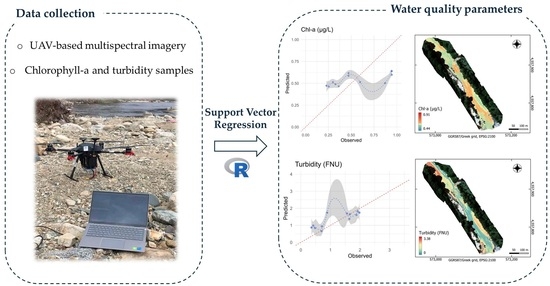
Water quality monitoring is essential for assessing a freshwater ecosystem’s status. This knowledge is indispensable for selecting restoration measures to ensure the provision of ecosystem services and sustainable growth of human communities. Remote sensing (RS) has proven to be effective for this purpose, offering broad coverage and high temporal and spatial resolution, which is particularly important for small water bodies. In this study, UAV-based multispectral imagery is employed to estimate key water quality parameters, namely, Chlorophyll-a (Chl-a) and turbidity, which are relevant to global and national legislation and policies. Machine learning models were developed using the support vector regression (SVR) algorithm. The Chl-a model resulted in an R2 value of 0.49 and an RMSE of 0.24 μg/L, while the turbidity model resulted in an R2 value of 0.70 and an RMSE of 0.38 Formazin Nephelometric Unit (FNU). These models enabled the generation of detailed spatial distribution maps of water quality indicators for the studied river. The proposed approach provides valuable information that supports monitoring for both pressure and restoration impacts, promoting the sustainability of freshwater ecosystems.

1. Introduction

River ecosystems provide multiple ecosystem services that benefit humans and enhance well-being, including water supply and purification, climate regulation, air quality improvement, erosion control, biodiversity support, pollination, and recreation [1]. These ecosystem services make rivers essential for human development and sustainability. Global and national legislative frameworks and policy initiatives, such as the United Nations 2030 Agenda–SDG 6 and the EU Water Framework Directive (EU WFD), aim to protect and, when needed, restore them. However, river ecosystems face increasing threats from population growth, resource exploitation, pollution, damming, and climate change, among other stressors [2], resulting in a synergistic effect that impacts ecosystem health, and thus, impairs the provisioning of goods and services for the environment and society [1].
Water quality monitoring can pinpoint pollution sources and stressor trends, as well as depict the status, and hence support effective water management strategies and accurate condition reporting [3] to ultimately protect and restore these vulnerable and vital ecosystems. Water quality monitoring can be accomplished through assessing indicators—divided into biological quality elements (i.e., phytoplankton and proxies such as Chl-a and phycocyanin), physico-chemical elements (e.g., turbidity, total suspended solids, and dissolved oxygen), and hydromorphology elements (e.g., bathymetry and water flow)—that can determine the ecological status of surface waters [4,5].
Such indicators, also referred to as water quality parameters [3,5,6,7], can traditionally be measured using point-based in situ methods, which offer high precision and strong relevance to the study area [8]. However, such an approach is limited by high costs and long time cycles, making it challenging to provide systematic, spatiotemporal explicit information on the water quality at regional to local scales [9]. Remote sensing (RS) overcomes these limitations by relying on the interaction between light and water constituents and has proven to be an effective method for assessing water quality [8,10]. As solar radiation penetrates a water body, its spectral properties are altered through the absorption and scattering characteristics of water, depending on its dissolved and particulate constituents and their concentrations. Part of this radiation is scattered back to the surface, where it can be detected by optical sensors and is referred to as water-leaving radiance. The ratio of the water-leaving radiance to the downwelling irradiance at the water surface, called the remote sensing reflectance, contains information about the water body and its constituents [11]. By analyzing the optical properties of photosynthetic pigments versus the reflectance rates of particles through RS, accurate estimation of optically active water parameters, such as Chl-a and turbidity can be achieved [9].
Chlorophyll-a (Chl-a) serves as a key indicator of the plankton biomass distribution and is a fundamental measure of primary productivity and water body eutrophication. It is a widely studied parameter through Earth Observation (EO) data due to its significance in assessing water quality [5]. The Chl-a concentration is proportional to the reflectance in the green and red bands and inversely proportional to the reflectance in the blue band [12]. Turbidity is another key indicator for assessing water quality, particularly water transparency, and provides valuable insights into pollutant deposition, decomposition, and diffusion as it is also linked with more properties like oxygen dissolving ability, temperature, and alteration of metabolic/biological processes. As an optically active water quality parameter, turbidity causes incident light to weaken due to absorption and scattering by suspended particles. The extent of light attenuation and its interaction with water can be effectively captured in EO data. Consequently, remote sensing can determine the spatial distribution of turbidity based on the degree of light attenuation. Red and near-infrared (NIR) bands are closely related to turbidity and used to identify low–medium-turbidity waters and high-turbidity waters, respectively [13].
Satellite RS data have been used efficiently for water quality retrieval in many studies [3,12,14,15]; however, satellites’ spatial resolution is often insufficient for monitoring small-to-medium-sized inland water bodies with optically complex waters. Use of satellite EO data is not only challenged by contamination of narrow water bodies signal from adjacent land surfaces [16] but also by time gaps between in situ sample collection and image acquisition, combined with the dynamic nature of small water bodies condition and atmospheric signal attenuation due to clouds and haze [17]. Therefore, the development of robust water quality models through satellite EO data heavily relies on the proper selection and application of the atmospheric correction algorithms [18]. In contrast, unmanned aerial vehicles (UAVs) provide very high-resolution EO data, overcoming challenges such as mixed signals presence by adequately distinguishing between land and water spectral reflectances.
Several studies have leveraged these advantages and estimated water quality parameters of small rivers using sensors mounted on UAVs, as well as ground sampling and laboratory analyses [19,20,21,22,23,24]. Chen et al. (2021) [9] estimated Chl-a and turbidity, among other parameters, at an urban river in China using a Rededge-MX multispectral camera (MicaSense, Inc., Seattle, WA, USA) on a multi-rotor UAV and constructed inversion models using machine learning algorithms. Similarly, Yao et al. (2024) [25] compared the performance of different support vector regression (SVR) models to predict the Chl-a, total phosphorus, NH3-N, and turbidity in small and micro water bodies utilizing a Genie 4 multispectral UAV. Yan et al. (2023) [26] developed inversion models using the quadrotor Elf 4 UAV (Da-Jiang Innovations Science and Technology Co., Ltd. (DJI), Shenzhen China, https://www.dji.com/gr) equipped with a multispectral imaging system, as well as a portable multi-parameter water quality instrument for sampling, aiming to predict dissolved oxygen and turbidity. Cui et al. (2022) [13] monitored the turbidity of small inland water bodies by UAV hyperspectral EO data, statistical analyses, and multiple linear regression models. Earlier studies have also compared the performance of UAV mounted hyperspectral and multispectral sensors for inland water quality assessment, showing the superiority of hyperspectral sensors [27,28]. However, limitations related to sensor costs, flight design requirements, and UAV platform characteristics regarding carrying heavier hyperspectral sensors, as well as the satisfactory modeling accuracy achieved with multispectral UAV imagery, support the use of lower-cost UAV multispectral sensors in inland water quality monitoring [29].
Τhis study focused on estimating two water quality parameters relevant to the EU WFD legislative framework—Chl-a and turbidity—in a small river in Thrace, northeast Greece. The analysis was based on UAV-based multispectral imagery combined with in situ measurements at two sites analyzed in the laboratory for cross-validation and machine learning techniques. The specific objectives of the study were to (1) explore the relationship between UAV-derived reflectance and Chl-a concentration and turbidity by analyzing different band combinations and spectral indices, (2) develop RS based models for water quality monitoring, and (3) explore the temporal and spatial differences in Chl-a and turbidity. The ultimate goal was to promote a tool for aerial low-cost monitoring in narrow Mediterranean streams with shallow waters and vast riverbed diversity, where other RS techniques cannot be applied.

2. Materials and Methods

2.1. Study Area

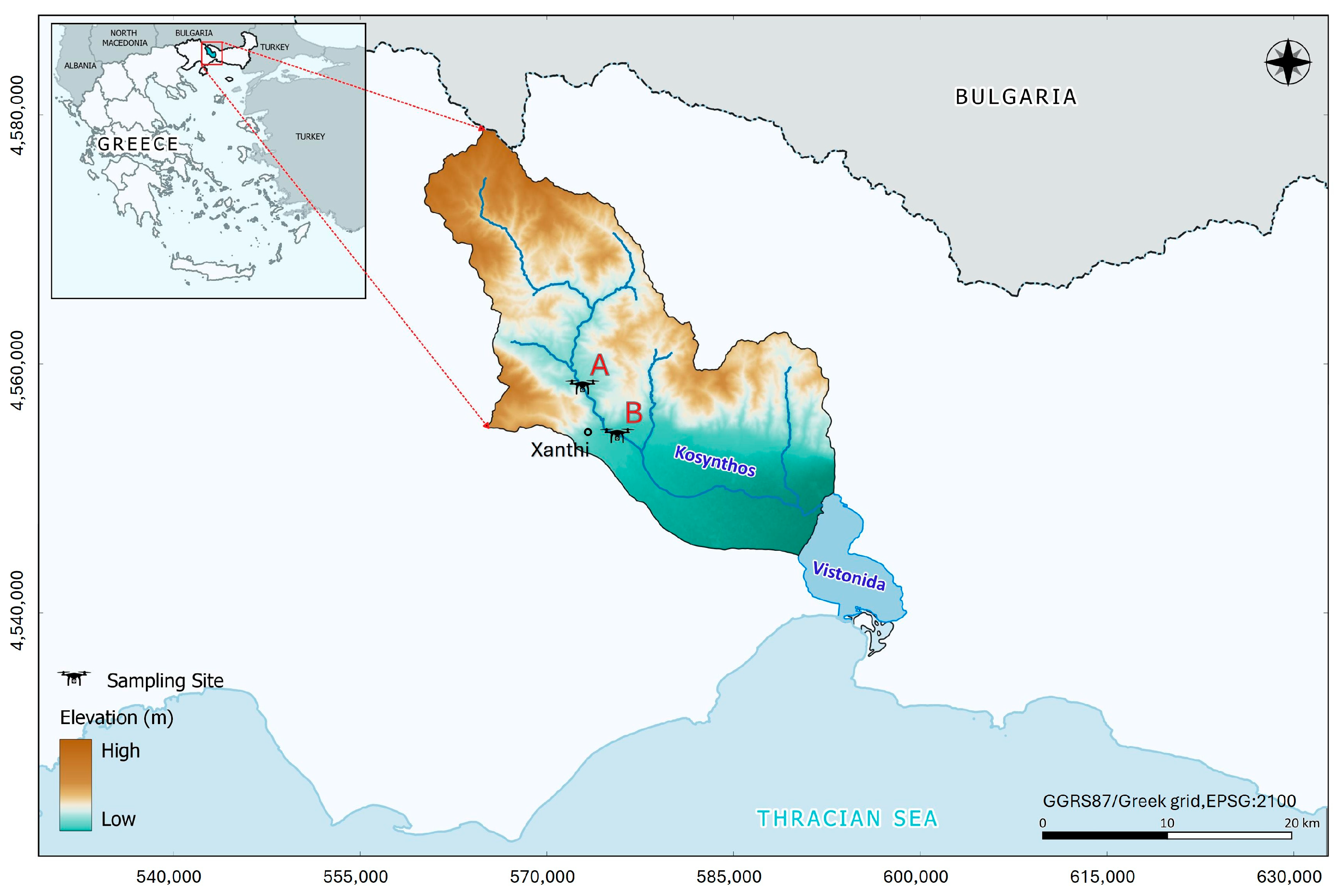
The focus of this study was a typical small peri-urban Mediterranean river with intermittent flow, namely, Kosynthos River (type RM1 according to WFD typology), within the Thrace River Basin District (Northeast Greece) (Figure 1). The region is morphologically characterized by a strong heterogeneity with mountainous areas, coastal areas, rivers, wetlands, and plains, and it experiences a Mediterranean climate that transitions to a Mediterranean Highland climate in its mountainous areas [30,31]. Precipitation averages 791 mm annually in the plain area, ranging from 368 to 1307 mm, while in the mountainous area, it averages 1044 mm annually, ranging from 539 to 1828 mm [32].
Figure 1. Study area and the sampling sites.
The Kosynthos River extends 73 km, with a sub-basin area of 530 km2, and consists of two main branches. Its waters flow entirely within Greek territory, originating from the peaks of the central Rhodope Mountains. The river traverses several villages in the mountainous region of Rhodope, passes through the town of Xanthi, and flows across the plain before discharging into Lake Vistonida. The mean elevation of the study area is 702.6 m, while the maximum elevation reaches 1827 m. The outlet is located at an elevation of 87 m. In addition, the length of the mainstream is 34.4 km, and the hypsometric distribution is 2.2% up to 300 m, 29.3% from 300 m to 600 m, and 68.5% above 600 m [32].
Extensive construction works have been carried out along the river in recent years, resulting in channelization, riverbed enclosure, and the construction of embankments that further alter its behavior. These modifications have increased the flow velocity, consequently affecting the sediment transport and deposition rates. Small terrace dams have been installed upstream to mitigate sediment accumulation; however, their effectiveness is limited due to structural degradation and lack of maintenance after the energy generated by temporal torrential flows. The river is subject to continuous anthropogenic pressures, receiving wastewater from surrounding settlements (including the town of Xanthi), as well as agricultural runoff containing fertilizers and pesticides. During flood events, additional pollution loads are introduced, further degrading the water quality and ecosystem health.
Sections of the study area are subject to a protection regime. The northern part of the drainage basin is within the Natura 2000 network, and the river’s estuarine zone, including Lake Vistonida, which is protected by the Ramsar Convention, is located within the boundaries of the National Park of Eastern Macedonia and Thrace [32].

2.2. UAV Image Acquisition

In this study, a custom-built quadcopter UAV was employed as the platform for acquiring high-resolution multispectral images. Constructed from carbon fiber, the UAV is equipped with brushless motors providing over 2400 gf of thrust each. The propulsion system consists of dynamically balanced carbon polymer propellers. The navigation system integrates the nine-axis ICM-20948 (InvenSense, San Jose, CA, USA) inertial measurement unit, which comprises a gyroscope, accelerometer, and magnetometer. The positioning system utilizes the Ublox M8N/Q (U-BLOX, Thalwil, Switzerland) global navigation satellite system (GNSS) receiver, supporting GPS, GLONASS, Galileo, and BeiDou, providing high positional accuracy. The UAV is controlled via an open-source flight controller, with telemetry operating at 433 MHz and a power output of 500 mW. The power supply consists of at least two 12,000 mAh LiPo SMART batteries, ensuring extended flight endurance.
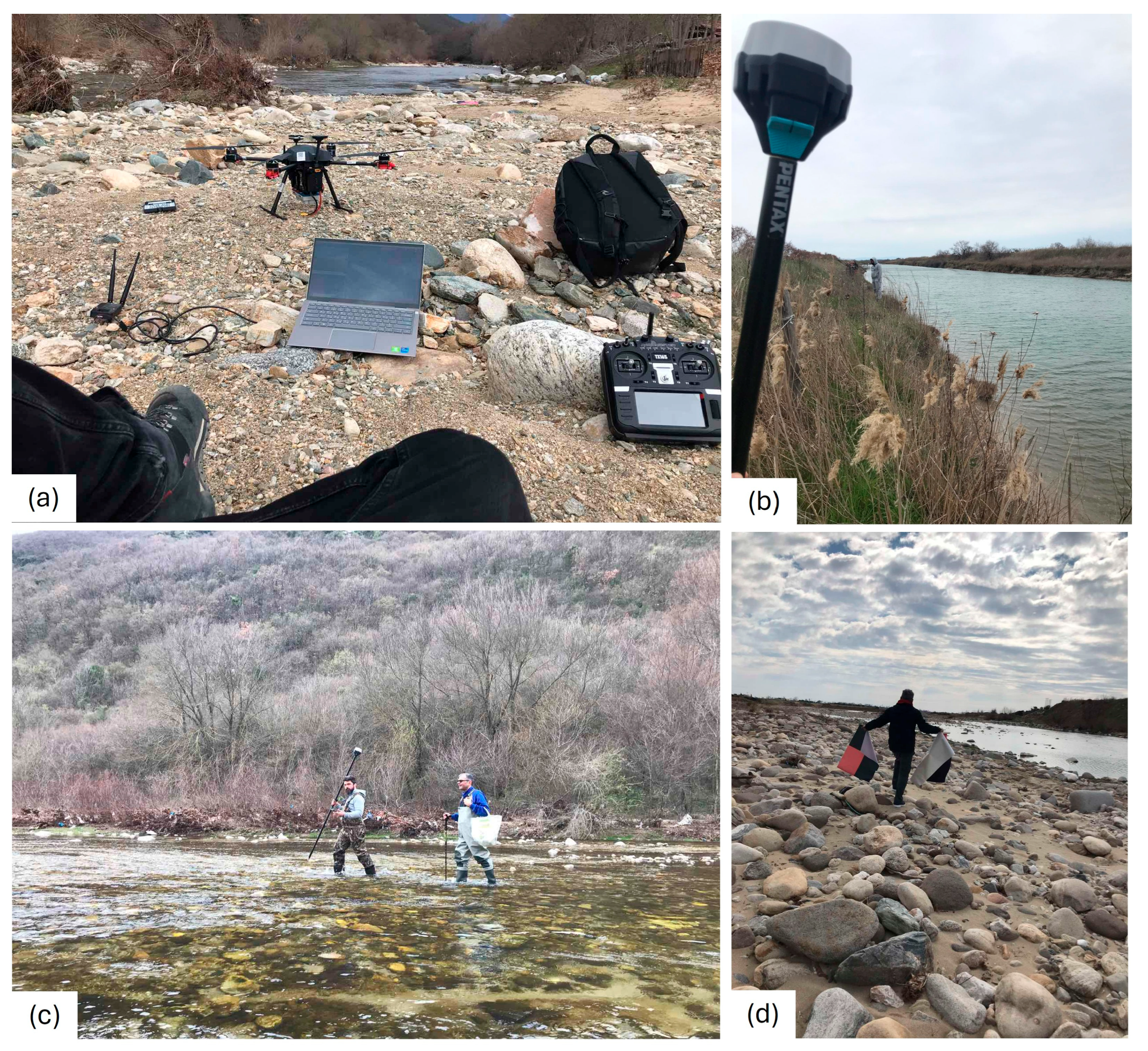
The UAV platform (Figure 2) is equipped with the Micasense RedEdge-MX Dual camera system, consisting of two five-band cameras: the RedEdge-MX and the new RedEdge-MX blue (MicaSense, Inc., Seattle, WA, USA, http://www.micasense.com/, accessed on 11 November 2025). The sensor has 10 bands ranging from visible to the near-infrared spectrum, as listed in Table 1. The sensor resolution is 1280 × 960 pixels (1.2 MP for each of the multispectral bands) and the ground sample distance is 8 cm per pixel (for each band) at 120 m above ground level. The total horizontal field of view is 47.2° for each of the ten bands [33].
Figure 2. The custom-built UAV with the Micasense RedEdge-MX Dual camera system (a), Emlid REACH RS2+ GNSS receiver (b), photograph of the sampling site (c), and ground control points (d).
Table 1. Sensor bands and central wavelengths.
Two flights were conducted—on 1 July 2022, and 18 March 2023—to acquire high-resolution multispectral images at two sites in the middle section of the river. The two sites were chosen before and after the town of Xanthi (Figure 1) to capture any potential differences due to the impact of the town’s activities on the river’s water quality. The temporality of sampling was designed to capture the two distinct flow phases of the stream (wet and dry season) to further enhance the realism of the model.
Flight planning was conducted using the open-source software “Mission Planner-1.3.77,” enabling precise programming of mapping areas, flight altitude, speed, takeoff and return points, and image overlap percentages. The UAV operational altitude was set at 50 m. The course overlap degree was set at 80%, and the side overlap degree was set at 75%. To minimize specular reflection, all UAV images were captured between 12:00 and 14:00 local time and under specific environmental conditions, including solar angles not exceeding 60°, minimal cloud cover, and low-wind conditions [22,34]. Ground control points were established on both sides of the river to improve the spatial precision of the mosaic images. We also used the EMLID Reach RS2+™, portable real-time kinematic global positioning system receiver (Emlid, Budapest, Hungary) to geolocate each sampling point.
Radiometric consistency of the UAV-based multispectral measurements was ensured through a standardized calibration and processing workflow rather than direct SI-traceable laboratory calibration of the sensor. The MicaSense RedEdge-MX Dual camera system is factory radiometrically characterized and provides reflectance-equivalent measurements by converting raw digital numbers to at-sensor radiance and surface reflectance using sensor-specific calibration coefficients embedded in the image metadata.
Prior to each flight, images were acquired through a calibrated reflectance panel (CRP), whose reflectance values are traceable to laboratory spectroradiometric measurements. This empirical approach for converting MicaSense image pixel values to reflectance has been found to be effective, with UAV-derived absolute reflectance values showing good agreement with in situ reflectance measurements, particularly for wavelengths below 700 nm [35]. The calibration procedure was implemented within the Pix4D Mapper 4.8 (Pix4D, accessed on 11 November 2025) processing chain, which utilizes the CRP measurements together with camera calibration parameters to compute absolute surface reflectance for each spectral band. Given the low flight altitude (50 m above ground level), atmospheric effects were considered negligible and no additional atmospheric correction was applied, in line with established close-range UAV remote sensing practices [19,20,21,22]. In addition, the atmospheric effects in the visible and infrared bands at this attitude are very small and almost uniform over the spectral range considered.
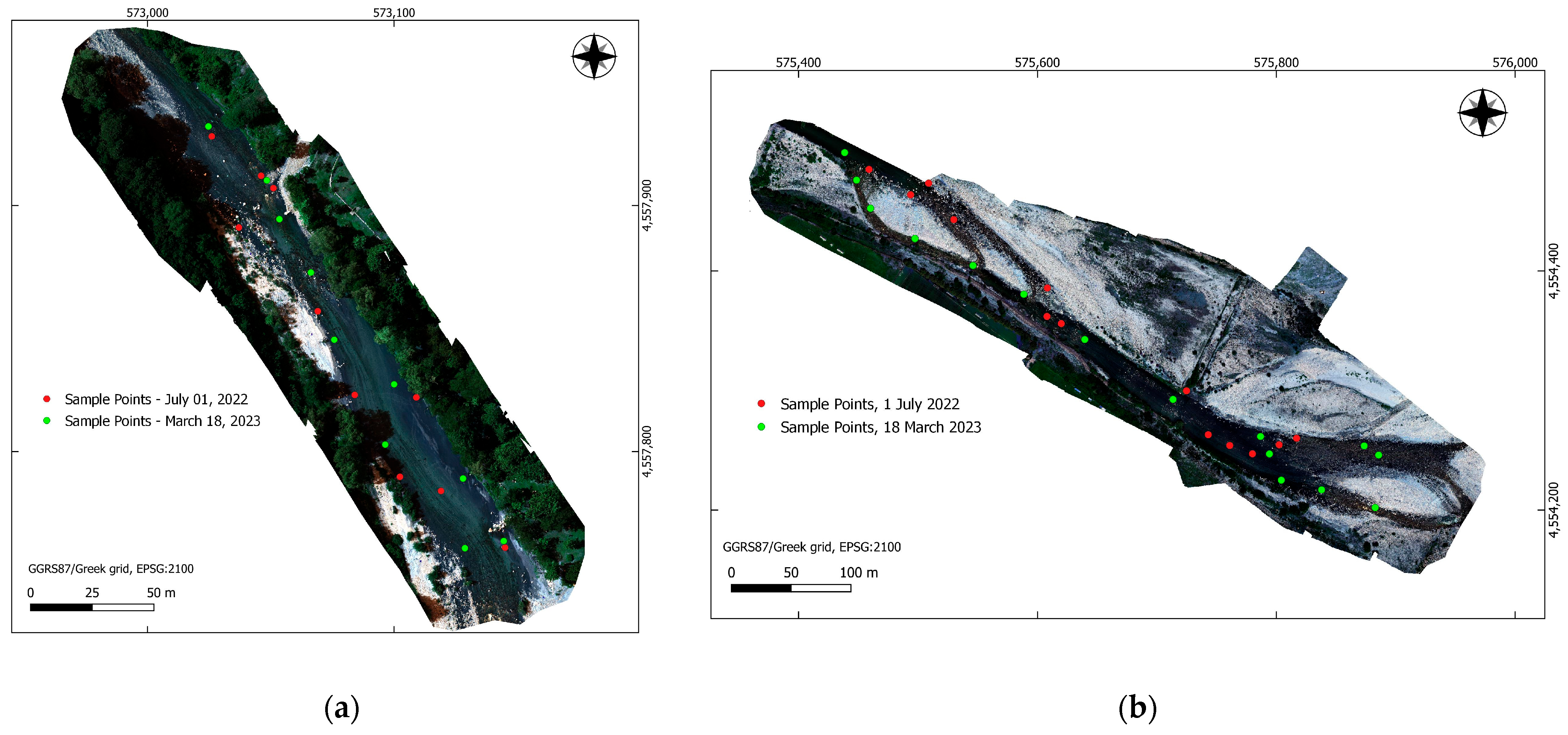
Sensor stability and comparability across acquisition dates were further supported by the use of consistent flight geometry, identical camera settings, and controlled illumination conditions (near solar noon, minimal cloud cover). Finally, the mosaic images were created using the Pix4D Mapper 4.8 software (Pix4D, Lausanne, Switzerland). The process results of the multi-band GEOTIFFs are presented in Figure 3.
Figure 3. Orthomosaics of the two sampling sites of the study area and the distribution of sampling points at the upstream Xanthi site (site A) (a) and downstream Xanthi site (site B) (b).

2.3. In Situ Water Quality Sampling

In total, 48 water samples were collected from the Kosynthos River (23 samples in July 2022 and 25 samples in March 2023) distributed all along the two sampling sites (Figure 3). At each sampling point, 250 mL of water was taken at a depth of 50 cm below the water surface using a sampler and transported to a storage container. All samples were held in an ice-filled thermostat until they were delivered to the laboratory for testing and analysis. Through contemporaneous in situ water sampling and laboratory analysis of chlorophyll-a and turbidity following standard APHA protocols, validation of the radiometrically calibrated UAV products was also performed indirectly [36].
Multiseasonal measurements are essential from an ecological perspective, as they capture the seasonal variability that rivers experience throughout the year. The spring season, characterized by heavy precipitation and increased river flushing [3], is represented by measurements taken in March. In contrast, autumn typically exhibits reduced discharge following the dry period extending from mid-June to November [3]. To represent this season, July was selected since by September, water levels are generally very low, with only remnant micro-pools remaining.

2.4. Dataset Development and Feature Selection

The dataset was developed by extracting the mean reflectance value from a 5 × 5-pixel window at each sampling point. This approach ensures that the average reflectance value, rather than that of a single pixel, is used to establish correlations with the in situ Chl-a and turbidity observations, thereby minimizing the background interference [21,37]. Additionally, this approach accounts for pixel value variability caused by the heterogeneous nature of water, which is influenced by environmental factors such as sun glint, waves, and suspended particles [20].
The modeling framework relied primarily on relative spectral features (band ratios, normalized indices, and multi-band combinations), which are less sensitive to absolute radiometric offsets and potential inter-flight sensor variability [38]. Subsequently, various band combinations and water-related indices were computed based on the literature (see Appendix A) and analyzed using Spearman correlation analysis to identify the most suitable spectral combinations for each water quality parameter model (Appendix A). The application of band combinations and water indices contribute to reduce the background noise, enhance the sensitivity of spectral reflectance to water quality parameters, and improve the accuracy of the water quality models [9]. It should be noted that to minimize multicollinearity issues, RedEdge-MX Blue bands were used. The features with the highest correlation and statistical significance (p < 0.05) were selected as inputs for the Chl-a and turbidity models.
Finally, the dataset, comprising 48 water samples for each water quality parameter, was divided into a training set and a test set at a ratio of 7:3.

2.5. Remote Sensing Model Development

Support vector regression (SVR) is a machine learning algorithm widely used for both linear and non-linear regression tasks based on support vector machines (SVMs). Unlike traditional regression methods, SVR is a nonparametric technique that leverages kernel functions to handle complex, high-dimensional relationships in the data [39]. The core principle of SVR involves constructing an optimal hyperplane in a high-dimensional space, ensuring that the distance between the hyperplane and the training samples is minimized while maintaining the error within a specified tolerance [25].
In this study, the radial basis function kernel (RBF) was employed for SVR, and the key hyperparameters C (penalty coefficient) and sigma (RBF kernel coefficient) were optimized using a two-dimensional grid search method to identify the most appropriate values by testing different pairs of parameters. Thus, a 10-fold cross-validation procedure was performed and the pair of parameters with the highest cross-validation accuracy was chosen aiming to minimize the error rate [3,40]. In this way, the generalization ability of the algorithm to unknown data was enhanced. All the analyses were conducted using the caret package in R-4.1.3 programming language.

2.6. Model Evaluation

Three accuracy metrics, i.e., the coefficient of determination (R2), root-mean-square error (RMSE), and mean absolute error (MAE), were employed in the model accuracy assessment (Table 2), which are used in many water quality studies [3,41,42,43]. The coefficient of determination R2 evaluates the goodness-of-fit of the regression model, with values nearer to 1 signifying better predictive performance. The RMSE metric measures the deviation between the predicted and the observed values, with lower RMSE values indicating a higher prediction accuracy of the model. However, the RMSE can be strongly influenced by outliers. The MAE metric provides insight into the average vertical distance between predicted and observed values [44,45].
Table 2. Accuracy metrics (R2, RMSE, and MAE) for the model accuracy assessment. Here, y i represents observations, y i ^ denotes predicted values, y i ¯ is the mean of the observations, and n indicates the number of observations.

3. Results

3.1. Model Development

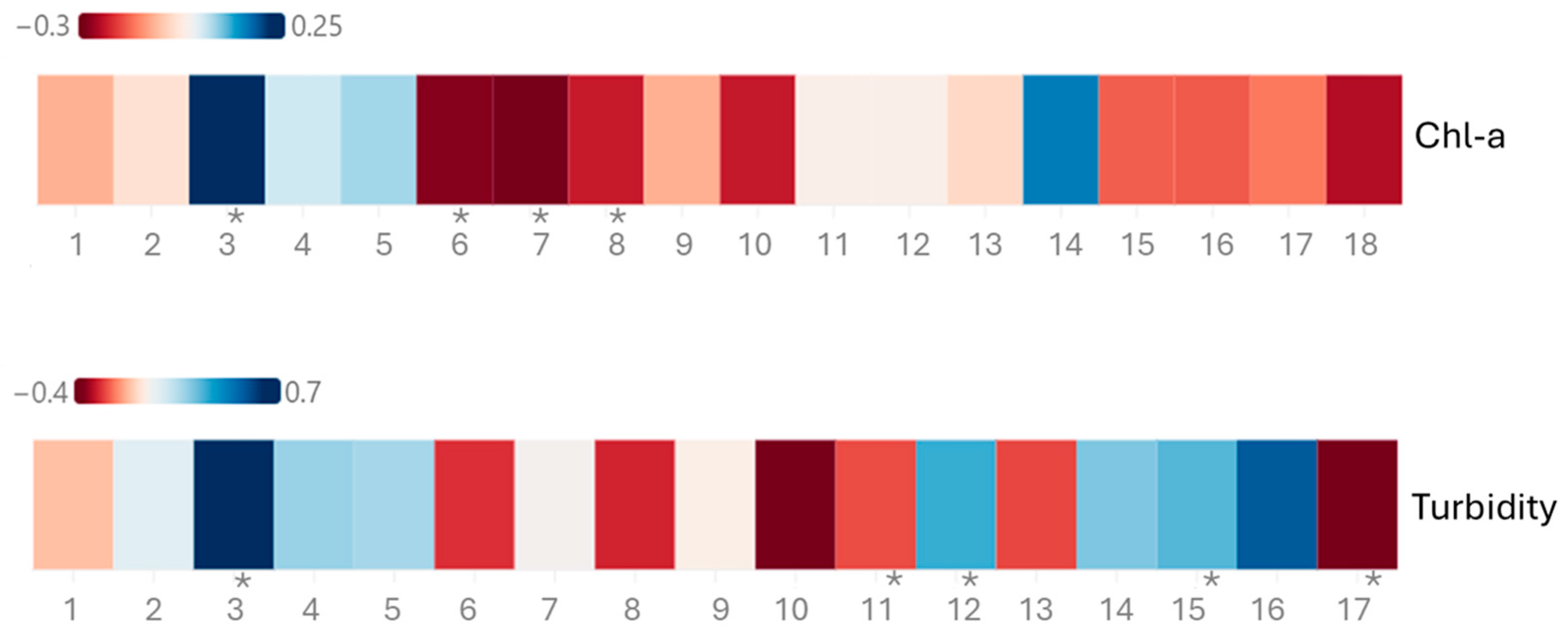
To identify the most suitable EO features for the prediction models, Spearman correlation analysis was used. The results revealed that turbidity exhibited the strongest positive correlation with the red band (r > 0.6), while Chl-a showed the highest negative correlation with the combination of blue, red, and red-edge (705 nm) bands (r= −0.28). Turbidity demonstrated stronger correlations, both positive and negative, compared with Chl-a, which showed weaker correlations with the EO features considered. More specifically, the r values for turbidity ranged from −0.11 to −0.35 and from 0.001 to 0.60. Regarding Chl a, the r values ranged from −0.01 to −0.28 and from 0.03 to 0.21 (Figure 4).
Figure 4. The correlation between spectral bands, band combinations, indices, and water quality parameters. The * symbol indicates statistically significant features (p < 0.05). Numbers correspond to the ΕO features shown in Table A1 and Table A2 (see Appendix A).
The final set of the EO features for the Chl-a and turbidity prediction models are presented in Table 3. Regarding Chl-a, four features were chosen based on their highest correlation with other features and their statistical significances. The red band and three-band combinations of the blue, green, red, and red-edge (705 nm) bands were used. Accordingly, for the turbidity modeling, five features were chosen, including the red band; the RENDWI; a band ratio; and combinations of the blue, red, and red-edge (705 nm and 740 nm) bands.
Table 3. Selected input features for the Chl-a and turbidity models.
Two prediction models were developed for the water quality parameters Chl-a and turbidity by utilizing data from both sampling sites and dates. A 10-fold cross validation was conducted to search for the optimal combination of C and sigma parameters for both the Chl-a and turbidity models. The sigma and cost giving the best cross-validation accuracy were selected for the final model development.
As shown in Figure 5a, a lower RMSE is observed for lower-to-moderate sigma values (narrow kernel width) and lower-to-moderate C values. Small sigma values capture finer local patterns in the data while avoiding excessive smoothing. However, this may increase the model’s complexity and increase the sensitivity to the noise in the training data. In Figure 5b, the heatmap shows the lowest RMSE values for low sigma values (narrow kernel width) across a relatively broad range of values of parameter C. For higher sigma and higher C values, the errors also increase.
Figure 5. Heat maps of the SVR performance for different combinations of C and sigma parameters during the cross-validation procedure for the Chl-a (a) and turbidity (b) models.
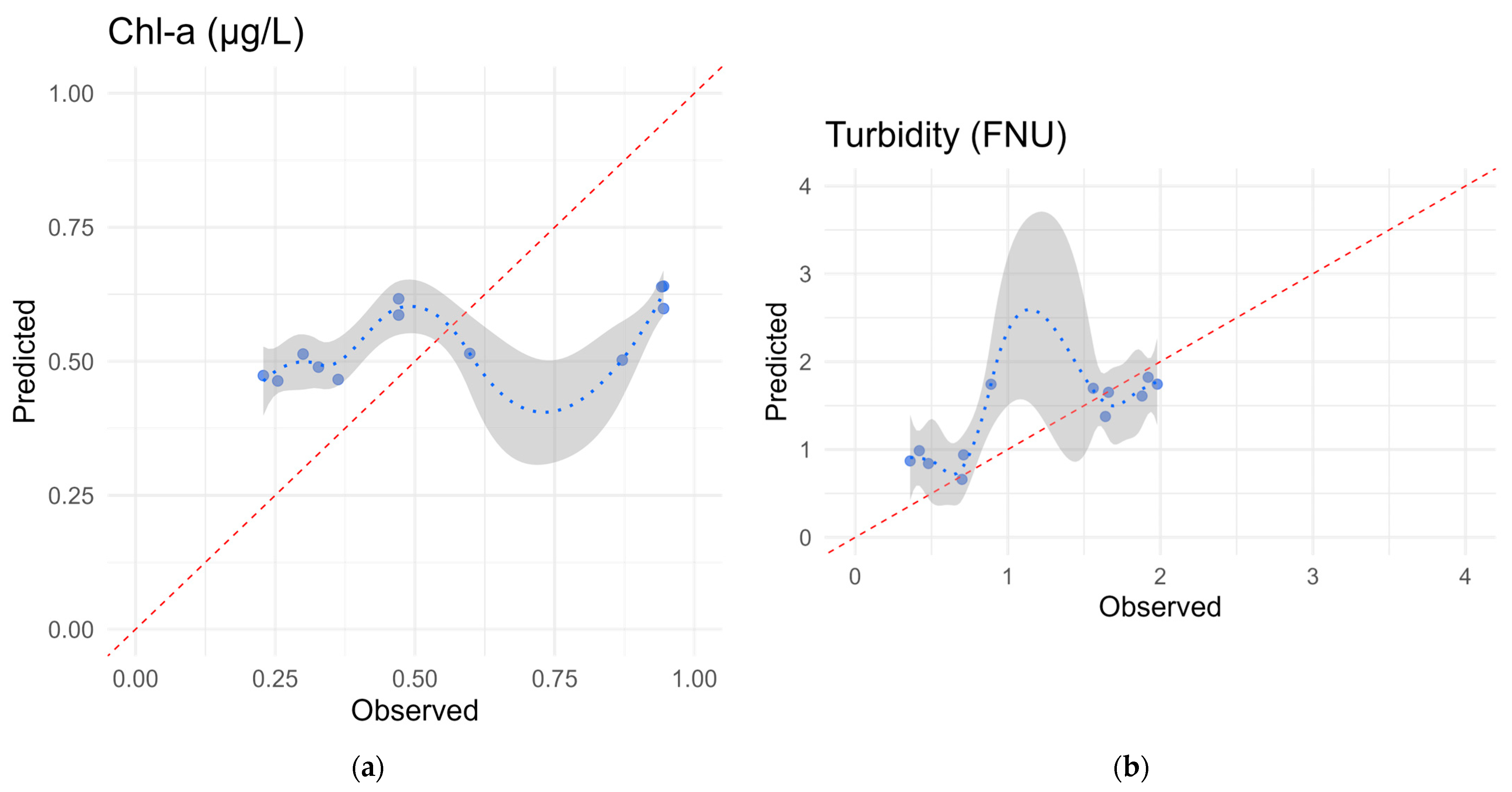
The turbidity model outperformed the Chl-a model (Figure 6 and Table 4). Specifically, the turbidity model exhibited an R2 value of 0.70 and an RMSE of 0.38 FNU (Table 4). The correlation between the observed and predicted turbidity values is high (r = 0.84), and according to Figure 6b, there is a slight overestimation for lower turbidity values (<1.5 FNU). In contrast, the Chl-a model showed intermediate performance, with an R2 value of 0.49 and an RMSE of 0.24 μg/L. The correlation between the observed and predicted values (r = 0.70) was lower than that of the turbidity model. As illustrated in Figure 6a, the model tended to overestimate lower Chl-a values (<0.3 μg/L) and underestimate higher Chl-a values (>0.8 μg/L).
Figure 6. Scatter plots of Chl-a (a) and turbidity (b) prediction models. The red dashed line is the 1:1 reference line, the blue dotted line is the trend line considering the relationship between predicted and observed values, and the shaded area is the confidence interval (95%).
Table 4. Accuracy metrics for models’ evaluation.

3.2. Spatial Explicit Water Quality Maps

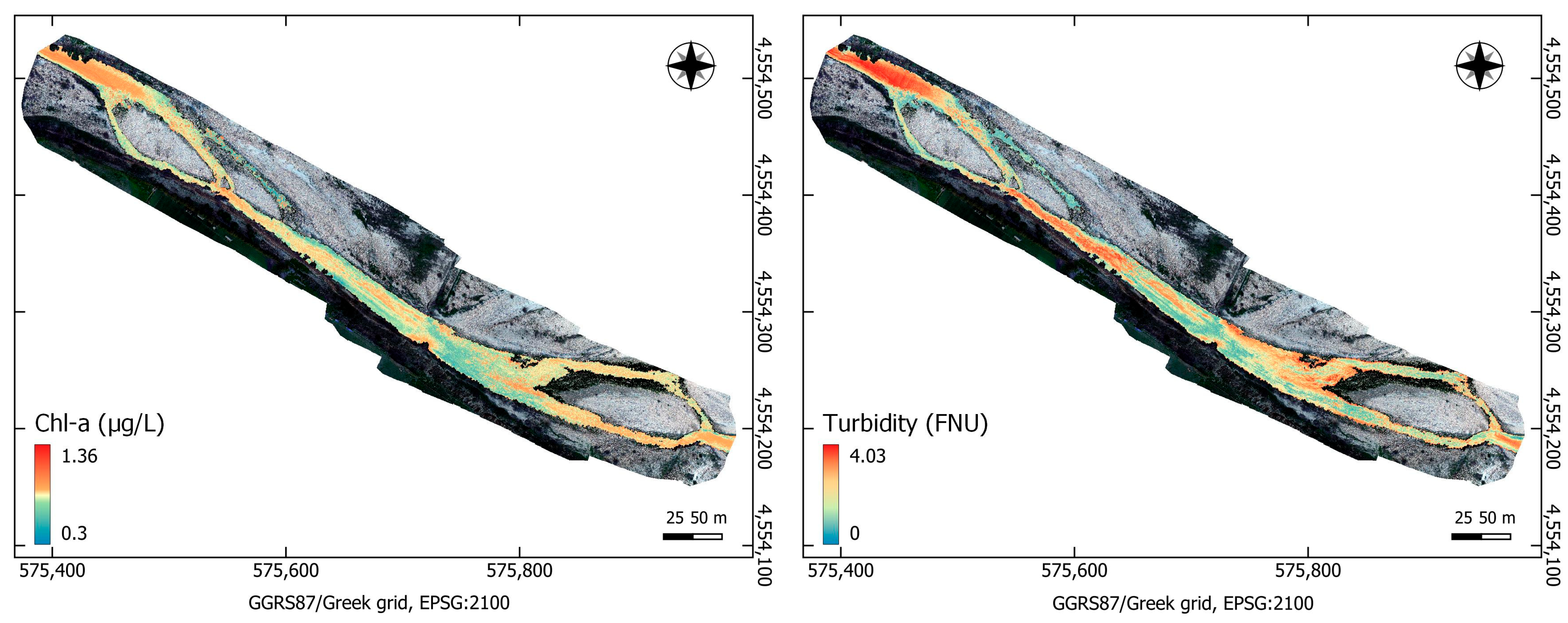
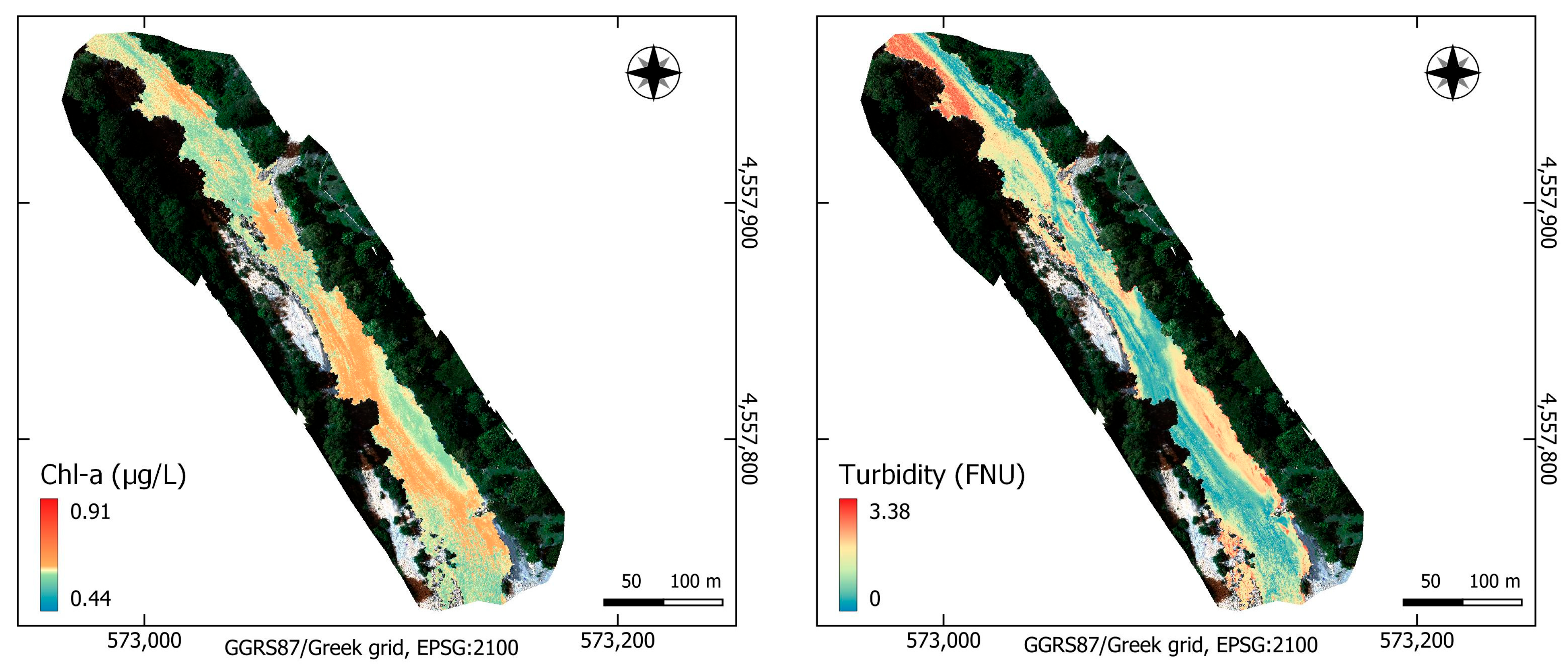
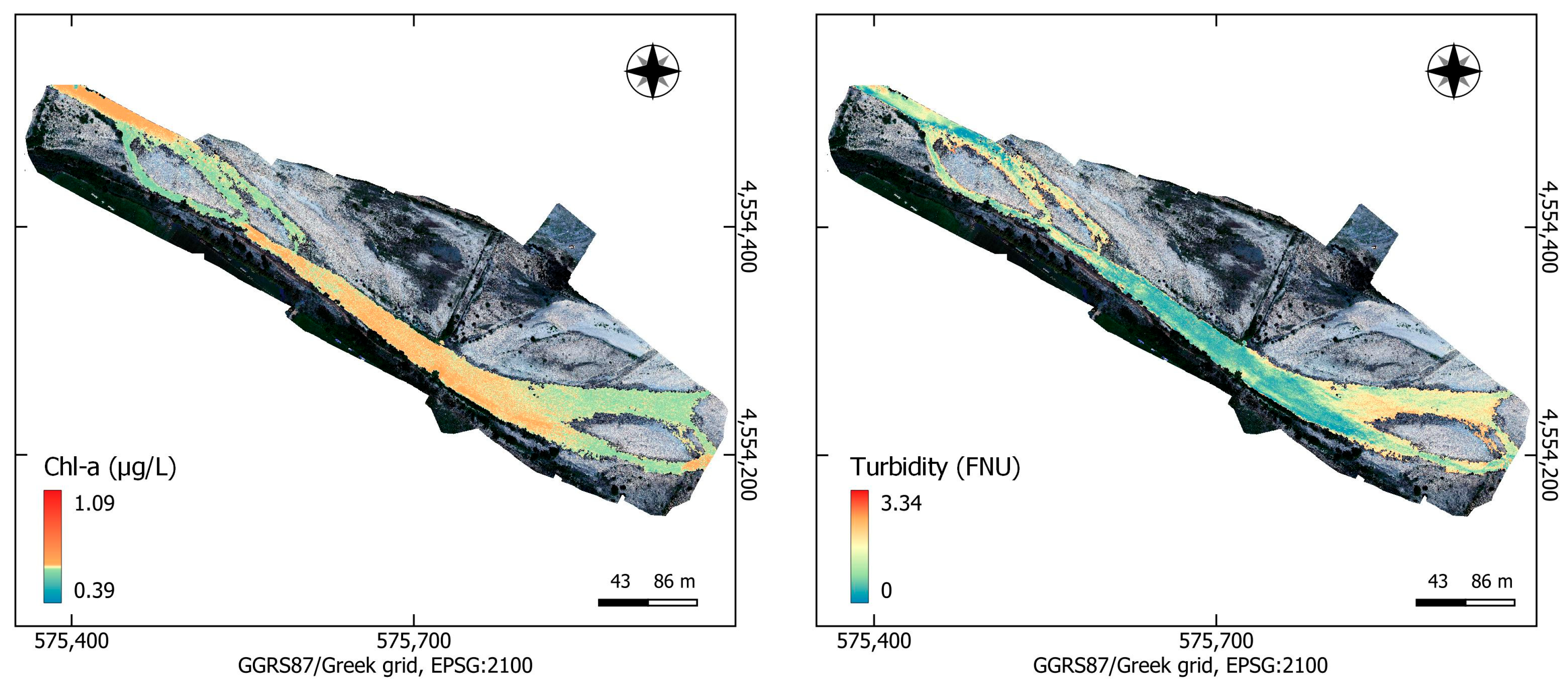
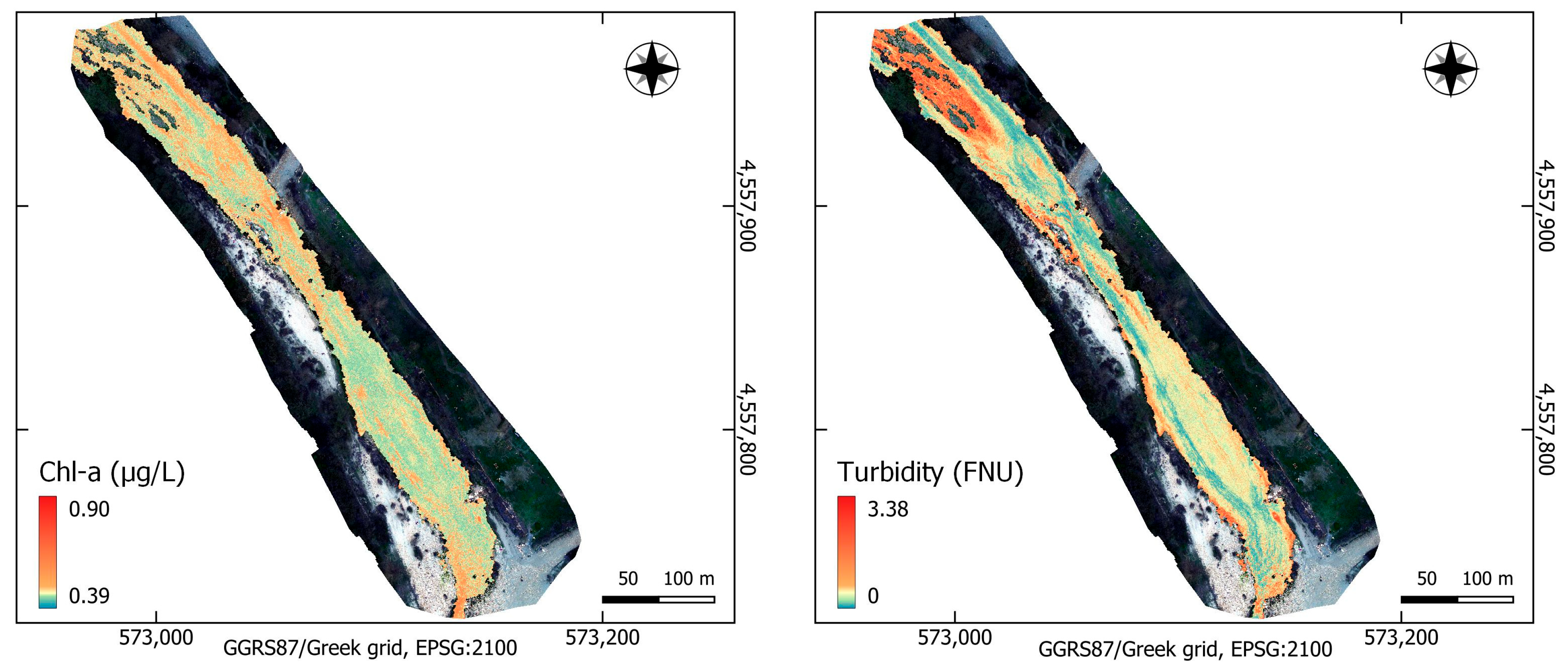
The Chl-a and turbidity maps were generated using the SVR models (Figure 7, Figure 8, Figure 9 and Figure 10). These maps illustrate site-specific variations in Chl-a and turbidity for both sampling sites and sampling dates. At the first sampling site (site A—upstream of the town of Xanthi), on 1 July 2022, the Chl-a levels ranged from 0.44 μg/L to 0.91 μg/L and the turbidity levels ranged from <1 to 3.38 FNU (Figure 7). At the second sampling site (site B—downstream of the town of Xanthi) on the same date, the Chl-a levels ranged from 0.39 μg/L to 1.09 μg/L and the turbidity levels ranged from <1 to 3.34 FNU (Figure 7). At the first sampling site (site A—upstream of the town of Xanthi) on 18 March 2023, the Chl-a levels ranged from 0.39 μg/L to 0.90 μg/L and the turbidity levels ranged from <1 to 3.38 FNU (Figure 7). At the second sampling site (site B—downstream of the town of Xanthi) on the same date, the Chl-a levels ranged from 0.30 μg/L to 1.36 μg/L and the turbidity levels ranged from <1 to 4.03 FNU (Figure 7).
Figure 7. Chl-a and turbidity distribution maps at upstream Xanthi site (site A) on 1 July 2022.
Figure 8. Chl-a and turbidity distribution maps at downstream Xanthi site (site B) on 1 July 2022.
Figure 9. Chl-a and turbidity distribution maps at upstream Xanthi site (site A) on 18 March 2023.
Figure 10. Chl-a and turbidity distribution maps at downstream Xanthi site (site B) on 18 March 2023.
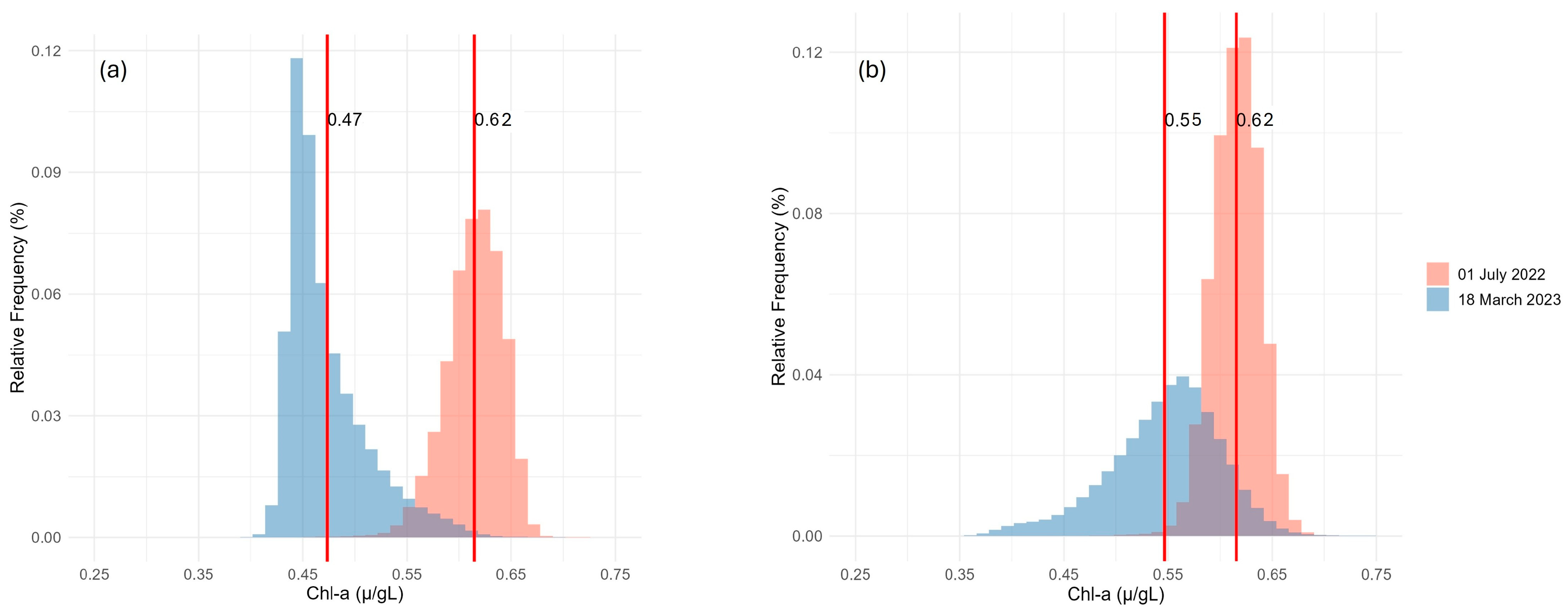
Relative frequency histograms were generated to facilitate the interpretation of the Chl-a and turbidity distributions (Figure 11 and Figure 12). Regarding Chl-a, higher concentrations were observed in July 2022 at both sampling sites. The mean Chl-a values during this period corresponded to 0.62 μg/L at the upstream Xanthi site (site A) and to 0.62 μg/L at the downstream Xanthi site (site B). In contrast, in March, the Chl-a values were lower, with mean values of 0.47 μg/L and 0.55 μg/L at sampling sites A and B, respectively. Comparing the two sampling sites, slightly higher Chl-a concentrations were observed at sampling site B. The distribution of Chl-a concentrations also showed variations. In July, at the sampling site B, the predominance of the highest Chl-a concentrations was detected (Figure 11).
Figure 11. Relative frequency histograms of the Chl-a predictions at the upstream Xanthi site (site A) (a) and downstream Xanthi site (site B) (b) on 1 July 2022 and 18 March 2023. The vertical red lines represent the mean values of the Chl-a concentration.
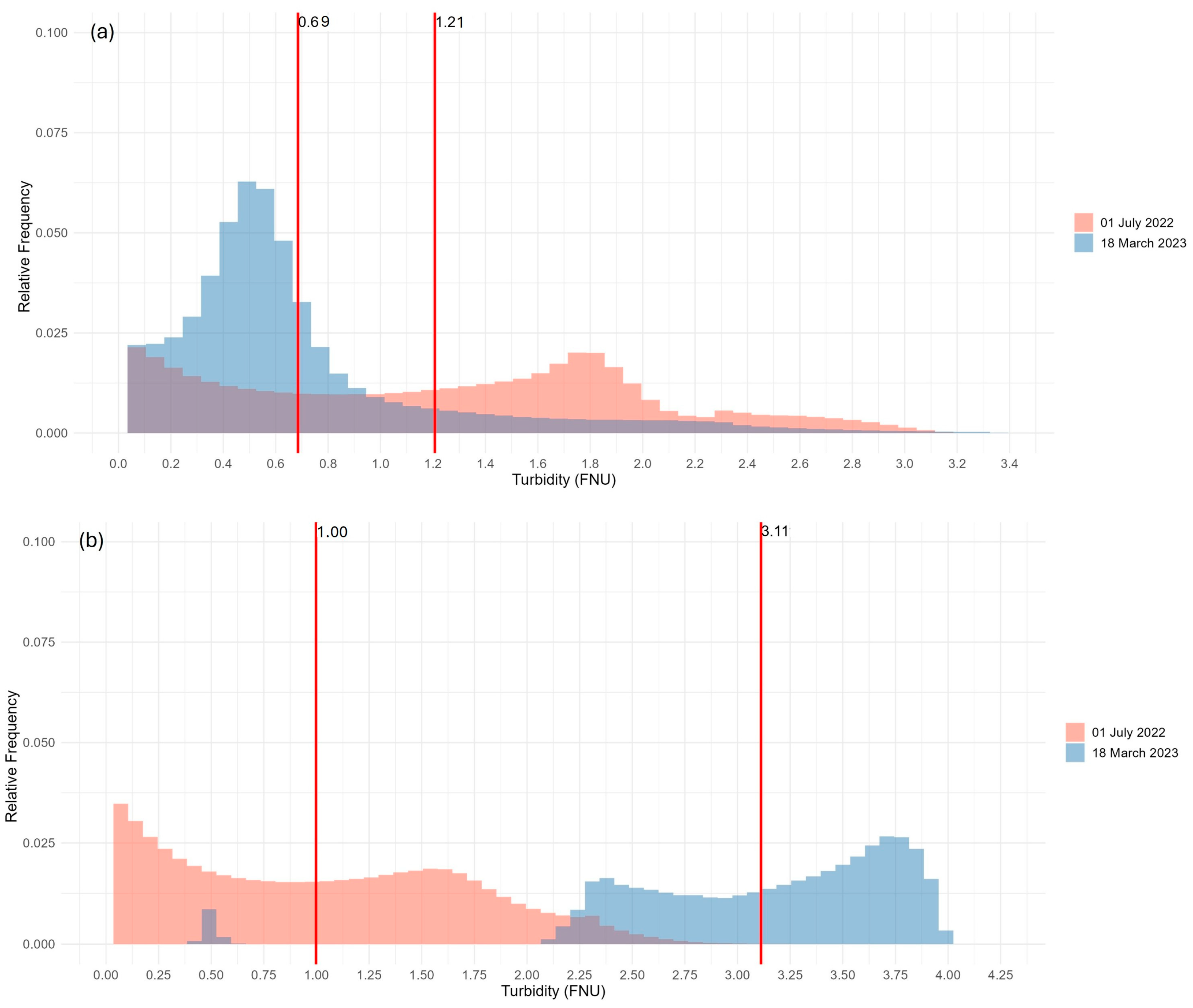
Figure 12. Relative frequency histograms of the turbidity predictions at the upstream Xanthi site (site A) (a) and downstream Xanthi site (site B) (b) on 1 July 2022 and 18 March 2023. The vertical red lines represent the mean values of the turbidity.
The turbidity values show similar ranges for both sites and dates, as well as a generally uniform distribution, except for the turbidity values at the upstream Xanthi site in March. During this period, the mean turbidity was 0.69 FNU at the upstream Xanthi site and 3.11 FNU at downstream Xanthi site. In July, the mean turbidity values were 1.21 FNU and 1.00 FNU at sampling sites A and B, respectively. At the downstream Xanthi site, the turbidity was notably higher in spring than in summer. At the upstream Xanthi site (site A), the turbidity values overlapped between the two dates. However, their spatial distribution differs, with the turbidity values in March being concentrated in the lower range, whereas in July, values were more evenly spread across the full range (Figure 11).

4. Discussion

Overall, the study aimed to develop an accurate and cost-effective water quality monitoring system to bridge the knowledge gap regarding the status of small Mediterranean inland water bodies and to support informed decision-making for the improved management and conservation of water resources. EO-based prediction models were developed to assess the water quality in a small peri-urban river in northeastern Greece. Two UAV flights were conducted to acquire high-resolution multispectral imagery concurrently with water sampling at two sites of the river. The relationship between the spectral reflectance and the concentrations of Chl-a and turbidity was analyzed by testing different band combinations and applying the SVR algorithm. These optical active parameters are key indicators for assessing water quality and are considered mandatory quality elements for determining the ecological status of surface water bodies under the EU-WFD framework [5].
According to our findings, the prediction models for Chl-a and turbidity yielded comparable results with other studies, demonstrating the potential of UAV multispectral imagery combined with SVR for water quality assessment. The turbidity prediction model performed well, achieving an R2 value of 0.70, which is similar to other studies that employed UAV imagery [25,26,46]. Chen et al.’s (2021) machine learning models exhibited lower R2 values ranging from 0.367 to 0.597 while studying an urban river, attributing the inversion results to discrepancies in the landscape surroundings of the sampling sites [9]. Similarly, SVR models applied at a small rural river yielded similar accuracy (R2 < 0.68), highlighting the algorithm’s sensitivity to parameter selection [46]. In other studies, using UAV hyperspectral imagery [13,47], statistical and machine learning models were employed, achieving higher (R2 = 0.72) or comparable model fits (R2 < 0.70). Hou et al. (2023) developed a random forest model to retrieve turbidity in an urban river using datasets from different seasons, achieving slightly better performance during the summer period (R2 = 0.775) [48]. Turbidity, as an optically active water quality parameter, is highly correlated with spectral reflectance but exhibits complex interactions influenced by factors such as the concentration of suspended particles. Thus, sophisticated models like SVMs are often necessary to improve the predictive accuracy [49], which further supports the modeling approach in this analysis.
The Chl-a model exhibited moderate performance with an R2 value of 0.49, yet yielding results that are comparable with other studies, where multispectral UAV-based imagery was employed to estimate Chl-a and other water quality parameters [19,50]. Acknowledging the differences both in the functioning and in the optical traits of lake waterbody types in relation the more dynamic environment of rivers, Zhao et al. (2022) developed slightly more accurate Chl-a models (R2 = 0.58) using SVMs over a lake [50]. Xiao et al. (2022) predicted Chl-a by applying machine learning and stacked ensemble algorithms, reporting lower model performances (R2 < 0.504) [19]. Furthermore, Kupssinskü et al. (2020) applied SVR to estimate the Chl-a concentration across a lake and a dam using UAV (R2 = 0.635) and Sentinel-2 (R2 = 0.413) data, respectively [38]. It should be noted that the previous slightly more accurate models concerned lakes, where Chl-a usually has higher values than in rivers. On the other hand, this study is the first attempt to model Chl-a in a small torrent under minimum flow conditions. Although this water quality parameter is highly sensitive to light and is particularly responsive to optical measurements [19], it undergoes biological and optical complexities that influence the optical properties of the water column. More specifically, the diverse phytoplankton types, with each presenting a unique pigment composition, and the presence of aquatic vegetation and suspended sediments influence the spectral response of the water column [51,52]. Additionally, bottom reflectance, especially in shallow water, affects the upwelling optical signals, thereby complicating accurate Chl-a estimation [5]. This was particularly evident throughout the study area: leaves, shadows, tree branches, rocks, water flow, and variations in water depth influenced the recorded spectral signals, introducing noise to the Chl-a estimations, as stated also by Chen (2021) [9].
Overall, the SVR algorithm was a reliable choice for modeling water quality parameters due to its ability to handle nonlinear relationships and accuracy in predicting results with small sample sizes [3,12]. The slight overestimation in modeling turbidity for lower values can shape the trends in a more “precautionary” way in actual monitoring campaigns, as low turbidity values do not interfere with system health or ecological function. The Chl-a model was able to describe half the variation of the observed values, while for turbidity, the results were even better, both with relatively low RMSE, which enables the use of low-cost multispectral UAVs as a monitoring tool especially for small Mediterranean basins. The moderate accuracy of Chl-a prediction suggests that further research should be conducted to examine the performance of alternative algorithms [42,49].
The SVR models, despite the use of the limited number of samples (n = 48) used in this study, revealed notable relationships between the spectral reflectance and the two examined water quality parameters. Turbidity and Chl-a, as optically active parameters, exhibit strong correlations with the red, red-edge, green, and blue spectral regions [53]. These spectral bands, or combinations of them, were utilized to develop the prediction models. Both parameters, were positively correlated with the red band (650 nm), with turbidity displaying the highest spectral response at this wavelength, complying with findings of previous studies [13,54,55,56]. Moreover, utilizing multi-band combinations as inputs has proven effective in modeling the two water quality parameters. Band combinations showed stronger correlations with Chl-a and turbidity measurements compared with the individual bands. However, there should be more research to optimize the number of bands included in the combinations through repeated training and testing during the modeling process [57].
Comparing the spatiotemporal distribution of the two estimated parameters revealed that Chl-a exhibited the highest concentrations in July, as expected. During the summer, higher water temperatures and reduced streamflow create favorable conditions for phytoplankton biomass growth, changing its density and diversity [58,59]. Consequently, Chl-a is expected to increase, as it is a pigment present in all photosynthetic organisms that converts sunlight into energy through photosynthesis [60]. Regarding turbidity, higher values were noticed at the sampling site B on March, probably due to the weather conditions and mainly precipitation, as noted by other studies as well [61,62], which is heavier in spring than in summer. Differences between the two sites affected the parameters values, maybe due to variations in flow rate, riverbed width, and self-purification capacity [25], as well as human activities, which are closely linked to the geographic characteristics of each sampling location. More specifically, sampling site A is located more to the north in a mountainous region characterized by forest vegetation. In contrast, sampling site B is located near a residential area and agricultural land, where anthropogenic pressures, such as wastewater discharge and agricultural runoff, are more pronounced.

Limitations and Future Research

Despite the fact that the two water quality parameters were predicted with results comparable with those reported in other studies (see Section 4), specific limitations should be considered in this study. First, although the samples covered a significant part of the study area and two different seasons, future research should focus on expanding the datasets by repeating UAV measurements at the sampling sites. This would help determine whether larger sample sizes, covering a broader range of seasonal fluctuations in the river, would provide stronger support for models’ development and their ability to generalize to unseen data. Furthermore, extending the application of the UAV experiment to additional sites would help assess the transferability and generalizability of the models when applied to different sites or bio-optical environments providing further evidence for the robustness of the approach [63]. This is particularly evident in the case of Chl-a modeling; the limited number of samples may have affected the performance and robustness of the SVR model, as well as its generalizability, as indicated by the cross-validation results (Section 3.1).
Apart from the limited samples, additional factors may have affected the effectiveness of the models and should be taken into account. More specifically, the interaction of the inherent optical properties (absorption and scattering) of small inland waters with particulate organic and inorganic particles affects the radiance recorded by remote sensing sensors [64]. In addition, phenomena such as sun glint (i.e., the direct sunlight reflected off the water surface) and sky glint (i.e., the scattered sky radiation reflected off the water surface) might induce radiometric distortions to the water-leaving radiance recorded by UAV sensors [65,66,67]. In our study, these effects were mitigated through the adoption of widely used data acquisition strategies and radiometric calibration procedures. Data acquisition was carried out under specific environmental and controlled flight conditions, with low flight altitudes of 50 m, considering that earlier studies have shown that the scattered irradiance from the atmosphere is negligible at low altitudes (between 20 and 100 m) [18]. By appropriately adjusting the flight geometry of the UAV and the timing of the flights under conditions with very low wind speed and solar zenith angles below 60°, sun glint was effectively minimized [67]. In addition, image pixel vales underwent standard, absolute radiometric calibration procedures for the MicaSense camera based on the empirical CRP approach, consistent with earlier studies focusing on inland and coastal water quality monitoring [68,69,70,71,72].
Future research should compare the standard radiometric calibration procedures employed in our study, with methods employing radiative transfer modeling or alternative empirical line calibration procedures in terms of modeling accuracy and robustness [35,65].

5. Conclusions

The focus of this study was on a peri-urban river in northeast Greece subjected to multiple anthropogenic pressures affecting the sustainability of the area, as well as other water bodies ecosystem conditions, as in the case of Vistonida Lake into which the river discharges. Employing UAV multispectral imagery and SVR proved to be an effective approach to monitor water quality. The models captured 49% and 70% of the variations in the observed values for Chl-a (RMSE = 0.24 μg/L) and turbidity (RMSE = 0.38 FNU), respectively. For the dry season, Chl-a ranged from 0.39–1.09 μg/L and turbidity from <1–3.38 FNU. Accordingly, for the wet season, Chl-a ranged from 0.30–1.36 μg/L and turbidity from <1–4.03 FNU, capturing temporal variations as well. Enabling the estimation of these two crucial parameters, valuable information can be provided about the ecological status of the river.
The approach complies with the EU-WFD framework and addresses the growing need for non-invasive, cost-effective, and intensified water quality monitoring. At the same time, the study’s findings underline the urgency of establishing common guidelines for the use of EO and overcoming existing constraints to its formal incorporation in WFD monitoring methods.
The use of UAV-based imagery demonstrated that it is a powerful alternative for high-resolution water quality monitoring that is capable of capturing fine-scale variations that satellite imagery may overlook. The ability of UAVs to deliver precise, spatially detailed EO data makes them particularly well-suited for assessing smaller waterbodies, especially narrow rivers that high-resolution satellites (e.g., 10 m) fail to capture in their entirety due to spatial resolution limitations. However, it should be noted that optically complex water bodies, such as shallow and narrow rivers like Kosynthos, with a 14 m mean cross-section width and located in a complex peri-urban landscape, may require sensors from both satellites and UAVs, with additional bands and narrower bandwidths; thus, the use of hyperspectral imagery could have improved the model’s accuracy, especially for the Chl-a estimation, whose spectral characteristics are not efficiently captured by broader multispectral bands [73]. In addition, although UAVs are limited in their spatial coverage, they remain highly effective for local-scale monitoring efforts, especially in the case of small waterbodies.
Overall, the study highlights the effectiveness of UAVs in water quality monitoring, providing useful data and tools that can support stakeholders and policymakers in making informed decisions and taking targeted actions to promote and maintain the good ecological statuses of waterbodies.

Author Contributions

Conceptualization, I.K., C.S.A. and G.M.; methodology, K.V., K.B., C.S.A., D.L. and G.M.; software, K.V., K.B. and I.-A.K.; formal analysis, K.V., K.B. and I.-A.K.; data curation, K.V., K.B., I.-A.K., C.S.A. and D.L.; writing—original draft preparation, K.V.; writing—review and editing, D.L., C.S.A., I.K. and G.M.; visualization, K.V.; supervision, C.S.A. and G.M.; funding acquisition, I.K. All authors have read and agreed to the published version of the manuscript.

Funding

Produced for Eye4Water project, MIS 5047246, implemented under the action: “Support for Research Infrastructure and Innovation” by the Operational Program “Competitiveness, En-trepreneurship and Innovation”. Co-financed by Greece and the European Union European Regional Development Fund.

Data Availability Statement

The data presented in this study is available upon request from the corresponding author. The data is not publicly available due to action provision.

Conflicts of Interest

The authors declare no conflicts of interest.

Abbreviations

The following abbreviations are used in this manuscript:
CRPCalibrated reflectance panel
Chl-aChlorophyll-a
EOEarth Observation
EU WFDEU Water Framework Directive
FNUFormazin Nephelometric Unit
GNSSGlobal navigation satellite system
MAEMean absolute error
NIRNear-infrared
RBFRadial basis function
RMSERoot-mean-square error
RSRemote sensing
SVMsSupport vector machines
SVRSupport vector regression
UAVUnmanned aerial vehicle

Appendix A

Table A1. List of EO features tested in the Spearman correlation analysis for Chl-a prediction model development.
a/aInput FeatureDescriptionReference
1 b 444 Coastal blue bandRaw data
2 g 531 Green bandRaw data
3 r 650 Red bandRaw data
4 r e 705 Red-edge bandRaw data
5 r e 740 Red-edge bandRaw data
6 g 531 + r e 705 r 650 Band combination[9]
7 b 444 + r e 705 r 650 Band combination[9]
8 b 444 + r e 705 b 444 + r 650 Band combination[9]
9 r e 705 g 531 + r 650 Band combination[9]
10 g 531 + r e 705 g 531 + r 650 Band combination[9]
11 b 444 + r e 705 Band summation[19]
12 b 444 + r e 740 Band summation[19]
13 r e 740 b 444 + r 650 Band combination[25]
14 r e 740 b 444 Band ratio[25]
15 r e 740 r 650 Band ratio[25]
16 r e 740 r 650   r e 740 + r 650 × r e 740 r 650 Band combination[50]
17 r e 740 r 650 Band difference[50]
18 r e 740 r 650 Band ratio[50]
Table A2. List of EO features tested in the Spearman correlation analysis for turbidity prediction model development.
a/aInput featureDescriptionReference
1 b 444 Coastal blue bandRaw data
2 g 531 Green bandRaw data
3 r 650 Red bandRaw data
4 r e 705 Red-edge bandRaw data
5 r e 740 Red-edge bandRaw data
6 r e 705 b 444 + r 650 Band combination[9]
7 r e 705 + r e 740 b 444 + g 531 + r 650 Band combination[9]
8 g 531 + r e 705 b 444 + g 531 + r 650 Band combination[9]
9 r e 705 b 444 + g 531 + r 650 Band combination[9]
10 g 531 r e 705 g 531 + r e 705 Band combination[26]
11 R E N D W I = g 531   r e 740   g 531 + r e 740 Rededge normalized difference
water index
[25]
12 r e 740 + r e 705 g 531 g 531 + r e 740 + r e 705 Band combination [26]
13 g 531   r e 740   g 531 + r e 740 Band combination[25]
14 r e 740 g 531 Band ratio[25]
15 r e 740 b 444 Band ratio[25]
16 r 650 + r e 740 g 531 Band combination[21]
17 b 444 + r e 740 b 444 + r 650 Band combination[25]

References

  1. Gilvear, D.J.; Spray, C.J.; Casas-Mulet, R. River Rehabilitation for the Delivery of Multiple Ecosystem Services at the River Network Scale. J. Environ. Manag. 2013, 126, 30–43. [Google Scholar] [CrossRef] [PubMed]
  2. Basak, S.M.; Hossain, M.S.; Tusznio, J.; Grodzińska-Jurczak, M. Social Benefits of River Restoration from Ecosystem Services Perspective: A Systematic Review. Environ. Sci. Policy 2021, 124, 90–100. [Google Scholar] [CrossRef]
  3. Vatitsi, K.; Siachalou, S.; Latinopoulos, D.; Kagalou, I.; Akratos, C.S.; Mallinis, G. Monitoring Water Quality Parameters in Small Rivers Using SuperDove Imagery. Water 2024, 16, 758. [Google Scholar] [CrossRef]
  4. European Environment Agency. European Waters—Assessment of Status and Pressures; European Environment Agency: Copenhagen, Denmark, 2018. [Google Scholar]
  5. Samarinas, N.; Spiliotopoulos, M.; Tziolas, N.; Loukas, A. Synergistic Use of Earth Observation Driven Techniques to Support the Implementation of Water Framework Directive in Europe: A Review. Remote Sens. 2023, 15, 1983. [Google Scholar] [CrossRef]
  6. Sagan, V.; Peterson, K.T.; Maimaitijiang, M.; Sidike, P.; Sloan, J.; Greeling, B.A.; Maalouf, S.; Adams, C. Monitoring Inland Water Quality Using Remote Sensing: Potential and Limitations of Spectral Indices, Bio-Optical Simulations, Machine Learning, and Cloud Computing. Earth Sci. Rev. 2020, 205, 103187. [Google Scholar] [CrossRef]
  7. Muller-Karger, F.E. Remote Sensing of Marine Pollution: A Challenge for the 1990s. Mar. Pollut. Bull. 1992, 25, 54–60. [Google Scholar] [CrossRef]
  8. Jaywant, S.A.; Arif, K.M. Remote Sensing Techniques for Water Quality Monitoring: A Review. Sensors 2024, 24, 8041. [Google Scholar] [CrossRef]
  9. Chen, B.; Mu, X.; Chen, P.; Wang, B.; Choi, J.; Park, H.; Xu, S.; Wu, Y.; Yang, H. Machine Learning-Based Inversion of Water Quality Parameters in Typical Reach of the Urban River by UAV Multispectral Data. Ecol. Indic. 2021, 133, 108434. [Google Scholar] [CrossRef]
  10. Adjovu, G.E.; Stephen, H.; James, D.; Ahmad, S. Overview of the Application of Remote Sensing in Effective Monitoring of Water Quality Parameters. Remote Sens. 2023, 15, 1938. [Google Scholar] [CrossRef]
  11. Coqué, A.; Morin, G.; Peroux, T.; Martinez, J.-M.; Tormos, T. Lake SkyWater-A Portable Buoy for Measuring Water-Leaving Radiance in Lakes Under Optimal Geometric Conditions. Sensors 2025, 25, 1525. [Google Scholar] [CrossRef]
  12. Yang, H.; Kong, J.; Hu, H.; Du, Y.; Gao, M.; Chen, F. A Review of Remote Sensing for Water Quality Retrieval: Progress and Challenges. Remote Sens. 2022, 14, 1770. [Google Scholar] [CrossRef]
  13. Cui, M.; Sun, Y.; Huang, C.; Li, M. Water Turbidity Retrieval Based on UAV Hyperspectral Remote Sensing. Water 2022, 14, 128. [Google Scholar] [CrossRef]
  14. Ansper, A.; Alikas, K. Retrieval of Chlorophyll a from Sentinel-2 MSI Data for the European Union Water Framework Directive Reporting Purposes. Remote Sens. 2018, 11, 64. [Google Scholar] [CrossRef]
  15. Theologou, I.; Patelaki, M.; Karantzalos, K. Can Single Empirical Algorithms Accurately Predict Inland Shallow Water Quality Status from High Resolution, Multi-Sensor, Multi-Temporal Satellite Data? ISPRS Int. Arch. Photogramm. Remote Sens. Spat. Inf. Sci. 2015, XL-7/W3, 1511–1516. [Google Scholar] [CrossRef][Green Version]
  16. Jiang, D.; Scholze, J.; Liu, X.; Simis, S.G.H.; Stelzer, K.; Müller, D.; Hunter, P.; Tyler, A.; Spyrakos, E. A Data-Driven Approach to Flag Land-Affected Signals in Satellite Derived Water Quality from Small Lakes. Int. J. Appl. Earth Obs. Geoinf. 2023, 117, 103188. [Google Scholar] [CrossRef]
  17. Toming, K.; Kutser, T.; Laas, A.; Sepp, M.; Paavel, B.; Nõges, T. First Experiences in Mapping Lake Water Quality Parameters with Sentinel-2 MSI Imagery. Remote Sens. 2016, 8, 640. [Google Scholar] [CrossRef]
  18. Wasehun, E.T.; Hashemi Beni, L.; Di Vittorio, C.A. UAV and Satellite Remote Sensing for Inland Water Quality Assessments: A Literature Review. Environ. Monit. Assess. 2024, 196, 277. [Google Scholar] [CrossRef]
  19. Xiao, Y.; Guo, Y.; Yin, G.; Zhang, X.; Shi, Y.; Hao, F.; Fu, Y. UAV Multispectral Image-Based Urban River Water Quality Monitoring Using Stacked Ensemble Machine Learning Algorithms—A Case Study of the Zhanghe River, China. Remote Sens. 2022, 14, 3272. [Google Scholar] [CrossRef]
  20. Isgró, M.A.; Basallote, M.D.; Barbero, L. Unmanned Aerial System-Based Multispectral Water Quality Monitoring in the Iberian Pyrite Belt (SW Spain). Mine Water Environ. 2022, 41, 30–41. [Google Scholar] [CrossRef]
  21. Ying, H.; Xia, K.; Huang, X.; Feng, H.; Yang, Y.; Du, X.; Huang, L. Evaluation of Water Quality Based on UAV Images and the IMP-MPP Algorithm. Ecol. Inform. 2021, 61, 101239. [Google Scholar] [CrossRef]
  22. Castro, C.C.; Gómez, J.A.D.; Martín, J.D.; Sánchez, B.A.H.; Arango, J.L.C.; Tuya, F.A.C.; Díaz-Varela, R. An UAV and Satellite Multispectral Data Approach to Monitor Water Quality in Small Reservoirs. Remote Sens. 2020, 12, 1514. [Google Scholar] [CrossRef]
  23. Lu, Q.; Si, W.; Wei, L.; Li, Z.; Xia, Z.; Ye, S.; Xia, Y. Retrieval of Water Quality from UAV-Borne Hyperspectral Imagery: A Comparative Study of Machine Learning Algorithms. Remote Sens. 2021, 13, 3928. [Google Scholar] [CrossRef]
  24. Choo, Y.; Kang, G.; Kim, D.; Lee, S. A Study on the Evaluation of Water-Bloom Using Image Processing. Environ. Sci. Pollut. Res. 2018, 25, 36775–36780. [Google Scholar] [CrossRef] [PubMed]
  25. Yao, K.; Chen, Y.; Li, Y.; Zhang, X.; Zhu, B.; Gao, Z.; Lin, F.; Hu, Y. Water Quality Prediction of Small-Micro Water Body Based on the Intelligent-Algorithm-Optimized Support Vector Machine Regression Method and Unmanned Aerial Vehicles Multispectral Data. Sustainability 2024, 16, 559. [Google Scholar] [CrossRef]
  26. Yan, Y.; Wang, Y.; Yu, C.; Zhang, Z. Multispectral Remote Sensing for Estimating Water Quality Parameters: A Comparative Study of Inversion Methods Using Unmanned Aerial Vehicles (UAVs). Sustainability 2023, 15, 298. [Google Scholar] [CrossRef]
  27. Jung, S.H.; Kwon, S.; Seo, I.W.; Kim, J.S. Comparison between Hyperspectral and Multispectral Retrievals of Suspended Sediment Concentration in Rivers. Water 2024, 16, 1275. [Google Scholar] [CrossRef]
  28. Olivetti, D.; Roig, H.L.; Martinez, J.-M.; Ferreira, A.M.R.; Marinho, R.R.; Mincato, R.L.; Martins, E.S.P.R. Inland Water Quality Monitoring Using Airborne Small Cameras: Enhancing Suspended Sediment Retrieval and Mitigating Sun Glint Effects. Drones 2025, 9, 173. [Google Scholar] [CrossRef]
  29. Olivetti, D.; Cicerelli, R.; Martinez, J.-M.; Almeida, T.; Casari, R.; Borges, H.; Roig, H. Comparing Unmanned Aerial Multispectral and Hyperspectral Imagery for Harmful Algal Bloom Monitoring in Artificial Ponds Used for Fish Farming. Drones 2023, 7, 410. [Google Scholar] [CrossRef]
  30. Vatitsi, K.; Ioannidou, N.; Mirli, A.; Siachalou, S.; Kagalou, I.; Latinopoulos, D.; Mallinis, G. LULC Change Effects on Environmental Quality and Ecosystem Services Using EO Data in Two Rural River Basins in Thrace, Greece. Land 2023, 12, 1140. [Google Scholar] [CrossRef]
  31. Kaffas, K.; Hrissanthou, V. Computation of Hydro-Geomorphologic Changes in Two Basins of Northeastern Greece. In Hydro-Geomorphology—Models and Trends; Shukla, D.P., Ed.; IntechOpen: London, UK, 2017. [Google Scholar]
  32. Pisinaras, V.; Petalas, C.; Gemitzi, A.; Tsihrintzis, V.A. Water Quantity and Quality Monitoring of Kosynthos River, North-Eastern Greece. Glob. NEST J. 2007, 9, 259–268. [Google Scholar]
  33. RedEdge-MX Dual Camera Imaging System by MicaSense—AEROMOTUS. Available online: https://www.aeromotus.com/product/rededge-mx-dual-camera-imaging-system-by-micasense/ (accessed on 11 November 2025).
  34. Cao, S.; Danielson, B.; Clare, S.; Koenig, S.; Campos-Vargas, C.; Sanchez-Azofeifa, A. Radiometric Calibration Assessments for UAS-Borne Multispectral Cameras: Laboratory and Field Protocols. ISPRS J. Photogramm. Remote Sens. 2019, 149, 132–145. [Google Scholar] [CrossRef]
  35. Shrestha, M.; Scholl, V.; Sampath, A.; Irwin, J.; Kropuenske, T.; Adams, J.; Burgess, M.; Brady, L. Absolute Radiometric Calibration Evaluation of Uncrewed Aerial System (UAS) Headwall and MicaSense Sensors and Improving Data Quality Using the Empirical Line Method. Remote Sens. 2025, 17, 3738. [Google Scholar] [CrossRef]
  36. Lipps, W.C.; Braun-Howland, E.B.; Baxter, T.E. Standard Methods for the Examination of Water and Wastewater; American Public Health Association: Washington, DC, USA, 2023. [Google Scholar]
  37. Zhou, S.; Xiao, M.; Zhang, J.; Huang, Y.; Jin, Z.; Xiong, B. Inversion of Water Quality by Remote-Sensing Monitoring Based on Machine Learning in Complex Freshwater Environments. Desalination Water Treat. 2023, 291, 20–31. [Google Scholar] [CrossRef]
  38. Kupssinskü, L.S.; Guimarães, T.T.; Souza, E.M.D.; Zanotta, D.C.; Veronez, M.R.; Gonzaga, L.; Mauad, F.F. A Method for Chlorophyll-a and Suspended Solids Prediction through Remote Sensing and Machine Learning. Sensors 2020, 20, 2125. [Google Scholar] [CrossRef]
  39. Jayanthi, S.L.S.V.; Keesara, V.R.; Sridhar, V. Prediction of Future Lake Water Availability Using SWAT and Support Vector Regression (SVR). Sustainability 2022, 14, 6974. [Google Scholar] [CrossRef]
  40. Mather, P.; Tso, B. Classification Methods for Remotely Sensed Data; CRC Press: Boca Raton, FL, USA, 2016. [Google Scholar]
  41. Salas, E.A.L.; Kumaran, S.S.; Partee, E.B.; Willis, L.P.; Mitchell, K. Potential of Mapping Dissolved Oxygen in the Little Miami River Using Sentinel-2 Images and Machine Learning Algorithms. Remote Sens. Appl. Soc. Environ. 2022, 26, 100759. [Google Scholar] [CrossRef]
  42. Ngwenya, N.; Bangira, T.; Sibanda, M.; Gurmessa, S.K.; Mabhaudhi, T. UAV-Based Remote Sensing of Chlorophyll-a Concentrations in Inland Water Bodies: A Systematic Review. Geocarto Int. 2025, 40, 2452246. [Google Scholar] [CrossRef]
  43. Raghavendra, S.; Deka, P.C. Support Vector Machine Applications in the Field of Hydrology: A Review. Appl. Soft Comput. 2014, 19, 372–386. [Google Scholar] [CrossRef]
  44. Singh, K.P.; Basant, N.; Gupta, S. Support Vector Machines in Water Quality Management. Anal. Chim. Acta 2011, 703, 152–162. [Google Scholar] [CrossRef]
  45. Pizani, F.M.C.; Maillard, P.; Ferreira, A.F.F.; Amorim, C.C.D. Estimation of Water Quality in a Reservoir from Sentinel-2 Msi and Landsat-8 Oli Sensors. ISPRS Ann. Photogramm. Remote Sens. Spat. Inf. Sci. 2020, V-3-2020, 401–408. [Google Scholar] [CrossRef]
  46. Chen, Y.; Yao, K.; Zhu, B.; Gao, Z.; Xu, J.; Li, Y.; Hu, Y.; Lin, F.; Zhang, X. Water Quality Inversion of a Typical Rural Small River in Southeastern China Based on UAV Multispectral Imagery: A Comparison of Multiple Machine Learning Algorithms. Water 2024, 16, 553. [Google Scholar] [CrossRef]
  47. Liu, B.; Li, T. A Machine-Learning-Based Framework for Retrieving Water Quality Parameters in Urban Rivers Using UAV Hyperspectral Images. Remote Sens. 2024, 16, 905. [Google Scholar] [CrossRef]
  48. Hou, Y.; Zhang, A.; Lv, R.; Zhang, Y.; Ma, J.; Li, T. Machine Learning Algorithm Inversion Experiment and Pollution Analysis of Water Quality Parameters in Urban Small and Medium-Sized Rivers Based on UAV Multispectral Data. Environ. Sci. Pollut. Res. 2023, 30, 78913–78932. [Google Scholar] [CrossRef] [PubMed]
  49. Deng, Y.; Zhang, Y.; Pan, D.; Yang, S.X.; Gharabaghi, B. Review of Recent Advances in Remote Sensing and Machine Learning Methods for Lake Water Quality Management. Remote Sens. 2024, 16, 4196. [Google Scholar] [CrossRef]
  50. Zhao, X.; Li, Y.; Chen, Y.; Qiao, X.; Qian, W. Water Chlorophyll a Estimation Using UAV-Based Multispectral Data and Machine Learning. Drones 2022, 7, 2. [Google Scholar] [CrossRef]
  51. Ritchie, J.C.; Schiebe, F.R. Water Quality. In Remote Sensing in Hydrology and Water Management; Schultz, G.A., Engman, E.T., Eds.; Springer: Berlin/Heidelberg, Germany, 2000; pp. 287–303. [Google Scholar]
  52. Coccia, C.; Pintado, E.; Paredes, Á.L.; Aragonés, D.; O’Ryan, D.C.; Green, A.J.; Bustamante, J.; Díaz-Delgado, R. Modelling Water Depth, Turbidity and Chlorophyll Using Airborne Hyperspectral Remote Sensing in a Restored Pond Complex of Doñana National Park (Spain). Remote Sens. 2024, 16, 2996. [Google Scholar] [CrossRef]
  53. Kwon, D.Y.; Kim, J.; Park, S.; Hong, S. Advancements of Remote Data Acquisition and Processing in Unmanned Vehicle Technologies for Water Quality Monitoring: An Extensive Review. Chemosphere 2023, 343, 140198. [Google Scholar] [CrossRef]
  54. Wójcik, K.A.; Bialik, R.J.; Osińska, M.; Figielski, M. Investigation of Sediment-Rich Glacial Meltwater Plumes Using a High-Resolution Multispectral Sensor Mounted on an Unmanned Aerial Vehicle. Water 2019, 11, 2405. [Google Scholar] [CrossRef]
  55. Ehmann, K.; Kelleher, C.; Condon, L.E. Monitoring Turbidity from above: Deploying Small Unoccupied Aerial Vehicles to Image in-Stream Turbidity. Hydrol. Process. 2019, 33, 1013–1021. [Google Scholar] [CrossRef]
  56. Garg, V.; Kumar, A.S.; Aggarwal, S.P.; Kumar, V.; Dhote, P.R.; Thakur, P.K.; Nikam, B.R.; Sambare, R.S.; Siddiqui, A.; Muduli, P.R.; et al. Spectral Similarity Approach for Mapping Turbidity of an Inland Waterbody. J. Hydrol. 2017, 550, 527–537. [Google Scholar] [CrossRef]
  57. Tang, X.; Huang, M. Inversion of Chlorophyll-a Concentration in Donghu Lake Based on Machine Learning Algorithm. Water 2021, 13, 1179. [Google Scholar] [CrossRef]
  58. Fabian, P.S.; Cha, Y.K.; You, K.A.; Kwon, H.H. Spatiotemporal Dynamics of Summer Chlorophyll-a Concentrations under Varying Drought Conditions in a Hierarchical Bayesian Model. Chem. Eng. J. 2025, 514, 163074. [Google Scholar] [CrossRef]
  59. Kunlasak, K.; Chitmanat, C.; Whangchai, N.; Promya, J.; Lebel, L. Relationships of Dissolved Oxygen with Chlorophyll-a and Phytoplankton Composition in Tilapia Ponds. Int. J. Geosci. 2013, 4, 46–53. [Google Scholar] [CrossRef]
  60. García–Nieto, P.J.; García–Gonzalo, E.; Fernández, J.R.A.; Muñiz, C.D. Forecast of Chlorophyll-a Concentration as an Indicator of Phytoplankton Biomass in El Val Reservoir by Utilizing Various Machine Learning Techniques: A Case Study in Ebro River Basin, Spain. J. Hydrol. 2024, 639, 131639. [Google Scholar] [CrossRef]
  61. Carter, G.S.; Kowalski, K.P.; Eggleston, M.R. Turbidity and Estimated Phosphorus Retention in a Reconnected Lake Erie Coastal Wetland. Water 2022, 14, 1853. [Google Scholar] [CrossRef]
  62. Lu, Y.; Chen, J.; Xu, Q.; Han, Z.; Peart, M.; Ng, C.N.; Lee, F.Y.S.; Hau, B.C.H.; Law, W.W.Y. Spatiotemporal Variations of River Water Turbidity in Responding to Rainstorm-Streamflow Processes and Farming Activities in a Mountainous Catchment, Lai Chi Wo, Hong Kong, China. Sci. Total Environ. 2023, 863, 160759. [Google Scholar] [CrossRef]
  63. Martin, S.; Bryère, P.; Gernez, P.; Renosh, P.R.; Doxaran, D. Towards Reliable High-Resolution Satellite Products for the Monitoring of Chlorophyll-a and Suspended Particulate Matter in Optically Shallow Coastal Lagoons. Remote Sens. 2025, 17, 3430. [Google Scholar] [CrossRef]
  64. Chegoonian, A.M.; Pahlevan, N.; Zolfaghari, K.; Leavitt, P.R.; Davies, J.-M.; Baulch, H.M.; Duguay, C.R. Comparative Analysis of Empirical and Machine Learning Models for Chla Extraction Using Sentinel-2 and Landsat OLI Data: Opportunities, Limitations, and Challenges. Can. J. Remote Sens. 2023, 49, 2215333. [Google Scholar] [CrossRef]
  65. Windle, A.E.; Silsbe, G.M. Evaluation of Unoccupied Aircraft System (UAS) Remote Sensing Reflectance Retrievals for Water Quality Monitoring in Coastal Waters. Front. Environ. Sci. 2021, 9, 674247. [Google Scholar] [CrossRef]
  66. Keukelaere, L.D.; Moelans, R.; Knaeps, E.; Sterckx, S.; Reusen, I.; Munck, D.D.; Simis, S.G.H.; Constantinescu, A.M.; Scrieciu, A.; Katsouras, G.; et al. Airborne Drones for Water Quality Mapping in Inland, Transitional and Coastal Waters—MapEO Water Data Processing and Validation. Remote Sens. 2023, 15, 1345. [Google Scholar] [CrossRef]
  67. Lee, J.-S.; Kim, S.-Y.; Jo, Y.-H. A Novel Method for Eliminating Glint in Water-Leaving Radiance from UAV Multispectral Imagery. Remote Sens. 2025, 17, 996. [Google Scholar] [CrossRef]
  68. Bartelt, G.; You, J.; Hondzo, M. Remote Cyanobacteria Detection by Multispectral Drone Imagery. Lake Reserv. Manag. 2024, 40, 236–247. [Google Scholar] [CrossRef]
  69. Giles, A.B.; Correa, R.E.; Santos, I.R.; Kelaher, B. Using Multispectral Drones to Predict Water Quality in a Subtropical Estuary. Environ. Technol. 2024, 45, 1300–1312. [Google Scholar] [CrossRef]
  70. Hong, S.M.; Morgan, B.J.; Stocker, M.D.; Smith, J.E.; Kim, M.S.; Cho, K.H.; Pachepsky, Y.A. Water Quality Variables and Spectral Indices as Predictors of E. Coli Concentrations in an Irrigation Pond: A Case Study. Water Res. 2025, 287, 124344. [Google Scholar] [CrossRef]
  71. Isgró, M.A.; Basallote, M.D.; Caballero, I.; Barbero, L. Comparison of UAS and Sentinel-2 Multispectral Imagery for Water Quality Monitoring: A Case Study for Acid Mine Drainage Affected Areas (SW Spain). Remote Sens. 2022, 14, 4053. [Google Scholar] [CrossRef]
  72. Trinh, H.L.; Kieu, H.T.; Pak, H.Y.; Pang, D.S.C.; Tham, W.W.; Khoo, E.; Law, A.W.-K. A Comparative Study of Multi-Rotor Unmanned Aerial Vehicles (UAVs) with Spectral Sensors for Real-Time Turbidity Monitoring in the Coastal Environment. Drones 2024, 8, 52. [Google Scholar] [CrossRef]
  73. Xiao, Y.; Li, X.; Chen, J.; Guo, S.; Xu, Y.; Nie, X.; Nie, Y.; Hao, F.; Fu, Y. A Novel Approach for Tracking the Diurnal Dynamics of Chlorophyll-a in Lakes Using UAV Hyperspectral Images. J. Hydrol. 2025, 660, 133403. [Google Scholar] [CrossRef]
Disclaimer/Publisher’s Note: The statements, opinions and data contained in all publications are solely those of the individual author(s) and contributor(s) and not of MDPI and/or the editor(s). MDPI and/or the editor(s) disclaim responsibility for any injury to people or property resulting from any ideas, methods, instructions or products referred to in the content.

Article Metrics

Citations

Article Access Statistics

Multiple requests from the same IP address are counted as one view.