Article

Investigation of the Vertical Microphysical Characteristics of Rainfall in Guangzhou Based on Phased-Array Radar


1
State Key Laboratory of Climate System Prediction and Risk Management, Nanjing Normal University, Nanjing 210023, China
2
Key Laboratory of River Basin Digital Twinning of Ministry of Water Resources, Beijing 100038, China
*
Author to whom correspondence should be addressed.
Remote Sens. 2026, 18(2), 322; https://doi.org/10.3390/rs18020322
Submission received: 16 November 2025 / Revised: 13 January 2026 / Accepted: 16 January 2026 / Published: 18 January 2026
(This article belongs to the Section Environmental Remote Sensing)

Highlights

What are the main findings?
  • An X-band phased-array radar raindrop regression model retrieved three DSD parameters with NSE ≥ 0.91 for D0 and log10Nw.
  • Large-drop cores (>2 mm) were observed above 2 km, and tilted vertical structures indicate a strong horizontal drop drift driven by the remnant circulation of Typhoon Haikui.
What are the implications of the main findings?
  • High-resolution DSD maps from agile PAR can be input directly into severe weather nowcasting systems.
  • The observed slanted DSD underscores the importance of vertical retrieval in tracing raindrop evolution aloft and refining microphysical parameterizations.

Abstract

The accurate retrieval of the raindrop size distribution (DSD) is a longstanding objective in meteorology because it underpins reliable quantitative precipitation estimation. Among remote sensors, weather radars are the primary tool for mapping DSD over wide areas, and phased-array systems in particular have demonstrated unique advantages owing to their high temporal and spatial resolution together with agile beam steering. Exploiting the underused high-resolution capability of an X-band phased-array radar, this study induced a Rainfall Regression Model (RRM). The RRM assumes a normalized gamma DSD model and retrieves its three parameters. It was then applied to a rain event influenced by the remnant circulation of Typhoon Haikui that affected Guangzhou on 8 September 2023. First, collocated disdrometer observations and T-matrix scattering simulations are used to build polynomial regressions between DSD parameters (D0, Nw, μ) and the polarimetric variables. Validation against independent disdrometer samples yields Nash–Sutcliffe efficiencies of 0.93 for D0 and 0.91 for log10Nw. The RRM is then applied to the full volumetric radar data. Horizontal maps reveal that the surface elevation angle consistently exhibited the largest standard deviation for all three parameters. A vertical profile analysis shows that large-drop cores (D0 > 2 mm) can reside above 2 km and that iso-value contours tilt rather than align vertically, implying an appreciable horizontal drift of raindrops within the complex remnant typhoon–monsoon wind field. By demonstrating the ability of X-band phased-array radar to resolve the three-dimensional microphysical structure of remnant typhoon precipitation, this study advances our understanding of the vertical characteristics of raindrops and provides high-resolution DSD information that can be directly ingested into severe weather monitoring and nowcasting systems.

1. Introduction

Raindrop size distribution (DSD) quantitatively describes the microphysical characteristics of rainfall, defined as the number distribution of raindrops of different sizes per unit volume [1]. The evolution of DSD effectively reflects microphysical processes such as coalescence, breakup, and evaporation during raindrop descent [2]. Therefore, investigating its variations contributes to a deeper understanding of precipitation formation mechanisms and provides critical foundations for various Earth science applications, including the precipitation retrieval of ground-based or spaceborne weather radar, the assessment of rainfall-induced soil erosion, the analysis of aerosol–cloud–precipitation interactions, and the initialization and validation of cloud microphysical models [3,4,5].
In microphysical parameterization schemes, the representation of DSD is primarily categorized into bin parameterization and bulk parameterization, which differ in how they describe the relationship between raindrop number concentration and particle size. The bin parameterization divides the raindrop samples into dozens to hundreds of diameter bins and explicitly computes the number concentration in each bin. However, the bin model requires processing large amounts of data and involves complex computational steps, resulting in substantial computational demands that largely limit its widespread application in operational settings [6]. In contrast, bulk parameterization abstracts the DSD using mathematical functions, providing a methodological framework for rainfall microphysical research that balances computational efficiency with physical interpretability. Unlike the bin model, which relies on discrete size interval statistics, the bulk model describes the overall shape of the DSD in the form of continuous functions, significantly reducing the computational dimensionality of numerical simulations [7,8]. In 1948, Marshall and Palmer [9] laid the theoretical foundation for DSD research by proposing the negative exponential model (M-P distribution) based on filter paper stain experiments. Since then, various DSD distribution forms have been developed, such as exponential, Gamma, log-normal, or Gaussian functions [10,11,12]. Currently, the three-parameter Gamma distribution has gained mainstream adoption due to its shape parameter’s ability to better characterize the distribution of small droplets [13].
Early methods for DSD measurement required substantial manual operation, such as the flour method, filter paper stain method, high-speed cameras, and immersion techniques [14]. However, these methods generally suffered from low accuracy, high labor intensity, significant costs, and operational difficulties [3]. With technological advancements, disdrometers have been widely adopted as the most accurate means of obtaining DSDs. By using sensors to capture the number of raindrops within different diameter classes in the sampling area, disdrometers enable precise DSD measurements. As a point-based measurement tool, the data collected by disdrometers typically represent only the DSD characteristics of a small area centered around the instrument [3]. Moreover, due to their high cost, large-scale deployment remains challenging.
The advent of weather radar has provided a new perspective for large-scale DSD research, primarily categorized into spaceborne dual-frequency radar and ground-based dual-polarization radar. Satellite-based dual-frequency radar can retrieve DSD by comparing observations from two different frequency bands [15]. While it offers extensive coverage capable of global observation, its spatial resolution is limited (approximately 5 km), and it cannot perform fixed-position scanning [8]. For operational applications, ground-based dual-polarization weather radar is currently more commonly used due to its higher temporal and spatial resolution. Ground dual-polarization weather radars transmit and receive both horizontally and vertically polarized electromagnetic waves, obtaining horizontal and vertical reflectivity factors (ZH, ZV) as well as key polarimetric parameters such as differential reflectivity (ZDR) and specific differential phase (KDP) [5,16,17,18]. Studies have revealed that these dual-polarization parameters exhibit correlations with the parameters of bulk DSD models [17,19,20].
Several algorithms now exist for radar-based DSD retrieval. For instance, double-moment normalization retrieves the DSD by scaling it with two independent radar-observed moments [21], whereas SCOP-ME iteratively fits three free parameters to ZH, ZDR, and KDP for maximum physical consistency [22]. The constrained-Gamma (C-G) method fixes μ(Λ) a priori, yielding a two-equation, two-variable solution that is computationally light and robust to KDP noise [20,23]. Because C-G needs only ZH and ZDR and runs in real time, it remains the preferred scheme for operational X-band phased-array radars where rapid updates and a minimal data dependency are essential. Several studies have proposed machine learning-based DSD retrieval methods [5,24,25]. While these approaches can capture nonlinear relationships, they rely on large-scale, high-quality training samples that fully cover meteorological and geographical variability. For instance, Zhu et al. [5] found that time prediction capabilities only become stable when using data spanning over four years. While machine learning demonstrates strong nonlinear fitting capabilities in DSD retrieval, its application in operational contexts must consider challenges such as interpretability, generalization, and computational cost. Traditional regression methods retain distinct advantages in scenarios prioritizing model transparency, computational efficiency, and the direct physical interpretability of the retrieved parameters, even though their performance, like any data-driven approach, can be influenced by data availability.
Currently, traditional operational weather radars predominantly use mechanical scanning, which performs a three-dimensional observation of weather systems by alternately adjusting azimuth and elevation angles. This method has a relatively long scanning cycle and limited vertical resolution [26,27], making it difficult to effectively capture rapidly evolving large-scale weather systems. In light of this, phased-array weather radars have emerged. Utilizing multi-antenna arrays and electronic scanning technology, they enable the rapid observation of atmospheric three-dimensional structures while maintaining a high precision [28,29]. Phased-array radars achieve inertialess beam scanning through a precise control of array element phases, completing full spatial volumetric scanning in a single antenna rotation, with a temporal resolution up to the sub-minute level. This significantly enhances the monitoring capability for rapidly changing precipitation processes [30]. The high-precision polarimetric parameters they provide contain richer information on rainfall microphysics, contributing to an improved DSD retrieval accuracy and deeper mechanistic understanding of small-scale convective system evolution. With the growing societal demand for refined weather forecasting and warning, the deployment of high spatiotemporal resolution phased-array radars has been progressively advancing. Locations in China including Guangdong province have deployed X-band phased-array radars [27,31] and conducted related applied research, which is expected to significantly enhance the monitoring capability for small-scale severe weather events.
However, the current application of X-band phased-array radar observations in China remains at a preliminary exploratory stage. The level of data development does not fully match the hardware observation capability, and data mining lags behind the scale of equipment deployment, leading to the significant underutilization of high-resolution observational resources. The existing research has primarily focused on quantitative precipitation estimation [32,33] and radar attenuation correction [34,35], yet a systematic framework that exploits the 1 min/30 m high spatiotemporal resolution advantage for microphysical retrieval is still lacking. Explorations remain relatively limited, particularly in the field of rainfall microphysical characteristic retrieval. Furthermore, raindrops are influenced by complex aerodynamic and microphysical processes during descent, leading to certain vertical variations in DSD [36,37]. These vertical DSD variations can be reflected in observations from different radar elevation angles.
To our knowledge, this study presents the first precipitation–intensity–polarization relationship specifically established for the X-band phased-array radar in the Conghua district, Guangzhou, introducing the Rainfall Regression Model (RRM) that retrieves the full gamma DSD parameters from simultaneous polarimetric parameters. By treating raindrop size, number concentration, and shape parameters as explicit targets and performing multi-elevation inversion, we can provide a novel, high-resolution tool for resolving vertical DSD variations that cannot be captured by conventional 5 to 10 min mechanized scans, thereby advancing both the monitoring and nowcasting of rapidly evolving severe weather.

2. Study Area and Data

2.1. Study Area

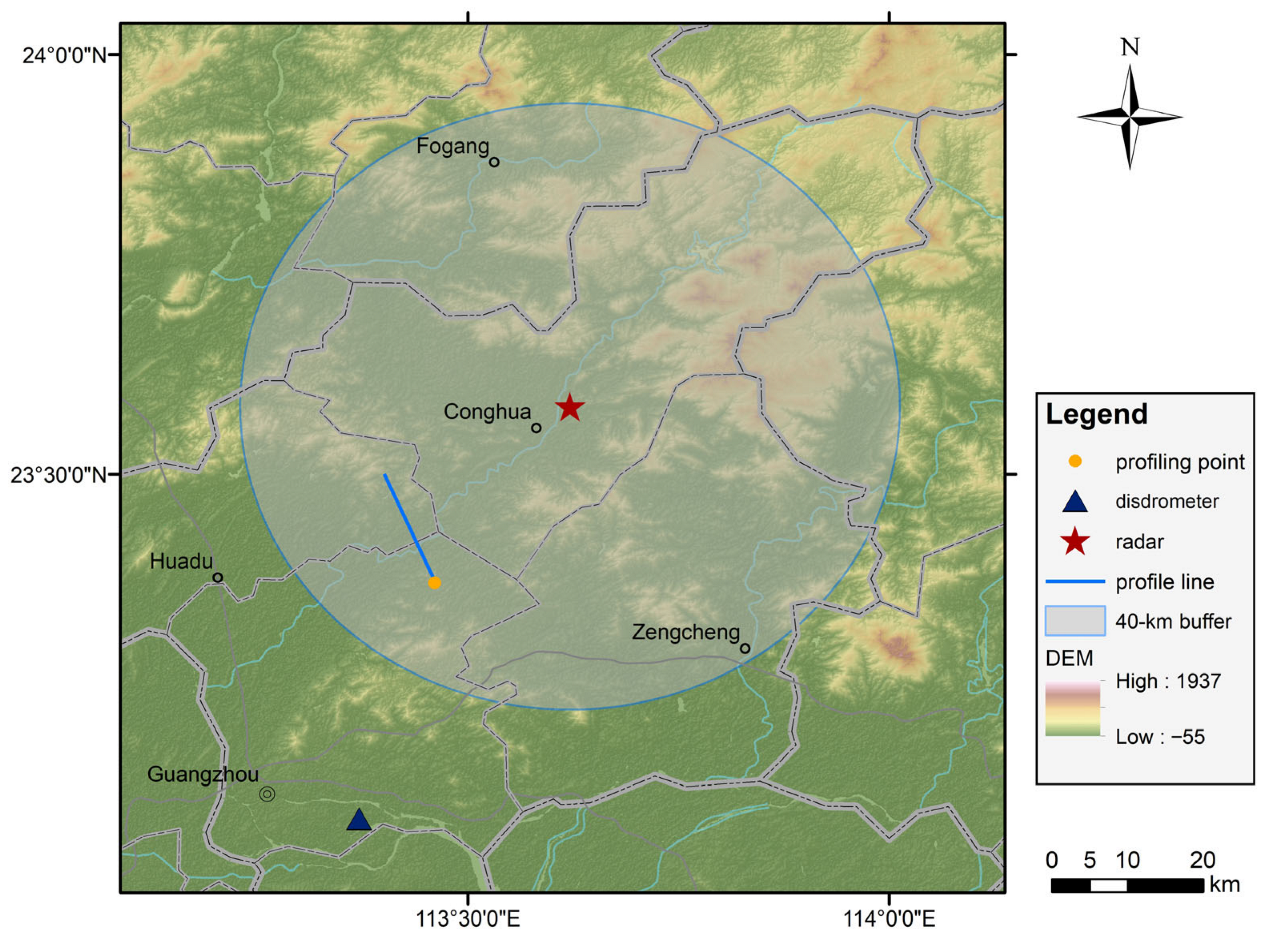
This study utilizes observational data from the Guangzhou G9590 disdrometer site (113.37°E, 23.09°N) to develop a DSD parameter model. It further integrates data from the X-band phased-array radar at station ZG005 (113.62°E, 23.58°N) to retrieve multi-layer DSD data, enabling the dynamic retrieval and fusion analysis of DSD parameters with a high spatiotemporal resolution. The locations of the disdrometer and radar are illustrated in Figure 1. The blue solid line marks the location used for the subsequent vertical profile analysis because it lies over a low-elevation valley free of terrain blockage, ensuring that the lowest elevation sweeps (0.9°) of the radar retain unobstructed views of the boundary layer.

2.2. Data

The primary data sources used in this experiment are the AXPT0364 X-band phased-array weather radar (Naruida, Guangzhou, China) located in Conghua and the G9590 JD-2DVD two-dimensional video disdrometer (Joanneum Research, Graz, Austria). The AXPT0364 radar employs 64 all-solid-state coherent T/R modules and carries a flat-panel antenna, 1.3 m × 0.7 m. It delivers 256 W peak power, forms a 3.6° (horizontal) × 1.8° (vertical) beam, and achieves a minimum spatial resolution of 30 m with a 1 min temporal resolution (Table 1). The system operates in a one-dimensional electronic phased-array configuration, performing mechanical scanning in the horizontal plane and phased-array scanning in the vertical plane. The JD-2DVD, situated about 60 km from the radar and thus the only calibration source within a reasonable radius, records the drop number of each diameter bin and concentration at 1 min intervals. Radar data were quality-controlled by random-noise filtering and attenuation correction referring to Zhang et al. [38], and liquid precipitation was isolated with the correlation coefficient ρhv ≥ 0.97 [39], while disdrometer data were filtered using the V–D method [40]. Regarding lightning rod interference, previous studies like Wang et al. [41] have proposed mitigation approaches, yet these corrections were not implemented here owing to the absence of rod material, dimension, and position data.
Disdrometer observation data from September 2023 to October 2024 were used to establish the precipitation parameter model, comprising a total of 33,082 valid 1 min resolution samples. During this period, from 7 to 15 September 2023, Guangzhou experienced multiple continuous precipitation events due to the combined influence of the remnant circulation of Typhoon Haikui and the southwest monsoon. Several meteorological stations recorded historically extreme precipitation levels. This period was selected as a typical precipitation scenario for conducting DSD retrieval experiments using the phased-array radar. To analyze rainfall microphysical characteristics at different heights, the study focused on the multi-angle data of the phased-array radar. The elevation angle interval for each layer of data is 0.9°. This altitude distribution allows the study to effectively capture vertical rainfall processes influenced by the surface within the boundary layer, as well as the evolution characteristics in the free atmosphere. All analyses were performed within the 42 km effective range of the radar data. To suppress measurement noise in the polarimetric variables, a 5 × 5 spatial median filter was applied to the fields prior to retrieval. It should be noted that the present work introduces the RRM algorithm rather than targeting pure typhoon applications, and future campaigns will collect additional disdrometer data during intact tropical cyclone passages to further validate the model under true typhoon conditions.

3. Methodology

3.1. DSD Model

The bin parameterization method discretizes raindrop diameters into multiple size bins. The number concentration N (mm−1·m−3) of raindrops per unit volume in the i-th bin at time t, measured by a disdrometer, can be calculated as follows:
N D i , t = n i t A V i Δ t Δ D i ,
where Di (mm) represents the central raindrop diameter of the i-th bin; ni(t) is the raindrop count in the i-th bin at time step t; A (m2) refers to the sampling area of the disdrometer; Δt is the sampling time interval; ΔDi is the width of the i-th diameter bin (unit: mm); and Vi (m·s−1) denotes the terminal velocity of raindrops. When the bin intervals are sufficiently small, the bin method can accurately represent the actual raindrop size distribution. However, its computational complexity increases significantly with the number of bins, making it less suitable for theoretical analysis compared to bulk microphysical parameterization schemes.
The bulk parameterization method employs predefined analytical functions and can be described using only a few DSD parameters. Among these, the normalized Gamma distribution is widely adopted due to its flexibility and reasonable constraints. Its expression is given by the following:
N ( D ) = N w 6 ( 3.67 + μ ) μ + 4 3.67 4 Γ ( μ + 4 ) D D 0 μ e x p [ ( 3.67 + μ ) D D 0 ] ,
where N(D) represents the number of raindrops with diameter D per unit volume, D0 (mm) is the drop median volume diameter, Nw (mm−1·m−3) is the normalized intercept parameter, Γ(n) denotes the gamma function, and μ is the shape parameter.
D0 and the mass-weighted mean drop diameter (Dm) are functionally related, and DSD parameters can be expressed through moment ratios as follows [12,42]:
D m = D 4 N D d D D 3 N D d D ,
D 0 = 3.67 + μ 4 + μ D m ,
N w = 256 ( D 3 N D d D ) 5 6 ( D 4 N D d D ) 4 ,
η = ( D 4 N D d D ) 2 ( D 2 N D d D ) ( D 6 N D d D ) ,
μ = 7 + 11 η 7 + 11 η 2 4 ( η 1 ) ( 30 η 12 ) 2 ( η 1 ) .
Additionally, μ is often related to the slope λ of the exponential DSD [43,44], where λ can be calculated as follows:
λ = ( D 2 N D d D ) ( μ + 4 ) ( μ + 3 ) ( D 4 N D d D ) .
Subsequently, the rain rate R (mm·h−1) is calculated from the DSD and drop velocity:
R = 6 π × 10 4 N D D 3 V ( D ) d D ,
where V (m·s−1) is the terminal velocity of raindrops with diameter D. Moreover, to mitigate the influence of sampling errors and anomalous particles on the calculation of higher-order moments during the estimation of μ, this study employs a masking method to remove non-liquid precipitation particles and excludes samples with I > 5 mm·h−1 when estimating μ. This strategy, adopted in multiple studies [45,46], effectively enhances the robustness and physical consistency of parameter estimation.

3.2. Radar Polarization Parameters

Traditional single-polarization Doppler radar primarily relies on the radar reflectivity factor (Z) and radial velocity (RV) for observations. In contrast, dual-polarization radar significantly enhances the retrieval capability for precipitation type and intensity by utilizing multiple parameters such as the horizontal reflectivity factor (ZH, mm6·m−3), differential reflectivity (ZDR, dB), and specific differential phase (KDP, deg·km−1). This technology alternately transmits horizontally and vertically polarized electromagnetic waves and receives their backscattered signals, thereby obtaining more comprehensive information on particle phase and shape.
Meanwhile, based on the DSD parameters calculated from disdrometer observations, the three core dual-polarization parameters (ZH, ZDR, and KDP) can be computed using the T-matrix scattering approach [47]. The T-matrix computations were performed with PyTMatrix [48] at a wavelength of 33.3 mm (X-band). In the T-matrix process, a temperature of 10 °C was assumed, yielding |Kw|2 = 0.93 for liquid water. Drop shapes follow the axis ratio relation of Thurai et al. [49], and drop orientations are described by a Gaussian distribution with a 0° mean and 20° standard deviation. An adaptive orientation-averaging algorithm was employed to ensure converged scattering matrices. This further generates a time series of equivalent radar polarimetric parameters with a temporal resolution of 1 min, which is used for constructing subsequent retrieval models. The expressions are as follows:
Z H , V = 4 λ 4 π 4 K w 4 f H , V D i 2 N ( D ) D i 3 D i ,
Z D R = 10 log 10 Z H Z V ,
K D P = 180 λ π R e f H H 0 , D i f V V 0 , D i N ( D i ) D i ,
where fH(Di) and fV(Di) signify the backscattering amplitudes of raindrops for horizontally and vertically polarized waves, respectively. fHH(0, Di) and fVV(0, Di) are the standard forward scattering amplitudes, Kw represents the dielectric constant factor of water, and λ is the radar wavelength.

3.3. RRM Algorithm

According to Rayleigh scattering theory, the radar reflectivity factor Z can be expressed as a function of the sixth moment of the DSD. Based on Equation (4), ZH can be explicitly formulated as a function of N(D). When the raindrop shape satisfies the equilibrium axis ratio relationship related to diameter D, both ZDR and KDP can also be expressed as functions of N(D), although their sensitivities to the characteristics of the DSD differ. Therefore, this study systematically analyses the intrinsic relationship between radar observables and the DSD parameters from the perspective of rainfall microphysical mechanisms. This theoretical framework links radar observation parameters with characteristic raindrop diameters through microphysical processes, and its rationality and universality have been validated by previous studies [19,50].
Regarding DSD retrieval from phased-array radar, this study adopts an empirical algorithm based on polynomial regression to establish quantitative relationships between dual-polarization parameters and DSD characteristics. First, based on ZDR, D0 is retrieved using the following third-order polynomial regression equation:
D 0 = a + b Z D R + c Z D R 2 + d Z D R 3 .
Subsequently, Nw can be estimated using DSD moments such as ZH or ZDR. This study estimates the liquid water content (LWC) based on ZH and ZDR, subsequently deriving Nw using Equation (9):
L W C = a Z H 10 b Z D R + c Z D R 2 + d Z D R 3 + e Z D R 4 ,
N w = 3.67 4 π ρ w L W C D 0 4 .
Finally, since µ is closely related to the slope λ of the exponential DSD [43], µ is estimated by the following:
μ = a + b λ + c λ 2 ,
λ = m Z D R n .

3.4. Evaluation Methods

To quantitatively evaluate the performance of the DSD retrieval model, this study employs four widely used statistical metrics: Mean Absolute Error (MAE), Mean Bias Error (MBE), Root Mean Square Error (RMSE), and the Nash–Sutcliffe Efficiency coefficient (NSE). Each metric is defined as follows:
M A E = O i E i n ,
M B E = O i E i n ,
R M S E = 1 n O i E i 2 ,
N S E = 1 ( O i E i ) 2 ( O i O ¯ ) 2 .
where Oi represents the reference value of the parameter calculated from disdrometer observational data, Ei denotes the radar-retrieved parameter, O ¯ is the mean of all observed values, and n is the sample number.

4. Results

4.1. DSD Observation from the Disdrometer

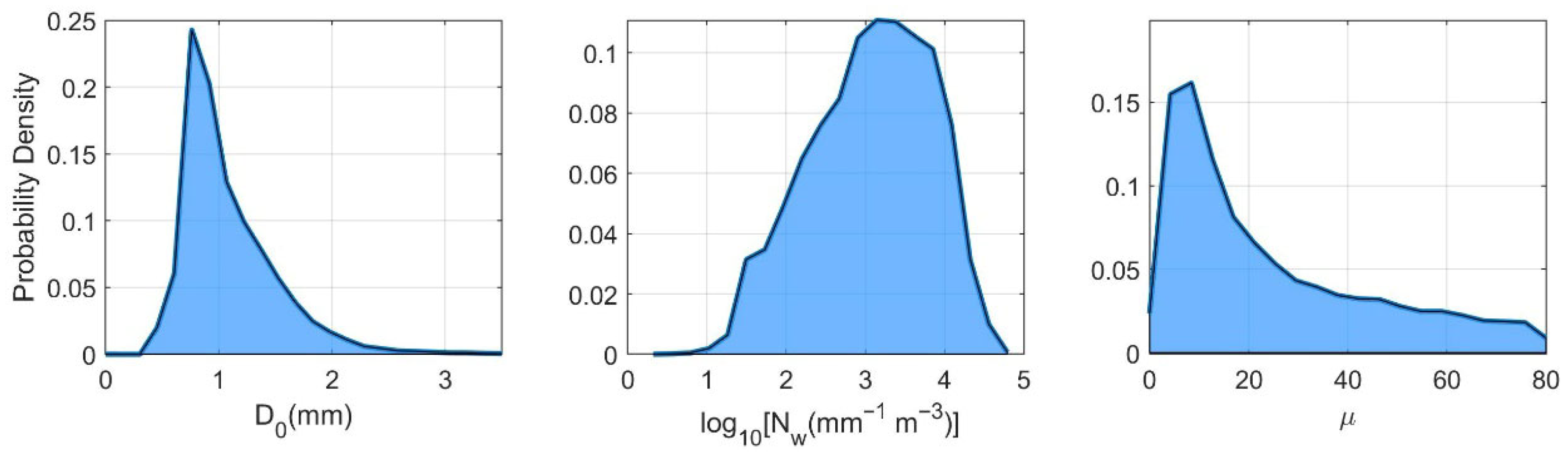
Radar quantitative precipitation estimation (QPE) relies on empirical relationships between precipitation microphysical parameters and radar observables, which are influenced by local DSD characteristics. Since DSD parameters exhibit a certain spatial representativeness under similar climatic and geographical conditions, their probability density distributions (PDFs) often demonstrate similar statistical characteristics. This provides a basis for inferring regional precipitation microphysical properties using point-based observational data. Figure 2 displays the PDFs of three minute-resolution core DSD parameters (D0, Nw and μ) based on JD-2DVD observational data from the Guangzhou G9590 site.
As shown in Figure 2, all three exhibit single-peak behavior. Specifically, the D0 curve climbs sharply from 0.3 mm to its maximum at 0.76 mm, then descends gradually toward zero above 3 mm, signifying a prevalence of mid-sized drops and a scarcity of extremes. This pattern aligns with the growth and fragmentation processes expected in South China’s warm, moist environment, where plentiful moisture promotes coalescence, yet moderate updrafts curb the maturation of exceptionally large drops. The log10Nw curve peaks at 3.1 units, with a steeper decline on the high side than on the low side, an asymmetry that inversely mirrors the D0 curve and reflects the mutual constraint between drop size and concentration in the air column [8]. Meanwhile, the μ distribution stretches broadly, accumulating near 8 while retaining a notable probability out to values exceeding 20.
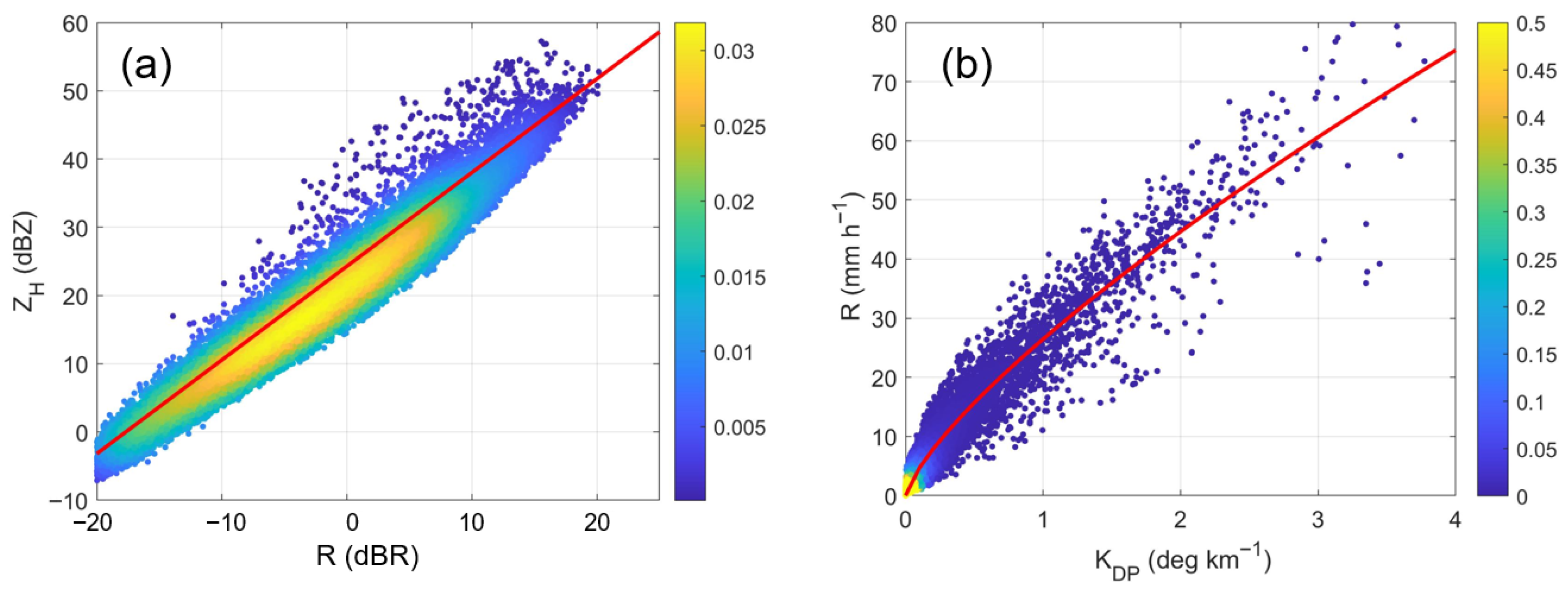
Based on the computed DSD parameters, the T-matrix method was used to calculate the scattering amplitudes of precipitation particles, from which equivalent dual-polarization radar parameters (ZH, ZDR, and KDP) with a temporal resolution of 1 min were derived. Using these parameters, ZH–R and R–KDP relationships were established, as shown in Figure 3. The relationships are both power functions, representing essential empirical associations in radar QPE applications. In the study area, they are expressed as ZH = 268.14 R1.373 and R = 26.47 KDP0.754. Most R values fall below 10 mm h−1.

4.2. DSD Parameter Retrieval Using RRM

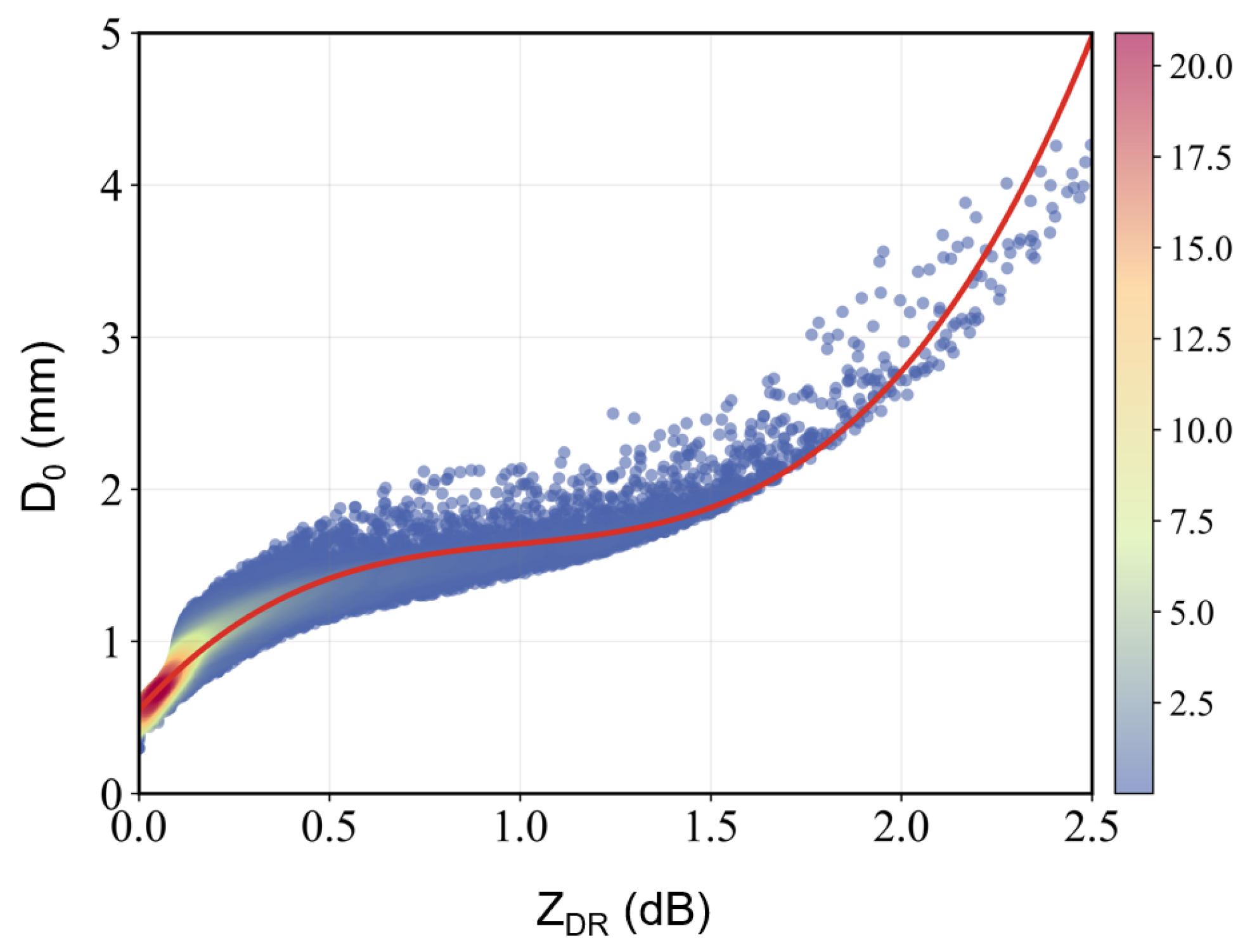
In the RRM, the directly observed and computed D0, Nw, and μ parameters from the disdrometer were used as the true target variables, while the simulated dual-polarization radar parameters using the T-matrix served as input features. Based on long-term disdrometer observational data, the experiment utilized Equations (4)–(6) to estimate the three DSD parameters. Table 2 lists the specific information of the three DSD parameters obtained in the RRM. Table 2 summarizes the detailed procedural information involved in deriving the three DSD parameters within the RRM.
ZDR is sensitive to larger raindrops, and its value increases in heavy rainfall as the proportion of large drops rises, making it an effective indicator of rainfall microphysical characteristics. Figure 4 presents the D0ZDR relationship in polynomial form, showing a good fitting trend where the fitted curve passes through the high-density D0ZDR sample points. In this site, D0 is mainly below 1 mm, while ZDR is mostly below 2.0 dB and concentrated below 0.2 dB, indicating that most raindrops observed in the study area are small in size, nearly spherical in shape, and undergo minimal deformation.
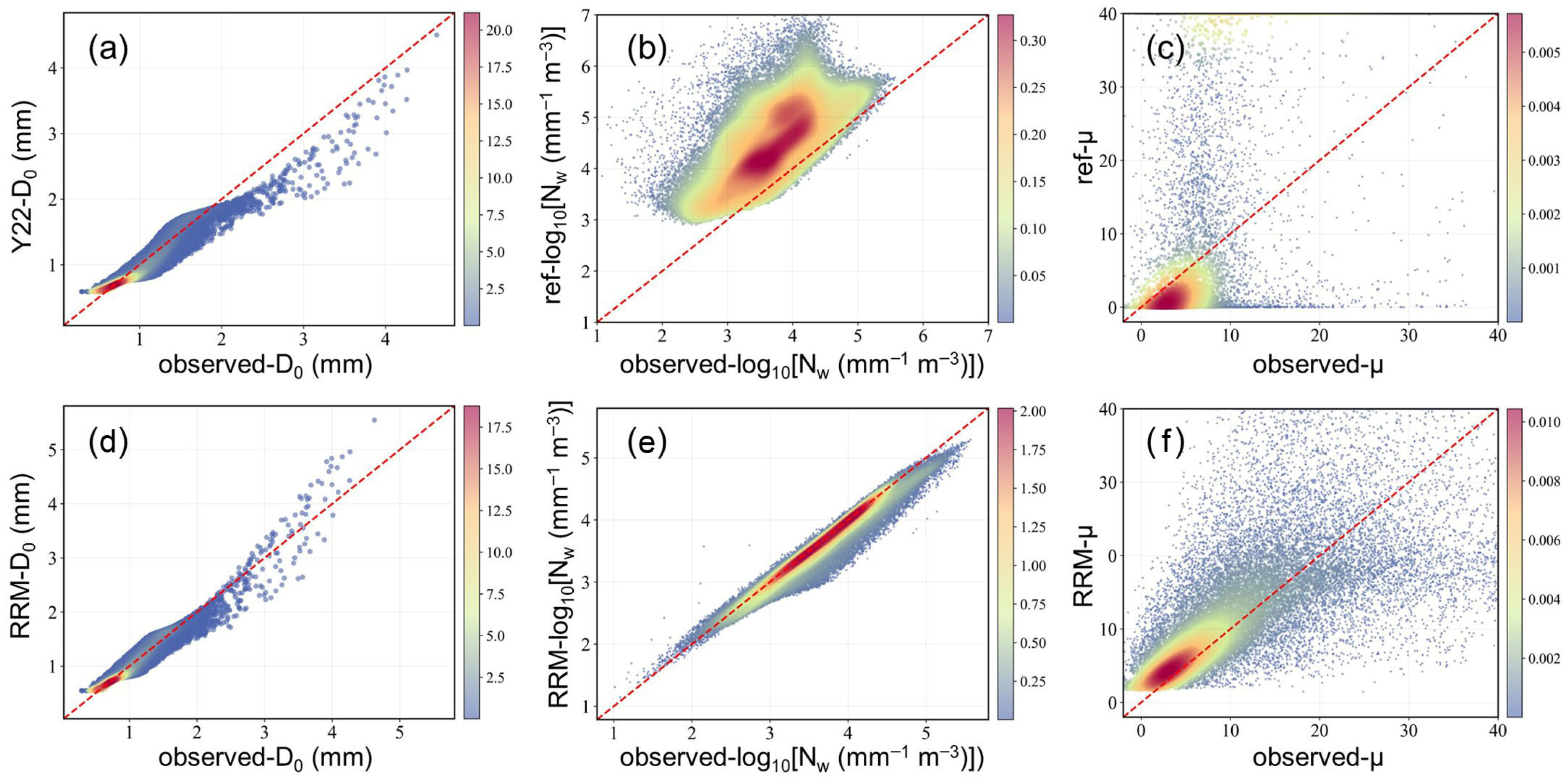
To evaluate the performance of the RRM estimation model, 80% of the disdrometer observational data were used for model training, while the remaining 20% were reserved for independent validation, and the results were compared with the regression relations of Yang et al. [42] (hereafter abbreviated as Y22). As shown in Figure 5, compared to the Y22 results, the RRM-retrieved DSD parameters demonstrate a better agreement with measured values, with data points for all three parameters clustered closely around the 1:1 line. A noticeable critical point exists for D0 at 2 mm, beyond which the fitting performance gradually deteriorates, indicating a reduced model applicability for larger raindrop sizes. However, the sample points are largely distributed along the diagonal line. In contrast, Y22-D0 produces a significant deviation from the diagonal. Overall, the RRM-D0 model shows a high accuracy, with evaluation metrics superior to the Y22 results. The RMSE is 0.11 mm and the NSE reaches 0.93 (Table 3), reflecting a strong consistency between simulated and observed values and demonstrating an excellent retrieval capability within the main particle size range. The statistical analysis of disdrometer data shows that the measured average D0 is 0.93 mm, with most precipitation events having raindrop sizes distributed in the 0.5–1.5 mm range, indicating a good model applicability for non-extreme precipitation conditions.
The retrieved log10Nw values distribute closely along the 1:1 line with a high density and low dispersion, particularly showing an optimal accuracy in the log10Nw ≈ 3–4 range, consistent with the probability density distributions discussed in Section 3.1. In terms of accuracy metrics, the model achieves an RMSE of 0.20 units and NSE of 0.91 for log10Nw retrieval, with only a slight positive bias of 0.10, indicating a robust performance. In contrast, the Y22 results are significantly overestimated, concentrated almost entirely on the upper side of the diagonal. Both the RMSE and MAE exceed those of RRM by more than sevenfold, and the NSE even yields negative values, indicating the unreliability of the Y22 model in this region.
Regarding the retrieved μ values, both Y22 and RRM results show a greater dispersion compared to the D0 and log10Nw results, reflecting a higher sensitivity to the complexity of DSD shapes and consequently a greater retrieval difficulty. This scattered distribution may be due to the fact that μ is calculated from higher-order moments, introducing a large uncertainty. Nevertheless, the mean bias of the RRM-μ model is only −0.05, with no notable systematic bias, while the Y22 results are markedly lower than the observed values, with an MBE of 1.06. The RRM also demonstrates a significantly superior RMSE, MAE, and NSE compared to the Y22 results, demonstrating a reasonably great predictive performance.

4.3. Spatiotemporal Evolution of DSD Parameters Retrieved by the RRM from Operational Radar Data

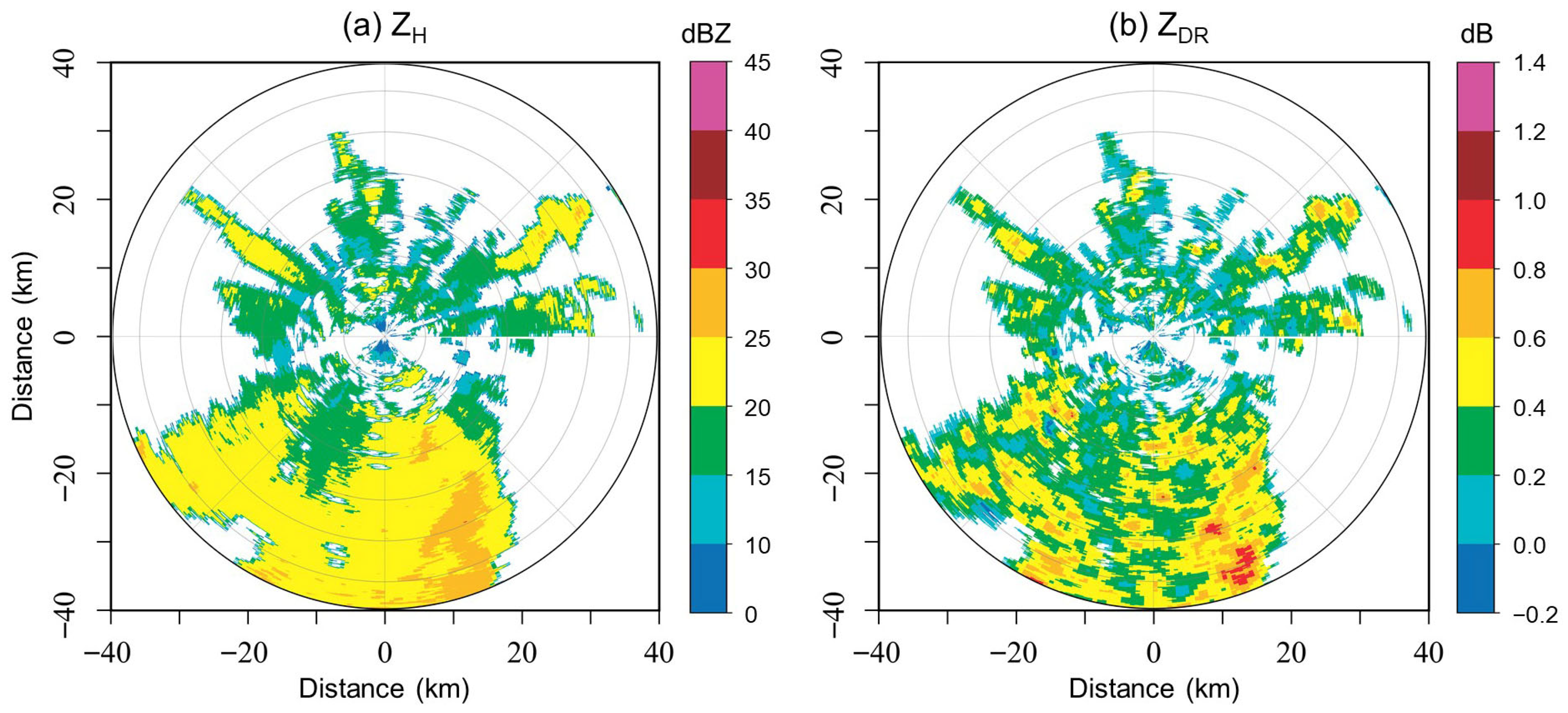
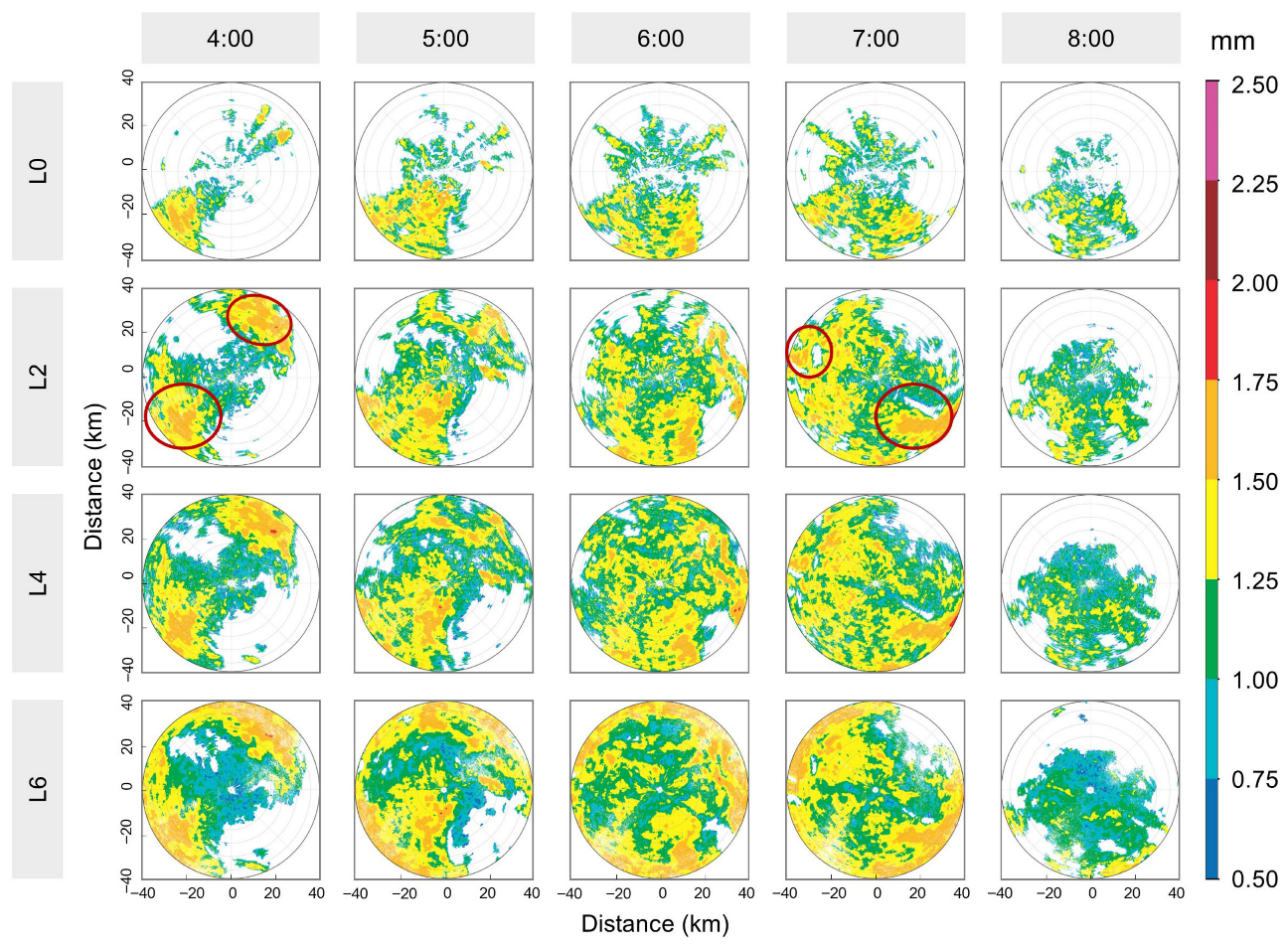
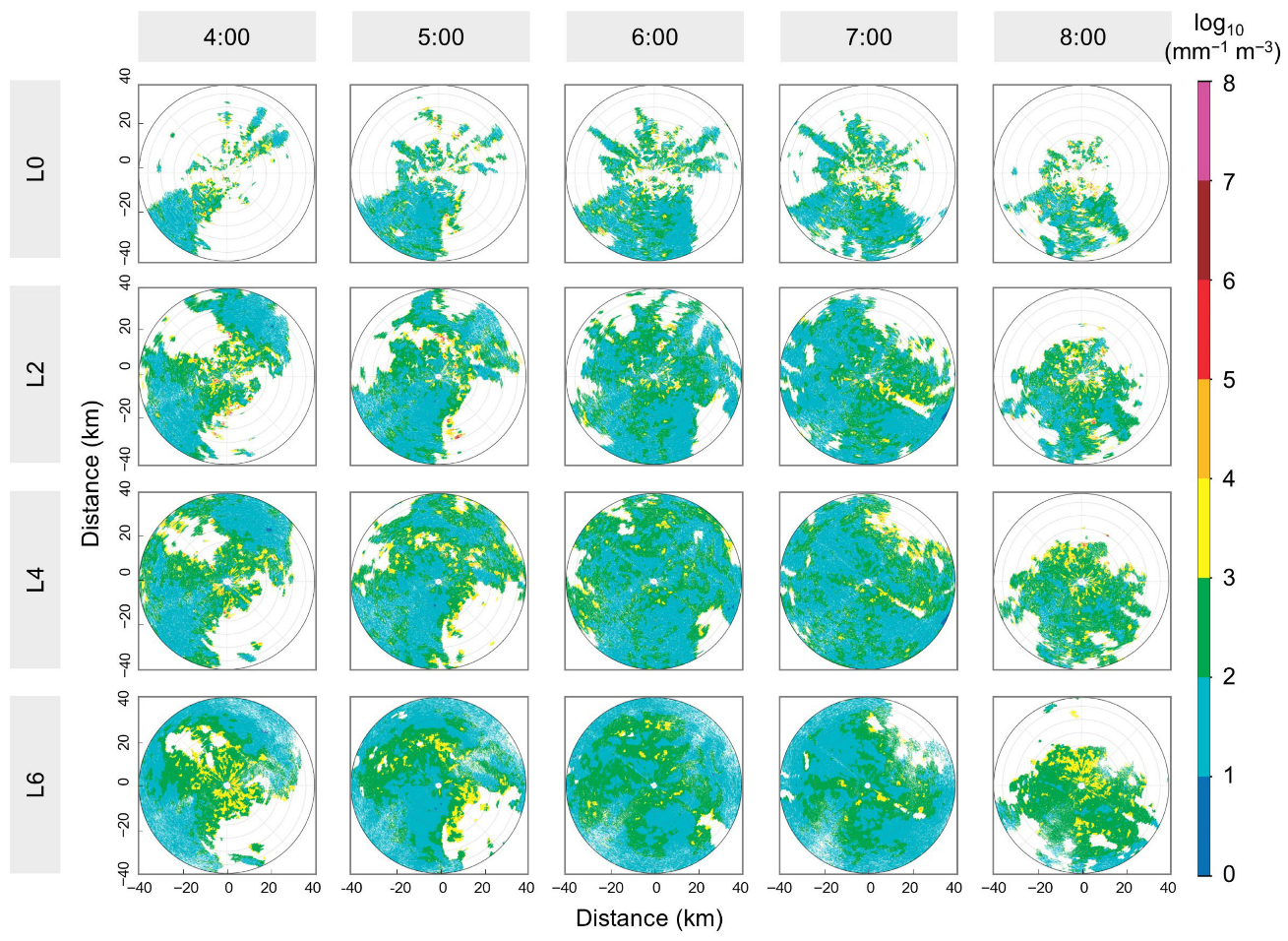
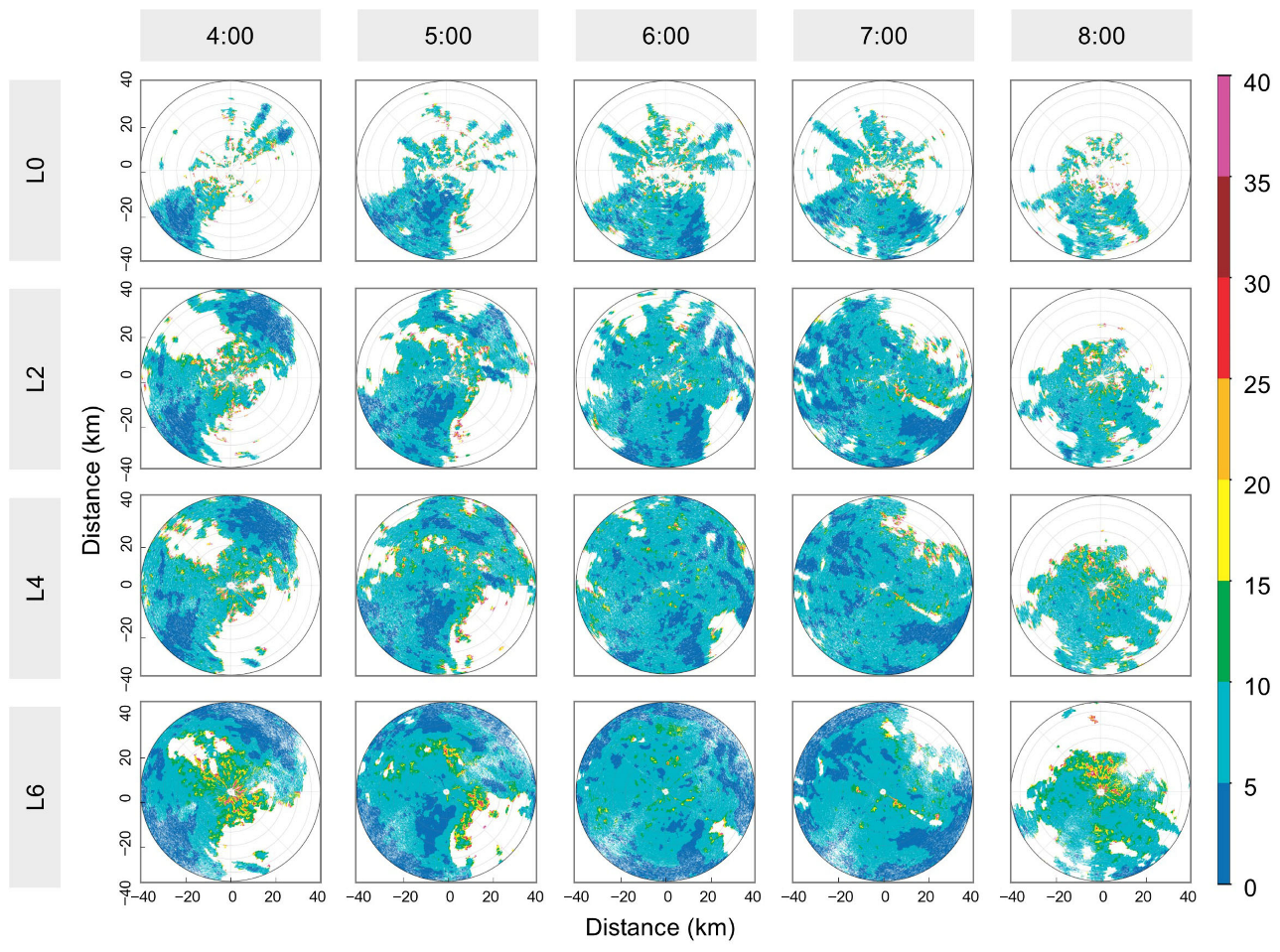
Using the phased-array radar volume scans collected between 04:00 and 08:00 UTC on 8 September 2023, we applied the RRM retrieval algorithm to every elevation angle and produced hourly maps of the DSD. Figure 6 shows ZH and ZDR images in the lowest elevation angle at 06:00 UTC this day. The following DSD analysis focuses on four near-surface elevation angle layers, namely layer 0 (0.9°), layer 2 (2.7°), layer 4 (4.5°), and layer 6 (6.3°), hereafter abbreviated as L0, L2, L4, and L6, respectively, within a 40 km radius of the radar. Figure 7 presents the spatial patterns of D0 retrieved at these four elevations for each hourly snapshot. An inspection of the rainfall coverage reveals pronounced ground clutter masking in the lowest elevation (L0), manifested as extensive blank sectors in the plan-position images. As the elevation angle increases, progressively more rainfall is observed, and, by 06:00 UTC at L6, precipitation echoes occupy nearly the entire 40 km domain. Throughout the period, the rainband migrates from the northwestern quadrant of the study area toward the south.
During this period, D0 predominantly ranged between 1.0 and 1.5 mm, with several convective cores exceeding 1.5 mm, indicative of active coalescence and updraft processes within localized intense rainfall. A notable temporal evolution was observed, as visually highlighted by the circled regions of larger raindrops in the L2 elevation of Figure 7, which systematically shifted from the northeastern and southwestern sectors towards the northwestern and southeastern sectors of the radar domain. This spatial progression likely reflects the advection and reorganization of the convective system by prevailing winds. The layer-averaged D0 peaked at 05:00 (1.25 mm), coinciding with the most intense convective phase, whereas the minima were recorded at 08:00 for L0, L2, L4, and L6 (1.02–1.10 mm), marking the transition to a more stratiform and dissipating stage. A clear spatial heterogeneity was evident across vertical layers, with the altitude of the maximum mean D0 varying over time. For instance, the peak D0 occurred at the L4 layer (1.9 mm) at 04:00, shifted to the highest layer L6 (1.26–1.28 mm) between 05:00 and 07:00, and was located at the L2 layer (1.10 mm) by 08:00. This temporal shift in the vertical location of the largest raindrops highlights the complexity of microphysical processes, such as coalescence, breakup, and evaporation, occurring at different levels within the precipitation column. Furthermore, spatial variability was most pronounced at the lowest elevations, as indicated by the mean standard deviation of 0.25 mm in L0 compared with only 0.20 mm in L4, underscoring the greater microphysical heterogeneity introduced by near-surface interactions and wind effects.
The spatial pattern of log10Nw (Figure 8) exhibited a nearly inverse relationship with D0, a classic feature in DSD characterization where regions of larger drops often correspond to lower number concentrations. The layer-averaged log10Nw reached its minimum at 05:00 (2.02–2.08 unit), similar to the D0 maximum. The highest overall mean, 2.57 units, occurred in L6 at 08:00. As with D0, the spread of log10Nw was largest at low elevations, particularly at 04:00 and 08:00 when sampling was sparse, highlighting the enhanced sensitivity of near-surface measurements to localized microphysical and environmental fluctuations.
In Figure 9, parameter μ exhibited a broad dynamic range but was generally low (<10). A low μ indicates a broader DSD tail and therefore a relatively high fraction of large drops, which is characteristic of vigorous convective cells. Consequently, the spatial distribution of μ resembled that of log10Nw rather than D0, with pronounced maxima near the radar center and along parts of the storm periphery. The mean μ increased toward lower elevations. It reached 10.23 in L0 at 08:00, corresponding to the highest layer-mean value of the dataset. Conversely, the lowest mean μ occurred at 06:00 UTC in the highest layer (L6). Additionally, μ exhibits less fluctuation in high-elevation angles, which indicates a more homogeneous and narrower DSD, potentially reflecting a more uniform initial generation or sorting of raindrops at higher levels.

4.4. Vertical Characteristics of DSD Parameters Retrieved from Operational Radar Data

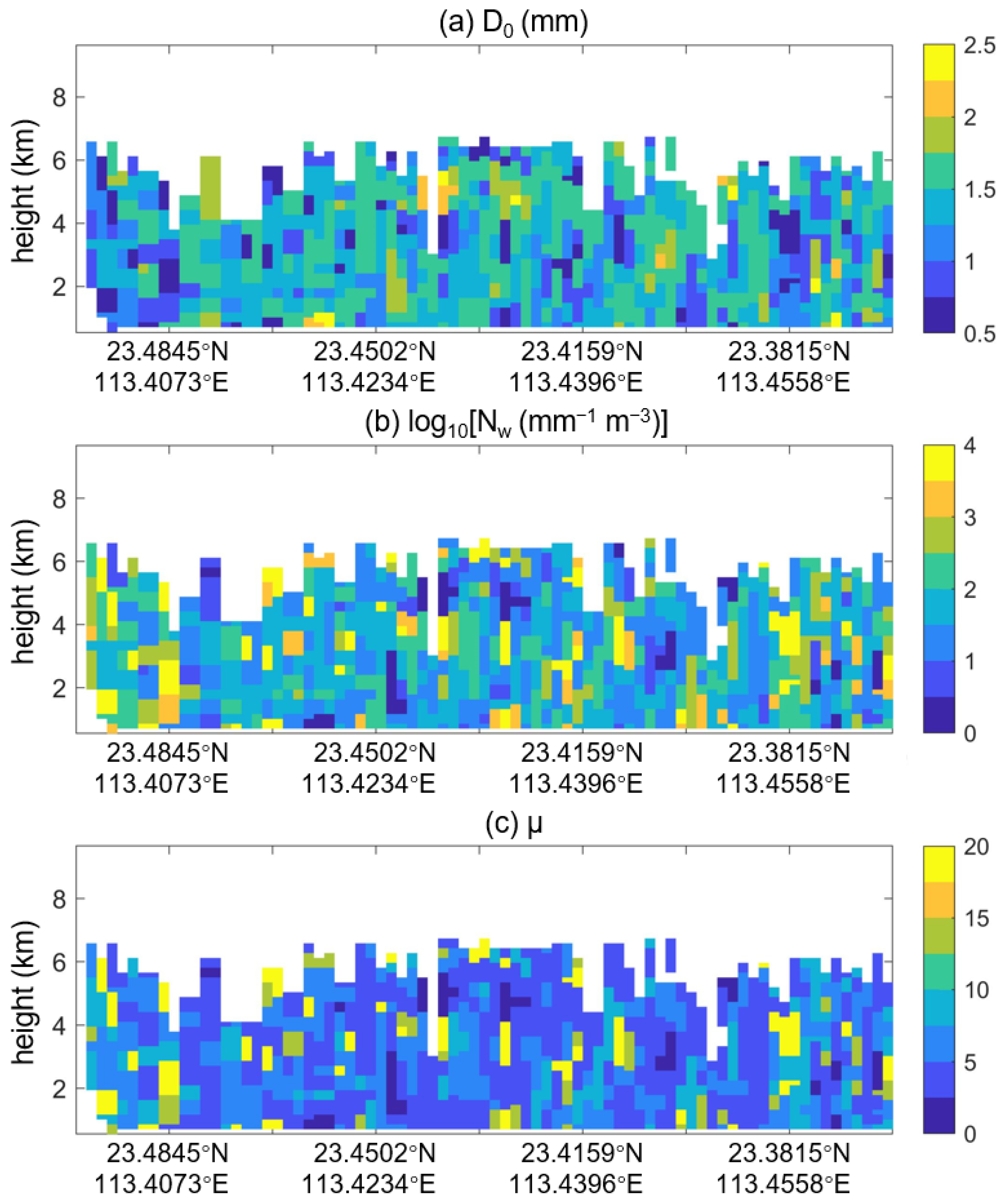
A vertical cross-section was extracted along the blue line indicated in Figure 1. Figure 10 presents the RRM-retrieved DSD parameters at 06:00 for all 40 elevation angles. Since rainfall was observed only at the 16th elevation angle (14.4°) and below, this profile is restricted to these lowest elevation angle ranges. As shown in Figure 10, liquid precipitation is mainly confined below 7 km above ground level over the observation area. Throughout the section, D0 varies inversely with log10Nw and μ. High-D0 columns are consistently accompanied by low log10Nw and low μ values. The vertical gradient is pronounced, and large drops are not restricted to the lowest levels, as several elevated cores with D0 exceeding 2 mm appear above 2 km.
Clusters of similarly sized drops are vertically aligned, indicating that comparable drop diameters tend to aggregate within the same height layers rather than being randomly distributed. At low levels, the section traverses two D0 maxima whose values increase downward, whereas log10Nw and μ decrease, implying that large surface drops grow through a collection of smaller hydrometeors aloft. Near 6 km, the low D0 coupled with the high log10Nw indicates abundant moisture and recently melted ice particles that have not yet coalesced into larger drops. The iso-value contours of all three parameters slope obliquely rather than vertically, suggesting that complex wind fields associated with the remnant typhoon and monsoon flow advect raindrops significantly across the vertical plane.
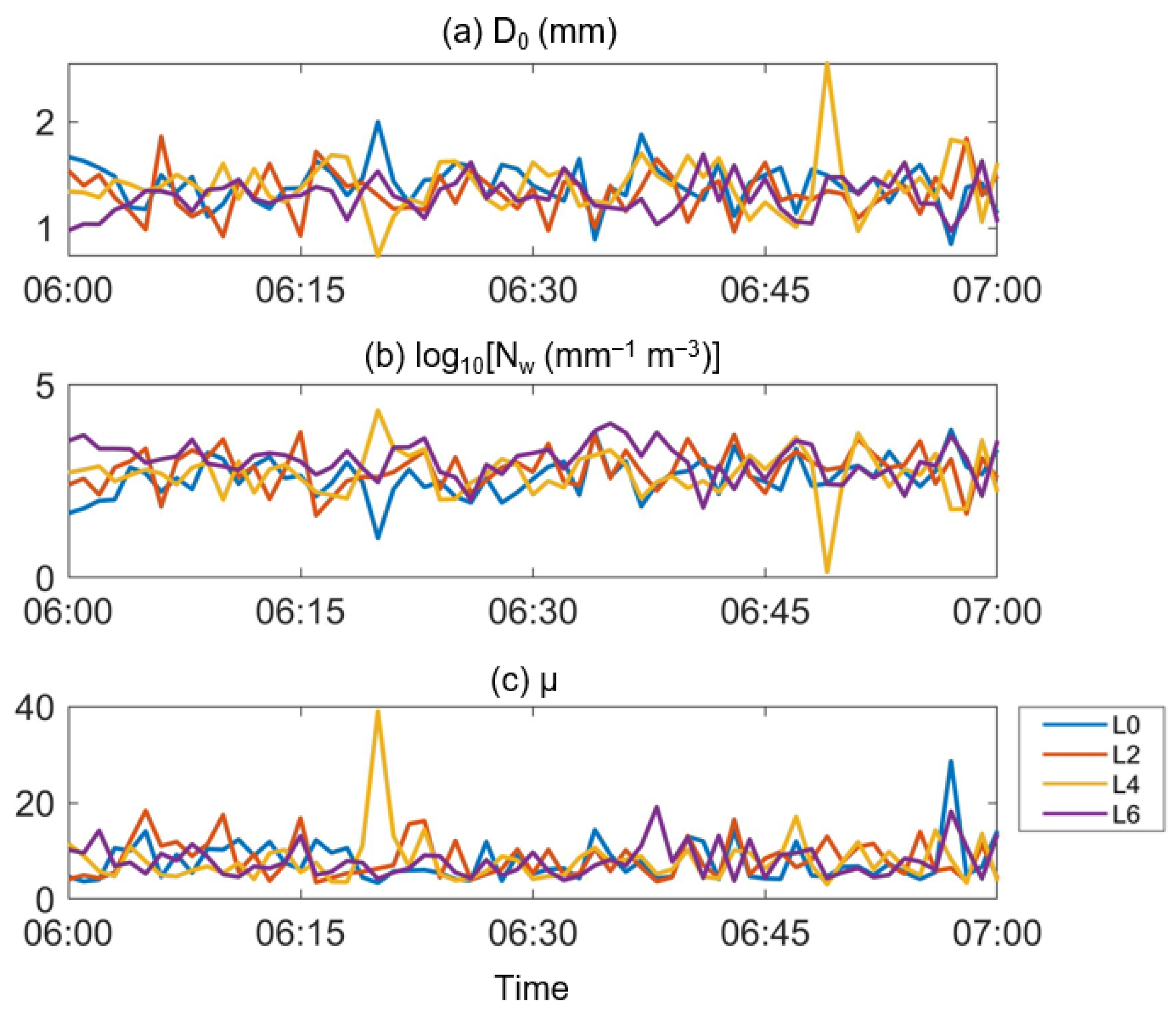
Figure 11 presents the minute-resolved time series of DSD parameters at the four elevation layers (L0, L2, L4, L6) for an analysis point on the profile line (orange point in Figure 1, 23.37°N, 113.46°E) from 6:00 to 7:00 UTC on 8 September 2023. The time series differ notably among the layers. For instance, at approximately 6:20 UTC, parameters such as D0, log10Nw, and μ exhibited peaks in opposite directions between L0 and L4. However, the time series for L0 and L4 nearly converged between 6:30 and 6:40 UTC. The mean D0 retrieved at the lowest elevation (L0) was the largest among the four layers, while its mean log10Nw and μ were the smallest. Furthermore, the variances of all three parameters were smallest at L6, indicating a relatively lower variability in the DSD aloft compared to near the ground.

5. Discussion

This study demonstrates an application of RRM for retrieving vertical DSD parameters from X-band phased-array radar observations. The method demonstrated a robust performance in retrieving the D0 and Nw, as indicated by the high NSE values in independent validation. For the shape parameter μ, the retrievals showed little bias, with an MBE close to zero. However, the non-negligible RMSE and MAE highlight the persistent challenge in precisely estimating μ, a parameter known for its high sensitivity to the tails of the drop size distribution and observational uncertainties [5,51]. Notably, the performance of the proposed RRM in estimating μ represents a clear improvement over applying the model framework of Y22 under the same conditions. This underscores the RRM’s advancement as a stable, regression-based approach tailored for high-resolution radar systems, effectively translating polarimetric observations into key microphysical parameters with enhanced fidelity.
The vertical structure of the retrieved DSD parameters during the remnant typhoon event provides concrete, observationally derived insights into precipitation processes. The analysis revealed that the altitude corresponding to the maximum or minimum mean value of DSD parameters was not fixed but changed over time. Notably, the surface layer consistently exhibited the largest standard deviation for all parameters, reflecting the complex microphysical processes occurring as raindrops descend toward the ground, such as coalescence and fragmentation [1,13]. The key advancement here is the detailed, high-resolution vertical portrayal enabled by the phased-array radar. The detection of localized high-D0 cores residing above 2 km and the systematic slanting of parameter isopleths is particularly significant. These features provide direct evidence of the substantial horizontal advection of hydrometeors within the complex wind field, which highlights the necessity of considering three-dimensional wind fields for accurate microphysical interpretation in complex convective systems.
The primary limitations of this work stem from data constraints and the empirical nature of the model. The disdrometer used to establish the regression relationships was located outside the radar’s observation domain, which precluded a direct, collocated validation of the radar-retrieved DSD parameters. Consequently, while the RRM relationships are physically grounded, the representativeness of the retrieved microphysical fields, especially their spatial patterns, could not be verified against independent, point-scale measurements, a common challenge in quantitative radar meteorology. While the calibration applied ensures an overall data usability, the quality of polarimetric variables such as ZDR may be subject to an increased uncertainty at elevation angles farther from the antenna boresight (0.9°), particularly at the high analyzed layer.
Future work would benefit from deploying disdrometers within the radar coverage to enable a rigorous pixel-level validation. Additionally, the current polynomial regression between ZDR and DSD parameters may be suboptimal in the high-ZDR range due to the limited number of strong-rain samples in the training dataset. This can affect the retrieval accuracy for microphysically significant large-drop populations. For instance, within the ZDR interval of 2.3–2.5 dB, the retrieved D0 exhibits a mean positive bias of approximately 0.5 mm. Future retrievals could employ regression based on mean values within ZDR intervals to ensure a balanced weighting and improved consistency across the entire dynamic range. Furthermore, the regression coefficients were calibrated for a specific radar configuration, limiting the model’s immediate transferability to other frequencies, climates, or orographic settings. A promising path forward is to integrate the physical basis of empirical relationships with the adaptability of machine learning techniques, training models on diverse, multi-region datasets to develop more robust and generalizable retrieval algorithms. Finally, regarding the spatial continuity in vertical profiles, the fine-scale variations exhibited by the instantaneous profiles may reflect the inherent complexity of concurrent microphysical processes, such as evaporation, breakup, and coalescence, but may also stem from measurement and retrieval noise. This noise complicates the interpretation of legitimate small-scale microphysical structures. Therefore, future studies employing an array of disdrometers deployed at different altitudes (e.g., mountaintop, slope, and base) will be crucial. Such a setup can provide vertical-truth DSD data to validate the vertical profiles retrieved by radar. This direct validation is essential to objectively distinguish retrieval noise from true physical variability, thereby guiding the development of optimal filtering strategies and calibration procedures to reveal the unambiguous spatial structure of precipitation and better understand its vertical evolution.

6. Conclusions

To address the underutilization of high-resolution X-band phased-array radar data, this study introduced a DSD retrieval model based on RRM and applied it to a remnant typhoon rainfall event in Conghua, Guangzhou, to characterize the vertical structure of the DSD.
Ground-based disdrometer observations were first combined with T-matrix scattering calculations to generate the polarimetric variables ZH, ZDR, and KDP. A three-parameter DSD retrieval scheme was then built through rainfall regression. Validation against disdrometer data yielded NSE values of 0.93 for D0 and 0.91 for log10Nw, with corresponding RMSE values of only 0.11 mm and 0.20 units, respectively. The shape parameter μ exhibited a slightly lower NSE because of its sensitivity to spectral shape, yet its mean bias was close to zero, confirming the reliability of the RRM and the potential of X-band phased-array radar for DSD estimation.
The RRM was subsequently applied to the multi-elevation scans collected during the remnant circulation of Typhoon Haikui in September 2023. The elevation angle with the maximum or minimum mean value of DSD parameters (D0, log10Nw, and μ) was not fixed at a specific altitude but varied with time. However, the surface layer consistently exhibited the largest standard deviation for all three parameters, indicating the highest microphysical variability, likely due to intensified near-surface processes such as evaporation, drop breakup, and wind effects. Vertical profiles further revealed that high-D0 cores were not always anchored to low levels; rather, isopleths of DSD parameters slanted with height, most likely because raindrops were advected horizontally by the complex remnant typhoon and monsoon flow.
This work establishes a framework for exploiting the unique capabilities of phased-array radar for precipitation microphysics research. Looking forward, the deployment of radar networks with similar technology will enable the construction of high-resolution, three-dimensional DSD maps in real time. The future research directions include rigorous pixel-level validation via dense disdrometer arrays, the extension and generalization of the RRM using machine learning across diverse climates, and, ultimately, the integration of such high-frequency DSD retrievals into operational nowcasting systems to improve the monitoring and forecasting of severe weather.

Author Contributions

J.Z. (Jingxuan Zhu) and D.J. carried out the experiments and processed the radar and disdrometer data. J.Z. (Jingxuan Zhu) drafted the initial manuscript. C.L., J.Z. (Jun Zhang), and Q.D. conceived the study, designed the retrieval framework, and supervised the analysis. All authors have read and agreed to the published version of the manuscript.

Funding

This research was funded by the National Natural Science Foundation of China, grant number 42371409 and 42201020, and the Open Research Fund of Key Laboratory of River Basin Digital Twinning of Ministry of Water Resources, grant number Z0202042022.

Data Availability Statement

The raw data supporting the conclusions of this article will be made available by the authors on request.

Acknowledgments

The authors are grateful to the Guangzhou Meteorological Service for providing the phased-array radar and the disdrometer data used in this study.

Conflicts of Interest

The authors declare no conflicts of interest.

References

  1. Dai, Q.; Han, D. Exploration of Discrepancy between Radar and Gauge Rainfall Estimates Driven by Wind Fields. Water Resour. Res. 2014, 50, 8571–8588. [Google Scholar] [CrossRef]
  2. Serio, M.A.; Carollo, F.G.; Ferro, V. Raindrop Size Distribution and Terminal Velocity for Rainfall Erosivity Studies. A Review. J. Hydrol. 2019, 576, 210–228. [Google Scholar] [CrossRef]
  3. Dai, Q.; Zhu, J.; Zhang, S.; Zhu, S.; Han, D.; Lv, G. Estimation of Rainfall Erosivity Based on WRF-Derived Raindrop Size Distributions. Hydrol. Earth Syst. Sci. 2020, 24, 5407–5422. [Google Scholar] [CrossRef]
  4. Testik, F.Y.; Rahman, M.K. First in Situ Observations of Binary Raindrop Collisions. Geophys. Res. Lett. 2017, 4, 1175–1181. [Google Scholar] [CrossRef]
  5. Zhu, J.; Dai, Q.; Xiao, Y.; Zhu, S.; Zhuo, L.; Zhang, J.; Han, D. Raindrop Size Distribution (DSD) Retrieval from Polarimetric Radar Observations Using Neural Networks. Atmos. Res. 2024, 310, 107638. [Google Scholar] [CrossRef]
  6. Khain, A.P.; Beheng, K.D.; Heymsfield, A.; Korolev, A.; Krichak, S.O.; Levin, Z.; Pinsky, M.; Phillips, V.; Prabhakaran, T.; Teller, A.; et al. Representation of Microphysical Processes in Cloud-Resolving Models: Spectral (Bin) Microphysics versus Bulk Parameterization. Rev. Geophys. 2015, 53, 247–322. [Google Scholar] [CrossRef]
  7. Yang, Q.; Dai, Q.; Han, D.; Chen, Y.; Zhang, S. Sensitivity Analysis of Raindrop Size Distribution Parameterizations in WRF Rainfall Simulation. Atmos. Res. 2019, 228, 1–13. [Google Scholar] [CrossRef]
  8. Zhu, J.; Zhang, S.; Yang, Q.; Shen, Q.; Zhuo, L.; Dai, Q. Comparison of Rainfall Microphysics Characteristics Derived by Numerical Weather Prediction Modelling and Dual-Frequency Precipitation Radar. Meteorol. Appl. 2021, 28, e2000. [Google Scholar] [CrossRef]
  9. Marshall, J.S.; Palmer, W.M.K. The Distribution of Raindrops with Size. J. Meteor. 1948, 5, 165–166. [Google Scholar] [CrossRef]
  10. Feingold, G.; Levin, Z. The Lognormal Fit to Raindrop Spectra from Frontal Convective Clouds in Israel. J. Appl. Meteorol. Climatol. 1986, 25, 1346–1363. [Google Scholar] [CrossRef]
  11. Torres, D.S.; Porrà, J.M.; Creutin, J.-D. A General Formulation for Raindrop Size Distribution. J. Appl. Meteorol. Climatol. 1994, 33, 1494–1502. [Google Scholar] [CrossRef]
  12. Ulbrich, C.W. Natural Variations in the Analytical Form of the Raindrop Size Distribution. J. Clim. Appl. Meteorol. 1983, 22, 1764–1775. [Google Scholar] [CrossRef]
  13. Dai, Q.; Yang, Q.; Han, D.; Rico-Ramirez, M.A.; Zhang, S. Adjustment of Radar-Gauge Rainfall Discrepancy Due to Raindrop Drift and Evaporation Using the Weather Research and Forecasting Model and Dual-Polarization Radar. Water Resour. Res. 2019, 55, 9211–9233. [Google Scholar] [CrossRef]
  14. Zhu, Y.; Liu, Y. Advances in Measurement Techniques and Statistics Features of Surface Raindrop Size Distribution. Adv. Earth Sci. 2013, 28, 685–694. [Google Scholar]
  15. Iguchi, T.; Seto, S.; Meneghini, R.; Yoshida, N.; Awaka, J.; Le, M.; Chandrasekar, V.; Brodzik, S.; Kubota, T.; Takahashi, N. GPM/DPR Level-2 Algorithm Theoretical Basis Document. In NASA Global Precipitation Measurement Mission; NASA Goddard Space Flight Center: Greenbelt, MD, USA, 2021. [Google Scholar]
  16. Abhijeet, K.; Rao, T.N.; Rao, N.R.; Jyothi, K.A. Retrieval of Microphysical Parameters of Monsoonal Rain Using X-Band Dual-Polarization Radar: Their Seasonal Dependence and Evaluation. Atmos. Meas. Tech. 2023, 16, 871–888. [Google Scholar] [CrossRef]
  17. Bringi, V.N.; Chandrasekar, V.; Hubbert, J.; Gorgucci, E.; Randeu, W.L.; Schoenhuber, M. Raindrop Size Distribution in Different Climatic Regimes from Disdrometer and Dual-Polarized Radar Analysis. J. Atmos. Sci. 2003, 60, 354–365. [Google Scholar] [CrossRef]
  18. Kwon, S.; Jung, S.-H.; Lee, G. A Case Study on Microphysical Characteristics of Mesoscale Convective System Using Generalized DSD Parameters Retrieved from Dual-Polarimetric Radar Observations. Remote Sens. 2020, 12, 1812. [Google Scholar] [CrossRef]
  19. Brandes, E.A.; Zhang, G.; Vivekanandan, J. An Evaluation of a Drop Distribution–Based Polarimetric Radar Rainfall Estimator. J. Appl. Meteorol. 2003, 42, 652–660. [Google Scholar] [CrossRef]
  20. Kim, D.-S.; Maki, M.; Lee, D.-I. Retrieval of Three-Dimensional Raindrop Size Distribution Using X-Band Polarimetric Radar Data. J. Atmos. Ocean. Technol. 2010, 27, 1265–1285. [Google Scholar] [CrossRef]
  21. Raupach, T.H.; Berne, A. Retrieval of the Raindrop Size Distribution from Polarimetric Radar Data Using Double-Moment Normalisation. Atmos. Meas. Tech. 2017, 10, 2573–2594. [Google Scholar] [CrossRef]
  22. Anagnostou, M.N.; Kalogiros, J.; Marzano, F.S.; Anagnostou, E.N.; Montopoli, M.; Piccioti, E. Performance Evaluation of a New Dual-Polarization Microphysical Algorithm Based on Long-Term X-Band Radar and Disdrometer Observations. J. Hydrometeorol. 2013, 14, 560–576. [Google Scholar] [CrossRef]
  23. Zhang, G.; Vivekanandan, J.; Brandes, E. A Method for Estimating Rain Rate and Drop Size Distribution from Polarimetric Radar Measurements. IEEE Trans. Geosci. Remote Sens. 2001, 39, 830–841. [Google Scholar] [CrossRef]
  24. Shin, K.; Kim, K.; Song, J.J.; Lee, G. Polarimetric Retrieval of Raindrop Size Distribution: Double-Moment Normalization Approach and Machine Learning Techniques. Geophys. Res. Lett. 2024, 51, e2023GL106057. [Google Scholar] [CrossRef]
  25. Conrick, R.; Zagrodnik, J.P.; Mass, C.F. Dual-Polarization Radar Retrievals of Coastal Pacific Northwest Raindrop Size Distribution Parameters Using Random Forest Regression. J. Atmos. Ocean. Technol. 2020, 372, 229–242. [Google Scholar] [CrossRef]
  26. Palmer, R.; Bodine, D.; Kollias, P.; Schvartzman, D.; Zrnić, D.; Kirstetter, P.; Zhang, G.; Yu, T.-Y.; Kumjian, M.; Cheong, B.; et al. A Primer on Phased Array Radar Technology for the Atmospheric Sciences. Bull. Am. Meteorol. Soc. 2022, 103, E2391–E2416. [Google Scholar] [CrossRef]
  27. Zhao, K.; Huang, H.; Lu, Y.; Chen, H.; Wu, C.; Zhao, G.; Zhu, Y.; Tan, Z.-M.; Zhang, Y.; Fu, P.; et al. Operational Phased Array Radar Network for Natural Hazard Monitoring and Warnings in Urban Environments over the Greater Bay Area, China. Bull. Am. Meteorol. Soc. 2024, 105, E2152–E2174. [Google Scholar] [CrossRef]
  28. Heinselman, P.L.; Torres, S.M. High-Temporal-Resolution Capabilities of the National Weather Radar Testbed Phased-Array Radar. J. Appl. Meteorol. Climatol. 2011, 50, 579–593. [Google Scholar] [CrossRef][Green Version]
  29. Palmer, R.D.; Schvartzman, D. Emerging Trends in Radar: Phased Arrays for Weather Observations. IEEE Aerosp. Electron. Syst. Mag. 2025, 40, 60–64. [Google Scholar] [CrossRef]
  30. Zrnic, D.S.; Kimpel, J.F.; Forsyth, D.E.; Shapiro, A.; Crain, G.; Ferek, R.; Heimmer, J.; Benner, W.; McNellis, F.T.J.; Vogt, R.J. Agile-Beam Phased Array Radar for Weather Observations. Bull. Am. Meteorol. Soc. 2007, 88, 1753–1766. [Google Scholar] [CrossRef]
  31. Wang, C.; Zhao, K.; Zhu, K.; Huang, H.; Lu, Y.; Yang, Z.; Fu, P.; Zhang, Y.; Chen, B.; Hu, D. Assimilation of X-Band Phased-Array Radar Data With EnKF for the Analysis and Warning Forecast of a Tornadic Storm. J. Adv. Model. Earth Syst. 2021, 13, e2020MS002441. [Google Scholar] [CrossRef]
  32. Otsuka, S.; Tuerhong, G.; Kikuchi, R.; Kitano, Y.; Taniguchi, Y.; Ruiz, J.J.; Satoh, S.; Ushio, T.; Miyoshi, T. Precipitation Nowcasting with Three-Dimensional Space–Time Extrapolation of Dense and Frequent Phased-Array Weather Radar Observations. Weather Forecast. 2016, 31, 329–340. [Google Scholar] [CrossRef]
  33. Kikuchi, H.; Ushio, T.; Mizutani, F.; Wada, M. Improving the Accuracy of Rain Rate Estimates Using X-Band Phased-Array Weather Radar Network. IEEE Trans. Geosci. Remote Sens. 2018, 56, 6986–6994. [Google Scholar] [CrossRef]
  34. Geng, F.; Liu, L. Study on Attenuation Correction for the Reflectivity of X-Band Dual-Polarization Phased-Array Weather Radar Based on a Network with S-Band Weather Radar. Remote Sens. 2023, 15, 1333. [Google Scholar] [CrossRef]
  35. Feng, J.; Liu, X.; Xia, F.; Zhang, Y.; Rao, X. Attenuation Correction of the X-Band Dual-Polarization Phased Array Radar Based on Observed Raindrop Size Distribution Characteristics. Atmosphere 2023, 14, 1022. [Google Scholar] [CrossRef]
  36. Tang, Q.; Xiao, H.; Guo, C.; Feng, L. Characteristics of the Raindrop Size Distributions and Their Retrieved Polarimetric Radar Parameters in Northern and Southern China. Atmos. Res. 2014, 135–136, 59–75. [Google Scholar] [CrossRef]
  37. Zhu, J.; Dai, Q.; Xiao, Y.; Zhang, J.; Zhuo, L.; Han, D. Radar Remote Sensing Retrieval of Vertical Profile of Rainfall Kinetic Energy in the UK. IEEE Trans. Geosci. Remote Sens. 2025, 63, 1–11. [Google Scholar] [CrossRef]
  38. Zhang, Y.; Wu, S.; Li, H.; Hu, D.; Huang, H.; Fu, P.; Tian, C. Data Quality Analysis and Application of Guangzhou X-Band Dualpolarization Phased Array Radars. J. Trop. Meteorol. (Chin. Version) 2022, 38, 23–34. [Google Scholar] [CrossRef]
  39. Tomkins, L.M.; Yuter, S.E.; Miller, M.A.; Allen, L.R. Image Muting of Mixed Precipitation to Improve Identification of Regions of Heavy Snow in Radar Data. Atmos. Meas. Tech. 2022, 15, 5515–5525. [Google Scholar] [CrossRef]
  40. Ji, L.; Chen, H.; Li, L.; Chen, B.; Xiao, X.; Chen, M.; Zhang, G. Raindrop Size Distributions and Rain Characteristics Observed by a PARSIVEL Disdrometer in Beijing, Northern China. Remote Sens. 2019, 11, 1479. [Google Scholar] [CrossRef]
  41. Wang, H.; Yu, H.; Wen, H.; Shu, Z. The Impact of Lightning Rods on the Differential Reflectivity of X-Band Radar. Atmosphere 2025, 16, 204. [Google Scholar] [CrossRef]
  42. Yang, Q.; Dai, Q.; Zhang, S.; Zhu, K.; Zhang, L. Raindrop Size Distribution Retrieval Model for X-Band Dual-Polarization Radar in China Incorporating Various Climatic and Geographical Elements. IEEE Trans. Geosci. Remote Sens. 2022, 60, 1–17. [Google Scholar] [CrossRef]
  43. Cheng, L.; English, M. A Relationship Between Hailstone Concentration and Size. J. Atmos. Sci. 1983, 40, 204–213. [Google Scholar] [CrossRef][Green Version]
  44. Vivekanandan, J.; Zhang, G.; Brandes, E. Polarimetric Radar Estimators Based on a Constrained Gamma Drop Size Distribution Model. J. Appl. Meteorol. 2004, 43, 217–230. [Google Scholar] [CrossRef]
  45. Gorgucci, E.; Chandrasekar, V.; Baldini, L. Microphysical Retrievals from Dual-Polarization Radar Measurements at X Band. J. Atmos. Ocean. Technol. 2008, 25, 729–741. [Google Scholar] [CrossRef]
  46. Bringi, V.N.; Williams, C.R.; Thurai, M.; May, P.T. Using Dual-Polarized Radar and Dual-Frequency Profiler for DSD Characterization: A Case Study from Darwin, Australia. J. Atmos. Ocean. Technol. 2009, 26, 2107–2122. [Google Scholar] [CrossRef]
  47. Waterman, P.C. Matrix Formulation of Electromagnetic Scattering. Proc. IEEE 1965, 53, 805–812. [Google Scholar] [CrossRef]
  48. Leinonen, J. High-Level Interface to T-Matrix Scattering Calculations: Architecture, Capabilities and Limitations. Opt. Express OE 2014, 22, 1655–1660. [Google Scholar] [CrossRef]
  49. Thurai, M.; Huang, G.J.; Bringi, V.N.; Randeu, W.L.; Schönhuber, M. Drop Shapes, Model Comparisons, and Calculations of Polarimetric Radar Parameters in Rain. J. Atmos. Ocean. Technol. 2007, 24, 1019–1032. [Google Scholar] [CrossRef]
  50. Brandes, E.A.; Zhang, G.; Vivekanandan, J. Comparison of Polarimetric Radar Drop Size Distribution Retrieval Algorithms. J. Atmos. Ocean. Technol. 2004, 21, 584–598. [Google Scholar] [CrossRef]
  51. Gatidis, C.; Schleiss, M.; Unal, C. Sensitivity Analysis of DSD Retrievals from Polarimetric Radar in Stratiform Rain Based on the μ–Λ Relationship. Atmos. Meas. Tech. 2022, 15, 4951–4969. [Google Scholar] [CrossRef]
Figure 1. Map of the disdrometer, the X-band phased-array radar, and its 40-buffer ranges, with terrain elevation in the background.
Remotesensing 18 00322 g001
Figure 2. PDFs of DSD parameters derived from disdrometer observations.
Remotesensing 18 00322 g002
Figure 3. Kernel density plots of ZH–R (a) and R–KDP (b) relationships derived from disdrometer observations, with the red line in each plot denoting the fitted curve.
Remotesensing 18 00322 g003
Figure 4. Kernel density plot of the D0ZDR relationship with the fitted curve shown in red.
Remotesensing 18 00322 g004
Figure 5. Kernel density plots of D0 (a), log10Nw (b), and μ (c) from observations versus Y22 retrievals, and D0 (d), log10Nw (e), and μ (f) from observations versus RRM retrievals, with the diagonal line shown dashed.
Remotesensing 18 00322 g005
Figure 6. ZH (a) and ZDR (b) images at 06:00 UTC on 8 September 2023 in the lowest elevation angle.
Remotesensing 18 00322 g006
Figure 7. D0 fields retrieved with the RRM at multiple elevation angles and time steps (red circles mark individual rainfall centers).
Remotesensing 18 00322 g007
Figure 8. Log10Nw fields retrieved with the RRM at multiple elevation angles and time steps.
Remotesensing 18 00322 g008
Figure 9. μ fields retrieved with the RRM at multiple elevation angles and time steps.
Remotesensing 18 00322 g009
Figure 10. Vertical profile of the RRM-retrieved D0 (a), log10Nw (b), and μ (c) at 06:00 UTC on 8 September 2023.
Remotesensing 18 00322 g010
Figure 11. Time series of retrieved D0 (a), log10Nw (b), and μ (c) at four elevation layers (L0, L2, L4, L6) for a selected location (23.37°N, 113.46°E) from 6:00 to 7:00 UTC on 8 September 2023.
Remotesensing 18 00322 g011
Table 1. Key specifications of the AXPT0364 X-band phased-array weather radar.
ParameterSpecification
Antenna TypeActive, flat-panel array
Antenna Size (H × V)1.3 m × 0.7 m
Operating Frequency9.3–9.5 GHz
TechnologyAll-solid-state, coherent T/R modules
Peak Transmit Power256 W
Beamwidth (H × V)3.6° (Azimuth) × 1.8° (Elevation)
Boresight Elevation Angle0.9°
Maximum Elevation Angle in Operational Data36°
Scanning StrategyAzimuth Scan: Mechanical Rotation
Elevation Scan: Electronic (Phased-Array) Steering
Volume Scan Cycle~90 s (full volumetric scan)
Antenna Rotation Speed4° s−1
Maximum Range (Theoretical)60 km
Range Resolution30 m
Temporal Resolution (Data Update)1 min
Table 2. Details in RRMs.
TargetRRM
D0 D 0 = 0.56 + 2.62 Z D R 2.22 Z D R 2 + 0.71 Z D R 3
Nw L W C = 1.60 × 10 3 Z H 10 4.22 Z D R + 5.87 Z D R 2 + 3.79 Z D R 3 + 0.81 Z D R 4 N w = 3.67 4 π ρ w L W C D 0 4
μ μ = 0.07 + 1.36 λ + 0.05 λ 2 λ = 2.11 Z D R 0.61
Table 3. Evaluation metrics for D0, log10Nw, and μ retrieved by the Y22 and RRM.
ModelTargetRMSEMAEMBENSE
Y22D00.15 mm0.10 mm−0.03 mm0.88
log10Nw1.40 log10 (m−3 mm−1)1.18 log10 (m−3 mm−1)−1.17 log10 (m−3 mm−1)−3.50
μ7.594.911.06−1.99
RRMD00.11 mm0.07 mm−0.00 mm0.93
log10Nw0.20 log10 (m−3 mm−1)0.14 log10 (m−3 mm−1)0.10 log10 (m−3 mm−1)0.91
μ5.273.35−0.050.32
Disclaimer/Publisher’s Note: The statements, opinions and data contained in all publications are solely those of the individual author(s) and contributor(s) and not of MDPI and/or the editor(s). MDPI and/or the editor(s) disclaim responsibility for any injury to people or property resulting from any ideas, methods, instructions or products referred to in the content.