1. Introduction
Exploration of the lunar south pole has become a central objective in current international lunar programs because of its unique environmental conditions, high scientific value, and strategic importance for future exploration. The region hosts permanently shadowed craters that may preserve water ice and volatiles, which are key resources for future in situ utilization and crewed missions. However, the south pole’s low solar elevation angles, steep and highly variable terrain, and strong spatial contrasts in illumination and temperature impose severe constraints on surface operations. For solar-powered rovers, such as the upcoming Chang’E-7 (CE-7) [
1,
2], traversing this environment requires not only avoiding hazardous slopes but also maintaining near-continuous solar exposure to ensure energy supply and thermal regulation [
3,
4]. These challenges represent a coupled illumination-terrain problem that is unprecedented in the context of lunar surface exploration.
Over the past decade, several agencies have developed illumination mapping and path-planning frameworks for polar missions [
5]. NASA’s Volatiles Investigating Polar Exploration Rover (VIPER) mission [
6], the Lunar Polar Exploration Mission (LUPEX) [
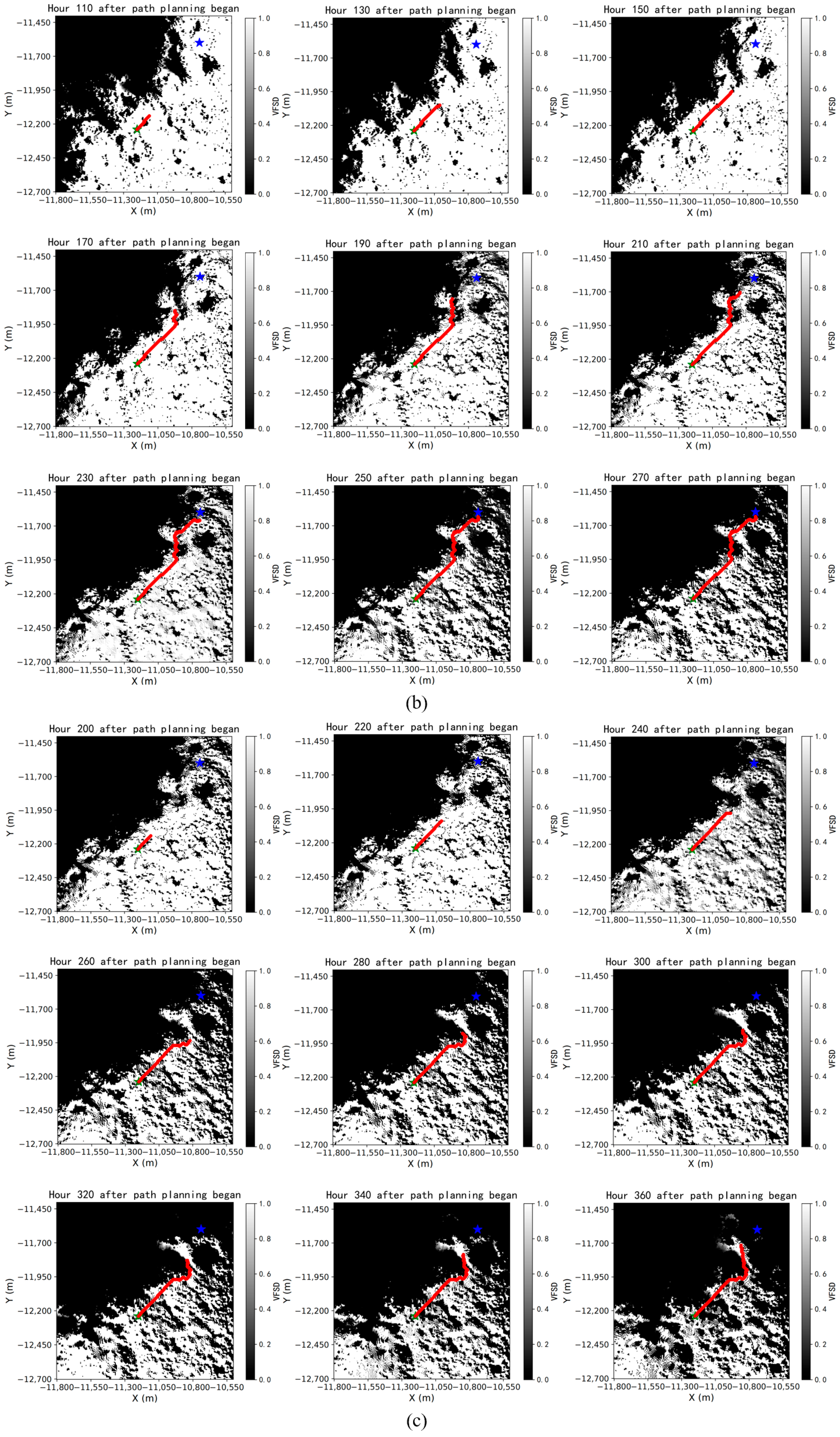
7], a joint project between the Japan Aerospace Exploration Agency (JAXA) and the Indian Space Research Organization (ISRO), and European Space Agency’s (ESA) Lunar Exploration Mission (HERACLES) [
8] have each emphasized quasi-continuous illumination zones to ensure sustained operation. Existing path planning algorithms can be broadly classified into three categories: (i) graph-based approaches such as A*, D*, and Theta* [
9,
10,
11,
12]; (ii) sampling-based methods such as Rapidly exploring Random Trees (RRT) and RRT* [
13,
14]; and (iii) intelligent optimization or learning-based techniques such as particle swarm optimization (PSO), genetic algorithms (GA), and deep Q-networks (DQN) [
15,
16,
17,
18,
19,
20]. Graph-based algorithms provide deterministic optimality and efficiency but typically rely on static maps and fixed cost heuristics. Sampling and learning-based approaches offer adaptability but often incur high computational cost and limited physical interpretability. Consequently, these methods struggle to model time-varying illumination, a dominant constraint at the lunar poles, in real-time path search.
Existing research has demonstrated that terrain slope, surface roughness, and illumination conditions are critical factors influencing the traversability of planetary rovers in polar regions. Early Mars exploration missions, such as Spirit and Opportunity, employed the Grid-based Estimation of Surface Traversability algorithm (GESTALT), which primarily assessed path feasibility based on static environmental features such as slope and roughness [
21]. However, in the context of the lunar south pole, the spatiotemporal variability of solar illumination emerges as a decisive constraint, significantly impacting both energy availability and the long-term sustainability of rover operations. Illumination-aware path planning has been explored in previous studies using static or precomputed illumination layers derived from Lunar Reconnaissance Orbiter (LRO) imagery and LOLA data. Gläser et al. [
22,
23] and Speyerer et al. [
24] mapped potential “peaks of eternal light” and identified solar visibility corridors, yet these works primarily focused on surface illumination characterization rather than its integration into autonomous navigation. Bai et al. [
25] analyzed the respective impacts of static topography and dynamic lighting, yet their method relied on discrete temporal snapshots for independent path planning, thereby failing to capture the continuous temporal evolution of illumination. Inoue et al. [
26] proposed a delay-robust spatiotemporal path planning algorithm (ROBUST-STP3R), which constructs a spatiotemporal hybrid graph to incorporate both illumination and communication constraints. Nonetheless, their method relies on fuzzy logic approximations, which limit its fidelity in modeling real physical variations. Recent advances in learning-based path planning approaches (e.g., Yu et al. [
17]; Hu et al. [
19]) have improved algorithmic autonomy and adaptability; however, these methods generally still lack effective mechanisms for modeling and utilizing the continuous temporal dynamics of solar illumination.
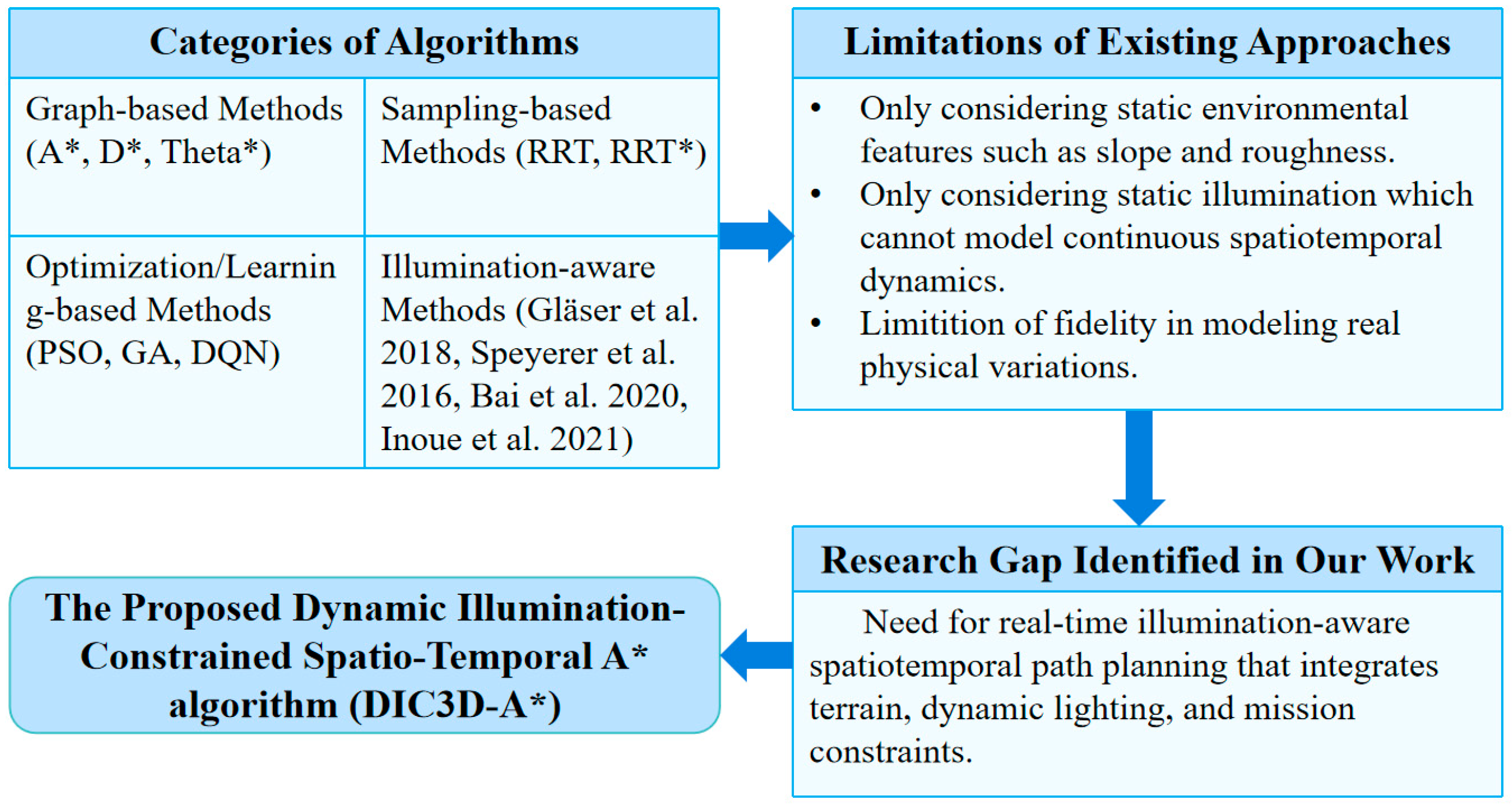
From an algorithmic modeling perspective, most existing studies remain at the level of mission-specific heuristic optimization or static illumination field analysis. There is a noticeable lack of systematic methodologies and validation frameworks for quantitatively modeling the spatiotemporal dynamics of solar illumination and integrating them with terrain features, communication constraints, and other multi-dimensional factors within a unified path planning framework. This research gap poses a significant limitation to achieving energy-autonomous and optimally scheduled rover operations under the prolonged and highly dynamic environmental conditions characteristic of the lunar polar regions. To clarify the methodological landscape, we summarize existing path-planning approaches in a research roadmap (
Figure 1), highlighting their respective strengths, limitations, and the resulting research gap that motivates our proposed illumination-aware spatiotemporal planning framework.
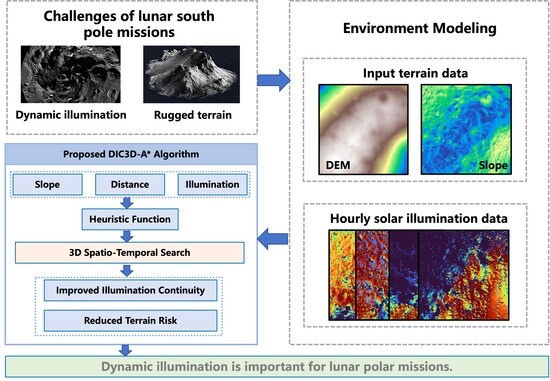
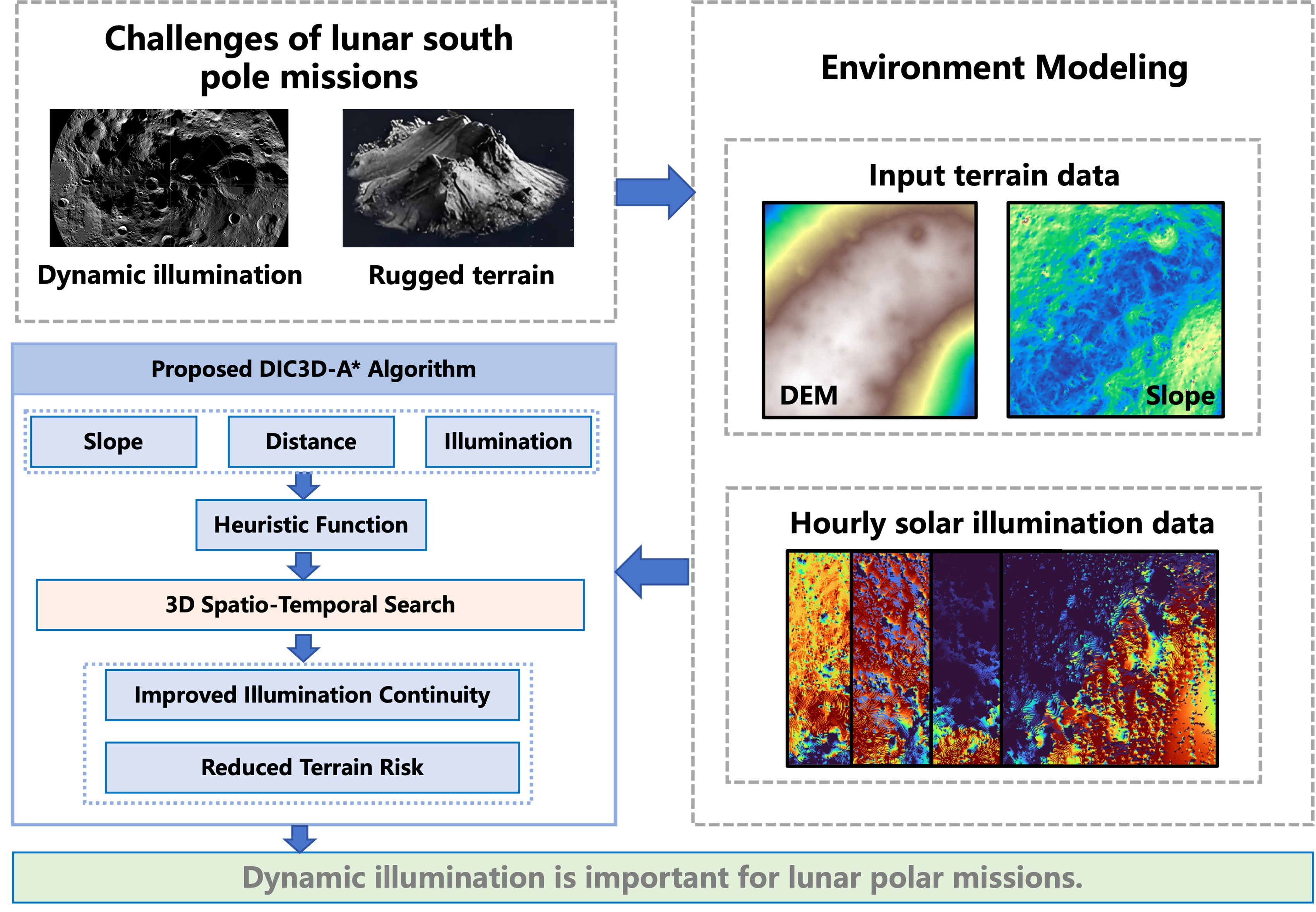
To bridge this gap, this study introduces DIC3D-A*, a Dynamic Illumination-Constrained Three-Dimensional A* algorithm for time-dependent path planning in lunar south pole exploration. The algorithm extends conventional A* search into a spatiotemporal domain, in which terrain safety, traversability, and illumination availability are jointly evaluated through a unified heuristic cost function. Using high-resolution Digital Elevation Models (DEM) and hourly planetary ephemerides, the algorithm dynamically updates node feasibility based on both slope and visible fraction of the solar disk (VFSD). By incorporating “wait” actions during transient shadow intervals, DIC3D-A* ensures illumination continuity while minimizing total travel distance and energy loss. The main contributions of this work are summarized as follows:
A high-temporal-resolution dataset of dynamic illumination conditions and the corresponding dynamic traversability map of the lunar south polar region are constructed by integrating high-resolution DEMs with planetary ephemerides.
A spatio-temporal A* heuristic cost function tailored for polar environments is developed, incorporating a physically quantifiable coupling term that explicitly links terrain characteristics, traversal distance, and illumination conditions.
Extensive simulations constructed across multiple initial times and algorithmic baselines demonstrate that the proposed DIC3D-A* method achieves superior overall performance in cumulative solar disk visibility (CSDV), terrain elevation adaptability, and computational efficiency. Furthermore, the sensitivity of the method to the selection of the mission start time and its engineering implications are comprehensively evaluated.
The findings of this work provide new insights and technical foundations for optimizing solar energy utilization and path planning strategies in the CE-7 mission and future lunar polar rover explorations.
2. Data and Methodology
2.1. Environment Modeling
To investigate rover path planning under the complex topography and time-dependent illumination conditions of the lunar south polar region, an environmental model was developed to accurately represent both the surface morphology and the temporal variability of solar illumination. The modeling framework consisted of three major components: (1) acquisition and processing of high-resolution terrain data, (2) computation of the visible fraction of the solar disk (VFSD), and (3) generation of dynamic illumination datasets.
The terrain data used in this study were derived from the high-resolution DEM produced by the Lunar Orbiter Laser Altimeter (LOLA) onboard NASA’s Lunar Reconnaissance Orbiter (LRO) (
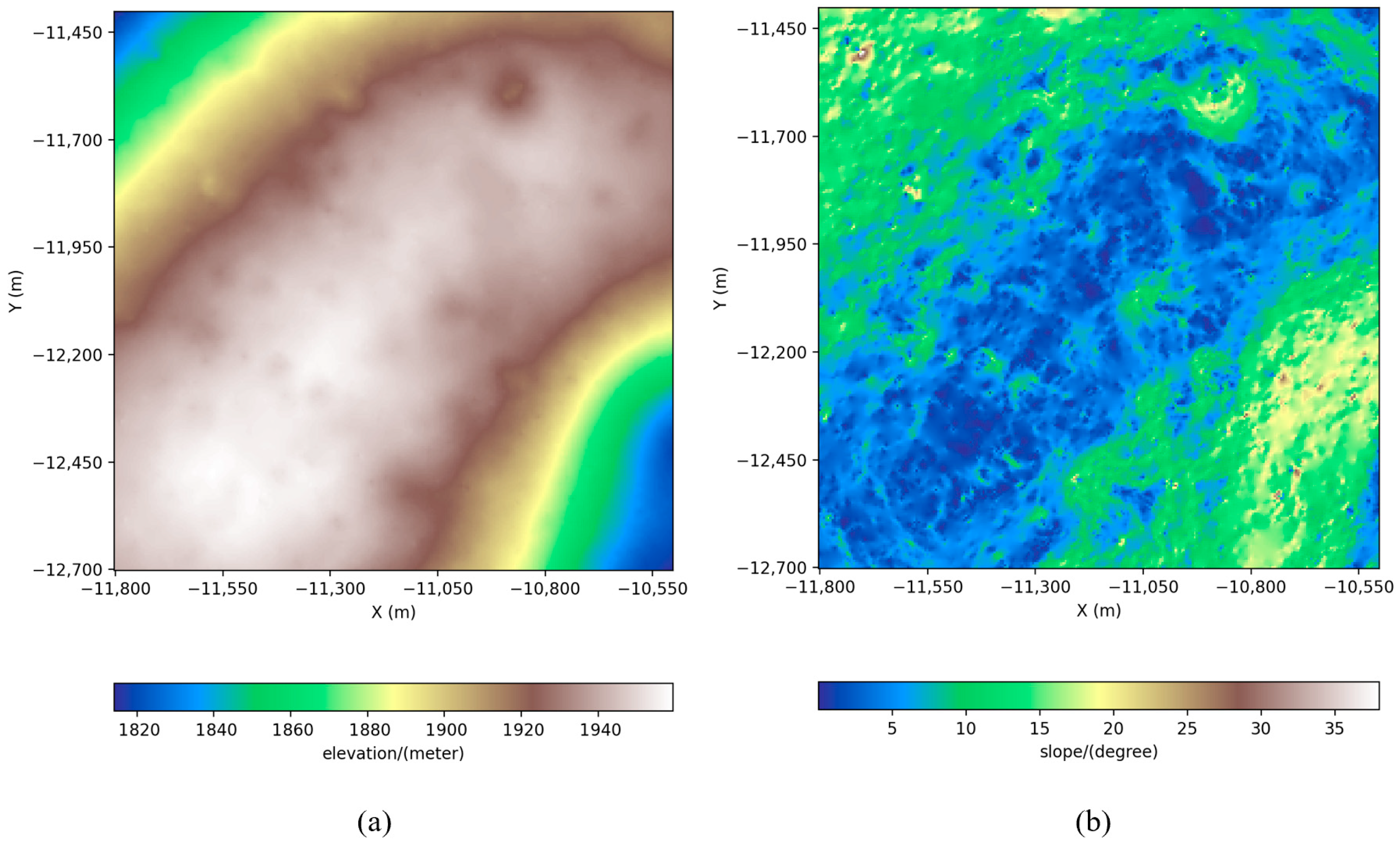
https://pgda.gsfc.nasa.gov/products/78, accessed on 5 December 2025). Based on this DEM, a terrain model covering an area of approximately 1300 m × 1300 m was generated with a spatial resolution of 5 m/pixel (
Figure 2a). The selected region is located near the connecting ridge between Shackleton and de Gerlache Craters, an area characterized by substantial topographic variation. Local slopes exceed 25° in many places, while a narrow corridor with slopes below 10° occurs along the ridge (
Figure 2b). At the broader scale, steep slopes are concentrated on the crater walls and the flanks of the connecting ridge. This complex terrain strongly influences rover traversability and local illumination visibility. The morphological characteristics of the selected area are comparable to those of “near-continuous illumination zones” identified by NASA’s VIPER mission in the lunar South Pole, indicating that the study area is both representative and scientifically relevant.
To quantify the effect of terrain-induced shadowing on solar illumination, the VFSD was calculated by employing the horizon method [
3,
22]. For each DEM grid cell, a 360° azimuthal horizon profile was generated to evaluate potential terrain occlusion. By combining this profile with the apparent solar radius and the time-dependent Moon-Sun geometry, the visible and obscured portions of the solar disk were determined, and the corresponding VFSD value was computed. The mathematical formulation is expressed as follows:
Here, denotes the unoccluded portion of the solar disk not obstructed by the local horizon, and represents the total area of the solar disk. The variables refer to an arbitrary surface location and observation time within the study domain. When the terrain horizon completely obscures the solar disk, the visible fraction is defined as 0; conversely, when the disk is entirely visible .
Using the DE440 planetary ephemeris released by NASA’s Jet Propulsion Laboratory, this study calculated the real-time Sun-Moon distance and the subsolar point coordinates (latitude and longitude) on the lunar surface for the period from 1 November to 31 December 2026, at an hourly temporal resolution. The apparent solar motion during this interval is approximately 0.55° per hour, which is comparable to the Sun’s apparent angular diameter of about 0.53°. This indicates that the chosen temporal resolution is sufficient to resolve subtle variations in solar position, particularly in the polar regions. By calculating the VFSD at each hourly time step, a dynamic illumination dataset was generated with a spatial resolution of 5 m and a temporal resolution of 1 h, encompassing the entire study area.
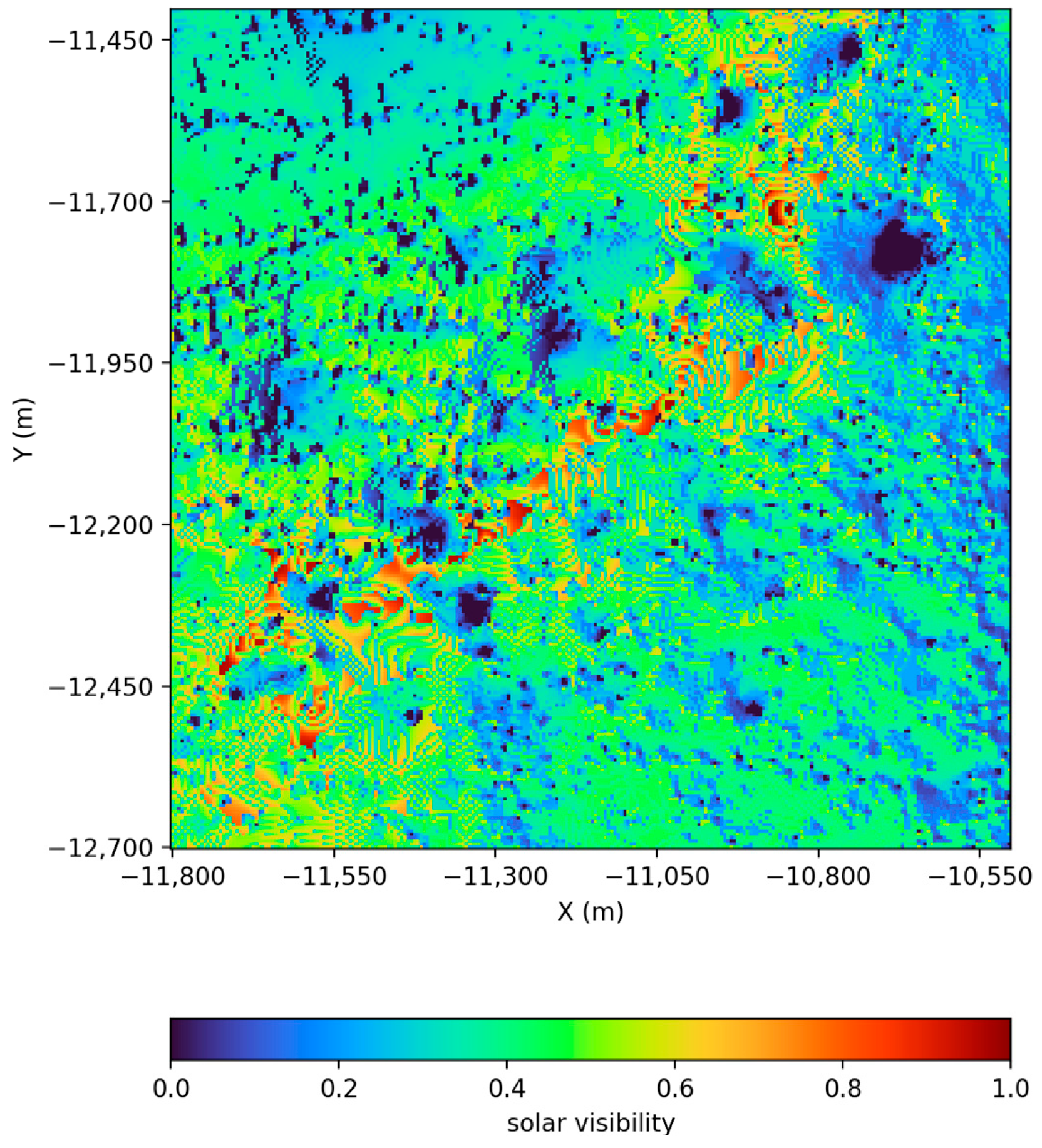
Figure 3 illustrates the spatial distribution of solar visibility across the study area during the selected simulation period, expressed as the proportion of time each pixel receives direct solar illumination. Comparison with
Figure 2 reveals a strong spatial correspondence between solar visibility and local topographic variation. The elevated ridge connecting Shackleton and de Gerlache craters exhibits notably high illumination, with visibility values generally exceeding 0.75. These ridge-top regions, characterized by higher elevation and minimal horizon obstruction, receive prolonged sunlight exposure and therefore constitute potential quasi-continuous illumination zones. In contrast, areas within crater interiors and topographic depressions display persistently low visibility values (generally below 0.25) due to extensive shadowing from adjacent crater walls, making them less favorable for surface operations or landing site selection. Although the analysis covers a representative two-month interval rather than a full lunar illumination cycle, the clear alignment between solar visibility patterns and local relief provides meaningful guidance for rover surface operations and path-planning decisions within the defined temporal window.
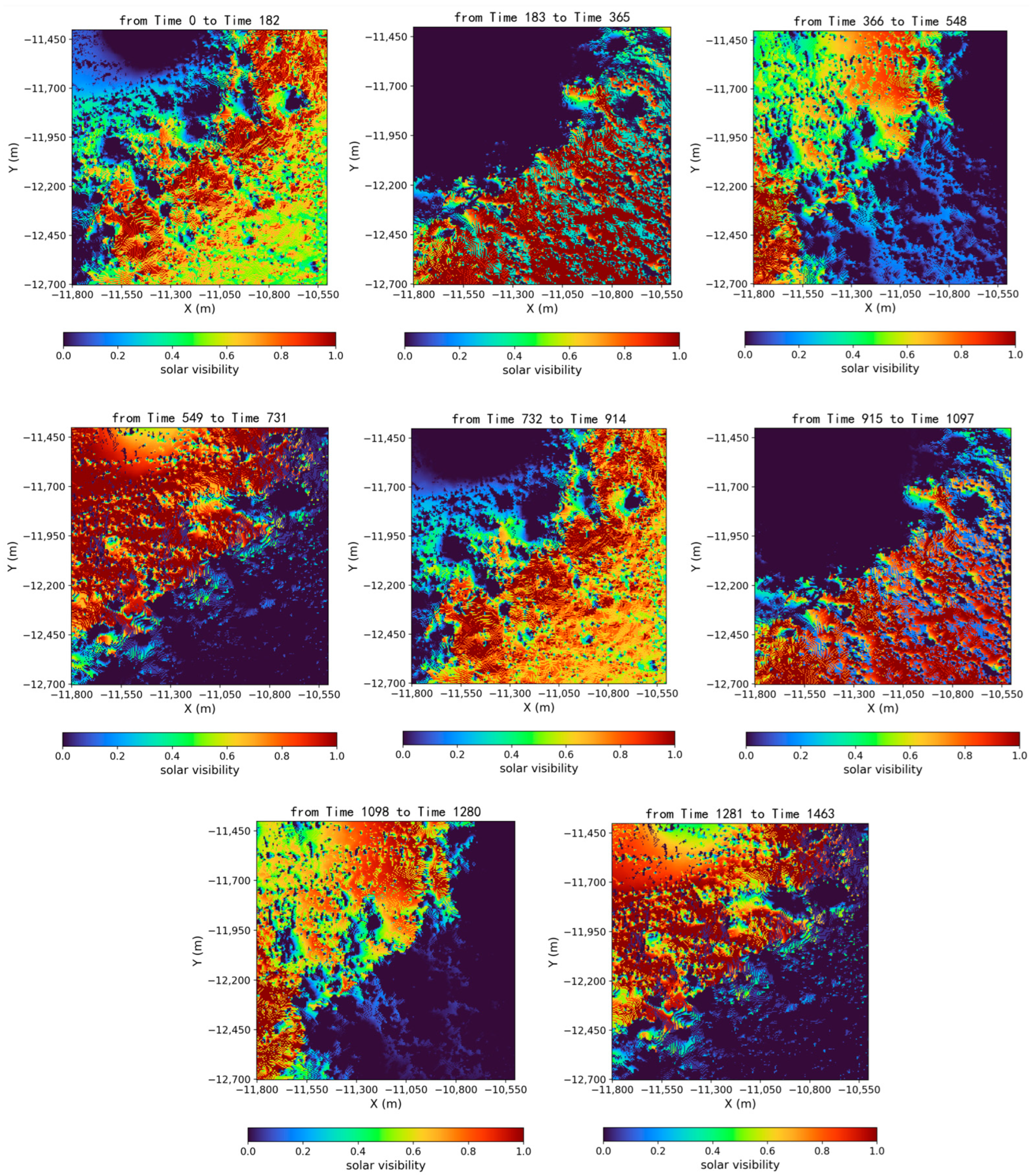
A spatiotemporal analysis of solar visibility across the study area was further performed by dividing the entire simulation period into eight sequential intervals, each spanning 182 h. This interval length was chosen as a compromise between temporal resolution and computational efficiency, and it corresponds to roughly one quarter of a lunar synodic illumination cycle in the south polar region. Solar visibility was computed for each interval to examine temporal variations in illumination patterns (
Figure 4). The results indicate that high-visibility zones exhibit a quasi-periodic drift along the ridge connecting Shackleton and de Gerlache craters across different intervals. In contrast, adjacent low-lying regions consistently maintain low visibility values, emphasizing the dominant influence of local topography on temporal illumination dynamics. The combined results from
Figure 3 and
Figure 4 reveal two key characteristics of the illumination environment at the lunar south pole:
Quasi-periodic temporal variation. Rover operations should be synchronized with illumination cycles to maximize energy availability and maintain continuous scientific observations.
Pronounced spatial heterogeneity. Path planning algorithms must incorporate illumination constraints in conjunction with terrain slope and distance cost, prioritizing route nodes within high-illumination corridors to achieve optimal energy sustainability and terrain safety.
2.2. Generation of the Dynamic Traversability Map
Building upon the hourly VFSD dataset, a dynamic traversability map was developed to represent both terrain safety and temporal illumination conditions. This map delineates the spatiotemporal accessibility of a lunar rover operating within the complex environment of the south polar region. According to rover design specifications and mission constraints for polar operations, terrain is considered traversable when the local slope does not exceed 15° [
27], and an area is defined as illuminated when the VFSD is greater than or equal to 0.6 [
28].
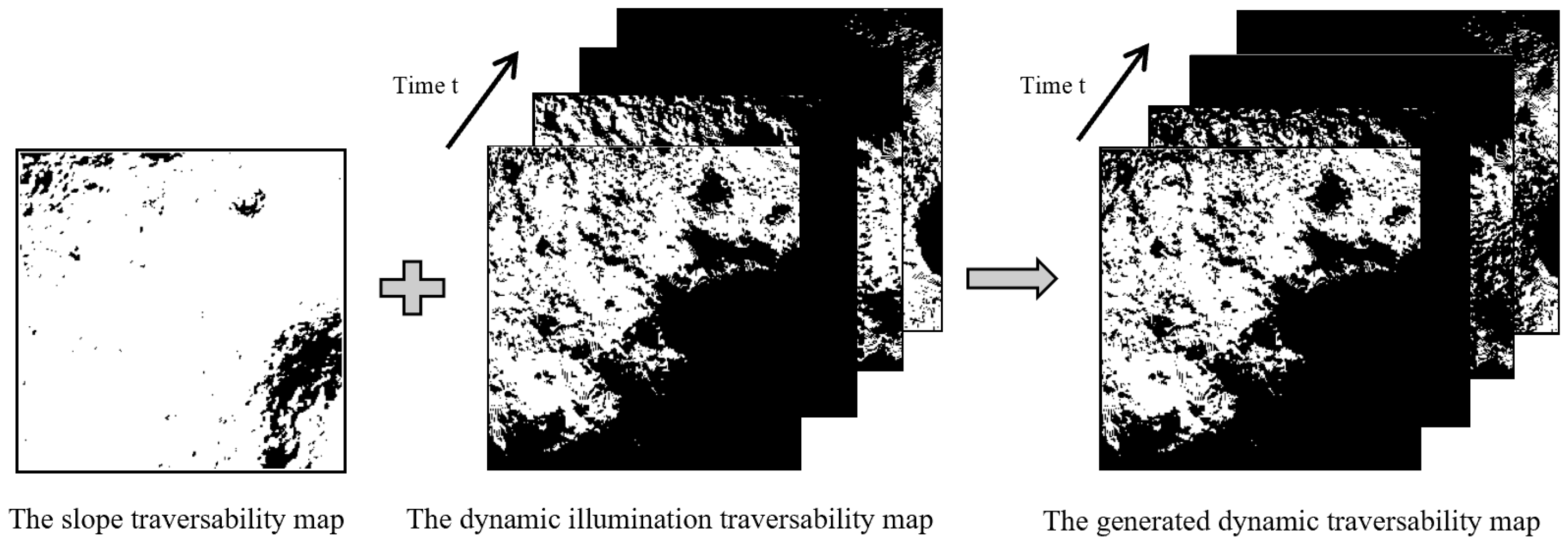
A continuous traversability modeling strategy was adopted, in which slope and illumination conditions were parameterized as continuous functions to quantify overall traversability. Initially, both the slope and the dynamic illumination maps were binarized to construct preliminary traversability maps (
Figure 5). In the slope-based map, white pixels represent areas satisfying the slope constraint (≤15°) and thus deemed navigable, whereas black pixels indicate slope exceeding this limit and are classified as non-traversable. For the illumination component, 1464 hourly solar illumination snapshots within the target period (1 November–31 December 2026) were processed individually. In each snapshot, pixels with a VFSD ≥ 0.6 were assigned a value of one (white), indicating illumination compliance, while pixels below this threshold were assigned zero (black), representing non-illuminated or shadowed regions. This yielded a time series of hourly illumination-based traversability maps.
Subsequently, element-wise matrix multiplication was performed between the slope traversability layer and each hourly illumination layer to produce the dynamic traversability maps. The resulting dataset represents the rover’s time-dependent accessibility across the study area, with white pixels denoting traversable zones and black pixels marking impassable terrain. By integrating both topographic and illumination constraints, the dynamic traversability maps provide essential input for global path planning and operational scheduling in future lunar surface exploration missions.
3. Three-Dimensional A* Path Planning Algorithm
3.1. Mobility Model for Lunar Polar Rovers
The A* algorithm is a heuristic path planning method that extends the Dijkstra algorithm, offering superior performance in both path optimality and computational efficiency. It has been widely employed in planetary rover navigation and autonomous decision-making for deep space missions. In contrast to static environments, the illumination conditions at the lunar south pole vary significantly over time. This temporal variability introduces additional constraints that directly affect rover mobility and energy management. Therefore, the conventional two-dimensional (2D) path planning framework must be expanded into a three-dimensional (3D) state-space formulation that integrates both spatial and temporal dimensions. This 3D extension enables the algorithm to account for dynamic illumination variations, ensuring that the rover’s navigation strategy remains both energy-efficient and operationally feasible through its mission timeline.
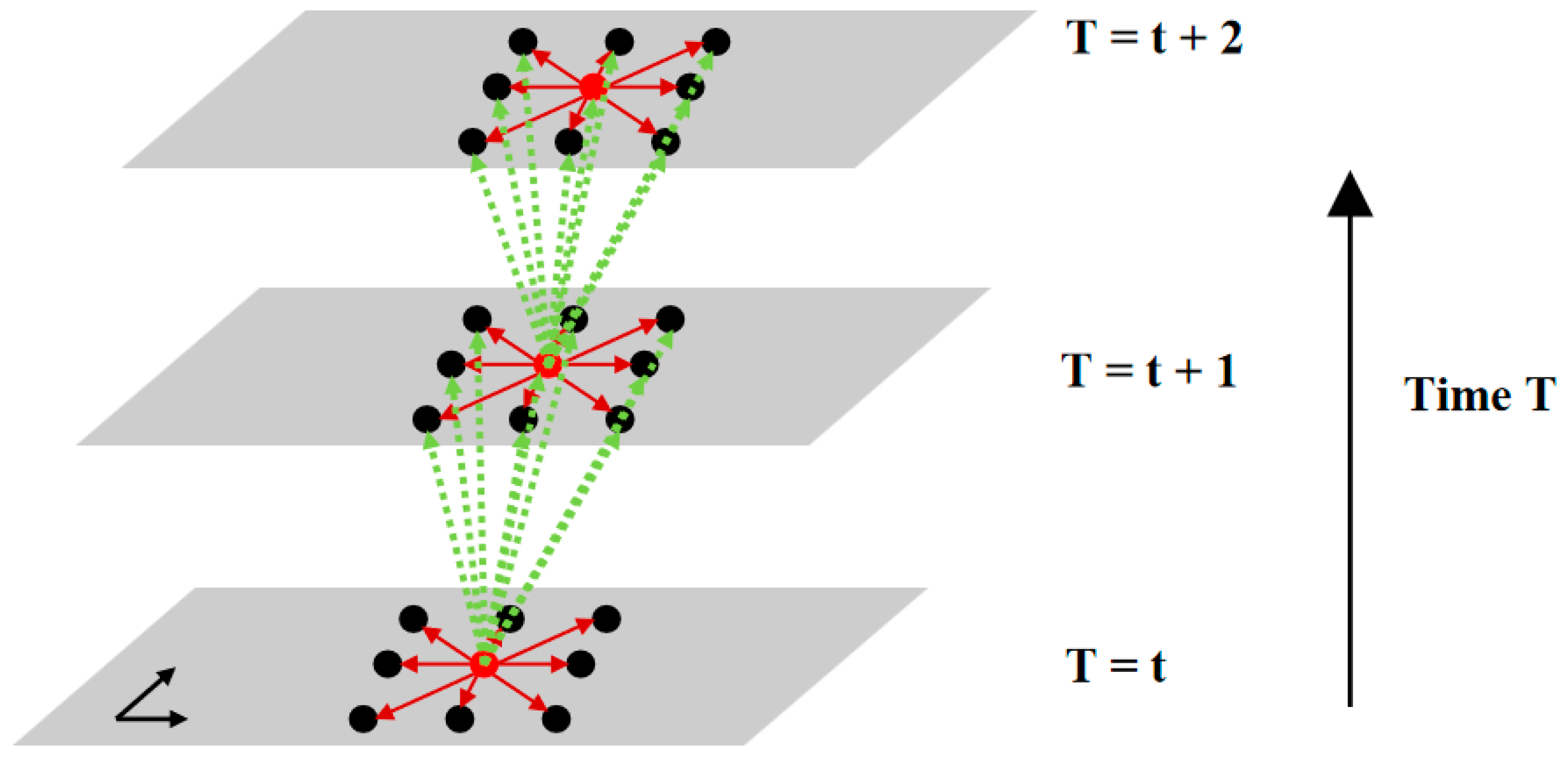
As illustrated in
Figure 6, the rover’s state at any given time is represented by a triplet
, where
denotes the spatial position and
represents the temporal component. The red dot indicates the rover’s current location, while the black dots correspond to eight spatially adjacent candidate positions in the planar grid. At the subsequent time step, the rover may move to one of these eight neighboring cells or remain stationary, resulting in nine possible state transitions. Unlike the conventional 2D A* algorithm, which operates solely in the spatial domain, the proposed approach incorporates the temporal dimension into the state space, enabling dynamic search operations in
. This extension allows the algorithm to explicitly account for temporal variations in illumination during the path planning. Moreover, by including a “wait” action, the rover can temporarily delay movement during short-duration shadowed periods, thereby securing more favorable illumination conditions in subsequent time steps. This strategy supports energy-aware and sustainable path planning.
To ensure engineering feasibility, moderate constraints are imposed on the rover’s mobility. The traversal speed is set to 5 m/h, matching the DEM’s spatial resolution (5 m/pixel) and the temporal resolution (1 h per time step). This alignment ensures spatiotemporal coherence in state transitions, enhancing the practical reliability of the planned trajectories.
During the spatio-temporal search process, the algorithm enforces both terrain slope and illumination constraints. A state transition from to is considered feasible only if:
The slope along the path between the two nodes does not exceed 15°;
The VFSD at the destination node satisfies
Nodes meeting both criteria are marked as traversable, while those failing either condition are excluded from the search, preventing entry into permanently shadowed or excessively steep regions.
The A* algorithm maintains open and closed sets throughout the search. To handle the temporal dimension, each closed-set entry is uniquely identified by the triplet , and a temporal monotonicity constraint is enforced to avoid state backtracking or redundant visits. Multiple candidate paths may occupy the same spatial location at different time layers, capturing the diversity of feasible trajectories introduced by dynamic solar illumination.
This modeling approach establishes a unified representation linking the rover’s spatial position, temporal evolution, and illumination constraints. It enables path planning that simultaneously considers terrain safety and energy sustainability. Compared with the conventional 2D A* algorithm, the proposed 3D model explicitly represents rover motion in a dynamically changing illumination environment, providing a foundation for heuristic design and energy-optimal trajectory derivation.
3.2. Heuristic Function Design
In the A* algorithm, the design of the heuristic function is critical, as it directly impacts computational efficiency while ensuring that rover safety constraints are respected during traversal. In the lunar south polar environment, real-time variations in solar illumination strongly influence both solar energy utilization and thermal control management. Therefore, the heuristic function must consider not only terrain and spatial distance but also the dynamically evolving illumination conditions.
For a given node
, the total cost function is defined as:
where
denotes the accumulated cost from the start node to the current node
, and
represents the heuristic estimate of the cost from the node
to the goal.
In this study, both the terrain-and illumination-related components of the heuristic function are conservatively estimated using lower-bound approximations. This approach guarantees , thereby preserving the admissibility and consistency of the algorithm. By ensuring these properties, the heuristic function enables the 3D A* algorithm to generate energy-efficient, safe, and computationally tractable paths for rover navigation under dynamic illumination conditions.
3.2.1. Terrain Cost Computation
Assuming the rover is located at position
, the corresponding local slope is denoted as
. The slope calculation follows the approach described in [
11] and is expressed as:
where
and
represent the rates of elevation change in the horizontal and vertical directions, respectively, computed as:
where
to
denote the elevation values within a
grid centered at
, and
and
are the spatial resolutions of the DEM in the horizontal and vertical directions, respectively, both set to 5 m/pixel.
The terrain-related cost considers three primary factors: elevation variation (
), slope gradient (
), and surface roughness (
). The total terrain cost is defined as
. In the dynamic traversability map, navigable regions are labeled
, and non-traversable regions are labeled as
. For a rover transition from the current position
to a candidate position
, the terrain-related costs are computed as:
Here, and denote the elevations at positions and , with as the weighting coefficient for elevation change. and are the slopes at the respective positions, with representing the slope influence factor. and correspond to terrain roughness values, with as the weighting factor for roughness variation.
Terrain roughness
is calculated as [
11]:
where
is the elevation of each cell in the
neighborhood, and
is the mean elevation. In Equation (9), the weights
,
, and
are normalized such that
.
3.2.2. Distance Cost Computation
The distance cost represents the fundamental component of the heuristic function and can be evaluated using either the Euclidean or the diagonal distance metrics. Assuming the rover is currently located at point
and moves to a neighboring point
at the next time step, the distance cost
is calculated as:
where
denotes the spatial distance between positions
and
, and
is the weighting coefficient associated with the distance component.
3.2.3. Illumination Cost Computation
Let
denote the VFSD at position
at time
, and
denote the VFSD at position
at time
. The illumination cost
is defined as:
where
is the weighting coefficient determining the sensitivity of the illumination cost to changes in solar visibility. When the solar visibility at time
increases relative to that at time
, the overall illumination cost
decreases, incentivizing the rover to move toward regions with higher solar exposure. Conversely, a reduction in solar visibility results in an increased illumination cost, discouraging traversal through shadowed or energy-deficient regions. This formulation effectively steers the rover toward trajectories that maintain favorable illumination conditions and support energy-efficient operations.
When terrain cost, distance cost, and illumination cost are jointly considered, the heuristic function of the proposed dynamic illumination-aware spatio-temporal A* path planning algorithm can be expressed as:
3.3. The Proposed DIC3D-A* Algorithms
Building upon the heuristic formulation described in
Section 3.2, this study introduces an enhanced spatio-temporal path planning algorithm termed Dynamic Illumination Constrained 3D A* (DIC3D-A*), specifically designed for lunar south polar rover navigation. The algorithm extends the conventional A* framework by incorporating a temporal dimension and dynamic illumination constraints, thereby constructing a unified spatiotemporal search space. This design allows the planner to evaluate both terrain safety and time-dependent illumination simultaneously, ensuring that the resulting path maintains energy sustainability while achieving global optimality. Such an approach is particularly crucial for the lunar south pole, where extreme terrain variability and rapid illumination transition present significant operational challenges.
The overall workflow of the proposed DIC3D-A* algorithm is summarized in Algorithm 1, which outlines the initialization, heuristic evaluation, node expansion, and dynamic illumination-aware path selection procedures.
| Algorithm 1: DIC3D-A*, an improved DIC3D-A* path planning algorithm considering dynamic illumination for lunar polar rovers |
Input:
Digital Elevation Map of the Region of Interest (),
Slope Map (),
Dynamic Illumination Map (),
Start Point (),
Goal point ().
Output:
Optimal path from Start to Goal.
Initialization:
Generate the Dynamic Traversability Map () and Terrain Roughness Map ().
Insert the start node into the Open Set; initialize the Closed Set as empty.
Set the actual cost of the start node , and initialize its heuristic cost .
For all other nodes, initialize the actual cost , and set the heuristic cost .
Node Expansion and Path Planning Procedure:
while OpenSet ≠ do
current node in OpenSet with lowest
if current = Goal then
Reconstruct and return the globally optimal path
end if
Remove current from OpenSet
Add current to ClosedSet
for each neighbor in Neighbors(current) do
if neighbor ∉ traversable area of or neighbor ∈ ClosedSet then
continue
end if
Compute the heuristic transition cost:
tentative_g ← g(current) +
if tentative_g < g(neighbor) then
Update g(neighbor) ← tentative_g
Compute the heuristic cost h(neighbor) using .
Update f(neighbor) g(neighbor) + h(neighbor)
end if
end for
end while
Finish |
The DIC3D-A* algorithm incorporates terrain slope, surface roughness, travel distance, and the VFSD as its primary input parameters. By constructing a dynamic traversability map (), the algorithm integrates terrain safety and illumination sustainability constraints within a unified three-dimensional state space (x,y,t) for path planning. Unlike conventional two-dimensional A* algorithms, DIC3D-A* explicitly accounts for temporal evolution, enabling the rover to dynamically avoid shadowed regions during traversal. In addition, the algorithm includes a wait-in-place mechanism that supports a sun-tracking strategy, thereby optimizing both energy acquisition and terrain safety throughout the planned trajectory.
The algorithm integrates terrain characteristics, travel distance, and time-dependent illumination into the cost function for each state transition. By adjusting their corresponding weighting coefficients, it can be flexibly tailored to different mission objectives and operational environments. The main features and methodological innovations of the proposed approach are summarized as follows:
Spatiotemporal Consistency. By introducing the temporal dimension into the state space, the algorithm models time-varying illumination conditions and enhances the interpretability of the planning process. The time step is aligned with the rover’s nominal velocity (5 m/h) and the spatial resolution of the DEM, ensuring physical consistency and coherence between spatial and temporal discretization scales.
Sun-Tracking Mechanism. The algorithm allows the rover to perform wait-in-place actions in shadowed or low-illumination areas, delaying movement until favorable lighting conditions occur. This mechanism effectively treats time as an additional optimization variable, enabling the search to identify energy-sustainable trajectories within the combined illumination-time domain rather than relying solely on static terrain conditions.
Dynamic Traversability Constraint. Based on the dynamic traversability map constructed by integrating terrain slope and time-varying illumination conditions, it ensures that every transition step taken by the rover within the three-dimensional state space adheres to both topographic and lighting constraints, guaranteeing the overall feasibility of the generated trajectory.
5. Results
To rigorously evaluate the performance of the proposed DIC3D-A* algorithm, three groups of simulation experiments were conducted under a unified DEM, dynamic illumination datasets, and consistent parameter configurations. First, the path-generation characteristics of four A* algorithm variants were compared. Second, the influence of different start times on planning outcomes was examined. Finally, the proposed DIC3D-A* algorithm was benchmarked against the RRT* and DQN algorithms. Across all experiments, the evaluation metrics included total path length, number of nodes, algorithm runtime, average terrain undulation index, and cumulative solar disk visibility fraction along the generated path.
5.1. Performance Comparison of Multi-Weighted A* Algorithms
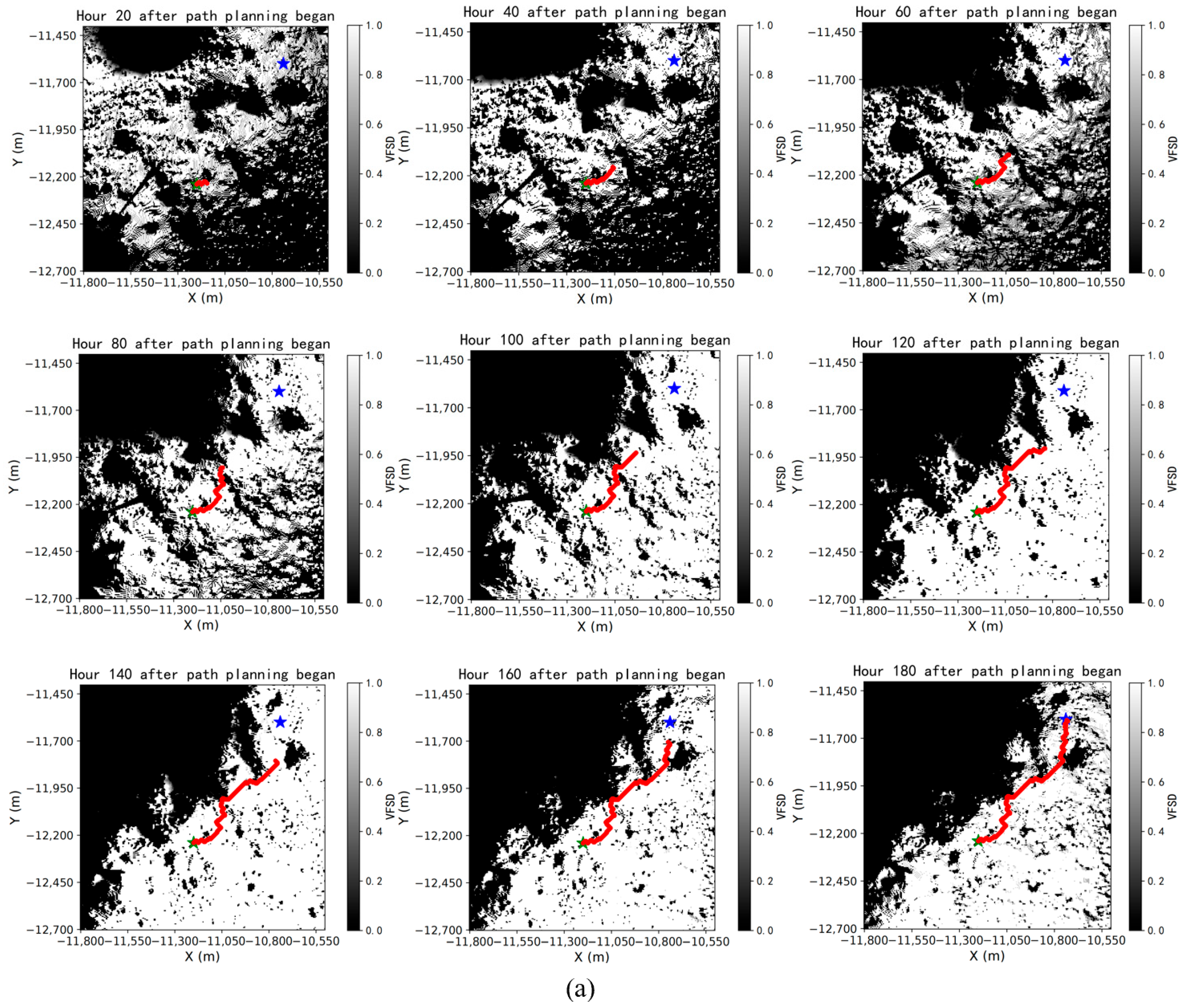
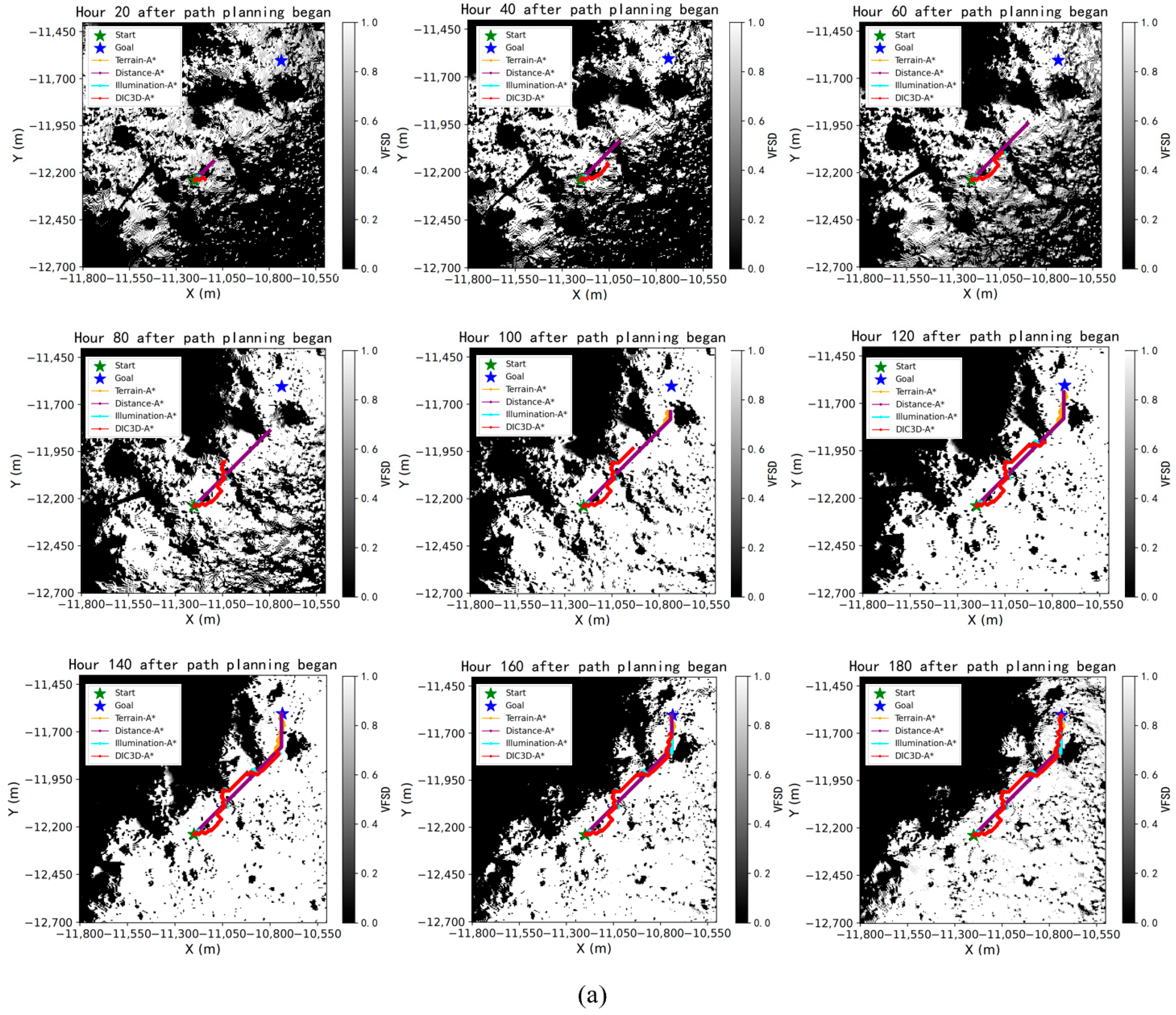
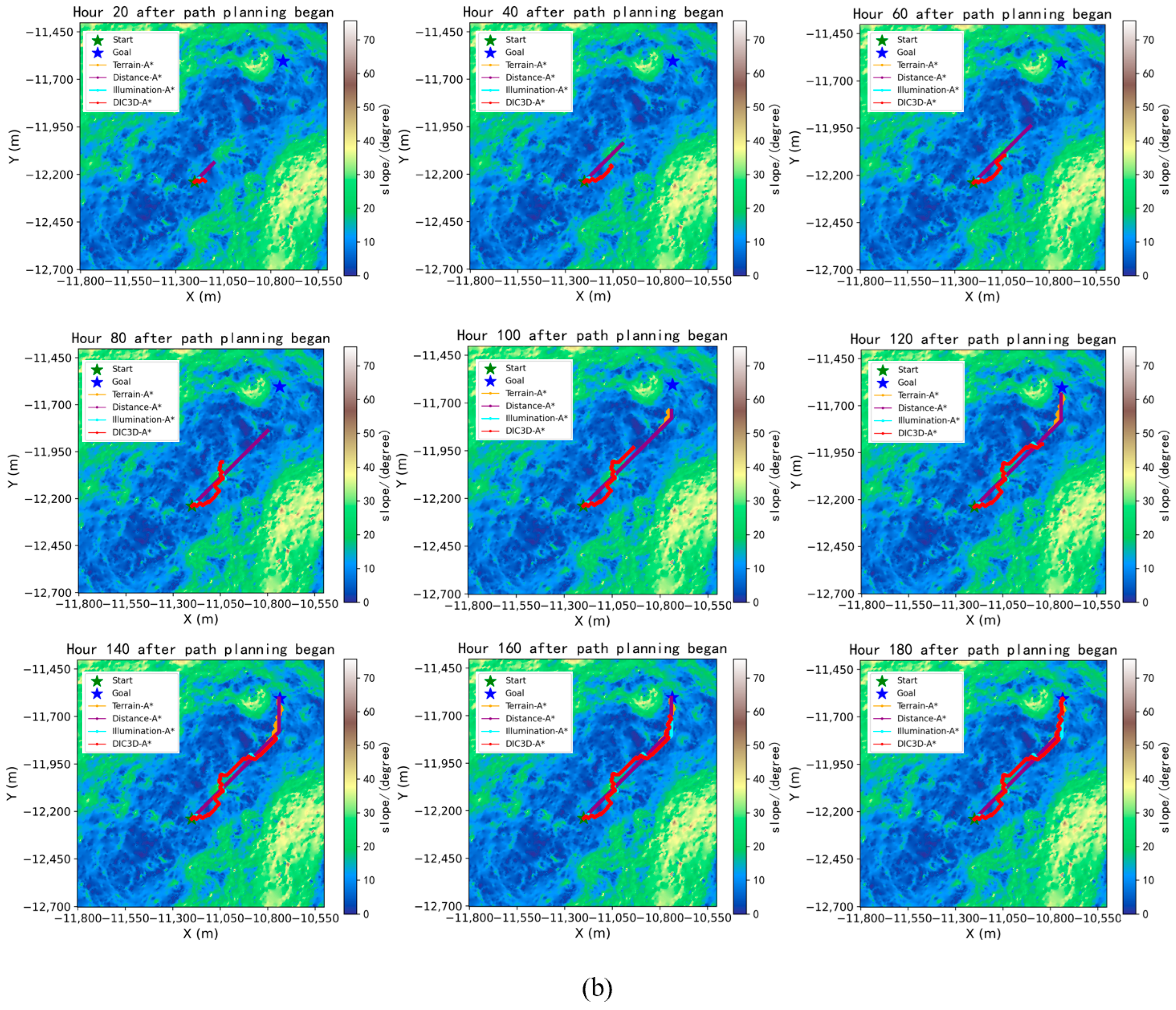
Figure 7 presents path snapshots of the four A* algorithm variants under dynamic illumination and terrain slope conditions. As shown in
Figure 7a, the Terrain-A* and Distance-A* algorithms exhibit limited responsiveness to temporal illumination variations across different time intervals. In contrast, the Illumination-A* and DIC3D-A* algorithms actively avoid shadowed regions and, during low-illumination periods, reroute through continuously sunlit corridors.
Figure 7b shows the time-indexed paths overlaid on the terrain slope map. The results indicate that Terrain-A* and Distance-A* preferentially expand nodes that minimize terrain cost or geodesic distance alone, whereas Illumination-A* and DIC3D-A* produce paths that jointly satisfy terrain and illumination constraints, demonstrating superior adaptability to environmental variations.
As summarized in
Table 4, the Terrain-A* and Distance-A* algorithms achieved the shortest path length (871 m and 825 m) and the lowest computation times (147 ms and 89 ms, respectively). However, both approaches neglected illumination constraints, leading to frequent traversal through shadowed regions and resulting in low CSDV values (84.04 and 80.51). In contrast, the Illumination-A* algorithm substantially improved the CSDV to 175.21 by prioritizing regions with favorable lighting, though at the cost of increased path length (1075 m) and a higher terrain undulation index (3.55). The DIC3D-A* algorithm achieved a more balanced performance, generating a path length of 1072 m with a CSDV of 173.18 and a terrain undulation index of 2.94. The latter represents a 17.2% reduction in terrain ruggedness compared with Illumination-A*, demonstrating improved efficiency in balancing solar exposure and terrain complexity.
In terms of terrain undulation, Terrain-A* and DIC3D-A* yielded the lowest values, indicating that their paths primarily traverse flatter regions. Terrain-A* produced the smoothest path since it considers only slope constraints, while DIC3D-A*, jointly optimized terrain, distance and illumination, occasionally crossing mild slopes. By contrast, the Illumination-A* and Distance-A* which prioritize avoiding shadowed areas or selecting distance-optimal nodes, are more likely to traverse elevated terrain, leading to slightly higher undulation values. Regarding the CSDV metric, Illumination-A* achieved the highest score due to its illumination-prioritized heuristic, while DIC3D-A* achieved nearly comparable solar visibility (173.18 versus 175.21) with a shorter and smoother path. Terrain-A* and Distance-A*, which do not consider illumination, yielded significantly lower CSDC values due to frequent traversal through shadowed regions. These results highlight a clear trade-off between terrain smoothness and energy continuity. By adaptively balancing its cost weights, DIC3D-A* effectively achieves an optimal compromise between solar exposure stability and terrain safety.
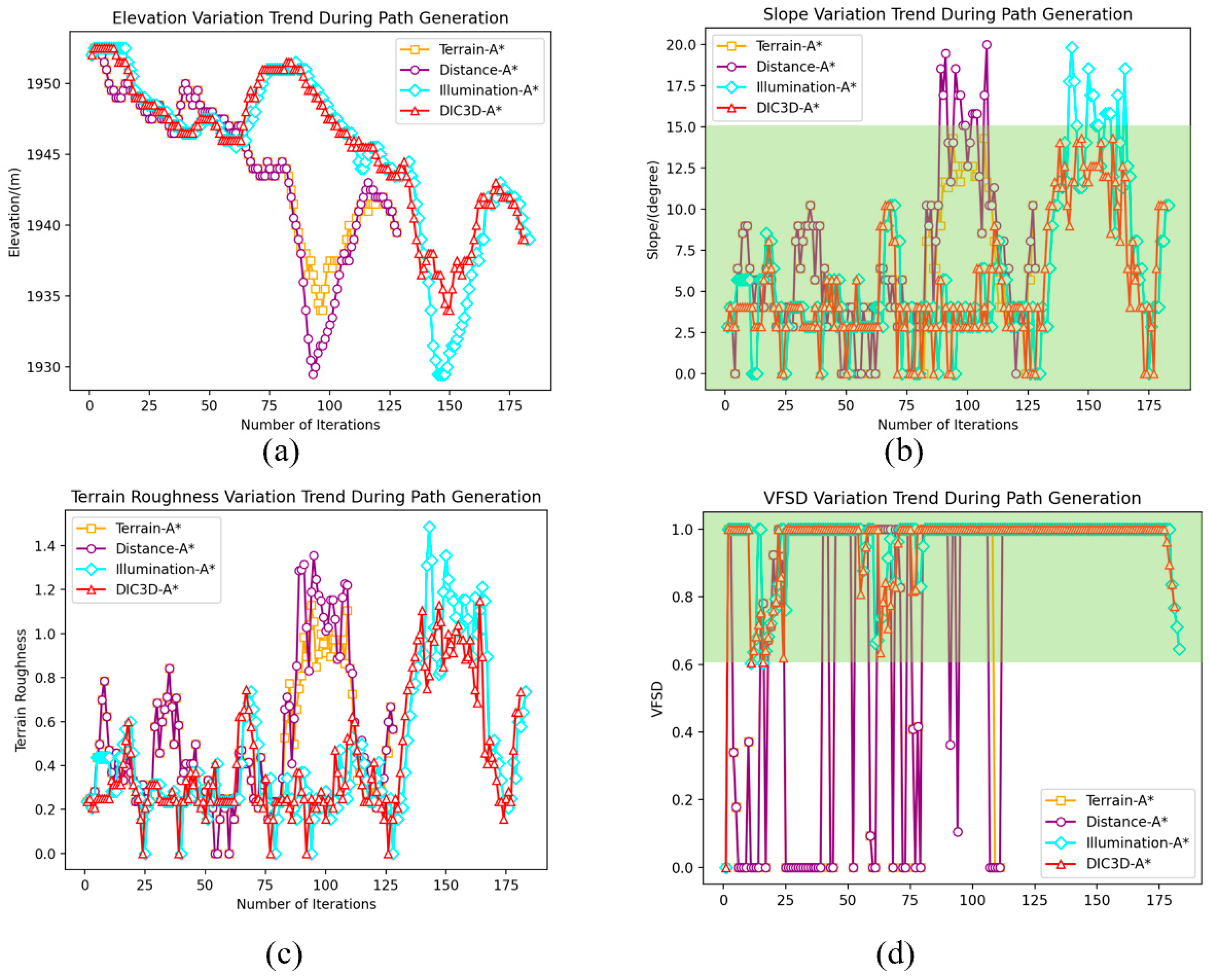
Figure 8 illustrates the variations in elevation, slope, terrain roughness, and solar disk visibility along the paths generated by the four algorithms. Terrain-A* and DIC3D-A* exhibit relatively minor fluctuations in elevation, slope, and terrain roughness, indicating that their paths remain confined to flatter terrain. In contrast, Illumination-A* and Distance-A* independently optimize the illumination component and the distance factor, respectively, therefore the resulting paths exhibit more pronounced variations in elevation and slope, as shown in
Figure 8b. The illumination profiles in
Figure 8d show that Terrain-A* and Distance-A* frequently pass through areas of low solar visibility, violating continuous illumination requirements. Conversely, the paths generated by the Illumination-A* and DIC3D-A* consistently remain within the green region, which meets the requirement of high solar visibility (≥0.6). DIC3D-A* demonstrates a superior balance, maintaining strong illumination continuity while ensuring acceptable terrain safety. Although its path exhibits slightly greater topographic variation than those of Terrain-A* and Distance-A*, it significantly improves overall energy availability and operational stability, which is crucial for sustained rover operations in the lunar polar environment.
5.2. Temporal Sensitivity Analysis of Algorithms Under Dynamic Illumination Conditions
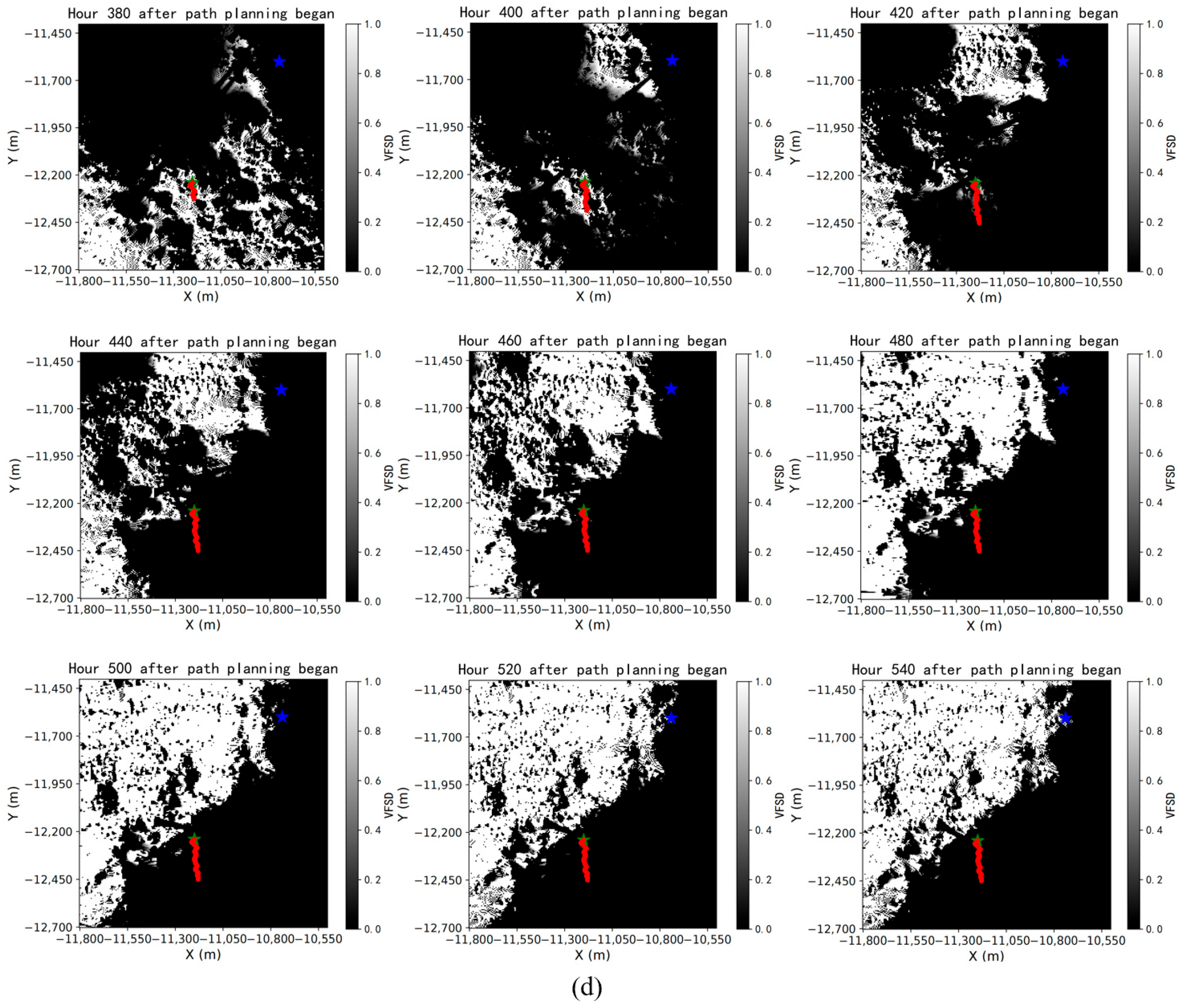
To quantitatively assess the temporal sensitivity of path-planning performance under dynamic illumination, four representative time points were selected within the simulation period from 1 November to 31 December 2026 (0 h, 90 h, 180 h, and 360 h) as initial timestamps for algorithm execution (
Figure 9).
Figure 9 illustrates the path generated by the DIC3D-A* algorithm at each of these starting times.
The results indicate that temporal variations in illumination have a substantial impact on both the reachability and optimality of the planned paths. At 0 h and 90 h, although shadowed areas within the region are relatively scattered, the algorithm is still able to frequently bypass local shadow patches and find a feasible path from the start to the target point. Compared with 0 h, the shadow coverage gradually increases and becomes more dispersed during the latter half of the route at 90 h. As a result, the algorithm must introduce more in-place waiting operations in anticipation of the emergence of passable areas. Consequently, although the final produced path is shorter (941 m vs. 1072 m) than 0 h, the algorithm requires a longer execution time (9.56 s vs. 1.96 s). At 180 h, during the early phase of path planning, the algorithm can still locate regions that satisfy both terrain and illumination constraints within sparsely illuminated areas. However, as planning proceeds, the target node becomes completely shadowed in the latter half of the route, preventing the algorithm from reaching the target even by the preset time limit of 60 s. In contrast, at 360 h, the majority of the study area experiences minimal solar illumination, and the VFSD falls to near-zero levels. This discontinuity of illuminated regions fragments the traversable domain, preventing the algorithm from finding a connected solution within the defined constraints.
As shown in
Table 5, a clear temporal relationship exists among path length, number of nodes, and algorithm execution time. As the continuity of the illuminated region increases, the computational efficiency of the algorithm improves substantially, enabling it to find the optimal path more rapidly (e.g., 0 h). In contrast, when illumination is discontinuous or highly fragmented, the search space becomes spatially separated. In such cases, although the resulting path maybe shorter, the algorithm must frequently expand boundary nodes or remain stationary while waiting for illumination recovery, which greatly increases the time complexity (e.g., 90 h). Moreover, when the study area remains in shadow for an extended period (e.g., 180 h and 360 h), the algorithm is unable to identify a traversable path. These findings highlight the strong influence of dynamic illumination constraints on the path-search process within a three-dimensional state space.
From the perspective of a future polar exploration mission, selecting an appropriate starting time for rover operations is critical to ensuring both energy efficiency and navigational safety. It is recommended that path planning and exploration activities be initiated during time windows characterized by high illumination continuity (e.g., around 0 h and 90 h), which maximizes solar energy utilization and minimizes computational complexity. In contrast, during periods of widespread shadow coverage (such as at 180 h and 360 h), a “wait-and-resume” operational strategy or adaptive adjustment of algorithmic weighting coefficients should be implemented. Such measures are essential to maintaining energy sustainability and ensuring the reachability of planned paths under dynamic illumination conditions.
5.3. Comparative Performance Analysis of DIC3D-A*, RRT*, and DQN Algorithms
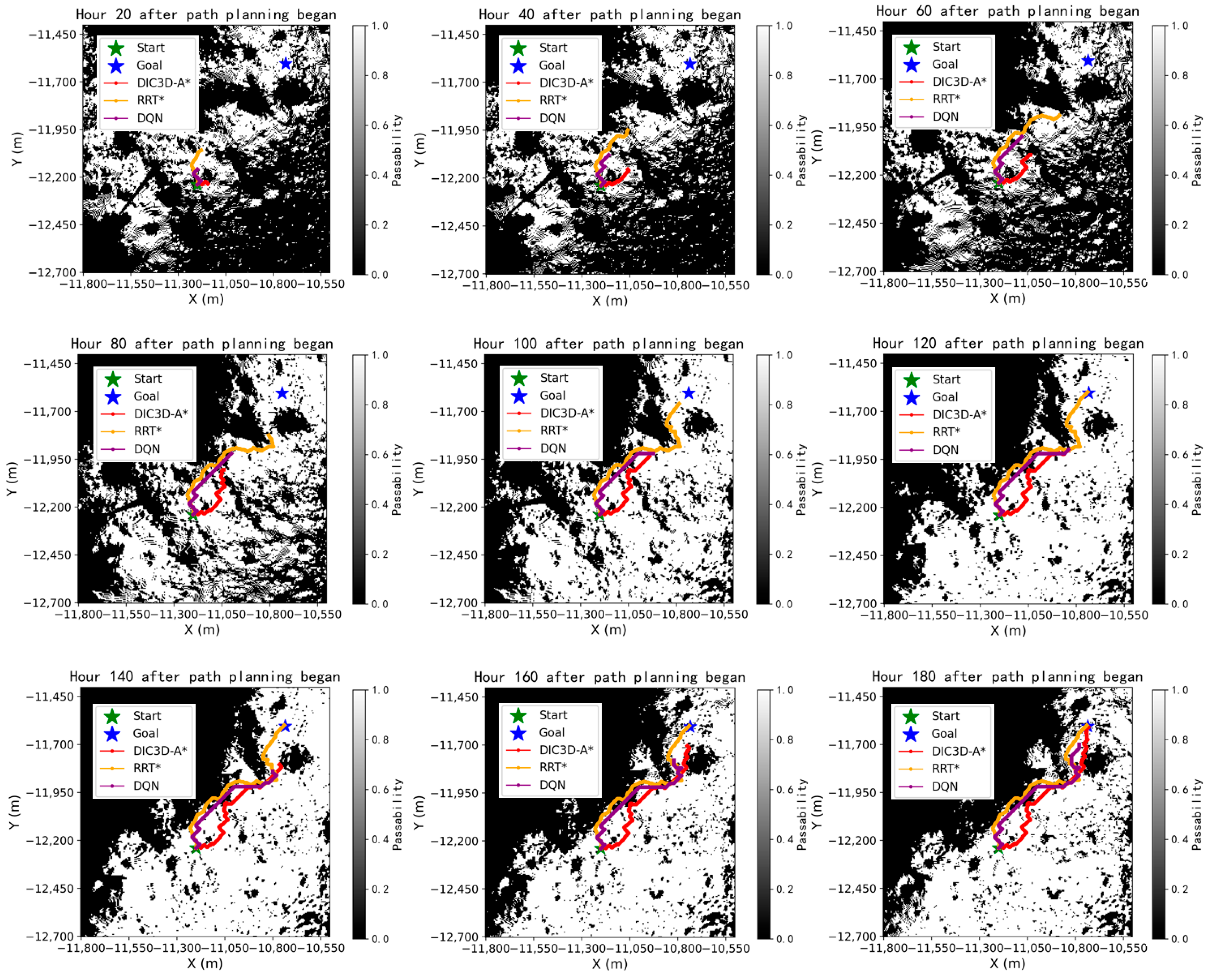
To systematically evaluate the overall performance of the proposed DIC3D-A* algorithm in complex polar environments, two representative algorithms were selected as benchmarks: the RRT* algorithm, which is based on probabilistic sampling, and the DQN algorithm, which applies deep reinforcement learning. Together with DIC3D-A*, these three methods represent distinct paradigms in path planning: classical graph-search, probabilistic sampling, and intelligent decision-making. All experiments were performed under identical terrain and illumination conditions. The comparative results are summarized in
Figure 10 and
Table 6.
In terms of overall performance, the DIC3D-A* algorithm achieved the best balance among key metrics, including the shortest path length (1072 m), the best illumination continuity (CSDV = 173.18), and the minimum execution time (1.96 s). By contrast, RRT*, which performs global exploration through rapid random-tree expansion, requires extensive node sampling to approximate an optimal solution. This resulted in the longest runtime (33.06 s) and the lowest illumination continuity (CSDV = 84.84), despite the relatively minimal terrain complexity (IndexT = 2.01). The DQN algorithm, on the other hand, relied on a policy network that learned illumination and terrain distribution through experience. It achieved a relatively high CSDV (167.82), reflecting superior energy performance, but generates the longest path (1090 m) because it lacked explicit terrain modeling. Moreover, the neural-network inference at each decision step increased the computational burden, resulting in a relatively high execution time (4.03 s).
As shown in
Table 6, DIC3D-A* achieved Pareto-optimal performance across the three evaluation dimensions of energy, terrain, and computation. Specifically, it reduces path length by 1.1% and execution time by 94.1% compared to RRT*, while increasing the CSDV by 104.1%. It also significantly outperformed DQN in illumination continuity and real-time responsiveness. This superior performance can be attributed to its heuristic design, which explicitly integrates slope, distance, and illumination cost. By coupling these factors, the algorithm dynamically balances energy availability and terrain traversability within the three-dimensional (x, y, t) search space, ensuring both energy efficiency and path feasibility. These findings offer practical insights for future polar exploration, especially for optimizing autonomous rover operations in regions of near-continuous solar illumination.
6. Discussion
6.1. The Critical Role of Dynamic Illumination Constraints in Path Planning
The results of this study demonstrate that dynamic solar illumination constraints are a dominant factor influencing path-planning performance for lunar south polar rovers. By integrating the VFSD into a three-dimensional state space, the DIC3D-A* algorithm jointly optimizes terrain safety and energy continuity. Compared with conventional A*-based algorithms that consider only terrain or Euclidean distance, the DIC3D-A* approach improves CSDV by 106.1% and 115.1%, respectively, and significantly reduces the probability of the rover entering prolonged shadowed regions. In comparison with illumination-only approaches, it achieves a 17.2% reduction in the average terrain roughness index, confirming the dual impact of illumination and terrain constraints in maintaining both energy sustainability and navigational safety.
Temporal sensitivity experiments (as shown in
Figure 9 and
Table 5) further reveal that the algorithm generates the most energy-efficient paths during the connected phases of quasi-continuous illumination (e.g., at 0 h). During disconnected phases (e.g., at 180 h and 360 h), the algorithm fails to produce a feasible trajectory, indicating that dynamic illumination directly determines the connectivity of the search space and the topology of the feasible domain. This finding provides a quantitative foundation for identifying solar illumination windows and optimizing rover mission scheduling in future lunar polar exploration scenarios.
6.2. Comparison with Existing Approaches and Methodological Innovations
Most existing path-planning methods for polar rovers rely on static illumination snapshots [
25] or incorporate illumination constraints solely from the perspective of energy optimization [
24]. Although some recent studies have attempted to introduce temporal factors into the path cost function [
26], these methods typically employ empirical weighting strategies without explicitly modeling the underlying physical illumination parameters.
In contrast, the proposed DIC3D-A* algorithm establishes a physically grounded, interpretable, and computationally efficient spatio-temporal search framework by coupling terrain slope, travel distance, and dynamic illumination costs within its heuristic function. This integrated formulation enables the algorithm to achieve a Pareto-optimal balance between terrain smoothness and energy efficiency.
Compared with sampling-based methods such as RRT* and learning-based planners such as DQN, the DIC3D-A* algorithm demonstrates superior performance in both computational efficiency and path quality (see
Table 6). It reduces execution time by approximately 94.1% relative to RRT* and shortens the path length by about 2% compared with DQN, while maintaining high illumination gains. These results confirm the robustness and stability of a physically informed heuristic modeling approach under dynamic polar illumination conditions.
Furthermore, the objectives of DIC3D-A* align closely with the energy-feasible path-planning framework proposed for NASA’s VIPER mission and the illumination-aware navigation strategy adopted in the LUPEX mission. The key methodological innovation of DIC3D-A* lies in its cost function’s ability to continuously respond to temporal variations in illumination. This dynamic responsiveness allows automatic identification of feasible mission windows within simulated environments, thereby enabling integrated optimization of path planning and energy management for future polar rover operations.
6.3. Algorithm Robustness and Applicability
Experimental results obtained under varying initial start times demonstrate that the DIC3D-A* algorithm exhibits strong robustness and adaptability when operating under temporally dynamic illumination conditions. During unfavorable lighting scenarios (such as at 180 h and 360 h), discontinuities in quasi-continuous illumination regions reduce connectivity within the search space, leading to infeasible path generation. In contrast, during well-illuminated phases (e.g., at 0 h and 90 h), the algorithm successfully produces smooth and energy-sustainable trajectories. These outcomes indicate that the algorithm maintains high reachability and cost stability under time-varying illumination environments. When illumination conditions are favorable, DIC3D-A* demonstrates an effective dynamic balance among path length, terrain roughness, and CSDV. This behavior suggests that the algorithm’s cost function maintains parameter stability and consistent responsiveness even when subject to environmental perturbations.
From an applicability perspective, the algorithm’s integrated response mechanism to illumination, terrain, and energy constraints establishes a solid theoretical and engineering foundation for autonomous decision-making and energy-adaptive path planning in future polar exploration missions. Its scalability extends beyond lunar applications, making it suitable for other extraterrestrial environments such as the Martian poles or the polar regions of Ceres. For example, under Martian conditions, the illumination-cost term could be adapted to account for the planet’s longer diurnal cycles and the effects of a thin, scattering atmosphere.
6.4. Limitation Analysis
Although the DIC3D-A* algorithm demonstrates strong robustness and energy sustainability under dynamic illumination conditions, its performance remains constrained by several modeling assumptions and implementation conditions. These limitations are summarized below.
The current model simplifies solar energy capture, which may lead to inaccuracies in estimating energy feasibility. This is especially relevant in polar environments, where power generation efficiency and thermal balance vary significantly with solar incidence angle. Future work should incorporate additional parameters such as solar incidence geometry, solar panel array orientation, and radiative thermal balance to develop an integrated optimization framework that couples energy management, thermal regulation, and path planning.
- 2.
Idealized Environmental and Terrain Modeling
The experiments were conducted using a 5 m/pixel DEM derived from LRO/LOLA data, which lacks sufficient resolution to represent meter- or sub-meter-scale boulder distributions and fine surface roughness. This simplification can cause misjudgments of path feasibility near slope thresholds. Future studies should incorporate high-resolution stereo imagery (e.g., Lunar Reconnaissance Orbiter Camera Narrow Angle Camera) and photometric terrain modeling to correct for microtopographic deviations and improve the accuracy of terrain-based safety assessments.
- 3.
Algorithmic Complexity and Real-Time Performance Constraints
Introducing the temporal dimension expands the search space from two to three dimensions, increasing the number of nodes exponentially. Although the heuristic function mitigates some of this computational load, execution time may still exceed real-time requirements for large-scale or long-duration missions. In contrast, sampling-based (e.g., RRT*) and learning-based planners (e.g., DQN) exhibit better scalability for near-optimal solutions. It should be noted that the present study focuses on global path planning, which provides high-level guidance rather than determining the final executed trajectory. Actual motion execution and obstacle avoidance are handled by onboard perception and navigation systems. Future work may explore hybrid frameworks combining hierarchical and local re-planning strategies, in which a global illumination model operates at the higher level while real-time local planning ensures responsiveness at the low level, thereby balancing optimality and computational efficiency.
- 4.
Limitations of the Validation Environment and Experimental Conditions
The proposed algorithm in this paper was validated only in a single-region experimental scenario and all experiments were performed in a numerical simulation environment without incorporating realistic sensor noise, pose estimation errors, or communication latency. In actual lunar rover missions, uncertainties in illumination forecasting, terrain perception, and power transmission could significantly influence algorithm performance. Therefore, future validation should incorporate high-fidelity simulation platforms (e.g., ROS/Gazebo) and hardware-in-the-loop experiments to ensure operational reliability and practical deployability under task constraints. In addition, the scalability of the algorithm across multiple experimental scenarios and its general applicability across diverse settings need to be systematically validated.
6.5. Future Work and Research Outlook
The DIC3D-A* algorithm has demonstrated strong engineering applicability and scientific potential for path planning within the dynamically illuminated and topographically complex environment of the lunar polar regions. However, bridging the gap between theoretical modeling and mission-level deployment will require further advancements in algorithmic intelligence, energy modeling, and multi-task collaborative optimization. Key directions for future research are outlined below.
The current algorithm represents solar illumination primarily through the VFSD, without incorporating factors such as the rover’s battery state of charge, solar array orientation, or thermal balance dynamics. Future work should integrate solar flux, power consumption, and thermal feedback into a unified framework to achieve closed-loop coupling between path planning and energy management. By incorporating constraints derived from energy conservation laws, thermal control dynamics, and battery degradation processes, such models would enable a more accurate assessment of mission feasibility under extreme cold and extended shadow conditions.
- 2.
Adaptive Path Planning Framework Based on Deep Learning and Multi-Agent Decision-Making
With the growing adoption of reinforcement learning and graph neural networks in space robotics, future research could combine the heuristic structure of DIC3D-A* with deep reinforcement learning methods to form a cognitive-planning-decision architecture. For instance, DQN-based models could dynamically adjust weighting parameters between illumination and terrain costs, allowing the system to respond rapidly to abrupt lighting transitions and uncharted terrain features. Furthermore, in support of upcoming missions such as the International Lunar Research Station (ILRS), the framework could be extended to multi-agent cooperative path planning, enabling distributed energy sharing and collaborative task execution among multiple rovers to enhance overall system robustness and efficiency.
- 3.
Establishment of High-Fidelity Simulation and In-Orbit Validation Frameworks
Future work should utilize advanced simulation platforms such as ROS 2 and Gazebo to construct realistic mission environments that incorporate sensor noise, communication latency, and terrain perception uncertainty. This would allow more rigorous evaluation of algorithmic robustness under operational conditions. Building upon this foundation, a full-chain experimental system could be developed that integrates lunar polar environmental simulation with physical rover prototypes. Such a system would replicate solar dynamics, terrain interactions, and energy consumption patterns characteristic of polar regions, enabling multi-physics coupling experiments encompassing solar-tracking mobility, energy scheduling, and path optimization. This platform would provide a comprehensive testbed for assessing algorithmic performance across varying quasi-continuous illumination zones and terrain complexities.
7. Conclusions
In response to the dynamic illumination and highly variable terrain conditions expected in future lunar south pole rover missions (such as China’s CE-7), this study proposes a spatio-temporal A* path planning algorithm, DIC3D-A*, that integrates dynamic solar illumination constraints to achieve an optimized balance between energy sustainability and terrain safety. Using high-resolution topographic data from LRO/LOLA and a time-resolved illumination model derived from planetary ephemerides, a dynamic traversability map with hourly temporal resolution was constructed. This framework enables continuous path search within a three-dimensional spatiotemporal state space, thereby improving the feasibility and efficiency of autonomous navigation under realistic polar conditions.
These results show that dynamic solar illumination is a decisive factor in lunar polar path planning. By explicitly coupling terrain slope, travel distance, and illumination cost in its heuristic function, DIC3D-A* performs both efficiently and interpretably under time-varying lighting. Compared with the conventional A* algorithm that consider only terrain or distance, DIC3D-A* improves the CSDV by 106.1% and 115.1%, respectively; moreover, compared with illumination-based A* algorithms, it reduces the average terrain roughness index by 17.2%. Across simulations with different initial times, the algorithm dynamically identifies temporal connectivity windows within illuminated regions, enabling temporally adaptive path optimization. Relative to the sampling-based RRT* and deep reinforcement learning-based DQN methods, DIC3D-A* achieves superior path length and computational efficiency while maintaining a Pareto-optimal balance between energy and terrain constraints.
This research presents a validated framework for autonomous navigation and energy management of lunar polar rovers operating in dynamically changing environments. Future work will focus on integrating detailed energy-thermal models, developing hybrid optimization frameworks that combine heuristic and learning-based strategies, and conducting high-fidelity physical simulations for validation and deployment. These efforts aim to enhance the algorithm’s engineering applicability in real lunar operations and multi-energy mission scenarios, providing both theoretical and technical support for intelligent mission planning in China’s forthcoming lunar polar exploration programs.