Drone-Based Measurements of Marine Aerosol Size Distributions and Source–Receptor Relationships over a Great Barrier Reef Lagoon

 ,
,  , , and
Highlights
- Drone-based observations captured strong event-to-event variability in marine aerosol size and number concentrations.
- Air-mass origin and boundary-layer structure were the primary factors shaping observed aerosol characteristics.
- Upwind transport and boundary-layer dynamics are critical for interpreting reef-scale aerosol measurements.
- Drone-based sampling provides an effective approach for monitoring marine aerosols in remote and otherwise inaccessible regions.
Abstract
1. Introduction
2. Materials and Methods
2.1. Sampling Methods and Safety Strategy
2.2. Sampling Hardware
2.3. Modelling Data and Analysis
3. Results
4. Discussion
5. Conclusions
Author Contributions
Funding
Data Availability Statement
Acknowledgments
Conflicts of Interest
Appendix A
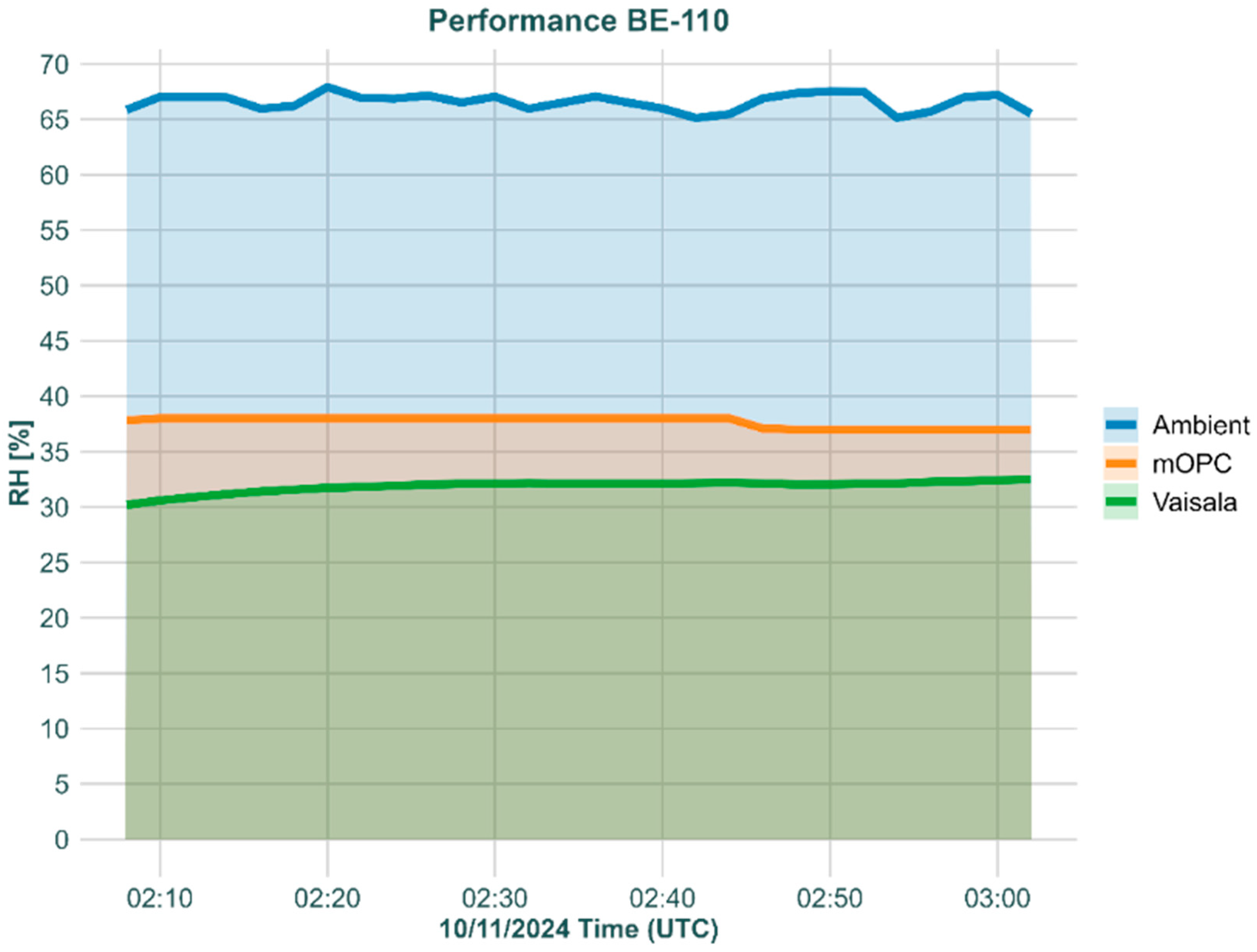
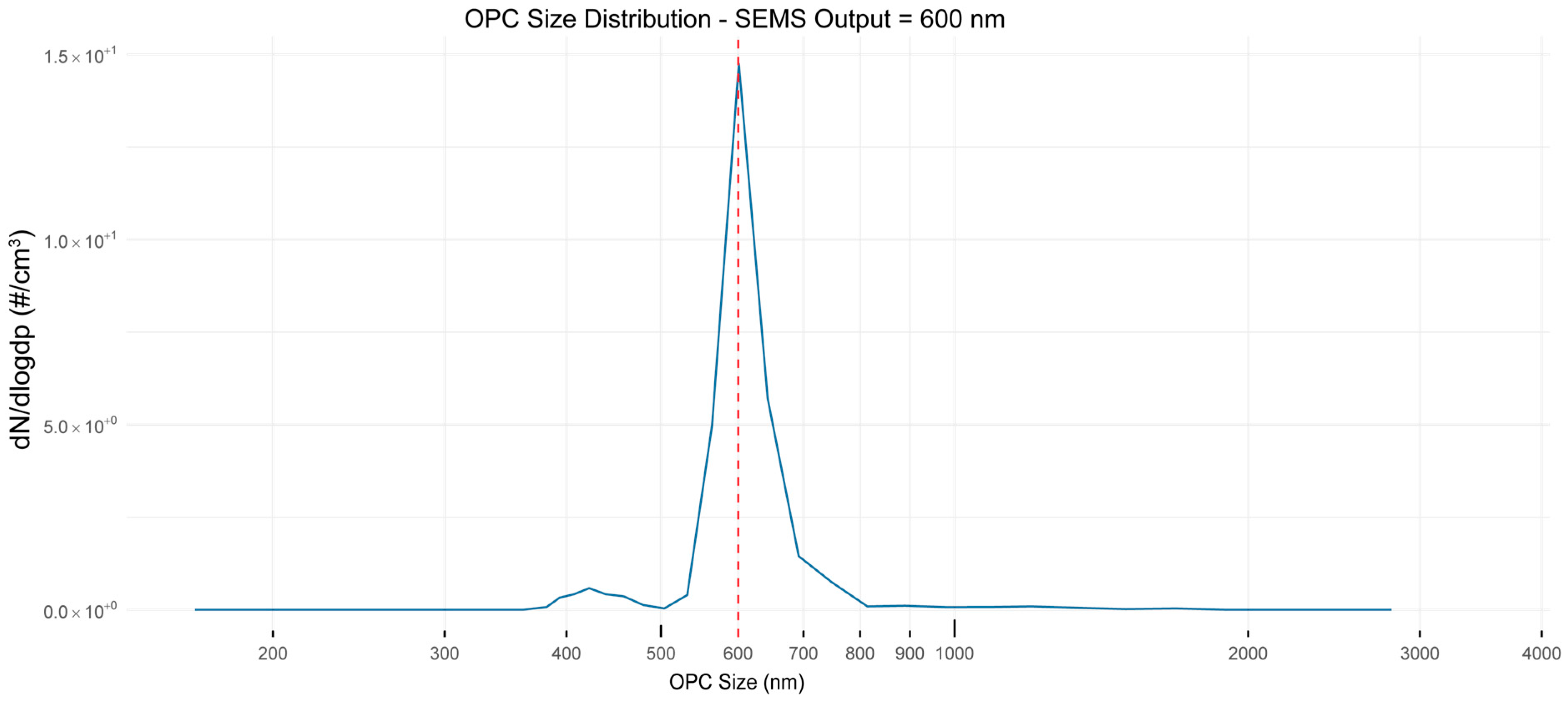
Performance Test of the Inline Gas Dryer Unit BE-110



| PERMANOVA (Mode 180|Mode 240) | |||
|---|---|---|---|
| df | Pseudo-F | p | |
| Location (fixed) | 3|3 | 1.0005|0.50263 | 0.4021|0.6896 |
| Event (random) | 15|15 | 266.47|365.17 | 0.0001|0.0001 |
| DISTANCE BASED LINEAR MODEL (mode 180|mode 240) | |||
| MARGINAL TESTS | R2 | p | |
| Speed | 0.025|0.020 | 0.2084|0.2635 | |
| MLH | 0.033|0.266 | 0.1414|0.0001 | |
| Depth | 0.202|0.011 | 0.0001|0.4200 | |
| Tide | 0.003|0.004 | 0.6840|0.6363 | |
| Cluster | 0.3510.181 | 0.0001|0.0004 | |
| BEST SOLUTIONS (mode 180) | R2 | AICc | |
| Cluster | 0.351 | 629.97 | |
| MLH, Depth, Tide, Cluster | 0.590 | 607.52 | |
| BEST SOLUTIONS (mode 240) | |||
| MLH | 0.266 | 643.12 | |
| Speed, MLH, Depth, Cluster | 0.411 | 635.93 | |
| PERMANOVA analyses were conducted using 9999 permutations, Type III sum of squares, and a Euclidean dissimilarity matrix. A Distance-Based Linear Model was developed using the Corrected Akaike’s Information Criterion for model selection, applying a best-fit approach. | |||
References
- Stull, R.B. An Introduction to Boundary Layer Meteorology; Springer: Dordrecht, The Netherland, 1988; Volume 1. [Google Scholar]
- Katoshevski, D.; Nenes, A.; Seinfeld, J.H. A study of processes that govern the maintenance of aerosols in the marine boundary layer. J. Aerosol Sci. 1999, 30, 503–532. [Google Scholar] [CrossRef] [Scilit]
- Russell, L.M.; Moore, R.H.; Burrows, S.M.; Quinn, P.K. Ocean flux of salt, sulfate, and organic components to atmospheric aerosol. Earth-Sci. Rev. 2023, 239, 104364. [Google Scholar] [CrossRef] [Scilit]
- Andreae, M.O.; Jones, C.D.; Cox, P.M. Strong present-day aerosol cooling implies a hot future. Nature 2005, 435, 1187–1190. [Google Scholar] [CrossRef] [Scilit] [PubMed]
- Jacobson, M.Z. Global direct radiative forcing due to multicomponent anthropogenic and natural aerosols. J. Geophys. Res. Atmos. 2001, 106, 1551–1568. [Google Scholar] [CrossRef] [Scilit]
- Carslaw, K.; Lee, L.; Reddington, C.; Pringle, K.; Rap, A.; Forster, P.; Mann, G.; Spracklen, D.; Woodhouse, M.; Regayre, L. Large contribution of natural aerosols to uncertainty in indirect forcing. Nature 2013, 503, 67–71. [Google Scholar] [CrossRef] [Scilit] [PubMed]
- Fan, J.; Wang, Y.; Rosenfeld, D.; Liu, X. Review of Aerosol–Cloud Interactions: Mechanisms, Significance, and Challenges. J. Atmos. Sci. 2016, 73, 4221–4252. [Google Scholar] [CrossRef] [Scilit]
- IPCC. Climate Change 2021—The Physical Science Basis: Working Group I Contribution to the Sixth Assessment Report of the Intergovernmental Panel on Climate Change; IPCC: Geneva, Switzerland, 2023. [Google Scholar]
- Kleefeld, C.; O’Dowd, C.D.; O’Reilly, S.; Jennings, S.G.; Aalto, P.; Becker, E.; Kunz, G.; de Leeuw, G. The relative contribution of submicron and supermicron particles to aerosol light scattering in the marine boundary layer (MBL). J. Geophys. Res. Atmos. 2002, 107, PAR 8-1–PAR 8-13. [Google Scholar] [CrossRef] [Scilit]
- Jackson, R.L.; Woodhouse, M.T.; Gabric, A.J.; Cropp, R.A.; Swan, H.B.; Deschaseaux, E.S.; Trounce, H. Modelling the influence of coral-reef-derived dimethylsulfide on the atmosphere of the Great Barrier Reef, Australia. Front. Mar. Sci. 2022, 9, 910423. [Google Scholar] [CrossRef] [Scilit]
- McGowan, H.; Sturman, A.; Saunders, M.; Theobald, A.; Wiebe, A. Insights from a decade of research on coral reef—Atmosphere energetics. J. Geophys. Res. Atmos. 2019, 124, 4269–4282. [Google Scholar] [CrossRef] [Scilit]
- Flores, J.M.; Bourdin, G.; Kostinski, A.B.; Altaratz, O.; Dagan, G.; Lombard, F.; Haëntjens, N.; Boss, E.; Sullivan, M.B.; Gorsky, G. Diel cycle of sea spray aerosol concentration. Nat. Commun. 2021, 12, 5476. [Google Scholar] [CrossRef] [Scilit]
- Chen, Z.; Schofield, R.; Rayner, P.; Zhang, T.; Liu, C.; Vincent, C.; Fiddes, S.; Ryan, R.G.; Alroe, J.; Ristovski, Z.D.; et al. Characterization of aerosols over the Great Barrier Reef: The influence of transported continental sources. Sci. Total Environ. 2019, 690, 426–437. [Google Scholar] [CrossRef] [Scilit]
- De Leeuw, G.; Andreas, E.L.; Anguelova, M.D.; Fairall, C.; Lewis, E.R.; O’Dowd, C.; Schulz, M.; Schwartz, S.E. Production flux of sea spray aerosol. Rev. Geophys. 2011, 49, RG2001. [Google Scholar] [CrossRef] [Scilit]
- Croft, B.; Martin, R.V.; Moore, R.H.; Ziemba, L.D.; Crosbie, E.C.; Liu, H.; Russell, L.M.; Saliba, G.; Wisthaler, A.; Müller, M.; et al. Factors controlling marine aerosol size distributions and their climate effects over the northwest Atlantic Ocean region. Atmos. Chem. Phys. 2021, 21, 1889–1916. [Google Scholar] [CrossRef] [Scilit]
- Saliba, G.; Chen, C.-L.; Lewis, S.; Russell, L.M.; Rivellini, L.-H.; Lee, A.K.Y.; Quinn, P.K.; Bates, T.S.; Haëntjens, N.; Boss, E.S.; et al. Factors driving the seasonal and hourly variability of sea-spray aerosol number in the North Atlantic. Proc. Natl. Acad. Sci. USA 2019, 116, 20309–20314. [Google Scholar] [CrossRef] [Scilit] [PubMed]
- Andreae, M.O.; Ferek, R.J.; Bermond, F.; Byrd, K.P.; Engstrom, R.T.; Hardin, S.; Houmere, P.D.; LeMarrec, F.; Raemdonck, H.; Chatfield, R.B. Dimethyl sulfide in the marine atmosphere. J. Geophys. Res. D Atmos. 1985, 90, 12891–12900. [Google Scholar] [CrossRef] [Scilit]
- O’Dowd, C.D.; De Leeuw, G. Marine aerosol production: A review of the current knowledge. Philos. Trans. R. Soc. Ser. A Math. Phys. Eng. Sci. 2007, 365, 1753–1774. [Google Scholar] [CrossRef] [Scilit]
- Jones, G.; Nevitt, G.; Simó, R. Editorial: The role of dimethylsulfide and other sulfur substances on the climate and ecology of coral reefs. Front. Mar. Sci. 2023, 10, 1119817. [Google Scholar] [CrossRef] [Scilit]
- Swan, H.B.; Jones, G.B.; Deschaseaux, E.S.; Eyre, B.D. Coral reef origins of atmospheric dimethylsulfide at Heron Island, southern Great Barrier Reef, Australia. Biogeosciences 2017, 14, 229–239. [Google Scholar] [CrossRef] [Scilit]
- Swan, H.B.; Crough, R.W.; Vaattovaara, P.; Jones, G.B.; Deschaseaux, E.S.; Eyre, B.D.; Miljevic, B.; Ristovski, Z.D. Dimethyl sulfide and other biogenic volatile organic compound emissions from branching coral and reef seawater: Potential sources of secondary aerosol over the Great Barrier Reef. J. Atmos. Chem. 2016, 73, 303–328. [Google Scholar] [CrossRef] [Scilit]
- Hinds, W.C.; Zhu, Y. Aerosol Technology: Properties, Behavior, and Measurement of Airborne Particles; John Wiley & Sons: New York, NY, USA, 2022. [Google Scholar]
- Grythe, H.; Ström, J.; Krejci, R.; Quinn, P.; Stohl, A. A review of sea-spray aerosol source functions using a large global set of sea salt aerosol concentration measurements. Atmos. Chem. Phys. 2014, 14, 1277–1297. [Google Scholar] [CrossRef] [Scilit]
- Song, A.; Li, J.; Tsona, N.T.; Du, L. Parameterizations for sea spray aerosol production flux. Appl. Geochem. 2023, 157, 105776. [Google Scholar] [CrossRef] [Scilit]
- Khan, M.; Gillespie, S.; Razis, B.; Xiao, P.; Davies-Coleman, M.; Percival, C.; Derwent, R.; Dyke, J.; Ghosh, M.; Lee, E. A modelling study of the atmospheric chemistry of DMS using the global model, STOCHEM-CRI. Atmos. Environ. 2016, 127, 69–79. [Google Scholar] [CrossRef] [Scilit]
- Murphy, D.M.; Anderson, J.R.; Quinn, P.K.; McInnes, L.M.; Brechtel, F.J.; Kreidenweis, S.M.; Middlebrook, A.M.; Pósfai, M.; Thomson, D.S.; Buseck, P.R. Influence of sea-salt on aerosol radiative properties in the Southern Ocean marine boundary layer. Nature 1998, 392, 62–65. [Google Scholar] [CrossRef] [Scilit]
- Quinn, P.K.; Collins, D.B.; Grassian, V.H.; Prather, K.A.; Bates, T.S. Chemistry and Related Properties of Freshly Emitted Sea Spray Aerosol. Chem. Rev. 2015, 115, 4383–4399. [Google Scholar] [CrossRef] [Scilit] [PubMed]
- O’Dowd, C.D.; Smith, M.H.; Consterdine, I.E.; Lowe, J.A. Marine aerosol, sea-salt, and the marine sulphur cycle: A short review. Atmos. Environ. 1997, 31, 73–80. [Google Scholar] [CrossRef] [Scilit]
- McGowan, H.; Lensky, N.G.; Abir, S.; Saunders, M. Coral Reef Coupling to the Atmospheric Boundary Layer Through Exchanges of Heat, Moisture, and Momentum: Case Studies from Tropical and Desert Fringing Coral Reefs. Front. Mar. Sci. 2022, 9, 900679. [Google Scholar] [CrossRef] [Scilit]
- Lewis, E.R.; Schwartz, S.E. Sea Salt Aerosol Production: Mechanisms, Methods, Measurements, and Models; American Geophysical Union: Washington, DC, USA, 2004; Volume 152. [Google Scholar]
- Dror, T.; Flores, J.M.; Altaratz, O.; Dagan, G.; Levin, Z.; Vardi, A.; Koren, I. Sensitivity of warm clouds to large particles in measured marine aerosol size distributions—A theoretical study. Atmos. Chem. Phys. 2020, 20, 15297–15306. [Google Scholar] [CrossRef] [Scilit]
- Jensen, J.B.; Nugent, A.D. Condensational Growth of Drops Formed on Giant Sea-Salt Aerosol Particles. J. Atmos. Sci. 2017, 74, 679–697. [Google Scholar] [CrossRef] [Scilit]
- Sorribas, M.; Martín, J.G.; Hay, T.; Mahajan, A.S.; Cuevas, C.A.; Reyes, M.A.; Mora, F.P.; Gil-Ojeda, M.; Saiz-Lopez, A. On the concentration and size distribution of sub-micron aerosol in the Galápagos Islands. Atmos. Environ. 2015, 123, 39–48. [Google Scholar] [CrossRef] [Scilit]
- Horchler, E.J.; Alroe, J.; Harrison, L.; Cravigan, L.; Harrison, D.P.; Ristovski, Z.D. Measurement report: Aerosol and cloud nuclei properties along the Central and Northern Great Barrier Reef–impact of continental emissions. Atmos. Chem. Phys. 2025, 25, 10075–10087. [Google Scholar] [CrossRef] [Scilit]
- Hernandez-Jaramillo, D.C.; Medcraft, C.; Braga, R.C.; Butcherine, P.; Doss, A.; Kelaher, B.; Rosenfeld, D.; Harrison, D.P. New airborne research facility observes sensitivity of cumulus cloud microphysical properties to aerosol regime over the great barrier reef. Environ. Sci. Atmos. 2024, 4, 861–871. [Google Scholar] [CrossRef] [Scilit]
- Burgués, J.; Marco, S. Environmental chemical sensing using small drones: A review. Sci. Total Environ. 2020, 748, 141172. [Google Scholar] [CrossRef] [Scilit]
- Wu, L.; Horchler, E.J.; Ristovski, Z.; Liu, J.; Yu, F.; Han, S.; Zhao, W.; Richards, L.; Harrison, D.; Zheng, J. Ammonia emissions from an avian-rich island in the Great Barrier Reef: Environmental drivers and observational insights. Atmos. Environ. 2025, 361, 121525. [Google Scholar] [CrossRef] [Scilit]
- Zhou, S.; Salter, M.; Bertram, T.; Brito Azevedo, E.; Reis, F.; Wang, J. Shoreline wave breaking strongly enhances the coastal sea spray aerosol population: Climate and air quality implications. Sci. Adv. 2025, 11, eadw0343. [Google Scholar] [CrossRef] [Scilit] [PubMed]
- Australian Government. Civil Aviation Safety Regulations 1998, Statutory Rules No. 237, 1998, Part 101—Unmanned Aircraft and Rockets; Australian Government: Canberra, Australian, 2024.
- Australian Government Civil Aviation Safety Authority. Rules for Recreational Drone Operators. Available online: https://www.casa.gov.au/knowyourdrone/drone-rules (accessed on 15 May 2025).
- Brechtel Manufacturing Inc. Instrument Manual Ver. 2.0 Mini-OPC 9405. Available online: https://www.brechtel.com/wp-content/uploads/2023/08/bmi_model_9405_mOPC_manual_ver_2.0.pdf (accessed on 17 June 2024).
- Alvarado, M.; Gonzalez, F.; Erskine, P.; Cliff, D.; Heuff, D. A Methodology to Monitor Airborne PM10 Dust Particles Using a Small Unmanned Aerial Vehicle. Sensors 2017, 17, 343. [Google Scholar] [CrossRef] [Scilit] [PubMed]
- Brechtel Manufacturing Inc. Flow Splitters Two-Way, Four-Way and Centerline Models 1100 to 1105. Available online: https://www.brechtel.com/wp-content/uploads/2014/10/Brechtel_Model_1100_Series_FlowSplitters_Brochure.pdf (accessed on 20 January 2025).
- Elzhov, T.V.; Mullen, K.M.; Spiess, A.-N.; Bolker, B. minpack.lm: R Interface to the Levenberg-Marquardt Nonlinear Least-Squares Algorithm Found in MINPACK, Plus Support for Bounds; The Comprehensive R Archive Network (CRAN): Vienna, Austria, 2016. [Google Scholar] [CrossRef] [Scilit]
- Stein, A.F.; Draxler, R.R.; Rolph, G.D.; Stunder, B.J.B.; Cohen, M.D.; Ngan, F. NOAA’s HYSPLIT Atmospheric Transport and Dispersion Modeling System. Bull. Am. Meteorol. Soc. 2015, 96, 2059–2077. [Google Scholar] [CrossRef] [Scilit]
- Carslaw, D.C.; Ropkins, K. Openair—An R package for air quality data analysis. Environ. Model. Softw. 2012, 27, 52–61. [Google Scholar] [CrossRef] [Scilit]
- Sirois, A.; Bottenheim, J.W. Use of backward trajectories to interpret the 5-year record of PAN and O3 ambient air concentrations at Kejimkujik National Park, Nova Scotia. J. Geophys. Res. Atmos. 1995, 100, 2867–2881. [Google Scholar] [CrossRef] [Scilit]
- Jackson, R.; Gabric, A.; Woodhouse, M.; Swan, H.; Jones, G.; Cropp, R.; Deschaseaux, E. Coral Reef Emissions of Atmospheric Dimethylsulfide and the Influence on Marine Aerosols in the Southern Great Barrier Reef, Australia. J. Geophys. Res. Atmos. 2020, 125, e2019JD031837. [Google Scholar] [CrossRef] [Scilit]
- Fung, K.M.; Heald, C.L.; Kroll, J.H.; Wang, S.; Jo, D.S.; Gettelman, A.; Lu, Z.; Liu, X.; Zaveri, R.A.; Apel, E.C.; et al. Exploring dimethyl sulfide (DMS) oxidation and implications for global aerosol radiative forcing. Atmos. Chem. Phys. 2022, 22, 1549–1573. [Google Scholar] [CrossRef] [Scilit]
- Townsend, N.; Baldry, K.; Crossman, D.; Cullen, R.; Doubell, M.; Ingleton, T.; Mackay, K.; McNeil, M.; Nichol, S.; Parnum, I.; et al. Ausseabed: A National Program of Collaboration to Maximise Australia’s Seabed Mapping Efforts. Coast. Eng. Proc. 2023, 37, management.174. [Google Scholar] [CrossRef] [Scilit]
- Jones, G.; Curran, M.; Broadbent, A.; King, S.; Fischer, E.; Jones, R. Factors affecting the cycling of dimethylsulfide and dimethylsulfoniopropionate in coral reef waters of the Great Barrier Reef. Environ. Chem. 2007, 4, 310–322. [Google Scholar] [CrossRef] [Scilit]
- Braga, R.C.; Rosenfeld, D.; Hernandez, D.; Medcraft, C.; Efraim, A.; Moser, M.; Lucke, J.; Doss, A.; Harrison, D. Cloud processing dominates the vertical profiles of aerosols in marine air masses over the Great Barrier Reef. Atmos. Res. 2025, 315, 107928. [Google Scholar] [CrossRef] [Scilit]
- Saltzman, E.S. Marine aerosols. Geophys. Monogr. Ser. 2009, 187, 17–35. [Google Scholar] [CrossRef] [Scilit]
- Julaha, K.; Ždímal, V.; Šmejkalová, A.H.; Komínková, K.; Zíková, N. Boundary layer and mixing layer height: Models vs. Ground-based measurements intercomparison. Atmos. Res. 2025, 315, 107897. [Google Scholar] [CrossRef] [Scilit]
- Anderson, M.J. Permutational multivariate analysis of variance (PERMANOVA). In Wiley Statsref: Statistics Reference Online; John Wiley & Sons, Ltd.: Hoboken, NJ, USA, 2014; pp. 1–15. [Google Scholar] [CrossRef] [Scilit]
- Gupta, D.; Kim, H.; Park, G.; Li, X.; Eom, H.J.; Ro, C.U. Hygroscopic properties of NaCl and NaNO3 mixture particles as reacted inorganic sea-salt aerosol surrogates. Atmos. Chem. Phys. 2015, 15, 3379–3393. [Google Scholar] [CrossRef] [Scilit]
- Fiddes, S.L.; Woodhouse, M.T.; Utembe, S.; Schofield, R.; Alexander, S.P.; Alroe, J.; Chambers, S.D.; Chen, Z.; Cravigan, L.; Dunne, E.; et al. The contribution of coral-reef-derived dimethyl sulfide to aerosol burden over the Great Barrier Reef: A modelling study. Atmos. Chem. Phys. 2022, 22, 2419–2445. [Google Scholar] [CrossRef] [Scilit]
- Eckert, C.; Hernandez-Jaramillo, D.C.; Medcraft, C.; Harrison, D.P.; Kelaher, B.P. Drone-Based Measurement of the Size Distribution and Concentration of Marine Aerosols above the Great Barrier Reef. Drones 2024, 8, 292. [Google Scholar] [CrossRef] [Scilit]
- Jackson, R.; Gabric, A.; Cropp, R. Coral reefs as a source of climate-active aerosols. PeerJ 2020, 8, e10023. [Google Scholar] [CrossRef] [Scilit]
- Alroe, J.; Cravigan, L.T.; Miljevic, B.; Johnson, G.R.; Selleck, P.; Humphries, R.S.; Keywood, M.D.; Chambers, S.D.; Williams, A.G.; Ristovski, Z.D. Marine productivity and synoptic meteorology drive summer-time variability in Southern Ocean aerosols. Atmos. Chem. Phys. 2020, 20, 8047–8062. [Google Scholar] [CrossRef] [Scilit]
- Quinn, P.K.; Coffman, D.J.; Johnson, J.E.; Upchurch, L.M.; Bates, T.S. Small fraction of marine cloud condensation nuclei made up of sea spray aerosol. Nat. Geosci. 2017, 10, 674–679. [Google Scholar] [CrossRef] [Scilit]
- Fitzgerald, J.W. Model of the aerosol extinction profile in a well-mixed marine boundary layer. Appl. Opt. 1989, 28, 3534–3538. [Google Scholar] [CrossRef] [Scilit] [PubMed]
- Ryan, R.G.; Eckert, C.; Kelaher, B.P.; Harrison, D.P.; Schofield, R. Boundary layer height above the Great Barrier Reef studied using drone and Mini-Micropulse LiDAR measurements. J. South. Hemisph. Earth Syst. Sci. 2024, 74, ES24008. [Google Scholar] [CrossRef] [Scilit]
- Eckert, C.; Monteforte, K.I.; Harrison, D.P.; Kelaher, B.P. Exploring Meteorological Conditions and Microscale Temperature Inversions above the Great Barrier Reef through Drone-Based Measurements. Drones 2023, 7, 695. [Google Scholar] [CrossRef] [Scilit]
- Abdalmogith, S.S.; Harrison, R.M. The use of trajectory cluster analysis to examine the long-range transport of secondary inorganic aerosol in the UK. Atmos. Environ. 2005, 39, 6686–6695. [Google Scholar] [CrossRef] [Scilit]
- Cui, L.; Song, X.; Zhong, G. Comparative Analysis of Three Methods for HYSPLIT Atmospheric Trajectories Clustering. Atmosphere 2021, 12, 698. [Google Scholar] [CrossRef] [Scilit]
- Gantt, B.; Meskhidze, N.; Facchini, M.C.; Rinaldi, M.; Ceburnis, D.; O’Dowd, C.D. Wind speed dependent size-resolved parameterization for the organic mass fraction of sea spray aerosol. Atmos. Chem. Phys. 2011, 11, 8777–8790. [Google Scholar] [CrossRef] [Scilit]
- Seibert, P.; Beyrich, F.; Gryning, S.-E.; Joffre, S.; Rasmussen, A.; Tercier, P. Review and intercomparison of operational methods for the determination of the mixing height. Atmos. Environ. 2000, 34, 1001–1027. [Google Scholar] [CrossRef] [Scilit]
- Luo, T.; Yuan, R.; Wang, Z. On factors controlling marine boundary layer aerosol optical depth. J. Geophys. Res. Atmos. 2014, 119, 3321–3334. [Google Scholar] [CrossRef] [Scilit]
- Cropp, R.; Gabric, A.; van Tran, D.; Jones, G.; Swan, H.; Butler, H. Coral reef aerosol emissions in response to irradiance stress in the Great Barrier Reef, Australia. Ambio 2018, 47, 671–681. [Google Scholar] [CrossRef] [Scilit]
- Christiansen, S.; Salter, M.E.; Gorokhova, E.; Nguyen, Q.T.; Bilde, M. Sea spray aerosol formation: Laboratory results on the role of air entrainment, water temperature, and phytoplankton biomass. Environ. Sci. Technol. 2019, 53, 13107–13116. [Google Scholar] [CrossRef] [Scilit]
- Tomasi, C.; Lupi, A. Primary and secondary sources of atmospheric aerosol. In Atmospheric Aerosols: Life Cycles and Effects on Air Quality and Climate; John Wiley & Sons, Ltd.: Hoboken, NJ, USA, 2017; pp. 1–86. [Google Scholar] [CrossRef] [Scilit]
- Wang, Y.-C.; Wang, S.-H.; Lewis, J.R.; Chang, S.-C.; Griffith, S.M. Determining planetary boundary layer height by micro-pulse lidar with validation by UAV measurements. Aerosol Air Qual. Res. 2021, 21, 200336. [Google Scholar] [CrossRef] [Scilit]
- Deschaseaux, E.S.; Jones, G.B.; Deseo, M.A.; Shepherd, K.M.; Kiene, R.; Swan, H.; Harrison, P.L.; Eyre, B.D. Effects of environmental factors on dimethylated sulfur compounds and their potential role in the antioxidant system of the coral holobiont. Limnol. Oceanogr. 2014, 59, 758–768. [Google Scholar] [CrossRef] [Scilit]
- Van Eijk, A.; Kusmierczyk-Michulec, J.; Francius, M.; Tedeschi, G.; Piazzola, J.; Merritt, D.; Fontana, J. Sea-spray aerosol particles generated in the surf zone. J. Geophys. Res. Atmos. 2011, 116, D19210. [Google Scholar] [CrossRef] [Scilit]
- Jackson, R.; Gabric, A.; Matrai, P.; Woodhouse, M.; Cropp, R.; Jones, G.; Deschaseaux, E.; Omori, Y.; McParland, E.; Swan, H. Parameterizing the Impact of Seawater Temperature and Irradiance on Dimethylsulfide (DMS) in the Great Barrier Reef and the Contribution of Coral Reefs to the Global Sulfur Cycle. J. Geophys. Res. Ocean. 2021, 126, e2020JC016783. [Google Scholar] [CrossRef] [Scilit]
- Perma Pure. BE Series Moisture Exchangers. Available online: https://www.permapure.com/wp-content/uploads/2021/10/BE-Gas-Detection.pdf (accessed on 20 February 2025).



| Event | Local Date | Local Time | Tide | Flights |
|---|---|---|---|---|
| 1|2 | 3 Nov. | 8 am|2 pm | high|low | 8 |
| 3|4 | 4 Nov. | 9 am|3 pm | high|low | 8 |
| 5|6 | 5 Nov. | 10 am|3 pm | high| ow | 8 |
| 7 | 6 Nov. | 10 am | high | 4 |
| 8|9 | 9 Nov. | 7 am|2 pm | low|high | 8 |
| 10 | 11 Nov. | 10 am | low | 4 |
| 11 | 12 Nov. | 11 am | low | 4 |
| 12 | 13 Nov. | 6 am | high | 4 |
| 13 | 14 Nov. | 1 pm | low | 4 |
| 14|15 | 15 Nov. | 8 am|2 pm | high|low | 8 |
| 16 | 16 Nov. | 6 am | high | 4 |
| Environmental Factors High Tide|Low Tide | |||||
|---|---|---|---|---|---|
| Event group | 1|2 | 3|4 | 5|6 | 9|8 | 14|15 |
| Wind speed local | 4.8 | 4.8 | 3.8|4.6 | 2.8|3.7 | 5.4|4.2 | 2.2|2.7 |
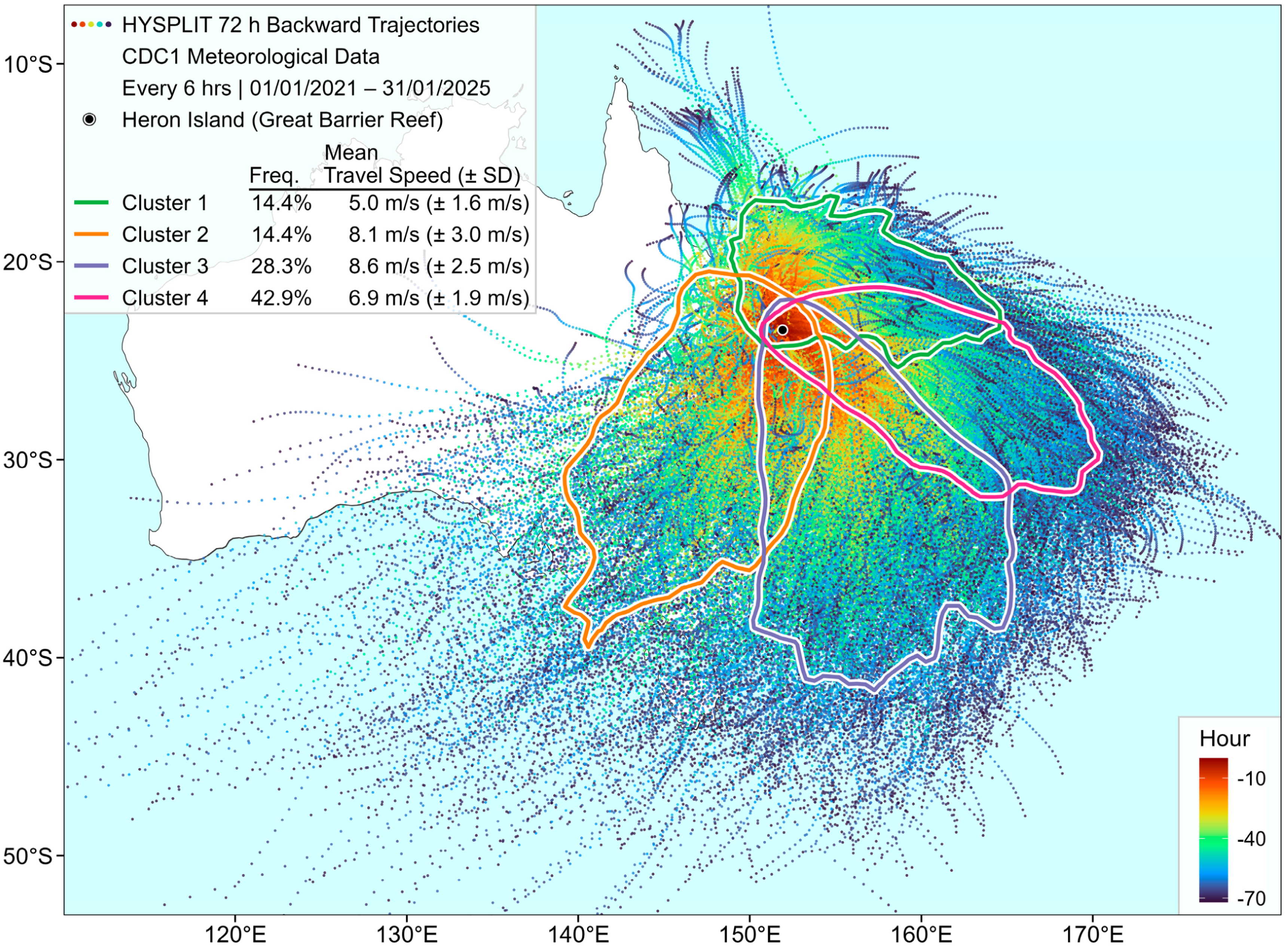
| K-means cluster | 4|4 | 4|4 | 4|4 | 1|1 | 1|1 |
| MLH [m] | 853|888 | 829|855 | 1005|947 | 605|590 | 582|527 |
| Travel speed [m/s] | 6.4|6.1 | 4.9|4.9 | 4.5|4.1 | 5.0|6.7 | 5.0|4.3 |
| Water depth [m] | −674|−561 | −336|−331 | −216|−110 | −72|−58 | −80|−237 |
| Mean percentual change in aerosol number concentration (165.0 to 176.3 nm) (Standard deviation|Standard error (n = 84)) | |||||
| Island | 7.2 (14.3|1.6) | 12.0 (18.2|2.0) | 11.4 (23.1|2.5) | 22.8 (26.0|2.8) | 2.1 (24.9|1.6) |
| Lagoon | 8.7 (18.4|2.0) | 8.1 (17.1|1.9) | 12.5 (23.3|2.5) | 33.2 (28.3|3.1) | −7.3 (19.9|2.2) |
| Crest | 11.4 (18.2|2.0) | 12.0 (12.0|1.5) | 14.5 (19.3|2.1) | 37.1 (33.0|3.6) | −9.9 (19.9|2.2) |
| Background | 2.8 (17.2|1.9) | 14.3 (21.2|2.3) | 16.2 (21.7|2.4) | 30.2 (31.4|3.4) | −16.7 (19.6|2.1) |
Disclaimer/Publisher’s Note: The statements, opinions and data contained in all publications are solely those of the individual author(s) and contributor(s) and not of MDPI and/or the editor(s). MDPI and/or the editor(s) disclaim responsibility for any injury to people or property resulting from any ideas, methods, instructions or products referred to in the content. |
© 2026 by the authors. Licensee MDPI, Basel, Switzerland. This article is an open access article distributed under the terms and conditions of the Creative Commons Attribution (CC BY) license.
Share and Cite
Eckert, C.; Monteforte, K.I.; Medcraft, C.; Doss, A.; Harrison, D.P.; Kelaher, B.P. Drone-Based Measurements of Marine Aerosol Size Distributions and Source–Receptor Relationships over a Great Barrier Reef Lagoon. Remote Sens. 2026, 18, 251. https://doi.org/10.3390/rs18020251
Eckert C, Monteforte KI, Medcraft C, Doss A, Harrison DP, Kelaher BP. Drone-Based Measurements of Marine Aerosol Size Distributions and Source–Receptor Relationships over a Great Barrier Reef Lagoon. Remote Sensing. 2026; 18(2):251. https://doi.org/10.3390/rs18020251
Chicago/Turabian StyleEckert, Christian, Kim I. Monteforte, Chris Medcraft, Adrian Doss, Daniel P. Harrison, and Brendan P. Kelaher. 2026. "Drone-Based Measurements of Marine Aerosol Size Distributions and Source–Receptor Relationships over a Great Barrier Reef Lagoon" Remote Sensing 18, no. 2: 251. https://doi.org/10.3390/rs18020251
APA StyleEckert, C., Monteforte, K. I., Medcraft, C., Doss, A., Harrison, D. P., & Kelaher, B. P. (2026). Drone-Based Measurements of Marine Aerosol Size Distributions and Source–Receptor Relationships over a Great Barrier Reef Lagoon. Remote Sensing, 18(2), 251. https://doi.org/10.3390/rs18020251