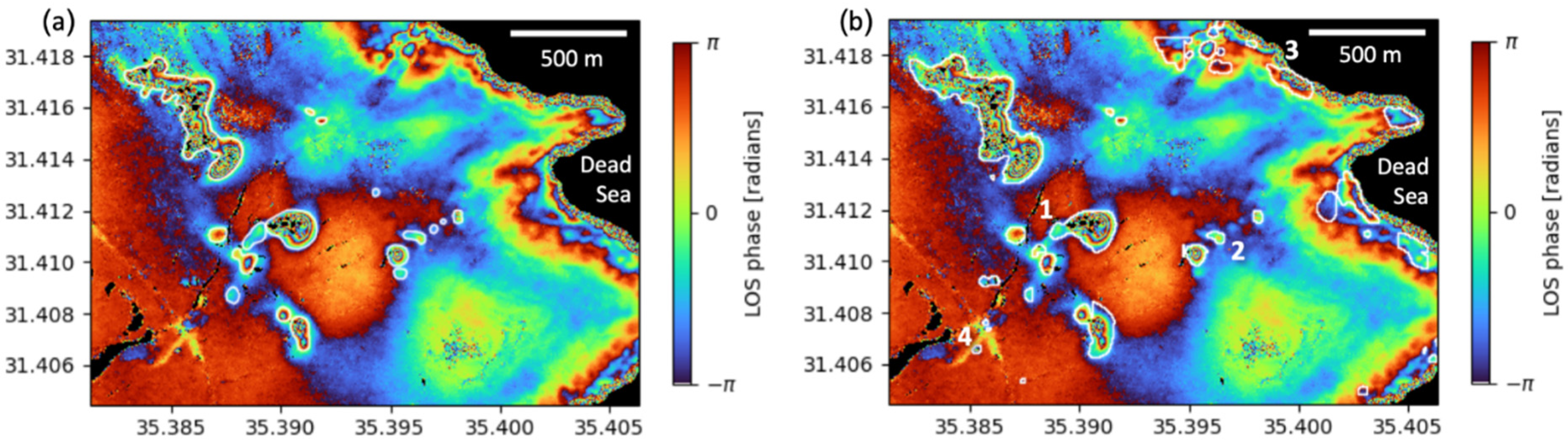
Deep Learning Applied to Spaceborne SAR Interferometry for Detecting Sinkhole-Induced Land Subsidence Along the Dead Sea


Highlights
- A UNet-based Deep Learning architecture was used to detect subsidence patterns observed in Interferometric Synthetic Aperture Radar (InSAR) measurements.
- Different train–test partition schemes based on random patches, temporal division, and geographic distribution showed high inference performance, with object-level metric scores above 0.8.
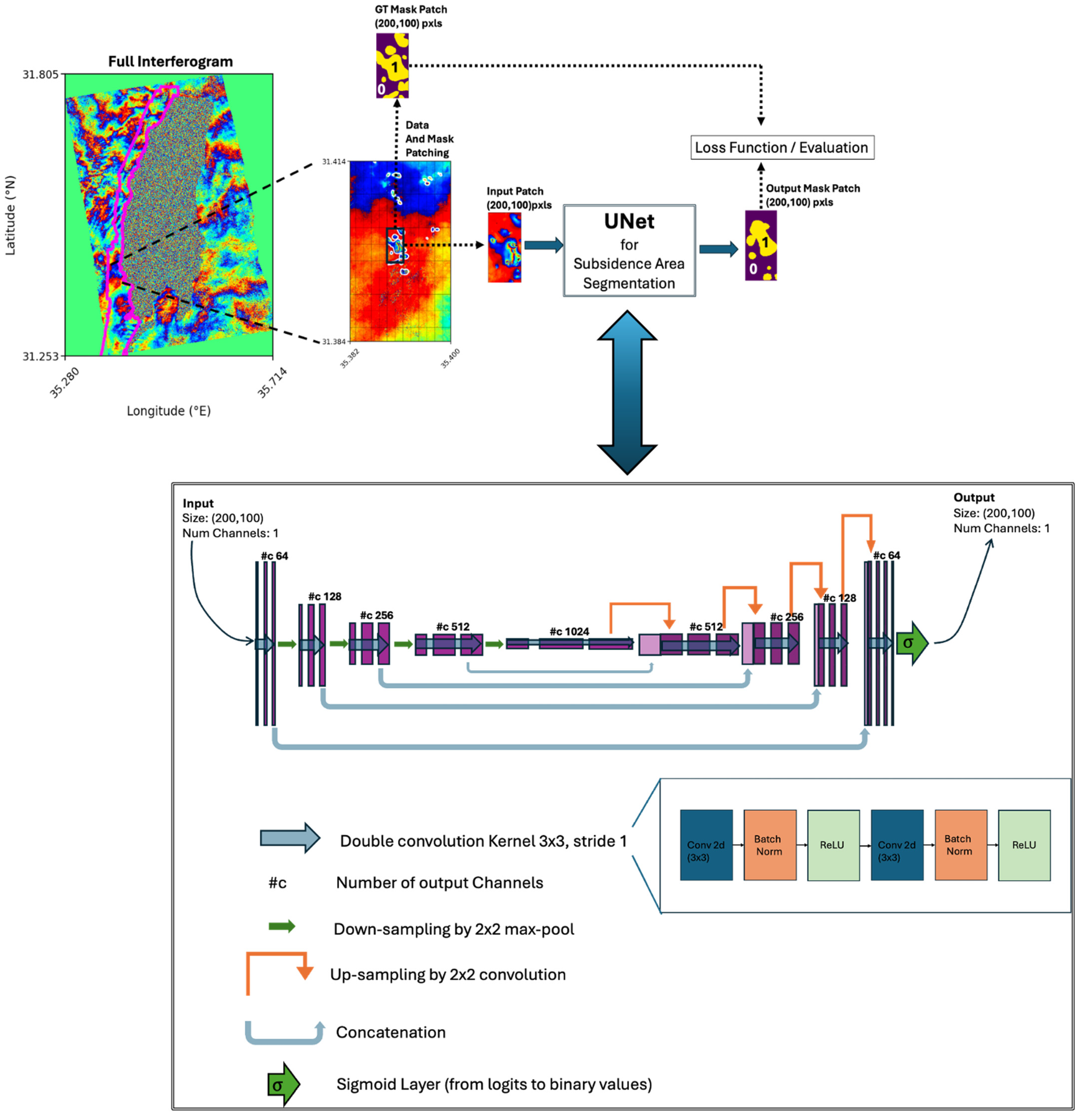
- The UNet architecture shows strong potential for automating the delineation of sinkhole-induced subsidence from individual wrapped interferograms, reducing post-processing overhead and human errors, and enhancing the efficiency and reliability of sinkhole activity monitoring.
- Different train–test partitioning schemes reveal a clear hierarchy of model generalization, quantified using object-level performance metrics, from recognizing partially seen subsidence patterns to transferring across unseen acquisitions and geospatial regions.
Abstract
1. Introduction
Dataset Background and Context
2. Data Collection and Mapping
3. Methods
3.1. Pre-Training Data Preparation and Conditioning
3.2. Binary Image Segmentation and Network Architecture
3.3. Training-Test Partitioning Strategies
- 1.
- In the Random by Patches partition, all patches in the dataset are randomly divided into training, validation, and test sets.
- a.
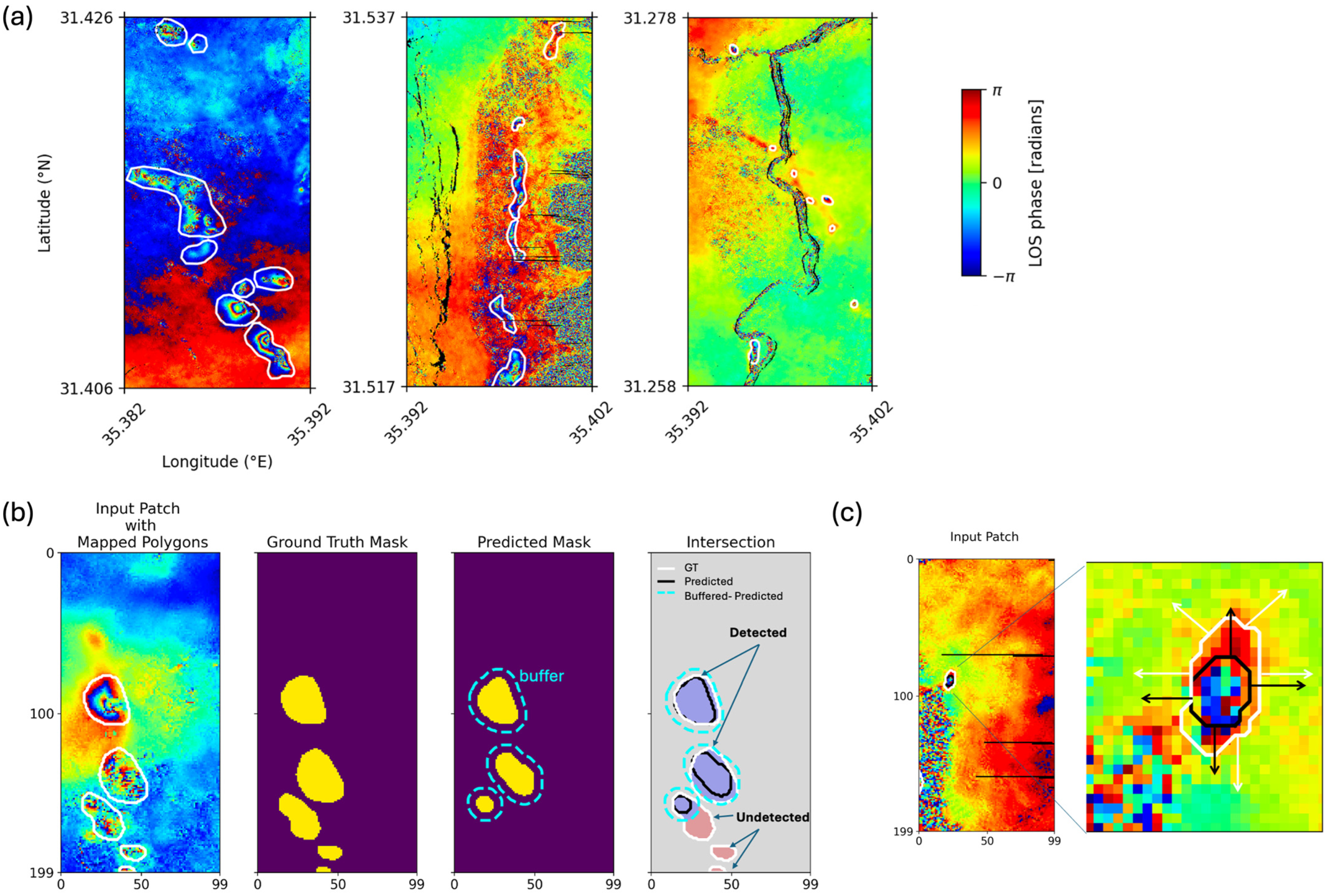
- In the first variation, there is no restriction on the overlap between patches in the training set and those in the validation and test sets. While some degree of information leakage is expected, evaluating the model in this partition type offers valuable insights into its generalization ability and robustness in detecting subsidence objects despite variations in their appearance within the input phase images.
- b.
- In the second variation, Training and validation/test patches may be drawn from the same interferogram but without spatial overlap.
- 2.
- In the Random by Interferograms partition, validation and test sets include patches from (randomly selected) interferograms that were not part of the training. This simulates the model’s performance when processing an unseen interferogram acquired on different dates, thereby introducing distinct atmospheric, ground, acquisition settings, and other temporal conditions.
- 3.
- In the Spatial partition scheme, the dataset is geographically divided at a latitude of 31.3°, such that patches to the north form the training set, while southern patches form the validation and test sets. This scenario evaluates the model’s generalization potential across diverse geospatial conditions. In this scheme, we also train and test a model on the full dataset, which includes 11-, 44- and 77-day interval interferograms across the 2019–2023 range, using a dividing latitude of 31.4°. This is done to assess whether geographical generalization scales with dataset size and diversity. In addition, we train a spatial partition model with data augmentations, as described in the next subsection.
3.4. Data Augmentation for Spatial Partition Scheme
3.5. Training and Loss Function
3.6. Evaluation Metrics and Inference
3.6.1. Metrics
3.6.2. Per-Patch Evaluation and Full-Range Inference Reconstruction
- (1)
- local (per-patch) evaluation, performed on all non-zero ground-truth patches in the test dataset, and
- (2)
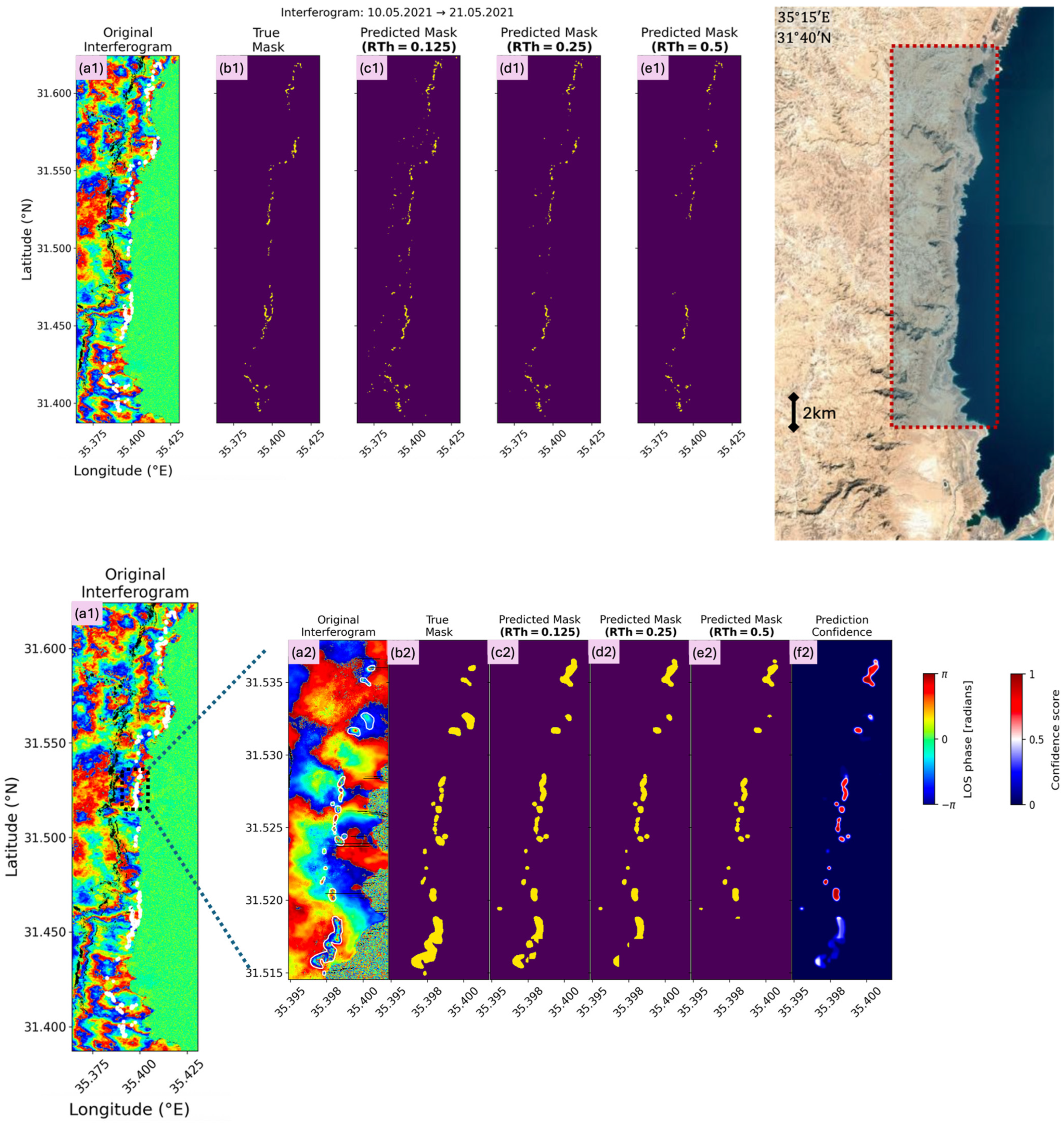
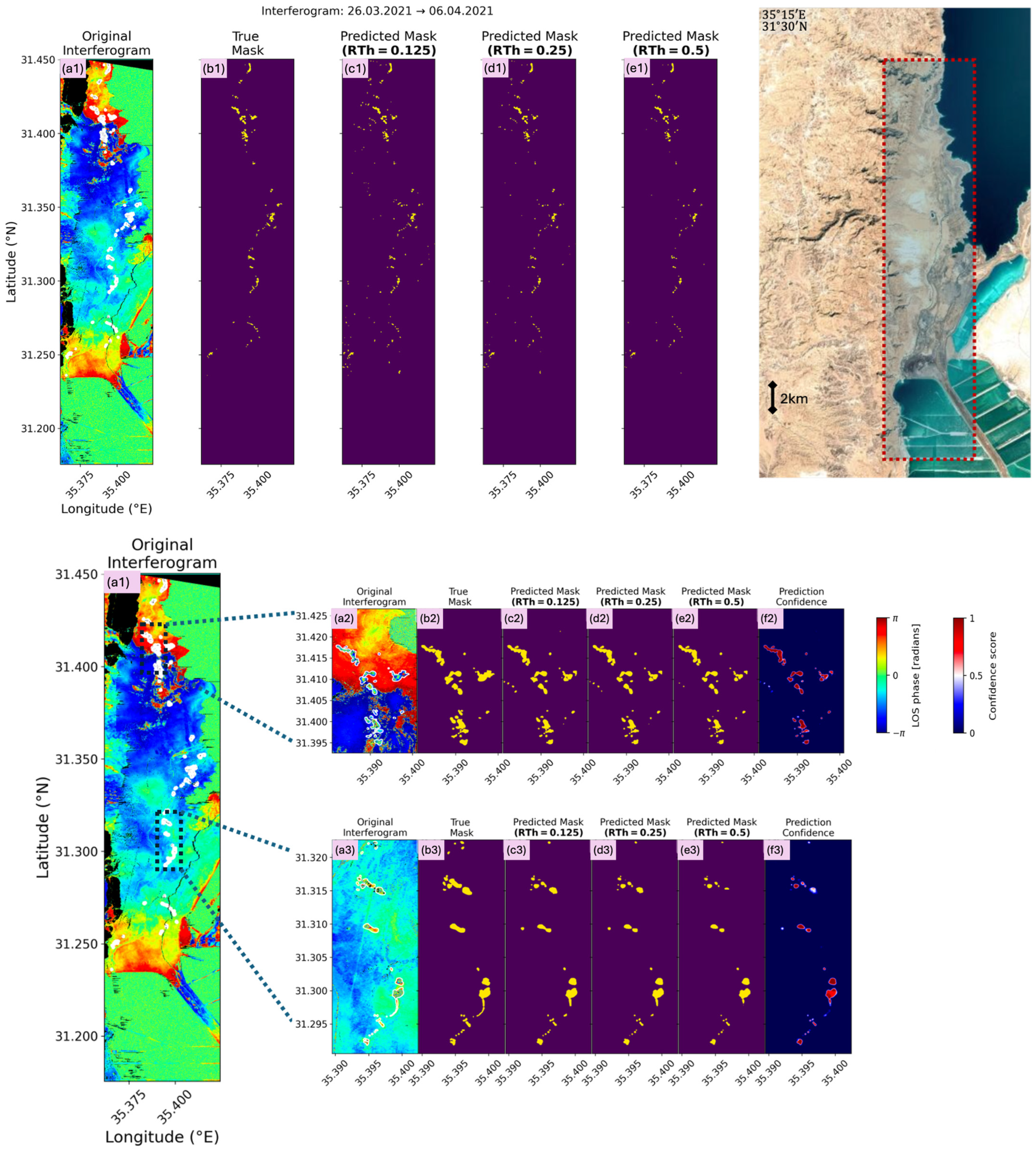
- full-range inference reconstruction, in which predictions are combined in spatial order across overlapping patches to generate a continuous output over a target region.
4. Results
4.1. Per-Patch Inference
- 1.
- Random by Patches Partition Scheme
- 2.
- Random by Interferograms Partition Scheme
- 3.
- Spatial Partition Scheme
4.2. Full Range Inference Reconstruction
4.3. Computational Performance
5. Discussion
5.1. Method Limitations
5.2. Generalization Potential of the DL Model
5.3. Full-Range Inference Reconstruction
5.3.1. False Positives and Inference Confidence
5.3.2. Polygon-Level Detection Analysis
5.4. The Potential for an Automatic AI Model for the Dead Sea Monitoring System
6. Summary and Conclusions
Supplementary Materials
Author Contributions
Funding
Data Availability Statement
Acknowledgments
Conflicts of Interest
References
- Galloway, D.; Jonse, D.R.; Ingebritsen, S.E. Land Subsidence in the United States; U.S. Geological Survey: Reston, VA, USA, 1999.
- Martinez, J.; Johnson, K.; Neal, J. Sinkholes in Evaporite Rocks. Am. Sci. 1998, 86, 38. [Google Scholar] [CrossRef]
- Orhan, O.; Haghshenas Haghighi, M.; Demir, V.; Gökkaya, E.; Gutiérrez, F.; Al-Halbouni, D. Spatial and Temporal Patterns of Land Subsidence and Sinkhole Occurrence in the Konya Endorheic Basin, Turkey. Geosciences 2023, 14, 5. [Google Scholar] [CrossRef]
- Gutiérrez, F.; Parise, M.; De Waele, J.; Jourde, H. A Review on Natural and Human-Induced Geohazards and Impacts in Karst. Earth-Sci. Rev. 2014, 138, 61–88. [Google Scholar] [CrossRef]
- Waltham, T.; Bell, F.G.; Culshaw, M.G. Sinkholes and Subsidence; Karst and Cavernous Rocks in Engineering and Const; Springer: Berlin/Heidelberg, Germany, 2005; ISBN 978-3-540-20725-2. [Google Scholar]
- Parise, M. Rock Failures in Karst. In Landslides and Engineered Slopes. From the Past to the Future; Chen, Z., Zhang, J., Li, Z., Wu, F., Ho, K., Eds.; CRC Press: Boca Raton, FL, USA, 2008; pp. 275–280. ISBN 978-0-415-41196-7. [Google Scholar]
- Intrieri, E.; Gigli, G.; Nocentini, M.; Lombardi, L.; Mugnai, F.; Fidolini, F.; Casagli, N. Sinkhole Monitoring and Early Warning: An Experimental and Successful GB-InSAR Application. Geomorphology 2015, 241, 304–314. [Google Scholar] [CrossRef]
- Jones, C.E.; Blom, R.G. Bayou Corne, Louisiana, Sinkhole: Precursory Deformation Measured by Radar Interferometry. Geology 2014, 42, 111–114. [Google Scholar] [CrossRef]
- Nof, R.N.; Baer, G.; Ziv, A.; Raz, E.; Atzori, S.; Salvi, S. Sinkhole Precursors along the Dead Sea, Israel, Revealed by SAR Interferometry. Geology 2013, 41, 1019–1022. [Google Scholar] [CrossRef]
- Nof, R.N.; Baer, G. Monitoring Gradual Subsidence and Changes along the Dead Sea Coast Using SAR Interferometry; Infrastructure Instability Along the Dead Sea: Final Report 2008–2011; Geological Survey of Israel: Jerusalem, Israel, 2012.
- Paine, J.G.; Buckley, S.M.; Collins, E.W.; Wilson, C.R. Assessing Collapse Risk in Evaporite Sinkhole-Prone Areas Using Microgravimetry and Radar Interferometry. JEEG 2012, 17, 75–87. [Google Scholar] [CrossRef]
- Baer, G.; Magen, Y.; Nof, R.N.; Raz, E.; Lyakhovsky, V.; Shalev, E. InSAR Measurements and Viscoelastic Modeling of Sinkhole Precursory Subsidence: Implications for Sinkhole Formation, Early Warning, and Sediment Properties. JGR Earth Surf. 2018, 123, 678–693. [Google Scholar] [CrossRef]
- Niemi, T.M.; Ben-Avraham, Z.; Gat, J.R. The Dead Sea: The Lake and Its Setting; Oxford monographs on geology and geophysics; Oxford University Press: New York, NY, USA, 1997; ISBN 978-0-19-508703-1. [Google Scholar]
- Baer, G.; Bernstein, M.; Yechieli, Y.; Nof, R.N.; Abelson, M.; Gavrieli, I. Elevation and Thickness of the 11–10 Kyr Old ‘Sinkholes Salt’ Layer in the Dead Sea: Clues to Past Limnology, Paleo-Bathymetry and Lake Levels. J. Paleolimnol. 2023, 70, 159–173. [Google Scholar] [CrossRef]
- Yechieli, Y.; Abelson, M.; Bein, A.; Crouvi, O.; Shtivelman, V. Sinkhole “Swarms” along the Dead Sea Coast: Reflection of Disturbance of Lake and Adjacent Groundwater Systems. Geol. Soc. Am. Bull. 2006, 118, 1075–1087. [Google Scholar] [CrossRef]
- Yechieli, Y.; Magaritz, M.; Levy, Y.; Weber, U.; Kafri, U.; Woelfli, W.; Bonani, G. Late Quaternary Geological History of the Dead Sea Area, Israel. Quat. Res. 1993, 39, 59–67. [Google Scholar] [CrossRef]
- Abelson, M.; Yechieli, Y.; Crouvi, O.; Baer, G.; Wachs, D.; Bein, A.; Shtivelman, V. Evolution of the Dead Sea Sinkholes. Geol. Soc. Am. Spec. Pap. 2006, 401, 241–253. [Google Scholar] [CrossRef]
- Baer, G.; Gavrieli, I.; Swaed, I.; Nof, R.N. Remote Sensing of Floodwater-Induced Subsurface Halite Dissolution in a Salt Karst System, with Implications for Landscape Evolution: The Western Shores of the Dead Sea. Remote Sens. 2024, 16, 3294. [Google Scholar] [CrossRef]
- Closson, D.; Karaki, N.A.; Milisavljevic, N.; Hallot, F.; Acheroy, M. Salt-Dissolution-Induced Subsidence in the Dead Sea Area Detected by Applying Interferometric Techniques to ALOS Palsar Synthetic Aperture Radar Images. Geodin. Acta 2010, 23, 65–78. [Google Scholar] [CrossRef]
- Frumkin, A.; Raz, E. Collapse and Subsidence Associated with Salt Karstification along the Dead Sea. Carbonates Evaporites 2001, 16, 117–130. [Google Scholar] [CrossRef]
- Baer, G.; Schattner, U.; Wachs, D.; Sandwell, D.; Wdowinski, S.; Frydman, S. The Lowest Place on Earth Is Subsiding—An InSAR (Interferometric Synthetic Aperture Radar) Perspective. Geol. Soc. Am. Bull. 2002, 114, 12–23. [Google Scholar] [CrossRef]
- Nof, R.N.; Abelson, M.; Raz, E.; Magen, Y.; Atzori, S.; Salvi, S.; Baer, G. SAR Interferometry for Sinkhole Early Warning and Susceptibility Assessment along the Dead Sea, Israel. Remote Sens. 2019, 11, 89. [Google Scholar] [CrossRef]
- Willner, S.E.; Lipchin, C.; Aloni, Z. Salt Storms, Sinkholes and Major Economic Losses: Can the Deteriorating Dead Sea Be Saved from the Looming Eco Crisis? Negev Dead Sea Arav. Stud. 2015, 7, 27–37. [Google Scholar]
- Closson, D. Structural Control of Sinkholes and Subsidence Hazards along the Jordanian Dead Sea Coast. Environ. Geol. 2005, 47, 290–301. [Google Scholar] [CrossRef]
- Bai, Z.; Wang, Y.; Li, M.; Sun, Y.; Zhang, X.; Wu, Y.; Li, Y.; Li, D. Land Subsidence in the Singapore Coastal Area with Long Time Series of TerraSAR-X SAR Data. Remote Sens. 2023, 15, 2415. [Google Scholar] [CrossRef]
- Hamdi, L.; Defaflia, N.; Merghadi, A.; Fehdi, C.; Yunus, A.P.; Dou, J.; Pham, Q.B.; Abdo, H.G.; Almohamad, H.; Al-Mutiry, M. Ground Surface Deformation Analysis Integrating InSAR and GPS Data in the Karstic Terrain of Cheria Basin, Algeria. Remote Sens. 2023, 15, 1486. [Google Scholar] [CrossRef]
- Zhao, J.; Yang, X.; Zhang, Z.; Niu, Y.; Zhao, Z. Mine Subsidence Monitoring Integrating DS-InSAR with UAV Photogrammetry Products: Case Studies on Hebei and Inner Mongolia. Remote Sens. 2023, 15, 4998. [Google Scholar] [CrossRef]
- Anantrasirichai, N.; Biggs, J.; Albino, F.; Bull, D. The Application of Convolutional Neural Networks to Detect Slow, Sustained Deformation in InSAR Time Series. Geophys. Res. Lett. 2019, 46, 11850–11858. [Google Scholar] [CrossRef]
- Biggs, J.; Anantrasirichai, N.; Albino, F.; Lazecky, M.; Maghsoudi, Y. Large-Scale Demonstration of Machine Learning for the Detection of Volcanic Deformation in Sentinel-1 Satellite Imagery. Bull. Volcanol. 2022, 84, 100. [Google Scholar] [CrossRef] [PubMed]
- Bountos, N.I.; Michail, D.; Papoutsis, I. Learning From Synthetic InSAR With Vision Transformers: The Case of Volcanic Unrest Detection. IEEE Trans. Geosci. Remote Sens. 2022, 60, 1–12. [Google Scholar] [CrossRef]
- Anantrasirichai, N.; Biggs, J.; Albino, F.; Hill, P.; Bull, D. Application of Machine Learning to Classification of Volcanic Deformation in Routinely Generated InSAR Data. JGR Solid Earth 2018, 123, 6592–6606. [Google Scholar] [CrossRef]
- Alrabayah, O.; Caus, D.; Watson, R.A.; Schulten, H.Z.; Weigel, T.; Rüpke, L.; Al-Halbouni, D. Deep-Learning-Based Automatic Sinkhole Recognition: Application to the Eastern Dead Sea. Remote Sens. 2024, 16, 2264. [Google Scholar] [CrossRef]
- Kaushal, A.; Gupta, A.K.; Sehgal, V.K. A Semantic Segmentation Framework with UNet-Pyramid for Landslide Prediction Using Remote Sensing Data. Sci. Rep. 2024, 14, 30071. [Google Scholar] [CrossRef]
- Ronneberger, O.; Fischer, P.; Brox, T. U-Net: Convolutional Networks for Biomedical Image Segmentation. In Medical Image Computing and Computer-Assisted Intervention—MICCAI 2015; Navab, N., Hornegger, J., Wells, W.M., Frangi, A.F., Eds.; Lecture Notes in Computer Science; Springer International Publishing: Cham, Switzerland, 2015; Volume 9351, pp. 234–241. ISBN 978-3-319-24573-7. [Google Scholar]
- Kirillov, A.; Mintun, E.; Ravi, N.; Mao, H.; Rolland, C.; Gustafson, L.; Xiao, T.; Whitehead, S.; Berg, A.C.; Lo, W.-Y.; et al. Segment Anything. In Proceedings of the Proceedings of the IEEE/CVF International Conference on Computer Vision, Paris, France, 1–6 October 2023. [Google Scholar]
- Chen, J.; Lu, Y.; Yu, Q.; Luo, X.; Adeli, E.; Wang, Y.; Lu, L.; Yuille, A.L.; Zhou, Y. TransUNet: Transformers Make Strong Encoders for Medical Image Segmentation. arXiv 2021, arXiv:2102.04306. [Google Scholar] [CrossRef]
- Xie, E.; Wang, W.; Yu, Z.; Anandkumar, A.; Alvarez, J.M.; Luo, P. SegFormer: Simple and Efficient Design for Semantic Segmentation with Transformers. Adv. Neural Inf. Process. Syst. 2021, 34, 12077–12090. [Google Scholar]
- Oktay, O.; Schlemper, J.; Folgoc, L.L.; Lee, M.; Heinrich, M.; Misawa, K.; Mori, K.; McDonagh, S.; Hammerla, N.Y.; Kainz, B.; et al. Attention U-Net: Learning Where to Look for the Pancreas. arXiv 2018, arXiv:1804.03999. [Google Scholar] [CrossRef]
- Wegmuller, U.; Werner, C.; Strozzi, T. SAR Interferometric and Differential Interferometric Processing Chain. In Proceedings of the 1998 IEEE International Geoscience and Remote Sensing Symposium (IGARSS’98), Seattle, WA, USA, 6–10 July 1998; IEEE: Seattle, WA, USA, 1998; Volume 2, pp. 1106–1108. [Google Scholar]
- Goldstein, R.M.; Werner, C.L. Radar Interferogram Filtering for Geophysical Applications. Geophys. Res. Lett. 1998, 25, 4035–4038. [Google Scholar] [CrossRef]
- Hasan, K.R.; Tuli, A.B.; Khan, M.A.-M.; Kee, S.-H.; Samad, M.A.; Nahid, A.-A. Deep-Learning-Based Semantic Segmentation for Remote Sensing: A Bibliometric Literature Review. IEEE J. Sel. Top. Appl. Earth Obs. Remote Sens. 2024, 17, 1390–1418. [Google Scholar] [CrossRef]
- Li, J.; Cai, Y.; Li, Q.; Kou, M.; Zhang, T. A Review of Remote Sensing Image Segmentation by Deep Learning Methods. Int. J. Digit. Earth 2024, 17, 2328827. [Google Scholar] [CrossRef]
- Yuan, X.; Shi, J.; Gu, L. A Review of Deep Learning Methods for Semantic Segmentation of Remote Sensing Imagery. Expert Syst. Appl. 2021, 169, 114417. [Google Scholar] [CrossRef]
- Goodfellow, I.; Bengio, Y.; Courville, A. Deep Learning; MIT Press: Cambridge, MA, USA, 2016. [Google Scholar]
- Milletari, F.; Navab, N.; Ahmadi, S.-A. V-Net: Fully Convolutional Neural Networks for Volumetric Medical Image Segmentation. In Proceedings of the 2016 Fourth International Conference on 3D Vision (3DV), Stanford, CA, USA, 25–28 October 2016; IEEE: Stanford, CA, USA, 2016; pp. 565–571. [Google Scholar]
- RMSprop—Porch 2.7 Documentation. Available online: https://docs.pytorch.org/docs/stable/generated/torch.optim.RMSprop.html (accessed on 30 May 2025).





| (1) Partition 1: Random by Patches | |||||||
| a. With Overlap | |||||||
| Dice Coeff. | Pixel-Level Recall | Pixel-Level Precision | RecallOL | PrecisionOL | |||
| ITh = 0.7 b = 5 pixels | ITh = 0.9 b = 2 pixels | ITh = 0.7 b = 5 pixels | ITh = 0.9 b = 2 pixels | ||||
| 0.82 | 0.89 | 0.94 | 0.98 | 0.92 | 0.98 | 0.96 | |
| b. Without Overlap | |||||||
| Dice Coeff. | Pixel-Level Recall | Pixel- Level Precision | RecallOL | PrecisionOL | |||
| ITh = 0.7 b = 5 pixels | ITh = 0.5 b = 10 pixels | ITh = 0.7 b = 5 pixels | ITh = 0.5 b = 10 pixels | ||||
| 0.62 | 0.71 | 0.75 | 0.82 | 0.9 | 0.87 | 0.92 | |
| (2) Partition 2: Random by Interferograms | |||||||
| 0.62 | 0.67 | 0.8 | 0.81 | 0.9 | 0.88 | 0.93 | |
| (3) Partition 3: Spatial Partition | |||||||
| Small dataset Lat. 31.3° | 0.54 | 0.59 | 0.71 | 0.72 | 0.81 | 0.8 | 0.87 |
| Large dataset Lat. 31.4° | 0.56 | 0.67 | 0.71 | 0.78 | 0.86 | 0.83 | 0.88 |
| Large dataset Lat. 31.4° Augmented | 0.6 | 0.77 | 0.65 | 0.86 | 0.91 | 0.86 | 0.9 |
| RTh = 0.125 | RTh = 0.25 | RTh = 0.5 | |
|---|---|---|---|
| ITh = 0.7, b = 5 pixels | RecallOL = 0.9 PrecisionOL = 0.73 | RecallOL = 0.82 PrecisionOL = 0.82 | RecallOL = 0.71 PrecisionOL = 0.89 |
| ITh = 0.5, b = 10 pixels | RecallOL = 0.94 PrecisionOL = 0.75 | RecallOL = 0.9 PrecisionOL = 0.84 | RecallOL = 0.8 PrecisionOL = 0.9 |
Disclaimer/Publisher’s Note: The statements, opinions and data contained in all publications are solely those of the individual author(s) and contributor(s) and not of MDPI and/or the editor(s). MDPI and/or the editor(s) disclaim responsibility for any injury to people or property resulting from any ideas, methods, instructions or products referred to in the content. |
© 2026 by the authors. Licensee MDPI, Basel, Switzerland. This article is an open access article distributed under the terms and conditions of the Creative Commons Attribution (CC BY) license.
Share and Cite
Dekel, G.; Nof, R.N.; Sarafian, R.; Rudich, Y. Deep Learning Applied to Spaceborne SAR Interferometry for Detecting Sinkhole-Induced Land Subsidence Along the Dead Sea. Remote Sens. 2026, 18, 211. https://doi.org/10.3390/rs18020211
Dekel G, Nof RN, Sarafian R, Rudich Y. Deep Learning Applied to Spaceborne SAR Interferometry for Detecting Sinkhole-Induced Land Subsidence Along the Dead Sea. Remote Sensing. 2026; 18(2):211. https://doi.org/10.3390/rs18020211
Chicago/Turabian StyleDekel, Gali, Ran Novitsky Nof, Ron Sarafian, and Yinon Rudich. 2026. "Deep Learning Applied to Spaceborne SAR Interferometry for Detecting Sinkhole-Induced Land Subsidence Along the Dead Sea" Remote Sensing 18, no. 2: 211. https://doi.org/10.3390/rs18020211
APA StyleDekel, G., Nof, R. N., Sarafian, R., & Rudich, Y. (2026). Deep Learning Applied to Spaceborne SAR Interferometry for Detecting Sinkhole-Induced Land Subsidence Along the Dead Sea. Remote Sensing, 18(2), 211. https://doi.org/10.3390/rs18020211