Article

MFRA-YOLOv11: Remote Sensing Small Object Detection Algorithm Based on Multiscale Feature Extraction and Region Awareness


1
College of Computer Science and Technology, Zhengzhou University of Light Industry, Zhengzhou 450002, China
2
School of Computer Science, Nanjing University of Information Science and Technology, Nanjing 210044, China
3
School of Geographic Sciences, Xinyang Normal University, Xinyang 464000, China
*
Author to whom correspondence should be addressed.
Remote Sens. 2026, 18(17), 2965; https://doi.org/10.3390/rs18172965
Submission received: 1 June 2026 / Revised: 8 August 2026 / Accepted: 20 August 2026 / Published: 2 September 2026

Abstract

Small objects in remote sensing images often exhibit blurred edges and dense distributions. This makes it difficult to precisely localize object regions. These challenges are especially pronounced on devices with limited computational capacity, where accuracy and efficiency are both critical. To address these challenges, we propose MFRA-YOLOv11, an enhanced YOLOv11s-based network for remote sensing small object detection under the horizontal bounding box paradigm, which integrates multiscale feature extraction and object region awareness to improve detection accuracy. First, in the backbone, we introduce the CSP bottleneck with triple attention aggregation module to emphasize object regions. This module combines channel, coordinate, and kernel attention to aggregate features, enhancing the localization and representation of small objects. Second, a multiscale feature extraction module is integrated into the neck to enhance feature representation across different scales capturing multiscale features along horizontal and vertical directions under varied receptive fields, further boosting small object detection. Finally, we incorporate an adaptive multi-receptive field module into the detection head, which adaptively selects appropriate receptive fields for feature maps of varying granularity, aiding the head in accurate object localization. We validated the accuracy of MFRA-YOLOv11 on the NWPU VHR-10, VEDAI, and DOTA datasets. Compared to YOLOv11, our model achieves 3.0%, 2.7%, and 3.6% improvements in mAP50 on these three datasets, respectively, and 2.4%, 3.5%, and 4.0% improvements in mAP50–95, with only a slight increase in computational cost (15.9% in parameters and 10.2% in GFLOPs).

1. Introduction

Object detection in remote sensing imagery involves the precise localization and classification of target features from aerial or satellite platforms. This fundamental capability enables crucial applications across environmental monitoring, town and country planning, military reconnaissance, security surveillance, and marine observation [1,2,3,4]. Therefore, the development of high-accuracy detection algorithms is essential to advance remote sensing technology. Optical remote sensing images offer a wide field of view, capturing thousands of square kilometers of the Earth’s surface in a single shot. Their high resolution, clear textures, and rich contextual information make them particularly suited for object detection. In this study, we concentrates on optical remote sensing images.
Meanwhile, remote sensing object detection faces several challenges. In contrast to natural images, remote sensing images are typically acquired from high altitudes, causing large variations in object size within a single scene and increasing the risk of missing small object features. Detection performance is also more vulnerable to environmental noise [5,6]. Furthermore, small objects occupy few pixels and exhibit blurred edges against complex backgrounds. Their spatial distributions can be highly dense. Addressing these multiscale characteristics, dense small object layouts, and blurred edges requires more effective methods to improve detection efficiency.
Many researchers have adapted YOLO variants for remote sensing object detection. SCENE-YOLO [7] extended YOLOv8 by integrating omni-dimensional dynamic convolution (ODConv) [8], which combined spatial attention, channel attention, and kernel attention to suppress background noise and improve the detection efficiency of small objects. FFCA-YOLO [9] enhanced feature fusion by introducing weighted concatenation in the neck, which refined feature fusion and supported global context modeling. Although these methods significantly enhance detection performance, there is considerable growth in model complexity, which may hinder deployment in resource-constrained environments. More recent approaches, including MoPKL [10] breaks the limitation of pure vision models, introducing a vision-language framework that leverages language descriptions to guide the learning of motion prior knowledge for small infrared targets. MICPL [11] breaks through the limitation of a single vision pattern by proposing a motion-inspired cross-pattern learning scheme. It effectively mines latent motion patterns and adapts them with vision semantics, demonstrating superior performance and adaptability to detect small moving objects. In response, rotated box-based detectors have emerged as an effective alternative for handling densely packed oriented objects. Oriented R-CNN [12] addresses the inefficiency of generating rotated boxes in traditional two-stage detectors by proposing an oriented Region Proposal Network (oriented RPN). S2A-Net [13] addresses the misalignment between horizontal anchor boxes and axis-aligned convolutional features in aerial object detection, which causes inconsistency between classification score and localization accuracy for rotated objects. ACDet [14] proposes an adaptive anchor alignment mechanism (A3M) that decouples centripetal sampling bias in categorical features to learn aligned anchor points without extra supervision.
In summary, the above algorithms have shown promising performance in identifying objects in remote sensing data. However, they often introduce significant computational overhead and struggle to accurately locate small objects in complex scenes, such as detecting background regions as objects. In addition, within the YOLO series, YOLOv11 achieved higher accuracy while reducing parameter count and computation complexity, but its performance in detecting small objects remains suboptimal. So, our goal is to develop an efficient small object detector for remote sensing imagery using YOLOv11 as the baseline. To mitigate these challenges, we design a novel model that combined multiscale feature extraction with region perception (MFRA-YOLOv11). The key contributions in this paper are as follows.
1.
We propose the CSP structure with triple attention aggregation (CTAA) module to enhance the localization of small objects in complex backgrounds. This module integrates channel, coordinate, and kernel attention mechanisms, where channel and coordinate attention are independently embedded into the kernel attention stream. This design reduces potential interference among attention mechanisms.
2.
We propose the multiscale feature extraction (MFE) module to capture directional object features. Motivated by the inherent orientations of objects, multiscale features are extracted along both horizontal and vertical axes. Furthermore, dilated convolutions are integrated to expand the receptive field without increasing the computational burden, facilitating more comprehensive context modeling.
3.
We design a adaptive multi-receptive field module (AMR), integrated into the existing YOLO detection head as the AMR-Head, enabling rapid object identification. It assigns adaptive weights to parallel branches with different receptive fields during regression, allowing the detection head to adaptively select its receptive field according to the spatial and scale characteristics of objects. This design addresses the challenge of accurately localizing and regressing objects of varying sizes.
The remainder of this paper is organized as follows. Section 2 reviews the evolution of object detection methods, YOLOv11s, and related work on remote sensing small object detection, including multiscale fusion and attention mechanisms. Section 3 details the proposed MFRA-YOLOv11 model. Section 4 describes our experimental setup and compares MFRA-YOLOv11 with other leading YOLO variants. Section 5 provides a comprehensive analysis of the methodological framework and experimental results. Finally, Section 6 concludes this paper.

2. Related Work

2.1. Evolution of Object Detection Methods

Recently, object detection has evolved from traditional feature-based methods [15,16] to deep learning-based approaches [17,18,19]. Traditional algorithms suffer from poor adaptability and limited feature representation, which limit their applicability to modern detection tasks. Following advances in powerful GPUs and large-scale datasets, convolutional neural networks (CNNs) [20,21,22] have achieved remarkable success in computer vision. As a result, deep learning frameworks have become dominant in remote sensing object detection.
Depending on whether object proposals are generated separately, detection methods are commonly partitioned into one-stage and two-stage detectors. Traditional two-stage algorithms consistently achieve state-of-the-art recognition accuracy, including fast R-CNN [23], faster R-CNN [24], mask R-CNN [25], and dynamic R-CNN [26]. These methods produce region proposals through sliding-window operations on feature maps and introduce a confidence parameter to distinguish object regions from the background. Although two-stage approaches achieve high precision, they often have long inference times and involve complex models. The release of YOLOv1 [27] in 2016 marked the rise of one-stage detectors, most notably YOLOv1 and SSD [28]. Unlike two-stage methods, the one-stage paradigm employs direct regression of bounding boxes on feature maps without generating proposals separately. YOLOv1 removed the generation of object proposals and directly regressed the object locations. It adopted a simple network structure and achieved a fast inference speed. YOLOv5 [29] replaced Darknet, simplified deployment, and added spatial pyramid pooling fast (SPPF) for efficient multiscale fusion. YOLOv8 [30] removed predefined anchors and simplified inference. YOLOv11 [31] further refined both the backbone and the head, offering enhancements in both computational efficiency and prediction precision compared to previous versions. YOLOv12 [32] proposes an attention-centric real-time detection framework that matches the inference speed of prior CNN-based YOLO models while unlocking the performance benefits of attention mechanisms. Despite the remarkable success of the YOLO series in object detection tasks, YOLOv11 still exhibits several limitations in remote sensing image scenarios, such as insensitivity to scale variations and poor performance in detecting small objects.

2.2. YOLOv11

YOLOv11 builds on YOLOv8 by upgrading its feature fusion module, introducing new attention mechanisms, and adopting a more lightweight detection head. These enhancements deliver higher detection accuracy and support a wider range of application scenarios. As shown in Figure 1, the backbone network is built on three fundamental components: the C3k2, SPPF, and C2PSA module. The C3k2 module incorporates cross-stage partial connections into the traditional C3 block to separate and fuse features effectively, reducing redundant gradient flow and improving model stability. The SPPF module pools feature maps at multiple spatial scales to capture the multiscale characteristics of images. The C2PSA module embeds sensitive attention within the backbone to enhance spatial feature learning. In the neck, YOLOv11 uses an FPN–PAN fusion architecture. Here, FPN propagates semantic information.
From top to bottom, high-level semantics are fused to lower layers, while PAN aggregates features from the bottom to the top to reinforce fine-grained details and localization. YOLOv11 remains anchor-free and depth-wise separable convolution (DWConv) modules are adopted in the classification head architectures to make the head lighter and faster.

2.3. Multiscale Feature Extraction Methods for Small Object Detection

Efficiently capturing multiscale features is essential for remote sensing small object detection tasks. Small objects often represent merely sparse pixel clusters within large receptive fields, and reducing the receptive field makes their features even harder to detect. Thus, fully exploiting multiscale representations is vital for improved detection. Traditional methods rely on pyramid networks: Lin et al. [33] proposed the feature pyramid network (FPN), which fused feature maps from different convolutional layers to integrate abstract semantic information with fine-grained spatial features. Based on FPN, variants such as SA-FPN [34], Weight-FPN [35], MuRDE-FPN [36], and SAFPN [37] were introduced to extract multiscale features more efficiently. Wang et al. [38] presented CESFE-YOLO with a context enhancement module (CEM) [39]. CEM injected global context while extracting features at multiple scales. YOLOv8n-DDS [40] proposed a lightweight detection model specifically for early-stage root mold in hydroponic barley seedlings, where the targets are small and difficult to distinguish. CPD-YOLO [41] enhances multiscale feature fusion and inference efficiency, improves multi-dimensional dynamic awareness. Zhang et al. [42] observed that pooled feature maps can suffer semantic and distribution mismatches during fusion. To address this, they proposed SFPN for one-stage detectors, inserting cross-scale synthesis layers in the FPN to align and fuse multiscale features more effectively. These studies demonstrated that strengthening multiscale extraction and fusion improved the accuracy of small objects when object sizes varied significantly. Furthermore, enhancing the features before the fusion further improved the representation quality. Wu et al. [43] addressed dense scenes with variably oriented objects in high-resolution imagery by combining local details with global semantics to avoid missing critical features. Quan et al. [44] noted that different feature levels carried distinct object cues and should not be fused directly, so they introduced attention mechanisms in the early layers to highlight key information. Other studies adopted a multi-branch architecture [45] to extract features in diverse receptive fields and enrich feature representations.
Inspired by these studies, we designed the MFE module that integrated dilated convolutions within a multi-branch architecture. Each branch focused on different receptive fields, and dilation enlarged the field of view without adding parameters. This lightweight module significantly improved small object detection accuracy while adding minimal complexity.

2.4. Attention Mechanisms in Object Detection

Remote sensing images encompass extensive regions, causing backgrounds to dominate scenes and obscure objects. Many objects exhibit low contrast or simple shapes, making accurate localization challenging. Suppressing background noise and precisely focusing on object regions are crucial to detection performance.
Attention mechanisms have proven to be effective in this context. Liu et al. [46] propose a one-stage semi-supervised method named SODRS. It integrates attention mechanisms and a confident pseudo-labeling strategy, demonstrating high accuracy and robustness in detecting densely distributed or overlapping objects in complex scenes. Chen et al. [47] proposed an attention-guided feature aggregation approach that emphasized spatial and channel information in the backbone. Jin et al. [48] obtained object location information along horizontal and vertical directions in the spatial domain, enabling a precise focus on the object. Ma et al. [49] sequentially combined spatial and channel attention to Enhance edge information and suppress background interference. Xie et al. [50] proposes Swin-DETR to address low-resolution small targets in complex environments. It enhances the DETR backbone by integrating the Swin-T architecture for deeper feature extraction and the CBAM attention module to improve target identification accuracy, thereby effectively boosting detection performance. Qu et al. [51] introduced a two-dimensional attention module that jointly modeled inter-channel similarity and spatial structure, allowing simultaneous channel and space-wise focus. However, separating spatial and channel attention could lead to information loss when their emphases conflicted.
To overcome this, we propose the CTAA module. It weights channel and coordinate attention into the convolutional kernel attention, enabling joint modeling of object regions across multiple dimensions. This design enhances small object feature extraction in low-resolution imagery while minimizing interference among attention branches.

3. Proposed Methods

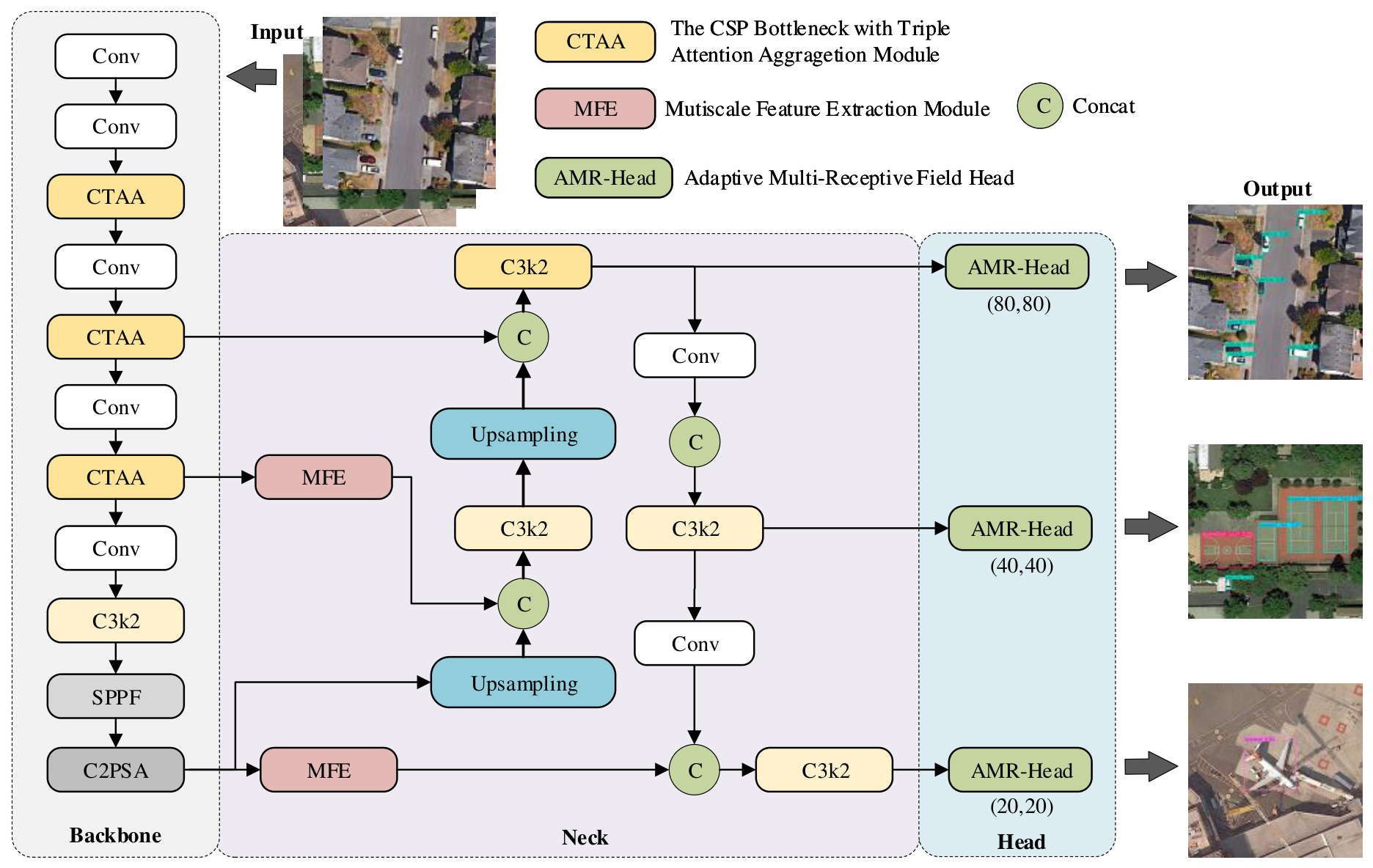
We adopt YOLOv11 as our baseline because it offers a smaller parameter footprint, lower computational complexity, and strong small object performance in remote sensing images. Building on this foundation, in Figure 2, we propose MFRA-YOLOv11 for more precise detection of small objects. In the first stage, we propose the CTAA module, enhancing the backbone network’s region awareness capability, and extracting fine-grained features. In the second stage, we insert the MFE module into the neck, so the model learns richer global and local representations, which significantly strengthen multiscale detection, suppress background interference, and improve feature expression. In the final stage, the AMR-Head module refines the detection head by adaptively fusing multi-receptive field information to the regression branch, thus increasing the accuracy of the localization and the efficiency of the inference.

3.1. CSP Bottleneck with Triple Attention Aggregation (CTAA) Module

In shallow layers, YOLOv11 uses four C3k2 blocks composed of multiple bottleneck submodules. This design increases the depth of the model and reduces computational cost, but relies on a simple residual structure that cannot fully capture fine object details. Large background regions with many dominant pixels overwhelm sparse object features and disrupt accurate localization. Small objects occupy only a few pixels and exhibit blurred edges, making shallow-layer feature extraction especially important.
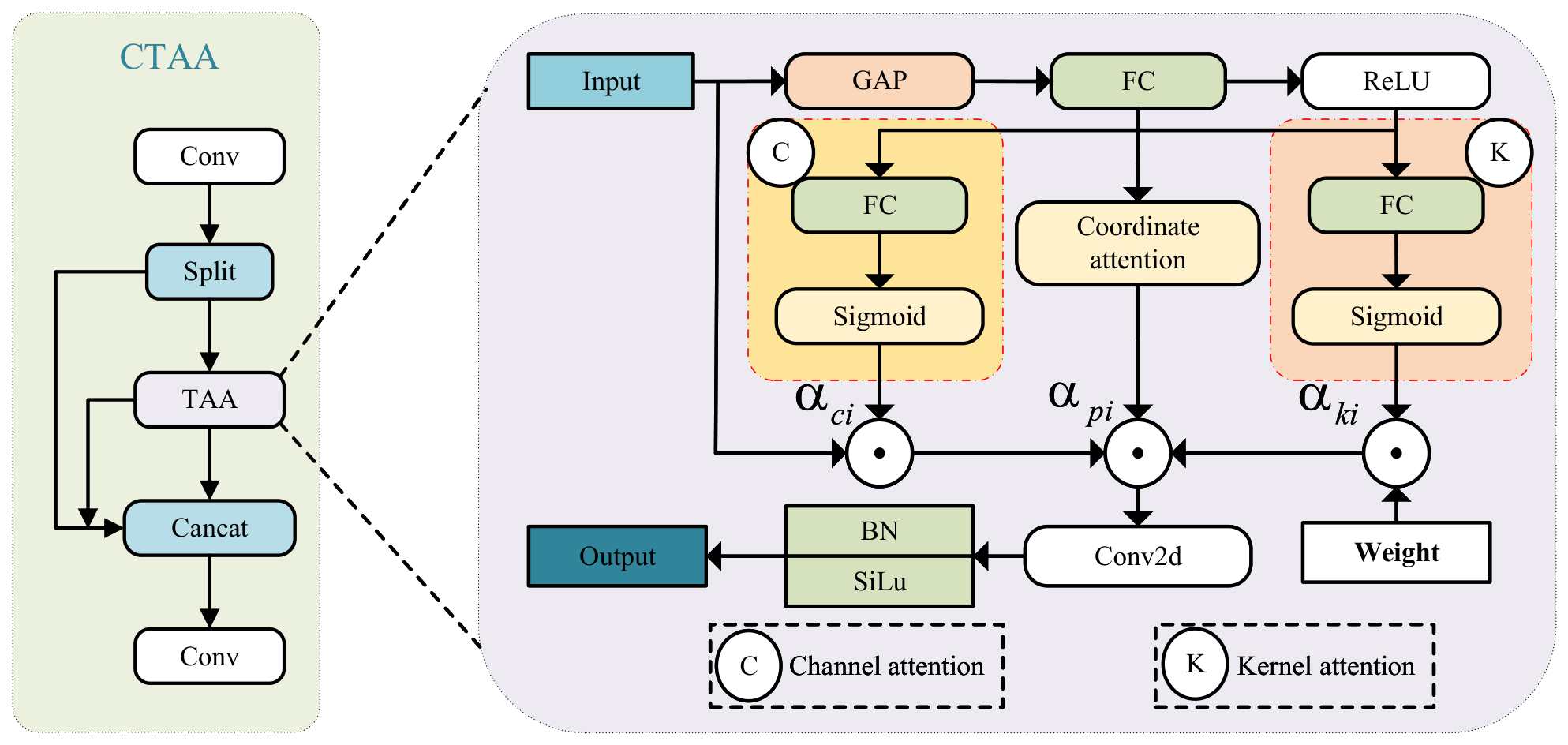
In tackling these problems, we introduced the CTAA module by replacing the bottleneck modules in the first three C3k2 modules with a triple attention aggregation unit. The CTAA module guides the network to focus on object regions in shallow layers. Attention across channel, kernel, and coordinate dimensions to improve object localization and efficiently extract small object features, providing richer representations for neck-level fusion. Specifically, channel attention adaptively highlights informative feature channels and suppresses redundant responses, allowing the network to focus on discriminative semantic cues that are easily overwhelmed in small object scenarios.
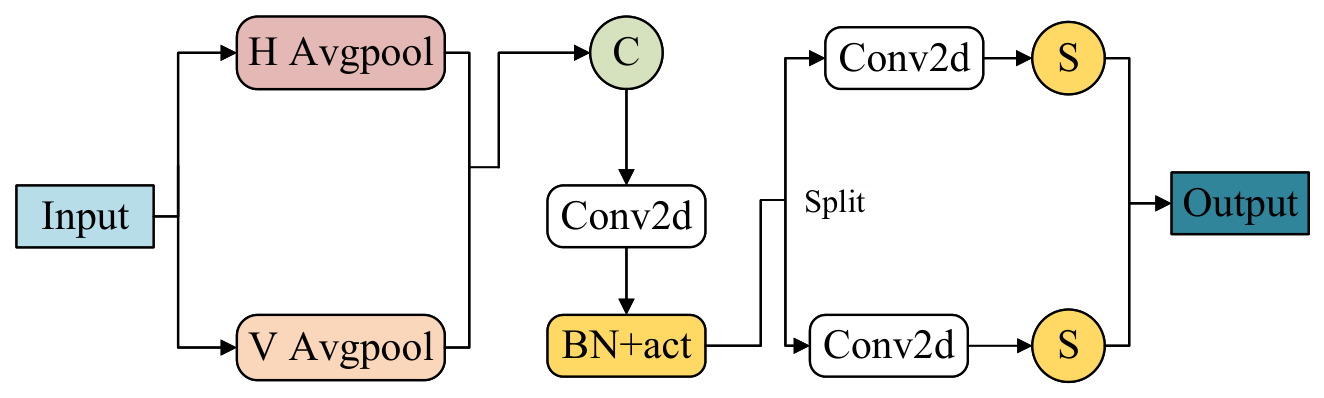
Unlike spatial attention, which treats all spatial locations equally, coordinate attention preserves precise directional information, enabling the model to accurately localize target regions across different scales and effectively compensate for the loss of small object information. Furthermore, kernel attention enables adaptive selection of convolution kernels with different receptive fields. This multi-dimensional fusion improves the model’s ability to extract fine-grained features and localize small targets under complex remote sensing conditions. Figure 3 shows the detailed architecture of the introduced coordinate attention module, and “H”, “V”, “BN”, “act”, and “S” refer to horizontal, vertical, activation, and Softmax. After the input feature map, it undergoes a two-dimensional adaptive mean aggregation along width and height directions. This operation generates a ( h ) and a ( w ) , which serve to encode spatial positional information. The pooled feature a ( w ) is transposed and then concatenated with a ( h ) along the height dimension to form a combined feature. This step enables the model to incorporate contextual features from both directions. The output of a ( h ) and a ( w ) are as follows:
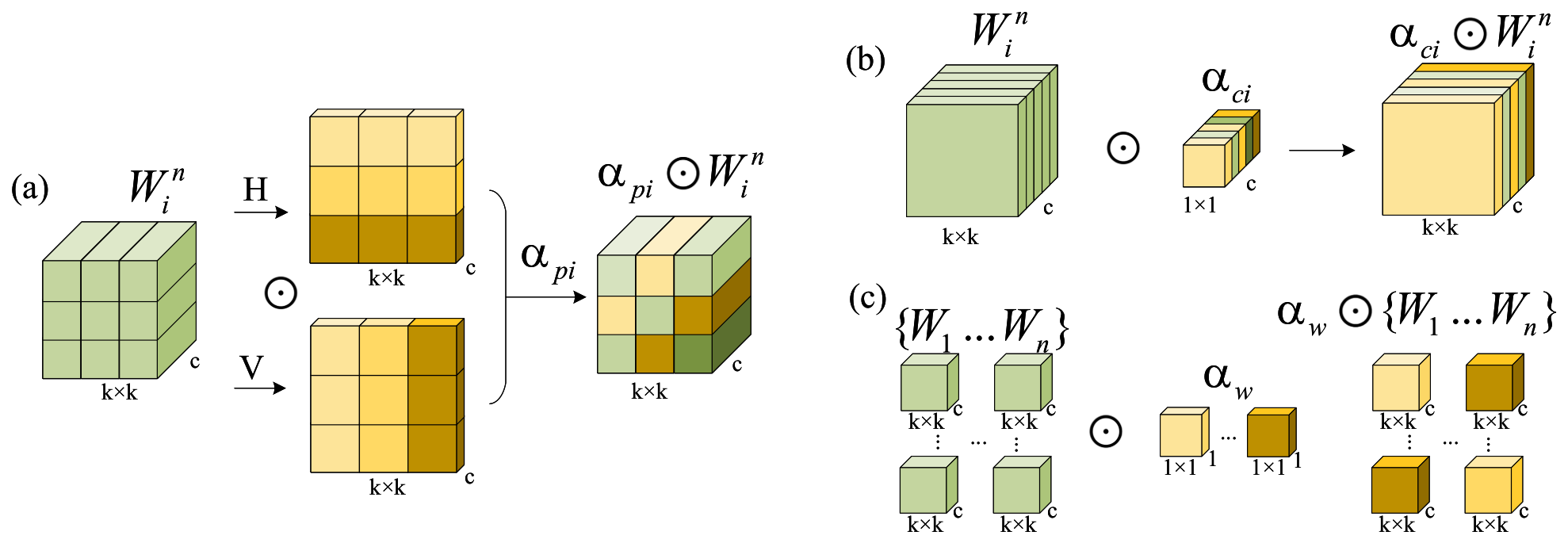
Subsequently, the combined feature is processed by a one-dimensional convolution layer, a batch normalization layer, and a non-linear activation function to extract a compressed intermediate representation. The resulting feature is then split into two tensors, representing attention information horizontally and vertically. Each tensor is passed through a one-dimensional convolution layer followed by a sigmoid activation function to generate two attention weight maps, corresponding to the respective directions. The attention weights are multiplied by the elements multiplied with the input features to perform position-enhanced channel attention modeling. The final output is a feature map enriched with direction-sensitive spatial information. The attention aggregation unit employs a three-branch structure in which two branches compute attention weights in the channel and coordinate dimensions in parallel. Each set of weights is applied separately to the convolution kernel, avoiding mutual interference and greatly enhancing each attention mechanism while reducing information loss. The aggregation process of the triple attention mechanism is illustrated in Figure 4, and the resulting attended kernel is then used in the convolution operation as follows
α ( h ) = 1 W 0 i < W X ( h , i )
α ( w ) = 1 H 0 j < H X ( j , w ) .
Y = α c i α p i α k i W i + + α c n α p n α k n W n × X , i = 1 , 2 , 3 , , n .
In (3), Y represents the feature map processed by the TAA module, while X is the input feature map to the TAA module. W i denotes the i-th convolution kernel, a c i and a p i are the attention weights for the channel and coordinate dimensions. The symbol ⊙ denotes the multiplication of the attention weights by elements in different dimensions in the convolution kernel. The framework of the TAA module is shown in Figure 5. Upon receiving the input feature map X, TAA first applies global average pooling, a fully connected layer, and ReLU activation to produce a feature vector of length equal to the channel dimension of X. This vector then feeds into three parallel attention branches. Each branch comprises an FC layer with sigmoid nonlinearity, generating three weight coefficients: a c i , a p i , and a k i . Finally, these three coefficient sets are merged into the base kernel W i by element-wise multiplication, yielding the attended kernel used to convolve X, which produces Y. Building on this TAA module, we construct the CTAA module as illustrated in Figure 5. By replacing the bottleneck units in the shallow backbone with the CTAA module, the network becomes more sensitive to small objects and better focuses on object regions while suppressing background noise. This leads to improved small object feature extraction in early layers.

3.2. Multiscale Feature Extraction (MFE) Module

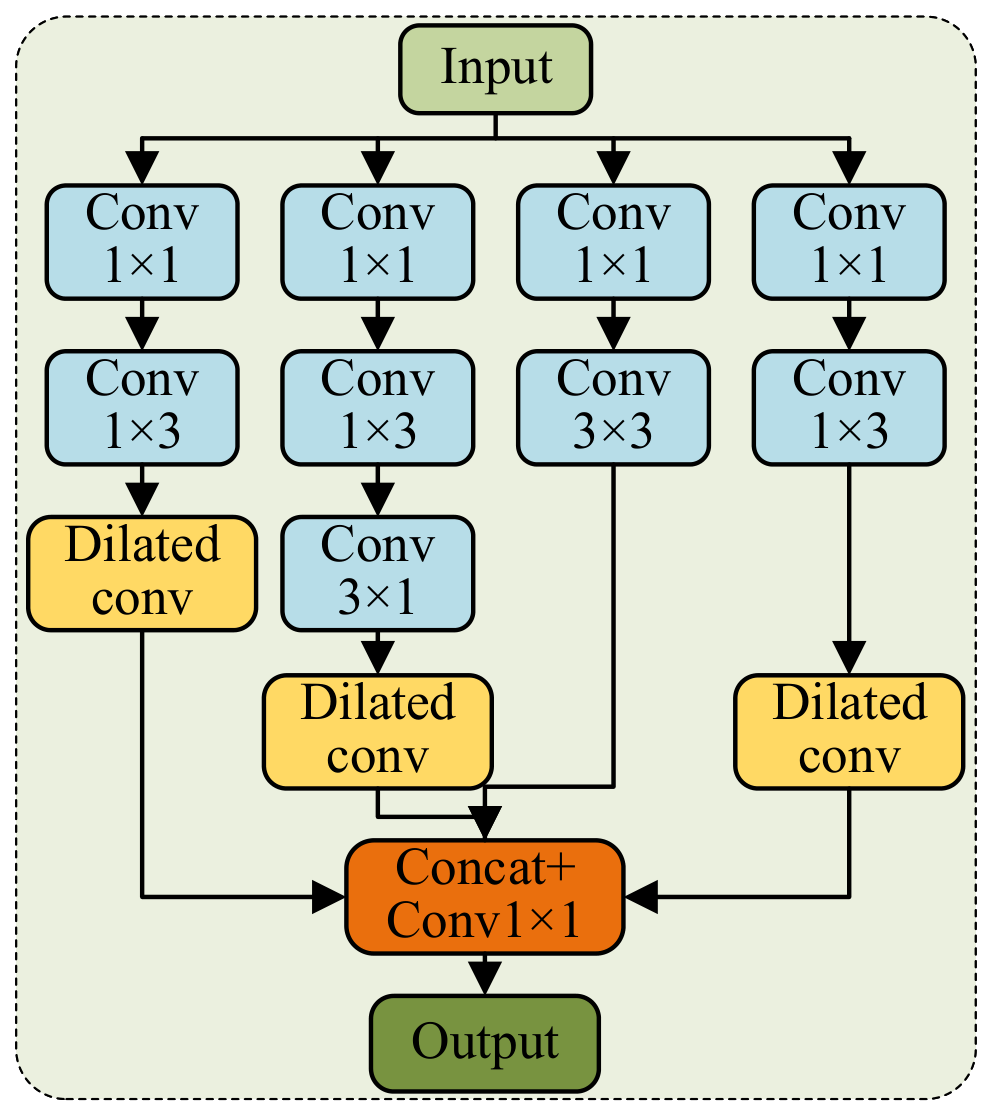
The YOLOv11 standard relies on its backbone for feature extraction through successive convolutional layers and pooling. However, these layers have limited receptive fields and may fail to capture sufficient deep semantics and global context, especially under the complex backgrounds of remote sensing images. This limitation hinders the reliable extraction of features for small objects. Inspired by RFB [52] and MSFE [53], the MFE module we proposed adopts a multi-branch structure combined with dilated convolutions to expand the receptive field while introducing only a slight increase in parameters, thereby retaining fine-grained details effectively. This architectural design enables efficient capture and fusion of multiscale features, thereby enhancing the representation of small objects. Figure 6 illustrates the MFE module. All four branches begin with a 1 × 1 convolutional layer performing channel reduction, lowering computational cost and improving expressiveness. Based on this design, the first branch employs a 3 × 3 convolution to capture basic features. The second branch uses a 1 × 3 convolution to capture horizontal spatial patterns in the feature representation. The third branch adopts a 3 × 1 convolution to capture vertical information. The fourth branch leverages a 1 × 3 and 3 × 1 convolution as an asymmetric structure, reducing parameters while enhancing directional information. Each of the last three branches is followed by a dilated convolution, which provides a larger receptive field, integrating global and local features, and preventing small object information loss. We place the MFE module between the backbone and the neck so that it receives the richest multiscale representations extracted by the backbone before the neck further fuses them, acting as a feature refinement bridge that enhances both semantic and spatial information simultaneously without interfering with the backbone’s downsampling process or the neck’s fusion pathways. The MFE calculation process is as follows:
X 1 = Conv 3 × 3 Conv 1 × 1 ( X )
X 2 = Conv 3 × 3 rate = 3 Conv 1 × 3 Conv 1 × 1 ( X )
X 3 = Conv 3 × 3 rate = 3 Conv 3 × 1 Conv 1 × 1 ( X )
X 4 = Conv 3 × 3 rate = 5 Conv 3 × 1 Conv 1 × 3 Conv 1 × 1 ( X )
Y = Conv 1 × 1 Concat ( X 1 , X 2 , X 3 , X 4 )
where, C o n v 1 × 1 , C o n v 3 × 3 , C o n v 1 × 3 , and C o n v 3 × 1 denote standard convolution operations with kernel sizes of 1 × 1, 3 × 3, 1 × 3, and 3 × 1, respectively. The dilation rates of 3 and 5 indicate dilated convolution operations. represents the output feature map, while X 1 , X 2 , X 3 , and X 4 denote the output feature maps of the four branches. The final output is obtained. By combining dilated convolutions with multi-branch extraction, MFE significantly enriches both global and fine-grained features, leading to improved detection of small objects with minimal additional cost.

3.3. Adaptive Multi-Receptive Field Head(AMR-Head)

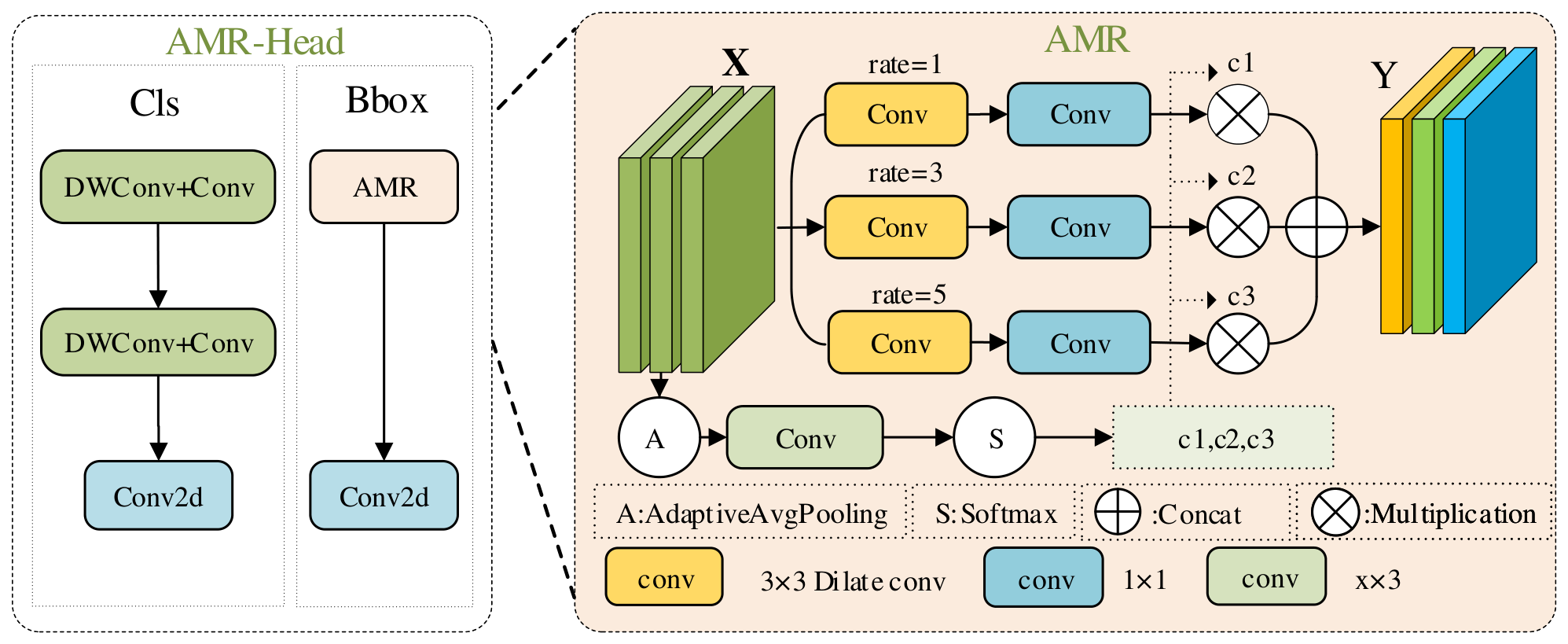
Following the same design as in Figure 7, the framework of the detection head in YOLOv11 consists two branches, dedicated to classification and regression tasks. The classification branch comprises a standard convolution followed by a depth-wise separable convolution (DWConv), reducing parameters and accelerating inference while retaining sufficient feature capacity. The regression branch uses three successive standard convolutions to predict the offsets of the bounding box. These branches share intermediate information and jointly perform detection, with classification estimating object confidence scores based on detailed appearance cues, while regression refines object contours through iterative boundary offset prediction. However, the regression branch consists of three convolutional layers, which directly regress the feature maps transmitted from the neck. Static receptive fields struggle with large-scale variations, easily losing information about small objects. To overcome these limitations, we proposed the AMR-Head module, which retains the dual branch structure to minimize classification regression conflict but increases the regression branch with a adaptive multi-receptive field module (AMR). Unlike the original YOLOv11 detection head, which relies solely on foreground features for bounding box regression, AMR-Head explicitly adaptively fuses features from multi-receptive fields. The AMR enriches contextual and multiscale cues, allowing the model to better distinguish small objects from cluttered backgrounds. The upper part of the AMR employs dilated convolutions with dilation rates of 1, 3, and 5, each followed by a 1 × 1 standard convolution, to capture multiscale contextual features. The lower part applies adaptive average pooling and a convolutional layer with three output channels, followed by Softmax activation, producing three weighting coefficients (c1, c2, c3) corresponding to the upper branches for weighted feature fusion. This adaptive multi-receptive field mechanism substantially improves the localization accuracy of small objects in complex remote sensing scenes. The computation procedure of AMR-Head is as follows:
C i = S Conv c × 3 A ( X ) , i = 1 , 2 , 3
X i = Conv 1 × 1 Conv 3 × 3 rate = 2 i 1 , i = 1 , 2 , 3
Y = i = 1 3 X i C i , i = 1 , 2 , 3
where S represents Softmax, A denotes AdaptiveAvgPooling, and indicates convolution operations with kernel size 1 × 1, dilation rate is 2 × i 1 , and the number of output channels is three. X i represents the output feature maps of three branches, and their weighted sum produces the final output Y. This fusion dynamically emphasizes the appropriate receptive field sample-dependent global receptive-field weighting, greatly enhancing the sensitivity to small and irregular objects. By integrating AMR into the regression branch, the AMR-Head module combines precise boundary refinement with rich context and scale adaptivity, yielding faster and more accurate localization under challenging remote sensing conditions.

4. Experimental Results

In this section, we describe the datasets, evaluation metrics, and experimental results. We first conduct ablation studies to quantify the contributions of the CTAA, MFE, and AMR-Head components to MFRA-YOLOv11. Finally, Our approach was rigorously evaluated against advanced and authoritative object detection algorithms, and the analysis demonstrated the superior performance of MFRA-YOLOv11.

4.1. Datasets and Evaluation Metrics

To comprehensively evaluate the proposed method in remote sensing small object detection, we designed comparative experiments on three representative datasets: NWPU VHR-10, VEDAI, and DOTA. These datasets were chosen to verify the performance of MFRA-YOLOv11 on different data scales and various small object density scenarios.
The NWPU VHR-10 dataset [54] is a widely used remote sensing dataset comprising 800 images with ten common object classes: airplane (AE), ship (SP), storage tank (ST), baseball diamond (BD), tennis court (TC), basketball court (BC), ground track field (GTF), harbor (HR), bridge (BE), and vehicle (VE). The dataset was randomly partitioned into training and testing subsets with a ratio of approximately 8:2, comprising 650 and 150 images, respectively.
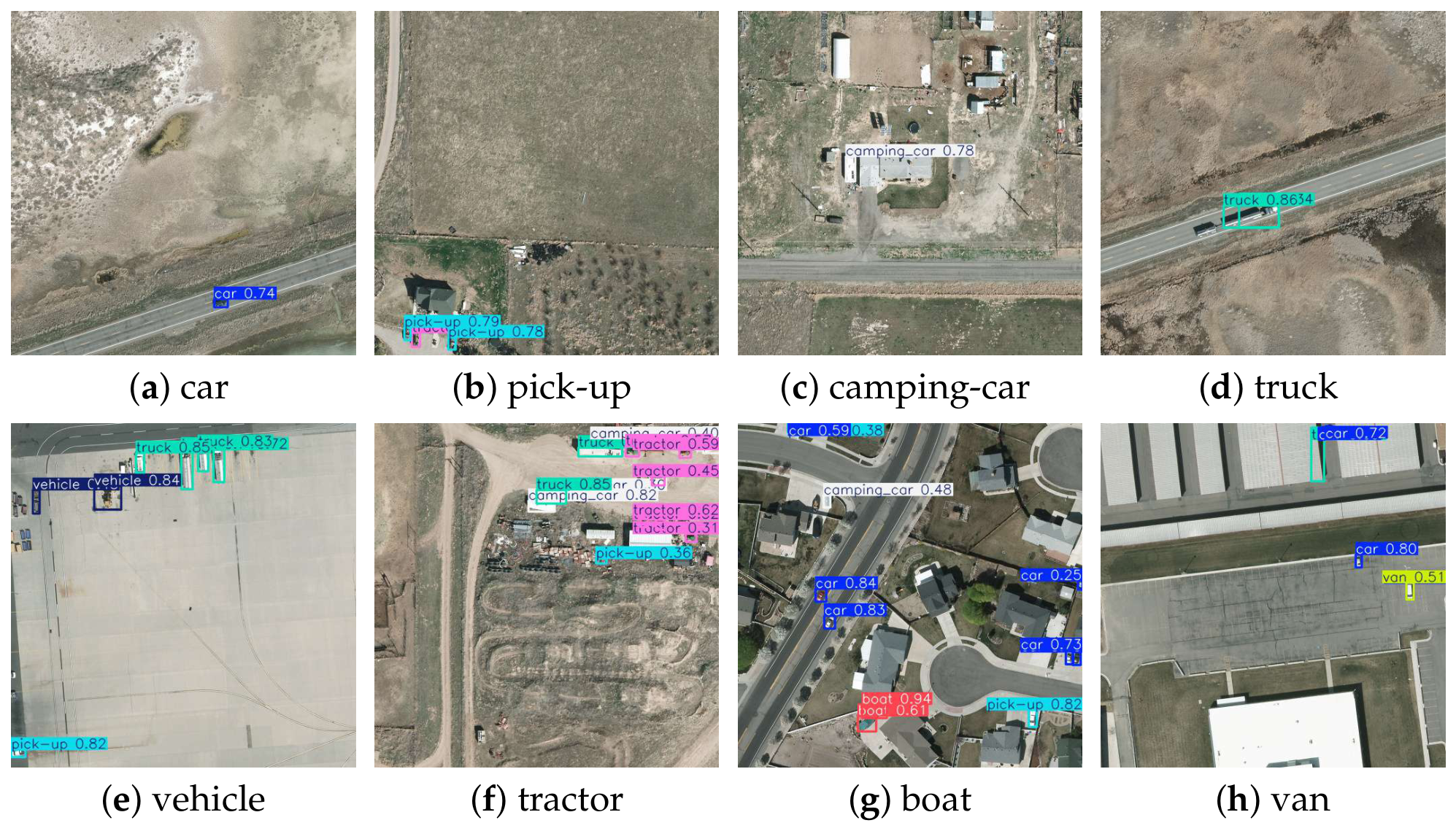
The VEDAI dataset [55] includes a variety of vehicle objects on small scales, which makes it suitable for remote sensing small object detection. It comprises 1210 images, each available in two modalities, RGB and IR. In this work, we only use the RGB version. Because the dataset contains few instances of plane, motorcycle, and bus, we focus only on the following eight categories: car (CR), pick-up (PU), camping car (CC), truck (TK), vehicle (VE), tractor (TR), boat (BT), and van (VN). The dataset was randomly partitioned into training and testing subsets with a ratio of approximately 9:1, comprising 1089 and 121 images, respectively.
The DOTA-v1.0 dataset [56] was publicly released by Wuhan University of China in 2018 and represents a widely used large-scale optical remote sensing image dataset. The image sizes in this dataset range from 800 × 800 pixels to 4000 × 4000 pixels. This dataset contains 2806 images with a total of 188,282 object instances. Approximately 85% of these object instances have pixel dimensions smaller than 50 × 50, making this dataset particularly suitable for small object detection research and presenting significant challenges. The dataset covers 15 common object categories: Plane (PE), Ship (SH), Storage Tank (ST), Baseball Diamond (BD), Tennis Court (TC), Basketball Court (BC), Ground Track Field (GTF), Harbor (HA), Bridge (BR), Large Vehicle (LV), Small Vehicle (SV), Helicopter (HC), Roundabout (RT), Soccer Ball Field (SBF), and Swimming Pool (SP). During experiments, to improve training effectiveness, we divided the original large-scale DOTA images into 1024 × 1024 pixel sub-images with a 20% overlap in both height and width directions, which effectively reduces the risk of losing small objects due to image splitting. More importantly, to prevent any label leakage, all sub-images cropped from the same original image were assigned exclusively to the same split. This strategy significantly increases the number of small object samples per sub-image and enhances the model’s ability to learn densely distributed small targets, while maintaining a clean separation between training, validation, and test sets.
After completing the image splitting process, we removed all blank images that did not contain any objects. Finally, we randomly selected 10,276 images for the training set, 3281 images for the validation set, and reserved the remaining 6011 images for the test set.
Average precision (AP) is used as an evaluation metric for model detection performance. The precision of each class is determined by both precision and recall, represented as the integral of the precision–recall (PR) curve. By setting different IOU thresholds, AP can be divided into metrics such as mAP50 and mAP50–95. The calculation of mAP is as follows:
A P = 0 1 P i ( R i ) d R i , i = 0 , 1 , 2 , , n
m A P = 1 C i = 1 c A P i
where C represents the number of categories, P i denotes the precision of each category, and R i denotes the recall for each category.

4.2. Experimental Details

All experiments were conducted under the same settings. We implemented our models in PyTorch 1.2.1 on a Windows 10 machine equipped with an NVIDIA GeForce RTX 4080 GPU (16 GB RAM). We used SGD [57] with a momentum of 0.937, a learning rate of 0.01, and a batch size of 16. The NWPU VHR-10 dataset was trained for 200 epochs, the VEDAI dataset was trained for 300 epochs, and the DOTA was trained for 150 epochs.

4.3. Ablation Study

To validate the proposed architecture, comprehensive ablation analyses were performed on the DOTA dataset. As shown in Table 1, the results show that CTAA achieves the highest mAP50 of 70.8% and mAP50–95 of 47.4% while even reducing computational cost to 19.4 GFLOPs compared to the baseline YOLOv11s which has 21.6 GFLOPs. In contrast, simply combining CA and SE in parallel, denoted as CA+SE, increases both GFLOPs to 22.3 and parameters to 9.77 M but yields lower accuracy than CTAA. This demonstrates that CTAA is not a naive superposition of three attentions. By embedding channel and coordinate attention into the kernel attention stream and fusing them via element-wise multiplication, CTAA avoids mutual interference among attention branches and achieves synergistic enhancement. The superior performance over CBAM and CA further supports the effectiveness of our design. In addition, to determine a suitable backbone and evaluate the contribution of the CTAA module to small object detection, we determined the optimal backbone configuration by replacing the C3k2 module in the first layer, the first two layers, the first three layers, and all layers with the CTAA module, denoted B1, B2, B3, and B4, respectively. We compared each variant with the original YOLOv11 using parameter count, GFLOPs, mAP50 and mAP50–95. As shown in Table 2, all models B1 through B4 outperformed the baseline in overall mAP50 and mAP50–95. Although B4 achieved the highest accuracy, it incurred a large increase in parameters. B3 offered the best trade-off between accuracy and complexity, so in the backbone, we replaced the first three layers of the C3k2 module with the CTAA module.
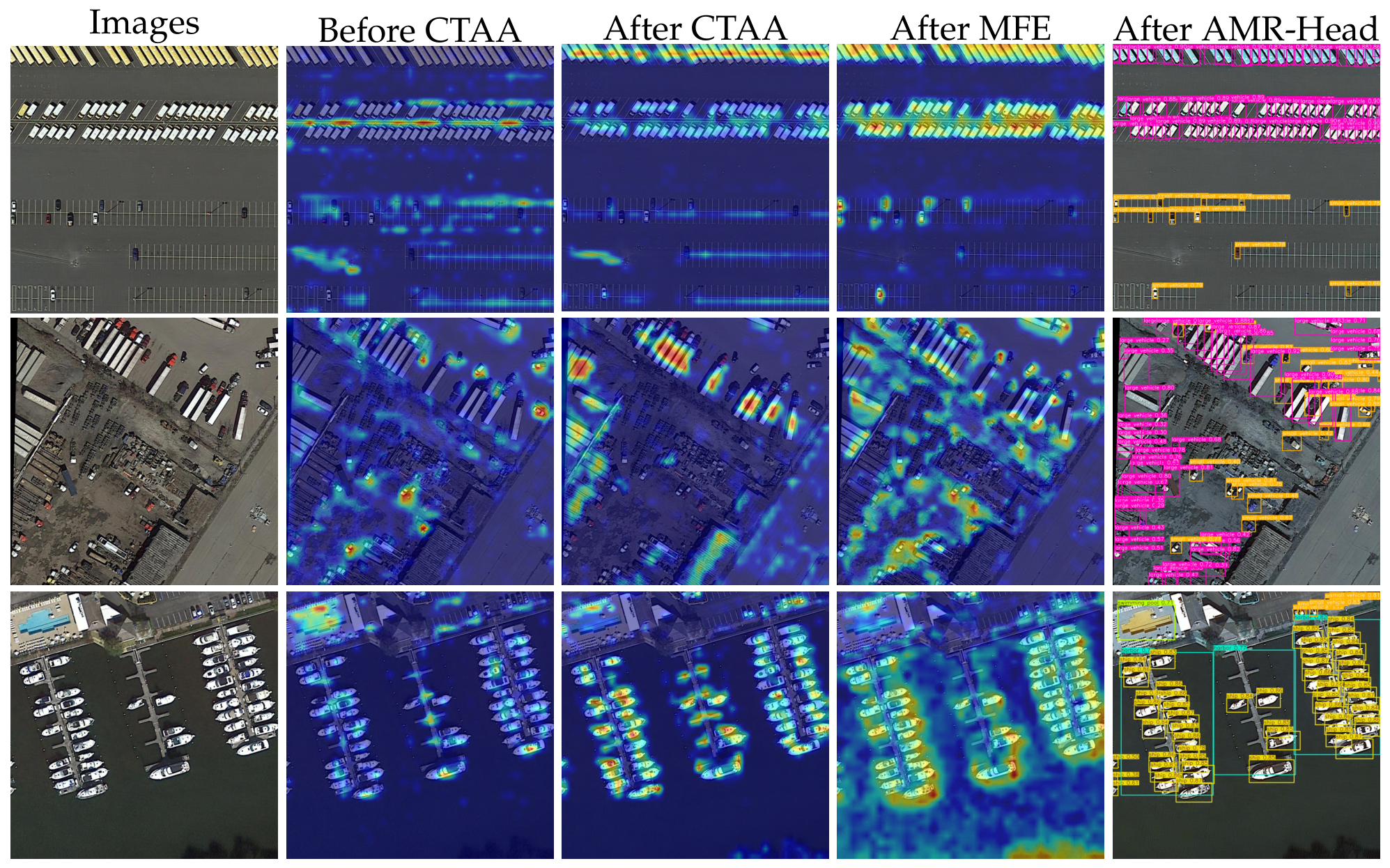
To evaluate the contributions of the CTAA, MFE, and AMR-Head components, we incrementally integrated these modules into YOLOv11 and conducted ablation experiments, with results shown in Table 3. We visualized the results after the input images passed through the three modules. Where √ indicates the module is included and × indicates exclusion. We report FPS, mAP50, mAP50–95, GFLOPs, and parameter count. YOLOv11 was selected as our baseline. Adding CTAA increased mAP50 by 1.6% and mAP50–95 by 1.9% while reducing GFLOP by 10.2%, demonstrating that early attention aggregation improved accuracy and cut computation. Introducing MFE increased GFLOPs by 14.8% but improved mAP50 by 2.1% and mAP50–95 by 1.7% through richer multiscale feature extraction. AMR-Head further improved localization by dynamically selecting receptive fields via the AMR, achieving higher precision and recall. Furthermore, the progressive integration of CTAA, MFE, and AMR-Head yields consistent performance gains, demonstrating their synergistic complementarity in region awareness, multiscale aggregation, and adaptive receptive-field selection. Finally, the complete combination of MFRA-YOLOv11 achieved the highest precision and recall with only a slight increase in GFLOPs, mAP50 reached 72.8% and mAP50–95 reached 49.8% while the FPS decreased by 6%. We incorporate Grad-CAM [58] to visualize how CTAA, MFE, and AMR-Head modules contribute to our MFRA-YOLOv11. We compare the resulting activation maps to show which image regions receive the most focus, with brighter colors indicating higher attention. As shown in Figure 8, the model focus shifts noticeably toward object areas after the CTAA module. Following the MFE and AMR-Head modules, the model’s attention on the object regions becomes even stronger.

4.4. Comparative Experiments

Under the same experimental setup, we evaluate MFRA-YOLOv11 against common one-stage models (YOLOv8s, YOLOv11s, YOLOv12s), classic two-stage models (Faster R-CNN, Dynamic R-CNN), as well as other state-of-the-art object detection algorithms (FFCA-YOLO, Swin-DETR, SORDS). The experimental results obtained on the NWPU VHR-10, VEDAI, and DOTA datasets are compared.
(1) First, we conducted preliminary experiments on various object detection algorithms using the NWPU VHR-10 dataset. The horizontal axis represents the ten object categories in the NWPU VHR-10 dataset, while the vertical axis lists the various object detection algorithms. We highlight the highest value in each column in bold. As shown in the Table 4, MFRA-YOLOv11 achieved the highest detection accuracy for five categories on the NWPU VHR-10 dataset, with a mAP50 of 94.5% and a mAP50–95 of 59.3%, outperforming YOLOv11 by 3.0% and 2.4%, respectively. The proposed CTAA module improved the accuracy of small object detection, effectively addressing dense objects and objects with unclear edges, such as vehicles. However, the performance of the ships was limited due to the small number of instances. The MFE module effectively extracted features for objects with significant scale variations, such as airplanes. Furthermore, the AMR-Head module achieved precise regression of the object position. Our model achieved the highest accuracy of 96.5% for densely distributed vehicles.
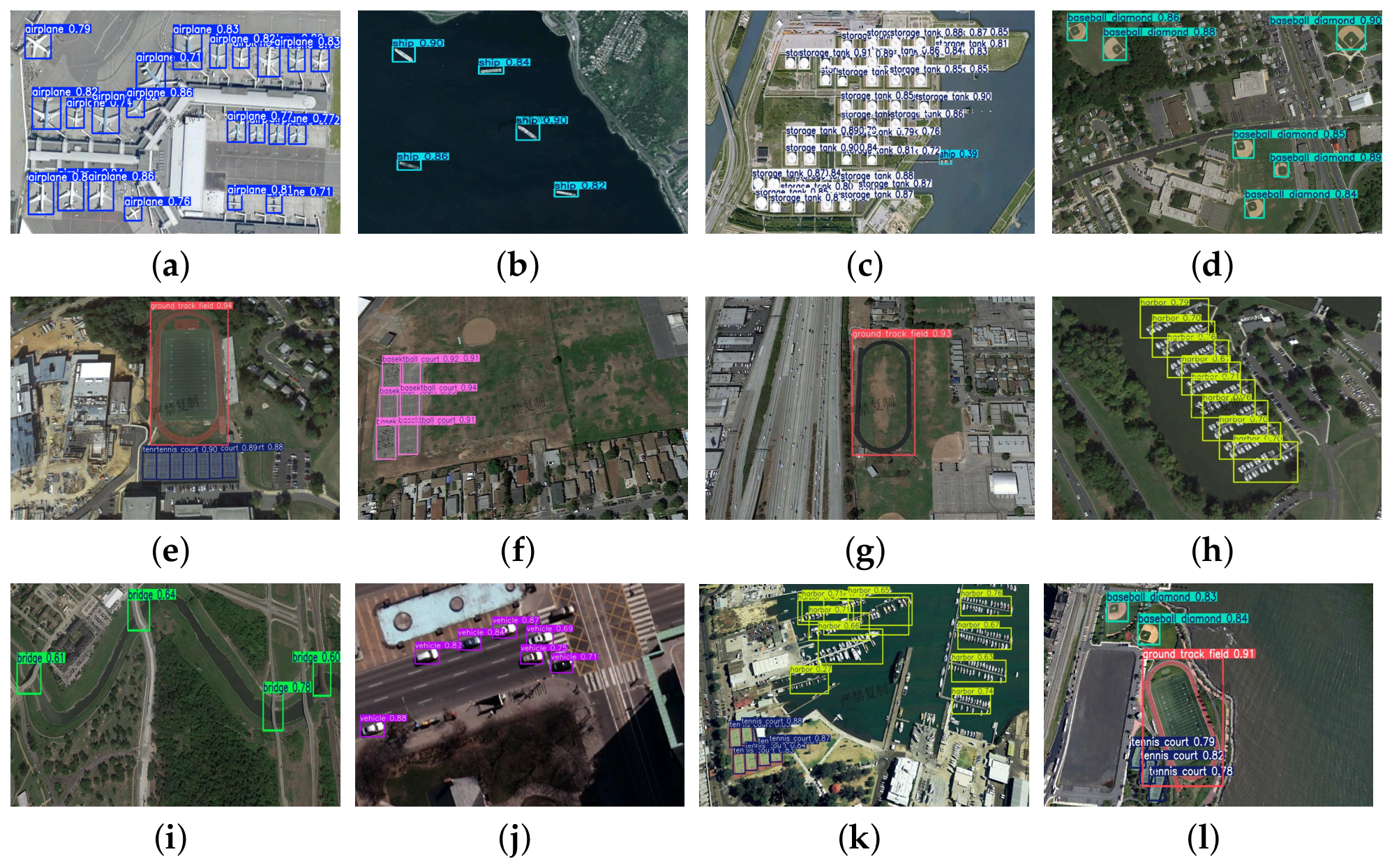
Figure 9 demonstrates the detection performance achieved by MFRA-YOLOv11 for the ten categories in the NWPU VHR-10 dataset, demonstrating its outstanding performance. In addition, the NWPU VHR-10 dataset contains images with densely distributed small objects, indistinct object features, and objects of various scales. Figure 9k,l show that MFRA-YOLOv11 effectively addressed multiscale objects and complex background information, accurately locating and detecting small objects.
(2) Next, we evaluated various object detection algorithms in the VEDAI dataset, which contains a high proportion of small vehicle objects, to assess the performance of MFRA-YOLOv11 in scenes with many small objects. The results shown in Table 5, demonstrate that MFRA-YOLOv11 achieves the highest detection precision in four categories. Our method achieved a mAP50 of 67.9% and a mAP50–95 of 46.4%, outperforming YOLOv11 by 2.7% and 3.5%, respectively. Figure 10 illustrates the detection performance of MFRA-YOLOv11 across eight target categories. Although the objects are very small, our method delivers outstanding results.
(3) Subsequently evaluated various object detection algorithms on the more authoritative DOTA dataset to further demonstrate the superiority of our proposed MFRA-YOLOv11. Table 6 consolidates the empirical validation results. Our method achieved a mAP50 of 72.8% and a mAP50–95 of 49.8%, outperforming YOLOv11 by 3.6% and 4%, respectively. It attained optimal recognition rates across all 7 categories, including small and dense objects such as ships, and objects that are difficult to locate because they are not clearly distinguishable from the background, such as harbor and ground track field. However, the detection performance for the bridge was suboptimal because the dataset contained few instances.
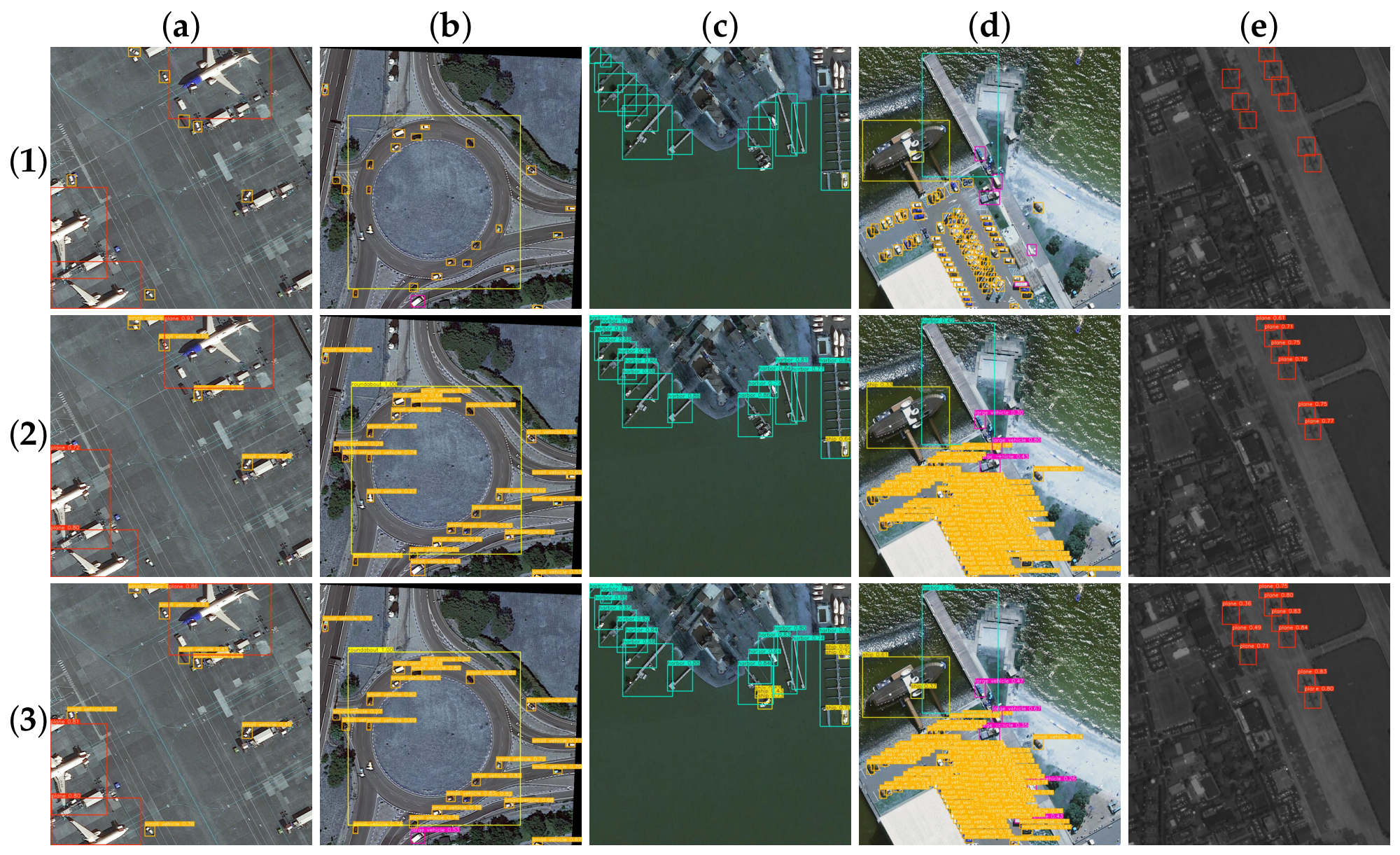
To further illustrate the superior performance of our MFRA-YOLOv11, Figure 11 compares its detection results with those of YOLOv11. Addressing the dual challenges of complex backgrounds and scale variation in remote sensing images, we note that detection errors (false positives, false negatives, and misclassifications) collectively degrade overall mAP performance. In Figure 11a, our method accurately identifies all small vehicles without false detections. In Figure 11b, our model correctly classifies a small vehicle, whereas YOLOv11 misclassifies it as a large vehicle. In Figure 11c–e, our method successfully localizes target regions even under cluttered backgrounds and large-scale variations, confirming its effectiveness for small object detection in complex remote sensing scenes.
Despite the above successes, we also observe several typical failure patterns. As shown in Figure 11e, a strong shadow is misclassified as a small vehicle, indicating that the CTAA module’s strong spatial-location bias can be sensitive to illumination anomalies. Additionally, in Figure 11c, elongated harbor structures resembling bridges are occasionally confused, suggesting that the fixed directional kernels (1 × 3 and 3 × 1) in the MFE module lack adaptive texture discrimination. Furthermore, under severe occlusion or near-complete overlap, the AMR-Head module fails to distinguish overlapping boundaries, leading to missed detections.

5. Discussion

Efficiently extracting small object features from remote sensing images is crucial for advancing remote sensing data analysis. Our approach addresses this challenge with only a slight increase in model complexity. We built a detector on the YOLOv11 framework that improves accuracy for small objects and handles objects with large variations in scale. Given the intricate background clutter and faint features of small objects, precise localization directly affects performance. To this end, we designed region awareness and multiscale feature extraction mechanisms that increase small object detection accuracy. The proposed CTAA module embeds channel and coordinate attention into the convolutional kernel via a triple attention aggregation unit, reducing interference among attention branches and enabling shallow layers to focus on object regions. As shown in Table 2, the CTAA module improves precision while reducing computational cost. The MFE module, placed between the backbone and the neck, captures multiscale directional features with dilated convolutions, and the AMR-Head module adaptively assigns receptive field weights for regression. Together, these modules lead to more accurate boundary localization across object scales.
To better position our work among recent advances in remote sensing small object detection, we compare MFRA-YOLOv11 with several state-of-the-art methods. As reported in Table 6, Our method achieves a mAP50 of 72.8% and a mAP50–95 of 49.8% on the DOTA dataset, outperforming FFCA-YOLO (69.3%, 46.8%), Swin-DETR (71.3%, 47.5%), and SODRS (71.7%, 48.4%). Notably, MFRA-YOLOv11 obtains these results with only 10.92 M parameters and 23.8 GFLOPs, representing a 15.9% and 10.2% increase over YOLOv11s, respectively. In contrast, many competing methods rely on heavier backbones or additional computational overhead. Therefore, our approach achieves a competitive trade-off between detection accuracy and model efficiency, particularly suitable for applications that require high small-object recall with modest additional resources. In terms of practical deployment, MFRA-YOLOv11 achieves an inference speed of 208 FPS, confirming that the accuracy improvements are attained without sacrificing real-time performance, making our method suitable for resource-constrained edge deployment scenarios.
Furthermore, we evaluate the generalization capability of MFRA-YOLOv11 across different remote sensing datasets. The experimental results demonstrate that our method consistently achieves superior performance on multiple datasets, particularly for small object categories. When evaluated on additional public remote sensing datasets, our method maintains a notable improvement over the baseline in terms of AP for small objects, indicating that the proposed attention and multiscale feature extraction mechanisms are effective across varying imaging conditions and scene complexities. This cross-dataset robustness further supports the practical applicability of our approach in diverse remote sensing scenarios. Despite these advantages, we acknowledge several limitations of our current study. First, the CTAA module, while effective in focusing on object regions, remains sensitive to extreme illumination variations such as strong shadows, which can lead to false positives. Second, the MFE module relies on fixed directional convolutions (1 × 3 and 3 × 1 kernels) and may cause confusion between object classes that share similar horizontal or vertical textures (harbors and bridges). Third, the AMR-Head module, despite adaptively aggregating multi-receptive field features, struggles under severe occlusion or near-complete overlap of densely distributed small targets. Fourth, our current method is designed for horizontal bounding boxes only, whereas oriented bounding boxes are often more suitable for remote sensing scenarios. These limitations are inherent to our design choices and provide clear directions for future work, including the integration of illumination normalization, deformable convolutions, a rotated-box extension, and advanced loss functions to better handle occlusion. We will explore these improvements in subsequent research.

6. Conclusions

Considering that remote sensing images consist mainly of small objects with blurred edges and dense distributions, we propose MFRA-YOLOv11 for object detection in such images. Our approach integrates the CTAA module into the shallow layers of the model to perceive object regions and focus on small object features. The MFE module is then added to the neck to extract multiscale directional features, and the AMR-Head module is introduced in the detection head to enhance object localization. Extensive experiments on the NWPU VHR-10, VEDAI, and DOTA datasets demonstrate that compared to other object detection algorithms, MFRA-YOLOv11 achieves superior accuracy, with a 15.9% increase in parameters and a 10.2% increase in GFLOPs. Specifically, it improves mAP50 and mAP50–95 by 3.0% and 2.4%, 2.7% and 2.5%, 3.6% and 4% over the baseline YOLOv11s on the three datasets, respectively.
Despite these promising results, our method has certain limitations, including sensitivity to extreme illumination, potential confusion between classes with similar directional textures, and difficulties under severe occlusion. Future work will focus on addressing these issues through illumination normalization, deformable convolutions, extending the detector to handle rotated bounding boxes, and designing more advanced loss functions. In general, MFRA-YOLOv11 exhibits enhanced capability for small object detection in remote sensing images and provides a solid foundation for further research in resource-aware remote sensing applications.

Author Contributions

Conceptualization, W.H. and Q.Z.; methodology, W.H. and Q.Z.; software, L.G., L.S. and J.N.; validation, L.G., L.S. and J.N.; writing—original draft preparation, W.H. and Q.Z.; writing—review and editing, L.G., L.S. and J.N.; formal analysis, L.G., L.S. and J.N. All authors have read and agreed to the published version of the manuscript.

Funding

This study was supported by the National Natural Science Foundation of China (No. 62471239, U23B2006), the Henan Province Science and Technology Breakthrough Project (No.252102211065), the Central Guidance for Local Science and Technology Development Fund Project of Henan (No. 220251831017). in part by the Central Government Guided Local Science and Technology Development Fund Projects of Qinghai under Grant 2026-GX-Z26.

Data Availability Statement

The original contributions presented in the study are included in the article; further inquiries can be directed to the authors.

Acknowledgments

The authors would like to thank the editors and reviewers for their advice.

Conflicts of Interest

The authors declare no conflicts of interest.

References

  1. Zhang, X.; Wang, A.; Zheng, Y.; Mazhar, S.; Chang, Y. A Detection Method with Antiinterference for Infrared Maritime Small Target. IEEE J. Sel. Top. Appl. Earth Obs. Remote Sens. 2024, 17, 3999–4014. [Google Scholar] [CrossRef] [Scilit]
  2. Zhuang, L.; Gao, L.; Zhang, B.; Fu, X.; Bioucas-Dias, J.M. Hyperspectral Image Denoising and Anomaly Detection Based on Low-Rank and Sparse Representations. IEEE Trans. Geosci. Remote Sens. 2022, 60, 5500117. [Google Scholar] [CrossRef] [Scilit]
  3. Ju, M.; Mao, T.; Li, M.; Niu, B.; Jin, S.-N. VFMDet: A Visual Filtering Mechanism-Based SAR Ship Detection Model for Complex Environment. IEEE Geosci. Remote Sens. Lett. 2025, 22, 4000705. [Google Scholar] [CrossRef] [Scilit]
  4. Tian, P.; Wang, Z.; Cheng, P.; Wang, Y.; Wang, Z.; Zhao, L.; Yan, M.; Yang, X.; Sun, X. UCDNet: Multi-UAV Collaborative 3-D Object Detection Network by Reliable Feature Mapping. IEEE Trans. Geosci. Remote Sens. 2025, 63, 5602016. [Google Scholar] [CrossRef] [Scilit]
  5. Guo, Q.; Dou, X. A Modified Approach for Noise Estimation in Optical Remotely Sensed Images with a Semivariogram: Principle, Simulation, and Application. IEEE Trans. Geosci. Remote Sens. 2008, 46, 2050–2060. [Google Scholar] [CrossRef]
  6. Khelifi, L.; Mignotte, M. Deep Learning for Change Detection in Remote Sensing Images: Comprehensive Review and Meta-Analysis. IEEE Access 2020, 8, 126385–126400. [Google Scholar] [CrossRef] [Scilit]
  7. Zhao, T.; Feng, R.; Wang, L. SCENE-YOLO: A One-Stage Remote Sensing Object Detection Network with Scene Supervision. IEEE Trans. Geosci. Remote Sens. 2025, 63, 5401515. [Google Scholar] [CrossRef] [Scilit]
  8. Li, C.; Zhou, A.; Yao, A. Omni-dimensional dynamic convolution. arXiv 2022, arXiv:2209.07947. [Google Scholar]
  9. Zhang, Y.; Ye, M.; Zhu, G.; Liu, Y.; Guo, P.; Yan, J. FFCA-YOLO for Small Object Detection in Remote Sensing Images. IEEE Trans. Geosci. Remote Sens. 2024, 62, 5611215. [Google Scholar] [CrossRef] [Scilit]
  10. Chen, S.; Ji, L.; Zhu, S.; Ye, M. MICPL: Motion-Inspired Cross-Pattern Learning for Small-Object Detection in Satellite Videos. IEEE Trans. Neural Netw. Learn. Syst. 2025, 36, 6437–6450. [Google Scholar] [CrossRef] [Scilit]
  11. Chen, S.; Ji, L.; Peng, S.; Zhu, S.; Ye, M.; Sang, Y. Language-Driven Motion Prior Knowledge Learning for Moving Infrared Small Target Detection. IEEE Trans. Geosci. Remote Sens. 2025, 63, 5006014. [Google Scholar] [CrossRef] [Scilit]
  12. Xie, X.; Cheng, G.; Wang, J.; Yao, X.; Han, J. Oriented R-CNN for Object Detection. In Proceedings of the IEEE/CVF International Conference on Computer Vision; IEEE: New York, NY, USA, 2021; pp. 3520–3529. [Google Scholar]
  13. Han, J.; Ding, J.; Li, J.; Xia, G.-S. Align Deep Features for Oriented Object Detection. IEEE Trans. Geosci. Remote Sens. 2022, 60, 5602511. [Google Scholar] [CrossRef] [Scilit]
  14. Zhu, Z.; Kang, J.; Diao, W.; Wang, B.; Ni, J. Align and Complete Samples in Remote Sensing Fine-Grained Rigid Object Detection. IEEE Trans. Geosci. Remote Sens. 2025, 63, 5655617. [Google Scholar] [CrossRef] [Scilit]
  15. Felzenszwalb, P.F.; Girshick, R.B.; McAllester, D.; Ramanan, D. Object Detection with Discriminatively Trained Part-Based Models. IEEE Trans. Pattern Anal. Mach. Intell. 2010, 32, 1627–1645. [Google Scholar] [CrossRef] [Scilit]
  16. Weber, J.; Lefevre, S. A multivariate hit-or-miss transform for conjoint spatial and spectral template matching. In Proceedings of the Image and Signal Processing: 3rd International Conference, ICISP 2008, Cherbourg-Octeville, France, 1–3 July 2008; pp. 226–235. [Google Scholar]
  17. Liu, H.; Wang, X.; Wang, H.; Bin, J.; Dong, H.; Ge, J.; Liu, Z.; Yuan, Z.; Zhu, J.; Luan, X. Magneto-Inductive Magnetic Gradient Tensor System for Detection of Ferromagnetic Objects. IEEE Magn. Lett. 2020, 11, 8101205. [Google Scholar] [CrossRef] [Scilit]
  18. Wang, Z.; Zhou, G.; Ma, J.; Xue, T.; Jia, Z. Beyond the Snowfall: Enhancing Snowy Day Object Detection Through Progressive Restoration and Multi-Feature Fusion. In Proceedings of the ICASSP 2024—2024 IEEE International Conference on Acoustics, Speech and Signal Processing (ICASSP); IEEE: New York, NY, USA, 2024; pp. 3315–3319. [Google Scholar]
  19. Guo, G.; Fang, L.; Yue, J. Oriented Spatial Correlative Aligned Feature for Remote Sensing Object Detection. In Proceedings of the 2021 IEEE International Geoscience and Remote Sensing Symposium IGARSS; IEEE: New York, NY, USA, 2021; pp. 5319–5322. [Google Scholar]
  20. Raj, R.; Kos, A. An Extensive Study of Convolutional Neural Networks: Applications in Computer Vision for Improved Robotics Perceptions. Sensors 2025, 25, 1033. [Google Scholar] [CrossRef] [Scilit]
  21. Wang, Y.; Zhang, X.; Ye, S.; Yu, G.; Gouda, M.; Li, X.; He, Y. Dual-Branch CNN-Based Fusion of Computer Vision and Near-Infrared Spectroscopy for Quantitative Prediction: A Case of Black Tea Processing. Future Foods 2026, 13, 100928. [Google Scholar] [CrossRef] [Scilit]
  22. Amiruzzaman, S.; Amiruzzaman, M.; Batchu, R.M.; Dracup, J.; Pham, A.; Crocker, B.; Ngo, L.; Dewan, M.A.A. Bidirectional Translation of ASL and English Using Machine Vision and CNN and Transformer Networks. Computers 2026, 15, 20. [Google Scholar] [CrossRef] [Scilit]
  23. Girshick, R. Fast R-CNN. In Proceedings of the IEEE International Conference on Computer Vision (ICCV); IEEE: New York, NY, USA, 2015; pp. 1440–1448. [Google Scholar]
  24. Ren, S.; He, K.; Girshick, R.; Sun, J. Faster R-CNN: Towards real-time object detection with region proposal networks. IEEE Trans. Pattern Anal. Mach. Intell. 2016, 39, 1137–1149. [Google Scholar] [CrossRef] [Scilit]
  25. He, K.; Gkioxari, G.; Dollar, P.; Girshick, R. Mask R-CNN. In Proceedings of the IEEE International Conference on Computer Vision (ICCV); IEEE: New York, NY, USA, 2017; pp. 2961–2969. [Google Scholar]
  26. Zhang, H.; Chang, H.; Ma, B.; Wang, N.; Chen, X. Dynamic R-CNN: Towards high quality object detection via dynamic training. In Proceedings of the Computer Vision–ECCV 2020: 16th European Conference, Glasgow, UK, 23–28 August 2020; pp. 260–275. [Google Scholar]
  27. Redmon, J.; Divvala, S.; Girshick, R.; Farhadi, A. You Only Look Once: Unified, Real-Time Object Detection. In Proceedings of the IEEE Conference on Computer Vision and Pattern Recognition (CVPR); IEEE: New York, NY, USA, 2016; pp. 779–788. [Google Scholar]
  28. Liu, W.; Anguelov, D.; Erhan, D.; Szegedy, C.; Reed, S.; Fu, C.-Y.; Berg, A.C. SSD: Single Shot Multibox Detector. In Proceedings of the Computer Vision–ECCV 2016: 14th European Conference, Amsterdam, The Netherlands, 11–14 October 2016; pp. 21–37. [Google Scholar]
  29. Jocher, G.; Chaurasia, A.; Stoken, A.; Borovec, J.; Kwon, Y.; Fang, J.; Michael, K.; Montes, D.; Nadar, J.; Skalski, P.; et al. Ultralytics/yolov5: V6.1-TensorRT, TensorFlow Edge TPU and OpenVINO Export and Inference; Zenodo: Geneva, Switzerland, 2022. [Google Scholar]
  30. Sohan, M.; Sai Ram, T.; Rami Reddy, C.V. A review on yolov8 and its advancements. In Proceedings of the International Conference on Data Intelligence and Cognitive Informatics; Springer: Singapore, 2024; pp. 529–545. [Google Scholar]
  31. Khanam, R.; Hussain, M. YOLOv11: An overview of the key architectural enhancements. arXiv 2024, arXiv:2410.17725. [Google Scholar]
  32. Tian, Y.; Ye, Q.; Doermann, D. Yolov12: Attention-centric real-time object detectors. Adv. Neural Inf. Process. Syst. 2026, 38, 78433–78457. [Google Scholar]
  33. Lin, T.-Y.; Dollar, P.; Girshick, R.; He, K.; Hariharan, B.; Belongie, S. Feature Pyramid Networks for Object Detection. In Proceedings of the IEEE Conference on Computer Vision and Pattern Recognition (CVPR); IEEE: New York, NY, USA, 2017; pp. 2117–2125. [Google Scholar]
  34. Han, L.; Li, N.; Li, J.; Gao, B.; Niu, D. SA-FPN: Scale-Aware Attention-Guided Feature Pyramid Network for Small Object Detection on Surface Defect Detection of Steel Strips. Measurement 2025, 249, 117019. [Google Scholar] [CrossRef] [Scilit]
  35. Li, Y.; Zhang, Z.; Zhang, J.; Shi, J.; Zhu, X.; Chen, B.; Lan, Y.; Jiang, Y.; Cai, W.; Tan, X.; et al. TeaBudNet: A Lightweight Framework for Robust Small Tea Bud Detection in Outdoor Environments via Weight-FPN and Adaptive Pruning. Agronomy 2025, 15, 1990. [Google Scholar] [CrossRef] [Scilit]
  36. Kisieliūtė, M.; Daugėla, I. MuRDE-FPN: Precise UAV Localization Using Enhanced Feature Pyramid Network. Drones 2026, 10, 162. [Google Scholar] [CrossRef] [Scilit]
  37. Wang, G.; Li, Q.; Wang, N.; Liu, H. SAFPN: A full semantic feature pyramid network for object detection. Pattern Anal. Appl. 2023, 26, 1729–1739. [Google Scholar] [CrossRef] [Scilit]
  38. Wang, L.; Fu, P.; Jiang, H. CESFE-YOLO: A Context-Enriched and Shallow Feature Enhancement-Based Method for Flotation Slurry Particle Detection. IEEE Trans. Instrum. Meas. 2026, 75, 2501014. [Google Scholar] [CrossRef] [Scilit]
  39. Xiao, J.; Guo, H.; Zhou, J.; Zhao, T.; Yu, Q.; Chen, Y.; Wang, Z. Tiny object detection with context enhancement and feature purification. Expert Syst. Appl. 2023, 211, 118665. [Google Scholar] [CrossRef] [Scilit]
  40. Huang, J.; Ma, Z.; Wu, Y.; Bao, Y.; Wang, Y.; Su, Z.; Guo, L. YOLOv8-DDS: A Lightweight Model Based on Pruning and Distillation for Early Detection of Root Mold in Barley Seedling. Inf. Process. Agric. 2025, 12, 581–594. [Google Scholar] [CrossRef] [Scilit]
  41. Yu, G.; Ma, B.; Zhang, R.; Xu, Y.; Lian, Y.; Dong, F. CPD-YOLO: A Cross-Platform Detection Method for Cotton Pests and Diseases Using UAV and Smartphone Imaging. Ind. Crop. Prod. 2025, 234, 121515. [Google Scholar] [CrossRef] [Scilit]
  42. Zhang, Y.-M.; Hsieh, J.-W.; Lee, C.-C.; Fan, K.-C. SFPN: Synthetic FPN for Object Detection. In Proceedings of the 2022 IEEE International Conference on Image Processing (ICIP); IEEE: New York, NY, USA, 2022; pp. 1316–1320. [Google Scholar]
  43. Wu, Y.; Luo, Y.; Chen, H.; Chen, F.; Ye, H.; Chen, X.; Li, X. YOLO11-SPE: A Lightweight Object Detection Model for Corn Seedling Counting. J. Real-Time Image Process. 2026, 23, 29. [Google Scholar] [CrossRef] [Scilit]
  44. Quan, Z.; Sun, J. A Feature-Enhanced Small Object Detection Algorithm Based on Attention Mechanism. Sensors 2025, 25, 589. [Google Scholar] [CrossRef] [Scilit]
  45. Li, T.; Xiong, X.; Zhang, Y.; Fan, X.; Zhang, Y.; Huang, H.; Hu, D.; He, M.; Liu, Z. RE-YOLOv5: Enhancing Occluded Road Object Detection via Visual Receptive Field Improvements. Sensors 2025, 25, 2518. [Google Scholar] [CrossRef] [Scilit]
  46. Liu, M.; Kuang, L.; Li, C.; Tian, J.; Chen, Z.; Han, X. SODRS: Semisupervised Learning for One-Stage Small Object Detection in Remote Sensing Images. IEEE J. Sel. Top. Appl. Earth Obs. Remote Sens. 2025, 18, 10711–10723. [Google Scholar] [CrossRef] [Scilit]
  47. Chen, Y.; Liu, B.; Yuan, L. PR-Deformable DETR: DETR for Remote Sensing Object Detection. IEEE Geosci. Remote Sens. Lett. 2024, 21, 2506105. [Google Scholar] [CrossRef] [Scilit]
  48. Jin, X.; Su, H.; Liu, K.; Ma, C.; Wu, W.; Hui, F.; Yan, J. UniMamba: Unified Spatial-Channel Representation Learning with Group-Efficient Mamba for LiDAR-Based 3D Object Detection. In Proceedings of the Computer Vision and Pattern Recognition Conference; IEEE: New York, NY, USA, 2025; pp. 1407–1417. [Google Scholar]
  49. Ma, S.; Lu, H.; Liu, J.; Zhu, Y.; Sang, P. LAYN: Lightweight Multi-Scale Attention YOLOv8 Network for Small Object Detection. IEEE Access 2024, 12, 29294–29307. [Google Scholar] [CrossRef] [Scilit]
  50. Xie, Y.; Ma, X.; Zhao, Q. Research on Target Detection Network Based on improved Swin-DETR. In Proceedings of the 2023 4th International Conference on Big Data, Artificial Intelligence and Internet of Things Engineering (ICBAIE); IEEE: New York, NY, USA, 2023; pp. 324–328. [Google Scholar]
  51. Qu, X.; Zheng, Y.; Zhou, Y.; Su, Z. YOLO v8_CAT: Enhancing Small Object Detection in Traffic Light Recognition with Combined Attention Mechanism. In Proceedings of the 2024 10th International Conference on Computer and Communications (ICCC); IEEE: New York, NY, USA, 2024; pp. 706–710. [Google Scholar]
  52. Liu, S.; Huang, D.; Wang, Y. Receptive Field Block Net for Accurate and Fast Object Detection. In Proceedings of the European Conference on Computer Vision (ECCV); Springer: Cham, Switzerland, 2018; pp. 385–400. [Google Scholar]
  53. Zhang, W.; Liu, Z.; Zhou, S.; Qi, W.; Wu, X.; Zhang, T.; Han, L. LS-YOLO: A Novel Model for Detecting Multiscale Landslides With Remote Sensing Images. IEEE J. Sel. Top. Appl. Earth Obs. Remote Sens. 2024, 17, 4952–4965. [Google Scholar] [CrossRef] [Scilit]
  54. Cheng, G.; Zhou, P.; Han, J. Learning Rotation-Invariant Convolutional Neural Networks for Object Detection in VHR Optical Remote Sensing Images. IEEE Trans. Geosci. Remote Sens. 2016, 54, 7405–7415. [Google Scholar] [CrossRef] [Scilit]
  55. Razakarivony, S.; Jurie, F. Vehicle detection in aerial imagery: A small target detection benchmark. J. Vis. Commun. Image Represent. 2016, 34, 187–203. [Google Scholar] [CrossRef] [Scilit]
  56. Xia, G.-S.; Bai, X.; Ding, J.; Zhu, Z.; Belongie, S.; Luo, J.; Datcu, M.; Pelillo, M.; Zhang, L. DOTA: A large-scale dataset for object detection in aerial images. In Proceedings of the IEEE Conference on Computer Vision and Pattern Recognition; IEEE: New York, NY, USA, 2018; pp. 3974–3983. [Google Scholar]
  57. Bottou, L. Large-scale machine learning with stochastic gradient descent. In Proceedings of the COMPSTAT’2010: 19th International Conference on Computational Statistics, Paris, France, 22–27 August 2010; pp. 177–186. [Google Scholar]
  58. Selvaraju, R.R.; Cogswell, M.; Das, A.; Vedantam, R.; Parikh, D.; Batra, D. Grad-CAM: Visual Explanations From Deep Networks via Gradient-Based Localization. In Proceedings of the IEEE International Conference on Computer Vision (ICCV); IEEE: New York, NY, USA, 2017; pp. 618–626. [Google Scholar]
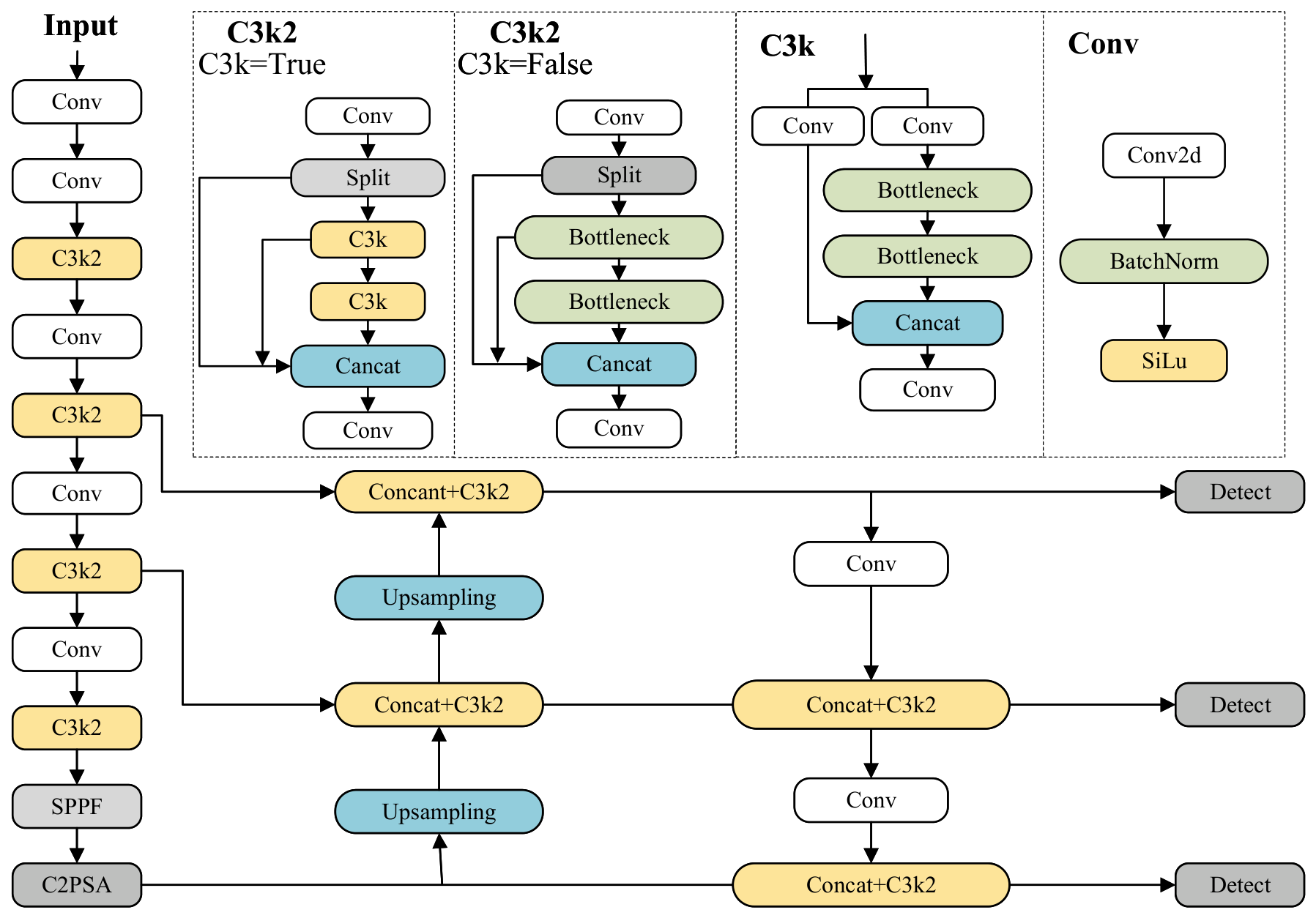
Figure 1. Framework of YOLOv11.
Remotesensing 18 02965 g001
Figure 2. Framework of proposed MFRA-YOLOv11 algorithm.
Remotesensing 18 02965 g002
Figure 3. Structure of coordinate attention.
Remotesensing 18 02965 g003
Figure 4. Illustration of the three types of attention in TAA applied to convolutional kernels. (a) Weighted computation along coordinate dimensions, (b) weighted computation along channel dimensions, and (c) weighted computation along kernel dimensions.
Remotesensing 18 02965 g004
Figure 5. Structure of CTAA.
Remotesensing 18 02965 g005
Figure 6. Structure of MFE.
Remotesensing 18 02965 g006
Figure 7. Structure of AMR-Head.
Remotesensing 18 02965 g007
Figure 8. Visualization of the contribution of CTAA, MFE, and AMR-Head.
Remotesensing 18 02965 g008
Figure 9. Visualization of objects and complex scenes in the NWPU VHR-10 dataset. (a) airplane. (b) ship. (c) storage tank. (d) baseball diamond. (e) tennis court. (f) basketball court. (g) ground track field. (h) harbor. (i) bridge. (j) vehicle. (k) complex background. (l) multiscale.
Remotesensing 18 02965 g009
Figure 10. Visualization of objects in the VEDAI dataset.
Remotesensing 18 02965 g010
Figure 11. The visual comparison between YOLOv11 and the proposed method on the DOTA dataset. (1) ground truth. (2) YOLOv11. (3) MFRA-YOLOv11.
Remotesensing 18 02965 g011
Table 1. Comparison of different attention mechanisms on YOLOv11s.
Attention ModulesParams (M)GFLOPsmAP50mAP50–95
None (YOLOv11s)9.4221.669.245.8
CBAM9.7522.169.546.1
CA9.5821.969.846.3
CA + SE9.7722.370.246.9
CTAA9.6319.470.847.7
Table 2. Different backbones on YOLOv11.
BackboneParams (M)GFLOPsmAP50mAP50–95
YOLOv11s9.4221.669.245.8
B19.4520.969.546.6
B29.4920.169.946.9
B39.6319.470.847.7
B410.2519.270.947.8
Table 3. Ablation studies of model components on the DOTA dataset.
MethodsCTAAMFEAMR-HeadFPSmAP50mAP50–95GFLOPsParams (M)
YOLOv11s×××22269.245.821.69.42
1××23070.847.719.49.63
2××18271.347.524.810.35
3××20570.346.622.29.81
4×19572.048.322.510.56
5×21271.648.521.510.02
6×17772.148.325.610.72
720872.849.823.810.92
Table 4. Comparison Experiments on the NWPU VHR-10 Dataset.
MethodsAESPSTBDTCBCGTFHRBEVEmAP50mAP50–95
Faster R-CNN [24]95.690.137.599.182.783.399.687.590.251.381.743.8
Dynamic R-CNN [26]97.374.864.695.084.280.795.291.186.758.382.845.3
YOLOv8s [30]98.178.384.498.380.978.398.293.195.295.390.055.8
YOLOv11s [31]98.479.185.697.480.396.596.492.994.593.691.556.9
YOLOv12s [32]97.880.284.898.482.197.995.592.495.494.091.957.2
FFCA-YOLO [9]99.181.086.999.589.296.397.285.689.594.391.957.3
Swin-DETR [50]97.491.384.996.183.692.694.090.395.494.292.057.2
SODRS [46]98.984.586.897.588.794.399.185.897.192.892.657.5
MFRA-YOLOv1199.586.488.999.285.399.198.894.796.996.594.559.3
Note: Bold values indicate the best performance in each column.
Table 5. Comparison Experiments on the VEDAI Dataset.
MethodsCRPUCCTKVETRBTVNmAP50mAP50–95
Faster R-CNN [24]53.555.239.649.124.856.337.639.244.430.9
Dynamic R-CNN [26]66.258.342.646.534.258.935.241.247.931.3
YOLOv8s [30]92.179.373.356.439.065.742.656.163.142.0
YOLOv11s [31]90.380.987.665.539.562.440.354.765.242.9
YOLOv12s [32]91.282.186.265.440.165.141.252.865.543.1
FFCA-YOLO [9]89.476.387.966.141.567.344.462.867.043.9
Swin-DETR [50]92.183.584.963.842.270.341.356.266.843.8
SODRS [46]89.479.391.364.953.268.038.254.267.344.1
MFRA-YOLOv1193.580.187.067.439.170.845.959.767.946.4
Note: Bold values indicate the best performance in each column.
Table 6. Comparison Experiments on the DOTA Dataset.
MethodsPE/SHST/BDTC/BCGTF/HRBE/LVSV/HCRT/SBFSP/mAP50mAP50–95
Faster R-CNN [24]72.5/77.460.5/69.778.4/72.657.1/67.350.2/67.760.8/63.048.4/62.378.6/65.844.3
Dynamic R-CNN [26]76.3/68.467.6/66.883.2/73.862.3/71.346.2/68.865.2/58.654.6/54.974.2/66.144.1
YOLOv8s [30]89.2/89.268.7/73.890.4/60.159.4/84.341.6/85.264.8/51.556.1/56.158.4/68.644.9
YOLOv11s [31]91.5/88.169.7/74.992.6/61.962.9/81.443.1/82.568.4/52.455.2/53.359.6/69.245.8
YOLOv12s [32]92.3/88.570.8/76.091.8/62.263.0/82.142.7/83.667.3/52.658.2/50.460.5/69.546.8
FFCA-YOLO [9]94.8/88.583.4/75.286.2/68.841.2/76.454.6/81.863.9/42.559.7/41.781.5/69.346.8
Swin-DETR [50]86.8/65.382.7/78.886.5/82.360.6/67.949.7/73.170.2/66.365.8/56.377.1/71.347.5
SODRS [46]89.6/87.483.7/78.390.3/68.964.5/71.443.9/76.870.5/63.362.5/60.364.0/71.748.4
MFRA-YOLOv1195.7/90.473.0/81.694.0/63.369.5/84.446.5/87.070.3/55.862.8/54.463.5/72.849.8
Note: Bold values indicate the best performance in each column.
Disclaimer/Publisher’s Note: The statements, opinions and data contained in all publications are solely those of the individual author(s) and contributor(s) and not of MDPI and/or the editor(s). MDPI and/or the editor(s) disclaim responsibility for any injury to people or property resulting from any ideas, methods, instructions or products referred to in the content.