Article

C2Fusion: Collaborative Conditional Diffusion Model for Infrared and Visible Remote Sensing Image Fusion

1
School of Electrical and Information Engineering, Zhengzhou University, Zhengzhou 450001, China
2
International College, Zhengzhou University, Zhengzhou 450001, China
3
School of Computer and Artificial Intelligence, Zhengzhou University, Zhengzhou 450001, China
*
Author to whom correspondence should be addressed.
These authors contributed equally to this work.
Remote Sens. 2026, 18(14), 2402; https://doi.org/10.3390/rs18142402
Submission received: 31 May 2026 / Revised: 8 July 2026 / Accepted: 14 July 2026 / Published: 20 July 2026
(This article belongs to the Section AI Remote Sensing)

Highlights

What are the main findings?
  • The proposed C 2 Fusion is specifically designed for infrared–visible remote sensing image fusion. By modeling geometric structures and fine-grained textures through structure- and texture-oriented diffusion branches, respectively, it effectively disentangles structural and textural representations.
  • Based on the designed dual-branch conditional diffusion framework, structure-oriented, texture-oriented, and collaborative consistency losses are constructed to provide more precise optimization constraints, thereby mitigating single-modality dominance and avoiding extreme fusion bias.
What are the implications of the main findings?
  • The findings demonstrate that explicitly separating thermal structural cues from infrared images and texture details from visible images can improve the interpretability, stability, and visual quality of fused remote sensing images.
  • This study shows that the collaborative conditional diffusion mechanism provides a more stable and controllable generative paradigm for infrared–visible remote sensing image fusion, offering a new perspective for complementary multimodal information modeling in complex remote sensing scenarios.

Abstract

Infrared and visible image fusion (IVIF) is a vital approach to enhance scene representation by fusing the thermal structure of infrared images and the texture details of visible images. However, unlike natural images, remote sensing (RS) imagery typically exhibits sparser semantics and textures (e.g., small vehicles and buildings), which degrade the performance of common IVIF methods. To address this issue, we propose C 2 Fusion, a Collaborative Conditional difFusion method for the IVIF task of RS images. First, we propose a dual-branch conditional diffusion network to disentangle structure and texture features, and a feature refinement network that adaptively fuses the branch outputs. Second, for adapting to the features of RS images, we propose a series of loss functions (e.g., edge consistency loss, texture consistency loss, high-frequency consistency loss, low-frequency consistency loss and collaborative loss) to further improve the performance on fusing RS imagery. Qualitative and quantitative experiments show that for the IVIF task of RS imagery, our C 2 Fusion achieves leading or competitive performance compared with state-of-the-art methods, particularly in structural clarity, detail preservation, and visual coherence.

1. Introduction

Infrared and visible image fusion (IVIF) is a longstanding task to improve scene understanding, which fuses the thermal salient structure of infrared images and the texture details of visible images [1,2]. By combining the advantages of two modalities, IVIF can provide enhanced scene representation for subsequent visual analysis tasks (e.g., object detection [3,4,5,6], segmentation [7,8,9], and tracking [10]), and has been widely applied in nighttime surveillance [11], drone perception [12], autonomous driving [13], and so on.
Existing IVIF methods are broadly divided into two categories: traditional model-driven methods [14] and learning-based methods [15,16,17]. Traditional methods rely on hand-crafted transforms and manually designed fusion rules to combine complementary information from infrared and visible images, which consist of multi-scale transform-based approaches [18,19], sparse-representation-based approaches [20], salience-based approaches [21], and hybrid approaches [22], although these methods are typically interpretable, their performance is often limited by pre-defined algorithms that require manual adjustments for different fusion tasks [1]. In contrast, learning-based methods exploit data-driven models to learn adaptive fusion representations, which have significantly advanced the IVIF field in recent years. Representative learning-based methods are classed into extraction-driven approaches and generation-driven approaches. Extraction-driven methods [15] extract features from source images and then fuse the extracted features from different modalities, and then compute the final fused image by pre-defined fusion rules. Generation-based methods focus on training a generative model (e.g., autoencoder [23,24,25], generative adversarial network (GAN) [26,27], and diffusion model [28,29]) to generate fused images in an end-to-end manner.
However, existing IVIF methods focus on fusing natural images, which face challenges in fusing remote sensing (RS) imagery with special structures [30]. First, RS images are acquired from a top-view perspective and often cover large-scale areas with highly complex spatial layouts. Second, the visual contents in RS imagery usually exhibit sparse semantics and weak local textures, i.e., vehicles, roads, and buildings may occupy only a small portion, and vegetation, water, or bare land occupy large homogeneous regions. These characteristics make remote sensing IVIF different from natural-scene fusion: sparse targets such as vehicles and buildings require clearer boundary preservation, while large homogeneous regions require stable luminance and texture reconstruction without introducing artificial details. Therefore, existing IVIF methods are less effective when directly transferred to RS imagery [31].
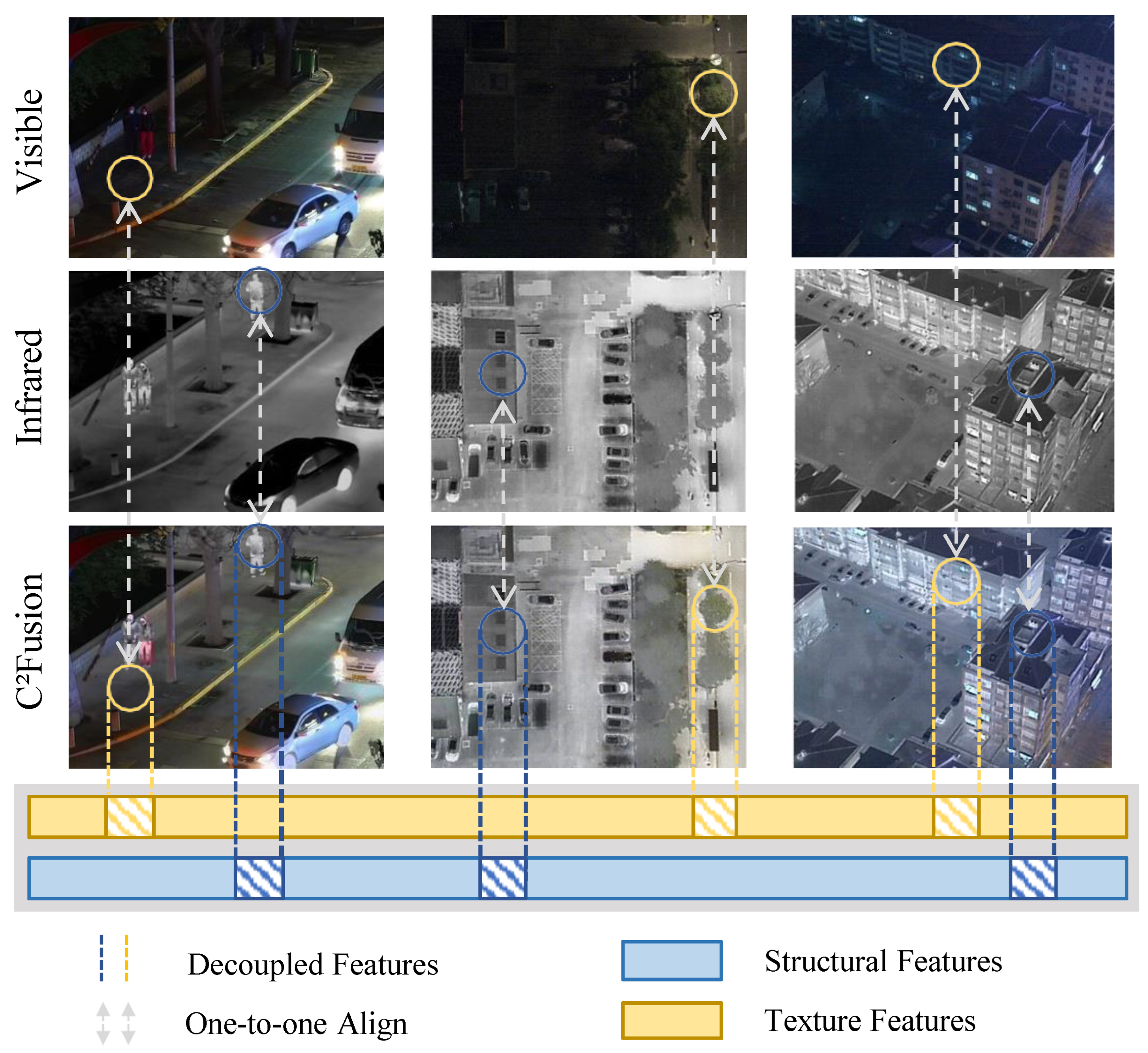
To address these issues, we propose C 2 Fusion, a Collaborative Conditional difFusion model tailored for the IVIF task of remote sensing imagery. First, as shown in Figure 1, in  C 2 Fusion, we design a dual-branch (i.e., a structure branch and a texture branch) conditional denoiser, which can disentangle and extract common structure-oriented and texture-oriented features from paired infrared and visible images. Second, considering the unique characteristics of RS imagery, we propose a series of loss functions (e.g., edge consistency loss, texture consistency loss, high-frequency consistency loss, and collaborative loss) to further improve the performance on fusing RS imagery. Finally, to effectively combine the outputs of the two branches, we design a feature refinement network that adaptively integrates their predictions and outputs a fused RS image with balanced information and high quality. Extensive experiments on remote sensing IVIF benchmarks demonstrate the effectiveness of the proposed method. Qualitative results show that C 2 Fusion produces fused images with clearer thermal structures, richer fine details, and more coherent visual appearance. Quantitative comparisons further verify that our method consistently outperforms state-of-the-art approaches across multiple evaluation metrics. These results confirm that explicitly disentangling structure and texture information and enforcing collaborative conditional modeling are both crucial for high-quality IVIF in remote sensing scenarios.
To summarize, our main contributions are threefold as follows:
  • We propose C 2 Fusion, a collaborative conditional diffusion model that is tailored for the IVIF task of RS imagery. C 2 Fusion contains a designed dual-branch generator, where one structure branch focuses on extracting edges and geometric information, and the other texture branch focuses on fine details and spectral consistency, which can effectively disentangle the structure and texture features from paired infrared and visible images.
  • We propose a series of loss functions (e.g., edge consistency loss, texture consistency loss, high-frequency consistency loss, and collaborative loss) that can improve the performance on preserving key features of edge, texture, high-frequency information, and cross-branches consistency. Moreover, a feature refinement network is further introduced to adaptively integrate complementary information from both branches within a unified probabilistic model and enable controllable fusion.
  • Extensive experiments show that our C 2 Fusion can produce high-quality fused results and achieves leading or competitive performance among state-of-the-art methods in terms of structural clarity, detail preservation, and visual coherence.

2. Related Works

Below, we summarize the representative studies most related to IVIF. In this field, researchers have made remarkable achievements, which are primarily categorized into the traditional methods [21,32] and the learning-based methods [26,33,34].

2.1. Learning-Based IVIF Methods

With the rise of deep learning, image fusion has gradually evolved into an end-to-end data-driven paradigm. Early models commonly utilized pre-trained autoencoder (AE) structures to extract multi-layer features and perform image reconstruction through simple fusion rules. For instance, DIDFuse [35] decomposes images into low-frequency and high-frequency components, which are fused separately and then reconstructed by a decoder, effectively balancing structural and detail preservation.
Recent advances in cross-modal perception and interaction learning further explore collaborative feature modeling and edge-aware representation across heterogeneous modalities. For example, Co-D2 [36] introduces radar-guided infrared perception for collaborative detection and de-ghosting, while Band-Mixed Edge-Aware Interaction Learning [37] investigates edge-aware feature interaction strategies in RGB-T camouflaged object detection, providing useful insights for multimodal representation learning in infrared-visible related tasks.
Subsequently, CNN architectures were widely introduced into end-to-end fusion models, achieving holistic optimization through encoder–fusion layer–decoder structures. A typical representative is U2Fusion [38], which constructs a unified unsupervised network and adaptively measures the information content of source images via a weight module, achieving effective fusion in a task-unsupervised manner [39].
As Transformers were introduced into fusion tasks, several models also achieved promising results; for example, Rao et al. proposed TGFuse [40], which employs a fusion of CNN and a lightweight Transformer to capture long-range dependencies and incorporates adversarial training to enhance the visual quality of the output. Furthermore, task-driven and integrated registration-fusion methods have also gained attention [41]. For example, SeAFusion [42] incorporates semantic signals from detection and segmentation into the training loop, ensuring the fused images possess applicability for downstream tasks [43]. Overall, the aforementioned AE, CNN, and Transformer models, alongside task- or registration-enhanced methods, have driven incremental improvements in fusion performance. However, most still rely on single-path decoding and handcrafted loss functions, making it difficult to achieve a systematic balance among multiple objectives, such as structural clarity, textural details, and spectral consistency.

2.2. IVIF Based on Generative Models

Generation-based approaches consider the image fusion task as a transformation from source images to target images. In various image fusion tasks, GAN-based methods, relying on distribution-level adversarial learning, typically achieve higher subjective quality and visual perceptual effects. Ma et al. proposed FusionGAN [26], pioneering the application of the generator-discriminator game to infrared-visible image fusion. This enabled the generator to simultaneously preserve infrared intensities and visible details, achieving promising visual effects and information retention performance.
Subsequently, Xu et al. [44] proposed DDcGAN, which employs conditional adversarial learning with dual discriminators to constrain the consistency of the fused results against the infrared and visible distributions, respectively. This significantly enhances thermal target saliency and mitigates single-modality bias. Liu et al. introduced TarDAL [45] (Target-aware Dual Adversarial Learning), utilizing a “single-generator and dual-discriminator” architecture combined with a bi-level optimization strategy for joint task training. This approach significantly improves detection accuracy and the semantic consistency of the fused images. Overall, GAN-based fusion methods achieve state-of-the-art perceptual quality by virtue of distribution matching. However, training instability and mode collapse induced by the adversarial game, alongside high sensitivity to discriminator and loss configurations, remain their primary limitations concerning cross-scene robustness and reproducibility.
With the progressive integration of diffusion models into the field of image fusion, they have emerged as a complement to GAN-based trajectories. Diff-IF [33,46] introduces the “fusion knowledge priors” as conditional guidance during the fusion process, thereby significantly enhancing fusion stability and final quality. Similarly, Zhao et al. [34] propose DDFM to formulate the fusion task within a conditional DDPM framework, achieving high-quality “tuning-free” multi-modal fusion based on a hierarchical Bayesian model and expectation-maximization. Relying on the probabilistic consistency and denoising characteristics of diffusion models, the aforementioned methods provide more reliable learning signals during the training phase. This facilitates a more rational balance between high-frequency details and cross-modal consistency, consequently enhancing controllability, robustness, and interpretability. Nevertheless, the direct application of diffusion models to unsupervised multi-modal fusion remains constrained by critical challenges. The “direct transfer” of pre-trained generative models struggles to align with fusion objectives, while long-chain sampling introduces efficiency bottlenecks. Furthermore, single-path denoising is tasked with simultaneously addressing multiple objectives—structure, texture, and spectra—which is prone to inducing representation entanglement and modal bias, ultimately necessitating a reliance on cumbersome handcrafted losses to rectify details and alignment.
However, existing IVIF methods are mainly developed for natural images, which limits their performance on fusing RS imagery. In contrast, our C 2 Fusion is specifically designed with the unique characteristics of RS imagery and introduces a series of optimization strategies, thereby achieving state-of-the-art performance on the IVIF task of RS imagery.

3. Method

3.1. Overview

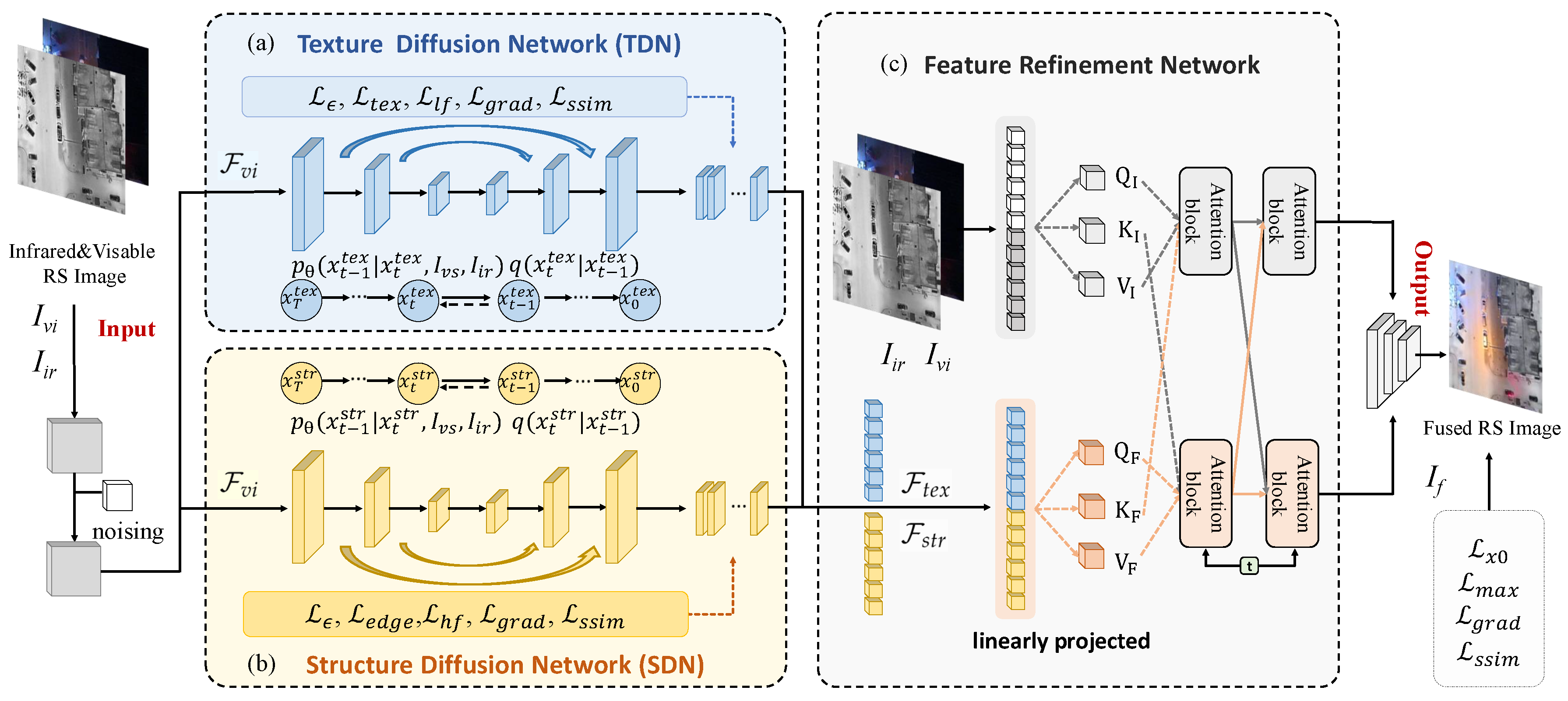
The overall pipeline of C 2 Fusion is shown in Figure 2. Given an infrared RS image I i r and a visible RS image I v i , our C 2 Fusion is modeled as a function Φ to generate a high-quality fused RS image I f , formalized as I f = Φ ( I i r , I v i ) .
Our method C 2 Fusion Φ = { Φ e , Φ c d n , Φ r e f } consists of two main components: a dual-branch conditional diffusion network Φ c d n (including a structure diffusion network (SDN) [Figure 2b] and a texture diffusion network (TDN) [Figure 2a]), and a feature refinement network (FRN) Φ r e f [Figure 2c]. First, we input paired RS images { I i r , I v i } to Φ e , and extract the latent features { F i r , F v i } . Then, as shown in Figure 2a,b, the structure and texture features of { F i r , F v i } are decoupled by our tailored two branches in Φ c d n respectively. Finally, as shown in Figure 2c, the FRN Φ r e f is utilized to aggregate and polish decoupled features to obtain the final fused RS image I f .
In our C 2 Fusion, the dual-branch conditional diffusion network Φ c d n is designed with a fusion knowledge prior generated by Diff-IF [33]. Since infrared-visible image fusion does not provide real ground-truth fused images, the Diff-IF output is employed as a clean reference distribution during training. Based on this prior, the first branch SDN Φ s t r emphasizes geometric fidelity and boundary sharpness, while the second branch TDN Φ t e x focuses on preserving fine texture details and luminance stability. Subsequently, the feature refinement network Φ r e f adaptively integrates complementary information from both branches within a unified probabilistic model, enabling controllable fusion. Our total loss function L t o t a l to optimize Φ is defined as
L t o t a l = λ 1 L s t r + λ 2 L t e x + λ 3 L r e f ,
where λ 1 to λ 3 are used to balance the multiple objectives, and  L s t r , L t e x , and  L r e f denote the objectives of optimizing SDN, TDN, and FRN, respectively.
We will detail the dual-branch conditional diffusion network (including SDN and TDN), the FRN, and our loss functions in Section 3.2, Section 3.3, and Section 3.4, respectively.

3.2. Dual-Branch Conditional Diffusion Network

The goal of the dual-branch conditional diffusion network Φ c d n is to explicitly disentangle the complementary structure and texture features from infrared and visible RS images within a unified conditional generation framework. By assigning structure-preserving and texture-preserving learning targets to two dedicated diffusion branches, the proposed architecture aims to reduce the mutual interference between heterogeneous objectives and improve the controllability of multimodal fusion. Φ c d n = { N s t r , N t e x } consists of a structure diffusion network (SDN) N s t r and a texture diffusion network (TDN) N t e x . SDN is responsible for recovering geometry-dominant and edge-consistent representations (e.g., boundary sharpness and high-frequency geometry), and TDN is designed to restore detail-aware and luminance-consistent representations (e.g., fine textures and low-frequency coherence). Specifically, L h f in the structure branch is employed to enhance geometric boundaries, object contours, and local structural variations, thereby avoiding over-smoothing during structure restoration; meanwhile, L l f in the texture branch is used to maintain luminance distribution and low-frequency visual consistency, thereby preventing local over-sharpening and luminance instability during texture enhancement. This design is particularly related to the characteristics of remote sensing images. The structure branch is expected to preserve sparse but important geometric cues, such as small vehicles, road boundaries, building contours, and other man-made edges, while the texture branch is used to maintain local appearance and luminance stability in weak-texture or homogeneous regions. Therefore, the designed Φ c d n can effectively exploit cross-modal complementarity and provide decoupled features for the subsequent refinement stage. Below, we first introduce the basics of the diffusion model and then detail the SDN and the TDN.
Basics of the diffusion model. Diffusion models are generative models that learn the data distribution by progressively adding Gaussian noise to clean samples and then reversing this process to recover the target data [28]. A typical diffusion model D consists of a forward noising process and a reverse denoising process.
In the forward process q, Gaussian noise is gradually added to a clean sample x 0 :
q ( x t x t 1 ) = N 1 β t x t 1 , β t I ,
where N ( · ) denotes a Gaussian distribution, x t is the noisy sample at diffusion step t, β t is the variance schedule, and  I is the identity matrix. The reverse process p θ learns to recover the clean sample from the noisy input, defined as
p θ ( x t 1 x t , t , c ) = N μ θ ( x t , t , c , σ t 2 I ,
where c denotes the conditional information, μ θ ( · ) is the mean predicted by the denoising network parameterized by θ , σ t 2 is the variance at step t. In practice, the denoising network predicts the noise component as ϵ ^ θ = U θ ( z t , t c ) .
Structure diffusion network. The SDN Φ s t r is proposed to model structure-oriented information from paired infrared and visible RS images and to output the structure features F s t r = Φ s t r ( F i r , F v i , p θ , q ) . As shown in Figure 2b, SDN takes the cross-modal features { F i r , F v i } extracted by the encoder Φ e as conditional inputs, and performs conditional denoising to recover structure-preserving representations. The objective of this branch is to emphasize geometric fidelity and boundary sharpness, such that the fused image can maintain clear object contours and stable structural layouts in complex remote sensing scenes.
Let x 0 s t r denote the clean structure representation, and let x t s t r denote its noisy state at diffusion step t. The forward diffusion process of SDN is defined as
q x t s t r x t 1 s t r = N 1 β t x t 1 s t r , β t I ,
and the reverse denoising process is defined as
p θ x t 1 s t r x t s t r , F v i , F i r ,
where q, p θ , β t , and  I are defined same as Equations (2) and (3). To improve structural fidelity, as shown in Figure 2b, SDN is optimized by a designed structure-oriented loss function L s t r , defined as
L s t r = λ 1 s L ϵ + λ 2 s L e d g e + λ 3 s L h f + λ 4 s L g r a d + λ 5 s L s s i m + λ 6 s L c o l l ,
where λ 1 s to λ 6 s are used to balance the multiple objectives. Under the guidance of the loss function L s t r , SDN progressively reconstructs the structure representation from x T s t r to x 0 s t r . SDN can effectively capture complementary structural cues from the two modalities, thereby providing structure-preserving features for the subsequent refinement stage.
Texture Diffusion Network. The TDN Φ t e x is proposed to extract texture-oriented features from both infrared and visible RS images and output the texture features F t e x = Φ t e x ( F i r , F v i , p θ , q ) . As shown in Figure 2b, TDN performs conditional denoising to recover texture-preserving representations from { F i r , F v i } . The goal of TDN is to emphasize fine texture details and luminance stability, such that the fused image can preserve rich local details and consistent visual appearance in complex remote sensing scenes. Let x 0 t e x denote the clean texture representation, and let x t t e x denote its noisy state at diffusion step t. The forward diffusion process of TDN is defined as
q ( x t t e x x t 1 t e x ) = N 1 β t x t 1 t e x , β t I ,
and the reverse denoising process is defined as
p θ ( x t 1 t e x x t t e x , F v i , F i r ) ,
where q, p θ , β t , and  I are defined same as Equations (2) and (3). To improve texture fidelity, as shown in Figure 2b, TDN is optimized by the designed texture-oriented loss function L t e x , represented as
L t e x = λ 1 t L ϵ + λ 2 t L t e x + λ 3 t L l f + λ 4 t L g r a d + λ 5 t L s s i m + λ 6 t L c o l l ,
where λ 1 t to λ 6 t are used to balance the multiple objectives. Under the guidance of the loss function L t e x , TDN progressively reconstructs the texture representation from x T t e x to x 0 t e x . TDN can effectively capture complementary textural cues from the two modalities, thereby providing texture-preserving features for the subsequent refinement stage.
Depending on L t e x , TDN progressively reconstructs the texture representation from x T t e x to x 0 t e x . Consequently, the branch can effectively capture complementary texture cues from the two modalities, thereby providing texture-enhanced features for the subsequent refinement stage.

3.3. Feature Refinement Network

As shown in Figure 2c, the feature refinement network (FRN) Φ r e f is designed to deeply aggregate the complementary outputs of the SDN and TDN into a unified fused image I f . Let F s t r and F t e x denote the reconstructed representations generated by SDN and TDN at diffusion step t, respectively. Φ r e f learns an aggregation function, defined as
I f = Φ r e f F s t r , F t e x , I v i , I i r .
In practice, to prevent the refinement stage from interfering with the denoising objectives of SDN and TDN, the branch reconstructions are detached before being fed into Φ r e f . Specifically, a stop-gradient (detach) operation is applied to the outputs of SDN and TDN before entering Φ r e f , so that gradients from the refinement network are not propagated back to the two diffusion branches. This design prevents cross-branch optimization interference and feature entanglement during training, while it has no impact on the inference process. To fully mine and integrate these two modality-specific representations, FRN discards simple concatenation and introduces an interactive mechanism based on dual-branch cross-attention [47]. First, the detached texture and structure representations (combined with the original input images I v i , I i r ) are separately fed into a Patch Embed Overlap layer to extract deep features with local continuity. Specifically, the original visible and infrared images are concatenated and mapped to produce the image-level Query ( Q I ), Key ( K I ), and Value ( V I ) vectors. Simultaneously, the output features from the texture and structure branches are concatenated to generate the feature-level Query ( Q F ), Key ( K F ), and Value ( V F ) vectors. Then, to achieve bidirectional fidelity reinforcement between the deep representations and source inputs, we use a cross-attention block [48,49]. The feature representation queries the K I and V I of the original images through Q F , thereby injecting authentic structural and textural details into the fused features. Meanwhile, the image representation queries the K F and V F of the dual-branch features through Q I to enrich its deep semantic information. After processing through multiple interactive attention blocks and feed-forward networks, these two sets of complementarily fused features are concatenated and mapped to reconstruct the final fused output I ^ f .
To improve the final fusion quality, FRN is optimized by a refinement-oriented loss function L r e f , defined as
L r e f = λ 1 r L x 0 + λ 2 r L max + λ 3 r L g r a d + λ 4 r L s s i m ,
where λ 1 r to λ 4 r are used to balance the multiple objectives. L x 0 is the reconstruction loss against the supervisory fusion prior, L max preserves salient responses from both modalities, and  L g r a d and L s s i m are utilized to improve contour continuity and local structural consistency. Under the guidance of L r e f , Φ r e f successfully integrates the complementary structure and texture representations into the final fused image.

3.4. Loss Function

Below we will detail all the loss functions utilized in Equations (1), (6) and (9), including the diffusion reconstruction loss L ϵ , edge consistency loss L e d g e , high-frequency consistency loss L h f , gradient loss L g r a d , structural similarity loss L s s i m , texture consistency loss L t e x , low-frequency consistency loss L l f , collaborative loss L c o l l , reconstruction loss L x 0 , maximum-intensity preservation loss L max . Among them, L e d g e , L h f , L t e x , L l f , and  L c o l l are our proposed terms, and  L ϵ , L g r a d , L s s i m , L x 0 , and  L max basically follow the prior work [33]. Although SDN and TDN share the same fusion prior during diffusion training, this prior is used as a global reference for learning a reasonable fused image distribution rather than as a strong supervision signal that directly forces the two branch outputs to be identical. The fusion prior mainly provides a basic direction for recovering from noisy states to the fused image distribution. The functional difference between SDN and TDN is further guided by their branch-specific losses. Specifically, L e d g e and L h f encourage SDN to focus on edges, contours, and local structural variations, while L t e x and L l f guide TDN to preserve texture details, luminance stability, and regional consistency. The proposed losses are designed according to the characteristics of remote sensing IVIF. Edge and high-frequency constraints encourage SDN to preserve sparse structural cues and small object boundaries; texture and low-frequency constraints help TDN maintain local details and luminance consistency in weak-texture regions, and the collaborative loss prevents the two branches from diverging excessively while preserving their specialization.
Edge Consistency Loss. To preserve clear boundaries and stable geometric layouts, we introduce an edge consistency loss L e d g e for SDN, defined as
L e d g e = E ( x ^ 0 , t s t r ) w e d g e v i E ( I v i ) + ( 1 w e d g e v i ) E ( I i r ) 1 .
where w e d g e v i = E ( I v i ) E ( I v i ) + E ( I i r ) + ε , and  E ( x ) indicates a multi-scale edge energy map by combining Gaussian smoothing [50] and Sobel filtering [51]. Here, ϵ is a small positive constant used to avoid division by zero and improve numerical stability. In all adaptive weight calculations, we set ϵ = 1 × 10 6 , computed by
E ( x ) = k K S x ( G k Y ( x ) ) 2 + S y ( G k Y ( x ) ) 2 + ε ,
where K denotes the set of smoothing scales, G k is a Gaussian kernel of size k, and  S x , S y are Sobel operators. Based on the edge energies of the visible and infrared images, we form an adaptive edge target and define L e d g e explicitly, which encourages SDN to preserve structure-dominant responses from the more informative modality at each location.
High-Frequency Consistency Loss. To further reduce oversmoothing and enhance fine structural details, we introduce a high-frequency consistency loss L h f , defined as
L h f = H ( x ^ 0 , t s t r ) w h f v i H ( I v i ) + ( 1 w h f v i ) H ( I i r ) 1 ,
where w h f v i = H ( I v i ) H ( I v i ) + H ( I i r ) + ε , and  H ( · ) indicates a multi-scale high-frequency energy map. H ( x ) is extracted by Gaussian smoothing followed by a Laplacian operator, computed by H ( x ) = σ S L G σ Y ( x ) , where S denotes the set of Gaussian scales, G σ is a Gaussian kernel of scale σ , and L is the discrete Laplacian kernel. Based on the high-frequency energies of the visible and infrared images, we form an adaptive high-frequency target and define L h f explicitly, which encourages SDN to recover subtle detail transitions and local structural variations.
Texture Consistency Loss. To guide TDN toward detail-aware reconstruction, we design a texture consistency loss L t e x based on directional differences and soft local binary patterns [52], defined as
L t e x = T ( x ^ 0 , t t e x ) w t e x v i T ( I v i ) + ( 1 w t e x v i ) T ( I i r ) 1 ,
where w t e x v i = A ( I v i ) A ( I v i ) + A ( I i r ) + ε , and  T ( · ) indicates a texture representation map. T ( x ) is computed by T ( x ) = AvgPool Ω σ β [ K i Y ( x ) ] i = 1 8 , where { K i } i = 1 8 denotes eight directional difference filters [53], β is the temperature parameter, and  Ω is the local averaging window. The associated texture energy A ( x ) used to compute the adaptive weights is defined by the summed directional response magnitude A ( x ) = i = 1 8 K i Y ( x ) .
Low-Frequency Consistency Loss. To preserve global intensity coherence and large-scale visual stability, we further impose a low-frequency consistency loss L l f on TDN. The final loss is computed by averaging the Charbonnier distance over all scales, defined as
L l f = 1 | K l f | k K l f ρ L k ( x ^ 0 , t t e x ) w l f v i L k ( I v i ) + ( 1 w l f v i ) L k ( I i r ) ,
where ρ ( z ) = z 2 + ε 2 is the Charbonnier penalty function [54], w l f v i = A l f ( I v i ) A l f ( I v i ) + A l f ( I i r ) + ε . L k ( x ) indicates the multi-scale low-frequency components extracted by Gaussian smoothing, computed by L k ( x ) = G k Y ( x ) , where K l f denotes the set of low-frequency scales, and  G k is a Gaussian kernel of scale k. The associated low-frequency energy A l f ( x ) used to compute the adaptive weights is defined by A l f ( x ) = k K l f L k ( x ) . Based on the low-frequency energies of the visible and infrared images, we form an adaptive low-frequency target and define L l f explicitly, which helps TDN preserve local details without sacrificing global intensity consistency.
Collaborative Loss. Although SDN and TDN are optimized for different objectives, their reconstructions should remain mutually compatible. Therefore, we introduce a collaborative loss to constrain the two branches in a shared reconstruction space. In implementation, one branch is detached when supervising the other, represented as
L c o l l s t r = x ^ 0 , t s t r sg x ^ 0 , t t e x 1 ,
L c o l l t e x = sg x ^ 0 , t s t r x ^ 0 , t t e x 1 ,
where sg ( · ) denotes the stop-gradient operation. For simplicity, both terms are denoted by L c o l l in the overall branch objectives. This design prevents the two diffusion branches from diverging excessively while preserving their specialization, thereby improving the stability and complementarity of the proposed framework.
The collaborative loss is not intended to eliminate the difference between SDN and TDN. Instead, it serves as a weak consistency constraint to prevent excessive inter-branch divergence and keep their outputs compatible for subsequent FRN refinement. In our implementation, this loss is assigned a small weight, and a stop-gradient operation is adopted during cross-branch supervision. Thus, it maintains inter-branch compatibility without forcing the two branches to learn the same function. We acknowledge that the current loss design includes multiple auxiliary terms and weighting hyperparameters, increasing optimization complexity and dependence on handcrafted constraints. These losses are introduced to balance competing objectives in remote sensing IVIF, including structural preservation, texture recovery, luminance consistency, and cross-modal information retention. Future work will explore adaptive loss weighting and dynamic multi-objective balancing to reduce this dependence.
Discussion on Loss Design. Although the proposed edge, texture, high- and low-frequency, and collaborative losses are effective for guiding the two diffusion branches, they also have potential limitations. Edge- and high-frequency-related constraints mainly contribute to boundary regions, local discontinuities, and fine structural variations, but may be less effective in homogeneous interiors such as water surfaces, bare land, or smooth road areas. To alleviate this issue, C 2 Fusion combines these frequency-related constraints with diffusion noise-prediction loss, gradient loss, SSIM loss, reconstruction loss, and maximum-intensity preservation loss, preventing the model from overemphasizing a single type of frequency information. In addition, the dual-branch design assigns structure-aware and texture-aware objectives to SDN and TDN separately, while FRN adaptively integrates their outputs to balance structural clarity, texture preservation, and global consistency.
Introducing multiple auxiliary losses inevitably brings additional training overhead and increases the complexity of optimization. However, these losses are only used during the training stage and do not introduce extra computation during inference. Moreover, the additional training cost is relatively limited compared with the performance gains achieved by the proposed framework in terms of structural preservation, texture fidelity, and cross-modal information integration. In practice, we use a DDIM-based accelerated sampling strategy with K = 4 inference steps, which significantly reduces the iterative inference cost without noticeable performance degradation. Therefore, we consider this trade-off reasonable for improving the fusion quality of remote sensing infrared-visible images. In future work, frequency-guided spatial modeling and adaptive cross-frequency balancing will be further explored to improve robustness in homogeneous regions and complex remote sensing scenes.

3.5. Network Architecture

To avoid redundancy, a generic branch index κ { s t r , t e x } is used. The network contains two conditional denoisers (SDN and TDN) and a balanced feature refinement network (FRN) Φ r e f . At step t, the paired source images are first encoded as ( F i r , F v i ) = Φ e ( I i r , I v i ) , and the condition is defined as c = [ F v i , F i r ] . Given the condition c , noisy state x t , and scalar noise level s t , each denoiser takes [ c , x t ] and predicts branch-specific noise ϵ ^ t κ . A clean estimate is recovered by an ϵ -parameterized operator x ^ 0 , t κ = Recover ( x t , ϵ ^ t κ ; γ t ) , where γ t = s t 2 in training (continuous noise) and γ t = α ¯ t in inference. The FRN aggregates the two detached estimates along with the source images to produce the fused prediction I ^ f , t = Φ r e f F s t r , F t e x , I v i , I i r , after which the latent state is updated by a schedule-driven transition x t 1 = Update ( x t , I ^ f , t ; { α } ) . Since the reverse denoising process is iterative, the inference complexity of C ( 2 ) Fusion is approximately proportional to the number of sampling steps K, i.e.,  O ( K ( C S D N + C T D N + C F R N ) ) , where C S D N , C T D N , and  C F R N denote the computational costs of one forward pass of SDN, TDN, and FRN, respectively. During training, branch estimates are detached before entering Φ r e f to stabilize optimization and preserve branch specialization. The overall pipeline, training strategy, and testing strategy are described in Algorithm 1, Algorithm 2, and Algorithm 3, respectively.
Recover ( · ) denotes the standard ϵ -parameterized reconstruction of x 0 from ( x t , ϵ ^ ) under noise level γ t . Update ( · ) denotes the schedule-driven latent transition using coefficients computed from { α t , α ¯ t } . Both operators match the standard diffusion implementation. Here, c denotes the encoded cross-modal condition [ F v i , F i r ] extracted by Φ e , rather than the original image pair. The original images I v i and I i r are still used in the FRN stage together with the branch reconstructions to refine the final fused image.
Algorithm 1 Overall pipeline of C 2 Fusion
  • Require: Infrared image I i r , visible image I v i , encoder Φ e , structure diffusion network Φ s t r , texture diffusion network Φ t e x , refinement network Φ r e f
  • Ensure: Fused image I f
     1:
    Input the paired images ( I v i , I i r ) into the cross-modal perception encoder Φ e
     2:
    Extract cross-modal features ( F v i , F i r ) Φ e ( I v i , I i r )
     3:
    Generate structure-oriented representation x ^ s t r 0 through Φ s t r ( F v i , F i r )
     4:
    Generate texture-oriented representation x ^ t e x 0 through Φ t e x ( F v i , F i r )
     5:
    Refine and aggregate the two branch outputs:
     6:
         I f Φ r e f ( F s t r , F t e x , I v i , I i r )
     7:
    return  I f
Algorithm 2 Training strategy of C 2 Fusion
  • Require: Denoisers { U θ κ κ } κ { s t r , t e x } , refinement network Φ r e f , minibatch ( I v i , I i r , I f ) , schedule { α ¯ t } t = 1 T , optimizer
  • Ensure: Trained parameters θ s t r , θ t e x , ϕ r e f
     1:
    repeat
     2:
        Sample t Uniform { 1 , , T } , set s t α ¯ t ; sample ϵ N ( 0 , I )
     3:
        Extract features ( F i r , F v i ) Φ e ( I i r , I v i )
     4:
        Build condition c [ F v i , F i r ]
     5:
        Noising: x t s t I f + 1 s t 2 ϵ
     6:
        Shared input h t [ c , x t ] , and set γ t s t 2
     7:
        for  κ { s t r , t e x }  do
     8:
             Noise prediction: ϵ ^ t κ U θ κ κ ( h t , s t )
     9:
             Clean estimate: x ^ 0 , t κ Recover ( x t , ϵ ^ t κ ; γ t )
    10:
        end for
    11:
        Refinement: I ^ f , t Φ ref sg ( F str ) , sg ( F tex ) , I v i , I i r
    12:
        Compute L total = λ 1 L s t r + λ 2 L t e x + λ 3 L r e f
    13:
        Update θ s t r , θ t e x , ϕ r e f via Adam on L total
    14:
    until converged
Algorithm 3 Testing strategy of C 2 Fusion
  • Require: Trained { U θ κ κ } κ { s t r , t e x } , Φ r e f , input pair ( I v i , I i r ) , schedule { α t , α ¯ t } t = 1 T
  • Ensure: Fused image I ^ f
     1:
    Initialize x T N ( 0 , I )
     2:
    Extract features ( F i r , F v i ) Φ e ( I i r , I v i )
     3:
    Build condition c [ F v i , F i r ]
     4:
    for  t = T , , 1   do
     5:
          s t α ¯ t ,    γ t α ¯ t ,     h t [ c , x t ]
     6:
         for  κ { s t r , t e x }  do
     7:
              ϵ ^ t κ U θ κ κ ( h t , s t )
     8:
              x ^ 0 , t κ Recover ( x t , ϵ ^ t κ ; γ t )
     9:
        end for
    10:
         I ^ f , t Φ r e f F s t r , F t e x , I v i , I i r
    11:
         x t 1 Update ( x t , I ^ f , t ; { α t , α ¯ t } )
    12:
    end for
    13:
    return  I ^ f , 0 (as the final fused output I ^ f )

4. Experiments

4.1. Experimental Setup

Datasets. In the task of infrared-visible RS image fusion, we adopt three widely used public datasets: DroneVehicle [55], LLVIP [56], and MAVS [57]. The proposed model is trained on the standard training split of the DroneVehicle dataset and evaluated not only on its original test set but also on the LLVIP and MAVS datasets, which contain diverse scenarios such as varying complex environments. This setup is designed to further validate the generalizability of our model across various low-altitude UAV remote sensing scenarios. In addition, MAVS [57], a multimodal visible-SAR remote sensing dataset, is used as an auxiliary cross-modal generalization benchmark to further evaluate the robustness of the proposed fusion framework beyond strictly visible-infrared scenarios.
This setting allows us to assess both infrared-visible fusion performance and cross-modal generalization ability in diverse remote sensing scenarios.
Implementation Details. All experiments are implemented in PyTorch 2.3.0 on a single NVIDIA RTX 4070. We use Adam [58] with an initial learning rate of 1 × 10 4 . The batch size is 2. Images are resized to 128 × 128 , normalized to [ 1 , 1 ] , and augmented by random crop, horizontal flip, and intensity normalization. For fair comparison, all compared methods are evaluated on the same test image pairs with the same input resolution, normalization strategy, and metric calculation scripts. No additional manual post-processing is applied to the fused results of any method. For methods with publicly available official codes or pretrained models, we follow their official inference settings; for methods that require retraining, we reproduce them as closely as possible according to the training protocols provided in their original papers or official implementations. For SDN and TDN, we adopt a linear noise schedule with T = 1000 forward steps and train the model to predict noise ( ϵ -prediction). During inference, we adopt DDIM sampling to reduce the number of reverse sampling steps, thereby decreasing the computational overhead and inference time compared with full long-chain DDPM sampling. Table 1 lists our setting of loss weights. Each coefficient maps to a specific loss term. Specifically, λ 1 s and λ 1 t balance the branch-wise noise prediction in Equations (6) and (9); λ 2 s and λ 3 s correspond to the edge and high-frequency consistency losses in Equation (6) and λ 2 t and λ 3 t refer to the texture and low-frequency consistency losses in Equation (9). Furthermore, λ 4 s , λ 4 t , and λ 3 r are assigned to the gradient losses across Equations (6), (9) and (11), while λ 5 s , λ 5 t , and λ 4 r control the structural similarity losses in the same equations. The collaborative losses in Equations (6) and (9) are weighted by λ 6 s and λ 6 t . For the refinement network in Equation (11), λ 1 r and λ 2 r govern the x 0 reconstruction and maximum-intensity preservation losses, respectively. Finally, the top-level parameters λ 1 , λ 2 , and λ 3 combine the three groups to form the total objective in Equation (1).
Efficiency Consideration. Although the proposed dual-branch diffusion framework introduces additional computational cost compared with single-branch fusion methods, we adopt several strategies to improve practical efficiency. First, during inference, we employ a DDIM-based accelerated sampling strategy, reducing the number of reverse sampling steps from T = 1000 during training to K = 4 , which significantly alleviates the iterative inference burden. In addition, the structure and texture branches can be executed in parallel at each diffusion step, and mixed-precision training is adopted to further reduce GPU memory usage.
To provide a more concrete analysis of the computational overhead, we further measure the resource consumption under the same experimental setting used in this paper, i.e., a single NVIDIA RTX 4070 GPU, batch size of 2, and input resolution of 128 × 128 . During training, the peak GPU memory consumption is approximately 7.6 GB, and the average training time per iteration is about 443 ms. During inference, since gradient computation and auxiliary losses such as edge, texture, high-/low-frequency, and collaborative losses are not involved, the GPU memory consumption decreases to approximately 3.2 GB. With DDIM sampling, the average inference time for one infrared-visible image pair is about 3.9 s. These results indicate that although C 2 Fusion is computationally heavier than ordinary one-pass CNN-based fusion models, its resource consumption remains feasible on a single consumer-level GPU. Therefore, the proposed method is more suitable for offline or near-real-time remote sensing scenarios where fusion quality, structural fidelity, and cross-modal information preservation are prioritized over strict real-time latency.
Evaluation Metrics. To comprehensively evaluate the fusion quality of C 2 Fusion in remote sensing scenarios, we employ six widely used quantitative metrics covering four key aspects: information richness, structural detail preservation, cross-modal consistency, and perceptual fidelity. Entropy (EN) measures the overall information capacity of the fused image through intensity distribution analysis, reflecting the model’s ability to preserve fine-grained spectral variations in heterogeneous terrain. Edge Information (EI) and Mutual Information (MI) jointly assess the retention of structural boundaries and cross-source correlation, which are crucial for preserving man-made edges, coastlines, and linear features in high-resolution remote sensing imagery. Visual Information Fidelity (VIF) evaluates the perceptual preservation of salient details from both infrared and visible modalities, emphasizing the clarity of land–water boundaries, urban textures, and vegetation patterns. Structural Similarity (SSIM) measures luminance, contrast, and structural fidelity with respect to both modalities and is computed as the sum of modality-specific SSIM scores to capture joint structural consistency—this design can naturally yield values above 1 for high-quality fusion. Peak Signal-to-Noise Ratio (PSNR) complements these metrics by quantifying reconstruction fidelity with respect to both source images, ensuring that enhanced visual quality does not come at the cost of significant pixel-level distortion. Together, these metrics provide a balanced and objective evaluation of the fused results in terms of both human visual perception and task-oriented utility, ensuring that the proposed model not only generates visually pleasing outputs but also retains critical information for downstream remote sensing applications such as object detection, land-use classification, and change monitoring.

4.2. Comparison with State-of-the-Art Methods

In this section, we evaluate the performance of several state-of-the-art fusion methods on three benchmark test sets. Specifically, we compare several representative methods, including CNN-based methods (e.g., U2Fusion [38], CDDFuse [59], MetaFusion [60], and ReCoNet [61]), GAN-based methods (e.g., FusionGAN [26] and TarDAL [45]), and Diffusion-based methods (e.g., DDFM [34], Diff-IF [33], and TDFusion [62]). To ensure a consistent evaluation protocol, all methods are tested on the same infrared-visible image pairs under the same preprocessing and evaluation pipeline. The fused outputs are saved in the same format and directly used for quantitative evaluation without additional enhancement, filtering, or manual adjustment. All methods are evaluated using the same quantitative metrics described previously to ensure a fair and consistent comparison.
It should be noted that Diff-IF is used to generate the pseudo-supervisory fusion prior I f for training C 2 Fusion. Therefore, the comparison with Diff-IF is interpreted as evaluating whether the proposed dual-branch conditional diffusion and feature refinement mechanism can further improve upon this prior, rather than as a completely independent prior-free comparison. As shown in the quantitative results, C 2 Fusion achieves better performance than Diff-IF on multiple metrics, indicating that our method does not simply reproduce the Diff-IF output but further improves structural clarity, texture preservation, and cross-modal information integration.
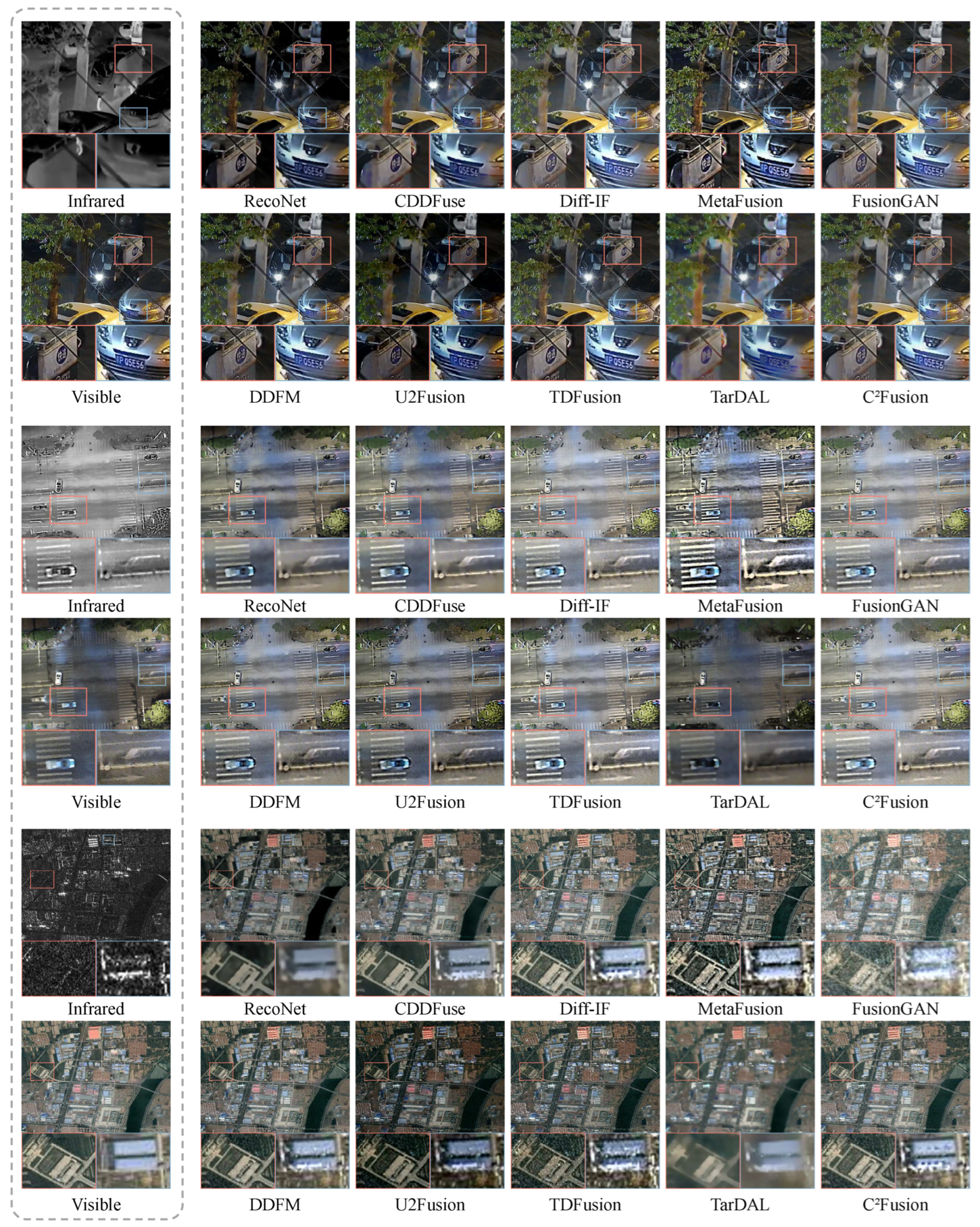
Qualitative comparison. Figure 3 presents the qualitative comparison results between our proposed C 2 Fusion and several representative fusion methods on three typical image pairs from the DroneVehicle, LLVIP, and MAVS datasets. It is evident that our method achieves superior performance in both target saliency and texture detail preservation.
The example in the first group from the LLVIP [56] dataset illustrates that C 2 Fusion excels at preserving key infrared targets, as evidenced by the clearly rendered license plate region with sharp boundaries and enhanced contrast. Similarly, in the second group from DroneVehicle [55], the contours of the directional signs are well-preserved, with sharp and complete edges, significantly outperforming other methods. This improved target separability greatly benefits downstream perception tasks.
Besides, C 2 Fusion effectively preserves rich textural details from visible images, which is clearly evident in the third group from the MAVS [57] dataset. This advantage is primarily attributed to our dual-path diffusion architecture, which enables the disentangled modeling of structural and textural features, thereby improving the fidelity of fine-grained visual information in line with human perceptual preferences.
With the collaborative conditional diffusion mechanism and multi-level feature representation, C 2 Fusion achieves a better balance between highlighting salient infrared targets and preserving visible texture richness, ultimately producing more visually pleasing fusion results.
Quantitative comparison. As summarized in Table 2, C 2 Fusion attains leading scores on most criteria, especially MI, VIF, and PSNR, showing strong capability in preserving cross-modal information and maintaining low distortion to both sources. It also delivers competitive second-best results on EI and SSIM, indicating sharper structures and high structural fidelity under our dual-path design. From a remote-sensing perspective, these gains are particularly meaningful: EI reflects the continuity of man-made edges (e.g., roads, runways, building façades) and coastline boundaries; MI/VIF capture how well salient thermal targets and fine visible textures are jointly retained, which benefits tasks such as small-object detection and land–water delineation; PSNR constrains pixel-level distortions that can harm quantitative interpretation (e.g., radiometric analyses), and our SSIM (computed as the sum to both modalities) emphasizes consistent local structure across infrared and visible views. We also note that EN by itself can be inflated by noise or excessive sharpening; therefore, we jointly consider EN with VIF/EI to prefer information-rich yet stable detail. Overall, the balanced improvements across MI/VIF/PSNR and the competitive EI/SSIM confirm that collaborative conditional diffusion effectively preserves both salient infrared cues and high-frequency visible textures, which is aligned with the requirements of downstream remote-sensing applications (e.g., detection and change monitoring).
Detection Performance Comparison. This section validates the effectiveness of fusion results in downstream object detection tasks [63]. To ensure fairness, we adopt YOLOv12n as backbones and retrain it on the LLVIP [56] and M 3 FD [45] training sets using fusion results from different methods. All detectors are trained for 200 epochs with identical hyperparameter settings.
Table 3 presents the detection performance comparison of different fusion methods on the M 3 FD and LLVIP datasets. The results indicate that C 2 Fusion achieves the highest mAP scores, outperforming all other methods in both datasets. This demonstrates that our method not only produces high-quality fusion images but also significantly enhances the performance of downstream object detection tasks.
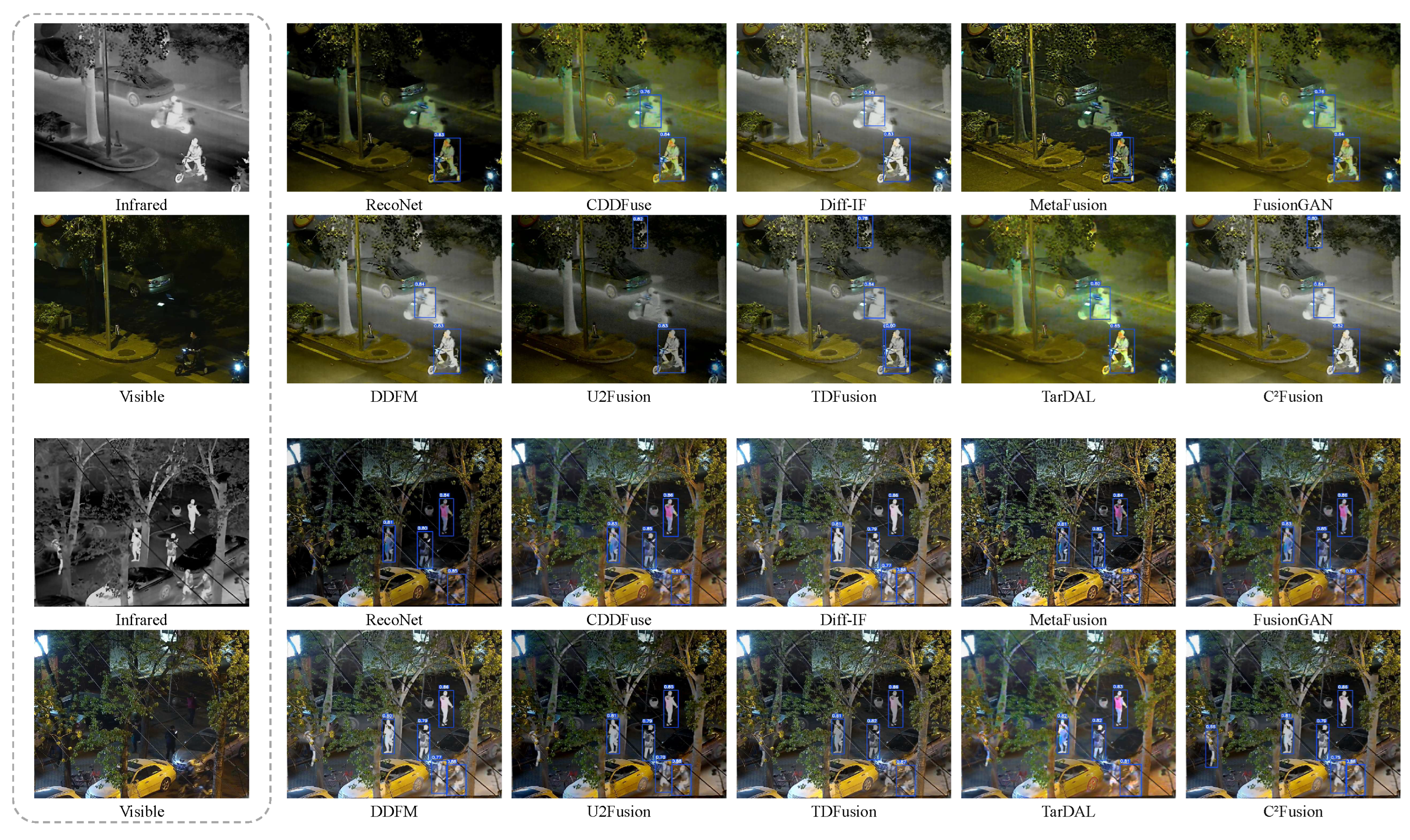
As shown in Figure 4, detectors trained on fused images demonstrate better object localization, especially in low-illumination and cluttered scenes. Notably, C 2 Fusion provides clearer contours and stronger contrast for salient targets such as pedestrians, leading to improved detection accuracy. In Example 1, other models exhibit false positives, missed detections, or duplicate detections when facing scenes with strong headlight interference and densely clustered pedestrians. In contrast, our method accurately detects all salient targets in these challenging conditions, achieving high confidence scores across the board. In Example 2, the occlusion caused by tree branches on the left side results in detection failure for all other SOTA methods. Only C 2 Fusion successfully identifies the obscured object, further demonstrating its robustness in complex, cluttered environments. This highlights the advantage of information complementarity in fusion images, which enhances model perception and robustness in complex environments.

4.3. Ablation Studies

To verify the effectiveness of C 2 Fusion, we design two types of ablation experiments. First, to evaluate the disentanglement ability of the dual-branch diffusion architecture, we conduct diagnostic ablations that separately examine the outputs of SDN, TDN, and the final fused image. This reveals the specific roles of the structure-focused SDN and the texture-focused TDN and shows how they complement each other in preserving structural fidelity and textural details. Second, to assess the impact of our constraint loss system, which combines structural, frequency, and perceptual terms, we perform loss ablations by removing individual loss components. The results demonstrate the contribution of each term to the overall fusion performance and visual stability. These experiments together confirm both the value of the dual-branch design and the necessity of our targeted optimization objectives.
Investigation on Different Pseudo-Supervisory Priors. To further analyze whether the proposed C 2 Fusion simply depends on a specific pseudo-supervisory prior or can consistently improve upon different fusion priors, we conduct an additional ablation study by using the outputs of different representative fusion methods as the pseudo-supervised image I f . Specifically, we select ReCoNet, CDDFuse, TDFusion, and U2Fusion as prior-generating methods and use their fused results as the clean reference images for retraining C 2 Fusion. For a fair comparison, all variants are trained under the same network architecture, training strategy, loss functions, and hyperparameter settings. The only difference lies in the source of the pseudo-supervised prior I f .
Table 4 summarizes the quantitative results on the DroneVehicle, LLVIP, and MAVS test sets. It can be observed that, in most cases, C 2 Fusion trained with different pseudo-supervisory priors achieves better performance than the corresponding prior-generating baseline method. This indicates that the proposed model does not merely copy the input pseudo prior or rely on a particular fusion method. Instead, the structure diffusion branch, texture diffusion branch, and feature refinement network further refine the prior distribution and improve the fused representation. These results also suggest that the proposed framework has good robustness to different pseudo-supervisory priors and can effectively enhance structural clarity, texture preservation, and cross-modal information integration based on various initial fused distributions.
Investigation on Diffusion Branch Replacement. To verify whether the performance gains of C 2 Fusion stem from the diffusion process itself, rather than solely from the dual-branch architecture, FRN, or designed losses, we conduct a branch replacement ablation. Specifically, we replace the diffusion-based SDN and TDN with deterministic non-diffusion branches (a CNN and a CNN-Transformer hybrid). To ensure a fair comparison, all other components, including the dual-branch framework, FRN module, training strategy, and fusion losses, remain unchanged. This isolates the impact of our progressive conditional denoising process against deterministic feature mapping.
We evaluate both models on the DroneVehicle, LLVIP, and MAVS test sets using EI, EN, and MI (measuring edge preservation, information richness, and cross-modal retention, respectively). As shown in Table 5, the deterministic replacement model suffers performance degradation across most metrics. Although it retains the dual-branch structure and FRN, it is less effective at balancing structural clarity and information preservation. In contrast, the full C 2 Fusion achieves more stable and competitive performance. These results demonstrate that the diffusion-based conditional denoising process independently enhances fusion quality, further justifying its necessity in our remote sensing infrared-visible image fusion framework.
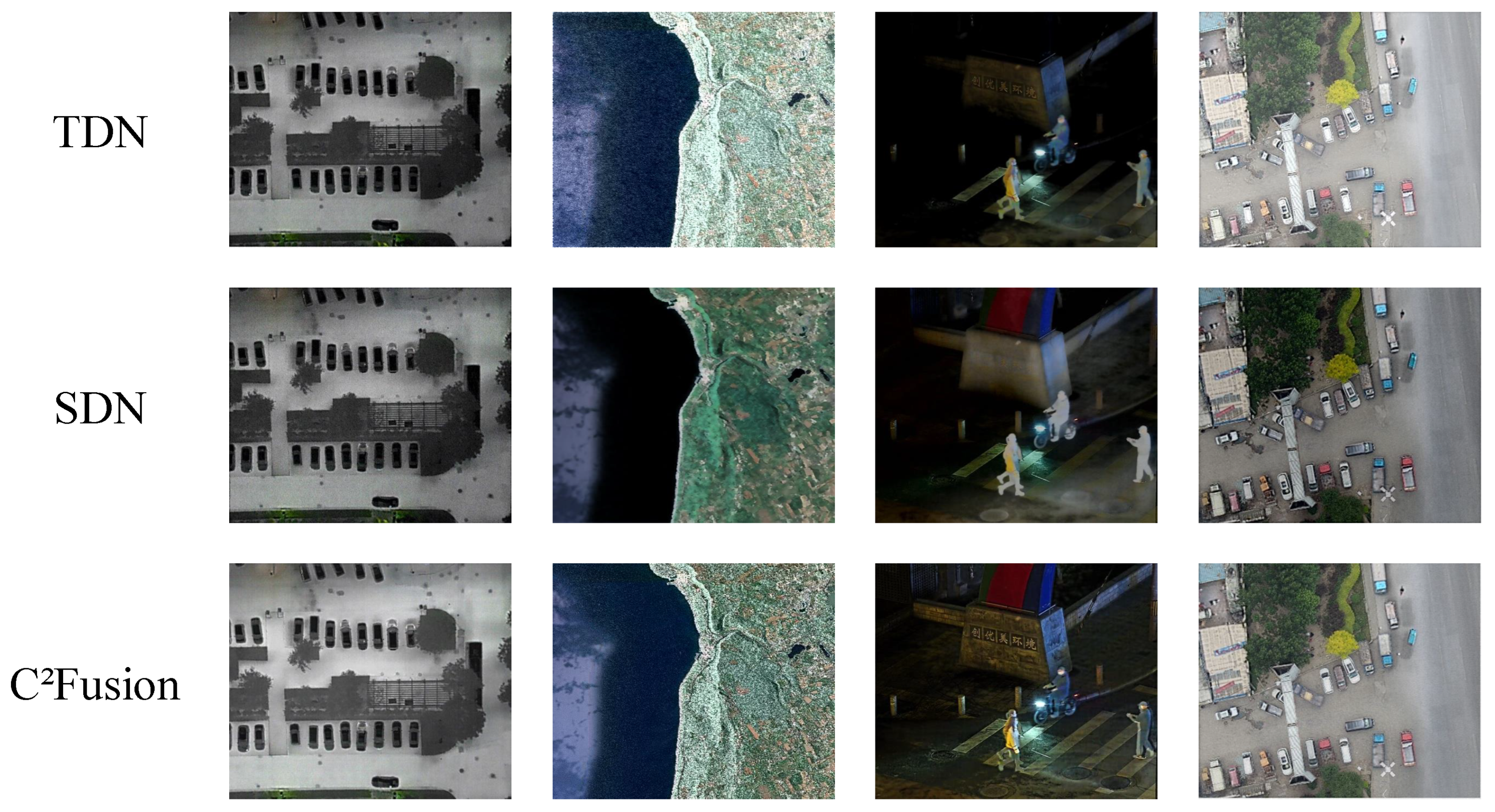
Investigation on Multi-Branch Outputs. To analyze the modality-specific roles of each branch in C 2 Fusion, we perform a diagnostic ablation on the trained model by exposing three image-domain outputs during inference: the structure-focused SDN output, the texture-focused TDN output, and the final fused image produced after the refinement stage. All other settings remain identical to the main experiments. We evaluate these outputs on the DroneVehicle, LLVIP, and MAVS test sets using EI, EN, and MI, which reflect edge sharpness, information richness, and overall information preservation, respectively.
Table 6 summarizes the quantitative results. It should be noted that the outputs of both SDN and TDN are image-domain results rather than feature-domain representations; that is, each branch directly produces a fused image. We further visualize the SDN and TDN outputs in Figure 5. It can be observed that the TDN output tends to present a smoother global appearance and relatively lower contrast, which is consistent with its objective of preserving texture-related information and luminance stability. In contrast, the SDN output shows higher contrast and sharper edges, suggesting its stronger ability to preserve structural boundaries and geometric layouts. Nevertheless, some fine details are weakened in the SDN output, as this branch mainly emphasizes structural fidelity rather than rich texture reconstruction.
To further support this observation, we conduct a frequency-domain analysis in Table 7. The results show that TDN consistently has a higher low-frequency energy ratio, indicating its stronger tendency to preserve luminance consistency and regional stability, while SDN has a higher high-frequency energy ratio, reflecting its stronger response to edges, contours, and local structural variations. The final C 2 Fusion output lies between the two branches, suggesting that FRN effectively integrates the complementary low-frequency and high-frequency characteristics.
Although these visual differences may not always be obvious in every local region, the quantitative and frequency-domain results jointly confirm the functional specialization of the two branches. SDN achieves stronger EI performance, demonstrating its advantage in preserving edge and structural information, while TDN obtains competitive EN and MI scores, reflecting its ability to retain richer texture and information content. The final fused output integrates these complementary properties through FRN and achieves a more balanced performance, further verifying the effectiveness of the proposed dual-branch design.
Loss-level Diagnostic Ablation. To systematically validate the role of the proposed loss designs within the dual-pathway diffusion framework, we conducted targeted loss ablation studies. While keeping the basic losses (diffusion noise prediction loss L ϵ , gradient loss L grad , and structural similarity loss L ssim ) constant, we sequentially removed the five key constraint terms proposed in this paper to quantify their individual contributions and coupling effects.
In our experimental configuration, we maintain consistency across the network architecture, optimizer, and training strategy, while sequentially removing the aforementioned loss terms. Evaluation is conducted on three datasets—DroneVehicle, LLVIP, and MAVS—using three metrics: Edge Intensity (EI), Entropy (EN), and Mutual Information (MI), to reflect structural fidelity, information content, and cross-modal consistency, respectively. The experimental results are presented in Table 8. Here, “w/o” stands for “without”, denoting the variant of our model where the corresponding loss function component is removed to verify its individual effectiveness. The key observations are as follows:
  • The removal of L edge or L hf leads to a significant decrease in EI, with the fused images manifesting blurred boundaries and missing details; this demonstrates that structure-related constraints are indispensable for maintaining geometric fidelity.
  • The removal of L tex or L lf results in a marked decrease in EN and MI, accompanied by luminance instability and texture blurring; this underscores the critical importance of texture and luminance/low-frequency constraints for detail preservation.
  • The removal of L coll results in a concurrent decline in both EI and MI, alongside diminished cross-branch complementarity; this demonstrates the pivotal role of collaborative constraints in information fusion and feature alignment.
  • Upon the removal of all proposed constraints, the model degenerates into a framework relying solely on conventional diffusion and perceptual losses, resulting in over-smoothing and a loss of detail; this validates the necessity of the loss system proposed in this study.
In summary, the five categories of losses proposed in this paper establish a complementary mechanism within the overall optimization process: Structure-related losses ( L edge , L hf ) ensure edge and high-frequency fidelity. Texture-related losses ( L tex , L lf ) ensure edge and low-frequency fidelity. Collaborative consistency losses ( L coll ) facilitate information sharing and fusion across the dual branches. The comprehensive loss system enables C 2 Fusion to simultaneously achieve an optimal balance of structural clarity, information content, and cross-modal consistency across three categories of datasets. The five loss terms subject to ablation are as follows:
  • Edge Consistency Loss L edge : This loss term constrains the consistency between the fused result and the most prominent edge regions in the input source images, thereby enhancing structural clarity and contour fidelity.
  • High-Frequency Consistency Loss L hf : This loss term utilizes Laplacian filtering to extract high-frequency components, encouraging the model to preserve details and sharpness while preventing over-smoothing.
  • Texture Consistency Loss L tex : This loss term employs multi-directional texture filters to constrain the local structural responses of both visible and infrared modalities, thereby enhancing detail consistency.
  • Low-Frequency Consistency Loss L lf : This loss term utilizes Gaussian blurring to extract low-frequency components, achieving alignment in energy distributions while suppressing large-scale luminance drift.
  • Collaborative Loss L coll : This loss term establishes complementary constraints within the dual-branch latent space, enabling the dynamic alignment and fusion of information from both the structural and textural branches.


5. Discussion

Recent diffusion-based generative models for remote sensing, such as Text2Earth [64] and MetaEarth [65], have shown promising capabilities in large-scale scene modeling, multi-resolution image generation, and downstream task transfer. These advances indicate that diffusion models can learn rich remote-sensing priors, including spatial layouts, land-cover structures, and texture distributions, which may also benefit infrared-visible image fusion. In future work, such remote sensing generative priors could be transferred to fusion models through parameter-efficient fine-tuning, conditional adaptation, or feature distillation, thereby improving cross-scene generalization and structure preservation in weak-texture regions. However, directly applying large generative diffusion models to image fusion still remains challenging. Unlike general image generation, infrared-visible fusion requires faithful preservation of complementary information from both source modalities and should avoid hallucinated structures or unrealistic textures. In addition, the high computational cost and relatively slow sampling process of large diffusion models may limit their practical use in real-time remote sensing applications. Therefore, future work will explore lightweight adaptation, efficient sampling strategies, and modality-consistency constraints to better transfer diffusion-based remote sensing foundation models to infrared-visible image fusion.

6. Conclusions

In this paper, we propose C 2 Fusion, a Collaborative Conditional difFusion method for the IVIF task of RS images. First, we propose a dual-branch conditional diffusion network to disentangle structure and texture features, and a feature refinement network that adaptively fuses the branch outputs. Second, for adapting to the features of RS images, we propose a series of loss functions (e.g., edge consistency loss, texture consistency loss, high-frequency consistency loss, and collaborative loss) to further improve the performance on fusing RS imagery. Qualitative and quantitative experiments show that for the IVIF task of RS imagery, our method achieves competitive and often superior performance compared with state-of-the-art methods.

Author Contributions

Conceptualization, A.G. and S.C.; methodology, A.G. and S.C.; software, A.G., S.C. and K.Y.; validation, A.G., S.C. and K.Y.; formal analysis, A.G., S.C., K.Y. and Y.J.; investigation, A.G., S.C., K.Y., Y.J., Y.C. and J.C.; resources, H.S.; data curation, A.G., S.C., K.Y., Y.J., Y.C. and J.C.; writing—original draft preparation, A.G., S.C. and K.Y.; writing—review and editing, A.G., S.C., Y.J., Y.C. and H.S.; visualization, A.G., S.C., K.Y., Y.J. and J.C.; supervision, H.S.; project administration, H.S.; funding acquisition, H.S. All authors have read and agreed to the published version of the manuscript.

Funding

This research was funded by the China Postdoctoral Science Foundation, grant number 2024M762991; the National Natural Science Foundation of China, grant numbers U24A20326, 62325602, 62036010, and 62372415; and the Henan Province Science Foundation, grant numbers 242300421050 and 242300420948. The APC was funded by the authors.

Data Availability Statement

All data analyzed or generated in the course of the presented study are available from the corresponding author upon request.

Conflicts of Interest

The authors declare no conflicts of interest.

References

  1. Li, S.; Kang, X.; Fang, L.; Hu, J.; Yin, H. Pixel-level image fusion: A survey of the state of the art. Inf. Fusion 2017, 33, 100–112. [Google Scholar] [CrossRef] [Scilit]
  2. Du, P.; Bai, X.; Tan, K.; Xue, Z.; Samat, A.; Xia, J.; Li, E.; Su, H.; Liu, W. Advances of four machine learning methods for spatial data handling: A review. J. Geovis. Spat. Anal. 2020, 4, 13. [Google Scholar] [CrossRef] [Scilit]
  3. Nasrabadi, N.M. Hyperspectral Target Detection: An Overview of Current and Future Challenges. IEEE Signal Process. Mag. 2014, 31, 34–44. [Google Scholar] [CrossRef] [Scilit]
  4. Cao, Y.; Guan, D.; Huang, W.; Yang, J.; Cao, Y.; Qiao, Y. Pedestrian detection with unsupervised multispectral feature learning using deep neural networks. Inf. Fusion 2019, 46, 206–217. [Google Scholar] [CrossRef] [Scilit]
  5. Gong, J.; Sui, H.; Ma, G.; Zhou, Q. A review of multi-temporal remote sensing data change detection algorithms. Int. Arch. Photogramm. Remote Sens. Spat. Inf. Sci. 2008, 37, 757–762. [Google Scholar]
  6. Zhang, Y.; Chen, J.; Wang, J.; Shi, D.; Han, S.; Deng, L. C2DFF-Net for Object Detection in Multimodal Remote Sensing Images. IEEE Trans. Geosci. Remote Sens. 2025, 63, 1–16. [Google Scholar] [CrossRef] [Scilit]
  7. Kotaridis, I.; Lazaridou, M. Remote sensing image segmentation advances: A meta-analysis. ISPRS J. Photogramm. Remote Sens. 2021, 173, 309–322. [Google Scholar] [CrossRef] [Scilit]
  8. Liu, J.; Liu, Z.; Wu, G.; Ma, L.; Liu, R.; Zhong, W.; Luo, Z.; Fan, X. Multi-interactive feature learning and a full-time multi-modality benchmark for image fusion and segmentation. In Proceedings of the IEEE/CVF International Conference on Computer Vision; IEEE: Piscataway, NJ, USA, 2023; pp. 8115–8124. [Google Scholar]
  9. Zhang, X.; Zhai, H.; Liu, J.; Wang, Z.; Sun, H. Real-time infrared and visible image fusion network using adaptive pixel weighting strategy. Inf. Fusion 2023, 99, 101863. [Google Scholar] [CrossRef] [Scilit]
  10. Koch, W.; Koller, J.; Ulmke, M. Ground target tracking and road map extraction. ISPRS J. Photogramm. Remote Sens. 2006, 61, 197–208. [Google Scholar] [CrossRef] [Scilit]
  11. Li, H.; Wu, X.J. DenseFuse: A Fusion Approach to Infrared and Visible Images. IEEE Trans. Image Process. 2019, 28, 2614–2623. [Google Scholar] [CrossRef] [Scilit]
  12. Zhang, Q.; Zhao, S.; Luo, Y.; Zhang, D.; Huang, N.; Han, J. ABMDRNet: Adaptive-weighted Bi-directional Modality Difference Reduction Network for RGB-T Semantic Segmentation. In Proceedings of the IEEE/CVF Conference on Computer Vision and Pattern Recognition (CVPR); IEEE: Piscataway, NJ, USA, 2021; pp. 2633–2642. [Google Scholar]
  13. Yurtsever, E.; Lambert, J.; Carballo, A.; Takeda, K. A survey of autonomous driving: Common practices and emerging technologies. IEEE Access 2020, 8, 58443–58469. [Google Scholar] [CrossRef] [Scilit]
  14. Ma, J.; Ma, Y.; Li, C. Infrared and visible image fusion methods and applications: A survey. Inf. Fusion 2019, 45, 153–178. [Google Scholar] [CrossRef] [Scilit]
  15. Tang, L.; Yuan, J.; Zhang, H.; Jiang, X.; Ma, J. PIAFusion: A progressive infrared and visible image fusion network based on illumination aware. Inf. Fusion 2022, 83, 79–92. [Google Scholar] [CrossRef] [Scilit]
  16. Wang, D.; Liu, J.; Fan, X.; Liu, R. Unsupervised misaligned infrared and visible image fusion via cross-modality image generation and registration. arXiv 2022, arXiv:2205.11876. [Google Scholar]
  17. Sun, Y.; Cao, B.; Zhu, P.; Hu, Q. Detfusion: A detection-driven infrared and visible image fusion network. In Proceedings of the 30th ACM International Conference on Multimedia; Association for Computing Machinery: New York, NY, USA, 2022; pp. 4003–4011. [Google Scholar]
  18. Liu, Y.; Liu, S.; Wang, Z. A general framework for image fusion based on multi-scale transform and sparse representation. Inf. Fusion 2015, 24, 147–164. [Google Scholar] [CrossRef] [Scilit]
  19. Chang, X.; Jiao, L.; Liu, F.; Xin, F. Multicontourlet-Based Adaptive Fusion of Infrared and Visible Remote Sensing Images. IEEE Geosci. Remote Sens. Lett. 2010, 7, 549–553. [Google Scholar] [CrossRef] [Scilit]
  20. Liu, Y.; Chen, X.; Ward, R.K.; Wang, Z.J. Image Fusion With Convolutional Sparse Representation. IEEE Signal Process. Lett. 2016, 23, 1882–1886. [Google Scholar] [CrossRef] [Scilit]
  21. Bavirisetti, D.P.; Dhuli, R. Two-scale image fusion of visible and infrared images using saliency detection. Infrared Phys. Technol. 2016, 76, 52–64. [Google Scholar] [CrossRef] [Scilit]
  22. Ma, J.; Zhou, Z.; Wang, B.; Zong, H. Infrared and visible image fusion based on visual saliency map and weighted least square optimization. Infrared Phys. Technol. 2017, 82, 8–17. [Google Scholar] [CrossRef] [Scilit]
  23. Zhao, Z.; Xu, S.; Zhang, J.; Liang, C.; Zhang, C.; Liu, J. Efficient and model-based infrared and visible image fusion via algorithm unrolling. IEEE Trans. Circuits Syst. Video Technol. 2021, 32, 1186–1196. [Google Scholar] [CrossRef] [Scilit]
  24. Liu, J.; Fan, X.; Jiang, J.; Liu, R.; Luo, Z. Learning a deep multi-scale feature ensemble and an edge-attention guidance for image fusion. IEEE Trans. Circuits Syst. Video Technol. 2021, 32, 105–119. [Google Scholar]
  25. Xu, H.; Zhang, H.; Ma, J. Classification saliency-based rule for visible and infrared image fusion. IEEE Trans. Comput. Imaging 2021, 7, 824–836. [Google Scholar] [CrossRef] [Scilit]
  26. Ma, J.; Yu, W.; Liang, P.; Li, C.; Jiang, J. FusionGAN: A generative adversarial network for infrared and visible image fusion. Inf. Fusion 2019, 48, 11–26. [Google Scholar] [CrossRef] [Scilit]
  27. Ma, J.; Zhang, H.; Shao, Z.; Liang, P.; Xu, H. GANMcC: A Generative Adversarial Network with Multiclassification Constraints for Infrared and Visible Image Fusion. IEEE Trans. Instrum. Meas. 2021, 70, 1–14. [Google Scholar] [CrossRef] [Scilit]
  28. Ho, J.; Jain, A.; Abbeel, P. Denoising diffusion probabilistic models. Adv. Neural Inf. Process. Syst. 2020, 33, 6840–6851. [Google Scholar]
  29. Song, J.; Meng, C.; Ermon, S. Denoising Diffusion Implicit Models. arXiv 2020, arXiv:2010.02502. [Google Scholar]
  30. Wang, D.; Yan, Z.; Liu, P. Fine-Grained Interpretation of Remote Sensing Image: A Review. Remote Sens. 2025, 17, 3887. [Google Scholar] [CrossRef] [Scilit]
  31. Huo, C.; Chen, K.; Zhang, S.; Wang, Z.; Yan, H.; Shen, J.; Hong, Y.; Qi, G.; Fang, H.; Wang, Z. When Remote Sensing Meets Foundation Model: A Survey and Beyond. Remote Sens. 2025, 17, 179. [Google Scholar] [CrossRef] [Scilit]
  32. Singh, R.; Vatsa, M.; Noore, A. Integrated multilevel image fusion and match score fusion of visible and infrared face images for robust face recognition. Pattern Recognit. 2008, 41, 880–893. [Google Scholar] [CrossRef] [Scilit]
  33. Yi, X.; Tang, L.; Zhang, H.; Xu, H.; Ma, J. Diff-IF: Multi-modality Image Fusion via Diffusion Model with Fusion Knowledge Prior. Inf. Fusion 2024, 110, 102450. [Google Scholar] [CrossRef] [Scilit]
  34. Zhao, Z.; Bai, H.; Zhu, Y.; Zhang, J.; Xu, S.; Zhang, Y.; Zhang, K.; Meng, D.; Timofte, R.; Van Gool, L. DDFM: Denoising diffusion model for multi-modality image fusion. In Proceedings of the IEEE/CVF International Conference on Computer Vision; IEEE: Piscataway, NJ, USA, 2023; pp. 8082–8093. [Google Scholar]
  35. Zhao, Z.; Xu, S.; Zhang, C.; Liu, J.; Li, P.; Zhang, J. DIDFuse: Deep image decomposition for infrared and visible image fusion. arXiv 2020, arXiv:2003.09210. [Google Scholar]
  36. Cao, Z.; Xu, L.; Yu, H.; Sun, H.; Yuan, W.; Zhang, R. Co-D 2: Collaborative Detection and De-ghosting with Radar-guided Infrared Perception. IEEE Trans. Mob. Comput. 2026, 1–14. [Google Scholar] [CrossRef] [Scilit]
  37. Zhang, R.; Chen, K.; Li, L.; Zhou, D.; Xu, Y.; Lin, Z.; Xu, L.; Song, W. Band-Mixed Edge-Aware Interaction Learning for RGB-T Camouflaged Object Detection. IEEE Trans. Multimed. 2026, 1–12. [Google Scholar] [CrossRef] [Scilit]
  38. Xu, H.; Ma, J.; Jiang, J.; Guo, X.; Ling, H. U2Fusion: A unified unsupervised image fusion network. IEEE Trans. Pattern Anal. Mach. Intell. 2020, 44, 502–518. [Google Scholar] [CrossRef] [Scilit]
  39. Li, S.; Zou, Y.; Wang, G.; Lin, C. Infrared and Visible Image Fusion Method Based on a Principal Component Analysis Network and Image Pyramid. Remote Sens. 2023, 15, 685. [Google Scholar] [CrossRef] [Scilit]
  40. Rao, D.; Xu, T.; Wu, X.J. TGFuse: An infrared and visible image fusion approach based on transformer and generative adversarial network. IEEE Trans. Image Process. 2023, 1. [Google Scholar] [CrossRef] [Scilit] [PubMed]
  41. Lai, J.; Geng, J.; Deng, X.; Jiang, W. DDFN: Deblurring Dictionary Encoding Fusion Network for Infrared and Visible Image Object Detection. IEEE Geosci. Remote Sens. Lett. 2023, 20, 1–5. [Google Scholar] [CrossRef] [Scilit]
  42. Tang, L.; Yuan, J.; Ma, J. Image fusion in the loop of high-level vision tasks: A semantic-aware real-time infrared and visible image fusion network. Inf. Fusion 2022, 82, 28–42. [Google Scholar] [CrossRef] [Scilit]
  43. Xiang, X.; Zhou, G.; Niu, B.; Pan, Z.; Huang, L.; Li, W.; Wen, Z.; Qi, J.; Gao, W. Infrared-Visible Image Fusion Meets Object Detection: Towards Unified Optimization for Multimodal Perception. Remote Sens. 2025, 17, 3637. [Google Scholar] [CrossRef] [Scilit]
  44. Ma, J.; Xu, H.; Jiang, J.; Mei, X.; Zhang, X.P. DDcGAN: A dual-discriminator conditional generative adversarial network for multi-resolution image fusion. IEEE Trans. Image Process. 2020, 29, 4980–4995. [Google Scholar] [CrossRef] [Scilit]
  45. Liu, J.; Fan, X.; Huang, Z.; Wu, G.; Liu, R.; Zhong, W.; Luo, Z. Target-aware Dual Adversarial Learning and a Multi-scenario Multi-Modality Benchmark to Fuse Infrared and Visible for Object Detection. In Proceedings of the IEEE/CVF Conference on Computer Vision and Pattern Recognition (CVPR); IEEE: Piscataway, NJ, USA, 2022; pp. 5802–5811. [Google Scholar]
  46. Liu, G.; Zhang, R.; Xu, L.; Zhang, Q.; Zhou, D. Dif-CDFusion: A Diffusion-Based Common–Differential Network for Infrared and Visible Image Fusion. IEEE Trans. Geosci. Remote Sens. 2025, 63, 1–13. [Google Scholar] [CrossRef] [Scilit]
  47. Vaswani, A.; Shazeer, N.; Parmar, N.; Uszkoreit, J.; Jones, L.; Gomez, A.N.; Kaiser, Ł.; Polosukhin, I. Attention is all you need. Adv. Neural Inf. Process. Syst. 2017, 30. [Google Scholar] [CrossRef] [Scilit]
  48. Zamir, S.W.; Arora, A.; Khan, S.; Hayat, M.; Khan, F.S.; Yang, M.H. Restormer: Efficient Transformer for High-Resolution Image Restoration. In Proceedings of the IEEE/CVF Conference on Computer Vision and Pattern Recognition (CVPR); IEEE: Piscataway, NJ, USA, 2022; pp. 5728–5739. [Google Scholar]
  49. Liu, X.; Wang, Z.; Gao, H.; Li, X.; Wang, L.; Miao, Q. HATF: Multi-Modal Feature Learning for Infrared and Visible Image Fusion via Hybrid Attention Transformer. Remote Sens. 2024, 16, 803. [Google Scholar] [CrossRef] [Scilit]
  50. Burt, P.J.; Adelson, E.H. The Laplacian pyramid as a compact image code. IEEE Trans. Commun. 1983, 31, 532–540. [Google Scholar] [CrossRef] [Scilit]
  51. Sobel, I. An isotropic 3x3 image gradient operator. In Machine Vision for Three-Dimensional Scenes; Academic Press: Cambridge, MA, USA, 1990; pp. 376–379. [Google Scholar]
  52. Ojala, T.; Pietikainen, M.; Maenpaa, T. Multiresolution gray-scale and rotation invariant texture classification with local binary patterns. IEEE Trans. Pattern Anal. Mach. Intell. 2002, 24, 971–987. [Google Scholar] [CrossRef] [Scilit]
  53. Kirsch, R.A. Computer determination of the constituent structure of biological images. Comput. Biomed. Res. 1971, 4, 315–328. [Google Scholar] [CrossRef] [Scilit] [PubMed]
  54. Charbonnier, P.; Blanc-Feraud, L.; Aubert, G.; Barlaud, M. Two deterministic half-quadratic regularization algorithms for computed imaging. In Proceedings of the 1st International Conference on Image Processing; IEEE: Piscataway, NJ, USA, 1994; Volume 2, pp. 168–172. [Google Scholar]
  55. Sun, Y.; Cao, B.; Zhu, P.; Hu, Q. Drone-based RGB-Infrared Cross-Modality Vehicle Detection via Uncertainty-Aware Learning. IEEE Trans. Circuits Syst. Video Technol. 2022, 32, 6700–6713. [Google Scholar] [CrossRef] [Scilit]
  56. Jia, X.; Zhu, C.; Li, M.; Tang, W.; Zhou, W. LLVIP: A visible-infrared paired dataset for low-light vision. In Proceedings of the IEEE/CVF International Conference on Computer Vision; IEEE: Piscataway, NJ, USA, 2021; pp. 3496–3504. [Google Scholar]
  57. Zhao, X.; Zhao, L.; Li, H.; Zhang, Z.; Tang, P. A Multimodal Visible-SAR Dataset for Airport Detection in Remote Sensing Imagery; Science Data Bank: Beijing, China, 2025; Available online: https://www.scidb.cn/en/detail?dataSetId=29765a93b1c54e3d9fac27dbc03b8214 (accessed on 1 August 2025).
  58. Kingma, D.P.; Ba, J. Adam: A method for stochastic optimization. arXiv 2014, arXiv:1412.6980. [Google Scholar]
  59. Zhao, Z.; Bai, H.; Zhang, J.; Zhang, Y.; Xu, S.; Lin, Z.; Timofte, R.; Van Gool, L. CDDFuse: Correlation-Driven Dual-Branch Feature Decomposition for Multi-Modality Image Fusion. In Proceedings of the IEEE/CVF Conference on Computer Vision and Pattern Recognition (CVPR); IEEE: Piscataway, NJ, USA, 2023; pp. 5906–5916. [Google Scholar]
  60. Zhao, W.; Xie, S.; Zhao, F.; He, Y.; Lu, H. MetaFusion: Infrared and Visible Image Fusion via Meta-Feature Embedding from Object Detection. In Proceedings of the IEEE/CVF Conference on Computer Vision and Pattern Recognition (CVPR); IEEE: Piscataway, NJ, USA, 2023; pp. 13955–13965. [Google Scholar]
  61. Huang, Z.; Liu, J.; Fan, X.; Liu, R.; Zhong, W.; Luo, Z. ReCoNet: Recurrent Correction Network for Fast and Efficient Multi-modality Image Fusion. In Proceedings of the Computer Vision (ECCV); Springer: Cham, Switzerland, 2022; pp. 539–555. [Google Scholar]
  62. Bai, H.; Zhang, J.; Zhao, Z.; Wu, Y.; Deng, L.; Cui, Y.; Feng, T.; Xu, S. Task-driven Image Fusion with Learnable Fusion Loss. In Proceedings of the IEEE/CVF Conference on Computer Vision and Pattern Recognition (CVPR); IEEE: Piscataway, NJ, USA, 2025; pp. 7457–7468. [Google Scholar]
  63. Fei, X.; Guo, M.; Li, Y.; Yu, R.; Sun, L. ACDF-YOLO: Attentive and Cross-Differential Fusion Network for Multimodal Remote Sensing Object Detection. Remote Sens. 2024, 16, 3532. [Google Scholar] [CrossRef] [Scilit]
  64. Liu, C.; Chen, K.; Zhao, R.; Zou, Z.; Shi, Z. Text2Earth: Unlocking text-driven remote sensing image generation with a global-scale dataset and a foundation model. IEEE Geosci. Remote. Sens. Mag. 2025, 13, 238–259. [Google Scholar] [CrossRef] [Scilit]
  65. Yu, Z.; Liu, C.; Liu, L.; Shi, Z.; Zou, Z. Metaearth: A generative foundation model for global-scale remote sensing image generation. IEEE Trans. Pattern Anal. Mach. Intell. 2024, 47, 1764–1781. [Google Scholar]
Figure 1. Our method effectively disentangles the texture and structural features in remote sensing (RS) imagery (including low-altitude RS and satellite RS Imagery), which can achieve state-of-the-art performance on the IVIF task.
Remotesensing 18 02402 g001
Figure 2. System Pipeline. Given an infrared RS image I i r and a visible RS image I v i , our C 2 Fusion is modeled as a function Φ to generate a high-quality fused RS image I f = Φ ( I i r , I v i ) . The model is composed of a structure branch diffusion network (a), a texture branch diffusion network (b), and a feature refinement network (c).
Remotesensing 18 02402 g002
Figure 3. Visual comparison results of different fusion methods on LLVIP, DroneVehicle, and MAVS datasets.
Remotesensing 18 02402 g003
Figure 4. Detection performance comparison of different fusion methods on two sample images from the LLVIP dataset.
Remotesensing 18 02402 g004
Figure 5. Visualization of SDN TDN and C 2 Fusion outputs.
Remotesensing 18 02402 g005
Table 1. Setting of Loss Weights in Equations (1), (6), (9), and (11).
GroupWeights (Symbol = Value)
L ϵ L coll L edge / L tex / L x 0 L hf / L lf / L max L grad L ssim
L s t r λ 1 s = 2.0 λ 6 s = 1.0 λ 2 s = 1.3 λ 3 s = 1.2 λ 4 s = 0.6 λ 5 s = 1.2
L t e x λ 1 t = 2.0 λ 6 t = 1.0 λ 2 t = 1.5 λ 3 t = 1.3 λ 4 t = 1.5 λ 5 t = 0.8
L r e f λ 1 r = 1.0 λ 2 r = 1.2 λ 3 r = 1.5 λ 4 r = 1.0
Total λ 1 = 0.8 , λ 2 = 0.7 , λ 3 = 1.0
Table 2. Quantitative results of infrared-visible image fusion on DroneVehicle, LLVIP, and MAVS datasets. The best result is in red and the second one is in violet.
MethodDroneVehicle DatasetLLVIP DatasetMAVS Dataset
MIENVIFPSNREISSIMMIENVIFPSNREISSIMMIENVIFPSNREISSIM
TarDAL1.985.021.0132.6946.531.592.256.630.8528.0940.511.120.766.730.4927.7287.530.70
MetaFusion1.905.140.8430.5851.131.381.237.030.7228.3775.691.060.937.520.5628.01222.861.01
CDDFuse2.394.920.9230.4546.551.622.757.090.8929.1658.471.321.246.540.6428.35153.791.09
DDFM2.535.150.8431.5341.331.392.217.260.7928.8359.241.351.057.180.6827.93125.281.03
U2Fusion2.335.090.8128.9239.951.321.676.420.7327.1243.521.011.136.280.4126.92119.020.72
FusionGAN2.415.010.9531.6947.361.462.497.250.8428.9357.191.261.277.020.6227.39142.951.03
Diff-IF2.675.101.0232.6844.531.582.597.310.9030.0156.901.311.237.240.5828.77163.400.94
ReCoNet2.215.070.8826.7635.981.541.275.660.6927.5648.780.810.936.920.6328.00105.790.88
TDFusion2.445.110.9930.4945.121.631.867.240.9128.3151.541.291.227.300.6428.11186.741.09
C 2 Fusion2.765.171.0432.7244.191.622.627.310.9330.1263.321.301.297.260.7228.81168.281.04
Table 3. Performance comparison of downstream object detection on M 3 FD [45] and LLVIP datasets. The best result is in red and the second one is in violet.
Method M 3 FDLLVIP
mAP 50 mAP 75 AP 50 AP 75
Infrared76.5450.2585.3158.39
Visible78.2152.8274.5247.98
TarDAL82.5254.7590.7965.41
MetaFusion83.1656.6594.8366.23
CDDFuse85.2457.9395.2466.91
DDFM79.8752.2588.2962.33
U2Fusion80.1356.3192.1163.56
FusionGAN82.7955.2294.2967.36
Diff-IF84.6956.9795.9668.49
ReCoNet83.2857.1493.0366.21
TDFusion85.6157.4595.3867.33
C 2 Fusion88.2759.7196.1169.18
Table 4. Ablation study on different pseudo-supervisory fusion priors. The outputs of representative fusion methods are used as the pseudo-supervised image I f to retrain C 2 Fusion under identical experimental settings. The better result within each baseline-prior pair is highlighted in red.
Method/VariantDroneVehicle DatasetLLVIP DatasetMAVS Dataset
MIENVIFPSNREISSIMMIENVIFPSNREISSIMMIENVIFPSNREISSIM
ReCoNet2.215.070.8826.7635.981.541.275.660.6927.5648.780.810.936.920.6328.00105.790.88
ReCoNet prior2.694.991.0429.1744.651.571.415.860.9427.9255.311.011.226.950.6028.50125.540.93
CDDFuse2.394.920.9230.4546.551.622.757.090.8929.1658.471.321.246.540.6428.35153.791.09
CDDFuse prior2.875.081.1432.3944.441.562.917.750.8830.3561.581.301.287.060.6329.24173.691.14
TDFusion2.445.110.9930.4945.121.631.867.240.9128.3151.541.291.227.300.6428.11186.741.09
TDFusion prior2.765.051.1031.5846.841.561.957.420.9629.1553.201.341.157.150.6828.56192.451.12
U2Fusion2.335.090.8128.9239.951.321.676.420.7327.1243.521.011.136.280.4126.92119.020.72
U2Fusion prior2.415.150.7829.3540.821.361.726.250.7627.6844.901.051.086.410.4327.25122.500.75
Diff-IF2.675.101.0232.6844.531.582.597.310.9030.0156.901.311.237.240.5828.77163.400.94
C 2 Fusion2.765.171.0432.7244.191.622.627.310.9330.1263.321.301.297.260.7228.81168.281.04
Table 5. Diffusion branch replacement ablation on DroneVehicle, LLVIP, and MAVS. Best is red. Second is violet.
OutputDroneVehicleLLVIPMAVS
EIENMIEIENMIEIENMI
CNN39.874.122.4557.186.832.07148.336.411.34
CNN-Trans41.525.481.9354.957.422.44141.056.951.12
C 2 Fusion44.195.172.7663.327.312.62168.287.261.29
Table 6. Diagnostic ablation on DroneVehicle, LLVIP, and MAVS. Best is red; second is violet.
OutputDroneVehicleLLVIPMAVS
EIENMIEIENMIEIENMI
SDN50.564.532.3456.247.282.33147.406.151.16
TDN40.326.782.2552.637.581.55139.176.961.09
FRN44.195.172.7663.327.312.62168.287.261.29
Table 7. Frequency-domain analysis of SDN, TDN, and final C 2 Fusion outputs. Best is red.
OutputDroneVehicleLLVIPMAVS
R low R high R low R high R low R high
TDN0.84680.15320.84360.15640.86330.1367
SDN0.61440.38560.66010.33990.59680.4032
C 2 Fusion0.82250.17750.82970.17030.83500.1650
Table 8. Loss ablation on DroneVehicle, LLVIP, and MAVS (EI/EN/MI). Best is red; second is violet.
VariantDroneVehicleLLVIPMAVS
EIENMIEIENMIEIENMI
w/o L edge 40.124.932.4358.346.732.51153.127.061.10
w/o L hf 41.265.122.4556.616.582.48155.387.071.09
w/o L tex 41.884.902.3959.156.372.49156.417.201.11
w/o L lf 41.374.832.3657.586.682.71153.626.971.06
w/o L coll 43.425.082.7961.027.062.59160.857.181.17
L total 44.195.172.7663.327.312.62168.287.261.29
Disclaimer/Publisher’s Note: The statements, opinions and data contained in all publications are solely those of the individual author(s) and contributor(s) and not of MDPI and/or the editor(s). MDPI and/or the editor(s) disclaim responsibility for any injury to people or property resulting from any ideas, methods, instructions or products referred to in the content.