Article

V3Reg: Model Integrating Visual Information for Extreme Low Overlap Point Cloud Registration

College of Combat Support, Rocket Force University of Engineering, Xi’an 710025, China
*
Author to whom correspondence should be addressed.
Remote Sens. 2026, 18(12), 2050; https://doi.org/10.3390/rs18122050
Submission received: 12 May 2026 / Revised: 10 June 2026 / Accepted: 13 June 2026 / Published: 21 June 2026
(This article belongs to the Special Issue Point Cloud Data Analysis and Applications)

Highlights

What are the main findings?
  • We propose V3Reg, a visual–geometric point cloud registration framework that maps DINOv3 patch-level image representations onto 3D points to strengthen matching when geometric overlap is extremely limited.
  • A task-aware channel-wise gated fusion module is developed to dynamically balance visual and geometric cues; on RGBD-ZeroMatch, V3Reg maintains 50.2% registration recall at only 5% overlap.
What are the implications of the main findings?
  • The proposed framework shows that foundation-model visual features can provide reliable complementary constraints when pure geometric correspondences are too sparse or ambiguous.
  • The adaptive fusion strategy and RGBD-ZeroMatch benchmark support more robust evaluation and development of RGB-D registration methods for real-world low-overlap scenarios.

Abstract

Extremely low overlap leads to severely scarce local geometric correspondences across frame pairs. Pure geometric descriptors—encoding merely low-level shape signatures—inherently fail to impose sufficient constraints for reliable transformation estimation when matches become critically sparse, rendering registration fundamentally fragile. While recent red-green-blue-depth (RGB-D) attempts have explored visual augmentation, they predominantly rely on low-level chromatic statistics or shallow convolutional neural network (CNN) features, underutilizing the rich hierarchical semantics inherent in RGB imagery. We present V3Reg, a robust registration framework that pioneers the integration of large-scale vision foundation models (DINOv3) with adaptive cross-modal fusion. Specifically, we extract mid-to-deep semantic features (Layer 11) from DINOv3 to transcend low-level texture limitations, and propose a Task-Aware Channel-Wise Gated Adaptive Fusion (TACGAF) module that dynamically calibrates geometric-visual contributions via registration-error-guided channel-wise gating. To rigorously evaluate ultra-low-overlap robustness, we reconstruct RGBD-ZeroMatch, a benchmark with controllable overlap ratios ranging from 1% to 20%. Extensive experiments demonstrate that V3Reg achieves 99.6% Feature Matching Recall and 96.3% Registration Recall on standard benchmarks. Notably, it maintains 50.2% Registration Recall at merely 5% overlap, outperforming prior methods by over 18 percentage points.

1. Introduction

Point cloud registration is a fundamental task in 3D computer vision, underpinning applications such as robotic perception, autonomous navigation, augmented reality, and large-scale scene reconstruction. The goal is to estimate the rigid transformation that aligns two partially overlapping point clouds captured from different viewpoints. While progress has been steady under moderate overlap, the case of extremely low overlap—where only a tiny fraction of surface area is shared between frames—remains an open and practically important challenge. Indoor environments routinely exhibit this condition near doorways, stairwells, and around furniture, and the problem is exacerbated by planar surfaces, symmetric layouts, and repeated structures that produce geometrically similar local patterns across unrelated regions.
The mainstream line of work addresses registration through geometric feature learning. Early approaches combined hand-crafted descriptors such as FPFH [1] and SHOT [2] with robust estimators like RANSAC [3]. Subsequent deep-learning methods, from PointNet [4] and DGCNN [5] to sparse convolutional features [6,7], point-pair features [8], rotation-invariant descriptors [9], global registration [10,11,12], and bootstrap correspondence learning [13,14], have produced increasingly discriminative descriptors. Representative advances include overlap-aware matching [15], coarse-to-fine correspondence hierarchies [16], geometry-structured transformer attention [17,18], and prior-embedded attention for low-overlap scenarios [19]. These methods have pushed performance substantially on standard benchmarks. However, they all operate on geometric structure alone: when the overlapping region shrinks to a few percent of each frame, the number of reliable geometric anchors falls sharply, and planar or structurally repeated regions can produce dense clouds of geometrically indistinguishable false correspondences.
RGB-D sensors offer a natural path to supplement geometry with visual appearance. Several works have demonstrated that color information improves feature discriminability in regions where geometry is ambiguous [20,21,22,23,24]. PCR-CG [25] jointly encodes color and geometric cues, and ColorPCR [26] proposes a multi-stage fusion pipeline that achieves strong performance among RGB-D registration methods. Nevertheless, raw RGB values are sensitive to illumination changes and viewpoint-dependent reflectance, and shallow convolutional features capture limited semantic abstraction. Most fusion strategies also apply static operations—concatenation or fixed attention—that treat visual and geometric reliability as uniform across all points, ignoring the fact that the importance of each modality varies with local scene content and the current registration state.
Vision foundation models trained on large-scale unlabeled image data have recently demonstrated strong patch-level representations with robust semantic and part-level consistency across viewpoints. The DINO family of models [27,28,29] learns self-supervised features that are significantly more stable under illumination variation than raw color and encode hierarchical scene understanding beyond low-level texture. Crucially, DINO-style models produce dense patch tokens rather than a single image embedding, making them well-suited to dense correspondence tasks. Prior work such as DINOReg [30] has explored zero-shot registration using large pretrained vision models, demonstrating that foundation-model features carry useful geometric priors even without task-specific training. However, directly lifting 2D patch features into the 3D registration pipeline raises nontrivial challenges: patch tokens must be faithfully associated with 3D points via camera calibration, visual and geometric feature distributions are heterogeneous, and the relative reliability of each modality shifts across scene regions and overlap conditions.
These observations motivate a task-aware integration strategy. Rather than simply appending visual descriptors to geometric ones, the key insight of this work is to let the current alignment state—as measured by the residual of an initial geometry-only estimate—guide how much each feature channel draws on visual versus geometric information. Regions where the initial transformation fits well are likely geometrically discriminative and need less visual reinforcement; regions with large residuals signal potential geometric ambiguity where visual semantics can compensate.
We present V3Reg, a visual-geometric registration framework for extremely low-overlap RGB-D point cloud pairs. V3Reg employs the ViT-S/14 variant of DINOv3 [29], initialized from publicly available self-supervised weights, to extract dense patch features from RGB images. These features are projected onto 3D points via camera intrinsics and bilinear interpolation. Geometric features are extracted in parallel by a KPConv-FPN backbone [31]. The two streams are fused by the proposed Task-Aware Channel-Wise Gated Adaptive Fusion (TACGAF) module, which computes a channel-wise soft gate conditioned on both feature streams and the per-point residual from an initial coarse transformation, enabling point-by-point modality balancing without manual weighting. The fused representation feeds a transformer with mixed 2D–3D positional encoding [32], followed by coarse-to-fine matching and weighted Procrustes pose estimation. To systematically evaluate performance under extreme overlap scarcity, we construct RGBD-ZeroMatch, a controlled benchmark derived from RGBD-3DLoMatch [33] with overlap ratios ranging from 1% to 20%.
The main contributions of this paper are as follows:
1.
We introduce a visual–geometric registration framework that projects DINOv3 patch-level features onto 3D points, enabling foundation-model visual representations to complement geometric descriptors under severe overlap deficiency.
2.
We propose TACGAF, a task-aware channel-wise gated fusion module that uses initial alignment residuals to adaptively regulate the per-channel contribution of visual and geometric cues, without imposing a fixed fusion policy.
3.
We construct RGBD-ZeroMatch, a controlled benchmark for evaluating RGB-D registration under extremely low overlap, and validate V3Reg on indoor, outdoor, and ultra-low-overlap settings with extensive ablation analysis.

2. Materials and Methods

2.1. Materials

2.1.1. Datasets

We evaluate V3Reg on four benchmarks that together cover indoor high-overlap, indoor low-overlap, outdoor LiDAR-camera, and ultra-low-overlap registration scenarios.
RGBD-3DMatch [33] is a standard indoor RGB-D dataset containing reconstructed fragment pairs from diverse room-scale scenes. We follow the official training and testing splits, and re-train all baseline methods on the same RGB-D training data with identical preprocessing and evaluation protocols to ensure a fair comparison.
RGBD-3DLoMatch is the low-overlap variant of 3DMatch, retaining only fragment pairs whose overlap ratio falls below 30%. Its more challenging overlap distribution makes it the primary benchmark for assessing correspondence quality under constrained geometry. All baselines are re-trained and evaluated under the same protocol as V3Reg.
KITTI Odometry [34] provides synchronized LiDAR scans and camera images from outdoor autonomous driving sequences. We use sequences 00–05 for training, 06–07 for validation, and 08–10 for testing. Because the LiDAR field of view substantially exceeds that of the camera, we crop each scan to retain only points projectable into the camera image plane. This preprocessing produces paired visual–geometric data but also reduces inter-frame overlap, so pairs with overlap below 5% are discarded. All baselines are re-trained on the same cropped KITTI dataset.
RGBD-ZeroMatch (Ours). To enable systematic evaluation under extreme overlap scarcity, we construct a controllable test suite derived from RGBD-3DLoMatch. We select fragment pairs whose native overlap ratios fall in the range of 20–30%, ensuring that all target overlap levels can be generated from the same set of base pairs. For each pair, the ground-truth transformation is used only to identify overlapping source points: source points are temporarily transformed into the target coordinate frame, and a ball-tree nearest-neighbor search with an inlier threshold of 0.05 m separates overlapping and non-overlapping points. For a target overlap ratio r, all non-overlapping source points are retained, while K = round ( r N out / ( 1 r ) ) overlapping points are randomly sampled, where N out is the number of non-overlapping source points. The modified source cloud is then paired with the unchanged target cloud. We generate five target overlap levels, namely 1%, 5%, 10%, 15%, and 20%, with a fixed random seed for reproducibility. The achieved overlap deviates from the target by less than 0.1 percentage point.
Table 1 summarizes the dataset statistics. The actual overlap closely matches each target level, confirming that the construction procedure reliably controls the overlap ratio.

2.1.2. Baselines

We compare V3Reg against representative geometry-only methods—Predator [15], CoFiNet [16], GeoTransformer [17], and PEAL [19]—and the state-of-the-art RGB-D method ColorPCR [26]. To isolate architectural differences from data-split effects, all baselines are re-trained on the same training splits with consistent preprocessing. For RGBD-3DMatch and RGBD-3DLoMatch, all methods use the same RGB-D training data. For KITTI, all methods are re-trained on the cropped paired dataset. Coarse-to-fine methods use the Local-to-Global Registration (LGR) estimator; Predator follows its original estimation pipeline.

2.1.3. Evaluation Metrics

We adopt the following standard metrics:
  • Feature Matching Recall (FMR): fraction of fragment pairs whose inlier ratio exceeds a predefined threshold.
  • Inlier Ratio (IR): ratio of correct correspondences to all putative correspondences.
  • Registration Recall (RR): fraction of pairs registered successfully, defined as Relative Rotation Error (RRE) < 5 and Relative Translation Error (RTE) < 0.6 m.
  • Inference Time: average per-pair wall-clock time excluding I/O.
FMR, IR, and RR are reported under five correspondence budgets (5000, 2500, 1000, 500, 250).

2.2. Proposed Method

2.2.1. Problem Formulation and Framework Overview

Given a source RGB-D frame S = ( P s , I s ) and a target frame T = ( P t , I t ) , where P s , P t R N × 3 are point clouds and I s , I t R H × W × 3 are associated RGB images, the goal is to estimate the rigid transformation T * = ( R * , t * ) S E ( 3 ) minimizing:
T * = arg min R , t ( p i , p j ) C w i j R p i + t p j 2 2 ,
where C is a set of correspondences and w i j is the confidence of each pair.
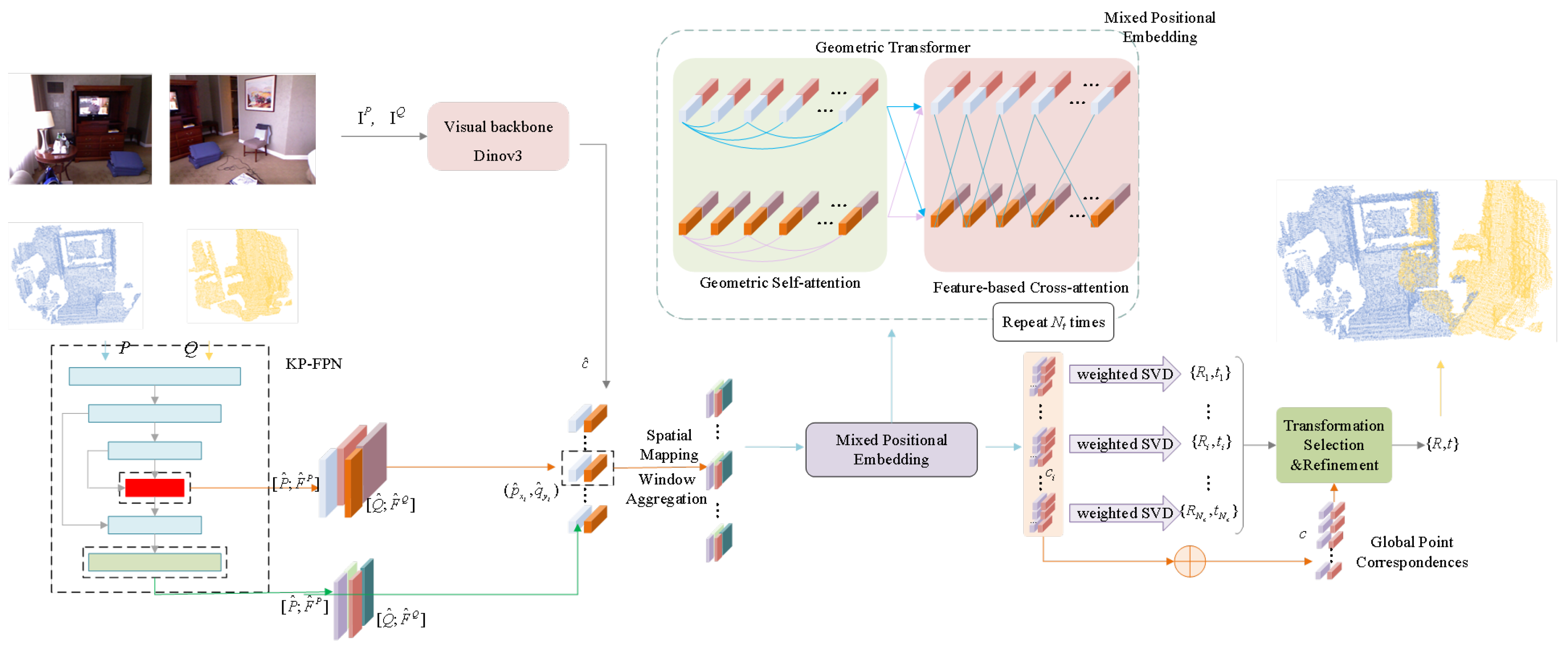
The overall pipeline of V3Reg is shown in Figure 1 and proceeds in four stages. First, DINOv3 and KPConv-FPN extract visual and geometric features in parallel from the RGB images and point clouds, respectively. Second, visual features are projected onto 3D points via camera calibration, and TACGAF fuses the two feature streams using task-aware alignment residuals. Third, a transformer with mixed 2D–3D positional encoding aggregates intra-frame and inter-frame context. Finally, a coarse-to-fine matching module produces weighted correspondences from which the rigid transformation is recovered.

2.2.2. Visual Feature Extraction and 2D-to-3D Projection

We use DINOv3 [29] as the visual backbone. Given an RGB image I , the selected transformer layer L produces a spatial feature map:
F v = DINOv 3 L ( I ) R H p × W p × d v ,
where H p = H / s , W p = W / s , s = 14 is the ViT-S/14 patch stride, and d v = 384 . Based on the layer-wise ablation in Section 3.6, we use layer 11.
Each 3D point p i is projected onto the image plane via the camera intrinsic matrix K:
u ¯ i = K p i , u i = u ¯ i x u ¯ i z , u ¯ i y u ¯ i z .
If the point cloud is expressed in a non-camera coordinate system, the appropriate extrinsic matrix is applied before projection. The pixel coordinate is then rescaled to the patch grid:
u i = x i s , y i s ,
and the point-wise visual descriptor is obtained by bilinear interpolation:
v i = Bilinear ( F v , u i ) R d v .
Points that project outside the image boundary or are inconsistent with the observed depth are assigned a learnable invalid-visual token, allowing the network to fall back to geometric features when visual observations are unavailable.

2.2.3. Geometric Feature Extraction

Geometric features are extracted by KPConv-FPN [31], which progressively downsamples the input point cloud to produce multi-resolution representations. Superpoint-level features F g R N g × d g support coarse correspondence estimation, while point-level features f g R N × d p are used for fine matching. Both d g and d p are set to 256.

2.2.4. Task-Aware Channel-Wise Gated Adaptive Fusion

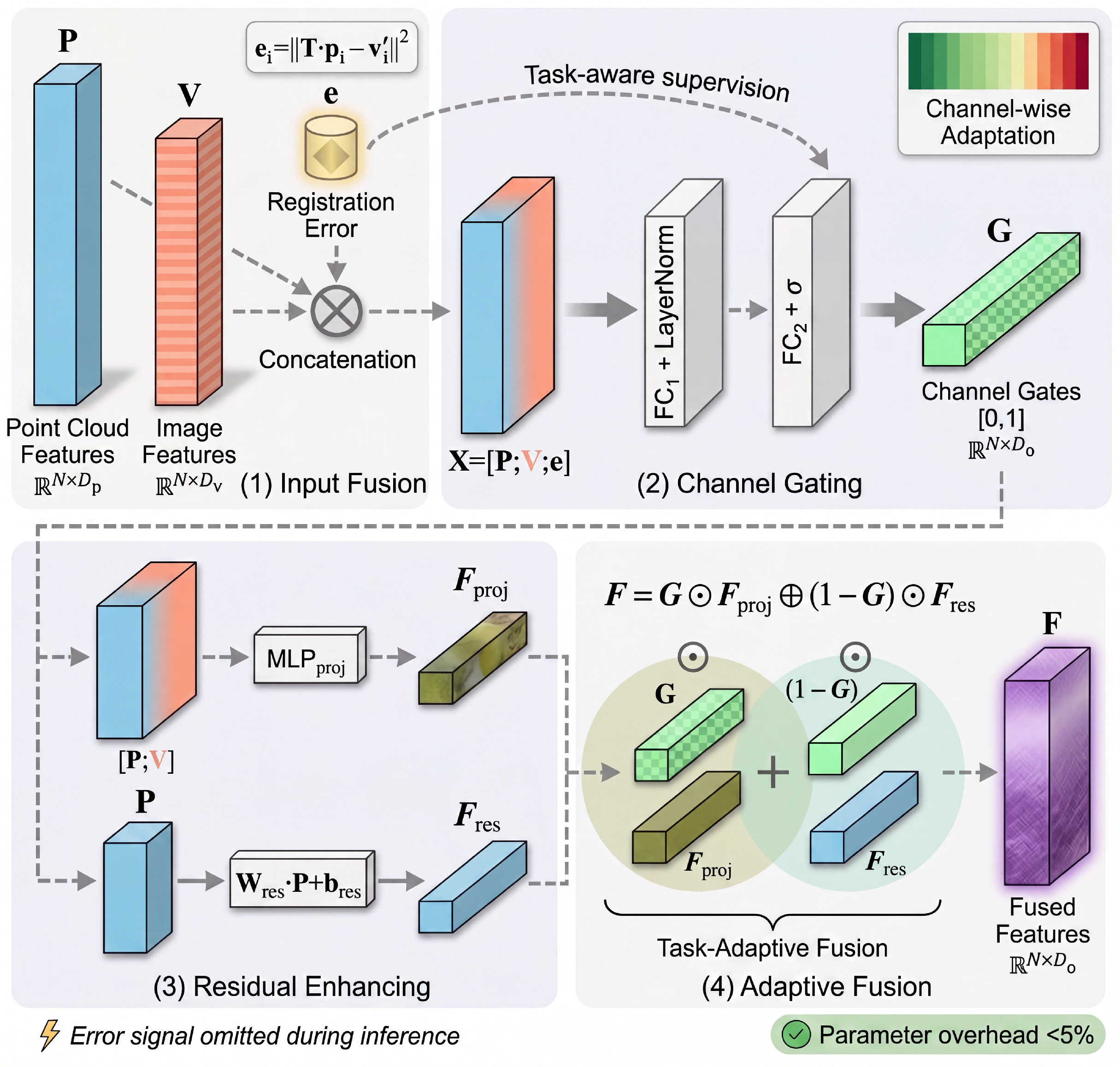
Geometric features encode metric surface structure and are reliable in structurally distinctive regions, while visual features from DINOv3 encode semantics and appearance that remain discriminative in texturally rich but geometrically ambiguous areas. Neither modality is uniformly reliable across all points; their relative utility varies with local scene content and the progress of alignment. Direct concatenation treats all feature channels and all modalities symmetrically, which cannot capture this variability. We therefore propose TACGAF, a module that computes a per-point, per-channel soft gate guided by an estimate of the current alignment quality, as illustrated in Figure 2.
Initial Alignment Residual
To obtain a task-aware signal without circular dependency, we first estimate a preliminary coarse transformation T init using geometry-only superpoint features. For each source point p i , the nearest neighbor p j in the target cloud under T init gives the per-point residual:
e i = T init p i p j 2 .
The residual is clipped and normalized:
e ^ i = min ( e i , τ e ) / τ e ,
where τ e is a predefined threshold that controls the sensitivity of the gate to local misalignment. A small τ e makes the gate highly sensitive to fine-scale errors; an overly large value suppresses the discriminative effect of the residual signal. Gradients are blocked through T init during training to stabilize optimization. The same procedure applies at inference without ground-truth supervision.
Channel-Wise Gated Fusion
The visual and geometric features are first projected to a common dimension d o = 256 :
v ˜ i = W v v i + b v , g ˜ i = W g f i g + b g , v ˜ i , g ˜ i R d o .
A two-layer MLP operating on the concatenation x i = [ g ˜ i ; v ˜ i ; e ^ i ] predicts a channel-wise gate:
m i = σ W 2 δ ( W 1 x i + b 1 ) + b 2 [ 0 , 1 ] d o ,
where δ is ReLU and σ is sigmoid. The gate balances a cross-modal projected feature against a geometric residual branch:
f i p r o j = MLP p r o j ( [ g ˜ i ; v ˜ i ] ) , f i r e s = W r g ˜ i + b r ,
f i f u s e d = m i f i p r o j + ( 1 m i ) f i r e s ,
where ⊙ denotes element-wise multiplication. When the residual is large or visual observations are unreliable, m i shifts toward zero, preserving structural geometric information. When geometry is ambiguous but visual appearance is distinctive, m i increases the contribution of the cross-modal branch.

2.2.5. Transformer Aggregation with Mixed Positional Encoding

After fusion, a transformer module [35] aggregates context within and across frames. Self-attention captures intra-frame spatial relationships; cross-attention models inter-frame feature interactions. To jointly leverage image-space layout and 3D metric geometry, the attention score between points i and j incorporates both a 2D and a 3D positional term:
A i j = q i k j d + ψ 2 D ( u i , u j ) + ψ 3 D ( p i , p j ) .
The 2D term uses Rotary Position Embedding [32] applied to projected image coordinates, preserving image-space spatial structure inherited from DINOv3. The 3D term encodes pairwise geometric relationships through a learnable projection of relative descriptors:
ψ 3 D ( p i , p j ) = W r ϕ ( r i j ) ,
where r i j is the raw pairwise geometric descriptor and ϕ is a nonlinear activation.

2.2.6. Coarse-to-Fine Correspondence Learning

At the coarse level, superpoint features are compared via cosine similarity, and optimal transport with dustbin variables [16] produces a soft assignment matrix. Top-ranked superpoint pairs seed local patch extraction at the fine level, where mutual nearest-neighbor filtering generates point-wise correspondences with confidence scores. The rigid transformation is recovered by weighted Procrustes analysis:
T * = arg min R , t ( i , j ) C w i j R p i + t p j 2 2 ,
solved via singular value decomposition. This RANSAC-free estimator follows the local-to-global registration paradigm and uses correspondence confidence to downweight outliers.

2.2.7. Loss Functions

Training combines circle loss for feature discriminability and binary cross-entropy for correspondence confidence, applied at both coarse and fine levels:
L c i r c l e = i log 1 + j P i e γ ( α p j ( d i j Δ p ) ) · k N i e γ ( α n k ( Δ n d i k ) ) ,
L b c e = ( i , j ) y i j log w ^ i j + ( 1 y i j ) log ( 1 w ^ i j ) ,
where P i and N i are positive and negative sample sets, d i j is feature distance, γ , Δ p , Δ n are margin hyperparameters, y i j is the ground-truth correctness label, and w ^ i j is the predicted confidence. The total loss is:
L t o t a l = L c i r c l e c o a r s e + L c i r c l e f i n e + λ L b c e c o a r s e + L b c e f i n e .

2.3. Implementation Details

V3Reg is implemented in PyTorch 2.7.1+cu126and trained on a single NVIDIA GeForce RTX 4090 GPU (NVIDIA Corporation, Santa Clara, CA, USA). KPConv-FPN uses four downsampling levels with 256-dimensional outputs. DINOv3 (ViT-S/14) is initialized from publicly available self-supervised pretrained weights; input RGB images are resized to 224 × 224 before feature extraction. The TACGAF hidden dimension is 512 with output projected to 256.
Training proceeds in two phases. For the first five epochs, the DINOv3 backbone is frozen to allow stable optimization of the geometric backbone and fusion modules. After this warm-up, all DINOv3 layers are fine-tuned at a learning rate of 1 × 10 5 , while the geometric backbone, TACGAF, and transformer modules use 1 × 10 4 . The optimizer is AdamW with cosine annealing over 40 epochs total, batch size 8. Data augmentation applies random rotation in [ 0 , 360 ] , scaling in [ 0.9 , 1.1 ] , point jittering, and color jittering.
The residual clipping threshold is set to τ e = 0.10 m for all indoor benchmarks (RGBD-3DMatch, RGBD-3DLoMatch, RGBD-ZeroMatch), consistent with the standard inlier distance criterion used in indoor registration evaluation. For KITTI, where scene scale is an order of magnitude larger, τ e = 1.0 m is used. Performance is stable across a reasonable range of τ e : excessively small values over-amplify noise, while overly large values reduce the gating signal’s task-awareness.

3. Results

3.1. Results on RGBD-3DMatch and RGBD-3DLoMatch

Table 2 reports FMR, IR, and RR on RGBD-3DMatch and RGBD-3DLoMatch across five correspondence budgets. On RGBD-3DMatch, V3Reg achieves 99.9% FMR and 97.2% RR at 5000 correspondences, surpassing ColorPCR by 7.6 percentage points in RR. The advantage is consistent across all budget levels.
On RGBD-3DLoMatch, V3Reg reaches 76.8% RR at 5000 correspondences, a 10.6-point gain over ColorPCR. Notably, the margin is maintained even at tight correspondence budgets: at 250 correspondences, V3Reg achieves 73.6% RR versus 64.2% for ColorPCR, indicating that the fused representation produces higher-quality individual correspondences.

3.2. Results on RGBD-ZeroMatch

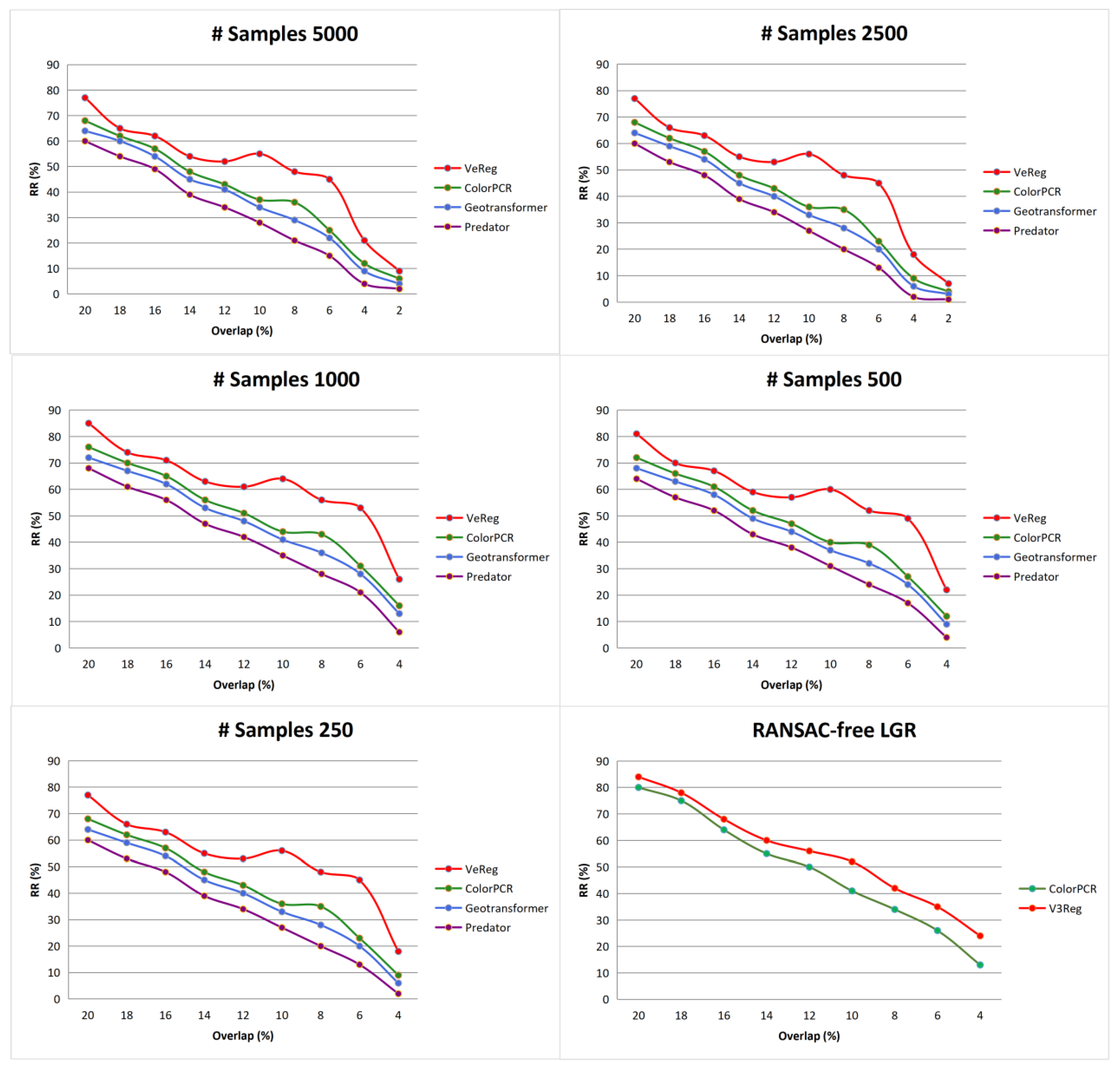
Figure 3 plots RR as a function of overlap ratio on RGBD-ZeroMatch. V3Reg consistently outperforms all baselines at every tested overlap level. At 5% overlap, it achieves 50.2% RR, while the best competing method falls below 32%. As the overlap approaches 1%, all methods experience further degradation; V3Reg retains the widest margin over geometry-only and RGB-D baselines, confirming that DINOv3 visual features provide stable complementary anchors even when shared geometric structure is nearly absent.

3.3. Results on KITTI

Table 3 reports results on the cropped KITTI test sequence [37,38,39]. V3Reg achieves 96.8% RR, RRE  = 0 . 48 , and RTE  = 14.2 cm, improving over ColorPCR by 1.7 percentage points in RR and reducing both rotation and translation errors. The consistent improvement in this outdoor LiDAR-camera setting, which differs substantially from the indoor training distribution, indicates that DINOv3 visual features generalize across sensing modalities and scene types.

3.4. Runtime Comparison

Table 4 compares inference time, registration recall, model size, and computational cost under three pose estimators on RGBD-3DMatch (3DM) and RGBD-3DLoMatch (3DLM). Model time covers feature extraction and correspondence prediction; pose time covers transformation estimation; total time is the end-to-end per-pair latency excluding I/O. Params and FLOPs denote the learnable parameter count and the forward computational cost of the registration network.
V3Reg’s model time is 0.305 s, modestly higher than ColorPCR’s 0.291 s because of the additional DINOv3 visual feature extraction pass. Consequently, V3Reg is not the fastest method in terms of total runtime. Under the LGR setting, its total inference time is 0.346 s, only 0.010 s higher than ColorPCR. This small overhead is accompanied by clear accuracy gains: V3Reg improves RR over ColorPCR by 7.6 percentage points on RGBD-3DMatch and 10.6 percentage points on RGBD-3DLoMatch.
The added complexity columns further show that the proposed framework remains computationally practical. Compared with ColorPCR, V3Reg uses fewer parameters and lower FLOPs under the LGR setting, with 33.37 M parameters and 265.15 G FLOPs versus 36.28 M parameters and 328.11 G FLOPs. These results indicate that V3Reg obtains stronger low-overlap robustness without introducing a prohibitive model-size or computational-cost burden.

3.5. Ablation Studies

Table 5 reports ablation results on RGBD-3DMatch and RGBD-ZeroMatch at 5000 correspondences (full model uses LGR). Replacing TACGAF with simple concatenation and an MLP reduces RR from 96.3% to 89.4% on RGBD-3DMatch and from 50.2% to 36.0% on RGBD-ZeroMatch—a 14.2-point collapse on the hardest benchmark—confirming that adaptive channel-wise gating is the single most important component. Removing alignment-residual conditioning drops RGBD-ZeroMatch RR to 44.1%, and removing the geometric residual branch further reduces it to 42.8%, showing that both the residual signal and the geometric fallback path contribute independently. Ablating 2D RoPE or 3D geometric positional encoding each reduces performance, confirming the complementarity of image-space and metric-space spatial reasoning. Replacing DINOv3 with CLIP [42] results in a 1.5-point drop on RGBD-ZeroMatch, consistent with CLIP being optimized for image-level rather than patch-level representations.

3.6. Impact of DINOv3 Feature Levels

Table 6 compares registration performance when visual features are drawn from different DINOv3 transformer layers. Shallow layers (e.g., Layer 3) capture low-level texture and boundary cues insufficient for semantic discrimination. The deepest layer (Layer 12) over-smooths spatial structure, reducing localization precision. Layer 11 achieves the best FMR and RR, indicating that mid-to-late-layer features strike the optimal balance between semantic abstraction and spatial resolution for dense point correspondence.
Qualitative comparisons on RGBD-3DMatch and low-overlap scenes (overlap ranging from 5% to 20%) are provided in the Supplementary Materials (Figures S1–S6).

4. Discussion

4.1. Role of Visual Foundation Features

The performance gap between V3Reg and geometry-only methods widens as overlap decreases. On RGBD-3DMatch (moderate overlap), V3Reg improves RR by 7.6 points over ColorPCR; on RGBD-3DLoMatch (low overlap), the gap grows to 10.6 points; on RGBD-ZeroMatch at 5% overlap, V3Reg outperforms the best competing method by over 18 points. This monotonically increasing advantage confirms that DINOv3 features become progressively more valuable as geometric evidence diminishes. The reason is structural: when the shared surface area is very small, local geometric descriptors have access to fewer distinctive structures such as edges and corners. DINOv3 features, trained with self-supervised objectives over millions of images, encode part-level consistency and semantic relationships that persist across viewpoints even when the geometric anchor set is sparse. The layer-level analysis further supports this interpretation: the optimal layer (11) lies in the mid-to-late range of the ViT-S/14, combining sufficient semantic abstraction with enough spatial precision to localize patch-level correspondences accurately.

4.2. Effect of Task-Aware Adaptive Fusion

The ablation results highlight that the mechanism of fusion matters at least as much as the source of visual features. The 14.2-point RR drop on RGBD-ZeroMatch when replacing TACGAF with simple concatenation far exceeds the 11.5-point drop from removing DINOv3 entirely (CLIP replacement serves as a proxy), demonstrating that how the modalities are combined is the dominant factor. The channel-wise gating conditioned on the initial residual addresses a fundamental asymmetry: near high-confidence geometric correspondences, the initial alignment is already accurate, so the gate suppresses visual contributions that could introduce noise; near geometrically ambiguous regions with large residuals, the gate promotes visual features. The geometric residual branch ( f i r e s ) preserves this structural information even when the gate weight is low, preventing catastrophic forgetting of geometric structure under visual dominance. The independent contribution of the residual branch (42.8% versus 44.1% without it) confirms that maintaining a clean geometric pathway is necessary, not just using the residual as a conditioning signal.

4.3. Accuracy–Efficiency Trade-Off

DINOv3 inference introduces a modest computational overhead relative to ColorPCR. In the LGR setting, V3Reg requires 0.346 s per pair, compared with 0.336 s for ColorPCR. Thus, V3Reg is not the fastest method in terms of total runtime. However, this additional 0.010 s cost brings a substantial improvement in registration accuracy, with RR increasing by 7.6 percentage points on RGBD-3DMatch and 10.6 percentage points on RGBD-3DLoMatch. This demonstrates that the proposed visual–geometric fusion strategy achieves a favorable accuracy–efficiency trade-off: a small and acceptable increase in visual feature extraction time is exchanged for significantly stronger robustness under low-overlap conditions.
For latency-critical deployments, the DINOv3 computation could be further reduced through token pruning, knowledge distillation into a lighter visual backbone, or quantization of the ViT-S encoder, all of which are compatible with the proposed fusion architecture.

4.4. Failure Cases and Limitations

Despite its advantages, V3Reg encounters four recurring failure modes as overlap approaches 1%. First, when the shared region consists almost entirely of planar surfaces with no salient boundaries, neither the geometric nor the visual branch can extract reliable anchor correspondences; the initial alignment residual signal itself becomes unreliable, reducing the effectiveness of the gate. Second, scenes with visually repetitive textures—uniform flooring, identical wall panels, repeated furniture—can produce ambiguous DINOv3 responses even for spatially separated patches, leading to false visual matches that the gating cannot fully suppress. Third, depth measurement noise or camera-LiDAR calibration error propagates into the 2D-to-3D projection step, corrupting the visual descriptors assigned to affected 3D points. Fourth, dynamic objects and occlusion boundaries introduce temporally inconsistent correspondences that violate the rigid-body assumption underlying the loss function.
These observations suggest several directions for future improvement. Uncertainty-aware projection could propagate depth noise estimates into the visual feature reliability score, reducing the influence of corrupted projections. Dynamic-object filtering—either through motion segmentation or semantic masking—could remove unstable correspondences from the residual computation. Temporal consistency modeling across sequential frames could stabilize correspondence quality in video-based registration. More efficient visual backbones, including lightweight ViT variants or distilled patch encoders, could reduce the computational footprint while preserving the patch-level discriminability that makes DINOv3 effective for this task.

5. Conclusions

This paper presented V3Reg, a visual–geometric registration framework for RGB-D point cloud pairs under extremely low overlap. By projecting DINOv3 patch-level features onto 3D points and fusing them with KPConv-FPN geometric features through the proposed TACGAF module, V3Reg adaptively balances the two modalities on a per-point, per-channel basis guided by initial alignment residuals.
Experiments across four benchmarks demonstrate that V3Reg consistently outperforms both geometry-only and RGB-D baselines. On RGBD-3DMatch, it reaches 97.2% Registration Recall; on RGBD-3DLoMatch, 76.8% RR—a 10.6-point improvement over the strongest prior method. Most significantly, on the proposed RGBD-ZeroMatch benchmark, V3Reg achieves 50.2% RR at 5% overlap, surpassing competing methods by over 18 percentage points. The runtime analysis shows that these accuracy gains require only a marginal increase in inference time.
Future work will further investigate uncertainty-aware depth projection, lightweight visual backbone alternatives, and dynamic-object robustness, aiming to extend the framework to online and resource-constrained deployment scenarios. Beyond the controlled RGBD-ZeroMatch benchmark, we also plan to construct a real-world measured low-overlap benchmark from large-scale outdoor surveying and field-collected RGB-D/LiDAR-camera scans. Such data will allow us to evaluate V3Reg under more challenging practical conditions, including long-range multi-modal disparities, dynamic occlusions, severe viewpoint changes, and calibration noise, thereby further validating and improving the method’s applicability in real deployment scenarios.


Supplementary Materials

The following supporting information can be downloaded at: https://www.mdpi.com/article/10.3390/rs18122050/s1, Figures S1 and S2: Qualitative comparison on scenes with approximately 5% overlap, including global registration results and ROI zoom-in views. Figures S3 and S4: Qualitative comparison on scenes with approximately 10% overlap, including global registration results and ROI zoom-in views. Figures S5 and S6: Qualitative comparison on scenes with approximately 20% overlap, including global registration results and ROI zoom-in views.

Author Contributions

Conceptualization, Y.L. and Y.H.; methodology, Y.L.; software, Y.L.; validation, Y.L., D.G. and Y.H.; formal analysis, Y.L.; investigation, Y.L. and Y.H.; resources, Y.L.; data curation, Y.L.; writing—original draft preparation, Y.L. and D.G.; writing—review and editing, Y.L., D.G. and Y.H.; visualization, Y.L.; supervision, D.G. and Q.Y.; project administration, D.G.; funding acquisition, D.G. and Q.Y. All authors have read and agreed to the published version of the manuscript.

Funding

This research was supported in part by the National Natural Science Foundation of China under grant number 62506380, in part by the Shaanxi Provincial Natural Science Foundation under grant number 2025JC-YBQN-896, and in part by the Foundational and Frontier Innovation Program of Rocket Force University of Engineering under grant number 2025-QYCX-ZD-03-021.

Data Availability Statement

The original contributions presented in this study are included in the article. Further inquiries can be directed to the corresponding author.

Acknowledgments

During the preparation of this manuscript, the authors used ChatGPT (OpenAI, GPT-5, accessed on 15 June 2026) to assist with language polishing, grammar correction, readability improvement, and formatting refinement. The AI tools were used only to improve the clarity and presentation of the manuscript and were not used to generate original scientific ideas, experimental designs, data, results, analyses, or conclusions. All scientific content, including the research problem, methodology, experimental design, data processing, results, interpretation, and conclusions, was developed, verified, and approved by the authors. The authors carefully reviewed and edited all AI-assisted text and take full responsibility for the accuracy, integrity, and originality of the submitted manuscript.

Conflicts of Interest

The authors declare no conflicts of interest. The funders had no role in the design of the study; in the collection, analyses, or interpretation of data; in the writing of the manuscript; or in the decision to publish the results.

Abbreviations

The following abbreviations are used in this manuscript:
RGB-DRed-Green-Blue Depth
SE(3)Special Euclidean Group in 3D
SO(3)Special Orthogonal Group in 3D
DoFDegrees of Freedom
CNNConvolutional Neural Network
MLPMulti-Layer Perceptron
RoPERotary Position Embedding
FMRFeature Matching Recall
RRRegistration Recall
RRERelative Rotation Error
RTERelative Translation Error
IRInlier Ratio
TACGAFTask-Aware Channel-Wise Gated Adaptive Fusion

References

  1. Rusu, R.B.; Blodow, N.; Beetz, M. Fast point feature histograms (FPFH) for 3D registration. In Proceedings of the IEEE International Conference on Robotics and Automation; IEEE: New York, NY, USA, 2009; pp. 3212–3217. [Google Scholar]
  2. Salti, S.; Tombari, F.; Di Stefano, L. SHOT: Unique signatures of histograms for surface and texture description. Comput. Vis. Image Underst. 2014, 125, 251–264. [Google Scholar] [CrossRef] [Scilit]
  3. Fischler, M.A.; Bolles, R.C. Random sample consensus: A paradigm for model fitting with applications to image analysis and automated cartography. Commun. ACM 1981, 24, 381–395. [Google Scholar] [CrossRef] [Scilit]
  4. Qi, C.R.; Su, H.; Mo, K.; Guibas, L.J. PointNet: Deep learning on point sets for 3D classification and segmentation. In Proceedings of the IEEE Conference on Computer Vision and Pattern Recognition; IEEE: New York, NY, USA, 2017; pp. 652–660. [Google Scholar]
  5. Wang, Y.; Sun, Y.; Liu, Z.; Sarma, S.E.; Bronstein, M.M.; Solomon, J.M. Dynamic graph CNN for learning on point clouds. ACM Trans. Graph. 2019, 38, 1–12. [Google Scholar] [CrossRef] [Scilit]
  6. Choy, C.; Park, J.; Koltun, V. Fully convolutional geometric features. In Proceedings of the IEEE/CVF International Conference on Computer Vision; IEEE: New York, NY, USA, 2019; pp. 8958–8966. [Google Scholar]
  7. Xu, M.; Ding, R.; Zhao, H.; Qi, X. PAConv: Position adaptive convolution with dynamic kernel assembling on point clouds. In Proceedings of the IEEE/CVF Conference on Computer Vision and Pattern Recognition; IEEE: New York, NY, USA, 2021; pp. 3173–3182. [Google Scholar]
  8. Deng, H.; Birdal, T.; Ilic, S. PPFNet: Global context aware local features for robust 3D point matching. In Proceedings of the IEEE Conference on Computer Vision and Pattern Recognition; IEEE: New York, NY, USA, 2018; pp. 195–205. [Google Scholar]
  9. Yu, H.; Hou, J.; Qin, Z.; Saleh, M.; Shugurov, I.; Wang, K.; Busam, B.; Ilic, S. RIGA: Rotation-invariant and globally-aware descriptors for point cloud registration. IEEE Trans. Pattern Anal. Mach. Intell. 2024, 46, 3796–3812. [Google Scholar] [CrossRef] [Scilit] [PubMed]
  10. Choy, C.; Dong, W.; Koltun, V. Deep global registration. In Proceedings of the IEEE/CVF Conference on Computer Vision and Pattern Recognition; IEEE: New York, NY, USA, 2020; pp. 2514–2523. [Google Scholar]
  11. Bai, X.; Luo, Z.; Zhou, L.; Chen, H.; Li, L.; Hu, Z.; Fu, H.; Tai, C.L. PointDSC: Robust point cloud registration using deep spatial consistency. In Proceedings of the IEEE/CVF Conference on Computer Vision and Pattern Recognition; IEEE: New York, NY, USA, 2021; pp. 15859–15869. [Google Scholar]
  12. Chen, Z.; Sun, K.; Yang, F.; Tao, W. SC2-PCR: A second order spatial compatibility for efficient and robust point cloud registration. In Proceedings of the IEEE/CVF Conference on Computer Vision and Pattern Recognition; IEEE: New York, NY, USA, 2022; pp. 13221–13231. [Google Scholar]
  13. El Banani, M.; Johnson, J. Bootstrap your own correspondences. In Proceedings of the IEEE/CVF International Conference on Computer Vision; IEEE: New York, NY, USA, 2021; pp. 6433–6442. [Google Scholar]
  14. Yang, Y.; Feng, C.; Shen, Y.; Tian, D. FoldingNet: Point cloud auto-encoder via deep grid deformation. In Proceedings of the IEEE Conference on Computer Vision and Pattern Recognition; IEEE: New York, NY, USA, 2018; pp. 206–215. [Google Scholar]
  15. Huang, S.; Gojcic, Z.; Usvyatsov, M.; Wieser, A.; Schindler, K. PREDATOR: Registration of 3D point clouds with low overlap. In Proceedings of the IEEE/CVF Conference on Computer Vision and Pattern Recognition; IEEE: New York, NY, USA, 2021; pp. 4267–4276. [Google Scholar]
  16. Yu, H.; Li, F.; Saleh, M.; Busam, B.; Ilic, S. CoFiNet: Reliable coarse-to-fine correspondences for robust pointcloud registration. Adv. Neural Inf. Process. Syst. 2021, 34, 23872–23884. [Google Scholar]
  17. Qin, Z.; Yu, H.; Wang, C.; Guo, Y.; Peng, Y.; Xu, K. Geometric transformer for fast and robust point cloud registration. In Proceedings of the IEEE/CVF Conference on Computer Vision and Pattern Recognition; IEEE: New York, NY, USA, 2022; pp. 11143–11152. [Google Scholar]
  18. Qin, Z.; Yu, H.; Wang, C.; Guo, Y.; Peng, Y.; Ilic, S.; Hu, D.; Xu, K. GeoTransformer: Fast and robust point cloud registration with geometric transformer. IEEE Trans. Pattern Anal. Mach. Intell. 2023, 45, 9806–9821. [Google Scholar] [CrossRef] [Scilit] [PubMed]
  19. Yu, J.; Ren, L.; Zhang, Y.; Zhou, W.; Lin, L.; Dai, G. PEAL: Prior-Embedded explicit attention learning for low-overlap point cloud registration. In Proceedings of the IEEE/CVF Conference on Computer Vision and Pattern Recognition; IEEE: New York, NY, USA, 2023; pp. 17702–17711. [Google Scholar]
  20. He, K.; Zhang, X.; Ren, S.; Sun, J. Deep residual learning for image recognition. In Proceedings of the IEEE Conference on Computer Vision and Pattern Recognition; IEEE: New York, NY, USA, 2016; pp. 770–778. [Google Scholar]
  21. Wang, Z.; Huo, X.; Chen, Z.; Zhang, J.; Sheng, L.; Xu, D. Improving RGB-D point cloud registration by learning multi-scale local linear transformation. In Proceedings of the European Conference on Computer Vision; Springer: Berlin/Heidelberg, Germany, 2022; pp. 175–191. [Google Scholar]
  22. Yuan, M.; Fu, K.; Li, Z.; Meng, Y.; Wang, M. PointMBF: A multi-scale bidirectional fusion network for unsupervised RGB-D point cloud registration. In Proceedings of the IEEE/CVF International Conference on Computer Vision; IEEE: New York, NY, USA, 2023; pp. 17694–17705. [Google Scholar]
  23. Yu, Z.; Qin, Z.; Tang, Y.; Wang, Y.; Yi, R.; Zhu, C.; Xu, K. NeRF-guided unsupervised learning of RGB-D registration. arXiv 2024, arXiv:2405.00507. [Google Scholar] [CrossRef] [Scilit]
  24. Jiang, H.; Dang, Z.; Wei, Z.; Xie, J.; Yang, J.; Salzmann, M. Robust outlier rejection for 3D registration with variational Bayes. In Proceedings of the IEEE/CVF Conference on Computer Vision and Pattern Recognition; IEEE: New York, NY, USA, 2023; pp. 1148–1157. [Google Scholar]
  25. Zhang, Y.; Yu, J.; Huang, X.; Zhou, W.; Hou, J. PCR-CG: Point cloud registration via deep explicit color and geometry. In Proceedings of the European Conference on Computer Vision; Springer: Berlin/Heidelberg, Germany, 2022; pp. 443–459. [Google Scholar]
  26. Mu, J.; Bie, L.; Du, S.; Gao, Y. ColorPCR: Color point cloud registration with multi-stage geometric-color fusion. In Proceedings of the IEEE/CVF Conference on Computer Vision and Pattern Recognition; IEEE: New York, NY, USA, 2024; pp. 21061–21070. [Google Scholar]
  27. Caron, M.; Touvron, H.; Misra, I.; Jégou, H.; Mairal, J.; Bojanowski, P.; Joulin, A. Emerging properties in self-supervised vision transformers. In Proceedings of the IEEE/CVF International Conference on Computer Vision; IEEE: New York, NY, USA, 2021; pp. 9650–9660. [Google Scholar]
  28. Oquab, M.; Darcet, T.; Moutakanni, T.; Vo, H.; Szafraniec, M.; Khalidov, V.; Fernandez, P.; Haziza, D.; Massa, F.; El-Nouby, A.; et al. DINOv2: Learning robust visual features without supervision. arXiv 2023, arXiv:2304.07193. [Google Scholar] [CrossRef] [Scilit]
  29. Siméoni, O.; Vo, H.V.; Seitzer, M.; Baldassarre, F.; Oquab, M.; Jose, C.; Khalidov, V.; Szafraniec, M.; Yi, S.; Ramamonjisoa, M.; et al. DINOv3: Learning robust visual features without supervision. arXiv 2025, arXiv:2508.10104. [Google Scholar] [CrossRef] [Scilit]
  30. Jiang, H.; Xie, J.; Yang, J.; Yu, L.; Zheng, J. Zero-shot RGB-D point cloud registration with pre-trained large vision model. In Proceedings of the Computer Vision and Pattern Recognition Conference; IEEE: New York, NY, USA, 2025; pp. 16943–16952. [Google Scholar]
  31. Thomas, H.; Qi, C.R.; Deschaud, J.E.; Marcotegui, B.; Goulette, F.; Guibas, L.J. KPConv: Flexible and deformable convolution for point clouds. In Proceedings of the IEEE/CVF International Conference on Computer Vision; IEEE: New York, NY, USA, 2019; pp. 6411–6420. [Google Scholar]
  32. Su, J.; Ahmed, M.; Lu, Y.; Pan, S.; Bo, W.; Liu, Y. Roformer: Enhanced transformer with rotary position embedding. Neurocomputing 2024, 568, 127063. [Google Scholar] [CrossRef] [Scilit]
  33. Zeng, A.; Song, S.; Nießner, M.; Fisher, M.; Xiao, J.; Funkhouser, T. 3DMatch: Learning local geometric descriptors from RGB-D reconstructions. In Proceedings of the IEEE Conference on Computer Vision and Pattern Recognition; IEEE: New York, NY, USA, 2017; pp. 1802–1811. [Google Scholar]
  34. Geiger, A.; Lenz, P.; Urtasun, R. Are we ready for autonomous driving? The KITTI vision benchmark suite. In Proceedings of the IEEE Conference on Computer Vision and Pattern Recognition; IEEE: New York, NY, USA, 2012; pp. 3354–3361. [Google Scholar]
  35. Vaswani, A.; Shazeer, N.; Parmar, N.; Uszkoreit, J.; Jones, L.; Gomez, A.N.; Kaiser, L.; Polosukhin, I. Attention is all you need. In Proceedings of the 31st International Conference on Neural Information Processing Systems; Curran Associates Inc.: Red Hook, NY, USA, 2017; Volume 30. [Google Scholar]
  36. Wang, H.; Liu, Y.; Dong, Z.; Wang, W. You only hypothesize once: Point cloud registration with rotation-equivariant descriptors. In Proceedings of the ACM International Conference on Multimedia; ACM: New York, NY, USA, 2022; pp. 1630–1641. [Google Scholar]
  37. Zeng, Z.; Wu, Q.; Zhang, X.; Wu, L.Y.; An, P.; Yang, J.; Wang, J.; Wang, P. Unlocking generalization power in LiDAR point cloud registration. In Proceedings of the Computer Vision and Pattern Recognition Conference; IEEE: New York, NY, USA, 2025; pp. 22244–22253. [Google Scholar]
  38. Yu, Z.; Qin, Z.; Zheng, L.; Xu, K. Learning instance-aware correspondences for robust multi-instance point cloud registration in cluttered scenes. In Proceedings of the IEEE/CVF Conference on Computer Vision and Pattern Recognition; IEEE: New York, NY, USA, 2024; pp. 19605–19614. [Google Scholar]
  39. Yang, L.; Kang, B.; Huang, Z.; Xu, X.; Feng, J.; Zhao, H. Depth anything: Unleashing the power of large-scale unlabeled data. In Proceedings of the IEEE/CVF Conference on Computer Vision and Pattern Recognition; IEEE: New York, NY, USA, 2024; pp. 10371–10381. [Google Scholar]
  40. Bai, X.; Luo, Z.; Zhou, L.; Fu, H.; Quan, L.; Tai, C.L. D3Feat: Joint learning of dense detection and description of 3D local features. In Proceedings of the IEEE/CVF Conference on Computer Vision and Pattern Recognition; IEEE: New York, NY, USA, 2020; pp. 6359–6367. [Google Scholar]
  41. Ao, S.; Hu, Q.; Yang, B.; Markham, A.; Guo, Y. SpinNet: Learning a general surface descriptor for 3D point cloud registration. In Proceedings of the IEEE/CVF Conference on Computer Vision and Pattern Recognition; IEEE: New York, NY, USA, 2021; pp. 11753–11762. [Google Scholar]
  42. Radford, A.; Kim, J.W.; Hallacy, C.; Ramesh, A.; Goh, G.; Agarwal, S.; Sastry, G.; Askell, A.; Mishkin, P.; Clark, J.; et al. Learning transferable visual models from natural language supervision. In Proceedings of the International Conference on Machine Learning; PMLR: Cambridge, MA, USA, 2021; pp. 8748–8763. [Google Scholar]
Figure 1. Overall framework of V3Reg. The architecture comprises four stages: (1) multi-modal feature extraction, where DINOv3 extracts visual features and KPConv-FPN extracts geometric features; (2) TACGAF for adaptive cross-modal fusion guided by initial alignment residuals; (3) transformer aggregation with mixed 2D–3D positional embedding; and (4) coarse-to-fine matching for transformation estimation.
Remotesensing 18 02050 g001
Figure 2. Architecture of the TACGAF module. Solid arrows indicate the forward feature flow, while dashed arrows denote task-aware residual guidance or feature routing. Colors distinguish different feature types: blue denotes geometric point-cloud features, orange denotes visual image features, yellow denotes registration-error residuals, green denotes channel gates, olive denotes projected features, and purple denotes fused features. Projected geometric and visual features are concatenated with the normalized alignment residual and passed through a channel-wise gating MLP. The resulting gate modulates the balance between the cross-modal projected feature and the geometric residual branch.
Remotesensing 18 02050 g002
Figure 3. Registration recall on RGBD-ZeroMatch at varying overlap ratios. Curves are shown for sample sizes of 5000, 2500, 1000, 500, and 250, plus the RANSAC-free LGR setting. V3Reg maintains the highest recall across all overlap levels and all correspondence budgets.“# Samples” denotes the number of sampled correspondences.
Remotesensing 18 02050 g003
Table 1. Statistics of RGBD-ZeroMatch under different target overlap ratios.“#” denotes the number of pairs.
Target Overlap# PairsAvg. Source PointsAvg. Target PointsActual Overlap
1%78710,69113,6941.00%
5%78711,14113,6945.00%
10%78711,76013,69410.00%
15%78712,45213,69415.00%
20%78713,23013,69420.00%
Table 2. Performance comparison on RGBD-3DMatch and RGBD-3DLoMatch. The upward arrow (↑) indicates that higher values are better. Boldfaced values indicate the best performance in each column.
MethodRGBD-3DMatch RGBD-3DLoMatch
500025001000500250 500025001000500250
Feature Matching Recall (%) ↑
D3Feat97.695.494.594.193.1 71.368.063.456.748.9
SpinNet96.697.296.895.594.3 72.269.864.457.949.7
Predator98.296.696.596.396.5 79.476.371.364.755.9
YOHO [36]98.197.697.597.796.0 75.972.567.560.652.0
CoFiNet97.998.398.198.298.3 76.973.568.961.253.1
GeoTransformer99.097.997.997.997.6 82.379.174.867.058.9
PEAL99.599.099.199.198.8 84.681.276.569.160.9
ColorPCR99.699.599.599.599.5 90.487.884.382.779.8
V3Reg99.999.699.599.599.4 90.790.589.989.889.8
Inlier Ratio (%) ↑
D3Feat29.628.423.118.814.4 8.88.27.613.010.2
SpinNet35.734.035.436.336.6 9.38.87.86.94.2
Predator39.639.134.529.724.2 25.920.923.423.523.5
YOHO41.840.338.637.229.8 24.420.419.815.913.1
CoFiNet43.941.038.835.432.1 26.724.624.824.122.6
GeoTransformer45.653.148.740.636.1 28.930.632.234.536.9
PEAL48.444.845.445.745.7 30.132.335.638.441.5
ColorPCR50.852.754.656.759.8 30.633.536.940.244.5
V3Reg55.256.559.861.964.5 32.435.838.442.646.5
Registration Recall (%) ↑
D3Feat72.270.168.563.760.8 37.233.630.026.422.8
SpinNet74.672.670.467.664.5 42.739.135.531.928.3
Predator78.576.974.671.268.6 54.951.347.744.140.5
YOHO80.279.577.875.372.1 48.344.741.137.533.9
CoFiNet80.379.878.276.073.0 57.253.650.046.442.8
GeoTransformer83.682.981.579.377.2 61.260.460.158.958.4
PEAL85.885.183.781.479.5 65.565.164.563.863.4
ColorPCR89.688.987.585.283.3 66.265.865.264.764.2
V3Reg97.296.896.395.995.5 76.876.475.874.973.6
Table 3. Performance on KITTI Odometry. Boldfaced numbers highlight the best.
MethodRRE (°)RTE (cm)RR (%)FMR (%)
FPFH2.1551.260.452.3
D3Feat1.1228.488.685.4
GeoTransformer0.6521.392.489.7
PEAL0.5818.694.191.2
ColorPCR0.5216.895.193.4
V3Reg0.4814.296.895.2
Table 4. Runtime, model size, and computational cost comparison on RGBD-3DMatch and RGBD-3DLoMatch. “# Samples” denotes the number of sampled correspondences. Boldfaced values indicate the best performance in each comparison group.
ModelEstimator# SamplesRR (%) Time (s)ParamsFLOPs
3DM3DLMModelPoseTotal(M)(G)
D3Feat [40]RANSAC-1k500072.237.2 0.0980.4880.58627.30250.14
SpinNet [41]RANSAC-1k500074.642.7 64.5240.02564.5492.16147.64
Predator [15]RANSAC-1k500078.554.9 0.1450.6240.76923.89224.31
CoFiNet [16]RANSAC-1k500080.357.2 0.3430.3980.7415.48123.17
GeoTransformer [17]RANSAC-1k500083.661.2 0.1990.3590.5586.85177.48
ColorPCR [26]RANSAC-1k500089.666.2 0.2910.3450.63636.24328.11
V3RegRANSAC-1k500097.276.8 0.3050.3650.67033.32265.15
D3Feat [40]weighted SVD25060.822.8 0.0980.0080.10627.30250.14
SpinNet [41]weighted SVD25063.828.3 64.5240.00564.5292.16147.64
Predator [15]weighted SVD25068.640.5 0.1450.0060.15123.89224.31
CoFiNet [16]weighted SVD25073.042.8 0.3430.0060.3495.48123.17
GeoTransformer [17]weighted SVD25077.258.4 0.1990.0030.2026.85177.48
ColorPCR [26]weighted SVD25083.364.2 0.2910.0010.29236.24328.11
V3Regweighted SVD25095.573.6 0.3050.0010.30633.32265.15
GeoTransformer [17]LGRall83.661.2 0.1780.0580.2366.89177.48
ColorPCR [26]LGRall89.666.2 0.2910.0450.33636.28328.11
V3RegLGRall97.276.8 0.3050.0410.34633.37265.15
Table 5. Ablation study on RGBD-3DMatch and RGBD-ZeroMatch. Boldfaced values indicate the best performance in each column.
ConfigurationRGBD-3DMatch RR (%)RGBD-ZeroMatch RR (%)
Baseline (Concat + MLP)89.436.0
w/o Alignment-Residual Conditioning93.944.1
w/o Residual Connection93.242.8
w/o 2D RoPE92.140.5
w/o 3D Geometric PE91.539.2
Replace DINOv3 with CLIP [42]91.238.7
V3Reg (Full)96.350.2
Table 6. Impact of DINOv3 feature depth. Boldfaced values indicate the best performance in each column.
Source LayerFeature TypeFMR (%)RR (%)
Layer 3Low-level Texture92.484.3
Layer 6Mid-level Pattern96.891.5
Layer 9Semantic-rich98.995.1
Layer 11Optimal99.696.3
Layer 12Over-smoothed98.294.8
Disclaimer/Publisher’s Note: The statements, opinions and data contained in all publications are solely those of the individual author(s) and contributor(s) and not of MDPI and/or the editor(s). MDPI and/or the editor(s) disclaim responsibility for any injury to people or property resulting from any ideas, methods, instructions or products referred to in the content.