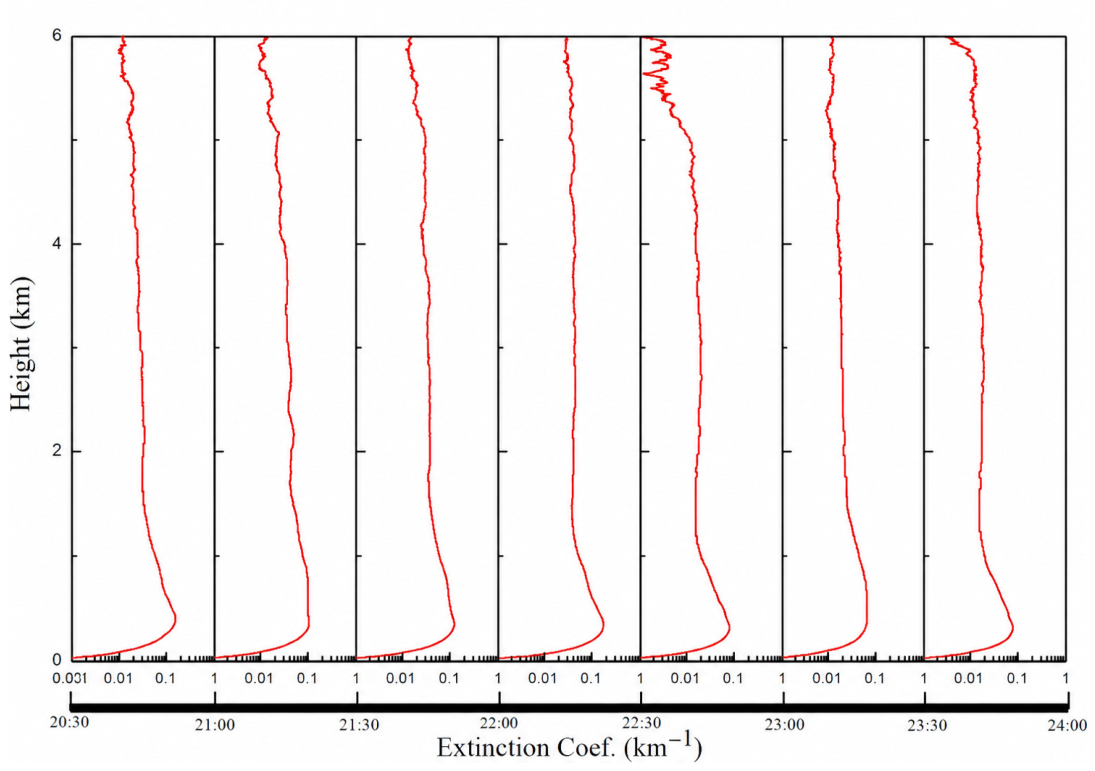
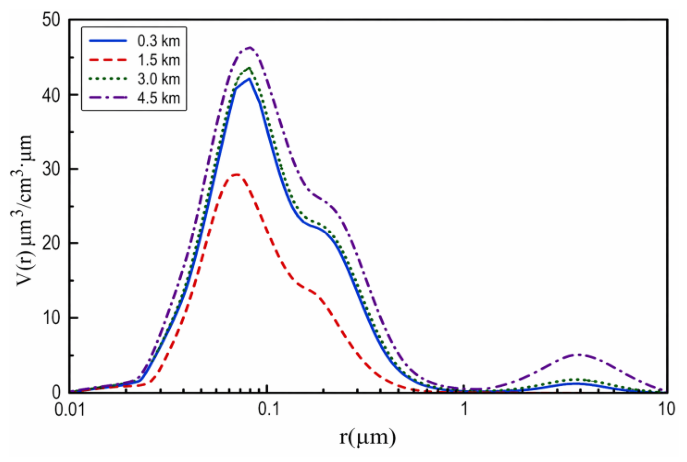
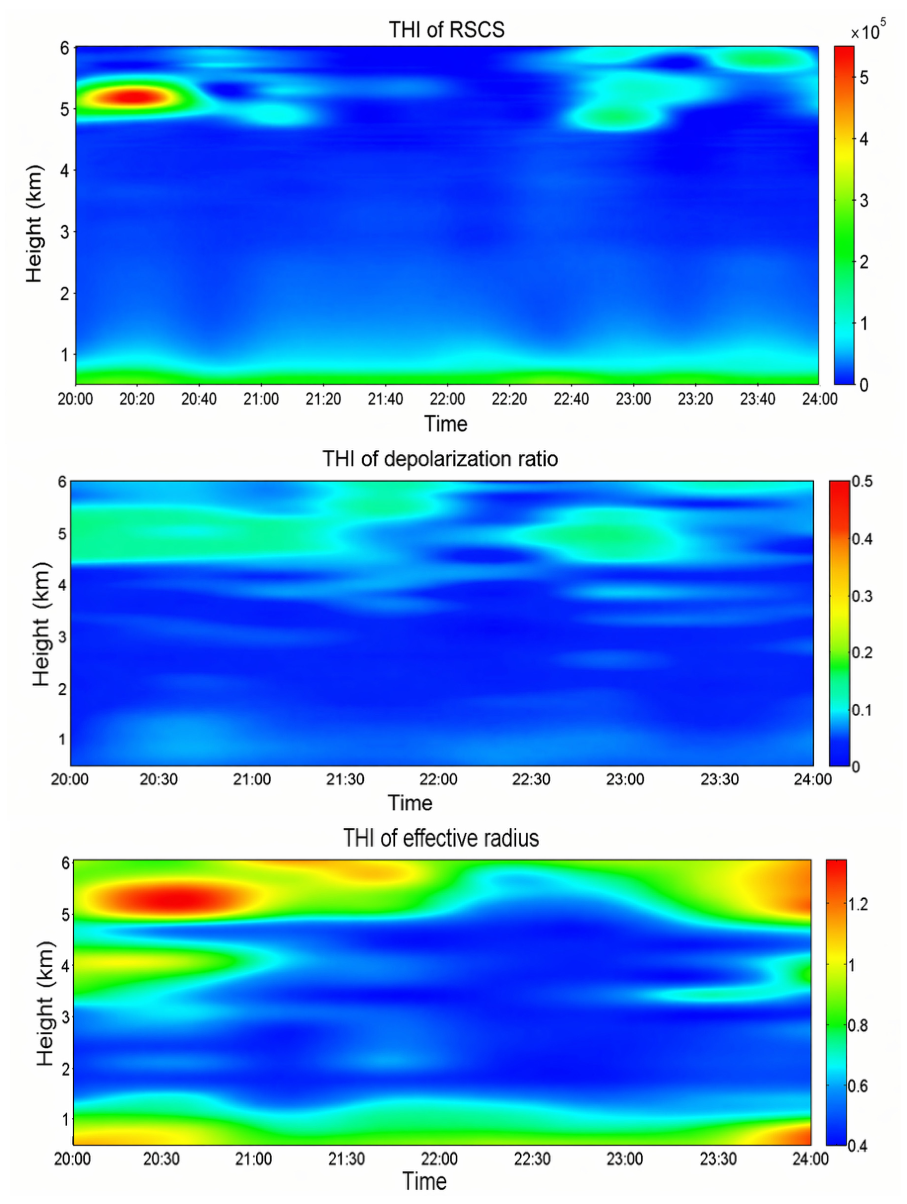
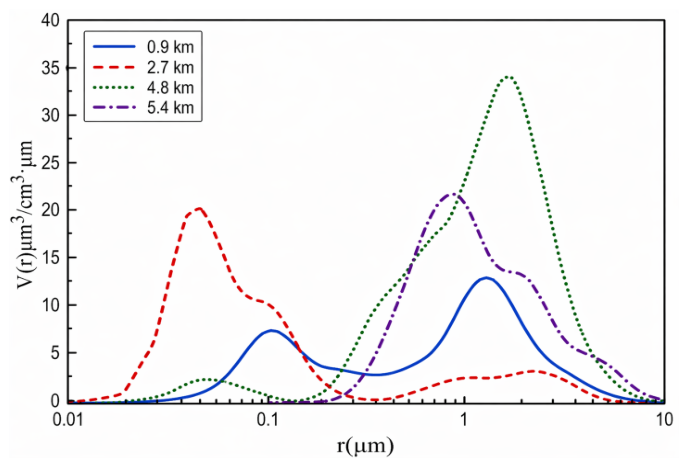
1. Introduction
Atmospheric aerosols are important constituents of the atmosphere that affect regional air quality, microphysical processes, and the Earth-atmosphere radiative budget. Compared with column-integrated observations, ground-based lidar can continuously resolve the vertical structure of aerosols and has therefore become an important tool for investigating aerosol optical and microphysical properties. In particular, parameters such as aerosol particle size distribution and effective radius can directly reflect particle sources, transport, transformation, and radiative effects, and have become a major focus of aerosol remote sensing research [
1].
In recent years, aerosol microphysical retrieval from lidar has developed along two linked directions. The first is the regularized inversion of multi-wavelength Raman or high-spectral-resolution lidar observations, especially the 3β + 2α configuration. On the basis of the theoretical framework proposed by Müller et al. [
2] and the bimodal 3β + 2α inversion demonstrated by Veselovskii et al. [
3], subsequent studies introduced hybrid regularization, B-spline representations, and averaging strategies to improve numerical stability and uncertainty control [
4,
5,
6]. These studies show that size distribution, effective radius, volume concentration, and, in some cases, refractive index can be retrieved from multi-wavelength optical data, but they also emphasize that the solution remains ill-posed and highly sensitive to measurement noise and prior assumptions.
The second direction uses additional constraints or multi-source observations to reduce non-uniqueness. Passive radiance inversions can retrieve particle size distribution and complex refractive index by simultaneously fitting multi-angular and multi-spectral observations [
7]. Combined Raman lidar, high-spectral-resolution lidar, sun-photometer, radar, and in situ observations, together with improved polarization-calibration procedures, have further been used to evaluate humidification effects, coarse-mode particles, and retrieval consistency [
8,
9,
10,
11,
12,
13,
14]. Recent algorithms, such as BOREAL and look-up-table/self-posed methods, also incorporate prior constraints and solution-space screening to suppress ill-posedness in 3β + 2α inversions [
15,
16]. Overall, the existing literature indicates that increasing information content improves retrieval reliability, whereas limited-channel lidar retrievals require careful prior-parameter treatment.
Related research in China has also developed rapidly in recent years, with particular emphasis on algorithm implementation, calibration, and quality control under practical observational conditions. For example, dual-wavelength lidar has been used to retrieve aerosol and small-cloud-droplet microphysical parameters and effective radius [
17,
18]; fluorescence–Raman–Mie polarization lidar and polarization Raman lidar have been applied to haze classification and optical-product quality assessment [
19,
20]; and the CARLNET network has promoted water-vapor Raman-channel calibration and raw-signal quality assessment for standardized ground-based lidar observations [
21,
22]. Together with recent multi-wavelength polarization Raman and micropulse lidar studies [
23,
24,
25], these works provide an important basis for vertical aerosol probing, but they still leave room for retrieval strategies tailored to limited-channel elastic-scattering systems.
In summary, the retrieval of particle size distribution and effective radius remains an ill-posed inverse problem, and the uncertainty becomes more pronounced when full Raman or high-spectral-resolution constraints are unavailable. For elastic-scattering systems, the Klett inversion also depends strongly on the prescribed boundary values and the assumed backscatter-to-extinction relationship [
26]. Against this background, the present study develops a parameter-search-based inversion framework for retrieving volume size distribution and effective radius from a 355/532/1064 nm three-wavelength elastic-scattering, single-channel polarization lidar system. By allowing the complex refractive index, particle-size interval, and lidar ratio to vary within physically plausible ranges, and by comparing two short urban case studies under clean and lightly polluted conditions, the applicability and limitations of the algorithm are assessed.
2. Materials and Methods
2.1. Theory of Volume Size Distribution Inversion
The aerosol particle size distribution is one of the core parameters describing the microphysical properties of a particle population. Among its representations, the volume size distribution characterizes the contribution of particles of different sizes to the total particle volume per unit air volume. Compared with analyzing only optical parameters such as extinction coefficient, backscatter coefficient, or depolarization ratio, the volume size distribution reflects particle-scale structure more directly. The effective radius further derived from the volume size distribution can in turn characterize the overall size of the particle population. Therefore, the volume size distribution and effective radius are taken as the main microphysical inversion targets in this study.
The volume size distribution function is given by:
This function represents the particle volume distribution within the radius interval from
r to
r +
dr per unit air volume. Here,
r denotes particle radius, and
v(r) represents the total volume contribution of particles per unit air volume. In quantitative studies of aerosol particle populations, integral parameters describing the entire population are required. The effective radius not only characterizes the relative size of particles of different radii within a unit volume, but also reflects the relative contributions of small and large particles; it is defined as:
Under single-scattering conditions, the extinction or backscatter coefficients retrieved from multi-wavelength lidar satisfy an integral relationship with the particle size distribution. For a given wavelength
λ, the corresponding optical quantity can be expressed as the convolution of the particle volume size distribution with the Mie scattering kernel function:
where
m is the complex refractive index, [
rmin,
rmax] is the particle-radius integration interval, and
ε is the approximation error. The kernel function is determined by Mie scattering theory and represents the contributions of particles of different sizes to extinction or backscatter at different wavelengths. Its relationship with the Mie scattering efficiency
Qp is:
Because the three wavelengths of 355, 532, and 1064 nm exhibit different sensitivities to fine-mode and coarse-mode particles, joint multi-wavelength observations provide the necessary multiscale constraints for inversion of the volume size distribution. The basic idea of aerosol volume-spectrum inversion is to approximate the true volume size distribution numerically. In this study, the 3β + 2α input configuration is used, that is, three backscatter-related quantities and two extinction-related quantities are jointly employed as inversion constraints. Under given optical inputs and prior parameters, the volume size distribution is parameterized with weighted B-spline functions, so that the unknown distribution is written as a linear combination of a set of basis functions:
where
Bj(
r) is the spline basis functions and
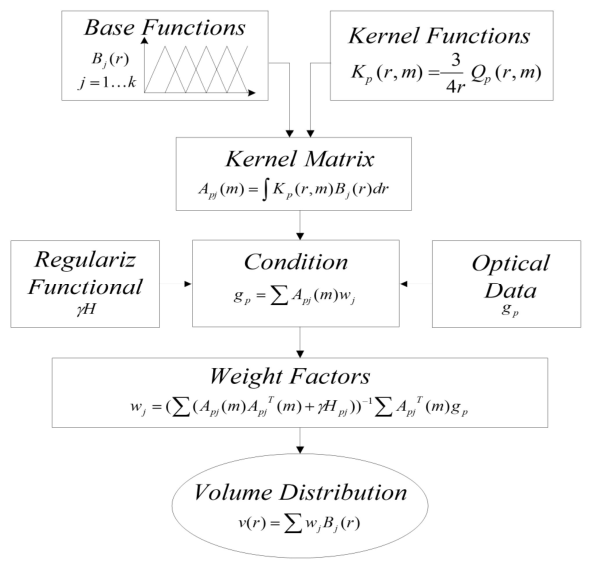
wj is the corresponding weights that need to be solved. According to the number of input parameters, five linear B-spline functions are adopted to approximate the true volume size distribution. In this way, the continuous spectral inversion problem is transformed into the estimation of a finite set of weight parameters. The inversion workflow is shown in
Figure 1.
For a given complex refractive index and particle-size interval, the kernel matrix
A is calculated from Mie theory, and the integral equation can be discretized in matrix form as follows:
where
g is the optical-input vector and
w is the spline-weight vector. Because the problem is strongly ill-posed, Tikhonov regularization is adopted to obtain the solution:
where
γ is the Lagrange multiplier and
H is the smoothing constraint matrix. The first term ensures consistency between the inversion result and the input optical quantities, whereas the second term suppresses oscillations in the retrieved distribution caused by noise and ill-conditioning. In this way, a smooth and physically meaningful volume size distribution can be obtained while preserving consistency with the observations as much as possible.
2.2. Numerical Simulations
To verify the feasibility and stability of the above inversion method, numerical simulations were first conducted using a typical bimodal lognormal volume size distribution. A bimodal lognormal distribution is the superposition of multiple unimodal lognormal distributions, and can be expressed as follows:
where
n is the number of peaks;
Cv is the normalized particle constant, i.e., the volume-contribution coefficient;
r is aerosol particle radius;
rm is the characteristic radius; and
σ is the geometric standard deviation. A bimodal distribution was selected because atmospheric aerosols usually contain both fine-mode and coarse-mode particles. A bimodal lognormal spectrum can therefore represent the typical size structure of urban-industrial aerosols reasonably well and is suitable as an ideal reference model for method validation. The empirical parameters selected in this study are listed in
Table 1.
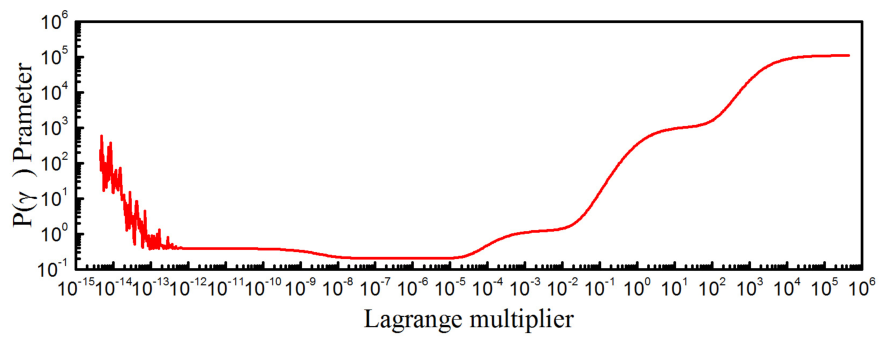
On this basis, Mie theory was used to calculate the extinction efficiency and backscatter efficiency at the three wavelengths, thereby generating the optical input vector corresponding to the prescribed volume size distribution. During the simulation, the Lagrange multiplier was selected using a generalized cross-validation criterion. Within the candidate parameter space, the generalized cross-validation function exhibits a distinct minimum as
γ varies, and the
γ corresponding to this minimum is taken as the optimal Lagrange multiplier.
In the above expression, ‖·‖ denotes the matrix 2-norm;
k is the number of optical parameters;
I is the identity matrix;
P is the cross-validation value, which measures the error and decreases as the error becomes smaller;
trace denotes the sum of the main diagonal elements; and
M is a matrix related to
γ. The simulation results are shown in
Figure 2, where the minimum cross-validation value is approximately 0.2035 and corresponds to the optimal Lagrange multiplier indicated in the figure. This demonstrates that the regularization-parameter selection strategy adopted in this study establishes a reasonable balance between data fitting and solution smoothness.
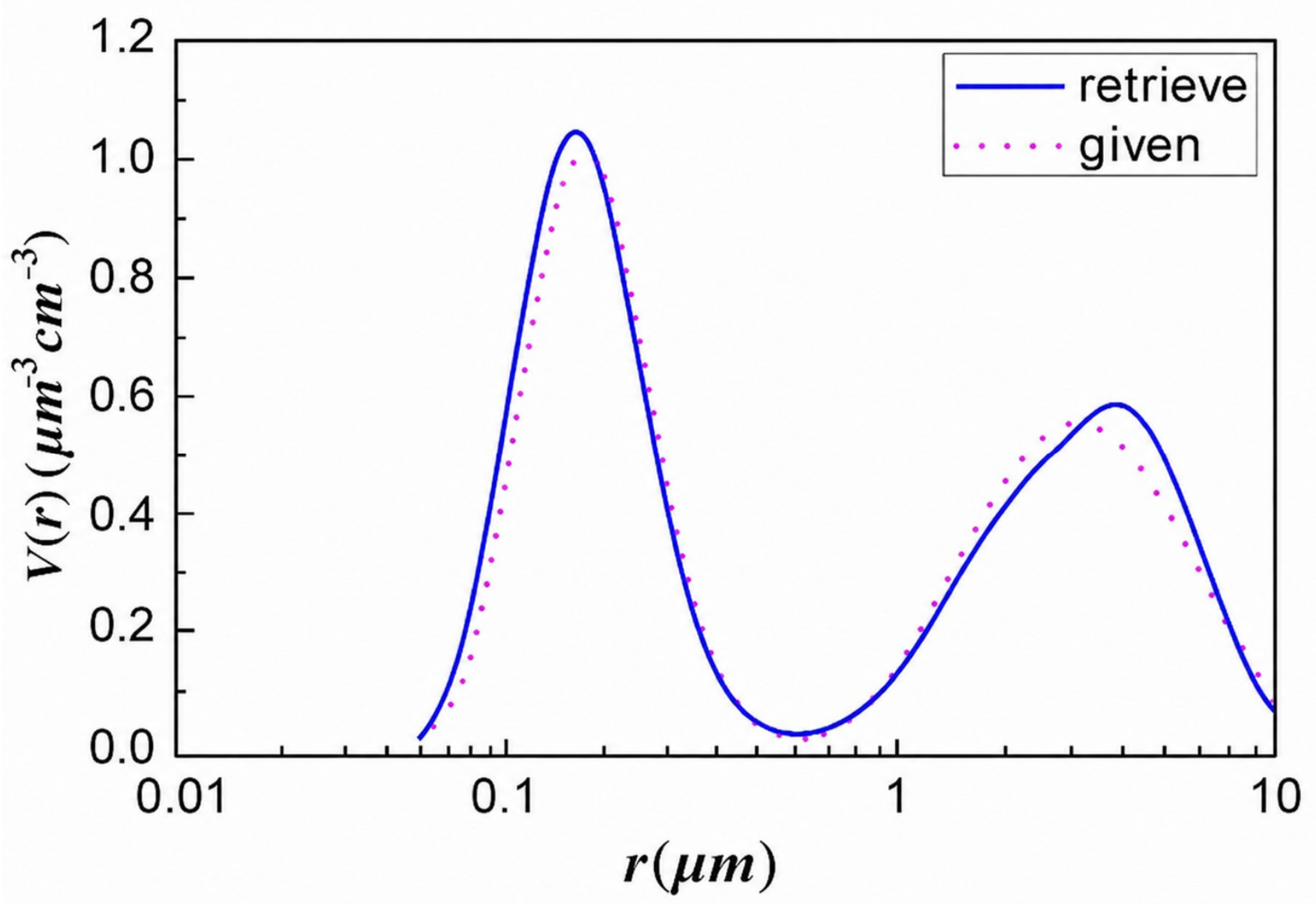
After selecting the optimal Lagrange multiplier, the inversion algorithm was used to reconstruct the volume size distribution. The results are shown in
Figure 3, in which the retrieved bimodal volume size distribution agrees well with the prescribed reference spectrum in overall shape. The peak positions of both the fine and coarse modes are reproduced satisfactorily, and the overall volume-contribution distribution is also in good agreement.
2.3. Analysis of Influencing Factors
Although the numerical simulations verify the feasibility of the inversion method under ideal conditions, retrieval results in the real atmosphere are still jointly affected by several prior parameters. In this study, the key factors controlling the stability of volume-spectrum inversion are summarized into three categories: complex refractive index, particle-size interval, and lidar ratio. These factors do not directly alter the inversion framework itself, but they significantly modify the retrieved particle-spectrum shape and effective radius by affecting either the kernel matrix or the optical input quantities. Therefore, systematic analysis and optimization of these factors are essential in practical applications.
To evaluate the accuracy of the inversion results, the average error of the optical parameters
δave, is defined as follows:
First, two extinction coefficients and three backscatter coefficients are retrieved from the lidar measurements and combined into an input vector gp. On this basis, the inversion algorithm is used to calculate the particle size distribution under different complex refractive indices and particle-size intervals, while the average relative error of the five optical parameters reconstructed from the retrieved result is computed simultaneously. By comparing the errors corresponding to each parameter combination, the volume size distribution associated with the δmin is selected as the optimal solution. This criterion is therefore a key indicator for judging whether the retrieved volume size distribution approaches the true distribution.
The complex refractive index is a key parameter governing particle-scattering characteristics, and different aerosol types typically correspond to different ranges of complex refractive index. For typical particle classes such as urban-industrial aerosol, biomass-burning aerosol, dust-marine aerosol, and cloud droplets, the real and imaginary parts differ substantially. The complex refractive indices of these typical particle classes are shown in
Table 2.
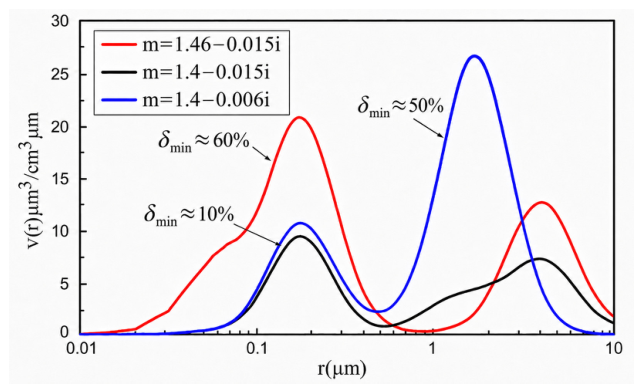
Because the kernel function depends directly on the complex refractive index, even small changes in it will alter the Mie efficiencies and thus modify the retrieved volume size distribution. Based on local conditions, echo signals acquired by the three-wavelength system under cloudy conditions (16 April 2023; AQI = 92; T = 15–25 °C) were selected, and the complex refractive index, according to the data in
Table 2, was varied within
m = (1.4–1.5) ± (0.003–0.015)
i.
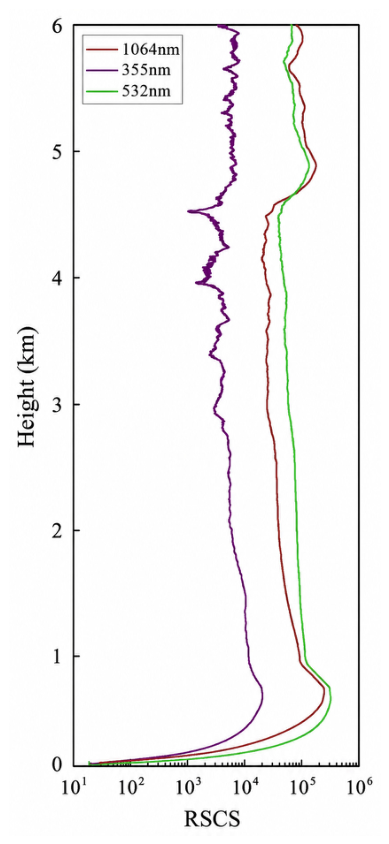
Figure 4 shows the range-squared-corrected signal (RSCS) collected by the multi-wavelength polarization lidar system. Combined with the meteorological conditions on that day, a thick aerosol layer can be inferred at around 4.5 km. The above inversion algorithm was then used to retrieve the volume size distribution and the minimum relative error of the optical parameters under different complex refractive indices.
The experimental data used in this section were obtained from nighttime observations by the ground-based 355/532/1064 nm multi-wavelength polarization lidar system. The raw lidar echo signals were first preprocessed and converted into range-squared-corrected signals, and the extinction and backscatter coefficients used as optical inputs were then retrieved through the elastic-lidar inversion procedure. The effects of different real and imaginary parts were compared. As shown in
Figure 5, at 5.4 km on that day, the average relative error between the experimental data and the reconstructed data reaches a minimum of only about 10% when
m = 1.4 − 0.015
i. Variations in the real part of the complex refractive index mainly affect the spectral position and fine-mode contribution in the small-particle-size range, whereas variations in the imaginary part have a more pronounced influence in the large-particle-size range, especially when the coarse mode is enhanced. This indicates that a single fixed complex refractive index should not be used uniformly for different weather conditions and altitude layers; instead, it should be treated as an optimizable parameter within the inversion procedure.
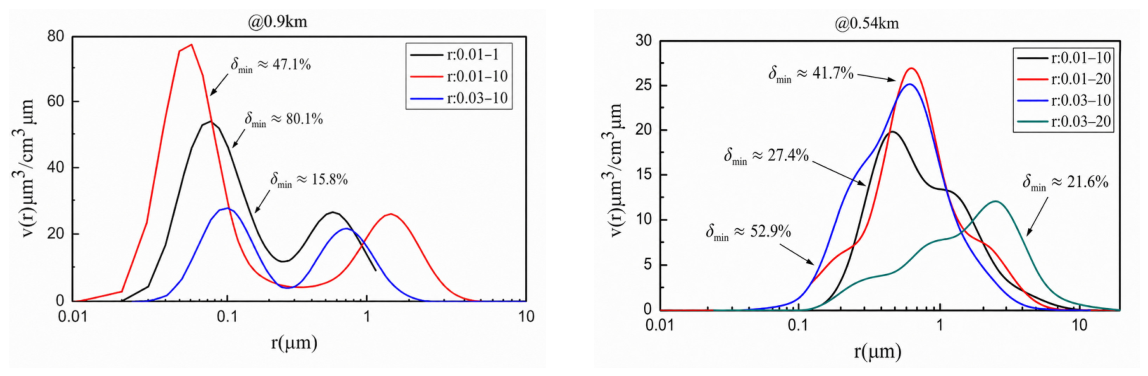
The particle-radius integration interval determines the size range covered by the volume-spectrum inversion. If the upper radius limit is set too small, the contribution of coarse-mode particles may be truncated; if the lower radius limit is not chosen appropriately, recovery of the fine mode will be affected. Therefore, the choice of particle-size interval directly determines whether the spectrum can fully represent the true particle-population distribution. Using the same experimental data as above, the optimal complex refractive index was taken as m = 1.46 − 0.006i at 0.9 km and m = 1.4 − 0.015i at 5.4 km, and the volume size distribution was retrieved for different radius intervals.
Figure 6 shows the volume size distributions retrieved for different radius intervals at heights of 0.9 and 5.4 km, together with the relative errors of the 3β + 2α parameters. It can be seen that at 0.9 km, when
r is set to [0.03, 10], the minimum relative error is 15.8%; therefore, the optimal radius interval at 0.9 km on that day is [0.03, 10]. At 5.4 km, the minimum relative error is 21.6% when the interval is [0.03, 20]. Relative to the 0.9 km level, this height lies near the center of the aerosol layer, where abundant large particles are present; accordingly, the peak shifts to the right and the contribution of large-radius particles increases, while the error remains within an acceptable range. Because large particles undergo gravitational settling, a certain number of them are also present in the lower atmosphere, making the contributions of small- and large-radius particles comparable there. With increasing altitude, the numbers of both small and large particles gradually decrease. However, at 5.4 km, because this level lies within the aerosol layer and contains relatively large particles, large-radius particles dominate. These results indicate that different radius intervals can shift the peaks of the volume size distribution and increase the retrieval error. Moreover, the appropriate radius interval varies with altitude and meteorological conditions; therefore, it needs to be reselected for each inversion.
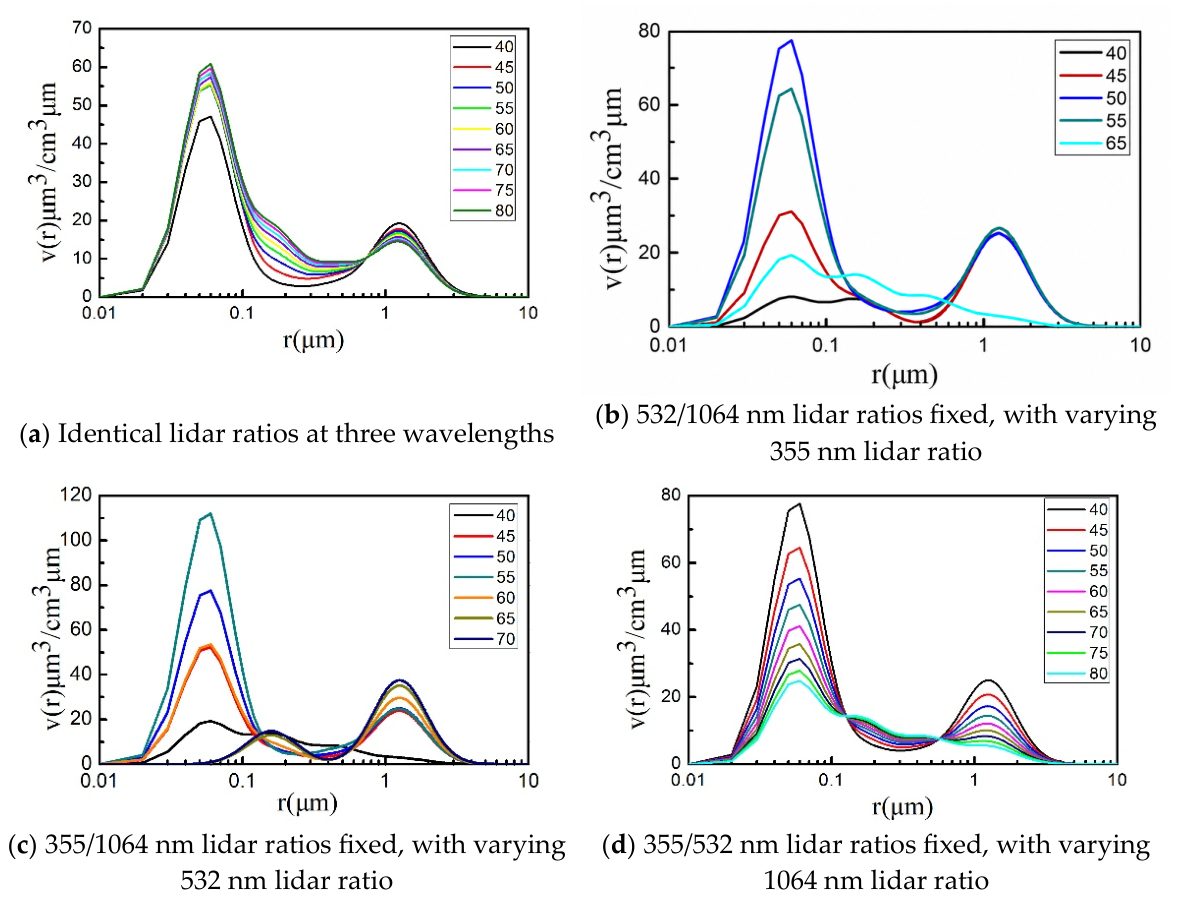
Retrieval of microphysical parameters is based on optical quantities obtained from elastic-scattering lidar inversion, and part of the input therefore depends on the prescribed lidar ratio. In this study, the initial lidar ratios at 355/532/1064 nm are assumed to be 50/50/40 [
27]. Although the lidar ratio does not explicitly appear in the regularization equation, it influences the final retrieved particle spectrum by modifying the backscatter-related input quantities. Using the same experimental dataset as above, a height of 4.8 km, the optimal complex refractive index
m = 1.46 − 0.006
i, and the radius interval [0.01, 10] were selected. Different lidar ratios were then used to retrieve the extinction and backscatter parameters and, subsequently, the volume size distribution was shown in
Figure 7.
Panel (1) shows the change in the volume size distribution when the lidar ratios at 355/532/1064 nm vary simultaneously under the same condition. Panel (2) shows the variation obtained by changing only the 355 nm lidar ratio while keeping the 532/1064 nm lidar ratios fixed at 50/40. Panel (3) shows the variation obtained by changing only the 532 nm lidar ratio while keeping the 355/1064 nm lidar ratios fixed at 50/40. Panel (4) shows the variation obtained by changing only the 1064 nm lidar ratio while keeping the 355/532 nm lidar ratios fixed at 50/50.
As shown in
Figure 7, in panel (1), with increasing lidar ratio, the volume contribution in the small-radius range gradually increases, whereas that in the large-radius range gradually decreases, although the magnitude of change is limited. In panel (2), as the 355 nm lidar ratio increases, the values in the small-radius range also increase, while the large-radius range shows no obvious change; when the lidar ratio reaches 60, the curve becomes nearly unchanged. In panel (3), the volume contribution in the small-radius range first increases and then decreases when the 532 nm lidar ratio reaches 55, whereas the contribution in the large-radius range gradually increases. In panel (4), the volume contribution in both the small- and large-radius ranges decreases with increasing 1064 nm lidar ratio. Because different wavelengths respond differently to particles of different sizes, changing the 355 nm lidar ratio mainly affects particles smaller than 0.1 μm, changing the 532 nm lidar ratio mainly affects particles in the range 0.1–2 μm, and changing the 1064 nm lidar ratio mainly affects particles larger than 2 μm.
These results indicate that changes in the lidar ratio at different wavelengths produce different effects on different particle-size ranges: shorter-wavelength channels are more sensitive to fine particles, whereas longer-wavelength channels are more sensitive to coarse particles. Therefore, the lidar ratio is not merely an empirical intermediate parameter, but an important prior quantity that determines the structure of the optical inputs. In limited-channel elastic-scattering systems, uncertainty in the prescribed lidar ratio is further propagated into the retrieved volume size distribution and effective radius.
2.4. Determination of the Optimal Solution
The complete optimization procedure can be summarized as follows. First, the optical input vector was constructed from the retrieved 3β + 2α parameters. Second, a set of candidate complex refractive indices, particle-size intervals, and lidar ratios was prescribed according to typical aerosol optical properties and the observational scenario. Third, for each parameter combination, the kernel matrix was calculated using Mie theory, and the volume size distribution was retrieved using Tikhonov regularization. Fourth, the retrieved size distribution was used to reconstruct the optical quantities, and the average relative reconstruction error was calculated. Finally, the parameter combination corresponding to the minimum reconstruction error was selected as the optimal solution. This procedure provides an optical-closure-based criterion for selecting prior parameters and reduces the dependence on a single fixed assumption.
Considering that complex refractive index, particle-size interval, and lidar ratio jointly affect the inversion results, this study adopts a parameter-optimization strategy of cyclic search, groupwise inversion, and minimization of the reconstruction error. The complex refractive index was set with a real part of 1.4–1.5 and an imaginary part of 0.003–0.015; the particle-radius range was set to 0.01–20 μm; and the lidar-ratio range was set to 40–60 sr. Volume-spectrum inversion is then performed for each selected combination of m and r, and the corresponding minimum relative error is calculated. Among the 1500 error values obtained, the solution with the smallest error is taken as the closest approximation to the true volume size distribution, and the corresponding complex refractive index and radius interval are adopted as the optimal values for retrieval.
Based on the above analysis, among the 1500 volume size distributions retrieved using different combinations of
m and
r, it was found that at 0.9 km the optimal parameters are
m = 1.46 − 0.006
i and
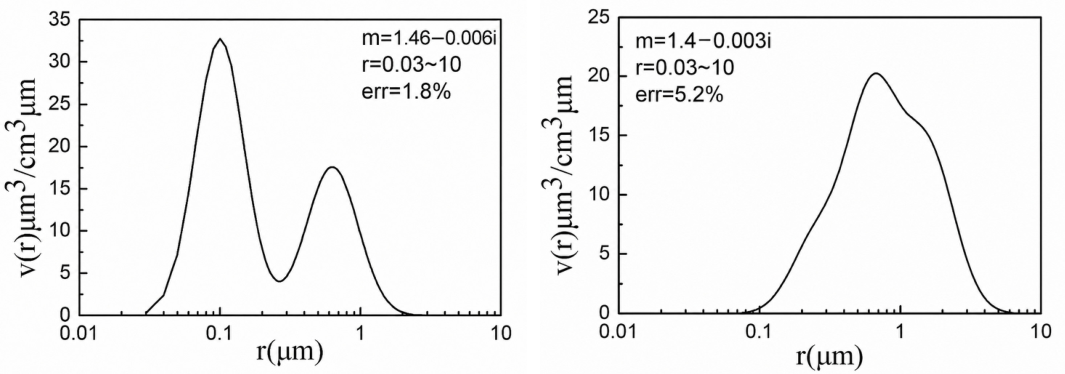
r = 0.03–10 μm, for which the relative error of the parameters reconstructed from the retrieved volume size distribution is only 1.8%. At 5.4 km, the optimal parameters are
m = 1.4 − 0.003
i and
r = 0.03–10 μm, and the average relative error among the five reconstructed parameters is only 5.2%. As shown in
Figure 8, the retrieved distributions closely approximate the true volume size distribution in both cases.
The parameter-optimization strategy adopted in this study can effectively avoid inversion errors caused by a single fixed parameter. It allows the optimal parameters to vary automatically with altitude and meteorological conditions, while reconstruction consistency ensures the greatest possible agreement between the retrieved results and the input observations.
2.5. Uncertainty Propagation Framework and Robustness Evaluation
Because the retrieval of aerosol microphysical parameters is an ill-posed inverse problem, uncertainties in the optical input quantities may propagate into the retrieved volume size distribution and effective radius. To clarify the possible uncertainty propagation path and to provide a basis for future quantitative robustness evaluation, a Monte Carlo perturbation framework is introduced in this section. This framework is not used as a completed quantitative uncertainty experiment in the present study, but rather as a methodological extension for evaluating the sensitivity of the retrieved microphysical parameters to optical-input perturbations.
For future implementation, N = 500 Monte Carlo realizations are recommended. Relative perturbations of 10% may be applied to the extinction coefficients, and relative perturbations of 15% may be applied to the backscatter coefficients, considering that backscatter retrievals from elastic lidar are generally more sensitive to signal noise and lidar-ratio assumptions.
The optical input vector used for microphysical inversion was defined as:
where
α and
β denote the extinction coefficient and backscatter coefficient, respectively. For the
n-th Monte Carlo realization, each optical quantity was perturbed according to:
where
gi(n) is the perturbed optical quantity,
gi is the original optical input,
σi is the prescribed relative uncertainty of the
i-th optical parameter, and
ξi(n) is a normally distributed random variable satisfying:
In vector form, the perturbed optical input vector can be written as:
where ⊙ denotes element-wise multiplication. For each perturbed optical input vector, the complete retrieval procedure would be repeated, including the selection of the regularization parameter and the search for the optimal prior parameters. The spline-weight vector for the
n-th realization would be obtained by solving the Tikhonov-regularized inverse problem:
The retrieved volume size distribution for the
n-th realization was then expressed as:
where
wj(n) is the corresponding weight coefficient. The effective radius corresponding to the
n-th realization was calculated as:
After
N Monte Carlo realizations, the mean retrieved volume size distribution can be calculated as:
and the corresponding standard deviation was calculated as:
Similarly, the mean effective radius and its standard deviation were calculated as:
The relative uncertainty of the retrieved effective radius can be further defined as:
To evaluate the optical closure of each realization, the retrieved volume size distribution was used to reconstruct the optical input vector. The reconstructed optical vector was expressed as:
and the average relative reconstruction error was calculated as:
The proposed Monte Carlo perturbation framework can be used to evaluate both the uncertainty propagation from optical quantities to microphysical parameters and the robustness of the prior-parameter search strategy in future work. If the retrieved volume size distribution and effective radius remained stable under moderate perturbations of the optical inputs, the retrieval was considered to be robust. In contrast, large variations in the retrieved size distribution or effective radius indicated that the corresponding altitude layer was more sensitive to optical-input uncertainty or prior-parameter selection.
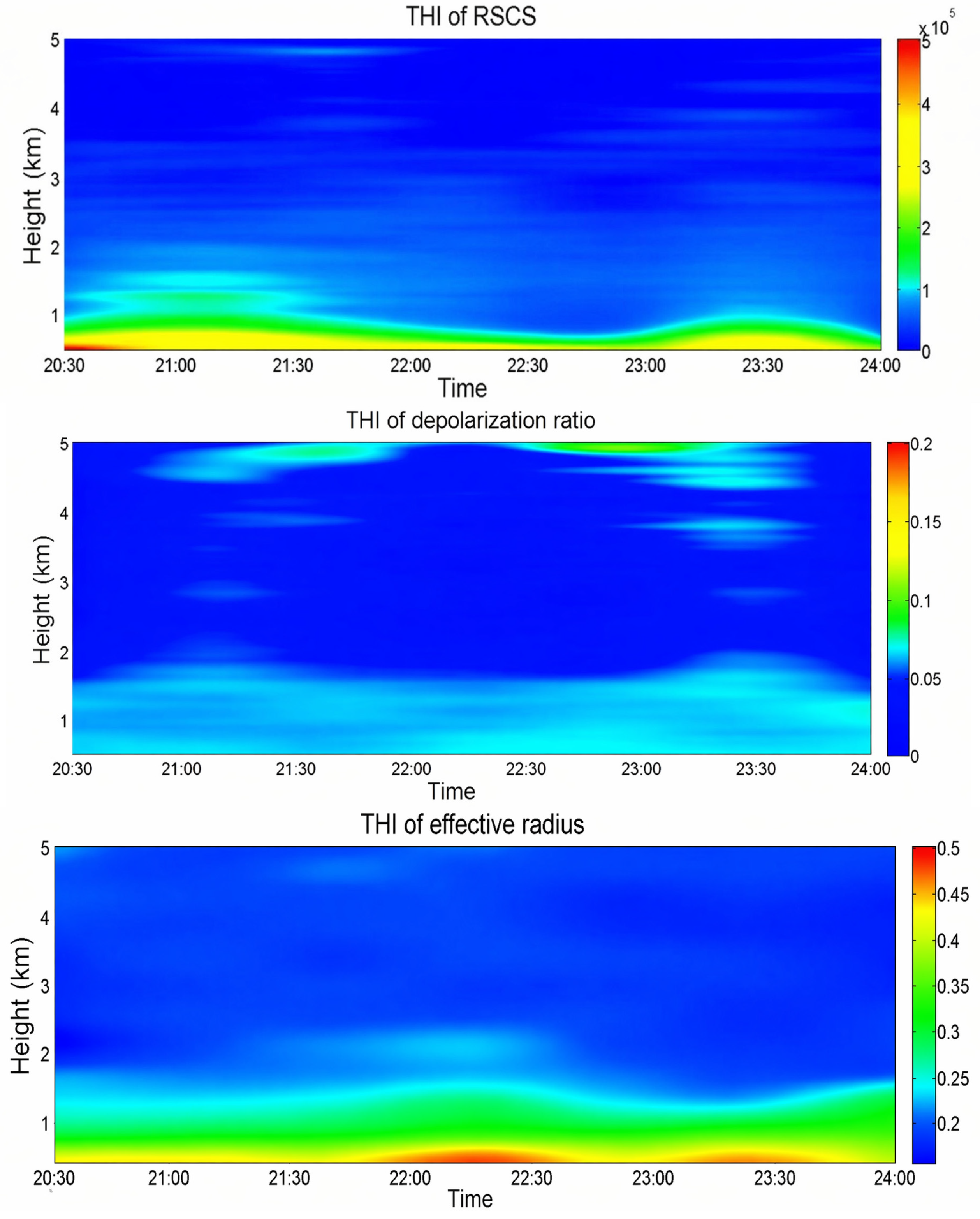
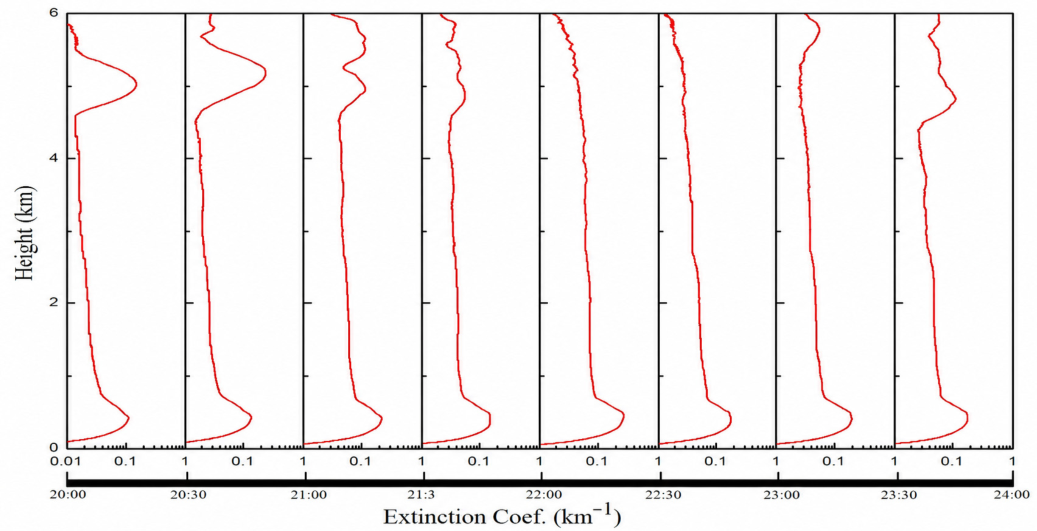
In this study, because no co-located in situ particle size distribution measurements were available during the selected nighttime lidar observations, direct point-by-point validation of the retrieved volume size distribution could not be performed. Therefore, in the present study, the reliability of the retrieval was mainly assessed using optical closure error and the physical consistency among RSCS, extinction coefficient, depolarization ratio, effective radius, and surface air-quality observations. A complete Monte Carlo-based uncertainty quantification will be conducted in future work when the full perturbation calculation framework is implemented. This framework provides a practical route for assessing the robustness of the proposed retrieval method under limited-channel elastic-lidar observational conditions.
The Monte Carlo-based uncertainty propagation framework provides a practical way to evaluate the sensitivity of the retrieved microphysical parameters to optical input uncertainties. This framework can be used to identify altitude layers in which the retrieved volume size distribution and effective radius are more sensitive to optical-input perturbations. In general, larger retrieval uncertainty is expected in weak-signal regions and aerosol-influenced layers, where the optical input quantities and prior-parameter selection may vary more strongly. Therefore, the Monte Carlo framework provides a potential quantitative basis for assessing the robustness of coarse-mode enhancement and effective-radius increase, especially in layers affected by aerosol particles or rapidly varying atmospheric structures.
4. Discussion
Retrieval of aerosol microphysical parameters from lidar observations is an intrinsically ill-posed inverse problem. Different combinations of particle size distribution, complex refractive index, and optical-input uncertainty may produce similar extinction and backscatter coefficients. Therefore, the present study should be understood as a practical attempt to improve the applicability of aerosol volume size distribution and effective-radius retrieval under limited-channel elastic-lidar conditions, rather than as a complete substitute for multi-wavelength Raman lidar, high-spectral-resolution lidar, or in situ particle measurements. The proposed framework follows the general physical basis of conventional lidar microphysical inversion, including Mie scattering kernels, B-spline representation of the volume size distribution, and Tikhonov regularization. However, the observational constraint in this study is weaker than that in standard multi-wavelength Raman lidar retrievals, because the system used here is a triple-wavelength elastic-scattering, single-polarization lidar, and part of the 3β + 2α optical input is obtained through elastic-lidar inversion and prescribed lidar-ratio assumptions. This difference defines both the practical value and the limitations of the proposed method.
Compared with classical multi-wavelength Raman lidar retrievals, the present method has fewer independent optical constraints. Raman lidar systems can provide more direct extinction and backscatter information, which is generally more favorable for retrieving particle size distribution, effective radius, volume concentration, and sometimes refractive-index-related parameters. Recent developments, such as maximum-likelihood-based retrieval, look-up-table strategies, and self-posed inversion schemes, further improve the stability of lidar microphysical retrieval by introducing stronger statistical constraints or more complete optical information. In contrast, the purpose of this study is not to increase the number of independent channels, but to improve retrieval robustness when only limited elastic-lidar information is available. The main methodological contribution is the introduction of a prior-parameter search strategy for the complex refractive index, particle-size interval, and lidar ratio, together with an optical reconstruction error minimization criterion. This strategy provides an internal optical-closure constraint for selecting physically plausible solutions and reduces the dependence of the retrieval on a single fixed set of prior parameters.
The proposed method also differs from multi-source synergistic retrieval approaches. Previous studies combining lidar with in situ particle measurements, sun-photometer products, radar observations, or other auxiliary measurements can provide stronger independent constraints on particle size distribution, refractive index, coarse-mode particles, and cloud-related particles. Such approaches are more suitable for quantitative validation and for reducing the non-uniqueness of microphysical inversion. In the present study, however, the retrieval framework is designed for a single-station ground-based elastic-lidar configuration. During the selected nighttime observations, no co-located in situ particle size distribution measurements, AERONET retrieval products, cloud radar observations, or Raman-lidar extinction profiles were available. Therefore, the present results cannot be regarded as directly validated microphysical measurements. Instead, the reliability of the retrieval is evaluated using numerical simulation, optical closure between the retrieved size distribution and the input optical quantities, comparison with fixed-prior retrievals, and physical consistency among RSCS, extinction coefficient, depolarization ratio, effective radius, and surface air-quality observations.
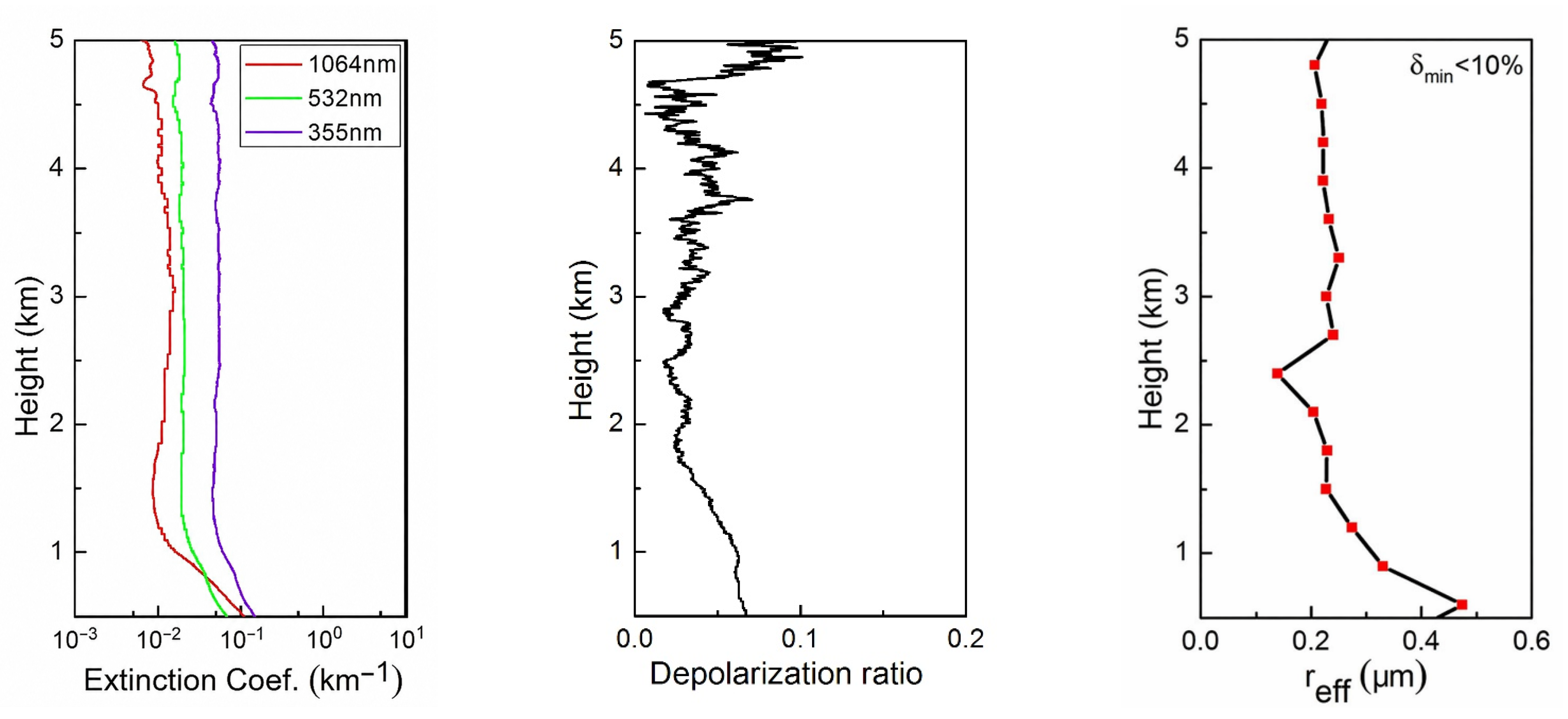
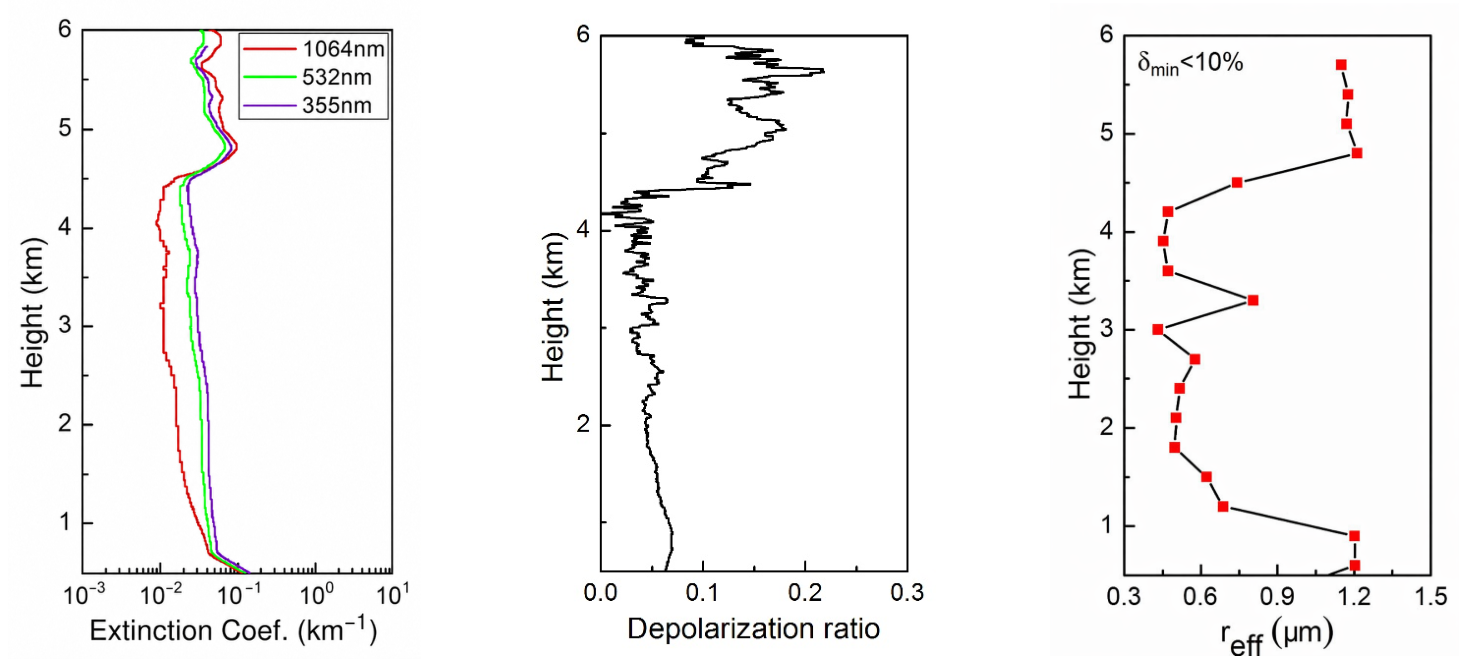
Within this methodological context, the two case studies provide useful but limited evidence for the applicability of the method. In the good-air-quality case, the retrieved particle spectrum is consistent with a fine-mode-dominated urban aerosol structure in the lower atmosphere. In the lightly polluted and cloud-influenced case, the enhanced effective radius and increased coarse-mode contribution in the upper layer are consistent with the simultaneous enhancement of RSCS, extinction coefficient, and depolarization ratio. These consistencies indicate that the method can capture physically reasonable vertical variations in particle-spectrum structure. However, such interpretations should be regarded as physically plausible indications rather than independently verified conclusions. In particular, the identification of cloud-influenced particle layers is based on the consistency among lidar optical quantities and retrieved microphysical parameters, and should be further verified using independent cloud or particle observations in future work.
A major strength of the proposed method is its practical applicability to limited-channel ground-based elastic-lidar systems. Many operational or research lidar systems, especially those used for routine urban nighttime observations, do not have complete Raman or high-spectral-resolution detection capability. For such systems, microphysical retrieval based on fixed values of complex refractive index, particle-size interval, and lidar ratio may lead to unstable or physically unrealistic solutions. The parameter-search strategy used in this study partly alleviates this problem by allowing key prior parameters to vary within prescribed physically reasonable ranges. Compared with conventional fixed-prior retrieval, the optimized retrieval can improve optical closure and produce more consistent vertical variations in volume size distribution and effective radius. Therefore, the method provides a useful intermediate approach between simple optical-parameter analysis and more advanced multi-channel microphysical retrieval.
Nevertheless, several limitations must be emphasized. First, because the optical inputs are derived from elastic-scattering lidar inversion, they are inevitably affected by signal noise, overlap correction, boundary-value selection, and lidar-ratio assumptions. These uncertainties can propagate into the retrieved volume size distribution and effective radius. Second, although the parameter-search strategy improves optical closure, it cannot eliminate the intrinsic non-uniqueness of aerosol microphysical inversion. Different combinations of complex refractive index, particle-size interval, and lidar ratio may still produce similar reconstruction errors, especially in weak-signal regions or in layers where aerosols and cloud particles coexist. Third, the inversion is based on Mie scattering theory, which assumes spherical particles. This assumption is generally acceptable for many urban fine-mode aerosols and liquid droplets, but it may introduce systematic errors for nonspherical dust particles, ice crystals, or complex mixed-phase particles. Fourth, the present validation is limited to synthetic simulations, optical-closure analysis, comparison with fixed-prior retrievals, and two short nighttime case studies. Therefore, the results should not be generalized to all urban atmospheric conditions or interpreted as climatological characteristics of aerosol microphysical properties.
The uncertainty propagation framework introduced in this study provides a basis for future robustness evaluation, but a complete quantitative Monte Carlo uncertainty analysis has not yet been implemented. This is an important limitation. In future work, perturbations should be applied systematically to extinction coefficients, backscatter coefficients, lidar ratios, and refractive-index assumptions to quantify their influence on the retrieved volume size distribution and effective radius. Such an analysis would help identify altitude layers where the retrieval is more sensitive to optical-input uncertainty or prior-parameter selection. This is particularly important for weak-signal regions and cloud-influenced layers, where uncertainty amplification is expected to be more significant.
Future studies should therefore focus on three aspects. First, co-located independent observations, such as in situ particle size distribution measurements, sun-photometer retrievals, Raman-lidar extinction profiles, high-spectral-resolution lidar products, or cloud radar observations, should be introduced to provide quantitative validation of the retrieved volume size distribution and effective radius. Second, a full Monte Carlo uncertainty analysis should be carried out to evaluate how measurement errors and prior-parameter uncertainties propagate into the final microphysical parameters. Third, more observational cases covering different aerosol types, humidity conditions, pollution levels, and cloud-influenced scenarios should be analyzed to test the generality and stability of the proposed parameter-search strategy. Through these improvements, the present framework can be further developed from an internally consistent elastic-lidar retrieval method into a more quantitatively validated approach for aerosol microphysical parameter retrieval.
5. Conclusions
For a 355/532/1064 nm three-wavelength elastic-scattering, single-channel polarization lidar system, this study establishes a methodological framework for retrieving aerosol volume size distribution and effective radius. The framework is based on 3β + 2α optical inputs, uses Mie scattering theory as the forward model, parameterizes the volume size distribution with B-spline functions, and achieves stable solutions through Tikhonov regularization and cross-validation. Numerical simulations show that the method can successfully reproduce the main structural characteristics of a bimodal lognormal particle spectrum, demonstrating its feasibility both theoretically and in numerical implementation. In addition, a parameter-optimization strategy of parameter search, inversion reconstruction, and error minimization is proposed. To address the difficulty of accurately prescribing prior parameters such as complex refractive index, particle-size interval, and lidar ratio in elastic-scattering systems, this study does not adopt a single fixed parameter set. Instead, it performs cyclic search within a prescribed parameter space and identifies the optimal solution by minimizing the average relative error of the reconstructed optical quantities. This strategy enhances the robustness of volume-spectrum inversion, allows the optimal parameters to adapt to different altitudes and meteorological conditions, and thereby improves the reliability of microphysical inversion under limited-channel observational conditions.
The influencing-factor analysis further shows that complex refractive index, particle-size interval, and lidar ratio are the key controlling quantities governing inversion of the volume size distribution. The complex refractive index mainly affects the peak positions and relative contributions of the fine and coarse modes; the particle-size interval determines whether the particle spectrum can completely cover the coarse mode; and the lidar ratio further affects retrieval performance in different size ranges by changing the backscatter-related input quantities. The representative case studies further demonstrate that the method can effectively distinguish between a fine-mode-dominated urban aerosol layer under clear-sky background conditions and a two-layer structure under lightly polluted conditions consisting of a near-surface polluted layer and an upper-level cloud-influenced-particle layer. Overall, for limited-channel urban ground-based lidar systems, this study develops a volume-spectrum inversion procedure with a clear physical basis, strong practical implementability, and a certain degree of scene adaptability, and reveals at the methodological level how key influencing factors control the stability of the results.