Article

High-Resolution Mapping, Attribution, and Carbon Loss Assessment of Forest Disturbances in China’s Critical Regions Using Multi-Source Remote Sensing


1
College of Forestry, Northwest A&F University, Yangling 712100, China
2
Xi’an Yuantu Intelligent Technology Co., Ltd., Xi’an 710000, China
*
Author to whom correspondence should be addressed.
Remote Sens. 2026, 18(12), 1982; https://doi.org/10.3390/rs18121982 (registering DOI)
Submission received: 6 May 2026 / Revised: 11 June 2026 / Accepted: 12 June 2026 / Published: 14 June 2026
(This article belongs to the Section Forest Remote Sensing)

Highlights

What are the main findings?
  • The disturbed forest area in the Northeast (1084.58 ha) significantly exceeded that in the Hengduan Mountains (133.48 ha) from 2021 to 2024, predominantly driven by natural degradation.
  • Despite accounting for only 12.3% of the Northeast’s disturbed area, the Hengduan Mountains generated 31.6% of its carbon emissions due to exceptionally high per-pixel biomass.
What are the implications of the main findings?
  • The disproportionately high carbon and economic losses per unit area in southwestern alpine forests highlight their critical climate mitigation value and the need for strict conservation.
  • Integrating optical and microwave time-series data provides a probabilistic, high-resolution framework for spatially explicit carbon auditing and optimizing national ecological compensation policies.

Abstract

Forest disturbances significantly affect the terrestrial carbon cycle, yet high-resolution detection, driver attribution, and carbon loss quantification remain challenging in cloudy and complex terrains. Here, we investigated the Northeast China and Southwest Hengduan Mountains forest regions from 2021 to 2024. We developed a Bayesian Model Averaging (BMA) framework integrating multi-source remote sensing (Sentinel-1/2, Landsat 8/9) and multi-algorithm ensembles (LandTrendr, CCDC, 1D-CNN) to extract 10 m disturbance features. Automated driver attribution and carbon loss quantification were achieved utilizing the Fire Information for Resource Management System (FIRMS), Dynamic World, and GEDI L4B LiDAR data. Validation yielded overall spatial accuracies of 91.15% in the Northeast and 89.62% in the Hengduan Mountains, with corresponding ensemble F1-Scores of 0.92 in both regions. Results indicated the disturbed area in the Northeast (1084.58 ha) significantly exceeded the Hengduan region (133.48 ha). Natural degradation dominated both regions (Northeast: 72.25%; Hengduan: 88.43%), though the Northeast experienced more wildfires and anthropogenic activities. Topographically, Northeast disturbances clustered on low-lying, gentle landscapes, whereas Hengduan events occurred on steep, high-altitude terrains. Due to denser per-pixel carbon storage, the Hengduan area exhibited higher carbon emission costs per unit area. Ultimately, this framework provides a quantitative technical foundation supporting high-resolution forest conservation and spatial evaluations for carbon neutrality commitments.

1. Introduction

Forest ecosystems are the principal carbon sink on land, playing a critical role in climate regulation and biodiversity maintenance [1]. However, anthropogenic activities and a changing climate have severely disrupted these areas [2]. Forests now experience a growing frequency of threats, such as widespread wildfires, intensive logging, and extreme hydro-geological events [3]. China possesses substantial natural forest assets and the largest planted forest area worldwide [4]. Recognizing the ecological value of these resources, the government has systematically initiated numerous major forestry conservation programs [5]. The Natural Forest Protection Program (NFPP) began in 1998 [6]. Commercial logging in natural forests was completely halted between 2015 and 2017 [7]. Since then, the spatial patterns and driving mechanisms of forest disturbances in China have changed fundamentally [8]. The proportion of large-scale anthropogenic logging has decreased significantly [9]. As a result, the relative importance of natural disasters has gradually increased. These disasters include wildfires, drought-induced mortality, and geological hazards triggered by extreme climate [10]. Therefore, accurate and timely monitoring of forest disturbances in national key ecological barrier zones is urgently needed [11]. Such monitoring is essential for evaluating forest conservation policies and supporting the national carbon neutrality strategy [12].
The rapid development of satellite remote sensing has provided abundant data for monitoring forest dynamics over large areas [13]. Medium-resolution optical time-series data, such as Landsat and Sentinel-2, are widely used to detect forest cover change [14]. This has led to the development of classic time-series segmentation algorithms. This progress has produced standard tools like LandTrendr and Continuous Change Detection and Classification (CCDC) [15]. Even with these tools, tracking forests in complex terrains remains difficult for existing systems [16]. First, frequent cloud cover presents a major barrier. In areas like the Hengduan Mountains of Southwest China, the lack of clear optical data greatly reduces both the speed and accuracy of detection [17]. Global forest change products that rely only on optical data are often compromised by cloud shadows and complex terrain in mountainous areas [18]. Second, single algorithms show inherent biases when processing different disturbance types [19]. Comprehensive comparisons indicate that no single model can perfectly capture both rapid abrupt changes and slow gradual degradation [20]. While ensemble approaches like stacked generalization have been successfully applied to forest change detection to address this [21], extending these multi-algorithm synergies to integrate both optical and microwave signals via probabilistic frameworks in cloudy, complex terrains remains underexplored. Furthermore, current research focuses mainly on identifying disturbed areas. A comprehensive systematic framework for automated driver attribution is still lacking [22]. Finally, when accounting for forest carbon losses, a scale mismatch commonly exists between high-resolution disturbance patches (<30 m) and coarse-resolution carbon density products (>1 km) [23]. The widespread use of static and uniform carbon emission factors also ignores regional heterogeneity [24]. Specifically, carbon loss per unit area varies with disturbance type and by region [25].
To fill these research gaps, this study constructed a forest disturbance monitoring and carbon assessment framework integrating spatiotemporal spectral information and multi-model synergies. The specific objectives of this study are: (1) to develop a dense optical time series fusing Sentinel-2 and Landsat 8/9 SR data, incorporate Sentinel-1 SAR structural features, and propose a Bayesian Model Averaging (BMA) fusion mechanism to improve 10 m detection accuracy in complex terrains; (2) to establish an automated, objective attribution framework by coupling multi-source spatiotemporal knowledge bases (FIRMS, Dynamic World); and (3) to quantify carbon and economic losses under various disturbance types using the Global Ecosystem Dynamics Investigation (GEDI) LiDAR 3D biomass product, thereby revealing the topographic and geographical heterogeneity of forest disturbance mechanisms in typical northern and southern forest regions of China.

2. Materials and Methods

2.1. Study Area

This study focuses on two distinct forest landscapes in China. The first is the Northeast Forest Region, which represents northern cold-temperate and temperate forests [26]. The second is the Southwest Hengduan Mountains Region, a typical area for southwestern alpine coniferous forests [27].
The rationale for selecting these two specific regions lies in their contrasting ecological roles and their representation of macro-scale forest disturbance mechanisms in China. Spanning Heilongjiang, Jilin, Liaoning, and eastern Inner Mongolia, the Northeast region features relatively mild slopes [28] and contains the country’s largest contiguous broadleaf-conifer mixed forests [29]. Functionally, this region serves as a critical national carbon sink and historical timber base [30]. Therefore, it effectively represents the northern “climate-fire-human” disturbance nexus. In this region, forest dynamics are predominantly shaped by climate-driven wildfires and agricultural encroachment at relatively accessible forest edges [31].
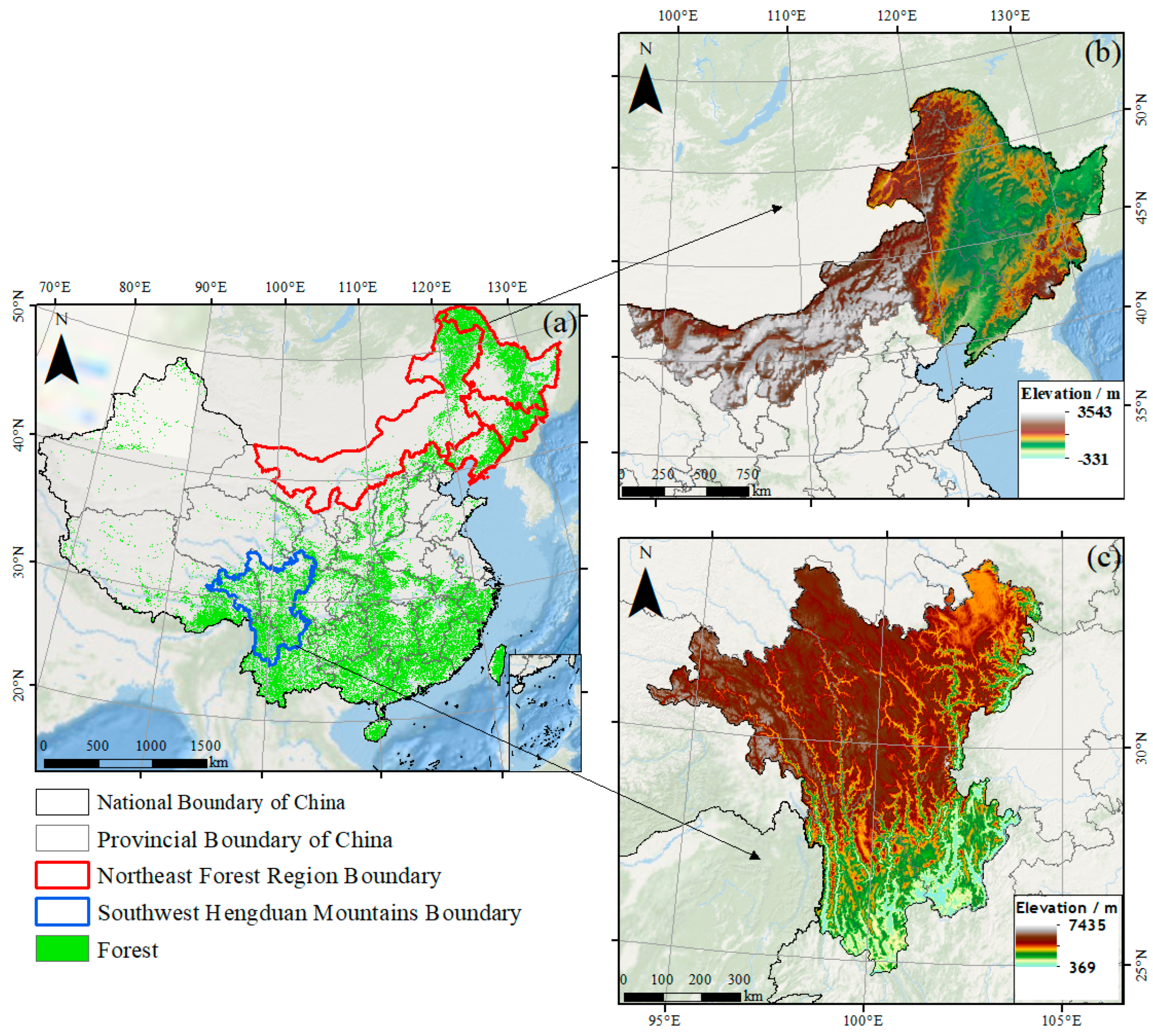
In contrast, the Hengduan Mountains Region acts as a vital ecological barrier for soil and water conservation in Southwest China [32]. Located in the transitional zone from the Qinghai–Tibet Plateau to the Yunnan-Guizhou Plateau, it is controlled by plateau uplift and active fault zones [33]. It possesses a complex alpine-gorge geomorphology [34]. This region is perennially covered by clouds and is geologically active [35]. Consequently, it represents the southwestern “topography-geohazard” disturbance nexus. Forest degradation here is uniquely driven by terrain-induced natural hazards, such as landslides and debris flows, exacerbated by monsoon precipitation [36]. Comparing these two distinct geographical extremes comprehensively encapsulates the spatial heterogeneity and underlying mechanisms of forest disturbances across China’s varied climatic and topographic zones (Figure 1).

2.2. Data Sources

Optical time series were constructed using 10 m Sentinel-2 L2A and 30 m Landsat 8/9 L2 surface reflectance (SR) data from 2019 to 2025. Pixel-level cloud masking was applied using the Scene Classification Layer (SCL) and QA_PIXEL bands to extract cloud-free summer observations (June to September) for data harmonization. For the radar time series, 10 m Sentinel-1 Ground Range Detected (GRD) C-band VV and VH polarization data were used. All aforementioned fundamental satellite imagery was accessed and processed via the Google Earth Engine (GEE) platform (Google LLC, Mountain View, CA, USA; https://developers.google.com/earth-engine/datasets, accessed on 2 March 2026).
To delineate the study areas and extract geographic characteristics, multiple auxiliary datasets were used. The spatial distribution of forests in China was derived from the Land Use/Land Cover dataset for 2020 (LUCC 2020), which was provided by the Resource and Environment Science and Data Center, Chinese Academy of Sciences (CAS) (http://www.resdc.cn/, accessed on 2 March 2026) with a 30 m spatial resolution. The elevation data set (DEM) was derived from the Shuttle Radar Topography Mission (SRTM) provided by the National Aeronautics and Space Administration (NASA) (https://earthexplorer.usgs.gov/, accessed on 2 March 2026) with a 30 m spatial resolution to map topographic characteristics and eliminate radiometric distortions in steep terrains. The spatial boundary of the Hengduan Mountains Region was mapped based on the geographical dataset provided by Zhang et al. [37].
For forest disturbance detection and driver attribution, the forest base map was extracted from the Hansen Global Forest Change product (GFW v1.11) at 30 m resolution (https://earthenginepartners.appspot.com/science-2013-global-forest, accessed on 3 March 2026). External attribution databases included the NASA Fire Information for Resource Management System (FIRMS) active fire product based on the Visible Infrared Imaging Radiometer Suite (VIIRS) at 375 m resolution (https://firms.modaps.eosdis.nasa.gov/, accessed on 2 March 2026) and the Google Dynamic World global dynamic land-cover product at 10 m resolution (https://dynamicworld.app/, accessed on 2 March 2026). Finally, the NASA GEDI L4B Aboveground Biomass (AGB) product at 1 km spatial resolution (https://gedi.umd.edu/, accessed on 2 March 2026) was introduced as the background carbon pool data to quantify carbon losses. To harmonize these substantial resolution differences into a unified 10 m analytical framework, specific spatial scaling rules were applied. Dynamic World data natively matched the 10 m grid via direct pixel-to-pixel correspondence. The 30 m GFW forest baseline was scaled using Nearest Neighbor (NN) resampling to preserve strict categorical boundaries without altering binary pixel values. For coarse-resolution datasets (375 m FIRMS and 1 km GEDI), a spatial intersection and deterministic pixel assignment approach was utilized. Specifically, 10 m disturbance patches geometrically intersecting with a 375 m FIRMS footprint were tagged with the fire attribute, while those falling within a 1 km GEDI footprint inherited its mean AGB value.

2.3. Methods

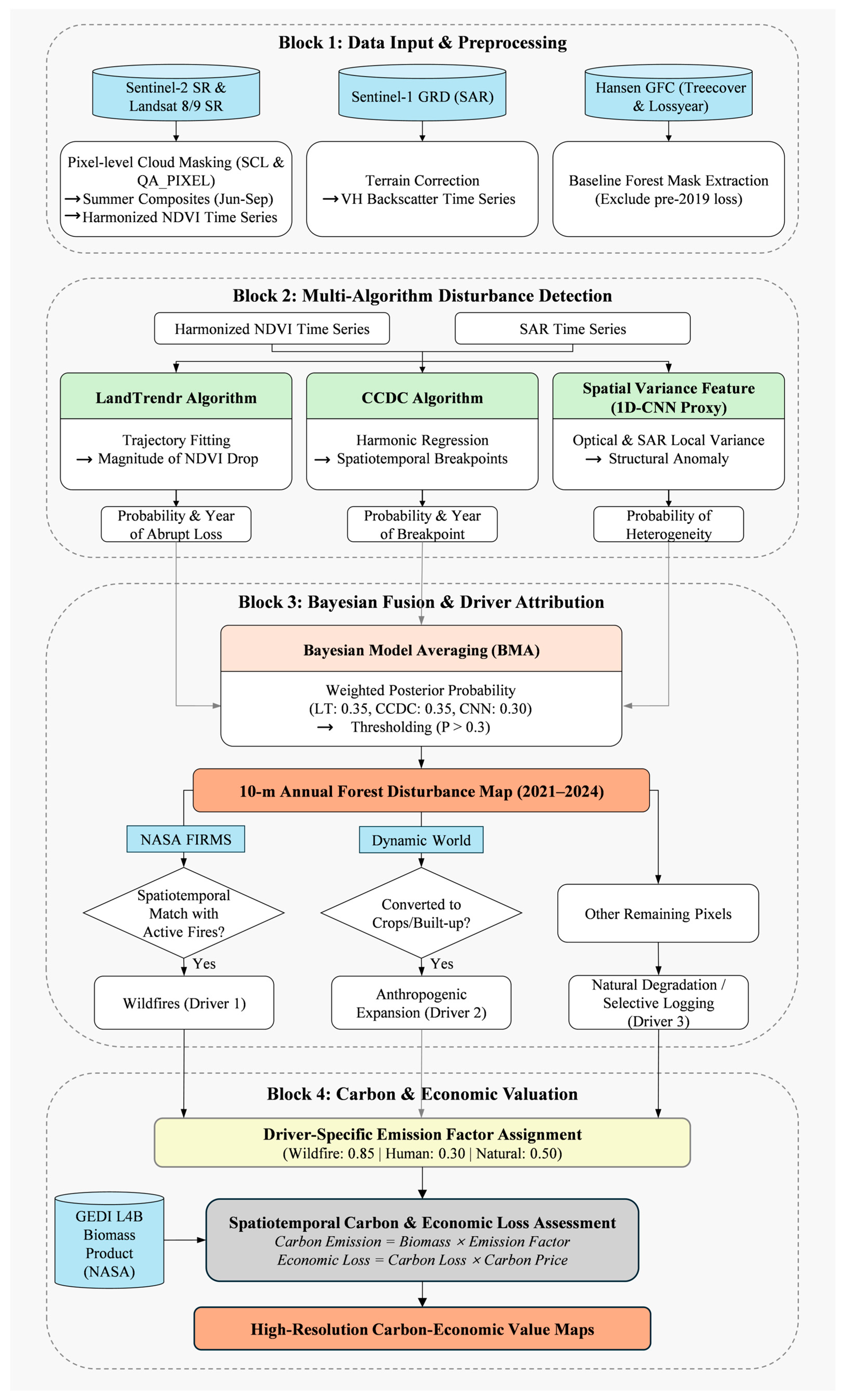
The research framework encompasses four core modules: data preprocessing, multi-algorithm disturbance detection, Bayesian fusion and attribution, and carbon loss quantification. All satellite image processing, time-series segmentation algorithms, and large-scale spatial analyses were implemented on the GEE platform using the JavaScript API. Subsequent statistical assessments, confusion matrix calculations, and advanced data visualizations were performed using Python (v3.8.15) (e.g., pandas v1.3.4 and matplotlib v3.4.3 libraries). The overall methodological flowchart of the study is illustrated in Figure 2.

2.3.1. Time-Series Harmonization and Forest Masking

Winter snow and autumn leaf-fall frequently create false disturbance signals in cold and mountainous areas. We minimized this noise by restricting our data collection strictly to the summer growing season (1 June to 30 September). Furthermore, combining surface reflectance (SR) data from Sentinel-2 and Landsat 8/9 increased image availability in cloudy regions. To ensure radiometric consistency across different sensors, Level-2 SR products were utilized, meaning rigorous atmospheric corrections (LaSRC for Landsat and Sen2Cor for Sentinel-2) were intrinsically applied by the data providers. Specifically, the “Harmonized” Sentinel-2 collection was selected to resolve the baseline quantification shifts introduced by the European Space Agency in 2022. Although slight differences in their Relative Spectral Response (RSR) functions introduce minor systemic biases between Landsat and Sentinel-2, their direct fusion remains methodologically robust. This robustness is achieved primarily because the normalized ratio computation of NDVI mathematically mitigates systemic multiplicative errors. Furthermore, the subsequent application of growing-season median compositing (for LandTrendr) and robust harmonic regression (for CCDC) effectively smooths out residual sensor-specific radiometric offsets and temporal Bidirectional Reflectance Distribution Function (BRDF) variations. To establish a clean starting point, we relied on the GFW dataset [38]. We kept only the pixels showing a canopy cover of 15% or higher in the year 2000. Finally, the loss-year band helped us remove any historical forest changes recorded prior to 2019.

2.3.2. Multi-Algorithm Detection and Bayesian Fusion

Single time-series algorithms naturally suffer from performance biases. They frequently fail to catch both slow forest decline and sudden stand-replacing events [19]. To fix this gap, we built a joint detection framework powered by three separate engines.
First, the LandTrendr algorithm [39] was employed as the trajectory segmentation engine. It relies on the Normalized Difference Vegetation Index (NDVI) extracted from the harmonized Sentinel-2 and Landsat 8/9 cloud-free summer composites. The NDVI is calculated as follows:
NDVI = NIR Red NIR + Red
where NIR and Red represent the surface reflectance of the near-infrared and red bands from harmonized optical images. According to the Google Earth Engine (GEE) implementation guidelines for LandTrendr [40], the algorithm expects a disturbance event to manifest as an increase in the spectral value. Because NDVI inherently decreases following forest clearing or degradation, we applied a signal inversion by multiplying the NDVI series by −1. This standardization ensures the algorithm accurately captures disturbance vertices. We required an absolute NDVI drop of 0.15 to trigger a valid trajectory break. While NDVI is sensitive to canopy chlorophyll loss, it is prone to the saturation effect in dense and high-biomass areas. We did not compare it with other optical indices, as they share similar top-canopy saturation and cloud-cover limitations. Instead, we utilized structural supplementary data to address these blind spots.
Second, the Continuous Change Detection and Classification (CCDC) algorithm [41] was introduced as the baseline anomaly engine. Even within the restricted summer window (June to September), forests exhibit normal micro-phenological rhythms. Utilizing dense harmonized optical time series, CCDC applies harmonic regression to filter out these seasonal variations and establish a stable historical baseline. When a disturbance occurs, the new spectral observations deviate from the predicted harmonic baseline. This mechanism allows CCDC to pinpoint the exact timing of the anomaly, effectively complementing the trend-fitting approach of LandTrendr.
Third, to address the optical saturation and frequent cloud cover in alpine regions, we introduced a 1D-CNN (One-Dimensional Convolutional Neural Network) structural variance engine [42]. The input variables for this engine comprise the optical NDVI and the time-series variance statistics of the Sentinel-1 C-band Synthetic Aperture Radar (SAR) backscatter coefficient. Specifically, we exclusively selected the VH cross-polarization rather than the VV polarization. According to microwave scattering theories in forest environments [43], C-band VH polarization is predominantly driven by volume scattering within the forest canopy. This mechanism makes VH backscatter highly sensitive to structural losses such as branch and leaf removal. In contrast, VV polarization is more sensitive to surface scattering and soil moisture, which can introduce significant observational noise during the wet monsoon season. Furthermore, we opted not to extract spatial texture features, such as the Gray-Level Co-occurrence Matrix (GLCM). Calculating spatial textures requires moving windows that inevitably degrade the original 10 m spatial resolution. Instead, we extracted the temporal variance statistics along the time axis.
Regarding the network architecture, deploying deep multi-hidden-layer CNNs for 10 m national-scale inference directly on the GEE platform frequently triggers memory limits and risks overfitting. Therefore, this model is designed as a lightweight and deterministic single-layer 1D-CNN architecture. It utilizes a predefined 1D convolutional filter coupled with a temporal variance pooling layer. This pooling layer slides across the time axis of the input sequences to extract the spatiotemporal structural variance anomaly. The model selection criterion for this architecture prioritizes the efficient isolation of physical structural variance associated with forest degradation while maintaining computational scalability for large-scale spatial mapping.
Combining predictions from heterogeneous models inherently introduces uncertainty. To address this, rather than relying on strict data-driven likelihood estimations which may risk regional overfitting, we developed a Bayesian-inspired heuristic ensemble framework based on the principles of Bayesian Model Averaging (BMA) [44]. Through expert-knowledge prior calibration, the joint posterior probability of disturbance, P ( D x ) , for a given pixel x was calculated as follows:
P ( D x ) = k = 1 3 W k P k ( D x )
where P k ( D x ) is the probability generated by the k-th engine (LandTrendr, CCDC, and 1D-CNN), and W k represents the assigned prior weight. The prior weights were determined based on the algorithmic mechanisms and physical characteristics of the input datasets, functioning as an expert-knowledge prior framework. LandTrendr and CCDC are pixel-based temporal segmentation algorithms that directly quantify the biochemical loss of canopy chlorophyll (NDVI). Given their established reliability, they were assigned a dominant joint weight of 0.70, split equally ( W L T = 0.35 ,   W C C D C = 0.35 ) to balance trend-fitting and baseline-anomaly detection. The 1D-CNN acts as a spatiotemporal variance extractor, utilizing both optical (NDVI) and microwave (SAR) inputs. While SAR penetrates clouds to capture sub-canopy structural collapse, it introduces inherent speckle noise. Consequently, a supplementary weight of W C N N = 0.30 was allocated to mitigate noise-induced commission errors while preserving its complementary value.
The posterior probability threshold was established at P ( D x ) 0.3 to address the asymmetric loss in forest monitoring, where omission errors in clouded regions are prioritized over minor commission errors. Rather than an arbitrary cut-off, this threshold operates as an inclusive trigger mechanism. In persistently clouded regions, if data voids force optical models to fail (probabilities = 0), a definitive spatiotemporal structural change detected by the 1D-CNN (probability = 1.0) resolves the BMA equation to exactly 0.30   ( 0 × 0.35 + 0 × 0.35 + 1.0 × 0.30 = 0.30 ) . Thus, setting the theoretical threshold at 0.30 ensures that valid detections under severe cloud cover are mathematically preserved. Subsequently, for pixels successfully flagged by this threshold, the year with the highest model confidence was selected as the final disturbance occurrence year.

2.3.3. Spatiotemporal Disturbance Attribution

Based on the extracted disturbance pixels, a spatiotemporal dynamic rule chain was constructed to classify the primary drivers into three categories. To address inconsistent spatio-temporal windows and resolve conflicting pixels that satisfy multiple drivers, we implemented a hierarchical prioritized decision tree. This hard-rule classification framework assigns distinct temporal windows and priorities to each driver category.
First Priority: Wildfire (Driver 1). The temporal window for fire detection was strictly confined to the exact year of the detected disturbance (Year T ). When the spatial location of a disturbance pixel overlapped with thermal anomalies (brightness temperature > 300 K) detected by FIRMS [45,46] within Year T , it was definitively attributed to wildfire. While typical active fire algorithms employ higher thresholds (e.g., 320–360 K), a 300 K threshold was adopted to account for sub-pixel thermal mixing. In mature dense forests, the thermal signature of low-intensity understory fires is heavily attenuated by the surrounding unburned canopy within a 375 m VIIRS pixel. This inclusive parameter prevents the omission of covert forest fires. Wildfire is assigned the highest priority because it acts as a rapid initiating catalyst. For example, if a pixel experiences a fire in 2022 and is subsequently converted to cropland in 2023, the primary cause of forest loss remains the fire. Therefore, conflicting pixels are resolved by prioritizing the initial fire event.
Second Priority: Human Activity (Driver 2). For pixels not classified as wildfire, we evaluated the land-cover transitions using the Dynamic World product [47]. The temporal window for this evaluation was set to the post-disturbance period (Years T + 1 and T + 2 ). This 1- to 2-year lag accounts for the time required to convert cleared forests into functional anthropogenic land uses. If the disturbed area stably transitioned into cropland (Crops) or built-up land (Built-up) during this extended window, it was attributed to human activity.
Third Priority: Natural Degradation (Driver 3). This serves as the residual category. Disturbance pixels that did not overlap with contemporaneous fires and did not transition into anthropogenic land covers were classified as natural degradation. These events primarily originate from geological hazards (such as landslides and debris flows), pests, and selective logging.

2.3.4. Carbon Emission Calculation and Economic Valuation

The initial stand carbon density prior to disturbance was obtained by matching the nearest valid observation from the GEDI L4B AGB product [48]. Currently, continuous open-source biomass mapping at a 10 m resolution remains unavailable on a national scale. However, given the high spatial autocorrelation of mature forest carbon density within homogeneous stands, the 1 km GEDI L4B product—representing the state-of-the-art in spaceborne LiDAR 3D structural retrieval—was selected as the most reliable stand-level background carbon pool proxy to capture regional carbon density gradients. To precisely quantify the environmental costs, the biomass data were converted to carbon stocks and weighted by specific disturbance severities. The pixel-level carbon emission ( CE pixel ) was calculated using the following equation:
CE pixel = AGB initial × CF × EF type
where AGB initial is the initial aboveground biomass derived from the GEDI L4B product, CF is the carbon conversion factor (set to 0.47 according to IPCC guidelines [49]), and EF type denotes the differential carbon emission factor assigned to different disturbance types (0.85 for wildfires, 0.30 for human activities, and 0.50 for natural degradation). Subsequently, direct economic losses were estimated based on the current guiding average price of the Chinese Certified Emission Reduction (CCER) market (approximately 60 RMB/ton) [50].

2.3.5. Validation Methodology

To avoid circular reasoning and scale-mismatch defects caused by using coarse-resolution products (e.g., 30 m) for validation, this study strictly followed the Good Practices for stratified random sampling recommended by Olofsson et al. [51]. In both regions, a total of 600 independent blind test sample points (300 per region) were extracted. Since the proposed framework relies on unsupervised time-series segmentation and rule-based overlay, external auxiliary datasets (such as FIRMS or Dynamic World) were not utilized as training samples, thereby intrinsically preventing spatial data leakage and circular evaluation. The sampling design was rigorously stratified across three dimensions: space (Northeast vs. Hengduan regions), class (stable forest vs. disturbed forest), and time (disturbance years from 2021 to 2024). Specifically, the sample points were allocated proportionally to the area of each stratum to ensure representativeness, with a guaranteed minimum sample size for the rare ‘disturbed’ class. Under a double-blind condition, interpreters cross-referenced two data sources to establish the Ground Truth and generate spatiotemporal confusion matrices. Primary spatial evidence was obtained from very-high-resolution (VHR) historical imagery available in Google Earth Pro. This imagery provides sub-meter resolution, typically 0.3 to 0.5 m, and is sourced from Maxar and Airbus archives [52]. By linking these spatial maps with frequent NDVI observations over time, we built a comprehensive tracking record. We then needed to address potential errors. Because validation data for 2025 was unavailable, keeping those predictions would inflate the false-alarm rate. Therefore, we excluded them entirely, limiting our core evaluation strictly to the 2021–2024 period. Finally, we applied a ±1 year tolerance for timing accuracy, a proven and reasonable adjustment for this type of analysis [53].

3. Results

3.1. Accuracy Assessment Results

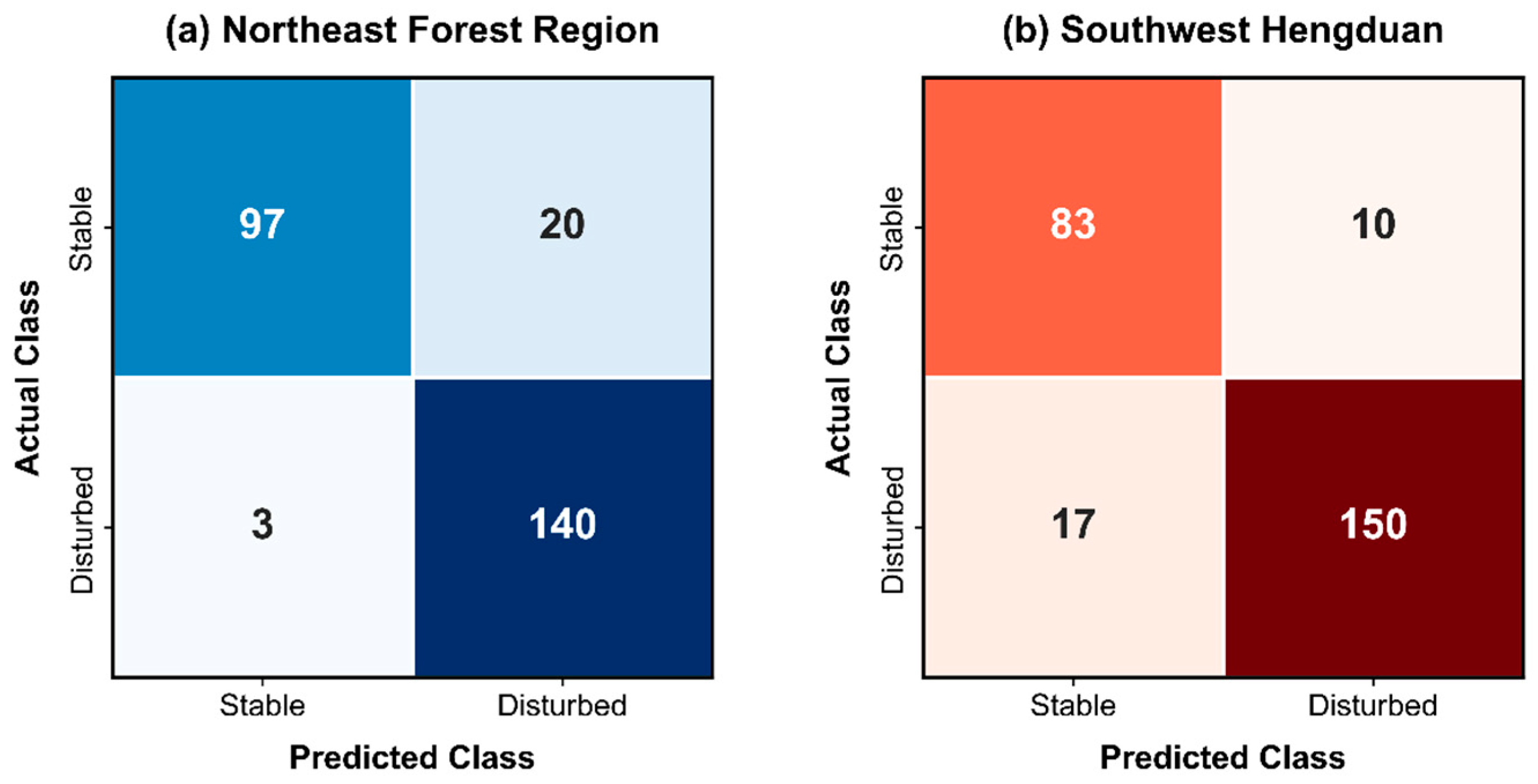
Table 1 details the visual interpretation outcomes based on stratified random blind sampling. The overall accuracy (OA) for spatial classification reached 91.15% in the Northeast and 89.62% in the Hengduan Mountains. These high metrics, supported by the Producer’s and User’s Accuracies, indicate an alignment between our model outputs and real-world ground truth. The specific error distributions and class-level agreements are visualized in the confusion matrices (Figure 3).
Breaking down the metrics by class revealed distinct regional strengths. For the Northeast, the Producer’s Accuracy (PA) for disturbances reached 97.90%, reflecting a low omission rate. On the other hand, the Hengduan Mountains showed a high User’s Accuracy (UA) of 93.75%. This UA demonstrates that the combined model mitigated false alarms, even in heavily clouded areas. Importantly, whenever a true disturbance was correctly spotted, its timing matched exactly within the ±1 year buffer. Ultimately, the dual-engine setup demonstrated the capacity to identify the initial year of disturbance within the defined temporal tolerance.
Given the highly imbalanced nature of forest disturbance events—where intact forests vastly outnumber disturbed patches—overall accuracy (OA) can be easily skewed. Therefore, the F1-Score, which serves as the harmonic mean of Producer’s Accuracy (PA, inversely related to omission errors) and User’s Accuracy (UA, inversely related to commission errors), was employed as the primary metric to rigorously evaluate model performance. To evaluate the rationale of the multi-algorithm integration, a post hoc comparative ablation study was conducted using the validation set (Table 1). A Pearson correlation analysis was performed on the continuous probability outputs. The temporal optical models (LandTrendr and CCDC) demonstrated high correlation (r = 0.792 in the Northeast, r = 0.736 in Hengduan). However, their correlations with the 1D-CNN were substantially lower (r = 0.451 and r = 0.348, respectively). This statistical independence confirms that the spatiotemporal variance and microwave structural features extracted by the 1D-CNN provide heterogeneous information distinct from pixel-based temporal optical breaks.
Table 2 details the performance of individual baseline models compared to the BMA ensemble at the 0.30 theoretical threshold. In the Hengduan Mountains, individual optical models exhibited omission errors due to persistent cloud cover (e.g., LandTrendr Producer’s Accuracy = 73.94%), while the 1D-CNN model introduced commission errors (User’s Accuracy = 82.05%). By aggregating these complementary priors, the BMA ensemble minimized respective single-model limitations, achieving an F1 score of 0.92 in both regions. The regional variance between producers’ and users’ accuracies in the BMA results reflects natural geographical heterogeneity: optimal visibility in the Northeast minimizes omissions, whereas edge-farming introduces slight commissions; conversely, the clouded but pristine alpine environment in the Hengduan limits human-induced false alarms but causes inevitable slight omissions.
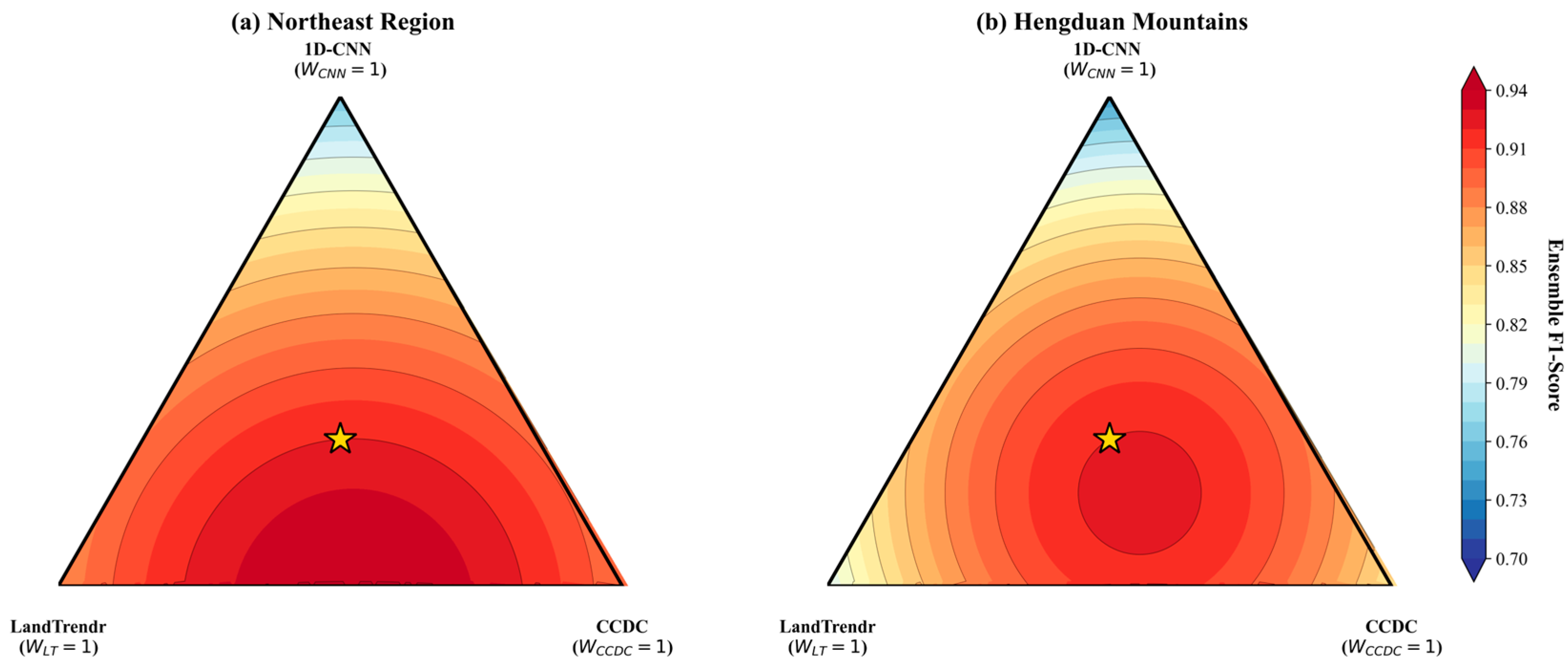
Additionally, a parameter sensitivity analysis was conducted to evaluate the theoretical weight allocation ( W L T = 0.35 ,   W C C D C = 0.35 ,   W C N N = 0.30 ). Based on the continuous probability outputs of the 600 validation points, we calculated the ensemble F1-Scores across all valid weight combinations ( i W i = 1 ) and visualized the parameter space using ternary phase diagrams (Figure 4). As illustrated, relying solely on the optical models (the bottom edge,  W C N N = 0 ) yields suboptimal accuracies due to cloud-induced omission risks, whereas heavily weighting the 1D-CNN (the top vertex) leads to accuracy degradation associated with microwave speckle noise. The theoretical configuration (denoted by the star) is located within the higher-accuracy region for both climatic zones. While this empirical setup may not represent the absolute mathematical optimum for each specific region, the relatively wide contour intervals surrounding the star indicate that the model performance remains stable under minor weight adjustments. This observation confirms that the selected parameters provide a reasonable and reliable baseline for large-scale mapping, balancing the inputs from pixel-based and spatiotemporal variance algorithms.
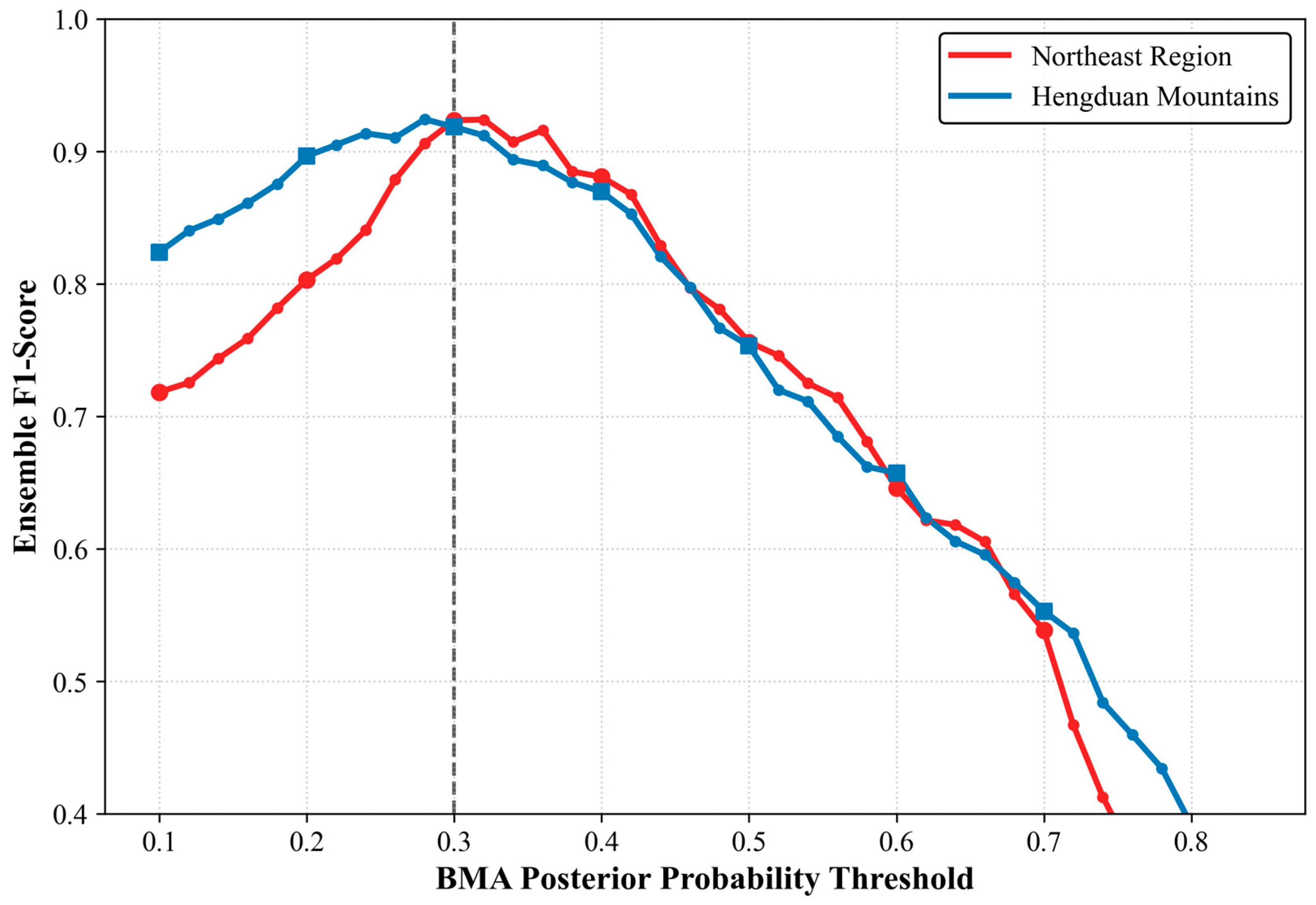
Following the validation of the weight allocation, a post hoc threshold sensitivity analysis (Figure 5) was conducted by evaluating the ensemble F1-Scores across thresholds from 0.1 to 0.8. The results indicate that the theoretically derived 0.30 activation threshold consistently falls within the high-accuracy plateau for both regions, validating its robustness as a global compromise threshold without risking regional overfitting.
Finally, to verify the rationality of the pixel assignment during the scale-mismatched attribution phase (e.g., overlaying 375 m FIRMS and 10 m Dynamic World maps onto disturbance patches), a pixel-level spatial consistency test was conducted. Based on 303 confirmed disturbance points, the framework’s assigned drivers were cross-validated against double-blind visual interpretations of post-disturbance VHR imagery in Google Earth. The validation yielded an overall spatial consistency of 78.9%. Specifically, the consistency rate for assigning Human Activity was 94.7%, indicating that the overlay rules classified anthropogenic drivers with acceptable accuracy. The consistency rate for Natural Degradation was 80.3%, while Wildfire yielded a consistency of 62.5%, reflecting the expected sub-pixel spatial mismatch when projecting 375 m thermal anomalies onto 10 m grids.

3.2. Spatiotemporal Evolution of Forest Disturbances

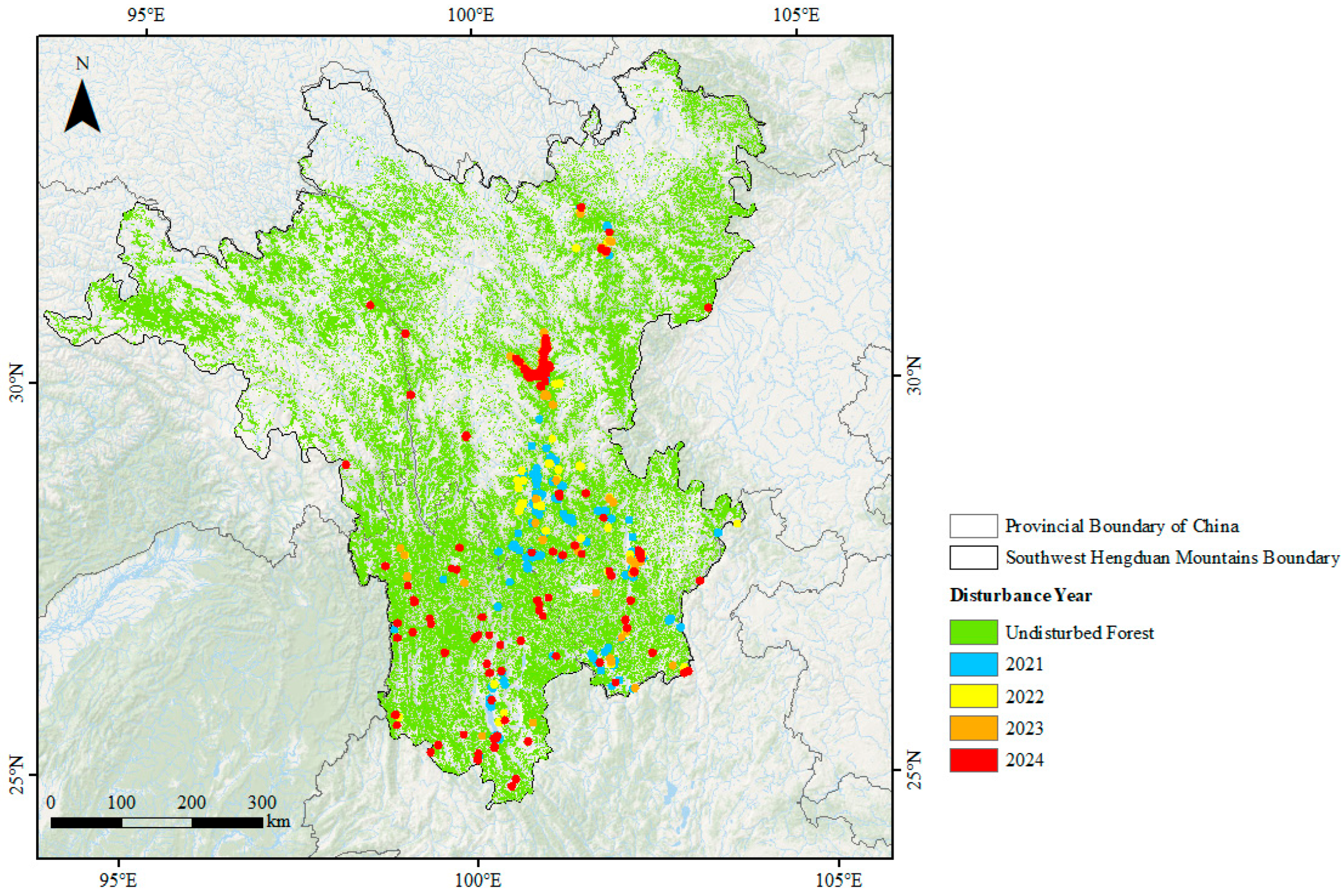
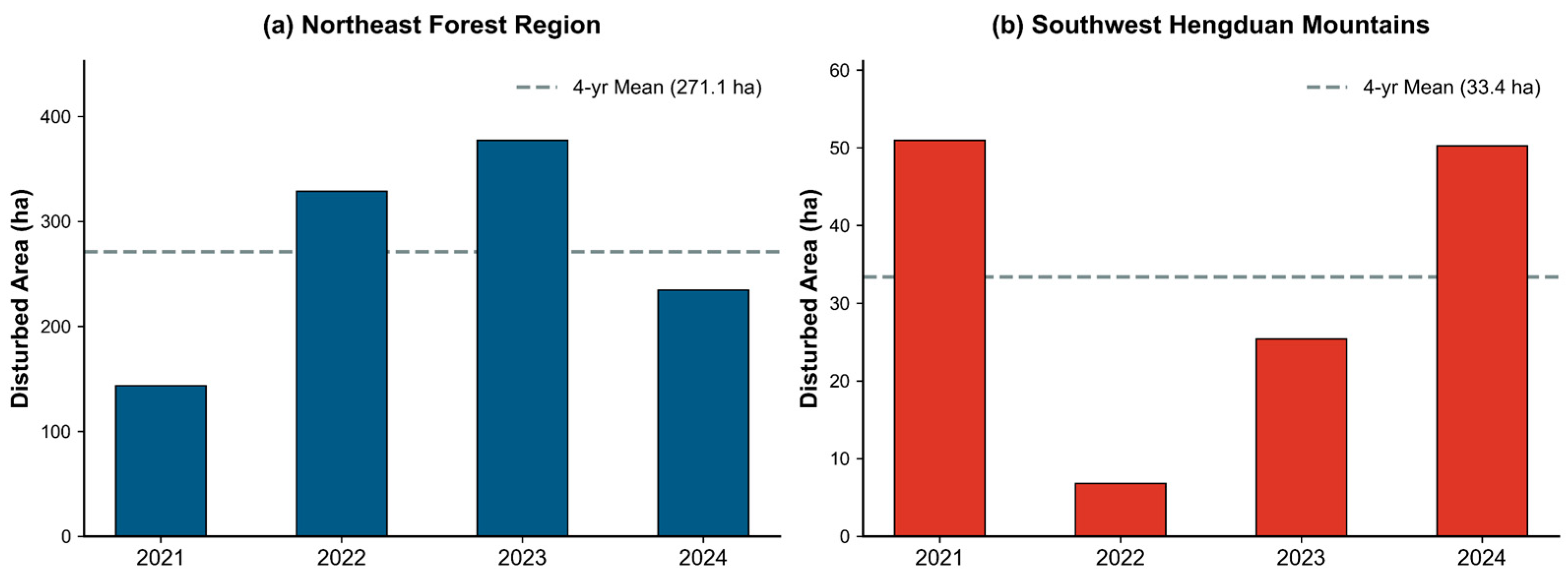
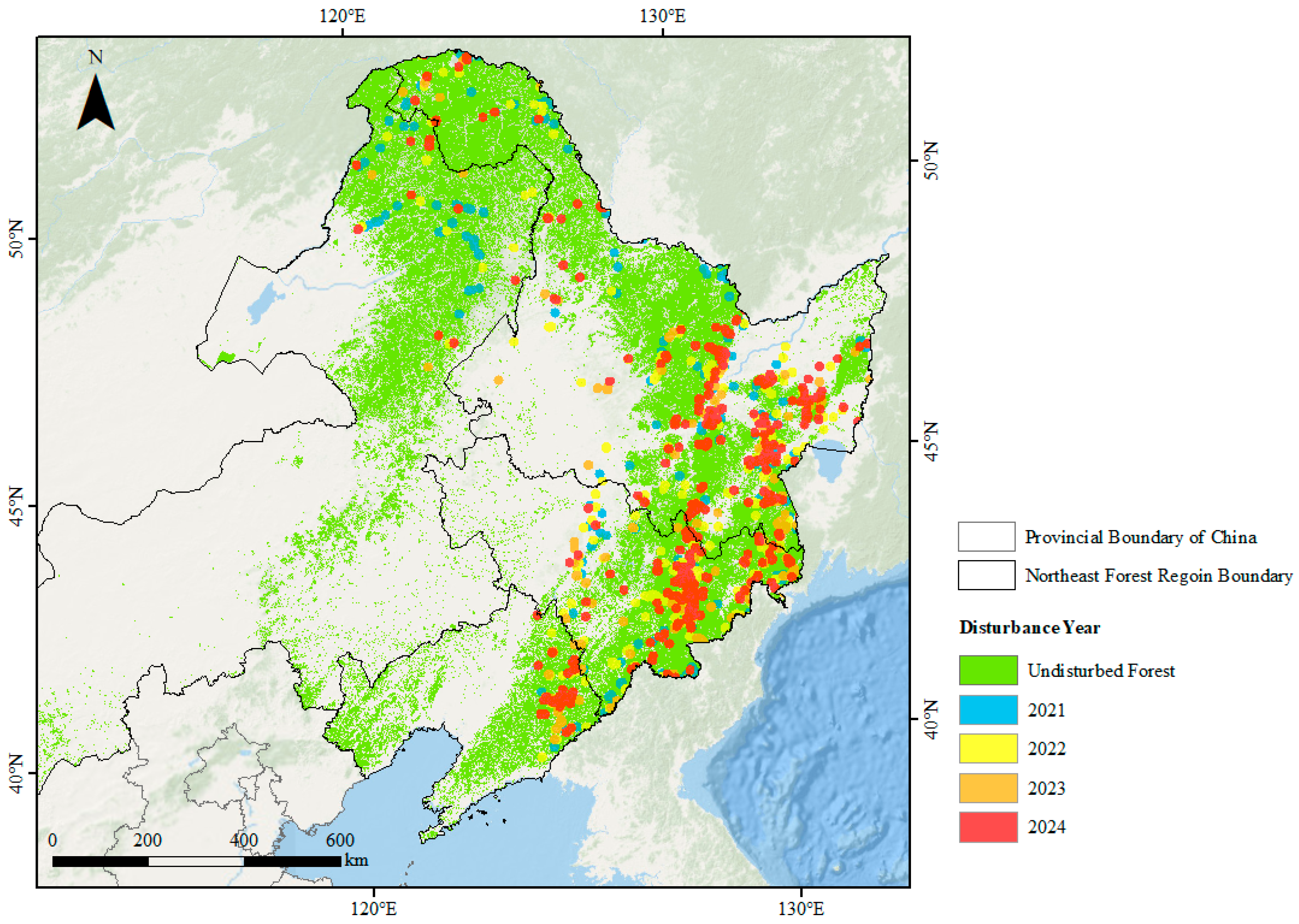
From 2021 to 2024, the overall disturbed forest area stayed relatively low across both regions. Even so, as shown in Figure 6, the data revealed clear year-to-year shifts and uneven spatial patterns. Over the four years, the Northeast lost a total of 1084.58 ha to disturbances. This figure is substantially larger than the 133.48 ha recorded in the Hengduan Mountains. Looking at the timeline, both areas were fairly stable during 2021 and 2022. Then, in 2023, the Northeast experienced a sharp spike, hitting 377.40 ha. To put this in perspective, that peak is 1.39 times the four-year average (271.15 ha) and 2.6 times the lowest point seen in 2021 (143.60 ha). Meanwhile, the Hengduan region stayed much flatter. It only saw a slight bump to 50.27 ha in 2024, likely driven by unusual local weather patterns affecting tree health. Spatially, damage in the Northeast tended to cluster in large patches, often hugging forest edges and roadways (Figure 7). In stark contrast, the Hengduan region suffered highly scattered, small-scale damage, appearing as fragmented lines or isolated spots deep within mountain gorges (Figure 8).

3.3. Drivers’ Attribution and Topographic Effects

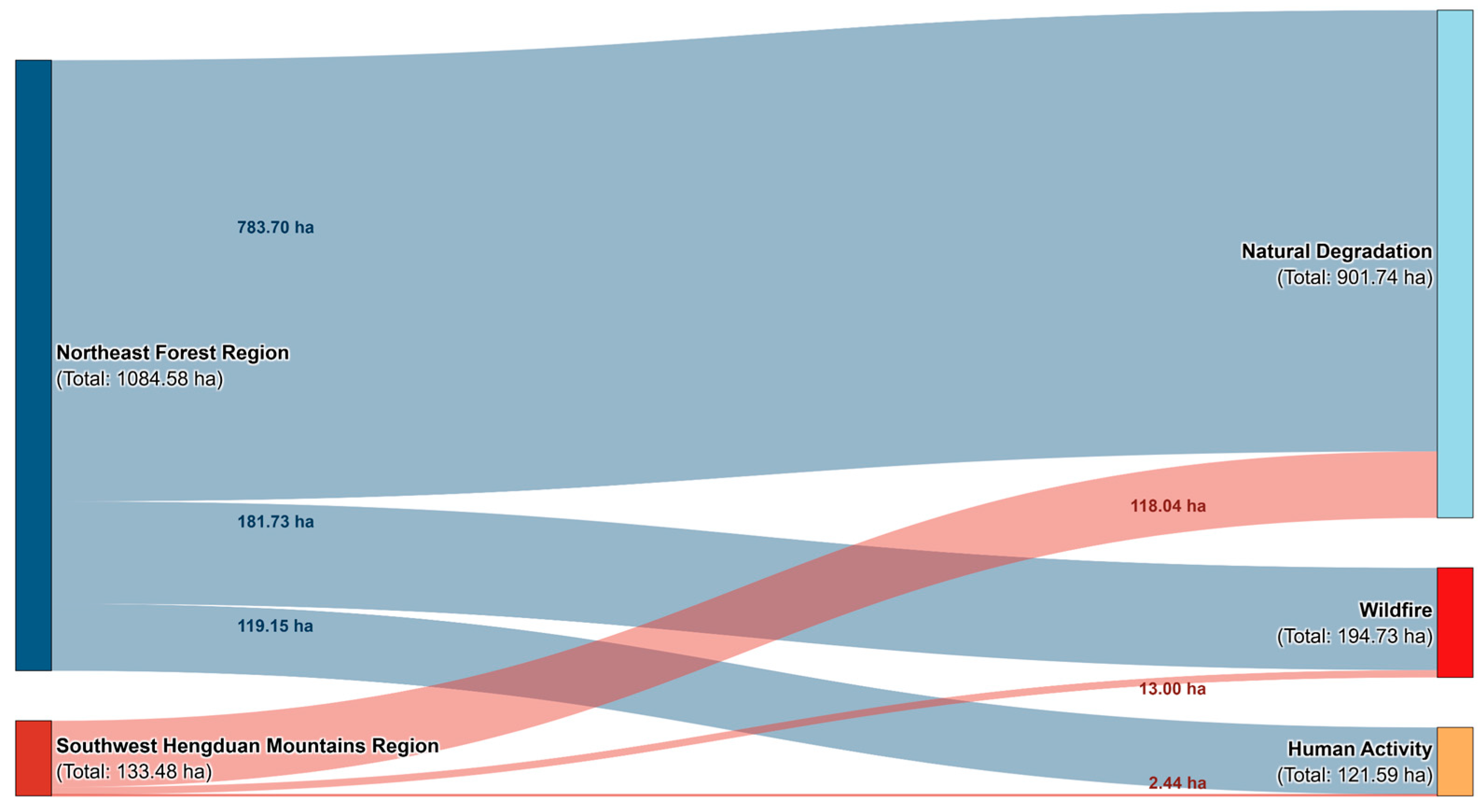
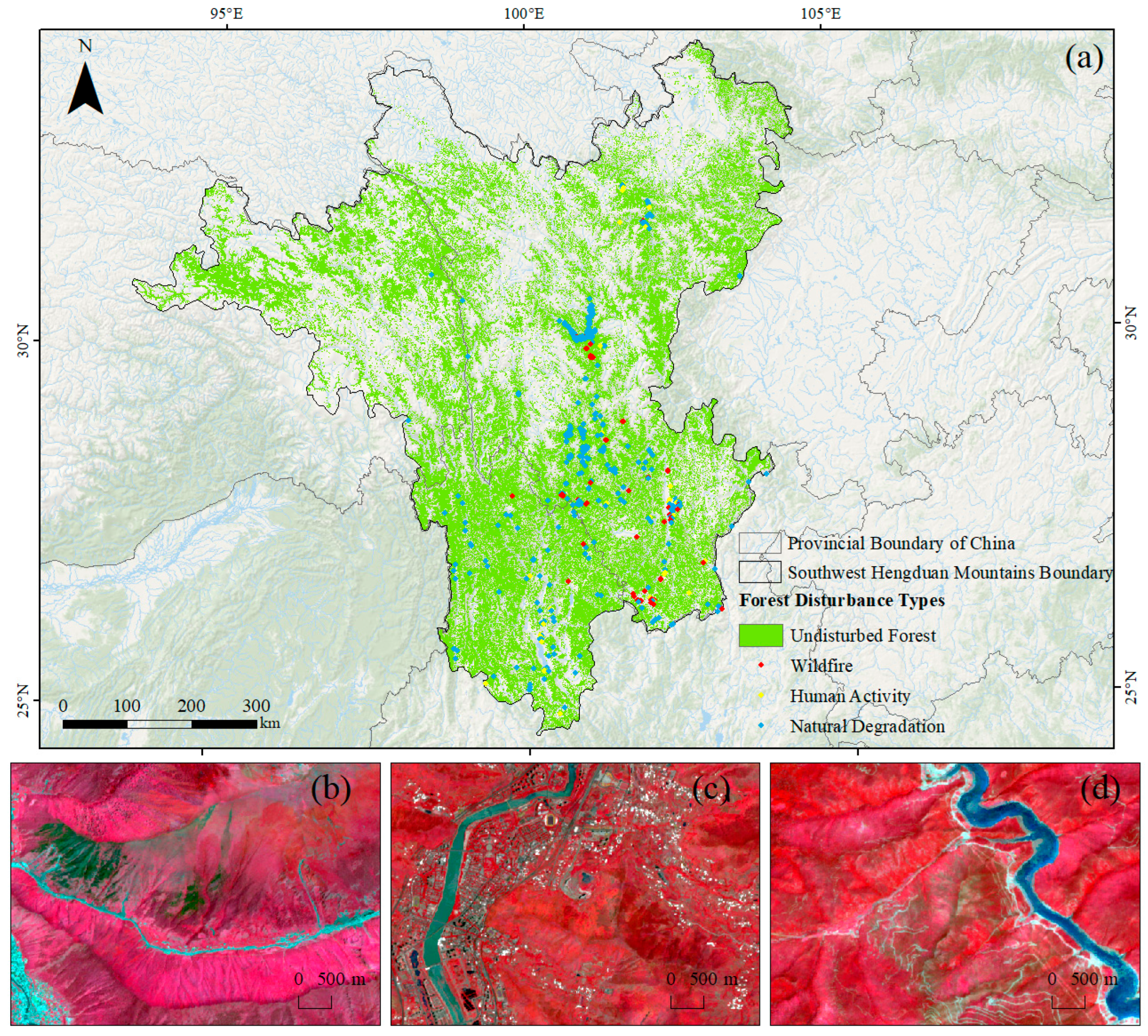
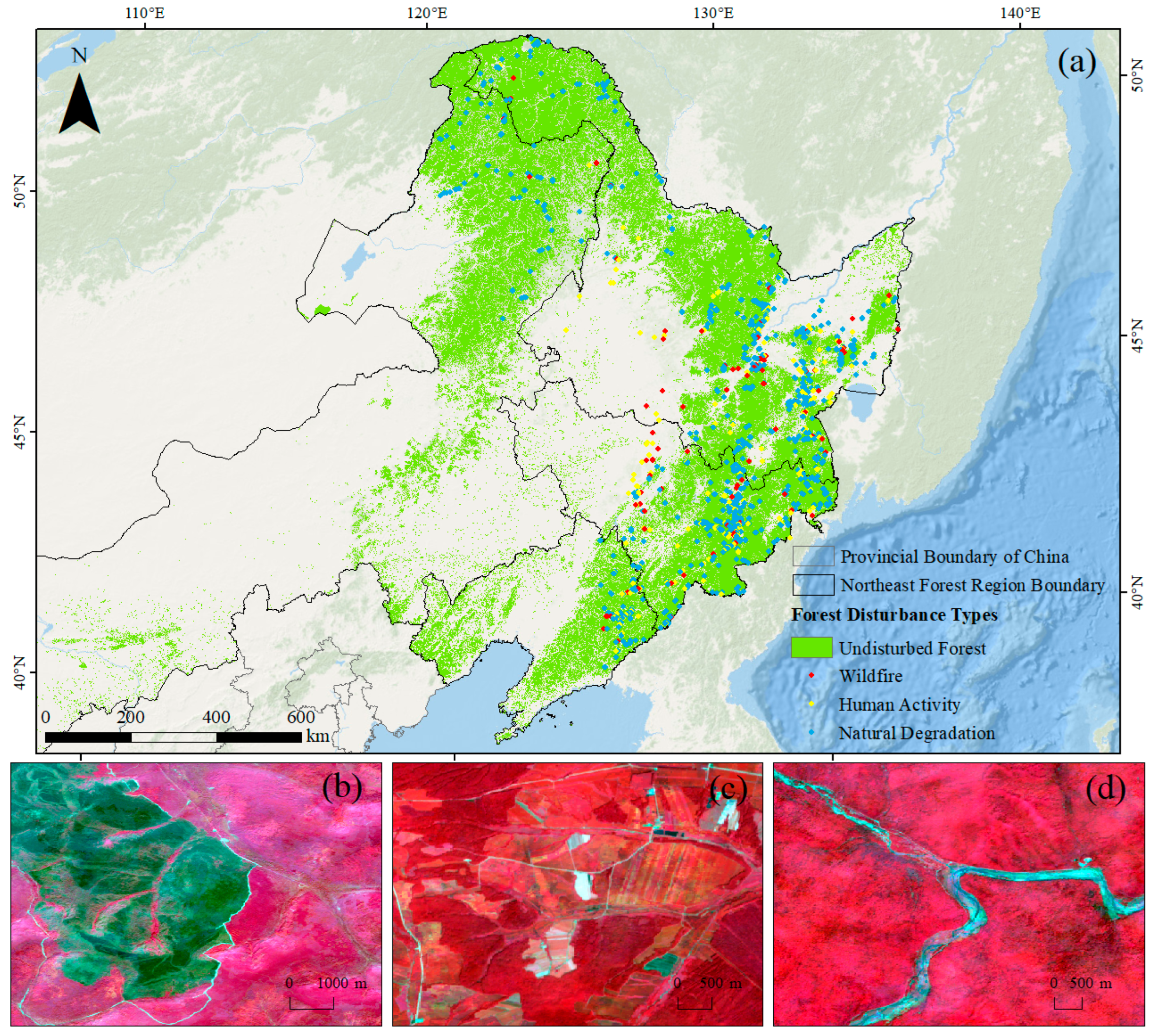
Table 3 highlights a clear geographic split in what caused these forest changes, with the detailed area flows for each driver visually summarized in Figure 9. Natural Degradation (Driver 3) stood out as the leading cause in both areas. However, it was especially dominant in the Hengduan Mountains, accounting for 88.43% of the damage. This is a noticeable jump from the 72.25% seen in the Northeast. On the flip side, the Northeast faced much heavier impacts from Wildfires and Human Activity. These two factors drove 16.76% and 10.99% of the events there, compared to just 9.74% and 1.83% in the Hengduan region. The spatial distributions and specific examples of these drivers are detailed for the Northeast in Figure 10, and for the Hengduan region in Figure 11. This indicates that the Northeast Forest Region, as a vital commercial forestry base and a high-latitude fire-prone area, continues to be substantially influenced by wildfire spread and infrastructure expansion at forest edges.
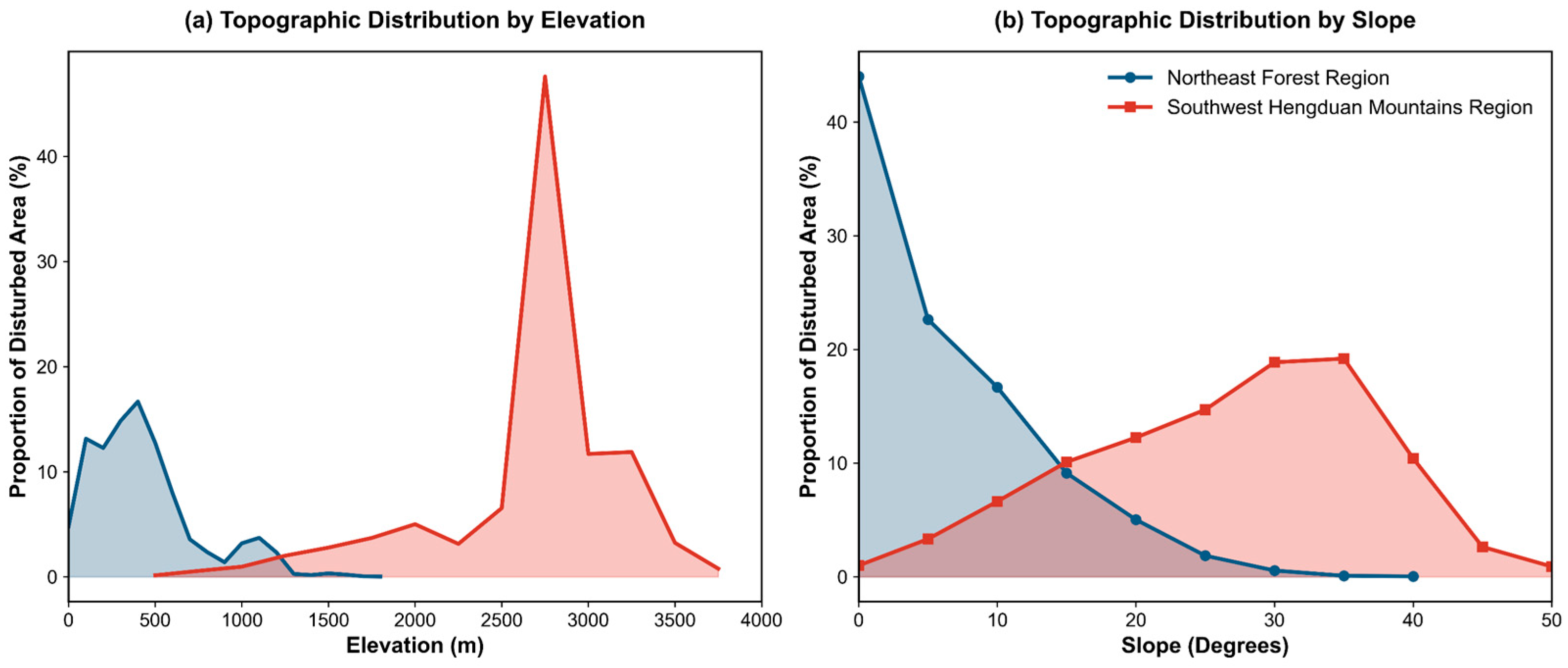
Topographic factors (elevation and slope) further quantified the inherent physical causes of disturbance mechanisms. As shown in Figure 12, disturbances in the Northeast were highly concentrated in low-elevation gentle terrain from 0 to 500 m (predominantly on slopes of 0–10°), facilitating large-scale wildfire spread and agricultural reclamation. Conversely, disturbances in the Hengduan Mountains exhibited typical sub-alpine characteristics, with extreme values emerging in the high-elevation range of 2750–3250 m. The difference in slope distribution was even more pronounced: disturbances in the Hengduan region showed a normal distribution as slope increased, with peaks occurring in the steep and very steep slope intervals of 30–35°. This extreme topographic distribution suggests that natural hazards induced by alpine gorges, such as landslides and debris flows, are likely among the primary driving forces for forest ecosystem degradation in the Hengduan region, though further field corroboration is required.

3.4. Carbon Emission and Economic Loss Estimates

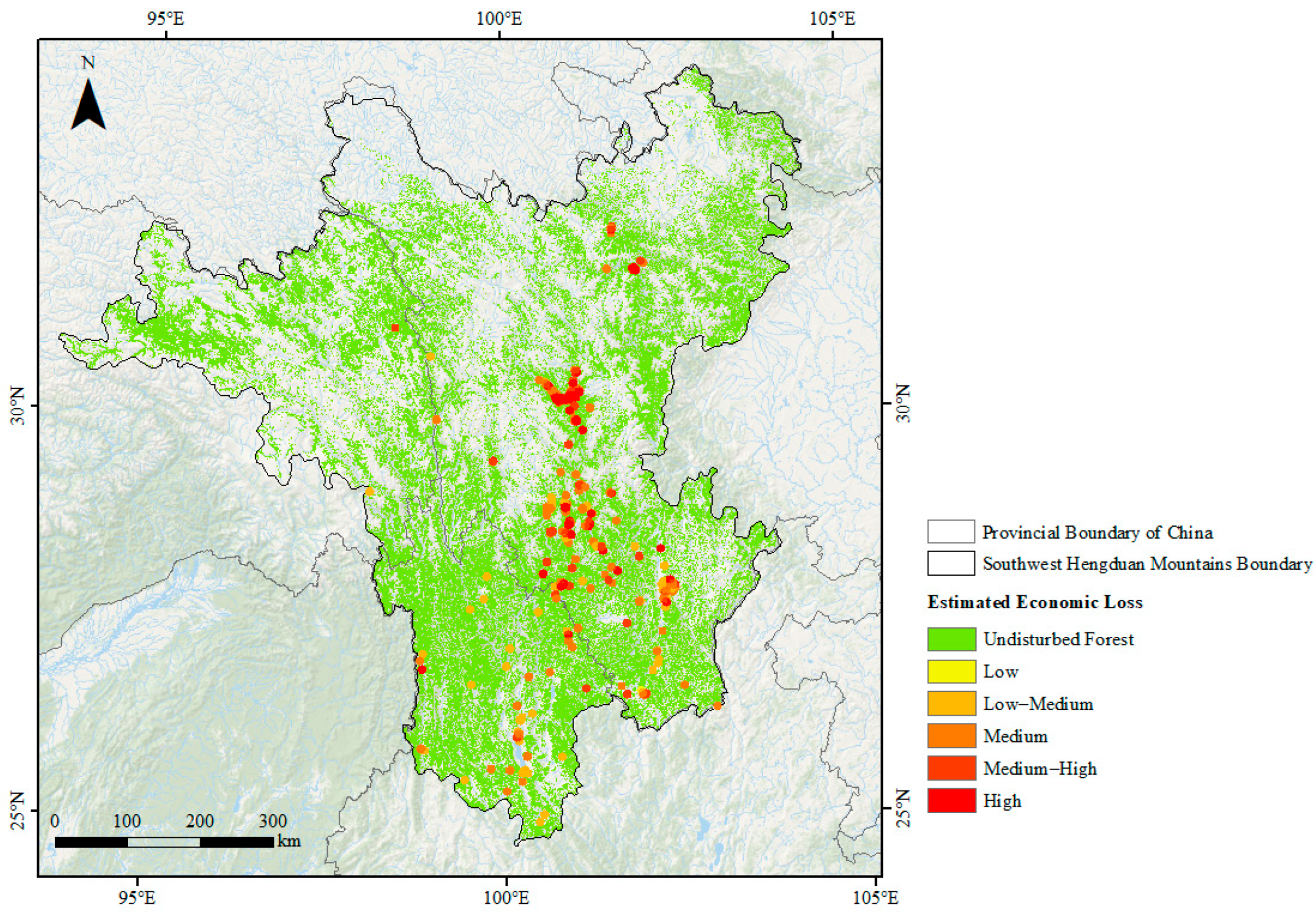
By integrating the biomass baseline and emission factors, this study quantified the ecological and economic costs triggered by forest disturbances (Table 4). From 2021 to 2024, disturbances across the two regions cumulatively generated 15,057.70 tons of carbon emissions. To quantify the spatial uncertainty caused by the scale mismatch between the 10 m disturbance patches and the 1 km GEDI biomass data, the coefficient of variation (CV) of 10 m NDVI within the 1 km GEDI footprints was calculated. This statistical metric is a standard approach to quantify sub-pixel spatial heterogeneity and scale-induced uncertainty [54,55]. This sub-pixel spatial heterogeneity analysis indicated a regional uncertainty of 4.3% for the Northeast forests and 12.0% for the Hengduan Mountains. Consequently, the cumulative carbon emissions carry a region-specific spatial uncertainty within this range. Based on the current guiding average price of the CCER carbon trading market (approx. 60 RMB/ton), the direct economic loss from these carbon emissions was roughly estimated at 903.48 thousand RMB. It is important to clarify that this valuation serves purely as an approximate macro-scale reference rather than a precise financial assessment.
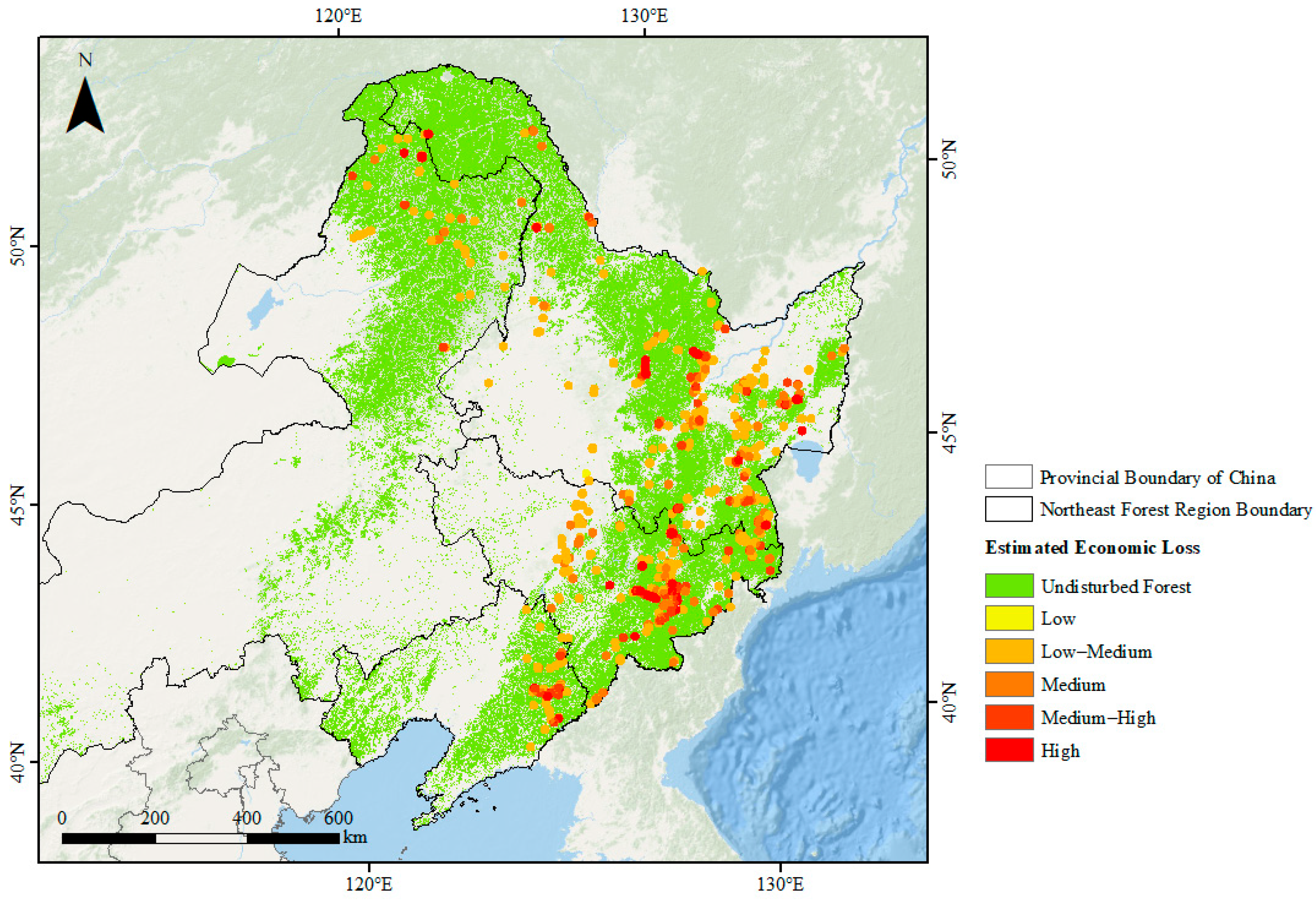
The data deeply revealed a “geographic heterogeneity effect of carbon density”: Although the total disturbed area in the Hengduan Mountains was only 12.3% of that in the Northeast, its total carbon emissions (3618.74 tons) accounted for 31.6% of the Northeast’s total (11,438.96 tons). This indicates that mature spruce and fir communities in the southwestern alpine gorges possess extremely high per-pixel biomass, resulting in a unit-area environmental and economic cost significantly higher than that of northern secondary forests. This finding shows that strict natural forest conservation in ecologically fragile southwestern regions has high climate mitigation value. Moreover, these spatially explicit valuation maps (Figure 13 and Figure 14) offer a quantitative basis for optimizing national ecological compensation policies and spatial carbon auditing. Both are important for achieving China’s carbon neutrality goals.

4. Discussion

4.1. Advancing Forest Disturbance Detection Through Multi-Source Synergies and EO Mechanisms

Mapping forest disturbances across complicated terrains traditionally involves difficult compromises among spatial detail, observation frequency, and data access. Applying our BMA framework yielded overall accuracies near 90% for both the sub-alpine Hengduan Mountains and the cold-temperate Northeast. To objectively contextualize this performance, recent state-of-the-art studies utilizing advanced fusion architectures have reported similar accuracy benchmarks. For instance, Zhao et al. [56] achieved a peak producer’s accuracy of 91.6% by fusing Landsat, Sentinel-2, and Sentinel-1 data in tropical regions, while contemporary deep learning approaches (e.g., CNNs and Transformers) routinely report disturbance detection accuracies between 88% and 93% [57,58].
While the absolute accuracy of our framework is competitive with these recent data-driven models, its specific methodological advantage lies in its operational robustness and physical interpretability. Current high-accuracy machine learning and deep learning ensembles predominantly operate as “black boxes.” They require large amounts of annotated regional training data to optimize feature-level concatenation and prevent overfitting. Furthermore, in persistently clouded environments like the Hengduan Mountains, contiguous optical data voids (e.g., NaNs) often paralyze these classifiers or necessitate error-prone gap-filling interpolations. In contrast, our BMA framework relies on unsupervised temporal segmentation engines (LandTrendr and CCDC) and expert-calibrated priors, bypassing the dependency on massive regional training datasets. More importantly, its decision-level probabilistic fusion naturally insulates the system from data voids. If prolonged clouds force optical probabilities to zero, an independent, high-confidence detection by the SAR sensor mathematically resolves the Bayesian posterior to 0.30. By employing 0.30 as an inclusive trigger, the framework transparently preserves valid microwave signals without requiring artificial data interpolation.
Beyond algorithmic architecture, the physical interactions behind multi-sensor Earth Observation (EO) further explain the framework’s stability. Since indices like NDVI respond sharply to drops in canopy chlorophyll, they are excellent for spotting sudden canopy loss, like clear-cutting. However, NDVI suffers from a pronounced saturation problem in dense, high-biomass forests (such as the mature stands in the Hengduan Mountains). Once the canopy reaches a certain density threshold, optical signals asymptotically level off, causing purely optical algorithms to miss subtle, slow-onset degradation or sub-canopy structural changes. Instead of comparing or supplementing NDVI with other optical parameters (e.g., EVI or NBR) that are still hindered by persistent cloud cover and top-canopy reflectance limits, we explicitly addressed this saturation bottleneck by bringing in Sentinel-1 C-band SAR using a 1D-CNN. As pointed out by recent studies on deep learning interpretability, C-band VH polarization is uniquely capable of picking up volume scattering inside the forest canopy [59]. If selective logging or natural decline disrupts a stand’s 3D structure, volume scattering drops off sharply—even if the top canopy still appears somewhat green. In practice, the BMA approach balances these sources probabilistically, enabling microwave signals to compensate for optical saturation and cloud obscuration.
Consequently, successfully translating this multi-sensor probabilistic synergy into a definitive disturbance map relies heavily on the parameterization of the activation threshold. The selection of the posterior probability threshold inevitably dictates the trade-off between omission and commission errors. Employing a lower threshold (e.g., <0.20) renders the system sensitive to minor phenological variations and SAR speckle noise, increasing commission errors. Conversely, applying a more conservative threshold (e.g., >0.40) impairs the framework in persistently clouded regions; genuine sub-canopy collapses detected solely by SAR cannot surpass the required probability without optical support, leading to substantial omission errors.
It is important to acknowledge the limitations of our theoretically derived 0.30 threshold. As revealed by the post hoc sensitivity analysis (Figure 5), the empirical optimum thresholds exhibit geographical variations: slightly lower in the Hengduan Mountains to prioritize recall under persistent clouds, and slightly higher in the Northeast to suppress edge-farming noise. The theoretical setup of 0.30 does not precisely align with the absolute empirical peak of either specific region. However, this theoretical threshold effectively functions as a robust global compromise. By avoiding rigid data-fitting to local samples, the 0.30 threshold safely resides within an acceptable high-accuracy plateau for both regions. This indicates that while the empirical parameterization has room for regional optimization, it provides a stable and justifiable baseline for large-scale forest monitoring without risking regional overfitting.

4.2. Topographic Controls and Driver-Specific Disturbance Responses

Forest disturbances showed clear geographic differences in both their spatial layout and underlying causes, with local terrain, extreme climate events, and national policies playing major shaping roles. Looking at the Northeast, the 2023 peak in disturbances mainly involved large, connected patches on lower, gentler slopes (0–10°). Wildfires (16.76%) and human expansion (10.99%) were the primary drivers here. Such a pattern underscores how vulnerable this area is to summer droughts and the buildup of flammable materials. Intense farming at the forest edges makes this even worse, a finding supported by recent satellite analyses of edge effects [31,60].
The situation is quite different in the Hengduan Mountains. Thanks to the strict rules of the National Forest Protection Program (NFPP), human-driven logging has dropped to almost nothing (1.83%). Instead, disturbances in this region were highly scattered. Natural degradation accounted for the vast majority (88.43%), mostly occurring on steep slopes (>30°) at higher altitudes (2750–3250 m). While our rule-based framework broadly categorizes these into “natural degradation”, recent path-tracking studies [61] suggest these small, isolated patches on extreme slopes are often the typical EO signature for debris flows and shallow landslides set off along active alpine faults. However, as this category encompasses multiple distinct processes, specific sub-driver conclusions should be drawn cautiously. Our carbon-economic assessment also brought a major geographic disparity to light. Even though the disturbed area in the Hengduan region was a mere 12.3% of what we saw in the Northeast, it produced 31.6% of the carbon emissions. This stark contrast underscores the massive per-pixel biomass stored in the mature fir and spruce forests of the southwestern alpine gorges. Therefore, having a 10 m resolution framework capable of detecting these scattered, terrain-driven disturbances is essential. If we relied on standard 30 m products, we would end up drastically underestimating the carbon lost from these high-biomass, fragile ecosystems [53].

4.3. Framework Extensibility and Potential Transferability

Beyond its immediate results, the proposed BMA methodology stands out for being modular. Because the fusion mechanism uses Bayesian probabilities rather than rigid spectral thresholds, it can be adapted to other regional contexts.
However, applying this framework to other global mountain systems or tropical biomes requires a cautious assessment of potential failure conditions. In near-equatorial or highly humid environments, continuous cloud cover can create optical data gaps exceeding a full year, while rapid vegetation regeneration can obscure subtle disturbance signals within months. Furthermore, Sentinel-1 C-band SAR is undeniably useful for understanding canopy structure, but it tends to saturate in forests with extremely high biomass (>100–150 Mg/ha). Under such extreme conditions, the current optical-C-band fusion may fail to capture early sub-canopy degradation.
To overcome these regional limitations, the framework’s architecture is designed to easily absorb upcoming Earth Observation datasets. New missions like ESA BIOMASS and NASA-ISRO SAR (NISAR) are set to provide global P-band and L-band data on an unprecedented scale [62,63]. Microwaves with these longer wavelengths can push deeper into the forest volume, reaching primary branches and tree trunks. In future applications, the probabilistic outputs from BIOMASS and NISAR can be fed directly into our BMA equation as new prior models, vastly improving our ability to detect early degradation in dense, persistently clouded ecosystems.

4.4. Uncertainties and Methodological Limitations

It is critical to contextually address the seemingly optimistic validation metrics reported in this study, particularly the near 90% overall accuracy and 100% temporal agreement within a ±1-year tolerance. These metrics are influenced by the validation methodology. The reliance on Google Earth Pro for visual interpretation introduces an observational availability bias. In the Hengduan Mountains, regions with persistent year-round cloud cover frequently lack continuous high-resolution (VHR) historical imagery. Consequently, the validated samples subconsciously clustered in areas with relatively better observational conditions where pre- and post-disturbance imagery was available. This sampling constraint likely shielded the framework from the most extreme “blind spots,” thereby somewhat inflating the overall accuracy compared to a purely field-surveyed dataset. Furthermore, the application of a ±1-year tolerance window significantly elevates the temporal accuracy metrics. While justified to accommodate the physical time-lags of optical sensors, this sliding window mathematically increases the probability of a “correct” match within our short monitoring period. Future validation campaigns should prioritize extensive on-the-ground field surveys or UAV-based orthomosaics, and incorporate daily revisit satellite constellations (e.g., PlanetScope) to tighten the temporal detection window and eliminate observational biases.
Beyond the fundamental detection accuracy, certain methodological limitations remain in the subsequent driver attribution phase. Although overlapping external datasets (such as FIRMS for fires and Dynamic World for land-cover transitions) provide an automated and rapid attribution framework, this map-overlay approach inevitably leads to error propagation and aggregation. The inherent classification errors, spatial misalignments, and omission errors in these auxiliary products are directly carried over into our final attribution results. For instance, small-scale activities like fuelwood collection might occasionally be mistaken for natural degradation due to similar spectral signatures in external land-cover maps. In addition to auxiliary data inaccuracies, the deterministic thresholds applied in the attribution rules also present inherent trade-offs. Specifically, adopting the inclusive 300 K thermal threshold minimizes the omission of sub-canopy fires but introduces a specific risk of misattribution. If canopy removal is driven by non-fire events—such as clear-cutting or landslides—the newly exposed bare ground can be heated by summer solar radiation to exceed 300 K, potentially causing the system to misclassify the event as a wildfire. These limitations highlight the need to develop specialized, region-specific deep learning tools for driver attribution moving forward. Furthermore, because our “Natural Degradation” serves inherently as a residual category—encompassing multiple distinct physiological and geological processes such as pests, windthrow, and selective logging—overinterpreting specific sub-drivers without corroborating field evidence must be avoided. To decouple these complex mixed processes, future frameworks could benefit from benchmarking against emerging comprehensive global forest disturbance attribution datasets [64] to refine the granularity of automated driver classification.
Following disturbance detection and attribution, matching spatial scales introduces uncertainty when calculating carbon loss. Using the 1 km GEDI L4B AGB product as the baseline carbon pool creates a spatial smoothing effect, averaging out intra-pixel biomass variations. As quantified in Section 3.4, this heterogeneity introduces a 12.0% uncertainty in the fragmented Hengduan Mountains compared to 4.3% in the continuous Northeast forests. Due to this smoothing effect, carbon loss from localized, small-scale disturbances in mature dense forests—a prevalent issue in the Hengduan Mountains—is likely underestimated, whereas losses at sparse forest edges undergoing agricultural expansion may be overestimated. Later studies could address this by replacing the 1 km proxy with comprehensive wall-to-wall 10 m AGB maps. These could be built by combining ICESat-2 photon data with high-resolution airborne LiDAR, or by utilizing structural estimates derived from Sentinel-1/2 through deep learning.
Additionally, the methodologies applied in the final evaluation phase, encompassing both carbon emission calculation and economic monetization, introduce specific directional uncertainties. The spatial consistency validation revealed that while the precision of detecting human activities is high, the strict reliance on discrete Dynamic World classes (“Crops” and “Built-up”) inevitably omits certain human-induced disturbances, such as unpaved open-pit mines, defaulting them to “Natural Degradation”. Because the carbon emission factor for natural degradation (e.g., 0.5) is higher than that for human activity (e.g., 0.3), this conservative attribution logic implies that our final carbon emission estimates represent a rigorous upper-bound evaluation. Building upon these physical carbon estimates, the subsequent economic valuation introduces a final layer of approximation. Translating these carbon losses into monetary terms using a static average CCER price inherently yields a macro-scale reference rather than a precise financial audit. Future holistic assessments should not only incorporate continuous structural metrics to resolve semantic attribution limitations, but also integrate dynamic carbon market fluctuations and broader ecosystem service valuations to further refine environmental auditing.

5. Conclusions

In this study, we developed a Bayesian Model Averaging (BMA) framework that probabilistically fuses optical temporal signals with microwave structural variance to monitor forest disturbances and assess carbon-economic losses. This decision-level fusion addresses the cloud-induced data voids inherent in conventional optical models, providing a robust methodology for high-resolution mapping in topographically complex regions. Applying this framework across China’s distinct climatic zones revealed profound geographical heterogeneity: disturbances in the Northeast are dually influenced by wildfires and anthropogenic expansion at low elevations, whereas degradation in the sub-alpine Hengduan Mountains is predominantly driven by topographical geohazards. Crucially, our spatially explicit valuation highlighted a significant “carbon density effect,” demonstrating that the destruction of mature southwestern alpine forests incurs disproportionately higher carbon and economic costs per unit area compared to northern secondary forests. Ultimately, this integrated monitoring paradigm provides actionable scientific evidence to optimize targeted spatial ecological regulations, refine national forestry carbon sink compensation mechanisms, and support China’s carbon neutrality commitments.

Author Contributions

Conceptualization, Y.C. and H.H.; methodology, Y.C. and H.H.; software, Y.C. and C.S.; validation, Y.C., H.H. and Z.H.; formal analysis, Y.C. and Z.H.; investigation, Y.C. and Z.H.; resources, H.H.; data curation, Y.C. and C.S.; writing—original draft preparation, Y.C.; writing—review and editing, X.W. and H.H.; visualization, Y.C. and C.S.; supervision, X.W. and H.H.; project administration, X.W. and H.H.; funding acquisition, X.W. and H.H. All authors have read and agreed to the published version of the manuscript.

Funding

This research received no external funding.

Data Availability Statement

The GEE scripts supporting the findings of this study are openly available in Zenodo at https://doi.org/10.5281/zenodo.19690332. All remote sensing data used in this study are publicly accessible via the Google Earth Engine platform. Derived data supporting the findings of this study are available from the corresponding author upon reasonable request.

Acknowledgments

The authors thank the Google Earth Engine team for providing the computational platform, and NASA and ESA for providing open-access satellite data.

Conflicts of Interest

Author Xiaoming Wang was employed by the Xi’an Yuantu Intelligent Technology Company. The remaining authors declare that the research was conducted in the absence of any commercial or financial relationships that could be construed as a potential conflict of interest.

Abbreviations

The following abbreviations are used in this manuscript:
AbbreviationFull Form
AGBAboveground Biomass
BMABayesian Model Averaging
CASChinese Academy of Sciences
CCDCContinuous Change Detection and Classification
CCERChinese Certified Emission Reduction
CNNConvolutional Neural Network
CVCoefficient of Variation
DEMDigital Elevation Model
EOEarth Observation
EVIEnhanced Vegetation Index
FIRMSFire Information for Resource Management System
GEDIGlobal Ecosystem Dynamics Investigation
GEEGoogle Earth Engine
NASANational Aeronautics and Space Administration
NBRNormalized Burn Ratio
NDVINormalized Difference Vegetation Index
NFPPNatural Forest Protection Program
OAOverall Accuracy
PAProducer’s Accuracy
RSRRelative Spectral Response
SARSynthetic Aperture Radar
SCLScene Classification Layer
SRSurface Reflectance
SRTMShuttle Radar Topography Mission
UAUser’s Accuracy
VHRVery-High-Resolution
VIIRSVisible Infrared Imaging Radiometer Suite

References

  1. Amenu, B.T.; Mamo, G.S.; Difabachew, E. Role of Forest Ecosystems in Climate Regulation and Disaster Risk Reduction in Dawro Zone, South West Ethiopia. Int. J. For. Res. 2026, 2026, 2146180. [Google Scholar] [CrossRef]
  2. Anandita, K.; Sinha, A.K.; Jeganathan, C. Understanding and Mitigating Climate Change Impacts on Ecosystem Health and Functionality. Rend. Lincei Sci. Fis. Nat. 2024, 35, 793–818. [Google Scholar] [CrossRef]
  3. Sommerfeld, A.; Senf, C.; Buma, B.; D’Amato, A.W.; Després, T.; Díaz-Hormazábal, I.; Fraver, S.; Frelich, L.E.; Gutiérrez, Á.G.; Hart, S.J.; et al. Patterns and Drivers of Recent Disturbances across the Temperate Forest Biome. Nat. Commun. 2018, 9, 4355. [Google Scholar] [CrossRef] [PubMed]
  4. Gu, Z.; Chen, X.; Yao, H.; Wu, J.; Zheng, M.; Gu, W.; Wang, S. Divergent Responses of Water Use Efficiency to Drought Events in Planted Forests: Southern vs Northern China. J. Hydrol. 2026, 664, 134281. [Google Scholar] [CrossRef]
  5. Zhang, X.; Chen, X.; Ji, Y.; Wang, R.; Gao, J. Forest Age Drives the Resource Utilization Indicators of Trees in Planted and Natural Forests in China. Plants 2024, 13, 806. [Google Scholar] [CrossRef]
  6. Delang, C.O.; Wang, W. Chinese Forest Policy Reforms after 1998: The Case of the Natural Forest Protection Program and the Slope Land Conversion Program. Int. For. Rev. 2013, 15, 290–304. [Google Scholar] [CrossRef]
  7. Luo, S.; Qiao, D.; Han, X.; Song, B.; Wan, Z.; Li, H. Does a Logging Ban Policy Increase Socio-Ecological Resilience? A Case Study of Key State-Owned Forest Areas in Northeast China. Sustainability 2024, 16, 8368. [Google Scholar] [CrossRef]
  8. Ying, L.; Han, J.; Du, Y.; Shen, Z. Forest Fire Characteristics in China: Spatial Patterns and Determinants with Thresholds. For. Ecol. Manag. 2018, 424, 345–354. [Google Scholar] [CrossRef]
  9. Wang, Y.; Zhang, Z.; Chen, X. The Dominant Driving Force of Forest Change in the Yangtze River Basin, China: Climate Variation or Anthropogenic Activities? Forests 2022, 13, 82. [Google Scholar] [CrossRef]
  10. Ali, R.; Kuriqi, A.; Kisi, O. Human–Environment Natural Disasters Interconnection in China: A Review. Climate 2020, 8, 48. [Google Scholar] [CrossRef]
  11. Wang, Y.; Jia, X.; Zhang, X.; Lei, L.; Chai, G.; Yao, Z.; Qiu, S.; Du, J.; Wang, J.; Wang, Z.; et al. Tracking Forest Disturbance in Northeast China’s Cold-Temperate Forests Using a Temporal Sequence of Landsat Data. Remote Sens. 2024, 16, 3238. [Google Scholar] [CrossRef]
  12. Zhao, X.; Ma, X.; Chen, B.; Shang, Y.; Song, M. Challenges toward Carbon Neutrality in China: Strategies and Countermeasures. Resour. Conserv. Recycl. 2022, 176, 105959. [Google Scholar] [CrossRef]
  13. Huang, C.; Zhou, Z.; Wang, D.; Dian, Y. Monitoring Forest Dynamics with Multi-Scale and Time Series Imagery. Environ. Monit. Assess. 2016, 188, 273. [Google Scholar] [CrossRef] [PubMed]
  14. Löw, M.; Koukal, T. Phenology Modelling and Forest Disturbance Mapping with Sentinel-2 Time Series in Austria. Remote Sens. 2020, 12, 4191. [Google Scholar] [CrossRef]
  15. Pasquarella, V.J.; Arévalo, P.; Bratley, K.H.; Bullock, E.L.; Gorelick, N.; Yang, Z.; Kennedy, R.E. Demystifying LandTrendr and CCDC Temporal Segmentation. Int. J. Appl. Earth Obs. Geoinf. 2022, 110, 102806. [Google Scholar] [CrossRef]
  16. Pandey, S.; Kumari, N.; Dash, S.K.; Al Nawajish, S. Challenges and Monitoring Methods of Forest Management Through Geospatial Application: A Review. In Advances in Remote Sensing for Forest Monitoring; Pandey, P.C., Arellano, P., Eds.; Wiley: Hoboken, NJ, USA, 2022; pp. 289–328. [Google Scholar]
  17. Li, Y.; Wu, Z.; Xu, X.; Fan, H.; Tong, X.; Liu, J. Forest Disturbances and the Attribution Derived from Yearly Landsat Time Series over 1990–2020 in the Hengduan Mountains Region of Southwest China. For. Ecosyst. 2021, 8, 73. [Google Scholar] [CrossRef]
  18. Van Den Hoek, J.; Smith, A.; Hurni, K.; Saksena, S.; Fox, J. Shedding New Light on Mountainous Forest Growth: A Cross-Scale Evaluation of the Effects of Topographic Illumination Correction on 25 Years of Forest Cover Change across Nepal. Remote Sens. 2021, 13, 2131. [Google Scholar] [CrossRef]
  19. Solórzano, J.V.; Gao, Y. Forest Disturbance Detection with Seasonal and Trend Model Components and Machine Learning Algorithms. Remote Sens. 2022, 14, 803. [Google Scholar] [CrossRef]
  20. Gao, Y.; Skutsch, M.; Paneque-Gálvez, J.; Ghilardi, A. Remote Sensing of Forest Degradation: A Review. Environ. Res. Lett. 2020, 15, 103001. [Google Scholar] [CrossRef]
  21. Healey, S.P.; Cohen, W.B.; Yang, Z.; Kenneth Brewer, C.; Brooks, E.B.; Gorelick, N.; Hernandez, A.J.; Huang, C.; Joseph Hughes, M.; Kennedy, R.E.; et al. Mapping Forest Change Using Stacked Generalization: An Ensemble Approach. Remote Sens. Environ. 2018, 204, 717–728. [Google Scholar] [CrossRef]
  22. Stahl, A.T.; Andrus, R.; Hicke, J.A.; Hudak, A.T.; Bright, B.C.; Meddens, A.J. Automated Attribution of Forest Disturbance Types from Remote Sensing Data: A Synthesis. Remote Sens. Environ. 2023, 285, 113416. [Google Scholar] [CrossRef]
  23. Lobo, E.; Dalling, J.W. Spatial Scale and Sampling Resolution Affect Measures of Gap Disturbance in a Lowland Tropical Forest: Implications for Understanding Forest Regeneration and Carbon Storage. Proc. R. Soc. B Biol. Sci. 2014, 281, 20133218. [Google Scholar] [CrossRef]
  24. Qin, S.; Chen, H.; Wang, H. Spatial–Temporal Heterogeneity and Driving Factors of Rural Residents’ Food Consumption Carbon Emissions in China—Based on an ESDA-GWR Model. Sustainability 2021, 13, 12419. [Google Scholar] [CrossRef]
  25. Breshears, D.D.; Allen, C.D. The Importance of Rapid, Disturbance-induced Losses in Carbon Management and Sequestration. Glob. Ecol. Biogeogr. 2002, 11, 1–5. [Google Scholar] [CrossRef]
  26. Qian, H.; Yuan, X.-Y.; Chou, Y.-L. Forest Vegetation of Northeast China. In Forest Vegetation of Northeast Asia; Kolbek, J., Šrůtek, M., Box, E.O., Eds.; Springer: Dordrecht, The Netherlands, 2003; pp. 181–230. [Google Scholar]
  27. Fan, Z.-X.; Bräuning, A.; Cao, K.-F.; Zhu, S.-D. Growth–Climate Responses of High-Elevation Conifers in the Central Hengduan Mountains, Southwestern China. For. Ecol. Manag. 2009, 258, 306–313. [Google Scholar] [CrossRef]
  28. Yu, D.; Zhou, L.; Zhou, W.; Ding, H.; Wang, Q.; Wang, Y.; Wu, X.; Dai, L. Forest Management in Northeast China: History, Problems, and Challenges. Environ. Manag. 2011, 48, 1122–1135. [Google Scholar] [CrossRef]
  29. Liu, Q.; Sun, Y.; Wang, G.; Cheng, F.; Xia, F. Short-Term Effects of Thinning on the Understory Natural Environment of Mixed Broadleaf-Conifer Forest in Changbai Mountain Area, Northeast China. PeerJ 2019, 7, e7400. [Google Scholar] [CrossRef] [PubMed]
  30. Ding, Y.; Huang, X.; Zhen, Z.; Zhao, W.; Wang, X. Natural Forests Show Stronger Carbon Sink Resistance to Extreme Drought than Plantations in Northeast China. Agric. For. Meteorol. 2026, 387, 111266. [Google Scholar] [CrossRef]
  31. Chen, J.; Cui, Z.; Tang, Z. Edge Effects on Forest Dynamics in China from 2000 to 2020: Evidence from Satellite Remote Sensing. Remote Sens. Environ. 2026, 334, 115187. [Google Scholar] [CrossRef]
  32. Ni, M.; Luo, P.; Yang, H.; Cheng, Y.; Li, H.; Huang, Y. Asynchronous Shifts in Plant Ecological Strategies across Forest Layers during Succession on Hengduan Mountains. Ecol. Indic. 2026, 182, 114579. [Google Scholar] [CrossRef]
  33. Yao, Y.; Zhang, B.; Han, F.; Pang, Y. Diversity and Geographical Pattern of Altitudinal Belts in the Hengduan Mountains in China. J. Mt. Sci. 2010, 7, 123–132. [Google Scholar] [CrossRef]
  34. Zhang, X.; Xu, X.; Li, X.; Cui, P.; Zheng, D. A New Scheme of Climate-Vegetation Regionalization in the Hengduan Mountains Region. Sci. China Earth Sci. 2024, 67, 751–768. [Google Scholar] [CrossRef]
  35. Xiang, R.; Steger, C.R.; Li, S.; Pellissier, L.; Sørland, S.L.; Willett, S.D.; Schär, C. Assessing the Regional Climate Response to Different Hengduan Mountains Geometries with a High-Resolution Regional Climate Model. J. Geophys. Res. Atmos. 2024, 129, e2023JD040208. [Google Scholar] [CrossRef]
  36. Tian, L.; Fu, W.; Tao, Y.; Li, M.; Wang, L. Dynamics of the Alpine Timberline and Its Response to Climate Change in the Hengduan Mountains over the Period 1985–2015. Ecol. Indic. 2022, 135, 108589. [Google Scholar] [CrossRef]
  37. Zhang, T.; Li, B.; He, Y.; Du, J.; Niu, H.; Xin, H. Spatial-Temporal Precipitation Dataset in Hengduan Mountains (1998–2012). J. Glob. Change Data Discov. 2019, 3, 168–174. [Google Scholar]
  38. Hansen, M.C.; Potapov, P.V.; Moore, R.; Hancher, M.; Turubanova, S.A.; Tyukavina, A.; Thau, D.; Stehman, S.V.; Goetz, S.J.; Loveland, T.R.; et al. High-Resolution Global Maps of 21st-Century Forest Cover Change. Science 2013, 342, 850–853. [Google Scholar] [CrossRef]
  39. Kennedy, R.E.; Yang, Z.; Cohen, W.B. Detecting Trends in Forest Disturbance and Recovery Using Yearly Landsat Time Series: 1. LandTrendr—Temporal Segmentation Algorithms. Remote Sens. Environ. 2010, 114, 2897–2910. [Google Scholar] [CrossRef]
  40. Kennedy, R.E.; Yang, Z.; Gorelick, N.; Braaten, J.; Cavalcante, L.; Cohen, W.B.; Healey, S. Implementation of the LandTrendr Algorithm on Google Earth Engine. Remote Sens. 2018, 10, 691. [Google Scholar] [CrossRef]
  41. Zhu, Z.; Woodcock, C.E. Continuous Change Detection and Classification of Land Cover Using All Available Landsat Data. Remote Sens. Environ. 2014, 144, 152–171. [Google Scholar] [CrossRef]
  42. Ige, A.O.; Sibiya, M. State-of-the-Art in 1D Convolutional Neural Networks: A Survey. IEEE Access 2024, 12, 144082–144105. [Google Scholar] [CrossRef]
  43. Rüetschi, M.; Small, D.; Waser, L.T. Rapid Detection of Windthrows Using Sentinel-1 C-Band SAR Data. Remote Sens. 2019, 11, 115. [Google Scholar] [CrossRef]
  44. Hinne, M.; Gronau, Q.F.; Van Den Bergh, D.; Wagenmakers, E.-J. A Conceptual Introduction to Bayesian Model Averaging. Adv. Methods Pract. Psychol. Sci. 2019, 3, 200–215. [Google Scholar] [CrossRef]
  45. Giglio, L.; Schroeder, W.; Justice, C.O. The Collection 6 MODIS Active Fire Detection Algorithm and Fire Products. Remote Sens. Environ. 2016, 178, 31–41. [Google Scholar] [CrossRef] [PubMed]
  46. Schroeder, W.; Oliva, P.; Giglio, L.; Csiszar, I.A. The New VIIRS 375 m Active Fire Detection Data Product: Algorithm Description and Initial Assessment. Remote Sens. Environ. 2014, 143, 85–96. [Google Scholar] [CrossRef]
  47. Small, C.; Sousa, D. Spectral Characteristics of the Dynamic World Land Cover Classification. Remote Sens. 2023, 15, 575. [Google Scholar] [CrossRef]
  48. Shendryk, Y. Fusing GEDI with Earth Observation Data for Large Area Aboveground Biomass Mapping. Int. J. Appl. Earth Obs. Geoinf. 2022, 115, 103108. [Google Scholar] [CrossRef]
  49. Intergovernmental Panel on Climate Change. 2019 Refinement to the 2006 IPCC Guidelines for National Greenhouse Gas Inventories; Intergovernmental Panel on Climate Change: Geneva, Switzerland, 2019. [Google Scholar]
  50. Ye, F.; Xiong, X.; Li, L.; Li, Y. Measuring the Effectiveness of the Chinese Certified Emission Reduction Scheme in Mitigating CO2 Emissions: A System Dynamics Approach. J. Clean. Prod. 2021, 294, 125355. [Google Scholar] [CrossRef]
  51. Olofsson, P.; Foody, G.M.; Herold, M.; Stehman, S.V.; Woodcock, C.E.; Wulder, M.A. Good Practices for Estimating Area and Assessing Accuracy of Land Change. Remote Sens. Environ. 2014, 148, 42–57. [Google Scholar] [CrossRef]
  52. Lesiv, M.; See, L.; Laso Bayas, J.C.; Sturn, T.; Schepaschenko, D.; Karner, M.; Moorthy, I.; McCallum, I.; Fritz, S. Characterizing the Spatial and Temporal Availability of Very High Resolution Satellite Imagery in Google Earth and Microsoft Bing Maps as a Source of Reference Data. Land 2018, 7, 118. [Google Scholar] [CrossRef]
  53. Liu, W.; Xu, Y.; Xie, H.; Zhang, H.; Guo, L.; Li, J.; Zhang, C. 30-Year Dynamics of Vegetation Loss in China’s Surface Coal Mines: A Comparative Evaluation of CCDC and LandTrendr Algorithms. Sustainability 2025, 17, 9011. [Google Scholar] [CrossRef]
  54. Garrigues, S.; Allard, D.; Baret, F.; Weiss, M. Quantifying Spatial Heterogeneity at the Landscape Scale Using Variogram Models. Remote Sens. Environ. 2006, 103, 81–96. [Google Scholar] [CrossRef]
  55. Wu, H.; Li, Z.-L. Scale Issues in Remote Sensing: A Review on Analysis, Processing and Modeling. Sensors 2009, 9, 1768–1793. [Google Scholar] [CrossRef] [PubMed]
  56. Tang, X.; Bratley, K.H.; Cho, K.; Bullock, E.L.; Olofsson, P.; Woodcock, C.E. Near Real-Time Monitoring of Tropical Forest Disturbance by Fusion of Landsat, Sentinel-2, and Sentinel-1 Data. Remote Sens. Environ. 2023, 294, 113626. [Google Scholar] [CrossRef]
  57. Neves, C.N.; Ortega Adarme, M.X.; Feitosa, R.Q.; Doblas Prieto, J.; Giraldi, G.A. Deep Network Based Approaches to Mitigate Seasonal Effects in SAR Images for Deforestation Monitoring. ISPRS Ann. Photogramm. Remote Sens. Spat. Inf. Sci. 2024, 10, 261–267. [Google Scholar] [CrossRef]
  58. Möhring, J.; Kattenborn, T.; Mahecha, M.D.; Cheng, Y.; Beloiu Schwenke, M.; Cloutier, M.; Denter, M.; Frey, J.; Gassilloud, M.; Göritz, A.; et al. Global, Multi-Scale Standing Deadwood Segmentation in Centimeter-Scale Aerial Images. ISPRS Open J. Photogramm. Remote Sens. 2025, 18, 100104. [Google Scholar] [CrossRef]
  59. Cué La Rosa, L.E.; Marcos, D.; Slagter, B.; Reiche, J. Deep Learning Interpretability for Understanding Forest Disturbance Driver Classification from Sentinel-1 and -2 Data. Int. J. Remote Sens. 2026, 47, 959–993. [Google Scholar] [CrossRef]
  60. Lou, L.; Ma, W.; Cheng, P.; Liu, H.; Huang, Y. Climatic and Fuel Drivers of Lightning-Induced Forest Fire Burned Area in the Da Hinggan Ling Region, Northeast China. Remote Sens. 2026, 18, 657. [Google Scholar] [CrossRef]
  61. Zhang, Z.; Zhang, Y. Terrain-Driven Path Tracking: Extraction of the Vegetation Line in the Southwest China Alpine-Gorge Region and Attribution Analysis of Its Spatial Variability. Environ. Monit. Assess. 2026, 198, 363. [Google Scholar] [CrossRef]
  62. Rosen, P.; Hensley, S.; Shaffer, S.; Edelstein, W.; Kim, Y.; Kumar, R.; Misra, T.; Bhan, R.; Sagi, R. The NASA-ISRO SAR (NISAR) Mission Dual-Band Radar Instrument Preliminary Design. In Proceedings of the 2017 IEEE International Geoscience and Remote Sensing Symposium (IGARSS), Fort Worth, TX, USA, 23–28 July 2017; IEEE: New York, NY, USA, 2017; pp. 3832–3835. [Google Scholar]
  63. Quegan, S.; Le Toan, T.; Chave, J.; Dall, J.; Exbrayat, J.-F.; Minh, D.H.T.; Lomas, M.; D’Alessandro, M.M.; Paillou, P.; Papathanassiou, K.; et al. The European Space Agency BIOMASS Mission: Measuring Forest above-Ground Biomass from Space. Remote Sens. Environ. 2019, 227, 44–60. [Google Scholar] [CrossRef]
  64. Wang, L.; Liu, S.; Song, W.; Ding, S.; Zhang, J. Global High-Resolution Forest Disturbance Type Dataset. Earth Syst. Sci. Data 2026, 18, 1601–1617. [Google Scholar] [CrossRef]
Figure 1. Location and topographic overview of the study areas. (a) Spatial distribution of forests in China, derived from the 30 m Land Use/Land Cover dataset (LUCC 2020) provided by the Resource and Environment Science and Data Center, Chinese Academy of Sciences (CAS); (b) Topographic characteristics (elevation) of the Northeast Forest Region; (c) Topographic characteristics of the Southwest Hengduan Mountains Region. The elevation data were derived from the 30 m Shuttle Radar Topography Mission (SRTM) Digital Elevation Model (DEM). The spatial extent of the Hengduan Mountains Region was delineated based on the dataset by Zhang et al. [37].
Remotesensing 18 01982 g001
Figure 2. Methodological flowchart of the study. The connecting arrows indicate the direction of the workflow and data processing sequence. The rightward arrows (→) within the text boxes represent the specific outputs generated by each processing step.
Remotesensing 18 01982 g002
Figure 3. Confusion matrices for the disturbance detection algorithm. (a) Northeast Forest Region; (b) Southwest Hengduan Mountains Region. The color intensity within the matrices represents the number of sample points, with darker shades indicating higher values and lighter shades indicating lower values. The blue and red color schemes are used to visually distinguish the two study regions.
Remotesensing 18 01982 g003
Figure 4. Post hoc ternary weight sensitivity analysis for the BMA ensemble. (a) Northeast Forest Region; (b) Southwest Hengduan Mountains Region. The yellow star represents the theoretically derived parameter configuration (0.35, 0.35, 0.30).
Remotesensing 18 01982 g004
Figure 5. Post hoc threshold sensitivity analysis for the BMA ensemble. The vertical dashed line represents the theoretically derived activation threshold of 0.30.
Remotesensing 18 01982 g005
Figure 6. Interannual variation in forest disturbances (2021–2024). (a) Northeast Forest Region; (b) Hengduan Mountains Region.
Remotesensing 18 01982 g006
Figure 7. Map of forest disturbances in the Northeast Forest Region.
Remotesensing 18 01982 g007
Figure 8. Map of forest disturbances in the Hengduan Mountains Region.
Remotesensing 18 01982 g008
Figure 9. Disturbance area flows by region and drivers (Sankey diagram). The colors of the flow bands represent the region of origin, with blue indicating the Northeast Forest Region and red indicating the Southwest Hengduan Mountains Region.
Remotesensing 18 01982 g009
Figure 10. Spatial distribution and driver attribution of forest disturbances in the Northeast Forest Region (2021–2024). (a) The regional-scale attribution map illustrating primary disturbance drivers. Inset panels provide 10 m resolution false color composites (NIR-Red-Green) combined with the algorithm predictions for typical disturbance events: (b) wildfire, (c) human activity (e.g., agricultural expansion), and (d) natural degradation.
Remotesensing 18 01982 g010
Figure 11. Spatial distribution and driver attribution of forest disturbances in the Hengduan Mountains Region (2021–2024). (a) Regional-scale attribution map. Inset panels show 10 m details for (b) wildfire, (c) human activity, and (d) natural degradation.
Remotesensing 18 01982 g011
Figure 12. Topographic distribution of disturbances. (a) Distribution by elevation; (b) distribution by slope.
Remotesensing 18 01982 g012
Figure 13. Carbon loss map in the Northeast Forest Region.
Remotesensing 18 01982 g013
Figure 14. Carbon loss map in the Hengduan Mountains Region.
Remotesensing 18 01982 g014
Table 1. Quantitative accuracy assessment metrics across two forest regions (2021–2024).
RegionOverall Accuracy (OA)Temporal Accuracy (±1 year)Producer’s Accuracy (Disturbed)User’s Accuracy (Disturbed)
Northeast91.15%100.00%97.90%87.50%
Hengduan89.62%100.00%89.82%93.75%
Table 2. Post hoc performance comparison between individual baseline algorithms and the BMA ensemble (at the theoretical 0.30 threshold).
RegionModelProducer’s Accuracy (%)User’s Accuracy (%)F1-Score
NortheastLandTrendr85.1490.000.88
CCDC87.8490.910.89
1D-CNN (SAR)72.9778.830.76
BMA Ensemble97.9787.350.92
HengduanLandTrendr73.9487.970.80
CCDC77.1391.190.84
1D-CNN (SAR)68.0982.050.74
BMA Ensemble89.8993.890.92
Table 3. Attribution of forest disturbances by primary drivers (2021–2024).
RegionWildfire (ha/%)Human Activity (ha/%)Natural Degradation (ha/%)Total (ha)
Northeast181.73 (16.76%)119.15 (10.99%)783.70 (72.25%)1084.58
Hengduan13.00 (9.74%)2.44 (1.83%)118.04 (88.43%)133.48
Table 4. Annual carbon emissions and economic losses from forest disturbances (2021–2024).
RegionMetric2021202220232024Total (2021–2024)
NortheastCarbon emissions (tons)1172.763813.794671.281781.1311,438.96
Economic loss (103 RMB)70.37228.83280.28106.87686.35
HengduanCarbon emissions (tons)1388.50176.13639.651414.463618.74
Economic loss (103 RMB)83.3110.5738.3884.87217.13
TotalCarbon emissions (tons)2561.263989.925310.933195.5915,057.70
Disclaimer/Publisher’s Note: The statements, opinions and data contained in all publications are solely those of the individual author(s) and contributor(s) and not of MDPI and/or the editor(s). MDPI and/or the editor(s) disclaim responsibility for any injury to people or property resulting from any ideas, methods, instructions or products referred to in the content.