


Highlights
What are the main findings?
- We define a customized “4+1” core characteristic framework for Remote Sensing Agent tailored to geospatial Earth observation.
- Three paradigm shifts of remote sensing processing are systematically summarized from initiation, execution and evaluation dimensions.
What are the implications of the main findings?
- RS Agent will grow into a groundbreaking driving force in the era of geospatial intelligence, contributing to Earth observation and sustainable development.
- Promising technical routes toward dynamic geoscience knowledge evolution and multi-agent coordination are outlined for subsequent RS Agent development.
Abstract
In the ongoing data-rich era, intelligent cognition is playing an increasingly important role in advancing remote sensing applications. However, traditional intelligent methods for remote sensing processing no longer fully meet the growing demands of this era and still suffer from several limitations, such as passive data-dependent processing, predefined-task execution, and lack of closed-loop optimization. As a customized GeoAI innovation for remote sensing, Remote Sensing Agent has entered an early stage of research explosion. This paper focuses on its paradigm-shifting role in reshaping remote sensing information processing, clarifies the “4+1” core characteristics including multimodal spatial perception, goal-driven spatial mission planning, geoscientific knowledge reference, geospatial workflow execution, and feedback loop. It elaborates the threefold reshaping of remote sensing information processing from initiation mode, execution mode, and evaluation criterion, namely shifting from passive data processing to active task-driven, from predefined-task processing to multi-agent collaboration, and from result-oriented output to full-process closed-loop optimization. Future prospects of Remote Sensing Agent in geoscientific knowledge base optimization, multi-agent collaboration efficiency, and complex-scenario adaptability are discussed. This paper provides targeted and forward-looking perspectives for intelligent innovation research in remote sensing.
1. Introduction
As a core means of Earth observation, remote sensing technology has entered the “intelligent cognition era” [1], which has brought about growing automation in remote sensing information processing. However, traditional intelligent methods for remote sensing processing face core pain points: passive processing dependent on pre-collected data, inability to cope with dynamic interferences; single-task or static-task execution, lack of multi-source data fusion and cross-scenario collaboration; and disconnected processing focusing only on final results, without dynamic optimization and experience reuse. These issues limit its application in complex scenarios.
Against this background, Remote Sensing Agent, a customized innovation of GeoAI in the remote sensing field, has emerged as a promising research direction [2] and rapidly become a research hotspot [3,4,5,6]. GeoAI (Geospatial Artificial Intelligence) refers to the integration of artificial intelligence techniques, geospatial data, GIScience, and Earth observation technologies to enable intelligent perception, analysis, reasoning, prediction, and decision support for spatially explicit phenomena [7,8,9]. The Remote Sensing Agent is a domain-specific GeoAI system dedicated to autonomous Earth observation and intelligent processing. Endowed with closed-loop capabilities of autonomous perception, task planning, memory evolution, and action execution, it is not a simple extension of GeoAI, but rather a domain-specific evolution of GeoAI for remote sensing. Recent studies have developed various remote sensing (RS) agent systems, covering fundamental theoretical frameworks [10,11], typical agent architectures [12,13,14], specialized evaluation benchmarks [5,15], and practical application paradigms [6,16,17,18,19,20], challenges and research directions [21], greatly promoting the advancement of agent-based geospatial intelligence.
This paper focuses on the role of Remote Sensing Agent, elaborates on its core characteristics, and expounds its threefold reshaping effect on the remote sensing information processing paradigm, providing forward-looking references for intelligent remote sensing research [10].
2. Core Characteristics of Remote Sensing Agent
General AI agents are widely acknowledged in the literature to follow a standard 4+1 paradigm: four core functional components (Perception, Planning, Memory, and Action) plus a feedback loop [10] that enables closed-loop interaction. Perception captures environmental states; planning decomposes goals and makes decisions; memory stores reusable information for knowledge retrieval and interactive reasoning; and action interacts with the outside world through tools or actuators. The feedback loop integrates these components and supports adaptive, iterative behavior [11].
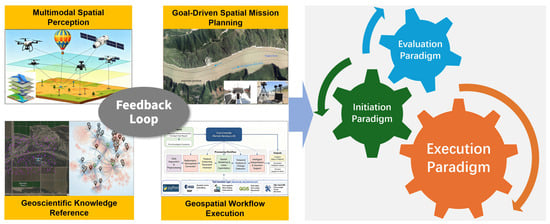
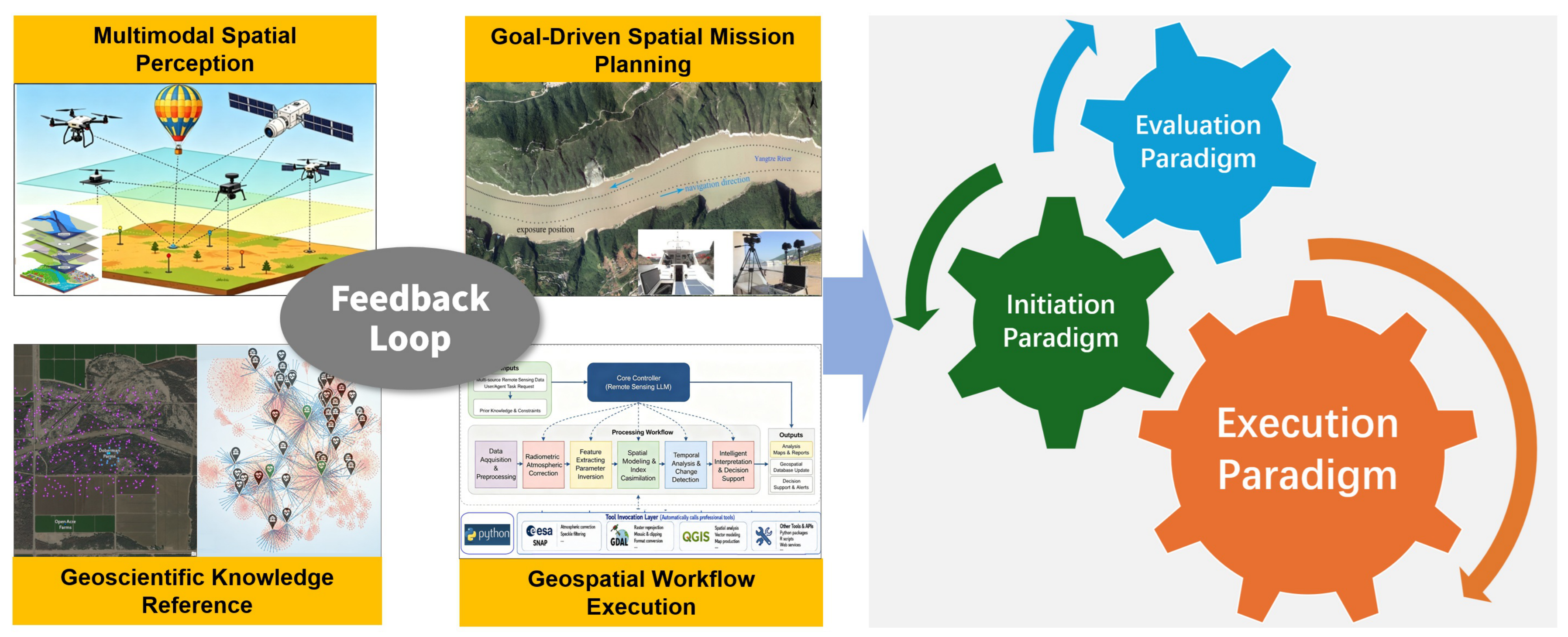
As a geospatially specialized intelligent agent, the Remote Sensing Agent draws on these classical characteristics while embedding strong domain-specific properties tailored to Earth observation, spatial analysis, and remote sensing data processing. As in Figure 1, it is tightly coupled with observation platforms, geospatial scenes, and environmental dynamics rather than acting as a general-purpose agent. Based on the universal agent architecture and the unique demands of remote sensing, we conceptualize its “4+1” core characteristics as follows:
Figure 1.
“4+1” core characteristics and threefold reshaping of the paradigms.
- Multimodal Spatial PerceptionThe agent perceives multi-source remote sensing data (optical, SAR, hyperspectral, LiDAR, etc.), spatial structures, geographic location, terrain conditions, and dynamic environmental changes, establishing a spatially aware representation of the observed scene [22]. Unlike general AI agents, Remote Sensing Agent integrates multimodal remote sensing perception channels to achieve comprehensive scene cognition. For example, it combines optical data’s high spectral resolution with SAR data’s all-weather observation capability, and supplements terrain details with LiDAR data, effectively overcoming the limitations of single-source data. In complex mountainous areas, it can perceive terrain slopes and aspect through LiDAR, and combine hyperspectral data to identify subtle changes in vegetation coverage, laying a foundation for subsequent task execution.
- Goal-Driven Spatial Mission PlanningFor typical remote sensing Earth observation scenarios, the agent no longer merely performs post hoc data processing, but smartly carries out full-process observation resource deployment and spatial task arrangement. Oriented to practical geospatial demands such as emergency disaster response and regional environmental monitoring, the agent independently selects suitable satellite platforms, matches spaceborne optical and SAR sensors with ground monitoring equipment, formulates reasonable joint observation time windows, and optimizes actual observation routes and scanning trajectories. Combined with real-time meteorological constraints, terrain occlusion conditions, and professional geoscientific knowledge, the agent continuously devises the overall observation scheme. For example, in flood emergency monitoring, the agent can automatically switch and schedule all-weather satellite resources to avoid cloud interference, coordinate multi-source space–ground integrated sensors, and adjust on-site observation sequences, rather than following fixed, offline processing schedules. This spatial mission planning capability effectively links high-level user observation intentions with actual on-demand Earth observation deployment [6].
- Geoscientific Knowledge ReferenceThe agent constructs and maintains a systematic geoscientific knowledge base, which includes spectral characteristics of ground objects, spatial topology relationships, surface environmental laws, and professional remote sensing processing specifications. This knowledge base serves as a core reference for the agent, and provides comprehensive or real-time prior information during perception, planning, and execution, replacing the simple information storage of general agents. For instance, in crop growth monitoring, it can call the spectral characteristic knowledge of different crop growth stages to accurately invert vegetation chlorophyll content; in urban land cover classification, it refers to spatial topology relationships to distinguish between residential areas and industrial zones, improving classification accuracy. Moreover, this knowledge base can be continuously updated through the feedback loop (which is the fourth characteristic), integrating new research results and practical experience to enhance the agent’s adaptability [15].
- Geospatial Workflow ExecutionAs the one of the core parts of Remote Sensing Agent, this component is responsible for executing a sequence of interrelated remote sensing processing tasks. Through professional tool scheduling and workflow orchestration, it converts multi-source raw observation data into decision-supporting analysis results and updates geospatial states in real time. The agent implements a full-stack remote sensing processing chain including data preprocessing, radiometric and atmospheric correction, feature extraction, spatial modeling, and intelligent interpretation, while supporting tool invocation, script generation, and observation device interaction. It can automatically invoke professional tools such as SNAP for atmospheric correction, GDAL for raster reprojection and QGIS for spatial modeling, and generate Python scripts to automate the processing workflow. For example, in coastal zone environmental monitoring, it completes the entire process from satellite data acquisition, radiometric correction, to coastal erosion extraction, and utilizes geoscientific knowledge to select the optimal feature extraction algorithm, ensuring the reliability of monitoring results. Such tool-augmented execution capability has been formally evaluated in recent benchmarks [5]. The core controller of this module is a large language model (LLM) oriented to remote sensing domain, which understands geospatial tasks, schedules professional tools, and coordinates the entire execution process. The LLM is fine-tuned with remote sensing text data and geospatial instruction data, and integrated with visual-language models to adapt to multimodal remote sensing data.
- Feedback LoopServing as the “+1” unifying mechanism, the feedback loop connects multimodal spatial perception, goal-driven spatial mission planning, geoscientific knowledge reference, and geospatial workflow execution. It evaluates task performances, transmits environmental feedback to upstream modules, updates geoscientific knowledge, helps to optimize the workflow, and forms a complete, autonomous, and evolvable closed-loop intelligence system. For example, if the extraction accuracy of a target detection task is lower than the expectation, the feedback loop will trace the error source—whether it is insufficient perception data or inappropriate algorithm parameters—and adjust the data collection scheme or optimize the algorithm with reference to geoscientific knowledge, realizing iterative improvement of task performances [17]. Therefore, the “+1” feedback loop is a cross-cutting mechanism that connects all four core components. When the workflow or task planning requires access to geoscientific knowledge, or when the perception module needs to provide references for other decision-making links, all such interactions are mainly realized through this “+1” feedback loop of the remote sensing agent.
This “4+1” paradigm distinguishes the Remote Sensing Agent from both general-purpose agents and traditional remote sensing models, endowing it with spatial awareness, task autonomy, and distinctive geoscientific intelligence rooted in interactive reference of professional domain knowledge. Compared with general AI agents, it has strong remote sensing domain specificity; compared with traditional remote sensing models, it breaks the limitations of passive and disconnected processing, laying a foundation for reshaping the remote sensing information processing paradigm.
3. Threefold Reshaping the Paradigm of Remote Sensing Information Processing
Traditional paradigms of remote sensing information processing were formed in the stage of manual operation and early automatic processing, with “passive processing, predefined-task execution, and result orientation” as the core characteristics, which can no longer adapt to the development needs of remote sensing technology in the intelligent era. Agentic AI is reshaping the technical framework of the geospatial field, making Remote Sensing Agent the core carrier of this paradigm shift [4,23]. Supported by a domain-oriented LLM as its central brain, the Remote Sensing Agent fundamentally reshapes the traditional paradigm through the collaboration of its four core components and the feedback loop from three dimensions: initiation paradigm, execution paradigm, and evaluation paradigm, promoting a qualitative leap in remote sensing information processing.
First, Reshaping the Initiation Paradigm: From “Passive Data Processing” to “Active Task-Driven”. The traditional “data-centric” paradigm relies on pre-collected data, leading to low pertinence of processing tasks and slow response to dynamic needs [4]. This paradigm shift from passive data processing to active task-driven intelligence aligns with the new trend of Earth interpretation empowered by large language models, which emphasizes the transformation from low-level perception to high-level decision-making [24]. In this mode, data collection and processing are disconnected: data is collected according to fixed plans, and processing is limited to available data, which cannot meet the real-time needs of complex tasks. For example, in sudden wildfire monitoring, traditional processing can only use pre-collected data, which may be outdated or occluded by smoke, resulting in delayed fire scope assessment and ineffective fire control guidance.
In contrast, supported by Multimodal Spatial Perception and Goal-Driven Spatial Mission Planning, the Remote Sensing Agent has achieved “task-driven” intelligence [24]. It takes user goals as the core, independently plans data collection schemes, adjusts parameters, and switches data sources (e.g., from optical data to SAR data) according to task needs, transforming the processing mode from “solving problems with available data” to “acquiring data needed for tasks” [4]. In future wildfire monitoring scenarios, Remote Sensing Agents may actively and dynamically recommend satellite imaging schedules and sensor configurations according to predicted fire spread trends, coordinate UAVs to complement ground observations, and support more timely and effective fire monitoring. This active adaptation capability has been verified by relevant research, which indicates that autonomous Remote Sensing Agents can significantly improve processing timeliness and pertinence compared with traditional models [23].
Second, Reshaping the Execution Paradigm: From “Predefined-Task Processing” to “Multi-Agent Collaboration”. Traditional processing modes mainly support single-task, static multi-task batch or chained processing, and they fundamentally lack the system-level self-organized collaborative task division by multi-agent frameworks. These tasks are predefined and sequential, incapable of the adaptive, dynamic, cross-scenario coordination required for complex tasks. Furthermore, the data fusion in these traditional methods is difficult to support multi-level integration across pixel, feature, and task layers even across modals without multi-agent frameworks. Therefore, when these models are designed for specific tasks, such as only extracting buildings or inverting surface temperature, they are hardly able to integrate multi-source data or complete cross-scenario coordination simultaneously. In global climate change monitoring, which requires integrating optical, SAR, and hyperspectral data to invert multiple parameters (e.g., surface temperature, vegetation coverage, carbon sink capacity), traditional task-execution models often produce fragmented results that are difficult to integrate.
Multi-agent frameworks can process heterogeneous data through division of labor and collaboration to break the above limitations [25]. Relying on the Geospatial Workflow Execution function, the Remote Sensing Agent adopts a centralized or distributed collaboration mode. In the centralized mode, a main agent decomposes complex tasks into sub-tasks and assigns them to sub-agents specializing in data collection, preprocessing, and feature extraction; in the distributed mode, multiple agents communicate independently to complete collaborative processing. This mode helps realize data fusion across different tasks and modalities as well as multi-parameter synchronous inversion, which traditional models struggle to support effectively. For example, in global ecological monitoring, multiple Remote Sensing Agents collaborate: some collect multi-source satellite data, some preprocess data to eliminate atmospheric interference, some invert ecological parameters, and the main agent integrates results to form a comprehensive ecological evaluation report. Relevant research has verified that this collaborative mode can significantly improve the intelligence and adaptability of execution of remote sensing tasks compared with single-task or static multi-task models, providing strong support for complex applications such as global ecological monitoring and emergency response.
Third, Reshaping the Evaluation Paradigm: From “Result-Oriented Output” to “Full-Process Closed-Loop Optimization”. The traditional “result-oriented” mode lacks dynamic optimization and on-site verification links, which hinders the improvement of processing accuracy. Traditional processing is a linear process without effective feedback: once errors occur in data preprocessing or feature extraction, it is difficult to trace the source, and processing experience cannot be reused. For example, in remote sensing image classification, if the model’s accuracy is low due to inappropriate atmospheric correction parameters, the same error may be repeated in subsequent tasks, resulting in wasted resources.
With Geoscientific Knowledge Reference and Feedback Loop, the Remote Sensing Agent has realized a full-process closed loop of “collection–preprocessing–processing–verification–optimization”. It records intermediate results, processing parameters, and experience in real time, forming a reusable experience library. During processing, the feedback loop evaluates intermediate results in real time: if data preprocessing noise is excessive, it adjusts denoising parameters; if feature extraction accuracy is low, it optimizes the algorithm with reference to ground object spectral knowledge. After task completion, it verifies results through field surveys or professional tools, and adjusts the processing scheme according to verification feedback to form iterative optimization. Relevant research has shown that this closed-loop mode can significantly improve processing accuracy compared with traditional result-oriented modes [18]. It has also been confirmed that tool-augmented Remote Sensing Agents with closed-loop optimization can continuously improve performance through iterative learning, promoting remote sensing processing towards high precision and high practicality.
In addition, explainable remote sensing (XAI) is integrated into the closed-loop optimization of the evaluation paradigm to provide interpretability support for model outputs and intelligent decision-making processes. It enables traceability and visualization of key steps in remote sensing information processing, assists in verifying the physical rationality of results, and enhances the credibility and reliability of the entire intelligent processing pipeline. By clarifying feature contributions, decision-making basis, and processing logic, XAI effectively alleviates the black-box effect of agents in complex scenarios, enabling closed-loop optimization to pursue not only accuracy improvement but also compliance with geoscientific laws and interpretability requirements in practical applications.
4. Discussion and Outlook
The rise of Remote Sensing Agent alleviates the core pain points of traditional remote sensing information processing but also promotes the landing application of remote sensing technology in multiple practical scenarios, with significant scientific research value and practical value. For example, in ecological environment monitoring, it is possible to realize nearly real-time and comprehensive monitoring through multi-agent collaboration; in disaster emergency response, it provides timely and accurate disaster assessment for rescue decisions; in precision agriculture, it supports refined management by adapting to crop growth dynamics; in urban governance, it integrates multi-source data to promote smart city construction. However, critical challenges still remain. First, real-time decision-making during disasters and abnormal events faces significant constraints, including satellite data transmission delays, limited edge computing capabilities, and complex environmental interferences, which hinder the agent’s ability to achieve low-latency emergency response. Second, sensor interoperability across heterogeneous platforms (e.g., satellites, UAVs, and ground sensors) remains a major bottleneck, due to inconsistent data formats, coordinate systems, and interface protocols, which complicates cross-platform collaboration and multi-source data fusion. In addition, issues such as large model hallucinations, geospatial grounding errors, and poor generalization under extreme conditions further limit the reliability and robustness of agents in real-world Earth observation missions. These challenges require targeted solutions in future research.
Although the research and application of Remote Sensing Agent are still in the initial stage, with the iteration of LVLM and edge computing technologies, etc., it will further improve its technical system. Future research can further advance the evolutionary iteration of Remote Sensing Agent by constructing dynamically updatable, scenario-customized geoscientific knowledge graphs instead of static knowledge bases. Moreover, it is necessary to explore lightweight, low-latency collaborative interaction mechanisms for heterogeneous multi-agent groups to support efficient joint observation across satellite, aerial, and ground platforms. In addition, further efforts should be devoted to improving the environmental robustness and generalization capability of remote sensing agents under extreme weather, cloud occlusion, and complex terrain interference, so as to promote the large-scale practical deployment of intelligent remote sensing processing systems in real Earth observation missions.
5. Conclusions
In conclusion, as an emerging innovative form in the remote sensing field, Remote Sensing Agent rewrites the rules of traditional remote sensing information processing from three dimensions, through its unique “4+1” characteristics, promoting the transformation of remote sensing technology from passive perception to active cognition. Despite existing bottlenecks including heterogeneous sensor compatibility and emergency real-time decision limits, advances in large vision-language models, dynamic geoscientific knowledge graph and edge computing will continuously improve the robustness of RS Agent. In the future, it will grow into a groundbreaking driving force in the era of geospatial intelligence, contributing to Earth observation and sustainable development.
Author Contributions
Conceptualization, P.L.; methodology, P.L. and R.Z.; investigation, P.L.; resources, P.L.; writing—original draft preparation, P.L. and R.Z.; writing—review and editing, P.L. and R.Z.; funding acquisition, P.L. All authors have read and agreed to the published version of the manuscript.
Funding
This work was supported in part by Project of Comprehensive Site Selection System under Grant KY24004, and in part by the National Natural Science Foundation of China under Grant Grant 41971397 and Grant 61731022.
Data Availability Statement
No new data were created or analyzed in this study.
Acknowledgments
The authors would like to thank the anonymous reviewers for their valuable comments.
Conflicts of Interest
The authors declare no conflicts of interest.
Abbreviations
The following abbreviations are used in this manuscript:
| GeoAI | Geospatial Artificial Intelligence |
| LVLM | Large Vision-Language Model |
| UAVs | Unmanned Aerial Vehicles |
| GDAL | Geospatial Data Abstraction Library |
| SNAP | Sentinel Application Platform |
References
- Shang, Y.; Cheng, B.; Zhang, Z.; Wang, Q.; Jin, P.; Huang, L.; Liu, C.; Huang, L.; Ding, X.; Shen, T.; et al. Artificial Intelligence for Remote Sensing: Progress, Challenges, and Perspectives. IEEE J. Sel. Top. Appl. Earth Obs. Remote Sens. 2026, 19, 6840–6874. [Google Scholar] [CrossRef] [Scilit]
- Feng, P.; Lv, Z.; Ye, J.; Wang, X.; Huo, X.; Yu, J.; Xu, W.; Zhang, W.; Bai, L.; He, C.; et al. Earth-agent: Unlocking the full landscape of earth observation with agents. arXiv 2025, arXiv:2509.23141. [Google Scholar]
- Awesome-Remote-Sensing-Agents. 2026. Available online: https://github.com/PolyX-Research/Awesome-Remote-Sensing-Agents (accessed on 9 June 2026).
- Xu, W.; Yu, Z.; Mu, B.; Wei, Z.; Zhang, Y.; Li, G.; Wang, J.; Peng, M. RS-Agent: Automating remote sensing tasks through intelligent agent. arXiv 2024, arXiv:2406.07089. [Google Scholar]
- Shabbir, A.; Munir, M.A.; Dudhane, A.; Sheikh, M.U.; Khan, M.H.; Fraccaro, P.; Moreno, J.B.; Khan, F.S.; Khan, S. Thinkgeo: Evaluating tool-augmented agents for remote sensing tasks. arXiv 2025, arXiv:2505.23752. [Google Scholar]
- Yao, L.; Xu, S.; Liu, F.; Zhang, C.; Yao, B.; Min, R.; Li, Y. RemoteAgent: Bridging Vague Human Intents and Earth Observation with RL-based Agentic MLLMs. arXiv 2026, arXiv:2604.07765. [Google Scholar]
- Li, W. Artificial Intelligence in Earth Science: A GeoAI Perspective. J. Geophys. Res. Mach. Learn. Comput. 2025, 2, e2025JH000691. [Google Scholar] [CrossRef] [Scilit]
- Li, W. GeoAI: Where machine learning and big data converge in GIScience. J. Spat. Inf. Sci. 2020, 20, 71–77. [Google Scholar] [CrossRef] [Scilit]
- Esri. GeoAI: What Is GeoAI? Official Documentation; Esri: Redlands, CA, USA, 2026. [Google Scholar]
- Tang, J.; Yan, Y.; Wang, Q.; Xia, Y.; Geng, B.; Chen, J.; Ma, K.; Zhai, Y.; He, Q.; Shao, W.; et al. Intelligent Remote Sensing Agents: A Survey. Available online: https://www.researchgate.net/publication/403817822_Intelligent_Remote_Sensing_Agents_A_Survey (accessed on 9 June 2026).
- Talemi, N.A.; Boone, J.; Afghah, F. Agentic AI in Remote Sensing: Foundations, Taxonomy, and Emerging Systems. arXiv 2026, arXiv:2601.01891. [Google Scholar] [CrossRef] [Scilit]
- Guo, H.; Su, X.; Wu, C.; Du, B.; Zhang, L.; Li, D. Remote Sensing ChatGPT: Solving Remote Sensing Tasks with ChatGPT and Visual Models. In Proceedings of the IGARSS 2024—2024 IEEE International Geoscience and Remote Sensing Symposium; IEEE: Piscataway, NJ, USA, 2024; pp. 11474–11478. [Google Scholar] [CrossRef] [Scilit]
- Zhu, L.; Wu, J.; Wang, B.; Zhang, G.; Wang, J.; Chen, S.; Tan, M. RS-AGENT: Large Language Models Guided Agent System for Remote Sensing Image Generation. In Proceedings of the IGARSS 2024—2024 IEEE International Geoscience and Remote Sensing Symposium; IEEE: Piscataway, NJ, USA, 2024; pp. 7020–7024. [Google Scholar] [CrossRef] [Scilit]
- Zhao, S.; Liu, F.; Zhang, X.; Chen, H.; Gu, X.; Jiang, Z.; Ling, F.; Fei, B.; Zhang, W.; Wang, J.; et al. OpenEarth-Agent: From Tool Calling to Tool Creation for Open-Environment Earth Observation. Version Number: 1. arXiv 2026, arXiv:2603.22148. [Google Scholar] [CrossRef] [Scilit]
- Xiao, A.; Cheng, S.; Xu, Y.; Ren, Y.; Chen, H.; Yokoya, N. GeoMMBench and GeoMMAgent: Toward Expert-Level Multimodal Intelligence in Geoscience and Remote Sensing. arXiv 2026, arXiv:2604.08896. [Google Scholar]
- Liu, Z.; Zhao, D.; Yuan, B.; Jiang, Z. RescueADI: Adaptive Disaster Interpretation in Remote Sensing Images with Autonomous Agents. IEEE Trans. Geosci. Remote Sens. 2025, 63, 5611814. [Google Scholar] [CrossRef] [Scilit]
- Liu, C.; Chen, K.; Zhang, H.; Qi, Z.; Zou, Z.; Shi, Z. Change-Agent: Toward Interactive Comprehensive Remote Sensing Change Interpretation and Analysis. IEEE Trans. Geosci. Remote Sens. 2024, 62, 5635616. [Google Scholar] [CrossRef] [Scilit]
- Lee, C.; Paramanayakam, V.; Karatzas, A.; Jian, Y.; Fore, M.; Liao, H.; Yu, F.; Li, R.; Anagnostopoulos, I.; Stamoulis, D. Multi-Agent Geospatial Copilots for Remote Sensing Workflows. In Proceedings of the IGARSS 2025—2025 IEEE International Geoscience and Remote Sensing Symposium; IEEE: Piscataway, NJ, USA, 2025; pp. 1084–1089. [Google Scholar] [CrossRef] [Scilit]
- Yao, L.; Liu, F.; Xu, S.; Zhang, C.; Min, R.; Di, S.; Zheng, Y. RemoteZero: Geospatial Reasoning with Zero Human Annotations. arXiv 2026, arXiv:2605.04451. [Google Scholar] [CrossRef] [Scilit]
- Yao, L.; Liu, F.; Lu, H.; Zhang, C.; Min, R.; Xu, S.; Di, S.; Peng, P. Remotereasoner: Towards unifying geospatial reasoning workflow. Proc. AAAI Conf. Artif. Intell. 2026, 40, 11883–11891. [Google Scholar] [CrossRef] [Scilit]
- Munir, M.A.; Sheikh, M.U.; Shabbir, A.; Khan, M.H.; Khan, F.; Zhu, X.X.; Demir, B.; Khan, S. Agentic AI for Remote Sensing: Technical Challenges and Research Directions. arXiv 2026, arXiv:2604.24919. [Google Scholar] [CrossRef] [Scilit]
- Hu, H.; Wang, P.; Feng, Y.; Wei, K.; Yin, W.; Diao, W.; Wang, M.; Bi, H.; Kang, K.; Ling, T.; et al. RingMo-Agent: A unified remote sensing foundation model for multi-platform and multi-modal reasoning. arXiv 2025, arXiv:2507.20776. [Google Scholar]
- Hashemi, M.; Züfle, A. A Comprehensive Survey of Agentic AI for Spatio-Temporal Data. Preprints 2026, 2026012236. [Google Scholar] [CrossRef]
- Fang, K.; Feng, H.; Cai, J.; Xia, Y.; Zhao, Y.; Wen, Z.; Wang, W.; Khowaja, S.A.; Dev, K.; Gadekallu, T.R. Large Language Models for Interpreting the Earth: A New Paradigm from Perception to Decision Intelligence. 2026. Available online: https://www.techrxiv.org/doi/pdf/10.36227/techrxiv.176857876.68610969/v1?onload=true (accessed on 9 June 2026).
- Sun, Z.; Zhou, Y.; Yang, J. An LLM-based Multi-Agent System for Remote Sensing Analysis. Big Earth Data 2026, 10, 1–25. [Google Scholar] [CrossRef] [Scilit]
Disclaimer/Publisher’s Note: The statements, opinions and data contained in all publications are solely those of the individual author(s) and contributor(s) and not of MDPI and/or the editor(s). MDPI and/or the editor(s) disclaim responsibility for any injury to people or property resulting from any ideas, methods, instructions or products referred to in the content. |
© 2026 by the authors. Licensee MDPI, Basel, Switzerland. This article is an open access article distributed under the terms and conditions of the Creative Commons Attribution (CC BY) license.