1. Introduction
Precise point positioning (PPP) has become an important technique in high-accuracy global navigation satellite system (GNSS) positioning and navigation research [
1,
2,
3]. Compared with Real-Time Kinematic (RTK), PPP does not rely on nearby reference stations and can therefore be more suitable for wide-area, infrastructure-limited, and dynamic environments [
4,
5]. Owing to these advantages, PPP has been widely applied in various scenarios, including marine navigation, offshore operations, and environmental monitoring [
6,
7]. Since the concept of PPP was established in the 1990s [
8], continuous improvements in precise orbit and clock products, as well as the development of the International GNSS Service (IGS), have gradually promoted PPP from post-processing to real-time applications [
9,
10]. The accuracy of real-time PPP is fundamentally limited by the quality of the satellite orbit and clock corrections: it depends on the stability and noise of the on-board frequency standards [
11], on the precision attainable when orbit and clock corrections are computed in an ultra-rapid/real-time regime [
12], and on the product itself, whose accuracy varies appreciably among analysis centers and generation strategies [
13].
With the growing demand for real-time high-precision positioning, open satellite-broadcast augmentation services have become increasingly attractive alternatives to network-delivered correction products. At present, BDS-3, Galileo, and Japan’s QZSS have launched public real-time PPP services, including PPP-B2b [
14], high accuracy service (HAS), and MADOCA/CLAS, respectively. These services provide new opportunities for real-time PPP users in regions where network connectivity is limited or unstable. Among them, PPP-B2b and MADOCA-PPP are two representative and complementary correction sources in the Asia-Pacific region.
Table 1 summarizes an overview of the services that are currently used primarily for real-time PPP.
As an important open augmentation service, PPP-B2b has been extensively studied in recent years. Existing works have investigated its correction precision [
15], service availability, message characteristics, Issue of Data (IOD) matching behavior [
16], positioning performance [
17], and time-transfer capability [
18,
19,
20,
21]. These studies have provided a relatively complete understanding of PPP-B2b from the perspectives of signal structure, correction quality, and user-side PPP performance.
On the QZSS side, CLAS has demonstrated rapid centimeter-level regional augmentation capability within Japan [
22]. Meanwhile, MADOCA-related studies have evaluated its usability and orbit/clock accuracy, assessed its multi-GNSS PPP and PPP-AR performance [
23], and discussed its potential application in future real-time precise orbit determination scenarios [
24,
25]. These works indicate that MADOCA-PPP is also a promising open service for real-time PPP in the Asia-Pacific region.
Although PPP-B2b and MADOCA-PPP have both shown strong potential for real-time PPP, existing studies have mainly evaluated them separately or compared them as standalone services. In contrast, the necessity and methodology of combining these two open services for robust real-time PPP remain insufficiently investigated. In particular, practical multi-service use involves not only complementary satellite support and geometry enhancement, but also inter-service inconsistency, asynchronous updates, and possible interruption of a single correction stream. Therefore, the key issue is no longer simply which service performs better on average, but how to construct a consistent and robust multi-service fusion framework.
To address this problem, this paper proposes a consistent fusion framework for combining MADOCA-PPP and PPP-B2b corrections in real-time PPP. The proposed method performs correction-domain fusion before user-level PPP estimation and explicitly considers inter-service inconsistency and robustness under single-service degradation or interruption. Static-station and dynamic experiments are further conducted to evaluate the proposed framework in terms of positioning accuracy, convergence, satellite availability, and outage-recovery behavior.
The main contributions of this study are summarized as follows:
- (1)
A unified correction-domain fusion framework is developed for combining MADOCA-PPP and PPP-B2b in real-time PPP.
- (2)
A consistency-preserving fusion strategy is introduced to handle inter-service mismatch and improve robustness under single-service interruption.
- (3)
Experiments using static-station and dynamic datasets demonstrate that the value of combining MADOCA-PPP and PPP-B2b lies not only in positioning accuracy, but also in solution continuity and service resilience.
2. Materials and Methods
This chapter first briefly introduces PPP-B2b and MADOCA real-time products, presents the PPP model of SSR correction used in the subsequent PPP performance comparison, and gives the recovery strategy of SSR correction.
2.1. PPP-B2b and MADOCA-PPP Products
PPP-B2b and MADOCA-PPP are two representative open satellite-broadcast augmentation services for real-time precise point positioning in the Asia-Pacific region. Although both services provide state-space representation (SSR) corrections for user-side PPP, they differ significantly in constellation support, message organization, correction content, and update characteristics. These differences make them complementary in practical real-time PPP, while also introducing non-negligible challenges for direct combination.
PPP-B2b is a public augmentation service provided by the BDS-3 system through geostationary orbit (GEO) satellite broadcasting [
26]. It mainly delivers satellite mask information, orbit corrections, user range accuracy index (URAI), DCB, and satellite clock corrections [
27] in SSR form. Existing studies have shown that PPP-B2b can support real-time precise positioning and time transfer, while its correction characteristics, delay behavior, SISRE evaluation [
28] and IOD matching properties have also been analyzed in detail. In practical PPP applications, PPP-B2b has the advantage of open access and direct satellite broadcasting, but its supported constellations and correction update characteristics remain service-specific.
MADOCA-PPP is developed within the QZSS augmentation framework and provides real-time precise corrections through L6 signals. Compared with PPP-B2b, MADOCA-PPP supports a broader multi-GNSS correction framework and adopts Compact SSR (CSSR), which offers a more compact message structure for real-time dissemination [
29,
30]. Previous studies have demonstrated the usability of MADOCA products in PPP and PPP ambiguity resolution (AR) applications, and have evaluated their orbit and clock quality as well as their potential in broader real-time precise positioning scenarios.
From the perspective of standalone service performance, the two services each possess their own strengths. However, in practical real-time PPP, relying on only one service may still lead to several limitations. First, the number of available satellites and the resulting observation geometry depend on service-specific constellation support. Second, the correction streams may experience temporary delay, degradation, or interruption, which can affect solution continuity and re-convergence behavior. Third, even when both services are available simultaneously, their corrections cannot be directly averaged in a statistically safe manner, because inter-service inconsistency may arise from different message conventions, reference realizations, update epochs, bias handling, and unknown common-mode correlation.
Therefore, the purpose of this study is not simply to compare PPP-B2b and MADOCA-PPP as two independent services, but to investigate how they can be consistently combined for robust real-time PPP. To achieve this goal, a unified correction-domain processing strategy is required before user-level PPP estimation, so that the complementary information from the two services can be utilized without introducing inconsistency or overconfident fusion.
2.2. Unified PPP Model and Correction-Domain Harmonization
In this study, an undifferenced ionosphere-free PPP model is adopted as the common user-side positioning model for all compared solutions. The same PPP estimator is used for MADOCA-PPP-only, PPP-B2b-only, and the fused solution. Therefore, the differences among the solutions mainly originate from the applied SSR correction products rather than from different user-side positioning models.
For a receiver
, satellite
, constellation
, and frequency
, the undifferenced pseudorange and carrier-phase observations can be expressed as follows:
where
is the geometric distance between the receiver and satellite,
is the speed of light,
and
are the receiver and satellite clock offsets,
is the tropospheric delay,
is the slant ionospheric delay on frequency
,
and
are receiver and satellite-dependent code hardware delays,
and
are carrier-phase hardware delays,
is the carrier wavelength,
is the integer ambiguity, and
and
denote the remaining measurement noise and unmodeled errors.
For each constellation, two frequencies are selected according to the available receiver-independent exchange format (RINEX) observation types and the signal bias information supported by the corresponding SSR service. The ionosphere-free (IF) combinations are formed as follows:
with
where
and
are the two selected carrier frequencies. This combination eliminates the first-order ionospheric delay. The frequency pair is constellation- and service-dependent.
After forming the ionosphere-free combinations and applying SSR orbit, clock, and signal bias corrections, the observation equations can be written as follows:
where
and
are the satellite position and clock corrected by SSR orbit and clock corrections.
is the inter-system bias of constellation
with respect to the GPS time reference.
and
denote the residual ionosphere-free code and phase bias terms after applying the available SSR signal bias corrections. If the corresponding signal bias correction is available, it is applied before PPP estimation; otherwise, the residual bias is absorbed by the receiver clock, inter-system bias, or ambiguity parameters depending on its physical property.
Since the MADOCA-PPP corrections include GLONASS, its FDMA inter-frequency biases (IFBs) are accounted for in the ionosphere-free PPP. The GLONASS-to-GPS inter-system bias (the frequency-independent hardware delay) is absorbed by a per-constellation receiver-clock parameter; the carrier-phase IFB is fully absorbed by the per-satellite float ambiguities and does not bias the float solution; and the pseudorange IFB is handled stochastically, by augmenting the GLONASS code variance with an IFB term (0.6 m, 1σ) rather than estimating explicit per-channel parameters. This is adequate in the float-PPP context used here, where GLONASS contributes to multi-constellation redundancy and geometry without integer ambiguity resolution.
The tropospheric delay is modeled as follows:
where
and
are the zenith hydrostatic and wet delays, and
and
are the corresponding mapping functions as a function of satellite elevation angle
. The hydrostatic component is corrected using an empirical model, while the wet component is estimated as an unknown parameter in the PPP filter.
The estimated state vector is defined as follows:
where
is the receiver position vector,
is the receiver clock offset,
is the zenith wet delay, and
are the float ionosphere-free ambiguities for all tracked satellites. GPS is used as the reference system, and its system bias is absorbed into the receiver clock. For GLONASS, Galileo, QZSS, and BDS, one inter-system bias parameter is estimated when observations from the corresponding constellation are used.
The linearized ionosphere-free PPP observation model can be expressed as follows:
where
is the post-fit residual vector,
is the design matrix,
is the state correction vector, and
is the observed-minus-computed vector after applying SSR and conventional geophysical corrections. The stochastic model is constructed according to satellite elevation angle and the quality indicators of the SSR corrections. In this way, satellites corrected by different services can be introduced into the same PPP estimator while retaining service-dependent correction uncertainty.
In the proposed correction-domain fusion strategy, MADOCA-PPP and PPP-B2b corrections are first converted into a unified SSR representation, including orbit, clock, and signal bias corrections. For overlapping satellites, especially GPS satellites corrected by both services, two correction estimates are available for the same satellite state and are fused before being introduced into the PPP filter. For non-overlapping satellites, such as GLONASS, Galileo, and QZSS from MADOCA-PPP or BDS-3 from PPP-B2b, the available single-service correction is used directly. This design allows the fused solution to benefit from the complementary constellation coverage of the two services while maintaining a consistent ionosphere-free PPP observation model.
The first harmonization step is satellite and constellation alignment. Since the two services do not support exactly the same constellation set, only those satellites with valid and correctly matched correction information are eligible for direct fusion, while service-exclusive satellites are retained in a single-service mode. In this way, the fusion framework can exploit common satellites for consistent combination and simultaneously preserve the geometry contribution of non-overlapping satellites.
The second step is broadcast-ephemeris consistency. Both PPP-B2b and MADOCA-PPP corrections are referenced to broadcast navigation information rather than directly to final precise products. Therefore, the corresponding broadcast ephemerides must be matched carefully in time and IOD space before correction application. This step is particularly important for avoiding artificial discrepancies caused by inconsistent ephemeris baselines rather than true service-level correction differences.
The third step is correction representation unification. Orbit corrections from different services may be transmitted in different representations or message structures, but they must ultimately be transformed into a common user-side form before PPP calculation. In this study, all orbit corrections are mapped into a unified satellite-related representation and then applied consistently with the associated broadcast ephemerides. Likewise, the clock corrections are converted into a common convention so that user-side clock modeling is not contaminated by service-dependent formulation differences.
The fourth step is bias and signal mapping harmonization. Because the two services may use different signal priorities and bias conventions, differential code bias handling must be made compatible with the actual observation types used in PPP processing. When service-native bias information is available and valid, it is applied directly; otherwise, external DCB information is used as a fallback to maintain consistency across services. This step is necessary to avoid introducing artificial inter-service offsets in the code observations.
After the above harmonization procedures, the two correction streams are transformed into a unified correction-domain representation, which provides the basis for subsequent consistent fusion. In other words, the purpose of harmonization is not to force the two services to become numerically identical, but to ensure that their differences primarily reflect true service-level characteristics rather than mismatched conventions or implementation artifacts. On this basis, the fused correction model can then be constructed in a statistically consistent manner.
2.3. Bias-State-Aware Structured Covariance Intersection
For a satellite corrected by both services, we collect the common-correction state into a four-dimensional vector
, comprising the radial, along-track and cross-track orbit corrections and the clock correction (in range units) expressed in a unified frame. After the harmonization of
Section 2.2, each service
(MADOCA-PPP and PPP-B2b) delivers an estimate that, in general, differs from the true state by both a slowly varying systematic offset and a random error,
where the offset
originates from service-specific datum, broadcast-ephemeris baseline and antenna/EOP conventions, and the cross-covariance
is unknown: the two services rely on partially overlapping tracking networks and shared modeling assumptions, so their errors contain a common-mode component that cannot be recovered at the user side. This unknown correlation is precisely the condition under which a minimum-variance combination becomes overconfident and for which covariance intersection (CI) is appropriate. Stacking the two observations,
reveals that the joint state
is not observable: for any
the triple
reproduces the same observations, so
has a rank deficiency equal to
. This gauge freedom is removed by fixing one service as the bias datum. Taking MADOCA-PPP as reference,
, leaves only the relative offset
to be estimated and renders
identifiable,
The relative offset is observable from the inter-service single difference
and is propagated as a slowly varying random-walk state shared across the overlapping satellites, which decouples the common state from the inter-service bias. The choice of datum does not affect identifiability: because only the inter-service difference
is observable, fixing either service as the bias datum removes the same gauge freedom, leaving identifiability—and, up to this gauge, the positioning solution—unchanged. We fix the higher-accuracy service (MADOCA-PPP,
Section 3.1.1) as the datum so that the random-walk bias state models the noisier PPP-B2b correction relative to a more stable reference, which yields better filter conditioning than the reverse assignment.
Using the estimated offset
with covariance
, the PPP-B2b state is aligned to the MADOCA datum,
so that
and
become unbiased estimates of the same state. The combination is termed structured because it is applied only within this common-correction subspace—block-diagonally, with a three-dimensional orbit block and a one-dimensional clock block—while the service bias is carried as a nuisance parameter outside the intersection; and because it is bias-state-aware, operating on the aligned quantities of (11). For the weight
, the covariance-intersection estimate and its covariance are
The essential robustness property is that, for every
and every admissible cross-covariance
, the result is consistent,
i.e., the fused covariance never underestimates the true error covariance irrespective of the unknown correlation. Property (13) is the formal basis of the consistency-preserving claim and, importantly, holds for any weight, not only the covariance-minimizing one; the correction injected into the user filter therefore cannot be overconfident.
MADOCA-PPP and PPP-B2b cannot be assumed mutually independent. Both are referenced to broadcast ephemerides rather than to independent final products; both are generated from globally distributed tracking networks whose stations partially overlap; and both estimate satellite orbits and clocks under broadly similar modeling conventions (reference-clock datum, terrestrial-frame realization, Earth-orientation and antenna models). Through these shared inputs and conventions, part of the orbit and clock errors of the two services is common-mode, so their cross-correlation is non-zero. At the user side, this correlation can neither be observed nor recovered, which is precisely why a minimum-variance combination—optimal only under independence—would be overconfident, whereas a covariance-intersection combination, consistent for any unknown cross-correlation, is appropriate. The two services additionally differ by service-specific systematic offsets (reference-frame and clock-datum conventions), which are represented by the bias state and removed prior to fusion so that the combination operates on quantities sharing a common reference.
Classical CI fixes the weight by
the tightest consistent bound. When one covariance is nested in the other in the Loewner order
—the regime of the GPS overlap, where MADOCA-PPP uniformly dominates PPP-B2b (
Section 3.1.1)—this minimizer is a vertex,
, so CI degenerates to source selection and performs no blending. To realize a genuine combination while preserving (13), the weight is instead set from the relative information of the two sources, component-wise,
which is the minimum-variance weight under independence and is interior whenever both sources carry finite information, so that the two services contribute in proportion to their accuracy. Although (14) is not the minimum-volume CI weight, it trades a marginally looser—yet, by (13), still consistent—covariance for a genuine, accuracy-proportional blend; because (13) holds for any
, this choice carries no risk of overconfidence.
Before combining, the statistical compatibility of the aligned sources is verified by the normalized innovation squared,
with
; fusion proceeds only if
, where
is the
quantile of
(
at
) and otherwise the datum correction is used. Because neither
nor
is recoverable at the user,
is built as a deliberately conservative correction-domain proxy from the service quality indicator (PPP-B2b URAI or the MADOCA variance field), an age-dependent inflation that treats orbit and clock separately, and a variance floor reflecting the measured product accuracy (
Section 3.1.1); over-bounding the true precision, together with (13), guarantees a non-overconfident fused correction, which is confirmed empirically by the NIS statistic of (15).
Finally, the fused state replaces the satellite orbit and clock used in the user PPP observation equations; the correction covariances set the information weight (14) that forms this fused state, while additionally drives the consistency gate (15) and the satellite-screening test. The per-observation measurement variance follows the standard elevation/SNR model (with a URA-based term for PPP-B2b–corrected satellites); injecting as an additional additive term in is a natural extension and is left to future work. For satellites corrected by only one service—GLONASS, Galileo and QZSS from MADOCA-PPP, and BDS-3 from PPP-B2b—the available single-service correction and its covariance are directly used in (11), providing the multi-constellation geometry augmentation that complements the fused GPS overlap.
This scheme is distinguished from related fusion rules as summarized in
Table 2: a naive inverse-variance combination assumes
and is overconfident under common-mode errors; classical CI is consistent but, with the determinant-minimizing weight, reduces to source selection for nested covariances; and Split-CI and Inverse-CI address the covariance structure or the double-counting of common information but not the systematic inter-service offset. By combining a bias state with datum fixing—removing the offset that classical CI would otherwise propagate into a biased estimate—a subspace-restricted, block-wise intersection, and an information-based weight, the proposed method realizes a genuine, consistent blend of the two correction services.
2.4. Algorithm Summary
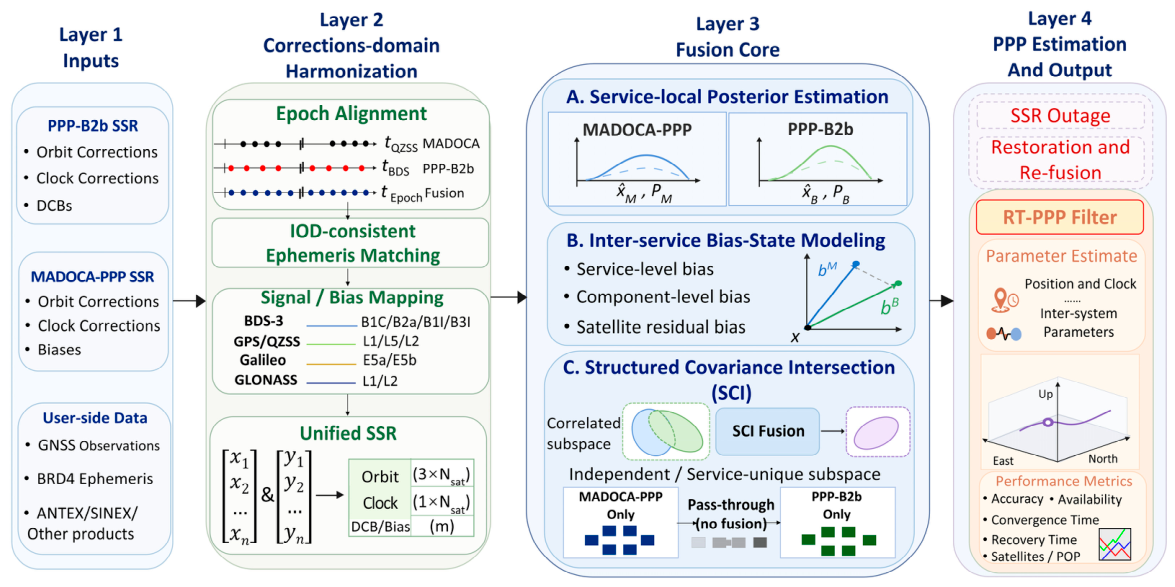
The overall framework of the proposed MADOCA-PPP/PPP-B2b fusion method is shown in
Figure 1.
2.5. Dataset
To comprehensively evaluate the proposed fusion framework, this study used two complementary types of datasets: static-station datasets and a real offshore kinematic trajectory dataset in the Asia-Pacific region. The former provides stable, repeatable, and reference-controllable test conditions, while the latter represents a practical dynamic positioning scenario with time-varying satellite geometry, observation quality, and correction availability. This combination enables the performance of MADOCA-PPP, PPP-B2b, and the proposed fused solution to be assessed from both nominal accuracy and robustness perspectives.
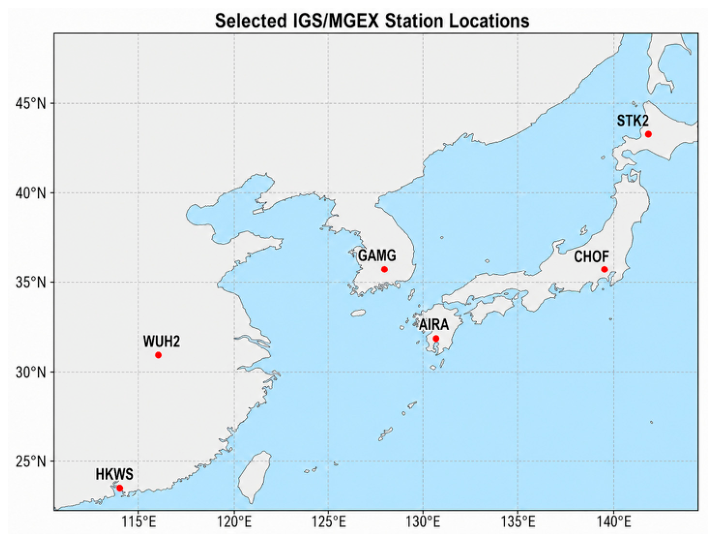
The static-station experiments were carried out using IGS/Multi-GNSS experiment (MGEX) station observations located within the effective service coverage of both MADOCA-PPP and PPP-B2b; the station distribution is shown in
Figure 2. In the experimental part, the WUH2 station is taken as the representative station. These datasets were used to evaluate nominal positioning accuracy, convergence behavior, valid-satellite number, constellation contribution, and geometric strength under relatively stable observation conditions. Because precise station coordinates are available from Solution (software/technique) Independent Exchange format (SINEX) products, the static-station experiments also provide reliable external references for assessing the consistency of different correction strategies.
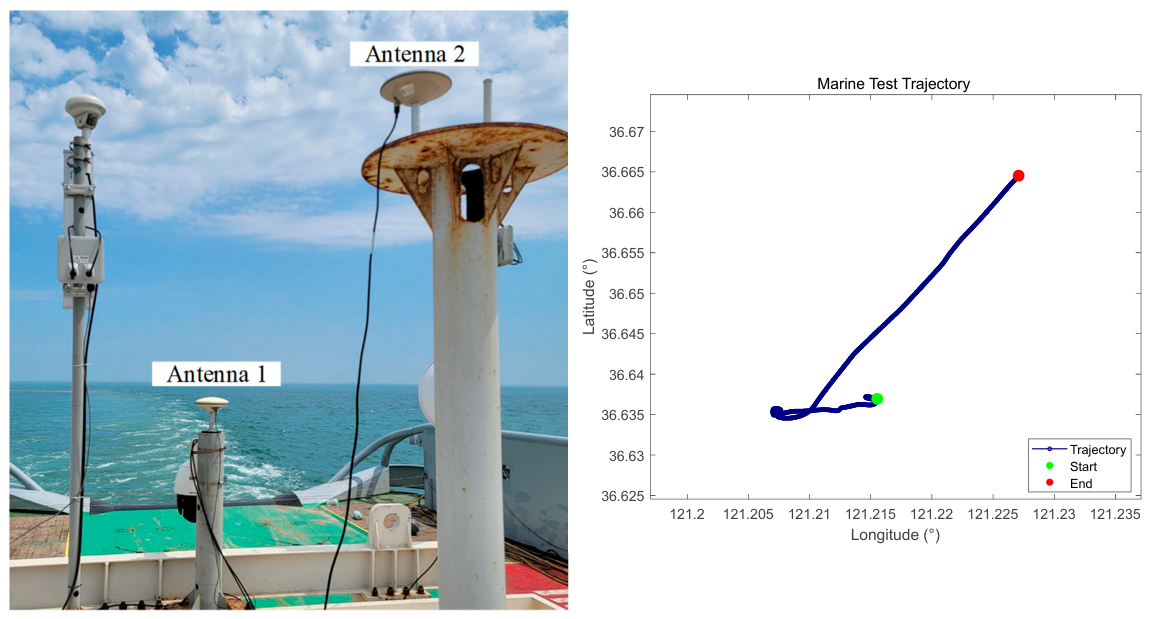
To further investigate the behavior of the proposed method under realistic dynamic conditions, a real offshore kinematic dataset collected on day of year (DOY) 190, 2023 was used; the offshore scenario and navigation trajectory are shown in
Figure 3. This dataset contains continuous multi-GNSS observations along a moving trajectory and therefore reflects practical challenges such as changing receiver environment, varying satellite visibility, fluctuating observation quality, and time-dependent correction support. It was mainly used to evaluate dynamic positioning accuracy, solution continuity, and post-outage recovery performance. Compared with the static-station datasets, the offshore trajectory is more representative of real-time maritime PPP applications, where service interruption and geometry variation can directly affect positioning reliability.
For all experiments, MADOCA-PPP corrections were decoded from QZSS L6 products, and PPP-B2b corrections were recovered from BDS-3 PPP-B2b messages [
31]. The corresponding broadcast ephemerides were used in a unified user-side processing framework. The observation data are in RINEX 3.04 (offshore) and 3.05 (WUH2). The broadcast navigation messages are taken from the DLR multi-GNSS broadcast file (BRD400DLR), in RINEX 4.00 for the 2023 offshore dataset and RINEX 4.02 for the 2024 WUH2 dataset; the RINEX 4 format provides the BDS-3 and multi-GNSS navigation message types required for the PPP-B2b service. External auxiliary products, including antenna phase center models and other products, were applied when available to maintain consistency among different PPP solutions. By combining station-based experiments and a real offshore dynamic experiment, the dataset design covers both controlled reference conditions and practical dynamic positioning conditions, providing a sufficient basis for evaluating the accuracy, availability, continuity, and robustness of multi-service SSR fusion.
2.6. Compared Schemes
To demonstrate the necessity and effectiveness of the proposed multi-service fusion method, three solution schemes were considered.
The first scheme is MADOCA-only PPP, in which only MADOCA-PPP corrections are used for user-side PPP estimation. This scheme serves as one standalone reference and reflects the performance of the QZSS-based open correction service under the adopted processing strategy.
The second scheme is PPP-B2b-only PPP, in which only PPP-B2b corrections are used. This scheme provides the second standalone reference and reflects the positioning characteristics of the BDS-3-based open augmentation service under the same user-side PPP model.
The third scheme is the full proposed fusion scheme, namely the bias-state-aware structured covariance intersection framework described in
Section 2. In this scheme, MADOCA-PPP and PPP-B2b corrections are first harmonized in the correction domain and then fused in a consistency-preserving manner before being injected into the PPP filter.
By comparing these schemes, the experiments are designed not only to show whether the fused solution is more accurate than the standalone solutions, but also to evaluate whether the proposed framework improves service continuity, geometry support, and robustness under correction interruption.
2.7. PPP Processing Strategy
To ensure that the comparison among different correction schemes is fair, all schemes were processed under a unified PPP strategy unless otherwise stated. An ionosphere-free multi-frequency PPP model was adopted for the user-side estimator, with consistent observation screening, tropospheric modeling, ambiguity treatment, and antenna correction settings across all experiments.
The basic observation model follows the framework introduced in
Section 2. Dual- or multi-frequency observations from the supported constellations G, R, E, J and C were used whenever valid measurements and corresponding correction information were available. The cut-off elevation angle, observation interval, ambiguity treatment strategy, and atmospheric parameter estimation settings were kept consistent across the compared schemes. In this way, differences in positioning performance can be attributed primarily to the correction source and fusion strategy, rather than to changes in the PPP filter configuration.
In the fused solution, service-native corrections were first aligned in time and representation, and then the fused orbit and clock corrections were injected into the PPP filter. When a satellite was supported by only one service, the corresponding correction was retained in a single-service mode rather than discarded, so that the geometry benefit of non-overlapping constellations could be preserved.
For the dynamic experiments, the same PPP strategy was used, except that the observation interval and evaluation window followed the characteristics of the dynamic dataset. This unified processing configuration ensures that the static-station and dynamic results remain comparable at the methodological level. The detailed process strategies are shown in
Table 3.
2.8. Evaluation Metrics
To comprehensively evaluate the performance of the proposed method, multiple metrics were adopted from the perspectives of positioning accuracy, convergence, geometry, continuity, and robustness.
The positioning accuracy was assessed using the root-mean-square (RMS) errors in the east, north, and up components, as well as the corresponding 2D and 3D RMS statistics. In addition, percentile-based metrics such as the 95th percentile of 3D error can also be reported to reflect tail behavior and occasional degradation more clearly than RMS alone.
The convergence performance was evaluated by the time required for the PPP solution first to satisfy a predefined accuracy threshold and remain within that threshold for a continuous time interval. Following the convention used in the original study, horizontal and vertical thresholds can be jointly defined to characterize practical convergence performance in real-time PPP. This metric is particularly important for comparing the impact of different correction schemes on initialization and post-recovery behavior.
To reflect the geometric contribution of the fused solution, the number of valid satellites and the positional dilution of precision (PDOP) were also analyzed. These metrics are useful for showing whether multi-service fusion improves the observation geometry even when the best single-service accuracy is already strong in nominal periods.
2.9. Correction-Outage Simulation Design
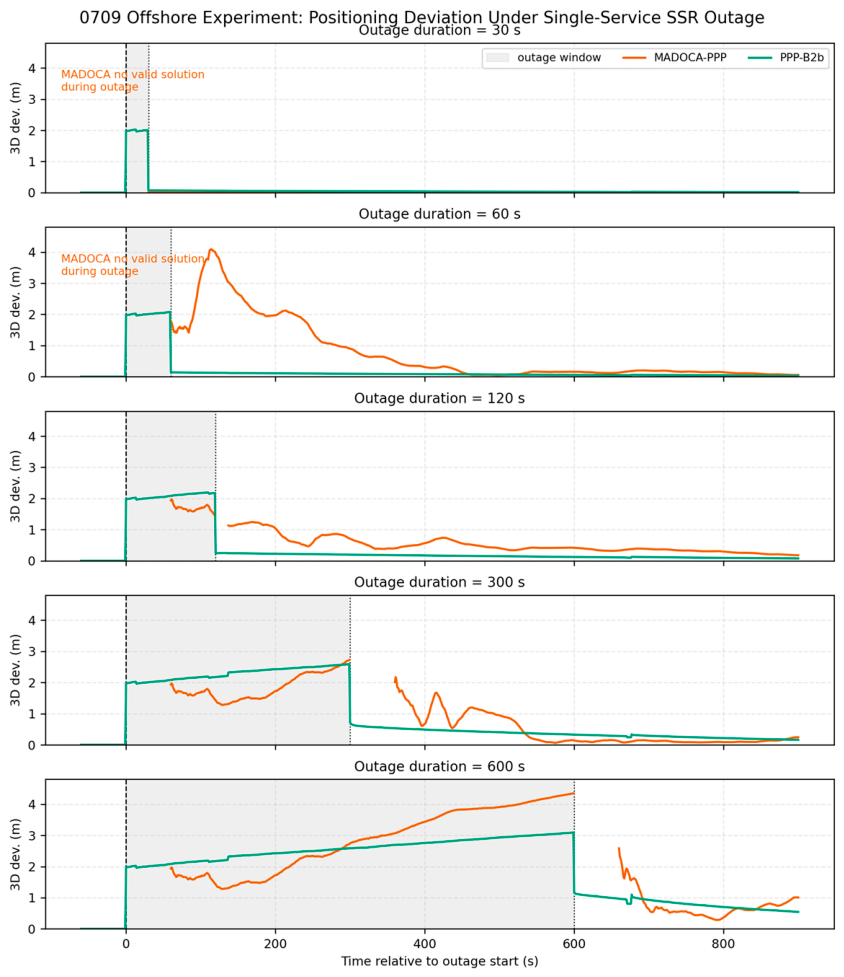
To verify the robustness of the proposed fusion method under practical service disturbances, controlled correction-outage experiments were designed. In these experiments, one correction stream was intentionally interrupted for a specified time window, while the other stream remained available. This setup was used to simulate temporary signal blockage, decoding failure, message interruption, or service degradation in practical real-time PPP applications.
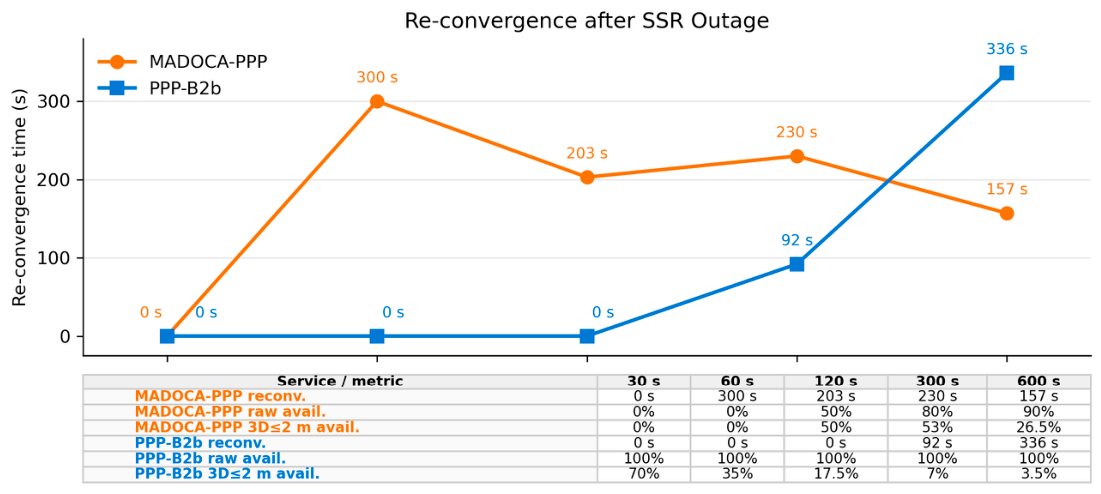
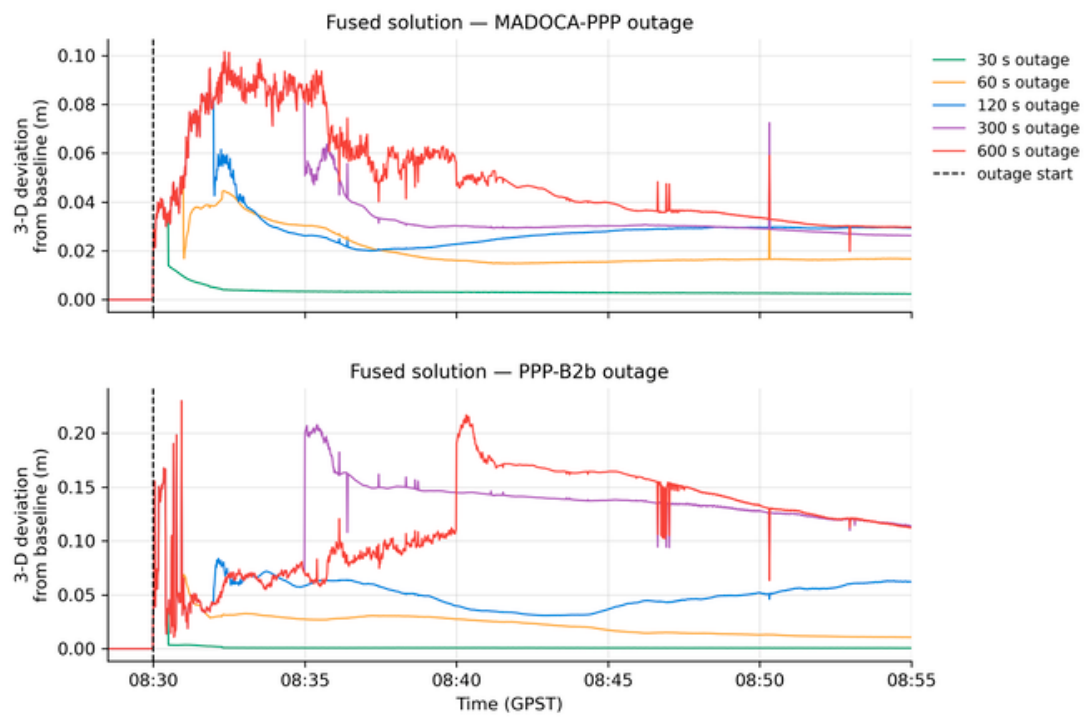
Specifically, outage scenarios were designed for both MADOCA-PPP-only interruption and PPP-B2b-only interruption. During the outage interval, the standalone solutions relying on the interrupted service naturally experienced correction loss, while the fused solution was expected to continue operating by relying on the remaining available service and the proposed consistency-preserving fusion mechanism. After service restoration, the post-outage error evolution and re-convergence time were analyzed for all compared schemes.
Different outage durations can be considered to evaluate the sensitivity of the proposed method to short and medium interruption events. Through this design, the experiments directly address a key motivation of this study, namely that the value of combining MADOCA-PPP and PPP-B2b is not limited to nominal positioning accuracy, but also includes improved continuity and resilience against temporary single-service failure.
4. Discussion
The results clarify that the role of PPP-B2b in the proposed framework should not be judged by its standalone positioning accuracy alone. Although PPP-B2b is less accurate than MADOCA-PPP in the tested datasets—an ordering confirmed at the correction level against precise WUM products, where the PPP-B2b GPS orbit/clock errors (3D RMS ~34 cm, ~0.23 ns) and BDS-3 errors (~31 cm, ~0.15 ns) exceed those of MADOCA-PPP on GPS (~10 cm, ~0.09 ns)—it provides an independent broadcast correction source, additional GPS and BDS-3 correction support, and a different outage response. The information-based weighting reflects this accuracy ordering automatically, assigning the larger share to the more accurate service while still forming a genuine blend on the overlapping GPS satellites.
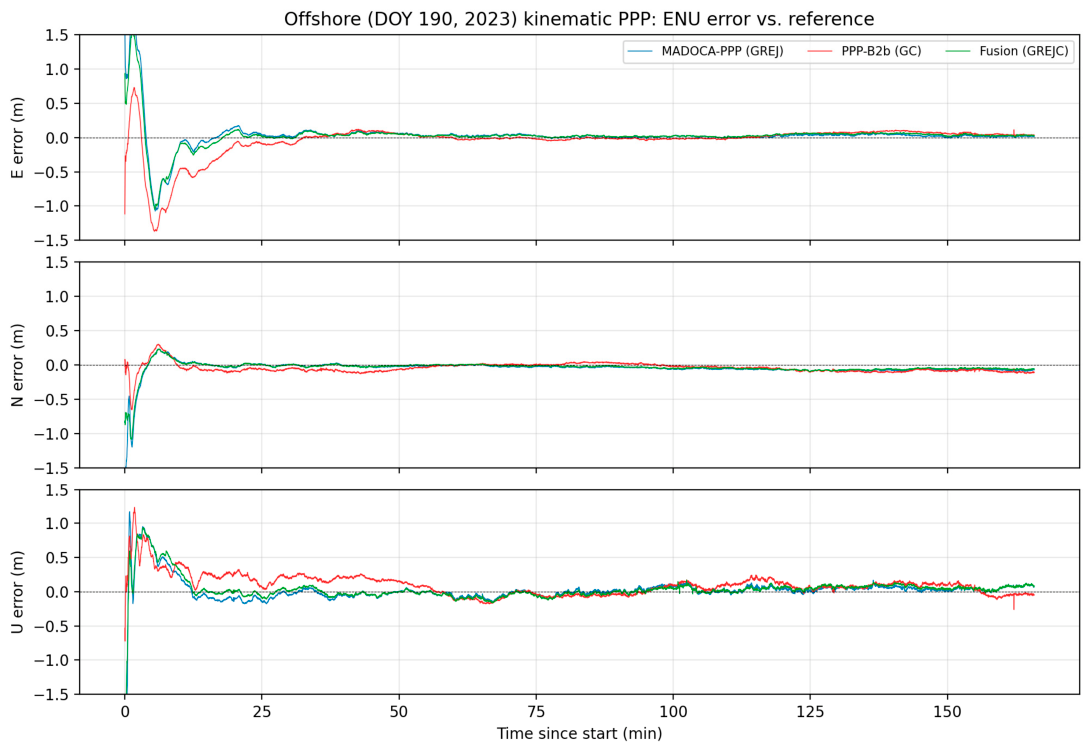
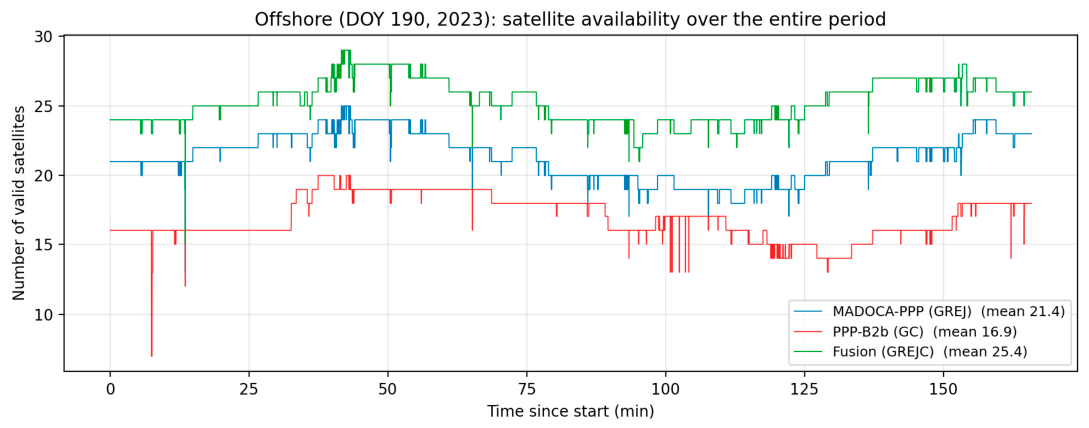
The benefit of the fusion is scenario-dependent. At the strong open-sky WUH2 station, where MADOCA-PPP alone is already near-optimal, the fusion increased the mean number of valid satellites from 21.98 to 26.56 and improved the horizontal RMS to 0.033 m—better than either standalone service (0.037 m and 0.079 m)—while the 3D RMS (0.068 m) remained on par with the best standalone service (0.066 m), the small residual difference confined to the vertical. In the offshore kinematic experiment, the fusion achieved the best overall accuracy among the three schemes (2-D 0.232 m, 3D 0.290 m), reducing the 3D RMS by 12.7% relative to MADOCA-PPP and 7.3% relative to PPP-B2b while raising the mean satellite count to 25.4. Correction-domain fusion therefore improves nominal accuracy where the additional correction information is consistent and strengthens the geometry, but it does not guarantee uniform improvement in every component at an already-optimal station—behavior that is the expected outcome of constellation augmentation rather than a deficiency of the algorithm.
The robustness experiments demonstrate the framework’s main practical value. Under increasing elevation cut-off, the fused solution degraded most slowly and remained the most accurate at every cut-off, outperforming both standalone services by about a factor of three at 40°. Under single-service outages, the standalone services showed complementary failure modes—MADOCA-PPP losing the solution for short interruptions, PPP-B2b retaining continuity at degraded accuracy—whereas the fused solution maintained 100% availability for all 30–600 s outages of either service, degrading gracefully to the surviving service’s accuracy level rather than suffering a complete loss. The statistical consistency of the fused covariance was confirmed by the normalized-innovation-squared test on both datasets (median ≈ 1.1; within the 99% bound in 100% of epochs), indicating that the consistency-preserving design is not overconfident.
The scope of the per-satellite blend deserves emphasis. The covariance-intersection blend operates on satellites corrected by both services, which at present are the GPS satellites; this reflects the current service configuration—MADOCA-PPP correcting GPS/GLONASS/Galileo/QZSS and PPP-B2b correcting GPS/BDS-3—rather than a limitation of the method, which would blend any constellation observed by both services. As the services expand their commonly corrected constellations (MADOCA-PPP with BeiDou support under development, and the PPP-B2b service designed to augment the four core constellations), the shared overlap will grow, and the same consistency-preserving blend will extend to the newly shared constellations without modification. The framework thus provides a theory and method already prepared for the deeper multi-service fusion anticipated as these open SSR services evolve.
The current implementation still has limitations. The fused correction covariance is used to form the blend, to drive the inter-service consistency gate, and to screen satellites, but it is not yet injected as an additive term into the measurement stochastic model; a direct mapping of the fused covariance into the observation weights is a natural extension. The residual inter-service inconsistency, particularly the time-varying clock-datum offset, is presently absorbed on GPS by the bias state and elsewhere by the receiver inter-system bias, and could be modeled more explicitly in multi-datum scenarios. Future work will therefore address the propagation of the fused covariance into the estimator, adaptive correlation bounding, refined constellation- and frequency-dependent bias handling, ambiguity resolution, and tight integration with inertial navigation.
5. Conclusions
This paper investigated the fusion of MADOCA-PPP and PPP-B2b SSR corrections for robust real-time precise point positioning. A bias-state-augmented structured covariance intersection framework was proposed to combine heterogeneous SSR products in the correction domain. The proposed method explicitly considers inter-service discrepancies and unknown cross-correlation, deriving the relative weighting of the two streams from their respective correction information, so that overlapping corrections are fused in a consistency-preserving manner while non-overlapping constellations still contribute to the user-side ionosphere-free PPP solution.
The experimental results show that MADOCA-PPP and PPP-B2b are complementary in satellite coverage and service behavior, but not equivalent in correction accuracy. A correction-domain assessment against precise WUM products confirmed that MADOCA-PPP is markedly more accurate than PPP-B2b on the overlapping GPS satellites, which the information-based weighting reflects automatically. In the WUH2 static-station per-epoch (pseudo-kinematic) experiment, the fusion increased the average number of valid satellites to 26.56 and improved the horizontal RMS to 0.033 m—better than either standalone service (0.037 m and 0.079 m)—while the 3D RMS (0.068 m) remained on par with the best standalone service (MADOCA-PPP, 0.066 m). This demonstrates that the fusion genuinely combines complementary information rather than merely selecting the better source. A more pronounced benefit was observed in the offshore kinematic experiment, where the fusion achieved the best overall horizontal and three-dimensional accuracy among the three schemes, with RMS2D and RMS3D of 0.232 m and 0.290 m. Compared with MADOCA-PPP, the fused solution reduced the 3D RMS error by 12.7% and increased the mean number of valid satellites from 21.40 to 25.4; compared with PPP-B2b, the 3D RMS improvement was 7.3%. Under increasing elevation cut-off angles, the fusion degraded most slowly and remained the most accurate at every cut-off, outperforming both standalone services by about a factor of three at 40°.
The main value of the proposed framework lies in its ability to jointly improve correction-source redundancy, satellite availability, positioning continuity, and robustness, while preserving statistical consistency. A normalized-innovation-squared check confirmed that the fused covariance is consistent and not overconfident across both the static and dynamic datasets. The outage experiments further demonstrated that the fused solution maintained 100.0% positioning availability when either MADOCA-PPP or PPP-B2b was temporarily interrupted; during the tested 30–600 s outages, the mean 3D error degraded to the surviving-source level with no significant divergence. Therefore, the fusion of MADOCA-PPP and PPP-B2b should be understood as a continuity-oriented and consistency-preserving PPP architecture that improves robustness and satellite availability—and can also improve nominal accuracy in favorable scenarios—rather than as a simple accuracy-maximization strategy that always dominates every standalone service.