1. Introduction
Slender support structures, such as telecommunication masts, industrial chimneys, steel towers, and overhead power line supports, constitute an essential component of technical infrastructure. They are characterized by a high height-to-width ratio and increased susceptibility to environmental loads, including wind, temperature variations, and operational stresses [
1,
2].
In power transmission systems, the geometric stability of steel lattice towers (LTTs) is of particular importance, as deformations may affect operational safety and the durability of the entire system. The determination of the geometric axis of such structures is therefore a fundamental task in engineering geodesy [
3,
4].
Conventional measurement techniques based on tachymetry and discrete point observations provide high accuracy but are limited by their discrete nature and restricted spatial representation [
5,
6]. Terrestrial laser scanning (TLS) offers an alternative by enabling the acquisition of dense point clouds and quasi-continuous geometric analysis [
7,
8,
9]. Recent review studies additionally confirm the growing importance of TLS-based technologies in deformation monitoring and engineering diagnostics of complex structures [
10].
Recent studies have focused on parametric modelling of structural axes based on TLS data, allowing for the analysis of deformation trends as a function of height [
11], as well as on deformation monitoring of steel structures using point cloud data [
12]. Integration of TLS with photogrammetric methods (SfM) has also been explored to improve model completeness [
13], along with model-fitting approaches such as RANSAC [
14]. Integration of terrestrial and aerial laser scanning has also proven effective for geometric analysis of slender engineering structures characterized by complex spatial geometry [
15]. LiDAR-based studies confirm the applicability of such methods in analysing the inclination of tall industrial structures [
16]. Furthermore, recent international studies have expanded these applications to include geometric monitoring of complex steel structures supported by deep learning methods [
17], as well as assessment of the structural behaviour of high-voltage transmission towers under excessive wind loads [
18].
Despite the growing number of TLS-based studies on slender structures, limited attention has been devoted to how data integration workflows affect the stability and consistency of geometric axis determination. Existing research primarily focuses on deformation analysis, parametric modelling, or data integration, whereas the quantitative effects of alignment uncertainty and cumulative transformation errors remain insufficiently investigated for lattice structures characterized by discontinuous geometry.
However, the accuracy of TLS-based analyses depends on multiple factors, including scanner class, scan geometry, registration quality, and the availability of control networks. This issue is particularly relevant for lattice structures, where discontinuous geometry results in uneven point distribution and increased sensitivity to alignment errors [
19,
20,
21].
Previous studies by the author demonstrated the applicability of TLS for geometric axis determination of lattice transmission towers and identified preliminary discrepancies associated with compact cloud-to-cloud workflows [
22]. However, the quantitative influence of registration strategy, cumulative transformation effects, and geometric stability on deformation interpretation was not investigated.
Environmental factors, such as solar radiation and dynamic effects, may also influence the results, with amplitudes comparable to geodetic measurement accuracy [
23,
24]. Surface properties of the object further affect TLS data quality [
25]. The integration of classical and modern measurement techniques enables more comprehensive deformation analysis [
26].
Survey-grade instruments, supported by control points and reference targets, allow for high consistency with classical geodetic methods, which is essential in deformation analysis [
12,
14].
The aim of this study is to assess the influence of the TLS scanner class and point cloud registration strategy on the determination of the geometric axis of a steel lattice transmission tower by comparing results obtained from tachymetry, Leica BLK360, and Riegl VZ-400i.
The main novel contributions of this study include the following:
A direct comparison of compact and survey-grade TLS workflows under different registration strategies;
The introduction of the Axis Drift Index (ADI) as a quantitative indicator of axis stability along the structure height;
The implementation of a simplified error propagation model describing cumulative registration effects in multi-station TLS surveys;
The assessment of how registration instability affects deformation interpretation in lattice structures.
The study also aims to distinguish actual structural response from apparent deformations introduced by registration uncertainty.
2. Study Object
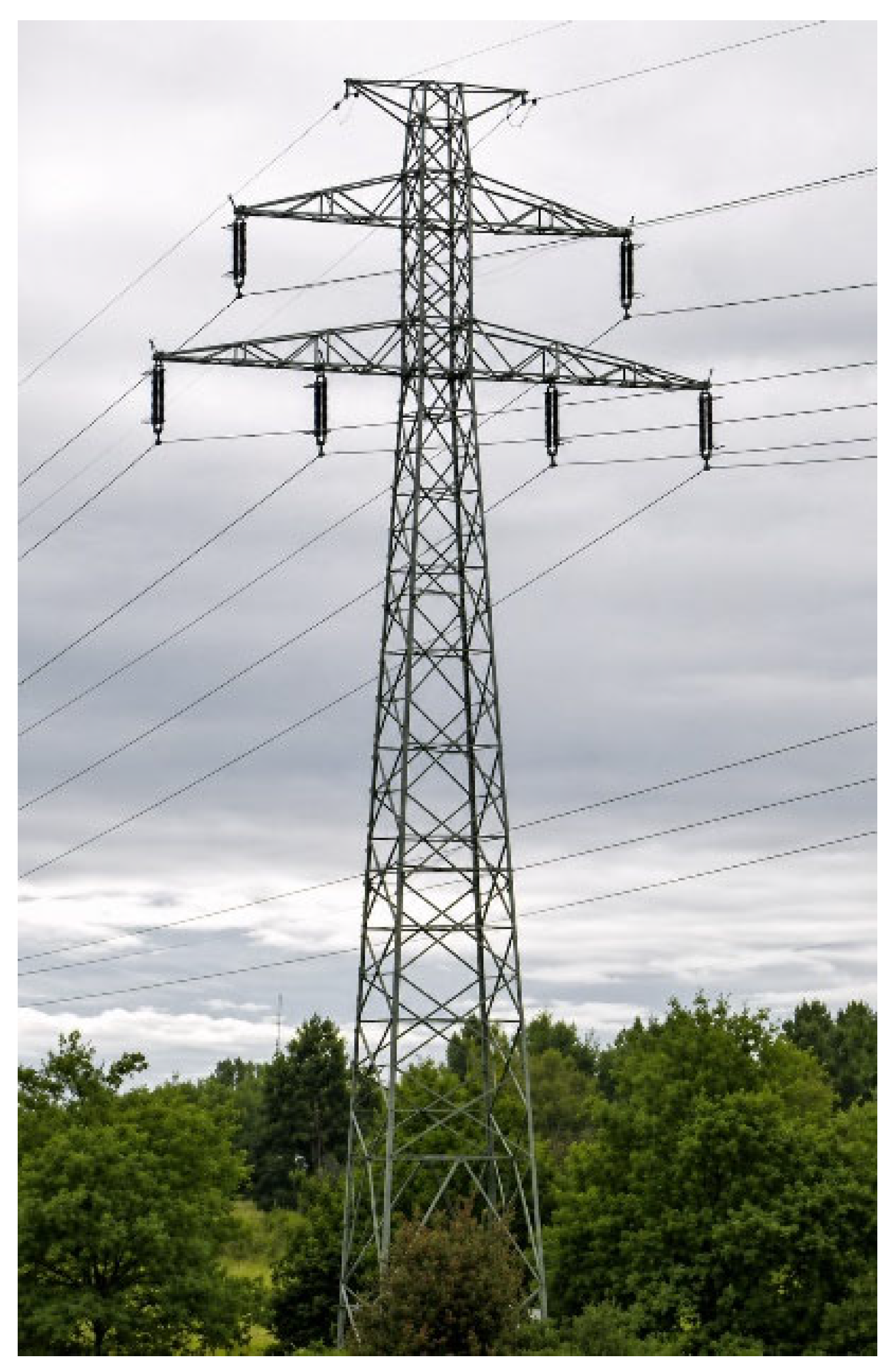
The investigated object was a steel high-voltage lattice transmission tower (LTT), founded on a reinforced concrete base. It represents a typical support structure characterized by a spatial arrangement of slender elements and a variable cross-section along its height (
Figure 1).
The analysed object was intentionally selected as a representative example of a slender lattice structure for which accurate TLS-based geometric modelling remains challenging due to discontinuous geometry, numerous thin members, and non-uniform point distribution.
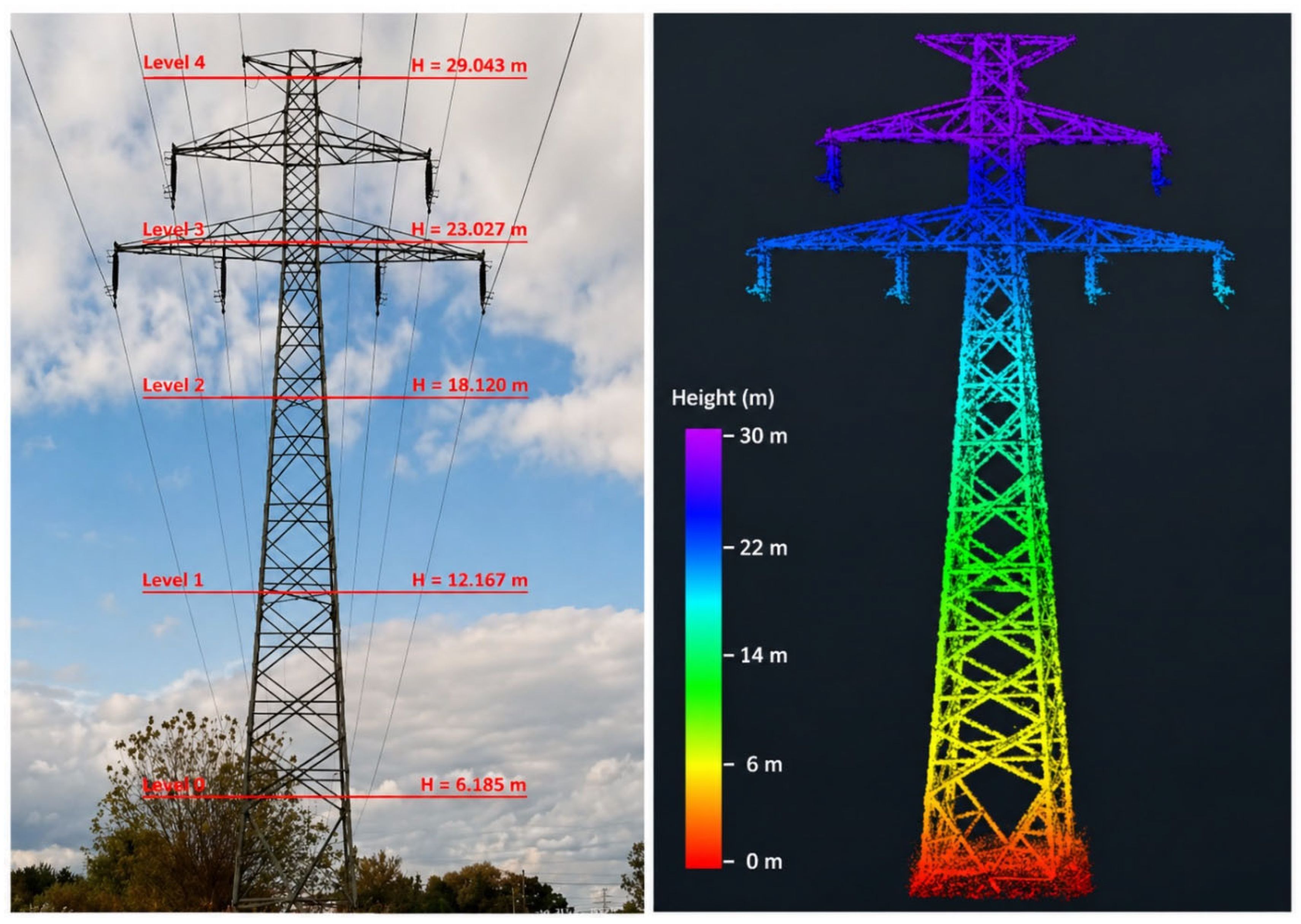
The total height of the tower was approximately 28–30 m. The structure consists of a main load-bearing framework composed of steel angles, reinforced by a system of diagonal and horizontal bracings. While this design ensures high structural efficiency, it also introduces significant challenges for measurement and data interpretation.
Unlike objects with continuous surfaces, lattice structures exhibit geometric discontinuity, numerous edges, and small cross-sectional elements. This results in local occlusions, non-uniform point density, and increased sensitivity of TLS results to scan geometry and point cloud alignment quality [
14,
19].
Additionally, the height of the structure leads to decreasing resolution with increasing distance from the scanner, particularly affecting the upper sections when using a limited number of scan positions or compact scanners [
27,
28].
The tower was deliberately selected as a complex test case representing a challenging environment for TLS-based analysis. Although the study was conducted on a single structure, the selected tower incorporates geometric characteristics commonly encountered in steel lattice transmission towers, including high slenderness, variable cross-sectional geometry, and discontinuous topology. Therefore, the obtained results may be considered representative for similar engineering structures analysed using TLS techniques.
The analysis was conducted at consistent height levels corresponding to structural nodes, ensuring comparability between tachymetric and TLS-derived results (
Figure 2).
3. Materials and Methods
3.1. Tachymetric Measurements
Tachymetric measurements were carried out using a Trimble C5 (Trimble Inc., Westminster, CO, USA) total station with an angular accuracy of 5″ and a distance measurement accuracy of 2 mm + 2 ppm in prism mode. Observations were conducted from three stations (P1–P3) distributed around the investigated tower.
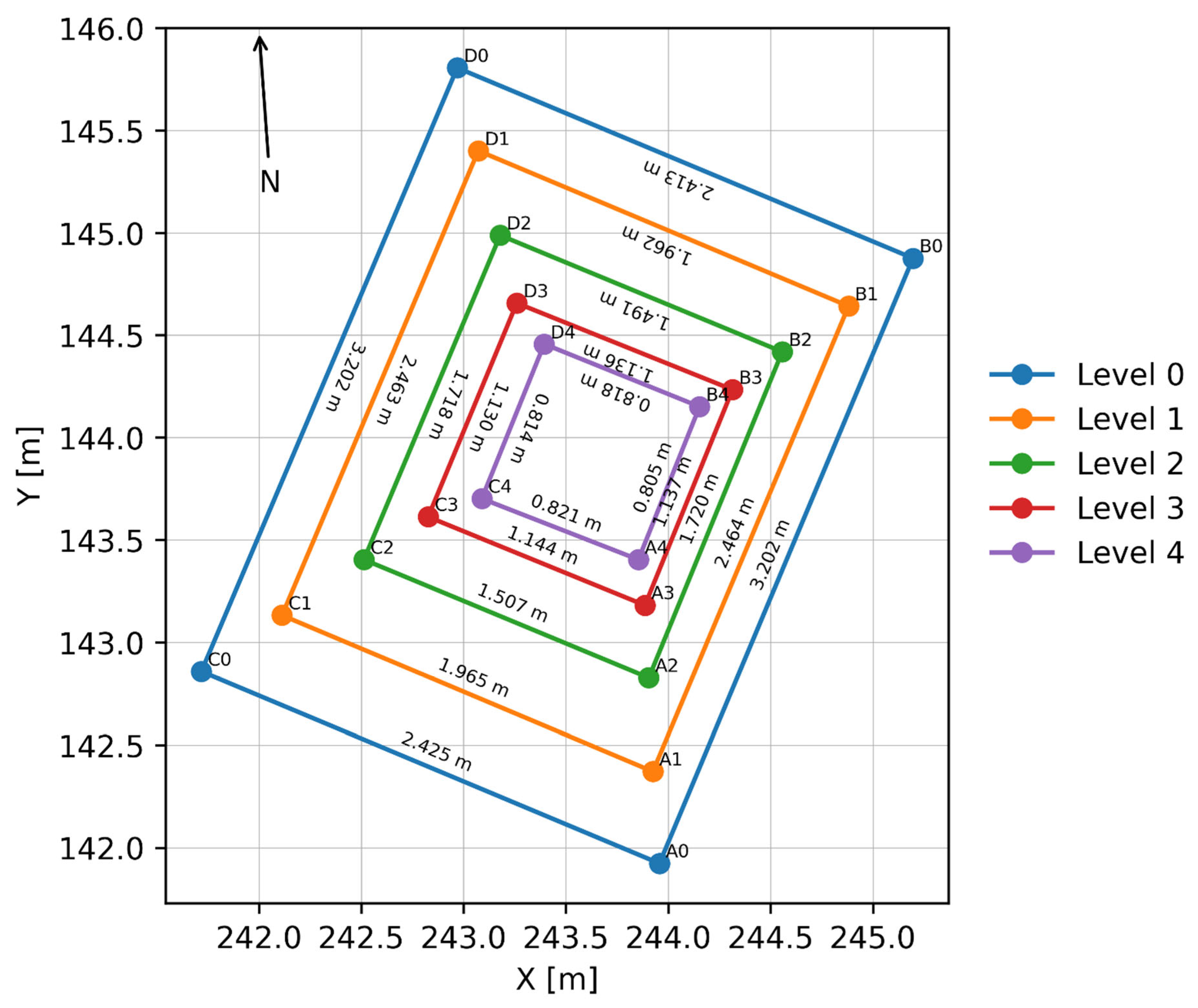
At each observation level corresponding to structural nodes, four characteristic points located at the edges of the structure (A, B, C, D) were determined. Measurements were performed from multiple stations to ensure redundant observations required for spatial adjustment.
Due to the limited availability of control points with sufficient accuracy, a local coordinate system was adopted in which
The Z-axis corresponds to the vertical direction;
The X and Y axes define the horizontal plane;
The origin is located at the base of the structure.
Axis deviations were analysed in a 3D coordinate system; however, their projections onto the horizontal plane were used for interpretation.
The measurement network was adjusted using the least squares method, assuming station P1 as fixed and orientation based on available control points.
The position of the geometric axis of the tower was determined based on cross-sections defined by the measured edge points. For each level, the centroid of the cross-section in the XY plane was calculated and adopted as the axis point.
Two data processing approaches were compared:
Angular intersections (direction-based adjustment);
Linear intersections (distance-based adjustment).
The obtained results indicate a clearly higher accuracy and stability of the angular intersection method. The linear method was affected by systematic errors resulting, among others, from reflectorless distance measurements and unfavourable incidence angles of the laser beam on steel structural elements.
The source of these errors was primarily the unfavourable incidence angle of the distance metre beam on the surfaces of steel elements and the variable geometry of edges. Comparative analysis with linear intersections showed that the reflectorless distance measurement method is characterized by significantly lower geometric stability (point position error mp up to 0.055 m). In the case of angular observations, this effect does not occur, which allowed achieving an accuracy at the level of mp ≤ 0.004 m and justifies the selection of this method as a reference in the comparative analysis.
To ensure methodological consistency, the same structural levels later used in TLS-based analysis were adopted for tachymetric observations. This enabled direct comparison of centroid positions and deformation trends between all measurement techniques within a common geometric framework.
The main characteristics and nominal accuracies of the applied measurement methods are summarized in
Table 1.
In this study, tachymetric results were adopted as the reference due to the high precision of determining the coordinates of characteristic points and the controlled measurement process.
It should be emphasized that the analysis concerns the geometric axis rather than individual points. Therefore, the uncertainty of axis determination was estimated based on the error propagation of the coordinates of points forming the cross-section:
where
mi—denotes point errors.
Based on the obtained results and instrument characteristics, the uncertainty of axis determination using the tachymetric method was assumed to be approximately 3–5 mm, which justifies its use as a reference method.
The adopted reference workflow additionally provided a stable basis for evaluating the influence of TLS registration uncertainty on the reconstructed geometric axis.
The adopted tachymetric measurement scheme and the distribution of observation points are presented in
Figure 3.
3.2. Determination of the Geometric Axis (Tachymetry)
The coordinates of the geometric axis were determined for five height levels corresponding to actual structural levels of the tower. The lowest observation level was adopted as the reference level, and for the remaining levels, coordinate increments and axis deviations were calculated.
At each analysed level, the geometric axis position was determined as the centroid of the cross-section defined by four characteristic edge points measured tachymetrically. The centroid coordinates were calculated independently for each level in the horizontal plane, which enabled direct assessment of axis displacement with increasing height.
The obtained results indicate a systematic increase in axis deviation with increasing height of the structure. Maximum values reach approximately 0.16 m in the X direction and 0.06 m in the Y direction.
The deformation pattern exhibits a quasi-linear trend, indicating internally consistent geometric behaviour of the structure. The reference axis determined from tachymetric observations was subsequently used for quantitative comparison with TLS-derived results, including RMSE analysis, regression modelling, and assessment of cumulative registration effects.
The coordinates of the geometric axis and the corresponding axis deviations determined from tachymetric observations are presented in
Table 2.
The reconstructed axis trajectory indicates progressive displacement predominantly in the X direction, while deviations in the Y direction remain smaller but spatially consistent along the structure height. Such behaviour is characteristic of slender lattice structures subjected to long-term environmental and operational loading.
3.3. TLS Measurement—Riegl VZ-400i
Terrestrial laser scanning measurements were performed using the Riegl VZ-400i (RIEGL Laser Measurement Systems GmbH, Horn, Austria) scanner. The system includes a pulse scanner, GNSS receiver, camera, and IMU module, enabling real-time determination of the scanner position and orientation. The Riegl VZ-400i scanner is characterized by a measurement accuracy of approximately 5 mm at a distance of 100 m, which qualifies it for high-precision geodetic applications.
Scanning was carried out from several measurement stations at an operating frequency of 1.2 MHz, allowing for a point density of approximately 500,000 points per second. The scanning resolution was selected to achieve a point spacing of approximately 0.02 m.
To improve registration accuracy, a hybrid approach was applied, comprising the following:
- ○
Initial GNSS-based georeferencing;
- ○
Target-based registration.
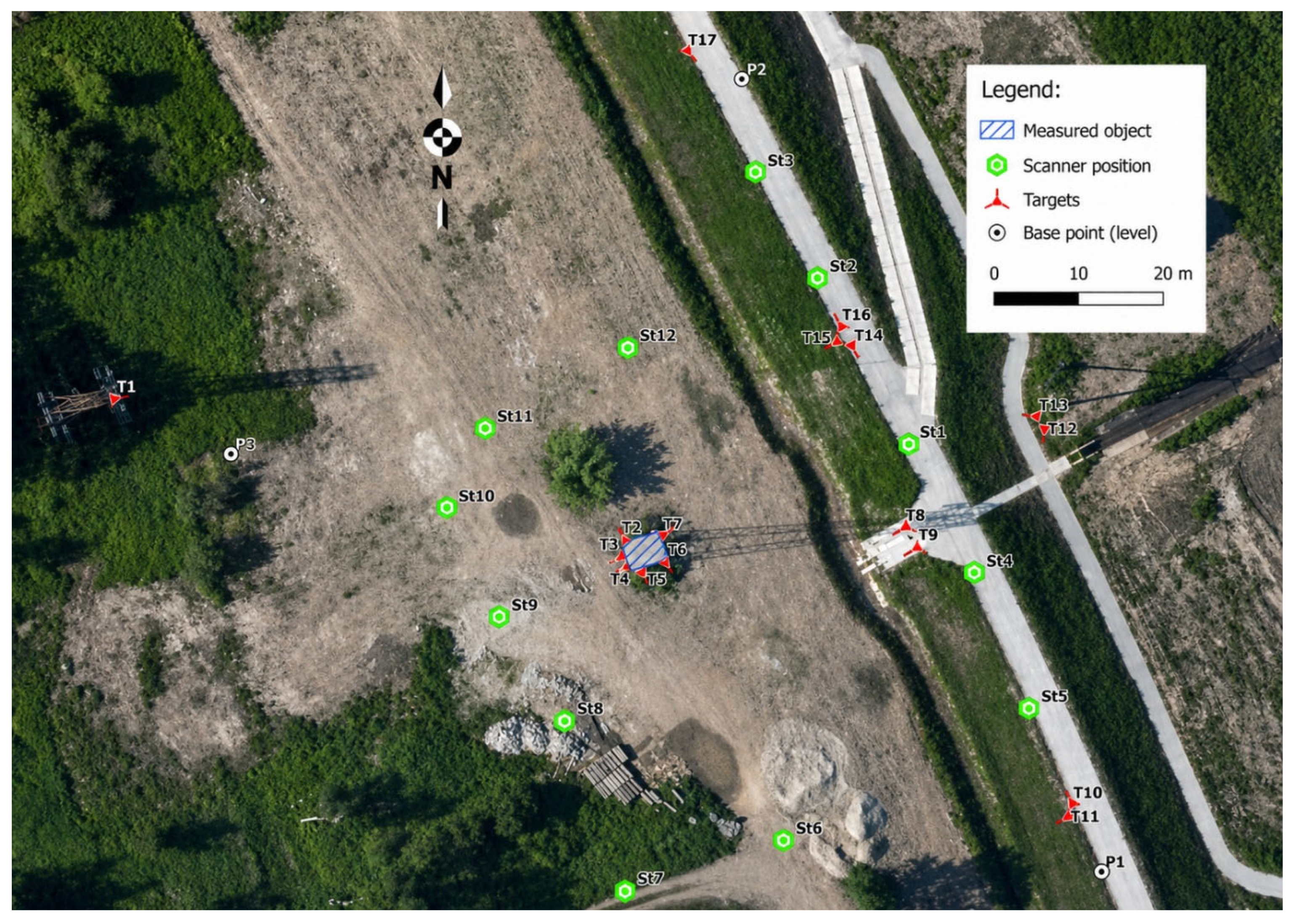
In the field, 17 reflective targets and 3 Leica HDS targets were distributed and measured tachymetrically to integrate TLS data with classical measurements (
Figure 4).
The adopted workflow enabled direct adjustment of all scans within a common reference framework and reduced cumulative transformation effects during multi-station registration.
The influence of the laser beam incidence angle on the accuracy of target measurements is presented in
Table 3.
The results indicate that unfavourable observation geometry may generate errors on the order of 0.01 m. This error results from asymmetry in the distribution of laser beam energy on the target surface and distortion of the measurement footprint at large incidence angles. This phenomenon highlights the necessity of designing scan geometry such that the laser beam intersects the surface of reference targets as close to perpendicular as possible.
Registration quality was assessed using target residuals after adjustment, for which the resultant fitting errors did not exceed 0.016 m. The obtained residuals confirm high internal consistency of the registration process and indicate that the adopted control-point-based workflow provides sufficient geometric stability for deformation-oriented analysis of slender structures.
In contrast to the compact BLK360 workflow analysed later in the study, the Riegl acquisition strategy was intentionally designed as a survey-grade reference solution combining stable control geometry, target-based registration, and redundant scan overlap. This enabled separation of hardware-related effects from registration-induced uncertainties during comparative analysis.
3.4. TLS Data Processing
After completing the measurements, point cloud registration was performed by merging data from all stations into a single coherent spatial model. Point cloud registration in TLS commonly relies on variants of the Iterative Closest Point (ICP) algorithm [
29], which iteratively minimizes distances between overlapping point sets. In practice, generalized and robust ICP formulations are often applied to improve stability in the presence of noise, varying point density, and incomplete data [
30,
31]. Recent studies have additionally proposed hybrid registration approaches combining SAC-IA and ICP algorithms to improve local alignment robustness in complex point cloud datasets [
32].
In the presented workflow, initial alignment was performed using GNSS-based scanner positioning, while final registration refinement was carried out using target-based adjustment constrained by tachymetrically measured control points. For the BLK360 workflow, cloud-to-cloud registration relied on ICP-based alignment without external geometric constraints, reflecting a typical rapid-survey configuration used in practical engineering applications.
Initial alignment was based on GNSS data, while final registration was carried out using targets measured tachymetrically. Registration accuracy was assessed based on target fitting, for which resultant errors did not exceed 0.016 m (
Table 3).
The ICP-based cloud-to-cloud registration procedure was performed iteratively until convergence of transformation parameters was achieved. For the BLK360 workflow, overlap between neighbouring scans exceeded approximately 30–40%, which ensured stable alignment under typical field conditions. Registration was performed in Leica Cyclone REGISTER 360 PLUS (BLK ed.) (Leica Geosystems AG, Heerbrugg, Switzerland) software using iterative ICP refinement.
Due to the open-network configuration and discontinuous geometry of the structure, local alignment uncertainties could propagate vertically along the tower, particularly in regions characterized by reduced overlap and lower point density.
Subsequently, point cloud filtering was performed to improve data quality. This process included the removal of measurement noise and outliers based on laser intensity analysis. In particular, points with intensity values outside the range of −15 dB to 5 dB were removed as they correspond to measurement disturbances.
Additionally, points not belonging to the analysed structure (e.g., vegetation, wires, and surrounding infrastructure) were removed using spatial selection tools. This filtering step was essential for correct determination of cross-sections and for reducing the influence of systematic errors.
Cross-sections were then generated at levels corresponding to the observation levels used in tachymetric measurements. These cross-sections were used to determine the geometric axis of the tower by computing centroids.
Cross-sections were defined as point layers with a thickness of 0.10 m (±0.05 m relative to the nominal height), including points satisfying the condition:
where
H0 denotes the analysed level.
Only points belonging to structural elements were included in further analysis, with spatial filtering used to eliminate outliers and environmental noise. Points distant from the main structure were excluded, which was particularly important for the lattice geometry.
The geometric axis position at each level was determined as the centroid of the point set:
where
n is the number of points in the cross-section.
The centroid coordinates were calculated using a simple arithmetic mean of all retained points within the slice. No additional weighting factors related to point intensity, scanner distance, or incidence angle were applied. The adopted layer thickness represents a compromise between centroid stability and limiting the influence of local geometric variability along the structure height.
In the literature, model-fitting approaches (e.g., RANSAC) are also used; however, in this study, the centroid-based method was adopted as more suitable for lattice structures with discontinuous geometry [
14].
Although feature-based or model-fitting registration approaches may potentially improve local alignment stability for compact TLS systems, such methods were beyond the scope of the present study. Future research should investigate whether advanced feature-based registration strategies or hybrid ICP-RANSAC workflows could reduce cumulative geometric distortions in cloud-to-cloud registration of slender lattice structures.
The adopted workflow enabled direct assessment of how registration strategy influences the stability of geometric axis reconstruction and the interpretation of apparent structural deformation.
3.5. Data Integration and Comparison Scheme
To enable direct comparison between tachymetric and TLS results, all data were transformed into a common local coordinate system. Identical height levels corresponding to structural nodes and a common reference level were adopted.
The same reference framework and cross-sectional levels were maintained throughout the analysis to ensure direct comparability between all datasets.
It should be emphasized that for the Leica BLK360 (Leica Geosystems AG, Heerbrugg, Switzerland) scanner, control-point-based registration was intentionally not applied. The cloud-to-cloud approach reflects typical practical use of compact scanners, where minimizing fieldwork and avoiding control networks is common. Such approaches are typically implemented using ICP-based alignment strategies, which, although efficient, are sensitive to initial conditions and may lead to cumulative transformation errors in open networks without stable control points [
29,
30].
The BLK360 workflow was therefore treated as a representative rapid-survey TLS configuration prioritizing operational simplicity over strict geometric control. This enabled assessment of the practical consequences of registration instability under realistic engineering conditions.
Using identical control networks for all methods would partially mask differences arising from measurement technology and reduce the ability to assess the actual impact of registration strategy.
Consequently, the comparative framework was designed to distinguish registration-related effects from hardware-related limitations during geometric axis reconstruction.
The analysis included the following:
- ○
Horizontal axis deviation;
- ○
Consistency of deformation direction;
- ○
Variation in results with height;
- ○
Influence of data quality and registration process.
Additionally, regression analysis, RMSE assessment, significance testing, and the proposed Axis Drift Index (ADI) were used to quantitatively evaluate geometric stability and cumulative deviation trends along the structure height.
Particular attention was devoted to distinguishing actual structural response from apparent geometric distortions caused by registration uncertainty and cumulative alignment effects.
3.6. Error Propagation Model
In multi-station TLS workflows, registration errors introduced during ICP-based alignment may propagate along the structure, particularly in open configurations lacking stable reference constraints [
29,
31].
For slender lattice structures, even small rotational or translational inconsistencies between consecutive scans may result in amplified geometric deviations at higher elevations, especially in cloud-to-cloud registration workflows.
A simplified linear error propagation model was adopted:
where
Δd(H)—axis deviation at height H;
Δd0—deviation at reference level;
k—error growth coefficient.
The coefficient k was estimated using least squares and represents a measure of geometric stability—lower values indicate higher stability.
The model was intended to quantify the tendency of geometric deviations to increase with height as a consequence of cumulative registration uncertainty rather than to reproduce the actual physical deformation behaviour of the structure.
The uncertainty of k was determined as:
where
σ0 is the standard deviation of residuals.
This model enables quantitative assessment of error accumulation with height and comparison of stability between measurement methods [
11].
The proposed error propagation coefficient additionally enables comparison of registration stability independently of absolute deformation magnitude.
Although the adopted formulation represents a simplified approximation of the actual error propagation process, it provides a practical engineering indicator for assessing the robustness of TLS registration workflows in deformation-oriented applications.
The model also supported the interpretation of the BLK360 results, where irregular axis behaviour suggested that a substantial part of the observed deviations originated from cumulative registration effects rather than unequivocal structural deformation.
4. Results
4.1. Axis Deviation—Comparison of Methods
The geometric axis deviation of the tower was determined for all analysed measurement methods at common height levels corresponding to actual structural levels.
For tachymetric measurements, a systematic, nearly linear increase in axis deviation with height was observed, reaching maximum values of approximately 0.16 m in the X direction and 0.06 m in the Y direction. This trend was adopted as the reference for evaluating the remaining methods.
The tachymetric reference trajectory indicates internally consistent geometric behaviour of the structure and provides a stable baseline for comparative TLS analysis.
A quantitative comparison of axis deviations obtained from all measurement methods is presented in
Table 4.
The results obtained from TLS data show clear differentiation depending on the applied technology. Data acquired using the Riegl VZ-400i scanner exhibit high agreement with the reference method in terms of both deviation values and their variation with height. Maximum differences relative to tachymetry do not exceed approximately 0.02 m in the X direction and 0.03 m in the Y direction.
The similarity of deformation trends between tachymetry and the Riegl workflow confirms that target-based registration enables reliable reconstruction of slender-structure axes within the expected uncertainty range for engineering-scale deformation analysis.
In contrast, results obtained from the Leica BLK360 scanner show greater variability, particularly in the upper parts of the structure. These deviations are not systematic and exhibit local disturbances in the axis trajectory, indicating the influence of registration errors and reduced geometric stability of the data.
The irregular behaviour of the BLK360-derived axis suggests that a substantial proportion of the observed deviations originates from cumulative registration effects rather than actual structural deformation. This demonstrates that, in open TLS networks without stable control points, registration instability may dominate the final deformation interpretation.
The comparison further indicates that axis reconstruction quality depends more strongly on the adopted registration workflow and stability of the reference framework than on scanner class alone.
4.2. Variation in Axis Deviation with Height
The analysis of axis deviation as a function of height confirms significant differences between the measurement methods.
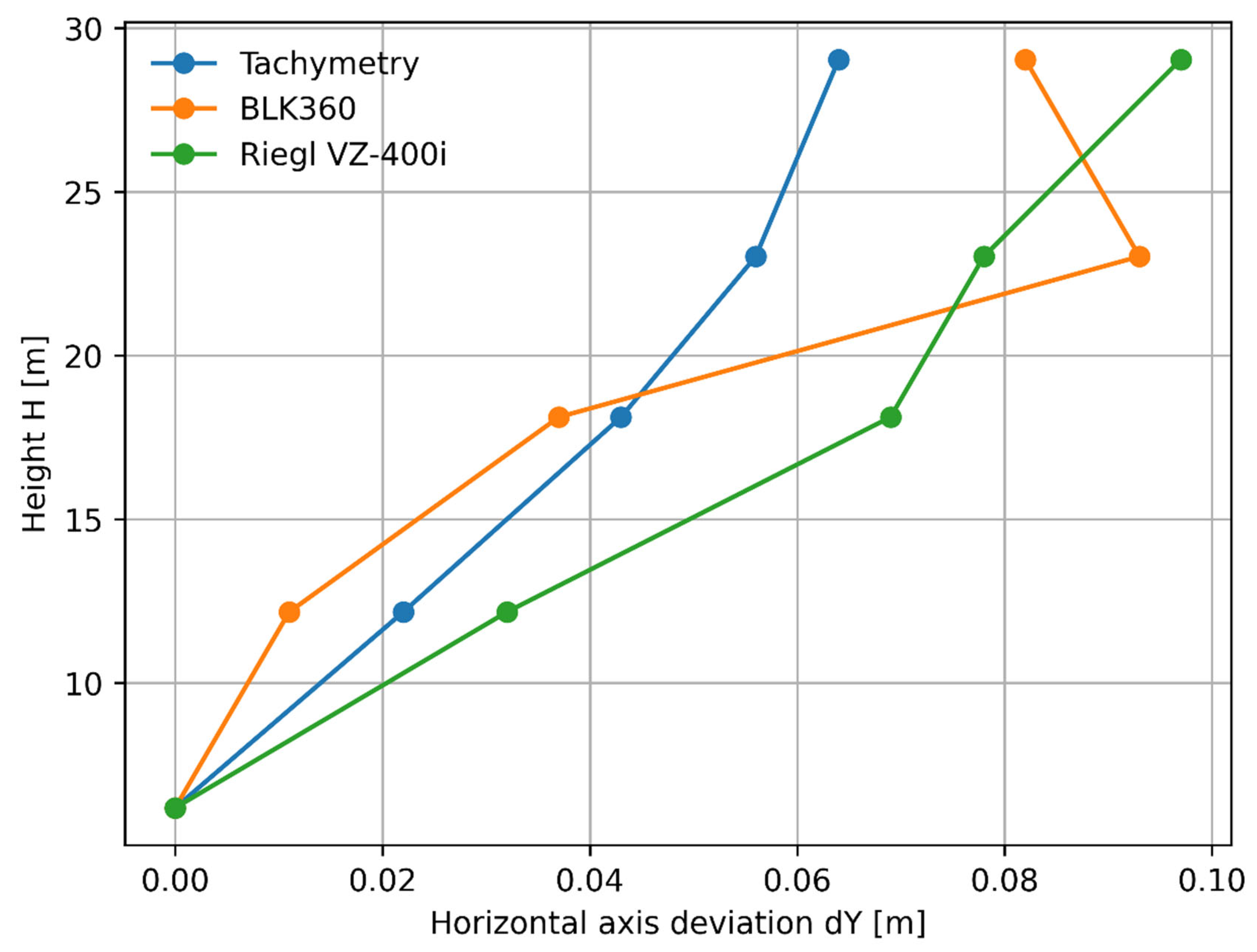
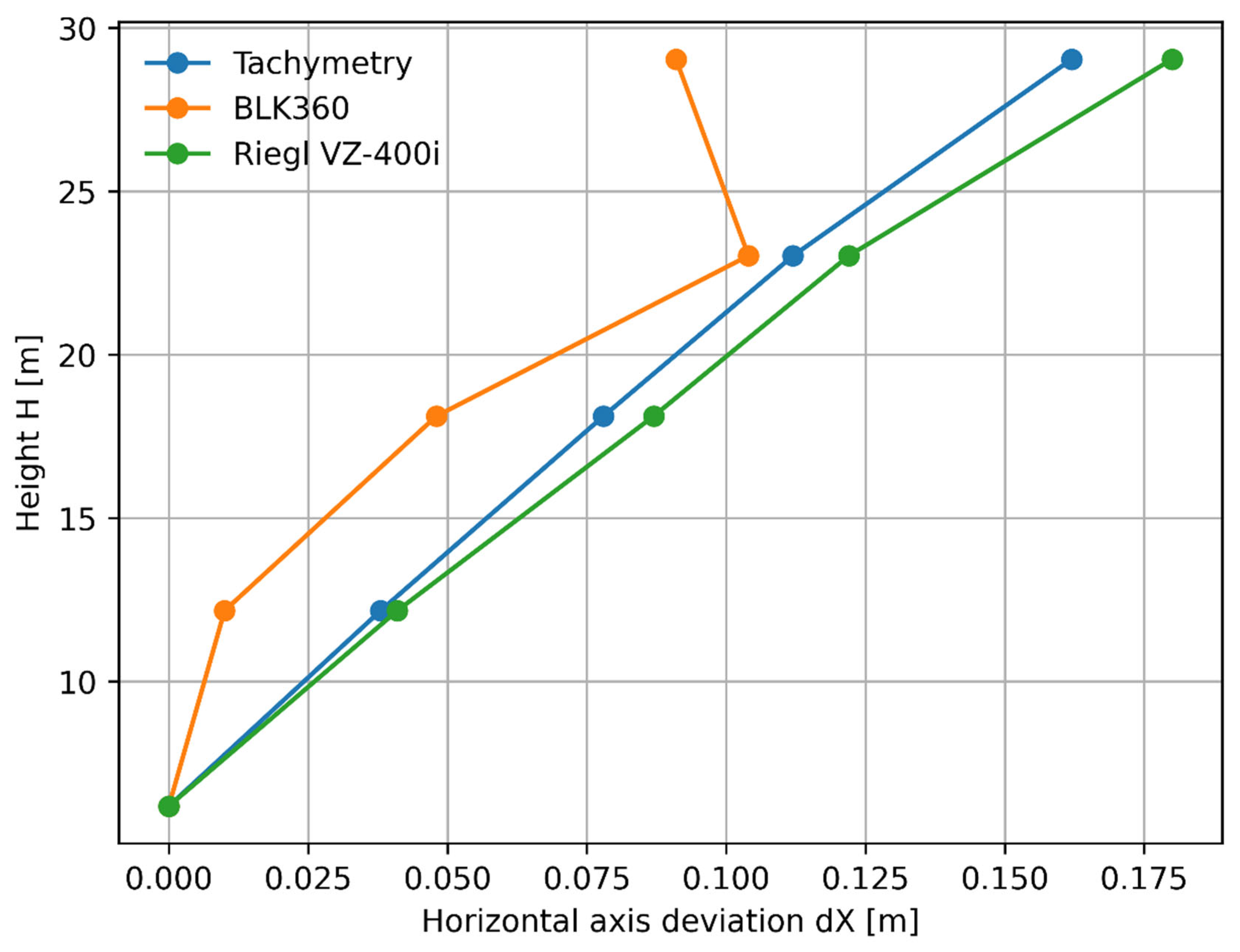
For both tachymetry and TLS data acquired with the Riegl VZ-400i scanner, a similar quasi-linear trend of axis deviation is observed. This indicates high geometric stability of both methods and correct representation of the actual deformation trend of the structure.
The close agreement of the vertical deviation profiles confirms that target-based TLS registration enables stable reconstruction of axis geometry even for complex lattice structures.
In contrast, data obtained using the BLK360 scanner exhibit significant deviations from a linear trend, particularly at higher elevations. This irregularity indicates the accumulation of registration errors and degradation of data quality with height, which is characteristic of cloud-to-cloud registration in open networks.
The increasing instability observed in the upper sections of the BLK360 dataset is consistent with the proposed error propagation model and suggests that a substantial part of the apparent displacement originates from cumulative alignment effects rather than actual structural deformation.
The variation of axis deviation with height for all analysed methods is illustrated in
Figure 5 and
Figure 6.
4.3. Plan View of the Geometric Axis
Comparison of the geometric axis in plan view enables evaluation of the consistency of the deformation direction.
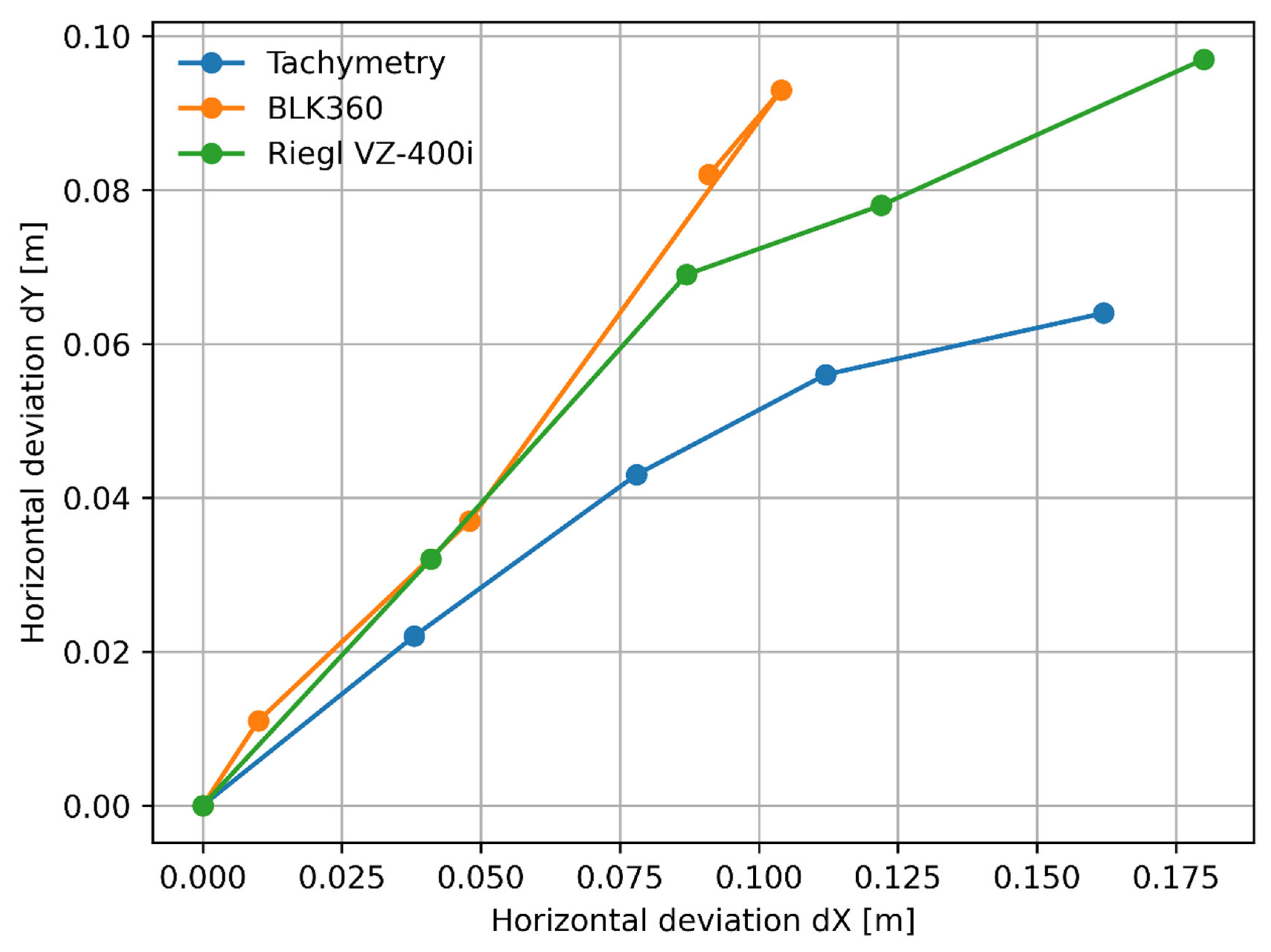
The reconstructed geometric axis trajectories in plan view are presented in
Figure 7.
All analysed methods indicate a similar direction of axis inclination, confirming consistency in global orientation. However, differences occur in the amplitude and regularity of the axis trajectory.
The plan-view comparison shows that all methods identify the same general deformation direction, whereas discrepancies are primarily associated with trajectory stability and local geometric distortions.
The largest deviations are observed for BLK360 data, where the axis shows greater irregularity and local distortions. Results obtained using the Riegl VZ-400i scanner remain consistent with tachymetric results, confirming high registration quality and geometric stability.
The discrepancies become particularly evident in the upper sections of the structure, where cumulative transformation effects lead to amplified horizontal deviations in plan view.
The planimetric comparison demonstrates that statistical agreement between datasets should be interpreted together with geometric consistency of the reconstructed axis trajectories.
4.4. Regression Analysis and Geometric Stability
Based on linear regression analysis, the coefficient of axis deviation growth with height was determined (
Table 5).
Linear regression was applied to evaluate the consistency of deformation progression and to quantify the geometric stability of the analysed measurement workflows. The obtained regression parameters describe the tendency of axis deviation to increase with height and enable direct comparison of the internal consistency of individual datasets.
High values of the coefficient of determination (R2 ≈ 1.00 for tachymetry and 0.998 for Riegl VZ-400i) indicate a linear deformation pattern and high internal consistency of the data.
The strong agreement between the tachymetric and Riegl regression models confirms that the target-based TLS workflow preserves the overall deformation trend and provides geometrically consistent results.
For the BLK360 scanner, a significantly lower R2 value (0.861) was obtained, indicating instability of results and the presence of non-linear disturbances.
The reduced coefficient of determination reflects local irregularities in the reconstructed axis trajectory and confirms the influence of cumulative registration-related distortions.
The higher value of coefficient k for Riegl data reflects greater sensitivity to actual geometric changes, whereas the lower value for BLK360 does not indicate higher accuracy but results from irregular data behaviour.
Consequently, the lower k value obtained for BLK360 should not be interpreted as evidence of reduced structural inclination, but rather as a consequence of deformation trend distortion caused by registration instability.
The regression analysis additionally demonstrates that high point cloud density alone does not guarantee reliable deformation interpretation. Even relatively dense datasets may produce geometrically inconsistent results when registration stability is insufficient.
The combined interpretation of k and R2 therefore provides a practical indicator of TLS workflow reliability and supports identification of datasets affected by cumulative alignment effects.
4.5. Statistical Assessment of Method Agreement
To quantitatively assess the agreement between methods, RMSE values were calculated with respect to the reference method.
The statistical comparison was intended to evaluate both numerical agreement between datasets and the influence of registration stability on deformation interpretation.
The statistical comparison of TLS-derived axis deviations relative to the tachymetric reference is summarized in
Table 6.
The analysis revealed the following:
- ○
The Riegl VZ-400i scanner achieves high agreement with tachymetry, particularly in the X direction.
- ○
RMSE values in the Y direction are comparable for both TLS technologies.
- ○
The BLK360 scanner is characterized by significantly higher root mean square error.
The low RMSE values obtained for the Riegl workflow confirm that target-based registration enables stable reconstruction of the geometric axis with deviations remaining within the expected uncertainty range for engineering-scale deformation analysis.
In contrast, deviations observed for the BLK360 workflow exceed the uncertainty level of the reference method and indicate the presence of cumulative registration-related distortions.
Although RMSE values in the Y direction are relatively similar for both TLS workflows, the BLK360-derived axis exhibits local geometric inconsistencies absent in the Riegl and tachymetric datasets.
These results demonstrate that statistical indicators should be interpreted together with geometric trajectory analysis rather than independently.
To further assess the detectability of geometric differences, the Level of Detection at the 95% confidence level (LoD95) was considered according to the commonly applied formulation:
where
σ1 and
σ2 denote the standard uncertainties of the compared datasets.
Considering the estimated uncertainty of the reference tachymetric method (approximately 0.003–0.005 m), deviations observed for the BLK360 workflow clearly exceed the LoD95 threshold, whereas differences obtained for the Riegl VZ-400i remain close to or within the expected uncertainty range for high-precision engineering applications.
4.6. Axis Drift Index (ADI)
To quantitatively assess the stability of measurement methods along the height of the structure, the Axis Drift Index (ADI) was introduced:
where
Δdtop—deviation at the highest level;
Δdbottom—deviation at the reference level;
H—height of the structure.
The ADI parameter was proposed as a simplified quantitative indicator describing the average rate of geometric axis deviation increase with height. Unlike local deviation analysis, the ADI enables global assessment of deformation consistency and registration stability throughout the entire structure.
The obtained values are as follows:
Tachymetry: ADI ≈ 0.0060 m/m (6 mm/m);
Riegl VZ-400i: ADI ≈ 0.0070 m/m (7 mm/m);
BLK360: ADI ≈ 0.0042 m/m (4 mm/m).
The lower ADI value for BLK360 does not indicate higher accuracy but results from irregular data behaviour and distortion of the linear trend.
The reduced ADI observed for the BLK360 workflow reflects instability of the reconstructed axis trajectory caused by cumulative registration inconsistencies.
The ADI is consistent with the regression slope coefficient k, allowing it to be interpreted as a measure of the average inclination of the structure.
For the tachymetric and Riegl datasets, close agreement between ADI and regression-based parameters confirms stable geometric behaviour of the reconstructed axis. In contrast, the discrepancy observed for BLK360 indicates reduced spatial consistency resulting from registration-related distortions.
Unlike local statistical measures such as RMSE, the ADI reflects the cumulative character of geometric deviations along the structure height and therefore supports identification of registration-induced deformation artefacts.
Reliable interpretation of ADI values requires simultaneous consideration of regression consistency, trajectory regularity, and registration workflow characteristics.
4.7. Significance Test of Differences
To assess the statistical significance of differences between methods, the following criterion was applied:
where
Δ—difference between methods;
σ—standard deviation of the error.
The adopted criterion enabled evaluation of whether the observed discrepancies between measurement methods exceeded the expected uncertainty level of the reference solution and could therefore be considered statistically meaningful.
Assuming the uncertainty of the reference method at the level of 0.003–0.005 m, it was found that:
- ○
Deviations for BLK360 (up to ~0.07 m) significantly exceed the significance threshold;
- ○
Deviations for Riegl VZ-400i (up to ~0.02 m) remain within acceptable limits.
The obtained results indicate that differences observed for the BLK360 workflow are statistically significant and primarily associated with registration instability, whereas deviations obtained for the Riegl workflow do not substantially affect interpretation of the object geometry.
The discrepancies observed for BLK360 cannot be attributed solely to random measurement noise or temporary environmental influences, but reflect systematic geometric inconsistencies associated with cloud-to-cloud registration.
In contrast, the deviations obtained for the Riegl VZ-400i workflow remain sufficiently small to preserve reliable interpretation of the actual deformation trend and geometric orientation of the structure.
The significance analysis additionally confirms that the dominant source of disagreement between the analysed TLS workflows originates from the adopted registration strategy rather than from intrinsic limitations of TLS technology itself.
From the perspective of deformation monitoring, the results demonstrate that statistically significant axis deviations do not necessarily correspond to actual structural deformation, particularly in open TLS networks affected by cumulative alignment uncertainty.
4.8. Influence of Data Quality on Results
The analysis confirms that the key factor affecting the accuracy of geometric axis determination is the quality of the data and the registration method.
The obtained results indicate that geometric consistency of TLS-derived axes depends primarily on registration stability and the robustness of the spatial reference framework rather than on scanner class alone.
For the BLK360 scanner, the use of cloud-to-cloud registration without stable reference points leads to error accumulation, particularly in the upper parts of the structure.
The absence of externally constrained control geometry resulted in irregular axis behaviour and reduced consistency of the reconstructed deformation trend.
In contrast, the use of the Riegl VZ-400i scanner and target-based registration significantly reduces errors and enables results consistent with tachymetry.
The adopted registration strategy ensured stable integration of all scan positions within a common coordinate framework and effectively limited cumulative transformation effects.
Additionally, it was shown that the laser beam incidence angle on targets may introduce errors on the order of 0.01 m, which directly affects registration quality.
Local factors affecting point quality, such as incidence angle, overlap conditions, scan geometry, and point distribution, may substantially influence deformation interpretation when registration constraints are insufficient. Similar studies have shown that scan planning geometry and station distribution significantly affect the reliability of TLS-based geometric measurements of civil infrastructures [
33].
Particularly for lattice structures characterized by discontinuous geometry and partial occlusions, non-uniform point distribution may amplify the sensitivity of centroid-based axis estimation to local registration inconsistencies.
Although the BLK360 represents a compact TLS system, the obtained results suggest that such instruments may still provide useful geometric information when supported by stable control frameworks or improved registration strategies. Therefore, the observed discrepancies should be interpreted primarily as consequences of the adopted processing workflow rather than intrinsic hardware limitations.
Overall, the results demonstrate that reliable deformation-oriented TLS analysis requires an integrated approach combining appropriate acquisition geometry, stable registration methodology, effective filtering, and rigorous control of the spatial reference framework.
5. Discussion
The obtained results reveal clear differences between the analysed measurement approaches, both in terms of the magnitude of geometric axis deviations and their variation as a function of height.
The tachymetric method, adopted as the reference, provides a stable and nearly linear representation of axis deviation. The high internal consistency of the dataset indicates that the observed deformation trend reflects the actual geometric behaviour of the structure rather than measurement artefacts, providing a reliable baseline for evaluation of TLS-derived solutions.
A high level of agreement with the reference method is also observed for data acquired using the Riegl VZ-400i scanner. Both the magnitude of deviations and their vertical trend closely match the tachymetric results. This confirms that the use of survey-grade TLS instruments, combined with target-based registration, enables results comparable to classical geodetic methods. These findings are consistent with previous studies on TLS-based parametric modelling of structural axes [
11] and deformation monitoring of steel structures [
12].
The obtained results additionally demonstrate that stable target-based registration effectively limits cumulative transformation effects and preserves consistent deformation trends.
In contrast, the Leica BLK360 results exhibit increased variability and irregularity of the reconstructed axis, particularly in the upper parts of the structure. The primary source of these discrepancies is not the scanner class itself, but the cloud-to-cloud registration workflow. ICP-based alignment in open TLS networks may introduce cumulative transformation errors that propagate with height and distort the reconstructed geometry [
29,
30]. Similar limitations of standard ICP-based workflows applied to point clouds characterized by variable density and partial occlusions have also been identified in recent TLS studies focused on displacement analysis and deformation monitoring [
34]. Similar drift-related geometric inconsistencies in point cloud workflows have also been discussed in quality-control studies integrating TLS and BIM data [
35].
This effect is especially important for slender lattice structures, where small angular inconsistencies between scans may produce amplified deviations at higher elevations. Similar behaviour has been reported in studies on large-scale TLS registration [
19]. The obtained results therefore indicate that deformation patterns derived from unconstrained registration should be interpreted with caution.
The results further demonstrate that, for lattice structures, point cloud density alone is not a decisive factor in achieving accurate geometric modelling. Instead, the stability of the spatial reference system and the robustness of the data integration process are of primary importance. In this context, the centroid-based approach adopted in this study proved suitable for discontinuous lattice geometry, whereas alternative model-fitting techniques such as RANSAC may be advantageous for more regular objects [
14].
At the same time, feature-based registration approaches combined with robust geometric descriptors may potentially improve alignment stability for compact TLS workflows. Although such methods were not investigated in the present study, they constitute an important direction for future research aimed at reducing cumulative registration errors in open TLS networks. Future studies may also explore automated point cloud segmentation methods based on deep learning algorithms to support the extraction of structural elements and improve the stability of geometric axis estimation [
36].
Environmental conditions also play a role in the interpretation of measurement results. Differences in wind speed and direction during data acquisition may have influenced temporary displacements of the structure. In the analysed case, TLS measurements were conducted under higher wind conditions, which could have introduced minor additional deviations, particularly in the transverse direction.
However, this effect is considered secondary and does not alter the main conclusions regarding the performance of the measurement methods. The strong agreement between tachymetry and Riegl VZ-400i results indicates that the dominant source of discrepancies lies in the registration workflow rather than in actual structural deformation. Nevertheless, accounting for meteorological conditions remains important in multi-epoch deformation analyses, as highlighted in previous studies [
23].
From a broader perspective, the findings align with current research trends in the use of TLS data for analysing the geometry of slender structures. The literature emphasises the importance of parametric axis modelling and the analysis of deformation trends as a function of height [
11,
16]. At the same time, increasing attention is being given to the integration of TLS with other measurement techniques, such as photogrammetry [
13], to improve the completeness and reliability of geometric models.
The present study extends these research directions by demonstrating that registration methodology itself may become the dominant factor controlling deformation interpretation reliability, even for high-density TLS datasets.
Limitations and Practical Implications
The presented results should be interpreted in light of several methodological and operational limitations. The analysis was conducted on a single lattice transmission tower with a specific geometric configuration, which limits direct generalization of the results to other slender structures. Different geometries and bracing configurations may exhibit varying sensitivity to registration instability and centroid-based axis reconstruction. Furthermore, measurements were not acquired under fully identical environmental conditions, and therefore some minor discrepancies may partially reflect temporary structural response.
The simplified BLK360 workflow reflects common rapid-survey practice and should therefore be interpreted as representative of typical operational conditions rather than the maximum achievable accuracy of compact TLS systems. The obtained discrepancies primarily illustrate the practical consequences of unconstrained cloud-to-cloud registration in open TLS networks.
In addition, the geometric axis was determined using a centroid-based approach derived from cross-sectional slices. Although this method is robust for lattice structures with discontinuous geometry, alternative modelling strategies, such as RANSAC-based fitting or parametric axis modelling, may yield different levels of sensitivity to noise and outliers [
14].
Despite these limitations, the results provide clear practical implications. They demonstrate that, in the analysis of slender structures, the dominant factor controlling accuracy is not the TLS instrument class per se, but the adopted registration workflow and the stability of the spatial reference framework. Target-based registration remains essential for high-precision applications, whereas cloud-to-cloud approaches—particularly in open networks—are prone to cumulative transformation errors and systematic geometric distortions.
For lattice structures, centroid-based axis estimation constitutes a robust and computationally efficient solution, especially in the presence of incomplete or irregular point cloud data. However, the most reliable results are obtained through hybrid measurement strategies that integrate classical geodetic techniques with TLS.
From an engineering perspective, careful design of acquisition geometry, scanner positioning, and target distribution remains essential for minimising systematic errors in TLS-based deformation analysis. The proposed Axis Drift Index (ADI) and simplified error propagation model additionally provide practical tools for identifying datasets affected by cumulative registration distortions. Overall, the results demonstrate that reliable geometric analysis of slender structures requires not only high-quality instrumentation, but above all a stable and rigorously designed registration framework.
Overall, the findings underline that reliable geometric analysis of slender structures using TLS requires not only high-quality instrumentation, but above all a rigorously designed measurement and registration framework.