Subpixel Mapping of Flammable Tree Species in Yajiang County Based on Sentinel-2 Time-Series Data and a Spectral Mixing–Unmixing Strategy



Highlights
- A Sentinel-2 time-series spectral mixing–unmixing framework was developed for subpixel mapping of flammable tree species in complex mountainous forests.
- The framework achieved reliable abundance estimation (R2 = 0.821) and high NFI-based mapping accuracy, effectively revealing the spatial distribution and composition of flammable tree species.
- The proposed approach provides useful support for forest fuel assessment, fire risk monitoring, and precision forest management.
- Continuous abundance estimation improves the representation of within-pixel species composition compared with conventional hard classification.
Abstract
1. Introduction
2. Study Area
3. Data and Methods
3.1. Data Collection and Processing
3.1.1. Sentinel-2 Data Acquisition and Processing
3.1.2. Reference Data Collection and Processing
3.2. Methods
3.2.1. Construction of the Mixed-Sample Database
3.2.2. Machine-Learning-Based Regression Unmixing Model Training
3.2.3. Subpixel Mapping of Flammable Tree Species
3.2.4. Accuracy Assessment of the Mapping Result
4. Results
4.1. The Effect of Mixed Sample Size on Deconvolution Accuracy and Computational Efficiency
4.2. Subpixel Mapping Results of Flammable Tree Species
4.3. Accuracy Assessment of the Flammable Tree Species Map Based on NFI Data
5. Discussion
5.1. Innovation of the Subpixel Mapping Framework for Flammable Tree Species
5.2. Uncertainty in the Construction of the Mixed Spectral Database
5.3. Potential Errors in the Accuracy Assessment of the Mapping Results
6. Conclusions
- (1)
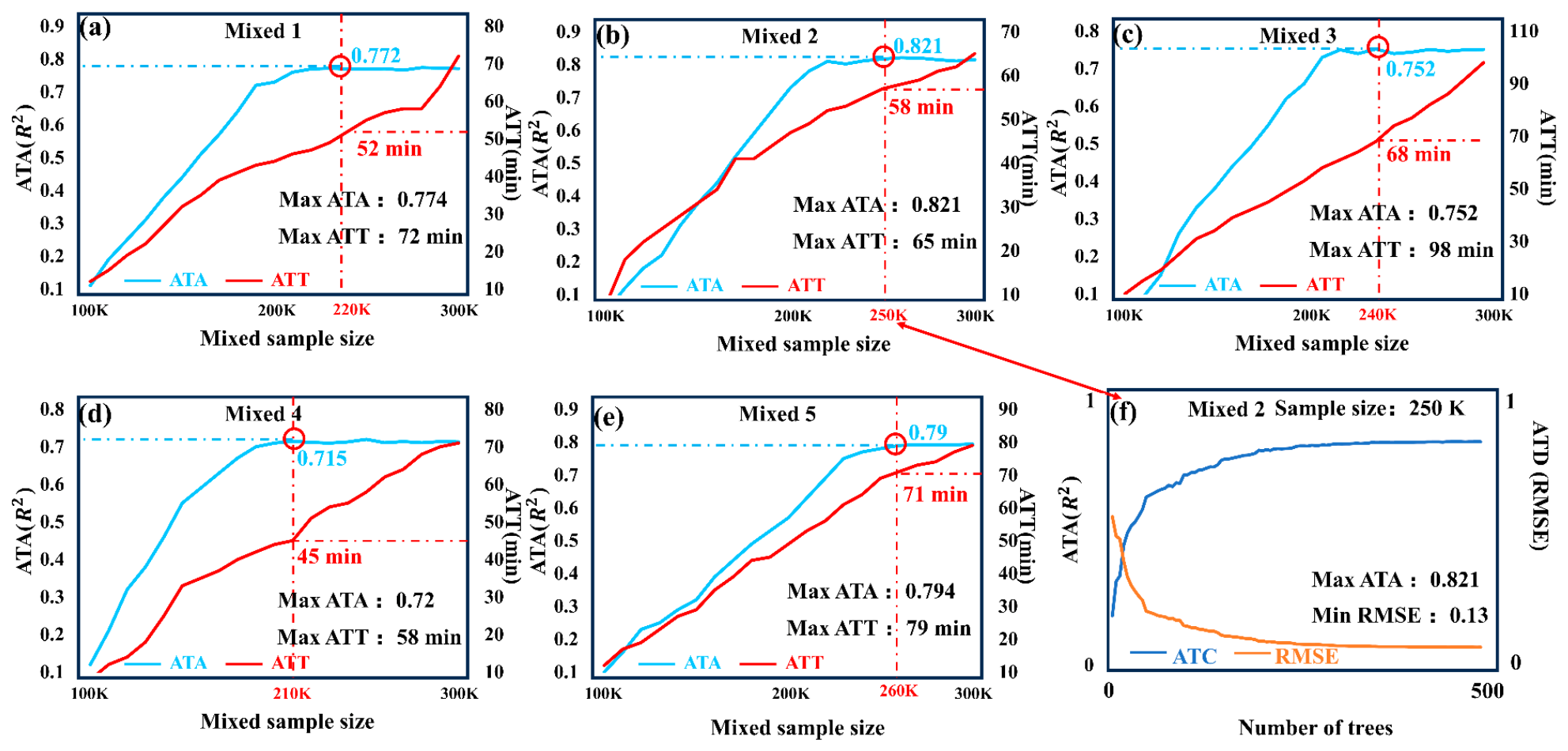
- By constructing temporal mixed samples from pure endmembers and integrating them with an XGBoost-based collaborative multi-regression framework, the proposed method achieved stable abundance-retrieval performance on synthetic mixed samples with known fractions. The optimal model was obtained under the Mixed 2 dataset with 250 K samples, reaching an R2 of 0.821.
- (2)
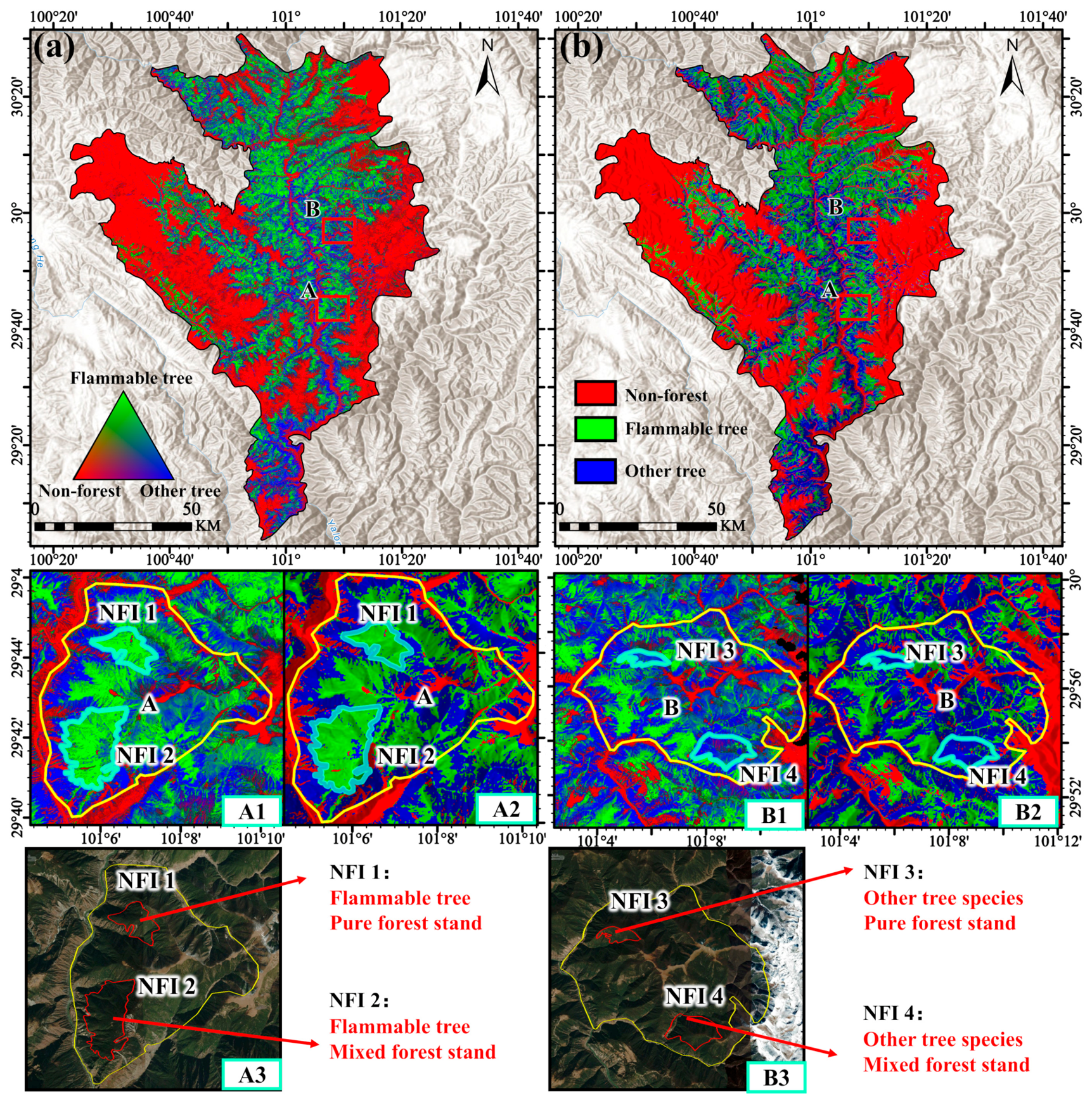
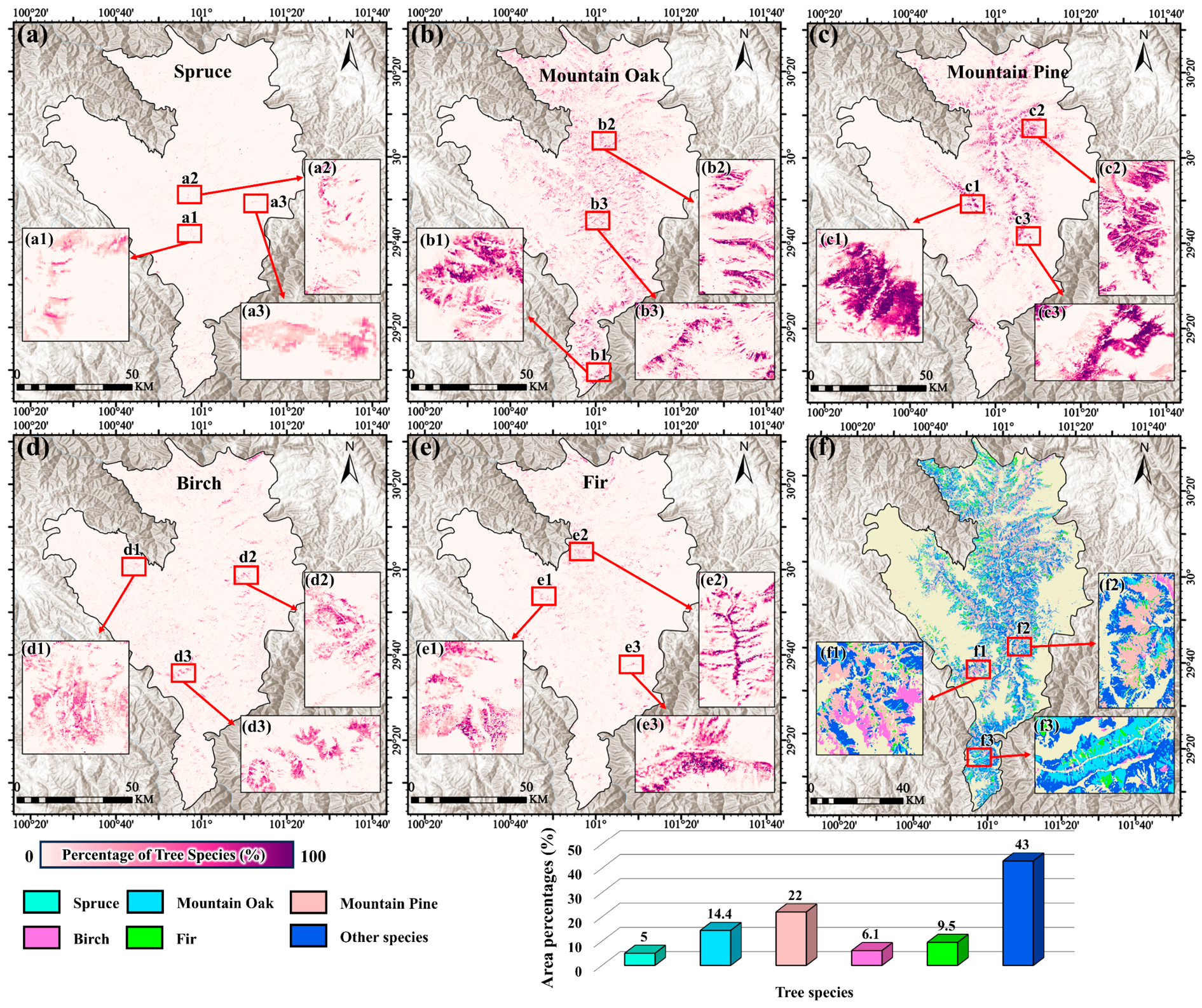
- The resulting maps provided a spatially explicit representation of the composition and dominant-species patterns of flammable forests in Yajiang County. Flammable tree species accounted for more than 50% of the mapped forest area and were mainly concentrated in the central and northern parts of the study area. Among the five target species, mountain pine was the most widespread dominant species, followed by spruce and mountain oak, whereas birch and fir exhibited more localized distributions.
- (3)
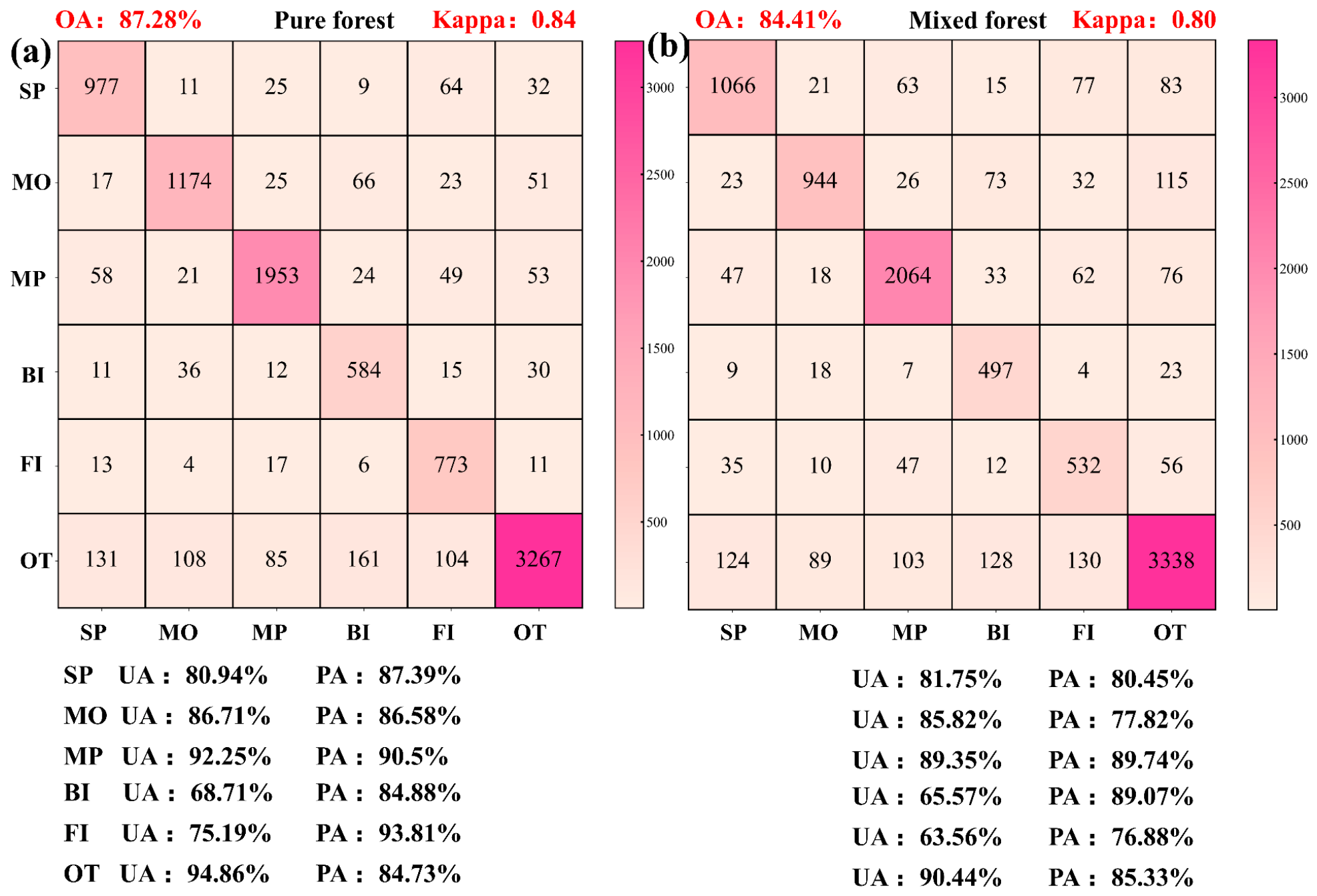
- The NFI-based categorical assessment supported the reliability of the mapped stand-structure and dominant-species patterns. The identification accuracies for pure and mixed stands were 93.95% and 91.22%, respectively, while the classification accuracies for pure-stand species types and dominant species in mixed stands were 87.28% and 84.41%, respectively. These results demonstrate strong categorical consistency between the mapped results and the NFI records.
Supplementary Materials
Author Contributions
Funding
Data Availability Statement
Acknowledgments
Conflicts of Interest
References
- Grootemaat, S.; Wright, I.J.; van Bodegom, P.M.; Cornelissen, J.H.C. Scaling up flammability from individual leaves to fuel beds. Oikos 2017, 126, 1428–1438. [Google Scholar] [CrossRef]
- Varner, J.M.; Kane, J.M.; Kreye, J.K.; Engber, E. The Flammability of Forest and Woodland Litter: A Synthesis. Curr. For. Rep. 2015, 1, 91–99. [Google Scholar] [CrossRef]
- Varner, J.M.; Kane, J.M.; Kreye, J.K.; Shearman, T.M. Litter Flammability of 50 Southeastern North American Tree Species: Evidence for Mesophication Gradients Across Multiple Ecosystems. Front. For. Glob. Change 2021, 4, 727042. [Google Scholar] [CrossRef]
- Costa, M.R.; Calvão, A.R.; Aranha, J. Linking wildfire effects on soil and water chemistry of the Marão River watershed, Portugal, and biomass changes detected from Landsat imagery. Appl. Geochem. 2014, 44, 93–102. [Google Scholar] [CrossRef]
- Michelaki, C.; Fyllas, N.M.; Galanidis, A.; Aloupi, M.; Evangelou, E.; Arianoutsou, M.; Dimitrakopoulos, P.G. Adaptive flammability syndromes in thermo-Mediterranean vegetation, captured by alternative resource-use strategies. Sci. Total Environ. 2020, 718, 137437. [Google Scholar] [CrossRef] [PubMed]
- Giannetti, F.; Barbati, A.; Mancini, L.D.; Travaglini, D.; Bastrup-Birk, A.; Canullo, R.; Nocentini, S.; Chirici, G. European Forest Types: Toward an automated classification. Ann. For. Sci. 2018, 75, 6. [Google Scholar] [CrossRef]
- Bolyn, C.; Lejeune, P.; Michez, A.; Latte, N. Mapping tree species proportions from satellite imagery using spectral–spatial deep learning. Remote Sens. Environ. 2022, 280, 113205. [Google Scholar] [CrossRef]
- Joshi, N.; Baumann, M.; Ehammer, A.; Fensholt, R.; Grogan, K.; Hostert, P.; Jepsen, M.R.; Kuemmerle, T.; Meyfroidt, P.; Mitchard, E.T.A.; et al. A Review of the Application of Optical and Radar Remote Sensing Data Fusion to Land Use Mapping and Monitoring. Remote Sens. 2016, 8, 70. [Google Scholar] [CrossRef]
- Nasiri, V.; Beloiu, M.; Asghar Darvishsefat, A.; Griess, V.C.; Maftei, C.; Waser, L.T. Mapping tree species composition in a Caspian temperate mixed forest based on spectral-temporal metrics and machine learning. Int. J. Appl. Earth Obs. Geoinf. 2023, 116, 103154. [Google Scholar] [CrossRef]
- Lechner, A.M.; Foody, G.M.; Boyd, D.S. Applications in Remote Sensing to Forest Ecology and Management. One Earth 2020, 2, 405–412. [Google Scholar] [CrossRef]
- Torres, P.; Rodes-Blanco, M.; Viana-Soto, A.; Nieto, H.; García, M. The Role of Remote Sensing for the Assessment and Monitoring of Forest Health: A Systematic Evidence Synthesis. Forests 2021, 12, 1134. [Google Scholar] [CrossRef]
- Phiri, D.; Simwanda, M.; Salekin, S.; Nyirenda, V.R.; Murayama, Y.; Ranagalage, M. Sentinel-2 Data for Land Cover/Use Mapping: A Review. Remote Sens. 2020, 12, 2291. [Google Scholar] [CrossRef]
- Shang, C.; Coops, N.C.; Wulder, M.A.; White, J.C.; Hermosilla, T. Update and spatial extension of strategic forest inventories using time series remote sensing and modeling. Int. J. Appl. Earth Obs. Geoinf. 2020, 84, 101956. [Google Scholar] [CrossRef]
- Hemmerling, J.; Pflugmacher, D.; Hostert, P. Mapping temperate forest tree species using dense Sentinel-2 time series. Remote Sens. Environ. 2021, 267, 112743. [Google Scholar] [CrossRef]
- Wulder, M.A.; Loveland, T.R.; Roy, D.P.; Crawford, C.J.; Masek, J.G.; Woodcock, C.E.; Allen, R.G.; Anderson, M.C.; Belward, A.S.; Cohen, W.B.; et al. Current status of Landsat program, science, and applications. Remote Sens. Environ. 2019, 225, 127–147. [Google Scholar] [CrossRef]
- Viña, A.; Liu, W.; Zhou, S.; Huang, J.; Liu, J. Land surface phenology as an indicator of biodiversity patterns. Ecol. Indic. 2016, 64, 281–288. [Google Scholar] [CrossRef]
- Immitzer, M.; Neuwirth, M.; Böck, S.; Brenner, H.; Vuolo, F.; Atzberger, C. Optimal Input Features for Tree Species Classification in Central Europe Based on Multi-Temporal Sentinel-2 Data. Remote Sens. 2019, 11, 2599. [Google Scholar] [CrossRef]
- Kollert, A.; Bremer, M.; Löw, M.; Rutzinger, M. Exploring the potential of land surface phenology and seasonal cloud free composites of one year of Sentinel-2 imagery for tree species mapping in a mountainous region. Int. J. Appl. Earth Obs. Geoinf. 2021, 94, 102208. [Google Scholar] [CrossRef]
- Yang, B.; Zhao, Y.; Li, J.; Liu, M.; Feng, L.; Zhou, B.; Wu, L. Large-scale mapping and uncertainty assessment of dominant tree species in southern China based on Sentinel-2 time series. J. Environ. Manag. 2025, 390, 126293. [Google Scholar] [CrossRef]
- Xi, Y.; Ren, C.; Tian, Q.; Ren, Y.; Dong, X.; Zhang, Z. Exploitation of Time Series Sentinel-2 Data and Different Machine Learning Algorithms for Detailed Tree Species Classification. IEEE J. Sel. Top. Appl. Earth Obs. Remote Sens. 2021, 14, 7589–7603. [Google Scholar] [CrossRef]
- Zhang, X.; Zhao, T.; Xu, H.; Liu, W.; Wang, J.; Chen, X.; Liu, L. GLC_FCS30D: The first global 30 m land-cover dynamics monitoring product with a fine classification system for the period from 1985 to 2022 generated using dense-time-series Landsat imagery and the continuous change-detection method. Earth Syst. Sci. Data 2024, 16, 1353–1381. [Google Scholar] [CrossRef]
- Maxwell, A.E.; Warner, T.A.; Fang, F. Implementation of machine-learning classification in remote sensing: An applied review. Int. J. Remote Sens. 2018, 39, 2784–2817. [Google Scholar] [CrossRef]
- Gudex-Cross, D.; Pontius, J.; Adams, A. Enhanced forest cover mapping using spectral unmixing and object-based classification of multi-temporal Landsat imagery. Remote Sens. Environ. 2017, 196, 193–204. [Google Scholar] [CrossRef]
- Klehr, D.; Stoffels, J.; Hill, A.; Pham, V.-D.; van der Linden, S.; Frantz, D. Mapping tree species fractions in temperate mixed forests using Sentinel-2 time series and synthetically mixed training data. Remote Sens. Environ. 2025, 323, 114740. [Google Scholar] [CrossRef]
- Bjerreskov, K.S.; Nord-Larsen, T.; Fensholt, R. Classification of Nemoral Forests with Fusion of Multi-Temporal Sentinel-1 and 2 Data. Remote Sens. 2021, 13, 950. [Google Scholar] [CrossRef]
- Persson, M.; Lindberg, E.; Reese, H. Tree Species Classification with Multi-Temporal Sentinel-2 Data. Remote Sens. 2018, 10, 1794. [Google Scholar] [CrossRef]
- Cooper, S.; Okujeni, A.; Jänicke, C.; Clark, M.; van der Linden, S.; Hostert, P. Disentangling fractional vegetation cover: Regression-based unmixing of simulated spaceborne imaging spectroscopy data. Remote Sens. Environ. 2020, 246, 111856. [Google Scholar] [CrossRef]
- Mitraka, Z.; Frate, F.D.; Carbone, F. Nonlinear Spectral Unmixing of Landsat Imagery for Urban Surface Cover Mapping. IEEE J. Sel. Top. Appl. Earth Obs. Remote Sens. 2016, 9, 3340–3350. [Google Scholar] [CrossRef]
- Okujeni, A.; Canters, F.; Cooper, S.D.; Degerickx, J.; Heiden, U.; Hostert, P.; Priem, F.; Roberts, D.A.; Somers, B.; van der Linden, S. Generalizing machine learning regression models using multi-site spectral libraries for mapping vegetation-impervious-soil fractions across multiple cities. Remote Sens. Environ. 2018, 216, 482–496. [Google Scholar] [CrossRef]
- Schug, F.; Pfoch, K.A.; Pham, V.-D.; van der Linden, S.; Okujeni, A.; Frantz, D.; Radeloff, V.C. Land cover fraction mapping across global biomes with Landsat data, spatially generalized regression models and spectral-temporal metrics. Remote Sens. Environ. 2024, 311, 114260. [Google Scholar] [CrossRef]
- Zhao, C.; Jia, M.; Zhang, R.; Wang, Z.; Ren, C.; Mao, D.; Wang, Y. Mangrove species mapping in coastal China using synthesized Sentinel-2 high-separability images. Remote Sens. Environ. 2024, 307, 114151. [Google Scholar] [CrossRef]
- Okujeni, A.; van der Linden, S.; Hostert, P. Extending the vegetation–impervious–soil model using simulated EnMAP data and machine learning. Remote Sens. Environ. 2015, 158, 69–80. [Google Scholar] [CrossRef]
- Sen, R.; Goswami, S.; Chakraborty, B. Jeffries-Matusita distance as a tool for feature selection. In Proceedings of the 2019 International Conference on Data Science and Engineering (ICDSE); IEEE: New York, NY, USA, 2019; pp. 15–20. [Google Scholar]
- Broge, N.; Mortensen, J. Deriving green crop area index and canopy chlorophyll density of winter wheat from spectral reflectance data. Remote Sens. Environ. 2002, 81, 45–57. [Google Scholar] [CrossRef]
- Bolyn, C.; Michez, A.; Gaucher, P.; Lejeune, P.; Bonnet, S. Forest mapping and species composition using supervised per pixel classification of Sentinel-2 imagery. Biotechnol. Agron. Société Environ. 2018, 22, 16. [Google Scholar] [CrossRef]
- Martimort, P.; Fernandez, V.; Kirschner, V.; Isola, C.; Meygret, A. Sentinel-2 MultiSpectral imager (MSI) and calibration/validation. In Proceedings of the 2012 IEEE International Geoscience and Remote Sensing Symposium, 22–27 July 2012; IEEE: New York, NY, USA, 2012; pp. 6999–7002. [Google Scholar]
- Okujeni, A.; van der Linden, S.; Tits, L.; Somers, B.; Hostert, P. Support vector regression and synthetically mixed training data for quantifying urban land cover. Remote Sens. Environ. 2013, 137, 184–197. [Google Scholar] [CrossRef]
- Okujeni, A.; van der Linden, S.; Suess, S.; Hostert, P. Ensemble Learning from Synthetically Mixed Training Data for Quantifying Urban Land Cover with Support Vector Regression. IEEE J. Sel. Top. Appl. Earth Obs. Remote Sens. 2017, 10, 1640–1650. [Google Scholar] [CrossRef]
- Bao, S.G.; Wang, W.J.; Liu, Z.; Zhang, H.K.; Wang, L.; Ma, J.; Sun, H.; Ba, S.; Wang, Y.; He, H.S. Revealing post-megafire spectral and compositional recovery in the Siberian boreal forest using Landsat time series and regression-based unmixing approach. Remote Sens. Environ. 2024, 311, 114307. [Google Scholar] [CrossRef]
- Blickensdörfer, L.; Oehmichen, K.; Pflugmacher, D.; Kleinschmit, B.; Hostert, P. National tree species mapping using Sentinel-1/2 time series and German National Forest Inventory data. Remote Sens. Environ. 2024, 304, 114069. [Google Scholar] [CrossRef]




| Spectral Indices | Formula |
|---|---|
| NDVI [34] | (B8 − B4)/(B8 + B4) |
| SAVI [35] | (1 + 0.2) × float (B8 − B4)/(B8 + B4 + 0.2) |
| REIP [36] | 705 + 35 × ((B4 + B7)/2 − (B5/B6) − B5) |
| Identification | Correctly Identified | Incorrectly Identified | Accuracy |
|---|---|---|---|
| Pure stands | 9395 | 605 | 93.95% |
| Mixed stands | 9122 | 878 | 91.22% |
| Pure-stand species type | 8728 | 1272 | 87.28% |
| Dominant species in mixed stands | 8441 | 1559 | 84.41% |
Disclaimer/Publisher’s Note: The statements, opinions and data contained in all publications are solely those of the individual author(s) and contributor(s) and not of MDPI and/or the editor(s). MDPI and/or the editor(s) disclaim responsibility for any injury to people or property resulting from any ideas, methods, instructions or products referred to in the content. |
© 2026 by the authors. Licensee MDPI, Basel, Switzerland. This article is an open access article distributed under the terms and conditions of the Creative Commons Attribution (CC BY) license.
Share and Cite
Li, Z.; Deng, X.; Deng, D.; Wang, Y.; Wu, L.; Yu, W.; Dong, B.; Yang, B. Subpixel Mapping of Flammable Tree Species in Yajiang County Based on Sentinel-2 Time-Series Data and a Spectral Mixing–Unmixing Strategy. Remote Sens. 2026, 18, 1952. https://doi.org/10.3390/rs18121952
Li Z, Deng X, Deng D, Wang Y, Wu L, Yu W, Dong B, Yang B. Subpixel Mapping of Flammable Tree Species in Yajiang County Based on Sentinel-2 Time-Series Data and a Spectral Mixing–Unmixing Strategy. Remote Sensing. 2026; 18(12):1952. https://doi.org/10.3390/rs18121952
Chicago/Turabian StyleLi, Zhiqiang, Xiaobing Deng, Dongzhou Deng, Yue Wang, Ling Wu, Wenyan Yu, Bingnan Dong, and Ben Yang. 2026. "Subpixel Mapping of Flammable Tree Species in Yajiang County Based on Sentinel-2 Time-Series Data and a Spectral Mixing–Unmixing Strategy" Remote Sensing 18, no. 12: 1952. https://doi.org/10.3390/rs18121952
APA StyleLi, Z., Deng, X., Deng, D., Wang, Y., Wu, L., Yu, W., Dong, B., & Yang, B. (2026). Subpixel Mapping of Flammable Tree Species in Yajiang County Based on Sentinel-2 Time-Series Data and a Spectral Mixing–Unmixing Strategy. Remote Sensing, 18(12), 1952. https://doi.org/10.3390/rs18121952