Scale-Aware Interpretation of Vegetation Traits and SIF-Based Dynamics in Earth Observation


Highlights
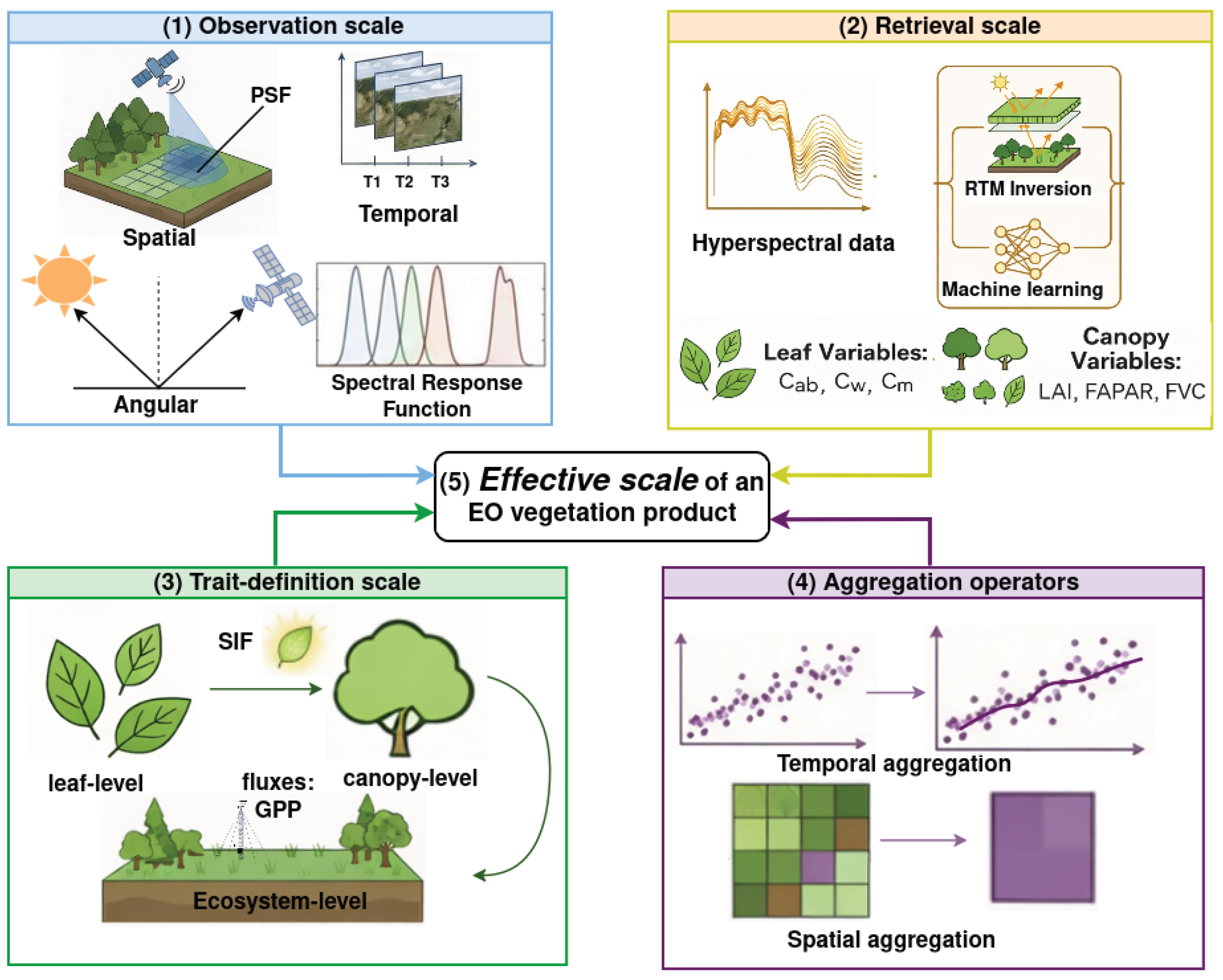
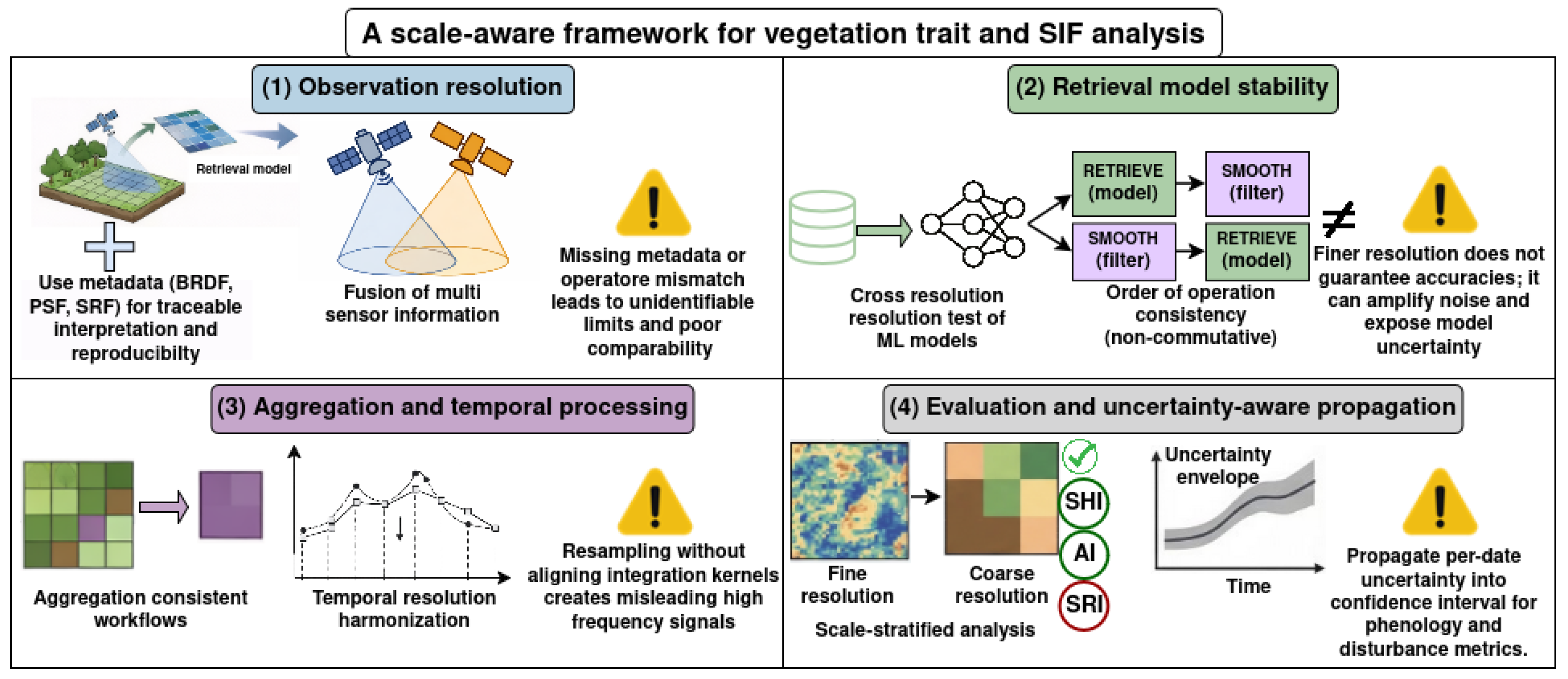
- Vegetation Earth observation is an inherently multiscale retrieval problem, with the effective scale determined by the interplay of observation, retrieval, and aggregation processes.
- Increasing spatial, spectral, or temporal resolution does not necessarily improve ecological accuracy (resolution–accuracy paradox), due to non-commutativity and scale-dependent error propagation.
- Vegetation products must be interpreted and evaluated at their effective scale, using aggregation-consistent and cross-scale diagnostics rather than single-resolution agreement.
- Robust use of current and future hyperspectral missions (e.g., FLEX, CHIME) requires scale-aware and uncertainty-aware modelling frameworks that explicitly account for heterogeneity, nonlinearity, and temporal sampling.
Abstract
1. Introduction
2. A Taxonomy of Scales for Trait Retrieval and SIF-Based Products
- 1.
- The spatial, temporal, spectral, and angular resolution of the observations (observation scale).
- 2.
- The organisational level at which retrieval frameworks derive vegetation properties from observations (retrieval scale).
- 3.
- The physical interpretation of the target variable itself (trait-definition scale).
- 4.
- The mathematical operators used to aggregate, resample, or compare observations and retrievals across spatial, temporal, or spectral resolutions (aggregation operators).
2.1. Observation Scale
2.2. Retrieval Scale
2.3. Trait Definition Scale
2.4. Aggregation Operators
2.5. Effective Scale
2.6. Scale Dependence of Retrieved Vegetation Quantities
2.7. Diagnostics of Spatial Homogeneity and Representativeness
3. Spatial Scale Effects as Sources of Bias in Trait and SIF-Based Products
3.1. Spatial Resolution and the Conditioning of the Retrieval Problem
3.2. Bias from Nonlinear Retrievals in Heterogeneous Landscapes
3.3. Compound Canopy Traits and Scaling
3.4. Canopy Structure, RT, and Scale Dependence
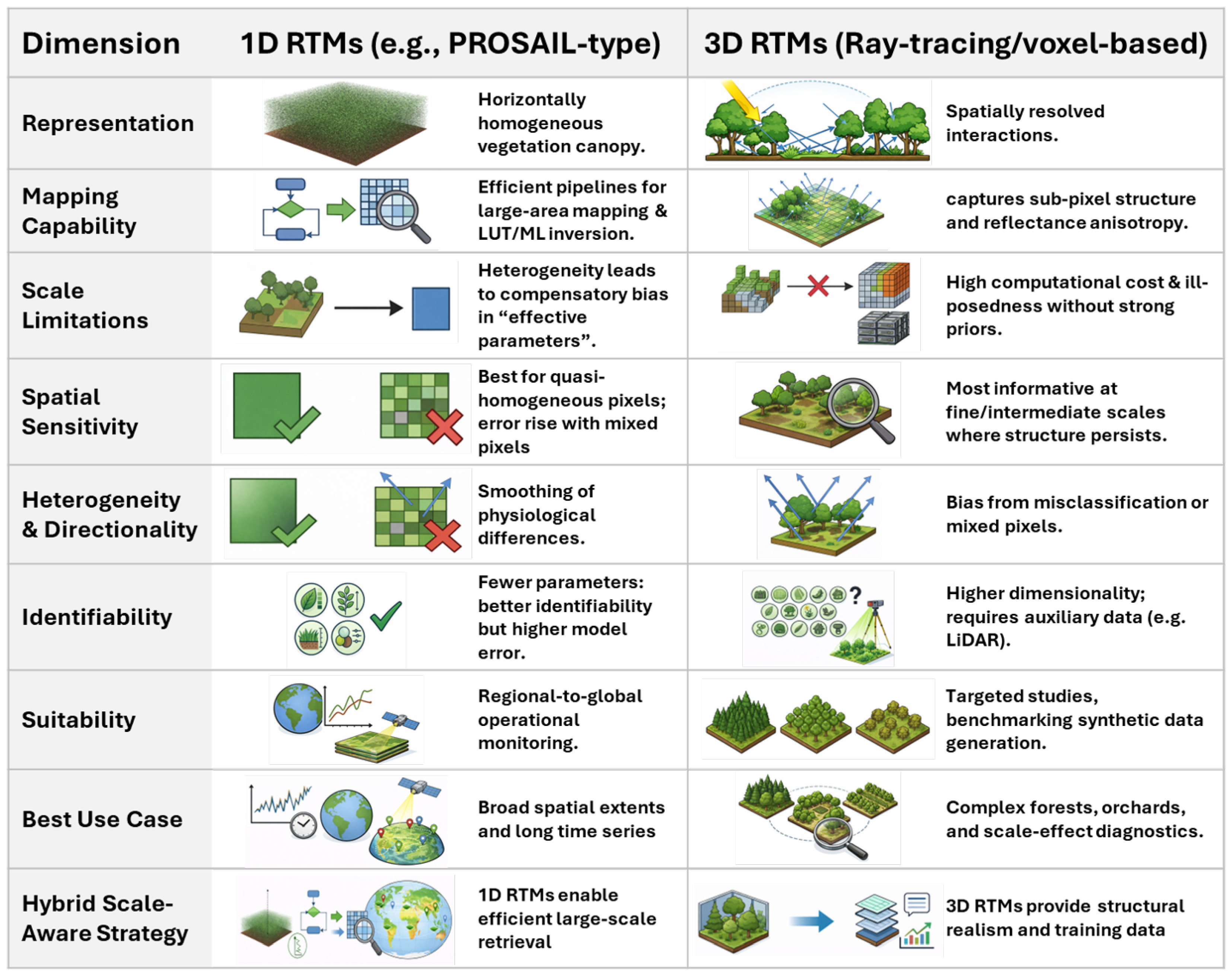
- 1D (turbid-medium) RTMs. Canopy structure is represented through effective parameters such as LAI, leaf angle distribution (LAD), and clumping factors. Horizontal heterogeneity is not explicitly resolved, and the canopy is treated as vertically structured but horizontally homogeneous (e.g., [18,95]).
3.5. Nonlinear Retrieval Processes: SIF Signals and ML Models Under Scale Change
3.6. Implications for Spatial Consistency and Interpretation
4. Temporal Sampling and Dynamics of Traits and SIF-Based Products
4.1. Temporal Resolution, Sampling Irregularity, and Aliasing
4.2. Temporal Compositing and Smoothing as Aggregation Operators
4.3. Temporal Mismatch Between Trait and SIF-Based Products
4.4. Algorithm Evolution and Apparent Temporal Change
4.5. Implications for Temporal Consistency and Interpretation
5. Process-Level Vegetation Dynamics Across Scales
5.1. Disturbance and Stress Detection Under Scale Constraints
5.2. Change Detection and Temporal Segmentation Applied to Traits
5.3. SIF-Based Early Stress Detection and Scale-Dependent Interpretation
5.4. Model Stratification Across Vegetation Types and Scale Effects
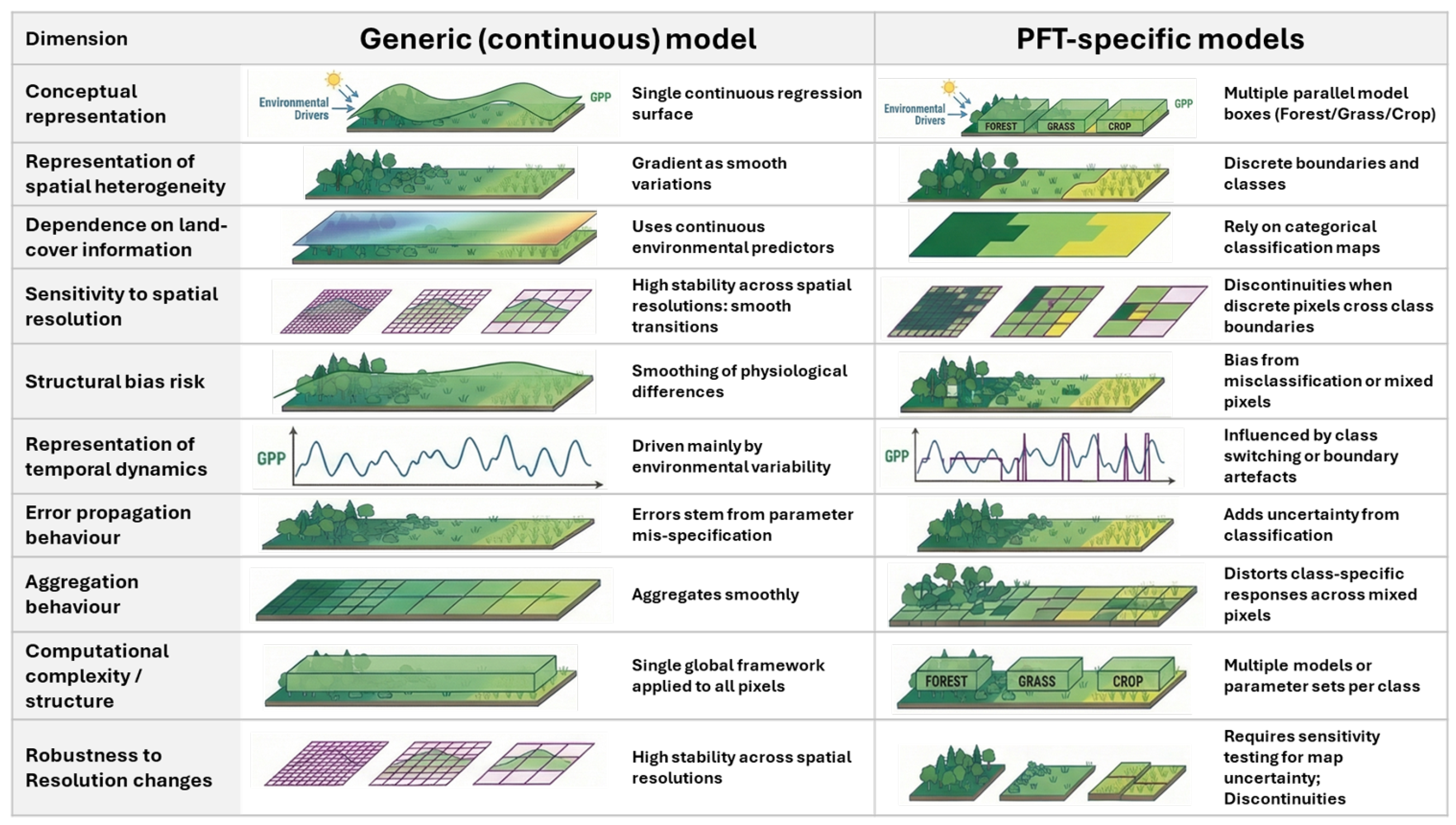
- PFT-stratified models. Partitioning variability into discrete categories may obscure continuous ecological gradients (e.g., [139,140]). Increasing complexity through PFT differentiation does not necessarily improve accuracy; instead, it redistributes structural and representativeness errors and increases sensitivity to land-cover uncertainty (e.g., [137,141]).
5.5. Implications for Process-Level Consistency and Interpretation
6. Scale-Aware Data Fusion and Multiresolution Modelling
6.1. Observation-Level Spatiotemporal Fusion (Reflectance-First)
6.2. Trait-Level Fusion: Retrieve–Then–Fuse vs. Fuse–Then–Retrieve
6.3. SIF Downscaling and Scale-Consistent Constraints on GPP and Stress
6.4. Hierarchical and Multi-Fidelity Approaches for Multi-Resolution Modelling
6.5. Recurrent Failure Modes and Practical Guidance
7. Evaluation and Validation of Scale-Aware Trait and SIF-Based Dynamics
8. Best-Practice Guidelines for Scale-Aware Trait and SIF-Based Dynamics
9. Outlook: Research Priorities for Scale-Aware Vegetation Dynamics in the CHIME and FLEX Era
10. Conclusions
Author Contributions
Funding
Data Availability Statement
Acknowledgments
Conflicts of Interest
References
- Frappart, F.; Ramillien, G. Monitoring of the Terrestrial Vegetation Dynamics from Satellite Remote Sensing: A Review of Vegetation Indices. Remote Sens. 2020, 12, 2915. [Google Scholar] [CrossRef]
- Verrelst, J.; Malenovský, Z.; van der Tol, C.; Camps-Valls, G.; Gastellu-Etchegorry, J.P.; Lewis, P.; North, P.; Moreno, J. Quantifying vegetation biophysical variables from imaging spectroscopy data: A review on retrieval methods. Surv. Geophys. 2019, 40, 589–629. [Google Scholar] [CrossRef]
- Zeng, L.; Wardlow, B.D.; Xiang, D.; Hu, S.; Li, D. A review of vegetation phenological metrics extraction using time-series, multispectral satellite data. Remote Sens. Environ. 2020, 237, 111511. [Google Scholar] [CrossRef]
- Mohammed, G.H.; Colombo, R.; Middleton, E.M.; Rascher, U.; van der Tol, C.; Nedbal, L.; Goulas, Y.; Pérez-Priego, O.; Damm, A.; Meroni, M.; et al. Remote sensing of solar-induced chlorophyll fluorescence (SIF) in vegetation: 50 years of progress. Remote Sens. Environ. 2019, 231, 111177. [Google Scholar] [CrossRef] [PubMed]
- Verrelst, J.; Kovács, D.D.; Rivera-Caicedo, J.P. Vegetation Trait Mapping with Optical Remote Sensing: Recent Advances in Methods and Applications; Elsevier: Amsterdam, The Netherlands, 2026. [Google Scholar] [CrossRef]
- Verrelst, J.; Camps-Valls, G.; Muñoz-Marí, J.; Rivera, J.P.; Veroustraete, F.; Clevers, J.G.; Moreno, J. Optical remote sensing and the retrieval of terrestrial vegetation bio-geophysical properties—A review. ISPRS J. Photogramm. Remote Sens. 2015, 108, 273–290. [Google Scholar] [CrossRef]
- Weiss, M.; Jacob, F.; Duveiller, G. Remote sensing for agricultural applications: A meta-review. Remote Sens. Environ. 2020, 236, 111402. [Google Scholar] [CrossRef]
- Homolová, L.; Malenovský, Z.; Clevers, J.G.P.W.; García-Santos, G.; Schaepman, M.E. Review of optical-based remote sensing for plant trait mapping. Ecol. Complex. 2013, 15, 1–16. [Google Scholar] [CrossRef]
- Cogliati, S.; Verhoef, W.; Kraft, S.; Sabater, N.; Alonso, L.; Vicent, J.; Moreno, J.; Drusch, M.; Colombo, R. Retrieval of sun-induced fluorescence using advanced spectral fitting methods. Remote Sens. Environ. 2015, 169, 344–357. [Google Scholar] [CrossRef]
- Damm, A.; Guanter, L.; Paul-Limoges, E.; van der Tol, C.; Hueni, A.; Buchmann, N.; Eugster, W.; Ammann, C.; Schaepman, M.E. Far-red sun-induced chlorophyll fluorescence shows ecosystem-specific relationships to gross primary production: An assessment based on observational and modeling approaches. Remote Sens. Environ. 2015, 166, 91–105. [Google Scholar] [CrossRef]
- Sun, Y.; Frankenberg, C.; Jung, M.; Joiner, J.; Guanter, L.; Köhler, P.; Magney, T. Overview of solar-induced chlorophyll fluorescence (SIF) from the Orbiting Carbon Observatory-2: Retrieval, cross-mission comparison, and global monitoring for GPP. Remote Sens. Environ. 2018, 209, 808–823. [Google Scholar] [CrossRef]
- Coppo, P.; Taiti, A.; Pettinato, L.; Francois, M.; Taccola, M.; Drusch, M. Fluorescence imaging spectrometer (FLORIS) for ESA FLEX mission. Remote Sens. 2017, 9, 649. [Google Scholar] [CrossRef]
- Drusch, M.; Moreno, J.; Del Bello, U.; Franco, R.; Goulas, Y.; Huth, A.; Kraft, S.; Middleton, E.M.; Miglietta, F.; Mohammed, G.; et al. The fluorescence explorer mission concept—ESA’s earth explorer 8. IEEE Trans. Geosci. Remote Sens. 2016, 55, 1273–1284. [Google Scholar] [CrossRef]
- Du, S.; Liu, L.; Liu, X.; Zhang, X.; Gao, X.; Wang, W. The solar-induced chlorophyll fluorescence imaging spectrometer (SIFIS) onboard the first terrestrial ecosystem carbon inventory satellite (TECIS-1): Specifications and prospects. Sensors 2020, 20, 815. [Google Scholar] [CrossRef]
- Bacour, C.; Maignan, F.; Peylin, P.; Macbean, N.; Bastrikov, V.; Joiner, J.; Köhler, P.; Guanter, L.; Frankenberg, C. Differences between OCO-2 and GOME-2 SIF products from a model-data fusion perspective. J. Geophys. Res. Biogeosci. 2019, 124, 3143–3157. [Google Scholar] [CrossRef]
- Nieke, J.; Despoisse, L.; Gabriele, A.; Weber, H.; Strese, H.; Ghasemi, N.; Gascon, F.; Alonso, K.; Boccia, V.; Tsonevska, B.; et al. The Copernicus Hyperspectral Imaging Mission for the Environment (CHIME): An Overview of Its Mission, System and Planning Status. In Proceedings of the Sensors, Systems, and Next-Generation Satellites XXVII, Amsterdam, The Netherlands, 3–6 September 2023. [Google Scholar] [CrossRef]
- García-Soria, J.L.; Morata, M.; Berger, K.; Pascual-Venteo, A.B.; Rivera-Caicedo, J.P.; Verrelst, J. Evaluating epistemic uncertainty estimation strategies in vegetation trait retrieval using hybrid models and imaging spectroscopy data. Remote Sens. Environ. 2024, 310, 114228. [Google Scholar] [CrossRef]
- Jacquemoud, S.; Verhoef, W.; Baret, F.; Bacour, C.; Zarco-Tejada, P.; Asner, G.; François, C.; Ustin, S. PROSPECT + SAIL Models: A Review of Use for Vegetation Characterization. Remote Sens. Environ. 2009, 113, S56–S66. [Google Scholar] [CrossRef]
- van der Tol, C.; Verhoef, W.; Timmermans, J.; Verhoef, A.; Su, Z. An integrated model of soil-canopy spectral radiances, photosynthesis, fluorescence, temperature and energy balance. Biogeosciences 2009, 6, 3109–3129. [Google Scholar] [CrossRef]
- Malenovský, Z.; Homolová, L.; Lukeš, P.; Buddenbaum, H.; Verrelst, J.; Alonso, L.; Schaepman, M.E.; Lauret, N.; Gastellu-Etchegorry, J.P. Variability and Uncertainty Challenges in Scaling Imaging Spectroscopy Retrievals and Validations from Leaves Up to Vegetation Canopies. Surv. Geophys. 2019, 40, 631–656. [Google Scholar] [CrossRef] [PubMed]
- Pinty, B.; Lavergne, T.; Dickinson, R.E.; Widlowski, J.; Gobron, N.; Verstraete, M.M. Simplifying the interaction of land surfaces with radiation for relating remote sensing products to climate models. J. Geophys. Res. Atmos. 2006, 111, D02116. [Google Scholar] [CrossRef]
- Jönsson, P.; Eklundh, L. TIMESAT—a program for analyzing time-series of satellite sensor data. Comput. Geosci. 2004, 30, 833–845. [Google Scholar] [CrossRef]
- Kennedy, R.E.; Yang, Z.; Cohen, W.B. Detecting trends in forest disturbance and recovery using yearly Landsat time series: 1. LandTrendr—Temporal segmentation algorithms. Remote Sens. Environ. 2010, 114, 2897–2910. [Google Scholar] [CrossRef]
- Verbesselt, J.; Hyndman, R.; Newnham, G.; Culvenor, D. Detecting trend and seasonal changes in satellite image time series. Remote Sens. Environ. 2010, 114, 106–115. [Google Scholar] [CrossRef]
- Belda, S.; Pipia, L.; Morcillo-Pallarés, P.; Rivera-Caicedo, J.P.; Amin, E.; De Grave, C.; Verrelst, J. DATimeS: A machine learning time series GUI toolbox for gap-filling and vegetation phenology trends detection. Environ. Model. Softw. 2020, 127, 104666. [Google Scholar] [CrossRef] [PubMed]
- Atkinson, P.M.; Curran, P.J. Defining an optimal size of support for remote sensing investigations. IEEE Trans. Geosci. Remote Sens. 1995, 33, 768–776. [Google Scholar] [CrossRef]
- Wu, H.; Li, Z. Scale Issues in Remote Sensing: A Review on Analysis, Processing and Modeling. Sensors 2009, 9, 1768–1793. [Google Scholar] [CrossRef]
- Loew, A.; Bell, W.; Brocca, L.; Bulgin, C.E.; Burdanowitz, J.; Calbet, X.; Donner, R.V.; Gelaro, R.; Ghent, D.; Gruber, A.; et al. Validation practices for satellite-based Earth observation data across communities. Rev. Geophys. 2017, 55, 779–817. [Google Scholar] [CrossRef]
- Woodcock, C.E.; Strahler, A.H. The Factor of Scale in Remote Sensing. Remote Sens. Environ. 1987, 21, 311–332. [Google Scholar] [CrossRef]
- Garrigues, S.; Allard, D.; Baret, F.; Weiss, M. Influence of landscape spatial heterogeneity on the non-linear estimation of leaf area index from moderate spatial resolution remote sensing data. Remote Sens. Environ. 2006, 105, 286–298. [Google Scholar] [CrossRef]
- Zhang, X.; Wang, J.; Gao, F.; Liu, Y.; Schaaf, C.; Friedl, M.; Yu, Y.; Jayavelu, S.; Gray, J.; Liu, L.; et al. Exploration of scaling effects on coarse resolution land surface phenology. Remote Sens. Environ. 2017, 190, 318–330. [Google Scholar] [CrossRef]
- Cui, T.; Martz, L.; Zhao, L.; Guo, X. Investigating the impact of the temporal resolution of MODIS vegetation indices on land surface phenology estimation. GISci. Remote Sens. 2020, 57, 395–410. [Google Scholar] [CrossRef]
- Jin, S.; Sader, S.A. MODIS time-series imagery for forest disturbance detection and quantification of patch size effects. Remote Sens. Environ. 2005, 99, 462–470. [Google Scholar] [CrossRef]
- Schott, J.R.; Gerace, A.; Woodcock, C.E.; Wang, S.; Zhu, Z.; Wynne, R.H.; Blinn, C.E. The impact of improved signal-to-noise ratios on algorithm performance: Case studies for Landsat class instruments. Remote Sens. Environ. 2016, 185, 37–45. [Google Scholar] [CrossRef]
- Tan, B.; Woodcock, C.E.; Hu, J.; Zhang, P.; Ozdogan, M.; Huang, D.; Yang, W.; Knyazikhin, Y.; Myneni, R.B. The impact of gridding artifacts on the local spatial properties of MODIS data. Remote Sens. Environ. 2006, 105, 98–114. [Google Scholar] [CrossRef]
- Dwyer, J.L.; Roy, D.P.; Sauer, B.; Jenkerson, C.B.; Zhang, H.K.; Lymburner, L. Analysis Ready Data: Enabling Analysis of the Landsat Archive. Remote Sens. 2018, 10, 1363. [Google Scholar] [CrossRef]
- Aplin, P. On Scales and Dynamics in Observing the Environment. Int. J. Remote Sens. 2006, 27, 2123–2140. [Google Scholar] [CrossRef]
- Ge, Y.; Jin, Y.; Stein, A.; Chen, Y.; Wang, J.; Wang, J.; Cheng, Q.; Bai, H.; Liu, M.; Atkinson, P.M. Principles and methods of scaling geospatial Earth science data. Earth-Sci. Rev. 2019, 197, 102897. [Google Scholar] [CrossRef]
- Verrelst, J.; Zhang, Y.; Morata, M.; De Clerck, E.; Liu, L. Machine Learning for Satellite Solar-Induced Fluorescence: Retrieval, Reconstruction, Downscaling, and Applications. Remote Sens. 2026, 18, 553. [Google Scholar] [CrossRef]
- Duggin, M.; Robinove, C. Assumptions implicit in remote sensing data acquisition and analysis. Remote Sens. 1990, 11, 1669–1694. [Google Scholar] [CrossRef]
- Schowengerdt, R.A. Remote Sensing: Models and Methods for Image Processing, 3rd ed.; Academic Press: Burlington, MA, USA, 2007. [Google Scholar]
- Cracknell, A.P. Review article: Synergy in remote sensing—What’s in a pixel? Int. J. Remote Sens. 1998, 19, 2025–2047. [Google Scholar] [CrossRef]
- Duveiller, G.; Defourny, P. A conceptual framework to define the spatial resolution requirements for agricultural monitoring using remote sensing. Remote Sens. Environ. 2010, 114, 2637–2650. [Google Scholar] [CrossRef]
- Huang, C.; Townshend, J.R.G.; Liang, S.; Kalluri, S.N.V.; DeFries, R.S. Impact of sensor’s point spread function on land cover characterization: Assessment and deconvolution. Remote Sens. Environ. 2002, 80, 203–212. [Google Scholar] [CrossRef]
- Holben, B.N. Characteristics of maximum-value composite images from temporal AVHRR data. Int. J. Remote Sens. 1986, 7, 1417–1434. [Google Scholar] [CrossRef]
- Kokaly, R.F.; Clark, R.N. Spectroscopic determination of leaf biochemistry using band-depth analysis of absorption features and stepwise multiple linear regression. Remote Sens. Environ. 1999, 67, 267–287. [Google Scholar] [CrossRef]
- Thenkabail, P.S.; Smith, R.B.; De Pauw, E. Hyperspectral vegetation indices and their relationships with agricultural crop characteristics. Remote Sens. Environ. 2000, 71, 158–182. [Google Scholar] [CrossRef]
- Verrelst, J.; Schaepman, M.E.; Koetz, B.; Kneubühler, M. Angular sensitivity analysis of vegetation indices derived from CHRIS/PROBA data. Remote Sens. Environ. 2008, 112, 2341–2353. [Google Scholar] [CrossRef]
- Tian, H.; Gao, Y.; Zhang, Y.; Li, H.; Verrelst, J.; Zeng, Y. Quantifying angular sensitivity and synergistic effects of SIF and vegetation indices for robust winter wheat yield estimation. Int. J. Appl. Earth Obs. Geoinf. 2026, 148, 105235. [Google Scholar] [CrossRef]
- Group on Earth Observations. A Quality Assurance Framework for Earth Observation (QA4EO): Principles and Guidelines; QA4EO Guideline Document (Report); Group on Earth Observations: Geneva, Switzerland, 2010. [Google Scholar]
- Jacquemoud, S.; Baret, F. PROSPECT: A Model of Leaf Optical Properties Spectra. Remote Sens. Environ. 1990, 34, 75–91. [Google Scholar] [CrossRef]
- Féret, J.B.; François, C.; Asner, G.; Gitelson, A.; Martin, R.; Bidel, L.; Ustin, S.; le Maire, G.; Jacquemoud, S. PROSPECT-4 and 5: Advances in the Leaf Optical Properties Model Separating Photosynthetic Pigments. Remote Sens. Environ. 2008, 112, 3030–3043. [Google Scholar] [CrossRef]
- Berger, K.; Atzberger, C.; Danner, M.; D’Urso, G.; Mauser, W.; Vuolo, F.; Hank, T. Evaluation of the PROSAIL model capabilities for future hyperspectral model environments: A review study. Remote Sens. 2018, 10, 85. [Google Scholar] [CrossRef]
- Bacour, C.; Baret, F.; Béal, D. Neural Network Estimation of LAI, fAPAR, fCover and LAI×Cab, from Top of Canopy MERIS Reflectance Data: Principles and Validation. Remote Sens. Environ. 2006, 105, 313–325. [Google Scholar] [CrossRef]
- Clevers, J.; Kooistra, L.; van den Brande, M. Using Sentinel-2 Data for Retrieving LAI and Leaf and Canopy Chlorophyll Content of a Potato Crop. Remote Sens. 2017, 9, 405. [Google Scholar] [CrossRef]
- Jacquemoud, S.; Bacour, C.; Poilvé, H.; Frangi, J.P. Comparison of Four Radiative Transfer Models to Simulate Plant Canopies Reflectance: Direct and Inverse Mode. Remote Sens. Environ. 2000, 74, 471–481. [Google Scholar] [CrossRef]
- Darvishzadeh, R.; Skidmore, A.; Schlerf, M.; Atzberger, C. Inversion of a Radiative Transfer Model for Estimating Vegetation LAI and Chlorophyll in a Heterogeneous Grassland. Remote Sens. Environ. 2008, 112, 2592–2604. [Google Scholar] [CrossRef]
- Zurita-Milla, R.; Laurent, V.; van Gijsel, J. Visualizing the Ill-Posedness of the Inversion of a Canopy Radiative Transfer Model: A Case Study for Sentinel-2. Int. J. Appl. Earth Obs. Geoinf. 2015, 43, 7–18. [Google Scholar] [CrossRef]
- Combal, B.; Baret, F.; Weiss, M.; Trubuil, A.; Macé, D.; Pragnère, A.; Myneni, R.B.; Knyazikhin, Y.; Wang, L. Retrieval of Canopy Biophysical Variables from Bidirectional Reflectance: Using Prior Information to Solve the Ill-Posed Inverse Problem. Remote Sens. Environ. 2003, 84, 1–15. [Google Scholar] [CrossRef]
- Pinty, B.; Gobron, N.; Widlowski, J.L.; Lavergne, T.; Verstraete, M. Synergy between 1-D and 3-D Radiation Transfer Models to Retrieve Vegetation Canopy Properties from Remote Sensing Data. J. Geophys. Res. Atmos. 2004, 109, D21205. [Google Scholar] [CrossRef]
- Widlowski, J.L.; Taberner, M.; Pinty, B.; Bruniquel-Pinel, V.; Disney, M.; Fernandes, R.; Gastellu-Etchegorry, J.P.; Gobron, N.; Kuusk, A.; Lavergne, T.; et al. The Third RAdiation Transfer Model Intercomparison (RAMI) Exercise: Documenting Progress in Canopy Reflectance Models. J. Geophys. Res. Atmos. 2007, 112, D09111. [Google Scholar] [CrossRef]
- Berger, K.; Rivera Caicedo, J.P.; Martino, L.; Wocher, M.; Hank, T.; Verrelst, J. A Survey of Active Learning for Quantifying Vegetation Traits from Terrestrial Earth Observation Data. Remote Sens. 2021, 13, 287. [Google Scholar] [CrossRef] [PubMed]
- Chen, J.; Black, T. Defining Leaf Area Index for Non-Flat Leaves. Plant Cell Environ. 1992, 15, 421–429. [Google Scholar] [CrossRef]
- Weiss, M.; Baret, F.; Smith, G.; Jonckheere, I.; Coppin, P. Review of Methods for In Situ Leaf Area Index (LAI) Determination: Part II. Estimation of LAI, Errors and Sampling. Agric. For. Meteorol. 2004, 121, 37–53. [Google Scholar] [CrossRef]
- Zheng, G.; Moskal, L.M. Retrieving Leaf Area Index (LAI) Using Remote Sensing: Theories, Methods and Sensors. Sensors 2009, 9, 2719–2745. [Google Scholar] [CrossRef]
- Oliphant, A.J. Terrestrial ecosystem-atmosphere exchange of CO2, water and energy from FLUXNET; review and meta-analysis of a global in-situ observatory. Geogr. Compass 2012, 6, 689–705. [Google Scholar] [CrossRef]
- Duveiller, G.; Cescatti, A. Spatially Downscaling Sun-Induced Chlorophyll Fluorescence Leads to an Improved Temporal Correlation with Gross Primary Productivity. Remote Sens. Environ. 2016, 182, 72–89. [Google Scholar] [CrossRef]
- Liang, S. Quantitative Remote Sensing of Land Surfaces; John Wiley & Sons: Hoboken, NJ, USA, 2003. [Google Scholar] [CrossRef]
- Markham, K.; Frazier, A.E.; Singh, K.K.; Madden, M. A review of methods for scaling remotely sensed data for spatial pattern analysis. Landsc. Ecol. 2023, 38, 619–635. [Google Scholar] [CrossRef]
- Verrelst, J.; Clerck, E.D.; Verma, B.; Mishra, K.; Caballero, G. Cloud-Native Earth Observation for Quantitative Vegetation Science: Architectures, Workflows, and Scientific Implications. Remote Sens. 2026, 18, 1154. [Google Scholar] [CrossRef]
- Lewis, A.; Oliver, S.; Lymburner, L.; Evans, B.; Wyborn, L.; Mueller, N.; Raevksi, G.; Hooke, J.; Woodcock, R.; Sixsmith, J.; et al. The Australian geoscience data cube—foundations and lessons learned. Remote Sens. Environ. 2017, 202, 276–292. [Google Scholar] [CrossRef]
- Sudmanns, M.; Augustin, H.; Killough, B.; Giuliani, G.; Tiede, D.; Leith, A.; Yuan, F.; Lewis, A. Think global, cube local: An Earth Observation Data Cube’s contribution to the Digital Earth vision. Big Earth Data 2023, 7, 831–859. [Google Scholar] [CrossRef]
- Hoyer, S.; Hamman, J. xarray: ND labeled arrays and datasets in Python. J. Open Res. Softw. 2017, 5, 10. [Google Scholar] [CrossRef]
- Rocklin, M. Dask: Parallel Computation with Blocked algorithms and Task Scheduling. In Proceedings of the 14th Python in Science Conference, Austin, TX, USA, 6–12 July 2015. [Google Scholar] [CrossRef]
- De Grave, C.; Pipia, L.; Siegmann, B.; Morcillo-Pallarés, P.; Rivera-Caicedo, J.P.; Moreno, J.; Verrelst, J. Retrieving and validating leaf and canopy chlorophyll content at moderate resolution: A multiscale analysis with the sentinel-3 OLCI sensor. Remote Sens. 2021, 13, 1419. [Google Scholar] [CrossRef]
- Rossini, M.; Celesti, M.; Bramati, G.; Migliavacca, M.; Cogliati, S.; Rascher, U.; Colombo, R. Evaluation of the Spatial Representativeness of In Situ SIF Observations for the Validation of Medium-Resolution Satellite SIF Products. Remote Sens. 2022, 14, 5107. [Google Scholar] [CrossRef]
- Cremer, N.; Alonso, K.; Doxani, G.; Chlus, A.; Thompson, D.; Brodrick, P.; Townsend, P.; Palombo, A.; Santini, F.; Gao, B.C.; et al. Atmospheric Correction Inter-Comparison eXercise, ACIX-III Land: An Assessment of Atmospheric Correction Processors for EnMAP and PRISMA over Land. Remote Sens. 2025, 17, 3790. [Google Scholar] [CrossRef]
- He, H.S.; DeZonia, B.E.; Mladenoff, D.J. An Aggregation Index (AI) to Quantify Spatial Patterns of Landscapes. Landsc. Ecol. 2000, 15, 591–601. [Google Scholar] [CrossRef]
- Ma, J.; Zhou, J.; Liu, S.; Göttsche, F.M.; Zhang, X.; Wang, S.; Li, M. Continuous Evaluation of the Spatial Representativeness of Land Surface Temperature Validation Sites. Remote Sens. Environ. 2021, 265, 112669. [Google Scholar] [CrossRef]
- Moran, P.A. Notes on continuous stochastic phenomena. Biometrika 1950, 37, 17–23. [Google Scholar] [CrossRef]
- Jantol, N.; Prikaziuk, E.; Celesti, M.; Hernandez-Sequeira, I.; Tomelleri, E.; Pacheco-Labrador, J.; Van Wittenberghe, S.; Pla, F.; Bandopadhyay, S.; Koren, G.; et al. Using Sentinel-2-based metrics to characterize the spatial heterogeneity of FLEX sun-induced chlorophyll fluorescence on sub-pixel scale. Remote Sens. 2023, 15, 4835. [Google Scholar] [CrossRef]
- Verrelst, J.; Schaepman, M.E.; Malenovskỳ, Z.; Clevers, J.G. Effects of woody elements on simulated canopy reflectance: Implications for forest chlorophyll content retrieval. Remote Sens. Environ. 2010, 114, 647–656. [Google Scholar] [CrossRef]
- Monitoring and assessing of landscape heterogeneity at different scales. Environ. Monit. Assess. 2013, 185, 9419–9434. [CrossRef]
- Tao, X.; Yan, B.; Wang, K.; Wu, D.; Fan, W.; Xu, X.; Liang, S. Scale transformation of Leaf Area Index product retrieved from multiresolution remotely sensed data: Analysis and case studies. Int. J. Remote Sens. 2009, 30, 5383–5395. [Google Scholar] [CrossRef]
- Xu, X.; Fan, W.; Tao, X. The spatial scaling effect of continuous canopy Leaves Area Index retrieved by remote sensing. Sci. China Earth Sci. 2009, 52, 393–401. [Google Scholar] [CrossRef]
- Chen, J. Spatial scaling of a remotely sensed surface parameter by contexture. Remote Sens. Environ. 1999, 69, 30–42. [Google Scholar] [CrossRef]
- Clevers, J.G.P.W.; Kooistra, L.; Schaepman, M.E. Estimating canopy water content using hyperspectral remote sensing data. Int. J. Appl. Earth Obs. Geoinf. 2010, 12, 119–125. [Google Scholar] [CrossRef]
- Gitelson, A.A.; Viña, A.; Ciganda, V.; Rundquist, D.C.; Arkebauer, T.J. Remote estimation of canopy chlorophyll content in crops. Geophys. Res. Lett. 2005, 32, L08403. [Google Scholar] [CrossRef]
- Inoue, Y.; Guérif, M.; Baret, F.; Skidmore, A.; Gitelson, A.; Schlerf, M.; Darvishzadeh, R.; Olioso, A. Simple and robust methods for remote sensing of canopy chlorophyll content: A comparative analysis of hyperspectral data for different types of vegetation. Plant Cell Environ. 2016, 39, 2609–2623. [Google Scholar] [CrossRef] [PubMed]
- Li, Z.; Jin, X.; Yang, G.; Drummond, J.; Yang, H.; Clark, B.; Li, Z.; Zhao, C. Remote Sensing of Leaf and Canopy Nitrogen Status in Winter Wheat (Triticum aestivum L.) Based on N-PROSAIL Model. Remote Sens. 2018, 10, 1463. [Google Scholar] [CrossRef]
- Brown, L.A.; Ogutu, B.O.; Dash, J. Estimating Forest Leaf Area Index and Canopy Chlorophyll Content with Sentinel-2: An Evaluation of Two Hybrid Retrieval Algorithms. Remote Sens. 2019, 11, 1752. [Google Scholar] [CrossRef]
- Verrelst, J.; Rivera-Caicedo, J.P.; Reyes-Muñoz, P.; Morata, M.; Amin, E.; Tagliabue, G.; Panigada, C.; Hank, T.; Berger, K. Mapping landscape canopy nitrogen content from space using PRISMA data. ISPRS J. Photogramm. Remote Sens. 2021, 178, 382–395. [Google Scholar] [CrossRef]
- Bøegh, E.; Houborg, R.; Bienkowski, J.; Braban, C.F.; Dalgaard, T.; van Dijk, N.; Dragosits, U.; Holmes, E.; Finch, J.W.; Glud, R.N.; et al. Remote sensing of LAI, chlorophyll and leaf nitrogen pools of crop- and grasslands in five European landscapes. Biogeosciences 2013, 10, 6279–6307. [Google Scholar] [CrossRef]
- Delloye, C.; Weiss, M.; Defourny, P. Retrieval of the canopy chlorophyll content from Sentinel-2 spectral bands to estimate nitrogen uptake in intensive winter wheat cropping systems. Remote Sens. Environ. 2018, 216, 245–261. [Google Scholar] [CrossRef]
- Verhoef, W. Light Scattering by Leaf Layers with Application to Canopy Reflectance Modeling: The SAIL Model. Remote Sens. Environ. 1984, 16, 125–141. [Google Scholar] [CrossRef]
- Gastellu-Etchegorry, J.P.; Demarez, V.; Pinel, V.; Zagolski, F. Modeling Radiative Transfer in Heterogeneous 3-D Vegetation Canopies. Remote Sens. Environ. 1996, 58, 131–156. [Google Scholar] [CrossRef]
- Nilson, T. A Theoretical Analysis of the Frequency of Gaps in Plant Stands. Agric. Meteorol. 1971, 8, 25–38. [Google Scholar] [CrossRef]
- Frankenberg, C.; Butz, A.; Toon, G.C. Disentangling chlorophyll fluorescence from atmospheric scattering effects in O2 A-band spectra of reflected sunlight. Geophys. Res. Lett. 2011, 38, L03801. [Google Scholar] [CrossRef]
- Verrelst, J.; Rivera, J.P.; van der Tol, C.; Magnani, F.; Mohammed, G.; Moreno, J. Global sensitivity analysis of the SCOPE model: What drives simulated canopy-leaving sun-induced fluorescence? Remote Sens. Environ. 2015, 166, 8–21. [Google Scholar] [CrossRef]
- Duveiller, G.; Filipponi, F.; Walther, S.; Köhler, P.; Frankenberg, C.; Guanter, L.; Cescatti, A. A spatially downscaled sun-induced fluorescence global product for enhanced monitoring of vegetation productivity. Earth Syst. Sci. Data 2020, 12, 1101–1116. [Google Scholar] [CrossRef]
- Foody, G.M.; Mathur, A. Toward intelligent training of supervised image classifications: Directing training data acquisition for SVM classification. Remote Sens. Environ. 2004, 93, 107–117. [Google Scholar] [CrossRef]
- Verrelst, J.; Muñoz, J.; Alonso, L.; Delegido, J.; Rivera, J.P.; Camps-Valls, G.; Moreno, J. Machine learning regression algorithms for biophysical parameter retrieval: Opportunities for Sentinel-2 and-3. Remote Sens. Environ. 2012, 118, 127–139. [Google Scholar] [CrossRef]
- Tian, Y.; Woodcock, C.E.; Wang, Y.; Privette, J.L.; Shabanov, N.V.; Zhou, L.; Zhang, Y.; Buermann, W.; Dong, J.; Veikkanen, B.; et al. Multiscale analysis and validation of the MODIS LAI product: I. Uncertainty assessment. Remote Sens. Environ. 2002, 83, 414–430. [Google Scholar] [CrossRef]
- Blackburn, G.A. Hyperspectral remote sensing of plant pigments. J. Exp. Bot. 2007, 58, 855–867. [Google Scholar] [CrossRef] [PubMed]
- Ustin, S.L.; Gitelson, A.A.; Jacquemoud, S.; Schaepman, M.E.; Asner, G.P.; Gamon, J.A.; Zarco-Tejada, P. Retrieval of foliar information about plant pigment systems from high resolution spectroscopy. Remote Sens. Environ. 2009, 113, S67–S77. [Google Scholar] [CrossRef]
- Gara, T.W.; Skidmore, A.K.; Darvishzadeh, R.; Wang, T. Leaf to canopy upscaling approach affects the estimation of canopy traits. GISci. Remote Sens. 2019, 56, 554–575. [Google Scholar] [CrossRef]
- Jin, Z.; Tian, Q.; Chen, J.; Chen, M. Spatial scaling between leaf area index maps of different resolutions. J. Environ. Manag. 2007, 85, 628–637. [Google Scholar] [CrossRef]
- Kang, X.; Huang, C.; Zhang, L.; Zhang, Z.; Lv, X. Downscaling solar-induced chlorophyll fluorescence for field-scale cotton yield estimation by a two-step convolutional neural network. Comput. Electron. Agric. 2022, 201, 107260. [Google Scholar] [CrossRef]
- Ni-Meister, W.; Yang, W.; Kiang, N.Y. A clumped-foliage canopy radiative transfer model for a global dynamic terrestrial ecosystem model. I: Theory. Agric. For. Meteorol. 2010, 150, 881–894. [Google Scholar] [CrossRef]
- Wang, Q.; Li, P. Canopy vertical heterogeneity plays a critical role in reflectance simulation. Agric. For. Meteorol. 2013, 169, 111–121. [Google Scholar] [CrossRef]
- Crawford, C.J.; Roy, D.P.; Arab, S.; Barnes, C.; Vermote, E.; Hulley, G.; Gerace, A.; Choate, M.; Engebretson, C.; Micijevic, E.; et al. The 50-year Landsat collection 2 archive. Sci. Remote Sens. 2023, 8, 100103. [Google Scholar] [CrossRef]
- Roberts, D.R.; Bahn, V.; Ciuti, S.; Boyce, M.S.; Elith, J.; Guillera-Arroita, G.; Hauenstein, S.; Lahoz-Monfort, J.J.; Schröder, B.; Thuiller, W.; et al. Cross-validation strategies for data with temporal, spatial, hierarchical, or phylogenetic structure. Ecography 2017, 40, 913–929. [Google Scholar] [CrossRef]
- Valavi, R.; Elith, J.; Lahoz-Monfort, J.J.; Guillera-Arroita, G. blockCV: An R package for generating spatially or environmentally separated folds for k-fold cross-validation of species distribution models. Methods Ecol. Evol. 2019, 10, 225–232. [Google Scholar] [CrossRef]
- Zhang, X.; Friedl, M.A.; Schaaf, C.B. Sensitivity of vegetation phenology detection to the temporal resolution of satellite data. Int. J. Remote Sens. 2009, 30, 2061–2074. [Google Scholar] [CrossRef]
- Atkinson, P.M.; Jeganathan, C.; Dash, J.; Atzberger, C. Inter-comparison of four models for smoothing satellite sensor time-series data to estimate vegetation phenology. Remote Sens. Environ. 2012, 123, 400–417. [Google Scholar] [CrossRef]
- Levitan, N.; Kang, Y.; Özdoğan, M.; Magliulo, V.; Castillo, P.; Moshary, F.; Gross, B. Evaluation of the Uncertainty in Satellite-Based Crop State Variable Retrievals Due to Site and Growth Stage Specific Factors and Their Potential in Coupling with Crop Growth Models. Remote Sens. 2019, 11, 1928. [Google Scholar] [CrossRef] [PubMed]
- Pipia, L.; Belda, S.; Franch, B.; Verrelst, J. Trends in satellite sensors and image time series processing methods for crop phenology monitoring. In Information and Communication Technologies for Agriculture—Theme I: Sensors; Springer: Cham, Switzerland, 2022; pp. 199–231. [Google Scholar] [CrossRef]
- White, M.A.; Thornton, P.E.; Running, S.W. A continental phenology model for monitoring vegetation responses to interannual climatic variability. Glob. Biogeochem. Cycles 2009, 21, 217–234. [Google Scholar] [CrossRef]
- Richardson, A.D.; Keenan, T.F.; Migliavacca, M.; Ryu, Y.; Sonnentag, O.; Toomey, M. Climate change, phenology, and phenological control of vegetation feedbacks to the climate system. Agric. For. Meteorol. 2013, 169, 156–173. [Google Scholar] [CrossRef]
- Guanter, L.; Zhang, Y.; Jung, M.; Joiner, J.; Voigt, M.; Berry, J.A.; Frankenberg, C.; Huete, A.R.; Zarco-Tejada, P.; Lee, J.E.; et al. Global and time-resolved monitoring of crop photosynthesis with chlorophyll fluorescence. Proc. Natl. Acad. Sci. USA 2014, 111, E1327–E1333. [Google Scholar] [CrossRef]
- Rossini, M.; Meroni, M.; Celesti, M.; Cogliati, S.; Julitta, T.; Panigada, C.; Rascher, U.; van der Tol, C.; Colombo, R. Analysis of red and far-red sun-induced chlorophyll fluorescence and their ratio in different canopies based on observed and modeled data. Remote Sens. 2016, 8, 412. [Google Scholar] [CrossRef]
- Liu, X.; Liu, L.; Guan, K.; Du, S.; Wang, S. Tracing the seasonality of photosynthesis in croplands using remotely sensed sun-induced fluorescence. Agric. For. Meteorol. 2017, 232, 237–248. [Google Scholar] [CrossRef]
- Köhler, P.; Frankenberg, C.; Joiner, J.; Guanter, L. Global retrievals of solar-induced chlorophyll fluorescence with TROPOMI: First results and intersensor comparison to OCO-2. Geophys. Res. Lett. 2018, 45, 10456–10463. [Google Scholar] [CrossRef]
- Guanter, L.; Bacour, C.; Schneider, A.; Aben, I.; van Kempen, T.A.; Maignan, F.; Retscher, C.; Köhler, P.; Frankenberg, C.; Joiner, J.; et al. The TROPOSIF global sun-induced fluorescence data set from the TROPOMI instrument. Earth Syst. Sci. Data 2021, 13, 5423–5440. [Google Scholar] [CrossRef]
- Liang, S.; Fang, H.; Chen, M. Atmospheric correction of Landsat ETM+ land surface imagery. I. Methods. IEEE Trans. Geosci. Remote Sens. 2001, 39, 2490–2498. [Google Scholar] [CrossRef]
- Claverie, M.; Ju, J.; Masek, J.G.; Dungan, J.L.; Vermote, E.F.; Roger, J.; Skakun, S.V.; Justice, C. The Harmonized Landsat and Sentinel-2 surface reflectance data set. Remote Sens. Environ. 2018, 219, 145–161. [Google Scholar] [CrossRef]
- Pouliot, D.; Latifovic, R.; Fernandes, R.; Olthof, I. Evaluation of compositing period and AVHRR and MERIS spectral bands for phenology monitoring. Remote Sens. Environ. 2011, 115, 158–166. [Google Scholar] [CrossRef]
- Cai, Z.; Jönsson, P.; Jin, H.; Eklundh, L. Performance of Smoothing Methods for Reconstructing NDVI Time-Series and Estimating Vegetation Phenology from MODIS Data. Remote Sens. 2017, 9, 1271. [Google Scholar] [CrossRef]
- Vicca, S.; Balzarolo, M.; Filella, I.; Granier, A.; Herbst, M.; Knohl, A.; Longdoz, B.; Mund, M.; Nagy, Z.; Pintér, K.; et al. Remotely-sensed detection of effects of extreme droughts on gross primary production. Sci. Rep. 2016, 6, 28269. [Google Scholar] [CrossRef]
- Zhu, Z.; Woodcock, C.E. Continuous change detection and classification of land cover using all available Landsat data. Remote Sens. Environ. 2014, 144, 152–171. [Google Scholar] [CrossRef]
- Jamali, S.; Jönsson, P.; Eklundh, L.; Ardö, J.; Seaquist, J. Detecting changes in vegetation trends using time series segmentation. Remote Sens. Environ. 2015, 156, 182–195. [Google Scholar] [CrossRef]
- Gómez, C.; White, J.C.; Wulder, M.A. Optical remotely sensed time series data for land cover classification: A review. ISPRS J. Photogramm. Remote Sens. 2016, 116, 55–72. [Google Scholar] [CrossRef]
- Wulder, M.A.; Masek, J.G.; Cohen, W.B.; Loveland, T.R.; Woodcock, C.E. Opening the archive: How free data has enabled the science and monitoring promise of Landsat. Remote Sens. Environ. 2012, 112, 2–10. [Google Scholar] [CrossRef]
- Sun, Y.; Frankenberg, C.; Wood, J.D.; Schimel, D.S.; Jung, M.; Guanter, L.; Drewry, D.; Verma, M.; Porcar-Castell, A.; Griffis, T.J.; et al. OCO-2 advances photosynthesis observation from space via solar-induced chlorophyll fluorescence. Science 2017, 358, eaam5747. [Google Scholar] [CrossRef]
- Porcar-Castell, A.; Tyystjärvi, E.; Atherton, J.; Van der Tol, C.; Flexas, J.; Pfündel, E.; Moreno, J.; Frankenberg, C.; Berry, J. Linking chlorophyll a fluorescence to photosynthesis for remote sensing applications: Mechanisms and challenges. J. Exp. Bot. 2014, 65, 4065–4095. [Google Scholar] [CrossRef]
- Running, S.W.; Nemani, R.R.; Heinsch, F.A.; Zhao, M.; Reeves, M.; Hashimoto, H. A Continuous Satellite-Derived Measure of Global Terrestrial Primary Production. BioScience 2004, 54, 547–560. [Google Scholar] [CrossRef]
- Yuan, W.; Liu, S.; Zhou, G.; Zhou, G.; Tieszen, L.L.; Baldocchi, D.; Bernhofer, C.; Gholz, H.; Goldstein, A.H.; Goulden, M.; et al. Deriving a light use efficiency model from eddy covariance flux data for predicting daily gross primary production across biomes. Agric. For. Meteorol. 2007, 143, 189–207. [Google Scholar] [CrossRef]
- Turner, D.P.; Ritts, W.D.; Styles, J.M.; Yang, Z.; Cohen, W.B.; Law, B.E.; Thornton, P.E. Evaluation of MODIS NPP and GPP products across multiple biomes. Remote Sens. Environ. 2006, 102, 282–292. [Google Scholar] [CrossRef]
- Cranko Page, J.; Abramowitz, G.; De Kauwe, M.G.; Pitman, A.J. Are Plant Functional Types Fit for Purpose? Geophys. Res. Lett. 2024, 51, e2023GL104962. [Google Scholar] [CrossRef]
- Xie, X.; Li, A.; Chen, J.; Guan, X.; Leng, J. Quantifying Scaling Effect on Gross Primary Productivity Estimation in the Upscaling Process of Surface Heterogeneity. J. Geophys. Res. Biogeosci. 2022, 127, e2021JG006775. [Google Scholar] [CrossRef]
- Ma, X.; Huete, A.R.; Yu, Q.; Restrepo-Coupe, N.; Beringer, J.; Hutley, L.B.; Kanniah, K.D.; Cleverly, J.; Eamus, D. Parameterization of an ecosystem light-use-efficiency model for predicting savanna GPP using MODIS EVI. Remote Sens. Environ. 2014, 154, 253–271. [Google Scholar] [CrossRef]
- Xiao, J.; Zhuang, Q.; Law, B.E.; Chen, J.; Baldocchi, D.D.; Cook, D.R.; Oren, R.; Richardson, A.D.; Wharton, S.; Ma, S.; et al. A continuous measure of gross primary productivity for the conterminous U.S. derived from MODIS and AmeriFlux data. Remote Sens. Environ. 2010, 114, 576–591. [Google Scholar] [CrossRef]
- Reyes-Muñoz, P.; Kovács, D.D.; Berger, K.; Pipia, L.; Belda, S.; Rivera-Caicedo, J.P.; Verrelst, J. Inferring global terrestrial carbon fluxes from the synergy of Sentinel 3 & 5P with Gaussian process hybrid models. Remote Sens. Environ. 2024, 305, 114072. [Google Scholar] [CrossRef]
- Reyes-Muñoz, P.; DKovács, D.; Verrelst, J. Tower-to-global upscaling of terrestrial carbon fluxes driven by MODIS-LAI, Sentinel-3-LAI and ERA5-Land data. Ecol. Indic. 2025, 177, 113597. [Google Scholar] [CrossRef]
- Gao, F.; Masek, J.; Schwaller, M.; Hall, F. On the Blending of the Landsat and MODIS Surface Reflectance: Predicting Daily Landsat Surface Reflectance. IEEE Trans. Geosci. Remote Sens. 2006, 44, 2207–2218. [Google Scholar] [CrossRef]
- Zhu, X.; Chen, J.; Gao, F.; Chen, X.; Masek, J.G. An Enhanced Spatial and Temporal Adaptive Reflectance Fusion Model for Complex Heterogeneous Regions. Remote Sens. Environ. 2010, 114, 2610–2623. [Google Scholar] [CrossRef]
- Zhu, X.; Helmer, E.H.; Gao, F.; Liu, D.; Chen, J.; Lefsky, M.A. A Flexible Spatiotemporal Method for Fusing Satellite Images with Different Resolutions. Remote Sens. Environ. 2016, 172, 165–177. [Google Scholar] [CrossRef]
- Gevaert, C.M.; García-Haro, F.J. A Comparison of STARFM and an Unmixing-Based Algorithm for Landsat and MODIS Data Fusion. Remote Sens. Environ. 2015, 156, 34–44. [Google Scholar] [CrossRef]
- Xue, J.; Leung, Y.; Fung, T. A Bayesian Data Fusion Approach to Spatio-Temporal Fusion of Remotely Sensed Images. Remote Sens. 2017, 9, 1310. [Google Scholar] [CrossRef]
- Verrelst, J.; García-Soria, J.L.; Reyes-Muñoz, P.; De Clerck, E.; Morata, M.; Rivera-Caicedo, J.P. Epistemic and aleatoric uncertainty in optical vegetation trait retrieval: Concepts, Methods, and Outlook. ISPRS J. Photogramm. Remote Sens. 2026, 234, 20–45. [Google Scholar] [CrossRef]
- Roy, D.P.; Li, J.; Zhang, H.K.; Yan, L.; Huang, H.; Li, Z. Examination of Sentinel-2A Multi-Spectral Instrument (MSI) Reflectance Anisotropy and the Suitability of a General Method to Normalize MSI Reflectance to Nadir BRDF Adjusted Reflectance. Remote Sens. Environ. 2017, 199, 25–38. [Google Scholar] [CrossRef]
- Fang, H.; Jiang, C.; Li, W.; Wei, S.; Baret, F.; Chen, J.M.; García-Haro, F.J.; Liang, S.; Liu, R.; Myneni, R.B.; et al. Characterization and intercomparison of global moderate resolution leaf area index (LAI) products: Analysis of climatologies and theoretical uncertainties. J. Geophys. Res. Biogeosci. 2013, 118, 529–548. [Google Scholar] [CrossRef]
- Verger, A.; Baret, F.; Weiss, M. A multisensor fusion approach to improve LAI time series. Remote Sens. Environ. 2011, 115, 2460–2470. [Google Scholar] [CrossRef]
- Baret, F.; Weiss, M.; Lacaze, R.; Camacho, F.; Makhmara, H.; Pacholcyzk, P.; Smets, B. GEOV1: LAI and FAPAR essential climate variables and FCOVER global time series capitalizing over existing products. Part 1: Principles of development and production. Remote Sens. Environ. 2013, 137, 299–309. [Google Scholar] [CrossRef]
- Joiner, J.; Yoshida, Y.; Vasilkov, A.P.; Yoshida, Y.; Corp, L.A.; Middleton, E.M. First observations of global and seasonal terrestrial chlorophyll fluorescence from space. Biogeosciences 2011, 8, 637–651. [Google Scholar] [CrossRef]
- Li, X.; Xiao, J. A Global, 0.05-Degree Product of Solar-Induced Chlorophyll Fluorescence Derived from OCO-2, MODIS, and Reanalysis Data. Remote Sens. 2019, 11, 517. [Google Scholar] [CrossRef]
- Shekhar, A.; Buchmann, N.; Gharun, M. How well do recently reconstructed solar-induced fluorescence datasets model gross primary productivity? Remote Sens. Environ. 2022, 283, 113282. [Google Scholar] [CrossRef]
- Magney, T.S.; Bowling, D.R.; Logan, B.A.; Grossmann, K.; Stutz, J.; Blanken, P.D.; Burns, S.P.; Cheng, R.; Garcia, M.A.; Köhler, P.; et al. Mechanistic evidence for tracking the seasonality of photosynthesis with solar-induced fluorescence. Proc. Natl. Acad. Sci. USA 2019, 116, 11640–11645. [Google Scholar] [CrossRef]
- Kaminski, T.; Knorr, W.; Rayner, P.J.; Heimann, M. Assimilating atmospheric data into a terrestrial biosphere model: A case study of the seasonal cycle. Glob. Biogeochem. Cycles 2002, 4, 14-1–14-16. [Google Scholar] [CrossRef]
- Wikle, C.K. Hierarchical Bayesian models for predicting the spread of ecological processes. Ecology 2003, 84, 1382–1394. [Google Scholar] [CrossRef]
- Cressie, N.; Wikle, C.K. Statistics for Spatio-Temporal Data; Wiley: Hoboken, NJ, USA, 2011. [Google Scholar] [CrossRef]
- Kennedy, M.C.; O’Hagan, A. Predicting the Output from a Complex Computer Code when Fast Approximations are Available. Biometrika 2000, 87, 1–13. [Google Scholar] [CrossRef]
- Bilionis, I.; Zabaras, N.; Konomi, B.A.; Lin, G. Multi-output separable Gaussian process: Towards an efficient, fully Bayesian paradigm for uncertainty quantification. J. Comput. Phys. 2013, 241, 212–239. [Google Scholar] [CrossRef]
- Perdikaris, P.; Raissi, M.; Damianou, A.; Lawrence, N.D.; Karniadakis, G.E. Nonlinear Information Fusion Algorithms for Data-Efficient Multi-Fidelity Modelling. Proc. R. Soc. A 2017, 473, 20160751. [Google Scholar] [CrossRef]
- Meyer, H.; Reudenbach, C.; Wöllauer, S.; Nauss, T. Importance of spatial predictor variable selection in machine learning applications—Moving from data reproduction to spatial prediction. Ecol. Model. 2019, 411, 108815. [Google Scholar] [CrossRef]
- Ploton, P.; Mortier, F.; Réjou-Méchain, M.; Barbier, N.; Picard, N.; Rossi, V. Spatial validation reveals poor predictive performance of large-scale ecological mapping models. Nat. Commun. 2020, 11, 4540. [Google Scholar] [CrossRef] [PubMed]
- Rastetter, E.B.; King, A.W.; Cosby, B.J.; Hornberger, G.M.; O’Neill, R.V.; Hobbie, J.E. Aggregating fine-scale ecological knowledge to model coarser-scale attributes of ecosystems. Ecol. Appl. 1992, 2, 55–70. [Google Scholar] [CrossRef] [PubMed]
- Schaepman-Strub, G.; Schaepman, M.E.; Painter, T.H.; Dangel, S.; Martonchik, J.V. Reflectance quantities in optical remote sensing—Definitions and case studies. Remote Sens. Environ. 2006, 103, 27–42. [Google Scholar] [CrossRef]
- Gascon, F.; Michael, R.A.S.T.; Nieke, J.; Celesti, M.; Bogaarts, C. CHIME: Une Mission Copernicus d’Imagerie Hyperspectrale Pour l’Environment. Revue Française Photogrammétrie Télédétection 2022, 224, 5–8. [Google Scholar] [CrossRef]
- De Grave, C.; Verrelst, J.; Morcillo-Pallarés, P.; Pipia, L.; Rivera-Caicedo, J.P.; Amin, E.; Belda, S.; Moreno, J. Quantifying vegetation biophysical variables from the Sentinel-3/FLEX tandem mission: Evaluation of the synergy of OLCI and FLORIS data sources. Remote Sens. Environ. 2020, 251, 112101. [Google Scholar] [CrossRef]




| Variable | Trait-Definition Scale | Typical Interpretation | Effective-Scale Considerations |
|---|---|---|---|
| Cab | Leaf biochemical trait | Leaf chlorophyll concentration | Sensitive to canopy structure, viewing geometry, and sub-pixel heterogeneity. |
| CCC | Canopy biochemical stock | Integrated canopy chlorophyll content | Depends on both chlorophyll concentration and canopy density. |
| True LAI | Canopy structural property | Total one-sided leaf area | Aggregation behaviour influenced by canopy heterogeneity and scale mismatch. |
| Effective LAI | Radiative-transfer property | Optically effective canopy density | Depends on canopy architecture, clumping, viewing geometry, and RT assumptions. |
| FAPAR | Canopy–ecosystem functional variable | Fraction of absorbed photosynthetically active radiation | Influenced by canopy structure, illumination conditions, and temporal compositing. |
| SIF | Canopy–ecosystem functional signal | Photosynthetic activity and stress | Affected by footprint mixing, canopy reabsorption, illumination geometry, and temporal aggregation. |
| GPP | Ecosystem process variable | Carbon uptake rate | Integrates processes across broader spatial and temporal scales through modelling and data assimilation. |
| Scale Dimension | Affected Traits and Products | Failure Mechanism | Diagnostic Symptoms in Dynamics | Scale-Aware Mitigation Strategies | Representative References |
|---|---|---|---|---|---|
| Spatial resolution | LAI, FAPAR, , CWC | Sub-pixel heterogeneity interacts with nonlinear retrieval mappings, so coarse-resolution retrievals are not equivalent to aggregated fine-scale retrievals | Damped seasonal amplitudes; resolution-dependent biases; altered trends across spatial supports | Scale transformation models; heterogeneity stratification; resolution-aware validation using finer-resolution reference data | Tao et al. [84], Tian et al. [103] |
| Spectral resolution | Pigments (, ), water-related traits | Bandpass differences and spectral-response mismatch alter effective absorption features and cross-sensor sensitivity | Cross-sensor seasonal offsets; inconsistent interannual variability; reduced comparability of trait anomalies | Spectral response harmonisation; sensor-specific feature selection or harmonised spectral domains; observation-level fusion before retrieval | Blackburn [104], Ustin et al. [105] |
| Retrieval scale | Leaf- vs. canopy-level traits; CCC, CWC | Mismatch between the scale at which a variable is retrieved and the scale at which it is interpreted | Physically implausible magnitudes; cross-trait inconsistency; erroneous comparisons between leaf- and canopy-scale products | Explicit trait definitions; retrieval formulations consistent with target support; scale-conversion or upscaling relationships where needed | Clevers et al. [87], Gara et al. [106] |
| Aggregation operator | All nonlinear traits and derived metrics | Non-commutativity of aggregation, resampling, and nonlinear retrieval under heterogeneity leads to biased effective states and distorted dynamics | Bias in mean states; shifted phenology; scale-dependent trends or anomalies | Aggregation-consistent inference; retrieve–then–aggregate versus aggregate–then–retrieve tests; resolution-aware forward modelling | Pinty et al. [21], Jin et al. [107] |
| Temporal resolution | Traits, SIF-based products, phenology metrics | Temporal compositing and smoothing mix phenological phases and short-duration stress responses across dates | Shifted transition dates; damped seasonal amplitudes; attenuation of short-duration events (e.g., heat or drought stress) | Temporal harmonisation matched to process timescales; segmentation and uncertainty-aware phenology modelling; event-sensitive analyses | Jönsson and Eklundh [22], Verbesselt et al. [24] |
| Footprint size | SIF-based products, SIF-constrained GPP | Mixed illumination, canopy structure, and physiology within coarse footprints decouple observed SIF from local photosynthetic activity | SIF–GPP decoupling; muted or delayed stress signals; scale-dependent empirical relationships | Aggregation-consistent SIF downscaling; footprint-aware interpretation; consistency constraints between fine and coarse estimates | Duveiller and Cescatti [67], Kang et al. [108] |
| Canopy structure | LAI, FAPAR, , CWC, SIF-based indicators | Clumping, gaps, and vertical heterogeneity alter photon transport and effective scattering/absorption behaviour, modifying trait sensitivity under aggregation | Resolution-dependent sensitivity; trait–structure inconsistency; directional effects not explained by 1D assumptions | Structure-aware RTM modelling; explicit clumping parameterisation; vertically resolved or heterogeneous canopy representations | Ni-Meister et al. [109], Wang and Li [110] |
| Algorithm evolution | All traits and SIF-based products | Changes in calibration, atmospheric correction, retrieval algorithms, or processing collections introduce artificial differences unrelated to ecosystem change | Artificial discontinuities; step changes; spurious breaks in long time series; reduced comparability across product versions | Provenance tracking; version-aware analyses; harmonisation across product versions and reprocessing campaigns | Loew et al. [28], Crawford et al. [111] |
| ML training scale | ML-derived vegetation traits and SIF surrogates | Mismatch between training and application scales, combined with spatial autocorrelation and distribution shift, leads to the breakdown of learned relationships under rescaling and biased generalisation | Overconfident uncertainty estimates; scale-dependent artefacts in temporal dynamics; poor transfer across resolutions, regions, or seasons | Scale-stratified training and evaluation; spatially blocked cross-validation; multi-scale benchmarking and uncertainty calibration | Roberts et al. [112], Valavi et al. [113] |
| Evaluation Target | Scale Dimension | What Is Compared | Recommended Metrics | Typical Failure Modes |
|---|---|---|---|---|
| Spatial representativeness | Spatial (pixel vs. field) | Retrieved traits vs. in situ or upscaled references | RMSE, bias, representativeness error | Footprint mismatch; sub-pixel heterogeneity |
| Cross-resolution consistency | Spatial + aggregation | Fine-resolution retrievals vs. re-aggregated coarse observations | Correlation, bias, closure error | Ignoring aggregation operators; non-commutativity |
| Aggregation consistency | Aggregation | Re-aggregated fine-scale estimates vs. original coarse observations | Closure error, conservation metrics | Violation of conservation or aggregation assumptions |
| Temporal dynamics | Temporal sampling | Time-series trajectories across sensors or products | Correlation, phase shift, amplitude differences | Over-smoothing; temporal aliasing; inconsistent compositing |
| Phenology metrics | Temporal aggregation | Seasonal indicators (SOS, EOS, peak timing) | Timing error, RMSE, confidence intervals | Sensitivity to smoothing and temporal resolution |
| Disturbance detection | Spatiotemporal | Disturbance timing and magnitude | Detection delay, magnitude error, detection probability | Mixed pixels; missed short-duration events |
| Recovery dynamics | Temporal trajectory | Post-disturbance trajectories across products | Recovery rate, trajectory similarity, time-to-recovery | Baseline effects; inconsistent temporal support |
| Multi-sensor agreement | Observation (spectral + angular) | Products from different sensors | Bias, correlation, uncertainty overlap | Spectral mismatch; BRDF effects; preprocessing differences |
| SIF–trait/process consistency | Retrieval + process | SIF vs. traits or GPP proxies | Correlation, lag analysis, causality metrics | Scale mismatch; temporal misalignment; confounding drivers |
| ML-based retrieval behaviour | Training vs. application scale | Predictions across resolutions or domains | Cross-scale stability, calibration, generalisation error | Information leakage; domain shift; scale mismatch |
| Uncertainty consistency | Multi-scale uncertainty | Predicted vs. propagated uncertainty | Coverage probability, calibration curves, sharpness | Ignoring scale dependence; inconsistent uncertainty propagation |
| Resolution sensitivity | Spatial + temporal | Controlled resampling experiments | Stability metrics, variance ratios, sensitivity indices | Assuming monotonic accuracy with resolution |
| Data/compute-induced scale effects | Data + computational | Alternative layouts or processing strategies | Consistency and reproducibility metrics | Hidden scale operators; reproducibility issues |
| Guideline Domain | Scale Dimension | Recommended Practice | Typical Pitfalls |
|---|---|---|---|
| Observation definition | Observation scale | Characterise footprint, PSF, SRF, temporal integration, and angular effects before analysis. | Treating pixel size as effective resolution; ignoring PSF or compositing effects |
| Trait definition and retrieval scale | Trait-definition and retrieval scales | Match retrieval outputs to the intended ecological interpretation and distinguish structural from effective quantities. | Mixing incompatible variables or definitions |
| Aggregation and nonlinearity | Aggregation operators; spatial scale | Evaluate aggregation consistency and test retrieve–aggregate versus aggregate–retrieve workflows. | Assuming commutativity; neglecting sub-pixel heterogeneity |
| Model complexity and identifiability | Retrieval scale; model complexity | Match model complexity to information content and apply appropriate constraints. | Overparameterisation; equifinality |
| Temporal consistency | Temporal observation and aggregation | Harmonise temporal sampling and compositing windows before comparing products. | Incompatible temporal supports or smoothing strategies |
| Effective scale alignment | Observation, retrieval, and trait-definition scales | Assess cross-resolution stability and aggregation consistency to diagnose effective scale. | Assuming finer resolution guarantees better interpretation |
| Uncertainty propagation | Uncertainty scaling; effective scale | Propagate uncertainties across retrieval and aggregation steps and distinguish aleatoric from epistemic uncertainty. | Ignoring scale dependence or mixing uncertainty sources |
| Validation and representativeness | Representativeness; effective scale | Account for spatial and temporal representativeness when comparing with reference data. | Direct point-to-pixel comparisons |
| ML training and evaluation | Training-domain and retrieval scales | Use spatially and temporally stratified validation and assess cross-scale robustness. | Information leakage; poor transferability |
| Reproducibility and provenance | Processing scale; effective scale | Document preprocessing, compositing, and retrieval settings and maintain traceable workflows. | Undocumented processing changes; artificial trends |
Disclaimer/Publisher’s Note: The statements, opinions and data contained in all publications are solely those of the individual author(s) and contributor(s) and not of MDPI and/or the editor(s). MDPI and/or the editor(s) disclaim responsibility for any injury to people or property resulting from any ideas, methods, instructions or products referred to in the content. |
© 2026 by the authors. Licensee MDPI, Basel, Switzerland. This article is an open access article distributed under the terms and conditions of the Creative Commons Attribution (CC BY) license.
Share and Cite
Verrelst, J.; Verma, B.; Reyes-Muñoz, P. Scale-Aware Interpretation of Vegetation Traits and SIF-Based Dynamics in Earth Observation. Remote Sens. 2026, 18, 1951. https://doi.org/10.3390/rs18121951
Verrelst J, Verma B, Reyes-Muñoz P. Scale-Aware Interpretation of Vegetation Traits and SIF-Based Dynamics in Earth Observation. Remote Sensing. 2026; 18(12):1951. https://doi.org/10.3390/rs18121951
Chicago/Turabian StyleVerrelst, Jochem, Bhagyashree Verma, and Pablo Reyes-Muñoz. 2026. "Scale-Aware Interpretation of Vegetation Traits and SIF-Based Dynamics in Earth Observation" Remote Sensing 18, no. 12: 1951. https://doi.org/10.3390/rs18121951
APA StyleVerrelst, J., Verma, B., & Reyes-Muñoz, P. (2026). Scale-Aware Interpretation of Vegetation Traits and SIF-Based Dynamics in Earth Observation. Remote Sensing, 18(12), 1951. https://doi.org/10.3390/rs18121951