1. Introduction
1.1. Need for High-Frequency Remote Sensing Monitoring of Taklimakan Dust
Dust weather is one of the most typical hazardous weather processes in arid Northwest China and is also an important component of the global mineral dust cycle [
1,
2,
3,
4]. The Taklimakan Desert is located inside the Tarim Basin. It has a bare land surface, sparse vegetation, and a dry climate, and it is an important dust source region in East and Central Asia. Previous satellite remote sensing, field observation, and reanalysis studies show that dust aerosols in this region are more active in spring and summer, and their spatial distribution is strongly influenced by basin topography, source-region heterogeneity, and prevailing winds [
5,
6,
7,
8]. High-AOD areas often appear over the desert interior, basin margins, and major transport corridors. In some strong dust cases, they can show continuous dust belts or wind-direction-following plume structures [
5,
6,
7,
8]. Here, dust belt refers to the main continuous high-AOD zone within the basin or along its margins, plume structure refers to the downstream transport pattern elongated by the background wind, and high-AOD tail refers to the rare extreme end of the pixel-level AOD distribution. Therefore, in this study, the phrase “obvious banded high-AOD area” is limited to a remote-sensing morphology during strong dust processes, rather than a climatological mean shape for all times. For air-quality warnings, transportation, aviation operations, and solar-energy management, it is more useful to know the current location, intensity change, and downstream influence range of dust belts in time than to only provide daily mean dust levels. Thus, high-frequency remote sensing monitoring and 0–1 h recursive nowcasting of dust AOD over the Taklimakan Desert have clear scientific and application values. In this study, nowcasting specifically refers to 15, 30, 45, and 60 min recursive forecasts constrained by high-frequency FY-4B AOD sequences, rather than the broader 0–6 h meteorological nowcasting range.
Geostationary meteorological satellites provide an important information source for aerosol and dust nowcasting that is different from polar-orbiting satellites because they can observe diurnal variation and rapidly evolving plumes at much higher temporal frequency [
9,
10,
11,
12]. Previous applications of Himawari-8/9 AHI and GOES-16/17 ABI have shown that geostationary imagers can capture rapidly evolving aerosol, smoke, and dust structures at sub-hourly time scales. Compared with these sensors, FY-4B AGRI provides a regional geostationary constraint over East Asia, where bright desert surfaces and complex retrieval gaps make dust AOD nowcasting particularly challenging. Polar-orbiting satellites have advantages in spatial resolution, long-term stability, and product maturity, but their daily overpass frequency is limited. It is difficult for them to continuously describe the full process from dust emission to development, transport, and diffusion. FY-4B is a new-generation Chinese geostationary meteorological satellite carrying the Advanced Geostationary Radiation Imager (AGRI), which provides high-frequency full-disk observations over East Asia. Its operational AOD product offers minute-to-hour-scale aerosol information and is therefore suitable for constraining short-term aerosol and dust evolution when valid retrievals are available. Previous studies on FY-4 series aerosol products also indicate that geostationary AOD has important value in describing aerosol diurnal variation and fast pollution processes [
12,
13,
14]. For a region such as the Taklimakan Desert, where dust changes quickly, surface albedo is high, and observation conditions are complex, the key value of FY-4B high-frequency AOD is to provide information on the latest dust state, main dust belt location, and spatial-shape evolution and then to support remote-sensing constraints for nowcasting within 1 h.
However, the use of FY-4B AOD over desert regions is also limited by product quality conditions. Satellite aerosol retrieval has long faced difficulties in separating surface reflectance over bright surfaces, although algorithms such as Deep Blue and MAIAC have substantially improved aerosol retrieval over land and arid regions [
15,
16,
17,
18,
19,
20]. Cloud contamination, cloud edges, and thick aerosol conditions can also cause quality-control removal, spatial missing data, and larger retrieval uncertainty, which has been widely reported in satellite AOD validation and intercomparison studies [
19,
20,
21,
22]. These problems are especially common over desert and semi-arid regions [
13,
16,
19,
21]. For nowcasting, these problems affect the supervision target at the current time and also affect historical AOD memory and state feedback during recursive prediction. Therefore, the evaluation of FY-4B AOD-constrained dust nowcasting should consider mean overall accuracy, valid retrieval coverage, AOD-intensity stratification, and lead-time changes at the same time.
1.2. Research Progress on Geostationary AOD and Dust Nowcasting
Existing dust forecasting studies mainly include numerical models, data assimilation, and data-driven methods. Numerical weather prediction and chemical transport models can describe dust emission, transport, diffusion, and deposition, and they are suitable for synoptic-scale forecasting and mechanism analysis [
3,
23,
24,
25,
26,
27]. Related studies have been widely used for East Asian dust emission, long-range transport from the Taklimakan Desert, and regional aerosol simulation [
3,
5,
6]. Data assimilation and aerosol reanalysis systems can use satellite or ground observations to correct aerosol initial fields and improve model analysis, but such systems are complex and sensitive to observation errors, assimilation windows, emission parameters, and model resolution [
27,
28,
29,
30]. Data-driven methods can directly learn short-term evolution relationships from remote sensing sequences and reanalysis fields. They are fast to update, flexible to deploy, and easy to combine with high-frequency satellite observations. ConvLSTM and U-Net and their spatiotemporal extensions have become common baselines in precipitation nowcasting, remote sensing image prediction, and gridded environmental-field prediction [
31,
32]. More recent spatiotemporal learning models, including PredRNN, SimVP, Earthformer, and data-driven weather forecasting networks, further demonstrate the value of temporal memory, convolutional temporal gradients, and attention-based long-range dependency in environmental prediction [
33,
34,
35,
36,
37,
38,
39]. For temporal sequence modeling, LSTM is useful for keeping continuous state memory; TCN can extract local temporal changes and multi-scale temporal gradients through dilated causal convolutions; and Transformer can represent longer temporal dependence and cross-region relationships with attention mechanisms [
40,
41,
42]. These structures are complementary and are suitable for high-frequency geostationary AOD nowcasting. However, if a pure data-driven model only learns pixel-level mapping, it may ignore physical constraints such as boundary-layer mixing, vertical momentum transfer, source-region threshold activation, upwind transport, and deposition loss. This strategy is also consistent with physics-guided and physics-informed machine learning, where scientific constraints are introduced to reduce physically implausible solutions and improve generalization under sparse or noisy observations [
43,
44,
45,
46]. In this way, the model can keep the fast update ability of deep learning and also use dynamic constraints of dust processes.
For FY-4B AOD nowcasting over the Taklimakan Desert, four key issues still exist. First, FY-4B AOD has missing data and uncertainty under bright desert surfaces, cloud contamination, and thick dust conditions. The model needs to handle valid low values, invalid retrievals, and low-confidence high values at the same time. Second, short-term AOD changes include both newly generated high-AOD areas near source regions and the movement and expansion of existing dust belts along the wind field. A single extrapolation method or a single spatiotemporal encoder has difficulty handling both processes well. Third, dust enhancement is controlled not only by near-surface wind speed but also by boundary-layer height, stability, vertical wind shear, low-level jets, and soil moisture. Without explicitly introducing these processes, the model may treat physical triggering conditions as ordinary spatial textures. Fourth, forecast skill has clear conditional dependence, and it may be very different among high-coverage, low-coverage, moderate-intensity, and extreme high-AOD samples. Therefore, this study mainly focuses on the constraining ability of the FY-4B AOD product under different observation conditions and further emphasizes the role of explicit physical-process representation and LSTM–TCN–Transformer hybrid temporal modeling in recovering AOD spatial structures.
1.3. Scientific Questions and Contributions of This Study
Based on the above understanding, this study uses the FY-4B high-frequency AOD sequence as the core observational constraint and uses ERA5 near-surface fields, 100 m wind fields, and model-level diagnostic variables to describe the dynamic background. A Taklimakan dust AOD nowcasting dataset is built on a unified 48 × 64 grid. This study focuses on four scientific questions. First, how much nowcasting information can FY-4B high-frequency AOD provide for 15–60 min dust evolution? Second, can physical information such as boundary-layer height, vertical wind shear, lower-level stability, and low-level jets help the model distinguish source-region enhancement from transport propagation? Third, how does the constraint provided by this information decay with recursive lead time? Fourth, how do valid retrieval coverage and AOD intensity regulate forecast skill and error structure? Around these questions, this study uses baseline comparison, recursive prediction, coverage stratification, intensity stratification, ablation experiments, and image-level case diagnosis to evaluate the product-field consistency, physical interpretability, and application boundary of geostationary FY-4B AOD for dust nowcasting over bright desert regions.
The main work of this study can be summarized as follows:
A 15 min collocated sample set of FY-4B AOD, ERA5 single-level variables, and model-level diagnostic variables is constructed. Near-surface wind, 100 m wind, boundary-layer height, model-level vertical wind shear, Richardson number, and low-level jet proxies are jointly used to describe the short-term dust-evolution background;
A physics-informed spatiotemporal learning framework is constructed by combining historical AOD, valid masks, dynamic background, spatial context, and physical summary features. The LSTM branch keeps continuous state memory, the TCN branch extracts local short-term changes and multi-scale temporal gradients, and the Transformer branch represents longer temporal dependencies and cross-region connections. The physics encoder represents threshold emission, boundary layer mixing, downward momentum transfer, source-region enhancement, upwind transport, and deposition loss; the mask-aware observation encoder handles valid observations and missing areas;
The condition dependence of FY-4B AOD nowcasting ability is systematically analyzed from overall skill, multi-lead recursive prediction, valid retrieval coverage stratification, AOD intensity stratification, seasonal stability, and typical cases, and the influence of physical-process constraints on high-value cores, boundary locations, and spatial continuity is discussed;
Baseline comparison and module ablation are used to explain the contributions of historically valid observations, the physics encoder, the source-enhancement stream, the transport-propagation stream, the high-AOD tail refiner, and the low-confidence-region refiner to the spatial-structure recovery of remote-sensing AOD forecast fields, and the limitations under the supervision of a single FY-4B AOD product are discussed.
2. Study Area, Data, and Sample Construction
2.1. Study Area and Dust Remote Sensing Scene
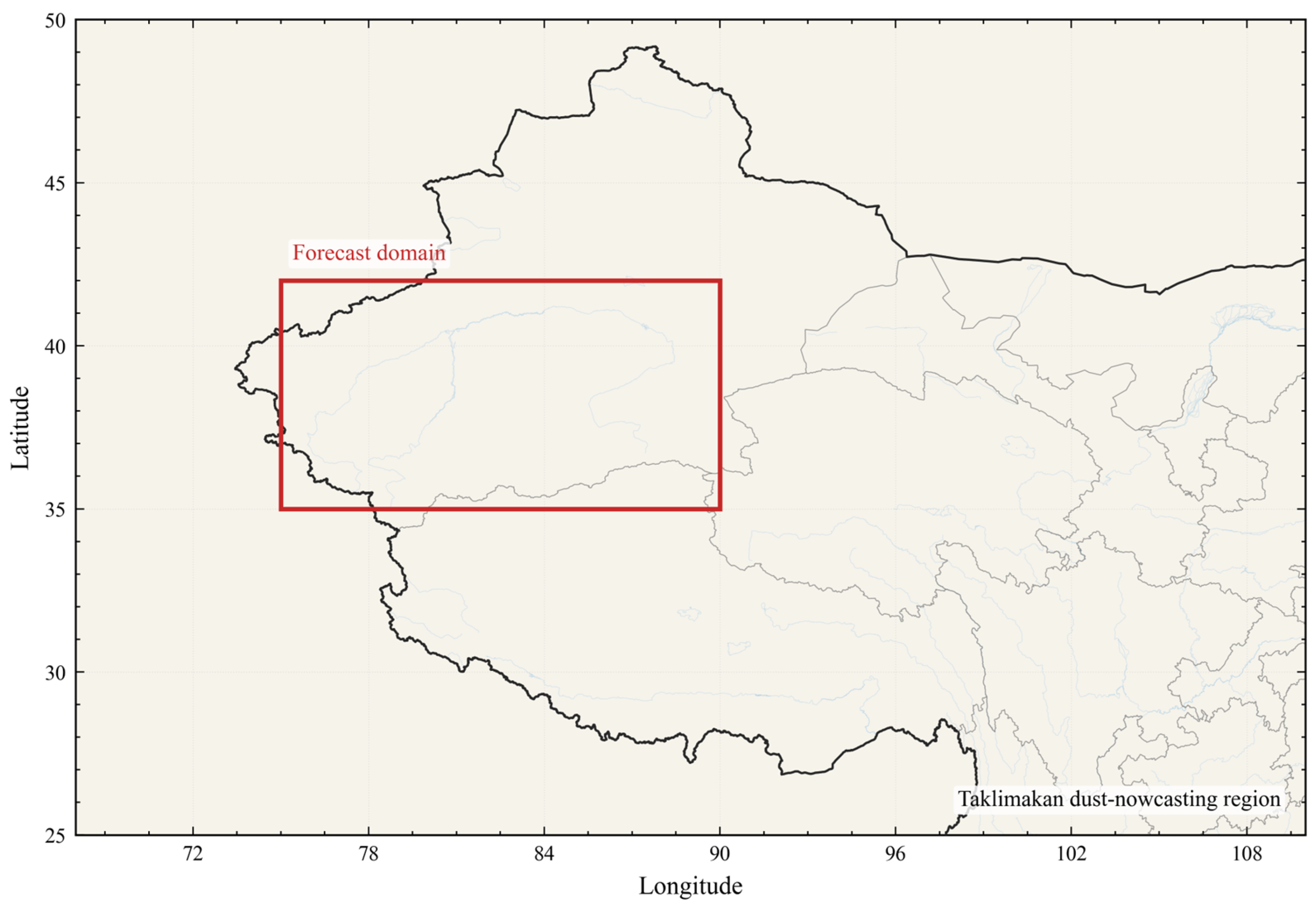
The study area covers the Taklimakan Desert and its surrounding regions, with a range of about 75–90°E and 35–42°N. This region is located in southern Xinjiang and is surrounded by the Tianshan Mountains, Kunlun Mountains, and Altun Mountains. Bare sandy land and mobile dunes are widely distributed inside the basin, making it a typical dust source region in Northwest China. Previous studies have pointed out that the closed topography of the Tarim Basin can affect near-surface winds, boundary-layer development, and dust retention and export processes. As a result, high-dust areas may stay over the desert interior or be transported along basin margins and downstream channels [
5,
7]. The study area includes both the desert interior where local dust emission frequently occurs and the main pathways where dust is transported along basin margins and downstream channels, as shown in
Figure 1. To support joint modeling of FY-4B high-frequency AOD and ERA5 multivariable data, the cropped FY-4B raster domain is resampled to a 48 × 64 model grid. This grid is a computational tensor grid derived from the selected satellite-image crop, rather than an equal-degree latitude-longitude grid; geographic maps are displayed with the corresponding domain extent to preserve spatial interpretation.
2.2. FY-4B AOD Product, Valid Retrieval Coverage, and Missing Data
The FY-4B geostationary meteorological satellite carries the AGRI imager and has high-frequency observation capability. It can provide continuous remote sensing information for aerosol diurnal variation monitoring over East Asia [
12,
13,
14]. This study uses the FY-4B AOD product as the main remote sensing constraint. In preprocessing, time parsing, regional clipping, abnormal-value identification, missing-mask generation, and target-grid resampling are performed. AOD values greater than or equal to 60,000 are treated as invalid retrievals, and a cropped FY-4B scene is excluded when more than 80% of its pixels are missing. The valid-pixel mask is resized together with the AOD field and is retained as an explicit model input. Compared with single-time monitoring applications, nowcasting depends more on the most recent observation memory in continuous time series. Therefore, this study uses not only the AOD values but also the valid-pixel mask and sample coverage at each time so that valid observations, low-confidence areas, and large missing scenes can be separated.
It should be noted that the FY-4B AOD product over the Taklimakan region is affected by bright desert surfaces, cloud contamination, thick dust shielding, and retrieval quality control. Thus, spatial coverage fluctuation and high-AOD uncertainty exist. Bright desert surfaces can increase errors in surface reflectance estimation, and thick aerosol and cloud-edge conditions may also change the sign of retrieval bias. Therefore, this study does not assume that FY-4B AOD always has systematic underestimation or overestimation in all high-AOD scenes [
13,
16,
19]. The evaluation metrics in this study mainly measure spatiotemporal consistency between the model prediction and the FY-4B AOD product field. To provide an independent external reference, we further compare selected cases with MODIS MAIAC AOD and MERRA-2 dust optical depth at the high-value-footprint level. This comparison should be interpreted as an external consistency check of aerosol-enhancement footprints, not as direct pixel-level validation of true atmospheric dust loading. To reduce the influence of product missing data on result interpretation, the main metrics are calculated only on FY-4B valid observation pixels. The results are further analyzed by sample coverage and AOD intensity.
2.3. ERA5 Dynamic Background Variables
This study uses ERA5 reanalysis data to describe the dynamic, thermodynamic, and land-surface background of short-term dust evolution. ERA5 provides globally consistent hourly atmospheric, land, and boundary-layer variables at the reanalysis grid scale; in this study, ERA5 fields were used at a horizontal resolution of 0.25° × 0.25° before collocation to the 48 × 64 model grid [
47]. In this study, hourly ERA5 variables are matched to the 15 min FY-4B AOD samples by nearest-neighbor temporal matching within a maximum allowed gap of 90 min. Input variables include near-surface wind, 100 m wind, boundary-layer height, surface pressure, water vapor, cloud cover, radiation, land-surface temperature, soil moisture, and soil temperature. Model-level vertical wind shear, lower-level stability, Richardson number, and low-level jet-related diagnostic variables are also introduced. These variables provide dynamic background information that cannot be directly observed by FY-4B AOD and are especially used to describe boundary-layer mixing, upper-level momentum transfer, nocturnal low-level jets, and near-surface wind enhancement, which directly affect dust emission and transport.
In addition to ERA5 variables, the model explicitly uses FY-4B AOD and its valid mask from the past 8 time steps. Historical AOD provides memory of the recent dust state and the main dust belt position, while the valid mask helps to distinguish true low AOD from invalid retrieval regions. Based on the distribution of historical valid pixels, the model further constructs quality-related features, such as recent valid-observation ratio, historical coverage, observation confidence, and missing pressure. In this way, high-coverage areas can use more satellite observation memory, while low-coverage areas rely more on ERA5 dynamic background, physical-process summary features, and spatial context. This design allows the model to use the high-frequency time-series information of FY-4B AOD and also infer spatial structures from boundary-layer and transport backgrounds when observations are incomplete.
2.4. Sample Window, Temporal Split, and Evaluation Mask
Based on the unified collocation of FY-4B and ERA5, 30,964 original time samples are obtained. After temporal continuity checking, 15,631 sequence samples that can form input-output windows are retained. The sample period is from 05:45 on 2 September 2022 to 10:00 on 31 August 2025. The model input consists of ERA5 multivariable fields, historical FY-4B AOD, and the corresponding valid masks for the past eight 15 min time steps, which gives a 2 h historical window. This length was selected to include recent dust-belt persistence, short-term intensity tendency, and retrieval-coverage evolution while keeping the sequence length computationally manageable for the hybrid temporal backbone. The main output is the AOD field at the future 15 min lead, and 30, 45, and 60 min forecasts are generated by recursion.
The training, validation, and test sets are divided by monthly temporal blocks, with ratios of 0.85, 0.075, and 0.075. All normalization statistics for ERA5 variables, model-level diagnostic variables, physical proxy channels, and AOD target transformation are computed from the training subset only and then applied unchanged to the validation and test subsets. An 8-time-step temporal buffer is set between adjacent subsets to reduce possible skill overestimation caused by neighboring-sample leakage. Continuous metrics are calculated on FY-4B valid observation pixels, including RMSE, MAE, correlation coefficient R, and R2. Event-based metrics include CSI, POD, and FAR and are calculated at AOD thresholds of 0.8, 1.5, 2.0, and 2.5. The lower threshold captures dust-affected pixels, whereas the higher thresholds evaluate the ability to preserve medium-to-strong and extreme high-AOD structures in the long-tailed Taklimakan dust distribution. In addition to overall metrics, this study focuses on coverage stratification, AOD intensity stratification, seasonal stratification, and multi-lead recursive evaluation in order to explain how FY-4B product-quality conditions affect nowcasting ability.
3. Physics-Informed Hybrid Method for FY-4B AOD-Constrained Dust Nowcasting
3.1. Forecast Problem and Recursive Setting
This study defines Taklimakan dust AOD nowcasting as a gridded prediction problem constrained by high-frequency remote sensing observations and reanalysis dynamic fields. Let the input sequence over the past T time steps be , which includes ERA5 multivariable fields, historical FY-4B AOD, AOD valid masks, and static land-surface information. The model target is to predict the future AOD field . This study uses τ = 15 min as the main lead time and recursively predicts 30, 45, and 60 min AOD fields by feeding the predicted AOD back into the historical window. During recursion, the predicted AOD is transformed back to model space, clipped to the valid model range, inserted into the rolling historical AOD sequence as a pseudo-observation, and assigned a valid pseudo-mask for the fed-back time step; quality-related features such as historical valid fraction, observation confidence, and missing pressure are then recomputed from the updated window. This setting is used to test the effective retention time of the most recent FY-4B observation state within 1 h.
Considering the obvious long-tailed distribution of AOD, this study uses an asinh target transformation to improve training stability: , followed by min-max scaling in the transformed space. During evaluation, predictions are inversely transformed to physical AOD space using , and all continuous and event-based metrics are computed after this inverse transformation. The same target transformation and inverse-transform evaluation protocol are used for the proposed model and all learning-based baselines. For FY-4B missing pixels, the model does not use them as valid supervision targets in the main error calculation, but their locations are passed to the model through the valid-mask channel. This treatment avoids treating invalid retrieval regions as true low AOD and also keeps retrieval coverage as an indicator of forecast uncertainty.
3.2. Multi-Source Input, Historical Valid Observations, and Dynamic Background
FY-4B AOD over the Taklimakan region has missing data, coverage fluctuation, and high-AOD uncertainty. At the same time, the dust AOD field has source-region enhancement and downstream transport structures. Therefore, this study builds a physics-informed FY-4B AOD nowcasting framework. The framework is driven by four types of information. The first type is historical FY-4B AOD and its valid masks, which provide the recent dust state, valid observation range, and missing locations. The second type is ERA5 dynamic and thermodynamic background and model-level diagnostic variables, which describe boundary-layer mixing, vertical wind shear, low-level jets, and transport background. The third type is the physical summary features generated by the physics encoder, including dust emission, transport, deposition, and event support. The fourth type is spatial context and output correction modules, which improve structural representation in low-coverage areas and high-AOD boundaries.
In the feature construction stage, the model first extracts features such as recent valid observation, historical valid ratio, coverage, and missing pressure from historical AOD sequences and valid masks. Then, near-surface wind, 100 m wind, soil moisture, boundary-layer height, and model-level diagnostic variables are used to construct background constraints related to dust enhancement and transport. Different from simply using ERA5 variables as ordinary input channels, this study further sends these variables into a physics encoder. The encoder produces eight summary channels: friction-velocity ratio , threshold margin , effective emission gate, local event gate, source support, transport support, total event-flux proxy, and drag partition. These channels are concatenated with the shared meteorological representation and are passed to the structured prediction heads, where source and transport increments are estimated separately. Therefore, dynamic and thermodynamic information enters the forecast backbone in a form that is closer to the dust process.
3.3. Physics Encoder and Explicit Representation of Source-Transport Processes
The physics encoder first learns land-cover-dependent surface physical parameters, including threshold wind speed, threshold residual correction, roughness length, and erodibility. The learnable threshold wind-speed factors are constrained within , roughness-length factors within , and erodibility factors within 0–1.0 depending on land-cover type, so that parameter updates remain within prescribed physical ranges. Then, near-surface wind, 100 m wind, boundary-layer height, model-level vertical wind shear, lower-level stability, and Richardson number are used to construct friction velocity, stability index, turbulence intensity, turbulent kinetic energy, and a Monin–Obukhov proxy correction. These variables represent the regulation of stable stratification, thermal conditions, and vertical momentum transfer on near-surface dust emission. Soil moisture, roughness, and erodibility are further used to correct the threshold wind speed so that source-region triggering conditions can vary with surface wetness and drag partition.
For source-region enhancement, the model estimates local emission flux from the threshold activation gate, local event gate, 100 m momentum transfer, low-level jet phase release, gust-front proxy, and intermittent emission probability. This helps the model identify source regions that are close to the threshold and may enhance rapidly. For transport propagation, the model constructs non-cyclic upwind AOD from the historical AOD field along the background wind vector and combines transport gate, transport event gate, transport support, and transported flux to estimate the downstream movement and expansion of existing dust belts. Thermal emission flux and dry deposition velocity are also explicitly calculated to represent additional daytime lifting caused by surface heating and short-term AOD loss. Thus, when predicting future AOD, the model learns not only image texture but also physical proxy information of dust emission, transport, and deposition.
3.4. LSTM–TCN–Transformer Hybrid Temporal Backbone, Mask Awareness, and Structured Prediction
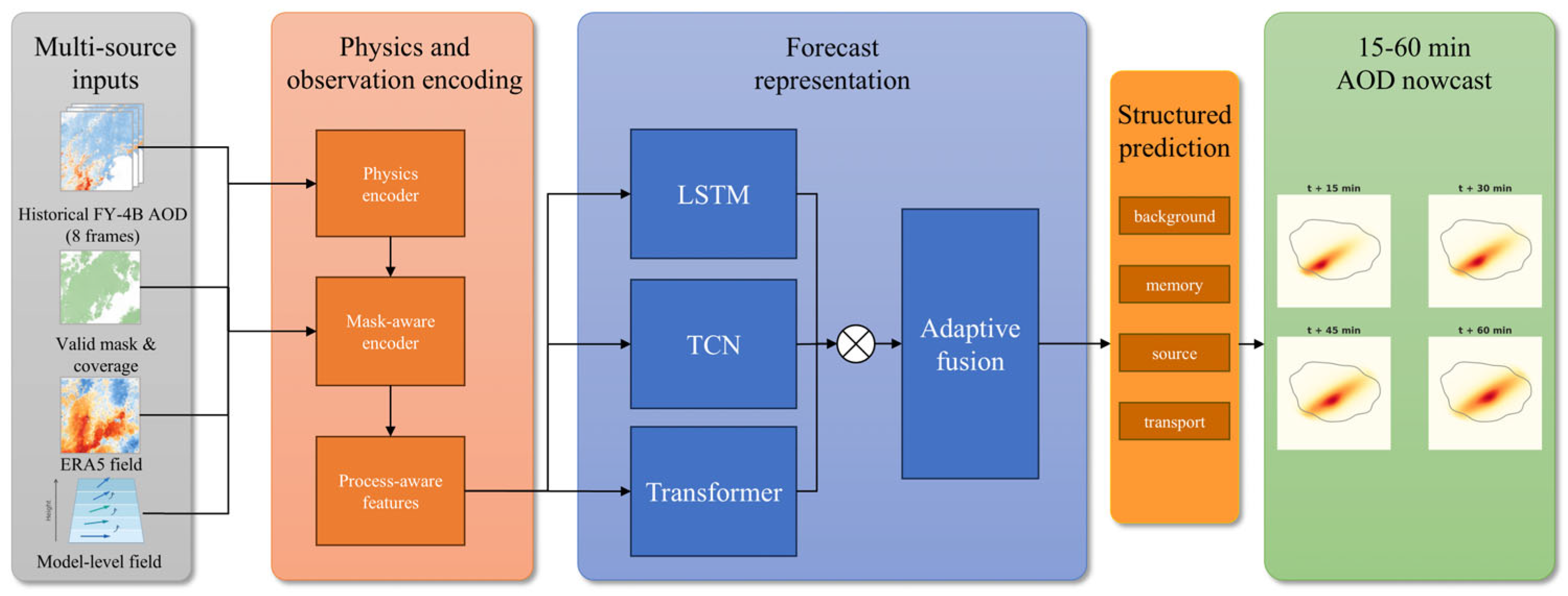
The overall architecture is summarized in
Figure 2. In the network structure, this study adopts a three-branch hybrid temporal backbone of LSTM–TCN–Transformer, together with mask-aware observation encoding, physical-process encoding, lead-aware and regime-aware modulation, and structured prediction heads. The main hyperparameters are summarized in
Table A1. The LSTM branch uses FY-4B AOD, valid masks, and meteorological background features from the past 8 time steps to keep continuous state memory of dust-belt position, intensity variation, and dynamic background. It is suitable for describing the persistent evolution of the main dust belt within a short time. The TCN branch uses one-dimensional temporal convolutions and dilated convolutions to extract local short-term changes, multi-scale temporal gradients, and rapid enhancement signals. It is more sensitive to newly generated high-AOD areas, boundary movement, and local enhancement within 15–60 min. The Transformer branch uses self-attention to build global connections among different times and spatial regions, and it is used to capture the overall displacement of dust belts, non-local links between source regions and downstream areas, and longer temporal dependence. The outputs of the three branches are combined by an adaptive fusion module, and the fusion weights can change with meteorological background, retrieval coverage, source support, and transport support. Therefore, the model can use different temporal information sources under high-coverage, low-coverage, local-emission, and regional-transport situations. The Mask-Aware Observation Encoder uses the idea of partial convolution to encode historical AOD and valid masks so that valid regions and missing regions have different weights in feature extraction and false smoothing under large missing areas is reduced. The physics encoder provides summary features of boundary-layer mixing, vertical wind shear, source-region emission, upwind transport, and deposition loss, and these features enter the structured prediction heads together with the output of the temporal backbone and spatial-context modules. At the prediction stage, the future AOD field is decomposed into background, memory-adjustment, source-increment, and transport-increment components. Persistence blending, tail refinement, full-resolution refinement, and missing-region refinement are further added. The background head represents low-frequency persistent structures; memory_adjust corrects historical observation memory; the source stream represents newly generated high-value areas; the transport stream represents propagation of existing dust belts; and the high-value and low-confidence correction modules improve strong dust cores and large missing-data areas.
3.5. Physics-Constrained Training, Baseline Methods, and Evaluation Metrics
For AOD fields, low-value pixels are the majority, while high-value pixels are rare but more important for applications. Therefore, this study uses a training objective composed of basic reconstruction error, high-value weighting, event-based constraints, and spatial-consistency constraints. To enhance physical consistency, the training loss further includes weak emission-deposition mass conservation/mass balance regularization, physical-parameter prior regularization, physical-feature spatial conservation, advection consistency, suppression of over-enhancement under inactive physical conditions, a 15 min persistence-skill lower-bound constraint, stripe suppression in low-confidence regions, and high-AOD tail quantile matching. These constraints do not force the model to become a complete chemical transport model. Instead, they provide weak physical boundaries in data-driven learning, making the predicted increments more consistent with basic rules of source release, transport propagation, deposition loss, and the rarity of high-value events. Historical AOD masking augmentation is also used during training so that the model sees different degrees of missing observations and the error amplification caused by insufficient historical information under low-coverage conditions can be reduced. Multi-lead forecasting is implemented by a single-step model with recursion. The 15 min prediction is fed back into the historical AOD window to generate 30, 45, and 60 min forecasts. The comparison methods include Persistence, Adv-Persistence, ConvLSTM, and ST-UNet. Persistence directly uses the most recent valid AOD field as the future forecast, without considering dust-belt displacement or intensity change. Adv-Persistence uses the ERA5 100 m wind field when u100/v100 are available, with u10/v10 used as fallback fields, to advect the most recent AOD field on the basis of persistence; it therefore represents a simple wind-driven dynamic extrapolation baseline. ConvLSTM and ST-UNet represent a commonly used recurrent spatiotemporal network and an encoder-decoder spatial prediction network, respectively. All methods use the same data split and valid-pixel evaluation mask.
4. Results
4.1. Overall Skill at the Main 15 min Lead Time
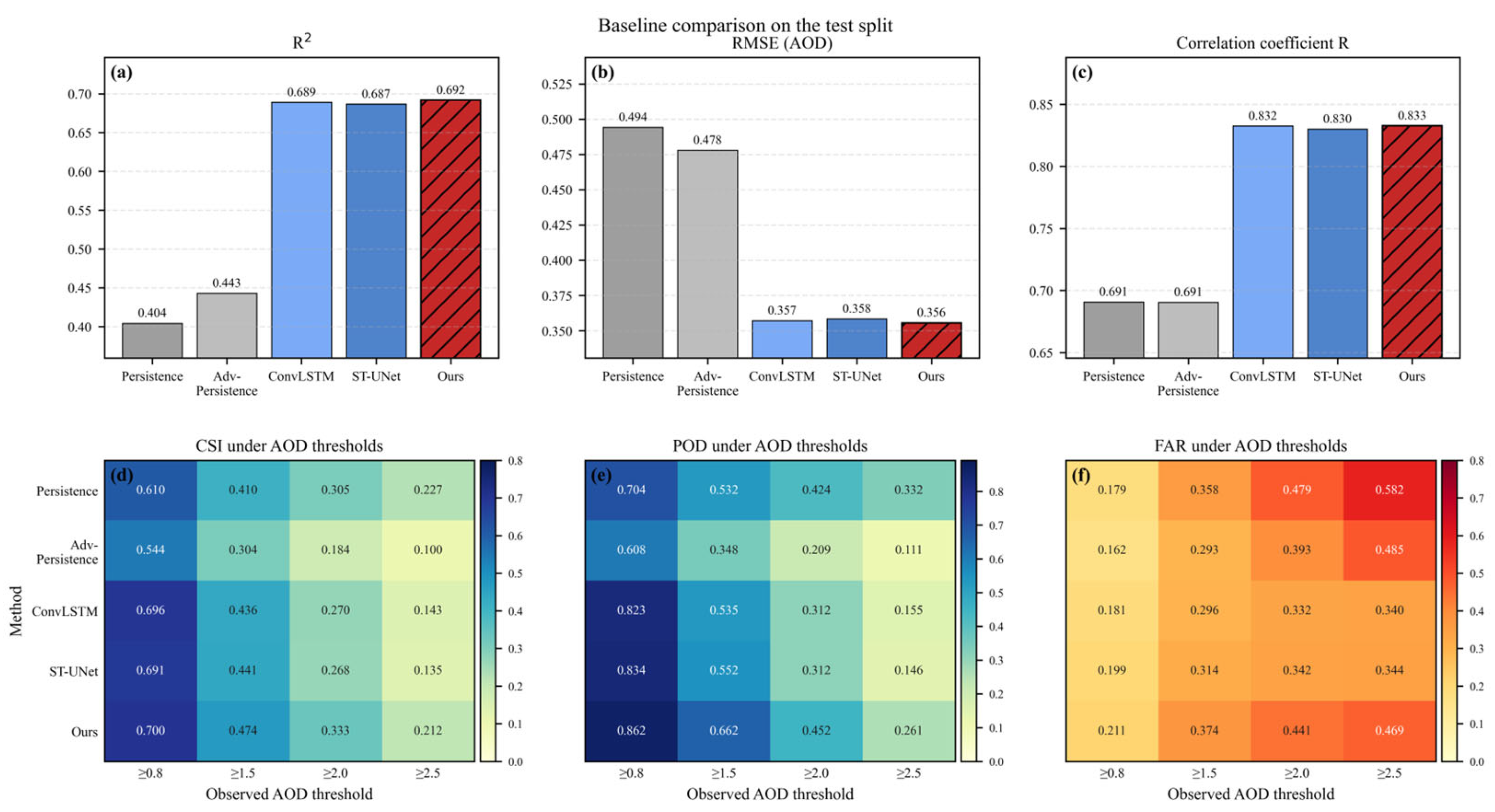
Figure 3 compares the proposed method with several baselines at the main 15 min lead time. The persistence method still has some skill at this short lead time, indicating that the most recent FY-4B AOD observation contains strong state memory. However, persistence forecasting cannot describe dust-belt movement, expansion, and newly generated high-AOD areas. Adv-Persistence can improve some transport cases by adding advection information, but it is still difficult to handle local emissions, boundary-layer momentum transfer, and structural missing information in low-coverage samples. ConvLSTM and ST-UNet can learn spatiotemporal structures, and their overall performance is better than traditional extrapolation baselines, but they lack explicit source-transport decomposition and weak physical constraints. The proposed method reaches a more stable balance between overall spatial consistency and high-AOD event detection, suggesting that historical AOD, valid masks, boundary layer and vertical structure information, LSTM–TCN–Transformer temporal representation and spatial-structure prediction, source-transport dual-stream representation, and physics-constrained losses jointly improve the nowcasting of FY-4B AOD fields.
The high-AOD threshold event metrics in
Figure 3 show that the advantage of the proposed method is mainly in dust-affected pixels and medium-to-high AOD areas. As the AOD threshold increases, the event skill of all methods decreases. However, the proposed method still keeps a relative advantage at higher thresholds, indicating that source-region enhancement, transport propagation, and high-value correction contribute to the identification of strong dust belts. This result supports the use of FY-4B high-frequency AOD as a core state constraint for nowcasting and also suggests that the high-value tail should be diagnosed separately.
From the mechanism of the results, the combined input of historical AOD and its valid mask helps distinguish observations missing from true low values. Source-region enhancement and transport propagation information help the model consider both newly generated dust areas and the continuation of existing dust belts. Therefore, relatively stable spatial-structure performance can be maintained at both the main lead time and recursive lead times.
4.2. Information Decay in 15–60 min Recursive Prediction
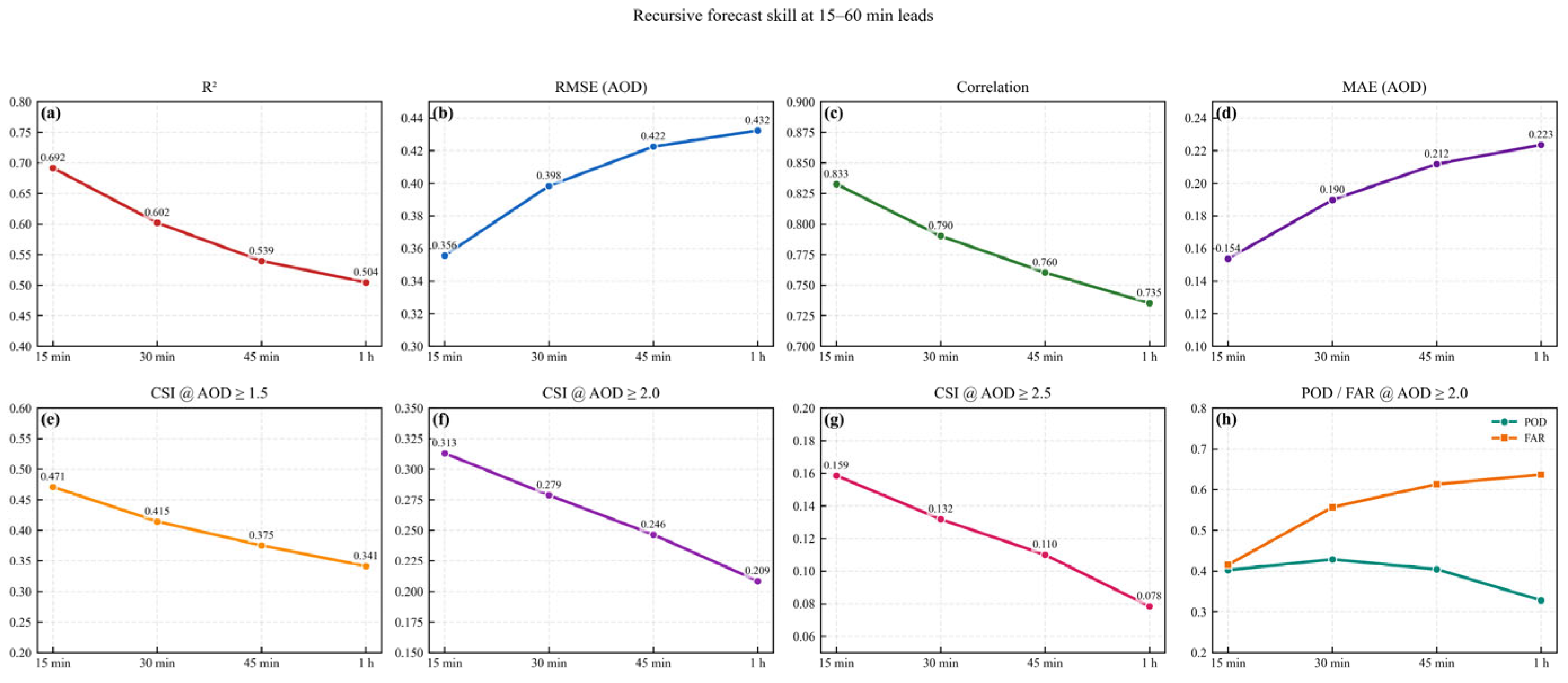
Figure 4 and
Table A2 show the forecast skill changes from 15 to 60 min recursive predictions. As lead time increases, R
2 and correlation coefficient gradually decrease, while RMSE and MAE gradually increase. This indicates that the constraint from the most recent FY-4B AOD observation on the current dust state weakens during recursion. The change also shows that the 15 min forecast is more controlled by recent valid observations and short-term dynamic background, while the 45–60 min forecasts require the model to continuously infer dust-belt movement and intensity change without real new observations being fed back. Even so, the 60 min lead still keeps usable spatial consistency, suggesting that FY-4B high-frequency observations have continuous information value for dust nowcasting within 1 h.
The decay rates of different metrics are not the same. High-AOD event skill usually decreases faster than overall correlation. This means that the model preserves the main dust belt position and large-scale propagation direction better than the extreme high-value core and detailed boundaries. In other words, FY-4B high-frequency AOD provides useful constraints on dust influence range and spatial structure within 1 h, while peak-intensity prediction is still limited by missing historical observations, product high-AOD uncertainty, and accumulated recursive errors.
4.3. Control of Valid Retrieval Coverage on Forecast Skill
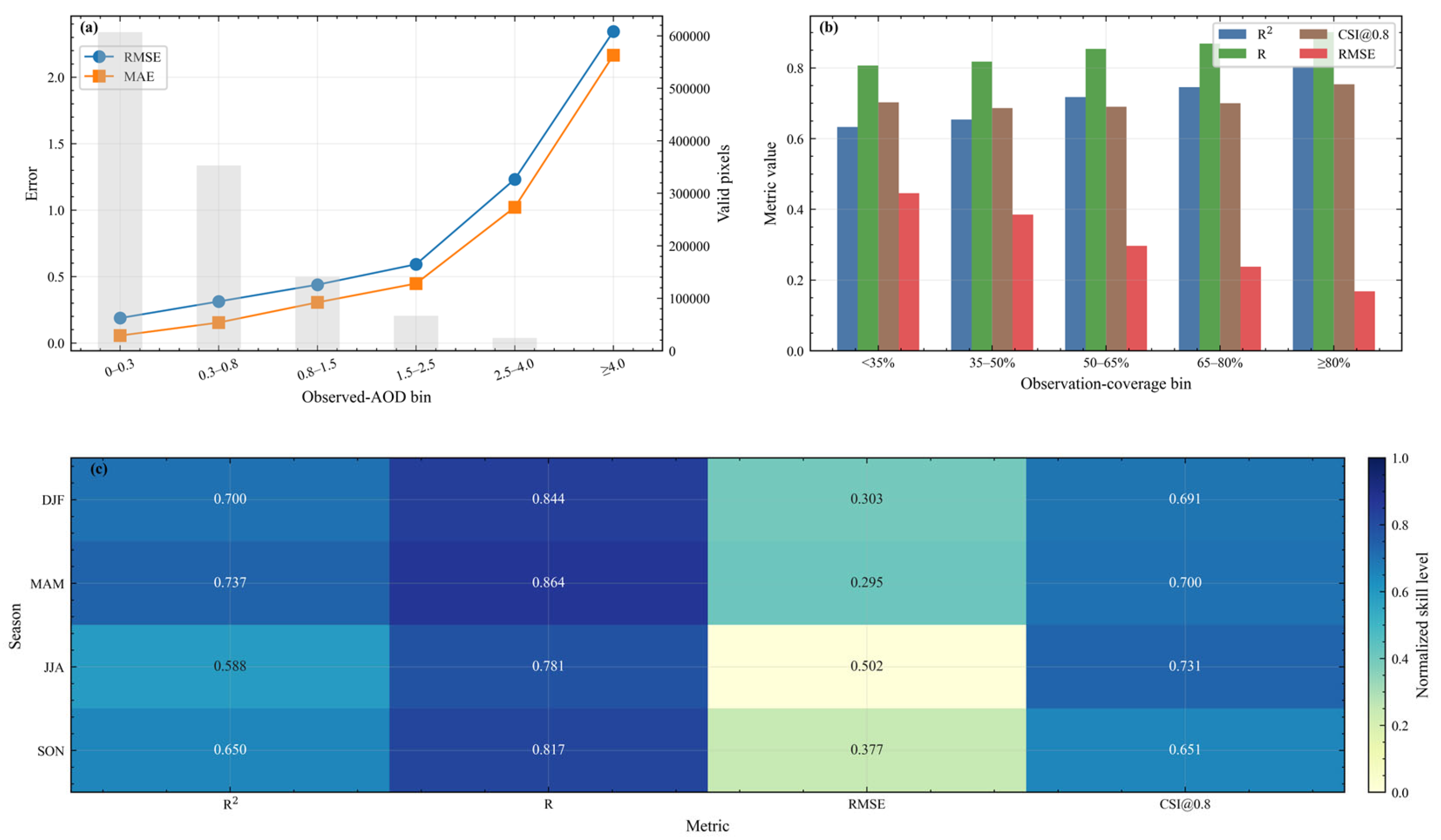
As shown in
Figure 5, the coverage-stratified results show that the completeness of FY-4B valid observations is a key factor controlling nowcasting performance. The intensity-stratified results show increasing errors and stronger underestimation in the highest-AOD bins, while the coverage-stratified results indicate that valid-pixel completeness is an important control on forecast skill. The seasonal heat map summarizes the combined influence of dust activity, boundary-layer background, and satellite retrieval conditions. In high-coverage samples, historical AOD can provide relatively complete information on the main dust belt position, spatial extent, and intensity background, and the forecast field is more consistent with the FY-4B observation field. In low-coverage samples, the model can still use ERA5 dynamic background and spatial context to identify the main affected area, but the high-value core and detailed boundaries are more easily underestimated. This result indicates that the forecast value of geostationary AOD comes from high temporal resolution and also depends on the spatial completeness of valid pixels.
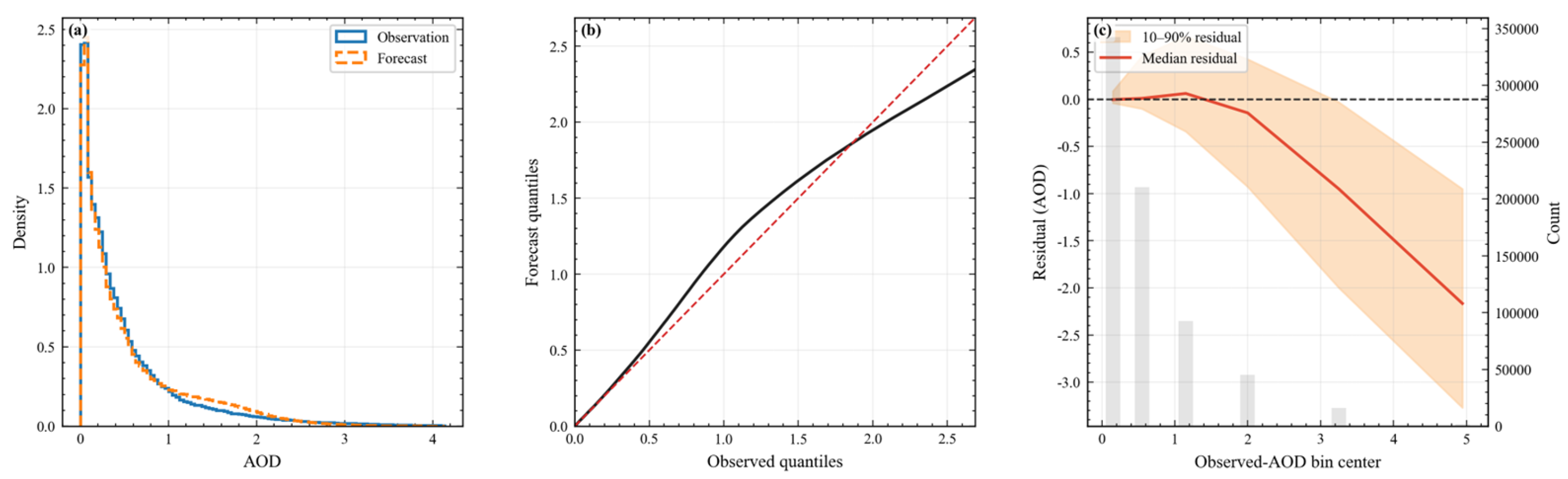
4.4. High-AOD Tail Distribution and Strong-Dust Underestimation
Figure 6 further shows that the model has relatively stable fitting ability in low-to-moderate and moderate dust intervals but has a more obvious negative bias in the extreme high-AOD interval. The results indicate that the model captures the main distribution pattern but still tends to underestimate extreme high-AOD values. The distribution curve, quantile consistency, and residual boxplots jointly show that, as FY-4B observed AOD increases, the predicted values respond to the peak more conservatively. This phenomenon is related to the long-tailed training-sample distribution, AOD retrieval uncertainty under thick dust conditions, reduced valid coverage, and accumulated recursive forecast errors. It should be emphasized that the negative bias here means model underestimation relative to FY-4B valid retrieval pixels. It cannot directly indicate the bias direction of the FY-4B product relative to true atmospheric AOD.
Combining coverage stratification and intensity stratification shows that “high AOD + low coverage” is the most difficult remote sensing nowcasting scene in this study. In such samples, historical AOD lacks complete spatial constraints, and the strong dust core is more easily affected by cloud contamination, thick aerosols, bright surfaces, and quality control. The model has to rely more on dynamic background and neighborhood structure, so peak values are more easily underestimated and boundaries become more diffuse. This result suggests that improving nowcasting of extreme dust events in the future requires additional constraints from multi-source AOD, AERONET, ground PM10, lidar, or aerosol reanalysis products for low-coverage high-AOD samples.
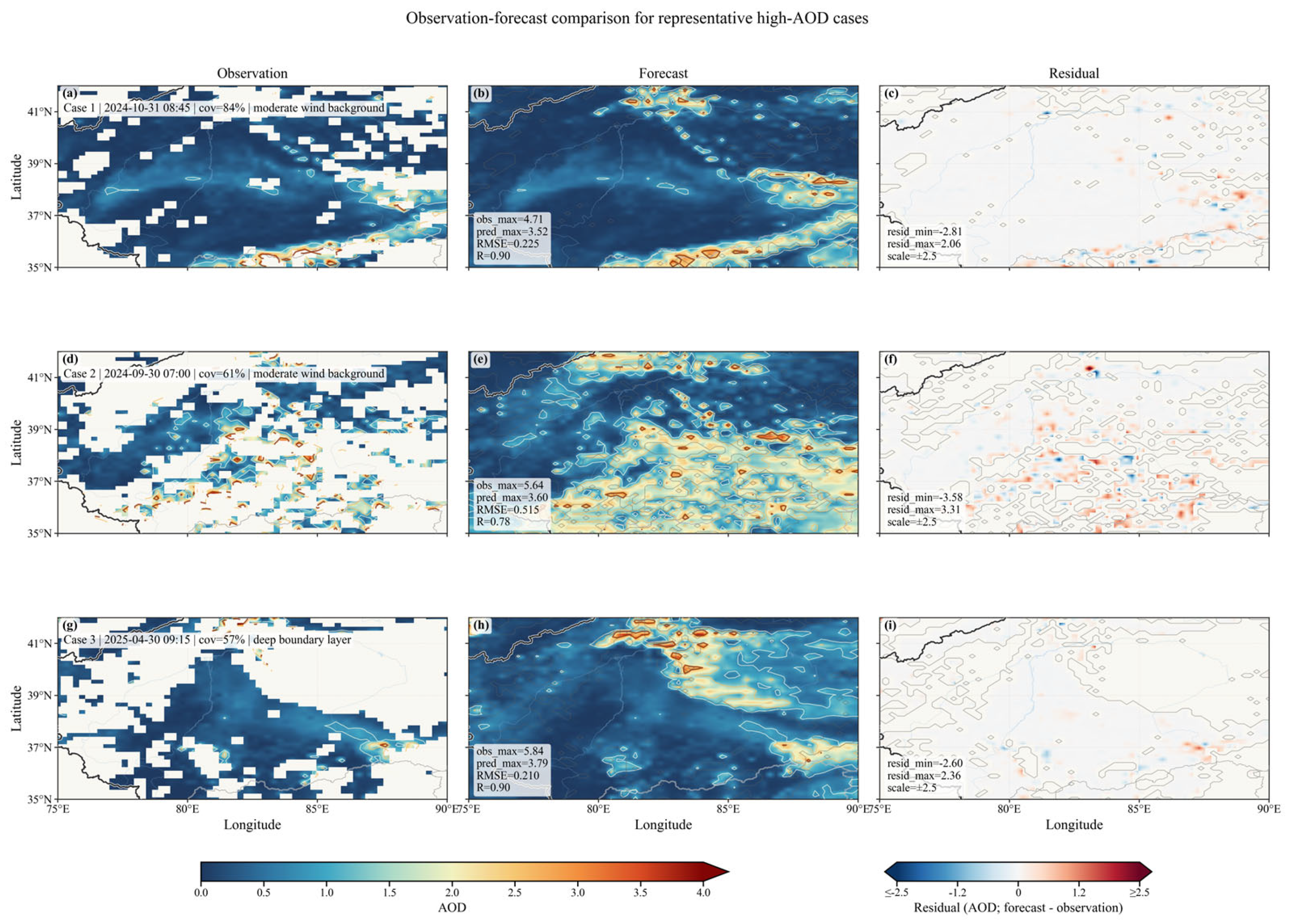
4.5. Typical Cases: High-Coverage, Missing-Boundary, and Difficult High-AOD Scenes
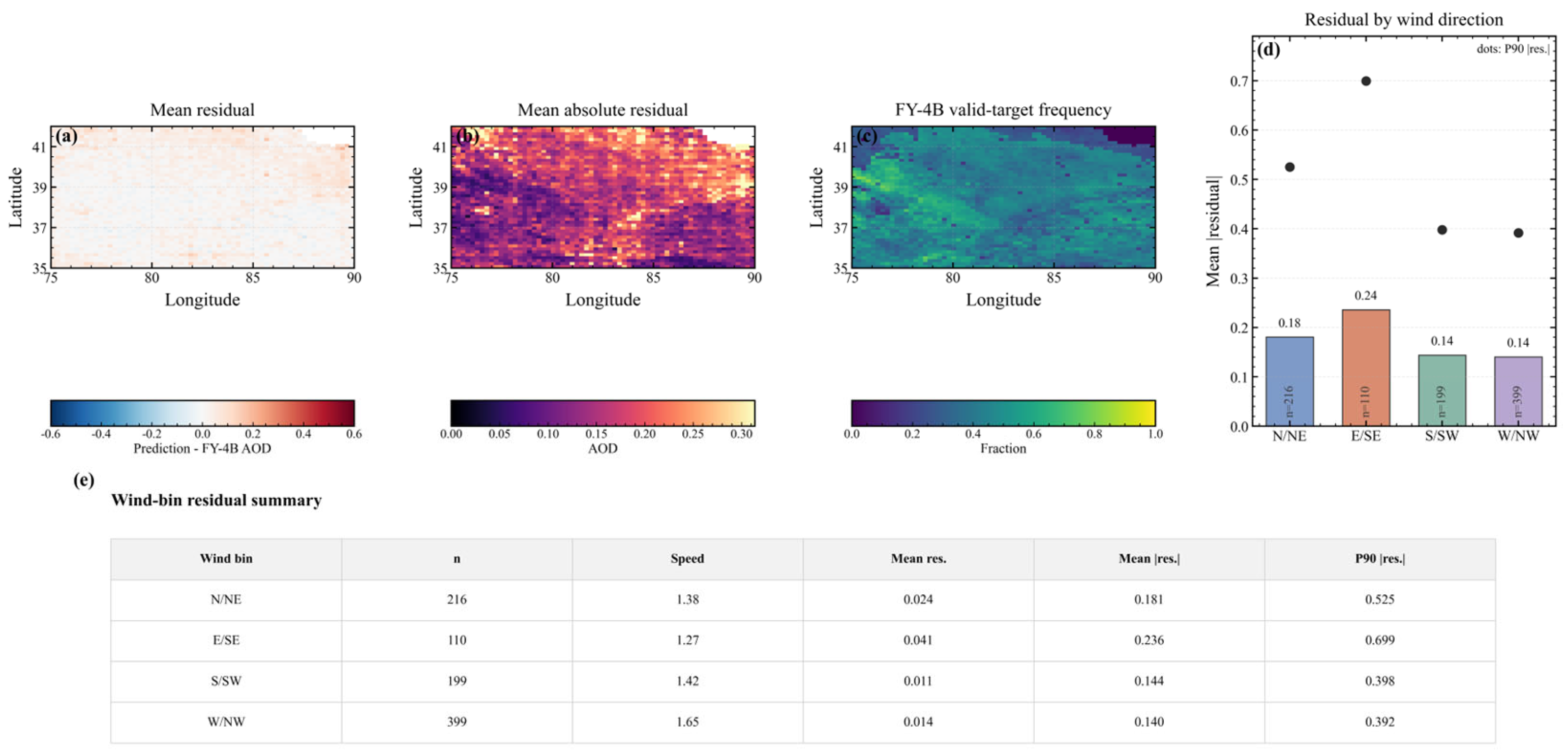
Figure 7 shows that the model can reproduce the main dust belt direction inside the basin and its downstream propagation pattern in representative high-AOD cases. The three selected cases represent a high-coverage dust-belt scene, a missing-boundary broad-event scene, and a difficult high-AOD core scene, respectively. The model generally preserves the main dust-belt position and large-scale transport pattern, while larger residuals occur near extreme high-value cores, missing-data boundaries, and local sudden-enhancement regions. In samples with high FY-4B valid coverage and continuous dust-belt structure, the forecast field is generally consistent with the observation field in the main affected area, high-value range, and downstream extension direction. Residuals are mainly located near high-value edges and local peak regions. The test-set spatial residual diagnosis further shows that the mean residual is generally weak compared with the mean absolute residual, suggesting that local positive and negative errors partly compensate in domain-mean statistics (
Figure A1). Larger absolute residuals occur mainly in regions with frequent high-gradient AOD structures and variable FY-4B valid-target coverage. We further grouped the test samples by dominant 100 m wind direction and composited the residual fields (
Figure A2 and
Table A6). The E/SE wind bin shows the largest mean absolute residual and 90th-percentile absolute residual, while the W/NW and S/SW bins show weaker residual amplitudes. In low-coverage or locally sudden-enhancement samples, the model can still identify the main affected area, but errors in the high-value core and detailed boundaries become larger. This indicates that recent valid AOD observations provide key constraints for dust nowcasting.
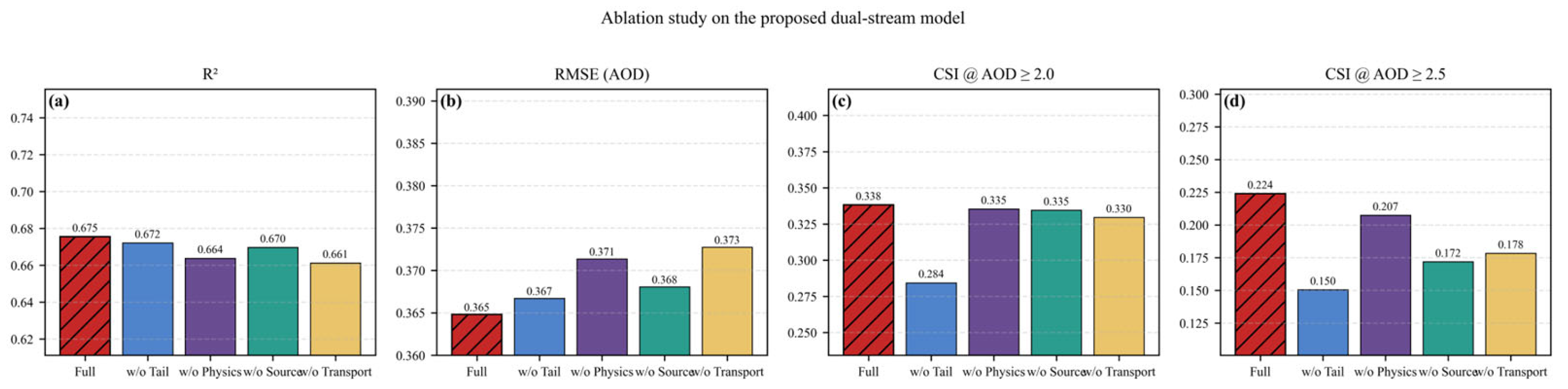
4.6. Ablation Analysis
Figure 8 and
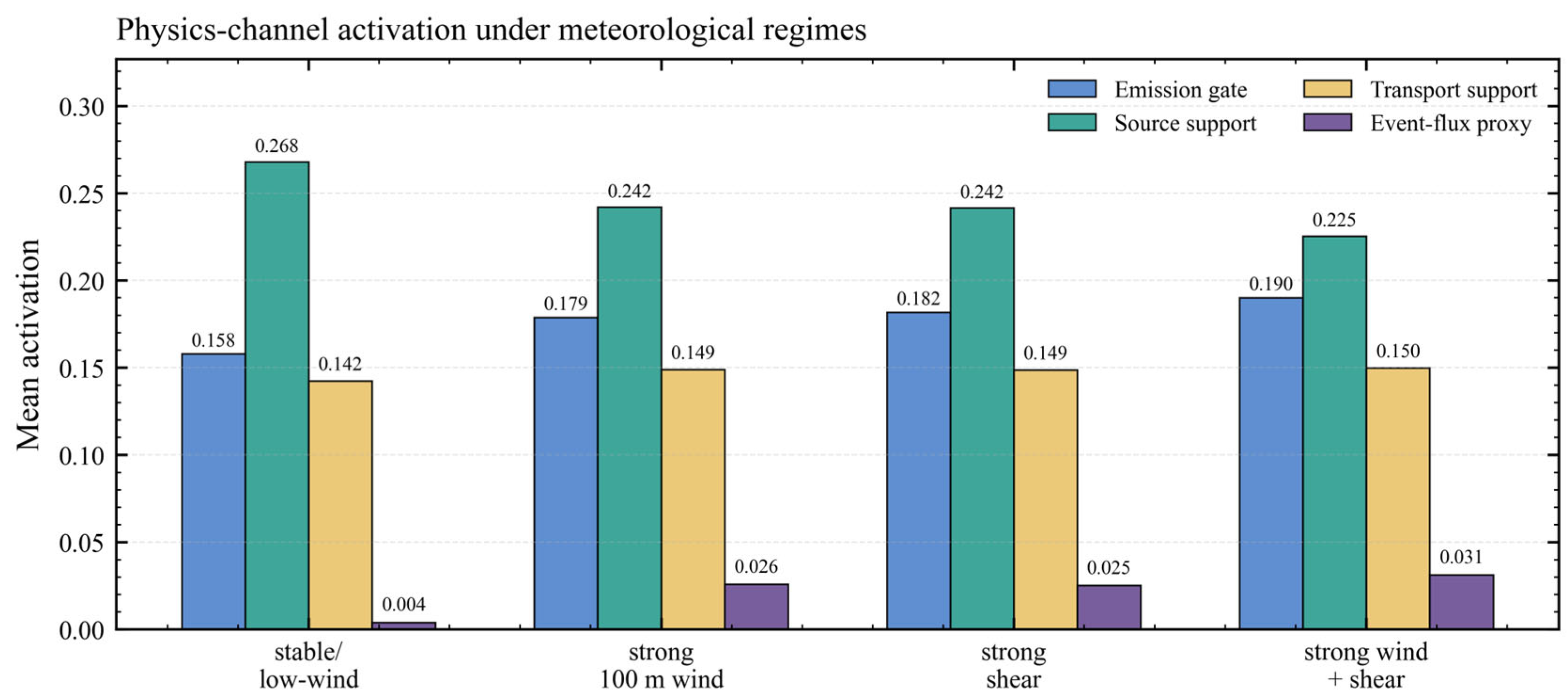
Table A3 show that different modules make different contributions to the remote-sensing AOD forecast field. Different variants show different types of performance degradation, indicating that FY-4B AOD nowcasting skill is jointly controlled by historical observation completeness, boundary-layer and vertical-structure constraints, source-transport process representation, and spatial-structure correction. Historical valid-observation information helps distinguish valid AOD constraints from missing areas. To further diagnose this behavior, we summarized the activation of the effective emission gate, source support, transport support, and event-flux proxy under different meteorological regimes (
Figure A2 and
Table A5). Compared with stable low-wind samples, strong-wind and strong-shear regimes show higher effective emission-gate activation and a much larger event-flux proxy. Source support remains highest in the stable low-wind category, reflecting its role as a land-surface and source-region background constraint with weaker dependence on instantaneous wind triggering. The source-enhancement stream mainly improves newly generated high-value areas and near-threshold emission scenes, while the transport-propagation stream mainly improves the structural representation of existing dust belts moving and expanding along the background wind. The high-AOD tail and low-confidence-region correction modules mainly affect strong dust cores, large missing-data areas, and high-gradient boundaries.
4.7. External Consistency Check with MODIS MAIAC and MERRA-2
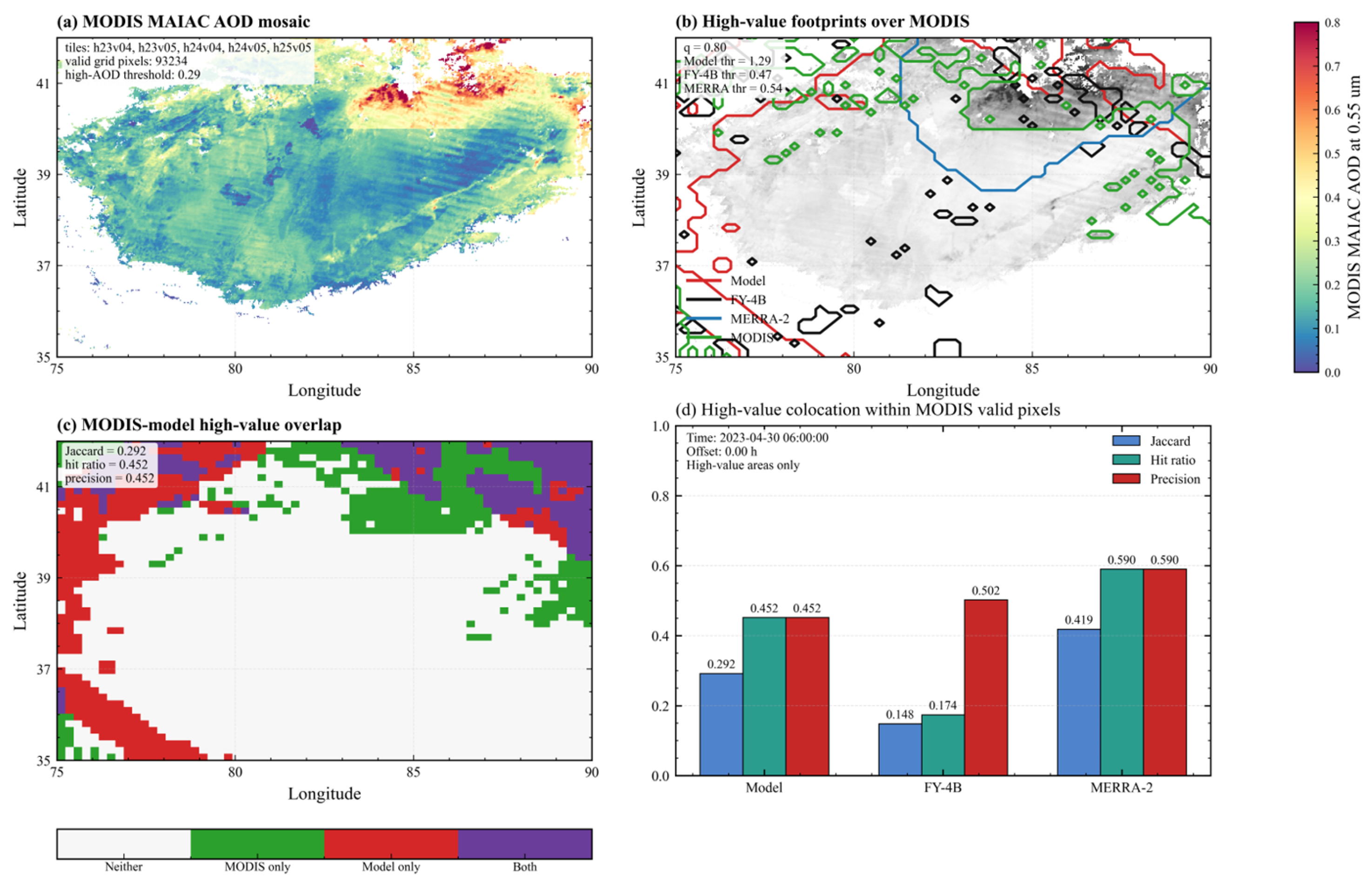
To further address the limitation that the main evaluation is referenced to the FY-4B AOD product field, we conducted an external footprint-level consistency check using independent MODIS MAIAC AOD retrievals and MERRA-2 dust optical depth, as shown in
Figure 9. This analysis examines whether the predicted high-AOD footprint is spatially colocated with independently observed aerosol-enhancement regions under available MODIS clear-sky retrievals. It should be interpreted as an external consistency check of high-value aerosol footprints and should not be treated as pixel-level validation of true atmospheric dust loading.
For the case on 30 April 2023, five MODIS MAIAC MCD19A2 tiles covering the study domain were mosaicked, including h23v04, h23v05, h24v04, h24v05, and h25v05. The external-reference time matched the FY-4B/model test sample at 06:00 UTC with zero-hour offset. High-value footprints were defined using the upper 20% of valid pixels for each product, which avoids imposing a common absolute AOD threshold on products with different dynamic ranges and physical meanings.
Within MODIS-valid pixels, the model-MODIS high-value overlap reaches a Jaccard index of 0.292, a hit ratio of 0.452, and a precision of 0.452. The corresponding MERRA-2-MODIS overlap is higher, with a Jaccard index of 0.419 and a hit ratio of 0.590, consistent with the smoother large-scale nature of MERRA-2 reanalysis. These results indicate that the proposed model captures part of the externally observed high-AOD footprint; however, because the comparison is based on one clear-sky MODIS case and footprint-level overlap metrics, it should be used only as supporting evidence rather than as a quantitative validation of absolute AOD.
5. Discussion
5.1. Nowcasting Information Value of FY-4B High-Frequency AOD
From the view of remote-sensing AOD image evolution, source-region enhancement and regional transport show two different spatial structures. Source-region enhancement usually corresponds to the rapid appearance of high-AOD cores in the desert interior or near basin margins. Regional transport appears as the movement, expansion, and decay of existing dust belts along the background wind field. The model design in this study writes these two structures into the prediction heads and explicitly considers boundary-layer height, lower-level stability, vertical wind shear, low-level jets, soil moisture, and erodibility in the physics encoder. This physics-informed spatiotemporal architecture allows the model to combine FY-4B high-frequency AOD memory with spatial plume-structure representation under different physical regimes. The LSTM branch is more suitable for maintaining the continuous state of existing dust belts, the TCN branch is more suitable for short-term abrupt changes and local enhancement, and the Transformer branch is more suitable for connecting source regions with downstream areas. With the physics encoder, the model can better sense direct emission caused by near-surface strong wind, enhancement triggered by downward momentum transfer, additional daytime lifting caused by surface heating, and upwind dust-belt transport.
As a new-generation geostationary meteorological satellite of China, FY-4B provides high-frequency AOD observations that serve as important spatiotemporal constraints for dust AOD nowcasting over the Taklimakan Desert. The results show that recent historical AOD has the strongest constraint at the 15 min main lead time. After recursion to 60 min, the model can still keep the main dust belt position and influence range, but high-AOD event skill decreases faster. This means that the main contribution of geostationary satellite AOD within 1 h is to provide the current spatial state and the main dust belt shape. Peak intensity and local sudden enhancement still need more reliable observations or additional physical information. This result is also useful for other geostationary-satellite-driven nowcasting tasks. For rapidly changing targets such as cloud, fire, aerosol, and dust, high temporal resolution can be fully converted into forecast skill only when valid observations have enough spatial completeness. Therefore, future geostationary-satellite nowcasting studies should include product quality flags, coverage, missing-data patterns, and target-intensity distribution in model design and result interpretation and should report both overall errors and condition-stratified errors.
5.2. Product Coverage, High-AOD Uncertainty, and Application Boundary
The results of this study show that the nowcasting information value of FY-4B AOD has clear coverage dependence and intensity dependence. In high-coverage samples, recent valid observations can relatively completely constrain the main dust belt position and spatial range. In low-coverage samples, the model needs to rely more on ERA5 dynamic background, the physics encoder, and neighborhood spatial structure, and peak intensity and high-gradient boundaries are more likely to have errors. The high-AOD tail distribution further shows that extreme strong dust samples are affected by sample scarcity, product retrieval uncertainty, and model smoothing at the same time (
Table A4). In the test set, valid pixels with AOD < 0.8 account for 80.37% of all valid pixels, whereas pixels with AOD ≥ 3.0 account for only 1.20%. This long-tailed pixel-level distribution confirms that the highest-AOD tail provides much fewer training examples and explains why extreme high-AOD cores are more prone to conservative prediction. Explicit physical-process representation can help the model maintain dust-belt structure in some low-coverage scenes, but it cannot fully replace missing satellite observations. Therefore, FY-4B high-frequency AOD is more suitable for constraining the dust influence range and main dust belt shape within 1 h. Prediction of extreme peak intensity still needs multi-source observations and probabilistic uncertainty representation.
5.3. Limitations and Future Multi-Source Validation
Although the proposed method obtains relatively stable spatial performance in high-frequency dust AOD nowcasting over the Taklimakan Desert, several limitations remain. First, FY-4B AOD is used as the supervision target and the main evaluation object. Therefore, the metrics in this study mainly reflect the forecast consistency with the FY-4B AOD product field. Although we added a MODIS MAIAC/MERRA-2 external footprint-level consistency check for selected cases, dense independent validation with AERONET, lidar, ground PM10, and multi-source satellite products is still needed to quantify true atmospheric dust loading. Second, low-coverage and extreme high-AOD samples are still the main error sources, which are related to FY-4B product quality, long-tailed training samples, and accumulated recursive errors. Finally, ERA5 can only provide dynamic background at the reanalysis scale. Local gusts, downbursts, dune-scale dust emission, and small-scale boundary-layer disturbances are still difficult to fully describe with the current inputs.
Based on this study, future work can be improved from three aspects. On the observation side, AERONET, PM10, lidar, multi-source satellite AOD, and aerosol reanalysis products can be combined to provide more reliable validation references for low-coverage and extreme high-AOD samples. On the method side, the current deterministic recursive framework can be extended to probabilistic or ensemble forecasting so that product missing data, high-value retrieval uncertainty, and model recursive errors can be quantified. On the application side, the current framework can be applied to other geostationary satellites and dust source regions, to compare the actual constraints of high-frequency AOD under different product conditions.
6. Conclusions
This study investigates the short-term information value of FY-4B high-frequency AOD for dust nowcasting over the Taklimakan Desert, a bright-surface source region where aerosol retrievals are frequently affected by missing pixels, variable coverage, and high-AOD uncertainty. A physics-informed nowcasting framework is developed by combining historical FY-4B AOD, valid-mask sequences, ERA5 dynamic background fields, model-level vertical diagnostics, and surface constraints. The framework uses an LSTM–TCN–Transformer hybrid temporal backbone to represent state memory, local temporal gradients, and longer-range dependency and further introduces a physics encoder to describe boundary-layer mixing, vertical wind shear, source-region emission, upwind transport, and deposition loss. Mask-aware observation encoding and structured prediction heads are used to handle valid retrieval memory, missing-region context, source and transport increments, high-AOD tails, and low-confidence areas.
The experiments show that FY-4B AOD can provide effective constraints on the main dust-belt position and spatial extent within 1 h. Forecast skill is strongest at the 15 min lead time and decreases with recursive prediction to 30, 45, and 60 min. This decay is more evident for high-AOD event metrics than for overall continuous metrics, indicating that the large-scale dust influence range is more predictable than the extreme peak intensity and sharp boundaries. The proposed framework outperforms persistence, advective persistence, ConvLSTM, and ST-UNet baselines in maintaining spatial structure and detecting medium-to-high AOD events, suggesting that high-frequency geostationary AOD, valid-mask information, physical-process encoding, and hybrid temporal representation provide complementary constraints for short-term dust evolution.
The results also reveal a clear dependence on retrieval coverage and AOD intensity. High-coverage samples allow recent valid observations to constrain the dust plume more completely, while low-coverage samples require stronger dependence on dynamic background, physical-process features, and spatial context. Extreme high-AOD cases remain the most difficult scenes because they are influenced by retrieval uncertainty, long-tailed sample distribution, and smoothing during recursive prediction. Therefore, the proposed method is most reliable for representing the location, extent, and evolution tendency of dust plumes within 1 h, while quantitative estimation of extreme AOD peaks still requires additional independent observations and uncertainty-aware prediction.
Several limitations should be addressed in future work. First, the current evaluation mainly measures consistency with the FY-4B AOD product field. The added MODIS MAIAC/MERRA-2 case comparison provides an external footprint-level consistency check, while dense validation with AERONET, lidar, ground PM10, and multi-source satellite products remains necessary before the FY-4B-constrained forecasts can be interpreted as absolute atmospheric dust-loading estimates. Second, local gust fronts, sub-grid emission bursts, and small-scale boundary-layer turbulence cannot be fully represented by ERA5-scale dynamic fields. Third, recursive nowcasting may accumulate errors when new valid satellite observations are unavailable. Future work should focus on multi-source AOD fusion, probabilistic high-AOD prediction, independent event validation, and physically constrained data assimilation so that geostationary satellite AOD can be used more reliably in operational dust monitoring and early warning over arid and semi-arid regions.