Technical Note

Evaluation of SBAS-Enhanced Positioning Performance Under Different Latitudes and Geomagnetic Activity Levels


College of Intelligent Systems Science and Engineering, Harbin Engineering University, Harbin 150001, China
*
Author to whom correspondence should be addressed.
Remote Sens. 2026, 18(12), 1918; https://doi.org/10.3390/rs18121918
Submission received: 27 April 2026 / Revised: 31 May 2026 / Accepted: 5 June 2026 / Published: 10 June 2026
(This article belongs to the Section Engineering Remote Sensing)

Highlights

What are the main findings?
  • A systematic multi-dimensional evaluation shows that EGNOS-enhanced single-frequency positioning performance is affected by latitude, seasonal variation, and geomagnetic activity.
  • SBAS significantly improves positioning accuracy, stability, integrity, and availability, although performance degradation occurs under disturbed geomagnetic conditions.
What are the implications of the main findings?
  • The study provides operational evidence for the effectiveness of SBAS-enhanced positioning under diverse environmental conditions within the EGNOS service area.
  • The results support the assessment of SBAS applicability for safety-of-life applications and highlight the need to consider space-weather disturbances in robustness evaluations.

Abstract

The ionosphere is a major error source in single-frequency GNSS positioning, and Satellite-Based Augmentation Systems (SBAS) mitigate this effect by providing real-time correction information. However, the performance of SBAS under different latitude regions and geomagnetic activity levels still requires further evaluation. Taking EGNOS as an example, this study assesses SBAS-enhanced positioning performance using data from nine IGS stations across Europe. The experiments cover relatively low-, mid-, and high-latitude regions within the EGNOS service area, four representative quarters in 2023, and two disturbed geomagnetic events. Results show: (1) SBAS significantly improves positioning accuracy in all latitude regions, with overall improvement rates ranging from 62.11% to 83.51%. (2) The relatively low-latitude region achieves the largest performance gains, while the mid-latitude region provides the most stable and accurate results. (3) Under disturbed geomagnetic conditions, SBAS still outperforms conventional SPP, but its performance decreases compared with low-Kp periods, with latitude-dependent degradation observed at both MAS1 and SOD3. (4) The integrity analysis further shows that APV II availability reaches 91.85%, whereas CAT I availability decreases to 86.95% under disturbed conditions. Overall, SBAS effectively improves single-frequency positioning accuracy, stability, and integrity, but its performance remains affected by latitude and geomagnetic activity.

1. Introduction

The Global Navigation Satellite System (GNSS) has been widely adopted in navigation, geodetic surveying, and scientific research. Among various positioning techniques, Single-Point Positioning (SPP) remains a fundamental method, extensively used due to its simplicity and low hardware requirements [1,2]. However, the accuracy of single-frequency SPP is limited by several error sources, including satellite orbit and clock errors, ionospheric delays, and tropospheric delays [3,4]. Among these, ionospheric delay is considered the dominant error source for single-frequency users, particularly during periods of intense geomagnetic activity when ionospheric conditions become highly variable and unpredictable [5,6]. To address this issue, the Satellite-Based Augmentation System (SBAS) offers a cost-effective and low-latency solution to enhance positioning performance. SBAS broadcasts real-time corrections for satellite ephemeris, clock offsets, and ionospheric delays via Geostationary Earth Orbit (GEO) satellites, thereby significantly improving the performance of single-frequency SPP [7,8,9]. Specifically, SBAS provides ionospheric corrections at predefined Ionospheric Grid Points (IGPs). The receiver interpolates the Vertical Ionospheric Delay at its position using the surrounding IGPs, and then projects it onto the satellite–receiver path using a mapping function to obtain the Slant Ionospheric Delay [10,11]. However, due to the curvature of the Earth and variations in IGP spatial density, the performance of SBAS ionospheric corrections exhibits substantial differences across latitudinal regions [12,13].
In addition, ionospheric delay errors are strongly affected by geomagnetic activity and space-weather conditions. Geomagnetic activity is commonly characterized by the Kp index, where higher Kp values indicate stronger geomagnetic disturbances. Previous studies have shown that geomagnetic storms, solar flare activity, and TEC variability can induce rapid ionospheric delay changes, increase spatial gradients, and degrade GNSS positioning performance [14,15,16]. These findings suggest that the effectiveness of SBAS ionospheric corrections may vary under different ionospheric and geomagnetic conditions.
During geomagnetically quiet periods, the ionosphere is relatively stable, and SBAS correction parameters can more effectively represent the ionospheric state, thereby im-proving positioning accuracy [17]. In contrast, during geomagnetic storm periods, the ionospheric structure becomes more dynamic, and residual ionospheric-related errors may increase after SBAS correction, resulting in degraded positioning performance [18,19]. However, most existing studies have focused on ionospheric diagnostics, TEC variability, or GNSS error behavior, while systematic operational evaluations of SBAS-enhanced single-frequency positioning performance across latitude regions, representative seasonal periods, and geomagnetic activity levels remain limited.
To address this gap, this study provides a systematic and multi-dimensional evaluation of EGNOS-enhanced single-frequency positioning performance under varying geographic and geomagnetic conditions. Specifically, the analysis jointly considers latitude-dependent performance within the EGNOS service area, seasonal variability based on twelve observation days distributed across four representative quarters of 2023, and geomagnetic activity effects represented by the Kp index. In addition to positioning accuracy, RMS distribution characteristics, integrity performance, and APV II/CAT I availability are also assessed to provide a more comprehensive evaluation of SBAS applicability under realistic operating conditions.
The remainder of this paper is organized as follows. Section 2 introduces the single-frequency observation model and the characteristics of SBAS correction products for different error sources. Section 3 presents the SBAS-enhanced positioning algorithm and integrity monitoring method based on a sequential least squares estimator. Section 4 analyzes the experimental results under different latitude regions and geomagnetic activity levels. Section 5 summarizes the main findings and discusses future research directions.

2. Observation Error Correction

Since we focus on the real-time single-frequency positioning enhanced by SBAS corrections, the single-frequency observation model and the features of SBAS correction products for different error sources are analyzed in this section.

2.1. Observation Functional Model

In the case of the single-frequency GPS receiver, the pseudorange observation can be expressed as:
p = ρ + c ( d t r d t s ) + I + T + ε p
where p is the observed pseudorange, ρ is the geometric range between receiver and satellite, d t r is the receiver clock error, d t s is the satellite clock error, I is the ionosphere delay, T is the tropospheric delay, ε p contains the unmodeled quantities such as observation noise and multipath, specific to observation. These effects are described in detail by [20].
To achieve higher positioning accuracy, it is essential to correct for a broader range of observational error sources. Satellite-Based Augmentation System (SBAS) enables such corrections by broadcasting real-time information related to satellite orbit, satellite clock, and ionospheric delay errors. The relevant SBAS messages used for these corrections include the pseudorange correction, User Differential Range Error (UDRE), satellite position corrections, satellite velocity corrections, satellite clock drift parameters, ionospheric grid point (IGP) coordinates, and the corresponding vertical ionospheric delay values at each IGP [21,22,23].

2.2. Satellite Orbit and Clock Error Correction

SBAS broadcasts satellite orbit and clock corrections relative to the broadcast ephemeris. The SBAS augmentation messages provide users with both long-term and fast correction components for satellite orbit and clock errors. The long-term corrections primarily account for slowly varying satellite orbit and clock biases, while the fast corrections compensate for rapid variations in satellite clock errors. The calculation formulas of SBAS satellite orbit and clock error correction can be written as:
r S B A S = r + r · Δ t
δ Δ t s v = δ a f 0 + δ a f 1 Δ t + P R C / c
where r S B A S is the satellite coordinate correction vector, r is the satellite correction with respect to SBAS ephemeris time, r · is the rate-of-change vector of satellite position, Δ t is the satellite clock correction error estimate, δ a f 0 and δ a f 1 are the satellite clock offset error correction and the clock-drift error correction coefficients, P R C is fast clock varying corrections [21].

2.3. Atmospheric Error Correction

Atmospheric errors in GNSS positioning are generally divided into two components: ionospheric delay and tropospheric delay. Among these, ionospheric delay is a major error source for single-frequency GNSS users. In SBAS, this error is mitigated by broadcasting real-time ionospheric delay correction parameters. Specifically, the SBAS user receiver determines the Vertical Ionospheric Delay (VID) at its ionospheric pierce point by interpolating the VID values from the four surrounding Ionospheric Grid Points (IGPs). This vertical delay is then projected to the Slant Ionospheric Delay (SID) along the satellite–receiver path using an appropriate mapping function. The spatial density of IGPs increases at lower latitudes, as the geographic distance represented by a degree of longitude becomes smaller with increasing latitude. Therefore, it is necessary to conduct positioning experiments at different latitudes to further evaluate the applicability and effectiveness of SBAS ionospheric corrections, especially in low-latitude regions with strong ionospheric gradients.
Constructing an accurate ionospheric correction model is crucial for suppressing this error in single-frequency SPP. It has been proven that the ionospheric error can be modeled by tilting the zenith of ionosphere to estimate the ionospheric gradients along with zenith delay [24]:
d i o n = I z M F + M F cot e cos α g n + M F cot e sin α g e
where d i o n is the ionospheric correction obtained from SBAS, e is the elevation angle and α is the azimuth angle. I z is the zenith delay, g n and g e are the horizontal gradients in the north and east directions. M F is the mapping function and can be computed as M F = 1 cos 2   e / 1 + h / R 2 1 / 2 , in which R is the mean radius of the Earth and h is the average height of the ionosphere layer [25].
Tropospheric error can be decomposed into a dominant hydrostatic component and a smaller wet component, in which the hydrostatic component can be molded and considered be known, while the wet part must be estimated. A common approach to estimate tropospheric error involves modeling the zenith tropospheric delay and applying an appropriate mapping function to project it onto the slant path [20]. To ensure accurate modeling of the tropospheric effect, we adopted the tropospheric correction strategy recommended by SBAS. Specifically, the Zenith Wet Delay (ZWD) is first estimated using offline meteorological models, such as the Global Pressure and Temperature (GPT) model. The delay is then projected onto the slant path using a mapping function. Finally, the residual tropospheric error is weighted by satellite elevation, and ZWD residual is estimated accordingly [21,26].
Such improvements are particularly critical for applications requiring high-precision and real-time positioning, including autonomous driving, unmanned aerial vehicle navigation, and other intelligent systems operating in dynamic environments.

3. Positioning Algorithm

With the corrected single-frequency pseudorange observations, the user coordinates can be accurately resolved. Assuming that n satellites are available, the linearized measurement model can be expressed as:
Δ y = G Δ x + ε
where Δ y is the n-dimensional vector of pseudorange residuals after SBAS corrections, in which n is the number of satellites involved in the position solution. Δ x is the correction vector for the estimated user position and receiver clock bias at the linearization point, and can be expressed as Δ x = Δ x , Δ y , Δ z , c × Δ t , in which Δ t is the receiver clock offset relative to the system time, and c is the speed of light. ε is the residual measurement errors after correction. G is the observation matrix, and the i-th row corresponding to the i-th satellite can be expressed as:
G i = cos E i sin A i cos E i cos A i sin E i 1
where E i is the elevation angle and A i is the azimuth angle. The weighted least squares estimation of the user position error and receiver clock offset can be expressed as:
Δ x = S Δ y
where S is the weighted least-squares mapping matrix and can be computed as S = G T W G 1 G T W , and W is the weighting matrix and can be written as:
W = w 1 0 0 0 w 2 0 0 0 w n
where w i = 1 σ 2 i , σ 2 i is the covariance of the pseudorange difference for the i-th satellite and can be written as:
σ 2 i = σ f i t 2 i + σ U I R E 2 i + σ t r o p 2 i + σ a i r 2 i
where σ f i t 2 i is the covariance of the differential correction residuals; σ U I V E 2 i is the covariance of the ionospheric delay corrections; σ t r o p 2 i is the covariance of the tropospheric delay correction residuals; and σ a i r 2 i is the covariance of airborne equipment errors. The computation methods for each error covariance follow the RTCA DO-229E standard [27]. The processing strategy for the observation error sources for real-time single-frequency positioning using SBAS corrections is listed in Table 1.
Integrity refers to the capability of a navigation system to promptly alert users when the system is no longer functioning properly due to a fault or anomaly [28]. In addition to broadcasting wide-area differential correction information, SBAS also provide real-time integrity information to ensure system reliability. Upon receiving these integrity messages, the user receiver can compute the corresponding Protection Levels (xPL), which quantify the statistical bounds within which the true positioning error is expected to lie with a specified level of confidence. These include the Horizontal Protection Level (HPL) and the Vertical Protection Level (VPL). To assess system integrity, the computed xPL values are compared against the predefined Alarm Level (xAL) associated with the specific navigation application.
xPL is computed according to Equation (10):
H P L = K H d 1 , 1 2 + d 2 , 2 2 2 + d 1 , 1 2 d 2 , 2 2 2 2 + d 1 , 2 2 V P L = K V d 3 , 3
where d is the covariance matrix and can be computed as d = G T W G 1 , d 1 , 1 is the variance of the horizontal east–west error, d 2 , 2 is the variance of the north–south error, d 3 , 3 is the variance in the vertical direction, and d 1 , 2 is the covariance (cross-term) between the two horizontal components. Considering that the probability of Hazardously Misleading Information (HMI) specified by SBAS should be less than 10 7 per hour, the protection level factors are determined according to the specifications in the SBAS Minimum Operational Performance Standards (MOPS, RTCA DO-229E, and the values of K V and K H in the above equation are set to 5.33 and 6.0, respectively [27].
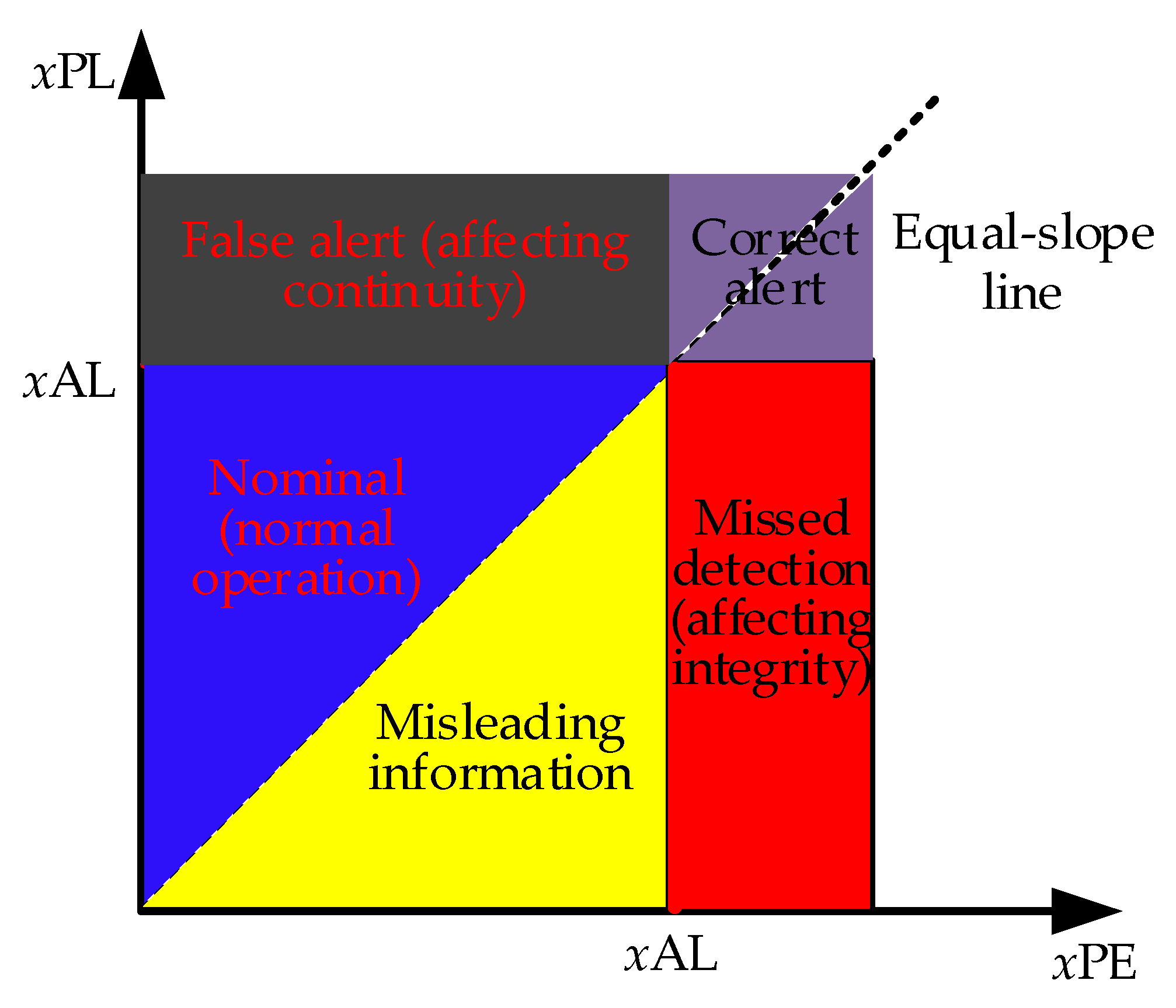
Based on the following criteria, system performance is classified as:
  • Missed detection (affecting integrity): xPE > xAL and xPL < xAL;
  • False alert (affecting continuity): xPE < xAL and xPL > xAL;
  • Correct alert: xPE > xAL and xPL > xAL;
  • Misleading information: xPE < xAL, xPL < xAL and xPE > xPL;Nominal (normal operation): xPE < xAL, xPL < xAL and xPE < xPL.
According to the definition of the Stanford Plot, as shown in Figure 1, a two-dimensional histogram of xPE versus xPL is constructed to analyze the joint distribution. Based on the frequency in each defined region, the system’s continuity, integrity, and availability performance are evaluated accordingly, thereby enabling a complete integrity monitoring assessment [29].
The availability was assessed under two levels of navigation service requirements: APV II (Approach Procedure with Vertical Guidance, Level II) and CAT I (Category I Precision Approach). According to ICAO SARPs and RTCA DO-229D [27], the performance requirements for APV II and CAT I approaches are summarized as follows:
  • APV II: HPL ≤ 40 m, VPL ≤ 20 m, Integrity risk ≤ 10 7 per approach and Time to alert ≤ 6 s.
  • CAT I: HPL ≤ 40 m, VPL ≤ 12 m, Integrity risk ≤ 10 7 per approach and Availability ≥ 99%.

4. Experiments and Discussion

To comprehensively evaluate the real-time positioning performance of single-frequency SPP enhanced by SBAS correction products, a series of positioning experiments were conducted under varying latitudinal regions and geomagnetic activity levels (as indicated by Kp index). Two positioning strategies were compared: the SBAS-assisted method (hereafter referred to as SBAS) and the conventional GPS Single-Point Positioning method based solely on broadcast ephemerides (hereafter referred to as SPP). This comparison aims to characterize the performance limits of SBAS-based enhancement under different geophysical conditions. Positioning accuracy was assessed using the root mean square (RMS) of positioning errors as the primary performance metric. The RMS positioning errors are calculated with respect to the reference station coordinates provided by the International GNSS Service (IGS). A satellite elevation mask of 10° was applied to all tests. It should be noted that although a 10° elevation mask is applied, residual multipath effects may still exist. However, their impact is expected to be limited due to the good observational environment of the selected IGS stations. All GNSS observation and SBAS message data were processed at their original 30 s sampling intervals. Data quality control was performed by excluding epochs with insufficient valid observations or missing navigation information. Because the positioning algorithm was based on single-frequency pseudorange measurements, no dedicated carrier-phase cycle-slip correction procedure was required. Although all datasets were processed offline, SBAS corrections were applied sequentially according to their original broadcast epochs without using future correction information, thereby emulating real-time operation.
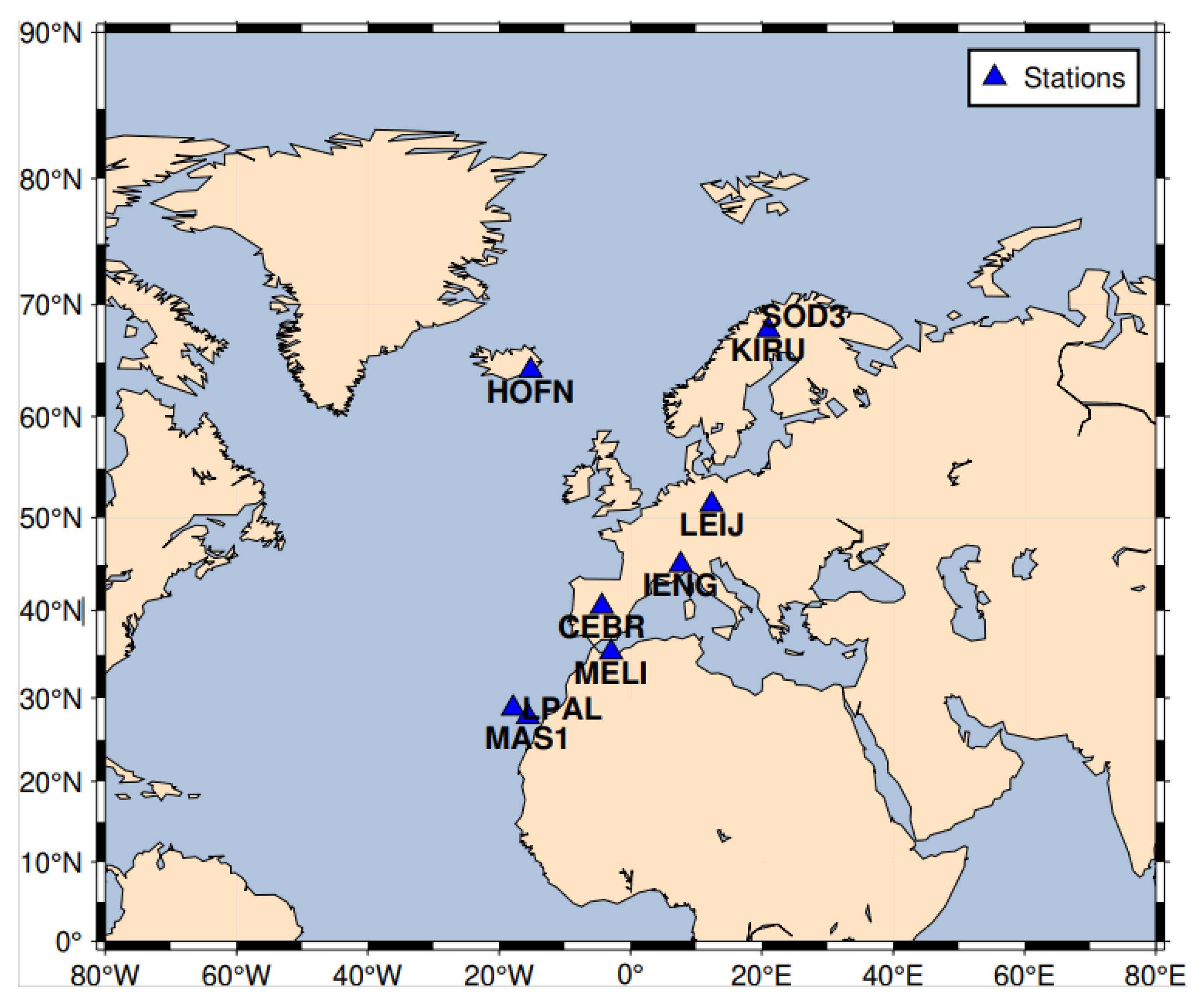
Given that EGNOS data is publicly available via ftp://serenad-public.cnes.fr/SERENAD0/FROM_NTMFV2/MSG/ (accessed on 31 May 2026), observation data from nine IGS stations across Europe were selected to conduct positioning experiments in different latitude regions. To ensure representative evaluation under varying seasonal conditions, four quarters of 2023 were considered, with three observation days selected in each quarter. The corresponding days of year (DOYs) were 032, 033, and 034 for Q1; 152, 153, and 154 for Q2; 244, 245, and 246 for Q3; and 335, 336, and 337 for Q4.
The spatial distribution of the selected stations is illustrated in Figure 2, and detailed station information is summarized in Table 2.

4.1. Positioning Performance Across Latitudinal Regions

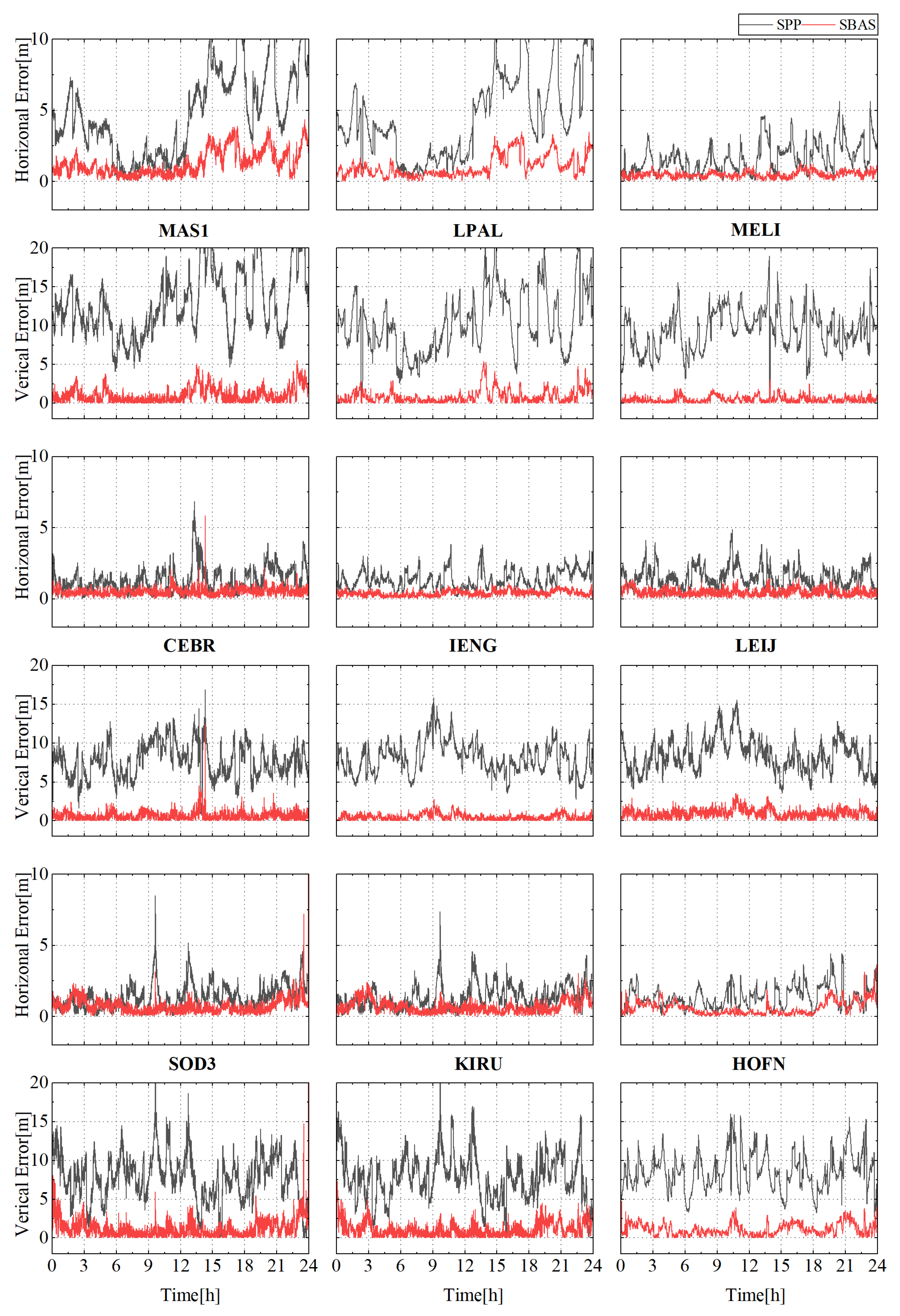
To evaluate the influence of latitude on SBAS positioning performance, nine IGS stations within the EGNOS service area were selected and grouped into three latitude regions: MAS1, LPAL, and MELI for the low-latitude region; CEBR, IENG, and LEIJ for the mid-latitude region; and SOD3, KIRU, and HOFN for the high-latitude region. Positioning experiments were conducted using observations collected during geomagnetically quiet conditions (low Kp). Figure 3 presents the positioning results for DOY 032, which is used as a representative quiet day to illustrate the performance at individual stations. The subsequent analysis extends the evaluation to twelve representative observation days distributed across four quarters of 2023.
As shown in Figure 3, SBAS-enhanced positioning consistently outperforms the standard SPP solution across all latitude regions. The improvement is primarily attributed to the SBAS real-time corrections for ionospheric delay, satellite orbit, and clock errors, which cannot be effectively mitigated by the broadcast-ephemeris-based SPP approach.
A statistical summary of positioning errors at the nine stations is presented in Table 3. In the low-latitude group: MAS1, LPAL, and MELI achieved SBAS-based horizontal positioning errors of 1.57 m, 1.32 m, and 0.55 m, respectively, representing improvements over SPP by 71.91%, 75.60%, and 72.22%. Their vertical errors were 1.42 m, 1.32 m, and 0.65 m, with corresponding improvements of 89.63%, 88.05%, and 93.30%. For the mid-latitude group: CEBR, IENG, and LEIJ showed horizontal positioning errors of 0.59 m, 0.44 m, and 0.54 m, improving over SPP by 63.13%, 71.05%, and 67.86%. The vertical errors were 0.90 m, 0.65 m, and 1.14 m, with improvements of 88.75%, 92.21%, and 86.96%, respectively. In the high-latitude region: SOD3, KIRU, and HOFN achieved horizontal errors of 0.94 m, 0.81 m, and 0.79 m, showing improvement rates of 42.68%, 50.00%, and 49.68%. Vertical positioning errors were 1.81 m, 1.44 m, and 1.38 m, with improvements of 78.45%, 82.92%, and 84.53%. These results clearly demonstrate that SBAS significantly enhances the positioning accuracy of single-frequency SPP, with relatively weaker improvements generally observed at higher latitudes. Specifically: Low-latitude regions show the greatest benefit from SBAS corrections. Station LPAL achieved the highest horizontal improvement (75.60%), while MELI recorded the highest vertical improvement (93.30%). Mid-latitude stations also showed substantial improvements in both horizontal and vertical domains. However, in high-latitude regions, the effectiveness of SBAS corrections was noticeably reduced, particularly for horizontal accuracy—SOD3 exhibited only a 42.68% improvement. Table 4 summarizes the average performance improvements across latitude bands. The results confirm the trend: The overall performance improvement is highest in low-latitude regions (81.79%), followed by mid-latitude regions (78.33%), while the improvement is lowest in high-latitude regions (64.11%). Notably, the horizontal performance improvement in high-latitude areas is only 47.45%.
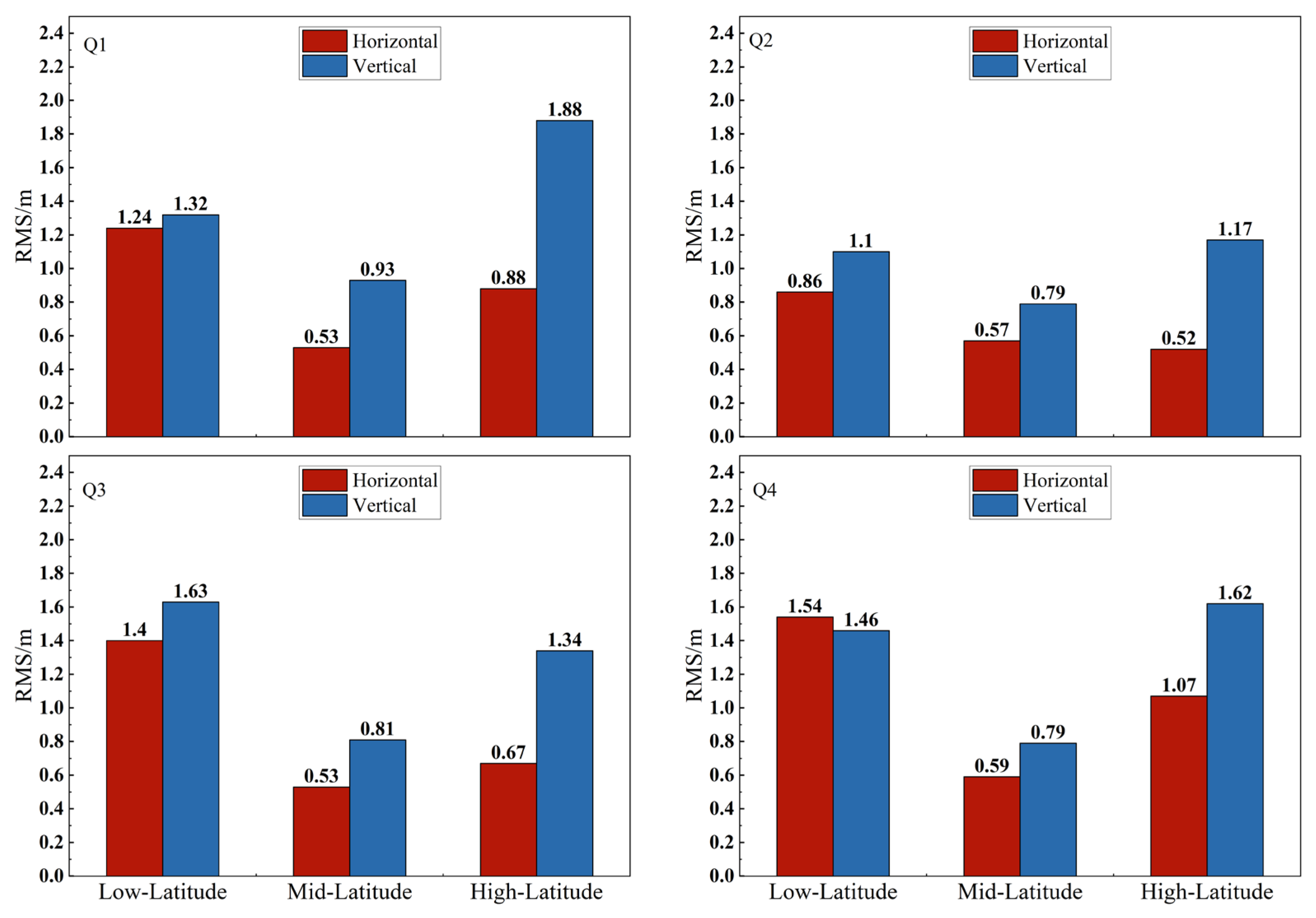
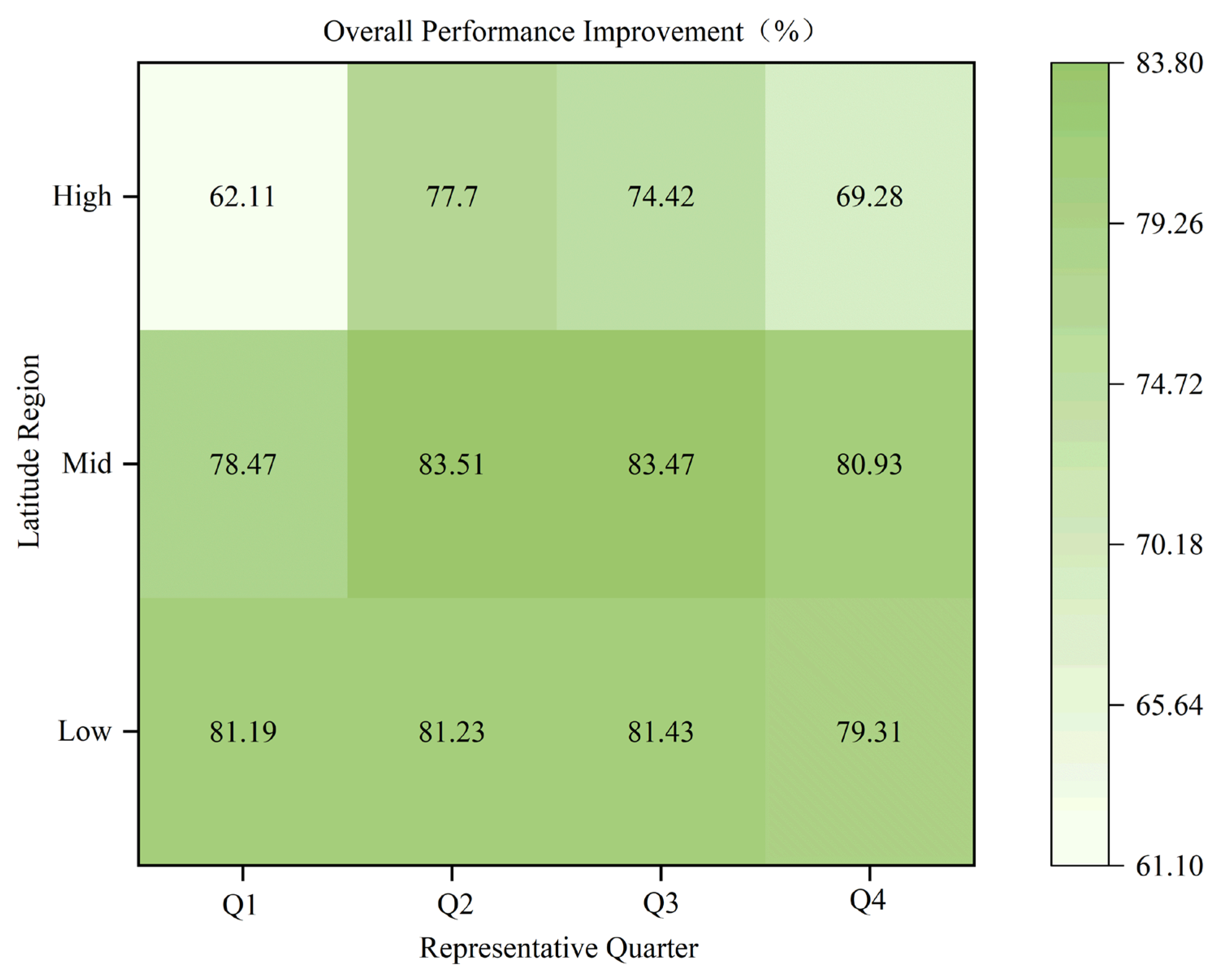
Figure 4 illustrates the average positioning performance improvement achieved by SBAS across different latitude regions and representative quarters, while Figure 5 summarizes the corresponding RMS positioning errors. Overall, SBAS significantly improves positioning performance in all latitude regions, with average improvement rates ranging from 62.11% to 83.51%.
The relatively low-latitude region achieves the largest overall improvements, with gains consistently above 79% and peaking at 81.43% in Q3. Correspondingly, the horizontal and vertical RMS values remain within 0.86–1.54 m and 1.11–1.63 m, respectively. The mid-latitude region provides the best overall performance and stability, achieving the highest improvement rate of 83.51% in Q2 and consistently low RMS values (<0.60 m horizontally and <0.93 m vertically). This result may be associated with the favorable location of these stations within the central EGNOS coverage area, where correction information is generally more reliable.
In contrast, the high-latitude region exhibits the lowest overall performance and the largest seasonal variability. The improvement rate increases from 62.11% in Q1 to 77.70% in Q2 before decreasing to 69.28% in Q4. Although SBAS still provides substantial positioning enhancement, the corresponding RMS values, particularly in the vertical component (1.17–1.88 m), remain higher than those in the low- and mid-latitude regions, indicating greater sensitivity to environmental variability and reduced positioning stability.
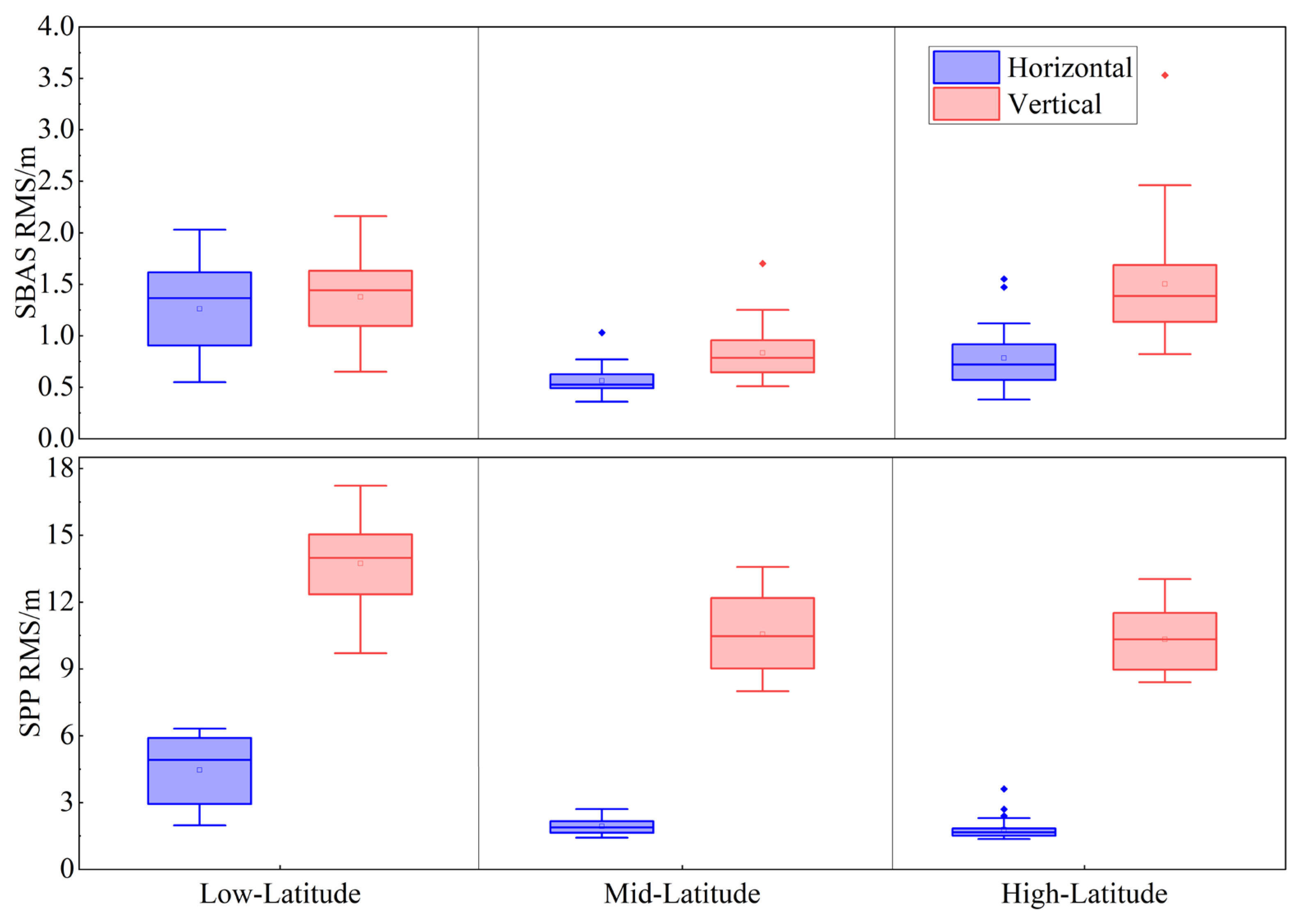
Figure 6 further presents the distributions of horizontal and vertical RMS values for the SPP and SBAS solutions across different latitude regions. Compared with the average RMS statistics, the boxplots provide additional information on the variability and consistency of positioning performance across multiple stations and observation periods.
As shown in Figure 6, the RMS distributions of the SBAS solution (upper panel) are consistently lower and more concentrated than those of the corresponding SPP solution (lower panel) in all latitude regions. For the horizontal component, the median RMS decreases from approximately 4.9 m to 1.3 m in the relatively low-latitude region, from 1.9 m to 0.6 m in the mid-latitude region, and from 1.7 m to 0.8 m in the high-latitude region. Meanwhile, the interquartile ranges become noticeably narrower after applying SBAS corrections, indicating improved positioning stability. The relatively low-latitude region exhibits the largest RMS values before correction, whereas the mid-latitude region achieves the most concentrated distribution after SBAS enhancement.
A similar but more pronounced improvement is observed for the vertical component. The median vertical RMS decreases from approximately 14.0 m to 1.4 m, 10.5 m to 0.8 m, and 10.3 m to 1.4 m in the relatively low-, mid-, and high-latitude regions, respectively. In addition to the substantial reduction in RMS values, the SBAS solutions exhibit considerably narrower distributions, indicating improved consistency and reliability of vertical positioning. Several outliers remain in the high-latitude region, suggesting that positioning performance may still experience occasional degradation under unfavorable ionospheric or geomagnetic conditions. Overall, the boxplot results are consistent with the average RMS statistics and indicate that the positioning improvements achieved by SBAS are robust across different stations and observation periods.
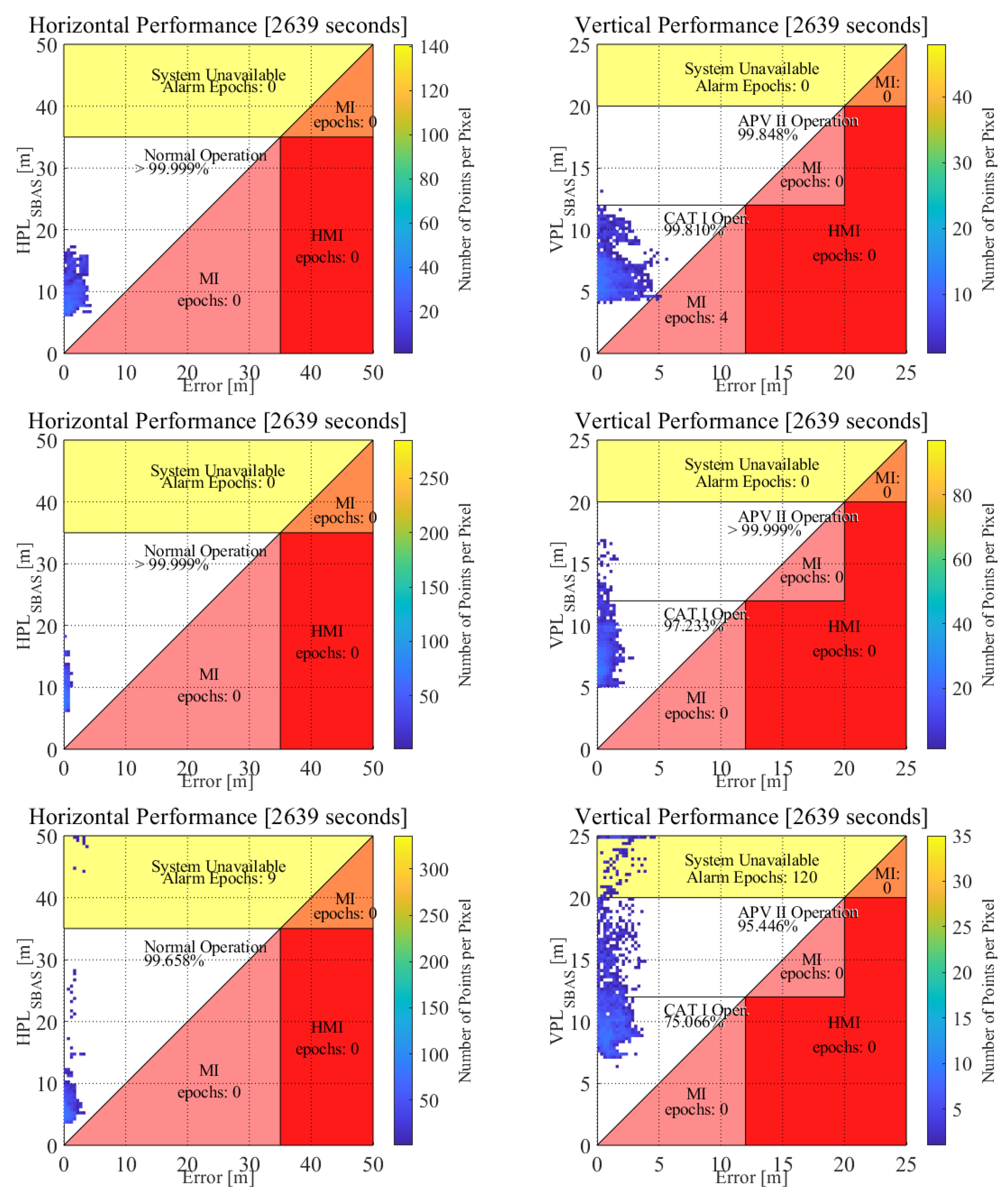
To evaluate the integrity performance, Stanford plots were utilized for representative stations in different latitude zones. Specifically, MAS1 was selected for the low-latitude region, IENG for the mid-latitude, and HOFN for the high-latitude region. The integrity evaluation results for these stations on DOY32 are shown in Figure 7. A statistical summary of availability performance across all nine stations is presented in Table 5. The results indicate the following: Under APV II requirements, the three stations in the low-latitude region achieved an availability of 98.75%, those in the mid-latitude region achieved 99.36%, and those in the high-latitude region achieved 90.28%. Under the CAT I navigation requirement, the availability values for the same regions were 97.35%, 93.37%, and 59.95%, respectively.

4.2. Positioning Performance Under Different Geomagnetic Activity Levels

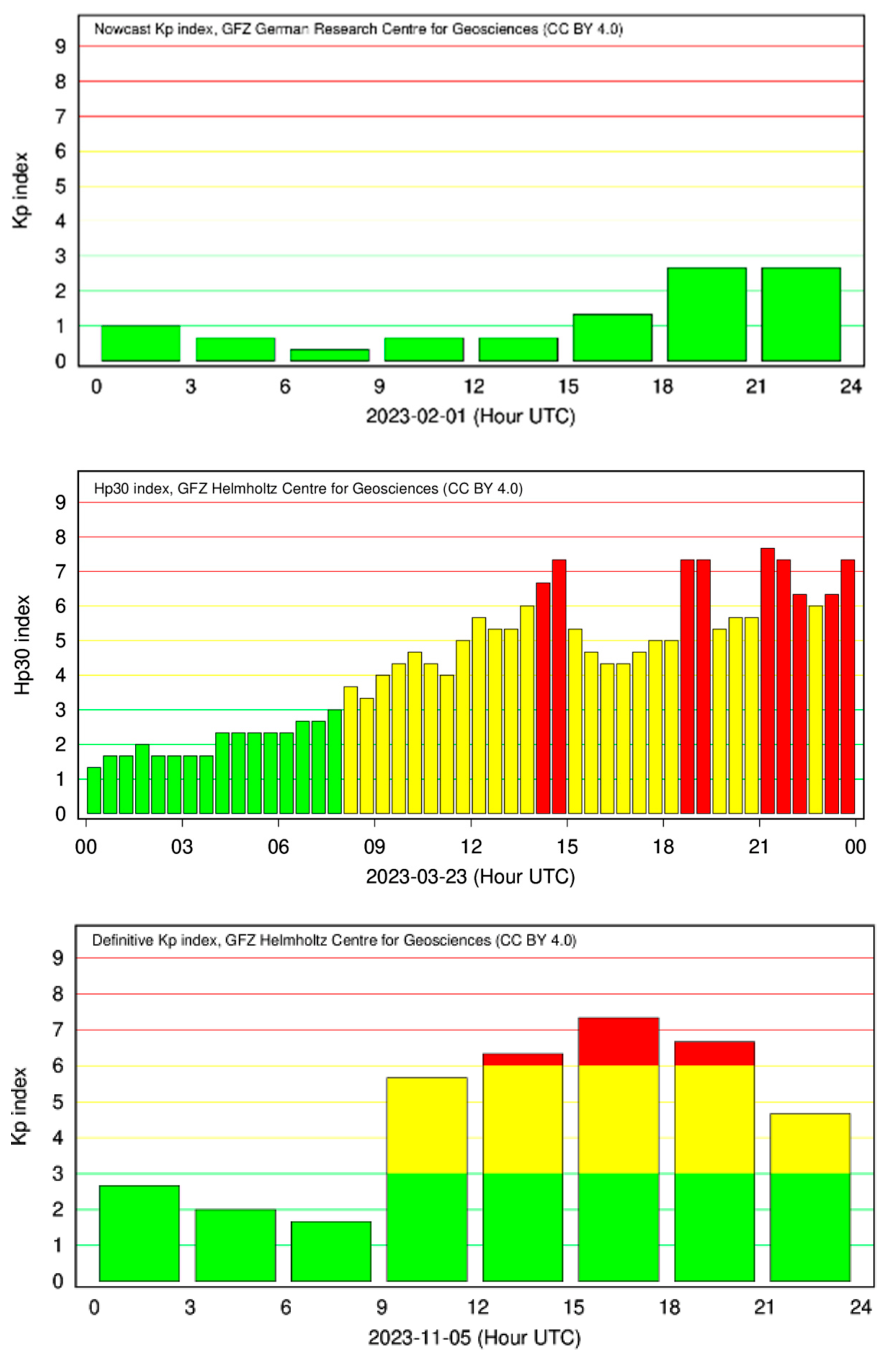
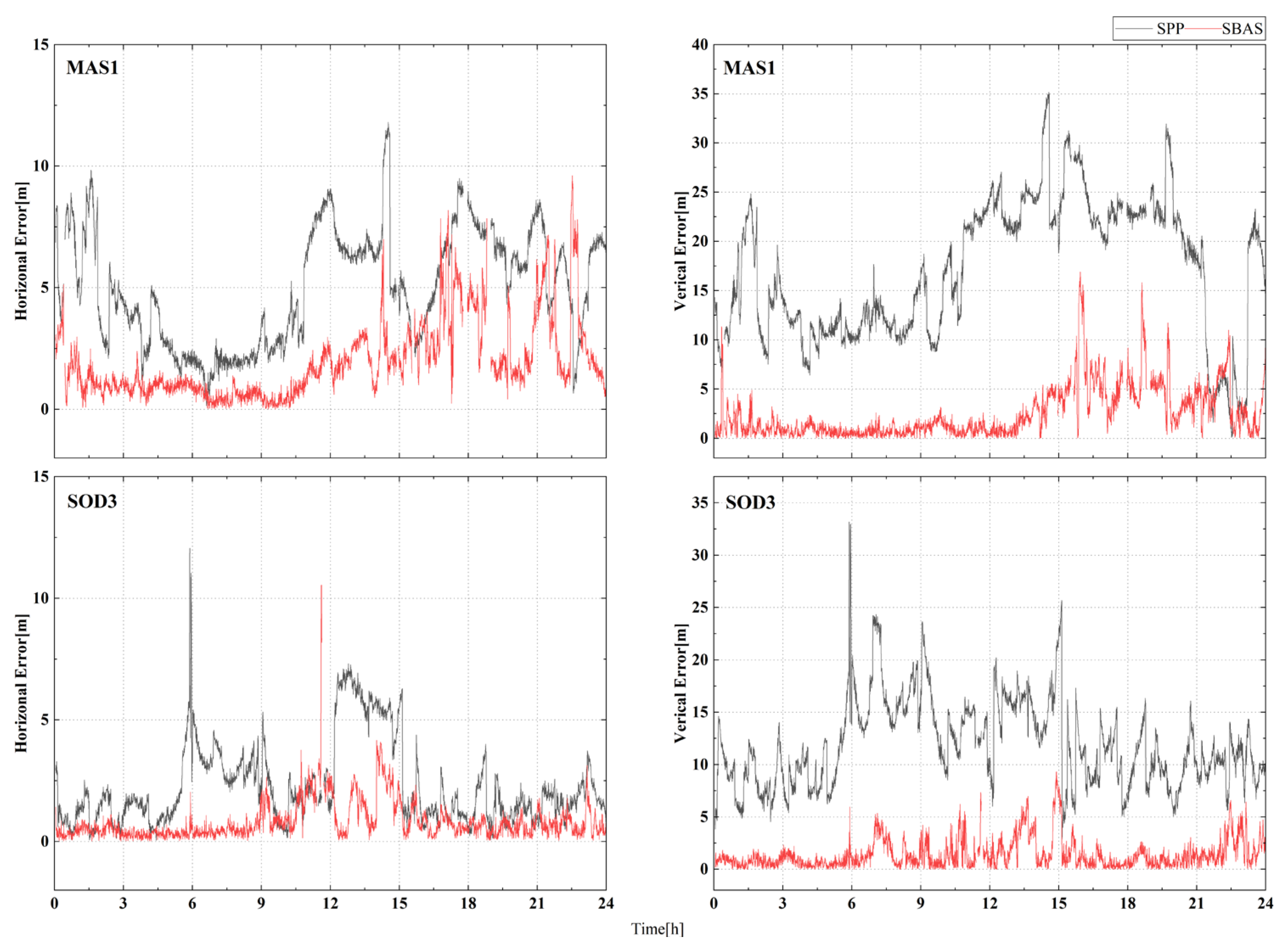
To assess the impact of geomagnetic activity intensity on SBAS positioning performance, additional experiments were conducted under both low and high Kp conditions. The latitude-dependent experiments discussed in the previous section were performed during geomagnetically quiet periods characterized by low Kp values. To evaluate SBAS performance under disturbed geomagnetic conditions, two high Kp events in 2023 were selected, namely DOY 082 and DOY 309. In addition, both the relatively low-latitude station MAS1 and the high-latitude station SOD3 were included to examine the latitude-dependent response of SBAS positioning performance during geomagnetic disturbances. The Kp index data were obtained from the publicly available GFZ Potsdam website (https://kp.gfz-potsdam.de (accessed on 31 May 2026)), and the Kp variations for the selected disturbed days are shown in Figure 8.
As shown in Figure 9, the SBAS solution generally outperforms SPP at both stations, indicating that SBAS corrections remain effective under disturbed geomagnetic conditions. However, positioning performance degrades during enhanced geomagnetic activity. At MAS1, both horizontal and vertical errors increase after the onset of the disturbed period, suggesting reduced effectiveness of SBAS ionospheric corrections. At SOD3, more pronounced short-term fluctuations and isolated error peaks are observed, indicating greater sensitivity of high-latitude positioning to ionospheric variability during disturbed periods.
The RMS statistics are summarized in Table 6. On DOY 082, the SBAS horizontal and vertical RMS values at MAS1 increase from 1.18 m and 1.40 m during low Kp periods to 3.01 m and 4.42 m during high Kp periods, corresponding to degradations of 155.08% and 215.71%, respectively. For SOD3, the corresponding RMS values increase from 0.45 m and 1.41 m to 1.40 m and 2.31 m, with degradations of 211.11% and 63.83%. These results indicate that geomagnetic disturbances degrade SBAS positioning performance in both relatively low- and high-latitude regions, although their degradation patterns differ.
To reduce dependence on a single disturbed event, DOY 309 was also included in Table 6. SBAS still provides clear improvements over SPP at both stations, with horizontal and vertical improvements of 71.84% and 89.93% at MAS1 and 53.94% and 77.45% at SOD3, respectively. The results from DOY 082 and DOY 309 suggest that the impact of geomagnetic activity on SBAS performance is not limited to a single storm case. Although SBAS remains effective under disturbed conditions, its performance decreases relative to low Kp periods.
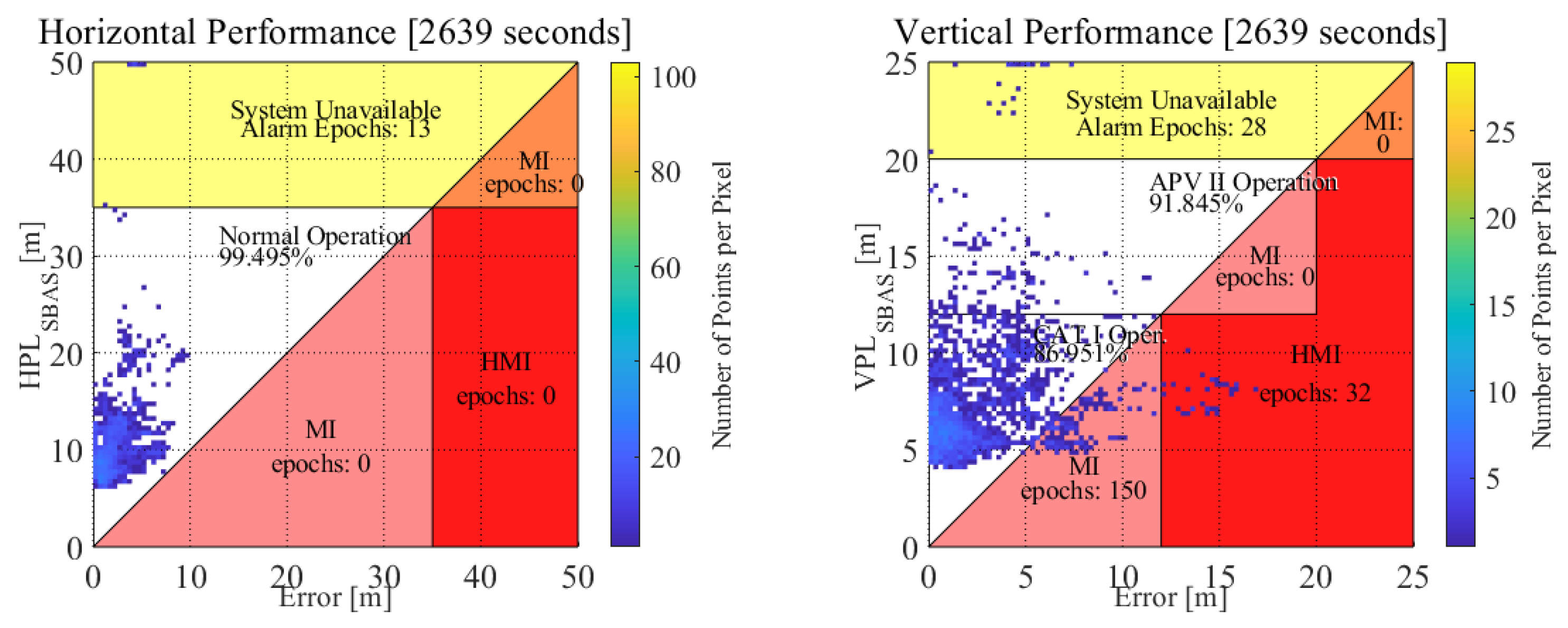
Figure 10 presents the integrity performance of MAS1 on DOY 082 using the Stanford diagram. Under the APV II requirement, an availability of 91.85% is achieved, whereas the availability decreases to 86.95% under the more stringent CAT I requirement. This reduction indicates that SBAS integrity performance becomes more sensitive to disturbed geomagnetic conditions when stricter vertical protection constraints are imposed.
The degradation is mainly reflected in the increase in protection levels, particularly the vertical protection level (VPL). During geomagnetically disturbed periods, ionospheric variability may increase the residual ionospheric-related errors after SBAS correction, which enlarges the estimated protection levels. As a result, some epochs that still satisfy the APV II alert limit fail to meet the CAT I requirement. Therefore, although SBAS continues to improve positioning accuracy under disturbed geomagnetic conditions, its integrity availability may be reduced for operations requiring stricter protection limits.
These results demonstrate the practical significance of integrity assessment for safety-of-life applications. Under disturbed space-weather conditions, SBAS-enhanced positioning may remain usable for APV II in most epochs, but CAT I service availability becomes more vulnerable due to its stricter vertical integrity requirement. This indicates that geomagnetic disturbances can limit the operational robustness of SBAS for precision approach applications.

5. Conclusions

This study systematically evaluated the real-time performance of SBAS-enhanced single-frequency positioning under different latitude regions and geomagnetic activity levels within the EGNOS service area. The results show that SBAS significantly improves positioning performance in all latitude regions, with overall improvement rates ranging from 62.11% to 83.51% across representative quarters. The relatively low-latitude region achieves the largest performance gains, whereas the mid-latitude region provides the most stable and accurate results. In contrast, the high-latitude region exhibits lower improvement rates and larger seasonal variability, indicating that SBAS performance remains latitude-dependent.
The expanded multi-day analysis and RMS boxplots further demonstrate that the observed improvements are not limited to individual stations or specific observation days. After applying SBAS corrections, both horizontal and vertical RMS distributions shift toward lower values, while the variability is reduced, indicating improved accuracy, stability, and consistency of single-frequency positioning.
Geomagnetic activity has a noticeable impact on SBAS-enhanced positioning. Although SBAS continues to outperform conventional SPP under disturbed conditions, its performance degrades compared with geomagnetically quiet periods. Results from MAS1 and SOD3 during the disturbed events on DOY 082 and DOY 309 indicate that geomagnetic disturbances degrade SBAS positioning performance in both relatively low- and high-latitude regions, with latitude-dependent degradation characteristics.
The integrity assessment further shows that SBAS availability decreases under disturbed geomagnetic conditions, particularly for applications with stricter vertical protection requirements. For MAS1 on DOY 082, availability reaches 91.85% under APV II requirements but decreases to 86.95% under CAT I requirements. This reduction is mainly associated with increased protection levels during disturbed periods, highlighting the sensitivity of CAT I availability and precision approach operations to disturbed space-weather conditions.
Overall, this study provides a systematic operational evaluation of SBAS-enhanced single-frequency positioning performance under varying latitude, seasonal, and geomagnetic conditions. The results demonstrate that SBAS can substantially enhance positioning accuracy, stability, integrity, and availability within the EGNOS service area, while its effectiveness remains influenced by environmental conditions. Future work will incorporate longer-term datasets, additional geomagnetic storm events, TEC maps, and ionospheric disturbance indicators to further investigate the physical mechanisms underlying SBAS performance degradation and to improve the robustness of SBAS-enhanced positioning in challenging environments.

Author Contributions

P.C. conceived the idea and wrote the paper; P.C. designed the experiments with L.Z. and C.J.; P.C. and C.J. performed the experiments; Z.X. analyzed the data. All authors have read and agreed to the published version of the manuscript.

Funding

This research was jointly funded by National Natural Science Foundation of China (Grant Nos. 62403158, 62373117, 62573150), the Fundamental Research Funds for Central Universities (No. 3072025GH0401), the Program for chunyan Innovative Research Team in Heilongjiang Province of China under Grant CYQN24070. The APC was funded by the authors.

Data Availability Statement

The data presented in this study are available from the corresponding author upon reasonable request.

Acknowledgments

We acknowledge the IGS for providing static GPS data and the ESA for the EGNOS correction data.

Conflicts of Interest

The authors declare no conflicts of interest.

References

  1. Su, K.; Jin, S.; Hoque, M.M. Evaluation of Ionospheric Delay Effects on Multi-GNSS Positioning Performance. Remote Sens. 2019, 11, 171. [Google Scholar] [CrossRef]
  2. Nie, Z.; Zhou, P.; Liu, F.; Wang, Z.; Gao, Y. Evaluation of Orbit, Clock and Ionospheric Corrections from Five Currently Available SBAS L1 Services: Methodology and Analysis. Remote Sens. 2019, 11, 411. [Google Scholar] [CrossRef]
  3. Schlüter, S.; Hoque, M.M. An SBAS Integrity Model to Overbound Residuals of Higher-Order Ionospheric Effects in the Ionosphere-Free Linear Combination. Remote Sens. 2020, 12, 2467. [Google Scholar] [CrossRef]
  4. Yin, P.; Shi, S.; Ren, D. SBAS ionospheric grid delay estimation based on ionospheric tomography: A case study on September 7–9, 2017. GPS Solut. 2022, 26, 86. [Google Scholar] [CrossRef]
  5. Aguiar, C.R.; Monico, J.F.G.; Moraes, A.O. Impact of ionospheric scintillations on GNSS availability and precise positioning. Space Weather 2025, 23, e2024SW004217. [Google Scholar] [CrossRef]
  6. Wang, Z.; Yang, G.; Huang, R.; Li, M.; Zhu, M. Multi-GNSS Large Areas PPP-RTK Performance During Ionosphere Anomaly Periods. Sensors 2025, 25, 2200. [Google Scholar] [CrossRef] [PubMed]
  7. Demyanov, V.; Yasyukevich, Y.; Sergeeva, M.A.; Vesnin, A. How to Improve GNSS/SBAS Reliability Under Space Weather Impacts. In GNSS Performance Under Space Weather; Springer: Berlin/Heidelberg, Germany, 2022; pp. 139–160. [Google Scholar]
  8. Wang, A.; Chen, J.; Zhang, Y.; Liu, X.; Wang, H. Real-time ionospheric model establishment using multi-GNSS single-frequency observations. Remote Sens. 2024, 16, 1511. [Google Scholar] [CrossRef]
  9. Wang, S.; Wang, D.; Sun, J. Artificial neural network-based ionospheric delay correction method for satellite-based augmentation systems. Remote Sens. 2022, 14, 676. [Google Scholar] [CrossRef]
  10. Lee, J.; Jo, Y.; Park, B.; Kim, D. Approach to Utilizing SFMC SBAS Message for Dual-frequency Users to Enable Universally Applicable SBAS. In Proceedings of the 2025 International Technical Meeting of the ION, Long Beach, CA, USA, 22–25 January 2025. [Google Scholar]
  11. Matera, E.R.; Ekambi, B.; Chamard, J. A Comparative Analysis of GNSS Multipath Error Characterization Methodologies in an Urban Environment. In Proceedings of the 2024 International Conference on Localization and GNSS (ICL-GNSS); IEEE: Paris, France, 2024. [Google Scholar]
  12. Kim, D.; Han, D.; Kee, C. Preliminary Test Results of RTK-aided Conical Domain Model for SBAS Ionospheric Correction. In Proceedings of the ION Pacific PNT, Honolulu, HI, USA, 8–11 April 2019. [Google Scholar]
  13. Wang, S.; Ding, W.; Guan, Y. An improved ionospheric delay correction method for SBAS. Electro 2021, 30, 329–337. [Google Scholar]
  14. Nayak, K.; Carrillo-Vargas, A.; Urias, C.L.; Romero-Andrade, R.; Nava, G.C.; Caccavari-Garza, A. Regional variability and multiscale dynamics of ionospheric total electron content during the intense geomagnetic storm of May 10, 2024, in central Mexico. Adv. Space Res. 2025, 76, 7412–7432. [Google Scholar] [CrossRef]
  15. López-Urias, C.; Vazquez-Becerra, G.E.; Nayak, K.; López-Montes, R. Analysis of Ionospheric Disturbances during X-Class Solar Flares (2021–2022) Using GNSS Data and Wavelet Analysis. Remote Sens. 2023, 15, 4626. [Google Scholar] [CrossRef]
  16. Reddybattula, K.D.; Panda, S.K.; Sharma, S.K.; Singh, A.K.; Kurnala, K.; Haritha, C.S.; Wuyyuru, S. Anomaly Effects of 6–10 September 2017 Solar Flares on Ionospheric Total Electron Content over Saudi Arabian Low Latitudes. Acta Astronaut. 2020, 176, 157–168. [Google Scholar] [CrossRef]
  17. Kim, D.U.; Han, D.H.; Choi, B.K.; Kee, C. Accuracy Improvement of SBAS Ionospheric Correction Using Electron Density Distribution Model. J. Position. Navig. Timing 2019, 8, 59–70. [Google Scholar]
  18. Li, W. Ionospheric Monitoring for Dual-Frequency Multi-Constellation GBAS. Ph.D. Thesis, The Hong Kong Polytechnic University, Hong Kong, China, 2024. [Google Scholar]
  19. Chen, S.; Gao, W.; Li, M.; Jin, B. Single frequency service performance of BDSBAS: Models and assessment. GPS Solut. 2025, 29, 64. [Google Scholar] [CrossRef]
  20. Kouba, J. A Guide to Using International GNSS Services (IGS) Products; International GNSS Services (IGS): Pasadena, CA, USA, 2009. [Google Scholar]
  21. Walter, T. Satellite-Based Augmentation Systems (SBASs). In Position, Navigation, and Timing Technologies in the 21st Century; Parkinson, B.W., Spilker, J.J., Eds.; Wiley: Hoboken, NJ, USA, 2020; Volume 2, pp. 915–944. [Google Scholar]
  22. David, P.; Kriegel, M.; Berdermann, J.; Kauristie, K.; Wissing, J.M. Performance Indicator Development Addressing Mitigation of the Space Weather Impacts on GNSS. J. Space Saf. Eng. 2023, 10, 162–174. [Google Scholar] [CrossRef]
  23. Barrios, J.; Pericacho, J.G.; Domenech, S.; López, N.Á. Worldwide SBAS Broadcasts Between 2017 and 2022: A Comparative Study. In Proceedings of the 35th International Technical Meeting of the ION GNSS+, Denver, CO, USA, 19–23 September 2022. [Google Scholar]
  24. Chen, K.; Gao, Y. Ionospheric effect mitigation for real-time single frequency PPP. Navig. J. Inst. Navig. 2008, 55, 205–213. [Google Scholar] [CrossRef]
  25. Jin, B.; Chen, S.; Li, D.; Wang, Y.; Takka, E. Performance Analysis of SBAS Ephemeris Corrections and Integrity Algorithms in China Region. Satell. Navig. 2021, 2, 5. [Google Scholar] [CrossRef]
  26. Zhang, H.; Yuan, Y.; Li, W.; Li, Y.; Chai, Y. Assessment of three tropospheric delay models (IGGTROP, EGNOS and UNB3M) based on precise point positioning in the Chinese region. Sensors 2016, 16, 122. [Google Scholar] [CrossRef]
  27. RTCA. Minimum Operational Performance Standards for Global Positioning System/Satellite-Based Augmentation System Airborne Equipment, DO-229E; RTCA, Inc.: Washington, DC, USA, 2016; pp. 1–559. [Google Scholar]
  28. Oching, W.; Sauer, K. GPS Integrity and Potential Impaction Aviation Safety. J. Navig. 2003, 56, 51–65. [Google Scholar] [CrossRef]
  29. Phelts, R.E.; Walter, T.; Enge, P. Toward real-time SQM for WAAS: Improved detection techniques. In Proceedings of the 14th International Technical Meeting of the Satellite Division of the Institute of Navigation (ION GPS 2001), Salt Lake City, UT, USA, 11–14 September 2001; pp. 1063–1073. [Google Scholar]
Figure 1. Definition of the Stanford plot.
Remotesensing 18 01918 g001
Figure 2. European stations used in the experiment.
Remotesensing 18 01918 g002
Figure 3. Statistical results of positioning performance on DOY 032 across latitude regions. MAS1, LPAL, and MELI represent the low-latitude, CEBR, IENG, and LEIJ represent the mid-latitude, and SOD3, KIRU, and HOFN represent the high-latitude regions. Horizontal and vertical positioning errors are shown above and below the station names, respectively.
Remotesensing 18 01918 g003
Figure 4. Heatmap of average SBAS positioning performance improvement across different latitude regions and representative quarters. Darker colors indicate greater enhancement.
Remotesensing 18 01918 g004
Figure 5. SBAS positioning accuracy statistics across latitude regions and quarters.
Remotesensing 18 01918 g005
Figure 6. Boxplots of horizontal and vertical RMS values for SBAS and SPP solutions across different latitude regions. The upper panel shows the RMS distributions of the SBAS solution, while the lower panel shows those of the SPP solution. Blue and red boxplots represent the horizontal and vertical RMS values, respectively.
Remotesensing 18 01918 g006
Figure 7. Stanford plot statistics for representative stations. From top to bottom are MAS1 (low-latitude), IENG (mid-latitude), and HOFN (high-latitude); from left to right are the horizontal and vertical performance analysis plots, respectively.
Remotesensing 18 01918 g007
Figure 8. Kp index variations for the quiet reference day (DOY 032) and the two disturbed geomagnetic days (DOY 082 and DOY 309) in 2023. The bar colors indicate different levels of geomagnetic activity, and the horizontal lines denote the corresponding Kp index levels.
Remotesensing 18 01918 g008
Figure 9. Horizontal and vertical positioning error time series of the SPP and SBAS solutions at MAS1 and SOD3 during the disturbed geomagnetic event on DOY 082.
Remotesensing 18 01918 g009
Figure 10. Stanford plot of integrity performance at MAS1 on DOY 082 under disturbed geomagnetic conditions.
Remotesensing 18 01918 g010
Table 1. Processing strategy for real-time single-frequency positioning using SBAS corrections.
ErrorsSettings
Satellite orbit and clock errorSBAS real-time satellite products
Ionosphere errorSBAS ionosphere correction as the observation, the parameters of the ionosphere model is estimated
Troposphere errorThe zenith delay of wet troposphere residual is modeled as the first-order Markov random walk
Solid Earth tideSolid Earth tide correction proposed by [20]
Relativistic effectsEstimation model recommended by IS-GPS-200
Other estimated parametersReceiver coordinates, receiver clock error
Table 2. Basic information about the stations.
StationReceiver ModelLatitudeLongitude
MAS1SEPT POLARX527.764−15.633
LPALLEICA GR5028.764−17.894
MELILEICA GR5035.281−2.952
CEBRSEPT POLARX5TR40.453−4.368
IENGSEPT POLARX5TR45.0157.639
LEIJJAVAD TRE_3 DELTA51.35412.374
SOD3JAVAD TRE_3 DELTA67.42126.389
KIRUSEPT POLARX5TR67.85720.968
HOFNLEICA GR5064.267−15.198
Table 3. RMS statistics of SPP and SBAS positioning results.
StationsSPP RMS (m)SBAS RMS (m)Performance Improvement (%)
HorizontalVerticalHorizontalVerticalHorizontalVertical
MAS15.5913.691.571.4271.9189.63
LPAL5.4111.051.321.3275.6088.05
MELI1.989.700.550.6572.2293.30
CEBR1.608.000.590.9063.1388.75
IENG1.528.340.440.6571.0592.21
LEIJ1.688.740.541.1467.8686.96
SOD31.648.400.941.8142.6878.45
KIRU1.628.430.811.4450.0082.92
HOFN1.578.920.791.3849.6884.53
Table 4. Average improvement in horizontal and vertical positioning performance across different latitude regions.
Different Latitude RegionsHorizontal Performance Improvement (%)Vertical Performance Improvement (%)Overall Performance Improvement (%)
Low-Latitude 73.2490.3381.79
Mid-Latitude 67.3589.3178.33
High-Latitude 47.4581.9764.71
Table 5. Availability Analysis for Required Navigation Performance.
Availability (%)APV IICAT I
HorizontalVerticalHorizontalVertical
MAS199.9999.8599.9999.81
LPAL99.9698.7599.9698.71
MELI99.9999.9999.9997.35
CEBR98.9899.4798.9896.06
IENG99.9999.9999.9997.23
LEIJ99.9999.3699.9993.37
SOD399.7090.2899.7059.95
KIRU99.9992.4499.9962.88
HOFN99.6695.4599.6675.07
Table 6. RMS statistics of SPP and SBAS positioning performance under different Kp index conditions.
StationDOYPeriodSPP RMS (m)SBAS RMS (m)Improvement (%)
HVHVHV
MAS1082Entire Day5.5118.292.503.6254.6380.21
Low Kp4.1612.821.181.4071.6389.08
High Kp6.1720.823.014.4251.2278.77
309Entire Day6.2519.771.761.9971.84 89.93
SOD3082Entire Day2.8612.631.152.0359.7983.93
Low Kp2.5112.670.451.4182.0788.87
High Kp3.0512.611.402.3154.1081.68
309Entire Day3.4313.041.582.9453.9477.45
Disclaimer/Publisher’s Note: The statements, opinions and data contained in all publications are solely those of the individual author(s) and contributor(s) and not of MDPI and/or the editor(s). MDPI and/or the editor(s) disclaim responsibility for any injury to people or property resulting from any ideas, methods, instructions or products referred to in the content.