Review

A Decade of Optical Remote Sensing Applications in Marine Biodiversity and Benthic Habitat Monitoring: A Systematic Review


by
Laura Martín-García
1,
Enrique Casas
2,
Pedro A. Hernández-Leal
2,
Andrea Z. Botelho
3,4 and
Manuel Arbelo
2,*
1
Centro Oceanográfico de Canarias, Instituto Español de Oceanografía (IEO-CSIC), 38180 Santa Cruz de Tenerife, Spain
2
Departamento de Física, Universidad de La Laguna, 38200 San Cristóbal de La Laguna, Spain
3
Centro de Investigação em Biodiversidade e Recursos Genéticos (CIBIO), InBIO Laboratório Associado, BIOPOLIS Program in Genomics, Biodiversity and Land Planning, UNESCO Chair—Land Within Sea: Biodiversity & Sustainability in Atlantic Islands, Universidade dos Açores, 9500-321 Ponta Delgada, Portugal
4
Faculdade de Ciências e Tecnologia, Universidade dos Açores, 9500-321 Ponta Delgada, Portugal
*
Author to whom correspondence should be addressed.
Remote Sens. 2026, 18(12), 1917; https://doi.org/10.3390/rs18121917 (registering DOI)
Submission received: 15 April 2026 / Revised: 24 May 2026 / Accepted: 9 June 2026 / Published: 10 June 2026

Highlights

What are the main findings?
  • Optical remote sensing (ORS) applications for benthic biodiversity are primarily based on multispectral satellite sensors, with an increasing use of unmanned aerial vehicles (UAVs) and hyperspectral approaches. Pre-processing and validation methods remain highly heterogeneous.
  • Studies mainly focus on broad benthic habitat classifications and dominant coastal ecosystems such as coral reefs and seagrasses, in tropical and subtropical regions.
What are the implications of the main findings?
  • ORS is a key tool for multi-scale, repeatable monitoring supporting marine conservation and policy frameworks.
  • Improving methodological standardisation, taxonomic coverage, and global research equity is essential for enhancing comparability and operational use.

Abstract

Monitoring biodiversity in coastal and marine ecosystems is essential for supporting conservation strategies, sustaining ecosystem services, and meeting policy commitments at multiple scales, including the European Union’s Habitats Directive, Sustainable Development Goal 14 (SDG 14, Life Below Water), and the Kunming–Montreal Global Biodiversity Framework (GBF). However, many benthic habitats remain insufficiently mapped or monitored due to the spatial, temporal, and logistical limitations of traditional field-based approaches. Optical Remote Sensing (ORS), based on the use of optical sensors to retrieve spectral information from shallow-water environments, has emerged as a powerful tool for mapping and monitoring these ecosystems. This study presents a systematic review aimed at providing a comprehensive synthesis of above-water ORS applications for benthic biodiversity and habitat monitoring over the period 2014–2023. A total of 179 peer-reviewed studies were analyzed to identify temporal trends, geographic patterns, target ecosystems, and methodological workflows. The review considered observation platforms including satellite, airborne, unmanned aerial vehicles (UAVs), and field spectrometry systems, together with key preprocessing procedures required for reliable benthic detection, such as atmospheric correction, water column correction, and sunglint removal, alongside validation using independent measurements. The analysis reveals a rapid expansion of ORS applications, with a strong geographic concentration in tropical and subtropical regions. Studies focusing on specific benthic groups predominantly target coral reefs and seagrass ecosystems, although many adopt integrative benthic habitat classifications that incorporate multiple benthic components at the habitat level. However, significant limitations persist, including inconsistent preprocessing workflows, limited reporting transparency, and the underrepresentation of several ecologically important taxa (e.g., annelids, mollusks, echinoderms). Despite these challenges, ORS has become a cornerstone of large-scale and repeatable coastal monitoring. By analyzing methodological practices, ecological targets, and geographic biases, this review provides a critical foundation for improving the robustness, scalability, and global applicability of ORS in benthic habitat mapping, biodiversity monitoring, and ecosystem-based management.

1. Introduction

Biodiversity monitoring in coastal and marine ecosystems is essential for guiding conservation efforts, ensuring the sustainability of ecosystem services, and fulfilling global policy commitments such as the European Union’s Habitats Directive, the United Nations Sustainable Development Goals (particularly SDG 14, Life Below Water, focussing on the conservation and sustainable use of marine resources), and the Kunming–Montreal Global Biodiversity Framework (GBF), which establishes global biodiversity targets for conservation and ecosystem restoration [1,2]. Yet, many benthic habitats, particularly complex rocky and sedimentary systems, remain poorly mapped or monitored due to logistical, technical, or financial constraints. Traditional field-based approaches, such as diving surveys and in situ sampling, while ecologically detailed, often lack the spatial and temporal coverage needed to detect large-scale ecological changes and long-term ecosystem dynamics [3]. In recent decades, remote sensing (RS) technologies have emerged as powerful tools to overcome these limitations. Among them, Optical Remote Sensing (ORS) has shown particular promise in benthic ecology through the detection and characterization of shallow-water habitats based on spectral information. Advances in sensor technology, spanning satellite, airborne, UAV-based, and field spectroscopic systems, have improved the capacity to assess habitat extent, ecological condition, and spatio-temporal change across coastal and shallow marine environments. As a result, ORS is becoming an essential component of ecosystem-based management strategies, biodiversity monitoring programs, and habitat restoration initiatives in coastal and marine environments [4].
Building on the rapid expansion of remote sensing technologies, a substantial body of review literature has emerged examining their application to marine habitat mapping and ecological assessment [3,4,5,6,7,8,9]. Broad methodological syntheses have examined the evolution of shallow-water remote sensing and satellite-derived bathymetry, with an emphasis on optical physics and radiative processes [4], as well as satellite-derived bathymetry approaches focused on depth-retrieval methodologies and their limitations [9]. Other contributions have focused on habitat structural complexity derived from remote sensing data [6] or on long-term trends in benthic habitat mapping methodologies [3]. In parallel, several reviews adopt taxonomic, habitat-based, or regional perspectives. Coral reef ecosystems have received particular attention, including analyses of machine learning approaches for coral habitat classification [10], comparisons between traditional in situ ecological surveys and remote sensing methods [11], and foundational reviews showing how optical remote sensing has evolved from localized reef mapping toward operational frameworks for coral reef monitoring and climate-impact assessment [5]. Tropical seagrass systems have likewise been reviewed with emphasis on suitable remote sensing technologies [7], and regional syntheses have applied systematic review frameworks to assess habitat mapping in specific biogeographic contexts, such as Macaronesia (North Atlantic region including the volcanic archipelagos of Azores, Madeira, Canary Islands, and Cape Verde) [8].
Although these works provide valuable technical, taxon-specific, and regional insights, they do not offer a comprehensive cross-taxa and cross-platform evaluation of ORS applications for benthic biodiversity. Consequently, the literature still lacks a global, structured synthesis dedicated specifically to ORS as a methodological framework, and remains fragmented across platforms, ecological targets, and geographic settings, limiting cross-comparability and a clear understanding of methodological strengths and gaps.
This systematic review aims to fill that gap by analyzing peer-reviewed studies using ORS to map or monitor benthic biodiversity in shallow aquatic environments, including coastal and intertidal systems such as mangroves. Specifically, this study seeks to: (1) identify temporal, geographic, and thematic patterns in the application of ORS to benthic biodiversity research; (2) evaluate the platforms, sensors and preprocessing workflows employed in habitat mapping and biodiversity assessment; (3) characterize the ecosystems and biological groups most frequently targeted; and (4) synthesize methodological challenges, research gaps, and emerging directions discussed in the literature to guide more robust, reproducible and inclusive applications of ORS in marine biodiversity science. While classification algorithms, including machine learning, deep learning, and object-based image analysis, play an important role in benthic habitat mapping, they were not systematically evaluated in this review. Likewise, studies primarily focused on photogrammetric reconstruction or Structure-from-Motion workflows were considered outside the scope of the analysis. Instead, this review emphasizes observation platforms, sensor characteristics, preprocessing procedures, validation practices, and ecological uses of ORS data, including habitat mapping, biodiversity monitoring, and restoration assessment.

2. Materials and Methods

2.1. Literature Search Strategy

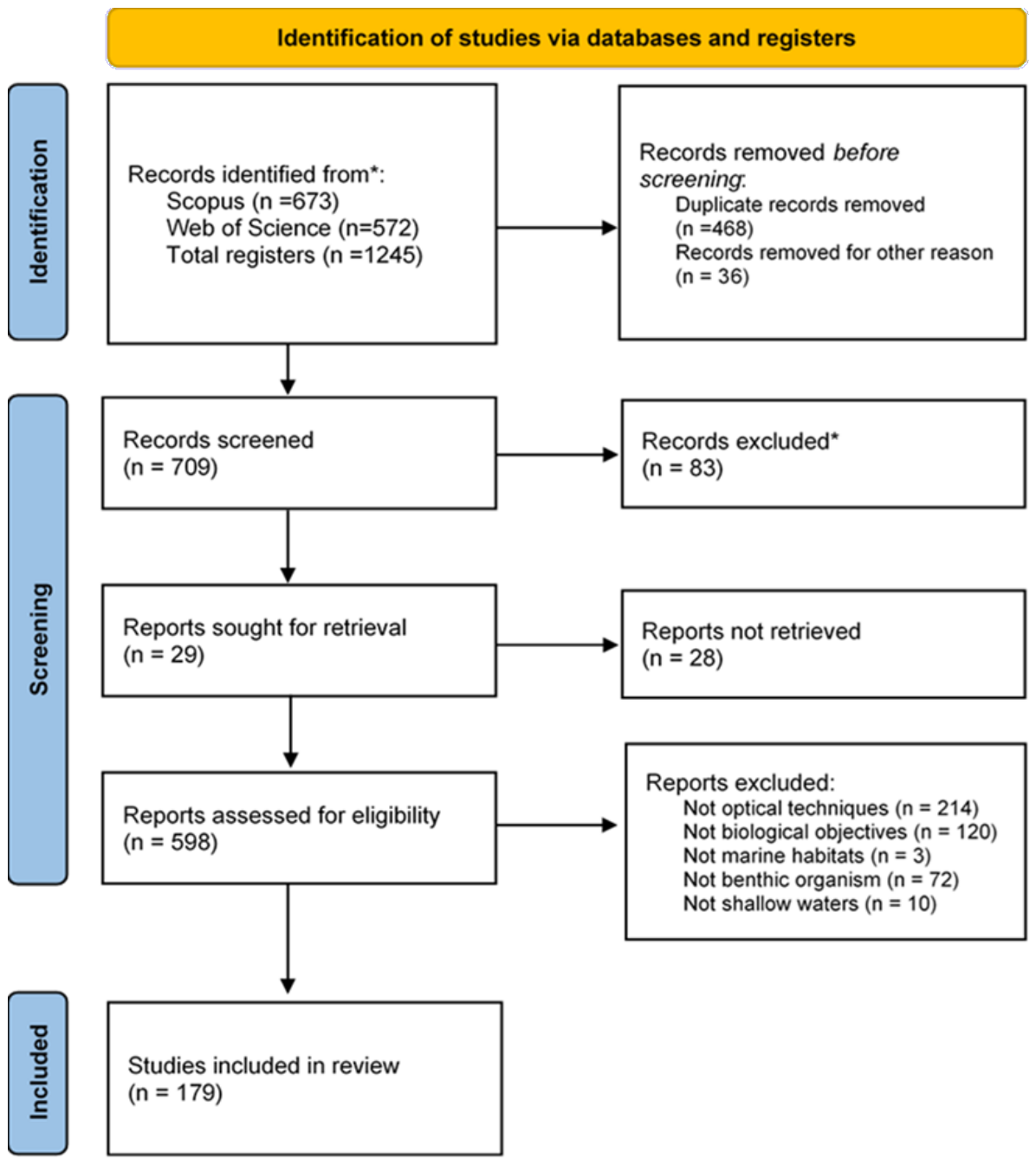
To systematically review the use of ORS techniques in benthic biodiversity research, a comprehensive literature search was conducted in accordance with PRISMA (Preferred Reporting Items for Systematic Reviews and Meta-Analyses) guidelines [12]. The search was performed across two major academic databases, Scopus [13] and Web of Science (WoS) [14], covering the period from 2014 to 2023. Only English-language peer-reviewed journal articles were considered. The search query was designed to capture a broad range of ORS applications in shallow water and benthic environments, focusing on biodiversity assessment and monitoring. A structured Boolean query was developed to retrieve relevant literature from the SCOPUS and WOS databases. The search string was organized into five conceptual groups: (i) remote sensing technologies, (ii) shallow-water marine environments, (iii) ecological or mapping applications, (iv) biological or ecological targets, and (v) exclusion terms. Within each group, terms were combined using OR, while groups were combined using AND. For example, combinations such as (“remote sens*” OR satellite OR UAV) AND (“shallow water*” OR benth* OR seafloor). Exclusion terms were applied using NOT (Table 1).

2.2. Screening and Filtering Process

After retrieving the search results, all records (673 in Scopus and 572 in WOS) were exported and compiled into a single database. Duplicate records were identified and removed manually. The remaining articles underwent a two-stage screening process: (1) title and abstract screening to exclude clearly irrelevant studies and (2) full-text review, consisting of an independent full reading by at least two authors to assess final eligibility. The articles were included if they applied ORS techniques (e.g., multispectral, hyperspectral, drone- or satellite-based imagery) and were focused on benthic or shallow marine environments and relevant to biodiversity or ecosystem-level assessments, including mapping, monitoring, species or habitat characterization, or conservation. Studies were excluded if they primarily used non-optical methods, such as acoustic sensors or numerical modeling without remote sensing input, or focused on non-marine or freshwater systems (e.g., rivers, lakes, ice-covered areas, or oil-related studies) or pelagic species (turtles, planktonic or fishes). Studies centered on underwater photogrammetry, Structure-from-Motion workflows, or imaging systems operating exclusively below the water surface were also excluded from the review scope. The selection process is illustrated in a PRISMA flow diagram (Figure 1), which details the number of records identified, screened, excluded, and retained for final analysis. A total of 179 articles met the established inclusion criteria, forming the basis for the database from which variables were extracted and analyzed in this study.

2.3. Data Extraction and Categorization

In addition to the journal statistics obtained from academic databases, detailed information was extracted from each eligible study to support quantitative and qualitative synthesis. The following variables were recorded: maximum depth of the study area, bathymetric range, type of remote sensing platform (e.g., satellite, UAV, aircraft or others), the sensor used, spectral information (Multispectral, RGB, Hyperspectral or Panchromatic), geographical location (country/region), and location type (continental, island, atoll or coastal lagoons). Technical details, such as spatial resolution and year(s) of data acquisition, were also extracted (Table 2).
In parallel, information on methodological procedures was recorded, including the application of atmospheric, sunglint (surface sun-reflection effects), and water column corrections, as well as the use of validation with independent in situ data. These corrections address sensor- and environment-induced distortions common in aquatic environments, while validation provides an empirical basis for assessing the reliability of the remote sensing outputs. Recording these elements allowed for the evaluation of common practices and methodological rigor across studies.
Ecological variables recorded included the main benthic habitat categories, such as algae, seagrass or coral reef, along with taxonomic groups, highlighting the target species whenever mentioned. Studies that involved the mapping of multiple biological groups or that combined biological and substrate or geomorphological features (e.g., sand, rock, reef, rubble) were collectively categorized under the label `benthic habitat’.
As an additional step in classifying the literature, the studies included in the PRISMA analysis were categorized according to their main objectives, which were grouped into seven thematic categories: conservation, ecological knowledge, management, mapping, methodological improvement, monitoring, and restoration. These categories were defined a priori based on the aims explicitly stated in the articles, encompassing studies focused on protecting biodiversity, improving ecosystem understanding, supporting management and spatial planning, generating habitat maps, enhancing methodologies, monitoring temporal changes, and guiding restoration initiatives. Since many studies addressed more than one purpose, two columns were created in the database: one for the primary objective, corresponding to the most directly stated or central aim, and another for a secondary objective when applicable. This procedure allowed the multidimensional nature of ORS applications in marine biodiversity to be captured, while ensuring a structured and comparable categorization across studies.
Data extraction was conducted manually using excel and Rstudio to ensure consistent recording and classification of variables across all reviewed studies. Categories were standardized when necessary to harmonize terminology across studies (e.g., aligning various habitat terms under broader benthic categories). These variables formed the basis for further analysis of trends, methodological patterns, and research gaps in the application of ORS for benthic biodiversity.

3. Results

3.1. Overview of the Studies

3.1.1. Journal Statistics and Long-Term Citation Performance

The 179 reviewed articles were distributed across 73 journals, reflecting the interdisciplinary nature of ORS applications in benthic biodiversity research. The ten most productive journals accounted for 95 publications (approximately 53% of the total; Table 3). Remote Sensing (MDPI) was the leading journal with 33 articles (18%), followed by Remote Sensing of Environment (13 articles) and International Journal of Remote Sensing (10 articles). Most studies (91%) were published in JCR-indexed journals, with nearly 90% published in first-quartile (Q1) or second-quartile (Q2) journals according to Journal Citation Reports (JCR) [15]. In addition to specialized remote sensing journals, contributions also appeared in marine ecology journals such as Coral Reefs [16,17,18,19,20] and Frontiers in Marine Science [21,22,23,24,25,26,27,28,29]. Overall, the reviewed articles accumulated 4721 citations during the study period. Citation performance varied substantially among journals (Table 3), with Remote Sensing of Environment and Coral Reefs showing the highest average citation rates per article. These patterns suggest that ORS applications in marine biodiversity monitoring are increasingly recognized across both remote sensing and marine science communities.

3.1.2. Authorship and International Collaboration

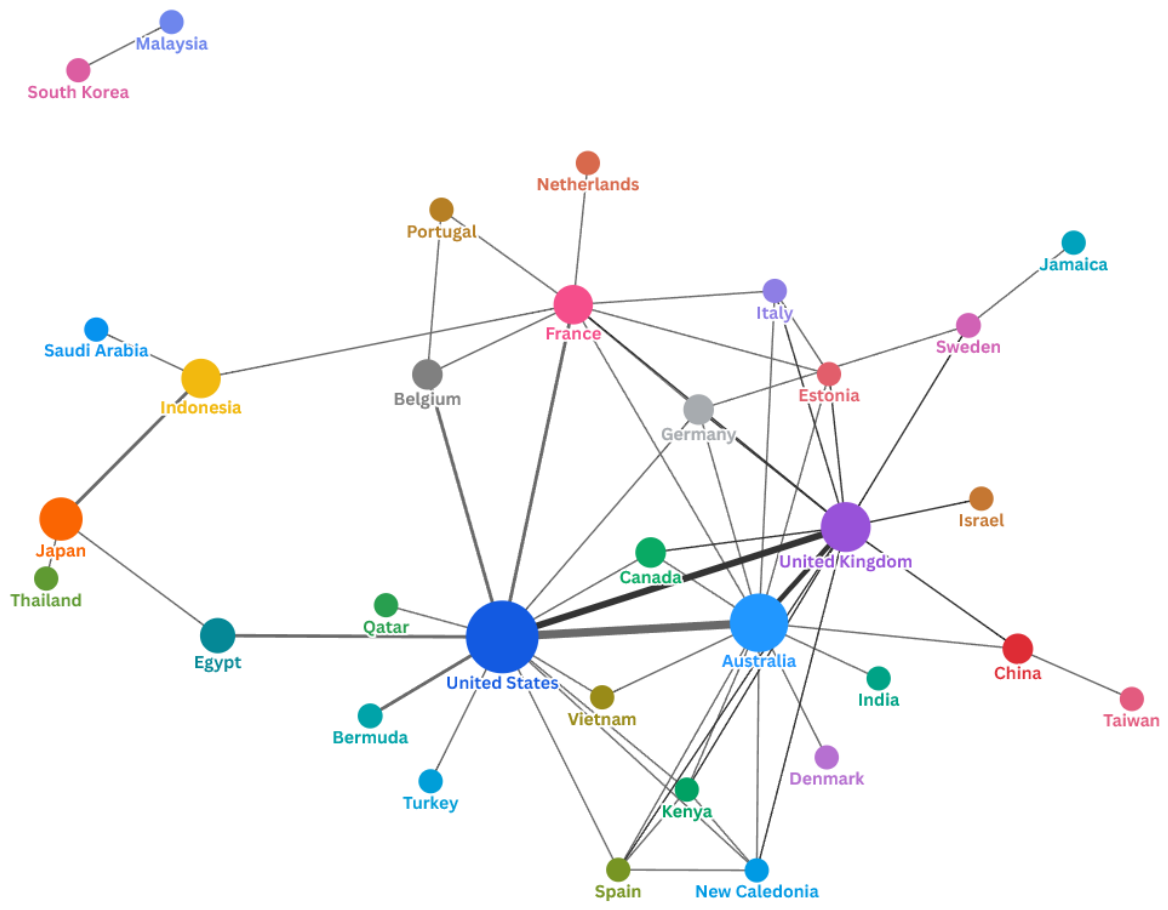
Authorship in the reviewed literature spanned 40 countries, though research activity was highly concentrated in a few. The United States led with 44 publications, followed by Australia (26), Indonesia (22), France and China (13 each), and Italy (11). Collectively, the 14 most represented countries accounted for approximately 78% of total authorship.
International collaboration was present in 39 studies (21.6%). The United States was the most frequent international partner (17 collaborative papers), followed by Australia (11), the United Kingdom (8), Japan (6), and France and Indonesia (5 each). The international co-authorship network (Figure 2) reveals strong collaborative links among major research hubs, particularly between Australia, the United States, and the United Kingdom.

3.1.3. Temporal Trends

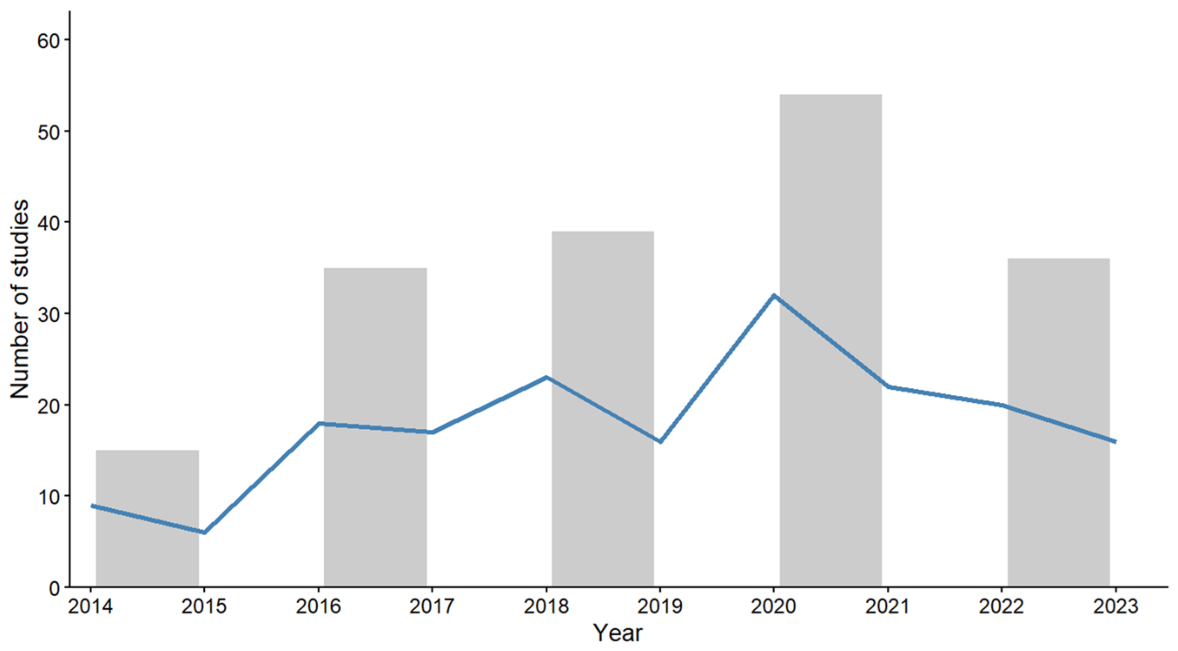
As illustrated in Figure 3, publication output increased markedly over the study period, rising from 9 and 6 studies in 2014 and 2015, respectively, to a peak of 32 studies in 2020 (18% of the total). This trend corresponds to an average annual growth rate of approximately 23%, estimated using the Compound Annual Growth Rate (CAGR), which describes the mean annual rate of increase over a defined period [30]. Although publication numbers declined slightly after 2020, research activity remained consistently high during 2021–2023, indicating sustained scientific interest in ORS applications for benthic biodiversity monitoring.

3.1.4. Geographical Trends

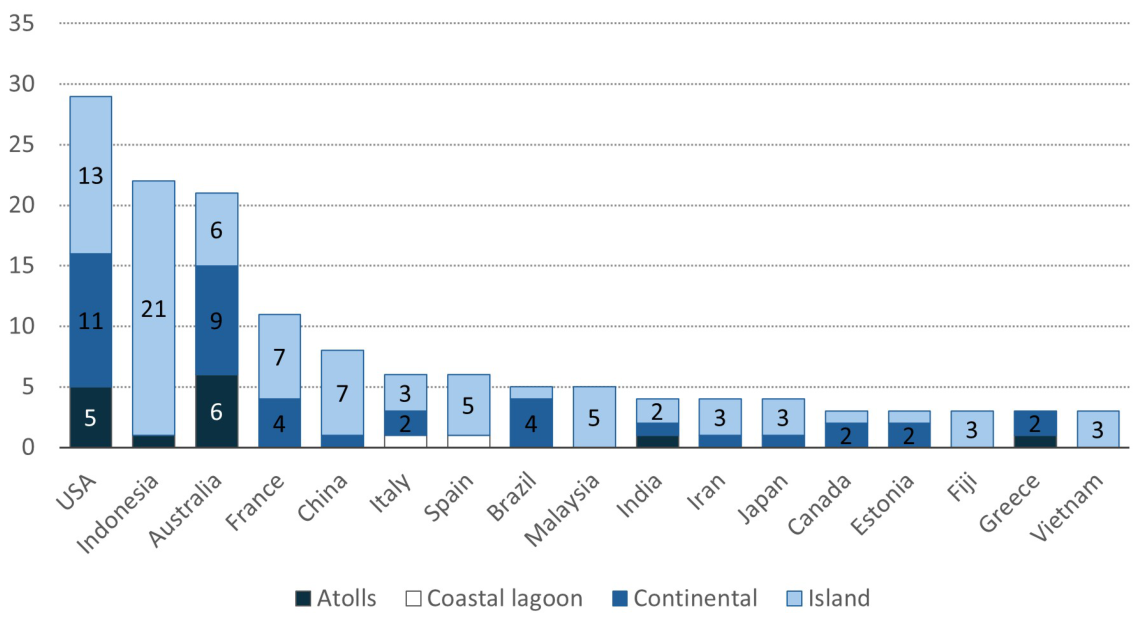
The geographic distribution of studies reveals marked disparities in research activity across countries and regions (Figure 4). The United States accounted for 17% of all studies (30 out of 179), followed by Indonesia (12.3%) and Australia (11.7%). France, China, Italy, and Spain contributed smaller but consistent proportions of the reviewed literature, reflecting the concentration of ORS applications in countries with extensive coastal ecosystems and established marine research infrastructure.
Figure 4 also illustrates the geographic setting of study sites within each country. Continental environments dominated in countries such as the United States [31,32,33,34,35] and Australia [19,36,37,38,39], whereas island settings prevailed in several Southeast Asian nations, including Indonesia [40,41,42,43], China [44,45,46,47], and Malaysia [48,49,50,51]. Atoll environments were comparatively less represented and mainly associated with coral reef systems in the Pacific and Indian Oceans [17,52,53,54]. Coastal lagoon environments appeared only in a few studies [55,56], notably in Italy and Spain.
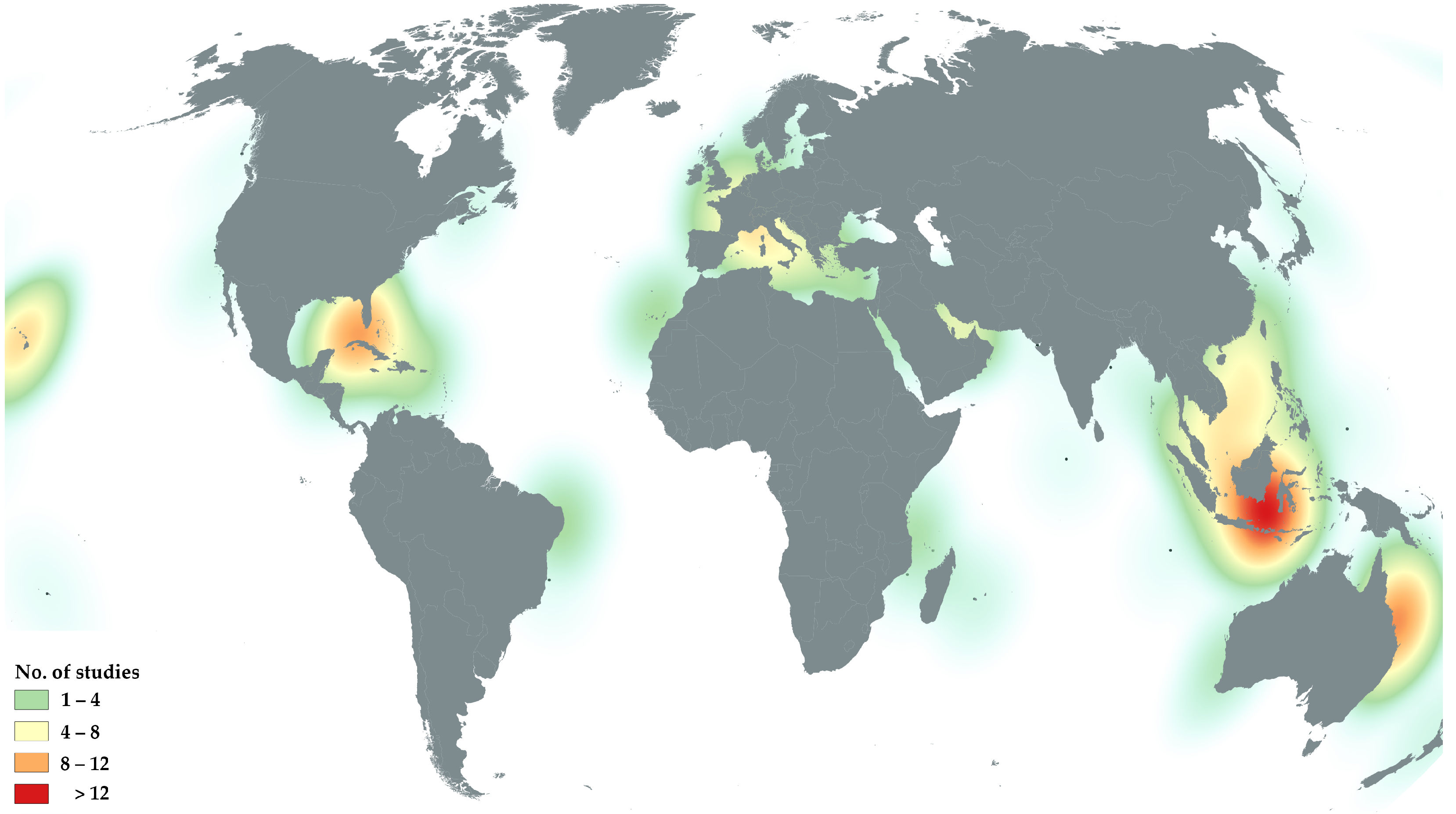
At the regional scale (Figure 5), Southeast Asia represented the largest concentration of study sites (28%), followed by Oceania (23%), the Caribbean (12%), and the Mediterranean (9%). In contrast, Central America, Western Europe, and East Africa collectively accounted for less than 9% of study locations.

3.2. Optical Sensors and Platforms: Distribution and Characteristics

3.2.1. Sensors and Platforms

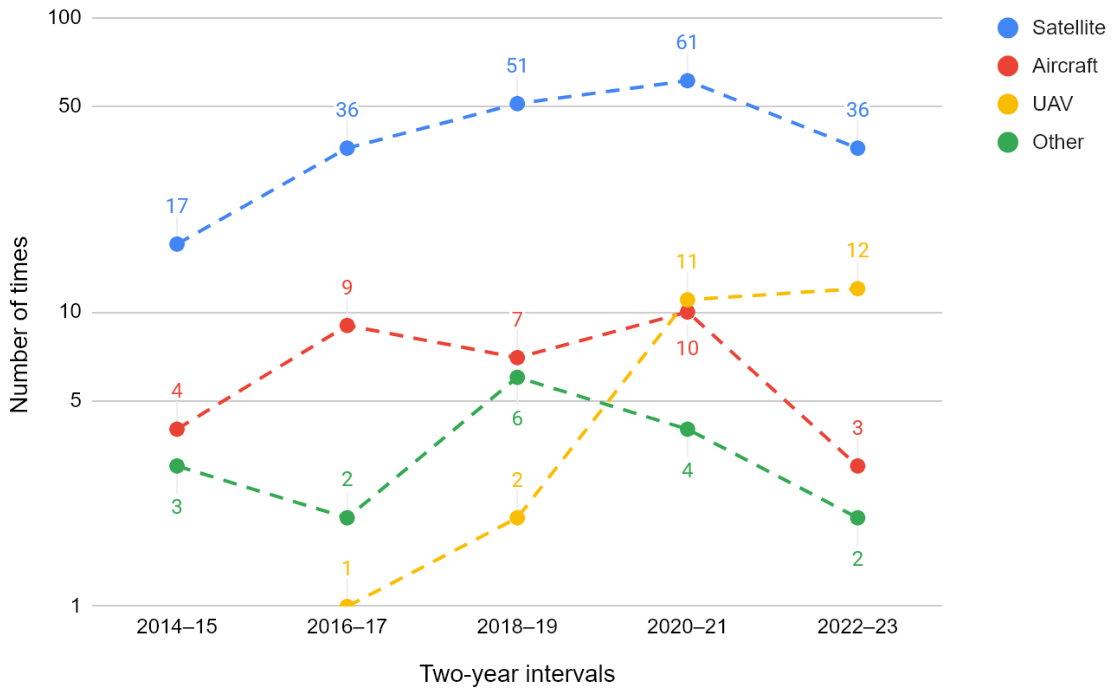
The reviewed literature included a wide range of ORS sensors deployed across multiple observation platforms, including satellites (201 records), crewed aircraft (33), uncrewed aerial vehicles (UAVs) (26), and other systems such as handheld spectrometers or parasailing-mounted cameras (17). Although some studies combined multiple sensors or platforms, single-sensor approaches predominated, representing 125 of the reviewed articles. Figure 6 summarizes platform usage across two-year intervals from 2014 to 2023. Satellite platforms remained dominant throughout the study period and reached their highest use during 2020–2021. Aircraft-based applications showed relatively stable but limited representation, whereas UAV-based studies increased steadily after 2016–2017, reflecting their growing adoption for high-resolution shallow-water mapping. In contrast, the use of other non-conventional platforms remained comparatively limited and sporadic.

3.2.2. Spectral and Spatial Resolutions

To facilitate analysis, the optical sensors identified in the reviewed studies were grouped into three categories according to the spectral information recorded: multispectral, hyperspectral, and RGB/panchromatic (PAN) systems.
Table 4 summarizes the multispectral sensors identified in the literature, including 30 satellite systems and one UAV-mounted camera. Frequently used platforms included Landsat, Sentinel-2, SPOT, WorldView-2/3, Dove [57,58,59,60], RapidEye [61,62], QuickBird [53,63,64], and GeoEye-1 [65,66,67]. Most commercial satellites provided spatial resolutions below 5 m, supporting fine-scale coastal and benthic mapping, whereas UAV-mounted systems such as the Micasense RedEdge–M achieved centimetric resolutions suitable for ultra-high-resolution applications in shallow environments [50,55,68,69]. Despite differences in spectral coverage, most studies focused on visible wavelengths (approximately 400–700 nm), which are most suitable for underwater observations due to their greater penetration through the water column.
Hyperspectral systems (Table 5) were primarily airborne, with the HySpex VNIR–1600 sensor being the most frequently used [24,75,76,77,78,79,80]. Other systems, including AVIRIS, CASI, AisaEAGLE–1K, and CAO–2, appeared less frequently, while PRISMA represented the only spaceborne hyperspectral mission identified in the review [81]. These systems capture hundreds of narrow contiguous bands across the visible and shortwave infrared ranges, enabling detailed spectral characterization of benthic habitats. A distinct case was the ASD FieldSpec spectrometer, reported in 11 studies [24,34,47,68,75,78,80,82,83,84,85]. Rather than producing imagery, this instrument was mainly used to acquire reference spectral signatures for benthic substrates and biological components, supporting spectral library construction, sensor simulation, and image interpretation.
RGB and PAN systems (Table 6) included satellites, aerial orthophotography, UAV-mounted cameras, and other non-conventional imaging systems such as parasailing with a Sony NEX-7 HD camera [87]. UAV-based RGB cameras, particularly DJI integrated systems, were among the most frequently employed sensors [16,29,38,43,47,50,69,88,89,90,91,92,93,94,95,96,97], reflecting the growing accessibility of centimetric-resolution imagery for site-scale coastal monitoring. Historical aerial orthophotography was also used in several studies [78,93,98], demonstrating the value of archival datasets for long-term environmental assessment. Satellite-derived RGB imagery, including Google Earth products, was occasionally employed, although incomplete metadata often limited reproducibility. PAN sensors were less common, with examples including the high-resolution WorldView-1 satellite [99] and the Grasshopper GRAS-14S5M camera [100]. Emerging approaches based on airborne fluid lensing, designed to reduce wave-induced distortions in shallow-water observations, were reported only once in the reviewed literature [26].

3.2.3. Ranking of the Most Frequently Used Sensors

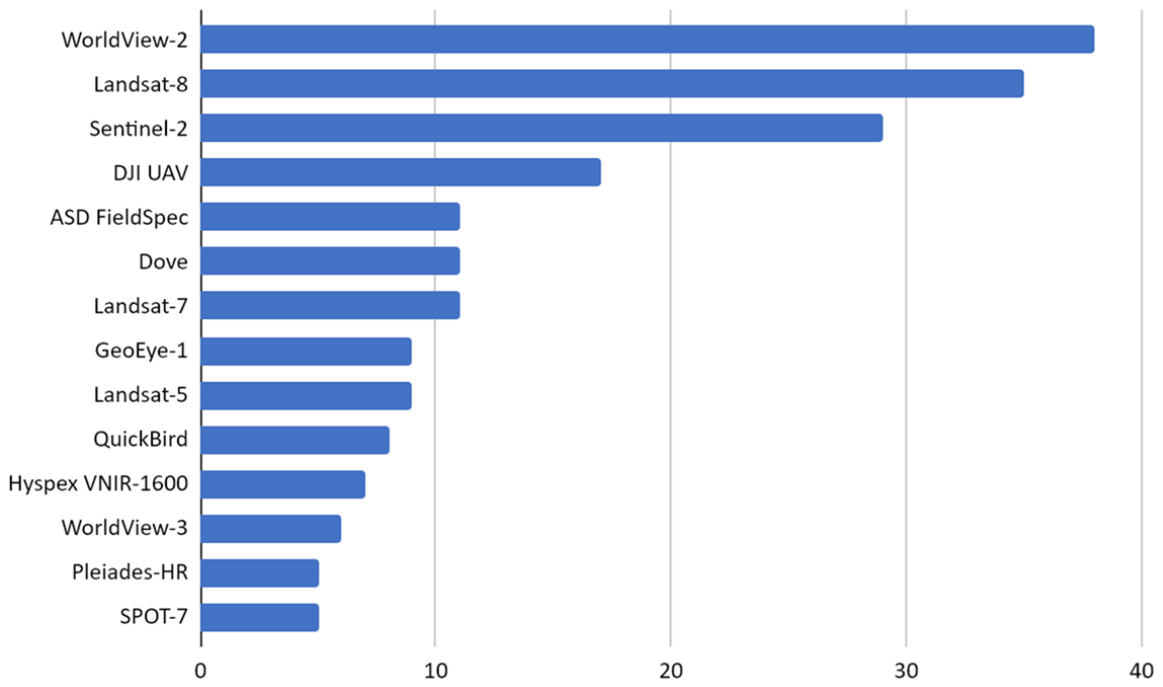
Figure 7 ranks the 14 most commonly employed sensors across the reviewed 179 studies. Satellite platforms clearly dominated, particularly WorldView-2 (38 studies), Landsat-8 (35), and Sentinel-2 (29). The Dove microsatellites by Planet Labs (11) further highlight the growing role of small satellite platforms. When grouping by satellite families, Landsat missions accounted for 61 studies (Landsat-1 to -9), while Maxar Technologies’ suite, now operated by Vantor, (WorldView-2/3, GeoEye-1, QuickBird) appeared in 62 studies, underscoring their prominence. The Pleiades-HR [78,104,105,106,107] and SPOT-7 [82,108,109,110,111] sensors by Airbus Defence and Space (5 each) represent additional high-resolution alternatives. Among UAVs, DJI’s integrated cameras (17 studies) were the most frequently used, reflecting the increasing adoption of low-altitude, centimeter-scale mapping approaches. Airborne deployments favored the HySpex VNIR–1600 (7 studies), whereas the ASD FieldSpec (11 studies) was the principal sensor within the “Other” platform group.

3.3. Pre-Processing, Correction Methods and Validation Procedures

3.3.1. Processing Levels and Input Products

Image processing levels describe the degree of radiometric and geometric correction already applied to remote sensing products before analysis. In general, Level 1 products correspond to geometrically corrected imagery with limited radiometric processing, whereas Level 2 products typically include surface reflectance retrievals after atmospheric correction. Higher levels may incorporate additional processing steps depending on the sensor provider [112,113].
A total of 234 sensor instances from satellite and airborne platforms were identified for this analysis, including 201 satellite sensors and 33 airborne systems. UAV-based and other non-conventional platforms were excluded because the processing level of the imagery was rarely reported. Among airborne sensors, only two studies specified the use of Level 1B products, corresponding to CASI [114] and HySpex VNIR-1600 [75]. Most reported processing levels referred to satellite imagery (51 instances). Level 1 products were the most frequently used (33 cases), followed by Level 2 products (15 cases). Sentinel-2 Level 1C imagery was particularly common, being explicitly reported in 15 studies [42,45,56,71,115,116,117,118,119,120,121,122,123,124,125]. However, the processing level was not specified for approximately 75% of all satellite sensors (150 out of 201), revealing limited methodological transparency across the reviewed literature. A distinct case involved PlanetScope Dove imagery, for which three studies [47,126,127] reported the use of Level 3B products. According to PlanetScope specifications, these products correspond to orthorectified top-of-atmosphere radiance imagery broadly comparable to Level 1C products from other satellite missions. One study [47], however, explicitly referred to Level 3B analytic surface reflectance products, indicating that both orthorectification and radiometric correction had already been applied.

3.3.2. Atmospheric Correction

A total of 277 sensor–method combinations, primarily from satellite and airborne observations, were analyzed to evaluate the application of atmospheric correction procedures. In total 64 cases explicitly stated that no atmospheric correction was applied, while 49 provided no information on this aspect. A total of 30 instances reported the use of atmospheric correction without specifying the method.
Empirical or simplified approaches were used, with the dark object subtraction (DOS) method (34) as the most common, followed by the empirical line method (4) and COST (Cosine of the Solar Zenith angle) (2). Model-based radiative transfer approaches were also widely employed, including FLAASH (Fast Linearly-adjusted Adjusted Radiative Transfer Code) (36), ATCOR (Atmospheric and Topographic Correction) (16), 6S (Second Simulation of the Satellite Signal in the Solar Spectrum) (14), ATREM (ATmospheric REMoval) (7), Sen2Cor (Sentinel 2 Correction) (7), ACOLITE (Atmospheric Correction for Operational Land Imager ‘lite’) (5) and ICOR (Image Correction for Atmospheric Effects) (2).
Processing chains specifically designed for aquatic or coastal environments were less common but considerable, comprising C2RCC (Case 2 Regional Coast Colour) (3), SeaDAS (SeaWiFS Data Analysis System) (3), and the POLYMER polynomial-based algorithm (1). Less frequently mentioned tools included MIP (Modular Inversion and Processing System), libRadtran (library for radiative transfer), TAFKAA (The Algorithm Formerly Known As ATREM), and a case-specific implementation following [128].

3.3.3. Water Column Correction

Water column correction aims to reduce depth-related attenuation effects in optically shallow waters to improve the retrieval of bottom reflectance and benthic features. It can be applied to optical imagery acquired from satellite, airborne, UAV-based, and other above-water observation systems.
The review of water column correction methods indicates a clear predominance of empirical approaches over physically based, model-driven techniques. In a substantial proportion of cases, no water column correction was applied (42%), while in 16% of instances the methodology was not reported.
Among studies implementing a correction, the empirical approach proposed by Lyzenga was by far the most widely used, accounting for 51 applications (18%). This method, originally introduced by [129,130], combines spectral bands into depth-invariant indices to reduce the influence of water-column attenuation on bottom reflectance under the assumption of spatially homogeneous water optical properties, thereby improving the discrimination of benthic features. A further 17% of cases reported the application of a water column correction without specifying the underlying method. Physically based approaches were less frequent, with methods from [131,132,133] collectively accounting for eight applications. Other correction techniques, including those proposed by [134,135], as well as several singular or study-specific implementations, together represented a minor fraction (4%) of the total reported applications.

3.3.4. Sunglint Correction

The analysis of sunglint treatment across the selected studies reveals that explicit correction or mitigation strategies were applied relatively infrequently. In most cases, no sunglint correction was performed (138 occurrences), while a substantial number of studies did not report whether any procedure was applied (52).
When sunglint handling was indicated, the specific method was often not described (38 times). Among studies that did report an explicit approach, the empirical method proposed by [136] was by far the most widely used (29 occurrences), making it the dominant technique for sunglint correction in shallow-water remote sensing. This method exploits the assumption of negligible water-leaving radiance in the near-infrared over deep waters and relies on the statistical relationship between visible and NIR bands to estimate and remove the glint component.
Less formal strategies were also reported, including the visual inspection of imagery to exclude glint-contaminated scenes (11 occurrences). Other methods appeared only sporadically, such as a modified Google CloudScore algorithm [137], MIP [138,139], the approach of Lee et al. (2001) [140], POLYMER [45], or the use of a circular polarizing filter during image acquisition [29].

3.3.5. Validation Procedures

The review reveals substantial heterogeneity in how accuracy assessment is conducted and reported across studies, which prevented a consistent categorization of validation approaches. Nevertheless, some form of validation was reported in more than 90% of the reviewed studies, indicating that accuracy assessment is a common component of ORS applications, despite the lack of methodological consistency. While many studies reported validation using independent datasets derived from in situ surveys, underwater imagery, or UAV-based observations, others relied on internal validation strategies such as cross-validation or random partitioning of training data. In many cases, the distinction between independent and non-independent validation datasets is not clearly defined, further limiting comparability and reproducibility.

3.4. Benthic Habitats, Biodiversity Patterns, and Research Applications

3.4.1. Benthic Categories

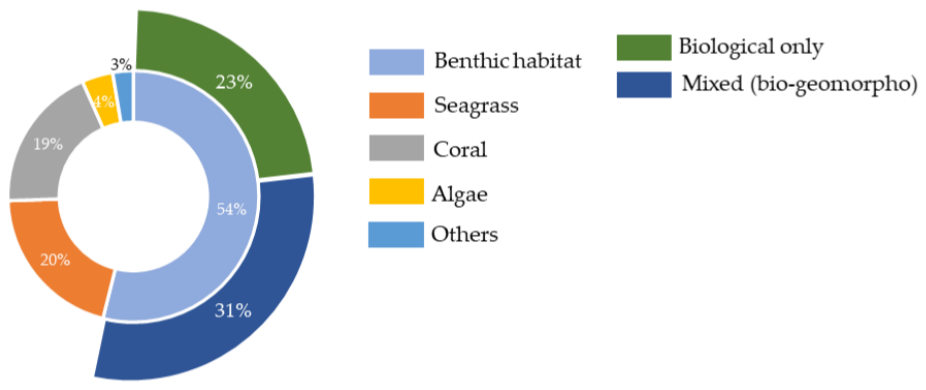
Among the 179 reviewed studies, 97 articles (54%) were grouped under the broad category “benthic habitat” because they addressed multiple benthic components, habitat types, or integrated classifications rather than focusing on a single ecological target (Figure 8). This category often encompassed diverse environments and biological elements, sometimes combining components such as microphytobenthos, mangroves, oyster beds (e.g., Crassostrea spp.), and substrate features within a common classification framework [74,75,82]. Of these 97 studies, 55 (30.7% of the total) combined biological and geomorphological elements, including sand, reef, rock, or rubble, whereas the remaining 42 focused exclusively on biological components. These two subdivisions correspond to the outer ring of Figure 8. The remaining 82 studies (46%) focused on specific benthic targets or ecosystems. Seagrass ecosystems represented the largest category (20%), followed by coral reef studies (19%). Coral studies were assigned to this category only when coral reefs represented the explicit primary target of the study, whereas studies integrating corals within broader habitat classifications, mixed benthic assemblages, or combined biological–geomorphological frameworks were retained within the “benthic habitat” category. Algae represented 4% of the studies, followed by less represented targets including annelids [24], mollusks [141], foraminifera [17], echinoderms [38], and mangroves [142].
These patterns reflect the predominant use of broad habitat-based classifications in ORS studies. The following section further explores the biological diversity represented within these studies through the taxonomic composition of the reported organisms.

3.4.2. Taxa List

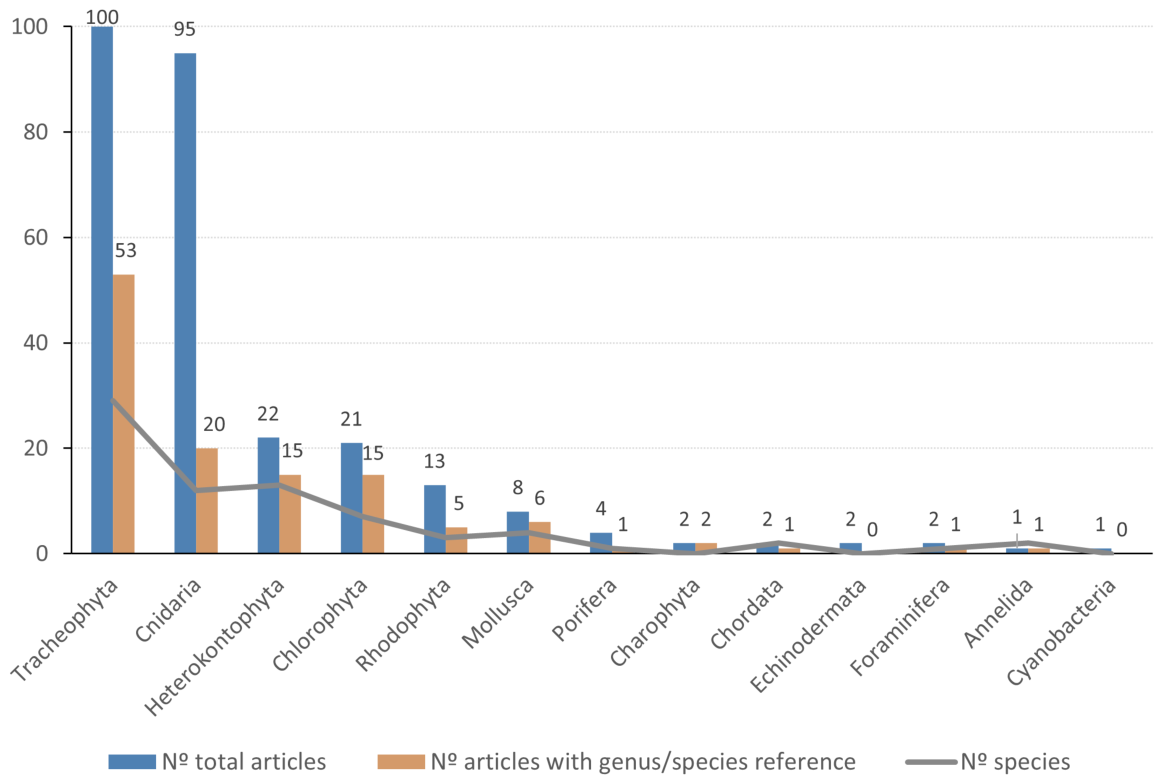
Building on this classification framework, the reviewed studies targeted a broad range of benthic organisms belonging to 13 major taxonomic groups (phyla or divisions; Figure 9), which are further subdivided into 26 orders and 48 families. Despite this apparent taxonomic breadth, there is a marked concentration of studies on Tracheophyta (vascular plants with 100 articles), primarily driven by seagrass-focused applications, although a smaller number of studies also addressed mangrove ecosystems, and on Cnidaria, largely associated with coral reef mapping and monitoring. These groups are frequently treated as broad functional categories, particularly “seagrass” and “coral”. In terms of taxonomic resolution, 87 studies (48.6%) did not report any genus or species level identification. Among the remaining 92 studies, 112 distinct species belonging to 69 genera were identified.
Within Tracheophyta, most research focused on seagrasses, reported in 46 studies (25.4%), while mangroves appeared in seven (3.8%). Commonly cited species included Posidonia oceanica (Mediterranean seagrass; 11 studies), Thalassia testudinum (turtle grass; 10 studies), Halophila ovalis (paddle grass; 10 studies), and Thalassia hemprichii (9 studies). Other Cymodoceaceae species, such as Cymodocea nodosa, Halodule uninervis, Halodule wrightii, Syringodium filiforme, and Syringodium isoetifolium, were each reported in more than six studies.
Cnidarians include reef-building corals, sea anemones, and related anthozoans. In 70 of these (39.2% of the total dataset), the term “coral” was used generically, referring to hard, soft, live, or dead reef-forming corals without further specification. When identified at genus level, the most frequently reported taxa were Porites (massive reef-building corals; 14 studies) and Acropora (branching or table corals; 11 studies), both dominant reef-building genera in tropical systems. This pattern reflects the strong emphasis placed on coral reef habitat mapping, although species-level resolution often remains limited.
Macroalgae were recorded in 62 studies (34.3%), although in 26 of these the group was referred to simply as “algae” without taxonomic detail. Brown algae were most frequently identified, particularly Sargassum species (rockweeds; seven species across six studies; [47,83,143,144,145,146]). Green algae were mainly represented by Caulerpa (three species in five studies) and Ulva (sea lettuce; two species in four studies). Red algae appeared in 13 studies; in five cases they were described as calcareous red algae, rhodolith-forming communities or maërl [36,54,147,148,149].

3.4.3. Biodiversity and Depth

Regarding the environmental context of these studies, depth distribution shows a clear predominance of shallow-water applications. In 79 articles (43.9%), the study depth did not exceed 10 m, while in 49 articles (27.2%) it remained within 20 m. In total, 28 studies (15.6%) extended up to 30 m, and only 3 studies were conducted exclusively within the first 5 m. Six articles focused on intertidal environments, and in 15 cases (8.3%) no bathymetric information was provided.
When examined by benthic category, clear depth-related differences emerged. Benthic habitat spans all predefined depth intervals, reflecting its use across a wide range of shallow and moderately deep environments. In contrast, categories such as Algae and Seagrass are predominantly associated with intertidal and shallow-water zones, reflecting both their ecological distribution and the depth limitations inherent to optical remote sensing methods.
Analysis of maximum depth shows variation among benthic categories. Studies classified as Coral reached the highest average maximum depths (22–26.7 m). In contrast, categories involving Seagrass or Algae were associated with lower mean maximum depths, generally below 16 m. Benthic habitat exhibited average maximum depths comparable to those reported for Coral.

3.4.4. Research Objectives in Benthic Biodiversity Studies Using ORS

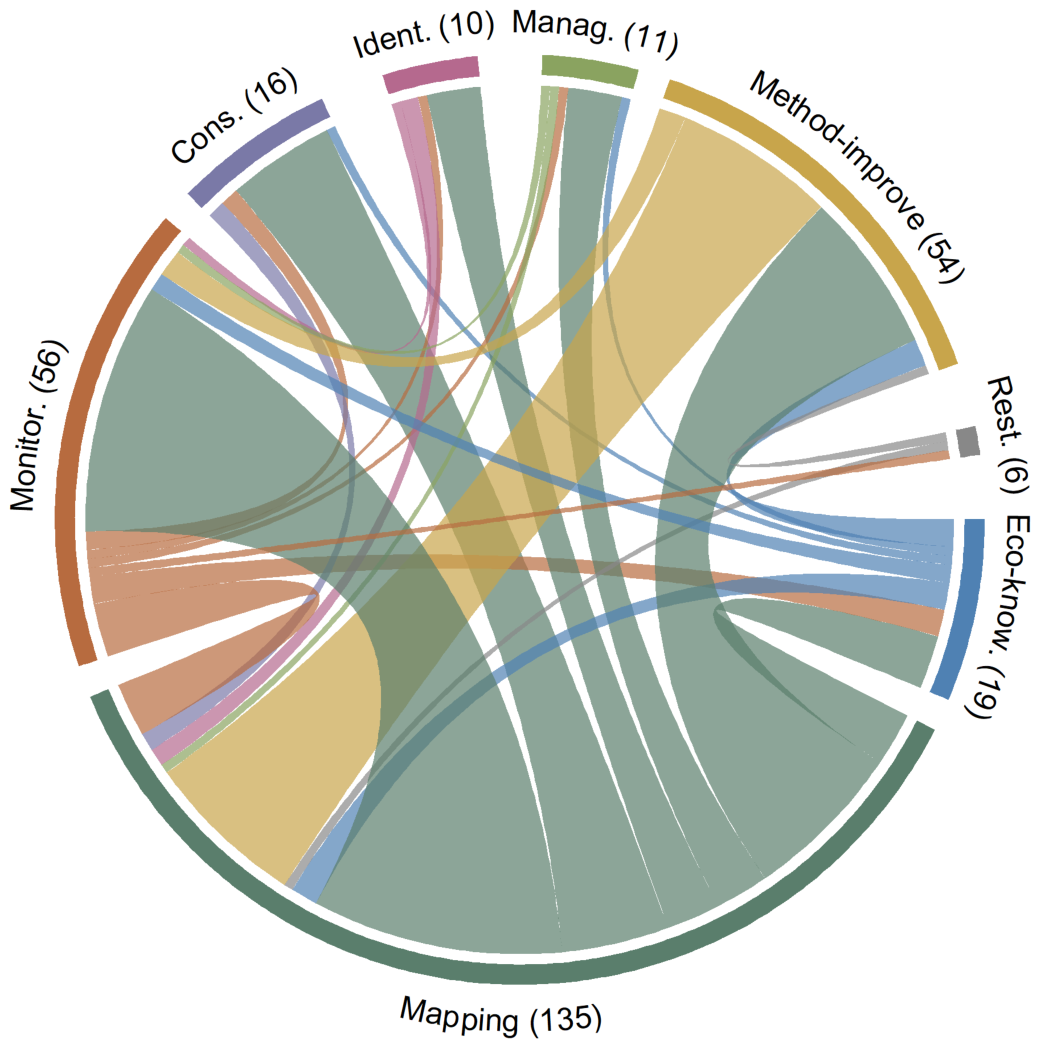
Among the 179 scientific articles selected through PRISMA criteria, the most frequently cited research objectives related to the application of ORS to marine benthic biodiversity were Mapping (75%) and Monitoring (31.7%) (Figure 10). These were followed by Methodological improvement (30%), Ecological knowledge (10.5%), and Conservation (9.4%). Other cited objectives included Management (6.1%), Identification (5.5%), and Restoration (3.3%).
Most of the articles (72%) address more than one research objective, revealing through the chord diagram a dense and interwoven network of co-occurrences across the reviewed studies (Figure 10). Mapping stands out as the central objective, co-occurring with Methodological improvement (36 studies), Monitoring (34) and Conservation (14). Monitoring also appears with nearly all other objectives, but it is mainly the secondary objective behind mapping. Less commonly cited objectives, such as Management, Identification, and Restoration, tend to appear in conjunction with broader goals.

3.4.5. Cross-Analysis of Sensors by Benthic Category and Research Objectives

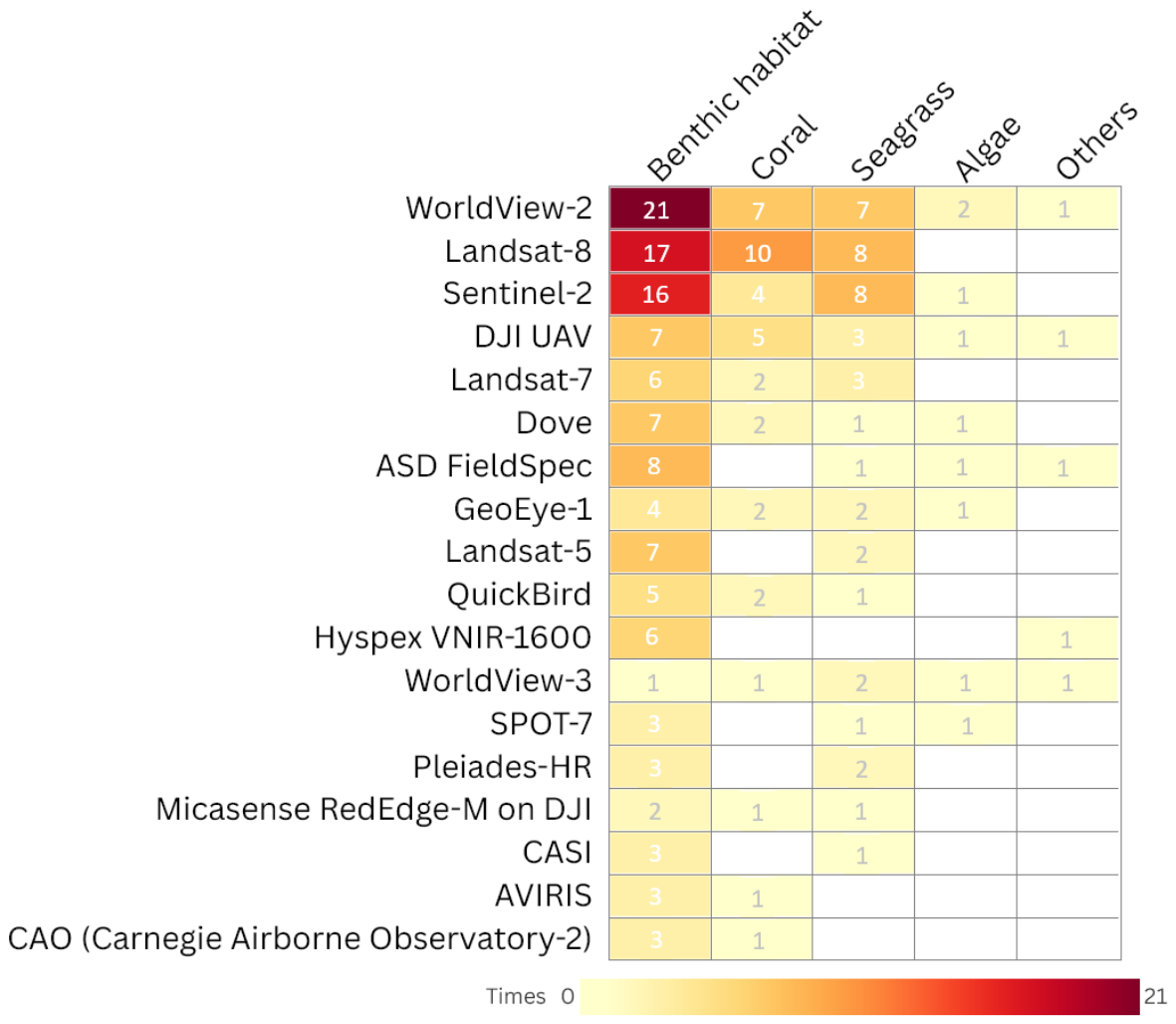
As noted in the previous section, studies addressing the generic “Benthic habitat” category constituted the largest share of the reviewed literature and involved the broadest range of sensors. Multispectral satellite platforms dominated this category, with WorldView-2 (21 studies), Landsat-8 (17) and Sentinel-2 (16) being the most frequently used sensors. Seagrass constituted the second most intensively studied benthic class and was predominantly mapped using Landsat-8 and Sentinel-2 (8 studies each), followed by WorldView-2 (7). Coral-focused studies were also well represented, particularly those employing Landsat-8 (10), WorldView-2 (7), and DJI-based UAV imagery (5), indicating the use of sensors with different spatial resolution. In contrast, algae-related studies were comparatively scarce. With the exception of WorldView-2, which was used in two studies [20,144], all other sensors appeared only once in this category, including the monochrome and multispectral Grasshopper systems [100], high-resolution satellites as Ikonos [33], GeoEye-1 [145] and SPOT-7 [110], and a multi-sensor combination involving Sentinel-2, Dove, DJI UAV, and ASD FieldSpec [47]. These patterns are synthesised in Figure 11, presented as a heatmap showing the frequency of sensor use across benthic categories, with colour intensity ranging from dark red (highest frequency) to white (no occurrences). The heatmap highlights the strong concentration of multispectral satellite sensors in broadly defined benthic habitat classes.
When analyzing sensor use across specific taxonomic groups, the most broadly applied sensors were WorldView-2 and Landsat-8, covering eight and seven different major taxonomic groups (phyla or divisions), respectively. However, certain groups showed clear associations with specific sensor types, likely driven by their spatial scale, habitat complexity, or detectability. For example, Annelida were consistently studied using high-resolution hyperspectral sensors such as ASD FieldSpec and Hyspex VNIR-1600, which are suitable for capturing fine-scale benthic features. Porifera, in contrast, were primarily mapped using Landsat-8, a multispectral satellite sensor with moderate spatial resolution appropriate for broader habitat-level detection. Studies on mollusks demonstrated the use of a wide array of platforms, including Landsat-5, -7, and -8, RapidEye, SPOT-4, SPOT-7, and WorldView-2 and -3.
Focusing on sensor usage within individual research objectives, mapping applications were primarily supported by satellite-based systems, with WorldView-2 (26 studies), Landsat-8 (24), and Sentinel-2 (17) being the most frequently employed sensors. Smaller commercial satellite platforms, such as QuickBird (8), Dove (6) and Pleiades-HR (3) [78,105,107], were also commonly employed for mapping purposes. Among airborne sensors, HySpex VNIR-1600 (5), CASI (4), AVIRIS (4), and AisaEAGLE-1K-OGS and CAO (Carnegie Airborne Observatory-2) [49,150] (2 each) contributed additional hyperspectral capabilities. The ASD FieldSpec spectrometer (8) was primarily used in support of mapping campaigns. UAVs, particularly DJI UAVs (12) and the Micasense RedEdge-M camera on DJI (2), further reflect the growing role of low-altitude platforms in shallow-water habitat mapping.
Monitoring was the second most frequently cited objective; however, only a limited number of remote sensing systems were repeatedly employed for this purpose. Sentinel-2 [34,120,151] and sensors from the Landsat program (specifically Landsat-4, -5, -7, and -8) appeared in two to three studies each [152,153,154], with all of them corresponding to satellite-based platforms.
Beyond the predominant applications of mapping and monitoring, several sensors demonstrated notable versatility by supporting a broader range of objectives in shallow-water remote sensing. WorldView-2 stands out as the most multi-purpose sensor, also being used in studies focused on all remaining main objectives, reflecting its high spatial resolution and consistent availability. Sentinel-2 had the second broadest thematic coverage, with documented applications in all objectives except conservation, highlighting its growing relevance as a free, open-access platform supporting mapping, monitoring, ecological knowledge, restoration, and management applications. Next was the Landsat-8, which, beyond its extensive use for mapping, was also employed in studies related to conservation (2), identification (1), monitoring (3), and restoration (1). This likely resulted from its moderate spatial resolution, high temporal frequency, and long-term data continuity.

4. Discussion

4.1. Key Technological Trends

One of the clearest technological trends identified between 2014 and 2023 is the consolidation of open access satellite missions as the backbone of shallow-water ORS. The widespread use of Landsat-8 [19,28,39,41,61,62,82,84,99,115,119,137,138,146,152,153,154,155,156,157,158,159,160,161,162,163,164,165,166,167,168,169,170,171,172] and Sentinel-2 [34,37,42,45,46,47,56,71,81,115,116,117,118,119,120,121,122,123,124,125,137,151,161,166,167,173,174,175,176] highlights their central role in benthic habitat monitoring at broad spatial scales, supported by global coverage, systematic acquisition, and free-data policies. These characteristics facilitate long-term monitoring and cross-regional comparisons.
Commercial very-high-resolution sensors, particularly those developed by Maxar Technologies [17,18,20,23,32,40,44,51,52,53,54,63,64,65,66,67,85,99,115,141,143,144,145,148,149,166,168,169,175,177,178,179,180,181,182,183,184,185,186,187,188,189,190,191,192,193,194,195,196,197,198,199,200], remain important for habitat-scale applications requiring detailed spatial information. Their use supports the identification of fine-scale ecological patterns, although acquisition costs continue to limit broader adoption.
UAV applications expanded rapidly after approximately 2018 [16,29,35,38,43,47,50,55,68,69,71,88,89,90,91,92,93,94,95,96,97,103,107,175], driven by lower platform costs, lightweight multispectral sensors, and advances in classification methods. UAVs provide centimetric-resolution observations suitable for shallow and spatially constrained environments, but their operational range and dependence on environmental and regulatory conditions remain limiting factors.
Microsatellite constellations, particularly Planet Labs systems [47,57,58,59,60,126,127,166,167,196,197], reflect an increasing emphasis on temporal resolution and near-continuous monitoring. Their high revisit frequency complements traditional satellite missions by improving temporal coverage despite more limited spectral capabilities.
Airborne hyperspectral sensors [21,24,26,27,28,34,36,42,49,75,76,77,78,79,80,83,84,98,102,114,139,147,150,166,190,201,202,203,204,205], although less frequently applied, remain among the most powerful tools for detailed benthic discrimination. Their high spectral resolution allows for improved detection of subtle differences in benthic composition. However, their operational complexity and high cost limit broader adoption. Deployment often requires dedicated aircraft, expert personnel, and sophisticated sensor integration, along with extensive post-processing workflows. As a result, their use is generally restricted to government agencies or academic research institutions, such as those linked to NASA or university-led observatories, and access typically depends on collaborative frameworks or competitive funding schemes. Consequently, while hyperspectral approaches demonstrate strong analytical potential, their scalability and operational integration into routine monitoring remain limited.
A further notable trend is the increasing integration of multiple platforms within individual studies [34,47,71,78,166,167]. Hybrid approaches combining satellite observations with UAV-based data, in situ surveys, and field spectroscopy are progressively used for calibration, validation, and multi-scale analysis. Typically, satellite imagery provides regional-scale habitat mapping and temporal coverage, UAV observations contribute centimetric spatial detail, field spectroscopy supports spectral library development and calibration, and in situ observations are used for validation and ecological interpretation. An example is provided by the study of eelgrass mapping in Elkhorn Slough, California, which combined Sentinel-2 imagery, Google Earth products, airborne hyperspectral PRISM observations, and bio-optical modelling to improve habitat detection under turbid water conditions [34]. This convergence reflects a methodological maturation of ORS, shifting from single-sensor frameworks toward integrative strategies that leverage complementary strengths in spatial, temporal, and spectral resolution.

4.2. Research Priorities and Taxonomic Focus

Research patterns in the reviewed literature reveal a heterogeneous taxonomic focus, with variations appearing to be driven mainly by technological developments, data availability, and research interests rather than by temporal changes in the ecological targets investigated.
A substantial proportion of studies were grouped under the integrative category “benthic habitat” (97 cases; 54%), encompassing classifications that combined biological and physical components such as seagrasses, macroalgae, corals, sand, rock, and rubble. This pattern reflects a major strength of ORS: the capacity to integrate multiple benthic elements within heterogeneous coastal environments. However, species-level discrimination often remains limited by sensor resolution, water column effects, and habitat complexity.
Within this ecosystem perspective, coral reef ecosystems remain a major focus of ORS applications, particularly in relation to climate change. Coral reefs are among the most biodiverse and ecologically valuable marine systems, yet they are increasingly threatened by rising sea surface temperatures, which drive widespread coral bleaching and associated mortality [206]. A major scientific breakthrough over the last decade has been the transition from opportunistic, site-specific mapping toward operational, multi-temporal monitoring of reef condition and thermal stress at regional to global scales [5,207]. Time-series imagery from platforms such as Sentinel-2 and Landsat is now routinely used to detect and quantify bleaching events, assess spatial patterns of thermal stress, characterize habitat condition, and support reef resilience assessments [58,152,167,207]. These advances have enabled the development of operational monitoring initiatives such as NOAA’s Coral Reef Watch (CRW), which provides global bleaching alert systems based on sea surface temperature anomalies, and the Allen Coral Atlas [208], which delivers standardized coral habitat mapping products and bottom reflectance analyses at unprecedented spatial scales. Collectively, these developments illustrate how ORS has evolved from a primarily descriptive mapping tool into an operational framework supporting climate adaptation, ecological forecasting, and large-scale reef monitoring.
Seagrass ecosystems have also received considerable attention due to their ecological and socio-economic importance. Species-level mapping is comparatively more common, including applications involving Posidonia oceanica [81,93,104,118,149,164,174,175,203,209] and Thalassia testudinum [31,114,170,188,191,201,202]. This likely reflects the relatively homogeneous structure of many seagrass meadows compared with the taxonomic richness and structural complexity of coral reefs. Consequently, coral applications often remain at broader functional levels, whereas species-level discrimination is more feasible in homogeneous systems or in approaches based on close-range photogrammetry, which were outside the scope of this review.
Microphytobenthos, i.e., communities of microscopic photosynthetic organisms inhabiting surface sediments, appeared in several integrative assessments [22,36,56,75,82]. Although still underrepresented, its increasing inclusion reflects its ecological importance and potential suitability for hyperspectral and UAV-based applications, particularly in intertidal environments [22].
Despite these advances, ORS applications remain uneven across taxa. Groups such as mollusks, echinoderms, and sponges are rarely the primary focus of mapping efforts [17,24,38,68,141], mainly because their spectral ambiguity and fragmented spatial distribution limit detection. Their limited representation therefore appears to reflect methodological constraints rather than ecological relevance.
Overall, current ORS applications tend to prioritize benthic systems combining ecological importance, management relevance, and favourable spectral characteristics. While this trend is operationally justified, it may also introduce biases in the representation of benthic biodiversity.

4.3. Geographic and Biogeographic Biases

The spatial distribution of studies reveals a strong concentration in tropical and subtropical regions, with approximately three-quarters of research conducted between 23°N and 23°S. Southeast Asia, the Caribbean, and parts of Oceania account for 63% of case studies, reflecting the global importance of coral reefs and associated shallow-water habitats in these regions. Despite this concentration, some reef-bearing regions appear comparatively underrepresented relative to their ecological relevance, particularly parts of East Africa, the Western Indian Ocean, and several tropical island systems. However, a quantitative assessment of study density relative to reef extent was beyond the scope of this review.
The predominance of low-latitude systems is partly explained by their exceptional biodiversity and conservation relevance. However, it also introduces methodological biases because optical properties, benthic composition, water clarity, and environmental variability differ substantially among tropical, temperate, and polar environments. Consequently, workflows and correction approaches developed for clear tropical waters may not perform equally well in turbid, seasonally dynamic, or high-latitude systems [210].
Temperate ecosystems, including kelp forests, mixed sediment habitats, and soft-bottom systems, remain comparatively underrepresented despite their ecological importance [22,24,29,47,55,68,69,75,77,79,80,82,93,94,96,101,108,143,144,164,192]. Polar and subpolar coastal regions are also less represented due to logistical constraints, extreme illumination regimes, cloud cover, and seasonal ice [62,95,97,100,110,165,177,205]. Limited methodological adaptation to these environments likely reinforces existing geographic biases.
These patterns are consistent with the distribution of scientific infrastructure and remote sensing capacity. Countries such as the United States, Australia, Indonesia, and France contribute disproportionately to both authorship and study locations, whereas several biodiversity-rich regions remain less represented. This imbalance likely reflects differences in funding, technological access, and institutional capacity.
Overall, current ORS frameworks have been developed mainly within a limited set of environmental and institutional contexts, which may restrict their transferability to underrepresented ecosystems.

4.4. Methodological Challenges in ORS of Benthic Ecosystems

Despite the rapid expansion of ORS applications in benthic ecology, several methodological limitations still constrain the robustness, comparability, and operational transferability of derived products. These challenges reflect both technical and conceptual difficulties associated with mapping biologically diverse and optically dynamic shallow-water environments. In particular, the review reveals substantial heterogeneity in preprocessing workflows, reporting practices, and validation strategies.
One of the most critical issues identified is the variability in atmospheric correction approaches. This step is fundamental for removing atmospheric scattering, aerosol effects, and adjacency contamination, yet its implementation remains inconsistent across studies. For multispectral satellite missions, tools such as Sen2Cor [56,71,117,118,119,120,175] and ACOLITE [34,81,160,164,169] are increasingly adopted, especially for Sentinel-2 imagery, while simplified empirical approaches, particularly Dark Object Subtraction (DOS), remain widespread due to their operational simplicity and low computational cost. However, these empirical methods may reduce cross-sensor comparability, particularly in multi-temporal or multi-platform analyses. In contrast, physically based radiative transfer models such as FLAASH [17,23,31,51,53,63,75,82,106,115,119,143,159,166,175,183,184,189,195,198,199,205], ATCOR [24,62,76,77,80,85,116,164,169,177,190], and the 6S-based atmospheric correction framework [20,57,59,61,137,148,149,184,190] offer greater theoretical robustness but are less frequently used due to their higher data requirements and technical complexity. For non-specialist users, these differences imply that habitat maps generated from similar imagery may not always be directly comparable when different preprocessing approaches are applied. This may affect the consistency of long-term monitoring programmes and limit the transferability of mapping products intended for environmental management and conservation applications.
The relatively limited use of aquatic-specific processors represents another important constraint. Tools such as SeaDAS [73,165], C2RCC [45,74,174], and POLYMER [45] have been specifically developed to address the optical complexity of coastal and shallow-water environments, including high turbidity, adjacency effects, and sunglint contamination. Nevertheless, their adoption remains comparatively low in benthic habitat mapping studies. This underuse may reflect limited familiarity within the benthic ecology community, as well as challenges related to parameterization and validation in optically complex waters. Water column correction also shows marked variability. The empirical depth-invariant approach introduced by Lyzenga remains the most widely applied method [40,41,42,51,54,59,71,109,111,114,117,118,121,122,123,124,126,127,137,149,151,154,157,162,163,164,170,171,176,179,180,194,199,211], largely due to its practicality, low data requirements, and effectiveness in shallow, optically clear environments. However, bio-optical and physics-based inversion approaches, such as those developed by Lee and collaborators [45,78,83,190], remain underutilized despite their stronger theoretical basis and potential transferability across environmental conditions. The omission of water column correction in some studies may be justified when objectives focus on relative classification or when depth variability is limited. Nonetheless, inconsistent application and reporting of these procedures reduce reproducibility and hinder cross-study comparisons.
Surface reflectance distortions caused by sunglint represent another frequently overlooked source of uncertainty. Although empirical correction using near-infrared bands is well established and operationally accessible [18,31,32,59,66,71,85,121,122,123,149,153,161,176,177,179,180,190,194,195,205], its application is inconsistently documented. This omission is particularly relevant in tropical and subtropical environments, where sunglint can obscure benthic spectral signals.
Beyond correction algorithms, the review highlights a major gap in the reporting of preprocessing levels and input products. Among the cases where this information was reported, Level 1 products were more frequently used than atmospherically corrected Level 2 datasets, suggesting that many workflows rely on user-defined correction procedures. Sentinel-2 Level 1C imagery was particularly prominent [42,45,56,71,115,116,117,118,119,120,121,122,123,124,125]. However, for approximately three-quarters of the satellite sensors reviewed, the processing level of the input product was not explicitly stated. This lack of detail complicates the interpretation of methodological differences across studies and hampers efforts to develop standardized workflows.
Validation practices represent another major methodological bottleneck. Accuracy assessment procedures show substantial heterogeneity across the reviewed literature. Differences in study design, data sources, and objectives prevented their recategorization into a standardized framework, limiting quantitative comparison across studies. Examples of validation approaches reported in the literature include independent field surveys based on diving observations, underwater imagery and video transects, in situ sampling, and comparisons with existing habitat maps [44,57,97,123,138,147,161,164,194]. These datasets are commonly used to construct confusion matrices and derive accuracy metrics.The limited availability of reference datasets for validation is frequently associated with logistical and financial constraints, particularly in remote or resource-limited regions. This limitation has direct implications for the credibility and operational uptake of ORS products in conservation and management contexts. Without robust validation, uncertainty estimates remain difficult to interpret, reducing confidence in habitat maps used for decision-making.
Overall, the methodological heterogeneity identified in this review suggests that benthic ORS remains in a transitional phase between exploratory and operational applications. Greater standardization in preprocessing workflows, transparent reporting of input products and correction procedures, and improved validation protocols will be essential to enhance comparability, reproducibility, and long-term monitoring capacity.

4.5. Policy and Conservation Implications

ORS provides a scalable approach for supporting long-term ecological monitoring at regional and national scales, particularly within marine protected areas (MPAs), coastal observatories, and environmental assessment frameworks. In Europe, these applications are closely linked to policy instruments such as the Marine Strategy Framework Directive and Natura 2000, which require spatially explicit information on habitat extent and condition. Similar needs are emerging globally, reinforcing the relevance of satellite-based monitoring for environmental governance.
The widespread use of ORS for mapping and monitoring applications [16,23,24,32,36,39,40,41,42,44,54,56,59,61,62,63,74,84,90,91,101,117,118,137,141,143,146,148,166,171,177,185] reflects its alignment with major conservation initiatives, including the Convention on Biological Diversity, the Sustainable Development Goals (particularly SDG 14), and the Kunming–Montreal Global Biodiversity Framework. In this context, ORS supports the generation of spatial indicators, ecosystem condition assessments, and long-term monitoring of environmental change.
Global conservation targets, including the commitment to protect at least 30% of marine and terrestrial ecosystems by 2030, further emphasize the importance of operational monitoring systems. Satellite-derived habitat mapping, change detection, and multi-temporal analyses increasingly support conservation planning, protected area assessment, and ecosystem resilience evaluation. However, the integration of ORS into active management remains uneven. Objectives related to restoration and management remain comparatively underrepresented in the reviewed literature [19,27,65,70,81,93,99,109,122,142,156,181,182,183], suggesting that ORS applications are still concentrated on baseline mapping and monitoring. Although the growing availability of high-resolution and multi-temporal datasets offers considerable potential for restoration assessment, degradation detection, and ecosystem recovery monitoring, these applications remain inconsistently developed across regions and ecosystem types.
Finally, effective implementation requires standardized and interoperable classification systems. Frameworks such as the European Nature Information System (EUNIS) [212] and initiatives such as the European Marine Observation and Data Network (EMODnet) [213] provide pathways for integrating remote sensing products into operational monitoring and reporting. Strengthening compatibility between technological capabilities, ecological frameworks, and policy requirements will be essential to maximize the contribution of ORS to conservation and sustainable coastal management.

4.6. Future Research Directions and Recommendations

The evolution of ORS in benthic ecology will continue to be driven by technological innovation, expanding sensor availability, and increasing conservation demands. Future research should therefore aim not only to improve technical performance, but also to address the methodological, ecological, and geographic gaps identified in this review.
One of the most promising directions is the wider adoption of hyperspectral imaging [214]. These systems offer exceptional spectral resolution and enable the detection of subtle differences among benthic substrates and biological assemblages, particularly in heterogeneous and optically complex environments such as coral reef–seagrass mosaics, macroalgal forests, and turbid coastal ecosystems [4,215]. Although airborne hyperspectral sensors remain among the most powerful tools for detailed benthic discrimination (Section 4.1), their operational complexity and high cost have historically limited their use to institutions with access to dedicated aircraft and specialized expertise. However, the landscape is changing rapidly with the emergence of new spaceborne and UAV-based platforms. The launch of high-resolution hyperspectral satellites is expected to broaden access to this technology. The recent deployment of Planet Labs’ Tanager-1 satellite, developed through the Carbon Mapper partnership [216,217], represents a major step toward operational spaceborne monitoring. With a spectral range of 400–2500 nm and a spatial resolution of 30 m, Tanager-1 opens new opportunities for global-scale benthic mapping and cross-platform validation [218]. Even more promising for fine-scale applications is the emergence of commercial constellations such as Pixxel’s Firefly [219]. With six operational satellites already in orbit, Firefly delivers the world’s highest-resolution hyperspectral imagery at 5 m ground sampling distance across more than 135 bands (450–900 nm) and a 24-h revisit frequency. This combination of spatial, spectral, and temporal capabilities may enable monitoring of dynamic coastal ecosystems at unprecedented scales. Complementing these commercial hyperspectral initiatives, NASA’s Eagle (Explorer for Artemis Geology Lunar and Earth) mission, formerly developed under the Surface Biology and Geology (SBG) concept, represents an important future hyperspectral Earth observation program. Scheduled for launch later this decade, Eagle is expected to provide high-spectral-resolution observations with open access data products, offering considerable potential for large-scale benthic biodiversity monitoring and cross-platform applications.
At finer spatial scales, hyperspectral technologies are also expanding rapidly across emerging platforms. The growing availability of lightweight, compact sensors deployed on unmanned aerial vehicles (UAVs) is bridging the critical gap between local ecological surveys and regional satellite observations. Instruments such as the Headwall Nano-Hyperspec, Resonon Pika L, Specim FX and the UHD185 developed by Cubert GmbH [220] are increasingly accessible, enabling centimeter mapping of benthic communities. This trend is expected to facilitate multi-scale approaches, allowing researchers to compare and refine satellite-derived products using high-resolution local observations and to monitor small-scale features such as restoration sites, invasive species patches, or fragmented habitats that remain unresolved by spaceborne sensors. However, UAV-based hyperspectral observations should not be considered direct in situ validation, as independent underwater surveys, field observations, imagery, or sampling remain necessary to provide ground-reference information in submerged environments.
In parallel, UAV systems themselves are expected to continue expanding in importance as standalone platforms. Their flexibility, relatively low cost, and ultra-high spatial resolution make them particularly well suited for monitoring shallow and spatially constrained environments. Future research should prioritize the use of UAV-based mapping in poorly studied regions, especially where satellite observations are limited by persistent cloud cover, turbidity, or inadequate spatial resolution.
Beyond optical technologies alone, the integration of ORS with complementary sensing systems represents a critical frontier. Acoustic mapping techniques (e.g., side-scan sonar and multibeam echosounders) [221] and bathymetric LiDAR systems [222] provide structural, geomorphological, and depth information that optical sensors cannot directly retrieve. Multimodal data fusion is particularly valuable in optically complex or deeper environments, as well as in structurally heterogeneous habitats. These approaches can enhance habitat discrimination, improve ecological interpretation, and increase the robustness of classification outputs.
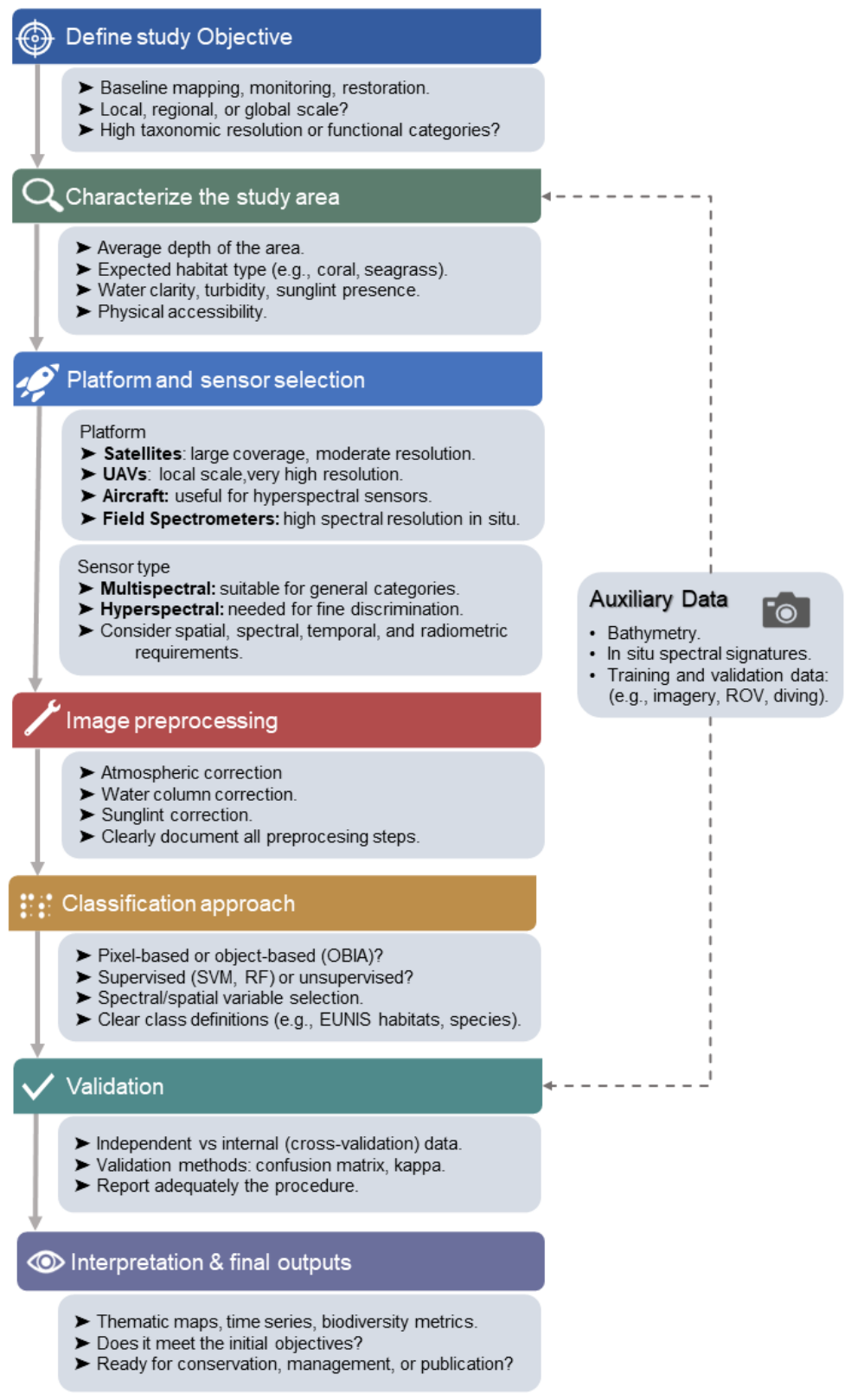
Methodological improvements in preprocessing remain a fundamental priority. Advances in atmospheric, water column, and sunglint correction are essential to reduce optical distortions and ensure reliable benthic mapping. While classification approaches continue to evolve, the robustness of mapping outputs depends on the quality and consistency of preprocessing workflows. In this context, field validation remains indispensable, although the development of scalable remote workflows will be necessary to support regional and global monitoring initiatives. A structured and transparent methodological pipeline, such as the one illustrated in Figure 12, can help guide the sequential decision-making process from study design to final outputs. The workflow begins with defining the study objectives and characterizing the environmental conditions of the study area, which subsequently determine platform and sensor selection. Preprocessing steps, including atmospheric and water column corrections, are then adapted according to habitat characteristics and image properties. Classification and validation stages follow, supported by auxiliary information such as bathymetry, underwater observations, spectral measurements, and reference datasets. Finally, the framework links these methodological decisions with the generation of thematic products intended for monitoring, conservation, and management applications.
Building on these developments, artificial intelligence (AI) and machine learning represent an important emerging frontier in benthic remote sensing [10,223]. These approaches offer strong potential for automated data analysis, anomaly detection, and large-scale pattern recognition, particularly when integrated with multi-source environmental data, historical imagery, and sensor metadata. Although classification algorithms were not systematically assessed in this review, their rapid development is closely linked to these advances and will likely play an increasing role in future ORS applications. Their effective implementation will depend on the availability of high-quality annotated datasets, improved model transparency, and closer integration with ecological knowledge, especially in the context of operational monitoring and adaptive management frameworks.
Beyond these technological and methodological advances, a critical future priority is addressing the pronounced geographic imbalance identified in this review. Research efforts remain concentrated in a limited number of regions, while many biodiversity-rich and vulnerable coastal ecosystems remain understudied. Improving global equity in ORS research will require capacity building, open access data, technology transfer, and sustained international collaboration. Such efforts are essential not only to expand scientific knowledge but also to support conservation and management in regions where monitoring needs are most urgent.
Finally, effective ORS applications depend not only on technological capacity but also on robust ecological understanding of the biological systems being mapped. Future studies should integrate biodiversity baselines, species assemblages, depth distributions, functional traits, and seasonal dynamics. Aligning technological advances with ecological and conservation priorities will ultimately determine the long-term impact of ORS in marine biodiversity science and ecosystem-based management.

Author Contributions

Conceptualization, L.M.-G. and M.A.; methodology, L.M.-G., E.C., P.A.H.-L., A.Z.B. and M.A.; software, L.M.-G., E.C., P.A.H.-L., A.Z.B. and M.A.; validation, L.M.-G., E.C., P.A.H.-L., A.Z.B. and M.A.; formal analysis, L.M.-G. and M.A.; investigation, L.M.-G. and M.A.; data curation, L.M.-G. and M.A.; writing—original draft preparation, L.M.-G., E.C., P.A.H.-L., A.Z.B. and M.A.; writing—review and editing, L.M.-G., E.C., P.A.H.-L., A.Z.B. and M.A.; visualization, L.M.-G. and M.A.; supervision, L.M.-G. and M.A. All authors have read and agreed to the published version of the manuscript.

Funding

This work was conducted within the BIODIV programme on monitoring marine biodiversity in Spanish protected areas (2022–2025), funded by the European Union through NextGenerationEU and led by MITECO and CSIC–IEO. Work supported by National Funds through FCT-Fundação para a Ciência e a Tecnologia in the scope of the project UID/50027/2025-Rede de Investigação em Biodiversidade e Biologia Evolutiva and Azorean regional funds through DRCID (M1.1.A/FUNC.UI&D/015/2025/RTF/001/Apoio UI&D).

Data Availability Statement

The data presented in this study are available on request from the first author.

Acknowledgments

The authors gratefully acknowledge Pablo Martín-Sosa for his support.

Conflicts of Interest

The authors declare no conflicts of interest.

References

  1. Convention on Biological Diversity. Kunming-Montreal Global Biodiversity Framework. 2022. Available online: https://www.cbd.int/gbf (accessed on 14 May 2026).
  2. United Nations. Transforming our world: The 2030 Agenda for Sustainable Development. 2015. Available online: https://sdgs.un.org/goals/goal14 (accessed on 14 May 2026).
  3. Misiuk, B.; Brown, C.J. Benthic habitat mapping: A review of three decades of mapping biological patterns on the seafloor. Estuar. Coast. Shelf Sci. 2024, 296, 108599. [Google Scholar] [CrossRef]
  4. Kutser, T.; Hedley, J.; Giardino, C.; Roelfsema, C.; Brando, V.E. Remote sensing of shallow waters—A 50 year retrospective and future directions. Remote Sens. Environ. 2020, 240, 111619. [Google Scholar] [CrossRef]
  5. Hedley, J.D.; Roelfsema, C.M.; Chollett, I.; Harborne, A.R.; Heron, S.F.; Weeks, S.; Skirving, W.J.; Strong, A.E.; Eakin, C.M.; Christensen, T.R.L.; et al. Remote Sensing of Coral Reefs for Monitoring and Management: A Review. Remote Sens. 2016, 8, 118. [Google Scholar] [CrossRef]
  6. Pygas, D.R.; Ferrari, R.; Figueira, W.F. Review and meta-analysis of the importance of remotely sensed habitat structural complexity in marine ecology. Estuar. Coast. Shelf Sci. 2020, 235, 106468. [Google Scholar] [CrossRef]
  7. Ambarwulan, W.; Dewi, R.S.; Widiatmaka. Review on remote sensing technologies for seagrass mapping in tropical regions. Sains Malays. 2022, 51, 959–976. [Google Scholar] [CrossRef]
  8. Cosme de Esteban, M.; Tuya, F.; Haroun, R.; Otero-Ferrer, F. A systematic review of marine habitat mapping in the central-eastern Atlantic archipelagos: Methodologies, current trends, and knowledge gaps. Remote Sens. 2025, 17, 2331. [Google Scholar] [CrossRef]
  9. Duplančić Leder, T.; Baučić, M.; Leder, N.; Gilić, F. Optical satellite-derived bathymetry: An overview and WoS and Scopus bibliometric analysis. Remote Sens. 2023, 15, 1294. [Google Scholar] [CrossRef]
  10. Burns, C.; Bollard, B.; Narayanan, A. Machine-learning for mapping and monitoring shallow coral reef habitats. Remote Sens. 2022, 14, 2666. [Google Scholar] [CrossRef]
  11. Lützenkirchen, L.; Duce, S.; Bellwood, D. Exploring benthic habitat assessments on coral reefs: A comparison of direct field measurements versus remote sensing. Coral Reefs 2024, 43, 265–280. [Google Scholar] [CrossRef]
  12. Page, M.J.; McKenzie, J.E.; Bossuyt, P.M.; Boutron, I.; Hoffmann, T.C.; Mulrow, C.D.; Shamseer, L.; Tetzlaff, J.M.; Akl, E.A.; Brennan, S.E.; et al. The PRISMA 2020 statement: An updated guideline for reporting systematic reviews. BMJ 2021, 372, n71. [Google Scholar] [CrossRef]
  13. Elsevier B.V. Scopus. 2024. Available online: https://www.scopus.com (accessed on 17 May 2026).
  14. Clarivate Analytics. Web of Science. 2024. Available online: https://www.webofscience.com (accessed on 17 May 2026).
  15. Clarivate. Journal Citation Reports. 2025. Available online: https://clarivate.com/academia-government/scientific-and-academic-research/research-funding-analytics/journal-citation-reports/ (accessed on 19 February 2026).
  16. Casella, E.; Collin, A.; Harris, D.; Ferse, S.; Bejarano, S.; Parravicini, V.; Hench, J.L.; Rovere, A. Mapping coral reefs using consumer-grade drones and structure from motion photogrammetry techniques. Coral Reefs 2017, 36, 269–275. [Google Scholar] [CrossRef]
  17. Doo, S.S.; Hamylton, S.; Finfer, J.; Byrne, M. Spatial and temporal variation in reef-scale carbonate storage of large benthic foraminifera: A case study on One Tree Reef. Coral Reefs 2017, 36, 293–303. [Google Scholar] [CrossRef]
  18. Purkis, S.J.; Gleason, A.C.R.; Purkis, C.R.; Dempsey, A.C.; Renaud, P.G.; Faisal, M.; Saul, S.; Kerr, J.M. High-resolution habitat and bathymetry maps for 65,000 sq. km of Earth’s remotest coral reefs. Coral Reefs 2019, 38, 467–488. [Google Scholar] [CrossRef]
  19. Roelfsema, C.M.; Kovacs, E.M.; Ortiz, J.C.; Callaghan, D.P.; Hock, K.; Mongin, M.; Johansen, K.; Mumby, P.J.; Wettle, M.; Ronan, M.; et al. Habitat maps to enhance monitoring and management of the Great Barrier Reef. Coral Reefs 2020, 39, 1039–1054. [Google Scholar] [CrossRef]
  20. Fraiola, K.M.S.; Miura, T.; Martinez, J.; Lopes, K.H.; Amidon, F.; Torres-Pérez, J.; Spalding, H.L.; Williams, T.; So, K.; Sachs, E.; et al. Using commercial high-resolution satellite imagery to monitor a nuisance macroalga in the largest marine protected area in the USA. Coral Reefs 2023, 42, 253–259. [Google Scholar] [CrossRef]
  21. Ackleson, S.G.; Smith, J.P.; Rodriguez, L.M.; Moses, W.J.; Russell, B.J. Autonomous coral reef survey in support of remote sensing. Front. Mar. Sci. 2017, 4, 325. [Google Scholar] [CrossRef]
  22. Androuin, T.; Polerecky, L.; Decottignies, P.; Dubois, S.F.; Dupuy, C.; Hubas, C.; Jesus, B.; Le Gall, E.; Marzloff, M.P.; Carlier, A. Subtidal Microphytobenthos: A Secret Garden Stimulated by the Engineer Species Crepidula fornicata. Front. Mar. Sci. 2018, 5, 475. [Google Scholar] [CrossRef]
  23. Singh, A.A.; Maharaj, A.; Kumar, M.; Singh, P.; Singh, S.; Muller-Karger, F.E.; McCarthy, M.; Joseph, L.; Damlamian, H.; Begg, Z. Developing high resolution baseline coast resource maps using world view 2 imagery for a coastal village in Fiji. Front. Mar. Sci. 2019, 6, 207. [Google Scholar] [CrossRef]
  24. Bajjouk, T.; Jauzein, C.; Drumetz, L.; Dalla Mura, M.; Duval, A.; Dubois, S.F. Hyperspectral and lidar: Complementary tools to identify benthic features and assess the ecological status of Sabellaria alveolata reefs. Front. Mar. Sci. 2020, 7, 575218. [Google Scholar] [CrossRef]
  25. Morgan, K.M.; Moynihan, M.A.; Sanwlani, N.; Switzer, A.D. Light limitation and depth-variable sedimentation drives vertical reef compression on turbid coral reefs. Front. Mar. Sci. 2020, 7, 571256. [Google Scholar] [CrossRef]
  26. van den Bergh, J.; Chirayath, V.; Li, A.; Torres-Pérez, J.L.; Segal-Rozenhaimer, M. NeMO-Net–gamifying 3D labeling of multi-modal reference datasets to support automated marine habitat mapping. Front. Mar. Sci. 2021, 8, 645408. [Google Scholar]
  27. Schill, S.R.; Asner, G.P.; McNulty, V.P.; Pollock, F.J.; Croquer, A.; Vaughn, N.R.; Escovar-Fadul, X.; Raber, G.; Shaver, E. Site selection for coral reef restoration using airborne imaging spectroscopy. Front. Mar. Sci. 2021, 8, 698004. [Google Scholar] [CrossRef]
  28. Candela, A.; Edelson, K.; Gierach, M.M.; Thompson, D.R.; Woodward, G.; Wettergreen, D. Using remote sensing and in situ measurements for efficient mapping and optimal sampling of coral reefs. Front. Mar. Sci. 2021, 8, 689489. [Google Scholar] [CrossRef]
  29. Ventura, D.; Grosso, L.; Pensa, D.; Casoli, E.; Mancini, G.; Valente, T.; Scardi, M.; Rakaj, A. Coastal benthic habitat mapping and monitoring by integrating aerial and water surface low-cost drones. Front. Mar. Sci. 2023, 9, 1096594. [Google Scholar] [CrossRef]
  30. Bornmann, L.; Mutz, R. Growth rates of modern science: A bibliometric analysis based on the number of publications and cited references. J. Assoc. Inf. Sci. Technol. 2015, 66, 2215–2222. [Google Scholar] [CrossRef]
  31. Pu, R.; Bell, S.; Meyer, C. Mapping and assessing seagrass bed changes in Central Florida’s west coast using multitemporal Landsat TM imagery. Estuar. Coast. Shelf Sci. 2014, 149, 68–79. [Google Scholar]
  32. Baumstark, R.; Duffey, R.; Pu, R. Mapping seagrass and colonized hard bottom in Springs Coast, Florida using WorldView-2 satellite imagery. Estuar. Coast. Shelf Sci. 2016, 181, 83–92. [Google Scholar]
  33. Makowski, C.; Finkl, C.W.; Vollmer, H.M. Geoform and landform classification of continental shelves using geospatially integrated IKONOS satellite imagery. J. Coast. Res. 2017, 331, 1–22. [Google Scholar] [CrossRef]
  34. Dierssen, H.M.; Bostrom, K.J.; Chlus, A.; Hammerstrom, K.; Thompson, D.R.; Lee, Z. Pushing the limits of seagrass remote sensing in the turbid waters of Elkhorn Slough, California. Remote Sens. 2019, 11, 1664. [Google Scholar]
  35. Kaplanis, N.J.; Edwards, C.B.; Eynaud, Y.; Smith, J.E. Future sea-level rise drives rocky intertidal habitat loss and benthic community change. PeerJ 2020, 8, e9186. [Google Scholar] [CrossRef]
  36. Leiper, I.; Phinn, S.; Roelfsema, C.; Joyce, K.; Dekker, A. Mapping coral reef benthos, substrates, and bathymetry, using compact Airborne Spectrographic Imager (CASI) data. Remote Sens. 2014, 6, 6423–6445. [Google Scholar]
  37. Roelfsema, C.M.; Lyons, M.B.; Castro-Sanguino, C.; Kovacs, E.M.; Callaghan, D.; Wettle, M.; Markey, K.; Borrego-Acevedo, R.; Tudman, P.; Roe, M.; et al. How much shallow coral habitat is there on the Great Barrier Reef? Remote Sens. 2021, 13, 4343. [Google Scholar]
  38. Li, J.Y.Q.; Duce, S.; Joyce, K.E.; Xiang, W. SeeCucumbers: Using deep learning and drone imagery to detect sea cucumbers on coral reef flats. Drones 2021, 5, 28. [Google Scholar] [CrossRef]
  39. Kovacs, E.M.; Roelfsema, C.; Udy, J.; Baltais, S.; Lyons, M.; Phinn, S. Cloud processing for simultaneous mapping of seagrass meadows in optically complex and varied water. Remote Sens. 2022, 14, 609. [Google Scholar] [CrossRef]
  40. Manessa, M.; Kanno, A.; Sekine, M.; Ampou, E.; Widagti, N.; As-syakur, A. Shallow-Water benthic identification using multispectral satellite imagery: Investigation on the effects of improving noise correction method and spectral cover. Remote Sens. 2014, 6, 4454–4472. [Google Scholar]
  41. Nurdin, N.; Komatsu, T.; Agus; Akbar AS, M.; Djalil, A.R.; Amri, K. Multisensor and multitemporal data from Landsat images to detect damage to coral reefs, small islands in the Spermonde archipelago, Indonesia. Ocean Sci. J. 2015, 50, 317–325. [Google Scholar] [CrossRef]
  42. Fauzan, M.A.; Kumara, I.S.W.; Yogyantoro, R.N.; Suwardana, S.W.; Fadhilah, N.; Nurmalasari, I.; Apriyani, S.; Wicaksono, P. Assessing the capability of Sentinel-2A data for mapping seagrass percent cover in Jerowaru, East Lombok. Indones. J. Geogr. 2017, 49, 195. [Google Scholar] [CrossRef]
  43. Nababan, B.; Mastu, L.O.K.; Idris, N.H.; Panjaitan, J.P. Shallow-Water benthic habitat mapping using drone with object based image analyses. Remote Sens. 2021, 13, 4452. [Google Scholar]
  44. Xu, H.; Liu, Z.; Zhu, J.; Lu, X.; Liu, Q. Classification of coral reef benthos around ganquan island using WorldView-2 satellite imagery. J. Coast. Res. 2019, 93, 466. [Google Scholar] [CrossRef]
  45. Huang, W.; Zhao, J.; Ai, B.; Sun, S.; Yan, N. Bathymetry and benthic habitat mapping in shallow waters from sentinel-2A imagery: A case study in xisha islands, China. IEEE Trans. Geosci. Remote Sens. 2022, 60, 4212412. [Google Scholar] [CrossRef]
  46. Chen, H.; Chu, S.; Zhuang, Q.; Duan, Z.; Cheng, J.; Li, J.; Ye, L.; Yu, J.; Cheng, L. FSPN: End-to-end full-space pooling weakly supervised network for benthic habitat mapping using remote sensing images. Int. J. Appl. Earth Obs. Geoinf. 2023, 118, 103264. [Google Scholar] [CrossRef]
  47. Chen, J.; Wang, K.; Zhao, X.; Cheng, X.; Zhang, S.; Chen, J.; Li, J.; Li, X. Satellite imagery-estimated intertidal seaweed biomass using UAV as an intermediary. Remote Sens. 2023, 15, 4428. [Google Scholar] [CrossRef]
  48. Mustapha, M.A.; Lihan, T.; Khalid, L.I. Coral reef and associated habitat mapping using ALOS satellite imagery. Sains Malays. 2014, 43, 1363–1371. [Google Scholar]
  49. Thompson, D.R.; Hochberg, E.J.; Asner, G.P.; Green, R.O.; Knapp, D.E.; Gao, B.C.; Garcia, R.; Gierach, M.; Lee, Z.; Maritorena, S.; et al. Airborne mapping of benthic reflectance spectra with Bayesian linear mixtures. Remote Sens. Environ. 2017, 200, 18–30. [Google Scholar] [CrossRef]
  50. Muslim, A.M.; Chong, W.S.; Safuan, C.D.M.; Khalil, I.; Hossain, M.S. Coral reef mapping of UAV: A comparison of sun glint correction methods. Remote Sens. 2019, 11, 2422. [Google Scholar] [CrossRef]
  51. Hossain, M.S.; Muslim, A.M.; Nadzri, M.I.; Teruhisa, K.; David, D.; Khalil, I.; Mohamad, Z. Can ensemble techniques improve coral reef habitat classification accuracy using multispectral data? Geocarto Int. 2020, 35, 1214–1232. [Google Scholar] [CrossRef]
  52. Hamylton, S.M.; Duce, S.; Vila-Concejo, A.; Roelfsema, C.M.; Phinn, S.R.; Carvalho, R.C.; Shaw, E.C.; Joyce, K.E. Estimating regional coral reef calcium carbonate production from remotely sensed seafloor maps. Remote Sens. Environ. 2017, 201, 88–98. [Google Scholar] [CrossRef]
  53. Roelfsema, C.; Kovacs, E.; Roos, P.; Terzano, D.; Lyons, M.; Phinn, S. Use of a semi-automated object based analysis to map benthic composition, Heron Reef, Southern Great Barrier Reef. Remote Sens. Lett. 2018, 9, 324–333. [Google Scholar] [CrossRef]
  54. Hamylton, S.M.; Mallela, J. Reef development on a remote coral atoll before and after coral bleaching: A geospatial assessment. Mar. Geol. 2019, 418, 106041. [Google Scholar] [CrossRef]
  55. Taddia, Y.; Russo, P.; Lovo, S.; Pellegrinelli, A. Multispectral UAV monitoring of submerged seaweed in shallow water. Appl. Geomat. 2020, 12, 19–34. [Google Scholar] [CrossRef]
  56. Haro, S.; Jesus, B.; Oiry, S.; Papaspyrou, S.; Lara, M.; González, C.J.; Corzo, A. Microphytobenthos spatio-temporal dynamics across an intertidal gradient using Random Forest classification and Sentinel-2 imagery. Sci. Total Environ. 2022, 804, 149983. [Google Scholar] [CrossRef]
  57. Li, J.; Schill, S.R.; Knapp, D.E.; Asner, G.P. Object-based mapping of coral reef habitats using Planet Dove satellites. Remote Sens. 2019, 11, 1445. [Google Scholar] [CrossRef]
  58. Xu, Y.; Vaughn, N.R.; Knapp, D.E.; Martin, R.E.; Balzotti, C.; Li, J.; Foo, S.A.; Asner, G.P. Coral bleaching detection in the Hawaiian Islands using spatio-temporal Standardized Bottom Reflectance and Planet Dove satellites. Remote Sens. 2020, 12, 3219. [Google Scholar] [CrossRef]
  59. Wicaksono, P.; Maishella, A.; Lazuardi, W.; Muhammad, F.H. Consistency assessment of multi-date PlanetScope imagery for seagrass percent cover mapping in different seagrass meadows. Geocarto Int. 2022, 37, 15161–15186. [Google Scholar] [CrossRef]
  60. Barve, S.; Webster, J.M.; Chandra, R. Reef-Insight: A framework for reef habitat mapping with clustering methods using remote sensing. Information 2023, 14, 373. [Google Scholar] [CrossRef]
  61. Giardino, C.; Bresciani, M.; Fava, F.; Matta, E.; Brando, V.; Colombo, R. Mapping submerged habitats and mangroves of Lampi Island marine National Park (Myanmar) from in situ and satellite observations. Remote Sens. 2015, 8, 2. [Google Scholar] [CrossRef]
  62. Müller, G.; Stelzer, K.; Smollich, S.; Gade, M.; Adolph, W.; Melchionna, S.; Kemme, L.; Geißler, J.; Millat, G.; Reimers, H.C.; et al. Remotely sensing the German Wadden Sea-a new approach to address national and international environmental legislation. Environ. Monit. Assess. 2016, 188, 595. [Google Scholar] [CrossRef] [PubMed]
  63. Roelfsema, C.M.; Lyons, M.; Kovacs, E.M.; Maxwell, P.; Saunders, M.I.; Samper-Villarreal, J.; Phinn, S.R. Multi-temporal mapping of seagrass cover, species and biomass: A semi-automated object based image analysis approach. Remote Sens. Environ. 2014, 150, 172–187. [Google Scholar] [CrossRef]
  64. Maina, J.; Jones, K.; Hicks, C.; McClanahan, T.; Watson, J.; Tuda, A.; Andréfouët, S. Designing climate-resilient marine protected area networks by combining remotely sensed coral reef habitat with coastal multi-use maps. Remote Sens. 2015, 7, 16571–16587. [Google Scholar] [CrossRef]
  65. Tsujimoto, R.; Terauchi, G.; Sasaki, H.; Sakamoto, S.X.; Sawayama, S.; Sasa, S.; Yagi, H.; Komatsu, T. Damage to seagrass and seaweed beds in Matsushima Bay, Japan, caused by the huge tsunami of the Great East Japan Earthquake on 11 March 2011. Int. J. Remote Sens. 2016, 37, 5843–5863. [Google Scholar] [CrossRef]
  66. McIntyre, K.; McLaren, K.; Prospere, K. Mapping shallow nearshore benthic features in a Caribbean marine-protected area: Assessing the efficacy of using different data types (hydroacoustic versus satellite images) and classification techniques. Int. J. Remote Sens. 2018, 39, 1117–1150. [Google Scholar] [CrossRef]
  67. Mohamed, H.; Nadaoka, K.; Nakamura, T. Semiautomated mapping of benthic habitats and seagrass species using a convolutional neural network framework in Shallow Water environments. Remote Sens. 2020, 12, 4002. [Google Scholar] [CrossRef]
  68. Chand, S.; Bollard, B. Multispectral low altitude remote sensing of wild oyster reefs. Glob. Ecol. Conserv. 2021, 30, e01810. [Google Scholar] [CrossRef]
  69. Chand, S.; Bollard, B. Detecting the spatial variability of seagrass meadows and their consequences on associated macrofauna benthic activity using novel drone technology. Remote Sens. 2021, 14, 160. [Google Scholar] [CrossRef]
  70. da Silva, G.C.M.; de Souza, F.E.S.; Marinho-Soriano, E. Application of ALOS AVNIR-2 for the detection of seaweed and seagrass beds on the northeast of Brazil. Int. J. Remote Sens. 2017, 38, 662–678. [Google Scholar] [CrossRef]
  71. Wicaksono, P.; Fauzan, M.A.; Asta, S.G.W. Assessment of Sentinel-2A multispectral image for benthic habitat composition mapping. IET Image Process. 2020, 14, 279–288. [Google Scholar] [CrossRef]
  72. Ben-Romdhane, H.; Marpu, P.R.; Ouarda, T.B.M.J.; Ghedira, H. Corals & benthic habitat mapping using DubaiSat-2: A spectral-spatial approach applied to Dalma Island, UAE (Arabian Gulf). Remote Sens. Lett. 2016, 7, 781–789. [Google Scholar]
  73. Barnes, B.B.; Garcia, R.; Hu, C.; Lee, Z. Multi-band spectral matching inversion algorithm to derive water column properties in optically shallow waters: An optimization of parameterization. Remote Sens. Environ. 2018, 204, 424–438. [Google Scholar] [CrossRef]
  74. Garcia, R.A.; Lee, Z.; Barnes, B.B.; Hu, C.; Dierssen, H.M.; Hochberg, E.J. Benthic classification and IOP retrievals in shallow water environments using MERIS imagery. Remote Sens. Environ. 2020, 249, 112015. [Google Scholar] [CrossRef]
  75. Le Bris, A.; Rosa, P.; Lerouxel, A.; Cognie, B.; Gernez, P.; Launeau, P.; Robin, M.; Barillé, L. Hyperspectral remote sensing of wild oyster reefs. Estuar. Coast. Shelf Sci. 2016, 172, 1–12. [Google Scholar] [CrossRef]
  76. Petit, T.; Bajjouk, T.; Mouquet, P.; Rochette, S.; Vozel, B.; Delacourt, C. Hyperspectral remote sensing of coral reefs by semi-analytical model inversion—Comparison of different inversion setups. Remote Sens. Environ. 2017, 190, 348–365. [Google Scholar] [CrossRef]
  77. Jay, S.; Guillaume, M.; Minghelli, A.; Deville, Y.; Chami, M.; Lafrance, B.; Serfaty, V. Hyperspectral remote sensing of shallow waters: Considering environmental noise and bottom intra-class variability for modeling and inversion of water reflectance. Remote Sens. Environ. 2017, 200, 352–367. [Google Scholar] [CrossRef]
  78. Bajjouk, T.; Mouquet, P.; Ropert, M.; Quod, J.P.; Hoarau, L.; Bigot, L.; Le Dantec, N.; Delacourt, C.; Populus, J. Detection of changes in shallow coral reefs status: Towards a spatial approach using hyperspectral and multispectral data. Ecol. Indic. 2019, 96, 174–191. [Google Scholar] [CrossRef]
  79. Guillaume, M.; Minghelli, A.; Deville, Y.; Chami, M.; Juste, L.; Lenot, X.; Lafrance, B.; Jay, S.; Briottet, X.; Serfaty, V. Mapping benthic habitats by extending non-negative matrix factorization to address the water column and seabed adjacency effects. Remote Sens. 2020, 12, 2072. [Google Scholar] [CrossRef]
  80. Minghelli, A.; Vadakke-Chanat, S.; Chami, M.; Guillaume, M.; Peirache, M. Benefit of the potential future hyperspectral satellite sensor (BIODIVERSITY) for improving the determination of water column and seabed features in coastal zones. IEEE J. Sel. Top. Appl. Earth Obs. Remote Sens. 2021, 14, 1222–1232. [Google Scholar] [CrossRef]
  81. Borfecchia, F.; Micheli, C.; De Cecco, L.; Sannino, G.; Struglia, M.V.; Di Sarra, A.G.; Gomez, C.; Mattiazzo, G. Satellite multi/hyper spectral HR sensors for mapping the Posidonia oceanica in south Mediterranean islands. Sustainability 2021, 13, 13715. [Google Scholar] [CrossRef]
  82. Echappé, C.; Gernez, P.; Méléder, V.; Jesus, B.; Cognie, B.; Decottignies, P.; Sabbe, K.; Barillé, L. Satellite remote sensing reveals a positive impact of living oyster reefs on microalgal biofilm development. Biogeosciences 2018, 15, 905–918. [Google Scholar] [CrossRef]
  83. Arora, M.; Gujrati, A.; Chaudhury, N.R.; Patel, R.C. Benthic coverage and bottom topography of coral reef environment over Pirotan reef, Gulf of Kachchh region, India. Geocarto Int. 2019, 34, 1089–1097. [Google Scholar] [CrossRef]
  84. Bell, T.W.; Okin, G.S.; Cavanaugh, K.C.; Hochberg, E.J. Impact of water characteristics on the discrimination of benthic cover in and around coral reefs from imaging spectrometer data. Remote Sens. Environ. 2020, 239, 111631. [Google Scholar] [CrossRef]
  85. Zoffoli, M.L.; Frouin, R.; Moura, R.L.; de Medeiros, T.A.G.; Bastos, A.C.; Kampel, M. Spatial distribution patterns of coral reefs in the Abrolhos region (Brazil, South Atlantic ocean). Cont. Shelf Res. 2022, 246, 104808. [Google Scholar] [CrossRef]
  86. Hedley, J.D.; Mirhakak, M.; Wentworth, A.; Dierssen, H.M. Influence of three-dimensional coral structures on hyperspectral benthic reflectance and water-leaving reflectance. Appl. Sci. 2018, 8, 2688. [Google Scholar] [CrossRef]
  87. Kabiri, K.; Rezai, H.; Moradi, M.; Pourjomeh, F. Coral reefs mapping using parasailing aerial photography-feasibility study: Kish Island, Persian Gulf. J. Coast. Conserv. 2014, 18, 691–699. [Google Scholar] [CrossRef]
  88. Kabiri, K.; Rezai, H.; Moradi, M. A drone-based method for mapping the coral reefs in the shallow coastal waters—Case study: Kish Island, Persian Gulf. Earth Sci. Inform. 2020, 13, 1265–1274. [Google Scholar] [CrossRef]
  89. Kabiri, K. Mapping coastal ecosystems and features using a low-cost standard drone: Case study, Nayband Bay, Persian gulf, Iran. J. Coast. Conserv. 2020, 24, 1–8. [Google Scholar] [CrossRef]
  90. Fallati, L.; Saponari, L.; Savini, A.; Marchese, F.; Corselli, C.; Galli, P. Multi-temporal UAV data and object-based image analysis (OBIA) for estimation of substrate changes in a post-bleaching scenario on a Maldivian reef. Remote Sens. 2020, 12, 2093. [Google Scholar] [CrossRef]
  91. Hamad, I.Y.; Staehr, P.A.U.; Rasmussen, M.B.; Sheikh, M. Drone-based characterization of seagrass habitats in the tropical waters of Zanzibar. Remote Sens. 2022, 14, 680. [Google Scholar] [CrossRef]
  92. Nieuwenhuis, B.O.; Marchese, F.; Casartelli, M.; Sabino, A.; van der Meij, S.E.T.; Benzoni, F. Integrating a UAV-derived DEM in object-based image analysis increases habitat classification accuracy on coral reefs. Remote Sens. 2022, 14, 5017. [Google Scholar] [CrossRef]
  93. Pergent-Martini, C.; Monnier, B.; Lehmann, L.; Barralon, E.; Pergent, G. Major regression of Posidonia oceanica meadows in relation with recreational boat anchoring: A case study from Sant’Amanza bay. J. Sea Res. 2022, 188, 102258. [Google Scholar] [CrossRef]
  94. Tahara, S.; Sudo, K.; Yamakita, T.; Nakaoka, M. Species level mapping of a seagrass bed using an unmanned aerial vehicle and deep learning technique. PeerJ 2022, 10, e14017. [Google Scholar] [CrossRef]
  95. Svane, N.; Lange, T.; Egemose, S.; Dalby, O.; Thomasberger, A.; Flindt, M.R. Unoccupied aerial vehicle-assisted monitoring of benthic vegetation in the coastal zone enhances the quality of ecological data. Prog. Phys. Geogr. 2022, 46, 232–249. [Google Scholar] [CrossRef]
  96. Giles, A.B.; Ren, K.; Davies, J.E.; Abrego, D.; Kelaher, B. Combining drones and deep learning to automate coral reef assessment with RGB imagery. Remote Sens. 2023, 15, 2238. [Google Scholar] [CrossRef]
  97. Thomasberger, A.; Nielsen, M.M. UAV-based subsurface data collection using a low-tech ground-truthing payload system enhances Shallow-Water monitoring. Drones 2023, 7, 647. [Google Scholar] [CrossRef]
  98. Zhang, C. Applying data fusion techniques for benthic habitat mapping and monitoring in a coral reef ecosystem. ISPRS J. Photogramm. Remote Sens. 2015, 104, 213–223. [Google Scholar] [CrossRef]
  99. Araújo, P.V.d.N.; Farias do Amaral, R. Mapping of coral reefs in the continental shelf of Brazilian Northeast through remote sensing. Rev. Gest. Costeira Integr. 2016, 16, 5–20. [Google Scholar] [CrossRef]
  100. van der Wal, D.; van Dalen, J.; Wielemaker-van den Dool, A.; Dijkstra, J.T.; Ysebaert, T. Biophysical control of intertidal benthic macroalgae revealed by high-frequency multispectral camera images. J. Sea Res. 2014, 90, 111–120. [Google Scholar] [CrossRef]
  101. Berov, D.; Klayn, S.; Deyanova, D.; Karamfilov, V. Current distribution of Zostera seagrass meadows along the Bulgarian Black Sea coast (SW Black Sea, Bulgaria) (2010–2020). Biodivers. Data J. 2022, 10, e78942. [Google Scholar] [CrossRef]
  102. Caras, T.; Hedley, J.; Karnieli, A. Implications of sensor design for coral reef detection: Upscaling ground hyperspectral imagery in spatial and spectral scales. Int. J. Appl. Earth Obs. Geoinf. 2017, 63, 68–77. [Google Scholar] [CrossRef]
  103. Ellis, S.L.; Taylor, M.L.; Schiele, M.; Letessier, T.B. Influence of altitude on tropical marine habitat classification using imagery from fixed-wing, water-landing UAV s. Remote Sens. Ecol. Conserv. 2021, 7, 50–63. [Google Scholar] [CrossRef]
  104. Rende, S.F.; Bosman, A.; Di Mento, R.; Bruno, F.; Lagudi, A.; Irving, A.D.; Dattola, L.; Giambattista, L.D.; Lanera, P.; Proietti, R.; et al. Ultra-high-resolution mapping of Posidonia oceanica (L.) Delile meadows through acoustic, optical data and Object-based Image classification. J. Mar. Sci. Eng. 2020, 8, 647. [Google Scholar] [CrossRef]
  105. Nguyen, D.H.; Ngo, T.D.; Vu, V.D.; Du, Q.V.V. Establishing distribution maps and structural analysis of seagrass communities based on high-resolution remote sensing images and field surveys: A case study at Nam Yet Island, Truong Sa Archipelago, Vietnam. Landsc. Ecol. Eng. 2022, 18, 405–419. [Google Scholar] [CrossRef]
  106. Le Quilleuc, A.; Collin, A.; Jasinski, M.F.; Devillers, R. Very high-resolution satellite-derived bathymetry and habitat mapping using Pleiades-1 and ICESat-2. Remote Sens. 2021, 14, 133. [Google Scholar] [CrossRef]
  107. Dang Nguyen, H.; Trung Ngo, D.; Viet Vu, D. Benthic habitat mapping and assessment of seagrass species diversity in Da Lon Reef, Truong Sa Islands, Vietnam, using very high-resolution satellite imagery and in situ data. Vietnam J. Earth Sci. 2023, 45, 531–552. [Google Scholar] [CrossRef] [PubMed]
  108. Wilson, K.L.; Skinner, M.A.; Lotze, H.K. Eelgrass (Zostera marina) and benthic habitat mapping in Atlantic Canada using high-resolution SPOT 6/7 satellite imagery. Estuar. Coast. Shelf Sci. 2019, 226, 106292. [Google Scholar] [CrossRef]
  109. Cruz-Vázquez, C.; Rioja-Nieto, R.; Enriquez, C. Spatial and temporal effects of management on the reef seascape of a marine protected area in the Mexican Caribbean. Ocean Coast. Manag. 2019, 169, 50–57. [Google Scholar] [CrossRef]
  110. St-Pierre, A.P.; Gagnon, P. Kelp-bed dynamics across scales: Enhancing mapping capability with remote sensing and GIS. J. Exp. Mar. Biol. Ecol. 2020, 522, 151246. [Google Scholar] [CrossRef]
  111. Turissa, P.; Bisman, N.; Vincentius, S.; Dony, K.; Hawis, M. Evaluation methods of change detection of seagrass beds in the waters of Pajenekang and Gusung selayar. Trends Sci. 2021, 18, 677. [Google Scholar] [CrossRef]
  112. U.S. Geological Survey. Landsat Product Information. 2025. Available online: https://www.usgs.gov/landsat-missions/product-information (accessed on 22 May 2026).
  113. European Space Agency. Copernicus Sentinel-2 data products. 2026. Available online: https://sentinels.copernicus.eu/sentinel-data-access/sentinel-products/sentinel-2-data-products (accessed on 22 May 2026).
  114. Pan, Z.; Glennie, C.; Fernandez-Diaz, J.C.; Starek, M. Comparison of bathymetry and seagrass mapping with hyperspectral imagery and airborne bathymetric lidar in a shallow estuarine environment. Int. J. Remote Sens. 2016, 37, 516–536. [Google Scholar] [CrossRef]
  115. Kovacs, E.; Roelfsema, C.; Lyons, M.; Zhao, S.; Phinn, S. Seagrass habitat mapping: How do Landsat 8 OLI, Sentinel-2, ZY-3A, and Worldview-3 perform? Remote Sens. Lett. 2018, 9, 686–695. [Google Scholar] [CrossRef]
  116. Immordino, F.; Barsanti, M.; Candigliota, E.; Cocito, S.; Delbono, I.; Peirano, A. Application of Sentinel-2 multispectral data for habitat mapping of pacific islands: Palau Republic (Micronesia, Pacific Ocean). J. Mar. Sci. Eng. 2019, 7, 316. [Google Scholar] [CrossRef]
  117. Bayyana, S.; Pawar, S.; Gole, S.; Dudhat, S.; Pande, A.; Mitra, D.; Johnson, J.A.; Sivakumar, K. Detection and mapping of seagrass meadows at Ritchie’s archipelago using sentinel 2A satellite imagery. Curr. Sci. 2020, 118, 1275. [Google Scholar] [CrossRef]
  118. Yucel-Gier, G.; Kocak, G.; Akcali, B.; Ilhan, T.; Duman, M. Evaluation of Posidonia oceanica map generated by sentinel-2 image: Gulbahce bay test site. Turk. J. Fish. Aquat. Sci. 2020, 20, 571–581. [Google Scholar] [CrossRef]
  119. Wicaksono, P.; Kumara, I.S.W.; Fauzan, M.A.; Yogyantoro, R.N.; Lazuardi, W. Sentinel-2A and Landsat 8 OLI to model benthic habitat biodiversity index. Geocarto Int. 2022, 37, 1628–1644. [Google Scholar]
  120. Fauzan, M.A.; Wicaksono, P.; Hartono. Characterizing Derawan seagrass cover change with time-series Sentinel-2 images. Reg. Stud. Mar. Sci. 2021, 48, 102048. [Google Scholar] [CrossRef]
  121. Poursanidis, D.; Traganos, D.; Teixeira, L.; Shapiro, A.; Muaves, L. Cloud-native seascape mapping of Mozambique’s Quirimbas National Park with Sentinel-2. Remote Sens. Ecol. Conserv. 2021, 7, 275–291. [Google Scholar]
  122. Kartikasari, A.; Pristianto, T.; Hanintyo, R.; Ampou, E.E.; Wibawa, T.A.; Borneo, B.B. Representative benthic habitat mapping on Lovina coral reefs in Northern Bali, Indonesia. Biodiversitas 2021, 22, 4766–4774. [Google Scholar]
  123. Wicaksono, P.; Wulandari, S.A.; Lazuardi, W.; Munir, M. Sentinel-2 images deliver possibilities for accurate and consistent multi-temporal benthic habitat maps in optically shallow water. Remote Sens. Appl. Soc. Environ. 2021, 23, 100572. [Google Scholar] [CrossRef]
  124. Zainul, H.; De Oliveira Vieira, L.; Rahma, S.; Herlambung, A.R.; Abdur Rahman As-Syakur, A.R.A.S. Mapping sea grass coverage of Tanjung Benoa Bali using medium resolution satellite imagery Sentinel 2B. Sains Malays. 2023, 52, 1315–1332. [Google Scholar] [CrossRef]
  125. Hamuna, B.; Pujiyati, S.; Gaol, J.L.; Hestirianoto, T. Spatial distribution of benthic habitats in Kapota Atoll (Wakatobi National Park, Indonesia) using remote sensing imagery. Biodiversitas 2023, 24, 3700–3707. [Google Scholar]
  126. Nandika, M.R.; Ulfa, A.; Ibrahim, A.; Purwanto, A.D. Assessing the Shallow Water habitat mapping extracted from high-resolution satellite image with multi classification algorithms. Geomat. Environ. Eng. 2023, 17, 69–87. [Google Scholar]
  127. Van An, N.; Quang, N.H.; Son, T.P.H.; An, T.T. High-resolution benthic habitat mapping from machine learning on PlanetScope imagery and ICESat-2 data. Geocarto Int. 2023, 38, 2184875. [Google Scholar]
  128. Kerr, J.M.; Purkis, S.J. An algorithm for optically-deriving water depth from multispectral imagery in coral reef landscapes in the absence of ground-truth data. Remote Sens. Environ. 2018, 210, 307–324. [Google Scholar] [CrossRef]
  129. Lyzenga, D.R. Passive Remote Sensing Techniques for Mapping Water Depth and Bottom Features. Appl. Opt. 1978, 17, 379–383. [Google Scholar] [CrossRef]
  130. Lyzenga, D.R. Remote Sensing of Bottom Reflectance and Water Attenuation Parameters in Shallow Water Using Aircraft and Landsat Data. Int. J. Remote Sens. 1981, 2, 71–82. [Google Scholar] [CrossRef]
  131. Lee, Z.; Carder, K.L.; Mobley, C.D.; Steward, R.G.; Patch, J.S. Hyperspectral remote sensing for shallow waters: I. A semianalytical model. Appl. Opt. 1998, 37, 6329–6338. [Google Scholar] [CrossRef]
  132. Lee, Z.; Carder, K.L.; Mobley, C.D.; Steward, R.G.; Patch, J.S. Hyperspectral remote sensing for shallow waters: II. Deriving bottom depths and water properties by optimization. Appl. Opt. 1999, 38, 3831–3843. [Google Scholar] [CrossRef]
  133. Lee, Z.; Carder, K.; Arnone, R. Deriving inherent optical properties from water color: A multiband quasi-analytical algorithm for optically deep waters. Appl. Opt. 2002, 41, 5755–5772. [Google Scholar] [CrossRef] [PubMed]
  134. Sagawa, T.; Boisnier, E.; Komatsu, T.; Mustapha, K.B.; Hattour, A.; Kosaka, N.; Miyazaki, S. Using Bottom Surface Reflectance to Map Coastal Marine Areas: A New Application Method for Lyzenga’s Model. Int. J. Remote Sens. 2010, 31, 3051–3064. [Google Scholar] [CrossRef]
  135. Bierwirth, P.N.; Lee, T.J.; Burne, R.V. Shallow sea-floor reflectance and water depth derived by unmixing multispectral imagery. Photogramm. Eng. Remote Sens. 1993, 59, 331–338. [Google Scholar]
  136. Hedley, J.D.; Harborne, A.R.; Mumby, P.J. Simple and robust removal of sun glint for mapping shallow-water benthos. Int. J. Remote Sens. 2005, 26, 2107–2112. [Google Scholar] [CrossRef]
  137. Lizcano-Sandoval, L.; Anastasiou, C.; Montes, E.; Raulerson, G.; Sherwood, E.; Muller-Karger, F.E. Seagrass distribution, areal cover, and changes (1990–2021) in coastal waters off West-Central Florida, USA. Estuar. Coast. Shelf Sci. 2022, 279, 108134. [Google Scholar] [CrossRef]
  138. Roelfsema, C.; Kovacs, E.; Ortiz, J.C.; Wolff, N.H.; Callaghan, D.; Wettle, M.; Ronan, M.; Hamylton, S.M.; Mumby, P.J.; Phinn, S. Coral reef habitat mapping: A combination of object-based image analysis and ecological modelling. Remote Sens. Environ. 2018, 208, 27–41. [Google Scholar] [CrossRef]
  139. Kobryn, H.T.; Beckley, L.E.; Wouters, K. Bathymetry derivatives and habitat data from hyperspectral imagery establish a high-resolution baseline for managing the Ningaloo Reef, western Australia. Remote Sens. 2022, 14, 1827. [Google Scholar] [CrossRef]
  140. Lee, Z.; Carder, K.L.; Chen, R.F.; Peacock, T.G. Properties of the water column and bottom derived from Airborne Visible Infrared Imaging Spectrometer (AVIRIS) data. J. Geophys. Res. Ocean. 2001, 106, 11639–11651. [Google Scholar] [CrossRef]
  141. Tsatiris, A.; Papadopoulos, V.; Makri, D.; Topouzelis, K.; Manoutsoglou, E.; Hasiotis, T.; Katsanevakis, S. Spatial distribution, abundance and habitat use of the endemic Mediterranean fan mussel Pinna nobilis in Gera Gulf, Lesvos (Greece): Comparison of design-based and model-based approaches. Mediterr. Mar. Sci. 2018, 19, 642. [Google Scholar] [CrossRef]
  142. Chen, Y.C.; Chu, T.J.; Wei, J.D.; Shih, C.H. Effects of mangrove removal on benthic organisms in the Siangshan Wetland in Hsinchu, Taiwan. PeerJ 2018, 6, e5670. [Google Scholar] [CrossRef]
  143. Hoang, T.; Garcia, R.; O’Leary, M.; Fotedar, R. Identification and mapping of marine submerged aquatic vegetation in shallow coastal waters with WorldView-2 satellite data. J. Coast. Res. 2016, 75, 1287–1291. [Google Scholar] [CrossRef]
  144. Hoang, T.C.; Cole, A.J.; Fotedar, R.K.; O’Leary, M.J.; Lomas, M.W.; Roy, S. Seasonal changes in water quality and Sargassum biomass in southwest Australia. Mar. Ecol. Prog. Ser. 2016, 551, 63–79. [Google Scholar] [CrossRef]
  145. Setyawidati, N.; Kaimuddin, A.H.; Wati, I.P.; Helmi, M.; Widowati, I.; Rossi, N.; Liabot, P.O.; Stiger-Pouvreau, V. Percentage cover, biomass, distribution, and potential habitat mapping of natural macroalgae, based on high-resolution satellite data and in situ monitoring, at Libukang Island, Malasoro Bay, Indonesia. J. Appl. Phycol. 2018, 30, 159–171. [Google Scholar] [CrossRef]
  146. Abo Elenin, A.H.; Saber, S.A.; El-Kafrawy, S.B.; El-Naggar, H.A. An integrated field survey and remote sensing approach for marine habitat mapping along hurghada coast, red sea, Egypt. Egypt. J. Aquat. Biol. Fish. 2020, 24, 287–306. [Google Scholar] [CrossRef]
  147. Garcia, R.A.; Lee, Z.; Hochberg, E.J. Hyperspectral Shallow-Water remote sensing with an enhanced benthic classifier. Remote Sens. 2018, 10, 147. [Google Scholar] [CrossRef]
  148. Eugenio, F.; Marcello, J.; Martin, J. High-resolution maps of bathymetry and benthic habitats in Shallow-Water environments using multispectral remote sensing imagery. IEEE Trans. Geosci. Remote Sens. 2015, 53, 3539–3549. [Google Scholar] [CrossRef]
  149. Mederos-Barrera, A.; Marcello, J.; Eugenio, F.; Hernández, E. Seagrass mapping using high resolution multispectral satellite imagery: A comparison of water column correction models. Int. J. Appl. Earth Obs. Geoinf. 2022, 113, 102990. [Google Scholar]
  150. Drury, C.; Martin, R.E.; Knapp, D.E.; Heckler, J.; Levy, J.; Gates, R.D.; Asner, G.P. Ecosystem-scale mapping of coral species and thermal tolerance. Front. Ecol. Environ. 2022, 20, 285–291. [Google Scholar]
  151. Lazuardi, W.; Ardiyanto, R.; Marfai, M.A.; Mutaqin, B.W.; Kusuma, D.W. Coastal reef and seagrass monitoring for coastal ecosystem management. Int. J. Sustain. Dev. Plan. 2021, 16, 557–568. [Google Scholar] [CrossRef]
  152. Zuo, X.; Su, F.; Zhang, J.; Wu, W. Using Landsat data to detect change in live to recently (<6 months) dead coral cover in the western xisha islands, South China sea. Sustainability 2020, 12, 5237. [Google Scholar] [CrossRef]
  153. Darweesh, K.F.; Hellal, A.M.; Saber, S.A.; EL-Kafrawy, S.B.; Abdelsalam, A.A.; EL-Naggar, H.A. Three decades of remote sensing habitat mapping, along the Egyptian Coast of Aqaba Gulf, Red Sea. Egypt. J. Aquat. Biol. Fish. 2021, 25, 467–487. [Google Scholar]
  154. Nurdin, N.; Prasyad, H.; Rani, C.; Al Azizi, S.Q.; Pulubuhu, D.A.T.; Aris, A.; Aushaf, S.T.; Nurdin, N.; Komatsu, T. Tracking coral loss in the Spermonde Archipelago of Indonesia: 32 years of satellite monitoring from 1990 to 2022. Int. J. Remote Sens. 2024, 45, 8937–8967. [Google Scholar] [CrossRef]
  155. Yang, C.; Yang, D. An improved empirical model for retrieving bottom reflectance in optically Shallow Water. IEEE J. Sel. Top. Appl. Earth Obs. Remote Sens. 2015, 8, 1266–1273. [Google Scholar] [CrossRef]
  156. Hossain, M.S.; Bujang, J.S.; Zakaria, M.H.; Hashim, M. Marine and human habitat mapping for the Coral Triangle Initiative region of Sabah using Landsat and Google Earth imagery. Mar. Policy 2016, 72, 176–191. [Google Scholar] [CrossRef]
  157. Kakuta, S.; Takeuchi, W.; Prathep, A. Seaweed and seagrass mapping in Thailand measured using Landsat 8 optical and textural image properties. J. Mar. Sci. Technol.–Taiwan 2016, 24, 13. [Google Scholar] [CrossRef]
  158. Chegoonian, A.M.; Mokhtarzade, M.; Valadan Zoej, M.J. A comprehensive evaluation of classification algorithms for coral reef habitat mapping: Challenges related to quantity, quality, and impurity of training samples. Int. J. Remote Sens. 2017, 38, 4224–4243. [Google Scholar] [CrossRef]
  159. Katsanevakis, S.; Sini, M.; Dailianis, T.; Gerovasileiou, V.; Koukourouvli, N.; Topouzelis, K.; Ragkousis, M. Identifying where vulnerable species occur in a data-poor context: Combining satellite imaging and underwater occupancy surveys. Mar. Ecol. Prog. Ser. 2017, 577, 17–32. [Google Scholar] [CrossRef]
  160. Wei, J.; Lee, Z.; Garcia, R.; Zoffoli, L.; Armstrong, R.A.; Shang, Z.; Sheldon, P.; Chen, R.F. An assessment of Landsat-8 atmospheric correction schemes and remote sensing reflectance products in coral reefs and coastal turbid waters. Remote Sens. Environ. 2018, 215, 18–32. [Google Scholar] [CrossRef]
  161. Hedley, J.D.; Roelfsema, C.; Brando, V.; Giardino, C.; Kutser, T.; Phinn, S.; Mumby, P.J.; Barrilero, O.; Laporte, J.; Koetz, B. Coral reef applications of Sentinel-2: Coverage, characteristics, bathymetry and benthic mapping with comparison to Landsat 8. Remote Sens. Environ. 2018, 216, 598–614. [Google Scholar] [CrossRef]
  162. Gapper, J.J.; El-Askary, H.; Linstead, E.; Piechota, T. Evaluation of spatial generalization characteristics of a robust classifier as applied to coral reef habitats in remote islands of the Pacific Ocean. Remote Sens. 2018, 10, 1774. [Google Scholar] [CrossRef]
  163. Gapper, J.J.; El-Askary, H.; Linstead, E.; Piechota, T. Coral reef change detection in remote pacific islands using support vector machine classifiers. Remote Sens. 2019, 11, 1525. [Google Scholar] [CrossRef]
  164. Borfecchia, F.; Consalvi, N.; Micheli, C.; Carli, F.M.; Cognetti De Martiis, S.; Gnisci, V.; Piermattei, V.; Belmonte, A.; De Cecco, L.; Bonamano, S.; et al. Landsat 8 OLI satellite data for mapping of the Posidonia oceanica and benthic habitats of coastal ecosystems. Int. J. Remote Sens. 2019, 40, 1548–1575. [Google Scholar] [CrossRef]
  165. Lõugas, L.; Kutser, T.; Kotta, J.; Vahtmäe, E. Detecting long time changes in benthic macroalgal cover using Landsat image archive. Remote Sens. 2020, 12, 1901. [Google Scholar] [CrossRef]
  166. Lyons, M.B.; Roelfsema, C.M.; Kennedy, E.V.; Kovacs, E.M.; Borrego-Acevedo, R.; Markey, K.; Roe, M.; Yuwono, D.M.; Harris, D.L.; Phinn, S.R.; et al. Mapping the world’s coral reefs using a global multiscale earth observation framework. Remote Sens. Ecol. Conserv. 2020, 6, 557–568. [Google Scholar] [CrossRef]
  167. Li, J.; Fabina, N.S.; Knapp, D.E.; Asner, G.P. The sensitivity of multi-spectral satellite sensors to benthic habitat change. Remote Sens. 2020, 12, 532. [Google Scholar] [CrossRef]
  168. Ma, Y.; Zhang, H.; Li, X.; Wang, J.; Cao, W.; Li, D.; Lou, X.; Fan, K. An exponential algorithm for bottom reflectance retrieval in clear optically shallow waters from multispectral imagery without ground data. Remote Sens. 2021, 13, 1169. [Google Scholar] [CrossRef]
  169. da Silveira, C.B.L.; Strenzel, G.M.R.; Maida, M.; Gaspar, A.L.B.; Ferreira, B.P. Coral reef mapping with remote sensing and machine learning: A nurture and nature analysis in marine protected areas. Remote Sens. 2021, 13, 2907. [Google Scholar] [CrossRef]
  170. Gallagher, A.J.; Brownscombe, J.W.; Alsudairy, N.A.; Casagrande, A.B.; Fu, C.; Harding, L.; Harris, S.D.; Hammerschlag, N.; Howe, W.; Huertas, A.D.; et al. Tiger sharks support the characterization of the world’s largest seagrass ecosystem. Nat. Commun. 2022, 13, 6328. [Google Scholar] [CrossRef]
  171. He, M.; He, J.; Zhou, Y.; Sun, L.; He, S.; Liu, C.; Gu, Y.; Li, P. Coral reef applications of Landsat-8: Geomorphic zonation and benthic habitat mapping of Xisha Islands, China. GIsci Remote Sens. 2023, 60, 2261213. [Google Scholar] [CrossRef]
  172. Ma, Y.; Zhang, H.; Cao, W.; Wang, J. Detection of coral bleaching in oceanic islands using normalized bottom reflectance change index from multispectral satellite imagery. IEEE Geosci. Remote Sens. Lett. 2023, 20, 1502105. [Google Scholar] [CrossRef]
  173. Zhou, G.; Ma, Z.; Sathyendranath, S.; Platt, T.; Jiang, C.; Sun, K. Canopy reflectance modeling of aquatic vegetation for algorithm development: Global sensitivity analysis. Remote Sens. 2018, 10, 837. [Google Scholar] [CrossRef]
  174. Traganos, D.; Reinartz, P. Machine learning-based retrieval of benthic reflectance and Posidonia oceanica seagrass extent using a semi-analytical inversion of Sentinel-2 satellite data. Int. J. Remote Sens. 2018, 39, 9428–9452. [Google Scholar] [CrossRef]
  175. Marcello, J.; Eugenio, F.; Gonzalo-Martin, C.; Rodriguez-Esparragon, D.; Marques, F. Advanced processing of multiplatform remote sensing imagery for the monitoring of coastal and mountain ecosystems. IEEE Access 2021, 9, 6536–6549. [Google Scholar] [CrossRef]
  176. Adalya, N.M.; Mutaqin, B.W. Modeling of hydro-oceanographic parameters and its possible impact on coral reef cover in Derawan Island waters, East Kalimantan, Indonesia. Model. Earth Syst. Environ. 2022, 8, 4191–4203. [Google Scholar] [CrossRef]
  177. Reshitnyk, L.; Costa, M.; Robinson, C.; Dearden, P. Evaluation of WorldView-2 and acoustic remote sensing for mapping benthic habitats in temperate coastal Pacific waters. Remote Sens. Environ. 2014, 153, 7–23. [Google Scholar] [CrossRef]
  178. Saunders, M.I.; Bayraktarov, E.; Roelfsema, C.M.; Leon, J.X.; Samper-Villarreal, J.; Phinn, S.R.; Lovelock, C.E.; Mumby, P.J. Spatial and temporal variability of seagrass at Lizard Island, Great Barrier Reef. Bot. Mar. 2015, 58, 35–49. [Google Scholar] [CrossRef]
  179. Teixeira, L.; Hedley, J.; Shapiro, A.; Barker, K. Comparison of two independent mapping exercises in the Primeiras and segundas archipelago, Mozambique. Remote Sens. 2016, 8, 52. [Google Scholar] [CrossRef]
  180. Wicaksono, P. Improving the accuracy of Multispectral-based benthic habitats mapping using image rotations: The application of Principle Component Analysis and Independent Component Analysis. Eur. J. Remote Sens. 2016, 49, 433–463. [Google Scholar]
  181. Selgrath, J.C.; Roelfsema, C.; Gergel, S.E.; Vincent, A.C.J. Mapping for coral reef conservation: Comparing the value of participatory and remote sensing approaches. Ecosphere 2016, 7, e01325. [Google Scholar] [CrossRef]
  182. Busch, J.; Greer, L.; Harbor, D.; Wirth, K.; Lescinsky, H.; Curran, H.A.; de Beurs, K. Quantifying exceptionally large populations of Acropora spp. corals off Belize using sub-meter satellite imagery classification. Bull. Mar. Sci. 2016, 92, 265–283. [Google Scholar] [CrossRef]
  183. Warren, C.; Dupont, J.; Abdel-Moati, M.; Hobeichi, S.; Palandro, D.; Purkis, S. Remote sensing of Qatar nearshore habitats with perspectives for coastal management. Mar. Pollut. Bull. 2016, 105, 641–653. [Google Scholar] [CrossRef] [PubMed]
  184. Eugenio, F.; Marcello, J.; Martin, J.; Rodríguez-Esparragón, D. Benthic habitat mapping using multispectral high-resolution imagery: Evaluation of Shallow Water atmospheric correction techniques. Sensors 2017, 17, 2639. [Google Scholar] [CrossRef] [PubMed]
  185. Amran, M.A. Mapping seagrass condition using Google earth imagery. J. Eng. Sci. Technol. Rev. 2017, 10, 18–23. [Google Scholar] [CrossRef]
  186. Mohamed, H.; Nadaoka, K.; Nakamura, T. Assessment of machine learning algorithms for automatic benthic cover monitoring and mapping using towed underwater video camera and high-resolution satellite images. Remote Sens. 2018, 10, 773. [Google Scholar]
  187. Goodell, W.; Stamoulis, K.A.; Friedlander, A.M. Coupling remote sensing with in situ surveys to determine reef fish habitat associations for the design of marine protected areas. Mar. Ecol. Prog. Ser. 2018, 588, 121–134. [Google Scholar] [CrossRef]
  188. Oguslu, E.; Islam, K.; Perez, D.; Hill, V.J.; Bissett, W.P.; Zimmerman, R.C.; Li, J. Detection of seagrass scars using sparse coding and morphological filter. Remote Sens. Environ. 2018, 213, 92–103. [Google Scholar] [CrossRef]
  189. Kabiri, K.; Rezai, H.; Moradi, M. Mapping of the corals around Hendorabi Island (Persian Gulf), using WorldView-2 standard imagery coupled with field observations. Mar. Pollut. Bull. 2018, 129, 266–274. [Google Scholar] [CrossRef]
  190. Marcello, J.; Eugenio, F.; Martín, J.; Marqués, F. Seabed mapping in coastal shallow waters using high resolution multispectral and hyperspectral imagery. Remote Sens. 2018, 10, 1208. [Google Scholar] [CrossRef]
  191. León-Pérez, M.C.; Hernández, W.J.; Armstrong, R.A. Characterization and distribution of seagrass habitats in a Caribbean nature reserve using high-resolution satellite imagery and field sampling. J. Coast. Res. 2019, 35, 937. [Google Scholar] [CrossRef]
  192. Collings, S.; Campbell, N.A.; Keesing, J.K. Quantifying the discriminatory power of remote sensing technologies for benthic habitat mapping. Int. J. Remote Sens. 2019, 40, 2717–2738. [Google Scholar] [CrossRef]
  193. Butler, J.D.; Purkis, S.J.; Yousif, R.; Al-Shaikh, I.; Warren, C. A high-resolution remotely sensed benthic habitat map of the Qatari coastal zone. Mar. Pollut. Bull. 2020, 160, 111634. [Google Scholar] [CrossRef]
  194. Wicaksono, P.; Aryaguna, P.A. Analyses of inter-class spectral separability and classification accuracy of benthic habitat mapping using multispectral image. Remote Sens. Appl. Soc. Environ. 2020, 19, 100335. [Google Scholar] [CrossRef]
  195. Conti, L.A.; Torres da Mota, G.; Barcellos, R.L. High-resolution optical remote sensing for coastal benthic habitat mapping: A case study of the Suape Estuarine-Bay, Pernambuco, Brazil. Ocean Coast. Manag. 2020, 193, 105205. [Google Scholar] [CrossRef]
  196. Li, A.S.; Chirayath, V.; Segal-Rozenhaimer, M.; Torres-Perez, J.L.; van den Bergh, J. NASA NeMO-net’s convolutional neural network: Mapping marine habitats with spectrally heterogeneous remote sensing imagery. IEEE J. Sel. Top. Appl. Earth Obs. Remote Sens. 2020, 13, 5115–5133. [Google Scholar] [CrossRef]
  197. Sievers, K.T.; McClure, E.C.; Abesamis, R.A.; Russ, G.R. Non-reef habitats in a tropical seascape affect density and biomass of fishes on coral reefs. Ecol. Evol. 2020, 10, 13673–13686. [Google Scholar] [CrossRef] [PubMed]
  198. Singh, A.A.; Maharaj, A.; Singh, P. Benthic resource baseline mapping of Cakaunisasi and Yarawa reef ecosystem in the Ba region of Fiji. Water 2021, 13, 468. [Google Scholar] [CrossRef]
  199. Hossain, M.S.; Muslim, A.M.; Nadzri, M.I.; Sabri, A.W.; Khalil, I.; Mohamad, Z.; Beiranvand Pour, A. Coral habitat mapping: A comparison between maximum likelihood, Bayesian and Dempster–Shafer classifiers. Geocarto Int. 2021, 36, 1217–1235. [Google Scholar] [CrossRef]
  200. Wan, J.; Qin, Z.; Cui, X.; Yasir, M.; Ma, B. Seafloor habitat mapping by combining multiple features from optic and acoustic data: A case study from ganquan island, South China sea. IEEE J. Sel. Top. Appl. Earth Obs. Remote Sens. 2023, 16, 7248–7263. [Google Scholar] [CrossRef]
  201. Hill, V.J.; Zimmerman, R.C.; Bissett, W.P.; Dierssen, H.; Kohler, D.D.R. Evaluating light availability, seagrass biomass, and productivity using hyperspectral airborne remote sensing in Saint Joseph’s bay, Florida. Estuaries Coast. 2014, 37, 1467–1489. [Google Scholar] [CrossRef]
  202. Zhang, M.; English, D.; Hu, C.; Carlson, P.; Muller-Karger, F.E.; Toro-Farmer, G.; Herwitz, S.R. Short-term changes of remote sensing reflectancein a shallow-water environment: Observations from repeated airborne hyperspectral measurements. Int. J. Remote Sens. 2016, 37, 1620–1638. [Google Scholar] [CrossRef]
  203. Cappucci, S.; Valentini, E.; Monte, M.D.; Paci, M.; Filipponi, F.; Taramelli, A. Detection of natural and anthropic features on small islands. J. Coast. Res. 2017, 77, 73–87. [Google Scholar] [CrossRef]
  204. Asner, G.P.; Vaughn, N.R.; Balzotti, C.; Brodrick, P.G.; Heckler, J. High-resolution reef bathymetry and coral habitat complexity from airborne imaging spectroscopy. Remote Sens. 2020, 12, 310. [Google Scholar] [CrossRef]
  205. Vahtmäe, E.; Paavel, B.; Kutser, T. How much benthic information can be retrieved with hyperspectral sensor from the optically complex coastal waters? J. Appl. Remote Sens. 2020, 14, 016504. [Google Scholar] [CrossRef]
  206. Ayad, M.; Lee, C.M.; Porter, J.W.; Chirayath, V.; Nivison, C.L.; Vaughn, K.M.; Kudela, R. Impacts of the 2023 Marine Heatwave in the Florida Keys: Detection and Analysis of a Mass Coral Bleaching Event Using Spaceborne Remote Sensing Imagery. Environ. Sci. Technol. 2025, 59, 15227–15235. [Google Scholar] [CrossRef]
  207. Rivera-Sosa, A.; Muñiz-Castillo, A.I.; Charo, B.; Asner, G.P.; Roelfsema, C.M.; Donner, S.D.; Bambic, B.D.; Bonelli, A.G.; Pomeroy, M.; Manzello, D.; et al. Six decades of global coral bleaching monitoring: A review of methods and call for enhanced standardization and coordination. Front. Mar. Sci. 2025, 12, 1547870. [Google Scholar] [CrossRef]
  208. Allen Coral Atlas. Allen Coral Atlas: Global Coral Reef Habitat Mapping and Monitoring Platform. 2026. Available online: https://www.allencoralatlas.org/ (accessed on 22 May 2026).
  209. Romeo, R.; Baradello, L.; Blanos, R.; Congiatu, P.P.; Cotterle, D.; Ciriaco, S.; Donda, F.; Deponte, M.; Gazale, V.; Gordini, E.; et al. Shallow geophysics of the asinara island marine reserve area (NW Sardinia, Italy). J. Maps 2019, 15, 759–772. [Google Scholar] [CrossRef]
  210. Gattuso, J.P.; Gentili, B.; Duarte, C.M.; Kleypas, J.A.; Middelburg, J.J.; Antoine, D. Light availability in the coastal ocean: Impact on the distribution of benthic photosynthetic organisms and their contribution to primary production. Biogeosciences 2006, 3, 489–513. [Google Scholar] [CrossRef]
  211. Lubis, M.Z.; Anurogo, W.; Hanafi, A.; Kausarian, H.; Taki, H.M.; Antoni, S. Distribution of benthic habitat using Landsat-7 Imagery in shallow waters of Sekupang, Batam Island, Indonesia. Biodiversitas 2018, 19, 1117–1122. [Google Scholar] [CrossRef]
  212. European Environment Agency. EUNIS—European Nature Information System. 2024. Available online: https://eunis.eea.europa.eu (accessed on 19 May 2026).
  213. European Marine Observation and Data Network. EMODnet Portal. 2024. Available online: https://emodnet.ec.europa.eu (accessed on 19 May 2026).
  214. Smart, J.N.; Cowley, D.; Carrasco Rivera, D.E.; Hafizt, M.; Lyons, M.; Phinn, S.; Roelfsema, C. Hyperspectral remote sensing for monitoring coral reef and seagrass Ecosystems: Capabilities, limitations and future directions. Mar. Environ. Res. 2026, 217, 107928. [Google Scholar] [CrossRef] [PubMed]
  215. Giardino, C.; Bresciani, M.; Valentini, E.; Gasperini, L.; Bolpagni, R.; Brando, V.E. Airborne hyperspectral data to assess suspended particulate matter and aquatic vegetation in a shallow and turbid lake. Remote Sens. Environ. 2015, 157, 48–57. [Google Scholar] [CrossRef]
  216. Duren, R.; Cusworth, D.; Ayasse, A.; Howell, K.; Diamond, A.; Scarpelli, T.; Kim, J.; O’neill, K.; Lai-Norling, J.; Thorpe, A.; et al. The Carbon Mapper emissions monitoring system. Atmos. Meas. Tech. 2025, 18, 6933–6958. [Google Scholar] [CrossRef]
  217. Guido, J.; Keremedjiev, M.; Mason, J.; Duren, R.; Lai-Norling, J.; Seaman, K.; Green, R. Advanced Hyperspectral Imaging from Orbit: Achievements and Challenges from the First Year of Tanager-1. In Proceedings of the Small Satellite Conference, Salt Lake City, UT, USA, 10–13 August 2025. [Google Scholar]
  218. Asner, G.P.; Vaughn, N.R.; Heckler, J.; Roth, K.L.; Rosenthal, A. Mapping Live Coral: Comparing Spaceborne to Airborne Imaging Spectroscopy. Remote Sens. 2026, 18, 435. [Google Scholar] [CrossRef]
  219. Pixxel. Pixxel|Hyperspectral Imaging for Earth Observation. 2026. Available online: https://www.pixxel.space/ (accessed on 25 February 2026).
  220. Zhang, Z.; Huang, L.; Wang, Q.; Jiang, L.; Qi, Y.; Wang, S.; Shen, T.; Tang, B.H.; Gu, Y. UAV Hyperspectral Remote Sensing Image Classification: A Systematic Review. IEEE J. Sel. Top. Appl. Earth Obs. Remote Sens. 2025, 18, 3099–3124. [Google Scholar] [CrossRef]
  221. Brown, C.J.; Smith, S.J.; Lawton, P.; Anderson, J.T. Benthic habitat mapping: A review of progress towards improved understanding of the spatial ecology of the seafloor using acoustic techniques. Estuar. Coast. Shelf Sci. 2011, 92, 502–520. [Google Scholar] [CrossRef]
  222. Collin, A.; Ramambason, C.; Pastol, Y.; Casella, E.; Rovere, A.; Thiault, L.; Espiau, B.; Siu, G.; Lerouvreur, F.; Nakamura, N.; et al. Very high resolution mapping of coral reef state using airborne bathymetric LiDAR surface-intensity and drone imagery. Int. J. Remote Sens. 2018, 39, 5676–5688. [Google Scholar] [CrossRef]
  223. Cortes, S.T. Recent trends and future directions in artificial intelligence (AI) applications for coastal ecosystems Conservation: Insights from a bibliometric analysis. Watershed Ecol. Environ. 2026, 8, 88–99. [Google Scholar] [CrossRef]
Figure 1. PRISMA flow diagram illustrating the systematic review process. The diagram summarizes the identification, screening, eligibility, and inclusion stages, and the final number of studies included in the synthesis. * Records excluded manually.
Remotesensing 18 01917 g001
Figure 2. International co-authorship network among the 32 countries that jointly authored at least one study. Node size is proportional to the number of collaborative articles involving each country, while edge thickness represents the number of joint publications between pairs.
Remotesensing 18 01917 g002
Figure 3. Temporal distribution of reviewed studies between 2014 and 2023. The blue line represents the annual number of studies, whereas the grey bars indicate the cumulative number of studies grouped into two-year periods.
Remotesensing 18 01917 g003
Figure 4. Number of studies per country (only countries with more than two studies are shown), categorized according to the geographic setting of each study site. Bar segments indicate studies conducted in island, continental, atoll, or coastal lagoon environments. Number labels are displayed only for categories represented by more than one study.
Remotesensing 18 01917 g004
Figure 5. Geographic distribution of study sites based on the number of studies per region. Warmer colors indicate higher study density. The legend within the figure shows the density intervals used (1–4, 4–8, 8–12, and >12 studies).
Remotesensing 18 01917 g005
Figure 6. Number of times employing each platform (satellite, other, aircraft, or UAV) in two-year intervals from 2014 to 2023.
Remotesensing 18 01917 g006
Figure 7. The 14 most widely used optical remote sensors between 2014 and 2023 in benthic habitat studies.
Remotesensing 18 01917 g007
Figure 8. Distribution of benthic classification categories across the 179 reviewed studies. The inner ring shows the main ecological categories used in the literature. The outer ring represents a nested subdivision of the “benthic habitat” category only, distinguishing studies based exclusively on biological components from those combining biological and geomorphological elements. The incomplete outer ring reflects that this subdivision applies only to the benthic habitat class and not to the remaining categories.
Remotesensing 18 01917 g008
Figure 9. Distribution of reviewed studies across major taxonomic groups (phyla or divisions). Blue bars show the total number of articles per group, orange bars indicate studies reporting genus- or species-level identifications, and the grey line represents the number of distinct species reported for each group.
Remotesensing 18 01917 g009
Figure 10. Chord diagram showing the co-occurrence of research objectives among the 179 reviewed studies that reported more than one objective. Arc segments represent the total frequency of each objective, including both primary and secondary classifications, while chord width is proportional to the number of shared occurrences between categories. For example, the strong connection between Mapping and Monitoring indicates that these objectives were frequently addressed together within the same study. Semi-transparent colors were used to improve visualization of overlapping links. Labels were abbreviated for clarity, and values in parentheses indicate the total number of studies associated with each objective.
Remotesensing 18 01917 g010
Figure 11. Number of studies using the most common sensors (≥4 occurrences) across the different benthic categories. The Other category includes annelids, mollusks, foraminifera, echinoderms, and mangroves.
Remotesensing 18 01917 g011
Figure 12. Workflow for ORS applications in benthic habitat and biodiversity studies. The diagram outlines the main steps from defining study objectives and characterizing the study area to platform and sensor configuration, image preprocessing, classification, validation, and interpretation of outputs. Key decisions involve the intended application (e.g., baseline mapping, monitoring, or restoration), environmental conditions, data requirements, and sensor capabilities. Auxiliary data (e.g., bathymetry, in situ spectral measurements, and training/validation data) support multiple stages. Final products include thematic maps, time series, and biodiversity indicators for conservation and management.
Remotesensing 18 01917 g012
Table 1. Boolean search terms used in SCOPUS and WOS.
GroupSearch Terms
Remote sensing technologiesremote sens*, drone, UAV, UAS, satellite, multispectral, hyperspectral, radiometer, spaceborne, airborne
Shallow-water marine environmentshallow water*, benth*, seafloor
Ecological and mapping applicationsmapping, monitoring, identification, cartography, distribution, observation, localization, characterization, restoration, conservation
Biological or ecological targetshabitat, ecosystem, communit*, population, biodiversity, forest, reef, species, alga*, seaweed*, coral, phanerogam, seagrass, cnidaria, polycha*, mussel*
Exclusion termslake*, ice, river, fresh water, freshwater, oil
The asterisk (*) represents a wildcard character used to retrieve word variants sharing the same root (e.g., ‘benth*’ includes benthic, benthos, and benthonic).
Table 2. Description of the variables extracted from the literature review included in the PRISMA analysis, indicating their definitions and the categories or ranges applied in this study.
VariableDescriptionCategories/Range
Publication yearYear in which the study was published.2014–2023
Maximum DepthMaximum water depth (m) analyzed from RS imagery as reported in the study; categorized as “non-defined” when not specified.0–25 m or non-defined
Bathymetric rangeDepth interval covered (in meters) in the study area, categorized into three classes according to the maximum depth reached.0–10 m, 0–20 m, and 0–30 m
PlatformType of platform used to acquire ORS data.Aircraft, Satellite, UAV, Others
SensorOptical sensor or instrument employed for data acquisition.e.g., Sentinel-2-MSI, Landsat-OLI, WorldView, Aerial cameras
Spectral informationSpectral bands or wavelength ranges used in the study.Hyperspectral, Multispectral, True color RGB, Panchromatic
CountryCountry where the study area is located.Reported per study
LocationSpecific geographic area or site of the study.Region, archipelago, ocean or sea
Location typeGeneral classification of the study area.Atolls, Continent, Island, Coastal lagoon
Benthic categoryType of benthic habitat, taxonomic group or substrate investigated. The term “benthic habitat” is used here as an integrative category for studies mapping multiple benthic classes within a single classification framework, including biological groups and/or abiotic substrate types.e.g., Coral reef, Seagrass, Algae, Sand, Rock, Mixed, Benthic habitat
Taxa/groupMain taxonomic groups or biological assemblages analyzed.e.g., Ulva spp., Posidonia oceanica, Acropora spp.
ObjectivePrimary aim of the study based on its stated purpose.Conservation, Ecological knowledge, Management, Mapping, Methodological improvement, Monitoring, Restoration
Table 3. Top 10 JCR-indexed journals by number of publications and cites.
JournalArticlesCitesAverage Cites/Article
Remote Sens.3384425.6
Remote Sens. Environ.1393271.7
Int. J. Remote Sens.1014914.9
Front. Mar. Sci.914215.8
Geocarto Int.6406.7
Coral Reefs538076.0
J. Coast. Res.*55911.8
Estuar. Coast. Shelf Sci.514729.4
IEEE J. Sel. Top. Appl. Earth Obs. Remote Sens.45012.5
Remote Sens. Ecol. Conserv.313444.7
* It was included in Journal Citation Reports until 2021.
Table 4. Multispectral remote sensors: spatial resolution and spectral characteristics.
Satellite/SensorSpatial Resolution (m)BandsSpectral Range (nm)
MSPAN
ALOS AVNIR–2 [48,70,71]104420–890
Dove (PlanetScope)3–4.14–8430–890
Dubaisat–2 [72]4.01.04450–890
FORMOSAT–28.02.05450–900
GeoEye–11.650.415450–920
IKONOS3.20.825445–900
Landsat–1 (MSS)794500–1100
Landsat–2 (MSS)794500–1100
Landsat–4 (TM)30 (120)7450–2350 (+TIR)
Landsat–5 (TM)30 (120)7450–2350 (+TIR)
Landsat–7 (ETM+)30 (60)158450–2350 (+TIR)
Landsat–8 (OLI)301511450–2350
Landsat–9 (OLI–2)301511450–2350
MERIS–ENVISAT [73,74]300–120015390–1040
Micasense RedEdge–M on UAV at 120 m high0.085465–860
Pleiades–HR2.80.75450–915
QuickBird2.40.615450–900
RapidEye5.05440–850
Sentinel–2 (MSI)10, 20, 6013443–2190
Sentinel–3 (OLCI)30021400–1020
SkySat - C Gen.1.00.725450–900
SPOT–1 (HRV)20104500–890
SPOT–2 (HRV)20104500–890
SPOT–3 (HRV)20104500–890
SPOT–4 (HRVIR)20105500–1750
SPOT–5 (HRG)10, 2055500–1750
SPOT–66.01.55450–890
SPOT–76.01.55450–890
WorldView–21.840.469400–1040
WorldView–31.24 (3.7)0.3117400–1040 (+SWIR)
Zi Yuan–3A5.82.15450–890
Table 5. Overview of hyperspectral imaging systems: spatial and spectral specifications across platforms.
SensorPlatformSpatial Res. (m)Spectral Range (nm)
AHSAircraft2.0–6.0430–12,800
AisaEAGLE–1KAircraft0.3–4.0400–970
ASD FieldSpecOtherN/A (point spectrometer)350–2500
AVIRISAircraft4.0–20.0380–2500
CAO–2Aircraft1.0–2.5380–2510
CASIAircraft0.5–2.0380–1050
HyMapAircraft3.0–10.0450–2500
Hyspex VNIR–1600Aircraft0.5–2.0400–1000
MIVISAircraft2.0–20.0430–12,700
NASA/JPL PRISMAircraft0.3–1.0350–1050
Pika XC2Other (Translation system)Setup-dependent400–1000
Pika–LUAVSetup-dependent400–1000
PRISMASatellite30400–2500
SAMSOMAircraft1.0–5.0380–970
SOC710 [86]Other (Tripode)Setup-dependent380–1040
AHS (Airborne Hyperspectral Scanner); AVIRIS (Airborne Visible InfraRed Imaging Spectrometer); CAO-2 (Carnegie Airborne Observatory–2); CASI (Compact Airborne Spectrographic Imager); HyMap (Hyperspectral Mapper); MIVIS (Multispectral Infrared Visible Imaging Spectrometer); NASA/JPL PRISM (Portable Remote Imaging SpectroMeter); PRISMA (Hyperspectral Precursor of the Application Mission); SAMSOM (Spectroscopic Aerial Mapping System with On-board Navigation hyperspectral imager).
Table 6. Summary of RGB and/or panchromatic (PAN) imaging systems by platform.
Sensor/ProductPlatformTypeSpectral Range (nm)Spatial Resolution (cm)Reference
Aerial orthophotographyAircraftRGBNA10–100[78,93,98]
Integrated camera on DJI UAVsUAVRGB∼400–700<10[16,29,38,43,47,50,69,88,89,90,91,92,93,94,95,96,97]
FluidCam NASAAircraftRGB380–720Setup-dependent[26]
Google Earth ImagerySatelliteRGBNANA[34,101]
GoProUAVRGBNA<1[35]
Grasshopper GRAS-14S5MOtherPAN∼400–10000.5[100]
Grasshopper GRAS-14S5COtherRGB∼400–7000.5[100]
Digital photographyOtherRGBNA<1[102]
Sony NEX-7 HDOther (Parasailing)RGB370–730NA[87]
Sony RX0 1.0UAV (Fixed-wing)RGB∼400–700<4.62[103]
WorldView-1SatellitePAN450–90050[99]
Disclaimer/Publisher’s Note: The statements, opinions and data contained in all publications are solely those of the individual author(s) and contributor(s) and not of MDPI and/or the editor(s). MDPI and/or the editor(s) disclaim responsibility for any injury to people or property resulting from any ideas, methods, instructions or products referred to in the content.