Article

Scale-Separated Fusion of Multi-Mission Altimetry and SWOT Observations for High-Resolution Sea Level Anomaly Mapping

1
National Marine Environmental Forecasting Center, Beijing 100081, China
2
National Satellite Ocean Application Service, Beijing 100081, China
*
Author to whom correspondence should be addressed.
Remote Sens. 2026, 18(12), 1913; https://doi.org/10.3390/rs18121913 (registering DOI)
Submission received: 24 April 2026 / Revised: 28 May 2026 / Accepted: 9 June 2026 / Published: 10 June 2026
(This article belongs to the Special Issue Applications of Satellite Geodesy for Sea-Level Change Observation)

Highlights

What are the main findings?
  • A scale-separated fusion framework was developed to integrate conventional nadir altimetry with SWOT observations, preserving large-scale SLA consistency while explicitly recovering organized sub-80 km variability (defined here as spatially coherent, spectrally energetic, and dynamically consistent short-wavelength structures, including fronts, eddy boundaries, and filaments).
  • The resulting global 0.08° SLA product achieved stable agreement with AVISO/CMEMS, with a mean spatial correlation of approximately 0.85, and showed a mean RMSE of approximately 4.9 cm against sample-independent Jason-3 along-track observations, while better preserving fronts, eddy boundaries, and filamentary structures than a conventional unified fusion scheme.
What are the implications of the main findings?
  • The results indicate that treating large-scale and mesoscale–submesoscale SLA components separately can reduce scale mixing and over-smoothing when dense SWOT observations are fused with multi-mission altimetry.
  • The framework provides a practical pathway for next-generation high-resolution sea level anomaly mapping and supports improved observation of dynamically meaningful short-wavelength ocean variability.

Abstract

Conventional multi-mission altimetry fusion tends to attenuate short-wavelength sea surface height anomaly (SLA) signals when high-density two-dimensional SWOT observations are incorporated into a single smoothing framework. To address this limitation, this study proposes a scale-separated, scale-wise fusion framework for high-resolution SLA reconstruction that jointly exploits multi-mission nadir altimetry and SWOT wide-swath observations. Multi-mission Level-3 observations from Sentinel-3A/B, HY-2B, SARAL/Altika, and SWOT are first harmonized through quality control, spatiotemporal reference unification, and cross-calibration referenced to Jason-3; Jason-3 was not used as a fusion input; instead, it served as the cross-calibration reference and as an external validation source after excluding calibration-involved samples. The SWOT-observed SLA field is then decomposed using an 80 km Lanczos filter—chosen as a practical working scale reflecting SWOT’s effective resolution rather than a universal physical boundary—into a large-scale background component and a mesoscale–submesoscale perturbation component. The large-scale component is reconstructed using adaptive optimal interpolation with latitude-dependent covariance scales, whereas the mesoscale–submesoscale component is refined through a physically regularized Transformer-based learning branch that recovers organized sub-80 km variability as a relative enhancement with respect to the AVISO/CMEMS reference. The two components are finally recombined on a 0.08° × 0.08° grid to generate a global SLA product. Validation from August 2023 to August 2024 shows that the proposed product maintains strong large-scale consistency with AVISO/CMEMS, with a mean daily spatial correlation of approximately 0.85. Sample-independent cross-validation against concurrent Jason-3 along-track observations yields a mean daily RMSE of 4.9 cm. Regional case studies in the Kuroshio Extension and the Scotia Sea further show that, relative to a conventional unified fusion scheme, the proposed framework better preserves organized sub-80 km structures, including fronts, eddy boundaries, and filamentary features, without degrading the large-scale background. Two specific technical contributions are (i) a reproducible scale-separated workflow that decouples large-scale OI mapping from fine-scale learning-based reconstruction, and (ii) a physically regularized loss formulation that constrains spatial gradients and Laplacian smoothness to suppress nonphysical artifacts during small-scale enhancement. These results suggest that scale-separated fusion provides an effective and operationally practical strategy for next-generation high-resolution SLA products and for improved observation of dynamically significant short-wavelength ocean variability.

1. Introduction

Satellite altimetry is a core observing system for large-scale ocean dynamics because it provides sustained, near-global measurements of sea surface height and related surface signals. Among the derived variables, sea level anomaly (SLA) is especially important because it captures departures from the long-term mean sea surface and thereby reflects the evolution of currents, eddies, fronts, and climate-related variability. As multi-mission observations have accumulated, gridded SLA products have become essential to studies of ocean circulation, mesoscale variability, and air–sea interaction [1,2].
The value of multi-mission fusion is well established. By combining observations from several nadir altimeters, operational mapping systems can increase sampling density, reduce data gaps, and generate spatially continuous SLA fields suitable for both scientific analysis and operational use [3,4]. Classical optimal interpolation (OI) and related objective mapping methods therefore underpin many widely used products, including the AVISO/CMEMS system [5]. Their main weakness, however, is equally clear: when observations with very different sampling characteristics are blended within a single smoothing framework, short-wavelength variability is easily weakened or lost, especially in dynamically energetic regions.
This limitation has become more important in the SWOT era because SWOT was designed as a wide-swath interferometric altimetry mission for observing both ocean surface topography and terrestrial surface water, and it has been increasingly recognized for its potential in global hydrological applications, including surface-water monitoring, river discharge estimation, and lake and reservoir water-level observation [6,7,8,9,10]. Unlike conventional nadir altimeters, SWOT provides dense two-dimensional observations of sea surface height through Ka-band radar interferometry and can directly constrain fronts, eddies, and finer-scale structures that are only partially resolved by traditional mapping systems [11,12,13]. Nevertheless, SWOT KaRIn observations are also subject to spatially correlated errors, including instrument noise and roll-related systematic errors—which must be carefully addressed before being incorporated into a multi-mission fusion framework.
The central challenge is therefore not simply how to include SWOT in an existing workflow, but how to incorporate its fine-scale information without forcing fundamentally different scales and error structures into the same statistical treatment. If SWOT and nadir-altimeter observations are fused indiscriminately, the analysis may preserve the large-scale stability of conventional mapping while still suppressing part of the short-wavelength variability that SWOT is uniquely able to observe.
Recent studies have separately demonstrated the value of multi-mission mapping, scale-aware decomposition, and physics-informed reconstruction. Yet SWOT-informed SLA fusion still lacks a reproducible workflow that can simultaneously preserve the mature large-scale background of operational mapping systems, recover organized short-wavelength variability that is otherwise over-smoothed, and generate a regular-grid product suitable for routine production and comparison. The key issue is therefore not whether these ingredients are individually useful, but how to organize them so that the reconstruction strategy matches the multi-scale structure and heterogeneous error characteristics of the observations [5,12,13].
To address this problem, this study develops a scale-separated fusion framework for multi-mission satellite altimetry and SWOT observations. Rather than treating reconstruction as a single-step mapping problem, the method reformulates it as a scale-dependent reconstruction problem. The SWOT-informed signal is first decomposed into a large-scale component and a mesoscale–submesoscale component. The large-scale field is reconstructed with adaptive optimal interpolation to preserve basin-scale consistency, whereas the short-wavelength component is recovered in a separate physically regularized learning branch designed to retain organized fine-scale variability. The two branches are then recombined on a common 0.08° grid to generate the final SLA product.

2. Materials and Methods

2.1. Multi-Mission Altimetry Datasets

The scale-separated fusion method developed in this study integrates conventional nadir-pointing altimeters and wide-swath imaging radar altimetry in a coordinated manner. By leveraging their complementary observational characteristics, the method aims to improve the quality of the reconstructed SLA product. The satellite datasets used for calibration, reconstruction, and validation include Sentinel-3A/B, Jason-3, HY-2B, SARAL/Altika, and SWOT missions [11,12,14,15].
Given its high measurement stability and well-established accuracy, Jason-3 was used as the reference mission for inter-mission cross-calibration. To avoid direct assimilation into the fused product, Jason-3 observations were excluded from the fusion inputs. They were used as the cross-calibration reference and, after excluding calibration-involved samples, as an external validation reference. Its Level-3 SLA observations were used only to place Sentinel-3A/B, HY-2B, and SARAL/Altika into a common reference system through cross-calibration and were not included in any stage of the reconstruction. For subsequent validation, Jason-3 observations were used only after excluding samples involved in the corresponding calibration and fusion procedures, so that the validation comparison remained independent at the sample level [16]. Because Jason-3 provides near-global along-track coverage with a 10-day repeat cycle, excluding the calibration-involved samples does not introduce systematic spatial or temporal gaps in the validation dataset; the remaining independent observations still densely sample all major ocean basins.
Sentinel-3A/B, part of the Copernicus program, demonstrates strong performance under high sea states and in coastal regions [14]. Its L3 products provide high-precision along-track SLA observations. HY-2B carries a dual-frequency radar altimeter capable of acquiring global measurements of sea surface height, significant wave height, and surface wind speed under all-weather, day-and-night conditions [15]. Although its native along-track resolution is relatively coarse, the processed L3 product exhibits comparatively low observational errors. Incorporating HY-2B into the integrated system increases the spatial density of observations, particularly in the China Seas and the western Pacific, thereby improving the regional reconstruction quality of the fusion field.
SARAL/Altika is a joint scientific mission conducted by India and France. It carries the Altika Ka-band radar altimeter, which was the first operational spaceborne Ka-band altimeter. Its Ka-band observations provide complementary information to conventional Ku/C-band measurements and contribute additional along-track constraints for multi-mission SLA reconstruction.
SWOT constitutes the primary innovative data source in this study. Unlike traditional nadir-pointing altimeters, SWOT employs a Ka-band Radar Interferometer (KaRIn) with two antennas to receive sea surface echoes and retrieve two-dimensional sea surface height fields across a 120-km swath using interferometric ranging techniques. This observation marks the transition from profile altimetry to swath altimetry and enables the direct observation of mesoscale eddies, fronts, and submesoscale processes [12]. The Level 3 SWOT SLA product was used in this study. Its high-resolution, spatially continuous two-dimensional observations provide a solid foundation for scale separation, extraction of fine-scale dynamical signals, and enhancement of the spatial resolution and structural representation of the fused product.
By integrating Sentinel-3A/B, HY-2B, SARAL/Altika, and SWOT as reconstruction inputs while using Jason-3 as the cross-calibration and validation reference, the proposed framework combines multi-mission sampling with an independent reference constraint. This complementary and information-rich input ensemble provides robust data support for the generation of next-generation high-resolution global SLA products [14,15].

2.2. Data Preprocessing and Cross-Calibration

Reliable fusion of multi-mission satellite altimetry requires preprocessing steps that account for differences in data structure, reference systems, quality-control criteria, and error characteristics among missions. Although the input products are all distributed as Level-3 SLA datasets, they remain heterogeneous in format and data quality because of differences in sensor type, mission design, and processing workflow. A unified preprocessing procedure was therefore applied to convert these heterogeneous datasets into a consistent input set for subsequent scale separation and scale-dependent reconstruction [16].

2.2.1. Data Quality Control

The first stage of preprocessing consisted of mission-specific quality control and format standardization. Although Sentinel-3A/B, HY-2B, SARAL/Altika, and SWOT all provide Level-3 SLA products, their data structures, flag definitions, and valid-data coverage differ across missions and processing agencies. The purpose of this step was therefore to construct a unified multi-mission dataset with consistent structure and reliable observations.
Initial screening was based on the quality flags provided with each mission product. These flags identify observations potentially affected by land contamination, sea ice, precipitation, snowfall, or instrument anomalies. Following the recommendations in the corresponding user manuals, mission-specific masking rules were applied to remove observations flagged as unreliable. For example, in the Sentinel-3A products distributed by the Copernicus Marine Service, only observations flagged as valid and unaffected by land, snow, or sea ice were retained [14]. For HY-2B, observations associated with poor-quality indicators were excluded [15].
After flag-based screening, the retained observations were subjected to a uniform physical-range check. Based on the expected variability of global SLA, values outside a conservative range of −2.0 to 2.0 m were treated as unrealistic outliers and removed. A local spatial-consistency test was then applied to further suppress isolated noise. For each valid observation, the difference from neighboring valid observations was evaluated; points with anomalously large local deviations were identified as suspicious and excluded.
Finally, all datasets were transformed to a common temporal and spatial reference framework. This step ensured consistency across missions before fusion. All timestamps were standardized to Coordinated Universal Time (UTC) with a common reference epoch of 00:00:00 on 1 January 2000.

2.2.2. SWOT Data Handling

A key difficulty in incorporating SWOT into a multi-mission fusion framework is that its Level-3 product is provided as a dense two-dimensional gridded field, whereas conventional nadir altimeters provide sparse along-track observations [17]. If the SWOT grid is introduced directly into a conventional OI framework, the high density and strong spatial correlation of adjacent grid cells can lead to severe redundancy in the observation set. This may degrade the conditioning of the covariance matrix, reduce numerical stability, and increase the computational burden of the analysis. For this reason, the SWOT Level-3 product was not used directly as a regular gridded input in the fusion procedure [18].
Before restructuring, the SWOT data were subjected to the same basic quality-control procedures applied to the other datasets, including invalid-value removal, physical-range screening, and local outlier detection. After quality control, the SWOT gridded field was converted to a point-based representation. The purpose of this step was not simple subsampling, but to reformulate the dense regular grid into an observation set that could be processed together with conventional nadir-altimeter measurements within a common fusion framework.
This point-based transformation reduces the redundancy associated with the regular SWOT grid while retaining the observational information most relevant to fronts, eddy boundaries, and local gradient variations. Compared with conventional along-track sampling, the restructured SWOT observations still preserve much richer two-dimensional spatial information, but in a form that is more suitable for joint processing and numerically stable reconstruction.
After this restructuring step, the multi-source datasets were merged progressively by temporal batch and data type rather than as a single aggregated input. This strategy reduces peak memory demand, improves preprocessing efficiency, and preserves consistent sample ordering and time indexing for subsequent fusion and model training. After point-based restructuring, batchwise merging, and spatiotemporal standardization, SWOT and conventional nadir-altimeter observations share a common input interface for the subsequent scale-separation and scale-dependent reconstruction procedures.
It should be noted that SWOT KaRIn interferometric observations are subject to spatially correlated errors that are most pronounced near the swath edges and along the nadir line. The outer edges of the swath (approximately 50–60 km from nadir) exhibit increased noise due to reduced interferometric sensitivity, and the central nadir region (within approximately 5 km of nadir) contains artifacts associated with the transition between the two interferometric half-swaths. To mitigate these effects, a cross-track spatial filter was applied prior to scale separation: pixels within 10 km of each outer swath edge and within 5 km of the nadir line were excluded. This filtering step removes pixels in the most noise-affected portions of the swath and substantially reduces edge- and nadir-related noise that would otherwise propagate into the separated components and bias the subsequent spectral analyses, consistent with recent SWOT lake, inland-water, and coastal-estuarine studies that emphasize product-specific screening, water-surface elevation validation, and application-dependent uncertainty [19,20,21].

2.2.3. Systematic Bias Correction Based on Cross-Calibration

Despite quality control and spatiotemporal standardization, systematic differences may remain among satellite missions because of instrumental characteristics, calibration uncertainties, and orbit-related errors. If not corrected, these biases can propagate into the fusion process and degrade the consistency of the reconstructed SLA field. Cross-calibration was therefore applied before fusion [16].
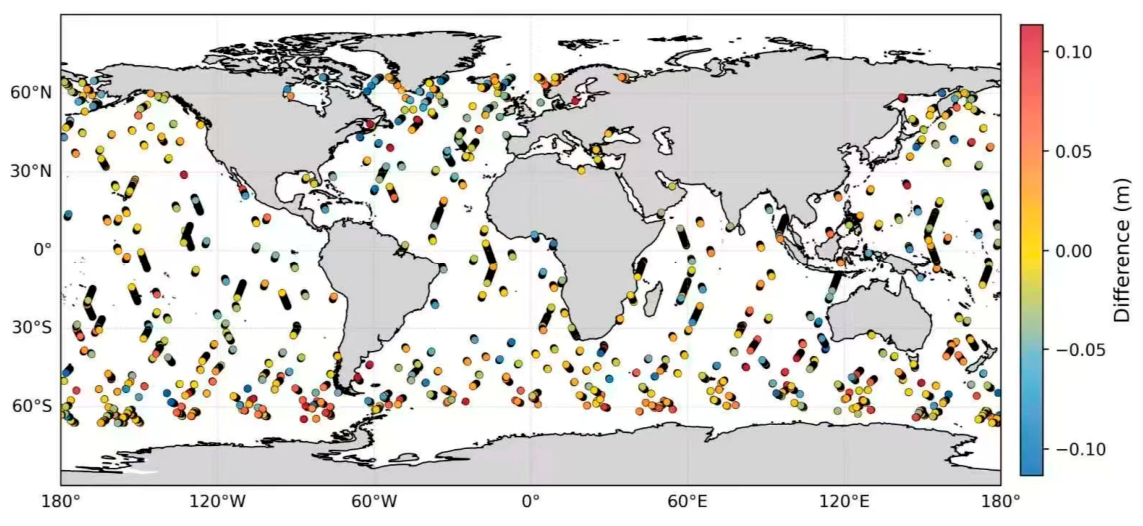
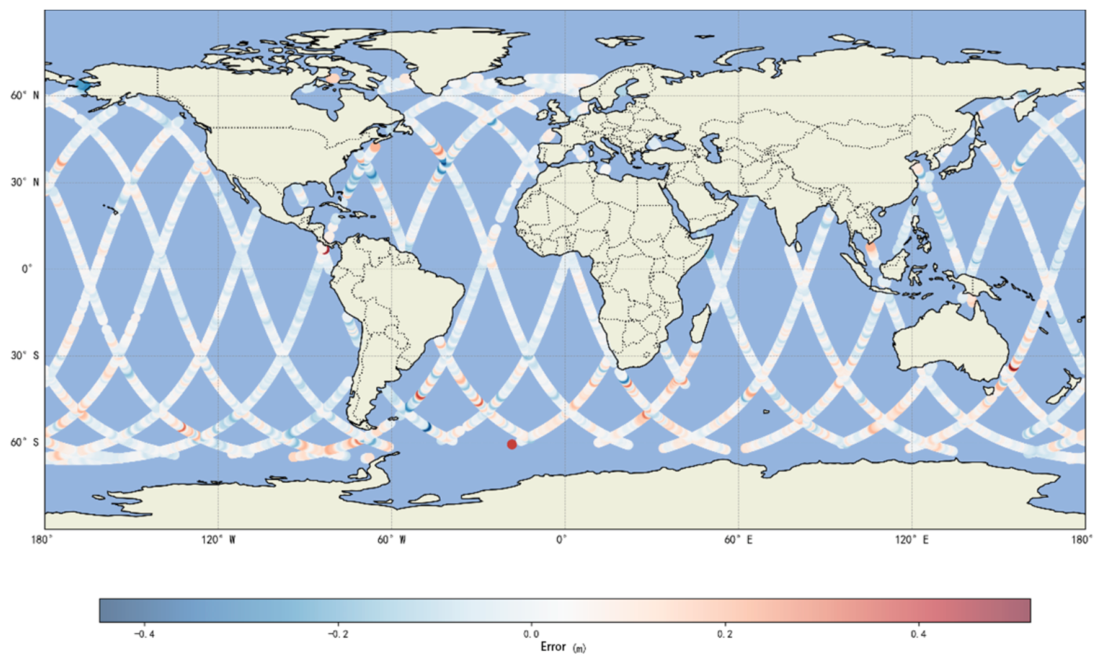
Jason-3 was adopted as the reference mission because of its high measurement accuracy and long-term stability. The SLA observations from Sentinel-3A and the other nadir-altimeter missions were cross-calibrated against Jason-3 to place all inputs within a common reference framework. The effectiveness of this procedure is illustrated in Figure 1, which shows the global distribution of SLA differences between calibrated Sentinel-3A observations and Jason-3. The mean bias is 0.00 cm, with a standard deviation of 4.46 cm, an RMSE of 4.46 cm, and a correlation coefficient of 0.876. These metrics confirm that the cross-calibration procedure effectively removes systematic inter-mission offsets. No large-scale systematic positive or negative bias is evident within the displayed range of −0.20 to 0.20 m. Although localized deviations remain in some marginal seas, these differences are spatially scattered rather than regionally coherent, indicating that the remaining discrepancies are dominated mainly by random observational noise and local spatiotemporal mismatch rather than residual systematic bias [16,22].
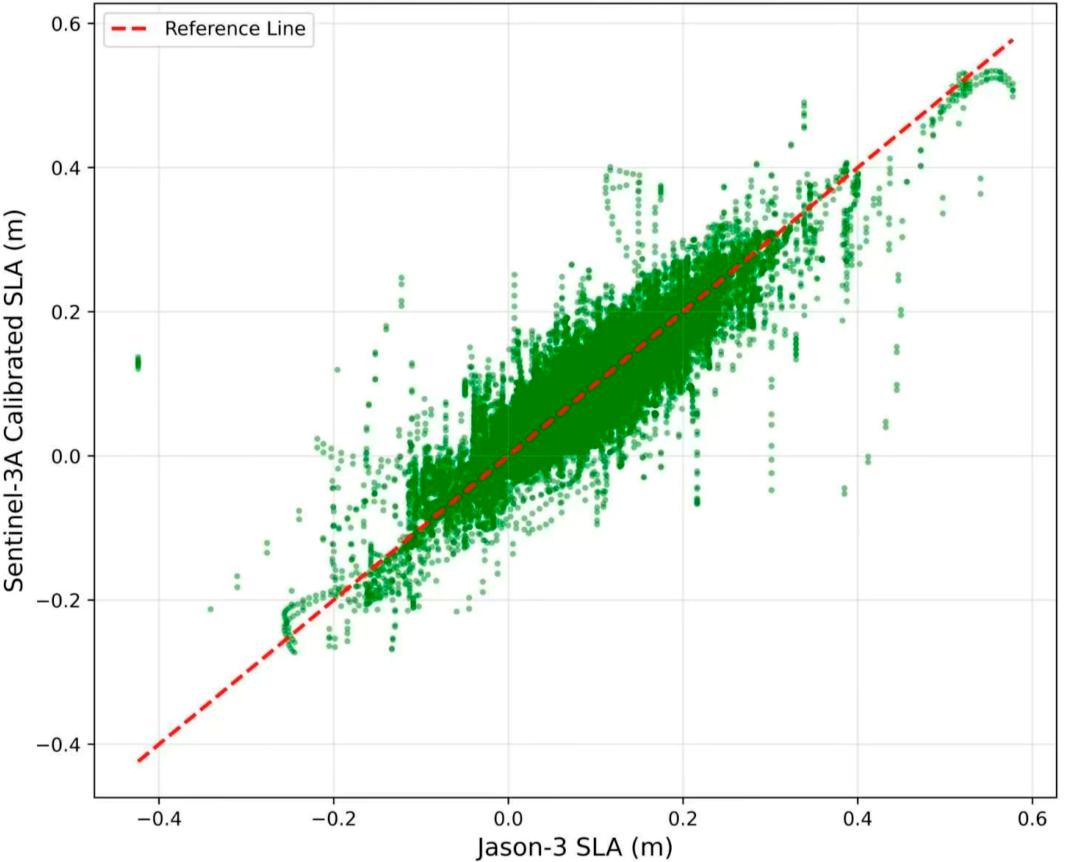
Figure 2 further evaluates the cross-calibration result using a scatter comparison between the calibrated Sentinel-3A SLA observations and the corresponding Jason-3 SLA values. The calibrated Sentinel-3A observations closely follow the reference line, with most points forming a dense linear band and a regression slope close to unity. This indicates that the calibrated Sentinel-3A measurements are broadly consistent with the Jason-3 reference after bias correction. Together with the near-zero mean difference shown in Figure 1, the scatter relationship in Figure 2 indicates that the cross-calibration step effectively removed the mean inter-mission offset and improved consistency between Sentinel-3 and Jason-3. The remaining discrepancies are limited and do not suggest residual large-scale systematic bias [22].
Overall, the preprocessing procedure combined mission-specific quality control, anomaly screening, reference unification, and cross-calibration to produce a harmonized multi-mission dataset. This unified dataset provides the basis for the subsequent scale-separation and scale-dependent fusion analyses.

2.3. Methodological Framework

2.3.1. Overall Framework

The proposed framework is designed to jointly use conventional nadir-altimeter observations and SWOT measurements. Conventional nadir altimeters provide relatively stable constraints on the large-scale background field, whereas SWOT supplies dense two-dimensional observations that are more sensitive to short-wavelength variability. This complementarity motivates a scale-separated reconstruction strategy rather than a uniform fusion treatment applied directly to all observations [11,12].
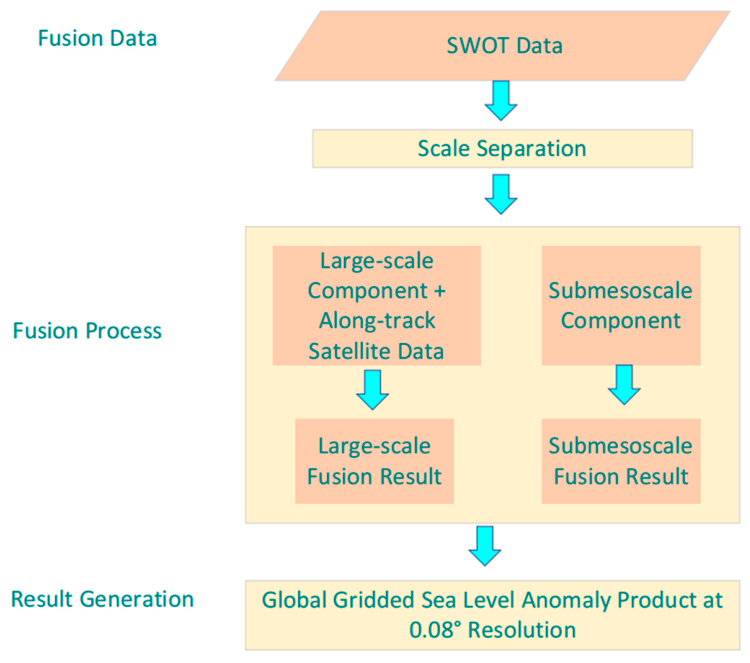
The framework is based on the premise that large-scale background variability and mesoscale–submesoscale variability differ not only in spatial scale, but also in error characteristics and sensitivity to over-smoothing. A single reconstruction strategy is therefore unlikely to represent both components equally well. In the present workflow, the SWOT-related signal is decomposed into a large-scale component and a mesoscale–submesoscale component. The large-scale component is reconstructed using adaptive OI based on conventional nadir-altimeter observations together with the extracted large-scale SWOT information. The mesoscale–submesoscale component is reconstructed in a separate branch with explicit physical regularization to improve the recovery of organized fine-scale structures while limiting cross-scale contamination. The two reconstructed components are then linearly recombined to generate the final SLA field (Figure 3).

2.3.2. Scale Separation Technique

The availability of SWOT wide-swath observations has substantially improved the observation of sea surface height variability at fine spatial scales [12,17]. A central challenge, however, is how to incorporate this dense two-dimensional information together with conventional nadir-altimeter observations without degrading the large-scale dynamical consistency of the reconstructed field. If SWOT and conventional nadir-altimeter observations are merged directly within a single reconstruction framework, scale mixing may occur because the observations differ markedly in sampling geometry, error structure, and sensitivity to mesoscale–submesoscale variability [13].
This problem arises for several reasons. First, observational errors differ across systems and scales. Errors in conventional nadir altimeters are commonly treated as weakly correlated in space, whereas SWOT errors may exhibit stronger two-dimensional spatial correlation because of the characteristics of interferometric measurement [18]. If these differences are ignored, SWOT observations may receive excessive weight in optimal interpolation, thereby affecting the large-scale background field. Second, conventional covariance models are generally better suited to smooth large-scale variability than to the broad spectrum of mesoscale–submesoscale motions. Applying a single smoothing treatment to all observations may therefore suppress physically meaningful mesoscale–submesoscale signals. Third, because the observed SLA field contains superimposed variability from multiple scales, direct reconstruction of the unseparated signal can blur real mesoscale structures or introduce artificial small-scale noise.
For these reasons, scale separation is introduced as the first step of the present framework. The purpose is to decompose the SWOT-related signal into components that can be reconstructed with scale-appropriate methods under different assumptions. In this study, the signal is separated into a large-scale component and a mesoscale–submesoscale component, so that the large-scale background and the mesoscale–submesoscale variability can be treated independently before recombination.
The scale-separation procedure is motivated by the scale dependence of ocean variability in spectral space. SLA spectra typically exhibit different energy distributions across wavenumbers, which provides a practical basis for separating the signal into large-scale and mesoscale–submesoscale components. The filtering step should therefore isolate the target scales while minimizing artificial oscillations and preserving the overall signal structure [13,17].
Among the candidate filters, the Lanczos filter was selected in this study because it provides a relatively sharp cutoff while suppressing side-lobe oscillations more effectively than simple moving averages or Gaussian smoothing [23]. In the present framework, the cutoff wavelength was set to 80 km, and the corresponding spatial-domain kernel is written as follows:
h n = s i n 2 π f c n s i n π n / W 2 π f c n π n / W , if   n 0 2 f c , if   n = 0
where h n is the discrete filter kernel, f c   is the normalized cutoff spatial frequency, and W is the half-window length of the Lanczos window. The first factor corresponds to the sinc kernel associated with the ideal low-pass response, whereas the second factor is the Lanczos window used to truncate the filter and suppress Gibbs oscillations.
In implementation, the quality-controlled SWOT Level-3 SLA data were reorganized from the original two-dimensional grid into a one-dimensional point sequence while retaining the valid observations and their associated longitude, latitude, and time information. The subsequent scale-separation procedure was carried out in the one-dimensional distance domain defined by the cumulative great-circle distance between adjacent observations.
The cutoff wavelength was fixed at 80 km and was treated here as a practical working scale for separating the dynamically smoother background field from the mesoscale–submesoscale variability to which SWOT is more sensitive, rather than as a universal physical boundary between mesoscale and submesoscale regimes [17]. This choice reflects a balance between two considerations. First, SWOT’s effective spatial resolution under typical ocean conditions supports separation at scales below 100 km. Second, the Lanczos filter requires a sufficiently long window to achieve a sharp spectral cutoff without excessive Gibbs oscillations; a cutoff near 80 km provides a favorable trade-off between frequency selectivity and spatial localization. Sensitivity tests with 60 km and 100 km cutoffs further confirm that 80 km yields stable separation performance across mid-latitude and high-latitude regions, and that the residual-variance ratio increases only modestly beyond this value. In dynamical regimes where the mesoscale–submesoscale transition scale differs from this fixed value, a regionally adaptive cutoff may offer further improvement.
The normalized cutoff frequency was determined from the sampling interval and the prescribed cutoff wavelength, and the Lanczos window width was set to 3, corresponding to a 7-point convolution kernel. On this basis, one-dimensional low-pass convolution was applied to the SLA sequence in the distance domain while preserving the original sequence length. The filtered field was defined as the large-scale component, whereas the residual relative to the original SLA sequence was defined as the mesoscale–submesoscale component. For cases in which the sequence had been mapped onto an equally spaced distance grid before filtering, both separated components were subsequently restored to the original observation locations [23].

2.3.3. Scale-Dependent Fusion

After scale separation, the large-scale and mesoscale-submesoscale components exhibit markedly different statistical and dynamical characteristics. The present framework therefore adopts a scale-dependent reconstruction strategy rather than a single uniform fusion step. The large-scale component is reconstructed within a classical optimal interpolation (OI) framework using conventional nadir-altimeter observations together with the extracted large-scale SWOT information, whereas the mesoscale-submesoscale component is reconstructed in a separate physically constrained branch designed for stronger nonlinearity and intermittency. The methodological emphasis is thus placed on the coordinated design of the two reconstruction branches and their subsequent recombination [18,24].
For the large-scale component, OI is used to preserve the stable basin-scale structure supported by covariance-based mapping. For the mesoscale-submesoscale component, a physically constrained reconstruction branch is introduced to recover organized mesoscale-submesoscale variability more effectively while reducing cross-scale interference. This arrangement allows the framework to make use of the complementary strengths of different observing systems under scale-appropriate assumptions [24].
Large-Scale Signal Fusion
The large-scale component was reconstructed using an adaptive OI scheme. In this framework, the analysis field is obtained by combining the background field and the observations so that the expected analysis-error variance is minimized [24]. The corresponding analysis equation is written as follows:
x = x b + K y H x b
where the observation operator maps the background field from the analysis grid to the observation locations, and the gain matrix determines the contribution of the innovation term to the final analysis. Under the OI assumptions, the gain matrix is given by
K = B H T H B H T + R 1
where B   denotes the background-error covariance matrix, R   denotes the observation-error covariance matrix, and H T   is the transpose of the observation operator. In the present implementation, the observation-error covariance was not treated as purely diagonal. Because adjacent observations along satellite tracks are not strictly independent, correlated errors were explicitly considered in the specification of R [24]. The observation-error covariance matrix was therefore written as
< ε i ε j δ i j b 2 W h e n   i   a n d   j   a r e   n o t   i n   t h e   s a m e   o r b i t   o r   t h e   s a m e   p e r i o d δ i j b 2 + E L W W h e n   i   a n d   j   a r e   i n   t h e   s a m e   o r b i t   o r   t h e   s a m e   p e r i o d
where the diagonal terms represent the individual observation-error variances and the off-diagonal structure accounts for along-track error correlation.
To account for regional differences in ocean variability, the background covariance model was formulated with latitude-dependent zonal and meridional correlation scales rather than with globally fixed values. The zonal and meridional correlation scales were expressed as
L x = 50 + 300 900 2 l a t 2 + 900 , l a t < 1 4 , k m 50 + 250 900 l a t 2 + 900 , 1 4 < l a t 9 0 , k m
L y = 250 , l a t < 1 4 , k m 50 + 250 900 l a t 2 + 900 , 1 4 < l a t 9 0 , k m
These expressions allow the correlation scales to vary with latitude and thereby better represent the geographical dependence of large-scale ocean dynamics.
In addition, the spatial separation between an observation and an analysis point was not represented by a purely isotropic Euclidean distance. Instead, an anisotropic space-time distance metric was introduced to account for advection by the long-term mean surface flow:
r = ( Δ x C p x Δ t L x ) 2 + ( Δ y C p y Δ t L y ) 2
Here, Δx and Δy denote the zonal and meridional spatial separations, respectively, and Δt denotes the time lag between the observation point and the target grid point. and represent the climatological zonal and meridional surface-current velocities for the corresponding longitude–latitude region.
T = 15 , l a t > 1 5   d a y s 10 15 , 5 < l a t < 1 0 , d a y s 10 , l a t < 5 , d a y s
Finally, the spatiotemporal covariance function used in this study is written as follows:
F ( r , t ) = [ 1 + a r + ( a r ) 2 6 ( a r ) 3 6 ] exp ( a r ) exp ( t 2 / T 2 )
This formulation integrates the adaptive spatial correlation scale, the anisotropic space–time distance, and the latitude-dependent temporal decorrelation scale into a unified covariance model, thereby providing a more realistic description of the spatiotemporal variability of ocean dynamics.
Mesoscale-Submesoscale Signal Fusion
Within the scale-separated framework, the mesoscale-submesoscale branch is designed to improve the reconstruction of SLA variability below 80 km, where the signal is more intermittent, nonlinear, and more easily attenuated by conventional unified mapping. Rather than extending the large-scale OI formulation directly to this regime, the present study introduces a Transformer-based correction branch with physical regularization to refine the mesoscale-submesoscale component on the common analysis grid. The supervisory reference is derived from AVISO gridded fields after applying the same scale-separation procedure as that used in the reconstruction workflow. Local patches extracted from these reference fields are paired with the corresponding observation-driven input patches to construct the training samples [5,13]. It should be emphasized that the training labels are derived from AVISO/CMEMS after the same 80 km Lanczos separation. Consequently, the recovered mesoscale–submesoscale signal represents a relative spatial enhancement with respect to the AVISO reference at sub-80 km scales, rather than an absolute retrieval of the true oceanographic submesoscale field.
The implemented model adopts Transformer encoder architecture. The input sequence is first projected into the model feature space and combined with positional encoding and is then processed by stacked Transformer blocks composed of multi-head self-attention, residual connections, layer normalization, and feed-forward sublayers. When physical regularization is enabled, the training loss is written as
L θ = L M S E + λ × L p h y
In this expression, L M S E   denotes the root-mean-square-error loss, which ensures that the predicted sea level anomaly field remains close to the training labels.   λ is a balancing coefficient that controls the weight of the physical constraint in the total loss, and θ represents the learnable model parameters. L p h y is the explicit physical-regularization term used to guide the network toward dynamically consistent solutions.
L p h y = g r a d _ l o s s + λ × l a p l a c i a n _ l o s s
This design has a clear physical interpretation. The gradient-loss term penalizes anomalous spatial gradients in the sea-surface-height field, thereby suppressing nonphysical sharp oscillations or spurious frontal structures and helping to preserve spatial smoothness and continuity. The Laplacian-loss term constrains the curvature of the sea-surface-height field, which is related to relative vorticity under geostrophic balance. This constraint helps improve the dynamical self-consistency of the reconstructed mesoscale–submesoscale component [25].
In summary, the proposed mesoscale-submesoscale fusion branch combines nonlinear feature extraction by a deep-learning model with multi-level physical constraints so that small-scale structures are enhanced without losing dynamical plausibility [25]. The key implementation parameters of the framework are summarized in Table 1. The Lanczos window width (W = 3) follows Duchon [23], who demonstrated that this value provides a favorable balance between cutoff sharpness and side-lobe suppression for one-dimensional low-pass filtering. The OI correlation scales Lx and Ly were estimated from regional SLA autocorrelation functions and vary with latitude as specified by Equations (5) and (6). The physical regularization coefficient λ and the loss-function balancing weight were determined through grid search on a held-out validation subset, such that the RMSE and gradient-loss terms contribute comparably to the total training objective. The Transformer model dimension and the number of attention heads were selected based on common configurations for moderate-scale geospatial regression tasks, with the depth chosen to be sufficient for capturing localized nonlinear relationships while maintaining training stability.
Multiscale Result Generation
After scale-dependent reconstruction, the large-scale component obtained from the OI branch and the mesoscale-submesoscale component refined by the Transformer-based branch were linearly recombined to generate the final SLA field:
η fused = η large + η sub
where the large-scale term denotes the OI-based reconstruction result and the mesoscale-submesoscale term denotes the output of the correction branch. Before superposition, both components were mapped onto the same regular grid (0.08° × 0.08°) to ensure consistency in spatial resolution.

3. Results

3.1. Scale Separation Results

After Lanczos-based scale separation, two representative dynamical regions were selected to evaluate the physical plausibility of the decomposition results: a selected southern Indian Ocean sector of the Antarctic Circumpolar Current (ACC) and a subregion of the Kuroshio Extension. These two regions were chosen because they represent contrasting dynamical regimes, namely a high-latitude circumpolar current system and a mid-latitude western boundary current system, both characterized by pronounced variability across a broad range of spatial scales [26].
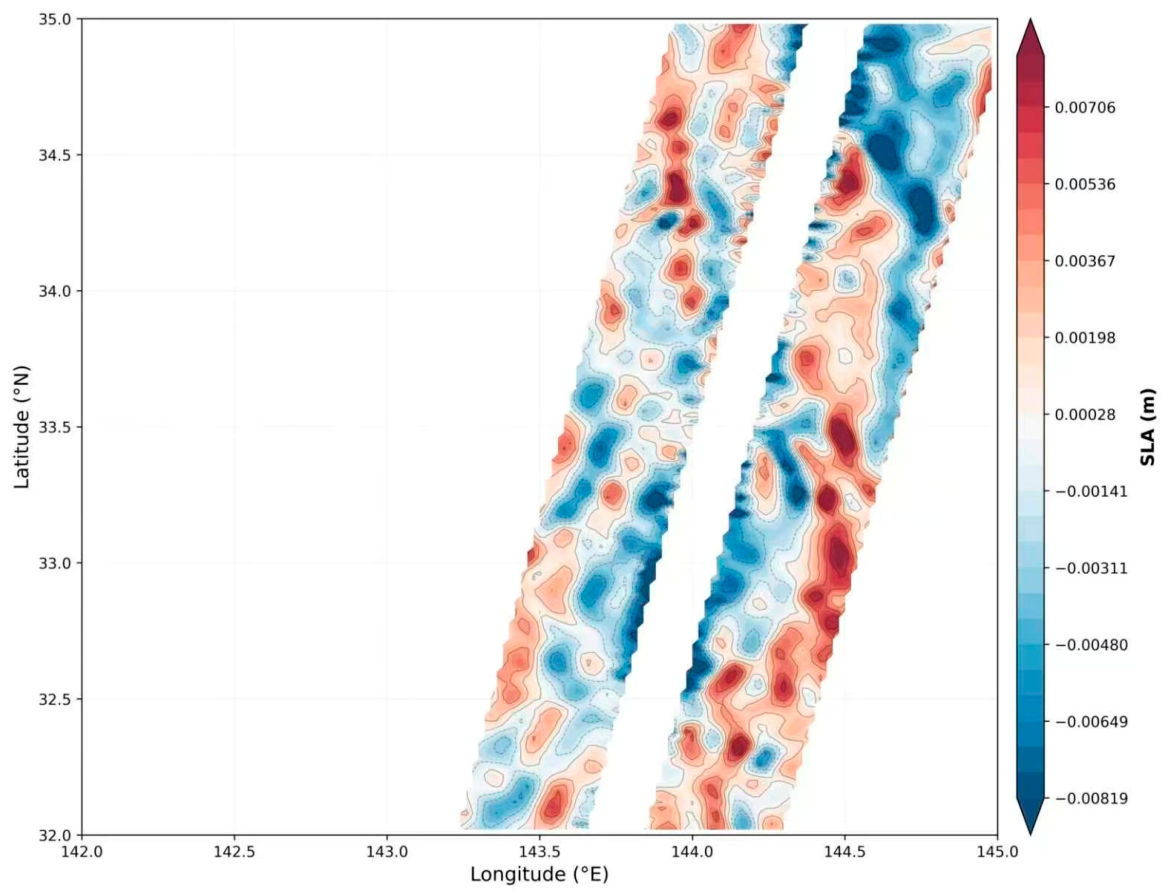
Pixels within 10 km of the outer swath edges and within 5 km of the nadir line were excluded prior to scale separation to mitigate KaRIn edge and nadir artifacts. The spatial patterns shown in Figure 4 and Figure 5 are therefore free of the prominent swath-edge striping that would otherwise contaminate the decomposed mesoscale–submesoscale field.
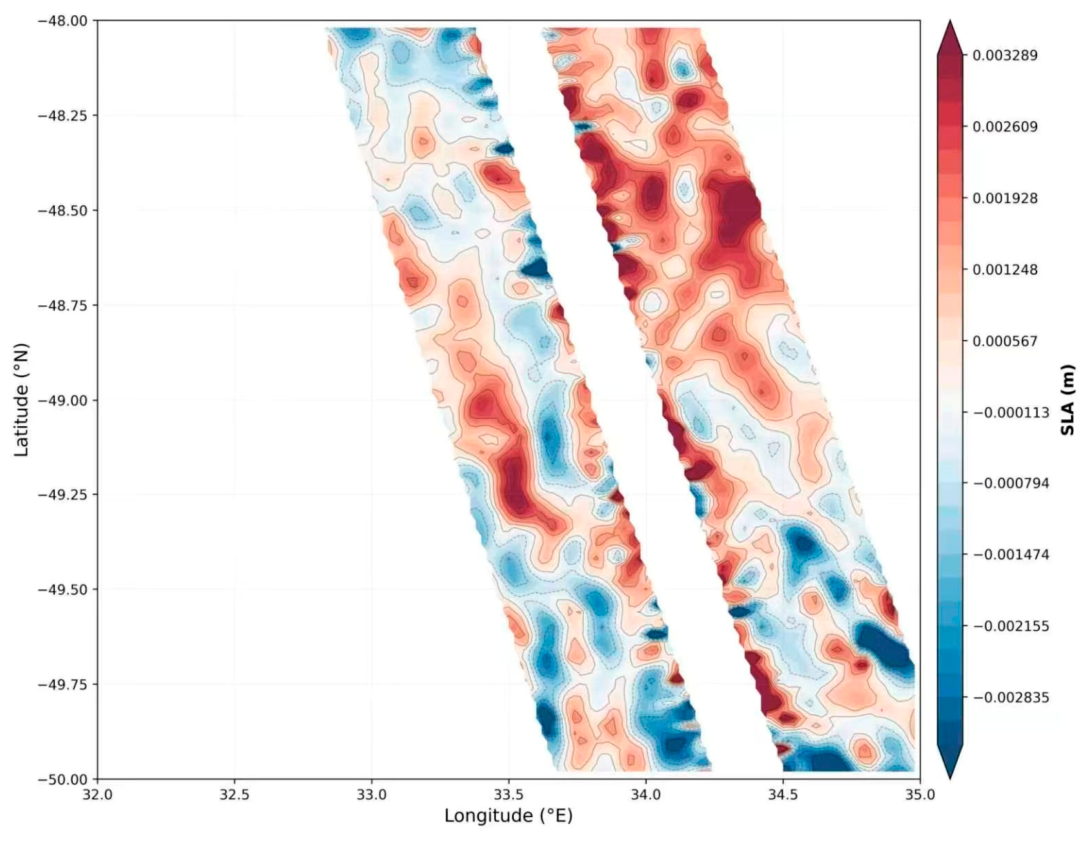
Figure 4 shows the extracted mesoscale–submesoscale SLA component in the selected southern Indian Ocean sector of the ACC. The signal amplitude is mainly within ±0.02 m, and the field exhibits coherent patch-like and filamentary structures with characteristic spatial scales of several tens of kilometers. These structures are spatially consistent with regions of intensified horizontal shear and strain associated with the ACC frontal system. At the same time, no large-scale coherent bias is evident in the extracted field, indicating that the scale-separation procedure isolates the mesoscale–submesoscale component without introducing obvious large-scale distortion.
Figure 5 presents the corresponding mesoscale-submesoscale component in a local subregion of the Kuroshio Extension. The extracted signal is likewise concentrated within approximately ±0.02 m, but displays a more heterogeneous spatial texture, including multiple localized anomaly centers, narrow filaments, and elongated structures aligned with the mean flow. This pattern is consistent with the strong eddy activity, frontal variability, and shear-driven deformation characteristic of the Kuroshio Extension [26,27].
Taken together, the southern Indian Ocean ACC sector and Kuroshio Extension examples indicate that the Lanczos-based separation retains spatially coherent mesoscale–submesoscale structures in dynamically active regions rather than producing disorganized small-scale noise. These results support the use of the scale-separation procedure as the first step of the subsequent scale-dependent fusion framework.

3.2. Verification of Scale Separation Results

After Lanczos-based scale separation, spectral diagnostics were used to evaluate whether the decomposition preserved the expected scale-dependent structure of the SLA field. Kinetic energy (KE) density spectra and power spectral density (PSD) analyses were used to assess the physical consistency of the separation and to examine whether the large-scale and mesoscale-submesoscale components occupied the intended spectral ranges [23].
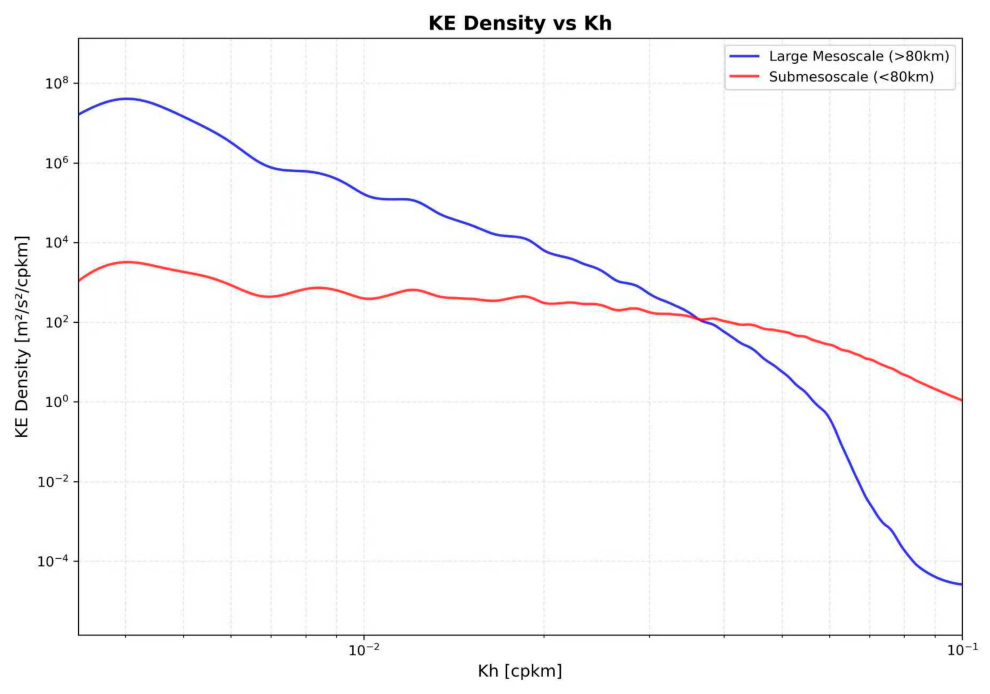
All spectral analyses presented in this section were performed on data that had passed the cross-track spatial filter; pixels near the swath edges and nadir line were excluded prior to scale separation, so that edge-related artifacts do not contribute to the computed spectra. Figure 6 shows the KE density spectrum as a function of horizontal wavenumber. The large-scale component (wavelengths > 80 km) and the mesoscale–submesoscale component (wavelengths < 80 km) exhibit a clear spectral separation. Most of the energy in the large-scale component is concentrated at low wavenumbers, whereas the mesoscale–submesoscale component contributes relatively more energy at higher wavenumbers. This distribution is consistent with the intended role of the Lanczos filter in separating the smoother background field from the shorter-wavelength variability.
The KE spectrum of the large-scale component shows the expected behavior of large-scale sea surface motions, with dominant energy at low wavenumbers and a comparatively gentle spectral slope. For wavelengths greater than 80 km, the large-scale component retains most of the kinetic energy, indicating that the decomposition preserves the dominant energy-containing background variability. Overall, the spectral structure shown in Figure 6 supports the physical plausibility of the extracted large-scale component and indicates that the separation behaves consistently with the expected scale-dependent organization of ocean variability.
By contrast, the kinetic-energy density spectrum of the mesoscale–submesoscale component is markedly higher than that of the large-scale component in the high-wavenumber range, indicating that the separated small-scale branch successfully retains the energetic short-wavelength variability expected from the original SWOT observations.
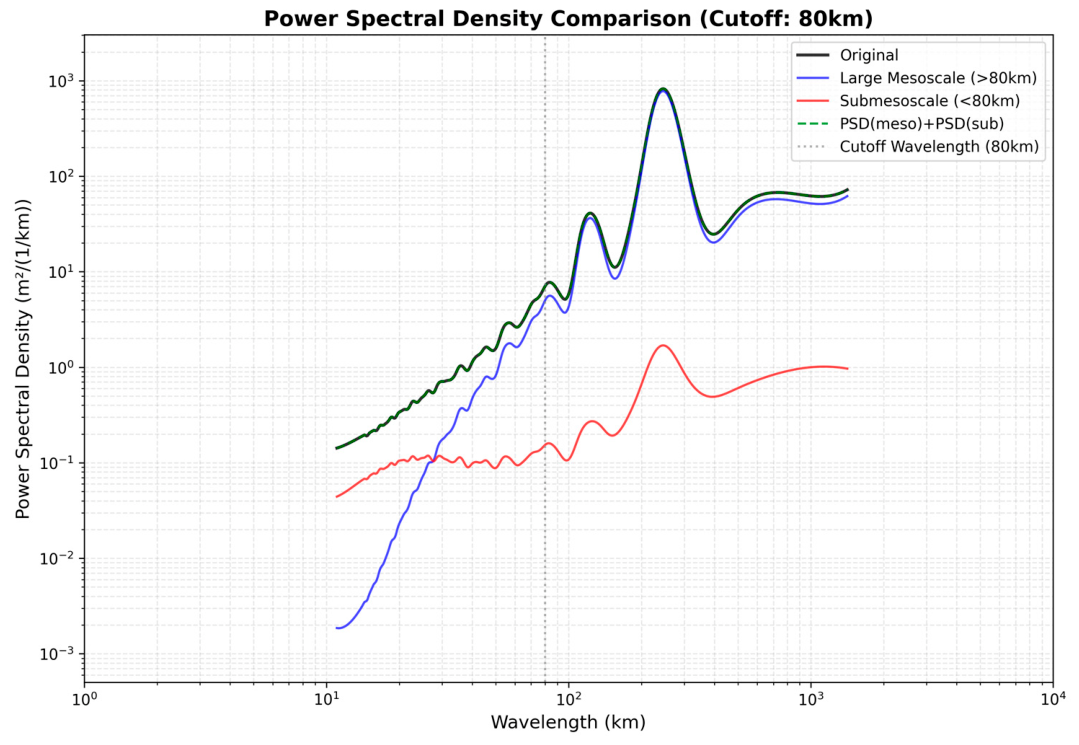
Figure 7 shows the PSD comparison used to evaluate the completeness of the scale separation. Four spectra are included: the original SWOT SLA signal, the large-scale component extracted by the Lanczos filter, the mesoscale–submesoscale component, and the reconstructed signal obtained by linear recombination of the two separated components.
The spectral comparison indicates that the decomposition behaves as intended across the target scales. In the low-wavenumber range (wavelengths > 80 km), the spectrum of the large-scale component closely follows that of the original signal, indicating that most of the large-scale energy is retained after filtering. In the high-wavenumber range (wavelengths < 80 km), the large-scale spectrum decays rapidly relative to the original spectrum, showing that the filter effectively removes higher-wavenumber variability from the large-scale field.
By contrast, the mesoscale–submesoscale component contributes little energy at low wavenumbers but exhibits substantially higher energy at high wavenumbers. This behavior indicates that the variability removed from the low-pass field is transferred primarily into the mesoscale–submesoscale component, consistent with the intended scale separation.
The reconstructed spectrum, obtained by linear recombination of the two components, almost overlaps with the original spectrum over the full wavenumber range. This result indicates that the decomposition-reconstruction procedure preserves the overall spectral energy distribution without obvious artificial gain or loss.
Taken together, Figure 6 and Figure 7 show that the large-scale and mesoscale–submesoscale components occupy distinct spectral ranges and that their linear recombination recovers the original signal to a high degree. These results support the use of the Lanczos-based scale separation as the preprocessing step of the subsequent scale-dependent fusion framework.

Sensitivity of the Cutoff Wavelength

To examine the influence of the selected cutoff wavelength on the scale-separation results, an additional sensitivity test was conducted using SWOT data from 1 January to 1 March 2024. The Lanczos low-pass decomposition was repeated with cutoff wavelengths of 60 km, 80 km, and 100 km, and the variance ratio of the mesoscale–submesoscale residual component was compared across the three settings. The purpose of this sensitivity test was not to identify a universally optimal transition scale, but rather to assess whether the 80 km setting adopted in the present framework provides a stable and physically reasonable balance between preserving the large-scale background and extracting energetic short-wavelength variability [17,23].
The results show that, for the selected multi-date SWOT files, the residual-variance ratio increased consistently with increasing cutoff wavelength. The mean variance ratios for the 60 km, 80 km, and 100 km settings were 1.1%, 1.7%, and 1.8%, respectively. This behavior is physically interpretable: a smaller cutoff wavelength retains more intermediate-scale variability within the large-scale background field, whereas a larger cutoff wavelength transfers a greater fraction of longer-wavelength perturbations into the residual branch(Table 2). Considering the need to preserve a stable large-scale field while still isolating the fine-scale variability that SWOT is best able to constrain, and given the consistent behavior across multiple days, 80 km was adopted as the default cutoff wavelength in the subsequent experiments [17].

3.3. Fusion Product Results

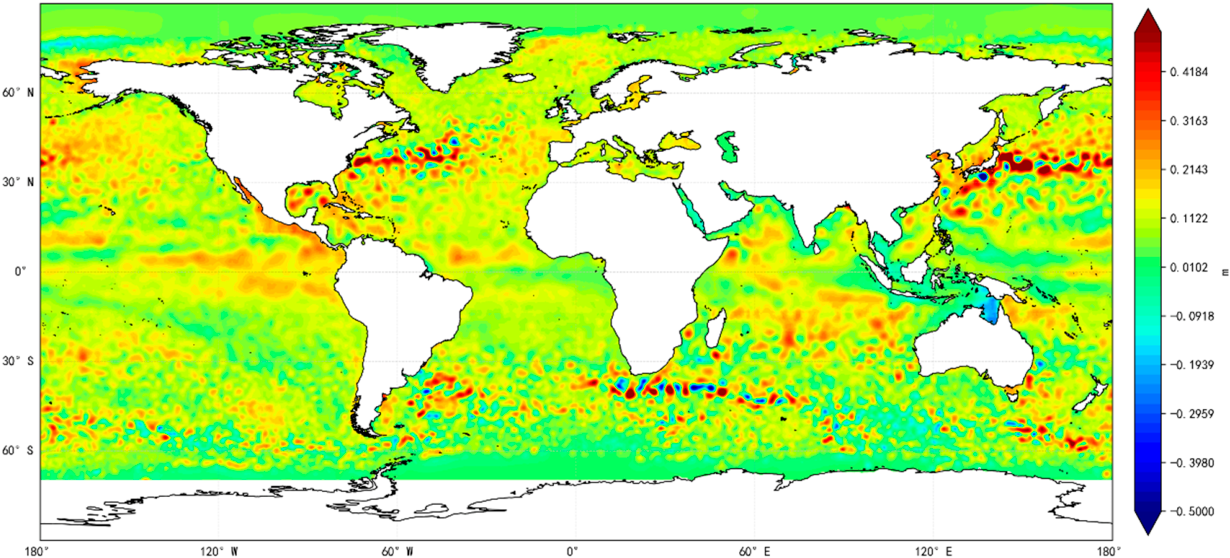
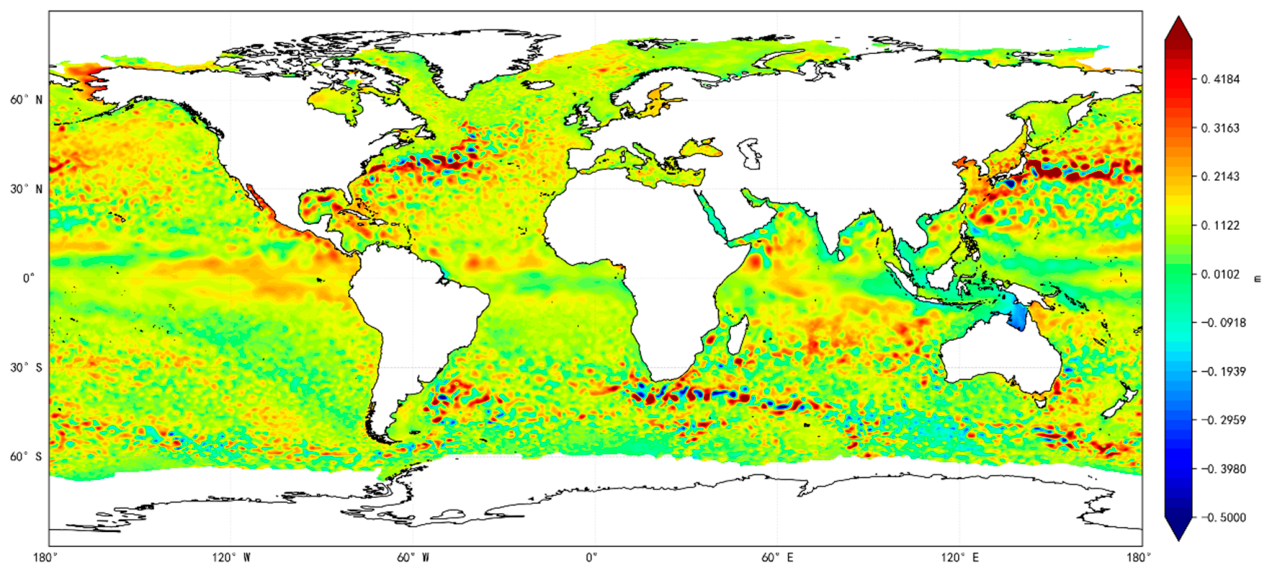
To illustrate the performance of the proposed framework, the gridded SLA product generated for 1 August 2023 is examined as a representative example (Figure 8). At the global scale, the product reproduces the major features of the observed ocean dynamic topography while maintaining good spatial continuity and physically coherent large-scale organization. The map is therefore useful not only as a visual example, but also as a direct test of whether the scale-separated workflow preserves the basin-scale background expected from an operational SLA product [5].
For example, in the North Pacific, the Kuroshio Current and its extension are clearly identifiable as a well-defined positive SLA band extending eastward from east of Taiwan toward Japan before merging into the broader North Pacific circulation, consistent with the known variability of the Kuroshio Extension jet and recirculation system [26]. The signal forms a coherent large-scale structure, within which fine-scale features are embedded, including jet meanders and the coexistence of warm and cold mesoscale eddies, phenomena that are also consistent with the nonlinear eddy field documented in satellite observations [22].
A similar western boundary current system is evident in the North Atlantic. The Gulf Stream emerges from the Florida Strait, flows northward along the eastern coast of the United States, and separates from the coast near Cape Hatteras. Within this large-scale positive SLA band, the extension exhibits pronounced meandering and possible eddy shedding behavior. These features are consistent with the corresponding AVISO SLA product for 1 August 2023 (Figure 9) [5]. A direct comparison between Figure 8 and Figure 9 shows strong agreement at the level of large-scale circulation. The positions and intensities of major current systems, as well as the equatorial structures and the Antarctic Circumpolar Current, are highly consistent between the two products. This indicates that the proposed fusion method does not introduce significant spatial bias and is capable of accurately representing the fundamental structure of the global ocean circulation.
Notably, in regions where conventional along-track altimetry coverage is sparse (e.g., parts of the central South Pacific and the southern Indian Ocean), the present fusion product maintains good spatial continuity and structural completeness. In many traditional SLA fusion products, insufficient observational constraints in such regions often lead to excessive smoothing or artificial striping artifacts. In contrast, no large-scale smoothing patches or obvious interpolation stripes are observed in Figure 8. Instead, the SLA field exhibits spatially coherent yet dynamically complex textures, consistent with smaller-scale eddy-like and short-wavelength variability [13,27].
Overall, the global maps indicate that the proposed framework preserves the large-scale circulation background while allowing additional SWOT-informed fine-scale information to enter the final product in a controlled way. The main gain is therefore not indiscriminate sharpening but improved multiscale representation under a reconstruction strategy that treats different scales separately.

3.4. Product Validation and Error Analysis

3.4.1. Comparison with the AVISO Product

Because AVISO/CMEMS gridded fields were used as a practical reference for constructing the training labels of the mesoscale–submesoscale branch, the comparison with AVISO was not intended as a fully independent validation. Instead, it was used as a large-scale consistency check to examine whether the proposed product preserves the basin-scale circulation background while allowing scale-dependent departures in dynamically active regions [5].
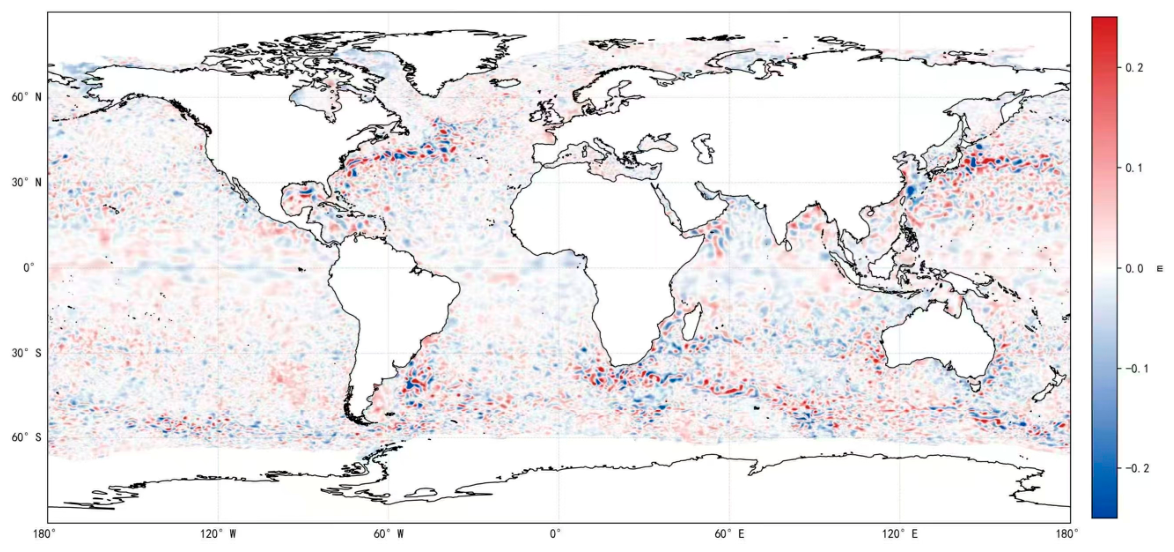
Figure 10 shows the spatial difference field between the proposed product and the AVISO SLA field on 1 August 2023 (Proposed − AVISO). The differences exhibit a heterogeneous spatial pattern, with relatively large amplitudes concentrated mainly in dynamically energetic regions, including the Kuroshio Extension, the Gulf Stream extension, the Antarctic Circumpolar Current pathway, and the Agulhas retroflection region. In these areas, the difference field shows banded and spatially organized structures broadly aligned with the main current systems. By contrast, differences over relatively quiescent open-ocean regions are much smaller and generally lack coherent spatial organization. More than 80% of the grid-point differences fall within ±0.25 m, indicating that the residual discrepancies are localized and concentrated in dynamically active regions rather than reflecting large-scale systematic offsets.
For 1 August 2023, the global spatial correlation coefficient between the two products is 0.8663 and the RMSE is 4.79 cm. These metrics indicate strong agreement in large-scale spatial structure and suggest that the proposed framework preserves basin-scale consistency while introducing scale-dependent differences primarily in dynamically active regions, where mesoscale–submesoscale variability is more prominent.
Because a single-day comparison may be influenced by the instantaneous ocean state, regional dynamics, and day-to-day changes in observational coverage, the agreement with AVISO was further evaluated using daily statistics from August 2023 to August 2024.
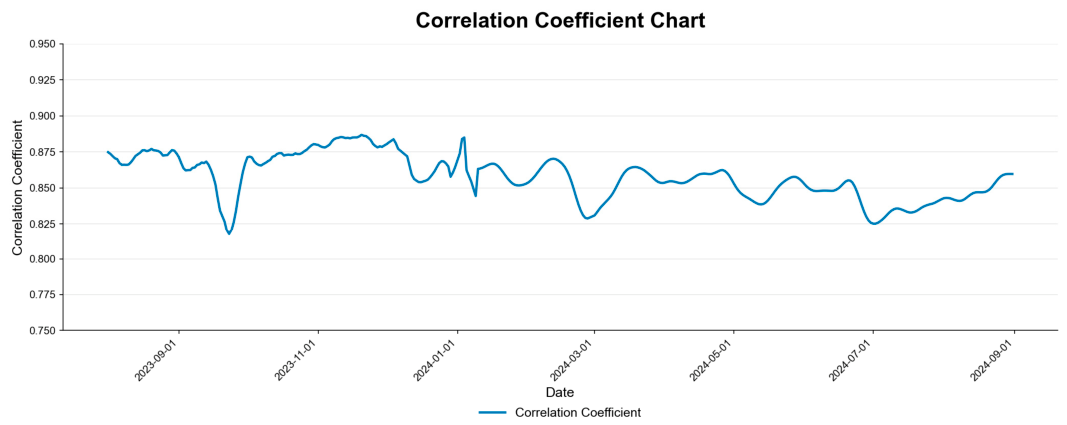
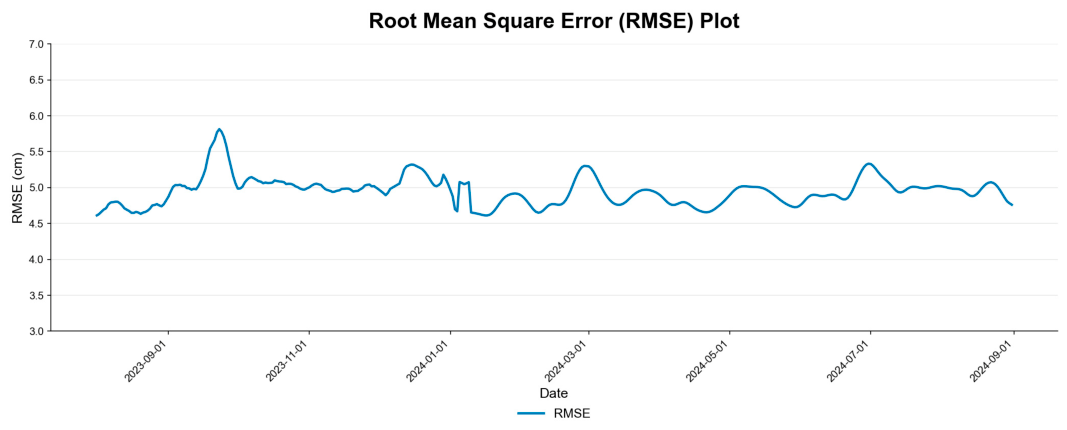
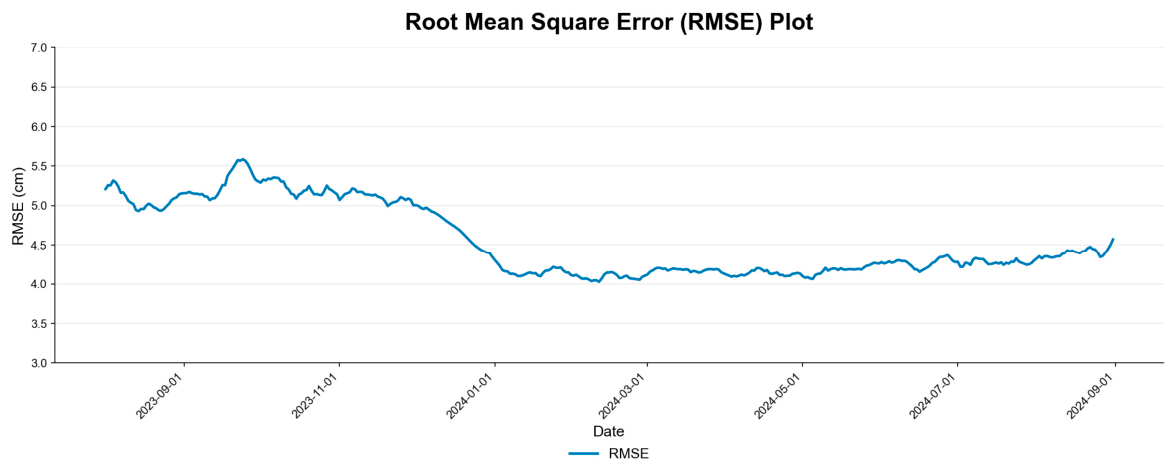
As shown in Figure 11, the daily spatial correlation coefficient between the proposed SLA product and AVISO remains consistently high during this period, varying between 0.825 and 0.900 with a mean value of approximately 0.85. Figure 12 shows the corresponding daily RMSE, which ranges from 4.80 to 5.80 cm with a mean value of approximately 4.94 cm. Although RMSE exhibits somewhat stronger temporal fluctuations than the correlation coefficient, no systematic drift or persistent increase is evident in either time series.
When considered together with the spatial difference field in Figure 10, these annual statistics suggest that the proposed product remains closely aligned with the AVISO background at the basin scale. At the same time, the residual differences are not spatially uniform but are concentrated mainly in dynamically energetic regions, indicating that the departures are more likely related to different representations of mesoscale–submesoscale variability than to a global systematic bias.
Overall, the AVISO comparison supports the view that the proposed framework preserves the expected large-scale circulation background over an annual time window. Its additional value therefore lies not in altering the basin-scale structure, but in allowing a different and more explicit treatment of mesoscale–submesoscale variability relative to a conventional unified fusion scheme.

3.4.2. Cross-Validation with Independent Observations

To further assess the proposed SLA product, Jason-3 along-track observations that were not used in the corresponding fusion samples were used as an external validation reference. In this comparison, the validation observations were matched in space and time with the gridded SLA product, while samples involved in the corresponding calibration or fusion procedures were excluded. The resulting differences therefore provide a sample-independent evaluation of the fused field [16,22].
Figure 13 shows the global difference field for 1 August 2023 relative to the Jason-3 reference. On the global scale, the differences do not exhibit coherent large-scale positive or negative bands, and no obvious systematic spatial offset is evident. Instead, the difference field is characterized by a near-zero-mean and spatially dispersed pattern, indicating good overall consistency between the proposed product and the sample-independent Jason-3 observations.
At the same time, the differences are not completely random. Regions with relatively large deviations occur in spatially clustered patterns, mainly in dynamically energetic or observationally complex areas. By contrast, over broad open-ocean regions, particularly in relatively quiescent low-variability areas, the differences remain small and lack coherent spatial organization. This spatial pattern suggests that the proposed framework maintains good agreement with the Jason-3 reference at the large scale, while the remaining deviations are concentrated mainly in regions where reconstruction is more challenging.
To evaluate the temporal stability of the proposed product, the validation was extended from single-day spatial comparisons to a daily time-series assessment using independent Jason-3 along-track observations from August 2023 to August 2024. Figure 14 shows the daily RMSE time series over this period. Overall, the RMSE remains close to 5 cm and varies within a relatively narrow range of approximately 4.8–5.2 cm. No systematic drift or isolated spike-like departures are evident, indicating that the product maintains stable performance over the annual validation window.
Some day-to-day fluctuations are still present, which are expected under changing dynamic and observational conditions. Larger discrepancies are more likely during periods of enhanced mesoscale activity and stronger SLA variability, when the reconstruction problem becomes intrinsically more difficult. Nevertheless, the RMSE remains within a controlled range throughout the period, suggesting that the proposed framework is robust to seasonal changes and regional dynamical intensification.
Considered together with the spatial difference pattern in Figure 13, these results indicate that the proposed product does not exhibit obvious global systematic bias relative to the independent Jason-3 reference. Combined with the large-scale agreement previously shown with AVISO, the time-series validation supports the view that the proposed framework improves mesoscale–submesoscale representation without compromising the large-scale background consistency of the reconstructed SLA field.

3.5. Integrated Comparison Between the Proposed Framework and a Conventional Unified Fusion Scheme

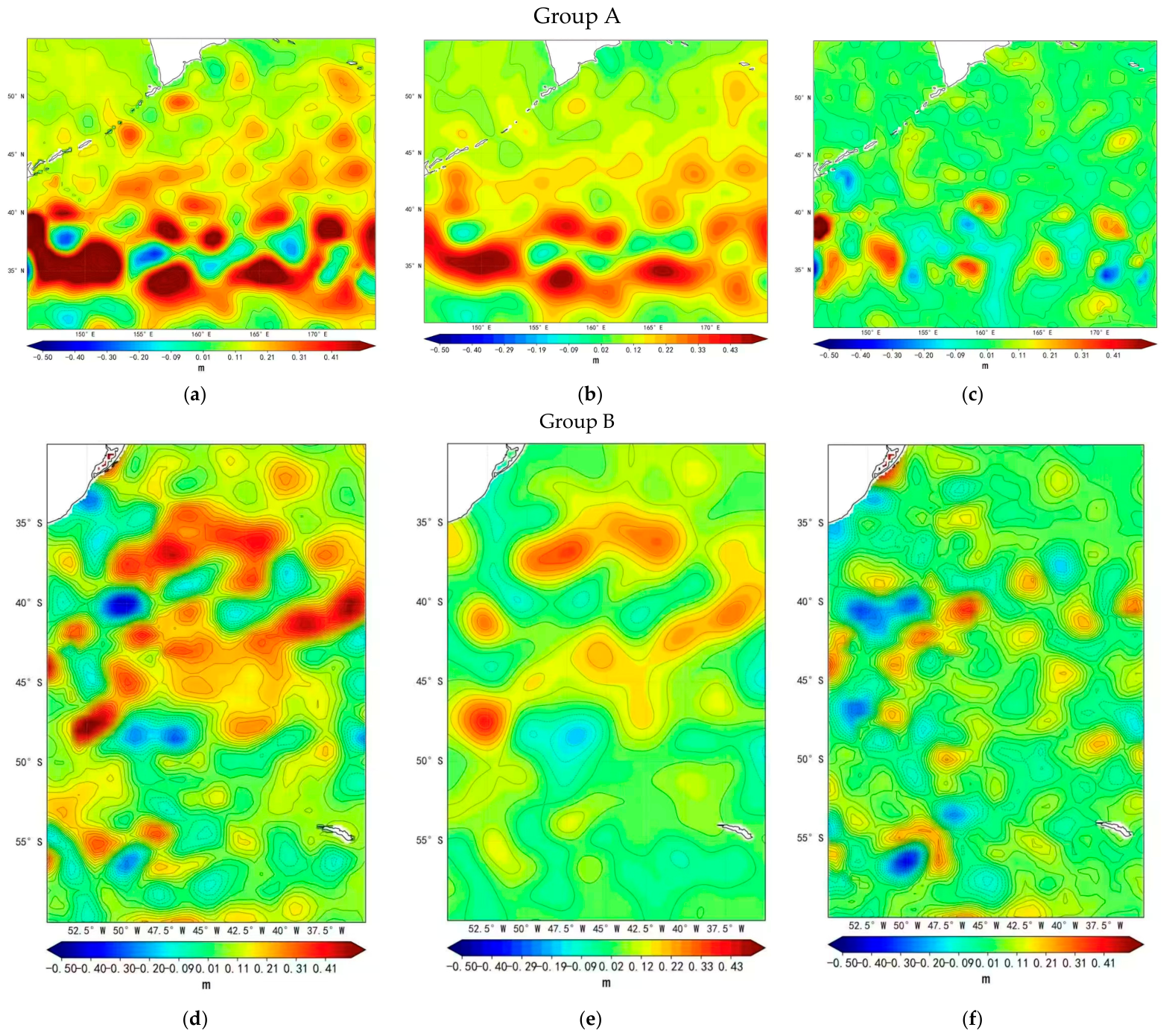
To evaluate the practical effect of the proposed framework on the representation of mesoscale–submesoscale variability, two regional case studies were conducted in comparison with a conventional unified fusion scheme. The purpose of this comparison is to examine whether, under otherwise comparable observational conditions, prior scale separation combined with dedicated reconstruction of the mesoscale–submesoscale component can improve the recovery of organized fine-scale structures. In the proposed framework, scale separation is performed before reconstruction, and the mesoscale–submesoscale component is reconstructed through a physically constrained branch. By contrast, the comparison scheme uses the same observations but performs direct fusion within a conventional unified OI framework, without prior scale decomposition. Therefore, the difference between the two products should be interpreted as the overall effect of the proposed scale-separated framework rather than the isolated contribution of any single component [13]. For this comparison, a conventional unified fusion scheme was constructed as a baseline. This baseline uses exactly the same set of multi-mission observations (Sentinel-3A/B, HY-2B, SARAL/Altika, and SWOT) and the same optimal interpolation configuration as the large-scale branch of the proposed framework but does not include the prior scale separation step. In the baseline, all nadir-altimeter and SWOT observations are fused within a single OI framework under identical covariance assumptions, representing the standard practice in which heterogeneous data types are merged without scale-dependent treatment. The only methodological difference between the proposed and baseline frameworks is therefore the scale separation step and the associated Transformer-based refinement of the mesoscale–submesoscale component.
For clarity, the results are organized into two groups: Group A presents the Kuroshio Extension comparison, and Group B presents the Scotia Sea comparison. The representation of nonlinear, transient, and high-gradient ocean structures places high demands on spatial resolution, sampling density, and scale fidelity. In the conventional OI framework, signals at different spatial scales are represented under the same covariance structure, which may lead to scale mixing and excessive smoothing of mesoscale–submesoscale variability. The purpose of this comparison is therefore to assess whether the proposed framework can alleviate this limitation while preserving the large-scale organization of the SLA field. Figure 15a shows the SLA field reconstructed on 1 August 2023 using the complete proposed workflow, including SWOT scale separation and scale-dependent fusion. The study region is located south of the Kuroshio Extension, within the subtropical mode-water formation area [26]. At the mesoscale, the reconstructed field clearly captures the southwest–northeast-oriented positive SLA band associated with the Kuroshio Extension. The meandering jet structure is well defined, and multiple warm-core and cold-core eddies are distributed along their flanks, each exhibiting closed contours and identifiable anomaly centers [27].
In addition to these primary mesoscale features, the reconstructed field also exhibits abundant shorter-wavelength structures. Along eddy peripheries, frontal regions, and the open-ocean areas between adjacent eddies, the SLA field shows spatially organized perturbations with characteristic scales of approximately 20–80 km. These structures appear as filamentary features, fragmented frontal segments, localized closed anomalies, and irregular high-gradient bands. South of the jet core, the field does not exhibit a spatially uniform anomaly distribution; instead, many elongated and patch-like perturbations are embedded within the broader-scale background, indicating pronounced spatial heterogeneity [27].
An important feature of the reconstructed field is that the enhancement of small-scale variability is not spatially uniform. The added variance is concentrated mainly in dynamically active regions, particularly near fronts, eddy boundaries, and filamentary structures, while the large-scale SLA pattern remains stable overall. This spatially selective enhancement suggests that the recovered short-wavelength variability is more likely to represent dynamically organized signals rather than unstructured random amplification. Within the analytical framework of this study, the Kuroshio case therefore provides region-scale integrated evidence for the practical effect of the proposed design. Because the comparison product lacks both prior scale separation and the physically constrained reconstruction branch for the mesoscale–submesoscale component, the difference between the two products reflects the combined effect of the full framework. The difference further supports this interpretation. Its dominant signals appear as filamentary and patch-like structures with characteristic spatial scales of several tens of kilometers, which is consistent with the typical spatial expression of mesoscale–submesoscale variability. By contrast, the differences are relatively weak in dynamically quiescent regions where strong gradients and active eddy interactions are absent.
Overall, the regional comparison indicates that the proposed framework can enhance the representation of mesoscale–submesoscale variability while preserving the coherent large-scale structure of the regional SLA field. The added structures are mainly concentrated in regions where mesoscale–submesoscale variability is dynamically plausible, supporting their interpretation as meaningful oceanographic signals rather than noise-like artifacts.
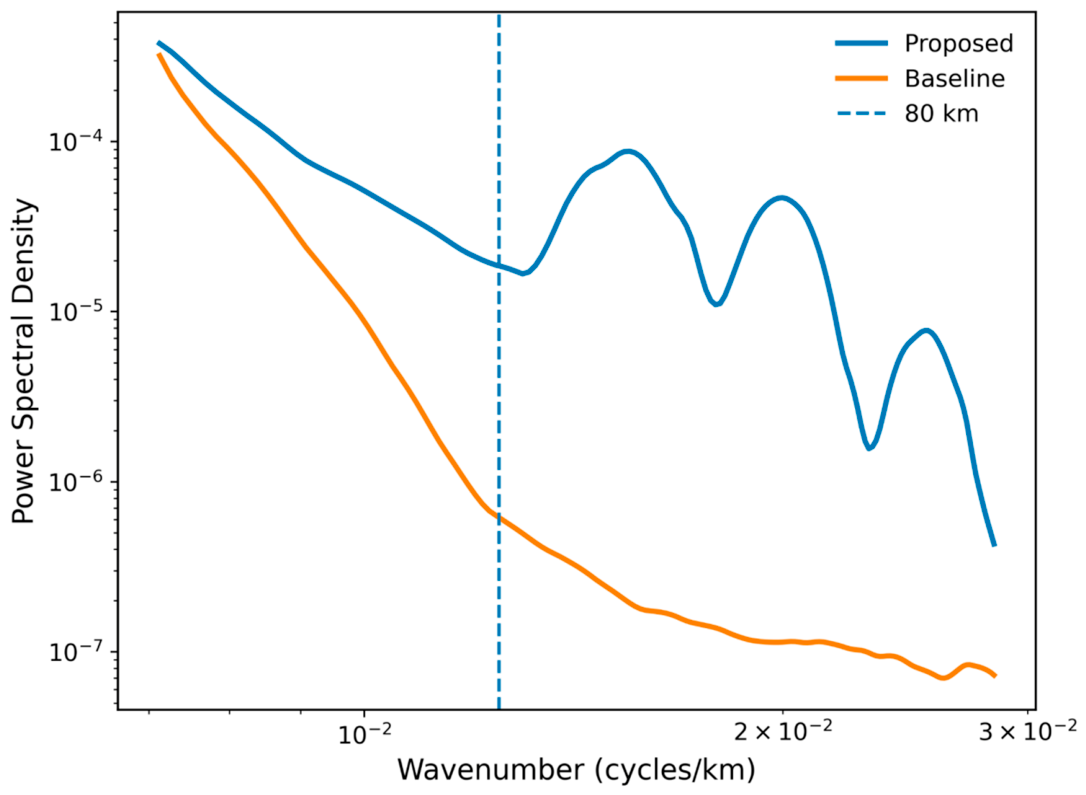
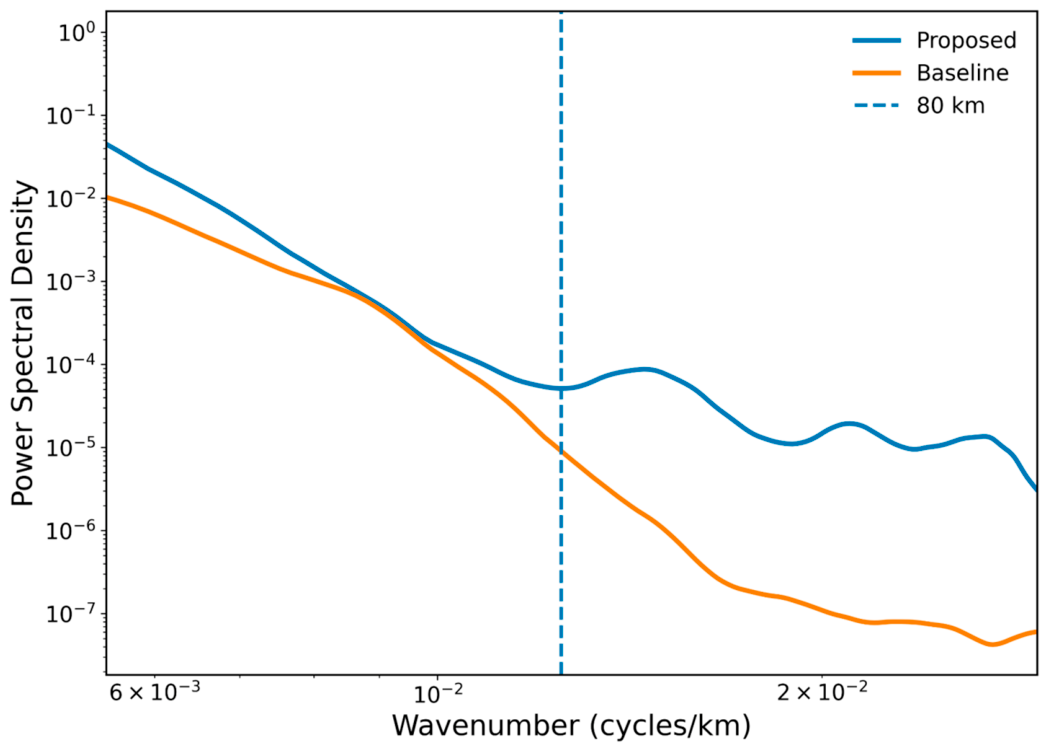
To complement the spatial comparison, a power spectral density analysis was further conducted for the Kuroshio Extension case within the target wavelength range of the proposed framework [23]. The 80 km cutoff is explicitly marked as the separation scale. As shown in Figure 16, the proposed framework retains systematically higher spectral energy than the baseline over most of the wavelength band below 80 km [17,28]. This result is consistent with the regional maps and suggests that the proposed workflow preserves more short-wavelength variability than the conventional unified fusion scheme, in which signals at different scales are represented under a single smoothing strategy and may therefore be partially attenuated.
This spectral difference should, however, be interpreted conservatively. In the present study, enhanced spectral energy within the target band is regarded as evidence of improved short-wavelength representation relative to the unified baseline only when it is accompanied by spatially coherent fronts, eddy boundaries, and filamentary structures in the corresponding regional maps, rather than as direct proof of an independently validated submesoscale truth. Under this interpretation, the combined spatial and spectral results support the view that the proposed framework recovers additional organized short-wavelength variability while preserving the large-scale structure of the regional field [28,29].
To examine whether the integrated advantage of the proposed framework is limited to a single western boundary current regime, the evaluation was further extended to the Scotia Sea, a high-latitude region characterized by complex circulation and relatively sparse conventional altimeter coverage. To complement the spatial comparison, a power spectral density (PSD) analysis was also conducted for this case using the same displayed wavenumber range and the same 80 km reference scale as those adopted for the Kuroshio Extension case.
The Scotia Sea is primarily influenced by the Antarctic Circumpolar Current (ACC) and is subject to harsh high-latitude observational conditions. Compared with western boundary current regions, conventional nadir altimeter sampling is relatively sparse in this area. The region therefore provides a stringent test case for evaluating the robustness of the proposed framework under dynamically complex and observationally challenging conditions. Unlike the Kuroshio Extension, which is dominated by a boundary-intensified current system, the Scotia Sea is controlled by the ACC, the strongest zonal current system in the global ocean. Strong westerly winds interact with pronounced bathymetric variability, generating intense eddy kinetic energy through frontal instability. As a result, the regional flow field exhibits strong anisotropy and clear topographic constraints. Under such conditions, characterized by both dynamic complexity and sparse observations, the fusion framework faces substantial challenges.
Figure 15d shows the SLA product generated by the scale-separation and scale-dependent fusion framework in the Scotia Sea. Even in this observation-sparse region, the product clearly delineates the primary ACC pathway and the associated strong sea-surface-height gradients, while also resolving mesoscale–submesoscale structures such as closed anomaly centers, narrow perturbation bands, and fragmented patches. For comparison, Figure 15e presents the product obtained from a conventional fusion framework without scale separation. Although the large-scale gradient associated with the ACC is retained, the representation of fine-scale structures is substantially weakened. Mesoscale eddy boundaries appear more diffuse, structural heterogeneity is reduced, and filamentary features are noticeably smoothed, giving the field a more homogenized appearance. This behavior is consistent with the limitations of a single covariance structure in representing anisotropic flow patterns and topographic constraints, thereby leading to scale mixing and excessive smoothing.
As shown in Figure 17, the proposed framework also retains higher spectral energy than the baseline over most of the wavelength band below 80 km in the Scotia Sea, even when the displayed horizontal wavenumber range is kept identical to that of the Kuroshio Extension panel for direct visual comparison. This result suggests that the spectral advantage of the proposed framework is not restricted to a single energetic western boundary current region. As in the Kuroshio Extension case, the additional short-wavelength variance in the Scotia Sea is accompanied by coherent spatial organization in Figure 15f, which supports the interpretation that the recovered variance is predominantly physically meaningful rather than a simple amplification of random noise [28,29].
Taken together, the Kuroshio Extension and Scotia Sea case studies indicate that the proposed framework improves the representation of mesoscale–submesoscale processes relative to a conventional unified fusion strategy. The Kuroshio Extension case demonstrates that the method can recover stronger organized short-wavelength variability in an energetic western boundary current regime, whereas the Scotia Sea case shows that this advantage persists under high-latitude, observationally sparse, and dynamically complex conditions. Both the regional maps and effective-band PSD diagnostics consistently indicate that the additional variance retained below 80 km is spatially organized rather than randomly amplified, supporting the interpretation that the gain reflects a more effective recovery of dynamically meaningful short-wavelength structure [13,28,29].

4. Discussion

4.1. Interpretation of the Multiscale Fusion Results

The proposed framework reformulates heterogeneous altimetry fusion into a scale-separated reconstruction problem. By separating the SWOT-involved signal prior to reconstruction, the framework avoids representing basin-scale background variability and short-wavelength variability within the same statistical treatment [13].
The validation results indicate that this design is effective in practice. Consistency with AVISO/CMEMS suggests that the framework preserves the large-scale circulation background, whereas the sample-independent comparison with Jason-3 indicates that the overall accuracy remains stable, without evident temporal drift, during the representative period from August 2023 to August 2024. The extended evaluation over the same period leads to the same overall conclusion. Taken together, these results indicate that the additional short-wavelength detail is not obtained at the expense of basin-scale consistency [5,16].
At the regional scale, the advantage of the framework is most evident in dynamically energetic regions. The comparisons in the Kuroshio Extension and the Scotia Sea show that the proposed workflow enhances fronts, eddies, and filamentary structures, which tend to be weakened when all scales are fused under a single smoothing strategy. The corresponding PSD results within the target band further indicate that this enhancement reflects additional recovered organized short-wavelength variance rather than indiscriminate amplification of texture. Taken together, these results show that the framework is not merely producing visually sharper maps. Instead, it improves the representation of organized variability below 80 km while maintaining the physical coherence and operational usability of the large-scale background. The present results therefore support scale-separated reconstruction as a practically meaningful improvement over conventional unified fusion for SWOT-involved SLA mapping.
Overall, the proposed framework provides a practical approach for combining the high precision of conventional nadir altimeters with the high spatial resolution of SWOT wide-swath observations. These results support the feasibility of scale-separated fusion for heterogeneous altimetry datasets and provide a useful pathway toward next-generation high-resolution SLA products for remote sensing applications and ocean analysis.

4.2. Methodological Implications

A key methodological implication of this study is that SWOT-informed multi-mission fusion benefits from treating scale separation and reconstruction as a coordinated workflow. When dense two-dimensional SWOT observations and sparse but stable nadir-altimeter observations are merged within a single uniform smoothing framework, the risk of scale mixing increases substantially. This issue is closely related to the long-standing challenge of resolving mesoscale variability in satellite altimetry mapping [13]. In the proposed framework, this risk is reduced by separating the signal prior to reconstruction and by applying appropriate methods to the resulting components, a scale- and error-aware perspective that is also relevant to SWOT hydrological applications involving river discharge estimation and uncertainty treatment [10,30].
This coordinated design is important for two reasons. First, prior scale separation reduces the likelihood that a substantial fraction of the short-wavelength perturbation signal will be absorbed into the large-scale background estimate. Second, physical regularization in the small-scale branch helps the recovered variance emerge preferentially in dynamically plausible fronts, eddy boundaries, and filamentary structures rather than as spatially random texture. The framework therefore has value not only as an implementation strategy, but also as a practical methodological approach for heterogeneous altimetry fusion.

4.3. Limitations and Future Work

Despite these strengths, several limitations should be acknowledged. First, the mesoscale–submesoscale branch is trained against an AVISO-based reference field rather than fully independent truth. This choice provides a practical and reproducible source of supervision, but it also implies that the learned short-wavelength variability may inherit some representational smoothing from the reference product. Consequently, the recovered sub-80 km signal should be interpreted as a relative spatial enhancement with respect to AVISO rather than an absolute retrieval of the true submesoscale field. Second, the current framework adopts a fixed 80 km cutoff and simplified physical regularization, which may not fully represent strong regional anisotropy, seasonal variability, or rapidly evolving frontal regimes. The 80 km cutoff was selected as a practical working scale based on SWOT’s effective resolution and the Lanczos filter frequency response, and sensitivity tests indicate that the residual-variance ratio increases only modestly beyond this value; nevertheless, the optimal cutoff may vary with latitude and regional dynamics. Third, although the present experiments include annual-scale large-scale comparison and independent cross-validation, broader multi-date regional tests and additional independent observations would further strengthen the evidence for robustness and generality, particularly because global diagnosis of submesoscale variability from satellite altimetry remains challenging [29].
Future work will therefore focus on regionally adaptive cutoff selection that accounts for latitudinal and regional variations in the mesoscale–submesoscale transition scale, localized covariance modeling in dynamically energetic regimes (such as the Kuroshio Extension, the Gulf Stream, and the Japan Trench region), stronger physics-aware learning strategies that couple sea level with vorticity, and broader regional validation using more diverse independent observations. These extensions will be important for assessing the framework in climate applications, ocean operational forecasting, future multi-mission product generation, and broader SWOT-related water-cycle, water-resource, and societal applications [31,32].

5. Conclusions

This study develops a scale-separated fusion framework for multi-mission satellite altimetry and SWOT observations. In this framework, the SWOT-informed signal is decomposed prior to reconstruction, the large-scale component is estimated using adaptive optimal interpolation, and the short-wavelength component is recovered in a separate physically regularized branch before the components are recombined on a common 0.08° × 0.08° grid. The framework is designed to reduce scale mixing when dense SWOT observations are integrated with conventional nadir-altimeter measurements.
The results demonstrate the practical value of this design. Spectral diagnostics indicate that the decomposition preserves energy and effectively isolates the target scales. Annual comparison with AVISO/CMEMS shows that the fused product retains the expected large-scale circulation background, and sample-independent validation against Jason-3 indicates stable overall accuracy at the 4.9–5.0 cm level. Meanwhile, fine-scale improvements are demonstrated through two representative regional cases, where comparisons with a conventional unified fusion baseline show improved recovery of organized short-wavelength variability in both the Kuroshio Extension and the Scotia Sea. Two specific technical contributions of this work are: (i) a reproducible scale-separated workflow that decouples large-scale OI mapping from learning-based fine-scale reconstruction, allowing each component to be treated with scale-appropriate methods under distinct statistical assumptions; and (ii) a physically regularized loss formulation that jointly constrains SLA spatial gradients and Laplacian smoothness to suppress nonphysical artifacts during sub-80 km enhancement. Taken together, these results support scale-separated, physically regularized fusion as a promising approach for SWOT-informed high-resolution SLA mapping, while broader regional validation remains necessary to further assess its generality.

Author Contributions

Conceptualization, B.Y. and Y.J.; methodology, B.Y.; software, B.Y.; formal analysis, B.Y.; data curation, B.Y.; visualization, B.Y.; validation, Y.J. and X.J.; supervision, Y.J. and X.J.; resources, X.J.; project administration, X.J.; writing—original draft preparation, B.Y.; writing—review and editing, Y.J. and X.J. All authors have read and agreed to the published version of the manuscript.

Funding

This research received funding from the National Natural Science Foundation of China (grant No. 42192531).

Data Availability Statement

Publicly available satellite altimetry datasets were analyzed in this study. The Jason-3, Sentinel-3A/B, HY-2B, SARAL/Altika, SWOT, and AVISO/CMEMS sea level anomaly products are available from their corresponding mission data providers and public data portals. The derived products generated during this study are available from the corresponding author upon reasonable request because the processed multi-mission gridded datasets are large in volume and are maintained as supporting research data for internal verification and reproducibility. The satellite altimetry datasets analyzed in this study are publicly available from the Copernicus Marine Data Store (https://data.marine.copernicus.eu/products, accessed on 25 October 2024) and the National Satellite Ocean Application Service (NSOAS, https://www.nsoas.org.cn, accessed on 20 September 2025).

Acknowledgments

The authors thank the data providers, mission teams, and processing agencies responsible for the Jason-3, Sentinel-3A/B, HY-2B, SARAL/Altika, SWOT, and AVISO/CMEMS products used in this study. Their sustained efforts in data acquisition, calibration, processing, and distribution made this work possible.

Conflicts of Interest

The authors declare no conflicts of interest.

References

  1. Stammer, D.; Cazenave, A. (Eds.) Satellite Altimetry Over Oceans and Land Surfaces; CRC Press: Boca Raton, FL, USA, 2017. [Google Scholar] [CrossRef]
  2. Fu, L.-L.; Cazenave, A. (Eds.) Satellite Altimetry and Earth Sciences: A Handbook of Techniques and Applications; Academic Press: San Diego, CA, USA, 2001. [Google Scholar]
  3. Le Traon, P.-Y.; Nadal, F.; Ducet, N. An improved mapping method of multisatellite altimeter data. J. Atmos. Ocean. Technol. 1998, 15, 522–534. [Google Scholar] [CrossRef]
  4. Ducet, N.; Le Traon, P.-Y.; Reverdin, G. Global high-resolution mapping of ocean circulation from TOPEX/Poseidon and ERS-1 and -2. J. Geophys. Res. Ocean. 2000, 105, 19477–19498. [Google Scholar] [CrossRef]
  5. Taburet, G.; Sanchez-Roman, A.; Ballarotta, M.; Pujol, M.I.; Legeais, J.-F.; Fournier, F.; Faugere, Y.; Dibarboure, G. DUACS DT2018: 25 years of reprocessed sea level altimetry products. Ocean Sci. 2019, 15, 1207–1224. [Google Scholar] [CrossRef]
  6. Fu, L.-L.; Pavelsky, T.; Crétaux, J.-F.; Morrow, R.; Farrar, J.T.; Vaze, P.; Sengenes, P.; Vinogradova-Shiffer, N.; Sylvestre-Baron, A.; Picot, N.; et al. The Surface Water and Ocean Topography Mission: A breakthrough in radar remote sensing of the ocean and land surface water. Geophys. Res. Lett. 2024, 51, e2023GL107652. [Google Scholar] [CrossRef]
  7. Biancamaria, S.; Lettenmaier, D.P.; Pavelsky, T.M. The SWOT Mission and its Capabilities for Land Hydrology. Surv. Geophys. 2016, 37, 307–337. [Google Scholar] [CrossRef]
  8. Yao, J.; Xu, N.; Wang, M.; Gong, P.; Lu, H.; Cao, Y.; Tang, X.; Mo, F. Promoting global surface water monitoring research with the SWOT satellite. Innov. Geosci. 2024, 2, 100099. [Google Scholar] [CrossRef]
  9. Yao, J.; Xu, N.; Wang, M.; Liu, T.; Lu, H.; Cao, Y.; Tang, X.; Mo, F.; Chang, H.; Gong, H.; et al. SWOT satellite for global hydrological applications: Accuracy assessment and insights into surface water dynamics. Int. J. Digit. Earth 2025, 18, 2472924. [Google Scholar] [CrossRef]
  10. Durand, M.; Gleason, C.J.; Pavelsky, T.M.; Prata de Moraes Frasson, R.; Turmon, M.; David, C.H.; Altenau, E.H.; Tebaldi, N.; Larnier, K.; Monnier, J.; et al. A framework for estimating global river discharge from the Surface Water and Ocean Topography satellite mission. Water Resour. Res. 2023, 59, e2021WR031614. [Google Scholar] [CrossRef]
  11. Fu, L.-L.; Ubelmann, C. On the transition from profile altimeter to swath altimeter for observing global ocean surface topography. J. Atmos. Ocean. Technol. 2014, 31, 560–568. [Google Scholar] [CrossRef]
  12. Morrow, R.; Fu, L.-L.; Ardhuin, F.; Benkiran, M.; Chapron, B.; Cosme, E.; d’Ovidio, F.; Farrar, J.T.; Gille, S.T.; Lapeyre, G.; et al. Global observations of fine-scale ocean surface topography with the Surface Water and Ocean Topography (SWOT) mission. Front. Mar. Sci. 2019, 6, 232. [Google Scholar] [CrossRef]
  13. Dufau, C.; Orsztynowicz, M.; Dibarboure, G.; Morrow, R.; Le Traon, P.-Y. Mesoscale resolution capability of altimetry: Present and future. J. Geophys. Res. Ocean. 2016, 121, 4910–4927. [Google Scholar] [CrossRef]
  14. Donlon, C.J.; Berruti, B.; Buongiorno, A.; Ferreira, M.-H.; Féménias, P.; Frerick, J.; Goryl, P.; Klein, U.; Laur, H.; Mavrocordatos, C.; et al. The Global Monitoring for Environment and Security (GMES) Sentinel-3 mission. Remote Sens. Environ. 2012, 120, 37–57. [Google Scholar] [CrossRef]
  15. Jia, Y.; Yang, J.; Lin, M.; Zhang, Y.; Ma, C.; Fan, C. Global assessments of the HY-2B measurements and cross-calibrations with Jason-3. Remote Sens. 2020, 12, 2470. [Google Scholar] [CrossRef]
  16. Bosch, W.; Dettmering, D.; Schwatke, C. Multi-mission cross-calibration of satellite altimeters: Constructing a long-term data record for global and regional sea level change studies. Remote Sens. 2014, 6, 2255–2281. [Google Scholar] [CrossRef]
  17. Wang, J.; Fu, L.-L.; Torres, H.S.; Chen, S.; Qiu, B.; Menemenlis, D. On the spatial scales to be resolved by the Surface Water and Ocean Topography Ka-band radar interferometer. J. Atmos. Ocean. Technol. 2019, 36, 87–99. [Google Scholar] [CrossRef]
  18. Ruggiero, G.A.; Cosme, E.; Brankart, J.-M.; Le Sommer, J.; Ubelmann, C. An efficient way to account for observation error correlations in the assimilation of data from the future SWOT high-resolution altimeter mission. J. Atmos. Ocean. Technol. 2016, 33, 2755–2768. [Google Scholar] [CrossRef]
  19. Hamoudzadeh, A.; Ravanelli, R.; Crespi, M. SWOT Level 2 Lake Single-Pass Product: The L2_HR_LakeSP data preliminary analysis for water level monitoring. Remote Sens. 2024, 16, 1244. [Google Scholar] [CrossRef]
  20. Zhao, Y.; Fu, J.; Pang, Z.; Jiang, W.; Zhang, P.; Qi, Z. Validation of inland water surface elevation from SWOT satellite products: A case study in the middle and lower reaches of the Yangtze River. Remote Sens. 2025, 17, 1330. [Google Scholar] [CrossRef]
  21. Lichtman, I.D.; Bell, P.S.; Gommenginger, C.; Banks, C.; Calafat, F.M.; Brown, J.; Williams, S.D.P. Evaluating water levels from the Surface Water and Ocean Topography (SWOT) Mission in a hyper-tidal coastal and estuarine environment. Earth Space Sci. 2025, 12, e2024EA004104. [Google Scholar] [CrossRef]
  22. Yang, J.; Zhang, J.; Wang, C. Sentinel-3A SRAL global statistical assessment and cross-calibration with Jason-3. Remote Sens. 2019, 11, 1573. [Google Scholar] [CrossRef]
  23. Duchon, C.E. Lanczos filtering in one and two dimensions. J. Appl. Meteorol. 1979, 18, 1016–1022. [Google Scholar] [CrossRef]
  24. Bretherton, F.P.; Davis, R.E.; Fandry, C.B. A technique for objective analysis and design of oceanographic experiments applied to MODE-73. Deep Sea Res. 1976, 23, 559–582. [Google Scholar] [CrossRef]
  25. Charney, J.G. Geostrophic turbulence. J. Atmos. Sci. 1971, 28, 1087–1095. [Google Scholar] [CrossRef]
  26. Qiu, B.; Chen, S. Variability of the Kuroshio Extension jet, recirculation gyre, and mesoscale eddies on decadal time scales. J. Phys. Oceanogr. 2005, 35, 2090–2103. [Google Scholar] [CrossRef]
  27. Chelton, D.B.; Schlax, M.G.; Samelson, R.M. Global observations of nonlinear mesoscale eddies. Prog. Oceanogr. 2011, 91, 167–216. [Google Scholar] [CrossRef]
  28. Wang, J.; Lucas, A.J.; Stalin, S.; Lankhorst, M.; Send, U.; Schofield, O.; Kachelein, L.; Haines, B.; Meinig, C.; Pinkel, R.; et al. SWOT mission validation of sea surface height measurements at sub-100 km scales. Geophys. Res. Lett. 2025, 52, e2025GL114936. [Google Scholar] [CrossRef]
  29. Vergara, O.; Morrow, R.; Pujol, M.I.; Dibarboure, G.; Ubelmann, C. Global submesoscale diagnosis using along-track satellite altimetry. Ocean Sci. 2023, 19, 363–379. [Google Scholar] [CrossRef]
  30. Andreadis, K.M.; Coss, S.P.; Durand, M.; Gleason, C.J.; Simmons, T.T.; Tebaldi, N.; Bjerklie, D.M.; Brinkerhoff, C.; Dudley, R.W.; Gejadze, I.; et al. A first look at river discharge estimation from SWOT satellite observations. Geophys. Res. Lett. 2025, 52, e2024GL114185. [Google Scholar] [CrossRef]
  31. Vinogradova, N.T.; Pavelsky, T.M.; Farrar, J.T.; Hossain, F.; Fu, L.-L. A new look at Earth’s water and energy with SWOT. Nat. Water 2025, 3, 27–37. [Google Scholar] [CrossRef]
  32. Srinivasan, M.; Tsontos, V.; Bonnema, M.; Peña-Luque, S.; de Amorim-Teixeira, A.; Araujo, A.A.; Beighley, E.; Birkett, C.; Chen, C.; Croneborg-Jones, L.; et al. Launching into societal benefits from the Surface Water and Ocean Topography (SWOT) Mission. Water Resour. Res. 2025, 61, e2024WR038436. [Google Scholar] [CrossRef]
Figure 1. Difference map relative to Jason-3 after cross-calibration.
Remotesensing 18 01913 g001
Figure 2. Scatter plot related to Jason-3 after cross-calibration.
Remotesensing 18 01913 g002
Figure 3. Flowchart of the proposed scale-separated multi-mission altimetry and SWOT fusion framework.
Remotesensing 18 01913 g003
Figure 4. Mesoscale–submesoscale sea surface height anomaly signal extracted from a selected southern Indian Ocean sector of the Antarctic Circumpolar Current (units: m).
Remotesensing 18 01913 g004
Figure 5. Mesoscale-submesoscale signal extracted over a local subregion of the Kuroshio Extension (units: m).
Remotesensing 18 01913 g005
Figure 6. Kinetic energy density spectrum.
Remotesensing 18 01913 g006
Figure 7. Comparison of power spectral density.
Remotesensing 18 01913 g007
Figure 8. Fusion product developed in this study (units: m).
Remotesensing 18 01913 g008
Figure 9. AVISO fusion product (units: m).
Remotesensing 18 01913 g009
Figure 10. Difference map between the fusion product developed in this study and the AVISO product (units: m).
Remotesensing 18 01913 g010
Figure 11. Time series of spatial correlation coefficients from August 2023 to August 2024.
Remotesensing 18 01913 g011
Figure 12. Time series of root-mean-square errors (RMSE) from August 2023 to August 2024 (units: cm).
Remotesensing 18 01913 g012
Figure 13. Difference map between the fusion product developed in this study and Jason-3 observations (units: m).
Remotesensing 18 01913 g013
Figure 14. Time series of RMSE between the fusion product developed in this study and Jason-3 observations from August 2023 to August 2024 (units: cm).
Remotesensing 18 01913 g014
Figure 15. Comparison of fusion products for the two regional cases. Panels (ac) shows the Kuroshio Extension case: panel (a) is the scale-separated fusion product generated in this study, panel (b) is the fusion product obtained without scale separation, and panel (c) is the difference map between the two. Panels (df) shows the Scotia Sea case: panel (d) is the scale-separated fusion product generated in this study, panel (e) is the fusion product obtained without scale separation, and panel (f) is the difference map between the two (units: m).
Remotesensing 18 01913 g015
Figure 16. Effective-band power spectral density (PSD) comparison for the Kuroshio Extension case. The proposed framework retains more energy than the baseline in the target short-wavelength band below 80 km, supporting improved recovery of physically organized fine-scale variability.
Remotesensing 18 01913 g016
Figure 17. Effective-band power spectral density (PSD) comparison for the Scotia Sea case. Using the same displayed wavenumber range as Figure 16, the proposed framework retains more energy than the baseline in the target short-wavelength band below 80 km, supporting improved recovery of physically organized fine-scale variability in this high-latitude, data-sparse regime.
Remotesensing 18 01913 g017
Table 1. Key implementation settings of the integrated reconstruction framework.
ParameterValueRole in Workflow
BackboneTransformer encoderPatch-wise correction model for mesoscale–submesoscale reconstruction
Input shape(seq_len, 1)Sequence representation of each input patch
Patch size8Spatial size of the training patch
Model dimension96Hidden feature dimension of the Transformer
Attention heads6Multi-head self-attention configuration
Transformer layers3Depth of the encoder stack
Feed-forward dimension192Width of the position-wise feed-forward network
Dropout rate0.1Regularization during network training
Base lossMean squared errorData-fitting term between prediction and reference
Physical regularizationGradient loss + 0.5 × Laplacian lossPromotes spatial smoothness and dynamical consistency
Physics-loss weight 0.1Balances data fitting and physical regularization
OptimizerAdamParameter optimization
Batch size32Number of samples per mini batch
Epochs50Maximum number of training epochs
Validation split0.2Fraction of samples used for validation
Table 2. Multi-date sensitivity comparison of the mesoscale–submesoscale residual-variance ratio under different cutoff wavelengths.
Cutoff WavelengthMean Residual-Variance Ratio
60 km1.1%
80 km1.7%
100 km1.8%
Disclaimer/Publisher’s Note: The statements, opinions and data contained in all publications are solely those of the individual author(s) and contributor(s) and not of MDPI and/or the editor(s). MDPI and/or the editor(s) disclaim responsibility for any injury to people or property resulting from any ideas, methods, instructions or products referred to in the content.