Article

Machine Learning-Based Soil Moisture Retrieval from Sentinel-1A Observations over the International Soil Moisture Networks

1
School of Hydrology and Water Resources, Nanjing University of Information Science and Technology, Nanjing 210044, China
2
Key Laboratory of Hydrometeorological Disaster Mechanism and Warning of Ministry of Water Resources, Nanjing University of Information Science and Technology, Nanjing 210044, China
*
Author to whom correspondence should be addressed.
Remote Sens. 2026, 18(12), 1914; https://doi.org/10.3390/rs18121914 (registering DOI)
Submission received: 25 April 2026 / Revised: 2 June 2026 / Accepted: 8 June 2026 / Published: 10 June 2026

Highlights

What are the main findings?
  • Tree-based ensemble models, especially XGBoost, outperform deep learning algorithms and achieve the highest retrieval accuracy at global and regional scales.
  • XGBoost is insensitive to Sentinel-1A orbital geometry, enabling multi-orbit data fusion to improve temporal resolution without accuracy loss.
What are the implications of the main findings?
  • The validated global and regional calibration framework supports flexible production of high-spatiotemporal-resolution soil moisture datasets, balancing generalization ability for large-scale mapping and high precision for local applications.
  • The orbit insensitivity of XGBoost enables the fusion of multi-orbit Sentinel-1A observations, which can substantially improve the temporal resolution of soil moisture products without compromising accuracy, greatly benefiting operational hydrological and agricultural monitoring.

Abstract

Soil moisture (SM) is a critical variable in land–atmosphere water and energy exchange, and synthetic aperture radar (SAR) observations offer an effective means for large-scale and fine-resolution SM monitoring. Sentinel-1A, with its all-time and all-weather capability, has become an indispensable data source for SM retrieval, while comprehensive comparisons of machine learning and deep learning methods for regional and global scale SM retrieval remain insufficient. In this study, four widely used machine learning (ML) algorithms, including random forest (RF), eXtreme gradient boosting (XGBoost), convolutional neural network (CNN), and long short-term memory (LSTM), are evaluated for SM retrieval from Sentinel-1A observations across the International Soil Moisture Network (ISMN) at global and regional scales. Multiple-source dynamic parameters, including Sentinel-1A observations, MODIS vegetation parameters, ERA5-Land meteorological and soil variables, are used as inputs, as well as static geospatial parameters. Validation results demonstrate that tree-based ensemble methods (RF and XGBoost) consistently outperform deep learning methods across all scales. Specifically, XGBoost achieves the best performance with satisfactory SM retrieval results. Moreover, XGBoost is insensitive to Sentinel-1A viewing geometry, allowing fusion of multi-orbit observations to improve temporal resolution without accuracy loss. These findings demonstrate the effectiveness of tree-based ML for global/regional SM retrieval from Sentinel-1A. In addition, this study performs a comprehensive evaluation of spatial generalization ability and orbit robustness of different retrieval models under global heterogeneous environments, and proposes a reliable scheme for generating high-spatiotemporal-resolution SM products.

1. Introduction

Soil moisture (SM) is a crucial parameter in terrestrial ecosystems, playing an indispensable role in regulating land–atmosphere water and energy cycles, supporting agricultural productivity, and guiding drought and flood prediction [1,2]. It is recognized as a core climate parameter by the Global Climate Observation System [3]. Due to its extremely strong spatiotemporal heterogeneity, traditional in situ SM measurements fail to capture the spatial and temporal coverage of SM [4], which is time-consuming, labor-intensive, and costly to implement on a large scale. Remote sensing technology has emerged as a revolutionary solution to overcome these limitations and enable continuous dynamic monitoring of SM across various spatial scales. Among various remote sensing techniques, microwave remote sensing, due to its all-time and all-weather ability, has exhibited unique advantages in SM monitoring [5]. Specifically, active microwave remote sensing (e.g., synthetic aperture radar, SAR) shows superior performance for SM monitoring at fine spatial scales [1,6]. From the perspective of SAR data availability, the Sentinel-1 mission provides free, high-quality C-band data with high spatial resolution, short revisit cycles, and global coverage, making it a reliable and practical data source for large-scale SM monitoring.
Over the past few decades, diverse approaches for SAR-based SM retrieval can be grouped into four categories, including temporal change detection, physical scattering model inversion, polarimetric decomposition, and data-driven machine learning (ML) [1]. The first category is the temporal change detection method, which has been selected as the operational official SM retrieval algorithm for the Sentinel-1 mission [7]. This technique assumes surface roughness and vegetation remain temporally invariant over short periods and establishes a quantitative relationship between backscattering coefficients and SM. This method can capture temporal dynamics but fails in dense vegetation regions. The second type refers to physics-based scattering model inversion. It retrieves SM from satellite observations based on the microwave scattering model by minimizing a cost function [8,9]. This method minimizes discrepancies between SAR observations and model simulations, with iterative optimization yielding optimal SM values. Supported by physically based forward models and global optimization, it is robust and generalizable. It can retrieve multiple variables (SM, roughness, vegetation), though uncertainty rises with unknowns under limited observations. Third, fully polarimetric decomposition-based retrieval establishes an empirical quantitative relationship between fully polarimetric decomposition parameters (e.g., entropy, scattering angle, Freeman–Durden decomposition components) and soil permittivity, which also serves as an important SM retrieval method [10,11]. This approach requires fully polarimetric SAR data. It is only effective for bare surfaces and performs poorly in dense vegetated regions. The fourth class consists of ML algorithms. As typical data-driven tools, ML models construct a nonlinear mapping from multiple-source satellite observations or simulated datasets from a calibrated scattering model (e.g., water cloud model) to in situ SM labels [6,12]. These data-driven methods can achieve high retrieval accuracy but require large training datasets, long computation, and carry risks of local minima. They offer a feasible approach for global or regional SM retrieval. Therefore, this study focuses on implementing SM retrieval using these methods.
To date, commonly used ML methods, including random forest (RF), support vector regression (SVR), eXtreme gradient boosting (XGBoost), and multi-layer perceptron (MLP), have all been applied for SM retrieval at global or regional scales. RF and adaptive boosting method (AdaBoost) were used to estimate SM from Sentinel-1 and Sentinel-2 data over vegetated fields, and found that the performance of RF is slightly better than AdaBoost [13]. Four ML methods (artificial neural network, deep neural network, SVR, and tree-based method) were used to estimate SM from Sentinel-1 observations, and found comparable performance between semi-empirical microwave scattering models [14]. Emerging deep learning methods with strong fitting capabilities have also been applied to SM retrieval, such as convolutional neural networks (CNN), long short-term memory networks (LSTM), and transformers. The LSTM was combined with the particle swarm optimization to predict SM from multi-phase Sentinel-1A data at a large scale [15], and results showed the clear advantage of VV polarization used for SM retrieval at different depths. A cross-resolution deep transfer learning framework was proposed to retrieve SM from Sentinel-1 with limited training samples [16], which provided a new avenue for SM retrieval at a fine scale. A comprehensive evaluation of four ML methods for SM retrieval from SAR observations was implemented, and results showed that enthusiasm for ML approaches in SAR SM retrieval is currently overly high [6]. In summary, comprehensive comparisons of machine learning and deep learning methods for regional and global-scale SM retrieval remain insufficient. In addition, the spatial generalization ability and orbit robustness of different retrieval models under global heterogeneous environments have not been systematically clarified.
In contrast to most existing studies concentrated on regional retrieval or individual algorithm exploration, this study systematically compares ensemble machine learning and deep learning globally and quantifies their orbit robustness, which strengthens the uniqueness of our research and provides actionable guidance for operational SM mapping. To achieve this goal, four widely used ML methods, including RF, XGB, CNN, and LSTM, are comprehensively evaluated for SM retrieval over the International Soil Moisture Networks (ISMN). Model training and evaluation are implemented at global, regional, and network scales. This paper is organized as follows. Section 2 introduces the material, including the ISMN SM and predictor attributes. Section 3 describes the employed ML methods. Results and discussion are presented in Section 4 and Section 5, respectively. Conclusions are provided in Section 6.

2. Materials

2.1. ISMN SM Networks

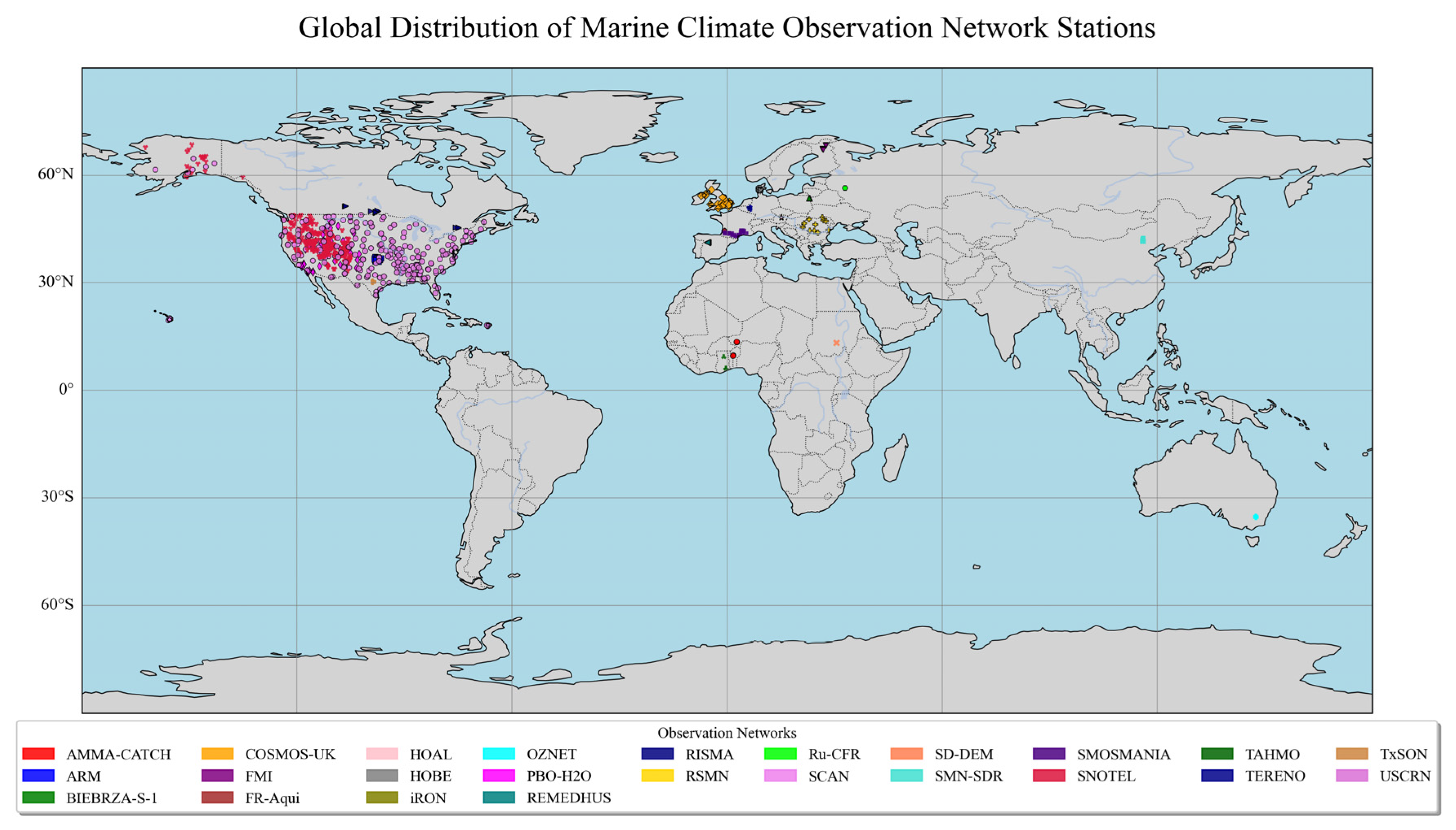
The ISMN is a centralized data archive that is globally available for in situ SM records [17]. In this study, in situ SM observations from the ISMN spanning 2017 to 2024 are used as representative true SM values for corresponding Sentinel-1A 1 km grid pixels. The compiled dataset includes 24 global networks (Table 1), encompassing both densely and sparsely distributed monitoring networks. Only high-quality measurements from shallow soil depths (≤5 cm) labeled “G” (good) are selected. The in situ SM record with the observation timestamp closest to the Sentinel-1 overpass time is used as the daily ground reference. Table 1 presents the basic characteristics of these networks, including station number, relative orbit number (fixed path identifier within Sentinel-1’s repeat cycle and the same number means consistent viewing geometry), and sample size and IGBP land cover classes. The spatial distribution of all selected ISMNs is displayed in Figure 1, covering diverse climate zones and land cover types across the globe.

2.2. Dataset

2.2.1. Sentinel-1A Data

The Sentinel-1 mission is part of the European Space Agency’s (ESA) Copernicus Programme [38], which is designed to provide all-time and all-weather SAR observations of the Earth’s surface. It is operated in the C-band (5.405 GHz) and comprises a constellation of four satellites (Sentinel-1A, 1B, 1C, and 1D) primarily intended to achieve high revisit frequency and global coverage. Sentinel-1 delivers consistent and reliable backscatter observations with various polarization and spatial resolutions [39]. The mission supports diverse operational and scientific applications, such as SM mapping, forest monitoring, natural disaster management, and so on. In this study, Sentinel-1A interferometric wide swatch ground range detected products from January 2017 to December 2024 are used. We directly acquire the aggregated 1 km resolution Sentinel-1A observations, including VV- and VH-polarized backscattering coefficients and incidence angle via the Google Earth Engine (GEE) platform, which offers routine preprocessing workflows for user convenience. Both ascending and descending Sentinel-1A observations are included. For both ascending and descending modes, different relative orbits (fixed observation tracks numbered 1–175 in a 12-day repeat cycle) may cover the same geographical regions, and the observations from these multiple orbits are all utilized in this study. The original Sentinel-1A data and auxiliary data are resampled to a unified 1 km spatial resolution. This resolution is primarily selected to meet the practical demands and accuracy criteria of kilometer-scale SM monitoring over large areas. In addition, 1 km is widely adopted in existing Sentinel-1-based SM mapping studies, as it achieves a good balance between data availability, computational efficiency, and operational application needs.

2.2.2. MODIS Data

To quantify the scattering contribution from vegetation, we use the MODIS Terra + Aqua LAI 4-day (MCD15A3H, 500 m) and the 8-day vegetation indices (NDVI and EVI) product (MCD13A2, 1 km) covering January 2017 to December 2024. We obtain all of the products directly via the GEE platform and apply quality control information to retain only high-quality LAI records. The original LAI, NDVI, and EVI time series are first smoothed using harmonic time series analysis [40], and the refined time series are subsequently interpolated to match Sentinel-1A acquisition times via cubic interpolation. The preprocessing steps are consistent with those reported in previous studies [5,41].

2.2.3. ERA5-Land Data

ERA5-Land is an enhanced land-only reanalysis dataset produced by the European Centre for Medium-Range Weather Forecasts (ECMWF). As the land component of the ECMWF fifth-generation reanalysis (ERA5), it provides a comprehensive set of near-surface meteorological, vegetation, terrestrial, and hydrological parameters at a 0.1° horizontal grid spacing covering the period from 1950 to the present [42]. ERA5-Land is derived from dedicated global land surface simulations, which are driven by high-resolution meteorological forcing variables, downscaled from the original ERA5 atmospheric reanalysis. Many studies have validated the ERA5-Land dataset using independent in situ measurements, confirming its favorable accuracy at the global scale. ERA5-Land offers hourly simulations of volumetric SM and soil temperature (ST) across four vertical soil layers, enabling detailed characterization of vertical variability in subsurface moisture and thermal states across the global land surface. In this study, topsoil (0–7 cm) SM and ST data corresponding to the Sentinel-1 imaging times are used. Daily-averaged ERA5-Land snow depth and snow cover data are also used to eliminate the influence of snow. To address the spatial resolution mismatch between ERA5-Land and Sentinel-1 datasets, all ERA5-Land data are resampled to a 1 km grid for spatial consistency, which is implemented via the GEE platform.

2.2.4. Preparation of Datasets

Satellite data, including the Sentinel-1 observations and MODIS vegetation parameters, are all processed to 1 km spatial resolution to match ISMN SM data. ERA5-Land data are also resampled to 1 km. To objectively assess algorithm performance, quality control measures are applied to the dataset. Sentinel-1 VV-polarized backscattering coefficients with values exceeding −5.0 dB or below −40.0 dB are excluded. Unlike previous similar studies, we define a broader valid data range for the Sentinel-1A observations. Considering the impacts of soil freezing and snow cover, datasets are excluded when ERA5-Land ST is lower than 0 °C or the snow depth exceeds 0. After the above preprocessing steps, a total of 200,667 data records were retained. Input parameters for the ML methods consist of two categories: dynamic parameters and static parameters. Dynamic parameters include Sentinel-1 VV and VH-polarized backscattering coefficients, incidence angle, MODIS vegetation parameters (LAI, NDVI, and EVI), and ERA5-Land variables (SM and ST). Static parameters include the latitude, longitude, and DEM. SM data from the ISMN are used as the target training data. A detailed list of all input variables is provided in Table 2 for clarity.

3. Methodology

3.1. Machine Learning Methods

In this study, four ML methods, including RF, XGBoost, CNN, and LSTM, are used to establish the relationship between input parameters (dynamic and static variables) and target training data (ISMN SM). To ensure the methods’ prediction accuracy and generalization ability for SM estimation, their hyperparameters are optimized and set through repeated experiments and validation using labeled data.

3.1.1. RF

RF is an ensemble ML algorithm based on multiple decision trees [43], which is widely used in regression and classification tasks for its high robustness, strong generalization ability, and resistance to overfitting [6,13]. The algorithm constructs a large number of independent decision trees via bootstrap resampling, with each tree trained on a randomly selected subset of the original dataset. During the training process of each decision tree, a random subset of input features is selected at each split node to avoid excessive correlation between individual trees, thereby improving the diversity and overall performance of the ensemble model. For regression tasks, the final prediction result is obtained by averaging the outputs of all individual decision trees. Compared with single decision trees and other traditional ML methods, RF effectively handles high-dimensional data, tolerates missing values, and provides feature importance scores, which help to identify the key factors affecting the target variable.
To ensure the performance and stability of RF, its hyperparameters are carefully tuned based on extensive experiments and validation. The specific parameter configuration of the RF is as follows. The number of decision trees is set to 800, which balances the model’s prediction accuracy and computational efficiency while avoiding overfitting. The maximum depth of each decision tree is set to 35, allowing the model to capture complex nonlinear relationships between input variables and SM without excessive complexity. The minimum number of samples required to split an internal node is set to 5, and the minimum number of samples required to be at a leaf node is set to 2, which effectively prevents overfitting by limiting the depth and complexity of individual decision trees. The maximum number of features considered for splitting at each node is set to “sqrt”, meaning that the square root of the total number of input features is randomly selected for each split, enhancing the diversity of decision trees. Additionally, the bootstrap parameter is set to True, indicating that each decision tree is trained on a bootstrapped sample of the original dataset. The random_state is fixed at 42 to ensure the reproducibility of the model’s training results and experimental consistency.

3.1.2. XGBoost

XGBoost is an optimized ensemble ML algorithm based on gradient boosting decision trees (GBDT), which is widely applied in regression and classification tasks for its ability to handle complex nonlinear relationships [6]. As an improved version of GBDT, XGBoost incorporates regularization terms into its objective function, effectively mitigating overfitting and enhancing the model’s generalization performance. The algorithm trains decision trees sequentially, where each new tree is constructed to correct the prediction errors of the previous ensemble model by minimizing the gradient of the loss function. It adopts a greedy strategy to select the optimal split points for tree nodes, and supports parallel computing to accelerate the training process. Additionally, XGBoost can automatically handle missing values and adjust feature weights, making it suitable for high-dimensional and noisy datasets common in remote sensing research. Compared with traditional ensemble methods, XGBoost offers stronger interpretability and flexibility, as it can output feature importance rankings to identify key variables influencing the target.
The specific parameter configuration of XGBoost is detailed as follows. The number of boosting rounds is set to 1000, which ensures sufficient model training to capture the complex relationship between input variables and SM while avoiding underfitting. The maximum depth of each decision tree is fixed at 10, balancing the model’s ability to learn complex patterns and the risk of overfitting. The learning rate is set to 0.05, which controls the step size of each boosting iteration to prevent the model from converging too quickly or overfitting. Both subsample (the proportion of training samples used for each tree) and colsample_bytree (the proportion of features used for each tree) are set to 0.8, enhancing the model’s generalization by introducing appropriate randomness. The tree_method is set to “hist”, which uses histogram-based optimization to accelerate the training process and improve computational efficiency. The objective function is specified as “reg:squarederror” to adapt to the regression task of SM prediction. Additionally, random_state is fixed at 42 to ensure the reproducibility of the model’s training results and experimental reliability.

3.1.3. CNN

CNN is a deep learning model specifically designed for processing grid-structured data, such as images and spatial feature data [44], which is widely used in feature extraction and pattern recognition tasks. Unlike traditional ML algorithms, CNNs can automatically learn hierarchical features from raw data without manual feature engineering. Its core structure includes convolutional layers, pooling layers, and fully connected layers. Convolutional layers use filters to extract local spatial features from input data, capturing subtle patterns and correlations. Pooling layers reduce the dimensionality of feature maps, lowering computational complexity while retaining key information. Fully connected layers integrate the extracted features to output the final prediction results. CNN effectively handles high-dimensional spatial data and noise interference, making it suitable for the SM prediction tasks [45].
The specific parameter settings are detailed as follows. The batch size is set to 1024, which balances the efficiency of model training and the stability of convergence. The total number of training epochs is fixed at 150, enabling the model to fully learn the inherent correlation between input features and the target variable (e.g., SM) without underfitting or overfitting. The learning rate (lr) is configured as 0.0001 to control the step size of parameter updates, avoiding rapid convergence or divergence that may affect model performance. For the convolutional layers, the number of filters is set to 64 and 128, respectively, which allows the model to effectively extract multi-level spatial features from remote sensing data and environmental parameters. The hidden dimension of the network is set to 256, providing sufficient capacity to capture complex nonlinear relationships between input variables and SM. In addition, a dropout rate of 0.2 is adopted to prevent overfitting by randomly deactivating 20% of the network nodes during training, further enhancing the model’s ability to adapt to different scenarios and improving its generalization performance in SM prediction.

3.1.4. LSTM

LSTM is a type of recurrent neural network (RNN) specifically designed to address the long-term dependency issue of traditional RNNs. It is widely applied in time series prediction tasks, making it suitable for processing sequential data related to SM and remote sensing. Unlike conventional RNNs, LSTM contains memory cells, input gates, forget gates, and output gates, which enable it to effectively capture and retain long-term temporal information. The forget gate controls the retention of historical data, the input gate regulates the update of memory cells, and the output gate determines the output of temporal features. LSTM can process time series data such as vegetation growth and meteorological conditions, learning the temporal correlation between input variables and SM changes [45,46,47].
The specific parameter settings are detailed as follows. The batch size is set to 1024, which ensures efficient model training while maintaining training stability. The total number of training epochs is fixed at 150, allowing the model to fully learn the temporal correlation of SM changes and avoid underfitting. The learning rate is set to 0.0001 to control the update step of model parameters, preventing overfitting caused by excessively rapid convergence. The model is designed with 3 hidden layers and a hidden dimension of 256, which enables it to capture complex temporal dependencies and nonlinear relationships between input features and SM. A dropout rate of 0.3 is introduced to avoid overfitting by randomly deactivating 30% of the network nodes during training, enhancing the model’s generalization ability.

3.2. Model Performance Evaluation

The labeled dataset (200,667 data records) is randomly split into two parts: 80% of the data are allocated to the four models (RF, XGBoost, CNN, and LSTM) for model training purposes, while the remaining 20% are reserved as the validation set to evaluate the generalization performance of each trained model and avoid overfitting. No additional independent test set is used in this study. Specifically, we train and validate the model at two spatial scales, including global and regional scales. At a global scale, the models are trained based on the labeled datasets from all ISMNs (80% of total records). At the regional scale, the models are trained based on the labeled dataset within individual networks (80% of records within this network). Datasets from networks including AMMA-CATCH, iRON, OZNET, PBO_H2O, Ru_CFR, SD_DEM, and TAHMO are not used due to insufficient samples. Bias, mean absolute error (MAE), root mean square error (RMSE), unbiased RMSE (ubRMSE), and determination of coefficient (R2) are used to evaluate the performance of the calibrated model.
B i a s = 1 n s m e s t s m o b s  
M A E = 1 n s m e s t s m o b s  
R M S E = 1 n s m e s t s m o b s 2  
u b R M S E = R M S E 2 B i a s 2  
R 2 = s m e s t s m e s t ¯ s m o b s s m o b s ¯ 2 s m e s t s m e s t ¯ 2 s m o b s s m o b s ¯ 2  
where s m e s t and s m o b s indicate the estimated and observed SM, and s m e s t ¯ and s m o b s ¯ are their average values, respectively.

4. Results

4.1. Evaluation at the Global Scale

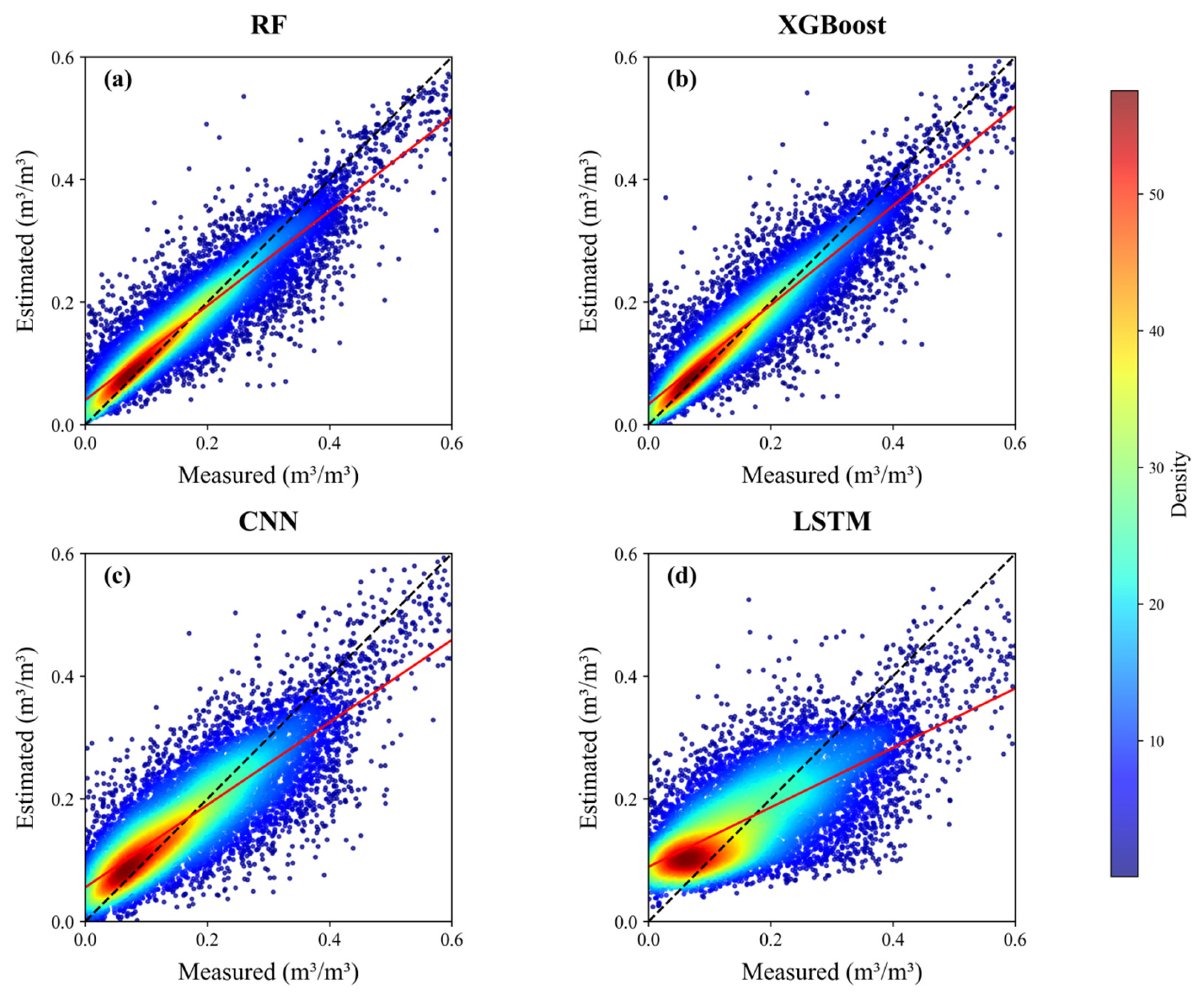
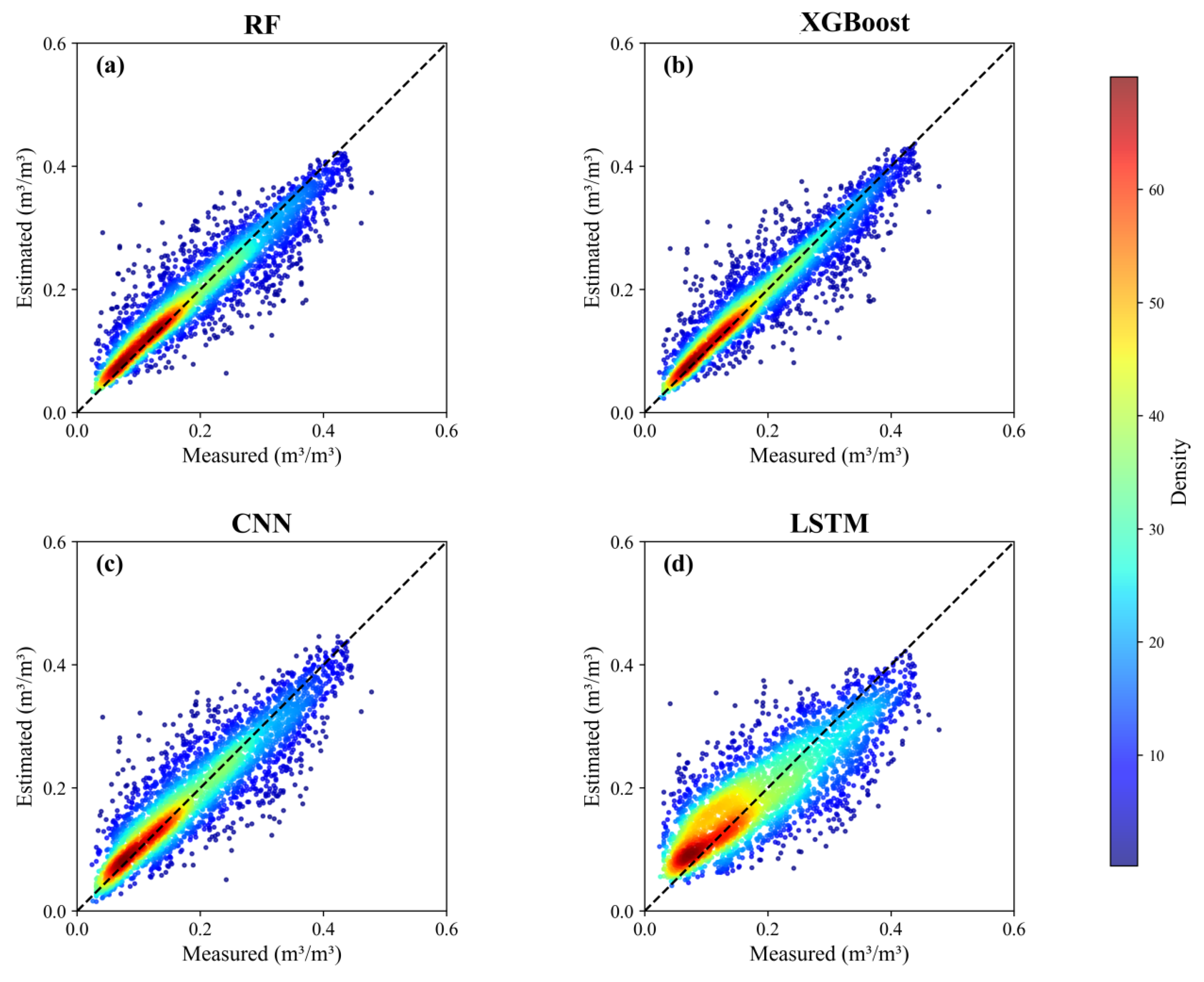
Figure 2 presents density scatterplots of estimated versus measured SM derived from the four ML approaches, namely RF, XGBoost, CNN, and LSTM, across global ISMNs. A comprehensive set of statistical metrics, including bias, MAE, RMSE, ubRMSE, and R2, is summarized in Table 3 to quantitatively assess and intercompare the retrieval accuracy of each model. All four methods show strong positive linear correlations between estimated and measured SM, with point clouds generally clustered around the 1:1 reference line. Nevertheless, noticeable discrepancies in predictive capability and error magnitude are clearly observed among the evaluated methods.
As shown in Figure 2 and Table 3, the two tree-based ensemble models (RF and XGBoost) consistently outperform the deep learning-based models (CNN and LSTM) in global SM estimation. Specifically, the XGBoost model achieves the best overall retrieval performance across all evaluation metrics. It yields the highest coefficient of determination (R2 = 0.831), indicating the highest predictive capability to explain the variance of observed SM. Meanwhile, XGBoost produces the lowest systematic bias (−0.001 m3/m3), the smallest MAE (0.033 m3/m3), as well as the minimum RMSE and ubRMSE (both 0.048 m3/m3), demonstrating very small global systematic deviation and the lowest prediction error. The performance of the RF model is highly comparable to that of XGBoost. Visually, the density distributions of RF (Figure 2a) and XGBoost (Figure 2b) are extremely similar, with high-density data clusters tightly concentrated along the 1:1 line and uniform error dispersion across the entire SM range. In contrast, the CNN model shows a marked decline in accuracy compared with the ensemble models, with a reduced R2 of 0.688 and substantially larger error statistics. The corresponding scatterplot (Figure 2c) also exhibits noticeably wider point dispersion and increased deviation from the reference regression line. The LSTM model demonstrates the relatively weaker global generalization ability among the four tested methods. It achieves the lowest R2 value (0.501), the largest MAE (0.064 m3/m3), and the highest RMSE and ubRMSE (0.082 m3/m3), alongside a minor negative bias (−0.002 m3/m3). As illustrated in Figure 2d, the SM derived from LSTM exhibits severe point scattering, prominent underestimation at high SM values and overestimation at low SM conditions, and substantially degraded alignment with the 1:1 reference line.
Notably, all models yield extremely low overall systematic bias (absolute magnitude < 0.002 m3/m3). In addition, RMSE values are identical to ubRMSE for each model, indicating that nearly all prediction errors stem from random noise rather than structured systematic offsets. Across all models, the highest point density is concentrated within the low-to-medium SM interval, which is consistent with the natural statistical distribution of global surface SM.

4.2. Evaluation at the Regional Scale

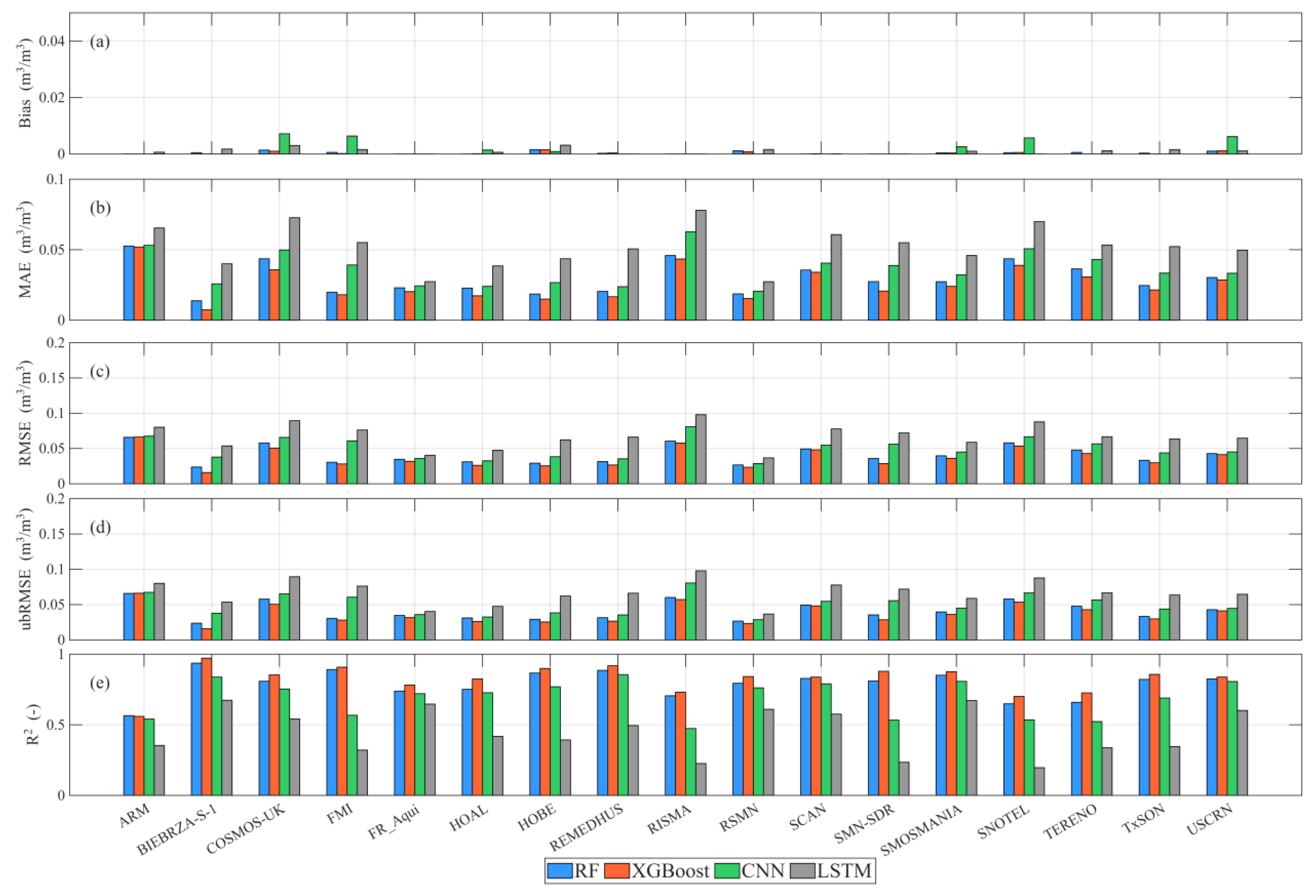
To further evaluate the regional applicability and robustness of the four models, independent validation is performed across 15 representative global in situ SM monitoring networks (including ARM, BIEBRZA-S-1, COSMOS-UK, FMI, FR_Aqui, HOAL, HOBE, REMEDHUS, RISMA, RSMN, SCAN, SMN-SDR, SMOSMANIA, SNOTEL, TERENO, TxSON, and USCRN). The remaining networks are excluded due to extremely limited available samples. Figure 3 summarizes the regional performance metrics of each network, namely bias, MAE, RMSE, ubRMSE, and R2, to quantitatively compare model performance at the regional scale.
Consistent with the global scale findings, a stable performance ranking of the four models is observed across all individual networks: XGBoost >RF > CNN > LSTM. Regarding systematic bias (Figure 3a), all four methods exhibit extremely low bias (<±0.02 m3/m3) across nearly all networks. RF and XGBoost maintain near-zero bias in almost every network, indicating minimal consistent overestimation or underestimation at regional/local scales. CNN shows a slightly larger positive bias in a small number of networks, while LSTM exhibits the largest magnitude of bias fluctuation among the four approaches. In terms of absolute and overall prediction error (Figure 3b–d), XGBoost consistently achieves the lowest MAE, RMSE, and ubRMSE across the majority of networks, followed very closely by the RF method. The two tree-based ensemble methods maintain MAE values generally below 0.05 m3/m3 and ubRMSE mostly within the range of 0.03–0.07 m3/m3 for most networks. In contrast, CNN yields moderately higher error metrics than the ensemble models, while LSTM consistently presents the highest MAE, RMSE, and ubRMSE across all selected networks. For model fitting accuracy (Figure 3e), XGBoost achieves the highest R2 values in nearly every individual network, ranging approximately between 0.70 and 0.90 for most networks. RF achieves comparable R2 values and is only marginally lower than those of XGBoost, further confirming its stable and robust retrieval capability. CNN maintains moderate performance with R2 mostly distributed between 0.55 and 0.75. LSTM consistently delivers the lowest coefficient of determination, with R2 frequently dropping below 0.60 and reaching as low as 0.2–0.3 in several networks, showing reduced predictive reliability.
Additionally, considerable inter-network performance variability is evident across all four methods. All algorithms tend to achieve higher accuracy and higher R2 for networks such as BIEBRZA-S-1, REMEDHUS, and SCAN, while exhibiting larger prediction degradation for networks including ARM, SNOTEL, and TEREANO. This discrepancy highlights the sensitivity of model performance to regional environmental heterogeneity, with ensemble models exhibiting greater resilience to such spatial variability.
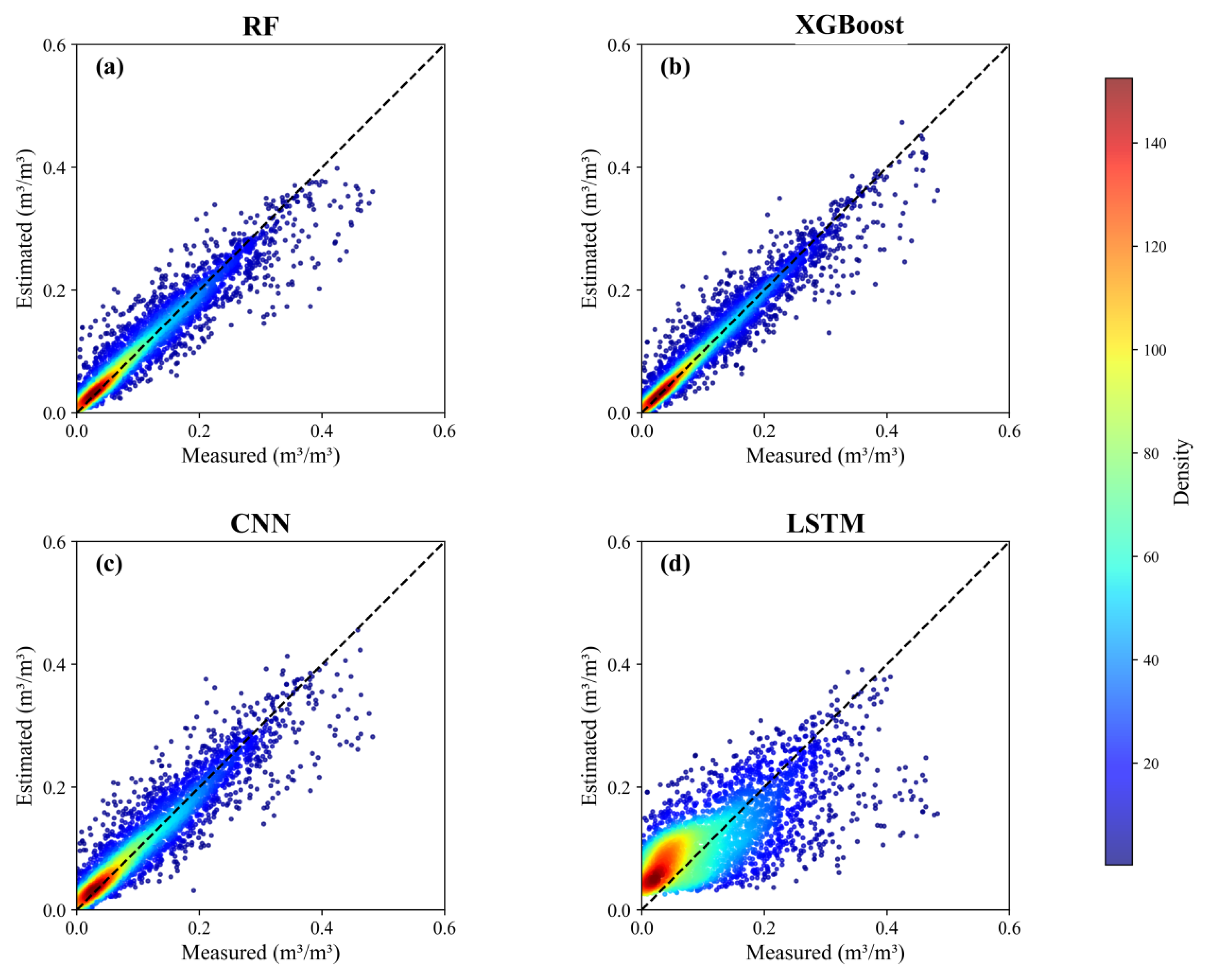
Based on the above statistical comparison, we further perform an in-depth visual evaluation to elaborate on the inter-model and inter-network differences. To this end, two typical and widely adopted regional validation networks, REMEDHUS and SMOSMANIA, are selected as representative case studies. Density scatterplots of estimated versus measured SM for all four methods at these two networks are displayed in Figure 4 and Figure 5, respectively.
At the REMEDHUS network, all four models exhibit a generally positive correlation between estimated and measured SM, yet clear and consistent inter-model discrepancies are readily apparent. The XGBoost (Figure 4b) delivers favorable retrieval performance for this region. Its density point core is tightly aligned along the 1:1 reference dashed line, with minimal point dispersion maintained across the full observed SM range. Systematic overestimation or underestimation is nearly absent, and the overall regression trend aligns almost perfectly with the ideal reference line. RF (Figure 4a) performs nearly indistinguishably from XGBoost, featuring an extremely compact density distribution and only marginally wider point scatter relative to the XGBoost outputs. In comparison, the CNN (Figure 4c) shows visibly increased point dispersion compared to the two ensemble methods. Deviations from the 1:1 line are clearly noticeable, accompanied by moderate systematic underestimation under high SM conditions. The LSTM (Figure 4d) yields the relatively poor retrieval performance among the four tested methods at the REMEDHUS network. Severe point scattering is observed across the entire SM value range. Most notably, the model exhibits a prominent systematic overestimation bias for low SM values (<0.1 m3/m3), alongside marked underestimation when SM exceeds approximately 0.30 m3/m3, resulting in a regression slope that deviates substantially from the ideal 1:1 relationship. Similarly to the results of REMEDHUS, the relative performance ranking of the four models remains fully consistent at the SMOSMANIA network. XGBoost produces the most accurate SM retrievals. RF retains its highly robust and stable prediction capability, with only limited accuracy reduction compared to XGBoost. CNN and LSTM continue to exhibit significant underperformance across this second representative network.

4.3. Model Performance on the Station Scale

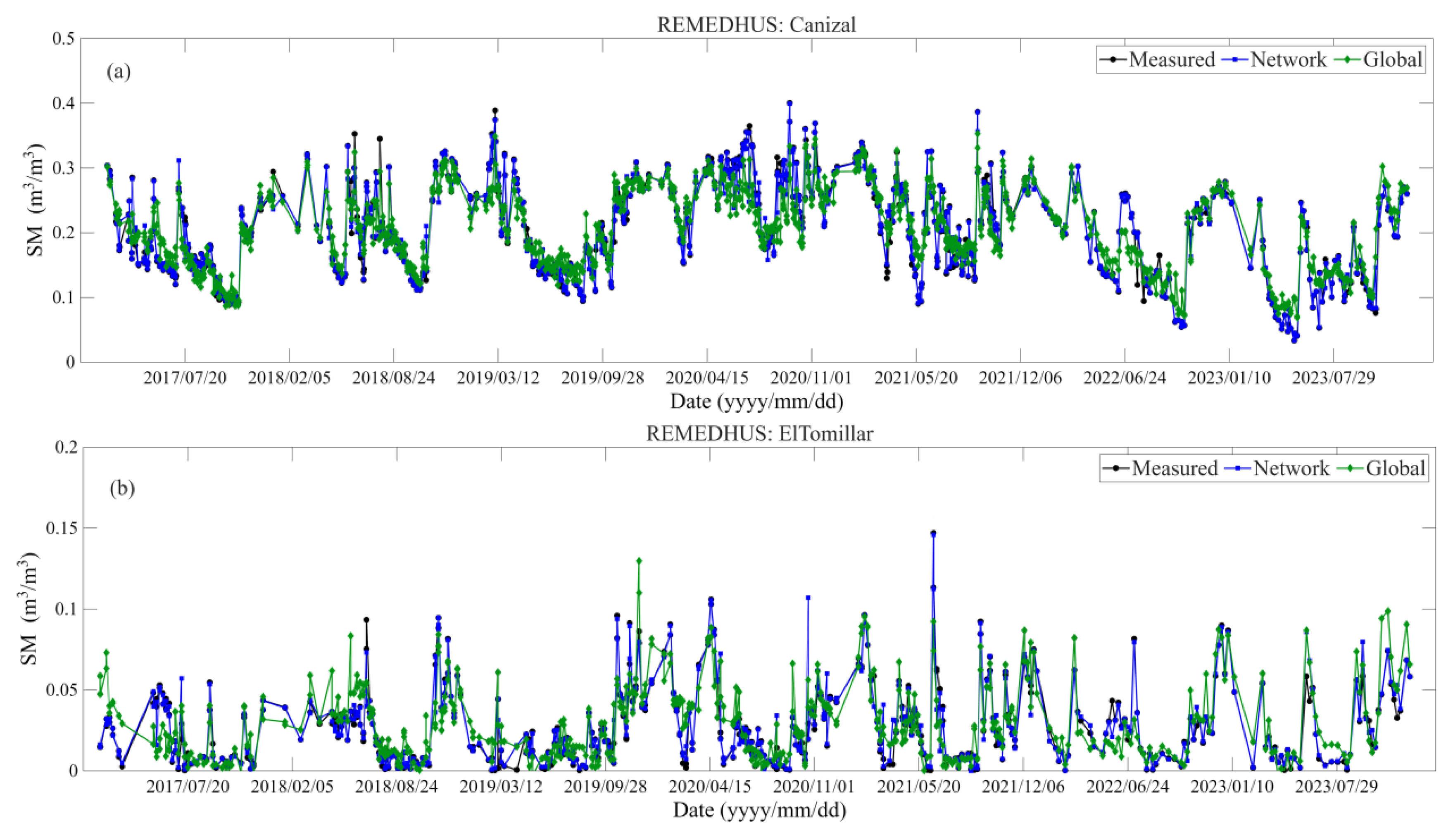
The results presented in the previous two sections demonstrate that XGBoost achieves the optimal estimation accuracy. Accordingly, the estimation results from this method are taken as a representative example to further analyze the performance differences among ML methods at the regional and global scales. In this section, we perform an intensive station-level assessment within the representative REMEDHUS network. Table 4 quantitatively compares the XGBoost retrieval accuracy at all 20 individual REMEDHUS stations, contrasting model performance when trained and validated at the local network scale versus when trained under the global-scale modeling framework. Meanwhile, time series comparisons between XGBoost estimated SM (from both regional scale and global scale) and measured SM at two typical stations (Canizal and ElTomillar) are illustrated in Figure 6.
Across all 20 stations within the REMEDHUS network, the XGBoost achieves relatively high retrieval accuracy when calibrated at the local regional scale. At this scale, nearly all stations exhibit nearly zero systematic bias (absolute bias < 0.002 m3/m3), confirming very little persistent overestimation or underestimation at individual stations. MAE values computed at the regional scale remain consistently below 0.010 m3/m3 for most stations, while both RMSE and ubRMSE are generally lower than 0.020 m3/m3. Most notably, R2 values at the regional scale range from 0.913 to 0.987, demonstrating that the locally calibrated XGBoost can explain over 90% of the temporal variance in measured SM at nearly every station. In contrast, a distinct degradation in retrieval performance is observed when the globally trained XGBoost model is directly applied to the same REMEDHUS station dataset. Although systematic bias at the global scale remains negligible and spatially stable across all sites, the MAE, RMSE, and ubRMSE values computed at the global scale are approximately 2–3 times higher than those obtained from the regional calibrated results. Meanwhile, R2 values decrease substantially to a range of 0.548–0.924, with several individual stations showing a particularly sharp reduction. These results show that the globally trained XGBoost retains robust and reliable general predictive ability, and targeted regional specific training yields substantial further improvements and fitting performance at the individual network level.
As illustrated in Figure 6, SM estimated from XGBoost aligns closely with in situ measurements, while the daily fluctuations, seasonal wetting and drying cycles, and the seasonal trend of measured SM have been captured. Specifically, the Sentinel-1A observations utilized at these two stations include both ascending and descending orbits, as well as all relative orbits covering the entire REMEDHUS station network. However, the time series results indicate that the geometric difference introduced by varying relative orbits of Sentinel-1A does not compromise the accuracy of XGBoost-derived SM retrievals. This is the critical distinction from traditional SM retrieval methods based on semi-empirical or theoretical microwave scattering models, which utilize different relative orbit data separately to avoid bias caused by satellite imaging geometry. Across the full 2017–2023 observation period, this implementation accurately reproduces peak wet conditions, gradual dry-down phases, and long-term inter-annual SM variability, even with the comprehensive inclusion of diverse Sentinel-1A orbital data. While outputs from the globally trained XGBoost also generally follow the overall temporal trend of SM dynamics, they exhibit larger short-term prediction fluctuations, occasional temporal phase misalignment, and substantially greater deviation from in situ observations during extreme high and low SM events. Notably, both calibration configurations reliably capture the core seasonal cyclic pattern of surface SM at these representative stations. However, the regionally calibrated XGBoost demonstrates markedly closer alignment with ground-truth measurements and exhibits far lower random prediction noise at very short temporal intervals, further affirming its robustness to orbital geometric differences in Sentinel-1 observations.

4.4. Model Performance on the Relative Orbit

To further verify the orbital robustness of the XGBoost retrieval across distinct Sentinel-1A observation geometries, we conduct a dedicated relative orbit analysis using data from the TERENO validation network. Table 5 summarizes the station-level error statistics of XGBoost-derived SM retrievals across multiple individual relative orbits for both regional and global calibrated methods. Across all stations and all tested relative orbits, the XGBoost exhibits consistently excellent and highly stable retrieval performance. For the regionally trained results, absolute bias remains consistently below 0.004 m3/m3 across every relative orbit, while MAE is maintained within the narrow range of 0.004–0.010 m3/m3. Correspondingly, RMSE and ubRMSE values stay below 0.025 m3/m3, and R2 values consistently exceed 0.89, with peak performance reaching 0.963. Critically, retrieval accuracy metrics show only very small variation across different relative orbits, confirming that differences in Sentinel-1A viewing geometry, incidence angle, and orbital acquisition characteristics exert almost no negative impact on XGBoost retrieval accuracy. When applying the globally calibrated method, performance remains satisfactory across all relative orbits, with only a minor and uniform reduction in accuracy compared to the local network training results.
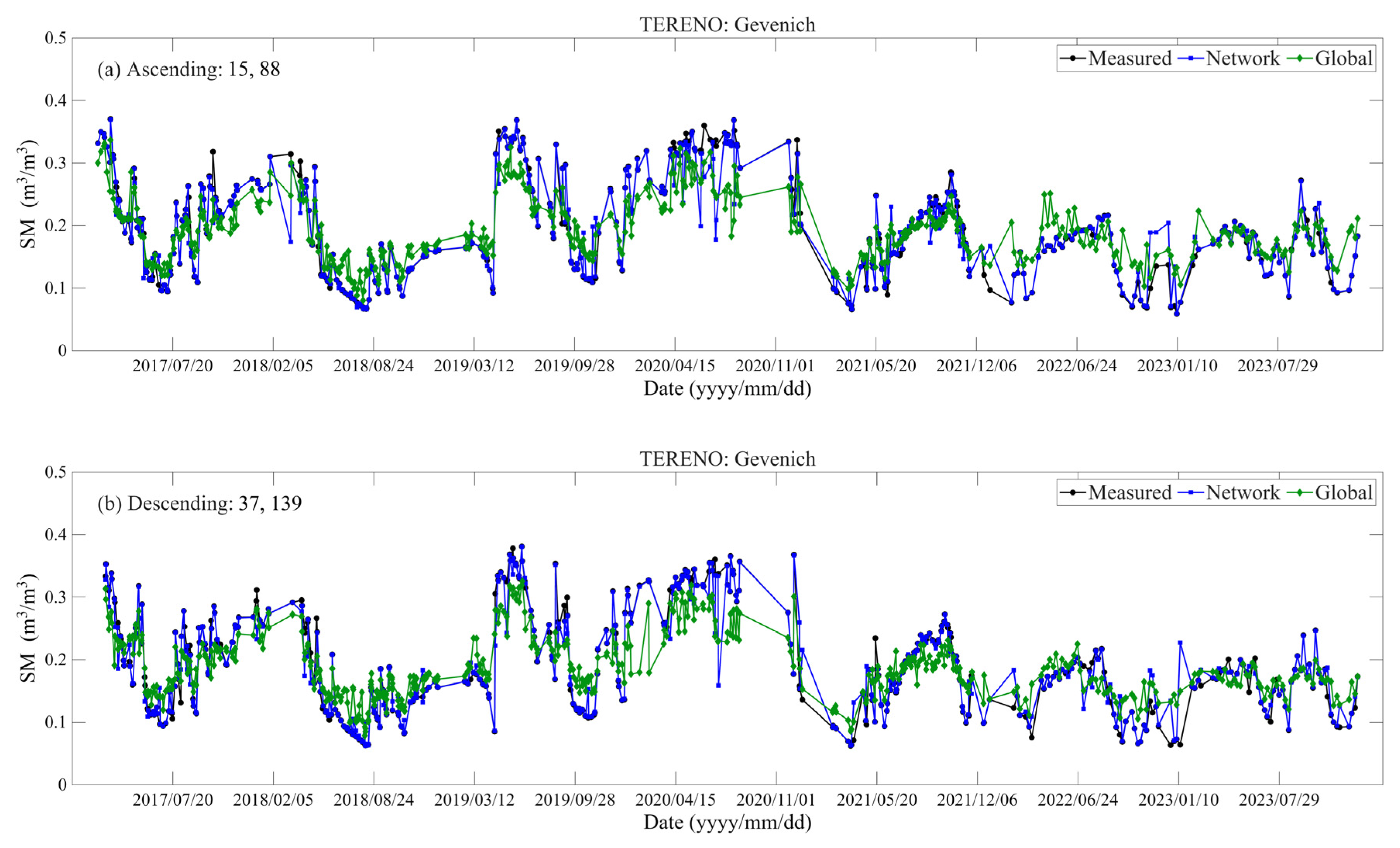
Figure 7 presents the time series of estimated and measured SM from XGBoost for the Gevenich station. Both ascending (Figure 7a, relative orbits 15 and 88) and descending (Figure 7b, relative orbits 37 and 139) Sentinel-1A retrievals accurately reproduce the full temporal evolution of in situ SM across the 2017–2023 observation period. Consistent with the results shown in Figure 6, XGBoost reliably captures daily fluctuations, seasonal wetting–drying cycles, and interannual variations for both orbit directions, with minimal deviation between retrieved estimates and ground-truth measurements. Notably, the stable and orbit-insensitive performance observed here carries an important practical advantage. Since retrievals from different ascending and descending relative orbits achieve comparable high accuracy without systematic degradation, observations from all available relative orbits can be reasonably integrated into a unified SM product. Such multi-orbit data fusion effectively increases the revisit frequency and substantially improves the effective temporal resolution of the final SM time series, while preserving high retrieval quality. This advantage constitutes a notable improvement over traditional semi-empirical or theoretical scattering models retrieval approaches, which are typically highly sensitive to orbital geometry and cannot robustly merge multi-orbit Sentinel-1 observations.

5. Discussion

In this study, four machine learning methods (RF, XGBoost, CNN, and LSTM) are applied to estimate SM across global ISMNs. All models are trained at global and regional scales, and validated at global, regional, and station scales. The results show the satisfactory performance of tree-based ensemble algorithms (RF and XGBoost) over deep learning models (CNN and LSTM) in SM retrieval across global, regional, and station scales, especially for the XGBoost. The superior performance of XGBoost stems from its inherent strengths in handling high-dimensional multiple-source inputs, along with native outlier resistance, built-in regularization, and strong capability to model complex nonlinear feature interactions, making it well-suited for SM retrieval tasks. The proposed XGBoost framework exhibits strong generalization and stability across global and regional conditions, supporting its potential for large-scale, high-spatiotemporal-resolution SM mapping. In contrast, generic deep learning architectures fail to achieve comparable accuracy, especially at large spatial scales. This is primarily because standard CNN and LSTM architectures under the specific configurations adopted in this study show limited ability to capture the extreme spatial heterogeneity of global land surfaces, diverse climate regimes, and varied land cover types. The relatively poorer performance of deep learning models may be related to model architecture, input feature design, hyperparameter tuning, temporal sequence length, or training strategies, which limit their applicability for large-scale SM mapping within the scope of the current experimental settings.
Comparison between regionally and globally calibrated XGBoost implementations also yields important practical insights for future product development. The global training strategy provides a unified, computationally efficient modeling framework capable of generating spatially consistent SM estimates across diverse climatic and land-surface conditions worldwide. While this approach inevitably involves a moderate compromise in overall retrieval accuracy relative to region-specific calibration, it delivers robust generalization performance and avoids the computational burden and redundancy of training separate models for each monitoring network. In contrast, regional calibration substantially improved retrieval accuracy and tighter agreement with in situ measurements, as demonstrated by significantly higher R2 and lower error metrics at individual stations within the REMEDHUS and TERENO networks. However, such regionally optimized methods tend to be tightly adapted to local environmental characteristics and thus exhibit limited transferability when applied to other geographic regions or unobserved landscapes. These results highlight that global modeling represents a pragmatic balance between accuracy, computational efficiency, and spatial consistency for large-scale SM mapping, while regional training is better suited for high-precision local applications where generalization across heterogeneous regions is less critical.
A particularly critical and practically meaningful advantage of XGBoost identified in this study lies in its robustness to variations in the orbital geometry of Sentinel-1A. This work employed a complete Sentinel-1A dataset incorporating all ascending and descending orbits, as well as all available relative orbits covering the full spatial extent of the study stations. Results from the REMEDHUS and TERENO networks clearly demonstrate that geometric imaging discrepancies originating from differing relative orbits have a limited impact on the retrieval performance of XGBoost. Accuracy metrics remained highly stable across all relative orbits, as well as across ascending and descending orbits. This orbit-insensitive behavior represents a notable improvement compared to conventional retrieval methods based on semi-empirical or theoretical scattering models [4,41], which are typically highly sensitive to observation incidence angles, viewing geometry, and orbital configurations. Since retrievals from all relative orbits achieve comparably high accuracy, multi-orbit Sentinel-1 observations can be reliably integrated and merged into a single unified SM time series. This data fusion effectively increases the overall revisit frequency and substantially enhances the effective temporal resolution of the final SM product, without compromising retrieval accuracy, which is a major operational benefit for hydrological and agricultural applications.
Previous studies on ML-based SM retrieval have shown inconsistent results in terms of optimal model performance. In vegetated agricultural areas, comparisons between RF and AdaBoost using integrated Sentinel-1 and Sentinel-2 data have demonstrated that RF can achieve slightly better retrieval accuracy [13]. In other regional-scale experiments that adopted ANN, DNN, SVR, and XGBoost for Sentinel-1-based SM estimation, ANN and SVR exhibited more reliable performance compared with other competing algorithms [14]. Nevertheless, several comprehensive evaluations have suggested that tree-based ensemble models, namely RF and XGBoost, generally outperform other machine learning approaches for SAR SM retrieval [6]. Our global-scale assessment yields a new result that RF and XGBoost achieve comparable retrieval accuracy, with XGBoost exhibiting slight advantages overall. These findings demonstrate that the predictive performance of ML is not exclusively determined by inherent algorithm architecture. Instead, it is jointly regulated by multiple external experimental factors, including the input feature variables, spatial representativeness of in situ SM stations, land-cover heterogeneity of study areas, and differing data preprocessing workflows.
As mentioned above, the selection and configuration of input feature parameters are critical determinants of ML-based SM retrieval accuracy. Given that ERA5-Land SM was incorporated as one of the input variables in our model, while ISMN in situ SM served as the training target, there exists a reasonable concern that the reanalysis SM data may dominate model training and weaken the core contribution of Sentinel-1 observations to retrieval results. To verify this potential influence and clarify the actual contribution of ERA5-Land SM features, an ablation experiment was implemented by excluding this variable from model training. Table 6 shows the error metrics between estimated and observed SM from selected ML methods over the global scale while excluding ERA5-land SM as input. Results show that all models maintain comparable accuracy without obvious performance degradation, and the model ranking remains consistent before and after removing the ERA5-Land SM feature. This demonstrates that ERA5-Land SM provides limited improvement to the retrieval accuracy of the constructed models, indicating that the proposed framework mainly relies on Sentinel-1A observations and multi-source auxiliary features rather than reanalysis SM data to complete SM estimation. This further validates that the high retrieval accuracy achieved in this study originates primarily from the effective surface information captured by Sentinel-1 data, which eliminates the doubt regarding the over-reliance on reanalysis SM products in model training and confirms the reliability of our retrieval framework.

6. Conclusions

This study systematically evaluates four machine learning algorithms, including RF, XGBoost, CNN, and LSTM, for SM retrieval from Sentinel-1A observations across global and regional scales, assisted by MODIS vegetation products, ERA5-Land reanalysis data, and static geospatial variables. Results consistently demonstrate that tree-based ensemble models outperform deep learning architectures under all tested conditions. Among them, XGBoost achieves the highest retrieval accuracy with very small systematic bias, strong stability, and superior capability in capturing temporal SM dynamics. Compared with the global calibrated results, local regional calibrated training further improves station-level precision. Notably, XGBoost exhibits strong insensitivity to Sentinel-1A relative orbit and viewing geometry, enabling the reliable fusion of multi-orbit data to improve temporal resolution without sacrificing retrieval accuracy. These findings confirm that tree-based ensemble learning, especially XGBoost, is a robust and effective approach for large-scale SM retrieval from Sentinel-1A data. This work provides a practical scheme for generating high-spatiotemporal-resolution SM products and offers methodological guidance for future SAR-based SM retrieval studies. Future research should further focus on explicitly interpreting feature importance, unpacking the physical mechanisms underlying XGBoost’s superior performance, incorporating explicit physical constraints into machine learning frameworks, and developing hybrid retrieval schemes that synergistically combine machine learning and physically based models for improved SM estimation accuracy.

Author Contributions

Conceptualization, J.W. and X.B.; methodology, X.B.; software, J.W.; validation, J.W. and Y.W.; formal analysis, J.W.; investigation, J.W.; resources, X.B.; data curation, Y.W.; writing—original draft preparation, J.W.; writing—review and editing, X.B. and Y.W.; visualization, J.W. and Y.W.; supervision, X.B. and W.S.; project administration, X.B. and W.S.; funding acquisition, X.B. and W.S. All authors have read and agreed to the published version of the manuscript.

Funding

This research was supported by funding from the National Natural Science Foundation of China under Grants 42471385 and 42471032.

Data Availability Statement

The raw data supporting the conclusions of this article will be made available by the authors on request.

Acknowledgments

The authors express sincere thanks to the International Soil Moisture Network and its data providers listed in Table 1.

Conflicts of Interest

The authors declare no conflicts of interest.

References

  1. Kornelsen, K.C.; Coulibaly, P. Advances in soil moisture retrieval from synthetic aperture radar and hydrological applications. J. Hydrol. 2013, 476, 460–489. [Google Scholar] [CrossRef]
  2. Bai, X.; Zheng, D.; Liu, X. Mapping of anomalous C-band backscatter signals caused by subsurface scattering and their correlations with land surface characteristics over the Tibetan Plateau. Sci. Remote Sens. 2025, 12, 100295. [Google Scholar] [CrossRef]
  3. Peng, J.; Albergel, C.; Balenzano, A.; Brocca, L.; Cartus, O.; Cosh, M.H.; Crow, W.T.; Dabrowska-Zielinska, K.; Dadson, S.; Davidson, M.W.J.; et al. A roadmap for high-resolution satellite soil moisture applications—Confronting product characteristics with user requirements. Remote Sens. Environ. 2021, 252, 112162. [Google Scholar] [CrossRef]
  4. Bai, X.; He, B.; Li, X.; Zeng, J.; Wang, X.; Wang, Z.; Zeng, Y.; Su, Z. First Assessment of Sentinel-1A Data for Surface Soil Moisture Estimations Using a Coupled Water Cloud Model and Advanced Integral Equation Model over the Tibetan Plateau. Remote Sens. 2017, 9, 714. [Google Scholar] [CrossRef]
  5. Bai, X.; Zheng, D.; Li, X.; Wigneron, J.-P.; van der Velde, R.; Zhang, P.; Su, Z. Simulation of SMAP and AMSR2 observations and estimation of multi-frequency vegetation optical depth using a discrete scattering model in the Tibetan grassland. Remote Sens. Environ. 2023, 292, 113592. [Google Scholar] [CrossRef]
  6. Zhu, L.; Dai, J.; Jin, J.; Yuan, S.; Xiong, Z.; Walker, J.P. Are the Current Expectations for SAR Remote Sensing of Soil Moisture Using Machine Learning Overoptimistic? IEEE Trans. Geosci. Remote Sens. 2025, 63, 4501815. [Google Scholar] [CrossRef]
  7. Bauer-Marschallinger, B.; Freeman, V.; Cao, S.; Paulik, C.; Schaufler, S.; Stachl, T.; Modanesi, S.; Massari, C.; Ciabatta, L.; Brocca, L.; et al. Toward Global Soil Moisture Monitoring with Sentinel-1: Harnessing Assets and Overcoming Obstacles. IEEE Trans. Geosci. Remote Sens. 2019, 57, 520–539. [Google Scholar] [CrossRef]
  8. Bai, X.; He, B.; Li, X. Optimum Surface Roughness to Parameterize Advanced Integral Equation Model for Soil Moisture Retrieval in Prairie Area Using Radarsat-2 Data. IEEE Trans. Geosci. Remote Sens. 2016, 54, 2437–2449. [Google Scholar] [CrossRef]
  9. Bai, X.; He, B. Potential of Dubois model for soil moisture retrieval in prairie areas using SAR and optical data. Int. J. Remote Sens. 2015, 36, 5737–5753. [Google Scholar] [CrossRef]
  10. Shi, H.; Wu, Q.; Lu, Z.; Zhao, J.; Liu, W.; Zhao, T.; Zhu, L.; Lang, F.; Zhao, L. Meter-level resolution surface soil moisture estimation over agricultural fields from time-series quad-pol SAR with constraints of coarse resolution CCI data products. Agric. Water Manag. 2025, 320, 109856. [Google Scholar] [CrossRef]
  11. Shi, H.; Zhao, L.; Yang, J.; Lopez-Sanchez, J.M.; Zhao, J.; Sun, W.; Shi, L.; Li, P. Soil moisture retrieval over agricultural fields from L-band multi-incidence and multitemporal PolSAR observations using polarimetric decomposition techniques. Remote Sens. Environ. 2021, 261, 112485. [Google Scholar] [CrossRef]
  12. Zhu, L.; Tan, Y.; Yuan, S.; Jin, J.; Tang, Z.; Walker, J.P. DeepProfile: An inverse fusion framework for root zone soil moisture profile estimation. Remote Sens. Environ. 2026, 339, 115408. [Google Scholar] [CrossRef]
  13. Wang, L.; Gao, Y. Soil Moisture Retrieval from Sentinel-1 and Sentinel-2 Data Using Ensemble Learning Over Vegetated Fields. IEEE J. Sel. Top. Appl. Earth Obs. Remote Sens. 2023, 16, 1802–1814. [Google Scholar] [CrossRef]
  14. Ezzahar, J.; Chehbouni, A.; Ouaadi, N.; Madiafi, M.; Said, K.; Er-Raki, S.; Laamrani, A.; Chakir, A.; Chabaane, Z.L.; Zribi, M. Sentinel-1 Backscatter and Interferometric Coherence for Soil Moisture Retrieval in Winter Wheat Fields Within a Semiarid South-Mediterranean Climate: Machine Learning Versus Semiempirical Models. IEEE J. Sel. Top. Appl. Earth Obs. Remote Sens. 2024, 17, 2256–2271. [Google Scholar] [CrossRef]
  15. Wu, Z.; Cui, N.; Zhang, W.; Liu, C.; Jin, X.; Gong, D.; Xing, L.; Zhao, L.; Wen, S.; Yang, Y. Estimating soil moisture content in citrus orchards using multi-temporal sentinel-1A data-based LSTM and PSO-LSTM models. J. Hydrol. 2024, 637, 131336. [Google Scholar] [CrossRef]
  16. Zhu, L.; Dai, J.; Liu, Y.; Yuan, S.; Qin, T.; Walker, J.P. A cross-resolution transfer learning approach for soil moisture retrieval from Sentinel-1 using limited training samples. Remote Sens. Environ. 2024, 301, 113944. [Google Scholar] [CrossRef]
  17. Dorigo, W.; Himmelbauer, I.; Aberer, D.; Schremmer, L.; Petrakovic, I.; Zappa, L.; Preimesberger, W.; Xaver, A.; Annor, F.; Ardö, J.; et al. The International Soil Moisture Network: Serving Earth system science for over a decade. Hydrol. Earth Syst. Sci. 2021, 25, 5749–5804. [Google Scholar] [CrossRef]
  18. Galle, S.; Grippa, M.; Peugeot, C.; Moussa, I.B.; Cappelaere, B.; Demarty, J.; Mougin, E.; Panthou, G.; Adjomayi, P.; Agbossou, E.K.; et al. AMMA-CATCH, a Critical Zone Observatory in West Africa Monitoring a Region in Transition. Vadose Zone J. 2018, 17, 180062. [Google Scholar] [CrossRef]
  19. Cook, D.R. Soil Temperature and Moisture Profile (STAMP) System Handbook; DOE Office of Science Atmospheric Radiation Measurement (ARM) Program: Washington, DC, USA, 2018. [Google Scholar]
  20. Dabrowska-Zielinska, K.; Musial, J.; Malinska, A.; Budzynska, M.; Gurdak, R.; Kiryla, W.; Bartold, M.; Grzybowski, P. Soil Moisture in the Biebrza Wetlands Retrieved from Sentinel-1 Imagery. Remote Sens. 2018, 10, 1979. [Google Scholar] [CrossRef]
  21. Cooper, H.M.; Bennett, E.; Blake, J.; Blyth, E.; Boorman, D.; Cooper, E.; Evans, J.; Fry, M.; Jenkins, A.; Morrison, R.; et al. COSMOS-UK: National soil moisture and hydrometeorology data for environmental science research. Earth Syst. Sci. Data 2021, 13, 1737–1757. [Google Scholar] [CrossRef]
  22. Ikonen, J.; Vehviläinen, J.; Rautiainen, K.; Smolander, T.; Lemmetyinen, J.; Bircher, S.; Pulliainen, J. The Sodankylä in situ soil moisture observation network: An example application of ESA CCI soil moisture product evaluation. Geosci. Instrum. Methods Data Syst. 2016, 5, 95–108. [Google Scholar] [CrossRef]
  23. Al-Yaari, A.; Dayau, S.; Chipeaux, C.; Aluome, C.; Kruszewski, A.; Loustau, D.; Wigneron, J.P. The AQUI Soil Moisture Network for Satellite Microwave Remote Sensing Validation in South-Western France. Remote Sens. 2018, 10, 1839. [Google Scholar] [CrossRef]
  24. Blöschl, G.; Blaschke, A.P.; Broer, M.; Bucher, C.; Carr, G.; Chen, X.; Eder, A.; Exner-Kittridge, M.; Farnleitner, A.; Flores-Orozco, A.; et al. The Hydrological Open Air Laboratory (HOAL) in Petzenkirchen: A hypothesis-driven observatory. Hydrol. Earth Syst. Sci. 2016, 20, 227–255. [Google Scholar] [CrossRef]
  25. Jensen, K.H.; Illangasekare, T.H. HOBE: A Hydrological Observatory. Vadose Zone J. 2011, 10, 1–7. [Google Scholar] [CrossRef]
  26. Osenga, E.C.; Vano, J.A.; Arnott, J.C. A community-supported weather and soil moisture monitoring database of the Roaring Fork catchment of the Colorado River Headwaters. Hydrol. Process. 2021, 35, e14081. [Google Scholar] [CrossRef]
  27. Smith, A.B.; Walker, J.P.; Western, A.W.; Young, R.I.; Ellett, K.M.; Pipunic, R.C.; Grayson, R.B.; Siriwardena, L.; Chiew, F.H.S.; Richter, H. The Murrumbidgee soil moisture monitoring network data set. Water Resour. Res. 2012, 48, W07701. [Google Scholar] [CrossRef]
  28. Larson, K.M.; Small, E.E.; Gutmann, E.D.; Bilich, A.L.; Braun, J.J.; Zavorotny, V.U. Use of GPS receivers as a soil moisture network for water cycle studies. Geophys. Res. Lett. 2008, 35, L24405. [Google Scholar] [CrossRef]
  29. González-Zamora, Á.; Sánchez, N.; Pablos, M.; Martínez-Fernández, J. CCI soil moisture assessment with SMOS soil moisture and in situ data under different environmental conditions and spatial scales in Spain. Remote Sens. Environ. 2019, 225, 469–482. [Google Scholar] [CrossRef]
  30. Ojo, E.R.; Bullock, P.R.; L’Heureux, J.; Powers, J.; McNairn, H.; Pacheco, A. Calibration and Evaluation of a Frequency Domain Reflectometry Sensor for Real-Time Soil Moisture Monitoring. Vadose Zone J. 2015, 14, 1–12. [Google Scholar] [CrossRef]
  31. Schaefer, G.L.; Cosh, M.H.; Jackson, T.J. The USDA Natural Resources Conservation Service Soil Climate Analysis Network (SCAN). J. Atmos. Ocean. Technol. 2007, 24, 2073–2077. [Google Scholar] [CrossRef]
  32. Ardö, J. A 10-Year Dataset of Basic Meteorology and Soil Properties in Central Sudan. Dataset Pap. Geosci. 2013, 2013, 1–6. [Google Scholar] [CrossRef]
  33. Zhao, T.; Shi, J.; Lv, L.; Xu, H.; Chen, D.; Cui, Q.; Jackson, T.J.; Yan, G.; Jia, L.; Chen, L.; et al. Soil moisture experiment in the Luan River supporting new satellite mission opportunities. Remote Sens. Environ. 2020, 240, 111680. [Google Scholar] [CrossRef]
  34. Albergel, C.; Rüdiger, C.; Pellarin, T.; Calvet, J.C.; Fritz, N.; Froissard, F.; Suquia, D.; Petitpa, A.; Piguet, B.; Martin, E. From near-surface to root-zone soil moisture using an exponential filter: An assessment of the method based on in-situ observations and model simulations. Hydrol. Earth Syst. Sci. 2008, 12, 1323–1337. [Google Scholar] [CrossRef]
  35. Zacharias, S.; Bogena, H.; Samaniego, L.; Mauder, M.; Fuß, R.; Pütz, T.; Frenzel, M.; Schwank, M.; Baessler, C.; Butterbach-Bahl, K.; et al. A Network of Terrestrial Environmental Observatories in Germany. Vadose Zone J. 2011, 10, 955–973. [Google Scholar] [CrossRef]
  36. Caldwell, T.G.; Bongiovanni, T.; Cosh, M.H.; Jackson, T.J.; Colliander, A.; Abolt, C.J.; Casteel, R.; Larson, T.; Scanlon, B.R.; Young, M.H. The Texas Soil Observation Network:A Comprehensive Soil Moisture Dataset for Remote Sensing and Land Surface Model Validation. Vadose Zone J. 2019, 18, 100034. [Google Scholar] [CrossRef]
  37. Bell, J.E.; Palecki, M.A.; Baker, C.B.; Collins, W.G.; Lawrimore, J.H.; Leeper, R.D.; Hall, M.E.; Kochendorfer, J.; Meyers, T.P.; Wilson, T.; et al. U.S. Climate Reference Network Soil Moisture and Temperature Observations. J. Hydrometeorol. 2013, 14, 977–988. [Google Scholar] [CrossRef]
  38. ESA. Sentinel-1 User Handbook; ESA: Paris, France, 2013; Available online: https://ftp.itc.nl/pub/Dragon4_Lecturer_2018/ESA%20EEs%20and%20Sentinels%20Brochures%20pdf/Copernicus%20Sentinels%201,2,3/Sentinel-1%20User%20Handbook.pdf (accessed on 1 June 2026).
  39. Torres, R.; Snoeij, P.; Geudtner, D.; Bibby, D.; Davidson, M.; Attema, E.; Potin, P.; Rommen, B.; Floury, N.; Brown, M.; et al. GMES Sentinel-1 mission. Remote Sens. Environ. 2012, 120, 9–24. [Google Scholar] [CrossRef]
  40. Verhoef, W.; Menenti, M.; Azzali, S. Cover A colour composite of NOAA-AVHRR-NDVI based on time series analysis (1981–1992). Int. J. Remote Sens. 1996, 17, 231–235. [Google Scholar] [CrossRef]
  41. Bai, X.; Zheng, D.; Liu, X.; Fan, L.; Zeng, J.; Li, X. Simulation of Sentinel-1A observations and constraint of water cloud model at the regional scale using a discrete scattering model. Remote Sens. Environ. 2022, 283, 113308. [Google Scholar] [CrossRef]
  42. Muñoz-Sabater, J.; Dutra, E.; Agustí-Panareda, A.; Albergel, C.; Arduini, G.; Balsamo, G.; Boussetta, S.; Choulga, M.; Harrigan, S.; Hersbach, H.; et al. ERA5-Land: A state-of-the-art global reanalysis dataset for land applications. Earth Syst. Sci. Data 2021, 13, 4349–4383. [Google Scholar] [CrossRef]
  43. Breiman, L. Random Forests. Mach. Learn. 2001, 45, 5–32. [Google Scholar] [CrossRef]
  44. Yu, J.; Zhang, X.; Xu, L.; Dong, J.; Zhangzhong, L. A hybrid CNN-GRU model for predicting soil moisture in maize root zone. Agric. Water Manag. 2021, 245, 106649. [Google Scholar] [CrossRef]
  45. Azad, N.; He, H. Generalization of multiple depths soil temperature estimation using LSTM and CNN. J. Hydrol. 2025, 661, 133687. [Google Scholar] [CrossRef]
  46. Pan, Z.; Xu, L.; Chen, N. Combining graph neural network and convolutional LSTM network for multistep soil moisture spatiotemporal prediction. J. Hydrol. 2025, 651, 132572. [Google Scholar] [CrossRef]
  47. Zhu, D.; Zhao, P.; Zhao, Q.; Li, Q.-L.; Zhang, Y.-S.; Yang, L.-X. A Two-Stream LSTM-Based Backscattering Model at L-Band and S-Band for Dry Soil Surfaces Under Large Roughness Conditions. IEEE J. Sel. Top. Appl. Earth Obs. Remote Sens. 2024, 17, 3137–3150. [Google Scholar] [CrossRef]
Figure 1. Global spatial distribution of the ISMNs used in this study.
Remotesensing 18 01914 g001
Figure 2. The density scatterplots between estimated and observed SM from (a) RF, (b) XGBoost, (c) CNN, and (d) LSTM over the global scale. The black dashed line represents the 1:1 reference line, where the estimated value equals the observed value, and the red solid line represents the linear regression line between the estimated and observed values.
Remotesensing 18 01914 g002
Figure 3. Error metrics between estimated and observed SM from selected ML methods over the regional scale (a) bias, (b) MAE, (c) RMSE, (d) ubRMSE, and (e) R2.
Remotesensing 18 01914 g003
Figure 4. The density scatterplots between estimated and observed SM from (a) RF, (b) XGBoost, (c) CNN, and (d) LSTM at the REMEDHUS network. The black dashed line represents the 1:1 reference line, where the estimated value equals the observed value.
Remotesensing 18 01914 g004
Figure 5. The density scatterplots between estimated and observed SM from (a) RF, (b) XGBoost, (c) CNN, and (d) LSTM at the SMOSMANIA network. The black dashed line represents the 1:1 reference line, where the estimated value equals the observed value.
Remotesensing 18 01914 g005
Figure 6. Time series of observed SM and XGBoost-estimated SM at (a) Canizal and (b) ElTomillar stations in the REMEDHUS network. The “Network” and “Global” in the legend indicate the retrieved SM based on the XGBoost method by the locally calibrated model (regional scale) and the SM retrieved by the globally calibrated model (global scale).
Remotesensing 18 01914 g006
Figure 7. Time series of estimated and observed SM at Gevenich station within the TERENO network at (a) ascending orbit and (b) descending orbit, while 15, 88, 37, and 139 stand for the relative orbit numbers. The “Network” and “Global” in the legend indicate the retrieved SM based on the XGBoost method by the locally calibrated model (regional scale) and the SM retrieved by the globally calibrated model (global scale).
Remotesensing 18 01914 g007
Table 1. The basic information of the ISMN SM networks across the world.
NetworkNo. of
Station Used
No. of
Relative Orbit
No. of
Samples
IGBP
Land Cover *
Reference
AMMA-CATCH7124510, 12[18]
ARM153267110, 12[19]
BIEBRZA-S-1183266610[20]
COSMOS-UK211112,3894, 5, 9, 10, 12, 14[21]
FMI17659908, 9, 10[22]
FR_Aqui3321568[23]
HOAL322603712[24]
HOBE28569231, 5, 9, 12, 14[25]
iRON835639, 10[26]
OZNET6145810, 12[27]
PBO_H2O4587442, 6, 7, 8, 9, 10, 12[28]
REMEDHUS20312,3457, 10, 12[29]
RISMA227134612[30]
RSMN1110574112-
Ru_CFR11415-
SCAN1755121,7961, 2, 4, 5, 7, 8, 9, 10, 12, 14[31]
SD_DEM1110210[32]
SMN-SDR334143710[33]
SMOSMANIA21912,4065, 8, 9, 10, 12, 14[34]
SNOTEL3703236,8661, 5, 7, 8, 9, 10-
TAHMO313028, 9, 10, 12, 14-
TERENO5435045, 9, 12[35]
TxSON40242969, 10[36]
USCRN904412,2541, 2, 4, 5, 6, 7, 8, 9, 10, 12, 14[37]
* 1–14 refers to evergreen needleleaf forests, evergreen broadleaf forests, deciduous needleleaf forests, deciduous broadleaf forests, mixed forests, closed shrublands, open shrublands, woody savannas, savannas, grasslands, permanent wetlands, croplands, urban and built-up lands, and cropland.
Table 2. Summary of input variables used for machine learning-based SM retrieval.
CategoryInput VariablesDescriptionData Source
Sentinel-1A
(Dynamic)
VVVV-polarized backsatter (dB)Sentinel-1A IW GRD
VHVH-polarized backsatter (dB)
ThetaLocal incidence angle (°)
Vegetation
(Dynamic)
LAILeaf area index (m2/m2)MODIS MCD15A3H
NDVINormalized difference vegetation index (-)MODIS MCD13A2
EVIEnhanced vegetation index (-)
Meteorology
(Dynamic)
ERA5-Land topsoil SM0–7 cm SM (m3/m3)ERA5-Land
ERA5-Land topsoil ST0–7 cm ST (°C)
Geospatial
(Static)
LatitudeGeographic latitude (°)Geographic data
LongtitudeGeographic longitude (°)
DEMDigital elevation model (m)Topographic data
Table 3. Error metrics between estimated and observed SM from selected ML methods over the global scale.
MethodsBias (m3/m3)MAE (m3/m3)RMSE (m3/m3)ubRMSE (m3/m3)R2 (-)
RF0.0010.0350.0490.0490.823
XGBoost−0.0010.0330.0480.0480.831
CNN0.0020.0490.0650.0650.688
LSTM−0.0020.0640.0820.0820.501
Table 4. Error metrics between estimated and observed SM from XGBoost at the REMEDHUS network.
StationsAt Regional ScaleAt Global Scale
Bias
(m3/m3)
MAE
(m3/m3)
RMSE
(m3/m3)
ubRMSE
(m3/m3)
R2
(-)
Bias
(m3/m3)
MAE
(m3/m3)
RMSE
(m3/m3)
ubRMSE
(m3/m3)
R2
(-)
Canizal−0.0000.0050.0150.0150.9580.0010.0220.0300.0300.844
Carretoro0.0010.0020.0060.0060.9650.0000.0110.0140.0140.808
CasaPeriles0.0000.0030.0100.0100.959−0.0010.0140.0190.0190.863
ConcejodelMonte0.0000.0040.0130.0130.972−0.0010.0210.0280.0280.880
ElCoto0.0010.0020.0050.0050.9250.0010.0090.0120.0110.548
ElTomillar0.0010.0020.0070.0070.9130.0020.0110.0150.0150.657
Granja-g0.0010.0040.0120.0120.966−0.0000.0180.0240.0240.871
Guarrati−0.0020.0090.0250.0240.952−0.00120.0290.0400.0400.886
LaAtalaya0.0010.0030.0070.0070.9870.0040.0140.0180.0180.924
LaCruzdeElias0.0010.0050.0130.0130.967−0.0010.0200.0260.0260.867
LasArenas−0.0010.0050.0130.0130.972−0.0020.0210.0280.0280.882
LasBodegas0.0010.0040.0110.0110.948−0.0010.0130.0180.0180.854
LasBrozas0.0000.0030.0080.0080.9610.0010.0160.0210.0210.780
LasEritas0.0000.0050.0140.0140.963−0.0030.0180.0240.0240.899
LasTresRayas0.0010.0050.0160.0160.9280.0030.0230.0300.0300.773
LasVacas−0.0000.0030.0090.0090.9650.0010.0120.0170.0170.885
LasVictorias0.0000.0020.0050.0050.9520.0010.0080.0110.0110.742
LlanosdelaBoveda0.0000.0050.0160.0160.969−0.0010.0250.0350.0350.869
Paredinas0.0010.0020.0040.0040.9790.0020.0090.0120.0120.812
Zamarron−0.0000.0030.0080.0080.974−0.0010.0140.0180.0180.882
Table 5. Error metrics between estimated and observed SM from XGBoost at the TERENO network.
StationsRelative
Orbits
Bias
(m3/m3)
MAE
(m3/m3)
RMSE
(m3/m3)
ubRMSE
(m3/m3)
R2
(-)
Bias
(m3/m3)
MAE
(m3/m3)
RMSE
(m3/m3)
ubRMSE
(m3/m3)
R2
(-)
Gevenich15−0.0010.0090.0250.0250.9050.0010.0270.0360.0360.869
88−0.0020.0060.0200.0200.940−0.0010.0350.0440.0440.792
37−0.0040.0090.0210.0210.9320.0010.0350.0430.0430.799
139−0.0010.0070.0220.0220.922−0.0010.0310.0380.0380.868
Merzenhausen15−0.0010.0050.0140.0140.962−0.0010.0200.0280.0280.876
880.0010.0060.0180.0180.940−0.0010.0280.0390.0390.740
37−0.0010.0060.0190.0190.9290.0010.0250.0340.0340.802
139−0.0010.0060.0200.0190.9240.0020.0250.0350.0350.774
Schoeneseiffen880.0010.0060.0180.0180.954−0.0020.0220.0310.0310.865
370.0010.0080.0230.0230.9190.0010.0250.0360.0360.808
1390.0010.0070.0170.0170.9550.0020.0240.0340.0340.834
Selhausen15−0.0010.0060.0150.0150.944−0.0020.0180.0250.0250.859
88−0.0010.0040.0120.0120.963−0.0030.0190.0260.0260.834
37−0.0020.0050.0160.0160.9390.0020.0220.0300.0300.790
1390.0010.0060.0170.0170.9340.0000.0210.0290.0290.819
Wildenrath88−0.0000.0050.0170.0170.9470.0010.0250.0340.0340.815
370.0010.0090.0230.0230.9010.0010.0260.0380.0380.746
1390.0030.0100.0240.0240.898−0.0010.0210.0300.0300.853
Table 6. Error metrics between estimated and observed SM from selected ML methods over the global scale while excluding ERA5-land SM as input.
MethodsBias (m3/m3)MAE (m3/m3)RMSE (m3/m3)ubRMSE (m3/m3)R2 (-)
RF0.0010.0370.0510.0510.827
XGBoost0.0010.0330.0470.0470.848
CNN0.0050.0530.0700.0700.672
LSTM−0.0010.0690.0870.0870.49
Disclaimer/Publisher’s Note: The statements, opinions and data contained in all publications are solely those of the individual author(s) and contributor(s) and not of MDPI and/or the editor(s). MDPI and/or the editor(s) disclaim responsibility for any injury to people or property resulting from any ideas, methods, instructions or products referred to in the content.