Article

Phenology-Informed Multitemporal PlanetScope and UAV-LiDAR Fusion for Above-Ground Carbon Mapping in Tropical Dry Forests of Sakaerat Biosphere Reserve, Thailand

by
Naruemol Kaewjampa
1,
Piyapong Tongdeenok
1,
Renuka Klabsuk
1,
Surachit Waengsothorn
2,
Hyeon Tae Kim
3 and
Sitthisak Moukomla
4,*
1
Department of Conservation, Faculty of Forestry, Kasetsart University, Bangkok 10900, Thailand
2
Sakaerat Environmental Research Station, Thailand Institute of Science and Technological Research, Nakhon Ratchasima 30370, Thailand
3
Institute of Smart Space Agriculture (ISSA), Department of Bio-Systems Engineering, Gyeongsang National University, Jinju 52828, Republic of Korea
4
Research Unit in Geospatial Research and Analytics for Climate and Environment, Department of Geography, Faculty of Liberal Arts, Thammasat University, 99 Phahonyothin Rd, Khlong Nueng, Khlong Luang District, Pathum Thani 12120, Thailand
*
Author to whom correspondence should be addressed.
Remote Sens. 2026, 18(12), 1903; https://doi.org/10.3390/rs18121903 (registering DOI)
Submission received: 13 May 2026 / Revised: 2 June 2026 / Accepted: 6 June 2026 / Published: 9 June 2026

Highlights

What are the main findings?
  • Multitemporal phenology preserves the dry–wet seasonal signal that single-composite optical data discard, increasing spectral sensitivity to above-ground carbon by 3.4× (DEF) and 2.0× (DDF).
  • Forest-type stratification (DEF vs. DDF) recovers ecologically distinct biomass–signal relationships, improving accuracy by +0.129 R2 over a pooled mixed-forest model.
What are the implications of the main findings?
  • In open dry dipterocarp forest, wet season green and red-edge reflectance carries a biomass signal independent of canopy structure, enabling optical screening where UAV-LiDAR is unavailable.
  • The framework maps reserve-wide carbon (0.217 Tg C at Sakaerat) for contemporaneous tropical dry forest assessment, while cross-year transfer still requires additional calibration.

Abstract

Tropical dry forests of mainland Southeast Asia contain considerable above-ground carbon (AGC) but present challenges for precise satellite-based AGC quantification because seasonal leaf phenology alters canopy reflectance throughout the year. To address this, we propose a phenology-informed approach that fuses multitemporal satellite imagery with airborne LiDAR. Using 17 PlanetScope images acquired between February 2024 and April 2026 over the Sakaerat Biosphere Reserve, together with UAV-LiDAR data, we extracted 128 phenological features and 12 canopy metrics at 10, 20 and 30 m. Machine learning models (Random Forest, XGBoost and LightGBM) were trained separately for dry evergreen forest (DEF) and dry dipterocarp forest (DDF). Under random five-fold cross-validation at 30 m, the best Random Forest models yielded R2 = 0.681 (95% CI: 0.626–0.729) for DEF and R2 = 0.661 (95% CI: 0.615–0.705) for DDF, with RMSE of 11.85 and 7.40 Mg C ha−1, respectively. Because the AGC reference labels are themselves back-calculated from LiDAR canopy height, these Combined values partly reflect allometric circularity between predictors and labels and should be read as an upper bound rather than an independent accuracy; the spectral-only PlanetScope models, which are free of this circularity, give a more conservative R2 = 0.342 (DEF) and 0.473 (DDF). Multitemporal phenological features and per-forest stratification jointly outperformed single-date baselines by 3.4× in DEF and 2.0× in DDF. We produced a 30 m AGC map of the reserve (total = 0.217 Tg C) and a higher resolution 3 m layer comprising ~8.7 million pixels. The results demonstrate the value of phenology-informed features and forest-type stratification for accurate AGC mapping in seasonally dry tropical forests, marking a step forward for remote sensing carbon assessment in phenologically dynamic landscapes.

1. Introduction

In the seasonally dry tropics of mainland Southeast Asia (MSEA), monthly leaf phenology transforms a hectare of dry dipterocarp forest from a closed green canopy in the wet season (NDVI > 0.7) to bare-branch openness in the dry season (NDVI < 0.3) and back again [1,2]. This cyclical reorganization of the canopy confounds single-date satellite estimates of above-ground carbon (AGC) and introduces systematic errors that remain an unresolved bottleneck for optical remote sensing of biomass across MSEA’s deciduous forest landscapes [3,4]. Yet these forests—comprising dry dipterocarp (DDF), dry evergreen (DEF) and mixed deciduous forest types—represent one of the most extensive yet least quantified terrestrial carbon reservoirs in tropical Asia: seasonally dry tropical forests may account for up to ~42% of tropical forest area (≈1.05 million km2 mapped globally) yet remain among the least studied for biomass and carbon [5,6].
Located in Nakhon Ratchasima Province, Thailand (14°31′N, 101°56′E), the Sakaerat Biosphere Reserve (SBR) has supported continuous ecological monitoring since 1967, including permanent vegetation plots and long-term phenology records [7]. Within a 10 km radius, the reserve contains both closed-canopy DEF (canopy cover > 90%, emergent trees 35–45 m tall) and open canopy DDF (canopy cover 40–60%, canopy height 15–25 m). This structural contrast—together with the phenological divergence between an evergreen system that retains leaves year-round and a fire-maintained deciduous system that sheds them annually—provides a natural testbed for evaluating how contemporary remote sensing approaches resolve carbon stocks in heterogeneous tropical dry forest landscapes.
Three families of approaches exist for mapping forest AGC. (1) LiDAR-only methods exploit the three-dimensional structure of the canopy and achieve high accuracy at the plot level (R2 ≈ 0.7–0.9); however, UAV-LiDAR is costly and spatially incomplete, while spaceborne LiDAR provides only sparse footprints rather than continuous coverage [3,8,9,10]. (2) Optical-only methods use multispectral imagery [11] and machine learning to produce wall-to-wall estimates but plateau at R2 ≈ 0.5–0.8 because of NDVI saturation in dense canopies and confounding from phenology and shadow [12,13]. (3) Multi-sensor fusion combines structural and spectral information and often outperforms either approach alone [14]; although multitemporal approaches are increasingly used, many fusion implementations still reduce the temporal dimension to a single-composite image, discarding the seasonal signal that is most diagnostic of deciduous biomass dynamics [15].
As an illustrative example, Ren et al. (2025) [13] reported R2 = 0.773 for AGC in the subtropical evergreen forest of southwestern China using an enhanced ResNet on a single Sentinel-2 composite. However, single-composite optical baselines of this type are unlikely to retain the full diagnostic signal in MSEA tropical dry forests because a median composite collapses the phenological signal that separates deciduous from evergreen carbon and NDVI saturates above 0.85 in closed-canopy DEF, suppressing optical sensitivity to high biomass. Also, the spectral baseline between forest types diverges substantially across the dry–wet cycle. These unresolved problems are recurrently reported in the tropical biomass mapping literature as drivers of unaccounted variance and poor operational performance in seasonally dry regions.
Our framework derives phenological features from multitemporal PlanetScope data, fuses them with UAV-LiDAR canopy structure, and trains forest-type-specific machine learning models. This study contributes (1) methodologically, multitemporal phenological feature engineering from 17 PlanetScope acquisitions, separate per-forest models (Random Forest, XGBoost, LightGBM), and a multi-resolution analysis at 10, 20 and 30 m; (2) for validation, a systematic comparison of three cross-validation regimes—random K-fold, spatial block K-fold and leave-one-plot year-out (LOPO); and (3) as a product, a 30 m wall-to-wall AGC map of the 77.93 km2 SBR at the resolution selected as the joint optimum across forest types.
To structure this contribution, we address three research questions: (i) does multitemporal phenological feature engineering recover above-ground carbon signal that single-composite optical data lose in seasonally dry forests; (ii) does forest-type stratification (DEF vs. DDF) outperform a pooled mixed-forest model; and (iii) what is the genuine, non-circular contribution of optical phenology once LiDAR canopy structure is accounted for? We hypothesize that seasonal phenological features and per-forest stratification each add diagnostic signal, whereas the spectral contribution beyond canopy structure is modest but ecologically interpretable.

2. Materials and Methods

2.1. Study Area

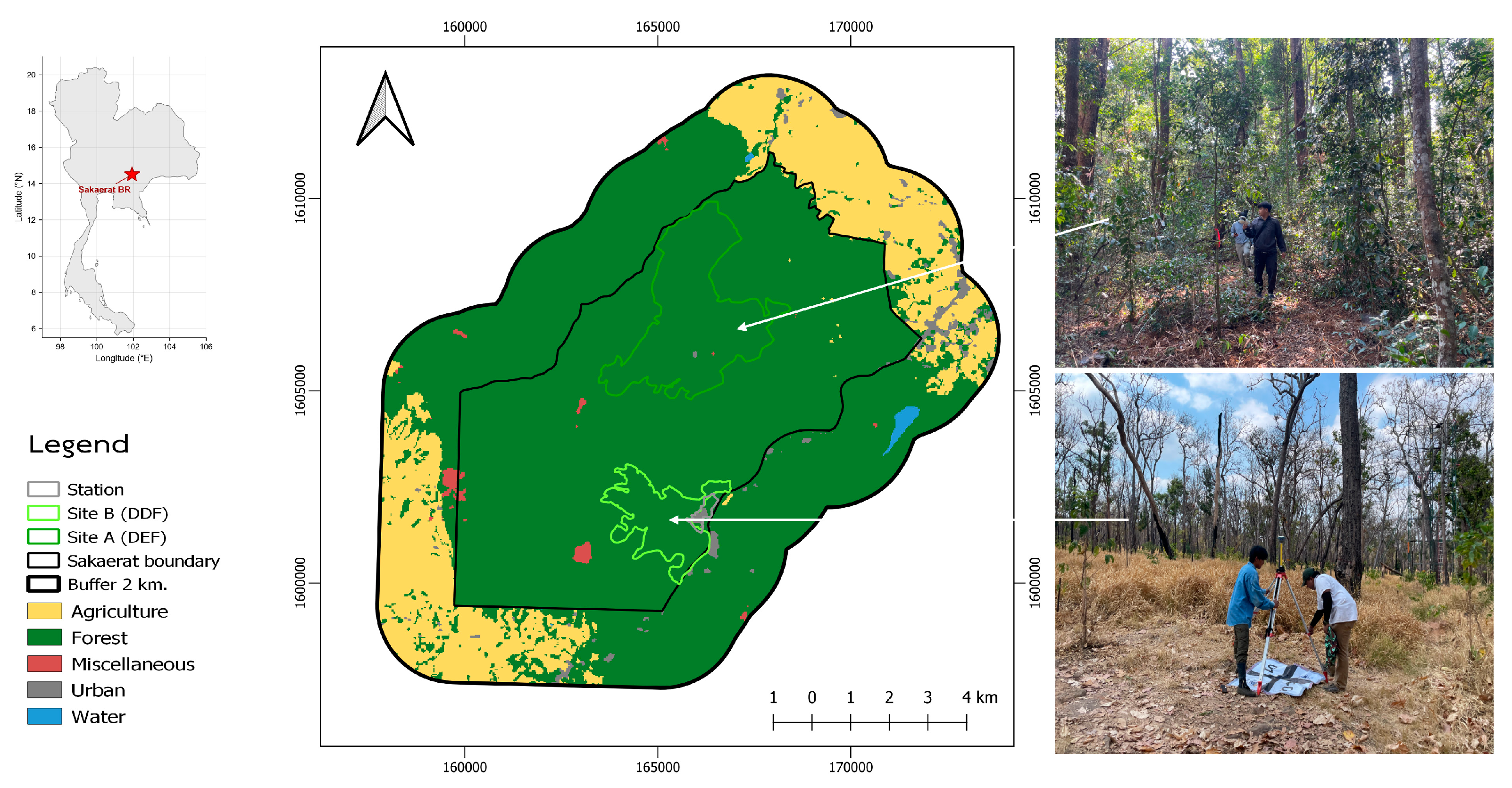
The SBR is located on the western margin of the Khorat Plateau in Nakhon Ratchasima Province, northeastern Thailand and covers 77.9 km2 (Figure 1). The reserve was designated under the UNESCO Man and the Biosphere Program in 1976 and has been continuously monitored since 1967. Elevation ranges from 280 to 762 m a.s.l.; mean annual rainfall is approximately 1200 mm, concentrated in the May–October wet season; and mean annual temperature is 26 °C. The reserve contains two contrasting forest ecosystems, both representative of mainland Southeast Asia. In the eastern section, the dry evergreen forest (DEF) is a species-rich, multi-layered, closed-canopy forest with emergent trees 35–45 m tall and a mean stem density of 1054 stems ha−1 (girth ≥ 15 cm). The dry dipterocarp forest (DDF), a fire-maintained open woodland covering the southern and western portions, is dominated by Shorea obtusa, Shorea siamensis and Dipterocarpus obtusifolius, with canopy heights of 15–25 m and a mean stem density of ~280 stems ha−1 (girth ≥ 15 cm).
As one of the oldest biosphere reserves in mainland Southeast Asia (designated under the UNESCO Man and the Biosphere Program in 1976, with continuous ecological monitoring since 1967), Sakaerat co-locates the two most extensive seasonally dry forest types of the region—DEF and DDF—within a single, well-characterized 78 km2 landscape that includes permanent vegetation plots and long-term phenology records. This makes it a representative and exceptionally well-documented testbed for dry forest carbon mapping across MSEA.
The two forest types also differ markedly in seasonal phenology, which is central to this study. DEF is functionally evergreen, retaining a closed leaf canopy throughout the year (dry season NDVI ≈ 0.86) with little seasonal variation. DDF is strongly deciduous: most dipterocarp species shed their leaves during the November–April dry season, exposing soil and litter (dry season NDVI ≈ 0.53), and re-flush at the onset of the May–October wet season. This DEF–DDF phenological divergence across the dry–wet cycle is precisely the signal that the multitemporal PlanetScope features are designed to capture.

2.2. Datasets

2.2.1. UAV-LiDAR

UAV-LiDAR data were collected during two field campaigns—on 17–18 April 2025 and on 4 February 2026—using a DJI Matrice 300 RTK quadcopter platform (SZ DJI Technology Co., Ltd., Shenzhen, China) with a dual CHCNAV AA450 LiDAR payload (CHC Navigation, Shanghai, China). The payload comprises the following: a Livox Avia (Laser Class 1) laser scanner (Livox Technology Company Limited, Shenzhen, China) with a maximum detection range of 450 m at 80% target reflectivity, scan rate of 240,000 points s−1 at single return and up to 720,000 points s−1 at triple return densities; horizontal and vertical accuracies rated by its manufacturer to be <10 and <5 cm respectively at a distance of 50 m above ground level, a built-in RGB camera (26 MP) for colorizing point-cloud data, and an onboard GNSS/IMU module that operates at 500 Hz. Missions for each flight were planned in DJI Pilot (SZ DJI Technology Co., Ltd., Shenzhen, China) in a grid pattern at 50–100 m AGL, ground speed of 5–10 m s−1 and a side overlap of 20–50%, with an IMU initialization routine (figure-of-eight maneuver) performed prior to each scanning pass. Post-processing of the raw GNSS/IMU and LiDAR data was performed in CHCNAV CoPre (CHC Navigation, Shanghai, China)using differential GNSS trajectory reconstruction, point-cloud generation, boresight calibration, and RGB colorization to produce georeferenced LAS files.

2.2.2. PlanetScope Imagery

PlanetScope Surface Reflectance imagery harmonized to Sentinel-2 [16] was obtained through the Planet Education and Research Program at 3 m ground sampling distance. We selected 17 cloud-free acquisitions from 13 February 2024 to 13 April 2026, covering eight spectral bands (coastal blue, blue, green I, green, yellow, red, red-edge and near-infrared) (Table 1). PlanetScope offers a near-daily revisit capability, from which we retained 17 cloud-free dates spanning the dry–wet phenological cycle. The Usable Data Mask 2 (UDM2) was used as an auxiliary mask for cloud contamination.

2.2.3. Per-Tree Above-Ground Carbon

Per-tree above-ground carbon reference values were derived from LiDAR-detected tree positions, breast-height diameters back-calculated from canopy height via a locally calibrated H–DBH power regression, and the species-pooled Thai dry forest allometric equations of Duangsathaporn et al. (2023) [17];
C tree = a DBH b H c
with (a, b, c) = (0.0185, 2.1371, 0.6804) for DEF and (0.0132, 2.1570, 0.7630) for DDF, where C tree is in kg tree−1, DBH in cm, and H in m. The carbon fraction used for back-calculating above-ground biomass is 0.4717 (DEF) and 0.4750 (DDF).

2.3. LiDAR Processing and Canopy Height Model Generation

Raw LAS files were streamed in 10-million-point chunks per plot year to construct a 1 m canopy height model (CHM). The digital terrain model (DTM) was estimated as the 5th percentile of all Z values within each 1 m cell, and the digital surface model (DSM) as the 95th percentile [18,19]. Single-pass minimum and maximum streaming was used, followed by a 3 × 3 minimum filter on the DTM to suppress isolated low returns. The CHM was computed as CHM = DSM − DTM and clipped to the ecologically plausible range [0, 60] m to remove airborne spikes. All CHMs were co-registered to EPSG:32647 (WGS 84 UTM Zone 47N) with their grid origins snapped to integer multiples of the output resolution, ensuring that plot years were spatially aligned with each other and with the PlanetScope feature grid.
The 1 m CHM was then aggregated to coarser grids for each output resolution r ∈ {10, 20, 30} m by calculating a total of 12 metrics per cell, namely maximum height (Hmax), mean height (Hmean), standard deviation of height (Hstd) and the 25th (Hp25), 50th (Hp50), 75th (Hp75), 95th (Hp95) and the 99th percentile heights (Hp99). The canopy cover at four height thresholds (CC2m, CC5m, CC10m and CC20m) was also calculated as the non-zero fraction of 1 m pixels with CHM ≥ threshold within each coarser cell. These metrics are widely used in the literature on area-based LiDAR Forest characterization [20,21]. We excluded cells with less than 50% valid 1 m pixels.

2.4. PlanetScope Phenological Feature Engineering

For every grid cell located at position (x, y) with length of the side r, surface reflectance was then sampled from each of the PlanetScope scenes by averaging over all valid pixels co-located within an r × r window on the cell. We also excluded pixels that were flagged as cloud; cells in which fewer than 50% of pixels were clear in a given scene were assigned no data for that scene.
For each cell, band and acquisition date, reflectance values were aggregated into eight phenological statistics reflecting seasonal canopy behavior: dry season mean (November–April), wet season mean (May–October), maximum, minimum, amplitude (max − min), 10th and 90th percentiles and coefficient of variation. The temporal aggregation approach follows the phenological metrics framework established for MODIS time-series analysis [1,22,23] and adapted to higher sensor resolution [24]. Applied to the eight spectral bands, this yields 64 features per cell. An additional 64 features were derived from eight vegetation indices—NDVI [25], EVI [26], NDRE [27], NDWI [28], MSAVI [29], GNDVI [30], ARI [31] and CRI [32]—each computed per scene before temporal aggregation. The total phenological feature set thus comprises 128 features per grid cell.
This design differs from prior PlanetScope-based biomass studies and from the single-composite Sentinel-2 approach of Ren et al. (2025) [13] by preserving the seasonal signal that is diagnostic of tropical dry forest deciduous behaviors. In contrast to fully temporal deep learning methods—such as temporal convolutional networks [33] or transformer architectures [34,35] applied to raw 17-date sequences—the present feature engineering enables straightforward use of tree-based ensemble models, which have demonstrated consistent outperformance over deep learning baselines on tabular feature inputs observations [36,37].

2.5. Per-Forest-Type Model Training

We evaluated three machine learning regressors: Random Forest [38] with 300 trees and a minimum of two samples per leaf; XGBoost [39] with 500 trees, a maximum depth of 6, a learning rate of 0.05, a subsample of 0.8 and a per-tree column subsample of 0.8; and LightGBM [40] with 500 trees, 63 leaves and a learning rate of 0.05. Hyperparameters were fixed across experiments to allow direct comparison. Features were standardized to zero mean and unit variance using training-fold statistics only, and the same scaler was applied to the corresponding test fold. We compared three feature subsets: PS_only (128 phenological PlanetScope features), LiDAR_only (12 canopy structure metrics in Section 2.3), and Combined (the union, 140 features). Final per-forest models were trained on the 2025 plot year subsets only (n = 461 DEF cells, n = 550 DDF cells at 30 m) because preliminary diagnostics indicated considerable canopy disturbance between the April 2025 and February 2026 acquisitions; the 2026 plot year subsets (n = 359 DEF, n = 258 DDF) were reserved as the held-out folds for the leave-one-plot-year-out (LOPO) generalization test described in Section 2.6. We discussed this limitation in Section 4.4 as it relates to fire-maintained DDF ecosystems [41].

2.6. Cross-Validation Schemes

Three cross-validation schemes were applied to characterize different generalization regimes: (1) random K-fold (k = 5), the conventional approach and most published carbon-mapping studies; (2) spatial block K-fold (k = 5), in which all cells in each of five vertical strips are assigned to one fold based on x_UTM quantiles, controlling for the spatial autocorrelation that inflates apparent accuracy under random K-fold [42,43,44]; and (3) leave-one-plot-year-out (LOPO; k = 4 folds, one held-out plot year per fold: DEF_2025, DEF_2026, DDF_2025, DDF_2026), which tests the operationally relevant question of whether a model trained on past observations can predict AGC in a new year or location. The coefficient of determination (R2), root-mean-square error (RMSE) and mean absolute error (MAE) were computed for each fold and for each (resolution × feature set × model) combination. Bootstrap confidence intervals (1000 iterations) were calculated around the best configuration [45].

2.7. Feature Attribution via SHAP

The mean most important features per forest were determined using SHAP TreeExplainer [46,47] applied to the final Random Forest models. The SHAP values were calculated for each forest from a stratified random sample of 500 cells. We defined global feature importance as the mean absolute SHAP value for the sample.

2.8. Wall-to-Wall AGC Mapping

Wall-to-wall above-ground carbon mapping was produced at two complementary spatial resolutions across the full 77.93 km2 extent of SBR (EPSG:32647). The two products serve distinct purposes: a primary 30 m map for quantitative carbon accounting, and a supplementary 3 m layer at the satellite’s native resolution for spatial pattern analysis.

2.8.1. Primary Product—30 m Combined Map

The final forest-type-specific Random Forest Combined models were applied to every 30 m grid cell within the reserve. Canopy structure features were derived from the 30 m aggregated Meta global 1 m canopy height model [48], and PlanetScope phenological features were sampled as described in Section 2.4. Each cell was assigned a forest type using a canopy height rule (Hp95 > 22 m → DEF, otherwise DDF), with a dry season NDVI fallback where canopy height data were inadequate (NDVI > 0.75 → DEF). The corresponding forest-specific model was then applied to predict AGC per cell.

2.8.2. Supplementary Product—3 m PS-Derived Layer

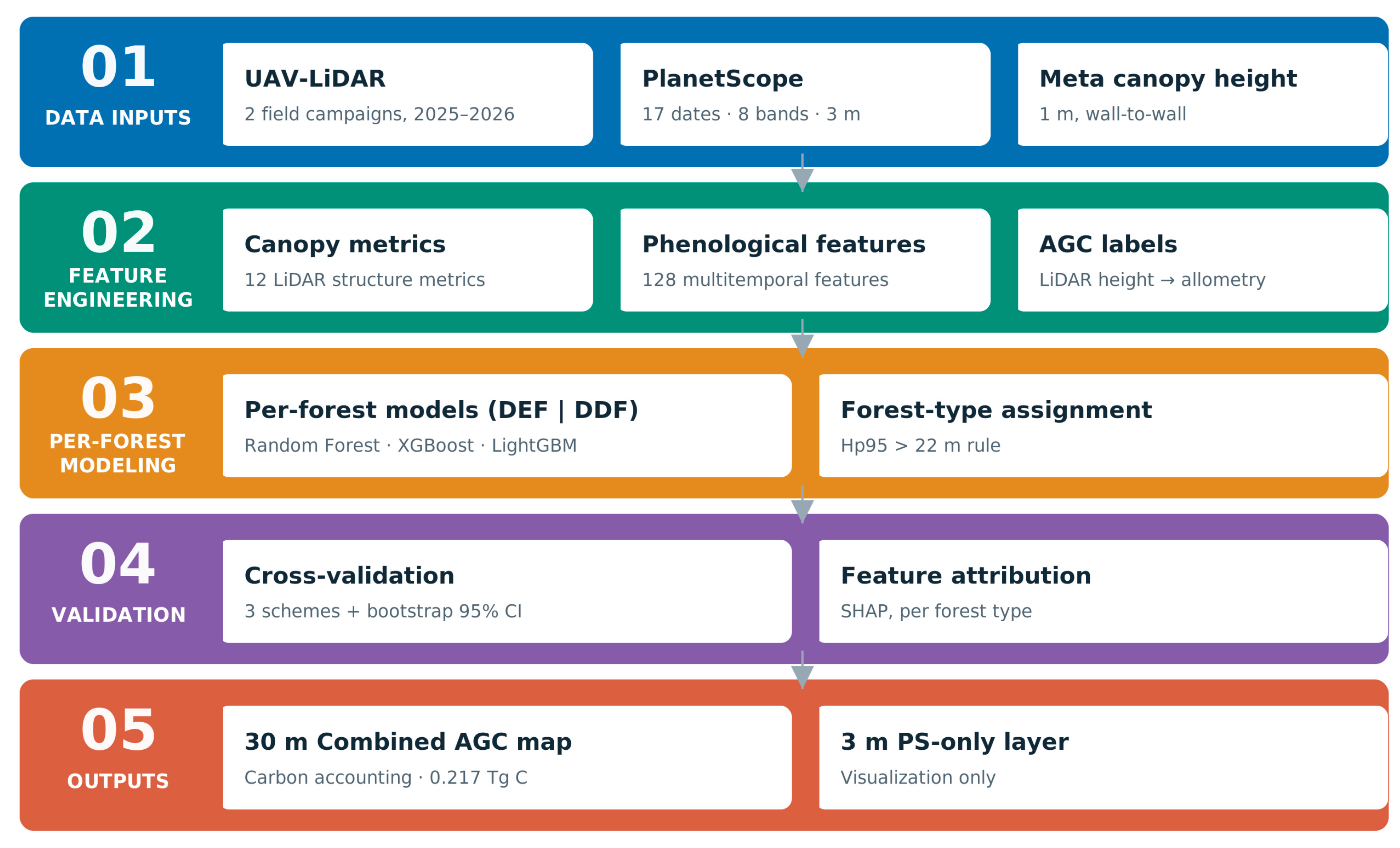
To deliver an AGC product at the native PlanetScope resolution, the PS-only Random Forest models (Section 2.5) were applied to phenological features computed at each 3 m cell within the reserve, generating approximately 8.7 million predicted pixels at the native PlanetScope resolution. Forest type at each 3 m cell was inherited from its parent 30 m cell via nearest-neighbor lookup. Because the model is trained at 30 m feature distributions but applied at 3 m, the predictions are subject to a scale-related distribution shift; this is quantified in Section 3.6.2 by aggregating the 3 m predictions back to 30 m and comparing against the direct 30 m PS-only output. The 3 m product is intended as a high-spatial-resolution PlanetScope-derived layer for sub-stand pattern analysis, canopy gap mapping, and integration with other 3 m data products—not as a higher accuracy replacement for the 30 m Combined map. The full processing workflow, from data acquisition through per-forest model training and wall-to-wall prediction, is illustrated in Figure 2.

3. Results

3.1. Effect of Spatial Resolution

Model performance generally improved with coarser grid resolution across feature subsets and cross-validation schemes, with the 30 m grid performing best overall (Table 2). The improvement with coarser resolution reflects two effects (1) the variance of AGC within each cell decreases as more trees and spectral pixels are averaged, reducing target noise and (2) the proportion of cells containing at least one tree increases from 75% at 10 m to 98–100% at 30 m, eliminating the zero-AGC canopy gap cells that are difficult to predict from spectral features. The 30 m resolution was therefore selected for all subsequent analyses.

3.2. Contribution of Feature Sets

At 30 m resolution under random K-fold cross-validation (Table 3), the Combined feature set consistently outperformed both single-source alternatives. The marginal contribution of PlanetScope features over LiDAR-only (ΔR2) was +0.017 in DEF and +0.020 in DDF. The PlanetScope contribution is modest in both forest types and similar in magnitude, with a slightly larger gain in DDF—consistent with the prediction that visible–NIR indices retain biomass sensitivity in open canopies but saturate in closed evergreen canopies (Section 4.1).
Random Forest was selected as the final regressor on three grounds. (i) For the Combined feature set at 30 m it gave the highest or statistically tied mean R2 in both forests (DEF: RF 0.677 vs. XGB 0.667, LGB 0.675; DDF: RF 0.654 vs. XGB 0.647, LGB 0.617). (ii) It showed the lowest fold-to-fold variance and the smallest degradation under the stricter spatial block scheme, indicating greater robustness to the modest per-forest sample sizes (n = 461 DEF, 550 DDF). (iii) The gradient-boosting models (XGBoost, LightGBM) were more prone to overfitting the 128-dimensional phenological feature space at these sample sizes, consistent with the documented advantage of bagged ensembles over boosting in low-n, high-dimensional tabular regimes. Hyperparameters were held fixed across all models so that the comparison reflected algorithm behavior rather than tuning.

3.3. Cross-Validation Scheme Comparison

The three cross-validation schemes produced successively lower R2 values while delineating uncertainty bounds across different generalization regimes. Performance dropped as the cross-validation barrier became more stringent (Table 4), with leave-one-plot-year-out yielding a Combined median R2 ≈ 0.251 and substantial forest- and year-specific variability. The high fold-to-fold variance under spatial block K-fold for DEF (σ = 0.245) is driven by one of five spatial blocks (n ≈ 92 test cells) that intersects a DEF–DDF transition zone where canopy heights and dry season NDVI overlap between the two forest types; the remaining four blocks yield R2 in the 0.55–0.70 range. This fold should therefore be interpreted as an upper bound estimate of cross-region uncertainty under strong spatial autocorrelation. The drop from random to spatial K-fold (ΔR2 = −0.122 for DEF, −0.080 for DDF) is consistent with spatial autocorrelation inflating apparent performance under random K-fold. The much larger decrease under LOPO reflects the distributional shift between plot years caused by inter-annual canopy change and the four-plot-year sample size limit, which restricts statistical learning across years.
Per-forest stratification yielded substantial gains over a pooled mixed-forest model. When DEF and DDF cells from all four plot years were combined and a single Random Forest was trained, the random K-fold R2 at 30 m fell to 0.537, compared with 0.677 (DEF) and 0.654 (DDF) for the stratified models—an average improvement of +0.129 in R2. This pattern is consistent with the principle of modeling ecologically distinct strata independently to prevent distribution shift effects [43,49]. Leave-one-plot-year-out cross-validation reveals a forest- and year-asymmetric pattern: the DDF folds yielded positive R2 (DDF_2025 = +0.405; DDF_2026 = +0.605), whereas DEF_2025 yielded R2 = +0.097 and DEF_2026 yielded a strongly negative R2 = −1.763 (mean across folds = −0.164; median = +0.251). As a single outlier fold dominates the mean, we report the median as a more robust summary, while explicitly noting that the DEF_2026 result reflects an out-of-distribution year with inter-annual canopy change rather than poor model fit in general (Section 4.4). Pearson correlations between phenology features and AGC reveal additional structure: in DDF, NDRE_wet_mean correlates strongly with AGC (r = +0.457), followed by NDVI_wet_mean (+0.333) and NDVI_dry_mean (+0.303). In DEF, B6_Red_amplitude and B8_NIR_amplitude correlate at |r| ≈ 0.30, and EVI_wet_mean and MSAVI_wet_mean correlate at r ≈ −0.35. The full top-20 PlanetScope feature ranking per forest type is provided in Appendix A Table A1. These associations support the use of multitemporal phenological features as a primary input.

3.4. Feature Importance: SHAP Analysis

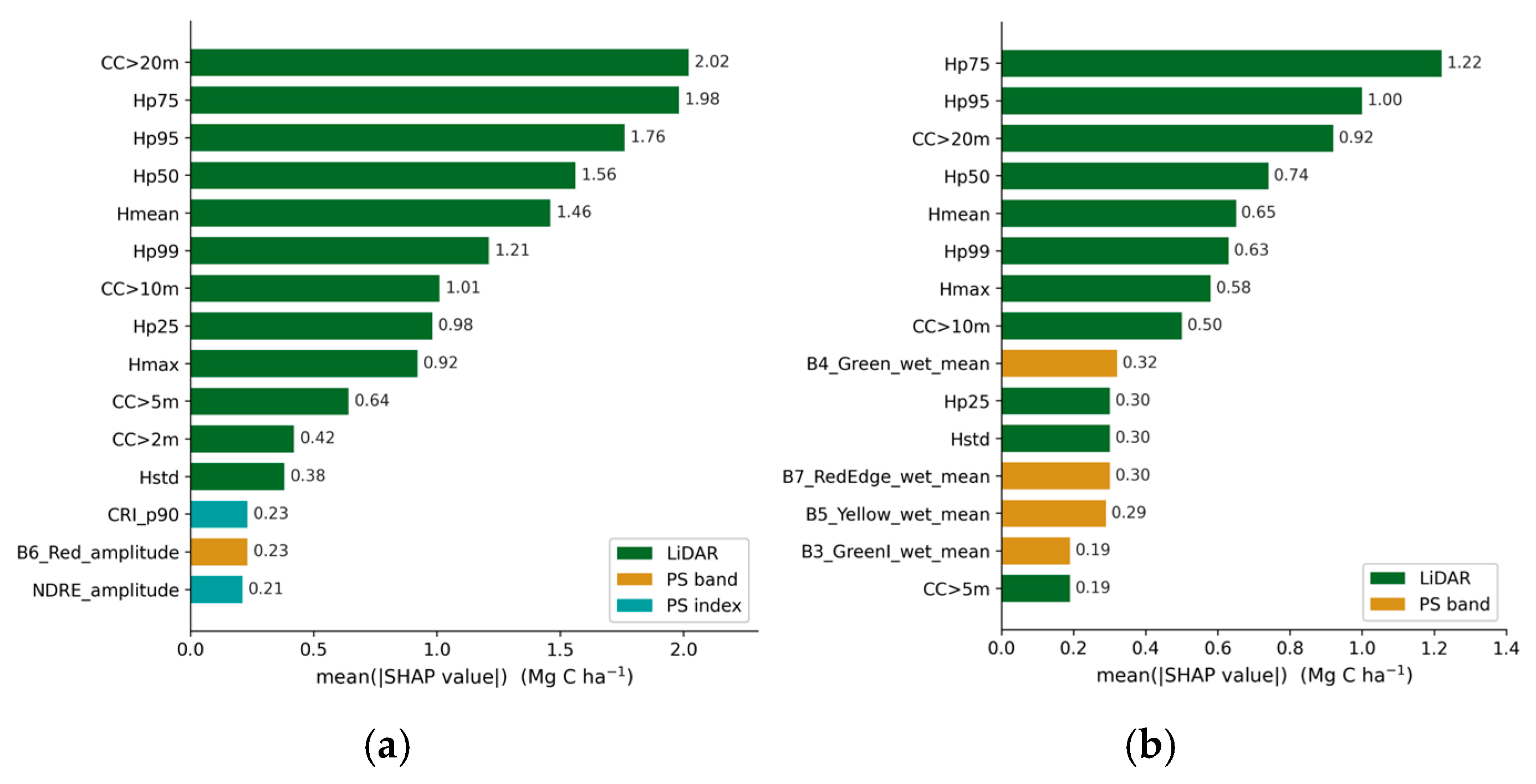
According to SHAP TreeExplainer applied separately to each of the final Random Forest Combined models, canopy structure features were identified as being the most important in both forest types, although they ranked differently (Figure 3).
In DEF, the mean absolute SHAP values indicated that the 10 most important features were all LiDAR-based: canopy cover above 20 m (CC20m, importance 2.02), 75th percentile height (Hp75, 1.98), 95th percentile height (Hp95, 1.76), median height (Hp50, 1.56), mean height (Hmean, 1.46), 99th percentile height (Hp99, 1.21), maximum height (Hmax, 0.92) and additional canopy cover metrics. Consistent with the well-documented saturation of NDVI in closed evergreen canopies [26], no PlanetScope feature appeared in the top fifteen features for DEF.
For DDF, the leading features were also LiDAR-derived (Hp75, Hp95, CC20m, and Hp50); however, the wet season mean reflectance of PlanetScope Band 4 (Green; 540–590 nm) ranked ninth with an importance of 0.32—the first PlanetScope feature to appear in either forest type. Wet season green-band reflectance captures leaf chlorophyll content at peak canopy greenness and provides an independent biomass signal in DDF due to the sparse deciduous canopy and the greater visibility of soil and understory background [50].
In DEF, CC20m measures the fraction of 1 m pixels within a 30 m cell whose LiDAR-derived canopy height exceeds 20 m, primarily capturing tall emergent and dominant tree crowns. Because emergent stems contribute disproportionately to total biomass [51,52], the proportion of canopy above the dominant stratum is strongly related to AGC in closed evergreen forest. The same feature is relevant in DDF, but here Hp75 and the green-band phenological signal also contribute, capturing canopy openness and seasonal leaf dynamics.
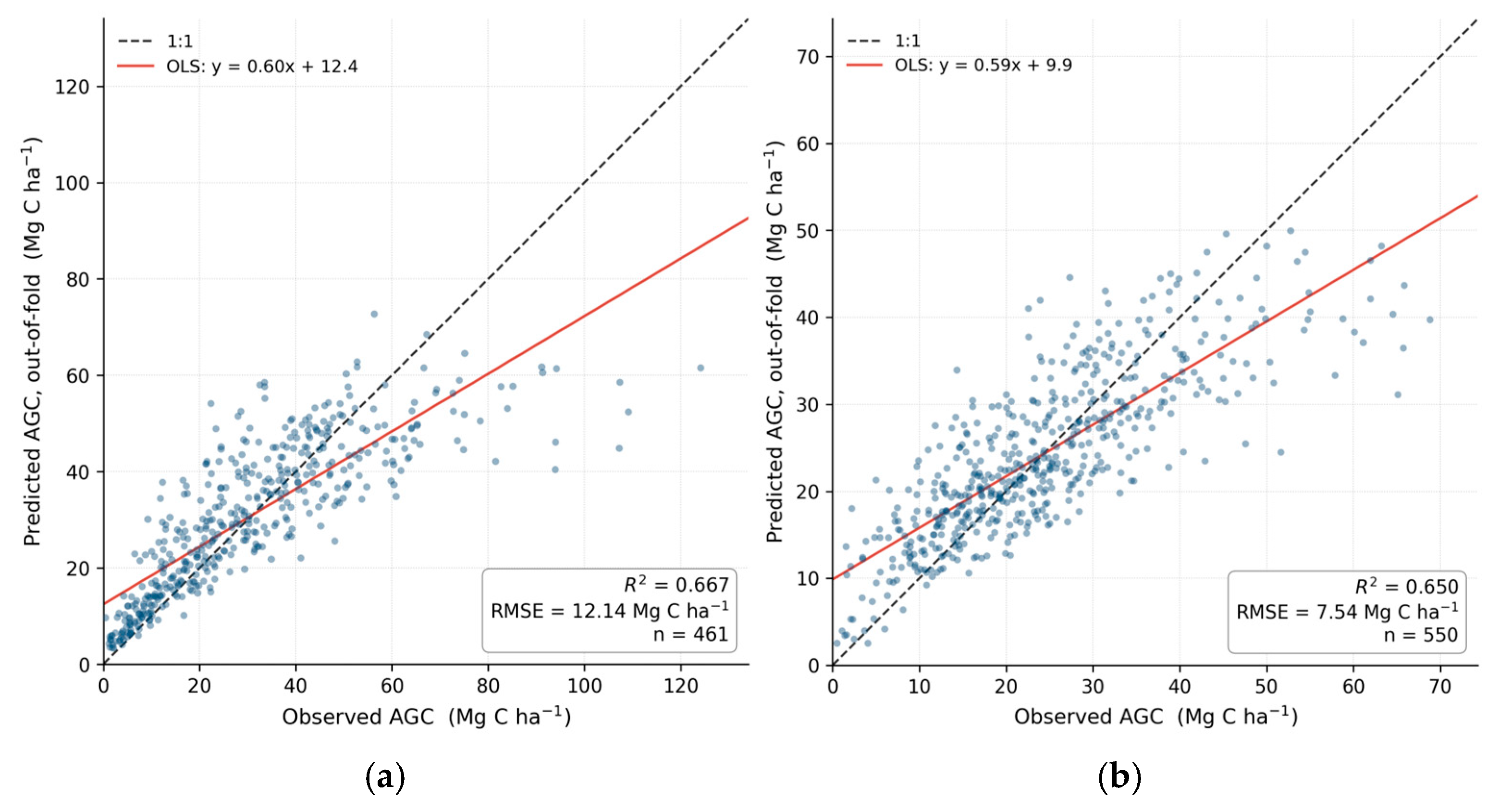
The best per-forest configurations (Combined Random Forest at 30 m under random K-fold) were used to generate out-of-fold predictions for diagnostic inspection (Figure 4). For DEF, predictions agreed well with observations across the 0–60 Mg C ha−1 range (R2 = 0.668, RMSE = 12.13 Mg C ha−1, n = 461), with a slight tendency to under-predict the highest biomass cells (>50 Mg C ha−1)—a pattern consistent with NDVI saturation at high canopy closure. For DDF, prediction error was smaller in absolute terms (RMSE = 7.55 Mg C ha−1, n = 550) reflecting the lower AGC range of this forest type, with R2 = 0.649 indicating that roughly two-thirds of cell-level AGC variation are captured by the Combined feature set. Both forest types exhibit residual scatter that is approximately homoscedastic across the observed AGC range, supporting the use of these models for reserve-wide spatial prediction.

3.5. Sensitivity Analyses

To isolate the contribution of multitemporal phenological features, we re-ran the PS-only and Combined models with dry season mean reflectance alone and with the full multitemporal feature set. For PS-only models at 30 m under random K-fold, the multitemporal feature set yielded R2 = 0.344 ± 0.038 (DEF) and R2 = 0.476 ± 0.063 (DDF), substantially outperforming the single-composite baseline of R2 = 0.102 ± 0.069 (DEF) and R2 = 0.244 ± 0.145 (DDF). This demonstrates that phenological feature engineering retains diagnostic information that is lost in single-composite reductions, substantiating the core methodological assertion of this study. When PlanetScope features are combined with LiDAR canopy structure features, R2 converges to 0.677 (DEF) and 0.656 (DDF), indicating that LiDAR canopy structure absorbs most of the predictive signal in the joint feature space—consistent with allometric circularity at the label level (Table 5).

3.6. Wall-to-Wall Above-Ground Carbon Maps

3.6.1. Primary Product—30 m Combined AGC Map

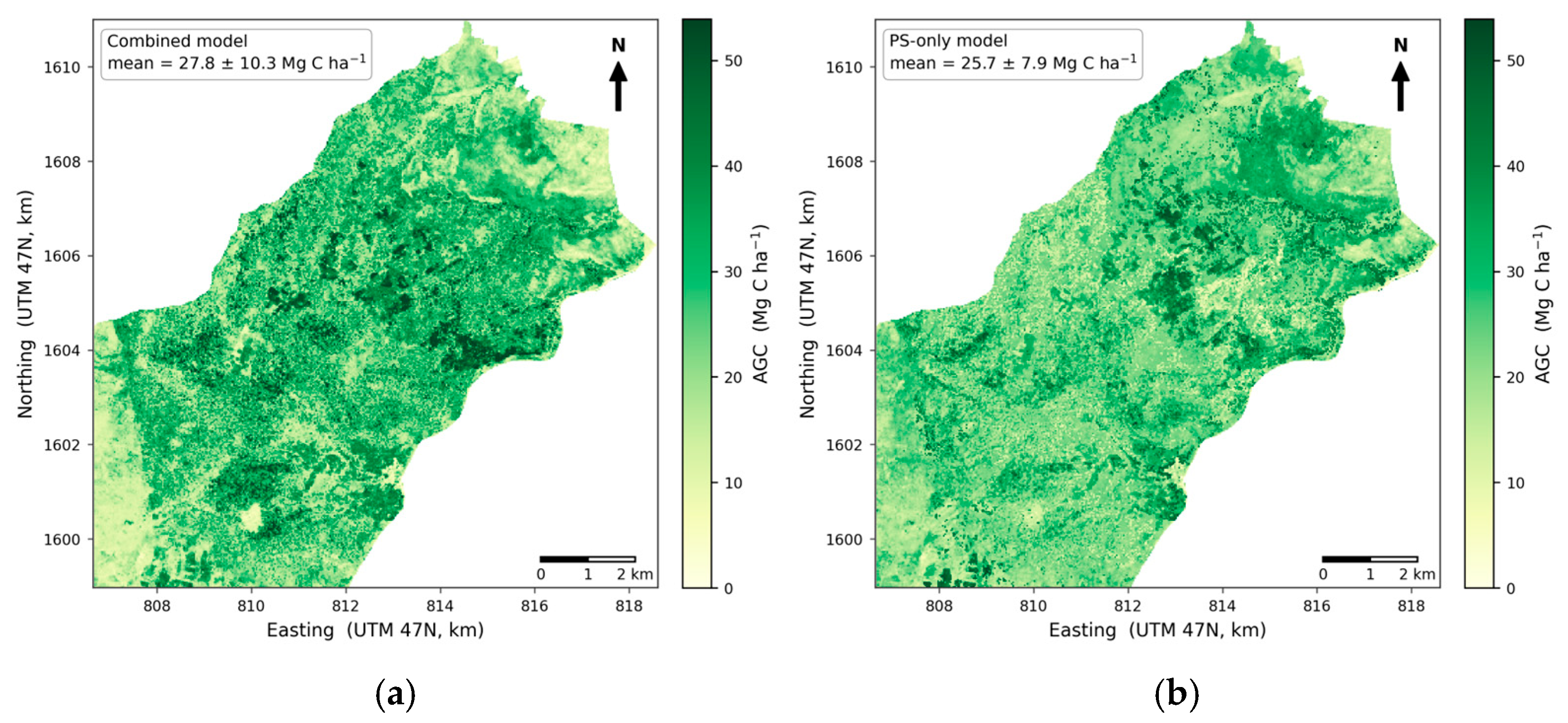
The final Combined Random Forest models for DEF and DDF were applied to a 30 m grid covering the entire 77.93 km2 SBR (Figure 5). The grid comprises 86,648 cells, of which 86,558 (99.9%) have valid Meta global canopy height data [48] and complete PlanetScope phenological coverage. Each cell was classified to a forest type using a canopy height rule (Hp95 > 22 m for DEF; otherwise DDF), with a dry season NDVI > 0.75 fallback for cells lacking sufficient canopy height data. The 22 m threshold was selected to separate the DEF closed-canopy stratum (typical Hp95 ≈ 24–35 m) from the DDF open canopy (typical Hp95 ≈ 12–20 m); the resulting forest-type allocation (DEF 38.8%/DDF 61.2%) is consistent with published forest-type maps for the reserve. This classification yielded 33,598 DEF cells (38.8% of the reserve), concentrated in the eastern and central portions, and 53,050 DDF cells (61.2%), covering the southern, western and ridge-edge areas—broadly consistent with published forest-type maps for SBR. Using the Combined model, the mean above-ground carbon density across the reserve was estimated at 27.8 ± 10.3 Mg C ha−1, and using the PS-only model at 25.7 ± 7.9 Mg C ha−1; this difference of <2 Mg C ha−1 reflects the additional structural information provided by the Meta CHM. These values are consistent with those reported for similar tropical dry forest landscapes in mainland Southeast Asia [53] and remain within the range bracketed by the plot-level LiDAR-derived AGC estimates of 56.5 Mg C ha−1 (DEF) and 38.7 Mg C ha−1 (DDF) at the high-biomass extreme, suggesting that reserve-wide means reflect mixtures of mature stands with lower-density transition zones.

3.6.2. Supplementary Product—3 m PS-Derived AGC Layer

The PS-only Random Forest models (Section 2.8.2) were applied at every 3 m grid cell within the reserve, producing approximately 8.7 million predicted pixels at the native PlanetScope resolution. The 30 m Combined map necessarily averages over spatial detail (canopy gaps, sub-stand structural variation and small-scale disturbance signatures) that is preserved in the 3 m output and visible within each underlying multitemporal PlanetScope image.
Because the model is trained at 30 m feature distributions but applied at 3 m, a within-study consistency test was performed: the 3 m AGC predictions were aggregated by mean within each 30 m × 30 m block and compared with the direct 30 m PS-only AGC output. Across all 86,648 aggregated areas, the aggregation R2 = 0.873 with RMSE = 2.81 Mg C ha−1. The mean 3 m aggregated AGC (26.93 Mg C ha−1) exceeds the direct 30 m PS-only mean (25.72 Mg C ha−1) by +1.21 Mg C ha−1 (+4.7% relative bias), reflecting the upward shift in predicted AGC when phenological features are computed from single 3 m pixels rather than 30 m averages. The bias is small and spatially consistent (R2 = 0.873 indicates that the spatial pattern of the 3 m aggregated map closely matches the direct 30 m output), supporting the use of the 3 m product as a high-spatial-resolution PS-derived layer. Total above-ground carbon estimated from the 3 m grid is 0.210 Tg C, within 3% of the direct 30 m PS-only estimate.
The 3 m product is presented as a high-resolution PS-derived layer for visualization and downstream applications (canopy gap mapping, sub-stand pattern analysis, integration with 3 m PlanetScope products), not as an independently validated 3 m AGC product; users should rely on the 30 m Combined map for quantitative carbon accounting and on the 3 m layer for spatial pattern analysis.

4. Discussion

4.1. NDVI Saturation in Closed Evergreen Canopy

Diagnostic analysis of the per-cell feature–target correlations confirmed the canonical NDVI saturation pattern in DEF. The mean dry season NDVI in DEF was 0.855 ± 0.007, exhibiting almost no variation across cells despite a broad range in AGC (interquartile range ≈ 15–45 Mg C ha−1); the Pearson correlation between NDVI_dry_mean and AGC was r = −0.05, statistically indistinguishable from zero. In DDF, by contrast, dry season NDVI averaged 0.529 ± 0.049 with an AGC correlation of r = +0.31, consistent with the open canopy regime in which soil and understory background contribute proportionally to the spectral signal. NDVI saturation in DEF explains the dominance of LiDAR features and the small but consistent contribution of PlanetScope features in DDF, where spectral and structural information are complementary. The result is consistent with previous observations [26,54,55] that the visible–NIR domain alone cannot discriminate AGC variation within closed-canopy tropical evergreen forests. Sensitivity to high biomass may additionally require SAR backscatter and short-wave infrared reflectance, which provide complementary information [56,57].
The ecological basis for the green- and red-edge sensitivity in DDF lies in its open, deciduous canopy. In the wet season, dry dipterocarp stands flush new foliage and leaf chlorophyll peaks; green (540–590 nm) and red-edge (705–745 nm) reflectance respond directly to chlorophyll concentration and leaf area development, which scale with standing biomass in these low-density stands (≈280 stems ha−1, canopy cover 40–60%). Because the canopy is open, a larger fraction of the pixel signal originates from sunlit foliage rather than from multiple-scattering saturation, so the wet season green/red-edge bands track the biomass gradient instead of saturating. In the dry season the same stands shed leaves and expose soil and litter, collapsing the vegetation signal—which is why the seasonal amplitude of these bands, not any single date, carries the biomass information. In closed-canopy DEF the opposite holds: year-round leaf cover drives NDVI into saturation (dry season NDVI = 0.855 ± 0.007, r with AGC ≈ 0), leaving canopy structure as the only informative dimension.
Critically, not all vegetation indices behave alike under dense canopy. In DEF, broadband NDVI saturates (r ≈ 0 with AGC), whereas red-edge and amplitude-based features retain a weak but non-zero association with the structural gradient (Red and NIR seasonal amplitude, |r| ≈ 0.30; EVI and MSAVI wet season means, r ≈ −0.35), indicating that these features track residual structure rather than greenness per se. In DDF, the red-edge index NDRE (wet season mean, r = 0.46) and wet season NDVI (r = 0.33) retain the strongest biomass utility, consistent with the open canopy mechanism described above (full ranking in Appendix A Table A1).

4.2. Comparison with Recent Carbon Mapping Studies

Despite our more diverse spectral inputs from PlanetScope and the addition of airborne LiDAR, our random K-fold R2 values are 9–13% lower in absolute terms than the R2 = 0.773 reported by Ren et al. (2025) [13] for AGC mapping in subtropical evergreen forest of southwestern China using an enhanced ResNet on a single Sentinel-2 composite. To evaluate the causal role of multitemporal feature engineering relative to single-composite reduction, our within-site ablation attributes the bulk of this gap to feature engineering rather than to model architecture. We attribute the remaining gap to the greater diversity of forest types in MSEA—closed-canopy DEF and open canopy DDF—with partially overlapping spectral and structural distributions, which require per-forest stratification to recover signal. NDVI saturation in closed DEF canopy limits visible–NIR sensitivity, and the lower mean stem density and greater canopy variability of MSEA dry forests, relative to subtropical karst evergreen forest, further constrain achievable R2. Per-forest R2 values converge towards the upper range of published tropical dry forest AGC accuracies (typically 0.5–0.7) when models are stratified by forest type [49,58,59]. The within-site ablation provides unambiguous evidence that multitemporal phenological feature engineering is the principal component distinguishing this method from single-composite optical approaches.
Set against recent tropical dry forest biomass studies, our accuracies fall within the published range and clarify the role of the optical signal. Integrating LiDAR, ALOS PALSAR, climate and field data, Hernández-Stefanoni et al. (2020) [60] reached R2 = 0.44 for tropical dry forest AGB, underscoring how difficult open, seasonally deciduous canopies remain even for multi-sensor inputs. Singh et al. (2022) [61] obtained a much higher adjusted R2 (up to 0.91) for a dry deciduous forest from wet season Sentinel-2, yet dry season models collapsed to near-zero skill—mirroring our result that the phenological timing of the spectral signal, not its mere availability, governs biomass sensitivity. Fine-resolution optical products behave similarly: within-season 10 m biomass estimates from Landsat, Sentinel-2 and PlanetScope [62] and PlanetScope-based biomass models in other biomes [63] track biomass only where canopy openness exposes the foliar signal. Finally, the modest optical gain over structure that we report is consistent with SAR–LiDAR fusion studies in which L-band SAR and spaceborne LiDAR carry most of the structural biomass signal while optical bands add complementary but secondary information that saturates at high biomass [64].

4.3. PlanetScope Contribution: Small but Real

PlanetScope features contributed a modest marginal R2 (+0.017 in DEF, +0.020 in DDF) over LiDAR-only models, but this estimate represents the true spectral information that remains after accounting for canopy structure. The most informative such channel in DDF—wet season green-band reflectance—captures chlorophyll-mediated leaf area dynamics during the peak greenness phase, which is not present in a static canopy height model. This implies that for sites without UAV-LiDAR—currently the case for most operational applications across MSEA—PlanetScope-based phenology can serve as a complementary screening layer where LiDAR coverage is unavailable, albeit with reduced accuracy: at 30 m, PS-only Random Forest yielded R2 = 0.342 (DEF) and 0.473 (DDF), corresponding to RMSE of 17 Mg C ha−1 (DEF) and 9 Mg C ha−1 (DDF). These values are consistent with published optical-only tropical dry forest AGC accuracies [53].
The contribution of optical phenology can be decomposed against the LiDAR structural baseline. At 30 m under random K-fold, LiDAR-only Random Forest explained R2 = 0.660 (DEF) and 0.634 (DDF), the spectral-only PlanetScope model R2 = 0.342 (DEF) and 0.473 (DDF), and the Combined model R2 = 0.677 (DEF) and 0.654 (DDF). Two points follow. First, the unique spectral gain over structure is small (ΔR2 = +0.017 DEF, +0.020 DDF) because the PlanetScope signal is largely collinear with canopy structure; the optical component is therefore better understood as a partially redundant, ecologically interpretable layer than as the dominant driver. Second, and critically for interpretation, the LiDAR-only and Combined values are inflated by allometric circularity, whereas the PlanetScope-only result is not. The non-circular spectral bound (R2 ≈ 0.342–0.473) is thus the most defensible estimate of what optical phenology alone can deliver in the absence of LiDAR labels, and it is this bound—not the headline Combined R2—that should guide expectations for LiDAR-free operational mapping across MSEA.

4.4. Limitations

Most importantly, because the AGC reference labels are back-calculated from LiDAR canopy height via H–DBH allometry, and LiDAR canopy metrics are simultaneously used as predictors, the LiDAR-only and Combined accuracies are partly circular: predictors and labels share the same structural signal. The headline R2 values (0.681/0.661) should therefore be read as an upper bound that would not be reproduced against independent field biomass. The PlanetScope-only models break this circularity—their predictors are independent of the LiDAR-derived labels—and yield the more conservative and more transferable estimate (R2 = 0.342 DEF/0.473 DDF). We retain the Combined model as the headline because permitting allometric circularity is standard practice in LiDAR-AGB mapping, but we frame the optical-only bound as the honest measure of spectral skill.
In this study, AGC reference values are derived from an H–DBH regression applied to LiDAR-derived canopy heights and propagated through allometric equations, linking AGC to the same remote sensing features used as predictors. This circularity can produce higher R2 values for LiDAR-based and Combined models than would be obtained from independent field biomass data [60,65]. PS-only models avoid this circular bias and yield more conservative biomass estimates across gradients. Although the spectral contribution of PlanetScope to the Combined model is modest (+0.017 to +0.020 R2 above LiDAR-only)—a limitation also reported in UAV-LiDAR biomass studies [12]—it may still introduce bias. The low temporal transferability under LOPO (negative R2 when training on three plot years and predicting the held-out plot year, e.g., when DEF_2026 is the test fold) is driven by inter-annual canopy change, edge disturbance, and LiDAR co-registration differences between years rather than by fire (DEF is not fire-maintained, whereas DDF is subject to recurrent surface fires that introduce additional canopy variability). Operational biomass estimation requires models that are stable over time [66,67].
Forest-type separation in this study relies on a single canopy height threshold (Hp95 > 22 m), which is interpretable and adequate for the strongly bimodal height distribution at Sakaerat but is necessarily simplistic in mixed stands and DEF–DDF transition zones, where canopy heights and dry season NDVI overlap and produce the largest cross-validation variance (Section 3.3). A probabilistic or hierarchical classification that propagates forest-type membership uncertainty into the AGC prediction is a clear direction for future work.
Although short-wave infrared (SWIR) bands are useful for resolving moisture and woody biomass signals in AGC mapping, PlanetScope lacks SWIR; Sentinel-2 SWIR data, which mitigate visible–NIR saturation in dense canopies and improve moisture estimation, could be incorporated in future work. Domain shifts in merged datasets—for example, discrepancies between global canopy height products and UAV-LiDAR in areas outside LiDAR coverage—can introduce additional uncertainty. Validation here relies on sparse field data (~16 plot year observations) within an allometric framework rather than on direct plot biomass measurements. There is also a scaling-related bias when phenological features are computed at 3 m and predictions are aggregated to 30 m. Consequently, the 30 m Combined map should be used for quantitative carbon accounting, while the 3 m PS-derived layer is best suited to visualization and spatial pattern analysis.
The final carbon surface inherits uncertainty from a chain of steps, which we make explicit here: (i) sensor fusion and co-registration among UAV-LiDAR, the Meta global canopy height product and PlanetScope, where sub-pixel misregistration blurs the structure–spectra correspondence; (ii) the H–DBH and allometric conversion used to generate the AGC labels, which carries both parameter uncertainty and the circularity discussed above; and (iii) model prediction error, bracketed by the bootstrap 95% confidence intervals reported in Section 3.5. A fully propagated uncertainty budget, together with independent field-measured AGC to break the allometric dependence, is the priority for future validation campaigns.
The 3 m layer is explicitly not an independently validated carbon product: it is generated by applying models trained on 30 m feature distributions to 3 m pixels, introducing a scale-dependent distribution shift. It is provided solely for visualization and sub-stand pattern analysis; all quantitative carbon accounting in this study uses the 30 m Combined map.

5. Conclusions

This study demonstrates the integration of phenology-informed multitemporal PlanetScope imagery with airborne UAV-LiDAR to improve above-ground carbon stock mapping in Southeast Asian tropical dry forests. Multitemporal phenological feature engineering captures the dry–wet contrast separating deciduous from evergreen carbon and substantially outperforms single-composite baselines (×3.4 in DEF, ×2.0 in DDF). Stratifying the analysis by forest type further improves model performance by accounting for canopy structure differences (+0.129 R2 over a pooled model).
The complementarity of multitemporal optical phenology with LiDAR canopy structure is the central methodological contribution: optical phenology captures leaf area dynamics that canopy height alone cannot resolve, while LiDAR carries the three-dimensional structure against which optical signals saturate. Applied to the SBR, the framework produced a 30 m primary AGC map totaling 0.217 Tg C, together with a 3 m PS-derived supplementary layer for sub-stand pattern analysis.
The framework has potential to be transferred to other tropical dry forest regions, subject to comparable data availability and local calibration. It is important to note, however, that the leave-one-plot-year-out cross-validation results (median R2 ≈ 0.251, with the DEF_2026 fold showing model breakdown at R2 = −1.763) indicate that, at present, the framework supports contemporaneous AGC mapping within the trained domain rather than projection across years. Operational temporal transfer will require additional plot years and explicit modeling of inter-annual canopy change. Future work will focus on integrating additional remote sensing sources (notably Sentinel-2 SWIR and Sentinel-1 SAR), expanding the field validation network, and exploring deep temporal models for raw 17-date sequences. These extensions are expected to improve biomass estimates, mitigate existing methodological limitations, and broaden the applicability of forest carbon assessment tools across tropical dry forest ecosystems.

Author Contributions

Conceptualization, S.M. and N.K.; methodology, S.M.; software, S.M.; validation, N.K., P.T., R.K. and S.W.; formal analysis, S.M.; investigation, S.M.; resources, R.K., S.W. and H.T.K.; data curation, P.T.; writing—original draft preparation, S.M.; writing—review and editing, N.K., P.T., R.K. and S.W.; visualization, S.M.; supervision, N.K. and H.T.K.; project administration, N.K.; funding acquisition, N.K. All authors have read and agreed to the published version of the manuscript.

Funding

This research was funded by the Extra Budgetary Contribution from the Republic of Korea (EBC-K) 2024 of Asia-Pacific Telecommunity, Bangkok, Thailand (APT/2025/EBC-K/2025/03).

Data Availability Statement

The data presented in this study are available on request from the corresponding author due to ongoing related analyses within the same research project.

Acknowledgments

The authors thank the Sakaerat Environmental Research Station (SERS), Thailand Institute of Scientific and Technological Research (TISTR), for site access and field logistical support, and the field crew for stem tagging and caliper measurements. The authors gratefully acknowledge Planet Labs PBC for providing PlanetScope imagery through the Planet Education and Research Program. During the preparation of this manuscript, the authors used Anthropic (Claude version 1.11187.4) for the purposes of language editing and figure-generation scripting. The authors have reviewed and edited the output and take full responsibility for the content of this publication.

Conflicts of Interest

The authors declare no conflicts of interest.

Appendix A

Table A1. Top-20 Pearson correlations between PlanetScope phenological features and AGC at 30 m, ranked by |r|, for (a) DEF (n = 461) and (b) DDF (n = 550). Correlations computed from the 2025 plot year subsets (Section 2.5). Feature suffix: _dry/wet_mean = seasonal means; _amplitude = max−min; _p10/p90 = percentiles; _cv = coefficient of variation.
ForestRankFeatureFeature_TypePearson_rabs_rn_Cells
DEF1NDVI_minPS_index−0.48920.4892461
2NDVI_cvPS_index0.45070.4507461
3B4_Green_p10PS_band−0.44740.4474461
4NDVI_amplitudePS_index0.43460.4346461
5ARI_p90PS_index0.42860.4286461
6B7_RedEdge_minPS_band−0.42680.4268461
7B7_RedEdge_p10PS_band−0.41810.4181461
8ARI_cvPS_index0.40850.4085461
9NDWI_amplitudePS_index0.40360.4036461
10GNDVI_amplitudePS_index0.40360.4036461
11NDWI_maxPS_index0.38610.3861461
12GNDVI_minPS_index−0.38610.3861461
13B6_Red_minPS_band−0.37450.3745461
14B1_Coastal_cvPS_band0.36510.3651461
15NDRE_cvPS_index0.36140.3614461
16NDRE_amplitudePS_index0.36020.3602461
17B8_NIR_wet_meanPS_band−0.35380.3538461
18B8_NIR_maxPS_band−0.35330.3533461
19ARI_dry_meanPS_index0.35320.3532461
20EVI_maxPS_index−0.35210.3521461
DDF1B7_RedEdge_wet_meanPS_band−0.6230.623550
2ARI_p90PS_index0.5460.546550
3B4_Green_minPS_band−0.54370.5437550
4ARI_wet_meanPS_index0.54220.5422550
5B4_Green_wet_meanPS_band−0.53820.5382550
6B4_Green_p10PS_band−0.53630.5363550
7B3_GreenI_wet_meanPS_band−0.51790.5179550
8ARI_maxPS_index0.51540.5154550
9B2_Blue_p10PS_band−0.47930.4793550
10NDRE_p90PS_index0.47630.4763550
11B5_Yellow_p10PS_band−0.47060.4706550
12B5_Yellow_wet_meanPS_band−0.46480.4648550
13NDWI_p10PS_index−0.46160.4616550
14GNDVI_p90PS_index0.46160.4616550
15B5_Yellow_minPS_band−0.46060.4606550
16NDRE_wet_meanPS_index0.45710.4571550
17B3_GreenI_p10PS_band−0.44430.4443550
18ARI_amplitudePS_index0.43610.4361550
19GNDVI_wet_meanPS_index0.42930.4293550
20NDWI_wet_meanPS_index−0.42930.4293550

References

  1. Reed, B.C.; Brown, J.F.; VanderZee, D.; Loveland, T.R.; Merchant, J.W.; Ohlen, D.O. Measuring Phenological Variability from Satellite Imagery. J. Veg. Sci. 1994, 5, 703–714. [Google Scholar] [CrossRef]
  2. Viennois, G.; Barbier, N.; Fabre, I.; Couteron, P. Multitemporal Analysis of High-Spatial-Resolution Optical Satellite Imagery for Mangrove Species Mapping. IEEE J. Sel. Top. Appl. Earth Obs. Remote Sens. 2013, 6, 2245–2257. [Google Scholar] [CrossRef]
  3. Asner, G.P.; Mascaro, J. Mapping Tropical Forest Carbon: Calibrating Plot Estimates to a Simple LiDAR Metric. Remote Sens. Environ. 2014, 140, 614–624. [Google Scholar] [CrossRef]
  4. Réjou-Méchain, M.; Muller-Landau, H.C.; Detto, M.; Thomas, S.C.; Le Toan, T.; Saatchi, S.S.; Barreto-Silva, J.S.; Bourg, N.A.; Bunyavejchewin, S.; Butt, N.; et al. Local Spatial Structure of Forest Biomass and Its Consequences for Remote Sensing of Carbon Stocks. Biogeosciences 2014, 11, 6827–6840. [Google Scholar] [CrossRef]
  5. Miles, L.; Newton, A.C.; DeFries, R.S.; Ravilious, C.; May, I.; Blyth, S.; Kapos, V.; Gordon, J.E. A Global Overview of the Conservation Status of Tropical Dry Forests. J. Biogeogr. 2006, 33, 491–505. [Google Scholar] [CrossRef]
  6. Becknell, J.M.; Kissing Kucek, L.; Powers, J.S. Aboveground Biomass in Mature and Secondary Seasonally Dry Tropical Forests: A Literature Review and Global Synthesis. For. Ecol. Manag. 2012, 276, 88–95. [Google Scholar] [CrossRef]
  7. Terakunpisut, J.; Gajaseni, N.; Ruankawe, N. Carbon Sequestration Potential in Aboveground Biomass of Thong Pha Phum National Forest, Thailand. Appl. Ecol. Environ. Res. 2007, 5, 93–102. [Google Scholar] [CrossRef]
  8. Duncanson, L.; Kellner, J.R.; Armston, J.; Dubayah, R.; Minor, D.M.; Hancock, S.; Healey, S.P.; Patterson, P.L.; Saarela, S.; Marselis, S.; et al. Aboveground Biomass Density Models for NASA’s Global Ecosystem Dynamics Investigation (GEDI) Lidar Mission. Remote Sens. Environ. 2022, 270, 112845. [Google Scholar] [CrossRef]
  9. Silva, J.S.; Silva, R.M.d.; Santos, C.A.G. Spatiotemporal Impact of Land Use/Land Cover Changes on Urban Heat Islands: A Case Study of Paço Do Lumiar, Brazil. Build. Environ. 2018, 136, 279–292. [Google Scholar] [CrossRef]
  10. Dubayah, R.; Blair, J.B.; Goetz, S.; Fatoyinbo, L.; Hansen, M.; Healey, S.; Hofton, M.; Hurtt, G.; Kellner, J.; Luthcke, S. The Global Ecosystem Dynamics Investigation: High-Resolution Laser Ranging of the Earth’s Forests and Topography. Sci. Remote Sens. 2020, 1, 100002. [Google Scholar] [CrossRef]
  11. Moukomla, S.; Srestasathiern, P.; Siripon, S.; Wasuhiranyrith, R.; Kooha, P. Estimating above Ground Biomass for Eucalyptus Plantation Using Data from Unmanned Aerial Vehicle Imagery. In Proceedings of the Remote Sensing for Agriculture, Ecosystems, and Hydrology XX; SPIE: Bellingham, WA, USA, 2018; Volume 10783, pp. 39–44. [Google Scholar]
  12. Asner, G.P.; Mascaro, J.; Muller-Landau, H.C.; Vieilledent, G.; Vaudry, R.; Rasamoelina, M.; Hall, J.S.; van Breugel, M. A Universal Airborne LiDAR Approach for Tropical Forest Carbon Mapping. Oecologia 2011, 168, 1147–1160. [Google Scholar] [CrossRef]
  13. Ren, J.; Liu, L.; Wu, Y.; Ouyang, L.; Yu, Z. Estimating Forest Carbon Stock Using Enhanced ResNet and Sentinel-2 Imagery. Forests 2025, 16, 1198. [Google Scholar] [CrossRef]
  14. Silva, C.A.; Hudak, A.T.; Vierling, L.A.; Loudermilk, E.L.; O’Brien, J.J.; Hiers, J.K.; Jack, S.B.; Gonzalez-Benecke, C.; Lee, H.; Falkowski, M.J.; et al. Imputation of Individual Longleaf Pine (Pinus palustris Mill.) Tree Attributes from Field and LiDAR Data. Can. J. Remote Sens. 2016, 42, 554–573. [Google Scholar] [CrossRef]
  15. Réjou-Méchain, M.; Tymen, B.; Blanc, L.; Fauset, S.; Feldpausch, T.R.; Monteagudo, A.; Phillips, O.L.; Richard, H.; Chave, J. Using Repeated Small-Footprint LiDAR Acquisitions to Infer Spatial and Temporal Variations of a High-Biomass Neotropical Forest. Remote Sens. Environ. 2015, 169, 93–101. [Google Scholar]
  16. Frazier, A.E.; Hemingway, B.L. A Technical Review of Planet Smallsat Data: Practical Considerations for Processing and Using PlanetScope Imagery. Remote Sens. 2021, 13, 3930. [Google Scholar] [CrossRef]
  17. Duangsathaporn, K.; Sangram, N.; Omule, Y.; Prasomsin, P.; Palakit, K.; Lumyai, P. Formulating Equations for Estimating Forest Stand Carbon Stock for Various Tree Species Groups in Northern Thailand. Forests 2023, 14, 1584. [Google Scholar] [CrossRef]
  18. Roussel, J.-R.; Auty, D.; Coops, N.C.; Tompalski, P.; Goodbody, T.R.H.; Meador, A.S. LidR: An R Package for Analysis of Airborne Laser Scanning (ALS) Data. Remote Sens. Environ. 2020, 251, 112061. [Google Scholar] [CrossRef]
  19. Khosravipour, A.; Skidmore, A.K.; Isenburg, M.; Wang, T.; Hussin, Y.A. Generating Pit-Free Canopy Height Models from Airborne LiDAR. Photogramm. Eng. Remote Sens. 2014, 80, 863–872. [Google Scholar] [CrossRef]
  20. Næsset, E. Predicting Forest Stand Characteristics with Airborne Scanning Laser Using a Practical Two-Stage Procedure and Field Data. Remote Sens. Environ. 2002, 80, 88–99. [Google Scholar] [CrossRef]
  21. White, J.C.; Wulder, M.A.; Varhola, A.; Vastaranta, M.; Coops, N.C.; Cook, B.D. A Best Practices Guide for Generating Forest Inventory Attributes from Airborne Laser Scanning Data Using an Area-Based Approach. For. Chron. 2013, 89, 722–723. [Google Scholar] [CrossRef]
  22. Jönsson, P.; Eklundh, L. Seasonality Extraction by Function Fitting to Time-Series of Satellite Sensor Data. IEEE Trans. Geosci. Remote Sens. 2002, 40, 1824–1832. [Google Scholar] [CrossRef]
  23. Zeng, P.; Zhang, W.; Li, Y.; Shi, J.; Wang, Z. Forest Total and Component Above-Ground Biomass (AGB) Estimation through C-and L-Band Polarimetric SAR Data. Forests 2022, 13, 442. [Google Scholar]
  24. Pasquarella, V.J.; Holden, C.E.; Woodcock, C.E. Improved Mapping of Forest Type Using Spectral-Temporal Landsat Features. Remote Sens. Environ. 2018, 210, 193–207. [Google Scholar] [CrossRef]
  25. Rouse, J.W.; Haas, R.H.; Schell, J.A.; Deering, D.W. Monitoring Vegetation Systems in the Great Plains with ERTS; National Aeronautics and Space Administration (NASA): Washington, DC, USA, 1974; Volume 351.
  26. Huete, A.; Didan, K.; Miura, T.; Rodriguez, E.P.; Gao, X.; Ferreira, L.G. Overview of the Radiometric and Biophysical Performance of the MODIS Vegetation Indices. Remote Sens. Environ. 2002, 83, 195–213. [Google Scholar] [CrossRef]
  27. Gitelson, A.A.; Merzlyak, M.N. Spectral Reflectance Changes Associated with Autumn Senescence of Aesculus hippocastanum L. and Acer platanoides L. Leaves. J. Plant Physiol. 1994, 143, 286–292. [Google Scholar] [CrossRef]
  28. Gao, B.-C. NDWI—A Normalized Difference Water Index for Remote Sensing of Vegetation Liquid Water from Space. Remote Sens. Environ. 1996, 58, 257–266. [Google Scholar] [CrossRef]
  29. Qi, J.; Chehbouni, A.; Huete, A.R.; Kerr, Y.H.; Sorooshian, S. A Modified Soil Adjusted Vegetation Index. Remote Sens. Environ. 1994, 48, 119–126. [Google Scholar] [CrossRef]
  30. Gitelson, A.A.; Kaufman, Y.J.; Merzlyak, M.N. Use of a Green Channel in Remote Sensing of Global Vegetation from EOS-MODIS. Remote Sens. Environ. 1996, 58, 289–298. [Google Scholar] [CrossRef]
  31. Gitelson, A.A.; Merzlyak, M.N.; Chivkunova, O.B. Optical Properties and Nondestructive Estimation of Anthocyanin Content in Plant Leaves. Photochem. Photobiol. 2001, 74, 38–45. [Google Scholar] [CrossRef]
  32. Gitelson, A.A.; Zur, Y.; Chivkunova, O.B.; Merzlyak, M.N. Assessing Carotenoid Content in Plant Leaves with Reflectance Spectroscopy. Photochem. Photobiol. 2002, 75, 272–281. [Google Scholar] [CrossRef]
  33. Pelletier, C.; Webb, G.I.; Petitjean, F. Temporal Convolutional Neural Network for the Classification of Satellite Image Time Series. Remote Sens. 2019, 11, 523. [Google Scholar] [CrossRef]
  34. Rußwurm, M.; Körner, M. Self-Attention for Raw Optical Satellite Time Series Classification. ISPRS J. Photogramm. Remote Sens. 2020, 169, 421–435. [Google Scholar] [CrossRef]
  35. Garnot, V.S.F.; Landrieu, L.; Giordano, S.; Chehata, N. Satellite Image Time Series Classification with Pixel-Set Encoders and Temporal Self-Attention. In Proceedings of the IEEE/CVF Conference on Computer Vision and Pattern Recognition, Seattle, WA, USA, 13–19 June 2020; IEEE: Piscataway, NJ, USA, 2020; pp. 12325–12334. [Google Scholar]
  36. Grinsztajn, L.; Oyallon, E.; Varoquaux, G. Why Do Tree-Based Models Still Outperform Deep Learning on Tabular Data? In Proceedings of the Advances in Neural Information Processing Systems, New Orleans, LA, USA, 9 December 2022; Volume 35. [Google Scholar]
  37. Shwartz-Ziv, R.; Armon, A. Tabular Data: Deep Learning Is Not All You Need. Inf. Fusion 2022, 81, 84–90. [Google Scholar] [CrossRef]
  38. Pedregosa, F.; Varoquaux, G.; Gramfort, A.; Michel, V.; Thirion, B.; Grisel, O. Scikit-Learn: Machine Learning in Python. J. Mach. Learn. Res. 2011, 12, 2825–2830. [Google Scholar]
  39. Chen, T.; Guestrin, C. XGBoost: A Scalable Tree Boosting System. In Proceedings of the 22nd ACM SIGKDD International Conference on Knowledge Discovery and Data Mining, San Francisco, CA, USA, 13–17 August 2016; ACM: New York, NY, USA, 2016; pp. 785–794. [Google Scholar]
  40. Ke, G.; Meng, Q.; Finley, T.; Wang, T.; Chen, W.; Ma, W. LightGBM: A Highly Efficient Gradient Boosting Decision Tree. In Proceedings of the Advances in Neural Information Processing Systems, Long Beach, CA, USA, 4–9 December 2017; Volume 30, pp. 3146–3154. [Google Scholar]
  41. Stott, P. Combustibility of Tropical Savanna Grass Communities of North-Western Thailand. J. Biogeogr. 2000, 27, 1457–1468. [Google Scholar] [CrossRef]
  42. Ploton, P.; Mortier, F.; Réjou-Méchain, M.; Barbier, N.; Picard, N.; Rossi, V. Spatial Validation Reveals Poor Predictive Performance of Large-Scale Ecological Mapping Models. Nat. Commun. 2020, 11, 4540. [Google Scholar] [CrossRef]
  43. Meyer, H.; Reudenbach, C.; Hengl, T.; Katurji, M.; Nauss, T. Improving Performance of Spatio-Temporal Machine Learning Models Using Forward Feature Selection and Target-Oriented Validation. Environ. Model. Softw. 2018, 101, 1–9. [Google Scholar] [CrossRef]
  44. Roberts, D.R.; Bahn, V.; Ciuti, S.; Boyce, M.S.; Elith, J.; Guillera-Arroita, G. Cross-Validation Strategies for Data with Temporal, Spatial, Hierarchical, or Phylogenetic Structure. Ecography 2017, 40, 913–929. [Google Scholar] [CrossRef]
  45. Efron, B.; Tibshirani, R.J. An Introduction to the Bootstrap; Monographs on Statistics and Applied Probability 57; Chapman & Hall: New York, NY, USA, 1993. [Google Scholar]
  46. Lundberg, S.M.; Lee, S.-I. A Unified Approach to Interpreting Model Predictions. In Proceedings of the Advances in Neural Information Processing Systems, Long Beach, CA, USA, 4–9 December 2017; Volume 30, pp. 4765–4774. [Google Scholar]
  47. Lundberg, S.M.; Erion, G.; Chen, H.; DeGrave, A.; Prutkin, J.M.; Nair, B. From Local Explanations to Global Understanding with Explainable AI for Trees. Nat. Mach. Intell. 2020, 2, 56–67. [Google Scholar] [CrossRef]
  48. Tolan, J.; Yang, H.-I.; Nosarzewski, B.; Couairon, G.; Vo, H.V.; Brandt, J. Very High Resolution Canopy Height Maps from RGB Imagery Using Self-Supervised Vision Transformer and Convolutional Decoder Trained on Aerial LiDAR. Remote Sens. Environ. 2024, 300, 113888. [Google Scholar] [CrossRef]
  49. Sothe, C.; Gonsamo, A.; Lourenço, R.B.; Kurz, W.A.; Snider, J. Spatially Continuous Mapping of Forest Canopy Height in Canada by Combining GEDI and ICESat-2 with PALSAR and Sentinel. Remote Sens. 2022, 14, 5158. [Google Scholar] [CrossRef]
  50. Hunt, E.R.; Doraiswamy, P.C.; McMurtrey, J.E.; Daughtry, C.S.T.; Perry, E.M.; Akhmedov, B. A Visible Band Index for Remote Sensing Leaf Chlorophyll Content at the Canopy Scale. Int. J. Appl. Earth Obs. Geoinf. 2013, 21, 103–112. [Google Scholar] [CrossRef]
  51. Slik, J.W.F.; Paoli, G.; McGuire, K.; Amaral, I.; Barroso, J.; Bastian, M.; Blanc, L.; Bongers, F.; Boundja, P.; Clark, C.; et al. Large Trees Drive Forest Aboveground Biomass Variation in Moist Lowland Forests across the Tropics. Glob. Ecol. Biogeogr. 2013, 22, 1261–1271. [Google Scholar] [CrossRef]
  52. Bastin, J.-F.; Barbier, N.; Couteron, P.; Adams, B.; Shapiro, A.; Bogaert, J.; De Cannière, C. Aboveground Biomass Mapping of African Forest Mosaics Using Canopy Texture Analysis. J. Biogeogr. 2015, 42, 1668–1678. [Google Scholar] [CrossRef]
  53. Yuen, J.Q.; Fung, T.; Ziegler, A.D. Review of Allometric Equations for Major Land Covers in SE Asia: Uncertainty and Implications for above- and below-Ground Carbon Estimates. For. Ecol. Manag. 2016, 360, 323–340. [Google Scholar] [CrossRef]
  54. Asner, G.P.; Nepstad, D.; Cardinot, G.; Ray, D. Drought Stress and Carbon Uptake in an Amazon Forest Measured with Spaceborne Imaging Spectroscopy. Proc. Natl. Acad. Sci. USA 2004, 101, 6039–6044. [Google Scholar] [CrossRef] [PubMed]
  55. Mutanga, O.; Skidmore, A.K. Narrow Band Vegetation Indices Overcome the Saturation Problem in Biomass Estimation. Int. J. Remote Sens. 2004, 25, 3999–4014. [Google Scholar] [CrossRef]
  56. Joshi, N.; Mitchard, E.T.A.; Brolly, M.; Schumacher, J.; Fernández-Landa, A.; Johannsen, V.K. Understanding “saturation” of Radar Signals over Forests. Sci. Rep. 2017, 7, 3505. [Google Scholar] [CrossRef]
  57. Cartus, O.; Santoro, M.; Kellndorfer, J. Mapping Forest Aboveground Biomass in the Northeastern United States with ALOS PALSAR Dual-Polarization L-Band. Remote Sens. Environ. 2014, 124, 466–478. [Google Scholar] [CrossRef]
  58. Réjou-Méchain, M.; Mortier, F.; Bastin, J.-F.; Cornu, G.; Barbier, N.; Bayol, N.; Bénédet, F.; Bry, X.; Dauby, G.; Deblauwe, V. Unveiling African Rainforest Composition and Vulnerability to Global Change. Nature 2021, 593, 90–94. [Google Scholar] [CrossRef]
  59. Duncanson, L.; Armston, J.; Disney, M.; Avitabile, V.; Barbier, N.; Calders, K. The Importance of Consistent Global Forest Aboveground Biomass Product Validation. Surv. Geophys. 2019, 40, 979–999. [Google Scholar] [CrossRef]
  60. Chave, J.; Condit, R.; Aguilar, S.; Hernandez, A.; Lao, S.; Perez, R. Error Propagation and Scaling for Tropical Forest Biomass Estimates. Philos. Trans. R. Soc. Lond. B Biol. Sci. 2004, 359, 409–420. [Google Scholar] [CrossRef]
  61. Singh, C.; Karan, S.K.; Sardar, P.; Samadder, S.R. Remote Sensing-Based Biomass Estimation of Dry Deciduous Tropical Forest Using Machine Learning and Ensemble Analysis. J. Environ. Manag. 2022, 308, 114639. [Google Scholar] [CrossRef]
  62. Cai, T.; Chang, C.; Zhao, Y.; Wang, X.; Yang, J.; Dou, P.; Otgonbayar, M.; Zhang, G.; Zeng, Y.; Wang, J. Within-Season Estimates of 10 m Aboveground Biomass Based on Landsat, Sentinel-2 and PlanetScope Data. Sci. Data 2024, 11, 1276. [Google Scholar] [CrossRef]
  63. Jargalsaikhan, M.-E.; Ichikawa, D.; Nagai, M.; Indree, T.; Katiyar, V.; Munkhtur, D.; Dashdondog, E. Aboveground Biomass Estimation and Time Series Analyses in Mongolian Grasslands Utilizing PlanetScope Imagery. Remote Sens. 2024, 16, 869. [Google Scholar] [CrossRef]
  64. Musthafa, M.; Singh, G. Improving Forest Above-Ground Biomass Retrieval Using Multi-Sensor L- and C- Band SAR Data and Multi-Temporal Spaceborne LiDAR Data. Front. For. Glob. Change 2022, 5, 822704. [Google Scholar] [CrossRef]
  65. McRoberts, R.E.; Næsset, E.; Gobakken, T. The Effects of Imperfect Reference Data on Remote Sensing-Assisted Estimators of Land Cover Class Proportions. ISPRS J. Photogramm. Remote Sens. 2016, 122, 132–141. [Google Scholar] [CrossRef]
  66. Hansen, M.C.; Potapov, P.V.; Moore, R.; Hancher, M.; Turubanova, S.A.; Tyukavina, A. High-Resolution Global Maps of 21st-Century Forest Cover Change. Science 2013, 342, 850–853. [Google Scholar] [CrossRef]
  67. Reiche, J.; Hamunyela, E.; Verbesselt, J.; Hoekman, D.; Herold, M. Improving Near-Real Time Deforestation Monitoring in Tropical Dry Forests by Combining Dense Sentinel-1 Time Series with Landsat and ALOS-2 PALSAR-2. Remote Sens. Environ. 2018, 204, 147–161. [Google Scholar] [CrossRef]
Figure 1. Study area of SBR in Thailand with the 77.9 km2 reserve boundary. The DEF and DDF field plots are highlighted.
Remotesensing 18 01903 g001
Figure 2. Coefficient of determination (R2) of the Random Forest Combined model (PlanetScope phenology + UAV-LiDAR) at three grid resolutions (10, 20, 30 m) for DEF (green) and DDF (ochre) forests under random 5-fold cross-validation. Error bars: ±1 SD across folds. The 30 m grid was selected as the joint optimum.
Remotesensing 18 01903 g002
Figure 3. SHAP feature importance for the (a) DEF and (b) DDF Combined Random Forest models at 30 m, computed with SHAP TreeExplainer on 500 stratified random cells. In DEF, all top-15 features are LiDAR-derived in DDF, the wet season mean of PlanetScope Band 4 (Green) appears at rank 9, encoding chlorophyll-mediated leaf area dynamics in the seasonally deciduous canopy.
Remotesensing 18 01903 g003
Figure 4. Predicted vs. observed above-ground carbon for the Combined Random Forest models at 30 m, from out-of-fold predictions in 5-fold random cross-validation: (a) DEF (R2 = 0.668, RMSE = 12.13 Mg C ha−1, n = 461); (b) DDF (R2 = 0.649, RMSE = 7.55 Mg C ha−1, n = 550).
Remotesensing 18 01903 g004
Figure 5. Wall-to-wall AGC maps of SBR; (a) Combined model fusing PlanetScope phenological features with UAV-LiDAR canopy structure metrics; (b) PlanetScope-only model. Both panels share an identical color scale (0–54 Mg C ha−1) to enable direct spatial comparison. The Combined map resolves substantially greater within-reserve heterogeneity (σ = 10.3 Mg C ha−1) than the PS-only map (σ = 7.9 Mg C ha−1).
Remotesensing 18 01903 g005
Table 1. PlanetScope Imagery acquisition date used in this study (17 dates, 2024–2026).
#Date (ISO)Season#Date (ISO)Season
113 Febraury 2024Dry105 July 2025Wet
27 March 2024Dry112 August 2025Wet
322 April 2024Dry123 October 2025Wet
411 November 2024Dry1327 November 2025Dry
54 December 2024Dry1423 January 2026Dry
618 January 2025Dry1515 February 2026Dry
716 February 2025Dry1631 March 2026Dry
823 March 2025Dry1713 April 2026Dry
923 April 2025Dry
Table 2. Effect of grid resolution on Random Forest Combined model performance (random K-fold, 5-fold).
ForestResolutionn CellsR2 (Mean ± Std)RMSE (Mg C ha−1)
DEF10 m31620.586 ± 0.01826.29
DEF20 m10390.626 ± 0.01715.38
DEF30 m4610.677 ± 0.03411.86
DDF10 m30580.563 ± 0.02417.55
DDF20 m12020.531 ± 0.04710.94
DDF30 m5500.654 ± 0.0427.42
Table 3. Feature set contribution at 30 m resolution under random K-fold cross-validation.
ForestFeature Setn FeaturesR2 (Mean ± Std)RMSEMAEΔR2 vs. LiDAR
DEFPS_only1280.342 ± 0.03817.0111.35
DEFLiDAR_only120.660 ± 0.04412.168.21
DEFCombined1400.677 ± 0.03411.868.01+0.017
DDFPS_only1280.473 ± 0.0639.176.81
DDFLiDAR_only120.634 ± 0.0547.605.69
DDFCombined1400.654 ± 0.0427.425.53+0.020
Table 4. Cross-validation scheme comparison for Combined Random Forest at 30 m, with per-fold breakdown for LOPO.
ForestCV Scheme/FoldR2RMSE (Mg C ha−1)n_Test
DEFRandom K-fold (k = 5)0.677 ± 0.03411.86~92/fold
DEFSpatial block (k = 5)0.555 ± 0.24512.54~92/fold
DDFRandom K-fold (k = 5)0.654 ± 0.0427.42~110/fold
DDFSpatial block (k = 5)0.574 ± 0.0288.10~110/fold
DEF + DDF pooledRandom K-fold (k = 5)0.537 ± 0.01310.79~325/fold
Pooled DEF + DDFLOPO—DDF_2025+0.4059.87552
LOPO—DDF_2026+0.6057.26258
LOPO—DEF_2025+0.09719.99461
LOPO—DEF_2026−1.76320.78359
Median (LOPO)+0.25113.93
Table 5. Sensitivity analyses for the headline Combined Random Forest model at 30 m. (a) Multitemporal-vs-single-composite ablation under random 5-fold CV. (b) Paired bootstrap 95% confidence intervals on pooled out-of-fold predictions (1000 iterations).
ForestScenarion FeaturesR2 (Mean ± Std)RMSE (Mg C ha−1)
DEF(a) PS single-composite (Ren-style)160.102 ± 0.06919.81
DEF(a) PS multitemporal (this study)1280.344 ± 0.03816.98
DEF(a) PS single + LiDAR280.677 ± 0.03711.86
DEF(a) PS multitemporal + LiDAR1400.678 ± 0.03211.84
DEF(b) Bootstrap 95% CI (1000×)1400.681 [0.626, 0.729]
DDF(a) PS single-composite (Ren-style)160.244 ± 0.14510.92
DDF(a) PS multitemporal (this study)1280.476 ± 0.0639.15
DDF(a) PS single + LiDAR280.655 ± 0.0507.38
DDF(a) PS multitemporal + LiDAR1400.656 ± 0.0377.39
DDF(b) Bootstrap 95% CI (1000×)1400.661 [0.615, 0.705]
Disclaimer/Publisher’s Note: The statements, opinions and data contained in all publications are solely those of the individual author(s) and contributor(s) and not of MDPI and/or the editor(s). MDPI and/or the editor(s) disclaim responsibility for any injury to people or property resulting from any ideas, methods, instructions or products referred to in the content.