Article

Variations in Ice Discharge and a Frontal Ablation Estimate of Marine-Terminating Glaciers Throughout Alaska from 2015 to 2021


Institute of Geography, Friedrich-Alexander-Universität Erlangen-Nürnberg, 91058 Erlangen, Germany
*
Author to whom correspondence should be addressed.
Remote Sens. 2026, 18(12), 1900; https://doi.org/10.3390/rs18121900 (registering DOI)
Submission received: 4 April 2026 / Revised: 3 June 2026 / Accepted: 5 June 2026 / Published: 9 June 2026

Highlights

What are the main findings?
  • Ice discharge dominated frontal ablation (~89%), while terminus retreat contributed substantially for some glaciers, particularly Columbia Glacier. Strong seasonal variability was linked to subglacial drainage system efficiency, producing late-summer velocity minima for most glaciers.
  • Glacier variability is linked to local climate, especially regional ocean temperature (strong negative correlation)
What are the implications of the main findings?
  • The study’s methodology—combining satellite-derived velocities (Sentinel-1), ice thickness data and flux-gates—provides a transferable framework for monitoring glacier change using openly accessible data.
  • High temporal resolution of glacier variability allows for a detailed assessment of climate–glacier interactions and can improve constraints on sea-level rise projections.

Abstract

Marine-terminating glaciers are major contributors to sea-level rise, yet their frontal ablation—the combined loss from ice discharge and terminus retreat—remains poorly constrained. This study presents a monthly time series of ice discharge for 40 marine-terminating glaciers in Alaska from 2015 to 2021, derived from Sentinel-1 velocity data, and reconstructed ice thickness information. Frontal ablation was calculated as the sum of ice discharge and terminus mass loss, from manually delineated terminus positions between 2015 and 2020. The mean annual ice discharge was 11.81 ± 5.35 Gt a−1, dominated by Hubbard, Columbia and Yahtse glaciers, which together accounted for ~70% of Alaska’s total ice discharge. Terminus retreat contributed an additional 1.30 ± 0.07 Gt a−1, resulting in a total frontal ablation of 13.11 ± 5.35 Gt a−1. Most glaciers exhibited late-summer velocity minima indicating seasonal changes in subglacial drainage efficiency, while the strongest relationship was found with regional ocean temperature. These findings confirm that Alaska’s marine-terminating glaciers currently lose relatively little mass through frontal retreat compared to their regional mass balance. Our observations are consistent with previous studies suggesting that many Alaskan marine-terminating glaciers have passed their phase of rapid retreat. The presented analysis also provides fundamental information for refining sea-level rise projections.

1. Introduction

Global atmospheric warming has accelerated over the past few decades [1,2,3]. Mountain regions, which rely on seasonal runoff from snow and glaciers, are particularly affected by warming rates of 0.2 ± 0.1 °C per decade above the global average [4]. Rapid glacier mass loss has been observed outside the Greenland and Antarctic ice sheets [4,5,6,7], making glaciers important indicators of climate change [8,9,10].
Although glaciers hold less than 1% of Earth’s land ice [11], they currently contribute 25–30% to global sea-level rise (SLR) [6,12]. During the last century, from 1902 to 2009, glaciers have lost 114 ± 5 mm sea-level equivalent (SLE) of mass [8]. Alaska and Arctic Canada have been identified as major contributors to this loss [13,14].
For marine-terminating glaciers, mass balance not only includes surface accumulation and ablation processes but also frontal ablation, which is the mass loss along the glacier terminus due to iceberg calving, submarine melting, and subaerial sublimation [15,16,17]. Frontal ablation is defined as the sum of ice discharge and terminus mass change due to retreat or advance, and remains one of the least constrained processes in sea-level rise predictions [15,16,18].
Compared to other regions in the Northern Hemisphere, ice discharge was suggested to be the most important driver for frontal ablation in Alaska [18], where marine-terminating glaciers, also called tidewater glaciers, play a central role in total glacier mass budget [15]. These glaciers were often believed to follow the tidewater glacier cycle, alternating between advance, rapid retreat, and retracted stability [19,20,21]. While retreat was usually considered independent from climate [20], recent observations in Alaska show widespread retreat, suggesting that climatic warming has reached a point where it overrides stabilizing phases [17,22]. Columbia Glacier is one of the most prominent examples, having retreated more than 20 km since 1980 and losing 50% of its mass [15,19,22].
Frontal ablation, including ice discharge, is largely driven by glacier velocity, which is connected to retreat and terminus instabilities [17,23]. Seasonal variability in subglacial drainage systems modulates flow, with peak velocities typically occurring in spring and early summer [23,24]. Submarine melt, influenced by ocean temperature, can account for up to half of the incoming ice discharge at glacier termini during summer [25].
Few studies have examined the impact of frontal ablation on glacier mass balance, which limits accurate predictions of SLR [15,26]. Two regional estimates of decadal frontal ablation from marine-terminating glaciers exist for Alaska [15,18]. This study presents a monthly ice-discharge record for all marine-terminating glaciers in Alaska between 2015 and 2021, providing a regional-scale assessment at substantially higher temporal resolution than most previous studies. Frontal ablation is estimated by combining ice discharge with manually derived glacier terminus area changes over the observation period. The monthly time series further enables an investigation of seasonal and interannual variability in ice discharge and its relationship to atmospheric and oceanic conditions derived from reanalysis datasets. The workflow relies on openly accessible datasets and is transferable to other glacierized regions.

2. Study Region

Alaska contains 27,000 glaciers, covering nearly 87,000 km2 [10,27]. The glaciers are located in the Brooks Range, Alaska Range, and Coast Mountains, reaching elevations above 6000 m [10,28]. Land-terminating glaciers account for 67%, lake-terminating glaciers for 20%, and marine-terminating glaciers for 13% of the total glacier area in Alaska [11].
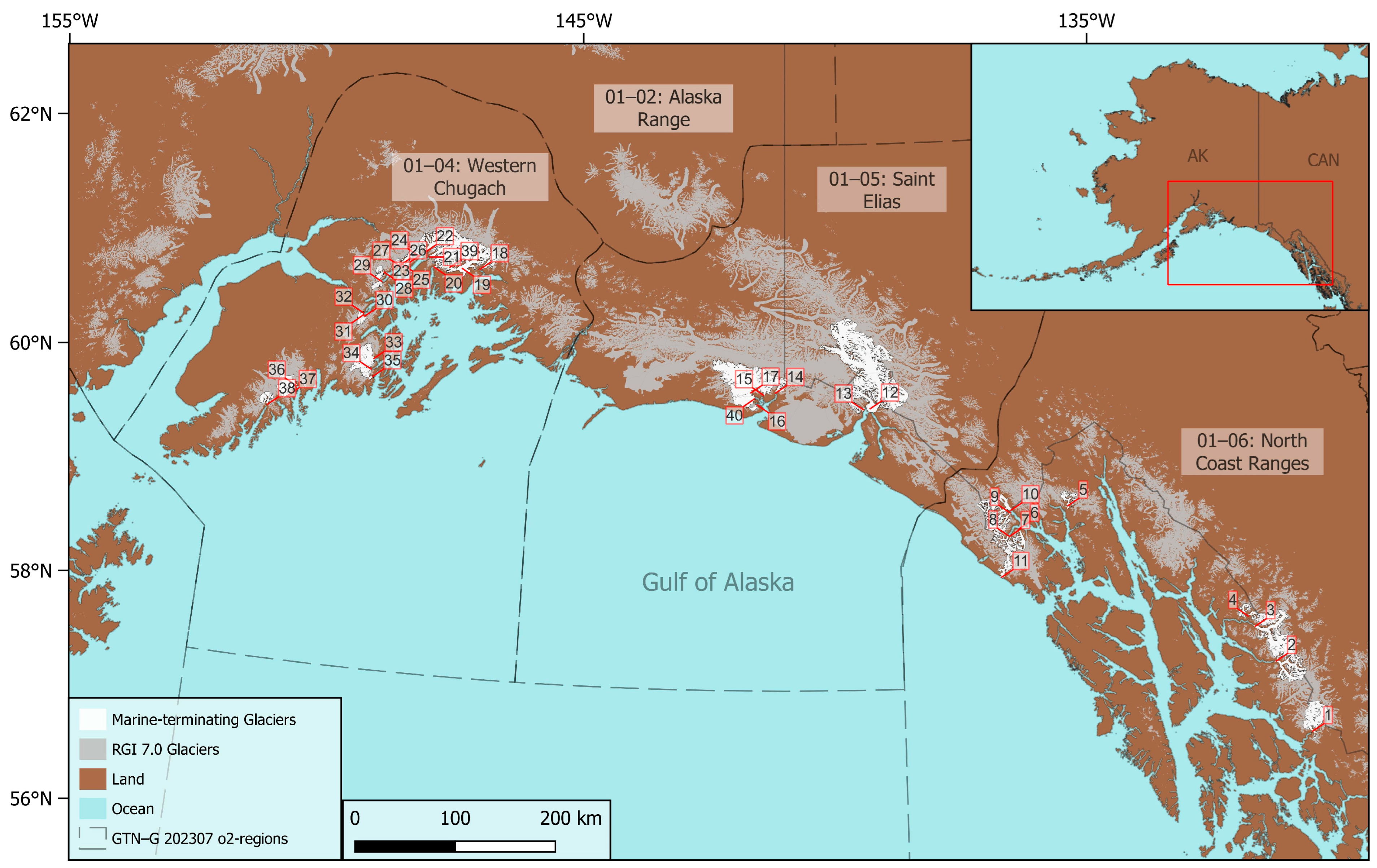
Marine-terminating glaciers are only found in southern Alaska. Consequently, the study region extends along the Gulf of Alaska from northwest British Columbia and the Coast Mountains to the western Chugach Mountains [29], between 56 and 61°N (Figure 1). It includes the three Randolph Glacier Inventory (RGI) version 7.0 o2-subregions: Western Chugach (01–04), Saint Elias (01–05), and North Coast Ranges (01–06), all of which are part of the Alaska RGI region (01) [29]. Most of the RGI 7.0 glacier area did not change compared to the RGI version 6.0, making a comparison to previous studies easier [30].
In the studied subregions of Alaska, marine-terminating glaciers represent 17.7% of the glacier area [29]. These glaciers have undergone significant retreat since the Little Ice Age, when most had reached their maximum extent between the early 18th and late 19th centuries [10,15,31,32].
Marine-terminating glaciers are particularly important because of their strong contribution to mass loss and SLR. Mc Nabb et al. [15] analyzed 50 of such glaciers with a total area of ~12,000 km2, showing that just four glaciers—Columbia, Hubbard, Yahtse, and LeConte—accounted for 65% of the total frontal ablation between 1985 and 2013. Their incomplete understanding, including the role of fjord geometry and ocean forcing, remains a challenge for accurately predicting future contributions to SLR [15,33].
Alaska’s climate is characterized by strong spatial gradients in temperature and precipitation. The environment ranges from subpolar to polar zones, with tundra vegetation and widespread boreal forests [34]. Climatic variability is primarily governed by latitude, elevation, and ocean proximity, with maritime conditions along the Coast Mountains and more continental climates in the Alaska Range [10,35]. Precipitation varies strongly, from approximately 200 mm annually in the North to up to 8000 mm in the southern Coast Mountains, which act as a barrier to Pacific air masses [11,36]. Large-scale atmospheric drivers include the Aleutian Low and the Pacific Decadal Oscillation (PDO), with positive PDO phases linked to warmer and wetter conditions [11,31]. Both long-term warming and increased precipitation have been observed in Alaska, accompanied by a shortening of the snow season and a longer persisting melt season [31,37,38].

3. Materials and Methods

3.1. Ice Discharge Calculation

Ice discharge is defined as the mass or volumetric flux of ice through a vertical cross section called ‘flux gate’, which is perpendicular to the flow of ice [16]. Precise estimation of ice discharge from marine-terminating glaciers is important for quantifying their mass loss [39].
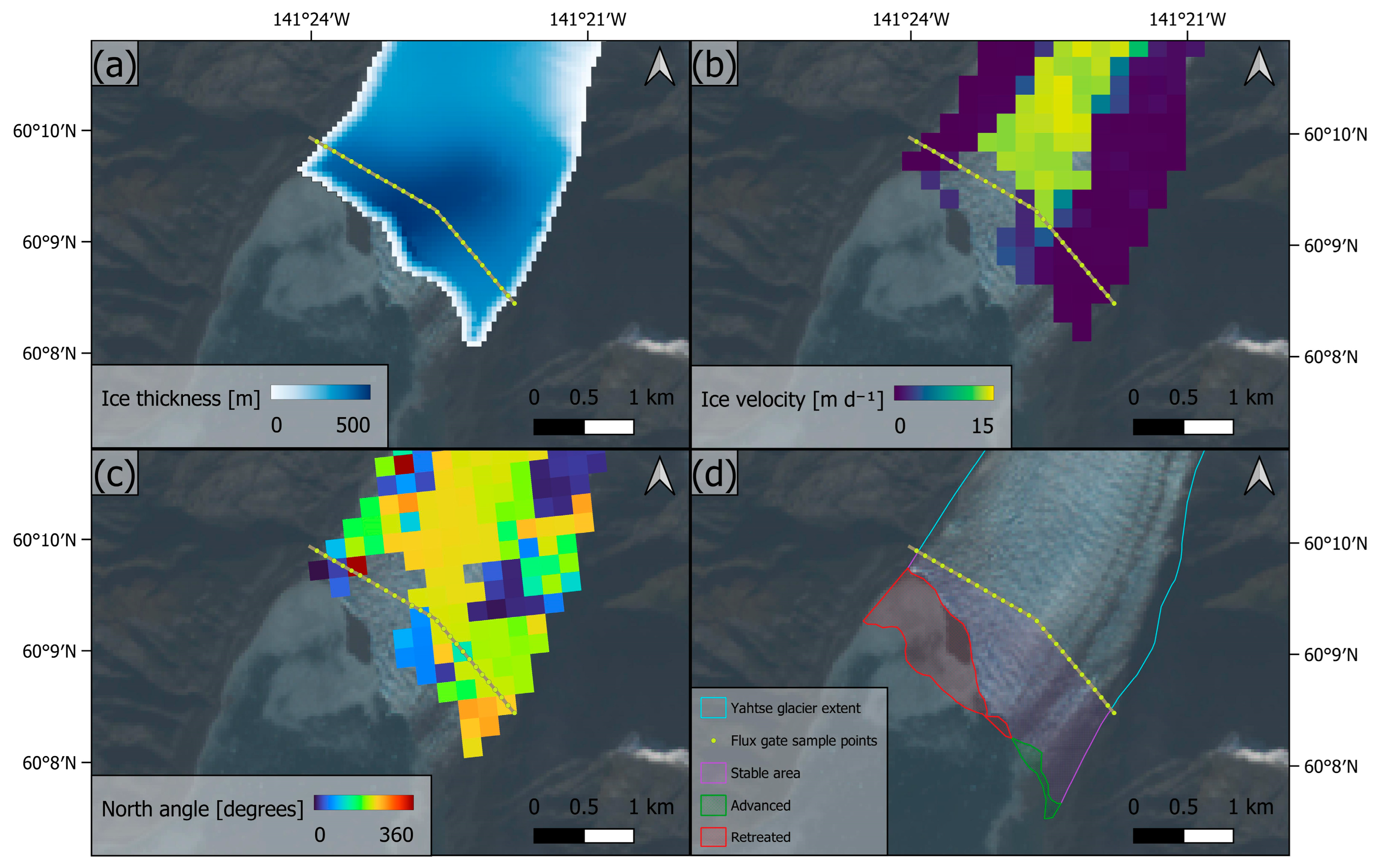
The volumetric ice discharge between January 2015 and September 2021 is calculated by multiplying ice velocity with the cross-sectional area (ice thickness), while integrating over a flux gate (see Figure 2) [27,39,40]. The formula after Rott et al. [41] was adapted to calculate the ice discharge rate ( D ˙ i c e , in Gt a−1):
D ˙ i c e = n = 1 N ρ w n H n u n   c o s   ( α n )
where N is the total number of flux gate segments, ρ is the density of ice, w n is the width of a flux gate segment at flux gate point n , H n the ice thickness of the segment, u n is the mean velocity of the vertical ice column and α n is the angle between the velocity vector and the angle perpendicular to the flux gate for the respective segment. The surface velocity v is used to estimate u n , which is assumed to represent 95% of the former—leading to the expression: u n = 0.95 v [18,41].
The ice volume flux is converted into the final mass flux by assuming an ice density ρ of 917 kg m−3 [16]. Ice velocity and thickness are point sampled at 100 m intervals along the flux gate—defined as flux gate segments. Ice thickness from Millan et al. [12] was temporally corrected for each ice discharge calculation as ice thickness data were only available from a reference date in July 2021. Surface elevation change data (dh/dt) from Hugonnet et al. [14] is taken for temporal ice thickness correction. We used the yearly dh/dt for each glacier between January 2015 and January 2020, and assumed that this rate remained representative for 2020–2021. Surface velocity magnitudes and flow angles are taken from the Sentinel-1 glacier flow database RETREAT [42].
Angles where α n > 90° are considered unreliable because they imply flow opposite to the expected discharge direction across the flux gate. Such values likely arise from noise or very slow-moving ice. These measurements are set to the flux gate segment’s perpendicular angle with a velocity of 5 m a−1 to minimize their influence on the discharge calculation. Final ice discharge values of the segments are linearly interpolated to fill gaps along each flux gate.
The dataset from Friedl et al. [42] consists of surface velocities and flow angles derived from Sentinel-1 Synthetic Aperture Radar (SAR) images by applying intensity offset tracking. The resulting monthly or annually averaged scene-pair velocity fields have a spatial resolution of 200 m with an uncertainty <0.08 m d−1. The angles are provided in degrees of displacement relative to true north. Monthly velocity magnitude and angle products are downloaded from the database between January 2015 and September 2021. Several months have poor coverage, especially during 2015 and 2016, while January 2021 is completely missing.
A recent glacier thickness dataset based on the shallow-ice approximation [43] is publicly available from Millan et al. [12]. The ice thickness dataset has a spatial resolution of 50 m with mean errors of 25–35% for ice thickness values > 100 m [12].
The flux gates are defined after Rott et al. [41]. Flux gates are usually chosen close to the calving front to avoid a correction of surface mass balance for the area between the calving front and the gate [40]. They also need to be positioned perpendicular to the flow direction of ice which can be difficult for glacier systems with a complex geometry, e.g., multiple glacier branches [39]. The flux gates were positioned for the year 2020 with the help of Landsat-8 optical imagery and have a length of ~100 km for the entire study region. Flux gates were positioned in locations that remained stable throughout the study period and were selected to avoid regions affected by terminus retreat, tongue separation, or glacier breakup. We paid attention to the coverage of ice thickness and velocity data to minimize data gaps in the following ice discharge calculation. However, some minor gaps remained in the data (Figure 2). All files included in the ice discharge calculation were projected into the coordinate system EPSG:32607—WGS 84.
The ice discharge is calculated for all distinct glacier termini contacting the ocean in 2020—therefore a glacier may have multiple flux gates. In total, 45 flux gates are drawn for 40 glaciers. Two flux gates were drawn for Tsaa glacier and six for Columbia glacier with two for the eastern branch and four for the western branch. Columbia glacier consisted of two branches since 2010 [23], which split up further before 2020. To stay consistent with naming, the four western flux gates are summarized as First Branch Columbia glacier and the two eastern flux gates as Columbia glacier, after RGI 7.0 [29].
Ice discharge is estimated as previously described by using a flux gate near but not directly on the glacier terminus [41]. The climatic mass balance (CMB)—accumulation or ablation processes—on the area between flux gate and terminus is not considered within ice discharge and terminus mass change [16,44]. By neglecting this contribution, frontal ablation might be overestimated by up to 19% [15,40]. Concerning ice discharge and terminus mass change, the overestimation might be up to 20% and 9%, respectively, as reported by Kochtitzky et al. [18]. The CMB, B ˙ c l i m , is used to correct the terminus mass change ( M ˙ t e r m ) and the ice discharge ( D ˙ i c e ). B ˙ c l i m comprises processes such as snow accumulation and melt at the surface, refreezing of melt or rain at the surface and melt or refreezing below the surface [18]. The climatic mass balance rate B ˙ c l i m can be estimated by only including surface mass balance, while the minor contribution from internal and basal mass balances can be neglected [15,18,40,45]. B ˙ c l i m is approximated here by calculating the mass change due to elevation change with dh/dt data from Hugonnet et al. [14]. This estimate already contains mass change due to surface mass balance [45] and potential dynamic thinning is neglected. The mean elevation change from 2015 to 2020 was −4.14 ± 5.92 m a−1 on the area uninvolved in terminus retreat or advance ( S f ) below the flux gates [14]. Other studies [15,45] account for the surface mass balance by taking a fixed value of −10 m w.e. a−1 (m w.e. = metres water equivalent) which corresponds to the highest value found on Columbia Glacier by Rasmussen et al. [46]. B ˙ c l i m is estimated for all areas downstream of the fluxgate (including unchanged area, lost and gained area, see Figure 2d), by calculating the mass change from the mean elevation change for each glacier and converting those values into the mean specific climatic mass balance rate, which is given in kg m−2 a−1. The corrected ice discharge ( D ˙ i c e c o r ) was then calculated after Kochtitzky et al. [18]:
D ˙ i c e c o r = D ˙ i c e + S f × B ˙ c l i m
with the ice discharge rate D ˙ i c e (Gt a−1), the area below the fluxgate which did not retreat or advance ( S f , in m2) and the mean specific climatic mass balance rate named B ˙ c l i m (kg m−2 a−1).
Figure 2. Input variables, exemplarily for Yahtse glacier. (a) Ice thickness in metres [12], (b) ice velocity in metres per day [12], (c) north angles in degrees [12] from July 2021 and (d) glacier terminus with flux gate and sample points along the flux gate (yellow), Yahtse glacier Randolph Glacier Inventory 7.0 outline [29] (light-blue), stable area S f (purple), advanced area (green) and retreated area (red). Background is from Landsat 8 10 October 2020 [46].
Remotesensing 18 01900 g002
Terminus mass change was estimated following Kochtitzky et al. [18] by manually digitizing glacier fronts from Landsat 8 images for 2015 and 2020 [47]. Mass loss rates were computed by using the CMB correction value B ˙ c l i m , together with the area and mean ice thickness of the retreated or advanced glacier area [15,18,45]. Terminus mass loss is indicated by a negative sign and terminus mass gain by a positive sign according to Kochtitzky et al. [18]. Frontal ablation was then calculated as the sum of ice discharge and terminus mass change after Cogley et al. [16] and Kochtitzky et al. [18].

3.2. Uncertainty

Ice discharge uncertainty is estimated by computing velocity and angle errors from Friedl et al. [42] ice velocities and angles. Ice thickness errors are provided in the dataset from Millan et al. [12]. From the ice discharge term (Equation (1)) similar to Kochtitzky et al. [18] follows:
σ D ˙ i c e = ρ n D ˙ i c e H n σ H n 2 + D ˙ i c e u n σ u n 2 + D ˙ i c e α n σ α n 2
and for the corrected ice discharge σ D ˙ i c e c o r with σ B ˙ c l i m :
σ 2 D ˙ i c e c o r = σ D ˙ i c e 2 + S f × σ B ˙ c l i m 2 + σ S f × B ˙ c l i m 2
where σ H n and σ u n are the uncertainties for ice thickness and velocity at flux gate point n , respectively. σ α n is the angle uncertainty. σ B ˙ c l i m is the uncertainty of the mean specific climatic mass balance rate, which is calculated by taking the elevation change error from Hugonnet et al. [14]. σ S f is the uncertainty of gained or lost area below the flux gate, determined from its perimeter multiplied by the width of one pixel, which is 30 m for Landsat [18,45,48].
Millan et al. [12] report an uncertainty of 30% for their modelled glacier thickness. Uncertainties are primarily related to the surface slope, ice velocity, and for several glaciers exhibiting surge type behaviour [12]. The study by Millan et al. [12] identified four surging glaciers in Alaska from 2015 to 2019 for which they increased their uncertainty estimate up to 75%. However, no further evaluation of potentially surging glaciers during the study period was carried out.
The uncertainty of ice velocity can be estimated by calculating ice velocity over ice free land areas, which are assumed to be motionless, or by in situ measurements [49,50]. Since the latter was not available, the median ice velocity for all pixels classified as land was taken as an uncertainty value. Sánchez-Gámez and Navarro [40] concluded that the angle uncertainty can be neglected due to a low contribution to the ice discharge uncertainty. However, here, the angle uncertainty σ α n was estimated with the formula after Mouginot et al. [49]:
σ α n = σ u n 2 × u n
with the uncertainty in velocity σ u n and the velocity u n .

3.3. Atmospheric Data

Atmospheric data from the fifth generation of European ReAnalysis (ERA5) is used to investigate the glacier-climate relationship for marine-terminating glaciers in Alaska. ERA5 is produced by the European Centre for Medium-Range Weather Forecasts (ECMWF), which is embedded within the Copernicus Climate Change Service (C3S) from the European Commission [51].
Monthly averaged data from the ERA5-Land dataset is used from the Copernicus Climate Data Store [51]. The ERA5-Land monthly averaged dataset contains air temperature 2 m above ground (K), snowfall (m w.e.) and total precipitation (m), which were downloaded for the study period spanning from January 2015 and September 2021 [52]. The data are extracted for each glacier location at the flux gate and mean values from all glaciers are calculated. The air temperature above 2 m (further referred to as surface temperature) is converted into degrees Celsius. Correlation analysis was carried out using Spearman’s rank correlation test because the data are not normally distributed [53]. Trends are analyzed first by decomposing the timeseries data with Seasonal Decomposition of Time Series by Loess (STL) after Cleveland et al. [54], before applying a linear regression [53].

3.4. Ocean Temperature Data

The Global Oceanic and Sea-Ice Reanalysis (GLORYS12) dataset is used for further analysis regarding ocean-glacier interaction, as it includes a three dimensional dataset of ocean temperature and is available at 1/12 degrees horizontal resolution [55]. GLORYS12 covers 50 vertical levels from 1993 onward and is part of the Copernicus Marine Environment Monitoring Service (CMEMS) [56]. The dataset was produced by using in situ and satellite observations, numerical modelling and data assimilation [55].
The GLORYS12V1 monthly product was downloaded from the Marine Data Store [56] for the longest available period January 2015 to June 2021. The variable sea water potential temperature (°C), from now on referred to as ocean temperature, is used for further analysis. As coverage was not always available close to the glacier termini, a buffer of 50 km distance was placed around the flux gates and the mean of those pixels is taken from the GLORYS12 data for each glacier. This buffer was chosen to ensure sufficient spatial coverage of the ocean temperature product across all glaciers. For that reason, some glaciers are sampled with similar or identical ocean temperature samples because they are located in the same fjord. Some glaciers have to be sampled further away due to poor coverage. For Columbia glacier for example, coverage starts 16 km south of its terminus. Therefore, sampled ocean temperature reflects regional rather than local conditions.
Due to differing spacing between each depth level, the depth weighted mean is calculated from the ocean temperature data. A maximum of 32 depth levels, equal to a depth from 0.49 to 541.09 m is chosen, accounting for typical fjord depth and ice thickness. The mean thickness at the flux gates was 248 ± 72 m [12]. The mean fjord depth at all glacier termini is 241 m, which was retrieved from the southern Alaska coastal relief model [57]. Finally, a correlation analysis was performed as described in Section 3.3.

3.5. Seasonal Patterns

Seasonal effects have strong controls on submarine melt and subglacial discharge, and thus glacier velocities [25,58]. Marine-terminating glaciers show different seasonal velocity patterns which can be determined either by terminus position change or meltwater [59].
Therefore, seasonal variability is analyzed according to Moon et al. [59] and glaciers are assigned into three categories of behaviour. Type 1 behaviour is characterized by a glacier velocity speedup between late spring and early summer. Velocity remains high until it decreases in late winter or early spring. For Type 2, velocity strongly increases during early summer and decreases during mid-summer. Winter velocities can be higher than during spring and fall but mostly remain lower than during summer. Type 3 is distinguished by a late summer minimum. Over the winter, velocity steadily increases before it begins slowing down during mid-summer [59].
For the seasonal characterization, the mean glacier velocity from Friedl et al. [42] is taken at the flux gates and linearly detrended. The mean velocity is computed for each month and glacier. This seasonal velocity variability is then used to manually identify the type of behaviour for each glacier after Moon et al. [59].

4. Results

4.1. Ice Discharge

For all 40 glaciers within the study region, the average ice discharge from January 2015 to September 2021 was 11.81 ± 5.35 Gt a−1. Per glacier, the yearly ice discharge was 0.05 ± 0.07 Gt a−1 on average (median: 0.04 ± 0.07 Gt a−1) and with a standard deviation of 0.81 ± 0.24 Gt a−1. The glaciers which had the highest contributions were Hubbard glacier (4.49 ± 1.30 Gt a−1), Columbia glacier (2.93 ± 1.12 Gt a−1; both branches together) and Yahtse glacier (0.76 ± 0.30 Gt a−1). These three glaciers together represented ~70% of the entire ice discharge (Table 1).
Table 2 shows the uncorrected ice discharge values for each glacier. In total, the difference between uncorrected and corrected ice discharge is 0.25 ± 0.1 Gt a−1. Columbia glacier had the highest correction value, as it was also the glacier which had lost the most terminal glacier area (Table 1). Unfortunately, Dawes glacier could not be corrected, because there was not sufficient coverage at the terminus.

4.2. Terminus Mass Loss

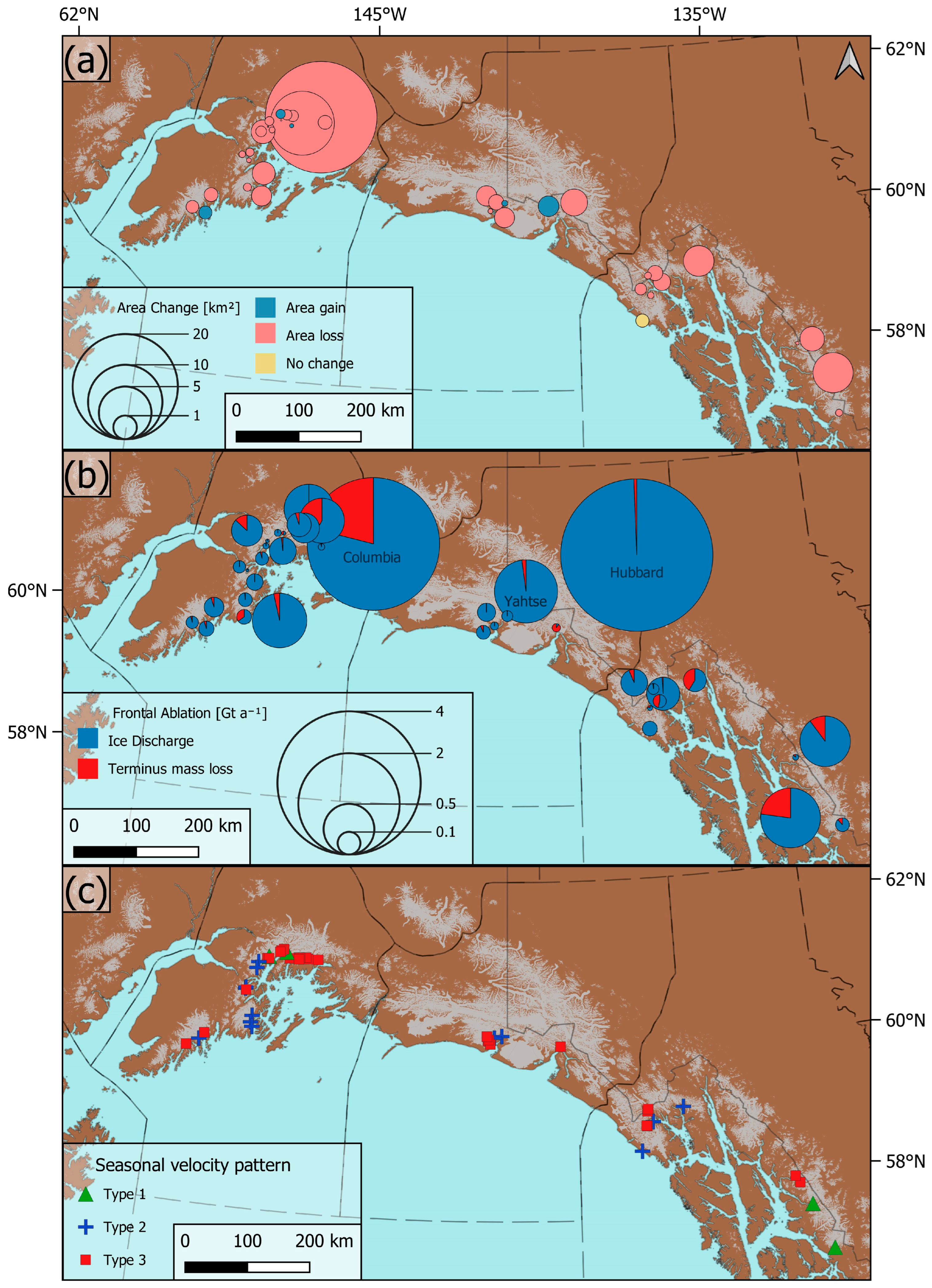
The total manually derived area change at the glacier termini from July 2015 to October 2020 is −29.24 ± 4.19 km2, indicating an overall area loss (Table 1). La Perouse glacier did not change during the study period (Figure 3a), 7 glaciers gained area (Turner, Tyndall, Meares, Harvard, Bryn Mawr, Cascade and Holgate glacier), and 32 of the glaciers lost area. The area gained on the terminus accounts for 2.07 ± 1.02 km2 while the lost area contributes −31.31 ± 4.23 km2. It is clearly visible (Figure 3a) that both branches of Columbia glacier contribute the most by losing 19.62 ± 1.08 km2, explaining two thirds of the total area change. The mean area change is −0.73 ± 0.10 km2 (median change: −0.11 ± 0.08 km2) with a standard deviation of 2.37 ± 0.12 km2.
The net terminus mass loss during the study period was 1.30 ± 0.07 Gt a−1. Some glaciers advanced (Turner, Tyndall, Meares, Harvard, Bryn Mawr, Cascade and Holgate glacier), and one glacier was stable (La Perouse). However, 32 of 40 glaciers (80%) retreated at the terminus from 2015 to 2021. The mass loss of 1.33 ± 0.07 Gt a−1 exceeded the mass gain from advance of 0.028 ± 0.003 Gt a−1 (Table 1).
The largest contributors were Columbia glacier with −0.73 ± 0.02 Gt a−1, First Branch Columbia glacier with −0.17 ± 0.02 Gt a−1 and Dawes glacier with −0.163 ± 0.006 Gt a−1. The mean terminus mass change was −0.033 ± 0.002 Gt a−1 (median: −0.0012 ± 0.0004 Gt a−1) with a standard deviation of 0.118 ± 0.004 Gt a−1.

4.3. Frontal Ablation

The total frontal ablation from January 2015 to September 2021 was 13.11 ± 5.35 Gt a−1. The mean frontal ablation was 0.33 ± 0.13 Gt a−1 (median: 0.04 ± 0.07 Gt a−1). On average, ice discharge explains ~89% of the entire frontal ablation. For several glaciers, and for example Turner glacier, terminus mass loss contributed more to frontal ablation than ice discharge. The results for all glaciers are summarized in Table 1.
Hubbard and Columbia glacier are the largest contributors to frontal ablation. While ice discharge made up 99.6% of Hubbard glacier’s frontal ablation, it accounted for 78.7% of Columbia glacier’s and 57.5% of the First Branch Columbia glacier’s frontal ablation. Turner glacier received a negative ice discharge value because the CMB correction value (Equation (2)) was higher than the uncorrected ice discharge, which is outside the expected range of values. A potential cause might be the poor coverage of dh/dt data from Hugonnet et al. on some glacier termini. This would also result in a negative frontal ablation value. Consequently, the uncorrected ice discharge value for Turner glacier of 0.012 ± 0.055 Gt a−1. is used for further analysis. Turner glacier’s terminus, however, advanced and gained 0.012 ± 0.001 Gt a−1 which means that the frontal ablation results to zero (Table 1). For area change, ice discharge and terminus mass loss, see Figure 3.

4.4. Seasonality

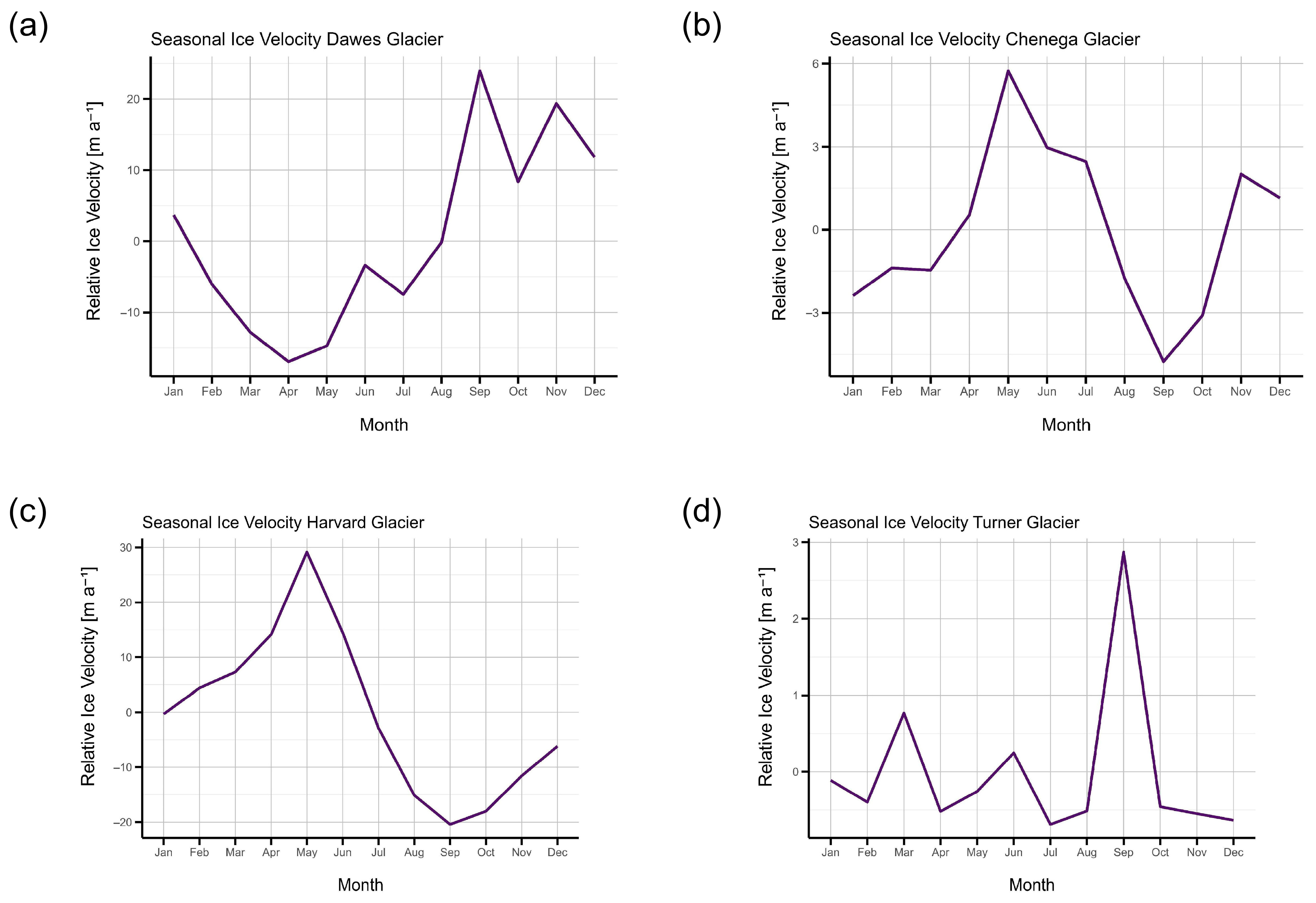
Four glaciers (8.9%) were assigned to Type 1 behaviour, thirteen (28.9%) were classified as Type 2 and twenty-seven (60%) as Type 3 (Figure 3c). Turner glacier was not clearly distinguishable as velocity decreases from January onwards reaching a low in July (Figure 4d). Afterwards, velocity shortly peaks in September and decreases again in October. Glacier velocity data were analyzed for each flux gate, with the multiple flux gates of Tsaa and Columbia glaciers considered separately. For both Tsaa gates and all Columbia gates, Type 3 behaviour was observed. Overall, Type 3 was the dominant category representing ~60% of all glaciers.
All types are scattered across the study region, and therefore no clear geographical pattern is visible (Figure 3c). Dawes glacier for example (Figure 4a), located in the North Coast Ranges, was assigned to Type 1 as it shows a late winter/spring velocity deceleration followed by a late spring/early summer acceleration.
Chenega glacier (Figure 4b) is characterized by an early summer speedup and mid-summer slow-down and was for that reason classified as Type 2. Winter velocity is elevated but it remains lower than the summer maximum.
Type 3 behaviour is observed e.g., for Harvard glacier (Figure 4c), whose seasonal velocity is governed by a mid-summer slowdown which leads to a pronounced late summer minimum. After that, velocity steadily increases again.

4.5. Climate-Glacier Relationship

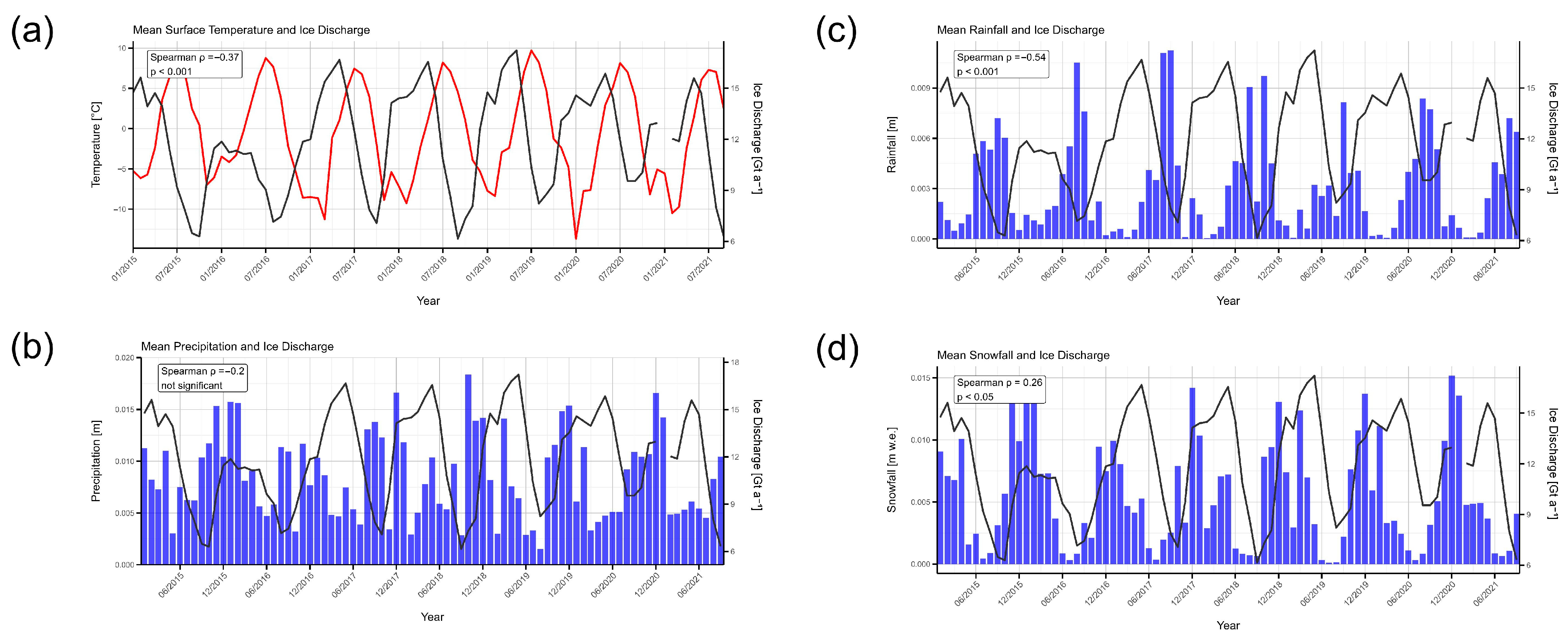
Ice discharge and surface temperature showed a moderate negative Spearman correlation of ρ = −0.37 (p < 0.001). The relationship between precipitation and ice discharge was not significant (Spearman ρ = −0.20, p = 0.07). Rainfall was moderately negatively correlated with ice discharge, with ρ = −0.54 (p < 0.001). Snowfall, on the other hand, showed a weak positive correlation with ice discharge (ρ = 0.26, p < 0.05), compare Figure 5.
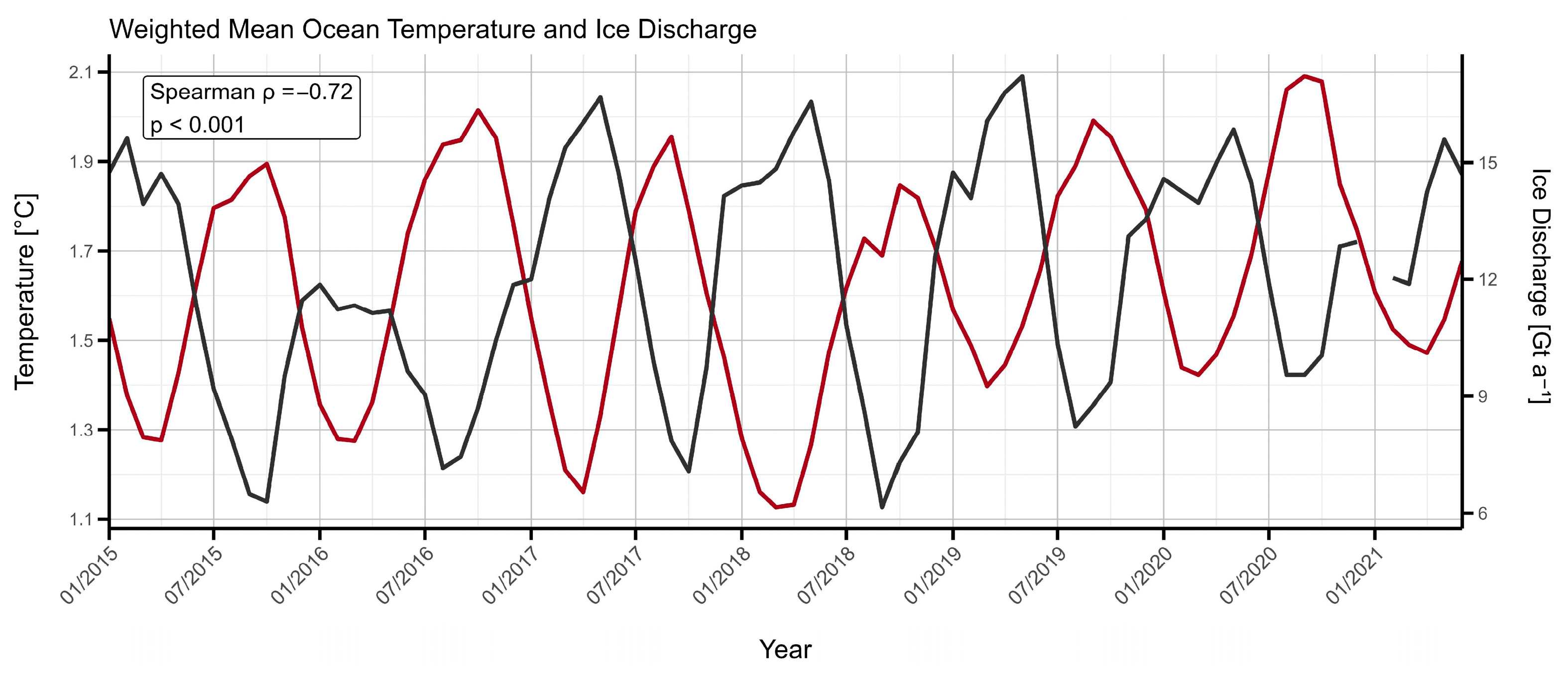
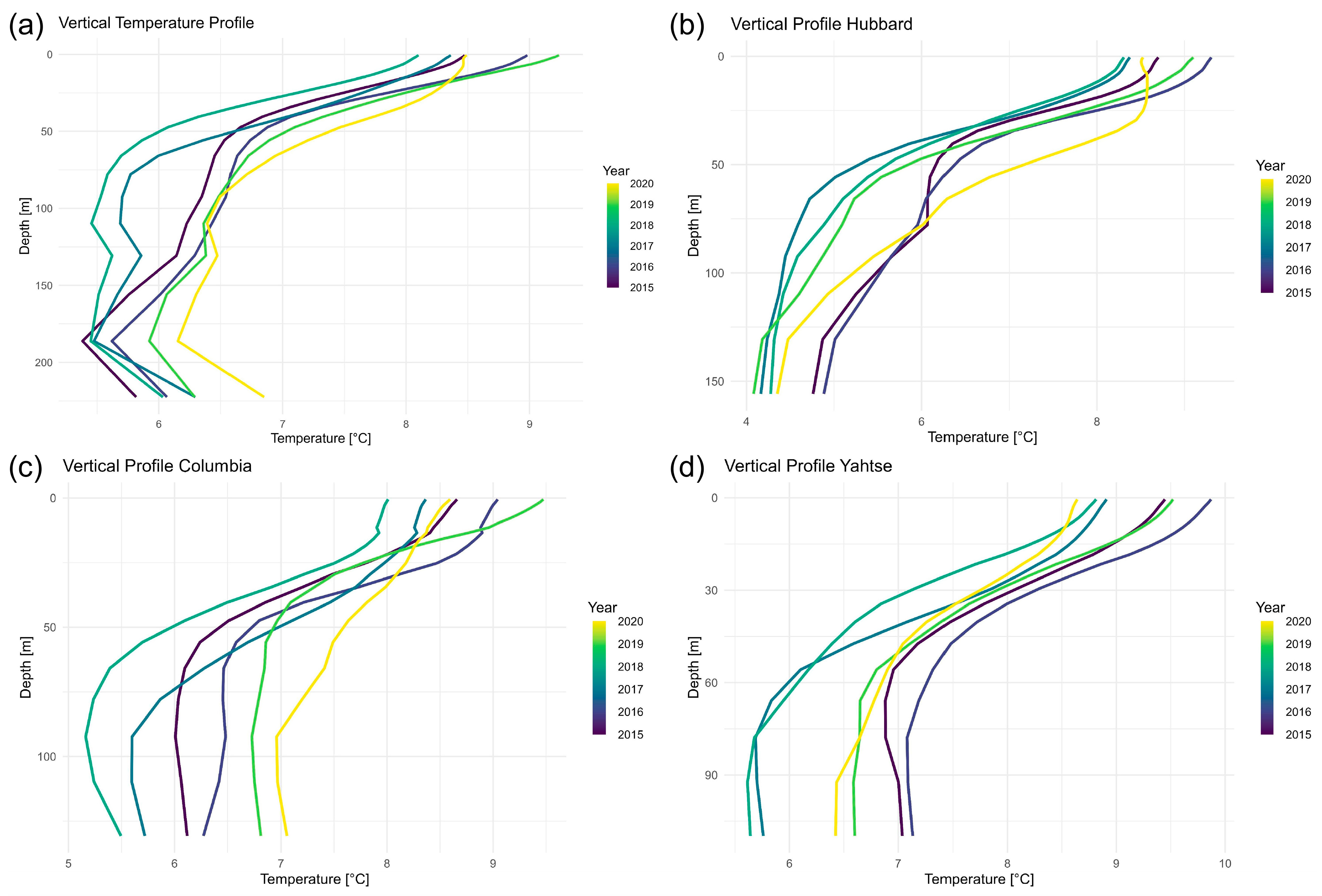
The strongest relationship was found with ocean temperature (Figure 6). Weighted mean ocean temperature was strongly and negatively correlated with average ice discharge, with ρ = −0.72 (p < 0.001). Hubbard and Columbia glacier exhibited strong negative correlations of −0.62 (p < 0.001) and −0.65 (p < 0.001). Ocean temperature at Yahtse glacier conversely showed a low positive correlation with ice discharge (Spearman ρ = 0.23, p < 0.05). This relationship was most prominent during September. Compared to 2015, ocean temperatures for 2016, 2019 and 2020 are warmer. However, during 2017 and 2018, temperatures dropped, especially below 50 m depth. Overall, mean ocean temperatures increased by 0.16 °C (0.002 °C per month) from January 2015 to June 2021.
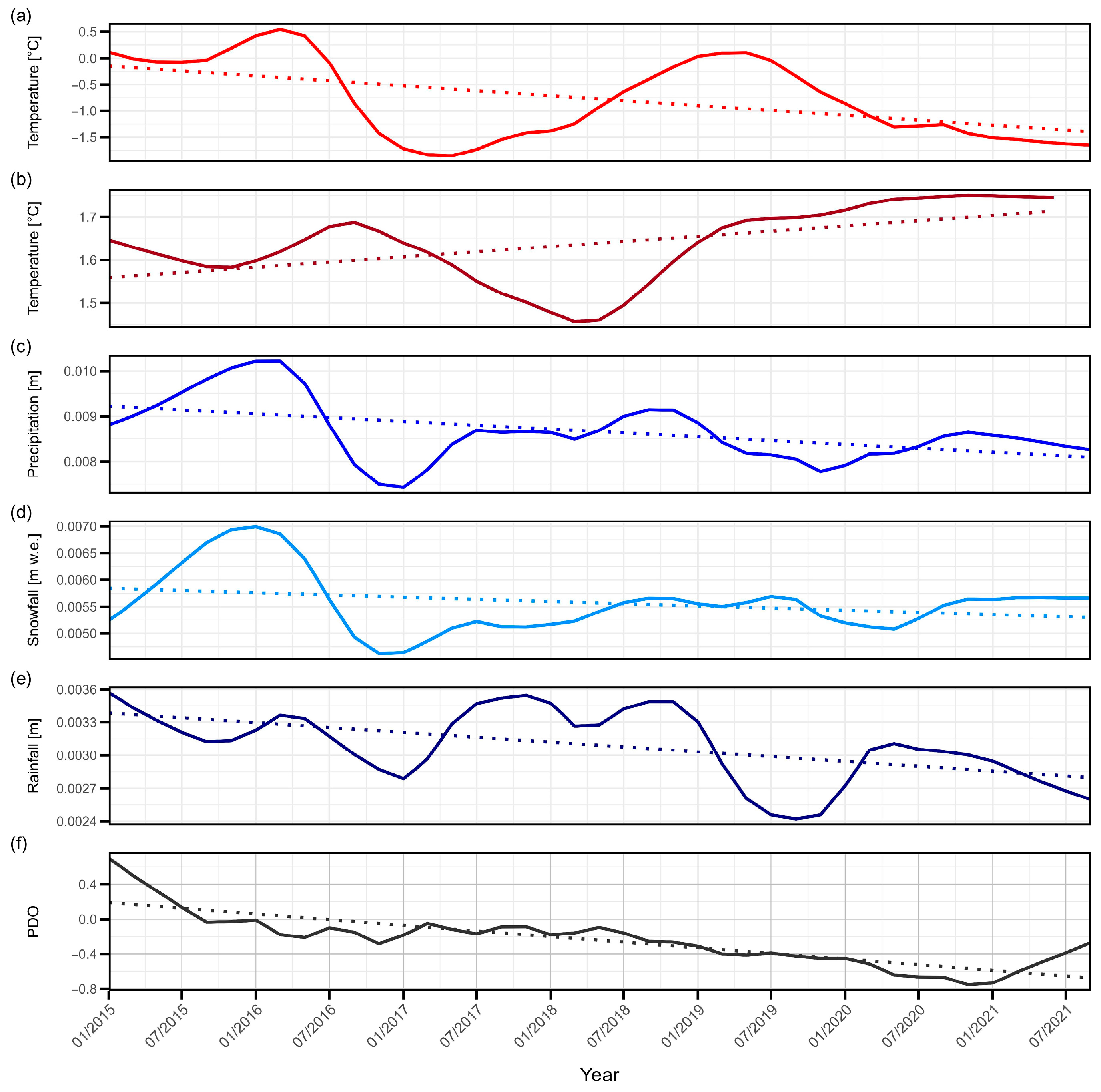
In contrast to ocean temperature, all other variables showed decreasing trends (Figure 7). Simultaneously, the PDO switched from positive to negative. Surface temperature decreased by 1.26 °C (0.02 °C per month), total precipitation by 1.1 mm (0.014 mm per month), snowfall by 0.000550 m w.e. (0.000007 m w.e. per month) and rainfall by 0.5945 mm (0.0073 mm per month). All trends, PDO excluded, were found to be highly significant (p < 0.001).

5. Discussion

5.1. Comparison to Other Studies

Several studies have quantified frontal ablation of Alaskan glaciers over different periods, glacier types, and using varying methodological approaches [15,18,44]. Although these studies broadly agree that frontal ablation represents a major component of glacier mass loss, substantial differences exist in reported rates of frontal ablation and ice discharge. These discrepancies can largely be attributed to differences in study period, glacier type (marine- vs. lake-terminating), ice thickness and velocity data, treatment of CMB between flux gate and terminus, and dominant glacier contributions.
McNabb et al. [15] reported a mean frontal ablation rate of 15.11 ± 3.63 Gt a−1 and a total ice discharge of 15.4 Gt a−1 for the period 1985–2013, compared to 13.11 ± 5.35 Gt a−1 of frontal ablation and a mean ice discharge of 11.81 ± 5.35 Gt a−1 found here for the period 2015–2021. The study [15] investigated frontal ablation of 27 marine-terminating glaciers in Alaska, representing 96% of the total marine-terminating glacier area. Frontal ablation was computed by taking the sum of calving and submarine melt at the terminus while using a flux gate approach. Thickness variations were accounted for, while surface mass balance between the flux gate and terminus was approximated using a CMB of −10 m w.e. a−1 for all glaciers, corresponding to the maximum value observed at Columbia Glacier. This assumption is considerably more negative than the average CMB of −3.72 ± 5.33 m w.e. a−1 estimated for the same area in this study, and likely contributes to higher frontal ablation estimates for McNabb et al. Differences are further influenced by the study period, as McNabb et al. include years of particularly rapid retreat, especially at Columbia Glacier, which alone accounted for ~25% of total frontal ablation.
Kochtitzky et al. [18] estimated frontal ablation and ice discharge of Northern Hemisphere marine-terminating glaciers from 2000 to 2010 and 2010 to 2020, including 42 glaciers in Alaska. For Alaska, frontal ablation rates decreased from 11.59 ± 0.39 Gt a−1 during 2000–2010 to 10.68 ± 0.33 Gt a−1 during 2010–2020, while ice discharge declined from 11.49 ± 0.35 Gt a−1 to 9.79 ± 0.18 Gt a−1 over the same periods. In contrast, terminus mass loss increased nearly tenfold. Compared to Kochtitzky et al., this study finds higher frontal ablation, ice discharge, and terminus mass loss for 2015–2021, which may reflect both methodological differences (e.g., thickness assumptions and velocity datasets) and differences in the observation periods. Nevertheless, both studies consistently show that frontal ablation is dominated by ice discharge (≈89–92%) and that a small subset of glaciers contribute disproportionately to total mass loss. Frontal ablation was defined consistently in Kochtitzky et al. and in this study as the sum of ice discharge and terminus mass change. Ice velocity data were mainly taken from annual displacement mosaics generated from Landsat of the Inter-mission Time Series of Land Ice Velocity and Elevation (ITS_LIVE). The study [18] used directly measured thickness data from the Glacier Thickness Database (GlaThiDa) 3.0.3 and accounted for thickness change during the study period by incorporating elevation change data from Hugonnet et al. [14]. Where no observations were available, they incorporated modelled ice thickness from Millan et al. [12]. Kochtitzky et al. [18] report that the modelled ice thickness was on average 135 m higher than observations on the fluxgate. Unlike McNabb et al. [15], they explicitly modelled the CMB between the flux gate and terminus rather than applying a constant value. Similar to this study, glacier terminus positions were mapped manually, primarily by using optical imagery (Landsat or ASTER) to calculate mass change due to terminus retreat or advance.
Catania et al. [44] focused on 55 lake-terminating glaciers in Alaska from 2009 to 2018 using a flux-gate approach like McNabb et al. [15]. The authors reported a total frontal ablation of 6.1 Gt a−1 for all lake-terminating glaciers combined, with a median frontal ablation rate of 0.04 Gt a−1, which closely matches the median value found in this study (0.04 ± 0.07 Gt a−1). In contrast to marine-terminating glaciers, ice discharge values and total frontal ablation were substantially lower. Catania et al. [44] show that nearly all lake-terminating glaciers retreated over recent decades, with higher mean retreat rates than marine-terminating glaciers yet lost substantially less mass overall. This contrast highlights the importance of the terminus environment: marine-terminating glaciers experience enhanced mass loss due to calving dynamics and submarine melt, even if retreat rates are lower on average. The dominance of individual glaciers, such as Columbia Glacier, also strongly influences mean retreat and mass loss statistics across all studies. Catania et al. [44] used ice thickness and velocity data from Millan et al. [12]. CMB between flux gate and terminus was approximated using a constant value of −10 m w.e. a−1 as in the study of McNabb et al. [15]. Terminus retreat was also determined by manually delineating glacier terminus positions between 1984 and 2021 from annual Landsat imagery [45].

5.2. Drivers

Glacier retreat is initiated if there is an imbalance between ice discharge and terminus mass loss [44]. Caldwell et al. [45] define two types of frontal ablation. The first one is active frontal ablation, where the incoming ice discharge is higher than the terminus mass loss. The other type is passive frontal ablation, which is characterized by low ice discharge rates but high terminus mass loss. Both of these types can lead to high frontal ablation rates but active frontal ablation may let the whole glacier react to terminus conditions with positive feedbacks [45]. In this study, ice discharge was found to be the most important driver of mass loss (see Section 4), and therefore, active frontal ablation dominates. However, it remains unclear how far a comparison of lake- and marine terminating glaciers is suitable.

5.2.1. Glacier Velocity

Ice discharge greatly depends on ice velocity [44], which is seasonally controlled [23] and tends to be higher under maritime climatic conditions [33]. Typically, velocities of glaciers in Alaska reach their maximum somewhere around spring and their minimum during late summer or fall [15,23,60]. We found Type 3 (see Section 3.5 and Section 4.4) behaviour for most of the glaciers (60%) in the study area. This velocity pattern has been described for glaciers in Alaska by previous studies [15,23,33,60,61,62].
However, some glaciers may show characteristics of more than one pattern, e.g., Chenega glacier. Moon et al. [59] suggest that melt plays an important role for the Type 1 behaviour, where meltwater increases the velocity from spring to summer. High velocities through late summer and fall, combined with the observation that this pattern occurred for a few glaciers and was not continuous over the years, indicated that Type 1 behaviour mostly depends on the glacier terminus position [59]. From the four Type 1 glaciers, Dawes glacier retreated the most (compare Table 1), while the others (Barry, LeConte and Yale glacier) did not retreat considerably.
Type 2 glaciers are associated with increasing runoff which accelerates ice velocity during early summer [59]. Some glaciers accelerated earlier or decelerated during late summer/spring. It is unclear whether those glaciers should be classified as Type 3 or as Type 2. A comparison with runoff data might help to better understand the dynamics, but this was beyond the scope of this study. Nevertheless, Type 2 behaviour implies that most of those glaciers do not have or only possess a weak drainage system [59].
The Type 3 pattern indicates that there is a change from an inefficient to an efficient drainage system due to decreasing velocity when runoff is high [59]. A majority of glaciers show this pattern clearly (e.g., Harvard glacier, see Figure 4c), with a pronounced maximum during spring and a minimum that most often appears in September or October (late summer/early fall). Turner glacier, which was not assigned to any type, could arguably be considered a Type 1 glacier, because terminus mass change was comparably high. Given the subjectivity of this classification, future studies should investigate these different velocity patterns in more detail. Considering the rather low number of glaciers and the strong difference between them, we could not clear thresholds or similar clustering metrics. Consequently, we stuck to the manual clustering approach.
Enderlin et al. [22] also stated that the subglacial drainage system has greater effects on glacier velocity than terminus retreat or advance. Therefore, meltwater induces changes in basal motion depending on the evolution of the drainage system [60]. This leads to an offset between ice discharge and temperature. While the drainage channels for meltwater have not developed yet, the increasing availability of meltwater raises the pressure below the glacier, which induces basal motion and leads to a speedup in ice velocity [62]. As soon as the system is developed, meltwater starts draining and pressure is released which slows down the glacier’s velocity [60]. Drainage channels start to close at the beginning of winter, and hence velocity starts increasing because of remaining summer meltwater [23] and rainwater entering the drainage system [60]. The correlation of ocean temperature and ice discharge indicates that this relationship is highly significant (Figure 6).
Glacier surges, defined as periodical changes in flow with exceptionally high velocities [17,33], can bias mass loss estimates and lead to higher frontal ablation rates [14,18]. The RGI 7.0 [29] suggests that only La Perouse glacier is known to surge in the study region. La Perouse glacier had very low mean velocities at the flux gate of 5.5 ± 1.5 m a−1 and did not advance or retreat. This indicates that La Perouse glacier was possibly in a quiescent phase [33,63].

5.2.2. Terminus Retreat

Terminus retreat can increase glacier velocities [22], but this happens on interannual timescales rather than seasonal. Retreat can be triggered by thinning, which reduces friction at the glacier bed resulting in a velocity increase [23]. And indeed, thinning was observed on most of the glaciers during the study period with a mean elevation change of −1.59 ± 0.32 m a−1 (median: −0.94 ± 0.31 m a−1) [14]. This also matches the finding that most of the glaciers retreated from 2015 to 2020. Retreat, however, was dominated by Columbia glacier, which retreated even further while splitting into separate glacier tongues and thinning annually by −3.20 ± 0.19 m [14].
Terminus retreat also depends on other conditions such as (1) whether the glacier tongue is grounded or not, (2) whether the terminus is buttressed by an ice mélange and (3) submarine melt [44]. (1) and (2) would need further investigation as this was beyond the scope of this study. (3) can be related from ocean temperature variation. Submarine melt either results from ambient melt due to warm ocean waters or from discharge driven melt where meltwater is discharged through the subglacial drainage system and forms plumes that enhance melt [25,58]. The latter is hypothesized to be the most important driver [15,25,58].
Jackson et al. [25] also state that submarine melt is the primary driver of terminus retreat during summer and glacier dynamics are the primary driver during winter. The observed strong negative correlation between ice discharge and ocean temperature (Figure 6) suggests a link between subglacial discharge and ice discharge. As ocean temperature decreases at the end of summer, ice discharge starts increasing again. When air and ocean temperature drop in fall, the subglacial channels change from efficient to inefficient, which leads to an increase in ice discharge [15,23].
The observed increasing trend in ocean temperature presumably elevates ambient melt. This might also partly explain the higher rate of terminus mass loss compared to Kochtitzky et al. [18]. The ocean temperature increase can be seen for most years and depths (Figure 8). Two years are the exception, 2017 and 2018, where temperatures are significantly lower between ~50 m and ~200 m depth. It is also notable that this difference is more pronounced for Yahtse (Figure 8d) than for Hubbard (Figure 8b) and Columbia (Figure 8c) glaciers. We observed this drop in mean ocean temperatures over the entire study region (Figure 7b).

5.2.3. Atmospheric Drivers

During the study period, the PDO index became increasingly more negative [64], coinciding with lower temperatures and precipitation (Figure 7). This trend is consistent with decreasing trends for most of the analyzed ERA5 variables, as a negative PDO phase is usually associated with lower temperature and precipitation [11]. Short-term peaks in surface temperature and snowfall during 2015/2016 and 2018/2019 aligned with El Niño events, while colder phases aligned with La Niña years [65]. These variations were observed in the ERA5 data, suggesting a considerable effect of ENSO on glacier mass balances in Alaska over the study period [43]. However, quantifying the effect of these climate-modes on ice discharge and frontal ablation exceeds the scope of this study.
Surface temperature was weakly correlated (Figure 5a), but the comparison also reveals that ice discharge decrease happens shorty before surface temperatures reach a maximum in July. This means that the drainage system needs at least one or two months to develop, but once fully developed, it results in an ice discharge reduction of up to ~60%.
Precipitation had the lowest correlation of all variables and was not significant (Figure 5b). Snowfall showed no strong positive relationship (Figure 5d). The moderate negative correlation between rainfall and ice discharge may reflect the generally efficient subglacial drainage conditions that prevail during much of the summer melt season. Under these conditions, additional rainfall can be evacuated efficiently through the drainage network and is therefore not associated with increased ice discharge. However, periods of high rainfall coinciding with increased ice discharge in late summer and early autumn (August–October; Figure 5c) indicate short-term glacier acceleration caused by enhanced water input to a progressively less efficient drainage system. The abrupt increase in ice discharge during this period suggests that seasonal changes in drainage efficiency influence the glacier’s dynamic response to rainfall [66]. While this mechanism may explain individual late-season discharge peaks, the overall relationship between rainfall and ice discharge remains negative.

5.2.4. Glacier Geometry and Mass Balance

Compared to other regions and land terminating glaciers, marine-terminating glaciers in Alaska have experienced less mass loss [14]. A possible explanation is the coastal setting of these glaciers within high altitude, accompanied by high accumulation [33]. The response of a glacier, reflected in its mass balance, is determined by the glacier’s geometry and the local climate variability [21]. Glacier geometry (width, surface and bed topography) is a first-order control on glacier dynamics [22,44].
Zeller et al. [67] recently published an inventory of accumulation area ratios (AAR) and equilibrium line altitudes (ELA) for over 3000 glaciers in Alaska (88% of regional area) between 2018 and 2022. The study observed that maritime glaciers had lower ELAs compared to continental glaciers. ELAs were maximized during 2018 and 2019, which resulted from extraordinary high summer temperatures [67]. This was clearly coinciding with the observed rising temperatures on all marine-terminating glaciers during this study (Figure 7a).
For regions with marine-terminating glaciers, Zeller et al. [67] reported greater surface elevation loss than for other regions with the same AAR. This might be due to mass loss from frontal ablation which cannot be constrained with AAR variability [18,67].
Many glaciers still had low ELAs and AARs >0.5 on average from 2018 to 2022. Glaciers with comparably low AAR are, e.g., Turner glacier (AAR = 0.21), Northland glacier (AAR = 0.28) and First Branch Columbia glacier (AAR = 0.24).
Therefore, comparably low ice discharge values can be explained by such low AARs. Depending on glacier size and the sensitivity of ELA increase [68], glaciers with higher AARs tend to show higher rates of ice discharge. This is especially the case for Hubbard glacier, which had the highest AAR (0.87) and the highest ice discharge of all glaciers (4.49 ± 1.30 Gt a−1).
These findings show that in Alaska, increasingly negative surface mass balances and ice dynamics are the main reasons for mass loss [15]. Larsen et al. 2015 [21] demonstrated that marine-terminating glaciers contributed less to the mass loss in Alaska than land- or lake-terminating glaciers. It is believed that most marine-terminating glaciers have already slowed or stopped retreating, which would explain why the observed ice discharge is the primary contributor to frontal ablation [15].

6. Conclusions

This study provides a monthly series of ice discharge from marine terminating glaciers in Alaska. Ice discharge is combined with long-term terminus mass loss to give an estimate of the total frontal ablation over the same period. The mean yearly ice discharge rate of all glaciers from 2015 to 2021 was 11.81 ± 5.35 Gt a−1. Hubbard glacier had the highest ice discharge with 4.49 ± 1.30 Gt a−1. Glaciers also lost 1.30 ± 0.07 Gt a−1 due to terminus retreat, resulting in a total frontal ablation of 13.11 ± 5.35 Gt a−1. Overall, ice discharge was the main contributor to frontal ablation accounting for 89%.
Seasonality in ice discharge of most glaciers (~89%) is likely controlled by the evolution of the subglacial drainage system. Most of the glaciers experienced a late summer decrease in ice discharge, which can be associated with a switch from an inefficient to an efficient drainage system. Maritime conditions with high amounts of snowfall and sufficient AARs might explain high rates of ice discharge. There was, however, a decreasing trend of precipitation and surface air temperature. Contrarily, ocean temperature still increased from 2015 to 2020 and showed the strongest relationship with ice discharge.
Terminus mass loss only contributed ~11% to frontal ablation, which indicates that ambient melt from elevated ocean water temperature is not the primary driver for frontal ablation and that many glaciers possess quite stable front geometries. Although surface melt might have been less due to decreasing surface temperatures and rainfall, it is evident in most studies that surface melt is the main cause of glacier mass loss in Alaska.
Compared to other regions, marine-terminating glaciers in Alaska lose comparably low amounts by terminus mass loss. There were only a few cases where frontal ablation was elevated. Except for Columbia glacier, which experienced rapid retreat, most of the glaciers have already passed drastic terminus retreat.
The findings of this study aim to address the existing gap in frontal ablation estimates. The proposed methodology is adaptable to other regions and offers a systematic approach, facilitating the calculation of frontal ablation through ice discharge and terminus mass loss. Glacier surface mass balance observations or an automated glacier front detection could be implemented for more temporally detailed future studies. Further effort is needed to integrate the controlling mechanisms of retreat, e.g., subglacial topography and submarine melt.

Author Contributions

Conceptualization, H.Z. and T.S.; methodology, H.Z. and D.P.; software, H.Z. and D.P.; formal analysis, H.Z.; data curation, H.Z. and D.P.; writing—original draft preparation, H.Z.; writing—review and editing, T.S. and D.P.; visualization, H.Z.; supervision, T.S.; project administration, T.S.; funding acquisition, T.S. All authors have read and agreed to the published version of the manuscript.

Funding

This research was funded by the Bayerisches Staatsministerium für Wissenschaft und Kunst: M3OCCA German Research Foundation: SE 3091/4-1 and CH 2080/5-1; German Research Foundation Emmy-Noether-Programme: SE 3091/5-1. We acknowledge financial support by Deutsche Forschungsgemeinschaft and Friedrich-Alexander-Universität Erlangen-Nürnberg within the funding programme “Open Access Publication Funding”.

Data Availability Statement

Ice velocity data were obtained from the RETREAT project ([42]: Global time series and temporal mosaics of glacier surface velocities derived from Sentinel-1 data. Earth System Science Data 13: 4653–4675. [https://doi.org/10.5194/essd-13-4653-2021]). Ice thickness data were obtained from Millan et al. ([12]: Ice velocity and thickness of the world’s glaciers. Nature Geoscience 15: 124–129. [https://doi.org/10.1038/s41561-021-00885-z]). Glacier outlines were obtained from the Randolph Glacier Inventory version 7.0 ([29]: Randolph Glacier Inventory—A Dataset of Global Glacier Outlines, Version 7. [https://doi.org/10.5067/F6JMOVY5NAVZ]). ERA5 climate data were downloaded from the Copernicus Climate Data Store ([52]: ERA5-Land monthly averaged data from 1950 to present. [https://doi.org/10.24381/CDS.68D2BB30]). Ocean temperature data were obtained from the Copernicus Marine Data Store ([56]: Global Ocean Physics Reanalysis. [https://doi.org/10.48670/MOI-00021]).

Acknowledgments

During the preparation of this work, AI technologies were used to assist in the writing process. Specifically, ChatGPT (GPT-4) (OpenAI, San Francisco, CA, USA) was used in order to assist with rephrasing and improving readability. After using these tools, the manuscript was carefully reviewed, and the content was edited as needed. No tools or services were used for content generation.

Conflicts of Interest

The authors declare no conflicts of interest.

References

  1. Copernicus. Copernicus: 2023 Is the Hottest Year on Record, with Global Temperatures Close to the 1.5 °C Limit. Available online: https://climate.copernicus.eu/copernicus-2023-hottest-year-record (accessed on 25 September 2024).
  2. World Meteorological Organization (WMO). WMO Global Annual to Decadal Climate Update 2024–2028; World Meteorological Organization (WMO): Geneva, Switzerland, 2024; Available online: https://wmo.int/publication-series/wmo-global-annual-decadal-climate-update-2024-2028 (accessed on 25 September 2024).
  3. NOAA. 2023 Was the World’s Warmest Year on Record, by Far; National Oceanic and Atmospheric Administration: Silver Spring, MD, USA, 2024. Available online: https://www.noaa.gov/news/2023-was-worlds-warmest-year-on-record-by-far (accessed on 25 September 2024).
  4. Hock, R.; Rasul, G.; Adler, C.; Cáceres, B.; Gruber, S.; Hirabayashi, Y.; Jackson, M.; Kääb, A.; Kang, S.; Kutuzov, S.; et al. High Mountain Areas. In IPCC Special Report on the Ocean and Cryosphere in a Changing Climate; Pörtner, H.-O., Roberts, D.C., Masson-Delmotte, V., Zhai, P., Tignor, M., Poloczanska, E., Mintenbeck, K., Alegría, A., Nicolai, M., Okem, A., et al., Eds.; Cambridge University Press: Cambridge, UK; New York, NY, USA, 2019; pp. 131–202. [Google Scholar]
  5. Gardner, A.S.; Moholdt, G.; Cogley, J.G.; Wouters, B.; Arendt, A.A.; Wahr, J.; Berthier, E.; Hock, R.; Pfeffer, W.T.; Kaser, G.; et al. A Reconciled Estimate of Glacier Contributions to Sea Level Rise: 2003 to 2009. Science 2013, 340, 852–857. [Google Scholar] [CrossRef]
  6. Zemp, M.; Huss, M.; Thibert, E.; Eckert, N.; McNabb, R.; Huber, J.; Barandun, M.; Machguth, H.; Nussbaumer, S.U.; Gärtner-Roer, I.; et al. Global Glacier Mass Changes and Their Contributions to Sea-Level Rise from 1961 to 2016. Nature 2019, 568, 382–386. [Google Scholar] [CrossRef]
  7. Intergovernmental Panel on Climate Change (IPCC). Climate Change 2021—The Physical Science Basis: Working Group I Contribution to the Sixth Assessment Report of the Intergovernmental Panel on Climate Change, 1st ed.; Cambridge University Press: Cambridge, UK, 2023. [Google Scholar]
  8. Marzeion, B.; Jarosch, A.H.; Hofer, M. Past and Future Sea-Level Change from the Surface Mass Balance of Glaciers. Cryosphere 2012, 6, 1295–1322. [Google Scholar] [CrossRef]
  9. Zemp, M. The Monitoring of Glaciers at Local, Mountain, and Global Scale. In Physische Geographie Glaziologie und Geomorphodynamik; Geographisches Institut der Universität Zürich: Zürich, Switzerland, 2012. [Google Scholar]
  10. WGMS. Global Glacier Change Bulletin No. 5 (2020–2021); Zemp, M., Gärtner-Roer, I., Nussbaumer, S.U., Welty, E.Z., Dussaillant, I., Bannwart, J., Eds.; ISC(WDS)/IUGG(IACS)/UNEP/UNESCO/WMO, World Glacier Monitoring Service; World Glacier Monitoring Service (WGMS): Zürich, Switzerland, 2023. [Google Scholar]
  11. Jakob, L.; Gourmelen, N.; Ewart, M.; Plummer, S. Spatially and Temporally Resolved Ice Loss in High Mountain Asia and the Gulf of Alaska Observed by CryoSat-2 Swath Altimetry between 2010 and 2019. Cryosphere 2021, 15, 1845–1862. [Google Scholar] [CrossRef]
  12. Millan, R.; Mouginot, J.; Rabatel, A.; Morlighem, M. Ice Velocity and Thickness of the World’s Glaciers. Nat. Geosci. 2022, 15, 124–129. [Google Scholar] [CrossRef]
  13. Ciracì, E.; Velicogna, I.; Swenson, S. Continuity of the Mass Loss of the World’s Glaciers and Ice Caps from the GRACE and GRACE Follow-On Missions. Geophys. Res. Lett. 2020, 47, e2019GL086926. [Google Scholar] [CrossRef]
  14. Hugonnet, R.; McNabb, R.; Berthier, E.; Menounos, B.; Nuth, C.; Girod, L.; Farinotti, D.; Huss, M.; Dussaillant, I.; Brun, F.; et al. Accelerated Global Glacier Mass Loss in the Early Twenty-First Century. Nature 2021, 592, 726–731. [Google Scholar] [CrossRef] [PubMed]
  15. McNabb, R.W.; Hock, R.; Huss, M. Variations in Alaska Tidewater Glacier Frontal Ablation, 1985–2013. J. Geophys. Res. Earth Surf. 2015, 120, 120–136. [Google Scholar] [CrossRef]
  16. Cogley, J.G.; Hock, R.; Rasmussen, L.A.; Arendt, A.A.; Bauder, A.; Braithwaite, R.J.; Jansson, P.; Kaser, G.; Möller, M.; Nicholson, L.; et al. Glossary of Glacier Mass Balance and Related Terms; UNESCO-IHP: Paris, France, 2010. [Google Scholar]
  17. Kochtitzky, W.; Copland, L. Retreat of Northern Hemisphere Marine-Terminating Glaciers, 2000–2020. Geophys. Res. Lett. 2022, 49, e2021GL096501. [Google Scholar] [CrossRef]
  18. Kochtitzky, W.; Copland, L.; Van Wychen, W.; Hugonnet, R.; Hock, R.; Dowdeswell, J.A.; Benham, T.; Strozzi, T.; Glazovsky, A.; Lavrentiev, I.; et al. The Unquantified Mass Loss of Northern Hemisphere Marine-Terminating Glaciers from 2000–2020. Nat. Commun. 2022, 13, 5835. [Google Scholar] [CrossRef]
  19. McNabb, R.W.; Hock, R. Alaska Tidewater Glacier Terminus Positions, 1948–2012. J. Geophys. Res. Earth Surf. 2014, 119, 153–167. [Google Scholar] [CrossRef]
  20. Post, A.; O’Neel, S.; Motyka, R.J.; Streveler, G. A Complex Relationship between Calving Glaciers and Climate. Eos Trans. Am. Geophys. Union 2011, 92, 305–306. [Google Scholar] [CrossRef]
  21. Larsen, C.F.; Burgess, E.; Arendt, A.A.; O’Neel, S.; Johnson, A.J.; Kienholz, C. Surface Melt Dominates Alaska Glacier Mass Balance. Geophys. Res. Lett. 2015, 42, 5902–5908. [Google Scholar] [CrossRef]
  22. Enderlin, E.M.; O’Neel, S.; Bartholomaus, T.C.; Joughin, I. Evolving Environmental and Geometric Controls on Columbia Glacier’s Continued Retreat. J. Geophys. Res. Earth Surf. 2018, 123, 1528–1545. [Google Scholar] [CrossRef]
  23. Vijay, S.; Braun, M. Seasonal and Interannual Variability of Columbia Glacier, Alaska (2011–2016): Ice Velocity, Mass Flux, Surface Elevation and Front Position. Remote Sens. 2017, 9, 635. [Google Scholar] [CrossRef]
  24. Burgess, E.W.; Larsen, C.F.; Forster, R.R. Summer Melt Regulates Winter Glacier Flow Speeds throughout Alaska. Geophys. Res. Lett. 2013, 40, 6160–6164. [Google Scholar] [CrossRef]
  25. Jackson, R.H.; Motyka, R.J.; Amundson, J.M.; Abib, N.; Sutherland, D.A.; Nash, J.D.; Kienholz, C. The Relationship Between Submarine Melt and Subglacial Discharge from Observations at a Tidewater Glacier. J. Geophys. Res. Ocean. 2022, 127, e2021JC018204. [Google Scholar] [CrossRef]
  26. Recinos, B.; Maussion, F.; Rothenpieler, T.; Marzeion, B. Impact of Frontal Ablation on the Ice Thickness Estimation of Marine-Terminating Glaciers in Alaska. Cryosphere 2019, 13, 2657–2672. [Google Scholar] [CrossRef]
  27. Farinotti, D.; Huss, M.; Fürst, J.J.; Landmann, J.; Machguth, H.; Maussion, F.; Pandit, A. A Consensus Estimate for the Ice Thickness Distribution of All Glaciers on Earth. Nat. Geosci. 2019, 12, 168–173. [Google Scholar] [CrossRef]
  28. Kienholz, C.; Hock, R.; Truffer, M.; Arendt, A.A.; Arko, S. Geodetic Mass Balance of Surge-Type Black Rapids Glacier, Alaska, 1980–2001–2010, Including Role of Rockslide Deposition and Earthquake Displacement. J. Geophys. Res. Earth Surf. 2016, 121, 2358–2380. [Google Scholar] [CrossRef]
  29. NSIDC-0770, Version 7; Randolph Glacier Inventory—A Dataset of Global Glacier Outlines; NSIDC: National Snow and Ice Data Center: Boulder, CO, USA, 2023; Available online: https://nsidc.org/data/nsidc-0770/versions/7 (accessed on 2 August 2024).
  30. NSIDC-0770, Version 6; Randolph Glacier Inventory—A Dataset of Global Glacier Outlines; NSIDC: National Snow and Ice Data Center: Boulder, CO, USA, 2017; Available online: https://nsidc.org/data/nsidc-0770/versions/6 (accessed on 23 May 2024).
  31. Davies, B.; McNabb, R.; Bendle, J.; Carrivick, J.; Ely, J.; Holt, T.; Markle, B.; McNeil, C.; Nicholson, L.; Pelto, M. Accelerating Glacier Volume Loss on Juneau Icefield Driven by Hypsometry and Melt-Accelerating Feedbacks. Nat. Commun. 2024, 15, 5099. [Google Scholar] [CrossRef]
  32. Larsen, C.F.; Motyka, R.J.; Freymueller, J.T.; Echelmeyer, K.A.; Ivins, E.R. Rapid Viscoelastic Uplift in Southeast Alaska Caused by Post-Little Ice Age Glacial Retreat. Earth Planet. Sci. Lett. 2005, 237, 548–560. [Google Scholar] [CrossRef]
  33. Burgess, E.W.; Forster, R.R.; Larsen, C.F. Flow Velocities of Alaskan Glaciers. Nat. Commun. 2013, 4, 2146. [Google Scholar] [CrossRef]
  34. Schultz, J. Die Ökozonen der Erde. In UTB Geowissenschaften, Ökologie, Agrarwissenschaften, 5th ed.; UTB GmbH: Stuttgart, Germany, 2016. [Google Scholar]
  35. Bieniek, P.A.; Bhatt, U.S.; Thoman, R.L.; Angeloff, H.; Partain, J.; Papineau, J.; Fritsch, F.; Holloway, E.; Walsh, J.E.; Daly, C.; et al. Climate Divisions for Alaska Based on Objective Methods. J. Appl. Meteorol. Clim. 2012, 51, 1276–1289. [Google Scholar] [CrossRef]
  36. L’Heureux, M.L.; Mann, M.E.; Cook, B.I.; Gleason, B.E.; Vose, R.S. Atmospheric Circulation Influences on Seasonal Precipitation Patterns in Alaska during the Latter 20th Century. J. Geophys. Res. Atmos. 2004, 109, D06106. [Google Scholar] [CrossRef]
  37. Winski, D.; Osterberg, E.; Ferris, D.; Kreutz, K.; Wake, C.; Campbell, S.; Hawley, R.; Roy, S.; Birkel, S.; Introne, D.; et al. Industrial-Age Doubling of Snow Accumulation in the Alaska Range Linked to Tropical Ocean Warming. Sci. Rep. 2017, 7, 17869. [Google Scholar] [CrossRef]
  38. Thoman, R.; McFarland, H.R. Alaska’s Changing Environment 2.0; Alaska Center for Climate Assessment and Policy, International Arctic Research Center; University of Alaska Fairbanks: Fairbanks, AK, USA, 2024. [Google Scholar]
  39. Shahateet, K.; Navarro, F.; Seehaus, T.; Fürst, J.J.; Braun, M. Estimating Ice Discharge of the Antarctic Peninsula Using Different Ice-Thickness Datasets. Ann. Glaciol. 2023, 64, 121–132. [Google Scholar] [CrossRef]
  40. Sánchez-Gámez, P.; Navarro, F.J. Ice Discharge Error Estimates Using Different Cross-Sectional Area Approaches: A Case Study for the Canadian High Arctic, 2016/17. J. Glaciol. 2018, 64, 595–608. [Google Scholar] [CrossRef]
  41. Rott, H.; Müller, F.; Nagler, T.; Floricioiu, D. The Imbalance of Glaciers after Disintegration of Larsen-B Ice Shelf, Antarctic Peninsula. Cryosphere 2011, 5, 125–134. [Google Scholar] [CrossRef]
  42. Friedl, P.; Seehaus, T.; Braun, M. Global Time Series and Temporal Mosaics of Glacier Surface Velocities Derived from Sentinel-1 Data. Earth Syst. Sci. Data 2021, 13, 4653–4675. [Google Scholar] [CrossRef]
  43. Hooke, R.L. Principles of Glacier Mechanics, 3rd ed.; Cambridge University Press: Cambridge, UK, 2020. [Google Scholar]
  44. Catania, G.A.; Stearns, L.A.; Moon, T.A.; Enderlin, E.M.; Jackson, R.H. Future Evolution of Greenland’s Marine-Terminating Outlet Glaciers. J. Geophys. Res. Earth Surf. 2020, 125, e2018JF004873. [Google Scholar] [CrossRef]
  45. Caldwell, N.G.; Armstrong, W.H.; McNabb, R.; Enderlin, E.M.; McGrath, D.; Rick, B.; Hanson, J.; Perry, L.B. Retreat and Frontal Ablation Rates for Alaska’s Lake-Terminating Glaciers: Investigating Potential Physical Controls with Implications for Future Stability. J. Glaciol. 2025, 71, e67. [Google Scholar] [CrossRef]
  46. Rasmussen, L.A.; Conway, H.; Krimmel, R.M.; Hock, R. Surface Mass Balance, Thinning and Iceberg Production, Columbia Glacier, Alaska, 1948–2007. J. Glaciol. 2011, 57, 431–440. [Google Scholar] [CrossRef]
  47. USGS. Earth Explorer. Available online: https://earthexplorer.usgs.gov/ (accessed on 1 May 2025).
  48. Paul, F.; Barrand, N.E.; Baumann, S.; Berthier, E.; Bolch, T.; Casey, K.; Frey, H.; Joshi, S.P.; Konovalov, V.; Bris, R.L.; et al. On the Accuracy of Glacier Outlines Derived from Remote-Sensing Data. Ann. Glaciol. 2013, 54, 171–182. [Google Scholar] [CrossRef]
  49. Mouginot, J.; Scheuchl, B.; Rignot, E. Mapping of Ice Motion in Antarctica Using Synthetic-Aperture Radar Data. Remote Sens. 2012, 4, 2753–2767. [Google Scholar] [CrossRef]
  50. Van Wychen, W.; Copland, L.; Gray, L.; Burgess, D.; Danielson, B.; Sharp, M. Spatial and Temporal Variation of Ice Motion and Ice Flux from Devon Ice Cap, Nunavut, Canada. J. Glaciol. 2012, 58, 657–664. [Google Scholar] [CrossRef]
  51. Muñoz-Sabater, J.; Dutra, E.; Agustí-Panareda, A.; Albergel, C.; Arduini, G.; Balsamo, G.; Boussetta, S.; Choulga, M.; Harrigan, S.; Hersbach, H.; et al. ERA5-Land: A State-of-the-Art Global Reanalysis Dataset for Land Applications. Earth Syst. Sci. Data 2021, 13, 4349–4383. [Google Scholar] [CrossRef]
  52. Copernicus Climate Change Service. ERA5-Land Monthly Averaged Data from 1950 to Present. Available online: https://cds.climate.copernicus.eu/datasets/reanalysis-era5-land-monthly-means?tab=overview (accessed on 19 June 2025).
  53. Dytham, C. Choosing and Using Statistics: A Biologist’s Guide; Wiley-Blackwell: Hoboken, NJ, USA, 2011; Volume 3. [Google Scholar]
  54. Cleveland, R.B.; Cleveland, W.S.; McRae, J.E.; Terpenning, I. STL: A Seasonal-Trend Decomposition Procedure Based on Loess. J. Off. Stat. 1990, 6, 3–33. [Google Scholar]
  55. Lellouche, J.-M.; Greiner, E.; Bourdallé-Badie, R.; Garric, G.; Melet, A.; Drévillon, M.; Bricaud, C.; Hamon, M.; Le Galloudec, O.; Regnier, C.; et al. The Copernicus Global 1/12° Oceanic and Sea Ice GLORYS12 Reanalysis. Front. Earth Sci. 2021, 9, 698876. [Google Scholar] [CrossRef]
  56. European Union-Copernicus Marine Service. Global Ocean Physics Reanalysis. Available online: https://data.marine.copernicus.eu/product/GLOBAL_MULTIYEAR_PHY_001_030/description (accessed on 19 June 2025).
  57. Lim, E.; Eakins, B.W.; Wigley, R. Coastal Relief Model of Southern Alaska: Procedures, Data Sources and Analysis. Available online: https://www.ngdc.noaa.gov/mgg/coastal/s_alaska.html (accessed on 19 June 2025).
  58. Jackson, R.H.; Nash, J.D.; Kienholz, C.; Sutherland, D.A.; Amundson, J.M.; Motyka, R.J.; Winters, D.; Skyllingstad, E.; Pettit, E.C. Meltwater Intrusions Reveal Mechanisms for Rapid Submarine Melt at a Tidewater Glacier. Geophys. Res. Lett. 2020, 47, e2019GL085335. [Google Scholar] [CrossRef]
  59. Moon, T.; Joughin, I.; Smith, B.; van den Broeke, M.R.; van de Berg, W.J.; Noël, B.; Usher, M. Distinct Patterns of Seasonal Greenland Glacier Velocity. Geophys. Res. Lett. 2014, 41, 7209–7216. [Google Scholar] [CrossRef]
  60. Yang, R.; Hock, R.; Kang, S.; Guo, W.; Shangguan, D.; Jiang, Z.; Zhang, Q. Glacier Surface Speed Variations on the Kenai Peninsula, Alaska, 2014–2019. J. Geophys. Res. Earth Surf. 2022, 127, e2022JF006599. [Google Scholar] [CrossRef]
  61. Stearns, L.A.; Hamilton, G.S.; van der Veen, C.J.; Finnegan, D.C.; O’Neel, S.; Scheick, J.B.; Lawson, D.E. Glaciological and Marine Geological Controls on Terminus Dynamics of Hubbard Glacier, Southeast Alaska. J. Geophys. Res. Earth Surf. 2015, 120, 1065–1081. [Google Scholar] [CrossRef]
  62. Armstrong, W.H.; Anderson, R.S.; Fahnestock, M.A. Spatial Patterns of Summer Speedup on South Central Alaska Glaciers. Geophys. Res. Lett. 2017, 44, 9379–9388. [Google Scholar] [CrossRef]
  63. Trantow, T.; Herzfeld, U.C. Evolution of a Surge Cycle of the Bering-Bagley Glacier System from Observations and Numerical Modeling. J. Geophys. Res. Earth Surf. 2024, 129, e2023JF007306. [Google Scholar] [CrossRef]
  64. National Centers for Environmental Information. ERSST PDO Index; National Centers for Environmental Information (NCEI): Asheville, NC, USA, 2025. [Google Scholar]
  65. National Weather Service. Climate Prediction Center. Cold & Warm Episodes by Season. Historical El Nino/La Nina Episodes (1950–Present). Available online: https://www.cpc.ncep.noaa.gov/products/analysis_monitoring/ensostuff/ONI_v5.php (accessed on 5 July 2025).
  66. Ing, R.N.; Nienow, P.W.; Sole, A.J.; Tedstone, A.J.; Mankoff, K.D. Minimal Impact of Late-Season Melt Events on Greenland Ice Sheet Annual Motion. Geophys. Res. Lett. 2024, 51, e2023GL106520. [Google Scholar] [CrossRef]
  67. Zeller, L.; McGrath, D.; Sass, L.; Florentine, C.; Downs, J. Equilibrium Line Altitudes, Accumulation Areas and the Vulnerability of Glaciers in Alaska. J. Glaciol. 2025, 71, e28. [Google Scholar] [CrossRef]
  68. McGrath, D.; Sass, L.; O’Neel, S.; Arendt, A.; Kienholz, C. Hypsometric Control on Glacier Mass Balance Sensitivity in Alaska and Northwest Canada. Earth’s Future 2017, 5, 324–336. [Google Scholar] [CrossRef]
Figure 1. Overview of the study region (red square) in Alaska. Marine-terminating glaciers (white) and Randolph Glacier Inventory 7.0 [29] glaciers (light grey). Political boundaries (grey) and land areas (brown) are from GADM. RGI 7.0 subregions (dotted) are from the Global Terrestrial Network for Glaciers (GTN-G).
Remotesensing 18 01900 g001
Figure 3. (a) Glacier area changes in km2 from 2015 to 2020. Blue denotes area gain and red area loss. One glacier area did not change (La Perouse) indicated by yellow. (b) Frontal ablation as the sum of ice discharge and terminus mass loss (Gt a−1) between 2015 and 2021. (c) Geographical distribution of Type 1 (green triangle), Type 2 (blue cross) and Type 3 (red square) classified after Jackson et al. [58].
Remotesensing 18 01900 g003
Figure 4. Seasonal velocity patterns with examples for (a) Type 1, (b) Type 2 and (c) Type 3 behaviour after Jackson et al. [58]. Turner glacier (d) was not assigned to any type.
Remotesensing 18 01900 g004
Figure 5. (a) Mean surface temperature in degrees Celsius (red line), (b) mean precipitation (blue) in metres, (c) mean rainfall (blue) in metres and (d) mean snowfall (blue) in metres water equivalent (m w.e.) of all glaciers with ice discharge (black line) in Gigatons per year (Gt a−1) between January 2015 and September 2021 are depicted. The spearman correlation coefficient ρ and the significance p are shown for each variable. Statistical significance is defined as p < 0.05, with p < 0.001 indicating highly significant correlations.
Remotesensing 18 01900 g005
Figure 6. Weighted mean ocean temperature (red) and ice discharge (black) between January 2015 and June 2021 with spearman correlation coefficient ρ and significance level p indicating high significance.
Remotesensing 18 01900 g006
Figure 7. Trends of climate variables between January 2015 and September 2021 after seasonal decomposition with STL (line) and after linear regression (dotted) for (a) surface temperature in red, (b) ocean temperature in dark red, (c) precipitation in blue, (d) snowfall in light blue, (e) rainfall in dark blue and (f) Pacific Decadal Oscillation (PDO) in black.
Remotesensing 18 01900 g007
Figure 8. Vertical profiles of ocean temperatures between 2015 and 2020 for (a) all glaciers averaged, (b) Hubbard glacier, (c) Columbia glacier and (d) Yahtse glacier.
Remotesensing 18 01900 g008
Table 1. Results for each glacier between January 2015 and September 2021. For Glacier location see Figure 1.
ID-NumberGlacier NameArea Change [km2]Frontal Ablation [Gt a−1]Ice Discharge [Gt a−1]Terminus Mass Change [Gt a−1]
01LeConte Glacier−0.09 ± 0.060.04 ± 0.050.03 ± 0.05−0.0044 ± 0.0002
02Dawes Glacier−2.47 ± 0.240.70 ± 0.190.54 ± 0.19−0.1626 ± 0.0055
03South Sawyer Glacier−0.98 ± 0.130.50 ± 0.170.45 ± 0.17−0.0515 ± 0.0038
04Sawyer Glacier−0.02 ± 0.030.01 ± 0.090.01 ± 0.09−0.0009 ± 0.0003
05McBride Glacier−1.27 ± 0.150.10 ± 0.060.06 ± 0.06−0.0433 ± 0.0031
06Lamplugh Glacier−0.55 ± 0.140.03 ± 0.020.02 ± 0.02−0.0158 ± 0.0010
07Gilman Glacier−0.06 ± 0.030.01 ± 0.010.004 ± 0.008−0.0009 ± 0.0001
08Johns Hopkins Glacier−0.19 ± 0.090.21 ± 0.080.21 ± 0.08−0.0020 ± 0.0002
09Margerie Glacier−0.42 ± 0.130.14 ± 0.070.13 ± 0.07−0.0091 ± 0.0010
10Grand Pacific Glacier−0.04 ± 0.090.02 ± 0.110.02 ± 0.11−0.0004 ± 0.0001
11La Perouse Glacier0.00 ± 0.100.04 ± 0.130.04 ± 0.120.00 ± 0.03
12Hubbard Glacier−0.77 ± 0.224.51 ± 1.304.49 ± 1.30−0.0274 ± 0.0023
13Turner Glacier *0.90 ± 0.170.000 ± 0.0550.012 ± 0.0550.012 ± 0.001
14Tyndall Glacier0.15 ± 0.090.02 ± 0.030.02 ± 0.030.00002 ± 0.00012
15Yahtse Glacier−0.69 ± 0.080.78 ± 0.300.76 ± 0.30−0.0167 ± 0.0007
16Grotto Glacier−0.03 ± 0.020.01 ± 0.040.01 ± 0.04−0.00001 ± 0.00003
17Guyot Glacier−0.34 ± 0.080.06 ± 0.080.06 ± 0.08−0.0005 ± 0.0009
18Shoup Glacier−0.03 ± 0.020.01 ± 0.060.01 ± 0.06−0.0003 ± 0.0001
19Columbia Glacier−14.30 ± 0.723.43 ± 0.942.70 ± 0.94−0.7333 ± 0.0191
20Meares Glacier0.03 ± 0.040.17 ± 0.080.17 ± 0.080.00016 ± 0.00004
21Yale Glacier−0.19 ± 0.070.11 ± 0.040.11 ± 0.04−0.0058 ± 0.0005
22Harvard Glacier0.15 ± 0.110.48 ± 0.220.48 ± 0.220.0001 ± 0.0002
23Smith Glacier−0.12 ± 0.060.003 ± 0.0070.002 ± 0.007−0.0014 ± 0.0004
24Bryn Mawr Glacier0.0005 ± 0.00940.01 ± 0.020.01 ± 0.020.00001 ± 0.00002
25Barry Glacier−0.12 ± 0.060.14 ± 0.080.14 ± 0.08−0.0026 ± 0.0008
26Cascade Glacier0.003 ± 0.0120.003 ± 0.0140.003 ± 0.0140.000003 ± 0.000019
27Coxe Glacier−0.01 ± 0.020.01 ± 0.020.01 ± 0.02−0.00004 ± 0.00005
28Surprise Glacier−0.80 ± 0.120.19 ± 0.120.16 ± 0.12−0.0252 ± 0.0027
29Harriman Glacier−0.12 ± 0.120.03 ± 0.130.03 ± 0.13−0.0013 ± 0.0002
30Beloit Glacier−0.01 ± 0.020.05 ± 0.040.05 ± 0.04−0.00008 ± 0.00004
31Blackstone Glacier−0.003 ± 0.0200.03 ± 0.030.03 ± 0.03−0.000001 ± 0.000010
32Northland Glacier−0.01 ± 0.020.002 ± 0.0090.002 ± 0.009−0.00004 ± 0.00005
33Chenega Glacier−0.70 ± 0.210.58 ± 0.210.56 ± 0.21−0.0203 ± 0.0025
34Tiger Glacier−0.04 ± 0.050.04 ± 0.030.04 ± 0.03−0.0007 ± 0.0003
35Bainbridge Glacier−0.51 ± 0.110.04 ± 0.050.03 ± 0.05−0.0151 ± 0.0010
36Aialik Glacier−0.24 ± 0.110.08 ± 0.080.07 ± 0.08−0.0037 ± 0.0008
37Holgate Glacier0.22 ± 0.060.05 ± 0.030.05 ± 0.030.0025 ± 0.0004
38McCarty Glacier−0.11 ± 0.040.03 ± 0.080.03 ± 0.08−0.0012 ± 0.0005
39First Branch Columbia Glacier−5.31 ± 0.360.40 ± 0.180.23 ± 0.18−0.1681 ± 0.0186
40Tsaa Glacier−0.17 ± 0.090.04 ± 0.100.04 ± 0.10−0.0026 ± 0.0006
Total−29.24 ± 4.1913.11 ± 5.3511.81 ± 5.35−1.30 ± 0.07
* Turner glacier had higher correction values than ice discharge; therefore, uncorrected frontal ablation and ice discharge values are shown instead of the CMB corrected values.
Table 2. Uncorrected Ice Discharge for each glacier.
Glacier NameUncorrected Ice Discharge [Gt a−1]
LeConte Glacier0.03 ± 0.05
Dawes Glacier0.54 ± 0.19
South Sawyer Glacier0.47 ± 0.17
Sawyer Glacier0.01 ± 0.09
McBride Glacier0.08 ± 0.06
Lamplugh Glacier0.02 ± 0.02
Gilman Glacier0.005 ± 0.008
Johns Hopkins Glacier0.21 ± 0.08
Margerie Glacier0.13 ± 0.07
Grand Pacific Glacier0.02 ± 0.11
La Perouse Glacier0.05 ± 0.12
Hubbard Glacier4.48 ± 1.30
Turner Glacier0.012 ± 0.055
Tyndall Glacier0.02 ± 0.03
Yahtse Glacier0.76 ± 0.30
Grotto Glacier0.01 ± 0.04
Guyot Glacier0.07 ± 0.08
Shoup Glacier0.01 ± 0.06
Columbia Glacier2.81 ± 0.93
Meares Glacier0.17 ± 0.08
Yale Glacier0.11 ± 0.04
Harvard Glacier0.47 ± 0.22
Smith Glacier0.002 ± 0.007
Bryn Mawr Glacier0.01 ± 0.02
Barry Glacier0.15 ± 0.08
Cascade Glacier0.003 ± 0.014
Coxe Glacier0.01 ± 0.02
Surprise Glacier0.17 ± 0.12
Harriman Glacier0.04 ± 0.13
Beloit Glacier0.05 ± 0.04
Blackstone Glacier0.03 ± 0.02
Northland Glacier0.002 ± 0.009
Chenega Glacier0.57 ± 0.21
Tiger Glacier0.04 ± 0.03
Bainbridge Glacier0.03 ± 0.05
Aialik Glacier0.07 ± 0.08
Holgate Glacier0.05 ± 0.03
McCarty Glacier0.03 ± 0.08
First Branch Columbia Glacier0.27 ± 0.18
Tsaa Glacier0.04 ± 0.10
Total12.06 ± 5.33
Disclaimer/Publisher’s Note: The statements, opinions and data contained in all publications are solely those of the individual author(s) and contributor(s) and not of MDPI and/or the editor(s). MDPI and/or the editor(s) disclaim responsibility for any injury to people or property resulting from any ideas, methods, instructions or products referred to in the content.