Article

Enhanced Detection of Subsurface Combustion: An Improved Index Combined with Time Series Analysis

College of Geo-Exploration Science and Technology, Jilin University, Changchun 130026, China
*
Author to whom correspondence should be addressed.
Remote Sens. 2026, 18(12), 1901; https://doi.org/10.3390/rs18121901 (registering DOI)
Submission received: 6 May 2026 / Revised: 2 June 2026 / Accepted: 6 June 2026 / Published: 9 June 2026

Highlights

What are the main findings?
  • A subsurface combustion index was developed by integrating vegetation indices with environmental factors, enhancing the detectability of combustion signatures.
  • Long-term time series analysis (2010–2025) of multi-source remote sensing data enabled the identification of combustion periods and spatial distribution of subsurface combustion in mining areas.
What are the implications of the main findings?
  • The proposed method enables the synergistic identification of combustion periods and spatial locations, providing a cost-effective alternative to labor-intensive field surveys.
  • This approach facilitates efficient remote sensing detection of subsurface combustion, supporting early warning systems, hazard zonation, and sustainable management of mining areas.

Abstract

Subsurface combustion in coal mines poses a significant threat to ecosystem integrity, geological stability, and public safety. Effective risk mitigation requires continuous monitoring and accurate detection of combustion dynamics. In this study, an improved subsurface combustion index (SCI) was developed based on multisource remote sensing indicators, and long-term time series observations (2010–2025) were used to characterize its spatiotemporal evolution. Results show that dREGI achieved the highest anomaly discrimination among all evaluated vegetation indices, with an M-statistic of 1.4186, outperforming NDVI (1.1073) and EVI (0.8226). Adaptive principal component analysis identified dREGI and H as the dominant contributors to SCI construction. Separability analysis further demonstrated that integrating dREGI with LST and H improved the performance of the composite SCI by 16.3%, increasing its M-statistic from 0.959 to 1.115 relative to the dREGI-only baseline. Temporally, subsurface combustion exhibits a multi-stage evolution, with initial anomalies emerging around 2013, followed by a transitional phase during 2014–2018. Activity intensifies during 2019–2023, peaks in 2023, and declines in 2024, indicating residual combustion. Spatially, high-risk areas are concentrated in the eastern region, while moderate and low-risk zones occur in the central and western regions, respectively. These results demonstrate that the proposed indices provide a more robust and sensitive framework for early warning and spatial delineation of subsurface combustion zones.

1. Introduction

Subsurface combustion, driven by slow oxidation and low-temperature combustion, poses a major global hazard, resulting in substantial resource loss, environmental degradation, and economic damage [1,2]. Such fires are typically triggered by mining activities or spontaneous combustion [3]. Because they develop slowly, propagate invisibly, and interact strongly with surface environments, precisely identifying their onset time and spatial distribution remains a critical challenge for ensuring mining safety and protecting ecosystems in coal mining regions [4,5].
Existing subsurface combustion monitoring approaches mainly rely on ground observations, thermal infrared remote sensing, deformation monitoring, and optical remote sensing techniques. These data sources exhibit strong complementarity as well as inherent limitations in practical applications. Early studies primarily relied on airborne infrared systems to detect thermal anomalies caused by subsurface combustion [6,7,8]. Although such approaches offer high detection accuracy and allow for direct validation, they are limited by small spatial coverage, high operational costs, and the difficulty of achieving long-term continuous monitoring. As a result, they are mainly used for local validation and accuracy calibration. With the development of satellite remote sensing, thermal infrared data have been widely used to detect land surface temperature anomalies associated with subsurface combustion [9,10,11]. InSAR techniques have also been explored to characterize mining-related deformation associated with subsurface combustion and land subsidence [12,13,14,15,16]. However, InSAR observations in mining areas are frequently affected by temporal and geometric decorrelation, vegetation disturbance, and sparse coherent targets, which may reduce deformation retrieval accuracy and spatial continuity [17,18]. Optical remote sensing provides long-term, high-frequency, and spatially continuous observations, making it particularly suitable for monitoring vegetation responses in mining regions [19,20]. Vegetation indices can indirectly reflect ecological stress induced by subsurface combustion. However, conventional vegetation indices are often affected by background noise, sparse vegetation cover, and seasonal variability, which may reduce their sensitivity to weak ecological disturbances during the early stages of subsurface combustion [21,22]. Subsurface combustion can alter near-surface hydrothermal conditions, reduce soil moisture availability, and disrupt vegetation physiological activity, thereby inducing spectral and phenological changes detectable by optical remote sensing observations [23,24,25].
Traditional single-date thermal threshold methods are sensitive to seasonal variability, atmospheric effects, and surface heterogeneity, often resulting in false-positive detections and pseudo-thermal anomalies in coal fire monitoring [26,27]. Existing approaches predominantly rely on thermal anomalies and surface disturbance signals, which are more indicative of mid-to-late combustion stages and therefore limited in capturing early-stage subsurface combustion processes. Nevertheless, subsurface combustion monitoring has evolved from single-source thermal threshold methods toward multi-source and multi-temporal analytical frameworks. Despite these advances, challenges remain in improving early-stage detection sensitivity, environmental robustness, and long-term monitoring stability in complex mining environments. Recent studies have increasingly incorporated multi-source remote sensing, InSAR–thermal fusion, and time series analysis into coal fire monitoring [28]. Sentinel-based thermal and optical observations have been used to improve spatial and temporal monitoring consistency, while vegetation stress indicators and ecological response metrics have shown potential for identifying early environmental disturbances associated with subsurface combustion [29,30]. In addition, machine learning approaches, such as random forest and deep neural network models, have also been introduced to improve nonlinear feature extraction and anomaly classification in complex mining environments [31]. However, most existing studies remain focused on thermal manifestations or post-disturbance ecological responses, whereas ecological precursor signals occurring before detectable thermal anomalies remain insufficiently explored. Despite these advances, current methods still face several limitations, including sensitivity to noise, limited long-term stability, and insufficient capability in capturing early-stage subsurface combustion signals. These challenges highlight the need for more robust and temporally sensitive indices that can effectively integrate multispectral and environmental information.
Despite these advancements, existing approaches remain insufficient in early-stage detection capability, temporal sensitivity, and environmental robustness, particularly in capturing ecological precursor signals prior to detectable thermal anomalies.
To address the limitations of existing approaches in capturing early-stage subsurface combustion signals, this study proposes a vegetation-based spectral enhancement index (dREGI) and further couples this enhanced greenness metric with surface temperature (T) and humidity (H) variables to construct a composite Subsurface Combustion Index (SCI). Compared with conventional multi-source approaches that primarily detect advanced combustion stages, the proposed framework enhances sensitivity to early-stage ecological precursors, thereby improving temporal responsiveness and early warning capability in subsurface combustion monitoring.

2. Materials and Methods

2.1. Study Area

The study area is situated in the transitional zone between the northern margin of the Loess Plateau and the Mu Us Sandy Land. The surface landscape is composed of multiple land cover types, which exhibit distinct spatial distribution patterns, reflecting a certain degree of surface heterogeneity across the study area.
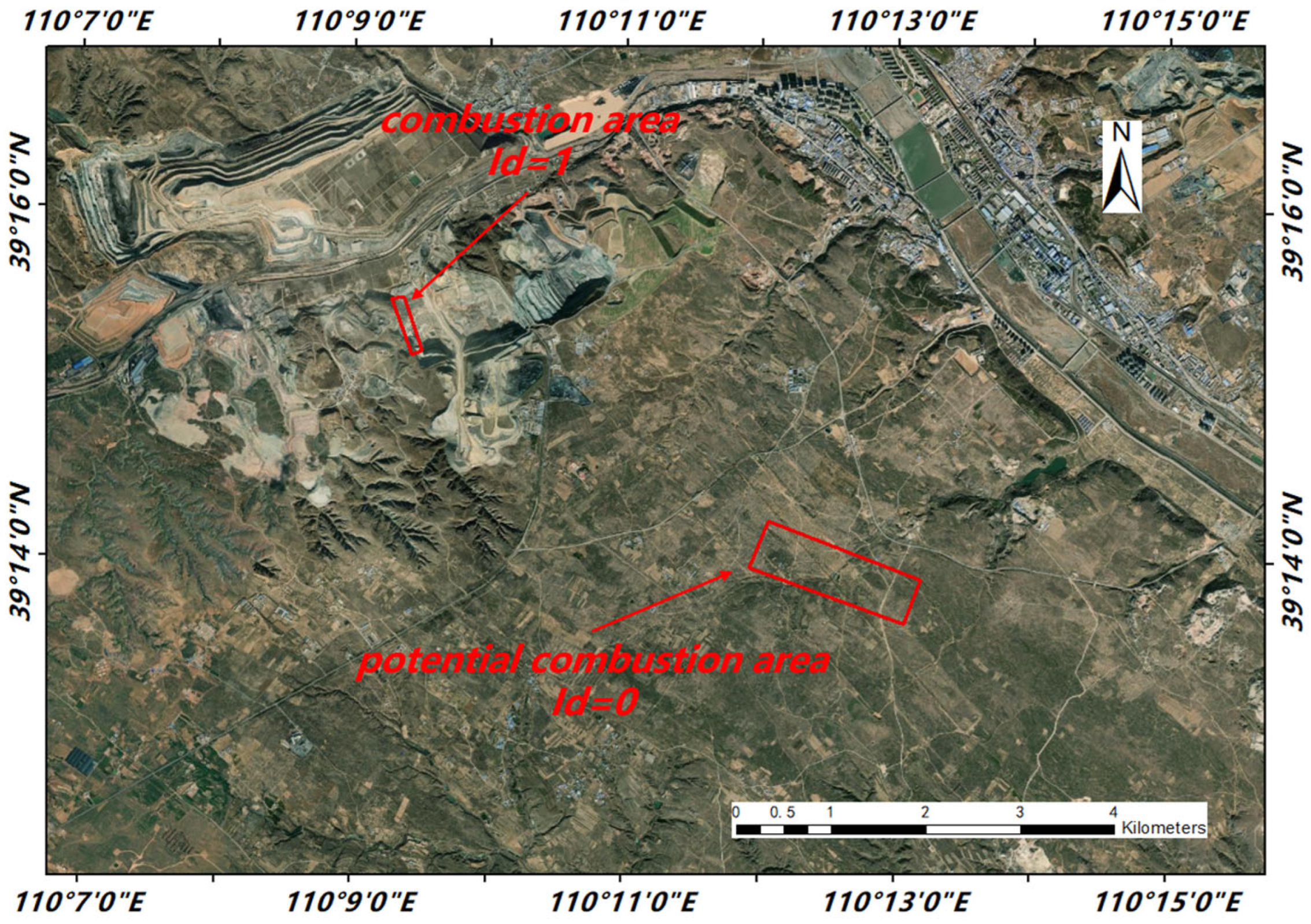
Based on differences in spatial characteristics and surface conditions, the study area was further divided into two subregions. The combustion area is primarily characterized by open combustion conditions. Although relatively small in size, it exhibits pronounced terrain undulations and steeper slopes, accompanied by notably low vegetation coverage, indicating strong topographic constraints on surface processes. The potential combustion area is characterized by higher mean elevation, gentler slopes, and relatively better vegetation coverage, representing a topographically more stable area within the study region. Figure 1 illustrates the geographic location of the study area. The combustion area covers approximately 0.07 km2, while the potential combustion area covers approximately 0.90 km2. The total study area is approximately 0.97 km2.
The study area was divided into combustion areas (Id = 1) and potential combustion areas (Id = 0) based on combined field investigation and remote sensing interpretation. Combustion areas (Id = 1) were identified at locations exhibiting clear surface combustion manifestations during field surveys, including exposed burning outcrops, thermal alteration features, bare ground exposure, local smoke emissions, and severe vegetation degradation. These areas also showed strong spectral and thermal anomalies in remote sensing imagery. Potential combustion areas (Id = 0) refer to surrounding zones where no obvious combustion exposure was observed during field investigation. These areas generally retained partial vegetation cover and lacked distinct surface combustion characteristics, although they may still contain latent underground combustion risk. The field observations were further combined with multi-source remote sensing indicators, including thermal infrared anomalies, vegetation stress responses, and spectral feature variations, to improve the reliability of the labeling process.

2.2. Data Source

In this study, an integrated remote sensing dataset was constructed by combining multi-source optical and thermal infrared products, together with auxiliary environmental data. All datasets were accessed and processed within the Google Earth Engine (GEE) platform, which provides a unified computational environment for large-scale geospatial data processing. The dataset covers the period from 2010 to 2025 and was designed to support long-term monitoring of coal spontaneous combustion processes. To ensure temporal continuity, a multi-source data integration strategy was adopted by combining MODIS (from 2010), VIIRS (from 2012), and Sentinel-2 (from 2015), enabling complementary trade-offs between spatial resolution and temporal coverage.
Although the original products have different revisit cycles, a harmonized daily time series framework was constructed. When multiple observations were available within the same day, a compositing strategy was applied to generate daily representative values. All optical datasets were preprocessed using a consistent quality control procedure. Scenes with cloud coverage greater than 20% were excluded, and pixel-level cloud contamination was removed using sensor-specific quality masks. This ensured consistency in subsequent index calculations across datasets. The final dataset includes 489 Sentinel-2 scenes, 761 MODIS daily composites, and 4103 VIIRS daily observations, providing a multi-scale dataset combining high spatial resolution and long-term temporal continuity. The specific data information is shown in Table 1.
Environmental variables were derived from multi-source remote sensing data. Land surface temperature (LST) was obtained from MODIS and VIIRS thermal infrared products using the generalized split-window algorithm and resampled to 10 m spatial resolution using bilinear interpolation to ensure spatial consistency with Sentinel-2 data.
A surface moisture proxy (H) was derived from Sentinel-1 VV-polarized backscatter coefficients. The normalized backscatter was used to characterize relative variations in soil moisture, which reflect surface dielectric changes associated with moisture content. The derived moisture indicator was also resampled to 10 m resolution to maintain spatial consistency across datasets.
Due to the limited temporal frequency of thermal and SAR-derived variables, temporal gaps were filled using interpolation to construct continuous time series for subsequent multi-temporal analysis. Although this proxy does not represent direct atmospheric humidity, it effectively captures relative surface moisture dynamics and has been widely applied in remote sensing-based environmental studies.
Although InSAR data were not incorporated in this study, it is acknowledged as a complementary technique for detecting deformation associated with subsurface combustion. Future work will explore the integration of InSAR with optical and thermal remote sensing to further improve multi-source fusion-based monitoring of coal fire dynamics.

2.3. Methodology

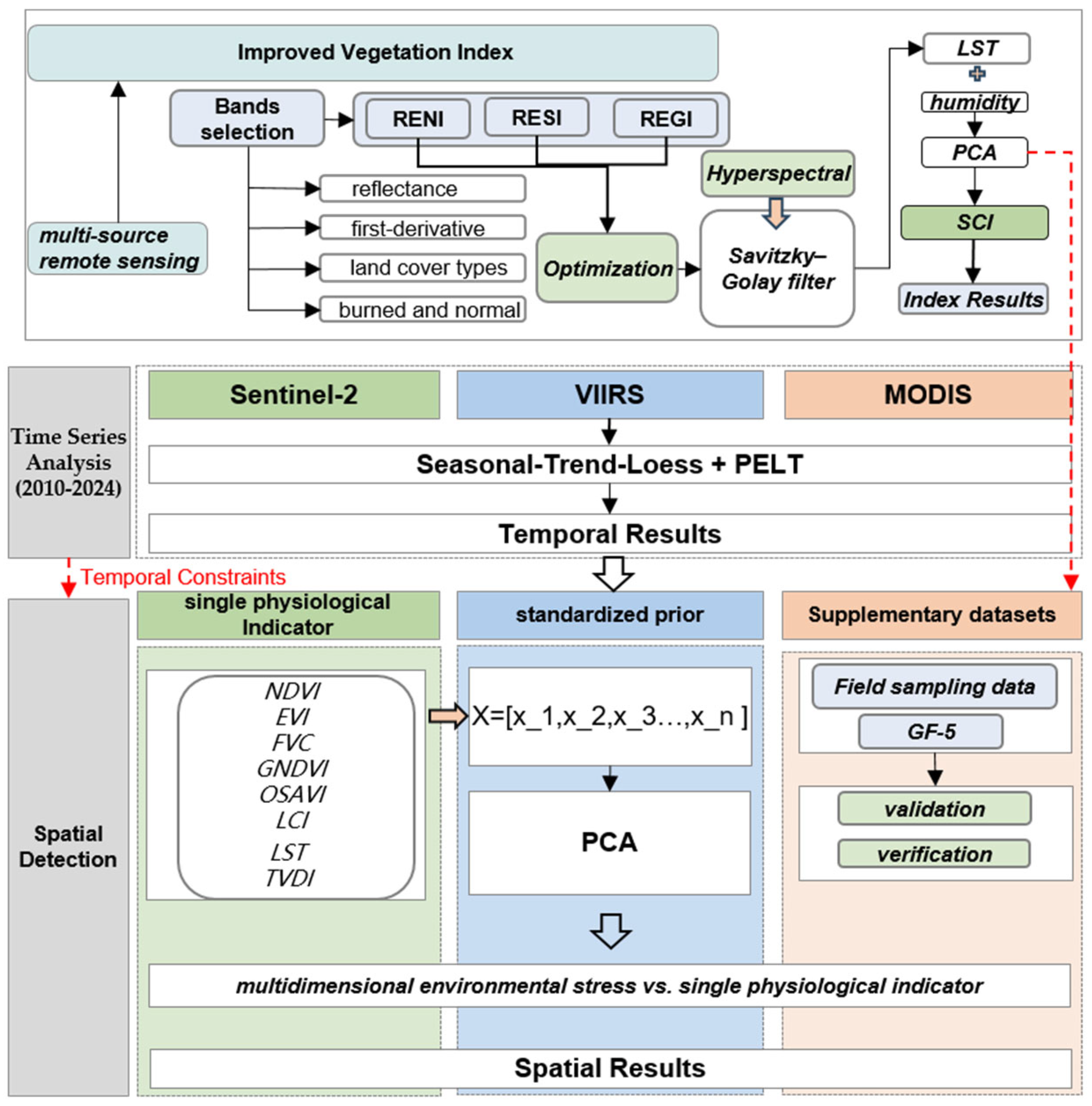
As shown in Figure 2, the proposed framework consists of three sequential components. First, improved red-edge-based vegetation indices are constructed from Sentinel-2 observations to enhance sensitivity to vegetation physiological stress induced by subsurface combustion. Second, a composite combustion index (SCI) is developed by integrating spectral and environmental variables, and its temporal evolution is analyzed using STL decomposition and change-point detection. Finally, principal component analysis (PCA) is applied to multi-source feature stacks to generate a spatially explicit combustion anomaly index.

2.3.1. Construction of the Subsurface Combustion Index

The multispectral indices were derived from the Sentinel-2 MultiSpectral Instrument (MSI) onboard the Sentinel-2 satellite mission [32]. In areas affected by coal spontaneous combustion, subsurface burning generates thermal disturbances and surface degradation, which can damage vegetation structure and reduce canopy integrity, leading to decreased near-infrared (NIR) reflectance and altered red-edge characteristics. To capture the spectral gradient between the high-reflectance NIR region and the red-edge transition, we constructed the Red-Edge Normalized Index (RENI). RENI is sensitive to vegetation structural degradation and demonstrates strong detection capability in moderately to severely burned areas [33].
R E N I = N I R R E 1 N I R + R E 1
In (1), N I R refers to the near-infrared band with a central wavelength of approximately 842 nm, and R E 1 denotes the Sentinel-2 red-edge 1 band with a central wavelength of approximately 705 nm.
In subsurface combustion areas, high surface temperatures, gas emissions, and subsidence often cause vegetation degradation or bare soil exposure, which reduces red-light absorption and shifts red-edge positions. To capture the reflectance difference between the red and red-edge bands, particularly under sparse vegetation or exposed soil conditions, we constructed the Red-Edge Soil Index (RESI). By enhancing the contrast between the red-edge and red bands, RESI effectively characterizes vegetation damage and soil exposure, exhibiting high sensitivity in subsurface combustion-disturbed regions [34].
R E S I = R E 1 R E D R E 1 + R E D
In (2), R E D represents the red band with a central wavelength of approximately 665 nm, and R E 1 is the Sentinel-2 red-edge 1 band.
Under coal spontaneous combustion conditions, vegetation is affected by thermal stress and gaseous pollutants, which alter chlorophyll content and leaf structure, leading to increased green-light reflectance or reduced red-edge reflectance. To capture the relationship between visible reflectance and red-edge response, we developed the Red-Edge Green Index (REGI). By comparing the green and red-edge bands, REGI effectively detects early vegetation stress and physiological degradation, making it suitable for identifying progressive vegetation anomalies caused by subsurface combustion activities [19].
R E G I = R E 1 G R E E N R E 1 + G R E E N
In (3), G R E E N denotes the green band with a central wavelength of approximately 560 nm, and R E 1 is the Sentinel-2 red-edge 1 band.
Compared with conventional red-edge vegetation indices such as NDRE and CIred-edge, the proposed RENI, RESI, and REGI are specifically designed for subsurface combustion detection rather than general vegetation monitoring [33,34]. Traditional indices mainly focus on chlorophyll variation and crop physiological status under agricultural conditions, whereas the indices proposed in this study aim to capture the combined effects of thermal disturbance, vegetation degradation, soil exposure, and gaseous emissions induced by underground coal combustion. In particular, RENI emphasizes structural degradation between the NIR and red-edge regions, RESI enhances the spectral contrast associated with sparse vegetation and exposed soils, and REGI is designed to improve sensitivity to early-stage vegetation stress under thermal and environmental disturbances. Therefore, although these indices share the normalized difference formulation commonly used in vegetation remote sensing, their physical interpretation, target application, and spectral sensitivity differ from those of conventional red-edge indices. To further evaluate their effectiveness, the proposed indices were compared with conventional red-edge vegetation indices, including NDRE and CIred-edge, using statistical significance, class separability, and stability metrics. The results demonstrate that REGI consistently achieved higher discriminative capability for combustion-related vegetation stress, supporting its selection as the spectral component of the SCI framework.
Although three red-edge-based indices (RENI, RESI, and REGI) were initially designed to capture different aspects of vegetation response to subsurface combustion, only REGI was selected as the representative spectral indicator for subsequent SCI construction. This selection was based on its superior sensitivity to early-stage vegetation physiological stress, as well as its stronger separability between burned and non-burned areas compared to the other indices. Preliminary correlation analysis and statistical evaluation indicated that REGI provided the most stable and discriminative performance. Therefore, REGI was used as the spectral component in the SCI framework to avoid redundancy and reduce feature collinearity.
The multispectral red-edge vegetation indices described above rely primarily on specific spectral band ratios. While these indices improve spectral sensitivity under vegetation stress and burning conditions, they do not explicitly consider environmental influences on vegetation and surface reflectance. For instance, elevated land surface temperature in burned or drought-affected areas accelerates vegetation water loss, while variations in humidity influence leaf moisture content and spectral responses in the red-edge and green bands.
The Savitzky–Golay (SG) filter was applied to the reflectance spectra to compute first-order derivative spectral features [35]. A window length of 11 and a second-order polynomial were used for local polynomial fitting. The derivative order was set to 1 to enhance subtle spectral variations associated with vegetation stress and combustion-induced physiological changes. The wavelength spacing was incorporated using the delta parameter. The first-order derivative transformation enhances the sensitivity to spectral slope changes, particularly in red-edge and near-infrared regions, which are highly responsive to vegetation stress induced by subsurface combustion. This operation performs spectral enhancement through first-order differentiation rather than smoothing.
To address the limitations of single-factor detection, a composite combustion index (SCI) was constructed by integrating spectral and environmental variables, including the spectral anomaly indicator (dREGI), land surface temperature (LST), and the humidity proxy (H). All variables were standardized using z-score normalization as follows:
X n o r m = X μ σ
To avoid subjective weighting, a data-driven adaptive weighting strategy based on principal component analysis (PCA) was adopted. In this first stage, PCA was applied exclusively for weight estimation rather than dimensionality reduction or feature fusion [36]. The adaptive weights were calculated as:
a t = | l o a d i n g d R E G I | | l o a d i n g | , b t = | l o a d i n g L S T | | l o a d i n g | , c t = | l o a d i n g H | | l o a d i n g |
In (5), a t , b t and c t denote the dynamic weights of the spectral, thermal, and humidity components for year t , respectively.
Accordingly, the annual SCI was calculated as:
S C I t = a t · Z ( d R E G I ) t + b t · Z ( L S T ) t + c t · Z ( H ) t
This formulation enables the SCI to adaptively reflect the relative importance of spectral stress, thermal anomalies, and moisture conditions under varying combustion environments, thereby improving the robustness and interpretability of subsurface combustion detection [37].

2.3.2. Time Series Analysis

The Seasonal-Trend-Loess (STL) method was employed to decompose the reconstructed multi-source time series into trend, seasonal, and residual components [38]. STL is a non-parametric and robust decomposition technique based on locally estimated scatterplot smoothing (LOESS), which is particularly suitable for remote sensing time series characterized by non-stationarity, noise, and irregular missing observations.
Singular Spectrum Analysis (SSA) was not adopted in this study, as STL decomposition was sufficient for extracting long-term trend and seasonal components from the reconstructed time series. Compared with alternative decomposition methods such as empirical mode decomposition (EMD) and wavelet transform, STL offers superior interpretability and computational efficiency, especially for large-scale long-term geospatial datasets. Its ability to model time-varying seasonal and trend components makes it appropriate for monitoring gradual vegetation responses under subsurface combustion conditions.
Y v = T v + S v + R v
In (7), where T v is the trend component, S v is the seasonal component, and R v is the residual.
To capture annual seasonality, the seasonal period was set to 365 observations, corresponding to the reconstructed daily time series. Missing observations were handled through temporal interpolation prior to decomposition. STL is robust to moderate smoothing effects and preserves long-term structural patterns in the presence of incomplete data. Following STL decomposition, the trend component was used for change point detection using the Pruned Exact Linear Time (PELT) algorithm [39]. PELT was selected due to its linear computational complexity and ability to optimize the number of change points via penalized cost minimization. A radial basis function (RBF) cost function was adopted to capture nonlinear temporal variations associated with subsurface combustion dynamics. The penalty parameter was set to 40 based on sensitivity analysis, and the minimum segment length was set to 30 observations to suppress short-term noise-induced fluctuations. This STL–PELT framework enables robust extraction of long-term combustion-related temporal dynamics while reducing the influence of seasonal variability and short-term noise.

2.3.3. Principal Component Analysis

To further characterize the spatial distribution of combustion-related anomalies, a second PCA stage was implemented for multi-feature spatial anomaly enhancement. Unlike the first PCA stage used for SCI weight estimation, this second PCA stage was designed for spatial feature fusion and anomaly extraction [36]. The input feature stack consisted of multiple combustion-sensitive indicators, including spectral indices (RENI, RESI, REGI), vegetation condition variables (NDVI and FVC), and derived temporal statistics from the Landsat time series. The feature matrix is expressed as:
X = x 1 , x 2 , x 3 , x n
In (8), x n represents the n -th combustion-sensitive index or spectral feature.
All features were standardized prior to PCA to eliminate differences in units and numerical scales. The standardized feature matrix was then mean-centered to construct the covariance matrix:
C = 1 m 1 Z T Z
In (9), m is the number of samples.
Eigenvalues and eigenvectors are then computed and sorted in descending order. The first principal component (PC1), which explains the largest proportion of variance, is used as the spatial combustion anomaly index. In this step, PCA is used exclusively for spatial feature fusion and anomaly enhancement, rather than weight estimation. The cumulative explained variance of the retained components is reported to ensure information preservation.

2.3.4. Statistical Metrics Definition

To evaluation the performance of different vegetation indices for both land cover classification and coal combustion monitoring, three statistical dimensions were implemented: statistical significance, class separability, and stability.
(1)
Statistical Significance (p-value)
The Kruskal–Wallis test, a non-parametric method, was used to evaluate whether there are statistically significant differences among different classes [40]. The p-value indicates the probability of obtaining the observed differences by chance. In this study, the test was applied to two scenarios. Compared three primary land cover types to evaluate the index baseline performance. Compared two specific canopy target zones: Burned Area and Non-Burned Area.
(2)
Class Separability (M-statistic)
The M-statistic was calculated to quantify the separation degree between the Burned and Non-Burned classes [41]. It is defined as the ratio of the difference between the means of the two classes to the sum of their standard deviations:
M = μ b u r n e d μ n o n b u r n e d σ b u r n e d + σ n o n b u r n e d
where μ and σ represent the mean and standard deviation of the corresponding spectral index values for each class. M < 1.0 indicates significant histogram overlap and poor separability and M > 1.0 indicates strong separability with minimal class overlap.
(3)
Random Forest Feature Importance (RF Importance)
In the synthesis analysis, a Random Forest (RF) classifier was trained using a sample size of N pixels extracted from the mining area [21,42]. The feature importance was computed based on the Gini Importance (Mean Decrease in Impurity), which quantifies the relative contribution of each vegetation index to the overall classification accuracy.

3. Results

3.1. Subsurface Combustion Index

3.1.1. Band Selection

To enhance the sensitivity of vegetation monitoring in coal mining areas and to effectively identify early-stage stress induced by subsurface combustion, this study systematically evaluated the spectral bands most responsive to vegetation physiological changes using both multispectral and hyperspectral data. Simply distinguishing vegetation from non-vegetation is insufficient to capture the impacts of subsurface coal combustion; therefore, it is necessary to identify bands capable of differentiating healthy vegetation from stressed vegetation to optimize the selection of bands for improved vegetation indices.
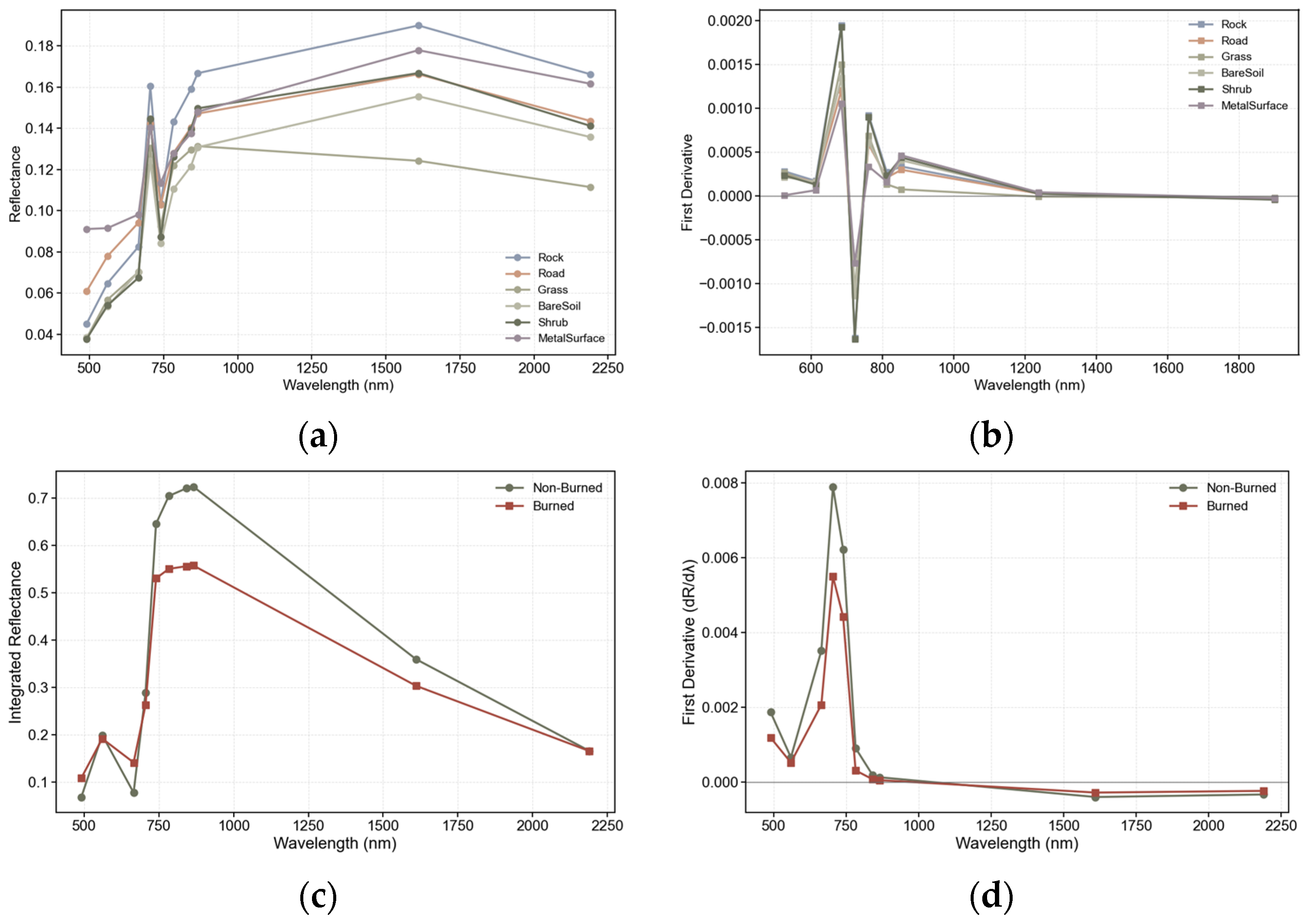
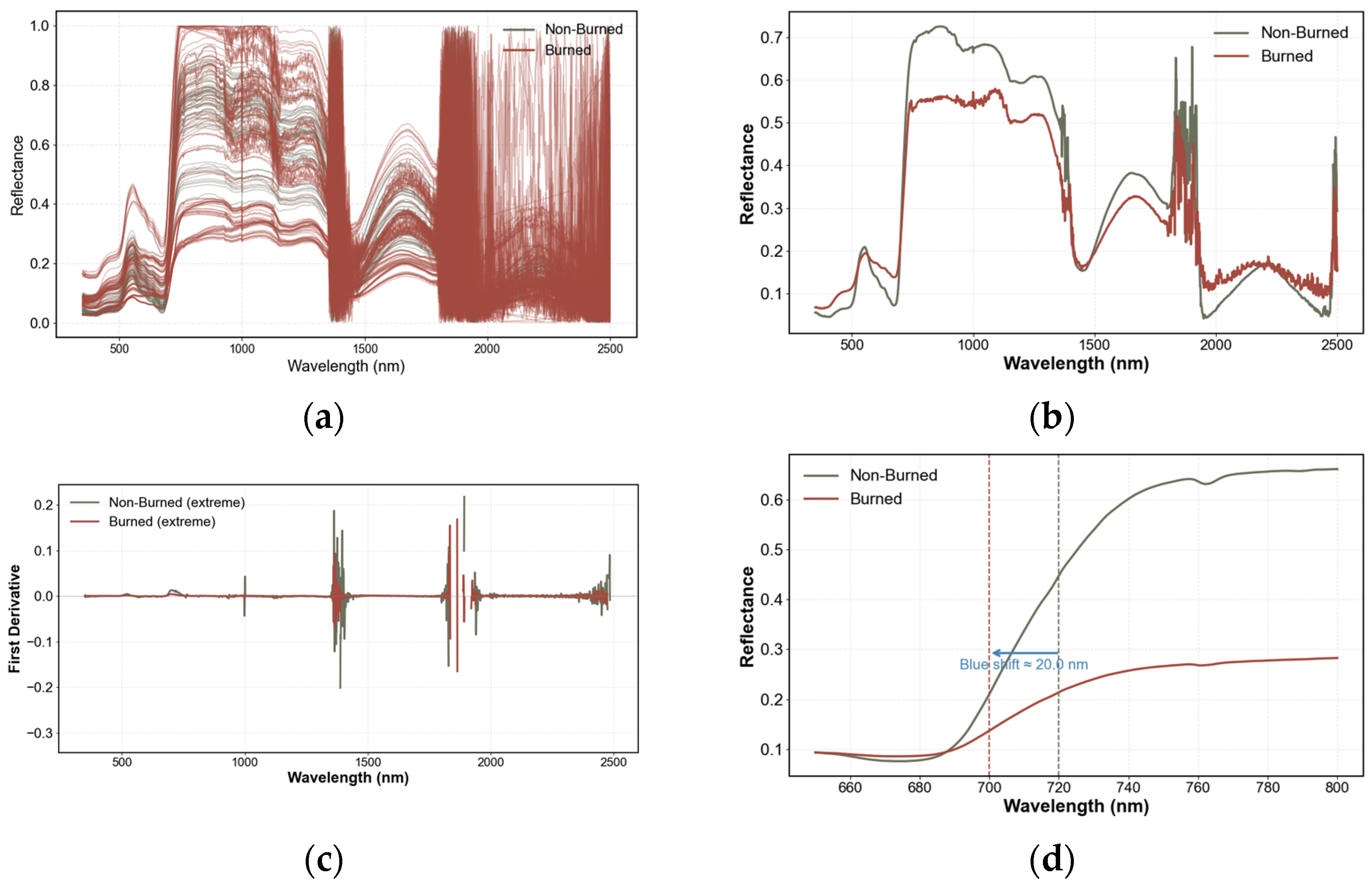
In the multispectral analysis, Sentinel-2 imagery was used to examine different land cover types, including rock, road, grass, bare soil, shrub, and metal surfaces, as well as burned and unburned vegetation samples (Figure 3). Reflectance values were extracted at key spectral bands (500, 750, 1000, 1250, 1500, 1750, 2000, and 2250 nm), corresponding to visible, red-edge, and shortwave infrared regions. First-derivative spectra were computed to enhance subtle variations in vegetation physiological status, particularly in the red-edge region, which is highly sensitive to chlorophyll content changes. This procedure enables improved discrimination among healthy vegetation, stressed vegetation, and non-vegetation surfaces. Burned and unburned samples were extracted at identical spectral wavelength positions to ensure direct spectral comparability across all bands (Figure 3c,d). Subsequently, hyperspectral imagery (350–2500 nm, 2151 bands) was employed to further identify spectral features most sensitive to vegetation stress. Mean spectra were calculated after preprocessing, and first-derivative analyses were conducted while excluding water-sensitive bands to reduce noise interference. To preserve key spectral features while smoothing noise, the Savitzky–Golay filter was applied, which simultaneously enables derivative computation and signal smoothing while maintaining spectral fidelity.
As shown in Figure 3, shrubs and grass exhibit pronounced first-derivative peaks near 722 nm in the red-edge region, whereas non-vegetation surfaces (roads, rocks, bare soil, and metal surfaces) show relatively weaker and less stable spectral responses. This indicates that the red-edge region is highly sensitive to vegetation physiological conditions. In contrast, burned samples exhibit alterations in both reflectance and derivative profiles compared with unburned vegetation, including reduced amplitude and slight shifts in the red-edge and near-infrared regions, reflecting vegetation stress induced by subsurface coal combustion. These spectral differences demonstrate that the red, red-edge, and near-infrared bands provide strong separability among healthy vegetation, stressed vegetation, and non-vegetation surfaces, thereby supporting the construction of an improved vegetation index.
As shown in Figure 4, hyperspectral analysis further confirms that the red-to-red-edge region exhibits the strongest spectral sensitivity: unburned vegetation shows higher first-derivative amplitudes, reflecting a steep red-to-red-edge transition, whereas burned vegetation exhibits reduced amplitudes, consistent with stress-induced changes in leaf structure and chlorophyll content.
In summary, the combination of multispectral red-edge analysis and hyperspectral sensitive band identification provides a robust basis for selecting bands for improved vegetation indices. This approach enhances the ability to distinguish healthy and stressed vegetation and increases the sensitivity and applicability of vegetation indices for early-stage combustion monitoring in complex mining environments.

3.1.2. Index Optimization

To enhance the sensitivity of vegetation monitoring to subsurface combustion impacts in mining areas, this study evaluated and optimized the class separability of three vegetation indices (RENI, RESI, and REGI) constructed from multispectral data. The original indices may exhibit limited responses to early-stage physiological stress; therefore, band refinement and derivative-based optimization were applied to improve their discriminative ability.
The three indices were first calculated based on Sentinel-2 multispectral imagery, and their performance was assessed across different land cover types. RENI emphasizes structural changes, capturing canopy integrity and vegetation structure; RESI highlights soil exposure and canopy loss, reflecting sparse vegetation and bare soil conditions; REGI targets early physiological stress by comparing green and red-edge bands, sensitive to chlorophyll content and leaf condition. Based on hyperspectral feature analysis, the Savitzky–Golay filter was applied to optimize the indices. This widely used digital filter performs both data smoothing and derivative calculation while preserving essential signal characteristics. Unlike traditional median or mean filters that may attenuate key spectral features, the Savitzky–Golay filter retains peak and structural information, enhancing index responsiveness to vegetation stress.
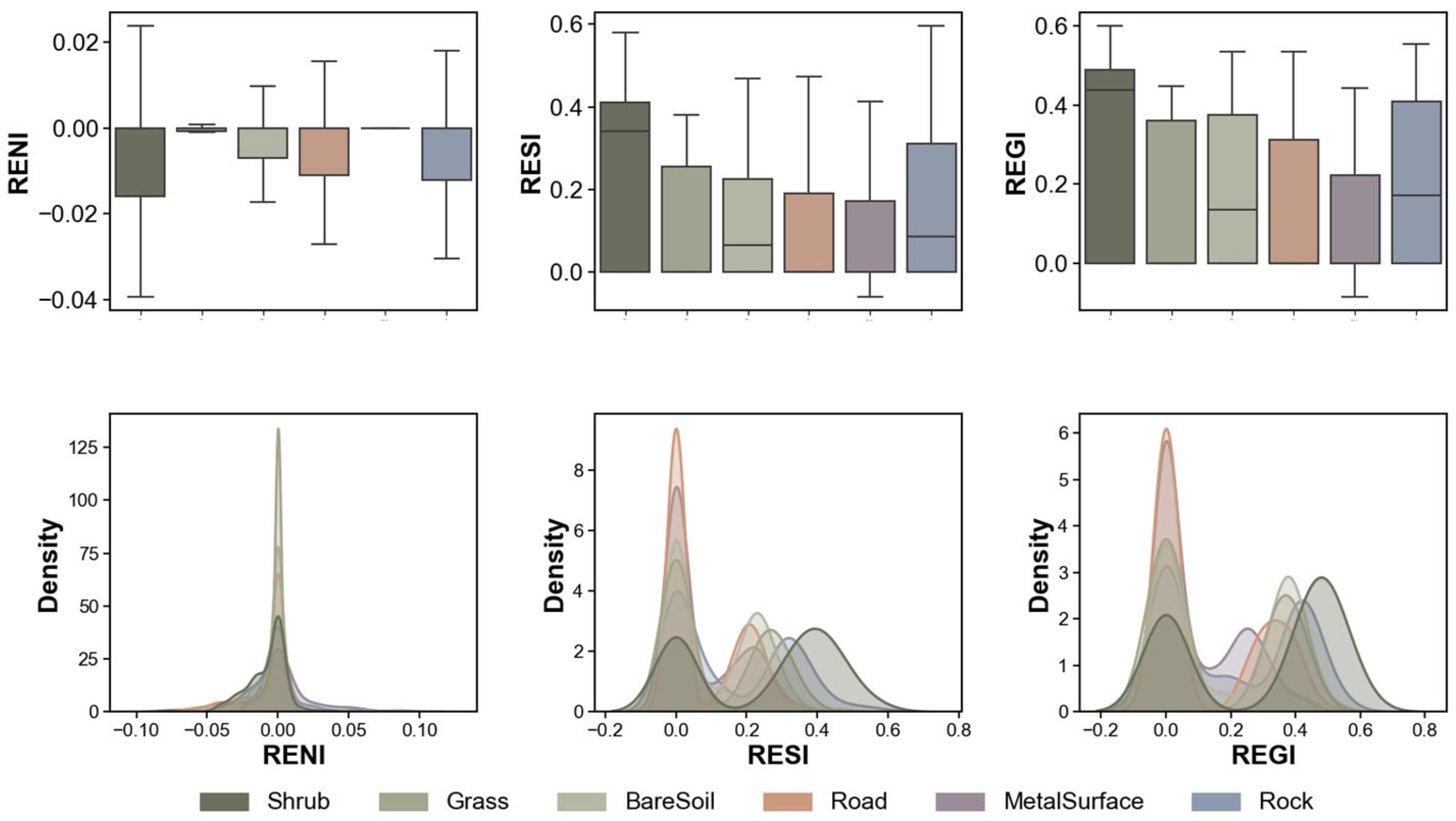
The results indicate that all three multispectral indices show significant differences across land cover types, with REGI and RESI exhibiting markedly higher class separability than RENI, suggesting that indices incorporating red-edge and visible bands are more sensitive in complex surface environments (Figure 5). RENI emphasizes structural changes which capture canopy integrity and vegetation structure. RESI highlights soil exposure and canopy loss, reflecting sparse vegetation and bare soil conditions. REGI targets early physiological stress by comparing the green and red-edge bands, sensitive to chlorophyll content and leaf condition.
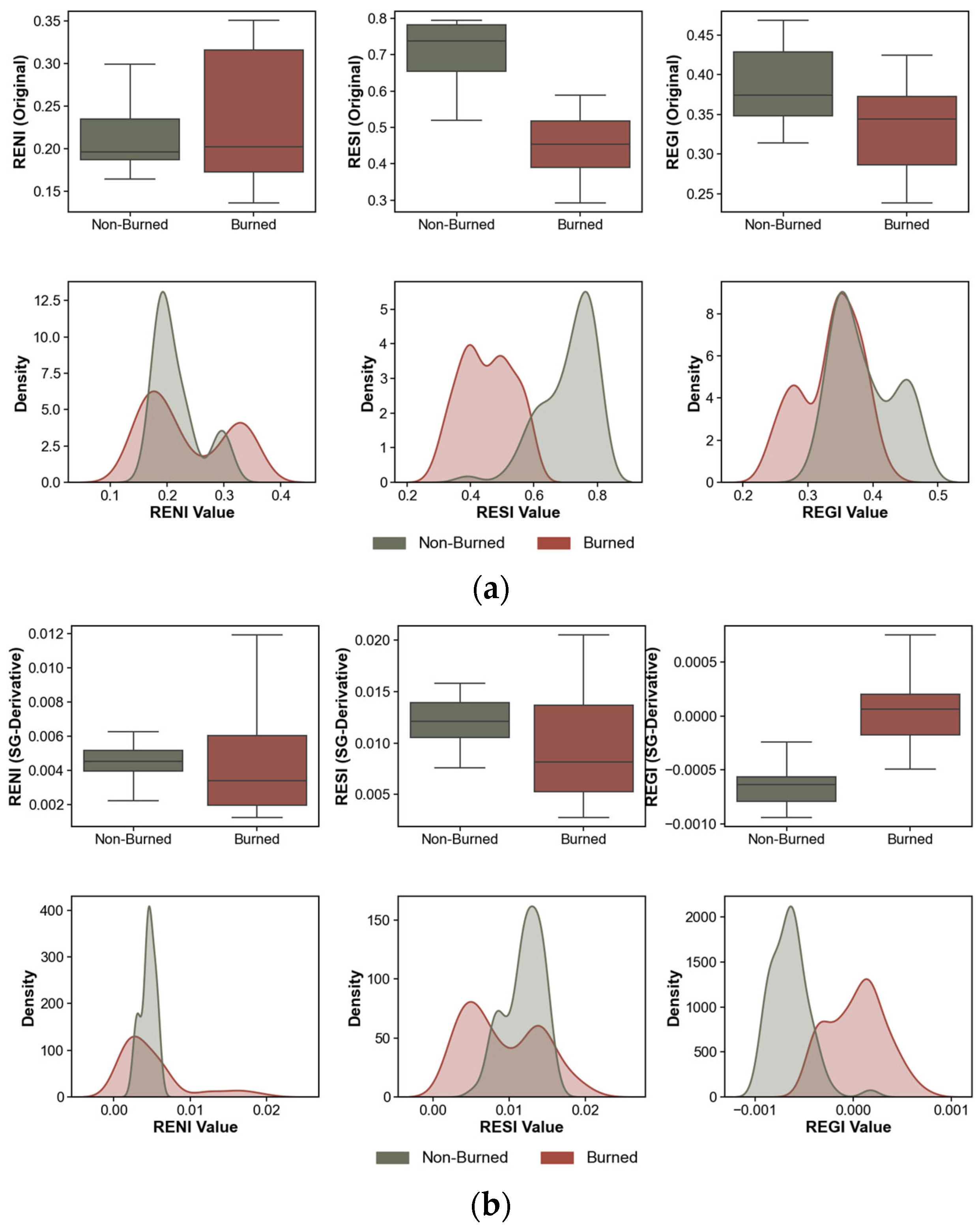
As shown in Figure 6, the Savitzky–Golay (SG) derivative transformation significantly enhanced the separability of the red-edge vegetation indices, particularly for dREGI, which exhibited the highest sensitivity to combustion-induced vegetation stress. Compared with the original indices, dREGI showed moderate improvement, while RENI remained relatively insensitive. These results indicate that first-derivative spectral enhancement effectively improves the discriminative capability of vegetation indices in subsurface combustion–affected environments.
Based on Table 2, the following conclusions can be drawn: For land cover class separability, the original values of REGI and RESI perform best, substantially outperforming RENI; therefore, RESI or REGI original values are recommended for land cover classification. Based on the evaluation of statistical significance from the Kruskal–Wallis test, the most sensitive spectral index (dREGI) was selected for combustion monitoring. To further quantify the relative contribution of spectral, thermal, and humidity factors, PCA-based adaptive weighting results are presented in Table 3. The PCA-derived weights demonstrate a balanced contribution of spectral, thermal, and humidity factors, indicating that coal combustion signals are jointly controlled by vegetation stress, thermal anomalies, and atmospheric moisture conditions.
To further evaluate the synergistic effect of multi-source factors, a combination analysis was conducted using the separability index (M-index). As shown in Table 4, the inclusion of thermal (LST) and humidity (H) variables progressively improves detection performance, with the full combination achieving the highest separability (M = 1.115), representing a 16.3% improvement over the spectral-only baseline.

3.1.3. Subsurface Combustion Index Results

To enhance the sensitivity of early-stage subsurface combustion detection in mining areas and reduce the influence of environmental heterogeneity on vegetation responses, this study proposes an improved vegetation-based index, the Combustion Spatial Index (SCI), built upon the previously developed dREGI framework. Methodologically, the dREGI was first derived from Sentinel-2 multispectral observations, and spectral derivative analysis was applied to enhance sensitivity to early vegetation stress signals. Subsequently, key environmental factors, including soil exposure, bare land proportion, water bodies, topographic elevation, and anthropogenic disturbance associated with mining activities, were integrated into dREGI through a weighted fusion scheme to generate the SCI. Time series analysis of SCI was conducted over the period 2017–2025 to ensure temporal consistency and stable multi-source observations. The resulting SCI values were normalized and visualized using a unified color scale to analyze spatial distribution patterns and identify potential combustion zones with temporal continuity.
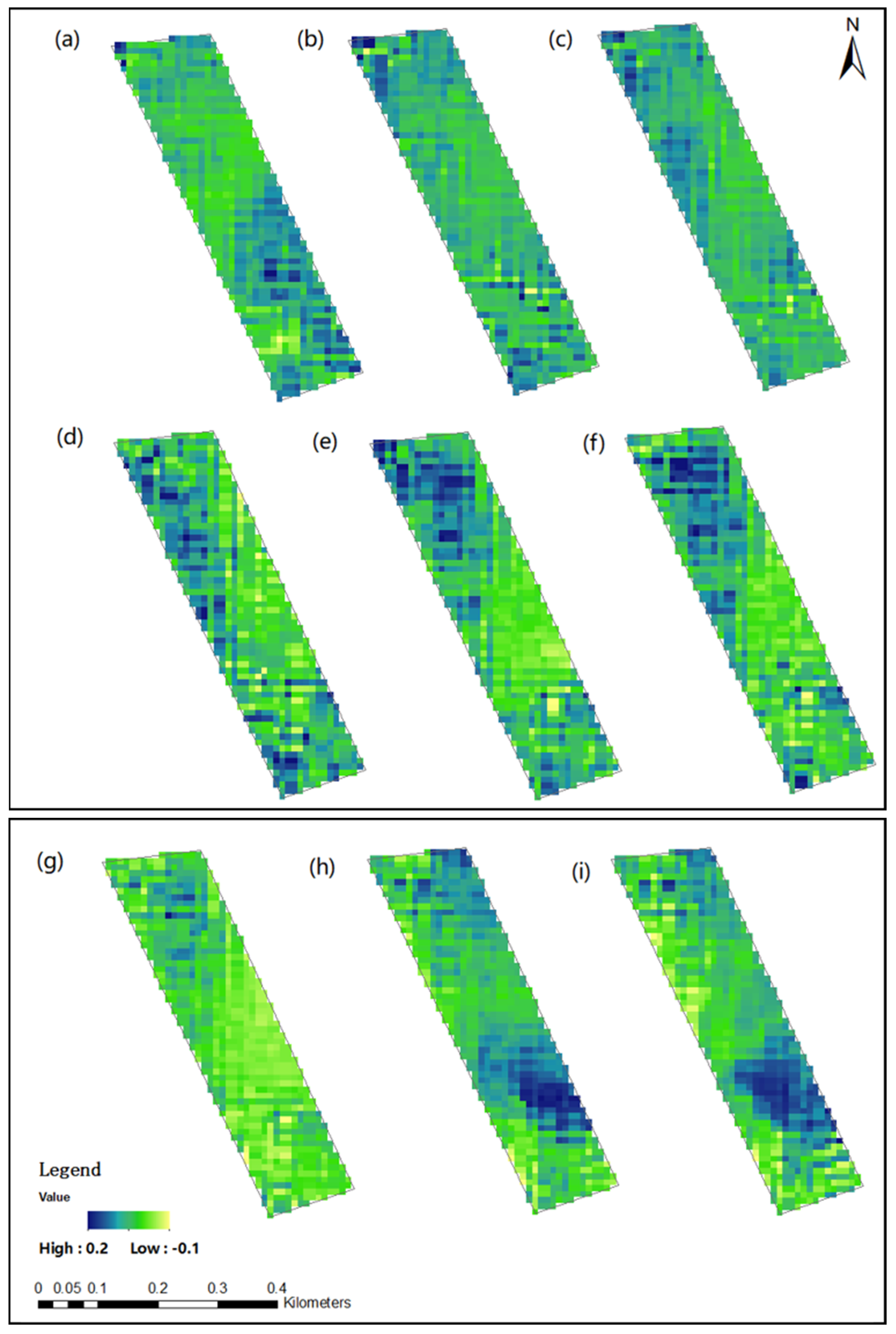
The Figure 7 analysis of combustion area revealed pronounced spatial heterogeneity and dynamic temporal changes. During the early stage (2017–2019), high-SCI patches were sparse and scattered, primarily confined to localized zones, while low to moderate SCI values dominated most areas, indicating that active combustion activity was limited and spatially discontinuous. In the middle stage (2020–2022), the number and size of high-SCI areas increased substantially, with isolated patches beginning to cluster locally and showing a gradual transition from scattered distributions toward more continuous, aggregated zones. Some previously high-value areas weakened or shifted, reflecting active combustion progression. By the late stage (2023–2025), the overall extent of high-SCI areas stabilized, though their spatial locations shifted, with new high-value patches emerging and some prior areas decreasing in intensity. The spatial continuity of active combustion zones became more pronounced, although large-scale continuous combustion zones had not yet formed. These patterns indicate that active combustion activity evolved from sparse, localized patches in the early stage to more pronounced localized clusters in the late stage, demonstrating SCI’s ability to capture both spatial heterogeneity and temporal progression.
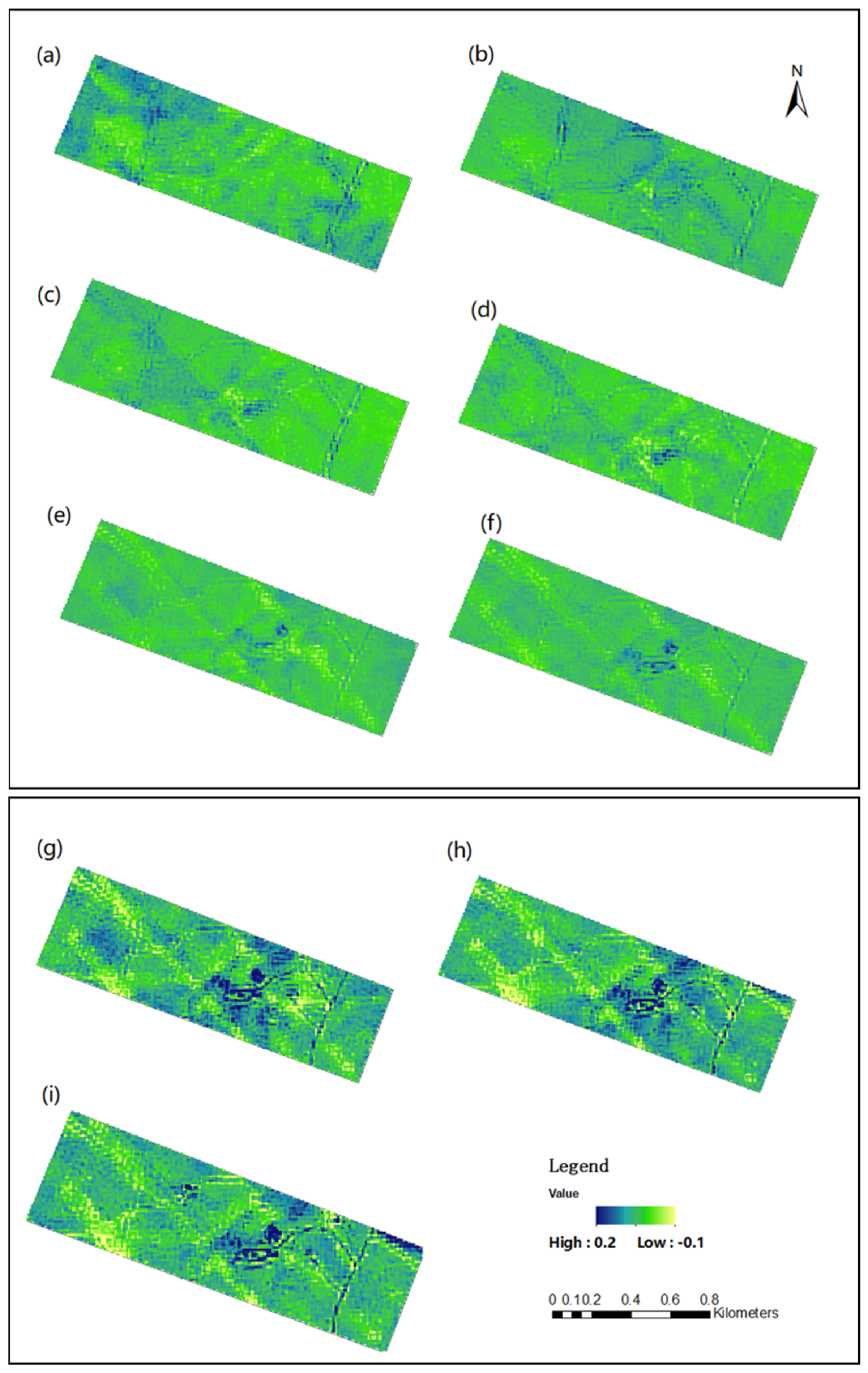
Analysis of potential combustion areas in Figure 8 shows a gradual spatial aggregation of high-SCI regions over time, indicating increasing concentration of combustion-related anomalies in localized zones.

3.2. Temporal Identification

It should be noted that the SCI is only calculated for the Sentinel-2 period (2017–2025), while the long-term temporal analysis (2010–2025) is based on multi-source vegetation and thermal indices rather than SCI. To investigate the temporal evolution of active and potential subsurface combustion regions and to quantify their ecological and thermal impacts, a multi-source observation-based time series dataset covering the period 2010–2025 was constructed. From this dataset, multiple vegetation indices, including NDVI, EVI, FVC, OSAVI, and LCI, as well as land surface temperature (LST) and the Temperature Vegetation Dryness Index (TVDI), were derived to characterize long-term variations in vegetation condition and surface thermal and moisture dynamics within combustion-affected areas.
This time series was generated by integrating multi-temporal remote sensing observations from different satellite sensors and reconstructing a daily-resolution dataset through a hierarchical fusion and temporal gap-filling strategy. This approach enables the detection of both gradual trends and abrupt changes in vegetation and thermal conditions, while accounting for data gaps caused by cloud contamination and sensor revisit limitations.
Multi-temporal analysis and change-point detection were then applied to the reconstructed time series to identify key transition points and anomalous fluctuations over the study period. By comparing active and potential combustion regions, a temporal evolution framework of combustion-related processes was established, enabling quantitative assessment of their timing, frequency, duration, and intensity, and providing a robust temporal basis for subsequent coupling analyses.
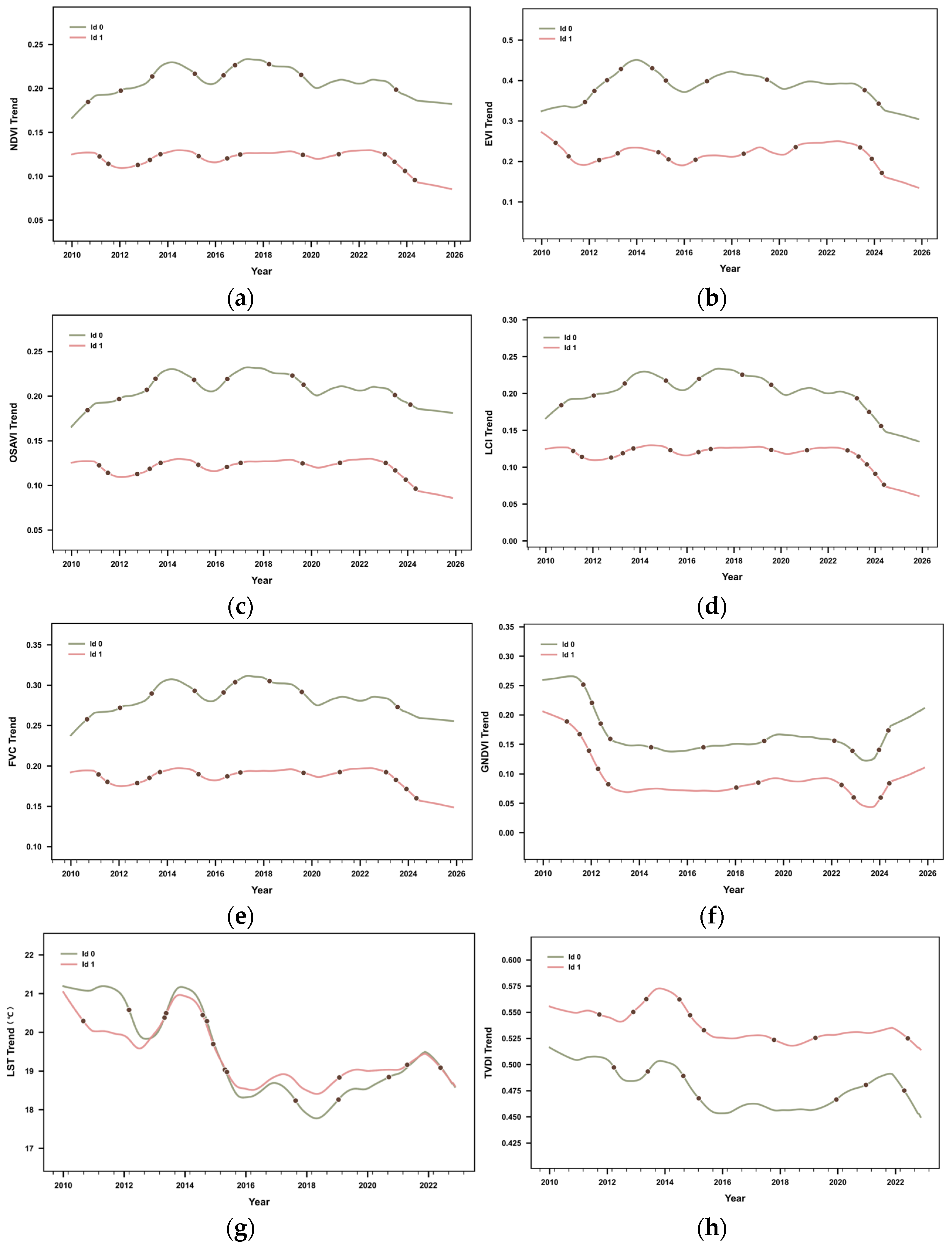
As shown in Figure 9, multiple vegetation and thermal indices exhibit consistent but asynchronous responses to combustion-related disturbances. Differences in response patterns reflect varying sensitivities of each index, with thermal and drought-related indicators generally responding earlier than vegetation structure-related indices. Combustion-related signals in potential areas show intermittent temporal variability, reflecting the long-term and non-continuous nature of subsurface combustion processes.
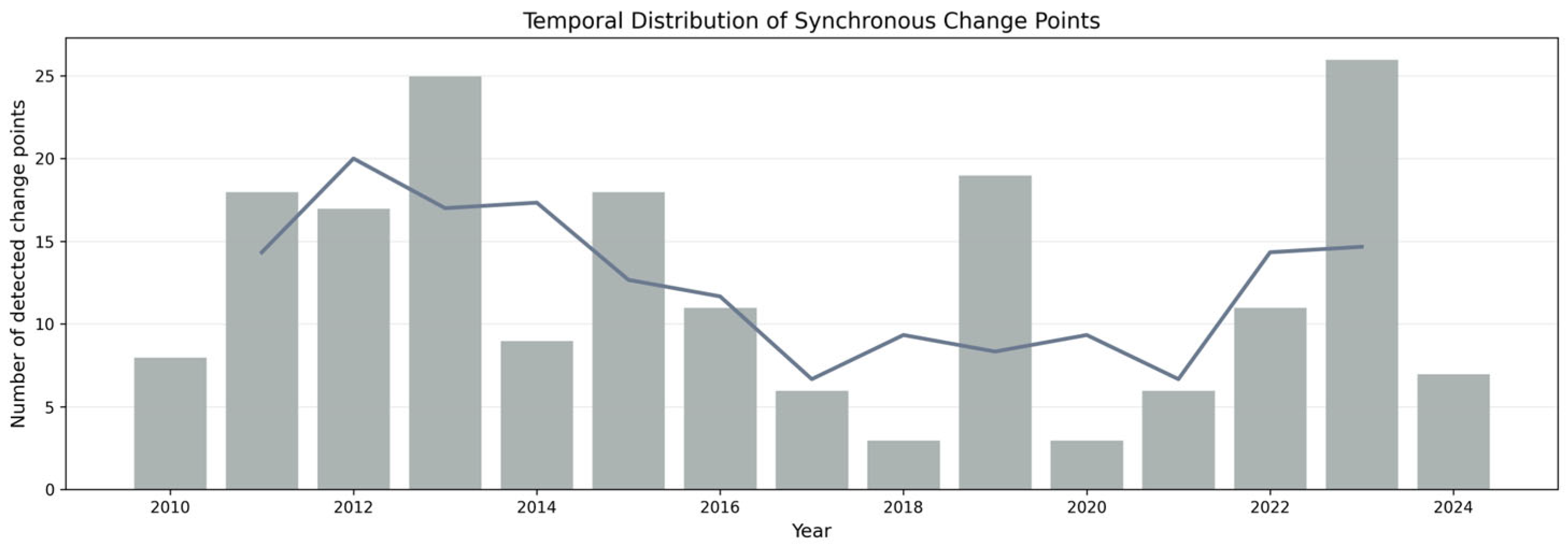
As shown in Figure 10, the combustion timeline of the potential combustion area clearly illustrates the temporal evolution of combustion events. The results indicate that combustion occurrences are stage-wise distributed over time, with significant differences across years in terms of frequency, duration, and intensity. Some events are persistent or recur over multiple periods, reflecting the hidden and sustained nature of combustion in the potential combustion area. This timeline provides an important temporal constraint for further analysis of the coupling between combustion processes, vegetation degradation, surface thermal anomalies, and drought responses.
By leveraging a long-term daily time series and comparing multiple vegetation indices, this approach captures both gradual trends and episodic shifts, revealing ecological responses and thermal dynamics that would be less apparent in shorter or single-index analyses. These results provide valuable temporal constraints for understanding the interactions between combustion activity, vegetation degradation, surface thermal anomalies, and drought responses.
To compare the performance of the improved index dREGI with traditional vegetation indices for combustion detection, this study conducted a comprehensive evaluation using the Kruskal–Wallis test, M-statistic, and Random Forest feature importance, considering statistical significance, class separability, and model contribution.
Table 5 shows that dREGI performs best, with the lowest p-value (4.24 × 10⁻²⁴), the highest separability (M-Statistic = 1.4186), and the greatest feature importance (0.3875), indicating a dominant role in classification.

3.3. Spatial Detection

To identify the fine-scale spatial distribution of potential combustion events and provide targeted management guidance for subsurface combustion prevention, this study conducted spatial detection of suspected burning events based on the temporal constraints obtained from the preceding time series analysis, aiming to delineate the precise locations and risk levels of subsurface combustion.
Methodologically, vegetation indices and the Combustion Spatial Index (SCI) were calculated for the key dates identified in the time series analysis to characterize the spatial patterns of combustion. Principal Component Analysis (PCA) was then applied to remove redundant information from the index data, producing a final map of combustion locations and enabling the classification of high-, medium-, and low-risk zones. The risk levels were classified using a quartile-based method based on the distribution of SCI values, with thresholds defined at the 25th, 50th, and 75th percentiles.
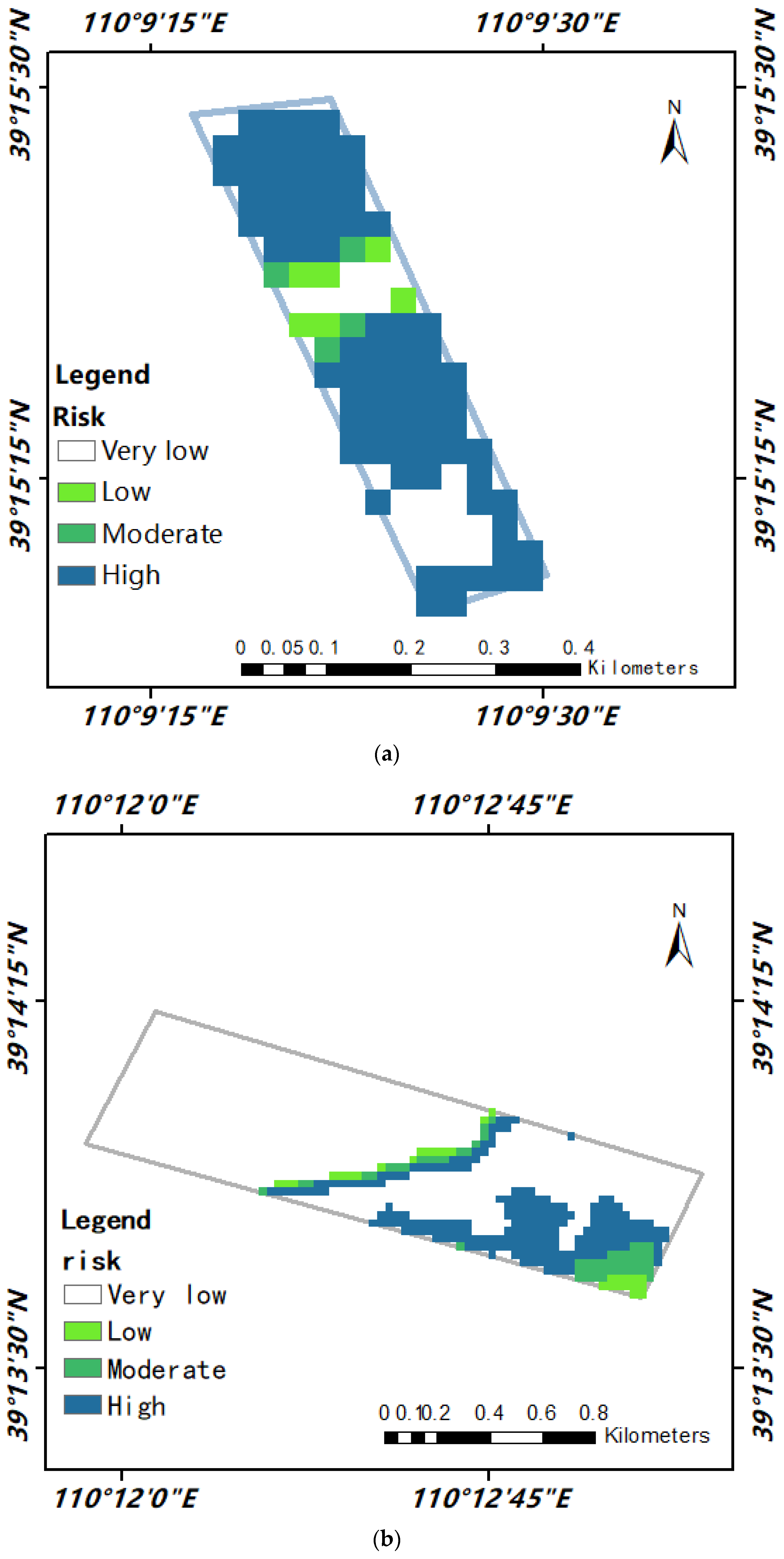
As shown in Figure 11, the results indicate that combustion spatial distribution exhibits a combination of linear and patchy patterns, closely associated with surface environmental conditions. The western part of the study area contains relatively few high-risk zones, with overall risk levels remaining low. The central region is dominated by medium- to low-risk areas, requiring long-term monitoring to prevent potential combustion events. The eastern region represents the primary high-risk potential combustion zone and should be prioritized for management and control. This fine-scale spatial analysis effectively reveals the likely occurrence locations and spatial heterogeneity of combustion, providing a scientific basis for subsequent monitoring and emergency management efforts.
To quantitatively evaluate the reliability of the SCI-based combustion risk mapping, field validation was conducted in both confirmed combustion areas and potential combustion zones.
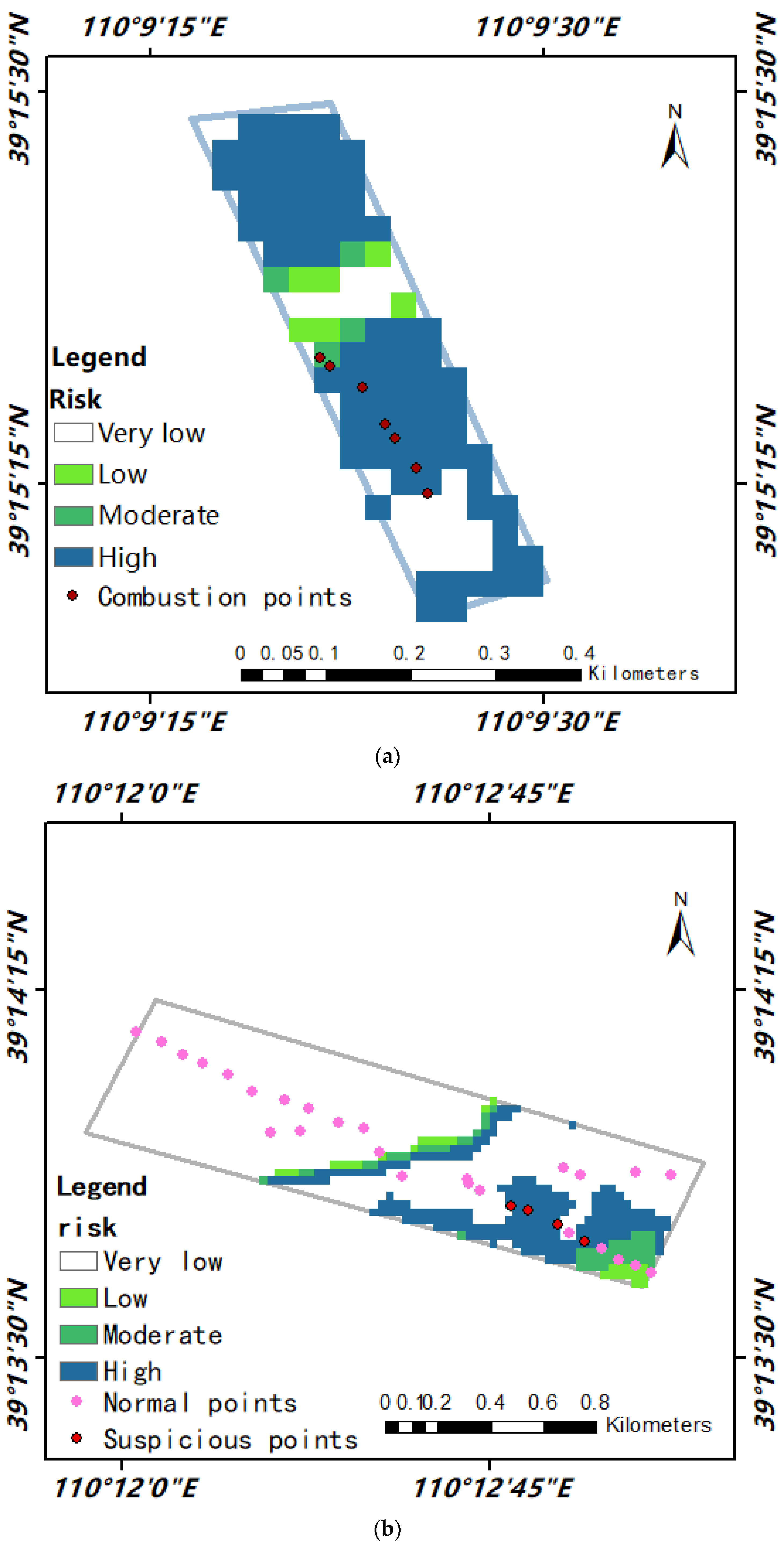
In the combustion area, a total of seven field sampling points were collected. These points were identified based on direct field evidence, including surface cracks, exposed burning materials, and localized smoke emissions. The field observations showed good spatial agreement with the potential combustion zones delineated by the proposed SCI framework, with all active combustion sampling locations falling within moderate- to high-risk areas. Although the number of field samples is limited, these results provide preliminary evidence supporting the capability of the SCI-based method in identifying combustion-related anomalies.
As shown in Figure 12, in the potential combustion area, 30 field sampling points were collected to characterize environmental conditions with potential combustion relevance. These points were not predefined as combustion or non-combustion ground truth samples, but instead represent field-observed environmental states derived from multi-source measurements, including surface temperature, vegetation stress, moisture conditions, and gas-related indicators. Based on integrated field observations, these samples were further interpreted as normal and suspicious points, reflecting a gradient of combustion-related environmental conditions rather than a binary classification scheme. The validation of the proposed SCI framework was conducted by assessing the spatial correspondence between field-interpreted suspicious points and high SCI regions, as well as the distribution of background points within low SCI zones. This provides a qualitative but spatially explicit evaluation of the capability of SCI in combustion-related environmental anomalies.

4. Discussion

4.1. Comparative Analysis of the Improved Index

Systematic comparison across vegetation indices reveals pronounced differential capability in segregating combustion and non-combustion territories. Both OSAVI and FVC demonstrated superior discriminative power, attributable to their efficacy in monitoring vegetation cover fluctuations and neutralizing soil background effects—outcomes consistent with extant studies [19,20]. This superiority is particularly pronounced for OSAVI, whose soil-adjusted design enables more reliable detection of vegetation stress signatures than NDVI in mining areas with limited vegetation cover, underscoring the methodological necessity of background correction [43,44]. Crucially, while soil-adjusted indices excel in mapping absolute background-corrected boundaries, the Red-Edge Gilbert Index coupled with Savitzky–Golay filtering (REGI-SG) exhibits unparalleled sensitivity to subtle, early-stage chlorophyll degradation and physiological stress induced by underlying thermal conduits. Recent studies have demonstrated that red-edge and hyperspectral indicators are particularly sensitive to chlorophyll degradation and physiological stress before visible vegetation deterioration occurs. For example, hyperspectral-based vegetation stress mapping and early stress detection studies have shown that subtle spectral changes in the red-edge region can serve as effective indicators of environmental disturbance prior to the appearance of obvious canopy damage. This observation is consistent with the enhanced sensitivity of REGI-SG observed in this study [23,45].
We advanced beyond vegetation-only detection by fusing REGI-SG with land surface temperature and moisture to create the Subsurface Combustion Index (SCI). While conventional single-factor indices offer simplicity, they pay a steep price in sensitivity and specificity: vegetation indices overlook thermal precursors and falter in non-vegetated zones; thermal indices alone confuse seasonal warming with combustion signals. The SCI mitigates these trade-offs through strategic multi-factor fusion, enabling detection of subtle, early-stage disturbances while filtering out noise from barren terrain and anthropogenic activity. Ablation analysis rigorously decomposes these contributions: isolated REGI-SG, though informative for vegetation health, proved insufficient for definitive fire identification; augmentation with LST provided the necessary thermal evidence, surpassing the M = 1.0 significance threshold. Nevertheless, the diurnal and seasonal variability of surface temperature introduced instability—a limitation overcome by moisture integration, which refined the M-value to 1.115 (10.6% gain). This progressive enhancement underscores that robust detection of concealed combustion demands the convergence of vegetative, thermal, and hydrological indicators, not their isolated application.
While the SCI achieves superior class separability, its operational robustness is not universal. First, in hyper-arid or severely degraded mining environments, REGI-SG effectiveness degrades under seasonal drought stress, narrowing the boundary between climatic and combustion-driven vegetation anomalies [25,30,46]. Second, and more critically, the linear fusion architecture presumes proportional factor relevance across combustion phases—yet empirical reality diverges: the early combustion regime is characterized by cryptic thermal expression but conspicuous vegetation distress, in stark contrast to the late-stage regime where thermal anomalies become dominant and vegetation indices may saturate or collapse. This phase-dependent sensitivity inversion implies that static weighting schemes inevitably sacrifice detection efficacy at certain evolutionary stages, highlighting an inherent trade-off between simplicity and comprehensiveness.
Although the SCI framework was developed in a specific coal mining region, its design is based on widely observed biophysical responses of vegetation stress, surface temperature anomalies, and moisture reduction. Similar coupled vegetation–thermal anomaly relationships have been reported in other coal fire regions, including India’s Jharia coalfield and several coal basins in the United States [47,48,49,50]. These results support the transferability of multi-index fusion frameworks across heterogeneous coalfields. Multi-source remote sensing approaches integrating vegetation indices and land surface temperature have further demonstrated strong capability in detecting environmental anomalies associated with land degradation and subsurface thermal processes.

4.2. Advantages and Limitations of Multi-Source Data

To mitigate the mixed-pixel effect in MODIS observations, this study recommends integrating high-resolution vegetation indices to perform spatial downscaling of thermal anomalies through vegetation–temperature coupling relationships. This approach improves spatial localization of combustion signals in fragmented mining landscapes. For VIIRS thermal saturation under extreme temperature conditions, relative anomaly metrics and multi-temporal normalization can be used instead of absolute brightness temperature, ensuring that combustion intensity gradients remain detectable even in high-temperature regimes. Although Sentinel-2 lacks thermal infrared bands, its red-edge and shortwave infrared bands provide indirect but physically meaningful indicators of vegetation stress and surface moisture variation. These proxies can be jointly constrained with thermal observations to enhance detection consistency across sensors.
Recent studies have demonstrated that integrating thermal infrared observations with deformation measurements can significantly improve coal fire delineation and combustion-state assessment compared with single-source approaches. Thermal–InSAR fusion frameworks have proven particularly effective in distinguishing active combustion zones from surrounding environmental disturbances, while Sentinel-based multi-source observations have improved spatial consistency and monitoring continuity in coal fire regions [15,16,29]. However, the sensitivity of such fused indicators remains inherently scale-dependent, limiting their ability to resolve very small or low-intensity combustion sources. Thermal infrared directly registers surface thermal expression but remains fundamentally compromised by atmospheric windows, diurnal thermal cycling, and surface radiative properties—generating false positives that are structurally indistinguishable from authentic signals. In the literature, InSAR has been proposed as a potential complementary technique for detecting subsurface deformation associated with thermal processes. However, its application in active mining environments is often limited by rapid anthropogenic surface disturbances and strong localized deformation gradients, which may lead to phase unwrapping difficulties and reduced coherence. Therefore, InSAR was not included in the analytical framework of this study. Instead, this work focuses on multi-spectral optical and thermal remote sensing indicators, which are more suitable for capturing vegetation stress and surface thermal anomalies associated with subsurface combustion processes.
Nevertheless, the integration itself engenders new challenges: whereas single-source approaches suffer from internal limitations, multi-source synthesis confronts inter-source discrepancies in spatial resolution, temporal cadence, and radiometric calibration. Consequently, the development of adaptive fusion algorithms and scale-transcendent modeling architectures remains an urgent priority rather than a solved problem [51].

4.3. Uncertainties and Future Work

This investigation underscores that vegetation index monitoring embodies a fundamental duality: it captures combustion impacts indirectly yet integratively. Subterranean combustion perturbs soil temperature, moisture dynamics, and root zone geochemistry, cascading into vegetation physiological distress and detectable spectral shifts. On the positive side, this ecological mediation enables large-scale, temporally extended surveillance of combustion footprints. On the negative side, the mediation introduces temporal displacement between ignition and signal expression, and vegetation responses remain susceptible to confounding by precipitation anomalies and climatic fluctuations—factors extrinsic to combustion processes.
Beyond these conceptual constraints, the operationalization of SCI faces practical boundaries. The restricted calibration period (2017–2025) creates a temporal discontinuity with the full time series (2010–2025), rendering pre-2017 analyses unverifiable and potentially compromising trend robustness. Atmospheric data integration—while beneficial for macro-scale temporal contextualization—is hampered by insufficient spatial resolution, limiting its role to chronological support rather than precise geolocation. Moreover, PCA-driven dimensionality reduction inevitably sacrifices nuanced spectral information, and subjective parameter choices during index construction propagate uncertainty through the analytical chain. In addition, field validation in this study was conducted using a limited number of ground sampling points due to accessibility and safety constraints in active mining regions. Therefore, the reported validation accuracy should be interpreted cautiously and regarded as preliminary evidence of the effectiveness of the proposed SCI framework rather than a comprehensive statistical assessment. Future studies should incorporate larger validation datasets and denser field observations to further evaluate the robustness and generalizability of the method.
Importantly, the proposed SCI framework does not explicitly define a fixed minimum detectable combustion size or intensity. This limitation arises from its nature as an integrated anomaly indicator rather than a direct physical measurement of combustion energy. The detection sensitivity is therefore scale-dependent and governed by sensor spatial resolution, background heterogeneity, and the magnitude of thermally or hydrologically induced surface responses. As a result, weak or highly localized subsurface combustion may not generate sufficient perturbations in vegetation stress or land surface temperature to be distinguished from natural variability. In this context, SCI should be interpreted as a relative indicator optimized for regional-scale combustion risk mapping rather than a quantitative threshold-based detection tool.
Recent advances in explainable machine learning and adaptive remote sensing modeling indicate considerable potential for dynamically adjusting feature importance according to environmental conditions and combustion stages. Such approaches may improve the transferability and generalization capability of multi-factor combustion monitoring frameworks while preserving interpretability [31,52].

5. Conclusions

This study presents an integrated framework for subsurface combustion monitoring by combining multi-source remote sensing time series analysis (2010–2025) with a high-sensitivity combustion detection index (SCI) derived from Sentinel-2 observations (2017–2025). The proposed approach enables both long-term temporal characterization and high-resolution spatial identification of subsurface combustion processes.
The long-term time series analysis (2010–2025), based on multi-source vegetation and thermal indicators (e.g., NDVI, EVI, OSAVI, FVC, LST, and TVDI) from MODIS, VIIRS, and Sentinel-2, reveals the overall evolutionary trajectory of subsurface combustion. This includes early-stage anomalies detected around 2013 using change-point analysis, followed by progressive intensification after 2015, a peak period during 2019–2023, and a residual activity phase in 2024–2025. Importantly, these temporal patterns are derived independently of the SCI and reflect system-level environmental responses rather than index-specific outputs.
The Subsurface Combustion Index (SCI), constructed from the Sentinel-2-derived dREGI combined with land surface temperature and environmental covariates, is specifically applied to the 2017–2025 period due to data availability constraints. SCI provides enhanced sensitivity to early-stage and low-intensity combustion signals and significantly improves spatial discrimination of combustion risk zones. Strong agreement between SCI-derived patterns and field validation further confirms its robustness for operational combustion mapping.
Spatial analysis based on identified combustion periods validates the framework’s capacity for precise geolocation of underground subsurface combustions. SCI values effectively delineate risk gradients: eastern sectors as high-priority zones, central regions as sustained monitoring targets, and western areas as low-risk peripheries. Crucially, the multi-factor SCI maintains detection fidelity across challenging environments—including sparsely vegetated and anthropogenically disturbed terrain—where unimodal temperature or vegetation approaches fail. Close correspondence between high-SCI predictions and field validation confirms the method’s reliability for operational spatiotemporal characterization of subsurface combustion.
Future research will focus on integrating multi-source geospatial and physical monitoring techniques to further improve subsurface combustion detection accuracy. In particular, the incorporation of InSAR-derived surface deformation measurements can provide additional constraints on underground thermal-driven subsidence processes. UAV-based high-resolution observations are also expected to enhance validation accuracy and bridge the scale gap between field surveys and satellite observations. Furthermore, the integration of gas emission indicators such as CO and CH4 may improve the physical interpretability of combustion evolution. Finally, deep learning-based multi-source data fusion frameworks offer promising potential for adaptive feature extraction and improved spatiotemporal generalization across different coalfield environments.

Author Contributions

G.W.: conceptualization, methodology, software, formal analysis, investigation, data curation, visualization, writing—original draft preparation. Z.Z.: methodology, validation, writing—review and editing. X.L.: data curation, investigation, writing—review and editing. S.C.: conceptualization, supervision, project administration, writing—review and editing. All authors have read and agreed to the published version of the manuscript.

Funding

This research was funded by the Key Scientific and Technological Initiative for the Satellite and Application of Changchun (Grant No. 2024WX06), and in part by the Scientific and Technological Innovation Project of Changbaishan Laboratory, Jilin Province (Grant No. CBS2026009). This work was supported in part by the National Natural Science Foundation of China (No. 42201372), in part by the Deep Earth Probe and Mineral Resources Exploration-National Science and Technology Major Project (No. 2025ZD1006800).

Data Availability Statement

The datasets used in this study are publicly available through the Google Earth Engine (GEE) platform, including Sentinel-1, Sentinel-2, MODIS, and VIIRS products. The GEE processing scripts developed in this study are publicly available at: https://github.com/wguoqin10-pixel/Coal-Fire-SCI-GEE (accessed on 5 June 2026).

Acknowledgments

The authors acknowledge the Google Earth Engine (GEE) platform for providing cloud-based computational resources and access to multi-source remote sensing datasets. The authors also thank NASA and the European Space Agency (ESA) for providing open-access satellite data used in this study.

Conflicts of Interest

The authors declare no conflicts of interest.

References

  1. Kuenzer, C.; Stracher, G.B. Remote and In Situ Mapping of Coal Fires. In Coal and Peat Fires: A Global Perspective; Stracher, G.B., Prakash, A., Sokol, E.V., Eds.; Elsevier: Amsterdam, The Netherlands, 2014; pp. 57–93. [Google Scholar]
  2. Stracher, G.B. Coal Fires Burning around the World: A Global Catastrophe. Int. J. Coal Geol. 2004, 59, 1–6. [Google Scholar] [CrossRef]
  3. Reddy, C.S.S.; Srivastav, S.K.; Bhattacharya, A. Application of Thematic Mapper Short Wavelength Infrared Data for the Detection and Monitoring of High Temperature Related Geoenvironmental Features. Int. J. Remote Sens. 1993, 14, 3125–3132. [Google Scholar] [CrossRef]
  4. Bell, F.G.; Bullock, S.E.T.; Hälbich, T.F.J.; Lindsay, P. Environmental Impacts Associated with an Abandoned Mine in the Witbank Coalfield, South Africa. Int. J. Coal Geol. 2001, 45, 195–216. [Google Scholar] [CrossRef]
  5. Rathore, C.S.; Wright, R. Monitoring Environmental Impacts of Surface Coal Mining. Int. J. Remote Sens. 1993, 14, 1021–1042. [Google Scholar] [CrossRef]
  6. Abrams, M.J.; Kahle, A.B.; Palluconi, F.D.; Schieldge, J.P. Geologic Mapping Using Thermal Images. Remote Sens. Environ. 1984, 16, 13–33. [Google Scholar] [CrossRef]
  7. Cracknell, A.P.; Mansor, S.B. Detection of Sub-Surface Coal Fires Using Landsat Thematic Mapper Data. Int. Arch. Photogramm. Remote Sens. 1992, 29, 750–753. [Google Scholar]
  8. Saraf, A.K.; Prakash, A.; Sengupta, S.; Gupta, R.P. Landsat-TM Data for Estimating Ground Temperature and Depth of Subsurface Coal Fire in the Jharia Coalfield, India. Int. J. Remote Sens. 1995, 16, 2111–2124. [Google Scholar] [CrossRef]
  9. Du, X.; Cao, D.; Mishra, D.; Bernardes, S.; Jordan, T.; Madden, M. Self-Adaptive Gradient-Based Thresholding Method for Coal Fire Detection Using ASTER Thermal Infrared Data, Part I: Methodology and Decadal Change Detection. Remote Sens. 2015, 7, 6576–6610. [Google Scholar] [CrossRef]
  10. Jiang, W.; Jia, K.; Chen, Z.; Deng, Y.; Rao, P. Using Spatiotemporal Remote Sensing Data to Assess the Status and Effectiveness of the Underground Coal Fire Suppression Efforts during 2000–2015 in Wuda, China. J. Clean. Prod. 2017, 142, 565–577. [Google Scholar] [CrossRef]
  11. Kuenzer, C.; Guo, H.; Ottinger, M.; Zhang, J.; Dech, S. Spaceborne Thermal Infrared Observation—An Overview of Most Frequently Used Sensors for Applied Research. In Thermal Infrared Remote Sensing; Kuenzer, C., Dech, S., Eds.; Remote Sensing and Digital Image Processing; Springer: Dordrecht, The Netherlands, 2013; Volume 17, pp. 131–148. ISBN 978-94-007-6638-9. [Google Scholar]
  12. Jiang, L.; Lin, H.; Ma, J.; Kong, B.; Wang, Y. Potential of Small-Baseline SAR Interferometry for Monitoring Land Subsidence Related to Underground Coal Fires: Wuda (Northern China) Case Study. Remote Sens. Environ. 2011, 115, 257–268. [Google Scholar] [CrossRef]
  13. Zhou, L.; Zhang, D.; Wang, J.; Huang, Z.; Pan, D. Mapping Land Subsidence Related to Underground Coal Fires in the Wuda Coalfield (Northern China) Using a Small Stack of ALOS PALSAR Differential Interferograms. Remote Sens. 2013, 5, 1152–1176. [Google Scholar] [CrossRef]
  14. Gupta, N.; Syed, T.H.; Athiphro, A. Monitoring Subsurface Coal Fires in Jharia Coalfield Using Observations of Land Subsidence from Differential Interferometric Synthetic Aperture Radar (DInSAR). J. Earth Syst. Sci. 2013, 122, 1249–1258. [Google Scholar] [CrossRef]
  15. Yu, B.; She, J.; Liu, G.; Ma, D.; Zhang, R.; Zhou, Z.; Zhang, B. Coal Fire Identification and State Assessment by Integrating Multitemporal Thermal Infrared and InSAR Remote Sensing Data: A Case Study of Midong District, Urumqi, China. ISPRS J. Photogramm. Remote Sens. 2022, 190, 144–164. [Google Scholar] [CrossRef]
  16. Liu, J.; Wang, Y.; Yan, S.; Zhao, F.; Li, Y.; Dang, L.; Liu, X.; Shao, Y.; Peng, B. Underground Coal Fire Detection and Monitoring Based on Landsat-8 and Sentinel-1 Data Sets in Miquan Fire Area, XinJiang. Remote Sens. 2021, 13, 1141. [Google Scholar] [CrossRef]
  17. Ferretti, A.; Prati, C.; Rocca, F. Permanent Scatterers in SAR Interferometry. IEEE Trans. Geosci. Remote Sens. 2001, 39, 8–20. [Google Scholar] [CrossRef]
  18. Karamvasis, K.; Karathanassi, V. Performance Analysis of Open Source Time Series InSAR Methods for Deformation Monitoring over a Broader Mining Region. Remote Sens. 2020, 12, 1380. [Google Scholar] [CrossRef]
  19. Purevdorj, T.S.; Tateishi, R.; Ishiyama, T.; Honda, Y. Relationships between Percent Vegetation Cover and Vegetation Indices. Int. J. Remote Sens. 1998, 19, 3519–3535. [Google Scholar] [CrossRef]
  20. Fern, R.R.; Foxley, E.A.; Bruno, A.; Morrison, M.L. Suitability of NDVI and OSAVI as Estimators of Green Biomass and Coverage in a Semi-Arid Rangeland. Ecol. Indic. 2018, 94, 16–21. [Google Scholar] [CrossRef]
  21. Biau, G.; Scornet, E. A Random Forest Guided Tour. TEST 2016, 25, 197–227. [Google Scholar] [CrossRef]
  22. Bannari, A.; Morin, D.; Bonn, F.; Huete, A.R. A Review of Vegetation Indices. Remote Sens. Rev. 1995, 13, 95–120. [Google Scholar] [CrossRef]
  23. Kayet, N.; Pathak, K.; Singh, C.P.; Bhattacharya, B.K.; Kumar Chaturvedi, R.; Brahmandam, A.S.; Mandal, C. Detection and Mapping of Vegetation Stress Using AVIRIS-NG Hyperspectral Imagery in Coal Mining Sites. Adv. Space Res. 2024, 73, 1368–1378. [Google Scholar] [CrossRef]
  24. Xu, M.; Cao, C.; Zhong, S.; Yang, X.; Bashir, B.; Wang, K.; Guo, H.; Gao, X.; Li, J.; Yang, Y. Ecological Vulnerability Assessment and Spatial-Temporal Variations Analysis in Typical Ecologically Vulnerable Areas of China. Front. Ecol. Evol. 2024, 12, 1406444. [Google Scholar] [CrossRef]
  25. Wang, Y.; Zhao, S.; Zuo, H.; Hu, X.; Guo, Y.; Han, D.; Chang, Y. Tracking the Vegetation Change Trajectory over Large-Surface Coal Mines in the Jungar Coalfield Using Landsat Time-Series Data. Remote Sens. 2023, 15, 5667. [Google Scholar] [CrossRef]
  26. Prakash, A.; Gupta, R. Land-Use Mapping and Change Detection in a Coal Mining Area—A Case Study in the Jharia Coalfield, India. Int. J. Remote Sens. 1998, 19, 391–410. [Google Scholar] [CrossRef]
  27. Chen, Y.; Jing, L.; Bo, Y.; Shi, P.; Zhang, S. Detection of Coal Fire Location and Change Based on Multi-temporal Thermal Remotely Sensed Data and Field Measurements. Int. J. Remote Sens. 2007, 28, 3173–3179. [Google Scholar] [CrossRef]
  28. Wang, Y.; Tian, F.; Huang, Y.; Wang, J.; Wei, C. Monitoring Coal Fires in Datong Coalfield Using Multi-Source Remote Sensing Data. Trans. Nonferr. Met. Soc. China 2015, 25, 3421–3428. [Google Scholar] [CrossRef]
  29. Karanam, V.; Motagh, M.; Garg, S.; Jain, K. Multi-Sensor Remote Sensing Analysis of Coal Fire Induced Land Subsidence in Jharia Coalfields, Jharkhand, India. Int. J. Appl. Earth Obs. Geoinf. 2021, 102, 102439. [Google Scholar] [CrossRef]
  30. Wang, B.; Li, P.; Zhu, X. Quantification of Vegetation Phenological Disturbance Characteristics in Open-Pit Coal Mines of Arid and Semi-Arid Regions Using Harmonized Landsat 8 and Sentinel-2. Remote Sens. 2023, 15, 5257. [Google Scholar] [CrossRef]
  31. Cui, S.; Liu, J.; Tian, Y.; Chen, S.; Hong, W.; Liu, Z.; Wang, C.; Wang, B.; Quan, Y.; Li, M.; et al. Explainable Machine Learning Identifies Anthropogenic Activity as a Key Driver of Forest Fire Severity in China’s Temperate Monsoon Region. GIScience Remote Sens. 2025, 62, 2599489. [Google Scholar] [CrossRef]
  32. Drusch, M.; Del Bello, U.; Carlier, S.; Colin, O.; Fernandez, V.; Gascon, F.; Hoersch, B.; Isola, C.; Laberinti, P.; Martimort, P.; et al. Sentinel-2: ESA’s Optical High-Resolution Mission for GMES Operational Services. Remote Sens. Environ. 2012, 120, 25–36. [Google Scholar] [CrossRef]
  33. Gitelson, A.A.; Viña, A.; Arkebauer, T.J.; Rundquist, D.C.; Keydan, G.; Leavitt, B. Remote Estimation of Leaf Area Index and Green Leaf Biomass in Maize Canopies. Geophys. Res. Lett. 2003, 30, 1248. [Google Scholar] [CrossRef]
  34. Gitelson, A.; Merzlyak, M.N. Quantitative Estimation of Chlorophyll-a Using Reflectance Spectra: Experiments with Autumn Chestnut and Maple Leaves. J. Photochem. Photobiol. B 1994, 22, 247–252. [Google Scholar] [CrossRef]
  35. Savitzky, A.; Golay, M.J.E. Smoothing and Differentiation of Data by Simplified Least Squares Procedures. Anal. Chem. 1964, 36, 1627–1639. [Google Scholar] [CrossRef]
  36. Jolliffe, I.T. Principal Component Analysis, 2nd ed.; Springer series in statistics; Springer: New York, NY, USA; Berlin/Heidelberg, Germany, 2004; ISBN 978-0-387-95442-4. [Google Scholar]
  37. Xu, H.; Wang, Y.; Guan, H.; Shi, T.; Hu, X. Detecting Ecological Changes with a Remote Sensing Based Ecological Index (RSEI) Produced Time Series and Change Vector Analysis. Remote Sens. 2019, 11, 2345. [Google Scholar] [CrossRef]
  38. Cleveland, R.B.; Cleveland, W.S.M.; Terpenning, I. STL: A Seasonal-Trend Decomposition Procedure Based on Loess. J. Off. Stat. 1990, 6, 3–73. [Google Scholar]
  39. Killick, R.; Fearnhead, P.; Eckley, I.A. Optimal Detection of Changepoints with a Linear Computational Cost. J. Am. Stat. Assoc. 2012, 107, 1590–1598. [Google Scholar] [CrossRef]
  40. Kruskal, W.H.; Wallis, W.A. Use of Ranks in One-Criterion Variance Analysis. J. Am. Stat. Assoc. 1952, 47, 583–621. [Google Scholar] [CrossRef]
  41. Kaufman, Y.J.; Remer, L.A. Detection of Forests Using Mid-IR Reflectance: An Application for Aerosol Studies. IEEE Trans. Geosci. Remote Sens. 1994, 32, 672–683. [Google Scholar] [CrossRef]
  42. Breiman, L. Random Forests. Mach. Learn. 2001, 45, 5–32. [Google Scholar] [CrossRef]
  43. Raju, A.; Singh, A.; Kumar, S.; Pati, P. Temporal Monitoring of Coal Fires in Jharia Coalfield, India. Environ. Earth Sci. 2016, 75, 989. [Google Scholar] [CrossRef]
  44. Yan, Y.; Piao, S.; Hammond, W.M.; Chen, A.; Hong, S.; Xu, H.; Munson, S.M.; Myneni, R.B.; Allen, C.D. Climate-Induced Tree-Mortality Pulses Are Obscured by Broad-Scale and Long-Term Greening. Nat. Ecol. Evol. 2024, 8, 912–923. [Google Scholar] [CrossRef]
  45. Kipkemoi, I. Early Detection of Vegetation Stress in Nairobi National Park: Structural Change Analysis from 2005 to 2025. Front. Environ. Sci. 2026, 13, 1662155. [Google Scholar] [CrossRef]
  46. Caparros-Santiago, J.A.; Rodriguez-Galiano, V.; Dash, J. Land Surface Phenology as Indicator of Global Terrestrial Ecosystem Dynamics: A Systematic Review. ISPRS J. Photogramm. Remote Sens. 2021, 171, 330–347. [Google Scholar] [CrossRef]
  47. Singh, N.; Chatterjee, R.S.; Kumar, D.; Panigrahi, D.C. Spatio-Temporal Variation and Propagation Direction of Coal Fire in Jharia Coalfield, India by Satellite-Based Multi-Temporal Night-Time Land Surface Temperature Imaging. Int. J. Min. Sci. Technol. 2021, 31, 765–778. [Google Scholar] [CrossRef]
  48. Raju, A.; Singh, A.; Chandniha, S.K. A Synergetic Approach for Quantification and Analysis of Coal Fires in Jharia Coalfield, India. Phys. Chem. Earth Parts ABC 2023, 131, 103441. [Google Scholar] [CrossRef]
  49. Yang, Z.; Zhang, J.; Zhao, Y. ACMI: An Index for Exposed Coal Mapping Using Landsat Imagery. arXiv 2024, arXiv:2403.07220. [Google Scholar] [CrossRef]
  50. Song, Z.; Kuenzer, C.; Zhu, H.; Zhang, Z.; Jia, Y.; Sun, Y.; Zhang, J. Analysis of Coal Fire Dynamics in the Wuda Syncline Impacted by Fire-Fighting Activities Based on in-Situ Observations and Landsat-8 Remote Sensing Data. Int. J. Coal Geol. 2015, 141–142, 91–102. [Google Scholar] [CrossRef]
  51. Liu, B.; Liu, X.; Wan, H.; Ma, Y.; Lu, L. Long-Term Quantitative Analysis of the Temperature Vegetation Dryness Index to Assess Mining Impacts on Surface Soil Moisture: A Case Study of an Open-Pit Mine in Arid and Semiarid China. Appl. Sci. 2025, 15, 1850. [Google Scholar] [CrossRef]
  52. Anees, S.A.; Mehmood, K.; Luo, M.; Abuelgasim, A.; Pan, S.; Shahzad, F.; Muhammad, S.; Khan, W.R. Advancing Forest Fire Burn Severity and Vegetation Recovery Assessments Using Remote Sensing and Machine Learning Approaches. Ecol. Inform. 2025, 92, 103446. [Google Scholar] [CrossRef]
Figure 1. Geographic location and geological setting of the study area.
Remotesensing 18 01901 g001
Figure 2. Schematic diagram of method framework.
Remotesensing 18 01901 g002
Figure 3. Sentinel-2 multispectral reflectance and first-derivative spectral analysis for different land-cover types. (a) Surface reflectance of multiple land cover types, including vegetation, bare soil, rock, road, and metal surfaces. (b) First-derivative spectra of corresponding land cover types, highlighting enhanced sensitivity in the red-edge region. (c) Comparison of spectral reflectance between burned and unburned vegetation samples extracted at identical spectral wavelength positions. (d) First-derivative comparison between burned and unburned samples at identical wavelength positions, emphasizing combustion-induced spectral variations.
Remotesensing 18 01901 g003
Figure 4. Hyperspectral surface reflectance and first-derivative analysis. Panel (a) shows the reflectance spectra of burned and normal points across 350–2500 nm (2151 bands); (b) displays the corresponding mean spectra after preprocessing; (c) illustrates the first-derivative results; and (d) shows the first-derivative results after excluding water-sensitive bands.
Remotesensing 18 01901 g004
Figure 5. Boxplots and kernel density estimates of the three multispectral vegetation indices across different land cover types.
Remotesensing 18 01901 g005
Figure 6. Comparison of the three vegetation indices at burned and normal points (a) Original indices; (b) indices after optimization.
Remotesensing 18 01901 g006
Figure 7. The temporal variation in the SCI in the combustion area (Id = 1). Panels (ai) correspond to the annual SCI results from 2017 to 2025, respectively.
Remotesensing 18 01901 g007
Figure 8. The temporal variation in the SCI in the potential combustion area (Id = 0). Panels (ai) correspond to the annual SCI results from 2017 to 2025, respectively.
Remotesensing 18 01901 g008
Figure 9. Temporal trends and detected change points of vegetation indices and land surface temperature in the combustion area (Id = 1) and potential combustion area (Id = 0). Black dots indicate statistically significant change points identified using the Pruned Exact Linear Time (PELT) algorithm. (a) NDVI temporal variation; (b) EVI temporal variation; (c) OSAVI temporal variation; (d) LCI temporal variation; (e) FCV temporal variation; (f) GNDVI temporal variation; (g) LST (°C) temporal variation; (h) TVDI temporal variation. TVDI reflects surface moisture conditions, where higher values indicate stronger surface dryness and vegetation stress, while lower values indicate relatively wetter and healthier conditions.
Remotesensing 18 01901 g009
Figure 10. Temporal distribution of synchronous change points. The bars represent the annual number of detected change points, while the line shows the smoothed temporal trend.
Remotesensing 18 01901 g010
Figure 11. Spatial distribution of combustion risk. (a) Combustion area (Id = 1); (b) potential combustion area (Id = 0) Risk classes were determined using quartile thresholds (25%, 50%, and 75%) of SCI values.
Remotesensing 18 01901 g011
Figure 12. Validation of combustion points using field sampling. (a) Active combustion area (Id = 1), where validation points were identified based on direct field evidence, including surface cracks, exposed burning materials, and localized smoke emissions. (b) Potential combustion area (Id = 0), where sampling points were selected based on integrated spectral and environmental indicators. “Suspicious points” are statistically defined as locations confirmed with anomalous conditions through the joint statistical analysis of ground-measured spectra, land surface temperature, and moisture/gas indicators, representing high-anomaly references within the study area.
Remotesensing 18 01901 g012
Table 1. Multi-source remote sensing data list.
Data SourceTime SpanSpatial ResolutionTemporal ResolutionValid Observations
Sentinel-22015–202510 m5 days489
VIIRS2012–2025500 mDaily4103
MODIS2010–2025500 mDaily761
Note: “Valid observations” refer to the number of quality-controlled satellite scenes (images) retained after preprocessing, including cloud masking, quality filtering, and spatial clipping to the study area. Table 1 summarizes the data availability periods of each dataset. The temporal window used for SCI analysis is 2017–2025 and is defined separately in the methodology to ensure temporal consistency across multi-source observations.
Table 2. Statistical significance and stability of different vegetation indices.
Indexp-Value (Land Cover)p-Value (Combustion)
RENI2.5205 × 10−119.6228 × 10⁻¹
RESI1.2645 × 10−673.6675 × 10⁻⁴
REGI8.5491 × 10−694.8703 × 10⁻⁸
dRENI_7.8024 × 10−2
dRESI_4.2422 × 10−4
dREGI_4.2365 × 10−24
Table 3. Adaptive PCA-derived weights across variables.
VariableWeight (wi)Contribution (%)
dREGI0.383938.39
LST0.238923.89
H0.377337.73
Sum1.0000100.00
Table 4. Separability performance and gain analysis of different factor combinations.
Factor CombinationM-StatisticPerformance Gain
dREGI0.959Baseline
dREGI + LST0.991+3.3%
dREGI + H1.008+5.1%
dREGI + LST + H1.115+16.3%
Table 5. Vegetation Index Performance Evaluation.
Indexp-ValueM-StatisticRF Importance
dREGI4.24 × 10−241.41860.3875
OSAVI2.96 × 10−191.11450.2244
FVC1.20 × 10−181.10870.1872
NDVI1.22 × 10−181.10730.1930
EVI5.02 × 10−120.82260.1332
REGI4.87 × 10−80.56470.0628
GNDVI6.70 × 10−30.19910.0709
LCI1.19 × 10−20.09490.1080
Disclaimer/Publisher’s Note: The statements, opinions and data contained in all publications are solely those of the individual author(s) and contributor(s) and not of MDPI and/or the editor(s). MDPI and/or the editor(s) disclaim responsibility for any injury to people or property resulting from any ideas, methods, instructions or products referred to in the content.