Article

Extracting UAV Signatures from Sea Clutter: An Autocorrelation-Guided Cyclic Spectral Fusion Filtering Approach

1
School of Physics, Xidian University, Xi’an 710071, China
2
Ninth Academy of China Aerospace Science and Technology Corporation, Beijing 100048, China
3
Aerospace Era Feihong Technology Co., Ltd., Beijing 100094, China
*
Author to whom correspondence should be addressed.
Remote Sens. 2026, 18(12), 1896; https://doi.org/10.3390/rs18121896 (registering DOI)
Submission received: 20 April 2026 / Revised: 3 June 2026 / Accepted: 4 June 2026 / Published: 8 June 2026
(This article belongs to the Special Issue Microwave Remote Sensing on Ocean Observation)

Highlights

What is the main finding?
  • An autocorrelation-guided cyclic spectral fusion filtering approach is proposed to address the short-term coherence and non-stationarity of sea clutter, effectively improving the performance of clutter suppression and UAV target signal extraction.
What are the implications of the main findings?
  • The proposed method significantly improves the robustness and discriminability of UAV cyclostationarity, offering a promising technical approach for radar filtering and detection in the context of low-SCNR sea clutter.
  • The results advance UAV radar detection technology in complex marine environments and improve the distinguishability of UAV radar echoes from other maritime targets.

Abstract

In the application of unmanned aerial vehicle (UAV) target perception in complex marine environments, the significant cyclostationarity of UAV radar echoes makes it highly suitable for extracting their signatures via cyclic spectral analysis. This method projects the signal onto the cyclic frequency dimension, exploiting the fundamental difference between the periodicity of the UAV’s micro-vibrations and the non-periodic randomness of sea clutter, enabling the effective and reliable extraction of the UAV’s target features. However, the sea-clutter background often masks the UAV signal, making it difficult to identify the target processing unit for cyclic spectral analysis rapidly. Autocorrelation processing excels at rapidly filtering out non-periodic components from the echo signal, thereby preserving and enhancing periodic components. It exploits the correlation between adjacent pulses to suppress slow clutter and enhance the echoes from moving targets, thereby establishing a target range for cyclic spectral analysis. Inspired by this, we first propose a novel method in this paper that innovatively employs autocorrelation-guided cyclic spectral fusion filtering, which effectively mitigates the short-term coherence and non-stationarity characteristics of strong sea-clutter background. Corresponding results with a measured strong sea-clutter background demonstrate that the proposed method effectively suppresses sea clutter and reliably extracts UAV target signals from other maritime targets. Compared with the classic moving target indicator (MTI) and the singular value decomposition (SVD) method, as well as their cascade processing, the proposed method achieves higher gain across various input signal-to-clutter-plus-noise ratios (SCNRs), demonstrating broad applicability and excellent detection performance.

1. Introduction

In recent years, unmanned aerial vehicle (UAV) technology has developed rapidly and become widely adopted [1,2]. In the military sector, UAVs—with their high stealth capabilities and ability to prevent casualties—are extensively used for tactical reconnaissance, target designation, and electronic countermeasures. In the civilian sector, they provide efficient and flexible solutions for precision agriculture, power line inspections, geographic information mapping, and emergency supply delivery [3,4]. Their unique high maneuverability, low cost, and ease of deployment have not only driven innovation in related industries but also led to their increasing integration into public life. However, as consumer-grade UAVs have become more readily accessible and operational barriers have decreased, issues such as unauthorized “black flights,” potential security threats, and privacy breaches have become increasingly prominent, posing new challenges to airspace management and public safety [5,6]. Consequently, the effective detection and identification of UAVs have become urgent technological requirements for strengthening low-altitude airspace control and maintaining social stability.
To achieve effective control, the primary challenge to address is detection. The physical characteristics of “low-altitude, slow-moving, small” targets, represented by UAVs, pose a series of challenges for radar detection [7,8,9]. First, their low-altitude nature means their flight paths are easily obscured by terrain features such as buildings, mountains, and trees, making it difficult for radar beams to maintain direct line-of-sight and creating detection blind spots. Second, their slow speed yields very weak Doppler shifts, leading to significant overlap with the echo spectra of other slow-moving objects, such as birds and floating balloons, making it difficult to distinguish them solely based on velocity information. Third, and most critically, their small radar cross section (RCS) results in extremely weak echo signals that are easily overwhelmed by environmental clutter and system noise, making reliable detection in complex backgrounds exceptionally difficult.
When the detection scenario extends to the sea surface, the problem becomes even more complex. Sea clutter—strong interference signals generated by backscattering from a rough sea surface—has become the primary bottleneck limiting the performance of maritime radar detection [10]. The sea surface is a dynamic, fractal, and rough surface driven by multiple factors such as wind, currents, and tides. Its scattering mechanisms are exceptionally complex, resulting in sea-clutter signals exhibiting the “three non-properties” of significant non-stationarity, non-Gaussian, and non-linearity [11]. To date, there is no universal, precise model capable of fully describing these characteristics. For “low, slow, and small” UAV targets flying over the sea surface, the micro-Doppler (m-D) shifts caused by their low-speed motion are easily masked by broad-spectrum, high-energy, and time-varying sea clutter, resulting in a severe deterioration of the signal-to-clutter ratio [12]. Therefore, in-depth research and effective suppression of sea clutter are key to enhancing UAV detection capabilities in maritime environments.
To address these challenges, experts and scholars have conducted extensive research. For example, one approach addresses the problem of spatial-spread clutter that can obscure detection across a wide angular range, including the main lobe. The solution proposed by this method uses clutter information from side lobes to estimate and suppress main-lobe interference via a single-notch spatial filter, validated through simulations and measured data [13]. In scenarios where sea clutter exhibits a broad Doppler spectrum that overlaps with low-velocity targets, conventional high-pass filtering proves inadequate. A multi-channel adaptive filter implemented in the frequency domain has thus been introduced to form multiple sharp notches across the clutter band, preserving target signals while effectively suppressing clutter [14]. Another technique for first-order sea-clutter suppression employs an orthogonal projection method. This method constructs a sea-clutter subspace from multi-channel and slow-time data at adjacent range cells, then projects the received signal onto the orthogonal complement of this subspace to retain target components [15]. Furthermore, by exploiting differences in fractional characteristics between targets and clutter, a fractional Fourier transform-based approach has been developed. It incorporates a coefficient-clustering method to identify target-range units and a minimax-based filtering scheme to extract target spectra, enabling effective separation of target echoes under varying sea conditions [16].
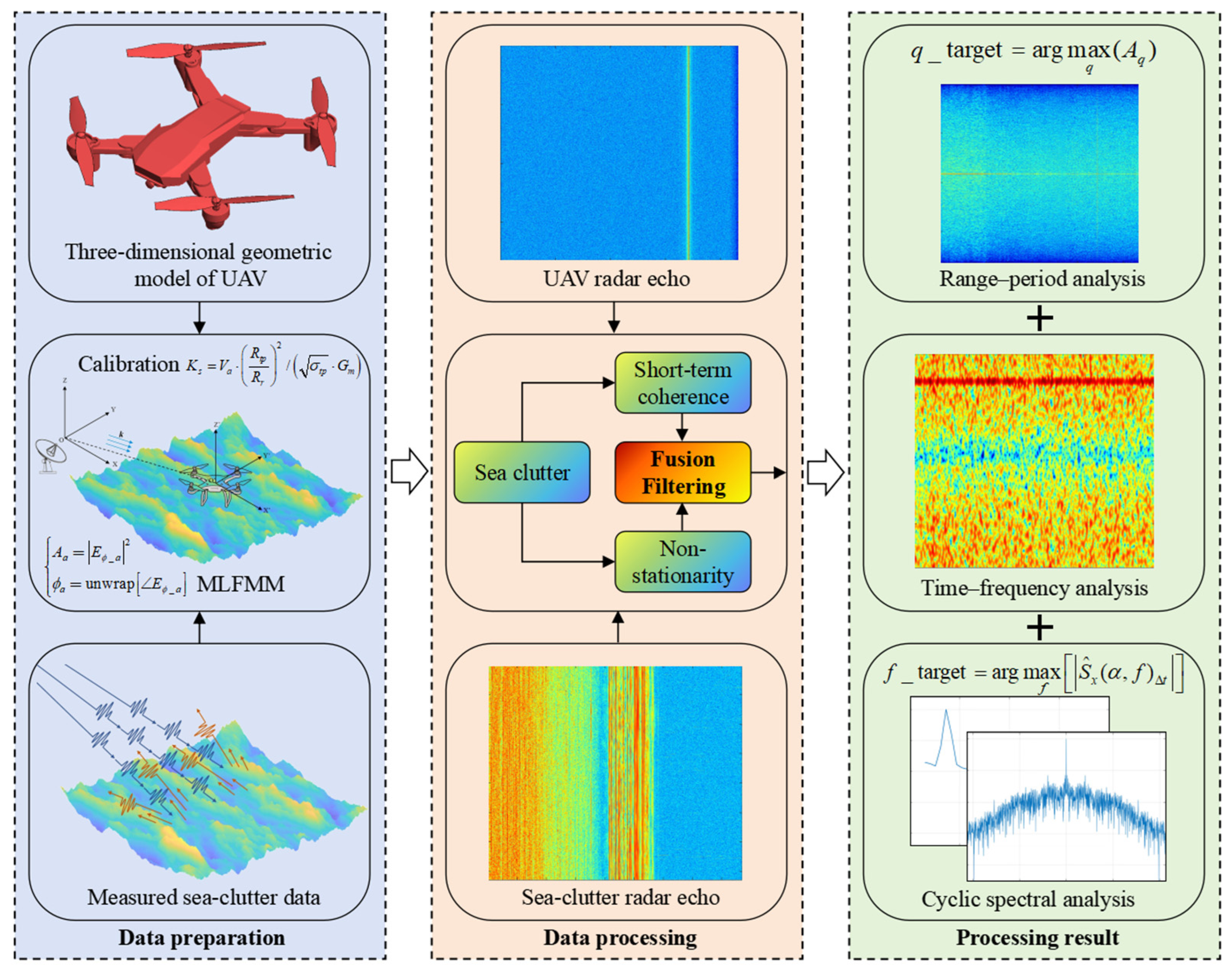
In this paper, during the data preparation phase, we employ the multi-level fast multipole method (MLFMM) to compute the RCS of a UAV three-dimensional model, and based on this, simulate accurate UAV radar echoes. A system calibration method establishes a unified physical benchmark between simulated and measured data, enabling their effective integration to construct the UAV radar echo against a sea-clutter background. Next, during the data processing stage, by exploiting temporal correlation differences between target and clutter signals across different pulses, we perform inter-pulse autocorrelation processing on radar echoes to filter out non-periodic components rapidly. Based on the cyclic spectrum [9], the data matrix and range cell index obtained from autocorrelation analysis are then combined with the cyclic spectrum. Leveraging the high resolution and strong interference resistance of the cyclic spectrum, we can highlight the peak frequency features of the UAV in the cyclic frequency domain. By analyzing the processing results, we can ultimately obtain information on the target’s range, velocity, and type. The proposed method innovatively employs autocorrelation-guided cyclic spectral fusion filtering to effectively mitigate the short-term coherence and non-stationarity characteristics of strong sea-clutter backgrounds. We evaluate the proposed method across two sea-clutter backgrounds and under various signal-to-clutter-plus-noise ratio (SCNR) conditions, showing it to have broader applicability and greater robustness than the classical MTI, SVD and the cascaded processing of these two methods. The specific workflow is illustrated in Figure 1.
This paper is organized as follows. In Section 2, radar echoes from UAVs are simulated by applying the RCS calculated using the MLFMM and combining them with the sea-clutter background. The fusion filtering approach based on the combination of autocorrelation and cyclic spectrum is described in Section 3. Section 4 presents the results and analysis of the simulation experiment, conducting performance tests and comparisons between the classic methods and the proposed method. Section 5 is devoted to the conclusion.

2. UAV Radar Echo Construction in the Context of Strong Sea Clutter

This paper employs MLFMM for accurately constructing radar echoes of the UAV. To achieve physically consistent fusion of simulated and measured data, this study derives system calibration factors based on radar equations and measured calibration data, establishes a quantitative mapping relationship between simulated signal amplitude and measured received voltage, and constructs UAV radar echoes against a background of sea clutter.

2.1. UAV Radar Echo Modeling

The MLFMM is an efficient and accurate numerical method, particularly suitable for calculating the RCS of complex electrically large UAV targets, thereby providing a critical input for subsequent radar echo simulation [17]. By performing calculations on the blade’s three-dimensional model using MLFMM, the complex scattering matrix components for the blade at various azimuth angles are directly computed. For a given polarization channel, the complex scattering field E ϕ _ b can be directly obtained; this scattering field contains the scattering intensity and intrinsic scattering phase of the blade at that angle. Therefore, the RCS amplitude pattern A b and phase pattern of the blade ϕ b can be defined as follows:
A b = E ϕ _ b 2 ϕ b = unwrap E ϕ _ b
where unwrap is the decoherence function, and the phase term must undergo decoherence processing to obtain a continuous physical phase.
Similarly, once the scattered field E ϕ _ a of the airframe is computed, the amplitude and phase patterns of the airframe’s RCS ( A a and ϕ a ) can be defined as follows:
A a = E ϕ _ a 2 ϕ a = unwrap E ϕ _ a
Following the theoretical framework of the “scattering center model” in radar signal processing, the baseband echoes from the airframe and blades are represented as a coherent superposition of echoes from different scattering centers. Based on the principle of linear superposition of radar echoes, the echoes from the airframe and all blades are added together [18], resulting in the radar echo of the multi-rotor UAV as follows:
s R t = m = 0 M 1 n = 0 N 1 A b _ m n t exp j ϕ b _ m n t exp j 4 π λ R 0 ν t + A a t exp j ϕ a t exp j 4 π λ R 0 ν t
where M is the number of rotors, N is the number of blades on a rotor, λ is the radar wavelength, R 0 is the initial range of the target, and ν is the velocity of the UAV.
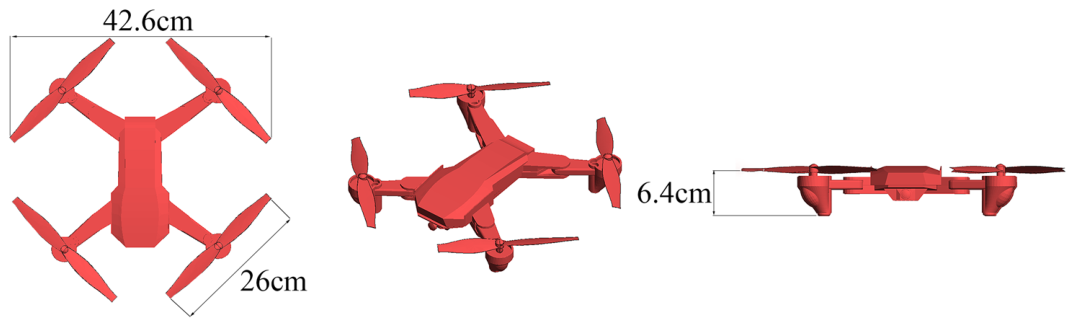
Taking a UAV with four rotors and two rotor blades as an example, this paper uses the three-dimensional model of the UAV shown in Figure 2, whose dimensions are approximately 42.6 cm × 42.6 cm × 6.4 cm, and the blade length L is 13 cm. When conducting MLFMM calculations, the azimuth angle is 0° and the elevation angle is −1° (simulated radar angle for detecting UAVs flying close to the sea surface). The calculation conditions are plane wave, far field, monostatic, and single frequency. The radar parameters are shown in Table 1. Since the bandwidth is relatively small compared to the frequency, a single frequency is set to conduct an efficient simulation.
The airframe and blades are considered to be made of engineered plastics. Since actual airframes often contain glass-fiber-reinforced or carbon-fiber-reinforced materials, and may include structural components such as metal frames and circuit boards, their relative permittivity and loss tangent are slightly higher than those of the blades. To reduce computational costs, both the airframe and blades are modeled as a single dielectric material, with their material parameters simplified and approximated as follows: for the airframe, ε r _ a = 5 and tan δ a = 0.03 ; for the blades, ε r _ b = 3 and tan δ b = 0.003 .
To counteract gyroscopic and aerodynamic torque effects during flight and achieve attitude control by utilizing the difference in rotational speed between the rotors, the rotation directions of two adjacent rotors are typically opposite. The rotational speed of the UAV blades f r is set to approximately 5 r/s to facilitate the analysis and verification of the simulation results. The UAV is configured to hover at a range of 9 km from the radar.
Based on the above parameters and conditions, the simulation results are shown in Figure 3.
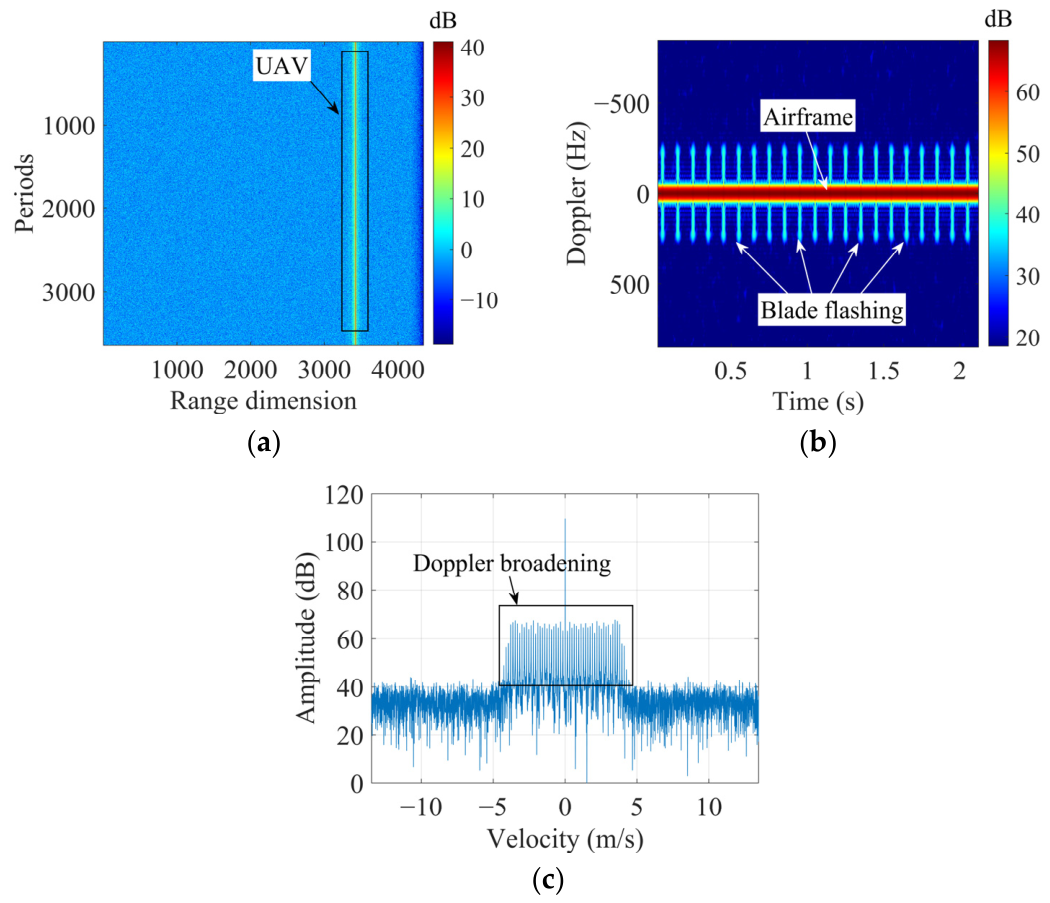
Figure 3a is a range–period plot. After pulse compression, the UAV echo appears as a thin vertical line in the figure; the range cell 3421, where it appears, represents the UAV’s position. After conversion, this corresponds to the preset range of 9 km.
Figure 3b shows a time–frequency plot obtained by applying a Gaussian window to the short-time Fourier transform (STFT) of the range cell containing the target (also known as the Gabor transform). Time–frequency analysis techniques reveal signal characteristics in both the time and frequency domains, making them particularly advantageous for analyzing non-stationary signals compared to traditional Fourier transform methods [19]. The Gabor transform achieves an optimal balance between time-domain and frequency-domain resolution, providing the best combined time–frequency resolution. The elongated horizontal central frequency band corresponds to the airframe; since the UAV is hovering, it is located at zero frequency. The vertical periodic peaks on both sides represent m-D signatures (rotor blade flutter) generated by blade rotation. Since the blade rotation speed is 5 r/s and there are 2 blades on each rotor, the period of the Doppler peaks should be 1 / f r / N = 0.1   s , which matches the time interval between the Doppler peaks shown in the figure.
Figure 3c shows a range–velocity slice, with the selected range cell corresponding to the UAV target location. The peak with the highest amplitude in the figure is at 0 m/s, corresponding to the airframe. Since the blade length is 0.13 m, the velocity corresponding to the Doppler broadening generated by the rotating blades should be 2 π L f r 4.1   m / s , which is consistent with the figure.
In summary, the simulated radar echoes show high consistency with the theoretical model’s predictions in terms of time–frequency, range–velocity, and m-D signatures, which validates the accuracy of the UAV radar echo model and lays a solid foundation for subsequent data processing.

2.2. Composite Echo Signal Generation

The sea-clutter dataset used in this paper was collected by the Naval Aeronautical University in the sea area near Yangma Island, Yantai, using an X-band solid-state fully coherent radar to detect the sea surface [20,21].
This experimental dataset employs an external calibration method to determine the relationship between measured voltages and the sea surface scattering coefficient under test. In the context of this paper, calibration refers to the process of establishing a quantitative mapping between the measured received voltage and the theoretical RCS of a target, using a reference target with known RCS. The output of this process is a system calibration factor, which physically represents the theoretical voltage amplitude that a 1 m2 point target at a reference distance of 1 m would produce after pulse compression. This system calibration factor is then used to convert the full-wave simulated RCS of the UAV into a simulated voltage signal that shares the same physical scale as the measured sea clutter.
Based on this, we calculated the system calibration factor through the stainless-steel ball calibration target used in the field experiment. It establishes a unified physical scale for integrating measured sea-clutter data with simulated UAV data.
According to the single-site radar equation, the received power from a target can be expressed as
P a = P t G a 2 λ 2 σ t p 4 π 3 R t p 4
Here, P t represents the peak transmit power, G a represents the antenna gain, σ t p represents the target’s RCS, and R t p represents the distance to the target.
Before matched filtering, the signal voltage amplitude at the output of the receiving antenna and the received power satisfy the relationship V a = P a Z 0 , where Z 0 is the characteristic impedance of the receiving system.
However, in practical engineering applications, the system calibration factor K s is typically defined as a coefficient that comprehensively accounts for factors such as transmit power and antenna gain, allowing the received voltage after matched filtering to be expressed directly as
V a = K s σ t p 1 R t p 2 G m
where G m is the matched filtering gain factor, which reflects the factor by which the signal-to-noise ratio improves before and after matched filtering. By introducing a reference distance R r (typically 1 m) for normalization, the calculation of the system calibration factor can be expressed as
K s = V a R t p R r 2 / σ t p G m
Based on the system transfer constant K s described above, the UAV scattering data obtained from full-wave simulation can be mapped to a voltage scale consistent with the measured sea clutter.
S UAV = S R t K s R r R t p 2 G m
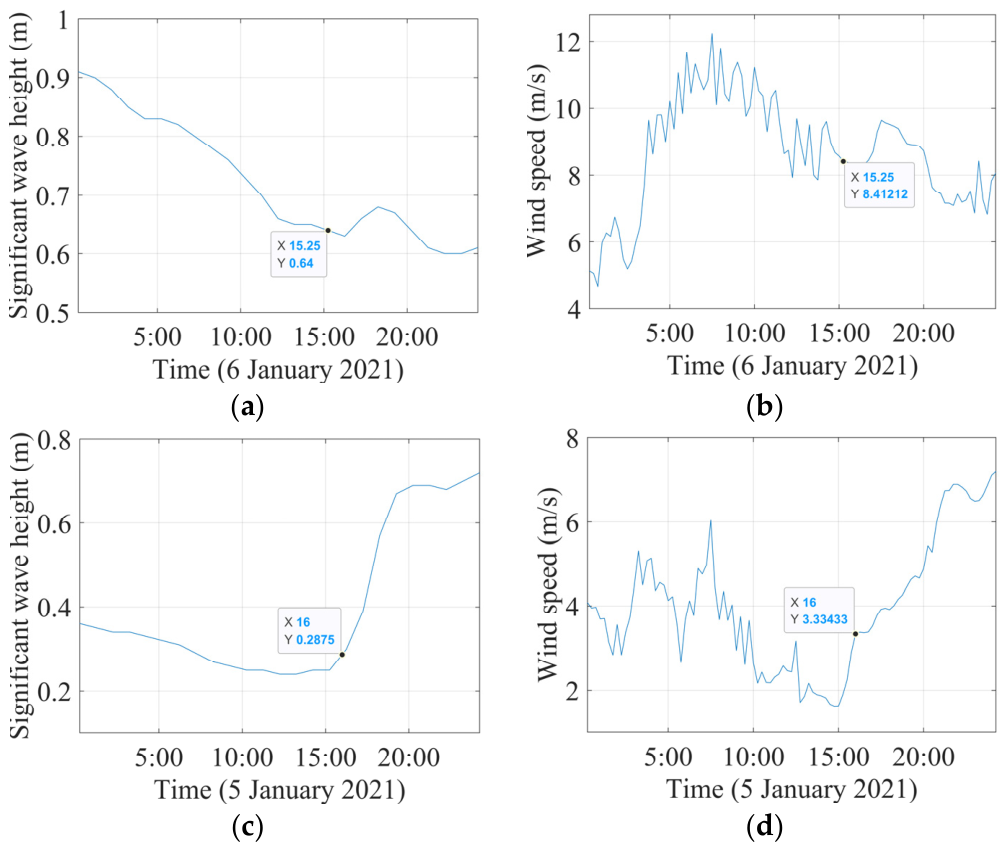
Using the calibration method described above, the simulation and measured data were combined by linear superposition. The UAV rotor speed under sea-clutter conditions was set to 15 r/s. The conditions and parameters for modeling the UAV’s electromagnetic scattering remained the same as before. The sea-clutter data used were obtained from antenna measurements conducted in the staring mode. More detailed parameters for the sea clutter and UAV are shown in Table 2. The meteorological and hydrographic parameters (wind speed and significant wave height) for the sea-clutter data segments used in this paper are shown in Figure 4. The meteorological parameters were recorded at 15 min intervals. The sea-clutter data containing a buoy and an island were measured at 15:21 on 6 January 2021, while the sea-clutter data containing a speedboat were measured at 16:06 on 5 January 2021. The results of combining UAV radar echoes with the two different sea-clutter backgrounds are shown in Figure 5 and Figure 6.
Figure 4a,b correspond to sea states 3–4 and show the meteorological and hydrographic parameters associated with sea clutter containing the buoy and island. Figure 4c,d correspond to sea state 2 and show the meteorological and hydrographic parameters associated with sea clutter containing the speedboat. Analysis confirms that the wind speed and significant wave height associated with sea states 3–4 are significantly higher than those of sea state 2. This increase in wave height and wind energy directly translates to a broader Doppler spectral bandwidth and heightened non-stationarity in the resulting sea clutter. Consequently, radar detection of targets becomes more challenging under these conditions, as the clutter exhibits greater spectral dispersion and temporal variation.
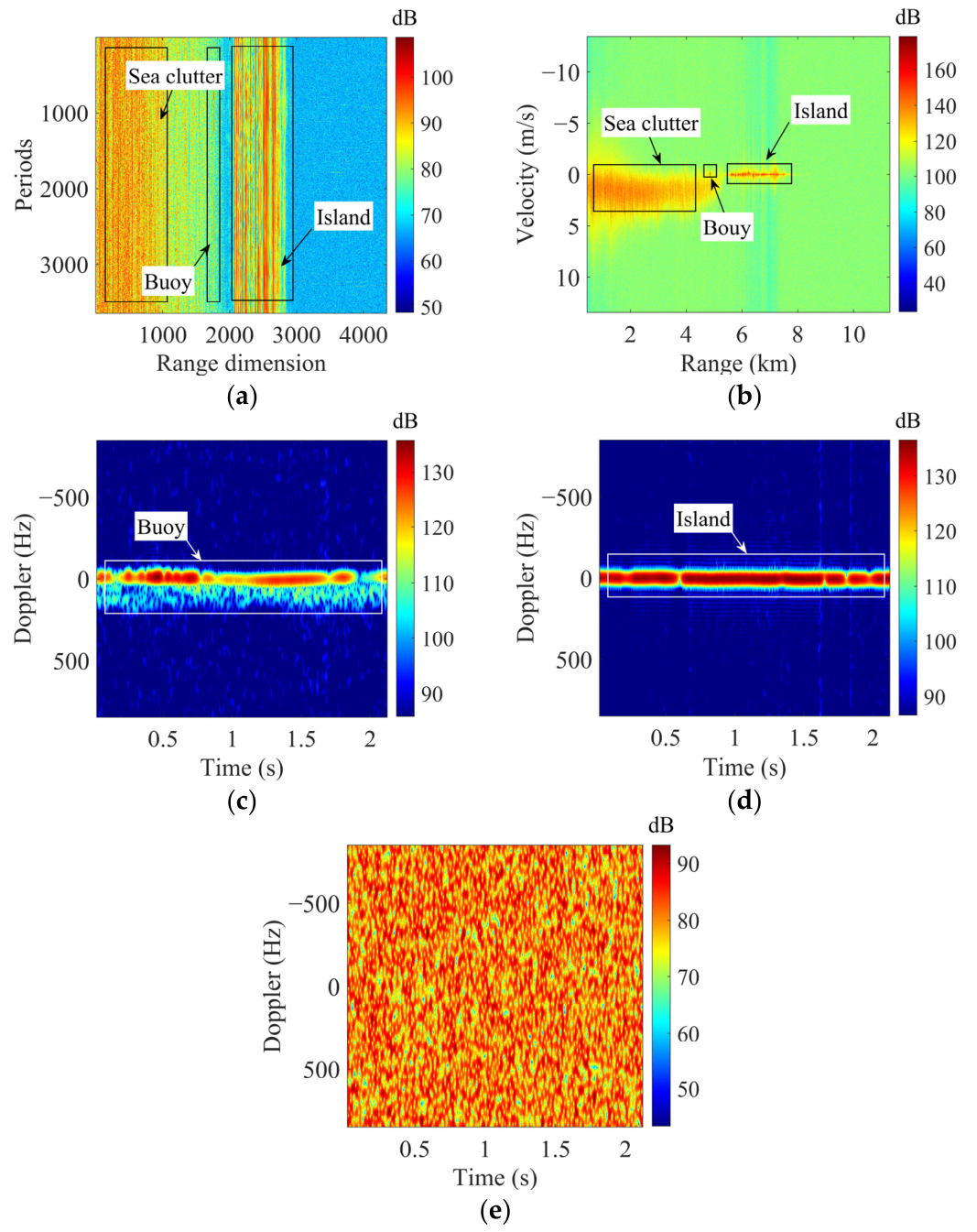
In Figure 5a, the near-range area shows interference from nearshore waves, while the mid-range area reveals buoy and island targets. The UAV target is theoretically located in the far-range area; however, because the data has not yet been filtered and the UAV target has a small RCS and weak echo, it is obscured by the sea-clutter background. In the figure, the buoy target appears as a single thin line, while the island target, due to its large actual volume and complex shape, appears as multiple thin lines spanning several range cells. Similarly, in the range–velocity plot of Figure 5b, sea clutter, buoys, and islands can be clearly observed, while the UAV target remains invisible. Furthermore, since the buoy and island targets are nearly stationary, they are both located near zero velocity (i.e., zero frequency), while nearshore wave interference exhibits an irregular distribution in the near-range and low-velocity regions. Figure 5c–e shows time–frequency analyses for different target range cells. In these figures, the UAV target is masked by sea clutter; the time–frequency signatures of the buoy and the island are distinctly different. The buoy exhibits significant Doppler frequency fluctuations due to its movement with the waves, while the Doppler frequency of the island remains relatively stable.
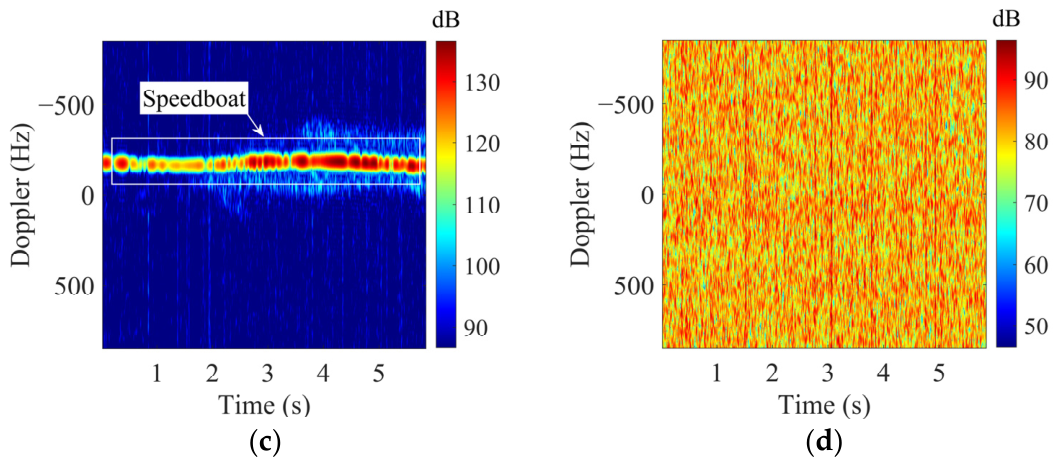
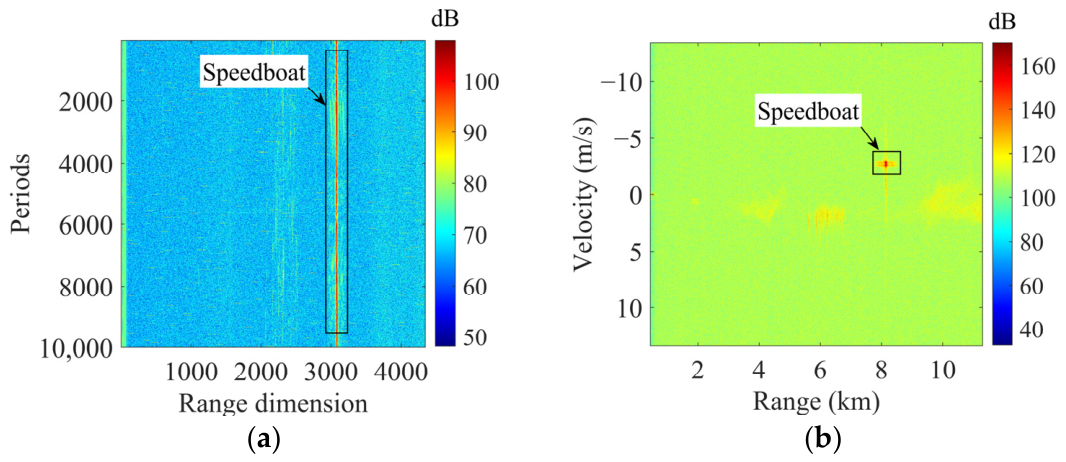
In Figure 6a, since the filtering methods have not yet been applied, only the radar echo from the speedboat target is visible. Figure 6b shows that the speedboat target is traveling at approximately −2.6 m/s, with a range of approximately 8.15 km. In Figure 6c, the Doppler frequency of the speedboat’s time–frequency echo is approximately −164 Hz, which is consistent with the Doppler shift 2 ν speedboat / λ caused by its motion. In Figure 6d, the UAV’s echo is overwhelmed by sea clutter.
In summary, using this system calibration method, we have established a unified reference standard for simulation data and measured data at the physical level. By combining measured sea-clutter data with simulated UAV data, we have successfully generated UAV radar echoes against a background of sea clutter, thereby providing robust data support for subsequent filtering processes.

3. Fusion Filtering Approach

UAV radar echoes exhibit significant cyclostationarity, making them highly suitable for extraction via cyclic spectral analysis. However, in complex marine environments, UAV target signals are often buried in strong sea clutter, making it difficult to identify the target processing cells for cyclic spectral analysis quickly. It limits the ability to perform efficient and reliable target-feature extraction using cyclic spectral analysis. In contrast, autocorrelation processing is highly effective for rapidly identifying periodic components within UAV echo signals while filtering out non-periodic background components, thereby providing a range cell index for cyclic spectral analysis. Inspired by this, this paper innovatively combines the strengths of these two methods, using autocorrelation to guide cyclic spectral analysis and thereby achieve fusion filtering. It utilizes the correlation between adjacent pulses to suppress slow clutter and enhance the echoes from moving targets with phase coherence, thereby establishing a target range for cyclic spectral analysis. Ultimately, by projecting the signal onto the cyclic frequency dimension, the method ingeniously exploits the fundamental difference between the periodicity of the UAV’s micro-vibrations and the non-periodic randomness of sea clutter, thereby efficiently and reliably separating the cyclostationary components caused by the m-D effect and extracting the UAV’s target features.

3.1. Autocorrelation Analysis

Autocorrelation measures the similarity between a signal and its delayed counterpart. Sea clutter and other uniformly distributed clutter typically exhibit broad spectra and short coherence times, meaning their autocorrelation functions decay rapidly with increasing time delay. Conversely, target echoes with periodicity or stability (e.g., targets moving at constant velocity or exhibiting regular micro-vibrations) may display significant peaks or periodic fluctuations in their autocorrelation functions at specific time delays.
Therefore, we compute the inter-pulse autocorrelation of the complex matrix of two-dimensional radar echoes (radar I/Q data, with dimensions P × Q). Here, P represents the number of range cells, and Q represents the number of pulses. By exploiting differences in temporal correlation between target and clutter signals across different pulses, we achieve sea-clutter suppression. If the slow-time sequence of the data matrix is denoted as s q p , where q is the range cell index, and p is the pulse index, the autocorrelation function of this sequence at time delay k is
R ^ q k = 1 P k p = 0 P 1 k s q p + k s q * p
For most range cells dominated by sea clutter, the autocorrelation function magnitude falls rapidly below a threshold. Range cells with autocorrelation functions that maintain significant energy for longer lags are identified as candidate cells with high temporal coherence, potentially containing target signals. After processing all range cells in this manner, a time delay of k = 1 is selected; the cell with the maximum amplitude corresponds to the target with the strongest periodicity. Since, in a strong clutter background, the total energy is dominated by clutter and the target signal is easily overwhelmed, k = 0 is not selected. The choice of k = 1 is because it directly corresponds to the most basic processing interval of the radar system, namely one pulse repetition time. At this timescale, slow ocean waves exhibit high correlation, whereas moving targets exhibit reduced correlation due to the Doppler effect, thereby enabling effective suppression of sea clutter. The autocorrelation function at delay k = 1 is calculated as follows:
A q = R ^ q 1 = 1 P 1 p = 0 P 2 s q p + 1 s q * p
Based on this, the index of the target range cells can be obtained using peak search:
q _ target = arg max q A q , q = 1 , 2 , , Q
Here, the value of arg max is the index of the function’s maximum value. The candidate range cells selected by this fast autocorrelation screening are then fed into the subsequent, more computationally intensive but precise cyclic spectrum analysis for final feature extraction.

3.2. Cyclic Spectral Analysis

A signal is referred to as a stationary signal when its statistical properties—such as mean and variance—remain constant over time. Conversely, a signal is termed non-stationary when its properties vary. When the statistical properties of a non-stationary signal exhibit periodic variation, it is classified as a cyclostationary signal. A random cyclostationary signal x t , whose cyclic autocorrelation function (CAF) is defined as
R x α τ = lim T 1 T T / 2 T / 2 x t + τ 2 x * t τ 2 e j 2 π α t d t
where α is the cyclic frequency. The cyclic spectrum, also known as cyclic spectral density (CSD), is defined as the Fourier transform of the CAF:
S x α f = R x α τ e j 2 π f τ d τ
where f is the spectral frequency. In addition, the CSD can be computed by skipping the CAF and directly from the FFT accumulation method (FAM) [22].

3.3. Guided Fusion Filtering

To address the non-stationarity of sea clutter, we transform the data into the cyclostationary domain. Leveraging its high resolution and strong interference resistance, we separate cyclostationary signals like UAV signals from sea clutter. By introducing the autocorrelation-derived data matrix and range cell index, we optimize the range for the cyclic spectral analysis.
This paper employs FAM for cyclic spectral analysis. This method accelerates computation by utilizing data segmentation, windowed overlapping processing, and a two-stage fast Fourier transform, thereby achieving estimates with low variance. The computational method is as follows.
S ^ x α , f Δ t = 1 P n N L r n = 0 P n 1 X T r n L ω , N L T s a f + α q α Δ α 2 X T * r n L ω , N L T s a f α q α Δ α 2 e j 2 π r n q α P n
The total number of slides within the observation period is P n , and the total data length N P = P n L ω . During FAM computation, the number of data points slid per window step is denoted as L ω . The total observation time Δ t = N P T s a determines the fundamental resolution Δ α = 1 / Δ t of the cyclic frequency α . T s a is the sampling period, q α is the discrete frequency index of the second-stage FFT, and X T is the short-time complex spectrum of the discrete-time complex signal x . In the actual algorithm, the slow time sequence s q _ target p containing the target range cell obtained through inter-pulse autocorrelation processing should be substituted here.
X T n , k = i = 0 N L 1 ω i x n i e j 2 π f n i / N L
In the equation, ω denotes a center-symmetric smoothing window of length N L (such as a Hamming window or Kaiser window) used to suppress spectral leakage; n represents the time sliding step. Through the above processing, we can extract the peak spectral frequency features of the UAV.
f _ target = arg max f S ^ x α , f Δ t
Similarly, the peak search for the cyclic frequency can also be performed. The main peak at zero cyclic frequency corresponds to the energy of the stationary component and must be excluded. The sub-peaks resulting from the cyclostationary component are typically distributed symmetrically on either side of zero cyclic frequency.
α _ target = arg max α S ^ x α , f Δ t
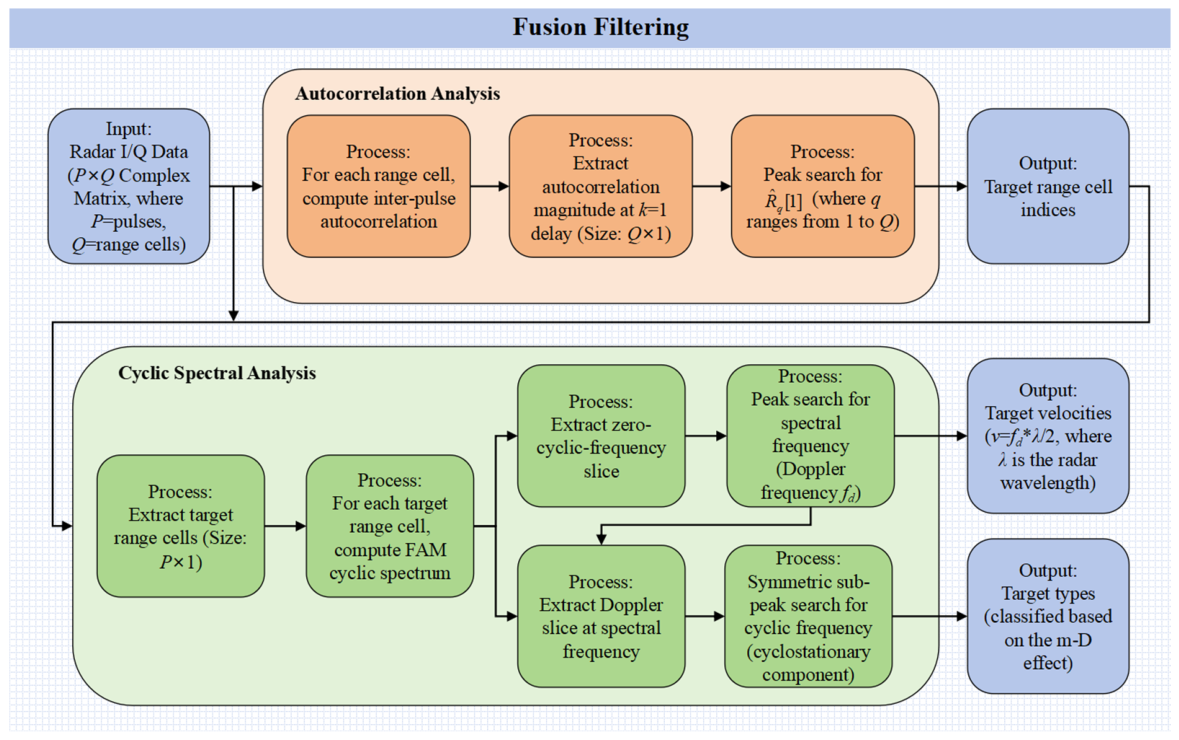
Based on the above processing, the UAV signal, which exhibits cyclostationarity, is separated from sea clutter and clearly distinguished from it due to its strong frequency concentration. The overall process flowchart and the relationships between the various steps are shown in Figure 7.

4. Results and Analysis

In this section, we apply the aforementioned filtering method, which combines autocorrelation and the cyclic spectrum, to suppress clutter in the integrated data. Its performance is then validated by comparing the results with those from the classical MTI, the SVD method, and the cascaded processing of MTI and SVD (referred to here as the cascade method) across a range of input SCNR conditions. Furthermore, to demonstrate the proposed method’s ability to process and track UAV targets, we evaluate its performance across different sea-clutter backgrounds.

4.1. SCNR Comparison

The input SCNR was set to six equally spaced intervals from −20 to 5 dB. The input SCNR range is set from −20 dB to 5 dB to cover typical operating conditions ranging from extremely challenging to relatively favorable. Lower limit −20 dB: Simulates an extreme scenario where the signal is severely overwhelmed by strong sea clutter, used to evaluate the algorithm’s detection capability and robustness under extremely low SCNR. Upper limit 5 dB: Represents a relatively favorable scenario where clutter interference still exists, used to verify the algorithm’s performance ceiling and convergence trends as the SCNR improves.
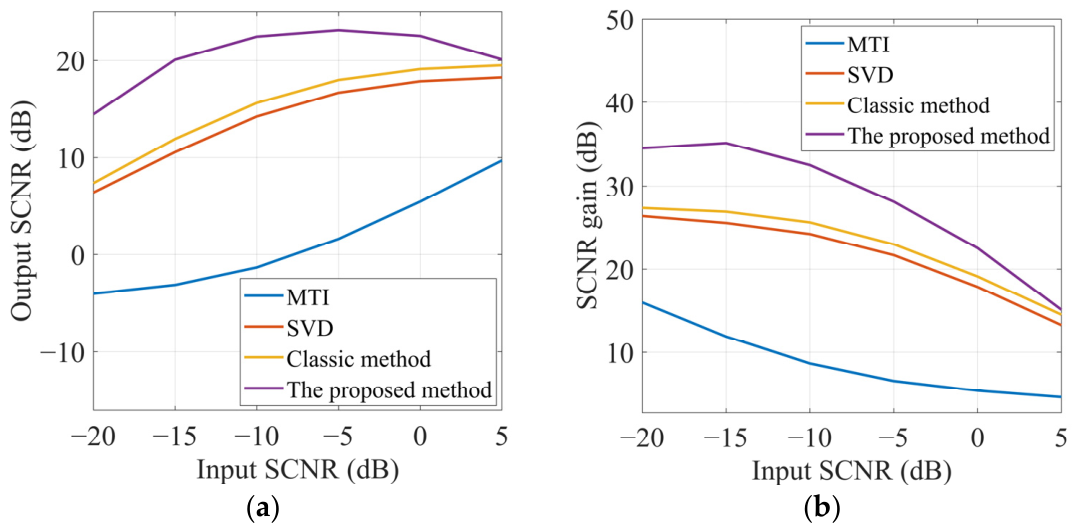
For each interval, the output SCNR was calculated using both the MTI, SVD, the cascade method (a cascade of MTI and SVD), and the proposed methods, followed by the computation of their respective SCNR gains. The quantitative results are presented in Table 3, with the corresponding variation curves shown in Figure 8.
As shown in Table 3, the proposed method achieves higher output SCNR and SCNR gain than the other three methods under both low- and high-input SCNR conditions. This indicates that the proposed method exhibits superior filtering performance across the entire input dynamic range. Analysis of Figure 8a reveals that the output SCNR of the proposed method first increases and then decreases. In contrast, the output SCNR of the MTI, SVD, and cascade method exhibits a monotonically increasing trend. This difference indicates that the proposed method more effectively leverages the signal’s structural characteristics through its joint analysis mechanism, thereby achieving optimal processing across a wide input dynamic range. This is represented in the figure by a distinct plateau region, indicating that within the input range (−10 to 0 dB), the proposed method achieves a relatively stable high signal gain. Among these methods, the MTI method offers the least filtering performance and is effective only when the interference is relatively weak. The SVD method and the cascade method yield similar filtering results; however, since the cascade method cascades the MTI method with the SVD method, there is a slight overall improvement in filtering performance. In Figure 8b, the gain curve of the proposed method shows a significant improvement over those of the MTI, SVD, and cascade method, indicating superior interference resistance and enhanced weak-signal processing capabilities across the entire input dynamic range. Compared with scenarios with high input SCNR, under strong sea-clutter interference at low input SCNR, the SCNR gains of the SVD and cascade methods differ even more significantly from those of the proposed method. This result indicates that, under such extreme conditions, their detection capabilities and robustness are markedly inferior.

4.2. Multi-Scenario Sea-Clutter Testing

The processed results of UAV radar echoes against two types of sea-clutter backgrounds are shown in Figure 9 and Figure 10.
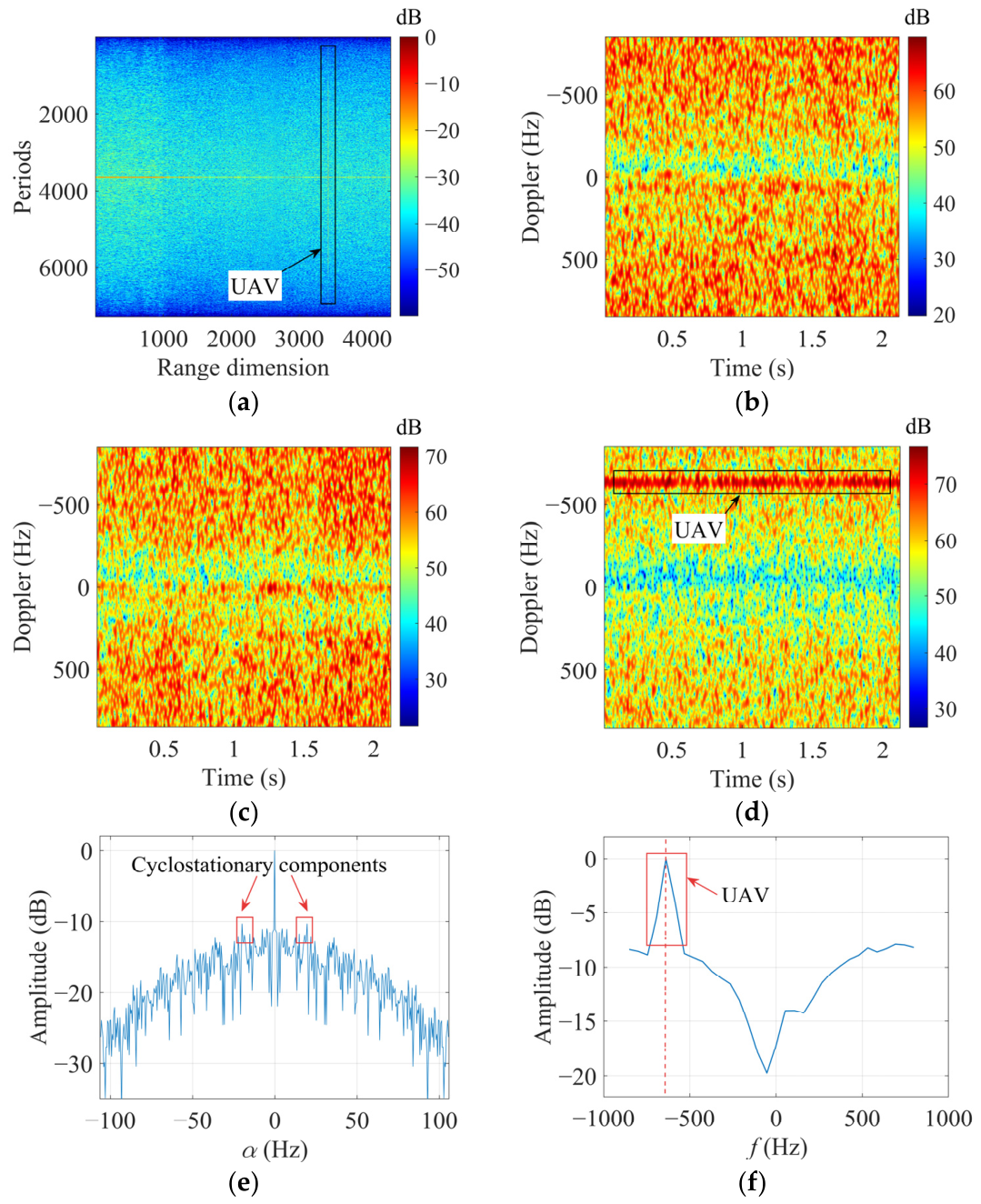
As shown in Figure 9a, the range–period plot generated by the proposed method successfully isolates and enhances the UAV target echo, which is no longer masked by sea clutter. Interferences, including nearshore clutter, buoys, and islands, are effectively suppressed due to their weak periodicity, slow motion, or low radar echo amplitude. The key to this separation lies in the inter-pulse autocorrelation processing with a delay of k = 1. This setting capitalizes on the phase coherence of the periodic UAV signal across adjacent pulses, thereby suppressing slow clutter and providing a distinct range cell index for the target. This index establishes a reliable search range for the subsequent cyclic spectral analysis. Figure 9b–d show the time–frequency analyses of different targets. In these figures, compared with Figure 5e, the amplitudes of buoy and island are significantly suppressed. At the same time, the energy of the UAV target becomes more concentrated in the time–frequency domain after filtering, thereby standing out against the sea clutter.
Figure 9e shows a slice of the UAV’s cyclic spectrum at the frequency f = 639   Hz . The small peaks on either side of the cyclic frequency represent a non-zero cyclic frequency distribution caused by the rotation of the UAV’s rotors, with a value of approximately 17.6 Hz, which is close to the theoretical rotor speed of 15 Hz. Figure 9f shows a slice of the UAV’s cyclic spectrum at frequency α = 0   Hz , and its maximum peak is located at f = 639   Hz , which is essentially consistent with the Doppler shift 2 ν / λ 633.3   Hz caused by the UAV’s velocity. The statistical characteristics of sea clutter typically lack strict, fixed periodicity and therefore do not constitute a cyclically stationary signal; its energy is primarily concentrated in the frequency band with zero cyclic frequency, which provides a “clean” background for observing the target signal at other cyclic frequencies. By selecting the appropriate cyclic frequency slices, we transformed the m-D features from the time–frequency plane and concentrated them onto specific spectral lines along the spectral frequency axis. This approach significantly suppressed sea clutter and noise unrelated to the modulation period, markedly improved the SCNR of the features, and successfully isolated the UAV signal.
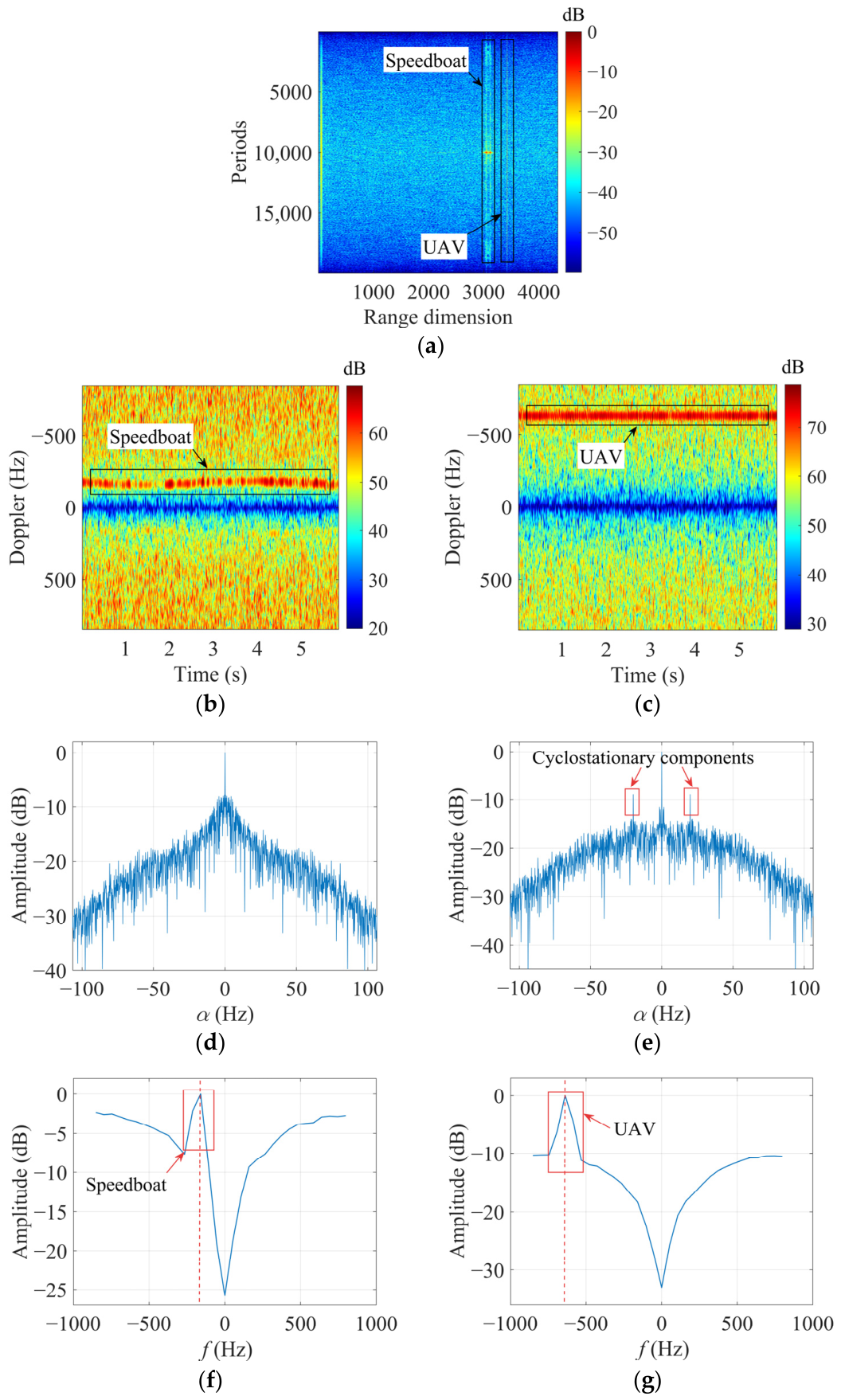
In the range–period plot shown in Figure 10a, in addition to the radar echo from the speedboat target, the radar echo from the UAV also stands out against the sea clutter, demonstrating the proposed method’s capability in processing weak targets. In Figure 10b, the amplitude of the speedboat’s time–frequency echo decreases after filtering but remains discernible, demonstrating the proposed method’s capability to identify moving targets. In Figure 10c, compared with Figure 6d, the time–frequency echo of the UAV is clearly visible due to the suppression of sea clutter. Figure 10d shows that the speedboat’s cyclic spectrum, in the slice at frequency f = 159   Hz , exhibits a peak only at zero cyclic frequency, with no significant peaks at non-zero cyclic frequencies. In contrast, the cyclic spectrum of the UAV at frequency f = 639   Hz in Figure 10e exhibits a cyclostationary component caused by the rotation of the UAV’s rotor blades (i.e., peaks at non-zero cyclic frequencies), manifested in the figure as small peaks on either side of the zero cyclic frequency. These peaks are approximately 18.1 Hz, which is close to the theoretical blade rotation speed of 15 Hz. In Figure 10f, the maximum peak appears around −159Hz, representing the Doppler shift caused by the speedboat’s motion. In Figure 10g, the maximum peak is approximately −639 Hz, representing the Doppler shift caused by the UAV’s motion. By measuring the Doppler shift of a moving target, information about the target’s velocity can be revealed. The cyclic spectrum analysis adds a new dimension to signal analysis. Since the m-D features of different targets vary significantly, they produce spectral peaks at different positions and intensities in the cyclic spectrum. Furthermore, since maritime targets such as speedboats and ships rarely exhibit periodic motion, the cyclostationary features detected by cyclic spectral analysis provide a key characteristic for distinguishing UAVs from these targets in the presence of sea clutter.
The above comparative analysis shows that the proposed method maintains high performance across the entire low-to-high SCNR range. It demonstrates its broad applicability across different sea states and its overall robustness. Furthermore, validation across different sea-clutter backgrounds shows that the proposed method better processes and preserves weak, moving targets while suppressing sea clutter.

5. Conclusions

This paper addresses the severe sea-clutter interference in radar detection of maritime targets, particularly UAVs. The radar echo of a UAV is constructed using its RCS, accurately calculated via a rigorous full-wave algorithm. Using a system calibration method, a unified physical scale is established to integrate simulated and measured data, thereby constructing the UAV radar echo within a sea-clutter background. The proposed method innovatively employs autocorrelation-guided cyclic spectral fusion filtering, which effectively mitigates the short-term coherence and non-stationarity of the strong sea-clutter background. First, inter-pulse autocorrelation is employed to assess the similarity of the signal at adjacent observation intervals. By selecting a specific delay, the contribution of sea-clutter correlation is reduced while preserving that of the moving target. Subsequently, the data domain is transformed via cyclic spectral analysis. The appropriate frequency slices are chosen to detect the prominent spectral peaks formed by the periodic m-D modulation, ultimately enabling the extraction of UAV target features against the sea-clutter background. Compared to classical MTI, SVD, and the cascaded processing of these two methods, this approach achieves a significant improvement in SCNR, demonstrating higher gain and superior performance across various input SCNR conditions. Validation results across diverse sea-clutter backgrounds confirm that the method effectively suppresses clutter and accurately extracts UAV echo signals in different sea states, distinguishing them from other maritime targets.

Author Contributions

Conceptualization, D.N.; methodology, S.L., D.N. and C.L.; software, S.L. and W.J.; validation, S.L., D.N. and C.L.; formal analysis, S.L.; investigation, S.L., D.N. and W.J.; resources, D.N.; data curation, S.L.; writing—original draft preparation, S.L.; writing—review and editing, D.N.; visualization, S.L.; supervision, D.N.; project administration, D.N.; funding acquisition, D.N. All authors have read and agreed to the published version of the manuscript.

Funding

This research was funded by the 111 Project (Grant No. B17035), the Natural Science Basic Research Program of Shaanxi, and the Open Research Fund Program of Key Laboratory of the Ministry of Education.

Data Availability Statement

The data is contained within the article.

Acknowledgments

We acknowledge the use of data provided by the Naval Aeronautical University in the sea area near Yangma Island, Yantai, with DOI:10.12000/JR19089. At the same time, we would like to thank the editors and anonymous reviewers for providing invaluable and constructive comments and suggestions.

Conflicts of Interest

Chuan Li is employed by Aerospace Era Feihong Technology Co., Ltd. and Ninth Academy of China Aerospace Science and Technology Corporation. The authors declare no conflicts of interest.

Abbreviations

The following abbreviations are used in this manuscript:
UAVUnmanned Aerial Vehicle
MLFMMMulti-Level Fast Multipole Method
MTIMoving Target Indicator
SVDSingular Value Decomposition
SCNRSignal-to-Clutter-plus-Noise Ratio
RCSRadar Cross Section
m-Dmicro-Doppler
STFTShort-Time Fourier Transform
CAFCyclic Autocorrelation Function
CSDCyclic Spectral Density
FAMFFT Accumulation Method

References

  1. Zhao, C.; Luo, G.; Wang, Y.; Chen, C.; Wu, Z. UAV Recognition Based on Micro-Doppler Dynamic Attribute-Guided Augmentation Algorithm. Remote Sens. 2021, 13, 1205. [Google Scholar] [CrossRef]
  2. Coluccia, A.; Fascista, A.; Sommer, L.; Schumann, A.; Dimou, A.; Zarpalas, D. The Drone-vs-Bird Detection Grand Challenge at ICASSP 2023: A Review of Methods and Results. IEEE Open J. Signal Process. 2024, 5, 766–779. [Google Scholar] [CrossRef]
  3. Hong, T.; Li, Y.; Fang, C.; Dong, W.; Chen, Z. Extracting Micro-Doppler Features from Multi-Rotor Unmanned Aerial Vehicles Using Time-Frequency Rotation Domain Concentration. Drones 2024, 8, 20. [Google Scholar] [CrossRef]
  4. Zhang, T.; Song, X. Computational Methods and Simulation of UAVs’ Micro-Motion Echo Characteristics Using Distributed Radar Detection. Symmetry 2026, 18, 26. [Google Scholar] [CrossRef]
  5. Wei, J.; Ma, D.; He, F.; Zhang, Q.; Feng, Z.; Liu, Z.; Liang, T. UAV’s Rotor Micro-Doppler Feature Extraction Using Integrated Sensing and Communication Signal: Algorithm Design and Testbed Evaluation. IEEE Trans. Wirel. Commun. 2025, 24, 10166–10182. [Google Scholar] [CrossRef]
  6. Lai, Y.; Duan, K.; Qiu, Z.; Wang, W. Joint Design of Waveform and Filter for MIMO DFRC Systems Under the Satellite-UAV Framework. IEEE Sens. J. 2025, 25, 6920–6939. [Google Scholar] [CrossRef]
  7. Passafiume, M.; Rojhani, N.; Collodi, G.; Cidronali, A. Modeling Small UAV Micro-Doppler Signature Using Millimeter-Wave FMCW Radar. Electronics 2021, 10, 747. [Google Scholar] [CrossRef]
  8. Kumawat, H.C.; Chakraborty, M.; Bazil Raj, A.A.; Dhavale, S.V. DIAT-μSAT: Small Aerial Targets’ Micro-Doppler Signatures and Their Classification Using CNN. IEEE Geosci. Remote Sens. Lett. 2022, 19, 6004005. [Google Scholar] [CrossRef]
  9. Kang, K.-B.; Choi, J.-H.; Cho, B.-L.; Lee, J.-S.; Kim, K.-T. Analysis of Micro-Doppler Signatures of Small UAVs Based on Doppler Spectrum. IEEE Trans. Aerosp. Electron. Syst. 2021, 57, 3252–3267. [Google Scholar] [CrossRef]
  10. Cui, J.; Wang, Y.; Mi, X.; Zhang, Y.; Du, P.; Zheng, H.; Sun, D.; Li, Q.; Su, F. Investigation on the Multidimensional Statistical Characteristics of Sea Clutter Acquired by a Ku-Band Radar with Variable Range Resolution. IEEE Trans. Geosci. Remote Sens. 2025, 63, 5103915. [Google Scholar] [CrossRef]
  11. Cao, C.; Zhang, J.; Zhang, X.; Gao, G.; Zhang, Y.; Meng, J.; Liu, G.; Zhang, Z.; Han, Q.; Jia, Y.; et al. Modeling and Parameter Representation of Sea Clutter Amplitude at Different Grazing Angles. IEEE J. Miniaturization Air Space Syst. 2022, 3, 284–293. [Google Scholar] [CrossRef]
  12. Lv, M.; Zhou, C. Study on Sea Clutter Suppression Methods Based on a Realistic Radar Dataset. Remote Sens. 2019, 11, 2721. [Google Scholar] [CrossRef]
  13. Zhang, X.; Yang, Q.; Yao, D.; Deng, W. Main-Lobe Cancellation of the Space Spread Clutter for Target Detection in HFSWR. IEEE J. Sel. Top. Signal Process. 2015, 9, 1632–1638. [Google Scholar] [CrossRef]
  14. Liu, S.; Ma, Y.; Huang, Y. Sea Clutter Cancellation for Passive Radar Sensor Exploiting Multi-Channel Adaptive Filters. IEEE Sens. J. 2019, 19, 982–995. [Google Scholar] [CrossRef]
  15. Li, J.; Chen, Z.; Zhao, C.; Ding, F. First-Order Sea Clutter Suppression for High-Frequency Surface Wave Radar Using Orthogonal Projection in Spatial–Temporal Domain. IEEE Geosci. Remote Sens. Lett. 2022, 19, 3503305. [Google Scholar] [CrossRef]
  16. Bi, X.; Guo, S.; Yang, Y.; Shu, Q. Adaptive Target Extraction Method in Sea Clutter Based on Fractional Fourier Filtering. IEEE Trans. Geosci. Remote Sens. 2022, 60, 5115609. [Google Scholar] [CrossRef]
  17. He, W.; Yang, Z.; Huang, X.; Wang, W.; Yang, M.; Sheng, X. High-Performance Evaluation of the Interpolations and Anterpolations in the GPU-Accelerated Massively Parallel MLFMA. IEEE Trans. Antennas Propag. 2023, 71, 6231–6236. [Google Scholar] [CrossRef]
  18. Chen, V.C.; Li, F.; Ho, S.-S.; Wechsler, H. Micro-Doppler effect in radar: Phenomenon, model, and simulation study. IEEE Trans. Aerosp. Electron. Syst. 2006, 42, 2–21. [Google Scholar] [CrossRef]
  19. Lui, H.; Persson, M.; Shuley, N.V.Z. Joint Time-Frequency Analysis of Transient Electromagnetic Scattering from a Subsurface Target. IEEE Antennas Propag. Mag. 2012, 54, 109–130. [Google Scholar] [CrossRef][Green Version]
  20. Liu, N.; Dong, Y.; Wang, G.; Ding, H.; Huang, Y.; Guan, J.; Chen, X.; He, Y. Sea-Detecting X-Band Radar and Data Acquisition Program. J. Radars 2019, 8, 656–667. [Google Scholar]
  21. Liu, N.; Ding, H.; Huang, Y.; Dong, Y.; Wang, G.; Dong, K. Annual Progress of the Sea-Detecting X-Band Radar and Data Acquisition Program. J. Radars 2021, 10, 173–182. [Google Scholar]
  22. Gardner, W. Measurement of Spectral Correlation. IEEE Trans. Acoust. Speech Signal Process. 1986, 34, 1111–1123. [Google Scholar] [CrossRef]
Figure 1. An overview of the workflow.
Remotesensing 18 01896 g001
Figure 2. Three-dimensional geometric model of UAV.
Remotesensing 18 01896 g002
Figure 3. Simulation results of UAV radar echoes. (a) Range–period plot; (b) time–frequency plot; (c) a slice of the range–velocity plot.
Remotesensing 18 01896 g003
Figure 4. The meteorological and hydrographic parameters for the sea-clutter data. (a) Significant wave height of sea clutter containing the buoy and island; (b) wind speed of sea clutter containing the buoy and island; (c) significant wave height of sea clutter containing the speedboat; (d) wind speed of sea clutter containing the speedboat.
Remotesensing 18 01896 g004
Figure 5. Raw composite radar echoes before filtering (containing the UAV, the buoy, and the island). (a) Range–period plot; (b) range–velocity plot; (c) time–frequency plot of buoy; (d) time–frequency plot of island; (e) time–frequency plot of UAV.
Remotesensing 18 01896 g005
Figure 6. Raw composite radar echoes before filtering (containing the UAV and the speedboat). (a) Range–period plot; (b) range–velocity plot; (c) time–frequency plot of speedboat; (d) time–frequency plot of UAV.
Remotesensing 18 01896 g006aRemotesensing 18 01896 g006b
Figure 7. The flowchart of the fusion filtering method.
Remotesensing 18 01896 g007
Figure 8. Performance comparison of the four methods under different input SCNR conditions: (a) output SCNR comparison; (b) SCNR gain comparison.
Remotesensing 18 01896 g008
Figure 9. Composite radar echoes processed using the proposed method (containing the UAV, the buoy, and the island). (a) Range–period plot; (b) time–frequency plot of buoy; (c) time–frequency plot of island; (d) time–frequency plot of UAV; (e) a slice of the UAV’s cyclic spectrum at f = 639   Hz ; (f) a slice of the UAV’s cyclic spectrum at α = 0   Hz .
Remotesensing 18 01896 g009
Figure 10. Composite radar echoes processed using the proposed method (containing the UAV and the speedboat). (a) Range–period plot; (b) time–frequency plot of speedboat; (c) time–frequency plot of UAV; (d) a slice of the speedboat’s cyclic spectrum at f = 159   Hz ; (e) a slice of the UAV’s cyclic spectrum at f = 639   Hz ; (f) a slice of the speedboat’s cyclic spectrum at α = 0   Hz ; (g) a slice of the UAV’s cyclic spectrum at α = 0   Hz .
Remotesensing 18 01896 g010
Table 1. Parameters for radar.
ParametersValue
Radar frequency9.5 GHz
Radar bandwidth25 MHz
Pulse width3 μs
Pulse repetition frequency1704 Hz
PolarizationHH
Table 2. Parameters for sea clutter and UAV.
Sea-Clutter DataSea StateSea Surface Target Range/kmUAV Range/kmUAV Velocity/(m/s)
Sea clutter containing the buoy and island3~4 levelsBuoy: 4.84; Island: 6.72910
Sea clutter containing the speedboat2 levelsSpeedboat: 8.15910
Table 3. Performance comparison of the four methods at different input SCNR.
Input SCNR/dBOutput SCNR of MTI/dBSCNR Gain of MTI/dBOutput SCNR of SVD/dBSCNR Gain of SVD/dBOutput SCNR of Cascade Method/dBSCNR Gain of Cascade Method/dBOutput SCNR of the Proposed Method/dBSCNR Gain of the Proposed Method/dB
−20−4.0315.976.4026.407.3727.3714.4634.46
−15−3.1211.8810.5625.5611.9226.9220.0835.08
−10−1.328.6814.2324.2315.6325.6322.4632.46
−51.626.6216.6821.6817.9922.9923.1228.12
05.465.4617.8617.8619.1219.1222.5322.53
59.694.6918.2613.2619.5114.5120.1015.10
Disclaimer/Publisher’s Note: The statements, opinions and data contained in all publications are solely those of the individual author(s) and contributor(s) and not of MDPI and/or the editor(s). MDPI and/or the editor(s) disclaim responsibility for any injury to people or property resulting from any ideas, methods, instructions or products referred to in the content.