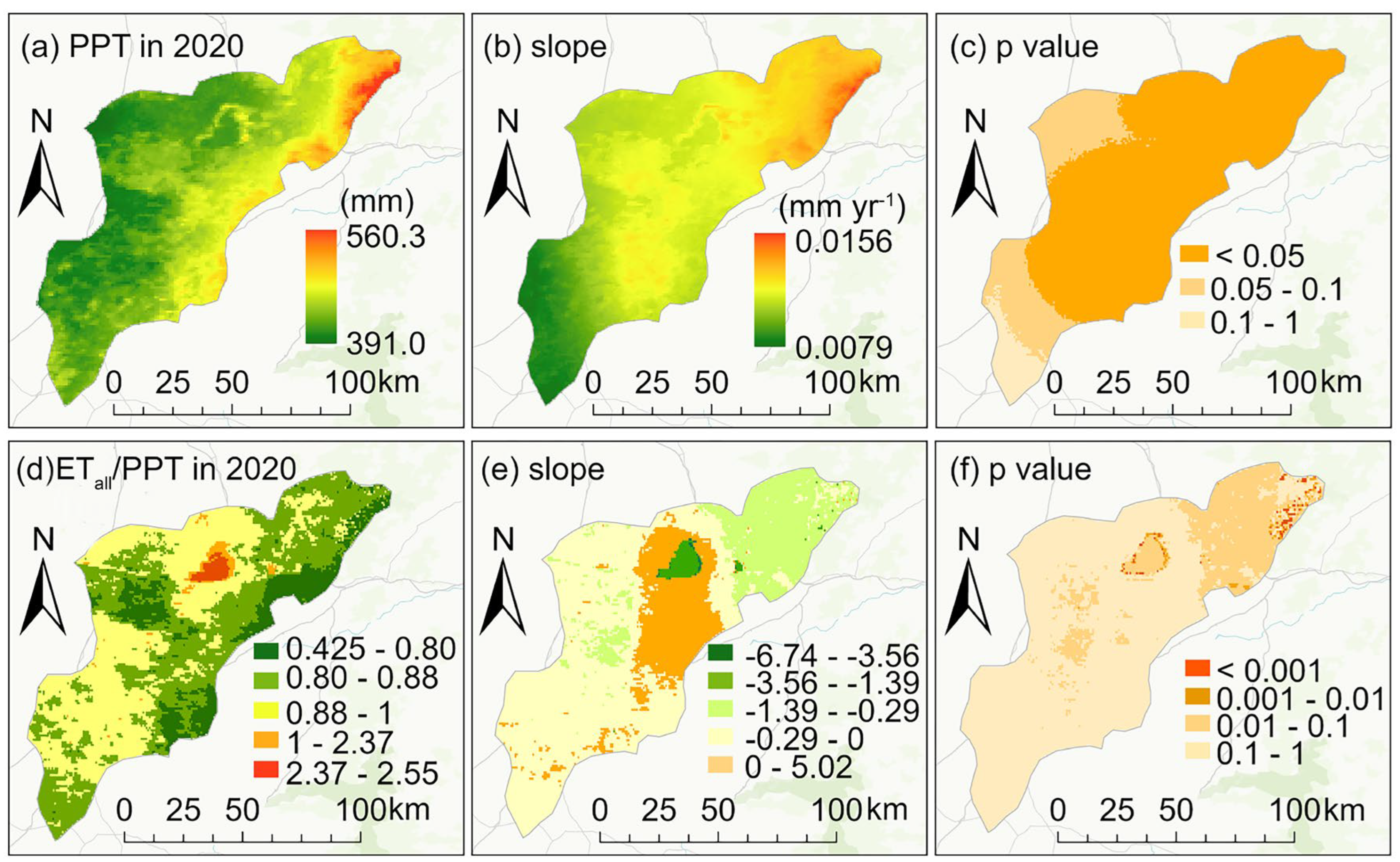
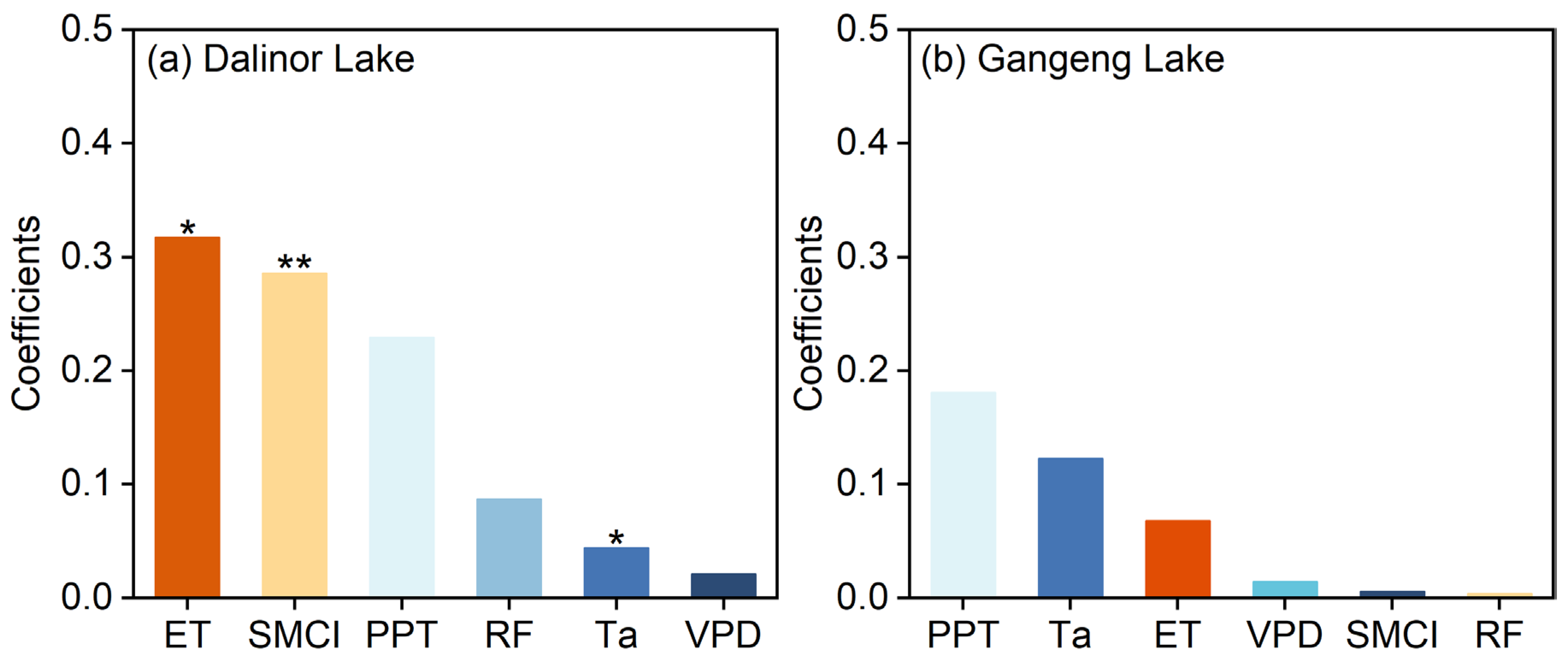
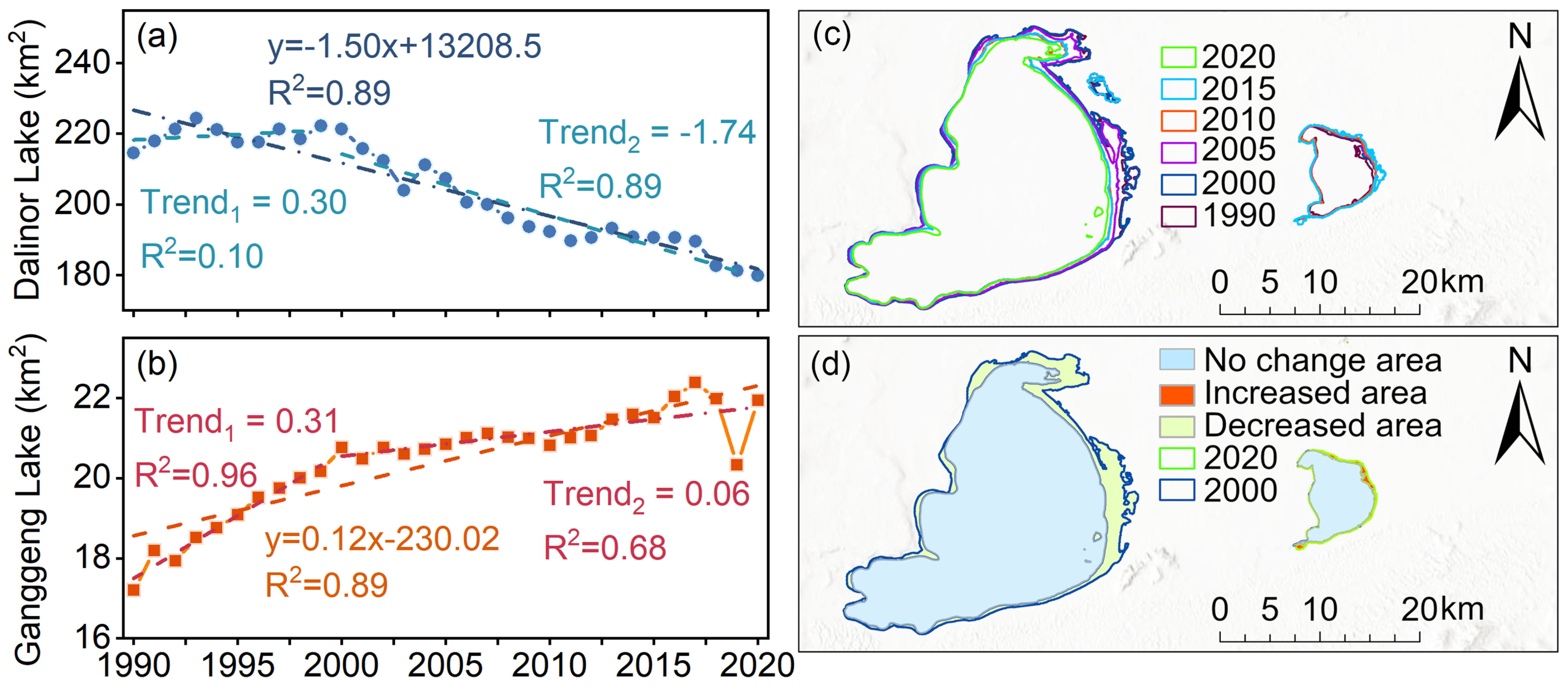
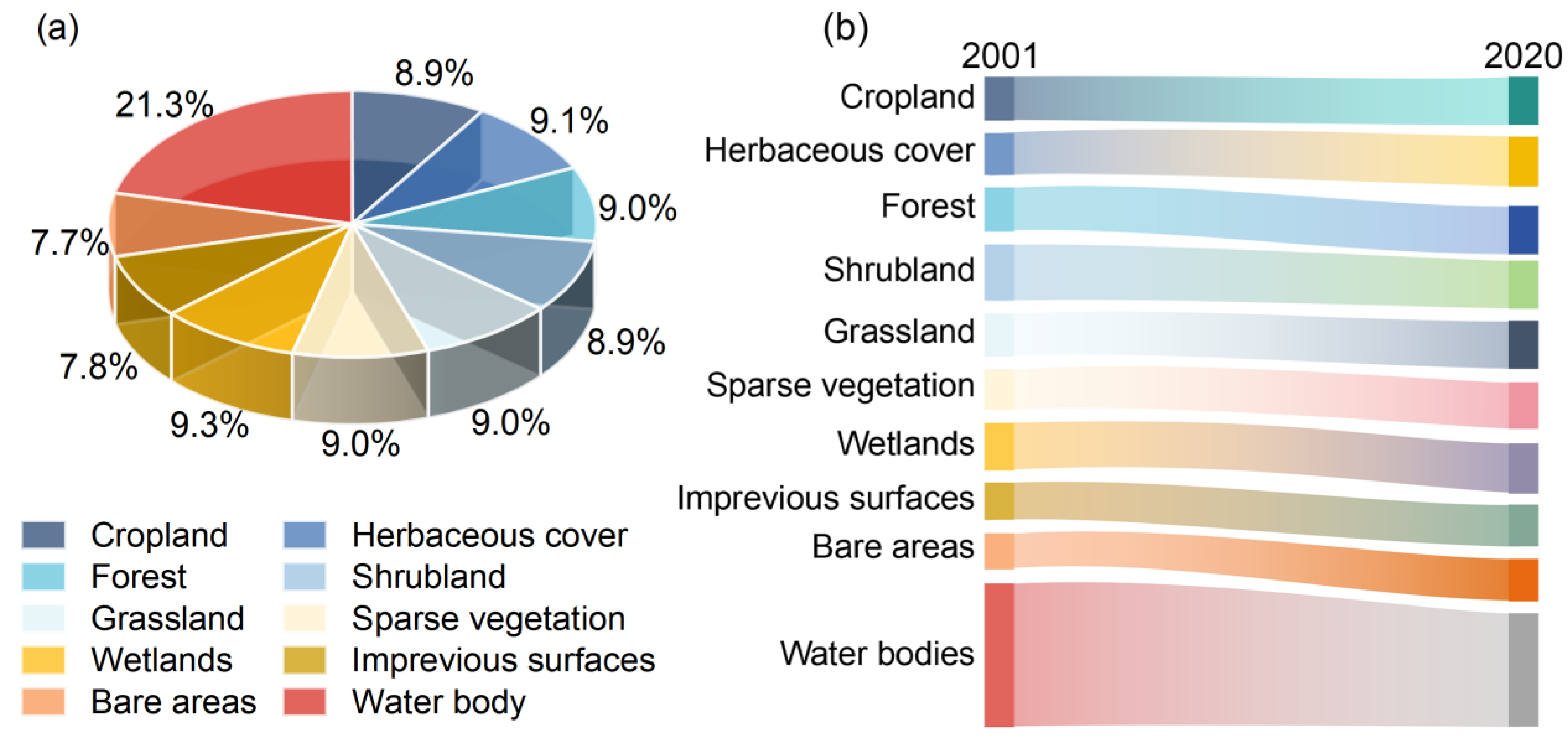
Remote Sensing Study of the Impact of Revegetation on Lake Shrinkage in a Semi-Arid Inland Lake Basin, Inner Mongolia


Highlights
- Revegetation projects in water-limited regions could intensify water consumption through evapotranspiration.
- The variation trends of surface areas and their driving factors differ between lakes of different sizes.
- Future revegetation projects should adopt a hydrologically informed and spatially differentiated method that balances the potential negative effects of vegetation on water resources.
- Water-efficient vegetation species could be prioritized for ecological restoration in semi-arid regions and incorporated into continuous monitoring for water balance.
Abstract
1. Introduction
2. Materials and Methods
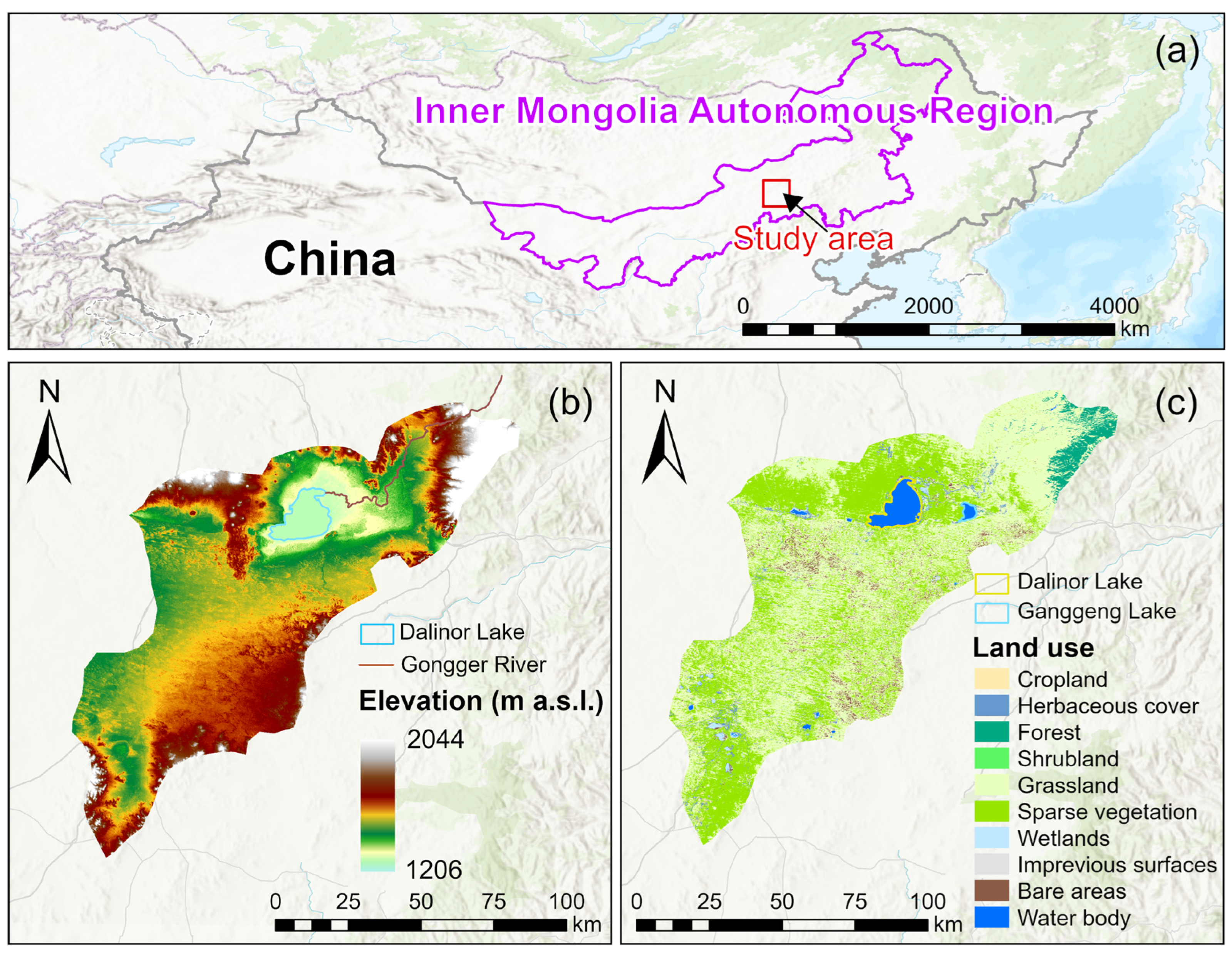
2.1. Study Area
2.2. Data Sources and Processing
2.2.1. Lake Area
2.2.2. Normalized Difference Vegetation Index (NDVI)
2.2.3. Meteorological and Hydrological Variables
2.2.4. Other Data
2.3. Statistical Analysis
3. Results
3.1. Changes in Lake Areas
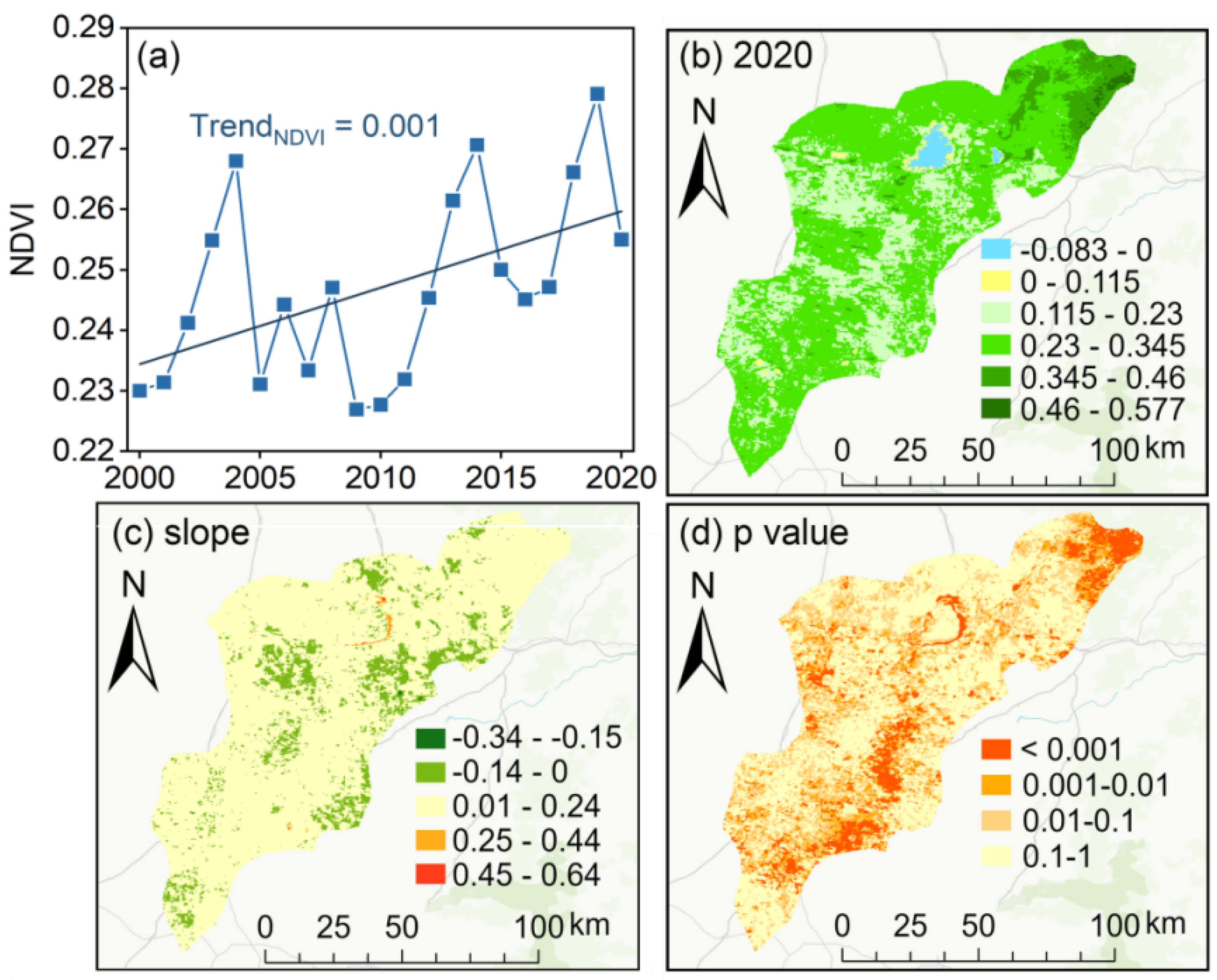
3.2. Temporal–Spatial Variations in NDVI
3.3. Changes in Meteorological and Hydrological Variables
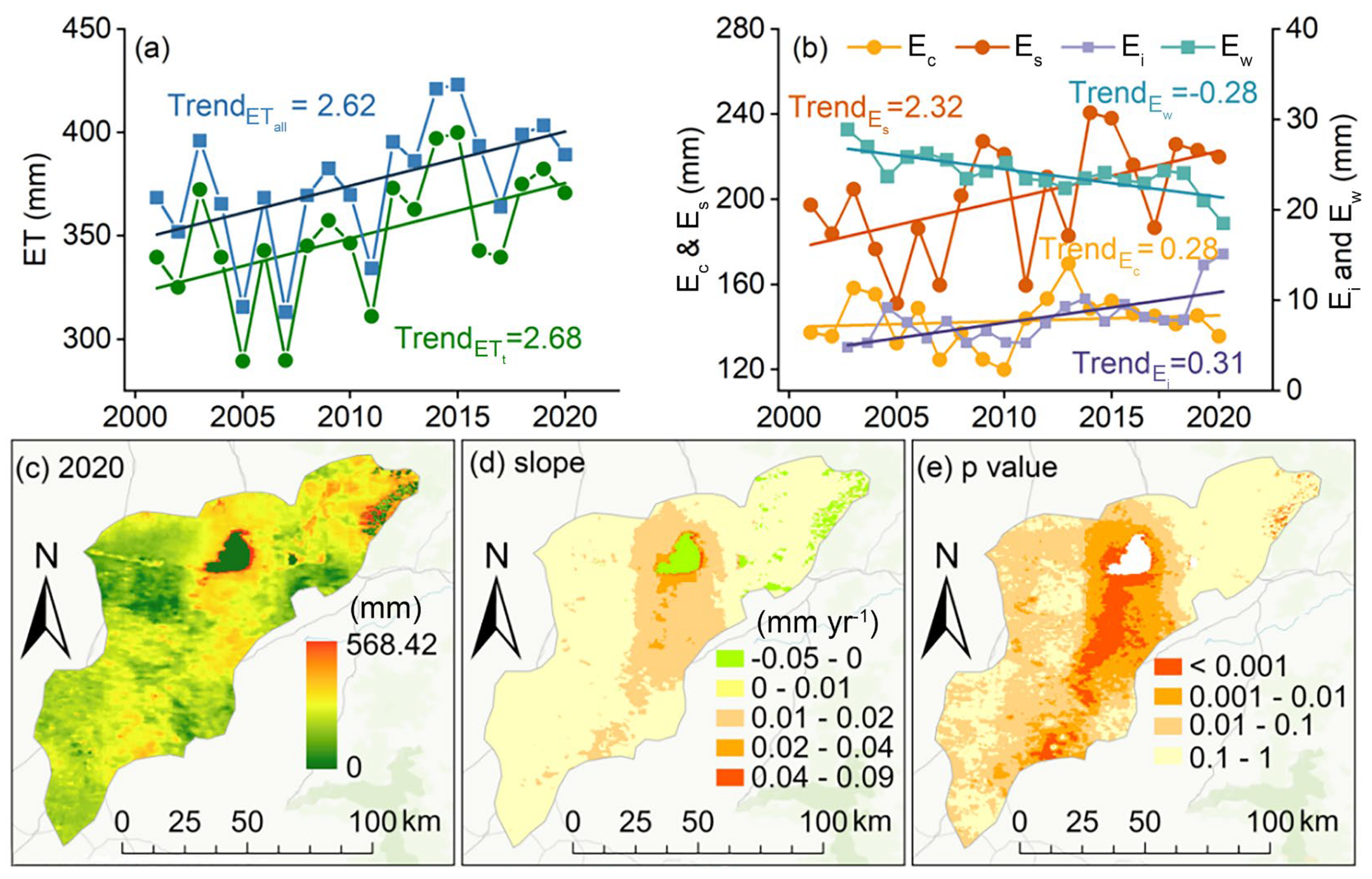
3.3.1. Evapotranspiration
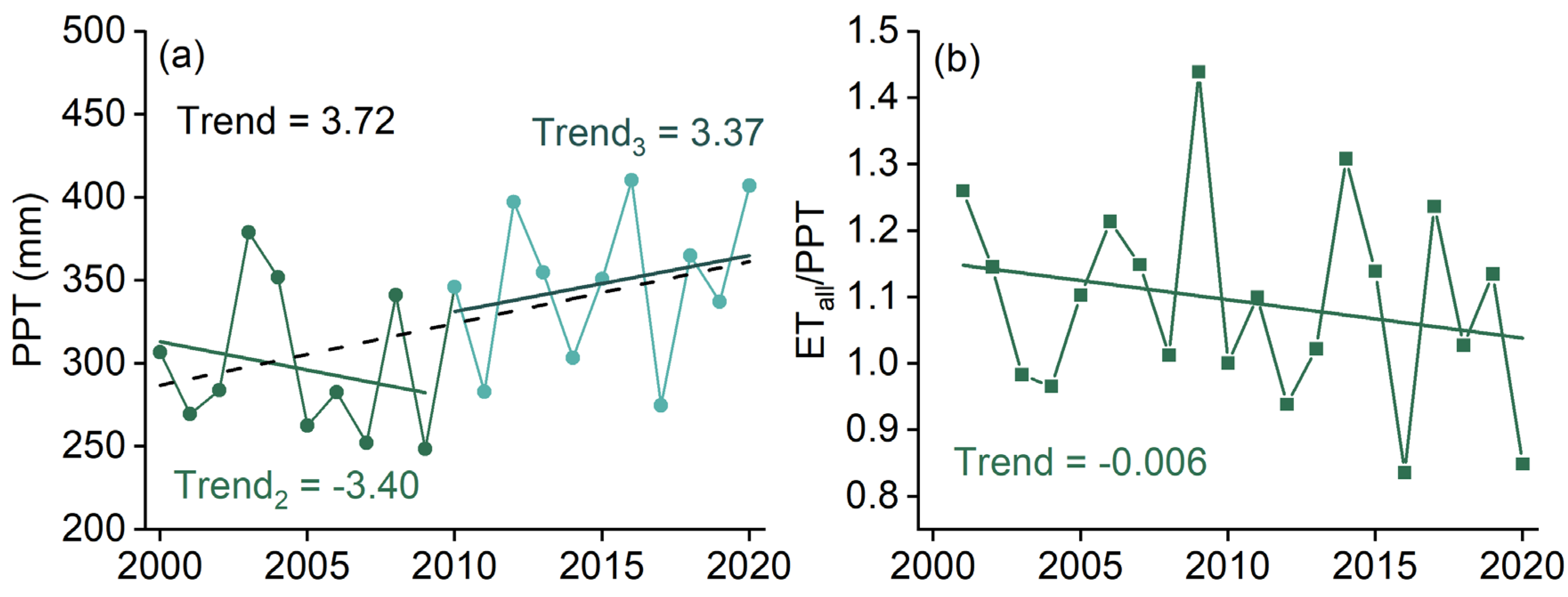
3.3.2. Precipitation
3.3.3. Other Variables
3.4. Controls of Lake Areas
4. Discussion
4.1. Dominant Controlling Factors of Dalinor Lake and Ganggeng Lake
4.2. Influence of Ecological Restoration on Dalinor Lake Through Evapotranspiration
4.3. Impact of Ecological Restoration on Dalinor Lake Through Evapotranspiration
4.4. Limitation
5. Conclusions
Supplementary Materials
Author Contributions
Funding
Data Availability Statement
Conflicts of Interest
References
- Bai, M.; Mo, X.; Liu, S.; Hu, S. Detection and attribution of lake water loss in the semi-arid Mongolian plateau: A case study in the Lake Dalinor. Ecohydrology 2020, 14, e2251. [Google Scholar] [CrossRef]
- Liu, W.; Fu, Z.; van Vliet, M.T.H.; Davis, K.F.; Ciais, P.; Bao, Y.; Bai, Y.; Du, T.; Kang, S.; Yin, Z.; et al. Global overlooked multidimensional water scarcity. Proc. Natl. Acad. Sci. USA 2025, 122, e2413541122. [Google Scholar] [CrossRef] [PubMed]
- Xu, Y.; Gun, Z.; Zhao, J.; Cheng, X. Variations in lake water storage over Inner Mongolia during recent three decades based on multi-mission satellites. J. Hydrol. 2022, 609, 127719. [Google Scholar] [CrossRef]
- Naeem, M.; Zhang, Y.; Nourani, V.; Tian, X.; Miao, P. Both climate and anthropogenic impacts on recent lake area change in the Erdos Plateau. J. Environ. Manag. 2025, 373, 123443. [Google Scholar] [CrossRef] [PubMed]
- Zhu, L.; Ju, J.; Qiao, B.; Liu, C.; Wang, J.; Yang, R.; Ma, Q.; Guo, L.; Pang, S. Physical and biogeochemical responses of Tibetan Plateau lakes to climate change. Nat. Rev. Earth Environ. 2025, 6, 284–298. [Google Scholar] [CrossRef]
- Xu, F.; Zhang, G.; Woolway, R.I.; Yang, K.; Wada, Y.; Wang, J.; Crétaux, J.F. Widespread societal and ecological impacts from projected Tibetan Plateau lake expansion. Nat. Geosci. 2024, 17, 516–523. [Google Scholar] [CrossRef]
- Guo, J.; Liu, K.; Na, J.; Liu, G.; Cao, Z.; Fan, C.; Xue, B.; Huang, J.; Song, C. A three-decade lake dataset on the Mongolian plateau tracking water area and quality dynamics (1990–2020). Sci. Data 2025, 12, 1788. [Google Scholar] [CrossRef]
- Tao, S.; Fang, J.; Zhao, X.; Zhao, S.; Shen, H.; Hu, H.; Tang, Z.; Wang, Z.; Guo, Q. Rapid loss of lakes on the Mongolian Plateau. Proc. Natl. Acad. Sci. USA 2015, 112, 2281–2286. [Google Scholar] [CrossRef]
- Chang, B.; Li, R.; Zhu, C.; Liu, K. Quantitative impacts of climate change and human activities on water-surface area variations from the 1990s to 2013 in Honghu lake, China. Water 2015, 7, 2881–2899. [Google Scholar] [CrossRef]
- Chen, B.; Chen, L.; Huang, B.; Michishita, R.; Xu, B. Dynamic monitoring of the Poyang Lake wetland by integrating Landsat and MODIS observations. ISPRS J. Photogramm. Remote Sens. 2018, 139, 75–87. [Google Scholar] [CrossRef]
- Shao, R.; Zhang, B.; Su, T.; Long, B.; Cheng, L.; Xue, Y.; Yang, W. Estimating the increase in regional evaporative water consumption as a result of vegetation restoration over the loess plateau, China. J. Geophys. Res. Atmos. 2019, 124, 11783–11802. [Google Scholar] [CrossRef]
- Jiang, C.; Yang, Z.; Liu, C.; Dong, X.; Wang, X.; Zhuang, C.; Zhao, L. Win-win-win pathway for ecological restoration by balancing hydrological, ecological, and agricultural dimensions: Contrasting lessons from highly eroded agroforestry. Sci. Total Environ. 2021, 774, 145140. [Google Scholar] [CrossRef]
- Du, H.; Liu, X.; Jia, X.; Li, S.; Fan, Y. Assessment of the effects of ecological restoration projects on soil wind erosion in northern China in the past two decades. Catena 2022, 215, 13. [Google Scholar] [CrossRef]
- Yan, Z.; Wang, T.; Ma, T.; Yang, D. Water-carbon-sediment synergies and trade-offs: Multi-faceted impacts of large-scale ecological restoration in the Middle Yellow River Basin. J. Hydrol. 2024, 634, 131099. [Google Scholar] [CrossRef]
- Wang-Erlandsson, L.; Fetzer, I.; Keys, P.W.; van der Ent, R.J.; Savenije, H.H.G.; Gordon, L.J. Remote land use impacts on river flows through atmospheric teleconnections. Hydrol. Earth Syst. Sci. 2018, 22, 4311–4328. [Google Scholar] [CrossRef]
- Seijger, C.; Kleinschmit, D.; Schmidt-Vogt, D.; Mehmood-Ul-Hassan, M.; Martius, C. Water and sectoral policies in agriculture-forest frontiers: An expanded interdisciplinary research approach. Ambio 2021, 50, 2311–2321. [Google Scholar] [CrossRef]
- Fu, F.Y.; Wang, S.; Wu, X.T.; Wei, F.; Chen, P.; Grünzweig, J.M. Locating hydrologically unsustainable areas for supporting ecological restoration in China’s drylands. Earth’s Future 2024, 12, e2023EF004216. [Google Scholar] [CrossRef]
- Zeng, Z.; Piao, S.; Li, L.Z.; Zhou, L.; Ciais, P.; Wang, T.; Li, Y.; Lian, X.; Wood, E.F.; Friedlingstein, P.; et al. Climate mitigation from vegetation biophysical feedbacks during the past three decades. Nat. Clim. Change 2017, 7, 432–436. [Google Scholar] [CrossRef]
- Li, X.; Xu, X.; Sonnenborg, T.O.; Andreasen, M.; He, C. Effect of ecological restoration on evapotranspiration and water yield in the agro-pastoral ecotone in northern China during 2000–2018. J. Hydrol. 2024, 638, 131531. [Google Scholar] [CrossRef]
- Li, J.; Liu, D.; Wang, T.; Li, Y.; Wang, S.; Yang, Y.; Wang, X.; Guo, H.; Peng, S.; Ding, J.; et al. Grassland restoration reduces water yield in the headstream region of Yangtze river. Sci. Rep. 2017, 7, 2162. [Google Scholar] [CrossRef]
- Ge, J.; Pitman, A.J.; Guo, W.; Zan, B.; Fu, C. Impact of revegetation of the Loess Plateau of China on the regional growing season water balance. Hydrol. Earth Syst. Sci. 2020, 24, 515–533. [Google Scholar] [CrossRef]
- Zhao, M.; Zhang, J.; Velicogna, I.; Liang, C.; Li, Z. Ecological restoration impact on total terrestrial water storage. Nat. Sustain. 2021, 4, 56–62. [Google Scholar] [CrossRef]
- Łopucki, R.; Klich, D.; Kociuba, P. Detection of spatial avoidance between sousliks and moles by combining field observations, remote sensing and deep learning techniques. Sci. Rep. 2022, 12, 8264. [Google Scholar] [CrossRef]
- Holland, S.; Heitman, J.L.; Howard, A.; Sauer, T.J.; Giese, W.; Ben-Gal, A.; Agam, N.; Kool, D.; Havlin, J. Micro-Bowen ratio system for measuring evapotranspiration in a vineyard interrow. Agric. For. Meteorol. 2013, 177, 93–100. [Google Scholar] [CrossRef]
- Ghisi, T.; Fischer, M.; Nieto, H.; Kowalska, N.; Jocher, G.; Homolová, L.; Burchard-Levine, V.; Žalud, Z.; Trnka, M. Evaluation of the METRIC and TSEB remote sensing evapotranspiration models in the floodplain area of the Thaya and Morava Rivers. J. Hydrol. Reg. Stud. 2024, 53, 101785. [Google Scholar] [CrossRef]
- Zhang, Y. PML_V2 Global Evapotranspiration and Gross Primary Production (2002.07–2019.08); National Tibetan Plateau/Third Pole Environment Data Center: Beijing, China, 2020.
- Zhang, M.; Wu, X. The rebound effects of recent vegetation restoration projects in mu us Sandy land of China. Ecol. Indic. 2020, 113, 106228. [Google Scholar] [CrossRef]
- Li, H.; Gao, Y.; Li, Y.; Yan, S.; Xu, Y. Dynamic of Dalinor lakes in the Inner Mongolian plateau and its driving factors during 1976–2015. Water 2017, 9, 749. [Google Scholar] [CrossRef]
- Zhang, Y.; Chen, J.; Chen, J.; Ma, F.; Yan, J.; Wang, W. Characterizing the interaction of groundwater with surface water and precipitation in the Mongolian Plateau in China. Hydrogeol. J. 2023, 31, 2323–2336. [Google Scholar] [CrossRef]
- Huete, A.; Didan, K.; Miura, T.; Rodriguez, E.P.; Gao, X.; Ferreira, L.G. Overview of the radiometric and biophysical performance of the MODIS vegetation indices. Remote Sens. Environ. 2002, 83, 195–213. [Google Scholar] [CrossRef]
- Gao, J.; Shi, Y.; Zhang, H.; Zhang, H.; Chen, X.; Zhang, W.; Shen, W.; Xiao, T.; Zhang, Y. China Regional 250 m Normalized Difference Vegetation Index Data Set (2000–2022); National Tibetan Plateau/Third Pole Environment Data Center: Beijing, China, 2023.
- Savitzky, A.; Golay, M.J. Smoothing and differentiation of data by simplified least squares procedures. Anal. Chem. 1964, 36, 1627–1639. [Google Scholar] [CrossRef]
- Zhang, H.; Luo, M.; Zhan, W.; Zhao, Y. A first 1 km High-Resolution Atmospheric Moisture Index Collection over China, 2003–2020; National Tibetan Plateau/Third Pole Environment Data Center: Beijing, China, 2023.
- Zhang, Y.; He, S. PML-V2 (China): Evapotranspiration and Gross Primary Production Dataset (2000.02.26–2020.12.31); National Tibetan Plateau/Third Pole Environment Data Center: Beijing, China, 2022.
- Nourani, V.; Ahmadi, R.; Zhang, Y.; Dąbrowska, D. Ensemble machine learning-based extrapolation of penman-monteith-leuning evapotranspiration data. Ecol. Indic. 2025, 170, 113012. [Google Scholar] [CrossRef]
- Tang, H.; Xue, Y.; Lou, X.; Ye, E.; Xiang, Y.; Liang, H. Spatiotemporal variation and driving effects of evapotranspiration in China during 2001–2022. J. Hydrol. Reg. Stud. 2025, 62, 102853. [Google Scholar] [CrossRef]
- Shangguan, W.; Li, Q.; Shi, G. A 1 km Daily Soil Moisture Dataset over China Based on In-Situ Measurement (2000–2022); National Tibetan Plateau/Third Pole Environment Data Center: Beijing, China, 2022.
- Zheng, M.; Fu, J.; Jin, Y.; Ji, Y.; Dong, S.; Liu, B. Impact of soil moisture depth variation on agricultural drought monitoring in karst and non-karst areas of southwest China: A case study of Yunnan Province. Catena 2025, 259, 109392. [Google Scholar] [CrossRef]
- Qi, Z.; Ye, Y.; Cai, Y.; Yuan, C.; Xie, Y.; Cheng, G.; Zhang, P.; Sun, L.; Wan, H. Investigating the characteristics and drivers of slow droughts and flash droughts: A multi-temporal scale drought identification framework. Water Resour. Res. 2025, 61, 2. [Google Scholar] [CrossRef]
- Fotheringham, A.S.; Brunsdon, C.; Charlton, M. Geographically Weighted Regression: The Analysis of Spatially Varying Relationships; Wiley: Chichester, UK, 2002. [Google Scholar]
- Gebrechorkos, S.H.; Sheffield, J.; Vicente-Serrano, S.M.; Funk, C.; Miralles, D.G.; Peng, J.; Dyer, E.; Talib, J.; Beck, H.E.; Singer, M.B.; et al. Warming accelerates global drought severity. Nature 2025, 642, 628–635. [Google Scholar] [CrossRef]
- Zhang, G.; Yao, T.; Chen, W.; Zheng, G.; Shum, C.K.; Yang, K.; Piao, S.; Sheng, Y.; Yi, S.; Li, J.; et al. Regional differences of lake evolution across China during 1960s–2015 and its natural and anthropogenic causes. Remote Sens. Environ. 2019, 221, 386–404. [Google Scholar] [CrossRef]
- Han, Z.; Huang, S.; Huang, Q.; Bai, Q.; Leng, G.; Wang, H.; Zhao, J.; Wei, X.; Zheng, X. Effects of vegetation restoration on groundwater drought in the Loess Plateau, China. J. Hydrol. 2020, 591, 125566. [Google Scholar] [CrossRef]
- Condon, L.E.; Atchley, A.L.; Maxwell, R.M. Evapotranspiration depletes groundwater under warming over the contiguous United States. Nat. Commun. 2020, 11, 873. [Google Scholar] [CrossRef]
- Zhao, G.; Li, Y.; Zhou, L.; Gao, H. Evaporative water loss of 1.42 million global lakes. Nat. Commun. 2022, 13, 3686. [Google Scholar] [CrossRef]
- Sun, J.; Li, X.; Wei, J. Area change characteristics of Wuliangsuhai Lake driven by climate change and human activities in the basin in the past 40 years. Arid. Land Geogr. 2024, 47, 1688–1699. [Google Scholar]
- Pi, X.; Luo, Q.; Feng, L.; Xu, Y.; Tang, J.; Liang, X.; Ma, E.; Cheng, R.; Fensholt, R.; Brandt, M.; et al. Mapping global lake dynamics reveals the emerging roles of small lakes. Nat. Commun. 2022, 13, 5777. [Google Scholar] [CrossRef]
- Zhang, D.; Liu, X.; Zhang, L.; Zhang, Q.; Gan, R.; Li, X. Attribution of evapotranspiration changes in humid regions of China from 1982 to 2016. J. Geophys. Res. Atmos. 2020, 125, e2020JD032404. [Google Scholar] [CrossRef]
- Ma, L.; Yu, G.; Chen, Z.; Yang, M.; Hao, T.; Zhu, X.; Zhang, W.; Lin, Q.; Liu, Z.; Han, L.; et al. Cascade effects of climate and vegetation influencing the spatial variation of evapotranspiration in China. Agric. For. Meteorol. 2024, 344, 109826. [Google Scholar] [CrossRef]
- Zhao, F.; Ma, S.; Wu, Y.; Qiu, L.; Wang, W.; Lian, Y.; Chen, J.; Sivakumar, B. The role of climate change and vegetation greening on evapotranspiration variation in the Yellow River Basin, China. Agric. For. Meteorol. 2022, 316, 108842. [Google Scholar] [CrossRef]
- Qiu, L.; Wu, Y.; Shi, Z.; Chen, Y.; Zhao, F. Quantifying the responses of evapotranspiration and its components to vegetation restoration and climate change onthe Loess Plateau of China. Remote Sens. 2021, 13, 2358. [Google Scholar] [CrossRef]
- Pang, X.; Lei, H.; Cong, Z.; Yang, H.; Duan, L.; Yang, D. Long term variation of evapotranspiration and water balance based on upscaling eddy covariance observations over the temperate semi-arid grassland of China. Agric. For. Meteorol. 2021, 308, 108566. [Google Scholar] [CrossRef]
- Chen, P.; Wang, S.; Song, S.; Wang, Y.; Wang, Y.; Gao, D.; Li, Z. Ecological restoration intensifies evapotranspiration in the Kubuqi Desert. Ecol. Eng. 2022, 175, 106504. [Google Scholar] [CrossRef]
- Luan, J.; Miao, P.; Tian, X.; Li, X.; Ma, N.; Faiz, M.A.; Xu, Z.; Zhang, Y. Estimating hydrological consequences of vegetation greening. J. Hydrol. 2022, 611, 128018. [Google Scholar] [CrossRef]
- Hu, Z.; Dai, Q.; Li, H.; Yan, Y.; Zhang, Y.; Yang, X.; Zhang, X.; Zhou, H.; Yao, Y. Response of ecosystem water-use efficiency to global vegetation greening. Catena 2024, 239, 107952. [Google Scholar] [CrossRef]
- Cui, J.; Lian, X.; Huntingford, C.; Gimeno, L.; Wang, T.; Ding, J.; He, M.; Xu, H.; Chen, A.; Gentine, P.; et al. Global water availability boosted by vegetation-driven changes in atmospheric moisture transport. Nat. Geosci. 2022, 15, 982–988. [Google Scholar] [CrossRef]
- Feng, H.; Zou, B.; Luo, J. Coverage-dependent amplifiers of vegetation change on global water cycle dynamics. J. Hydrol. 2017, 550, 220–229. [Google Scholar] [CrossRef]
- Wang, Q.; Jiang, S.; Zhai, J.; He, G.; Zhao, Y.; Zhu, Y.; He, X.; Li, H.; Wang, L.; He, F.; et al. Effects of vegetation restoration on evapotranspiration water consumption in mountainous areas and assessment of its remaining restoration space. J. Hydrol. 2022, 605, 127259. [Google Scholar] [CrossRef]
- Deng, C.; Zhang, B.; Cheng, L.; Hu, L.; Chen, F. Vegetation dynamics and their effects on surface water-energy balance over the Three-North Region of China. Agric. For. Meteorol. 2019, 275, 79–90. [Google Scholar] [CrossRef]
- Ning, T.; Li, Z.; Feng, Q.I.; Chen, W.; Li, Z. Effects of forest cover change on catchment evapotranspiration variation in China. Hydrol. Process. 2020, 34, 2219–2228. [Google Scholar] [CrossRef]
- Qin, G.; Meng, Z.; Fu, Y. Drought and water-use efficiency are dominant environmental factors affecting greenness in the Yellow River Basin, China. Sci. Total Environ. 2022, 834, 155479. [Google Scholar] [CrossRef]
- Jian, S.; Wang, A.; Hu, C.; Yan, D. Effect of landscape restoration on evapotranspiration and water use in the Yellow River Basin, China. Acta Geophys. 2024, 72, 341–356. [Google Scholar] [CrossRef]
- Zastrow, M. China’s tree-planting drive could falter in a warming world. Nature 2019, 573, 474–475. [Google Scholar] [CrossRef]
- Lu, C.; Zhang, Q.; Woolway, R.I.; Ma, L.; Liu, T.; Wang, G.; Sun, D.; Singh, V.P.; Bai, Y.; Sun, B.; et al. Global warming will increase the risk of water shortage in northwest China. Earth’s Future 2025, 13, 5. [Google Scholar] [CrossRef]
- Feng, X.; Fu, B.; Piao, S.; Wang, S.; Ciais, P.; Zeng, Z.; Lü, Y.; Zeng, Y.; Li, Y.; Jiang, X.; et al. Revegetation in China’s loess plateau is approaching sustainable water resource limits. Nat. Clim. Change 2016, 6, 1019–1022. [Google Scholar] [CrossRef]






Disclaimer/Publisher’s Note: The statements, opinions and data contained in all publications are solely those of the individual author(s) and contributor(s) and not of MDPI and/or the editor(s). MDPI and/or the editor(s) disclaim responsibility for any injury to people or property resulting from any ideas, methods, instructions or products referred to in the content. |
© 2026 by the authors. Licensee MDPI, Basel, Switzerland. This article is an open access article distributed under the terms and conditions of the Creative Commons Attribution (CC BY) license.
Share and Cite
Shao, Y.; Wang, N.; Zhao, L.; Yao, G.; Chen, Y.; Li, W.; Wang, H.; Li, H. Remote Sensing Study of the Impact of Revegetation on Lake Shrinkage in a Semi-Arid Inland Lake Basin, Inner Mongolia. Remote Sens. 2026, 18, 1833. https://doi.org/10.3390/rs18111833
Shao Y, Wang N, Zhao L, Yao G, Chen Y, Li W, Wang H, Li H. Remote Sensing Study of the Impact of Revegetation on Lake Shrinkage in a Semi-Arid Inland Lake Basin, Inner Mongolia. Remote Sensing. 2026; 18(11):1833. https://doi.org/10.3390/rs18111833
Chicago/Turabian StyleShao, Yamei, Nan Wang, Lijun Zhao, Guohui Yao, Yicong Chen, Weilun Li, Hao Wang, and Haidong Li. 2026. "Remote Sensing Study of the Impact of Revegetation on Lake Shrinkage in a Semi-Arid Inland Lake Basin, Inner Mongolia" Remote Sensing 18, no. 11: 1833. https://doi.org/10.3390/rs18111833
APA StyleShao, Y., Wang, N., Zhao, L., Yao, G., Chen, Y., Li, W., Wang, H., & Li, H. (2026). Remote Sensing Study of the Impact of Revegetation on Lake Shrinkage in a Semi-Arid Inland Lake Basin, Inner Mongolia. Remote Sensing, 18(11), 1833. https://doi.org/10.3390/rs18111833