Article

Remote Sensing Study of the Impact of Revegetation on Lake Shrinkage in a Semi-Arid Inland Lake Basin, Inner Mongolia


1
Co-Innovation Center for Sustainable Forestry in Southern China, Jiangsu Province Key Laboratory of Soil and Water Conservation and Ecological Restoration, Nanjing Forestry University, Nanjing 210037, China
2
Nanjing Institute of Environmental Sciences, Ministry of Ecology and Environment, Nanjing 210042, China
3
Inner Mongolia Autonomous Region Ecological Environment Low-Carbon Development Center, Huhhot 010011, China
*
Author to whom correspondence should be addressed.
Remote Sens. 2026, 18(11), 1833; https://doi.org/10.3390/rs18111833
Submission received: 10 April 2026 / Revised: 26 May 2026 / Accepted: 1 June 2026 / Published: 3 June 2026

Highlights

What are the main findings?
  • Revegetation projects in water-limited regions could intensify water consumption through evapotranspiration.
  • The variation trends of surface areas and their driving factors differ between lakes of different sizes.
What are the implications of the main findings?
  • Future revegetation projects should adopt a hydrologically informed and spatially differentiated method that balances the potential negative effects of vegetation on water resources.
  • Water-efficient vegetation species could be prioritized for ecological restoration in semi-arid regions and incorporated into continuous monitoring for water balance.

Abstract

Revegetation serves as a critical ecological safeguard, while these interventions have added complexity to the evapotranspiration processes and water balance. Dalinor Lake basin (DLB), located in the southeast of Inner Mongolia Plateau, serves as a vital habitat for migratory birds and plays an important role in the ecological security of northern China. To enhance biodiversity, numerous ecological restoration projects have been carried out in this area in recent years. Dalinor Lake, a large inland lake within the basin, has experienced persistent shrinkage. Although existing studies have explored its driving factors, the potential influence of revegetation activities on lake shrinkage remains unclear. In this study, we used remote sensing imagery, combined with supervised classification and visual interpretation methods, to extract changes in the surface areas of lakes within the DLB (i.e., Dalinor Lake and Ganggeng Lake), and analyzed the effects of total terrestrial evapotranspiration (ETt), precipitation (PPT), runoff, soil moisture content, and the vapor pressure deficit on these changes. Results showed that the Dalinor Lake’s area decreased by 18.68% from 2000 to 2020, and was mainly influenced by ETt, with the Normalized Difference Vegetation Index (NDVI) contributing the most to ETt (54.02%). In contrast, Ganggeng Lake expanded by 5.68% and was strongly driven by PPT. Compared with Ganggeng Lake, there have been more revegetation activities around Dalinor Lake, resulting in significant increases in NDVI and ETt, together with widespread declines in soil moisture in its surrounding areas, suggesting that revegetation exerted non-negligible water pressure on Dalinor Lake. These findings can provide valuable information for policymakers to balance large-scale ecological restoration with sustainable water management in semi-arid regions.

1. Introduction

Lakes are critical components of the terrestrial surface water system and play essential roles in regional ecological security and socioeconomic development, particularly in arid and semi-arid regions [1]. Globally, many regions are facing the risk of water scarcity due to climate change [2]. In water-limited areas, rising temperatures and changes in precipitation have caused dramatic variations in lakes [3,4,5]. It is widely known that lakes on the Qinghai–Tibetan Plateau have generally expanded in recent decades, attracting significant attention [5,6]. Lakes on the Mongolia Plateau are also extremely sensitive to climate change, with expansion mainly occurring in the western and northern parts, while significant shrinkage has been observed in the eastern and central regions [7]. In general, the areas of most lakes have declined, and the number of lakes larger than 1 km2 decreased from 785 in the late 1980s to 577 in 2010 [8]. Such widespread lake shrinkage has accelerated the deterioration of the regional environment and reduced biodiversity, resulting in certain ecological risks and threatening the livelihoods of local people [9,10]. Although the drivers of lake changes across the Mongolia Plateau have been analyzed, conclusions in different regions are still inconsistent due to spatial heterogeneity [3,8].
To enhance ecosystem resilience and mitigate ecological risks, a series of large-scale ecological restoration projects have been implemented across the Inner Mongolia Plateau over the past few decades, such as the Three-North Shelterbelt Forest Program and the conservation of mountain, river, forest, farmland, lake, grassland, and desert ecosystems. These efforts have effectively increased vegetation cover and controlled soil erosion [11,12,13,14]. However, in water-limited regions, ecological restoration projects may intensify conflicts between water demand and supply, threatening local water resources sustainability [15,16,17]. Revegetation and afforestation may change the surface albedo and increase precipitation [18,19]. It will lead to a decrease in runoff and soil moisture if increased precipitation fails to offset water consumption driven by elevated evapotranspiration [20,21,22]. Linking revegetation with the hydrological cycle is therefore critical to promoting vegetation programs while balancing water resource sustainable development. Accurate quantification of evapotranspiration relies on reliable data sources, which can be obtained through different methods, including field observations and satellite remote sensing technology [23]. Although field observation techniques (such as eddy covariance systems and the Bowen ratio method) can provide high-resolution evapotranspiration measurements, their application is limited by insufficient spatial and temporal coverage. Remote sensing technology, however, has effectively overcome these limitations by enabling the large-scale monitoring of key surface parameters for evapotranspiration estimation [24]. For example, Landsat 8 OLI imagery has been combined with the METRIC model to estimate evapotranspiration [25]. Evapotranspiration was also simulated by combining satellite LAI, meteorological forcing data and the Penman–Monteith–Leuning (PML) model, and the results were validated at both the watershed and station scales [26].
The Inner Mongolia Autonomous Region (IMAR) is a part of Inner Mongolia Plateau, with a lake area accounting for approximately 6.8% of China’s total lake area [2]. Dalinor Lake basin (DLB), located in the southeastern part of IMAR, serves as a vital habitat for migratory birds and plays a vital role in the ecological security of northern China. Dalinor Lake, the primary lake within DLB, is a typical endorheic saltwater lake, characterized by a vulnerable ecological environment. It has shrunk significantly in past decades, inevitably resulting in vegetation degradation, soil salinization, and biodiversity loss [1]. Since the early 2000s, some ecological restoration measures, including artificial afforestation, revegetation, and grazing exclusion, have been implemented across the basin and have achieved marked restoration progress [27]. Existing studies often attributed shrinkage directly to climate change and human activities [1,28,29]. The pathway that revegetation increases evapotranspiration and weakens the water column flow into the lake has been overlooked. It remained unclear whether this successful revegetation comes at the expense of lake water volume.
Based on Landsat images, high-resolution datasets for evapotranspiration and atmospheric variables, this study investigated the impact of revegetation on lake shrinkage through evapotranspiration in the DLB. Specifically, we aim to (1) analyze the evapotranspiration and other meteorological and hydrological variables in this region; (2) clarify the main driving factors of lake area changes; (3) reveal the impact of evapotranspiration on Dalinor Lake shrinkage. These results are expected to provide valuable insights for addressing challenges in ecological environment protection and water resources management, and ensuring sustainable development.

2. Materials and Methods

2.1. Study Area

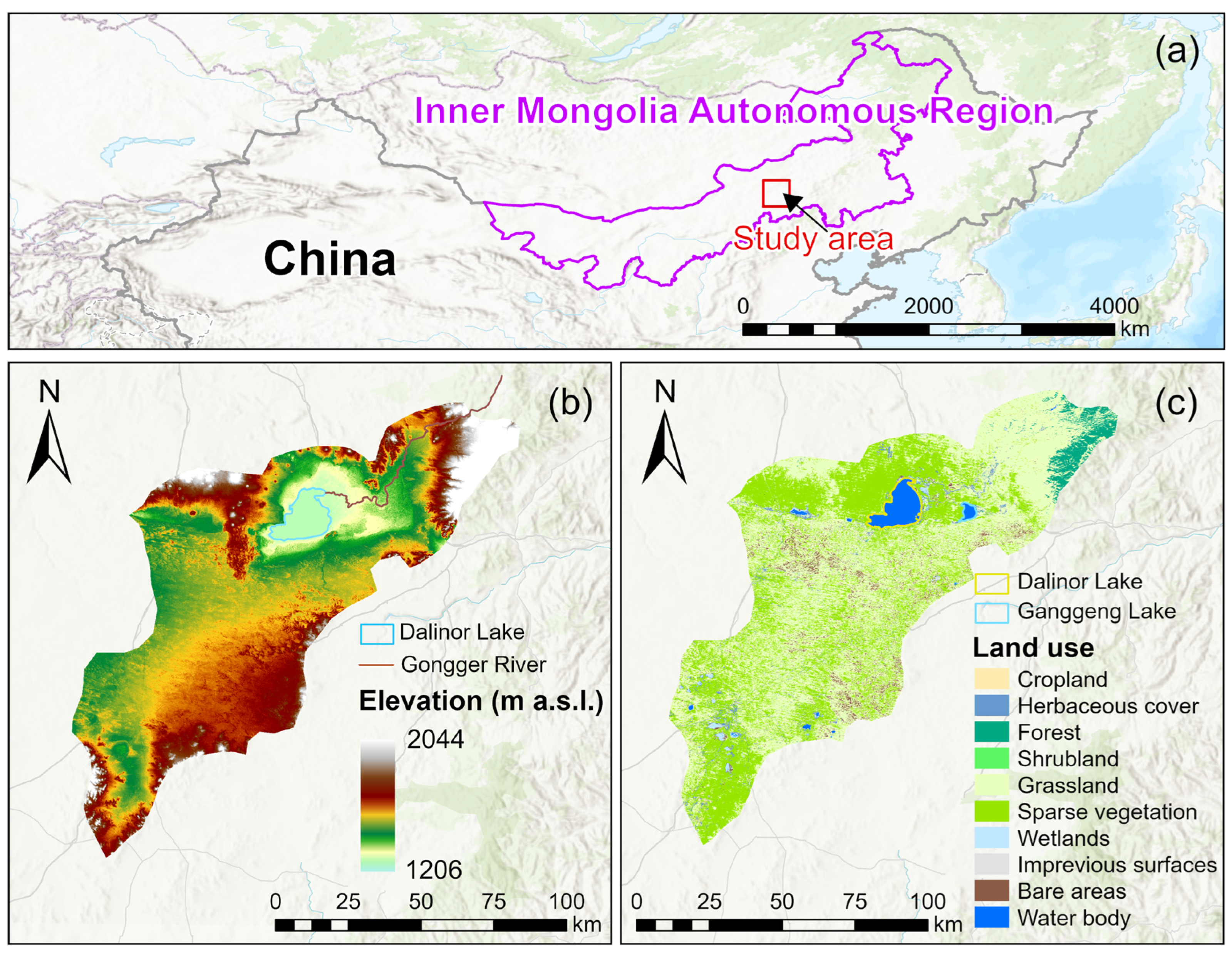
DLB (116°29′E~116°45′E, 43°13′N~43°23′N) is located in the western Hexigten Banner of Chifeng City, IMAR (Figure 1). It is bordered by the Hunshandake Sandy Land to the south and the Greater Khingan Mountains to the northeast. There are Dalinor Lake and Ganggeng Lake within DLB. Dalinor Lake is a closed soda-type semi-saline lake with an elevation of 1226–1228 m and an average water depth of 11 m. Water inputs to the lakes originate from precipitation, groundwater, and surface inflows from four rivers (i.e., Gongger, Shali, Liangzi, and Haolai Rivers). The Gongger River is the primary inflow river feeding Dalinor Lake, generally contributing near 50% of the lake’s total surface water input. Notably, groundwater is a significant and crucial component of the lake’s water supply. Ganggeng Lake is a freshwater lake, located 15 km east of Dalinor Lake, with a water depth of about 1–5 m. Its area is smaller than Dalinor Lake. This basin has a temperate continental monsoon climate with limited precipitation (PPT). According to meteorological records (1960–2020) from the surrounding weather observation station, the average annual PPT and annual mean air temperature (Ta) are 337.48 mm and 3.37 °C, respectively.

2.2. Data Sources and Processing

2.2.1. Lake Area

Landsat images were downloaded from the United States Geological Survey website (http://landsat.usgs.gov/) to explore the changes in lake areas within the DLB from 1990 to 2020. All of them are within 1% cloud cover and with lakes visible [20]. As the time of the Landsat images can affect the estimation of the lake area, we selected the images with consistent survey dates (all from July to September) for each year. The Landsat images are TM/ETM+/OLI images with a spatial resolution of 30 m.
Each Landsat image was geometrically corrected using SRTM elevation data. The boundaries of lakes were delineated through visual interpretation. The delineated lake boundaries were visually validated and checked against Google Earth (v10.92.0.1) images. The areas of Dalinor and Ganggeng Lakes were extracted. The accuracy of lake boundary delineation was assessed by quantifying the deviation between the 2014 and 2016 in situ GPS measurements and the boundaries delineated in the Landsat images. The horizontal error of our lake boundary delineation was less than 15 m, which is approximately equivalent to 0.5 pixels in the Landsat TM/ETM+ images.

2.2.2. Normalized Difference Vegetation Index (NDVI)

NDVI serves as an indicator of surface vegetation cover, health, density and biomass production. With values ranging from −1 to 1, those close to one indicate dense and healthy vegetation, values close to zero suggest sparse or stressed vegetation, and values less than zero usually represent water bodies or built-up areas [30]. The monthly NDVI data used in this study were obtained using the Aqua/Terra Moderate Resolution Imaging Spectroradiometer (MODIS) satellite sensor, spanning from 2000 to 2020 with a 16-day temporal composite at 250 m spatial resolution. The 250 m NDVI data before 2000 are not available in the study area due to the late launch time of the MODIS sensor. Although the Global Agricultural Monitoring System provides an NDVI dataset with a start year as early as 1981, the relatively coarse spatial resolution (8 km) hampers its use in small basins [1]. To ensure the quality of the data, several preprocessing steps were performed [31], including the initial reconstruction of a similar feature noise pixel, long sequence images, a Savitzky–Golay filter [32], and monthly synthesis. The data were downloaded from the website (https://data.tpdc.ac.cn/zh-hans/data/10535b0b-8502-4465-bc53-78bcf24387b3, accessed on 30 December 2024) [31].
We excluded the areas of lakes to reduce the noise in NDVI caused by the water bodies and derived the NDVI raster for each image using the following equation:
NDVI = (NIR − R)/(NIR + R)
where NDVI is the vegetation index, NIR is the Near-Infrared band, and R is the Red band.

2.2.3. Meteorological and Hydrological Variables

The meteorological data used in this study were obtained from the high-resolution atmospheric reanalysis product developed by the Qinghai–Tibet Plateau Research Institute of the Chinese Academy of Sciences (https://data.tpdc.ac.cn/). This dataset integrates model and observational meteorological variables from multiple sources, with a spatial resolution of 1 km and a temporal resolution of 1 month. The reanalysis product provides a grid dataset of some key surface meteorological parameters for surface process studies, including Ta and PPT. Vapor pressure deficit (VPD) data were obtained from an atmospheric moisture index dataset with a spatial resolution of 1 km and a temporal resolution of 1 month (https://doi.org/10.5281/zenodo.8070140, accessed on 22 May 2025) [33]. Meanwhile, based on the records (a temporal resolution of 3 h) from three stations (Xilinhot, Linxi, and Duolun), we calculated the annual mean temperature by averaging the 12 monthly temperatures in each year, and summarized the annual precipitation using the 12 monthly precipitations for each year. We also calculated multi-year average Ta and PPT by averaging the annual mean temperatures or precipitation during 2000–2020, respectively.
Evapotranspiration data were derived from the PML-V2 water–carbon coupled terrestrial evapotranspiration and gross primary productivity dataset released by the Institute of Tibetan Plateau Research, Chinese Academy of Sciences (https://doi.org/10.11888/Terre.tpdc.272389, accessed on 14 May 2025) [34]. This dataset was generated through the multiscale integration of the PML-V2 model with site-level and basin-level observation data, as well as global remote sensing data. The spatiotemporal resolutions of the data were 1 day and 500 m, respectively. The dataset contains five elements, which are gross primary product (GPP), vegetation transpiration (Ec), soil evaporation (Es), canopy vaporization of intercepted rainfall (Ei), and water, ice, and snow evaporation (Ew), respectively. PML-V2 is capable of effectively capturing water loss processes from both the canopy and soil [35]. The PML-V2 evapotranspiration product performs better than MODIS [36] and was widely used in evapotranspiration studies in various ecosystems, including lakes. Previous research found that estimated evapotranspiration from various climate regions and ecosystems (including wetlands, water, etc.) is close to the observed values in terms of correlation and amplitude of fluctuation, with a mean r value of 0.81 and a monthly Root Mean Square Deviation of 19.90 mm [36].
The total terrestrial evapotranspiration from soil and vegetation (ETt, m) and total evapotranspiration (ETall, m) were defined as follows:
ETt = Ec + Es + Ei
ETall = Ec + Es + Ei + Ew
The relationship between ETall and PPT is of great significance for understanding the interaction between climate and hydrology within a basin. For the ratio of ETall and PPT (ETall/PPT) in arid and semi-arid areas, the higher the ETall/PPT values, the more severe the water stress. Water use efficiency (WUE, g C L−1 H2O) was also used to represent the water resource use efficiency at the ecosystem level rather than the plant level, which was calculated by gross primary production (GPP, g C m−2) and ETall. The calculation of WUE proceeded as follows:
WUE = GPP/ETall
Soil moisture data were derived from the Soil Moisture of China by in situ dataset (SMCI) released by the Institute of Tibetan Plateau Research, Chinese Academy of Sciences (https://doi.org/10.11888/Terre.tpdc.272415, accessed on 6 June 2025) [37]. This dataset was obtained by machine learning, using ERA5_Land meteorological forcing data, leaf area index (LAI), land cover products, Digital Elevation Model (DEM) products, and soil properties as covariates, with 10-layer soil moisture observations from 1648 stations provided by the China Meteorological Administration serving as the baseline. This dataset was widely used in research [38,39]. It offers spatial resolutions of 1 km and 9 km, and the 1 km resolution dataset was used in this study.

2.2.4. Other Data

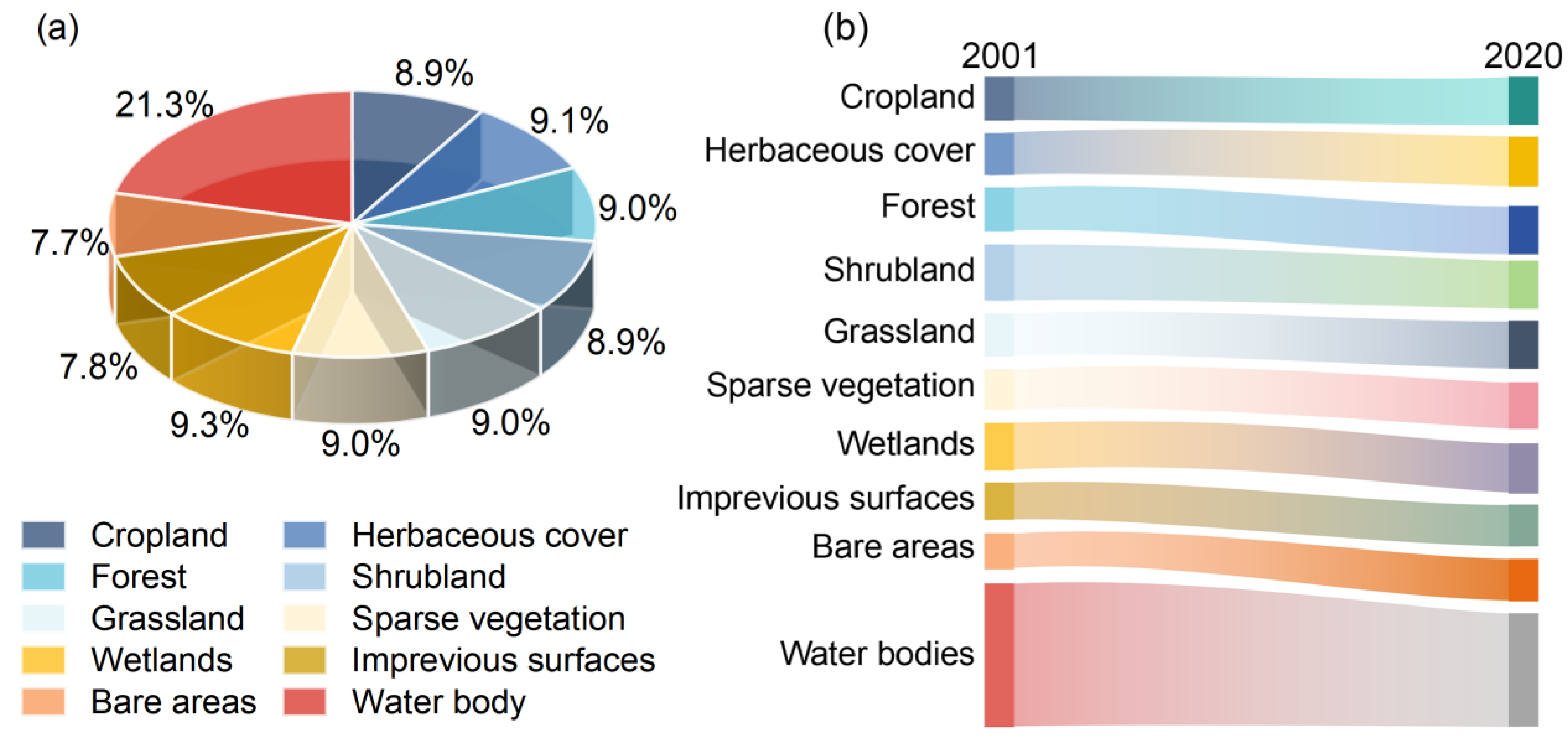
The 30 m annual land cover product of China (CLCD) during the study period was provided by the National Earth System Science Data Center, National Science & Technology Infrastructure of China (http://www.geodata.cn, accessed on 3 April 2025). Dominant land cover types within the DLB were farmland, herbaceous vegetation, forest, shrubland, grassland, sparse vegetation, wetland, impervious surfaces, and water bodies. Among these, grassland and sparse vegetation cover the largest areas. Land cover changes occurred between 2000 and 2020 (Table S1). The area of grassland decreased markedly, accompanied by reductions in water bodies and forests. The observed grassland degradation and water body shrinkage reflect critical environmental challenges in this region.
The water area in the DLB showed a dynamic change that resulted in a considerable decline and was primarily transformed into cropland, grassland, and impervious land. Cropland was the most prevalent land type, accounting for 45.88% of the total basin area, and increasing yearly. The DEM dataset was provided by Geospatial Data Cloud site, Computer Network Information Center, Chinese Academy of Sciences, with a spatial resolution of 500 m (http://www.gscloud.cn, accessed on 2 April 2025). RF monitoring data for the four rivers is performed from the monitoring station surrounding the Dalinor Lake. Due to the relatively late establishment of observation stations, manual measurements were predominantly used before their establishment, resulting in significant data gaps and incomplete datasets. Consequently, RF data is only available for the period from 2007 to 2020.

2.3. Statistical Analysis

The annual mean values for different variables were calculated based on daily or monthly data. The linear regression model was used to determine the variation trends of annual mean NDVI, ETall, ETt, and climatic factors by the slope of the model. The regression model is as follows:
y = at + b
where y is the lake area, and other factors; t is the time (year) from 2000 to 2020; a is the slope, indicating the changing rate; and b is the intercept of the regression. The p value is calculated using F-test to evaluate the statistical significance of the regression, with p values of 0.05 and 0.01 representing the confidence level of 95% and 99%, respectively.
To investigate the dominant predictors of lake areas, the generalized additive model (GAM) was used. GAM can describe nonlinear relationships and treat the degree of nonlinearity as a quantity to be estimated. The relative importance of each predictor was determined by comparing the deviance explained among predictors. All GAMs were implemented using the ‘mgcv’ package in R (v4.2.1). Variables were checked for collinearity before GAM analysis. The variance inflation factor (VIF) was used to explore the multicollinearity among predictors, where the values of VIF larger than five indicate severe potential multicollinearity. The result showed that the values of VIF of predictors were all less than five, indicating that there was no multicollinearity among predictors (Table S2).
The resampling methods were used to adjust the spatial resolutions of NDVI and evapotranspiration to be consistent with those of PPT and VPD. The correlation analysis among these variables in the DLB was carried out using the Pearson correlation coefficient r. The equation was as follows:
r x y = i = 1 n ( x i x ¯ ) ( y i y ¯ ) i = 1 n ( x i x ¯ ) 2 × i = 1 n ( y i y ¯ ) 2
where xi and yi are the values of the two factors x and y in year i, respectively; x and y are the corresponding mean values of the two variables; n is the length of the time series. The coefficient r indicates how closely the two variables are correlated; the higher the r value, the better the agreement.
To identify the dominant influencing factor of NDVI further, the Multiscale Geographically Weighted Regression model (MGWR) was used. The MGWR model [40] is a popular local spatial modeling technique. ETt is the dependent variable, and the five environmental factors (including PPT, NDVI, SMCI, Ta, and VPD) are independent variables. The spatial weight matrix was constructed using a bisquare kernel function with the optimal bandwidth determined by the corrected Akaike information criterion (AICc) [40]. The MGWR analysis was implemented using MGWR software (v2.2).

3. Results

3.1. Changes in Lake Areas

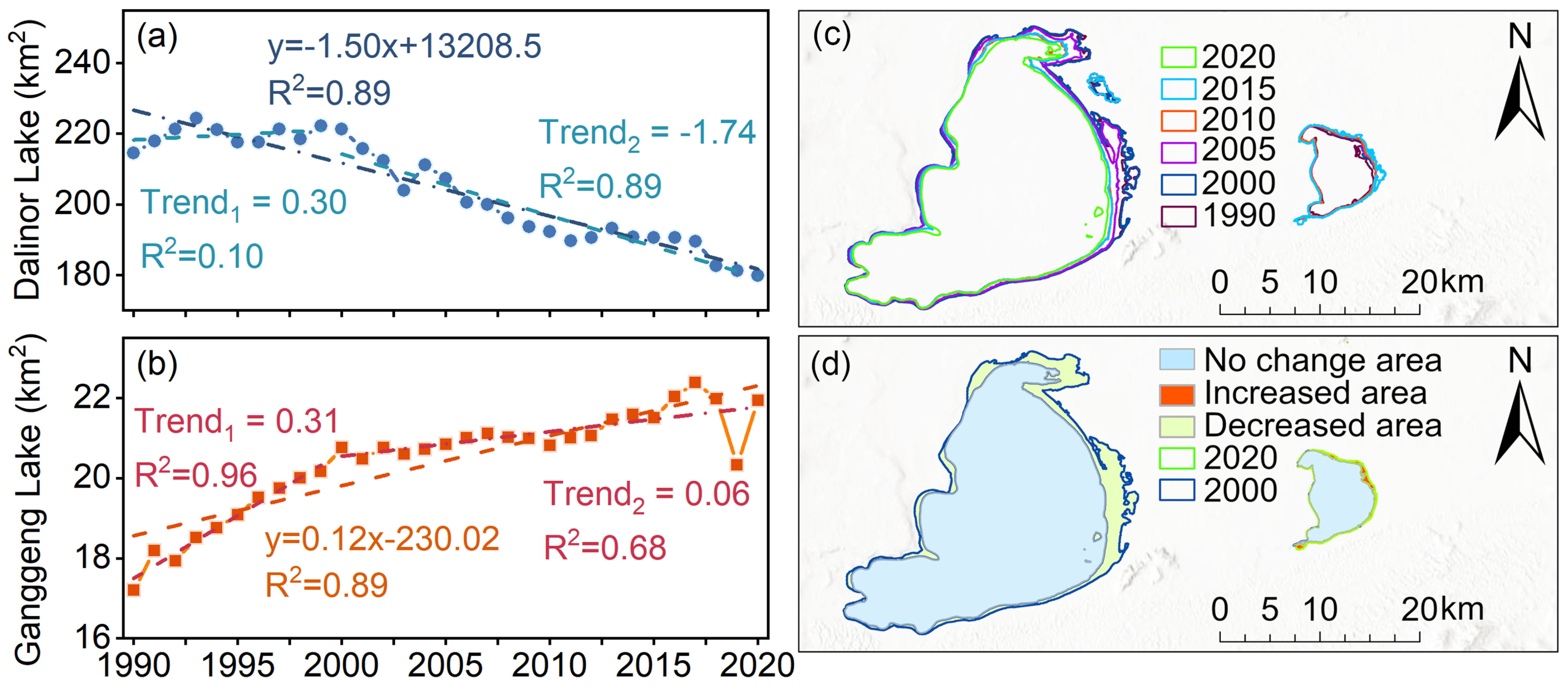
The area of Dalinor Lake decreased markedly from 214.53 km2 in 1990 to 179.91 km2 in 2020, with a mean decline rate of 1.50 km2 yr−1 (R2 = 0.89; Figure 2a). A distinct turning point occurred around 2000, after which the lake shifted from relative stability to rapid shrinkage. The variation showed little fluctuation before 2000, while the decrease rate reached 1.74 km2 yr−1 afterwards. Overall, Dalinor Lake lost 18.68% of its area from 2000 to 2020. Spatially, the rapid shrinkage of Dalinor Lake after 2000 was particularly pronounced along its northern and eastern shorelines (Figure 2b). The disappearance of inflow-associated marshes in these areas has led to progressive salinization and the alkalization of former lakebeds. Compounding this ecological stress, tourism and recreational infrastructure developed in parts of the northern and eastern margins may have further exacerbated water loss through increased local water demand and landscape alteration. In contrast, Ganggeng Lake expanded by 27.56% from 1990 (17.20 km2) to 2020 (21.94 km2) and 5.68% from 2000 to 2020. Spatially, the spatial pattern of Ganggeng Lake growth was primarily concentrated in its northeastern and eastern regions, coinciding with its surrounding wetland and sustained freshwater input from an eastern tributary. This difference between Dalinor and Ganggeng Lakes suggests that lake responses within the DLB were spatially heterogeneous and likely controlled by different hydrological and environmental conditions.

3.2. Temporal–Spatial Variations in NDVI

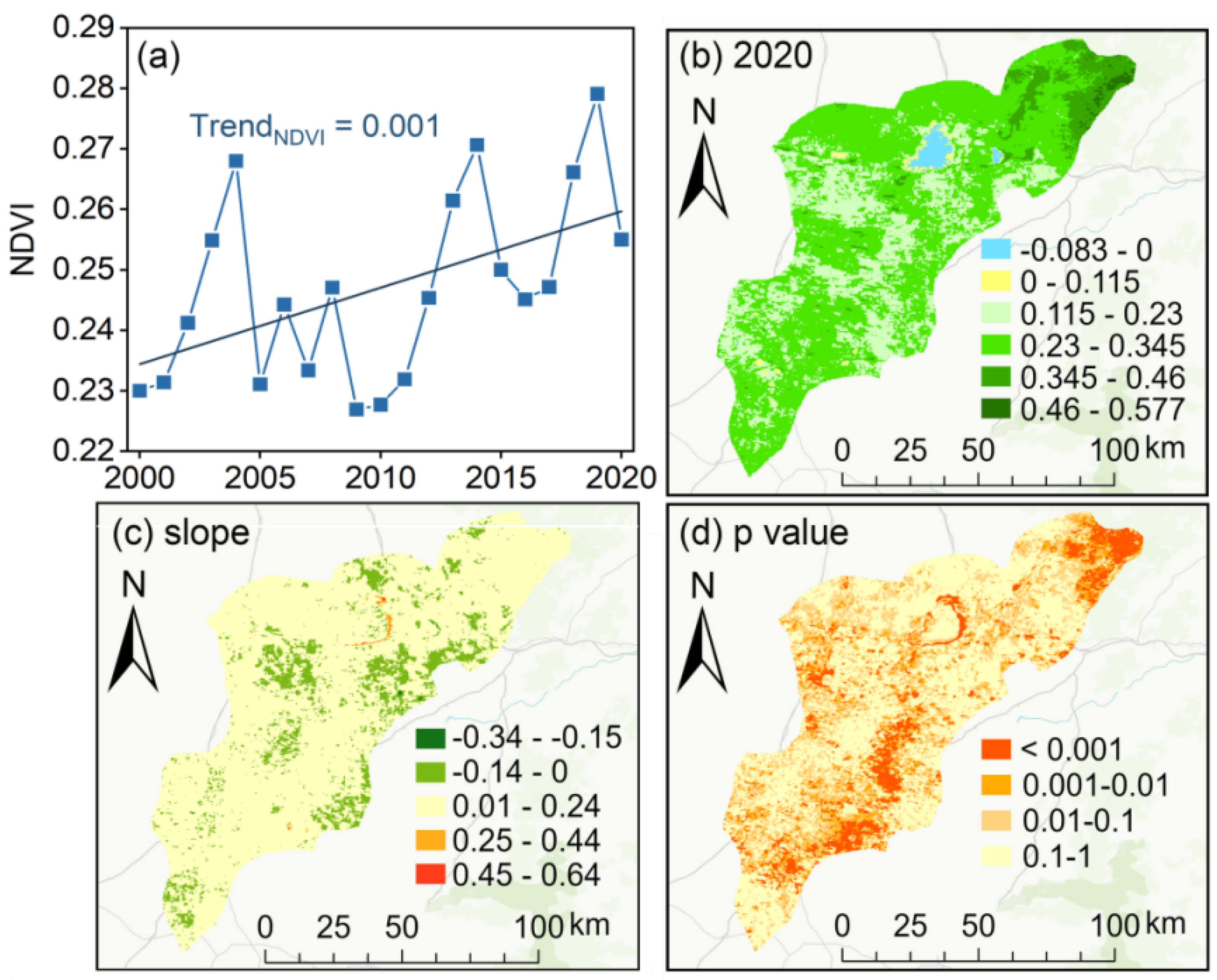
The annual mean NDVI of DLB was around 0.247 during 2000–2020, peaking at 0.279 in 2019. NDVI increased significantly from 0.230 in 2000 to 0.255 in 2020, corresponding to an increase of 10.87% and a mean trend of 0.001 yr−1 (Figure 3a). The spatial distribution of NDVI showed distinct regional heterogeneity (Figure 3b). Higher NDVI values were mainly concentrated in the northeastern part of the basin, which may be attributable to the influence of the Greater Khingan Mountains. Most of the basin experienced increasing NDVI during 2000–2020, but the magnitude of change varied substantially across space (Figure 3c,d). The most significant increase (p < 0.001) was observed in the areas surrounding Dalinor Lake, where ecological restoration activities have been widely implemented. Notably, a comparison between the two decades further revealed an acceleration in NDVI increase during 2010–2020 relative to 2000–2010 (Figure S1). This enhancement was particularly pronounced in the northeastern sub-basin and in the zones adjacent to Dalinor Lake.

3.3. Changes in Meteorological and Hydrological Variables

3.3.1. Evapotranspiration

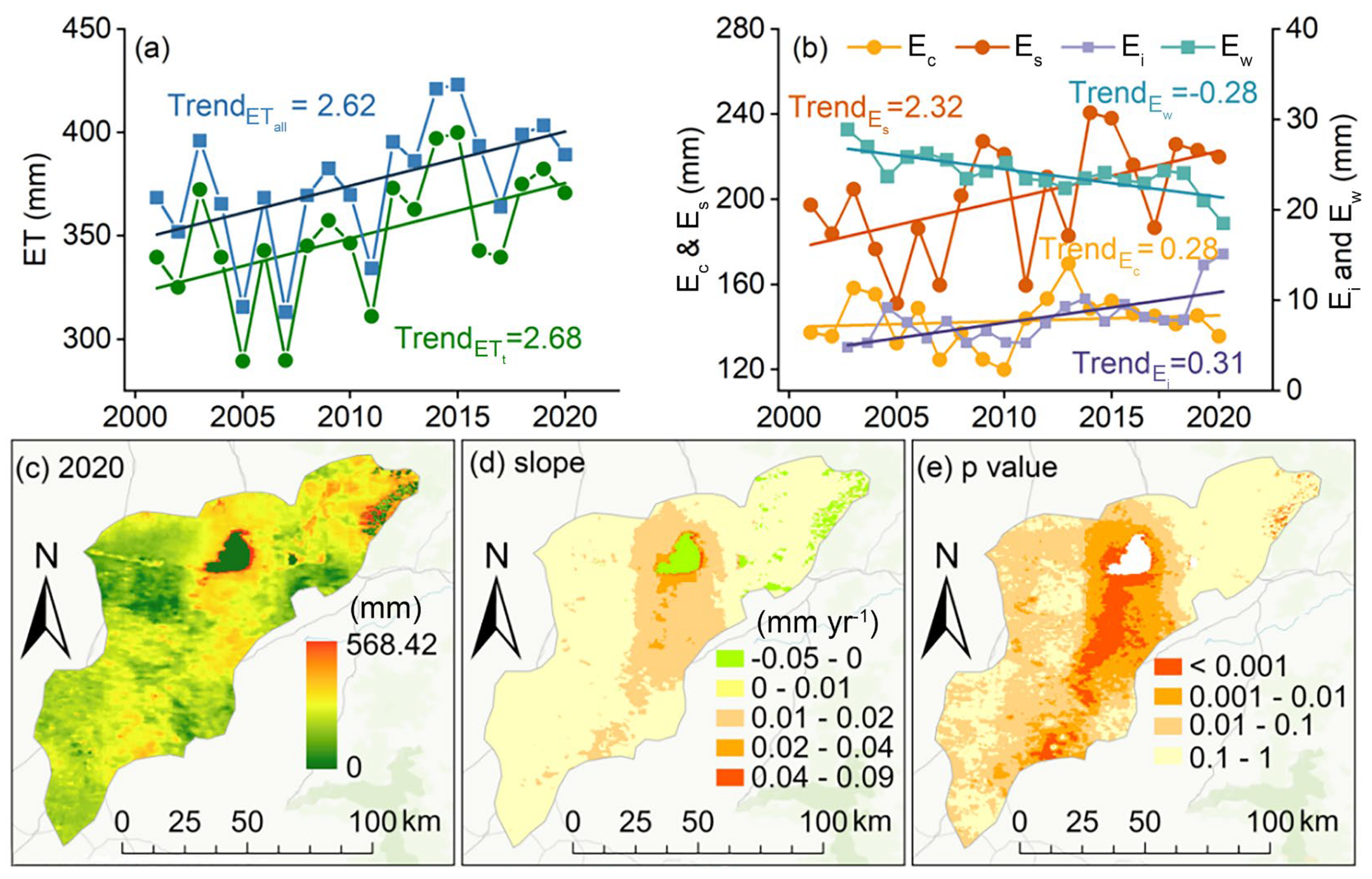
Annual ETt fluctuated between 313.10 and 423.18 mm during 2001–2020 (Figure 4a). ETt exhibited an increasing trend of 2.62 mm yr−1, and the increase rate was much more pronounced during 2010–2020 (2.64 mm yr−1) than during 2001–2010 (0.34 mm yr−1), indicating an accelerated rise in terrestrial water consumption in the most recent decade. ETall also increased at a rate of 2.62 mm yr−1 (Figure 4b). Temporal trends revealed that Es, Ei, and Ec increased at rates of 2.32 mm yr−1, 0.31 mm yr−1, and 0.28 mm yr−1, respectively, whereas Ew decreased slightly at a rate of −0.28 mm yr−1 (Figure 4b). The decline in Ew was consistent with the change in open-water surface area. Spatially, ETt reached its highest in the northeast and central regions surrounding Dalinor Lake (Figure 4c). This pattern generally corresponded to the spatial distribution of NDVI. From 2001 to 2020, ETt increased across 73.90% of the basin, with the most pronounced increases occurring in the central area adjacent to the lake. In contrast, localized declines in ETt were primarily observed in areas with reduced vegetation cover or forest degradation (Figure S2, Table S1). The spatial patterns of individual evapotranspiration components also exhibited distinct heterogeneity (Figure S3). The highest values of Ec and Ei occurred in the northeastern basin, consistent with dense vegetation and high canopy interception. Es reached its maximum in the south of Dalinor Lake, while the strongest increase in Ec occurred in the southwestern region. ETall varied characteristically across land cover types (Figure 5a). From 2001 to 2020, ETall from most land cover types increased steadily except for water bodies (Figure 5b).

3.3.2. Precipitation

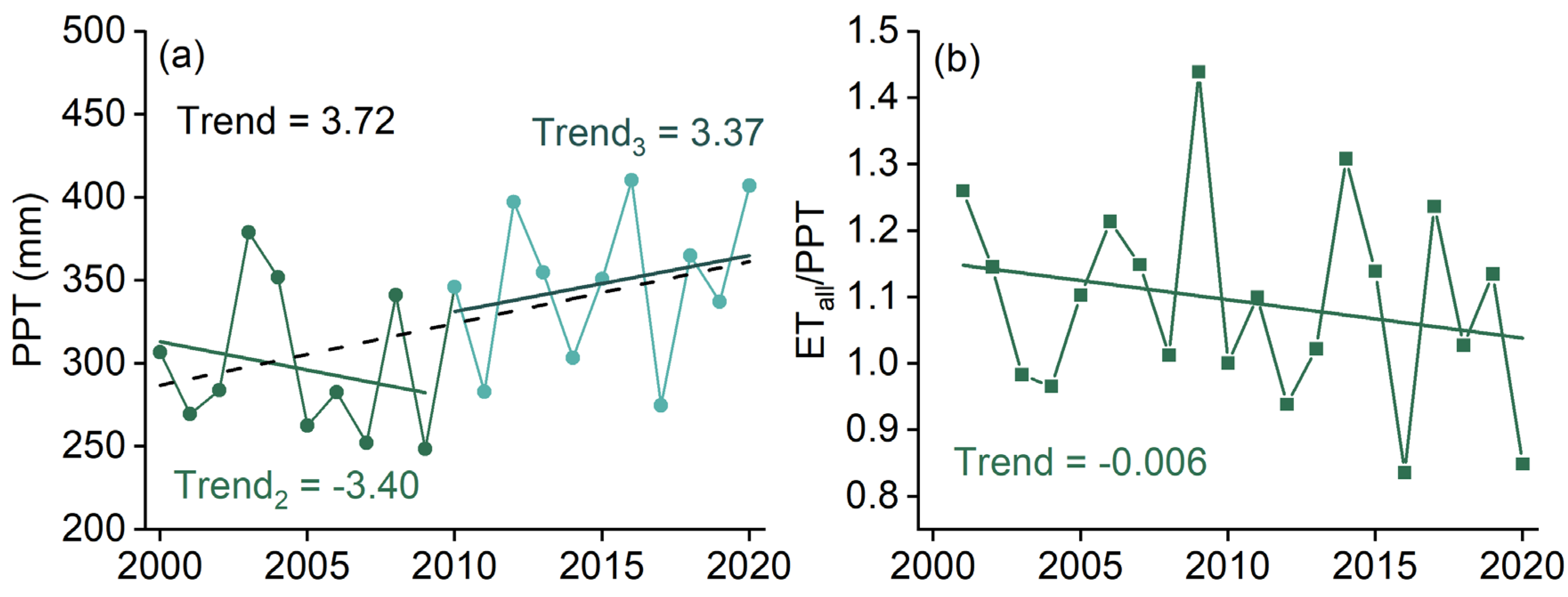
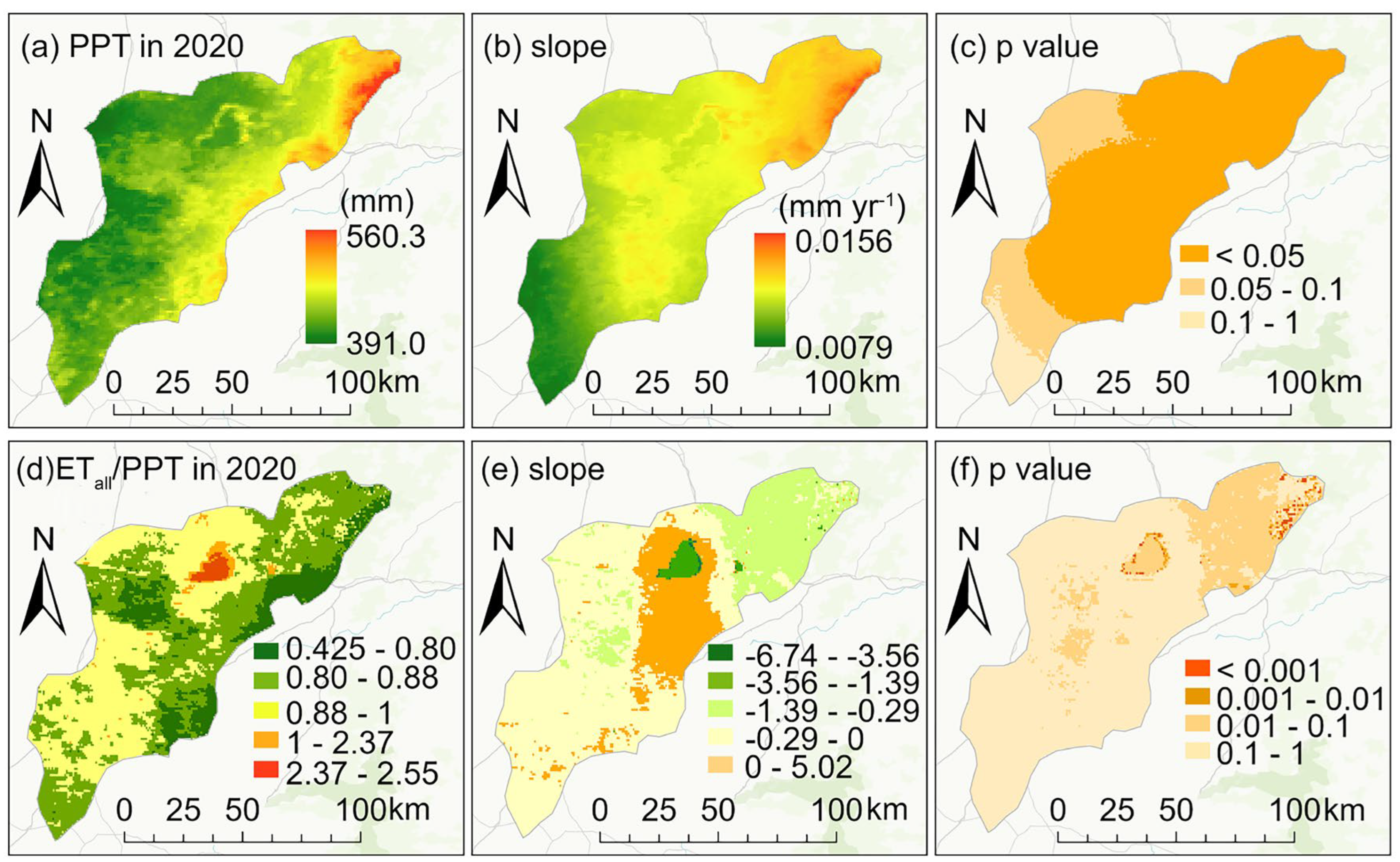
Annual PPT in the DLB showed an increasing trend during 2000–2020, with a slope of 3.72 mm yr−1 (Figure 6a). Distinct temporal patterns emerged when analyzing sub-periods. A decline was observed during 2000–2010 (−3.40 mm yr−1) and then a rebound from 2010 to 2020 (+3.37 mm yr−1). The spatial distribution of PPT exhibited a clear northeast-to-southwest decreasing gradient across the basin (Figure 7a). Trend patterns during 2000–2020 were also spatially heterogeneous (Figure 7b). The northeastern region experienced the most significant increase in precipitation, while the southwestern region showed the weakest increase.
The annual ratio of ETall to PPT decreased slightly during 2000–2020, with a trend of −0.007 mm yr−1 (Figure 6b). Spatially, the highest values of ETall/PPT were observed over Dalinor Lake and its surroundings (Figure 7d). Although the majority of the basin experienced a decline in ETall/PPT, the area surrounding Dalinor Lake was an exception, showing a significant increasing trend (Figure 7e,f), indicating relatively strong evaporative water loss compared with atmospheric water input in these zones. Distinct differences in ETall/PPT were also found among land cover types (Figure S4), with the highest mean values occurring over water bodies, followed by wetlands and herbaceous cover. Meanwhile, WUE showed an upward trend from 2001 to 2020 (Figure S5). Trend analysis further showed that WUE increased across most parts of the DLB, except for the central region (Figure S6).

3.3.3. Other Variables

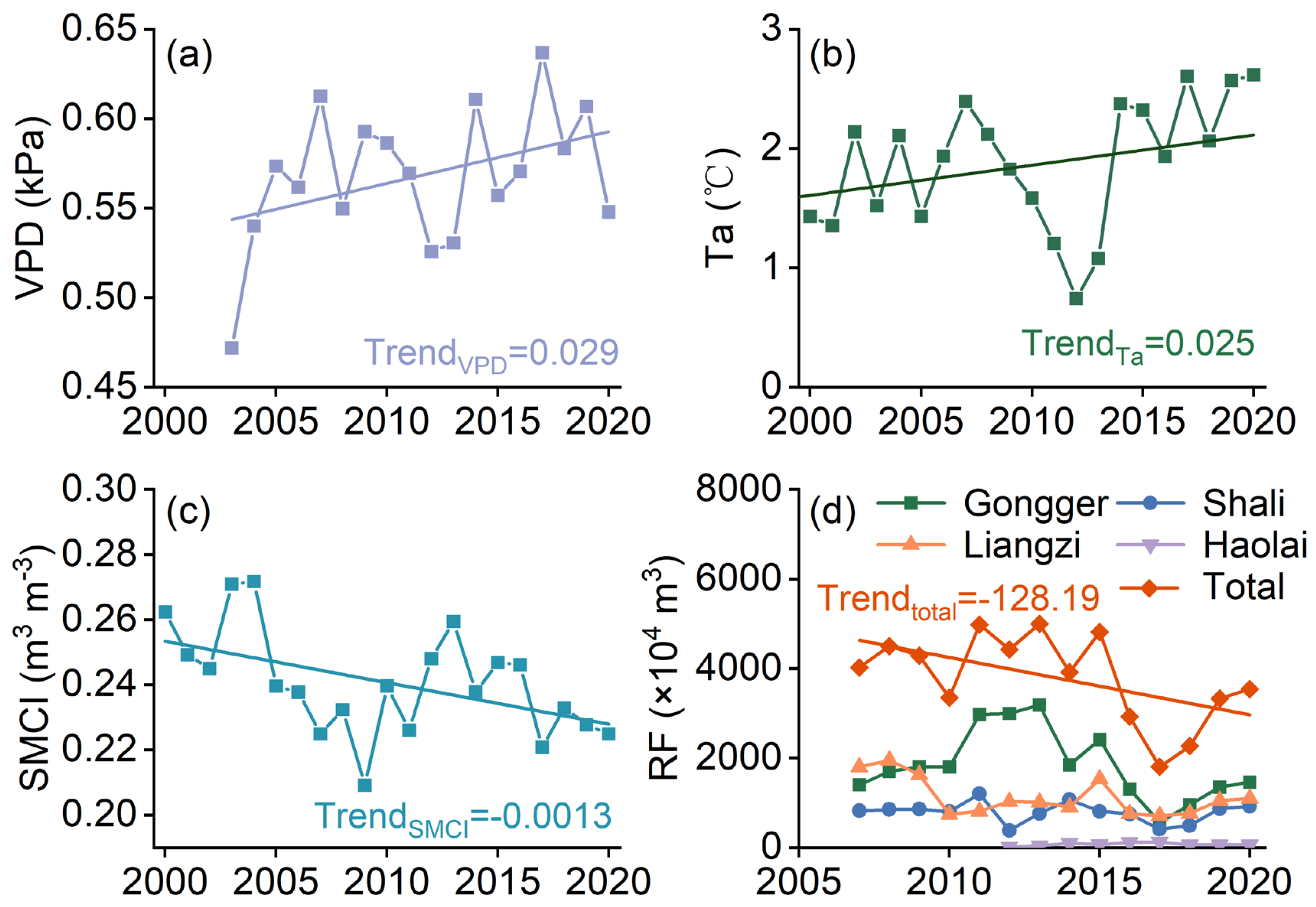
Annual mean SMCI decreased continuously from 2000 to 2020, with a slope of −0.0013 m3 m−3 yr−1 (Figure 8a). Spatially, higher SMCI values were mainly distributed in the northeastern and southeastern parts of the DLB (Figure S7a). Declining SMCI was observed across more than 98% of the basin, with the strongest decreases concentrated along the northern shoreline of Dalinor Lake (Figure S7b). Consistent with the drying soil conditions, annual mean Ta and VPD both increased during the study period, at rates of 0.025 °C yr−1 and 0.029 kPa yr−1, respectively. Mean annual VPD displayed a spatial gradient, increasing from the relatively humid northeastern highlands to the more arid southwestern part of the basin (Figure S7d). The strongest increase in VPD during 2000–2020 also occurred in the southwest (Figure S7e), indicating intensified atmospheric drying in this region. River flow (RF) records from the major inflow rivers to the Dalinor Lake (i.e., Gongger, Shali, Liangzi, and Haolai Rivers) showed long-term reduction trends over recent decades, with the Gongger River, the primary inflow, exhibiting a pronounced decline in annual RF since the early 2000s (Figure 8d).

3.4. Controls of Lake Areas

The areas of lakes within DLB were mainly affected by climatic and hydrological factors. Precipitation and runoff serve as water inputs to the lakes, influencing the water depth and areas directly. It could also regulate the regional water cycle indirectly by influencing nutrient absorption and vegetation growth around the lake. SMCI is a representative indicator for groundwater content that can directly affect the lake area. Evapotranspiration is a key component of the terrestrial water cycle, representing a major pathway of water loss from lakes, soils, and vegetation. Elevated evapotranspiration implies enhanced atmospheric demand for water, accelerating the depletion of lakes and thereby amplifying regional drying. Since Ew is largely influenced by changes in lake area, Et is used as one of the variables affecting lake area. High Ta generally suggests more radiation entering ecosystems, providing additional energy to intensify the hydrological cycle and accelerate surface evaporation, particularly in water-constrained regions [41], thereby influencing lake areas. VPD is the difference between saturation vapor pressure and actual vapor pressure, which directly reflects the dryness of the air. The larger the difference, the drier the air, thereby driving the water from the underlying lake surface to the atmosphere. Given the availability of the data, the period from 2003 to 2020, for which all data were available, was used for the driver analysis.
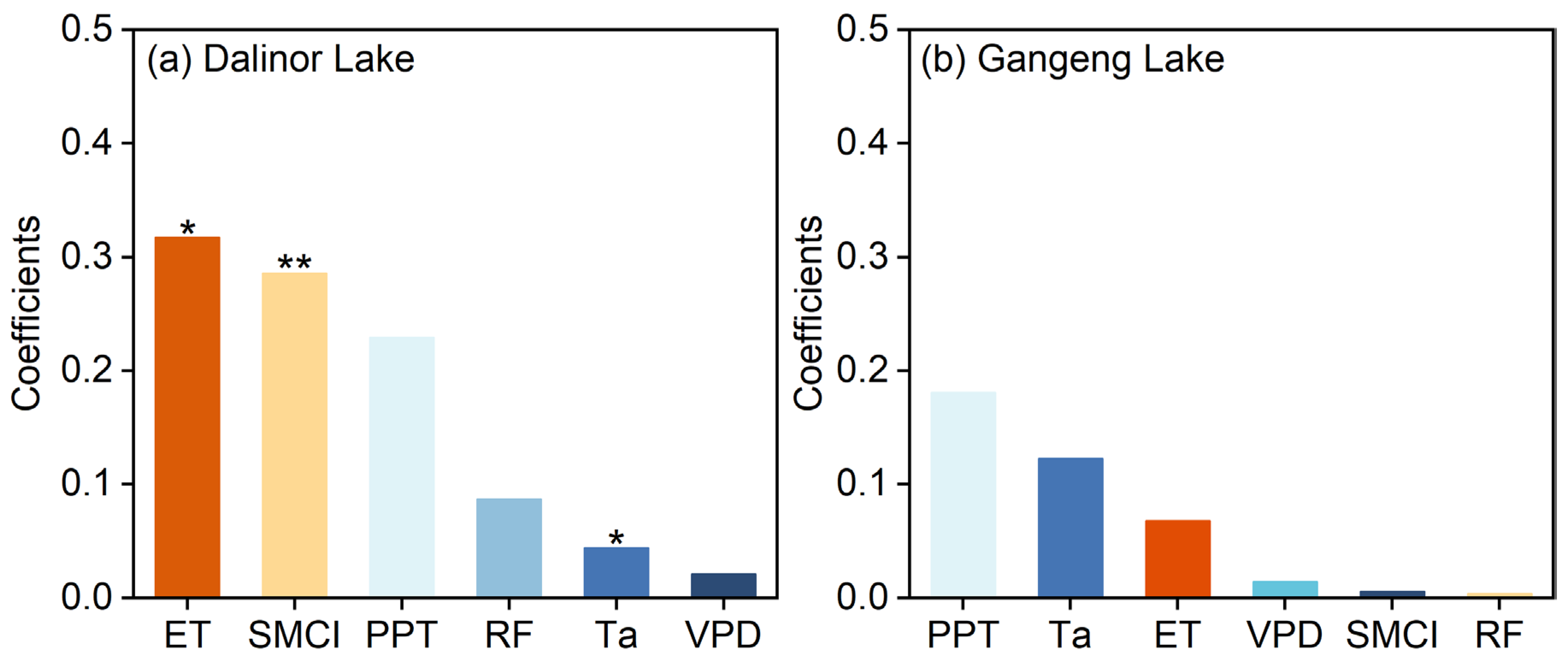
The generalized additive models (GAMs) were applied to quantify the relative effects of hydroclimatic variables on lake area dynamics (Figure 9). For Dalinor Lake, ETt and SMCI were identified as the dominant controlling factors. Among them, ETt explained 31.74% of the variation in lake area, indicating that enhanced evaporative water loss played a major role in lake shrinkage. SMCI also had a significant effect, suggesting that reductions in subsurface water availability were closely linked to changes in lake extent. In addition, rising temperature exerted a negative influence on the lake area, implying that thermal forcing further intensified hydrological stress. In contrast, the area of Ganggeng Lake was more sensitive to PPT than to other variables, indicating that direct atmospheric water input was the main driver of lake expansion. Ta also influenced the Ganggeng Lake area, but its effect was weaker than that of PPT. Pearson correlation and MGWR analysis were also used to analyze the primary drivers of ETt. The results showed that NDVI is the primary driver, with a contribution rate of 54.02%, which is significantly higher than the contributions of other factors (2.81–26.77%) (Figure S9).

4. Discussion

4.1. Dominant Controlling Factors of Dalinor Lake and Ganggeng Lake

Rapid lake shrinkage has been widely documented across the semi-arid Inner Mongolia Plateau over recent decades [8,42]. However, the dominant controls on lake area dynamics differ substantially among individual lakes due to variations in basin morphology, hydrological connectivity, climatic sensitivity, and human disturbance. Our analysis revealed different dominant drivers between Dalinor Lake and Ganggeng Lake. For Dalinor Lake, ETt was identified as the dominant influencing factor, followed by SMCI. This suggested that enhanced atmospheric water loss constrained the lake water balance. ETt constituted a major pathway of water export from soils, vegetation, etc. Increasing ETt might intensify water deficits and elevate the risk of persistent lake shrinkage [43,44]. Land surface can lose a considerable water volume through evapotranspiration (i.e., latent heat flux) [45]. A study on changes in lake areas on the Ordos Plateau found that increased evapotranspiration and reduced precipitation were the primary factors contributing to the significant decline in total lake areas [4]. It was also found that the area of Wuliangsuhai was significantly negatively correlated with evapotranspiration [46].
By contrast, Ganggeng Lake was more sensitive to precipitation and showed an overall expansion trend during the study period. This was consistent with the hydrological behavior of smaller and shallower lakes, which usually respond more rapidly to short-term climatic fluctuations because of their lower storage capacity and faster water turnover rates. Especially in water-limited areas, increases in precipitation could trigger lake expansion, whereas precipitation deficits may induce equally rapid contraction. The lake areas across the Tibetan Plateau were also found to expand, and the expansion is primarily driven by amplified lake water inputs from increased precipitation and glacier meltwater, with a dominant contribution of precipitation [6,42]. Previous studies have shown that small lakes supplied a disproportionately large contribution to global lake expansion, representing 46.2% of the net areal increase from the 1980–1990s to the 2010s [47]. Although long-term PPT trends across DLB during 1960–2020 were not statistically significant, a clear wetting signal emerged during 2000–2020, particularly after 2010. This localized increase likely offset water losses by evaporation, contributing to its relative stability or modest expansion (Figure 3b and Figure 7). The hydrological conditions of Ganggeng Lake were also influenced by human intervention, but the mechanisms differ from those of Dalinor Lake. The Dalinor Lake primarily faced pressure from increased groundwater depletion caused by large-scale revegetation in the surrounding environment and afforestation in Hunshandak Sandy Land, whereas Ganggeng Lake has undergone localized land-use changes that exert relatively minor impacts on groundwater consumption.
The contrasting variations in Dalinor and Ganggeng Lakes suggested different vulnerability paradigms in semi-arid lake systems. Large lakes faced a decline rooted in structural water scarcity, exacerbated by evapotranspiration triggered by ecological restoration and upstream water resource allocation. While small lakes exhibit interannual variation influenced by precipitation, granting them resilience during wet periods, they may become extremely vulnerable to collapse during droughts. These results highlighted the necessity for lake-specific management strategies.

4.2. Influence of Ecological Restoration on Dalinor Lake Through Evapotranspiration

ETt played an important role in affecting the Dalinor Lake area, which was influenced by both climate change and vegetation increase induced by ecological restoration. Climate factors directly regulate ETt by controlling water availability and energy supply [48,49]. At the same time, revegetation could substantially modify ETt through multiple biophysical pathways. Firstly, increased vegetation cover generally enhances canopy conductance and transpiration, thereby accelerating water-vapor exchange between land and atmosphere [50]. Secondly, greater canopy density tends to increase interception loss [19,48]. Finally, more vegetation may reduce regional surface albedo and increase the amount of shortwave radiation absorbed at the surface, resulting in elevated surface temperature. This may cause shallow roots of grassland to rapidly evaporate soil moisture near the surface [19]. Although negative relationships between NDVI and ETt were observed in a few locations, which might be related to the fact that increased NDVI reduced the amount of solar radiation reaching the land surface [51], the dominant pattern across the DLB was a positive association between NDVI and ETt. Importantly, the Pearson correlation analysis showed that the net total effect of climate change (indicated by Ta, PPT, and VPD) on ETt changes was relatively minor, while ETt was mainly controlled by ecological restoration (indicated by NDVI) (Figure S8). Meanwhile, the results of MGWR indicated that the contribution of NDVI to ETt was larger than that of other factors, suggesting that ecological restoration was the major contributor to ETt increase (Figure S9). Similar results have been reported in other arid and semi-arid regions, where vegetation change rather than climate variability dominated ETt dynamics [52,53]. Vegetation plays a key role in regulating water exchange between land and atmosphere [54,55], and large-scale revegetation has increasingly been recognized as an important driver of regional hydrological change. Globally, revegetation contributed an average ETt increase trend of 0.26 mm yr−1 from 2001 to 2018 [56].
Despite achieving significant ecological benefits, this ‘success’ has also come with hydrological costs. As a terminal lake with limited inflow, Dalinor Lake’s water balance is highly sensitive to changes in atmospheric demand and basin-scale water consumption. The concurrent decline in surface inflow and rising ETt have created a dual pressure on lake levels. Large-scale restoration has likely exceeded the hydrological carrying capacity of the local environment, leading to unsustainable water consumption [57,58]. The increasing ETall/PPT and decreasing WUE in the surrounding area of Dalinor Lake indicated the insufficient use of water (Figure 7e and Figure S6e). This pattern implies a potential mismatch between restoration intensity and local hydrological carrying capacity. Such trade-offs have been widely reported in water-limited regions [11,59,60]. Compared with bare land or sparsely vegetated surfaces, grasslands and forests exhibit higher transpiration rates and larger amounts of groundwater, as their deeper root systems access stored soil water and retain more intercepted rainfall for evaporation [61,62]. Empirical studies indicate that afforestation increases annual water use by 559 to 2354 m3 per hectare annually in arid and semi-arid regions [63]. As the climate continues to warm and dry in the future, water scarcity issues will become even more pronounced [64]. Moreover, newly introduced vegetation not only reduces soil moisture by increasing roughness [50] but has also been found to consume more soil moisture than native plants [65], thereby accelerating local water depletion and introducing potential water availability risks [19]. In the DLB, land-use transitions since 2000 have been dominated by the conversion of bare land to grassland. Although the total grassland area showed no significant trend, localized expansion near the lake, coupled with growing livestock demand, has intensified pressure on water resources.

4.3. Impact of Ecological Restoration on Dalinor Lake Through Evapotranspiration

The variation in the Dalinor Lake area was mainly influenced by ETt, while the increase in NDVI induced by revegetation contributed the most to the increase in ETt, indicating that the Dalinor Lake area was considerably controlled by vegetation. This showed that ecological restoration, while essential for combating land degradation and biodiversity loss, can act as a double-edged sword in water-limited regions. Therefore, the ecological restoration in the DLB should be evaluated not only in terms of restoration but also in terms of hydrological sustainability. Future ecological restoration measures in the DLB should adopt a hydrologically informed, adaptive, and spatially differentiated approach that balances the potential negative effects of revegetation on water resources. Here, several key findings were revealed, and recommendations were proposed.
Firstly, the ecological restoration projects in this area have intensified water consumption through the evapotranspiration process, leading to a significant shrinkage of Dalinor Lake. Future projects should avoid further expansion of the high-water-demand plant species in areas that serve as critical water sources for Dalinor Lake. Greater emphasis should instead be placed on native or drought-tolerant species with relatively large water use efficiency, particularly in the Hunshandake Sandy Land and in the upstream source areas. Vegetation density and structural configuration should also be carefully managed, as both strongly influence transpiration and interception loss [17]. Moderate vegetation cover is recommended to maintain ecosystem function without exacerbating water stress. Secondly, an increase in precipitation may provide opportunities for improving local water management. Nature-based solutions and small-scale rainwater harvesting measures could help gather runoff, recharge shallow soil moisture, and reduce unnecessary water loss. For example, channels could be used to divert surface water toward lakeside vegetation and reduce irrigation. Thirdly, it is crucial to establish a long-term and comprehensive hydrological observation network to monitor the state of ecosystems [19,50]. Remote sensing offers an efficient means of tracking changes in lake area, ETall, NDVI, and drought conditions, but it should be complemented by in situ measurements such as eddy covariance observations, streamflow gauging, groundwater monitoring, and soil moisture records. Such an integrated observation framework would improve the detection of hydrological stress signals and support the development of lake-oriented early warning systems. Finally, although direct anthropogenic effects were not explicitly quantified in this study, they should be incorporated into future management. Despite the 2019 Breeding Balance Plan issued by the Hexigten Banner government, overgrazing remains prevalent. Given that livestock depend on the same rivers that feed the lake, strict carrying-capacity-based grazing quotas, seasonal rotational systems, and remote monitoring of pasture conditions are urgently needed.

4.4. Limitation

While this study highlights the feedback between revegetation and ETt in DLB, several limitations warrant attention. Firstly, our analysis relied on static land cover classifications, which may simplify dynamic vegetation transitions. Future work should incorporate more nuanced vegetation parameters to better represent ecohydrological feedbacks. Secondly, the influence of revegetation beyond basin boundaries remains unquantified, particularly in upwind or upstream regions. Cross-basin atmospheric moisture recycling and regional circulation changes induced by large-scale revegetation could indirectly affect the water budget in DLB. Thirdly, direct validation of lake evaporation requires eddy covariance measurements or Bowen ratio systems, which were not available in this study. We will strengthen relevant monitoring efforts in this area and conduct further analysis combined with the remote sensing method in the future. Finally, human activities were not discussed in this study.

5. Conclusions

This study systematically investigated the spatiotemporal dynamics of lake area changes within the DLB and identified the dominant drivers; the study also analyzed the impact of revegetation on lake area through ETt, and proposed countermeasures to address lake degradation. Our results revealed a significant 18.68% reduction in the surface area of Dalinor Lake from 2000 to 2020, primarily driven by increased ETt, followed by SMCI. Meanwhile, the increase in ETt was mostly contributed by NDVI (54.02%), indicating that the Dalinor Lake area was considerably influenced by NDVI induced by revegetation. In contrast, the nearby Ganggeng Lake exhibited a 5.68% expansion, largely attributable to increased precipitation, highlighting the spatial heterogeneity of hydrological responses within the basin. More revegetation activities were carried out around Dalinor Lake than Ganggeng Lake, resulting in more significant increases in ETt (rate of 2.62 mm yr−1) and NDVI, together with widespread declines in SMCI near Dalinor Lake.
These findings confirmed that ecological restoration projects were a double-edged sword. While these projects aimed to combat land degradation and enhance ecosystem services, they may inadvertently exacerbate water scarcity. Therefore, future ecological planning should integrate hydrological sustainability into restoration design. Policymakers should prioritize water-efficient vegetation types, optimize planting density, and incorporate the continuous monitoring of water budgets to avoid the paradox of revegetation at the cost of drying.

Supplementary Materials

The following supporting information can be downloaded at https://www.mdpi.com/article/10.3390/rs18111833/s1; Figure S1: Changes in NDVI (a) from 2000 to 2010, (b) from 2010 to 2020, and (c) from 2000 to 2020.; Figure S2: Changes in ETt (mm) (a) from 2001 to 2010, (b) from 2010 to 2020, and (c) from 2001 to 2020; Figure S3: Spatiotemporal variations in Ec (mm), Es (mm), Ei (mm), and Ew (mm) from 2001 to 2020; Figure S4: Changes in ETall/PPT from 2001 to 2020; Figure S5: Variations in GPP and WUE; Figure S6: (a) Gross primary productivity (GPP, g C m−2) and (d) water use efficiency (WUE, g C L−1 H2O) in 2020; the variation trend of (b) GPP (g C m−2 yr−1) and (e) WUE (g C L−1 H2O yr−1) from 2001 to 2020; p values of (c) GPP and (f) WUE; Figure S7: (a) Annual SMCI (m3 m−3) in 2020, (b) the variation slope (m3 m−3 yr−1) and (c) p value of SMCI; (d) annual VPD (kPa) in 2020, (e) the variation slope (kPa yr−1) and (f) p value of VPD; (g) annual Ta (℃) in 2020, (h) the variation slope (℃ yr−1) and (i) p value of Ta; Figure S8: The correlation coefficients based on Pearson’s Correlation Analysis between ETt and other factors; Figure S9: The relative contributions of different factors to ETt based on Multiscale Geographically Weighted Regression Model; Table S1: The variance inflation factor (VIF) of predictors; Table S2: Areas of different land use.

Author Contributions

Conceptualization, H.L.; methodology, Y.S. and N.W.; software, G.Y. and N.W.; validation, L.Z. and N.W.; formal analysis, Y.S.; investigation, L.Z. and H.W.; data curation, Y.S. and Y.C.; writing—original draft preparation, Y.S.; writing—review and editing, W.L. and H.L.; visualization, Y.S. and Y.C.; supervision, H.L.; project administration, H.L.; funding acquisition, Y.S. All authors have read and agreed to the published version of the manuscript.

Funding

This research was funded by the National Special Public Welfare Study on Environmental Protection in China, grant number 201509027, and the Conservation of Biodiversity in China in light of climate change, grant number CHN-2152.

Data Availability Statement

All dataset could be found in Section 2.2.

Conflicts of Interest

The authors declare no conflicts of interest.

References

  1. Bai, M.; Mo, X.; Liu, S.; Hu, S. Detection and attribution of lake water loss in the semi-arid Mongolian plateau: A case study in the Lake Dalinor. Ecohydrology 2020, 14, e2251. [Google Scholar] [CrossRef]
  2. Liu, W.; Fu, Z.; van Vliet, M.T.H.; Davis, K.F.; Ciais, P.; Bao, Y.; Bai, Y.; Du, T.; Kang, S.; Yin, Z.; et al. Global overlooked multidimensional water scarcity. Proc. Natl. Acad. Sci. USA 2025, 122, e2413541122. [Google Scholar] [CrossRef] [PubMed]
  3. Xu, Y.; Gun, Z.; Zhao, J.; Cheng, X. Variations in lake water storage over Inner Mongolia during recent three decades based on multi-mission satellites. J. Hydrol. 2022, 609, 127719. [Google Scholar] [CrossRef]
  4. Naeem, M.; Zhang, Y.; Nourani, V.; Tian, X.; Miao, P. Both climate and anthropogenic impacts on recent lake area change in the Erdos Plateau. J. Environ. Manag. 2025, 373, 123443. [Google Scholar] [CrossRef] [PubMed]
  5. Zhu, L.; Ju, J.; Qiao, B.; Liu, C.; Wang, J.; Yang, R.; Ma, Q.; Guo, L.; Pang, S. Physical and biogeochemical responses of Tibetan Plateau lakes to climate change. Nat. Rev. Earth Environ. 2025, 6, 284–298. [Google Scholar] [CrossRef]
  6. Xu, F.; Zhang, G.; Woolway, R.I.; Yang, K.; Wada, Y.; Wang, J.; Crétaux, J.F. Widespread societal and ecological impacts from projected Tibetan Plateau lake expansion. Nat. Geosci. 2024, 17, 516–523. [Google Scholar] [CrossRef]
  7. Guo, J.; Liu, K.; Na, J.; Liu, G.; Cao, Z.; Fan, C.; Xue, B.; Huang, J.; Song, C. A three-decade lake dataset on the Mongolian plateau tracking water area and quality dynamics (1990–2020). Sci. Data 2025, 12, 1788. [Google Scholar] [CrossRef]
  8. Tao, S.; Fang, J.; Zhao, X.; Zhao, S.; Shen, H.; Hu, H.; Tang, Z.; Wang, Z.; Guo, Q. Rapid loss of lakes on the Mongolian Plateau. Proc. Natl. Acad. Sci. USA 2015, 112, 2281–2286. [Google Scholar] [CrossRef]
  9. Chang, B.; Li, R.; Zhu, C.; Liu, K. Quantitative impacts of climate change and human activities on water-surface area variations from the 1990s to 2013 in Honghu lake, China. Water 2015, 7, 2881–2899. [Google Scholar] [CrossRef]
  10. Chen, B.; Chen, L.; Huang, B.; Michishita, R.; Xu, B. Dynamic monitoring of the Poyang Lake wetland by integrating Landsat and MODIS observations. ISPRS J. Photogramm. Remote Sens. 2018, 139, 75–87. [Google Scholar] [CrossRef]
  11. Shao, R.; Zhang, B.; Su, T.; Long, B.; Cheng, L.; Xue, Y.; Yang, W. Estimating the increase in regional evaporative water consumption as a result of vegetation restoration over the loess plateau, China. J. Geophys. Res. Atmos. 2019, 124, 11783–11802. [Google Scholar] [CrossRef]
  12. Jiang, C.; Yang, Z.; Liu, C.; Dong, X.; Wang, X.; Zhuang, C.; Zhao, L. Win-win-win pathway for ecological restoration by balancing hydrological, ecological, and agricultural dimensions: Contrasting lessons from highly eroded agroforestry. Sci. Total Environ. 2021, 774, 145140. [Google Scholar] [CrossRef]
  13. Du, H.; Liu, X.; Jia, X.; Li, S.; Fan, Y. Assessment of the effects of ecological restoration projects on soil wind erosion in northern China in the past two decades. Catena 2022, 215, 13. [Google Scholar] [CrossRef]
  14. Yan, Z.; Wang, T.; Ma, T.; Yang, D. Water-carbon-sediment synergies and trade-offs: Multi-faceted impacts of large-scale ecological restoration in the Middle Yellow River Basin. J. Hydrol. 2024, 634, 131099. [Google Scholar] [CrossRef]
  15. Wang-Erlandsson, L.; Fetzer, I.; Keys, P.W.; van der Ent, R.J.; Savenije, H.H.G.; Gordon, L.J. Remote land use impacts on river flows through atmospheric teleconnections. Hydrol. Earth Syst. Sci. 2018, 22, 4311–4328. [Google Scholar] [CrossRef]
  16. Seijger, C.; Kleinschmit, D.; Schmidt-Vogt, D.; Mehmood-Ul-Hassan, M.; Martius, C. Water and sectoral policies in agriculture-forest frontiers: An expanded interdisciplinary research approach. Ambio 2021, 50, 2311–2321. [Google Scholar] [CrossRef]
  17. Fu, F.Y.; Wang, S.; Wu, X.T.; Wei, F.; Chen, P.; Grünzweig, J.M. Locating hydrologically unsustainable areas for supporting ecological restoration in China’s drylands. Earth’s Future 2024, 12, e2023EF004216. [Google Scholar] [CrossRef]
  18. Zeng, Z.; Piao, S.; Li, L.Z.; Zhou, L.; Ciais, P.; Wang, T.; Li, Y.; Lian, X.; Wood, E.F.; Friedlingstein, P.; et al. Climate mitigation from vegetation biophysical feedbacks during the past three decades. Nat. Clim. Change 2017, 7, 432–436. [Google Scholar] [CrossRef]
  19. Li, X.; Xu, X.; Sonnenborg, T.O.; Andreasen, M.; He, C. Effect of ecological restoration on evapotranspiration and water yield in the agro-pastoral ecotone in northern China during 2000–2018. J. Hydrol. 2024, 638, 131531. [Google Scholar] [CrossRef]
  20. Li, J.; Liu, D.; Wang, T.; Li, Y.; Wang, S.; Yang, Y.; Wang, X.; Guo, H.; Peng, S.; Ding, J.; et al. Grassland restoration reduces water yield in the headstream region of Yangtze river. Sci. Rep. 2017, 7, 2162. [Google Scholar] [CrossRef]
  21. Ge, J.; Pitman, A.J.; Guo, W.; Zan, B.; Fu, C. Impact of revegetation of the Loess Plateau of China on the regional growing season water balance. Hydrol. Earth Syst. Sci. 2020, 24, 515–533. [Google Scholar] [CrossRef]
  22. Zhao, M.; Zhang, J.; Velicogna, I.; Liang, C.; Li, Z. Ecological restoration impact on total terrestrial water storage. Nat. Sustain. 2021, 4, 56–62. [Google Scholar] [CrossRef]
  23. Łopucki, R.; Klich, D.; Kociuba, P. Detection of spatial avoidance between sousliks and moles by combining field observations, remote sensing and deep learning techniques. Sci. Rep. 2022, 12, 8264. [Google Scholar] [CrossRef]
  24. Holland, S.; Heitman, J.L.; Howard, A.; Sauer, T.J.; Giese, W.; Ben-Gal, A.; Agam, N.; Kool, D.; Havlin, J. Micro-Bowen ratio system for measuring evapotranspiration in a vineyard interrow. Agric. For. Meteorol. 2013, 177, 93–100. [Google Scholar] [CrossRef]
  25. Ghisi, T.; Fischer, M.; Nieto, H.; Kowalska, N.; Jocher, G.; Homolová, L.; Burchard-Levine, V.; Žalud, Z.; Trnka, M. Evaluation of the METRIC and TSEB remote sensing evapotranspiration models in the floodplain area of the Thaya and Morava Rivers. J. Hydrol. Reg. Stud. 2024, 53, 101785. [Google Scholar] [CrossRef]
  26. Zhang, Y. PML_V2 Global Evapotranspiration and Gross Primary Production (2002.07–2019.08); National Tibetan Plateau/Third Pole Environment Data Center: Beijing, China, 2020.
  27. Zhang, M.; Wu, X. The rebound effects of recent vegetation restoration projects in mu us Sandy land of China. Ecol. Indic. 2020, 113, 106228. [Google Scholar] [CrossRef]
  28. Li, H.; Gao, Y.; Li, Y.; Yan, S.; Xu, Y. Dynamic of Dalinor lakes in the Inner Mongolian plateau and its driving factors during 1976–2015. Water 2017, 9, 749. [Google Scholar] [CrossRef]
  29. Zhang, Y.; Chen, J.; Chen, J.; Ma, F.; Yan, J.; Wang, W. Characterizing the interaction of groundwater with surface water and precipitation in the Mongolian Plateau in China. Hydrogeol. J. 2023, 31, 2323–2336. [Google Scholar] [CrossRef]
  30. Huete, A.; Didan, K.; Miura, T.; Rodriguez, E.P.; Gao, X.; Ferreira, L.G. Overview of the radiometric and biophysical performance of the MODIS vegetation indices. Remote Sens. Environ. 2002, 83, 195–213. [Google Scholar] [CrossRef]
  31. Gao, J.; Shi, Y.; Zhang, H.; Zhang, H.; Chen, X.; Zhang, W.; Shen, W.; Xiao, T.; Zhang, Y. China Regional 250 m Normalized Difference Vegetation Index Data Set (2000–2022); National Tibetan Plateau/Third Pole Environment Data Center: Beijing, China, 2023.
  32. Savitzky, A.; Golay, M.J. Smoothing and differentiation of data by simplified least squares procedures. Anal. Chem. 1964, 36, 1627–1639. [Google Scholar] [CrossRef]
  33. Zhang, H.; Luo, M.; Zhan, W.; Zhao, Y. A first 1 km High-Resolution Atmospheric Moisture Index Collection over China, 2003–2020; National Tibetan Plateau/Third Pole Environment Data Center: Beijing, China, 2023.
  34. Zhang, Y.; He, S. PML-V2 (China): Evapotranspiration and Gross Primary Production Dataset (2000.02.26–2020.12.31); National Tibetan Plateau/Third Pole Environment Data Center: Beijing, China, 2022.
  35. Nourani, V.; Ahmadi, R.; Zhang, Y.; Dąbrowska, D. Ensemble machine learning-based extrapolation of penman-monteith-leuning evapotranspiration data. Ecol. Indic. 2025, 170, 113012. [Google Scholar] [CrossRef]
  36. Tang, H.; Xue, Y.; Lou, X.; Ye, E.; Xiang, Y.; Liang, H. Spatiotemporal variation and driving effects of evapotranspiration in China during 2001–2022. J. Hydrol. Reg. Stud. 2025, 62, 102853. [Google Scholar] [CrossRef]
  37. Shangguan, W.; Li, Q.; Shi, G. A 1 km Daily Soil Moisture Dataset over China Based on In-Situ Measurement (2000–2022); National Tibetan Plateau/Third Pole Environment Data Center: Beijing, China, 2022.
  38. Zheng, M.; Fu, J.; Jin, Y.; Ji, Y.; Dong, S.; Liu, B. Impact of soil moisture depth variation on agricultural drought monitoring in karst and non-karst areas of southwest China: A case study of Yunnan Province. Catena 2025, 259, 109392. [Google Scholar] [CrossRef]
  39. Qi, Z.; Ye, Y.; Cai, Y.; Yuan, C.; Xie, Y.; Cheng, G.; Zhang, P.; Sun, L.; Wan, H. Investigating the characteristics and drivers of slow droughts and flash droughts: A multi-temporal scale drought identification framework. Water Resour. Res. 2025, 61, 2. [Google Scholar] [CrossRef]
  40. Fotheringham, A.S.; Brunsdon, C.; Charlton, M. Geographically Weighted Regression: The Analysis of Spatially Varying Relationships; Wiley: Chichester, UK, 2002. [Google Scholar]
  41. Gebrechorkos, S.H.; Sheffield, J.; Vicente-Serrano, S.M.; Funk, C.; Miralles, D.G.; Peng, J.; Dyer, E.; Talib, J.; Beck, H.E.; Singer, M.B.; et al. Warming accelerates global drought severity. Nature 2025, 642, 628–635. [Google Scholar] [CrossRef]
  42. Zhang, G.; Yao, T.; Chen, W.; Zheng, G.; Shum, C.K.; Yang, K.; Piao, S.; Sheng, Y.; Yi, S.; Li, J.; et al. Regional differences of lake evolution across China during 1960s–2015 and its natural and anthropogenic causes. Remote Sens. Environ. 2019, 221, 386–404. [Google Scholar] [CrossRef]
  43. Han, Z.; Huang, S.; Huang, Q.; Bai, Q.; Leng, G.; Wang, H.; Zhao, J.; Wei, X.; Zheng, X. Effects of vegetation restoration on groundwater drought in the Loess Plateau, China. J. Hydrol. 2020, 591, 125566. [Google Scholar] [CrossRef]
  44. Condon, L.E.; Atchley, A.L.; Maxwell, R.M. Evapotranspiration depletes groundwater under warming over the contiguous United States. Nat. Commun. 2020, 11, 873. [Google Scholar] [CrossRef]
  45. Zhao, G.; Li, Y.; Zhou, L.; Gao, H. Evaporative water loss of 1.42 million global lakes. Nat. Commun. 2022, 13, 3686. [Google Scholar] [CrossRef]
  46. Sun, J.; Li, X.; Wei, J. Area change characteristics of Wuliangsuhai Lake driven by climate change and human activities in the basin in the past 40 years. Arid. Land Geogr. 2024, 47, 1688–1699. [Google Scholar]
  47. Pi, X.; Luo, Q.; Feng, L.; Xu, Y.; Tang, J.; Liang, X.; Ma, E.; Cheng, R.; Fensholt, R.; Brandt, M.; et al. Mapping global lake dynamics reveals the emerging roles of small lakes. Nat. Commun. 2022, 13, 5777. [Google Scholar] [CrossRef]
  48. Zhang, D.; Liu, X.; Zhang, L.; Zhang, Q.; Gan, R.; Li, X. Attribution of evapotranspiration changes in humid regions of China from 1982 to 2016. J. Geophys. Res. Atmos. 2020, 125, e2020JD032404. [Google Scholar] [CrossRef]
  49. Ma, L.; Yu, G.; Chen, Z.; Yang, M.; Hao, T.; Zhu, X.; Zhang, W.; Lin, Q.; Liu, Z.; Han, L.; et al. Cascade effects of climate and vegetation influencing the spatial variation of evapotranspiration in China. Agric. For. Meteorol. 2024, 344, 109826. [Google Scholar] [CrossRef]
  50. Zhao, F.; Ma, S.; Wu, Y.; Qiu, L.; Wang, W.; Lian, Y.; Chen, J.; Sivakumar, B. The role of climate change and vegetation greening on evapotranspiration variation in the Yellow River Basin, China. Agric. For. Meteorol. 2022, 316, 108842. [Google Scholar] [CrossRef]
  51. Qiu, L.; Wu, Y.; Shi, Z.; Chen, Y.; Zhao, F. Quantifying the responses of evapotranspiration and its components to vegetation restoration and climate change onthe Loess Plateau of China. Remote Sens. 2021, 13, 2358. [Google Scholar] [CrossRef]
  52. Pang, X.; Lei, H.; Cong, Z.; Yang, H.; Duan, L.; Yang, D. Long term variation of evapotranspiration and water balance based on upscaling eddy covariance observations over the temperate semi-arid grassland of China. Agric. For. Meteorol. 2021, 308, 108566. [Google Scholar] [CrossRef]
  53. Chen, P.; Wang, S.; Song, S.; Wang, Y.; Wang, Y.; Gao, D.; Li, Z. Ecological restoration intensifies evapotranspiration in the Kubuqi Desert. Ecol. Eng. 2022, 175, 106504. [Google Scholar] [CrossRef]
  54. Luan, J.; Miao, P.; Tian, X.; Li, X.; Ma, N.; Faiz, M.A.; Xu, Z.; Zhang, Y. Estimating hydrological consequences of vegetation greening. J. Hydrol. 2022, 611, 128018. [Google Scholar] [CrossRef]
  55. Hu, Z.; Dai, Q.; Li, H.; Yan, Y.; Zhang, Y.; Yang, X.; Zhang, X.; Zhou, H.; Yao, Y. Response of ecosystem water-use efficiency to global vegetation greening. Catena 2024, 239, 107952. [Google Scholar] [CrossRef]
  56. Cui, J.; Lian, X.; Huntingford, C.; Gimeno, L.; Wang, T.; Ding, J.; He, M.; Xu, H.; Chen, A.; Gentine, P.; et al. Global water availability boosted by vegetation-driven changes in atmospheric moisture transport. Nat. Geosci. 2022, 15, 982–988. [Google Scholar] [CrossRef]
  57. Feng, H.; Zou, B.; Luo, J. Coverage-dependent amplifiers of vegetation change on global water cycle dynamics. J. Hydrol. 2017, 550, 220–229. [Google Scholar] [CrossRef]
  58. Wang, Q.; Jiang, S.; Zhai, J.; He, G.; Zhao, Y.; Zhu, Y.; He, X.; Li, H.; Wang, L.; He, F.; et al. Effects of vegetation restoration on evapotranspiration water consumption in mountainous areas and assessment of its remaining restoration space. J. Hydrol. 2022, 605, 127259. [Google Scholar] [CrossRef]
  59. Deng, C.; Zhang, B.; Cheng, L.; Hu, L.; Chen, F. Vegetation dynamics and their effects on surface water-energy balance over the Three-North Region of China. Agric. For. Meteorol. 2019, 275, 79–90. [Google Scholar] [CrossRef]
  60. Ning, T.; Li, Z.; Feng, Q.I.; Chen, W.; Li, Z. Effects of forest cover change on catchment evapotranspiration variation in China. Hydrol. Process. 2020, 34, 2219–2228. [Google Scholar] [CrossRef]
  61. Qin, G.; Meng, Z.; Fu, Y. Drought and water-use efficiency are dominant environmental factors affecting greenness in the Yellow River Basin, China. Sci. Total Environ. 2022, 834, 155479. [Google Scholar] [CrossRef]
  62. Jian, S.; Wang, A.; Hu, C.; Yan, D. Effect of landscape restoration on evapotranspiration and water use in the Yellow River Basin, China. Acta Geophys. 2024, 72, 341–356. [Google Scholar] [CrossRef]
  63. Zastrow, M. China’s tree-planting drive could falter in a warming world. Nature 2019, 573, 474–475. [Google Scholar] [CrossRef]
  64. Lu, C.; Zhang, Q.; Woolway, R.I.; Ma, L.; Liu, T.; Wang, G.; Sun, D.; Singh, V.P.; Bai, Y.; Sun, B.; et al. Global warming will increase the risk of water shortage in northwest China. Earth’s Future 2025, 13, 5. [Google Scholar] [CrossRef]
  65. Feng, X.; Fu, B.; Piao, S.; Wang, S.; Ciais, P.; Zeng, Z.; Lü, Y.; Zeng, Y.; Li, Y.; Jiang, X.; et al. Revegetation in China’s loess plateau is approaching sustainable water resource limits. Nat. Clim. Change 2016, 6, 1019–1022. [Google Scholar] [CrossRef]
Figure 1. (a) The location of study area, (b) elevation, and (c) land use in DLB in 2020.
Remotesensing 18 01833 g001
Figure 2. Changes in areas of (a) Dalinor Lake and (b) Ganggeng Lake from 1990 to 2020, and spatial variations of (c) the boundaries and (d) areas of Dalinor Lake and Ganggeng Lake from 2000 to 2022.
Remotesensing 18 01833 g002
Figure 3. (a) Changes in annual mean NDVI from 2000 to 2020, (b) the spatial distribution of NDVI in 2020, (c) the spatial distribution of variation trend and (d) p values for NDVI from 2000 to 2020.
Remotesensing 18 01833 g003
Figure 4. (a) Variations in annual mean of ETt, ETall, and (b) Ec, Es, Ei, Ew. (c) Spatial distribution of ETt in 2020, (d) variation trend and (e) p values of ETt from 2001 to 2020.
Remotesensing 18 01833 g004
Figure 5. (a) ETall of different land use in 2020, and (b) changes in ETall of different land use from 2001 to 2020.
Remotesensing 18 01833 g005
Figure 6. Changes in (a) PPT and (b) ETall/PPT.
Remotesensing 18 01833 g006
Figure 7. (a) Annual precipitation (PPT) in 2020, (b) the variation slope and (c) p values of PPT, (d) annual ETall/PPT in 2020, (e) the variation slope and (f) p values of ETall/PPT.
Remotesensing 18 01833 g007
Figure 8. Variations in (a) VPD, (b) Ta, (c) SMCI, and (d) RF.
Remotesensing 18 01833 g008
Figure 9. GAM results of (a) Dalinor Lake and (b) Ganggeng Lake. * and ** represent statistical significance, indicating p < 0.05 and p < 0.01, respectively.
Remotesensing 18 01833 g009
Disclaimer/Publisher’s Note: The statements, opinions and data contained in all publications are solely those of the individual author(s) and contributor(s) and not of MDPI and/or the editor(s). MDPI and/or the editor(s) disclaim responsibility for any injury to people or property resulting from any ideas, methods, instructions or products referred to in the content.