Article

A Phenology-Guided Multi-Source Framework for In-Season Rice Mapping in Cloud-Prone and Complex Agroecosystems

1
School of Culture and Tourism, Henan University, Kaifeng 475004, China
2
School of Computer and Information Engineering, Henan University, Kaifeng 475004, China
3
Henan Province Engineering Research Center of Spatial Information Processing, Kaifeng 475004, China
4
Henan Key Laboratory of Big Data Analysis and Processing, Kaifeng 475004, China
5
School of Software, Henan University, Kaifeng 475004, China
*
Author to whom correspondence should be addressed.
Remote Sens. 2026, 18(11), 1828; https://doi.org/10.3390/rs18111828
Submission received: 23 April 2026 / Revised: 27 May 2026 / Accepted: 31 May 2026 / Published: 3 June 2026
(This article belongs to the Section Remote Sensing in Agriculture and Vegetation)

Highlights

What are the main findings?
  • The proposed MSDF-RiceID framework enables highly accurate in-season, month-scale rice mapping under persistent cloud cover using dynamically updated pseudo-samples and phenology-guided exponential feature weighting.
  • Cross-regional validation reveals that early-stage detectability is inherently governed by local cropping complexity, achieving reliable rice identification within just one month of transplanting in single-season regions while adapting robustly to complex triple-cropping systems.
What are the implications of the main findings?
  • This phenology-guided framework provides a scalable paradigm for operational mapping, significantly lowering the barrier for large-scale applications by eliminating the need for in-season manual samples.
  • The timely generated month-scale rice maps offer critical spatial intelligence to directly support precision agricultural management, early-season crop yield forecasting, and rapid post-disaster damage assessment.

Abstract

Rice is one of the world’s most important food crops, feeding over half of the global population and being crucial for food security. Accurate, timely mapping of rice fields is essential for precision agriculture, yet conventional methods relying on static samples fail to capture dynamic farmers’ planting decisions. To address this, we propose the Multi-Source Dynamic Sample Generation and Phenology-Guided Feature Selection Framework for In-Season Rice Identification (MSDF-RiceID) using multi-source remote sensing imagery. It incorporates two key innovations: (i) a rule-based sample updating mechanism based on historical rice maps and a dynamic threshold algorithm, and (ii) phenology-guided feature optimization through exponential weighting. Developed specifically to handle complex cropping patterns and high cloud cover in Hunan Province, MSDF-RiceID integrates these innovations within a grid-search-optimized Random Forest classifier to produce reliable monthly rice distribution maps. In-season samples corresponding to transplanting dates in April (DOY 100, 120), June (DOY 160), and July (DOY 184), differentiated as early-, middle-, and late-rice crops. The optimal feature set combined Sentinel-1 (PRI, VH, VH_VV), Sentinel-2 (NDYI, PSRI, NDBI, NDWI), and MODIS (NDVI, EVI, NDBI, LSWI) indices. Accuracy increased seasonally, with F1-score rising from 0.82 in May to 0.97 at harvest. Cross-region validation in Taishan (Guangdong) and Panjin (Liaoning) showed that the earliest identifiable stage (F1-score > 0.9) occurred earlier than in Hunan due to Hunan’s more complex triple-cropping phenology, highlighting the model’s strong transferability. Furthermore, MSDF-RiceID outperformed existing products (TWDTW-Rice and EARice10), increasing overall accuracy by 0.12–0.18, Kappa by 0.23–0.35, and F1-score by 0.09–0.15. These results demonstrate its effectiveness for in-season, large-scale, and dynamic rice mapping under persistent cloud cover, thereby providing direct support for precision agricultural management in heterogeneous cropping systems.

1. Introduction

As one of the world’s most pivotal food crops, rice serves as the primary caloric source for over half of the global population, playing a vital role in hunger alleviation efforts [1]. Accurate rice mapping is crucial for addressing global food security challenges, supporting rice growth monitoring and yield forecasting—particularly vital under increasing climate variability [2]. With advances in remote sensing technology, large-scale rice mapping has been achieved using optical and/or SAR imagery [3,4,5]. However, most existing studies rely on complete time-series data spanning the entire growth cycle for retrospective mapping [6,7,8]. This introduces a significant time lag, limiting their utility for rapid in-season damage assessment following sudden events such as floods or typhoons. Accurate in-season rice mapping is therefore essential for timely damage assessment and post-disaster recovery [9].
Current in-season identification approaches are primarily based on historical data, primarily categorized into phenology-based methods, deep learning models and traditional machine learning methods. Phenology-based rice mapping methods exploit unique phenological characteristics by applying thresholds derived from temporal vegetation index curves or segmentation algorithms. Multiple indices have been developed for this purpose, including the Temporal Spectral Descriptor (TSD) [10], composite dual-threshold strategies combining radar backscatter and vegetation dynamics [11], the 3-Sigmoid index (SSSI) [12], and the cumulative spectral and phenological characteristics index (CSP) [13]. Additionally, approaches assessing time-series similarity—such as Time-Weighted Dynamic Time Warping (TWDTW) [14], Moving Average Convergence Divergence (MACD) [15], and standard growth curve matching [16]—complement threshold-based identification by extracting reference phenological curves. Crucially, most curve-matching and similarity-assessment methods (such as TWDTW) are inherently retrospective, requiring full-season observations to construct holistic crop profiles, which severely limits their structural capability to capture transient early-season transplanting signals or execute dynamic, month-scale sample updates. While these phenology-based approaches offer computational efficiency, their dependence on localized prior knowledge and sensitivity to environmental variability limits applicability for large-scale in-season mapping.
Deep learning and traditional machine learning methods effectively overcome the limitations of hand-crafted thresholds through their self-learning capabilities. However, despite possessing exceptional non-linear feature extraction capabilities, deep learning models are limited by their extreme reliance on massive high-quality labeled samples and high computational overhead during large-scale spatial operations. Therefore, for large-scale in-season rice mapping, traditional machine learning methods, which offer computational efficiency and relatively controllable sample requirements, currently remain the mainstream strategy. Meanwhile, both deep learning and machine learning methods are affected by the quality and acquisition timing of training data. Sample acquisition methods based on field collection and visual interpretation are commonly employed [17,18,19,20,21,22,23,24], but often suffer from severe timing lags. For instance, Zhou et al. [25] and Fontanelli et al. [26] implemented advanced transformer or convolutional architectures for crop recognition, but their frameworks required training samples collected at crop maturity or months after sowing, introducing delays that hinder the prompt deployment of in-season classifiers. To reduce reliance on in-season samples, recent research explores historical data through two strategic directions: model transfer and label transfer. Model transfer approaches involve training classifiers on historical crop maps and applying them to new seasons or regions [27,28,29,30,31,32,33], often guided by historical crop indices [34] or cascade filtering strategies [35] to advance early crop classification under target domain label scarcity [36,37]. Label transfer methods generate training labels from historical classification data using advanced statistical or probabilistic modeling [38,39,40]. For instance, Zhang et al. [41] and Li et al. [42] leveraged multi-year historical data and crop rotation patterns to produce training labels for target-year modeling. At the same time, unsupervised clustering approaches have been introduced as label-free alternatives to delineate crop distributions without requiring in-season ground truth [43,44,45,46]. While label-free methods lessen the reliance on sample annotation, this advantage comes at the cost of reduced classification accuracy. Therefore, the use of historical samples remains a common practice in most current studies. Nevertheless, both traditional machine learning and deep learning approaches based on historical data remain dependent on static sample sets. Crucially, these static labels fail to capture the spatiotemporal variations in planting schedules across different regions. Consequently, during the early in-season period, fields still undergoing land preparation are frequently misclassified as already planted, compromising the accuracy and reliability of early-stage classification.
Studies have leveraged a wide range of features through multi-sensor integration strategies for crop monitoring and classification [15,19,21,23,29,30,45]. For example, Tiwari et al. [11] employed Sentinel-1 (S1) VV backscatter to identify the rice transplanting stage and Sentinel-2 (S2) NDVI to detect maturity. Additionally, Rußwurm et al. [47] incorporated all available bands from S1, S2, and PlanetScope, along with associated vegetation indices, for model training. These approaches reflect a growing trend toward utilizing a multitude of features from complementary remote sensing sources to enhance model performance in agricultural applications. However, the use of numerous features may lead to significant redundancy (e.g., multicollinearity), which can compromise model performance. Thus, identifying an optimal feature subset is crucial for enhancing efficiency and accuracy. Current approaches typically evaluate feature importance across the entire growing season to develop streamlined feature sets. For instance, Guo et al. [19] ranked features by importance and selected VH backscatter along with four vegetation indices—NDVI, EVI, NGRDI, and LSWI—from a larger feature set, while Wang et al. [48] applied the Boruta algorithm to remove irrelevant features by comparing the importance of original attributes with their randomly shuffled counterparts. However, these methods often fail to account for the varying contributions of different phenological stages to crop identification. This is particularly relevant for rice, which exhibits characteristic flooding signals during the transplanting phase.
To overcome these distinct limitations in the current literature, this study introduces two core innovations that directly address the limitations of existing methods. First, moving beyond the conventional static historical sample sets that fail to capture regional variations in planting schedules, we develop a dynamic threshold-driven pseudo-sample generation mechanism. This mechanism captures dynamic changes in rice planting status to ensure the continuous update of high-confidence training data during the early season. Second, unlike standard feature selection approaches that evaluate importance uniformly across the entire growing season, we introduce a phenologically optimized feature weighting scheme. This approach applies exponential functions to multi-source remote sensing features specifically at key growth stages, effectively amplifying critical stage-specific diagnostic indicators such as the characteristic flooding signals during the transplanting phase.
Based on these mechanisms, the proposed Multi-Source Dynamic Sample Generation and Phenology-Guided Feature Selection Framework for In-Season Rice Identification (MSDF-RiceID) enables month-scale rice mapping via a grid-search-tuned Random Forest classifier. The objectives of this study are to: (i) generate and update rice samples dynamically based on historical data; (ii) optimize features through adaptive thresholds and feature selection; and (iii) achieve monthly rice mapping using a fine-tuned Random Forest classifier.

2. Materials

2.1. Study Area

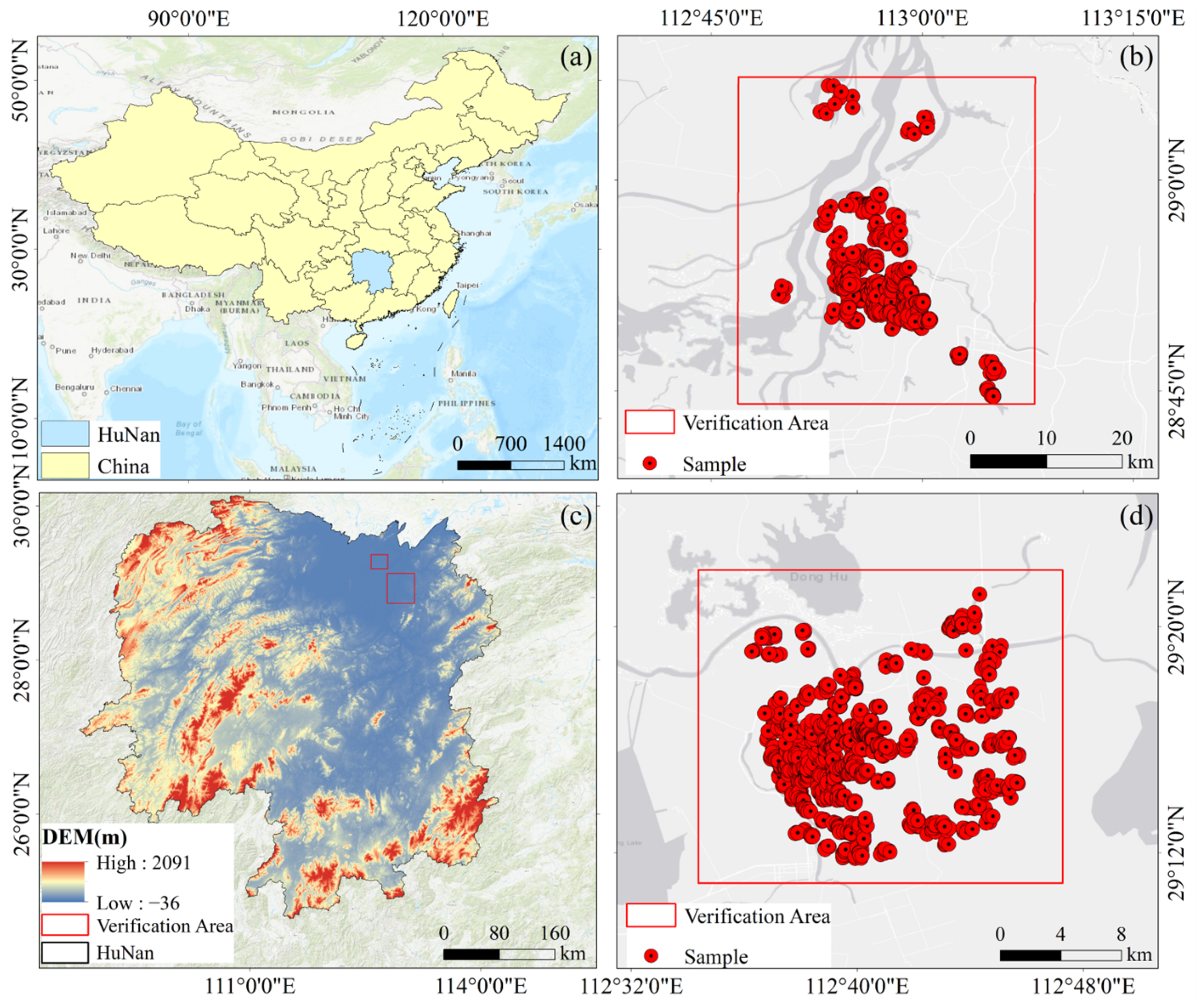
This study was conducted in Hunan Province (108°47′–114°15′ E, 24°38′–30°08′ N) (Figure 1). The region’s unique hydrothermal conditions, along with sufficient annual sunshine hours ranging from 1300 to 1800 and an average annual temperature of 15–18 °C, create an ideal environment for rice growth, making it a highly representative region for both single- and double-cropping rice systems in China. The typical rice cultivation calendar includes transplanting (April–July), followed by key phenological stages (tillering, jointing, heading, and flowering from June–September), and harvesting (July–November) (Figure 2) [49]. Climatically, Hunan Province features a subtropical monsoon climate characterized by a mean annual precipitation ranging from 1200 to 1700 mm, among the highest in China, coupled with frequent cloud cover and extreme weather events such as flooding [50]. These flooding events, along with spatial heterogeneity in phenology, present both an ideal testbed and significant challenges for in-season rice mapping.

2.2. Datasets

This study utilized multi-source remote sensing data through the Google Earth Engine (GEE) platform, incorporating Sentinel-1 Ground Range Detected (GRD) product, Harmonized Sentinel-2 MSI, MODIS imagery, and NASADEM of topographic data, along with farmland masks, historical rice maps, and ground truth samples. While optical data provide essential spectral information for crop identification, their reliability in southern China is often compromised by persistent cloud cover. In contrast, Synthetic Aperture Radar (SAR) data overcome this limitation with their cloud-penetrating capabilities, making them particularly effective for rice mapping due to the crop’s distinctive flooded growth signatures during key phenological stages. By strategically integrating these complementary datasets, we developed a robust month-scale rice mapping approach that addresses both spectral discrimination and temporal monitoring needs under challenging environmental conditions.

2.2.1. Sentinel-1 GRD Product

As part of ESA’s Copernicus program, the Sentinel-1 constellation provides C-band SAR imaging capabilities for continuous all-weather Earth observation. This study utilizes the GRD product in dual-polarization (VV + VH) mode, offering 10 m spatial resolution with a 12-day revisit period (Table 1). All Sentinel-1 data were preprocessed on Google Earth Engine using the Sentinel-1 Toolbox workflow, which includes: (1) thermal noise removal, (2) radiometric calibration, and (3) terrain correction using the SRTM digital elevation model. This processing chain ensures the radiometric accuracy and geometric fidelity required for precise rice mapping. For analysis, this study employed the time-series Sentinel-1 imagery acquired over Hunan Province from April to November in the training year (2022) and the target year (2023).

2.2.2. Optical Data

The Sentinel-2 mission, a critical component of ESA’s Copernicus Earth Observation Program, operates as a constellation of two satellites (Sentinel-2A and -2B) that collectively provide high-resolution multispectral imagery. This study utilizes Level-2A surface reflectance products available through Google Earth Engine, which have been processed from Level-1C top-of-atmosphere data through comprehensive radiometric calibration and atmospheric correction using the Sen2Cor algorithm. Sentinel-2 exhibits significant capabilities for characterizing rice growth patterns using vegetation indices and temporal phenological analysis, owing to its 12 spectral bands covering the visible, red-edge, and shortwave infrared regions (443–2190 nm) (Table 1).
The Moderate Resolution Imaging Spectroradiometer (MODIS), a NASA sensor aboard both Terra and Aqua satellites, provides comprehensive global coverage with a 1–2-day revisit frequency through its dual-satellite configuration. This study employs three MODIS products from Google Earth Engine: (1) MOD09A1 (8-day surface reflectance composite with 7 spectral bands at 500 m resolution), (2) MOD13Q1 (Terra-derived 16-day NDVI/EVI composites), and (3) MYD13Q1 (Aqua-derived 16-day NDVI/EVI composites). The synergistic use of Terra and Aqua observations achieves an effective 8-day temporal resolution, enabling precise tracking of rice phenology through vegetation index time-series analysis. The unique combination of spectral bands (620–2155 nm) of MODIS and frequent temporal sampling makes it particularly valuable for monitoring seasonal vegetation dynamics in large-scale agricultural systems.
All Sentinel-2 and MODIS data used in this study cover Hunan Province from April to November in both the training year (2022) and the transfer year (2023), consistent with the Sentinel-1 dataset.

2.2.3. Auxiliary Data

NASADEM, a state-of-the-art global digital elevation model (DEM) developed by NASA’s Jet Propulsion Laboratory, was utilized in this study to accurately extract elevation and slope features for rice paddy mapping. This next-generation DEM offers substantial advancements over legacy SRTM products, offering global 1-arcsecond (~30 m) resolution with void-free coverage, along with valuable additional layers including interferometric coherence, radar backscatter, and incidence angle data. These enhancements are particularly valuable for agricultural applications, enabling precise elevation and slope analysis of rice-growing areas where subtle terrain variations significantly influence water management and cultivation patterns.
The ESA WorldCover 10 m v200 product (2021), developed by the European Space Agency, was employed to generate a farmland mask for this study, which was designed to eliminate non-farmland regions (e.g., urban areas, forests, and water bodies) and refine the spatial scope for accurate rice identification. This global land cover dataset which provides 10 m resolution classification is directly accessible through the Google Earth Engine (GEE) platform.
Sample generation and method validation were performed by integrating multiple high-resolution rice distribution datasets: (1) Pan-Rice, a 10 m resolution national double-season rice dataset (2016–2024) developed by Pan et al. [51] using the time-weighted dynamic time warping (TWDTW) method; (2) Shen-Rice, a complementary 10 m single-season rice dataset (2017–2024) created by Shen et al. [52] using the TWDTW method; and (3) EARice10, a 10 m resolution annual rice map for East Asia (2023) produced by Song et al. [53]. The Pan-Rice and Shen-Rice datasets were merged to create a comprehensive TWDTW-Rice reference dataset for sample extraction. For validation purposes, both TWDTW-Rice and EARice10–as established rice maps for Hunan Province–were compared with our proposed algorithm to assess its performance improvements. Complete product specifications and access details are provided in Table 2.
The validation and testing data primarily consisted of field surveys and visual interpretation of high-resolution imagery from Google Earth. Initially, field surveys were conducted to establish highly reliable ground-truth anchors across three distinct regions. In Hunan Province, surveys were conducted at 31 sampling plots during two critical growth periods (15 April and 28–30 July 2023). Additionally, to evaluate cross-regional generalization, we monitored 20 paddy fields in Taishan, Guangdong Province (26 March to 30 June 2019, 9 visits), and 41 paddy fields in Panjin, Liaoning Province (4 May to 25 October 2024, 11 visits).
To meet the data requirements for rigorous large-scale evaluation, these field-based anchor plots were systematically augmented through visual interpretation. This process generated a massive pixel-level validation dataset. The detailed pixel counts for both rice and non-rice samples across the three regions are summarized in Table 3.
The spatial distribution of the validation samples was strategically stratified to capture regional phenological variations and complex land covers (e.g., lotus, corn, and wetlands). Due to topographical constraints, rice cultivation in Hunan is primarily concentrated in the northeastern Dongting Lake basin. Consequently, the verification areas were established within this basin to cover specific transplanting stages: Verification Area 1 (double-cropping zone) covers early rice and late rice transplanted in April and July, respectively; while Verification Area 2 (single-cropping zone) focuses on middle rice transplanted in June. Furthermore, the cross-regional validation samples explicitly encompass early rice transplanted in March (Taishan) and middle rice transplanted in May (Panjin), ensuring that the validation dataset comprehensively spans all transplanting months analyzed in this study.

3. Methods

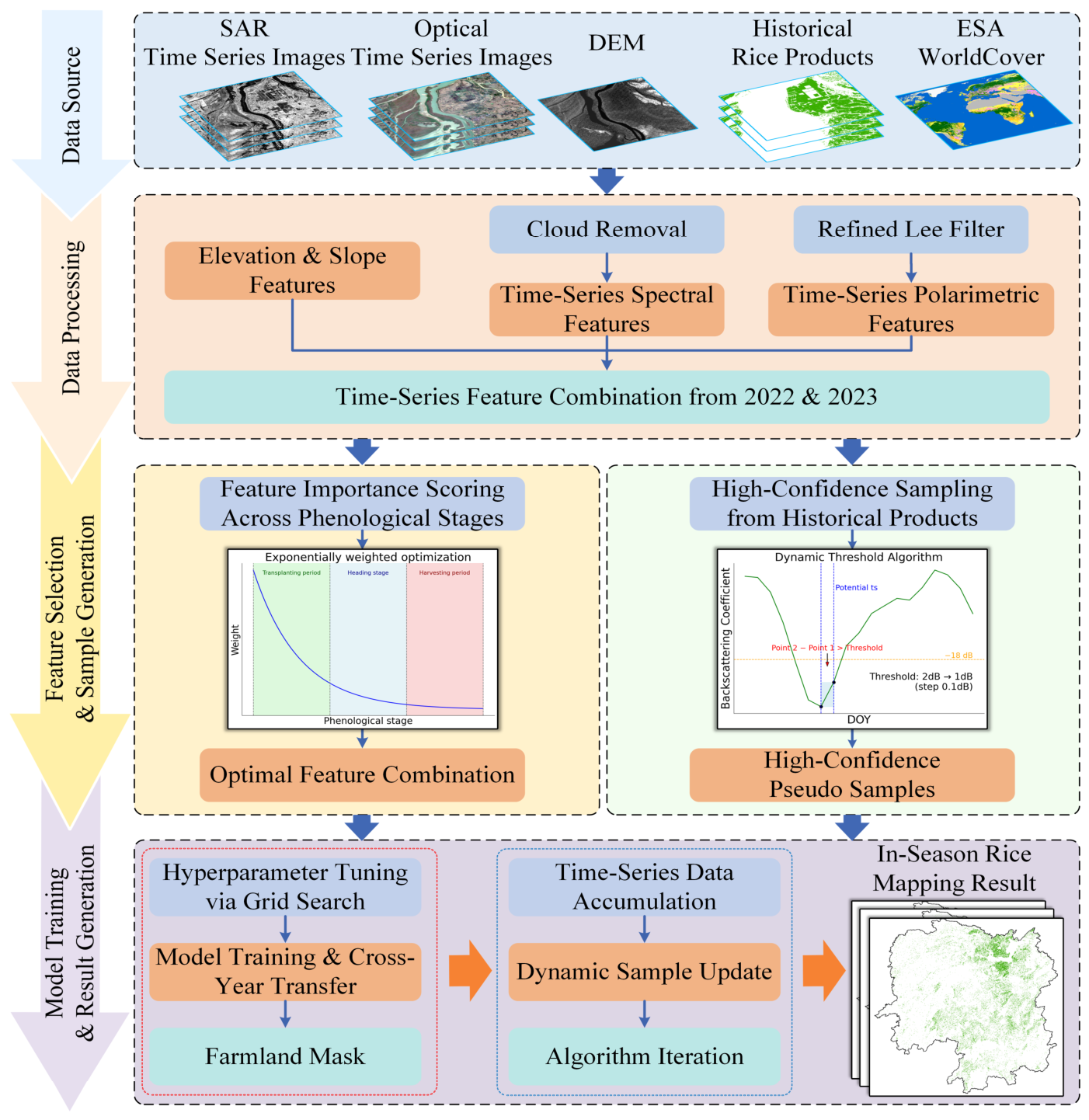
A novel in-season rice mapping framework proposed in the study integrated rice phenological characteristics into both sample selection and feature optimization through multi-source data fusion. As illustrated in Figure 3, the methodological framework consisted of six sequential components: (1) data preprocessing to ensure consistency across sensor inputs, (2) vegetation index calculation for feature extraction, (3) rule-based generation of high-confidence pseudo-samples, (4) phenology-guided feature optimization, (5) Random Forest (RF) training with hyperparameter tuning, and (6) accuracy assessment.

3.1. Data Preprocessing

The multi-source data processing pipeline incorporated several key steps to ensure data quality and consistency. The Sentinel-1 GRD data were processed using the Refined Lee filter to reduce speckle noise while preserving edge features [54]. For Sentinel-2 imagery, only acquisitions with cloud cover below 40% were retained for analysis, with cloudy pixels reconstructed through temporal linear interpolation to maintain spectral continuity. To address temporal resolution limitations of Sentinel-2, MODIS data were incorporated and upsampled to 10 m resolution via bilinear interpolation to establish a unified feature space for the pixel-based Random Forest classifier. Although upsampling 500 m data to 10 m inherently introduces mixed-pixel effects rather than creating genuine fine-scale spatial detail, it is a necessary step to preserve the native 10 m resolution of Sentinel sensors. All remote sensing time-series data underwent monthly median compositing to: (1) guarantee sufficient valid observations throughout the rice growth cycle, (2) effectively eliminate outliers (superior to mean filtering), and (3) minimize weather-induced noise–particularly crucial for southern China’s persistently cloudy conditions [29,55]. Finally, NASADEM elevation data were upsampled to 10 m resolution using cubic convolution to match the target spatial scale, ensuring proper integration with other datasets for terrain analysis of paddy rice.

3.2. Feature Construction

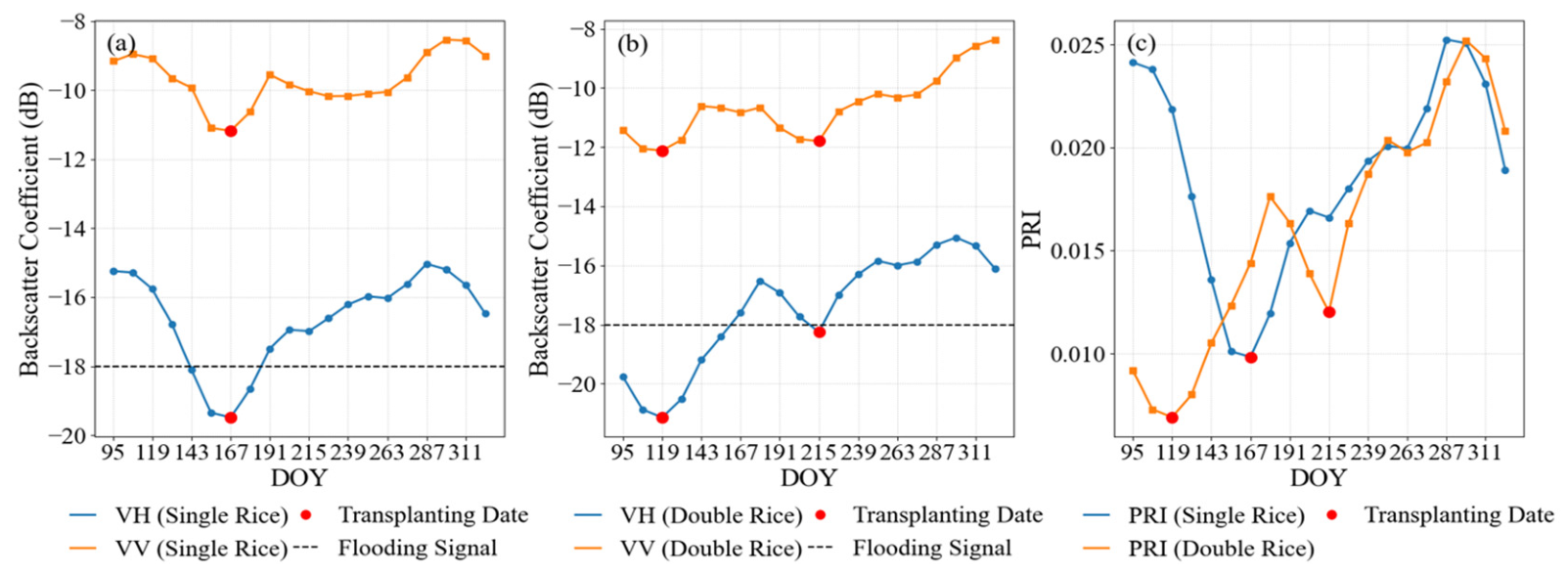
Eight polarization features were derived from the Sentinel-1 GRD VV and VH backscatter coefficients (Table 4). Notably, this study proposes a novel Polarization Ratio Index (PRI), specifically designed to capture the unique temporal backscatter signature of paddy rice, defined as P R I = V V × V H / ( V V + V H ) using linear power intensity. By nonlinearly combining dual-polarization information in the linear domain, the PRI significantly enhances sensitivity to rice phenological development. As illustrated in Figure 4, the PRI exhibits a distinct dynamic trajectory throughout the growth cycle. During the early flooding stage (transplanting), the specular reflection from the water surface yields minimum values for both VV and VH. Because the product of two small values in the numerator decreases more rapidly than their sum in the denominator, the PRI reaches its minimum during this phase. As rice progresses through vegetative stages, the increasing canopy complexity and multiple scattering effects drive a rapid increase in both backscatter coefficients. In this growth phase, the multiplicative numerator increases more rapidly than the additive denominator, thereby driving the PRI sharply upward. This characteristic “V-shaped” trajectory enables precise tracking of rice development from transplanting to maturity.
Distinct spectral signatures across various land cover types provide essential information for accurate classification. To leverage these differences, we computed eight optical indices (Table 5) from Sentinel-2 imagery specifically designed to discriminate key land cover classes (water bodies, croplands, natural vegetation, and built-up areas). These spectral features (including both the computed indices and original bands) were integrated into model training. To mitigate temporal gaps caused by Sentinel-2′s 5-day revisit cycle and frequent cloud cover in subtropical regions, we incorporated MODIS products, which are 8-day composites generated from daily observations. Due to spectral band differences between sensors, two additional MODIS-specific vegetation indices were derived to ensure data consistency (Table 5). Furthermore, elevation and slope parameters generated from NASADEM were included to account for topographic influences on rice cultivation, particularly important in terraced landscapes of Hunan Province.

3.3. High Confidence Pseudo Sample Generation and Update

3.3.1. High-Confidence Sample Generation from Historical Products

The stringent temporal requirements of in-season crop monitoring present significant challenges in acquiring reliable and timely rice samples. To address this constraint, we developed a robust sampling methodology that capitalizes on historical rice mapping. The approach employs three consecutive years (2020–2022) of rice classification data from the TWDTW-Rice product, retaining only those pixels consistently identified as rice throughout the three years to guarantee temporal reliability. To further refine sample quality, we implemented the ESA WorldCover 10 m land cover dataset as an agricultural mask, thereby excluding non-cropland areas. Through this integrated validation framework—combining multi-temporal consistency checks with spatial filtering—we established a high-confidence reference dataset appropriate for in-season crop monitoring.

3.3.2. Dynamic Threshold-Based Pseudo Sample Update

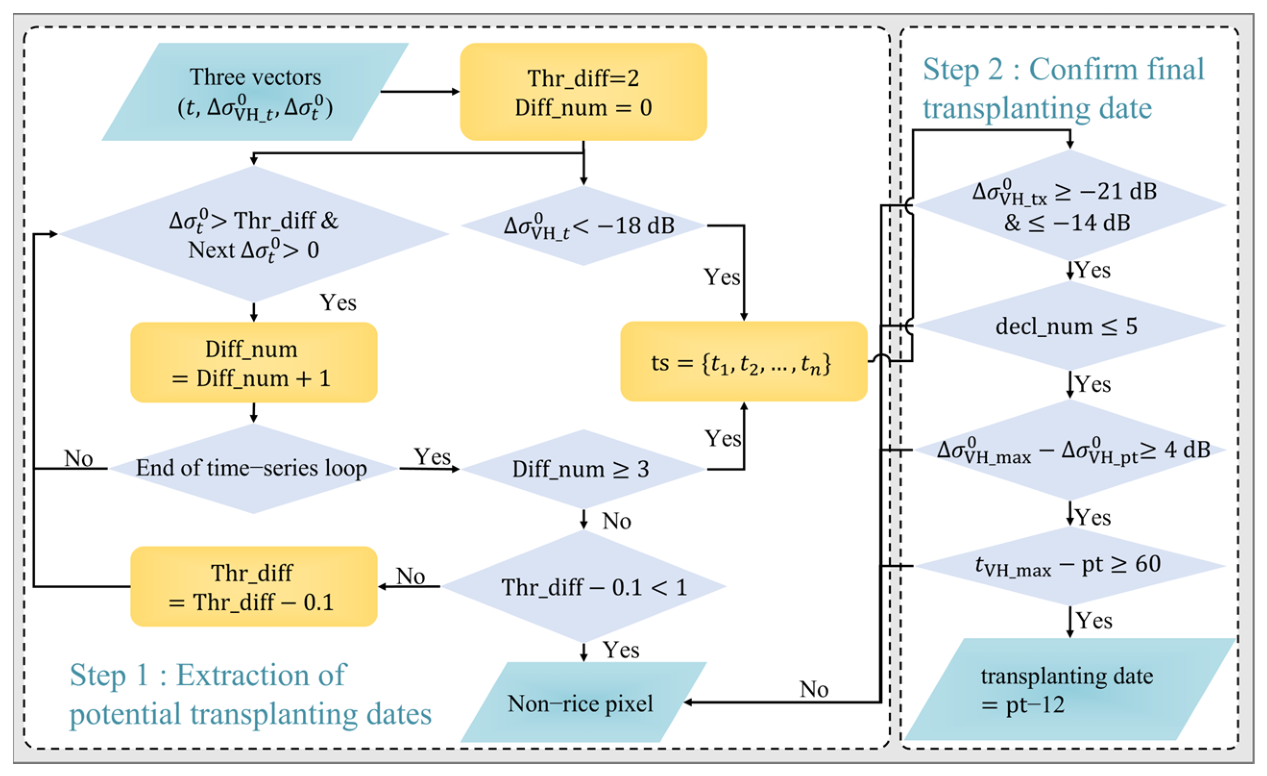
The dynamic threshold (DT) algorithm, previously validated for estimating rice transplanting dates using time-series Sentinel-1 GRD imagery [67], shows improved accuracy as the number of images increases after transplanting (DAT). Building on high-confidence samples derived from historical rice maps, we applied the DT algorithm to further update the sample by transplanting dates (Figure 5).
To support temporal tracking, we added the Day of Year (DOY) as an additional band to each image, enabling precise monitoring of phenological stages. Furthermore, to better characterize temporal dynamics, we calculated the difference ( σ t 0 ) in backscatter coefficients between consecutive observations with a 12-day revisit cycle, defined as
σ t 0 = σ V H _ t + 12 0 σ V H _ t 0
where σ V H _ t 0 represents the backscatter coefficient at time t (DOY).
In this study, the steps of the dynamic threshold algorithm mainly include the following four steps:
  • Identify the dates at which the VH backscatter coefficient of the current pixel drops below −18 dB. This threshold, derived from the rice backscatter coefficient curve (Figure 4), captures the “flooding signals” during the transplanting period. σ V H 0 on transplanting date is below −18 dB, as shown in Figure 4.
  • Extract the dates when σ t 0 > T h r _ d i f f and σ t + 12 0 exceeds 0 dB. As illustrated in Figure 5, T h r _ d i f f operates as a pixel-level adaptive threshold to ensure sufficient temporal nodes ( D i f f _ n u m 3 ) for capturing the rice growth trajectory. Initialized at 2 dB, T h r _ d i f f iteratively decreases by 0.1 dB if Diff_num < 3, which accommodates natural intra-class variations in backscatter increments. This relaxation loop terminates when D i f f _ n u m 3 is satisfied or the 1 dB lower bound is reached, below which the pixel is rejected as non-rice. Analysis of rice backscatter curves revealed that σ V H 0 on the second post-transplanting date increases relative to that on the first post-transplanting date.
  • Extract the date set t s = { t 1 , t 2 , , t n } that satisfies Conditions 1 and 2. This set contains potential key nodes of rice phenology.
  • Extract the date t i from t s that satisfies the following conditions (1–4). When t i satisfies all conditions, the loop terminate and t i is designated as the post-transplanting date ( p t ), while the transplanting date set to p t 12 . Otherwise, the loop continues iterating through the entire range. The conditions applied in this step are:
    • σ V H _ t x 0 ( t x [ t i + 12 , t V H _ m a x ] ) is ≥−21 dB and ≤−14 dB. From the second post-transplanting date to the maturity period, σ V H 0 typically ranges between −21 dB and −14 dB, as shown in Figure 4, the t V H _ m a x denotes the DOY of the maximum VH backscatter coefficient ( σ V H _ m a x 0 ) observed from tx until the end of the observation period.
    • d e c l _ n u m 5 , where d e c l _ n u m denotes the number of observations between p t and t V H _ m a x where σ t 0 < 0 . σ t 0 below 0 represents a decrease (e.g., in soil moisture) caused by rainfall. While the previous study [67] used a threshold of 3, this study uses a threshold of 5 due to the high rainfall characteristic of Hunan Province.
    • The difference between σ V H _ m a x 0 and σ V H _ p t 0 is ≥4 dB. This threshold promotes a strong positive trend in the temporal profile of the VH backscatter coefficient during the growing season (Figure 4).
    • A minimum interval of 60 days between t V H _ m a x and p t is required because the growth cycles for both single- and double-season rice exceed this duration, based on the rice growth calendar published by the International Rice Research Institute (IRRI) [http://www.knowledgebank.irri.org/step-by-step-production/pre-planting/crop-calendar, accessed on 18 December 2024].
Through the above multi-level conditional screening, this study constructed a high-confidence pseudo sample set integrating time-series dynamic features. By dynamically adjusting thresholds and time-series constraints, this method effectively overcomes the insufficient adaptability of single static thresholds to different years and rice types. The generated samples can be directly applied to cross-year transfer model training. Compared with traditional static samples, those extracted by the dynamic threshold algorithm can reflect the in-season rice planting status, reduce model contamination from unplanted rice pseudo samples, and their accuracy progressively improves with the accumulation of time-series data.

3.4. Exponentially Weighted Feature Selection

While high-dimensional feature sets enhance classification robustness, they concurrently elevate risks of model overfitting and computational complexity. In addition, feature importance varies significantly across different rice phenological stages. Therefore, we implemented an exponentially weighted feature selection method that incorporates rice phenological knowledge, temporally integrates importance scores of features across different phenological stages, constructing a comprehensive feature importance measurement system. Based on the rice phenological calendar (Figure 2), we divided the growth cycle into three critical phases: (1) sowing–transplanting, (2) vegetative growth, and (3) maturity.
The weighted importance scores of features were calculated using an exponential weighting approach based on the time span of each phenological stage, the decaying weight, and the original feature importance scores. The resulting scores were then used to select an optimal training feature set that maintains classification performance while mitigating model overfitting and improving computational efficiency.
The calculation formula is as follows:
w e i g h t e d _ i m p o r t a n c e f = i = 1 N i m p o r t a n c e f , i × w i n o r m a l i z e d
where i represents the i -th phenological period, and i m p o r t a n c e f , i represents the importance scores of features in i -th phenological period. The phenological periods comprised three key phases—sowing–transplanting, vegetative growth, and harvest—which are illustrated in Figure 2. For each phase, we quantitatively evaluated feature importance ( i m p o r t a n c e f , i ) using GEE’s ee.Classifier.explain() function, analyzing features from multiple data sources (Sentinel-1 and -2, MODIS). Importance scores were normalized within each phenological stage to allow cross-stage comparison.
The w i n o r m a l i z e d is the normalized weight of w i . The formulas are as follows:
w i = a d j u s t e d _ d u r a t i o n i × w _ d e c a y i
w i n o r m a l i z e d = w i i = 1 N w i
where a d j u s t e d _ d u r a t i o n i is the adjusted time span of each phenological stage, which is calculated using Equation (5):
a d j u s t e d _ d u r a t i o n i = d u r a t i o n i α
where d u r a t i o n i denotes the time span of the i -th phenological period; α is the adjustment factor. The w _ d e c a y i denotes the decaying weight of the i -th phenological period, and k is the decay coefficient. To balance information entropy and phenological prioritization while adhering to mathematical parsimony (avoiding dataset-specific over-tuning), both α and k were set to 0.5 in this study.
w _ d e c a y i = e k × i
By highlighting the unique phenological characteristics of rice during the transplanting and early vegetative stages, this early-season optimization strategy ensures the selection of the most suitable feature combination for in-season recognition, while effectively maintaining model simplicity and efficiency.

3.5. Random Forest with Model Hyperparameter Optimization and Cross-Year Transfer

The RF classifier serves as this study’s classification core. This ensemble method, widely adopted in crop mapping [28,68], generates predictions through aggregated decision tree outputs via majority voting. However, suboptimal hyperparameter tuning (e.g., excessive tree depth) may lead to overfitting due to high dimensionality.
In this study, an RF model was implemented within the GEE platform. To optimize predictive performance and learning dynamics, key hyperparameters were rigorously tuned using a grid search strategy. Given the memory restrictions of GEE and the relatively low-dimensional parameter space of its RF API, grid search enables a systematic evaluation across discretized grids to reliably identify the optimal configuration [69]. Based on comprehensive experimental testing, the optimal RF parameters were determined as follows: first, the number of decision trees was set to 300, striking an optimal balance between classification accuracy and computational efficiency. Second, the number of features evaluated at each node split was defined as 9—corresponding to the square root of the total feature count—to guarantee adequate diversity among the base classifiers. Finally, the minimum size of a terminal node was restricted to 1, enabling the model to effectively capture fine-grained and subtle spatial characteristics of heterogeneous landscapes. To ensure rigorous scientific reproducibility, this configuration was deployed via the GEE JavaScript API using the ee.Classifier.smileRandomForest() function, mapping the optimized hyperparameters to numberOfTrees, variablesPerSplit, and minLeafPopulation, respectively. Furthermore, the high-confidence pseudo-sample extraction was executed via the native ee.Image.stratifiedSample() function under a strictly locked random seed of 42 to guarantee fully deterministic sample partitioning. Spatial interpolation and multi-scale sensor alignment were standardized using the native bilinear resampling (resample(‘bilinear’)) and cubic convolution re-projection algorithms to ensure strict structural consistency across datasets.
Regarding the mapping framework, this study employed a cross-temporal model transfer strategy executed within individual Sentinel-1 tile-sized blocks to mitigate spatial autocorrelation. Initially, the RF classifier was trained using optimized features and a sparse subset of 20,000 dynamically generated pseudo-samples (10,000 per class) from 2022, which were strictly temporally aligned with the observational windows of the 2023 rice growing season. To ensure a genuine zero-shot evaluation for cross-year application, strict temporal data isolation was maintained; no target-year data from 2023 was involved in the training or hyperparameter selection of this historical model. Furthermore, while a separate hold-out field survey dataset exclusively for 2022 was unavailable due to logistical constraints, the baseline performance of the historical model was robustly validated using the inherent Random Forest Out-of-Bag (OOB) metric. The model achieved an excellent baseline OOB accuracy of 97.38% (OOB error: 0.0262), confirming its high reliability in capturing stable phenological features. Subsequently, this trained model was directly transferred to the 2023 time-series data for prediction. During the continuous in-season mapping process, as current-season satellite imagery gradually accumulated, the corresponding historical time windows were synchronously expanded. This mechanism allowed the historical features and pseudo-labels to be dynamically updated and augmented. Consequently, the model effectively captured the consistent inter-annual phenological response patterns of rice, progressively refining its identification performance and ultimately achieving robust in-season rice mapping for 2023.

3.6. Accuracy Assessment

For the in-season rice recognition results, this study evaluated accuracy using five metrics—producer accuracy (PA), user accuracy (UA), overall accuracy (OA), Kappa coefficient, and F1-score—based on field survey data and verification samples derived from visual interpretation. The calculation formulas for these five accuracy metrics are as follows:
P A = T P T P + F N
U A = T P T P + F P
O A = T P + T N T P + F N + F P + T N
K a p p a = P o P e 1 P e
P e = T P + F P × T P + F N + T N + F N × ( T N + F P ) ( T P + F N + F P + T N ) 2
F 1 s c o r e = 2 × P A × U A P A + U A
where T P denotes rice samples correctly classified as rice, F P represents non-rice samples misclassified as rice, T N refers to non-rice samples correctly classified as non-rice, F N is rice samples misclassified as non-rice, and P o is the overall accuracy.
Furthermore, to evaluate the statistical precision of the generated error matrices, the 95% confidence intervals (CIs) for the primary classification metrics were analytically derived using the standard binomial proportion error formulation:
C I = ± 1.96 × O A × 1 O A N
where O A represents the overall accuracy, and N denotes the total number of validation pixels.

4. Results

4.1. Spatiotemporal Distribution of Rice Sample

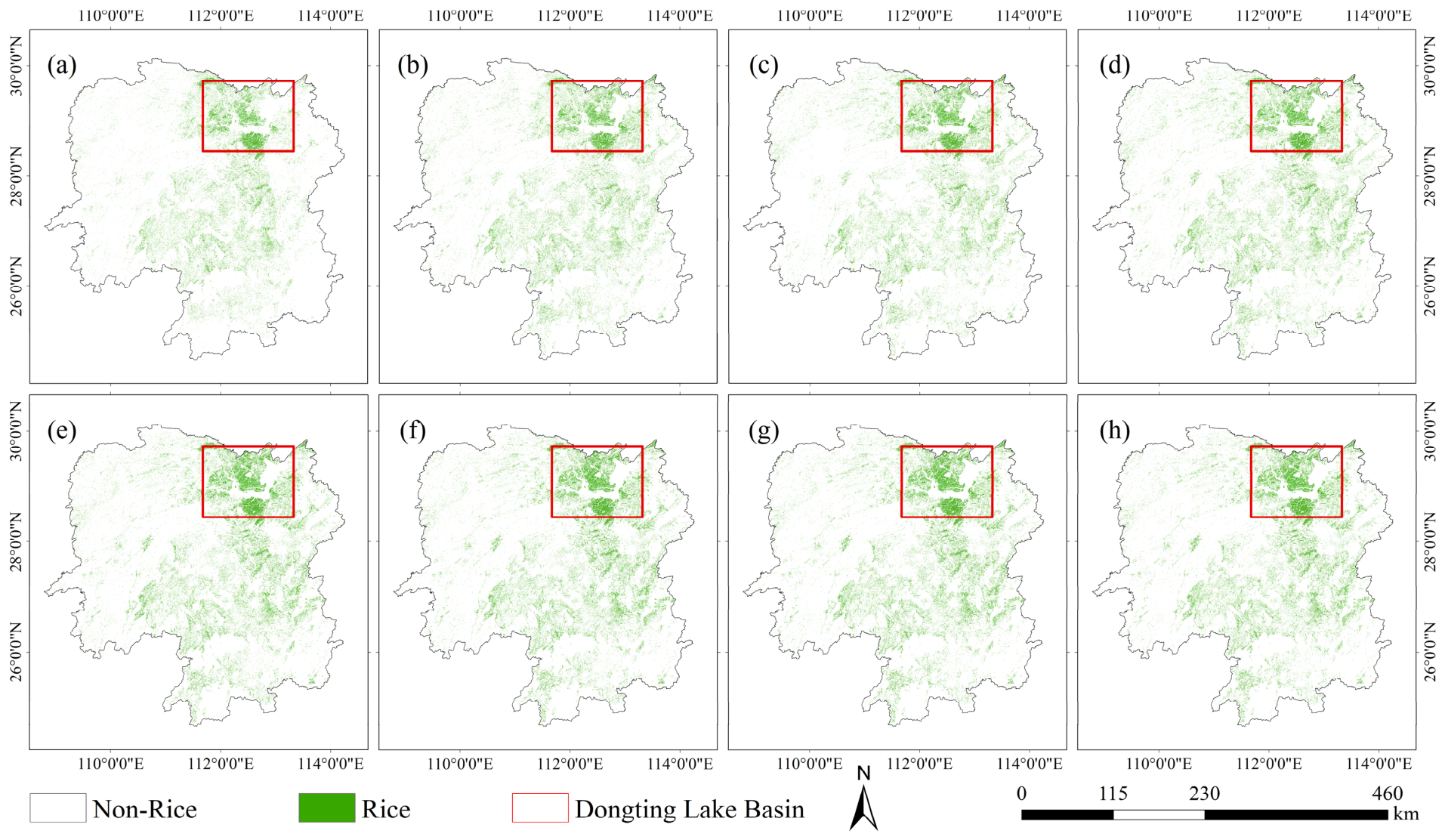
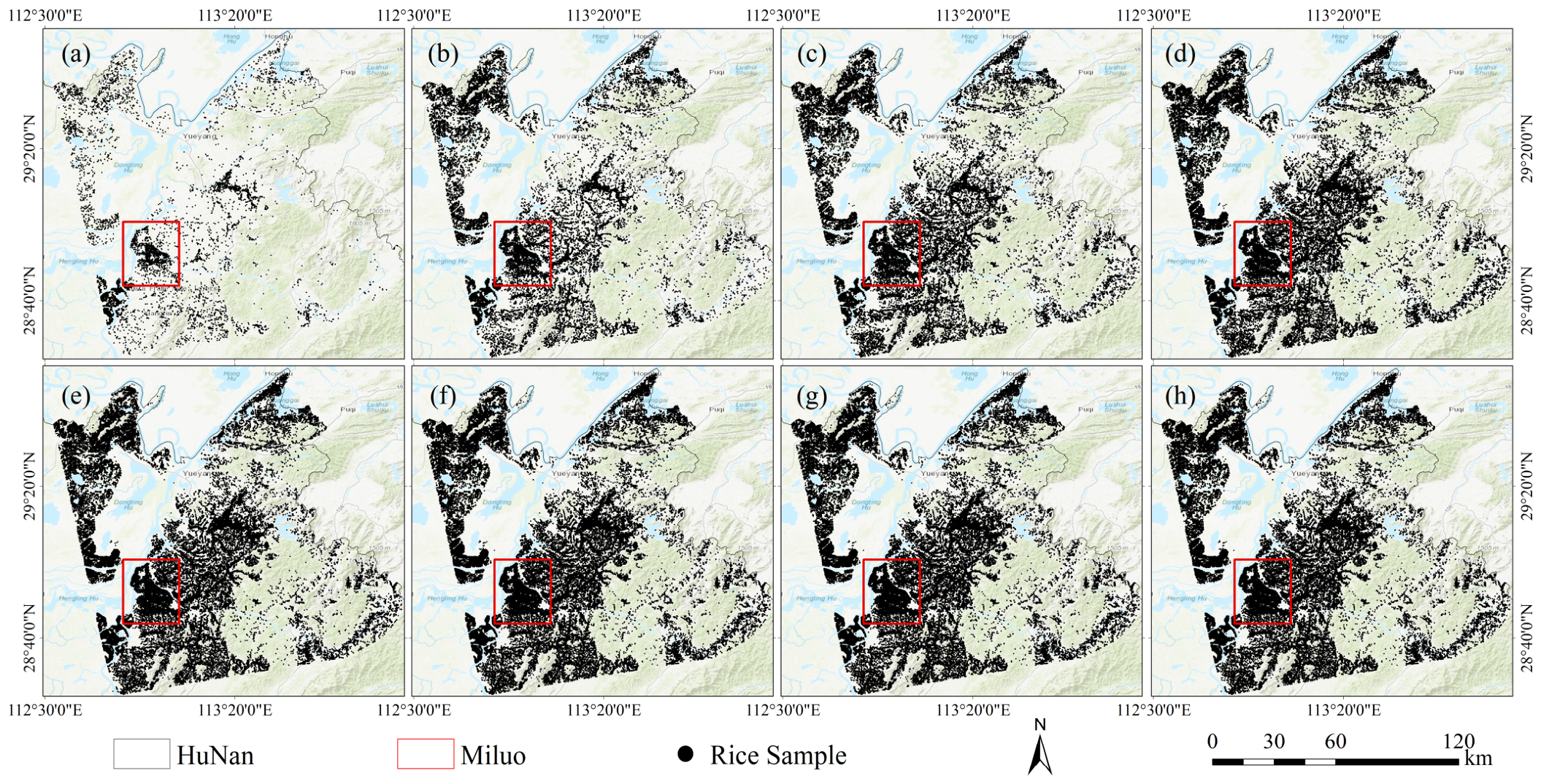
Figure 6 shows the spatiotemporal distribution of rice samples from April to November in the intensive rice-growing region of northeastern Hunan Province. Spatially, the overall distribution of extracted rice samples aligns well with field survey observations, showing concentrated planting in the East Dongting Lake area and the Xiang Jiang River Basin, and sparse distribution across eastern mountainous valleys.
A particularly notable pattern emerges in April, when the Miluo region (highlighted by the red box) exhibits a markedly higher density of rice samples compared to surrounding areas. This contrast is due to Miluo’s predominance of double-season rice cultivation. By April, early rice had already entered the transplanting phase, manifesting a distinct “V-shaped” signature in the backscatter time series. Conversely, transplanting in regions north of East Dongting Lake—characterized primarily by single-season rice cultivation—had not yet commenced by May. The dormancy during April and May resulted in significantly sparser rice samples in these months (Figure 6b,c). Transplanting activities in these regions typically commenced in June (Figure 6c).
Temporally, the rice sample density exhibits a continuous upward trend from April to July. This phenomenon of initial sparsity and subsequent density is a direct reflection of the spatial heterogeneity of cropping patterns along the time axis. It also confirms the validity of the phenology-based dynamic sample updating strategy proposed in this study. During the early growing season from April to May, only the earliest-planted early rice was included in the sample set, resulting in a lower density of training samples. As large-scale transplanting commenced after June, newly identified samples were continuously and dynamically accumulated into the training set, leading to a substantial surge in sample density. By July, the spatial distribution of the sample set had essentially covered all rice-growing regions, demonstrating high density and stability. This dynamically updated sampling mechanism ensures that the model is trained based on samples that best reflect the true planting status at every stage within the season.

4.2. Optimal Training Feature Combination

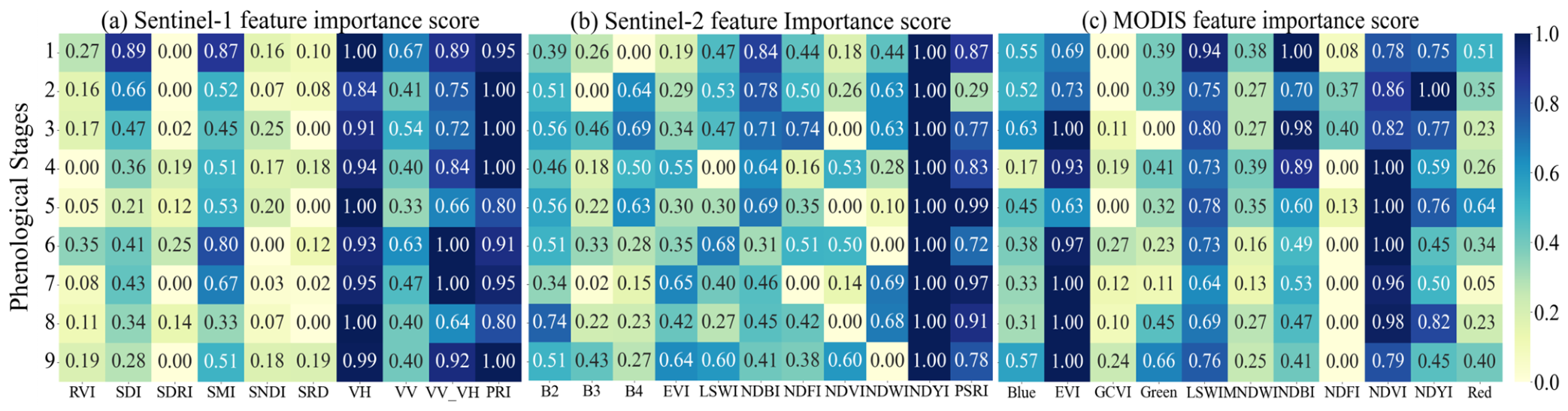
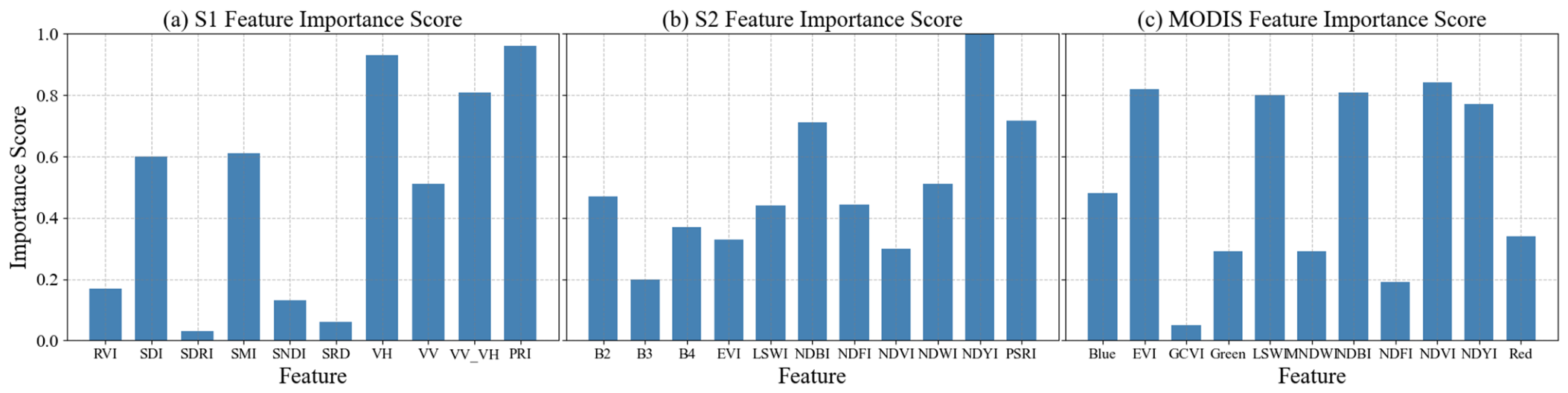
To accommodate the phenological diversity of early-, mid-, and late-season rice cultivars, the growth cycle was divided into three critical stages: (1) sowing–transplanting, (2) vegetative growth, and (3) maturity. Initial feature importance scores for each stage were derived using the ee.Classifier.explain() function in GEE, as illustrated in Figure 7. It is noteworthy that the ranking of the most important features (e.g., the consistent dominance of indices like NDYI and PSRI) remained highly stable across early, middle, and late rice. This biological consistency indicates that the classifier successfully locked onto the invariant physiological fingerprint of the crop—specifically, the dramatic pre-harvest canopy senescence and yellowing—as the primary discriminative node, rather than being biased by specific planting seasons. Within the proposed MSDF-RiceID framework, these scores were further integrated through an exponential weighting scheme that incorporates phase duration, decaying weight, and feature-specific relevance, resulting in a unified measure of weighted importance (Figure 8).
The features were then ranked in descending order, and a series of feature increment experiments was conducted to systematically assess the influence of feature quantity on the overall accuracy (OA) of rice classification. This analysis aimed to determine optimal feature combinations while minimizing redundancy and computational overhead.
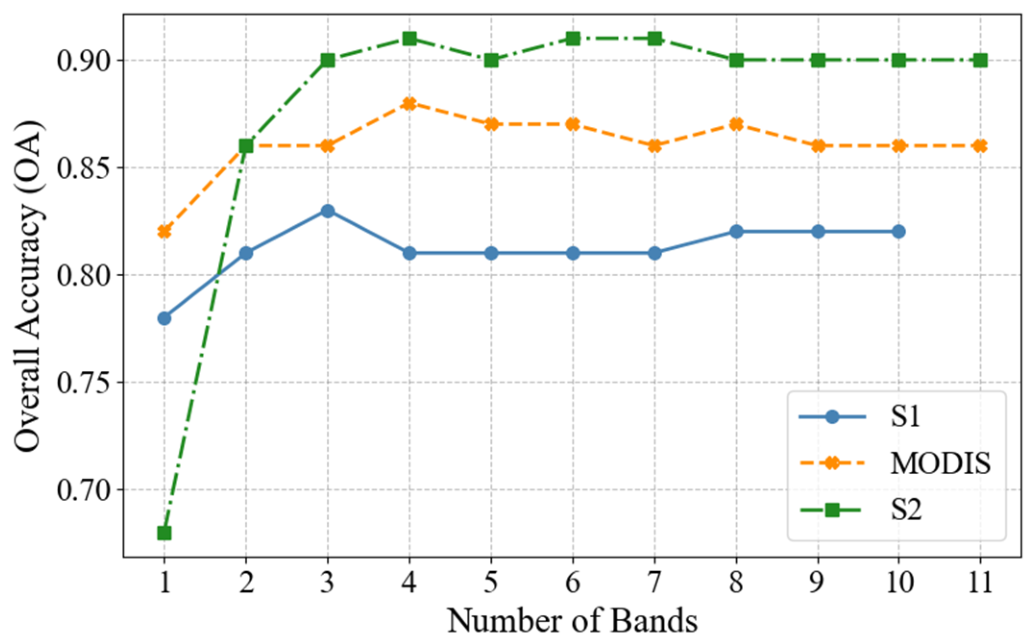
Experimental results (Figure 9) revealed that for Sentinel-1 data, OA peaked at 0.83 using only the top three features—PRI, VH backscatter coefficient, and VV_VH. Beyond this point, adding features caused a slight decline, with performance gradually stabilizing around 0.82. For Sentinel-2 and MODIS, OA reached maximum values of 0.91 and 0.88 respectively at four features, beyond which accuracy decreased slightly before stabilizing. Consequently, the optimal feature set for model training consisted of PRI, VH, and VV_VH from Sentinel-1; NDYI, PSRI, NDBI, and NDWI from Sentinel-2; NDVI, EVI, NDBI, and LSWI from MODIS; and terrain attributes included as auxiliary variables to further enhance spatial context.

4.3. Accuracy Evaluation of Multi-Source Data Combinations

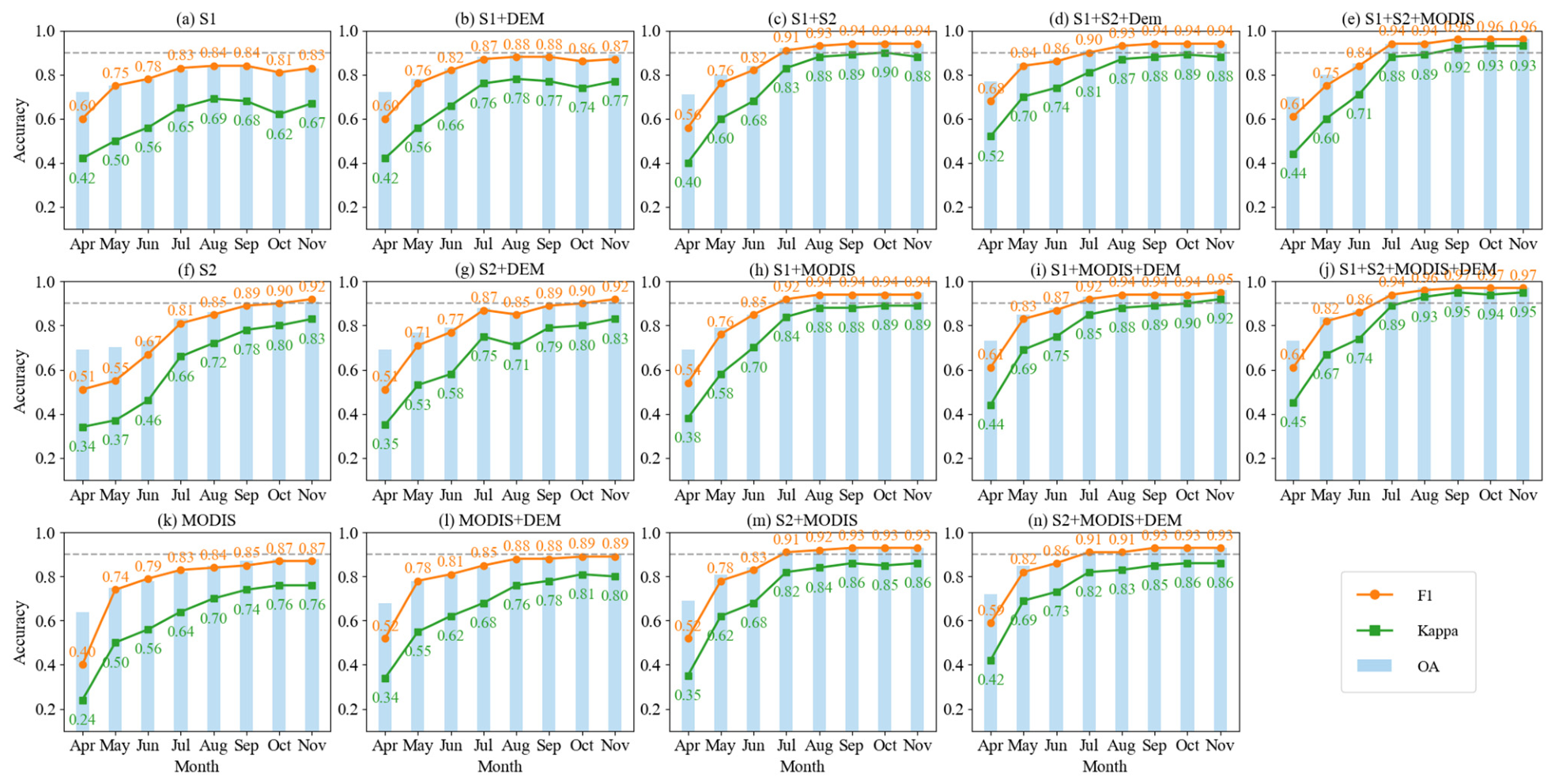
To evaluate the effectiveness of multi-source feature fusion for regional rice mapping, fourteen distinct feature combinations were constructed based on Sentinel-1 (S1), Sentinel-2 (S2), MODIS, and DEM terrain data. Specifically, seven sensor configurations—comprising single-source datasets (S1, S2, and MODIS) and their multi-source blends (S1 + S2, S1 + MODIS, S2 + MODIS, and S1 + S2 + MODIS)—were evaluated both with and without the integration of topographic features. The classification accuracy trajectories (OA, F1-score, and Kappa coefficient) for these fourteen combinations across the full growing season from April to November are systematically presented in Figure 10.
Overall, the empirical results in Figure 10 demonstrate that multi-source fusion configurations consistently outperform single-source baselines throughout the study period. The synergistic integration of all available satellite sensors yields the highest accuracy plateau, while the inclusion of DEM terrain features provides varying degrees of localized performance enhancements depending on the underlying data source.

4.4. Quantitative Performance Benchmarking Against Alternative Classifiers and Existing Products

To thoroughly verify the competitive edge and operational validity of the proposed framework, a comprehensive benchmarking evaluation was conducted across two distinct dimensions: an intra-algorithmic classifier comparison and an inter-product thematic verification.
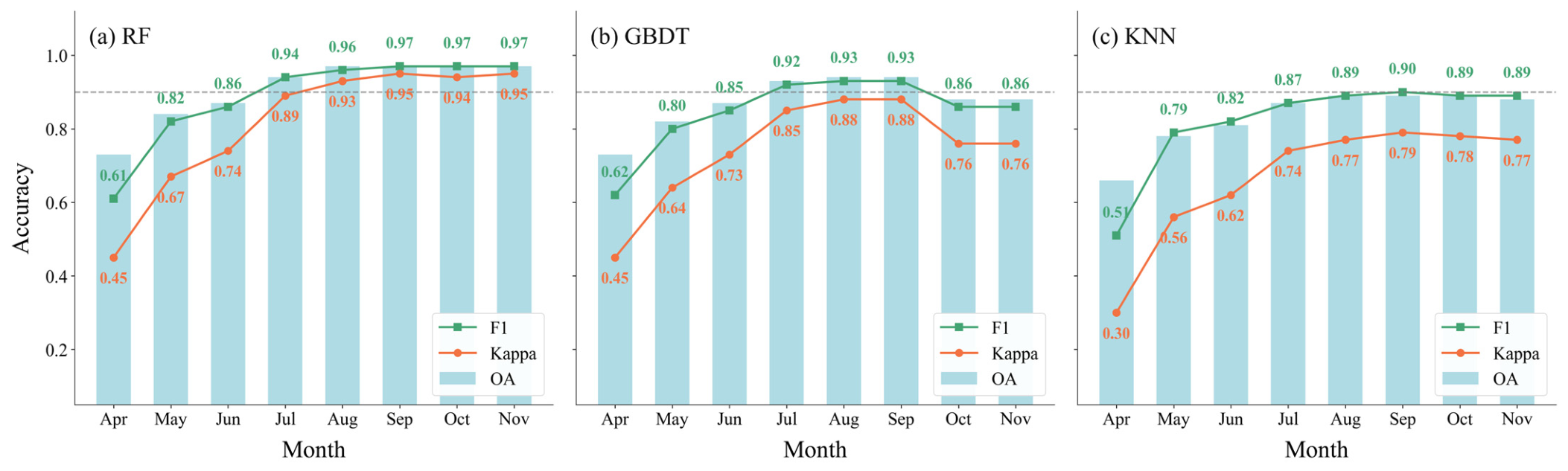
For the classifier benchmarking, the Random Forest (RF) core was evaluated against Gradient Boosting Decision Tree (GBDT) and K-Nearest Neighbors (KNN) using identical multi-source features from April to November. To ensure evaluation consistency, all models were deployed within the GEE platform using the exact same training sample set, a uniform sample size of 20,000 dynamically generated pseudo-samples, and a locked random seed of 42. The monthly time-series trajectories of Overall Accuracy (OA), F1-score, and Kappa coefficient across the full growing season are systematically plotted in Figure 11. As exhibited in Figure 11, the F1-scores of all three models demonstrated a progressive upward trend from April to September. During the initial transplanting window in April, the baseline F1-scores were relatively low, recorded at 0.61 for RF, 0.62 for GBDT, and 0.51 for KNN. By September, all models concurrently reached their annual performance peaks, with KNN obtaining an F1-score of 0.89 and GBDT achieving a competitive F1-score of 0.93, while RF established its technical dominance with an elite F1-score of 0.97 (Figure 11a). However, during the post-October harvesting phase, a severe performance divergence emerged; GBDT’s F1-score plunged abruptly from 0.93 down to 0.86 (Figure 11b), and KNN remained locked at a lower plateau around 0.89 (Figure 11c). In sharp contrast, the RF model demonstrated exceptional stability, firmly maintaining its target-crop F1-score at 0.97 continuously through October and November.
For the product verification, the final mapping results generated by the proposed MSDF-RiceID framework were cross-compared against two widely recognized alternative satellite-derived crop datasets: TWDTW-Rice and EARice10 (Table 6). Quantitative metrics show that MSDF-RiceID achieved a UA of 0.98, PA of 0.96, OA of 0.97, Kappa of 0.95, and F1-score of 0.97, yielding a substantial accuracy enhancement over alternative products (OA: +0.12–0.18; Kappa: +0.23–0.35; F1-score: +0.09–0.15, as summarized in Table 6).

4.5. Earliest Identifiable Time and Spatial Distribution of Rice

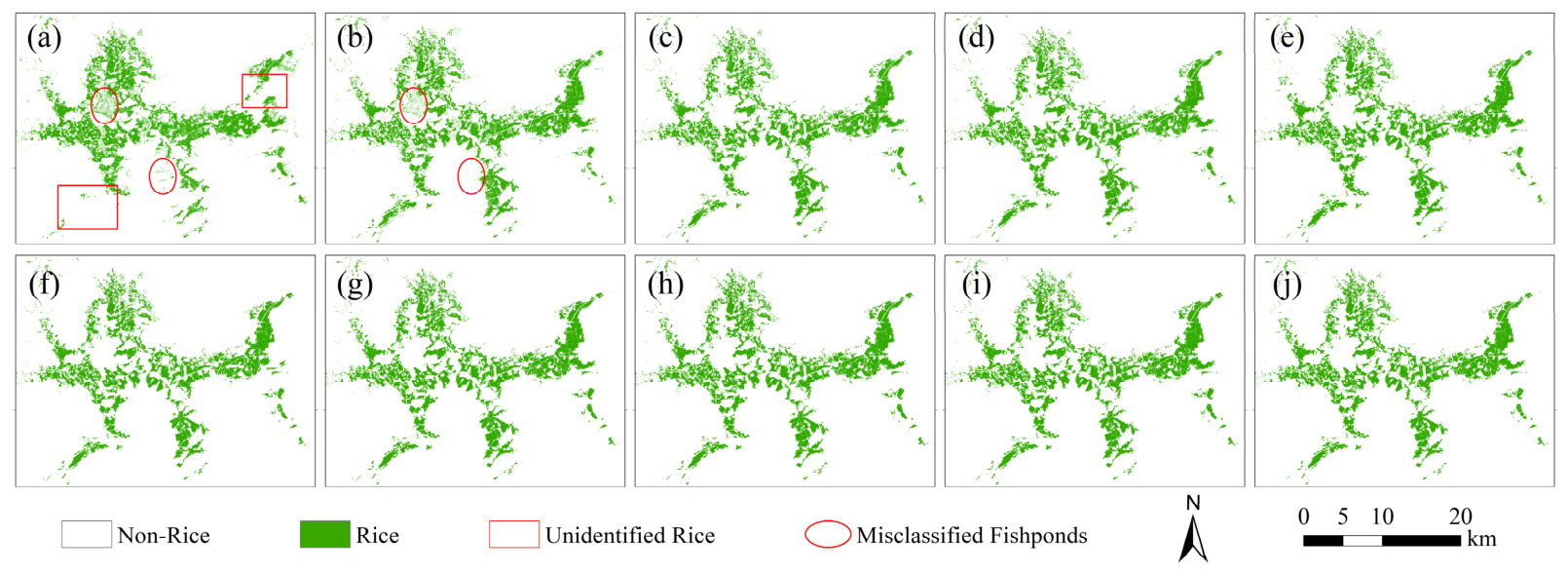
Figure 12 presents the monthly spatial distribution of rice across Hunan Province from April to November, highlighting the progressive spatial expansion of rice areas. In April, transplanting of early-season rice had just commenced in many regions, resulting in a relatively limited spatial distribution of identified rice fields (Figure 12a). With the advancement of transplanting and accumulating time-series remote sensing data, more rice pixels were successfully captured. In May, large-scale transplanting of single-season rice commenced, triggering a marked increase in classified rice areas (Figure 12b). Spatial coverage continued to expand through June (Figure 12c) and stabilized in July (Figure 12d). This trend was most prominent in the Dongting Lake Basin (highlighted by the red box)—a region characterized by high-density rice cultivation. The accumulation of multi-temporal data also enabled iterative refinement of initial predictions through progressive correction of misclassified pixels, thereby enhancing mapping accuracy temporally.
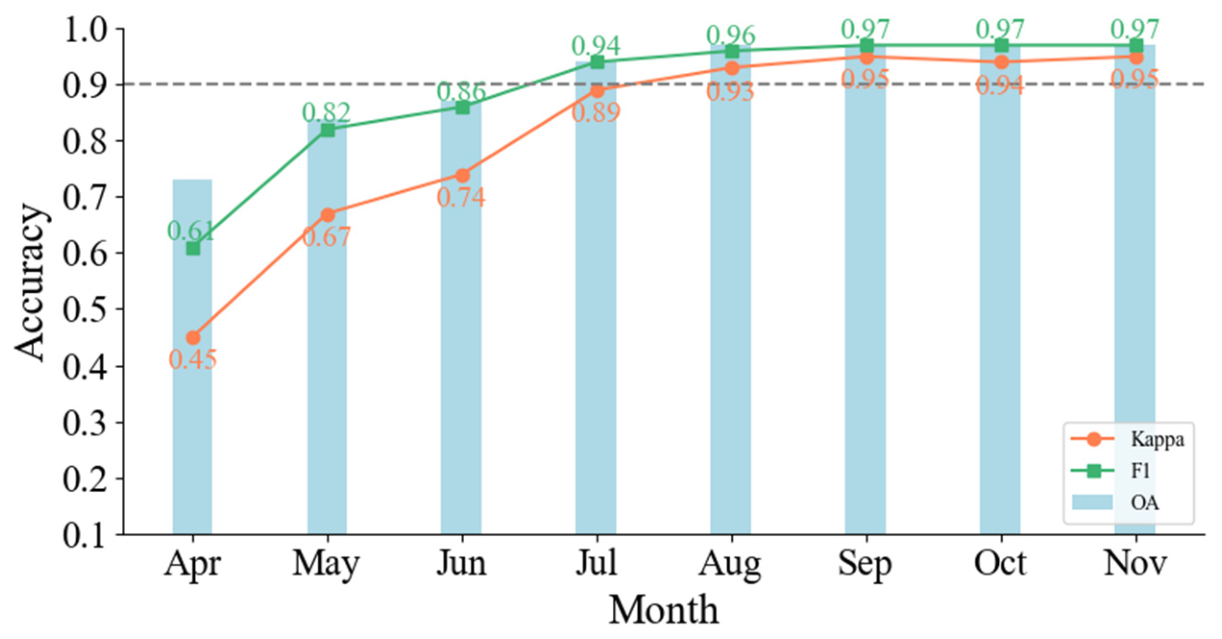
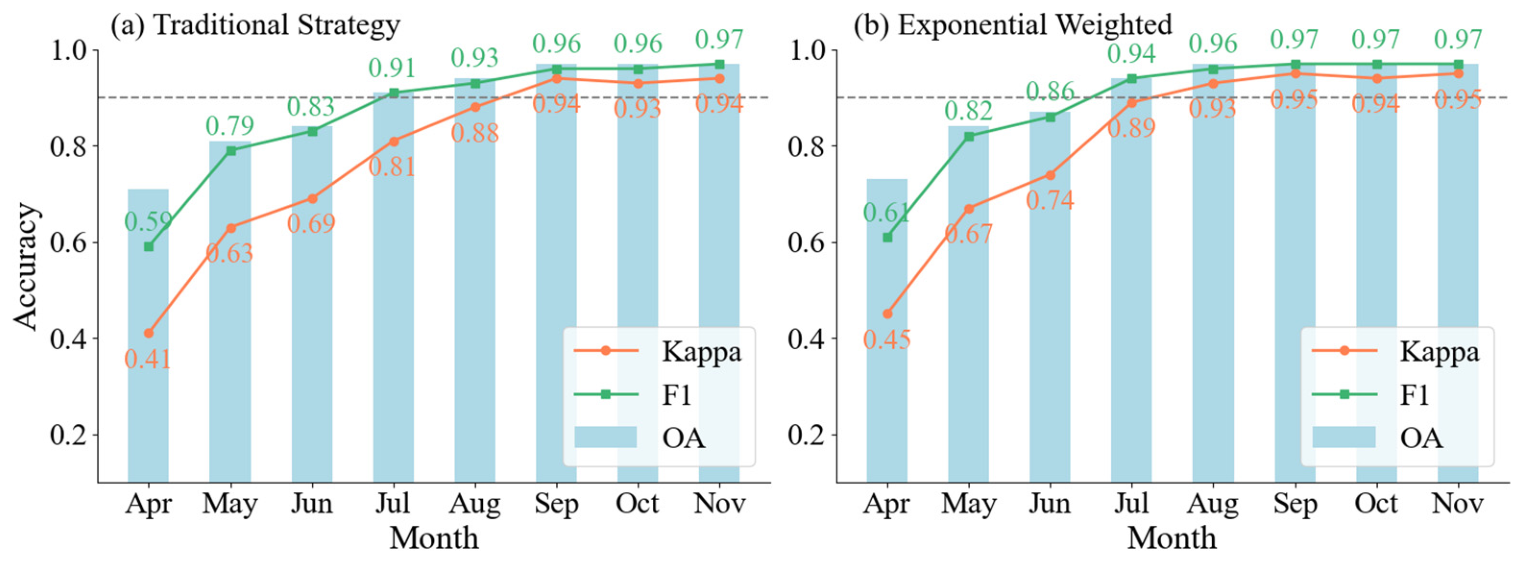
Based on the MSDF-RiceID framework’s ability to incorporate accumulating time-series information, July was identified as the earliest month enabling accurate and confident rice identification. Following You et al. [29], an F1-score threshold of 0.9 was used to define the earliest recognizable period. As shown in Figure 13, the F1-score increased steadily over time, reaching 0.86 in June and exceeding this threshold in July (0.94), before stabilizing at 0.97 from September. Similarly, the OA increased from 0.73 in April to 0.97 thereafter, while the Kappa coefficient improved from 0.45 to 0.95. However, it must be emphasized that this July detection window represents a localized benchmark highly dependent on Hunan’s complex cropping system and fragmented landscapes, rather than a rigidly fixed global timeline. To verify the regional adaptability of the framework, comparative evaluations were performed across distinct geographic conditions. In regions characterized by flat topography, homogeneous single-cropping systems, and large, contiguous agricultural fields—such as Panjin and Taishan—the earliest recognizable period advanced significantly to May (corresponding to the first and third months post-planting, respectively). This confirms that, while the quantitative threshold criteria (F1-score > 0.9) are universally generalizable, the absolute calendar month for optimal in-season mapping remains dynamic and must be calibrated to localized agronomic and geographic conditions.
It is important to note that the accuracy assessment in this study was based on post-season validation samples, which were all collected after transplanting was completed. As a result, certain pixels identified as ’non-rice’ in the early stages—due to rice not yet being planted—were later confirmed as rice fields. This temporal mismatch in reference data may cause underestimation of early-stage classification accuracy, as some unplanted but later-confirmed rice fields were incorrectly included in early misclassification statistics.

5. Discussion

5.1. In-Season Updating of Rice Samples

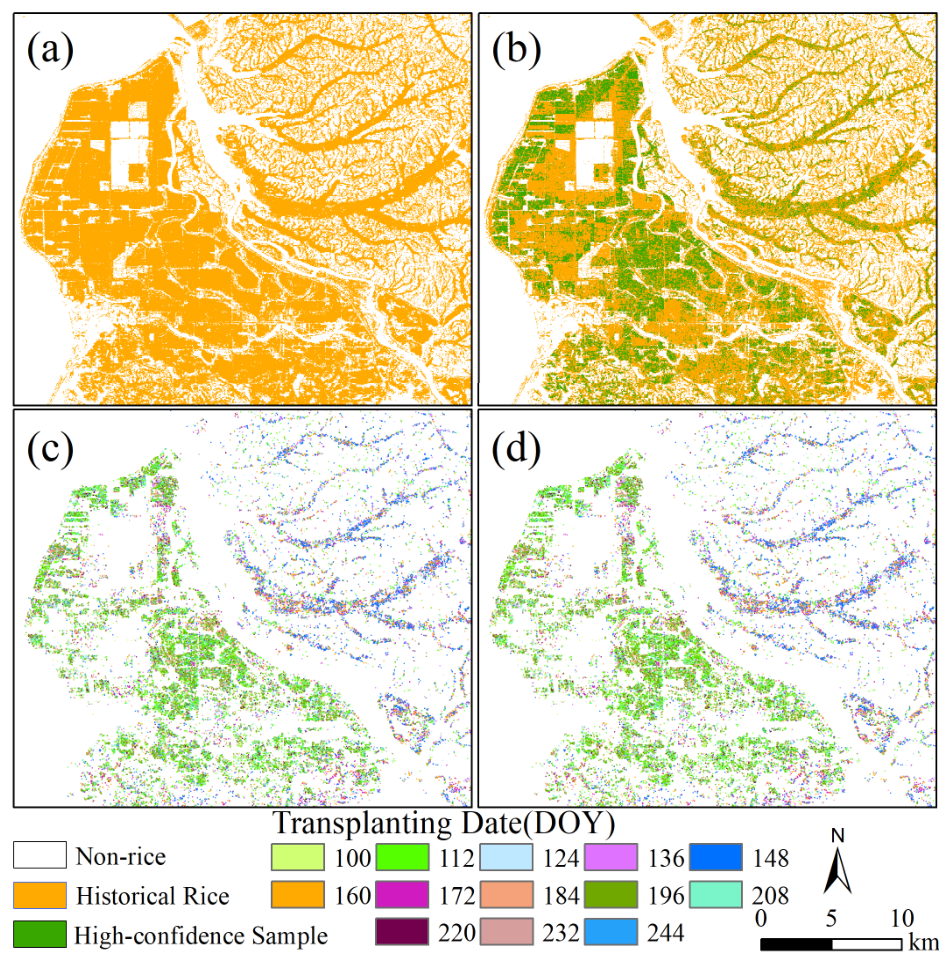
To obtain high-quality rice samples, a multi-step filtering strategy was adopted. Historical rice maps from TWDTW-Rice spanning 2020 to 2022 were first extracted and composited into Figure 14a. However, the analysis based on TWDTW-Rice revealed that these maps contained a small proportion of misclassified pixels, including wetlands and aquatic vegetation incorrectly labeled as rice. These misclassifications could significantly degrade the performance of rice classification. To mitigate this, high-confidence rice pixels persistently classified as rice across all three years were regarded as rice samples. Further refinement was achieved using a farmland mask to eliminate non-agricultural pixels mislabeled as rice (Figure 14b).
The DT algorithm was subsequently employed to identify high-confidence rice samples. This step not only reinforced the reliability of rice samples but also allowed the extraction of transplanting dates for individual pixels based on phenological signals (Figure 14c). Following regional rice phenology studies in Hunan Province [49], the normal transplanting window was defined as DOY 90 to 220. Samples with transplanting dates outside this range were excluded as anomalous, resulting in a final set of high-confidence rice samples (Figure 14d). Specifically, transplanting dates falling within DOY 100–112, 124–148, 160–172, 184–208, and 220 represent rice fields transplanted in April, May, June, July, and August, respectively.
While utilizing such historical products and automated phenological rules introduces an inherent risk of error propagation, this two-stage purification framework effectively bounds and suppresses potential noise amplification. The first-stage continuous spatial consensus across TWDTW-Rice (2020–2022) functions as a robust spatial filter that successfully sweeps away annual crop rotation anomalies and random mapping errors present in individual annual layers. Subsequently, the second-stage phenological purification via the DT algorithm calculates the precise localized transplanting dates on a pixel-by-pixel basis. By enforcing these exceptionally stringent multi-criterion constraints during the flooding window, the sample pool explicitly identifies and excludes confounded non-rice pixels (e.g., wetlands and aquatic vegetation) that frequently leak through static historical products.
From a machine learning standpoint, this dual-filtering architecture ensures that the final ensemble classifiers are fed with highly localized, phenologically synchronized core pure pixels rather than mixed or contaminated training inputs. Furthermore, ensemble bagging architectures like Random Forest possess a high mathematical resilience to low-level residual label noise, prioritizing the generalized regional scattering and reflectance trajectories over individual anomalous cells. The high overall accuracy (OA = 0.97) demonstrated under our strictly independent ground-truth validation firmly disproves any catastrophic error propagation, confirming that the developed sample updating strategy successfully stabilizes and purifies the automated sample stream under operational constraints.
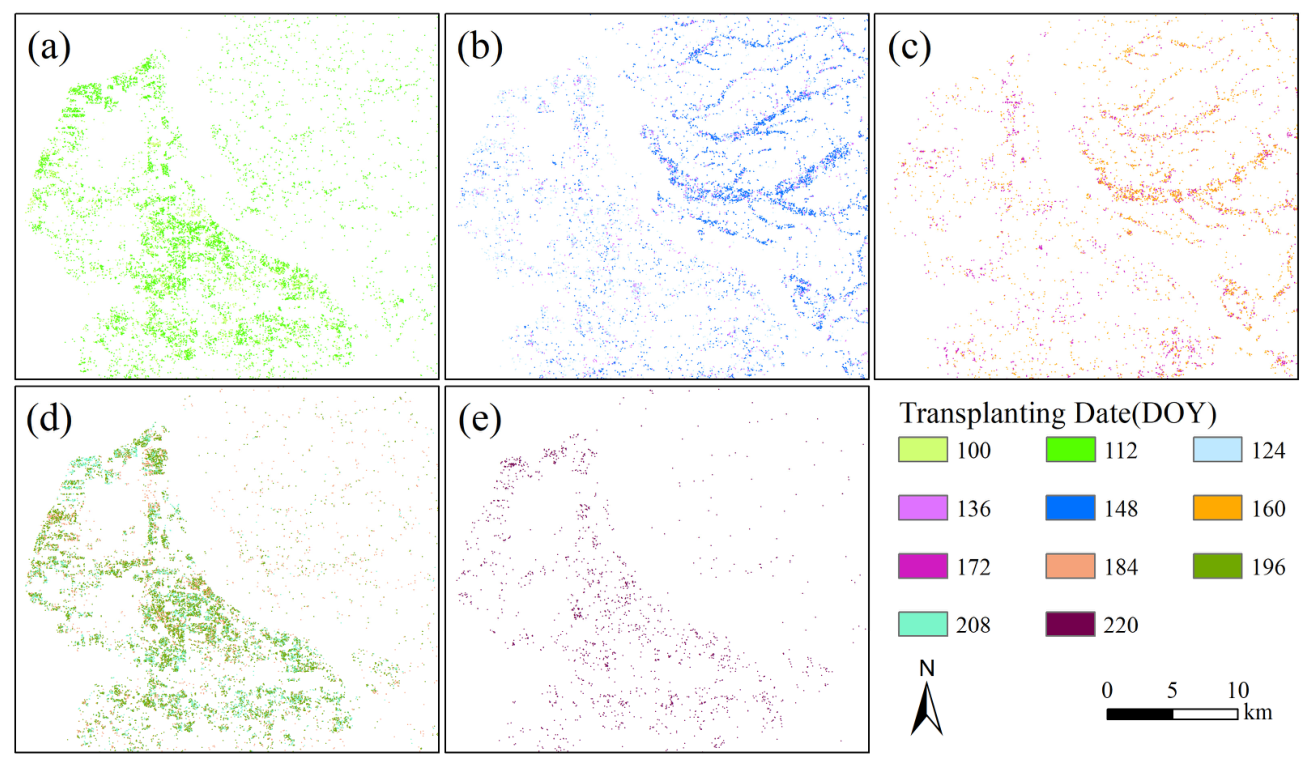
During the in-season mapping process, the sample set was iteratively updated based on the transplanting dates of rice pixels falling within their corresponding monthly time windows. Furthermore, Figure 15 reveals distinct regional variations in transplanting timing, clearly demonstrating that samples in the southwestern plains were transplanted earlier than those in the northeastern mountainous areas. Specifically, early-season rice—primarily cultivated in the low-altitude southwestern region—was generally transplanted around day of year (DOY) 100 to 120 in April (Figure 15a). From May to June, with the progressive accumulation of time-series imagery and the application of the DT algorithm, mid-season rice samples largely concentrated in the northeastern region were gradually identified (Figure 15b,c). Because lower temperatures at higher altitudes delay the suitable planting period, these mid-season rice crops in the high-elevation mountains were typically transplanted near DOY 160 in June. Subsequently, late-season rice, predominantly distributed in the southwestern lowlands, was typically transplanted around DOY 184 in July (Figure 15d). This spatial pattern aligns consistently with field survey results, confirming that double-season rice is mainly cultivated in the flatter western regions, whereas single-season rice dominates the northeastern uplands. The strong agreement between the remotely detected samples and ground observations demonstrates that the MSDF-RiceID framework reliably represents real-world farming practices, thereby enabling the in-season classification model to accurately capture the monthly spatial distribution of rice cultivation.
Despite the robust operational performance demonstrated, a comprehensive evaluation requires explicitly delimiting the physical boundaries, sensor-specific errors, and failure conditions of the MSDF-RiceID framework. First, because the dynamic threshold algorithm relies on identifying unique low backscatter coefficients during the specular reflection phase of paddy flooding, it remains inherently vulnerable to SAR polarimetric anomalies induced by intense precipitation. Heavy rainfall during the critical transplanting window introduces a dual-directional error propagation path: on one hand, it alters paddy water surface geometry, shifting specular reflection to diffuse scattering and artificially inflating VH backscatter above the −18 dB threshold, causing false non-rice omissions. On the other hand, intense downpours can induce localized surface pooling or flatten adjacent short-stature non-rice vegetation, smoothing their surface structures and suppressing their backscatter coefficients below the threshold, thereby introducing false-positive commission errors. Second, the framework is susceptible to failure under extreme meteorological anomalies, such as prolonged summer floods that submerge fields well into vegetative phases or severe early-season droughts that completely alter irrigation calendars, both of which deform the characteristic “V-shaped” profile and disrupt fixed chronological rules. Finally, mixed-pixel edge effects within highly fragmented agricultural landscapes continue to introduce localized geometric noise at parcel boundaries, limiting fine-scale mapping fidelity.

5.2. Comparison of Multi-Source Data Combinations

Based on the empirical accuracy metrics evaluated across various feature configurations in Section 4.3, this section further interprets the underlying physical, spectral, and environmental response mechanisms driving these results. Under single-source conditions (Figure 10a,f,k), notable performance differences were observed across sensors. Classification using S1 data achieved higher accuracy from April (OA = 0.72, F1-score = 0.6, Kappa = 0.42) to June (OA = 0.78, F1-score = 0.78, Kappa = 0.56). This advantage can be attributed to the SAR signal’s sensitivity to shallow water and sparse rice seedlings during transplanting, which results in distinctive low backscatter signatures. In contrast, crop discrimination with optical imagery during this period relied on spectral differences between land covers—differences that were not yet sufficiently distinct early in the season. As the growing season advanced, spectral separability improved, enabling optical-based classifications to exceed SAR performance after August. Models using MODIS data (OA = 0.78, F1-score = 0.79, Kappa = 0.56) outperformed those using S2 (OA = 0.73, F1-score = 0.67, Kappa = 0.46) prior to August, due to higher temporal frequency and greater data availability in cloud-prone periods. Although S2 data has a finer spatial resolution, its limited number of clear observations early in the season increased susceptibility to cloud and rainfall interference. With the accumulation of imagery over time, the spatial detail provided by S2 became increasingly advantageous, ultimately achieving the highest accuracy (OA = 0.91, F1-score = 0.92, Kappa = 0.83).
Under multi-source fusion (Figure 10c,e,h,m), the combination of S1, S2, and MODIS data achieved the best performance (OA = 0.96, F1-score = 0.96, Kappa = 0.93). This result can be attributed to the complementary nature of spatial, spectral, and temporal information provided by the three sensors: S1 data enabled the detection of paddy flooding and structural features in early growth stages, S2 imagery supported crop differentiation in mid-to-late stages through its high spectral and spatial resolution, and MODIS contributed continuous temporal coverage. The integrated use of these datasets compensated for limitations in continuity or spatial detail inherent in single- and dual-source configurations, while also improving spectral separability, which collectively enhanced classification accuracy and robustness. The S1 + S2 combination ranked second (OA = 0.95, F1-score = 0.94, Kappa = 0.90), benefiting from strong complementary characteristics though still limited by the acquisition frequency and cloud-induced data gaps of S2. The S1 + MODIS combination (OA = 0.95, F1-score = 0.94, Kappa = 0.89) partially alleviated constraints related to spatial resolution and temporal density; however, the coarse resolution of MODIS (500 m) led to classification uncertainty in heterogeneous and small-field landscapes, resulting in lower stability compared to S1+S2. The S2 + MODIS combination (OA = 0.93, F1-score = 0.93, Kappa = 0.86), consisting solely of optical sensors, exhibited lower complementarity. While the high temporal density of MODIS partly compensated for the scarcity of early-season S2 images, the mixed-pixel effect of MODIS reduced the effective spatial advantage of S2, leading to lower performance compared to combinations including SAR.
Furthermore, it is important to explicitly address the scale effect introduced by the MODIS data. Upsampling 500 m MODIS imagery to 10 m via bilinear interpolation inherently introduces an apparent “false resolution” with mixed-pixel effects. However, in cloud-prone regions like Hunan, the temporal continuity provided by MODIS is indispensable. This spatial-temporal trade-off is validated by our results: the S2 + MODIS combination outperforms S2 alone, demonstrating that the temporal information gain from MODIS effectively outweighs its spatial penalty. Nevertheless, to counteract the potential misclassifications in fragmented farmlands caused by MODIS’s spatial ambiguity, our framework relies on the synergistic S1 + S2 + MODIS combination. In this configuration, the native 10 m SAR and optical data provide the rigorous spatial constraints needed to delineate fragmented field boundaries and suppress artificial spatial autocorrelation, ensuring both high spatial fidelity and temporal continuity.
The effect of terrain factors on rice distribution was observed to vary depending on the data source used. Under single-source conditions, the use of DEM led to the greatest improvement in models using S1 (average gain ≈ 0.04), as radar backscatter is sensitive to surface geometry and water presence. Previous studies have shown that rice cultivation is primarily concentrated in areas below 200 m in altitude and on slopes under 6°, while it rarely occurs above 800 m or on slopes exceeding 16° [70]. Accordingly, DEM helped constrain plausible planting zones and reduce topographic noise in SAR-based classification. In contrast, optical data rely on spectral reflectance and vegetation indices, which are less influenced by topography than radar scattering mechanisms. Therefore, DEM provided only moderate benefits for optical imagery, mainly reducing confusion in early stages when spectral separability was low. Its contribution diminished once optical features became more distinctive later in the season. In multi-source fusion, although the relative benefit of DEM decreased with more abundant optical time-series data, its inclusion consistently improved performance. This was particularly evident when DEM was incorporated into the S1 + S2 + MODIS combination, enhancing overall accuracy and stability—with OA and F1-score increasing by approximately 0.02 and Kappa by 0.03 (Figure 10j). These improvements were most pronounced during the early growing period (April–June).
These results demonstrate that multi-source feature fusion effectively improves rice classification under challenging conditions. The combination of SAR, optical, and terrain data significantly enhances both spatial discrimination and temporal continuity, especially in regions with complex terrain and frequent cloud cover. Among all approaches, the “SAR + multi-scale optical + terrain” strategy yielded the most reliable and accurate mapping results by effectively mitigating atmospheric interference and capturing key phenological dynamics with improved temporal consistency, proving particularly beneficial for in-season rice classification.

5.3. Comparison of Feature Selection Strategies

Unlike conventional approaches where features are ranked with equal weighting across all growth periods, our exponential-weighted feature selection strategy dynamically adjusts feature importance according to phenological information. It emphasizes early-stage phenological features driven by the distinct flooding signal during the transplanting phase. Compared to the conventional full-season strategy (Figure 16), the proposed approach significantly improves early-stage identification performance, as evidenced by enhanced F1-scores and Kappa coefficient metrics. By prioritizing key features from Sentinel-1 (top 3) and integrated Sentinel-2/MODIS (top 4), the approach achieves consistent early-stage gains: F1-scores improve by +0.03 on average (April–June), with Kappa coefficients rising by 0.04–0.05 in May–June (Figure 16). It is worth noting that the performance gap narrowed after September, as phenological signals became more distinct and full-season features provided sufficient separability. This trend further emphasizes the importance of assigning greater weight to early-stage features when timely identification is necessary.

5.4. Comparative Evaluation and Suitability of Alternative Classifiers

As systematically illustrated in Figure 11, the time-series accuracy trajectories highlight distinct behavioral characteristics among different algorithmic architectures across the phenological stages. During the initial transplanting window in April, all models started at a lower baseline (RF F1-score: 0.61, GBDT F1-score: 0.62, KNN F1-score: 0.51), which accurately reflects the intense spectral and polarimetric confusion between transiently flooded paddies and nearby permanent water bodies. From June onward, as rice plants advanced into peak vegetative and reproductive stages, the rapid accumulation of biophysical tracking information led to a sharp escalation in accuracy. By September, all models reached their annual performance peaks, with KNN obtaining an F1-score of 0.89 and GBDT achieving a highly competitive F1-score of 0.93, while RF established its technical dominance with an elite F1-score of 0.97 (Figure 11a).
Intriguingly, the late-season harvesting phase from October to November induced a severe performance collapse for specific architectures. Post October, GBDT suffered a devastating performance degradation, with its F1-score falling abruptly from 0.93 in September to 0.86 in October and November (Figure 11b). This diagnostic divergence in F1-score is mathematically governed by the algorithmic tolerance of Bagging and Boosting structures against macro-structural semantic noise. Post October, widespread harvesting in Hunan Province transforms homogeneous crop canopies into chaotic fragments of bare soils and crop residues. Due to its residual-fitting nature, GBDT forces its late-stage constituent classifiers to minimize training errors by fitting these post-harvest scattering variations, leading to severe empirical overfitting that directly pollutes the targets and drags down the performance. Conversely, the random subspace feature selection mechanism inherent to Random Forest randomly subsets available dimensions at node splits across hundreds of parallel independent decision trees. This Bagging architecture naturally dilutes and down-weights the noisy post-harvest time-steps, forcing the ensemble to heavily rely on the pristine biophysical checkpoints captured during the peak growth window, thereby firmly locking its target-crop F1-score at an elite plateau of 0.97 (Figure 11a). Consequently, these empirical F1-score dynamics distinctively validate that RF remains the optimal and most reliable choice for operational in-season rice mapping.

5.5. Robustness Assessment of the MSDF-RiceID

5.5.1. Cross-Regional Performance Consistency

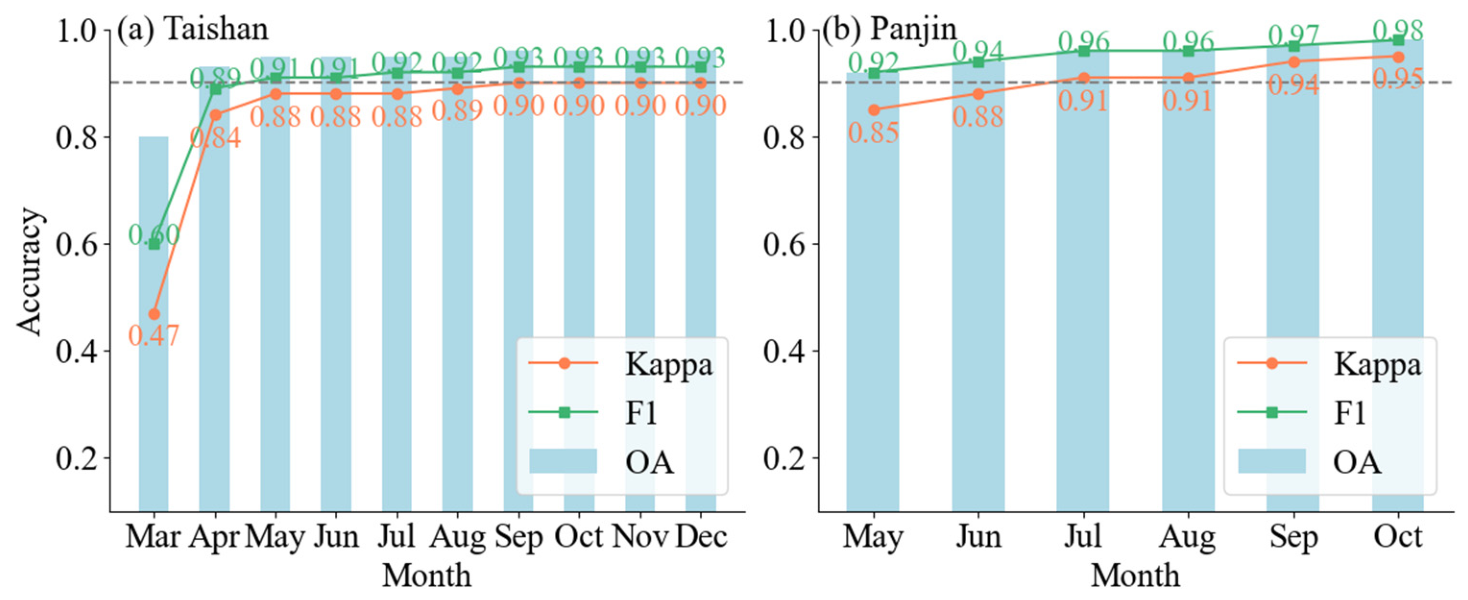
To evaluate the cross-regional applicability of the proposed MSDF-RiceID framework, in-season experiments encompassed geographically diverse rice-growing regions in southern and northern China: Taishan in Guangdong Province and Panjin in Liaoning Province. To further verify the statistical reliability of the mapping outcomes across these heterogeneous study areas, the 95% confidence intervals were analytically derived using Equation (13). The calculated standard error margins are tightly bounded within ±0.05% across all peak operational phases for the experimental regions, statistically demonstrating that the reported rice mapping results possess exceptional deterministic stability and are highly resistant to random spatial variations. Based on the previous rice phenology study [49], the monitoring period spanned March–December 2019 for Taishan and May–October 2024 for Panjin. However, since Sentinel-2 Level-2A surface reflectance products were unavailable in Taishan before 2019, only Sentinel-1 and MODIS data from 2018 and 2019 were used for classification in this region to maintain consistency across datasets. The classification results for Taishan and Panjin are presented in Figure 17 and Figure 18, respectively.
Early March classifications (OA = 0.8, F1-score = 0.6, Kappa = 0.47) misidentified fishponds as rice fields in southern and central Taishan subregions (red circles, Figure 17a). This confusion occurs when flooded paddies in the transplanting window exhibit: SAR backscatter similarity (VH: −21.44 dB vs. −20.98 dB) to open water bodies and optical water index overlap with water bodies (mean MNDWI: 0.67 vs. 0.72). The progressive enhancement correlates with increased temporal feature separability, where the added observations better distinguished rice phenological trajectories from permanent water bodies. Meanwhile, the paucity of early time-series observations further subjected the optical imagery in the southwestern and northeastern regions of Taishan to cloud and rainfall interference, resulting in the omission of rice (red boxes, Figure 17a). From April onward, accumulating time-series data enabled the correct identification of previously undetected rice fields and reduced fishpond misclassification (red circles, Figure 17b). The convergence of high accuracy (OA = 0.95, F1-score = 0.91, Kappa = 0.88) by May reflects established phenological divergence: as rice develops canopy structure beyond the flooding phase, enhanced backscatter and spectral separability from water bodies (ΔNDVI > 0.6) fundamentally suppress early-season confusion. This stabilization enables reliable in-season mapping with a 2–3-month lead over conventional full-season approaches.
Compared to Taishan, Panjin achieved earlier high-precision classification (OA = 0.92, F1-score = 0.92, Kappa = 0.85) within the first month post-transplanting, ultimately exceeding that of Taishan by 0.05 (Figure 19b). First, low annual precipitation minimized cloud interference, enabling high observational continuity that enhanced temporal feature separability–critical for distinguishing flooded paddies from aquaculture ponds during early growth stages. Second, Panjin’s landscape homogeneity (Figure 18) suppressed edge-mixed pixels that typically degrade early-stage classification in heterogeneous southern landscapes. Although May marked the earliest identifiable stage, initial classifications exhibited limited geometric fidelity with poorly resolved field boundaries (Figure 18a). As time-series data accumulated, accuracy steadily improved as the model captured finer intra-field structures, culminating in a peak F1-score of 0.98.
The earliest identifiable stage was achieved earlier in Taishan and Panjin than in Hunan Province. This difference can be attributed to the greater phenological complexity of Hunan’s triple-cropping systems—particularly transplanting phases spanning more than three months—which was further compounded by a limited number of early-season validation samples. Both factors contributed to lower initial classification accuracy. By contrast, the single-season rice system in Panjin is characterized by highly concentrated transplanting windows, whereas the double-season system in Taishan maintains distinct seasonal synchrony. Both patterns produce coherent phenological signatures, allowing earlier detection compared to the staggered triple-cropping system found in Hunan. Field investigations confirmed the predominance of rice transplanting during the initial detection window, where MSDF-RiceID successfully identified newly established fields. This effective deployment across divergent agroecological regions demonstrates the framework’s cross-regional adaptability and operational capacity for timely, precise monitoring of emerging planting patterns.

5.5.2. Multi-Product Algorithm Benchmarking: Accuracy Gains and Persistent Constraints

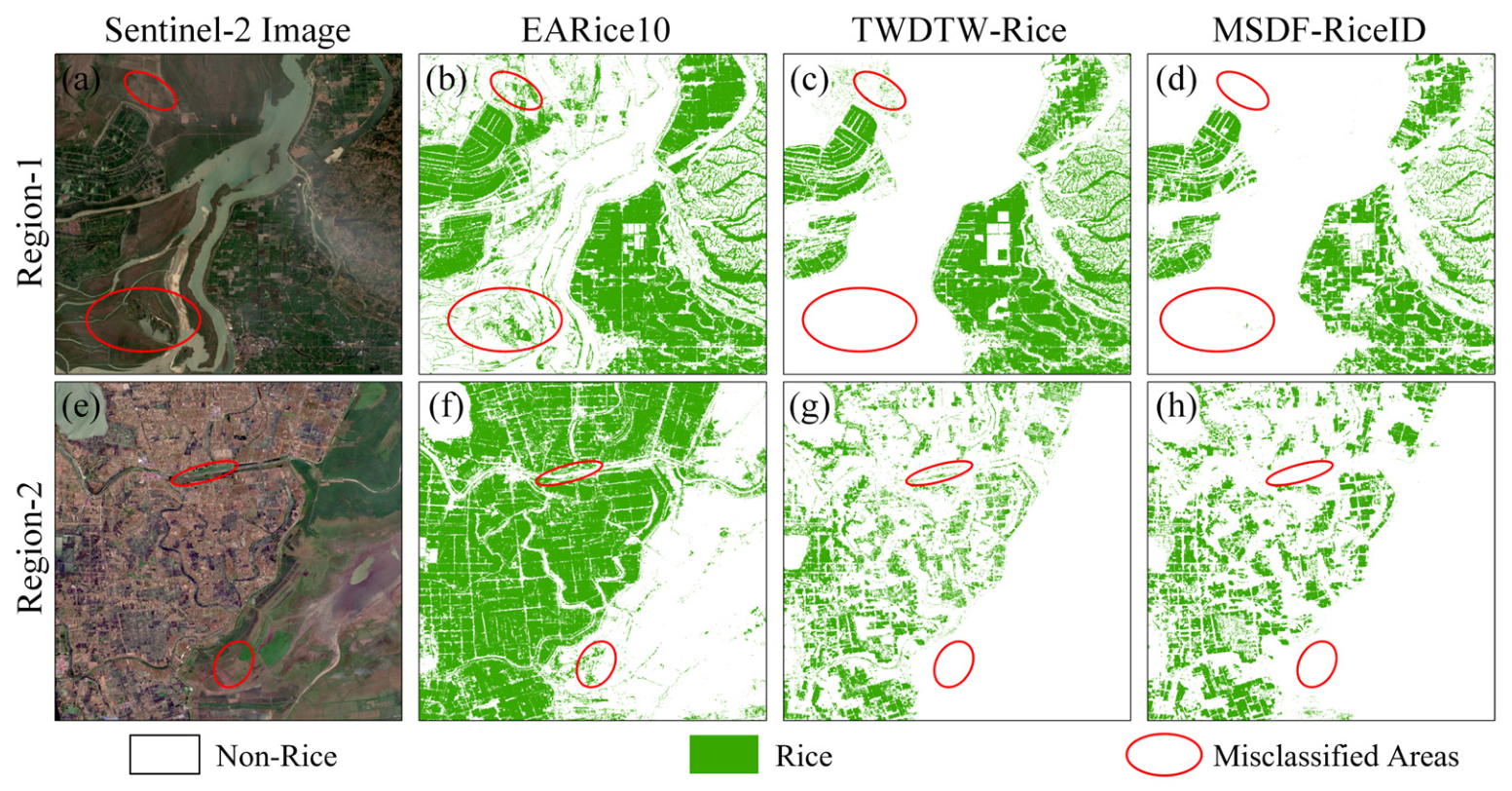
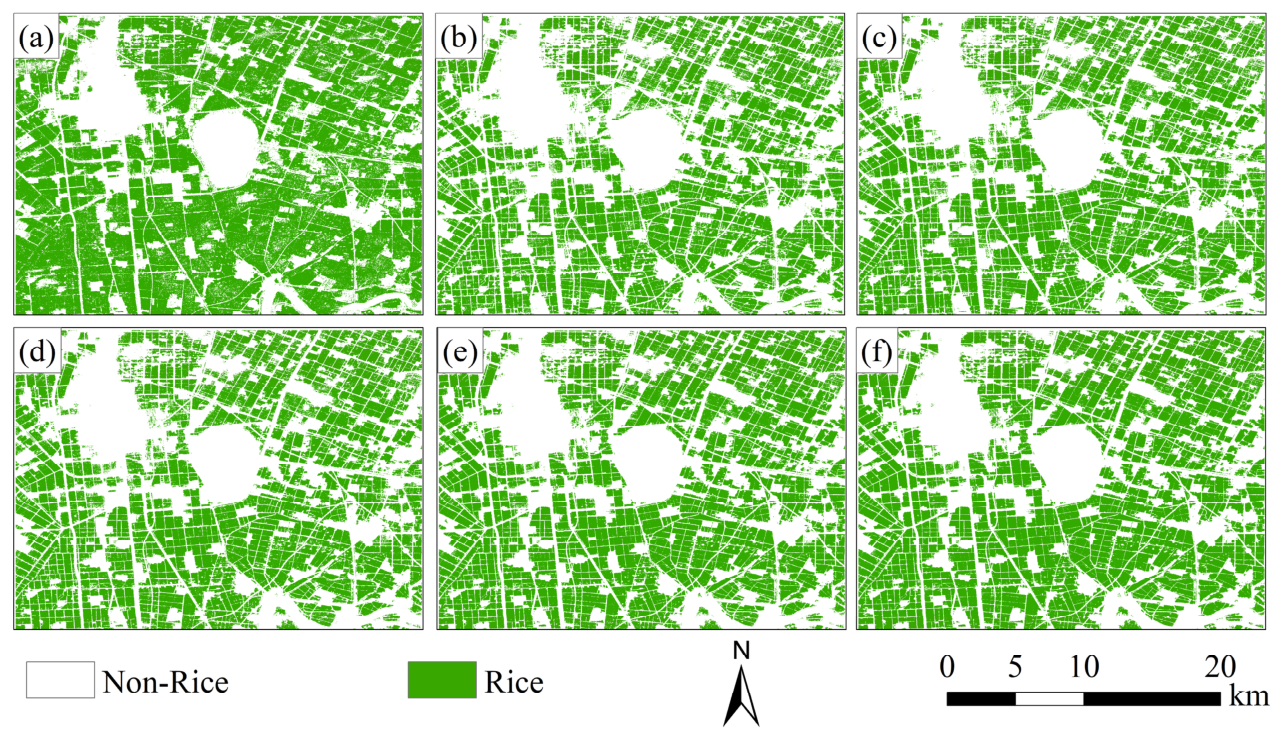
The superior performance of the proposed MSDF-RiceID framework over benchmark products stems from its ability to resolve persistent confusion in spectral and backscatter signals between rice paddies and wetlands, leading to substantial improvements in classification accuracy (OA: +0.12–0.18; Kappa: +0.23–0.35; F1-score: +0.09–0.15 relative to TWDTW-Rice and EARice10, as listed in Table 6). To statistically verify this thematic superiority, a pixel-level McNemar’s test was conducted on the discordant cells across the validation regions. In the paired map comparisons, MSDF-RiceID achieved 76,870 uniquely correct pixels against TWDTW-Rice (which yielded 9361), resulting in a Chi-squared statistic of 52,850.25. Compared to EARice10, MSDF-RiceID achieved 145,538 uniquely correct pixels (which yielded 11,734), resulting in a Chi-squared statistic of 113,836.17. The calculated p-values for both tests strictly approached zero (p < 0.001), robustly demonstrating that the observed performance advantages are mathematically meaningful and directly attributable to our proposed methodological innovations rather than random data fluctuations. Spatial mapping results across representative heterogeneous zones are visually displayed in Figure 20, where misclassified non-rice areas identified as rice by alternative products are highlighted with red circles.
The enhanced discrimination is achieved through a multi-temporal feature weighting approach that identifies flooded paddies based on phenological trajectory divergence after initial flooding stages—a period when conventional spectral and backscatter methods often fail due to similar sensor responses between rice and wetlands. Notably, although the 250 m MODIS time-series offers lower spatial resolution than Sentinel-2, its high temporal density plays a critical role in capturing key phenological cues. The daily revisit frequency of MODIS overcomes the 5–16-day gaps in Sentinel-2 acquisitions caused by cloudy seasons, enabling the capture of rapid phenophase transitions. For instance, in areas where EARice10 misclassified wetlands near Dongting Lake (Figure 20), short-duration flooding events indicative of rice cultivation were identified using time-series MODIS-derived vegetation indices within the proposed framework. Furthermore, the double-peak signature in MODIS EVI trajectories—associated with rice tillering and heading phases—provides an additional distinguishing feature absent in perennial wetlands.
While MSDF-RiceID achieves high classification accuracy, its performance faces one key constraint. The scarcity of early-season remote sensing data necessitated reliance on historical satellite imagery and existing rice products for model training and sample generation. This approach is inherently limited by historical data reliability, whereby substantial misclassification rates may propagate sample contamination into the current framework. To address this fundamental challenge, our ongoing work focuses on developing systematically validated annual rice products to enhance sample purity for future applications.

6. Conclusions

This study introduces MSDF-RiceID, a novel framework designed for in-season, month-scale rice mapping based on multi-source remote sensing imagery. The framework addresses the critical challenge of sparse early-season observations by integrating a dynamic threshold algorithm that automatically generates high-confidence pseudo samples from historical maps. Furthermore, it employs a phenologically guided exponentially weighted strategy for feature optimization, enhancing cross-year generalizability through adaptive model transfer.
Experimental results revealed regional variations in early detectability: the earliest identifiable stage (F1-score > 0.9) occurred in May for both Taishan (transplanted in March) and Panjin (transplanted in May), whereas Hunan Province required until July (transplanted in April), due to its more complex triple-cropping system with an extended transplanting window exceeding three months. For Hunan, in-season samples were successfully differentiated based on key transplanting dates in April (DOY 100 and 120), June (DOY 160), and July (DOY 184), corresponding to early, middle, and late rice seasons. Panjin notably achieved high classification accuracy (OA = 0.92, F1-score = 0.92, Kappa = 0.85) within the first month post-transplanting, outperforming Taishan by approximately 0.05 in final F1-score.
In terms of feature strategy, the “SAR + multi-scale optical + terrain” strategy produced the most reliable and accurate mapping results for in-season rice classification. The optimal feature set included indices from Sentinel-1 (PRI, VH, VV_VH), Sentinel-2 (NDYI, PSRI, NDBI, NDWI), and MODIS (NDVI, EVI, NDBI, LSWI). Dual-source models exhibited only marginally lower accuracy than their triple-source counterparts during most growth periods. Additionally, the exponentially weighted mechanism was essential for highlighting discriminative features in early-season identification. As expected, its advantage over equal weighting diminished as the season progressed into mid- and late-stages, when more distinct phenological signals were captured in the accumulated time-series data.
MSDF-RiceID significantly outperformed existing rice mapping products such as TWDTW-Rice and EARice10. Specifically, the framework achieved an overall accuracy of 0.97, a Kappa coefficient of 0.95, and an F1-score of 0.97. These represent improvements of 0.12–0.18 in OA, 0.23–0.35 in Kappa, and 0.09–0.15 in F1-score. The results highlight the framework’s robustness and adaptability across diverse cropping systems and environments. With its ability to support high-accuracy, timely rice monitoring, MSDF-RiceID is a scalable operational solution for large-scale agricultural management and disaster response.


Author Contributions

Conceptualization, W.W. (Wei Wang), N.L., J.Z. and W.W. (Wenfu Wu); methodology, W.W. (Wei Wang), S.L. and H.Y.; validation, W.W. (Wei Wang) and S.L.; investigation, W.Z.; data curation, W.W. (Wei Wang) and S.L.; writing—original draft preparation, W.W. (Wei Wang), S.L. and H.Y.; writing—review and editing, W.W. (Wei Wang), S.L., H.Y., N.L., J.Z. and W.W. (Wenfu Wu); supervision, W.Z.; funding acquisition, W.W. (Wei Wang), H.Y., J.Z. and W.W. (Wenfu Wu). All authors have read and agreed to the published version of the manuscript.
Funding

This research was funded by National Natural Science Foundation of China under Grant (42201226), Natural Science Foundation of Henan Province under Grant (252300420277) and the Plan of Science and Technology of Henan Province under Grants (232102211043 and 242102210113).

Data Availability Statement

All remote sensing data used in this study are openly and freely accessible through the Google Earth Engine (GEE) platform. The other data presented in this study are available on request from the corresponding author.

Acknowledgments

We express our deepest gratitude to the reviewers and editors for their suggestions.

Conflicts of Interest

The authors declare no conflicts of interest.

References

  1. Mosleh, M.K.; Hassan, Q.K.; Chowdhury, E.H. Application of remote sensors in mapping rice area and forecasting its production: A review. Sensors 2015, 15, 769–791. [Google Scholar] [CrossRef] [PubMed]
  2. Zheng, H.; Cheng, T.; Yao, X.; Deng, X.; Tian, Y.; Cao, W.; Zhu, Y. Detection of rice phenology through time series analysis of ground-based spectral index data. Field Crops Res. 2016, 198, 131–139. [Google Scholar] [CrossRef]
  3. Xiao, X.; Boles, S.; Frolking, S.; Salas, W.; Moore, B.; Li, C.; He, L.; Zhao, R. Observation of flooding and rice transplanting of paddy rice fields at the site to landscape scales in China using VEGETATION sensor data. Int. J. Remote Sens. 2002, 23, 3009–3022. [Google Scholar] [CrossRef]
  4. Xuan, F.; Dong, Y.; Li, J.; Li, X.; Su, W.; Huang, X.; Huang, J.; Xie, Z.; Li, Z.; Liu, H.; et al. Mapping crop type in Northeast China during 2013–2021 using automatic sampling and tile-based image classification. Int. J. Appl. Earth Obs. Geoinf. 2023, 117, 103178. [Google Scholar] [CrossRef]
  5. Zhang, C.; Zhang, H.; Tian, S. Phenology-assisted supervised paddy rice mapping with the Landsat imagery on Google Earth Engine: Experiments in Heilongjiang Province of China from 1990 to 2020. Comput. Electron. Agric. 2023, 212, 108105. [Google Scholar] [CrossRef]
  6. Xu, S.; Zhu, X.; Chen, J.; Zhu, X.; Duan, M.; Qiu, B.; Wan, L.; Tan, X.; Xu, Y.N.; Cao, R. A robust index to extract paddy fields in cloudy regions from SAR time series. Remote Sens. Environ. 2023, 285, 113374. [Google Scholar] [CrossRef]
  7. Huang, C.; You, S.; Liu, A.; Li, P.; Zhang, J.; Deng, J. High-resolution national-scale mapping of paddy rice based on Sentinel-1/2 data. Remote Sens. 2023, 15, 4055. [Google Scholar] [CrossRef]
  8. Wang, L.; Wang, T.; Ma, H.; Lu, P.; Sun, W.; Fan, L.; Wang, H.; Wu, Y.; Wang, Y. Time series SAR monitoring of rice in multiple cropping modes combining statistical and phenological characteristics. IEEE Trans. Geosci. Remote Sens. 2024, 62, 4411811. [Google Scholar] [CrossRef]
  9. Skakun, S.; Franch, B.; Vermote, E.; Roger, J.C.; Becker-Reshef, I.; Justice, C.; Kussul, N. Early season large-area winter crop mapping using MODIS NDVI data, growing degree days information and a Gaussian mixture model. Remote Sens. Environ. 2017, 195, 244–258. [Google Scholar] [CrossRef]
  10. Stroppiana, D.; Boschetti, M.; Azar, R.; Barbieri, M.; Collivignarelli, F.; Gatti, L.; Fontanelli, G.; Busetto, L.; Holecz, F. In-season early mapping of rice area and flooding dynamics from optical and SAR satellite data. Eur. J. Remote Sens. 2019, 52, 206–220. [Google Scholar] [CrossRef]
  11. Tiwari, V.; Tulbure, M.G.; Caineta, J.; Gaines, M.D.; Perin, V.; Kamal, M.; Krupnik, T.J.; Aziz, M.A.; Islam, A.T. Automated in-season rice crop mapping using Sentinel time-series data and Google Earth Engine: A case study in climate-risk prone Bangladesh. J. Environ. Manag. 2024, 351, 119615. [Google Scholar] [CrossRef]
  12. Zhou, Z.; Zhao, L.; Shi, H.; Sun, W.; Shi, L.; Yang, J. Early season mapping of rice using time series Sentinel-1 SAR images. In Proceedings of the 2024 IEEE International Geoscience and Remote Sensing Symposium (IGARSS 2024), Athens, Greece, 7–12 July 2024. [Google Scholar] [CrossRef]
  13. Huang, Y.; Pan, Y.; Zhu, Y.; Zhu, X.; Xia, X.; Chen, Q.; Hu, J.; Che, H.; Zheng, X.; Wang, L. In-season automated mapping of Xinjiang Cotton based on cumulative spectral and phenological characteristics. IEEE J. Sel. Top. Appl. Earth Obs. Remote Sens. 2025, 18, 5046–5062. [Google Scholar] [CrossRef]
  14. Dong, J.; Fu, Y.; Wang, J.; Tian, H.; Fu, S.; Niu, Z.; Han, W.; Zheng, Y.; Huang, J.; Yuan, W. Early-season mapping of winter wheat in China based on Landsat and Sentinel images. Earth Syst. Sci. Data 2020, 12, 3081–3095. [Google Scholar] [CrossRef]
  15. Gao, F.; Anderson, M.; Daughtry, C.; Karnieli, A.; Hively, D.; Kustas, W. A within-season approach for detecting early growth stages in corn and soybean using high temporal and spatial resolution imagery. Remote Sens. Environ. 2020, 242, 111752. [Google Scholar] [CrossRef]
  16. Chen, R.; Sun, L.; Chen, Z.; Wuyun, D.; Sun, Z. Early identification of corn and soybean using crop growth curve matching method. Agronomy 2024, 14, 146. [Google Scholar] [CrossRef]
  17. Zhang, X.; Zhang, P.; Shen, K.; Pei, Z. Rice identification at the early stage of the rice growth season with single fine quad Radarsat-2 data. In Proceedings of the 2016 SPIE Remote Sensing, Edinburgh, UK, 26–29 September 2016; p. 99981J. [Google Scholar] [CrossRef]
  18. Zhao, L.; Li, Q.; Chang, Q.; Shang, J.; Du, X.; Liu, J.; Dong, T. In-season crop type identification using optimal feature knowledge graph. ISPRS J. Photogramm. Remote Sens. 2022, 194, 250–266. [Google Scholar] [CrossRef]
  19. Guo, Y.; Xia, H.; Zhao, X.; Qiao, L.; Du, Q.; Qin, Y. Early-season mapping of winter wheat and garlic in Huaihe Basin using Sentinel-1/2 and Landsat-7/8 imagery. IEEE J. Sel. Top. Appl. Earth Obs. Remote Sens. 2022, 16, 8809–8817. [Google Scholar] [CrossRef]
  20. Wei, P.; Ye, H.; Qiao, S.; Liu, R.; Nie, C.; Zhang, B.; Song, L.; Huang, S. Early crop mapping based on Sentinel-2 time-series data and the random forest algorithm. Remote Sens. 2023, 15, 3212. [Google Scholar] [CrossRef]
  21. Liu, T.; Li, P.; Zhao, F.; Liu, J.; Meng, R. Early-stage mapping of winter canola by combining Sentinel-1 and Sentinel-2 data in Jianghan Plain, China. Remote Sens. 2024, 16, 3197. [Google Scholar] [CrossRef]
  22. Luo, J.; Xie, M.; Wu, Q.; Luo, J.; Gao, Q.; Shao, X.; Zhang, Y. Early crop identification study based on Sentinel-1/2 images with feature optimization strategy. Agriculture 2024, 14, 990. [Google Scholar] [CrossRef]
  23. Wang, C.; Zhang, X.; Wang, W.; Wei, H.; Wang, J.; Li, Z.; Li, X.; Wu, H.; Hu, Q. Understanding the potentials of early-season crop type mapping by using Landsat-8, Sentinel-1/2, and GF-1/6 data. Comput. Electron. Agric. 2024, 224, 109239. [Google Scholar] [CrossRef]
  24. Wen, C.; Lu, M.; Bi, Y.; Xia, L.; Sun, J.; Shi, Y.; Wei, Y.; Wu, W. Customized crop feature construction using genetic programming for early- and in-season crop mapping. Comput. Electron. Agric. 2025, 231, 109949. [Google Scholar] [CrossRef]
  25. Zhou, X.; Wang, J.; Shan, B.; He, Y. Early-season crop classification based on local window attention transformer with time-series RCM and Sentinel-1. Remote Sens. 2024, 16, 1376. [Google Scholar] [CrossRef]
  26. Fontanelli, G.; Lapini, A.; Santurri, L.; Pettinato, S.; Santi, E.; Ramat, G.; Pilia, S.; Baroni, F.; Tapete, D.; Cigna, F.; et al. Early-season crop mapping on an agricultural area in Italy using X-Band Dual-Polarization SAR satellite data and convolutional neural networks. IEEE J. Sel. Top. Appl. Earth Obs. Remote Sens. 2022, 15, 6789–6803. [Google Scholar] [CrossRef]
  27. Cai, Y.; Guan, K.; Peng, J.; Wang, S.; Seifert, C.; Wardlow, B.; Li, Z. A high-performance and in-season classification system of field-level crop types using time-series Landsat data and a machine learning approach. Remote Sens. Environ. 2018, 210, 35–47. [Google Scholar] [CrossRef]
  28. Hao, P.; Di, L.; Zhang, C.; Guo, L. Transfer learning for crop classification with Cropland Data Layer data (CDL) as training samples. Sci. Total Environ. 2020, 733, 138869. [Google Scholar] [CrossRef] [PubMed]
  29. You, N.; Dong, J. Examining earliest identifiable timing of crops using all available Sentinel-1/2 imagery and Google Earth Engine. ISPRS J. Photogramm. Remote Sens. 2020, 161, 109–123. [Google Scholar] [CrossRef]
  30. Johnson, D.M.; Mueller, R. Pre- and within-season crop type classification trained with archival land cover information. Remote Sens. Environ. 2021, 264, 112576. [Google Scholar] [CrossRef]
  31. Brinkhoff, J. Early-season industry-wide rice maps using Sentinel-2 time series. In Proceedings of the 2022 IEEE International Geoscience and Remote Sensing Symposium (IGARSS 2022), Kuala Lumpur, Malaysia, 17–22 July 2022. [Google Scholar] [CrossRef]
  32. Wang, Y.; Huang, H.; State, R. Early crop mapping using dynamic ecoregion clustering: A USA-wide study. Remote Sens. 2023, 15, 4962. [Google Scholar] [CrossRef]
  33. Son, N.T.; Chen, C.F.; Lin, H.S.; Cheng, Y.S.; Chen, C.R.; Syu, C.H.; Zhang, Y.T.; Liu, T.S.; Toscano, P.; Chen, S.L.; et al. Machine learning-based early prediction of rice-growing fields using multi-temporal Sentinel-1 synthetic aperture radar and Sentinel-2 multispectral data. J. Appl. Remote Sens. 2024, 18, 038503. [Google Scholar] [CrossRef]
  34. Yang, G.; Li, X.; Liu, P.; Yao, X.; Zhu, Y.; Cao, W.; Cheng, T. Automated in-season mapping of winter wheat in China with training data generation and model transfer. ISPRS J. Photogramm. Remote Sens. 2023, 202, 422–438. [Google Scholar] [CrossRef]
  35. Zhang, Z.; Li, C.; Deng, J.; Chanussot, J.; Hong, D. Adaptive high-quality sampling for winter wheat early mapping: A novel cascade index and machine learning approach. Smart Agric. Technol. 2025, 10, 100725. [Google Scholar] [CrossRef]
  36. Weilandt, F.; Behling, R.; Goncalves, R.; Madadi, A.; Richter, L.; Sanona, T.; Spengler, D.; Welsch, J. Early crop classification via multi-modal satellite data fusion and temporal attention. Remote Sens. 2023, 15, 799. [Google Scholar] [CrossRef]
  37. Račič, M.; Oštir, K.; Zupanc, A.; Čehovin Zajc, L. Multi-year time series transfer learning: Application of early crop classification. Remote Sens. 2024, 16, 270. [Google Scholar] [CrossRef]
  38. Shi, Q.; Pan, T.; Lu, D.; Li, H.; Chai, Z. BPUM: A Bayesian probabilistic updating model applied to early crop identification. J. Remote Sens. 2025, 5, 0438. [Google Scholar] [CrossRef]
  39. Zhang, C.; Di, L.; Hao, P.; Yang, Z.; Lin, L.; Zhao, H.; Guo, L. Rapid in-season mapping of corn and soybeans using machine-learned trusted pixels from cropland data layer. Int. J. Appl. Earth Obs. Geoinf. 2021, 102, 102374. [Google Scholar] [CrossRef]
  40. Zang, Y.; Chen, X. Integrating rotational prediction and historical classifiers for rapeseed in-season mapping. In Proceedings of the 2024 IEEE International Geoscience and Remote Sensing Symposium (IGARSS 2024), Athens, Greece, 7–12 July 2024. [Google Scholar] [CrossRef]
  41. Zhang, C.; Di, L.; Lin, L.; Li, H.; Guo, L.; Yang, Z.; Yu, E.G.; Di, Y.; Yang, A. Towards automation of in-season crop type mapping using spatiotemporal crop information and remote sensing data. Agric. Syst. 2022, 201, 103462. [Google Scholar] [CrossRef]
  42. Li, H.; Di, L.; Zhang, C.; Lin, L.; Guo, L.; Yu, E.G.; Yang, Z. Automated in-season crop-type data layer mapping without ground truth for the conterminous United States based on multisource satellite imagery. IEEE Trans. Geosci. Remote Sens. 2024, 62, 4403214. [Google Scholar] [CrossRef]
  43. You, N.; Dong, J.; Li, J.; Huang, J.; Jin, Z. Rapid early-season maize mapping without crop labels. Remote Sens. Environ. 2023, 290, 113496. [Google Scholar] [CrossRef]
  44. Wang, G.; Meng, D.; Chen, R.; Yang, G.; Wang, L.; Jin, H.; Ge, X.; Feng, H. Automatic rice early-season mapping based on simple non-iterative clustering and multi-source remote sensing images. Remote Sens. 2024, 16, 277. [Google Scholar] [CrossRef]
  45. Yu, Y.; Meng, L.; Luo, C.; Qi, B.; Zhang, X.; Liu, H. Early mapping method for different planting types of rice based on Planet and Sentinel-2 satellite images. Agronomy 2024, 14, 137. [Google Scholar] [CrossRef]
  46. Shen, Y.; Zhang, X.; Tran, K.H.; Ye, Y.; Gao, S.; Liu, Y.; An, S. Near real-time corn and soybean mapping at field-scale by blending crop phenometrics with growth magnitude from multiple temporal and spatial satellite observations. Remote Sens. Environ. 2025, 318, 114605. [Google Scholar] [CrossRef]
  47. Rußwurm, M.; Courty, N.; Emonet, R.; Lefèvre, S.; Tuia, D.; Tavenard, R. End-to-end learned early classification of time series for in-season crop type mapping. ISPRS J. Photogramm. Remote Sens. 2023, 196, 445–456. [Google Scholar] [CrossRef]
  48. Wang, X.; Chen, B.; Dong, J.; Gao, Y.; Wang, G.; Lai, H.; Wu, Z.; Yang, C.; Kou, W.; Yun, T. Early identification of immature rubber plantations using Landsat and Sentinel satellite images. Int. J. Appl. Earth Obs. Geoinf. 2024, 133, 104097. [Google Scholar] [CrossRef]
  49. Li, H.; Wang, X.; Wang, S.; Liu, J.; Liu, Y.; Liu, Z.; Chen, S.; Wang, Q.; Zhu, T.; Wang, L. ChinaRiceCalendar–seasonal crop calendars for early-, middle-, and late-season rice in China. Earth Syst. Sci. Data 2024, 16, 1689–1701. [Google Scholar] [CrossRef]
  50. Deng, G.; Tang, Z.; Li, C.; Chen, H.; Peng, H.; Wang, X. Extraction and analysis of spatiotemporal variation of rice planting area in Hunan Province based on MODIS time-series data. Remote Sens. Land Resour. 2020, 32, 177–185. [Google Scholar] [CrossRef]
  51. Pan, B.; Zheng, Y.; Shen, R.; Ye, T.; Zhao, W.; Dong, J.; Ma, H.; Yuan, W. High resolution distribution dataset of double-season paddy rice in China. Remote Sens. 2021, 13, 4609. [Google Scholar] [CrossRef]
  52. Shen, R.; Pan, B.; Peng, Q.; Dong, J.; Chen, X.; Zhang, X.; Ye, T.; Huang, J.; Yuan, W. High-resolution distribution maps of single-season rice in China from 2017 to 2022. Earth Syst. Sci. Data 2023, 15, 3203–3222. [Google Scholar] [CrossRef]
  53. Song, M.; Xu, L.; Ge, J.; Zhang, H.; Zuo, L.; Jiang, J.; Ding, Y.; Xie, Y.; Wu, F. EARice10: A 10 m resolution annual rice distribution map of East Asia for 2023. Earth Syst. Sci. Data 2025, 17, 661–683. [Google Scholar] [CrossRef]
  54. Yommy, A.S.; Liu, R.; Wu, A.S. SAR image despeckling using refined Lee filter. In Proceedings of the 2015 International Conference on Intelligent Human-Machine Systems and Cybernetics (IHMSC), Hangzhou, China, 26–27 August 2015. [Google Scholar] [CrossRef]
  55. Teluguntla, P.; Thenkabail, P.S.; Oliphant, A.; Xiong, J.; Gumma, M.K.; Congalton, R.G.; Yadav, K.; Huete, A. A 30-m Landsat-derived cropland extent product of Australia and China using random forest machine learning algorithm on Google Earth Engine cloud computing platform. ISPRS J. Photogramm. Remote Sens. 2018, 144, 325–340. [Google Scholar] [CrossRef]
  56. Nasirzadehdizaji, R.; Sanli, F.B.; Abdikan, S.; Cakir, Z.; Sekertekin, A.; Ustuner, M. Sensitivity analysis of multi-temporal Sentinel-1 SAR parameters to crop height and canopy coverage. Appl. Sci. 2019, 9, 655. [Google Scholar] [CrossRef]
  57. Sun, L.; Yang, T.; Lou, Y.; Shi, Q.; Zhang, L. Paddy rice mapping based on phenology matching and cultivation pattern analysis combining multi-source data in Guangdong, China. J. Remote Sens. 2024, 4, 0152. [Google Scholar] [CrossRef]
  58. McFeeters, S.K. The use of the Normalized Difference Water Index (NDWI) in the delineation of open water features. Int. J. Remote Sens. 1996, 17, 1425–1432. [Google Scholar] [CrossRef]
  59. Merzlyak, M.N.; Gitelson, A.A.; Chivkunova, O.B.; Rakitin, V.Y. Non-destructive optical detection of pigment changes during leaf senescence and fruit ripening. Physiol. Plant. 2002, 106, 135–141. [Google Scholar] [CrossRef]
  60. Tucker, C.J. Red and photographic infrared linear combinations for monitoring vegetation. Remote Sens. Environ. 1979, 8, 127–150. [Google Scholar] [CrossRef]
  61. Huete, A.; Didan, K.; Miura, T.; Rodriguez, E.P.; Gao, X.; Ferreira, L.G. Overview of the radiometric and biophysical performance of the MODIS vegetation indices. Remote Sens. Environ. 2002, 83, 195–213. [Google Scholar] [CrossRef]
  62. Zha, Y.; Gao, J.; Ni, S. Use of normalized difference built-up index in automatically mapping urban areas from TM imagery. Int. J. Remote Sens. 2003, 24, 583–594. [Google Scholar] [CrossRef]
  63. Xiao, X.; Boles, S.; Liu, J.; Zhuang, D.; Frolking, S.; Li, C.; Salas, W.; Moore, B. Mapping paddy rice agriculture in southern China using multi-temporal MODIS images. Remote Sens. Environ. 2005, 95, 480–492. [Google Scholar] [CrossRef]
  64. Zhao, X.; Nishina, K.; Akitsu, T.K.; Jiang, L.; Masutomi, Y.; Nasahara, K.N. Feature-based algorithm for large-scale rice phenology detection based on satellite images. Agric. For. Meteorol. 2023, 329, 109283. [Google Scholar] [CrossRef]
  65. Gitelson, A.A.; Gritz, Y.; Merzlyak, M.N. Relationships between leaf chlorophyll content and spectral reflectance and algorithms for non-destructive chlorophyll assessment in higher plant leaves. J. Plant Physiol. 2003, 160, 271–282. [Google Scholar] [CrossRef]
  66. Xu, H. Modification of normalised difference water index (NDWI) to enhance open water features in remotely sensed imagery. Int. J. Remote Sens. 2006, 27, 3025–3033. [Google Scholar] [CrossRef]
  67. Yang, H.; Pan, B.; Li, N.; Wang, W.; Zhang, J.; Zhang, X. A systematic method for spatio-temporal phenology estimation of paddy rice using time series Sentinel-1 images. Remote Sens. Environ. 2021, 259, 112394. [Google Scholar] [CrossRef]
  68. Steinhausen, M.J.; Wagner, P.D.; Narasimhan, B.; Waske, B. Combining Sentinel-1 and Sentinel-2 data for improved land use and land cover mapping of monsoon regions. Int. J. Appl. Earth Obs. Geoinf. 2018, 73, 595–604. [Google Scholar] [CrossRef]
  69. Ramadhan, M.M.; Sitanggang, I.S.; Nasution, F.R.; Ghifari, A. Parameter tuning in random forest based on grid search method for gender classification based on voice frequency. In Proceedings of the 2017 International Conference on Computer, Electronics and Communication Engineering (CECE 2017), Sanya, China, 25–26 June 2017. [Google Scholar] [CrossRef]
  70. Sang, G.; Tang, Z.; Mao, K.; Deng, G.; Wang, J.; Li, J. High-resolution paddy rice mapping using Sentinel data based on GEE platform: A case study of Hunan Province, China. Acta Agron. Sin. 2022, 48, 2409–2420. [Google Scholar] [CrossRef]
Figure 1. Location of the study area: (a) location of the study in China; (c) the terrain of Hunan Province; (b) and (d) the sample distributions of Validation Areas 1 and 2, respectively, where the sample points are drawn from the corresponding validation plots.
Remotesensing 18 01828 g001
Figure 2. Hunan rice phenological calendar.
Remotesensing 18 01828 g002
Figure 3. Algorithmic flowchart of the proposed MSDF-RiceID framework, detailing the four primary operational phases: multi-source data integration, preprocessing (e.g., cloud removal via temporal linear interpolation and SAR despeckling via Refined Lee filtering), phenology-guided feature weighting and dynamic threshold-based pseudo-sample generation, and iterative Random Forest classification for in-season rice mapping.
Remotesensing 18 01828 g003
Figure 4. (a) Time series backscattering coefficient curve of single-season rice. (b) Time series backscattering coefficient curve of double-season rice. (c) PRI curve of single-season and double-season rice.
Remotesensing 18 01828 g004
Figure 5. Dynamic threshold algorithm flowchart.
Remotesensing 18 01828 g005
Figure 6. Spatiotemporal distribution of rice samples: (ah) Time-series samples from April to November.
Remotesensing 18 01828 g006
Figure 7. Feature importance scores by phenological stage: (1–3) early rice; (4–6) middle rice; (7–9) late rice—each set representing transplanting, growth, and maturity stages, respectively.
Remotesensing 18 01828 g007
Figure 8. Final weighted importance scores of remote sensing features integrated across different phenological stages and rice cultivars using the proposed exponential weighting scheme: (a) Sentinel-1 (S1), (b) Sentinel-2 (S2), and (c) MODIS.
Remotesensing 18 01828 g008
Figure 9. Relationship between rice classification accuracy and number of bands from different data sources.
Remotesensing 18 01828 g009
Figure 10. Comparison of classification accuracy of multi-source data combinations (an). The dashed line indicates the F1-score = 0.9 recognition accuracy threshold.
Remotesensing 18 01828 g010
Figure 11. Time-series accuracy development and multi-model benchmarking metrics extracted monthly from April to November across (a) RF, (b) GBDT, and (c) KNN. The dashed line indicates the F1-score = 0.9 recognition accuracy threshold.
Remotesensing 18 01828 g011
Figure 12. In-season identification results of rice in Hunan Province: (ah) Time series results from April to November.
Remotesensing 18 01828 g012
Figure 13. Time series accuracy of in-season rice identification results in Hunan Province. The dashed line indicates the F1-score = 0.9 recognition accuracy threshold.
Remotesensing 18 01828 g013
Figure 14. Automatic generation of rice samples with transplanting dates in Miluo, Hunan: (a) Historical rice mapping composited by TWDTW-Rice spanning 2020 to 2022. (b) Consistent rice pixels over three years, masked by farmland extent. (c) Rice samples with transplanting dates generated using DT. (d) Final rice samples after removal of pixels with anomalous transplanting dates (DOY 232, 244).
Remotesensing 18 01828 g014
Figure 15. Distribution of rice samples across different transplanting months in Miluo, Hunan: (a) April; (b) May; (c) June; (d) July; (e) August.
Remotesensing 18 01828 g015
Figure 16. Comparison results of different feature optimization strategies. The dashed line indicates the F1-score = 0.9 recognition accuracy threshold.
Remotesensing 18 01828 g016
Figure 17. In-season rice identification results in Taishan, Guangdong Province. (aj) Monthly classification result from March to December.
Remotesensing 18 01828 g017
Figure 18. In-season rice identification results in Panjin, Liaoning Province. (af) Monthly classification results from May to October.
Remotesensing 18 01828 g018
Figure 19. Monthly classification accuracy in Taishan and Panjin. The dashed line indicates the F1-score = 0.9 recognition accuracy threshold.
Remotesensing 18 01828 g019
Figure 20. Rice classification results of three algorithms in different regions. Green areas represent classified rice, and misclassified areas are highlighted with red circles. (a) Sentinel-2 true-color composite of Region-1 acquired on 19 September 2023; (b) EARice10 classification result for Region-1; (c) TWDTW-Rice classification result for Region-1; (d) MSDF-RiceID classification result for Region-1; (e) Sentinel-2 true-color composite of Region-2 acquired on 12 May 2023; (f) EARice10 classification result for Region-2; (g) TWDTW-Rice classification result for Region-2; (h) MSDF-RiceID classification result for Region-2.
Remotesensing 18 01828 g020
Table 1. Sentinel-1, Sentinel-2 and MODIS selected band parameters.
Sentinel-1Sentinel-2MOD09A1
BandResolutionBandResolutionBandResolution
Band charactersVV10 mB210 msur_refl_b01500 m
B310 msur_refl_b02500 m
B410 msur_refl_b03500 m
B620 msur_refl_b04500 m
VH10 mB810 msur_refl_b05500 m
B1120 msur_refl_b06500 m
B1220 msur_refl_b07500 m
SCL20 mQA500 m
Revisit cycle12 days5 days8 days
Table 2. Information on existing rice products.
DatasetsResolutionData Source
Pan-Rice10 mhttps://doi.org/10.12199/nesdc.ecodb.rs.2022.012
(accessed on 18 December 2024)
Shen-Rice10 mhttps://doi.org/10.57760/sciencedb.06963
(accessed on 18 December 2024)
EARice1010 mhttps://doi.org/10.5281/zenodo.13118409
(accessed on 17 October 2024)
Table 3. Pixel counts of the validation dataset across the three regions (note: since the total number of validation pixels exceeds 540,000 across all experimental regions, the analytical 95% confidence intervals for the peak classification metrics are bounded within ±0.05%, ensuring robust statistical significance).
RegionNon-Rice (Pixels)Rice (Pixels)Total (Pixels)
Hunan394,167349,170743,337
Taishan439,377191,268630,645
Panjin266,819282,461549,280
Table 4. Polarization indices based on VV and VH backscatter coefficients of Sentinel-1 GRD.
IndexesFormulaCitation
PRI V V × V H / ( V V + V H ) This paper
RVI 4 × V H / ( V V + V H ) [56]
SDI V H V V [21]
SNDI ( V H V V ) / ( V H + V V )
SDRI 2 × V V / ( V V + V H )
SRD V H / V V V V / V H
SMI ( V V + V H ) / 2
VV_VH V V × V H [57]
Table 5. Spectral indexes.
SensorIndexesFormulaCitation
Sentinel-2NDWI ( G r e e n N I R ) / ( G r e e n + N I R ) [58]
PSRI ( R e d B l u e ) / R e d E d g e 2 [59]
Sentinel-2/MODISNDVI ( N I R R e d ) / ( N I R + R e d ) [60]
EVI 2.5 × ( N I R R e d ) ( N I R + 6 × R e d 7.5 × B l u e + 1 ) [61]
NDBI ( S W I R 2 N I R ) / ( S W I R 2 + N I R ) [62]
LSWI ( N I R S W I R 1 ) / ( N I R + S W I R 1 ) [63]
NDYI ( G r e e n B l u e ) / ( G r e e n + B l u e ) [64]
NDFI ( R e d S W I R 1 ) / ( R e d + S W I R 1 ) [49]
MODISGCVI N I R / G r e e n 1 [65]
MNDWI ( G r e e n S W I R 2 ) / ( G r e e n + S W I R 2 ) [66]
Table 6. Classification accuracy of MSDF-RiceID, TWDTW–Rice, and EARice10.
MethodUAPAOAKappaF1-Score
MSDF-RiceID0.980.960.970.950.97
TWDTW-Rice0.870.880.880.770.88
EARice100.70.990.790.60.82
Disclaimer/Publisher’s Note: The statements, opinions and data contained in all publications are solely those of the individual author(s) and contributor(s) and not of MDPI and/or the editor(s). MDPI and/or the editor(s) disclaim responsibility for any injury to people or property resulting from any ideas, methods, instructions or products referred to in the content.