1. Introduction
Robotic and human exploration of the Moon poses demanding requirements on future missions aimed at establishing permanent bases on the surface. A central prerequisite is the identification and quantitative assessment of in situ resources, which need to be characterized by precursor robotic missions to enable safe and reliable utilization by astronaut-operated facilities. Among volatile species, water ice is the most critical, as indirect measurements suggest its presence in permanently shadowed regions (PSRs) at the lunar poles [
1]. An equally important requirement for permanent bases is the availability of effective radiation shielding. Lunar lava tubes are regarded as promising natural shelters, offering substantial attenuation of ionizing radiation, a thermally stable environment, and access to deposits of sulfur-, titanium- and iron-bearing oxides, as well as other pyroclastic materials [
2].
At this stage of lunar exploration, more than fifty years after the last human mission, fundamental questions remain open: (i) Are existing orbital and in situ datasets sufficient to characterize the shallow subsurface to the level required for in situ resource utilization (ISRU) and the exploitation of natural shelters? (ii) Are dedicated orbital investigations needed to bridge the gap between global surface observations and the sparse, high-resolution measurements available for limited local regions? The study is motivated by the need to show that addressing these questions requires a dedicated orbital mission equipped with a radar sounder specifically designed to probe the shallow lunar subsurface, resolve ice in the regolith and map lava tubes, and provide the quantitative measurements needed to support future ISRU and habitat design.
Radar sounders are fundamental instruments for probing planetary surfaces and achieving the level of subsurface characterization required to meet these exploration objectives [
3]. Their operation relies on transmitting electromagnetic pulses that penetrate the ground and reflect from interfaces between materials with differing dielectric properties. The resulting echo signatures encode information on the geometry and composition of the subsurface: the two-way travel time constrains the depth of reflecting boundaries; the amplitude and waveform shape provide insight into dielectric contrasts and interface roughness; and variations in the phase history reveal structural and electromagnetic anomalies associated with buried cavities and discontinuities. When properly interpreted, these observables enable the discrimination of genuine subsurface features from surface-generated clutter and form the basis for quantitative reconstruction of shallow lunar [
4].
This work builds on the technological and scientific heritage of MARSIS [
5] and SHARAD [
6], which established orbital radar sounding as a primary technique for planetary subsurface investigation. In the lunar context, instruments such as the Lunar Radar Sounder (LRS) [
7] onboard SELENE, MiniSAR [
8] onboard Chandrayaan-1 and Mini-RF [
9] on the Lunar Reconnaissance Orbiter (LRO) provided important constraints on the Moon’s geological evolution and near-surface dielectric properties. These systems, however, were conceived to address different scientific objectives. LRS operated at a central frequency of approximately 5 MHz, achieving penetration depths of several kilometers at the expense of limited vertical resolution, whereas Mini-RF operated at
S- and
X-band frequencies, prioritizing surface roughness and dielectric characterization with only shallow penetration capability.
Consequently, previous lunar radar systems were not designed to achieve the combination of penetration depth, vertical resolution, and clutter mitigation required to unambiguously detect ice-bearing layers or subsurface lava tubes at depths relevant to exploration and resource utilization. Evidence for such structures has therefore relied on advanced post-processing and interpretation strategies. For example, the application of dedicated clutter analysis techniques to Mini-RF data led to the identification of anomalous radar signatures across the Mare Tranquillitatis Pit, interpreted as consistent with an elongated subsurface lava tube [
10]. Despite the significance of these results, the achievable level of subsurface characterization remains constrained by the original instrument objectives and acquisition configurations, motivating a radar sounder specifically tailored to shallow lunar subsurface sounding.
Orbital radar sounding offers significant advantages over close-range techniques, such as Ground Penetrating Radar (GPR), for large-scale planetary exploration [
11]. Observations acquired from orbit enable regional to global coverage, which is essential for systematic mapping of subsurface targets and cannot be achieved by surface assets operating over limited traverses. Radar sounding from orbit also introduces substantial challenges associated with the acquisition geometry, spacecraft and payload constraints, and the need to maintain repeatable and well-controlled observing conditions along the orbit. Among these, surface clutter represents a primary limiting factor. Clutter arises from off-nadir surface echoes that share the same two-way travel time as returns from the subsurface interfaces, thereby generating ambiguities that can mask or distort the echoes of interest. Quantifying the impact of clutter and related degradation mechanisms is therefore essential when assessing the detectability of specific subsurface features [
12].
Several processing strategies have been developed to enhance the information content of orbital radar sounder data and mitigate clutter effects [
13]. Doppler azimuth processing is the most established approach [
14], exploiting the frequency shift induced by the relative motion between the sensor and illuminated surface elements to improve along-track resolution and suppress off-nadir surface contributions in the azimuth direction. Additional de-cluttering techniques rely on the simulation of surface echoes using high-fidelity digital terrain models, enabling the identification and removal of topography-related returns during post-processing. Together, these methods form a critical component of any radar sounding system designed for reliable subsurface detection from orbit.
This paper addresses the design and performance assessment of an orbital radar sounder conceived for the detection of lunar lava tubes and water ice deposits. The scientific relevance of these targets has been widely recognized, and a number of studies have investigated the potential of radar sounding for subsurface exploration of the Moon (e.g., [
15]). Most existing analyses, however, have focused on instrument concepts and performance regimes optimized for deep surface investigation, primarily operating at lower frequencies in the High Frequency (HF) band (typically in the 5–9 MHz range), which are well-suited for kilometer-scale penetration but provided limited vertical resolution for shallow targets [
16].
Complementary studies have explored radar responses associated with specific subsurface features or have addressed detection feasibility under selected assumptions and acquisitions scenarios (e.g., [
17]). Within this context, a systematic assessment of radar sounder performance tailored to the shallow lunar subsurface, accounting for the combined effects of penetration depth, spatial resolution, and surface clutter in an orbital geometry, remains comparatively less explored. The present work aims to fill this gap by investigating a radar sounder architecture and operating regime designed to resolve ice-bearing layers and lava tubes at depths relevant for exploration and resource utilization.
The central design challenge for such an instrument is the well-known penetration–resolution trade-off inherent to radar sounding systems. Low-frequency radars enable kilometer-scale penetration but are characterized by vertical resolutions on the order of tens of meters, which limits their capability to resolve and quantitatively characterize shallow subsurface structures. Conversely, higher-frequency systems provide meter- to sub-meter-scale resolution but experience significant attenuation in lunar materials, restricting their effective penetration to the near surface. The VHF band represents an intermediate regime in which these competing requirements can be more effectively balanced. Bandwidths on the order of several tens of MHz enable meter-scale range resolution, while attenuation in typical lunar materials, such as porous regolith and basalt, remains compatible with penetration depths of several hundreds of meters. An orbital radar sounder operating in this frequency range therefore addresses a region of the design space that has not been the primary focus of previous lunar radar instruments, which have been optimized either for deep subsurface sounding (e.g., SELENE/LRS) or for surface and near-subsurface characterization (e.g., Mini-RF). Within this context, the contribution of this work lies in the systematic, system-level assessment of a VHF radar sounder tailored to the investigation of the shallow lunar subsurface. The analysis quantifies the achievable performance in terms of penetration depth, spatial resolution, and clutter-limited detectability, providing a consistent framework to evaluate the potential of this operating regime for resolving features such as ice-bearing layers and lava tubes at depths relevant to exploration.
The objective of this study is therefore threefold: (i) to derive the key design requirements for a radar sounder capable of effectively probing the shallow lunar subsurface; (ii) to quantitatively assess instrument performance as a function of radar parameters, acquisition geometry, and terrain properties; and (iii) to analyze the electromagnetic response of representative one-dimensional subsurface targets through dedicated simulations.
Instrument performance is evaluated using physically meaningful metrics, primarily the signal-to-noise ratio (SNR) and the signal-to-clutter ratio (SCR), which govern target detectability in orbital sounding configurations. The radar spatial discrimination capability is characterized in terms of range, along-track, and across-track resolution. The analysis adopts dedicated models for the acquisition geometry, surface and subsurface roughness derived from Lunar Orbiter Laser Altimeter (LOLA) data, and the electromagnetic properties of lunar materials, including dielectric constant and loss tangent.
The paper is organized as follows.
Section 2 introduces the scientific background and motivation underpinning the proposed mission concept, then the proposed radar sounder architecture is described.
Section 3 presents the modeling assumptions adopted for the acquisition geometry and for the characterization of surface and subsurface properties, together with the performance metrics used to guide the instrument design and define the analytical framework of the study. Results are presented in
Section 4 and discussed in
Section 5.
Section 6 summarizes the main findings and implications of the study.
2. Scientific Drivers and Instrument Concept
2.1. Science Objectives
Recent advances in lunar science have reinforced the strategic importance of in situ resource utilization (ISRU) as a key enabler for sustained human presence on the Moon. The identification, localization, and quantitative characterization of exploitable resources constitute fundamental objectives for upcoming robotic precursor missions, which are expected to reduce risk and inform the design of future surface infrastructures.
Among volatile species, water ice plays a central role due to its relevance for life support, and propellant production [
1]. Early indications of hydrogen enrichment at the lunar poles, derived from neutron spectrometer measurements by Lunar Prospector, first suggested the presence of water ice in permanently shadowed regions (PSRs) [
18]. Subsequent observations by the Chandrayaan-1’s Moon Mineralogy Mapper (M
3) revealed widespread OH/H
2O absorptions at near-infrared wavelengths [
19]. The measurements highlighted latitudinal and diurnal variability and localized enhancements consistent with contributions from both solar wind implantation and endogenous sources. Independent detections of the 3
m absorption band by EPOXI [
20] and reprocessed Cassini flyby data [
21] further supported the presence of OH/H
2O across the lunar surface. Evidence for water ice in polar regions was later provided by ultraviolet albedo and temperature measurements acquired by the Lunar Reconnaissance Orbiter (LRO), which revealed spectral signatures consistent with exposed water frost within PSRs colder than ∼110 K, with inferred ice abundances at the percent level and a highly heterogeneous spatial distribution. These observations indicate that water ice can be stable at the surface under appropriate thermal conditions [
22]. Direct confirmation of subsurface water ice was provided by the LCROSS impact experiment, which detected approximately 155 kg of water vapor and ice, corresponding to about 5.6% by mass of the excavated regolith, following the impact into the PSR of Cabeus crater [
23].
Despite these outstanding findings, the spatial distribution, physical state, and depth of ice-bearing layers remains only partially constrained, particularly at scales relevant for ISRU operations. Most observational evidence [
18,
22,
24] suggests that water ice is primarily present as pore-filling material within the cold upper regolith, rather than forming laterally extensive, pure massive deposits. This interpretation motivates the modeling approach adopted in this study, in which the radar-detectable target is represented as a dielectric discontinuity between relatively dry porous regolith and an underlying layer where pore space is partially or fully filled with water ice (see
Section 3.1). This representation provides a physically consistent yet simplified framework for evaluating radar detectability under current observational constraints.
A similar level of uncertainty characterizes the geometry and distribution of lunar lava tubes. Although recent missions, such as Gavity Recovery And Interior Laboratory (GRAIL), have significantly improved knowledge of the Moon’s internal structure at global scales [
25], the detailed characterization of shallow subsurface voids remains limited [
26,
27]. Lava tubes and associated cavities, formed during prolonged basaltic eruptions, represent key targets in this context. Under lunar gravity conditions, these structures can remain stable at scales significantly larger than their terrestrial counterparts. While terrestrial lava tubes typically exhibit widths of a few tens of meters, lunar analogs may reach widths of several hundreds of meters to potentially kilometer scale, provided sufficient roof thickness, generally ranging from tens to a few hundred meters depending on mechanical properties and geometry [
28]. Individual conduits may extend laterally for tens of kilometers, preserving stratigraphic records of mare volcanism and providing insight into the thermal and eruptive history of the lunar crust [
29]. From an operational perspective, lava tubes represent particularly attractive targets for future exploration, as they offer natural shielding from radiation, reduced thermal variability, and potential access to mineral resources, including sulfur-bearing compounds, ilmenite, and pyroclastic materials [
2]. Their characterization therefore plays a dual role, contributing both to fundamental scientific investigations and to the identification of candidate sites for sustained human and robotic activities.
Evidence for buried structures has emerged from a range of indirect observations, including orbital and surface radar measurements and gravity data. Results from Apollo 17/ALSE [
30], SELENE/LRS [
31], and YUTU-2/GPR [
32], together with high-resolution gravity data from GRAIL [
26], have indicated the presence of subsurface heterogeneities and void-like structures. More recently, analysis of Mini-RF radar data from LRO acquired from the Mare Tranquillitatis pit revealed radar backscattering signatures consistent with a subsurface conduit extending from the pit aperture, interpreted as a candidate lava tube [
10]. However, these observations were obtained with instruments not optimized to resolve the geometry, depth, or continuity of shallow underground cavities, limiting quantitative interpretation.
Within this framework, a significant gap remains in the systematic characterization of the lunar shallow subsurface, both in terms of its global distribution and its role in volatile storage and transport. This gap can be effectively addressed by a dedicated orbital mission carrying a radar sounder designed for shallow subsurface investigation. The mission concept considered in this study assumes a spacecraft operating in a low polar orbit, with a periselene altitude of approximately 30 km and an argument of periapsis of 270°. A comprehensive analysis of the mission architecture and spacecraft design is provided in a separate study currently in preparation and demonstrates that the operational assumptions adopted here for radar sizing are compatible with current state-of-the-art space technologies. Potential radio frequency interference (RFI) and payload electromagnetic compatibility requirements will be addressed in the mission-level work.
2.2. Instrument Architecture
The performance analyses presented in this work are based on a reference instrument concept representative of a very high frequency (VHF) orbital radar sounder specifically tailored for the investigation of the shallow lunar subsurface. The selected operating regime is motivated by the scientific objectives discussed in
Section 2.1, which require resolving ice-bearing layers and lava tubes at depths of several tens to a few hundreds of meters while maintaining sufficient penetration capability and robustness against surface clutter. Operating in the VHF band provides a compromise between vertical resolution, achievable bandwidth, and attenuation losses in lossy lunar materials, while remaining compatible with realistic spacecraft resource constraints.
The selection of the VHF band can be quantitatively motivated by comparing the achievable performance across three adjacent frequency regimes: HF (a few MHz), VHF (tens to a few hundred MHz), and UHF (several hundred MHz and above), while also ensuring compliance with lunar frequency allocation frameworks [
33]. Assuming, as is typical for radar sounders, a fractional bandwidth on the order of half the carrier frequency, an HF system operating at 5 MHz (representative of SELENE/LRS) provides a free-space range resolution of ∼75 m. Such resolution is insufficient to discriminate closely spaced subsurface interfaces, such as the roof and floor of shallow lava tubes or ice-bearing layers with characteristic thicknesses of a few tens of meters. By contrast, a VHF sounder operating at 150 MHz enables bandwidths on the order of several tens of MHz, yielding a range resolution of ∼2 m in free space. This resolution is consistent with the geometric scales of the targeted subsurface features and allows for meaningful structural characterization. Increasing the frequency further, a UHF system operating at 500 MHz could theoretically achieve sub-meter resolution. However, this improvement is offset by significantly higher attenuation losses. For typical lunar materials, two-way attenuation at UHF frequencies reaches several tens of dB within the first ∼100 m of propagation, effectively limiting sensitivity to shallow layers and reducing the capability to probe depths relevant for exploration. In parallel, antenna accommodation imposes additional constraints that further restrict the viable operating range. At HF range, large deployable dipole antennas, with lengths on the order of tens of meters, have been successfully implemented in heritage missions such as MARSIS and SELENE/LRS. While such solutions are flight-proven, their size and deployment complexity pose challenges for integration on compact lunar orbiters. Moving to higher frequencies alleviates antenna size constraints but introduces different limitations: achieving the directive radiation patterns required for clutter suppression in orbital sounding demands increased antenna gain and tighter control of beam geometry. At VHF and especially at UHF frequencies, this translates into more structured antenna configurations and stricter alignment and pointing requirements, which may become challenging for small- to medium-class platforms. Within this trade space, the VHF regime emerges as a physically consistent operating point that enables a balanced combination of vertical resolution, penetration capability, and system-level feasibility. It allows for meter-scale resolution while maintaining attenuation levels compatible with probing depths of several hundreds of meters in typical lunar materials, and it remains compatible with antenna concepts that can be realistically accommodated within current mission constraints. This combination of factors motivates the selection of the VHF band for the proposed radar sounder.
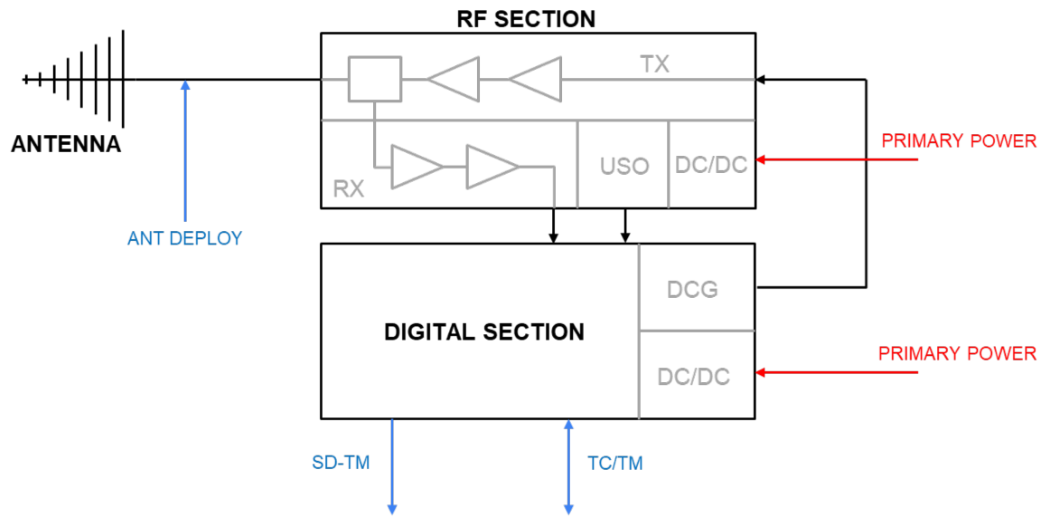
For the purposes of this study, the radar sounder is assumed to operate with a transmitted peak power on the order of 5 W. The overall system is assumed to have a peak power consumption below 40 W and a total mass below 20 kg, values that are representative of contemporary lunar orbiter payload capabilities. These parameters are not intended as a finalized instrument specification, but rather as a consistent reference framework supporting the performance assessment and trade analyses presented in this work. The assumed architecture builds upon the technological heritage of previous planetary radar sounders, while adopting system-level design choices consistent with the VHF operating regime and the shallow-subsurface targets of interest. The instrument is composed of three main subsystems (
Figure 1): the Antenna Section, the Radio Frequency Section (RFS), and the Digital Section (DS).
2.2.1. Antenna Section
Once deployed, the antenna forms a nadir-pointing directional beam designed to maximize sensitivity to near-nadir subsurface returns while suppressing off-nadir surface contributions that dominate clutter in orbital sounding geometries. A high-gain antenna is assumed, with a gain exceeding 5 dBi, in order to reduce the illuminated footprint and limit the contribution of surface echoes originating at large incidence angles. This level of directivity represents a trade-off between clutter mitigation, antenna size, and deployability constraints compatible with small- to medium-class lunar orbiters. The antenna is alternately connected to the transmitter and receiver chains through a dedicated RF switching network. This configuration ensures adequate isolation of the receiver front-end during transmission phases, preventing exposure to high radio-frequency power levels and preserving receiver sensitivity during echo acquisition.
2.2.2. Radio Frequency Section
The Radio Frequency Section comprises the transmitter, receiver, master oscillator (MO), RF switching network, and associated power conditioning electronics, including DC/DC converters. The radar operates in a monostatic configuration, transmitting linearly frequency-modulated pulses and receiving the corresponding echoes through the same antenna aperture. The pulse repetition frequency (PRF) is selected such that the useful portion of the received echo is fully contained between consecutive transmission events. Since the two-way travel time of the surface and subsurface echoes depends on spacecraft altitude and local topography, the timing of the receiving window is computed in real time, accounting for variations in surface elevation along the ground track. This adaptive timing strategy maximizes the effective listening interval while avoiding pulse overlap and range ambiguities. The MO provides the frequency and time reference for all radar operations and represents a critical element of the instrument. Its stability directly impacts phase noise, range resolution, and distance measurement accuracy. By ensuring temporal coherence across successive pulses, the MO enables effective pulse compression and supports Doppler-based processing techniques applied during ground data analysis.
2.2.3. Digital Section
The Digital Section is responsible for waveform generation, instrument synchronization, signal acquisition, and data handling. Using the reference timing and frequency information provided by the master oscillator, the DS generates the linearly frequency-modulated chirp waveform, which is subsequently amplified and transmitted by the RFS. On reception, the DS samples the returned echoes, applies initial signal conditioning, and buffers the data for storage and downlink. Instrument operations are managed autonomously by the DS according to an onboard science plan. Two primary operating modes are assumed: a low-power stand-by mode, which preserves timing coherence and instrument readiness between sounding opportunities, and an active acquisition mode, during which the radar transmits and receives according to predefined operational parameters. Mode transitions, PRF selection, and receiving window timing are handled onboard to accommodate changes in orbital geometry and surface topography, ensuring consistent data quality across successive orbital passes.
Consistent with the small-platform class assumed for the mission concept, onboard processing is limited to essential functions for data handling and instrument operation, including pulse compression, data formatting, pre-summing, and packetization for downlink. More advanced processing steps, such as clutter suppression, synthetic aperture focusing, and adaptive echo discrimination, are not implemented onboard due to their computational and power requirements. These operations are instead performed on the ground, where greater processing capabilities are available and auxiliary datasets (e.g., high-resolution digital elevation models) can be incorporated to enhance clutter mitigation and signal interpretation [
4].
3. Data and Methods
This section introduces the modeling assumptions adopted to describe the radar acquisition geometry and the physical properties of the lunar surface and subsurface, as required to evaluate the performance of the VHF radar sounder concept presented in
Section 2.2. These assumptions provide the analytical framework used to quantify the instrument capability to address the scientific objectives outlined in
Section 2.1.
Radar sounding performance in the VHF regime is strongly controlled by the electromagnetic properties of the probed materials, including permittivity and loss characteristics, as well as by surface and subsurface roughness, which governs scattering behavior and clutter generation. Dielectric contrasts determine the reflectivity at subsurface interfaces associated with the targeted features, whereas roughness and volumetric heterogeneities control the magnitude and angular distribution of the backscattered power. Together with the acquisition geometry, these parameters dictate the detectability of shallow subsurface targets and the relative contribution of surface clutter in an orbital sounding configuration.
The following subsections therefore detail the assumed observation geometry, the adopted subsurface structural models, and the statistical and electromagnetic descriptions of lunar surface and subsurface materials used in the performance assessment.
3.1. Acquisition Geometry and Subsurface Structure
To represent the lunar shallow subsurface in the two scientific scenarios considered in this study, simplified layered structural models are adopted. These models are intended to capture the dominant electromagnetic contrasts relevant to radar sounding, while remaining sufficiently generic to support parametric performance analysis.
In the lava tube scenario, the subsurface configuration follows the conceptual model introduced in Carrer et al. [
15]. A regolith layer overlies a basaltic substrate representative of mare units, within which the lava tube is embedded. The lava tube is modeled as an empty cave (i.e., a vacuum layer) hosted within the basalt. Its geometry is parameterized in terms of roof depth and lateral extent, while the vertical dimension is linked to the tube width through a fixed aspect ratio. A height-to-width ratio of approximately 1:3 is assumed, consistent with structural analogies derived from terrestrial lava tube systems [
28]. This simplified representation enables a systematic evaluation of detectability as a function of tube depth and size.
In the ice deposit detection scenario, the target of interest is a subsurface dielectric interface associated with the presence of water ice within porous lunar materials. The model assumes a transition from relatively dry regolith or rock, characterized by vacuum-filled pore space, to a layer in which pores are partially or fully filled with water ice, consistent with the occurrence scenario discussed in
Section 2. This compositional change produces a dielectric contrast that gives rise to a radar-detectable reflection. The approach is not based on any assumption on a specific ice morphology, allowing the analysis to remain applicable to both diffuse ice-bearing layers and more localized ice-rich horizons.
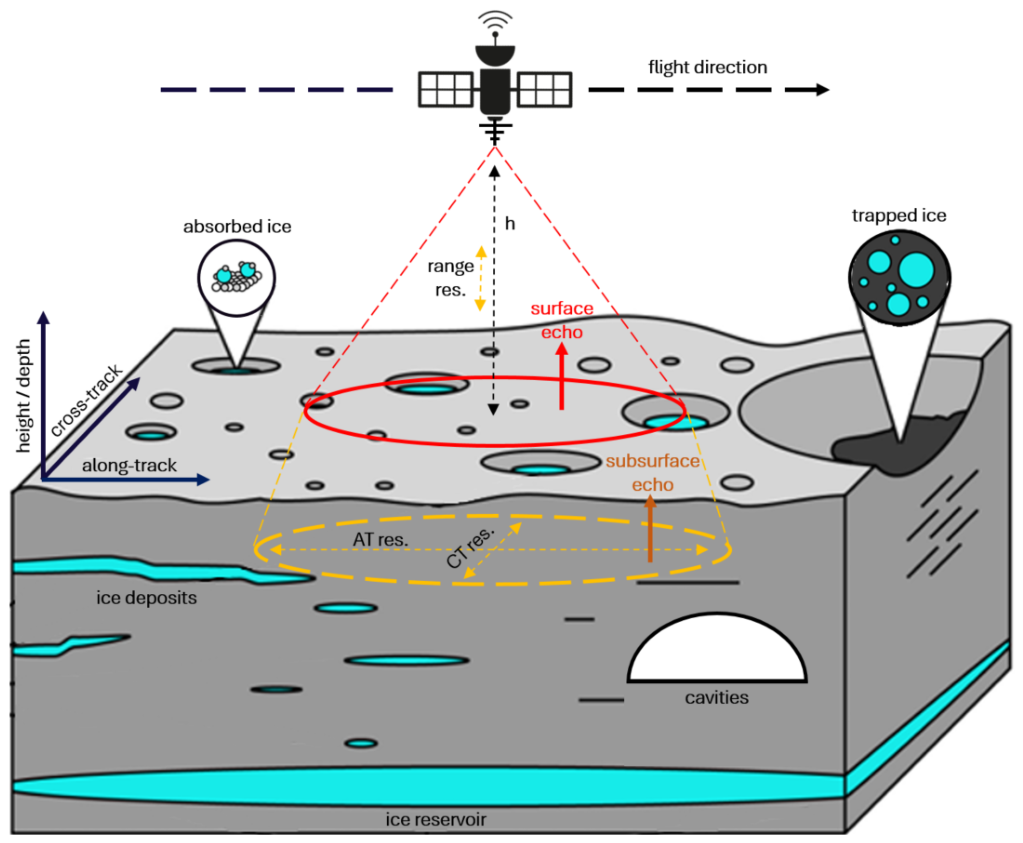
With respect to the observation geometry, the radar sounder is assumed to operate in a nadir-looking configuration from a spacecraft in a low polar orbit. The reference trajectory corresponds to a nominal periapsis altitude of approximately 30 km and an orbital velocity of about
km/s. A local coordinate system is defined with the along-track and cross-track directions referenced to the spacecraft velocity vector, and the range direction oriented normal to the surface, coinciding with the height and subsurface depth axis. This geometry, shown in
Figure 2, provides the basis for defining radar resolution, footprint dimensions, and clutter geometry in the subsequent analyses.
3.2. Radar Sounder Resolution
Based on the acquisition geometry described in
Section 3.1, the spatial resolution achievable by the radar sounder is characterized in the three orthogonal directions: cross-track (X-axis), along-track (Y-axis), and range (Z-axis). These resolution parameters define the instrument’s spatial discrimination capability and directly influence both target detectability and clutter behavior.
3.2.1. Range Resolution
The range resolution is determined by the temporal extent of the transmitted waveform and the adopted signal processing scheme. In the absence of modulation, two interfaces can be resolved only if their separation exceeds the distance traveled by the electromagnetic wave during the pulse duration time . In the proposed VHF radar sounder, however, linear frequency modulation of the transmitted pulse is assumed. The chirped waveform enables range compression through matched filtering of the received echo, allowing long-duration pulses with high energy content to be transmitted without degrading range resolution.
Under these assumptions, the range resolution is governed by the signal bandwidth rather than the pulse duration and can be expressed as:
where
c is the speed of light in vacuum,
B is the transmitted bandwidth and
is the relative dielectric constant of the propagation medium. For radar sounder systems, the achievable bandwidth is limited by antenna design constraints and is often assumed to be on the order of half of the carrier frequency [
35]. In this study, the VHF band is explored through a set of discrete carrier frequencies in the range 80–150 MHz, with 150 MHz selected as the upper reference value for performance assessment. This choice is not intended to represent a global optimum, but rather a representative, engineering-driven design point within the VHF regime. At this frequency, a conservative bandwidth of approximately 70 MHz can be achieved, enabling meter-scale vertical resolution while maintaining attenuation levels compatible with the targeted penetration depths. At the same time, this frequency range remains consistent with antenna accommodation and deployability constraints for small- to medium-class lunar orbiters. The end member of the considered range yields a theoretical free-space range resolution of ∼2 m. It is noted that this value represents a theoretical performance metric. In practice, the application of spectral weighting functions to suppress range sidelobes degrades the effective resolution by broadening the main lobe and reduces the signal-to-noise ratio, while improving the detectability of weaker subsurface reflections in the presence of strong neighboring echoes.
3.2.2. Along-Track Resolution
The along-track (azimuth) resolution is determined by the effective synthetic aperture achieved through coherent processing of successive echoes acquired as the spacecraft moves along its orbit. Synthetic aperture techniques exploit the Doppler frequency modulation induced by the relative motion between the radar and the illuminated surface elements, enabling resolution enhancement beyond the limitations imposed by the physical antenna size.
Each scatterer produces a characteristic Doppler signature, with zero Doppler shift at the point of closest approach and opposite frequency shifts during the approaching and receding phases. By coherently integrating the Doppler history of each scatterer and matching it to the expected phase evolution under nominal acquisition geometry, the azimuth location can be resolved with a resolution governed by the effective Doppler bandwidth. For unfocused synthetic aperture processing, commonly adopted for radar sounders, the along-track resolution can be expressed as [
3]:
where
is the carrier wavelength,
h is the spacecraft altitude, and
is the synthetic aperture length. The latter depends on the specific azimuth signal processing strategy and, in particular, on the achievable Doppler bandwidth that can be coherently exploited without loss of phase coherence for a given scatterer. In this study, unfocused synthetic aperture processing is assumed, as commonly adopted for orbital radar sounders. Under this condition, the synthetic aperture length can be approximated as
, leading to
For a VHF radar sounder operating at 150 MHz and an altitude of approximately 30 km, this corresponds to an along-track resolution on the order of 200 m.
3.2.3. Cross-Track Resolution
The cross-track resolution is governed by the pulse-limited diameter and cannot be significantly improved through Doppler processing, as no relative motion-induced frequency shift exists in the direction perpendicular to the spacecraft velocity. After pulse compression, the cross-track resolution can be approximated as [
36]:
where
is the range resolution and
h is the spacecraft altitude. This quantity is typically large for orbital radar sounders and is directly related to the illuminated footprint size. For the VHF configuration considered in this study, the cross-track resolution is on the order of several hundred meters, approximately 800 m.
3.3. Electromagnetic Properties of Materials and Fresnel Reflectivity
The interaction of radar waves with the lunar surface and subsurface is governed by the electromagnetic properties of the constituent materials, primarily the real part of the dielectric constant and the loss tangent. These parameters control wave propagation velocity, attenuation, and reflection strength at material interfaces, and therefore play a central role in determining radar sounder performance.
To represent the simplified lunar scenarios adopted for the performance assessment, a limited set of materials is considered and classified into host materials and inclusion materials. Host materials include: (i) regolith, the fragmented surficial material covering most of the Moon, whose dielectric properties vary moderately on the global scale as a function of density and composition; and (ii) basalt, the dominant volcanic rock in mare regions and the host medium for lava tube structures. Conservative representative values are adopted in this study: the real part of the dielectric permittivity is assumed to be approximately 2.7 for regolith, corresponding to
surface porosity and a zero-porosity value of 5, and around 6 for basalt, while loss tangent values are of the order
for the regolith and
for dry basalt [
37,
38].
Inclusion materials considered in the adopted models are void (vacuum) and water ice. For these inclusions, intrinsic dielectric properties of the pure substances are assumed, consistent with their idealized representation in the layered subsurface models.
The effective dielectric constant of porous geological materials depends on the dielectric properties and volumetric fractions of the host medium and the pore-filling inclusions. To describe this behavior, classical effective medium theories can be employed. Assuming that porosity varies only as a function of depth, the Maxwell Garnett mixing is adopted to model the dielectric constant
of the composite mixture:
where
is porosity as function of depth z,
is the dielectric constant of the host material, and
the dielectric constant of the inclusion material. The depth dependence of porosity is modeled using an exponential decay law:
where
is the surface porosity and
K is a characteristic decay constant. For lunar regolith,
K is assumed to be approximately 6.5 km [
39]. Increasing porosity results in a reduction of both effective dielectric constant and the loss tangent, thereby influencing wave velocity and attenuation with depth.
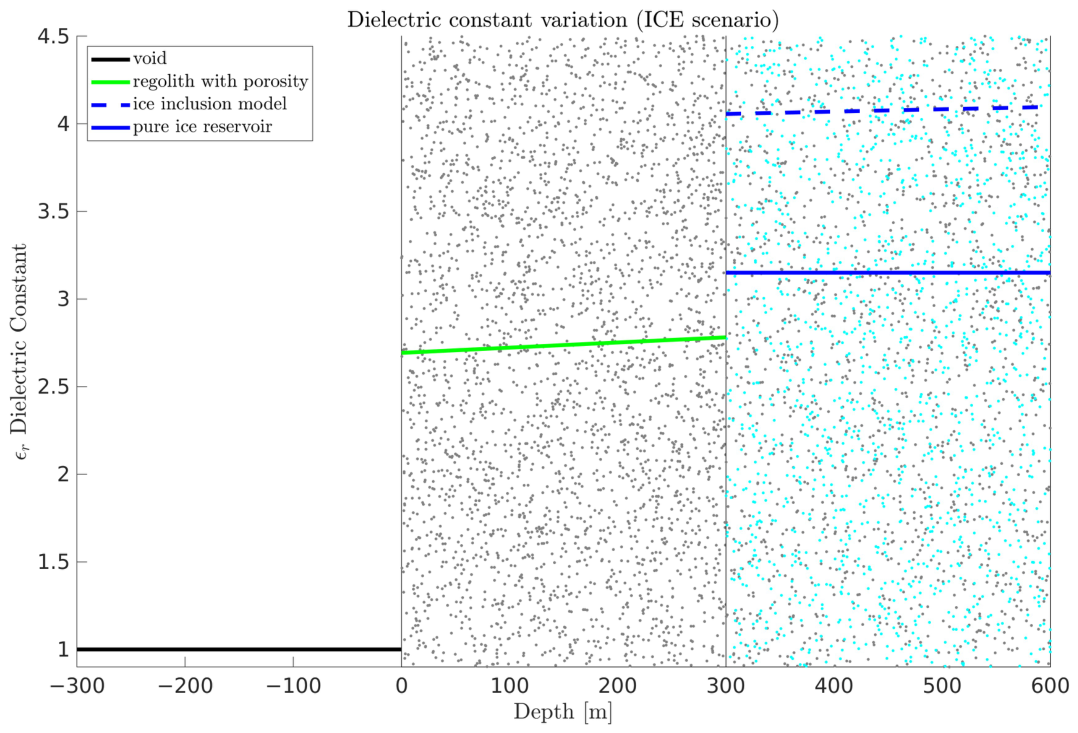
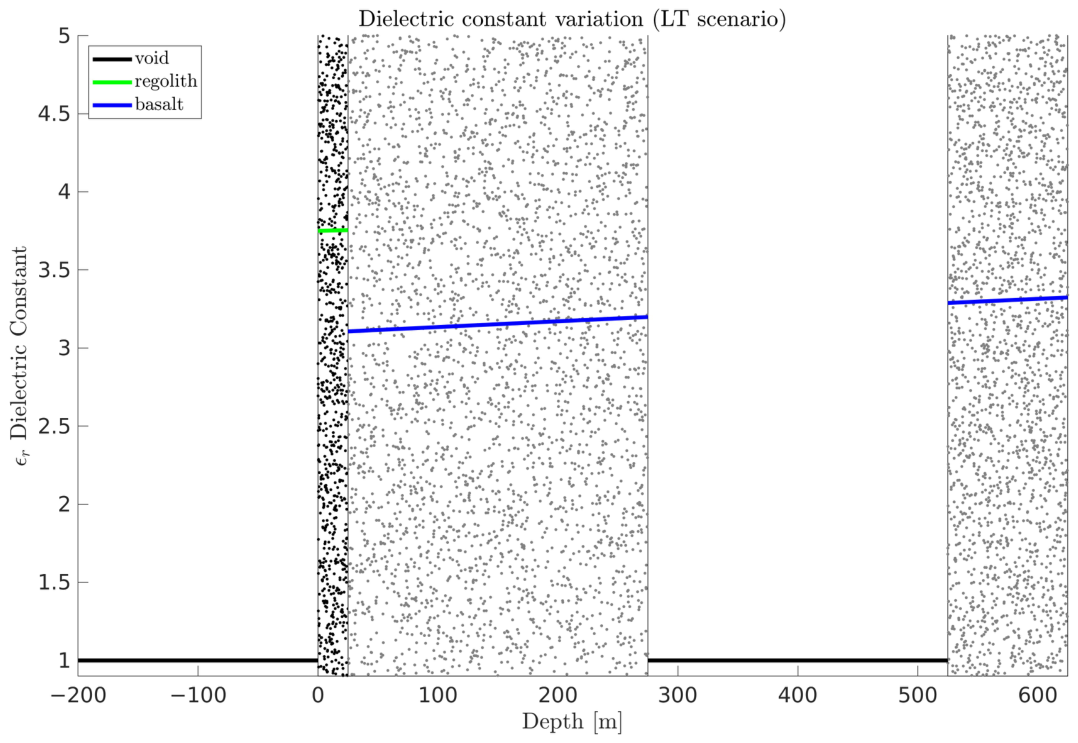
To evaluate the depth-dependent dielectric properties of the propagation medium relevant for radar sounding, the subsurface models adopted in this study are evaluated over depths extending to approximately 1.5 km below the surface. The regolith layer, generated by impact gardening, is assumed to have a typical thickness of a few meters to several tens of meters in mare regions, consistent with observational constraints. Beneath this layer, the upper kilometer of the lunar crust is expected to remain porous and fractured as a result of impact processes, thermal cracking, and volcanic history, with decaying porosity. For clarity and conciseness, despite recognizing the structural and compositional differences between the superficial regolith and the underlying fractured crust, the term regolith is hereafter used as a generalized descriptor for the entire porous near-subsurface medium. Profiles with the evolution of dielectric properties implied by the porosity decay are shown in
Figure 3 and
Figure 4. The radar performance calculations use the depth-dependent dielectric profile integrated along the actual propagation path to each target interface, so that attenuation and velocity effects are consistently accounted for.
From a modeling perspective, restricting the subsurface representation to shallow depths (e.g., ∼10 m) would underestimate the cumulative effects of dielectric stratification and attenuation on radar wave propagation, particularly for high-frequency sounding systems operating in orbital geometry. The adopted depth scale therefore provides a physically meaningful upper bound for the integration of electromagnetic losses and reflectivity, while preserving sensitivity to shallow interfaces relevant for ice deposits and lava tube detection. Representative profiles of the modeled dielectric constant as a function of depth are shown in
Figure 3 for the ice detection scenario and in
Figure 4 for the lava tube scenario.
Once the dielectric properties of adjacent layers are defined, the reflectivity at their interface can be quantified through the Fresnel reflection coefficient at normal incidence:
where
and
are the effective dielectric constants of the two media at depth
z. Abrupt changes in dielectric properties produce reflections whose strength is directly controlled by this coefficient, forming the basis for the detection of subsurface interfaces in radar sounding observations.
3.4. Surface and Subsurface Backscattering Models
To quantitatively evaluate the contribution of surface and subsurface backscattered power, an appropriate statistical description of lunar topography and interface roughness is required. Planetary surfaces are commonly modeled as realizations of stochastic processes and are therefore characterized using statistical parameters derived from topographic measurements. State-of-the-art approaches assume probability distributions for quantities such as surface heights and slopes, whose parameters are estimated from altimetric or stereo-derived datasets.
A simplified modeling treats surface height as a stationary Gaussian-distributed random variable. Under this assumption, key statistical descriptors can be defined, including the root-mean-square (rms) height and the rms slope, which are computed from height samples along profiles or over gridded topography. More refined models separate the scattering contributions into large-scale components, associated with gently undulating topography, and small-scale arising from surface roughness at spatial scales comparable to the radar wavelength [
13,
40,
41]. While effective in certain regimes, these formulations do not explicitly account for the scale dependence of roughness parameters that is commonly observed in planetary surfaces.
To capture this behavior, planetary topography is more appropriately described using fractal models [
42]. In particular, self-affine fractal surfaces exhibit statistical properties that vary with scale according to a power law characterized by the Hurst exponent,
H. Under a self-affine transformation, scaling the horizontal dimensions of the surface by a factor
d requires scaling vertical by
to preserve statistical similarity. The Hurst exponent ranges between 0 and 1 and governs how roughness at small spatial scales propagates to larger scales. Values of
are commonly observed for planetary surfaces, with
corresponding to self-similar (optical) surfaces and
representing Brownian (random-walk) roughness.
Within this framework, the scale dependence of the rms slope can be expressed as:
where
is the rms slope evaluated at a reference baseline
. This formulation allows the rms slope to be consistently extrapolated to the radar wavelength scale, which is the relevant spatial scale for scattering. Adopting a self-affine fractal description of surface and subsurface interfaces, the normalized radar backscattering coefficient can be computed as follows [
43]:
where
is the Fresnel reflection coefficient of the interface under consideration,
is the 0-
order Bessel’s function of the first kind,
is the incidence angle, and
is the rms slope evaluated at a baseline equal to the radar wavelength using Equation (
8). This formulation reduces to the classical optical scattering model in the limit
and to the Hagfors model for
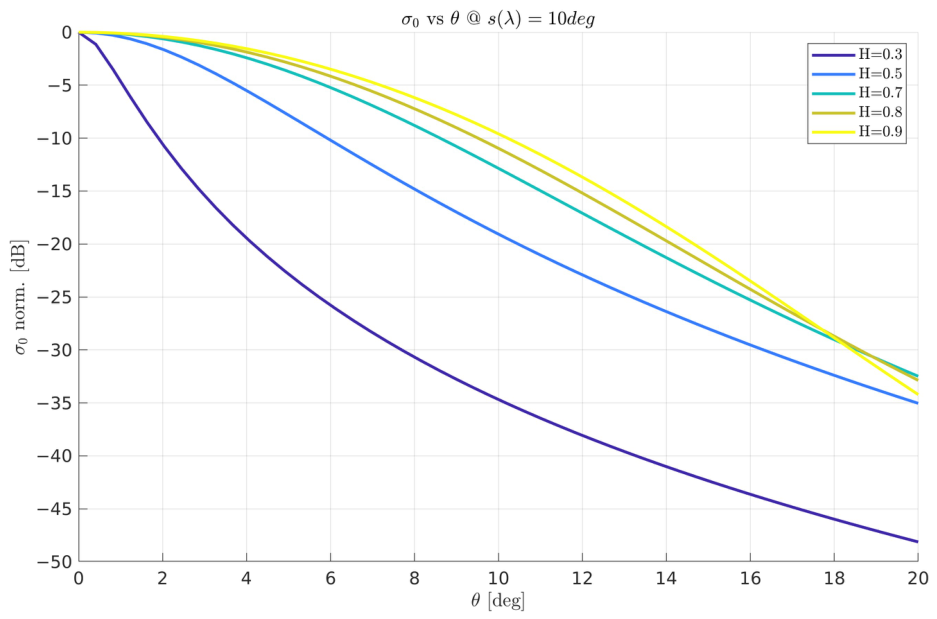
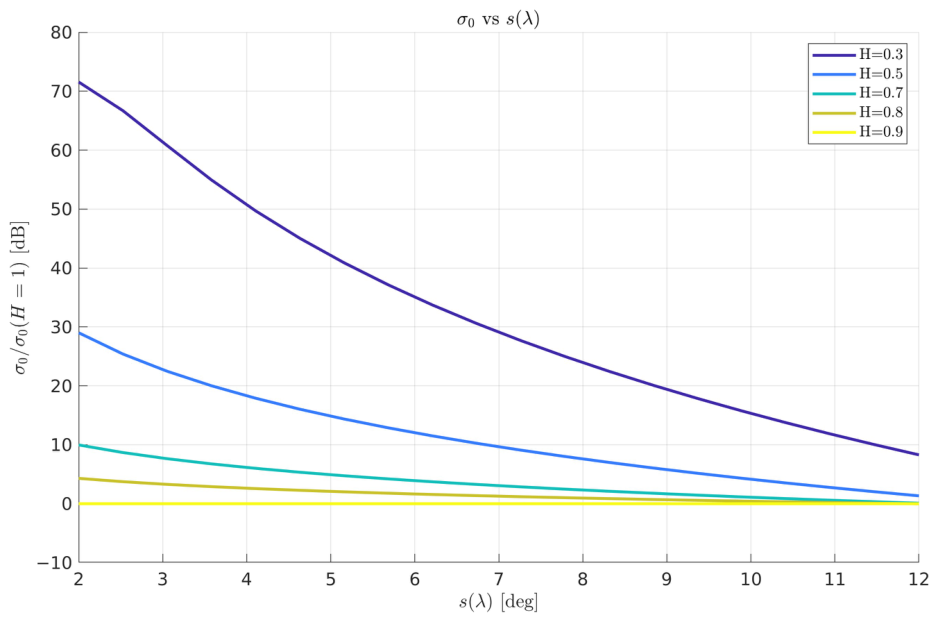
, which are adopted in this study as end-member cases to bracket the range of plausible surface roughness conditions. The dependence of the backscattering coefficient on rms slope and incidence angle for different values of the Hurst exponent is shown in
Figure 5 and
Figure 6, respectively.
3.5. Performance Evaluation
This section presents the analytical framework used to quantify the performance of the proposed VHF radar sounder. The analysis focuses on the physical mechanisms governing signal power degradation and on the metrics that ultimately determine subsurface target detectability in an orbital sounding configuration. In particular, the signal-to-noise ratio (SNR) and the signal-to-clutter ratio (SCR) are adopted as the primary performance indicators and are derived consistently with the modeling assumptions introduced in the previous sections.
3.5.1. Radar Signal Loss Mechanisms
Radar sounding performance is affected by several mechanisms that reduce the power of the received echo. The sources of power loss can be grouped into three main categories: (1) geometric losses, (2) attenuation losses, and (3) scattering losses.
Geometric losses arise from the radial distance between the radar sensor onboard the spacecraft and the subsurface target. As this distance increases, the transmitted energy spreads over a progressively larger area, leading to a reduction in power density at the receiver. In an orbital sounding configuration, this effect results in a two-way loss that scales with the fourth power of the effective propagation distance and is explicitly represented in the signal-to-noise ratio formulation discussed later.
Attenuation losses are caused by the absorption of electromagnetic energy as the radar wave propagates through the subsurface. Their magnitude depends on the electromagnetic properties of the materials, in particular on the loss tangent and the effective dielectric constant. Because radar sounding involves two-way propagation, from the surface to the target and back to the receiver, attenuation becomes increasingly significant with depth and increases with operating frequency. The cumulative two-way attenuation can be expressed as [
6]:
where
is the carrier frequency and
and
describe the depth-dependent dielectric properties of the medium. Additional attenuation arises from partial transmission and reflection at dielectric interfaces. These effects are explicitly accounted for through Fresnel coefficients in the SNR formulation.
Scattering losses are associated with surface and subsurface roughness and with volumetric heterogeneities, such as rock fragments within the regolith, which redistribute the incident energy away from the specular direction. At typical radar sounding frequencies, including the VHF regime considered here, volume scattering and phase dispersion effects are expected to be secondary compared to geometric spreading and attenuation losses [
15]. Consequently, geometric and attenuation losses are treated as the dominant contributors to signal power degradation in the present analysis.
3.5.2. Signal-to-Noise Ratio Formulation
The SNR quantifies the detectability of a subsurface interface relative to the system noise floor. It is defined as the ratio between the received power from the target echo and the total noise power within the receiver bandwidth. Higher SNR values correspond to increased confidence in target detection and improved measurement reliability.
Considering a stratified subsurface composed of
N layers with electromagnetic properties that vary continuously with depth and discontinuously at layer interfaces, the single-look SNR associated with the echo from the
j-th interface at nadir incidence can be expressed as [
6]:
where
is the Boltzmann constant,
B is the signal bandwidth,
is the transmitted power,
G is the antenna gain, and
is the radar wavelength. The term
denotes the Fresnel power reflectivity of the target interface, defined in Equation (
7), while
represents the normalized backscattering coefficient at nadir incidence, derived from the self-affine roughness model described in
Section 3.4. The factor
accounts for the cumulative two-way attenuation due to subsurface propagation, as introduced in
Section 3.5.1. The quantity
A represents the ground resolution cell area, corresponding to a single radargram pixel, and is given by
. The cross-track resolution
is determined by the conventional pulse-limited footprint after range compression and can be expressed as
, where
is the range resolution and
h is the spacecraft altitude. The along-track resolution
depends on the applied azimuth processing and is expressed as
, where
is the effective synthetic aperture length. For orbital radar sounders, unfocused synthetic aperture processing is assumed, yielding
.
The factor
accounts for two-way transmission losses across overlying interfaces. Geometric spreading losses are captured through the effective propagation distance:
where
h is the spacecraft altitude, and
and
are the thickness and dielectric constant of the
i-th layer, respectively.
The system noise temperature
includes contributions from frequency-dependent galactic radiation, target thermal emission, and receiver noise [
44]. In the VHF band and under conservative assumptions, these contributions are comparable and are modeled as:
where
is the radar carrier frequency,
F is the receiver noise factor, and
represents the effective physical temperature of the observed surface. Although the direct contribution of galactic radiation is expected to be limited for a nadir-pointing radar sounder, since it primarily enters through antenna sidelobes and scattering mechanisms, its contribution
is modeled here using an empirical frequency-dependent law under a simplified, direction-independent assumption. This approach is intentionally conservative, as it effectively assumes a larger exposure to galactic emission than would occur in realistic observation conditions. The resulting estimate therefore provides an upper bound to the noise contribution. A more rigorous treatment would require direction-dependent modeling of both the antenna radiation pattern and the sky brightness distribution, which is beyond the scope of the present work.
Detection capability is significantly enhanced through signal processing. Two principal gain factors are considered: range-compression gain and azimuth-compression gain. Range compression is achieved by transmitting a linearly frequency-modulated (chirped) waveform and applying matched filtering to the received echo. This process concentrates the signal energy into a shorter temporal interval, improving both range resolution and SNR ratio. The corresponding gain is , where is the pulse duration and B is the signal bandwidth.
Azimuth (synthetic aperture) processing enhances detection by coherently integrating echoes acquired as the spacecraft moves along its orbit. This processing exploits the Doppler frequency modulation induced by the relative motion between the sensor and a given ground scatterer, allowing energy spread along track to be focused into a narrower resolution cell. The resulting azimuth processing gain is given by
, which corresponds to the number of coherently combined pulses within the synthetic aperture. Here,
is the spacecraft velocity,
is the effective aperture length, and
is the pulse repetition frequency. To ensure proper sampling of the Doppler spectrum, the PRF must satisfy
, where
denotes the maximum antenna beamwidth in the along-track direction [
3].
3.5.3. Signal-to-Clutter Ratio Model
The SCR constitutes the most critical performance metric for orbital radar sounding applications. It quantifies the ratio between the received power from a subsurface target and the power of undesired surface off-nadir echoes (i.e., clutter echoes) that arrive at the receiver with the same two-way travel time. Strong clutter can mask weak subsurface reflections, introduce ambiguities in radargrams, and significantly hinder data interpretation. As a result, both instrument design and data processing strategies must explicitly address clutter mitigation.
For a given subsurface target, a clutter angle can be defined as the off-nadir incidence angle from which a surface echo has the same propagation delay as the target echo. Under the assumption of a nadir-pointing geometry, this angle can be expressed as , where h is the spacecraft altitude and is the effective propagation distance to the subsurface interface. Surface echoes arriving from experience a reduced backscattering coefficient relative to nadir returns, whereas the subsurface echo is attenuated by transmission and absorption losses accumulated along the propagation path.
For a fixed carrier frequency, increasing the target depth results in a larger clutter angle, thereby reducing the surface backscattering contribution, but simultaneously increases attenuation losses affecting the subsurface signal. The acquisition altitude also influences the SCR: lower orbital altitudes lead to larger clutter angles and, consequently, to a reduction in clutter power. These competing effects define a fundamental trade-off between penetration depth, clutter suppression, and orbital geometry. It is highlighted that the SCR improvement with lower altitude is not linked to the reduction of free-space geometric spreading losses, which scale with the fourth power of the effective propagation distance, which instead is the cause for the SNR increase.
Assuming that surface and subsurface echoes experience comparable geometric spreading losses and are associated with the same resolution cell, the SCR can be expressed as [
15]:
where
is the Fresnel reflectivity of the target interface, the product term accounts for two-way transmission losses across overlying interfaces,
is the cumulative attenuation factor, and
and
denote the subsurface and surface backscattering coefficients evaluated at nadir and at the clutter angle, respectively.
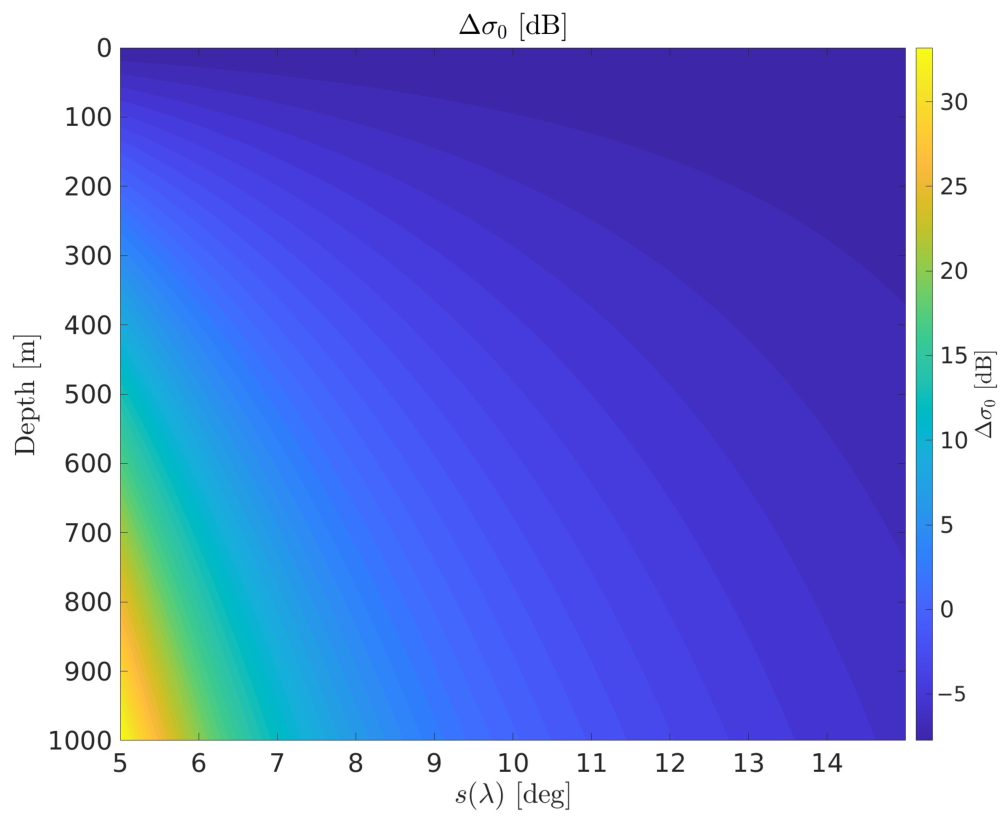
To isolate the effect of acquisition geometry on clutter, this study assumes that the same statistical roughness model applies to both surface and subsurface interfaces, such that the angular dependence of the backscattering coefficient constitutes the primary discriminant. Under this assumption, the ratio
depends mainly on the clutter angle and on terrain rms slope. Its variation with target depth and surface roughness is shown in
Figure 7.
The SCR, and consequently the reliability of subsurface detection, can be substantially improved through post-processing techniques. These include Doppler-based discrimination of off-nadir clutter, exploiting the non-zero Doppler shift of surface echoes, and surface de-cluttering based on numerical simulation of expected surface returns using high-resolution DEMs. The contribution of Doppler processing to clutter suppression is included through the improvement factor [
6]:
where
z is the target depth and
is the range resolution.
For the purposes of the performance assessment presented in this work, the minimum acceptable SCR is set to 0 dB, corresponding to the condition in which the power of the target echo equals that of the surface clutter arriving at the same two-way travel time. This threshold is adopted as a design reference consistent with established practice in orbital radar sounder studies [
6,
15], where it identifies the depth beyond which the target echo is no longer separable from clutter through conventional detection schemes. It should be emphasized, however, that the SCR threshold can be considered a design parameter rather than a fixed boundary: it can be relaxed by the application of post-processing techniques and DEM-driven de-cluttering, or tightened by imposing specific statistical detection requirements (e.g., target false-alarm and missed-detection probabilities). A comprehensive treatment of these aspects requires a detailed specification of the signal processing chain and is beyond the scope of the present high-level analysis.
4. Results
The quantitative performance assessment of the proposed VHF radar sounder was carried out by evaluating the SNR and the SCR for the two detection scenarios considered in this study: subsurface ice deposits and lava tube cavities. Given the residual uncertainty on several modeling parameters, in particular the statistical descriptors of surface roughness (rms slope and Hurst exponent), the analysis has been performed over representative end-member values rather than for a single nominal case. Specifically, the rms slope varies between 8° and 12°, bracketing the range derived from LOLA data over candidate target regions [
45], and the Hurst exponent is varied between 0.5 (Hagfors limit) and 1 (optical limit), covering the full range of plausible lunar surface scaling behavior. The results presented in the following are therefore expressed as performance envelopes rather than point estimates. The quantitative performance assessment of the proposed VHF radar sounder was carried out by evaluating the SNR and the SCR for the two detection scenarios considered in this study: subsurface ice deposits and the lava tube cavities.
In the ice detection scenario, a porous regolith mantle representative of the lunar south polar regions is assumed, with a surface porosity of
[
39]. The target of interest is the subsurface interface at which the pore-filling material transitions from vacuum to water ice, generating a dielectric contrast detectable by the radar sounder. In the lava tube detection scenario, the target echo originates from the lava tube ceiling and floor, with the radar signal propagating across multiple interfaces, which are regolith/basalt and basalt/void, in addition to the surface reflection.
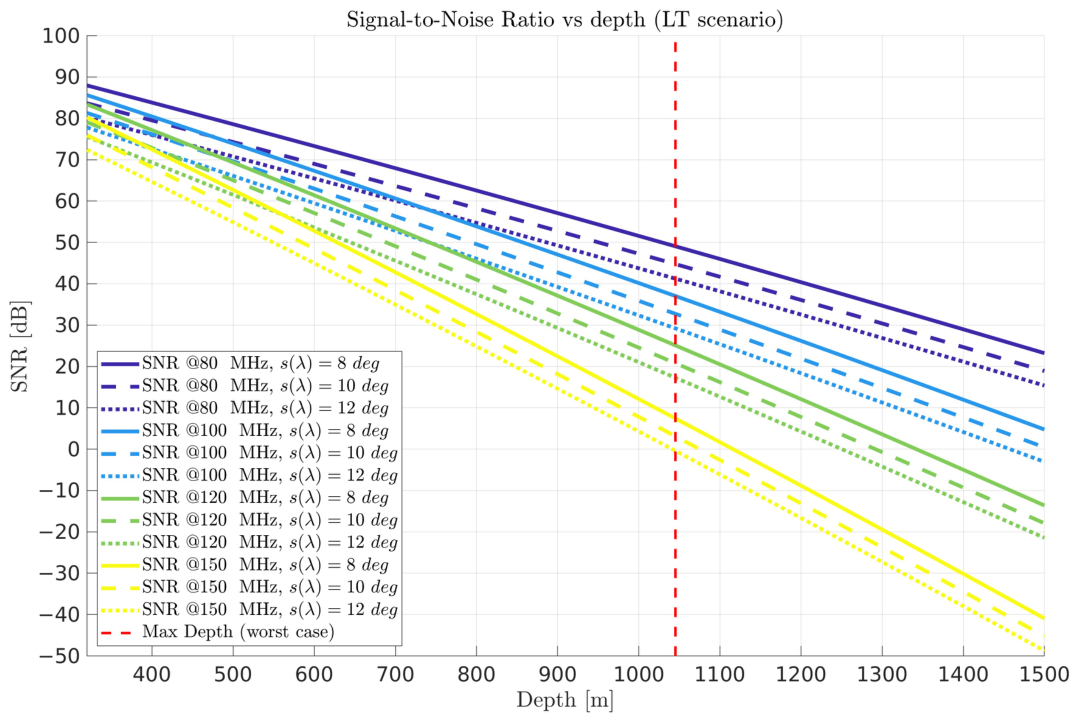
Figure 8 and
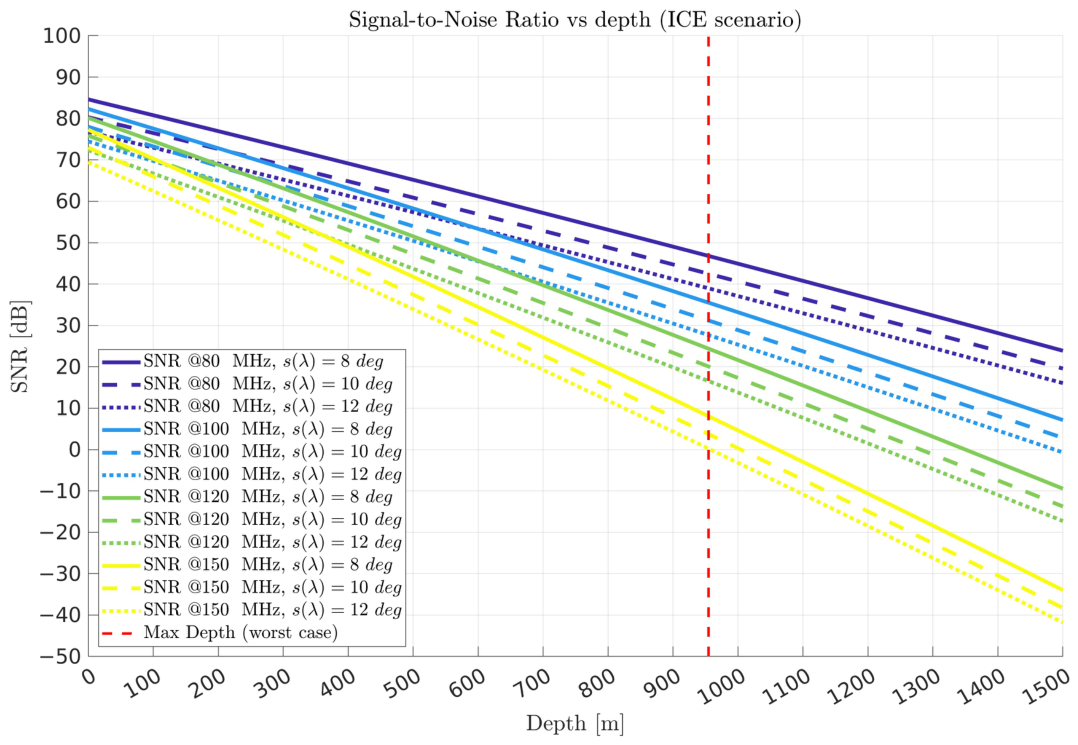
Figure 9 show the evolution of SNR as a function of target depth for the two scenarios.
In both cases, the SNR decreases monotonically with increasing depth, with a steeper decay observed at higher carrier frequencies. This behavior is primarily driven by two-way attenuation losses, which increase exponentially with depth and scale with frequency. In the ice detection scenario, an additional secondary effect arises from the progressive reduction of porosity with depth, which decreases the dielectric contrast between ice-filled and vacuum-filled regolith, thereby reducing the Fresnel reflectivity at the target interface.
The influence of surface roughness on SNR is assessed by considering a range of rms slope values, starting from those derived from LOLA data in the lunar south polar region [
45]. For a fixed carrier frequency and a representative Hurst exponent of 0.95, increasing rms slope yields leads to reduced backscattering efficiency and, consequently, to lower SNR values. The impact of frequency is also evident: higher operating frequencies result in increased attenuation losses and reduced maximum penetration depth.
Across the explored parameter envelope, the SNR remains above the assumed detectability threshold of 0 dB down to depths ranging from approximately 950 m (worst-case rms slope of 12°) to approximately 1000 m (best-case rms slope of 8°) for the ice detection scenario at 150 MHz. For the lava tube scenario, the corresponding depth envelope extends from approximately 1050 m to approximately 1100 m under the same roughness variation. In both scenarios, rising the central frequency to 120 MHz leads to an higher penetration depth, ranging from 1200–1300 m for the ice layer detection and to about 1400–1500 m for the lava tube detection. In all the cases, these depth ranges exceed those expected for subsurface features of interest for human and robotic exploration missions.
These depths exceed those expected for subsurface features of interest for both human and robotic exploration (on the order of hundreds of meters for cavities and tens of meters for ice deposits, according to their respective stability studies [
28,
46,
47]).
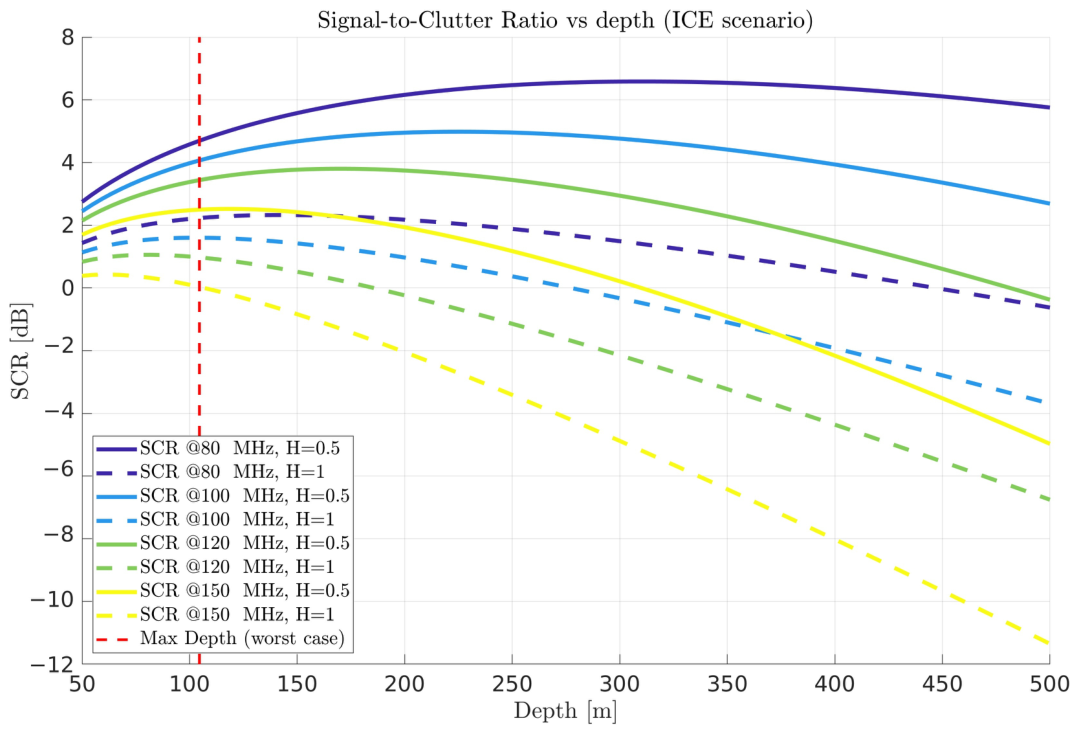
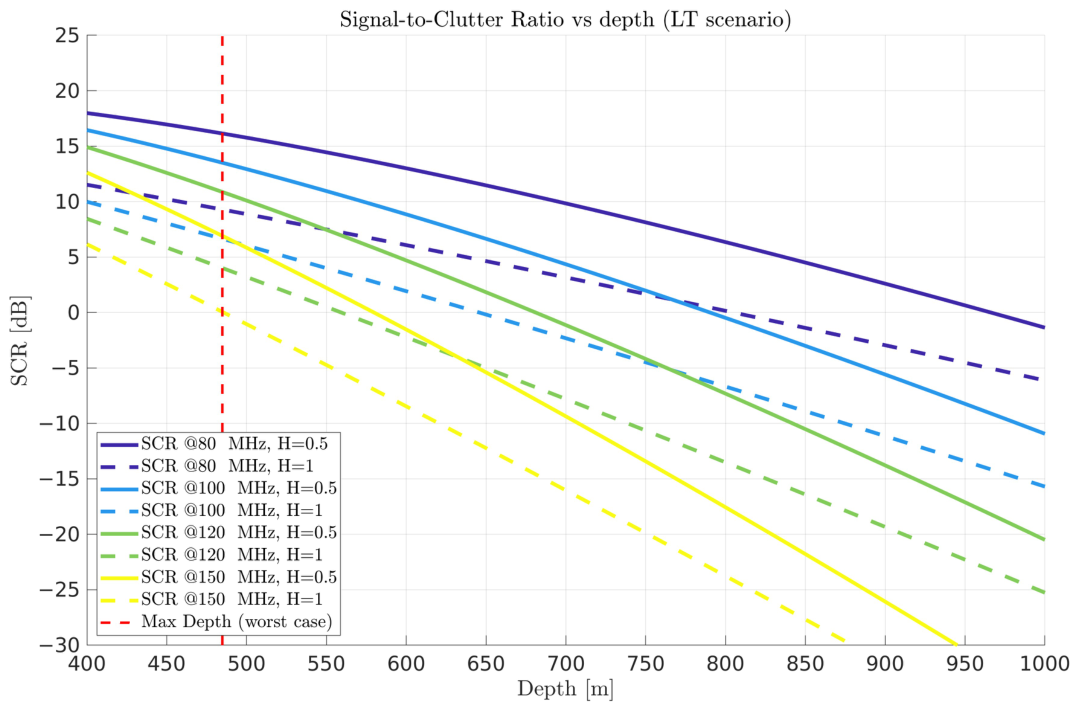
The SCR analysis highlights a more stringent limitation. In this case, the rms slope is held fixed while Hurst exponent is varied between two end-member values, that corresponds to Hagfors model for a worst-case roughness scenario, and is the optical model, which together bracket the range of plausible lunar surface conditions. As for the SNR, increasing the carrier frequency degrades performance by amplifying attenuation losses and reducing the contrast between subsurface echoes and competing surface clutter.
In the ice detection scenario, the SCR analysis in
Figure 10 indicates that, at a carrier frequency of 150 MHz, detectable penetration depths span from approximately 100 m under the most unfavorable roughness assumptions (Hagfors limit,
) to approximately 300 m under optical roughness conditions (
). For the lava tube detection scenario in
Figure 11, the corresponding depth envelope extends from approximately 480 m to approximately 580 m across the same range of Hurst exponent values. The worst-case values quoted above therefore represent lower bounds on achievable performance; across the most likely range of surface roughness conditions encountered on the Moon, detectable depths are expected to fall within these envelopes, with the specific value depending on local terrain statistics. These results reflect the combined effects of clutter geometry, attenuation, and dielectric contrast and emphasize the dominant role of clutter in limiting subsurface detectability from orbit.
The reference spacecraft altitude of 30 km above the surface adopted in this study is consistent with the baseline low polar orbit introduced in
Section 2. This parameter directly influences the balance between subsurface detectability and mission-level constraints. A reduction in altitude would decrease the effective clutter angle (
Section 3.5.3), thereby reducing the contribution of off-nadir surface echoes and improving the SCR-limited penetration depth. However, lower orbital altitudes are associated with reduced orbital lifetime and increased sensitivity to lunar gravitational perturbations, requiring more frequent orbit maintenance. Conversely, operation at higher altitudes increases the clutter contribution and reduces the SCR, effectively compressing the range of detectable subsurface depths. At the same time, geometric spreading losses also increase with altitude, further degrading signal strength. The adopted altitude of 30 km therefore represents a balanced operating point, providing favorable conditions for subsurface detection while remaining compatible with the orbital stability and resource constraints of a realistic small- to medium-class lunar orbiter.
The analysis demonstrates that the SCR constitutes the primary design driver for the radar sounder and, by extension, for the associated mission concept. Clutter mitigation requirements impose stringent constraints on instrument architecture, orbital parameters, and ground-based processing strategies.
The greater detection depth achieved in the lava tube scenario relative to the ice detection case is primarily driven by the higher dielectric contrast at the target interface. In particular, the reflectivity at the basalt, void boundary is significantly larger than that associated with a transition from dry to ice-bearing porous regolith. However, additional factors contribute to this behavior. In the lava tube scenario, the radar wave propagates through a cavity region characterized by negligible losses, thereby reducing cumulative attenuation along the propagation path. This contrasts with the ice detection case, where the signal propagates through lossy, ice-bearing media, leading to increased attenuation for the same two-way distance. Secondary effects include transmission losses at the regolith–basalt interface and the generally higher loss tangent of basalt, which partially counterbalance the improved reflectivity. Furthermore, the clutter geometry becomes more favorable for deeper targets: as depth increases, the corresponding clutter angle increases, resulting in a reduction of the surface backscattering coefficient and an improvement in the SCR (see
Section 3.5.3). The combined effect of these mechanisms explains the enhanced detectability of lava tubes relative to ice-bearing layers.
The presented results shall be compared against the reference depth range of near-term ISRU concepts, which target the uppermost meters of regolith [
47], where drilling and thermal extraction technologies are viable. A penetration depth on the order of 100 m therefore exceeds both the envelope of existing observational constraints and the depth range accessible to first-generation ISRU systems. Within this context, the achieved performance is consistent with the objectives of preparatory exploration missions and supports the feasibility of detecting subsurface ice deposits and lava tubes at depths relevant for future robotic and human activities.
One-Dimensional Radar Signature Simulation
Analyses of the electromagnetic signatures from the lava tube and ice deposit detection scenarios were carried out by simulating the interaction between a linearly frequency-modulated pulse and a horizontally stratified subsurface. The objective is to complement the SNR and SCR analyses with a time-domain representation of the radar response, highlighting the effects of frequency, attenuation, and resolution on target discrimination.
The problem is formulated by considering a plane electromagnetic wave incident at an angle
onto a medium composed of
M homogeneous horizontal layers [
48]. Each m-
layer is characterized by its dielectric constant
, electrical conductivity
, and magnetic permeability
. The complex propagation constant for each layer is defined as:
where
is the angular frequency. Under the assumption of transverse electromagnetic propagation and symmetry with respect to the incidence plane, the magnetic field in each layer has only a
y-component. Once the magnetic field solution is obtained, the tangential component of the electric field can be expressed as
Continuity of the tangential electric and magnetic field components at each interface leads to the following boundary conditions:
The system is closed by imposing a semi-infinite half-space as the bottom layer, allowing only downward-propagating waves. The characteristic impedance of the layered medium is then computed recursively from the deepest layer upward, enabling the determination of the frequency-domain reflection coefficient at the surface. This procedure is repeated for each frequency discretized component of the transmitted chirp signal, after which the reflected spectrum is transformed back into the time domain to obtain the simulated radar echo.
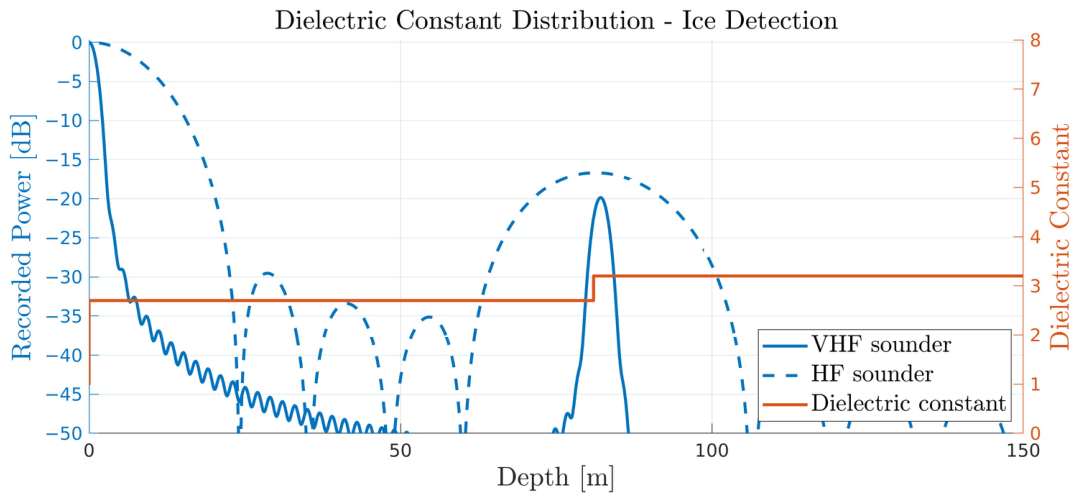
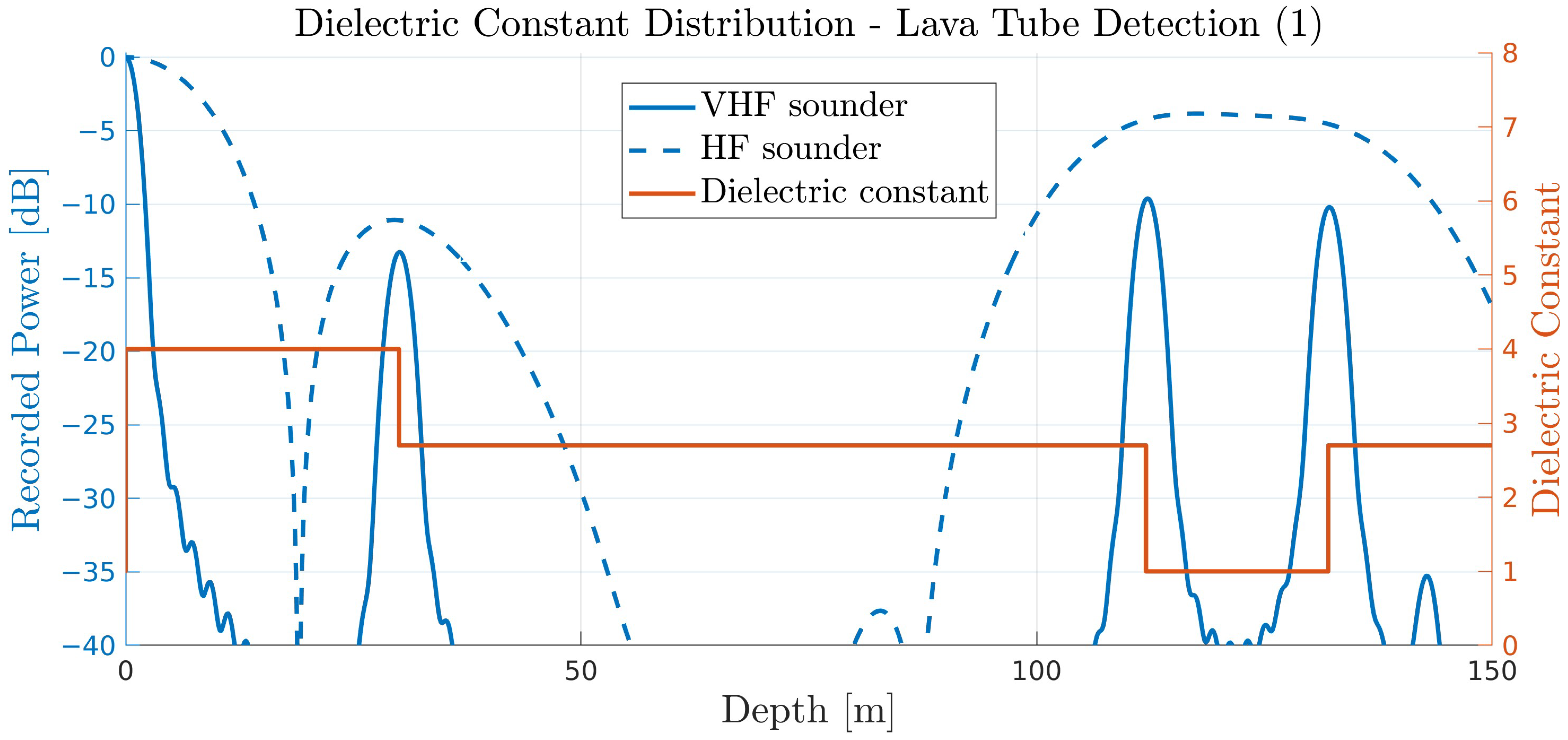
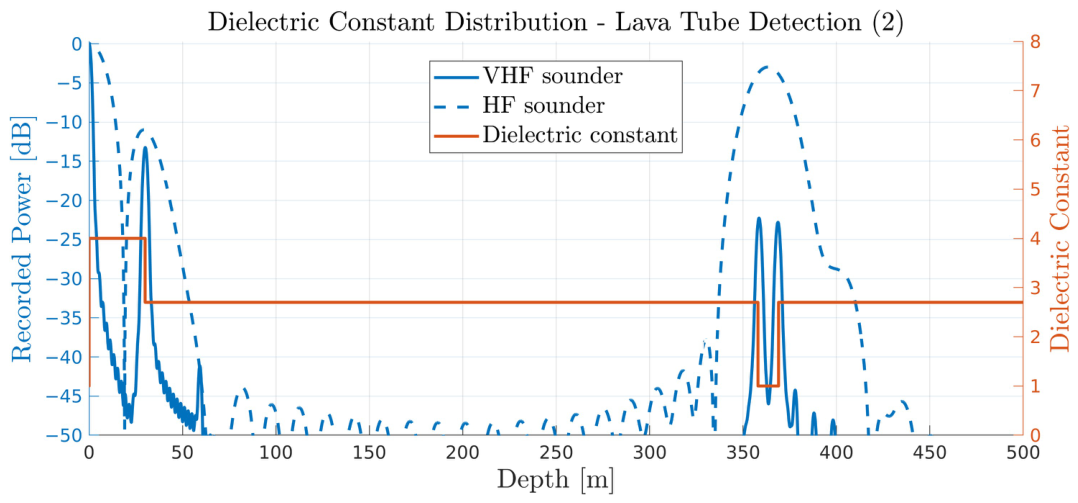
Figure 12,
Figure 13 and
Figure 14 show representative one-dimensional radar responses for the ice reservoir detection, shallow lava tube detection, and deep lava tube detection scenarios, respectively, together with the corresponding depth profiles of the dielectric constant. For each case, the response of the proposed VHF radar sounder is compared with that of a lower-frequency system with characteristics representative of SHARAD. As expected, the higher-frequency VHF configuration exhibits stronger attenuation with depth and increased sidelobe levels, but provides substantially improved range resolution. This enhanced resolution enables the separation of closely spaced dielectric interfaces that remain unresolved at lower frequencies. Moreover, the comparison between the two lava tube detection scenarios at different depths highlights that the improved resolution, enabling a clearer discrimination of the lava tube structural interfaces, comes at the expense of increased absorption losses. These losses, driven by the higher operating frequency, result in a steeper decay of the peak power level compared to that observed at lower frequencies.
5. Discussion
This study has investigated the feasibility and performance of an orbital VHF radar sounder specifically conceived for the detection and characterization of shallow subsurface features on the Moon, with particular emphasis on lava tubes and water ice deposits. The analysis combined a physically consistent modeling framework with quantitative performance metrics and one-dimensional electromagnetic simulations to assess the capability of such an instrument to address key scientific and exploration-driven objectives.
The performance assessment was conducted through the evaluation of two complementary target discrimination metrics: the SNR, which quantifies detectability relative to the system noise floor, and the SCR, which measures the ability to distinguish subsurface echoes from competing surface returns arriving with identical two-way travel times. While SNR provides a first-order indication of signal detectability, the results of this study clearly identify the SCR as the dominant limiting factor in orbital radar sounding geometries. In particular, the maximum effective penetration depth for reliable subsurface detection is constrained by the depth at which the SCR remains above the adopted 0 dB detectability threshold (
Section 3.5.3), highlighting the critical role of surface clutter in defining the practical performance envelope of the instrument.
The analysis shows that attenuation losses associated with two-way propagation through lossy lunar materials constitute the primary design driver for the radar sounder, especially at VHF frequencies. These losses increase rapidly with depth and frequency and are further modulated by the dielectric properties of the subsurface, including porosity decay and material composition. Surface and subsurface roughness, modeled through a self-affine fractal framework constrained by statistical parameters derived from LOLA data, also play a significant role by influencing both backscattering efficiency and clutter behavior. Within this context, the combined SNR and SCR analyses provide a physically grounded basis for identifying operating regimes and orbital configurations that maximize scientific return while remaining compatible with realistic spacecraft constraints.
The work relies on a set of modeling assumptions introduced to define performance metrics and identify the feasible design space for the proposed class of scientific instrument. The subsurface has been represented through layered, laterally homogeneous models, with dielectric properties derived from established mixing formulations and values reported in the literature. In real scenarios, the lunar subsurface is expected to exhibit significant lateral heterogeneity, including embedded blocks, fractured horizons, and localized volatile enrichments, which may influence both interface reflectivity and cumulative signal attenuation. To mitigate the impact of these simplifications, the analysis has been conducted under conservative assumptions and includes representative worst-case scenarios for terrain properties. In addition, the adopted formulation of the Signal-to-Clutter Ratio (SCR) is based on a simplified two-dimensional geometry. In realistic acquisition conditions, three-dimensional surface topography introduces off-nadir returns from azimuthally distributed regions that share the same two-way travel time as the subsurface target but are not confined to the along-track plane. These contributions are expected to increase the overall clutter power and, consequently, reduce the effective SCR with respect to the values reported here. A rigorous quantification of this effect requires full three-dimensional electromagnetic simulations over high-resolution digital elevation models, combined with detailed antenna radiation pattern modeling, and represents a primary direction for future work. Such analyses will also enable the evaluation of detection performance metrics, including false-alarm and missed-detection probabilities, which depend on the statistical characterization of clutter and are beyond the scope of the present system-level assessment. Finally, although the proposed instrument leverages architectural elements from heritage radar sounders, operation in the VHF band introduces specific implementation challenges that require further investigation. While antenna deployment at HF frequencies has been extensively demonstrated in flight, the realization of directive, higher-gain antenna systems at VHF entails more structured configurations, with tighter requirements on deployment accuracy, alignment, and platform integration. These aspects introduce additional complexity for small- to medium-class lunar orbiters and will need to be addressed in subsequent design phases.
6. Conclusions
Beyond instrument-level considerations, the performance results offer quantitative guidance for the identification of regions where subsurface access may be achievable with reduced operational risk. In particular, the dependence of SCR on target depth, surface roughness, and acquisition geometry enables the delineation of favorable areas where clutter conditions are inherently mitigated, such as regions with moderate slopes. This capability is directly relevant to the planning of future robotic and human exploration activities, as it supports informed site selection for in situ resource utilization, subsurface access, and potential habitat emplacement. By linking radar performance to geophysical and geomorphological parameters, the proposed framework contributes to bridging the gap between remote sensing observations and operational decision-making.
The one-dimensional radar signature simulations further complement the performance analysis by providing direct insight into the expected time-domain response of the radar system. These simulations highlight the fundamental trade-off between penetration depth and vertical resolution that governs radar sounder design. In the ice detection scenario, lower-frequency systems comparable to heritage HF sounders are shown to retain sensitivity to the target interface, albeit with limited vertical resolution and reduced capability to resolve fine-scale layering. In contrast, in the lava tube detection scenario, the same lower-frequency configuration fails to resolve the distinct echoes associated with the roof and floor of the cavity, effectively precluding any meaningful geometric characterization of the structure.
The proposed VHF radar sounder overcomes this limitation by enabling the unambiguous separation of closely spaced subsurface interfaces, allowing for both the detection and geometric characterization of lava tube cavities. The ability to resolve roof and floor echoes translates directly into improved estimates of cavity thickness, internal structure, and potential accessibility, which are critical parameters for both scientific investigations and exploration planning. These results underscore the advantage of operating in the VHF regime for shallow subsurface investigations, where enhanced vertical resolution is required to resolve features of interest at depths relevant to exploration and resource utilization.
From an engineering perspective, the reference instrument architecture presented in this work builds upon the technological heritage of previous planetary radar sounders, such as SHARAD and MARSIS, while operating in a distinct frequency regime tailored to the targeted science objectives. The assumed design parameters are compatible with current spacecraft platforms and represent a high technology readiness level solution achievable through incremental, low-risk evolution of existing technologies.
In summary, this work demonstrates that an orbital VHF radar sounder represents a robust and effective tool for the investigation of the lunar shallow subsurface. The presented results constitute a solid proof of concept for this class of instrumentation and highlight its potential role as a key enabling technology for future lunar exploration. By providing quantitative performance bounds and physically grounded interpretations, this study supports the informed selection of exploration targets and contributes to the broader objective of enabling sustained human and robotic presence on the Moon through improved subsurface characterization and resource assessment.
Author Contributions
Conceptualization, M.E.A., A.G., R.O., F.B., A.F. and C.R.; methodology, M.E.A. and A.G.; software, M.E.A. and C.R.; validation, M.E.A., A.G., C.R., S.E.L. and E.P.; formal analysis, M.E.A. and C.R.; investigation, M.E.A., A.G. and C.R.; resources, A.G., A.F. and F.A.; data curation, M.E.A., A.G. and C.R.; writing—original draft preparation, M.E.A.; writing—review and editing, M.E.A., A.G., C.R., A.F., R.O., F.B., E.P. and S.E.L.; visualization, M.E.A., A.G. and C.R.; supervision, A.G., R.O., F.B., A.F., E.P., S.E.L. and F.A.; project administration, M.E.A. and A.G.; funding acquisition, A.F. and F.A. All authors have read and agreed to the published version of the manuscript.
Funding
This work is supported by ASI-INAF agreement n.2025-20-HH0 “Multicale Geophysical Investigation of the Lunar Subsurface”.
Data Availability Statement
The original contributions presented in this study are included in the article. Further inquiries can be directed to the corresponding author.
Conflicts of Interest
The authors declare no conflicts of interest regarding the publication of this article.
References
- Anand, M.; Crawford, I.A.; Balat-Pichelin, M.; Abanades, S.; Van Westrenen, W.; Péraudeau, G.; Jaumann, R.; Seboldt, W. A brief review of chemical and mineralogical resources on the Moon and likely initial in situ resource utilization (ISRU) applications. Planet. Space Sci. 2012, 74, 42–48. [Google Scholar] [CrossRef] [Scilit]
- Horz, F. Lava tubes-potential shelters for habitats. In Lunar Bases and Space Activities of the 21st Century; National Aeronautics and Space Administration, Lyndon B. Johnson Space Center: Houston, TX, USA, 1985; pp. 405–412. [Google Scholar]
- Ulaby, F.T.; Long, D.G.; Blackwell, W.J.; Elachi, C.; Fung, A.K.; Ruf, C.; Sarabandi, K.; Zebker, H.A.; Van Zyl, J. Microwave Radar and Radiometric Remote Sensing; University of Michigan Press: Ann Arbor, MI, USA, 2014; Volume 4. [Google Scholar]
- Carrer, L.; Bruzzone, L. Solving for ambiguities in radar geophysical exploration of planetary bodies by mimicking bats echolocation. Nat. Commun. 2017, 8, 2248. [Google Scholar] [CrossRef] [Scilit] [PubMed]
- Biccari, D.; Picardi, G.; Seu, R.; Melacci, P.T. Mars Surface Models and Subsurface Detection Performance in MARSIS. In Proceedings of the IEEE International Geoscience and Remote Sensing Symposium (IGARSS 2001), Sydney, Australia, 9–13 July 2001; pp. 2560–2562. [Google Scholar] [CrossRef] [Scilit]
- Seu, R.; Biccari, D.; Orosei, R.; Lorenzoni, L.; Phillips, R.; Marinangeli, L.; Picardi, G.; Masdea, A.; Zampolini, E. SHARAD: The MRO 2005 shallow radar. Planet. Space Sci. 2004, 52, 157–166. [Google Scholar] [CrossRef] [Scilit]
- Ono, T.; Kumamoto, A.; Kasahara, Y.; Yamaguchi, Y.; Yamaji, A.; Kobayashi, T.; Oshigami, S.; Nakagawa, H.; Goto, Y.; Hashimoto, K.; et al. The lunar radar sounder (lrs) onboard theákaguya (selene) spacecraft. Space Sci. Rev. 2010, 154, 145–192. [Google Scholar] [CrossRef] [Scilit]
- Spudis, P.D.; Bussey, D.; Baloga, S.; Butler, B.; Carl, D.; Carter, L.M.; Chakraborty, M.; Elphic, R.; Gillis-Davis, J.; Goswami, J.; et al. Initial results for the north pole of the Moon from Mini-SAR, Chandrayaan-1 mission. Geophys. Res. Lett. 2010, 37, L06204. [Google Scholar] [CrossRef] [Scilit]
- Nozette, S.; Spudis, P.; Bussey, B.; Jensen, R.; Raney, K.; Winters, H.; Lichtenberg, C.L.; Marinelli, W.; Crusan, J.; Gates, M.; et al. The lunar reconnaissance orbiter miniature radio frequency (Mini-RF) technology demonstration. Space Sci. Rev. 2010, 150, 285–302. [Google Scholar] [CrossRef] [Scilit]
- Carrer, L.; Pozzobon, R.; Sauro, F.; Castelletti, D.; Patterson, G.W.; Bruzzone, L. Radar evidence of an accessible cave conduit on the Moon below the Mare Tranquillitatis pit. Nat. Astron. 2024, 8, 1119–1126. [Google Scholar] [CrossRef] [Scilit]
- Peeples, W.J.; Sill, W.R.; May, T.W.; Ward, S.H.; Phillips, R.J.; Jordan, R.L.; Abbott, E.A.; Killpack, T.J. Orbital radar evidence for lunar subsurface layering in Maria Serenitatis and Crisium. J. Geophys. Res. Solid Earth 1978, 83, 3459–3468. [Google Scholar] [CrossRef] [Scilit]
- Ferro, A.; Pascal, A.; Bruzzone, L. A novel technique for the automatic detection of surface clutter returns in radar sounder data. IEEE Trans. Geosci. Remote Sens. 2012, 51, 3037–3055. [Google Scholar] [CrossRef]
- Picardi, G.; Biccari, D.; Seu, R.; Marinangeli, L.; Johnson, W.; Jordan, R.; Plaut, J.; Safaenili, A.; Gurnett, D.; Ori, G.; et al. Performance and surface scattering models for the Mars Advanced Radar for Subsurface and Ionosphere Sounding (MARSIS). Planet. Space Sci. 2004, 52, 149–156. [Google Scholar] [CrossRef] [Scilit]
- Picardi, G.; Sorge, S.; Seu, R.; Fedele, G.; Jordan, R. Coherent cancellation of surface clutter for radar sounding. In Proceedings of the IEEE 1999 International Geoscience and Remote Sensing Symposium. IGARSS’99 (Cat. No. 99CH36293), Hamburg, Germany, 28 June–2 July 1999; IEEE: New York, NY, USA, 1999; Volume 5, pp. 2678–2680. [Google Scholar]
- Carrer, L.; Gerekos, C.; Bruzzone, L. A multi-frequency radar sounder for lava tubes detection on the Moon: Design, performance assessment and simulations. Planet. Space Sci. 2018, 152, 1–17. [Google Scholar] [CrossRef] [Scilit]
- Ono, T.; Oya, H. Lunar Radar Sounder (LRS) experiment on-board the SELENE spacecraft. Earth Plan. Space 2000, 52, 629–637. [Google Scholar] [CrossRef] [Scilit]
- Fa, W.; Jin, Y. Simulation of radar sounder echo from lunar surface and subsurface structure. Sci. China Earth Sci. 2010, 53, 1043–1055. [Google Scholar] [CrossRef] [Scilit]
- Feldman, W.C.; Maurice, S.; Binder, A.B.; Barraclough, B.L.; Elphic, R.C.; Lawrence, D.J. Fluxes of Fast and Epithermal Neutrons from Lunar Prospector: Evidence for Water Ice at the Lunar Poles. Science 1998, 281, 1496–1500. [Google Scholar] [CrossRef] [Scilit]
- Pieters, C.M.; Goswami, J.; Clark, R.; Annadurai, M.; Boardman, J.; Buratti, B.; Combe, J.P.; Dyar, M.; Green, R.; Head, J.; et al. Character and spatial distribution of OH/H2O on the surface of the Moon seen by M3 on Chandrayaan-1. Science 2009, 326, 568–572. [Google Scholar] [CrossRef] [Scilit]
- Sunshine, J.M.; Farnham, T.L.; Feaga, L.M.; Groussin, O.; Merlin, F.; Milliken, R.E.; A’Hearn, M.F. Temporal and Spatial Variability of Lunar Hydration As Observed by the Deep Impact Spacecraft. Science 2009, 326, 565–568. [Google Scholar] [CrossRef] [Scilit] [PubMed]
- Clark, R.N. Detection of adsorbed water and hydroxyl on the Moon. Science 2009, 326, 562–564. [Google Scholar] [CrossRef] [Scilit] [PubMed]
- Hayne, P.O.; Hendrix, A.; Sefton-Nash, E.; Siegler, M.A.; Lucey, P.G.; Retherford, K.D.; Williams, J.P.; Greenhagen, B.T.; Paige, D.A. Evidence for exposed water ice in the Moon’s south polar regions from Lunar Reconnaissance Orbiter ultraviolet albedo and temperature measurements. Icarus 2015, 255, 58–69. [Google Scholar] [CrossRef] [Scilit]
- Colaprete, A.; Schultz, P.; Heldmann, J.; Wooden, D.; Shirley, M.; Ennico, K.; Hermalyn, B.; Marshall, W.; Lawrence, W.S.S.K.; Elphic, D.; et al. Detection of Water in the LCROSS Ejecta Plume. Science 2010, 330, 463–468. [Google Scholar] [CrossRef] [Scilit]
- Hurley, D.M.; Hodges, R.; Bussey, D.B.J.; Holder, J.; Rummel, J.; Helmlinger, M.; Lee, P. Current state of lunar volatile knowledge: A white paper review. Planet. Space Sci. 2012, 74, 49–58. [Google Scholar]
- Zuber, M.T.; Smith, D.E.; Solomon, S.C.; Asmar, S.W.; Konopliv, A.S.; Lemoine, F.G.; Lemoine, J.M.; Neumann, G.A.; Phillips, R.J.; Yuan, C.Y.; et al. Gravity Field of the Moon from the Gravity Recovery and Interior Laboratory (GRAIL) Mission. Science 2013, 339, 668–671. [Google Scholar] [CrossRef] [Scilit]
- Chappaz, L.; Sood, R.; Melosh, H.J.; Howell, K.C.; Blair, D.M.; Milbury, C.; Zuber, M.T. Evidence of large empty lava tubes on the Moon using GRAIL gravity. Geophys. Res. Lett. 2017, 44, 105–112. [Google Scholar] [CrossRef] [Scilit]
- Andrews-Hanna, J.C.; Asmar, S.W.; Head, J.W., III; Kiefer, W.S.; Konopliv, A.S.; Lemoine, F.G.; Matsuyama, I.; Mazarico, E.; McGovern, P.J.; Melosh, H.J.; et al. Ancient igneous intrusions and early expansion of the Moon revealed by GRAIL gravity gradiometry. Science 2013, 339, 675–678. [Google Scholar] [CrossRef] [Scilit]
- Blair, D.M.; Chappaz, L.; Sood, R.; Milbury, C.; Bobet, A.; Melosh, H.J.; Howell, K.C.; Freed, A.M. The structural stability of lunar lava tubes. Icarus 2017, 282, 47–55. [Google Scholar] [CrossRef] [Scilit]
- Head, J.W., III. Lunar volcanism in space and time. Rev. Geophys. 1976, 14, 265–300. [Google Scholar] [CrossRef] [Scilit]
- Elachi, C.; Kobrick, M.; Roth, L.; Tiernan, M.; Brown, W.E.J. Local Lunar Topography from the Apollo 17 ALSE Radar Imagery and Altimetry. Moon 1976, 15, 119–128. [Google Scholar] [CrossRef] [Scilit]
- Pommerol, A.; Kofman, W.; Audouard, J.; Grima, C.; Beck, P.; Mouginot, J.; Hérique, A.; Kumamoto, A.; Kobayashi, T.; Ono, T. Detectability of Subsurface Interfaces in Lunar Maria by the LRS/SELENE Sounding Radar: Influence of Mineralogical Composition. Geophys. Res. Lett. 2010, 37, L03203. [Google Scholar] [CrossRef] [Scilit]
- Zhou, H.; Feng, X.; Ding, C.; Dong, Z.; Liu, C.; Meng, Z. Yutu-2 Radar Sounding Evidence of a Buried Crater at Chang’E-4 Landing Site. IEEE Trans. Geosci. Remote Sens. 2022, 60, 4600419. [Google Scholar] [CrossRef] [Scilit]
- Space Frequency Coordination Group. Communication Frequency Allocations and Sharing in the Lunar Region; Recommendation SFCG 32-2R6; Space Frequency Coordination Group: Darmstadt, Germany, 2019; Available online: https://sfcgonline.org/resources/recommendations/ (accessed on 18 March 2026).
- Hurley, D.; Cahill, J.; Chabot, N.; Greenhagen, B.; Hibbitts, C.; Klima, R.; Lawrence, D.; Mandt, K.; Nunez, J.; Patterson, W.; et al. Mission to Characterize Volatiles in Old, Cold, Permanently Shadowed Regions on the Moon. Bull. AAS 2021, 53, 365. [Google Scholar] [CrossRef] [Scilit]
- Daniels, D.; Gunton, D.; Scott, H. Introduction to subsurface radar. In Proceedings of the IEE Proceedings F (Communications, Radar and Signal Processing); IET: London, UK, 1988; Volume 135, pp. 278–320. [Google Scholar] [CrossRef] [Scilit]
- Croci, R.; Seu, R.; Flamini, E.; Russo, E. The SHAllow RADar (SHARAD) Onboard the NASA MRO Mission. In Proceedings of the IEEE; Invited Paper; IEEE: New York, NY, USA, 2011. [Google Scholar] [CrossRef] [Scilit]
- Olhoeft, G.R.; Strangway, D.W. Dielectric properties of the first 100 meters of the Moon. Earth Planet. Sci. Lett. 1975, 24, 394–404. [Google Scholar] [CrossRef] [Scilit]
- Lauro, S.E.; Mattei, E.; Soldovieri, F.; Pettinelli, E.; Orosei, R.; Vannaroni, G. Dielectric constant estimation of the uppermost Basal Unit layer in the martian Boreales Scopuli region. Icarus 2012, 219, 458–467. [Google Scholar] [CrossRef] [Scilit]
- Clifford, S.M. A model for the hydrologic and climatic behavior of water on Mars. J. Geophys. Res. Planets 1993, 98, 10973–11016. [Google Scholar] [CrossRef] [Scilit]
- Picardi, G.; Biccari, D.; Seu, R.; Plaut, J.; Johnson, W.; Jordan, R.; Safaeinili, A.; Gurnett, D.; Huff, R.; Orosei, R.; et al. MARSIS: Mars advanced radar for subsurface and ionosphere sounding. In Mars Express: The Scientific Payload; Wilson, A., Ed.; Chicarro, A., Coord.; ESA SP-1240; ESA Publications Division: Noordwijk, The Netherlands, 2004; pp. 51–69. ISBN 92-9092-556-6. [Google Scholar]
- Picardi, G.; Biccari, D.; Bazzoni, A.; Fois, F.; Iorio, M.; Seu, R.; Melacci, P.; Federico, C.; Frigeri, A.; Minelli, G.; et al. Mars Advanced Radar for Subsurface and Ionosphere Sounding (MARSIS): Subsurface performances evaluation. In Proceedings of the International Conference on Radar (RADAR 2003), Adelaide, Australia, 3–5 September 2003; p. 7. [Google Scholar] [CrossRef] [Scilit]
- Orosei, R.; Bianchi, R.; Coradini, A.; Espinasse, S.; Federico, C.; Ferriccioni, A.; Gavrishin, A.I. Self-affine behavior of Martian topography at kilometer scale from Mars Orbiter Laser Altimeter data. J. Geophys. Res. Planets 2003, 108, 8023. [Google Scholar] [CrossRef] [Scilit]
- Shepard, M.; Campbell, B. Radar Scattering from a Self-Affine Fractal Surface: Near-Nadir Regime. Icarus 1999, 141, 156–171. [Google Scholar] [CrossRef] [Scilit]
- Kraus, J.D. Radio Astronomy, 2nd ed.; Cygnus-Quasar Books: Powell, OH, USA, 1986. [Google Scholar]
- Rosenburg, M.A.; Aharonson, O.; Head, J.W.; Kreslavsky, M.A.; Mazarico, E.; Neumann, G.A.; Smith, D.E.; Torrence, M.H.; Zuber, M.T. Global surface slopes and roughness of the Moon from the Lunar Orbiter Laser Altimeter (LOLA). J. Geophys. Res. Planets 2011, 116, E02001. [Google Scholar] [CrossRef] [Scilit]
- Paige, D.A. The thermal stability of near-surface ground ice on Mars. Nature 1992, 356, 43–45. [Google Scholar] [CrossRef] [Scilit]
- King, O.; Warren, T.; Bowles, N.; Sefton-Nash, E.; Fisackerly, R.; Trautner, R. The Oxford 3D thermophysical model with application to PROSPECT/Luna 27 study landing sites. Planet. Space Sci. 2020, 182, 104790. [Google Scholar] [CrossRef] [Scilit]
- Wait, J.R. Electromagnetic Waves in Stratified Media; International Series of Monographs on Electromagnetic Waves; Pergamon Press: Oxford, UK; New York, NY, USA, 1962; Volume 3. [Google Scholar]
Figure 1.
Block diagram of the assumed VHF radar sounder architecture, highlighting the Antenna Section, Radio Frequency Section (RFS), and Digital Section (DS).
Figure 1.
Block diagram of the assumed VHF radar sounder architecture, highlighting the Antenna Section, Radio Frequency Section (RFS), and Digital Section (DS).
Figure 2.
Radar Sounder acquisition geometry model highlighting the key elements affecting the instrument design and the detection targets (adapted from [
34]). In particular, the image depicts the sensor height
h and the directions in which range, along-track and cross-track resolution are measured. Moreover, example of detection targets are depicted: extended ice deposits and reservoirs, underground cavities and trapped ice inclusions.
Figure 2.
Radar Sounder acquisition geometry model highlighting the key elements affecting the instrument design and the detection targets (adapted from [
34]). In particular, the image depicts the sensor height
h and the directions in which range, along-track and cross-track resolution are measured. Moreover, example of detection targets are depicted: extended ice deposits and reservoirs, underground cavities and trapped ice inclusions.
Figure 3.
Modeled evolution of the effective dielectric constant with depth for the ice detection scenario. The profiles illustrate the contrast between a diffuse ice inclusion model, in which pore-filling material transitions from vacuum to water ice (dashed line), and an extended ice reservoir model (continuous line).
Figure 3.
Modeled evolution of the effective dielectric constant with depth for the ice detection scenario. The profiles illustrate the contrast between a diffuse ice inclusion model, in which pore-filling material transitions from vacuum to water ice (dashed line), and an extended ice reservoir model (continuous line).
Figure 4.
Modeled evolution of the effective dielectric constant with depth for the lava tube detection scenario, represented by a regolith layer overlying fractured basalt and an embedded vacuum-filled cavity.
Figure 4.
Modeled evolution of the effective dielectric constant with depth for the lava tube detection scenario, represented by a regolith layer overlying fractured basalt and an embedded vacuum-filled cavity.
Figure 5.
Dependence of the normalized radar backscattering coefficient on the rms slope for the adopted self-affine fractal surface model. Curves correspond to different values of the Hurst exponent, illustrating the influence of surface roughness scaling on scattering behavior.
Figure 5.
Dependence of the normalized radar backscattering coefficient on the rms slope for the adopted self-affine fractal surface model. Curves correspond to different values of the Hurst exponent, illustrating the influence of surface roughness scaling on scattering behavior.
Figure 6.
Dependence of the normalized radar backscattering coefficient on the incidence angle for the adopted self-affine fractal surface model. Curves correspond to different values of the Hurst exponent, highlighting the role of roughness scaling in the angular scattering response.
Figure 6.
Dependence of the normalized radar backscattering coefficient on the incidence angle for the adopted self-affine fractal surface model. Curves correspond to different values of the Hurst exponent, highlighting the role of roughness scaling in the angular scattering response.
Figure 7.
Variation of the difference in normalized backscattering coefficient, , between the subsurface target and the surface clutter contribution, shown as a function of target depth (via the corresponding clutter angle) and terrain rms slope.
Figure 7.
Variation of the difference in normalized backscattering coefficient, , between the subsurface target and the surface clutter contribution, shown as a function of target depth (via the corresponding clutter angle) and terrain rms slope.
Figure 8.
SNR for the ice detection scenario as a function of target depth. Line colors correspond to central frequencies within the VHF band: 80 MHz (blue), 100 MHz (light blue), 120 MHz (green), and 150 MHz (yellow). Line styles indicate rms slope values representative of surface roughness in the target area: continuous (8°), dashed (10°), and dotted (12°). The vertical red line highlights the maximum penetration depth for the worst-case scenario considered (150 MHz, 12° rms slope).
Figure 8.
SNR for the ice detection scenario as a function of target depth. Line colors correspond to central frequencies within the VHF band: 80 MHz (blue), 100 MHz (light blue), 120 MHz (green), and 150 MHz (yellow). Line styles indicate rms slope values representative of surface roughness in the target area: continuous (8°), dashed (10°), and dotted (12°). The vertical red line highlights the maximum penetration depth for the worst-case scenario considered (150 MHz, 12° rms slope).
Figure 9.
SNR for the lava tube detection scenario as a function of target depth. Line colors correspond to central frequencies within the VHF band: 80 MHz (blue), 100 MHz (light blue), 120 MHz (green), and 150 MHz (yellow). Line styles indicate rms slope values representative of surface roughness in the target area: continuous (8°), dashed (10°), and dotted (12°). The vertical red line highlights the maximum penetration depth for the worst-case scenario considered (150 MHz, 12° rms slope).
Figure 9.
SNR for the lava tube detection scenario as a function of target depth. Line colors correspond to central frequencies within the VHF band: 80 MHz (blue), 100 MHz (light blue), 120 MHz (green), and 150 MHz (yellow). Line styles indicate rms slope values representative of surface roughness in the target area: continuous (8°), dashed (10°), and dotted (12°). The vertical red line highlights the maximum penetration depth for the worst-case scenario considered (150 MHz, 12° rms slope).
Figure 10.
SCR for the ice detection scenario as a function of target depth. Line colors correspond to central frequencies within the VHF band: 80 MHz (blue), 100 MHz (light blue), 120 MHz (green), and 150 MHz (yellow). Line styles indicate Hurst exponent values representative of surface roughness in the target area: continuous (0.5), dashed (1). The vertical red line highlights the maximum penetration depth for the worst-case scenario considered (150 MHz, H = 1).
Figure 10.
SCR for the ice detection scenario as a function of target depth. Line colors correspond to central frequencies within the VHF band: 80 MHz (blue), 100 MHz (light blue), 120 MHz (green), and 150 MHz (yellow). Line styles indicate Hurst exponent values representative of surface roughness in the target area: continuous (0.5), dashed (1). The vertical red line highlights the maximum penetration depth for the worst-case scenario considered (150 MHz, H = 1).
Figure 11.
SCR for the lava tube detection scenario as a function of target depth. Line colors correspond to central frequencies within the VHF band: 80 MHz (blue), 100 MHz (light blue), 120 MHz (green), and 150 MHz (yellow). Line styles indicate Hurst exponent values representative of surface roughness in the target area: continuous (0.5), dashed (1). The vertical red line highlights the maximum penetration depth for the worst-case scenario considered (150 MHz, H = 1).
Figure 11.
SCR for the lava tube detection scenario as a function of target depth. Line colors correspond to central frequencies within the VHF band: 80 MHz (blue), 100 MHz (light blue), 120 MHz (green), and 150 MHz (yellow). Line styles indicate Hurst exponent values representative of surface roughness in the target area: continuous (0.5), dashed (1). The vertical red line highlights the maximum penetration depth for the worst-case scenario considered (150 MHz, H = 1).
Figure 12.
One-dimensional simulated radar signal response for the ice detection scenario. The red line shows the adopted depth-dependent dielectric property profile used in the simulation, while blue lines represent the corresponding radar echoes expected from a VHF sounder (continuous line) and from a lower-frequency (HF) sounder (dashed line).
Figure 12.
One-dimensional simulated radar signal response for the ice detection scenario. The red line shows the adopted depth-dependent dielectric property profile used in the simulation, while blue lines represent the corresponding radar echoes expected from a VHF sounder (continuous line) and from a lower-frequency (HF) sounder (dashed line).
Figure 13.
One-dimensional simulated radar signal response for the lava tube detection scenario at shallow depth. The red line shows the adopted depth-dependent dielectric property profile used in the simulation, while blue lines represent the corresponding radar echoes expected from a VHF sounder (continuous line) and from a lower-frequency (HF) sounder (dashed line).
Figure 13.
One-dimensional simulated radar signal response for the lava tube detection scenario at shallow depth. The red line shows the adopted depth-dependent dielectric property profile used in the simulation, while blue lines represent the corresponding radar echoes expected from a VHF sounder (continuous line) and from a lower-frequency (HF) sounder (dashed line).
Figure 14.
One-dimensional simulated radar signal response for the lava tube detection scenario at higher depth. The red line shows the adopted depth-dependent dielectric property profile used in the simulation, while blue lines represent the corresponding radar echoes expected from a VHF sounder (continuous line) and from a lower-frequency (HF) sounder (dashed line).
Figure 14.
One-dimensional simulated radar signal response for the lava tube detection scenario at higher depth. The red line shows the adopted depth-dependent dielectric property profile used in the simulation, while blue lines represent the corresponding radar echoes expected from a VHF sounder (continuous line) and from a lower-frequency (HF) sounder (dashed line).
| Disclaimer/Publisher’s Note: The statements, opinions and data contained in all publications are solely those of the individual author(s) and contributor(s) and not of MDPI and/or the editor(s). MDPI and/or the editor(s) disclaim responsibility for any injury to people or property resulting from any ideas, methods, instructions or products referred to in the content. |



 ,
,