Article

Spectroscopic and Geochemical Characterization of NWA 11421: Insights into Lunar Crust–Mantle Composition and Implications for Remote Sensing and Moon Exploration

by
Andrew Alberini
1,2,*,
Francesco Renzi
1,2,
Giovanni Poggiali
1,
Fernándo Alberquilla
3,
Sole Biancalani
1,4,5,6,
Cristina García-Florentino
1,
Anaïs Roussel
1,
Mariano Battistuzzi
1,
Julene Aramendia
3,
Juan Manuel Madariaga
3,
Teresa Fornaro
1 and
John Robert Brucato
1
1
INAF-Astrophysical Observatory of Arcetri, L.go E. Fermi 5, 50125 Florence, Italy
2
Department of Physics and Astronomy, University of Florence, Via Giovanni Sansone 1, 50019 Sesto Fiorentino, Italy
3
Department of Analytical Chemistry, Faculty of Science and Technology, University of the Basque Country (UPV/EHU), Barrio Sarriena s/n, 48940 Leioa, Spain
4
Department of Physics, University of Trento, Via Sommarive 14, Povo, 38123 Trento, Italy
5
Italian Space Agency (ASI), Viale del Politecnico snc, 00133 Rome, Italy
6
Department of Earth Sciences, University of Florence, Via G. La Pira 4, 50121 Florence, Italy
*
Author to whom correspondence should be addressed.
Remote Sens. 2026, 18(4), 576; https://doi.org/10.3390/rs18040576
Submission received: 29 December 2025 / Revised: 28 January 2026 / Accepted: 5 February 2026 / Published: 12 February 2026

Highlights

What are the main findings?
  • Multi-scale VIS–IR, μ-FTIR, and μ-EDXRF analyses show that NWA 11421 is dominated by anorthositic lithologies, with significant olivine and Fe-rich low-Ca pyroxenes, consistently observed across all scales and confirmed by elemental mapping.
  • The Christiansen Feature (CF) of NWA 11421 (8.12 μm) matches crater-ejecta orbital regions and, through CF-based silicate ternary maps, shows relative mafic enrichment compared to typical Apollo highland samples.
What are the implications of the main findings?
  • Spectral indicators such as the CF position suggest that NWA 11421 is consistent with an origin from deep crustal or shallow mantle cumulates, providing new constraints on the composition and evolution of the lunar interior.
  • The integrated laboratory dataset provides a direct identification of Fe-, Mg-, Al-, and O-bearing mineral phases in NWA 11421, showing that mafic-enriched crater-related terrains are promising targets for future in situ exploration and ISRU activities.

Abstract

Lunar meteorites provide access to a geographically unconstrained record of the Moon, offering key insights into crustal diversity and interior evolution beyond the Apollo and Luna landing sites. Among them, the feldspathic breccia NWA 11421 is of particular interest because of its complex mineralogy and the presence of a dunite clast interpreted as a fragment of the lunar mantle. We present a non-destructive, multi-scale characterization of NWA 11421 using VIS–IR spectroscopy, µ-FTIR mapping, and µ-EDXRF. Results identify a polymict feldspathic breccia dominated by an anorthite matrix, with significant low-Ca pyroxene and olivine occurring as discrete mafic microdomains at the micro-scale. Near-infrared pyroxene band positions and Christiansen Feature (CF) value further indicate relatively mafic and primitive components. In addition, NWA 11421 CF value match with lunar crater-ejecta regions observed by the Diviner radiometer (LRO). These findings are consistent with a deep crustal or shallow mantle origin for NWA 11421 and may provide useful constraints for the selection of future landing sites, particularly in the context of ISRU-oriented human exploration, where mafic components are key sources of Fe and Mg.

1. Introduction

The characterization and study of lunar meteorites have provided unique and fundamental information about the Moon, contributing decisively to our understanding of its lithological diversity and geological evolution over time [1,2,3,4,5]. Although the Apollo (USA) and Luna (USSR) missions have provided a huge amount of data on the composition and history of our satellite, these samples come from geographically limited areas of the visible side and do not necessarily represent the overall composition of the lunar surface [6]. Lunar meteorites, on the other hand, constitute a much broader and more random geological archive: although their precise origin on the lunar surface is unknown, they are believed to represent a global sampling of the crust, including fragments from both the near and far sides, as well as from the polar regions [1,6]. Only in a few cases, for exceptional compositions it was possible to hypothesize a crater of specific origin [7,8]. Furthermore, lunar meteorites increase the number of “virtually” available samples and provide critical ground truth for orbital investigations. They help constrain the interpretation of spectral and chemical anomalies detected at regional scales, thereby contributing to a more complete understanding of the evolution of the lunar crust and mantle [9]. Studies of this type are strategically valuable in supporting the interpretation of remote sensing data collected by lunar orbital missions. In fact, the information obtained in the laboratory serves as the “ground truth” for orbital data, which are used to calibrate remote sensing geochemical datasets, providing a more accurate global perspective of the chemical diversity of the lunar surface [9,10].
Lunar meteorites are also valuable testbeds for Moon exploration, giving access to real samples for future planned missions. Even small samples can be extremely helpful to understand the complex mineralogy of the Moon as well as to access interesting areas not targeted by sample return missions. One the one hand, meteorites can be compared with remote sensing, supporting the interpretation of data acquired by our satellites; on the other hand, they are pivotal samples to test under development instruments to be launched with future lunar missions [11].
An interesting sample is the lunar meteorite Northwest Africa 11421 (NWA 11421), a feldspathic breccia discovered in 2017 in Morocco, with a total recovered mass of 912 g [12]. It belongs to the NWA 8046 clan. From a petrographic point of view, NWA 11421 consists of angular to sub-rounded whitish clasts, up to about 1 cm in size, embedded in a greyish, vitreous groundmass. The matrix also contains dispersed mineral fragments. The dominant mineral phases are low-calcium pyroxene (LCP), high-calcium pyroxene (HCP), and olivine and calcic plagioclase, while minor constituents include chromite, ilmenite, fayalite, pyrrhotite, Fe–Ni metal, and barite. Some regions exhibit melt regions showing quenching textures characterized by dendritic pyroxene and plagioclase [12]. Of particular significance is the discovery, within NWA 11421, of a dunite clast measuring approximately 1 cm, interpreted as the first fragment of lunar mantle material identified to date [13,14]. The clast is composed of 95% olivine (Fo83), with LCPs and HCPs, plagioclase, and chrome spinel. The homogeneous composition of the minerals suggests an internal chemical equilibrium, and thermobarometry indicates that the dunite has equilibrated at approximately 980 ± 20 °C and 0.4 ± 0.1 GPa. Since the pressure at the base of the lunar crust is only 0.14–0.18 GPa, this value corresponds to a depth of approximately 88 ± 22 km, within the upper lunar mantle [14]. Regarding this study, although the presence of small fragments potentially derived from the dunite clast within the breccia cannot be completely ruled out, this work does not aim to characterize the dunite clast itself as a distinct component derived from the mantle. Rather, the spectroscopic investigation is dedicated to the breccia that hosts this unique lithology.
For a valuable and original non-destructive characterization of NWA 11421, an integrated approach is proposed in this work combining VIS–IR (VISible and near/mid-InfraRed) bulk spectroscopy, micro-IR mapping, and micro-EDXRF (Energy Dispersive X-Ray Fluorescence) mapping. Bulk spectral reflectance measurements provide the overall spectral signature of the meteorite, which can be directly compared with orbital data, while IR micro-spectroscopy (e.g., using micro-FTIR) on thin samples allows the identification and mapping of mineralogical phases on a micrometric scale, thanks to their characteristic spectral features [15,16,17]. In particular, minerals such as plagioclase, pyroxene, and olivine show distinctive spectral patterns in the mid-infrared, recognizable through reststrahlen bands (RBs) and the position of the Christiansen Feature (CF), whose systematic variation allows the different mineralogical compositions to be distinguished [11]. At the same time, elementary analyses using micro-EDXRF provide high-resolution chemical mapping, complementing spectral observations and allowing compositional variations to be correlated with the identified spectroscopic signatures.
Although IR spectroscopy is widely employed in the study and characterization of meteorites (e.g., carbonaceous chondrites), its application to lunar meteorites remains limited. Only a few targeted studies have explored IR or micro-IR techniques on lunar samples [18,19] other than NWA 11421, and no IR-based investigations on NWA 11421 have been reported to date. This multi-scale, non-destructive strategy is designed, for the first time in the study of NWA 11421, to capture the full spectral complexity of the sample and enables the identification and characterization of mineral phases at both macro- and micro-scales. In this work, it is specifically applied to investigate the mineralogical composition of NWA 11421, to constrain the relative contributions of feldspathic and mafic components within the breccia, and to assess their spatial organization across different length scales. By integrating bulk, meso-scale, and micro-scale spectroscopic analyses, this study aims to provide new insights into the lithological nature and mixing processes of the breccia. This approach constrains the relative contributions of crustal versus deeper sources recorded by the meteorite and evaluates its relevance as a reference material for the calibration and interpretation of orbital and in situ spectral data. This methodology establishes a robust framework for linking laboratory spectroscopy with remote sensing observations and supports future applications in planetary surface exploration and resource identification and utilization.

2. Material and Methods

Sample description. A fragment of the officially classified lunar meteorite NorthWest Africa (NWA) 11421 (Meteoritical Bulletin, no. 106) [12] was used in this study. The specimen (mass: 246 mg; dimensions: 3.2 × 5.1 × 0.9 mm) was purchased in 2023 from a meteorite commercial dealer. Upon reception, the sample was registered under the internal laboratory ID Arcetri-NWA11421-1. According to the seller’s documentation and the Meteoritical Bulletin Database, NWA 11421 is a feldspathic breccia containing anorthositic clasts and glassy impact-derived components.
VIS-IR bulk spectroscopy. The characterization of the samples was performed by DRIFTS (Diffuse Reflectance Infrared Fourier Transform Spectroscopy). DRIFTS measurements were carried out at INAF—Astrophysical Observatory of Arcetri using a Bruker VERTEX 70v FTIR instrument (Bruker, Ettlingen, Germany) equipped with a Praying MantisTM Diffuse Reflection Accessory (Harrick DRIFT, Harrick Scientific, Pleasantville, NY, USA). For the VIS range, measurements were performed using a tungsten–halogen lamp as the radiation source, coupled with InGaAs, Ge, and Si detectors, and a CaF2 beamsplitter. For the IR range, a Globar source was employed together with a DigiTech DLaTGS detector (Bruker) and a KBr beamsplitter (Bruker). Spectra were acquired using 500 scans of the interferometer with a resolution of 4 cm−1 in the wavenumber range 28,000–400 cm−1 (0.3–25 µm).
μ-IR spectroscopy. The VERTEX 70v spectrometer is also interfaced with a Bruker HYPERION 1000 μ-FTIR microscope (Bruker), where two detectors are available for this instrument: (i) a classical MCT detector with a lateral resolution limited by the mechanical apertures of the instrument and the sample signal (typical resolution is hundred microns); (ii) a multi-element focal-plane array (FPA) detector for infrared imaging (64 × 64 pixel) with a lateral resolution determined by the pixel dimension (2 microns) and light diffraction in the measured wavelength range (typically between two and tens of microns). A global map of both faces was acquired using the μ-FTIR microscope with MCT detector with a spatial resolution of about 350 μm and 25 scans for each spectrum. Spectra were then integrated using the main bands of major mineral phases to realize distribution maps. Moreover, to investigate mineralogical variability at the micro-scale, focal plane array (FPA) infrared hyperspectral mapping was performed on several petrographically distinct microdomains, each spanning spatial dimensions on the order of tens of micrometers. Cluster analysis (K-means algorithm with Savitzky–Golay smoothing mode) was then applied to the resulting hyperspectral dataset to group pixels with similar spectral behavior and extract representative average spectra for each microdomain. This approach enables the identification of distinct mineralogical units (i.e., clusters) while minimizing local noise and sub-pixel variability, providing a robust basis for subsequent compositional interpretation.
Spectral fitting. The average cluster spectra from μ-FTIR microscope FPA measurements were fitted with a multi-Gaussian approach in order to identify the major components for each cluster. The workflow implemented is the following: (i) nonnegative least-squares (NLS) curve fitting based on mineralogical phases retrieved from Meteoritical Bulletin; (ii) multi-Gaussian curve fitting with fixed Gaussian position based on major mineralogical phases retrieved by NLS fitting results.
Specifically, in the NLS fitting procedure, each spectrum was analyzed using as reference the laboratory (RELAB) spectra of major and minor mineral phases identified in NWA 11421, including albite, andesine, anorthite, bytownite, enstatite, forsteritic olivine, fayalitic olivine, ferrosilite, labradorite, oligoclase, and pigeonite. This approach allowed an unbiased first-order estimation of the most plausible mineralogical contributors for each microdomain. The resulting best-fit models, expressed as relative mineral proportions, are shown in Figure S1 and Table S1 in the Supplementary Materials. In the spectral fitting output, major mineralogical phases (anorthite, forsteritic olivine, and LCPs) closely match the reported major phases in the Meteoritical Bulletin report. The results reinforce the interpretation that the micro-scale mineralogy reflects the same feldspathic and pyroxene-rich assemblage identified at the bulk scale.
In the second step, we proceeded with a multi-Gaussian fitting analysis (Figure S2 and Table S2). We used only the major mineral phases obtained from NLS fitting for each cluster, discarding minor contributions from intermediate members that likely reflect spectral overlap rather than true petrographic presence. To refine the classification and quantify the proportions of the main mineral phases, the diagnostic absorption features of each spectrum were deconvolved, using a series of Gaussian functions, into their characteristic vibrational components. Specifically, the following wavenumber markers were used to fit multiple Gaussians: anorthite (933, 1024, 1106, and 1162 cm−1), forsterite (834 and 948 cm−1), pigeonite (958, 885, and 1101 cm−1), and ferrosilite (893 and 1020 cm−1). To avoid overfitting and to take into account the poor sensibility of infrared spectroscopy below a few percent abundance, and according to the percentage of anorthite obtained by the first fitting procedure, we decided to use a different combination of peaks for each cluster. In detail, when the percentage of anorthite identified in the NLS fitting was more than 1%, we did not use the peaks of ferrosilite. Instead, if this was not the case and anorthite abundance was less than 1%, we used one more peak of olivine (at 1056 cm−1) and all the peaks of ferrosilite, excluding any peaks of anorthite. The decision to switch between anorthite and ferrosilite was made with the purpose of maintaining coherence with the anti-correlated distribution of these two major phases observed using the μ-FTIR MCT maps.
μ-EDXRF. Elemental characterization was carried out using a Bruker M4 TORNADO µ-XRF spectrometer (Bruker) equipped with two air-cooled Rh tubes. The tube used operated between 10 and 50 kV and 100 and 600 μA and was coupled to a polycapillary lens providing a lateral resolution of 25 μm (Mo Kα). Fluorescence was detected with a 30 mm2 SDD detector with 142 eV energy resolution (Mn Kα). Analyses were performed under vacuum (20 mbar) using an MV10 N VARIO-B pump (VACUUBRAND GMBH + CO KG, Wertheim, Germany) to improve detection of light elements. No sample preparation was required. The analytical procedure involved first acquiring a µ-EDXRF elemental map to evaluate elemental distributions and identify concentration hotspots. Semi-quantitative compositions were then obtained from the mapped data, strengthening the complementarity with the other spectroscopic techniques used in the paper and supporting the final interpretations. Although, we acknowledge a limited sensitivity of the XRF technique to elements lighter than Mg.

3. Results

3.1. Macro-Scale IR (Bulk)

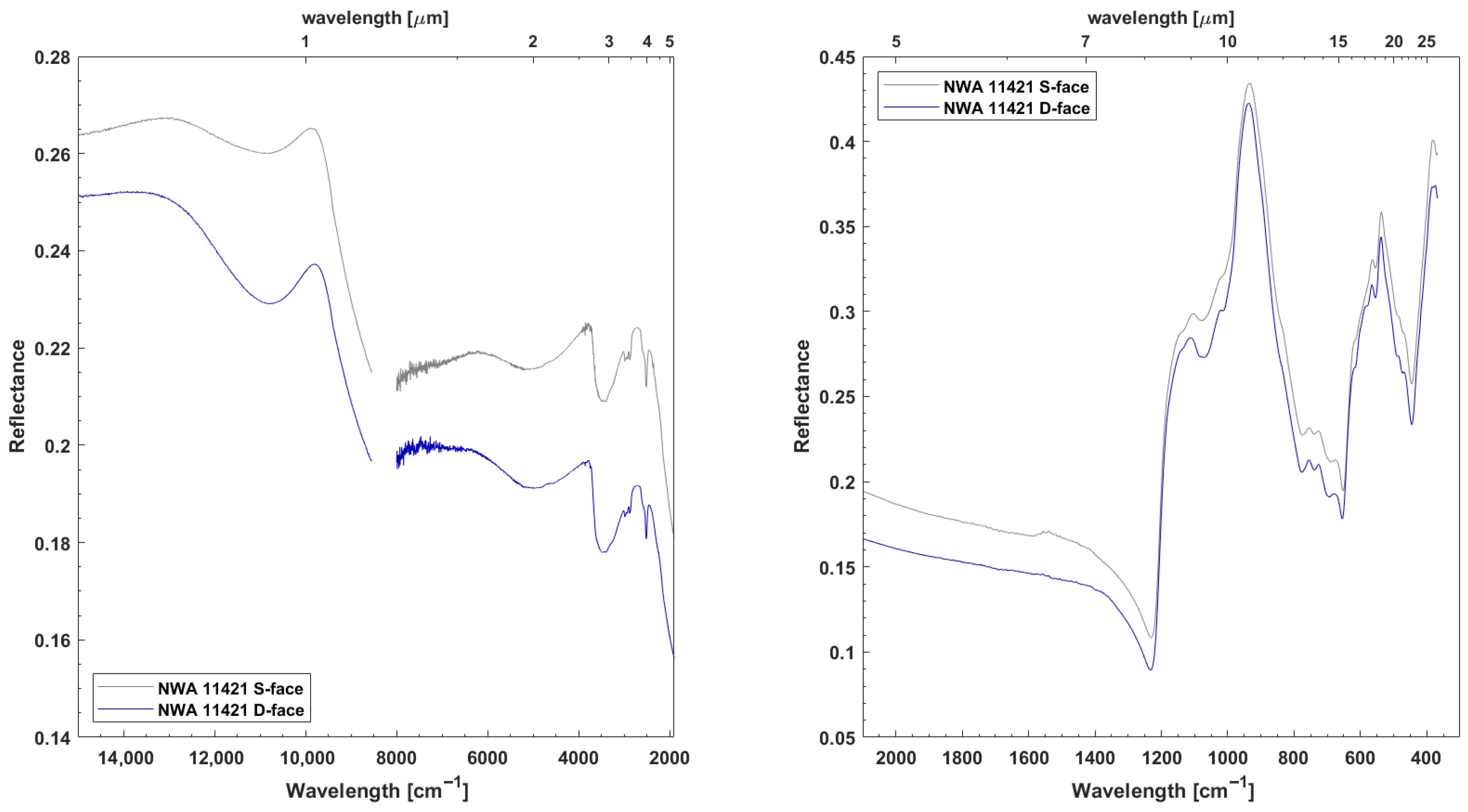
The reflectance spectra acquired on the two exposed surfaces of NWA 11421, the light-toned “D-face” and the darker “S-face”, show a high degree of similarity over the full VIS–IR range (Figure 1).
Both spectra display prominent absorption centered at 10,764 cm−1 (0.93 µm) for the D-face and at 10,848 cm−1 (0.92 µm) for the S-face. This band is attributed to Fe2+ crystal-field electronic transitions in the M2 crystallographic site of pyroxenes. A second broad absorption is observed near 4800 cm−1 (2.08 µm), which is assigned to Fe2+ crystal-field transitions responsible for the characteristic 2 µm band of pyroxenes. A subtle band appears around 8300 cm−1 (~1.2 µm). This spectral feature lies at the boundary between the MIR and VIS-NIR acquisition ranges, where instrumental continuity is limited. Therefore, this band is provisionally attributed to weaker Fe2+ transitions in the M1 site of pyroxenes. Therefore, this assignment must be considered with caution. Overall, the positions and shapes of the 1 and 2 µm absorptions are fully consistent with the behavior of Fe2+ crystal-field transitions in LCPs. As established by laboratory studies [20,21,22,23,24], these absorptions reflect a convolution of compositional, structural, and textural factors, with band positions generally shifting to longer wavelengths as Fe2+ and Ca2+ contents increase. The band centers observed here therefore point to pyroxenes within the low-Ca compositional field, consistent with ortho- and clinopyroxene mineralogies described in the literature.
Spectra acquired on the two faces show an absorption band near 3500 cm−1 (2.86 µm), which is assigned to OH-stretching vibrations. Additional weak absorptions in the 3000–2800 cm−1 region are attributed to C–H stretching modes of organic compounds. Bands observed at 2512 cm−1 (3.98 µm) and 2592 cm−1 (3.86 µm) are assigned to vibrational modes associated with carbonate groups.
Christiansen Features (CFs) are present in the spectra at 1232 cm−1 (8.12 µm) and 1230 cm−1 (8.13 µm) for the D-face and S-face, respectively. This feature is diagnostic of feldspathic materials and is commonly observed in plagioclase-rich assemblages.
Below the CF, the spectra exhibit a series of well-resolved characteristic peaks of feldspathic lunar material according to RELAB spectra references (Table S3). The band at 1160 cm−1 (8.62 µm) is assigned to vibrational modes of calcic plagioclase. A doublet between 1110 cm−1 (9.01 µm) and 1100 cm−1 (9.09 µm) is also observed and is attributed to overlapping contributions from calcic plagioclase and LCPs. The relative intensity of these two components differs between the two surfaces: the 1100 cm−1 peak is more intense in the S-face spectrum, whereas the 1110 cm−1 component is more pronounced in the D-face. Additional bands at 1020 cm−1 (9.80 µm) and at 934 cm−1 (10.71 µm) are assigned to fundamental vibrational modes of feldspar. A shoulder at 834 cm−1 (12.0 µm) is attributed to forsteritic olivine. At lower wavenumbers, a cluster of peaks occurs at 754 cm−1 (13.26 µm), 725 cm−1 (13.79 µm), and 673 cm−1 (14.85 µm), which are diagnostic of calcic plagioclase. Further feldspar-related absorptions are present at 620 cm−1 (16.13 µm), 602 cm−1 (16.61 µm), 588 cm−1 (17.01 µm), 565 cm−1 (17.70 µm), and 536 cm−1 (18.66 µm), followed by weaker bands at 484 cm−1 (20.66 µm) and 466 cm−1 (21.46 µm). The 602–588 cm−1 doublet is more intense in the D-face spectrum than in the S-face.
Overall, the spectral features observed in both surfaces are dominated by absorptions assigned to calcic plagioclase, with additional contributions from LCPs and forsteritic olivine, together with secondary features related to OH, organic compounds, and carbonates.

3.2. Meso-Scale IR

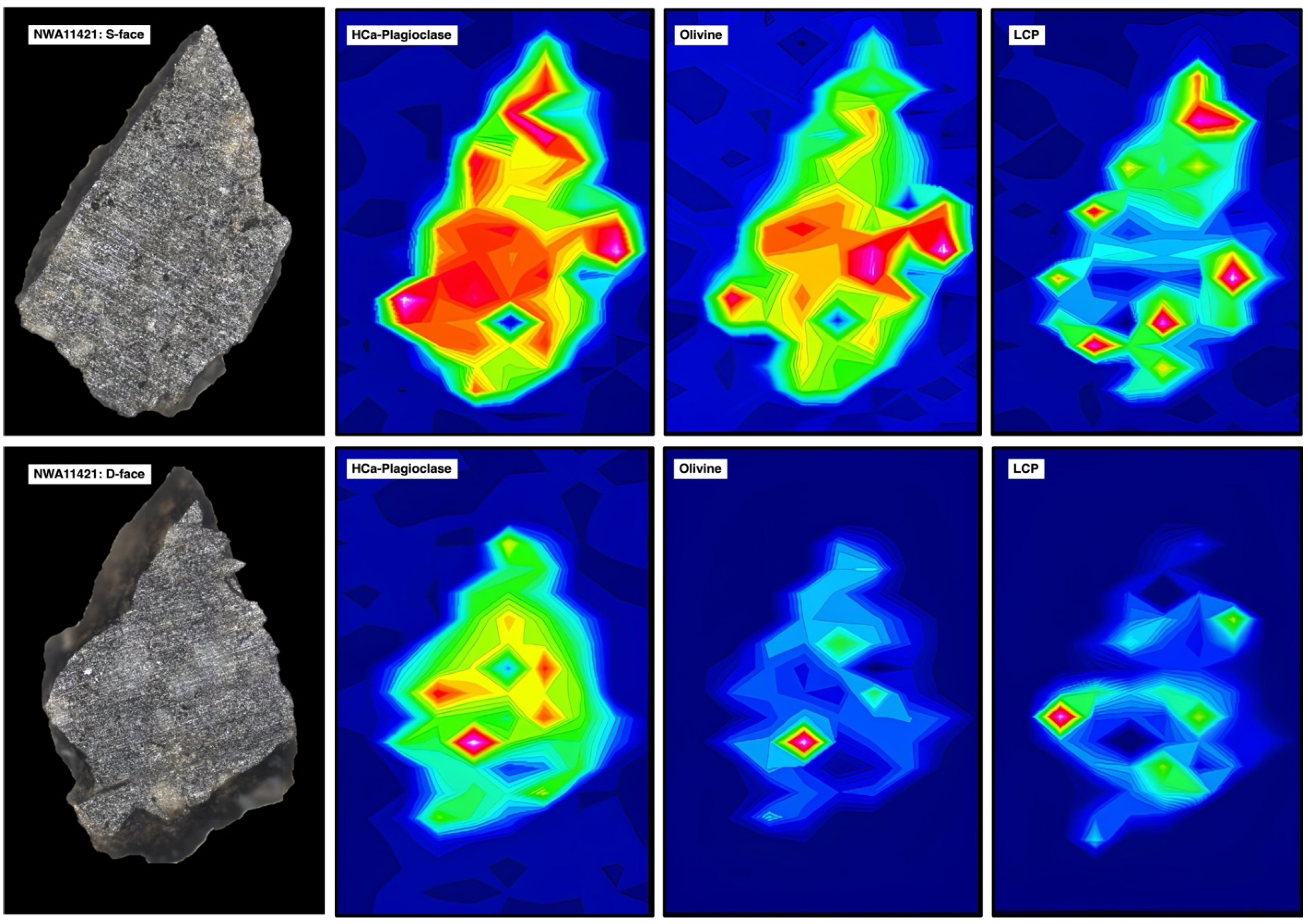
Moving from the macro-scale to the meso-scale, the MCT-based infrared analysis provides spatially resolved information on the distribution of the main mineral phases identified in the bulk spectra. Both the S-face and the D-face were mapped, focusing on anorthite, forsteritic olivine, and LCPs.
Representative diagnostic peaks were selected for each mineral phase: (i) 934 cm−1, assigned to the main vibrational mode of calcic plagioclase (anorthite); (ii) 834 cm−1, attributed to forsteritic olivine and chosen because it is the only olivine-related feature clearly resolvable in this spectral region; (iii) 1100 cm−1, assigned to LCPs, consistently with the bulk spectral observations.
The intensity maps obtained from the 934 cm−1 band show that the anorthositic component is pervasive across both faces of the sample, although with variable signal intensity (Figure 2). The 834 cm−1 maps reveal that olivine is more abundant on the S-face, whereas it appears significantly less prominent on the D-face. The spatial distribution of the 1100 cm−1 band indicates that LCP follows a pattern similar to that of olivine, with higher intensities on the S-face and lower intensities on the D-face.
Spatial comparisons between the three diagnostic maps show that olivine exhibits a co-localization with the anorthositic component, while LCP displays a tendency toward anti-correlation with the anorthositic matrix. In addition, the ratio between the anorthite signal (934 cm−1) and the combined olivine–LCP signals (834 and 1100 cm−1) is higher on the D-face than on the S-face, indicating a relative enhancement of the anorthositic spectral contribution on the D-face.
Overall, the MCT analysis reveals systematic variations in the relative abundance and spatial distribution of anorthite, olivine, and LCPs across the two exposed surfaces, providing spatially resolved confirmation of the mineralogical components identified in the bulk spectra.
Supplementary micro-EDXRF elemental maps (Figure S3) independently support the MCT results. High Al abundances are spatially associated with anorthite, consistent with the Al-rich composition of calcic plagioclase. Regions characterized by dominant Fe and low Mg contents are attributed to Fe-rich pyroxenes, such as ferrosilite. Olivine-bearing microdomains are identified by the co-occurrence of Mg and Fe in the absence of Ca, typically in clasts smaller than ~50 µm. Conversely, very high Ca abundances are diagnostic of anorthositic regions. The combined elemental distributions therefore corroborate the phase assignments derived from the MCT infrared mapping.

3.3. Micro-Scale IR

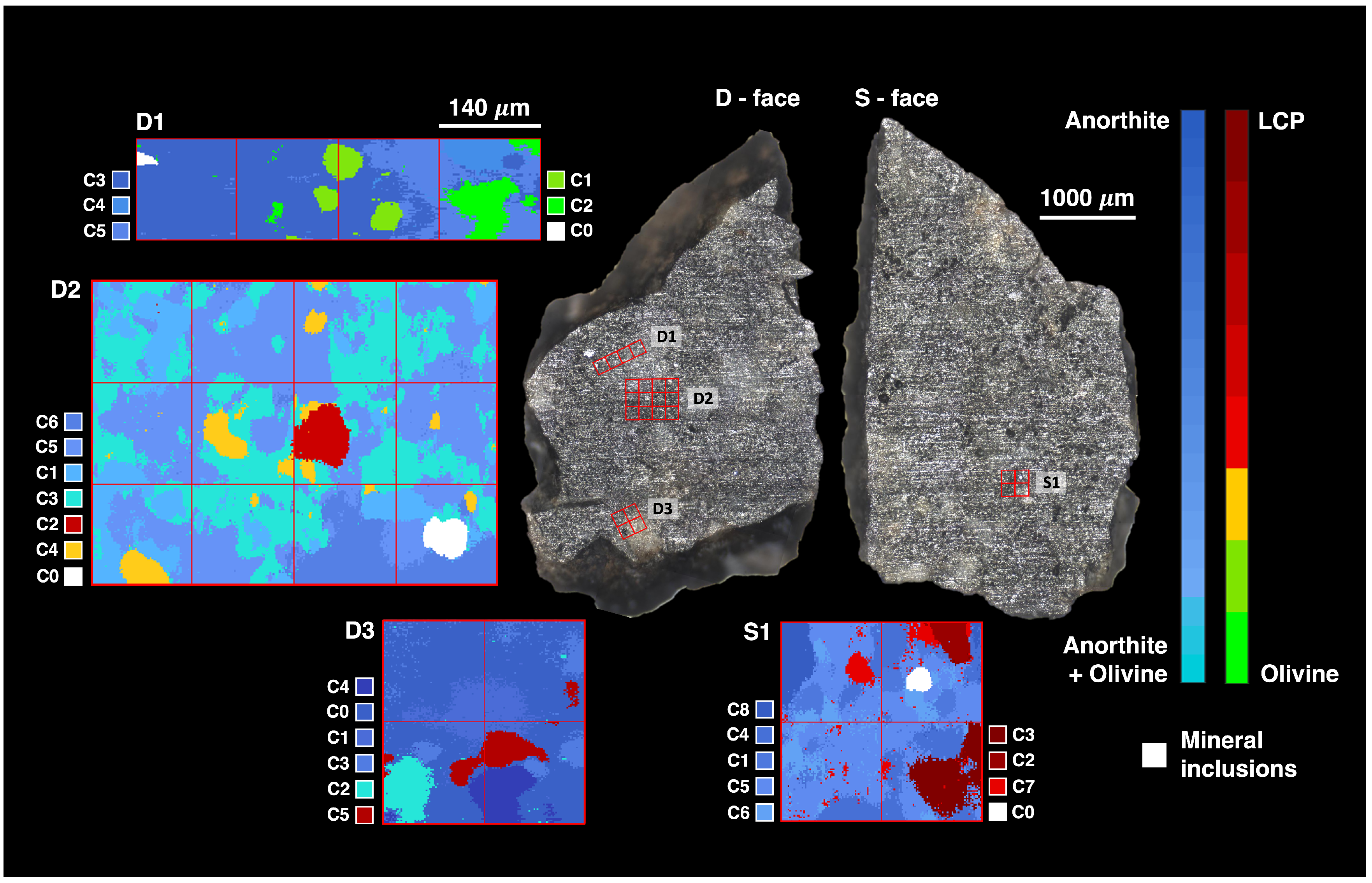
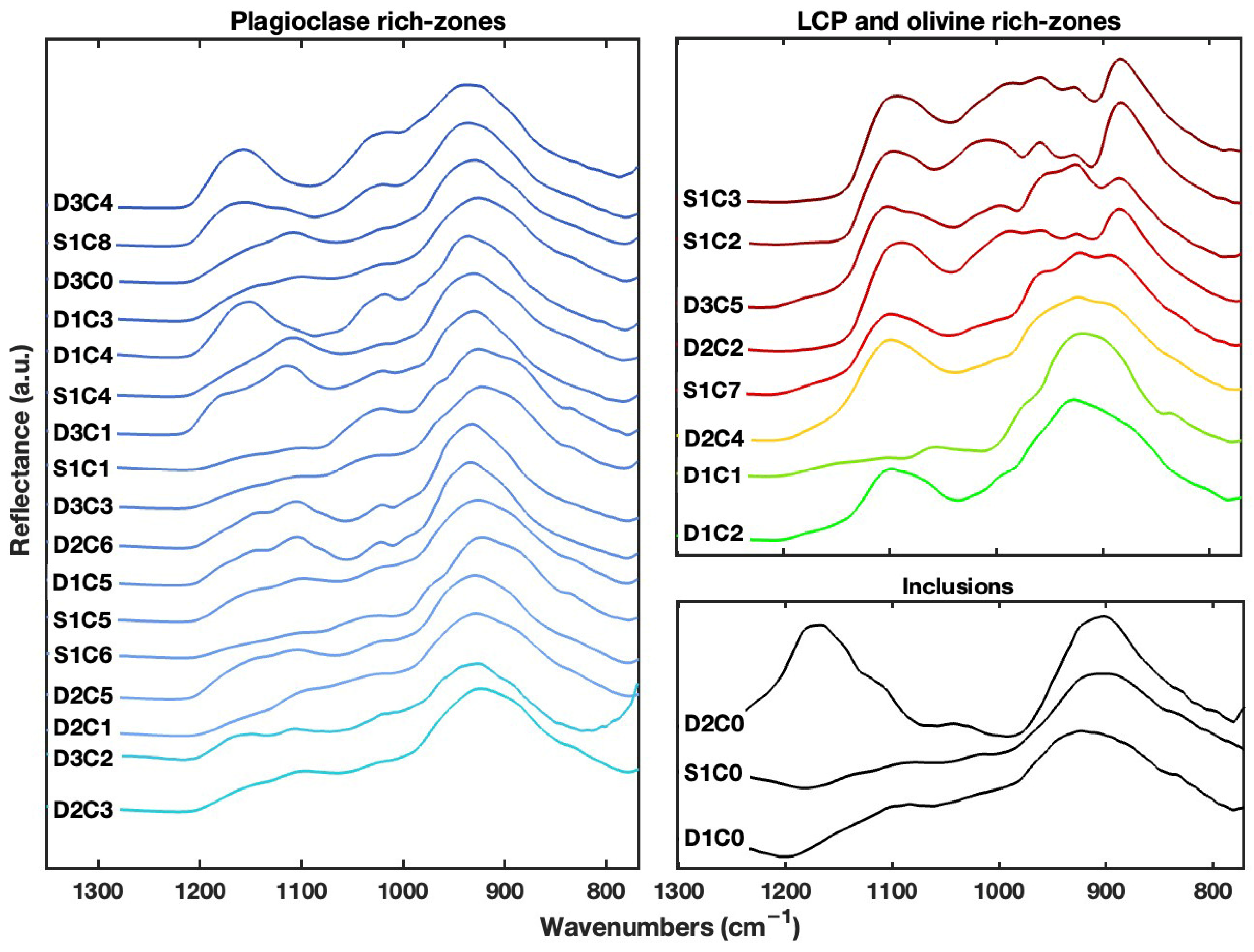
After characterizing the breccia at the macro-scale (bulk) and meso-scale (MCT), we extended our investigation to the micron scale through FPA hyperspectral mapping. The FPA hyperspectral datasets were analyzed using the spectral fitting procedures described in the Material and Methods section. These fitting approaches allowed the identification and comparison of the relative spectral contributions of anorthite, olivine, and LCPs (pigeonite and ferrosilite) within the different clusters and mapped microdomains. As shown in Figure 3 and Figure 4, four micro-scale regions were analyzed: three on the D-face (D1, D2, D3) and one on the S-face (S1). Within each region, clusters (C#) were extracted and assigned to dominant mineralogical components based on their diagnostic spectral features. Two main spectral domains and a third separate case for mineral inclusions were identified.
The first domain is characterized by spectra dominated by anorthite features, corresponding to the breccia matrix. Within this domain, a progressive transition is observed from spectra approaching nearly pure anorthite (blue-toned, from D3C4) to spectra showing increasing contributions of olivine (cyano-toned, up to D2C3), while retaining a minor but persistent contribution from LCPs. These clusters define a continuous spectral gradation from plagioclase-dominated to mixed plagioclase–olivine compositions.
The second domain comprises clusters in which anorthite features are negligible. They are dominated either by LCPs, such as pigeonite and ferrosilite (red-toned inclusions), or by olivine (green-toned inclusions), with intermediate clusters showing transitional compositions in which LCPs and olivine occur in comparable abundances (yellow-toned inclusions).
Finally, mineral inclusions represent a separate case and were analyzed independently. These inclusions, identified as clusters D2C0, S1C0, and D1C0, display spectral characteristics distinct from the surrounding matrix (Figure 3 and Figure 4).
For S1C0, the spectrum is characterized by a systematic redshift of the CF and of the RB relative to the surrounding matrix, while preserving the overall band shapes and their relative intensities. No significant broadening or suppression of the main vibrational features is observed, and the spectral morphology remains comparable to that of plagioclase-dominated clusters, apart from the shift in peak positions. Cluster D1C0 also exhibits a redshift of the CF and RB, although less pronounced than in S1C0. In addition, its spectrum is characterized by noticeable band broadening and by a flattening of the reflectance peaks, with some features becoming weakly expressed compared to the surrounding matrix, providing direct evidence for shock-related modification of plagioclase. These features are consistent with partial amorphization and represent transitional states between crystalline anorthite and diaplectic glass (maskelynite) [15]. Cluster D2C0 shows spectral characteristics that cannot be confidently assigned at this stage. Although spectral fitting suggests a predominantly anorthositic composition, its overall band morphology differs markedly from both the matrix and the other inclusions. Furthermore, the presence of absorptions around 1600 cm−1 could indicate organic contamination, which complicates interpretation and prevents a definitive assessment of the alteration processes affecting this inclusion.
Overall, the FPA analysis shows that the majority of the mapped regions are spectrally dominated by anorthite, in agreement with the trends observed in the bulk and MCT reflectance analyses. Diagnostic anorthite vibrational modes are pervasive across the dataset, confirming the presence of a continuous anorthositic matrix throughout the analyzed areas. At the same time, the cluster-derived spectra reveal a heterogeneous mineralogical assemblage at the micro-scale, defining a systematic organization of the breccia into: (i) an anorthite-dominated matrix with variable contributions of olivine; (ii) mafic microdomains dominated by LCPs and olivine; (iii) discrete inclusions characterized by modified spectral behavior.

4. Discussion

4.1. Multi-Scale Investigation of NWA 11421

The integration of the bulk, meso-scale (MCT), and micro-scale (FPA) results provides a coherent, multi-scale view of the mineralogical architecture of NWA 11421 and its geological significance. At all investigated spatial scales, the mineralogical assemblage is dominated by calcic plagioclase (anorthite), with significant contributions from LCPs and forsteritic olivine.
At the bulk scale, the dominance of spectroscopic features assigned to calcic plagioclase confirms that anorthite is the main mineralogical component of the sample (Figure 1). This is fully consistent with the feldspathic nature of NWA 11421 and reflects the prevalence of plagioclase-rich lithologies typical of the lunar highlands crust. Anorthositic materials are widely interpreted as flotation cumulates formed during the crystallization of the lunar magma ocean, and their spectral signature is characterized by a strong CF and by the dense set of MIR vibrational bands observed in the present spectra (Figure 1). Minor variations in band intensities between the two exposed surfaces, however, indicate local heterogeneity rather than fundamental compositional differences, which is consistent with a clastic, brecciated lithology. The detection of LCPs through the diagnostic 1 and 2 µm absorptions and their contribution to the MIR features around 1100 cm−1 reflects the incorporation of mafic components within the breccia matrix. Such pyroxenes are common in lunar breccias, where impact processes mechanically mix crustal anorthositic material with fragments of more mafic lithologies. In addition, forsteritic olivine, inferred from the feature at ~834 cm−1, indicates a contribution from olivine-bearing lithologies. In lunar breccias, olivine is consistent with deeper-seated crustal or mantle-related materials or with impact-derived mixing of mafic components into the feldspathic crust. Some spectral features also reflect secondary processes. The band at ~3500 cm−1 (2.86 µm), attributed to OH-stretching vibrations, may indicate terrestrial hydration and/or shock-induced hydroxylation. Additional minor absorptions between 3000 and 2800 cm−1, corresponding to C–H stretching modes, together with bands at 2512 cm−1 (3.98 µm) and 2592 cm−1 (3.86 µm), are consistent with the presence of organic and carbonate species, likely introduced by post-fall terrestrial contamination. These features do not affect the primary mineralogical interpretation but highlight the importance of considering secondary alteration processes when interpreting the infrared spectra of meteorites. Overall, the bulk spectral signature is consistent with a lunar anorthositic lithology, characterized by dominant calcic plagioclase with olivine and LCPs. The results align with the Meteoritical Bulletin classification of NWA 11421 and correlate well with comparative Apollo spectral datasets, particularly those of calcic plagioclase returned from the Taurus–Littrow region (Apollo 17) (see Table S1).
The MCT and μ-EDXRF results extend this bulk mineralogical picture by adding a spatial mineral distribution. The pervasive distribution of anorthite across both faces confirms that the feldspathic component constitutes the structural framework of the breccia, acting as the dominant matrix in which the other mineral phases are embedded. The higher abundance of olivine and LCPs on the S-face (consistent with bulk results), together with their relative depletion on the D-face, demonstrates that the breccia is laterally heterogeneous and records variations in the relative proportions of anorthositic and mafic components. Moreover, the observed spatial relationships between anorthite, olivine, and LCPs (Figure 2) are consistent with a heterogeneous mineralogical organization typical of polymict feldspathic breccias [1,25]. The spatial co-location between anorthite and olivine can be explained by the presence of troctolitic or troctolitic-anorthositic components (mixtures of plagioclase-rich and olivine-bearing materials) already observed in the NWA 11421 meteorite [14]. In contrast, the anti-correlation between these phases and LCPs suggests the incorporation of compositionally distinct mafic components within the feldspathic matrix.
The FPA hyperspectral results further refine this picture by revealing the mineralogical organization of the breccia at the micron scale. At this level, the sample exhibits a clear hierarchical structure in which a continuous anorthositic matrix is interspersed with discrete mafic microdomains and isolated bright inclusions (Figure 3 and Figure 4). The first spectral domain, dominated by anorthite with variable contributions from olivine and minor LCPs (left panel in Figure 4), corresponds to the breccia matrix and confirms that plagioclase-rich material forms the backbone of the sample. The smooth spectral transition from nearly pure anorthite to mixed anorthite–olivine compositions indicates the progressive incorporation of mafic material into the feldspathic matrix, rather than sharp lithological boundaries. This anorthite–olivine association is fully consistent with the MCT results, which show a clear spatial co-location of these phases, and provides micro-scale confirmation of the presence of troctolitic or troctolitic-anorthositic components within the breccia. The second spectral domain, in which anorthite is negligible and the spectra are dominated by olivine and LCPs (panel at the top right in Figure 4), represents discrete mafic microdomains embedded within the feldspathic matrix. These domains most plausibly correspond to fragments of more mafic lithologies that were mechanically incorporated into the breccia, which is typical of polymict lunar breccias [1].
Finally, the bright mineral inclusions provide additional insight into the physical processing of the breccia. The spectral behavior of S1C0, marked by a uniform redshift of the CF and RB without major changes in band morphology, indicates that some spectral anomalies arise from modifications of optical properties caused by variations in grain size, porosity, or thin glassy coatings, rather than from changes in mineralogy [26,27]. On the other hand, the observed features consistent with maskelynite of D1C0 indicate that the breccia experienced shock pressures sufficient to induce structural damage in plagioclase, a diagnostic signature of lunar impact processes [15,19]. The inclusion D2C0 remains ambiguous due to its anomalous spectral morphology and the presence of organic contamination, illustrating the complexity of micro-scale interpretation where multiple processes may overprint the primary mineralogical signal.

4.2. Application to Remote Sensing Exploration

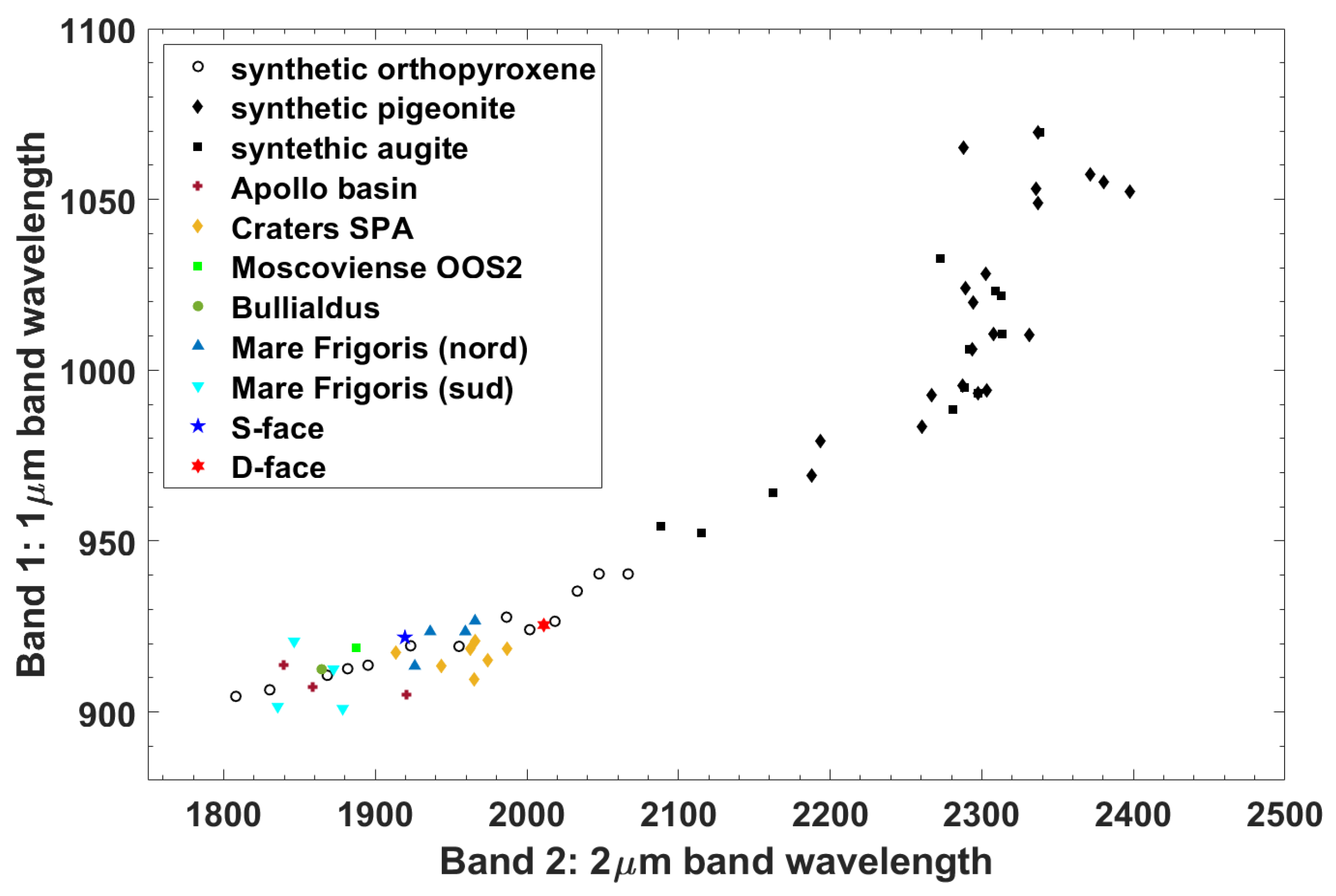
The average derived 1 μm and 2 μm band centers for the M2 crystallographic site in the bulk spectra of the two faces of NWA 11421 were compared with 20 LCP detections [16] obtained from the Moon using the Moon Mineralogy Mapper (M3) instrument on board the Chandrayaan-1 mission [28]. Values are plotted within the range of 1 and 2 μm band centers expected for orthopyroxene, as illustrated in Figure 5. A series of synthetic orthopyroxenes, pigeonites, and augites is plotted as a comparison. Half of the lunar pyroxenes in the plot show moderate Mg content, consistent with orthopyroxenes. The positions of both the D-face (red star) and S-face (blue star) fragments of the NWA 11421 meteorite within the diagram strongly support its proposed origin from the deep lunar crust or mantle cumulates. Both points cluster tightly with the synthetic orthopyroxene area, confirming the dominance of LCPs—a characteristic of primitive, high-temperature lunar interior material. The S-face, positioned slightly toward shorter wavelengths on the 2 μm axis, indicates a component that is particularly low in iron (Fe), suggesting a highly magnesian or primitive pyroxene composition. Conversely, the D-face’s minor shift toward longer wavelengths implies a slightly greater Fe content or a subtle contribution from a high-calcium phase. This spectral difference between the two faces reflects the minor chemical and thermal heterogeneities expected within a mantle-derived sample.
Figure 5. Position of 1 μm and 2 μm band centers for the D-face and S-face of NWA 11421 in comparison with 20 LCPs observed on the Moon by Klima et al. [16], and the synthetic pyroxenes [23,29].
Remotesensing 18 00576 g005
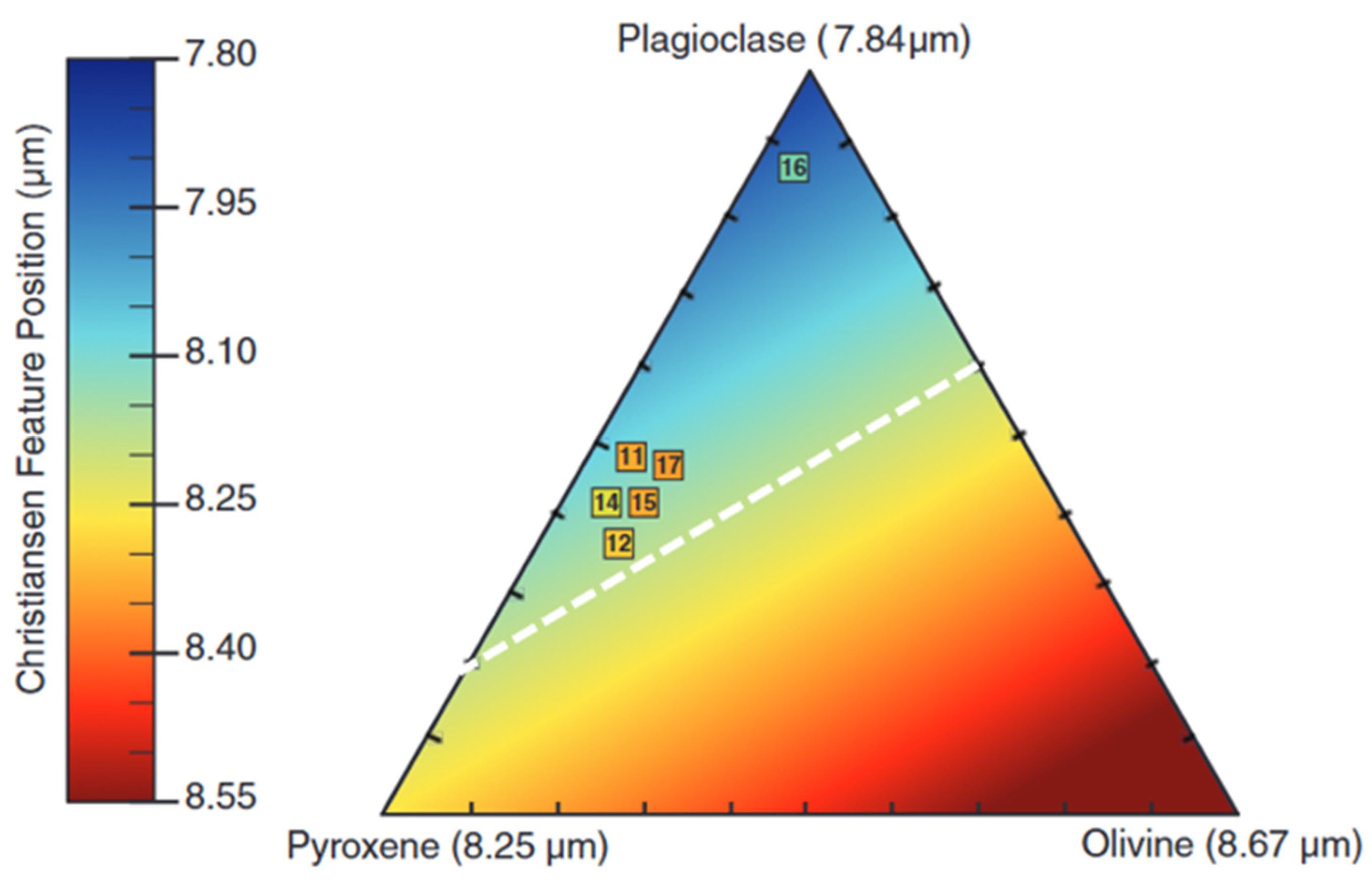
More information can arise from the position of the CF from the bulk measurements of both NWA 11421 faces. In Figure 6, we plotted the line of constant CF 8.12 μm (average value for both breccia faces) on a silicate ternary constructed by using CF positions for crystalline immature plagioclase (anorthite endmember), pyroxene (intermediate composition), and olivine (forsterite endmember). For reference, the CF values of samples collected at each Apollo landing site are presented. All Apollo points are significantly closer to the plagioclase (anorthite) corner. This confirms that the lunar crust sampled by Apollo missions, even in the maria (basaltic plains), has a very high component of anorthite, supporting the LMO model where the crust formed from floating anorthite crystals. However, the dashed white line represents all possible mineral compositions that would yield a CF value of 8.12 μm. Any sample plotting along this line is a mixture of plagioclase, pyroxene, and olivine in proportions that collectively result in the 8.12 μm CF feature. The dashed white line passes through the pyroxene-rich area of the diagram, below the main cluster of the plagioclase-rich Apollo samples with a CF value significantly higher than that of pure anorthite (7.84 μm). This indicates that NWA 11421 is much richer in mafic components (pyroxene and olivine) and poorer in anorthite compared to the average lunar highlands sample. This mafic enrichment is consistent with the interpretation that NWA 11421 originated from the deep crustal or shallow mantle cumulates—rock layers richer in olivine and pyroxene that settled during the LMO crystallization.
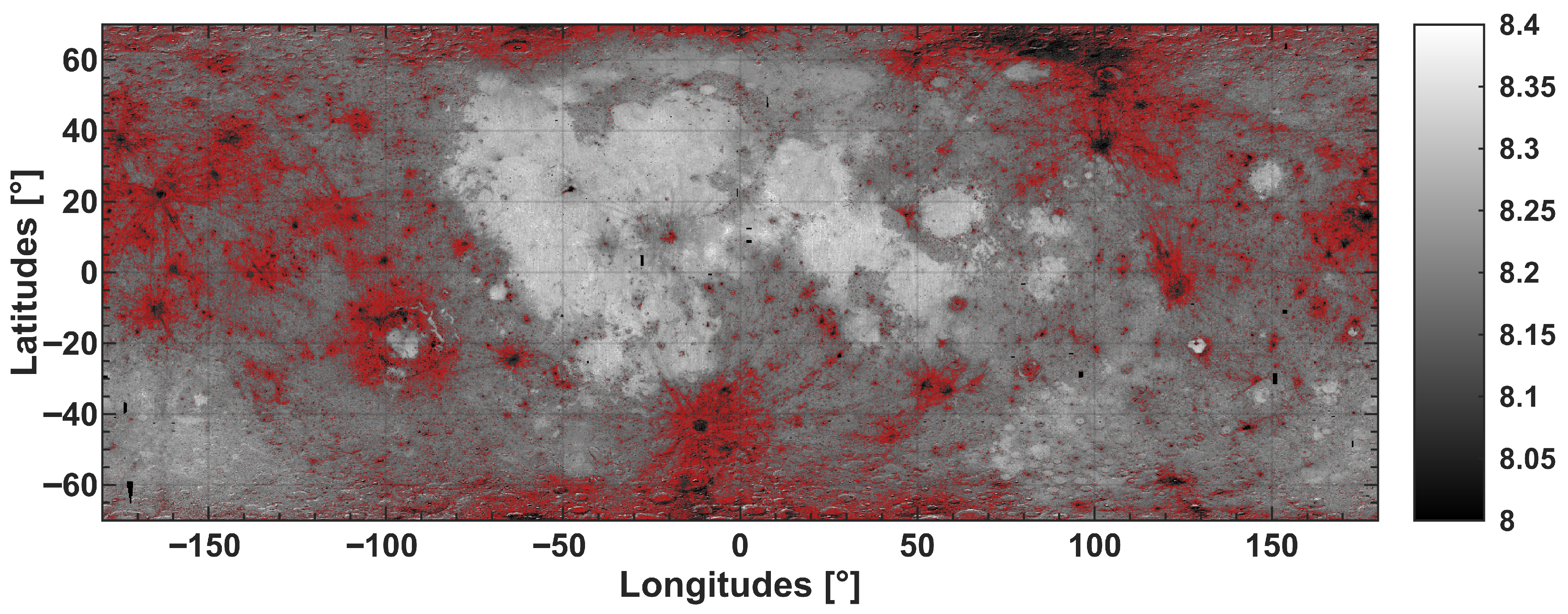
From data of the Diviner Lunar Radiometer instrument on board the NASA Lunar Reconnaissance Orbiter, it was possible to obtain global maps of the CF values [30]. From our measured value for the NWA 11421 CF of 8.12 μm, we evaluated a range of ±2 μm to try to identify possible regions with similar values. The results are shown in Figure 7 highlighted in red over the CF maps in gray. As can be seen, regions with CF values close to NWA 11421 are found in proximity to craters ejecta, reinforcing the suggestion that the meteorite is a product of melting from an impact excavating material from the deep mantle.
Figure 6. Silicate ternary diagram with associated CF positions for plagioclase (anorthite endmember), pyroxene (intermediate composition), and olivine (forsterite endmember) measured in simulated lunar conditions and assuming a linear mixing behavior for the CF position. The CF values of samples from each Apollo site are superimposed (squared numbers from 11 to 17), as well as the white dashed line representing the constant CF value of 8.12 μm observed in bulk spectra of the NWA 11421 meteorite (figure modified from Greenhagen et al. [31]).
Remotesensing 18 00576 g006
Figure 7. Image of the CF from the Diviner Lunar Radiometer Experiment. Data are plotted as the inverse of wavelength, with 8 μm in black and 8.4 μm in white. In red are highlighted regions where the CF is in the range ± 2 μm from NWA 11421 with a value of 8.12 μm. Note that the regions with comparable CF are located in close proximity to craters ejecta. The longitude covers ± 180°, and latitude is ±70° (figure modified from Lucey et al. [30]).
Remotesensing 18 00576 g007

4.3. Importance of Mantle Rocks in ISRU Application

In the context of human space exploration, NWA 11421 could increase our knowledge. The presence of anorthite, olivine, and pyroxene is paramount for lunar ISRU (In Situ Resource Utilization) as these minerals constitute the bulk of the Moon’s crust and mantle, serving as the primary source for essential resources (see Table 1). Anorthite (dominant in the highlands) provides the necessary aluminum for structural alloys and O2, while the mafic olivine and pyroxene (common in the maria and mantle) supply critical iron and magnesium for heavy infrastructure and shielding. The distribution of these elements can be inferred from remote sensing data and supported by meteorite analyses, which provide complementary constraints but do not replace direct in situ measurements. Moreover, the mineralogy will dictate landing site selection, ensuring access to high-quality metallic feedstocks and predictable O2 yields through processes like Molten Regolith Electrolysis, thereby minimizing dependence on Earth resupply.
In the hypothesis of a lunar mantle origin, the information obtained by NWA 11421 could be significant for optimizing ISRU, despite the surface focus of current missions. Mantle-derived rocks, often found as deep impact ejecta or xenoliths, reveal primitive mineral compositions (high Mg-olivine and pyroxenes) that are often purer and less altered than surface regolith. This purity guarantees cleaner, more concentrated feedstocks for magnesium and iron extraction, facilitating the more efficient metal and alloy production essential for building lunar infrastructure. Furthermore, mantle material is expected to be severely depleted in volatile elements and contaminants, simplifying high-temperature processing like Molten Regolith Electrolysis for O2 harvesting. Finally, mantle rocks, being excavated after impact and other collisional events, are expected to also be located in highland terrain usually deprived of olivine and pyroxene. Understanding the mantle’s stratification validates the lunar magma ocean model, allowing scientists to reliably predict the composition of un-sampled regions and strategically select future resource exploitation sites far more effectively than relying solely on heterogeneous surface data. As visible from Figure 7, the possible distribution of material close in composition to NWA 11421 can be found in close proximity to craters ejecta; therefore, these regions should be included in the possible list of future landing sites.

5. Conclusions

In this work, we present a multi-scale, non-destructive characterization of the lunar meteorite NWA 11421 combining VIS–IR bulk spectroscopy, μ-FTIR imaging (MCT and FPA), and μ-EDXRF analysis. This integrated approach demonstrates how laboratory spectroscopy can provide a robust framework for linking meteorite studies with orbital remote sensing, with the potential to strengthen the role of lunar meteorites in global investigations of the Moon’s composition from the perspective of exploration.
The dataset consistently indicates that NWA 11421 is dominated by anorthositic lithologies, in agreement with its classification as a feldspathic breccia, while hosting a significant mafic component in the form of olivine and LCPs (pigeonite and ferrosilite). At the bulk and meso-scale, the anorthositic matrix contains substantial olivine contributions, defining troctolitic compositions, while LCP-rich domains are spatially anti-correlated with the feldspathic matrix. This organization reflects the polymict nature of the breccia and records impact-driven mixing of lithologies with different petrogenetic origins. At the micro-scale, discrete mafic domains dominated by olivine and LCPs are observed within the anorthositic matrix, demonstrating that lithological heterogeneity is preserved down to the micron scale.
Moreover, the bulk near-infrared pyroxene band positions and the CF values establish a direct link between laboratory measurements and orbital remote sensing data. The near-infrared bands fall within the orthopyroxene field, confirming the dominance of LCPs and suggesting relatively mafic and primitive components. This mafic character is further supported by the CF position of NWA 11421, which lies closer to the pyroxene corner of the silicate ternary diagram compared to typical Apollo highland samples. In addition, the CF value of NWA 11421 matches those observed by the Diviner Lunar Radiometer Experiment in lunar crater-ejecta regions, reinforcing the consistency between laboratory spectra and impact-excavated materials identified from orbit.
From a broader scientific perspective, this study can show how multi-scale laboratory spectroscopy can refine the interpretation of orbital mineralogical maps and improve our understanding of crustal and deep-seated lunar lithologies. In addition, it could provide a methodological template that can be applied to other meteorites and future returned samples. In the context of future Moon missions, our results could be particularly relevant for the identification and characterization of crater-related terrains as key targets for accessing mafic and potentially mantle-proximal materials. Although meteorite studies cannot replace in situ investigations, they can provide complementary constraints for landing site selection, mission planning, and resource assessment (ISRU). Consequently, this study could serve both as a scientific reference for lunar processes and as a guide for future exploration strategies aimed at understanding and utilizing the Moon’s geological diversity.


Supplementary Materials

The following supporting information can be downloaded at: https://www.mdpi.com/article/10.3390/rs18040576/s1, Figure S1: XRF maps of D- and S-face of NWA 11421; Figure S2: Result of nonnegative least-squares (NLS) curve fitting for the cluster obtained from FPA μ-FTIR measurements; Figure S3: Result of gaussian fit for the cluster obtained from FPA μ-FTIR measurements; Table S1: RELAB index of the spectra used in the paper; Table S2: Result of nonnegative least-squares (NLS) curve fitting for the cluster obtained from FPA μ-FTIR measurements; Table S3: Result of gaussian fit for the cluster obtained from FPA μ-FTIR measurements.

Author Contributions

Conceptualization, A.A., F.R., and G.P.; methodology, A.A., F.R., and G.P.; software, G.P., F.R., and A.A.; validation, A.A., F.R., G.P., C.G.-F., and S.B.; formal analysis, G.P. and F.R.; investigation, A.A., F.R., G.P., and F.A.; resources, J.R.B., T.F., J.A., and J.M.M.; data curation, A.A., F.R., and G.P.; writing—original draft preparation, A.A., F.R., and G.P.; writing—review and editing, A.A., F.R., G.P., F.A., S.B., C.G.-F., A.R., M.B., T.F., J.A., J.M.M., and J.R.B.; visualization, A.A., F.R., G.P., and F.A.; supervision, A.A., F.R., and G.P.; project administration, A.A., F.R., and G.P.; funding acquisition, J.R.B., T.F., J.A., and J.M.M. All authors have read and agreed to the published version of the manuscript.

Funding

This research was funded by the Space It Up project funded by the Italian Space Agency, ASI, and the Ministry of University and Research, MUR, under contract n. 2024-5-E.0-CUP n. I53D24000060005. F.A., J.A., and J.M.M. acknowledge the support of the PAMMAT project funded by the Spanish Agency for Research, Contract No. PID2022-142750OB-I00, funded by the Spanish Agency for Research AEI (through the Spanish Ministry of Science and Innovation, MCIN, and the European Regional Development Fund, FEDER, MCIN/AEI/10.13039/501100011033/FEDER, UE).

Data Availability Statement

Data are contained within the article or Supplementary Materials.

Conflicts of Interest

The authors declare no conflicts of interest.

References

  1. Korotev, R.L. Lunar geochemistry as told by lunar meteorites. Geochemistry 2005, 65, 297–346. [Google Scholar] [CrossRef]
  2. Joy, K.H.; Gross, J.; Korotev, R.L.; Zeigler, R.A.; McCubbin, F.M.; Snape, J.F.; Curran, N.M.; Pernet-Fisher, J.F.; Arai, T. Lunar meteorites. Rev. Mineral. Geochem. 2023, 89, 509–562. [Google Scholar] [CrossRef]
  3. Cohen, B.A.; Swindle, T.D.; Kring, D.A. Support for the lunar cataclysm hypothesis from lunar meteorite impact melt ages. Science 2000, 290, 1754–1756. [Google Scholar] [CrossRef] [PubMed]
  4. Korotev, R.L.; Jolliff, B.L.; Zeigler, R.A.; Gillis, J.J.; Haskin, L.A. Feldspathic lunar meteorites and their implications for compositional remote sensing of the lunar surface and the composition of the lunar crust. Geochim. Cosmochim. Acta 2003, 67, 4895–4923. [Google Scholar] [CrossRef]
  5. Demidova, S.I.; Nazarov, M.A.; Lorenz, C.A.; Kurat, G.; Brandstätter, F.; Ntaflos, T. Chemical composition of lunar meteorites and the lunar crust. Petrology 2007, 15, 386–407. [Google Scholar] [CrossRef]
  6. Joy, K.H.; Arai, T. Lunar meteorites: New insights into the geological history of the Moon. Astron. Geophys. 2013, 54, 4–28. [Google Scholar] [CrossRef]
  7. Gnos, E.; Hofmann, B.A.; Al-Kathiri, A.; Lorenzetti, S.; Eugster, O.; Whitehouse, M.J.; Villa, I.M.; Jull, A.J.T.; Eikenberg, J.; Spettel, B.; et al. Pinpointing the source of a lunar meteorite: Implications for the evolution of the Moon. Science 2004, 305, 657–659. [Google Scholar] [CrossRef]
  8. Arai, T.; Hawke, B.R.; Giguere, T.A.; Misawa, K.; Miyamoto, M.; Kojima, H. Antarctic lunar meteorites Yamato-793169, Asuka-881757, MIL 05035, and MET 01210 (YAMM): Launch pairing and possible cryptomare origin. Geochim. Cosmochim. Acta 2010, 74, 2231–2248. [Google Scholar] [CrossRef]
  9. Joy, K.H.; Crawford, I.A.; Curran, N.M.; Zolensky, M.; Fagan, A.F.; Kring, D.A. The Moon: An archive of small body migration in the Solar System. Earth Moon Planets 2016, 118, 133–158. [Google Scholar] [CrossRef]
  10. Warren, P.H. “New” lunar meteorites: Implications for composition of the global lunar surface, lunar crust, and the bulk Moon. Meteorit. Planet. Sci. 2005, 40, 477–506. [Google Scholar] [CrossRef]
  11. Zhang, P.; Dai, W.; Niu, R.; Zhang, G.; Liu, G.; Liu, X.; Bo, Z.; Wang, Z.; Zheng, H.; Liu, C.; et al. Overview of the lunar in situ resource utilization techniques for future lunar missions. Space Sci. Technol. 2023, 3, 0037. [Google Scholar] [CrossRef]
  12. Gattacceca, J.; Bouvier, A.; Grossman, J.; Metzler, K.; Uehara, M. The meteoritical bulletin, No. 106. Meteorit. Planet. Sci. 2019, 54, 469–471. [Google Scholar] [CrossRef]
  13. Treiman, A.H.; Coleff, D.M. Lunar meteorite Northwest Africa (NWA) 11421: X-ray tomography and preliminary petrology. In Proceedings of the 81st Annual Meeting of the Meteoritical Society, Moscow, Russia, 22–27 July 2018; Volume 81, p. 6329. [Google Scholar]
  14. Treiman, A.H.; Semprich, J. A dunite fragment in meteorite Northwest Africa (NWA) 11421: A piece of the Moon’s mantle. Am. Mineral. 2023, 108, 2182–2192. [Google Scholar] [CrossRef]
  15. Martin, D.J.P.; Joy, K.H.; Pernet-Fisher, J.F.; Wogelius, R.; Morlok, A.; Hiesinger, H. Using quantitative micro-FTIR spectroscopy to characterise the shock history of feldspathic lunar meteorites Miller Range 090034, 090070 and 090075. In Proceedings of the 47th Annual Lunar and Planetary Science Conference, Woodlands, TX, USA, 21–25 March 2016; p. 1547. [Google Scholar]
  16. Klima, R.L.; Pieters, C.M.; Boardman, J.W.; Green, R.O.; Head, J.W.; Isaacson, P.J.; Mustard, J.F.; Nettles, J.W.; Petro, N.E.; Staid, M.I.; et al. New insights into lunar petrology: Distribution and composition of prominent low-Ca pyroxene exposures as observed by the Moon Mineralogy Mapper (M3). J. Geophys. Res. Planets 2011, 116. [Google Scholar] [CrossRef]
  17. Bruschini, E.; Carli, C.; Tosi, F. Mapping the Spectral and Mineralogical Variability of Lunar Breccia Meteorite NWA 13859 by VNIR Reflectance Spectroscopy. Minerals 2023, 13, 1000. [Google Scholar] [CrossRef]
  18. Cao, H.; Chen, J.; Fu, X.; Ling, Z. Raman and infrared spectroscopic perspectives of lunar meteorite Northwest Africa 4884. J. Raman Spectrosc. 2020, 51, 1652–1666. [Google Scholar] [CrossRef]
  19. Martin, D.J.P.; Pernet-Fisher, J.F.; Joy, K.H.; Wogelius, R.A.; Morlok, A.; Hiesinger, H. Investigating the shock histories of lunar meteorites Miller Range 090034, 090070, and 090075 using petrography, geochemistry, and micro-FTIR spectroscopy. Meteorit. Planet. Sci. 2017, 52, 1103–1124. [Google Scholar] [CrossRef]
  20. Adams, J.B. Visible and near-infrared diffuse reflectance spectra of pyroxenes as applied to remote sensing of solid objects in the solar system. J. Geophys. Res. 1974, 79, 4829–4836. [Google Scholar] [CrossRef]
  21. Cloutis, E.A.; Gaffey, M.J. Pyroxene spectroscopy revisited: Spectral-compositional correlations and relationship to geothermometry. J. Geophys. Res. Planets 1991, 96, 22809–22826. [Google Scholar] [CrossRef]
  22. Burns, R.G. Rates and mechanisms of chemical weathering of ferromagnesian silicate minerals on Mars. Geochim. Cosmochim. Acta 1993, 57, 4555–4574. [Google Scholar] [CrossRef]
  23. Klima, R.L.; Pieters, C.M.; Dyar, M.D. Spectroscopy of synthetic Mg-Fe pyroxenes I: Spin-allowed and spin-forbidden crystal field bands in the visible and near-infrared. Meteorit. Planet. Sci. 2007, 42, 235–253. [Google Scholar] [CrossRef]
  24. Denevi, B.W.; Lucey, P.G.; Hochberg, E.J.; Steutel, D. Near-infrared optical constants of pyroxene as a function of iron and calcium content. J. Geophys. Res. Planets 2007, 112. [Google Scholar] [CrossRef]
  25. Heiken, G.; Vaniman, D.; French, B.M. Lunar Sourcebook: A User’s Guide to the Moon; Cambridge University Press: Cambridge, UK, 1991. [Google Scholar]
  26. Cooper, B.L.; Salisbury, J.W.; Killen, R.M.; Potter, A.E. Midinfrared spectral features of rocks adnd their powders. J. Geophys. Res. Planets 2002, 107, 1-1-1-17. [Google Scholar] [CrossRef]
  27. Martin, A.C.; Emery, J.P.; Loeffler, M.; Donaldson Hanna, K.L. Mid-infrared reflectance and emissivity spectra of high porosity regoliths. J. Geophys. Res. Planets 2025, 130, e2024JE008331. [Google Scholar] [CrossRef]
  28. Green, R.O.; Pieters, C.; Mouroulis, P.; Eastwood, M.; Boardman, J.; Glavich, T.; Isaacson, P.; Annadurai, M.; Besse, S.; Barr, D.; et al. The Moon Mineralogy Mapper (M3) imaging spectrometer for lunar science: Instrument description, calibration, on-orbit measurements, science data calibration and on-orbit validation. J. Geophys. Res. Planets 2011, 116. [Google Scholar] [CrossRef]
  29. Klima, R.L.; Dyar, M.D.; Pieters, C.M. Near-infrared spectra of clinopyroxenes: Effects of calcium content and crystal structure. Meteorit. Planet. Sci. 2011, 46, 379–395. [Google Scholar] [CrossRef]
  30. Lucey, P.G.; Greenhagen, B.; Hanna, K.D.; Bowles, N.; Flom, A.; Paige, D.A. Christiansen feature map from the lunar reconnaissance orbiter diviner lunar radiometer experiment: Improved corrections and derived mineralogy. J. Geophys. Res. Planets 2021, 126, e2020JE006777. [Google Scholar] [CrossRef]
  31. Greenhagen, B.T.; Lucey, P.G.; Wyatt, M.B.; Glotch, T.D.; Allen, C.C.; Arnold, J.A.; Bandfield, J.L.; Bowles, N.E.; Hanna, K.L.D.; Hayne, P.O.; et al. Global silicate mineralogy of the Moon from the Diviner Lunar Radiometer. Science 2010, 329, 1507–1509. [Google Scholar] [CrossRef]
Figure 1. Bulk VIS–IR reflectance spectra of the two exposed surfaces of NWA 11421, showing dominant anorthositic signatures with variable contributions from LCPs and olivine. Differences between the surfaces reflect localized heterogeneity within the breccia.
Remotesensing 18 00576 g001
Figure 2. MCT-based infrared meso-scale analysis of the NWA 11421 breccia. Both the S- and D-faces were mapped to obtain spatially resolved information on the distribution of the main mineral phases identified in the bulk spectra, with particular focus on anorthite (High-Ca Plagioclase), forsteritic olivine, and LCPs.
Remotesensing 18 00576 g002
Figure 3. FPA hyperspectral mineral mapping of four micro-scale regions on the D-face (D1, D2, D3) and S-face (S1) of the sample. The center of the image shows the locations of the analyzed grids in the breccia. For each grid, cluster maps (C#) derived from the FPA analysis are displayed with corresponding color keys indicating dominant mineralogical components. Colors reflect the relative abundance of anorthite (blue), olivine (green), and LCPs (red). Cyan clusters C2 and C3 have a higher abundance of olivine than anorthite. White clusters correspond to mineral inclusions, which were analyzed separately. The maps illustrate the heterogeneous yet systematically organized mineralogy of the breccia, revealing spatial transitions between anorthositic matrix regions, olivine- and pyroxene-rich microdomains, and isolated inclusions with distinct spectral behavior.
Remotesensing 18 00576 g003
Figure 4. Representative FPA-derived reflectance spectra for all clusters grouped by mineralogical dominance. The (left panel) shows clusters belonging to the plagioclase-rich domain (blue-toned), characterized by a progressive transition from nearly pure anorthite (D3C4) to spectra showing increasing contributions from olivine (up to D2C3), while retaining a minor but persistent contribution from LCPs. The (top right panel) displays spectra from clusters in which anorthite is negligible and the spectral signature is dominated by LCPs (pigeonite and ferrosilite) and/or olivine, illustrating transitional trends from LCP-dominated (red) to olivine-dominated (green) compositions, through a close fifty-fifty mix of the two components (yellow). The (bottom right panel) presents spectra from mineral inclusions, which form a distinct spectral family due to band shifts, band broadening, or anomalous morphology relative to the surrounding matrix.
Remotesensing 18 00576 g004
Table 1. Dominant composition for different terrains of Moon surface and mantle rocks, the possible elements extractable, and their role in ISRU application.
Dominant MineralLunar TerrainExtracted ResourcesISRU Application
Anorthite
CaAl2Si2O8
Highlands (light-colored uplands)Oxygen (O2),
aluminum (Al),
silicon (Si)
Construction of structures, solar cells.
Pyroxene/Olivine
(Fe,Mg)SiO3
Maria (dark plains) or mantle rocksOxygen (O2),
iron (Fe),
magnesium (Mg)
(element purity increase in mantle rocks)
Shielding, heavy infrastructure, propellant.
Disclaimer/Publisher’s Note: The statements, opinions and data contained in all publications are solely those of the individual author(s) and contributor(s) and not of MDPI and/or the editor(s). MDPI and/or the editor(s) disclaim responsibility for any injury to people or property resulting from any ideas, methods, instructions or products referred to in the content.