First Light Capabilities of UVSQ-SAT NG NanoCam: Preliminary Limb Temperature Retrieval from a CubeSat Imager

 ,
,  , , , , and
Highlights
- Use of CubeSats to measure atmospheric temperature.
- Identify instrumental issues.
- Allow for the development of an operational satellite payload.
- Allow for the deployment of a constellation of such instruments.
Abstract
1. Introduction
2. Dynamics of the Middle Atmosphere: Characteristic Phenomena and Scales
3. Description of UVSQ-Sat NG
4. Processing the Image Obtained Using the NSRTM Model
5. Conclusions
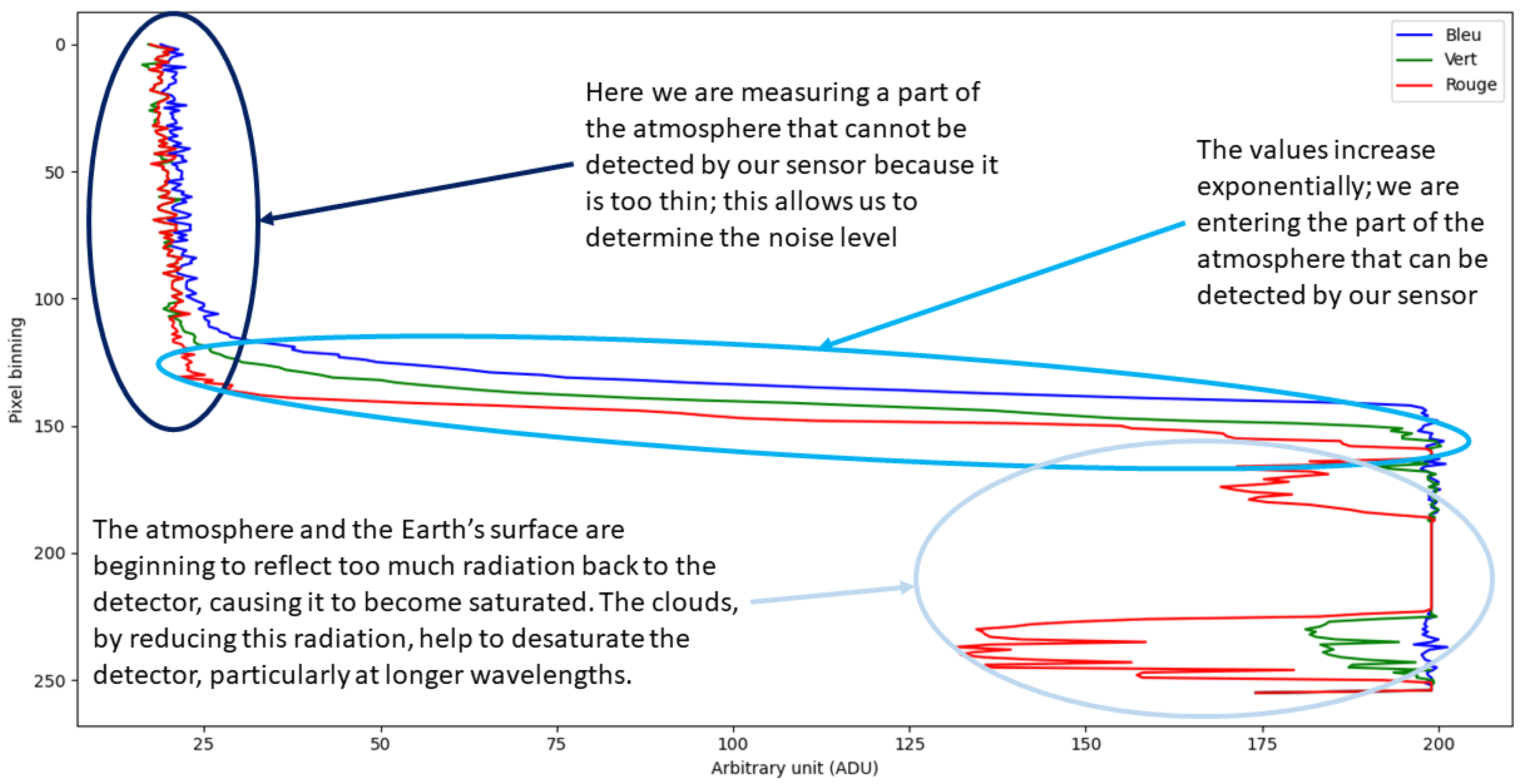
- The electronic saturation of the detector pixels (upper limit) and various types of noise, such as those induced by exposure time or detector cooling (lower limit), should enable a measurement dynamic range of over 1000 to be achieved.
- Detector noise, which must be limited as much as possible to reach the highest altitudes
- Ensuring a nominal limb pointing mode in order to know the pointing precisely.
- Avoiding saturating the detector in the lower part in order to determine the altitude and having an alternative to deduce the altitude scales in case of for the absence of a stellar sensor.
- Peak charge storage.
- Dark signal.
- Readout noise.
- Dark signal non-uniformity.
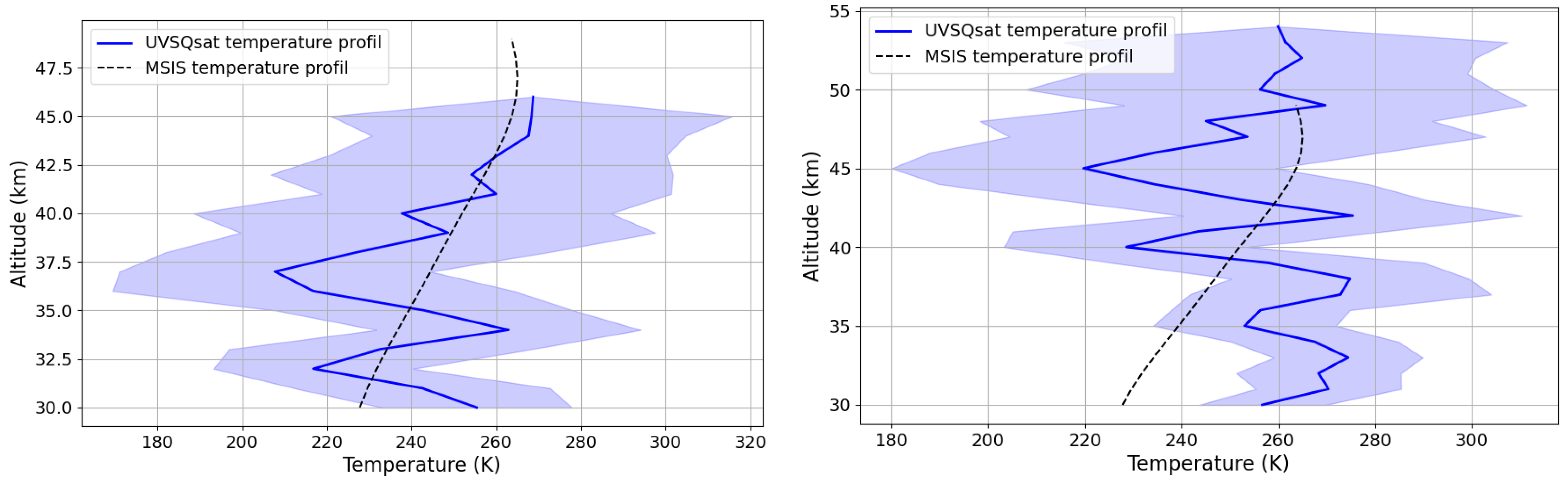
- Reproduce a temperature field uncontaminated by atmospheric tides.
- Significantly increase the number of observations at this level of the atmosphere, which is currently very difficult to observe and for which data is sorely lacking.
- Improve our understanding of the phenomena affecting the middle atmosphere, the main characteristics of which were presented in Part 2.
Author Contributions
Funding
Data Availability Statement
Conflicts of Interest
References
- Chipperfield, M.P.; Bekki, S. Opinion: Stratospheric ozone—Depletion, recovery and new challenges. Atmos. Chem. Phys. 2024, 24, 2783–2802. [Google Scholar] [CrossRef]
- Shepherd, T.G. Large-Scale atmospheric dynamics for atmospheric chemists. Chem. Rev. 2003, 103, 4509–4532. [Google Scholar] [CrossRef] [PubMed]
- Fritts, D.C.; Alexander, M.J. Gravity wave dynamics and effects in the middle atmosphere. Rev. Geophys. 2003, 41, 1003. [Google Scholar] [CrossRef]
- Tian, W.; Huang, J.; Zhang, J.; Xie, F.; Wang, W.; Peng, Y. Role of stratospheric processes in climate change: Advances and challenges. Adv. Atmos. Sci. 2023, 40, 1379–1400. [Google Scholar] [CrossRef]
- Thorne, P.W.; Vomel, H.; Bodeker, G.; Sommer, M.; Apituley, A.; Berger, F.; Bojinski, S.; Braathen, G.; Calpini, B.; Demoz, B.; et al. GCOS reference upper air network (GRUAN): Steps towards assuring future climate records. AIP Conf. Proc. 2013, 1552, 1042–1047. [Google Scholar] [CrossRef]
- Khaykin, S.M.; Funatsu, B.M.; Hauchecorne, A.; Godin-Beekmann, S.; Claud, C.; Keckhut, P.; Pazmino, A.; Gleisner, H.; Nielsen, J.K.; Syndergaard, S.; et al. Postmillennium changes in stratospheric temperature consistently resolved by GPS radio occultation and AMSU observations. Geophys. Res. Lett. 2017, 44, 7510–7518. [Google Scholar] [CrossRef]
- Chandra, S.; Fleming, E.L.; Schoeberl, M.R.; Barnett, J.J. Monthly mean global climatology of temperature, wind, geopotential height and pressure for 0–120 km. Adv. Space Res. 1990, 10, 3–12. [Google Scholar] [CrossRef]
- Keckhut, P.; Schmidlin, F.; Hauchecorne, A.; Chanin, M. Stratospheric and mesospheric cooling trend estimates from u.s. rocketsondes at low latitude stations (8°S–34°N), taking into account instrumental changes and natural variability. J. Atmos. Sol.-Terr. Phys. 1999, 61, 447–459. [Google Scholar] [CrossRef]
- Hauchecorne, A.; Chanin, M.L.; Wilson, R. Mesospheric temperature inversion and gravity wave breaking. Geophys. Res. Lett. 1987, 14, 933–936. [Google Scholar] [CrossRef]
- Mariaccia, A.; Keckhut, P.; Hauchecorne, A.; Khaykin, S.; Ratynski, M. Co-Located wind and temperature observations at Mid-Latitudes during mesospheric inversion layer events. Geophys. Res. Lett. 2023, 50, e2022GL102683. [Google Scholar] [CrossRef]
- Beig, G.; Keckhut, P.; Lowe, R.P.; Roble, R.G.; Mlynczak, M.G.; Scheer, J.; Fomichev, V.I.; Offermann, D.; French, W.J.R.; Shepherd, M.G.; et al. Review of mesospheric temperature trends. Rev. Geophys. 2003, 41, 1015. [Google Scholar] [CrossRef]
- Steiner, A.K.; Ladstädter, F.; Randel, W.J.; Maycock, A.C.; Fu, Q.; Claud, C.; Gleisner, H.; Haimberger, L.; Ho, S.P.; Keckhut, P.; et al. Observed Temperature Changes in the Troposphere and Stratosphere from 1979 to 2018. J. Clim. 2020, 33, 8165–8194. [Google Scholar] [CrossRef]
- Zou, C.; Qian, H.; Wang, W.; Wang, L.; Long, C. Recalibration and merging of SSU observations for stratospheric temperature trend studies. J. Geophys. Res. Atmos. 2014, 119, 13180–13205. [Google Scholar] [CrossRef]
- Funatsu, B.M.; Claud, C.; Keckhut, P.; Hauchecorne, A.; Leblanc, T. Regional and seasonal stratospheric temperature trends in the last decade (2002–2014) from AMSU observations. J. Geophys. Res. Atmos. 2016, 121, 8172–8185. [Google Scholar] [CrossRef]
- Keckhut, P.; Gelman, M.E.; Wild, J.D.; Tissot, F.; Miller, A.J.; Hauchecorne, A.; Chanin, M.; Fishbein, E.F.; Gille, J.; Russell, J.M.; et al. Semidiurnal and diurnal temperature tides (30–55 km): Climatology and effect on UARS-LIDAR data comparisons. J. Geophys. Res. Atmos. 1996, 101, 10299–10310. [Google Scholar] [CrossRef]
- Thompson, D.W.J.; Seidel, D.J.; Randel, W.J.; Zou, C.Z.; Butler, A.H.; Mears, C.; Osso, A.; Long, C.; Lin, R. The mystery of recent stratospheric temperature trends. Nature 2012, 491, 692–697. [Google Scholar] [CrossRef]
- Fishbein, E.F.; Cofield, R.E.; Froidevaux, L.; Jarnot, R.F.; Lungu, T.; Read, W.G.; Shippony, Z.; Waters, J.W.; McDermid, I.S.; McGee, T.J.; et al. Validation of UARS Microwave Limb Sounder temperature and pressure measurements. J. Geophys. Res. Atmos. 1996, 101, 9983–10016. [Google Scholar] [CrossRef]
- Dudhia, A.; Livesey, N.; Taylor, F. Validation of ISAMS retrievals of atmospheric temperature and pressure. Adv. Space Res. 1994, 14, 237–241. [Google Scholar] [CrossRef]
- Gille, J.C.; Bailey, P.L.; Massie, S.T.; Lyjak, L.V.; Edwards, D.P.; Roche, A.E.; Kumer, J.B.; Mergenthaler, J.L.; Gross, M.R.; Hauchecorne, A.; et al. Accuracy and precision of cryogenic limb array etalon spectrometer (CLAES) temperature retrievals. J. Geophys. Res. Atmos. 1996, 101, 9583–9601. [Google Scholar] [CrossRef]
- Hervig, M.E.; Russell, J.M.; Gordley, L.L.; Park, J.H.; Drayson, S.R.; Deshler, T. Validation of aerosol measurements from the Halogen Occultation Experiment. J. Geophys. Res. Atmos. 1996, 101, 10267–10275. [Google Scholar] [CrossRef]
- Sica, R.J.; Izawa, M.R.M.; Walker, K.A.; Boone, C.; Petelina, S.V.; Argall, P.S.; Bernath, P.; Burns, G.B.; Catoire, V.; Collins, R.L.; et al. Validation of the Atmospheric Chemistry Experiment (ACE) version 2.2 temperature using ground-based and space-borne measurements. Atmos. Chem. Phys. 2008, 8, 35–62. [Google Scholar] [CrossRef]
- Russell, J.M., III; Mlynczak, M.G.; Gordley, L.L.; Tansock, J.J., Jr.; Esplin, R.W. Overview of the SABER experiment and preliminary calibration results. Proc. SPIE Int. Soc. Opt. Eng. SPIE 1999, 3756, 277–288. [Google Scholar] [CrossRef]
- Schwartz, M.; Livesey, N.; Read, W. MLS/Aura L2 Temperature V006 (ML2T); Version 4; NASA: Washington, DC, USA, 2015. [CrossRef]
- Marlton, G.; Charlton-Perez, A.; Harrison, G.; Polichtchouk, I.; Hauchecorne, A.; Keckhut, P.; Wing, R.; Leblanc, T.; Steinbrecht, W. Using a network of temperature lidars to identify temperature biases in the upper stratosphere in ECMWF reanalyses. Atmos. Chem. Phys. 2021, 21, 6079–6092. [Google Scholar] [CrossRef]
- Mariaccia, A.; Keckhut, P.; Hauchecorne, A.; Claud, C.; Pichon, A.L.; Meftah, M.; Khaykin, S. Assessment of ERA-5 Temperature Variability in the Middle Atmosphere Using Rayleigh LiDAR Measurements between 2005 and 2020. Atmosphere 2022, 13, 242. [Google Scholar] [CrossRef]
- Keckhut, P.; Hauchecorne, A.; Meftah, M.; Khaykin, S.; Claud, C.; Simoneau, P. Middle-Atmosphere Temperature Monitoring Addressed with a Constellation of CubeSats Dedicated to Climate Issues. J. Atmos. Ocean. Technol. 2021, 38, 685–693. [Google Scholar] [CrossRef]
- Kozubek, M.; Laštovička, J.; Zajicek, R. Climatology and Long-Term Trends in the Stratospheric Temperature and Wind using ERA5. Remote Sens. 2021, 13, 4923. [Google Scholar] [CrossRef]
- Beagley, S.R.; McLandress, C.; Fomichev, V.I.; Ward, W.E. The Extended Canadian Middle Atmosphere Model. Geophys. Res. Lett. 2000, 27, 2529–2532. [Google Scholar] [CrossRef]
- Baldwin, M.P.; Stephenson, D.B.; Thompson, D.W.J.; Dunkerton, T.J.; Charlton, A.J.; O’Neill, A. Stratospheric memory and skill of Extended-Range weather forecasts. Science 2003, 301, 636–640. [Google Scholar] [CrossRef]
- Osprey, S.M.; Gray, L.J.; Hardiman, S.C.; Butchart, N.; Bushell, A.C.; Hinton, T.J. The climatology of the Middle Atmosphere in a vertically extended version of the Met Office’s climate model. Part II: Variability. J. Atmos. Sci. 2010, 67, 3637–3651. [Google Scholar] [CrossRef]
- Barth, C.A.; Rusch, D.W.; Thomas, R.J.; Mount, G.H.; Rottman, G.J.; Thomas, G.E.; Sanders, R.W.; Lawrence, G.M. Solar Mesosphere Explorer: Scientific objectives and results. Geophys. Res. Lett. 1983, 10, 237–240. [Google Scholar] [CrossRef]
- Shepherd, G.G. Application of Doppler Michelson imaging to upper atmospheric wind measurement: WINDII and beyond. Appl. Opt. 1996, 35, 2764. [Google Scholar] [CrossRef]
- Hauchecorne, A.; Blanot, L.; Wing, R.; Keckhut, P.; Khaykin, S.; Bertaux, J.L.; Meftah, M.; Claud, C.; Sofieva, V. A new MesosphEO data set of temperature profiles from 35 to 85 km using Rayleigh scattering at limb from GOMOS/ENVISAT daytime observations. Atmos. Meas. Tech. 2019, 12, 749–761. [Google Scholar] [CrossRef]
- Da Costa Louro, P.; Keckhut, P.; Hauchecorne, A.; Meftah, M.; Jaross, G.; Mangin, A. Limb Temperature Observations in the Stratosphere and Mesosphere Derived from the OMPS Sensor. Remote Sens. 2024, 16, 3878. [Google Scholar] [CrossRef]
- Fussen, D.; Dekemper, E.; Errera, Q.; Franssens, G.; Mateshvili, N.; Pieroux, D.; Vanhellemont, F. The ALTIUS mission. Atmos. Meas. Tech. 2016, preprint. [Google Scholar] [CrossRef]
- Salawitch, R.J.; Smith, J.B.; Selkirk, H.; Wargan, K.; Chipperfield, M.P.; Hossaini, R.; Levelt, P.F.; Livesey, N.J.; McBride, L.A.; Millán, L.F.; et al. The Imminent data Desert: The future of stratospheric monitoring in a rapidly changing world. Bull. Am. Meteorol. Soc. 2025, 106, E540–E563. [Google Scholar] [CrossRef]
- Meftah, M.; Clavier, C.; Sarkissian, A.; Hauchecorne, A.; Bekki, S.; Lefèvre, F.; Galopeau, P.; Dahoo, P.R.; Pazmino, A.; Vieau, A.J.; et al. UVSQ-SAT NG, a new CubeSat pathfinder for monitoring Earth outgoing energy and greenhouse gases. Remote Sens. 2023, 15, 4876. [Google Scholar] [CrossRef]
- Hauchecorne, A.; Cot, C.; Dalaudier, F.; Porteneuve, J.; Gaudo, T.; Wilson, R.; Cénac, C.; Laqui, C.; Keckhut, P.; Perrin, J.M.; et al. Tentative detection of clear-air turbulence using a ground-based Rayleigh lidar. Appl. Opt. 2016, 55, 3420. [Google Scholar] [CrossRef] [PubMed]
- McLandress, C. The seasonal variation of the propagating diurnal tide in the mesosphere and lower thermosphere. Part I: The role of gravity waves and planetary waves. J. Atmos. Sci. 2002, 59, 893–906. [Google Scholar] [CrossRef]
- Trémoulu, S.; Ming, F.C.; Hauchecorne, A.; Khaykin, S.; Ratynski, M.; Keckhut, P. Implementation of a multiresolution analysis method to characterize multi-scale wave structures in lidar data. Atmos. Meas. Tech. 2026, 19, 1039–1058. [Google Scholar] [CrossRef]
- Tufel, N.G.; Keckhut, P.; Dumas, L.; Mariaccia, A.; Meftah, M.; Courcoux, Y.; Vicomte, M.; Hauchecorne, A. Assessment of middle atmosphere climatology using lidar for aerospace applications. Adv. Space Res. 2025, 76, 1871–1889. [Google Scholar] [CrossRef]
- Kishore, P.; Ratnam, M.V.; Velicogna, I.; Sivakumar, V.; Bencherif, H.; Clemesha, B.R.; Simonich, D.M.; Batista, P.P.; Beig, G. Long-term trends observed in the middle atmosphere temperatures using ground based LIDARs and satellite borne measurements. Ann. Geophys. 2014, 32, 301–317. [Google Scholar] [CrossRef][Green Version]
- Tsuda, T. Characteristics of atmospheric gravity waves observed using the MU (Middle and Upper atmosphere) radar and GPS (Global Positioning System) radio occultation. Proc. Jpn. Acad. Ser. B 2014, 90, 12–27. [Google Scholar] [CrossRef]
- Friedlingstein, P.; O’Sullivan, M.; Jones, M.W.; Andrew, R.M.; Gregor, L.; Hauck, J.; Quéré, C.L.; Luijkx, I.T.; Olsen, A.; Peters, G.P.; et al. Global Carbon Budget 2022. Earth Syst. Sci. Data 2022, 14, 4811–4900. [Google Scholar] [CrossRef]
- McCarthy, M.P.; Best, M.J.; Betts, R.A. Climate change in cities due to global warming and urban effects. Geophys. Res. Lett. 2010, 37, L09705. [Google Scholar] [CrossRef]
- Chi, Y.; Zhao, C.; Yang, Y.; Zhao, X.; Yang, J. Global characteristics of cloud macro-physical properties from active satellite remote sensing. Atmos. Res. 2024, 302, 107316. [Google Scholar] [CrossRef]
- Ridenti, M.A.; Swenson, C. Optimizing satellite constellations for atmospheric tide detection in the thermosphere. Adv. Space Res. 2025, 77, 5278–5290. [Google Scholar] [CrossRef]



| Phenomenon | Amplitude (K) | Vertical Wavelength (km) | Period |
|---|---|---|---|
| Atmospheric tides | 0.1 to 15 | From 30 to 60 | From 12 h to 24 h |
| Gravity waves | 1 to 10 | <10 | Form 5 min to 20 h |
| Planetary wave | 5 to 30 | >10 | From 2 to 30 day |
| Turbulence | <1 | <1 | <5 min |
| QBO | ≈3 | ≈15 | 28 months (mean) |
| Solar Flux | ≈4 | – | 27 day and 11 years |
| ENSO | ≈1 | ≈20 | 60 months (mean) |
| Stratospheric warming | >10 | ≈40 | >1 week |
| Mesospheric inversion | >10 | ≈10 | From 1 day to 1 week |
Disclaimer/Publisher’s Note: The statements, opinions and data contained in all publications are solely those of the individual author(s) and contributor(s) and not of MDPI and/or the editor(s). MDPI and/or the editor(s) disclaim responsibility for any injury to people or property resulting from any ideas, methods, instructions or products referred to in the content. |
© 2026 by the authors. Licensee MDPI, Basel, Switzerland. This article is an open access article distributed under the terms and conditions of the Creative Commons Attribution (CC BY) license.
Share and Cite
Da Costa Louro, P.; Meftah, M.; Keckhut, P.; Dufour, C.; Vieau, A.-J.; Hauchecorne, A.; Ratynski, M.; Mangin, A. First Light Capabilities of UVSQ-SAT NG NanoCam: Preliminary Limb Temperature Retrieval from a CubeSat Imager. Remote Sens. 2026, 18, 1659. https://doi.org/10.3390/rs18101659
Da Costa Louro P, Meftah M, Keckhut P, Dufour C, Vieau A-J, Hauchecorne A, Ratynski M, Mangin A. First Light Capabilities of UVSQ-SAT NG NanoCam: Preliminary Limb Temperature Retrieval from a CubeSat Imager. Remote Sensing. 2026; 18(10):1659. https://doi.org/10.3390/rs18101659
Chicago/Turabian StyleDa Costa Louro, Pedro, Mustapha Meftah, Philippe Keckhut, Christophe Dufour, André-Jean Vieau, Alain Hauchecorne, Mathieu Ratynski, and Antoine Mangin. 2026. "First Light Capabilities of UVSQ-SAT NG NanoCam: Preliminary Limb Temperature Retrieval from a CubeSat Imager" Remote Sensing 18, no. 10: 1659. https://doi.org/10.3390/rs18101659
APA StyleDa Costa Louro, P., Meftah, M., Keckhut, P., Dufour, C., Vieau, A.-J., Hauchecorne, A., Ratynski, M., & Mangin, A. (2026). First Light Capabilities of UVSQ-SAT NG NanoCam: Preliminary Limb Temperature Retrieval from a CubeSat Imager. Remote Sensing, 18(10), 1659. https://doi.org/10.3390/rs18101659