Technical Note

First Light Capabilities of UVSQ-SAT NG NanoCam: Preliminary Limb Temperature Retrieval from a CubeSat Imager


1
LATMOS/IPSL, UVSQ Université Paris-Saclay, Sorbonne Université, CNRS, 78280 Guyancourt, France
2
Gordien Strato, 11 Boulevard d’Alembert, 78280 Guyancourt, France
3
Rosenstiel School of Marine and Atmospheric Science (RSMAS), University of Miami, Miami, FL 33146, USA
4
ACRI-ST, 260 Route du Pin Montard, 06904 Sophia-Antipolis, France
*
Author to whom correspondence should be addressed.
Remote Sens. 2026, 18(10), 1659; https://doi.org/10.3390/rs18101659
Submission received: 6 March 2026 / Revised: 23 April 2026 / Accepted: 15 May 2026 / Published: 21 May 2026
(This article belongs to the Special Issue Satellite Observation of Middle and Upper Atmospheric Dynamics)

Highlights

What are the main findings?
  • Use of CubeSats to measure atmospheric temperature.
What are the implications of the main findings?
  • Identify instrumental issues.
  • Allow for the development of an operational satellite payload.
  • Allow for the deployment of a constellation of such instruments.

Abstract

This study assesses the technical feasibility of using polar orbiting satellite constellations to generate temperature profiles in the middle atmosphere, based on image analysis from the UVSQ-Sat NG nanosatellite. We first identified the phenomena influencing the temperature of this layer of the atmosphere, specifying their amplitudes and spatio-temporal resolutions. We then present the UVSQ-Sat NG nanosatellite and its Nanocam instrument, whose images of the Earth’s limb served as the basis for our processing. Finally, we detail the processing methodology, demonstrating its applicability to any image of the Earth’s limb acquired in the spectral range from near-UV to near-IR, subject to the following strict conditions: a measurement dynamic range greater than 1000 and rigorous control of instrumental noise. This approach paves the way for continuous, global monitoring of the middle atmosphere, which is essential for improving climate and weather models.

1. Introduction

The middle atmosphere remains a region that has been insufficiently explored. This region is governed by photochemical processes, particularly those related to the ozone [1], but also by dynamic processes [2], notably the propagation of gravity waves in the mesosphere [3]. Stratospheric warming modulates the evolution of the northern hemisphere stratosphere and could play an important role in the seasonal evolution of surface weather conditions [4]. In recent years, this region has seen renewed interest due to issues of atmospheric re-entry and security and defence challenges. In the lower stratosphere (<20–30 km), meteorological soundings have been providing horizontal wind and temperature profiles for decades, mainly sampling air masses above the continents from which the balloons are released. A sub-network dedicated to climate, GRUAN [5], was launched more recently with a limited number of stations. GNSS RO data [6] complement this meteorological network over the same latitude range globally from space using the occultation technique. At higher altitudes, temperature and wind measurements were possible using sounding rockets deployed continuously between the 1960s and 1990s, providing the first climatologies [7] the identification of cooling associated with ozone depletion and the increase in the greenhouse effect [8] and dynamic processes such as Mesospheric Inversion Layers [9,10]. All of these measurements have played a major role in our understanding of the upper atmosphere, but also in confirming the cooling of this region in connection with the increase in greenhouse gases [11,12]. Rockets have now been completely abandoned in favour of new instruments orbiting the Earth. Since the 1980s, NOAA has launched successive meteorological missions to provide temperature measurements up to the stratosphere, first with SSU sensors [13] and then with AMSU sensors [14]. However, these nadir observations have a limited vertical resolution of 5–10 km and cannot measure above the stratopause. Furthermore, temporal continuity between missions has been difficult [15,16] due to changes in orbit and atmospheric tides, which induce oscillations depending on the time of measurement. Limb observations, on the other hand, provide measurements with a vertical resolution of approximately 1–2 km and a slightly degraded horizontal resolution of a few hundred km, but for a stratified region, this represents a better compromise. However, no measurements of this type have been carried out operationally. On the other hand, research instruments have been deployed that allow temperature measurements with good vertical resolution up to the mesosphere by limb sighting, notably as part of the NASA UARS mission. The measurements were made either by observing the emission of oxygen molecules at the limb in the microwave range (63 GHz), as in the MLS experiment—Microwave Limb Sounder [17] experiment, or by using the emission of carbon dioxide molecules in the infrared range, as in the ISAMS—the Improved Stratospheric and Mesospheric Sounder [18] instrument and the CLAES—Cryogenic Limb Array Etalon Spectrometer [19]—or using the solar occultation technique, as in HALOE—Halogen Occultation Experiment [20]. Similar and improved experiments were then put into orbit on microsatellites, such as the ACE, Atmospheric Chemistry Experiment [21] aboard the Canadian Space Agency’s SCISAT-1 satellite; the SABER, Sounding of the Atmosphere using Broadband Emission Radiometry [22] on NASA’s TIMED (Thermosphere Ionosphere Mesosphere Energetics Dynamics) satellite; or the MLS AURA mission, which measure atmospheric composition through the thermal microwave emission of the Earth’s limb [23]. As these experimental data are not incorporated into numerical weather models; the outputs of the European model, for example, show a large bias (10 K), underestimate the atmospheric variability [24,25], and do not allow certain phenomena to be detected, such as mesospheric inversions [10], due to a lack of data but also probably because of inadequate vertical resolutions. These limb observation instruments are complex instruments equipped with high-performance spectrometers to measure numerous chemical species, particularly trace gases that have an impact on ozone chemistry and the climate in general. Their weight varies from 6.5 tonnes for UARS to a few hundred kilograms for microsatellites. Using only molecular scattering, taking temperature measurements using a miniaturised instrument weighing a few kilograms has been proposed [26].
The lack of reliable observations in the middle atmosphere, especially in the mesosphere, leads to biases in reanalysis models, such as ERA5 and MERRA-2 [25,27], which are widely used in the scientific community. This could cause significant problems in the future, as in recent years the vertical domain of numerical weather models has been extended to higher altitudes and with improved spatial resolution in order to better predict the behaviour of the lower layers of the atmosphere [28,29,30].
The scattering-of-the-limb approach was first demonstrated with the SME and WINDII missions [31,32], but the analysis is based on a similar method developed on the GOMOS (Global Ozone Monitoring by Occultation of Stars) instrument on board the ESA Envisat satellite. This instrument was based on star occultation and had two sky background observation channels that corresponded to molecular scattering. These observations made it possible to obtain temperature profiles from 30 to 80 km with an accuracy of less than 2 K [33]. However, these observations were obtained with a single detector but with a sophisticated device for tracking stars. The series of new JPSS (Joint Polar Satellite System) satellites, carrying the OMPS LP (Ozone Mapping and Profiler Suite-Limb Profile) spectrometer, launched into orbit in 2012 by NASA, also has a limb-viewing capability. This instrument has also made it possible to capture molecular scattering and the vertical temperature profile, but with a single imager and without mechanical movement [34]. With the upcoming ALTIUS—Atmospheric Limb Tracker for the Investigation of the Upcoming Stratosphere satellite [35], also dedicated to stratospheric chemistry and also with a limb view—these two instruments are the only ones scheduled to study the middle atmosphere in the coming years. These instruments, which carry wide-spectrum spectrometers, are too heavy and complex to be adapted to constellations capable of taking measurements at several local times in order to account for the significant variability caused by atmospheric thermal tides in the middle atmosphere. The scientific community faces a critical data deficit in the stratosphere [36], while there are still many unanswered scientific questions and crucial climate issues, in particular, the recovery of the stratospheric ozone layer in relation to the impact of forest fires, volcanic eruptions, tropospheric pollutants, and changes in atmospheric circulation in response to the increase in greenhouse gases, the possibility of harsher Arctic winters, and the spectre of geoengineering, which will be difficult to quantify in the absence of observations.
The UVSQ-SAT nanosatellite [37], launched into orbit in March 2025, has a camera for analysing cloud scenes. This small satellite therefore provides a unique opportunity to test the concept of measuring temperature profiles using a miniaturised payload even if it has not been designed for this purpose [26]. Miniaturising such a method would complement measurements from traditional satellites and help answer the scientific questions regarding the dynamics of the middle atmosphere, as outlined in Section 1. Through the deployment of a constellation of small satellites, this approach would provide enhanced spatial and temporal coverage, as well as improved resolution for the study of mesoscale and global atmospheric phenomena. In this study, UVSQ-Sat NG data are used, and the characteristics of the UVSQ-SAT NG satellite will be described in Section 2 below. Image analysis will then be explained in Section 3. Finally, in Section 4, conclusions and prospects will be presented.

2. Dynamics of the Middle Atmosphere: Characteristic Phenomena and Scales

By compiling the results of several studies [38,39,40,41,42], we have identified all the phenomena influencing the temperature of the middle atmosphere, whether in amplitude, vertical wavelength, or period. It is important to note that some of these phenomena, and especially their effects on the temperature of this atmospheric layer, are still the subject of active research, which implies uncertainties in the results but allows us to define precise scientific objectives for missions dedicated to observing the temperature of the middle atmosphere.
As Table 1 shows, the phenomena observed have extremely varied spatial and temporal scales: from the order of minutes for turbulence to several decades for the solar cycle. Even within a single phenomenon, several periods can coexist. For example, the Sun combines a rotation period of approximately 27 days with a magnetic activity cycle of approximately 11 years. Other phenomena display even wider ranges, with periods varying by a factor of 240 between minimum and maximum values.
It should also be noted that in Table 1 we have indicated 20 h as the maximum period for gravity waves; however, this maximum period is not fixed: it varies with latitude, under the influence of the Coriolis frequency [43]. At high latitudes, it limits the propagation of gravity waves to shorter periods, while at the equator, this constraint is reduced, allowing for longer periods.

3. Description of UVSQ-Sat NG

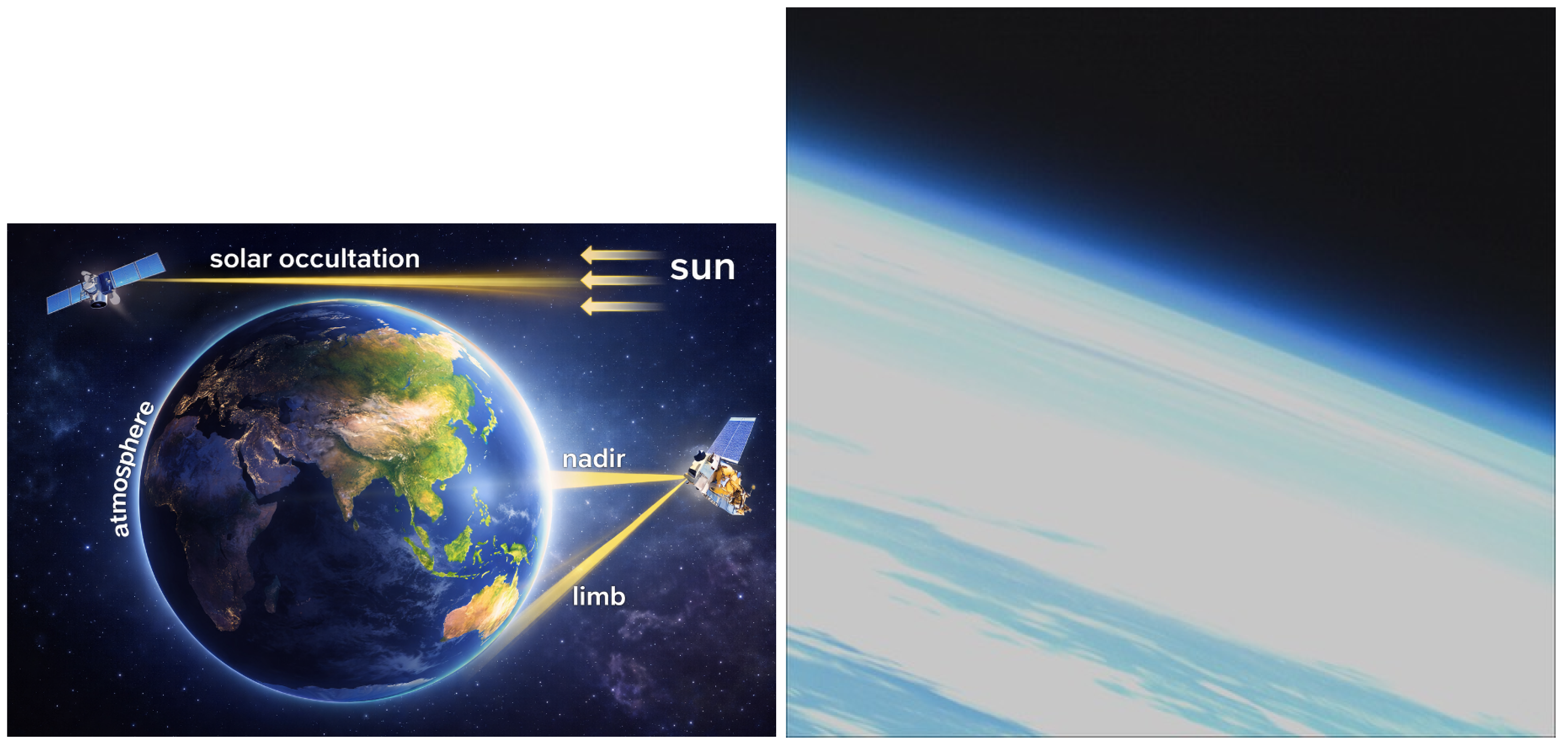
UVSQ-Sat NG is a French 6U CubeSat nanosatellite developed by LATMOS (Laboratoire Atmosphères et Observations Spatiales) as part of the INSPIRE programme (https://lasp.colorado.edu/inspire/ (accessed on 10 April 2026)) and the Île-de-France Space Academy (https://academiespatiale.fr/ (accessed on 10 April 2026)). Climate change, which encompasses various phenomena such as rising temperatures, more extreme weather events and changes in precipitation patterns in many regions, is a process that requires continuous and optimal monitoring. It is known that the increase in anthropogenic emissions of greenhouse gases (GHGs), mainly carbon dioxide (CO2), methane (CH4), nitrous oxide (N2O), and fluorinated gases is the main factor driving this process [44,45]. These emissions alter the composition of the atmosphere, which has an impact on the Earth’s radiation balance (ERB). Given that all these phenomena are linked, monitoring them provides a better understanding of the climate change that is currently underway. In addition, rapid variations, particularly during the day, require frequent revisit times and therefore the use of constellations. This is why satellite missions have been successfully launched to monitor changes in the ERB: initially with the UVSQ-Sat and Inspire-Sat 7 missions, then with the UVSQ-Sat NG mission, successfully launched on 15 March 2025 at an average orbital altitude of 591 km, which will combine ERB and GHG monitoring. To measure GHGs, UVSQ-Sat NG carries a spectrometer that measures the flux column between 1200 and 2000 nm and is capable of providing CO2 concentrations with an accuracy of 3 ppm and CH4 concentrations with an accuracy of 40 ppm. These greenhouse gases are observed using a nadir-pointing spectrometer with a 6 km ground footprint that measures the fluxes emanating from the atmospheric column between 1200 and 2000 nm with a resolution ranging from 1 to 6 nm. Among its payloads, UVSQ-Sat NG carries a high-definition camera called NanoCam. This camera acquires images of the type and horizontal distribution of cloud cover as well as the nature of the ground, which are critical elements for the radiation balance concerning upward IR emissions and reflected visible light. As part of a specific manoeuvre, it was possible to observe the Earth’s limb illuminated in the visible range, as illustrated in Figure 1. The camera is equipped with a 2048 × 1536 pixel CMOS (Complementary Metal-Oxide-Semiconductor) sensor, with a pixel size of 3.2 µm × 3.2 µm. The lens has a focal length of 70.5 mm with an aperture of F/2.2, corresponding to an aperture area of 32 mm. Its total field of view is 13° (diagonal), which corresponds to a ground footprint of 77 km (diagonal) and a spatial resolution of less than 30 m per pixel in the nadir position. Its spectral range is from 390 nm to 690 nm and exposure times are generally 1 ms but can be adjusted depending on conditions to optimise image quality. Figure 1 shows the different targeting modes of UVSQ-sat NG and a photograph of the limb used for the processing in the rest of this study.

4. Processing the Image Obtained Using the NSRTM Model

The images obtained can be broken down into three images, which are the camera’s natural RGB components (red, green, and blue). As a general rule, the spectral range covered by the red channel is between 600 and 690 nm, that of the green channel between 490 and 580 nm, and finally that of the blue channel between 390 and 490 nm. This separation allows sensitivity to a different range of wavelengths, and the image will result from different scattering efficiencies depending on the molecules, aerosols, or water in the form of crystals or droplets. The wavelength around blue is the most sensitive part of the spectrum for scattering by molecules and obtaining a signal from the highest layers of the atmosphere, as shown in Figure 2. The spectral range around red is less sensitive to molecular scattering and highlights the scattering induced by aerosols such as particles, droplets, and ice crystals that make up the different layers of clouds. Moving from blue to red, we become increasingly sensitive to aerosols,; meanwhile, moving from red to blue, we become increasingly sensitive to molecular scattering.
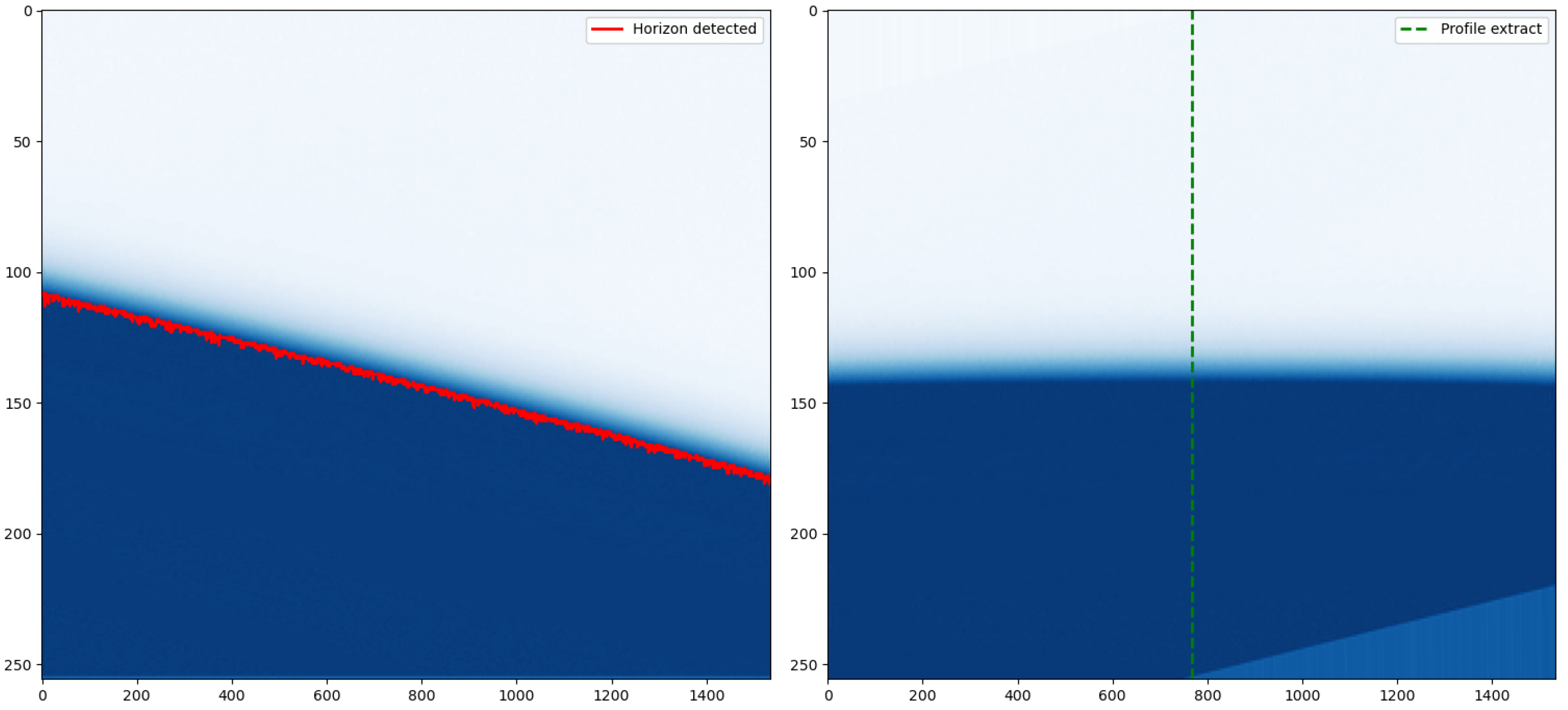
As can be seen in this example, the image of the limb was taken at a certain angle. In order to use all of the image channels, it is necessary to rotate the image to restore a horizontal horizon similar to all of the detector columns, which facilitates image processing to produce temperature profiles. To achieve this, we detect the horizon line, which will give us a linear equation that we can use to rotate the image, as shown in Figure 3.
As can be seen in Figure 3, we have 256 pixels on the y-axis instead of the 2048 mentioned in Section 2. This is because we had to group the pixels together due to the camera’s quality. In fact, the base camera has a resolution of 127 m per pixel, as shown in Equation (1), but the problem is that the noise is far too high to maintain such a resolution. For this reason, we have grouped the pixels into sets of eight to achieve a resolution of one kilometre, which allows us to reach a sufficient noise level to proceed with the scientific processing of the image, although we will see later that, as the camera was not developed for this purpose, the uncertainty of the results obtained remains high.
Δ h = θ pixel · D limb
where Δ h is the altitude difference covered by one pixel, θ pixel is the angular size of one pixel in radians, and D limb the distance to the limb.
It is therefore possible to extract a profile of molecular density as a function of altitude from this image in order to calculate the pressure, atmospheric density, and subsequently the temperature. Here we have used the Simplified Radiative Transfer Model (NSRTM) developed as part of the analysis of data from NASA’s OMPS orbital spectrometer [34]. The idea is simple: above 30 km, the radiance of the Earth’s limb is purely Rayleigh and directly proportional to density. Based on this assumption, we can apply the ideal gas law and hydrostatic equilibrium to determine the temperature as follows:
d P ( z ) = ρ ( z ) · g ( z ) · d z
P ( z ) = R · ρ ( z ) · T ( z ) M
where z is the altitude, P is the pressure, T the temperature, ρ the atmospheric density, g the gravity, R the perfect gas constant, and M the air molar mass.
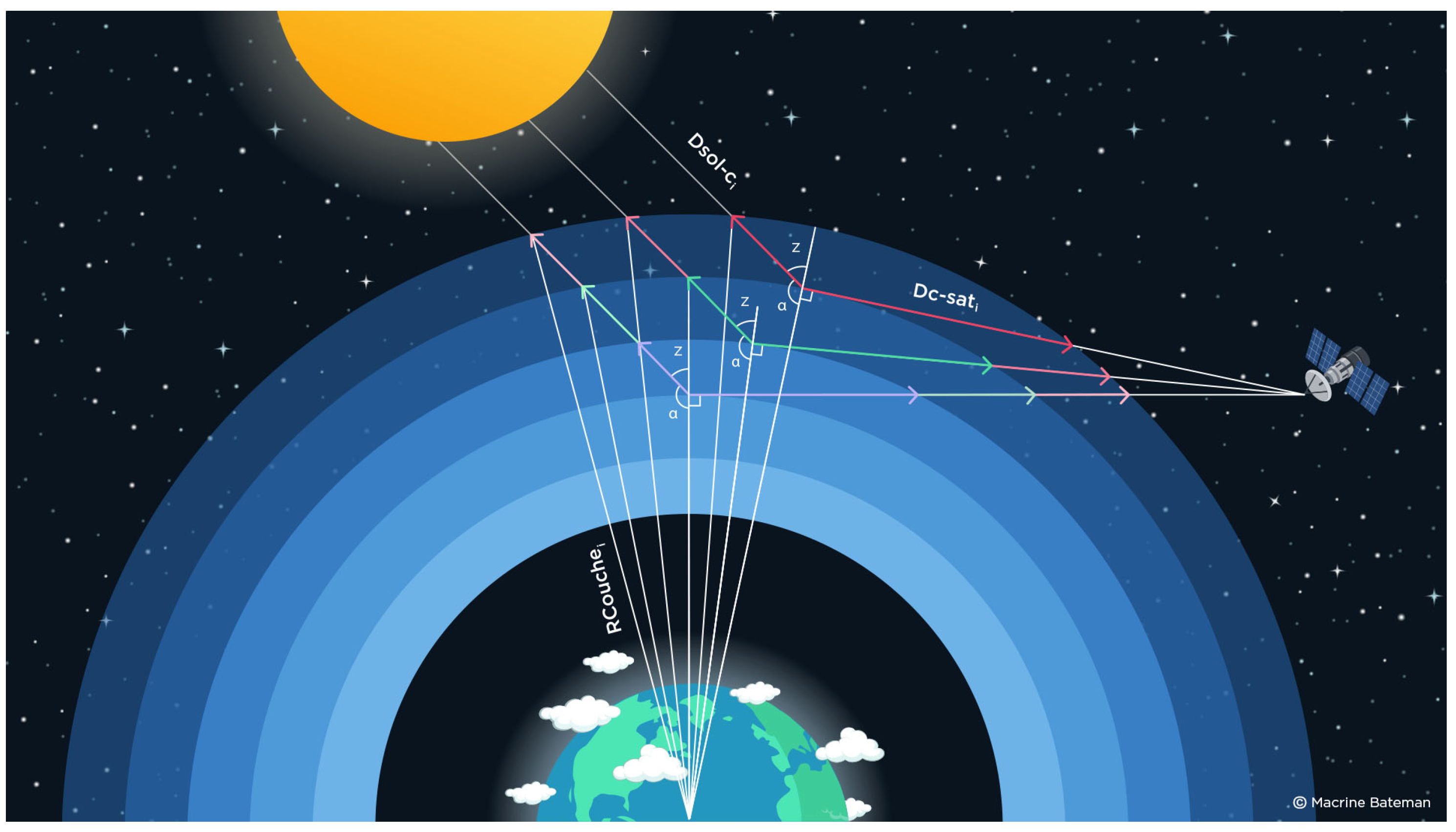
Unfortunately, due to the nature of satellite observations of the Earth’s atmosphere, a number of corrections must be applied to the measured profile before these two laws can be applied, To better understand these observational issues and the equations that follow, we have diagrammed the observation made by an instrument pointing at the limb (Figure 4).
Firstly, the profile measured by the instrument is an integrated radiance profile; we apply the so-called ‘onion peel’ method, which allows us to separate each measured layer as follows:
L ( z ) = L int ( z ) L int ( j ) · ( j + 1 j j z )
where Lint is the integrated radiance profile, L the radiance profile, and z the altitude, with j = z + 1 and with j + 1 j j z representing the weight of layers j in layer z proportional to the length of the line of sight z in the j layer.
Secondly, the radiance emitted by a layer is not the same as that measured by the detector, as it is altered by Rayleigh scattering and molecular absorption by O 3 and NO 2 as it travels through the atmospheric layers above the layer under observation. To correct for this alteration, we apply the following:
L cor ( z ) = L ( z ) · e D sat β ray + β O 3 + β NO 2
where L cor is the corrected radiance profile, L is the radiance profile, z is the altitude, D sat is the distance from the layer to the satellite, and β ray , β O 2 , and β NO 2 represent molecular scattering and absorption in this path.
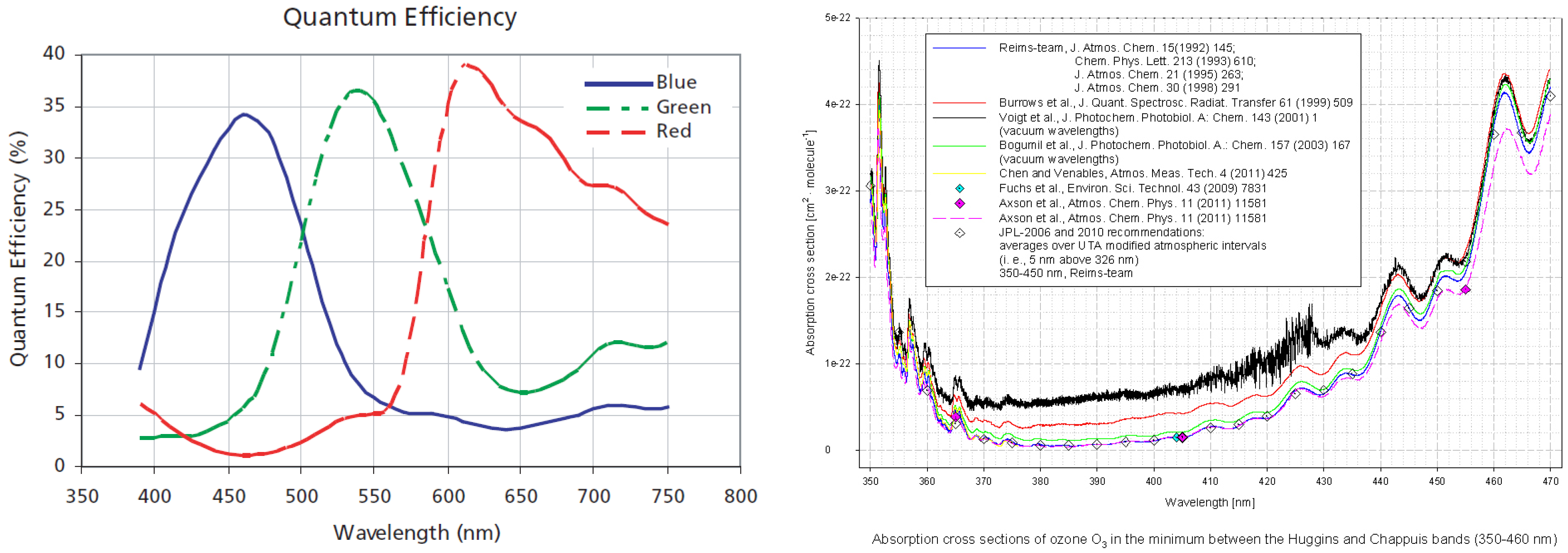
To estimate molecular absorption or scattering, two pieces of information are required. Firstly, the average number of molecules of the species in question, which can be obtained from atmospheric models. Secondly, the absorption or scattering value of these molecules within the detector’s spectral range, which depends on the sensor’s characteristics, particularly its Quantum Efficiency (QE). The QE, provided by the manufacturer (see Figure 5 (left)), enables the sensor’s sensitivity at different wavelengths to be determined. Finally, the absorption or scattering values of the molecules, measured in the laboratory are used to calculate their average contribution to absorption or scattering within the sensor’s spectral range, as illustrated in Figure 5 (right).
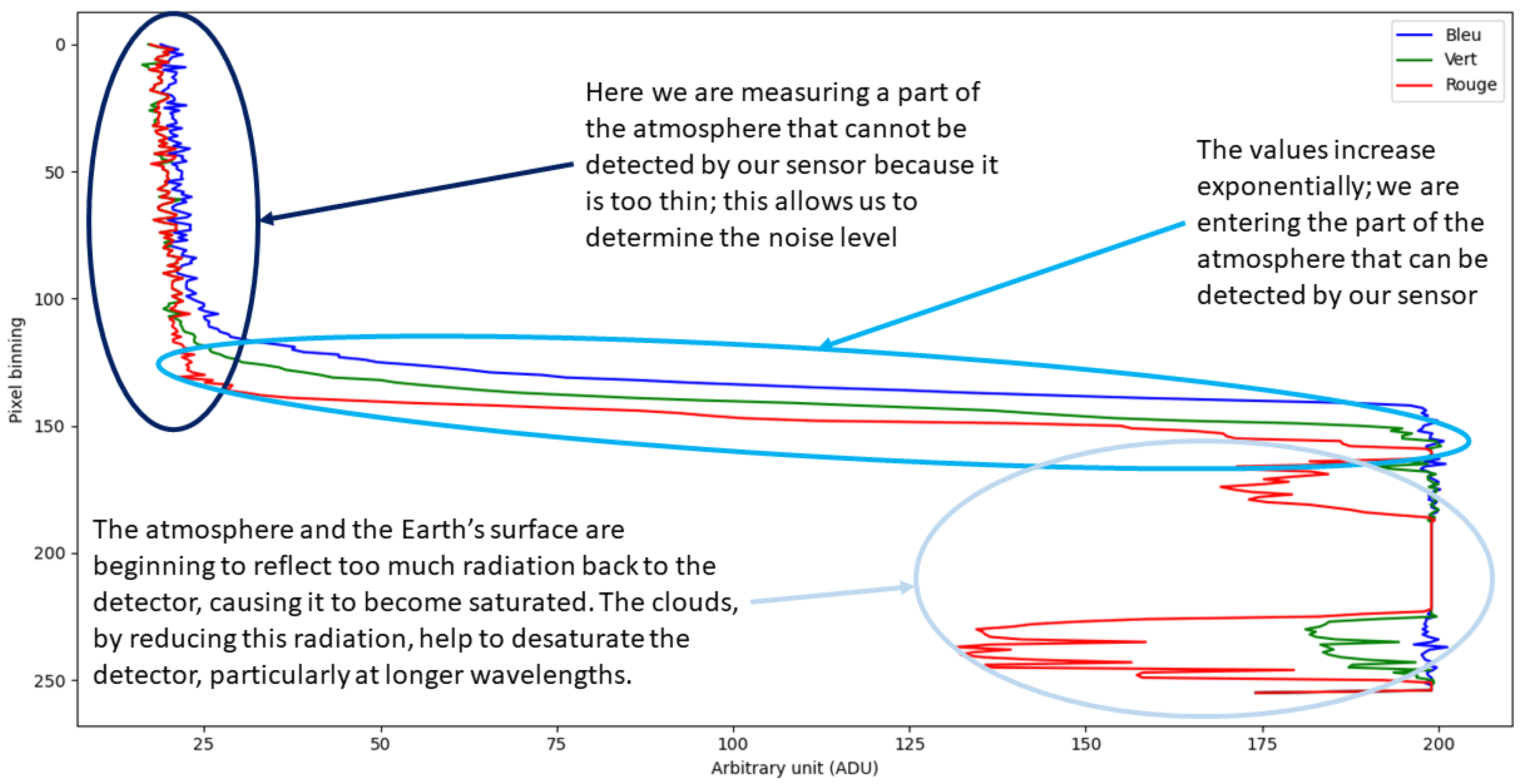
For each wavelength range, we can see that the noise level is around 20 and saturation at 200 (arbitrary unit of the detector in ADU). We can deduce that the maximum signal strength varies by a factor of 10. However, given the scale height of 8 km, it appears that this factor only covers approximately three scale heights, or about 24 km of altitude. By comparison, to cover the entire altitude range from 30 to 80 km, as for the GOMOS and OMPS missions, a radiance factor of 1000 is required between these two altitude levels. The signals shown in Figure 6 should enable us to determine the horizon and, using this reference point and the geometry of the instrument (lens focal length and pixel size), identify the altitude of each scattering layer.
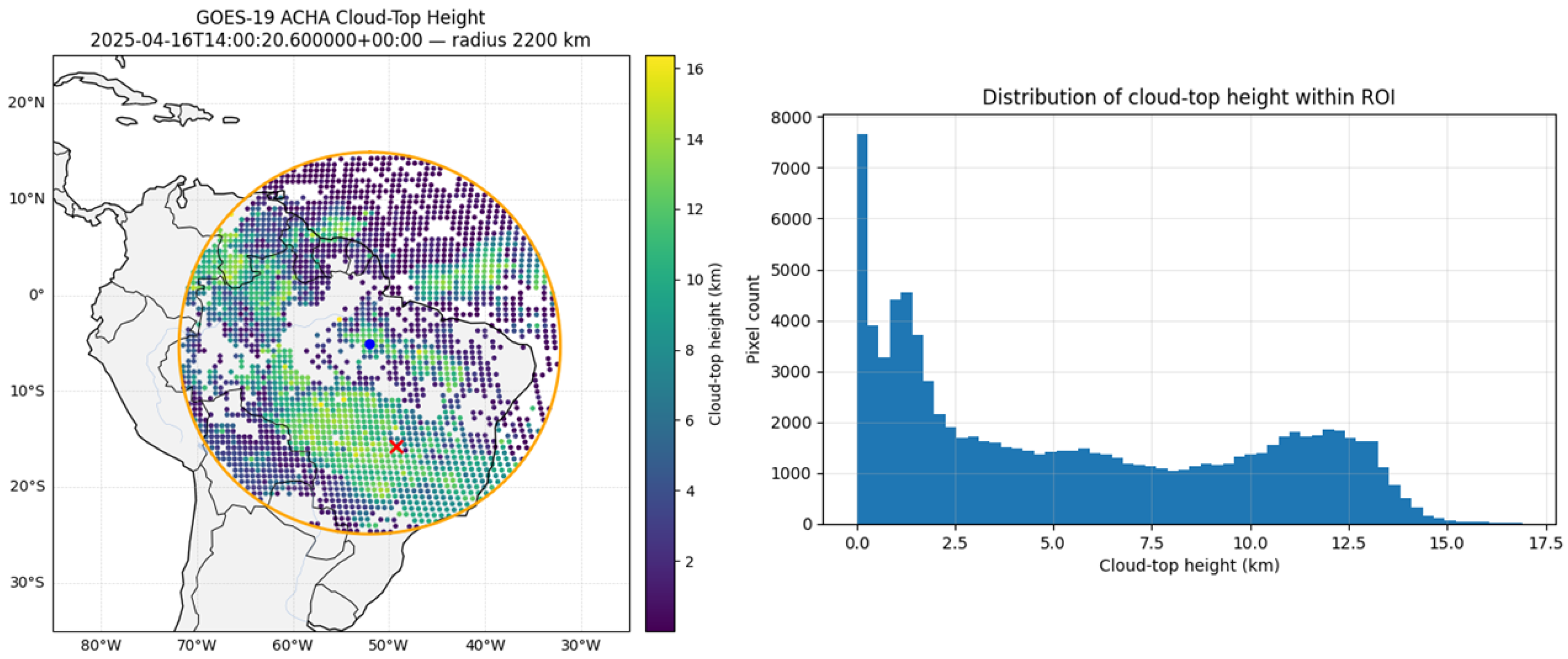
Due to saturation, this information is missing, as is the direction of view that could be provided by the star sensor. However, the photo was taken at a time when the satellite was not sending us this information, and only position information (latitude and longitude) is available. One solution lies in the red channel profile, which provides information about the clouds. We also know that this profile was measured within a circle of 2200 km around the point 5°S; 52°W, which corresponds to an equatorial position above Brazil. Thanks to a study conducted using combined CloudSat and CALIPSO products, we know that cloud tops are on average 12 km high in this area [46]. We have confirmed these altitude values using data from the GOES-19 (ACHA) instrument, which provides cloud tops in our research area, Figure 7 shows the ACHA cloud top height field on the right and on the left is the histogram of heights within this area of interest.
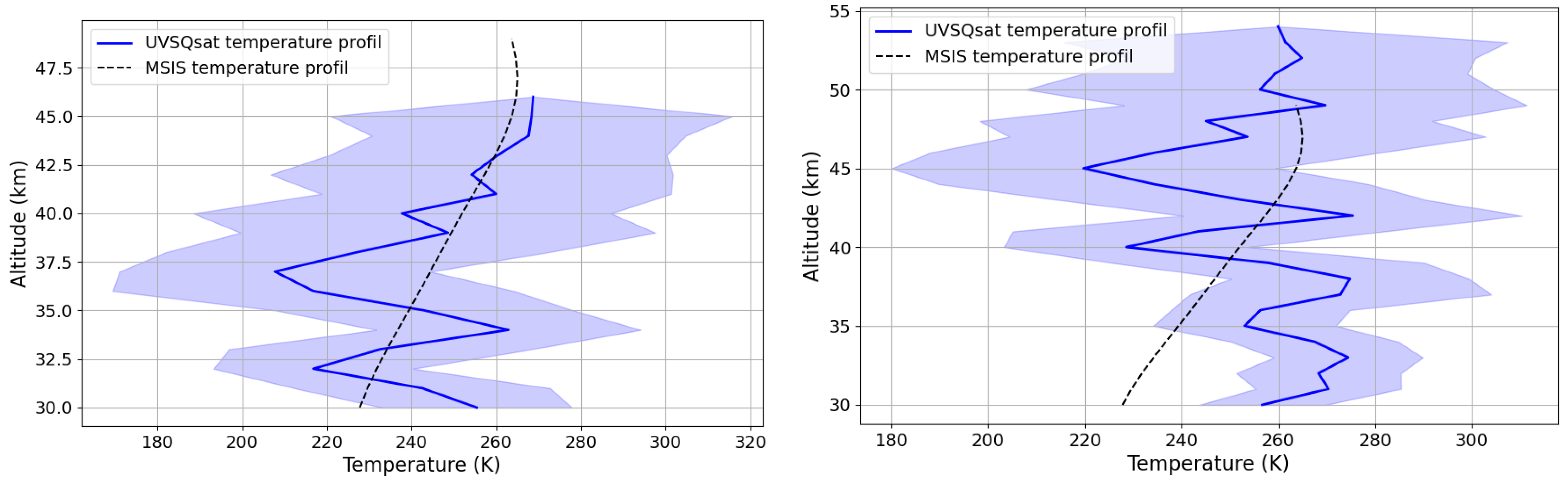
We can see that the maximum height measured at the time of our passage is 16 km, but that this value is rarely reached, with cloud cover becoming increasingly likely above 12.5 km. This is the value we used for the first desaturation of the red channel, which is found around pixel 160 on the y-axis of Figure 4. It therefore allows us to reposition the height scale in space. Our hypothesis is confirmed by the temperature profile given by the blue channel, which we compared to an average profile from the MSIS climatological model for the satellite’s position (Figure 8), In order to show what would happen if the height scale were positioned incorrectly we conducted a sensitivity stress-test. We simulated the same profile but shifted the entire altitude grid 8 km upwards (for example, the cloud that was measured at 12 km is now at 20 km). In the upper stratosphere and mesosphere, the temperature varies very little with longitude; this allows us to sum the columns (40) in order to maximise the signal-to-noise ratio and also to obtain information on the quality of the temperature profile obtained by the camera. However, it should be noted that the camera on board UVSQ-Sat was not designed for this purpose. Although the temperature profile obtained is generally consistent, the fluctuations observed (ups and downs) exhibit abnormally high amplitudes, far exceeding those measured by scientifically validated instruments such as lidars, radiosondes or radio occultation techniques. These excessive fluctuations suggest that noise still has too great an influence on the values measured by NanoCam. Consequently, the results could be significantly improved by using a detector with a wider signal dynamic range. On the other hand, this study shows that this approach, which had previously been used on sophisticated satellites at least the size of a microsatellite, can be applied to small satellites such as nanosatellites.

5. Conclusions

The work presented in this study demonstrates for the first time the technical feasibility of measuring temperature profiles in the middle atmosphere from a CubeSat, using a method based on Rayleigh scattering. By analysing images of the Earth’s limb acquired by the NanoCam camera on the UVSQ-Sat NG satellite, it was possible to extract radiance profiles in the red, green and blue channels. Although limited by sensor dynamics and instrumental noise, these profiles made it possible to reconstruct a temperature profile, which was successfully compared with a reference climatological model (MSIS 2.0).
This study also provided a better understanding of the technical limitations to making this approach operational and scientifically robust, such as:
  • The electronic saturation of the detector pixels (upper limit) and various types of noise, such as those induced by exposure time or detector cooling (lower limit), should enable a measurement dynamic range of over 1000 to be achieved.
  • Detector noise, which must be limited as much as possible to reach the highest altitudes
  • Ensuring a nominal limb pointing mode in order to know the pointing precisely.
  • Avoiding saturating the detector in the lower part in order to determine the altitude and having an alternative to deduce the altitude scales in case of for the absence of a stellar sensor.
As NanoCam is a consumer-grade camera, we were unable to find the information that would have allowed us to quantify its shortcomings precisely; as we mentioned in the article, the purpose of this camera was simply to take nadir images of the Earth’s surface. However, despite the lack of this information, we were able to identify and better understand the data that will be crucial when developing a scientific instrument dedicated to temperature measurement as follows:
  • Peak charge storage.
  • Dark signal.
  • Readout noise.
  • Dark signal non-uniformity.
The miniaturisation of such a temperature measurement method makes it possible to significantly reduce observation costs. This paves the way for the deployment of a homogeneous constellation, comprising several CubeSats, or a heterogeneous constellation, combining traditional satellites and CubeSats in staggered orbits. Such an approach would offer three major advantages as follows:
  • Reproduce a temperature field uncontaminated by atmospheric tides.
  • Significantly increase the number of observations at this level of the atmosphere, which is currently very difficult to observe and for which data is sorely lacking.
  • Improve our understanding of the phenomena affecting the middle atmosphere, the main characteristics of which were presented in Part 2.

Author Contributions

Writing—original draft, P.D.C.L.; Writing—review & editing, M.M., P.K., C.D., A.-J.V., A.H., M.R. and A.M. All authors have read and agreed to the published version of the manuscript.

Funding

This analysis of UVSQSAT-NG data is part of the improvement of the ESA ALTIUS mission in collaboration with BIRA-IASB, with a funding contribution from the TAP-SAT project founded by the PNTS (Programme National de Télédétection Spatiale) [26,47]. This study contributes to improving the means of observing the middle atmosphere and, as such, is a contribution to the project supported by the Directorate General of Armament from the French Ministry of Armed Forces under contract 202395002.

Data Availability Statement

No scientifically usable database has been created for this article, but if you have any questions, please do not hesitate to contact the author for more information.

Conflicts of Interest

Author Alain Hauchecorne was employed by the company Gordien Strato, Antoine Mangin was employed by the company ACRI-ST. The remaining authors declare that the research was conducted in the absence of any commercial or financial relationships that could be construed as a potential conflict of interest.

References

  1. Chipperfield, M.P.; Bekki, S. Opinion: Stratospheric ozone—Depletion, recovery and new challenges. Atmos. Chem. Phys. 2024, 24, 2783–2802. [Google Scholar] [CrossRef]
  2. Shepherd, T.G. Large-Scale atmospheric dynamics for atmospheric chemists. Chem. Rev. 2003, 103, 4509–4532. [Google Scholar] [CrossRef] [PubMed]
  3. Fritts, D.C.; Alexander, M.J. Gravity wave dynamics and effects in the middle atmosphere. Rev. Geophys. 2003, 41, 1003. [Google Scholar] [CrossRef]
  4. Tian, W.; Huang, J.; Zhang, J.; Xie, F.; Wang, W.; Peng, Y. Role of stratospheric processes in climate change: Advances and challenges. Adv. Atmos. Sci. 2023, 40, 1379–1400. [Google Scholar] [CrossRef]
  5. Thorne, P.W.; Vomel, H.; Bodeker, G.; Sommer, M.; Apituley, A.; Berger, F.; Bojinski, S.; Braathen, G.; Calpini, B.; Demoz, B.; et al. GCOS reference upper air network (GRUAN): Steps towards assuring future climate records. AIP Conf. Proc. 2013, 1552, 1042–1047. [Google Scholar] [CrossRef]
  6. Khaykin, S.M.; Funatsu, B.M.; Hauchecorne, A.; Godin-Beekmann, S.; Claud, C.; Keckhut, P.; Pazmino, A.; Gleisner, H.; Nielsen, J.K.; Syndergaard, S.; et al. Postmillennium changes in stratospheric temperature consistently resolved by GPS radio occultation and AMSU observations. Geophys. Res. Lett. 2017, 44, 7510–7518. [Google Scholar] [CrossRef]
  7. Chandra, S.; Fleming, E.L.; Schoeberl, M.R.; Barnett, J.J. Monthly mean global climatology of temperature, wind, geopotential height and pressure for 0–120 km. Adv. Space Res. 1990, 10, 3–12. [Google Scholar] [CrossRef]
  8. Keckhut, P.; Schmidlin, F.; Hauchecorne, A.; Chanin, M. Stratospheric and mesospheric cooling trend estimates from u.s. rocketsondes at low latitude stations (8°S–34°N), taking into account instrumental changes and natural variability. J. Atmos. Sol.-Terr. Phys. 1999, 61, 447–459. [Google Scholar] [CrossRef]
  9. Hauchecorne, A.; Chanin, M.L.; Wilson, R. Mesospheric temperature inversion and gravity wave breaking. Geophys. Res. Lett. 1987, 14, 933–936. [Google Scholar] [CrossRef]
  10. Mariaccia, A.; Keckhut, P.; Hauchecorne, A.; Khaykin, S.; Ratynski, M. Co-Located wind and temperature observations at Mid-Latitudes during mesospheric inversion layer events. Geophys. Res. Lett. 2023, 50, e2022GL102683. [Google Scholar] [CrossRef]
  11. Beig, G.; Keckhut, P.; Lowe, R.P.; Roble, R.G.; Mlynczak, M.G.; Scheer, J.; Fomichev, V.I.; Offermann, D.; French, W.J.R.; Shepherd, M.G.; et al. Review of mesospheric temperature trends. Rev. Geophys. 2003, 41, 1015. [Google Scholar] [CrossRef]
  12. Steiner, A.K.; Ladstädter, F.; Randel, W.J.; Maycock, A.C.; Fu, Q.; Claud, C.; Gleisner, H.; Haimberger, L.; Ho, S.P.; Keckhut, P.; et al. Observed Temperature Changes in the Troposphere and Stratosphere from 1979 to 2018. J. Clim. 2020, 33, 8165–8194. [Google Scholar] [CrossRef]
  13. Zou, C.; Qian, H.; Wang, W.; Wang, L.; Long, C. Recalibration and merging of SSU observations for stratospheric temperature trend studies. J. Geophys. Res. Atmos. 2014, 119, 13180–13205. [Google Scholar] [CrossRef]
  14. Funatsu, B.M.; Claud, C.; Keckhut, P.; Hauchecorne, A.; Leblanc, T. Regional and seasonal stratospheric temperature trends in the last decade (2002–2014) from AMSU observations. J. Geophys. Res. Atmos. 2016, 121, 8172–8185. [Google Scholar] [CrossRef]
  15. Keckhut, P.; Gelman, M.E.; Wild, J.D.; Tissot, F.; Miller, A.J.; Hauchecorne, A.; Chanin, M.; Fishbein, E.F.; Gille, J.; Russell, J.M.; et al. Semidiurnal and diurnal temperature tides (30–55 km): Climatology and effect on UARS-LIDAR data comparisons. J. Geophys. Res. Atmos. 1996, 101, 10299–10310. [Google Scholar] [CrossRef]
  16. Thompson, D.W.J.; Seidel, D.J.; Randel, W.J.; Zou, C.Z.; Butler, A.H.; Mears, C.; Osso, A.; Long, C.; Lin, R. The mystery of recent stratospheric temperature trends. Nature 2012, 491, 692–697. [Google Scholar] [CrossRef]
  17. Fishbein, E.F.; Cofield, R.E.; Froidevaux, L.; Jarnot, R.F.; Lungu, T.; Read, W.G.; Shippony, Z.; Waters, J.W.; McDermid, I.S.; McGee, T.J.; et al. Validation of UARS Microwave Limb Sounder temperature and pressure measurements. J. Geophys. Res. Atmos. 1996, 101, 9983–10016. [Google Scholar] [CrossRef]
  18. Dudhia, A.; Livesey, N.; Taylor, F. Validation of ISAMS retrievals of atmospheric temperature and pressure. Adv. Space Res. 1994, 14, 237–241. [Google Scholar] [CrossRef]
  19. Gille, J.C.; Bailey, P.L.; Massie, S.T.; Lyjak, L.V.; Edwards, D.P.; Roche, A.E.; Kumer, J.B.; Mergenthaler, J.L.; Gross, M.R.; Hauchecorne, A.; et al. Accuracy and precision of cryogenic limb array etalon spectrometer (CLAES) temperature retrievals. J. Geophys. Res. Atmos. 1996, 101, 9583–9601. [Google Scholar] [CrossRef]
  20. Hervig, M.E.; Russell, J.M.; Gordley, L.L.; Park, J.H.; Drayson, S.R.; Deshler, T. Validation of aerosol measurements from the Halogen Occultation Experiment. J. Geophys. Res. Atmos. 1996, 101, 10267–10275. [Google Scholar] [CrossRef]
  21. Sica, R.J.; Izawa, M.R.M.; Walker, K.A.; Boone, C.; Petelina, S.V.; Argall, P.S.; Bernath, P.; Burns, G.B.; Catoire, V.; Collins, R.L.; et al. Validation of the Atmospheric Chemistry Experiment (ACE) version 2.2 temperature using ground-based and space-borne measurements. Atmos. Chem. Phys. 2008, 8, 35–62. [Google Scholar] [CrossRef]
  22. Russell, J.M., III; Mlynczak, M.G.; Gordley, L.L.; Tansock, J.J., Jr.; Esplin, R.W. Overview of the SABER experiment and preliminary calibration results. Proc. SPIE Int. Soc. Opt. Eng. SPIE 1999, 3756, 277–288. [Google Scholar] [CrossRef]
  23. Schwartz, M.; Livesey, N.; Read, W. MLS/Aura L2 Temperature V006 (ML2T); Version 4; NASA: Washington, DC, USA, 2015. [CrossRef]
  24. Marlton, G.; Charlton-Perez, A.; Harrison, G.; Polichtchouk, I.; Hauchecorne, A.; Keckhut, P.; Wing, R.; Leblanc, T.; Steinbrecht, W. Using a network of temperature lidars to identify temperature biases in the upper stratosphere in ECMWF reanalyses. Atmos. Chem. Phys. 2021, 21, 6079–6092. [Google Scholar] [CrossRef]
  25. Mariaccia, A.; Keckhut, P.; Hauchecorne, A.; Claud, C.; Pichon, A.L.; Meftah, M.; Khaykin, S. Assessment of ERA-5 Temperature Variability in the Middle Atmosphere Using Rayleigh LiDAR Measurements between 2005 and 2020. Atmosphere 2022, 13, 242. [Google Scholar] [CrossRef]
  26. Keckhut, P.; Hauchecorne, A.; Meftah, M.; Khaykin, S.; Claud, C.; Simoneau, P. Middle-Atmosphere Temperature Monitoring Addressed with a Constellation of CubeSats Dedicated to Climate Issues. J. Atmos. Ocean. Technol. 2021, 38, 685–693. [Google Scholar] [CrossRef]
  27. Kozubek, M.; Laštovička, J.; Zajicek, R. Climatology and Long-Term Trends in the Stratospheric Temperature and Wind using ERA5. Remote Sens. 2021, 13, 4923. [Google Scholar] [CrossRef]
  28. Beagley, S.R.; McLandress, C.; Fomichev, V.I.; Ward, W.E. The Extended Canadian Middle Atmosphere Model. Geophys. Res. Lett. 2000, 27, 2529–2532. [Google Scholar] [CrossRef]
  29. Baldwin, M.P.; Stephenson, D.B.; Thompson, D.W.J.; Dunkerton, T.J.; Charlton, A.J.; O’Neill, A. Stratospheric memory and skill of Extended-Range weather forecasts. Science 2003, 301, 636–640. [Google Scholar] [CrossRef]
  30. Osprey, S.M.; Gray, L.J.; Hardiman, S.C.; Butchart, N.; Bushell, A.C.; Hinton, T.J. The climatology of the Middle Atmosphere in a vertically extended version of the Met Office’s climate model. Part II: Variability. J. Atmos. Sci. 2010, 67, 3637–3651. [Google Scholar] [CrossRef]
  31. Barth, C.A.; Rusch, D.W.; Thomas, R.J.; Mount, G.H.; Rottman, G.J.; Thomas, G.E.; Sanders, R.W.; Lawrence, G.M. Solar Mesosphere Explorer: Scientific objectives and results. Geophys. Res. Lett. 1983, 10, 237–240. [Google Scholar] [CrossRef]
  32. Shepherd, G.G. Application of Doppler Michelson imaging to upper atmospheric wind measurement: WINDII and beyond. Appl. Opt. 1996, 35, 2764. [Google Scholar] [CrossRef]
  33. Hauchecorne, A.; Blanot, L.; Wing, R.; Keckhut, P.; Khaykin, S.; Bertaux, J.L.; Meftah, M.; Claud, C.; Sofieva, V. A new MesosphEO data set of temperature profiles from 35 to 85 km using Rayleigh scattering at limb from GOMOS/ENVISAT daytime observations. Atmos. Meas. Tech. 2019, 12, 749–761. [Google Scholar] [CrossRef]
  34. Da Costa Louro, P.; Keckhut, P.; Hauchecorne, A.; Meftah, M.; Jaross, G.; Mangin, A. Limb Temperature Observations in the Stratosphere and Mesosphere Derived from the OMPS Sensor. Remote Sens. 2024, 16, 3878. [Google Scholar] [CrossRef]
  35. Fussen, D.; Dekemper, E.; Errera, Q.; Franssens, G.; Mateshvili, N.; Pieroux, D.; Vanhellemont, F. The ALTIUS mission. Atmos. Meas. Tech. 2016, preprint. [Google Scholar] [CrossRef]
  36. Salawitch, R.J.; Smith, J.B.; Selkirk, H.; Wargan, K.; Chipperfield, M.P.; Hossaini, R.; Levelt, P.F.; Livesey, N.J.; McBride, L.A.; Millán, L.F.; et al. The Imminent data Desert: The future of stratospheric monitoring in a rapidly changing world. Bull. Am. Meteorol. Soc. 2025, 106, E540–E563. [Google Scholar] [CrossRef]
  37. Meftah, M.; Clavier, C.; Sarkissian, A.; Hauchecorne, A.; Bekki, S.; Lefèvre, F.; Galopeau, P.; Dahoo, P.R.; Pazmino, A.; Vieau, A.J.; et al. UVSQ-SAT NG, a new CubeSat pathfinder for monitoring Earth outgoing energy and greenhouse gases. Remote Sens. 2023, 15, 4876. [Google Scholar] [CrossRef]
  38. Hauchecorne, A.; Cot, C.; Dalaudier, F.; Porteneuve, J.; Gaudo, T.; Wilson, R.; Cénac, C.; Laqui, C.; Keckhut, P.; Perrin, J.M.; et al. Tentative detection of clear-air turbulence using a ground-based Rayleigh lidar. Appl. Opt. 2016, 55, 3420. [Google Scholar] [CrossRef] [PubMed]
  39. McLandress, C. The seasonal variation of the propagating diurnal tide in the mesosphere and lower thermosphere. Part I: The role of gravity waves and planetary waves. J. Atmos. Sci. 2002, 59, 893–906. [Google Scholar] [CrossRef]
  40. Trémoulu, S.; Ming, F.C.; Hauchecorne, A.; Khaykin, S.; Ratynski, M.; Keckhut, P. Implementation of a multiresolution analysis method to characterize multi-scale wave structures in lidar data. Atmos. Meas. Tech. 2026, 19, 1039–1058. [Google Scholar] [CrossRef]
  41. Tufel, N.G.; Keckhut, P.; Dumas, L.; Mariaccia, A.; Meftah, M.; Courcoux, Y.; Vicomte, M.; Hauchecorne, A. Assessment of middle atmosphere climatology using lidar for aerospace applications. Adv. Space Res. 2025, 76, 1871–1889. [Google Scholar] [CrossRef]
  42. Kishore, P.; Ratnam, M.V.; Velicogna, I.; Sivakumar, V.; Bencherif, H.; Clemesha, B.R.; Simonich, D.M.; Batista, P.P.; Beig, G. Long-term trends observed in the middle atmosphere temperatures using ground based LIDARs and satellite borne measurements. Ann. Geophys. 2014, 32, 301–317. [Google Scholar] [CrossRef][Green Version]
  43. Tsuda, T. Characteristics of atmospheric gravity waves observed using the MU (Middle and Upper atmosphere) radar and GPS (Global Positioning System) radio occultation. Proc. Jpn. Acad. Ser. B 2014, 90, 12–27. [Google Scholar] [CrossRef]
  44. Friedlingstein, P.; O’Sullivan, M.; Jones, M.W.; Andrew, R.M.; Gregor, L.; Hauck, J.; Quéré, C.L.; Luijkx, I.T.; Olsen, A.; Peters, G.P.; et al. Global Carbon Budget 2022. Earth Syst. Sci. Data 2022, 14, 4811–4900. [Google Scholar] [CrossRef]
  45. McCarthy, M.P.; Best, M.J.; Betts, R.A. Climate change in cities due to global warming and urban effects. Geophys. Res. Lett. 2010, 37, L09705. [Google Scholar] [CrossRef]
  46. Chi, Y.; Zhao, C.; Yang, Y.; Zhao, X.; Yang, J. Global characteristics of cloud macro-physical properties from active satellite remote sensing. Atmos. Res. 2024, 302, 107316. [Google Scholar] [CrossRef]
  47. Ridenti, M.A.; Swenson, C. Optimizing satellite constellations for atmospheric tide detection in the thermosphere. Adv. Space Res. 2025, 77, 5278–5290. [Google Scholar] [CrossRef]
Figure 1. (Left): a diagram of the different targeting modes of UVSQ-sat NG; (Right): a photo of the Earth’s limb taken by UVSQ-sat NG on 16 April 2025 at 13:58 UTC.
Remotesensing 18 01659 g001
Figure 2. Same image as Figure 1 for the three different channels of the RGB camera.
Remotesensing 18 01659 g002
Figure 3. Blue image in Figure 2. By detecting the horizon, we obtain a linear equation that allows the image to be rotated to facilitate processing. The green dotted line indicates the profile that was extracted for Figure 4.
Remotesensing 18 01659 g003
Figure 4. This diagram illustrates the path taken by the radiance in each layer observed by an instrument that observes the Earth’s limb. At each layer, the radiance is scattered by air molecules and absorbed by ozone and nitrogen dioxide molecules. R Couche i represents the radius from the Earth to the given layer, and D c - Sat i represents the distance that the radiance in layer i crosses to reach the satellite. Similarly, D sol - c i represents the distance travelled by the radiance arriving from the Sun to the layer.
Remotesensing 18 01659 g004
Figure 5. (Left): QE of the NanoCam. (Right): effective absorption cross-sections for ozone between 350 and 470 nm, compiled by the Max Planck Institute for Chemistry (Mainz, Germany). Source: https://www.uv-vis-spectral-atlas-mainz.org/uvvis/index.html (accessed on 10 April 2026).
Remotesensing 18 01659 g005
Figure 6. Luminous flux for each RGB channel for one of the detector columns, represented by the green dotted line in Figure 3.
Remotesensing 18 01659 g006
Figure 7. (Left): the cloud top height field centred on position 5°S; 52°W with a radius of 2200 km. (Right): the histogram of heights within the area of interest.
Remotesensing 18 01659 g007
Figure 8. The blue curve represents the temperature inversion of the sum of the 40 pixel lines. The shaded blue area in the figure corresponds to the uncertainty in the temperature of the blue profile at 1 sigma. The dotted black curve indicates the reference temperature of the MSIS 2.0 model. On the left, the profile with the correct altitude grid; on the right, the profile with a simulated positioning error of 8 km on the altitude.
Remotesensing 18 01659 g008
Table 1. Phenomena influencing the temperature of the middle atmosphere, with their amplitudes, vertical wavelengths, and characteristic periods.
PhenomenonAmplitude (K)Vertical Wavelength (km)Period
Atmospheric tides0.1 to 15From 30 to 60From 12 h to 24 h
Gravity waves1 to 10<10Form 5 min to 20 h
Planetary wave5 to 30>10From 2 to 30 day
Turbulence<1<1<5 min
QBO≈3≈1528 months (mean)
Solar Flux≈427 day and 11 years
ENSO≈1≈2060 months (mean)
Stratospheric warming>10≈40>1 week
Mesospheric inversion>10≈10From 1 day to 1 week
Disclaimer/Publisher’s Note: The statements, opinions and data contained in all publications are solely those of the individual author(s) and contributor(s) and not of MDPI and/or the editor(s). MDPI and/or the editor(s) disclaim responsibility for any injury to people or property resulting from any ideas, methods, instructions or products referred to in the content.