A Scanline-Based Sliding Window Filtering Method for UAV-Borne LiDAR Bathymetry Point Clouds

 , ,
, ,
Highlights
- A novel scanline-based sliding window filtering method is proposed for the denoising of UAV-borne LiDAR bathymetric point clouds, which can effectively separate noise while completely retaining detailed features of complex terrain in shallow-water areas.
- The method achieves ≥96% noise recall and F1-score ≥ 0.9 across different terrains, with excellent filtering performance and strong adaptability, significantly improving the quality of point cloud data.
- This study innovatively applies bathymetric LiDAR scanline information to point cloud filtering, providing a new paradigm for UAV-borne LiDAR bathymetry data processing.
- The proposed method is of great reference significance for improving the data quality of UAV-borne LiDAR bathymetry and can effectively promote the application of this technology in complex shallow-water areas.
Abstract
1. Introduction
2. Methods
2.1. Workflow of the Scanline-Based Sliding Window Filtering Method
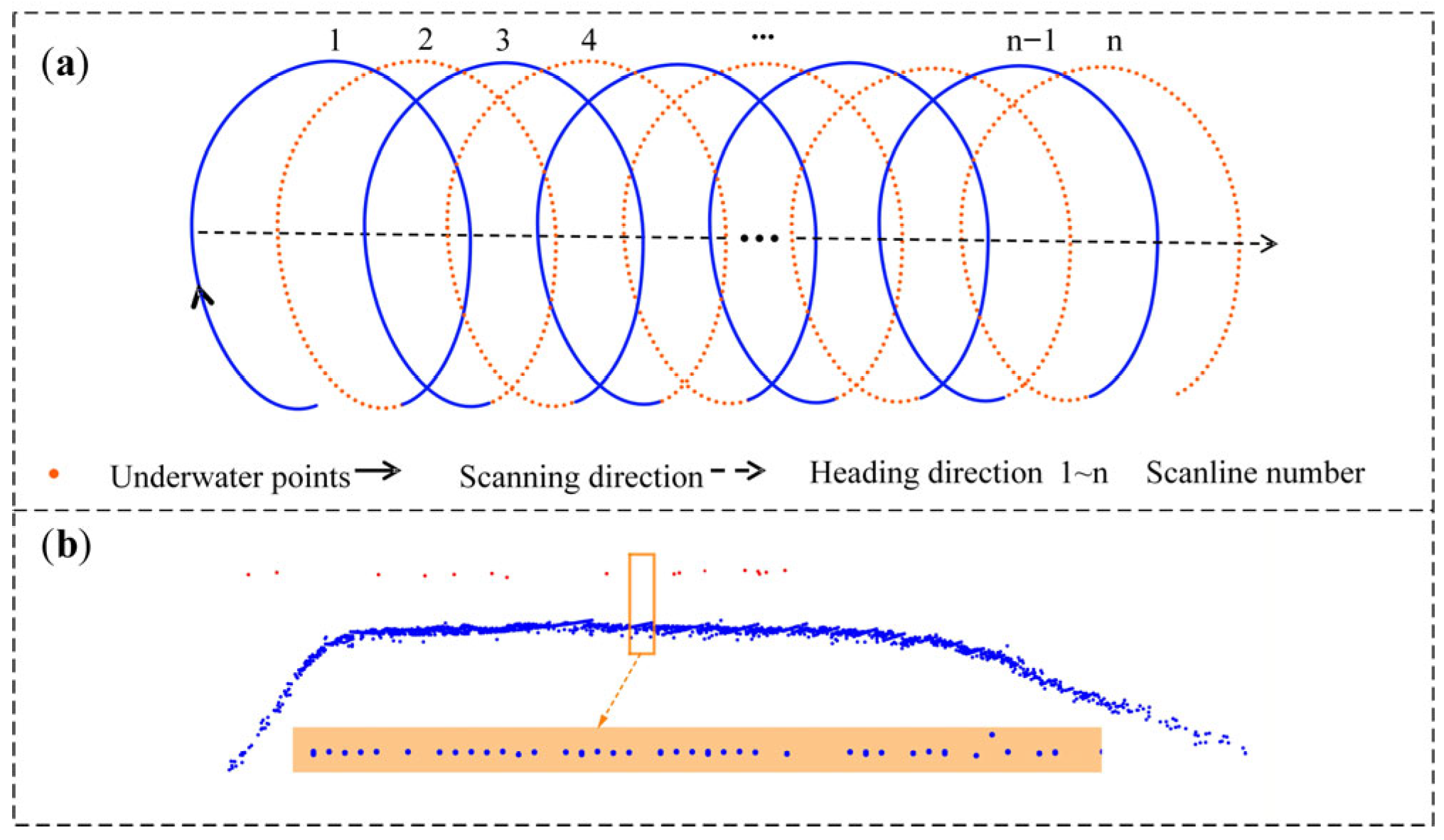
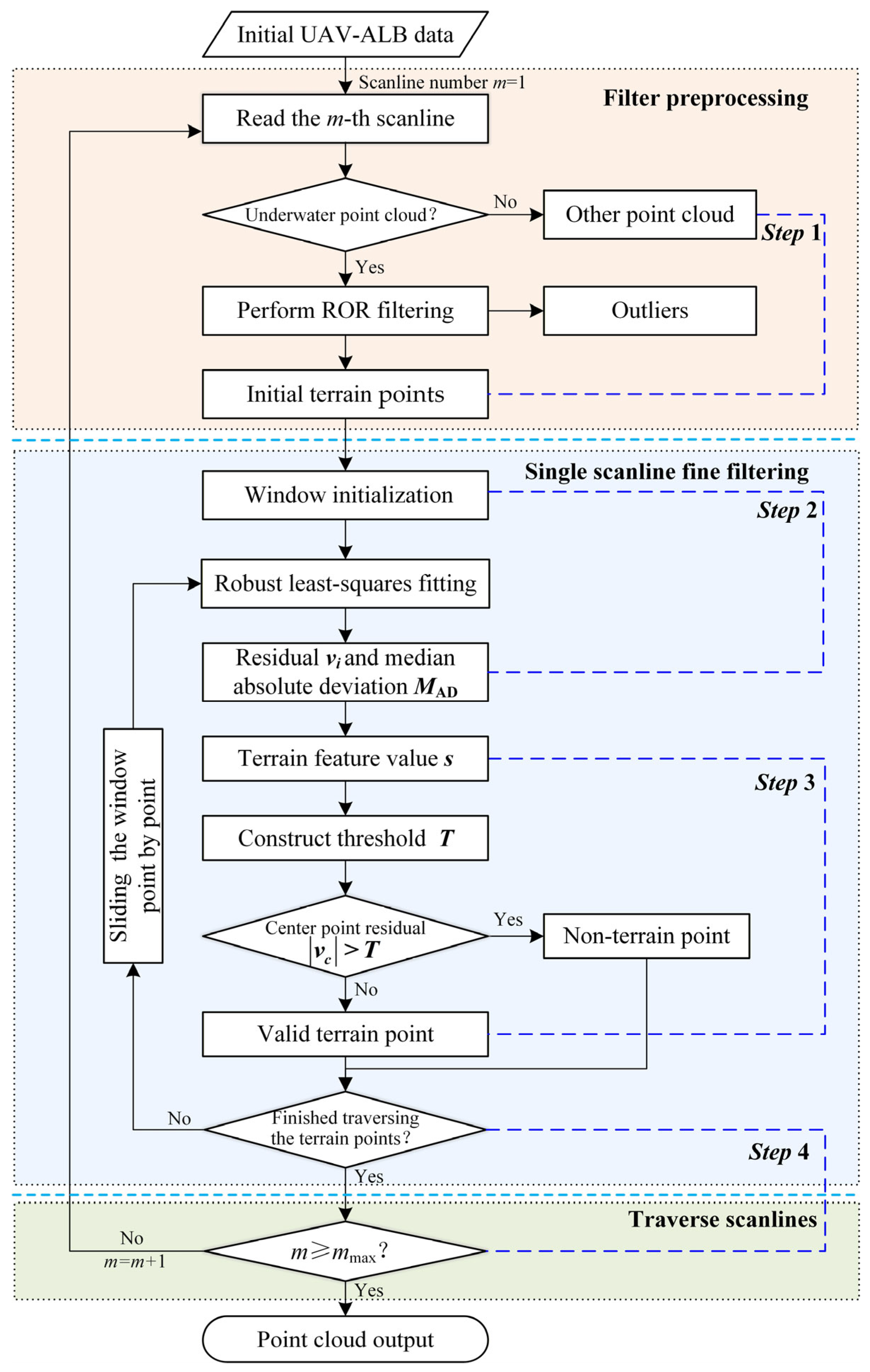
- Read the initial UAV-ALB data according to the scanline number, extract the underwater point clouds, and remove outliers using radius outlier removal (ROR) algorithm to obtain the initial terrain points.
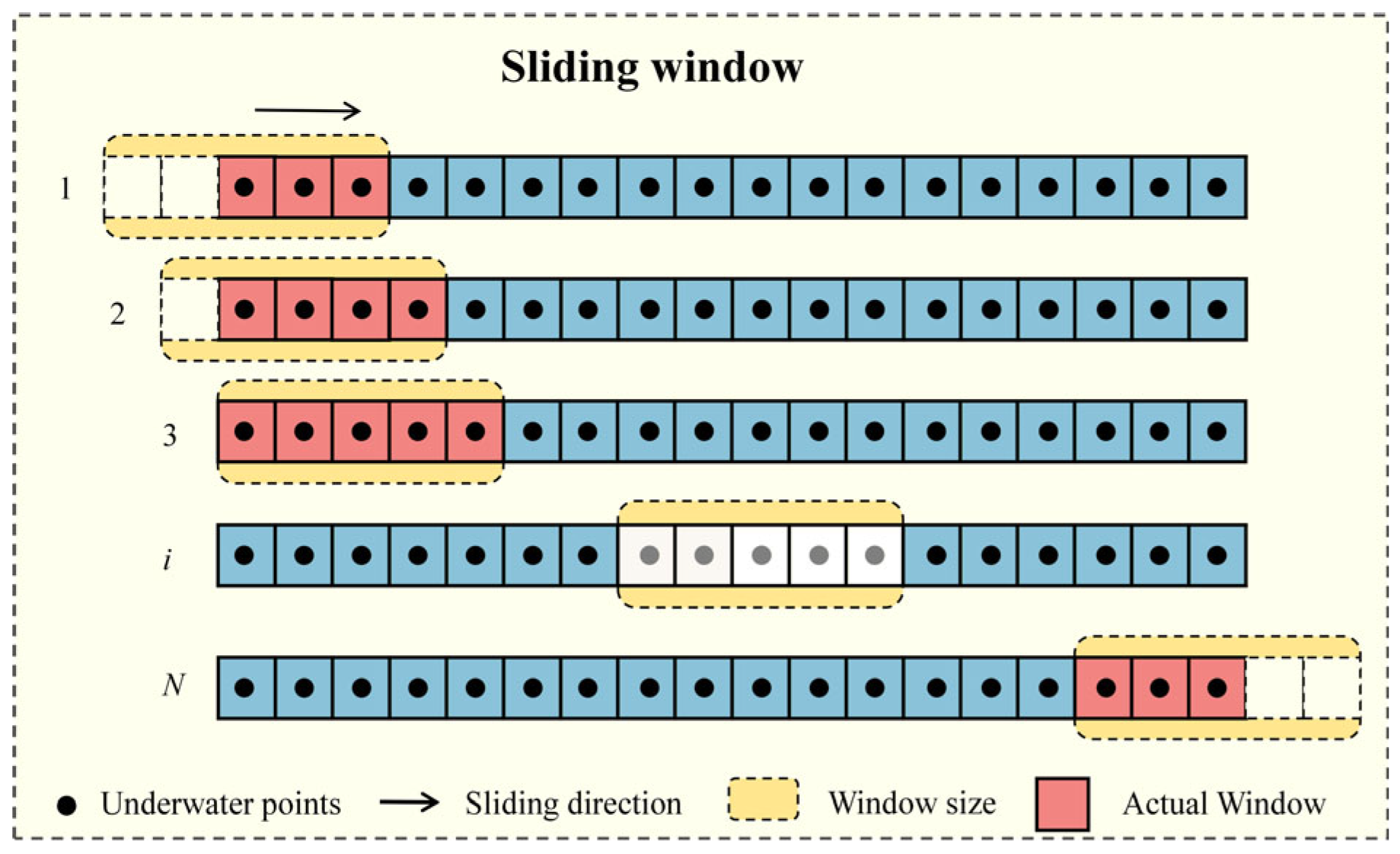
- Based on the results of the previous step, convert the 3D point cloud data into 2D data, define and initialize a sliding window, and perform polynomial fitting within the window using the IGG III robust least-squares (RLS) method. The residual vi of each fitting point and the median absolute deviation MAD are then calculated and retained.
- Determine the terrain complexity based on MAD, obtain the feature value s, and determine the filtering threshold T. If the absolute residual of the window center point exceeds T, the center point is classified as a non-terrain point; otherwise, it is classified as a terrain point. Only the window center point is processed each time to reduce misclassification at abrupt terrain changes and prevent continuous overfiltering.
- Slide the window point by point along the current scanline and repeat the fitting process in steps 2 and 3 until all initial terrain points on the scanline have been processed and the fine filtering of the single scanline is completed. Finally, all scanlines are processed sequentially according to their scanline numbers, and the above procedure is repeated to complete global point cloud filtering, after which all classified point clouds are merged to produce the final results.
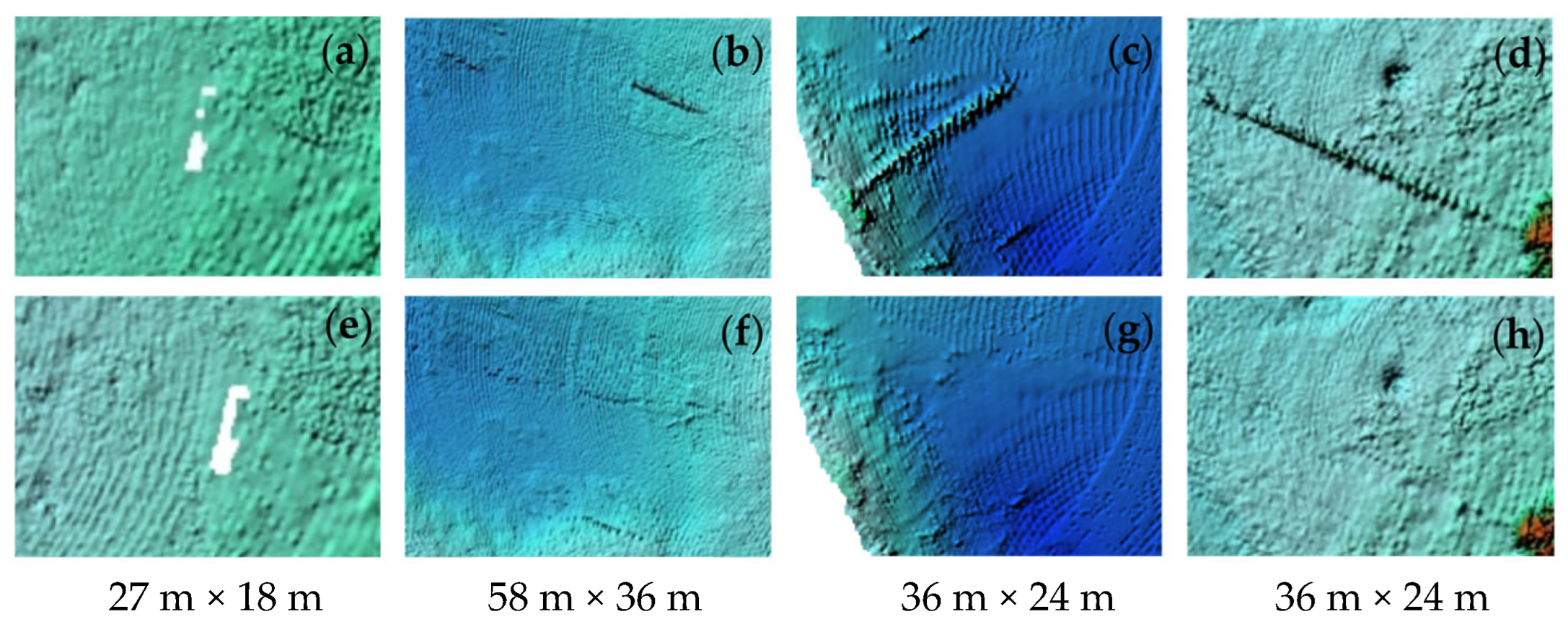
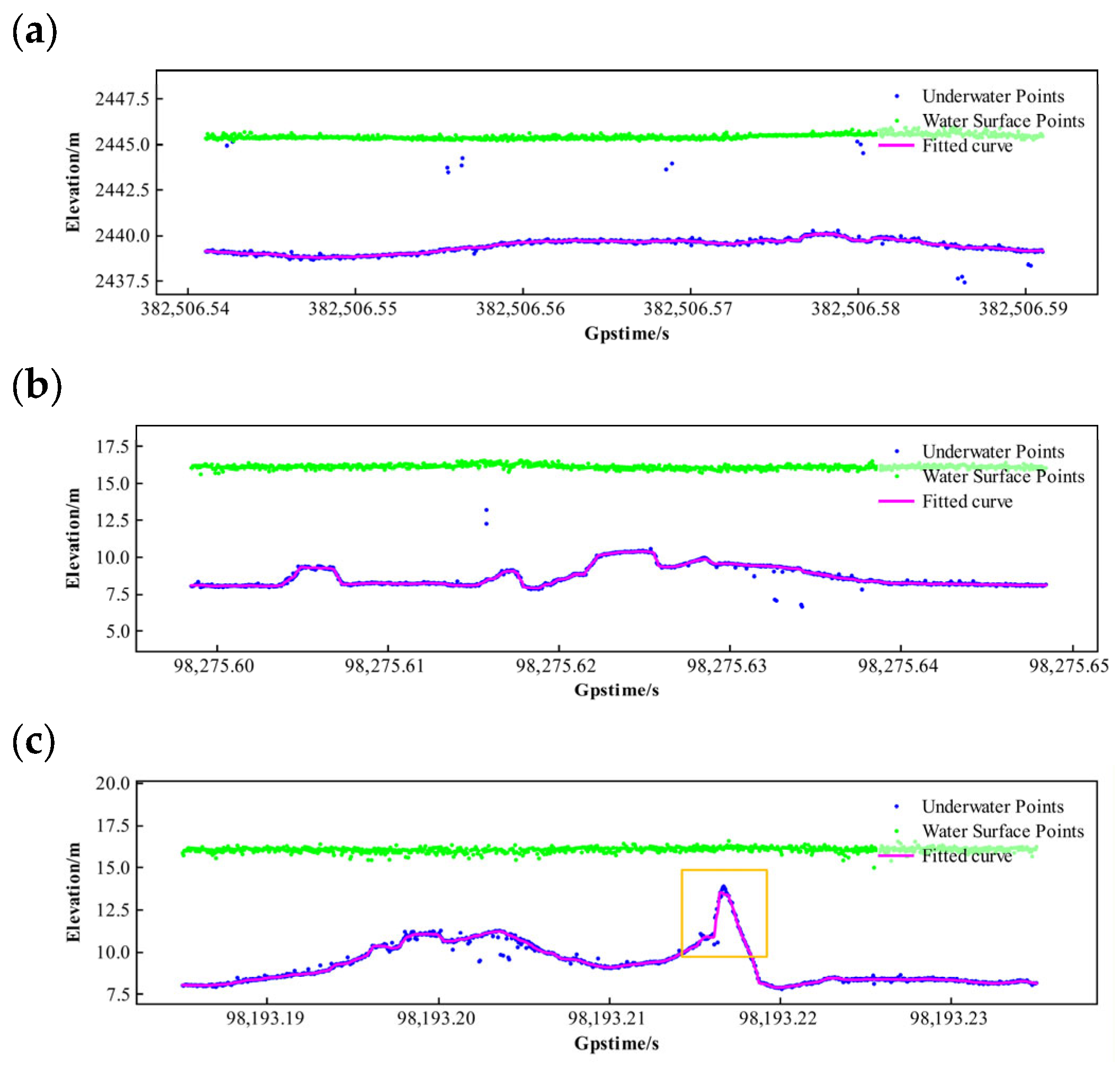
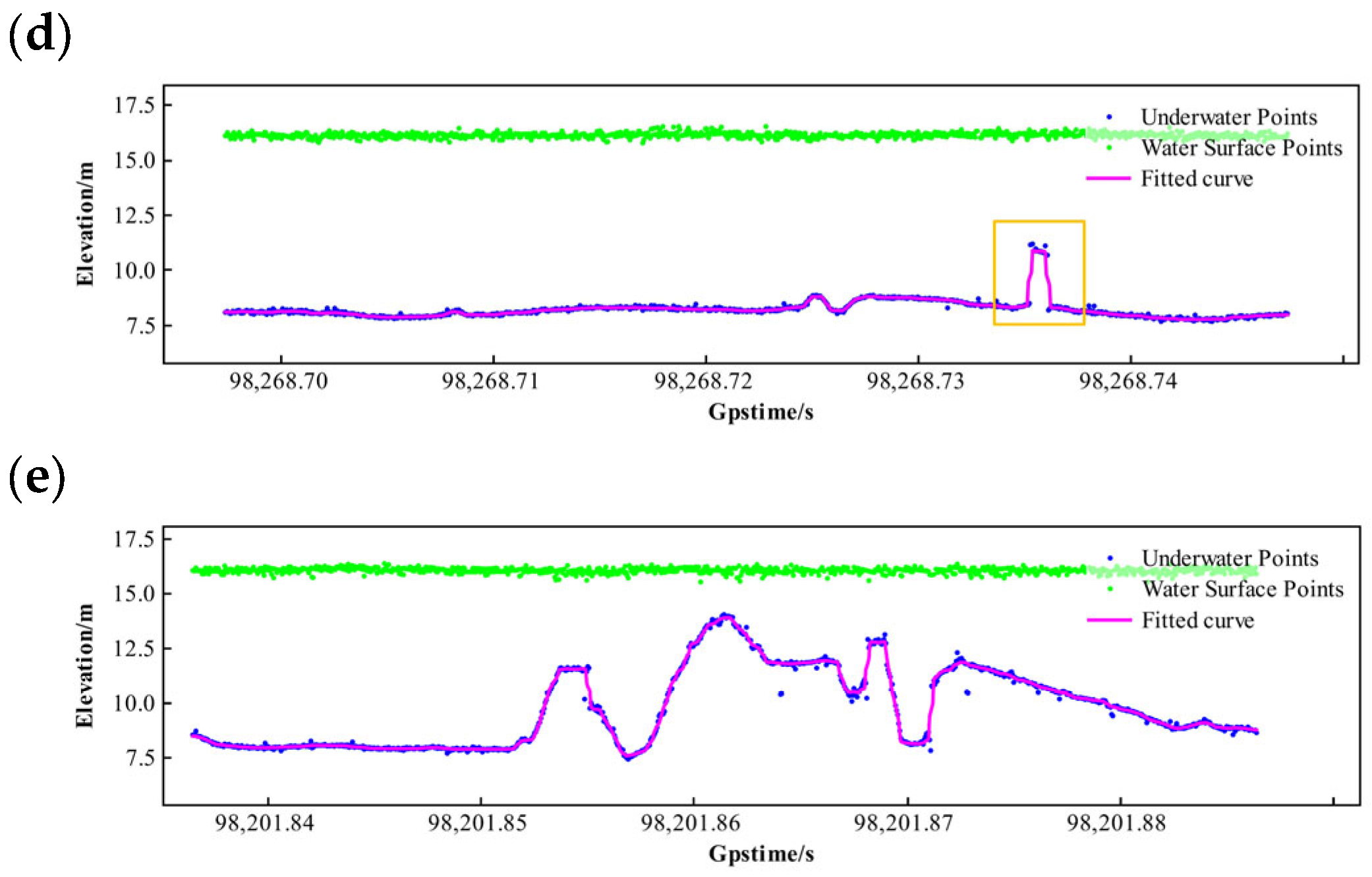
2.2. Terrain and Noise Characteristics
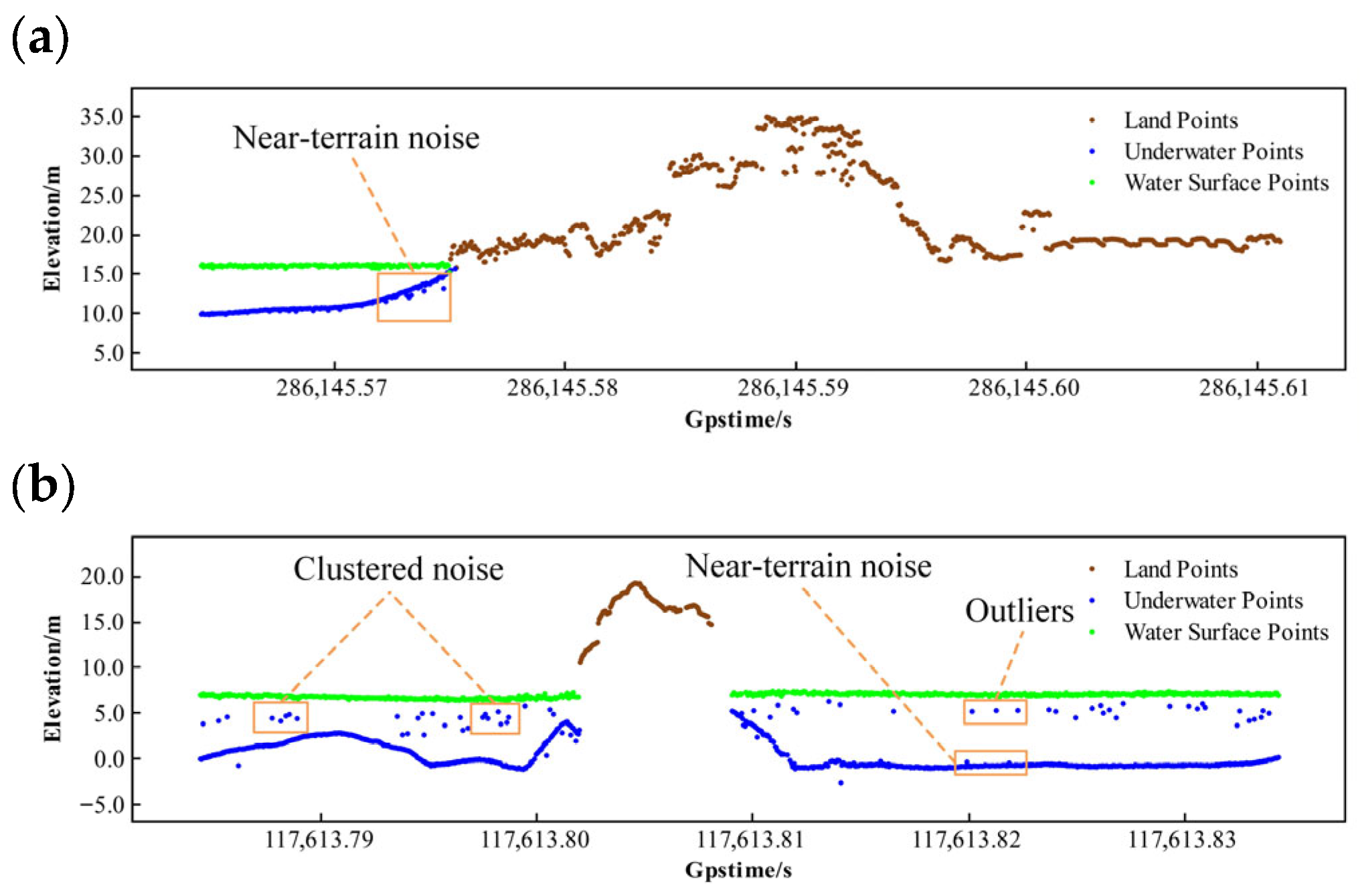
- (1)
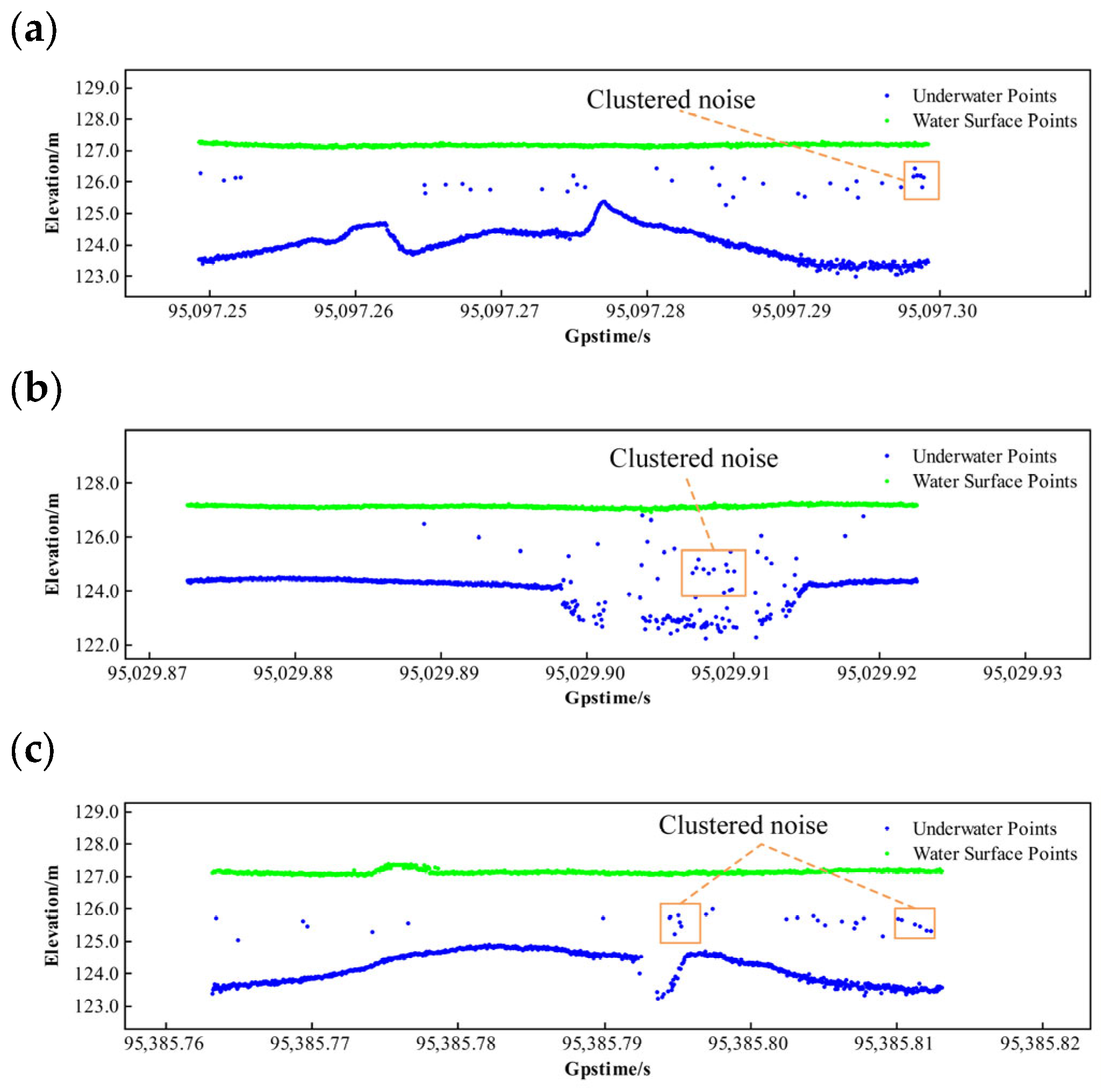
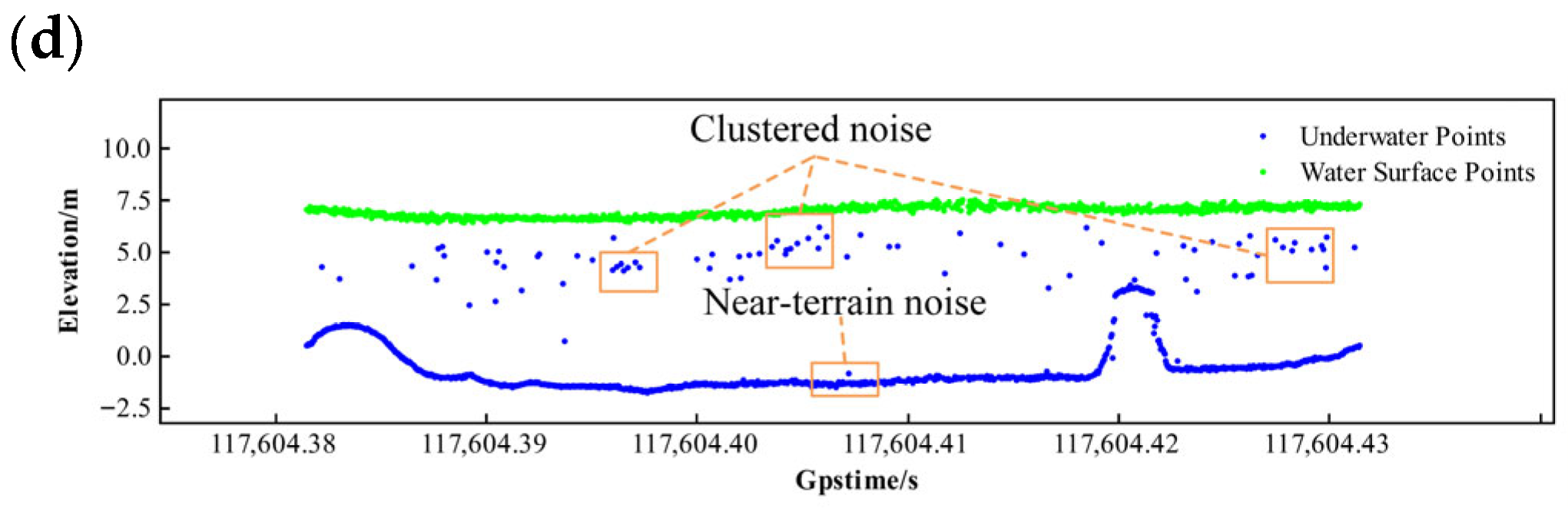
- Land–water interface

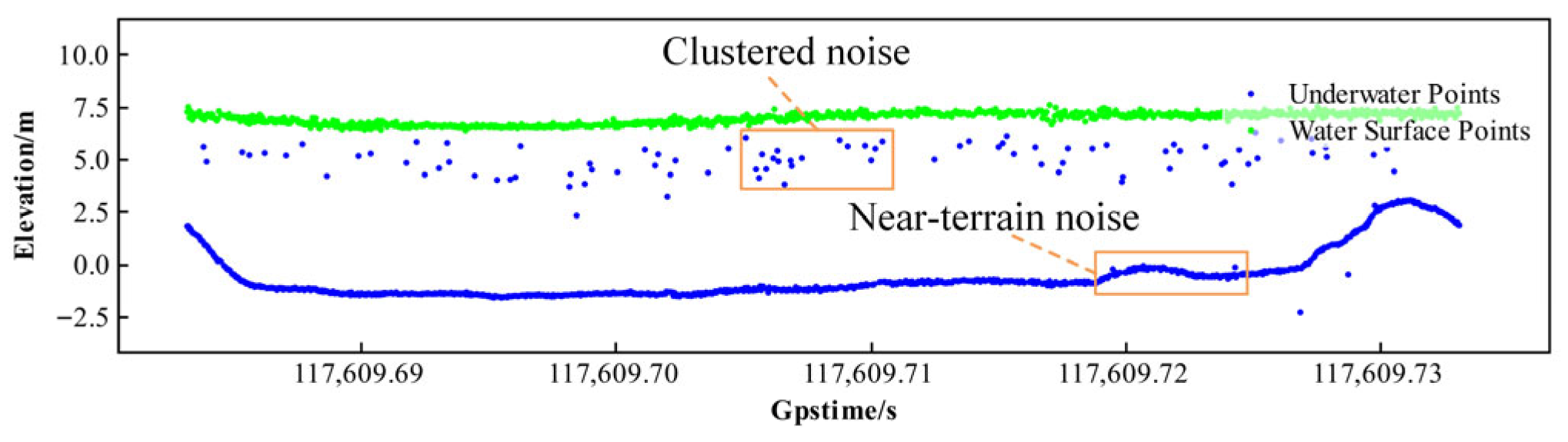
- (2)
- Flat underwater areas


- (3)
- Undulating underwater areas
- (4)
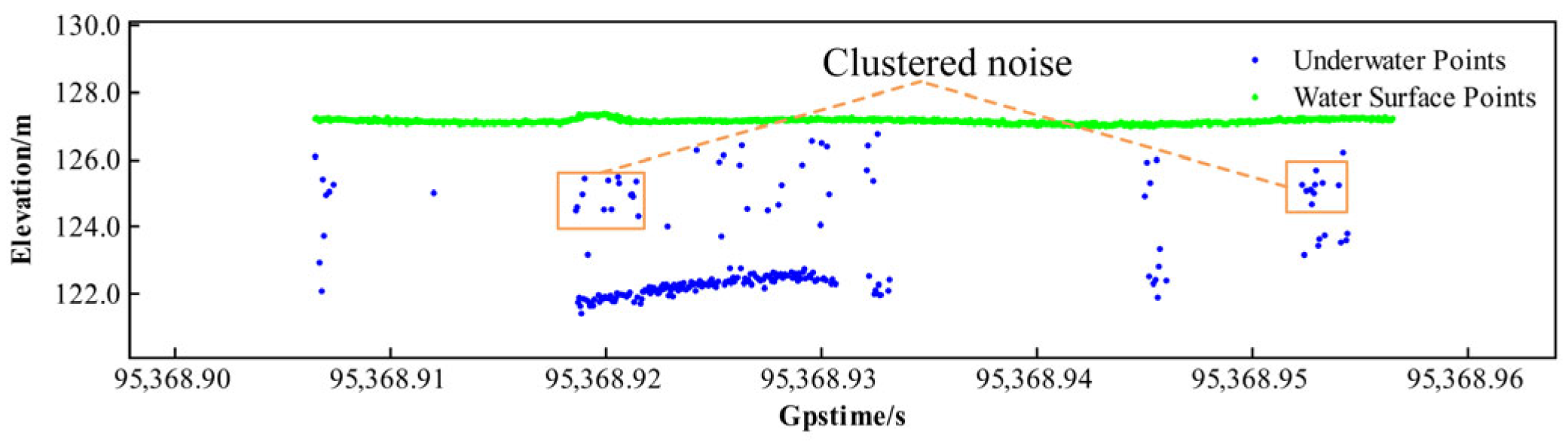
- Deep-water areas
2.3. Radius Outlier Removal (ROR)
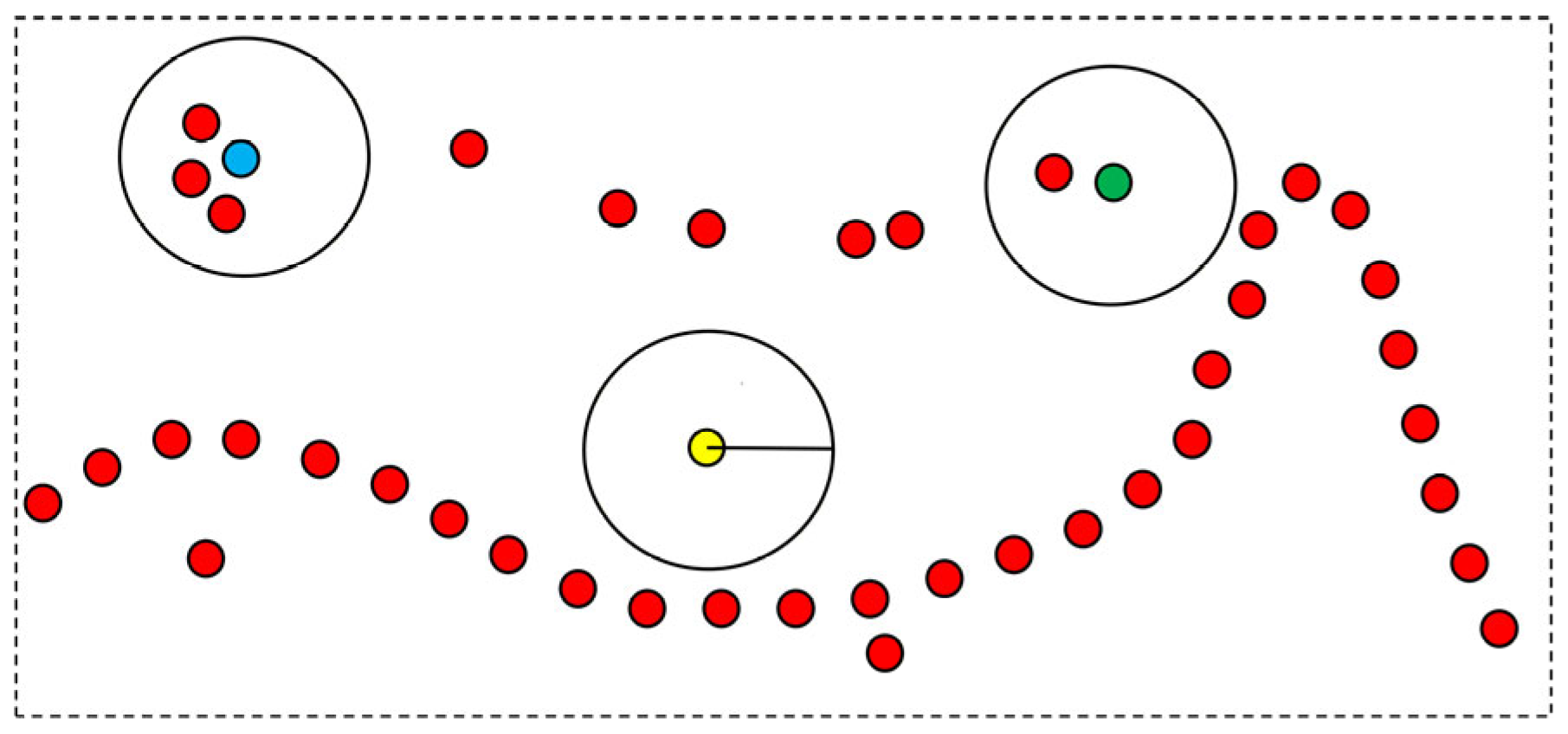
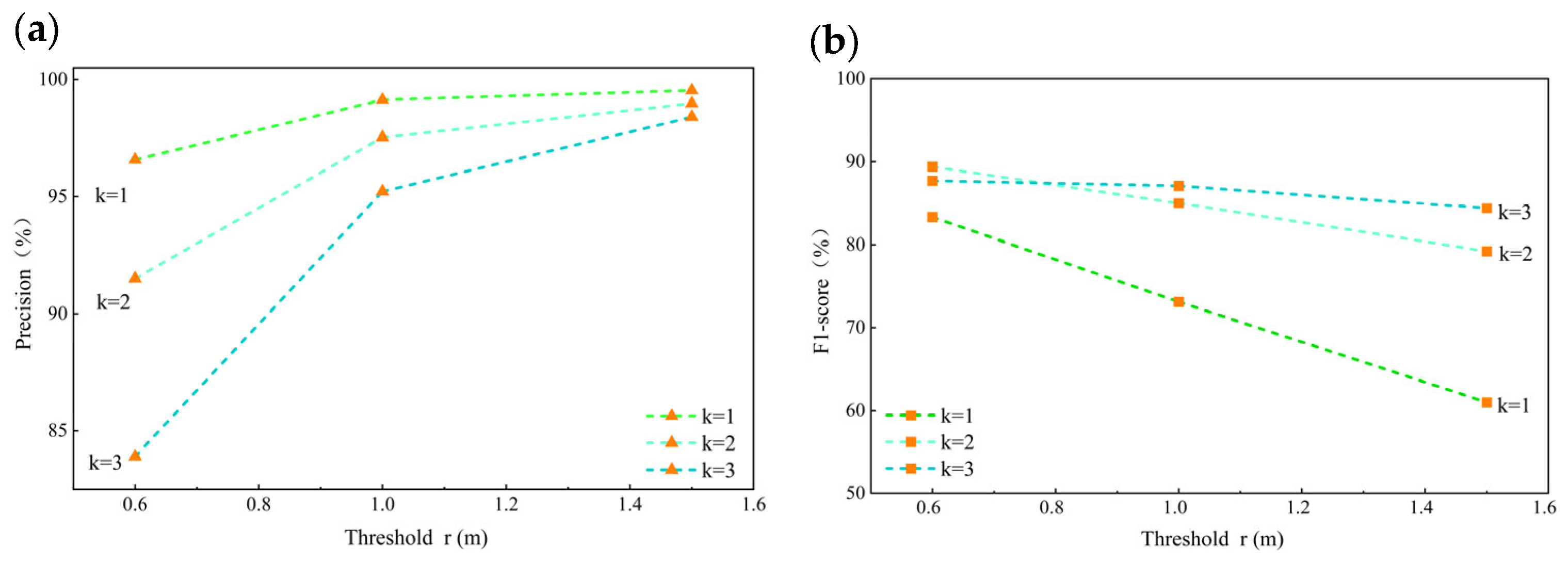
- Set the search radius r and neighbor point-count threshold k for ROR filtering.
- For the underwater point cloud data, read scanlines individually according to their scanline numbers, extract the 3D (Xi, Yi, Zi) coordinates of the underwater points, and perform the filtering process.
- a.
- Topology construction: A k-d tree method was used to construct a spatial topological structure for the scanline point cloud.
- b.
- Noise point identification: Each underwater point on the scanline was traversed, and a k-nearest neighbor search was performed in a 3D space. Points with fewer than k neighbors within the search radius r were identified as outliers and removed; otherwise, they were retained as terrain points.
2.4. Robust Polynomial Fitting Based on Sliding Windows
2.4.1. Sliding Window
2.4.2. Robust Least Squares Fitting
2.5. Adaptive Threshold Setting
3. Experimental Data
4. Results
4.1. Qualitative Evaluation
4.2. Quantitative Evaluation
- (1)
- Evaluation metrics
- (2)
- Quality evaluation
4.3. Comparison with Another Method
5. Discussion
5.1. Analysis of Fitting Results
5.2. Influence of Filtering Parameters
5.2.1. ROR Parameters
5.2.2. Polynomial Fitting Parameters
5.3. Influence of Flight Parameters and Water Conditions
5.4. Limitations
5.4.1. Abrupt Terrain Areas
5.4.2. Non-Terrain Objects
5.4.3. High-Density Noise
6. Conclusions
Author Contributions
Funding
Data Availability Statement
Conflicts of Interest
References
- He, Y.; Tao, B.; Yu, J.; Xu, G.; Huang, Y. Development of Airborne LiDAR Bathymetric Technology and Application. Chin. J. Lasers 2024, 51, 1101016. [Google Scholar]
- Liu, Z.; Yang, A.; Yang, F.; Su, D.; Feng, C.; Wang, M. The Feasibility Analysis for the Airborne LiDAR Bathymetry Application in Marine Surveying and Charting. Hydrogr. Surv. Charting 2018, 38, 43–47. [Google Scholar] [CrossRef]
- Liu, Y.; Wang, T.; Hu, Q.; Huang, T.; Zhang, A.; Di, M. Coastline Bathymetry Retrieval Based on the Combination of LiDAR and Remote Sensing Camera. Water 2024, 16, 3135. [Google Scholar] [CrossRef]
- Zuo, Z.; Zhang, Z.; Zhang, J. Noise removal algorithm of LIDAR point clouds based on three-dimensional finite-element analysis. Natl. Remote Sens. Bull. 2012, 16, 297–309. [Google Scholar] [CrossRef]
- Wang, D.; Xing, S.; He, Y.; Yu, J.; Xu, Q.; Li, P. Evaluation of a New Lightweight UAV-Borne Topo-Bathymetric LiDAR for Shallow Water Bathymetry and Object Detection. Sensors 2022, 22, 1379. [Google Scholar] [CrossRef] [PubMed]
- Dreier, A.; Janßen, J.; Kuhlmann, H.; Klingbeil, L. Quality Analysis of Direct Georeferencing in Aspects of Absolute Accuracy and Precision for a UAV-Based Laser Scanning System. Remote Sens. 2021, 13, 3564. [Google Scholar] [CrossRef]
- Vélez-Nicolás, M.; García-López, S.; Barbero, L.; Ruiz-Ortiz, V.; Sánchez-Bellón, Á. Applications of Unmanned Aerial Systems (UASs) in Hydrology: A Review. Remote Sens. 2021, 13, 1359. [Google Scholar] [CrossRef]
- Hui, Z.; Cheng, P.; Guan, Y.; Nie, Y. Review on Airborne LiDAR Point Cloud Filtering. Laser Optoelectron. Prog. 2018, 55, 7–15. [Google Scholar] [CrossRef]
- Meng, X.; Currit, N.; Zhao, K. Ground Filtering Algorithms for Airborne LiDAR Data: A Review of Critical Issues. Remote Sens. 2010, 2, 833–860. [Google Scholar] [CrossRef]
- Yilmaz, V. Automated ground filtering of LiDAR and UAS point clouds with metaheuristics. Opt. Laser Technol. 2021, 138, 106890. [Google Scholar] [CrossRef]
- Li, P.; Wang, H.; Liu, Z.; Liu, Z.; Shi, B. A Morphological LiDAR Points Cloud Filtering Method Based on Scan Lines. J. Geomat. Sci. Technol. 2011, 28, 274–277+282. [Google Scholar] [CrossRef]
- Hui, Z.; Hu, Y.; Yevenyo, Y.Z.; Yu, X. An Improved Morphological Algorithm for Filtering Airborne LiDAR Point Cloud Based on Multi-Level Kriging Interpolation. Remote Sens. 2016, 8, 35. [Google Scholar] [CrossRef]
- Li, Y.; Yong, B.; Van Oosterom, P.; Lemmens, M.; Wu, H.; Ren, L.; Zheng, M.; Zhou, J. Airborne LiDAR Data Filtering Based on Geodesic Transformations of Mathematical Morphology. Remote Sens. 2017, 9, 1104. [Google Scholar] [CrossRef]
- Ma, Y.; Xu, N.; Liu, Z.; Yang, B.; Yang, F.; Wang, X.H.; Li, S. Satellite-derived bathymetry using the ICESat-2 lidar and Sentinel-2 imagery datasets. Remote Sens. Environ. 2020, 250, 112047. [Google Scholar] [CrossRef]
- Wang, C.; Ji, M.; Wang, J.; Wen, W.; Li, T.; Sun, Y. An Improved DBSCAN Method for LiDAR Data Segmentation with Automatic Eps Estimation. Sensors 2019, 19, 172. [Google Scholar] [CrossRef]
- Wang, D.; Yu, J.; Liu, F.; Li, Q. ICESat-2 single photon laser point cloud denoising algorithm based on improved DBSCAN clustering. Earth Planets Space 2024, 76, 128. [Google Scholar] [CrossRef]
- Zhang, Z.; Liu, X.; Ma, Y.; Xu, N.; Zhang, W.; Li, S. Signal Photon Extraction Method for Weak Beam Data of ICESat-2 Using Information Provided by Strong Beam Data in Mountainous Areas. Remote Sens. 2021, 13, 863. [Google Scholar] [CrossRef]
- Zhang, Q.; Zhang, S.; Li, C.; Zhang, K.; Chen, Z. Multispectral information-assisted filtering of bathymetric point clouds. Hydrogr. Surv. Charting 2025, 45, 10–14+29. [Google Scholar] [CrossRef]
- Chen, Y.; Wang, Z.; Song, W.; Le, Y.; Zhou, L.; Guo, H.; Wu, L.; Yi, L. A Segmented Adaptive Filtering Method for Nearshore Bathymetry Using ICESat-2 Dataset. Remote Sens. 2026, 18, 568. [Google Scholar] [CrossRef]
- Zhang, W.; Qi, J.; Wan, P.; Wang, H.; Xie, D.; Wang, X.; Yan, G. An Easy-to-Use Airborne LiDAR Data Filtering Method Based on Cloth Simulation. Remote Sens. 2016, 8, 501. [Google Scholar] [CrossRef]
- Cai, S.; Yu, S.; Hui, Z.; Tang, Z. ICSF: An Improved Cloth Simulation Filtering Algorithm for Airborne LiDAR Data Based on Morphological Operations. Forests 2023, 14, 1520. [Google Scholar] [CrossRef]
- Hu, C.; Shi, Z.; Pan, G.; Ren, D.; Luo, Y. Side-Slope Point Cloud Filtering Method With Strip Curve Fitting. IEEE Trans. Geosci. Remote Sens. 2025, 63, 4417914. [Google Scholar] [CrossRef]
- Li, H.; Ye, C.; Guo, Z.; Wei, R.; Wang, L.; Li, J. A Fast Progressive TIN Densification Filtering Algorithm for Airborne LiDAR Data Using Adjacent Surface Information. IEEE J. Sel. Top. Appl. Earth Obs. Remote Sens. 2021, 14, 12492–12503. [Google Scholar] [CrossRef]
- Shi, X.; Ma, H.; Chen, Y.; Zhang, L.; Zhou, W. A parameter-free progressive TIN densification filtering algorithm for lidar point clouds. Int. J. Remote Sens. 2018, 39, 6969–6982. [Google Scholar] [CrossRef]
- Gou, F.; Li, Y.; Hou, C.; Wang, H. 3D point cloud global denoising algorithm based on different noise characteristics. Meas. Sci. Technol. 2024, 35, 015032. [Google Scholar] [CrossRef]
- Yan, Y.; Chen, Z.; Sun, Y.; Li, Z.; Yao, C. LiDAR point cloud ground filtering algorithm in dense and low vegetation area. Bull. Surv. Mapp. 2021, 07, 1–5. [Google Scholar] [CrossRef]
- Qin, L.; Wu, W.; Tian, Y.; Xu, W. LiDAR Filtering of Urban Areas With Region Growing Based on Moving-Window Weighted Iterative Least-Squares Fitting. IEEE Geosci. Remote Sens. Lett. 2017, 14, 841–845. [Google Scholar] [CrossRef]
- Su, W.; Sun, Z.; Zhong, R.; Huang, J.; Li, M.; Zhu, J.; Zhang, K.; Wu, H.; Zhu, D. A new hierarchical moving curve-fitting algorithm for filtering lidar data for automatic DTM generation. Int. J. Remote Sens. 2015, 36, 3616–3635. [Google Scholar] [CrossRef]
- Doneus, M.; Miholjek, I.; Mandlburger, G.; Doneus, N.; Verhoeven, G.; Briese, C.; Pregesbauer, M. Airborne Laser Bathymetry for Documentation of Submerged Archaeological Sites in Shallow Water. Int. Arch. Photogramm. Remote Sens. Spat. Inf. Sci. 2015, XL-5/W5, 99–107. [Google Scholar] [CrossRef]
- Yang, A.; Wu, Z.; Yang, F.; Su, D.; Ma, Y.; Zhao, D.; Qi, C. Filtering of airborne LiDAR bathymetry based on bidirectional cloth simulation. ISPRS J. Photogramm. Remote Sens. 2020, 163, 49–61. [Google Scholar] [CrossRef]
- Su, D.; Yan, D.; Chen, L.; Chen, Y.; Dong, J.; Wu, D.; Yu, X. Surface-volume-bottom joint-filtering algorithm for Airborne LiDAR bathymetric point cloud. Acta Geod. Cartogr. Sin. 2023, 52, 614–623. [Google Scholar] [CrossRef]
- Kraus, K.; Pfeifer, N. Determination of terrain models in wooded areas with airborne laser scanner data. ISPRS J. Photogramm. Remote Sens. 1998, 53, 193–203. [Google Scholar] [CrossRef]
- Pfeifer, N.; Stadler, P.; Briese, C. Derivation of digital terrain models in the SCOP++ environment. In OEEPE Workshop on Airborne Laserscanning and Interferometric SAR for Detailed Digital Terrain Models; Torlegard, K., Nelson, J., Eds.; EuroSDR: Co Kildare, Ireland, 2001. [Google Scholar]
- Yu, J.; Lu, X.; Tian, M.; He, Y.; Lv, D.; Hu, S.; Wang, Y.; Cao, Y.; Huang, T. Effect Analysis of Positioning Model and Boresight Error Analysis of Airborne LiDAR Bathymetry System. Infrared Laser Eng. 2019, 48, 337–345. [Google Scholar] [CrossRef]
- Li, H.; Tang, S.; Huang, J. Discussion for the selection of constant in selecting weight iteration method in robust estimation. Sci. Surv. Mapp. 2006, 6, 70–71+76+5. [Google Scholar] [CrossRef]
- Wang, S.; Zhou, P.; Wu, Z.; Li, J.; Wei, Y. Detection and Elimination of Bathymetric Outliers in Multibeam Echosounder System Based on Robust Multi-quadric Method and Median Parameter Model. J. Eng. Sci. Technol. Rev. 2018, 11, 70–78. [Google Scholar] [CrossRef]


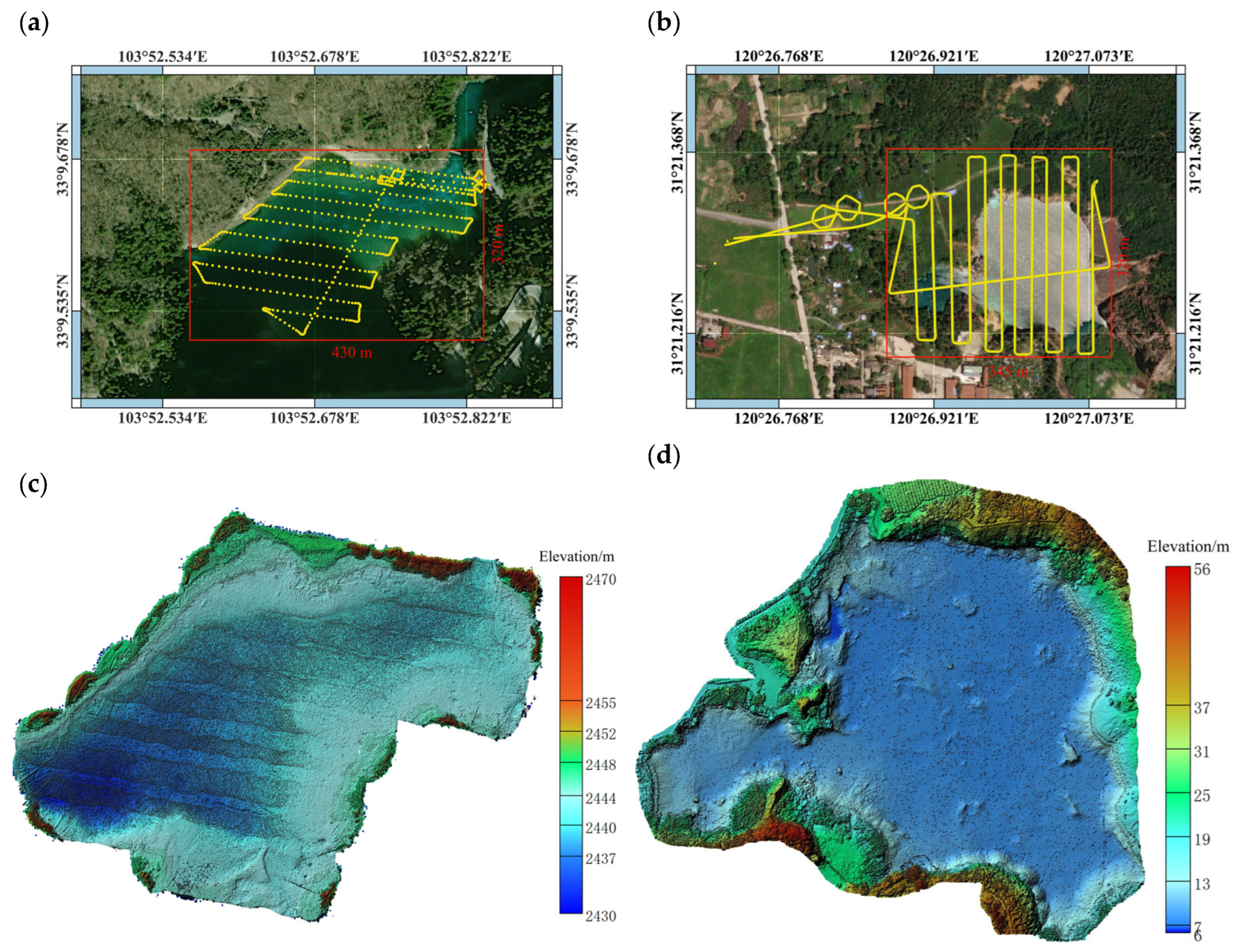
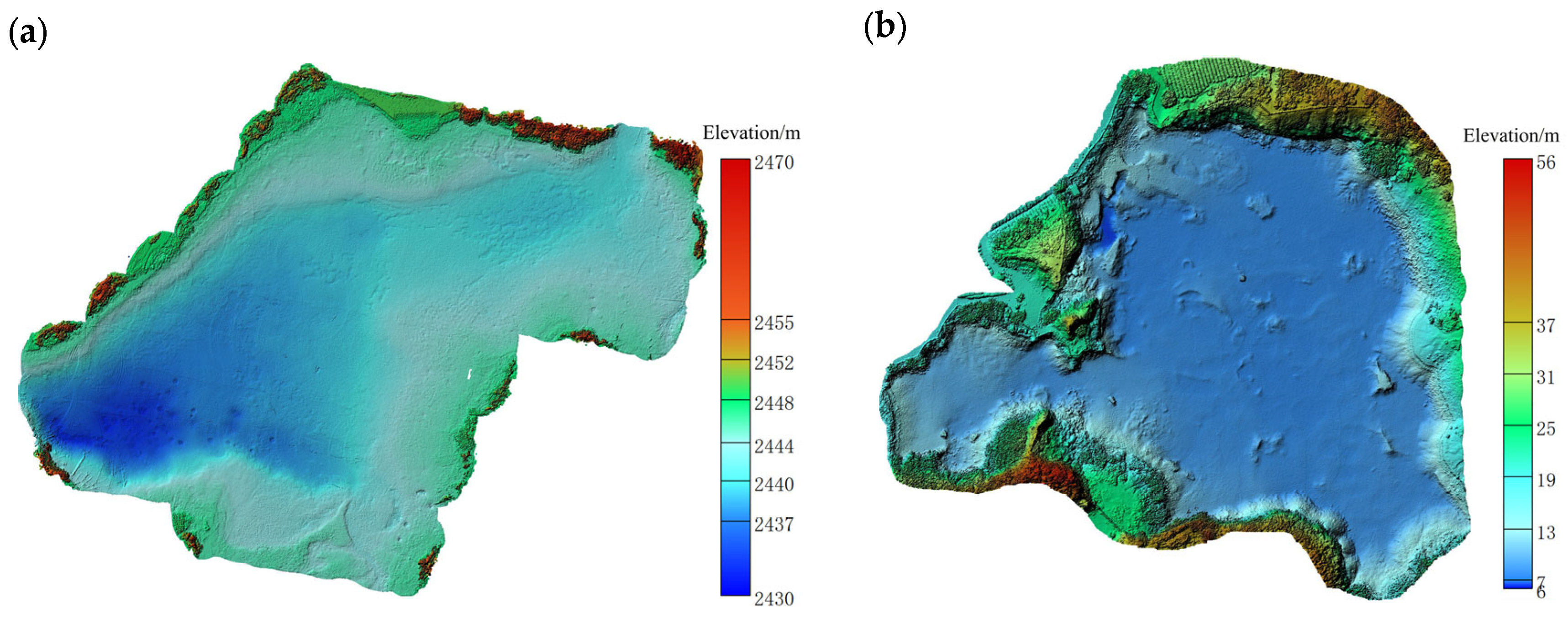

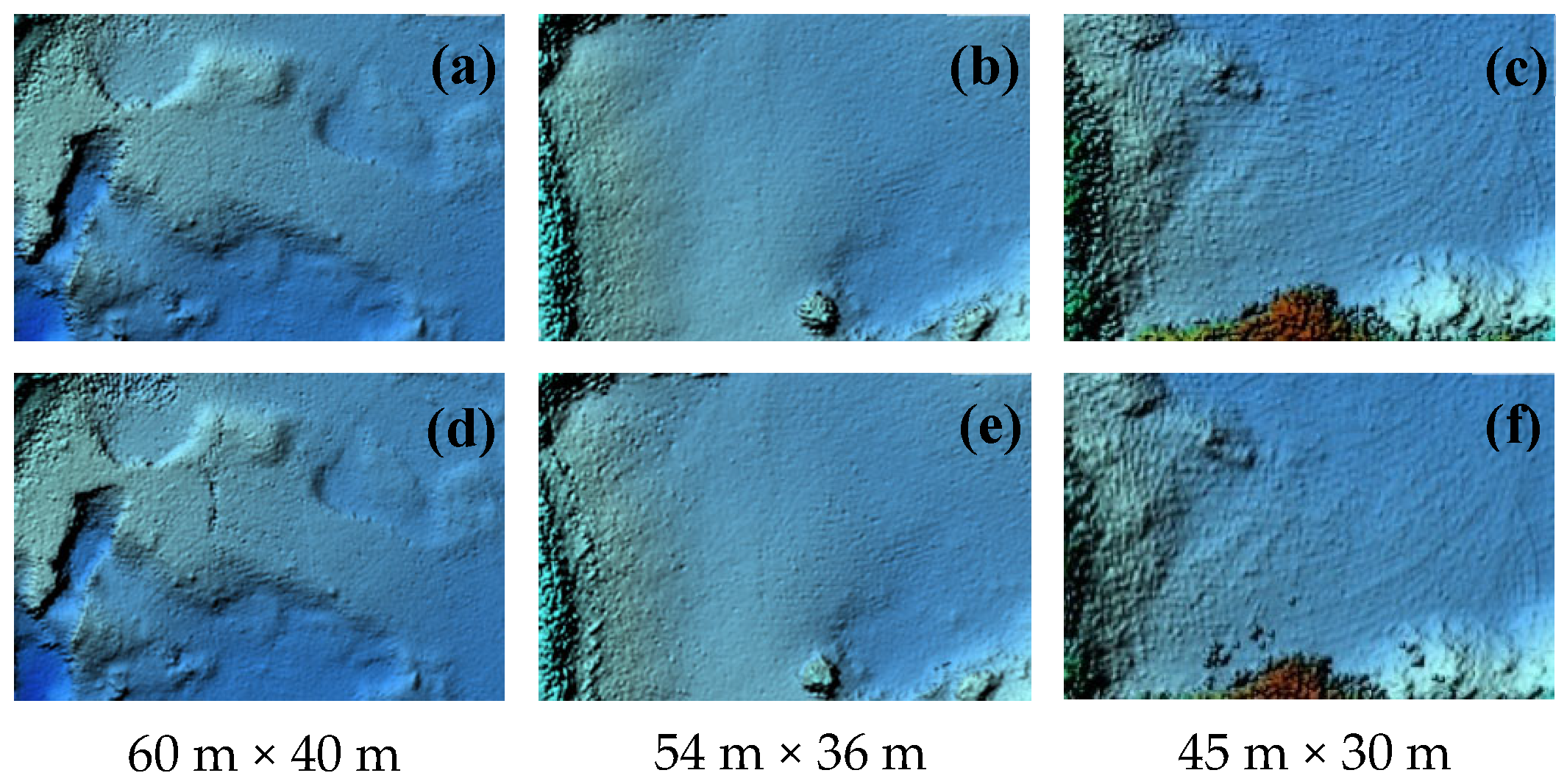
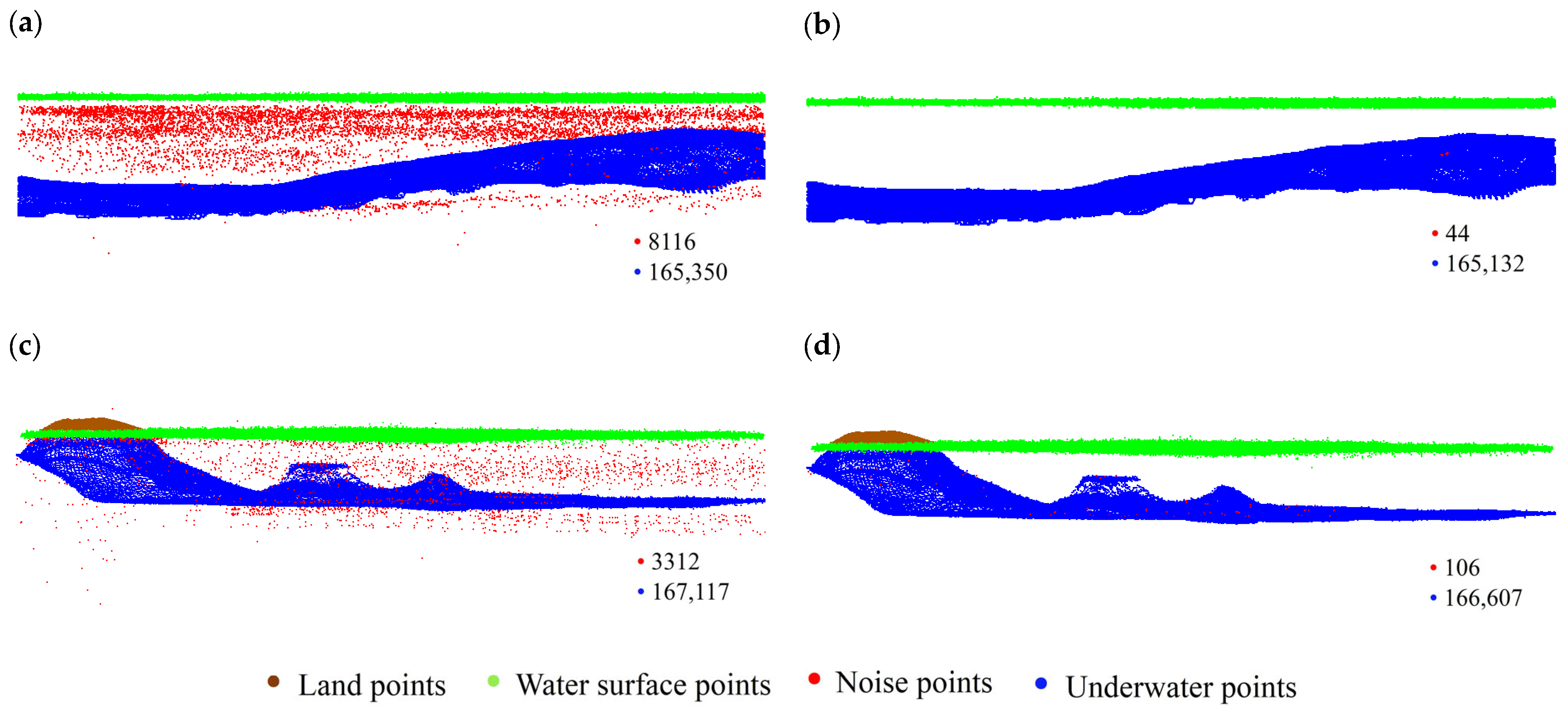



| Parameters | Indicators |
|---|---|
| Laser pulse frequency | ≥20 kHz |
| Laser wavelength | 532 nm & 1064 nm |
| Scanning mode | Elliptical scanning |
| Scanning speed | 1200 rpm |
| Field of view (FOV) | 40° |
| Data acquisition mode | Full-Waveform sampling |
| Maximum detection depth | 2 × SD (at flight height 75 m) |
| Bathymetric accuracy | 0.2 m |
| Weight | ≤4.2 kg |
| Category | Algorithm Recognition | R | P | F1 | OA | |
|---|---|---|---|---|---|---|
| Noise Points | Terrain Points | |||||
| Noise points | TP | FN | TP/(TP + FN) | TP/(TP + FP) | 2PR/(P + R) | (TP + TN)/(TP + FN + FP + TN) |
| Terrain points | FP | TN | ||||
| Data | Filtering Method | R/% | P/% | F1 | OA/% | Time |
|---|---|---|---|---|---|---|
| Data 1 | SVB | 97.04 | 91.1 | 0.940 | 99.42 | 4 min 12 s |
| our | 99.46 | 97.37 | 0.984 | 99.85 | 7.355 s | |
| Data 2 | SVB | 87.02 | 74.14 | 0.801 | 99.16 | 4 min 56 s |
| our | 96.80 | 86.28 | 0.912 | 99.64 | 7.196 s |
| Area | Stage | TP | FN | FP | TN | R/% | P/% | F1 | OA/% |
|---|---|---|---|---|---|---|---|---|---|
| Data 1 | 1 | 1771 | 6345 | 3 | 165,347 | 21.82 | 99.83 | 0.358 | 96.34 |
| 2 | 8072 | 44 | 218 | 165,132 | 99.46 | 97.37 | 0.984 | 99.85 | |
| Data 2 | 1 | 1315 | 1997 | 59 | 167,058 | 39.70 | 95.71 | 0.561 | 98.79 |
| 2 | 3206 | 106 | 510 | 166,607 | 96.80 | 86.28 | 0.912 | 99.64 |
| m | n | TP | FN | FP | TN | R/% | P/% | F1 | OA/% | Time/s |
|---|---|---|---|---|---|---|---|---|---|---|
| 3 | 13 | 8068 | 48 | 201 | 165,149 | 99.41 | 99.88 | 0.985 | 99.86 | 5.574 |
| 17 | 8072 | 44 | 218 | 165,132 | 99.46 | 99.87 | 0.984 | 99.85 | 5.751 | |
| 21 | 8073 | 43 | 267 | 165,083 | 99.47 | 99.84 | 0.981 | 99.82 | 6.004 | |
| 5 | 13 | 8068 | 48 | 201 | 165,149 | 99.41 | 99.88 | 0.985 | 99.86 | 6.582 |
| 17 | 8072 | 44 | 218 | 165,132 | 99.46 | 99.87 | 0.984 | 99.85 | 7.073 | |
| 21 | 8073 | 43 | 267 | 165,083 | 99.47 | 99.84 | 0.981 | 99.82 | 7.381 | |
| 7 | 13 | 8068 | 48 | 201 | 165,149 | 99.41 | 99.88 | 0.985 | 99.86 | 8.099 |
| 17 | 8072 | 44 | 218 | 165,132 | 99.46 | 99.87 | 0.984 | 99.85 | 8.533 | |
| 21 | 8073 | 43 | 267 | 165,083 | 99.47 | 99.84 | 0.981 | 99.82 | 8.937 |
Disclaimer/Publisher’s Note: The statements, opinions and data contained in all publications are solely those of the individual author(s) and contributor(s) and not of MDPI and/or the editor(s). MDPI and/or the editor(s) disclaim responsibility for any injury to people or property resulting from any ideas, methods, instructions or products referred to in the content. |
© 2026 by the authors. Licensee MDPI, Basel, Switzerland. This article is an open access article distributed under the terms and conditions of the Creative Commons Attribution (CC BY) license.
Share and Cite
Yu, J.; Zhang, J.; Mu, J.; Guo, J.; Lv, D.; Du, X.; Lin, P. A Scanline-Based Sliding Window Filtering Method for UAV-Borne LiDAR Bathymetry Point Clouds. Remote Sens. 2026, 18, 1635. https://doi.org/10.3390/rs18101635
Yu J, Zhang J, Mu J, Guo J, Lv D, Du X, Lin P. A Scanline-Based Sliding Window Filtering Method for UAV-Borne LiDAR Bathymetry Point Clouds. Remote Sensing. 2026; 18(10):1635. https://doi.org/10.3390/rs18101635
Chicago/Turabian StyleYu, Jiayong, Jing Zhang, Jiangchao Mu, Jiachun Guo, Deliang Lv, Xiaoxue Du, and Peng Lin. 2026. "A Scanline-Based Sliding Window Filtering Method for UAV-Borne LiDAR Bathymetry Point Clouds" Remote Sensing 18, no. 10: 1635. https://doi.org/10.3390/rs18101635
APA StyleYu, J., Zhang, J., Mu, J., Guo, J., Lv, D., Du, X., & Lin, P. (2026). A Scanline-Based Sliding Window Filtering Method for UAV-Borne LiDAR Bathymetry Point Clouds. Remote Sensing, 18(10), 1635. https://doi.org/10.3390/rs18101635