


Highlights
What are the main findings?
- This review highlights a clear shift from conventional pixel-based and object-based methods to learning-based approaches. Traditional techniques struggle with high-resolution data and complex feature representation. In contrast, deep learning models, especially CNNs and autoencoders, effectively capture hierarchical and nonlinear features, leading to more accurate real-world representations.
- 2D data is effective for detecting horizontal changes such as land cover and building footprints, while 3D data provides essential information on vertical and volumetric changes like building height. However, deep learning for 3D change detection is still in its early stages compared to 2D approaches. It also faces key challenges, including high data acquisition costs, noise in 3D data, and the need for high-performance computing resources.
What are the implications of the main findings?
- Continuous and precise monitoring of building dynamics through these advanced methods is essential for informed decision making in urban planning, sustainable development, and smart city management.
- To overcome current limitations, the sources suggest that future research must focus on developing lightweight models and label-efficient learning strategies (such as self-supervised or synthetic data) to reduce the heavy reliance on massive, labeled datasets and high computational power.
Abstract
Change detection is a fundamental task in remote sensing with broad applications in urban monitoring, agriculture, watershed management, and land use and land cover analysis. In urban environments, accurate change detection is particularly critical for resource management, urban planning, and smart city development. Rapid urbanization has led to frequent and complex changes in buildings, which constitute key structural components of cities. Consequently, continuous and precise monitoring of building dynamics is essential for informed decision-making related to urban growth, environmental assessment, traffic management, and sustainable development. This paper presents a comprehensive review of two-dimensional (2D) and three-dimensional (3D) change detection methods applied to urban areas. Conventional and advanced approaches are systematically analyzed, and their strengths and limitations are critically discussed from a holistic perspective. Special emphasis is placed on recent learning-based techniques, which demonstrate enhanced robustness and accuracy in complex urban environments. Finally, current challenges and future research directions are identified to support the further development of effective 2D and 3D urban change detection methods.
1. Introduction
Change detection refers to the process of identifying and analyzing variations in objects or phenomena over time using multi-temporal remote sensing data. It is a key component of Earth observation and has been widely applied to monitoring natural hazards, urban growth, land use and land cover changes, environmental degradation, and climate-related processes. Depending on the application, change detection may target short-term events, such as earthquakes and fires, or long-term processes, including urban expansion, deforestation, and droughts [1,2].
In urban environments, change detection plays a particularly important role due to the rapid pace and complexity of human-induced transformations. Buildings, as fundamental elements of urban structure, undergo frequent changes in geometry, height, function, and density. Accurate monitoring of these changes is essential for urban planning, infrastructure management, disaster assessment, and smart city development. However, urban areas pose significant challenges for change detection due to heterogeneous land cover, dense structures, occlusions, and varying illumination and viewing conditions [3].
Recent advances in remote sensing platforms, including high-resolution satellite imagery, aerial photogrammetry, unmanned aerial vehicles (UAVs), and light detection and ranging (LiDAR) systems, have significantly improved the availability of multi-temporal 2D and 3D data. At the same time, the integration of artificial intelligence (AI), particularly machine learning and deep learning techniques, has transformed change detection methodologies. These developments have led to a clear distinction between conventional change detection approaches and learning-based methods [2,4].
Although several studies have reviewed specific aspects of change detection, a comprehensive and systematic review that jointly analyzes 2D and 3D change detection methods in urban areas—while explicitly comparing conventional and learning-based approaches—remains limited. This paper aims to address this gap by providing a holistic review of 2D and 3D urban change detection techniques, analyzing their strengths, limitations, and application scenarios, and outlining key challenges and future research directions. This review paper attempts to simultaneously examine both conventional and learning-based methods for detection of 2D and 3D urban changes. Compared to previous review studies, this is considered a novelty, as most existing studies focus on only one domain (either 2D or 3D). In addition, the tables presented in later sections provide the advantages and limitations of conventional and learning-based methods for quick review and summarization. In change detection problems, especially those related to natural disasters in urban areas, providing a method within the shortest possible time is critical. Therefore, researchers need to quickly evaluate the strengths and weaknesses of existing methods and select the most suitable approach based on the available data and conditions. Hence, review studies of this type are highly practical. While most review papers are lengthy and detailed, this work aims to maintain both comprehensiveness and conciseness, which constitutes the main objective and novelty of this study.
The remainder of this paper is structured as follows: The background is discussed in Section 2. Urban change detection patterns and publications are presented in Section 3. The review and classification of change detection methods are presented in Section 4. The 2D change detection methods are presented in Section 4.1, while the 3D change detection methods are discussed in Section 4.2. Finally, Section 5 concludes this article.
2. Background
Urban environments undergo continuous spatial–temporal changes driven by natural hazards, human activities, and environmental processes. Using multi-temporal remote sensing data, change detection aims to compare and interpret variations in objects or phenomena between two or more acquisition times. Depending on the temporal interval, change detection may target events occurring over a few seconds or days (e.g., earthquakes or fires), several months (e.g., construction activities and urban development), or multiple years (e.g., long-term urban transformation and drought). In this review, urban changes are broadly examined across short-term (seconds to days) and long-term (months to years) timescales to reflect the diverse temporal dynamics observed in urban environments [5,6].
Short-term urban changes typically occur over periods ranging from seconds to days and are often associated with sudden natural disasters such as earthquakes, fires, and floods. These events can cause severe, abrupt damage to buildings and infrastructure, particularly in dense urban areas. Changes occur over short-term (seconds) to long-term (years). For example, earthquakes can cause rapid destruction within seconds, whereas urban development typically occurs over years. Examples of short-, medium-, and long-term changes are presented, demonstrating that change is a fundamental aspect of the world and requires appropriate analysis methods. For instance, a destructive earthquake with a magnitude of approximately 7.8 struck southern and central Turkey and northern and western Syria on 6 February 2023, resulting in extensive human and structural losses across an affected area of approximately 350,000 km2. Figure 1 presents WorldView-2 images acquired before and after the earthquake, clearly illustrating widespread building damage in the city of Nurdağı [7].
Figure 1.
Satellite imagery of Nurdaghı, Turkey, acquired before (a) and after (b) the earthquake, illustrating building damage within a dense urban area.
Long-term changes generally occur over months to years and are commonly associated with environmental processes and human-induced transformations. Environmental degradation caused by prolonged drought represents a prominent category of long-term change. Lake Urmia, one of the largest saltwater lakes in the Middle East, provides a representative example of such phenomena. As shown in Figure 2, satellite images acquired in 1985 and 2023 reveal substantial shrinkage of Lake Urmia, demonstrating the necessity of long-term, multi-temporal monitoring for environmental change detection.
Figure 2.
Satellite images of Lake Urmia showing drought monitoring: (a) 1985 and (b) 2023, illustrating the long-term reduction in lake extent.
Urban development constitutes another major form of long-term change, typically involving gradual but extensive modifications to land use and urban morphology. In the northern provinces of Iran, particularly Mazandaran and Golestan, rapid urban expansion and deforestation have occurred in recent years. Between 2017 and 2021, large areas of forest and farmland were converted into residential areas and recreational facilities. Figure 3 illustrates this urban growth using Sentinel-2 imagery, highlighting the spatial extent and intensity of land conversion processes [8].
Figure 3.
Sentinel-2 satellite images of Mazandaran and Golestan provinces in (a) 2017 and (b) 2021, showing urban expansion and land-use conversion.
Similarly, District 22 of Tehran Municipality has experienced substantial urban development, with open lands converted into residential and commercial high-rise buildings and recreational centers. This transformation is illustrated in Figure 4 using GeoEye imagery acquired in 2003 and 2020 [9,10].
Figure 4.
GeoEye satellite images of District 22, Tehran, acquired in (a) 2003 and (b) 2020, showing urban development.
The diversity of short- and long-term urban change underscores the need for comprehensive and accurate information on urban change to support informed decision-making in urban planning, infrastructure management, and sustainable development. Recent advances in remote sensing—including high-resolution satellite imagery, UAV data, and 3D products such as digital surface models (DSMs) and point clouds—have significantly enhanced the ability to monitor urban changes. While 2D data is effective for detecting horizontal changes, such as land cover transitions and building-footprint modifications, 3D data provides critical information on vertical and volumetric changes, including building-height variations.
Furthermore, the integration of remote sensing data with advanced AI techniques, particularly deep learning models, has greatly improved the efficiency and accuracy of urban change detection. The combination of these two powerful approaches enables not only the detection of subtle changes in urban areas, buildings, and their boundaries but also the generation of comprehensive urban maps within a relatively short time. These developments motivate a systematic review of urban change detection approaches based on both data dimensionality (2D and 3D) and methodological paradigms (conventional and learning-based methods), which forms the basis of the following sections.
3. Urban Change Detection Pattern and Publications
3.1. Dataset Definition and Search Strategy
In this study, bibliographic data was collected from the Web of Science Core Collection (https://clarivate.com). This database was selected because it is widely used in citation-based bibliometric studies and provides relatively standardized information on publications, citations, authors, journals, keywords, and cited references. The search was conducted across all available publication years in Web of Science in order to capture both the early development and the recent growth of remote sensing-based urban change detection research. No fixed starting year was applied during the retrieval stage so that older but relevant studies could also be included in the initial dataset.
The search strategy was designed to focus on urban change detection methods using remote sensing data. In particular, it aimed to cover general urban change detection studies, building change detection, built-up area changes detection, urban object and feature change detection, urban expansion detection or monitoring, and map or building database updating. To reflect the 2D and 3D scope of this study, the query also included terms related to satellite images, aerial images, high-resolution imagery, LiDAR, point clouds, synthetic aperture radar (SAR), photogrammetry, digital surface models, DSM, and UAV data. The Topic Search field (TS) was used because it searches the title, abstract, author keywords, and Keywords Plus fields. This option was considered more suitable than a title-only search, as many method-oriented studies may mention the urban application context, data source, or change detection task in the abstract or keywords rather than directly in the title.
The final search query was as follows:
TS = ((“urban change detection” OR “building change detection” OR “building change” OR “built-up change detection” OR “built-up area change detection” OR “urban object change detection” OR “urban feature change detection” OR “urban land cover change detection” OR “urban land use change detection” OR “urban expansion detection” OR “urban expansion monitoring” OR “building map updating” OR “building updating” OR “building database updating” OR “urban map updating”) AND (“remote sensing” OR satellite* OR “aerial image*” OR “aerial imagery” OR “high-resolution image*” OR “very high resolution image*” OR LiDAR OR “point cloud*” OR SAR OR photogrammetry* OR “digital surface model*” OR DSM OR UAV)).
To ensure that the dataset focused on formal academic outputs, the document types were restricted to Article, Review, and Proceedings Paper. The records were exported from Web of Science using the Full Record and Cited References option. This export format was selected because it contains the key bibliographic information needed for the following analysis, including titles, abstracts, author keywords, Keywords Plus, publication years, source titles, citation counts, and cited references.
Since 2026 was an incomplete publication year at the time of data collection, records published in 2026 were excluded to avoid overinterpreting the apparent decline in the most recent year. After applying the search query and document-type restrictions, and excluding 2026 records, the final dataset consisted of 735 records. These records were used as the basis for the bibliometric analysis. After exporting, the separated Web of Science text files were merged and processed in Python 3.14.5 to extract the main bibliographic fields and classify the records into method-related groups, including 2D traditional change detection, 2D object-based change detection, 2D deep learning change detection, 3D traditional change detection, 3D deep learning change detection, and review.
The cleaned dataset was then used to calculate annual publication trends, identify highly cited papers, and support the method evolution analysis. In addition, the merged Web of Science file was imported into VOSviewer 1.6.20 (https://www.vosviewer.com) to conduct keyword co-occurrence analysis and identify the main thematic structure and emerging research directions in this field. This workflow was used to ensure that the analysis is transparent, reproducible, and consistent with the objective of comparing 2D and 3D urban change detection methods using remote sensing.
3.2. Publication Trends
As shown in Figure 5, the publication output of urban change detection methods remained relatively low during the early stage from 2000 to around 2010. During this period, most studies were concentrated in traditional 2D change detection, while 3D, deep learning, and object-based methods appeared only occasionally. This indicates that early urban change detection research mainly relied on conventional image comparison, spectral analysis, and pixel-level processing.
Figure 5.
Annual publication trends by method category.
After 2010, the number of publications gradually increased, especially for 2D traditional methods and 3D traditional methods. The growth of 3D traditional change detection became more visible between 2014 and 2019, reflecting the increasing use of LiDAR, DSMs, dense image matching, photogrammetry, and point clouds for building and urban structural change detection. However, the overall publication volume was still moderate before 2020. A much clearer growth stage can be observed after 2020. The most rapid increase occurred in 2D deep learning change detection, which rose sharply from 2021 and became the dominant category by 2025. This trend suggests that convolutional neural networks (CNNs), Siamese networks, UNet-based models, transformers, and semantic segmentation frameworks have become increasingly important for extracting urban changes from high-resolution satellite and aerial images. In comparison, 2D traditional methods continued to increase but at a slower rate, indicating that they still serve as useful and interpretable baselines. The 3D deep learning category also began to appear in recent years, but its output remained much lower than 2D deep learning, suggesting that this direction is still emerging.
Overall, Figure 5 shows a clear methodological shift in urban change detection research. The field has moved from early 2D traditional and pixel-based methods toward deep learning-driven approaches, while 3D methods based on LiDAR, DSMs, and point clouds have become an important but smaller research direction. This trend indicates that recent studies are increasingly focused on more automated, data-driven, and object-aware approaches for complex urban environments.
3.3. Keyword Co-Occurrence Analysis
Figure 6 presents the keyword co-occurrence network generated by VOSviewer. In this map, larger nodes indicate keywords with higher occurrence frequency, while the links represent co-occurrence relationships between keywords. Overall, several central terms, including “building change detection”, “remote sensing”, “change detection”, “deep learning”, and “feature extraction”, occupy the core of the network. This indicates that the field is mainly organized around remote sensing-based change detection, with building-level change detection and learning-based feature extraction becoming important research directions.
Figure 6.
Co-occurrence network of all keywords in urban change detection research: minimum occurrence threshold of 5 and 100 selected keywords.
The network can be broadly divided into several thematic groups. The red cluster is mainly related to traditional change detection and urban monitoring, including terms such as “change detection”, “classification”, “unsupervised change detection”, “urban change detection”, “segmentation”, and “synthetic aperture radar”. This cluster reflects the early and conventional basis of the field, where image comparison, classification, segmentation, and SAR-based analysis were commonly used. The blue cluster is more closely connected with building change detection and deep learning, including “building change detection”, “deep learning”, “siamese network”, “semantic segmentation”, “attention mechanism”, and “transformer”. This shows that recent studies have increasingly focused on automated and data-driven building-level change detection from high-resolution images. The green cluster is centered on “remote sensing” and “feature extraction” and includes terms such as “accuracy”, “data mining”, “convolutional neural networks”, “transformers”, and “remote sensing image”. This cluster suggests that model performance, feature learning, and image representation are important topics in current research.
Overall, Figure 6 shows that urban change detection research has developed from general remote sensing classification and traditional change detection toward building-level, deep learning-based, and feature-driven methods. The relatively small and peripheral position of terms such as “LiDAR” and “3D change detection” also suggests that 3D urban change detection remains a more specialized direction compared with 2D image-based methods. Taken together, the keyword map is consistent with the publication trend results, showing a clear movement from conventional image-based analysis to more automated, object-level, and learning-based approaches.
3.4. Highly Cited Papers and Method Categories
Table 1 presents the top highly cited papers in remote sensing-based urban change detection research. The most cited paper is “Change detection techniques” by Lu et al. [11], with 2200 citations. This paper is a general review of change detection methods and shows that traditional change detection techniques still form an important methodological foundation for this field. Another review paper, “Change Detection Based on Artificial Intelligence: State-of-the-Art and Challenges” by Shi et al. [12], also received 492 citations, indicating that artificial intelligence-based change detection has become an important topic in recent years. In addition, the review paper on 3D change detection by Qin et al. [13] shows the relevance of 3D change detection approaches, although 3D studies are less dominant in the highly cited list compared with 2D image-based studies.
Table 1.
Top 20 highly cited papers in urban change detection research by method category.
The table also shows that recent deep learning-based papers have gained strong citation influence within a relatively short period. For example, Chen et al. [14], Wang et al. [15], Chen et al. [16], Liu et al. [17], Zhang et al. [18], and Peng et al. [19] all appear among the most cited papers. These studies are mainly related to spatial–temporal attention, Siamese networks, fully convolutional networks, transformers, semi-supervised CNNs, and building change detection from high-resolution remote sensing images. This suggests that deep learning has become a major direction in recent urban change detection research, especially for 2D image-based and building-level change detection tasks.
At the same time, several traditional or non-deep learning studies are still highly cited, including urban land-cover change detection through sub-pixel imperviousness mapping, SAR-based building change detection, and morphological building index-based change detection. These papers show that traditional feature-based, spectral, SAR, and morphological methods remain important, particularly as interpretable baselines or application-oriented approaches. Overall, Table 1 suggests a clear transition in the highly cited literature. Earlier influential studies mainly provided general methodological foundations or traditional feature-based approaches, whereas recent highly cited papers are increasingly dominated by deep learning models, high-resolution image analysis, and building-level change detection.
3.5. Method Evolution and Summary
Table 2 summarizes the evolution of urban change detection methods from 2000 to 2025. Overall, the results show a clear transition from traditional 2D methods to object-based, deep learning, and 3D-aware approaches. In the early stage from 2000 to 2009, the field was mainly dominated by 2D traditional change detection, which accounted for 66.67% of the publications. These studies mostly relied on image comparison, classification, thresholding, spectral analysis, and pixel-level processing. Object-based and 3D methods were still limited in this period, and no deep learning studies were identified, suggesting that early urban change detection was mainly built on conventional and interpretable remote sensing methods.
Table 2.
Method evolution of urban change detection research by development stage, 2000–2025.
From 2010 to 2020, the method structure became more diverse. Although 2D traditional methods remained important, their share decreased from 53.98% in 2010–2016 to 37.61% in 2017–2020. During the same period, 3D traditional methods became more visible, especially in 2010–2016, when they accounted for 25.66% of the publications. This reflects the increasing use of LiDAR, DSMs, dense image matching, photogrammetry, and point clouds for detecting building and structural changes. Object-based methods also appeared more frequently, showing a gradual move from pixel-level analysis to object-level urban change detection. After 2017, deep learning started to grow rapidly, with 2D deep learning reaching 26.50% of the publications in 2017–2020.
The strongest transition occurred in 2021–2025, when 2D deep learning became the dominant method category, accounting for 60.81% of the publications. This indicates that urban change detection has shifted strongly toward data-driven models such as CNNs, Siamese networks, U-Net-based methods, attention mechanisms, transformers, and semantic segmentation frameworks. At the same time, traditional 2D methods still remained as practical baselines, while 3D deep learning increased to 16 records, showing the recent rise of 3D-aware methods. Taken together, the results suggest that urban change detection has evolved from simple 2D image comparison toward more automated, object-level, deep learning-based, and 3D-aware approaches, with 3D methods becoming an important direction for building-level and structural change detection in complex urban environments.
4. Review and Classification of Change Detection Methods
Change detection refers to identifying differences occurring in a given area over various periods. Change detection methods are classified into 2D and 3D groups, depending on the data. Given advances in remote sensing-assisted data collection and the introduction of AI networks to remote sensing applications, 2D and 3D change detection methods are divided into “learning-based methods” and “conventional methods”. This classification has been used in many photogrammetric and remote-sensing applications in recent years. In other words, the introduction of AI knowledge to remote sensing and photogrammetry has drawn a boundary between conventional and learning-based change detection methods [12,30,31].
4.1. 2D Change Detection Methods
Human activities have substantially changed the Earth’s surface in recent years. The 2D remote sensing and photogrammetry data from satellite, aerial, and drone images is recognized as an essential, accurate, rapid, and simple instrument to detect changes over large areas. Overall, conventional and learning-based 2D/3D change detection methods are categorized into supervised and unsupervised groups [32].
Supervised change detection methods are tolerant to atmospheric and lighting conditions as well as poor radiometric calibration. In other words, such methods are less sensitive to radiometric variations. However, ground reference data is required for supervised methods, which remains a key disadvantage since the collection of such data is time-consuming, expensive, and complex [32]. Unsupervised change detection methods, on the other hand, do not require ground reference data and detect changes by directly comparing pixels. Hence, these methods are sensitive to radiometric variations [32]. Furthermore, 2D change detection methods are classified into conventional and learning-based approaches, as discussed in detail below.
4.1.1. Conventional 2D Change Detection Methods
A variety of 2D change detection methods have been developed over the past few decades. Conventional 2D change detection methods are classified according to their evaluation unit. Observation analysis is the first type of conventional 2D change detection method. It is simple and produces accurate results; however, observation analysis encounters challenges, such as updating the existing maps, particularly in vast areas, which is a time-consuming and costly process [30,31].
Conventional 2D change detection methods are later classified into pixel-based and object-based groups. The former detects changes by comparing image pixels and cannot cope with challenges such as radiometric corrections and registration errors for different times or different satellites [30]. The latter, on the other hand, is mainly effective in the detection of changes in remote sensing images with low and medium spatial resolution and often fails to produce accurate results in remote sensing images of high spatial resolution. Therefore, object-based methods were proposed for change detection in high-spatial-resolution imagery [30]. The general classification of the pixel- and object-based conventional change detection methods is available in Figure 7. As shown in Figure 7, pixel-based methods include mathematical approaches that apply mathematical operations to pre- and post-event images. Transformation-based methods (e.g., PCA) map data into another feature space and detect changes within that space. Classification-based methods first classify images and then perform change detection. In contrast, object-based methods first extract objects and then compare them across different time periods. Figure 7 illustrates these categories.
Figure 7.
Classification of conventional 2D change detection methods [30].
Following the classification of conventional pixel- and object-based change detection methods, many researchers have developed specific algorithms for urban change detection, often combining multiple techniques to address challenges such as high-resolution imagery and complex urban environments. Bruzzone and Prieto [33] investigated change detection through the elevation difference method to automate the detection of changes in urban areas using thresholding. Chen et al. [34] employed change vector analysis to detect land cover changes in Chinese urban areas. They developed a two-stage algorithm in which land cover was classified in the first stage and changes were classified in the second stage. Gong [35] employed principal component analysis (PCA) and fuzzy theory simultaneously for change detection. They applied PCA to the image differences rather than to the images themselves and then applied a fuzzy algorithm to combine information and obtain the final changes. Celik [36] proposed an unsupervised method for detecting urban changes using PCA and k-means clustering. They divided the difference at two time points into smaller sections and applied PCA to each difference image section. Finally, k-means clustering was applied to the image divisions to classify them as changed or unchanged, yielding a binary change map. Silvan and Wang [37] studied post-classification change detection. Yuan et al. [38] investigated change detection by classifying Landsat images in seven countries over four time intervals. Bovolo et al. [39] studied urban change detection using a semi-supervised method. They adopted a support vector machine (SVM) approach and utilized unlabeled data for image classification. Healy et al. [40] detected changes in forest areas using Landsat images based on a random forest (RF) classifier. Blaschke [41] studied forest change detection using the geographical information system (GIS) and an object-based approach. Many conventional change detection methods, such as geometric operator-based methods [33] and transformation-based methods [36], often have limitations in practical applications. Moreover, weather conditions, seasonal variations, and differences in satellite imagery can negatively affect their change detection accuracy [39,40]. Although object-based analysis techniques reduce errors by extracting spectral and geometric features, they are often time-consuming. However, they can effectively detect changes. Moreover, it is still difficult to accurately delineate changed areas due to thresholding challenges [42]. Supervised and unsupervised conventional methods are often inefficient in automatically extracting features and, therefore, cannot effectively represent change information at high levels of complexity, resulting in poor performance in detecting changes across a given area. Classification techniques require training data and typically operate on limited datasets [30]. Table 3 reports the advantages and disadvantages of conventional 2D change detection methods.
Table 3.
Conventional 2D change detection methods.
4.1.2. Learning-Based 2D Change Detection Methods
Deep learning is a branch of machine learning (ML), and deep learning methods have used the advantages of statistical knowledge, human brain, and applied mathematics features in recent years [44]. As a powerful tool, deep learning has achieved a level of flexibility that can represent fundamental concepts in the real world [42]. It follows the connectivity theory inspired by the function of the human brain’s cells, known as neurons. This theory has led to the emergence of artificial neural networks (ANNs). ANNs function based on artificial neuron layers. An ANN receives data through the input layer and converts the data into outputs through an activation function and deep feature training. In practice, ANNs are employed to solve complex problems, e.g., change detection in remote sensing images, which include multiple hidden layers. This multi-layer architecture is referred to as deep learning neural networks or deep learning [44].
Deep learning techniques automatically represent the inputs required for change detection. Deep learning-based change detection methods have recently drawn much attention from many researchers as a top debate since they produce effective results. Recent studies have used deep learning to automatically extract non-linear, hierarchical, and complex features from remote sensing images for change detection. Therefore, deep learning models tackle the limitations of conventional change detection methods. In light of their large learning capacities and modeling, deep learning networks have bridged image elements and the real world, allowing for the representation of real-world changes [44,45].
Deep learning networks in change detection are classified into (1) convolutional neural networks (CNNs), (2) autoencoder (AE) or stacked AE (SAE) models, (3) recurrent neural networks (RNNs), (4) generative adversarial networks (GANs), and (5) deep belief networks (DBNs) [4]. Table 4 compares the characteristics, advantages, and limitations of deep learning networks used for change detection. Figure 8 shows the architecture of each network.
Table 4.
Deep learning networks in change detection.
Figure 8.
Visualization of the architecture of the deep learning networks: (a) CNN, (b) AE and SAE, (c) RNN, (d) GAN, and (e) DBN.
As shown in Figure 8, CNN consists of stacked convolution layers for feature extraction. AE has an Encoder path and Decoder path for feature extraction and reconstruction. RNN is based on recurrent blocks for time-series analysis. GAN consists of a generator and discriminator for data generation. DBN has complex architecture and is less used in change detection.
CNNs in 2D Change Detection
CNNs have been widely adopted for 2D change detection due to their strong feature extraction capabilities. Daudt et al. [56] employed a Siamese network comprising two convolutional branches for change detection. This fully connected network was compared to conventional change detection models and demonstrated higher accuracy and speed. They also used a skip connection in the architecture of a Siamese network, leading to a 500-fold speed enhancement relative to the initial architecture. Zhang et al. [57] utilized a connected network with spectral and spatial feature training for change detection. The network comprised three components, namely spectral–spatial connection representation, feature fusion, and discrimination learning. They obtained spectral–spatial features using a Siamese CNN and then integrated the extracted features to represent the difference between two images for change detection. Finally, discrimination learning was exploited to obtain more effective information from the integrated features. Wang et al. [58] employed a Siamese network with a hybrid module in order to extract convolutional features for change detection. Their technique extracted hierarchical features from input data and demonstrated higher performance than other methods. Lin et al. [59] exploited a bilateral CNN to detect changes in bitemporal multispectral images. They trained two CNNs to represent deep features. The final features were obtained through a linear combination of the extracted features from the two models. Finally, a Softmax classifier was employed to generate the final change map. Zhang et al. [60] introduced a feature difference CNN framework based on the VGG16 model to extract features from bitemporal difference images of remote sensing data. Their model utilized the improved cross-entropy loss function to shorten the training time and enhance performance to obtain higher efficiency in binary change detection. Yang et al. [61] employed a Siamese network for change detection in RGB images. Jiang et al. [62] utilized a semi-automatic Siamese network based on transfer learning to detect building damage. Wang et al. [63] introduced an attention mechanism-based CNN to detect building changes. Ma et al. [64] employed CNNs with multiple feature fusion to detect building changes. Semi-supervised methods reduce the need for labeled data. However, deep learning-based change detection methods generally require high computational resources. CNNs face challenges in modeling global features, while Transformer-based methods suffer from high computational complexity. This study recommends focusing on lightweight models, foundation model support, and federated learning to mitigate these limitations. Cheng et al. [1] evaluated CNN, Transformer-based, and Mamba networks for change detection in urban development and disaster assessment. They assessed benchmark datasets, including multispectral, SAR, hyperspectral, and 3D datasets. State-of-the-art models, such as Transformer-based and Mamba networks, show strong performance on benchmark datasets such as LEVIR-CD and WHU-CD. However, a major challenge is the need for large, labeled datasets. This study recommends designing efficient models and utilizing synthetic data.
Lei et al. [65] investigated the performance of CNN, Transformer-based, and Mamba-based networks for 2D change detection using high-resolution images, hyperspectral, and SAR data. Deep learning approaches were analyzed under supervised, semi-supervised, and unsupervised paradigms. CNN networks extract deep features at higher levels, effectively model non-linear relationships between features, and are efficient.
Jeevan and Shanthi [66] studied different change detection methods for satellite images. According to this study, CNN and Siamese networks have suitable performance in feature extraction from input data. Also, networks such as High-Resolution Triplet Network (HRTNet) have multiscale detection capability and deep multitask learning methods can integrate additional data, which improves segmentation. However, the need for large, labeled datasets, limitations in generalization and robustness, and high computational cost are among the main disadvantages of the studied methods. Yu et al. [67] compared deep learning methods for change detection and reviewed approaches published since 2018. Their study shows that CNNs perform well in extracting local and spatial features. Transformer-based models can capture global contextual information across images. Mamba networks are suitable for hierarchical feature extraction and large-scale datasets. GANs perform well in image enhancement and single-class classification tasks. RNNs and long short-term memory (LSTM) can detect changes over time series data. However, limitations include model underfitting and poor generalization due to the lack of labeled datasets. In addition, class imbalance and multimodal data fusion remain key challenges. To address class imbalance, multimodal data fusion and improved model development are suggested. Wu et al. [68] compared CD-Lamba with traditional state space models (SSMs) such as Mamba and CNN and Transformer-based networks. CD-Lamba showed better performance and uses bi-temporal satellite images for change detection. However, this network has limitations in distinguishing real changes from pseudo-changes that occur due to weather or lighting conditions. Peng et al. [69] compared deep learning methods for change detection. They categorized models into feature-based, patch-based, and image-based groups, including CNN, Transformer-based, and hybrid models. They studied the challenge of label-efficient learning and proposed solutions and also provided methods to reduce the need for labeled data and presented a roadmap for supervised learning. Ding et al. [4] studied deep learning methods used for change detection in past decades. They evaluated different methods on benchmark datasets such as LEVIR and OSCD. They also proposed a supervised strategy including semi-supervised, self-supervised, and unsupervised approaches to address the limitation of labeled data.
Zhang et al. [70] proposed the LMCNet network, which is a CNN designed for multi-class object counting. Their proposed network used a ghost attention mechanism, which showed suitable performance. They also introduced a loss function called focal-L2, which is appropriate for the class imbalance problem. Ai et al. [71] proposed the MSRIHL network, which uses SAR images. This network extracts features by integrating multi-scale Haar-like rotation-invariant features. The model follows a two-stage approach, including a TCS-JCFAR detector for initial prescreening and a CNN network for target separation. Ai et al. [72] proposed the MKSFF-CNN network for data classification. Their method showed suitable performance in extracting effective features and boundary objects. In this study, a multi-channel parallel topology was developed, which uses different kernel sizes for feature integration and extraction.
AEs in 2D Change Detection
AEs represent an important class of deep learning models for 2D change detection, as they enable effective feature learning and reconstruction-based comparison of multitemporal images. Khelifi et al. [30] employed a fully connected Unet model to detect urban area changes. Papadomanolaki et al. [73] coupled the Unet and a fully connected RNN for urban area detection. Wiratama et al. [74] utilized a feature-level Unet model to map land cover through multiple images with high spatial resolution. A pan-sharpening image was generated using a low-pass filter. They exploited layer blocks of feature-level differences and Unet segmentation layers. The layer blocks of feature-level differences were obtained for all levels of image features. This methodology yielded even more effective results under noisy data and different geometric distributions at different data acquisition angles than other techniques. Chen et al. [75] analyzed urban change detection using a Siamese convolutional network and an attention mechanism-based AE model through multispectral Google Earth images of an area captured in different seasons. Zhang et al. [76] used Unet and improved SeNet models for change detection based on multispectral IKONOS images of Wuhan. Ding et al. [77] used an attention mechanism-based hierarchical AE network to detect building changes via LEVIR-CD data. Wang et al. [78] studied building change detection through a DeepLab-based fully connected AE network. Wei et al. [79] detected urban changes using a boundary-aware Siamese-based AE network. Raza et al. [80] exploited EfficientUnet++ to detect urban area changes. Papadomanolaki et al. [81] introduced a U-Net-based model comprising convolutional layers combined with an LSTM. The model performs encoding at each feature level using LSTM blocks and decoding for segmentation. The overall segmentation output on the initial data was represented as the final change map. Ahangarha et al. [82] investigated urban change detection using Unet based on Sentinel-2 urban area images. Zeng and Gu [3] compared deep learning methods for land cover change detection. Models such as U-Net, CNNs, GANs, and the Segment Anything Model (SAM) were evaluated under supervised, unsupervised, and semi-supervised approaches for both pixel-based and object-based change detection. The evaluated methods demonstrate good accuracy and performance; however, they require large volumes of labeled data for training and are sensitive to noise in the input data. Wang et al. [83] compared AE, CNN, RNN, and Transformer-based networks for spatiotemporal feature extraction. They examined different learning approaches such as fully supervised, semi-supervised, and weakly supervised regarding the need for labeled datasets. Challenges of deep learning methods include the need for large, labeled datasets for training, data imbalance, and the integration of multisource data as input to the network, where each data source presents its own challenges.
RNNs in 2D Change Detection
Among deep learning methods, RNNs are particularly suited for change detection tasks that involve temporal information, as they can model sequential dependencies and improve the detection of changes between images acquired at different times. Mou and Zhu [84] proposed an RNN-based model for change detection in which CNN and RNN architectures were jointly employed. The model extracts spectral, spatial, and temporal features and detects change types using bi-temporal multispectral images. It demonstrated satisfactory performance in both qualitative and quantitative evaluations. RNN models have been used in relatively few studies on change detection. Kaure and Afaq [85] compared the performance of RNN, CNN, AE, GAN, and Transformer-based models for change detection using SAR and hyperspectral data. Deep learning methods enable automatic feature extraction, effective feature representation, and high accuracy in change detection. However, these networks are computationally complex and require high-performance computing systems. Moreover, each model has its own limitations. For example, RNNs become difficult to train when there is a large temporal gap between images. CNNs may fail to effectively capture intermediate features, which can negatively affect final detection accuracy. GANs also suffer from the vanishing gradient problem.
GANs in 2D Change Detection
GANs have emerged as a promising approach for 2D change detection, owing to their capability to learn data distribution and enhance the separation between changed and unchanged areas. Gong et al. [86] proposed a model comprising a GAN and a discriminative classifier. The classifier divided the input data into change, non-change, and uncertain (non-classified) groups. If not effectively trained, it may reduce to a binary classification between change and non-change. The model achieved superior accuracy in distinguishing change and non-change pixels. Luo et al. [87] improved change detection performance using a deep GAN combined with DeepLabV3+. Their model integrated both generative and discriminative components for enhanced data representation. The generative phase proved effective in learning data distributions. Subsequently, DeepLabV3+ was employed for change detection. The model was evaluated on Google Earth, Landsat, and the Onera Sentinel-2 Change Detection (OSCD) datasets. Alvarez et al. [88] introduced a self-supervised conditional GAN (cGAN) for change detection using multispectral images. The model was trained to learn the distributions of change and non-change samples, and its performance was compared with other methods. Zhang et al. [89] utilized a dual GAN to separate the bi-temporal feature space. Subsequently, building change detection was performed using the extracted deep features on the LEVIR-CD and WHU-CD datasets.
DBNs in 2D Change Detection
Building on earlier studies using CNNs, AEs, GANs, and RNNs for change detection, DBNs offer another approach for capturing high-level representations in 2D change detection tasks. Saha et al. [90] proposed a novel methodology for processing multispectral images. They independently trained each image using a deep network comprising convolutional layers and DBN. No additional labels were used during the training process, and the extracted features were passed to a final ArgMax layer for classification. A new loss function was also proposed for this architecture. Cao et al. [91] proposed a technique for generating difference images for unsupervised change detection using multispectral remote sensing data. They employed a DBN for training and high-level feature extraction. By emphasizing differences between change and non-change regions, training samples were generated from inter-image differences. Finally, a simple clustering approach was used to generate the change map. The model was evaluated on data from three different sources, including SPOT-5, Landsat, and Google Earth, and demonstrated superior performance compared to conventional methods such as image differencing. Table 5 summarizes the literature on 2D change detection based on learning-based methods along with their advantages and limitations.
Table 5.
Learning-based methods in 2D change detection.
In conclusion, when sufficient labeled training data is available, CNN networks show better performance. In complex urban areas, AE networks are more suitable since they can extract deeper features with higher accuracy using hierarchical structures. Therefore, for areas with high complexity, these networks are recommended. GAN networks are mainly used for data generation, which can address the lack of training data. RNN networks are suitable for detecting changes using time-series and long-term data. Overall, the complexity of these methods, the need for large, labeled datasets, and the high computational cost are major limitations of deep learning networks. These limitations can be mitigated by selecting optimized models and designing or using efficient network components.
Despite the significant advancements of 2D change detection methods, these are inherently cannot capture vertical and volumetric information, for instance, which is often critical in urban environments. Such a limitation motivates the development of 3D change detection approaches, which are discussed in the following section.
4.2. 3D Change Detection
The studies summarized in Table 5 have mainly focused on 2D change detection from remote sensing data using primarily spectral features in recent years. However, relying solely on spectral features has limitations, such as sensitivity to height changes, shadows, occlusions, and spectral variations in buildings [93]. Drone data, laser scanners, stereo image dense matching, digital terrain models (DTMs), DSMs, and other remote sensing data sources containing 3D information have led to increased research on 3D change detection methods [93]. 3D change detection methods are classified into conventional and learning-based groups. Based on the employed data representations and processing strategies, existing 3D change detection approaches can be broadly divided into conventional and learning-based. The following subsections review these two categories in detail, highlighting their underlying principles, representative studies, and key advantages and limitations.
4.2.1. Conventional 3D Change Detection Methods
Conventional 3D change detection methods primarily rely on explicit geometric modeling and handcrafted feature extraction from 3D data representations. Qin et al. [13] classified conventional 3D change detection methods into (1) geometric comparison and (2) geometric spectral analysis groups. Geometric comparison methods rely solely on geometric features, whereas geometric spectral approaches integrate both geometric and spectral information. Geometric comparison methods are divided into height differencing, Euclidean distance height differencing, and projection-based difference groups. Moreover, geometric spectral analysis is categorized into post-refinement, direct feature fusion, and post-classification groups [13].
Geometric Comparison
Geometric comparison methods detect 3D changes using geometric features in the data. Height differencing is the first category of geometric comparison methods [13]. The height differencing approach maps changes using the difference between two digital models. Menderes et al. [94] studied change detection in the 2010 Haiti earthquake via satellite stereo images and the resulting point cloud. Sasagawa et al. [95] utilized orthophotos and the resulting DSM and implemented differencing and simple thresholding to map changes in a Japanese region. Tian et al. [96] used IKONOS stereo images and LiDAR point clouds to detect 3D building changes. They decreased the noise and then differenced two DSMs. Tong et al. [97] estimated earthquake damage using DSMs derived from IKONOS stereo images. Querin et al. [98] analyzed differences between two generated DSMs and estimated building dimensions by labeling conceptual–spatial data of pixels and their adjacencies. Overall, the simplicity of implementation and effectiveness in large-scale change detection are key advantages of the DSM-based approach. On the other hand, sensitivity to image registration and matching errors remains a limitation of this approach. Furthermore, it is typically limited to 2.5-dimensional surface representations [93,99].
The Euclidean distance height differencing approach calculates the Euclidean distance between two 3D surfaces. Champion et al. [100] introduced an automatic technique for detecting building changes. They extracted 3D line features from stereo images of buildings and then identified changes using Euclidean distance measurements and a GIS database. In addition to stereo images and DSMs, point clouds derived from infrared (IR) and normalized difference vegetation index (NDVI) orthophotos were used to improve the results. Xiao et al. [101] studied change detection in complex urban areas using point clouds obtained from mobile mapping based on the Euclidean distance height differencing method. Robustness to small errors in 3D data registration in top-view analysis is an advantage of the Euclidean distance method. On the other hand, computational cost and complex implementation remain key challenges [13].
The projection-based difference technique is designed to measure geometric differences. It calculates the correlation between stereo images using point clouds or DSMs and then compares the correlations of two data acquisitions at different times to identify spectral decorrelation. Qin [102] adopted the projection-based difference approach and satellite stereo images of high spatial resolution and updated a 3D urban model. Boonpook et al. [103] proposed a rapid change detection framework using drone images by combining DSM-derived height information with image texture analysis. They applied Gaussian smoothing for noise reduction and calculated differences between two DSMs, followed by thresholding to generate an initial binary change map. Subsequently, texture-based change detection was performed by analyzing pixel neighborhoods, resulting in a final change map that captures texture variation patterns. This approach reduces errors caused by stereo image matching, which is a key advantage. Furthermore, it is accurate and practical when the point cloud and DSM are of high quality. However, change detection errors in homogeneous areas remain a limitation. Moreover, the accuracy of the method depends on the quality of the input 3D data used for change detection [93,99].
Geometric Spectral Analysis
Geometric spectral analysis detects 3D changes using both geometric and spectral information. As mentioned, it is further divided into post-refinement, direct feature fusion, and post-classification approaches. The post-refinement technique improves the outputs of geometric comparisons, such as height differences, by incorporating both geometric and spectral data.
Several studies have explored geometric spectral analysis for improving the accuracy of 3D urban change detection, particularly in building-level applications. Rogan et al. [104] applied a mask to the final change map and eliminated small objects, e.g., salt and pepper noise, automobiles, and tiny trees. Chaabouni-Chouayakh et al. [105] utilized height differencing and the post-refinement technique for automatic building change detection using IKONOS stereo images. They used spectral, texture, and SVM-extracted features for change detection. Stal et al. [106] employed differencing and post-refinement methods for change detection. They generated a point cloud based on a triangulated irregular network (TIN) and applied inverse distance weighting (IDW) to the interpolated surface. The difference between two DSMs was then calculated to obtain an initial change map. Finally, the change map was refined using a sharpening filter and thresholding.
Pang et al. [107] adopted height differencing and the post-refinement approach for building change detection. They separated buildings through a DSM via thresholding and used the random sample consensus (RANSAC) algorithm to improve the change map. The post-refinement method has flexible and relatively effective algorithms, and the parameters in such algorithms are comprehensible and easily executable. On the other hand, output dependence on geometric comparisons remains a limitation, and lost changes cannot be corrected in the next steps [93,99].
Direct feature fusion is used to calculate the changes in spectral and geometric features simultaneously. Tian et al. [108] utilized optimized image segmentation and combined the results of a graph-based approach to generate a segmentation model based on a DTM mean shift. Then, the segmentation results were used for building change detection. Tian et al. [109] utilized the Dempster–Shafer and Dezert–Smarandache fusion theories to fuse change features extracted from DSMs and initial maps and generate a change map. This framework was shown to be effective in integrating uncertain change information.
In addition, combining geometric and radiometric data and the simultaneous use of various information bands without a need to improve the algorithm are key advantages, whereas setting the effective parameters for fusion remains a major challenge, as ineffective fusion parameters would lead to even lower performance than non-fusion performance [93,99].
Post-classification change detection initially detects objects or performs classification on each dataset independently and then compares the resulting labels. Qin et al. [110] generated DSMs for both time periods through image matching and segmented orthophotos using mean shift segmentation. They then extracted four classes, i.e., shadows, ground, vegetation, and buildings, by fusing spectral and height features using a decision tree (DT) approach and generated the final 3D building change map based on height and spectral constraints. Qin et al. [13] argued that post-classification techniques are the optimal approach to 3D change detection. Wen et al. [111] used the post-classification technique to generate 3D change maps. They employed NDVI and hue, saturation, and value (HSV) features to update building maps and detect 3D changes. Dai et al. [112] utilized a supervised object-based technique for building change detection. They extracted ground, roofs, and vegetation from height point clouds using feature segmentation and clustering and detected changes using a bi-lateral object-based approach.
The dependence of output accuracy on classification accuracy is a key challenge. Moreover, high-accuracy data acquisition and feature design are required [93,99]. Table 6 shows the advantages and limitations of conventional 3D change detection methods.
Table 6.
Advantages and limitations of conventional 3D change detection methods.
4.2.2. Learning-Based 3D Change Detection
Considering the advantages and limitations of conventional 3D change detection methods, it is necessary to develop approaches that minimize these limitations while effectively integrating the strengths of existing methods. Deep learning techniques have attracted significant attention from researchers across various disciplines as an effective and efficient approach [12]. There has been an emerging literature on deep learning-based 3D change detection methodologies. Zhang et al. [113] utilized the LiDAR data and the point cloud obtained from image matching to detect 3D changes through deep learning. Pang et al. [93] employed a graph-based technique and simultaneous segmentation to map 3D changes using a deep CNN. Yew and Lee [114] exploited the point cloud through structure from motion at two times for urban change detection using a CNN. Yadav et al. [115] used the point cloud from the LiDAR data for 3D building change detection in Stockholm, Sweden, based on a Unet model. Lian et al. [116] used bi-temporal DSMs through an end-to-end CNN with five convolutional layers for building change detection.
Nagy et al. [117] studied urban area change detection using the GAN architecture and used the components of Siamese network, Unet, and Transformer blocks for mapping binary changes in urban streets. De Gelis et al. [118] employed a Siamese neural network consisting of convolutional blocks with a point kernel based on urban point cloud data. Mohammadi and Samadzadegan [10] extracted 3D features of the point cloud from stereo images using a CNN and provided 2D and 3D building changes in urban areas. Amirkalaei and Arefi [119] adopted a CNN technique to estimate a DSM at one time using a single image and mapped 3D urban area changes.
Jiang et al. [2] conducted a review in 2024 on change detection methods using multisource remote sensing data. They examined various deep learning networks, such as CNNs, Transformers, and GANs, for change detection using multisensor and multiplatform images. In addition, benchmark datasets for change detection, including SAR, optical data, and 3D point clouds, were introduced. According to this study, deep learning methods for change detection can effectively extract spatial and structural information with high accuracy. Furthermore, unlike optical images, 3D data is less affected by environmental conditions. However, acquiring 3D data is costly, and such data is generally not publicly available. In some cases, 3D data contains noise or lacks sufficient density. From this study’s perspective, CNN- and Transformer-based networks require large volumes of training data, while RNNs involve longer training times and higher complexity.
Mack et al. [120] used the CANUPO classification method and the RF algorithm to detect 3D changes in coastal areas. They used LiDAR point clouds over an 8-year period to monitor these changes. Their method employed a 2.75 shore-normal grid structure and converted it into M3C2CD metrics to accurately measure volumetric data. Marsocci et al. [121] introduced a new deep learning network called MTBIT for 3D change detection. Their proposed network did not require LiDAR or DSM data and used bi-temporal optical images to detect 3D changes. This network was built based on transformer-based blocks. De Gelis et al. [122] proposed a Siamese KPConv network as a new architecture for 3D change detection in urban areas. The network directly processes point cloud data. In its architecture, kernel point convolution is used to capture 3D geometric features. The model supports transfer learning and can be applied to different types of datasets.
Shirowzhan et al. [123], in a review study, investigated pixel-based methods such as SVM and maximum likelihood, and point-based methods such as M3C2 and cloud-to-cloud distance, for 3D building change detection using LiDAR data. The main goal of this study was to provide evaluation metrics for detecting elevation changes and distinguishing between newly constructed and demolished buildings. Finally, the study recommended integrating multiple methods to achieve better performance. De Gelis et al. [124] proposed an unsupervised deep learning approach based on deep change vector analysis for 3D urban change detection. They employed self-supervised learning with contrastive loss and deep clustering to extract features without requiring labeled data. Gomroki et al. [9] performed detection of multiple building changes using rasterized point clouds. Their method was based on an AE structure combining two networks, YOLOv7 and Modified U-Net. Their method showed good performance when dealing with unbalanced data for detecting multiple building changes. De Gelis et al. [125] addressed the essential need for benchmarking in 3D urban change detection by introducing a LiDAR simulation tool. This tool generates labeled data automatically, and its performance was evaluated using traditional, machine learning, and deep learning methods. Kharroubi et al. [126] compared distance-based, machine learning, and deep learning methods for change detection. In this study, challenges in 3D change detection such as occlusion, sensor noise, and data density were analyzed across different methods. Coletta et al. [127] introduced a new dataset for 2D and 3D building change detection. Using this dataset and a CNN network, they performed both 2D and 3D change detection. This dataset corresponds to a region in Spain. Zhang et al. [76] proposed the W-Net for 2D and 3D building change detection. Their network was based on an attention mechanism. This model was applied to optical images and LiDAR point clouds to simultaneously extract texture and shape features for detecting 2D and 3D building changes. De Gelis et al. [128], in another review study, developed a simulation tool to generate bi-etemporal point clouds for change detection. This tool produces a public dataset with different levels of resolution and noise, and its performance was evaluated for distance-based, machine learning, and deep learning methods. Wang et al. [129] proposed a new method for 3D co-segmentation using stereo satellite images for building change detection. Their approach simultaneously utilized morphological building indices and DSM data for segmentation and change detection. Alaba and Ball [130], in a review paper, investigated deep learning methods for 3D object detection using LiDAR data, with the aim of detecting changes in urban environments for autonomous driving applications. Table 7 summarizes the literature on 3D change detection based on learning-based methods along with their advantages and limitations.
Table 7.
Learning-based methods in 3D change detection.
Overall, this study indicates that 3D change detection networks face challenges related to the high cost of data acquisition, data noise, and the need for high-performance computing systems. Therefore, the development of new deep learning architectures for 3D change detection remains essential. By summarizing learning-based 3D change detection methods, it can be concluded that such methods should minimize occlusion errors and be capable of handling large-scale 3D data such as point clouds, DSMs, and LiDAR data. In addition, methods should be one stage and fully automatic so that their performance is not dependent on intermediate processing steps. Lightweight, GPU-efficient networks specifically designed for 3D change detection are also required. In conclusion, the literature on deep learning-based 3D change detection is still in its early stages, and neural network architectures continue to evolve. In other words, research on deep learning methods for 3D change detection has not yet reached the level of maturity and comprehensiveness seen in the 2D change detection literature.
In general, 2D and 3D change detection methods differ in terms of data source, acquisition, and application objectives. 2D methods use data with spectral and textural features and are applied in land cover change and urban expansion. Due to availability of satellite imagery with suitable revisit time and low cost, large-scale 2D change detection and long-term monitoring are feasible. Accordingly, the selection of an appropriate methodology should be guided by the specific requirements of the urban application. In urban expansion analysis, for example, more sophisticated and computationally intensive models may be justified despite their higher implementation cost, as they offer improved accuracy and richer spatial detail. In contrast, for crisis management applications, such as post-earthquake urban response, lightweight models that enable rapid generation of damage maps are more suitable, as they better support timely rescue and recovery operations.
In addition, 3D methods rely on LiDAR, point clouds, and DSM data and can provide valuable information such as building height and volume changes. However, this data is often expensive to acquire and computationally demanding to process. The integration of 2D and 3D methods can therefore provide more comprehensive urban change analysis. In particular, combining long-term 3D data with short-term 2D observations can establish a robust framework for continuous urban monitoring.
In summary, the reviewed methods demonstrate an evolution from conventional approaches to data-driven and learning-based techniques in both 2D and 3D studies. While 2D methods remain dominant due to data availability and lower cost, 3D approaches provide richer structural information at the expense of higher complexity and data acquisition challenges. Further synthesizes are provided in the concluding section.
5. Conclusions
Since buildings are the primary components of urban areas, building change detection represents a key step toward monitoring urban growth, supporting urban management, and updating urban maps. This review of 2D and 3D change detection methods indicates that deep learning techniques have attracted considerable attention from researchers in recent years. These methods have demonstrated satisfactory accuracy in change detection tasks by automatically extracting features from 2D and 3D remote sensing data. These features are mostly complex, hierarchical, and non-linear and can cope with the limitations of conventional change detection methods. In addition, deep learning methods are highly capable of modeling and learning, and therefore, learning based methods are the most effective existing approach for modeling and real-world representation.
A review of deep learning models for 2D and 3D change detection indicates that earlier studies primarily focused on CNN- and AE-based models. CNNs offer advantages such as satisfactory performance, accurate feature extraction, and fully connected architectures. However, long training times and the requirement for large training datasets remain major limitations. Siamese neural networks are among the most widely used CNN architectures in change detection and have been applied to the detection of changes in land cover, land use, buildings, and watersheds. AE-based networks are generally simple and practical, and their fully connected architectures enable accurate extraction of deep features. However, the need for large training datasets and limitations in boundary and edge detection remain significant challenges. AE networks have been widely utilized for detecting changes in land use, forest regions, buildings, and urban areas. GANs are primarily employed to generate synthetic training data to improve the performance of deep learning models that require large datasets. However, duplicated data generation and sensitivity to noise remain important limitations of GAN-based methods. Overall, CNN- and AE-based approaches remain among the most effective deep learning methods for 2D and 3D change detection.
Author Contributions
Conceptualization, M.G. and H.A.-N.; methodology, M.G. and A.G.; software, M.G. and A.G.; validation, M.G., A.G., M.H. and H.A.-N.; formal analysis, M.G. and H.A.-N.; investigation, M.G. and H.A.-N.; resources, M.G., A.G. and M.H.; writing—original draft preparation, M.G.; writing—review and editing, H.A.-N., A.G., R.H.G., D.I.B., M.H., B.K. and N.B.; visualization, M.G., A.G. and H.A.-N.; supervision, H.A.-N. and B.K.; project administration, M.G. and H.A.-N.; funding acquisition, H.A.-N. and B.K. All authors have read and agreed to the published version of the manuscript.
Funding
This research received no external funding.
Data Availability Statement
Derived data supporting the findings of this study are available from project administration on request.
Acknowledgments
The authors would like to thank the Faculty of Agricultural and Food Sciences, Department of Plant Science, the University of Manitoba, Winnipeg, Manitoba, Canada, the School of Computer Science, Faculty of Engineering and Information Technology, the University of Technology Sydney, School of Surveying and Geospatial Engineering, College of Engineering, University of Tehran, School of Mechanical Engineering, College of Engineering, University of Tehran, and the RIKEN Centre for Advanced Intelligence Project (AIP), Tokyo, Japan, for providing all facilities during this research.
Conflicts of Interest
The authors declare no conflicts of interest.
References
- Cheng, G.; Huang, Y.; Li, X.; Lyu, S.; Xu, Z.; Zhao, H.; Zhao, Q.; Xiang, S. Change detection methods for remote sensing in the last decade: A comprehensive review. Remote Sens. 2024, 16, 2355. [Google Scholar] [CrossRef] [Scilit]
- Jiang, W.; Sun, Y.; Lei, L.; Kuang, G.; Ji, K. Change detection of multisource remote sensing images: A review. Int. J. Digit. Earth 2024, 17, 2398051. [Google Scholar] [CrossRef] [Scilit]
- Gu, Z.; Zeng, M. The use of artificial intelligence and satellite remote sensing in land cover change detection: Review and perspectives. Sustainability 2024, 16, 274. [Google Scholar] [CrossRef] [Scilit]
- Ding, L.; Hong, D.; Zhao, M.; Chen, H.; Li, C.; Deng, J.; Yokoya, N.; Bruzzone, L.; Chanussot, J. A survey of sample-efficient deep learning for change detection in remote sensing: Tasks, strategies, and challenges. IEEE Geosci. Remote Sens. Mag. 2025, 13, 164–189. [Google Scholar] [CrossRef] [Scilit]
- Lu, K.; Zhao, X.; Li, M.; Zhou, Y.; Zhang, B. An urban change detection method based on multimodal data and knowledge graph technology. Int. J. Digit. Earth 2025, 18, 2564902. [Google Scholar] [CrossRef] [Scilit]
- Reba, M.; Seto, K.C. A systematic review and assessment of algorithms to detect, characterize, and monitor urban land change. Remote Sens. Environ. 2020, 242, 111739. [Google Scholar] [CrossRef] [Scilit]
- Gomroki, M.; Hasanlou, M.; Chanussot, J.; Hong, D. Emynet-bdd: Efficientvitb meets yolov8 in the encoder-decoder architecture for building damage detection using post-event remote sensing images. IEEE J. Sel. Top. Appl. Earth Obs. Remote Sens. 2024, 17, 13120–13134. [Google Scholar] [CrossRef] [Scilit]
- Gomroki, M.; Hasanlou, M.; Reinartz, P. STCD-EffV2T Unet: Semi Transfer Learning EfficientNetV2 T-Unet Network for Urban/Land Cover Change Detection Using Sentinel-2 Satellite Images. Remote Sens. 2023, 15, 1232. [Google Scholar] [CrossRef] [Scilit]
- Gomroki, M.; Hasanlou, M.; Chanussot, J. Automatic 3D Multiple Building Change Detection Model based on Encoder-Decoder Network using Highly Unbalanced Remote Sensing Datasets. IEEE J. Sel. Top. Appl. Earth Obs. Remote Sens. 2023, 16, 10311–10325. [Google Scholar] [CrossRef] [Scilit]
- Mohammadi, H.; Samadzadegan, F. An object based framework for building change analysis using 2D and 3D information of high resolution satellite images. Adv. Space Res. 2020, 66, 1386–1404. [Google Scholar] [CrossRef] [Scilit]
- Lu, D.; Mausel, P.; Brondizio, E.; Moran, E. Change detection techniques. Int. J. Remote Sens. 2004, 25, 2365–2401. [Google Scholar] [CrossRef] [Scilit]
- Shi, W.; Zhang, M.; Zhang, R.; Chen, S.; Zhan, Z. Change detection based on artificial intelligence: State-of-the-art and challenges. Remote Sens. 2020, 12, 1688. [Google Scholar] [CrossRef] [Scilit]
- Qin, R.; Tian, J.; Reinartz, P. 3D change detection–approaches and applications. ISPRS J. Photogramm. Remote Sens. 2016, 122, 41–56. [Google Scholar] [CrossRef] [Scilit]
- Chen, H.; Shi, Z. A spatial-temporal attention-based method and a new dataset for remote sensing image change detection. Remote Sens. 2020, 12, 1662. [Google Scholar] [CrossRef] [Scilit]
- Wang, L.; Li, R.; Zhang, C.; Fang, S.; Duan, C.; Meng, X.; Atkinson, P.M. UNetFormer: A UNet-like transformer for efficient semantic segmentation of remote sensing urban scene imagery. ISPRS J. Photogramm. Remote Sens. 2022, 190, 196–214. [Google Scholar] [CrossRef] [Scilit]
- Chen, J.; Yuan, Z.; Peng, J.; Chen, L.; Huang, H.; Zhu, J.; Liu, Y.; Li, H. DASNet: Dual attentive fully convolutional Siamese networks for change detection in high-resolution satellite images. IEEE J. Sel. Top. Appl. Earth Obs. Remote Sens. 2020, 14, 1194–1206. [Google Scholar] [CrossRef] [Scilit]
- Liu, Y.; Pang, C.; Zhan, Z.; Zhang, X.; Yang, X. Building change detection for remote sensing images using a dual-task constrained deep siamese convolutional network model. IEEE Geosci. Remote Sens. Lett. 2020, 18, 811–815. [Google Scholar] [CrossRef] [Scilit]
- Zhang, C.; Wang, L.; Cheng, S.; Li, Y. SwinSUNet: Pure transformer network for remote sensing image change detection. IEEE Trans. Geosci. Remote Sens. 2022, 60, 5224713. [Google Scholar] [CrossRef] [Scilit]
- Peng, D.; Bruzzone, L.; Zhang, Y.; Guan, H.; Ding, H.; Huang, X. SemiCDNet: A semisupervised convolutional neural network for change detection in high resolution remote-sensing images. IEEE Trans. Geosci. Remote Sens. 2020, 59, 5891–5906. [Google Scholar] [CrossRef] [Scilit]
- Feng, Y.; Jiang, J.; Xu, H.; Zheng, J. Change detection on remote sensing images using dual-branch multilevel intertemporal network. IEEE Trans. Geosci. Remote Sens. 2023, 61, 4401015. [Google Scholar] [CrossRef] [Scilit]
- Daudt, R.C.; Le Saux, B.; Boulch, A.; Gousseau, Y. Urban change detection for multispectral earth observation using convolutional neural networks. In IGARSS 2018—2018 IEEE International Geoscience and Remote Sensing Symposium; IEEE: New York, NY, USA, 2018; pp. 2115–2118. [Google Scholar]
- Yang, L.; Xian, G.; Klaver, J.M.; Deal, B. Urban land-cover change detection through sub-pixel imperviousness mapping using remotely sensed data. Photogramm. Eng. Remote Sens. 2003, 69, 1003–1010. [Google Scholar] [CrossRef] [Scilit]
- Li, M.; Ming, D.; Xu, L.; Dong, D.; Zhang, Y. SFEARNet: A network combining semantic flow and edge-aware refinement for highly efficient remote sensing image change detection. IEEE Trans. Geosci. Remote Sens. 2025, 63, 5402518. [Google Scholar] [CrossRef] [Scilit]
- Huang, Y.; Li, X.; Du, Z.; Shen, H. Spatiotemporal enhancement and interlevel fusion network for remote sensing images change detection. IEEE Trans. Geosci. Remote Sens. 2024, 62, 5609414. [Google Scholar] [CrossRef] [Scilit]
- Jiang, H.; Hu, X.; Li, K.; Zhang, J.; Gong, J.; Zhang, M. PGA-SiamNet: Pyramid feature-based attention-guided Siamese network for remote sensing orthoimagery building change detection. Remote Sens. 2020, 12, 484. [Google Scholar] [CrossRef] [Scilit]
- Wen, D.; Huang, X.; Bovolo, F.; Li, J.; Ke, X.; Zhang, A.; Benediktsson, J.A. Change detection from very-high-spatial-resolution optical remote sensing images: Methods, applications, and future directions. IEEE Geosci. Remote Sens. Mag. 2021, 9, 68–101. [Google Scholar] [CrossRef] [Scilit]
- Chen, H.; Li, W.; Shi, Z. Adversarial instance augmentation for building change detection in remote sensing images. IEEE Trans. Geosci. Remote Sens. 2021, 60, 5603216. [Google Scholar] [CrossRef] [Scilit]
- Marin, C.; Bovolo, F.; Bruzzone, L. Building change detection in multitemporal very high resolution SAR images. IEEE Trans. Geosci. Remote Sens. 2014, 53, 2664–2682. [Google Scholar] [CrossRef] [Scilit]
- Huang, X.; Zhang, L.; Zhu, T. Building change detection from multitemporal high-resolution remotely sensed images based on a morphological building index. IEEE J. Sel. Top. Appl. Earth Obs. Remote Sens. 2013, 7, 105–115. [Google Scholar] [CrossRef] [Scilit]
- Shafique, A.; Cao, G.; Khan, Z.; Asad, M.; Aslam, M. Deep learning-based change detection in remote sensing images: A review. Remote Sens. 2022, 14, 871. [Google Scholar] [CrossRef] [Scilit]
- Khelifi, L.; Mignotte, M. Deep learning for change detection in remote sensing images: Comprehensive review and meta-analysis. IEEE Access 2020, 8, 126385–126400. [Google Scholar] [CrossRef] [Scilit]
- Du, P.; Wang, X.; Chen, D.; Liu, S.; Lin, C.; Meng, Y. An improved change detection approach using tri-temporal logic-verified change vector analysis. ISPRS J. Photogramm. Remote Sens. 2020, 161, 278–293. [Google Scholar] [CrossRef] [Scilit]
- Bruzzone, L.; Prieto, D.F. Automatic analysis of the difference image for unsupervised change detection. IEEE Trans. Geosci. Remote Sens. 2000, 38, 1171–1182. [Google Scholar] [CrossRef] [Scilit]
- Chen, J.; Gong, P.; He, C.; Pu, R.; Shi, P. Land-use/land-cover change detection using improved change-vector analysis. Photogramm. Eng. Remote Sens. 2003, 69, 369–379. [Google Scholar] [CrossRef] [Scilit]
- Gong, P. Change detection using principal component analysis and fuzzy set theory. Can. J. Remote Sens. 1993, 19, 22–29. [Google Scholar] [CrossRef] [Scilit]
- Celik, T. Unsupervised change detection in satellite images using principal component analysis and k-means clustering. IEEE Geosci. Remote Sens. Lett. 2009, 6, 772–776. [Google Scholar] [CrossRef] [Scilit]
- Silván-Cárdenas, J.L.; Wang, L. On quantifying post-classification subpixel landcover changes. ISPRS J. Photogramm. Remote Sens. 2014, 98, 94–105. [Google Scholar] [CrossRef] [Scilit]
- Yuan, F.; Sawaya, K.E.; Loeffelholz, B.C.; Bauer, M.E. Land cover classification and change analysis of the Twin Cities (Minnesota) Metropolitan Area by multitemporal Landsat remote sensing. Remote Sens. Environ. 2005, 98, 317–328. [Google Scholar] [CrossRef] [Scilit]
- Bovolo, F.; Bruzzone, L.; Marconcini, M. A novel approach to unsupervised change detection based on a semisupervised SVM and a similarity measure. IEEE Trans. Geosci. Remote Sens. 2008, 46, 2070–2082. [Google Scholar] [CrossRef] [Scilit]
- Healey, S.P.; Cohen, W.B.; Yang, Z.; Brewer, C.K.; Brooks, E.B.; Gorelick, N.; Hernandez, A.J.; Huang, C.; Hughes, M.J.; Kennedy, R.E.; et al. Mapping forest change using stacked generalization: An ensemble approach. Remote Sens. Environ. 2018, 204, 717–728. [Google Scholar] [CrossRef] [Scilit]
- Blaschke, T. Object based image analysis for remote sensing. ISPRS J. Photogramm. Remote Sens. 2010, 65, 2–16. [Google Scholar] [CrossRef] [Scilit]
- Liu, S.; Du, Q.; Tong, X.; Samat, A.; Bruzzone, L.; Bovolo, F. Multiscale morphological compressed change vector analysis for unsupervised multiple change detection. IEEE J. Sel. Top. Appl. Earth Obs. Remote Sens. 2017, 10, 4124–4137. [Google Scholar] [CrossRef] [Scilit]
- Goswami, A.; Sharma, D.; Mathuku, H.; Gangadharan, S.M.P.; Yadav, C.S.; Sahu, S.K.; Pradhan, M.K.; Singh, J.; Imran, H. Change Detection in Remote Sensing Image Data Comparing Algebraic and Machine Learning Methods. Electronics 2022, 11, 431. [Google Scholar] [CrossRef] [Scilit]
- Zhang, L.; Zhang, L.; Du, B. Deep learning for remote sensing data: A technical tutorial on the state of the art. IEEE Geosci. Remote Sens. Mag. 2016, 4, 22–40. [Google Scholar] [CrossRef] [Scilit]
- Zhu, X.X.; Tuia, D.; Mou, L.; Xia, G.-S.; Zhang, L.; Xu, F.; Fraundorfer, F. Deep learning in remote sensing: A comprehensive review and list of resources. IEEE Geosci. Remote Sens. Mag. 2017, 5, 8–36. [Google Scholar] [CrossRef] [Scilit]
- LeCun, Y.; Bottou, L.; Bengio, Y.; Haffner, P. Gradient-based learning applied to document recognition. Proc. IEEE 1998, 86, 2278–2324. [Google Scholar] [CrossRef] [Scilit]
- Iino, S.; Ito, R.; Doi, K.; Imaizumi, T.; Hikosaka, S. CNN-based generation of high-accuracy urban distribution maps utilising SAR satellite imagery for short-term change monitoring. Int. J. Image Data Fusion 2018, 9, 302–318. [Google Scholar] [CrossRef] [Scilit]
- Hinton, G.E.; Salakhutdinov, R.R. Reducing the Dimensionality of Data with Neural Networks. Science 2006, 313, 504–507. [Google Scholar] [CrossRef] [Scilit]
- Chen, F.; Shi, J.; Gong, M. Differencing Neural Network for Change Detection in Synthetic Aperture Radar Images. In Bio-inspired Computing—Theories and Applications; Gong, M., Pan, L., Song, T., Zhang, G., Eds.; Communications in Computer and Information Science; Springer: Singapore, 2016; Volume 681, pp. 431–437. [Google Scholar] [CrossRef] [Scilit]
- Bengio, Y.; Simard, P.; Frasconi, P. Learning long-term dependencies with gradient descent is difficult. IEEE Trans. Neural Netw. 1994, 5, 157–166. [Google Scholar] [CrossRef] [Scilit] [PubMed]
- Lyu, H.; Lu, H.; Mou, L. Learning a transferable change rule from a recurrent neural network for land cover change detection. Remote Sens. 2016, 8, 506. [Google Scholar] [CrossRef] [Scilit]
- Goodfellow, I.J.; Pouget-Abadie, J.; Mirza, M.; Xu, B.; Warde-Farley, D.; Ozair, S.; Courville, A.; Bengio, Y. Generative Adversarial Nets. Adv. Neural Inf. Process. Syst. 2014, 27. Available online: https://proceedings.neurips.cc/paper/5423-generative-adversarial-nets (accessed on 7 June 2024).
- Gong, M.; Niu, X.; Zhang, P.; Li, Z. Generative adversarial networks for change detection in multispectral imagery. IEEE Geosci. Remote Sens. Lett. 2017, 14, 2310–2314. [Google Scholar] [CrossRef] [Scilit]
- Hinton, G.E.; Osindero, S.; Teh, Y.-W. A fast learning algorithm for deep belief nets. Neural Comput. 2006, 18, 1527–1554. [Google Scholar] [CrossRef] [Scilit]
- Argyridis, A.; Argialas, D.P. Building change detection through multi-scale GEOBIA approach by integrating deep belief networks with fuzzy ontologies. Int. J. Image Data Fusion 2016, 7, 148–171. [Google Scholar] [CrossRef] [Scilit]
- Daudt, R.C.; Le Saux, B.; Boulch, A. Fully convolutional siamese networks for change detection. In 2018 25th IEEE International Conference on Image Processing (ICIP); IEEE: New York, NY, USA, 2018; pp. 4063–4067. [Google Scholar]
- Zhang, W.; Lu, X. The spectral-spatial joint learning for change detection in multispectral imagery. Remote Sens. 2019, 11, 240. [Google Scholar] [CrossRef] [Scilit]
- Wang, M.; Tan, K.; Jia, X.; Wang, X.; Chen, Y. A deep siamese network with hybrid convolutional feature extraction module for change detection based on multi-sensor remote sensing images. Remote Sens. 2020, 12, 205. [Google Scholar] [CrossRef] [Scilit]
- Lin, Y.; Li, S.; Fang, L.; Ghamisi, P. Multispectral change detection with bilinear convolutional neural networks. IEEE Geosci. Remote Sens. Lett. 2019, 17, 1757–1761. [Google Scholar] [CrossRef] [Scilit]
- Zhang, M.; Shi, W. A feature difference convolutional neural network-based change detection method. IEEE Trans. Geosci. Remote Sens. 2020, 58, 7232–7246. [Google Scholar] [CrossRef] [Scilit]
- Yang, L.; Chen, Y.; Song, S.; Li, F.; Huang, G. Deep Siamese networks based change detection with remote sensing images. Remote Sens. 2021, 13, 3394. [Google Scholar] [CrossRef] [Scilit]
- Jiang, X.; Li, G.; Zhang, X.-P.; He, Y. A semisupervised Siamese network for efficient change detection in heterogeneous remote sensing images. IEEE Trans. Geosci. Remote Sens. 2021, 60, 4700718. [Google Scholar] [CrossRef] [Scilit]
- Wang, D.; Chen, X.; Jiang, M.; Du, S.; Xu, B.; Wang, J. ADS-Net: An Attention-Based deeply supervised network for remote sensing image change detection. Int. J. Appl. Earth Obs. Geoinf. 2021, 101, 102348. [Google Scholar]
- Ma, J.; Shi, G.; Li, Y.; Zhao, Z. MAFF-Net: Multi-Attention Guided Feature Fusion Network for Change Detection in Remote Sensing Images. Sensors 2022, 22, 888. [Google Scholar] [CrossRef] [Scilit]
- Lei, T.; Zhang, S.; Lin, S.; Liu, T.; Lv, Z.; Gao, T.; Gong, M.; Nandi, A.K. Remote sensing image change detection using deep learning techniques: A comprehensive survey. Artif. Intell. Rev. 2026, 59, 102. [Google Scholar] [CrossRef] [Scilit]
- Jeevan, A.; Shanthi, S.A. Remote sensing revolution-a critical analysis of change detection on satellite images. In 2024 1st International Conference on Trends in Engineering Systems and Technologies (ICTEST); IEEE: New York, NY, USA, 2024; pp. 1–6. [Google Scholar]
- Yu, C.; Yang, H.; Ma, L.; Yang, J.; Jin, Y.; Zhang, W.; Wang, K.; Zhao, Q. Deep learning-based change detection in remote sensing: A comprehensive review. IEEE J. Sel. Top. Appl. Earth Obs. Remote Sens. 2025, 18, 24415–24437. [Google Scholar] [CrossRef] [Scilit]
- Wu, Z.; Ma, X.; Zheng, K.; Lian, R.; Chen, Y.; Huang, Z.; Zhang, W.; Song, S. CD-lamba: Boosting remote sensing change detection via a cross-temporal locally adaptive state space model. IEEE J. Sel. Top. Appl. Earth Obs. Remote Sens. 2026, 19, 4028–4044. [Google Scholar] [CrossRef] [Scilit]
- Peng, D.; Liu, X.; Zhang, Y.; Guan, H.; Li, Y.; Bruzzone, L. Deep learning change detection techniques for optical remote sensing imagery: Status, perspectives and challenges. Int. J. Appl. Earth Obs. Geoinf. 2025, 136, 104282. [Google Scholar] [CrossRef] [Scilit]
- Zhang, L.; Wei, X.; Yu, H.; Jin, L. LMCNet: A Lightweight Multi-Class Counting Network with Ghost Attention Mechanism and Focal-L2 Loss. 2023. Available online: https://www.researchsquare.com/article/rs-3453178/v1 (accessed on 18 October 2023).
- Ai, J.; Tian, R.; Luo, Q.; Jin, J.; Tang, B. Multi-scale rotation-invariant Haar-like feature integrated CNN-based ship detection algorithm of multiple-target environment in SAR imagery. IEEE Trans. Geosci. Remote Sens. 2019, 57, 10070–10087. [Google Scholar] [CrossRef] [Scilit]
- Ai, J.; Mao, Y.; Luo, Q.; Jia, L.; Xing, M. SAR target classification using the multikernel-size feature fusion-based convolutional neural network. IEEE Trans. Geosci. Remote Sens. 2021, 60, 5214313. [Google Scholar] [CrossRef] [Scilit]
- Papadomanolaki, M.; Verma, S.; Vakalopoulou, M.; Gupta, S.; Karantzalos, K. Detecting urban changes with recurrent neural networks from multitemporal Sentinel-2 data. In IGARSS 2019—2019 IEEE International Geoscience and Remote Sensing Symposium; IEEE: New York, NY, USA, 2019; pp. 214–217. [Google Scholar]
- Wiratama, W.; Lee, J.; Sim, D. Change detection on multi-spectral images based on feature-level U-Net. IEEE Access 2020, 8, 12279–12289. [Google Scholar] [CrossRef] [Scilit]
- Chen, H.; Wu, C.; Du, B. Towards deep and efficient: A deep Siamese self-attention fully efficient convolutional network for change detection in VHR images. arXiv 2021, arXiv:2108.08157. [Google Scholar] [CrossRef] [Scilit]
- Zhang, H.; Wang, M.; Wang, F.; Yang, G.; Zhang, Y.; Jia, J.; Wang, S. A novel squeeze-and-excitation W-net for 2D and 3D building change detection with multi-source and multi-feature remote sensing data. Remote Sens. 2021, 13, 440. [Google Scholar] [CrossRef] [Scilit]
- Ding, Q.; Shao, Z.; Huang, X.; Altan, O. DSA-Net: A novel deeply supervised attention-guided network for building change detection in high-resolution remote sensing images. Int. J. Appl. Earth Obs. Geoinf. 2021, 105, 102591. [Google Scholar] [CrossRef] [Scilit]
- Wang, Y.; Gao, L.; Hong, D.; Sha, J.; Liu, L.; Zhang, B.; Rong, X.; Zhang, Y. Mask DeepLab: End-to-end image segmentation for change detection in high-resolution remote sensing images. Int. J. Appl. Earth Obs. Geoinf. 2021, 104, 102582. [Google Scholar] [CrossRef] [Scilit]
- Wei, H.; Chen, R.; Yu, C.; Yang, H.; An, S. BASNet: A Boundary-Aware Siamese Network for Accurate Remote-Sensing Change Detection. IEEE Geosci. Remote Sens. Lett. 2021, 19, 8022705. [Google Scholar] [CrossRef] [Scilit]
- Raza, A.; Huo, H.; Fang, T. EUNet-CD: Efficient UNet++ for change detection of very high-resolution remote sensing images. IEEE Geosci. Remote Sens. Lett. 2022, 19, 3510805. [Google Scholar] [CrossRef] [Scilit]
- Papadomanolaki, M.; Vakalopoulou, M.; Karantzalos, K. A deep multitask learning framework coupling semantic segmentation and fully convolutional LSTM networks for urban change detection. IEEE Trans. Geosci. Remote Sens. 2021, 59, 7651–7668. [Google Scholar] [CrossRef] [Scilit]
- Ahangarha, M.; Shah-Hosseini, R.; Saadatseresht, M. Deep learning-based change detection method for environmental change monitoring using sentinel-2 datasets. Environ. Sci. Proc. 2020, 5, 15. [Google Scholar]
- Wang, L.; Zhang, M.; Gao, X.; Shi, W. Advances and challenges in deep learning-based change detection for remote sensing images: A review through various learning paradigms. Remote Sens. 2024, 16, 804. [Google Scholar] [CrossRef] [Scilit]
- Mou, L.; Zhu, X.X. A recurrent convolutional neural network for land cover change detection in multispectral images. In IGARSS 2018—2018 IEEE International Geoscience and Remote Sensing Symposium; IEEE: New York, NY, USA, 2018; pp. 4363–4366. [Google Scholar]
- Kaur, G.; Afaq, Y. Developments in deep learning for change detection in remote sensing: A review. Trans. GIS 2024, 28, 223–257. [Google Scholar] [CrossRef] [Scilit]
- Gong, M.; Yang, Y.; Zhan, T.; Niu, X.; Li, S. A generative discriminatory classified network for change detection in multispectral imagery. IEEE J. Sel. Top. Appl. Earth Obs. Remote Sens. 2019, 12, 321–333. [Google Scholar] [CrossRef] [Scilit]
- Luo, X.; Li, X.; Wu, Y.; Hou, W.; Wang, M.; Jin, Y.; Xu, W. Research on change detection method of high-resolution remote sensing images based on subpixel convolution. IEEE J. Sel. Top. Appl. Earth Obs. Remote Sens. 2020, 14, 1447–1457. [Google Scholar] [CrossRef] [Scilit]
- Alvarez, J.L.H.; Ravanbakhsh, M.; Demir, B. S2-cGAN: Self-supervised adversarial representation learning for binary change detection in multispectral images. In IGARSS 2020—2020 IEEE International Geoscience and Remote Sensing Symposium; IEEE: New York, NY, USA, 2020; pp. 2515–2518. [Google Scholar]
- Zhang, Y.; Deng, M.; He, F.; Guo, Y.; Sun, G.; Chen, J. FODA: Building change detection in high-resolution remote sensing images based on feature–output space dual-alignment. IEEE J. Sel. Top. Appl. Earth Obs. Remote Sens. 2021, 14, 8125–8134. [Google Scholar] [CrossRef] [Scilit]
- Saha, S.; Mou, L.; Qiu, C.; Zhu, X.X.; Bovolo, F.; Bruzzone, L. Unsupervised deep joint segmentation of multitemporal high-resolution images. IEEE Trans. Geosci. Remote Sens. 2020, 58, 8780–8792. [Google Scholar] [CrossRef] [Scilit]
- Cao, G.; Wang, B.; Xavier, H.-C.; Yang, D.; Southworth, J. A new difference image creation method based on deep neural networks for change detection in remote-sensing images. Int. J. Remote Sens. 2017, 38, 7161–7175. [Google Scholar] [CrossRef] [Scilit]
- Seydi, S.T.; Hasanlou, M.; Amani, M. A new end-to-end multi-dimensional CNN framework for land cover/land use change detection in multi-source remote sensing datasets. Remote Sens. 2020, 12, 2010. [Google Scholar] [CrossRef] [Scilit]
- Pang, S.; Hu, X.; Zhang, M.; Cai, Z.; Liu, F. Co-segmentation and superpixel-based graph cuts for building change detection from bi-temporal digital surface models and aerial images. Remote Sens. 2019, 11, 729. [Google Scholar] [CrossRef] [Scilit]
- Menderes, A.; Erener, A.; Sarp, G. Automatic detection of damaged buildings after earthquake hazard by using remote sensing and information technologies. Procedia Earth Planet. Sci. 2015, 15, 257–262. [Google Scholar] [CrossRef] [Scilit]
- Sasagawa, A.; Baltsavias, E.; Kocaman-Aksakal, S.; Wegner, J.D. Investigation on automatic change detection using pixel-changes and DSM-changes with ALOS-PRISM triplet images. Int. Arch. Photogramm. Remote Sens. Spat. Inf. Sci. 2013, 40, 213–217. [Google Scholar] [CrossRef] [Scilit]
- Tian, J.; Chaabouni-Chouayakh, H.; Reinartz, P.; Krauss, T.; d’Angelo, P. Automatic 3D change detection based on optical satellite stereo imagery. Int. Arch. Photogramm. Remote Sens. Spat. Inf. Sci. 2010, 38, 586–591. [Google Scholar]
- Tong, X.; Hong, Z.; Liu, S.; Zhang, X.; Xie, H.; Li, Z.; Yang, S.; Wang, W.; Bao, F. Building-damage detection using pre-and post-seismic high-resolution satellite stereo imagery: A case study of the May 2008 Wenchuan earthquake. ISPRS J. Photogramm. Remote Sens. 2012, 68, 13–27. [Google Scholar] [CrossRef] [Scilit]
- Guerin, C.; Binet, R.; Pierrot-Deseilligny, M. Automatic detection of elevation changes by differential DSM analysis: Application to urban areas. IEEE J. Sel. Top. Appl. Earth Obs. Remote Sens. 2014, 7, 4020–4037. [Google Scholar] [CrossRef] [Scilit]
- Zhang, C.; Yue, P.; Tapete, D.; Jiang, L.; Shangguan, B.; Huang, L.; Liu, G. A deeply supervised image fusion network for change detection in high resolution bi-temporal remote sensing images. ISPRS J. Photogramm. Remote Sens. 2020, 166, 183–200. [Google Scholar] [CrossRef] [Scilit]
- Champion, N.; Boldo, D.; Pierrot-Deseilligny, M.; Stamon, G. 2D building change detection from high resolution satelliteimagery: A two-step hierarchical method based on 3D invariant primitives. Pattern Recognit. Lett. 2010, 31, 1138–1147. [Google Scholar] [CrossRef] [Scilit]
- Xiao, W.; Vallet, B.; Paparoditis, N. Change detection in 3D point clouds acquired by a mobile mapping system. ISPRS Ann. Photogramm. Remote Sens. Spat. Inf. Sci. 2013, 1, 331–336. [Google Scholar] [CrossRef] [Scilit]
- Qin, R. Change detection on LOD 2 building models with very high resolution spaceborne stereo imagery. ISPRS J. Photogramm. Remote Sens. 2014, 96, 179–192. [Google Scholar] [CrossRef] [Scilit]
- Boonpook, W.; Tan, Y.; Liu, H.; Zhao, B.; He, L. Uav-Based 3D Urban Environment Monitoring. ISPRS Ann. Photogramm. Remote Sens. Spat. Inf. Sci. 2018, 4, 37–43. [Google Scholar] [CrossRef] [Scilit]
- Rogan, J.; Franklin, J.; Roberts, D.A. A comparison of methods for monitoring multitemporal vegetation change using Thematic Mapper imagery. Remote Sens. Environ. 2002, 80, 143–156. [Google Scholar] [CrossRef] [Scilit]
- Chaabouni-Chouayakh, H.; Reinartz, P. Towards automatic 3D change detection inside urban areas by combining height and shape information. Photogramm. Fernerkund. Geoinf. 2011, 2011, 205–218. [Google Scholar] [CrossRef] [Scilit]
- Stal, C.; Tack, F.; De Maeyer, P.; De Wulf, A.; Goossens, R. Airborne photogrammetry and lidar for DSM extraction and 3D change detection over an urban area—A comparative study. Int. J. Remote Sens. 2013, 34, 1087–1110. [Google Scholar] [CrossRef] [Scilit]
- Pang, S.; Hu, X.; Wang, Z.; Lu, Y. Object-based analysis of airborne LiDAR data for building change detection. Remote Sens. 2014, 6, 10733–10749. [Google Scholar] [CrossRef] [Scilit]
- Tian, J.; Metzlaff, L.; d’Angelo, P.; Reinartz, P. Region-based building rooftop extraction and change detection. Int. Arch. Photogramm. Remote Sens. Spat. Inf. Sci.-ISPRS Arch. 2017, 42, 903–908. [Google Scholar] [CrossRef] [Scilit]
- Tian, J.; Dezert, J.; Reinartz, P. Refined building change detection in satellite stereo imagery based on belief functions and reliabilities. In 2015 IEEE International Conference on Multisensor Fusion and Integration for Intelligent Systems (MFI); IEEE: New York, NY, USA, 2015; pp. 160–165. [Google Scholar]
- Qin, R.; Huang, X.; Gruen, A.; Schmitt, G. Object-based 3-D building change detection on multitemporal stereo images. IEEE J. Sel. Top. Appl. Earth Obs. Remote Sens. 2015, 8, 2125–2137. [Google Scholar] [CrossRef] [Scilit]
- Wen, D.; Huang, X.; Zhang, A.; Ke, X. Monitoring 3D building change and urban redevelopment patterns in inner city areas of Chinese megacities using multi-view satellite imagery. Remote Sens. 2019, 11, 763. [Google Scholar] [CrossRef] [Scilit]
- Dai, C.; Zhang, Z.; Lin, D. An object-based bidirectional method for integrated building extraction and change detection between multimodal point clouds. Remote Sens. 2020, 12, 1680. [Google Scholar] [CrossRef] [Scilit]
- Zhang, Z.; Vosselman, G.; Gerke, M.; Persello, C.; Tuia, D.; Yang, M.Y. Change detection between digital surface models from airborne laser scanning and dense image matching using convolutional neural networks. ISPRS Ann. Photogramm. Remote Sens. Spat. Inf. Sci. 2019, 4, 453–460. [Google Scholar] [CrossRef] [Scilit]
- Yew, Z.J.; Lee, G.H. City-scale scene change detection using point clouds. In 2021 IEEE International Conference on Robotics and Automation (ICRA); IEEE: New York, NY, USA, 2021; pp. 13362–13369. [Google Scholar]
- Yadav, R.; Nascetti, A.; Ban, Y. Building Change Detection using Multi-Temporal Airborne LiDAR Data. arXiv 2022, arXiv:2204.12535. [Google Scholar] [CrossRef] [Scilit]
- Lian, X.; Yuan, W.; Guo, Z.; Cai, Z.; Song, X.; Shibasaki, R. End-to-end building change detection model in aerial imagery and digital surface model based on neural networks. Int. Arch. Photogramm. Remote Sens. Spat. Inf. Sci. 2020, 43, 1239–1246. [Google Scholar] [CrossRef] [Scilit]
- Nagy, B.; Kovács, L.; Benedek, C. ChangeGAN: A deep network for change detection in coarsely registered point clouds. IEEE Robot. Autom. Lett. 2021, 6, 8277–8284. [Google Scholar] [CrossRef] [Scilit]
- de Gélis, I.; Lefèvre, S.; Corpetti, T. 3D urban change detection with point cloud siamese networks. Int. Arch. Photogramm. Remote Sens. Spat. Inf. Sci. 2021, 43, 879–886. [Google Scholar] [CrossRef] [Scilit]
- Amirkolaee, H.A.; Arefi, H. 3D Change Detection in Urban Areas Based on DCNN Using A Single Image. Int. Arch. Photogramm. Remote Sens. Spat. Inf. Sci. 2019, 42, 89–95. [Google Scholar] [CrossRef] [Scilit]
- Mack, C.J.; Maclay, M.; Krier-Mariani, R.; Young, A.P. Integrated machine learning segmentation and 3D change detection for a scalable coastal cliff monitoring workflow. Comput. Geosci. 2026, 212, 106165. [Google Scholar] [CrossRef] [Scilit]
- Marsocci, V.; Coletta, V.; Ravanelli, R.; Scardapane, S.; Crespi, M. Inferring 3D change detection from bitemporal optical images. ISPRS J. Photogramm. Remote Sens. 2023, 196, 325–339. [Google Scholar] [CrossRef] [Scilit]
- de Gélis, I.; Lefèvre, S.; Corpetti, T. Siamese KPConv: 3D multiple change detection from raw point clouds using deep learning. ISPRS J. Photogramm. Remote Sens. 2023, 197, 274–291. [Google Scholar] [CrossRef] [Scilit]
- Shirowzhan, S.; Sepasgozar, S.M.; Li, H.; Trinder, J.; Tang, P. Comparative analysis of machine learning and point-based algorithms for detecting 3D changes in buildings over time using bi-temporal lidar data. Autom. Constr. 2019, 105, 102841. [Google Scholar] [CrossRef] [Scilit]
- de Gélis, I.; Saha, S.; Shahzad, M.; Corpetti, T.; Lefèvre, S.; Zhu, X.X. Deep unsupervised learning for 3D als point clouds change detection. ISPRS Open J. Photogramm. Remote Sens. 2023, 9, 100044. [Google Scholar] [CrossRef] [Scilit]
- De Gélis, I.; Lefèvre, S.; Corpetti, T.; Ristorcelli, T.; Thénoz, C.; Lassalle, P. Benchmarking change detection in urban 3D point clouds. In 2021 IEEE International Geoscience and Remote Sensing Symposium IGARSS; IEEE: New York, NY, USA, 2021; pp. 3352–3355. [Google Scholar]
- Kharroubi, A.; Poux, F.; Ballouch, Z.; Hajji, R.; Billen, R. Three dimensional change detection using point clouds: A review. Geomatics 2022, 2, 457–485. [Google Scholar] [CrossRef] [Scilit]
- Coletta, V.; Marsocci, V.; Ravanelli, R. 3DCD: A new dataset for 2D and 3D change detection using deep learning techniques. Int. Arch. Photogramm. Remote Sens. Spat. Inf. Sci. 2022, 43, 1349–1354. [Google Scholar] [CrossRef] [Scilit]
- de Gélis, I.; Lefèvre, S.; Corpetti, T. Change detection in urban point clouds: An experimental comparison with simulated 3D datasets. Remote Sens. 2021, 13, 2629. [Google Scholar] [CrossRef] [Scilit]
- Wang, H.; Lv, X.; Zhang, K.; Guo, B. Building change detection based on 3D co-segmentation using satellite stereo imagery. Remote Sens. 2022, 14, 628. [Google Scholar] [CrossRef] [Scilit]
- Alaba, S.Y.; Ball, J.E. A survey on deep-learning-based lidar 3D object detection for autonomous driving. Sensors 2022, 22, 9577. [Google Scholar] [CrossRef] [Scilit]
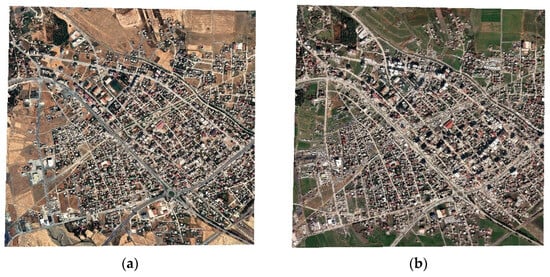
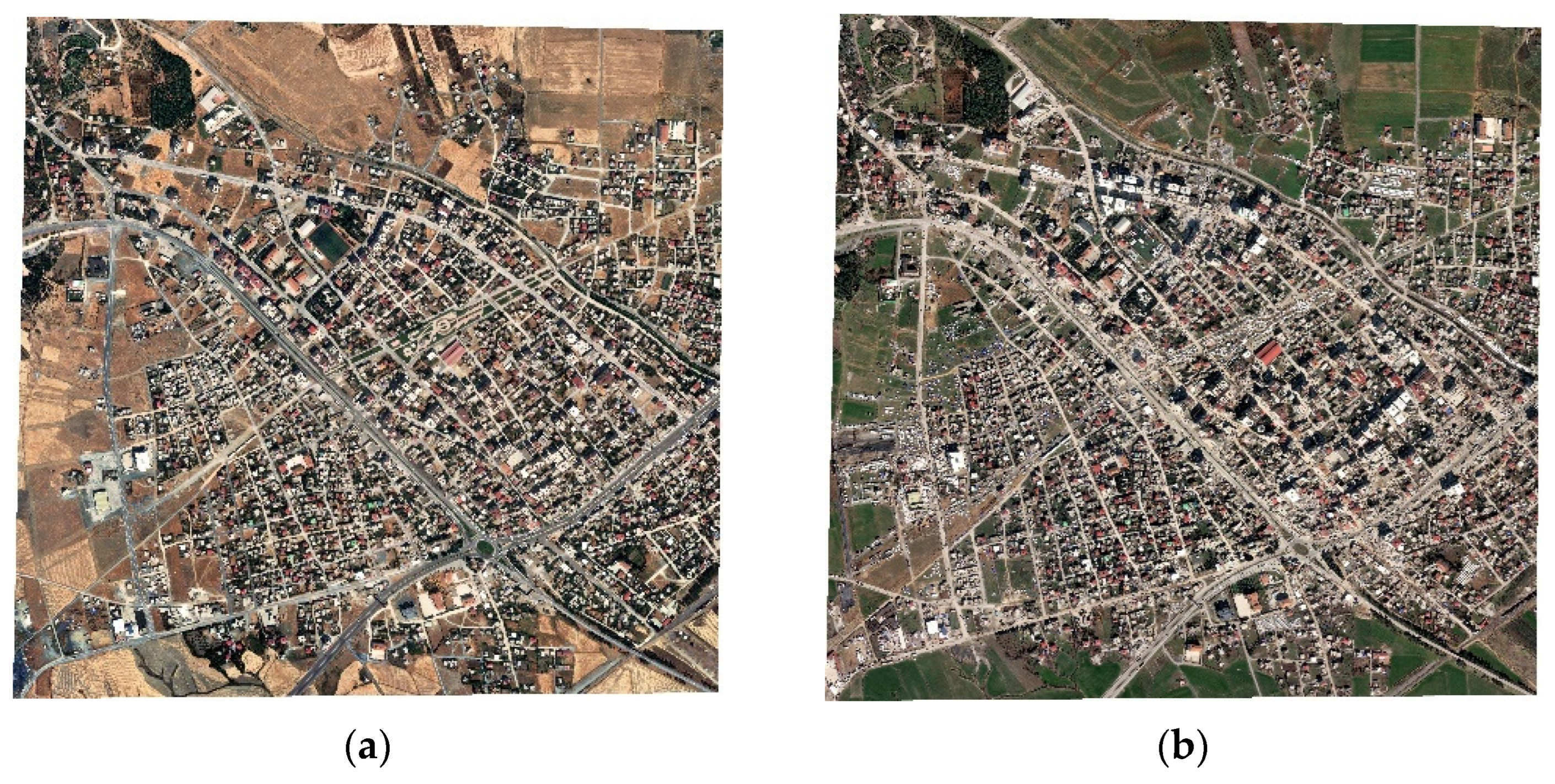
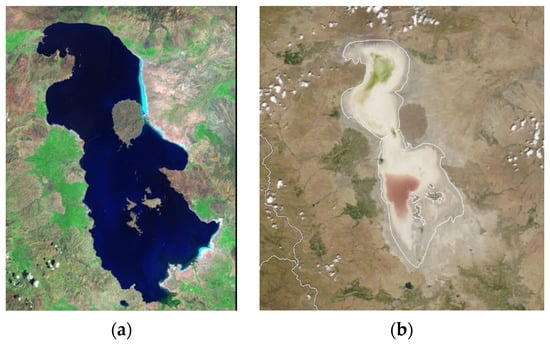
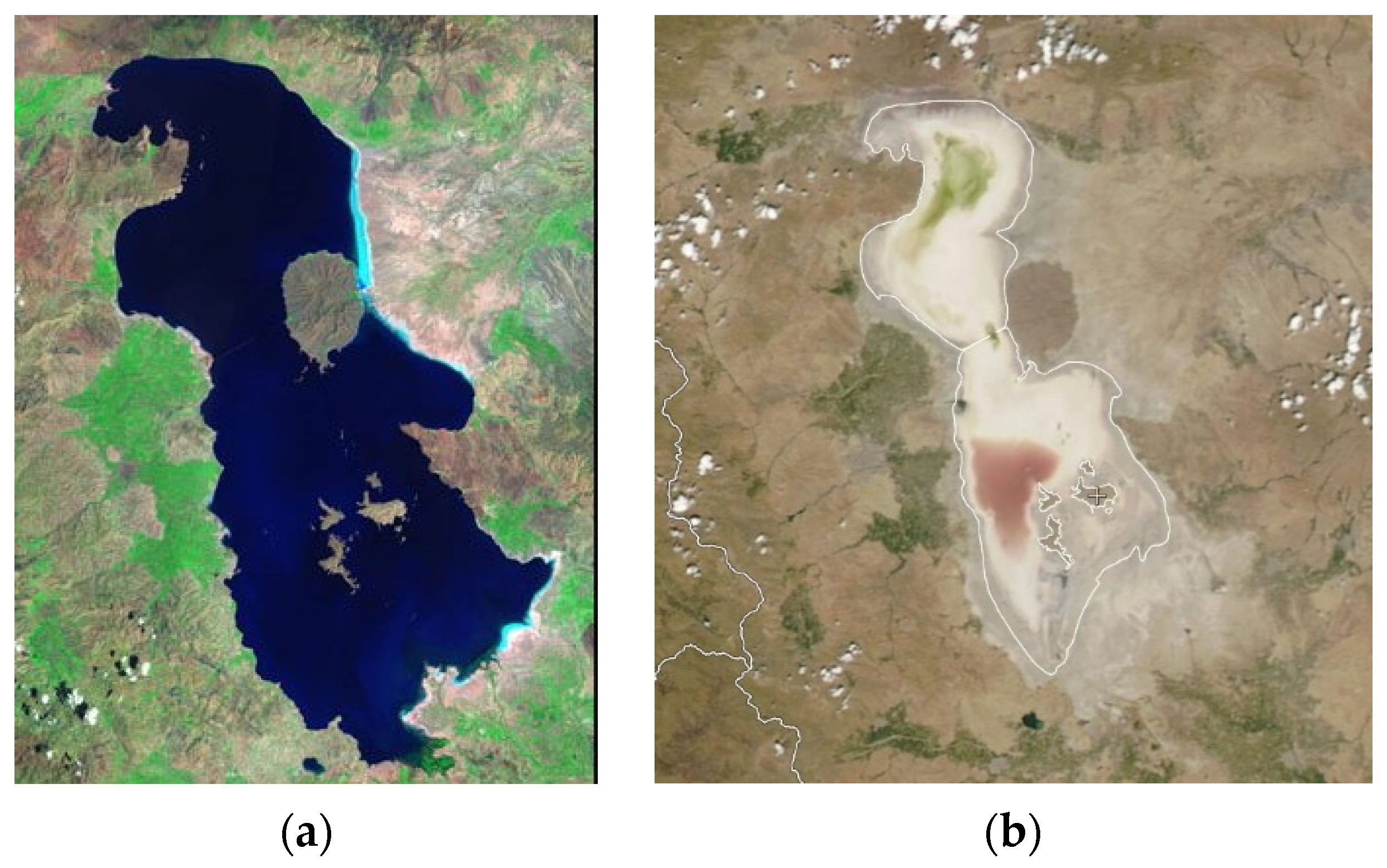
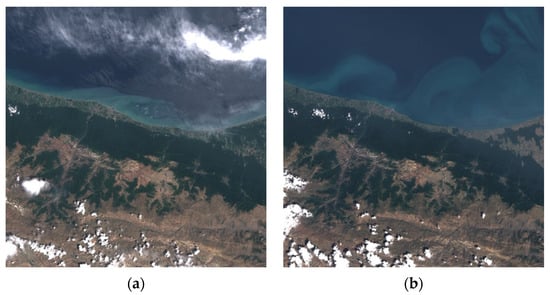
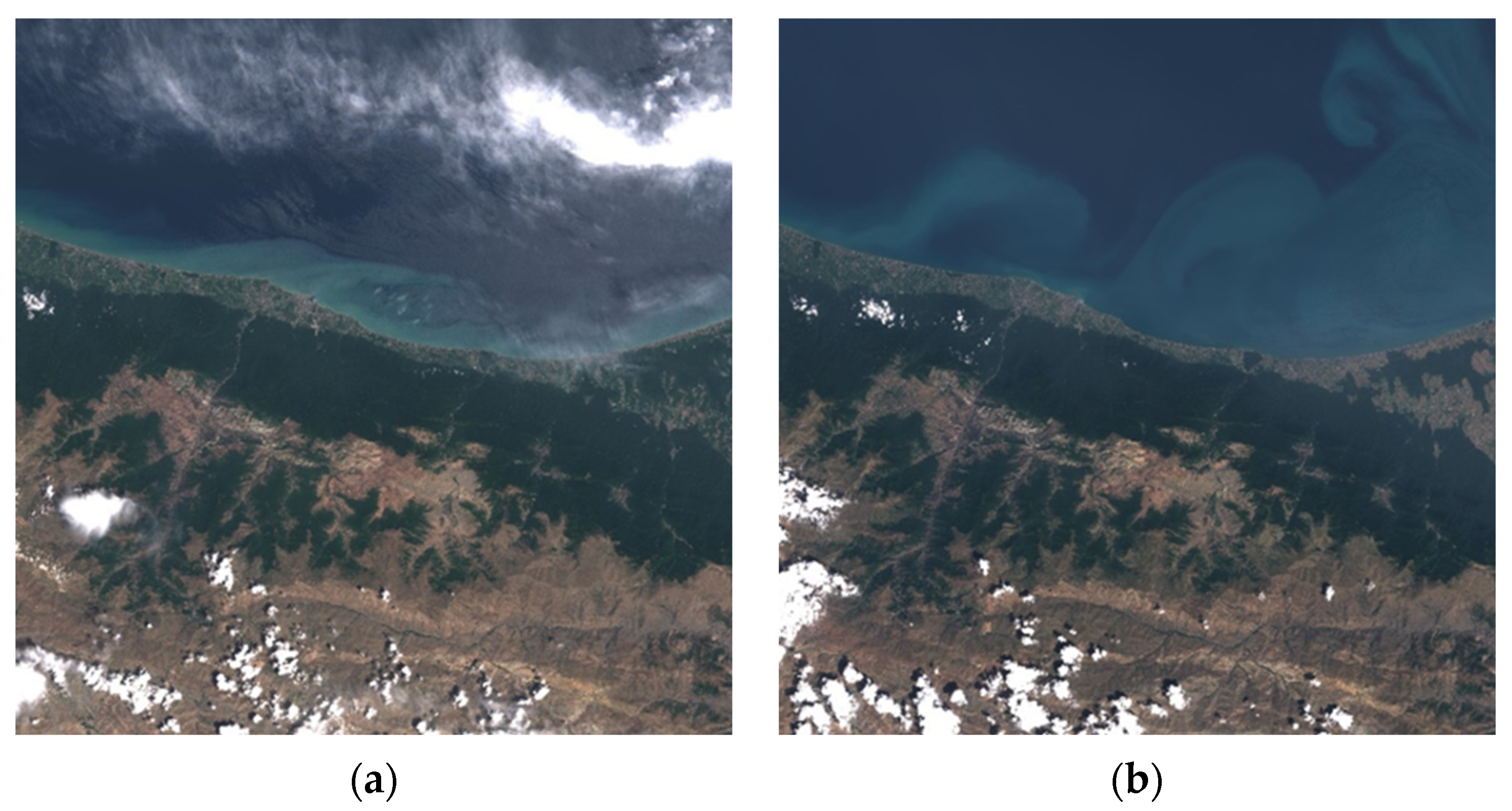
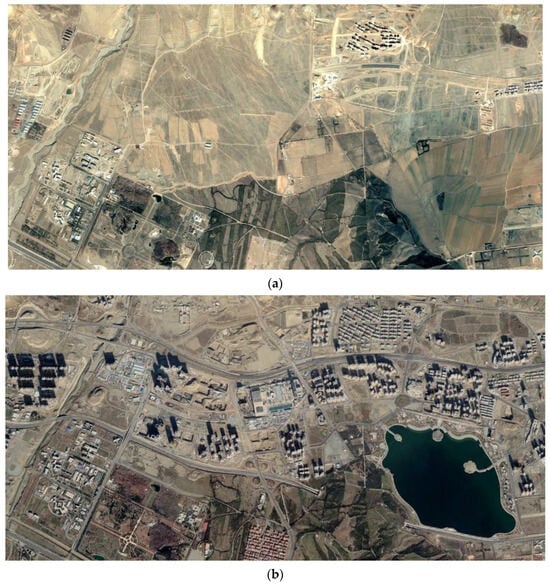
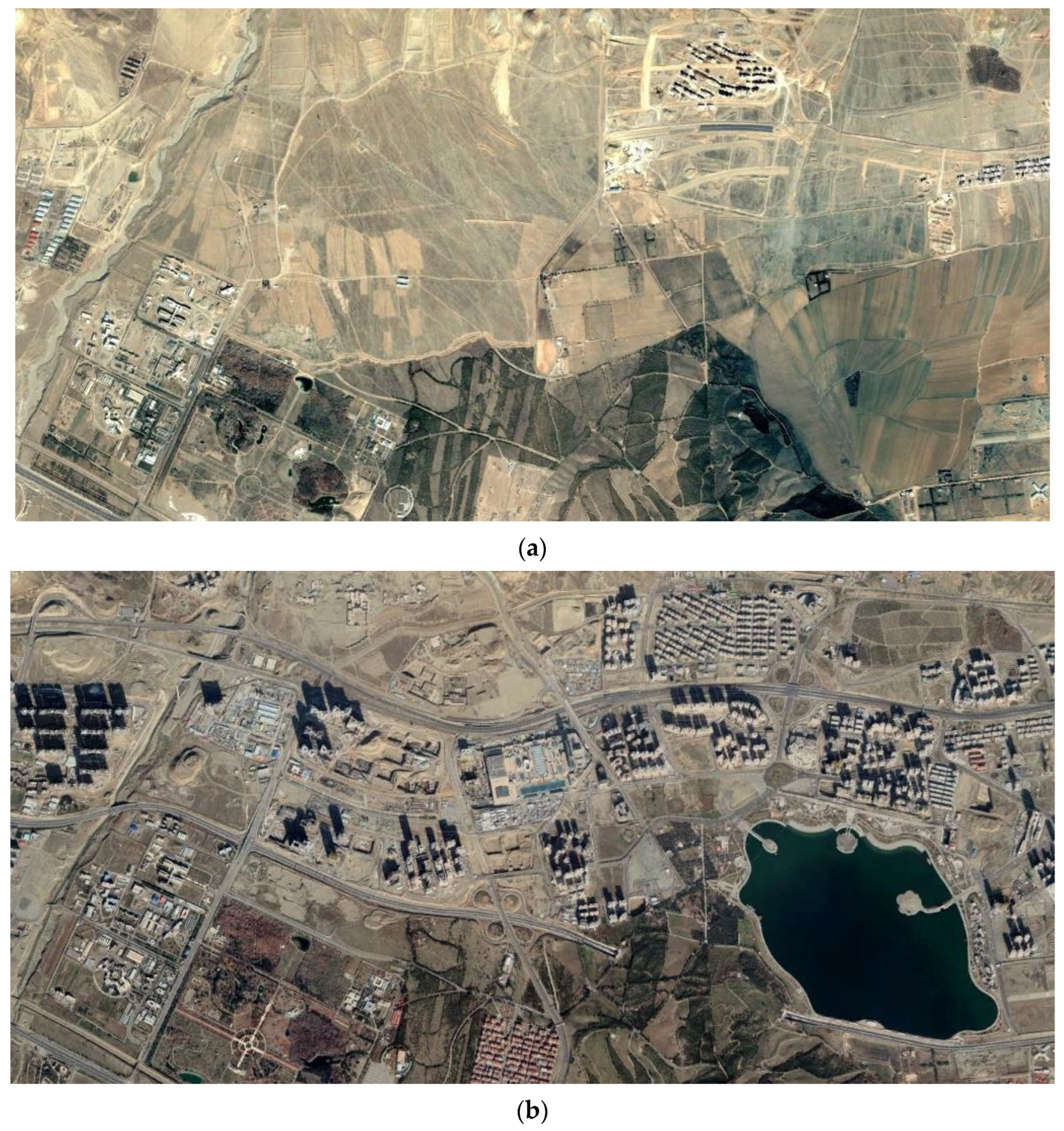
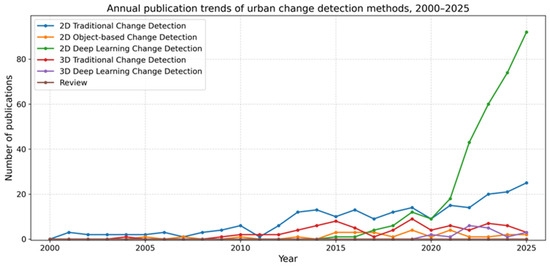
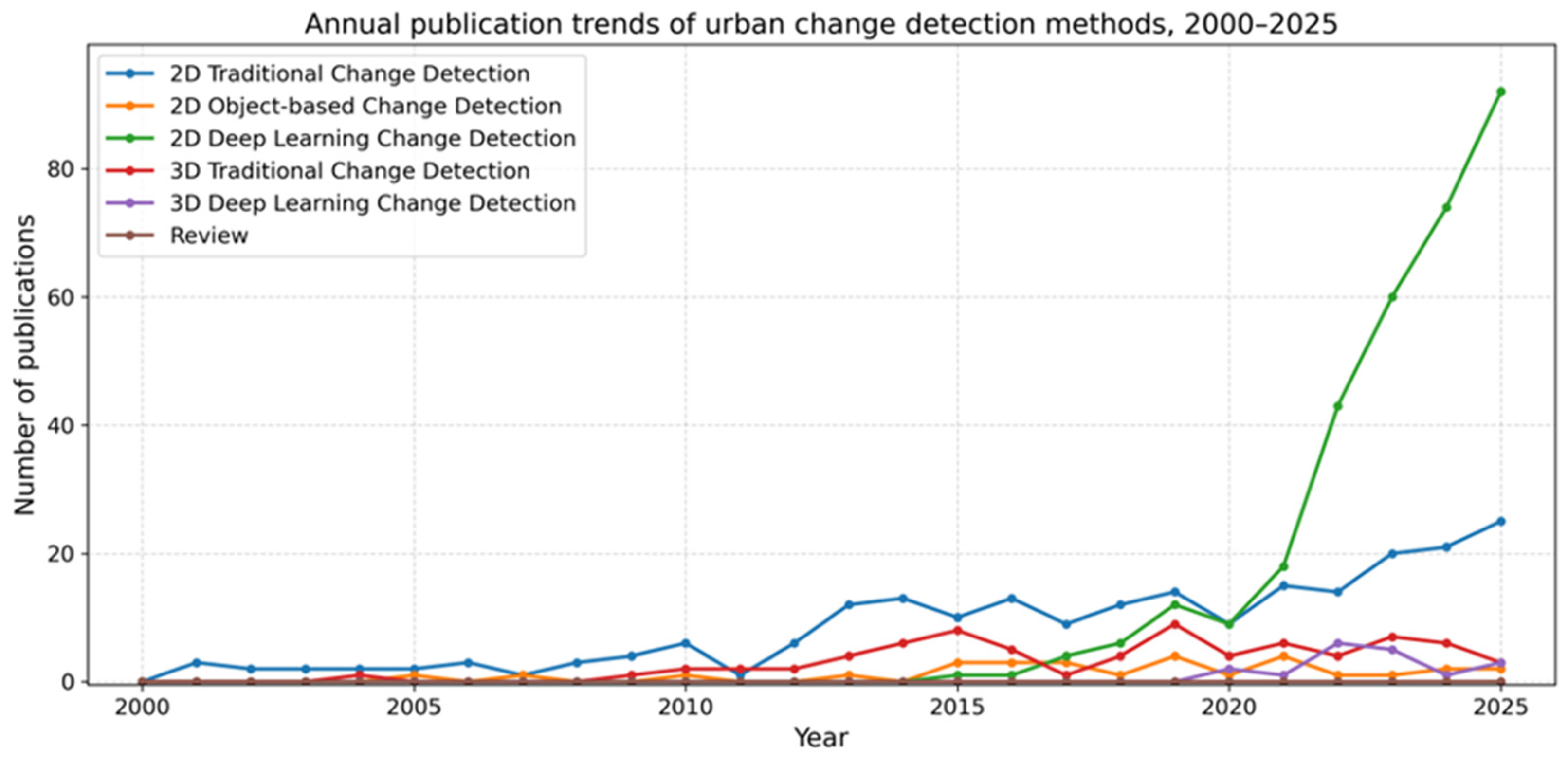
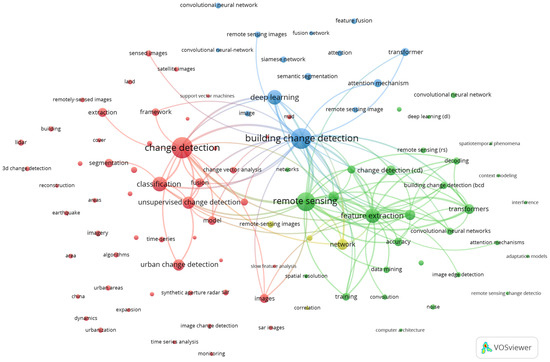
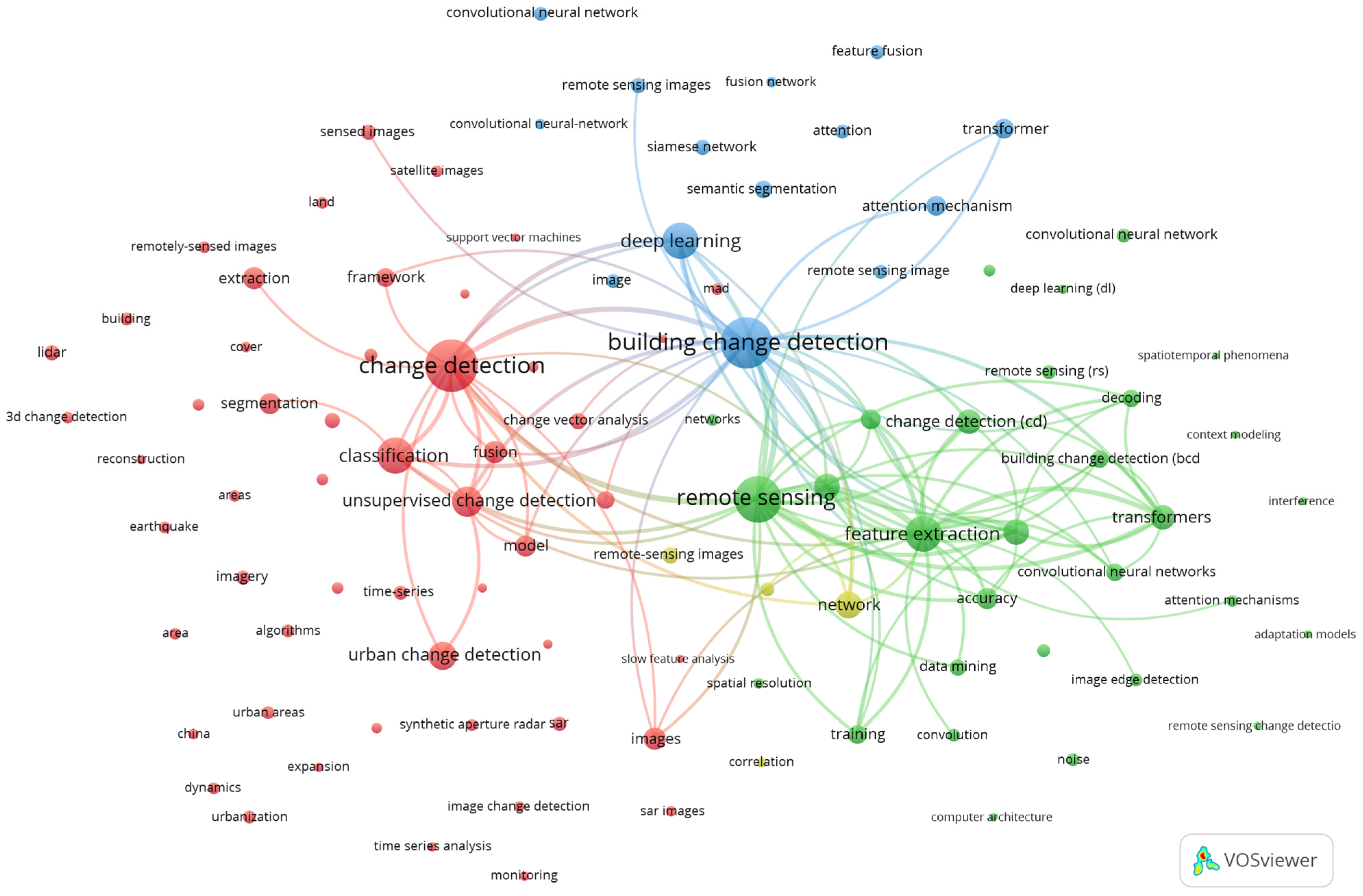
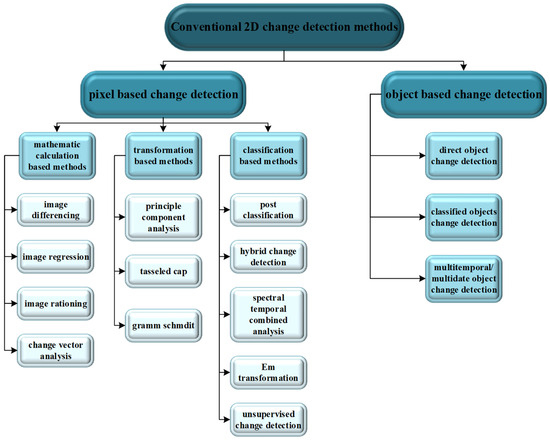
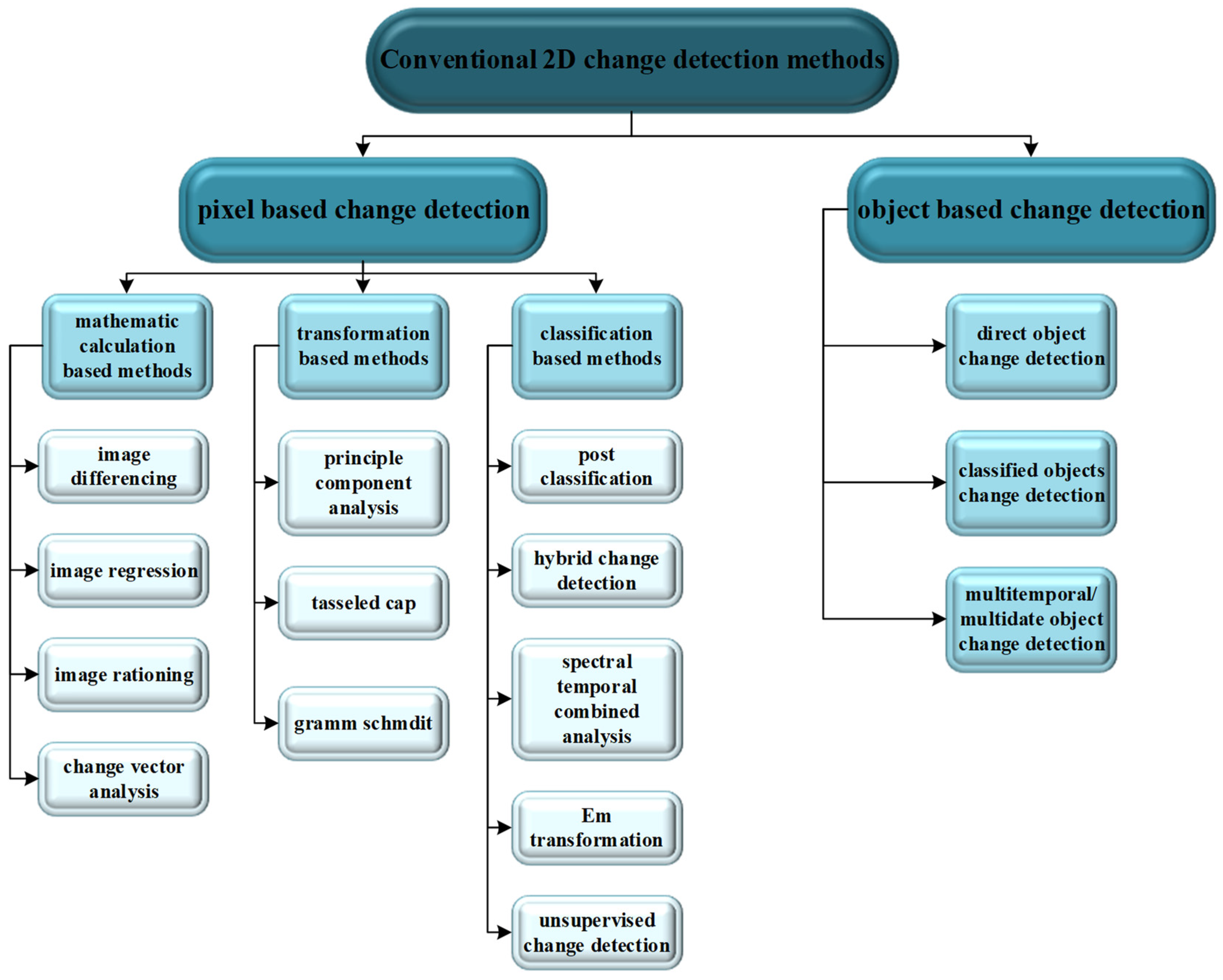
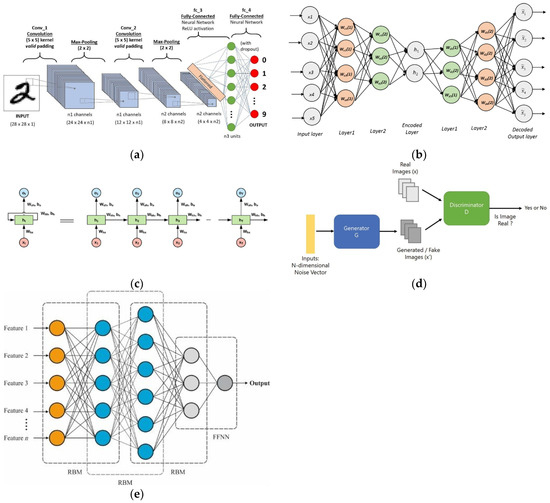
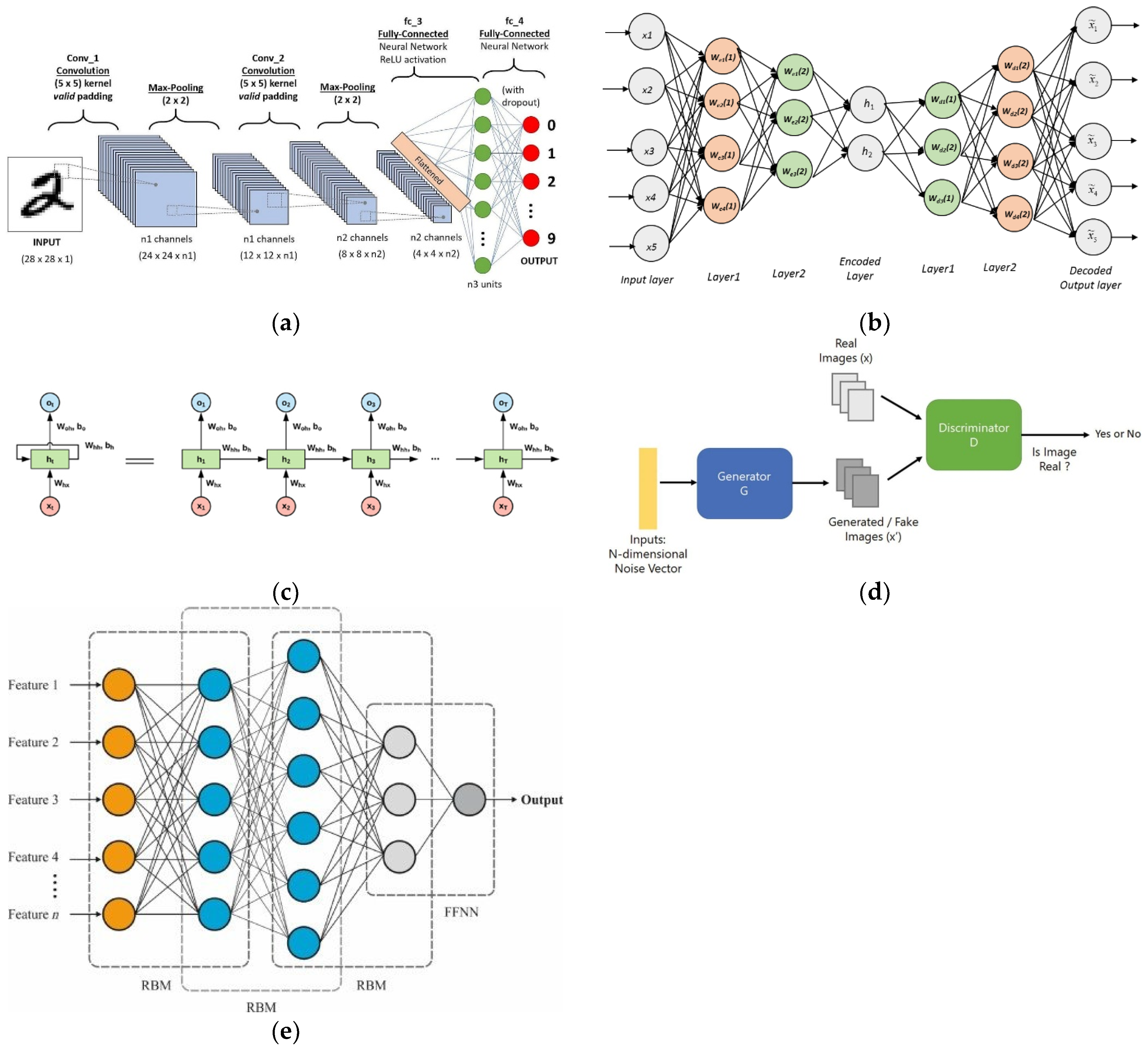

Disclaimer/Publisher’s Note: The statements, opinions and data contained in all publications are solely those of the individual author(s) and contributor(s) and not of MDPI and/or the editor(s). MDPI and/or the editor(s) disclaim responsibility for any injury to people or property resulting from any ideas, methods, instructions or products referred to in the content. |
© 2026 by the authors. Licensee MDPI, Basel, Switzerland. This article is an open access article distributed under the terms and conditions of the Creative Commons Attribution (CC BY) license.