Article

Seed-Driven Grid Adaptation Method: A Prior-Guided Active Learning Framework for Impervious Surface Mapping on the Qinghai–Xizang Plateau Using Google Satellite Embeddings

1
Aerospace Information Research Institute, Chinese Academy of Sciences, Beijing 100094, China
2
University of Chinese Academy of Sciences, Beijing 100049, China
3
Kashgar Aerospace Information Research Institute, Kashgar 844000, China
*
Author to whom correspondence should be addressed.
Remote Sens. 2026, 18(10), 1596; https://doi.org/10.3390/rs18101596 (registering DOI)
Submission received: 20 March 2026 / Revised: 2 May 2026 / Accepted: 13 May 2026 / Published: 16 May 2026

Highlights

What are the main findings?
  • A Seed-Driven Grid Adaptation (SDGA) framework was developed to map impervious surfaces across the Qinghai–Xizang Plateau using only Google Satellite Embeddings, with a Prior-guided Hybrid Active Sampling (PHAS) strategy to automatically mine informative samples.
  • The proposed method substantially improved mapping performance, increasing the F1-score in the Lhasa seed area from 65.02% to 82.22%, improving accuracy in about 67% of grids with a mean F1 gain of 0.1109, and producing a plateau-scale 10 m product with an overall F1-score of 0.8223.
What are the implications of the main findings?
  • Embedding features enable reliable impervious surface mapping in complex environments without direct use of spectral inputs.
  • The framework reduces manual labeling effort and supports scalable mapping with potential for cross-region and cross-temporal applications.

Abstract

Impervious surfaces are an important land surface indicator of urbanization level and human activity intensity, playing a crucial role in urban development monitoring and ecological environment assessment. However, in complex high-altitude regions such as the Qinghai–Xizang Plateau, the identification accuracy of existing medium-resolution impervious surface products remains limited at the regional scale due to complex land surface backgrounds, sparse distributions of impervious surfaces, and their generally small spatial extent. To address this challenge, this study proposes a Seed-Driven Grid Adaptation (SDGA) framework for large-scale impervious surface mapping over the Qinghai–Xizang Plateau. The proposed method uses the Google Satellite Embeddings (GSE) dataset as the primary input features and incorporates a 10 m impervious surface prior (P10) derived from a 2 m high-resolution impervious surface product to provide spatial constraints. Based on this prior information, a Prior-guided Hybrid Active Sampling (PHAS) strategy is developed to automatically construct high-value training samples through uncertainty-based positive sample mining and cluster-based negative sample mining. The framework first builds an initial seed knowledge base in the Lhasa seed area and subsequently performs local adaptive expansion within a 2° × 2° grid system, enabling automated impervious surface mapping across the Qinghai–Xizang Plateau. Experimental results show that, with only a small number of initial samples, the PHAS strategy significantly improves model performance, increasing the F1 score for impervious surface identification in the Lhasa seed area from 65.02% to 82.22%. During the grid-level adaptation stage, approximately 67% of the grids achieved improved accuracy, with an average F1 score increase of 0.1109 across the study area. Ultimately, the SDGA framework produced a 10 m resolution impervious surface product for the Qinghai–Xizang Plateau (SDGA-ISC10m), achieving an overall F1 score of 0.8223. Compared with seven existing medium-resolution impervious surface datasets, the proposed method demonstrates improved recognition performance under complex plateau environments, particularly in detecting sparsely distributed and small-scale impervious surfaces. The results indicate that integrating remote sensing embedding features with active learning strategies can effectively reduce the need for manual annotation and provide a new technical pathway for large-scale impervious surface mapping in complex regions.

1. Introduction

Impervious surfaces refer to man-made surfaces such as buildings, roads, and plazas that prevent water infiltration and are widely regarded as an important indicator of urbanization intensity and human activity [1,2,3]. The expansion of impervious surfaces can substantially alter regional hydrological cycles, surface energy balance, and ecosystem structure [4,5,6,7]. For example, increasing impervious surface coverage modifies surface runoff processes, fragments natural landscape patterns, and enhances regional energy accumulation and carbon emissions through the urban heat island effect [8,9,10,11,12,13,14,15]. Therefore, accurately mapping the spatial distribution of impervious surfaces is essential for understanding the impacts of human activities on ecological environments and climate systems [16,17,18].
The Qinghai–Xizang Plateau, often referred to as the “Third Pole of the Earth,” has an average elevation exceeding 4000 m and is one of the most climate-sensitive regions in the world [19,20]. The combination of high elevation and complex topography has shaped a unique climatic environment and a highly fragile ecosystem in this region [21]. In recent years, with the expansion of transportation infrastructure and urban development, human activities on the plateau have intensified, accompanied by a continuous increase in impervious surfaces [22,23]. The expansion of impervious surfaces not only alters regional hydrological processes but may also accelerate permafrost degradation, intensify local thermal environmental changes, and potentially affect the stability of plateau ecosystems [24]. Therefore, mapping and monitoring impervious surfaces in the Qinghai–Xizang Plateau, where ecological environments are highly fragile, is of great importance for understanding plateau urbanization processes, assessing the ecological impacts of human activities, and supporting sustainable regional development.
With the increasing availability of remote sensing imagery and the rapid development of machine learning and deep learning techniques, numerous medium-resolution global or regional land-cover and impervious surface datasets have been developed in recent years, such as GAIA [1], GHS-BUILT-S2 [25], ESA WorldCover10 [26], and GLC_FCS30 [3,27]. These datasets provide important data support for large-scale urbanization studies. However, accuracy assessment studies conducted in different regions have revealed that the local accuracy of existing impervious surface products over the Qinghai–Xizang Plateau remains relatively low [28,29]. Several factors contribute to this limitation. First, the plateau is characterized by a short vegetation growing season and generally low vegetation coverage. As a result, extensive land-cover types such as alpine grasslands, bare land, and dried riverbeds often exhibit spectral characteristics similar to those of impervious surfaces, leading to the well-known “different objects with similar spectra” problem and increasing classification difficulty [30,31]. Second, the complex topographic conditions of the plateau constrain urban development patterns. Apart from several relatively concentrated urban areas such as Lhasa and Xining, impervious surfaces are widely distributed in numerous small and spatially scattered rural settlements. These small-scale impervious surfaces are frequently omitted in existing medium-resolution products [32,33]. In addition, the vast geographic extent and pronounced geomorphological heterogeneity of the Qinghai–Xizang Plateau result in substantial variations in land-cover composition and spectral characteristics across different regions, further increasing the difficulty of regional mapping using a unified model. Therefore, to support related scientific research and practical applications, it is necessary to develop higher-accuracy regional medium-resolution impervious surface datasets tailored to the complex environmental conditions of the Qinghai–Xizang Plateau [34].
In studies of impervious surface extraction from medium-resolution remote sensing imagery, machine learning approaches such as random forest, as well as deep learning methods based on convolutional neural networks (CNNs) and Transformer architectures, have been widely applied [35,36,37,38,39,40]. In general, for the production of global or large-scale datasets, machine learning algorithms such as random forest are commonly adopted due to their high computational efficiency and relatively low requirements for training sample size. In contrast, for regional-scale high-precision mapping tasks, deep learning approaches have gradually become the dominant methods because of their stronger capability for feature representation and spatial pattern learning [41,42,43,44]. However, most of these methods rely heavily on large amounts of manually annotated training samples, and the construction of such datasets is time-consuming and labor-intensive, which has become a major bottleneck for large-scale mapping applications [45]. To alleviate the difficulty of obtaining training samples, several studies have explored automatic sample generation or weakly supervised learning strategies. For example, candidate samples can be generated from existing land-cover products and then filtered through rule-based procedures, or weak supervision can be adopted to reduce the demand for manual annotations [46,47,48,49,50,51]. Nevertheless, these approaches still require substantial data cleaning or manual verification. Furthermore, the spectral information contained in single-date medium-resolution optical imagery is often insufficient to support high-accuracy classification in complex urban environments. Consequently, many studies integrate additional data sources—such as synthetic aperture radar (SAR), nighttime light data, elevation information, or long-term time-series imagery—to construct multi-source or multi-temporal feature representations [3,52,53,54,55]. Although such approaches can improve classification accuracy, they also increase the complexity of data acquisition, preprocessing, and spatial co-registration. Overall, the construction of high-quality training samples and the preparation of multi-source input data have become among the most time-consuming and critical steps in current impervious surface mapping studies.
In recent years, with the rapid development of remote sensing foundation models and representation learning techniques, a new type of data representation—remote sensing embeddings—has gradually emerged. Representative datasets such as the Google Satellite Embeddings (GSE) dataset encode multi-source and multi-scale remote sensing imagery into high-dimensional semantic feature vectors through deep semantic representation learning, thereby providing a novel data representation for land surface classification tasks [56,57,58,59]. In contrast to conventional multi-source mapping workflows, the use of GSE avoids the direct collection, preprocessing, co-registration, and fusion of multiple remote sensing data sources for a specific classification task. Instead, multi-source information, such as optical, radar, and thermal infrared observations, is implicitly embedded into the learned feature representation during the generation of GSE. Compared with traditional spectral features, these embedding representations can alleviate spectral confusion among different land-cover types to a certain extent and exhibit stronger cross-regional generalization capability. However, studies investigating the application of remote sensing embeddings in specific land surface classification tasks remain relatively limited. In particular, their potential for large-scale impervious surface mapping in complex land-cover environments has not yet been fully explored [60].
To address the aforementioned challenges, this study proposes a Seed-Driven Grid Adaptation (SDGA) framework for large-scale impervious surface mapping over the Qinghai–Xizang Plateau. The framework utilizes the Google Satellite Embeddings (GSE) dataset as the sole input feature and incorporates prior information derived from high-resolution impervious surface datasets as spatial constraints. To reduce the dependence on manual annotations while improving model adaptability in heterogeneous plateau environments, a Prior-guided Hybrid Active Sampling (PHAS) strategy is further developed. PHAS is designed according to the asymmetric sampling requirements of impervious and non-impervious classes in this region. Specifically, sparse and spatially fragmented impervious surfaces require targeted mining of reliable but easily omitted positive samples, whereas the highly heterogeneous background class requires representative sampling of diverse and confusing negative samples. This task-oriented design enables PHAS to construct compact and informative training sets under the coupled challenges of scarce positive samples and strong background heterogeneity. The proposed framework first establishes initial knowledge in a representative seed region and then performs local adaptive expansion within a regular grid system, ultimately enabling automated mapping of impervious surfaces across the Qinghai–Xizang Plateau at a spatial resolution of 10 m. The main contributions of this study are summarized as follows:
  • A remote sensing embedding-based impervious surface mapping approach is proposed. By using only the GSE dataset as the input feature, the method enables medium-resolution impervious surface mapping and demonstrates the potential of embedding representations for land surface classification in complex plateau environments.
  • A PHAS strategy is developed for automatic high-value sample construction. By coordinating positive sample mining, negative sample mining, and spatial–semantic redundancy control, the strategy improves the reliability, informativeness, and diversity of the selected training samples under limited sample availability and heterogeneous background conditions.
  • The SDGA framework is constructed. Through a two-stage workflow consisting of seed knowledge generation and grid-level local adaptation, the framework enables effective model transfer from a local seed region to large-scale heterogeneous environments.
  • A 10 m resolution impervious surface dataset (SDGA-ISC10m) for the Qinghai–Xizang Plateau is generated. The effectiveness of the proposed method is systematically evaluated through multi-scale validation experiments.

2. Materials and Methods

2.1. Study Area

The study area of this research is the Qinghai–Xizang Plateau within China (Figure 1a), extending from 24°66′ to 40°66′N and 73°48′ to 105°63′E. The region has an average elevation exceeding 4000 m and covers approximately 2.58 million km2, encompassing Tibet, Qinghai, southern Xinjiang, western Sichuan, and parts of Gansu and Yunnan provinces. The Qinghai–Xizang Plateau is characterized by complex topography, pronounced climatic gradients, and highly heterogeneous land surface conditions. Snow and ice, sparse vegetation, and bare land are widely distributed, while impervious surfaces generally exhibit a spatially scattered pattern [61]. Figure 1c–e provide representative close-up examples of impervious surfaces within the study area, illustrating the diverse spatial patterns of impervious surfaces under different landscape settings.
In this study, the urban core of Lhasa and its surrounding areas, the largest city on the plateau, were selected as the method validation and seed generation region (Figure 1b). Lhasa has an average elevation of approximately 3650 m and features a typical “valley–urban” geomorphological pattern. The impervious surfaces in this region are diverse, including densely distributed urban centers, peri-urban expansion zones, and spatially scattered small rural settlements. The dominant land-cover types consist of alpine meadow and bare land, with croplands distributed along river valleys. Meanwhile, extensive bare surfaces and riverbanks with spectral characteristics similar to impervious surfaces are also present [62,63]. Therefore, Lhasa provides a representative scenario of impervious surface distribution under plateau conditions and is selected as the initial seed region to support the validation of the sample generation strategy and the construction of the seed model, thereby providing initialization for large-scale mapping.

2.2. Materials

2.2.1. Google Satellite Embeddings Dataset

The GSE dataset is a remote sensing embedding dataset generated by the Google AlphaEarth Foundations model, which encodes multi-source and multi-scale (10–1000 m) remote sensing imagery—including optical, radar, and thermal infrared data—into high-dimensional semantic representations through deep representation learning [59]. Although GSE is provided in a grid format with a spatial resolution of 10 m, each feature vector incorporates information across sensors and spatial scales. Specifically, each pixel is represented by a 64-dimensional unit vector, which serves as a semantic descriptor of land surface characteristics and can be directly used as input features for classification models, replacing conventional optical spectral features. From the perspective of feature organization, GSE is not a conventional multispectral image but a gridded semantic feature dataset. For each 10 m pixel, GSE provides a 64-dimensional unit embedding vector, x = [ e 1 , e 2 , , e 64 ] . Each element of this vector represents a learned latent feature and does not correspond to a specific physical spectral band. The complete 64-dimensional vector jointly describes the semantic characteristics of the land surface by integrating information learned from multi-source and multi-scale remote sensing observations. In this study, all 64 embedding dimensions were used as input features for the random forest classifier.
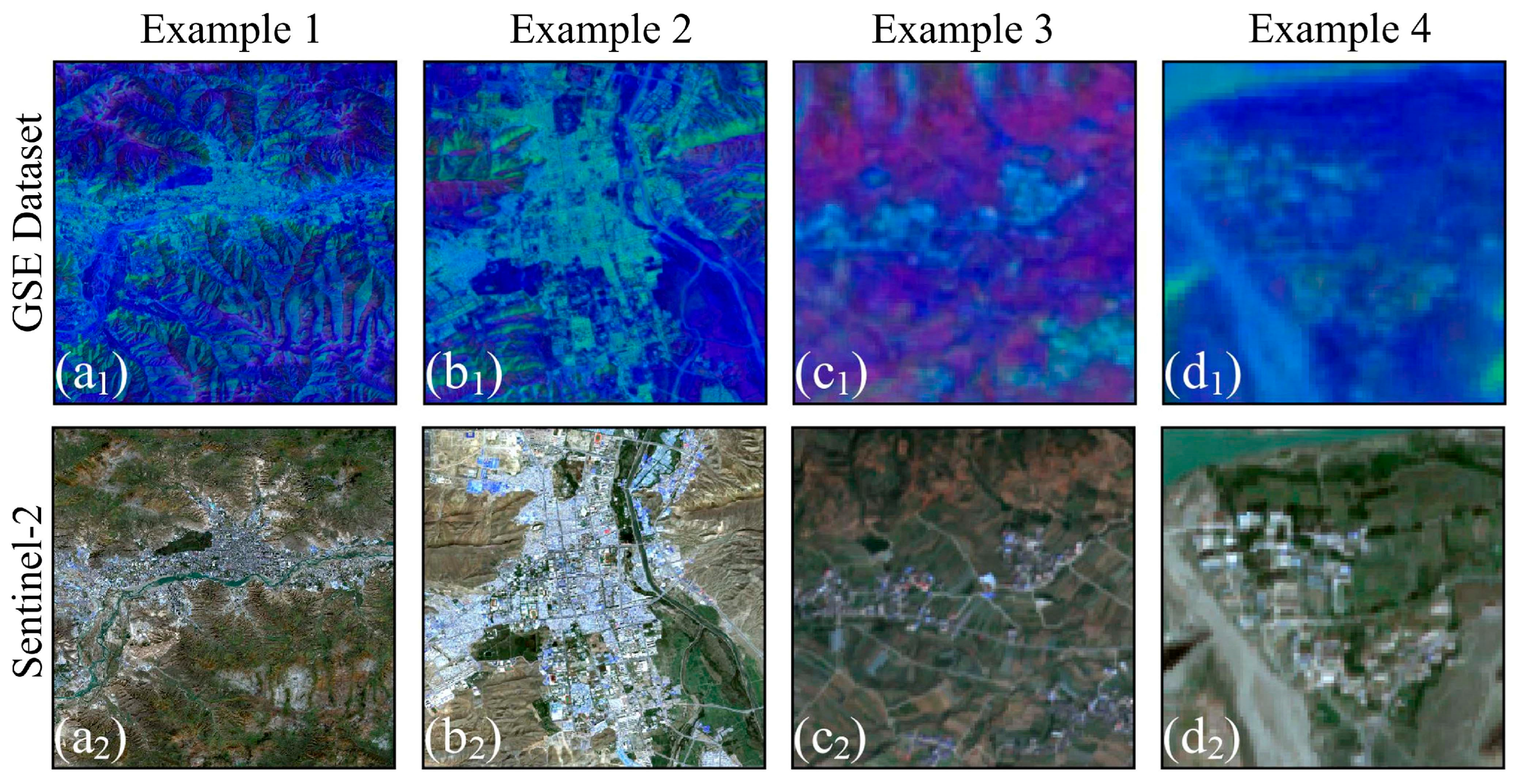
Compared with raw remote sensing imagery, GSE does not require complex preprocessing steps such as atmospheric correction, cloud removal, multi-source data fusion, or spatial co-registration. This greatly simplifies the data preparation process and makes GSE particularly suitable for efficient classification using machine learning models. In this study, the GSE dataset from 2020 was used for impervious surface mapping (Figure 2).

2.2.2. High-Resolution Impervious Surface Prior Data (P10)

P10 is a spatial prior dataset used for sample selection in the active learning process, generated by aggregating the QXP-ISD2m impervious surface product with a spatial resolution of 2 m. The QXP-ISD2m dataset was derived from high-resolution remote sensing imagery and includes two categories: roads and other impervious surfaces (PIS) [64]. It achieves high accuracy over the Qinghai–Xizang Plateau, with precision values of 94.30% and 90.84%, and recall values of 85.17% and 87.97% for roads and PIS, respectively.
To provide spatial constraints for GSE-based automatic sample selection, the QXP-ISD2m dataset was aggregated to a spatial resolution of 10 m, resulting in the P10 dataset. The pixel values of P10 range from 0 to 1, representing the proportion of impervious surface area within each 10 m grid cell. Its spatial resolution is consistent with that of the GSE dataset. It is important to note that, in this study, P10 is used solely as a high-quality spatial prior to constrain sample selection in the active learning process and to provide pseudo-label information. It is not involved in model training or inference. This design ensures that the final classification results are entirely driven by GSE semantic features, thereby enabling a rigorous evaluation of the feasibility of impervious surface mapping based on remote sensing embeddings.

2.2.3. Initial Training Set in Lhasa

GSE enables effective classification under limited training data conditions. Therefore, an initial training set consisting of only 150 samples was constructed in the Lhasa seed region to initialize the active learning process. The dataset includes 30 representative samples for each of five land-cover categories, namely impervious surfaces, vegetation, water bodies, snow/ice, and other surface types. The 30 impervious surface samples were treated as initial positive samples, while the remaining 120 samples were merged as negative samples.

2.2.4. Validation Sample Set for Impervious Surfaces on the Qinghai–Xizang Plateau

An independent impervious surface validation sample set was used to evaluate model performance over the Qinghai–Xizang Plateau. This dataset was derived from our previous study [28] and provides full spatial coverage of the plateau, including both impervious and non-impervious samples. It was generated using a stratified random sampling strategy, and all samples were cross-checked by multiple interpreters to ensure labeling consistency and reliability. The complete validation sample set contains 162,302 sample points, including 15,550 impervious surface samples and 146,752 non-impervious surface samples. In addition, the dataset includes a proportion of samples located along impervious surface boundaries, making it a relatively stringent benchmark for medium-resolution impervious surface mapping. More detailed information on its construction can be found in previous studies [28].

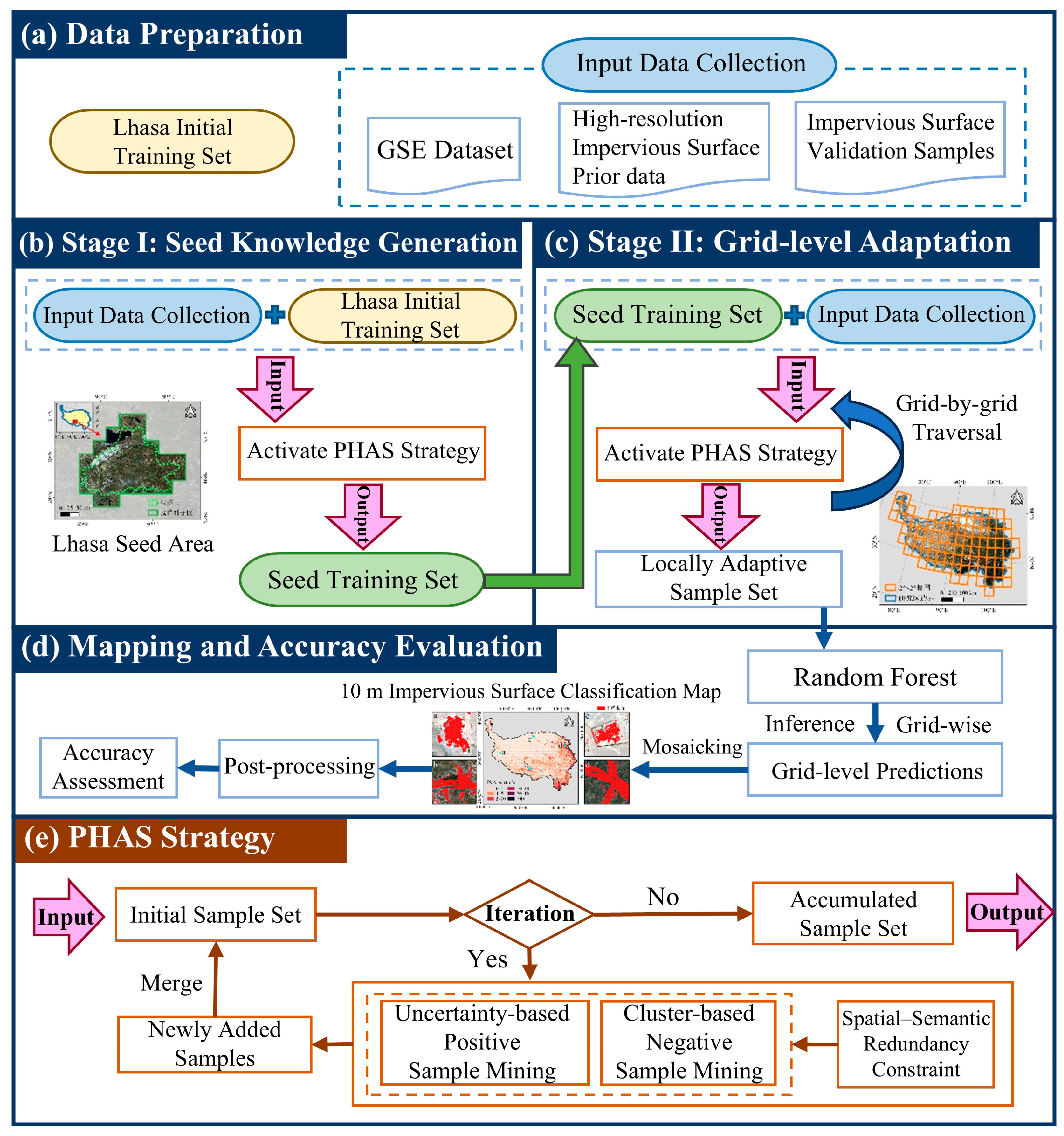
2.3. Overview of the SDGA Framework

This study proposes the SDGA framework for large-scale impervious surface mapping, which is built upon the PHAS strategy. The framework does not rely on conventional spectral bands of remote sensing imagery and instead uses GSE vectors as input features. By leveraging high-level semantic representations, it aims to alleviate spectral confusion in complex land surface environments and to explore the potential of GSE for medium-resolution impervious surface mapping in high-altitude regions. To address challenges such as the high cost of sample annotation, limited sample availability, and strong spatial heterogeneity of land cover, SDGA constructs a two-stage automatic sample mining workflow (Figure 3).
The first stage is the seed knowledge generation stage (Figure 3b), which is conducted exclusively in the Lhasa seed region. This stage aims to address the cold-start problem in active learning and to establish an initial decision boundary. By iteratively applying the PHAS strategy within the seed region, high-value samples are automatically selected, progressively forming a seed training set with strong generalization capability.
The second stage is the grid-level local adaptation stage (Figure 3c). In this stage, the seed knowledge generated in the first stage is transferred to other grid regions, where the PHAS strategy is reactivated. By mining locally difficult samples, grid-specific local adaptive training sets are constructed.
The PHAS strategy serves as the core component in both stages (Figure 3e). It adopts an iterative active learning mechanism that integrates uncertainty-based positive sample mining, cluster-based negative sample mining, and spatial–semantic redundancy constraints, enabling automatic selection and labeling of training samples.
Finally, for each grid, a random forest classifier is independently trained using the corresponding local adaptive training set and applied for prediction (Figure 3d). The results from all grids are mosaicked and post-processed to generate the 10 m impervious surface dataset for the Qinghai–Xizang Plateau, and the final product is evaluated using an independent validation sample set.

2.4. Prior-Guided Hybrid Active Sampling (PHAS) Strategy

To efficiently mine high-value samples in complex plateau environments, this study proposes a PHAS strategy. The strategy is designed to address two coupled challenges in large-scale impervious surface mapping over the Qinghai–Xizang Plateau: the scarcity and spatial fragmentation of impervious surface samples, and the strong heterogeneity of non-impervious background samples. Rather than applying a single uncertainty-based criterion to the entire candidate pool, PHAS adopts a class-specific sampling design. For positive samples, it focuses on mining reliable but easily omitted impervious surface pixels from prior-constrained candidate regions. For negative samples, it emphasizes the selection of diverse and confusing background pixels to improve the representation of heterogeneous non-impervious classes. Spatial–semantic redundancy constraints are further introduced to reduce repeated sampling in both geographic and feature spaces. Accordingly, the strategy consists of three complementary components: uncertainty-based positive sample mining, cluster-based negative sample mining, and spatial–semantic redundancy constraints, which jointly support targeted, representative, and efficient sample selection.

2.4.1. Uncertainty-Based Positive Sample Mining

To maximize the efficiency of positive sample mining, the positive-sample component of PHAS combines prior-guided spatial stratification with margin-based uncertainty ranking. This design balances sample reliability and information gain by jointly leveraging high-resolution prior information and feedback from the current classification model.
(1)
Prior-guided spatial stratification
P10 provides prior information on the spatial distribution of impervious surfaces at a 10 m resolution. However, since it is derived from an aggregation of a 2 m high-resolution product, inconsistencies between resolutions introduce mixed pixels and noise, particularly along impervious surface boundaries. Direct sampling based on such prior data may introduce incorrect labels and degrade model performance. To address this issue, candidate regions for positive samples are first divided into three subregions based on P10, enabling more robust sample selection.
  • The core pure zone is defined by initially selecting areas with P10 > 0.5 as potential impervious surfaces, followed by applying a morphological erosion with a radius of 20 m to remove boundary-related mixed pixels. The remaining regions are regarded as the core pure zone. This zone mainly corresponds to stable and homogeneous interior pixels of impervious surfaces, where semantic features are relatively clean and less affected by noise. Therefore, positive samples are exclusively selected from this region to ensure high reliability.
  • The ring mixed zone is defined as the difference between the original potential impervious surface region and the core pure zone. This zone is primarily located along impervious surface boundaries and is dominated by mixed pixels, with substantial boundary noise introduced by resolution discrepancies. To prevent such boundary noise from being incorrectly reinforced as positive features, this zone is treated as a spatial exclusion region during sampling, where the selection of positive samples is strictly prohibited.
  • The omission conflict zone is introduced to address the common issue of omission of sparse and dispersed impervious surfaces in the Qinghai–Xizang Plateau. This zone is defined as the subset of pixels within the core pure zone that are predicted as background by the model. These pixels represent strong positive targets that the model fails to identify. Incorporating a portion of such samples during sampling forces the model to learn difficult positive cases and improves its ability to detect challenging impervious surfaces.
(2)
Margin-based uncertainty ranking and selection
After spatial stratification of candidate regions, samples are further ranked based on model uncertainty to identify the most informative positive samples. For a given pixel x i , the random forest model outputs the probability of belonging to the impervious surface class, denoted as P I S x i [ 0 ,   1 ] . Based on this, the uncertainty score is defined as:
U x i = 1 2 × P I S x i 0.5
where U x i ranges from 0 to 1. A higher value indicates that the sample is closer to the decision boundary and thus more uncertain, while a lower value indicates a more confident prediction.
In each iteration, candidate positive samples are sorted in descending order of uncertainty, and a greedy strategy is applied to select samples with the highest uncertainty. This approach prioritizes samples near the current decision boundary that are most informative for refining the model, rather than repeatedly selecting high-confidence samples with limited information gain. As a result, it improves the efficiency of positive sample expansion and accelerates model convergence.

2.4.2. Cluster-Based Negative Sample Mining

Compared with positive samples, background land cover types in the Qinghai–Xizang Plateau are substantially more complex, including vegetation, water bodies, shadows, bare land, deserts, and various background objects with spectral characteristics similar to impervious surfaces. These categories exhibit strong intra-class heterogeneity. Under such conditions, random sampling or uncertainty-based sampling strategies similar to those used for positive samples tend to over-select dominant background types (e.g., grasslands and deserts), while neglecting less frequent but more confusing hard negative samples. To address this issue, a cluster-based negative sample mining strategy is proposed to construct a negative sample set that is both representative and diverse.
(1)
Construction of the negative sample candidate pool
First, potential regions for negative samples are defined based on P10. Considering that background areas near impervious surface boundaries also contain mixed pixels and boundary noise, a morphological dilation with a width of 20 m is applied to regions with P10 > 0.5. The complement of the dilated region is then defined as the potential negative sample region. This operation establishes a safety buffer around impervious surfaces, ensuring that candidate negative samples are drawn from relatively pure background areas.
Next, within the potential negative sample region, false positive areas that are prone to misclassification by the current model are further identified. Specifically, pixels that are predicted as impervious surfaces with prediction probabilities within the range [ 0.5 ,   P m a x ] are selected to form the negative sample candidate pool, where P m a x is set to 0.85 in this study. These pixels correspond to background regions that are incorrectly classified as impervious surfaces while the model is not yet fully confident in its predictions, and thus represent high-value hard negative samples. It should be noted that the potential negative sample region remains fixed during each iteration, whereas the negative sample candidate pool is dynamically updated as the model evolves.
(2)
Semantic feature clustering
To enhance the semantic diversity of negative samples, K-means clustering is applied to the candidate pool using the 64-dimensional GSE vectors as input features. The samples are partitioned into K semantic clusters, where K = 4 in this study.
In the absence of explicit class labels, the clustering process groups background samples based on semantic similarity. As a result, different types of background land cover (e.g., vegetation, water bodies, and bare land) are typically separated into distinct clusters in the feature space. Subsequently, negative samples are uniformly selected from each cluster and assigned negative labels. This strategy prevents the negative sample set from being dominated by a single prevalent background type, thereby promoting coverage of diverse semantic patterns, particularly those rare but confusing background categories. As the iterations proceed, the model is progressively exposed to more diverse and representative negative samples, which helps reduce false positives and improve overall classification performance.

2.4.3. Spatial-Semantic Redundancy Constraints

Although the aforementioned positive and negative sample mining strategies can identify high-value samples from the perspectives of uncertainty and semantic diversity, the candidate samples may still contain a large number of pixels that are highly clustered in space or highly similar in semantic features. For example, multiple pixels within the same water body may all be identified as hard negative samples, yet their information gain is largely redundant. To reduce redundancy and improve the representativeness of the training samples, both spatial distance constraints and semantic similarity constraints are introduced during the selection of positive and negative samples.
(1)
Spatial distance constraint
In remote sensing imagery, spatially adjacent pixels typically share similar atmospheric and background conditions. Therefore, repeatedly selecting neighboring pixels often contributes little additional information. To enhance sample representativeness and reduce redundancy caused by local spatial clustering, a minimum spatial distance constraint d m i n is imposed. During the greedy selection process, a candidate sample x n e w is accepted only if its distance from the existing selected sample set x s e l e c t e d satisfies:
D i s t a n c e x n e w ,   x s e l e c t e d > d m i n
Considering that a large number of impervious surfaces in the Qinghai–Xizang Plateau are small in size and spatially dispersed, d m i n is set to 500 m. This threshold ensures sufficient spatial dispersion of samples while avoiding overly restrictive constraints that could lead to an insufficient number of candidate samples.
(2)
Semantic similarity constraint
Spatial distance alone cannot fully eliminate redundancy, as pixels located far apart may still exhibit highly similar semantic features. For instance, water pixels from two distant lakes may still be highly similar in the embedding space. To further enhance the diversity of the training samples, a semantic similarity constraint is introduced. For a candidate sample embedding vector e n e w and any embedding vector e i in the current selected sample set S the cosine similarity is computed and required to satisfy:
m a x e n e w · e i e n e w e i < T s i m ,   e i S
where S denotes the current set of selected samples, and T s i m is the similarity threshold, which is set to 0.98 in this study. This constraint effectively filters out semantically redundant samples, allowing the active learning process to focus on expanding the feature space coverage of the model.
By jointly enforcing these two constraints, PHAS ensures that the newly selected samples in each iteration are not only informative but also representative and minimally redundant.
To improve the reproducibility of the PHAS process, the key heuristic parameters used for sample selection are summarized in Table 1. These parameters are fixed during the iterative sampling process within each region.
These parameters (Table 1) should be interpreted as heuristic control parameters for PHAS sample selection rather than globally optimized hyperparameters. Their purpose is to guide the iterative selection of non-redundant and diverse samples, rather than to independently optimize the final classification accuracy. Specifically, P m a x restricts hard negative candidates to false-positive pixels with moderate confidence, K encourages hard negative samples to cover multiple background patterns, d m i n reduces excessive spatial concentration of selected samples, and T s i m removes semantically repetitive samples that may be spatially distant. Since PHAS dynamically updates the candidate pool in each iteration, these parameters mainly serve as practical constraints for maintaining sample diversity, reliability, and candidate availability. When applying PHAS to regions with different landscape structures, target distributions, background complexity, or input data resolutions, they may be adjusted accordingly.

2.4.4. Iterative Stopping Criteria

PHAS adopts an iterative active learning mechanism, in which model training, sample selection, training set updating, and performance evaluation are sequentially performed in each iteration. To ensure efficient convergence and avoid redundant iterations, the following stopping criteria are defined. The active learning process for a given region is terminated once any of the following conditions is satisfied:
(1)
The model precision and recall both exceed predefined thresholds, indicating that the classification performance has reached an acceptable level. In this study, the thresholds for both precision and recall are set to 0.85;
(2)
The improvement in F1-score remains below a predefined threshold over consecutive iterations, suggesting diminishing returns from further sample expansion and indicating model convergence (the threshold is set to 0.05 in this study);
(3)
No new valid positive or negative samples can be identified in the current iteration, indicating that the candidate sample space under the given constraints has been largely exhausted;
(4)
The maximum number of iterations is reached.
Based on these criteria, the complete workflow of PHAS is defined as follows:
  • Step 1: Data preparation. Before the iteration begins, a labeled sample set L, a large unlabeled sample pool R (corresponding to the region under processing), and an independent validation sample set V are prepared.
  • Step 2: Model initialization. At the beginning of each iteration, a random forest classifier M is trained using the current labeled sample set L. The model is then evaluated on the validation set V. If stopping criterion (1) is satisfied, the iteration terminates and proceeds to Step 7; otherwise, the process continues.
  • Step 3: Sample querying and selection. The classifier M is applied to R to generate pixel-wise probability predictions. The uncertainty-based positive sample mining and cluster-based negative sample mining strategies in PHAS are then applied to identify candidate samples. From these, N positive and N negative samples that satisfy the spatial–semantic redundancy constraints are selected (a total of 2N samples). In this study, N is set to 50; therefore, up to 50 positive samples and 50 negative samples are selected in each iteration. If fewer than N samples are available, all are selected. If no valid samples are identified, stopping criterion (3) is satisfied, and the process terminates and proceeds to Step 7; otherwise, the iteration continues.
  • Step 4: Training set update. The newly selected samples are moved from the unlabeled sample pool R to the labeled sample set L.
  • Step 5: Model evaluation. The classifier M is retrained using the updated labeled sample set L and evaluated again on the validation set V. If stopping criteria (1) or (2) are satisfied, the iteration terminates and proceeds to Step 7; otherwise, the process continues.
  • Step 6: Iteration. If the maximum number of iterations (stopping criterion (4)) has not been reached, the process returns to Step 2; otherwise, it terminates and proceeds to Step 7.
  • Step 7: Output. The final labeled sample set L, including all queried and selected samples, and the trained classifier M for region R are output.

2.5. Seed-Driven Grid Adaptation

Directly applying active learning across the entire Qinghai–Xizang Plateau is impractical due to the extremely large size of the candidate region. This would not only significantly increase computational cost but also dilute sparse supervision signals, making it difficult for the model to capture complex spatial heterogeneity and achieve stable convergence. Therefore, although the PHAS strategy enables efficient automatic sample selection, it still requires integration with a robust spatial expansion framework for large-scale applications.
To address this issue, the SDGA framework adopts a workflow that progressively extends from a local seed region to the entire study area. It consists of two stages. In the first stage, a seed training set is generated in a representative region (Lhasa). In the second stage, the seed knowledge is used to initialize PHAS within a gridded spatial framework, where local adaptation is performed for each grid, enabling progressive expansion to the entire Qinghai–Xizang Plateau and completion of large-scale mapping.

2.5.1. Stage 1: Seed Knowledge Generation

The objective of the first stage is to progressively expand a small set of manually labeled samples into robust seed knowledge capable of supporting large-scale mapping. Lhasa, as a major city on the Qinghai–Xizang Plateau, contains both densely distributed urban impervious surfaces and sparsely distributed rural settlements. Meanwhile, the surrounding environment includes a wide range of land cover types, such as alpine meadows, dry riverbeds, water bodies, croplands, bare land, and snow/ice, exhibiting high landscape diversity and representativeness. Therefore, Lhasa is selected as the seed region.
In this stage, PHAS operates in a cold-start mode [65,66,67,68]. A small initial training set manually labeled in Lhasa (Initial training set in Lhasa) is first used to initialize PHAS and activate the active learning process within the seed region. In each iteration, hard samples are preferentially mined from the unlabeled data, including impervious surface pixels near the decision boundary and background samples that are prone to misclassification. Compared with random sampling, this strategy continuously strengthens the model’s ability to learn critical decision boundaries.
During the iterative process, newly selected samples are progressively incorporated into the training set and used to update the classification model, thereby gradually improving its ability to recognize complex land surface patterns. Once the stopping criteria are satisfied, the accumulated training samples generated in Lhasa form a seed sample set S L h a s a . This dataset serves as the seed knowledge, capturing key impervious surface characteristics in the GSE semantic feature space and providing the foundation for subsequent spatial expansion.

2.5.2. Stage 2: Grid-Level Local Adaptation

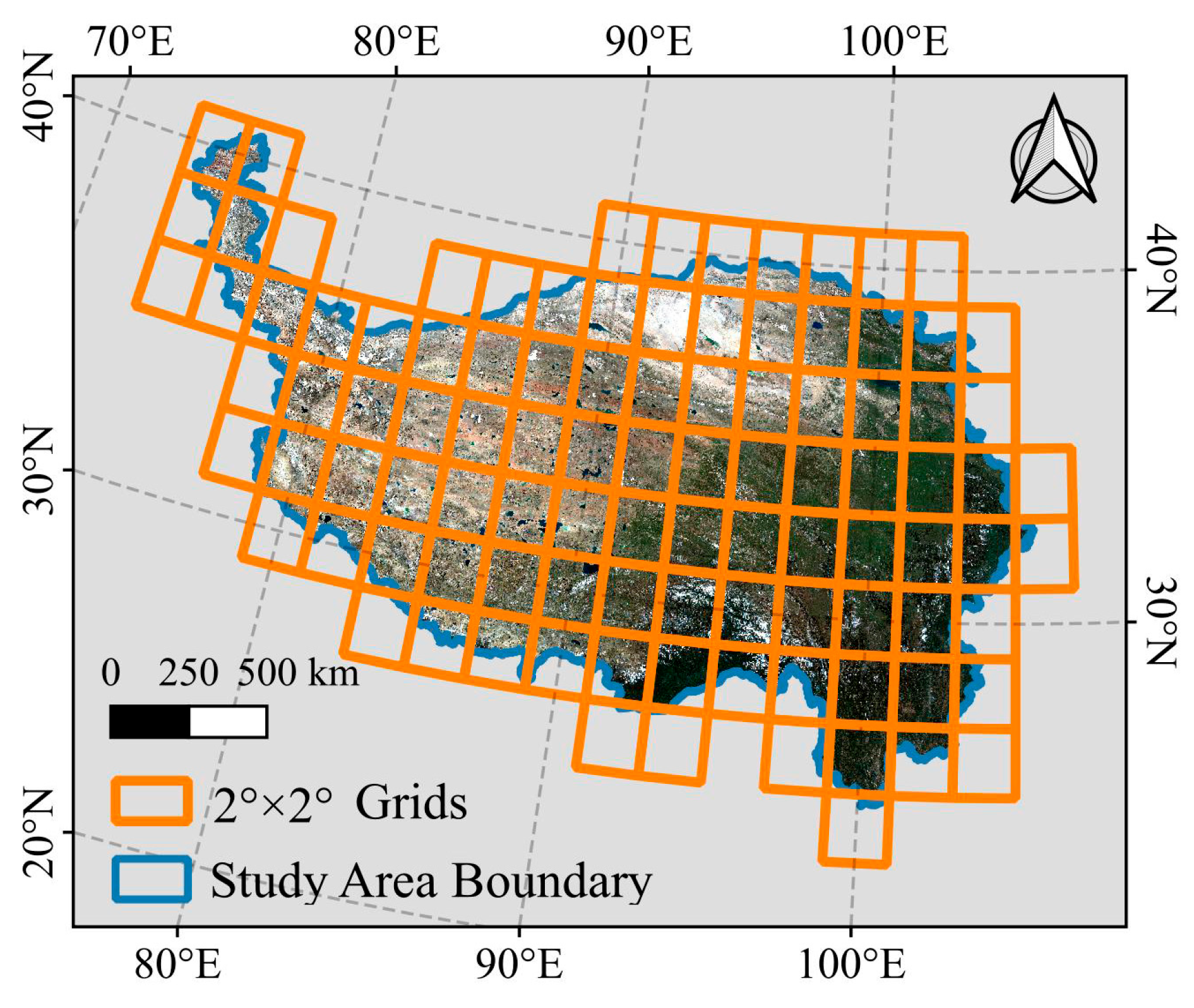
In the second stage, a grid-based strategy is employed to extend sample mining and impervious surface mapping to the entire Qinghai–Xizang Plateau. To improve computational efficiency and scalability, the study area is partitioned into regular 2° × 2° grid units (Figure 4), and the active learning process is conducted independently within each grid. For a given grid G i , the procedure is as follows:
(1)
Seed knowledge injection. The Lhasa seed sample set S L h a s a is first used as the initial training set for the current grid. A random forest classifier is trained and applied to generate initial predictions within the grid. This step effectively transfers the seed knowledge to the target region and provides a stable starting point for subsequent active learning.
(2)
Grid-level PHAS local adaptation. Due to variations in land cover composition, terrain conditions, and illumination across different grids, the seed model may still be affected by domain shift when applied to new regions. Therefore, PHAS is reactivated within the current grid to identify pixels with high uncertainty or significant feature discrepancies, and to automatically mine new local training samples. These newly selected samples are combined with the seed samples to form an updated local adaptive training set, which is then used to retrain the classifier. Through this process, the decision boundary is progressively adapted to the data distribution of the current grid.
The sample expansion process is strictly confined within each grid, ensuring that newly added samples accurately reflect local land surface characteristics while avoiding interference between different grids. By allowing each grid to converge independently, the method effectively adapts to regional differences in impervious surface patterns, background types, and data quality. Ultimately, the locally optimized model for each grid is used to generate impervious surface predictions for that grid.
Through the above procedure, SDGA enables automated sample expansion and model transfer from the Lhasa seed region to the entire Qinghai–Xizang Plateau. This approach significantly reduces the need for manual labeling while allowing the model to achieve local adaptation to diverse regional surface characteristics.

2.6. Impervious Surface Mapping and Post-Processing

2.6.1. Grid-Wise Inference

After grid-level adaptation, each grid obtains its corresponding local adaptive training set. For a given grid G i the training set consists of two components: the seed sample set S L h a s a generated in Stage 1 and the newly mined local samples S L o c a l obtained in Stage 2. These two components are merged to form the grid-specific training set S G r i d . A random forest classifier is trained using S G r i d , and pixel-wise inference is performed for all pixels within the grid to produce a probability map of impervious surfaces. A threshold of 0.5 is then applied to binarize the probability map, resulting in the grid-level impervious surface classification.

2.6.2. Extremely Low-Impervious Grid Processing

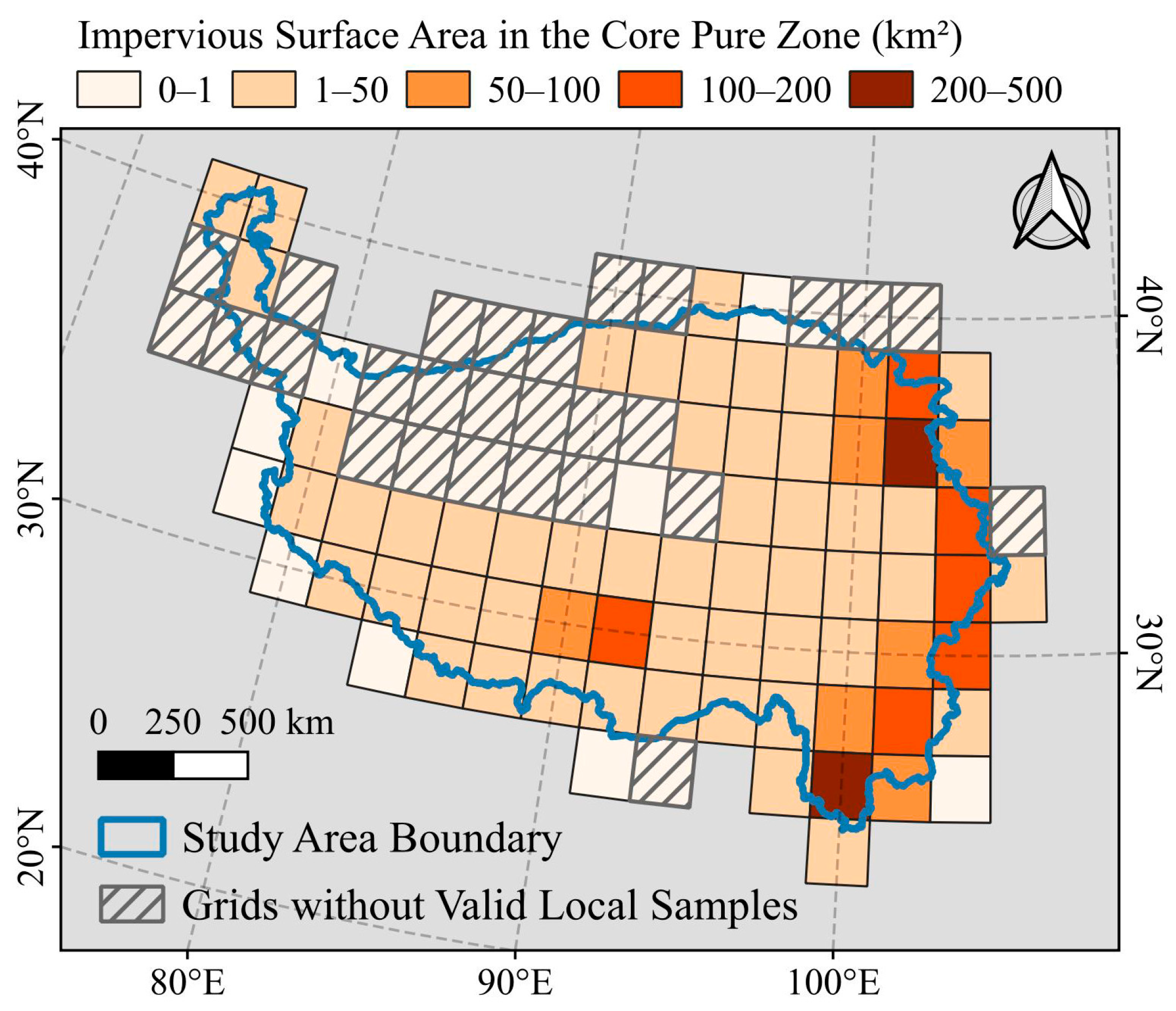
During the grid-level adaptation process, some grids located in high-altitude uninhabited areas or desert regions exhibit extremely low impervious surface coverage. Due to the scarcity of true targets, PHAS fails to identify new valid positive samples in these regions, which triggers the stopping criteria and prevents the formation of a local adaptive training set. The spatial distribution of these grids is shown in Figure 5, where the total impervious surface area within their core pure zones is less than 1 km2. For such grids, a prediction strategy based on transferring models from neighboring grids, combined with P10-based post-processing, is adopted.
First, following Tobler’s First Law of Geography [69,70], models from spatially adjacent grids that have successfully completed adaptation are selected for transfer to the target grid, producing an initial prediction P i n i t . However, in regions with extremely low impervious surface coverage, even a low false positive rate may lead to a large number of misclassifications. Therefore, prior information is further incorporated to constrain the prediction results. Specifically, a potential impervious surface mask is constructed based on P10. A morphological dilation with a width of 30 m is applied to regions with P10 > 0.5 to obtain the potential impervious surface region. The initial prediction is then intersected with this mask, retaining only the predicted pixels within the potential region, while pixels outside the mask are forcibly corrected to the background. This process effectively suppresses background noise in areas far from human activities. Finally, the prediction results from all grids are mosaicked and merged to generate the 10 m impervious surface dataset for the Qinghai–Xizang Plateau (SDGA-ISC10m).

2.7. Accuracy Assessment

To systematically evaluate the performance of the SDGA framework and the final product, a three-level hierarchical accuracy assessment scheme is designed, including evaluations at the seed region, representative grid regions, and the entire study area.
All evaluations are conducted using the same validation dataset, namely the validation sample set for impervious surfaces on the Qinghai–Xizang Plateau, which was derived from our previous study [28] and constructed based on manual visual interpretation. During the assessment, subsets corresponding to different spatial extents are extracted from this unified validation dataset to compute accuracy metrics, ensuring comparability across different evaluation levels. The three levels of assessment are described as follows.
(1)
Level 1: Evaluation in the seed knowledge generation stage
This level evaluates the effectiveness of PHAS during the cold-start phase in the Lhasa seed region. Using only 150 initial manually labeled samples, classification accuracy is calculated after each active learning iteration. The results are further compared with seven existing medium-resolution impervious surface products to assess the learning capability of PHAS under limited sample conditions.
The comparison products include GAIA30 [1], CISC30 [39], GlobalLand30 [71] (hereafter GL30), GLC-FCS30 [3,27] (hereafter FCS30), GHS-BUILT-S2 [25] (hereafter GHSB10), ESA WorldCover10 [26] (hereafter ESA10), and Dynamic World NRT products [72] (hereafter DW10). These products are widely used in global or regional impervious surface or built-up area mapping studies and therefore serve as reliable benchmark datasets.
(2)
Level 2: Evaluation in the grid-level adaptation stage
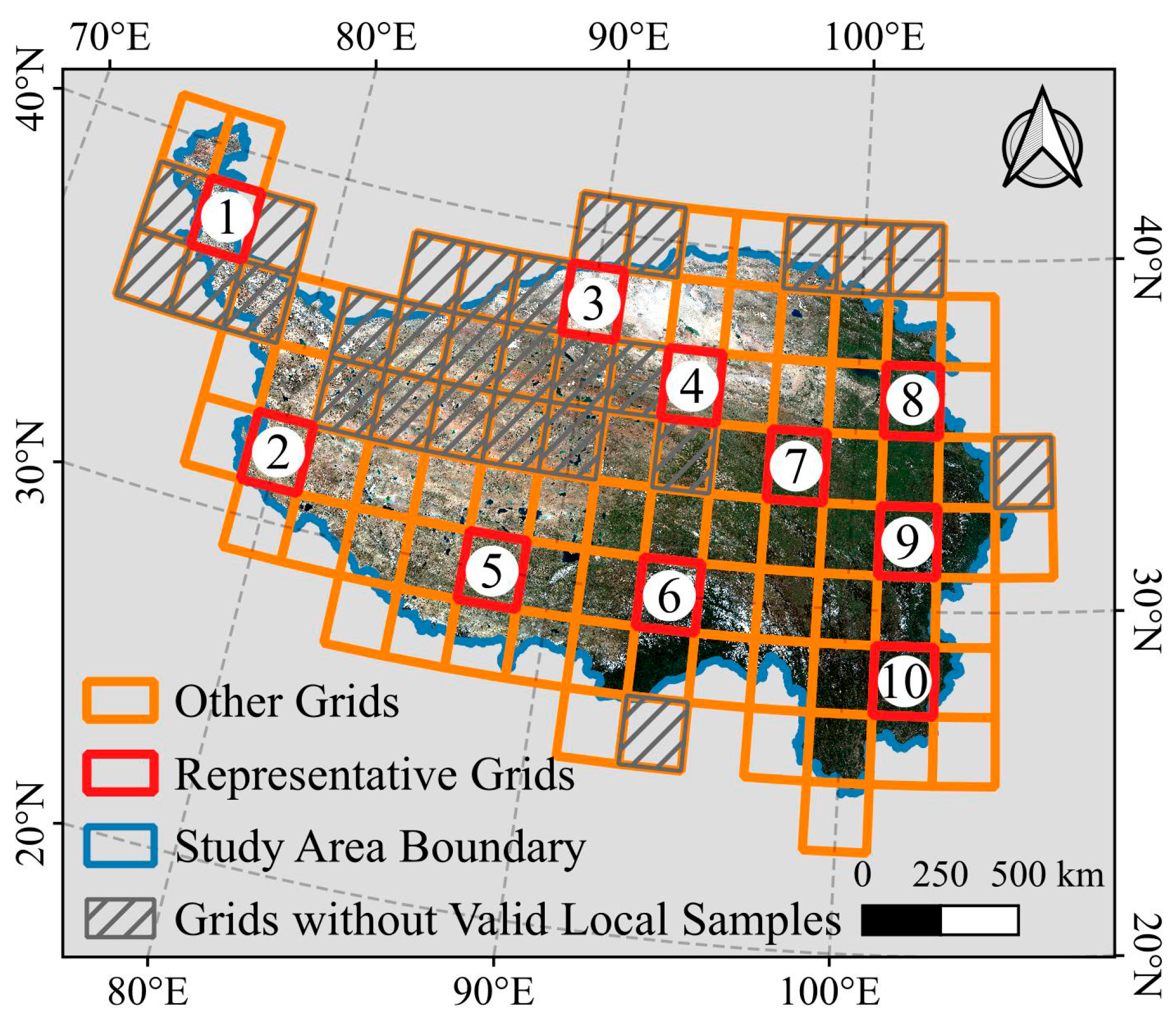
This level evaluates the transferability and local adaptation capability of SDGA at the grid scale. First, model performance, iteration efficiency, and the number of generated samples are analyzed across all 100 grid units. Then, 10 representative grids with well-distributed spatial locations are selected for detailed accuracy assessment and comparison with other medium-resolution products. The spatial distribution of these representative grids is shown in Figure 6. These grids cover different regions of the study area, including eastern, western, northern, and southern parts, and encompass various typical landscape types, such as urban areas (e.g., Xining, Rikaze, and Linzhi), complex mountainous regions, and desert environments. This design ensures the spatial representativeness of the evaluation results. Within these 10 representative grids, a total of 29,739 validation samples are included, consisting of 3966 impervious surface samples and 25,773 non-impervious surface samples.
(3)
Level 3: Evaluation of the final product at the plateau scale
At the full study area scale, the complete validation dataset is used to evaluate the final SDGA-ISC10m product. A comparative analysis is conducted against the seven existing medium-resolution impervious surface products. In addition, the impact of post-processing for extremely low-impervious grids is evaluated by comparing accuracy before and after post-processing, thereby validating the effectiveness of the proposed strategy.
At all levels, both quantitative and qualitative evaluations are conducted. Quantitative evaluation is performed using Precision, Recall, and F1-score to measure classification accuracy, while qualitative evaluation is carried out through visual comparison with existing products to assess the effectiveness of impervious surface extraction.

3. Results

3.1. Performance in the Lhasa Seed Area

3.1.1. Quantitative Results

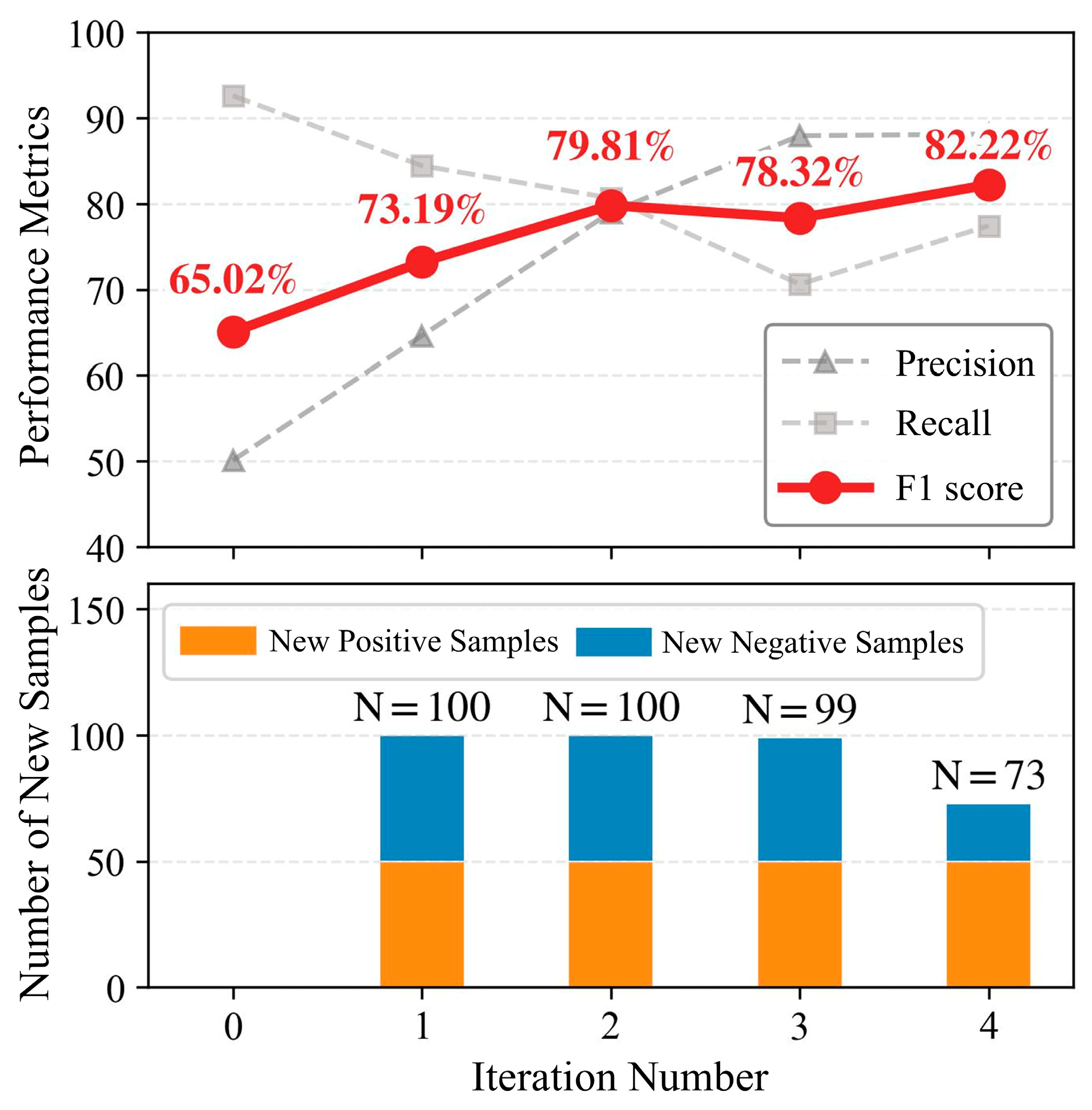
Figure 7 illustrates the evolution of classification accuracy in the Lhasa seed region under the PHAS strategy. Iteration 0 represents the model trained using only the initial 150 samples, yielding an F1-score of 65.02%. After activating the PHAS strategy, the model performance improves rapidly. With only one iteration and the addition of 50 positive and 50 negative samples, the F1-score increases to 73.19%, indicating that the strategy is able to effectively identify highly informative samples in the early stage. As the iterations proceed, the model accuracy continues to improve and reaches its peak at the fourth iteration, where the F1-score attains 82.22%. Meanwhile, the number of newly added samples per iteration decreases from 100 in the first two iterations to 73 in the final iteration, suggesting that the demand for new information diminishes as the decision boundary becomes increasingly stable. Ultimately, the seed training set generated in the Lhasa region contains a total of 894 samples (including the initial 150 samples), among which there are 230 positive samples and 292 negative samples.
In terms of accuracy composition, the initial model exhibits a recall of only about 50%, indicating substantial omission of impervious surfaces under limited sample conditions. As PHAS progressively introduces hard positive samples and hard negative samples from confusing background regions, the recall is significantly improved. By the end of the fourth iteration, the model achieves a precision of 88.12% and a recall of 77.42%, demonstrating a more balanced classification performance while maintaining high precision.
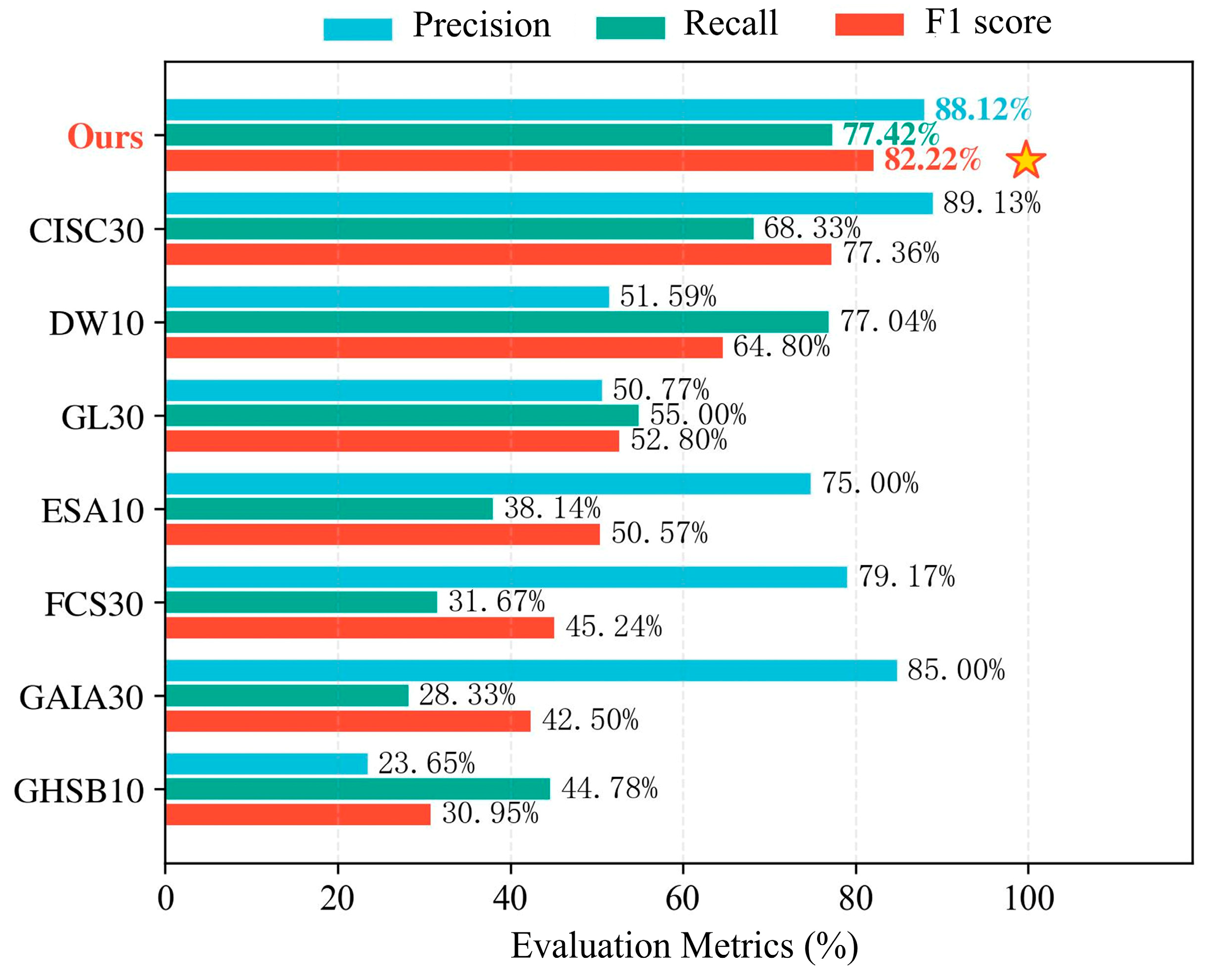
To further evaluate the final classification performance driven by PHAS and to assess whether the generated seed knowledge in the Lhasa region is suitable for subsequent transfer, the classification result after the fourth iteration is compared with seven existing impervious surface products (Figure 8).
Overall, the proposed method achieves the highest accuracy among all compared products in the Lhasa seed region, with an F1-score of 82.22%, outperforming the others. The closest performance is observed for CISC30, with an F1-score of 77.36%, while the remaining products show relatively larger gaps. The comparison results suggest that existing products may face challenges in maintaining stable performance under the complex background conditions of the Qinghai–Xizang Plateau. Products such as GAIA30, ESA10, and FCS30 tend to exhibit relatively high precision but comparatively lower recall, indicating that some impervious surfaces may not be fully captured. In comparison, the proposed method achieves improved recall while maintaining relatively high precision, resulting in a more balanced performance between accuracy and completeness. These results indicate that the combination of GSE data and the PHAS strategy is effective in capturing diverse impervious surface characteristics, and that the constructed seed sample set provides high-quality and transferable seed knowledge for the subsequent grid-level adaptation stage.

3.1.2. Qualitative Results

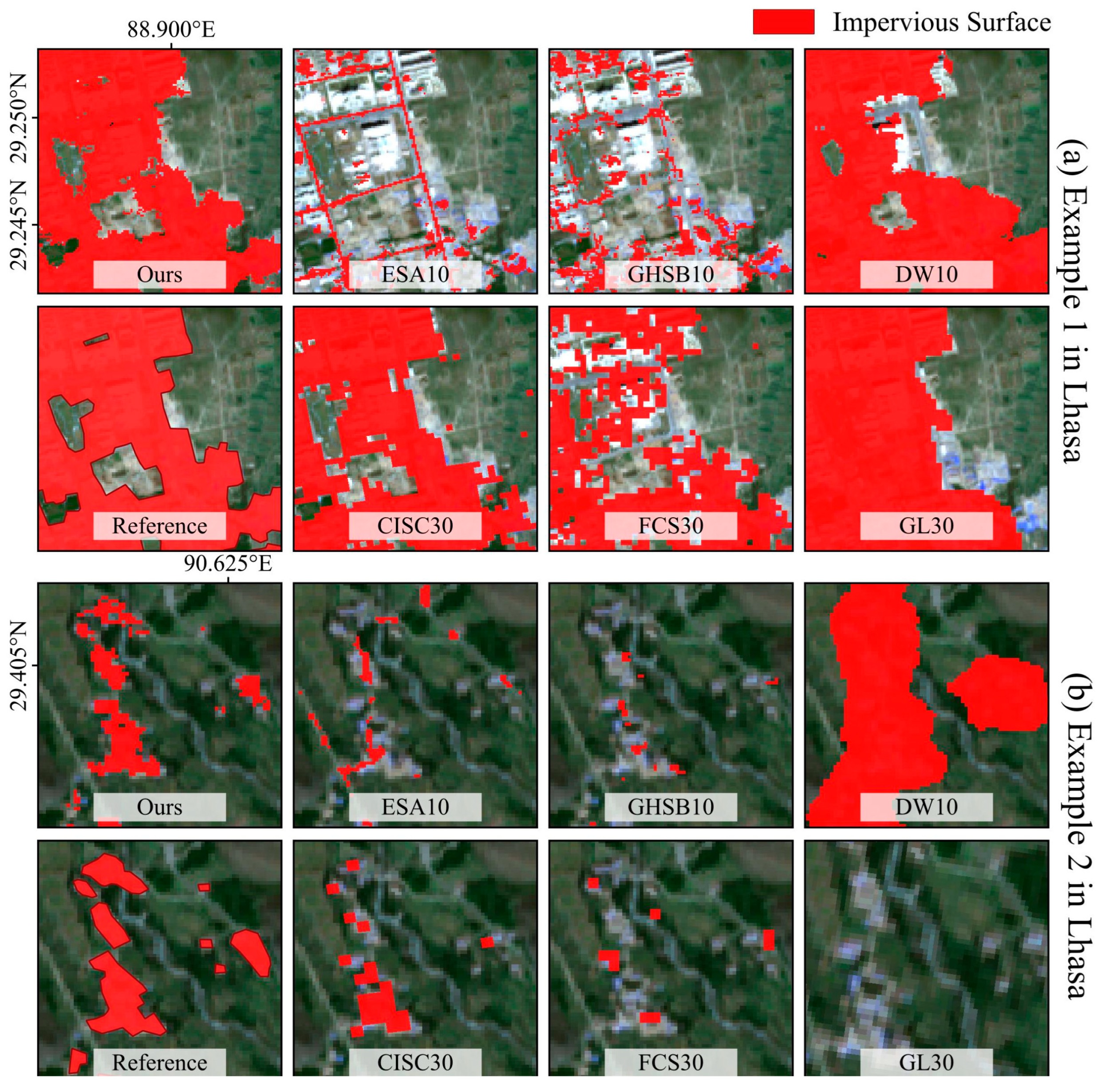
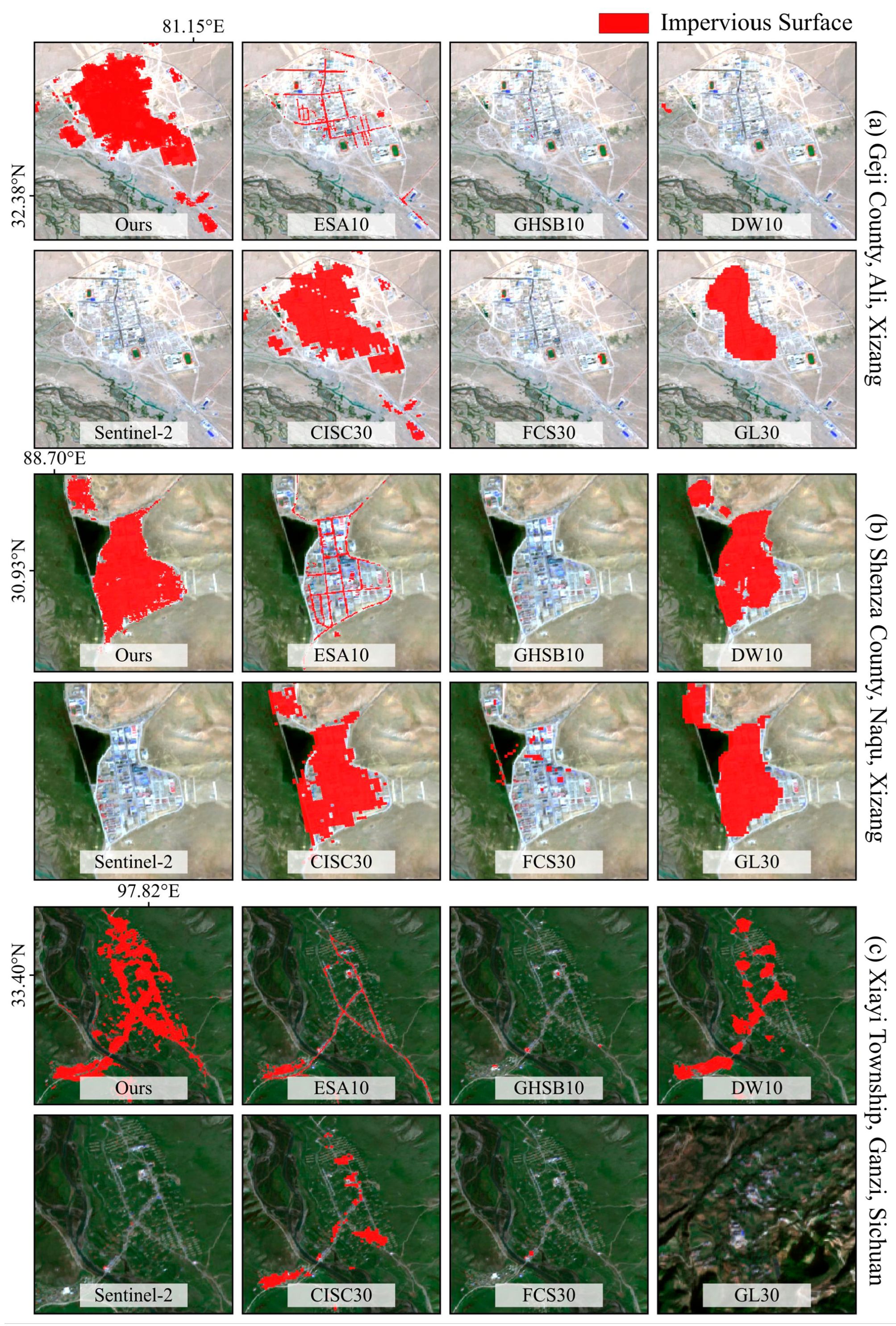
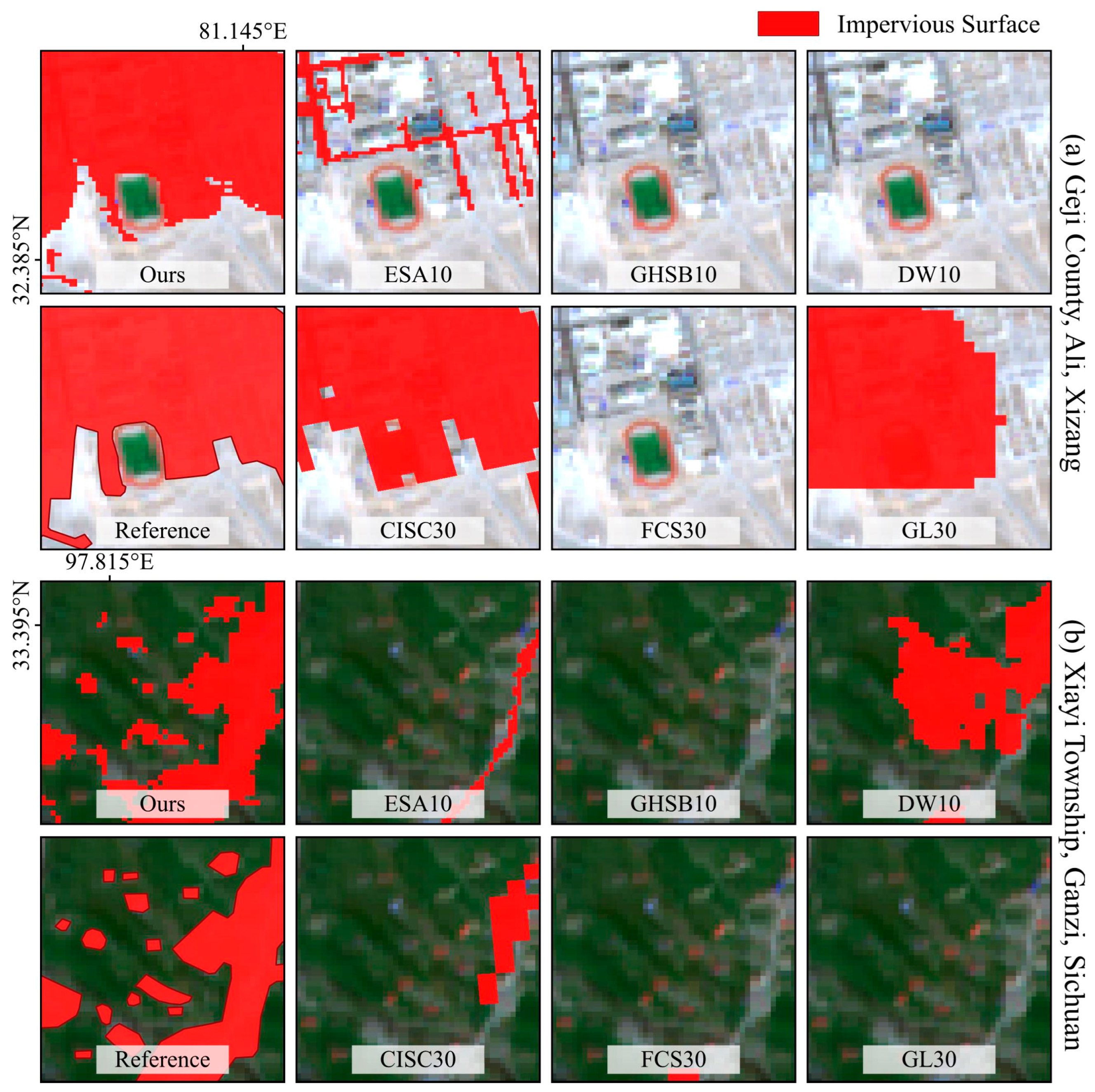
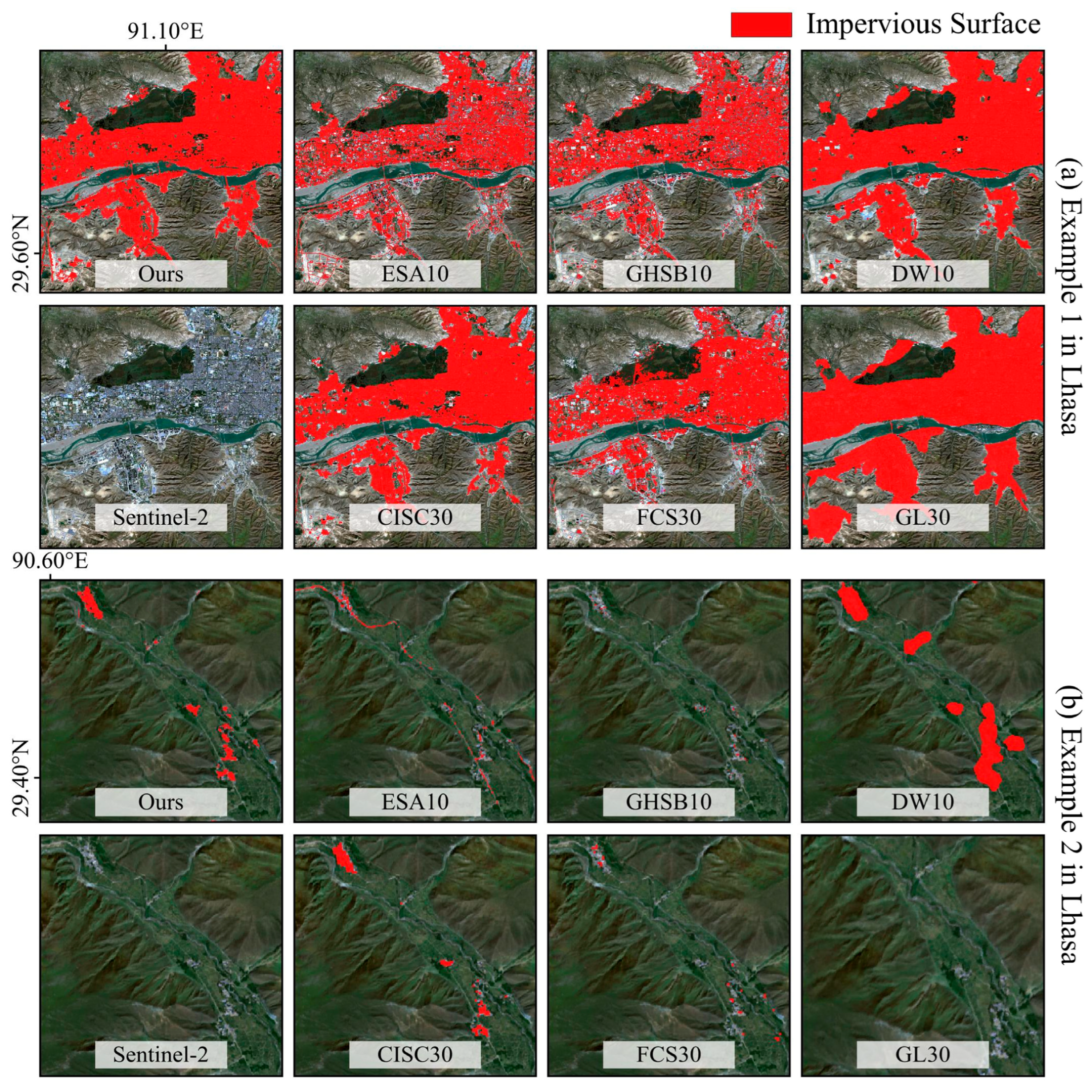
To visually assess the performance of the SDGA framework in the Lhasa seed region, two representative local areas are selected for comparative analysis (Figure 9). Figure 9a corresponds to a high-density urban area with large-scale impervious surfaces, while Figure 9b represents a sparsely distributed rural area characterized by small-scale village impervious surfaces. For each example, the first row shows 10 m resolution products, and the second row shows 30 m resolution products. For clarity of visualization, GAIA30, which exhibits relatively weaker performance in the quantitative evaluation, is not included in this figure. To further highlight the visual differences at a finer scale, two corresponding close-up examples with manually interpreted reference vectors are provided in Figure 10.
As shown in Figure 9a, in large-scale urban areas, the proposed method achieves high fidelity in delineating urban boundaries, preserves the completeness of impervious surfaces, and maintains fine internal details without obvious omission. In comparison, ESA10, GHSB10, and FCS30 tend to exhibit relatively higher omission in these regions. GL30 and DW10 provide relatively high completeness but show a tendency toward overestimation, where natural bare soil within and around urban areas is identified as impervious surfaces, leading to less precise boundary delineation. CISC30 demonstrates relatively strong performance, likely benefiting from the incorporation of 2 m resolution spectral features in its classification process, which introduces higher-resolution information. Notably, although the proposed method relies solely on GSE data with medium-resolution semantic features (10 m and above), it achieves performance comparable to CISC30, highlighting the effectiveness and potential of GSE-based representations. CISC30 performs relatively well, likely due to the incorporation of 2 m resolution spectral features in its classification process, which introduces higher-resolution information. Notably, although the proposed method relies solely on the GSE dataset with medium-resolution semantic features (10 m and above), it achieves performance comparable to CISC30, demonstrating the effectiveness and potential of GSE-based representations.
Figure 9b illustrates a rural village scenario in a river valley, where narrow rural roads, scattered houses, and extensive cropland are present. Compared with other products, the proposed method captures roads and dispersed houses more completely, demonstrating advantages in extracting small-scale impervious surfaces. ESA10, GHSB10, and FCS30 tend to show notable omission in this region, with many small village patches not fully represented. GL30 identifies only some larger settlements, while DW10 shows limited capability in road extraction and a tendency toward overestimation of village patches. CISC30 again demonstrates relatively strong performance among the compared products; however, due to resolution limitations, its results are somewhat less detailed than those of the proposed method.
Figure 10 provides closer visual comparisons for the same two examples using manually interpreted reference vectors. In Figure 10a, the proposed method shows the closest agreement with the reference vectors, particularly in terms of boundary delineation and internal spatial structure. By comparison, ESA10, GHSB10, and FCS30 show relatively evident omission errors, while CISC30 exhibits only slight omission. DW10 and GL30 tend to overestimate impervious surfaces, particularly in surrounding background areas. In Figure 10b, GL30, GHSB10, and FCS30 exhibit more pronounced omission of small and scattered impervious surface patches, whereas CISC30 and ESA10 show only slight omission. DW10 presents relatively severe overestimation in this rural village setting. These close-up comparisons further demonstrate that the proposed method achieves a better balance between omission and commission errors and provides more detailed delineation of impervious surfaces in the Lhasa seed region.
Overall, in the Lhasa seed region, the proposed method achieves a good balance between reducing misclassification and preserving fine details. The results indicate that GSE vectors alone are capable of mitigating spectral confusion under complex plateau conditions. With the joint support of the PHAS strategy and the P10 prior constraints, the model produces high-quality seed knowledge, providing a solid foundation for subsequent transfer and adaptation across the plateau.

3.2. Grid-Level Adaptive Mapping Results

3.2.1. Quantitative Results

To evaluate the effectiveness of the SDGA framework during the grid-level adaptation stage, quantitative analyses are conducted from two perspectives: (1) statistical results at the full grid scale and (2) regional accuracy comparisons between 10 representative grids and existing products.
(1)
Statistical results across all grids
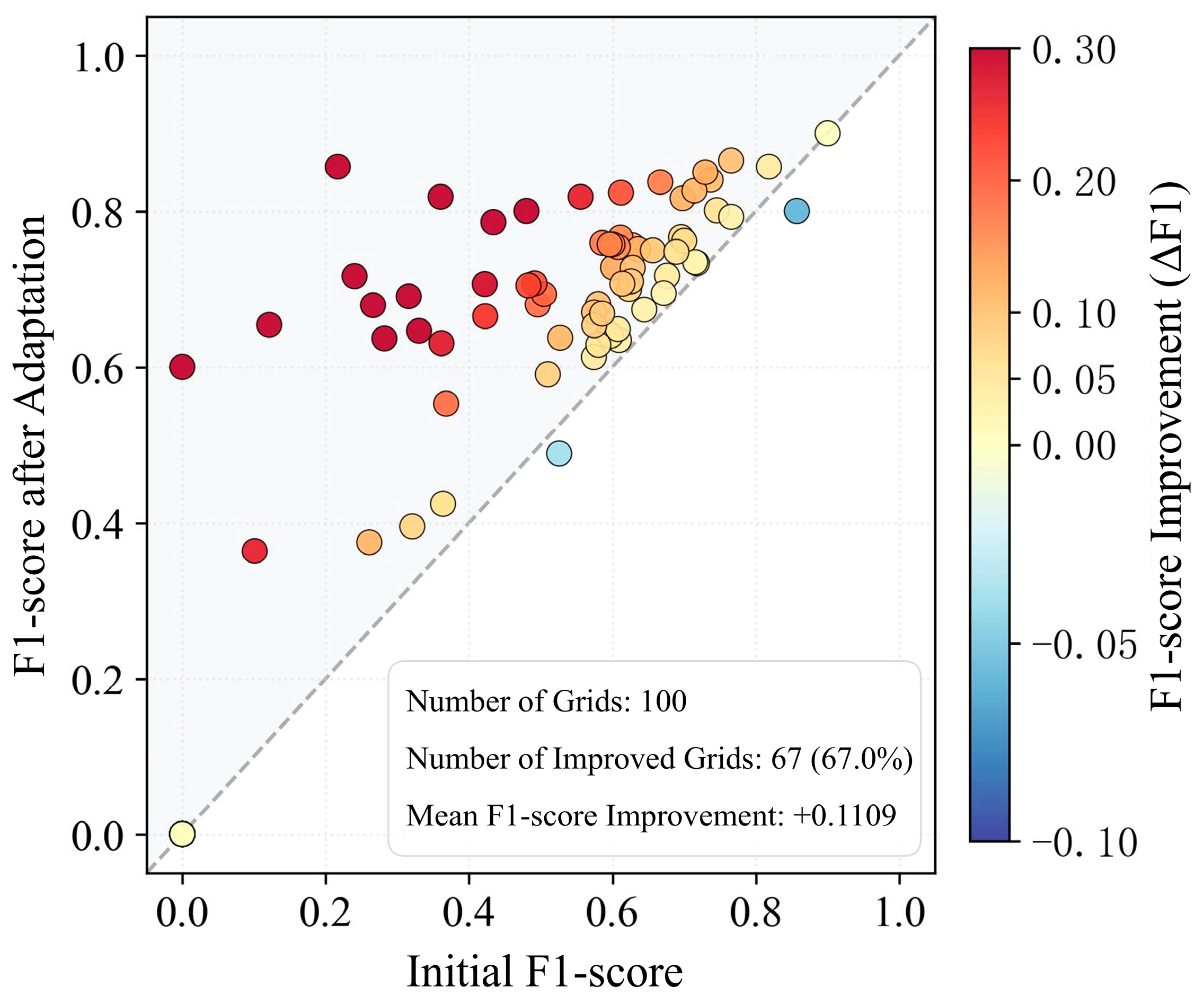
First, to examine the overall performance change before and after grid-level adaptation, the F1-scores of each grid are calculated and visualized using a scatter plot (Figure 11). Most points are located above the diagonal line (Y = X), indicating that the classification performance of local models is generally improved after applying PHAS-based adaptation. The statistics show that 67 out of 100 grids achieve performance improvement, accounting for 67.0% of all grids, with an average F1-score increase of 0.1109 across the entire study area.
Further analysis reveals that grids with lower initial accuracy tend to exhibit larger improvements, with some grids achieving ∆F1 values exceeding 0.2. This indicates that for regions with substantial landscape differences from the Lhasa seed area and lower initial model adaptability, PHAS can significantly enhance local model performance through the incorporation of a small number of locally mined samples. In contrast, grids with relatively high initial accuracy show smaller performance changes after adaptation, suggesting that the seed model is already well adapted to these regions and that local updates do not lead to overfitting or performance degradation.
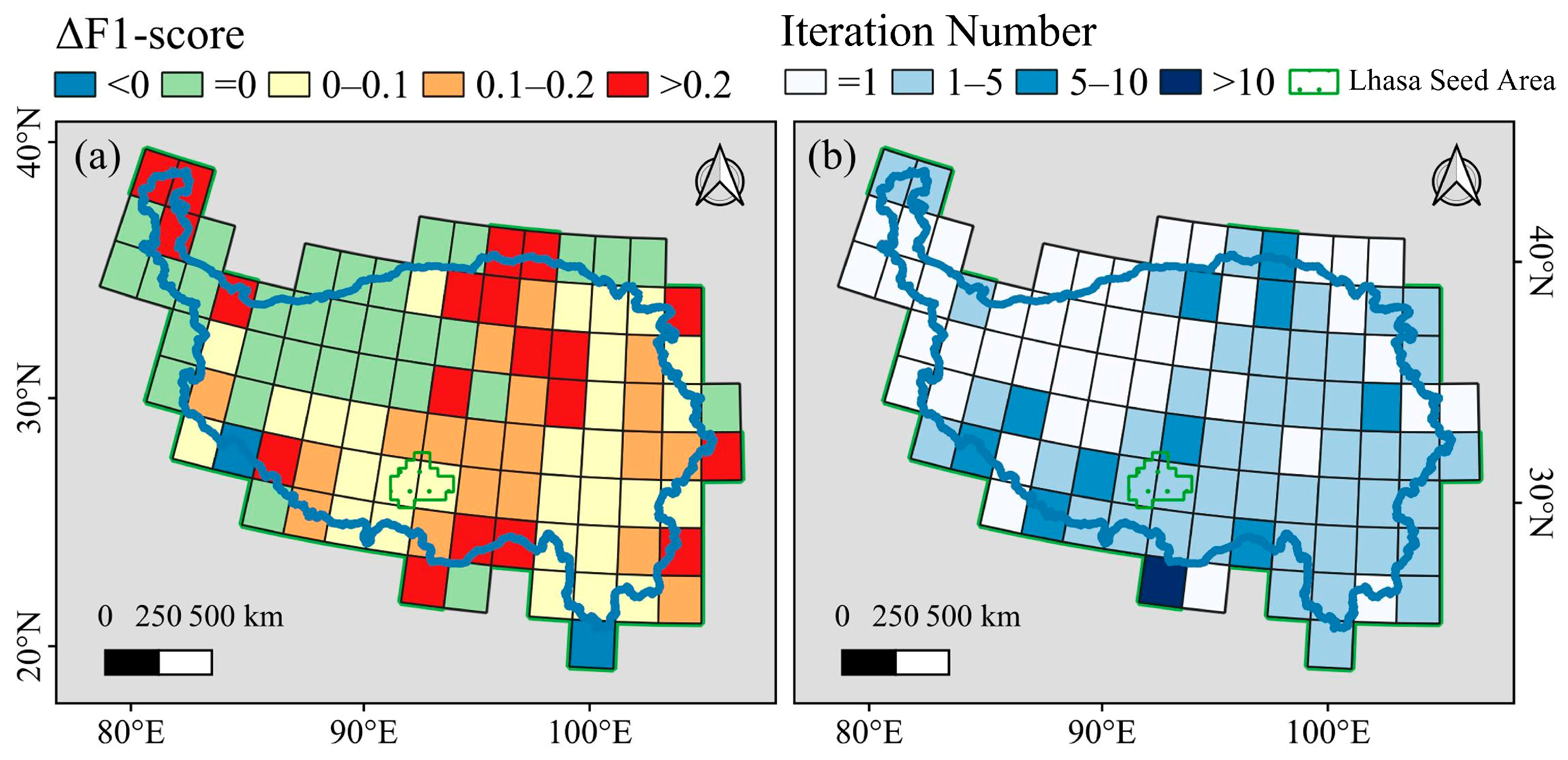
To further investigate the spatial patterns of grid-level local adaptation, the spatial distributions of F1-score improvement and PHAS iteration counts are illustrated in Figure 12. As shown in Figure 12a, grids with substantial F1 improvements are mainly distributed in the central-northern and marginal regions of the Qinghai–Xizang Plateau. These areas are characterized by the widespread presence of deserts, Gobi, and bare rock surfaces, which are easily confused with impervious surfaces, as well as relatively low impervious surface coverage, making classification more challenging. As a result, these regions rely more heavily on locally adaptive sample updates. In contrast, grids with limited improvement are primarily located in northwestern uninhabited regions and some boundary grids. This is mainly due to the extremely low impervious surface coverage in these areas, which prevents PHAS from identifying sufficient new positive samples during local adaptation, leading to early termination of the iterative process. In addition, boundary grids exhibit greater variability in F1 improvement due to their smaller effective study area.
Figure 12b presents the number of iterations required for convergence in each grid. The majority of grids converge within 1–5 iterations, indicating that the seed knowledge provides a strong initialization that effectively reduces the search space and improves convergence efficiency. Only a small number of grids require 5–10 iterations or more than 10 iterations, suggesting that these regions exhibit higher landscape heterogeneity or more complex local background conditions. Overall, the SDGA framework demonstrates the ability to adaptively adjust the local learning process according to regional heterogeneity.
To analyze the scale and spatial distribution of the locally generated samples during the grid-level adaptation stage, the numbers of newly added positive and negative samples in each grid are summarized (Figure 13), and the locations of newly added positive and negative samples within representative grids are visualized (Figure 14).
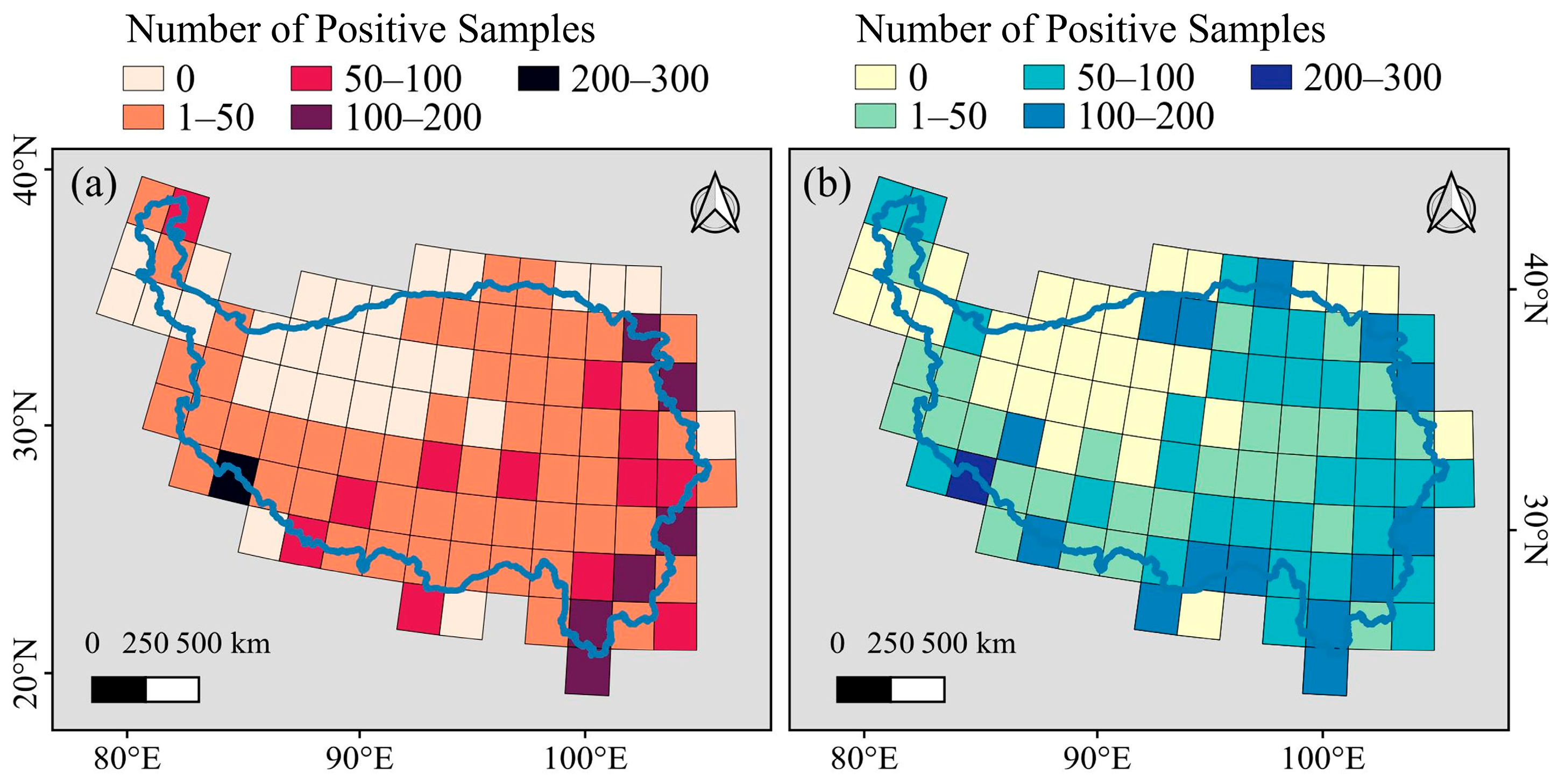
In total, 8654 new samples are obtained across the study area, including 3645 positive samples and 5009 negative samples. As shown in Figure 13, the numbers of newly added positive and negative samples vary considerably among grids, reflecting differences in local landscape heterogeneity. In general, most grids contain fewer than 50 newly added positive samples, whereas negative samples in many grids range between 50 and 100. This indicates that, compared with positive samples, the background environment in the Qinghai–Xizang Plateau exhibits greater heterogeneity, requiring a larger number of diverse negative samples to establish more discriminative decision boundaries.
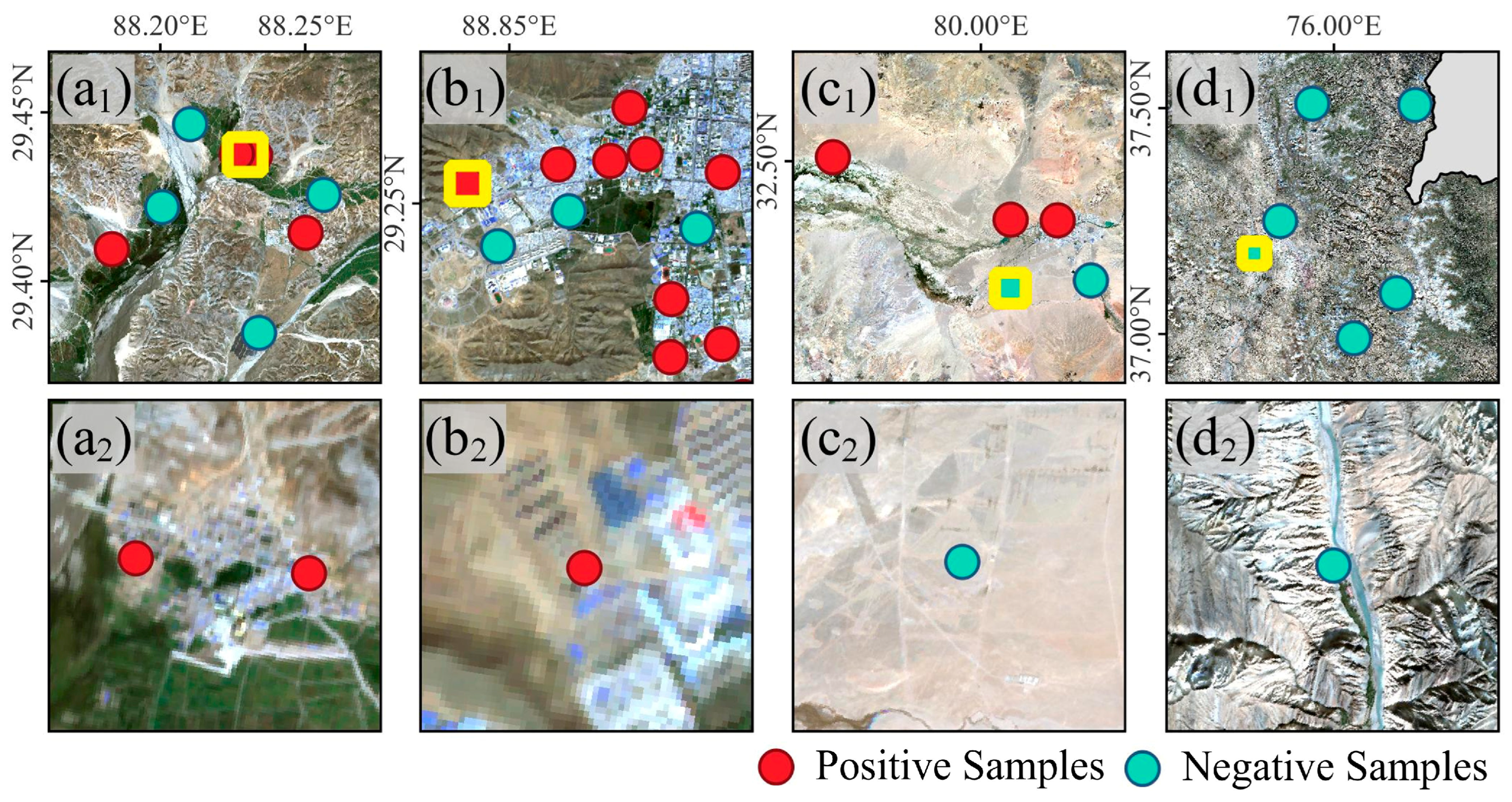
From the examples in Figure 14a2,b2, newly added positive samples are mainly concentrated along the edges of impervious surface patches and on low-rise structures with blurred textures, suggesting that PHAS preferentially selects samples that are critical for refining decision boundaries. In contrast, newly added negative samples are primarily distributed in regions such as bright bare soil and dry riverbeds (Figure 14c2,d2), which are easily confused with impervious surfaces. This indicates that the strategy effectively helps the model correct misclassifications caused by low-vegetation background areas.
Overall, SDGA does not allocate samples uniformly across the entire study area or rely on simple stratified random sampling. Instead, it dynamically selects the most informative positive and negative samples according to the dominant landscape characteristics of each grid. This demand-driven and adaptive sampling mechanism is a key factor enabling the proposed method to achieve high mapping accuracy in the complex environment of the Qinghai–Xizang Plateau.
(2)
Quantitative comparison across 10 representative grids
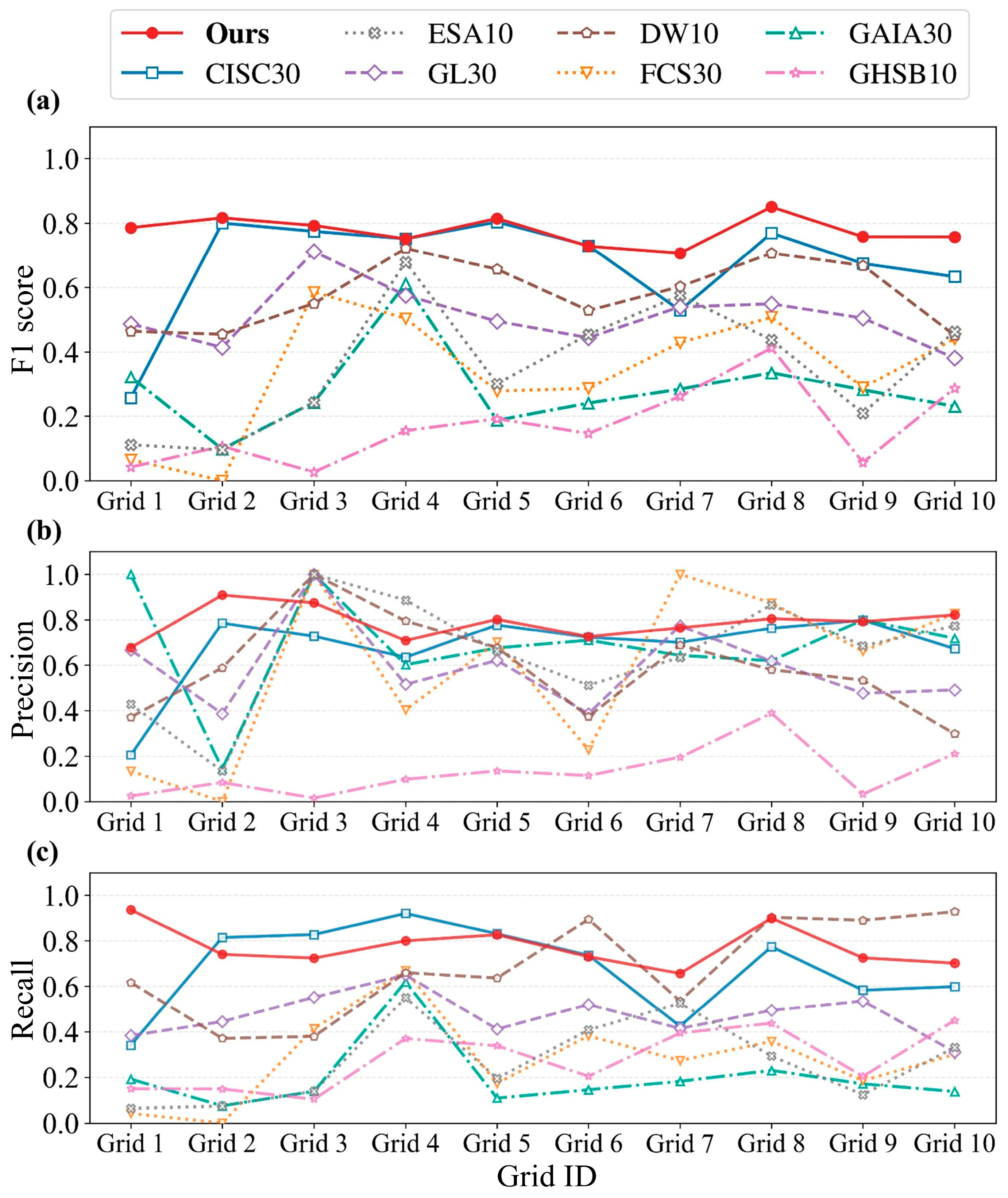
To further evaluate the robustness of the SDGA framework across different landscape types and spatially heterogeneous regions, ten spatially well-distributed grids were selected as representative areas. The proposed method was compared with seven existing products on a per-grid basis, and the results are shown in Figure 15.
As illustrated in Figure 15a, the proposed method maintains consistently high performance across all ten grids, with F1-scores exceeding 0.7 in every case. It achieves the highest F1-score in most grids and ranks second only in Grid 6. In comparison, the other products show relatively larger performance variability. For example, in Grid 2, located in the southwestern Qinghai–Xizang Plateau, where impervious surfaces are sparsely distributed and the background consists of a mixture of arid land and snow/ice, products such as ESA10 and GAIA30 exhibit relatively lower F1-scores, partly due to omission errors under these complex conditions. In comparison, SDGA alleviates this issue through grid-level local adaptation.
It is worth noting that CISC30 incorporates 2 m high-resolution spectral features during classification, enabling it to achieve performance comparable to the proposed method in most grids. However, the proposed method relies solely on 10 m GSE vectors as input features, yet still attains classification results highly comparable to those of CISC30. This demonstrates that the semantic embedding features provided by the GSE dataset possess strong representation capability for land surface objects, enabling high-accuracy impervious surface mapping even without relying on high-resolution spectral data as direct input features.
As further shown in Figure 15b,c, in challenging regions such as Grid 2 and Grid 6, where background classes are easily confused, the proposed method maintains relatively high precision. Meanwhile, in grids containing a large number of small-scale impervious surfaces, it also achieves notably higher recall compared to other products. This indicates that the P10 prior effectively guides the model to identify small and fragmented impervious surface samples, thereby reducing the omission errors commonly observed in existing products.
Overall, by reactivating PHAS at the grid level, SDGA enables efficient local adaptation within each grid, significantly improving the overall accuracy of impervious surface mapping across the entire study area. Its performance is comparable to methods that rely on high-resolution spectral features as input, further validating the effectiveness of the SDGA framework.

3.2.2. Qualitative Results

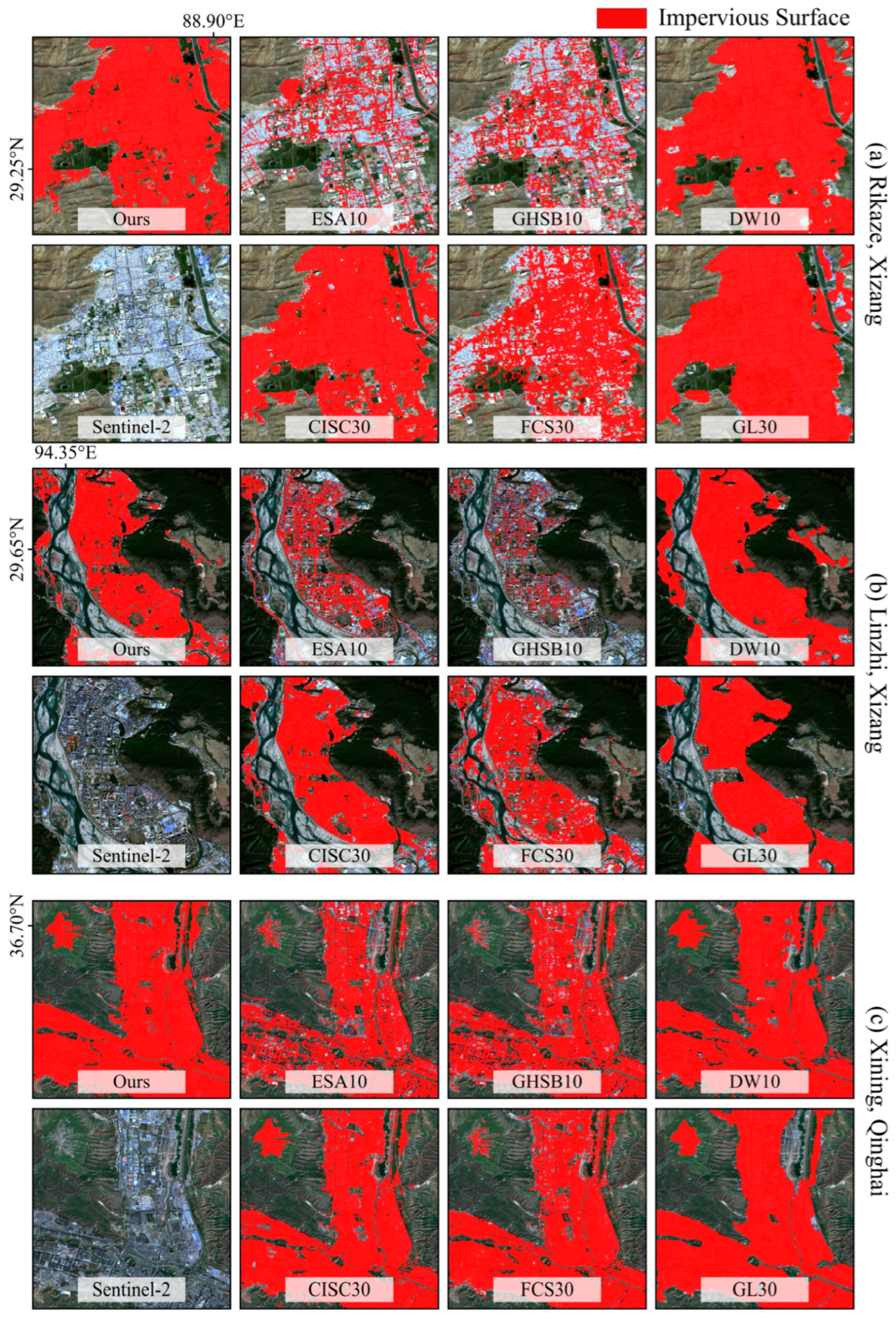
To visually evaluate the classification performance of SDGA after completing the grid-level adaptation in Stage 2, six representative regions were selected for qualitative comparison, including three large-scale urban areas (Rikaze, Linzhi, and Xining) and three small-scale rural areas (Ali, Naqu, and Ganzi). These regions are distributed across the western, central, and eastern parts of the Qinghai–Xizang Plateau, thereby reflecting classification performance under diverse landscape conditions.
Figure 16 presents the visual comparison results in large-scale urban areas. In such regions, the key challenge lies in accurately delineating urban boundaries while preserving the completeness of impervious surfaces and retaining internal details of pervious areas. As shown in Figure 16, the proposed method effectively distinguishes urban areas from adjacent mountains with sparse vegetation in both Rikaze and Xining, and also successfully separates impervious surfaces from dry riverbeds in the river valley of Linzhi. In contrast, ESA10 and GHSB10 exhibit substantial omission errors, while DW10 shows evident overestimation. Among the 30 m products, FCS30 performs well only in limited areas, and although GL30 can delineate urban extents with relatively smooth boundaries, it tends to generalize large impervious surface patches and fails to preserve internal pervious details. This phenomenon is particularly evident in Xining (Figure 16c), where pervious spaces within aggregated built-up areas are included as impervious surfaces, resulting in local overestimation. DW10 shows a similar tendency in this region, mainly due to its limited ability to distinguish internal pervious features within large and continuous impervious surface complexes. CISC30 achieves relatively strong overall performance; however, constrained by its spatial resolution, it still falls short of the proposed method in capturing fine-scale details. Overall, the proposed method produces a more balanced result by maintaining the completeness of impervious surfaces while better preserving internal non-impervious details.
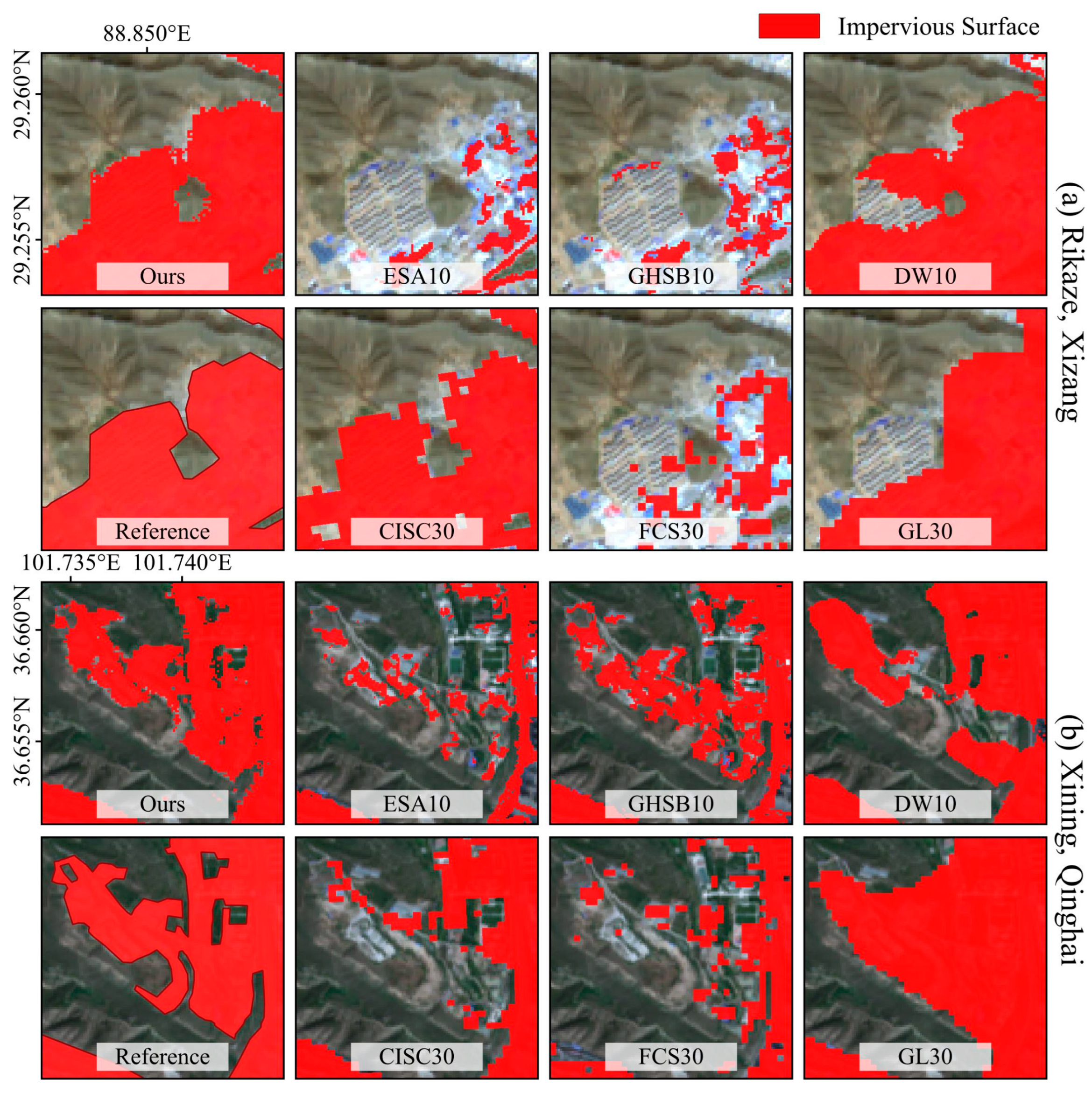
Figure 17 provides closer visual comparisons for two selected urban examples using manually interpreted reference vectors. In Figure 17a, ESA10, GHSB10, and FCS30 exhibit substantial omission, with large impervious surface areas remaining undetected. DW10 and GL30 show relatively limited omission, whereas CISC30 produces comparatively complete results; however, as a 30 m product, its mapped boundaries are visibly coarser and less refined than those of the proposed method. In Figure 17b, the proposed method shows the highest agreement with the reference, both in overall extent and in the preservation of internal non-impervious details. GL30 exhibits evident overextraction and fails to preserve the internal details of impervious surfaces, whereas the other compared products all show omission to varying degrees. These close-up comparisons further demonstrate that the proposed method achieves a better balance between completeness and delineation accuracy in large-scale urban areas.
Figure 18 focuses on small-scale rural impervious surface regions, which typically contain narrow roads and sparsely distributed small buildings, posing greater challenges for the identification of small-scale impervious surfaces. The proposed method demonstrates high completeness in extracting small-scale impervious surfaces across all three regions, effectively identifying scattered buildings and roads within bare land and cropland backgrounds. In contrast, ESA10, GHSB10, and FCS30 tend to exhibit notable omission errors in these areas, while DW10 and GL30 are able to capture only part of the impervious surface patches, with some omissions remaining. Although CISC30 shows relatively strong performance, it still presents limitations in representing finer-scale features.
Figure 19 provides closer visual comparisons for two selected rural examples using manually interpreted reference vectors. In Figure 19a, the proposed method shows the highest agreement with the reference and achieves relatively high overall completeness. Notably, it correctly excludes the pervious playground from the impervious surface class. In contrast, ESA10, GHSB10, DW10, and FCS30 exhibit substantial omission, with ESA10 identifying only part of the target area. CISC30 and GL30 produce relatively complete results; however, their mapped boundaries are coarser and less refined than those of the proposed method, and they also fail to distinguish the pervious playground from the surrounding impervious surfaces. In Figure 19b, the proposed method is capable of identifying very small impervious surface patches, whereas the other compared products show evident omission for such small targets. These close-up comparisons further demonstrate the advantage of the proposed method in preserving fine spatial details and detecting small-scale impervious surfaces in rural areas.
Overall, existing products tend to favor either higher precision or higher recall when extracting impervious surfaces at different scales: 10 m products are generally more conservative and prone to omission errors, whereas 30 m products are more likely to produce misclassifications and lose spatial details. In comparison, the proposed SDGA framework demonstrates stronger robustness in both large-scale urban and small-scale rural scenarios, effectively suppressing background noise while preserving fine-grained details, thereby achieving a more balanced classification performance.

3.3. Plateau-Scale Impervious Surface Mapping Results

3.3.1. Quantitative Results

(1)
Accuracy assessment of the SDGA-ISC10m product at the plateau scale
The SDGA-ISC10m product was evaluated at the plateau scale using the Validation Sample Set for Impervious Surfaces on the Qinghai–Xizang Plateau, and the results are summarized in Table 2. The evaluation indicates that SDGA-ISC10m achieves strong mapping performance across the entire plateau, with an F1-score of 0.8223 for the impervious surface class, a precision of 80.37%, and a recall of 84.17%. These results suggest that the SDGA framework, based on the GSE dataset, is capable of effectively identifying difficult negative samples that help suppress complex background noise, while also incorporating informative positive samples that facilitate the detection of sparse and fragmented impervious surface patches, thereby achieving a favorable balance between commission and omission errors.
(2)
Effectiveness of the post-processing strategy
To evaluate the effectiveness of the post-processing strategy designed for grids with extremely low impervious surface coverage, the accuracy metrics before post-processing were also computed (Table 2). The results show that recall remains unchanged at 84.17% before and after post-processing, indicating that the potential impervious surface region mask constructed from the P10 prior is highly reliable and does not lead to significant loss of true impervious surface pixels after applying the spatial intersection constraint.
Meanwhile, precision increases from 80.29% to 80.37%, and the F1-score improves from 0.8219 to 0.8223 after post-processing. Although the improvement is relatively modest, this is mainly because the validation subset associated with grids of extremely low impervious surface coverage accounts for only a small proportion of the full validation sample set. Combined with the subsequent qualitative analysis, it can be observed that this strategy effectively removes false positives in uninhabited regions, thereby contributing positively to the overall product quality. Overall, the post-processing method improves accuracy while preserving recall, demonstrating its effectiveness.

3.3.2. Qualitative Results

(1)
Spatial distribution patterns of the plateau-scale SDGA-ISC10m product
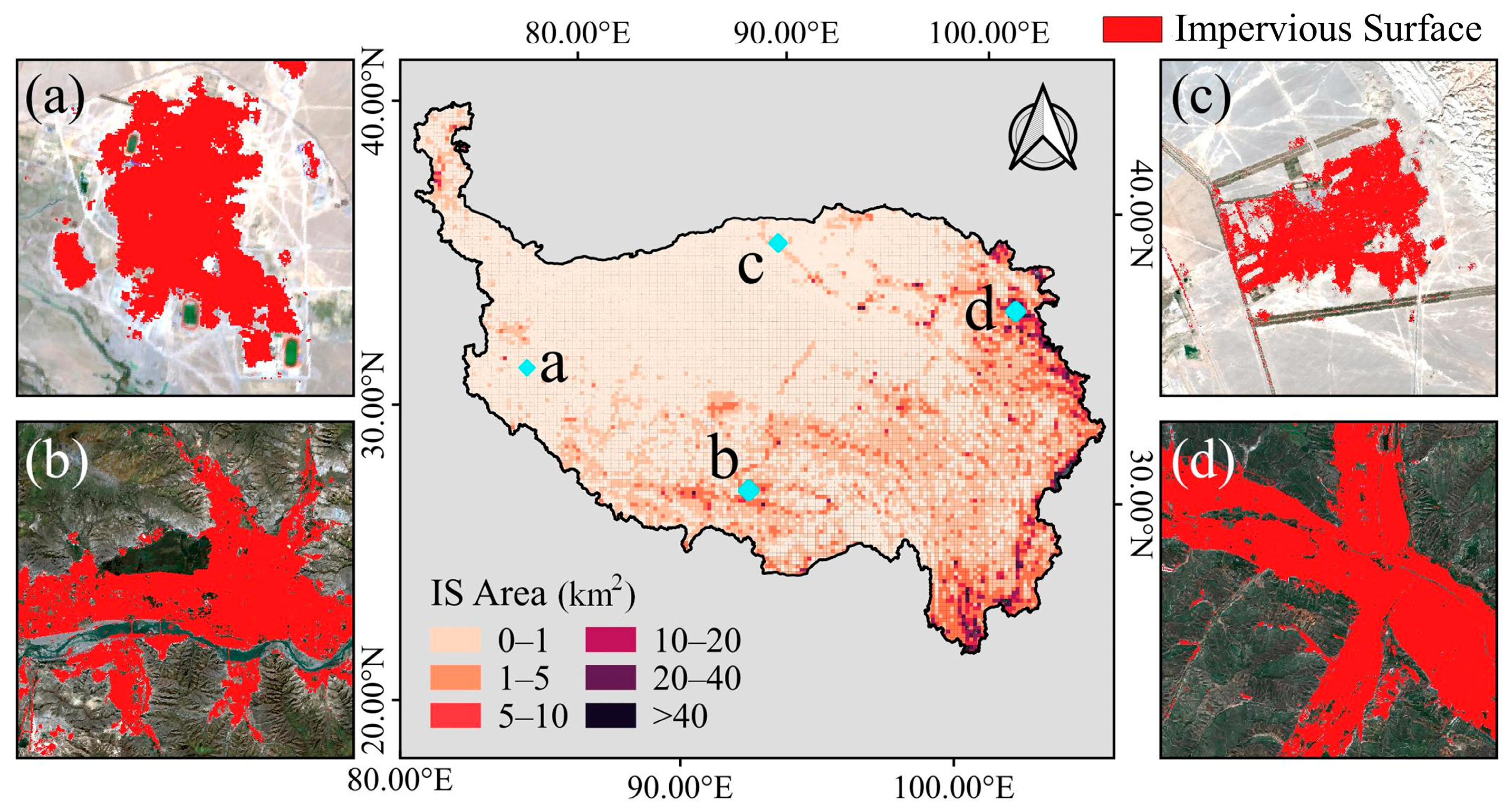
Figure 20 illustrates the spatial distribution of the SDGA-ISC10m product. Considering the low proportion of impervious surfaces across the Qinghai–Xizang Plateau, a 15 km × 15 km grid was used to aggregate impervious surface area within each grid cell, and the results were visualized using a classified color scheme. In addition, four representative regions located in the western, southern, northern, and eastern parts of the plateau were selected to present local mapping results.
Overall, SDGA-ISC10m exhibits clear spatial heterogeneity: impervious surfaces are relatively dense in the southeastern region, while they are extremely sparse in the northwestern region. Moreover, impervious surfaces generally show a clustered spatial pattern along river valleys and transportation corridors. The local zoom-in views in Figure 20 further demonstrate that SDGA-ISC10m is capable of effectively extracting impervious surface objects at multiple scales, both in low-density regions and in high-density urban areas, indicating strong applicability across the entire plateau.
(2)
Qualitative evaluation of the post-processing strategy
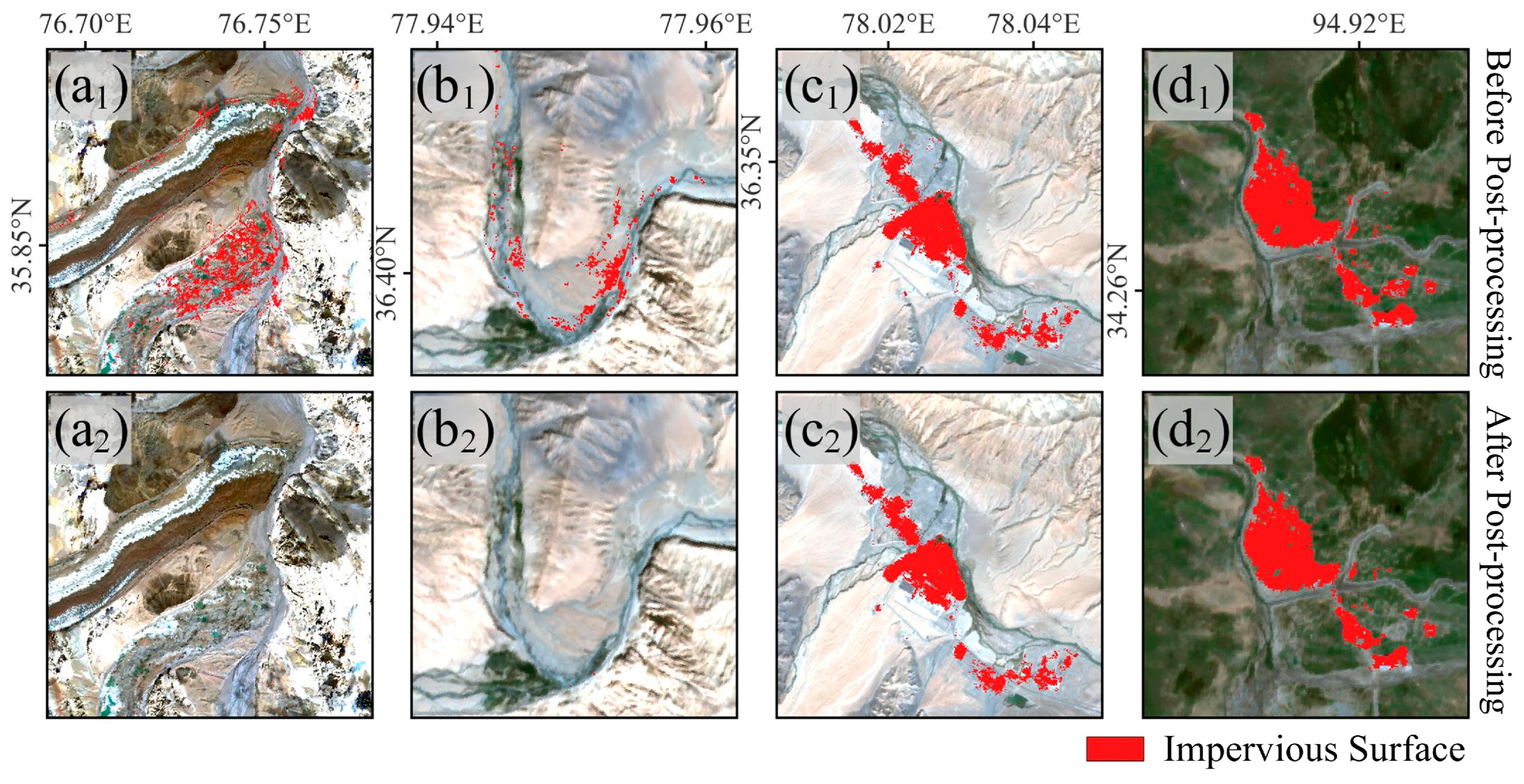
For grids with extremely low impervious surface coverage and without valid locally generated samples, four representative scenarios were selected to compare the results before and after post-processing (Figure 21). The first row of Figure 21 shows the results before post-processing, while the second row presents the results after post-processing.
As shown in Figure 21a,b, prior to post-processing, the neighboring-grid-based prediction strategy produces a considerable number of false positives in dry riverbeds and exposed gravel areas, which can lead to overestimation of impervious surface area. After applying the P10-based potential region mask, these background noises located far from human activity areas are effectively removed, thereby improving the overall precision of the product.
At the same time, Figure 21c,d indicate that the post-processing strategy is still able to preserve small but real impervious surface patches. This demonstrates that the method not only provides effective noise suppression but also maintains a certain level of reliability, without causing noticeable degradation in recall.

4. Discussion

4.1. Factors Contributing to the Effectiveness of the SDGA Framework

The results of this study demonstrate that the SDGA framework achieves relatively stable impervious surface mapping performance under the complex background conditions of the Qinghai–Xizang Plateau. This performance improvement does not arise solely from the classifier itself, but is primarily attributed to the synergistic interaction between the semantic feature representation and the adaptive sampling mechanism.
First, the GSE dataset provides not conventional pixel-level spectral features, but high-level semantic representations derived from the integration of multi-source and multi-scale remote sensing information. Such semantic features help mitigate the “same-spectrum-different-objects” issue commonly encountered with single-source spectral inputs in complex environments, such as bare land, dry riverbeds, and areas with low vegetation cover. As a result, the model gains more stable background discrimination capability in the highly heterogeneous environment of the Qinghai–Xizang Plateau. Therefore, the advantage of the proposed method in suppressing large-area false positives is not solely dependent on the classifier architecture, but largely benefits from the noise-resistant properties of GSE representations at the semantic level.
Second, the PHAS strategy does not simply improve model performance by increasing the number of samples. Instead, it refines the decision boundary in local regions through targeted mining of hard positive samples and selective identification of hard negative samples. On the Qinghai–Xizang Plateau, impervious surfaces are typically sparse, fragmented, and small in scale, while background classes are diverse and complex. Under such conditions, model performance depends more on sample quality than on a mechanical expansion of sample quantity. By prioritizing samples that are most informative to the current decision boundary, the PHAS strategy enables the model to adapt more efficiently to local landscape variations under limited sample conditions. This also explains why many grids with relatively low initial accuracy achieve substantial improvement during the grid-level adaptation stage.
In addition, the grid-level adaptation mechanism plays a crucial role in the effectiveness of the proposed framework. If a single model trained only on the Lhasa seed area were directly applied to the entire plateau, the significant landscape differences and domain shifts across regions would limit its generalization ability. By reactivating the PHAS strategy at the grid level, the SDGA framework allows the model to adapt to local background characteristics while maintaining a unified methodological framework. Therefore, the strength of this framework does not lie in constructing a globally optimal model, but in achieving a balance between global consistency and local flexibility through the combination of seed knowledge and local adaptation.
However, this advantage is accompanied by certain trade-offs. The proposed method places greater emphasis on improving overall robustness and suppressing misclassification under complex background conditions, rather than maximizing the preservation of all fine-scale linear features. Therefore, it is more suitable for large-scale mapping tasks in regions like the Qinghai–Xizang Plateau, where background noise is strong and spatial heterogeneity is pronounced. Its relatively limited performance on extremely fine linear features or sub-pixel-scale targets reflects the inherent applicability boundaries of the method under different scenarios.

4.2. Computational Cost and Scalability

The computational cost and scalability of SDGA were further considered from the perspective of cloud-based implementation. In this study, the SDGA workflow was implemented on the Google Earth Engine (GEE) platform. Therefore, the wall-clock runtime of each iteration was not solely determined by the algorithm itself, but was also affected by cloud-side task scheduling, server-side resource allocation, grid complexity, candidate sample availability, and export volume. As a result, the runtime of individual iterations may vary across grids and execution periods, and a fixed local CPU/GPU-based runtime is not directly applicable. In practical runs, many grid-level iterations were completed within the order of several minutes; however, this observation should not be regarded as a fixed runtime benchmark because the execution time in GEE varies with cloud-side scheduling and resource allocation. The iteration-count distribution in Figure 12 provides an indirect indication of the relative computational load among grids. Most grids required only a limited number of PHAS iterations to reach the stopping criteria, indicating that the iterative adaptation process did not lead to excessive repeated model updates for most regions. Since the classifier used in this study was a random forest and each local model was trained using a compact adaptive sample set, the model training and inference steps were computationally efficient compared with large deep-learning-based mapping workflows. The main computational burden was associated with grid-wise probability prediction, candidate sample filtering, and result export.
From the perspective of a large-scale application, SDGA is computationally feasible because the study area is decomposed into independent 2° × 2° grid units. This grid-wise design avoids processing the entire Qinghai–Xizang Plateau as a single task and allows local adaptation and classification to be executed separately for each grid. Moreover, the use of GSE avoids many computationally expensive preprocessing steps required by conventional multi-source workflows, such as atmospheric correction, cloud masking, multi-sensor feature construction, and spatial co-registration. Therefore, although exact wall-clock runtime may vary in the GEE cloud environment, the proposed SDGA framework has practical scalability for large-area impervious surface mapping.

4.3. Uncertainty and Limitations

Although the SDGA framework achieves strong mapping performance, the final SDGA-ISC10m product still contains certain uncertainties due to factors such as the quality of prior data, the intrinsic characteristics of the GSE dataset, and scale effects associated with the 10 m spatial resolution. These uncertainties are mainly reflected in the following aspects:
(1)
Spatial distribution patterns of the plateau-scale SDGA-ISC10m product: First, uncertainty arises from the reliance on prior data and the associated risk of error propagation. The P10 prior is primarily derived from high-resolution impervious surface data in 2020. Although impervious surfaces generally exhibit limited overall changes over short time periods, temporal inconsistencies at the local level may still introduce noise. In addition, if P10 itself contains misclassifications—for example, incorrectly labeling dry riverbeds as roads—such erroneous pixels may be selected as positive samples during the SDGA sampling process, thereby introducing incorrect features into the classification model. Although the PHAS strategy provides a certain level of error correction capability, strong local prior errors may still interfere with model convergence during the grid-level adaptation stage.
(2)
Omission of micro targets caused by GSE representation: Second, uncertainty also stems from the smoothing effect of GSE semantic representations on micro-scale targets. GSE generates high-level embedding features by integrating multi-source and multi-scale information. While this enhances robustness to complex backgrounds, it inevitably reduces certain high-frequency geometric details. As a result, very narrow roads and small, scattered buildings are more likely to be smoothed into background classes during feature representation. In contrast, pixel-level spectral classification methods, such as ESA10, although more sensitive to noise, may exhibit higher sensitivity to thin linear features like roads. This suggests that the strength of the GSE dataset lies in its semantic discrimination capability under complex background conditions, while the trade-off is a partial loss of geometric detail. For regions such as the Qinghai–Xizang Plateau, where background complexity is high, this trade-off—favoring overall robustness over local detail—is to some extent acceptable, but it also constitutes an important source of uncertainty.
(3)
Scale effects, mixed-pixel limitation and grid-size implications: In addition, uncertainty is associated with the scale effects of the 10 m spatial resolution and the mixed-pixel problem. Although SDGA-ISC10m demonstrates improved capability in identifying small targets compared with 30 m products, many rural roads and small buildings on the Qinghai–Xizang Plateau have widths of less than 5 m and are therefore typically represented as mixed pixels at 10 m resolution. Since the random forest classifier performs hard classification based on pixel-level features, it is inherently limited in capturing sub-pixel impervious surface fractions. Consequently, such fine-scale features may appear fragmented, contracted, or even omitted in the final mapping results. Furthermore, GSE datasets are not strictly raw 10 m spectral observations, but rather higher-level semantic representations derived from feature aggregation, which may further smooth extremely fine geometric boundaries. The grid size used for local adaptation may also affect the performance and stability of the SDGA framework. In this study, a 2° × 2° grid system was adopted as a practical compromise between local adaptability, sample availability, and computational efficiency. If the grid size is too large, each grid may contain stronger intra-grid heterogeneity in land-cover composition, terrain conditions, and background characteristics, which may weaken the effectiveness of local adaptation. In contrast, if the grid size is too small, some grids may contain very limited impervious surface samples, making it difficult for PHAS to mine sufficient valid local samples and increasing the computational burden caused by a larger number of grid units. Therefore, the adopted grid size represents a balance between capturing regional heterogeneity and maintaining stable model training. Nevertheless, the sensitivity of SDGA to different grid sizes has not yet been systematically evaluated and should be further investigated in future work.
To address the aforementioned uncertainties, future research can be further advanced along two directions. First, more robust prior construction and updating mechanisms could be explored to reduce the dependence on single-temporal high-resolution prior data and mitigate the impact of prior-related error propagation. Second, the semantic consistency of the GSE dataset across the temporal dimension could be further investigated, with a focus on developing embedding-based cross-year transfer and long-term change detection approaches, thereby extending the current static mapping framework toward dynamic monitoring applications.
Since GSE datasets share a unified semantic feature space across different years, their embedding representations may exhibit a certain degree of temporal stability, providing a potential foundation for cross-year model transfer. Future studies could systematically evaluate the generalization capability of models across different temporal combinations and further explore an impervious surface monitoring framework that supports “train once, apply to multiple periods,” thereby reducing the need for repeated training and improving the efficiency of long-term monitoring.

5. Conclusions

This study addresses the challenge of large-scale impervious surface mapping in highly heterogeneous environments by integrating high-resolution prior knowledge with semantic embedding features. A Seed-Driven Grid Adaptation (SDGA) framework was developed to enable adaptive sample construction and region-wise model transfer within a unified semantic feature space. Using only GSE features as input, the framework produces a 10 m impervious surface product for the Qinghai–Xizang Plateau with an F1-score of 0.8223, demonstrating the effectiveness of combining prior-guided sampling and grid-level adaptation for scalable mapping in complex regions.
In terms of sample construction, a Prior-guided Hybrid Active Sampling (PHAS) strategy was proposed to iteratively mine high-value samples. By prioritizing uncertain positive samples and balancing diverse negative samples, the strategy enhances both recall and precision while maintaining sample quality and diversity. As a result, a large-scale training dataset comprising 8654 samples was constructed, effectively improving the discriminative capability for impervious surface identification.
For spatial generalization, a grid-based adaptive workflow was designed to progressively transfer knowledge from a seed region to the entire plateau. Through iterative local sample updating and model refinement within each grid, the approach mitigates cross-region generalization limitations under strong spatial heterogeneity and enables progressive expansion from localized knowledge to plateau-scale mapping.
In terms of accuracy, the SDGA-ISC10m product achieves satisfactory mapping performance, with an F1-score of 0.8223 and precision and recall of 80.37% and 84.17%, respectively. Despite relying solely on embedding features as input, the proposed method demonstrates improved performance compared with several existing products, particularly in detecting sparse and low-density impervious surfaces. Meanwhile, embedding features exhibit a certain smoothing effect on fine geometric details, indicating room for improvement in boundary delineation.
Overall, this study demonstrates the feasibility of integrating prior knowledge with semantic embedding features for medium-resolution automated mapping. The proposed SDGA framework provides an effective solution for impervious surface mapping in highly heterogeneous regions and establishes a solid foundation for future cross-temporal change detection based on embedding features.

Author Contributions

Conceptualization, K.Z., G.H. and R.Y.; methodology, K.Z.; formal analysis, K.Z.; data curation, K.Z., R.Y. and G.W.; writing—original draft preparation, K.Z.; writing—review and editing, K.Z. and G.H.; project administration, G.H. All authors have read and agreed to the published version of the manuscript.

Funding

This work was supported by The Second Tibetan Plateau Scientific Expedition and Research Program, grant number 2019QZKK030701; the National Key Research and Development Program of China, grant number 2023YFF1304301; and the program of the National Natural Science Foundation of China under Grant 61731022.

Data Availability Statement

The Google Satellite Embedding used in this study is publicly accessible at https://developers.google.com/earth-engine/datasets/catalog/GOOGLE_SATELLITE_EMBEDDING_V1_ANNUAL (accessed on 2 December 2025). The high-resolution impervious surface prior data used in this study are currently under review and have not yet been publicly released.

Acknowledgments

We sincerely acknowledge the open-access datasets used in this study, including the Google Satellite Embedding (GSE) dataset provided by Google, the GHSL impervious surface products provided by the National Aeronautics and Space Administration (NASA), the WorldCover 2020 v100 land cover products offered by the ESA WorldCover consortium, the GLC_FCS30-2020 dataset and the CISC30 dataset provided by the Aerospace Information Research Institute, the GlobeLand30 2020 land cover products provided by the National Geomatics Center of China (NGCC), the GAIA global artificial impervious area dataset developed by the research team at Tsinghua University, and the Dynamic World 10 m near real-time land cover dataset developed by Google and the World Resources Institute (WRI).

Conflicts of Interest

The authors declare no conflicts of interest. The funders had no role in the design of the study; in the collection, analyses, or interpretation of data; in the writing of the manuscript; or in the decision to publish the results.

Abbreviations

The following abbreviations are used in this manuscript:
GSEGoogle satellite embeddings
SDGASeed-Driven Grid Adaptation
PHASPrior-guided Hybrid Active Sampling

References

  1. Gong, P.; Li, X.; Wang, J.; Bai, Y.; Cheng, B.; Hu, T.; Liu, X.; Xu, B.; Yang, J.; Zhang, W.; et al. Annual Maps of Global Artificial Impervious Area (GAIA) between 1985 and 2018. Remote Sens. Environ. 2020, 236, 111510. [Google Scholar] [CrossRef]
  2. Yin, R.; He, G.; Wang, G.; Long, T.; Li, H.; Zhou, D.; Gong, C. Automatic Framework of Mapping Impervious Surface Growth With Long-Term Landsat Imagery Based on Temporal Deep Learning Model. IEEE Geosci. Remote Sens. Lett. 2022, 19, 1–5. [Google Scholar] [CrossRef]
  3. Zhang, X.; Liu, L.; Wu, C.; Chen, X.; Gao, Y.; Xie, S.; Zhang, B. Development of a Global 30 m Impervious Surface Map Using Multisource and Multitemporal Remote Sensing Datasets with the Google Earth Engine Platform. Earth Syst. Sci. Data 2020, 12, 1625–1648. [Google Scholar] [CrossRef]
  4. Li, C.; Sun, G.; Caldwell, P.V.; Cohen, E.; Fang, Y.; Zhang, Y.; Oudin, L.; Sanchez, G.M.; Meentemeyer, R.K. Impacts of Urbanization on Watershed Water Balances Across the Conterminous United States. Water Resour. Res. 2020, 56, e2019WR026574. [Google Scholar] [CrossRef]
  5. Gu, Y.; Chen, Y.; Yang, D.; Zhao, X.; Pan, S. The Impact of Impervious Surface Expansion Morphology on Ecosystem Services and Thresholds in the Haihe River Basin. Ecol. Indic. 2025, 175, 113493. [Google Scholar] [CrossRef]
  6. Hanh Nguyen, H.; Venohr, M.; Gericke, A.; Sundermann, A.; Welti, E.A.R.; Haase, P. Dynamics in Impervious Urban and Non-Urban Areas and Their Effects on Run-off, Nutrient Emissions, and Macroinvertebrate Communities. Landsc. Urban Plan. 2023, 231, 104639. [Google Scholar] [CrossRef]
  7. Qin, X.; Wu, Y.; Huang, H.; Yang, X.; Gao, L. Impact of Impervious Surface Spatial Morphologies on Urban Waterlogging: Insights from a Cascade Modeling Chain at Catchment Scale. Sustain. Cities Soc. 2025, 134, 106912. [Google Scholar] [CrossRef]
  8. Hua, L.; Zhang, X.; Nie, Q.; Sun, F.; Tang, L. The Impacts of the Expansion of Urban Impervious Surfaces on Urban Heat Islands in a Coastal City in China. Sustainability 2020, 12, 475. [Google Scholar] [CrossRef]
  9. Xu, T.; Gong, J.; Yang, Z.; Wang, Y.; Jin, T.; Duman, I.; Kerimbaevich, E.F. Quantifying the Aggravation and Mitigation of Urban Heat Island through Differential Dynamic Changes in Impervious Surface. Sustain. Cities Soc. 2025, 131, 106680. [Google Scholar] [CrossRef]
  10. Yu, B. Ecological Effects of New-Type Urbanization in China. Renew. Sustain. Energy Rev. 2021, 135, 110239. [Google Scholar] [CrossRef]
  11. Rahman, M.M.; Alam, K. Clean Energy, Population Density, Urbanization and Environmental Pollution Nexus: Evidence from Bangladesh. Renew. Energy 2021, 172, 1063–1072. [Google Scholar] [CrossRef]
  12. Li, X.; Chen, G.; Zhang, Y.; Yu, L.; Du, Z.; Hu, G.; Liu, X. The Impacts of Spatial Resolutions on Global Urban-Related Change Analyses and Modeling. iScience 2022, 25, 105660. [Google Scholar] [CrossRef]
  13. Qiu, L.; He, J.; Yue, C.; Ciais, P.; Zheng, C. Substantial Terrestrial Carbon Emissions from Global Expansion of Impervious Surface Area. Nat. Commun. 2024, 15, 6456. [Google Scholar] [CrossRef] [PubMed]
  14. Li, Z.; Liu, W.; Zhang, X.; Liu, L. Carbon Emissions from Global Impervious Surface Expansion between 1985 and 2020. Sci. Total Environ. 2024, 952, 175856. [Google Scholar] [CrossRef]
  15. Urban, M.C.; Alberti, M.; De Meester, L.; Zhou, Y.; Verrelli, B.C.; Szulkin, M.; Schmidt, C.; Savage, A.M.; Roberts, P.; Rivkin, L.R.; et al. Interactions between Climate Change and Urbanization Will Shape the Future of Biodiversity. Nat. Clim. Change 2024, 14, 436–447. [Google Scholar] [CrossRef]
  16. Weng, Q. Remote Sensing of Impervious Surfaces in the Urban Areas: Requirements, Methods, and Trends. Remote Sens. Environ. 2012, 117, 34–49. [Google Scholar] [CrossRef]
  17. Zhang, L.; Yang, L.; Zohner, C.M.; Crowther, T.W.; Li, M.; Shen, F.; Guo, M.; Qin, J.; Yao, L.; Zhou, C. Direct and Indirect Impacts of Urbanization on Vegetation Growth across the World’s Cities. Sci. Adv. 2022, 8, eabo0095. [Google Scholar] [CrossRef]
  18. Huang, C.; Liu, K.; Ma, T.; Xue, H.; Wang, P.; Li, L. Analysis of the Impact Mechanisms and Driving Factors of Urban Spatial Morphology on Urban Heat Islands. Sci. Rep. 2025, 15, 18589. [Google Scholar] [CrossRef]
  19. Ren, C.; Han, L.; Xia, T.; Xu, Q.; Zhang, D.; Sun, G.; Feng, Z. Quantitative Analysis of Human Activities and Climatic Change in Grassland Ecosystems in the Qinghai–Tibet Plateau. Remote Sens. 2024, 16, 4054. [Google Scholar] [CrossRef]
  20. Yao, T.; Thompson, L.G.; Mosbrugger, V.; Zhang, F.; Ma, Y.; Luo, T.; Xu, B.; Yang, X.; Joswiak, D.R.; Wang, W.; et al. Third Pole Environment (TPE). Environ. Dev. 2012, 3, 52–64. [Google Scholar] [CrossRef]
  21. Yu, H.; Qian, X.; Jing, H.; Liu, Y. Spatiotemporal Evolution Characteristics and the Driving Force of Habitat Quality in the Qinghai–Tibet Plateau in Topographic View (2000–2020). Front. Ecol. Evol. 2024, 12, 1345665. [Google Scholar] [CrossRef]
  22. Liu, H.; Cheng, Y.; Liu, Z.; Li, Q.; Zhang, H.; Wei, W. Conflict or Coordination? The Spatiotemporal Relationship Between Humans and Nature on the Qinghai-Tibet Plateau. Earths Future 2023, 11, e2022EF003452. [Google Scholar] [CrossRef]
  23. Fang, C. Special Thinking and Green Development Path of Urbanization in Qinghai-Tibet Plateau. Acta Geogr. Sin. 2022, 77, 1907. [Google Scholar] [CrossRef]
  24. Li, Z.; Xue, J.; Si, L.; Du, F.; Gui, J.; Zhang, B. Ecosystem Services Driving Factors and Ecological Conservation Pattern Construction, Qinghai-Tibet Plateau. Environ. Sustain. Indic. 2024, 24, 100512. [Google Scholar] [CrossRef]
  25. Corbane, C.; Syrris, V.; Sabo, F.; Politis, P.; Melchiorri, M.; Pesaresi, M.; Soille, P.; Kemper, T. Convolutional Neural Networks for Global Human Settlements Mapping from Sentinel-2 Satellite Imagery. Neural Comput. Appl. 2021, 33, 6697–6720. [Google Scholar] [CrossRef]
  26. Zanaga, D.; Van De Kerchove, R.; De Keersmaecker, W.; Souverijns, N.; Brockmann, C.; Quast, R.; Wevers, J.; Grosu, A.; Paccini, A.; Vergnaud, S.; et al. ESA WorldCover 10 m 2020 V100; Zenodo: Geneva, Switzerland, 2021. [Google Scholar] [CrossRef]
  27. Zhang, X.; Liu, L.; Chen, X.; Gao, Y.; Xie, S.; Mi, J. GLC_FCS30: Global Land-Cover Product with Fine Classification System at 30 m Using Time-Series Landsat Imagery. Earth Syst. Sci. Data 2021, 13, 2753–2776. [Google Scholar] [CrossRef]
  28. Zheng, K.; He, G.; Yin, R.; Wang, G.; Long, T. A Comparison of Seven Medium Resolution Impervious Surface Products on the Qinghai–Tibet Plateau, China from a User’s Perspective. Remote Sens. 2023, 15, 2366. [Google Scholar] [CrossRef]
  29. Jia, Y.; Tang, L.; Wang, L. Influence of Ecological Factors on Estimation of Impervious Surface Area Using Landsat 8 Imagery. Remote Sens. 2017, 9, 751. [Google Scholar] [CrossRef]
  30. Feng, S.; Fan, F. Impervious Surface Extraction Based on Different Methods from Multiple Spatial Resolution Images: A Comprehensive Comparison. Int. J. Digit. Earth 2021, 14, 1148–1174. [Google Scholar] [CrossRef]
  31. Wu, F.; Ren, H.; Zhou, G. The 30 m Vegetation Maps from 1990 to 2020 in the Tibetan Plateau. Sci. Data 2024, 11, 804. [Google Scholar] [CrossRef] [PubMed]
  32. Tian, M.; Tian, Y. A Study on Sustainable Urbanization Based on Ecological Protection and Human Wellbeing in Xizang Autonomous Region. Chin. Sustain. Dev. Rev. 2024, 3, 82–94. [Google Scholar] [CrossRef]
  33. Ye, J.; Xiao, C.; Feng, Z.; Qiao, T.; Shi, Y.; Zhang, Y. Revealing Remote Sensing Blind Spots in Human-Driven Land Transitions: A Systematic Evaluation of State-of-the-Art Land Use and Land Cover Datasets on the Tibetan Plateau. Big Earth 2025, 10, 1–34. [Google Scholar] [CrossRef]
  34. He, G.; Jiao, W.; Zhang, Z.; Long, T.; Wang, G.; Peng, Y.; Yin, R. Remote Sensing Data Based Ready To Use (RTU) Products. China Sci. Data 2020, 5, 21. [Google Scholar] [CrossRef]
  35. Shao, Z.; Zhang, Y.; Zhang, L.; Song, Y.; Peng, M. Combining Spectral and Texture Features Using Random Forest Algorithm: Extracting Impervious Surface Area in Wuhan. In The International Archives of the Photogrammetry, Remote Sensing and Spatial Information Sciences; Copernicus Publications: Göttingen, Germany, 2016; Volume XLI-B7, pp. 351–358. [Google Scholar] [CrossRef]
  36. Shao, Z.; Ahmad, M.N.; Javed, A. Comparison of Random Forest and XGBoost Classifiers Using Integrated Optical and SAR Features for Mapping Urban Impervious Surface. Remote Sens. 2024, 16, 665. [Google Scholar] [CrossRef]
  37. Yu, F.; Tu, X.; Cai, L.; Zhang, J.; Wang, Z. RU-Net++: An Automatic Extraction Method for Impervious Surface Area Based on Neural Networks. In The International Archives of the Photogrammetry, Remote Sensing and Spatial Information Sciences; Copernicus Publications: Göttingen, Germany, 2025; Volume XLVIII-G-2025, pp. 1655–1662. [Google Scholar] [CrossRef]
  38. Chen, X.; Li, D.; Liu, M.; Jia, J. CNN and Transformer Fusion for Remote Sensing Image Semantic Segmentation. Remote Sens. 2023, 15, 4455. [Google Scholar] [CrossRef]
  39. Yin, R.; He, G.; Wang, G.; Zheng, K.; Gong, C.; Long, T.; Guo, Q. Enhanced 30 m Impervious Surfaces for China (2020, 2022) via 2 m/30 m Data Fusion. Sci. Data 2026, 13, 297. [Google Scholar] [CrossRef] [PubMed]
  40. Zheng, K.; Yin, R.; He, G.; Yang, R.; Wang, G.; Long, T.; Gong, C. 30 m Resolution Impervious Surface Covering Dataset for the Qinghai-Xizang Plateau in 2020 and 2022. China Sci. Data 2025, 10, 1–10. [Google Scholar] [CrossRef]
  41. Shao, Z.; Cheng, T.; Fu, H.; Li, D.; Huang, X. Emerging Issues in Mapping Urban Impervious Surfaces Using High-Resolution Remote Sensing Images. Remote Sens. 2023, 15, 2562. [Google Scholar] [CrossRef]
  42. Sun, L.; Wu, C.; Zhang, L.; Guo, H. An Automatic, Rapid and Continuous Impervious Surface Mapping Framework Based on Historical Land Cover Datasets. Geo-Spat. Inf. Sci. 2026, 1–23, in press. [Google Scholar] [CrossRef]
  43. Neupane, B.; Aryal, J.; Rajabifard, A. CNNs for Remote Extraction of Urban Features: A Survey-Driven Benchmarking. Expert Syst. Appl. 2024, 255, 124751. [Google Scholar] [CrossRef]
  44. Chang, R.; Hou, D.; Chen, Z.; Chen, L. Automatic Extraction of Urban Impervious Surface Based on SAH-Unet. Remote Sens. 2023, 15, 1042. [Google Scholar] [CrossRef]
  45. Sun, G.; Li, Z.; Zhang, A.; Wang, X.; Yan, K.; Jia, X.; Liu, Q.; Li, J. A 10-m Resolution Impervious Surface Area Map for the Greater Mekong Subregion from Remote Sensing Images. Sci. Data 2023, 10, 607. [Google Scholar] [CrossRef]
  46. Li, Z.; Zhang, H.; Lu, F.; Xue, R.; Yang, G.; Zhang, L. Breaking the Resolution Barrier: A Low-to-High Network for Large-Scale High-Resolution Land-Cover Mapping Using Low-Resolution Labels. ISPRS J. Photogramm. Remote Sens. 2022, 192, 244–267. [Google Scholar] [CrossRef]
  47. Liu, Y.; Wu, Y.; Chen, Z.; Huang, M.; Du, W.; Chen, N.; Xiao, C. A Novel Impervious Surface Extraction Method Based on Automatically Generating Training Samples From Multisource Remote Sensing Products: A Case Study of Wuhan City, China. IEEE J. Sel. Top. Appl. Earth Obs. Remote Sens. 2022, 15, 6766–6780. [Google Scholar] [CrossRef]
  48. Zhang, W.; Tang, P.; Corpetti, T.; Zhao, L. WTS: A Weakly towards Strongly Supervised Learning Framework for Remote Sensing Land Cover Classification Using Segmentation Models. Remote Sens. 2021, 13, 394. [Google Scholar] [CrossRef]
  49. Zhao, J.; Yuan, Z.; Mi, X.; Yang, J.; Chen, X.; Meng, X.; Zhu, H.; Meng, Y.; Jiang, Z.; Zhang, Z. A Cross-Spatiotemporal Weakly Supervised Framework for Land Cover Classification: Generating Temporally and Spatially Consistent Land Cover Maps. ISPRS J. Photogramm. Remote Sens. 2025, 227, 519–538. [Google Scholar] [CrossRef]
  50. Yang, R.; He, G.; Yin, R.; Wang, G.; Zhang, Z.; Long, T.; Peng, Y. Weakly-Semi Supervised Extraction of Rooftop Photovoltaics from High-Resolution Images Based on Segment Anything Model and Class Activation Map. Appl. Energy 2024, 361, 122964. [Google Scholar] [CrossRef]
  51. Peng, X.; He, G.; Wang, G.; Yin, R.; Wang, J. A Weakly Supervised Semantic Segmentation Framework for Medium-resolution Forest Classification with Noisy Labels and GF-1 WFV Images. IEEE Trans. Geosci. Remote Sens. 2024, 62, 1–19. [Google Scholar] [CrossRef]
  52. Sun, Z.; Du, W.; Jiang, H.; Weng, Q.; Guo, H.; Han, Y.; Xing, Q.; Ma, Y. Global 10-m Impervious Surface Area Mapping: A Big Earth Data Based Extraction and Updating Approach. Int. J. Appl. Earth Obs. Geoinf. 2022, 109, 102800. [Google Scholar] [CrossRef]
  53. Wu, Y.; Pan, J. Detecting Changes in Impervious Surfaces Using Multi-Sensor Satellite Imagery and Machine Learning Methodology in a Metropolitan Area. Remote Sens. 2023, 15, 5387. [Google Scholar] [CrossRef]
  54. Lin, Y.; Zhang, H.; Lin, H.; Gamba, P.E.; Liu, X. Incorporating Synthetic Aperture Radar and Optical Images to Investigate the Annual Dynamics of Anthropogenic Impervious Surface at Large Scale. Remote Sens. Environ. 2020, 242, 111757. [Google Scholar] [CrossRef]
  55. Jin, H.; Mountrakis, G. Fusion of Optical, Radar and Waveform LiDAR Observations for Land Cover Classification. ISPRS J. Photogramm. Remote Sens. 2022, 187, 171–190. [Google Scholar] [CrossRef]
  56. Lu, S.; Guo, J.; Zimmer-Dauphinee, J.R.; Nieusma, J.M.; Wang, X.; VanValkenburgh, P.; Wernke, S.A.; Huo, Y. Vision Foundation Models in Remote Sensing: A Survey. arXiv 2024. [Google Scholar] [CrossRef]
  57. Huang, Z.; Yan, H.; Zhan, Q.; Yang, S.; Zhang, M.; Zhang, C.; Lei, Y.; Liu, Z.; Liu, Q.; Wang, Y. A Survey on Remote Sensing Foundation Models: From Vision to Multimodality. arXiv 2025. [Google Scholar] [CrossRef]
  58. Huo, C.; Chen, K.; Zhang, S.; Wang, Z.; Yan, H.; Shen, J.; Hong, Y.; Qi, G.; Fang, H.; Wang, Z. When Remote Sensing Meets Foundation Model: A Survey and Beyond. Remote Sens. 2025, 17, 179. [Google Scholar] [CrossRef]
  59. Brown, C.F.; Kazmierski, M.R.; Pasquarella, V.J.; Rucklidge, W.J.; Zhang, C.; Shelhamer, E.; Lahera, E.; Wiles, O.; Ilyushchenko, S.; Zhang, L.L.; et al. AlphaEarth Foundations: An Embedding Field Model for Accurate and Efficient Global Mapping from Sparse Label Data. arXiv 2025. [Google Scholar] [CrossRef]
  60. Ma, Y.; Shen, Y.; Swatantran, A.; Lobell, D.B. Harvesting AlphaEarth: Benchmarking the Geospatial Foundation Model for Agricultural Downstream Tasks. Int. J. Appl. Earth Obs. Geoinf. 2026, 149, 105258. [Google Scholar] [CrossRef]
  61. Li, S.; Ge, Q.; Sun, F.; Ji, Q.; Liu, W.; Liu, R.; Xu, D.; Tao, Z. Annual 30 m Land Cover Dataset on the Tibetan Plateau from 1990 to 2023. Sci. Data 2025, 12, 510. [Google Scholar] [CrossRef]
  62. Han, W.; Lu, H.; Liu, G.; Wang, J.; Su, X. Quantifying Degradation Classifications on Alpine Grassland in the Lhasa River Basin, Qinghai-Tibetan Plateau. Sustainability 2019, 11, 7067. [Google Scholar] [CrossRef]
  63. Tang, W.; Zhou, T.; Sun, J.; Li, Y.; Li, W. Accelerated Urban Expansion in Lhasa City and the Implications for Sustainable Development in a Plateau City. Sustainability 2017, 9, 1499. [Google Scholar] [CrossRef]
  64. Zheng, K.; He, G.; Yin, R.; Wang, G.; Long, T.; Zhang, Z. A 2 m Resolution Impervious Surface Distribution Product of the Qinghai–Xizang Plateau Based on SegformerAT Model. IEEE J. Sel. Top. Appl. Earth Obs. Remote Sens. 2026, 19, 13714–13733. [Google Scholar] [CrossRef]
  65. Guo, J.; Chen, C.L.P.; Li, S.; Zhang, T. DEUCE: Dual-Diversity Enhancement and Uncertainty-Awareness for Cold-Start Active Learning. arXiv 2025. [Google Scholar] [CrossRef]
  66. Ren, P.; Xiao, Y.; Chang, X.; Huang, P.-Y.; Li, Z.; Gupta, B.B.; Chen, X.; Wang, X. A Survey of Deep Active Learning. arXiv 2020. [Google Scholar] [CrossRef]
  67. Wei, J.; Lin, Y.; Caesar, H. BaSAL: Size-Balanced Warm Start Active Learning for LiDAR Semantic Segmentation. arXiv 2023. [Google Scholar] [CrossRef]
  68. Yuan, H.; Hong, C. Foundation Model Makes Clustering A Better Initialization for Cold-Start Active Learning. arXiv 2024. [Google Scholar] [CrossRef]
  69. Tobler, W.R. A Computer Movie Simulating Urban Growth in the Detroit Region. Econ. Geogr. 1970, 46, 234. [Google Scholar] [CrossRef]
  70. Goodchild, M.F. First Law of Geography. In International Encyclopedia of Human Geography; Elsevier: Amsterdam, The Netherlands, 2009; pp. 179–182. [Google Scholar]
  71. Chen, J.; Chen, J.; Liao, A.; Cao, X.; Chen, L.; Chen, X.; He, C.; Han, G.; Peng, S.; Lu, M.; et al. Global Land Cover Mapping at 30 m Resolution: A POK-Based Operational Approach. ISPRS J. Photogramm. Remote Sens. 2015, 103, 7–27. [Google Scholar] [CrossRef]
  72. Brown, C.F.; Brumby, S.P.; Guzder-Williams, B.; Birch, T.; Hyde, S.B.; Mazzariello, J.; Czerwinski, W.; Pasquarella, V.J.; Haertel, R.; Ilyushchenko, S.; et al. Dynamic World, Near Real-Time Global 10 m Land Use Land Cover Mapping. Sci. Data 2022, 9, 251. [Google Scholar] [CrossRef]
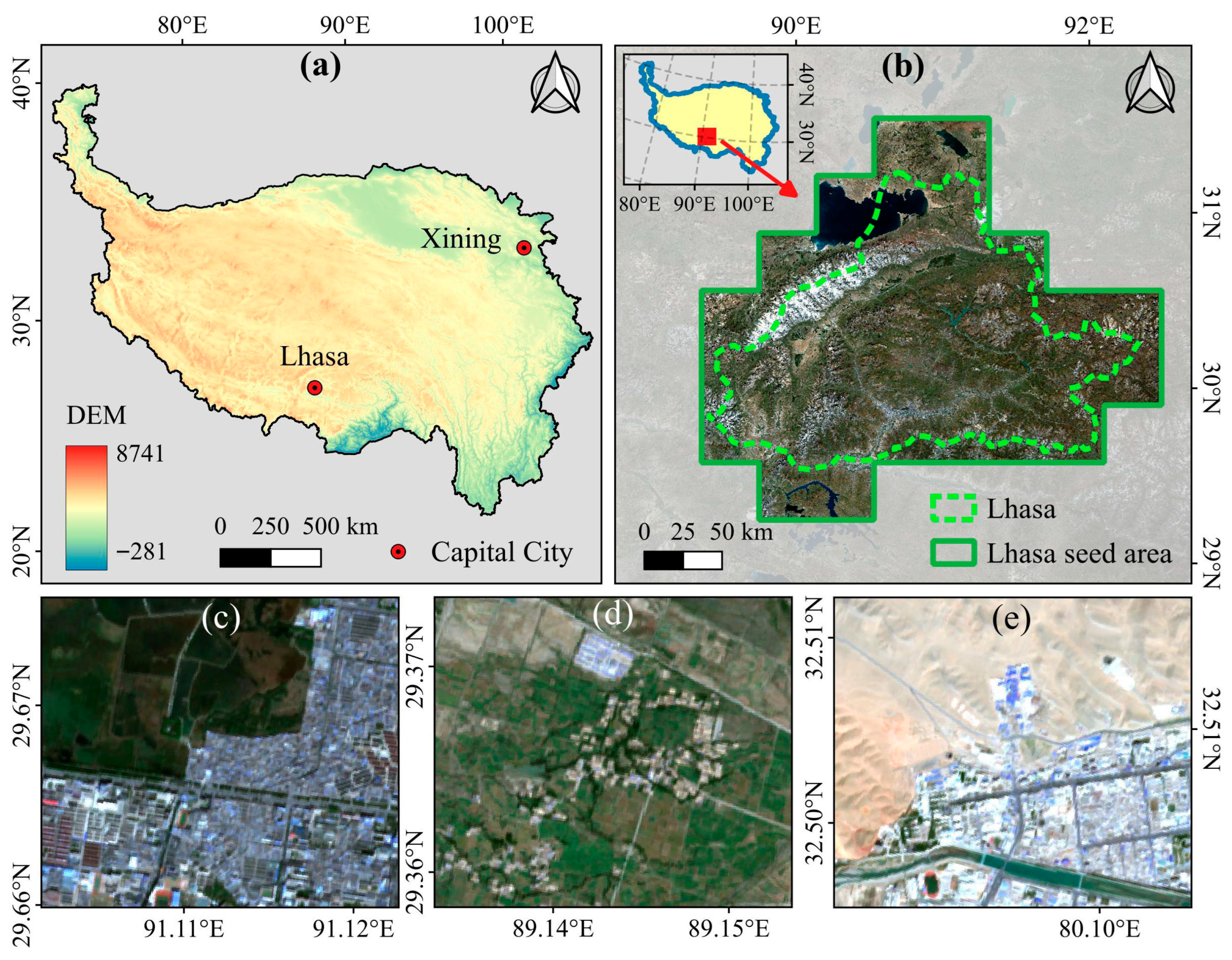
Figure 1. Study area, Lhasa seed area, and representative close-up examples of impervious surfaces. (a) Study area of the Qinghai–Xizang Plateau; (b) Lhasa seed area; (ce) close-up examples of impervious surfaces.
Remotesensing 18 01596 g001
Figure 2. Example visualization of the GSE dataset and corresponding Sentinel-2 images. (a1d1) show four impervious surface examples in the GSE dataset, and (a2d2) show the corresponding examples in Sentinel-2 images. The GSE images are false-color composites generated from three selected embedding dimensions, whereas the actual model input consists of the full 64-dimensional GSE vector for each 10 m pixel.
Remotesensing 18 01596 g002
Figure 3. Technical workflow of the SDGA framework.
Remotesensing 18 01596 g003
Figure 4. 2° × 2° grid partitioning of the study area.
Remotesensing 18 01596 g004
Figure 5. Spatial distribution of grids without valid local sample sets.
Remotesensing 18 01596 g005
Figure 6. Spatial distribution of 10 representative grids.
Remotesensing 18 01596 g006
Figure 7. Evolution of model performance in the Lhasa seed area driven by the PHAS strategy. For visualization purposes, F1 scores are labeled as percentages in the figure, but the actual unit of F1 is 1.
Remotesensing 18 01596 g007
Figure 8. Accuracy comparison of impervious surface mapping results in the Lhasa seed area with other medium-resolution products. For visualization purposes, F1 scores are labeled as percentages in the figure, but the actual unit of F1 is 1. The star indicates that the F1 score of ours is the highest among the products shown in this comparison.
Remotesensing 18 01596 g008
Figure 9. Visual comparison of impervious surface mapping results in the Lhasa seed area with other medium-resolution products.
Remotesensing 18 01596 g009
Figure 10. Close-up visual comparison of impervious surface mapping results in the Lhasa seed area.
Remotesensing 18 01596 g010
Figure 11. F1-score improvement after grid adaptation using the PHAS strategy. The dotted line represents the line Y = X .
Remotesensing 18 01596 g011
Figure 12. F1-score improvement and iteration number across grids after PHAS adaptation. (a) Spatial distribution of F1-score improvement; (b) spatial distribution of iteration number. The blue solid line indicates the boundary of the study area.
Remotesensing 18 01596 g012
Figure 13. Final local sample sizes for each grid. (a) Number of positive samples; (b) number of negative samples. The blue solid line indicates the boundary of the study area.
Remotesensing 18 01596 g013
Figure 14. Example of the spatial distribution of newly added positive and negative samples in the local sample set. (a1d1) show four areas containing newly added impervious surface samples, and the yellow-boxed regions are correspondingly enlarged in the second row; (a2,b2) show two examples of newly added positive samples, whereas (c2,d2) show two examples of newly added negative samples.
Remotesensing 18 01596 g014
Figure 15. Accuracy comparison of impervious surface mapping results in 10 representative grids against other medium-resolution products. (a) Comparison of F1 scores; (b) comparison of precision; (c) comparison of recall.
Remotesensing 18 01596 g015
Figure 16. Comparison of large-scale impervious surface extraction results with other products.
Remotesensing 18 01596 g016
Figure 17. Close-up comparison of large-scale impervious surface extraction results with other products and reference vectors.
Remotesensing 18 01596 g017
Figure 18. Comparison of small-scale impervious surface extraction results with other products.
Remotesensing 18 01596 g018
Figure 19. Close-up comparison of small-scale impervious surface extraction results with other products and reference vectors.
Remotesensing 18 01596 g019
Figure 20. Spatial distribution and local details of the SDGA-ISC10m product. The central panel shows impervious surface area aggregated within each 15 km × 15 km grid. (a) Small-scale impervious surfaces in the western Qinghai–Xizang Plateau; (b) large-scale impervious surfaces in Lhasa; (c) small-scale impervious surfaces in the northern Qinghai–Xizang Plateau; (d) large-scale impervious surfaces in Xining.
Remotesensing 18 01596 g020
Figure 21. Comparison of results in representative regions before and after post-processing. (a1,b1) show examples where the post-processing strategy effectively removed misclassified pixels, whereas (c1,d1) show examples where correct impervious surface areas were successfully preserved; (a2d2) present the corresponding results after post-processing.
Remotesensing 18 01596 g021
Table 1. Key heuristic parameters for sample selection in PHAS.
ParameterValueRole in PHAS
P m a x 0.85Upper probability bound for hard negative candidates
K4Number of semantic clusters for hard negative sample mining
d m i n 500Minimum spatial distance between selected samples
T s i m 0.98Maximum semantic similarity between selected samples
Table 2. Accuracy assessment results of the SDGA-ISC10m product.
ClassPrecisionRecallF1-Score
Before post-processingImpervious Surface80.29%84.17%0.8219
After post-processingImpervious Surface80.37%84.17%0.8223
Disclaimer/Publisher’s Note: The statements, opinions and data contained in all publications are solely those of the individual author(s) and contributor(s) and not of MDPI and/or the editor(s). MDPI and/or the editor(s) disclaim responsibility for any injury to people or property resulting from any ideas, methods, instructions or products referred to in the content.