


Characterizing Savanna Tree Canopy Heights Using GEDI and Spatially Continuous Multi-Source Data at a Landscape Level

Highlights
- Develop an optimized workflow for the filtering of high-quality GEDI footprints.
- Establish a mapping framework for accurately estimating savanna tree canopy height.
- The proposed method enables the filtering of accurate footprints from GEDI L2A products without relying on high-precision reference data.
- Savanna tree canopy height prediction requires modeling distinct from that for forests.
Abstract
1. Introduction
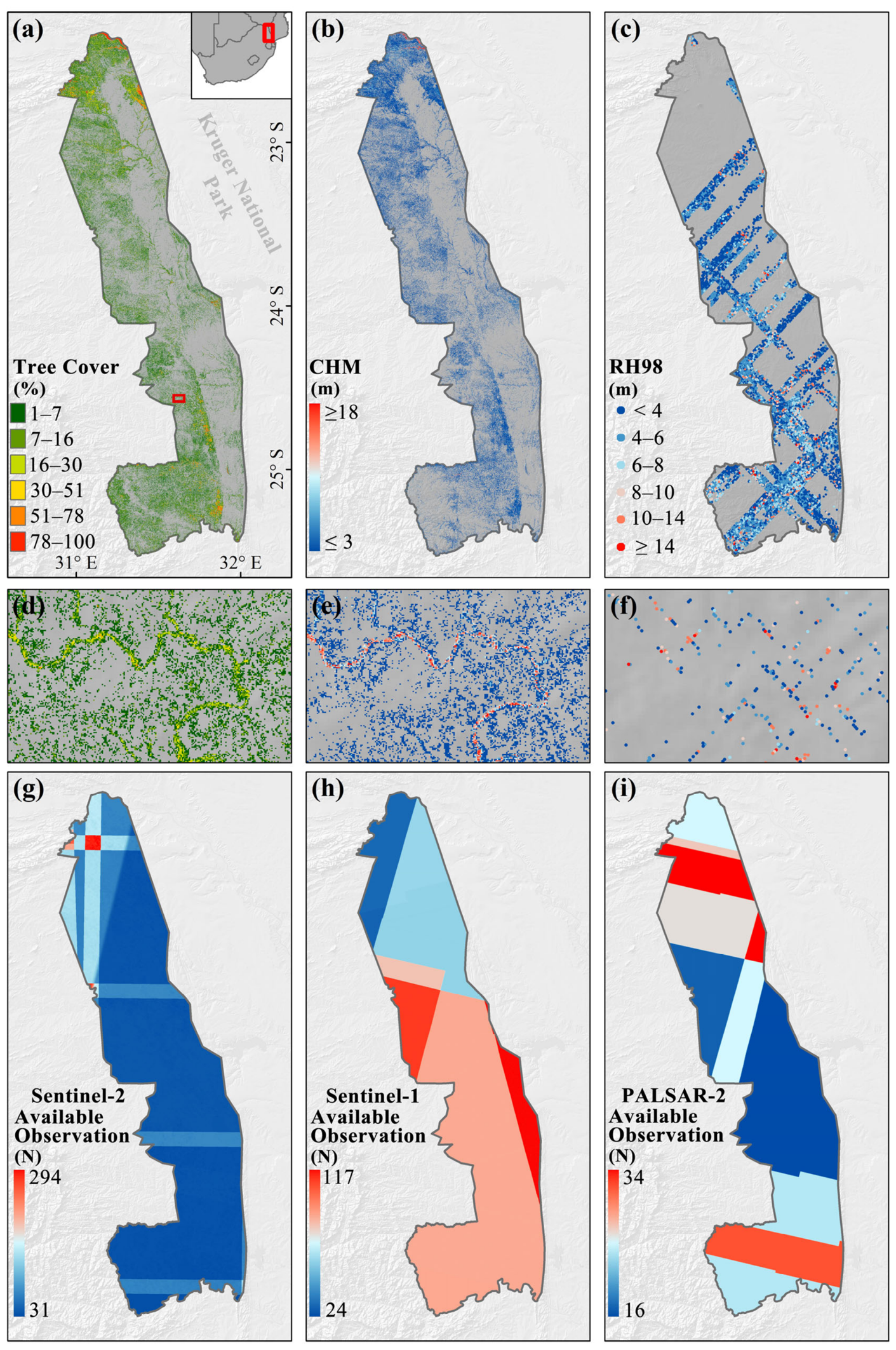
2. Study Area
3. Materials and Methods
3.1. Data
3.1.1. GEDI
3.1.2. Optical Data
3.1.3. Radar Data
3.1.4. AlphaEarth Data
3.1.5. Topographic Information
3.1.6. Mask Data
3.1.7. Reference Data
3.2. Features Calculation
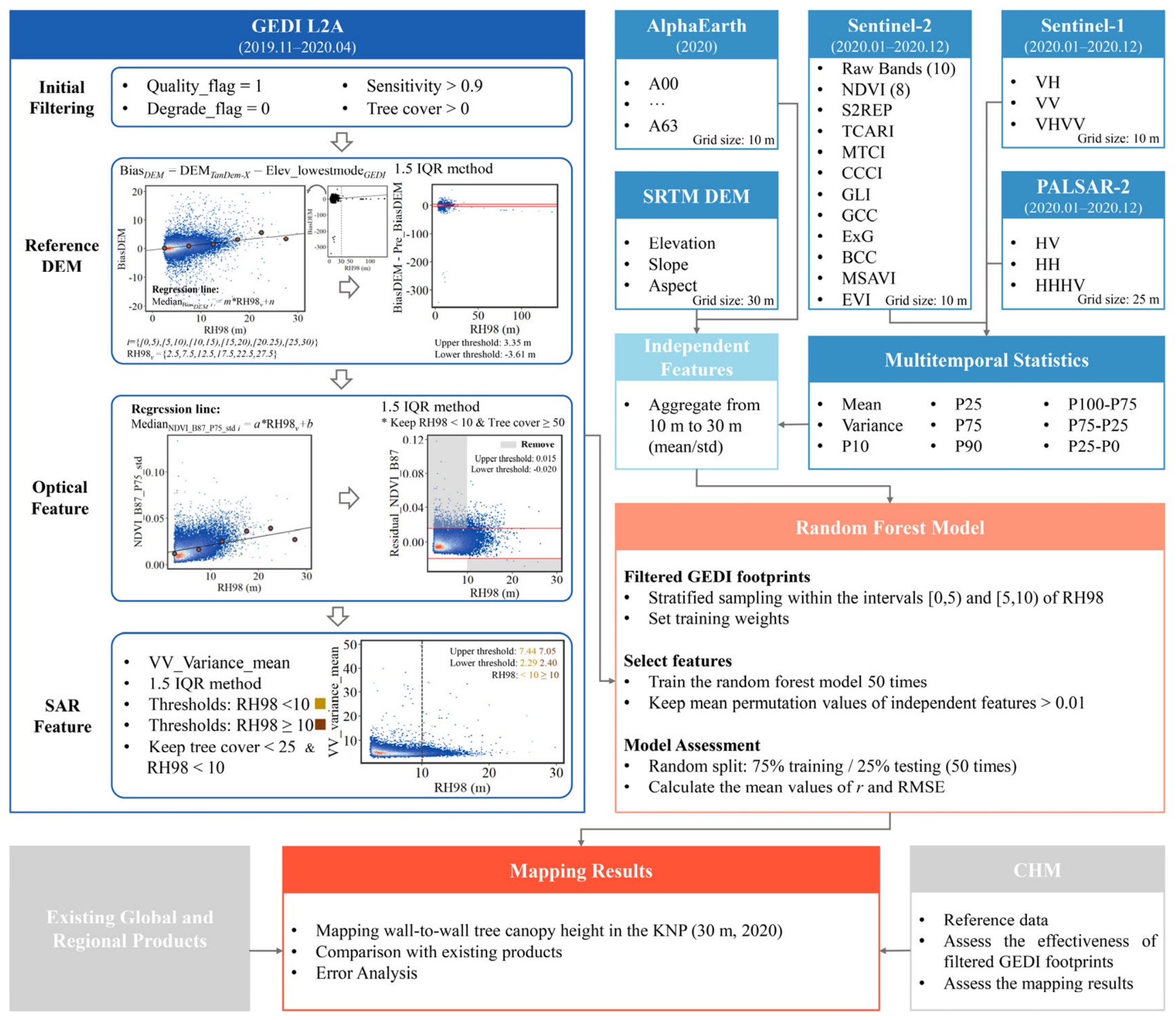
3.3. Comprehensive Filtering Framework for GEDI Data
3.4. Random Forest-Based Tree Canopy Height Estimation
3.5. Accuracy Assessment
4. Results
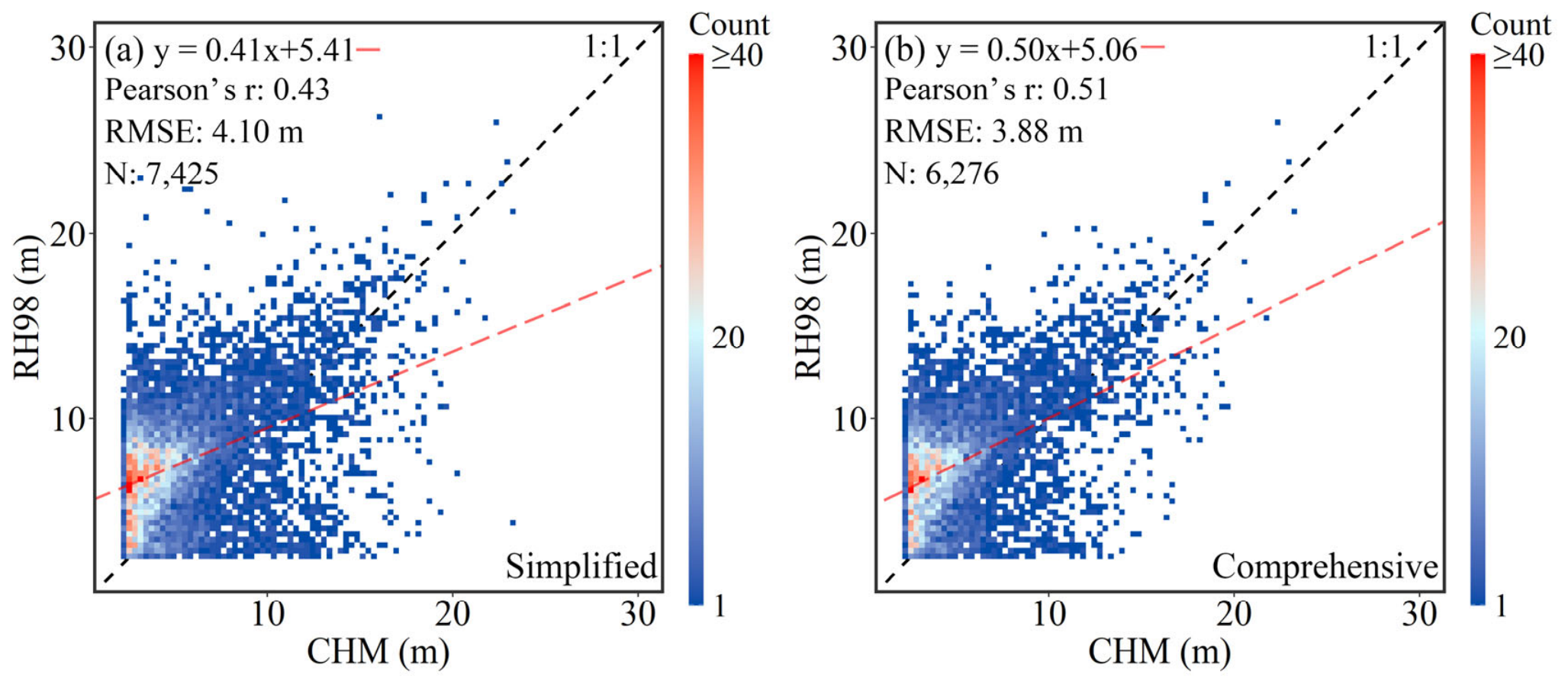
4.1. Comprehensive Filtering Framework Assessment
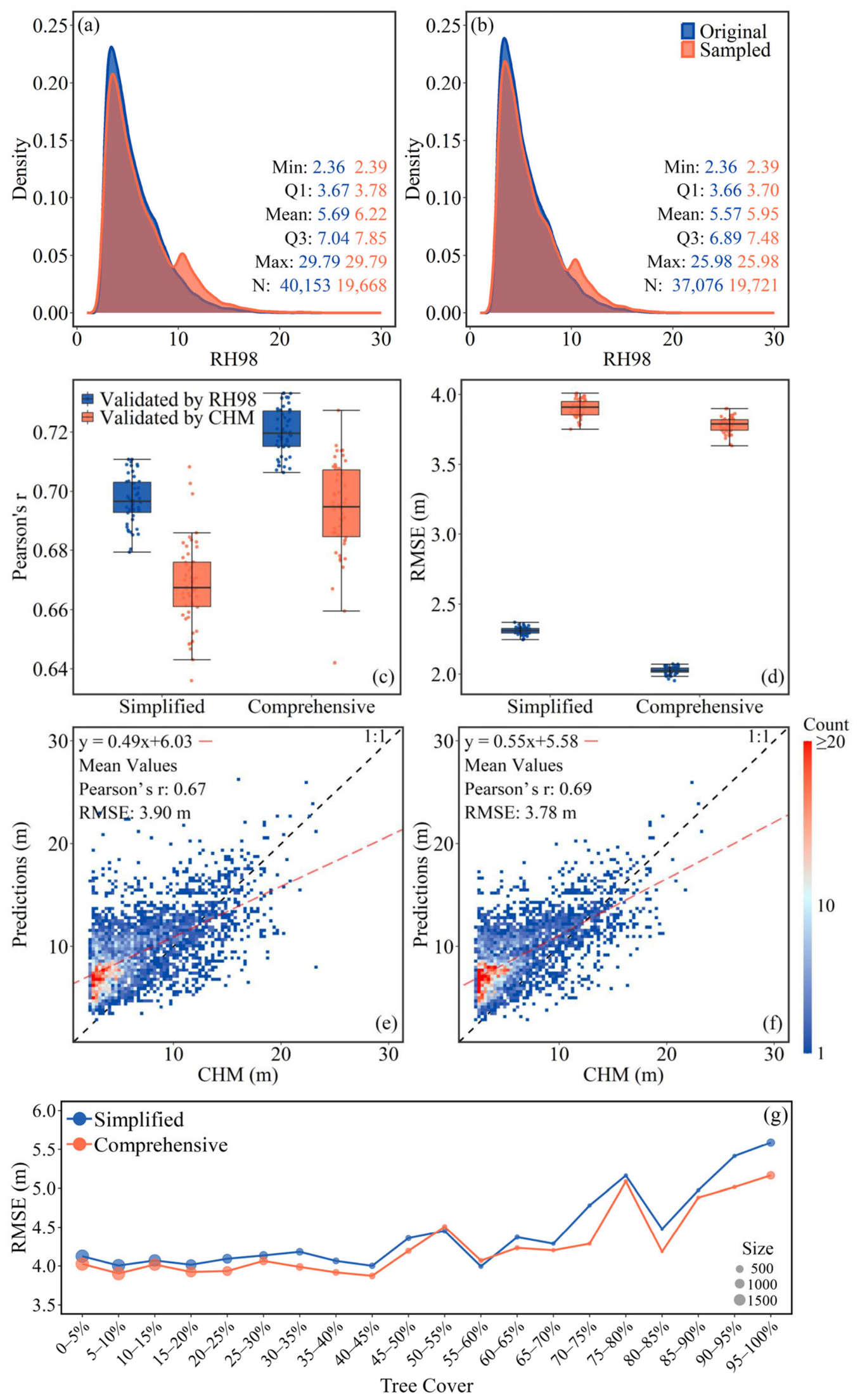
4.2. RF Models in the KNP
4.3. KNP Canopy Height Maps
4.4. Comparison with Existing Products
5. Discussions
5.1. Effectiveness of Proposed Filtering Method
5.2. Feature Selection and Interpretation
5.3. Limitation and Prospection
6. Conclusions
Author Contributions
Funding
Data Availability Statement
Acknowledgments
Conflicts of Interest
References
- Moore, C.E.; Beringer, J.; Evans, B.; Hutley, L.B.; McHugh, I.; Tapper, N.J. The contribution of trees and grasses to productivity of an Australian tropical savanna. Biogeosciences 2016, 13, 2387–2403. [Google Scholar] [CrossRef]
- Scholes, R.J.; Archer, S.R. Tree-grass interactions in savannas. Annu. Rev. Ecol. Syst. 1997, 28, 517–544. [Google Scholar] [CrossRef]
- Bouvet, A.; Mermoz, S.; Toan, T.L.; Villard, L.; Mathieu, R.; Naidoo, L.; Asner, G.P. An above-ground biomass map of African savannahs and woodlands at 25 m resolution derived from ALOS PALSAR. Remote Sens. Environ. 2018, 206, 156–173. [Google Scholar] [CrossRef]
- Holdo, R.M.; Nippert, J.B. Linking resource- and disturbance-based models to explain tree-grass coexistence in savannas. New Phytol. 2023, 237, 1966–1979. [Google Scholar] [CrossRef] [PubMed]
- Lucas, R.M.; Lee, A.C.; Armston, J.; Carreiras, J.; Viergever, K.M.; Bunting, P.; Clewley, D.; Moghaddam, M.; Siqueira, P.; Woodhouse, I. Quantifying carbon in savannas: The role of active sensors in measurements of tree structure and biomass. In Ecosystem Function in Savannas: Measurement and Modeling at Landscape to Global Scales; Taylor & Francis: New York, NY, USA, 2010; pp. 155–174. [Google Scholar]
- Zhou, Y.; Singh, J.; Butnor, J.R.; Coetsee, C.; Boucher, P.B.; Case, M.F.; Hockridge, E.G.; Davies, A.B.; Staver, A.C. Limited increases in savanna carbon stocks over decades of fire suppression. Nature 2022, 603, 445–449. [Google Scholar] [CrossRef]
- Gaynor, K.M.; Daskin, J.H.; Rich, L.N.; Brashares, J.S. Postwar wildlife recovery in an African savanna: Evaluating patterns and drivers of species occupancy and richness. Anim. Conserv. 2021, 24, 510–522. [Google Scholar] [CrossRef]
- Hill, M.J.; Hanan, N.P. Ecosystem Function in Savannas: Measurement and Modeling at Landscape to Global Scales; CRC Press: Boca Raton, FL, USA, 2010. [Google Scholar]
- Grace, J.; Jose, J.S.; Meir, P.; Miranda, H.S.; Montes, R.A. Productivity and carbon fluxes of tropical savannas. J. Biogeogr. 2006, 33, 387–400. [Google Scholar] [CrossRef]
- Shackleton, C.; Shackleton, S. The importance of non-timber forest products in rural livelihood security and as safety nets: A review of evidence from South Africa. S. Afr. J. Sci. 2004, 100, 658–664. [Google Scholar]
- Murphy, B.P.; Bowman, D.M. What controls the distribution of tropical forest and savanna? Ecol. Lett. 2012, 15, 748–758. [Google Scholar] [CrossRef]
- Archer, S. Tree-grass dynamics in a Prosopis-thornscrub savanna parkland: Reconstructing the past and predicting the future. Ecoscience 1995, 2, 83–99. [Google Scholar] [CrossRef]
- Devine, A.P.; McDonald, R.A.; Quaife, T.; Maclean, I.M. Determinants of woody encroachment and cover in African savannas. Oecologia 2017, 183, 939–951. [Google Scholar] [CrossRef]
- Mitchard, E.T.; Flintrop, C.M. Woody encroachment and forest degradation in sub-Saharan Africa’s woodlands and savannas 1982–2006. Philos. Trans. R. Soc. B 2013, 368, 20120406. [Google Scholar] [CrossRef] [PubMed]
- Zhang, G.; Ganguly, S.; Nemani, R.R.; White, M.A.; Milesi, C.; Hashimoto, H.; Wang, W.; Saatchi, S.; Yu, Y.; Myneni, R.B. Estimation of forest aboveground biomass in California using canopy height and leaf area index estimated from satellite data. Remote Sens. Environ. 2014, 151, 44–56. [Google Scholar] [CrossRef]
- Wang, M.; Sun, R.; Xiao, Z. Estimation of forest canopy height and aboveground biomass from spaceborne LiDAR and Landsat imageries in Maryland. Remote Sens. 2018, 10, 344. [Google Scholar] [CrossRef]
- Martens, S.N.; Breshears, D.D.; Meyer, C.W. Spatial distributions of understory light along the grassland/forest continuum: Effects of cover, height, and spatial pattern of tree canopies. Ecol. Modell. 2000, 126, 79–93. [Google Scholar] [CrossRef]
- Pimont, F.; Dupuy, J.-L.; Linn, R.R.; Dupont, S. Impacts of tree canopy structure on wind flows and fire propagation simulated with FIRETEC. Ann. For. Sci. 2011, 68, 523–530. [Google Scholar] [CrossRef]
- Feng, G.; Zhang, J.; Girardello, M.; Pellissier, V.; Svenning, J.C. Forest canopy height co-determines taxonomic and functional richness, but not functional dispersion of mammals and birds globally. Glob. Ecol. Biogeogr. 2020, 29, 1350–1359. [Google Scholar] [CrossRef]
- Davies, A.B.; Asner, G.P. Advances in animal ecology from 3D-LiDAR ecosystem mapping. Trends Ecol. Evol. 2014, 29, 681–691. [Google Scholar] [CrossRef] [PubMed]
- Muumbe, T.P.; Baade, J.; Singh, J.; Schmullius, C.; Thau, C. Terrestrial laser scanning for vegetation analyses with a special focus on savannas. Remote Sens. 2021, 13, 507. [Google Scholar] [CrossRef]
- Boucher, P.B.; Hockridge, E.G.; Singh, J.; Davies, A.B. Flying high: Sampling savanna vegetation with UAV-lidar. Methods Ecol. Evol. 2023, 14, 1668–1686. [Google Scholar] [CrossRef]
- Heckel, K.; Urban, M.; Bouffard, J.-S.; Baade, J.; Boucher, P.; Davies, A.; Hockridge, E.G.; Luck, W.; Ziemer, J.; Smit, I.; et al. The first sub-meter resolution digital elevation model of the Kruger National Park, South Africa. Koedoe 2021, 63, 13. [Google Scholar] [CrossRef]
- Potapov, P.; Li, X.; Hernandez-Serna, A.; Tyukavina, A.; Hansen, M.C.; Kommareddy, A.; Pickens, A.; Turubanova, S.; Tang, H.; Silva, C.E. Mapping global forest canopy height through integration of GEDI and Landsat data. Remote Sens. Environ. 2021, 253, 112165. [Google Scholar] [CrossRef]
- Wang, S.; Liu, C.; Li, W.; Jia, S.; Yue, H. Hybrid model for estimating forest canopy heights using fused multimodal spaceborne LiDAR data and optical imagery. Int. J. Appl. Earth Obs. Geoinf. 2023, 122, 103431. [Google Scholar] [CrossRef]
- Dubayah, R.; Blair, J.B.; Goetz, S.; Fatoyinbo, L.; Hansen, M.; Healey, S.; Hofton, M.; Hurtt, G.; Kellner, J.; Luthcke, S. The Global Ecosystem Dynamics Investigation: High-resolution laser ranging of the Earth’s forests and topography. Sci. Remote Sens. 2020, 1, 100002. [Google Scholar] [CrossRef]
- Li, X.X.; Wessels, K.; Armston, J.; Hancock, S.; Mathieu, R.; Main, R.; Naidoo, L.; Erasmus, B.; Scholes, R. First validation of GEDI canopy heights in African savannas. Remote Sens. Environ. 2023, 285, 113402. [Google Scholar] [CrossRef]
- García, M.; Saatchi, S.; Ustin, S.; Balzter, H. Modelling forest canopy height by integrating airborne LiDAR samples with satellite Radar and multispectral imagery. Int. J. Appl. Earth Obs. Geoinf. 2018, 66, 159–173. [Google Scholar] [CrossRef]
- Fagua, J.C.; Jantz, P.; Rodriguez-Buritica, S.; Duncanson, L.; Goetz, S.J. Integrating LiDAR, multispectral and SAR data to estimate and map canopy height in tropical forests. Remote Sens. 2019, 11, 2697. [Google Scholar] [CrossRef]
- de Almeida, C.T.; Gerente, J.; Campos, J.R.D.; Gomes, F.C.; Providelo, L.A.; Marchiori, G.; Chen, X.J. Canopy Height Mapping by Sentinel 1 and 2 Satellite Images, Airborne LiDAR Data, and Machine Learning. Remote Sens. 2022, 14, 4112. [Google Scholar] [CrossRef]
- Pourshamsi, M.; Xia, J.S.; Yokoya, N.; Garcia, M.; Lavalle, M.; Pottier, E.; Balzter, H. Tropical forest canopy height estimation from combined polarimetric SAR and LiDAR using machine-learning. ISPRS J. Photogramm. Remote Sens. 2021, 172, 79–94. [Google Scholar] [CrossRef]
- Jiang, F.; Zhao, F.; Ma, K.; Li, D.; Sun, H. Mapping the forest canopy height in Northern China by synergizing ICESat-2 with Sentinel-2 using a stacking algorithm. Remote Sens. 2021, 13, 1535. [Google Scholar] [CrossRef]
- Potapov, P.; Tyukavina, A.; Turubanova, S.; Talero, Y.; Hernandez-Serna, A.; Hansen, M.; Saah, D.; Tenneson, K.; Poortinga, A.; Aekakkararungroj, A. Annual continuous fields of woody vegetation structure in the Lower Mekong region from 2000-2017 Landsat time-series. Remote Sens. Environ. 2019, 232, 111278. [Google Scholar] [CrossRef]
- Campbell, M.J.; Dennison, P.E.; Kerr, K.L.; Brewer, S.C.; Anderegg, W.R. Scaled biomass estimation in woodland ecosystems: Testing the individual and combined capacities of satellite multispectral and lidar data. Remote Sens. Environ. 2021, 262, 112511. [Google Scholar] [CrossRef]
- Li, W.; Niu, Z.; Shang, R.; Qin, Y.; Wang, L.; Chen, H. High-resolution mapping of forest canopy height using machine learning by coupling ICESat-2 LiDAR with Sentinel-1, Sentinel-2 and Landsat-8 data. Int. J. Appl. Earth Obs. Geoinf. 2020, 92, 102163. [Google Scholar] [CrossRef]
- Xi, Z.; Xu, H.; Xing, Y.; Gong, W.; Chen, G.; Yang, S. Forest canopy height mapping by synergizing ICESat-2, Sentinel-1, Sentinel-2 and topographic information based on machine learning methods. Remote Sens. 2022, 14, 364. [Google Scholar] [CrossRef]
- Brown, C.F.; Kazmierski, M.R.; Pasquarella, V.J.; Rucklidge, W.J.; Samsikova, M.; Zhang, C.; Shelhamer, E.; Lahera, E.; Wiles, O.; Ilyushchenko, S. AlphaEarth Foundations: An embedding field model for accurate and efficient global mapping from sparse label data. arXiv 2025, arXiv:2507.22291. [Google Scholar] [CrossRef]
- Tang, H.; Stoker, J.; Luthcke, S.; Armston, J.; Lee, K.; Blair, B.; Hofton, M. Evaluating and mitigating the impact of systematic geolocation error on canopy height measurement performance of GEDI. Remote Sens. Environ. 2023, 291, 113571. [Google Scholar] [CrossRef]
- Ngo, Y.-N.; Ho Tong Minh, D.; Baghdadi, N.; Fayad, I. Tropical Forest Top Height by GEDI: From Sparse Coverage to Continuous Data. Remote Sens. 2023, 15, 975. [Google Scholar] [CrossRef]
- Schleich, A.; Durrieu, S.; Vega, C. Improving GEDI Footprint Geolocation Using a High Resolution Digital Elevation Model. IEEE J. Sel. Top. Appl. Earth Obs. Remote Sens. 2023, 16, 7718–7732. [Google Scholar] [CrossRef]
- Moudrý, V.; Prošek, J.; Marselis, S.; Marešová, J.; Šárovcová, E.; Gdulová, K.; Kozhoridze, G.; Torresani, M.; Rocchini, D.; Eltner, A. How to Find Accurate Terrain and Canopy Height GEDI Footprints in Temperate Forests and Grasslands? Earth Space Sci. 2024, 11, e2024EA003709. [Google Scholar] [CrossRef]
- Roy, D.P.; Kashongwe, H.B.; Armston, J. The impact of geolocation uncertainty on GEDI tropical forest canopy height estimation and change monitoring. Sci. Remote Sens. 2021, 4, 100024. [Google Scholar] [CrossRef]
- Yang, C.; Peng, D.; Deng, K.; Jiang, L.; Zhao, M.; Zeng, W.; Shao, Y.; Wang, N. Quantification of GEDI Geolocation Error and its Influence on Elevation and Canopy Height. IEEE J. Sel. Top. Appl. Earth Obs. Remote Sens. 2024, 17, 18012–18024. [Google Scholar] [CrossRef]
- Bunting, E.L.; Fullman, T.; Kiker, G.; Southworth, J. Utilization of the SAVANNA model to analyze future patterns of vegetation cover in Kruger National Park under changing climate. Ecol. Modell. 2016, 342, 147–160. [Google Scholar] [CrossRef]
- Rountree, M.W.; Rogers, K.H.; Heritage, G.L. LANDSCAPE STATE CHANGE IN THE SEMI-ARID SABIE RIVER, KRUGER NATIONAL PARK, IN RESPONSE TO FLOOD AND DROUGHT. S. Afr. Geogr. J. 2000, 82, 173–181. [Google Scholar] [CrossRef]
- MacFadyen, S.; Zambatis, N.; Van Teeffelen, A.J.A.; Hui, C. Long-term rainfall regression surfaces for the Kruger National Park, South Africa: A spatio-temporal review of patterns from 1981 to 2015. Int. J. Climatol. 2018, 38, 2506–2519. [Google Scholar] [CrossRef]
- Ben-Shahar, R. Does fencing reduce the carrying capacity for populations of large herbivores? J. Trop. Ecol. 1993, 9, 249–253. [Google Scholar] [CrossRef]
- Venter, F.; Gertenbach, W. A cursory review of the climate and vegetation of the Kruger National Park. Koedoe 1986, 29, 139–148. [Google Scholar] [CrossRef]
- Eckhardt, H.; Van Wilgen, B.; Biggs, H. Trends in woody vegetation cover in the Kruger National Park, South Africa, between 1940 and 1998. Afr. J. Ecol. 2000, 38, 108–115. [Google Scholar] [CrossRef]
- Beck, J.; Wirt, B.; Armston, J.; Hofton, M.; Luthcke, S.; Tang, H. Global Ecosystem Dynamics Investigation (GEDI) Level 02 User Guide; NASA: Washington, DC, USA, 2021; Volume 2.
- Hofton, M.; Blair, J.B.; Story, S.; Yi, D. Algorithm Theoretical Basis Document (ATBD); NASA: Washington, DC, USA, 2020.
- Blair, J.B.; Hofton, M.A. Modeling laser altimeter return waveforms over complex vegetation using high-resolution elevation data. Geophys. Res. Lett. 1999, 26, 2509–2512. [Google Scholar] [CrossRef]
- Drusch, M.; Del Bello, U.; Carlier, S.; Colin, O.; Fernandez, V.; Gascon, F.; Hoersch, B.; Isola, C.; Laberinti, P.; Martimort, P. Sentinel-2: ESA’s optical high-resolution mission for GMES operational services. Remote Sens. Environ. 2012, 120, 25–36. [Google Scholar] [CrossRef]
- Phiri, D.; Simwanda, M.; Salekin, S.; Nyirenda, V.R.; Murayama, Y.; Ranagalage, M. Sentinel-2 Data for Land Cover/Use Mapping: A Review. Remote Sens. 2020, 12, 2291. [Google Scholar] [CrossRef]
- Rouse, J. Monitoring the Vernal Advancement and Retrogradation of Natural Vegetation; NASA: Washington, DC, USA, 1973.
- Qi, J.; Chehbouni, A.; Huete, A.R.; Kerr, Y.H.; Sorooshian, S. A modified soil adjusted vegetation index. Remote Sens. Environ. 1994, 48, 119–126. [Google Scholar] [CrossRef]
- Gillespie, A.R.; Kahle, A.B.; Walker, R.E. Color enhancement of highly correlated images. II. Channel ratio and “chromaticity” transformation techniques. Remote Sens. Environ. 1987, 22, 343–365. [Google Scholar] [CrossRef]
- Woebbecke, D.M.; Meyer, G.E.; Von Bargen, K.; Mortensen, D.A. Color indices for weed identification under various soil, residue, and lighting conditions. Trans. ASAE 1995, 38, 259–269. [Google Scholar] [CrossRef]
- Drusch, M.; Gascon, F.; Berger, M. GMES Sentinel-2 Mission Requirements Document; European Space Agency: Paris, France, 2010. [Google Scholar]
- Fitzgerald, G.; Rodriguez, D.; O’Leary, G. Measuring and predicting canopy nitrogen nutrition in wheat using a spectral index—The canopy chlorophyll content index (CCCI). Field Crops Res. 2010, 116, 318–324. [Google Scholar] [CrossRef]
- Dash, J.; Curran, P.J. The MERIS terrestrial chlorophyll index. Int. J. Remote Sens. 2004, 25, 5403–5413. [Google Scholar] [CrossRef]
- Frampton, W.J.; Dash, J.; Watmough, G.; Milton, E.J. Evaluating the capabilities of Sentinel-2 for quantitative estimation of biophysical variables in vegetation. ISPRS J. Photogramm. Remote Sens. 2013, 82, 83–92. [Google Scholar] [CrossRef]
- Haboudane, D.; Miller, J.R.; Tremblay, N.; Zarco-Tejada, P.J.; Dextraze, L. Integrated narrow-band vegetation indices for prediction of crop chlorophyll content for application to precision agriculture. Remote Sens. Environ. 2002, 81, 416–426. [Google Scholar] [CrossRef]
- Rosenqvist, A.; Killough, B. A Layman’s Interpretation Guide to L-Band and C-Band Synthetic Aperture Radar Data; Comittee on Earth Observation Satellites: Washington, DC, USA, 2018. [Google Scholar]
- Atmani, F.; Bookhagen, B.; Smith, T. Measuring Vegetation Heights and Their Seasonal Changes in the Western Namibian Savanna Using Spaceborne Lidars. Remote Sens. 2022, 14, 2928. [Google Scholar] [CrossRef]
- Farr, T.G.; Rosen, P.A.; Caro, E.; Crippen, R.; Duren, R.; Hensley, S.; Kobrick, M.; Paller, M.; Rodriguez, E.; Roth, L. The shuttle radar topography mission. Rev. Geophys. 2007, 45, RG2004. [Google Scholar] [CrossRef]
- Jucker, T.; Bongalov, B.; Burslem, D.; Nilus, R.; Dalponte, M.; Lewis, S.L.; Phillips, O.L.; Qie, L.; Coomes, D.A. Topography shapes the structure, composition and function of tropical forest landscapes. Ecol. Lett. 2018, 21, 989–1000. [Google Scholar] [CrossRef] [PubMed]
- Reiner, F.; Brandt, M.; Tong, X.; Skole, D.; Kariryaa, A.; Ciais, P.; Davies, A.; Hiernaux, P.; Chave, J.; Mugabowindekwe, M.; et al. Africa Tree Cover Map; Zenodo: Geneva, Switzerland, 2023. [Google Scholar] [CrossRef]
- Reiner, F.; Brandt, M.; Tong, X.; Skole, D.; Kariryaa, A.; Ciais, P.; Davies, A.; Hiernaux, P.; Chave, J.; Mugabowindekwe, M. More than one quarter of Africa’s tree cover is found outside areas previously classified as forest. Nat. Commun. 2023, 14, 2258. [Google Scholar] [CrossRef]
- Lagomasino, D.; Fatoyinbo, T.; Lee, S.-K.; Simard, M. High-resolution forest canopy height estimation in an African blue carbon ecosystem. Remote Sens. Ecol. Conserv. 2015, 1, 51–60. [Google Scholar] [CrossRef]
- Filippelli, S.K.; Vogeler, J.C.; Mauro, F.; Coetsee, C.; Fekety, P.A.; McHale, M.; Bunn, D. Tracking savanna vegetation structure in South Africa by extension of GEDI canopy metrics with Landsat, Sentinel-2, and PALSAR. Sci. Remote Sens. 2026, 13, 100388. [Google Scholar] [CrossRef]
- Chen, P.; Huang, H.; Qin, P.; Wu, Z.; Wang, Z.; Liu, C.; Dong, N.; Wang, J. Unveiling the performance and influential factors of GEDI L2A for building height retrieval. GIScience Remote Sens. 2025, 62, 2498785. [Google Scholar] [CrossRef]
- Wright, M.N.; Ziegler, A. ranger: A Fast Implementation of Random Forests for High Dimensional Data in C++ and R. J. Stat. Softw. 2017, 77, 1–17. [Google Scholar] [CrossRef]
- Breiman, L. Random forests. Mach. Learn. 2001, 45, 5–32. [Google Scholar] [CrossRef]
- Jin, S.; Su, Y.; Gao, S.; Hu, T.; Liu, J.; Guo, Q. The transferability of Random Forest in canopy height estimation from multi-source remote sensing data. Remote Sens. 2018, 10, 1183. [Google Scholar] [CrossRef]
- Ahmed, O.S.; Franklin, S.E.; Wulder, M.A.; White, J.C. Characterizing stand-level forest canopy cover and height using Landsat time series, samples of airborne LiDAR, and the Random Forest algorithm. ISPRS J. Photogramm. Remote Sens. 2015, 101, 89–101. [Google Scholar] [CrossRef]
- Olden, J.D.; Lawler, J.J.; Poff, N.L. Machine learning methods without tears: A primer for ecologists. Q. Rev. Biol. 2008, 83, 171–193. [Google Scholar] [CrossRef]
- Lang, N.; Jetz, W.; Schindler, K.; Wegner, J.D. A high-resolution canopy height model of the Earth. Nat. Ecol. Evol. 2023, 7, 1778–1789. [Google Scholar] [CrossRef]
- Tolan, J.; Yang, H.-I.; Nosarzewski, B.; Couairon, G.; Vo, H.V.; Brandt, J.; Spore, J.; Majumdar, S.; Haziza, D.; Vamaraju, J. Very high resolution canopy height maps from RGB imagery using self-supervised vision transformer and convolutional decoder trained on aerial lidar. Remote Sens. Environ. 2024, 300, 113888. [Google Scholar] [CrossRef]
- Wang, C.; Elmore, A.J.; Numata, I.; Cochrane, M.A.; Shaogang, L.; Huang, J.; Zhao, Y.; Li, Y. Factors affecting relative height and ground elevation estimations of GEDI among forest types across the conterminous USA. GIScience Remote Sens. 2022, 59, 975–999. [Google Scholar] [CrossRef]
- Kutchartt, E.; Pedron, M.; Pirotti, F. Assessment of canopy and ground height accuracy from gedi lidar over steep mountain areas. ISPRS Ann. Photogramm. Remote Sens. Spat. Inf. Sci. 2022, 3, 431–438. [Google Scholar] [CrossRef]
- Huang, J.; Xia, T.; Shuai, Y.; Zhu, H. Assessing the Performance of GEDI LiDAR Data for Estimating Terrain in Densely Forested Areas. IEEE Geosci. Remote Sens. Lett. 2023, 20, 1–5. [Google Scholar] [CrossRef]
- Higgins, S.I.; Delgado-Cartay, M.D.; February, E.C.; Combrink, H.J. Is there a temporal niche separation in the leaf phenology of savanna trees and grasses? J. Biogeogr. 2011, 38, 2165–2175. [Google Scholar] [CrossRef]
- Archibald, S.; Scholes, R. Leaf green-up in a semi-arid African savanna-separating tree and grass responses to environmental cues. J. Veg. Sci. 2007, 18, 583–594. [Google Scholar]
- Luo, Y.; El-Madany, T.S.; Filippa, G.; Ma, X.; Ahrens, B.; Carrara, A.; Gonzalez-Cascon, R.; Cremonese, E.; Galvagno, M.; Hammer, T.W. Using near-infrared-enabled digital repeat photography to track structural and physiological phenology in Mediterranean tree–grass ecosystems. Remote Sens. 2018, 10, 1293. [Google Scholar] [CrossRef]
- Li, D.; Chen, J.M.; Yu, W.; Zheng, H.; Yao, X.; Zhu, Y.; Cao, W.; Cheng, T. A chlorophyll-constrained semi-empirical model for estimating leaf area index using a red-edge vegetation index. Comput. Electron. Agric. 2024, 220, 108891. [Google Scholar] [CrossRef]
- Viergever, K.M. Establishing the Sensitivity of Synthetic Aperture Radar to Above-Ground Biomass in Wooded Savannas. Ph.D. Thesis, The University of Edinburgh, Edinburgh, UK, 2008. [Google Scholar]
- Zhang, C.; Kerner, H.; Wang, S.; Hao, P.; Li, Z.; Hunt, K.A.; Abernethy, J.; Zhao, H.; Gao, F.; Di, L.; et al. Remote sensing for crop mapping: A perspective on current and future crop-specific land cover data products. Remote Sens. Environ. 2025, 330, 114995. [Google Scholar] [CrossRef]
- Lefsky, M.A.; Keller, M.; Pang, Y.; De Camargo, P.B.; Hunter, M.O. Revised method for forest canopy height estimation from Geoscience Laser Altimeter System waveforms. J. Appl. Remote Sens. 2007, 1, 013537. [Google Scholar]
- Adam, M.; Urbazaev, M.; Dubois, C.; Schmullius, C. Accuracy assessment of GEDI terrain elevation and canopy height estimates in European temperate forests: Influence of environmental and acquisition parameters. Remote Sens. 2020, 12, 3948. [Google Scholar] [CrossRef]
- Simard, M.; Pinto, N.; Fisher, J.B.; Baccini, A. Mapping forest canopy height globally with spaceborne lidar. J. Geophys. Res. Biogeosci. 2011, 116, 4021. [Google Scholar] [CrossRef]
- Su, Y.; Schwartz, M.; Fayad, I.; García, M.; Zavala, M.A.; Tijerín-Triviño, J.; Astigarraga, J.; Cruz-Alonso, V.; Liu, S.; Zhang, X.; et al. Canopy height and biomass distribution across the forests of Iberian Peninsula. Sci. Data 2025, 12, 678. [Google Scholar] [CrossRef] [PubMed]
- Dixon, D.J.; Zhu, Y.; Jin, Y. Canopy height estimation from PlanetScope time series with spatio-temporal deep learning. Remote Sens. Environ. 2025, 318, 114518. [Google Scholar] [CrossRef]



| Data Sources | Raw Bands | Features | Multitemporal Statistics | Aggregation (Mean/Std) | Number |
|---|---|---|---|---|---|
| Sentinel-2 (2020.01–2020.12) | B2(Blue) B3(Green) B4(Red) B5(Red Edge1) B6(Red Edge2) B7(Red Edge3) B8(NIR) B8A(Narrow NIR) B11(SWIR1) B12(SWIR2) | NDVI_B84 = (B8 − B4)/(B8 + B4) NDVI_B85 = (B8 − B5)/(B8 + B5) NDVI_B86 = (B8 − B6)/(B8 + B6) NDVI_B87 = (B8 − B7)/(B8 + B7) NDVI_B8A4 = (B8 − B4)/(B8 + B4) NDVI_B8A5 = (B8 − B5)/(B8 + B5) NDVI_B8A6 = (B8 − B6)/(B8 + B6) NDVI_B8A7 = (B8 − B7)/(B8 + B7) S2REP = 705 + 35((((B7 + B4)/2) − B5)/(B6 − B5)) TCARI = 3((B5 − B4) − 0.2(B5 − B3)(B5/B4)) MTCI = (RE2 − RE1)/(RE1 − R) CCCI = ((B8 − B5)/(B8 + B5))/((B8 − B4)/(B8 + B4)) GLI = (2B3 − B4 − B2)/(2B3 + B4 + B2) ExG = 2B3 − (B4 + B2) GCC= B3/(B4 + B3 + B2) BCC = B2/(B4 + B3 + B2) EVI = 2.5(B8 − B4)/(B8 + 6B4 + 7.5B2 + 1) | Mean Variance P10 P25 P75 P90 P100–P75 P75–P25 P25–P0 | √ | 504 |
| Sentinel-1 (2020.01–2020.12) | VV VH | VHVV = VH/VV | √ | 54 | |
| PALSAR-2 (2020.01–2020.12) | HH HV | HHHV = HH/HV | - | 27 | |
| AlphaEarth (2020) | A00~A63 | - | - | √ | 128 |
| SRTM | Elevation | Aspect/Slope | - | - | 3 |
| Validated by CHM | Validated by RH98 | ||||
|---|---|---|---|---|---|
| Pearson’s r | RMSE (m) | Pearson’s r | RMSE (m) | ||
| GEDI RH98 | Simplified | 0.43 | 4.10 | - | - |
| Comprehensive | 0.51 | 3.88 | - | - | |
| Model performance | Simplified | 0.67 | 3.90 | 0.70 | 2.31 |
| Comprehensive | 0.69 | 3.78 | 0.72 | 2.03 | |
| Filippelli et al. [71] | All | 0.15 | 5.62 | - | - |
| Low [2.35, 10) | 0.04 | 2.83 | - | - | |
| Medium [10, 20) | 0.10 | 7.61 | - | - | |
| High [≥20, max) | 0.21 | 14.59 | - | - | |
| Lang et al. [78] | All | 0.45 | 5.22 | - | - |
| Low [2.35, 10) | 0.13 | 4.76 | - | - | |
| Medium [10, 20) | 0.34 | 5.76 | - | - | |
| High [≥20, max) | 0.37 | 7.25 | - | - | |
| Potapov et al. [24] | All | 0.19 | 6.91 | - | - |
| Low [2.35, 10) | 0.08 | 2.95 | - | - | |
| Medium [10, 20) | 0.09 | 9.83 | - | - | |
| High [≥20, max) | 0.24 | 17.03 | - | - | |
| Tolan et al. [79] | All | 0.44 | 4.98 | - | - |
| Low [2.35, 10) | 0.21 | 3.95 | - | - | |
| Medium [10, 20) | 0.26 | 5.79 | - | - | |
| High [≥20, max) | 0.09 | 10.60 | - | - | |
| Our Results | All | 0.66 | 4.09 | - | - |
| Low [2.35, 10) | 0.28 | 4.28 | - | - | |
| Medium [10, 20) | 0.49 | 3.17 | - | - | |
| High [≥20, max) | 0.28 | 7.83 | - | - | |
Disclaimer/Publisher’s Note: The statements, opinions and data contained in all publications are solely those of the individual author(s) and contributor(s) and not of MDPI and/or the editor(s). MDPI and/or the editor(s) disclaim responsibility for any injury to people or property resulting from any ideas, methods, instructions or products referred to in the content. |
© 2026 by the authors. Licensee MDPI, Basel, Switzerland. This article is an open access article distributed under the terms and conditions of the Creative Commons Attribution (CC BY) license.
Share and Cite
Ma, X.; Qu, Y.; Chen, M.; Zheng, G.; Xu, C.; Li, X. Characterizing Savanna Tree Canopy Heights Using GEDI and Spatially Continuous Multi-Source Data at a Landscape Level. Remote Sens. 2026, 18, 1523. https://doi.org/10.3390/rs18101523
Ma X, Qu Y, Chen M, Zheng G, Xu C, Li X. Characterizing Savanna Tree Canopy Heights Using GEDI and Spatially Continuous Multi-Source Data at a Landscape Level. Remote Sensing. 2026; 18(10):1523. https://doi.org/10.3390/rs18101523
Chicago/Turabian StyleMa, Xiao, Yajie Qu, Meiyuan Chen, Guang Zheng, Chi Xu, and Xiaoxuan Li. 2026. "Characterizing Savanna Tree Canopy Heights Using GEDI and Spatially Continuous Multi-Source Data at a Landscape Level" Remote Sensing 18, no. 10: 1523. https://doi.org/10.3390/rs18101523
APA StyleMa, X., Qu, Y., Chen, M., Zheng, G., Xu, C., & Li, X. (2026). Characterizing Savanna Tree Canopy Heights Using GEDI and Spatially Continuous Multi-Source Data at a Landscape Level. Remote Sensing, 18(10), 1523. https://doi.org/10.3390/rs18101523