


Highlights
What are the main findings?
- We developed a thresholded NDVI-AUC metric to estimate surface soil salt content (SSC, 0–10 cm) under vegetation cover.
- Across Sentinel–Landsat fusion, Sentinel-2, Landsat-8/9, and MODIS, SSC showed a consistent inverse relationship with NDVI-AUC; threshold selection and sensor characteristics influenced model performance more strongly than smoothing.
What are the implications of the main findings?
- NDVI-AUC provides an interpretable time-series alternative to single-date bare soil indices in vegetated coastal landscapes.
- The 10 m implementation supports annual SSC hotspot mapping and land-management decisions in the Yellow River Delta.
Abstract
In vegetated coastal deltas, direct optical retrieval of surface soil salt content (SSC, 0–10 cm) is often hindered by canopy masking, mixed pixels, and seasonal variability in surface conditions. To improve SSC mapping under vegetation cover, this study developed a thresholded normalized difference vegetation index area-under-the-curve (NDVI-AUC) metric that integrates only the portion of the seasonal NDVI trajectory exceeding an ecologically defined threshold. Taking Dongying in the Yellow River Delta (YRD), China, as the study area, daily NDVI time series were reconstructed in Google Earth Engine (GEE) from Sentinel-2, Landsat-8/9, MODIS, and a Sentinel–Landsat fusion stream. An empirical electrical conductivity (EC)–SSC calibration was used to harmonize multi-year observations and construct a unified dataset of 177 topsoil samples collected in 2022, 2024, and 2025, which was divided into calibration (n = 118) and validation (n = 59) sets. Threshold traversal and Savitzky–Golay (SG) sensitivity tests were performed, and the negative exponential model was retained as the primary model after comparison with alternative monotonic decreasing functions. Across sensors, SSC showed a consistent inverse nonlinear relationship with NDVI-AUC. Threshold selection influenced model performance more strongly than SG smoothing. The Sentinel–Landsat fusion stream performed best, with R2 values of 0.731 and 0.725 for calibration and validation, respectively, followed closely by Sentinel-2 (R2 = 0.718 and 0.713). Landsat-8/9 showed moderate performance, whereas MODIS mainly represented background-scale patterns. The optimal 10 m implementation was further used to reconstruct annual SSC maps for 2021–2025, revealing stable coastal hotspots, localized bidirectional changes, and a modest model-derived decline in regional SSC. Overall, thresholded NDVI-AUC provides a simple, interpretable, and process-based metric for SSC mapping in vegetated coastal soils and can support agricultural decision makers in annual salinity hotspot screening and land management planning.
1. Introduction
Soil salinization is a major form of land degradation that threatens agricultural production, ecosystem functioning, and the sustainable use of soil resources worldwide [1]. Its spatial distribution is highly heterogeneous and its temporal behavior is dynamic, reflecting the combined effects of climate, hydrology, topography, and human management [2]. Under ongoing climatic change and intensified soil–water regulation, the processes controlling salt accumulation and redistribution are expected to become increasingly variable, creating a growing need for monitoring approaches that are spatially extensive, temporally continuous, and methodologically consistent [3]. Remote sensing provides an effective basis for regional salinity assessment, yet stable and interpretable retrieval remains difficult under complex surface conditions, particularly in areas with substantial vegetation cover [4].
Remote sensing retrieval of soil salinity generally follows two pathways: direct estimation from the spectral response of bare soil or salt crusts, and indirect estimation from vegetation responses to salt stress. The former has been investigated using ground-based, airborne, and satellite multispectral/hyperspectral observations, and commonly uses visible, near-infrared, shortwave-infrared, salinity index (SI), and albedo-related features, including feature-space approaches such as SI–Albedo and albedo–vegetation index models [5,6]. These methods can enhance salt-related spectral contrast when saline soil or salt crusts are exposed. However, their performance declines markedly under vegetation cover because canopy masking, crop residues, and mixed pixels obscure the soil background [7]. Temporal variation in soil moisture and surface condition further alters reflectance characteristics, making single-date retrieval difficult to stabilize across seasons and years [8]. In fragmented and heterogeneous coastal landscapes, reliable mapping often requires additional surface information, but this also exposes the limitations of approaches that rely primarily on instantaneous spectral features [9,10]. In vegetation-covered environments, vegetation response to salt stress therefore provides an alternative observational pathway because canopy condition can integrate the cumulative effects of salinity on plant growth [11].
On this basis, statistical and machine learning approaches have been widely used to combine spectral bands, SI features, vegetation indices, texture features, terrain variables, and environmental covariates to model nonlinear salinity relationships. Although such approaches can improve predictive performance, they are often sensitive to sensor type, acquisition timing, spatial scale, vegetation cover, and sample representativeness [12,13,14]. Moreover, increasing model complexity through feature stacking or hybrid frameworks may reduce interpretability and hinder transferability. These limitations have encouraged interest in simpler indicators that retain ecological relevance while reducing dependence on extensive covariates and model tuning. Previous studies have shown that vegetation spectra respond to salt stress in physiologically meaningful ways [15], and that temporal aggregation within selected periods can preserve dynamic information while simplifying the feature space [16,17]. Accordingly, recent work has shifted from single-date spectral observations toward time-series analysis of vegetation dynamics. Studies based on MODIS and other vegetation index records have shown that temporal information can suppress short-term noise, capture cumulative stress effects, and improve the consistency of salinity assessment relative to single-date imagery [18,19]. In the Yellow River Delta, the integration of vegetation index time series with optical imagery has likewise improved regional salinity mapping, indicating that temporal vegetation information provides a useful basis for retrieval in this environment [20].
Nevertheless, current time-series approaches still face several limitations. Retrieval performance is sensitive to the choice of temporal window, yet window selection is often only weakly constrained by ecological or physiological considerations, reducing comparability across surface conditions and land-cover types [16,21]. In addition, low-NDVI periods are commonly affected by bare soil, crop residues, salt crusts, and other background components, so indiscriminate temporal accumulation may dilute the contribution of effective vegetation growth and introduce systematic bias [22]. More complex time-series frameworks, including deep learning and hybrid multi-source models, may further improve fit, but often at the cost of interpretability, transferability, and methodological consistency across sensors and regions [13,22,23]. A remaining challenge, therefore, is to construct a temporally integrated metric that is simple, interpretable, and sufficiently consistent for cross-sensor application in vegetation-covered salinity landscapes.
In this study, we developed a thresholded NDVI-AUC metric to characterize the cumulative vegetation response associated with SSC under vegetation cover. Instead of integrating the full seasonal NDVI trajectory, the proposed metric accumulates only the portion exceeding a defined threshold, thereby emphasizing effective vegetation growth while suppressing low-NDVI background contributions from bare soil, crop residues, salt crusts, and noise. The specific objectives were to: (1) evaluate whether thresholded NDVI-AUC can provide an interpretable proxy for SSC under vegetation cover; (2) test whether threshold selection influences retrieval performance more strongly than SG smoothing; and (3) compare the stability and mapping applicability of the SSC–NDVI-AUC relationship across Sentinel-2, Landsat-8/9, MODIS, and Sentinel–Landsat fusion data. We hypothesized that SSC would show a consistent inverse relationship with thresholded NDVI-AUC across sensors, but that optimal thresholds and model performance would vary with sensor characteristics and surface conditions.
2. Materials and Methods
2.1. Study Area and Sampling
2.1.1. Study Area
The study area is located in the YRD, Dongying City, Shandong Province, China (118°07′E–119°10′E, 36°55′N–38°10′N). It is a typical low-relief coastal alluvial plain where salt accumulation is controlled by the combined effects of tidal influence, shallow groundwater, evaporation, and surface water–salt transport. The region has a warm temperate semi-humid continental monsoon climate, with a mean annual temperature of approximately 12.3 °C, mean annual precipitation of about 537 mm, and annual evaporation of about 1962 mm. This strong evaporation regime, together with shallow groundwater conditions, favors salt accumulation in the surface soil layer [24].
Elevation in the study area generally ranges from 0 to 20 m above sea level. Shallow groundwater is widespread, typically occurring at depths of 0.5–2.5 m, and is recharged mainly by precipitation and river seepage and discharged largely through evaporation [25]. These hydrogeomorphic conditions promote strong spatial heterogeneity in SSC. The dominant soil types include Fluvo-aquic soils, Coastal Solonchaks, and Alluvial soils, while salinized soils are mainly characterized by chloride and sulfate–chloride types, with Na+ and Cl− as the dominant ions [24]. Natural vegetation is dominated by salt-tolerant communities, including Phragmites australis, Suaeda salsa, and Tamarix chinensis [26].
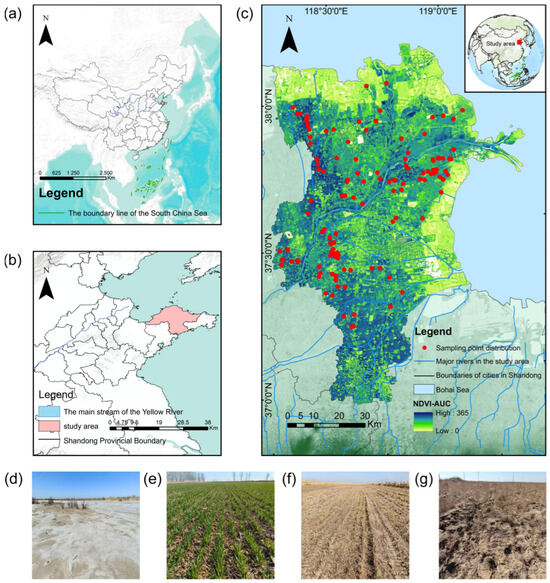
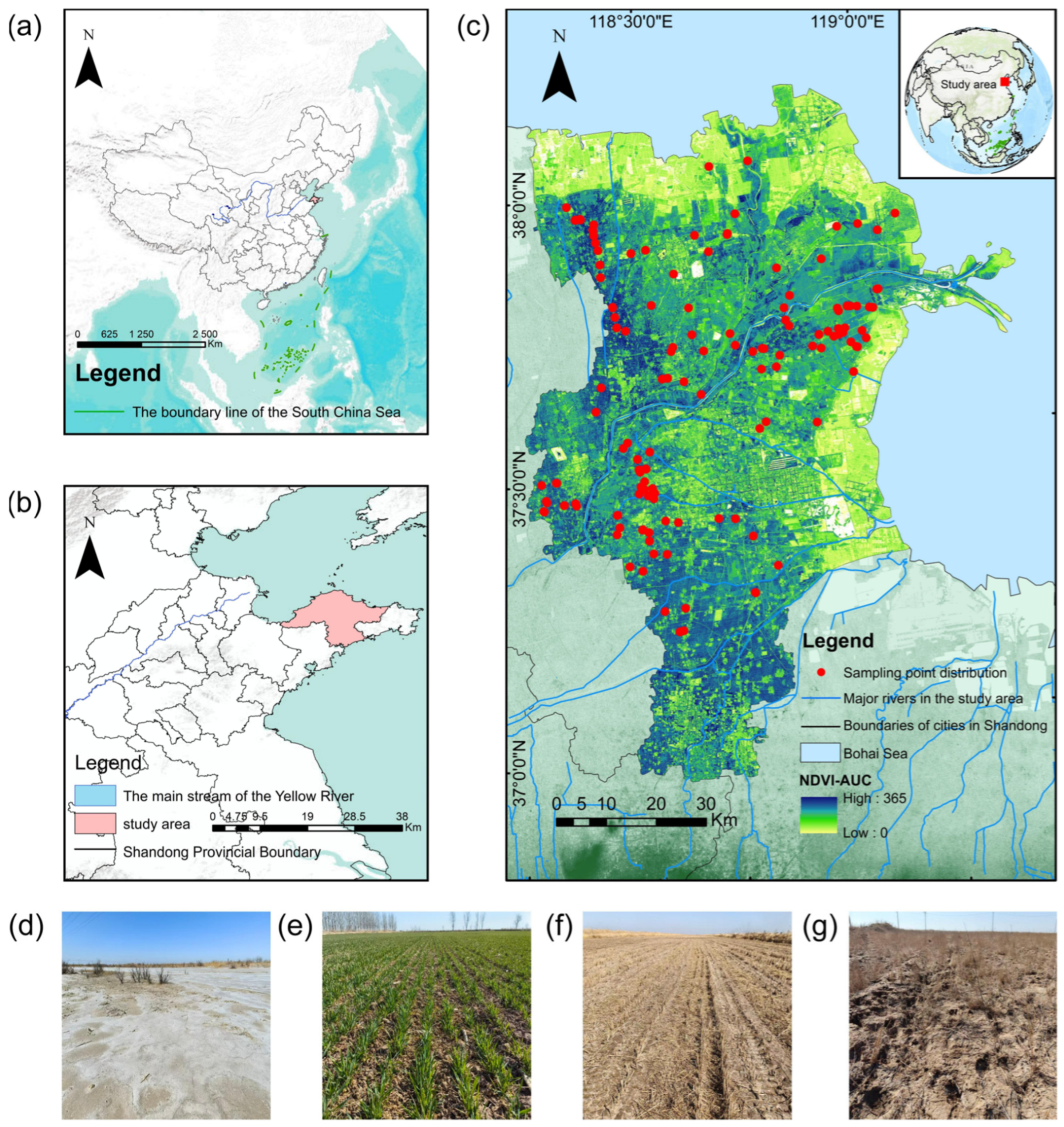
In this coastal delta environment, vegetation cover is extensive during the growing season, which limits direct optical retrieval of bare soil salt signals because of canopy masking and moisture-related surface variability [4]. This makes vegetation-based indirect retrieval particularly relevant for the study area. A total of 177 topsoil sampling sites were established across the main land-cover types, including saline land, cropland, woodland, and bare land (Figure 1).
Figure 1.
Location of the study area and distribution of field samples. (a) Location of the YRD within China. (b) Location of the study area within Shandong Province. (c) Spatial distribution of NDVI-AUC and sampling sites. (d–g) Representative field conditions during sampling.
2.1.2. Soil Sampling and Laboratory Analysis
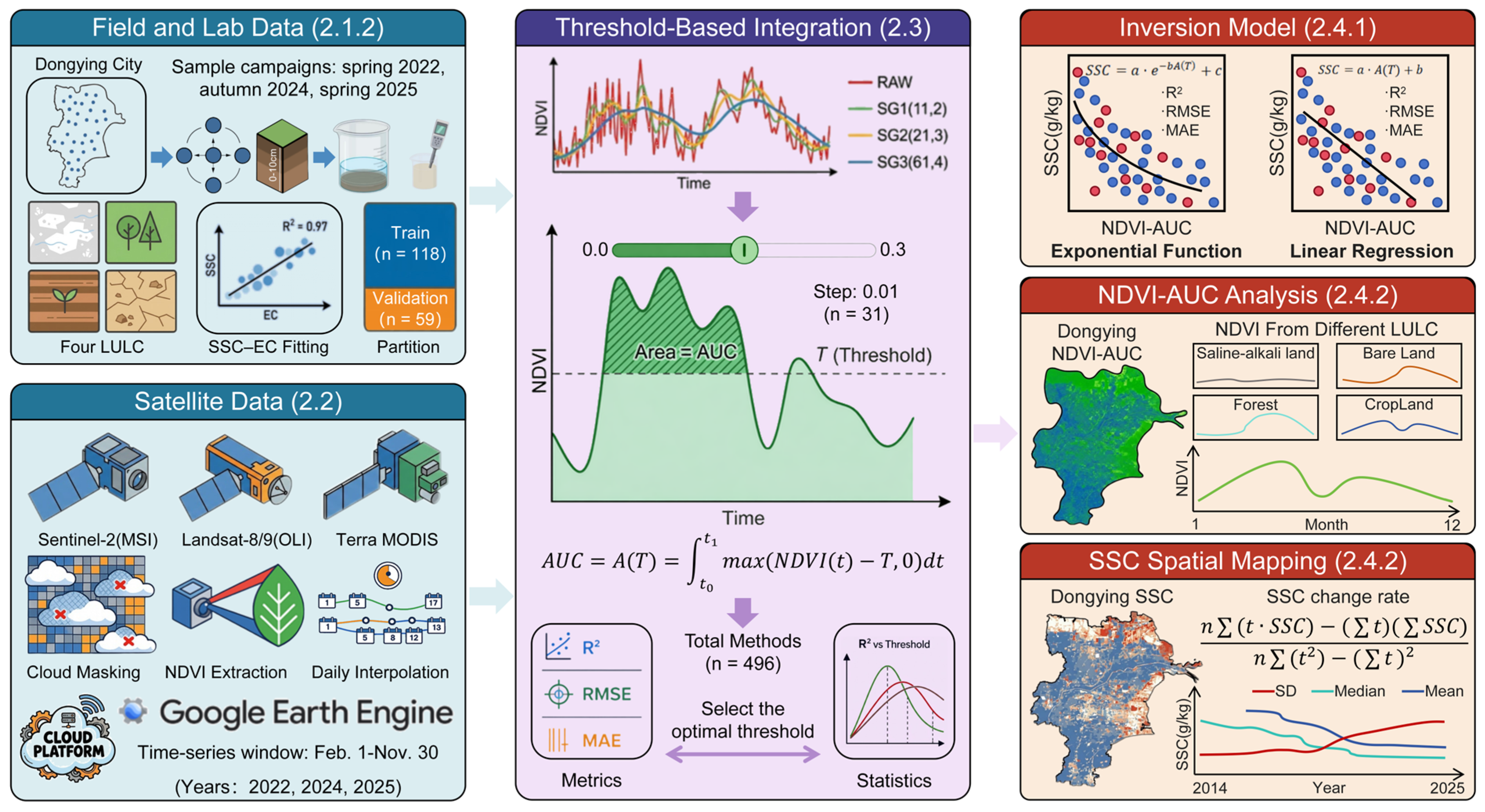
The surface soil dataset used for SSC calculation and model development included 177 sampling sites collected by our research team in 2022, 2024, and 2025, as summarized in Figure 2. Specifically, 67 historical field samples were collected in 2022, 50 historical field samples were collected in 2024, and 60 field samples were newly collected in spring 2025. Geographic coordinates and land-cover information were recorded for each site during field sampling. At each site, surface soil was collected from the 0–10 cm layer using a five-point composite sampling design [27]. After transport to the laboratory, the samples were air-dried, manually cleared of visible plant residues and gravel, and passed through a 2 mm sieve [28].
Figure 2.
Methodological workflow of the study, showing the main data sources, processing steps, and analytical framework. The workflow includes field and laboratory data collection, satellite data preprocessing, thresholded NDVI-AUC integration, model development, NDVI-AUC analysis under different land-cover types, and SSC spatial mapping.
Salinity was characterized using EC1:5 (i.e., EC measured in a 1:5 soil–water extract) and SSC, with SSC calculated from the total concentration of measured major water-soluble ions [29]. Soil extracts were prepared with deionized water at a soil-to-water ratio of 1:5 (w/v), followed by shaking and filtration to obtain the leachate. EC1:5 (dS m−1) was measured at 25 °C. The measured major water-soluble ions included Na+, K+, Ca2+, Mg2+, Cl−, , , and [30]. and were determined by acid–base titration, Cl− by silver nitrate titration, and by turbidimetry. Na+, K+, Ca2+, and Mg2+ were quantified by ICP-AES. All analytical and quality control procedures followed LY/T 1251–1999. SSC was calculated as the sum of the measured ion concentrations for samples with complete ion measurements.
2.1.3. EC–SSC Calibration
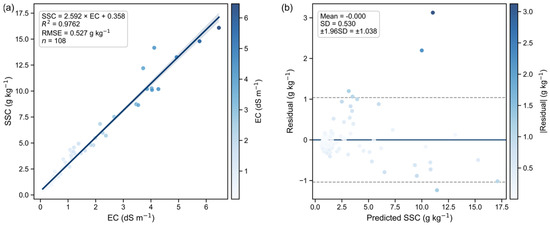
To harmonize EC1:5-based records with directly calculated SSC values, a subset of 108 paired topsoil samples with both EC1:5 and ion-summed SSC measurements was used to establish the EC–SSC calibration relationship (Figure 3). A linear model was fitted as follows:
where EC1:5 is expressed in dS m−1 and SSC in g kg−1. The fitted relationship showed high agreement between EC1:5 and SSC, with R2 = 0.9762, RMSE = 0.527 g kg−1, and n = 108. The residuals were centered close to zero and showed no evident systematic trend across the fitted SSC range, indicating that the calibration was suitable for converting EC1:5-based records to SSC-equivalent values. Equation (1) was therefore applied to samples with EC1:5 records but without complete ion-summed SSC measurements. The converted SSC-equivalent values were then combined with directly calculated SSC values to construct a unified dataset for subsequent model fitting and interannual mapping.
Figure 3.
EC1:5–SSC calibration and residual analysis. (a) Linear regression between EC1:5 and SSC based on 108 paired topsoil samples. (b) Residuals of predicted SSC plotted against fitted SSC values; the mean residual and the ±1.96 SD interval are shown to evaluate residual dispersion.
2.2. Satellite Data and Preprocessing
The satellite datasets, quality screening criteria, and sensor-specific reconstruction workflows are summarized in Table 1 and Table 2. For each sampling year, images acquired from 1 February to 30 November were used to cover the main vegetation growth period and to match the temporal window used for NDVI-AUC integration. All image acquisition, cloud/shadow masking, band harmonization, NDVI calculation, temporal reconstruction, and point/pixel extraction were implemented in GEE. Four data streams were used: Sentinel-2, Landsat-8/9, MODIS, and a Sentinel–Landsat fusion series. Because these datasets differed substantially in spatial resolution, revisit interval, valid observation density after quality screening, and noise characteristics, reconstruction was tailored to each data stream rather than applying a single strategy across sensors. The aim was to preserve the seasonally integrated NDVI signal required for thresholded NDVI-AUC estimation while making full use of the effective temporal information retained after quality control.
Table 1.
Satellite datasets and valid image counts.
Table 2.
Sensor-specific workflows for NDVI time-series reconstruction.
NDVI (Equation (2)) was calculated as follows:
where and denote near-infrared and red reflectance, respectively.
After quality screening, the Sentinel–Landsat fusion series retained the largest number of valid observations among the four data streams (Table 1). Because this series integrated observations from multiple platforms, sensor merging and simple weighting were first applied to reduce inter-sensor differences. The merged series was then reconstructed using double-logistic fitting, followed by cubic-spline and linear interpolation, to generate a daily continuous trajectory while preserving seasonal phenological continuity (Table 2). Sentinel-2 also retained relatively dense seasonal observations after QA60 masking. Given its high spatial resolution and sufficient seasonal sampling, weighted double-logistic fitting with Gauss–Newton optimization and dynamic reweighting was adopted to represent the asymmetric green-up and senescence phases of the annual trajectory while reducing the influence of residual cloud-related fluctuations.
By contrast, Landsat-8/9 retained fewer valid observations after QA_PIXEL cloud-bit screening, resulting in a sparser and more discontinuous annual trajectory (Table 1). Under these conditions, direct phenological fitting is sensitive to data gaps and local outliers. SG smoothing and outlier suppression were therefore applied before double-logistic phenological curve fitting to reconstruct a seasonally coherent trajectory from limited observations (Table 2). MODIS retained dense temporal observations after State_1 km cloud-state screening, but at a much coarser spatial resolution. For this temporally dense but mixed-pixel-prone series, linear interpolation, SG smoothing, and Whittaker smoothing were used to stabilize high-frequency observations without imposing an overly restrictive parametric curve.
Following reconstruction, all reconstructed time series were resampled to daily resolution to standardize temporal support across sensors and to ensure that differences in NDVI-AUC reflected vegetation dynamics rather than unequal revisit frequency or observation availability. Before final model construction, candidate sampling records affected by persistent cloud contamination, sensor-related artifacts, or strong sub-pixel heterogeneity were removed; the retained dataset corresponded to the 177 sampling sites described in Section 2.1.2.
2.3. NDVI-AUC Metric
2.3.1. SG Smoothing and Thresholded Integration
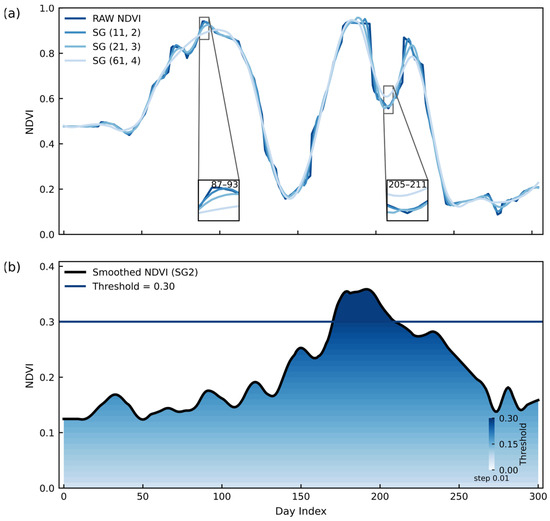
SG smoothing was used as a sensitivity test to evaluate whether moderate smoothing affected the shape of the reconstructed NDVI trajectories and the resulting NDVI-AUC values [34]. Multiple combinations of window length and polynomial order were tested, and four representative parameter sets were retained to cover a gradient from weak to stronger smoothing while avoiding excessive loss of phenological detail (Figure 4a). The purpose of this step was not to replace the sensor-specific reconstruction procedures, but to assess whether additional curve smoothing materially changed the SSC–NDVI-AUC relationship.
Figure 4.
Schematic illustration of NDVI time-series smoothing and thresholded temporal integration. (a) Comparison of raw NDVI observations with SG-smoothed curves under different parameter settings, showing local variations in curve shape. Here, SG (11, 2), SG (21, 3), and SG (61, 4) denote Savitzky–Golay smoothing with window lengths of 11, 21, and 61 and polynomial orders of 2, 3, and 4, respectively; the commas separate the two SG parameters rather than decimal values. (b) Illustration of thresholded NDVI-AUC calculation by traversing the threshold T; only the portions of the NDVI curve above T are integrated, and the shaded area represents the effective growth signal. Decimal values in the figure are expressed using periods.
The thresholded integration procedure accumulates NDVI only when the daily trajectory exceeds the threshold (Figure 4b). This design reduces the influence of dormant periods, sparse vegetation, bare soil, crop residues, salt crusts, and other low-NDVI background signals. As a result, the resulting NDVI-AUC metric is intended to represent the cumulative vegetation response during effective growth rather than the total seasonal NDVI signal [19]. Figure 4 illustrates both the smoothing sensitivity test and the thresholded integration concept used to construct the metric.
2.3.2. Metric Definition
Let denote the daily NDVI time series after reconstruction and daily resampling. For a given threshold , the thresholded NDVI-AUC metric, denoted as , was defined as the cumulative area of the NDVI trajectory above during the analysis period:
where and define the NDVI-AUC analysis period (Equation (3)), and ensures that only the portion of the NDVI trajectory above is accumulated. In this framework, represents a lower greenness threshold used to suppress low-NDVI background contributions from sparse vegetation, bare soil, crop residues, salt crusts, and noise.
Candidate values were set from 0.00 to 0.30 at increments of 0.01. This threshold range was not assumed to be universal; rather, it was selected to cover the low-to-moderate greenness range observed in the study area while retaining sufficient above-threshold observations for model fitting and regional mapping. The optimal was subsequently determined during the threshold selection step described below.
Under salt stress, may decrease through reductions in peak greenness, shortening of the effective growth period, or suppression of canopy development during the main growing stage. Therefore, was interpreted as an integrated vegetation response metric rather than a direct bare soil salinity index.
2.3.3. Threshold Selection
For each candidate threshold , was calculated for every data stream and SG smoothing setting. The same calibration and validation partitions were used throughout the threshold selection process to ensure that differences in performance reflected the effects of , data stream, and smoothing treatment rather than changes in sample partitioning. Model performance was evaluated using R2, RMSE, and MAE for both the calibration and validation datasets, with primary emphasis on validation performance to favor generalizability.
The optimal was selected by jointly considering validation accuracy, calibration–validation consistency, and mapping applicability. Candidate thresholds with higher validation R2 and lower validation RMSE and MAE were preferred. When several thresholds produced similar validation performance, the threshold with smaller calibration–validation discrepancy and more stable regional coverage was selected. Candidate thresholds that caused sampling records to lack any above-threshold vegetation signal, or that produced large invalid areas in regional NDVI-AUC maps, were not retained for operational mapping.
SG smoothing was treated as a sensitivity factor rather than an independent objective of optimization. Therefore, the selected threshold–smoothing combination was required to improve or maintain validation performance while preserving the seasonal shape of the reconstructed NDVI trajectory. This procedure ensured that the final represented a balance among model accuracy, robustness, and spatial applicability rather than a purely statistical optimum.
2.4. Modeling and Mapping
2.4.1. Model Fitting
Pearson correlation analysis was first used as an exploratory step to evaluate the direction and strength of the association between SSC and across threshold settings. The signed correlation coefficient was used to describe whether SSC increased or decreased with , and the corresponding -value was used to assess statistical significance. This analysis was used to identify candidate threshold ranges for subsequent model fitting.
To ensure a balanced distribution of salinity levels across datasets, the 177 sampling sites were ranked in descending order of SSC and divided using a stratified scheme. Within each group of three consecutive samples, two were assigned to the calibration set and one to the validation set, resulting in 118 calibration samples and 59 validation samples. The same calibration and validation partitions were used for all data streams, SG smoothing settings, threshold values, and model forms, so that differences in model performance reflected differences in , data stream, smoothing treatment, threshold setting, and model form rather than changes in sample partitioning.
The negative exponential model was used as the primary model because it provides a parsimonious and monotonic representation of the expected inverse relationship between SSC and cumulative vegetation activity. In vegetation-covered saline landscapes, increasing SSC generally suppresses canopy development and reduces the magnitude and duration of effective greenness; therefore, higher values are expected to correspond to lower SSC. The primary model (Equation (4)) was expressed as:
where denotes the thresholded NDVI-AUC value at threshold , and , , and are fitted parameters. Parameters and were constrained to be positive to preserve a monotonically decreasing relationship between SSC and .
To evaluate whether the SSC–NDVI-AUC relationship was sensitive to model form, a linear baseline model and four additional monotonic decreasing nonlinear models were fitted for comparison. The comparison models were selected because they preserve the expected inverse relationship between and SSC while differing in curve shape and flexibility. These models were expressed as follows:
Equations (5)–(9) represent the linear baseline, power decay, logarithmic decay, reciprocal decay, and Hill-type decay models, respectively. Where necessary, parameter constraints were imposed to preserve a monotonically decreasing response within the observed NDVI-AUC domain.
Each model was fitted for every combination of data stream, SG smoothing setting, and threshold value using the same calibration and validation partitions. This design ensured that model form comparisons were not confounded by differences in sample partitioning. For the direct model form comparison, the linear baseline and four additional monotonic decreasing models were evaluated under the same data-stream-specific threshold–smoothing combinations selected for the primary negative exponential model. In addition, the mean validation performance across the full threshold range was calculated for each model form to assess model robustness.
Model performance was evaluated using R2, RMSE, and MAE for both the calibration and validation datasets. Let denote the observed SSC, the predicted SSC, the mean observed SSC, and the sample size. The metrics (Equations (10)–(12)) were calculated as follows:
2.4.2. SSC Mapping
The recorded land-cover classes were used to examine whether NDVI-AUC trajectories differed among major surface types. For the sampling years 2022, 2024, and 2025, daily NDVI series were extracted for the 177 sampling sites, grouped by land-cover class, and averaged to derive representative phenological trajectories. The mean trajectory and the corresponding ±1 SD envelope were calculated for each land-cover class to compare temporal variability in vegetation development.
For pixel-level mapping, annual NDVI-AUC rasters were generated from the reconstructed daily NDVI series using the selected threshold . Water bodies and impervious surfaces were masked before SSC retrieval. Pixels that remained below throughout the analysis period were considered to lack an effective vegetation signal and were set to NoData. The fitted parameters of the primary negative exponential model were then applied pixelwise to NDVI-AUC using Equation (4) to generate annual SSC maps.
Using the selected 10 m implementation, annual NDVI-AUC and SSC maps were produced for 2021–2025. Pixel-wise SSC change rates were estimated as the slope of a linear regression between year and model-estimated SSC to characterize the spatial pattern of interannual SSC change (Equation (13)):
where denotes the year, is the pixel-wise SSC estimated for year using Equation (4), and is the number of valid annual observations for that pixel after excluding NoData values. The resulting slope represents the annual SSC change rate in g kg−1 yr−1. Pixels with insufficient valid annual observations were excluded from the change rate calculation.
3. Results
3.1. Data Distributions
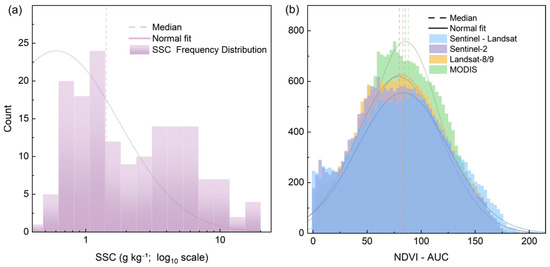
As shown in Figure 5a, SSC exhibited a pronounced right-skewed distribution, with most sampling sites concentrated in the low- to moderate-salinity range and only a small proportion of high-SSC observations. This uneven distribution reflects the strong spatial heterogeneity of SSC in the study area and supports the use of a stratified calibration–validation partition to maintain salinity-level balance during model fitting.
Figure 5.
Frequency distributions of SSC and NDVI-AUC. (a) Distribution of SSC for the 177 sampling sites, shown on a logarithmic scale, with the fitted normal curve and median indicated. (b) Distributions of NDVI-AUC derived from the Sentinel–Landsat fusion series, Sentinel-2, Landsat-8/9, and MODIS, with fitted normal curves and median positions shown for comparison.
By contrast, NDVI-AUC distributions differed among the four data streams (Figure 5b). Although all distributions were broadly unimodal, their central tendency, dispersion, and value range were not identical. The Sentinel–Landsat fusion series showed the widest value range and included a larger proportion of low NDVI-AUC values, whereas MODIS displayed a narrower distribution with a relatively higher central tendency. Sentinel-2 and Landsat-8/9 showed intermediate distributional characteristics. These differences indicate that spatial resolution, temporal observation density, and data-stream construction affected the numerical range and distribution of NDVI-AUC, supporting the need for data-stream-specific threshold selection and model calibration.
3.2. NDVI Profiles Across SSC Levels
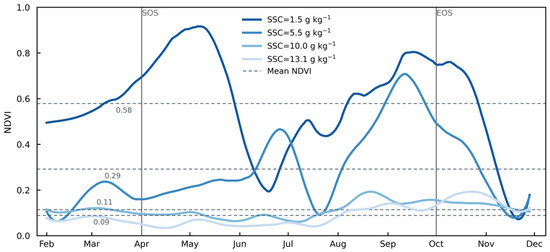
As shown in Figure 6, seasonal NDVI trajectories differed markedly among the four representative sampling sites with increasing SSC. Both annual NDVI amplitude and mean NDVI decreased as SSC increased, indicating progressively weaker vegetation activity under higher salinity conditions. Mean NDVI declined from 0.58 at SSC = 1.5 g kg−1 to 0.29, 0.11, and 0.09 at SSC = 5.5, 10.0, and 13.1 g kg−1, respectively. The period from early April to early October corresponded to the main growing season.
Figure 6.
Seasonal NDVI trajectories for four representative sampling sites with different SSC levels. The curves show intra-annual NDVI variation at SSC levels of 1.5, 5.5, 10.0, and 13.1 g kg−1, together with the corresponding mean NDVI reference lines. SOS and EOS denote the start and end of the main growing season, respectively.
The lowest-SSC profile showed the strongest seasonal dynamics, whereas the SSC = 5.5 g kg−1 profile retained a similar but weaker seasonal pattern. By contrast, the SSC = 10.0 and 13.1 g kg−1 profiles remained low throughout the year, with only minor fluctuations and limited late-season increases. Overall, increasing SSC was associated with flatter NDVI trajectories, weaker seasonal contrast, and lower peak canopy development.
3.3. Threshold Sensitivity
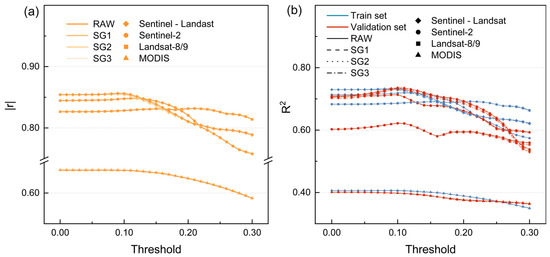
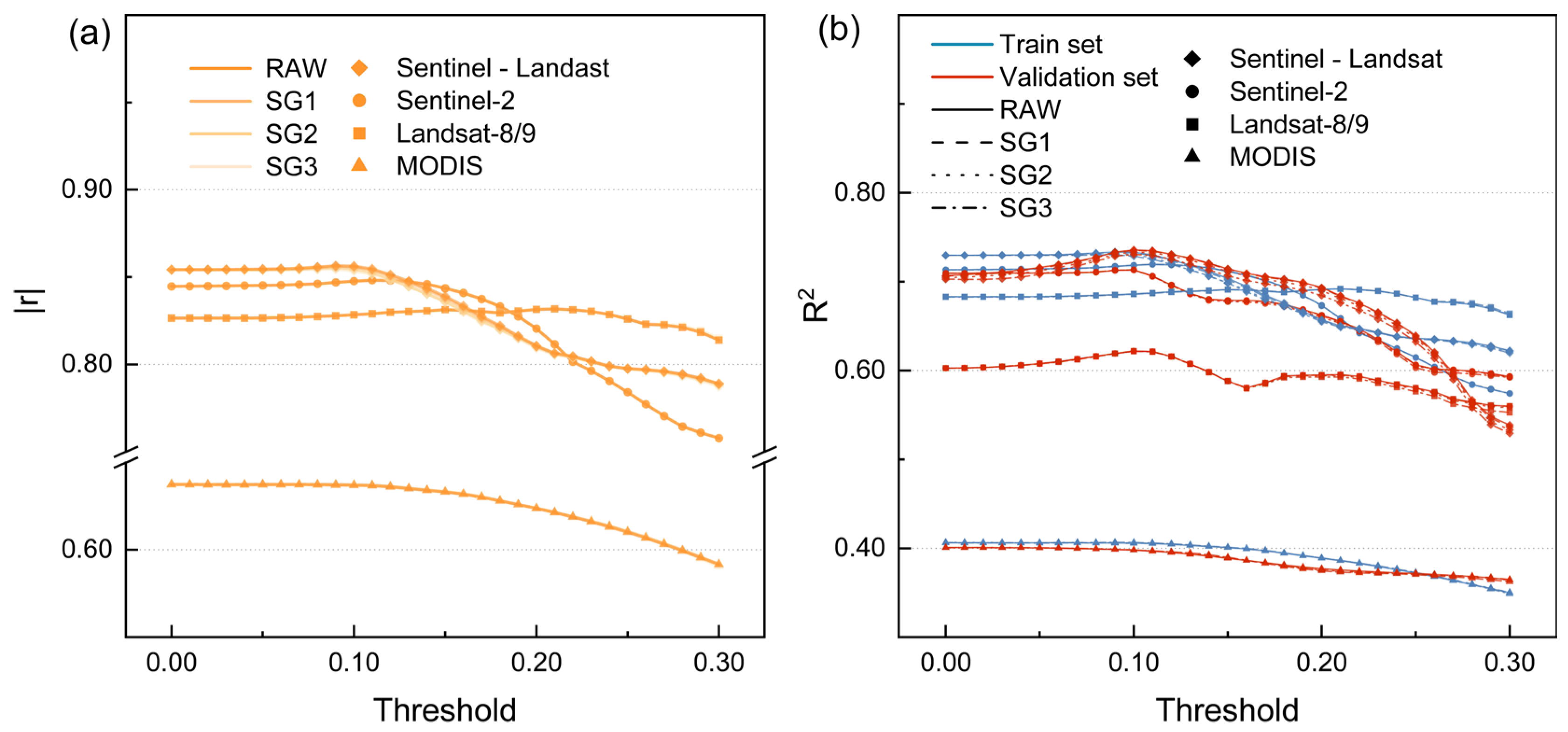
As shown in Figure 7, threshold selection had a stronger influence on the SSC–NDVI-AUC relationship than SG smoothing. Because SSC and NDVI-AUC were negatively correlated across the tested data streams, Figure 7a reports the absolute Pearson correlation coefficient to compare correlation strength among thresholds and smoothing settings. The curves for RAW, SG1, SG2, and SG3 largely overlapped within each data stream, indicating that moderate smoothing caused only limited changes in the strength of the SSC–NDVI-AUC association. In contrast, generally decreased as the threshold increased, especially after the low-to-moderate threshold range.
Figure 7.
Effects of threshold selection and SG smoothing on the SSC–NDVI-AUC relationship. (a) Variation in the absolute Pearson correlation coefficient between SSC and NDVI-AUC across threshold values. (b) Variation in calibration and validation R2 across threshold values. Different line styles represent RAW, SG1, SG2, and SG3 smoothing settings, and different symbols represent the four data streams.
The Sentinel–Landsat fusion series, Sentinel-2, and Landsat-8/9 maintained relatively strong inverse associations at low thresholds, whereas MODIS consistently showed weaker correlations. This difference indicates that the 10 m data streams better captured local vegetation responses related to SSC, while the coarser MODIS data stream mainly reflected broader background-scale variation. The R2 curves showed a similar pattern: model performance was relatively stable under low-to-moderate thresholds but declined at higher thresholds as fewer effective above-threshold observations were retained. Across data streams, the optimal or near-optimal threshold range was generally concentrated around low-to-moderate values, whereas excessive thresholding reduced both correlation strength and validation performance.
Overall, the results indicate that threshold selection was the dominant factor controlling the SSC–NDVI-AUC relationship, while SG smoothing mainly produced secondary adjustments to curve smoothness and model performance. Therefore, threshold optimization was necessary for model development, whereas SG smoothing was treated as a sensitivity factor rather than the primary determinant of retrieval accuracy.
3.4. Data Stream Comparison
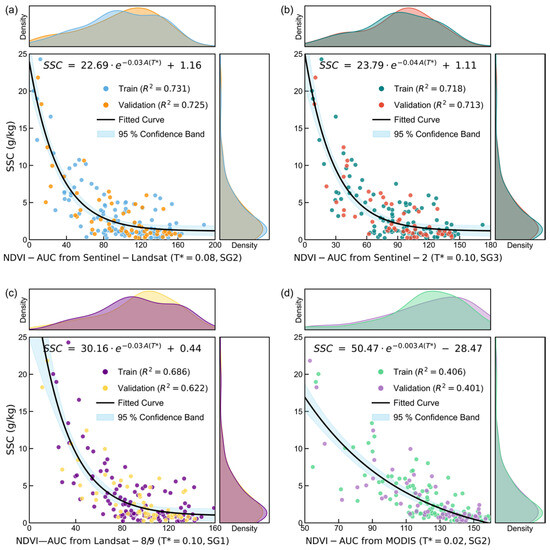
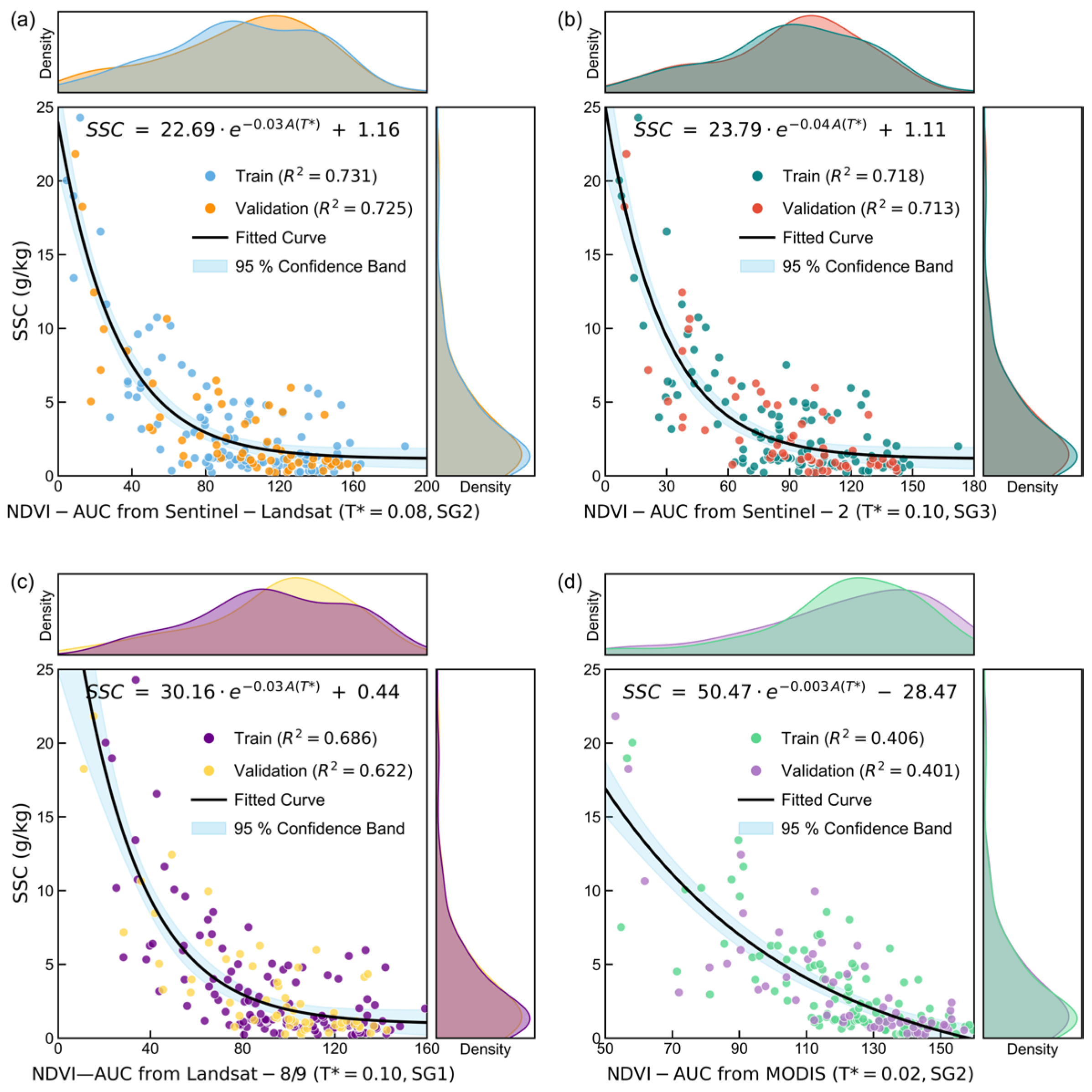
The primary negative exponential model showed clear differences in performance among the four data streams (Figure 8 and Table 3). Overall, the Sentinel–Landsat fusion series produced the best performance, with R2 values of 0.731 and 0.725 for the calibration and validation datasets, respectively. Sentinel-2 performed similarly, with calibration and validation R2 values of 0.718 and 0.713, respectively. These results indicate that the 10 m data streams captured the SSC–NDVI-AUC relationship more effectively than the coarser-resolution MODIS data stream.
Figure 8.
Comparison of negative exponential model performance across the four data streams. (a) Fitted relationship between SSC and NDVI-AUC for the Sentinel–Landsat fusion series under the selected threshold–smoothing combination (T = 0.08, SG2). (b) Fitted relationship between SSC and NDVI-AUC for Sentinel-2 under the selected threshold–smoothing combination (T = 0.10, SG3). (c) Fitted relationship between SSC and NDVI-AUC for Landsat-8/9 under the selected threshold–smoothing combination (T = 0.10, SG1). (d) Fitted relationship between SSC and NDVI-AUC for MODIS under the selected threshold–smoothing combination (T = 0.02, SG2). Scatter points represent calibration and validation samples, the black curves represent the fitted negative exponential models, and the blue shaded areas represent the 95% confidence bands.Across the four data streams, the selected threshold–smoothing combinations differed, confirming that the optimal was data-stream-dependent rather than universal. The Sentinel–Landsat fusion series achieved its best performance under SG2 and , Sentinel-2 under SG3 and , Landsat-8/9 under SG1 and , and MODIS under SG2 and (Table 3). These differences indicate that threshold selection interacted with spatial resolution, observation density, and time-series construction. Therefore, data-stream-specific threshold optimization was necessary before applying the model to regional SSC mapping.
Table 3.
Performance of the selected negative exponential models.
The Landsat-8/9 model showed moderate performance, with a validation R2 of 0.622. Although its spatial resolution was consistent with the 10 m mapping framework after resampling, the relatively sparse valid observations after quality screening limited the stability of the reconstructed seasonal NDVI trajectory. MODIS showed the weakest validation performance, with a validation R2 of 0.401, reflecting the effect of coarse spatial resolution and mixed pixels on the site-level SSC–NDVI-AUC relationship. Nevertheless, MODIS still captured broad background-scale variation and provided a useful contrast for evaluating the influence of spatial resolution and temporal observation density.
3.5. Model Form Comparison
To evaluate whether the SSC–NDVI-AUC relationship was dependent on the selected model form, the linear baseline model and four additional monotonic decreasing nonlinear models were compared with the primary negative exponential model (Table 4). All comparison models were evaluated using the same calibration and validation partitions and the same data-stream-specific threshold–smoothing combinations selected for the primary model. This design ensured that differences in model performance reflected model form rather than differences in sample partitioning or threshold selection. The fitted equations and parameter estimates of the selected primary negative exponential models are reported in Figure 8.
Table 4.
Validation performance across decay models and sensor parameters.
For the Sentinel–Landsat fusion series, Sentinel-2, and Landsat-8/9, the primary negative exponential model retained the highest validation R2 or the most balanced validation performance considering R2, RMSE, MAE, parsimony, and monotonic interpretability. The best alternative models achieved validation R2 values of 0.677 for the Sentinel–Landsat fusion series, 0.599 for Sentinel-2, and 0.586 for Landsat-8/9, which were lower than the corresponding negative exponential validation R2 values of 0.725, 0.713, and 0.622, respectively. MODIS was the only data stream for which the Hill-type decay model achieved higher validation accuracy than the negative exponential model, with validation R2 increasing from 0.401 to 0.451. However, this improvement occurred for the coarse-resolution MODIS data stream and did not affect the selection of the primary 10 m mapping model.
Overall, the comparison indicates that the inverse nonlinear relationship between NDVI-AUC and SSC was not an artifact of a single equation form. The alternative monotonic models reproduced the expected decreasing response to varying degrees, but the negative exponential model was retained as the primary mapping model because it provided the best compromise among validation accuracy, model simplicity, monotonic behavior, and ecological interpretability for the 10 m data streams.
3.6. SSC Maps and Trends
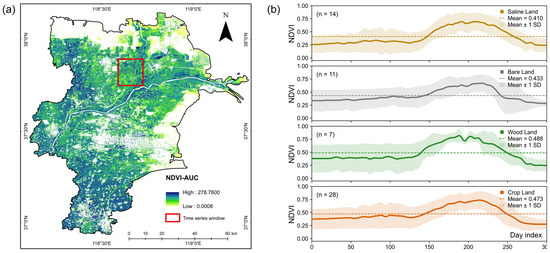
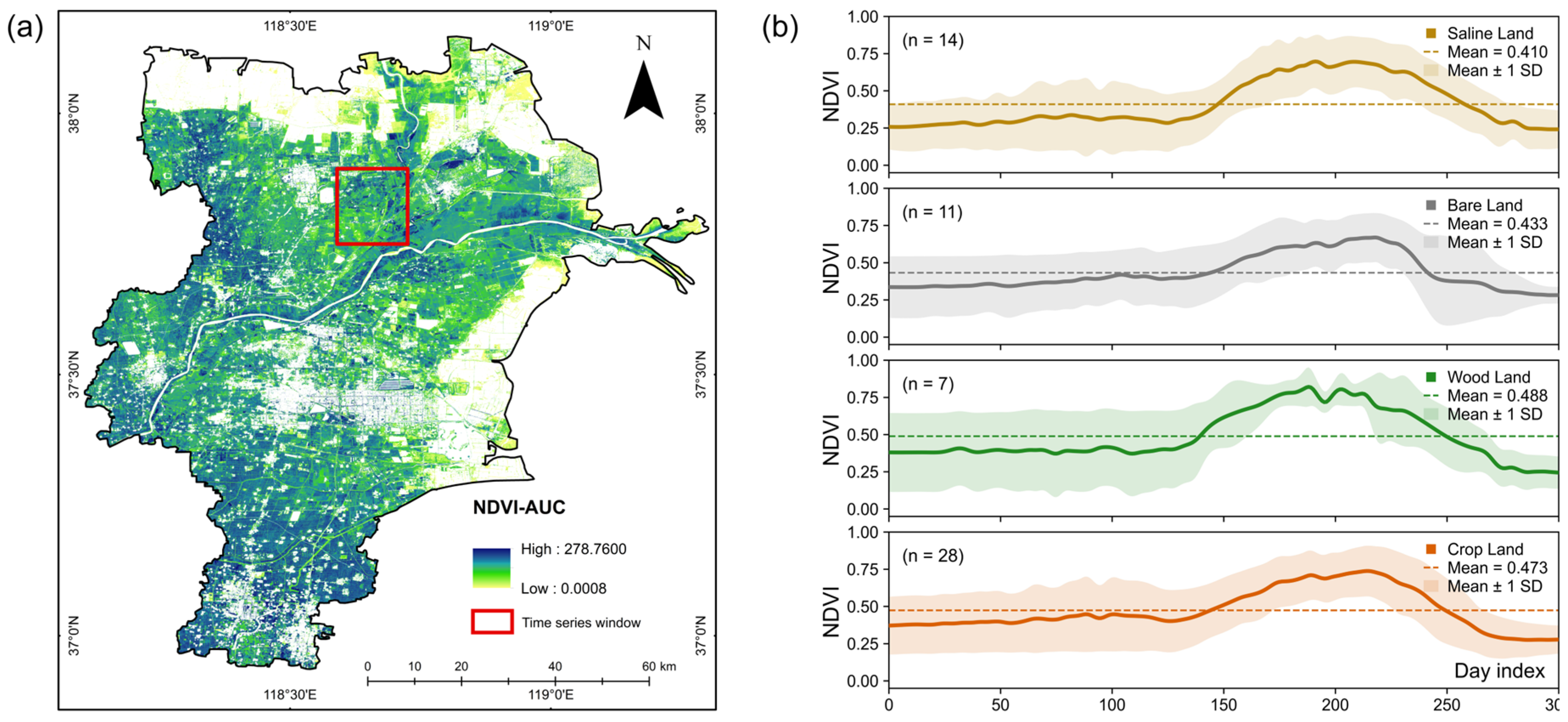
As shown in Figure 9a, the NDVI-AUC map exhibited marked spatial heterogeneity, forming a patchy mosaic rather than a simple regional gradient. High NDVI-AUC values were mainly concentrated in the western and southwestern parts of the study area, with scattered high-value patches in the central region, whereas lower values occurred more frequently in the northern and northeastern sectors. This pattern indicates clear spatial differences in accumulated vegetation activity, and the red box marks the area used for land-cover-specific seasonal trajectory analysis.
Figure 9.
Spatial pattern of NDVI-AUC and seasonal NDVI trajectories for different land-cover classes in the study area. (a) Spatial distribution of NDVI-AUC, with the red box indicating the area used for seasonal trajectory analysis. (b) Mean NDVI trajectories for saline land, bare land, woodland, and cropland; dashed lines indicate mean values, and shaded envelopes represent ±1 SD.
Seasonal NDVI trajectories differed among land-cover classes (Figure 9b). All four classes showed low values in late winter and spring, increased during summer, and declined in autumn, but their mean levels and seasonal amplitudes differed. Woodland showed the highest mean NDVI and strongest seasonal increase, followed by cropland, which maintained relatively high NDVI and a broad summer–autumn peak. Bare land showed an intermediate pattern, whereas saline land had the lowest mean NDVI despite a late-summer increase. These differences indicate that NDVI-AUC variation was closely related to land-cover-specific seasonal vegetation activity.
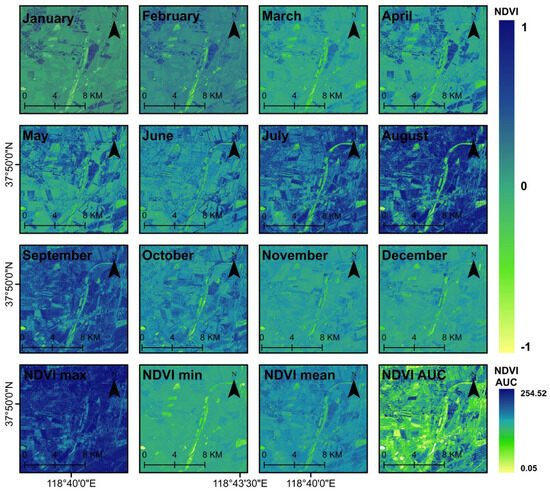
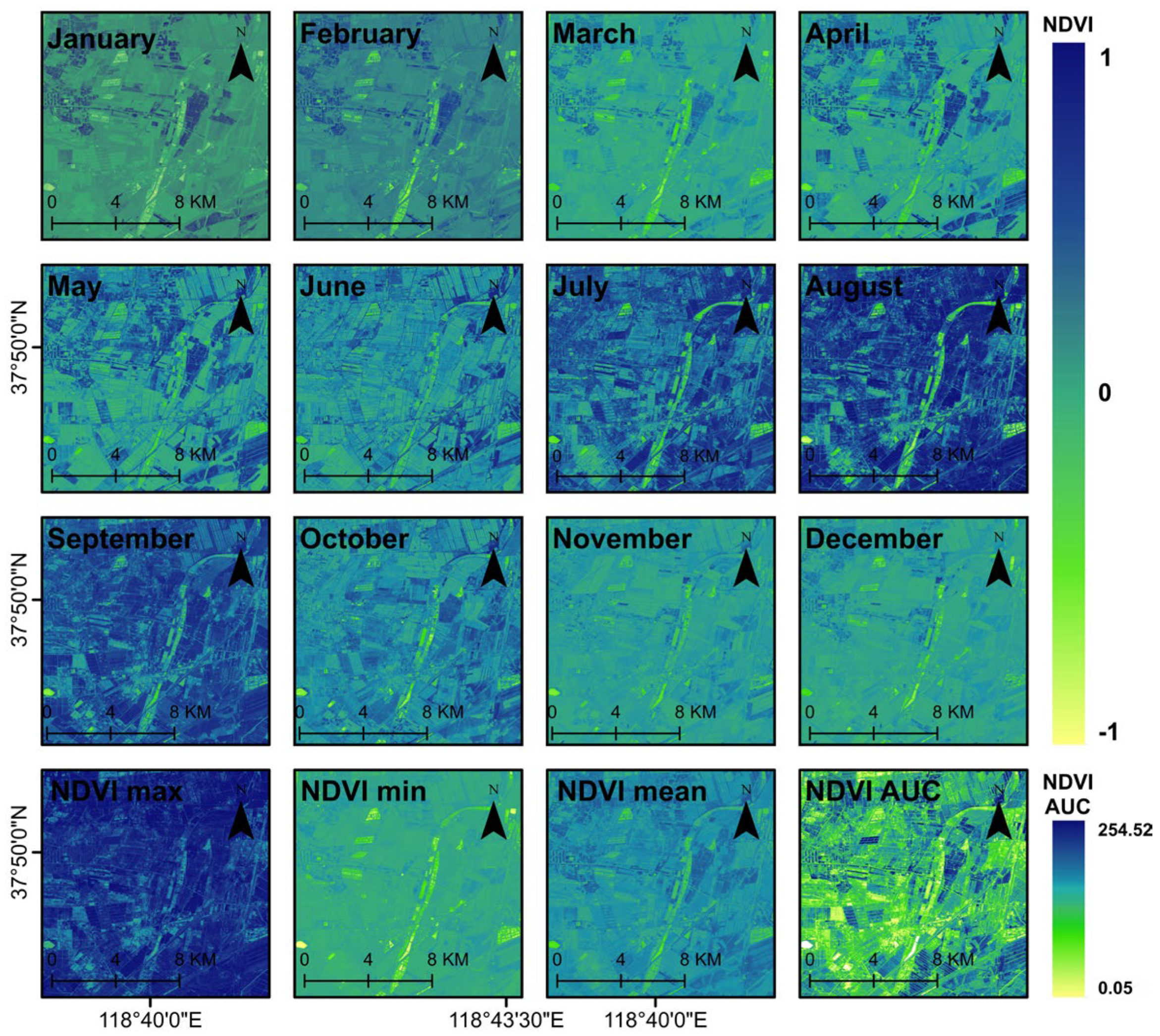
Figure 10 illustrates pronounced intra-annual variation in NDVI and its relationship with annual summary metrics. NDVI remained low in winter and early spring, expanded during April–May, reached its highest spatial extent and intensity during August–September, and then declined with autumn senescence. Compared with NDVImax, which mainly captured peak greenness, and NDVImin, which showed limited spatial contrast, NDVI-AUC preserved both the duration and magnitude of effective greenness. NDVImean showed a smoother spatial texture, whereas NDVI-AUC retained a clearer patch mosaic structure associated with cumulative vegetation activity, supporting its use as a seasonal indicator for SSC mapping.
Figure 10.
Comparison of monthly NDVI distributions, NDVI summary statistics, and NDVI-AUC in the study area. The figure shows the spatial distribution of monthly NDVI from January to December, together with NDVImin, NDVImax, NDVImean, and NDVI-AUC for the same sub-region.
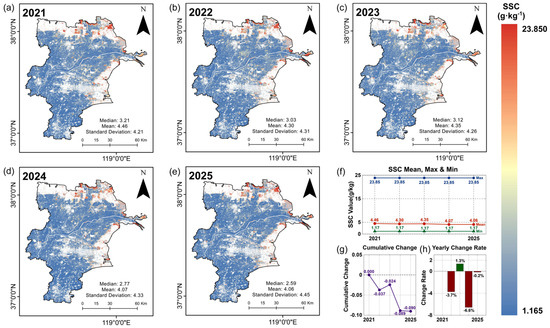
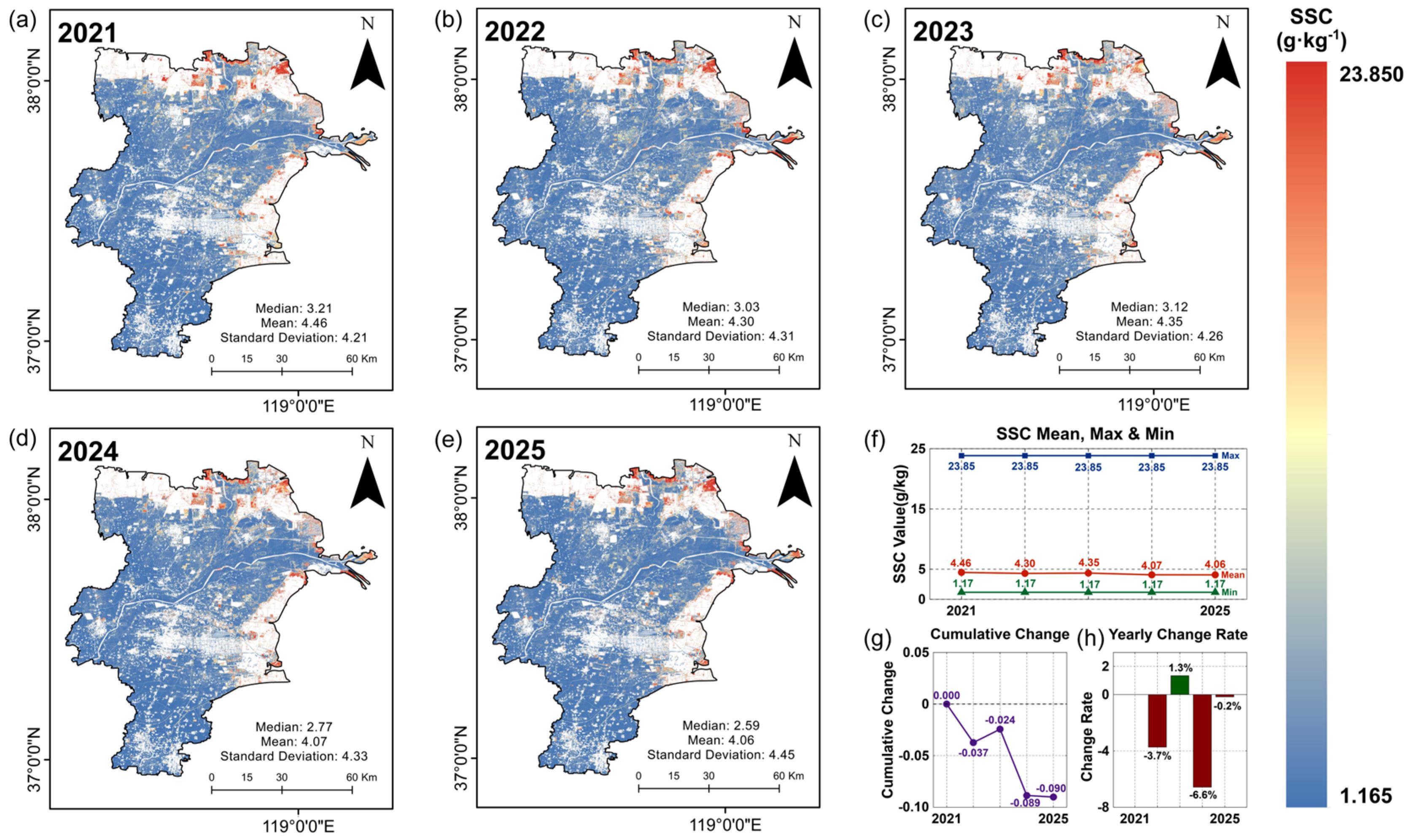
Figure 11 shows the annual SSC maps and summary statistics for 2021–2025. Across all years, the study area was dominated by low-to-moderate SSC, with relatively high values concentrated mainly along the northern coastal fringe and in scattered local patches. Although the overall spatial configuration remained broadly stable, the extent and intensity of high-SSC patches varied slightly among years. The annual maximum and minimum SSC values were 23.85 and 1.17 g kg−1, respectively, whereas mean SSC declined from 4.46 g kg−1 in 2021 to 4.06 g kg−1 in 2025, with a small rebound in 2023. A similar pattern was observed for the median, which decreased from 3.21 to 2.59 g kg−1 over the same period. By contrast, the standard deviation increased slightly from 4.21 to 4.45 g kg−1, indicating that spatial heterogeneity remained pronounced throughout the study period.
Figure 11.
Annual SSC patterns and temporal statistics for the study area from 2021 to 2025. (a–e) Annual SSC maps, with each panel annotated by the median, mean, and standard deviation. (f) Annual mean, maximum, and minimum SSC values. (g) Cumulative change in SSC relative to 2021. (h) Annual SSC change rate. Colors represent SSC in g kg−1.
The temporal indicators also suggest a modest overall decline in regional SSC after 2021 (Figure 11g,h). Cumulative change became progressively more negative through the study period, reached its lowest level in 2024, and remained nearly unchanged in 2025. The annual change rate was negative in 2022, positive in 2023, and negative again in 2024, followed by near stability in 2025. Overall, the results indicate a slight decline in mean regional SSC from 2021 to 2025, superimposed on persistent spatial heterogeneity and limited interannual variation in the distribution of high-SSC patches.
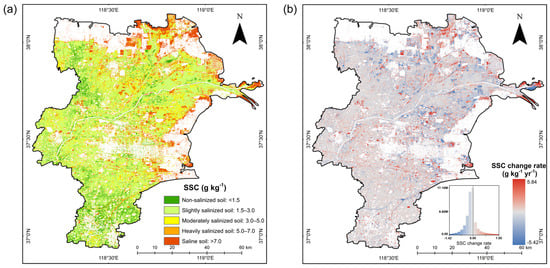
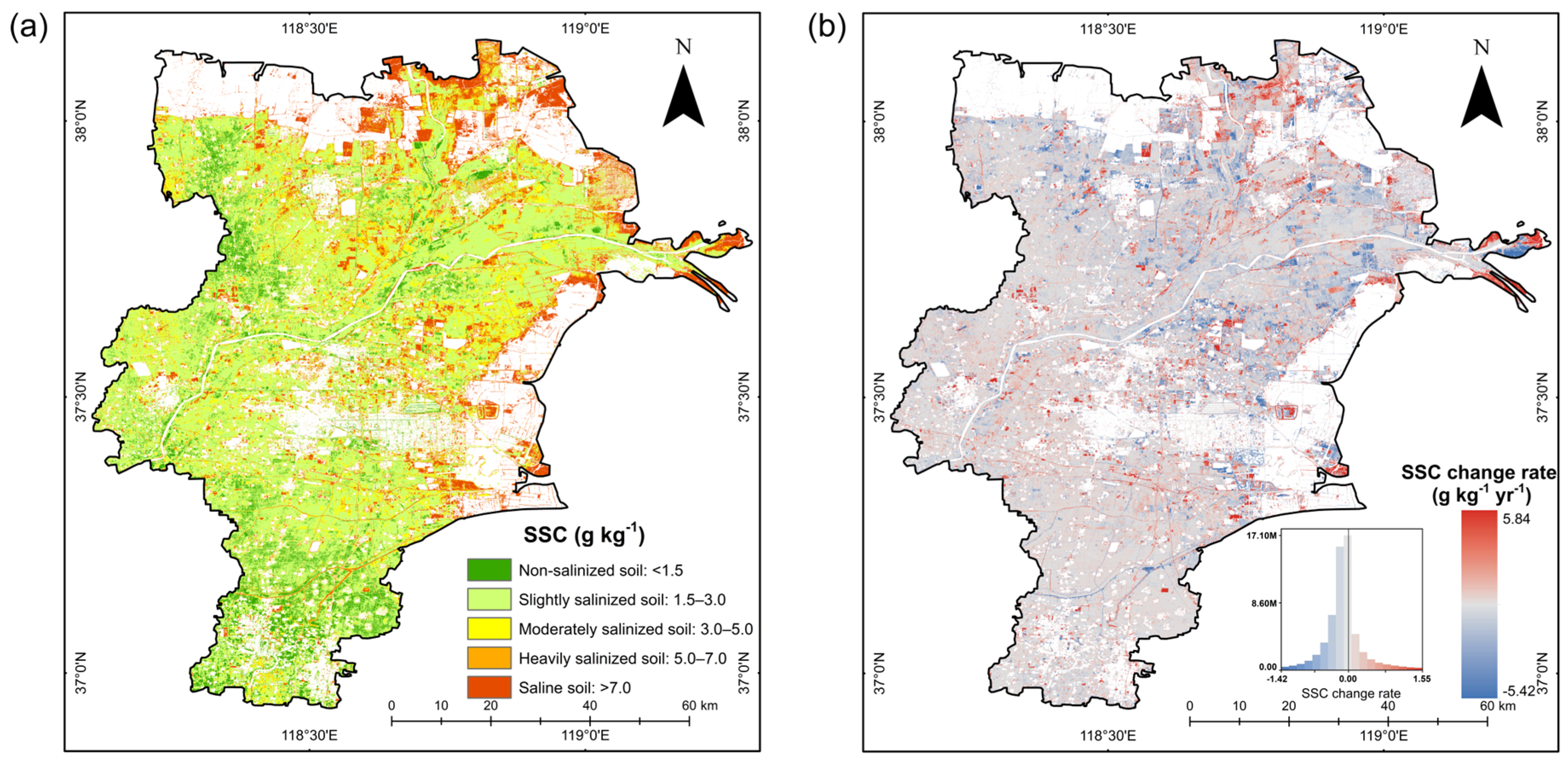
Figure 12 summarizes the SSC classification map and pixel-level change rate pattern. The classification map was generated using the coastal chloride-type salinization grading scheme, including non-salinized soil, slightly salinized soil, moderately salinized soil, heavily salinized soil, and saline soil. As shown in Figure 12a, the regional pattern was dominated by non-salinized and slightly salinized soils, which together formed the main background across most of the study area. Moderately salinized soil occurred as transitional patches, whereas heavily salinized soil and saline soil occupied smaller areas and were concentrated mainly along the northern coastal fringe and localized eastern coastal zones. This pattern indicates that high-SSC areas were spatially restricted but persistent in coastal and near-coastal zones.
Figure 12.
Spatial distribution of SSC classes and pixel-level SSC change rate in the study area during 2021–2025. (a) Classification map of SSC based on the coastal chloride-type salinization grading scheme, including non-salinized soil (<1.5 g kg−1), slightly salinized soil (1.5–3.0 g kg−1), moderately salinized soil (3.0–5.0 g kg−1), heavily salinized soil (5.0–7.0 g kg−1), and saline soil (>7.0 g kg−1). (b) Pixel-level SSC change rate in g kg−1 yr−1, where blue indicates a decrease, red indicates an increase, and gray indicates values close to zero. The inset histogram shows the frequency distribution of change rates.
The pixel-level change rate map further indicates that SSC remained relatively stable over most of the region during 2021–2025 (Figure 12b). Most pixels were concentrated near zero change, as shown by the inset histogram, indicating that large regional shifts were uncommon. Nevertheless, localized increases and decreases co-occurred across the landscape, forming scattered positive and negative change patches rather than a uniform directional trend. These spatial contrasts indicate that SSC evolution during the study period was characterized mainly by local variability superimposed on a relatively stable regional pattern.
4. Discussion
4.1. Mechanistic Interpretation of NDVI-AUC
In the coastal cropland–wetland mosaic of Dongying, direct optical retrieval of SSC is constrained by vegetation cover, mixed pixels, salt crusts, crop residues, and moisture-related surface variability. Traditional salinity retrieval methods based on SI features, albedo-related feature spaces, or single-date bare soil reflectance can enhance the spectral contrast of exposed saline soil or salt crusts [5,6,35]. However, their response becomes less direct when the soil background is partly or fully masked by canopy cover [7,9]. Under such conditions, vegetation response provides a complementary observation pathway because canopy development integrates the cumulative effects of salinity stress over time [11].
The use of NDVI-AUC as the core metric was therefore intentional. SI-type indices, NDSI-type indices, and albedo–vegetation index feature spaces are often designed to highlight bare soil salinity or salt crust exposure. These approaches can be effective under sparse vegetation or exposed soil conditions, but their performance may decrease during the growing season when canopy structure, crop residues, and surface moisture alter the observed spectral signal. By contrast, NDVI-AUC is not intended to directly detect salt crusts. It uses the above-threshold seasonal NDVI integral as an indirect vegetation response signal. Because salt stress can reduce leaf expansion, canopy vigor, photosynthetic activity, and the duration of effective growth [36,37,38,39], the seasonal integral of NDVI provides a process-related indicator of vegetation suppression under increasing SSC [15,38,39,40].
The thresholding step is central to this interpretation. If the full annual NDVI trajectory is integrated without restriction, the metric also accumulates low-NDVI signals associated with dormant periods, sparse vegetation, bare soil, crop residues, salt crusts, and noise. These components can weaken the vegetation–salinity relationship because they are not necessarily linked to sustained canopy activity. By integrating only the portion of the trajectory above the threshold , the proposed metric emphasizes effective greenness and reduces low-background contamination. This explains why threshold selection affected model performance more strongly than SG smoothing: thresholding changes the ecological meaning of the accumulated signal, whereas moderate smoothing mainly adjusts local curve shape. Therefore, should be interpreted as a dataset-specific greenness cutoff rather than a universal constant.
The observed negative exponential relationship between SSC and NDVI-AUC is consistent with the expected nonlinear response of vegetation to salinity stress. At low NDVI-AUC values, small changes in canopy activity may correspond to large differences in SSC because vegetation is already strongly suppressed. At higher NDVI-AUC values, the curve approaches a lower SSC background level because the vegetation response becomes less sensitive to further increases in the above-threshold NDVI integral. The model form comparison further supports this interpretation. The alternative monotonic decreasing models reproduced the inverse SSC–NDVI-AUC relationship to varying degrees, indicating that the relationship was not an artifact of a single equation form. Nevertheless, the primary negative exponential model was retained because it provided the best balance among validation accuracy, simplicity, monotonic behavior, and ecological interpretability for the 10 m data streams.
Overall, thresholded NDVI-AUC occupies an intermediate position between direct bare soil spectral retrieval and highly parameterized machine learning models. It does not attempt to replace SI, albedo-based, hyperspectral, or machine learning approaches in all situations. Instead, it provides a simple and interpretable seasonal metric for vegetation-covered salinity landscapes, especially where cumulative canopy response is more stable than instantaneous bare soil reflectance [41].
4.2. Effects of Data Stream Characteristics
The differences in model performance among the four data streams should be interpreted in relation to spatial resolution, temporal sampling density, observation consistency, and data construction rather than as a simple ranking of platform quality. The Sentinel–Landsat fusion series and Sentinel-2 produced the strongest SSC–NDVI-AUC relationships, whereas Landsat-8/9 showed intermediate performance and MODIS showed the weakest site-level accuracy. This pattern is consistent with the spatial structure of coastal salinization in Dongying, where saline patches are often small, fragmented, and embedded within cropland, aquaculture ponds, bare land, and salt-pan mosaics.
Spatial resolution is a key factor. Higher-resolution data streams better match field-scale heterogeneity and reduce the dilution effect caused by mixed pixels. As pixel size becomes coarser, saline soil, vegetation, water, bare land, and human-managed surfaces are more likely to be combined within the same pixel. This mixing can elevate or compress NDVI-AUC values and weaken their correspondence with point-scale SSC. The weaker performance of MODIS is therefore mainly attributable to coarse spatial support and mixed-pixel effects, rather than to a lack of temporal information.
Temporal sampling also influenced performance. Thresholded NDVI-AUC depends on the reconstruction of seasonal green-up, peak development, and senescence. Denser observations reduce interpolation uncertainty after cloud screening and help stabilize the estimated seasonally integrated NDVI signal [19]. The Sentinel–Landsat fusion series benefited from both high spatial detail and dense temporal support, while Sentinel-2 preserved strong spatial detail with sufficient seasonal observations. Landsat-8/9 provided comparable spatial information but fewer valid observations, making seasonal reconstruction more sensitive to cloud gaps and local outliers. MODIS provided dense temporal coverage but at a much coarser spatial resolution, making it more suitable for background-scale monitoring than for fine-scale SSC retrieval.
These findings indicate that thresholded NDVI-AUC is transferable across optical data streams in terms of its monotonic response pattern, but not in terms of a single universal parameter setting. The optimal , smoothing setting, and model performance varied among data streams because each stream represented a different balance between spatial detail and temporal continuity. Therefore, data-stream-specific threshold selection remains necessary before applying the model to regional SSC mapping.
4.3. SSC Dynamics and Hotspot Stability
The annual SSC maps for 2021–2025 indicate persistent spatial heterogeneity and modest interannual change rather than abrupt regional salinization or desalination. High-SSC areas were concentrated mainly along the northern coastal fringe and several localized eastern coastal zones, whereas most inland and agricultural areas remained dominated by non-salinized to slightly salinized soils. This pattern suggests that recent SSC dynamics were expressed primarily through changes in hotspot intensity and patch extent rather than through large-scale relocation of salinized areas [42,43,44].
The pixel-level change rate map further shows that most pixels were concentrated near zero change, while localized increases and decreases co-occurred across the landscape. Such stability is consistent with the hydrogeomorphic setting of the YRD, where shallow groundwater, tidal influence, marine-derived salts, low relief, and land-use configuration jointly constrain salt accumulation [24,25,45,46,47]. The modest model-derived decline in regional SSC should therefore be interpreted cautiously, because persistent high-SSC patches indicate that heavily salinized and saline areas remained stable in specific coastal zones.
The classification map based on the coastal chloride-type salinization grading scheme further emphasizes the management relevance of these results. Non-salinized and slightly salinized soils formed the dominant background, moderately salinized soil occurred as transitional patches, and heavily salinized soil or saline soil was more spatially restricted. Regional management should therefore focus not only on coastal hotspots, but also on transitional zones where moderate salinization may expand or recover depending on hydrological conditions and land-use practices.
4.4. Relationship to Machine Learning Inversion
Machine learning models are widely used in SSC retrieval because they can integrate spectral bands, SI features, vegetation indices, radar variables, texture features, terrain variables, and environmental covariates to represent nonlinear salinity patterns [48,49,50,51,52,53,54,55]. These models are valuable when the goal is to maximize predictive accuracy or to decompose complex environmental controls. Time-series machine learning approaches can also identify informative seasonal windows and exploit multi-temporal features for salinity mapping [20]. However, model performance is often sensitive to sample representativeness, input data type, spatial scale, feature selection, and validation strategy [14].
The value of NDVI-AUC lies less in outperforming all machine learning models than in providing an interpretable and low-dimensional seasonal feature. By compressing the vegetation trajectory into a cumulative above-threshold greenness metric, NDVI-AUC reduces dependence on high-dimensional feature stacking and minimizes alignment problems among multi-source variables. It can be interpreted directly in relation to cumulative canopy response, making the retrieval pathway more transparent than purely data-driven feature combinations. This property is particularly useful when the objective is consistent interannual mapping rather than optimal fitting for a single date or a single region. Recent deep learning applications in agricultural remote sensing have demonstrated strong high-throughput recognition capability under complex field conditions [56], but such task-specific frameworks also illustrate why direct transfer to SSC mapping may require additional samples, retraining, and interpretation.
This does not imply that NDVI-AUC should replace machine learning; instead, it can serve as a complementary feature or baseline indicator. In settings with limited samples, inconsistent covariates, or multi-year mapping needs, thresholded NDVI-AUC may provide more reproducible behavior than highly parameterized models. In settings where sufficient ground observations and reliable environmental covariates are available, NDVI-AUC could also be incorporated into machine learning frameworks as a structured temporal feature. This would allow future models to combine the interpretability of cumulative vegetation response with the flexibility of machine learning methods.
4.5. Strengths, Limitations, and Future Work
The main strength of thresholded NDVI-AUC is that it provides a simple and interpretable indicator for SSC retrieval under vegetation cover. In the Dongying coastal delta, where fragmented land cover, mixed pixels, and seasonal surface variability weaken direct bare soil spectral signals, the cumulative vegetation response pathway provides a practical alternative. The thresholded design further improves this pathway by excluding low-NDVI background components that would otherwise dilute the salinity-related signal.
The method also has clear limitations. First, it depends on identifiable vegetation response during the growing season. Its effectiveness is therefore reduced in non-vegetated areas, persistently bare salt crust surfaces, extremely sparse vegetation, or areas where vegetation response is weak. In these cases, masking, bare soil salinity indices, albedo-based feature space models, or hyperspectral approaches may be more suitable. Second, NDVI-AUC is influenced not only by SSC but also by crop type, sowing date, irrigation regime, drainage conditions, grazing, and non-saline water stress. These factors can alter cumulative canopy development under similar SSC levels and may introduce confounding effects. Stratification by land-cover type, crop type, or management zone may therefore improve interpretation in future applications [57].
Third, the SSC reference data include values harmonized through EC–SSC calibration. Although the EC–SSC relationship showed high agreement in this study, EC can be affected by extraction conditions, ionic composition, temperature correction, and laboratory procedure. This uncertainty should be considered when interpreting model accuracy and interannual change. Future work should include repeated field validation, independent annual validation samples, and formal uncertainty propagation from EC measurement, EC–SSC conversion, NDVI-AUC reconstruction, and model prediction.
Finally, conventional multispectral NDVI has limited spectral dimensionality. Because the proposed NDVI-AUC metric was derived from red- and near-infrared-based NDVI rather than from a multi-band feature selection framework, this study did not perform an individual spectral band sensitivity ranking. In dense vegetation, NDVI may saturate and become less sensitive to canopy differences related to salinity stress. Additional red-edge, shortwave-infrared, radar, proximal sensing, or hyperspectral information may help separate salinity stress from other vegetation or moisture effects [28,58,59]. Future research should therefore test the transferability of thresholded NDVI-AUC across additional coastal deltas and irrigated systems, evaluate its performance under different crop structures and groundwater conditions, and explore its integration with machine learning frameworks as an interpretable time-series feature.
Overall, thresholded NDVI-AUC should be positioned as a complementary, vegetation-response-based metric rather than a universal replacement for existing salinity retrieval methods. Its contribution lies in providing an interpretable seasonal signal that supports consistent SSC mapping in vegetation-covered coastal landscapes while remaining simple enough for multi-year monitoring and practical land management applications.
5. Conclusions
This study developed a thresholded NDVI-AUC metric for retrieving SSC in vegetation-covered coastal landscapes using multi-source optical time series. By integrating only the above-threshold portion of the seasonal NDVI trajectory, the metric reduced low-NDVI background contributions from bare soil, crop residues, salt crusts, and noise, while emphasizing cumulative vegetation activity during effective growth. The results showed that SSC had a consistent inverse relationship with NDVI-AUC across data streams, supporting the use of NDVI-AUC as an interpretable vegetation response proxy for SSC under vegetation cover.
Threshold selection had a stronger influence on model performance than SG smoothing. The optimal threshold was not universal but varied among data streams, reflecting differences in spatial resolution, observation density, and time-series construction. The Sentinel–Landsat fusion series achieved the best performance, with calibration and validation R2 values of 0.731 and 0.725, respectively, followed closely by Sentinel-2 with R2 values of 0.718 and 0.713. Landsat-8/9 showed moderate performance, whereas MODIS mainly represented background-scale variation because of its coarser spatial resolution. The model form comparison further confirmed that the inverse SSC–NDVI-AUC relationship was not dependent on a single equation form. Nevertheless, the negative exponential model was retained as the primary mapping model because it provided the best overall balance among accuracy, simplicity, monotonic behavior, and ecological interpretability for the 10 m data streams.
The 2021–2025 SSC maps revealed persistent spatial heterogeneity in the study area, with high-SSC hotspots concentrated mainly along the northern coastal fringe and localized eastern coastal zones. The regional mean SSC showed a modest model-derived decline during the study period, while pixel-level change rates indicated that most areas remained relatively stable and that localized increases and decreases coexisted. These findings suggest that thresholded NDVI-AUC can support consistent annual SSC mapping, hotspot identification, and land management assessment in vegetated coastal areas. Future work should incorporate independent multi-year validation samples, additional crop and management information, and complementary red-edge, SWIR, radar, or hyperspectral features to further improve transferability and uncertainty assessment.
Supplementary Materials
The following supporting information can be downloaded at: https://www.mdpi.com/article/10.3390/rs18101522/s1, Figure S1: Supplementary figure descriptions and captions; Table S1: SSC values of sampling sites; Dataset S1: sensor-specific NDVI-AUC datasets under different filtering methods and threshold settings.
Author Contributions
Conceptualization, Z.C. and L.H.; methodology, Z.C., R.S. and L.H.; validation, Z.C., Y.L., J.W. (Jingzhe Wang), Z.Z., J.D. and L.H.; investigation, J.W. (Jinjie Wang); resources, Z.C., Y.L., Z.W., J.D., X.G. and L.H.; data curation, Z.C., Y.L., R.S. and X.G.; writing—original draft preparation, Z.C.; writing—review and editing, Z.C. and L.H.; visualization, Z.C., R.S. and F.L.; supervision, Z.W., J.D., J.W. (Jinjie Wang), X.G. and L.H.; project administration, Z.Z. and L.H. All authors have read and agreed to the published version of the manuscript.
Funding
This research was funded by the National Natural Science Foundation of China, grant numbers 42401079, 42401065, 42501070, and 42501071; the National Center of Technology Innovation for Comprehensive Utilization of Saline-Alkali Land Challenge-Based Project, grant number GYJ2023002; the State Key Laboratory of Nutrient Use and Management, grant number GZ202011; the Natural Science Foundation of Xinjiang Uygur Autonomous Region, grant number 2025D01C27; the Shandong Provincial Natural Science Foundation, grant number R2024QD029; and the Qingdao Natural Science Foundation, grant number 24-4-4-zrjj-45-jch. The APC was funded by Zi’ang Cui.
Data Availability Statement
The data supporting the reported results are openly available in Zenodo at https://doi.org/10.5281/zenodo.18905858. These materials include Supplementary Figure S1 (supplementary figure descriptions and captions), Supplementary Table S1 (SSC values of sampling sites), and Supplementary Dataset S1 (sensor-specific NDVI-AUC datasets under different filtering methods and threshold settings).
Conflicts of Interest
The authors declare no conflicts of interest.
References
- Ivushkin, K.; Bartholomeus, H.; Bregt, A.K.; Pulatov, A.; Kempen, B.; de Sousa, L. Global mapping of soil salinity change. Remote Sens. Environ. 2019, 231, 111260. [Google Scholar] [CrossRef] [Scilit]
- Hassani, A.; Azapagic, A.; Shokri, N. Predicting long-term dynamics of soil salinity and sodicity on a global scale. Proc. Natl. Acad. Sci. USA 2020, 117, 33017–33027. [Google Scholar] [CrossRef] [Scilit] [PubMed]
- Hassani, A.; Azapagic, A.; Shokri, N. Global predictions of primary soil salinization under changing climate in the 21st century. Nat. Commun. 2021, 12, 6663. [Google Scholar] [CrossRef] [Scilit] [PubMed]
- Metternicht, G.I.; Zinck, J.A. Remote sensing of soil salinity: Potentials and constraints. Remote Sens. Environ. 2003, 85, 1–20. [Google Scholar] [CrossRef] [Scilit]
- Liu, J.; Zhang, L.; Dong, T.; Wang, J.; Fan, Y.; Wu, H.; Geng, Q.; Yang, Q.; Zhang, Z. The applicability of remote sensing models of soil salinization based on feature space. Sustainability 2021, 13, 13711. [Google Scholar] [CrossRef] [Scilit]
- Weng, Y.-L.; Gong, P.; Zhu, Z.-L. A spectral index for estimating soil salinity in the Yellow River Delta region of China using EO-1 Hyperion data. Pedosphere 2010, 20, 378–388. [Google Scholar] [CrossRef] [Scilit]
- Liu, Y.; Zhang, F.; Wang, C.; Wu, S.; Liu, J.; Xu, A.; Pan, K.; Pan, X. Estimating the soil salinity over partially vegetated surfaces from multispectral remote sensing image using non-negative matrix factorization. Geoderma 2019, 354, 113887. [Google Scholar] [CrossRef] [Scilit]
- Wang, J.; Ding, J.; Yu, D.; Ma, X.; Zhang, Z.; Ge, X.; Teng, D.; Li, X.; Liang, J.; Lizaga, I.; et al. Capability of Sentinel-2 MSI data for monitoring and mapping of soil salinity in dry and wet seasons in the Ebinur Lake region, Xinjiang, China. Geoderma 2019, 353, 172–187. [Google Scholar] [CrossRef] [Scilit]
- Xu, X.; Wang, X.; Yang, P.; Meng, Y.; Yu, D.; Li, C. Strategy for mapping soil salt contents during the bare soil period through a satellite image: Optimal calibration set combined with random forest. CATENA 2023, 223, 106900. [Google Scholar] [CrossRef] [Scilit]
- Chi, Y.; Sun, J.; Liu, W.; Wang, J.; Zhao, M. Mapping coastal wetland soil salinity in different seasons using an improved comprehensive land surface factor system. Ecol. Indic. 2019, 107, 105517. [Google Scholar] [CrossRef] [Scilit]
- Scudiero, E.; Skaggs, T.H.; Corwin, D.L. Regional-scale soil salinity assessment using Landsat ETM+ canopy reflectance. Remote Sens. Environ. 2015, 169, 335–343. [Google Scholar] [CrossRef] [Scilit]
- Wang, J.; Ding, J.; Yu, D.; Teng, D.; He, B.; Chen, X.; Ge, X.; Zhang, Z.; Wang, Y.; Yang, X. Machine learning-based detection of soil salinity in an arid desert region, Northwest China: A comparison between Landsat-8 OLI and Sentinel-2 MSI. Sci. Total Environ. 2020, 707, 136092. [Google Scholar] [CrossRef] [Scilit] [PubMed]
- Ge, X.; Ding, J.; Teng, D.; Xie, B.; Zhang, X.; Wang, J.; Han, L.; Bao, Q.; Wang, J. Exploring the capability of Gaofen-5 hyperspectral data for assessing soil salinity risks. Int. J. Appl. Earth Obs. Geoinf. 2022, 112, 102969. [Google Scholar] [CrossRef] [Scilit]
- Cui, Z.A.; Zhang, R.; Wang, W.; Peng, Z.; Wu, Y.; Zhao, Z.; Li, M.; Cong, Y.; Zhang, S.; Li, Z.; et al. Unveiling critical drivers of soil salinity prediction accuracy in remote sensing: A global meta-analysis. Plant Soil 2025, 516, 33–65. [Google Scholar] [CrossRef] [Scilit]
- Hamzeh, S.; Naseri, A.A.; AlaviPanah, S.K.; Mojaradi, B.; Bartholomeus, H.M.; Clevers, J.G.P.W.; Behzad, M. Estimating salinity stress in sugarcane fields with spaceborne hyperspectral vegetation indices. Int. J. Appl. Earth Obs. Geoinf. 2013, 21, 282–290. [Google Scholar] [CrossRef] [Scilit]
- Zhang, T.-T.; Qi, J.-G.; Gao, Y.; Ouyang, Z.-T.; Zeng, S.-L.; Zhao, B. Detecting soil salinity with MODIS time series VI data. Ecol. Indic. 2015, 52, 480–489. [Google Scholar] [CrossRef] [Scilit]
- Whitney, K.; Scudiero, E.; El-Askary, H.M.; Skaggs, T.H.; Allali, M.; Corwin, D.L. Validating the use of MODIS time series for salinity assessment over agricultural soils in California, USA. Ecol. Indic. 2018, 93, 889–898. [Google Scholar] [CrossRef] [Scilit]
- Guo, B.; Yang, X.; Yang, M.; Sun, D.; Zhu, W.; Zhu, D.; Wang, J. Mapping soil salinity using a combination of vegetation index time series and single-temporal remote sensing images in the Yellow River Delta, China. CATENA 2023, 231, 107313. [Google Scholar] [CrossRef] [Scilit]
- Xiong, J.; Ge, X.; Ding, J.; Wang, J.; Zhang, Z.; Zhu, C.; Han, L.; Wang, J. Optimal time-window for assessing soil salinity via Sentinel-2 multitemporal synthetic data in the arid agricultural regions of China. Ecol. Indic. 2025, 176, 113642. [Google Scholar] [CrossRef] [Scilit]
- Shi, S.; Wang, N.; Chen, S.; Hu, B.; Peng, J.; Shi, Z. Digital mapping of soil salinity with time-windows features optimization and ensemble learning model. Ecol. Inform. 2025, 85, 102982. [Google Scholar] [CrossRef] [Scilit]
- Wang, N.; Peng, J.; Chen, S.; Huang, J.; Li, H.; Biswas, A.; He, Y.; Shi, Z. Improving remote sensing of salinity on topsoil with crop residues using novel indices of optical and microwave bands. Geoderma 2022, 422, 115935. [Google Scholar] [CrossRef] [Scilit]
- Wang, N.; Peng, J.; Xue, J.; Zhang, X.; Huang, J.; Biswas, A.; He, Y.; Shi, Z. A framework for determining the total salt content of soil profiles using time-series Sentinel-2 images and a random forest-temporal convolution network. Geoderma 2022, 409, 115656. [Google Scholar] [CrossRef] [Scilit]
- Aihaiti, A.; Nurmemet, I.; Yu, X.; Aili, Y.; Li, S.; Lv, X.; Qin, Y. An enhanced soil salinity estimation method for arid regions using multisource remote sensing data and advanced feature selection. CATENA 2025, 256, 109116. [Google Scholar] [CrossRef] [Scilit]
- Zhao, L.; Kong, L.; Zhang, X.; Han, X.; Zhao, Z.; Li, B.; Wang, Y.; Li, Y.; Geng, B.; Zhao, M.; et al. Characteristics and risk assessment of soil salinization in the Yellow River Delta region, China. Water 2025, 17, 2920. [Google Scholar] [CrossRef] [Scilit]
- Zhi, C.; Cao, W.; Zhang, Z.; Li, Z.; Ren, Y. Hydrogeochemical characteristics and processes of shallow groundwater in the Yellow River Delta, China. Water 2021, 13, 534. [Google Scholar] [CrossRef] [Scilit]
- Xu, R.; Fan, Y.; Fan, B.; Feng, G.; Li, R. Classification and monitoring of salt marsh vegetation in the Yellow River Delta based on multi-source remote sensing data fusion. Sensors 2025, 25, 529. [Google Scholar] [CrossRef] [Scilit]
- Wang, L.; Hu, P.; Zheng, H.; Liu, Y.; Cao, X.; Hellwich, O.; Liu, T.; Luo, G.; Bao, A.; Chen, X. Integrative modeling of heterogeneous soil salinity using sparse ground samples and remote sensing images. Geoderma 2023, 430, 116321. [Google Scholar] [CrossRef] [Scilit]
- Wang, F.; Yang, S.; Wei, Y.; Shi, Q.; Ding, J. Characterizing soil salinity at multiple depth using electromagnetic induction and remote sensing data with random forests: A case study in Tarim River Basin of southern Xinjiang, China. Sci. Total Environ. 2021, 754, 142030. [Google Scholar] [CrossRef] [Scilit]
- Abdullah, A.Y.M.; Biswas, R.K.; Chowdhury, A.I.; Billah, S.M. Modeling soil salinity using direct and indirect measurement techniques: A comparative analysis. Environ. Dev. 2019, 29, 67–80. [Google Scholar] [CrossRef] [Scilit]
- Scudiero, E.; Skaggs, T.H.; Corwin, D.L. Comparative regional-scale soil salinity assessment with near-ground apparent electrical conductivity and remote sensing canopy reflectance. Ecol. Indic. 2016, 70, 276–284. [Google Scholar] [CrossRef] [Scilit]
- Wu, J.; Lin, L.; Li, T.; Cheng, Q.; Zhang, C.; Shen, H. Fusing Landsat 8 and Sentinel-2 data for 10-m dense time-series imagery using a degradation-term constrained deep network. Int. J. Appl. Earth Obs. Geoinf. 2022, 108, 102738. [Google Scholar] [CrossRef] [Scilit]
- Yang, Y.; Luo, J.; Huang, Q.; Wu, W.; Sun, Y. Weighted double-logistic function fitting method for reconstructing the high-quality Sentinel-2 NDVI time series data set. Remote Sens. 2019, 11, 2342. [Google Scholar] [CrossRef] [Scilit]
- Yu, W.; Li, J.; Liu, Q.; Zhao, J.; Dong, Y.; Zhu, X.; Lin, S.; Zhang, H.; Zhang, Z. Gap filling for historical Landsat NDVI time series by integrating climate data. Remote Sens. 2021, 13, 484. [Google Scholar] [CrossRef] [Scilit]
- Savitzky, A.; Golay, M.J.E. Smoothing and differentiation of data by simplified least squares procedures. Anal. Chem. 1964, 36, 1627–1639. [Google Scholar] [CrossRef] [Scilit]
- Gorji, T.; Yildirim, A.; Hamzehpour, N.; Tanik, A.; Sertel, E. Soil salinity analysis of Urmia Lake Basin using Landsat-8 OLI and Sentinel-2A based spectral indices and electrical conductivity measurements. Ecol. Indic. 2020, 112, 106173. [Google Scholar] [CrossRef] [Scilit]
- Balasubramaniam, T.; Shen, G.; Esmaeili, N.; Zhang, H. Plants’ response mechanisms to salinity stress. Plants 2023, 12, 2253. [Google Scholar] [CrossRef] [Scilit]
- van Straten, G.; de Vos, A.C.; Rozema, J.; Bruning, B.; van Bodegom, P.M. An improved methodology to evaluate crop salt tolerance from field trials. Agric. Water Manag. 2019, 213, 375–387. [Google Scholar] [CrossRef] [Scilit]
- Negrão, S.; Schmöckel, S.M.; Tester, M. Evaluating physiological responses of plants to salinity stress. Ann. Bot. 2016, 119, 1–11. [Google Scholar] [CrossRef] [Scilit]
- Ibrahim, E.A. Seed priming to alleviate salinity stress in germinating seeds. J. Plant Physiol. 2016, 192, 38–46. [Google Scholar] [CrossRef] [Scilit]
- Paruelo, J.M.; Epstein, H.E.; Lauenroth, W.K.; Burke, I.C. ANPP estimates from NDVI for the central grassland region of the United States. Ecology 1997, 78, 953–958. [Google Scholar] [CrossRef]
- Gorji, T.; Sertel, E.; Tanik, A. Monitoring soil salinity via remote sensing technology under data scarce conditions: A case study from Turkey. Ecol. Indic. 2017, 74, 384–391. [Google Scholar] [CrossRef] [Scilit]
- Zhou, Q.; Zhou, Y.; Wang, D.; Chen, H.; Liu, P. Integrated analytical framework for soil salinization assessment in the Yellow River Delta coastline: Spatiotemporal dynamics, future trends, and driving mechanisms (2003–2023). Agric. Water Manag. 2026, 323, 110057. [Google Scholar] [CrossRef] [Scilit]
- Guo, B.; Xu, M.; Zhang, R. Evolution patterns and dominant factors of soil salinization in the Yellow River Delta based on long-time-series and similar phenological-fusion images. Remote Sens. 2024, 16, 3332. [Google Scholar] [CrossRef] [Scilit]
- Xu, M.; Guo, B.; Zhang, R. A novel approach to detecting the salinization of the Yellow River Delta using a kernel normalized difference vegetation index and a feature space model. Sustainability 2024, 16, 2560. [Google Scholar] [CrossRef] [Scilit]
- Liu, Y.; Zhu, Y.; Qian, Y.; Xu, W.; Wei, G.; Huang, J. High-resolution soil salinity mapping and driving factor analysis at regional scale using multi-source remote sensing data. J. Hydrol. 2026, 664, 134604. [Google Scholar] [CrossRef] [Scilit]
- Liu, B.; Zhao, W.; Wen, Z.; Yang, Y.; Chang, X.; Yang, Q.; Meng, Y.; Liu, C. Mechanisms and feedbacks for evapotranspiration-induced salt accumulation and precipitation in an arid wetland of China. J. Hydrol. 2019, 568, 403–415. [Google Scholar] [CrossRef] [Scilit]
- Mazhar, S.; Pellegrini, E.; Contin, M.; Bravo, C.; De Nobili, M. Impacts of salinization caused by sea level rise on the biological processes of coastal soils—A review. Front. Environ. Sci. 2022, 10, 909415. [Google Scholar] [CrossRef] [Scilit]
- Zhang, H.; Fu, X.; Zhang, Y.; Qi, Z.; Zhang, H.; Xu, Z. Mapping multi-depth soil salinity using remote sensing-enabled machine learning in the Yellow River Delta, China. Remote Sens. 2023, 15, 5640. [Google Scholar] [CrossRef] [Scilit]
- Ma, S.; He, B.; Ge, X.; Luo, X. Spatial prediction of soil salinity based on the Google Earth Engine platform with multitemporal synthetic remote sensing images. Ecol. Inform. 2023, 75, 102111. [Google Scholar] [CrossRef] [Scilit]
- Sui, Y.; Jiang, R.; Liu, Y.; Zhang, X.; Lin, N.; Zheng, X.; Li, B.; Yu, H. Predicting the spatial distribution of soil salinity based on multi-temporal multispectral images and environmental covariates. Comput. Electron. Agric. 2025, 231, 109970. [Google Scholar] [CrossRef] [Scilit]
- Peng, J.; Biswas, A.; Jiang, Q.; Zhao, R.; Hu, J.; Hu, B.; Shi, Z. Estimating soil salinity from remote sensing and terrain data in southern Xinjiang Province, China. Geoderma 2019, 337, 1309–1319. [Google Scholar] [CrossRef] [Scilit]
- Muller, S.J.; van Niekerk, A. Identification of WorldView-2 spectral and spatial factors in detecting salt accumulation in cultivated fields. Geoderma 2016, 273, 1–11. [Google Scholar] [CrossRef] [Scilit]
- Li, Y.; Chang, C.; Wang, Z.; Zhao, G. Upscaling remote sensing inversion and dynamic monitoring of soil salinization in the Yellow River Delta, China. Ecol. Indic. 2023, 148, 110087. [Google Scholar] [CrossRef] [Scilit]
- Ge, X.; Ding, J.; Teng, D.; Wang, J.; Huo, T.; Jin, X.; Wang, J.; He, B.; Han, L. Updated soil salinity with fine spatial resolution and high accuracy: The synergy of Sentinel-2 MSI, environmental covariates and hybrid machine learning approaches. CATENA 2022, 212, 106054. [Google Scholar] [CrossRef] [Scilit]
- Aksoy, S.; Sertel, E.; Roscher, R.; Tanik, A.; Hamzehpour, N. Assessment of soil salinity using explainable machine learning methods and Landsat 8 images. Int. J. Appl. Earth Obs. Geoinf. 2024, 130, 103879. [Google Scholar] [CrossRef] [Scilit]
- Zhao, J.; Li, Z.; Bai, B.; Kong, X.; Yang, J.; Li, G.; Anberbir, T.; Xu, X. A novel deep learning framework for high-throughput peanut seedling identification across diverse germplasm and complex field environments. Int. J. Appl. Earth Obs. Geoinf. 2026, 146, 105061. [Google Scholar] [CrossRef] [Scilit]
- Nabiollahi, K.; Taghizadeh-Mehrjardi, R.; Shahabi, A.; Heung, B.; Amirian-Chakan, A.; Davari, M.; Scholten, T. Assessing agricultural salt-affected land using digital soil mapping and hybridized random forests. Geoderma 2021, 385, 114858. [Google Scholar] [CrossRef] [Scilit]
- Luo, Z.; Deng, M.; Tang, M.; Liu, R.; Feng, S.; Zhang, C.; Zheng, Z. Estimating soil profile salinity under vegetation cover based on UAV multi-source remote sensing. Sci. Rep. 2025, 15, 2713. [Google Scholar] [CrossRef] [Scilit]
- Das, A.; Bhattacharya, B.K.; Setia, R.; Jayasree, G.; Sankar Das, B. A novel method for detecting soil salinity using AVIRIS-NG imaging spectroscopy and ensemble machine learning. ISPRS J. Photogramm. Remote Sens. 2023, 200, 191–212. [Google Scholar] [CrossRef] [Scilit]

Disclaimer/Publisher’s Note: The statements, opinions and data contained in all publications are solely those of the individual author(s) and contributor(s) and not of MDPI and/or the editor(s). MDPI and/or the editor(s) disclaim responsibility for any injury to people or property resulting from any ideas, methods, instructions or products referred to in the content. |
© 2026 by the authors. Licensee MDPI, Basel, Switzerland. This article is an open access article distributed under the terms and conditions of the Creative Commons Attribution (CC BY) license.