Article

Using Satellite-Based NDVI to Monitor Subtle Changes in Native Grassland Condition Across Multiple Years


by
Diego R. Guevara-Torres
,
José M. Facelli
and
Bertram Ostendorf
*
Department of Ecology and Evolutionary Biology, School of Biological Sciences, University of Adelaide, Adelaide, SA 5005, Australia
*
Author to whom correspondence should be addressed.
Remote Sens. 2026, 18(10), 1515; https://doi.org/10.3390/rs18101515
Submission received: 17 March 2026 / Revised: 4 May 2026 / Accepted: 6 May 2026 / Published: 11 May 2026

Highlights

What are the main findings?
  • A beta regression model trained on single-year condensed NDVI patterns showed robust transferability across multiple years for predicting vegetation cover despite interannual rainfall variability.
  • The contrast between the growth strategies of perennial and annual vegetation was key to condensing the NDVI dry and rainy seasonal patterns.
What are the implications of the main findings?
  • The approach enables continual mapping of a continuous attribute of condition, facilitating the detection of temporal trends and subtle changes needed for monitoring degraded grasslands.
  • One-year training data for multiple-year predictions, with no need to repeat field-based sampling for modeling each year.
  • Our approach offers a globally applicable NDVI-based indicator of plant community growth strategy, enabling detection of within-pixel vegetation changes in different climates.

Abstract

Detecting changes in vegetation condition is crucial for monitoring heterogeneous systems like natural grasslands. However, a background of high spatial and temporal variability in environmental variables and plant responses challenges field surveys and remote sensing. Monitoring fine-scale heterogeneity and transitions influenced by invasive species remains challenging. To address this gap, this study developed an approach to map vegetation condition across multiple years using condensed seasonal NDVI patterns derived from Sentinel-2 time series. The approach was evaluated in the temperate grasslands of South Australia (Mediterranean-type climate), dominated by iron-grass (Lomandra effusa) and impacted by invasive annuals. A beta regression model was trained using an NDVI time series and field-based iron-grass cover from a single year (2022), achieving a pseudo-R2 of 0.63 (RMSE = 9.48 ± 3.43%). Extrapolating the model across 2019–2025 yielded similar spatial patterns in cover, revealing good agreement between field-based data and predictions (pseudo-R2 = 0.53 to 0.69) and between predictions for each year (pseudo-R2 = 0.84 to 0.9). Despite rainfall and NDVI variability, the approach enabled the detection of subtle changes and the identification of trends. This approach holds great potential for mapping continuous attributes of vegetation condition over time, contributing to the conservation and monitoring of grasslands.

1. Introduction

Native grasslands are important ecosystems severely impacted by humans that require urgent attention [1]. They are widespread across all inhabited continents, providing essential services such as foraging resources, carbon sequestration, soil erosion protection, water infiltration and biodiversity conservation [2,3]. Despite their importance, human activities have reduced their extent and facilitated the invasion of exotic species [4]. Invasive species affect the composition, functionality, and diversity of grassland [5], making it imperative to conduct monitoring to assess the condition of native grasslands. Comparing disturbed and undisturbed patches using continuous indicators can help us detect subtle vegetation changes needed to monitor grassland condition and set conservation priorities [6,7].
Monitoring highly heterogeneous plant communities, such as natural temperate grasslands subject to high rainfall variability, presents challenges in achieving representative sampling across time and space [8]. Traditional site-based methods are limited at broad scales due to their high demand for time and labor [9], limiting the number of locations [10]. Site-based sampling is particularly difficult in ecosystems adapted to low and variable rainfall [11]. Remote sensing methods enable monitoring of vegetation at broad spatial and temporal scales [6]. However, the effectiveness of remote sensing techniques is limited by the spatial and spectral resolutions of sensors, which are insufficient to capture the spectral response of plants in complex plant communities [12]. Nonetheless, monitoring grasslands using remote sensing has seen significant progress over the last few decades [13].
Remote sensing techniques are widely used to monitor grassland condition [13]. While most analyses focus on vegetation classifications, this approach can be temporally and spatially limited in heterogeneous ecosystems like grasslands [14]. Discrimination of vegetation classes enables the estimation of areas represented by specific vegetation types [15,16], allowing the identification of patches affected by invasive species [17,18]. However, fluctuations in weather, especially rainfall, prevent the use of such spectral models outside the spatial and temporal extent of their empirical data collection [19]. Furthermore, limited research has focused on vegetation heterogeneity using open-source satellites due to the trade-off between high spatial resolutions and temporal frequency [20].
Grasslands are often characterized by small-scale mosaics that contribute to the complexity of their plant communities, which can be highly diverse in species and functional traits [21,22]. Consequently, most remote sensing studies in grasslands merge plant communities or species into coarse vegetation classes, diminishing their capacity to assess changes in vegetation caused by invasive species [15,23].
Detecting subtle changes in vegetation patterns across time and space is needed for monitoring the condition of disturbed grasslands. Vegetation condition can gradually degrade when the expansion of invasive species impacts vegetation composition functionality [24]. As a result, degraded grasslands present mixed patches of invasive and native vegetation with complex spectral characteristics and high spatial variability. This complexity challenges the classification of transitions between types. Furthermore, patchiness is often smaller than pixel resolution, encouraging the use of statistical relationships between site-based variables and spectral information [25].
Predicting continuous biophysical variables of vegetation could enhance grassland monitoring by capturing subtle changes in vegetation. Most studies involving continuous variables in grasslands have focused on predicting measures of biomass or productivity [8], vegetation cover [26] or indicators of diversity [14,15,20]. However, imagery resolution and site-based data accessibility have limited the applicability of remote sensing techniques to complex plant communities [14]. Furthermore, few studies have assessed the transferability of their models across space and time, which limits their ability to detect subtle changes over broad areas.
There is a gap in using remote sensing to monitor changes in natural vegetation condition without the need for repeated field data collection for automated plant community assessments. To be effective for monitoring, approaches need to be transferable across different locations and times and should remain unaffected by weather variability, such as fluctuations in rainfall. The analysis aims to contribute to the development of satellite-based monitoring techniques capable of tracking community composition in highly heterogeneous environments at fine spatial and temporal scales.
In this study, we develop and test a repeatable approach to condition monitoring in degraded temperate grassland by predicting continuous changes in the cover of a foundation perennial tussock as a continuous condition attribute. Foundation species can provide insight into the condition of grasslands as they are considered ecosystem engineers that help to regulate water and nutrient cycling regimes, facilitate the establishment of native herbs and increase the community’s resistance to invasion [27,28,29,30]. We employed Sentinel-2 NDVI time series to develop a model that captures the relative differences in NDVI during dry and rainy seasons. This approach is based on the observation that annual invasive species have a higher NDVI seasonal amplitude as a response to rainfall compared to perennial native species. In addition, NDVI during the dry season is primarily correlated to perennial species, as annual invasive species are absent during this time. Seasonality patterns in NDVI time series can be used to assess land cover transitions between vegetation with different life cycles [31]. Therefore, seasonal NDVI contrasts between vegetation with different phenological patterns may provide a basis for modeling a continuous attribute of vegetation condition in grasslands.
The specific objectives of this paper are (1) to evaluate changes in NDVI in relation to native grasslands, (2) to test if continuous plant community attributes can be quantitatively modeled from satellite imagery and to determine if the model is sufficiently generic to allow predictions for different years, and (3) to corroborate time series of predicted community attributes.

2. Materials and Methods

2.1. Materials

2.1.1. Study Site

Our study focuses on the Iron-grass Natural Temperate Grassland of South Australia (hereafter referred to as iron-grass grasslands), a temperate grassland dominated by perennial graminoids of the genus Lomandra, known as iron-grasses, which form large tussocks [32]. Research was conducted at Poonthie Ruwe Conservation Park (PRCP), which covers over 245 ha and is located 90 km m SE of Adelaide, South Australia (Figure 1). The site has a Mediterranean-type climate, characterized by warm to hot, dry summers (December to February) and mild to cold rainy winters (June to August) [33]. Tailem Bend (5 km from PRCP) has a mean daily temperature range between 21.3 °C in February and 10.4 °C in July, with an average annual rainfall of 353.6 mm from 1991 to 2020, with an average summer rainfall of 59.7 mm and winter rainfall of 118.3 mm (Bureau of Meteorology of South Australia). The site has flat terrain with a shallow loamy soil over a frequently exposed calcrete rock layer.
PRCP represents one of the largest remaining iron-grass (Lomandra effusa) grassland patches in South Australia. Grasslands dominate most of the park, with sparse southern cypress pine (Callitris gracilis) and a eucalyptus woodland to the south. The South section of PRCP has more iron-grass (L. effusa) cover, while the North section has been severely affected by the invasion of wild oats (A. barbata), a common annual weed in the region. Other weeds (i.e., horehound, Marrubium vulgare) are present in small numbers.

2.1.2. Iron-Grass Cover Data Collection

In 2022 (August and October), we conducted a transect survey to estimate iron-grass cover across the study site. A total of 102 points were surveyed across the study area (Figure 1). Survey points were established every 30 m along randomly located transects (West to East). Big shrubs and extensive exposed calcrete rock were avoided during the survey. At each sampling point, two 20 m transects were established with their center at the sampling point and oriented in a random direction. Iron-grass cover at each sampling point was estimated by averaging the total cover recorded across both transects. Cover estimates ranged from 0 to 62%.

2.1.3. Sentinel-2 Time Series Processing

Sentinel-2 surface reflectance imagery was processed in Google Earth Engine (GEE) to generate vegetation indices time series from 2019 to 2025. The COPERNICUS/S2_SR_HARMONIZED collection was employed, supplemented by the COPERNICUS/S2_CLOUD_PROBABILITY dataset for pixel-level cloud screening. Images were filtered to the study area, retaining only those with scene-level cloud cover below a predefined threshold of 10%. A combined masking approach was applied to remove cloud and low-quality pixels. First, pixels with a cloud probability exceeding 10% were excluded. Secondly, the Scene Classification Layer (SCL) was used to retain only pixels corresponding to valid surface classes. To account for multiple acquisitions on the same date (due to the study area intersecting two Sentinel-2 tiles), images with the same acquisition date were collapsed into a single daily composite using a quality mosaic based on maximum NDVI.

2.1.4. Spectral Vegetation Indices

Six spectral indices were considered to capture complementary aspects of vegetation structure and condition (Table 1). These included the normalized difference vegetation index (NDVI), the two-band enhanced vegetation index (EVI2), the modified soil-adjusted vegetation index (MSAVI), the soil-adjusted vegetation index (SAVI), the normalized difference red-edge index (NDRE), and the chlorophyll index red-edge (CIRE). NDVI and EVI2 are indices commonly used in vegetation classification analysis, while MSAVI and SAVI help to reduce the influence of exposed soil [34]. NDRE and CIRE were calculated using the red-edge band (670–760 nm) to increase sensitivity to leaf chlorophyll [35].

2.1.5. Woodland Exclusion from Spectral Analysis

We masked out the woodland due to the high spectral values that evergreen trees present throughout the year. We employed a woodland raster generated by a random forest classification of woodland and grassland classes conducted at the study site that presented an accuracy of 90% for the woodland class [36]. We generated a 10 m buffer around woodland polygons to prevent interference from non-grass evergreen vegetation that could have grown in the borders of the woodland raster.

2.2. Methods

2.2.1. Objective 1—Patterns of NDVI and Iron-Grass Cover in Dry and Rainy Conditions

To assess the feasibility of predicting community properties from satellite imagery, we first examined the relationship between rainfall and NDVI time series of different iron-grass cover classes. We selected NDVI for this graphical analysis since it is a widely used and easily interpretable indicator of vegetation greenness and seasonal dynamics [34]. Field data were grouped into five classes that considered areas with no iron-grass cover and the other four levels based on quartiles of cover. NDVI values were extracted from satellite imagery and summarized as monthly means for each class and year from 2019 to 2025. The trajectories of the class-level NDVI summaries were contrasted with the mean rainfall data obtained from the Tailem Bend weather town station (ID: 95818), located 6 km from the study site. This analysis facilitated the identification of seasonal NDVI patterns associated with iron-grass cover, guiding the modeling of within-pixel community attributes.

2.2.2. Condensation of Seasonal Patterns Across Years

To use vegetation indices (VI) as inputs for a predictive model of iron-grass cover, we need to simplify and standardize their spatial and temporal patterns. Spectral responses vary across years due to differences in weather conditions, both in amplitude and dynamics. To reduce the effect of amplitude, the analysis focused on relative spatial differences within the study area during dry and rainy season conditions. Condensing the time series of each year into two periods simplified the complex response of the indices to rainfall and effectively characterized the spectral response associated with the growth strategy of iron-grass.
There are two components to our condensation procedure. The time series data of VI was initially divided into rainy and dry seasons for each year using terciles based on mean VI values. The lowest tercile was used to represent dry-season conditions and the highest tercile to represent rainy-season conditions, effectively condensing the highly variable time series into two layers. Raster maps of mean dry and rainy season VI were then standardized as Z-scores based on spatial mean and standard deviation, yielding two rasters (dry and rainy Z-scores). The standardization effectively removes climate-related differences in index magnitudes across years despite variations in rainfall timing and index magnitudes and distills relative differences within the study site.

2.2.3. Objective 2—Statistical Modeling of Iron-Grass Cover

Beta Regression Model
Beta regression was applied to quantify the relationship between field observations of iron-grass cover percentage and vegetation index Z-scores for dry and rainy conditions. The selection of vegetation indices is explained in the next section. Statistical analyses were performed in R version 4.4.3 using the betareg package [37]. Beta regression is well-suited for plant cover data as it models proportions constrained to specific intervals that do not follow a normal distribution [38]. Whilst beta regression models produce a pseudo-R2 value as a measure of explanatory power, these can be prone to overfitting [39]. We therefore focused on the root-mean-squared error (RMSE) to measure model performance. Because beta regression requires response values to lie strictly within the interval of 0 and 1, cover proportions (0–1) were transformed slightly inward before model fitting to avoid exact 0 values. Predictions were back-transformed to the original cover scale for interpretation.
Vegetation Indices Selection
To screen spectral predictors prior to temporal transferability analyses, we fitted a set of candidate beta regression models. A field survey of iron-grass cover was conducted during the year 2022, providing a comprehensive spatial dataset for modeling. Candidate models represented single indices (NDVI, EVI2, MSAVI, SAVI, NDRE, and CIRE), with predictors expressed as dry- and rainy-season standardized values as described above. All models were evaluated using the same complete-case subset of observations to ensure comparability. Model performance was assessed via 10-fold repeated cross-validation (40 repetitions), using pseudo-R2 and RMSE on the response scales. Candidate models were assessed based on the mean cross-validated RMSE.
The screening analysis showed that all vegetation indices performed well, with the simplest NDVI-based model providing the best predictive performance (Table 2). Models based on SAVI, EVI2, and MSAVI also performed relatively well and produced better results than models based on NDRE and CIRE. This result may be related to the coarser native resolution of the red-edge band (20 m) and the consequent loss of spatial detail in a heterogeneous system like grasslands, as identified in [36]. Therefore, the simple NDVI-based model composition was chosen for subsequent analyses.
Model Transferability
Temporal transferability was assessed to examine whether the relationship calibrated between iron-grass cover and seasonal NDVI in 2022 remained stable when applied to other years. Due to the slow growth of iron-grass tussocks, consistency in predicted iron-grass cover provides a means to broadly assess if the approach produces consistent predictions across multiple years, irrespective of different rainfall patterns.
To evaluate temporal transferability, the selected beta regression model was calibrated using 2022 NDVI dry and rainy Z-scores and evaluated on the corresponding seasonal predictor pairs from 2019 to 2025. Repeated 10-fold cross-validation with 100 resamples was applied. In each resample, model fitting was performed on the 2022 training subset, after which the fitted coefficients were used to generate predictions in each other year (using each year’s z-score dry and rainy values), preserving the model structure. This approach enabled a forthright comparison of model performance across years. Model transferability was assessed by the mean RMSE across years.

2.2.4. Objective 3—Extraction of Past Trends in Iron-Grass Cover from NDVI

To illustrate the feasibility of the spatio-temporal model to provide screening information on past and future trends, all available Sentinel imagery between 2019 and 2025 was used to estimate per-pixel trends in predicted iron-grass cover percentage. Although we do not have any field data to validate trends, the presence of spatial patterns of trends indicates that such modeling may be used for future monitoring. At each pixel, we use the seven predictions of iron-grass cover in a nonparametric Siegel regression [40], using the package mblm [41] to assess changes over time. It also needs to be noticed that the change is not absolute but relative within the study area. The slope estimated by the Siegel regression represents the annual change in predicted cover at each pixel. Positive values indicate increasing predicted cover over time, whereas negative values indicate decreasing predicted cover. Since predictions are expressed as cover percentage, slope values are interpreted as changes in predicted cover in percentage points per year. Thus, the resulting trend surface describes the spatial pattern, direction, and magnitude of relative modeled change across the study area.
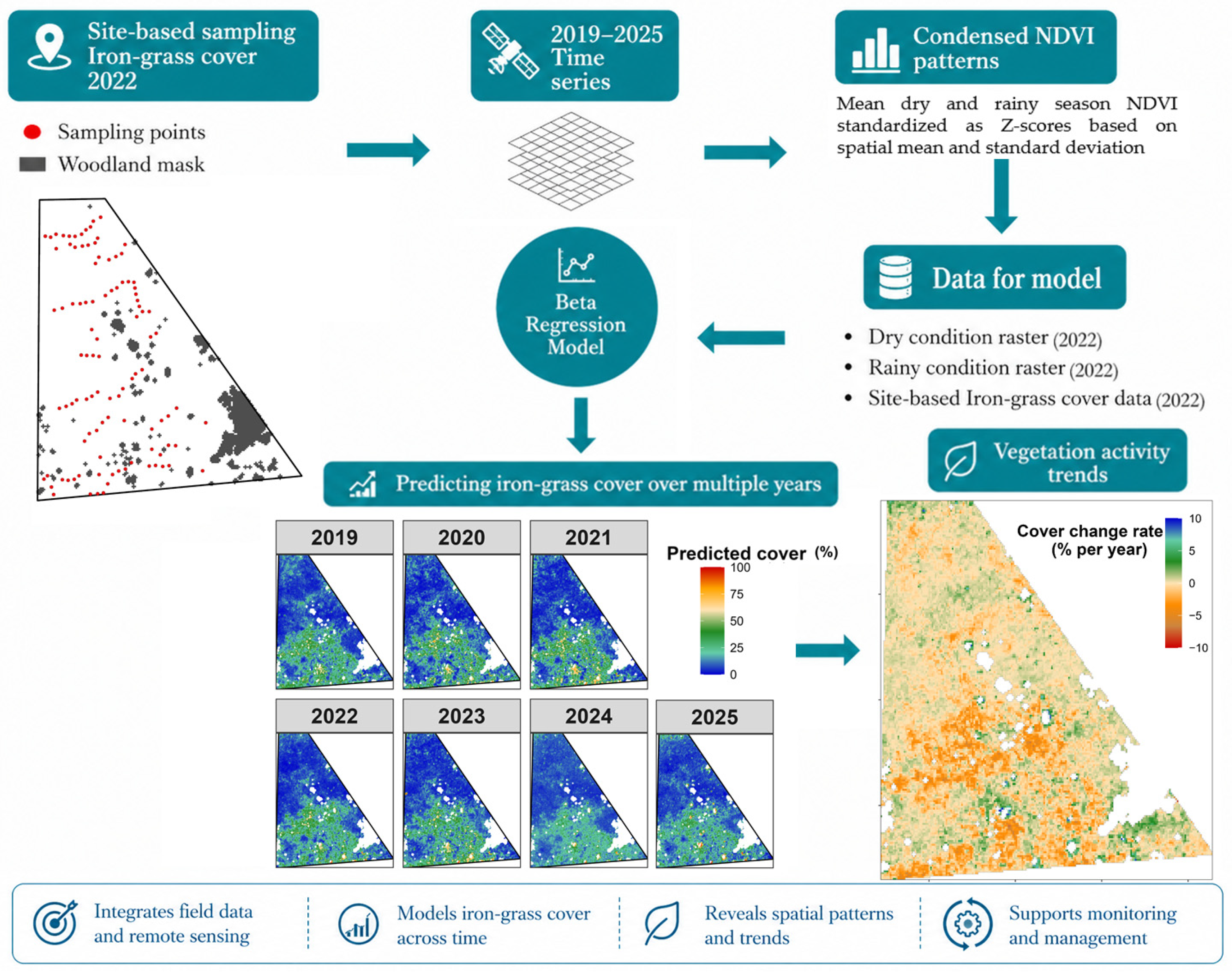
A flowchart summarizing the methods is presented in Figure 2. Alignment and icons in workflow labels were assisted by ChatGPT Images 2.0. Maps and figures were generated in RStudio Desktop.

3. Results

3.1. Patterns of NDVI and Iron-Grass Cover in Dry and Rainy Conditions

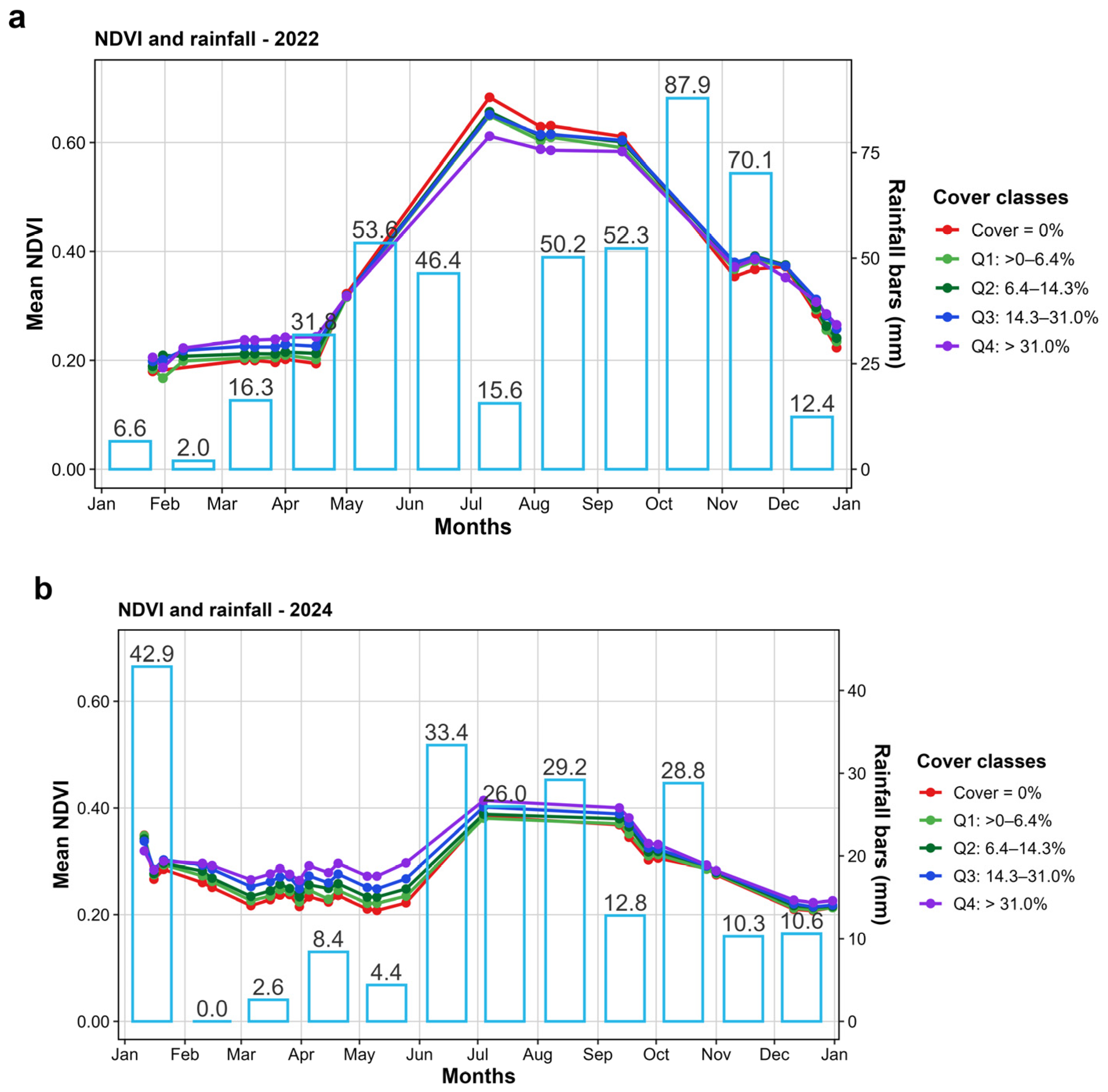
In order to assess how iron grass affects the relative differences in timing and magnitude of vegetation spectral response, the NDVI for different iron-grass cover classes was contrasted with rainfall obtained from Tailem Bend. From 2019 to 2025, NDVI differed consistently across dry and rainy seasons for different iron-grass classes. Despite variations, a positive relationship between NDVI and iron-grass cover was observed during dry conditions and a negative relationship during rainy conditions. The dry period provided a better separability of classes than the rainy period (Figure 3a,b). Iron-grass, as a perennial species, maintains a higher level of greenness during the dry season than annual grasses, like the invasive wild oats, that primarily grow during the rainy season [42]. The described pattern was present even in years with anomalous rainfall events during the first months of the year, which are usually part of the dry season. For example, 2019 presented high rainfall during January. Even though dry months could shift between years in composition and extension, dates with dry conditions presented better separability of classes. To portray these results, the years 2019 (Figure 3a) and 2025 (Figure 3b) were selected due to notable differences in rainfall patterns. NDVI time series for all years is presented in the Supplementary Material.
The overall NDVI obtained from sampling points showed correspondence with annual rainfall fluctuation (Table 3). Importantly, 2024 showed a broad reduction in NDVI relative to previous years, indicating a site-wide reduction in greenness. This community-level decline in NDVI was followed by only partial recovery in 2025.

3.2. Transferability of the Iron-Grass Cover Model

The beta regression models showed a strong predictive capability of iron-grass cover from the NDVI time series. The models showed a mean (n = 100) pseudo-R2 of 0.63 ± 0.02, revealing the dry and rainy datasets as positive and negative predictors, respectively. Model performance revealed similarities from 2019 to 2023, whereas RMSE slightly increased in 2024 and 2025 (Table 4), indicating a small reduction in transferability in those years.
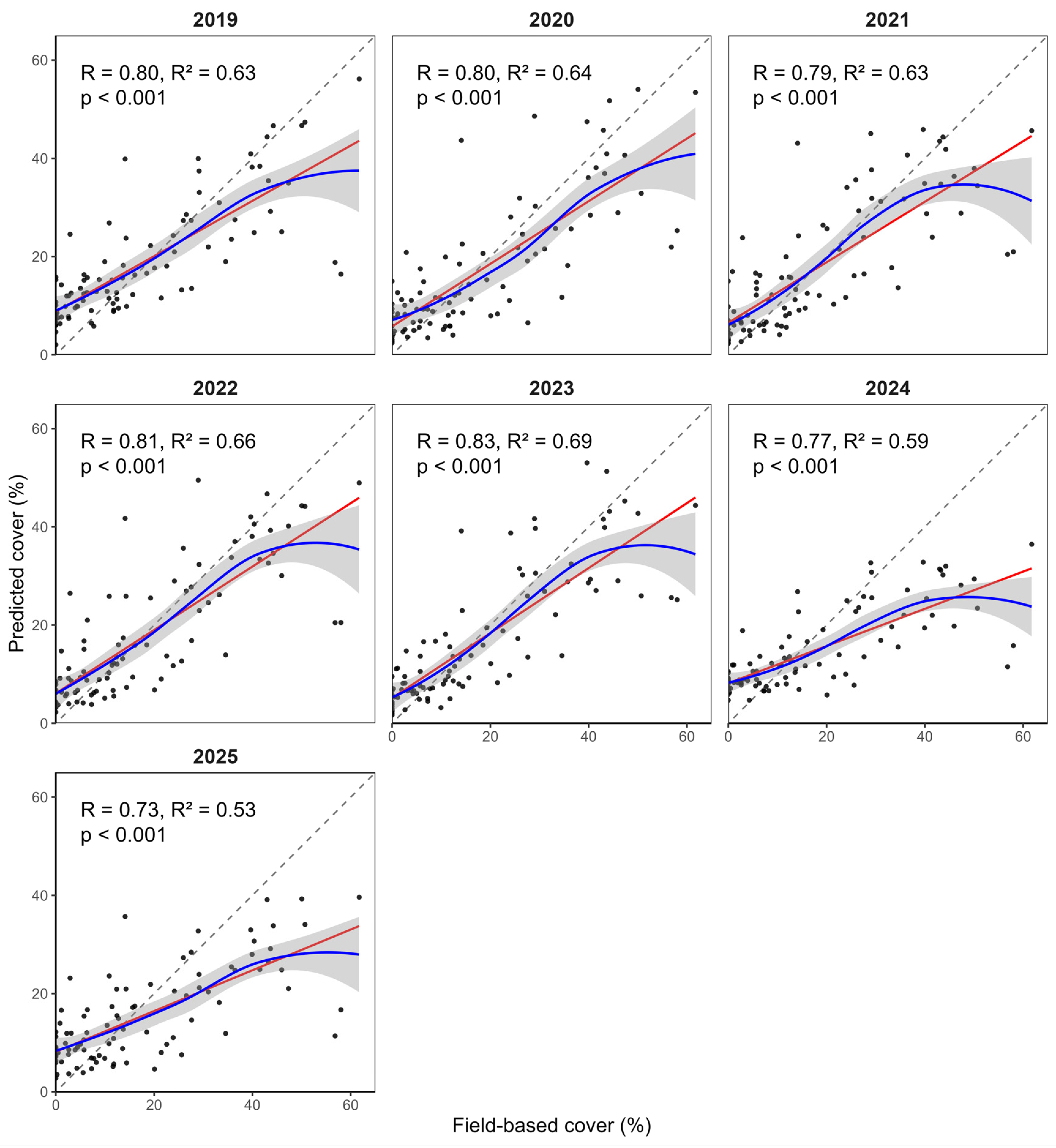
The site-based cover percentage data sampled in 2022 showed positive relationships with predicted iron-grass cover for all evaluated years (Figure 4). Coefficients of determination (R2) ranged from 0.53 to 0.69, indicating that the model explained a substantial proportion of the variation in field-based cover across years. The relationship between field-based and predicted cover was consistent across years, indicating that the model distinguished sites with lower and higher iron-grass cover. Predictions tracked field-based cover more closely at low to intermediate values, while greater variability was observed at high values. Model agreement was strongest between 2019 and 2023 (R2 = 0.63–0.69), while lower values were observed in the drier years 2024 and 2025 (R2 = 0.59 and 0.53, respectively), indicating reduced transferability. Nevertheless, the persistence of positive relationships across years is consistent with the expectation that the overall pattern of iron-grass cover remains similar over time, given the relative stability of iron-grass tussocks in the absence of major disturbance.
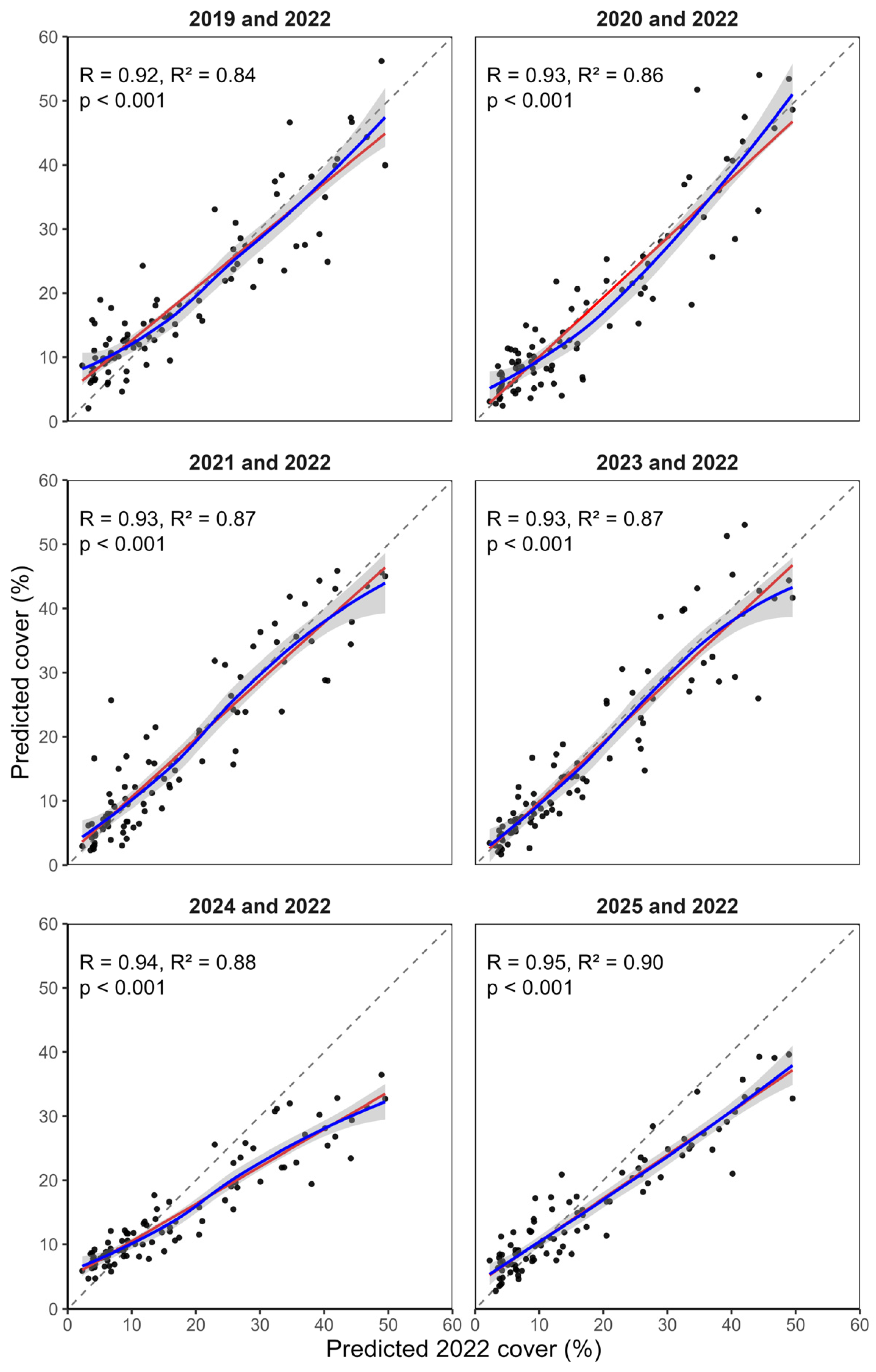
The iron-grass cover percentage predicted for 2022 showed a consistent relationship across years and covered a similar range of predicted values, although variability increased at high predicted cover values. The corresponding R2 values indicate that 84% to 90% of the variation in annual predictions was shared with the 2022 predictions, supporting similar spatial patterns of predicted cover among years (Figure 5).
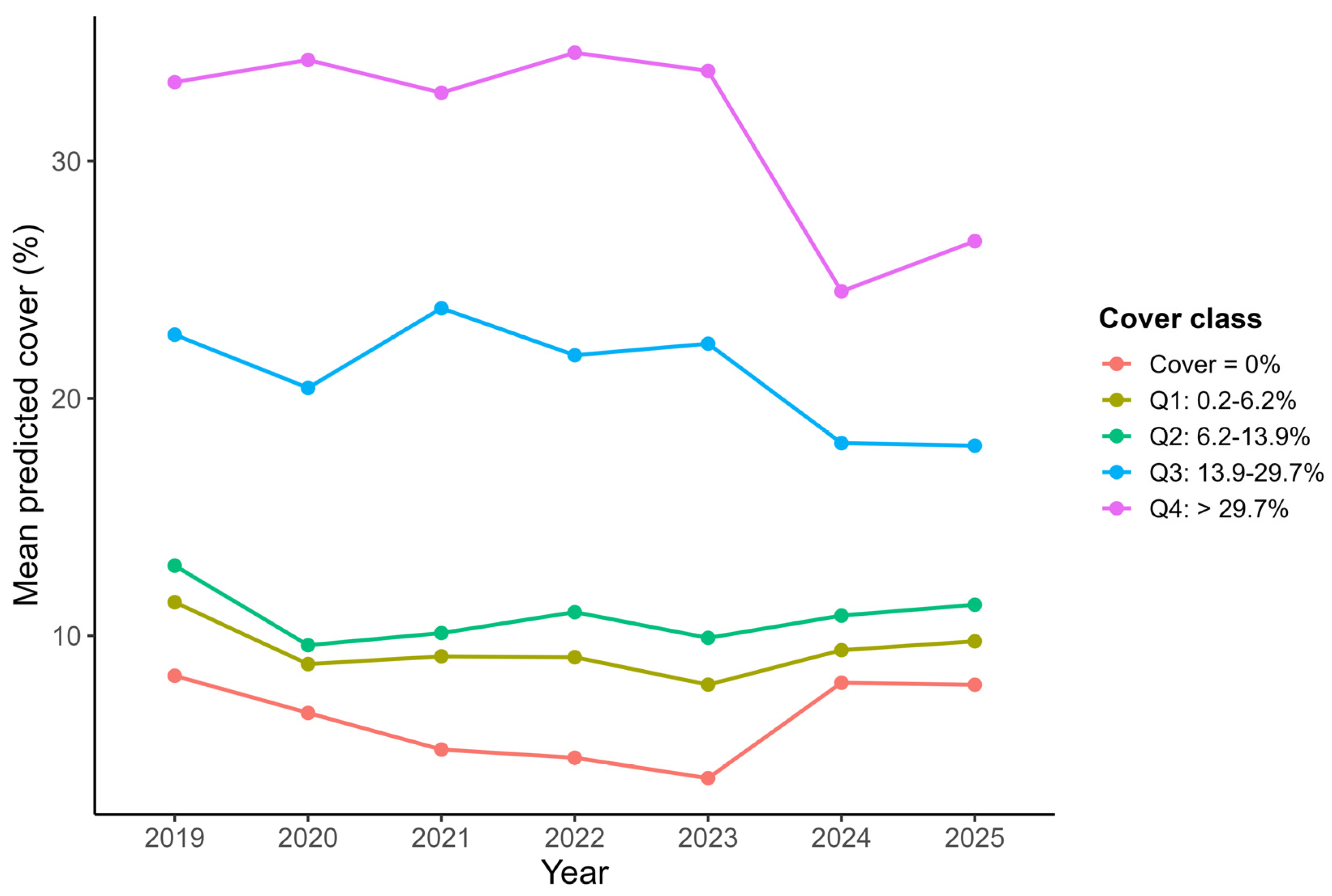
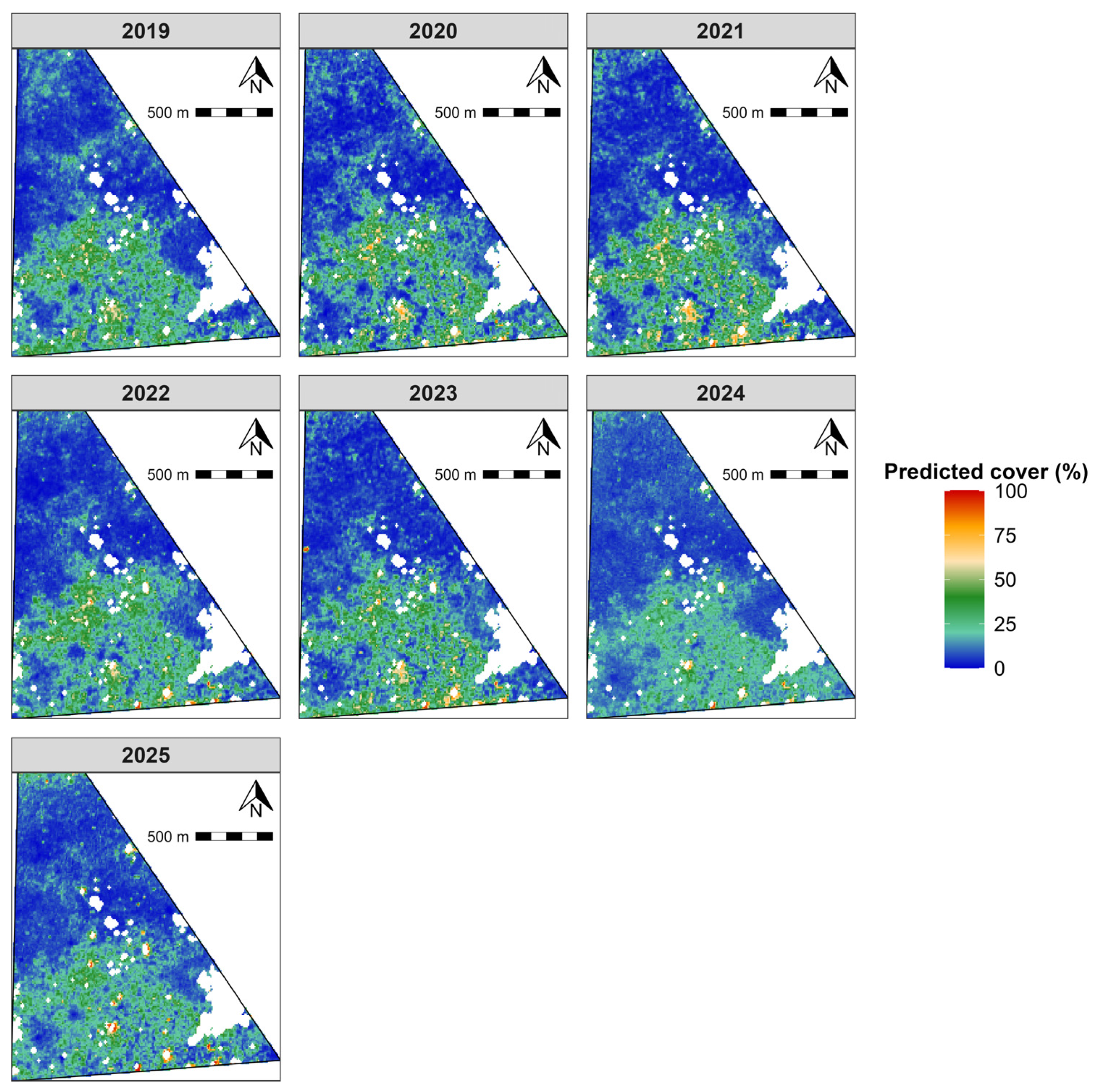
The distribution of the iron-grass cover percentage between 2019 and 2025 showed consistent patterns, revealing a persistent north–south gradient across the study area (Figure 6). The mid and north sections of the study area were dominated by low cover predictions (<25%), whereas higher cover values were repeatedly concentrated in the south. The distribution of moderate to high predicted cover (25–75%) was consistently observed across years at similar locations. Despite local year-to-year variation, the overall spatial pattern remained stable in time. However, in 2024 and 2025, cover predictions declined slightly, due to a decline in classes associated with Q3 and Q4, whereas the zero-cover class increased (Figure 7).

3.3. Vegetation Activity Trends

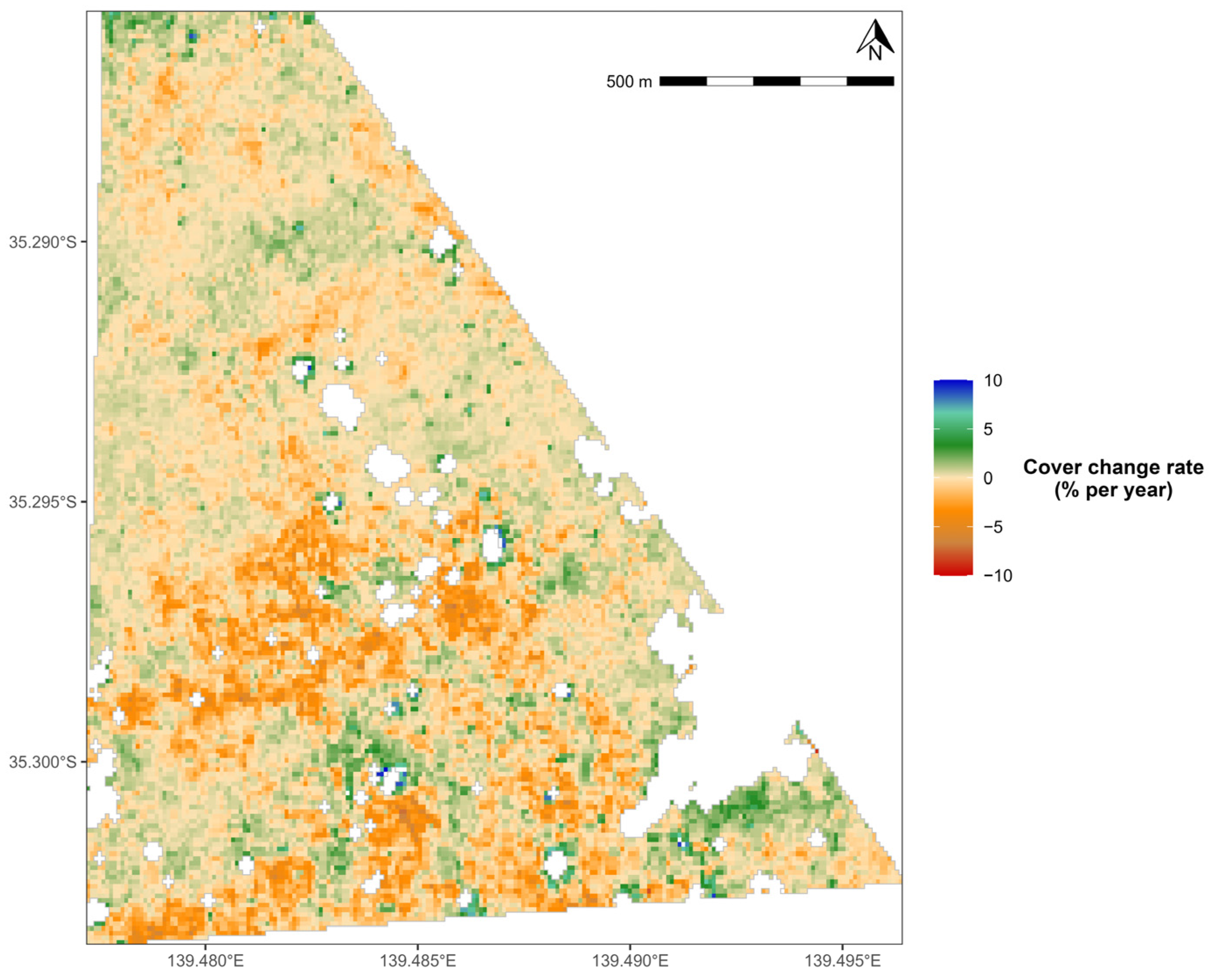
The model predictions between 2019 and 2025 showed small variability in the percentage change per year. Trend estimates derived from the 2019–2025 prediction time series were generally centered near zero across most of the study area, indicating limited temporal change in modeled iron-grass cover over the study period. Although variation was small, negative slopes were more common in the southern section of the study area (Figure 8).

4. Discussion

4.1. Seasonal NDVI Patterns and Model Transferability

This study presents an approach for monitoring the condition of natural grasslands from satellite imagery across multiple years. The results demonstrate that the cover proportion of a foundation perennial graminoid can be predicted from satellite time series, facilitating the quantitative assessment of mixed patches composed of native and invasive species. Importantly, the approach provides a quantitative indicator of the perennial vegetation signal within a pixel, facilitating the quantification of subtle changes in spatial patterns through time and supporting trend analysis.
A central strength of the approach was its ability to retain the seasonal ecological signal while reducing interannual variability in NDVI. The model is based on two rasters that condense the NDVI seasonality associated with the foundation species growth strategy. Partitioning the time series into dry and rainy datasets and standardizing the Z-scores enabled the synthesis of two concise rasters that summarized NDVI seasonal patterns. Because these datasets were defined by NDVI behavior rather than fixed monthly periods, the date selection was flexible and could shift with dry and rainy conditions. For instance, a January image could be assigned to the rainy dataset if its NDVI pattern was consistent with relatively wet conditions. These results demonstrated that this approach can be applied over time, preserving the seasonal spectral contrasts relevant to modeling, irrespective of rainfall pattern variability that might affect an NDVI time series.
The model demonstrated high transferability, predicting a consistent distribution of spatial cover patterns over time that aligns with iron-grass ecology. The similar RMSE across multiple years suggests that model performance can be maintained in successive years without the need to repeat site-based sampling. Although transferability weakened in the drier years 2024 and 2025, the consistently positive R2 values between predicted and field-based cover, and the agreement among year predictions, suggested that the overall pattern of iron-grass cover remained recognizable and consistent through time. These results were reflected in a consistent pattern in the distribution of iron-grass cover across the study site over multiple years. It should be noted that our assessment of model transferability focuses on consistency of predicted spatial cover patterns rather than the independent accuracy of annual cover estimates, because the absence of field-based data from other years prevents a full temporal accuracy assessment. Predictions revealed that the South section of the study area presented higher iron-grass cover than the North section. These results align with iron-grass’s slow growth and dispersal capacity [43] and with the study site’s history, which indicates that the South section is the most conserved [44]. Furthermore, the observed pattern is plausible if we consider that new individuals of iron-grass are more likely to originate from patches with more iron-grass cover and connectivity than from isolated patches with few iron-grass tussocks [45]. Therefore, the approach proves to be useful for monitoring and screening changes in the distribution of cover patterns, despite interannual variability in rainfall and NDVI.

4.2. Spatial Screening of Modeled Cover Change

The trend analysis showed spatially heterogeneous trajectories in predicted cover over time, which can serve as a screening tool to identify areas of potential change. As we have only 7 years of data, trend magnitudes may be unreliable; trend patterns, however, may indicate differences that can be assessed in the field. Even though the spatial patterns of predicted cover remain stable over time, the trend analysis showed that most of the areas with mid to high predictions in cover experience a decline (Figure 8). This result reflects the decrease in cover-prediction observed in the higher-cover classes in 2024 and 2025 (Figure 7). However, the trend analysis map shows that as some patches decline, others increase in the South section, while the majority of the mid- to North sections show negligible change. These results suggest that the trend pattern was not uniform, and not all areas with medium to high predicted cover showed the same trajectories. Since the linkage to the iron-grass cover in our approach is correlative, the reduction in NDVI standard deviation (Table 3) could have affected the model’s performance in the dry year 2024 by affecting other vegetation present in the study area. An effect that could have extended to 2025. Hence, screening for potential change has provided information on response variability across the study area and identified areas that require field inspection.

4.3. Relevance of Seasonal NDVI Condensation for Model Interpretation

The contrasting growth strategies of perennials and annuals were critical for interpreting the seasonality revealed in the NDVI time series. The approach utilizes the ecology of iron-grasses, which grow more slowly and maintain greenness more persistently through dry periods, whereas annual invasive species typically show a more rapid greenness response to rainfall. During the dry conditions, site-based data with iron-grass cover showed moderate NDVI values (0.2–0.4), consistent with Mediterranean grasslands during dry periods [46,47]. In contrast, locations dominated by wild oats exhibited NDVI values below or near 0.2, a range typical of bare soil [48,49]. Evergreen perennial species (mainly iron-grass in PRCP) account for most of the green biomass that persists during dry seasons. Thus, the absence of annuals during the dry condition dates facilitated the correlation between predictors and iron-grass cover, with the condensed dry raster as the strongest predictor.
During rainy conditions, iron-grass cover can be obscured by wild oats. Although perennial grasslands can show increases in NDVI during the rainy season [46,47], some site-based data increased to magnitudes reported for wild oats and other annual grasses, which can reach 0.75 [50,51]. This pattern may be due to the proliferation of wild oats in the study area, which can overgrow iron-grass tussocks and other grasses [52]. Furthermore, variability in wild oat biomass across the study area, driven by differences in soil composition and plant interactions, increases heterogeneity in vegetation cover, complicating the identification of NDVI patterns associated with perennials during rainy conditions. Hence, NDVI patterns during the rainy season were likely associated with increments in wild oat biomass, making it a negative predictor of iron-grass cover. Understanding NDVI patterns in patches free of invasive species may provide further insight into rainy-season NDVI dynamics.

4.4. Sources of Variability Affecting Model Performance

Several sources of spatiotemporal heterogeneity that obscure the NDVI response of iron-grasses affected the model’s performance. The spatial variability of soil characteristics and the temporal variability of rainfall profoundly affect grassland vegetation [53], producing high variability within 10 pixels. The proposed approach does not decompose these mixed pixels into spectral fractions. Rather, it presents an empirical estimate of cover, derived from the statistical relationship between field observations and seasonal NDVI patterns, that can be influenced by other factors within pixels. Tussock graminoids present high variability in their spatial distribution at fine-scale resource gradients [54]. Thus, the uneven distribution of iron-grasses could have affected the capacity to correlate NDVI values with site-based iron-grass cover. The variability in the biomass of annual plants could also have affected the NDVI time series by increasing the vegetation greenness during the dry season after summer rain episodes, leading to the overestimation of iron-grass cover. Furthermore, high-resource responding plants like wild oats could also have inflated NDVI values in specific patches.
Another source of variability related to the overestimation of iron-grass is the presence of evergreen vegetation different from iron-grass, which could have increased NDVI during the dry season. These include young pines, shrubs and other perennial graminoids distinct from iron-grass. The latter ones include native grasses like saw-sedge (Gahnia lanigera) and spear grass (Austrosptipa spp.), but also invasive perennials species like the Egyptian rose (Scabiosa atropurpurea) and horehound (Marrubium vulgare). For example, in 2023, we detected a high iron-grass cover prediction at the central section of the study site close to the roadside. This section was affected by a local increase in Egyptian rose cover. More importantly, it is noticeable that there are large magnitudes of positive trends in the proximity of the perennial vegetation mask. Examination of high-resolution imagery showed that these areas are affected by the growth of pine propagules rather than an increase in iron-grass. This demonstrates both strengths and weaknesses of the approach. The core strength of the approach is its ability to detect trends toward increased perennial growth strategies. But the prediction of iron-grass cover is correlative, not causal, and thus the interference of other perennial endmembers could affect the model. Masking out woodland with a layer based on high-resolution imagery, such as drone imagery, could prevent interference from propagule pines and other perennial plants. However, woodland cover may vary over time, requiring frequent updates. Another source of variability is exposed calcrete and bare soil that can decrease NDVI values, leading to the underestimation of iron-grass cover [55]. Further research in other temperate grasslands should incorporate other perennial graminoids into the analysis if their dominance is significant over the study area.

4.5. Management Relevance

This study presents a remote sensing approach employing continuous attributes of vegetation condition to monitor subtle changes in native grasslands associated with the cover of foundation perennial species. This approach can help characterize the condition of complex plant communities and the degree of degradation that natural grasslands suffer due to the expansion of invasive plants. By identifying relative spatial changes in vegetation condition, the approach can support spatial prioritization of management actions and guide field inspection toward areas of potential change. We demonstrate that this approach yields temporally consistent results, suggesting it can be transferred across years and contributing to the monitoring and management of native grassland condition. However, the approach is not restricted to the Mediterranean climate zone of our study area.
In general terms, our approach presents a quantitative indicator of the predominance of growth strategies within a pixel, which could be applied across several scenarios. Because the condensation of time series into seasonal layers is based on NDVI behavior rather than fixed calendar months, the method may help accommodate shifts in seasonal timing across years or regions. The approach may therefore have broader applicability to other climatic regimes, such as four-season cycles, provided that the target vegetation attribute produces a consistent seasonal spectral contrast relative to other vegetation components. Hence, the approach is potentially useful for a wide range of plant communities and climate zones, if the mixture of growth strategies is present and relevant to management. Nevertheless, the approach’s transferability to other land cover types may be reduced by factors that obscure seasonal signals, such as snow or canopy structure. Future applications should therefore include comprehensive knowledge of local vegetation and field-based data for calibration and validation when applying the approach beyond the study system. We encourage researchers to apply and test the approach in other ecosystems that present distinctive NDVI seasonality patterns between native and invasive vegetation or between other vegetation components relevant to management.

5. Conclusions

This study demonstrates the potential of Sentinel-2 time series to model the distribution of continuous plant community attributes over multiple years based on field data from a single year. We successfully modeled the distribution of a perennial foundation species in a grassland ecosystem affected by invasive annual grasses using an NDVI-based indicator of plant community growth strategy, contributing to the assessment of heterogeneous ecosystems threatened by invasive species. This addresses the significant challenge of monitoring degraded grasslands and provides a powerful management tool that enables continuous monitoring of vegetation condition within single pixels, including analysis of years preceding and following field data collection.
The results align well with the study area history and the ecology of iron-grass.
Key to this approach was leveraging the contrast between the growth properties of perennial and annual vegetation and condensing the NDVI time series to dry and rainy season maps. This enables the use of satellite imagery to monitor sub-pixel changes in vegetation cover over time without requiring annual site-based sampling for empirical model fitting, and irrespective of high rainfall variability across the study period.
Importantly, this approach can provide a monitoring tool for subtle changes in vegetation community attributes and consequent spatial mapping of trends across years or even decades at full pixel resolution of the imagery rather than summarizing proportions within zones. Specifically, the identification of trends in the cover of the foundation species is critical for managers to target field surveys in areas where satellite time series identify significant changes. Such information is needed to prioritize areas that may require management actions to support the conservation of temperate grasslands.

6. Patents

There are no patents resulting from this work. The GEE code used in the analysis is provided free of charge as supplementary material.

Supplementary Materials

The following supporting information can be downloaded at: https://www.mdpi.com/article/10.3390/rs18101515/s1.

Author Contributions

Conceptualization, D.R.G.-T., J.M.F. and B.O.; methodology, D.R.G.-T. and B.O.; software, D.R.G.-T. and B.O.; writing—original draft preparation, D.R.G.-T.; writing—review and editing, D.R.G.-T., J.M.F. and B.O. All authors have read and agreed to the published version of the manuscript.

Funding

This research received support for transportation to the study site from the Murraylands and Riverland Landscape Board from The Landscape Boards South Australia, as part of the grant “Increasing understanding of the dynamics of Iron-grass temperate grasslands to improve their management and conservation”.

Data Availability Statement

We have provided the shapefiles containing the field-based sampling data or iron-grass cover. The GEE code used in the analysis is provided free of charge as Supplementary Material.

Acknowledgments

We wish to thank Nicola Barnes and Kate Graham from the Murraylands and Riverland Landscape Board for their local knowledge and advice on the production of this manuscript. We are also grateful to Sami Rifai for his advice on Google Earth Engine procedures. Special thanks to all the volunteers who participated in the fieldwork. Transport to the study site was supported by the Murraylands and Riverland Landscape Board from The Landscape Boards South Australia, as part of the grant “Increasing understanding of the dynamics of Iron-grass temperate grasslands to improve their management and conservation.” We acknowledge the Ngarrindjeri people, Traditional Custodians of the land on which this study was conducted. This research was supported by a University of Adelaide International Postgraduate Scholarship Award. Parts of this document have been previously published as partial fulfillment of the requirements for Diego R. Guevara-Torres’s Doctor of Philosophy degree at the University of Adelaide.

Conflicts of Interest

The authors declare no conflicts of interest.

Abbreviations

The following abbreviations are used in this manuscript:
NDVINormalized difference vegetation index
EVI2Two-band enhanced vegetation index
MSAVIModified soil-adjusted vegetation index
SAVISoil-adjusted vegetation index
NDRENormalized difference red-edge index
CIREChlorophyll index red-edge
VIVegetation indices
RMSERoot-mean-squared error

References

  1. Veldman, J.W.; Buisson, E.; Durigan, G.; Fernandes, G.W.; Le Stradic, S.; Mahy, G.; Negreiros, D.; Overbeck, G.E.; Veldman, R.G.; Zaloumis, N.P.; et al. Toward an old-growth concept for grasslands, savannas, and woodlands. Front. Ecol. Environ. 2015, 13, 154–162. [Google Scholar] [CrossRef]
  2. Sala, O.E.; Paruelo, J.M. Ecosystem services in grasslands. In Nature’s Services: Societal Dependence on Natural Ecosystems; Island Press: Washington, SC, USA, 1997; pp. 237–251. [Google Scholar]
  3. Suttie, J.M.; Reynolds, S.G.; Batello, C. Grasslands of the World; Food & Agriculture Org.: Rome, Italy, 2005; Volume 34. [Google Scholar]
  4. Hautier, Y.; Tilman, D.; Isbell, F.; Seabloom, E.W.; Borer, E.T.; Reich, P.B. Anthropogenic environmental changes affect ecosystem stability via biodiversity. Science 2015, 348, 336–340. [Google Scholar] [CrossRef]
  5. Dukes, J.S. Biodiversity and invasibility in grassland microcosms. Oecologia 2001, 126, 563–568. [Google Scholar] [CrossRef] [PubMed]
  6. Lawley, V.; Lewis, M.; Clarke, K.; Ostendorf, B. Site-based and remote sensing methods for monitoring indicators of vegetation condition: An Australian review. Ecol. Indic. 2016, 60, 1273–1283. [Google Scholar] [CrossRef]
  7. Tehrany, M.S.; Kumar, L.; Drielsma, M.J. Review of native vegetation condition assessment concepts, methods and future trends. J. Nat. Conserv. 2017, 40, 12–23. [Google Scholar] [CrossRef]
  8. Wang, Z.B.; Ma, Y.K.; Zhang, Y.N.; Shang, J.L. Review of Remote Sensing Applications in Grassland Monitoring. Remote Sens. 2022, 14, 2903. [Google Scholar] [CrossRef]
  9. Ostendorf, B. Overview: Spatial information and indicators for sustainable management of natural resources. Ecol. Indic. 2011, 11, 97–102. [Google Scholar] [CrossRef]
  10. Gibbons, P.; Freudenberger, D. An overview of methods used to assess vegetation condition at the scale of the site. Ecol. Manag. Restor. 2006, 7, S10–S17. [Google Scholar] [CrossRef]
  11. Dudney, J.; Hallett, L.M.; Larios, L.; Farrer, E.C.; Spotswood, E.N.; Stein, C.; Suding, K.N. Lagging behind: Have we overlooked previous-year rainfall effects in annual grasslands? J. Ecol. 2017, 105, 484–495. [Google Scholar] [CrossRef]
  12. Imran, H.A.; Gianelle, D.; Rocchini, D.; Dalponte, M.; Martin, M.P.; Sakowska, K.; Wohlfahrt, G.; Vescovo, L. VIS-NIR, Red-Edge and NIR-Shoulder Based Normalized Vegetation Indices Response to Co-Varying Leaf and Canopy Structural Traits in Heterogeneous Grasslands. Remote Sens. 2020, 12, 2254. [Google Scholar] [CrossRef]
  13. Xu, D.D.; Guo, X.L. Some Insights on Grassland Health Assessment Based on Remote Sensing. Sensors 2015, 15, 3070–3089. [Google Scholar] [CrossRef] [PubMed]
  14. Muro, J.; Linstadter, A.; Magdon, P.; Wollauer, S.; Manner, F.A.; Schwarz, L.M.; Ghazaryan, G.; Schultz, J.; Malenovsky, Z.; Dubovyk, O. Predicting plant biomass and species richness in temperate grasslands across regions, time, and land management with remote sensing and deep learning. Remote Sens. Environ. 2022, 282, 113262. [Google Scholar] [CrossRef]
  15. Rapinel, S.; Mony, C.; Lecoq, L.; Clement, B.; Thomas, A.; Hubert-Moy, L. Evaluation of Sentinel-2 time-series for mapping floodplain grassland plant communities. Remote Sens. Environ. 2019, 223, 115–129. [Google Scholar] [CrossRef]
  16. Lechner, A.M.; Foody, G.M.; Boyd, D.S. Applications in Remote Sensing to Forest Ecology and Management. One Earth 2020, 2, 405–412. [Google Scholar] [CrossRef]
  17. Shoko, C.; Mutanga, O. Examining the strength of the newly-launched Sentinel 2 MSI sensor in detecting and discriminating subtle differences between C3 and C4 grass species. ISPRS J. Photogramm. Remote Sens. 2017, 129, 32–40. [Google Scholar] [CrossRef]
  18. Vaz, A.S.; Alcaraz-Segura, D.; Campos, J.C.; Vicente, J.R.; Honrado, J.P. Managing plant invasions through the lens of remote sensing: A review of progress and the way forward. Sci. Total Environ. 2018, 642, 1328–1339. [Google Scholar] [CrossRef]
  19. Wang, Y.F.; Xue, Z.H.; Chen, J.; Chen, G.Z. Spatio-temporal analysis of phenology in Yangtze River Delta based on MODIS NDVI time series from 2001 to 2015. Front. Earth Sci. 2019, 13, 92–110. [Google Scholar] [CrossRef]
  20. Fauvel, M.; Lopes, M.; Dubo, T.; Rivers-Moore, J.; Frison, P.L.; Gross, N.; Ouin, A. Prediction of plant diversity in grasslands using Sentinel-1 and-2 satellite image time series. Remote Sens. Environ. 2020, 237, 111536. [Google Scholar] [CrossRef]
  21. Blomqvist, M.M.; Olff, H.; Blaauw, M.B.; Bongers, T.; van der Putten, W.H. Interactions between above- and belowground biota: Importance for small-scale vegetation mosaics in a grassland ecosystem. Oikos 2000, 90, 582–598. [Google Scholar] [CrossRef]
  22. Bond, W.J.; Parr, C.L. Beyond the forest edge: Ecology, diversity and conservation of the grassy biomes. Biol. Conserv. 2010, 143, 2395–2404. [Google Scholar] [CrossRef]
  23. Macintyre, P.; van Niekerk, A.; Mucina, L. Efficacy of multi-season Sentinel-2 imagery for compositional vegetation classification. Int. J. Appl. Earth Obs. Geoinf. 2020, 85, 101980. [Google Scholar] [CrossRef]
  24. Pearson, D.E.; Ortega, Y.K.; Villarreal, D.; Lekberg, Y.; Cock, M.C.; Eren, O.; Hierro, J.L. The fluctuating resource hypothesis explains invasibility, but not exotic advantage following disturbance. Ecology 2018, 99, 1296–1305. [Google Scholar] [CrossRef] [PubMed]
  25. Strahler, A.H.; Woodcock, C.E.; Smith, J.A. On the Nature of Models in Remote-Sensing. Remote Sens. Environ. 1986, 20, 121–139. [Google Scholar] [CrossRef]
  26. Karl, J.W.; McCord, S.E.; Hadley, B.C. A comparison of cover calculation techniques for relating point-intercept vegetation sampling to remote sensing imagery. Ecol. Indic. 2017, 73, 156–165. [Google Scholar] [CrossRef]
  27. Eldridge, D.J.; Bowker, M.A.; Maestre, F.T.; Alonso, P.; Mau, R.L.; Papadopoulos, J.; Escudero, A. Interactive Effects of Three Ecosystem Engineers on Infiltration in a Semi-Arid Mediterranean Grassland. Ecosystems 2010, 13, 499–510. [Google Scholar] [CrossRef]
  28. Angelini, C.; Altieri, A.H.; Silliman, B.R.; Bertness, M.D. Interactions among Foundation Species and Their Consequences for Community Organization, Biodiversity, and Conservation. Bioscience 2011, 61, 782–789. [Google Scholar] [CrossRef]
  29. Elumeeva, T.G.; Onipchenko, V.G.; Werger, M.J.A. No other species can replace them: Evidence for the key role of dominants in an alpine Festuca varia grassland. J. Veg. Sci. 2017, 28, 674–683. [Google Scholar] [CrossRef]
  30. Ellison, A.M.; Degrassi, A.L. All species are important, but some species are more important than others. J. Veg. Sci. 2017, 28, 669–671. [Google Scholar] [CrossRef]
  31. Paruelo, J.M.; Texeira, M.; Staiano, L.; Mastrángelo, M.; Amdan, L.; Gallego, F. An integrative index of Ecosystem Services provision based on remotely sensed data. Ecol. Indic. 2016, 71, 145–154. [Google Scholar] [CrossRef]
  32. Williams, N.S.; Morgan, J.W. The native temperate grasslands of south-eastern Australia. In Land of Sweeping Plains: Managing and Restoring the Native Grasslands of South-Eastern Australia; CSIRO Publishing: Melbourne, Australia, 2015; pp. 27–59. [Google Scholar]
  33. Hallett, C.S.; Hobday, A.J.; Tweedley, J.R.; Thompson, P.A.; McMahon, K.; Valesini, F.J. Observed and predicted impacts of climate change on the estuaries of south-western Australia, a Mediterranean climate region. Reg. Environ. Change 2018, 18, 1357–1373. [Google Scholar] [CrossRef]
  34. Misra, G.; Cawkwell, F.; Wingler, A. Status of Phenological Research Using Sentinel-2 Data: A Review. Remote Sens. 2020, 12, 2760. [Google Scholar] [CrossRef]
  35. Delegido, J.; Verrelst, J.; Alonso, L.; Moreno, J. Evaluation of Sentinel-2 Red-Edge Bands for Empirical Estimation of Green LAI and Chlorophyll Content. Sensors 2011, 11, 7063–7081. [Google Scholar] [CrossRef]
  36. Guevara-Torres, D.R.; Facelli, J.M.; Ostendorf, B. Efficacy of Multiseason Sentinel-2 Imagery for Classifying and Mapping Grassland Condition. J. Sens. 2024, 2024, 6668228. [Google Scholar] [CrossRef]
  37. Cribari-Neto, F.; Zeileis, A. Beta Regression in R. J. Stat. Softw. 2010, 34, 1–24. [Google Scholar] [CrossRef]
  38. Bonham, C.D. Measurements for Terrestrial Vegetation; John Wiley & Sons: Hoboken, NJ, USA, 2013. [Google Scholar]
  39. Espinheira, P.L.; Ferrari, S.L.; Cribari-Neto, F. Bootstrap prediction intervals in beta regressions. Comput. Stat. 2014, 29, 1263–1277. [Google Scholar] [CrossRef]
  40. Siegel, A.F. Robust Regression Using Repeated Medians. Biometrika 1982, 69, 242–244. [Google Scholar] [CrossRef]
  41. Komsta, L.; Komsta, M.L. Package ‘mblm’. 2013. Available online: https://cran.r-project.org/web/packages/mblm/index.html (accessed on 28 November 2025).
  42. Huenneke, L.F.; Mooney, H.A. Grassland Structure and Function: California Annual Grassland; Springer Science & Business Media: Dordrecht, The Netherlands, 2012; Volume 20. [Google Scholar]
  43. Williams, N.; Marshall, A.; Morgan, J. Land of Sweeping Plains: Managing and Restoring the Native Grasslands of South-Eastern Australia; CSIRO Publishing: Melbourne, Australia, 2015. [Google Scholar]
  44. Clarke, J. Grassland Management at Poonthie Ruwe; South Australian Murray-Darling Basin Natural Resources Management Board: Burra, Australia, 2013. [Google Scholar]
  45. Alados, C.L.; Navarro, T.; Komac, B.; Pascual, V.; Rietkerk, M. Dispersal abilities and spatial patterns in fragmented landscapes. Biol. J. Linn. Soc. 2010, 100, 935–947. [Google Scholar] [CrossRef]
  46. Bart, R.R.; Tague, C.L.; Dennison, P.E. Modeling annual grassland phenology along the central coast of California. Ecosphere 2017, 8, e01875. [Google Scholar] [CrossRef]
  47. Milazzo, F.; Brocca, L.; Vanwalleghem, T. NDVI prediction of Mediterranean permanent grasslands using soil moisture products. Agronomy 2024, 14, 1798. [Google Scholar] [CrossRef]
  48. Essaadia, A.; Abdellah, A.; Ahmed, A.; Abdelouahed, F.; Kamal, E. The normalized difference vegetation index (NDVI) of the Zat Valley, Marrakech: Comparison and dynamics. Heliyon 2022, 8, e12092. [Google Scholar] [CrossRef]
  49. Žížala, D.; Minařík, R.; Zádorová, T. Soil organic carbon mapping using multispectral remote sensing data: Prediction ability of data with different spatial and spectral resolutions. Remote Sens. 2019, 11, 2947. [Google Scholar] [CrossRef]
  50. Lopez-Granados, F.; Jurado-Exposito, M.; Pena-Barragan, J.M.; Garcia-Torres, L. Using remote sensing for identification of late-season grass weed patches in wheat. Weed Sci. 2006, 54, 346–353. [Google Scholar] [CrossRef]
  51. Castillejo-Gonzalez, I.L.; Pena-Barragan, J.M.; Jurado-Exposito, M.; Mesas-Carrascosa, F.J.; Lopez-Granados, F. Evaluation of pixel- and object-based approaches for mapping wild oat (Avena sterilis) weed patches in wheat fields using Quick Bird imagery for site-specific management. Eur. J. Agron. 2014, 59, 57–66. [Google Scholar] [CrossRef]
  52. Lenz, T.I.; Moyle-Croft, J.L.; Facelli, J.M. Direct and indirect effects of exotic annual grasses on species composition of a South Australian grassland. Austral Ecol. 2003, 28, 23–32. [Google Scholar] [CrossRef]
  53. Harrison, S.; Spasojevic, M.J.; Li, D.J. Climate and plant community diversity in space and time. Proc. Natl. Acad. Sci. USA 2020, 117, 4464–4470. [Google Scholar] [CrossRef]
  54. Dickinson, Y.; Norton, D.A. Divergent small-scale spatial patterns in New Zealand’s short tussock grasslands. N. Z. J. Ecol. 2011, 35, 76–82. [Google Scholar]
  55. Montandon, L.M.; Small, E.E. The impact of soil reflectance on the quantification of the green vegetation fraction from NDVI. Remote Sens. Environ. 2008, 112, 1835–1845. [Google Scholar] [CrossRef]
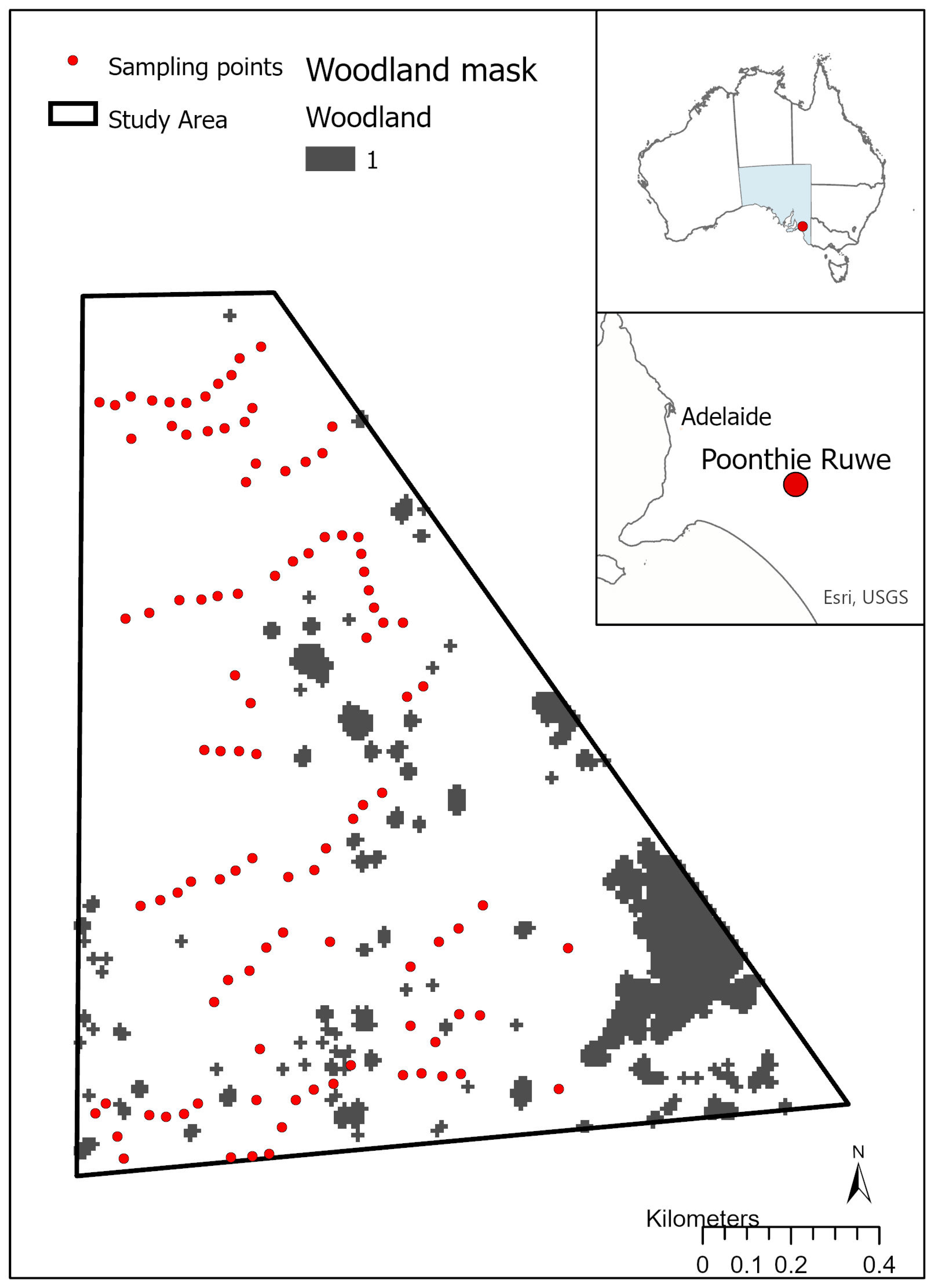
Figure 1. Poonthie Ruwe Conservation Park location (35.295°S, 139.485°) and sampling points in red, with woodland mask in gray.
Remotesensing 18 01515 g001
Figure 2. Flowchart showing data acquisition, condensation of NDVI patterns and modeling used in this study.
Remotesensing 18 01515 g002
Figure 3. Sentinel-2 cloud-filtered NDVI time series for 2019 (a) and 2024 (b) at field observation sites grouped by iron-grass cover quartiles with monthly rainfall (mm).
Remotesensing 18 01515 g003
Figure 4. Correlations between field observation of iron-grass cover percentage sampled in 2022 with predicted iron-grass from NDVI from 2019 to 2025. The 1:1 line of perfect agreement is shown as a dotted line. The red solid line represents the linear regression fit, while the blue solid line shows the smoothed relationship across the data; the grey band indicates the associated confidence interval.
Remotesensing 18 01515 g004
Figure 5. Correlations between the iron-grass cover percentage predicted for 2022 and the cover percentage predicted at the other years between 2019 and 2025. The 1:1 line of perfect agreement is shown as a dotted line. The red solid line represents the linear regression fit, while the blue solid line shows the smoothed relationship across the data; the grey band indicates the associated confidence interval.
Remotesensing 18 01515 g005
Figure 6. Iron-grass cover predictions from 2019 to 2025.
Remotesensing 18 01515 g006
Figure 7. Mean predicted cover from 2019 to 2025 at field observation sites grouped by iron-grass cover quartiles.
Remotesensing 18 01515 g007
Figure 8. Trend of iron-grass cover (percent per year) from 2019 to 2025.
Remotesensing 18 01515 g008
Table 1. List of vegetation indices used in random forest classifications.
Time SeriesRMSE
NDVI(NIR − R)/(NIR + R)
EVI22.5 · (NIR − R)/(NIR + 2.4 · R + 1.0)
SAVI[(NIR − Red)/(NIR + Red + L)] × (1 + L), L = 0.5
MSAVI[2 × NIR + 1 − √((2 × NIR + 1)2 − 8 × (NIR − Red))]/2
NDRE(NIR − red-edge-1)/(NIR + ed-edge-1)
CIRENIR/red-edge-1
Table 2. Screening results of vegetation-index beta-regression models (40 repetitions × 10 folds).
FormulaPixel ResolutionPseudo-R2RMSE (Scaled)
Cover ~ Z_NDVI_dry + Z_NDVI_rainy10 m0.61 ± 0.020.09 ± 0.03
Cover ~ Z_SAVI_dry + Z_SAVI_rainy10 m0.58 ± 0.020.10 ± 0.02
Cover ~ Z_EVI2_dry + Z_EVI2_rainy10 m0.58 ± 0.020.10 ± 0.02
Cover ~ Z_MSAVI_dry + Z_MSAVI_rainy10 m0.57 ± 0.020.10 ± 0.02
Cover ~ Z_NDRE_dry + Z_NDRE_rainy20 m0.43 ± 0.020.12 ± 0.03
Cover ~ Z_CIre_dry + Z_CIre_rainy20 m0.43 ± 0.020.12 ± 0.03
Table 3. Annual rainfall (mm) from the Tailem Bend weather station and overall NDVI in the study site from 2019 to 2025.
YearRainfall (mm)Overall NDVI
20192660.32 ± 0.13
2020374.90.38 ± 0.18
2021322.40.32 ± 0.14
2022445.20.33 ± 0.16
2023427.70.34 ± 0.14
2024209.40.27 ± 0.05
2025266.90.30 ± 0.11
Table 4. Performance of the trained model in terms of root mean square error (RMSE) ± standard deviation across 2019 to 2025.
Time SeriesRMSE
20199.90% ± 3.41%
20209.85% ± 3.08%
20219.88% ± 3.19%
20229.48% ± 3.43%
20239.17% ± 2.85%
202411.50% ± 3.30%
202511.50% ± 3.37%
Disclaimer/Publisher’s Note: The statements, opinions and data contained in all publications are solely those of the individual author(s) and contributor(s) and not of MDPI and/or the editor(s). MDPI and/or the editor(s) disclaim responsibility for any injury to people or property resulting from any ideas, methods, instructions or products referred to in the content.