Article

DualMambaFormer: A Parallel Hybrid Transformer–Mamba Network for Hyperspectral Image Classification


1
China Three Gorges Construction Engineering Corporation, Chengdu 610041, China
2
Changjiang River Scientific Research Institute, Changjiang Water Resources Committee, Wuhan 430010, China
3
School of Geosciences, Yangtze University, Wuhan 430100, China
4
Hubei Engineering Research Center of Unconventional Petroleum Geology and Engineering, Wuhan 430100, China
*
Author to whom correspondence should be addressed.
Remote Sens. 2026, 18(10), 1516; https://doi.org/10.3390/rs18101516
Submission received: 25 March 2026 / Revised: 3 May 2026 / Accepted: 9 May 2026 / Published: 11 May 2026

Highlights

What are the main findings?
  • A novel parallel hybrid network, DualMambaFormer, was developed, demonstrating superior classification performance over state-of-the-art CNN, Transformer, and Mamba models across four benchmark datasets.
  • The proposed dual-stream encoder successfully integrates Multi-Head Self-Attention and a Local Enhanced Mamba (LEM) module, enabling the synchronous extraction of global spatial correlations and local dynamic sequences without incurring quadratic computational complexity.
What are the implications of the main findings?
  • The empirical success of the proposed “global–sequence–local” modeling paradigm demonstrates that the proposed dual-stream encoder combines MHSA and LEM to capture complementary global correlations, sequential dependencies, and local spatial context within a unified framework. This architectural shift provides a robust, scalable foundation for future multi-modal fusion and real-time edge deployment tasks in Earth observation.
  • The study establishes a critical design principle for adapting sequence models to non-causal 2D spatial data: while State Space Models ensure linear complexity spectral processing, their integration with explicit local spatial operations is indispensable for preserving fine-grained morphological boundaries and complex land-cover textures.

Abstract
Hyperspectral image classification (HSIC) plays a crucial role in fine-grained Earth observation tasks. However, balancing efficient long-range dependency modeling with the extraction of fine-grained local features remains a significant challenge, primarily due to the inherent high-dimensional spectral redundancy and complex spatial variability of hyperspectral data. Existing modeling paradigms exhibit distinct limitations: Convolutional Neural Networks (CNNs) are constrained by localized receptive fields, while Vision Transformers (ViTs), despite their global receptive capabilities, incur prohibitive quadratic computational complexity. Meanwhile, the emerging Mamba architecture has demonstrated remarkable effectiveness in sequence modeling with linear complexity, but it often lacks sufficient sensitivity to local textures when directly applied to non-causal 2D images. To address these limitations, this paper proposes a novel parallel hybrid architecture termed DualMambaFormer. Deviating from the traditional serial stacking paradigm, the proposed network utilizes a dual-stream design to achieve the complementary fusion of global static attention and dynamic sequence reasoning. Specifically, the model first employs an SS-ResNet for spectral dimensionality reduction and local feature embedding. Subsequently, the architecture bifurcates into a parallel encoding stage: one branch leverages Multi-Head Self-Attention (MHSA) to capture global spatial correlations, while the other introduces a Local Enhanced Mamba (LEM) branch. By integrating State Space Models (SSM) with depthwise separable convolutions, the LEM branch simultaneously captures long-range causal dependencies and local spatial context. Finally, a dual class token fusion strategy is designed to integrate heterogeneous representations at the decision level. Extensive experiments on four benchmark datasets—Indian Pines, Pavia University, Salinas, and WHU-HongHu—show that DualMambaFormer achieves OA values of 96.56%, 98.95%, 97.60%, and 96.09%, respectively, with consistently high AA and Kappa coefficients. These results demonstrate the effectiveness, robustness, and generalization capability of the proposed method for hyperspectral image classification. Compared with the second-best competing methods, DualMambaFormer improves OA by 5.55, 2.30, 1.68, and 4.30 percentage points on the Pavia University, Indian Pines, Salinas, and WHU-HongHu datasets, respectively.

Graphical Abstract

1. Introduction

Hyperspectral imaging (HSI) has emerged as a foundational technology in remote sensing. By integrating spectroscopy with imaging, HSI captures fine-grained spectral signatures across continuous, narrow bands, thereby enabling precise Earth observation [1,2,3]. This capability has led to its widespread adoption in domains such as environmental monitoring [4,5], urban planning [6,7], and precision agriculture [8,9,10,11]. However, while this spectral richness significantly enhances discriminative potential, it introduces substantial computational and methodological challenges, particularly concerning the curse of dimensionality and the need for effective joint spectral–spatial feature extraction [12].
Prior to the deep learning era, HSI classification was dominated by statistical learning theories and shallow machine learning approaches. Early research prioritized the exploitation of high spectral resolution, employing discriminative classifiers for pixel-wise identification. Support vector machines (SVMs) emerged as a benchmark during this period due to their robustness in handling high-dimensional, small-sample data. Concurrently, algorithms such as random forest (RF) and multinomial logistic regression (MLR) demonstrated efficacy in modeling complex spectral distributions via kernel functions and nonlinear mapping [13,14,15]. To mitigate spectral redundancy, dimensionality reduction techniques like principal component analysis (PCA) and linear discriminant analysis (LDA) were frequently employed to construct robust feature representations within lower-dimensional subspaces [16,17].
Although traditional methods prove effective under controlled conditions, they reveal fundamental limitations when applied to the complexities of modern remote sensing tasks. First, their reliance on handcrafted feature engineering inherently restricts model performance; the discriminative power is largely bounded by human prior knowledge rather than the intrinsic patterns of the data. Second, shallow architectures suffer from inadequate representation capacity when attempting to fit high-dimensional, highly non-linear HSI data. Furthermore, given the practical constraint of limited annotated samples, these models are particularly vulnerable to the Hughes phenomenon, leading to a degradation in classification accuracy as the feature space expands [18,19].
Recent advances in deep spectral–spatial representation learning for hyperspectral image classification have mainly evolved along three representative directions: convolutional architectures, self-attention-based global modeling frameworks, and selective state space models. CNNs provide strong local inductive biases, Transformers capture global pairwise correlations, and Mamba-based SSMs offer efficient long-range sequence modeling. However, these modeling paradigms emphasize different aspects of hyperspectral data and directly coupling them in a single path may limit the independent preservation of their branch-specific representations. Motivated by this observation, we adopt a parallel heterogeneous design in which MHSA and LEM process the same tokenized sequence from complementary perspectives. This design allows global spatial correlation modeling, sequential dependency modeling, and local spatial enhancement to be preserved before decision-level fusion.
This study proposes a parallel hybrid Transformer–Mamba network, termed DualMambaFormer, for hyperspectral image classification. The proposed framework is motivated by the complementary characteristics of MHSA and LEM: MHSA captures global pairwise spatial correlations, whereas LEM models long-range sequential dependencies and local spatial continuity. By processing the same tokenized sequence through these two branches and fusing their class tokens at the decision level, the framework aims to preserve complementary spectral–spatial representations for accurate land-cover classification. The main contributions of this paper are listed as follows:
  • We propose a parallel hybrid architecture, termed DualMambaFormer, for hyperspectral image classification. The framework adopts a dual-stream paradigm to jointly model global spatial dependencies and dynamic sequential characteristics, thereby enhancing the representation of complex spectral–spatial information.
  • A Spectral–spatial Residual Network and a Local Enhanced Mamba (LEM) branch are further introduced to strengthen feature extraction. Specifically, the SS-ResNet reduces spectral redundancy while enhancing local feature embedding, and the LEM branch integrates state space modeling with depthwise convolution to capture both long-range dependencies and fine-grained local textures, effectively alleviating the loss of spatial continuity caused by flattening 2D images into 1D sequences.
  • Extensive experiments conducted on four benchmark hyperspectral datasets demonstrate the effectiveness of the proposed method. The results show that DualMambaFormer consistently outperforms representative convolutional, self-attention-based, and state-space-based methods, highlighting its strong classification accuracy, robustness, and generalization capability.
The remainder of this article is organized as follows: Section 2 reviews related work. Section 3 details the proposed DualMambaFormer methodology. Section 4 presents the experimental results and analyses, and Section 5 concludes the paper.

2. Related Work

This section reviews the three foundational learning paradigms that have propelled the advancement of hyperspectral image (HSI) classification: convolutional neural networks (CNNs), vision transformers (ViTs), and the emerging Mamba architecture rooted in state space models (SSMs).

2.1. CNN-Based Hyperspectral Classification

As the pioneering deep learning paradigm in remote sensing, Convolutional Neural Networks (CNNs) have demonstrated exceptional efficacy in extracting spatial textures and local spectral signatures through weight-sharing mechanisms and local receptive fields. Early studies predominantly focused on single-domain feature extraction. For instance, Hu et al. [20] proposed a deep 1D convolutional neural network specifically tailored for the spectral domain, while Chen et al. [21] utilized 2D-CNNs combined with dimensionality reduction techniques to extract spatial morphological patterns. To better accommodate the intrinsic volumetric nature of hyperspectral data, 3D-CNNs subsequently emerged. Zhong et al. [22] proposed the Spectral–spatial Residual Network (SSRN), a 3D deep learning framework designed to simultaneously capture joint spectral–spatial features directly from local image cubes. Furthermore, to mitigate the immense computational overhead associated with dense 3D operations, Roy et al. [23] proposed HybridSN, which sequentially cascades 3D and 2D convolutions. Additionally, to aggregate contextual information across diverse spatial resolutions, Gong et al. [24] proposed a CNN architecture with multiscale convolutions. Zhu et al. [25] introduced SC-EADNet, a lightweight CNN that integrates a self-supervised contrastive learning framework with asymmetric dilated convolutions for efficient multiscale feature extraction. More recently, Yang et al. [26] proposed an enhanced multiscale feature fusion network (EMFFN), in which a spectral cascaded dilated convolutional network and a parallel multipath network are jointly designed to capture multiscale spectral and spatial features. Yang et al. [27] further proposed an online spectral information compensation network (OSICN), which injects spectral cues into the network during spatial feature extraction through a candidate spectral vector mechanism and a progressive filling process. These studies improve spectral–spatial representation quality from the perspective of multiscale fusion and online compensation, but they still rely primarily on convolution-dominant feature extraction. Despite these advancements, CNNs are fundamentally bottlenecked by the strict locality of convolutional operations. This inductive bias severely limits the effective receptive field, making it difficult to aggregate scattered, global contextual information for materials belonging to the same semantic category.

2.2. Transformer-Based Global Modeling

To overcome the inherent limitations of CNNs in long-range modeling, the Transformer architecture has fundamentally shifted the paradigm of visual feature extraction via the self-attention mechanism. Following the milestone success of the Vision Transformer (ViT) [28], researchers have increasingly tailored the Transformer paradigm to the inherent characteristics of HSI data. Hong et al. [29] proposed SpectralFormer, which re-evaluates the serialization of spectral bands to capture fine-grained spectral evolution patterns. Building on the concept of joint feature integration, Sun et al. [30] proposed the Spectral–spatial Feature Tokenization Transformer (SSFTT), fusing spatial and spectral features through lightweight tokenization techniques. To enrich spatial structural information, Roy et al. [31] proposed a spectral–spatial morphological attention Transformer, incorporating learnable morphological convolutions. Additionally, Mei et al. [32] created the GAHT, which advances the extraction of local features in HSIs through a grouped pixel embedding module within the transformer framework, further optimizing feature representation. Concurrently, to balance computational efficiency with performance, Zhao et al. [33] proposed the Groupwise Separable Convolutional Vision Transformer (GSCVIT), which integrates grouped depthwise separable convolutions to ensure robust local-global feature fusion. Furthermore, Xu et al. [34] proposed a dual selective fusion transformer network employing dynamic receptive field adjustment for precise land-cover classification. While Transformers demonstrate superior global modeling capabilities, their quadratic computational complexity ( O N 2 ) poses significant memory and scalability issues for modern high-resolution HSI datasets, necessitating more efficient alternatives. To address the limitations of Transformers in local feature extraction, numerous studies have increasingly turned to hybrid CNN–Transformer architectures, aiming to jointly model fine-grained local details and long-range global dependencies. Ouyang et al. [35] proposed HybridFormer to jointly exploit the spatial–spectral information of hyperspectral images, while integrating the global modeling capability of Transformers with the local perception ability of convolutions to further enhance deep semantic representation. Fu et al. [36] proposed CTA-net, a novel hybrid architecture. This model employs a serial design where CNN modules are first utilized to extract local spatial features, followed by Transformer blocks to capture non-local global dependencies, further refined by a channel-spatial attention mechanism. Recently, Yang et al. [37] proposed a center-to-surrounding interactive learning (CSIL) framework, which decomposes the input into hierarchical center, neighbor, and surrounding regions and employs a dedicated center transformer to emphasize the contribution of the central pixel through pixel-, patch-, and feature-map-level interactions. Although CSIL and PDBE both adopt a multi-branch design, their motivations are different. CSIL partitions the input into center, neighbor, and surrounding regions to enhance center-pixel interaction, whereas PDBE keeps the same tokenized sequence for two heterogeneous modeling branches. The MHSA branch focuses on global pairwise spatial correlations, while the LEM branch focuses on sequential dependency modeling and local spatial continuity. Therefore, PDBE is designed to preserve complementary representations before decision-level fusion.
Although Transformers possess strong representational capacity, their effectiveness is substantially constrained by sequence length. Specifically, longer sequences incur high computational complexity, whereas shorter sequences may compromise representational effectiveness.

2.3. State Space Models (SSMs)

Recently, State Space Models (SSMs), particularly the Mamba architecture, have garnered significant attention by synergizing the long-range modeling capabilities of Transformers with a linear computational complexity ( O N ). State space models (SSMs) have recently been extended beyond traditional sequential data and have shown considerable potential in computer vision. Representative studies, including Vision Mamba [38] and Visual SSM [39], demonstrate the effectiveness of SSM-based architectures in capturing long-range dependencies within visual representations. This makes them exceptionally well-suited for processing continuous and dense spectral sequences. In the context of HSI analysis, Li et al. [40] proposed MambaHSI, which utilizes separate blocks for spatial and spectral modeling. To extend selective scanning into volumetric data, He et al. [41] proposed 3DSS-Mamba, capturing 3D spectral–spatial relationships. Furthermore, exploring structural integration, Wang et al. [42] proposed S2Mamba, a spatial–spectral state space model for hyperspectral image classification, which captures contextual dependencies along both spatial and spectral dimensions to achieve efficient and accurate classification. Building on spatial–spectral SSM-based modeling, Wang et al. [43] further proposed DBMGNet, a dual-branch hybrid framework that integrates Mamba with GCN to jointly exploit long-range spatial–spectral dependencies and non-Euclidean structural relationships in hyperspectral images. These methods investigate spectral–spatial integration through either serial stacking or heterogeneous branch designs. Similarly, Yang et al. [44] proposed GraphMamba, introducing graph structure learning into the vision Mamba framework. Existing Mamba-based HSI methods have explored spatial–spectral SSMs, graph-enhanced Mamba structures, and Mamba-GCN hybrid designs. These methods demonstrate the potential of SSMs for efficient spectral–spatial modeling. Different from these works, our goal is to explicitly combine attention-based global pairwise modeling with SSM-based sequential modeling and convolution-based local enhancement in a parallel encoder.

2.4. Prototype Learning and Few-Shot HSI Classification

Parallel to architectural advances, another research line addresses the scarcity of annotated HSI pixels through prototype learning and few-shot strategies. Tang et al. [45] proposed a multiscale spatial–spectral prototypical network (MSSPN), which constructs class prototypes from multiple feature-extraction layers rather than only the deepest one, thereby preserving hierarchical semantic cues in the metric space. Building on this idea, Tang et al. [46] further designed GLP-FSL, a global–local prototype-based framework that jointly matches global-view and local-view spatial–spectral prototypes and introduces a global–local knowledge-distillation strategy to improve domain adaptation in cross-domain HSI classification. More recently, Tang et al. [47] introduced a deep fuzzy metric learning (DFML) method that replaces the conventional Euclidean distance with a Gaussian-membership-based fuzzy metric, explicitly modeling the category uncertainty of mixed and edge pixels under few-shot conditions. Beyond few-shot settings that still rely on a small number of pixel-level samples, a complementary direction further relaxes the annotation granularity itself. In this vein, Yang et al. [48] proposed an image-to-pixel representation (ITER) framework, which generates dense pixel-wise predictions from only image-level tags by coupling a pseudo-label generation stage with a high-frequency-aware Transformer, thereby substantially reducing the annotation cost inherent to HSI interpretation. These works collectively demonstrate that decoupling representation learning from label efficiency is a fruitful direction: a strong spectral–spatial encoder, combined with a prototype-based classification head, can substantially alleviate the dependence on densely labeled samples.

3. Methodology

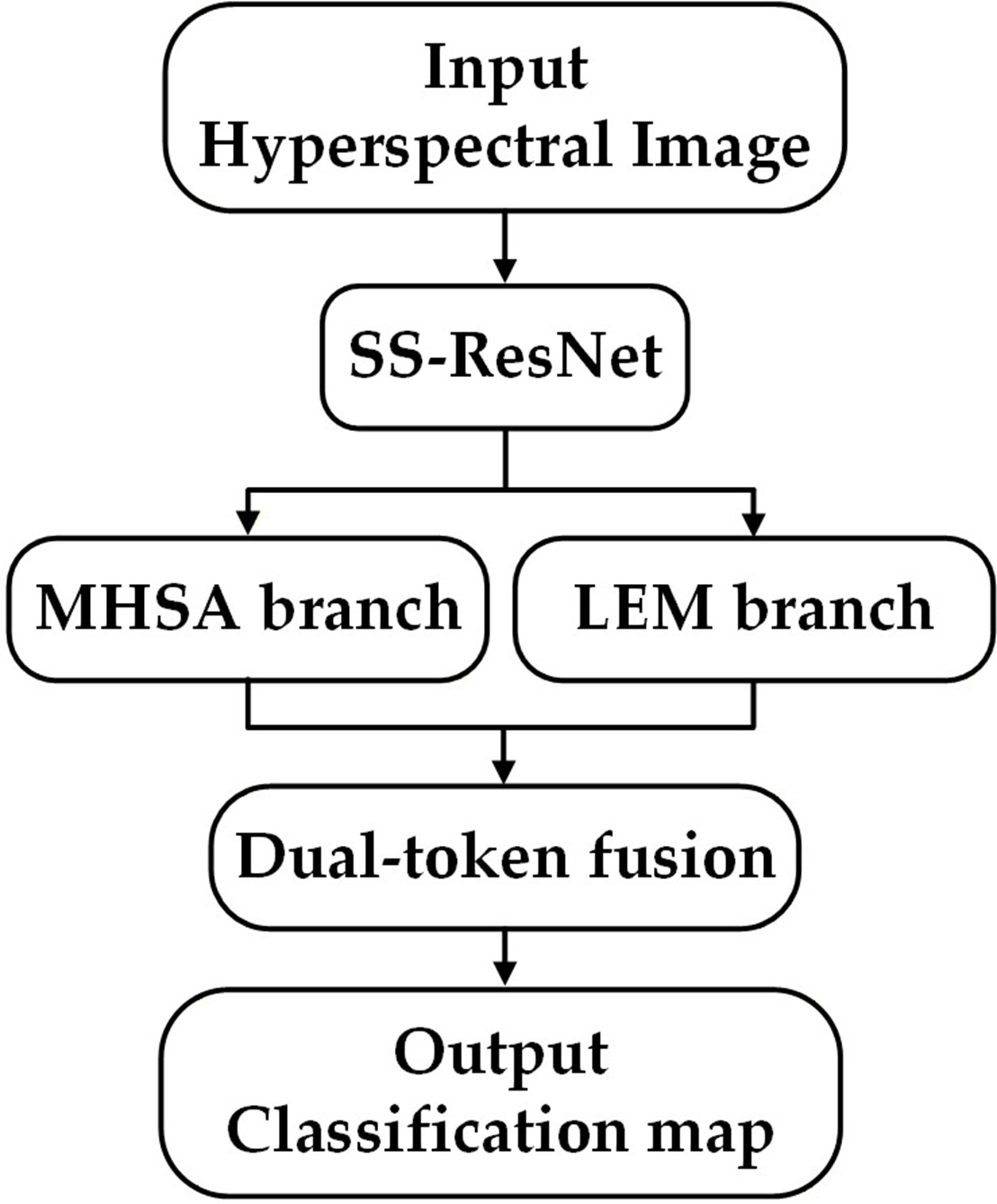
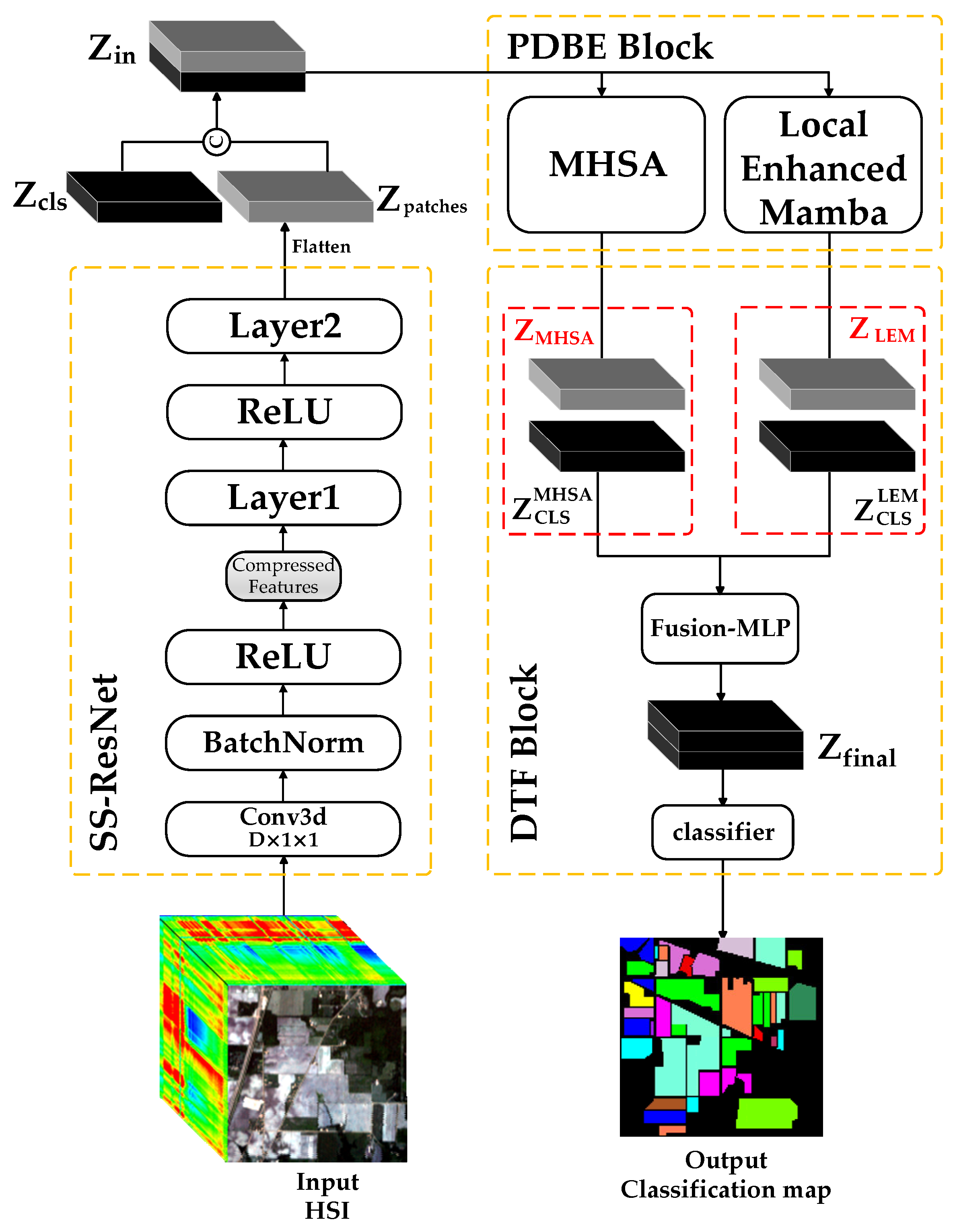
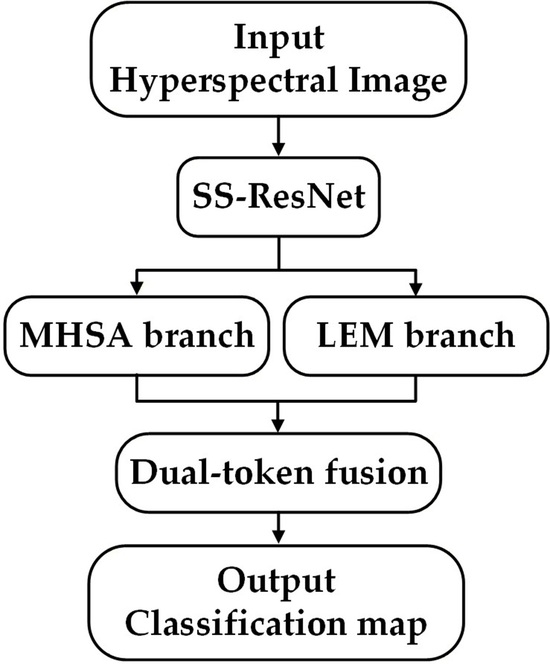
This section details the proposed DualMambaFormer, a unified framework tailored for hyperspectral image (HSI) classification. The architecture is meticulously engineered to resolve the inherent trade-off between modeling long-range dependencies and preserving fine-grained local spectral–spatial details by employing a parallel hybrid design. As depicted in Figure 1, the proposed DualMambaFormer seamlessly integrates the global receptive field of Transformers with the linear computational complexity inherent in state space models (SSMs). The overall framework is hierarchically structured into three core components: a spectral–spatial residual network (SS-ResNet) designed for robust initial feature embedding, a parallel dual-branch encoder responsible for heterogeneous feature extraction, and a dual-token fusion module dedicated to decision-level integration.

3.1. Overall Framework

The classification pipeline begins by processing the raw hyperspectral input, denoted as X R B × 1 × D λ × H × W , where B , D λ , and H   × W denote the batch size, the number of spectral bands, and the spatial dimensions, respectively. The data flow follows a progressive abstraction strategy. Initially, the input X is fed into the SS-ResNet to perform spectral dimensionality reduction and local spatial residual learning, yielding compact feature maps rich in local contextual information. These maps are subsequently flattened and projected into a 1D sequence, to which a learnable classification token ([CLS]) is appended to facilitate global feature aggregation. This sequence is then processed simultaneously by two parallel encoding branches: the multi-head self-attention (MHSA) branch, which captures long-range spatial contextual associations, and the Local Enhanced Mamba (LEM) branch, which concurrently models long-range causal dependencies and local spatial contexts. Finally, the distinct [CLS] tokens from both branches are extracted and fused via a nonlinear mapping module to predict the pixel-level land-cover categories.

3.2. Spectral–Spatial Residual Network

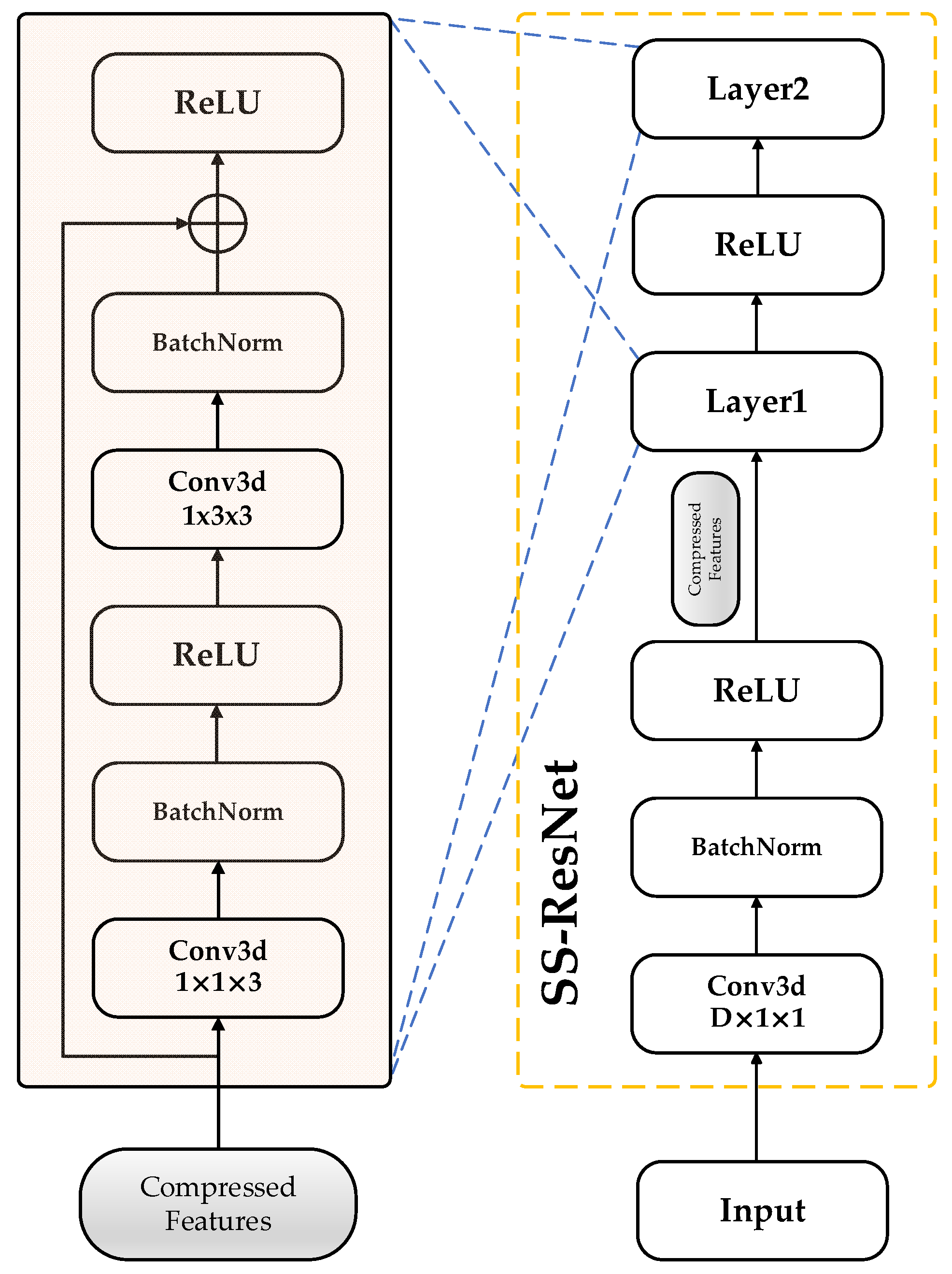
As illustrated in the architectural flowchart of Figure 2, the proposed Spectral–Spatial Residual Network (SS-ResNet) is designed to process the raw hyperspectral input through a two-stage sequential pipeline: spectral compression and spatial residual learning. High-dimensional HSI data are inherently characterized by significant spectral redundancy. Consequently, the direct ingestion of such data into complex sequence models often incurs prohibitive computational costs and exacerbates the risk of overfitting. To overcome these computational bottlenecks while preserving essential information, the SS-ResNet module initiates the shallow feature extraction process with a 3D convolutional layer utilizing a kernel size of D λ , 1,1 , where D λ is the number of input bands. This operation functions as a learnable spectral linear projection, effectively reducing dimensionality while retaining discriminative spectral signatures. The process is formulated as:
X c o m p = σ ReLU BN Conv D λ × 1 × 1 X
where X c o m p R B × E × H × W represents the compressed feature map, E is the target embedding dimension, BN denotes batch normalization, and σ represents the ReLU activation function.
Following this spectral compression, the feature maps traverse a stack of 3D residual blocks specifically designed to capture local spatial textures and intricate boundary information. These blocks leverage residual connections to facilitate smooth gradient propagation and enhance feature robustness, mathematically defined as:
X o u t = σ R e L U ( B N 2 ( C o n v 1 × 3 × 3 2 ( σ R e L U ( B N 1 ( C o n v 1 × 3 × 3 1 ( X c o m p ) ) ) ) ) ) + X c o m p
The resulting output, X o u t , intrinsically integrates deep spatial semantics with refined spectral information, providing a robust and compact initialization for the subsequent parallel encoding stages.

3.3. Parallel Dual-Branch Encoder

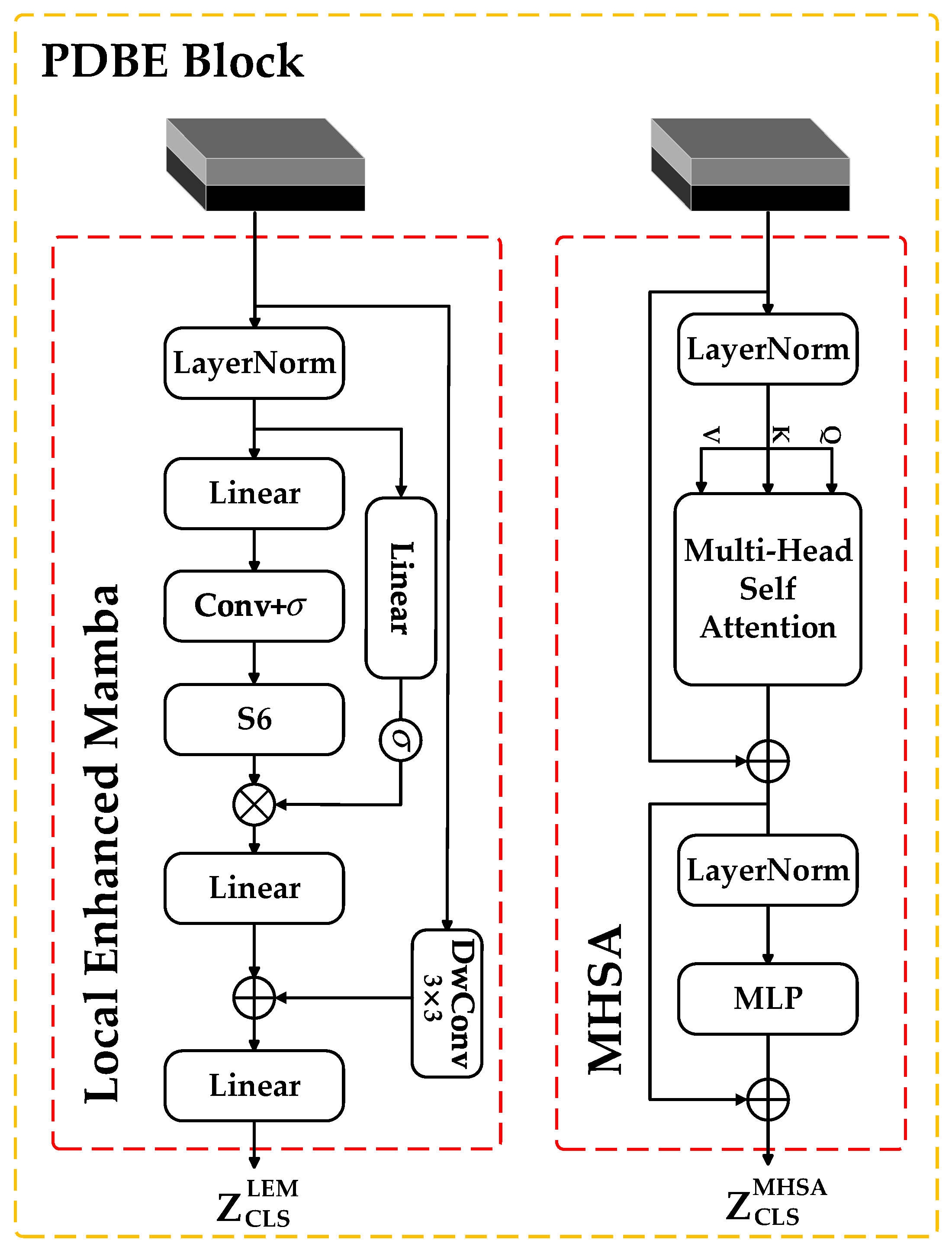
The motivation of the Parallel Dual-Branch Encoder (PDBE) is to exploit the complementary inductive biases of MHSA and LEM. Given the same tokenized hyperspectral sequence, MHSA models pairwise global spatial correlations, whereas LEM focuses on long-range sequential dependency modeling and local spatial continuity through SSM and depthwise convolution. Since these two branches emphasize different aspects of hyperspectral representation, they are processed in parallel to allow branch-specific features to be learned independently before decision-level fusion. Guided by this design rationale, PDBE consists of two structurally distinct streams, as illustrated in Figure 3. Initially, the 3D feature map X o u t is spatially flattened into a 2D sequence of patch embeddings, denoted as z p a t c h e s . Subsequently, a learnable parameterized classification token, c l s R E , is prepended to this sequence. The resulting composite input sequence Z i n can be formulated as:
Z i n = z c l s ; z p a t c h e s R B × L + 1 × E
where B denotes the batch size, L is the number of flattened spatial patches, and E represents the embedding dimension. The learnable [CLS] token does not contain raw image information itself. Instead, it serves as a task-oriented aggregation token whose representation is progressively updated through interactions with the patch tokens in each encoding branch.
The MHSA branch processes Z i n to capture global spatial correlations. For the h-th attention head, the input sequence is projected into query, key, and value matrices:
Q h = Z i n W h Q , K h = Z i n W h K , V h = Z i n W h V
where W h Q , W h K , W h V R E × d k are learnable projection matrices for the h-th head, and d k denotes the feature dimension of each attention head. The attention output of the h-th head is computed as:
Attention h Q h , K h , V h = softmax Q h K h T d k V h
The outputs of all attention heads are concatenated and projected to obtain the final output sequence of the MHSA branch:
Z M H S A = P r o j ( C o n c a t [ A t t e n t i o n 1 , , A t t e n t i o n h ] )
where H denotes the number of attention heads. The first token of Z M H S A is regarded as the MHSA-specific classification token and is later used for decision-level fusion.
In parallel, the LEM branch processes the same input sequence Z i n . The purpose of this branch is to complement the global correlation modeling of MHSA by introducing efficient sequential dependency modeling and local spatial enhancement. The sequential modeling capability is provided by the Mamba-based state space mechanism. In a discretized state space formulation, the hidden state and output at the k -th token can be written as:
h k = A ¯ h k 1 + B ¯ x k
y k = C s s m h k
where A ¯ and B ¯ denote the discretized state transition and input projection matrices, respectively, C s s m is the output projection matrix, x k is the k -th input token, h k is the latent state, and y k is the corresponding output token.
Different from applying a plain Mamba block directly to flattened image tokens, the proposed LEM branch incorporates local spatial enhancement into the Mamba-based sequence modeling process. This design is motivated by the fact that hyperspectral image patches are originally non-causal two-dimensional spatial structures, and direct one-dimensional tokenization may weaken local neighborhood continuity. Therefore, LEM combines state space modeling with lightweight local spatial operations inside the branch, enabling it to encode both long-range sequential dependencies and fine-grained local spatial cues. For clarity and compactness, the internal local-enhancement operation is regarded as part of the LEM branch rather than being introduced as an additional independent feature sequence. Thus, the final output of the LEM branch is denoted as:
Z L E M = L E M Z i n
The first token of Z L E M R B × ( L + 1 ) × E is used as the LEM-specific classification token for subsequent fusion. In this way, the MHSA branch and the LEM branch generate two parallel output sequences, Z M H S A and Z L E M , from the same input sequence Z i n . Their first tokens provide two complementary branch-level summaries: one emphasizing global pairwise spatial correlations and the other integrating sequential dependency modeling with local spatial enhancement.

3.4. Dual-Token Fusion and Classification

MHSA and LEM generate representations with different feature geometries: MHSA organizes tokens according to pairwise similarity, whereas LEM models ordered sequential dependencies and local continuity. If these features are fused at every layer, the two branches may be forced to align prematurely, which can weaken branch-specific representations and increase optimization difficulty. Therefore, we perform fusion at the decision level by concatenating the two branch-specific classification tokens. This design preserves the complementary information learned by each branch while keeping the fusion module lightweight. After the parallel encoding stage, two branch-specific output sequences are obtained: Z M H S A from the MHSA branch and Z L E M from the LEM branch. Instead of fusing intermediate features at each layer, DualMambaFormer performs decision-level fusion using the classification tokens extracted from the final output sequences of the two branches. Specifically, the MHSA-specific classification token is extracted from the first position of Z M H S A :
z c l s M H S A = z M H S A [ : , 0 , : ]
and the LEM-specific classification token is extracted from the first position of Z L E M :
z c l s L E M = z L E M [ : , 0 , : ]
It should be emphasized that z c l s L E M is not extracted from an intermediate local feature sequence. Instead, it is obtained from the final output sequence of the LEM branch, after the branch has internally integrated Mamba-based sequential modeling and local spatial enhancement. Therefore, z c l s M H S A mainly summarizes the global pairwise spatial correlations captured by the MHSA branch, whereas z c l s L E M summarizes the sequential and local spatial information encoded by the LEM branch.
The two classification tokens are then concatenated and fed into a multi-layer perceptron (MLP) to generate a unified discriminative representation:
z f i n a l = MLP Concat z c l s M H S A , z c l s L E M
The fused representation z f i n a l is further passed to a softmax classifier to obtain the predicted probability distribution over land-cover classes:
p = Softmax W o z f i n a l + b o
where W o and b o are the learnable parameters of the classifier, and p denotes the predicted class-probability vector.
The entire network is trained in an end-to-end manner using the cross-entropy loss:
L C E = 1 N i = 1 N j = 1 N c l a s s y i , j log p i , j
where N denotes the number of training samples in a mini-batch, N c l a s s represents the number of land-cover classes, y i , j is the binary ground-truth indicator, and p i , j denotes the predicted probability that sample i belongs to class j . By minimizing L C E , the proposed DualMambaFormer jointly optimizes the SS-ResNet, MHSA branch, LEM branch, and dual-token fusion classifier.

4. Experiments

In this section, comprehensive experiments are conducted on four widely adopted hyperspectral benchmark datasets to rigorously validate the effectiveness of the proposed DualMambaFormer. The dataset characteristics and experimental configurations are first introduced, followed by detailed ablation studies that analyze the impact of key hyperparameters and the specific contributions of individual architectural components. Finally, quantitative and qualitative comparisons with state-of-the-art (SOTA) methods are presented, alongside a comprehensive discussion on ablation study.

4.1. Experimental Datasets

To thoroughly evaluate the generalization capability of the proposed model across diverse sensor modalities, spatial resolutions, and scene complexities, the following four benchmark datasets were selected:
  • Indian Pines (IP): Acquired by the AVIRIS sensor over northwestern Indiana, USA, this dataset consists of 145 × 145 pixels with a spatial resolution of 20 m. After removing bands associated with water absorption, 200 spectral bands remain for analysis. The scene comprises 16 agricultural land-cover classes. Characterized by relatively low spatial resolution and a significant presence of mixed pixels, the IP dataset serves as a benchmark for evaluating the model’s noise robustness and context extraction capabilities.
  • Pavia University (PU): Collected by the ROSIS-03 sensor over the University of Pavia, Italy, this image has dimensions of 610 × 340 pixels and a high spatial resolution of 1.3 m. The dataset provides 103 spectral bands and covers 9 urban categories, such as asphalt, bricks, and shadows. Given its rich textural details and the highly fragmented spatial distribution of urban structures, this dataset challenges the model’s ability to preserve class boundaries.
  • Salinas (SA): Also acquired by the AVIRIS sensor, this dataset covers the Salinas Valley in California. It consists of 512 × 217 pixels with a spatial resolution of 3.7 m and contains 204 spectral bands covering 16 crop classes. Unlike the IP dataset, SA is characterized by large, continuous spatial regions with high homogeneity, serving as an ideal testbed for evaluating classification consistency over homogeneous regions.
  • WHU-Hi-HongHu (WHUHH): Acquired in Honghu City, Hubei Province, using a UAV platform equipped with a Nano-Hyperspec-VNIR imaging spectrometer, this dataset features an ultra-high spatial resolution of 0.043 m. The image measures 940 × 475 pixels and includes 270 spectral bands. Due to the extremely high resolution, individual objects often span hundreds of pixels with fine-grained textures, requiring the model to effectively capture both long-range dependencies and local features.

4.2. Experimental Setup and Evaluation Metrics

All experiments were implemented using the PyTorch 2.2.1 deep learning framework and accelerated by a single NVIDIA GeForce RTX 4070 GPU. Network optimization was driven by AdamW optimizer, configured with an initial learning rate of 1 × 10 4 and a weight decay of 1 × 10 5 . The training phase spanned 500 epochs to guarantee optimal convergence. During data preprocessing, the raw hyperspectral imagery was partitioned into 3D spectral–spatial cubes of size D λ × S × S , where D λ denotes the number of spectral bands and S denotes the spatial window size. In our experiments, S was set to 25. To maintain architectural consistency across diverse benchmark datasets, the latent embedding dimension within the model was uniformly standardized to 128. To robustly assess the model’s generalization capabilities, a randomized training sample selection strategy was adopted. Specifically, for the PU dataset, 30 samples per class were randomly extracted for training. For the SA and WHUHH datasets, 50 samples per class were designated for training. Similarly, 50 training samples per class were selected for the IP dataset, with the exception of classes 1, 7, and 9, where only 15 samples were selected due to the inherent scarcity of available annotations. All remaining labeled samples were strictly reserved for the testing phase. Quantitative classification performance was evaluated using three widely adopted standard metrics: Overall Accuracy (OA), Average Accuracy (AA), and the Kappa Coefficient ( κ ) . To mitigate the stochastic variance introduced by random parameter initializations and to ensure rigorous statistical reliability, all reported quantitative results are expressed as the mean and standard deviation derived from ten independent runs with distinct random seeds.

4.3. Comparison with State-of-the-Art Methods

To evaluate the comparative performance of the proposed framework, we benchmarked it against several representative hyperspectral classification methods. These include: SpectralFormer [29], a Transformer-based architecture employing sequential learning, trained with an Adam optimizer (learning rate: 5 × 10 5 ) and a decay factor of 0.9 every tenth of the total epochs; SSFTT [30], which integrates a CNN with a shallow Transformer and a Gaussian-weighted tokenization module, trained using Adam (learning rate: 1 × 10 4 ); GAHT [32], utilizing a hierarchical Transformer with grouped pixel embeddings, trained via SGD (momentum: 0.9, weight decay: 1 × 10 5 , learning rate: 1 × 10 4 ); GSCVIT [33], a lightweight network combining grouped separable convolutions with vision transformers trained using AdamW (learning rate: 1 × 10 4 , weight decay: 0.05); and 3DSS-Mamba [41], a novel framework based on state space models (SSMs) designed to model global spectral–spatial relationships with high computational efficiency, trained using AdamW (learning rate: 0.01, weight decay: 5 × 10 5 ).

4.3.1. Qualitative Analysis

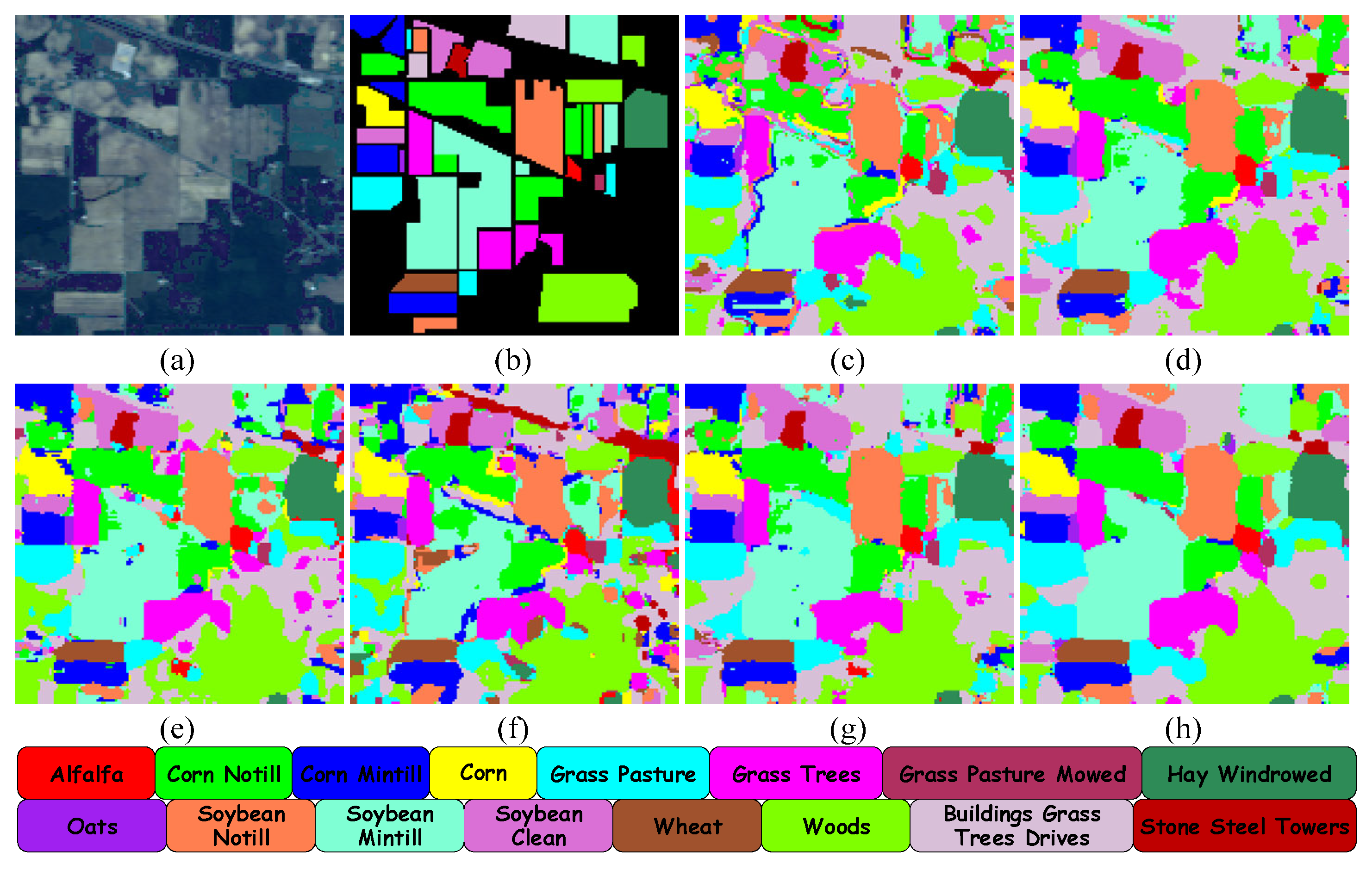
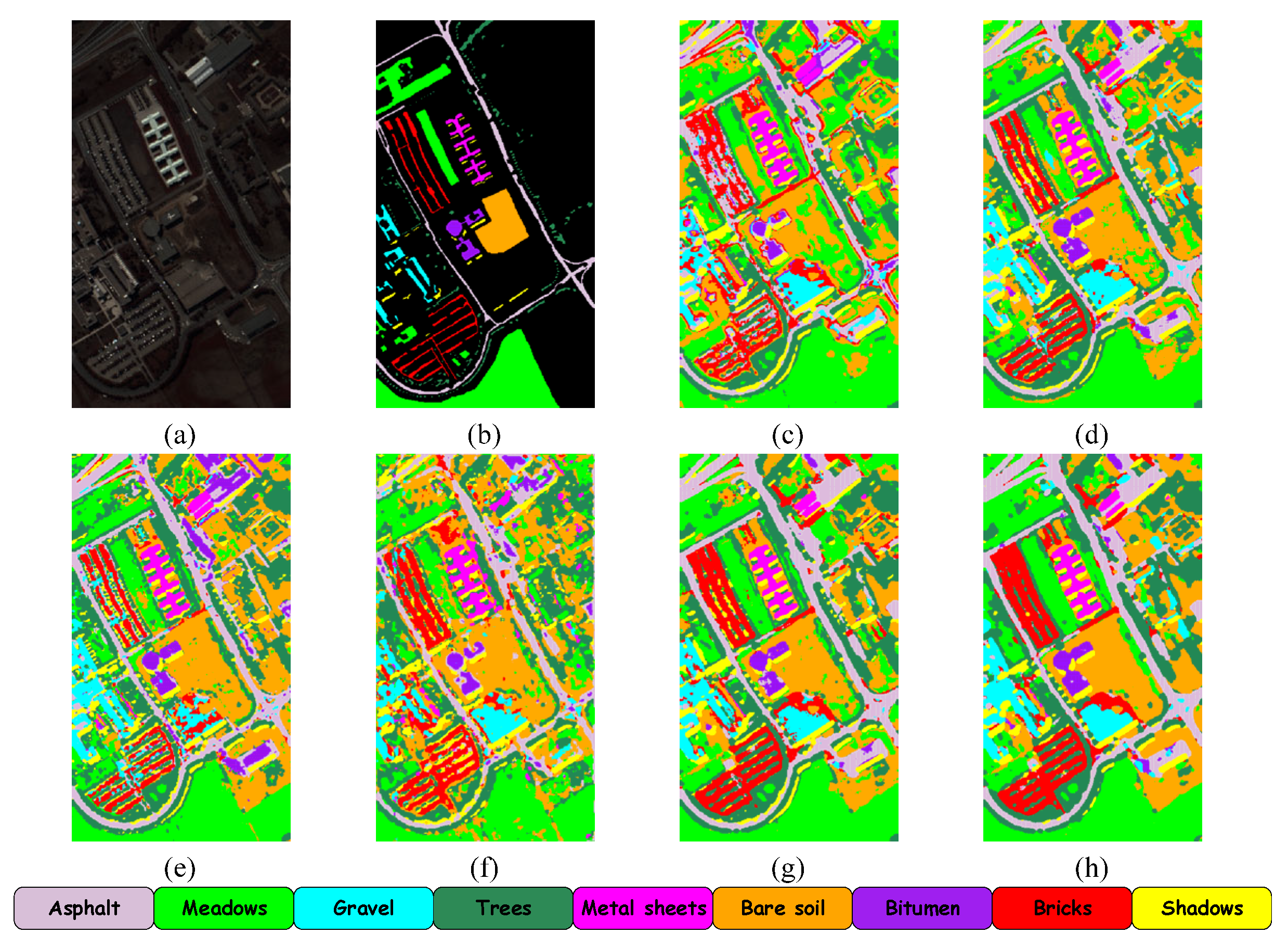
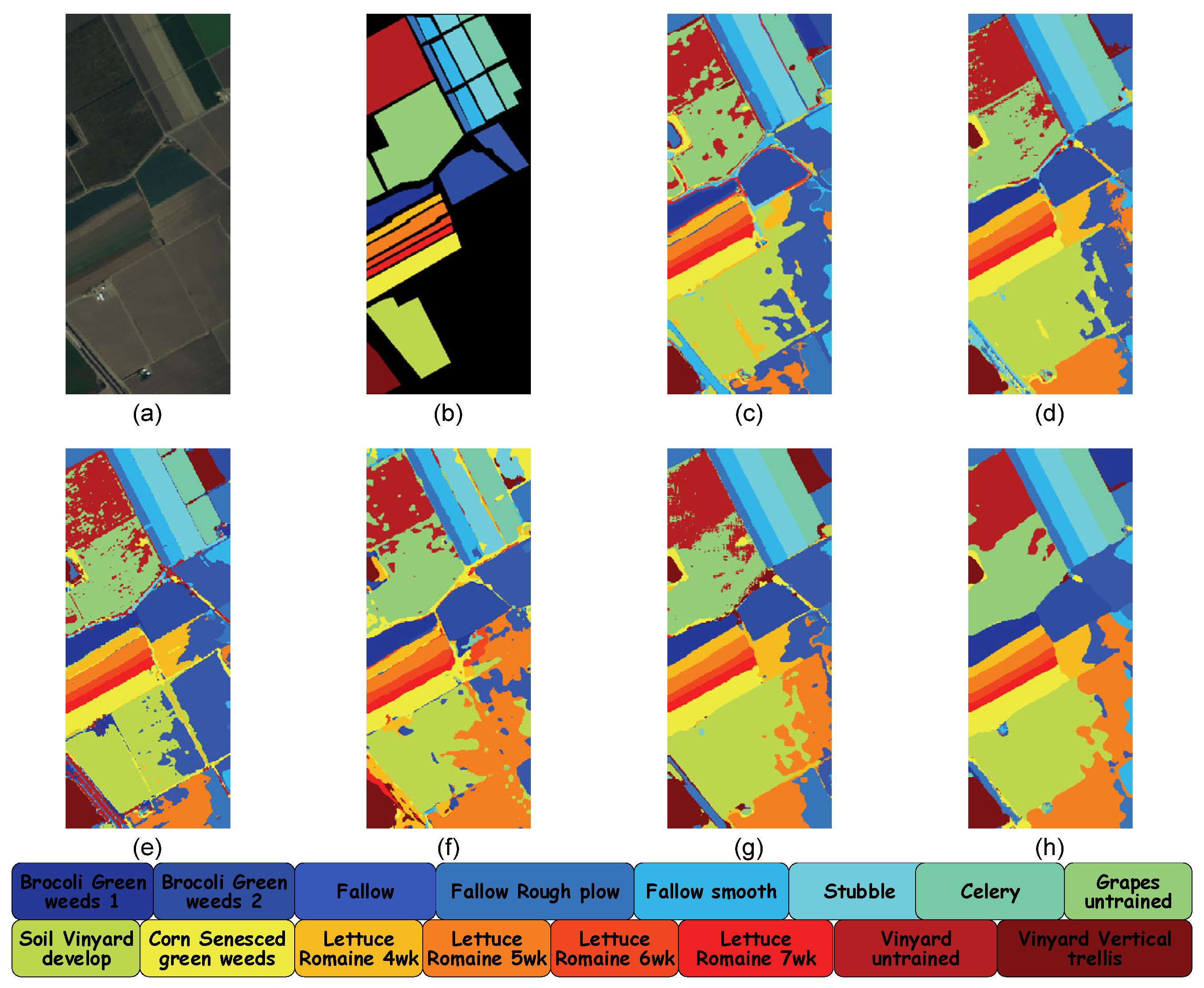
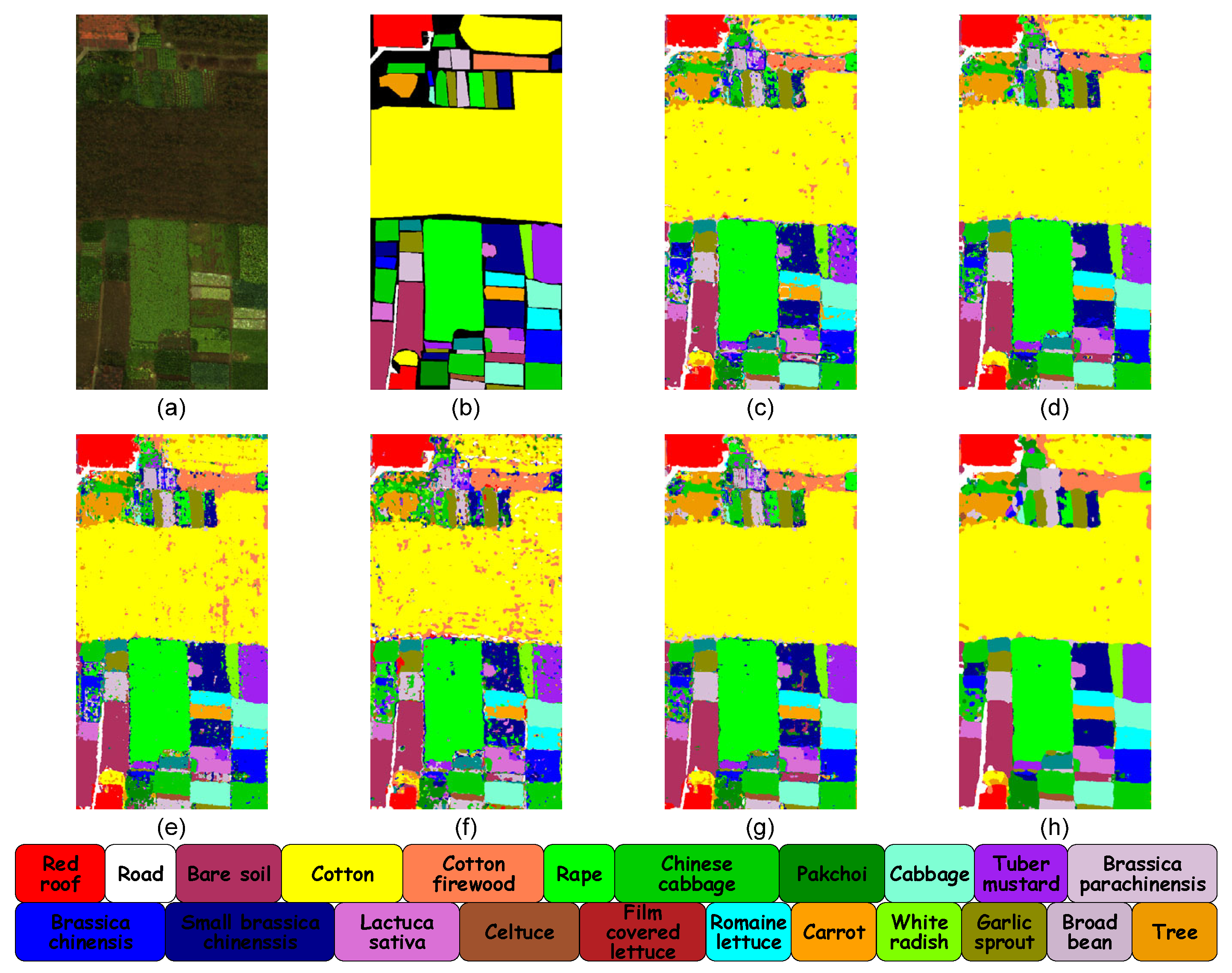
Visual comparisons of the classification maps generated by the proposed DualMambaFormer and the state-of-the-art baselines are comprehensively presented in Figure 4, Figure 5, Figure 6 and Figure 7. These visualizations correspond to the Pavia University, Indian Pines, Salinas, and WHU-HongHu datasets, respectively, visually validating the model’s robustness across varying spatial resolutions and scene complexities. Figure 4 displays the classification performance on the Pavia University dataset, which features complex urban structures. In challenging areas containing fine-grained classes, such as “Bricks” and “Shadows,” competing methods (e.g., GAHT) often suffer from edge erosion and severe over-smoothing. In contrast, the proposed DualMambaFormer successfully maintains sharp class boundaries and preserves detailed spatial coherence. This superior visual fidelity is attributed to the LEM branch, where the integration of depthwise convolution explicitly preserves morphological edges that are typically lost in pure SSM-based or Transformer-based architectures. Figure 5 illustrates the classification results on the Indian Pines dataset. Given that the scene is characterized by a low spatial resolution and a high proportion of mixed pixels, baseline methods like SpectralFormer and SSFTT exhibit noticeable “salt-and-pepper” noise within the large agricultural parcels. Conversely, DualMambaFormer produces highly smooth classification maps with significantly reduced noise in homogeneous regions. This improvement corroborates the effectiveness of the SS-ResNet module, which successfully suppresses spectral redundancy and extracts robust local features prior to global sequence modeling. Regarding the Salinas dataset shown in Figure 6, the scene comprises extensive, continuous agricultural zones. Although pure CNN-based methods sometimes fail to capture the global continuity of these large-scale classes, DualMambaFormer demonstrates superior spatial consistency across the entire image. This visual coherence validates the contribution of the MHSA branch, which effectively models long-range dependencies and ensures consistent semantic interpretation over large spatial distances. Figure 7 presents the results on the WHU-HongHu dataset, which possesses an ultra-high spatial resolution of 0.043 m. The key challenge here lies in distinguishing dense “parcel divisions” and fine textures. As observed, DualMambaFormer outperforms all competitors by accurately delineating the intricate boundaries between adjacent parcels without losing high-frequency texture details. This reinforces the architectural advantage of the proposed parallel design, where the LEM branch provides the necessary local inductive bias to capture fine-grained patterns that purely global models might otherwise overlook.

4.3.2. Quantitative Analysis

The quantitative assessment, detailed in Table 1, Table 2, Table 3 and Table 4, presents the overall accuracy (OA), average accuracy (AA), and kappa coefficient ( κ ) for all compared methods. The proposed DualMambaFormer consistently achieved superior performance across all metrics and datasets, outperforming both advanced Transformer-based models (GSCVIT, GAHT) and SSM-based approaches (3DSS-Mamba). For instance, on the Pavia University dataset (Table 1), while the second-best model, GSCVIT, reached an OA of 93.40%, DualMambaFormer achieved an OA of 98.95% and a κ of 98.61%, representing a substantial margin of approximately 5.5 percentage points. Similar trends were observed on the Indian Pines (Table 2) and Salinas (Table 3) datasets, where the proposed method achieved OAs of 96.56% and 97.60%, respectively. On the challenging WHU-HongHu dataset (Table 4), DualMambaFormer maintained its robustness, securing an OA of 96.09%, which corresponds to a significant improvement of nearly 4.3 percentage points over the nearest competitor (91.79%). In terms of class-wise accuracy, the model demonstrated strong discriminative capability for fine-grained features. On the Indian Pines dataset, DualMambaFormer achieved 100.00% accuracy for Classes 8, 9, and 10; notably, for Class 10, other methods such as SpectralFormer only reached 81.40%. This indicates the model’s proficiency in distinguishing land cover types with highly similar spectral signatures. Similarly, on the Pavia University dataset, the proposed method yielded the highest accuracy in the majority of classes (e.g., Classes 6, 7, and 8 exceeded 99%), with only minor deficits in isolated categories. This comprehensive performance advantage is attributed to the proposed parallel hybrid architecture. By utilizing the SS-ResNet for local inductive bias and spectral compression, followed by a parallel encoding scheme that combines the global alignment of the MHSA branch with the linear complexity and local spatial perception of the LEM branch, the framework effectively overcomes the limitations of existing methods—specifically, the lack of context-adaptive focus in GSCVIT and the high computational complexity of traditional Transformers.

5. Discussion

5.1. Robustness and Generalization Under Limited Training Samples

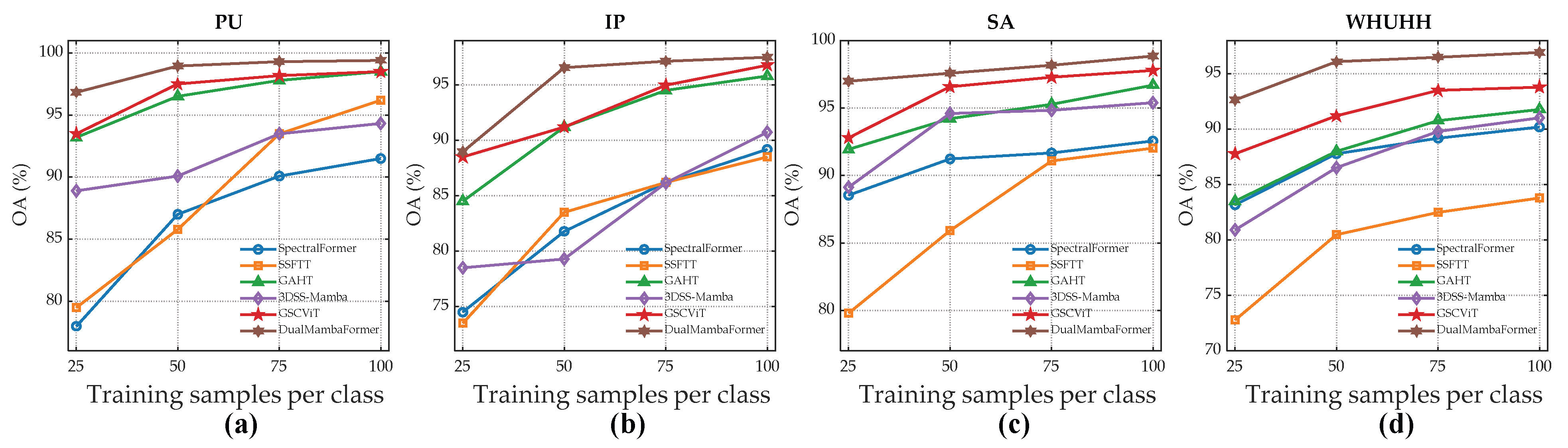
To assess the stability and generalization capability of the proposed DualMambaFormer method, we conducted extensive experiments on four diverse benchmark datasets—Pavia University, Indian Pines, Salinas, and WHU-HongHu—each with varying numbers of training samples. Specifically, we randomly selected 25, 50, 75, and 100 samples per class to construct the training sets, while keeping all remaining labeled pixels for testing. Figure 8 compares the classification performance of DualMambaFormer against five state-of-the-art baselines (SpectralFormer, SSFTT, GAHT, 3DSS-Mamba, and GSCVIT) under these different sample-size configurations. The results indicate that the classification accuracy of DualMambaFormer steadily improves as the number of training samples increases, demonstrating its robustness. Furthermore, DualMambaFormer consistently outperforms existing state-of-the-art methods, achieving the highest accuracy across all training sample configurations and all four datasets. Notably, the advantage of DualMambaFormer becomes most pronounced under the most challenging few-sample regime (25 samples per class), where the performance gap between DualMambaFormer and the second-best competitor reaches its maximum on every dataset. This trend confirms that the heterogeneous parallel design—combining the global modeling capacity of MHSA with the linear-complexity local-dynamic modeling of LEM—provides a particularly favorable inductive bias under limited-supervision conditions, enabling the model to extract discriminative spectral–spatial representations even when annotated samples are scarce.

5.2. Accuracy-Efficiency Trade-Off and Deployment Potential

Given that the foregoing comparative experiments indicate that hybrid Transformer-based architectures generally attain higher classification accuracy at the price of non-trivial computational overhead, we further conduct a comprehensive comparison of the proposed DualMambaFormer against the five representative baselines in terms of parameter count, FLOPs, inference latency, and throughput on each benchmark dataset, as summarized in Table 5. Across the four scenes, the proposed DualMambaFormer exhibits strong competitiveness and achieves a favorable balance between classification precision and inference efficiency. Regarding model parameters, the proposed DualMambaFormer maintains a remarkably stable parameter footprint—1.087 M on Pavia University, 1.101 M on Indian Pines, 1.101 M on Salinas, and 1.111 M on WHU-HongHu—whereas the parameter counts of GAHT and GSCVIT vary substantially with the input spectral dimensionality, scaling from 0.831 M/0.638 M on Indian Pines to 1.515 M/0.249 M on the higher-band WHU-HongHu scene; in particular, on WHU-HongHu DualMambaFormer (1.111 M) employs even fewer parameters than the state-of-the-art GAHT (1.515 M), reflecting the linear scalability of the LEM branch with respect to input length and spectral depth. For inference time, DualMambaFormer attains per-sample latencies of 0.148 ms, 0.203 ms, 0.169 ms, and 0.198 ms on Pavia University, Indian Pines, Salinas, and WHU-HongHu, respectively, which are consistently faster than the Transformer-based competitors GAHT (0.194/0.202/0.204/0.299 ms), GSCVIT (0.260/0.280/0.294/0.295 ms), and SpectralFormer (0.217/0.216/0.999/0.213 ms) on every dataset, while simultaneously delivering higher OAs—most notably on Salinas, where DualMambaFormer is approximately 5.9× faster than SpectralFormer. Although the FLOPs of DualMambaFormer remain higher than those of the lightweight baselines on all four datasets, this overhead originates from its deliberate use of raw 25 × 25 spectral–spatial cubes—rather than PCA-reduced low-dimensional patches adopted by SSFTT, GSCVIT, and 3DSS-Mamba—which preserves the full joint spectral–spatial context required for fine-grained land-cover discrimination. We attribute the favorable wall-clock efficiency of DualMambaFormer primarily to the linear-complexity O N nature of the LEM branch and to the decision-level fusion strategy, which avoids the layer-wise quadratic coupling cost O N 2 that would otherwise be incurred by alternating MHSA and SSM blocks at every depth. In summary, these per-dataset results corroborate that the proposed parallel hybrid design enables DualMambaFormer to achieve a sound trade-off between computational resource consumption and the perception of complex spectral–spatial scenes, rendering it a practical solution for high-dimensional hyperspectral image classification under resource-constrained conditions.

5.3. Class-Wise Error Patterns and Failure Cases

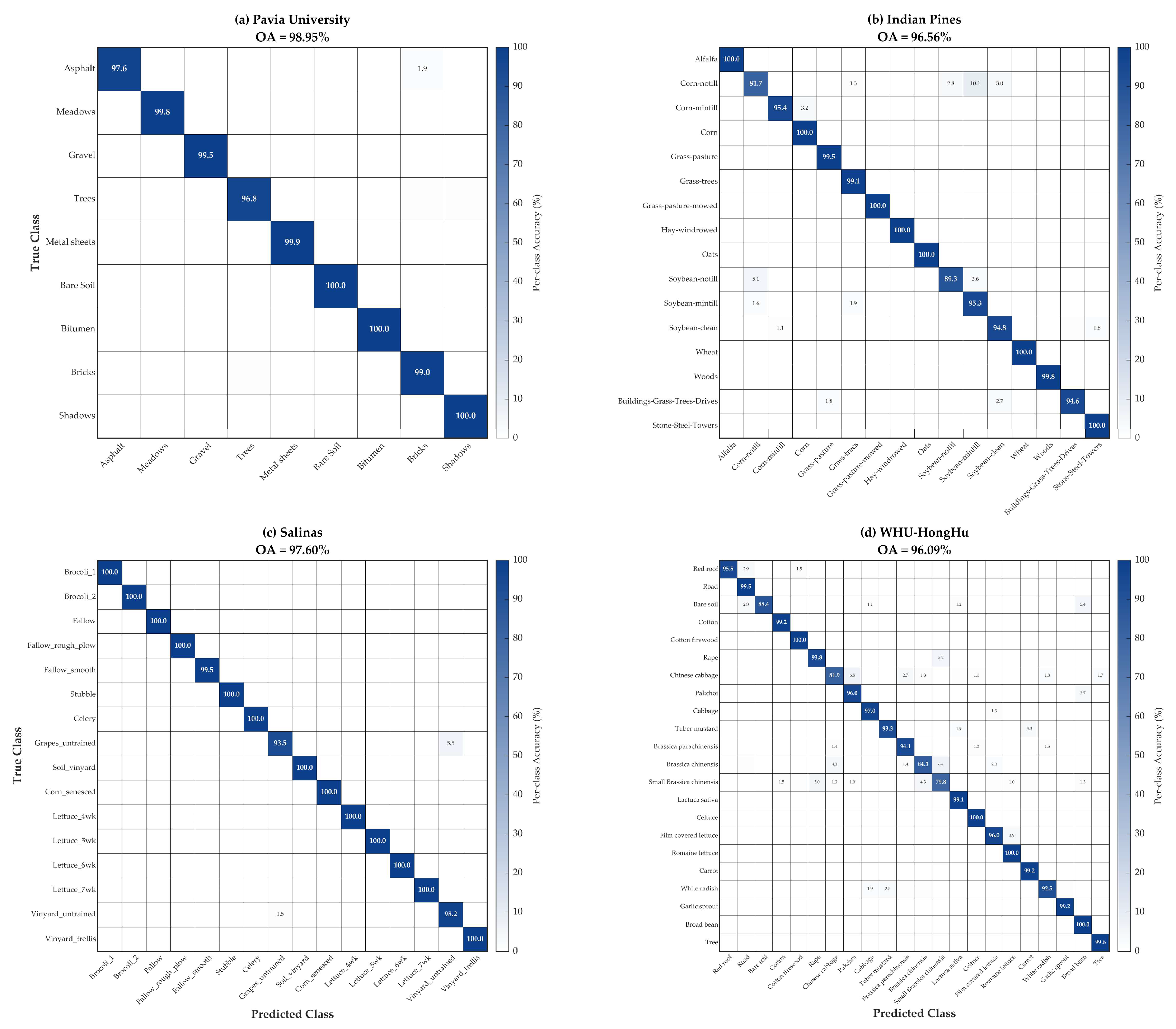
To further dissect the class-wise behavior of the proposed DualMambaFormer beyond the aggregate OA statistics, we visualize the row-normalized confusion matrices on the four benchmark datasets in Figure 9a–d. The diagonal entries represent the per-class accuracy (recall), whereas each off-diagonal entry quantifies the proportion of samples of a given true class that are mis-assigned to a competing class.
Pavia University (Figure 9a). On the Pavia University scene, DualMambaFormer attains an OA of 98.95%, and the confusion matrix is overwhelmingly diagonal-dominant: five of the nine urban categories—Bare Soil, Bitumen, Shadows, Metal sheets and Meadows—reach perfect or near-perfect recall (≥99.8%), and the remaining classes Gravel, Bricks, Asphalt and Trees still hold above 96.8%. Residual errors are concentrated within the spectrally adjacent man-made surfaces, with Trees (96.8%) and Asphalt (97.6%) constituting the two least separable classes; the dominant error pattern manifests as a small leakage between Asphalt, Bricks and Trees, all of which share overlapping reflectance characteristics under heterogeneous urban illumination. The fact that DualMambaFormer keeps every single category above 96.8% empirically supports the design rationale of the LEM branch: by re-injecting the 2D spatial contiguity destroyed by 1D flattening through depthwise convolution, boundary-adjacent pixels in fragmented urban structures are preserved rather than absorbed into the larger neighboring class.
Indian Pines (Figure 9b). On this low-resolution AVIRIS scene with substantial mixed-pixel contamination, DualMambaFormer reaches an OA of 96.56%, with seven of the sixteen agricultural classes—Alfalfa, Corn, Grass-pasture-mowed, Hay-windrowed, Oats, Wheat and Stone-Steel-Towers—achieving perfect 100.0% recall. The per-class accuracy is markedly uneven: small-sample categories are perfectly recognized, whereas the spectrally entangled Soybean–Corn cluster forms the principal source of error. Specifically, Corn-notill exhibits the lowest recall (81.7%), Soybean-notill follows at 89.3%, and Buildings-Grass-Trees-Drives at 94.6%; these three classes are exactly the categories most affected by the bidirectional Soybean ↔ Corn confusion, a long-standing failure mode on Indian Pines because the two crops share virtually overlapping reflectance signatures in the 700–1300 nm range. The fact that Soybean-mintill and Soybean-clean, despite belonging to the same spectrally entangled cluster, still reach 95.3% and 94.8%, respectively, indicates that the complementary fusion of the MHSA branch—capturing the long-range contextual co-occurrence of crop parcels—and the LEM branch—preserving the fine-grained spectral evolution within each parcel—provides discriminative cues that a single-paradigm backbone would otherwise lose to mixed-pixel ambiguity.
Salinas (Figure 9c). The Salinas dataset is dominated by large, homogeneous agricultural parcels, and DualMambaFormer accordingly achieves an OA of 97.60%, with the cleanest diagonal among all four datasets. Thirteen of the sixteen classes attain perfect 100.0% recall, and Fallow_smooth retains 99.5%; the residual error is concentrated in the canonical Salinas hard pair—Grapes_untrained (95.5%) and Vinyard_untrained (98.2%)—which corresponds to two viticultural classes that are notoriously indistinguishable based on spectral information alone, differing only in canopy density and trellising. The fact that DualMambaFormer keeps both classes above 95% under the 50-samples-per-class regime corroborates the design rationale of Section 3.3: by allowing global self-attention and state-space sequence modeling to operate at the same abstraction level on the same tokenized sequence, the parallel encoder is able to combine the global parcel-level context (MHSA) with the linear-complexity sequential dynamics (LEM) precisely where a single-paradigm backbone would otherwise collapse the two viticultural classes into one.
WHU-HongHu (Figure 9d). The WHU-HongHu UAV scene poses the most demanding test, as it contains 22 fine-grained Cruciferae and lettuce varieties at an ultra-high spatial resolution of 0.043 m. DualMambaFormer secures an OA of 96.09%, with most macro-categories—Cotton (99.2%), Cotton firewood (99.95%), Lactuca sativa (99.1%), Celtuce (100.0%), Romaine lettuce (100.0%), Carrot (99.2%), Garlic sprout (99.2%), Broad bean (100.0%) and Tree (99.6%)—achieving recall above 99%. Errors are tightly localized within the morphologically similar Brassica family, with the three lowest-recall classes being Small Brassica chinensis (79.8%), Chinese cabbage (81.9%) and Brassica chinensis (84.3%); a secondary cluster of moderately confused categories—Bare soil (88.4%), White radish (92.5%), Tuber mustard (93.3%), Rape (93.8%) and Brassica parachinensis (94.1%)—reflects the inherent challenge of separating leafy vegetables that differ only at the level of leaf-shape texture and inter-leaf occlusion. Importantly, even on these morphologically near-identical varieties, DualMambaFormer keeps every category above 79%, and no systematic confusion drift toward unrelated land-cover types is observed. This behavior directly validates the role of the depthwise-convolution pathway within the LEM branch: by reshaping the 1D token sequence back to a 2D spatial map and applying isotropic local convolution, the LEM branch supplies precisely the local inductive bias that the MHSA branch lacks, enabling the network to discriminate land-cover types whose separation depends not on spectral signature alone but on fine spatial morphology.
Across all four datasets, the confusion matrices share a consistent qualitative pattern: the diagonal is overwhelmingly dominant, the off-diagonal residual errors are confined to known spectrally entangled or morphologically similar class pairs (Asphalt/Bricks/Trees on Pavia, Soybean/Corn on Indian Pines, Grapes/Vinyard on Salinas, the Brassica family on WHU-HongHu), and no systematic mis-classification is observed toward unrelated land-cover categories. This pattern provides direct empirical support for the heterogeneous-paradigm parallel-encoding hypothesis articulated in Section 3: when global static attention and local-dynamic sequence modeling are deployed at the same abstraction level and fused only at the decision layer, the resulting class boundaries are intrinsically robust against both spectral confusion (handled by the MHSA branch) and morphological confusion (handled by the LEM branch).

5.4. Contribution of Key Architectural Components

To comprehensively validate the effectiveness and necessity of each individual architectural component within the proposed DualMambaFormer framework, rigorous ablation experiments were conducted across the four benchmark datasets. The quantitative results, illustrating the impact of the systematic exclusion of specific modules, are summarized in Table 6. The following subsections provide a detailed analysis of the underlying mechanisms driving these performance variations.

5.4.1. Role of the Spectral–Spatial Residual Network

As evidenced in Table 6, the omission of the SS-ResNet module precipitates a severe degradation in classification performance. Specifically, on the Indian Pines (IP) dataset, the overall accuracy (OA) experiences a sharp decline from 96.59% to 85.04%, representing a substantial drop of 11.55%. This phenomenon can be attributed to the inherent characteristics of raw HSI data, which are predominantly laden with high spectral redundancy and significant noise. Without the SS-ResNet serving as a preliminary feature embedding and denoising module, the direct projection of raw spectral signatures into deep semantic encoders (i.e., the MHSA and LEM branches) results in severe optimization challenges. The lack of shallow feature abstraction forces the subsequent Transformer and Mamba layers to model complex semantic dependencies directly from a noisy, high-dimensional pixel space. Consequently, the model becomes highly susceptible to the curse of dimensionality—especially under limited training samples—leading to feature divergence, severe overfitting, and suboptimal representation. The experimental results corroborate that the SS-ResNet module is indispensable for mitigating spectral redundancy and providing a robust, low-dimensional feature embedding that stabilizes the training of deep dual-branch networks.

5.4.2. Role of the Local Enhanced Mamba Branch

The comparison between the MHSA-only baseline and the proposed full model reveals a distinct performance gap. Admittedly, the MHSA-based architecture maintains a reasonable performance level; nevertheless, the removal of the LEM branch leads to a notable decrease in accuracy, particularly on the WHU-HongHu dataset, where OA drops by approximately 3.17% (92.92% vs. 96.09%). The MHSA branch effectively captures global static context through long-range dependency modeling; however, it inherently lacks the isotropic inductive bias required for capturing fine-grained local details and continuous spectral sequence evolutions. The LEM branch effectively mitigates this limitation by integrating a convolutional pathway for local spatial extraction and a state space model (SSM) pathway for linear-complexity sequence modeling. These mechanisms provide complementary advantages to the global attention mechanism. Specifically, the LEM branch enhances the model’s ability to capture subtle spectral variability and local texture patterns that are often over-smoothed by global self-attention. Thus, the LEM module proves critical for discriminating between spectrally similar land-cover classes in complex spatial environments.

5.5. Limitations and Future Work

Despite the strong classification performance and robustness demonstrated by DualMambaFormer, several limitations remain and deserve further investigation. First, although additional experiments under different training sample settings show that the proposed framework maintains competitive performance when labeled samples are limited, the current evaluation is still conducted mainly under supervised and controlled benchmark protocols. Therefore, its effectiveness under more challenging small-sample scenarios, such as extremely scarce labels, highly imbalanced class distributions, novel unseen categories, and cross-scene or cross-sensor few-shot transfer, has not yet been fully validated. Second, the use of raw spectral–spatial cubes helps preserve rich spectral and spatial information, but it inevitably increases computational and memory costs compared with PCA-reduced or other low-dimensional inputs. This may limit the applicability of the model in resource-constrained platforms, especially for real-time UAV, satellite, and edge-device deployment. Third, the present study mainly focuses on classification accuracy on public benchmark datasets, whereas practical remote sensing applications also require stronger robustness to atmospheric variation, sensor noise, seasonal changes, spatial resolution differences, and domain shifts.
In future work, we will further improve the efficiency and deployability of DualMambaFormer through model compression, pruning, quantization, knowledge distillation, and hardware-aware optimization. To better address the limited availability of labeled hyperspectral samples, we will also investigate the integration of DualMambaFormer with prototype learning, metric learning, semi-supervised learning, weakly supervised learning, and cross-domain adaptation. In particular, extending the proposed global–sequence–local modeling paradigm to few-shot and domain-generalized hyperspectral classification will be an important direction. Moreover, we plan to evaluate the model on more diverse multi-sensor and multi-temporal datasets, and to extend it to broader remote sensing tasks, including hyperspectral target detection, change detection, multispectral–SAR fusion, and multi-source Earth observation interpretation.

6. Conclusions

In this article, we proposed DualMambaFormer, a parallel hybrid Transformer–Mamba network for hyperspectral image classification. The proposed method aims to jointly model long-range spectral–spatial dependencies and preserve fine-grained local details. Specifically, an SS-ResNet module is first employed to reduce spectral redundancy and extract local residual features from raw hyperspectral cubes. Then, a Parallel Dual-Branch Encoder processes the same tokenized sequence from two complementary perspectives: the MHSA branch captures global pairwise spatial correlations, while the LEM branch integrates Mamba-based sequential modeling with local spatial enhancement. Finally, a dual-token fusion strategy combines the branch-specific classification tokens at the decision level for final land-cover prediction.
Extensive experiments on the Indian Pines, Pavia University, Salinas, and WHU-HongHu datasets demonstrate the effectiveness and generalization capability of DualMambaFormer. The proposed method achieves OA values of 96.56%, 98.95%, 97.60%, and 96.09% on the four datasets, respectively, outperforming representative convolutional, self-attention-based, and state-space-based baselines. The classification maps and confusion matrices further indicate that DualMambaFormer can effectively reduce misclassification in spectrally similar and spatially complex regions, especially for crop subclasses, urban materials, and fine-grained agricultural categories. The ablation studies verify the contribution of the main components, including SS-ResNet for spectral compression and local residual embedding, MHSA for global context modeling, and LEM for sequential dependency modeling and local spatial detail preservation. Moreover, experiments with different numbers of training samples show that the proposed framework remains robust under limited labeled samples, highlighting its potential for small-sample hyperspectral image classification.
Nevertheless, DualMambaFormer still requires further improvement before practical deployment. Although the model performs well under controlled small-sample benchmark settings, its capability in more realistic label-scarce scenarios, cross-domain few-shot transfer, and highly imbalanced class distributions remains to be further explored. In addition, the use of raw spectral–spatial cubes increase computational and memory costs, suggesting that lightweight optimization is still necessary. Future work will therefore focus on improving model efficiency through compression, pruning, quantization, and hardware-aware acceleration. We will also explore prototype learning, metric learning, semi-supervised learning, weakly supervised learning, and cross-domain adaptation to further enhance the model’s applicability under limited supervision. The proposed global–sequence–local modeling paradigm may also be extended to broader remote sensing applications, such as multispectral–SAR fusion, hyperspectral target detection, change detection, and multi-source Earth observation interpretation.

Author Contributions

Conceptualization, J.Y., J.L. (Jingwei Li) and W.S.; methodology, J.Y. and G.S.; validation, J.Y., J.L. (Jingwei Li) and X.C.; formal analysis, J.Y.; investigation, J.Y., J.L. (Jingwei Li) and J.L. (Jingying Lu); resources, W.S. and X.G.; data curation, J.Y. and R.Z.; writing—original draft preparation, J.Y. and W.S.; writing—review and editing, J.L. (Jingwei Li), W.S. and X.G.; visualization, W.S.; supervision, W.S. and X.G.; project administration, W.S.; funding acquisition, X.G. All authors have read and agreed to the published version of the manuscript.

Funding

This research was funded by the Scientific Research Project of China Three Gorges Construction Engineering Corporation, grant number JGGJ0424016, JGGJ0424017; Science Popularization and Education Project of Sanjiangyuan National Park in 2024, grant number QHBX-2025-31 Package Four; the Key Project of the Scientific Research Plan of Hubei Provincial Department of Education, grant number D20231304; the Hunan Natural Science Foundation Project Department Union Fund, grant number 2024JJ8327; Tianjin Key Laboratory of Rail Transit Navigation Positioning and Spatio-temporal Big Data Technology, No. TKL2026A06.

Data Availability Statement

The Indian Pines, Pavia University, Salinas, and WHU-Hi-HongHu datasets used in this study are publicly available from their corresponding benchmark repositories. Further implementation details and experimental records are available from the corresponding author upon reasonable request.

Conflicts of Interest

Authors Jiang Yu, Gan Sun, Jingying Lu, Ruimeng Zhou were employed by the company China Three Gorges Construction Engineering Corporation. The remaining authors declare that the research was conducted in the absence of any commercial or financial relationships that could be construed as a potential conflict of interest.

References

  1. Hong, D.F.; He, W.; Yokoya, N.; Yao, J.; Gao, L.R.; Zhang, L.P.; Chanussot, J.; Zhu, X.X. Interpretable Hyperspectral Artificial Intelligence: When nonconvex modeling meets hyperspectral remote sensing. IEEE Geosci. Remote Sens. Mag. 2021, 9, 52–87. [Google Scholar] [CrossRef]
  2. Wang, D.; Hu, M.Q.; Jin, Y.; Miao, Y.C.; Yang, J.Q.; Xu, Y.C.; Qin, X.L.; Ma, J.Q.; Sun, L.Y.; Li, C.X.; et al. HyperSIGMA: Hyperspectral Intelligence Comprehension Foundation Model. IEEE Trans. Pattern Anal. Mach. Intell. 2025, 47, 6427–6444. [Google Scholar] [CrossRef]
  3. Li, S.; Wang, M.; Cheng, C.; Gao, X.; Ye, Z.; Liu, W. Spectral-Spatial-Sensorial Attention Network with Controllable Factors for Hyperspectral Image Classification. Remote Sens. 2024, 16, 1253. [Google Scholar] [CrossRef]
  4. Duan, P.H.; Shan, T.C.; Kang, X.D.; Li, S.T. Spectral Super-Resolution in Frequency Domain. IEEE Trans. Neural Netw. Learn. Syst. 2025, 36, 12338–12348. [Google Scholar] [CrossRef]
  5. Obermeier, W.A.; Lehnert, L.W.; Pohl, M.; Gianonni, S.M.; Silva, B.; Seibert, R.; Laser, H.; Moser, G.; Müller, C.; Luterbacher, J. Grassland ecosystem services in a changing environment: The potential of hyperspectral monitoring. Remote Sens. Environ. 2019, 232, 111273. [Google Scholar] [CrossRef]
  6. Li, Z.; Chen, B.; Wu, S.; Su, M.; Chen, J.M.; Xu, B. Deep learning for urban land use category classification: A review and experimental assessment. Remote Sens. Environ. 2024, 311, 114290. [Google Scholar] [CrossRef]
  7. Siebels, K.; Goïta, K.; Germain, M. Estimation of mineral abundance from hyperspectral data using a new supervised neighbor-band ratio unmixing approach. IEEE Trans. Geosci. Remote Sens. 2020, 58, 6754–6766. [Google Scholar] [CrossRef]
  8. Liu, Y.; Fan, Y.; Feng, H.; Chen, R.; Bian, M.; Ma, Y.; Yue, J.; Yang, G. Estimating potato above-ground biomass based on vegetation indices and texture features constructed from sensitive bands of UAV hyperspectral imagery. Comput. Electron. Agric. 2024, 220, 108918. [Google Scholar] [CrossRef]
  9. Sahadevan, A.S. Extraction of spatial-spectral homogeneous patches and fractional abundances for field-scale agriculture monitoring using airborne hyperspectral images. Comput. Electron. Agric. 2021, 188, 106325. [Google Scholar] [CrossRef]
  10. Wang, C.; Liu, B.; Liu, L.; Zhu, Y.; Hou, J.; Liu, P.; Li, X. A review of deep learning used in the hyperspectral image analysis for agriculture. Artif. Intell. Rev. 2021, 54, 5205–5253. [Google Scholar] [CrossRef]
  11. Lu, B.; Dao, P.D.; Liu, J.; He, Y.; Shang, J. Recent advances of hyperspectral imaging technology and applications in agriculture. Remote Sens. 2020, 12, 2659. [Google Scholar] [CrossRef]
  12. Li, S.; Song, W.; Fang, L.; Chen, Y.; Ghamisi, P.; Benediktsson, J.A. Deep learning for hyperspectral image classification: An overview. IEEE Trans. Geosci. Remote Sens. 2019, 57, 6690–6709. [Google Scholar] [CrossRef]
  13. Melgani, F.; Bruzzone, L. Classification of hyperspectral remote sensing images with support vector machines. IEEE Trans. Geosci. Remote Sens. 2004, 42, 1778–1790. [Google Scholar] [CrossRef]
  14. Joelsson, S.R.; Benediktsson, J.A.; Sveinsson, J.R. Random forest classifiers for hyperspectral data. In Proceedings of the 2005 IEEE International Geoscience and Remote Sensing Symposium, 2005, IGARSS’05, Seoul, Republic of Korea, 29 July 2005; p. 4. [Google Scholar]
  15. Li, J.; Bioucas-Dias, J.M.; Plaza, A. Semisupervised hyperspectral image segmentation using multinomial logistic regression with active learning. IEEE Trans. Geosci. Remote Sens. 2010, 48, 4085–4098. [Google Scholar] [CrossRef]
  16. Farrell, M.D.; Mersereau, R.M. On the impact of PCA dimension reduction for hyperspectral detection of difficult targets. IEEE Geosci. Remote Sens. Lett. 2005, 2, 192–195. [Google Scholar] [CrossRef]
  17. Bandos, T.V.; Bruzzone, L.; Camps-Valls, G. Classification of hyperspectral images with regularized linear discriminant analysis. IEEE Trans. Geosci. Remote Sens. 2009, 47, 862–873. [Google Scholar] [CrossRef]
  18. Zhao, W.; Du, S. Spectral–spatial feature extraction for hyperspectral image classification: A dimension reduction and deep learning approach. IEEE Trans. Geosci. Remote Sens. 2016, 54, 4544–4554. [Google Scholar] [CrossRef]
  19. Mou, L.; Ghamisi, P.; Zhu, X.X. Unsupervised spectral–spatial feature learning via deep residual Conv–Deconv network for hyperspectral image classification. IEEE Trans. Geosci. Remote Sens. 2017, 56, 391–406. [Google Scholar] [CrossRef]
  20. Hu, W.; Huang, Y.; Wei, L.; Zhang, F.; Li, H. Deep convolutional neural networks for hyperspectral image classification. J. Sens. 2015, 2015, 258619. [Google Scholar] [CrossRef]
  21. Chen, Y.; Zhu, L.; Ghamisi, P.; Jia, X.; Li, G.; Tang, L. Hyperspectral images classification with Gabor filtering and convolutional neural network. IEEE Geosci. Remote Sens. Lett. 2017, 14, 2355–2359. [Google Scholar] [CrossRef]
  22. Zhong, Z.; Li, J.; Luo, Z.; Chapman, M. Spectral–spatial residual network for hyperspectral image classification: A 3-D deep learning framework. IEEE Trans. Geosci. Remote Sens. 2017, 56, 847–858. [Google Scholar] [CrossRef]
  23. Roy, S.K.; Krishna, G.; Dubey, S.R.; Chaudhuri, B.B. HybridSN: Exploring 3-D–2-D CNN feature hierarchy for hyperspectral image classification. IEEE Geosci. Remote Sens. Lett. 2019, 17, 277–281. [Google Scholar] [CrossRef]
  24. Gong, Z.; Zhong, P.; Yu, Y.; Hu, W.; Li, S. A CNN with multiscale convolution and diversified metric for hyperspectral image classification. IEEE Trans. Geosci. Remote Sens. 2019, 57, 3599–3618. [Google Scholar] [CrossRef]
  25. Zhu, M.Z.; Fan, J.Y.; Yang, Q.H.; Chen, T. SC-EADNet: A Self-Supervised Contrastive Efficient Asymmetric Dilated Network for Hyperspectral Image Classification. Ieee Trans. Geosci. Remote Sens. 2022, 60, 17. [Google Scholar] [CrossRef]
  26. Yang, J.; Wu, C.; Du, B.; Zhang, L. Enhanced multiscale feature fusion network for HSI classification. IEEE Trans. Geosci. Remote Sens. 2021, 59, 10328–10347. [Google Scholar] [CrossRef]
  27. Yang, J.; Du, B.; Xu, Y.; Zhang, L. Can spectral information work while extracting spatial distribution?—An online spectral information compensation network for HSI classification. IEEE Trans. Image Process. 2023, 32, 2360–2373. [Google Scholar] [CrossRef] [PubMed]
  28. Dosovitskiy, A.; Beyer, L.; Kolesnikov, A.; Weissenborn, D.; Zhai, X.; Unterthiner, T.; Dehghani, M.; Minderer, M.; Heigold, G.; Gelly, S. An image is worth 16x16 words: Transformers for image recognition at scale. arXiv 2020, arXiv:2010.11929. [Google Scholar]
  29. Hong, D.; Han, Z.; Yao, J.; Gao, L.; Zhang, B.; Plaza, A.; Chanussot, J. SpectralFormer: Rethinking hyperspectral image classification with transformers. IEEE Trans. Geosci. Remote Sens. 2021, 60, 5518615. [Google Scholar] [CrossRef]
  30. Sun, L.; Zhao, G.; Zheng, Y.; Wu, Z. Spectral–spatial feature tokenization transformer for hyperspectral image classification. IEEE Trans. Geosci. Remote Sens. 2022, 60, 5522214. [Google Scholar] [CrossRef]
  31. Roy, S.K.; Deria, A.; Shah, C.; Haut, J.M.; Du, Q.; Plaza, A. Spectral–spatial morphological attention transformer for hyperspectral image classification. IEEE Trans. Geosci. Remote Sens. 2023, 61, 5503615. [Google Scholar] [CrossRef]
  32. Mei, S.; Song, C.; Ma, M.; Xu, F. Hyperspectral image classification using group-aware hierarchical transformer. IEEE Trans. Geosci. Remote Sens. 2022, 60, 5539014. [Google Scholar] [CrossRef]
  33. Zhao, Z.; Xu, X.; Li, S.; Plaza, A. Hyperspectral image classification using groupwise separable convolutional vision transformer network. IEEE Trans. Geosci. Remote Sens. 2024, 62, 5511817. [Google Scholar] [CrossRef]
  34. Xu, Y.; Wang, D.; Zhang, L.; Zhang, L. Dual selective fusion transformer network for hyperspectral image classification. Neural Netw. 2025, 187, 107311. [Google Scholar] [CrossRef] [PubMed]
  35. Ouyang, E.; Li, B.; Hu, W.; Zhang, G.; Zhao, L.; Wu, J. When Multigranularity Meets Spatial-Spectral Attention: A Hybrid Transformer for Hyperspectral Image Classification. IEEE Trans. Geosci. Remote Sens. 2023, 61, 4401118. [Google Scholar] [CrossRef]
  36. Fu, C.; Zhou, T.; Guo, T.; Zhu, Q.; Luo, F.; Du, B. CNN-Transformer and Channel-Spatial Attention based network for hyperspectral image classification with few samples. Neural Netw. 2025, 186, 107283. [Google Scholar] [CrossRef]
  37. Yang, J.; Du, B.; Zhang, L. From center to surrounding: An interactive learning framework for hyperspectral image classification. ISPRS-J. Photogramm. Remote Sens. 2023, 197, 145–166. [Google Scholar] [CrossRef]
  38. Zhu, L.; Liao, B.; Zhang, Q.; Wang, X.; Liu, W.; Wang, X. Vision mamba: Efficient visual representation learning with bidirectional state space model. arXiv 2024, arXiv:2401.09417. [Google Scholar] [CrossRef]
  39. Liu, Y.; Tian, Y.; Zhao, Y.; Yu, H.; Xie, L.; Wang, Y.; Ye, Q.; Jiao, J.; Liu, Y. Vmamba: Visual state space model. Adv. Neural Inf. Process. Syst. 2024, 37, 103031–103063. [Google Scholar]
  40. Li, Y.P.; Luo, Y.; Zhang, L.F.; Wang, Z.M.; Du, B. MambaHSI: Spatial-Spectral Mamba for Hyperspectral Image Classification. IEEE Trans. Geosci. Remote Sens. 2024, 62, 16. [Google Scholar] [CrossRef]
  41. He, Y.; Tu, B.; Liu, B.; Li, J.; Plaza, A. 3DSS-Mamba: 3D-spectral-spatial mamba for hyperspectral image classification. IEEE Trans. Geosci. Remote Sens. 2024, 62, 5534216. [Google Scholar] [CrossRef]
  42. Wang, G.; Zhang, X.; Peng, Z.; Zhang, T.; Jiao, L. S 2 Mamba: A spatial–spectral state space model for hyperspectral image classification. IEEE Trans. Geosci. Remote Sens. 2025, 63, 5511413. [Google Scholar]
  43. Wang, H.; Zhuang, P.; Zhang, X.; Li, J. DBMGNet: A dual-branch mamba-GCN network for hyperspectral image classification. IEEE Trans. Geosci. Remote Sens. 2025, 63, 4410517. [Google Scholar] [CrossRef]
  44. Yang, A.; Li, M.; Ding, Y.; Fang, L.; Cai, Y.; He, Y. GraphMamba: An efficient graph structure learning vision mamba for hyperspectral image classification. IEEE Trans. Geosci. Remote Sens. 2024, 62, 5537414. [Google Scholar] [CrossRef]
  45. Tang, H.; Huang, Z.; Li, Y.; Zhang, L.; Xie, W. A multiscale spatial–spectral prototypical network for hyperspectral image few-shot classification. IEEE Geosci. Remote Sens. Lett. 2022, 19, 6011205. [Google Scholar] [CrossRef]
  46. Tang, H.; Wu, Y.; Li, H.; Tang, D.; Yang, X.; Xie, W. Global–local prototype-based few-shot learning for cross-domain hyperspectral image classification. Knowl.-Based Syst. 2025, 314, 113199. [Google Scholar] [CrossRef]
  47. Tang, H.; Zhang, C.; Tang, D.; Lin, X.; Yang, X.; Xie, W. Few-shot hyperspectral image classification with deep fuzzy metric learning. IEEE Geosci. Remote Sens. Lett. 2025, 22, 5502205. [Google Scholar] [CrossRef]
  48. Yang, J.; Du, B.; Wang, D.; Zhang, L. ITER: Image-to-pixel representation for weakly supervised HSI classification. IEEE Trans. Image Process. 2023, 33, 257–272. [Google Scholar] [CrossRef]
Figure 1. An illustration of the proposed DualMambaFormer architecture. The input hyperspectral cube is first processed by the SS-ResNet module for spectral compression and local spatial residual embedding. The resulting token sequence is then fed into two parallel branches, namely the MHSA branch for global spatial dependency modeling and the Local Enhanced Mamba branch for linear-complexity sequential and local-context modeling. Finally, the two branch-specific class tokens are fused through an MLP classifier to generate the land-cover prediction.
Remotesensing 18 01516 g001
Figure 2. Detailed architecture of the Spectral–Spatial Residual Network (SS-ResNet).
Remotesensing 18 01516 g002
Figure 3. Internal structure of the Parallel Dual-Branch Encoder (PDBE), consisting of the Local Enhanced Mamba and MHSA branches.
Remotesensing 18 01516 g003
Figure 4. Visualization of the classification maps on the Pavia University dataset. (a) False-color image. (b) Ground truth. (c) SpectralFormer. (d) GAHT. (e) SSFTT. (f) 3DSS-Mamba. (g) GSCVIT. (h) DualMambaFormer (ours).
Remotesensing 18 01516 g004
Figure 5. Visualization of the classification maps on the Indian Pines dataset. (a) False-color image. (b) Ground truth. (c) SpectralFormer. (d) GAHT. (e) SSFTT. (f) 3DSS-Mamba. (g) GSCVIT. (h) DualMambaFormer (ours).
Remotesensing 18 01516 g005
Figure 6. Visualization of the classification maps on the Salinas dataset. (a) False-color image. (b) Ground truth. (c) SpectralFormer. (d) GAHT. (e) SSFTT. (f) 3DSS-Mamba. (g) GSCVIT. (h) DualMambaFormer (ours).
Remotesensing 18 01516 g006
Figure 7. Visualization of the classification maps on the WHU-HongHu dataset. (a) False-color image. (b) Ground truth. (c) SpectralFormer. (d) GAHT. (e) SSFTT. (f) 3DSS-Mamba. (g) GSCVIT. (h) DualMambaFormer (ours).
Remotesensing 18 01516 g007
Figure 8. Comparison of classification performance with different training samples per class: (a) Pavia University dataset. (b) Indian Pines dataset. (c) Salinas dataset. (d) Whu-HongHu dataset.
Remotesensing 18 01516 g008
Figure 9. Row-normalized confusion matrices of the proposed DualMambaFormer on the four benchmark datasets. Diagonal entries denote per-class accuracy (recall, in %); off-diagonal entries quantify the percentage of mis-classified samples. Cell values below 1% are suppressed for readability. The reported OA values are 98.95%, 96.56%, 97.60% and 96.09% for (a) Pavia University, (b) Indian Pines, (c) Salinas, and (d) WHU-HongHu, respectively.
Remotesensing 18 01516 g009
Table 1. Quantitative classification results of the Pavia University dataset. Best results are shown in bold.
ClassSpectralFormerGAHTSSFTT3DSS-MambaGSCVITDualMambaFormer (Ours)
166.00 ± 11.4788.39 ± 9.2977.11 ± 17.1386.27 ± 3.8893.48 ± 3.6298.76 ± 0.80
277.25 ± 8.0989.27 ± 4.4369.92 ± 20.3089.97 ± 6.1791.69 ± 6.4599.08 ± 1.04
380.32 ± 11.0987.25 ± 6.2360.63 ± 14.5786.32 ± 5.0494.09 ± 4.1899.60 ± 0.43
491.10 ± 2.1296.87 ± 1.6597.26 ± 2.0390.23 ± 8.4693.61 ± 4.8895.63 ± 0.88
599.86 ± 0.2199.85 ± 0.1999.85 ± 0.2299.10 ± 0.8799.86 ± 0.1599.84 ± 0.14
677.09 ± 11.9692.96 ± 5.9877.10 ± 16.8693.34 ± 3.4293.86 ± 4.7499.93 ± 0.18
775.66 ± 10.8497.07 ± 3.8278.88 ± 20.9494.68 ± 3.9498.53 ± 1.1799.95 ± 0.11
862.86 ± 20.3888.08 ± 5.4376.74 ± 20.0388.42 ± 6.9295.12 ± 1.9499.12 ± 0.67
996.80 ± 1.2399.35 ± 0.4998.83 ± 1.9598.27 ± 1.2699.64 ± 0.4498.52 ± 0.77
OA (%)76.46 ± 2.3690.69 ± 2.4475.79 ± 9.1090.10 ± 2.3193.40 ± 2.4398.95 ± 0.55
κ   (%)69.94 ± 2.6487.91 ± 3.0969.92 ± 9.9887.10 ± 2.8491.39 ± 3.0598.61 ± 0.73
AA (%)80.77 ± 1.9193.23 ± 1.3881.81 ± 4.1091.84 ± 1.7595.54 ± 1.0798.94 ± 0.23
Table 2. Quantitative classification results of the Indian Pines dataset. Best results are shown in bold.
ClassSpectralFormerGAHTSSFTT3DSS-MambaGSCVITDualMambaFormer (Ours)
190.00 ± 7.83100.00 ± 0.0096.77 ± 4.3393.23 ± 7.2899.03 ± 1.4896.56 ± 0.98
268.72 ± 3.7188.08 ± 3.6984.45 ± 7.2465.83 ± 6.8489.47 ± 2.8599.68 ± 0.97
382.14 ± 6.6993.76 ± 3.8579.05 ± 26.6776.72 ± 11.3996.53 ± 2.6794.38 ± 4.20
494.60 ± 2.4099.63 ± 0.7997.65 ± 2.7497.59 ± 3.7999.89 ± 0.2197.59 ± 1.80
590.81 ± 2.7396.56 ± 2.0795.38 ± 2.3388.29 ± 4.6497.23 ± 1.6999.52 ± 0.65
695.32 ± 1.8099.34 ± 0.4296.82 ± 5.8994.93 ± 2.8999.43 ± 0.6197.46 ± 1.73
798.46 ± 4.62100.00 ± 0.00100.00 ± 0.0099.23 ± 2.31100.00 ± 0.0099.38 ± 0.41
897.27 ± 2.3699.86 ± 0.2899.58 ± 0.5597.76 ± 2.8499.93 ± 0.21100.00 ± 0.00
998.00 ± 6.00100.00 ± 0.00100.00 ± 0.00100.00 ± 0.00100.00 ± 0.00100.00 ± 0.00
1081.40 ± 3.8691.91 ± 2.6888.37 ± 5.5774.06 ± 14.1794.03 ± 2.51100.00 ± 0.00
1173.53 ± 4.4282.13 ± 4.4860.80 ± 25.8466.80 ± 10.6989.50 ± 3.2193.96 ± 2.70
1274.84 ± 6.6594.97 ± 2.2391.14 ± 3.3483.41 ± 10.8395.82 ± 1.8894.36 ± 2.35
1399.42 ± 0.54100.00 ± 0.0099.94 ± 0.1999.10 ± 1.3699.94 ± 0.1996.15 ± 1.65
1492.10 ± 2.8295.62 ± 1.8396.29 ± 2.0093.83 ± 3.1597.77 ± 0.8899.87 ± 0.39
1593.45 ± 4.2498.72 ± 1.2097.11 ± 1.7994.64 ± 4.2499.38 ± 0.8099.80 ± 0.16
1699.53 ± 0.93100.00 ± 0.0099.77 ± 0.7099.07 ± 1.14100.00 ± 0.0099.76 ± 0.26
OA (%)81.88 ± 1.3691.39 ± 1.3283.47 ± 9.0779.31 ± 3.6594.26 ± 0.8996.56 ± 0.98
κ (%)79.43 ± 1.5190.17 ± 1.4881.43 ± 9.9476.62 ± 4.0193.43 ± 1.0196.06 ± 1.12
AA (%)89.35 ± 1.1096.29 ± 0.4592.70 ± 3.7189.03 ± 2.3697.37 ± 0.3998.17 ± 0.51
Table 3. Quantitative classification results of the Salinas dataset. Best results are shown in bold.
ClassSpectralFormerGAHTSSFTT3DSS-MambaGSCVITDualMambaFormer (Ours)
195.02 ± 1.06100.00 ± 0.0099.96 ± 0.1299.91 ± 0.0999.80 ± 0.45100.00 ± 0.00
299.35 ± 0.4899.99 ± 0.0299.68 ± 0.6199.89 ± 0.1599.76 ± 0.31100.00 ± 0.00
396.08 ± 2.0699.63 ± 0.3299.00 ± 0.6598.52 ± 2.7599.84 ± 0.3598.53 ± 4.39
497.97 ± 0.7999.83 ± 0.2499.93 ± 0.0999.32 ± 0.6099.80 ± 0.2499.78 ± 0.38
592.68 ± 2.6399.17 ± 0.9199.15 ± 0.6498.42 ± 1.9898.73 ± 1.5299.13 ± 0.67
699.74 ± 0.41100.00 ± 0.0099.99 ± 0.0199.41 ± 0.7599.93 ± 0.1999.98 ± 0.07
797.95 ± 1.2799.94 ± 0.0899.87 ± 0.2298.88 ± 1.2099.97 ± 0.05100.00 ± 0.00
880.26 ± 2.2188.40 ± 1.1285.86 ± 2.1185.72 ± 5.8387.33 ± 1.8393.66 ± 3.11
997.69 ± 1.0199.80 ± 0.2199.44 ± 0.7498.37 ± 1.34100.00 ± 0.01100.00 ± 0.00
1092.55 ± 1.8197.92 ± 1.1896.82 ± 1.1795.64 ± 2.7598.17 ± 1.2799.31 ± 0.85
1193.97 ± 2.8699.78 ± 0.2399.44 ± 0.3599.72 ± 0.3299.43 ± 0.4699.99 ± 0.03
1297.91 ± 1.5599.99 ± 0.0299.88 ± 0.1198.49 ± 1.9399.79 ± 0.2599.97 ± 0.03
1399.97 ± 0.10100.00 ± 0.0099.70 ± 0.3199.28 ± 0.9899.99 ± 0.03100.00 ± 0.00
1499.16 ± 0.5699.74 ± 0.2099.29 ± 0.8498.38 ± 1.8999.39 ± 1.1799.96 ± 0.09
1580.27 ± 3.5089.70 ± 1.5082.71 ± 4.2388.66 ± 8.1691.25 ± 2.5793.23 ± 9.05
1697.34 ± 1.6199.32 ± 0.6098.28 ± 1.1998.96 ± 1.7299.04 ± 0.6499.99 ± 0.02
OA (%)91.23 ± 0.5095.92 ± 0.2694.22 ± 0.5994.60 ± 1.2695.87 ± 0.3897.60 ± 0.95
κ (%)90.25 ± 0.5595.46 ± 0.2993.57 ± 0.6693.99 ± 1.4195.41 ± 0.4297.33 ± 1.06
AA (%)94.87 ± 0.3498.33 ± 0.1397.44 ± 0.2297.35 ± 0.9098.26 ± 0.1898.97 ± 0.53
Table 4. Quantitative classification results of the WHU-HongHu dataset. Best results are shown in bold.
ClassSpectralFormerGAHTSSFTT3DSS-MambaGSCVITDualMambaFormer (Ours)
195.28 ± 1.0496.13 ± 0.8182.37 ± 15.0188.38 ± 5.9593.46 ± 5.8696.11 ± 0.58
290.01 ± 2.1296.23 ± 1.4769.44 ± 31.3491.15 ± 4.8295.07 ± 4.3197.67 ± 1.41
378.32 ± 1.6884.00 ± 8.9480.07 ± 11.9682.10 ± 5.9789.40 ± 2.6992.83 ± 2.64
493.20 ± 2.4095.46 ± 0.7084.41 ± 11.1786.76 ± 6.2495.56 ± 5.6298.10 ± 0.68
585.74 ± 5.1793.45 ± 2.3872.78 ± 29.8785.04 ± 7.1390.68 ± 0.7798.34 ± 1.27
690.41 ± 2.9294.12 ± 2.5266.43 ± 29.8590.97 ± 2.0793.32 ± 2.9096.88 ± 1.20
770.49 ± 3.3278.60 ± 3.9269.35 ± 14.2862.44 ± 8.8380.01 ± 5.0588.78 ± 2.19
863.43 ± 3.1180.02 ± 4.7564.45 ± 12.0757.92 ± 9.3783.12 ± 3.2495.95 ± 1.42
996.94 ± 0.8697.27 ± 1.7495.38 ± 3.4094.25 ± 2.7397.55 ± 1.3797.85 ± 1.74
1061.54 ± 5.7489.57 ± 2.2481.11 ± 8.8572.52 ± 6.1082.34 ± 11.6993.23 ± 5.29
1171.51 ± 3.3685.85 ± 3.5755.64 ± 19.3878.03 ± 7.0887.65 ± 3.8096.25 ± 1.01
1270.96 ± 4.1779.35 ± 5.2156.33 ± 20.3269.13 ± 5.6881.50 ± 9.1092.50 ± 2.77
1367.83 ± 5.2078.49 ± 4.7467.83 ± 5.2064.14 ± 8.3978.77 ± 4.3388.07 ± 2.81
1485.54 ± 3.1794.55 ± 2.2685.43 ± 8.7485.41 ± 3.6892.92 ± 5.1198.54 ± 1.26
1594.02 ± 2.9098.26 ± 1.0197.13 ± 2.8394.59 ± 3.0298.89 ± 0.6699.76 ± 0.51
1689.36 ± 3.5194.82 ± 1.6991.33 ± 3.2084.57 ± 9.0098.31 ± 1.4899.06 ± 1.47
1789.21 ± 2.3796.65 ± 1.9692.08 ± 3.8788.33 ± 4.7495.30 ± 5.4998.51 ± 3.06
1890.66 ± 3.8295.68 ± 2.5264.21 ± 25.6292.29 ± 4.3996.14 ± 2.7399.10 ± 0.57
1990.03 ± 1.9494.89 ± 0.9467.38 ± 24.1685.48 ± 5.9294.21 ± 2.1296.56 ± 1.07
2094.45 ± 2.0095.69 ± 2.3775.31 ± 22.0589.94 ± 6.6697.42 ± 1.6999.57 ± 0.30
2187.86 ± 5.6793.64 ± 12.1655.38 ± 36.6585.45 ± 10.6789.48 ± 11.8099.84 ± 0.49
2291.54 ± 3.5095.71 ± 2.0088.84 ± 9.7689.14 ± 7.5897.14 ± 1.8098.99 ± 0.73
OA (%)86.36 ± 1.0591.65 ± 0.8577.17 ± 9.4183.05 ± 3.5491.79 ± 2.3296.09 ± 0.38
κ (%)83.03 ± 1.2489.55 ± 1.0572.46 ± 10.6979.23 ± 4.0689.76 ± 2.7395.08 ± 0.47
AA (%)84.01 ± 0.8391.29 ± 0.9075.03 ± 9.2482.64 ± 2.2091.28 ± 1.2396.48 ± 0.43
Table 5. Comparison of model parameters, FLOPs, inference latency, and throughput among DualMambaFormer and competing methods on the four benchmark datasets.
DatasetMethodParams (M)FLOPs (M)Latency (ms/Sample)Throughput (Samples/s)
PUSpectralFormer0.18415.730.2174613
SSFTT0.15311.40.08311,981
GAHT0.92745.410.1945158
GSCVIT0.1534.960.263841
3DSS-Mamba0.02413.960.1377283
DualMambaFormer1.087428.20.1486771
IPSpectralFormer0.35635.410.2164622
SSFTT0.15311.40.08312,045
GAHT0.83140.670.2024955
GSCVIT0.63820.960.283568
3DSS-Mamba0.02413.960.1377297
DualMambaFormer1.101435.970.2034925
SASpectralFormer0.36636.430.9991001
SSFTT0.15311.40.07313,739
GAHT0.97347.610.2044893
GSCVIT0.1796.620.2943407
3DSS-Mamba0.02413.960.1347446
DualMambaFormer1.101436.290.1695927
WHUHHSpectralFormer0.55955.020.2134694
SSFTT0.15411.40.0812,428
GAHT1.51574.150.2993342
GSCVIT0.24910.250.2953389
3DSS-Mamba0.02513.960.1397212
DualMambaFormer1.111441.570.1985059
Table 6. Ablation study of key components of DualMambaFormer. Best results are shown in bold.
MHSALEMSS-ResNetPUIPSAWHUHH
93.89 ± 1.1885.04 ± 0.9693.42 ± 1.7888.36 ± 1.08
97.84 ± 0.3995.11 ± 0.5295.95 ± 0.6792.92 ± 0.79
98.95 ± 0.5796.56 ± 0.5597.60 ± 0.9596.09 ± 0.38
Disclaimer/Publisher’s Note: The statements, opinions and data contained in all publications are solely those of the individual author(s) and contributor(s) and not of MDPI and/or the editor(s). MDPI and/or the editor(s) disclaim responsibility for any injury to people or property resulting from any ideas, methods, instructions or products referred to in the content.