Article

Temporal Evolution of Crater Populations Formed on Different Facies of Lunar Complex Craters

1
School of Physics and Electronic Information Engineering, Guilin University of Technology, Guilin 541006, China
2
Planetary Environmental and Astrobiological Research Laboratory, School of Atmospheric Sciences, Sun Yat-sen University, Zhuhai 519000, China
*
Author to whom correspondence should be addressed.
Remote Sens. 2026, 18(10), 1510; https://doi.org/10.3390/rs18101510
Submission received: 15 February 2026 / Revised: 18 April 2026 / Accepted: 8 May 2026 / Published: 11 May 2026
(This article belongs to the Special Issue Remote Sensing for Planetary Geomorphology and Mapping)

Highlights

What are the main findings?
  • We observe that the crater SFDs of ejecta blanket are generally shallower than their corresponding coeval impact melt of lunar complex craters, and the density difference decreases with increasing crater age, from about 75 Ma to 871 Ma.
  • Temporal evolution is consistent with modeled crater production functions that account for time-dependent target properties.
What are the implications of the main findings?
  • Time-dependent target properties are potentially caused by impact-induced damage, which efficiently turns coherent melt into ejecta-like fragments.
  • The results suggest that for craters older than Tycho (~75 Ma), self-secondary craters are possibly not the dominant cause for observed crater density differences between coeval geologic units.

Abstract

The formation of a large complex crater is accompanied by the simultaneous formation of coeval sub-geological units that have diverged physical properties, such as a central melt pool and an ejecta blanket. Crater populations formed on different geological units of a given young complex craters usually exhibit different size–frequency distributions (SFDs), but the difference disappears for relatively old craters, e.g., the Copernicus crater with an age of about 800 million years ago (Ma). However, there is a lack of temporal and theoretical constraints on the evolutionary pathway connecting these two SFD end-member states. Here, by observing crater SFDs of complex craters with ages between about 75 Ma and 871 Ma, we find a decrease in the crater SFD difference between coeval geological units with increasing age. The time-dependent crater SFD difference is consistent with modeled production functions with consideration of time-dependent target physical properties. The time dependence of target properties potentially arises from impact-induced damage, which efficiently converts coherent melt into ejecta-like fragments. Our results also imply that the proportion of self-secondary craters to the diameter ≥120 m crater population superposing on the facies of lunar complex craters with age older than crater Tycho is possibly less than 50% and decreases with time.

1. Introduction

The lunar surface preserves an over 4 billion-year record of impact cratering [1,2]. A hypervelocity impact by a sufficiently large body instantaneously converts vast kinetic energy into heat and mechanical work, leading to the formation of a transient crater and two primary products: impact melt and ballistically emplaced ejecta deposits [1]. Impact melt originates under the extreme pressures and temperatures exerted by the impact. Impact melt subsequently cools to form various forms of products such as glass, melt-bearing breccia, and competent melt sheets [1,3]. In contrast, the ejecta deposits comprise debris ballistically ejected during the crater’s excavation stage. They are typically characterized by high initial porosity and a predominance of sharp, angular clasts [1,3,4].
Crater ejecta deposits and their coeval melt should have a consistent absolute model age (AMA) [5,6,7,8,9]. However, these two geological units often exhibit significant differences in their crater SFDs and AMAs [8,9,10,11,12], posing a critical challenge to crater SFD-based absolute dating methods.
The scale and morphology of impact craters are fundamentally controlled by the physical properties of the target material. It is well established that targets exhibiting high density or high effective strength yield smaller craters [9,13,14]. This principle is clearly manifested in the contrasting properties of lunar impact units: central impact melt forms a dense, coherent substrate, whereas ejecta blankets constitute loose, poorly consolidated debris. Consequently, craters formed on ejecta blankets could be systematically larger than those on contemporaneous impact melt [9,11,15]. Potential evidence of this target property effect is observed at the Tycho crater. The cumulative density of craters (≥200 m in diameter) on its ejecta blanket exceeds that on the impact melt unit by a factor of more than 5 [6,9,16]. In stark contrast, Copernicus crater, aged approximately 800 Ma, exhibits no significant difference between the crater SFDs of its ejecta and melt units [17,18].
Alternatively, the aforementioned crater density difference at crater Tycho can also be attributed to the contamination of self-secondary craters (SSCs), and the disappearance of the crater density difference at crater Copernicus could be caused by the accumulation of craters that are abundant enough to overwhelm self-secondary craters [17], which is supported by the observation of self-secondary craters formed by cold spot craters [19]. As time goes on, small primary and secondary craters accumulate and eventually reach equilibrium [20,21,22]. However, there is a lack of constraints on the initial density of SSCs formed on complex craters. In this work, we observe the density of craters superposing on coeval facies (i.e., the ejecta deposits and central melt) of complex craters to investigate the temporal evolution of crater density difference on the coeval targets.

2. Materials and Methods

2.1. Crater SFD Measurements

This study utilized high-resolution (~8 m per pixel) images from the Kaguya Terrain Camera (TC) (JAXA, Japan) [23] for crater identification. The high spatial resolution of the TC data enables the reliable identification of craters larger than 80 m in diameter. Crater diameters were manually measured using CraterTools [24]. To constrain the temporal evolution of crater densities on coeval targets, we selected eight craters (Figure 1) spanning a wide range of geological ages: Tycho (~75 Ma), Jackson (~247 Ma), Olbers A (~251 Ma), Petavius B (~228 Ma), Ohm (~303 Ma), Lalande (~397 Ma), Crookes (~487 Ma), and Copernicus (~871 Ma). Crater counts were performed on both the ejecta blankets and the central impact melt of these large craters. Their ages are derived from our mapped craters in combination with the production and chronology functions of [25] (see Section 2.3 for more details). This age sequence allows us to trace the temporal evolution of crater SFDs.
To ensure data reliability, counting areas were selected based on stringent criteria. Crater counting areas are required to be relatively flat to minimize slope-related mass wasting [16,27]. For ejecta blankets, pre-existing craters (filled with ejecta flows radically traced back to the parent crater) are excluded [28], complicated topography near crater rims (wall terraces and slumps), melt pools [20,25], and rocky areas are avoided [10,29]. Impact melt was identified by its relatively smooth surface, and the occurrence of cooling fractures (e.g., polygonal or concentric patterns) [30,31]. To achieve the best statistics, the selected boundary of the impact melt for crater counting should be as large as possible. Ejecta blanket boundaries were defined by the presence of a radially textured, typically extending from the crater rim outward until it becomes indistinguishable from the surrounding background terrain [5,28]. As the area of the ejecta blanket is usually much larger than the central impact melt, the number of craters within the ejecta blanket can significantly exceed the central melt. In this case, the error of the crater density ratio of ejecta deposits to central impact melt (see Section 2.2) is dominantly limited by the number of craters counted within the central melt, thus we select the smoothest sub-region of the ejecta blanket for crater counting (the resulting counted number of craters with diameter ≥120 m is required to be at least twice that of central impact melt; see Table 1).
When mapping craters, typical secondary craters are excluded. Specifically, secondary craters were systematically identified and excluded from the primary crater counts based on a combination of morphological irregularity and spatial distribution criteria, following established protocols [1,20]. Specifically, craters were flagged as secondary and removed from the statistical database if they exhibited at least one of the following characteristics: (1) spatial clustering, i.e., occurrence in distinct linear chains or tight clusters, and (2) morphological irregularity—V-shaped or highly asymmetric rims and shallow floor profiles. In this work, when determining a measurement boundary, we exclude secondary crater fields, and hence the amount of secondary craters in the measurement area is minor.
Although the spatial resolution of Kaguya TC images is high enough to ensure that the count of craters with a diameter ≥80 m (≥10 pixels) is complete [32], here, we adopted the minimum diameter of 120 m mainly due to the observation that craters supposing on crater Copernicus reach equilibrium at diameter of about 120 m [18] (see the next subsection for more detailed discussion). In addition, to ensure the completeness of craters with diameter ≥120 m, when mapping craters, we require that the minimum diameter of counted craters is at least 10% smaller than the minimum diameter.

2.2. Crater SFD Variations Among Coeval Geological Units

To quantify the crater density difference between impact melt and crater ejecta blanket, we calculate the cumulative crater density ratio of the ejecta blanket to the central melt for craters with diameters ≥120 m, denoted as R≥120m. The uncertainties of R≥120m (σR) were propagated from the counting statistics of the underlying crater populations. For each unit, the 1σ uncertainty of a cumulative crater SFD was assumed to follow   σ N = N / A , where N is the number of craters ≥120 m and A is the counting area (km2). The uncertainty in the crater density ratio was then propagated using the standard formula for the ratio of two independent variables [33]:
σ R = R 120 m · ( σ R e j e c t a N e j e c t a ) 2 + ( σ R m e l t N m e l t ) 2
A fundamental premise for interpreting the temporal evolution of crater density ratio is that the analyzed crater populations reside within the production function domain. Experiments showed that craters with a production SFD slope of less than −2 reached equilibrium when their SFD has a power low slope of −2 and density was between 1% and 10% of the geometric saturation density (the SFD slope of the geometric saturation is −2 [34]). As shown in Figure 2, Figure 3, Figure 4, Figure 5, Figure 6, Figure 7 and Figure 8, all SFDs of craters larger than 120 m in diameter are below the 1% of the geometric saturation density. Although the crater SFDs of crater Copernicus exceed 1% of the geometric saturation density, they do not possess a SFD slope of −2 (Figure 9). On the other hand, the diameter of the largest crater in equilibrium (some craters smaller than or equal to this equilibrium diameter have be erased, while craters larger than this diameter accumulate with time) observed at crater Copernicus with age of about 800 Ma is 100–120 m [17,18] and other complex craters studied here are younger, thus craters with diameter larger than 120 m superposing on them are not in equilibrium. This guarantees that the crater populations under comparison are unequivocally within the production regime. Consequently, any observed temporal evolution in the ratio can be robustly attributed to the result of subsequent impacts.

2.3. Absolute Model Ages of Studied Craters

Xie and Xiao [25] present a method to derive a debiased lunar crater chronology by correcting observed crater SFDs for three key biases that are not considered in the standard crater chronology of Neukum [35]: topographic degradation (which enlarges crater diameters over time), variable target properties (e.g., regolith vs. bedrock), and measurement errors in crater diameters. They model crater production functions (MPFTs) on various targets (time-independent reference competent rock and time-dependent layered targets) by combining impactor flux, crater scaling laws, and time-dependent regolith growth. The MPFTs are then modified to account for topographic diffusion (size-dependent degradation) and random measurement errors, yielding model-predicted production functions (MPFTDE) that can be directly compared to observed SFDs. Using the maximum likelihood estimation to find the best-matched MPFTDE of the observed SFDs, they convert measured crater densities (e.g., from Apollo, Luna, and Chang’e-5 sites) into debiased cumulative density of diameter ≥1 km craters N ( 1 ) on a reference target (i.e., time-independent competent rock). Finally, they fit these debiased densities to establish a new crater chronology function.
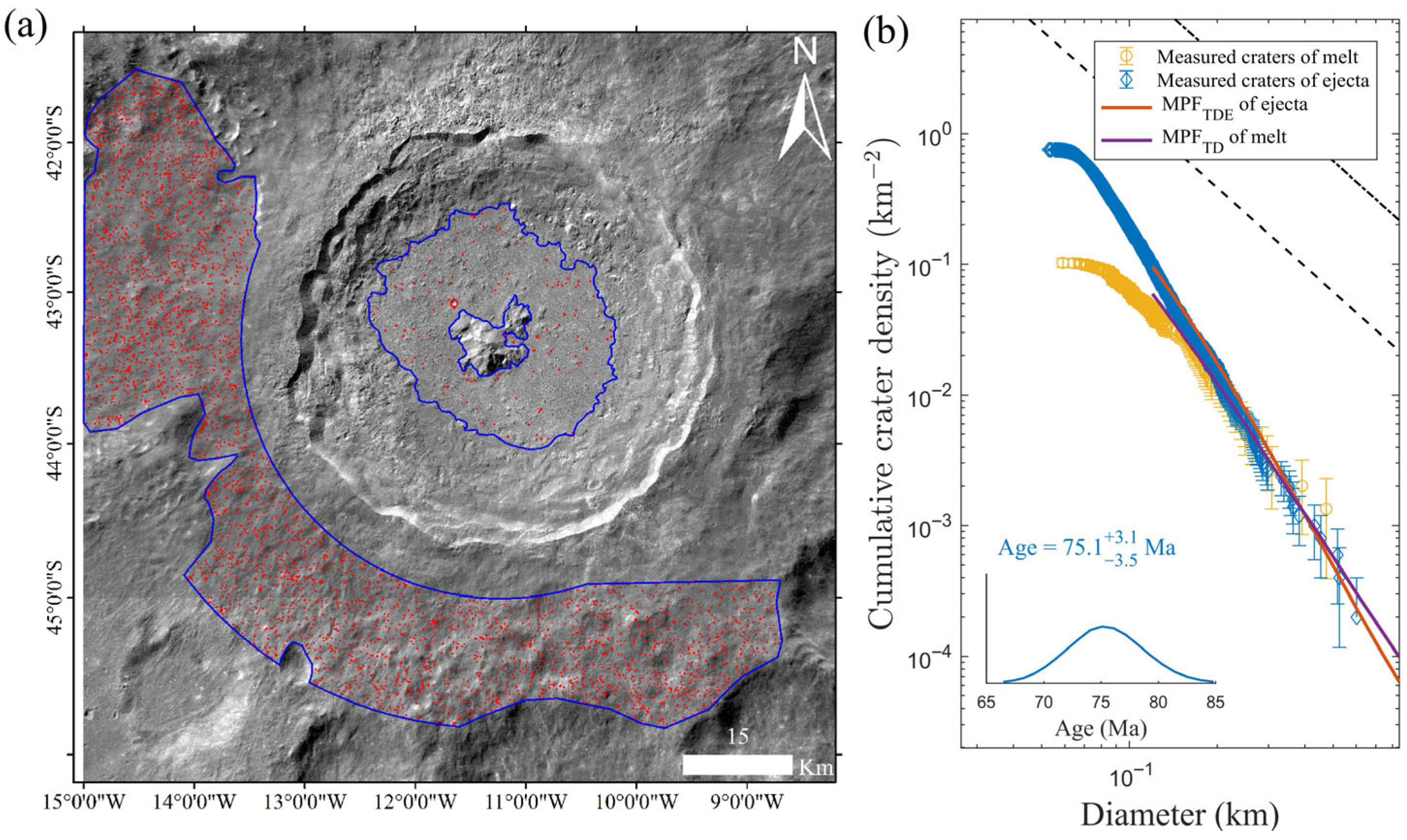
To estimate the age of a lunar unit using the crater production and chronology functions of Xie and Xiao [25], one would measure its crater SFD, apply the same debiasing corrections to obtain the debiased density of diameter ≥1 km craters, N ( 1 ) , and then use their chronology function to determine age t. For instance, as shown in Figure 2, we mapped craters on the ejecta and impact melt of crater Tycho, and then used their modeled dataset of MPFTDEs to fit the SFDs of the mapped craters. As the physical properties of impact melt and crater ejecta blanket are different, it is important to adopt appropriate crater scaling laws for their crater SFDs. As demonstrated by Xie and Xiao [25], the initial physical properties for impact melt and crater ejecta blanket are akin to competent rock and dry sand-like porous material (i.e., regolith on top of 1.4 km-thick megaregolith), respectively (it is worth noting that the physical properties are time-dependent, i.e., the surface undergoes weathering to form regolith and grows with time). We use MPFTDE for a target with initial dry sand-like physical properties to fit the SFD of craters on the ejecta blanket of crater Tycho (the best-fitted MPFTDE is denoted as MPFTDE of ejecta), and its corresponding MPFTDE for time-independent competent rock is used to derive the debiased crater density. Then the debiased density is used to determine its AMA by dividing the density by crater production rate of 7.574 × 10⁻⁷ km−2/Myr [25]. The maximum likelihood estimation also determines the probability density distribution of the AMAs (e.g., the inset of Figure 2b), and hence provides the estimate of the uncertainty of the best-fitted AMA. To achieve better statistics, we did not fit the SFD of its impact melt to derive the AMA, as the number of craters mapped on the impact melt is lower than on its ejecta blanket. For comparison, we also show the modeled production function with consideration of target properties and topographic degradation for impact melt (denoted as MPFTD of melt) corresponding to the best-fitted MPFTDE of ejecta.

3. Results

3.1. Ages of the Eight Copernican Complex Craters

Tycho crater (diameter ~86 km; 43°S, 11°W) is one of the youngest complex craters on the Moon (see Figure 1 and Figure 2). Isotopic dating of Apollo 17 ejecta samples suggests a formation age of approximately 109 Ma, but the age was derived from an indirect radiometric dating [3]. Consequently, we adopt the age ( 75.1 3.5 + 3.1 Ma) estimated from the production and chronology functions of Xie and Xiao [25], as shown in Figure 2 (the mapped craters are revised from [12] to ensure the completeness of craters with diameter larger than 120 m). Our estimate is a little less than that ( 85 18 + 15 Ma) derived from crater SFD measurements [6] mainly due to the use of different crater production and chronology functions. The crater exhibits well-preserved morphological features characteristic of a fresh complex crater, including a prominent central peak, terraced inner walls, and a continuous ejecta blanket [36]. These pristine attributes make Tycho an ideal starting point, as the initial crater SFD difference between its coherent impact melt and fragmental ejecta blanket is expected to be prominent.
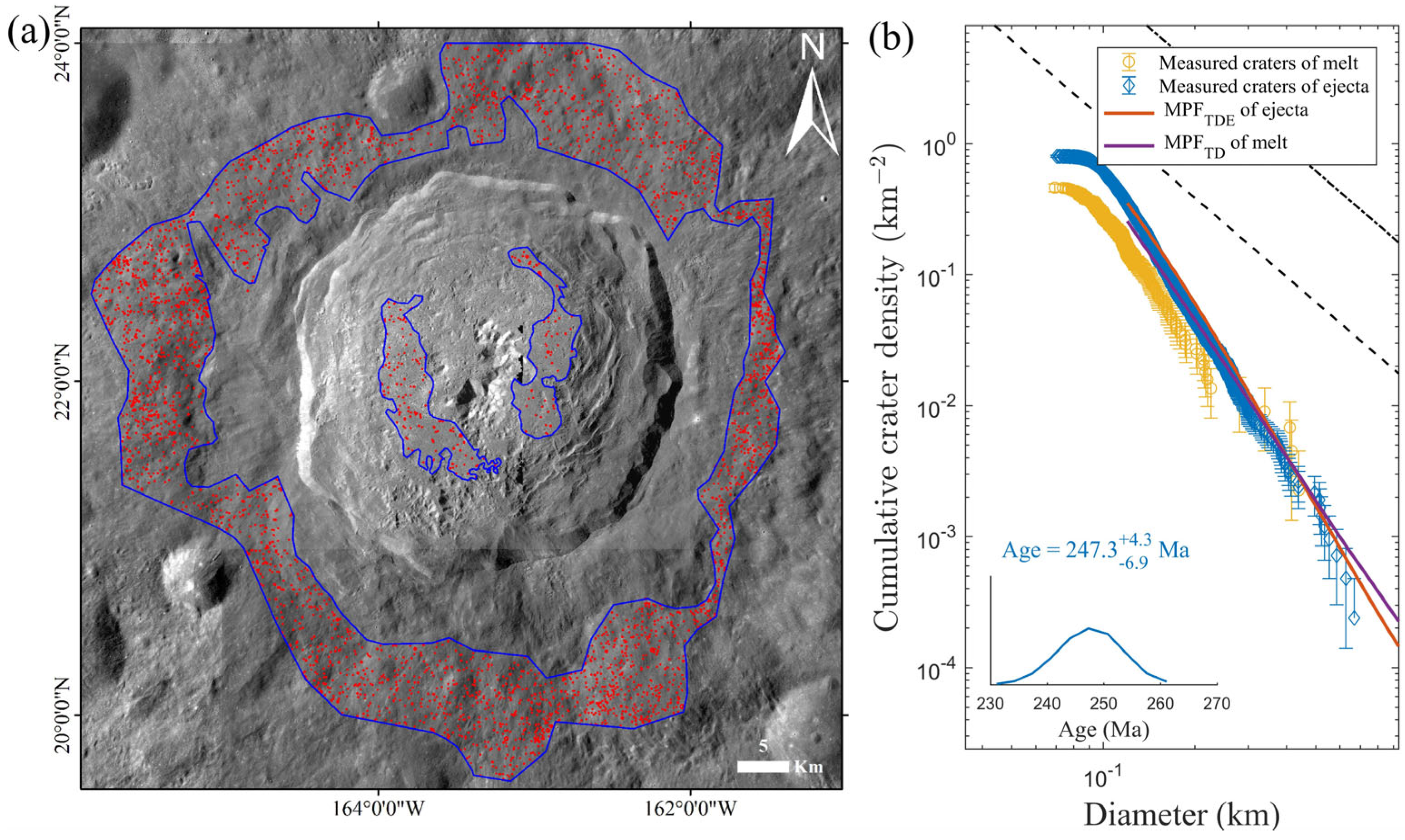
Jackson crater (diameter ~71 km; 22.4°N, 163.4°W) is a complex impact crater on the lunar farside, located east of Mare Moscoviense and north of the South Pole–Aitken Basin (see Figure 1 and Figure 3). It retains a prominent ray system and well-preserved structural features, including terraced walls and central peaks, though its morphology appears more subdued compared to the pristine state of Tycho crater [36]. This intermediate level of preservation makes Jackson crater a crucial sample in our temporal sequence for studying the ongoing evolution of target properties. Its age estimated from our crater counts is 247.3 6.9 + 4.3 Ma, as shown in Figure 3. Statistically, our estimate is inconsistent with that (147 ± 23 Ma) based on the measurement of craters on its proximal ejecta blanket [8]. The discrepancy is potentially caused by systematic errors in crater diameters [37].
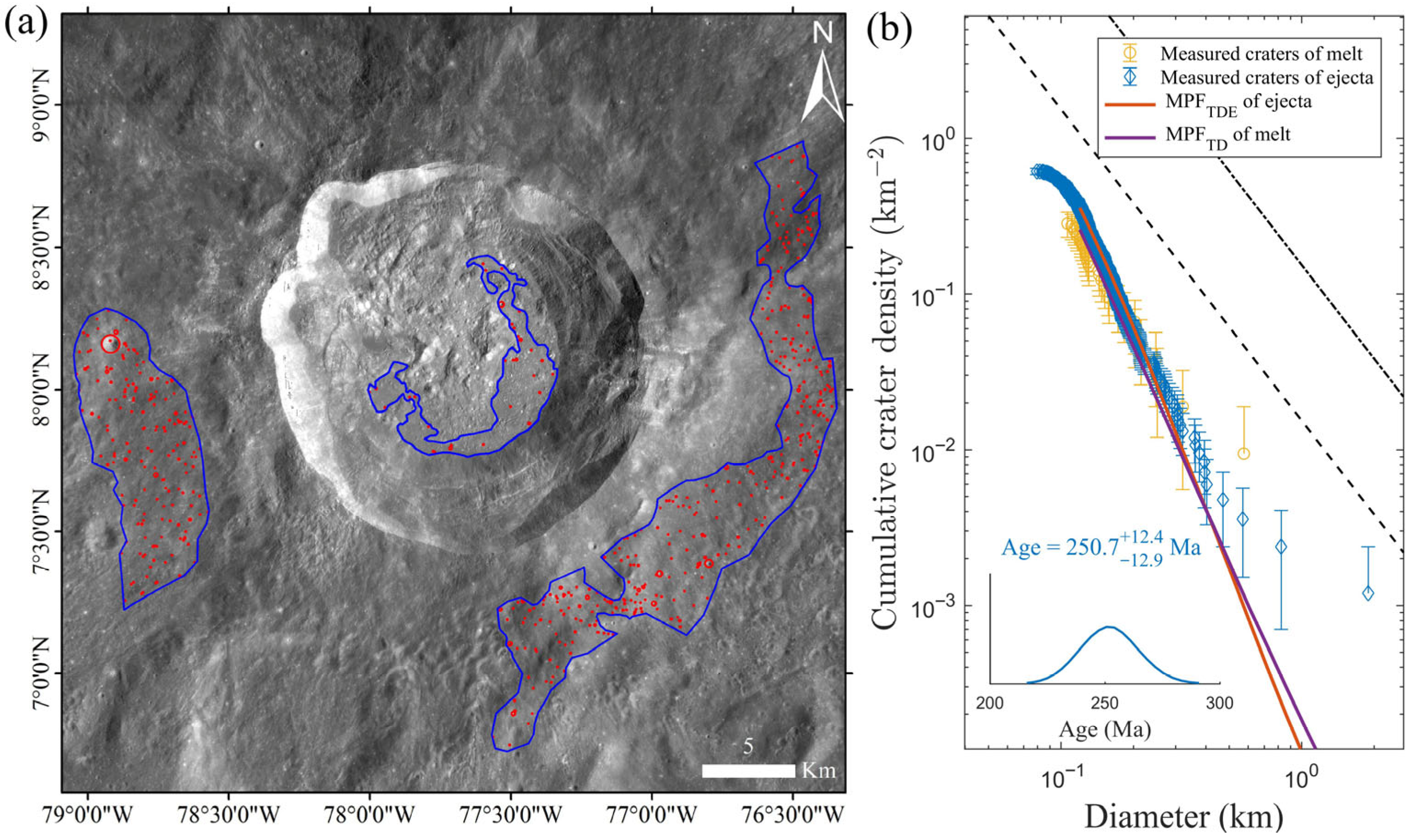
Crater Olbers A (diameter 41.8 km; 8.09°N, 282.32°W) is located in the highland region near the western limb of the lunar nearside (see Figure 1 and Figure 4). The most striking feature of this crater is its extensive bright ray system. It exhibits a well-preserved, sharp rim, with likely prominent terrace structures along its inner walls. The crater floor contains a subdued central uplift and is widely covered by impact melt deposits. Its age is estimated to be 250.7 12.9 + 12.4 Ma, which is less than that estimated by Terada and Morota [38] (185 ± 15 Ma) mainly due to the difference in the adopted crater production and chronology functions. Both works confirm that crater Olbers A is older than Tycho.
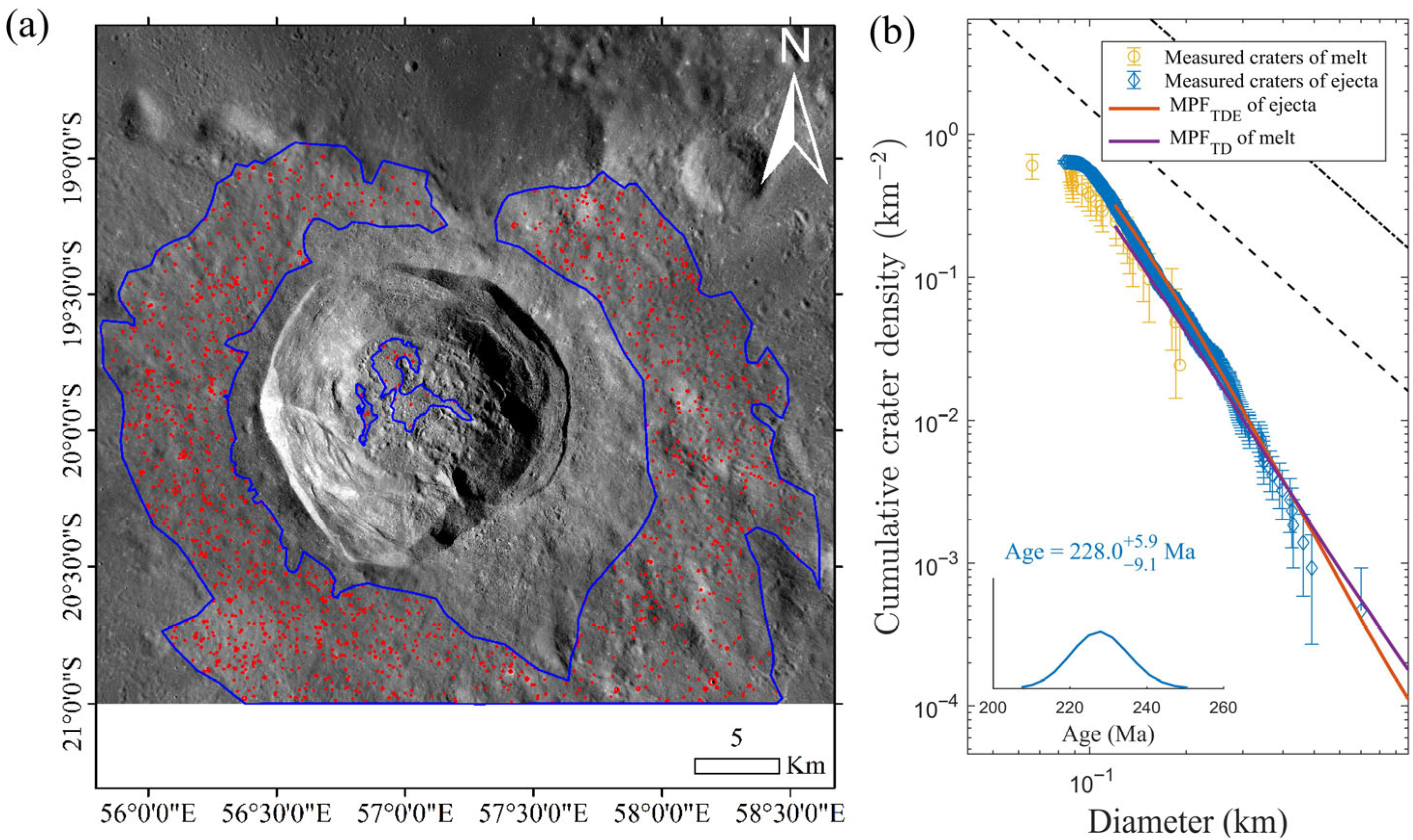
Petavius B (diameter 33.6 km; 19.96°S, 57.04°E) is a satellite crater located on the eastern lunar nearside, south of Mare Fecunditatis and northwest of the large impact crater Petavius (see Figure 1 and Figure 5). The Petavius B crater displays a relatively young morphological character, featuring prominent asymmetric bright rays [39]. According to our mapped craters, its age is 228.0 9.1 + 5.9 Ma, which is consistent with a previous estimate of 227 ± 34 Ma [38] within about 2σ uncertainties.
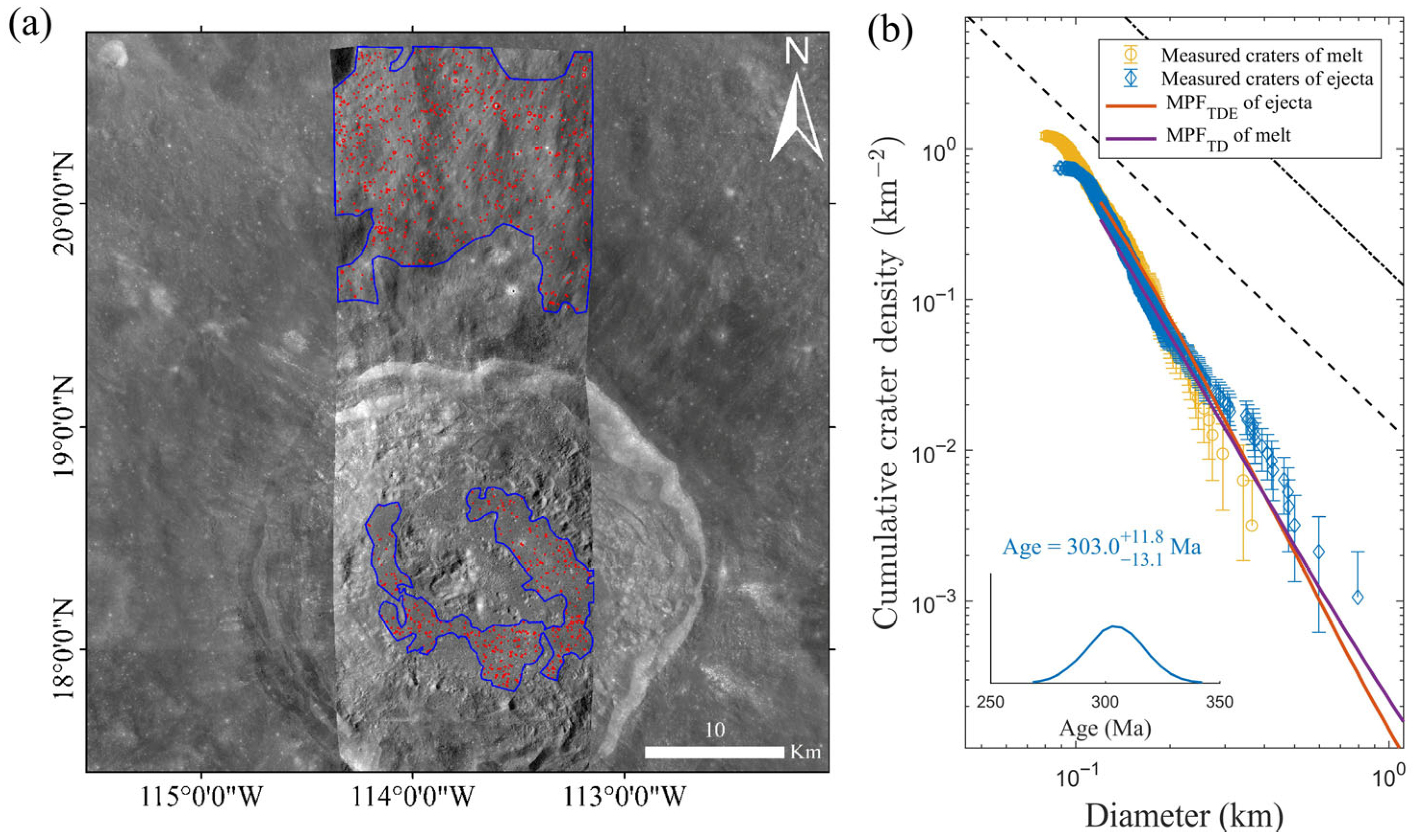
Ohm crater is a ~64 km-diameter complex crater on the lunar farside (18.4°N, 246.5°E; see Figure 1 and Figure 6). It exhibits characteristics indicative of an oblique impact, including a distinct asymmetric rim, the absence of a significant central peak, and diagnostic ejecta distribution [40,41]. The crater floor is dominated by extensive impact melt deposits, evidenced by low-albedo melt ponds and a network of polygonal and sub-parallel cooling fractures that point to former uniform melt coverage [41]. According to our mapped craters, its age is 303.0 13.1 + 11.8 Ma (Figure 6b). For comparison, the age of the Ohm crater is constrained to 291 Ma, based on the calibration of the rock abundance–age relationship derived from nine reference craters with a mean relative age uncertainty of 36.4% [42].
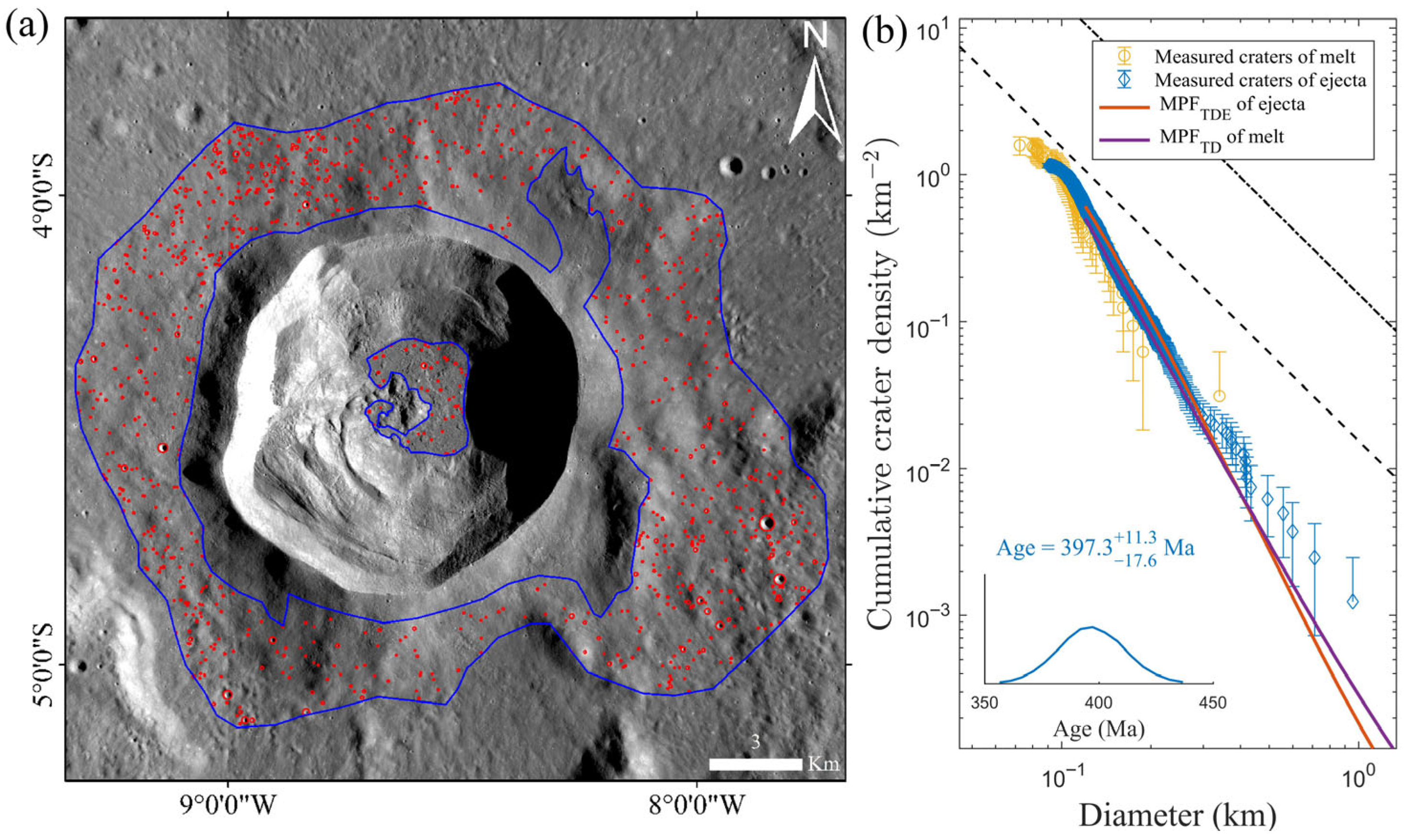
Lalande crater is a ~25 km-diameter structure (4.46°S, 8.65°W) that is morphologically transitional between simple and complex craters (see Figure 1 and Figure 7) [43]. It exhibits partially slumped walls with incipient terracing and a subtly raised central peak, lacking the prominent peak clusters of larger complex craters [6]. According to our mapped craters, its age is 397.3 17.6 + 11.3 Ma (Figure 7b). Our estimate is consistent with that (410 ± 20 Ma) determined by Xu, et al. [44].
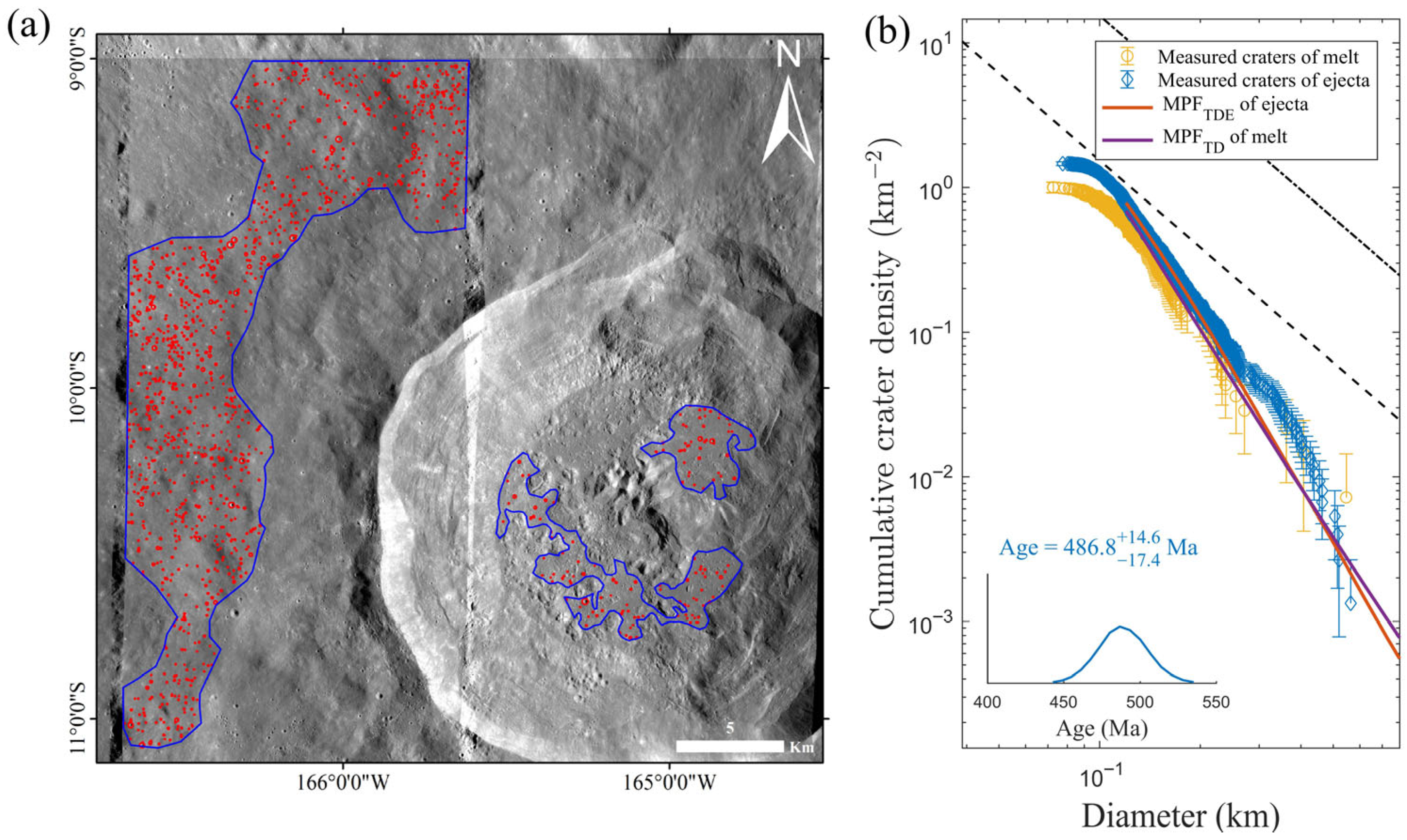
Crookes (10.3° S, 164.5° W) is an impact crater on the lunar farside, approximately 52 km in diameter. Morphologically, the crater floor of Crookes features a central uplift manifested as irregular central mounds. Additionally, the crater is characterized by a sharply defined rim, broad inner walls, and evidence of inward slumping along its wall slopes [41]. The age of the Crookes crater is constrained to 446 Ma [42]. Similar to the Ohm crater, it is based on the calibration of the rock abundance–age relationship derived from nine reference craters with a mean relative age uncertainty of 36.4%. According to the crater we measured, the maximum likelihood estimation of the absolute model age probability density yields an age of 486.8 17.4 + 14.6 Ma for the Crookes crater, which is consistent with a previous study [42].
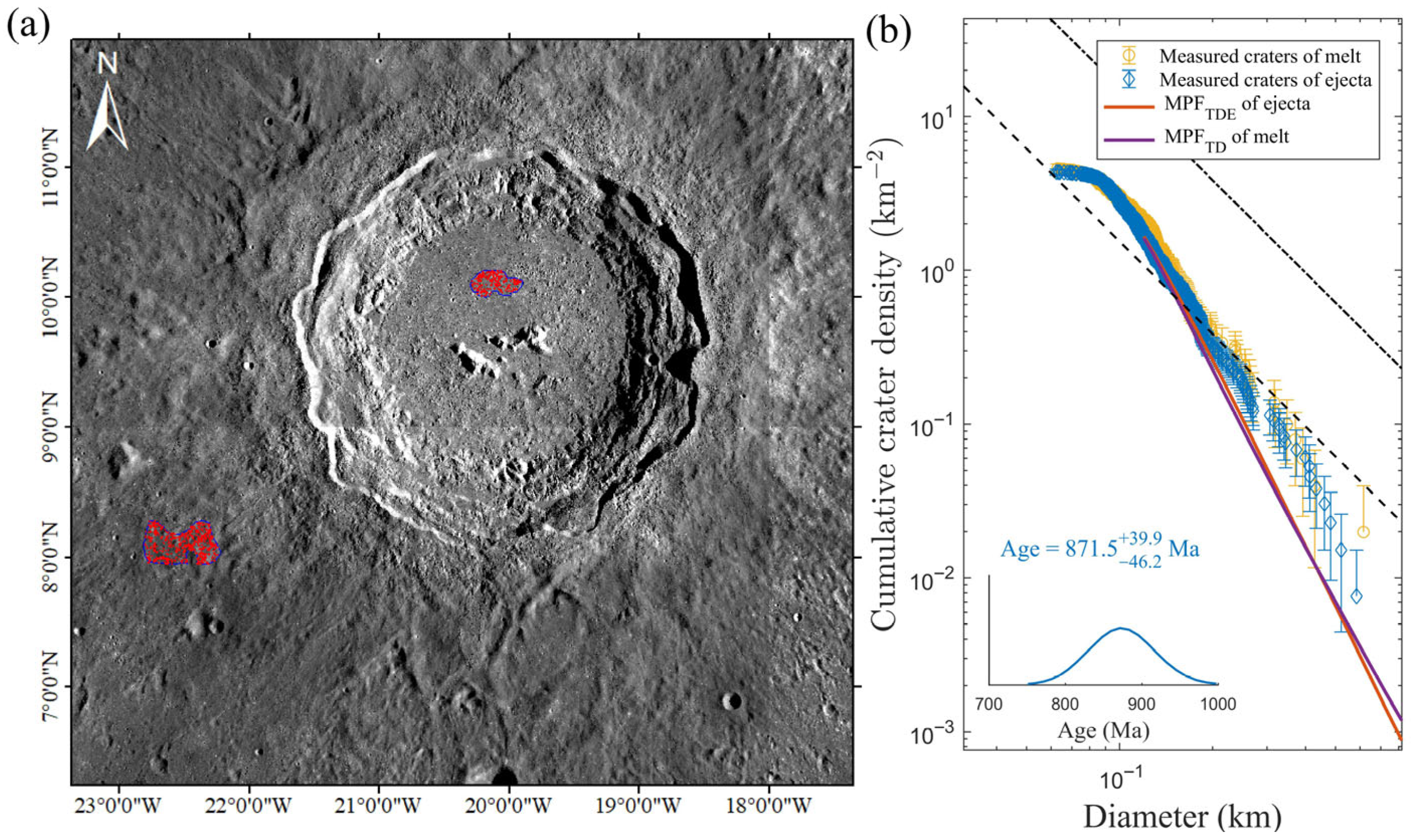
Copernicus (9.7°N, 20.0°W) is a renowned complex impact crater on the lunar nearside [3]. It is nearly perfectly circular in shape and features a prominent ray system that covers a large portion of the lunar nearside [3,26]. The crater has a diameter of about 93 km, a hexagonal rim outline, and terraced inner walls. Regarding the formation age of the Copernicus crater, early 40Ar–39Ar dating studies yielded an age of approximately 800 Ma [45]. Subsequently, Bogard, et al. [46] dated a granite fragment encased in KREEP glass and obtained an age of 800 ± 15 Ma [3], which is widely accepted as the formation age of the Copernicus crater. Using the mapped craters of [18], the maximum likelihood estimation of the absolute model age probability density yields an age of 871.5 46.2 + 39.9 Ma for the Copernicus crater, which is broadly consistent with previous studies.

3.2. Crater Density Ratios Observed at Large Craters with Different Ages

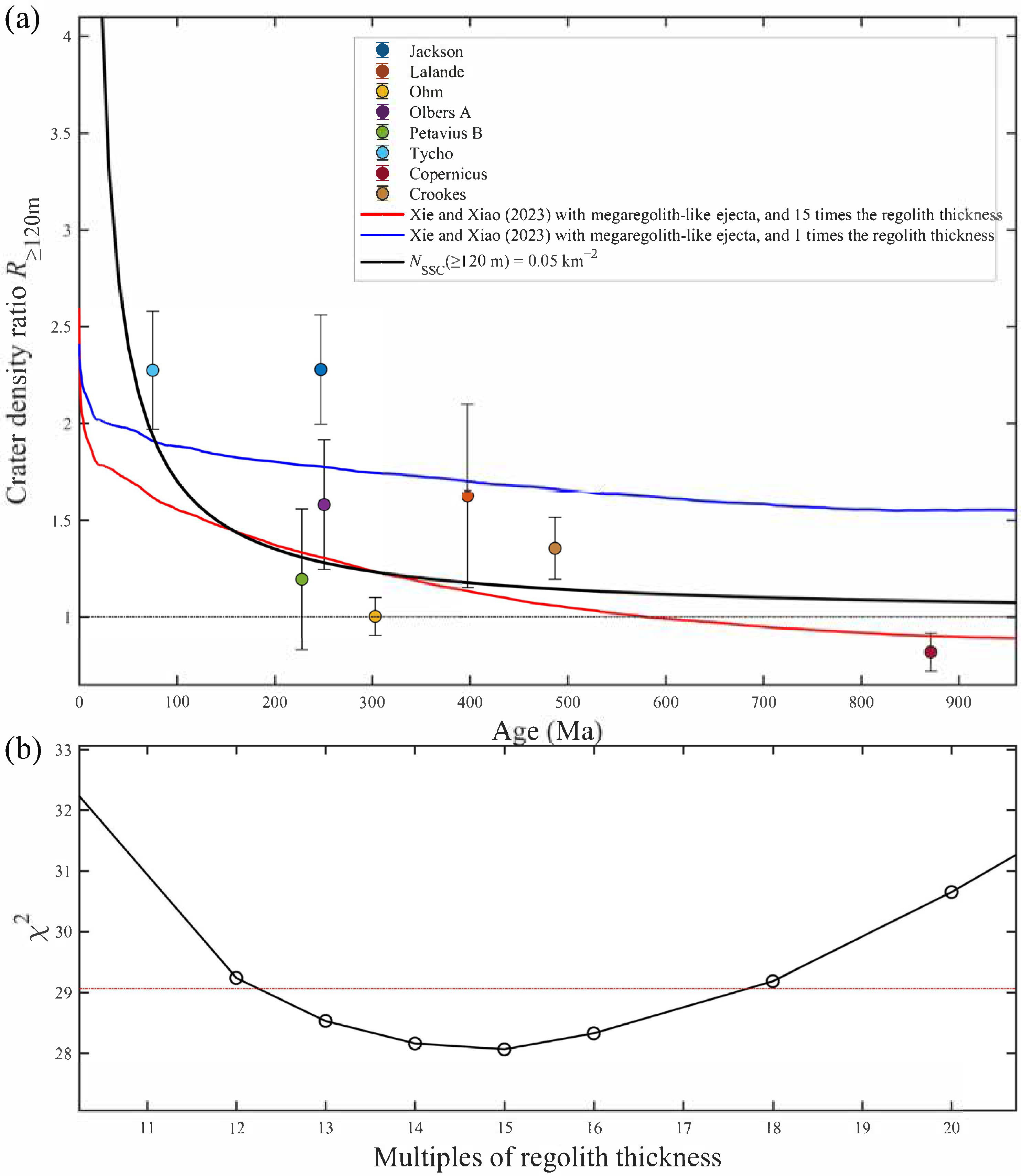
We analyzed crater SFDs of impact melt and ejecta units across the eight large complex craters forming a temporal sequence and derived the ratios of cumulative crater densities (R120m) as a function of model ages of their parent craters (Figure 10). The results reveal a decrease in R120m with increasing mode age, reflecting the gradual convergence of crater retention properties between the two units.
Consistent with earlier findings of significant crater SFD variations within Tycho crater [4,6,9,11,16,17], our analysis shows a pronounced disparity between its melt and ejecta units. Revising the crater catalog of crater Tycho from Xie, Xiao and Xu [12], we derive R120m = 2.3 ± 0.3 (Figure 2). For similar-sized craters, our result is consistent with that of Krüger, Bogert and Hiesinger [31] with a density ratio of about 2.9.
The density ratio observed at Jackson crater is R120m = 2.3 ± 0.3 (Figure 3). This is broadly consistent with the ratio of ~2 previously reported by Van der Bogert, Hiesinger, McEwen, Dundas, Bray, Robinson, Plescia, Reiss, Klemm and Team [8] for 10–100 m-diameter craters. For Olbers A crater, the crater SFD disparity between melt and ejecta is R120m = 1.6 ± 0.3 (Figure 4), which is similar to that of Lalande crater (R120m = 1.6 ± 0.5; Figure 7). For craters Petavius B and Ohm, where crater SFDs of melt and ejecta units are almost superimposed (Figure 5 and Figure 6), their respective density ratios are R120m = 1.2 ± 0.4 and 1.0 ± 0.1. For the Crookes crater, the crater SFD disparity between melt and ejecta is R≥120m = 1.4 ± 0.2 (Figure 8), which is consistent with the trend of decreasing density ratio with increasing age. For the Copernicus crater, crater SFDs of the two units are almost indistinguishable, with a density ratio slight lower than unity (R≥120m = 0.82 ± 0.1; Figure 9), which is consistent with previous studies reporting near-identical crater size–frequency distributions between ejecta and melt units for the Copernicus crater [17,18].

4. Discussion

4.1. Time-Dependent Target Properties and Their Effect on Crater Production

The density ratios generally decrease with surface ages, as shown in Figure 10. We find a match between our data and the model of Xie and Xiao [25] when adopting the MPFTDE for megaregolith-like ejecta and an initial melt strength of 10 MPa [48]. To simplify the model of fracturing impact melt, Xie and Xiao [25] adopt a two-layer target model (regolith on top of intact rock), but modeled–predicted crater density ratio decreases so slowly to be consistent with the data, as shown in Figure 10a. We use the χ 2 minimization technique (the weights are adopted as the reciprocal of the square of the uncertainties of the crater density ratios [47]) to find the match between the decay trend of the density ratio with time and modeled–predicted crater density ratio when adopting an upper layer with thickness 15 ± 3 times ticker than regolith thickness. The uncertainty is estimated according to Figure 10b. To test the sensitivity of our results to the minimum diameter, we use a minimum diameter of 140 m and get similar results; the resulting upper layer is 22 ± 5 times thicker than regolith thickness, which is consistent with the result derived from a minimum diameter of 120 m within about 2σ uncertainty. The requirement for a thicker upper layer suggests that except for the production of regolith, there should be a transition layer (consisting of fragments) beneath the regolith layer, which is potentially produced by impact-induced damage [18,49].
Previous works focused on the instantaneous fragmentation and damage of the target caused by a single impact event (e.g., [49]), and their conclusions are primarily applicable to describing the local target response during the formation of a single crater. In contrast, our study focuses on the cumulative effects of multiple impacts over geological timescales, specifically, how long-term, sustained bombardment progressively damages and fractures originally dense impact melt, causing their mechanical properties to gradually approach those of loose ejecta. The establishment of a damage model for the lunar surface is beyond the scope of this work, thus the reliability of the interpretation as the result of impact-induced damage has not been robustly tested currently.
The density of ≥1 km diameter craters are estimated by fitting the observed SFDs of craters on ejecta blanket with the production function of Xie and Xiao [25]. As the overall physical properties of the ejecta blanket are insensitive to the growth of regolith [25], the ages are almost unaffected (the resulting age differences are all less than 10%) by different parameters for interpreting the temporal trend, which is mainly caused by the fragmentation of the impact melt. Therefore, the variation trend of the crater density ratios is reliable.
The central impact melt typically presents as a coherent rock, whereas ejecta blankets consist of loose and fragmented debris [50]. After formation, the initial, coherent, and competent melt rock is progressively fragmented by continuous impact, generating cracks and breaking down into smaller clasts [18,49]. This process causes a continual decrease in its macroscopic mechanical strength and an increase in porosity, making it increasingly resemble unconsolidated ejecta. Consequently, its cratering efficiency increases over time according to crater scaling laws [12,25,51], leading to an accelerated crater accumulation rate (it is worth noting the original differences between the ejecta and the inner melt, as these two materials exhibit fundamentally different mechanical responses to cratering initially). In contrast, the material in the ejecta blanket, which is initially fragmented and unconsolidated, changes from coarse particles to finer ones. In terms of cratering efficiency, the change in its bulk target properties is far less dramatic than the fundamental transformation experienced by the melt (from competent rock to fragments) according to crater scaling laws [51]. Eventually, impact melt (at least its upper layer) will evolve to become fragmented and unconsolidated material with ejecta-like target properties. When their resistance to impact cratering (i.e., cratering efficiency) becomes indistinguishable, the number of craters accumulated under the same impact history will naturally converge, resulting in almost equivalent crater SFDs and AMAs [6,9,18,52].

4.2. Self-Secondary Craters

The causes for crater SFD differences have been extensively debated in the literature. Another explanation of the crater density difference between impact melt and ejecta is the contamination of craters at the ejecta blanket by SSCs [5,7,11,20,53,54]. It is worth noting that the SSC hypothesis and the target property evolution model are not mutually exclusive, while our data are not statistically good enough to disentangle the precise contribution of each mechanism mainly due to the lack of constraints on the potential dependence of SSC production density on its parent crater size. The SSC hypothesis considers that fragments ballistically ejected during a primary impact event create a population of secondary craters predominantly on the continuous ejecta blanket shortly after the emplacement of the ejecta blanket, while the central melt unit, which cools and solidifies later, records few/none of these contemporaneous secondary impacts. It is worth mentioning that part of the secondary craters, which forms right at the time of the ejecta emplacement and central melt sheet, makes more confusion both in crater observability and interpretation. This SSC hypothesis, therefore, predicts an initial crater density contrast between the two coeval units (the density ratio of craters with diameter ≥120 m is predicted to be about 2.4 as shown in Figure 10). After their formation, both units are subjected to the same subsequent impacts (comprising primary and secondary craters) [17]. This subsequent bombardment accumulates equally on both the ejecta and melt units, provided that impact cratering is independent of target properties. Consequently, any initial localized non-uniformity predicted by the SSC hypothesis should be progressively diluted due to the continuous accumulation of subsequent craters, which eventually far surpass the initial SSC population [17].
Here we consider the extreme case that SSCs do not undergo erasure. Specifically, if this crater density difference is solely due to the initial contamination of SSCs with the density of Nssc on the ejecta blanket (with none on the contemporaneous central melt due to its relatively long cooling time compared with the flight time of ejecta fragments) and both units subsequently accumulate craters at the same constant rate P (per Myr), then the observed density ratio is
R t = P t + N S S C P t = 1 + N S S C P t
The value of P for craters with diameters ≥120 m, P is 7.2 × 10⁻⁴ km−2Myr−1 according to Xie and Xiao [25]. This equation also matches the data of R120m, as shown in Figure 10a. The resulting Nssc for craters with diameters ≥120 m is 0.05 km−2, which implies that ejecta deposits younger than 0.05 km−2/7.2 × 10−4 km−2Myr−1 = 69.4 Ma (similar to the AMA of crater Tycho) could be dominated by SSCs. Note that this result is derived from assumptions that Nssc is independent of the size of the parent crater and SSCs do not undergo erasure. In addition, the effect of target properties (e.g., inner melt sheet is stronger than the ejecta) on cratering rate is also neglected. Caution should be exercised in the use of this estimate.

5. Conclusions

In this work, by observing SFDs of small craters at complex craters with ages between about 75 Ma and 871 Ma, we find a decrease in the crater SFD difference between coeval geological units with increasing age. This time-dependent crater SFD difference can be attributed to the change in target properties with time. The time-dependent target properties may be mainly caused by impact-induced damage, which efficiently turns coherent melt into ejecta-like fragments. Alternatively, the time-dependent crater SFD difference is caused by the contamination of SSCs, while the diameter ≥120 m crater population superposing on the facies of lunar complex craters with age older than crater Tycho is likely not dominant. In the future, the trend observed in this study can be tested through observation of more Copernican-aged impact craters (e.g., Aristarchus, Kepler, etc.).

Author Contributions

Conceptualization, M.X.; methodology, Y.Z., M.X. and Z.X.; software, Y.Z. and M.X.; validation, Y.Z. and M.X.; formal analysis, Y.Z., M.X. and Z.X.; investigation, Y.Z., M.X. and Z.X.; resources, M.X.; data curation, Y.Z. and M.X.; writing—original draft preparation, Y.Z.; writing—review and editing, Y.Z., M.X. and Z.X.; visualization, Y.Z. and M.X.; supervision, M.X.; project administration, M.X.; funding acquisition, M.X. All authors have read and agreed to the published version of the manuscript.

Funding

This research was funded by the National Natural Science Foundation of China (grant No. 12173011).

Data Availability Statement

Mapped craters can be found through Zenodo (https://doi.org/10.5281/zenodo.19634014; accessed on 11 May 2026). Kaguya TC morning images can be downloaded from https://darts.isas.jaxa.jp/app/pdap/selene/index.html.en (accessed on 15 February 2026).

Conflicts of Interest

The authors declare no conflicts of interest.

References

  1. Melosh, H.J. Impact Cratering: A Geologic Process; Oxford University Press: Oxford, UK; Clarendon Press: Oxford, UK, 1989. [Google Scholar]
  2. Stöffler, D.; Ryder, G.; Ivanov, B.A.; Artemieva, N.A.; Cintala, M.J.; Grieve, R.A.F. Cratering History and Lunar Chronology. Rev. Mineral. Geochem. 2006, 60, 519–596. [Google Scholar] [CrossRef]
  3. Stöffler, D.; Ryder, G. Stratigraphy and Isotope Ages of Lunar Geologic Units: Chronological Standard for the Inner Solar System. Space Sci. Rev. 2001, 96, 9–54. [Google Scholar] [CrossRef]
  4. Shoemaker, E.M.; Batson, R.M.; Holt, H.E.; Morris, E.C.; Rennilson, J.J.; Whitaker, E.A. Observations of the lunar regolith and the Earth from the television camera on Surveyor 7. J. Geophys. Res. 1969, 74, 1896–1977. [Google Scholar] [CrossRef]
  5. Shoemaker, E.M.; Batson, R.M.; Holt, H.E.; Morris, E.C.; Rennilson, J.J.; Whitaker, E.A. Television observations from Surveyor VII, in Surveyor 7 Mission Report. Part 2—Science Results. Tech. Rep. 1968, 173, 13. [Google Scholar]
  6. Hiesinger, H.; van der Bogert, C.H.; Pasckert, J.H.; Funcke, L.; Giacomini, L.; Ostrach, L.R.; Robinson, M.S. How old are young lunar craters? J. Geophys. Res. Planets 2012, 117, E12. [Google Scholar] [CrossRef]
  7. Zanetti, M.; Stadermann, A.C.; Jolliff, B.L.; Bogert, C.H.; Hiesinger, H.; Plescia, J.B. Auto-Secondary Cratering vs. Target Property Effects on Ejecta Blankets of Copernican Craters: What are the Implications for Age Dating Using Small-Diameter Crater Statistics? 2015. Available online: https://ui.adsabs.harvard.edu/abs/2015LPI....46.1209Z/abstract (accessed on 15 February 2026).
  8. Van der Bogert, C.H.; Hiesinger, H.; McEwen, A.S.; Dundas, C.; Bray, V.; Robinson, M.S.; Plescia, J.B.; Reiss, D.; Klemm, K.; the LROC Team. Discrepancies between crater sizefrequency distributions on ejecta and impact melt pools at lunar craters: An effect of differing target properties? In Proceedings of the 41st Lunar and Planetary Science Conference, The Woodlands, TX, USA, 1–5 March 2010. [Google Scholar]
  9. Van der Bogert, C.H.; Hiesinger, H.; Dundas, C.M.; Krüger, T.; McEwen, A.S.; Zanetti, M.; Robinson, M.S. Origin of discrepancies between crater size-frequency distributions of coeval lunar geologic units via target property contrasts. Icarus 2017, 298, 49–63. [Google Scholar] [CrossRef]
  10. Williams, J.-P.; Paige, D.; Plescia, J.; Pathare, A.; Robinson, M. Crater Size-Frequency Distributions on the Ejecta of Giordano Bruno. 2014. Available online: https://www.hou.usra.edu/meetings/lpsc2014/pdf/2882.pdf (accessed on 15 February 2026).
  11. Zanetti, M.; Stadermann, A.; Jolliff, B.; Hiesinger, H.; van der Bogert, C.H.; Plescia, J. Evidence for self-secondary cratering of Copernican-age continuous ejecta deposits on the Moon. Icarus 2017, 298, 64–77. [Google Scholar] [CrossRef]
  12. Xie, M.; Xiao, Z.; Xu, A. Time-Dependent Production Functions of Lunar Simple Craters on Layered Targets with Consideration of Topographic Degradation. Geophys. Res. Lett. 2019, 46, 10987–10996. [Google Scholar] [CrossRef]
  13. Michelle, R.; Kirchoff, S.M. New insights into lunar terrain properties and their effect on derivation of absolute model ages using Apollo landing sites. Icarus 2023, 391, 115336. [Google Scholar] [CrossRef]
  14. Kereszturi, A.; Steinmann, V. Terra-mare comparison of small young craters on the Moon. Icarus 2019, 322, 54–68. [Google Scholar] [CrossRef]
  15. Plescia, J.B.; Robinson, M.S. Giordano Bruno: Small crater populations––Implications for self-secondary cratering. Icarus 2019, 321, 974–993. [Google Scholar] [CrossRef]
  16. Xiao, Z.; Strom, R.G. Problems determining relative and absolute ages using the small crater population. Icarus 2012, 220, 254–267. [Google Scholar] [CrossRef]
  17. Xiao, Z.; Werner, S.C.J. Size-frequency distribution of crater populations in equilibrium on the Moon. Geophys. Res. 2015, 120, 2277–2292. [Google Scholar] [CrossRef]
  18. Xie, M.; Li, Y. Effect of Target Properties on Regolith Production. Remote Sens. 2024, 16, 2650. [Google Scholar] [CrossRef]
  19. Chang, Y.; Xiao, Z.; Liu, Y.; Cui, J. Self-Secondaries Formed by Cold Spot Craters on the Moon. Remote Sens. 2021, 13, 1087. [Google Scholar] [CrossRef]
  20. Xiao, Z.; Prieur, N.C.; Werner, S.C. The self-secondary crater population of the Hokusai crater on Mercury. Geophys. Res. Lett. 2016, 43, 7424–7432. [Google Scholar] [CrossRef]
  21. Hirabayashi, M.; Fassett, C.I.; Costello, E.S.; Minton, D.A. Crater Equilibrium State Characterization given Crater Production from a Single Power Law. Planet. Sci. J. 2024, 5, 250. [Google Scholar] [CrossRef]
  22. Xie, M.; Zhu, M.-H.; Xiao, Z.; Wu, Y.; Xu, A. Effect of Topography Degradation on Crater Size-Frequency Distributions: Implications for Populations of Small Craters and Age Dating. Geophys. Res. Lett. 2017, 44, 10171–10179. [Google Scholar] [CrossRef]
  23. Haruyama, J.; Hara, S.; Hioki, K.; Iwasaki, A.; Morota, T.; Ohtake, M.; Matsunaga, T.; Araki, H.; Matsumoto, K.; Ishihara, Y.; et al. Lunar Global Digital Terrain Model Dataset Produced from SELENE (Kaguya) Terrain Camera Stereo Observations. In Proceedings of the 43rd Lunar and Planetary Science Conference, The Woodlands, TX, USA, 19–23 March 2012. [Google Scholar]
  24. Kneissl, T.; van Gasselt, S.; Neukum, G. Map-projection-independent crater size-frequency determination in GIS environments—New software tool for ArcGIS. Planet. Space Sci. 2011, 59, 1243–1254. [Google Scholar] [CrossRef]
  25. Xie, M.; Xiao, Z. A new chronology from debiased crater densities: Implications for the origin and evolution of lunar impactors. Earth Planet. Sci. Lett. 2023, 602, 117963. [Google Scholar] [CrossRef]
  26. Robinson, M.S.; Brylow, S.M.; Tschimmel, M.; Humm, D.; Lawrence, S.J.; Thomas, P.C.; Denevi, B.W.; Bowman-Cisneros, E.; Zerr, J.; Ravine, M.A.; et al. Lunar reconnaissance orbiter camera (LROC) instrument overview. Space Sci. Rev. 2010, 150, 81–124. [Google Scholar] [CrossRef]
  27. Xiao, Z.; Zeng, Z.; Ding, N.; Molaro, J. Mass wasting features on the Moon—How active is the lunar surface? Earth Planet. Sci. Lett. 2013, 376, 1–11. [Google Scholar] [CrossRef]
  28. Fassett, C.I.; Head, J.W.; Kadish, S.J.; Mazarico, E.; Neumann, G.A.; Smith, D.E.; Zuber, M.T. Lunar impact basins: Stratigraphy, sequence and ages from superposed impact crater populations measured from Lunar Orbiter Laser Altimeter (LOLA) data. J. Geophys. Res. 2012, 117, E00H06. [Google Scholar] [CrossRef]
  29. Williams, J.-P.; Pathare, A.V.; Costello, E.S.; Gallinger, C.L.; Hayne, P.O.; Ghent, R.R.; Paige, D.A.; Siegler, M.A.; Russell, P.S.; Elder, C.M. The Effects of Terrain Properties Upon the Small Crater Population Distribution at Giordano Bruno: Implications for Lunar Chronology. J. Geophys. Res. Planets 2022, 127, e2021JE007131. [Google Scholar] [CrossRef] [PubMed]
  30. Denevi, B.W.; Koeber, S.D.; Robinson, M.S.; Garry, W.B.; Hawke, B.R.; Tran, T.N.; Lawrence, S.J.; Keszthelyi, L.P.; Barnouin, O.S.; Ernst, C.M.; et al. Physical constraints on impact melt properties from Lunar Reconnaissance Orbiter Camera images. Icarus 2012, 219, 665–675. [Google Scholar] [CrossRef]
  31. Krüger, T.; van der Bogert, C.H.; Hiesinger, H. Geomorphologic mapping of the lunar crater Tycho and its impact melt deposits. Icarus 2016, 273, 164–181. [Google Scholar] [CrossRef]
  32. Wang, Y.; Xie, M.; Xiao, Z.; Cui, J. The minimum confidence limit for diameters in crater counts. Icarus 2020, 341, 113645. [Google Scholar] [CrossRef]
  33. Ku, H.H. Notes on the use of propagation of error formulas. J. Res. Natl. Bur. Stand. C Eng. Instrum. 1966, 70C, 263. [Google Scholar] [CrossRef]
  34. Gault, D.E. Saturation and equilibrium conditions for impact cratering on the lunar surface: Criteria and implication. Radio Sci. 1970, 5, 237–291. [Google Scholar] [CrossRef]
  35. Neukum, G.; Ivanov, B.; Hartmann, W. Cratering Records in the Inner Solar System in Relation to the Lunar Reference System. Space Sci. Rev. 2001, 96, 55–86. [Google Scholar] [CrossRef]
  36. Dhingra, D.; Head, J.W.; Pieters, C.M. Geological mapping of impact melt deposits at lunar complex craters Jackson and Tycho: Morphologic and topographic diversity and relation to the cratering. Icarus 2017, 283, 268–281. [Google Scholar] [CrossRef]
  37. Xie, M.; Li, Y. Effect of crater diameter measurement errors on the uncertainty of crater statistics. Icarus 2026, 454, 117078. [Google Scholar] [CrossRef]
  38. Terada, K.; Morota, T.; Kato, M. Asteroid shower on the Earth-Moon system immediately before the Cryogenian period revealed by KAGUYA. Nat. Commun. 2020, 11, 3453. [Google Scholar] [CrossRef] [PubMed]
  39. Ghent, R.R.; Leverington, D.W.; Campbell, B.A.; Hawke, B.R.; Campbell, D.B. Properties of Lunar Crater Ejecta from New 70-cm Radar Observations. In Proceedings of the 35th Lunar and Planetary Science Conference, League City, TX, USA, 15–19 March 2004. [Google Scholar]
  40. Patel, S.; Satyakumar, A.V.; El-Maarry, M.R.; Solanki, P. Compositional variations in Ohm ray crater on the farside of the Moon: Implications for mafic anomaly. Planet. Space Sci. 2023, 229, 105674. [Google Scholar] [CrossRef]
  41. Thaker, A.D.; Patel, S.M.; Solanki, P.M. Morphological analysis and mapping of complex craters of Copernican age: Crookes, Ohm and Stevinus. Planet. Space Sci. 2020, 184, 104856. [Google Scholar] [CrossRef]
  42. Mazrouei, S.; Ghent, R.R.; Bottke, W.F.; Parker, A.H.; Gernon, T.M. Earth and Moon impact flux increased at the end of the Paleozoic. Science 2019, 363, 253–257. [Google Scholar] [CrossRef]
  43. Pike, R.J. Geometric interpretation of lunar craters: U.S. Geological Survey Professional Paper 1046. 1980; pp. C1–C77. Available online: https://pubs.usgs.gov/publication/pp1046C (accessed on 15 February 2026).
  44. Xu, L.; Qiao, L.; Xie, M.; Wu, Y. Formation age of lunar Lalande crater and its implications for the source region of the KREEP-rich meteorite Sayh al Uhaymir 169. Icarus 2022, 386, 115166. [Google Scholar] [CrossRef]
  45. Eberhardt, P.; Geiss, J.; Grögler, N.; Stettler, A. How old is the crater copernicus? Moon 1973, 8, 104–114. [Google Scholar] [CrossRef]
  46. Bogard, D.D.; Garrison, D.H.; Shih, C.Y.; Nyquist, L.E. 39Ar-40Ar dating of two lunar granites: The age of Copernicus. Geochim. Cosmochim. Acta 1994, 58, 3093–3100. [Google Scholar] [CrossRef]
  47. Press, W.H.; Teukolsky, S.A.; Vetterling, W.T.; Flannery, B.P. Numerical Recipes, 3rd Edition: The Art of Scientific Computing; Cambridge University Press: Cambridge, UK, 2007. [Google Scholar]
  48. Holsapple, K.A. Theory and Equations for “Craters from Impacts and Explosions”; Washington University: St. Louis, MO, USA, 2003. [Google Scholar]
  49. Senft, L.E.; Stewart, S.T. Modeling impact cratering in layered surfaces. J. Geophys. Res. Planets 2007, 112, E11002. [Google Scholar] [CrossRef]
  50. Shoemaker, E.M.; Hait, M.H.; Swann, G.A.; Schleicher, D.L.; Dahlem, D.H.; Schaber, G.G.; Sutton, R.L. Lunar Regolith at Tranquillity Base. Science 1970, 167, 452–455. [Google Scholar] [CrossRef]
  51. Holsapple, K.A.; Housen, K.R. A crater and its ejecta: An interpretation of Deep Impact. Icarus 2007, 191, 586–597. [Google Scholar] [CrossRef]
  52. Wünnemann, K.; Marchi, S.; Nowka, D.; Michel, P. The Effect of Target Properties on Impact Crater Scaling and the Lunar Crater Chronology. Lunar Planet. Sci. 2012, 43, 1805. [Google Scholar]
  53. Plescia, J.B.; Robinson, M.S. New constraints on the absolute lunar crater chronology. In Proceedings of the 42nd Lunar and Planetary Science Conference, The Woodlands, TX, USA, 7–11 March 2011; p. 1839. [Google Scholar]
  54. Plescia, J.B.; Robison, M.S. Lunar Self-Secondary Cratering: Implications for Cratering and Chronology. In Proceedings of the 46th Lunar and Planetary Science Conference, The Woodlands, TX, USA, 16–20 March 2015; p. 2535. [Google Scholar]
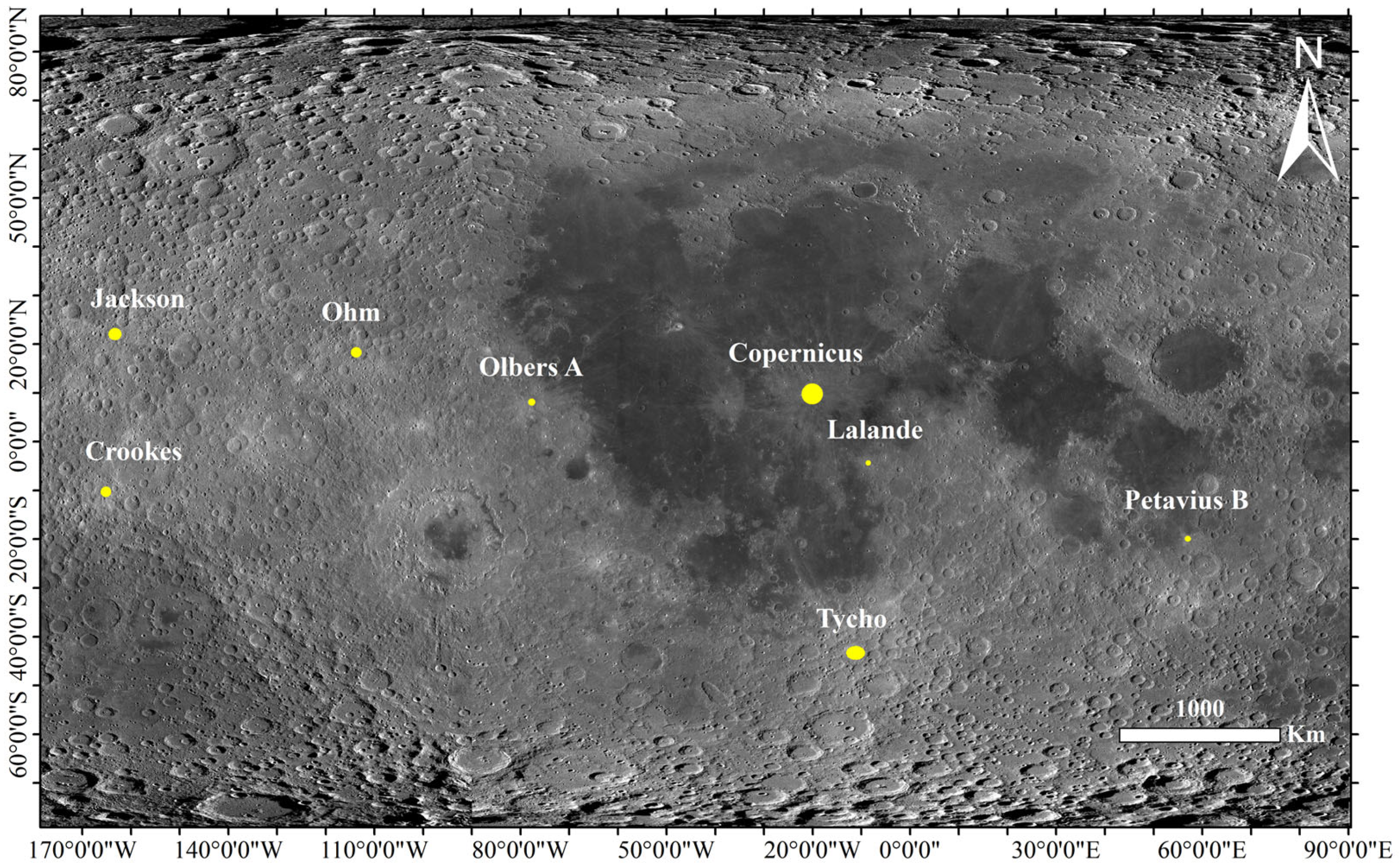
Figure 1. Locations of the eight studied impact craters. Base map is Lunar Reconnaissance Orbiter (LRO) Wide-Angle Camera (WAC) global mosaic [26].
Remotesensing 18 01510 g001
Figure 2. Craters mapped at crater Tycho. (a) Craters (red circles) mapped at ejecta and the central impact melt. The base map is a SELENE/Kaguya Terrain Camera image. Blue polygons outline the crater counting areas for the ejecta blanket and impact melt unit. (b) The crater SFDs of mapped small craters at crater Tycho. The MPFTDE that best fits the crater SFD of ejecta blanket and its corresponding MPFTD of melt are shown in solid lines. The inset shows the probability density distribution of the AMAs. The dotted-dash and dashed lines represent the 10% and 1% geometric saturations, respectively.
Remotesensing 18 01510 g002
Figure 3. (a) Craters mapped at crater Jackson, and (b) their SFDs, similar to Figure 2.
Remotesensing 18 01510 g003
Figure 4. (a) Craters mapped at crater Olbers A, and (b) their SFDs, similar to Figure 2.
Remotesensing 18 01510 g004
Figure 5. (a) Craters mapped at crater Petavius B, and (b) their SFDs, similar to Figure 2.
Remotesensing 18 01510 g005
Figure 6. (a) Craters mapped at crater Ohm, and (b) their SFDs, similar to Figure 2.
Remotesensing 18 01510 g006
Figure 7. (a) Craters mapped at crater Lalande, and (b) their SFDs, similar to Figure 2.
Remotesensing 18 01510 g007
Figure 8. (a) Craters mapped at crater Crookes, and (b) their SFDs, similar to Figure 2.
Remotesensing 18 01510 g008
Figure 9. (a) Craters mapped at crater Copernicus (taken from [18]), and (b) their SFDs, similar to Figure 2.
Remotesensing 18 01510 g009
Figure 10. (a) Temporal evolution of the crater density ratio between ejecta and melt units for craters with diameters ≥120 m. The black line represents the best fit of Equation 1 to the data. The red line represents the crater density ratio predicted from the modeled production function of Xie and Xiao [25]. The black dashed line represents the reference line with a density ratio of 1. (b) Finding the best estimate of the upper layer thickness using the χ 2 minimization approach. The 1σ uncertainty corresponds to Δ χ 2 = 1 (the red line) [47].
Remotesensing 18 01510 g010
Table 1. Summary of crater counting results at complex craters.
Crater NameAge (Ma)Diameter (km)UnitsArea (km)Number of Diameter ≥ 120 m CratersR ≥ 120 m
(±1σ)
Tycho 75.1 3.5 + 3.1 86Ejecta deposits5038.584832.3 ± 0.3
Melt1494.3663
Jackson 247.3 6.9 + 4.3 71Ejecta deposits4192.3514652.3 ± 0.3
Melt443.2268
Olbers A 250.7 12.9 + 12.4 41.8Ejecta deposits839.113001.6 ± 0.3
Melt106.0324
Petavius B 228.0 9.1 + 5.9 33.6Ejecta deposits2167.226901.2 ± 0.4
Melt41.2511
Ohm 303.0 13.1 + 11.8 64Ejecta deposits945.094181 ± 0.1
Melt316.99140
Lalande 397.3 17.6 + 11.3 24Ejecta deposits808.604901.6 ± 0.5
Melt32.1812
Crookes 486.8 17.4 + 14.6 52Ejecta deposits750.895911.4 ± 0.2
Melt139.3181
Copernicus 871.5 46.2 + 39.9 93Ejecta deposits131.682200.82 ± 0.1
Melt50.41103
Disclaimer/Publisher’s Note: The statements, opinions and data contained in all publications are solely those of the individual author(s) and contributor(s) and not of MDPI and/or the editor(s). MDPI and/or the editor(s) disclaim responsibility for any injury to people or property resulting from any ideas, methods, instructions or products referred to in the content.