Article

Estimation of Flood Thresholds for Hydrological Warning Purposes Using Sentinel-1 SAR Imagery-Based Modeling in the Tumbes River Basin (PERU)

1
National Water Authority (ANA), Lima 15036, Peru
2
Department of Water Resources, Universidad Nacional Agraria La Molina (UNALM), Lima 15012, Peru
3
National Service of Meteorology and Hydrology of Peru (SENAMHI), Lima 15072, Peru
4
UMR 5563 Géosciences Environnement Toulouse (GET), Université de Toulouse, CNRS, IRD, UPS, CNES, OMP, 14 Avenue Edouard Belin, 31400 Toulouse, France
5
Centro de Investigación y Tecnología del Agua CITA, Universidad de Ingeniería y Tecnología UTEC, Lima 15063, Peru
*
Author to whom correspondence should be addressed.
Remote Sens. 2026, 18(10), 1493; https://doi.org/10.3390/rs18101493
Submission received: 23 February 2026 / Revised: 8 April 2026 / Accepted: 3 May 2026 / Published: 9 May 2026

Highlights

What are the main findings?
  • By integrating SAR satellite observations with in situ hydrometric records, a statistical threshold estimation quantified a baseline flood activation of 743.49 m3/s and mapped the progressive affected areas across varying discharge levels.
  • The high reliability of these derived thresholds was ensured by an optimized mapping approach (utilizing Bmax and Edge Otsu algorithms) that achieved 95.8% overall spatial accuracy.
What are the implications of the main findings?
  • This methodology bridges the critical gap between spatial remote sensing and operational hydrology by translating discrete satellite observations into continuous, predictive early warning thresholds.
  • The scalable, cloud-based approach provides a validated, low-cost tool for disaster risk managers to anticipate flood impacts and optimize emergency resource allocation in data-scarce regions.

Abstract

Flood monitoring in dry tropical basins, such as the Tumbes River (Peru), faces critical challenges due to persistent cloud cover that restricts the operability of optical sensors during extreme events, coupled with the operational gap between satellite products and conventional hydrological monitoring. To overcome these limitations, this research developed a comprehensive methodological framework in Google Earth Engine that unifies automated image thresholding and Sentinel-1 SAR time series analysis for flood detection and the estimation of early warning thresholds. The Bmax Otsu and Edge Otsu algorithms were evaluated, previously calibrated using high-resolution imagery (PlanetScope) as reference data, topographically constrained by the HAND (Height Above the Nearest Drainage) model, and validated against established change detection algorithms. The analysis of seven hydrological events between 2017 and 2024 confirmed the statistical superiority of Bmax Otsu; although both methods achieved high overall accuracy (Bmax 95.8% versus Edge 95.7%), Bmax Otsu outperformed Edge Otsu in spatial consistency (Kappa 66.1% vs. 63.7%; IoU 45.6% vs. 45.0%). Based on this, a time series analysis was applied to discriminate permanent water bodies and isolate flood dynamics. Subsequently, the functional discharge–impact response was evaluated by linking the instantaneous flood extent captured by the SAR overpasses to their corresponding peak discharges. Validated against official INDECI damage reports, it was determined that significant impacts begin at an activation threshold of 743.49 m3/s (151 flooded ha, 157 affected inhabitants) and scale linearly up to extreme peak events of 1629.02 m3/s, compromising 1234 agricultural ha and 749 inhabitants. This methodology provides a validated, low-cost tool to translate SAR observations into critical thresholds for early warning systems in data-scarce regions.

1. Introduction

Globally, climate change-exacerbated floods cause severe socioeconomic impacts [1,2], with the South American Pacific coast being highly vulnerable to the intensification of the El Niño-Southern Oscillation (ENSO) and its associated overflows [3]. In transboundary basins like the Tumbes River, implementing monitoring systems is vital for disaster risk management [4]. This priority stems from the regional hydroclimatic complexity, driven by the Global ENSO via large-scale teleconnections [5,6] and the Coastal El Niño, an abrupt local warming in the Niño 1 + 2 region that typically triggers the most destructive floods [7,8]. Given this dual forcing and the inadequacy of hydrometric networks to capture rapid hydrological responses [9,10], validating satellite monitoring techniques to fill these spatiotemporal data gaps is imperative [11,12].
Traditional flood monitoring using in situ hydrometric networks faces critical limitations: they are often sparsely distributed and prone to damage during extreme peak flows, disrupting vital data collection [13]. Furthermore, these point measurements fail to capture the actual spatial extent of the flood, a crucial variable for emergency response and damage quantification [14,15]. While satellite remote sensing overcomes these restrictions by mapping water surfaces, its large-scale operational adoption has historically been limited by accuracy uncertainties and high computational demands [16]. Today, cloud-based platforms like Google Earth Engine (GEE) effectively solve these challenges, enabling massive and scalable satellite processing without the need for expensive local infrastructure.
Although optical remote sensing (Landsat, Sentinel-2, MODIS, VIIRS) [17,18,19,20,21,22] and methods like thresholds, decision trees, time series, and machine learning [23,24,25,26,27,28,29,30] overcome in situ monitoring barriers, their effectiveness in tropical floods drops drastically due to cloud cover [31,32]. To fill these gaps, Synthetic Aperture Radar (SAR) is used, which is capable of penetrating clouds for continuous acquisitions [33,34], making it the most robust tool for flood mapping today [15,16,35,36,37,38]. Massive access to SAR data driven by Sentinel-1 [39,40,41] and cloud platforms like GEE [42,43] allows for water extraction using techniques analogous to optical ones [44,45,46,47,48,49,50,51]. However, SAR imagery faces challenges such as speckle noise, relief-induced distortions, and interferences [52], as well as spectral ambiguities arising from backscatter behavior. These ambiguities cause false positives over smooth bare surfaces and false negatives both under dense vegetation canopies and over water surfaces where wind-induced waves increase surface roughness [53]. Mitigating these errors requires the automation of robust pre-processing chains, including radiometric terrain correction (RTC) and spatial filtering [15,54], to avoid manual interpretation and ensure the temporal consistency of the data [55].
In rapid disaster mapping, change detection approaches identify floods by comparing the event to historical baselines, utilizing statistics such as the Z-score [16]; however, their heavy reliance on dense image archives limits their application in areas with irregular data or frequent land use changes. To mitigate this restriction and simplify processing, single-scene thresholding using Otsu’s method [56] and optimized variants like Bmax Otsu and Edge Otsu [29,57] is frequently employed. Even so, obtaining a simple binary mask is insufficient; to effectively discriminate permanent water from actual floods in morphologically active rivers, time-series analysis proves superior to static masks by successfully subtracting the base hydrology [58]. Despite these advances, a methodological gap persists regarding the adaptability of these methods in Andean-Amazonian tropical basins, where it is imperative to calibrate parameters with very high-resolution imagery (such as PlanetScope) and validate them against established change detection approaches [16]. Finally, there is a critical disconnection with operational hydrology, as few studies manage to translate these SAR time series into specific discharge thresholds that can be directly integrated into Early Warning Systems (EWS) for disaster risk management.
The main objective of this study is to develop an automated cloud-based processing framework using Google Earth Engine (GEE) [42] and Python (version 3.8.20), aimed at the operational detection of floods and the estimation of critical hydrological thresholds in the Tumbes River using Sentinel-1 SAR imagery. Specifically, this study proposes four methodological objectives: (1) to calibrate the parameters of the Bmax Otsu and Edge Otsu thresholding algorithms using very high spatial resolution PlanetScope imagery as reference data; (2) to evaluate the performance of these automated methods by benchmarking them against traditional change detection algorithms [16]; (3) to implement a near–real-time flood monitoring algorithm for time series reconstruction; and (4) to generate flood thresholds associated with different preceding peak discharge levels along the critical reach of the Tumbes River, from the El Tigre gauging station to the Pacific Ocean.

2. Study Area and Data

2.1. Study Area

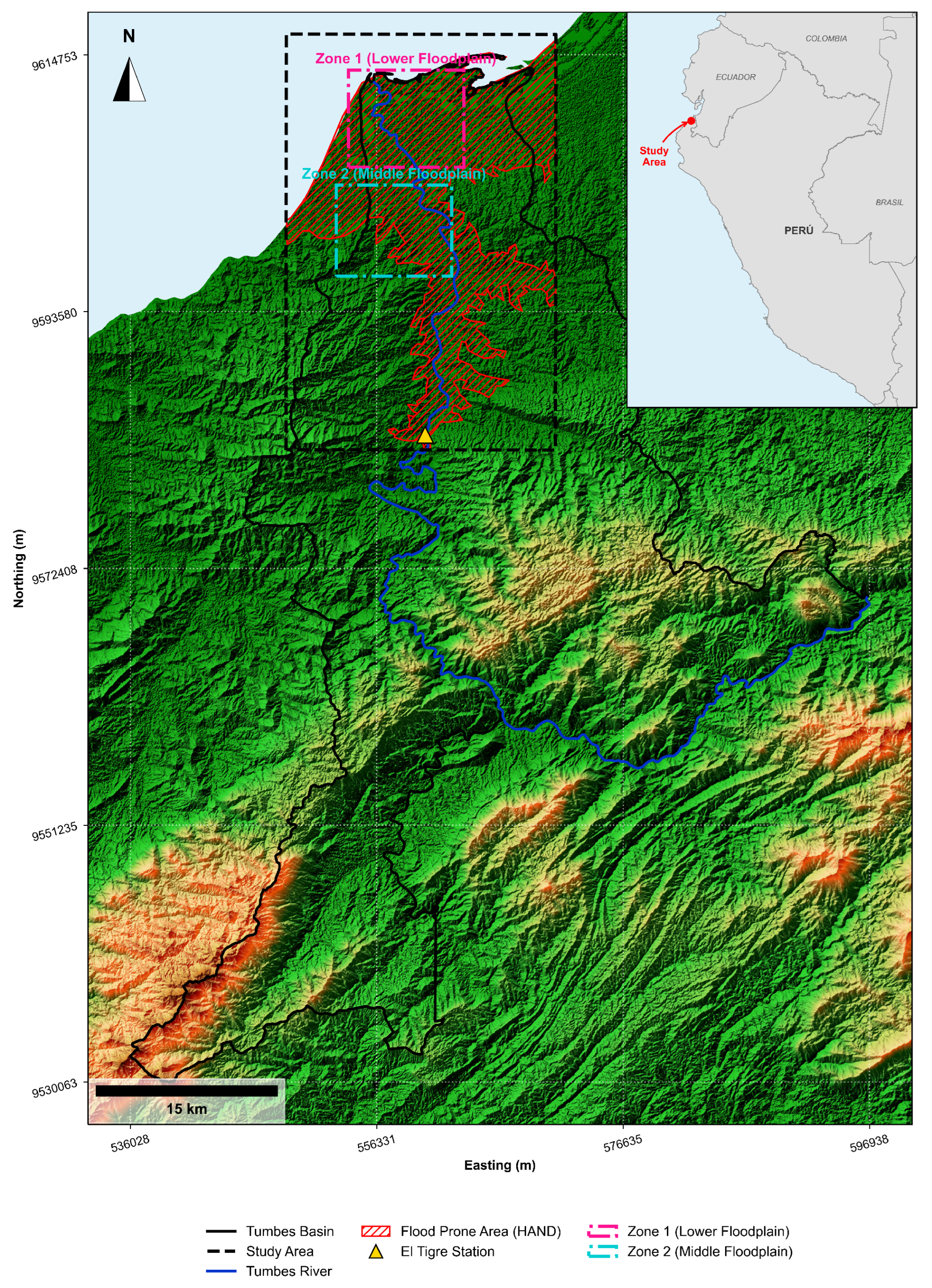
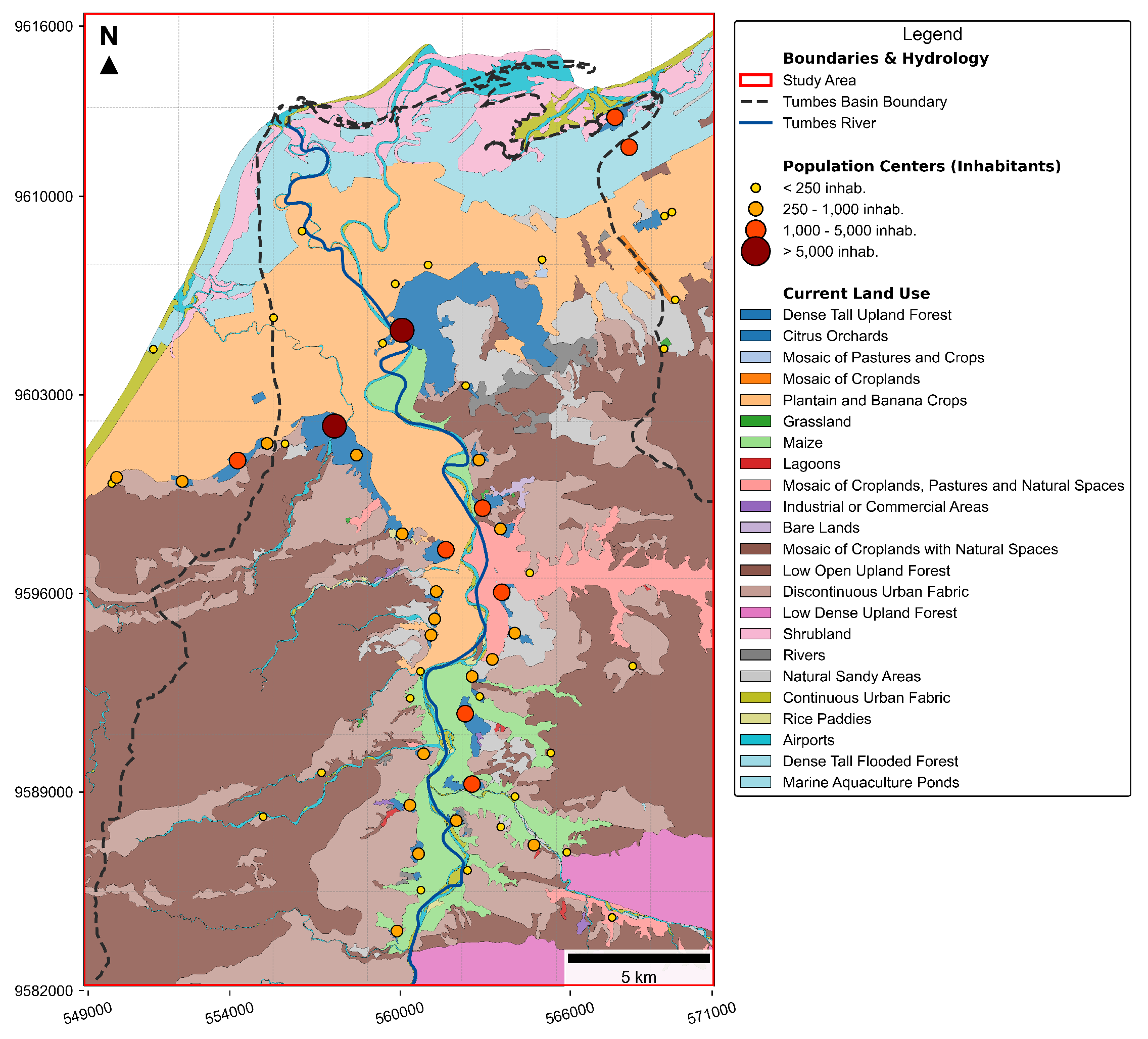
The study area comprises the Tumbes River floodplain, extending from the El Tigre station to the Pacific Ocean. To optimize visualization in the results and discussion, this area is delineated into lower and middle zones (Figure 1). This reach is part of the transboundary Puyango-Tumbes basin (5530 km2), with 1935.5 km2 and 140 km of the main channel located in Peru [59,60]. Between 2014 and 2024, the river exhibited severe hydrological aggressiveness, fluctuating between 12.32 and 1833.38 m3/s (averaging 202.51 m3/s during floods) [61]. This extreme variability directly threatens 224,863 inhabitants [62] and vast agricultural areas; their spatial distribution and land use (LULC) categories [63] are detailed in Figure 2. It is important to note that these same agricultural and aquaculture categories constitute the spatial baseline for the exclusion masks applied later in the temporal modeling methodology.

2.2. Data Used

2.2.1. Hydrometeorological Data

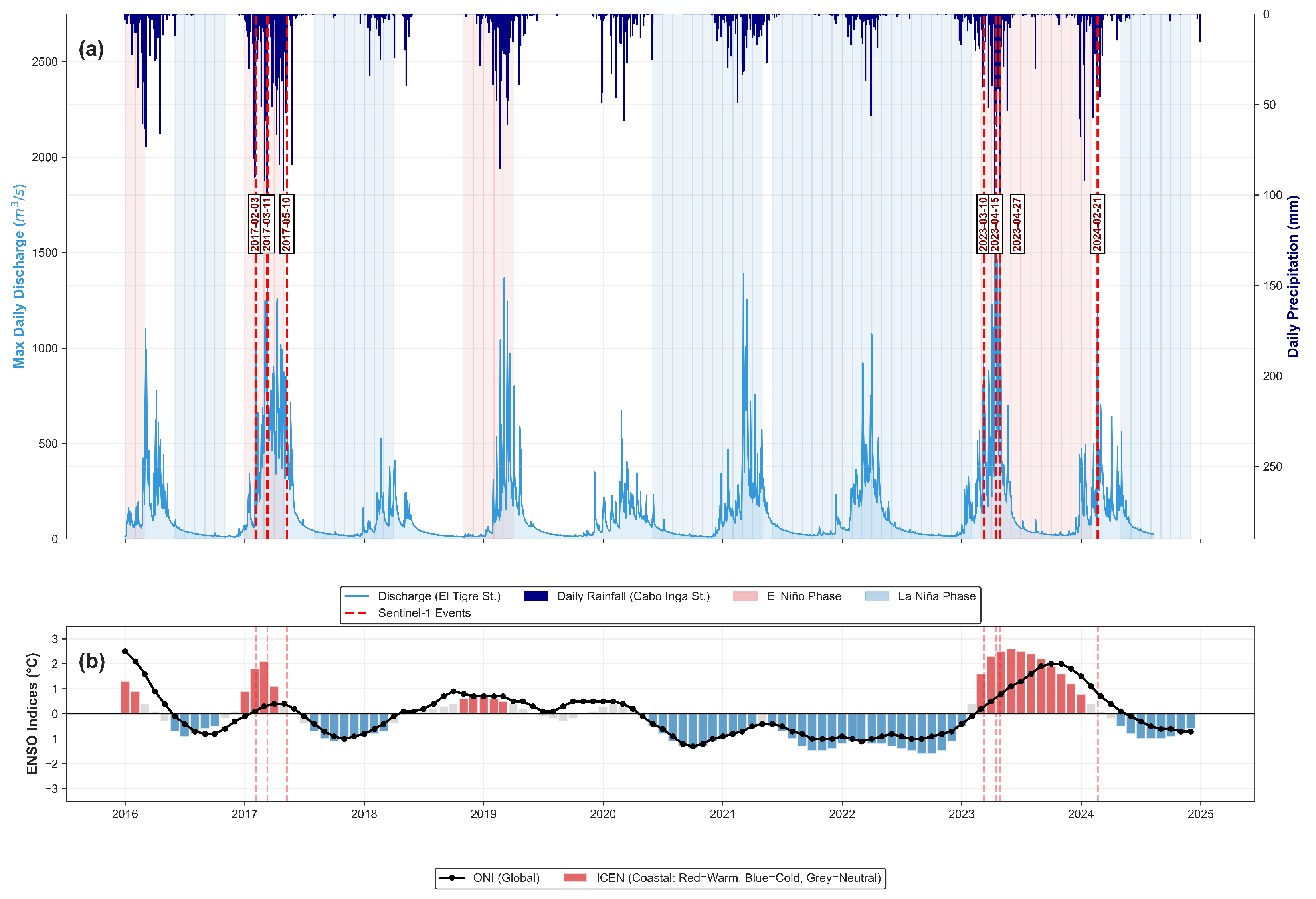
As the primary hydrometeorological inputs, daily discharge (Q) records from the El Tigre station and precipitation data from the Cabo Inga station were utilized. These datasets, covering the 2016–2024 period, were validated and provided by the National Meteorology and Hydrology Service of Peru (SENAMHI). To assess the flood hazard, this in situ information was coupled with continuous satellite monitoring using Sentinel-1 (Figure 1). Furthermore, to contextualize the temporal dynamics of the extreme events, the ground records were integrated with the ONI and ICEN climate indices, as illustrated in the hydrograph (Figure 3).

2.2.2. Sentinel-1 Data

For this research, we used Sentinel-1 (C-band) images in Interferometric Wide swath (IW) mode and GRD format at a 10 m resolution. These products are readily available in Google Earth Engine (GEE) with standard pre-processing already applied by the provider using SNAP, which includes thermal noise removal, radiometric calibration, and geometric correction using the SRTM DEM [64]. Building on this baseline, we implemented a post-processing stage by applying a Lee-Sigma filter [65] and Radiometric Terrain Correction (RTC) [66] to mitigate speckle noise and topographic distortions. Regarding polarization, while the cross-polarized VH band is more sensitive to volume scattering [34], limited penetration in dense vegetation is an intrinsic constraint of C-band sensors that affects both VV and VH polarizations; once canopy density exceeds a specific depth, the signal saturates regardless of the polarization used. Therefore, since including VH increases the computational complexity and tends to generate false positives over bare soils or sparse vegetation [16,43], we decided to rely exclusively on the VV polarization to avoid overestimating flooded areas due to false alarms. This band provides superior radiometric consistency, lower error rates [37], and high accuracy under calm wind conditions [67]. Working in a single dimension (VV) simplifies threshold calculation and ensures a conservative, robust baseline for extracting the surface water (Table 1).

2.2.3. Shuttle Radar Topography Mission (SRTM)

Because surface water tends to accumulate in the topographic depressions of basins, the incorporation of elevation data is critical to spatially constrain the domain of flood detection algorithms [68]. This study utilized the 30 m SRTM Digital Elevation Model (DEM) [64], a resolution selected for its optimal spatial compatibility with the native Sentinel-1 grid and its high computational efficiency for continuous operational basin-scale monitoring. From this input, a Height Above Nearest Drainage (HAND) model was derived following the methodology described in [69], which allowed for circumscribing the analysis exclusively to those regions with a relative height of less than 30 m from the nearest drainage network.

2.2.4. PlanetScope

The PlanetScope constellation, comprising over 120 CubeSats, provides daily high-resolution optical data (approximately 3 m GSD) in the visible and near-infrared spectrum [70]. Because optical acquisitions rarely coincide with flood events due to the persistent cloud cover that characterizes these phenomena, the parametric calibration phase was strategically restricted to the only two dates where an exact temporal overlap with Sentinel-1 overpasses was achieved: 28 April 2023, and 23 February 2024. Despite this atmospheric limitation, both scenes capture the extremes of the study area’s hydrological variability (severe and moderate magnitude floods), allowing for their use as ground-truth reference data [15] to rigorously define the optimal configuration, specifically the kernel size and threshold sensitivity, for the Bmax Otsu and Edge Otsu algorithms (a process detailed in Section 3.3). Once these operational parameters were defined to be robust against extreme radiometric intensity fluctuations, they were consistently applied to all seven identified events. Finally, to ensure the viability of the proposed method against established techniques, the accuracy and consistency of the resulting maps for the entire time series were validated by systematically benchmarking them against products generated using traditional change detection methods [16].

3. Methodology

3.1. Methodological Framework

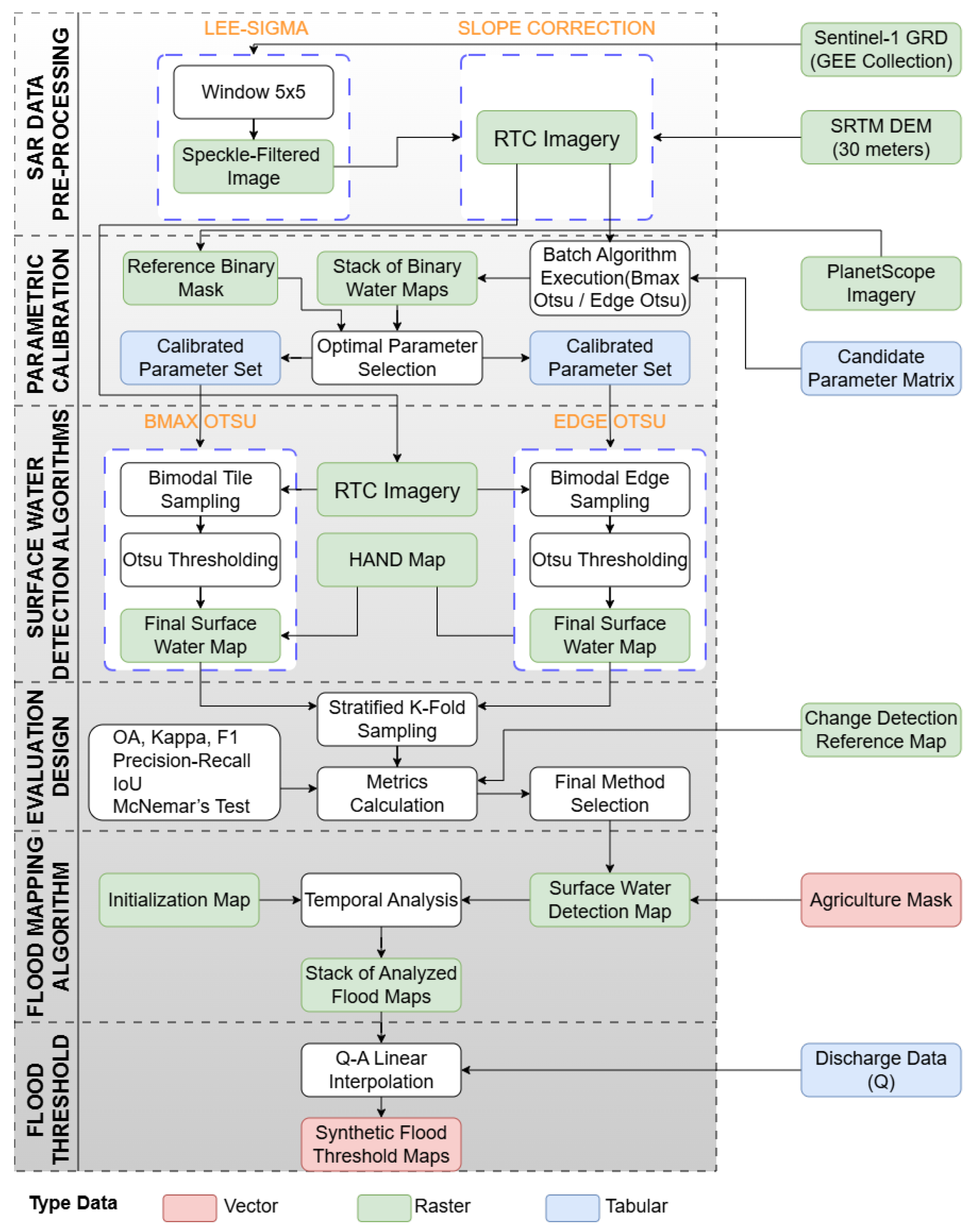
Figure 4 presents the methodological framework developed for the operational flood detection in the Tumbes River basin using Sentinel-1 SAR imagery. This architecture is conceptually defined as a low-cost solution, as it integrates the Copernicus open data policy with the free cloud-based processing environment of Google Earth Engine (GEE, JavaScript API, Google, Mountain View, CA, USA), thereby eliminating the economic barriers associated with commercial software acquisition and high-performance hardware requirements.
The workflow begins with SAR data pre-processing and an initial parametric calibration of the Bmax and Edge Otsu algorithms using high-resolution PlanetScope imagery. With these optimized parameters, image segmentation is executed, integrating the HAND index [69] to filter topography-induced false positives. The method’s robustness is evaluated via K-fold cross-validation against a benchmark change detection algorithm [16]. Finally, the temporal monitoring approach by [58] is applied to map the seven historical events, correlating the flooded areas with discharges at the El Tigre station to establish the flood thresholds.

3.2. SAR Data Pre-Processing

Sentinel-1 images (IW mode, GRD format) were acquired through Google Earth Engine (GEE), which performs standard pre-processing steps including orbital correction, thermal noise removal, and radiometric calibration to obtain the backscatter coefficient ( σ 0 ) in decibels [42]. To refine the radiometric quality and mitigate speckle noise without compromising structural edge sharpness, an adaptive Lee Sigma filter with a 5 × 5 window was applied [65]. Finally, a Radiometric Terrain Correction (RTC) was implemented using the 30 m SRTM Digital Elevation Model (DEM). This crucial step normalized the backscatter signal based on the local incidence angle, effectively rectifying topography-induced geometric distortions such as foreshortening and layover [66].

3.3. Methodological Setup for Parametric Calibration

To ensure methodological robustness without relying operationally on continuous optical imagery—which is severely limited by persistent cloud cover during extreme events—a one-time initial parametric calibration was performed using the only two available PlanetScope scenes coinciding with SAR overpasses (28 April 2023, and 23 February 2024). These images, capturing the variability between extreme and moderate flood magnitudes, were utilized to generate reference ground-truth masks through precise manual digitization, a process technically supported by the calculation of spectral indices (NDWI, NDVI) and true-color (RGB) composites. Using Overall Accuracy as the optimization metric against these reference maps, systematic tests were executed to determine the optimal parameters for each algorithm: 9 iterations for Bmax Otsu (combining tiling resolutions of 0.01 , 0.02 , 0.03 and bimodal thresholds of 0.65 , 0.70 , 0.75 ) and an exhaustive 18 iterations for Edge Otsu (alternating Canny thresholds of 0.25 , 0.50 , buffer widths of 100 m, 150 m, 200 m, and minimum edge lengths of 100 m, 150 m, 200 m). Once the optimal parameter sets were established—the detailed results of which are presented in Section 4.2—they were statically applied to the entire SAR dataset, thereby enabling an autonomous and automated surface water detection system.
3.4. Surface Water Detection Algorithms

To map surface water, two unsupervised algorithms—Bmax Otsu and Edge Otsu—were applied to the SAR GRD data. Both build upon Otsu’s thresholding method [56], which assumes a bimodal distribution to maximize inter-class variance. To overcome the limitations of the standard method in complex scenes with noisy or unimodal histograms, these approaches employ selective subsampling to restrict threshold calculations exclusively to areas that guarantee bimodality (detailed in Section 3.4.1 and Section 3.4.2). Crucially, their operational parameters were established through a one-time initial calibration using PlanetScope imagery (Section 3.3), ensuring the system does not rely on continuous optical data. Finally, the resulting surface water masks were consolidated by applying a 30 m vertical threshold derived from the HAND model [69] to filter topography-induced false positives.

3.4.1. Bmax Otsu Algorithm

The implementation of the Bmax Otsu algorithm [57], adapted to Google Earth Engine via Python, ensures a robust bimodal histogram for accurate thresholding. The workflow begins by tiling the image into 0.01 grids. The statistical bimodality of each subregion is then evaluated using the B m a x coefficient [71], requiring an a priori class estimation set at 13.92 dB (derived from the historical average of 32 Sentinel-1 images from 2017). A strict filtering criterion is applied to retain only tiles with B m a x > 0.65 . Both the optimal spatial resolution ( 0.01 ) and the bimodality cutoff ( 0.65 ) were established during the initial parametric calibration using PlanetScope imagery (Section 3.3). Finally, the statistics from these validated areas are aggregated to compute the definitive Otsu threshold, generating a binary mask where backscatter values below this limit are classified as surface water.

3.4.2. Edge Otsu Algorithm

In parallel, the Edge Otsu algorithm [29] was implemented, utilizing the Canny filter [72] to delineate the physical boundaries of water bodies. To prevent misclassification with urban structures or dense vegetation, an initial search mask [15] was applied using the same 13.92 dB reference threshold. Geometric filters, defined during the PlanetScope calibration (Section 3.3), were then applied to the detected edges: segments shorter than 150 m were discarded to reduce noise, and a 400 m wide buffer (200 m on each side) was generated around the valid edges. Finally, the histogram for the Otsu threshold calculation was constructed exclusively using the backscatter values (dB) within this buffer. Restricting the analysis to these water/land transition zones ensures a highly accurate classification across the entire scene.

3.5. Evaluation Design

Once the operational parameters were defined—using the optical PlanetScope calibration detailed in Section 3.3 and the temporal mapping dates were established (Table 2), surface water masks were generated for the seven events (Table 3) using the Bmax and Edge Otsu algorithms. To rigorously evaluate the operational performance of these adaptive thresholding methods against traditional techniques that require extensive time series, a comparative validation—conceptually distinct from the initial optical calibration—was conducted using a consolidated SAR change detection algorithm as a benchmark [16]. The evaluation across the entire study area employed a 10-fold stratified cross-validation [73] to preserve the original water/non-water proportions and accurately estimate error distribution. Based on these partitions, key remote sensing metrics (Overall Accuracy, Kappa, and F1-score) [73,74] were calculated, alongside an analysis of the precision (commission error) and recall (omission error) balance [75]. Finally, to determine whether the performance differences between Bmax and Edge Otsu were statistically real and not due to chance, McNemar’s test [76] was applied. By evaluating discrepancies in the error matrices [77] under a χ 2 distribution with a 5% significance level, this test confirmed the statistical distinction between both classifiers.

3.6. Flood Mapping Algorithm

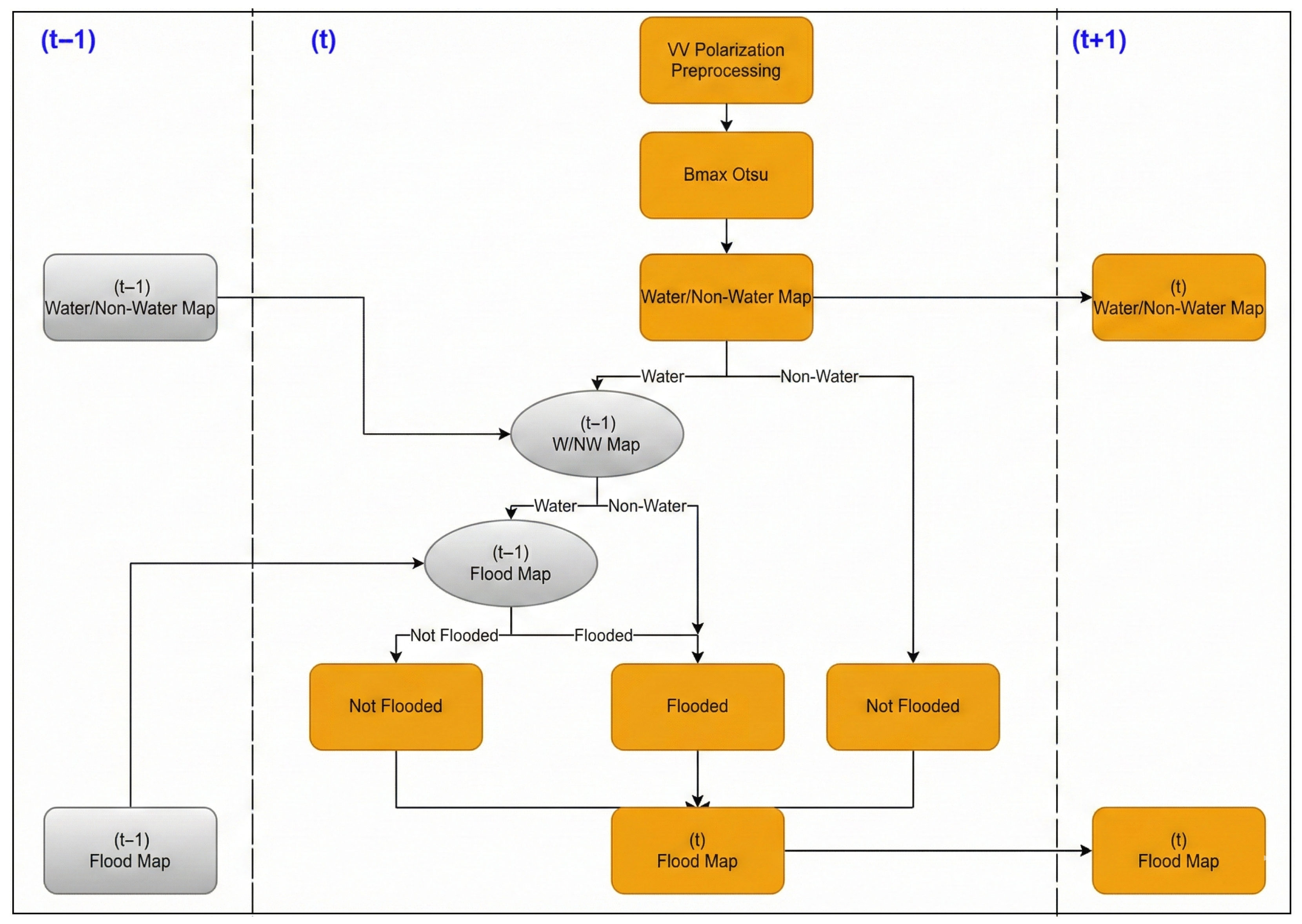
Following the methodology of [58], Figure 5 illustrates the flood mapping workflow based on Sentinel-1 SAR temporal dynamics. At time t, the Bmax Otsu algorithm—selected for its superior performance during evaluation—is applied to the VV-polarized image to generate a binary Water/Non-Water mask. Based on this input, the final flood map at t is derived using the following decision tree:
  • If a pixel is classified as Non-Water at t, it is automatically categorized as Not Flooded.
  • If a pixel is classified as Water at t, it is compared with the previous mask at t 1 :
    (a)
    If it was Non-Water at t 1 , it is classified as Flooded (emergence of new water).
    (b)
    If it was Water at t 1 , its history in the t 1 flood map is checked: if it was Flooded at t 1 , it remains Flooded at t (persistent flood); otherwise, it is classified as Not Flooded at t (permanent or seasonal water body).
Once all pixels are classified, the flood map for time t is consolidated and recursively integrated as the baseline reference for processing time t + 1 . This temporal analysis was executed independently for the seven events (three in 2017, three in 2023, and one in 2024), according to the periods detailed in Table 2. To initialize the algorithm, a “zero-flood” base map is required. This was established by selecting the date with the lowest water coverage prior to each year’s events: 30 October 2016 (for 2017), 25 July 2022 (for 2023), and 25 August 2023 (for 2024). However, given the hydrological complexity of the Tumbes region and the widespread presence of crops such as rice and banana, assuming an absolute absence of flooded pixels on these baseline dates could introduce errors, as some permanent water might correspond to saturated agricultural zones. To mitigate this, agricultural and aquaculture areas were explicitly masked out using official land use layers [63].

3.7. Flood Threshold

The spatial procedure was implemented using a first-order empirical modeling that, without executing a 2D hydrodynamic routing, pairs each SAR flood extent to the peak discharge recorded at El Tigre in the previous 24 h. This approach assumes the spatial capture as the cumulative scenario of maximum exposure. To establish the fundamental relationship between discharge (Q) and flooded area (A), different regression models (linear, logarithmic, and power) were evaluated. Given the finite availability of events (which cover a representative range of discharges), the evaluation employed a Leave-One-Out Cross-Validation (LOOCV). This iterative technique is highly robust for small samples, mitigating the risk of overfitting by training the model n 1 times and validating with the excluded event, quantifying the error through the Root Mean Square Error (RMSE).
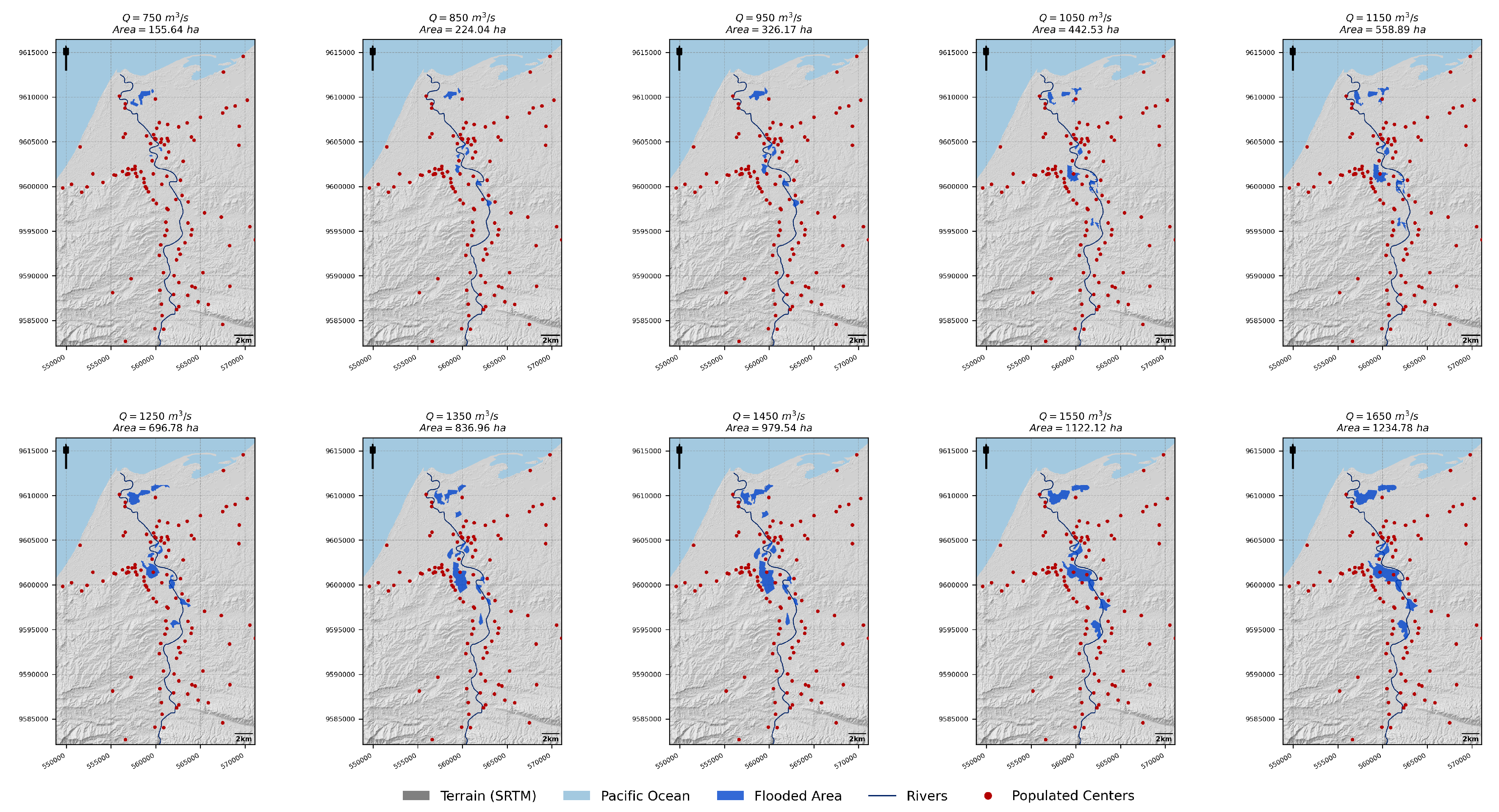
Following the comparative statistical analysis using LOOCV and RMSE, the regression model presenting the lowest predictive error was selected to estimate the flood area. Based on the functional relationship of this optimal model, a systematic generation scheme was established for the interval of 750 to 1650 m3/s, with a discretization of 25 m3/s, operationally optimizing the early warning system.
It is recognized that the scaling of vector formats presents inherent physical limitations, lacking a hydrodynamic modeling component that explicitly considers the role of detailed topography in flow propagation. To mitigate this spatial uncertainty, the methodology does not assume a geometric expansion isolated from physical reality. In a first spatial scaling stage, the vector file of the historical SAR event with the discharge closest to the simulated value was selected as a topological anchor. A morphological scaling factor was applied to this base geometry—which already encapsulates the real macro-topographical signature of the valley’s conditioning. This adjustment resizes the extent from its centroid to match the interpolated surface calculated by the selected regression model, acting as an initial spatial proxy.
To overcome the distortions derived from this strictly geometric scaling and to provide the polygons with a rigorous physical-topographic sense, a refinement stage based on the HAND (Height Above Nearest Drainage) model was introduced. To extract the representative topographic threshold for each observed SAR event, the absolute maximum HAND value within the inundation mask was excluded, as this statistic is highly susceptible to altimetric anomalies in the Digital Elevation Model (DEM) and false positives inherent to radar speckle noise. Instead, the 95th percentile ( P 95 ) of the HAND values contained within each polygon was adopted. This statistical approach acts as a robust spatial filter that suppresses outliers, defining an effective flood height ( H e f f ) that is significantly more stable and representative of the floodplain. Methodologically, utilizing these P 95 values, an empirical curve relating the observed discharges to their respective effective inundation heights was constructed, deriving an empirical power equation of the form H H A N D = α · Q β . This function allows for the analytical calculation of the maximum topographic threshold for each simulated discharge.
Using this control value ( H H A N D ), a spatial refinement of the previously scaled polygons was executed. Using the analytical HAND P95 threshold, the limits of the synthetic floodplains were adjusted, forcing the interpolated geometries to remain within the relative elevations dictated by the HAND model’s power equation. This strict topographic quality control ensured that water expansion respected the terrain relief, preventing atypical extrapolations.
Finally, the workflow culminated in the generation of a hybrid spatial database that approximates the progressive evolution of the flood. It is imperative to specify that these synthetic scenarios are not intended to replace two-dimensional hydrodynamic modeling, but rather constitute a data-driven operational solution optimized for Early Warning Systems. This approach assumes a conscious technical compromise, supported by research validating the suitability of 30 m global SRTM topography for operational SAR detection frameworks and HAND threshold derivation [15,64,69]: it sacrifices the deterministic representation of flood routing through micro-relief in favor of high computational efficiency, providing risk managers with a rapid and topographically validated tool.

4. Results

4.1. Flood Event Selection

Based on the historical series, seven flood events were identified and characterized, fulfilling the strict criteria of hydrological representativeness, synoptic intensity, and temporal coincidence with Sentinel-1 overpasses. This resulting dataset effectively captures the broad spectrum of water stress within the basin. The first three events document the complete evolution of the 2017 Coastal El Niño through its onset, peak, and decay phases (E1 to E3). Subsequently, the results encompass the complex hydroclimatic dynamics of 2023, triggered by the anomalous impact of Cyclone Yaku (E4) and immediately exacerbated by the consolidation of a new Coastal El Niño (E5 and E6). The chronological series concludes with an episode recorded during the mature phase of the global El Niño in February 2024 (E7). The characterization of these varied episodes provides a robust baseline to evaluate the operational stability of the detection thresholds under different climate forcings. The detailed parameters of all selected events are summarized in Table 3.

4.2. Parametric Calibration Results

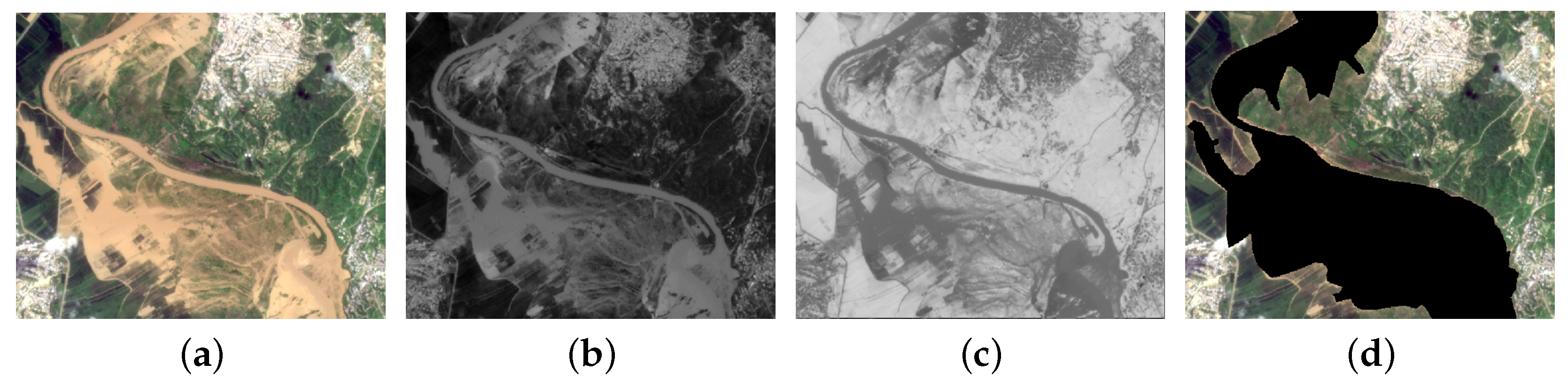
Persistent cloud cover during extreme events in the Tumbes basin limited usable optical data to just two coincident PlanetScope scenes. Consequently, a one-time initial calibration was performed to define robust static parameters for all subsequent SAR acquisitions. Figure 6 illustrates the ground-truth delineation process: highly accurate flooded area vectorizations (Figure 6d) were generated via visual interpretation of true-color composites (Figure 6a), analytically supported by NDWI (Figure 6b) for water extraction and NDVI (Figure 6c) for vegetation masking. Evaluated against these reference masks, the optimal algorithms’ configurations were established. Bmax Otsu converged at a 0.01 grid size and a 0.65 bimodality threshold, reflecting the need for a reduced spatial window to capture local heterogeneity and ensure sharp bimodal histograms. For Edge Otsu, maximum accuracy was achieved with a 0.5 Canny threshold, 150 m minimum edge length, and 200 m buffer width, highlighting the importance of filtering SAR speckle to isolate significant land-water transitions. Using these definitive parameters, specific backscatter thresholds were autonomously computed for the seven Sentinel-1 events (Table 4).

4.3. Comparative Evaluation Results of the Proposed Algorithms

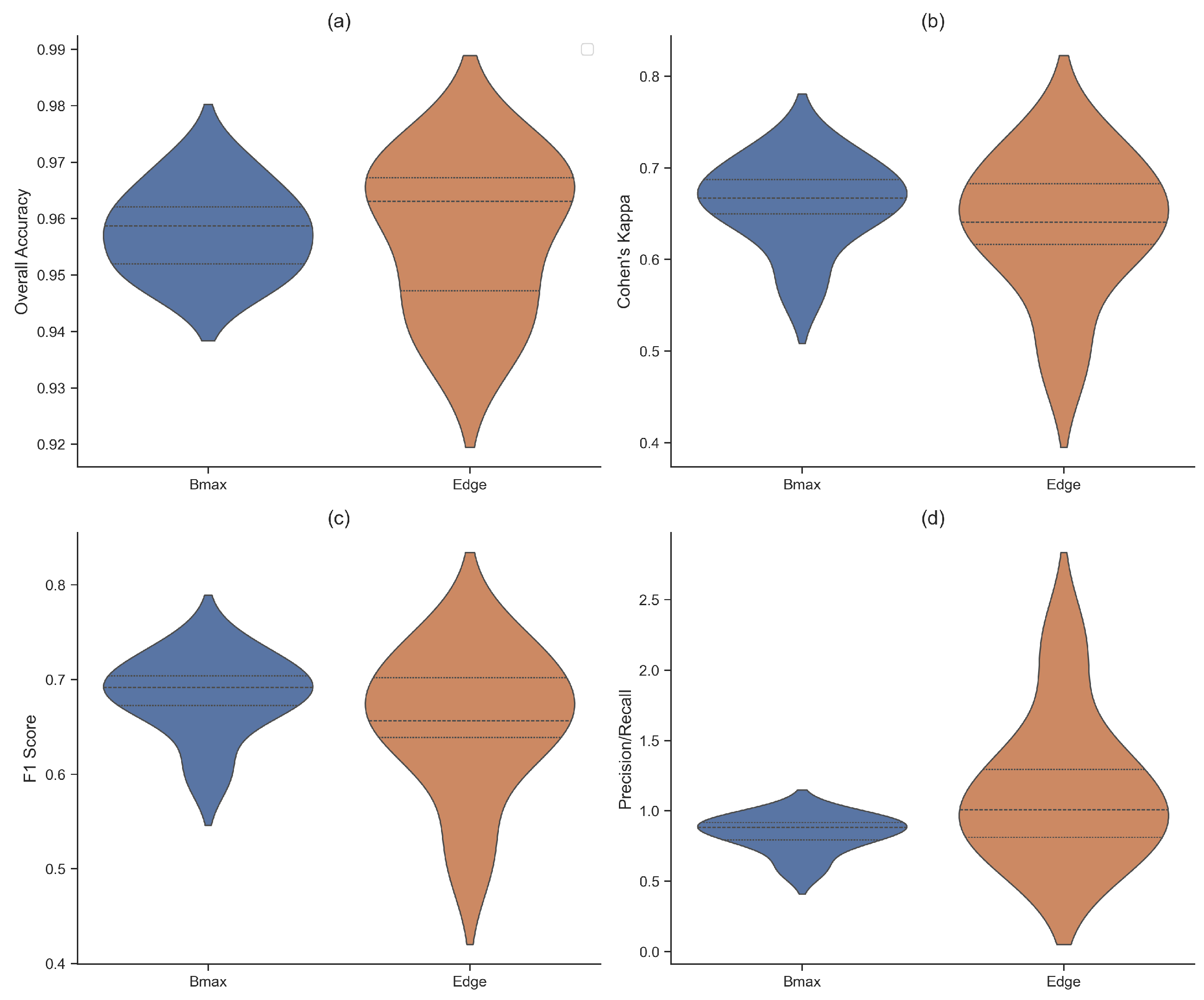
The surface water maps generated for the SAR events (Table 3) were evaluated against a traditional change detection benchmark [16]. The validation results (Table 5) and their K-Fold distributions (Figure 7) demonstrate that Bmax Otsu exhibits a slight but consistent superiority over Edge Otsu. Bmax Otsu achieved higher spatio-temporal stability, yielding an Overall Accuracy between 95% and 97% ( ± 0.0076 ) alongside steady Kappa and F1-Scores. Its mean precision-recall ratio of 0.837 indicates a well-balanced performance with a slight tendency toward commission errors. In contrast, Edge Otsu exhibited a precision-recall ratio > 1 , reflecting a prevalence of omission errors. Crucially, although the accuracy gains are slight, the McNemar test confirmed that the differences in the error distributions between both classifiers are statistically significant, validating Bmax Otsu as the more robust operational alternative.
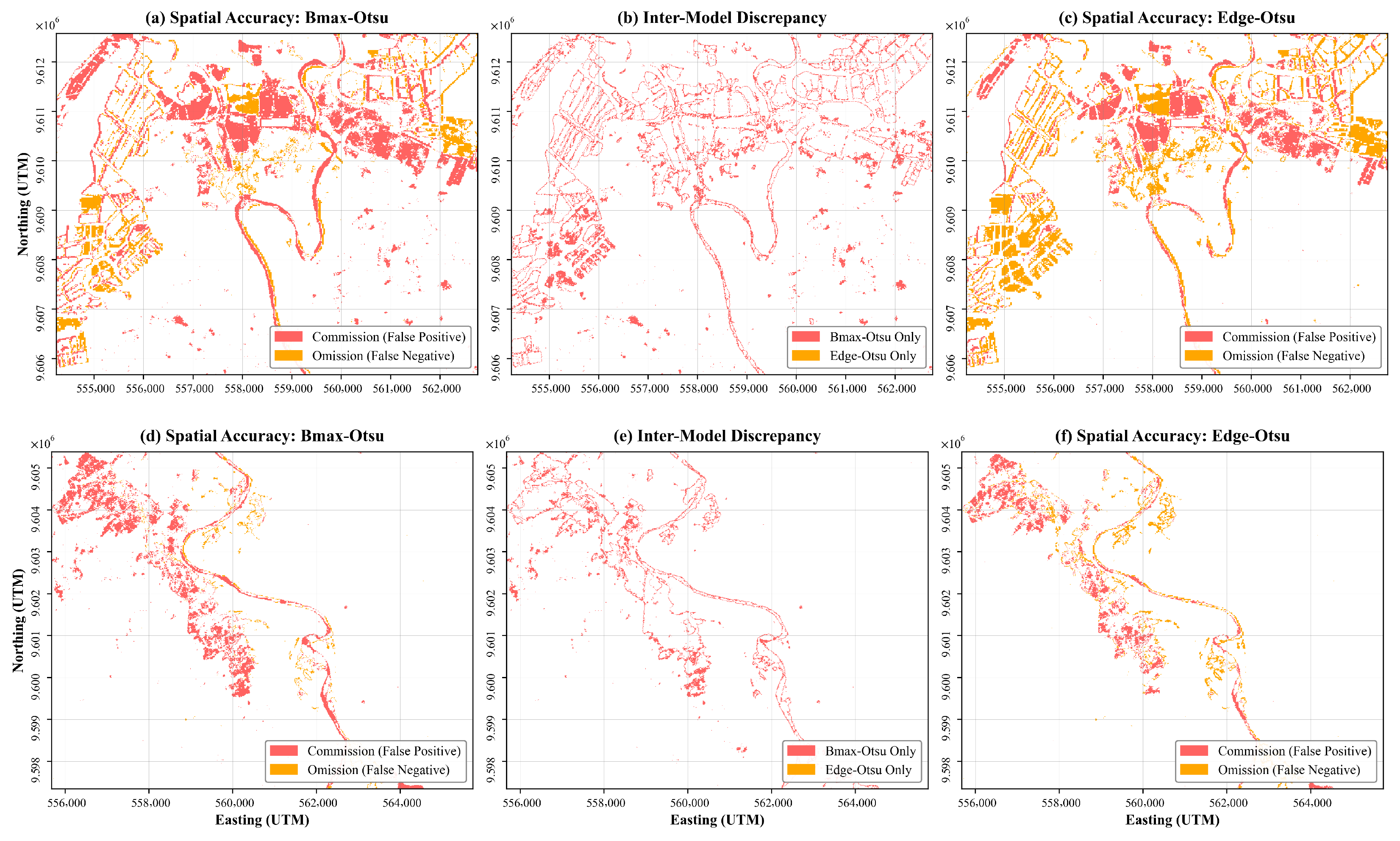
To evaluate the spatial agreement of the unsupervised histogram-based algorithms, the Intersection over Union (IoU) metric was calculated to quantify the overlap of the delineated surface water extents. Figure 8 illustrates this spatial assessment for the 15 April 2023 event, differentiating between the lower (Zone 1) and middle (Zone 2) floodplain sections. The direct inter-model comparison (Figure 8b,e) revealed a satisfactory spatial agreement, yielding an overall IoU of 69.6% between Bmax Otsu and Edge Otsu (72.0% in Zone 1 and 69.6% in Zone 2). However, Bmax Otsu consistently delineated a larger water extent, exceeding Edge Otsu by 7.0% in Zone 1 and 2.8% in Zone 2, represented by the distinct commission pixels in the discrepancy maps. Visualizations for the remaining hydrological events are provided in the Supplementary Materials.
When evaluated against the Change Detection benchmark (Figure 8a,c,d,f), both algorithms exhibited expected topological divergences stemming from their methodological differences: single-scene thresholding detects absolute water, whereas Change Detection isolates only transitional flooding. This is evident in Zone 1, where permanent water (e.g., aquaculture, mangroves) is captured by Bmax Otsu but bypassed by the baseline. Crucially, since these land covers are systematically masked during the subsequent flood modeling stage, this initial spatial disagreement does not propagate into the final model. These localized commission footprints will be further analyzed in the Discussion. For this specific event, Bmax Otsu achieved IoUs of 49.7% (Zone 1) and 48.8% (Zone 2), compared to Edge Otsu’s 44.5% and 49.4%. Despite reflecting a distinct spatial sensitivity, this trend remained consistent across all seven events (Table 6). Averaging an overall IoU of 45.6% against 45.0%, Bmax Otsu demonstrated a comparable performance to Edge Otsu. Nevertheless, considering the spatial resolution and the basin’s extent, this marginal 0.6% increment represents a substantial volume of pixels in terms of physical flooded area, supporting its adoption as the definitive operational method for this study.

4.4. Temporal Dynamics Results of the Flood Monitoring Model

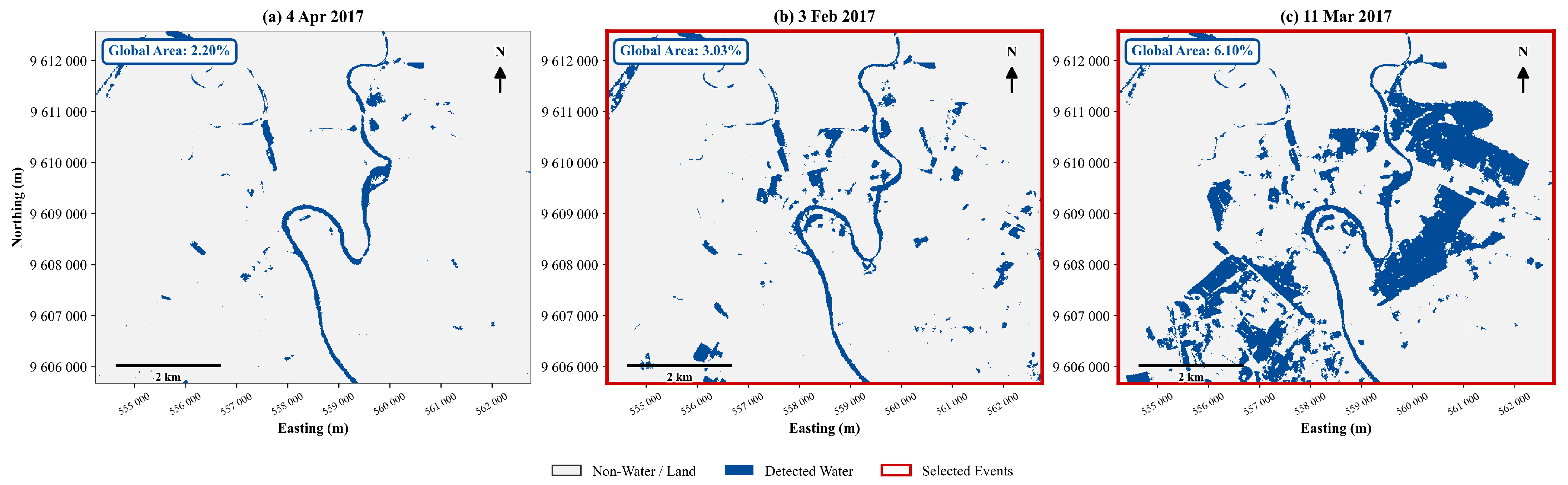
The temporal analysis encompassed seven flood events across three periods (2017, 2023, and 2024), mapped independently for the dates detailed in Table 2. In total, 45 surface water maps were generated using the dynamic Bmax Otsu algorithm. Figure 9 illustrates the resulting spatial dynamics for the 2017 series within the lower floodplain (Zone 1), with panels arranged by impact magnitude. Global basin coverage peaked at 6.10% on 11 March 2017, followed by a sustained recession phase (descending to 2.56% by 22 May).
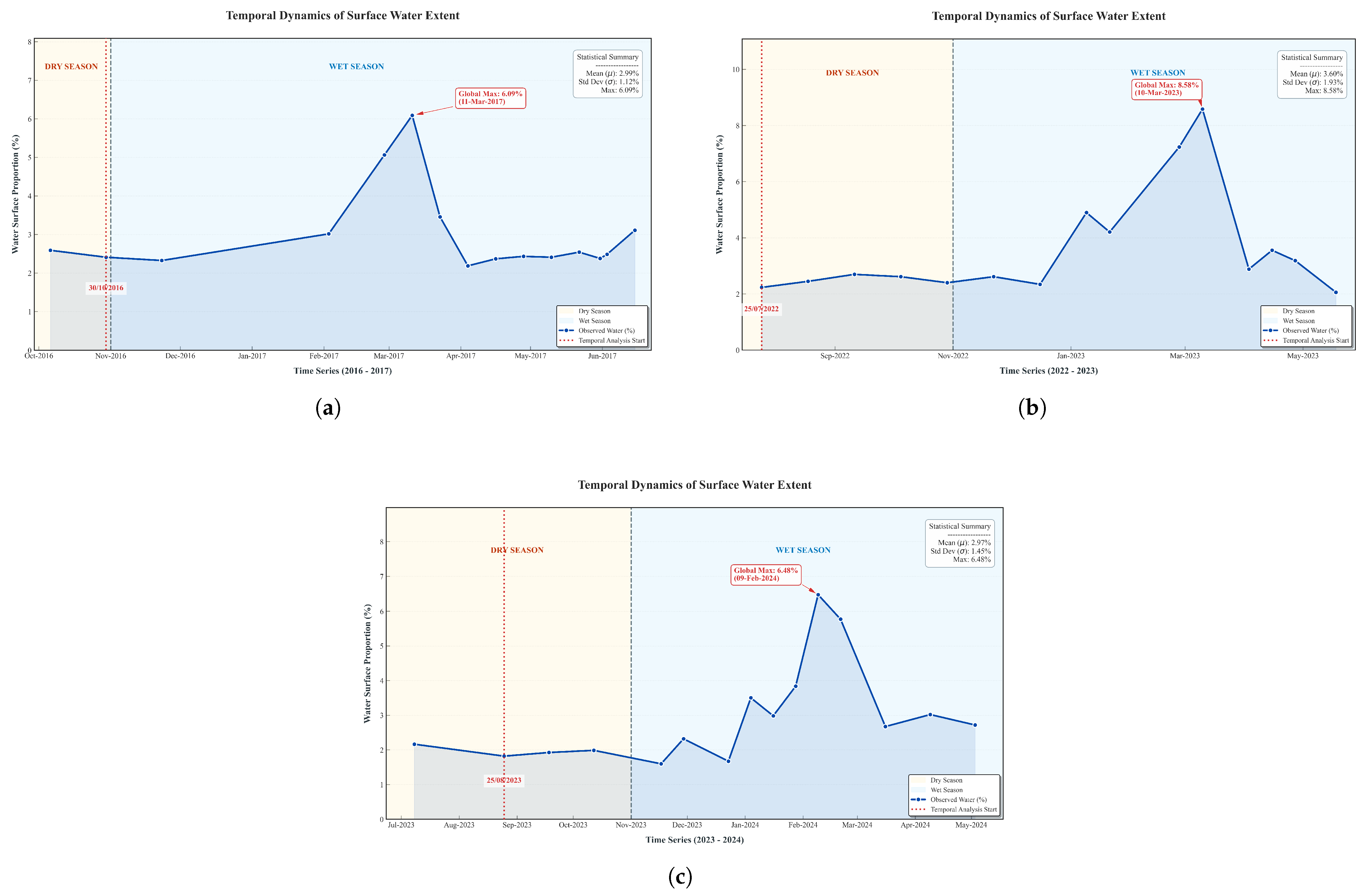
Figure 10 illustrates the temporal evolution of water pixel proportions, a critical analysis for defining the algorithm’s initialization time ( t 0 ) at the dry season minimum. Following [58], anchoring the time-series to this basal “non-flooded” state is essential to prevent the systematic propagation of initial water excess as commission errors throughout the monitoring period. Applying this principle, independent and adaptive baselines were established for each hydrological year: 30 October 2016, for the 2017 event (Figure 10a, peaking at 6.09% on 11 March 2017); 25 July 2022, for the highest-intensity 2023 event (Figure 10b, peaking at 8.58% on 10 March 2023); and 25 August 2023, for the 2024 event (Figure 10c, peaking at 6.48% on 9 February 2024).
However, the Tumbes region features high anthropogenic complexity (e.g., rice paddies, aquaculture) that maintains artificial saturation even during severe dry periods, potentially violating the basal assumption. To strictly enforce the “dry pixel” premise for monitoring the natural floodplain, these agricultural and aquaculture zones were systematically masked using official land cover layers [63]. The permanent water of the main river channel, on the other hand, was inherently isolated and excluded through the proposed temporal flood modeling itself.
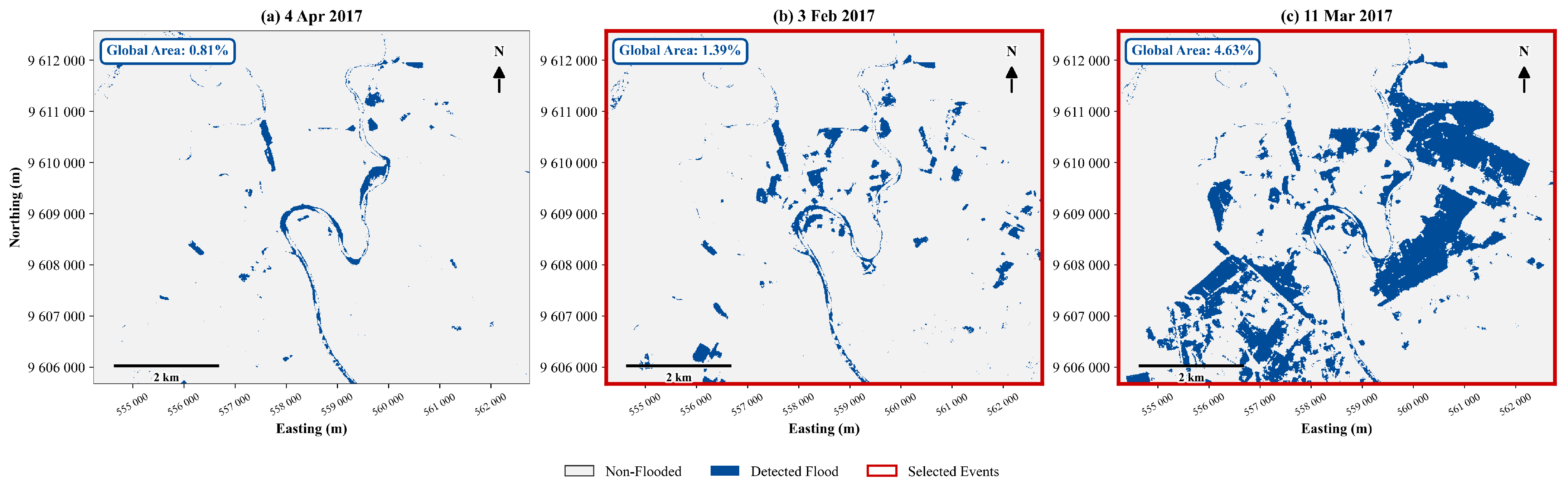
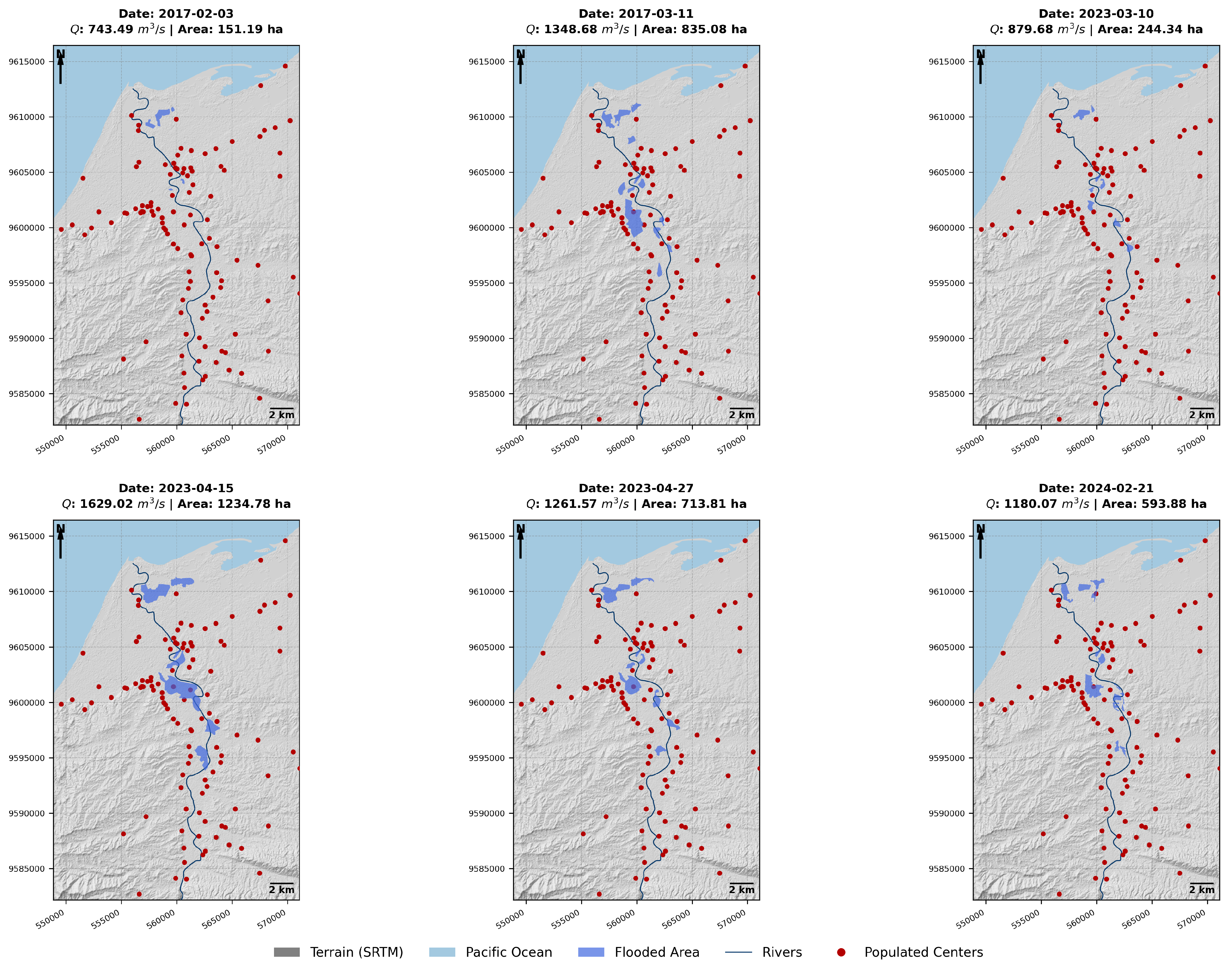
A total of 44 flood maps were generated for the seven analyzed events following the exclusion of permanent water bodies. Specifically for the 2017 series, Figure 11 presents the processed flood extents corresponding to the surface water scenes previously depicted in Figure 9. These results demonstrate significant spatiotemporal variability within the flooded areas of the Tumbes province during the 2017 event, effectively isolating the hydrological anomaly from permanent water bodies.
Through the implementation of the flood monitoring algorithm, the seven selected hydrological events were processed. However, the final cartographic presentation comprises six flood maps, as the May 2017 event yielded no detectable flooded areas. This finding confirms the algorithm’s capability to effectively discriminate hydrological recession periods without generating false positives.
To ensure cartographic fidelity for the positive events, the process incorporated exclusion masks to refine the final outputs. Furthermore, socioeconomic impacts were quantified: agricultural areas were assessed using official vector data from the Regional Government of Tumbes [63], while the exposed population was estimated based on INEI census records. The spatial distribution of these impacts is illustrated in Figure 12, with detailed statistical metrics provided in Table 7.

4.5. Hydrological Thresholds Modeling and Validation

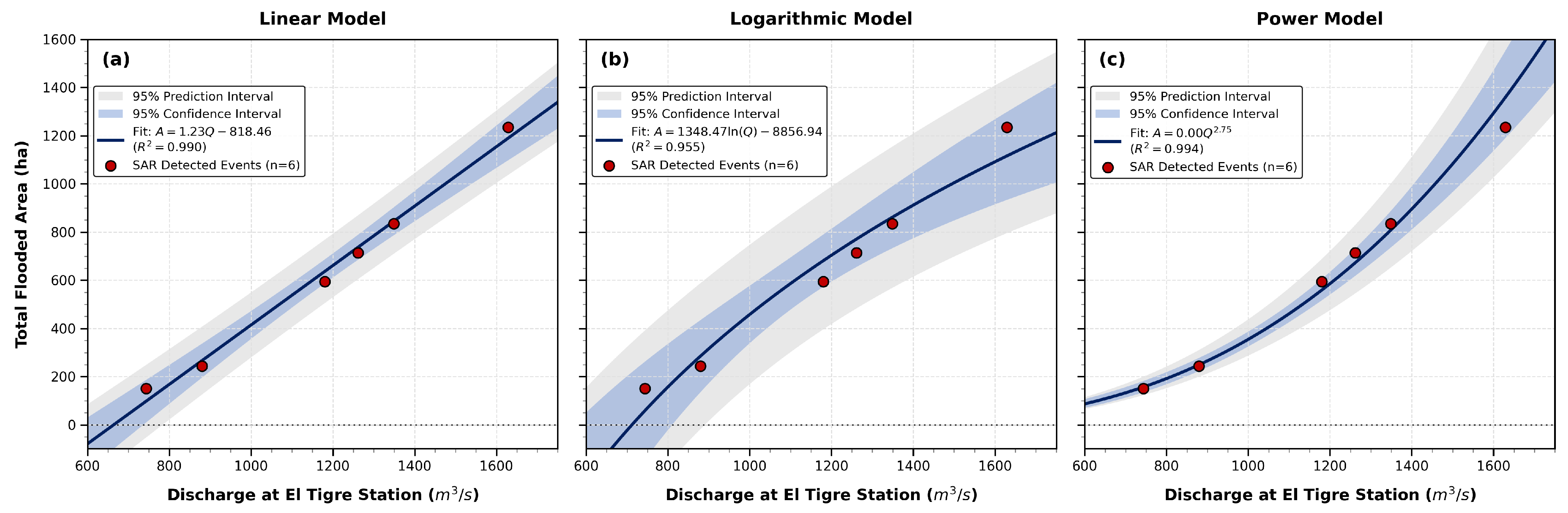
To model the functional response between discharge (Q) and inundated area (A), the lowest magnitude event (discharge of 588.31 m3/s) was initially excluded as it did not generate channel overflow or detectable flooded areas ( A = 0 ha). Consequently, the evaluation of the three empirical regression models was performed using the remaining six events. The goodness-of-fit metrics and predictive errors are summarized in Table 8.
Although the power model exhibited slightly better performance in the training metrics (Adjusted R 2 of 0.9865 and RMSE of 32.73 ), the evaluation of predictive capacity via Leave-One-Out Cross-Validation (LOOCV) revealed a different behavior. The linear model recorded the lowest generalization error (RMSE LOOCV = 67.89 ), significantly outperforming the power model (RMSE LOOCV = 96.16 ). This indicates that, given the finite sample of SAR events, the power model is prone to overfitting, whereas the linear model is spatially and mathematically more robust for predicting flooded areas at unobserved discharges. Consequently, the linear model was selected, with its governing equation defined as A = 1.2331 · Q 818.4593 . Figure 13 illustrates the comparative fit of the three evaluated models against the empirical observations, detailing their respective 95% confidence and prediction intervals.
A fundamental aspect of the selected linear model is its intersection with the abscissa axis. Mathematically, the equation projects that the inundation area is zero ( A = 0 ) when the discharge reaches 663.74 m3/s, representing the theoretical channel overflow threshold. However, for the operational purposes of the Early Warning System, it has been established that significant impacts begin at the recorded discharge of 743.49 m3/s, as this constitutes the first empirical event with confirmed SAR satellite evidence (151 inundated ha). Adopting this validated threshold ensures that warnings are based on corroborable physical impacts and not solely on mathematical extrapolations.
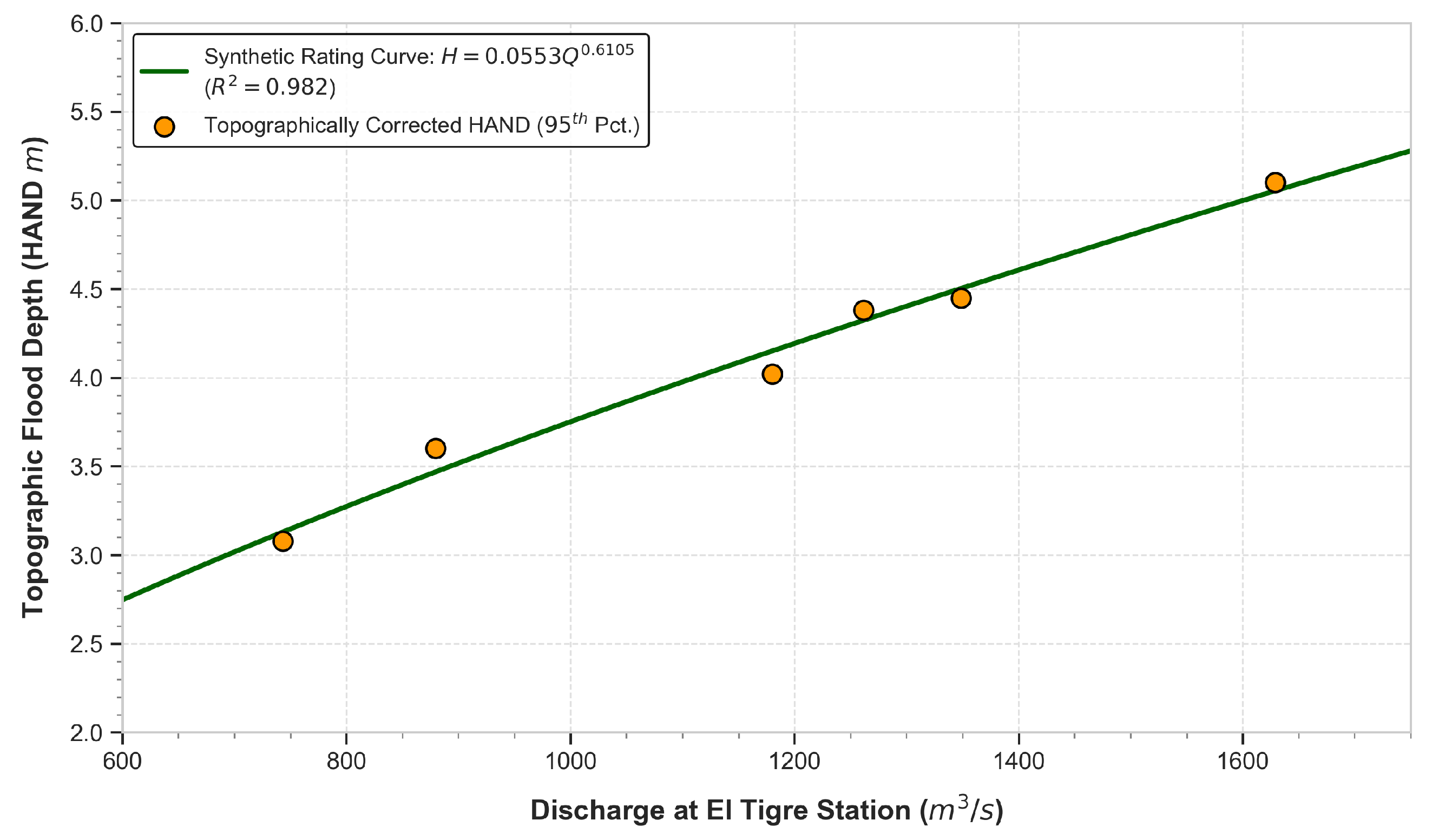
To guarantee the physical coherence of the polygons associated with this extrapolation, the relative topographic threshold was calculated using the HAND model. From the 95th percentile ( P 95 ) values extracted from the historical inundation masks, an empirical curve relating discharge to the effective inundation height ( H e f f ) was derived.
As observed in Figure 14, the hydrodynamic behavior in the valley optimally fits a power function. The application of this topographic control derived from the curve during spatial editing ensured that the growth of the modeled floodplain strictly obeyed the terrain’s relief. In accordance with this methodology, and after applying the HAND topographic restriction on the base geometries, a linear interpolation was carried out integrating the six analyzed events. This procedure allowed for determining the spatial extent of the flooded areas, as well as the population and agricultural affectation, for a range of discharges between 750 m3/s and 1650 m3/s, applying a discretization interval of 25 m3/s. The graphical results of the progressive floodplain evolution are detailed in Figure 15, while the impact quantification is summarized in Table 9.
Finally, for external validation purposes and verification of the model’s operational applicability, a comparative analysis was performed between the official damage reports issued by the National Institute of Civil Defense (INDECI) [78] and the results derived from the proposed algorithm for the event of 21 February 2024. The observed discrepancies and consistencies at the district level are detailed in Table 10.
The results demonstrate a high spatial coherence with the field records. The slight model overestimations in districts such as Corrales or San Jacinto are expected and consistent with the nature of SAR detections, which map the total extent of the water sheet (including temporary waterlogging not reported in the field), thereby configuring a conservative and highly valuable scenario for preventive risk management.

5. Discussion

5.1. Decoupling Global and Local ENSO Signals in Flood Dynamics

Our analysis highlights that extreme flood events in the Tumbes River cannot be solely explained by global canonical ENSO teleconnections monitored by the ONI (Niño 3.4 region) [5,6]. Instead, the decoupling of global and local signals reveals that maximum discharges are predominantly driven by abrupt local warming in the Niño 1 + 2 region, captured by the ICEN [7,8]. This dynamic is explicitly illustrated in the historical hydroclimatic regime (Figure 3), which demonstrates how peak discharges synchronize precisely with local coastal warming spikes, whereas relying solely on the ONI tends to underestimate the hydroclimatic forcing [9,79]. In Pacific slope catchments, deep atmospheric convection is highly sensitive to the proximity of the maximum sea surface temperature (SST) anomaly. By incorporating both indices, our framework successfully differentiates the hydrological impacts of Central (Modoki) and Coastal (Eastern) El Niño events [12,80], confirming that local oceanic thermal anomalies—as evidenced in the hydrograph—are the primary modulators of extreme runoff generation in the Puyango-Tumbes system.

5.2. Parametric Calibration

Additionally, the sensitivity analysis performed on these parameters revealed a critical dependence of algorithm performance on spatial scale. In the case of Bmax Otsu, the tiling resolution acted as a determining factor: increases in grid size beyond 0.02 tended to homogenize the radiometric variability in the landscape, reducing the algorithm’s ability to segregate clear bimodal histograms in areas with fragmented croplands. Conversely, for the Edge Otsu method, a direct trade-off between sensitivity and specificity was observed; reducing the minimum edge length and the Canny threshold dramatically increased commission error. This phenomenon is attributed to confusion between SAR-inherent speckle noise (or dense vegetation texture) and the physical boundaries of water bodies. Consequently, the selected values (150 m and 0.5 , respectively) confirm the operational equilibrium point required to filter false positives while maintaining the geometric integrity of flooded areas.

5.3. Discussion on the Comparative Evaluation of the Proposed Algorithms

Although statistical analysis confirms significant differences between the algorithms, it is crucial to examine their underlying sampling mechanisms. Bmax Otsu isolates local bimodal distributions through macroscale tessellation, granting it a clear operational advantage due to its parametric parsimony and high transferability. Conversely, Edge Otsu restricts histogram generation to a buffer around detected edges, exhibiting high sensitivity to the geometry of this strip and requiring exhaustive calibration to prevent under-sampling or the inclusion of non-water noise.
The moderate agreement observed visually and quantitatively, with an average IoU below 50%, between these automatic thresholding algorithms and the traditional Change Detection method underscores a fundamental divergence in their radiometric mechanics. Change Detection exhibits a strong temporal dependence, capturing transient soil moisture anomalies relative to a reference image, which inherently omits permanent water bodies such as the extensive aquaculture ponds present in Zone 1. In contrast, histogram-based methods operate with temporal independence, extracting the absolute open water body, including these aquaculture infrastructures. It is imperative to highlight that this visual disparity and low IoU in the raw maps do not amplify errors in the final hydrological modeling. Any initial overestimation or detection divergence is subsequently purged through the application of specific agriculture and aquaculture masks during the temporal analysis, alongside the strict topographic masking executed via the HAND model, which filters out radiometric noise and restricts the final polygons to guarantee the physical coherence of the flood.
Geometrically, the greater water extent identified by Bmax Otsu compared to Edge Otsu, evidenced by a 7% increase in Zone 1, is primarily driven by its sensitivity to capture these aforementioned aquaculture ponds and transition zones where the dielectric gradient is not sharp. Edge Otsu tends to be excessively conservative, omitting shallow waters or riparian vegetation. While the overall performance differences between the thresholding algorithms are marginal, Bmax Otsu captures these areas effectively, minimizing omission errors without sacrificing overall precision.
This operational resilience is visually consolidated in the violin plots (Figure 7). The morphology of the Bmax Otsu distributions exhibits a pronounced kurtosis, concentrating results tightly around the median, demonstrating a robustness independent of specific scene characteristics. In contrast, Edge Otsu displays significant vertical dispersion, indicating stochastic vulnerability, and an erratic distribution in the Precision/Recall ratio reaching values above 2.5. This variance ratifies that Edge Otsu is prone to systematic under-segmentation when the edge buffer fails to capture full bimodality. Consequently, rather than exhibiting an overwhelming superiority, Bmax Otsu stands out for presenting the most efficient metrics and a superior balance between geometric delineation and radiometric sensitivity, validating it as the most optimal alternative for automated multitemporal flood monitoring in the Tumbes River basin.

5.4. Histogram Bimodality Analysis

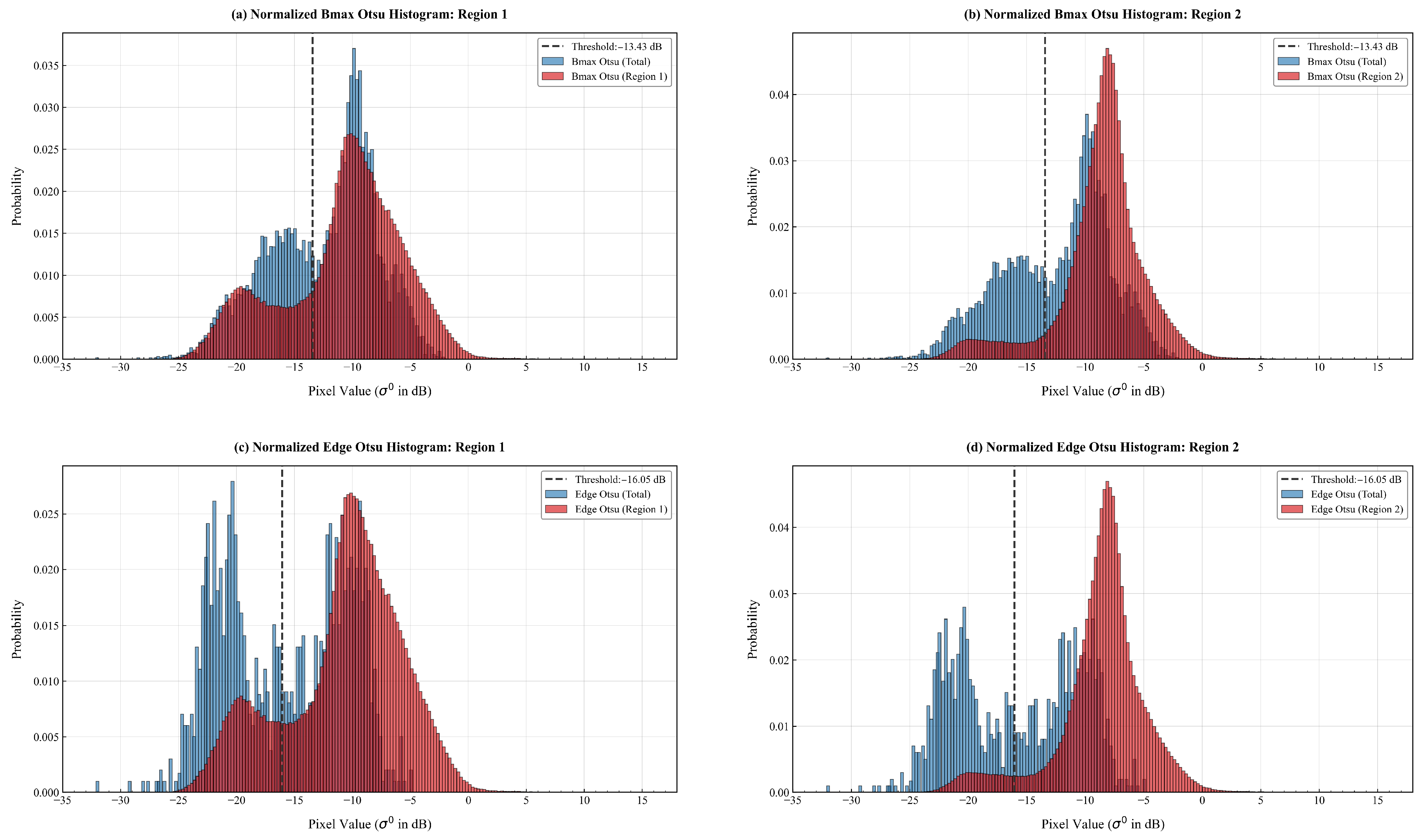
The difference between the methods is evident in the backscatter histograms, which reveal the sensitivity of each algorithm to the local composition of the scene. Figure 16 presents the comparison for the event of 15 April 2023. The Bmax Otsu histogram for the total area shows clear bimodality; however, when analyzing Zone 1, the separation between the water and non-water peaks is maximized (Figure 16a). This occurs because, by focusing the analysis on a zone with greater water presence, class balance is optimized, resulting in a more distinct bimodality. In contrast, in Zone 2 (Figure 16b), bimodality is attenuated due to the predominance of land pixels, which hinders automatic segmentation.
In turn, the Edge Otsu algorithm produces histograms with more symmetric peaks, a direct consequence of its sampling restricted to edge buffers. While this technique isolates transition zones, it tends to generate systematically lower thresholds than Bmax Otsu. This radiometric shift is the primary cause of the omission errors observed in Edge Otsu: by setting an excessively low threshold, the algorithm excludes water pixels with higher surface roughness. In conclusion, the histogram distributions confirm the superiority of Bmax Otsu; its methodology, based on the exclusive selection of tiles with marked bimodality (“checkerboard” tiles), ensures more conservative and robust thresholds, avoiding the bias introduced by noise in the reduced buffers of Edge Otsu.

5.5. Synthesis and Selection of the Optimal Algorithm

Although the comparative analysis provides differentiated perspectives on algorithmic performance across SAR datasets, significant convergence patterns are identified that support the spatial observations. Primarily, the evaluation demonstrates that Bmax Otsu offers superior consistency, both in the stability of the threshold calculation and in the spatial concordance of the water extent across complex scenarios. Even though the numerical differences in overall accuracy between the algorithms were marginal, statistical significance was verified in the error distribution and operational resilience. This finding is critical, as it confirms that Bmax Otsu possesses a greater capacity to capture transition zones without succumbing to speckle noise or systematic under-segmentation.
Based on the entirety of the evaluations conducted, it is concluded that the Bmax Otsu algorithm provides the most efficient and balanced metrics, achieving optimal adaptation to the radiometric characteristics of the study area. Consequently, this algorithm is selected as the core thresholding engine for the proposed methodology, whose final accuracy is fully guaranteed through the subsequent application of topographic and land use masks for automated and reliable flood detection.

5.6. Dynamic Threshold Behavior

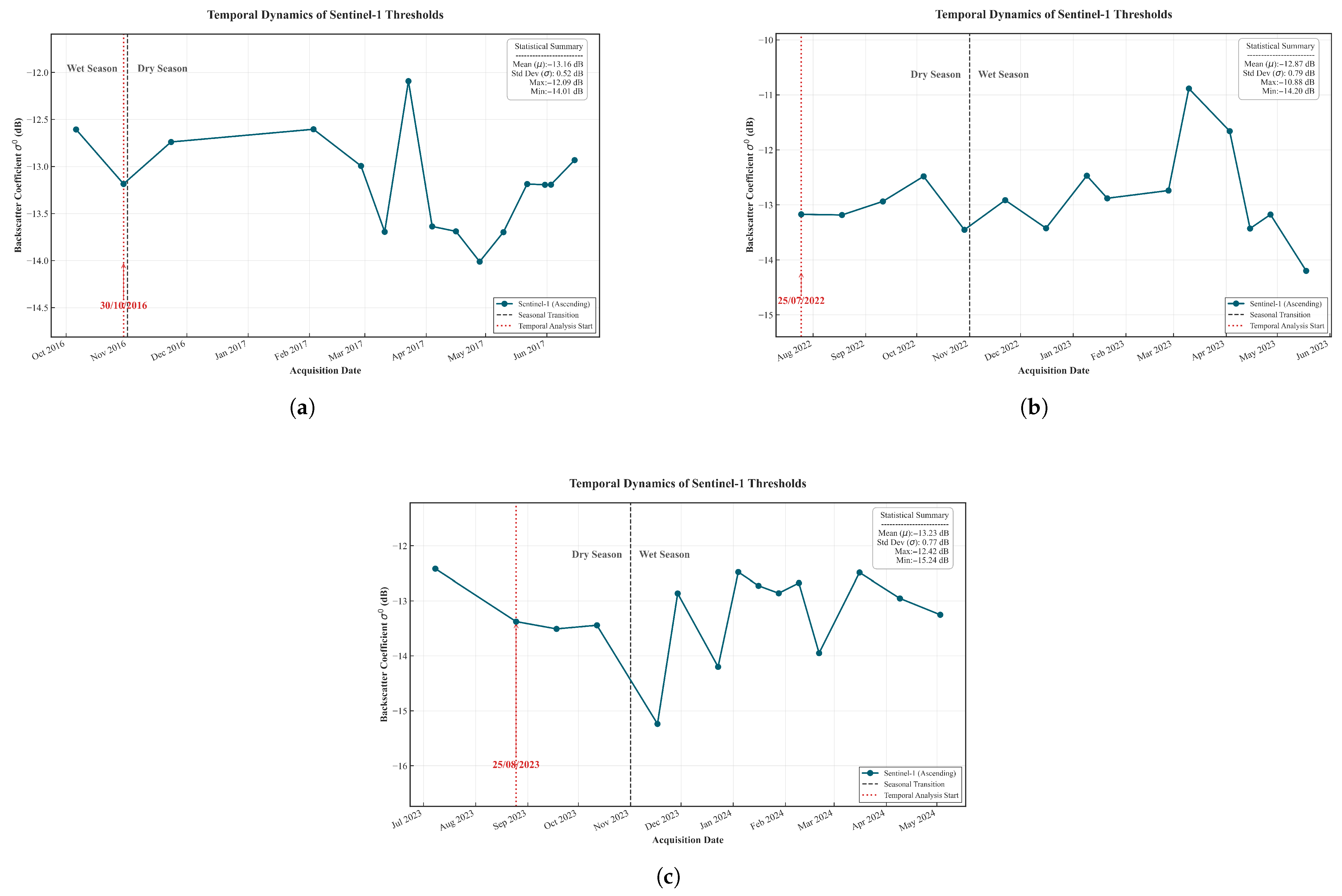
Figure 17 illustrates the temporal evolution of the dynamic thresholds determined by the Bmax Otsu algorithm across the three Sentinel-1 time series. Significant temporal variability is observed, with standard deviations ( σ ) ranging from 0.52 dB in 2017 to 0.79 dB in 2023. This behavior is attributable to the phenological dynamics of the agricultural cover (rice and banana); the presence of water layers (<5 cm) during the planting stage induces specular reflection that attenuates the backscatter intensity.
A detailed inspection of the series reveals critical radiometric dynamics triggered by extreme hydrological events. For example, the 2023 series (Figure 17b) exhibits the highest volatility ( σ = 0.79 dB) and the highest mean threshold ( μ = 12.87 dB). During the peak of the flood season (March–April 2023), the threshold shifted abruptly toward higher values, reaching a maximum of 10.88 dB. This behavior indicates that, as the flood extent expands, the “water” class becomes statistically dominant and radiometrically brighter (due to wind-induced roughness or sediment load), forcing the algorithm to relax the cutoff point to capture the entirety of the water body.
Conversely, pronounced drops in threshold values are observed during transitional periods. Notably, in the 2024 series (Figure 17c), the threshold decreased to a minimum of 15.24 dB in December. Had a fixed empirical threshold (for example, the standard 14 dB) been applied during this period, severe under-segmentation would have occurred. Consequently, the oscillation range of nearly 4.3 dB observed between the absolute maximum ( 10.88 dB in 2023) and the absolute minimum ( 15.24 dB in 2024) decisively validates the inadequacy of static thresholds. The adaptive nature of Bmax Otsu proves essential to compensate for these scene-specific radiometric changes, ensuring consistent detection under both low-flow and extreme flood scenarios.

5.7. Discussion on the Temporal Dynamics of the Flood Monitoring Model

Surface water maps derived from Sentinel-1 imagery demonstrated high efficacy in detecting deep water bodies, identifying both flooding in floodplains adjacent to rivers and water sheets in rice crop fields. For this reason, it was necessary to apply exclusion masks in these agricultural zones to avoid false positives in the mapping algorithms, as evidenced in Figure 9 on 11 March 2017, where water presence is detected in areas distant from the main channel, corresponding to irrigation areas [63]. Nevertheless, despite the masking, residual noise was identified in certain sectors of the rice paddies, likely attributable to the decrease in backscatter intensity that occurs during the phenological maturation stage of the crop.
The temporal analysis of surface water proportions reveals significant interannual variability in the hydrological regimes of the Tumbes River basin, validating the need for an adaptive initialization strategy. As evidenced in Figure 10, the transition from the dry to the wet season does not follow a rigid calendar pattern. For instance, the hydrological baseline ( t 0 ) for the 2017 event series was identified in late October (Figure 10a), whereas for the 2023 series, the optimal initialization point shifted to late July (Figure 10b). This temporal heterogeneity confirms that the use of fixed calendar dates for algorithm initialization would introduce biases, potentially capturing early flood signals as background noise.
Furthermore, the magnitude of the detected water extent highlights the exceptional intensity of the 2023 hydrological period. While the 2017 event, historically associated with the Coastal El Niño, recorded a maximum water proportion of 6.09%, the 2023 series culminated in a significantly higher peak of 8.58% on March 10. This increase is consistent with the extreme precipitation anomalies recorded during the incidence of Cyclone Yaku. The 2024 series (Figure 10c), with a peak of 6.48%, presents an intermediate scenario. The ability of the proposed methodology to capture these varying magnitudes, from basal minimums (<3%) to flood peaks, demonstrates the robustness of using relative pixel proportions as a standardized metric to monitor flood evolution across differentiated climatic years.
Although the temporal analysis effectively captured the progression of the events, the precision of the spatial delimitation showed dependencies regarding land cover characteristics. During maximum flood periods, surface water is effectively delimited in both river channels and rice fields due to the low backscatter intensity characteristic of deep water that induces specular reflection. However, mapping precision decreases during active phenological stages of the crop. The Sentinel-1 SAR sensor shows high sensitivity to soil-water mixing conditions during the sowing and seedbed periods, when the preparation of the planting beds generates a heterogeneous dielectric response that hinders automated segmentation [58].

5.8. Hydrological Thresholds Modeling

According to the flood maps, hydrological activation begins at 743.49 m3/s, a point where significant water anomalies are detected outside the main channel. Although the linear model projects an initial theoretical threshold of 663.74 m3/s ( A = 0 ), the empirical value of 743.49 m3/s was adopted to base the Early Warning System (EWS) on physical evidence from SAR imagery rather than mathematical extrapolations. Excluding the minor event (588.31 m3/s) to prevent bias, the linear interpolation of the remaining six events discretized impacts every 25 m3/s (Table 9).
The selection of the linear interpolation is grounded in its predictive superiority and resistance to overfitting, demonstrated by the RMSE LOOCV metric. To compensate for the physical limitations of geometric vector scaling, the HAND model was introduced as a topographic anchor. Utilizing the 95th percentile ( P 95 ) of HAND heights instead of the absolute maximum acted as a critical spatial filter to suppress DEM altimetric anomalies and speckle noise false positives, ensuring the synthetic polygons strictly adhere to the real relief of the valley.
This continuous and topographically constrained estimation provides a significant operational advantage over traditional discrete monitoring. Although the discharge-area relationship is consistent, clear non-linear jumps are identified, such as between 1200 and 1250 m3/s, where the affected population abruptly increases from 408 to 463 inhabitants. Identifying these inflection points, alongside the initial activation threshold, is vital for the Regional Government of Tumbes to transition from passive monitoring to active alerts. The capability to project that a discharge of 1650 m3/s corresponds exactly to 1234.78 ha equips decision-makers with precise, quantifiable scenarios for risk financing and emergency resource allocation.
The comparative analysis with the INDECI report for the 21 February 2024 event (Table 10) reveals both the robustness and limitations of the SAR algorithm. Spatial discrepancies do not stem from a single error source; rather, their origin is strictly conditioned by land cover dynamics and field logistics, broken down into three key factors:
  • Spatial concordance and conceptual divergence: In the Corrales district, the algorithm demonstrated high concordance, estimating 243.68 ha affected versus INDECI’s 200 ha. This slight overestimation (+21%) reflects an expected conceptual divergence: the SAR algorithm objectively detects the physical water surface, whereas field assessments report agro-economic damage, excluding waterlogged areas that did not result in total crop loss.
  • Detection in unreported zones (INDECI logistical limitation): A critical discrepancy was observed in San Jacinto and San Juan de la Virgen, where the algorithm detected impacts (52.88 ha and 42.75 ha) omitted in the official report. This administrative under-registration is categorically attributed to the inaccessibility of remote areas during the emergency peak [78]. Here, the SAR sensor generates no false positives but overcomes human logistical barriers to offer a more comprehensive mapping.
  • Underestimation in dense canopy (Physical sensor limitation): Conversely, in the Tumbes district, the algorithm underestimated the impact (254.57 ha) compared to INDECI (405 ha). This discrepancy is attributed to an omission error derived from the Sentinel-1 C-band physical wavelength limitation. In mature crops, the canopy generates volume scattering that obscures the underlying water sheet. Additionally, INDECI accounts for areas with rain-induced soil saturation without deep water bodies, which evade the thresholding sensitivity of the Bmax Otsu algorithm.
In summary, while administrative records provide the ground truth for economic valuation, the proposed SAR algorithm offers superior spatial objectivity and temporal resolution, serving as a vital complement to correct potential logistical biases in field-based damage assessments.

5.9. Methodological Limitations and Operational Robustness

It is imperative to acknowledge as a fundamental limitation of this research the lack of empirical incorporation of the hysteresis effect in the Discharge-Area (Q-A) relationship. In the Tumbes River floodplain, depression storage and slow agricultural drainage maintain extensively waterlogged areas during the receding limb of the hydrograph, even after drastic discharge decreases. Capturing this phenomenon is unfeasible due to the discrete temporal resolution of Sentinel-1 (6 to 12 days). This same acquisition frequency poses a challenge against rapid flood dynamics that occur on an hourly scale, increasing the probability of underestimating thresholds by missing the exact peak of the event in real time.
However, the suitability of the satellite sensor for this Early Warning System (EWS) does not lie in its use for direct hourly monitoring, but rather in its capability to retrospectively calibrate the empirical impact curve. In the operational phase, the temporal lag of the satellite is mitigated by decoupling the system from new SAR acquisitions. Warnings will be triggered using continuous hydrometric readings from the El Tigre station fed directly into the pre-established Q-A curve. In this context, omitting hysteresis carries the risk of generating false end-of-event alarms if river drawdown alone is assumed as a drying indicator. Therefore, the proposed approach is operationally delimited as a tool to predict the maximum extent of impact during the prevention and primary response phase, but not to model the desiccation process nor to determine the safe deactivation of the alert.
This operational reliance on a single gauging station (El Tigre) to drive the empirical model represents, in turn, a potential vulnerability under extreme failure scenarios. Nevertheless, redundancy is intrinsically ensured by the broader monitoring network of the basin. The presence of upstream (Cabo Inga) and downstream (Puente Tumbes) stations allows for the reliable estimation of discharge at El Tigre through established flow routing and travel time relationships.
Furthermore, while the SAR-based framework bypasses complex 2D hydrodynamic routing to prioritize computational efficiency, it is highly interoperable with ongoing institutional efforts. From the National Water Authority (ANA), this includes the systematic identification of critical flood points and the centralization of hydrometric data through the Water Observatory. Concurrently, SENAMHI is currently advancing distributed hydrological-hydraulic modeling, such as the RRI model, driven by precipitation inputs alongside artificial intelligence forecasting for key tributaries. The integration of multi-station observational routing and these complementary techniques guarantees the continuous estimation of peak discharges. In its current state, the methodology assumes a conscious technical compromise that sacrifices the deterministic representation of micro-relief in favor of a topographically validated and computationally efficient tool that safeguards the operational continuity of the EWS.

6. Conclusions

This research successfully developed an operational methodological framework for flood detection in the lower Tumbes River basin using Google Earth Engine and Sentinel-1 SAR imagery. By validating automatic bimodal thresholding algorithms, this study overcomes optical sensor constraints under persistent cloud cover. The hybrid integration of SAR data, unsupervised classification, and topographic modeling provides a robust solution for estimating critical Early Warning System (EWS) thresholds. In strict accordance with the objectives and analyzed results, the following conclusions are drawn:
  • Calibration and algorithmic resilience: Parametric calibration with high-resolution PlanetScope imagery confirmed that Bmax Otsu, utilizing a 0.01 grid size and a 0.65 bimodality threshold, optimally captures agricultural heterogeneity. Statistical K-fold evaluation demonstrated its superiority over Edge Otsu in overall accuracy (95.8%) and Kappa coefficient (66.1%), alongside a high resilience to speckle noise that minimizes omission errors in radiometrically complex areas.
  • Spatiotemporal dynamics reconstruction: The sequential monitoring algorithm reconstructed seven hydrological events between 2017 and 2024, effectively discriminating flood anomalies from permanent water bodies and irrigated crops. By accurately mapping a zero-impact low-flow event without generating false positives, the system proved highly reliable across all flood phases.
  • Topographically constrained discharge–impact modeling: An empirical predictive function was established using linear interpolation, justified by the LOOCV RMSE metric for its superior generalization capacity. To ensure physical coherence, the HAND model was applied using the 95th percentile to filter DEM anomalies. Operationally, a validated baseline activation threshold of 743.49 m3/s was identified, scaling up to 1234.78 hectares and 749 affected inhabitants under an extreme discharge scenario of 1629.02 m3/s.
  • Operational validation and intrinsic limitations: Comparison with official INDECI records highlighted the dual capability of the system. While the SAR sensor overcame field logistical barriers by detecting floods in unreported remote zones, it underestimated impacts in dense mature vegetation due to C-band volumetric scattering limitations. Furthermore, while the current approach accurately estimates maximum impact extent, it requires future coupling with 2D hydrodynamic models to capture the hysteresis effect during floodplain drying.
Ultimately, the developed methodology assumes a conscious technical compromise, sacrificing deterministic micro-relief resolution in favor of high computational efficiency and satellite objectivity. It equips disaster risk managers with a quantitative, topographically validated, and cost-effective tool to transition from passive observation to active flood hazard anticipation.

Supplementary Materials

The following supporting information can be downloaded at: https://www.mdpi.com/article/10.3390/rs18101493/s1.

Author Contributions

Conceptualization, J.C.B.A., L.B., P.R. and W.L.-C.; Methodology, J.C.B.A., O.F. and W.L.-C.; Software, J.C.B.A.; Validation, J.C.B.A. and P.R.; Formal analysis, J.C.B.A.; Investigation, J.C.B.A., J.V., O.F., L.B., P.R. and W.L.-C.; Resources, J.C.B.A., J.V., O.F., L.B., P.R. and W.L.-C.; Data curation, J.C.B.A. and J.V.; Writing—original draft, J.C.B.A.; Writing—review & editing, J.C.B.A., J.V., O.F., L.B., P.R. and W.L.-C.; Visualization, J.C.B.A.; Supervision, L.B., P.R. and W.L.-C.; Project administration, W.L.-C. All authors have read and agreed to the published version of the manuscript.

Funding

This research received no external funding.

Data Availability Statement

The original contributions presented in the study are included in the article/Supplementary Materials. For further inquiries, please contact the corresponding author.

Conflicts of Interest

The authors declare no conflicts of interest.

Abbreviations

The following abbreviations are used in this manuscript:
SARSynthetic Aperture Radar
GEEGoogle Earth Engine
GRDGround Range Detected
VVVertical transmit, Vertical receive
VHVertical transmit, Horizontal receive
IoUIntersection over Union

References

  1. Hirabayashi, Y.; Mahendran, R.; Koirala, S.; Konoshima, L.; Yamazaki, D.; Watanabe, S.; Kim, H.; Kanae, S. Global flood risk under climate change. Nat. Clim. Change 2013, 3, 816–821. [Google Scholar] [CrossRef]
  2. Tellman, B.; Sullivan, J.; Kuhn, C.; Kettner, A.; Doyle, C.; Brakenridge, G.; Erickson, T.; Slayback, D. Satellite imaging reveals increased proportion of population exposed to floods. Nature 2021, 596, 80–86. [Google Scholar] [CrossRef]
  3. Cai, W.; Borlace, S.; Lengaigne, M.; Van Rensch, P.; Collins, M.; Vecchi, G.A.; Timmermann, A.; Santoso, A.; McPhaden, M.J.; Wu, L.; et al. Increasing frequency of extreme El Niño events due to greenhouse warming. Nat. Clim. Change 2014, 4, 111–116. [Google Scholar] [CrossRef]
  4. Llauca, H.; Leon, K.; Lavado-Casimiro, W. Construction of a daily streamflow dataset for Peru using a similarity-based regionalization approach and a hybrid hydrological modeling framework. J. Hydrol. Reg. Stud. 2023, 47, 101381. [Google Scholar] [CrossRef]
  5. Bourrel, L.; Rau, P.; Dewitte, B.; Labat, D.; Lavado, W.; Coutaud, A.; Vera, A.; Alvarado, A.; Ordoñez, J. Low-frequency modulation and trend of the relationship between ENSO and precipitation along the northern to centre Peruvian Pacific coast. Hydrol. Process. 2015, 29, 1252–1266. [Google Scholar] [CrossRef]
  6. Rau, P.; Bourrel, L.; Labat, D.; Frappart, F.; Ruelland, D.; Lavado, W.; Dewitte, B.; Felipe, O. Hydroclimatic change disparity of Peruvian Pacific drainage catchments. Theor. Appl. Climatol. 2018, 134, 139–153. [Google Scholar] [CrossRef]
  7. Sanabria, J.; Bourrel, L.; Dewitte, B.; Frappart, F.; Rau, P.; Solis, O.; Labat, D. Rainfall along the coast of Peru during strong El Niño events. Int. J. Climatol. 2018, 38, 1737–1747. [Google Scholar] [CrossRef]
  8. Sanabria, J.; Bourrel, L.; Carrillo, C.; Labat, D. Unprecedented Rainfall and Moisture Patterns during El Niño 2016 in the Eastern Pacific and Tropical Andes: Northern Perú and Ecuador. Atmosphere 2019, 10, 768. [Google Scholar] [CrossRef]
  9. Rau, P.; Bourrel, L.; Labat, D.; Melo, P.; Dewitte, B.; Frappart, F.; Lavado, W.; Felipe, O. Regionalization of rainfall over the Peruvian Pacific slope and coast. Int. J. Climatol. 2017, 37, 143–158. [Google Scholar] [CrossRef]
  10. Rau, P.; Bourrel, L.; Labat, D.; Ruelland, D.; Frappart, F.; Lavado, W.; Dewitte, B.; Felipe, O. Assessing multi-decadal runoff (1970–2010) using regional hydrological modelling under data and water scarcity conditions in Peruvian Pacific catchments. Hydrol. Process. 2019, 33, 20–35. [Google Scholar] [CrossRef]
  11. Frappart, F.; Bourrel, L.; Brodu, N.; Riofrío, X.; Baup, F.; Darrozes, J.; Pombosa, R. Monitoring of the Spatio-Temporal Dynamics of the Floods in the Guayas Watershed (Ecuadorian Pacific Coast) using Global Monitoring ENVISAT ASAR Images and Rainfall Data. Water 2017, 9, 12. [Google Scholar] [CrossRef]
  12. Erazo, B.; Bourrel, L.; Frappart, F.; Chimborazo, O.; Labat, D.; Dominguez-Granda, L.; Matamoros, D.; Mejia, R. Validation of Satellite Estimates (Tropical Rainfall Measuring Mission, TRMM) for Rainfall Variability over the Pacific Slope and Coast of Ecuador. Water 2018, 10, 213. [Google Scholar] [CrossRef]
  13. Mishra, A.K.; Coulibaly, P. Developments in hydrometric network design: A review. Rev. Geophys. 2009, 47, RG2001. [Google Scholar] [CrossRef]
  14. Liu, C.C.; Shieh, M.C.; Ke, M.S.; Wang, K.H. Flood prevention and emergency response system powered by Google Earth Engine. Remote Sens. 2018, 10, 1283. [Google Scholar] [CrossRef]
  15. Markert, K.N.; Markert, A.M.; Mayer, T.; Nauman, C.; Haag, A.; Poortinga, A.; Bhandari, B.; Thwal, N.S.; Kunlamai, T.; Chishtie, F.; et al. Comparing sentinel-1 surface water mapping algorithms and radiometric terrain correction processing in southeast asia utilizing google earth engine. Remote Sens. 2020, 12, 2469. [Google Scholar] [CrossRef]
  16. Tripathy, P.; Malladi, T. Global Flood Mapper: A novel Google Earth Engine application for rapid flood mapping using Sentinel-1 SAR. Nat. Hazards 2022, 114, 1341–1363. [Google Scholar] [CrossRef]
  17. Pekel, J.F.; Cottam, A.; Gorelick, N.; Belward, A.S. High-resolution mapping of global surface water and its long-term changes. Nature 2016, 540, 418–422. [Google Scholar] [CrossRef]
  18. Du, Z.; Li, W.; Zhou, D.; Tian, L.; Ling, F.; Wang, H.; Gui, Y.; Sun, B. Analysis of Landsat-8 OLI imagery for land surface water mapping. Remote Sens. Lett. 2014, 5, 672–681. [Google Scholar] [CrossRef]
  19. Ji, L.; Geng, X.; Sun, K.; Zhao, Y.; Gong, P. Target detection method for water mapping using Landsat 8 OLI/TIRS imagery. Water 2015, 7, 794–817. [Google Scholar] [CrossRef]
  20. Yang, X.; Zhao, S.; Qin, X.; Zhao, N.; Liang, L. Mapping of urban surface water bodies from Sentinel-2 MSI imagery at 10 m resolution via NDWI-based image sharpening. Remote Sens. 2017, 9, 596. [Google Scholar] [CrossRef]
  21. Ahamed, A.; Bolten, J.D. A MODIS-based automated flood monitoring system for southeast asia. Int. J. Appl. Earth Obs. Geoinf. 2017, 61, 104–117. [Google Scholar] [CrossRef]
  22. Huang, C.; Chen, Y.; Zhang, S.; Li, L.; Shi, K.; Liu, R. Surface water mapping from Suomi NPP-VIIRS imagery at 30 m resolution via blending with Landsat data. Remote Sens. 2016, 8, 631. [Google Scholar] [CrossRef]
  23. Xu, H. Modification of normalised difference water index (NDWI) to enhance open water features in remotely sensed imagery. Int. J. Remote Sens. 2006, 27, 3025–3033. [Google Scholar] [CrossRef]
  24. Feyisa, G.L.; Meilby, H.; Fensholt, R.; Proud, S.R. Automated Water Extraction Index: A new technique for surface water mapping using Landsat imagery. Remote Sens. Environ. 2014, 140, 23–35. [Google Scholar] [CrossRef]
  25. Zhou, Y.; Dong, J.; Xiao, X.; Xiao, T.; Yang, Z.; Zhao, G.; Zou, Z.; Qin, Y. Open surface water mapping algorithms: A comparison of water-related spectral indices and sensors. Water 2017, 9, 256. [Google Scholar] [CrossRef]
  26. Jones, J.W. Efficient wetland surface water detection and monitoring via landsat: Comparison with in situ data from the everglades depth estimation network. Remote Sens. 2015, 7, 12503–12538. [Google Scholar] [CrossRef]
  27. Jones, J.W. Improved automated detection of subpixel-scale inundation—Revised dynamic surface water extent (DSWE) partial surface water tests. Remote Sens. 2019, 11, 374. [Google Scholar] [CrossRef]
  28. Donchyts, G.; Baart, F.; Winsemius, H.; Gorelick, N.; Kwadijk, J.; Van De Giesen, N. Earth’s surface water change over the past 30 years. Nat. Clim. Change 2016, 6, 810–813. [Google Scholar] [CrossRef]
  29. Donchyts, G.; Schellekens, J.; Winsemius, H.; Eisemann, E.; Van de Giesen, N. A 30 m resolution surface water mask including estimation of positional and thematic differences using landsat 8, srtm and openstreetmap: A case study in the Murray-Darling Basin, Australia. Remote Sens. 2016, 8, 386. [Google Scholar] [CrossRef]
  30. Isikdogan, F.; Bovik, A.C.; Passalacqua, P. Surface water mapping by deep learning. IEEE J. Sel. Top. Appl. Earth Obs. Remote Sens. 2017, 10, 4909–4918. [Google Scholar] [CrossRef]
  31. Markert, K.N.; Chishtie, F.; Anderson, E.R.; Saah, D.; Griffin, R.E. On the merging of optical and SAR satellite imagery for surface water mapping applications. Results Phys. 2018, 9, 275–277. [Google Scholar] [CrossRef]
  32. Oddo, P.C.; Bolten, J.D. The value of near real-time earth observations for improved flood disaster response. Front. Environ. Sci. 2019, 7, 127. [Google Scholar] [CrossRef]
  33. Sanyal, J.; Lu, X.X. Application of remote sensing in flood management with special reference to monsoon Asia: A review. Nat. Hazards 2004, 33, 283–301. [Google Scholar] [CrossRef]
  34. Twele, A.; Cao, W.; Plank, S.; Martinis, S. Sentinel-1-based flood mapping: A fully automated processing chain. Int. J. Remote Sens. 2016, 37, 2990–3004. [Google Scholar] [CrossRef]
  35. Yan, K.; Di Baldassarre, G.; Solomatine, D.P.; Schumann, G.J.P. A review of low-cost space-borne data for flood modelling: Topography, flood extent and water level. Hydrol. Process. 2015, 29, 3368–3387. [Google Scholar] [CrossRef]
  36. Elkhrachy, I. Assessment and management flash flood in Najran Wady using GIS and remote sensing. J. Indian Soc. Remote Sens. 2018, 46, 297–308. [Google Scholar] [CrossRef]
  37. Clement, M.A.; Kilsby, C.G.; Moore, P. Multi-temporal synthetic aperture radar flood mapping using change detection. J. Flood Risk Manag. 2018, 11, 152–168. [Google Scholar] [CrossRef]
  38. Amitrano, D.; Di Martino, G.; Iodice, A.; Riccio, D.; Ruello, G. Unsupervised rapid flood mapping using Sentinel-1 GRD SAR images. IEEE Trans. Geosci. Remote Sens. 2018, 56, 3290–3299. [Google Scholar] [CrossRef]
  39. Torres, R.; Snoeij, P.; Geudtner, D.; Bibby, D.; Davidson, M.; Attema, E.; Potin, P.; Rommen, B.; Floury, N.; Brown, M.; et al. GMES Sentinel-1 mission. Remote Sens. Environ. 2012, 120, 9–24. [Google Scholar] [CrossRef]
  40. Flores-Anderson, A.I.; Herndon, K.E.; Thapa, R.B.; Cherrington, E. The SAR Handbook: Comprehensive Methodologies for Forest Monitoring and Biomass Estimation; Technical Report; NASA: Huntsville, AL, USA, 2019.
  41. Tsyganskaya, V.; Martinis, S.; Marzahn, P.; Ludwig, R. SAR-based detection of flooded vegetation–a review of characteristics and approaches. Int. J. Remote Sens. 2018, 39, 2255–2293. [Google Scholar] [CrossRef]
  42. Gorelick, N.; Hancher, M.; Dixon, M.; Ilyushchenko, S.; Thau, D.; Moore, R. Google Earth Engine: Planetary-scale geospatial analysis for everyone. Remote Sens. Environ. 2017, 202, 18–27. [Google Scholar] [CrossRef]
  43. DeVries, B.; Huang, C.; Armston, J.; Huang, W.; Jones, J.W.; Lang, M.W. Rapid and robust monitoring of flood events using Sentinel-1 and Landsat data on the Google Earth Engine. Remote Sens. Environ. 2020, 240, 111664. [Google Scholar] [CrossRef]
  44. Chini, M.; Hostache, R.; Giustarini, L.; Matgen, P. A hierarchical split-based approach for parametric thresholding of SAR images: Flood inundation as a test case. IEEE Trans. Geosci. Remote Sens. 2017, 55, 6975–6988. [Google Scholar] [CrossRef]
  45. Horritt, M. A statistical active contour model for SAR image segmentation. Image Vis. Comput. 1999, 17, 213–224. [Google Scholar] [CrossRef]
  46. Benoudjit, A.; Guida, R. A novel fully automated mapping of the flood extent on SAR images using a supervised classifier. Remote Sens. 2019, 11, 779. [Google Scholar] [CrossRef]
  47. Pech-May, F.; Aquino-Santos, R.; Delgadillo-Partida, J. Sentinel-1 SAR images and deep learning for water body mapping. Remote Sens. 2023, 15, 3009. [Google Scholar] [CrossRef]
  48. Ulloa, N.I.; Yun, S.H.; Chiang, S.H.; Furuta, R. Sentinel-1 spatiotemporal simulation using convolutional LSTM for flood mapping. Remote Sens. 2022, 14, 246. [Google Scholar] [CrossRef]
  49. Lin, Y.N.; Yun, S.H.; Bhardwaj, A.; Hill, E.M. Urban flood detection with Sentinel-1 multi-temporal synthetic aperture radar (SAR) observations in a Bayesian framework: A case study for Hurricane Matthew. Remote Sens. 2019, 11, 1778. [Google Scholar] [CrossRef]
  50. Mayer, T.; Poortinga, A.; Bhandari, B.; Nicolau, A.P.; Markert, K.; Thwal, N.S.; Markert, A.; Haag, A.; Kilbride, J.; Chishtie, F.; et al. Deep learning approach for Sentinel-1 surface water mapping leveraging Google Earth Engine. ISPRS Open J. Photogramm. Remote Sens. 2021, 2, 100005. [Google Scholar] [CrossRef]
  51. Landuyt, L.; Verhoest, N.E.; Van Coillie, F.M. Flood mapping in vegetated areas using an unsupervised clustering approach on sentinel-1 and-2 imagery. Remote Sens. 2020, 12, 3611. [Google Scholar] [CrossRef]
  52. Landuyt, L.; Van Wesemael, A.; Schumann, G.J.P.; Hostache, R.; Verhoest, N.E.; Van Coillie, F.M. Flood mapping based on synthetic aperture radar: An assessment of established approaches. IEEE Trans. Geosci. Remote Sens. 2018, 57, 722–739. [Google Scholar] [CrossRef]
  53. Huang, W.; DeVries, B.; Huang, C.; Lang, M.W.; Jones, J.W.; Creed, I.F.; Carroll, M.L. Automated extraction of surface water extent from Sentinel-1 data. Remote Sens. 2018, 10, 797. [Google Scholar] [CrossRef]
  54. Uddin, K.; Matin, M.A.; Meyer, F.J. Operational flood mapping using multi-temporal Sentinel-1 SAR images: A case study from Bangladesh. Remote Sens. 2019, 11, 1581. [Google Scholar] [CrossRef]
  55. Truckenbrodt, J.; Freemantle, T.; Williams, C.; Jones, T.; Small, D.; Dubois, C.; Thiel, C.; Rossi, C.; Syriou, A.; Giuliani, G. Towards Sentinel-1 SAR analysis-ready data: A best practices assessment on preparing backscatter data for the cube. Data 2019, 4, 93. [Google Scholar] [CrossRef]
  56. Otsu, N. A threshold selection method from gray-level histograms. IEEE Trans. Syst. Man Cybern. 1979, 9, 62–66. [Google Scholar] [CrossRef]
  57. Cao, H.; Zhang, H.; Wang, C.; Zhang, B. Operational flood detection using Sentinel-1 SAR data over large areas. Water 2019, 11, 786. [Google Scholar] [CrossRef]
  58. Tran, K.H.; Menenti, M.; Jia, L. Surface water mapping and flood monitoring in the Mekong Delta using sentinel-1 SAR time series and Otsu threshold. Remote Sens. 2022, 14, 5721. [Google Scholar] [CrossRef]
  59. Silva Mena, C.J. Análisis del Convenio Internacional de la Cuenca Hidrográfica del río Puyango-Tumbes y el Desarrollo de la Población Tumbesina, 2021. Ph.D. Thesis, Universidad Nacional de Tumbes, Tumbes, Peru, 2022. [Google Scholar]
  60. Ojeda Huerta, E.R. Escenarios Para la Gestión de Recursos Hídricos Entre el Perú y Ecuador: El Caso de la Contaminación del Río Puyango-Tumbes. Master’s Thesis, Academia Diplomática del Perú Javier Pérez de Cuéllar, Lima, Peru, 2017. [Google Scholar]
  61. Servicio Nacional de Meteorología e Hidrología del Perú. Datos Hidrométricos de la Estación El Tigre, 2014–2024 [Dataset]. 2024. Available online: https://www.senamhi.gob.pe/site/descarga-datos/ (accessed on 17 October 2024).
  62. Instituto Nacional de Estadística e Informática (INEI). Censos Nacionales 2017: XII de Población, VII de Vivienda y III de Comunidades Indígenas; Instituto Nacional de Estadística e Informática: Lima, Peru, 2017.
  63. Gobierno Regional de Tumbes. Estudio de Uso Actual de la Tierra Para la Zonificación Ecológica y Económica del Departamento de Tumbes; Reporte Técnico; Gobierno Regional de Tumbes: Tumbes, Peru, 2023.
  64. Farr, T.G.; Rosen, P.A.; Caro, E.; Crippen, R.; Duren, R.; Hensley, S.; Kobrick, M.; Paller, M.; Rodriguez, E.; Roth, L.; et al. The shuttle radar topography mission. Rev. Geophys. 2007, 45, RG2004. [Google Scholar] [CrossRef]
  65. Lee, J.S.; Wen, J.H.; Ainsworth, T.L.; Chen, K.S.; Chen, A.J. Improved sigma filter for speckle filtering of SAR imagery. IEEE Trans. Geosci. Remote Sens. 2008, 47, 202–213. [Google Scholar]
  66. Vollrath, A.; Mullissa, A.; Reiche, J. Angular-based radiometric slope correction for Sentinel-1 on google earth engine. Remote Sens. 2020, 12, 1867. [Google Scholar] [CrossRef]
  67. Martinis, S.; Kuenzer, C.; Wendleder, A.; Huth, J.; Twele, A.; Roth, A.; Dech, S. Comparing four operational SAR-based water and flood detection approaches. Int. J. Remote Sens. 2015, 36, 3519–3543. [Google Scholar] [CrossRef]
  68. Huang, C.; Chen, Y.; Zhang, S.; Wu, J. Detecting, extracting, and monitoring surface water from space using optical sensors: A review. Rev. Geophys. 2018, 56, 333–360. [Google Scholar] [CrossRef]
  69. Nobre, A.D.; Cuartas, L.A.; Hodnett, M.; Rennó, C.D.; Rodrigues, G.; Silveira, A.; Saleska, S. Height Above the Nearest Drainage—A hydrologically relevant new terrain model. J. Hydrol. 2011, 404, 13–29. [Google Scholar] [CrossRef]
  70. Planet Team. Planet Application Program Interface: In Space for Life on Earth; Planet: San Francisco, CA, USA, 2024. [Google Scholar]
  71. Demirkaya, O.; Asyali, M.H. Determination of image bimodality thresholds for different intensity distributions. Signal Process. Image Commun. 2004, 19, 507–516. [Google Scholar] [CrossRef]
  72. Canny, J. A computational approach to edge detection. IEEE Trans. Pattern Anal. Mach. Intell. 1986, PAMI-8, 679–698. [Google Scholar] [CrossRef]
  73. Kohavi, R. A study of cross-validation and bootstrap for accuracy estimation and model selection. In Proceedings of the 14th International Joint Conference on Artificial Intelligence, Montreal, QC, Canada, 1995; Morgan Kaufmann Publishers Inc.: San Francisco, CA, USA, 1995; Volume 14, pp. 1137–1145. [Google Scholar]
  74. Ngo, T.T.; Mazet, V.; Collet, C.; De Fraipont, P. Shape-based building detection in visible band images using shadow information. IEEE J. Sel. Top. Appl. Earth Obs. Remote Sens. 2016, 10, 920–932. [Google Scholar] [CrossRef]
  75. Yang, H.L.; Yuan, J.; Lunga, D.; Laverdiere, M.; Rose, A.; Bhaduri, B. Building extraction at scale using convolutional neural network: Mapping of the united states. IEEE J. Sel. Top. Appl. Earth Obs. Remote Sens. 2018, 11, 2600–2614. [Google Scholar] [CrossRef]
  76. McNemar, Q. Note on the sampling error of the difference between correlated proportions or percentages. Psychometrika 1947, 12, 153–157. [Google Scholar] [CrossRef]
  77. Abdi, A.M. Land cover and land use classification performance of machine learning algorithms in a boreal landscape using Sentinel-2 data. GISci. Remote Sens. 2020, 57, 1–20. [Google Scholar] [CrossRef]
  78. Reporte Complementario N.º 5577-Lluvias Intensas en el Departamento de Tumbes; Technical Report; Centro de Operaciones de Emergencia Nacional-INDECI: Lima, Peru, 2024.
  79. Peña-Murillo, R.; Lavado-Casimiro, W.; Bourrel, L. Impacts of LULC and climate change on runoff and sediment production for the Puyango-Tumbes basin (Ecuador-Peru). Front. Remote Sens. 2024, 5, 1471144. [Google Scholar] [CrossRef]
  80. Castillón, F.; Rau, P.; Bourrel, L.; Frappart, F. Dynamics and patterns of land cover change in the Piura River Basin (Peruvian Pacific slope and coast) in the last two decades. Front. Remote Sens. 2025, 6, 1529044. [Google Scholar] [CrossRef]
Figure 1. Location of the study area in the lower Tumbes River basin. The map illustrates the topography, the drainage network, and the El Tigre hydrometric station, highlighting the flood domain delineated by the HAND model to constrain the spatial SAR analysis. Additionally, the specific sub-regions corresponding to the lower (Zone 1) and middle (Zone 2) floodplains analyzed in this study are explicitly delineated.
Remotesensing 18 01493 g001
Figure 2. Spatial distribution of Land Use/Land Cover (LULC) and population settlements in the lower Tumbes River basin. The proximity of settlements and agricultural areas to the main channel highlights their high socio-economic vulnerability to floods, justifying the need for continuous SAR monitoring.
Remotesensing 18 01493 g002
Figure 3. Hydroclimatic characterization and flood event selection in the Tumbes River basin (2016–2024). (a) The upper panel integrates daily maximum discharge at El Tigre (m3/s) and precipitation at Cabo Inga (mm), indicating ENFEN climatic phases (red for El Niño and blue for La Niña) and the seven Sentinel-1 acquisitions via vertical lines. (b) The lower panel contextualizes the climate dynamics through the ICEN and ONI indices, demonstrating the coupling between marine thermal anomalies and the hydrological response; in this panel, blue and red bars represent cold (La Niña) and warm (El Niño) coastal conditions, respectively, while grey bars indicate neutral periods.
Remotesensing 18 01493 g003
Figure 4. General flowchart of the proposed methodology. The workflow is divided into six main stages: SAR data pre-processing, parametric calibration, surface water detection algorithms (Bmax and Edge Otsu), evaluation design, flood mapping algorithm, and flood threshold determination.
Remotesensing 18 01493 g004
Figure 5. Flowchart of the flood monitoring algorithm based on the analysis of temporal dynamics of Sentinel-1 SAR imagery [58].
Remotesensing 18 01493 g005
Figure 6. Reference ground-truth delineation process using PlanetScope imagery from 28 April 2023. (a) True-color (RGB) composite. (b) NDWI index for water identification. (c) NDVI index for vegetation masking. (d) Final spectrally-assisted vector delineation of the flooded area.
Remotesensing 18 01493 g006
Figure 7. Accuracy assessment for both algorithms (Bmax Otsu and Edge Otsu), showing the distribution of (a) Overall Accuracy, (b) Cohen’s Kappa coefficient, (c) F1-Score, and (d) Precision/Recall ratio. Dashed lines within the violin plots indicate the quartiles (25th, 50th/median, and 75th percentiles). The more compact distributions (smaller dispersion) observed for Bmax Otsu indicate higher spatio-temporal stability and more consistent performance compared to Edge Otsu.
Remotesensing 18 01493 g007
Figure 8. Spatial accuracy and inter-model discrepancy for the 15 April 2023 event. The top (ac) and bottom (df) rows represent the lower and middle sections of the Tumbes floodplain, respectively. Columns 1 and 3 evaluate Bmax-Otsu and Edge-Otsu against the change detection benchmark, detailing commission (red) and omission (orange) errors. Column 2 highlights direct geometric discrepancies, showing areas detected exclusively by Bmax-Otsu (red) or Edge-Otsu (orange).
Remotesensing 18 01493 g008
Figure 9. Spatiotemporal dynamics of surface water in the lower Tumbes floodplain (Zone 1) during the 2017 El Niño Costero. The panels illustrate the binary water/non-water classification derived from Sentinel-1 imagery, arranged in descending order based on the percentage of total water area: (a) 4 April 2017, (b) 3 February 2017, and (c) 11 March 2017. Selected events are highlighted with red borders.
Remotesensing 18 01493 g009
Figure 10. Temporal evolution of water pixel percentage used to determine the flood algorithm initialization time. (a) 2017 Events. (b) 2023 Events. (c) 2024 Events.
Remotesensing 18 01493 g010
Figure 11. Spatiotemporal flood extent in the lower Tumbes floodplain (Zone 1) during the 2017 El Niño Costero. The panels depict the flood footprints isolated via the proposed temporal flood modeling, arranged in descending order based on the proportion of actively flooded area: (a) 4 April 2017, (b) 3 February 2017, and (c) 11 March 2017. Selected events are highlighted with red borders.
Remotesensing 18 01493 g011
Figure 12. Flood extent maps corresponding to all analyzed hydrological events.
Remotesensing 18 01493 g012
Figure 13. Comparative analysis of hydrological impact models. The panels illustrate the (a) Linear, (b) Logarithmic, and (c) Power regression models correlating peak discharge at El Tigre station with the total flooded area. Each model displays the 95% confidence interval (blue band) and the 95% prediction interval (grey band) derived from the six SAR-detected events.
Remotesensing 18 01493 g013
Figure 14. Empirical relationship between the modeled discharge and the HAND topographic threshold ( P 95 ). The curve represents the fit of the power equation H H A N D = α · Q β , which provides the altimetric limit of physical restriction used for the spatial refinement of the interpolated floodplains.
Remotesensing 18 01493 g014
Figure 15. Spatio-temporal evolution of interpolated flood scenarios for discharges ranging from 750 to 1650 m3/s, visualized at intervals of 100 m3/s.
Remotesensing 18 01493 g015
Figure 16. Comparative backscatter histograms for the Total Area versus Zones 1 and 2, using Bmax Otsu and Edge Otsu for the 15 April 2023 event. (a) Comparison between Total Area Bmax and Zone 1. (b) Comparison between Total Area Bmax and Zone 2. (c) Comparison between Total Area Edge and Zone 1. (d) Comparison between Total Area Edge and Zone 2.
Remotesensing 18 01493 g016
Figure 17. Threshold time series derived from Sentinel-1 imagery. (a) 2017 Events. (b) 2023 Events. (c) 2024 Events.
Remotesensing 18 01493 g017
Table 1. Technical specifications of the Sentinel-1 SAR imagery dataset used for the seven benchmark flood events. The table details the specific scene identifiers and acquisition parameters. All scenes belong to the Ascending orbit track.
EventDateMissionOrbitTime (UTC)Sentinel-1 Scene ID
13 February 2017S1BAsc23:43:36S1B_IW_GRDH_1SDV_20170203T234336_...3420
211 March 2017S1BAsc23:43:36S1B_IW_GRDH_1SDV_20170311T234336_...700C
310 May 2017S1BAsc23:43:38S1B_IW_GRDH_1SDV_20170510T234338_...6732
410 March 2023S1AAsc23:44:41S1A_IW_GRDH_1SDV_20230310T234441_...C254
23:45:06S1A_IW_GRDH_1SDV_20230310T234506_...2111
515 April 2023S1AAsc23:44:42S1A_IW_GRDH_1SDV_20230415T234442_...BEDA
23:45:07S1A_IW_GRDH_1SDV_20230415T234507_...6A0B
627 April 2023S1AAsc23:44:42S1A_IW_GRDH_1SDV_20230427T234442_...1D0E
23:45:07S1A_IW_GRDH_1SDV_20230427T234507_...114B
721 February 2024S1AAsc23:44:46S1A_IW_GRDH_1SDV_20240221T234446_...20CD
23:45:11S1A_IW_GRDH_1SDV_20240221T234511_...69F6
Note: All images are Ground Range Detected (GRD) products in Interferometric Wide (IW) mode. The “...” in the Scene ID column indicates truncated characters for brevity. S1A = Sentinel-1A; S1B = Sentinel-1B.
Table 2. Selected dates for temporal flood mapping analysis.
201720232024
DateStageDateStageDateStage
6 October 2016 25 July 2022Start8 July 2023
30 October 2016Start18 August 2022 25 August 2023Start
23 November 2016 11 September 2022 18 September 2023
3 February 2017Event 15 October 2022 12 October 2023
27 February 2017 29 October 2022 17 November 2023
11 March 2017Event 222 November 2022 29 November 2023
23 March 2017 16 December 2022 23 December 2023
4 April 2017 9 January 2023 4 January 2024
16 April 2017 21 January 2023 16 January 2024
28 April 2017 26 February 2023 28 January 2024
10 May 2017Event 310 March 2023Event 49 February 2024
22 May 2017 3 April 2023 21 February 2024Event 7
31 May 2017 15 April 2023Event 516 March 2024
3 June 2017 27 April 2023Event 69 April 2024
15 June 2017 18 May 2023 3 May 2024
Table 3. Hydrological characteristics of the selected benchmark flood events recorded at El Tigre station. The discharge values (Q) correspond to the representative hydraulic conditions for each event.
Event IDDateTime (Local)Discharge (m3/s)
E13 February 201718:43743.49
E211 March 201718:431348.68
E310 May 201718:43588.31
E410 March 202318:44879.68
E515 April 202318:441629.02
E627 April 202318:441261.57
E721 February 202418:441180.07
Note: Time indicates the approximate Sentinel-1 satellite overpass (UTC-5). Discharge data (Q) sourced from SENAMHI calibrated records.
Table 4. Threshold values for Bmax Otsu and Edge Otsu algorithms across the analyzed events.
EventSentinel SceneOrbitBmax (dB)Edge (dB)
1S1_20170203T234336_3420Ascending−12.60−13.18
2S1_20170311T234336_700CAscending−13.69−13.50
3S1_20170510T234338_6732Ascending−13.70−14.03
4S1_20230310T234441_C254Ascending−10.88−12.76
S1_20230310T234506_2111Ascending−12.47−12.99
5S1_20230415T234442_BEDAAscending−13.43−16.05
S1_20230415T234507_6A0BAscending−14.42−16.96
6S1_20230427T234442_1D0EAscending−13.18−15.49
S1_20230427T234507_114BAscending−14.42−15.25
7S1_20240221T234446_20CDAscending−13.95−17.82
S1_20240221T234511_69F6Ascending−16.21−16.57
Table 5. Statistical comparison between Bmax Otsu and Edge Otsu (Standard Deviations in parentheses).
StatisticBmax OtsuEdge Otsu
Overall Accuracy0.958 (0.0076)0.957 (0.0133)
Cohen’s Kappa0.661 (0.0468)0.637 (0.0742)
F1-Score0.683 (0.0415)0.656 (0.0717)
Precision0.656 (0.0636)0.711 (0.0738)
Recall0.803 (0.0656)0.706 (0.1613)
Precision/Recall0.837 (0.1300)1.159 (0.4991)
Table 6. Intersection over Union (IoU) index comparison between Bmax Otsu and Edge Otsu models.
ZONE 1ZONE 2TOTAL AREA
Bm/DetBm/EdEd/DetBm/DetBm/EdEd/DetBm/DetBm/EdEd/Det
IoU0.4550.7790.4270.3520.6920.3510.4560.7800.450
Table 7. Summary of socioeconomic impacts (affected population and flooded agricultural area) for the evaluated events at El Tigre station.
Peak Discharge (m3/s) [Date]DistrictAffected Population (n)Flooded Area (ha)
743.49 [3 February 2017]Corrales25.22
Tumbes155145.97
Total157151.19
879.67 [10 March 2023]Corrales2564.32
S. Jacinto27.45
San Juan1945.26
Tumbes136127.30
Total182244.34
1180.07 [21 February 2024]Corrales92243.68
S. Jacinto852.88
San Juan1842.75
Tumbes271254.57
Total389593.88
1261.57 [27 April 2023]Corrales100265.20
S. Jacinto954.61
San Juan3381.89
Tumbes332312.10
Total474713.81
1348.68 [11 March 2017]Corrales166406.91
S. Jacinto851.85
San Juan1740.87
Tumbes322302.97
Total513835.08
1629.02 [15 April 2023]Corrales180476.89
P. Hospital16.12
S. Jacinto25169.69
San Juan46114.32
Tumbes497467.76
Total7491234.78
Table 8. Statistical comparison of the evaluated regression models for the Discharge-Area relationship. Fitted parameters, Adjusted coefficient of determination ( R 2 Adj), Root Mean Square Error (RMSE), Akaike Information Criterion (AIC), and Leave-One-Out Cross-Validation RMSE (RMSE LOOCV) are reported.
ModelParameters ( α , β )Adjusted R 2 RMSEAICRMSE LOOCV
Linear [ 1.2331 , 818.4593 ] 0.9838 35.88 46.96 67.89
Logarithmic [ 1348.4676 , 8856.9418 ] 0.9244 77.49 56.20 144.94
Power [ 0.0 , 2.4137 ] 0.9865 32.73 45.86 96.16
Table 9. Interpolated discharge values (Q), estimated affected population, and total flooded area.
Q (m3/s)Pop. (n)Area (ha)Q (m3/s)Pop. (n)Area (ha)Q (m3/s)Pop. (n)Area (ha)
750163155.641075309471.621400557908.25
775180172.741100327500.711425579943.89
800198189.841125346529.801450601979.54
825153206.941150367558.8914756231015.18
850164224.041175384587.9815006391050.83
875178241.141200408623.2115256611086.47
900198267.981225438660.0015506831122.12
925220297.081250463696.7815757031157.76
950240326.171275486732.5116007251193.40
975261355.261300508767.3116257451229.05
1000282384.351325492802.1116507491234.78
1025304413.441350514836.96
1050290442.531375536872.61
Table 10. Comparison of affected population and agricultural areas between this study and the INDECI report (21 February 2024) [78].
DistrictAffected PopulationAffected Agri. Areas (ha)
This StudyINDECIThis StudyINDECI
Corrales9257243.68200
San Jacinto8052.880
S. J. de la Virgen18042.750
Tumbes271233254.57405
Disclaimer/Publisher’s Note: The statements, opinions and data contained in all publications are solely those of the individual author(s) and contributor(s) and not of MDPI and/or the editor(s). MDPI and/or the editor(s) disclaim responsibility for any injury to people or property resulting from any ideas, methods, instructions or products referred to in the content.