Article

Evaluation of FY-4B Surface Shortwave Radiation Products over China: Performance Improvement Induced by the Orbital Drift from 133°E to 105°E

1
Hubei Meteorological Service Center, Wuhan 430205, China
2
Innovation Center for FengYun Meteorological Satellite, Key Laboratory of Radiometric Calibration and Validation for Environmental Satellites, National Satellite Meteorological Center, China Meteorological Administration, Beijing 100081, China
*
Author to whom correspondence should be addressed.
Remote Sens. 2026, 18(10), 1454; https://doi.org/10.3390/rs18101454
Submission received: 11 March 2026 / Revised: 10 April 2026 / Accepted: 10 April 2026 / Published: 7 May 2026

Highlights

What are the main findings?
  • FY-4B’s orbital drift to 105°E reduced DSSR RMSE by 11.8% and mitigated East–West accuracy disparity.
  • Post-drift product accuracy (R = 0.95) matches international benchmarks like Himawari-8.
What are the implications of the main findings?
  • FY-4B is now a validated, high-fidelity data source for solar energy assessment and NWP.
  • The proven geometric optimization offers strategic guidance for the deployment of future geostationary constellations.

Abstract

The orbital drift of the Fengyun-4B (FY-4B) satellite from 133°E to 105°E in early 2024 significantly altered its viewing geometry over China, providing a unique opportunity to evaluate the impact of satellite positioning on the accuracy of downward surface shortwave radiation (DSSR) retrievals. In this study, FY-4B DSSR products before and after the drift were systematically evaluated using a strictly matched common set of 141 first-order radiation stations from the China Meteorological Administration during the summer seasons of 2023 and 2024. The results show that the post-drift product achieved markedly improved satellite–ground consistency, with the correlation coefficient increasing from 0.93 to 0.95 and the RMSE decreasing by 11.8% from 111.5 to 99.58 W/m2, while the mean bias remained close to zero. Spatially, the historical east–west disparity in retrieval accuracy was substantially mitigated, mainly because the westward orbital shift reduced the viewing zenith angle over western China and thereby weakened geometric distortions and atmospheric path-length errors. Further analyses across longitude, latitude, land cover, elevation, cloud regime, and diurnal cycle consistently indicate that the optimized viewing geometry was the dominant driver of the post-drift improvement, although residual errors remain in complex terrain and heterogeneous cloud conditions. These results demonstrate that the orbital shift to 105°E fundamentally enhanced the reliability of FY-4B DSSR products over China and provide useful guidance for future geostationary satellite deployment and radiation product application in solar energy assessment and numerical weather prediction.

1. Introduction

Surface downward shortwave radiation (DSSR), encompassing wavelengths from 0.3 μm to 2.5 μm, constitutes a fundamental physical quantity describing the solar energy reaching the Earth’s surface. It serves as a core parameter in the study of the Earth’s energy balance and climate system [1,2]. Beyond its critical role in climate monitoring, agrometeorology, and hydrological modeling, DSSR is an indispensable input for resource assessment and forecasting in the rapidly growing photovoltaic (PV) power generation sector. Consequently, acquiring high-precision, continuous, and high-spatiotemporal-resolution DSSR data is essential for optimizing energy utilization patterns and enhancing the performance of numerical weather prediction models [3]. In recent years, the advanced observational capabilities of China’s new-generation geostationary meteorological satellites, the “Fengyun-4” (FY-4) series, have provided unprecedented opportunities for deriving high-frequency, wide-coverage surface shortwave radiation products [4,5].
As the pioneer operational satellite of the FY-4 series, FY-4A has seen its surface shortwave radiation products extensively validated. Previous studies indicate that these products effectively capture diurnal and seasonal variations, maintaining high consistency with ground-based observations [6]. Validations have been conducted across diverse regions, from the mountainous Guizhou Plateau [7] and the Shanxi Plateau [8] to the monsoon region of Eastern China [9]. On a national scale, consistency has been shown to vary across different climatic zones [10,11]. Furthermore, comparative studies with international satellites, such as Himawari-8, have verified the general applicability of FY-4A products in East Asia [12,13]. These studies laid a solid foundation for assessing the successor satellite, FY-4B.
FY-4B represents the second generation of the FY-4 operational series, featuring significant upgrades in platform stability and payload performance [4,14]. While existing research on FY-4B has focused on atmospheric environmental parameters [15] and lightning data applications [16], there is a notable gap in the systematic validation of its surface radiation products. Crucially, in early 2024, the FY-4B satellite underwent a significant orbital drift, adjusting its sub-satellite point from 133°E to 105°E. This strategic maneuver was executed to assume the primary operational duties from the aging FY-4A satellite, thereby ensuring continuous and optimized monitoring coverage over the Chinese landmass and the surrounding regions. This orbital adjustment offers a unique opportunity to evaluate the impact of satellite viewing geometry on radiation retrieval accuracy.
Theoretically, the position of the sub-satellite point fundamentally determines the Viewing Zenith Angle (VZA) for a given target region. When located at 133°E, the satellite observes the majority of the Chinese landmass, particularly the western regions, at high slant angles. Large VZAs result in longer atmospheric optical paths, which amplify uncertainties related to aerosol extinction and cloud parallax effects [17]. Furthermore, oblique viewing geometries exacerbate pixel distortion and spatiotemporal mismatches between satellite pixels and ground stations, complicating the validation of surface radiation [18]. The shift to 105°E places the satellite directly over central China, significantly reducing the VZA for the entire country. This near-nadir view is theoretically expected to minimize geometric distortions and atmospheric attenuation errors.
However, despite the operational transition, a critical knowledge gap remains: the quantitative impact of the massive orbital drift (from 133°E to 105°E) and the resulting VZA changes on surface radiation retrieval accuracy has not yet been systematically evaluated. To the best of our knowledge, this study presents the first comprehensive national-scale assessment focusing on the performance evolution of FY-4B DSSR products pre- and post-drift. By utilizing high-quality reference data from the CMA network, we aim to (1) establish a rigorous accuracy benchmark for FY-4B’s new operational orbit; (2) isolate the geometric (VZA) contributions to retrieval improvements; and (3) dissect error characteristics across complex terrains and varying cloud regimes. It is worth noting that this study deliberately focuses on the summer season using a strictly matched common set of first-order stations. The primary focus here is to assess the satellite–ground consistency induced by the orbital drift rather than evaluating full-year continuous data. The complex and highly variable weather conditions in summer serve as an ideal rigorous testbed for evaluating data stability. The findings will provide a scientific blueprint for correcting historical satellite datasets and offer vital guidance for the deployment of future geostationary constellations.

2. Materials and Methods

2.1. Datasets

2.1.1. Satellite and Ground-Based Radiation Data

Fengyun Satellite Data: The Fengyun-4B (FY-4B) satellite, launched on 3 June 2021, serves as the first operational satellite of the FY-4 series. Between 1 February and 5 March 2024, the satellite underwent a planned orbital drift, adjusting its sub-satellite point from 133°E to 105°E, thereby replacing FY-4A as the primary operational satellite. The DSSR products utilized in this study are derived from observations by the Advanced Geostationary Radiation Imager (AGRI) onboard FY-4B. The product features a nadir spatial resolution of 4 km and a temporal resolution of 15 min. The dataset comprises 95 daily files, with a scheduled maintenance gap at 14:15 UTC.
To rigorously isolate the impact of the orbital drift from seasonal variabilities, this study focuses exclusively on the comparative analysis between the boreal summers (June–August) of 2023 (pre-drift) and 2024 (post-drift). This temporal selection strategy serves to control for critical confounding factors: it ensures consistency in the solar zenith angle (SZA) and minimizes environmental discrepancies related to atmospheric composition and surface phenology (e.g., snow cover), thereby allowing any observed performance shifts to be attributed primarily to the optimization of the satellite’s VZA. Additionally, as FY-4B commenced stable operations at 105°E in March 2024, the subsequent summer period represents the first continuous and reliable dataset available for validation, ensuring a robust ‘apple-to-apple’ comparison.
Ground-based Radiation Data: Ground-based radiation measurements were obtained from the China Meteorological Administration (CMA) observation network. To ensure a strict and unbiased paired comparison before and after the orbital drift, the pre-drift and post-drift station-level datasets were first screened independently and then matched by station ID. The resulting datasets contained 143 stations for the pre-drift period and 165 stations for the post-drift period, from which 141 fully overlapping first-order stations were retained as the final common-station set for the aligned evaluation. This common-station strategy ensures that the observed differences between the two periods are primarily attributable to changes in satellite viewing geometry rather than inconsistencies in spatial sampling. We selected first-order stations because they represent the highest-quality tier in the CMA radiation network, with more rigorous calibration, maintenance, and quality-control procedures. Although the number of available common stations remains limited relative to China’s large geographic and climatic heterogeneity, the retained 141 stations still provide a spatially broad and methodologically consistent basis for the present paired comparison.
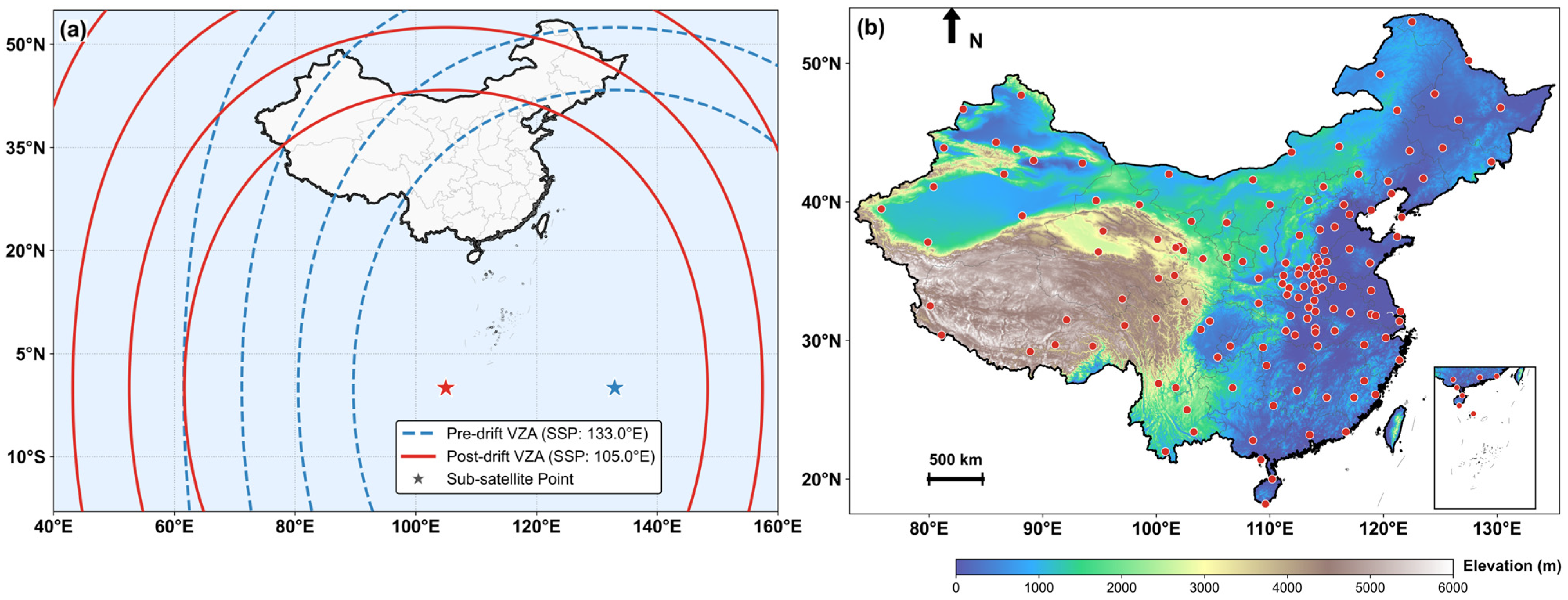
Furthermore, this study focuses exclusively on the summer season (June–August). The rationale is that our primary objective is to investigate the change in satellite–ground consistency driven by the orbital drift and VZA optimization, rather than to conduct a comprehensive full-year climatological assessment. Summer was specifically selected because its weather conditions are the most complex and dynamic (characterized by frequent convective clouds, high atmospheric moisture, and rapid weather shifts). Such complex conditions provide the most stringent testbed for evaluating the stability and robustness of the satellite retrieval algorithm. While seasonal variations are important, controlling the temporal window allows us to more effectively isolate the physical impact of the viewing geometry. To provide additional observational context, Figure 1 illustrates both the FY-4B viewing geometry before and after the orbital drift and the spatial distribution of the 141 common radiation stations used in the paired evaluation.

2.1.2. Auxiliary Datasets

ERA5 total cloud cover: The ERA5 total cloud cover (TCC) dataset, the fifth generation of ECMWF atmospheric reanalysis, is employed to characterize sky conditions. It assimilates multi-source observations to provide a comprehensive description of cloud coverage. Although FY-4B provides operational cloud products, ERA5 was selected in this study to serve as an independent atmospheric classifier. Specifically, it is utilized to stratify the matched satellite–ground samples into different sky conditions (e.g., clear-sky vs. cloudy) for the regime-dependent error analysis in Section 3. Clear-sky conditions are defined as TCC ≤ 0.1, while overcast conditions are TCC ≥ 0.9. Intermediate values represent broken clouds. This approach avoids the potential circular dependency where errors in the satellite’s internal cloud detection algorithm might mask biases in the radiation retrieval. To mitigate the scale mismatch between the coarse-resolution ERA5 (0.25°) and the fine-resolution satellite product (4 km), bilinear interpolation was applied to the ERA5 grids to spatially align with the ground stations. We acknowledge that this resolution discrepancy may introduce uncertainties, particularly at cloud edges and under broken cloud conditions. However, for the purpose of categorizing general sky conditions (e.g., clear-sky vs. overcast) at a statistical level, ERA5 provides a robust and consistent baseline [19].
Land cover: The land cover type product from the Moderate Resolution Imaging Spectroradiometer (MODIS) is a primary data source for global environmental monitoring. The MODIS land cover dataset offers a long temporal record and diverse classification schemes [20]. This study utilizes the classification scheme based on the Leaf Area Index (LAI), which defines 11 land cover types, including water bodies (Water), grasses and cereal crops (Grass), shrublands (Shrubs), broadleaf crops (B.Crops), savannas (Savannas), evergreen broadleaf forests (EBF), deciduous broadleaf forests (DBF), evergreen needleleaf forests (ENF), deciduous needleleaf forests (DNF), unvegetated lands (Unvegetated), and urban and built-up areas (Urban). In this study, this dataset serves as the reference for site classification. By extracting the land cover type corresponding to the geographic coordinates of each CMA ground station, we stratified the matched satellite–ground samples into different surface categories. This enables a regime-dependent evaluation to quantitatively assess how surface heterogeneity (e.g., albedo differences and canopy structures) impacts the retrieval accuracy of FY-4B DSSR.

2.2. Validation Strategy

2.2.1. Satellite Retrieval Algorithm

The DSSR data utilized in this study are the current operational products provided by the National Satellite Meteorological Center (NSMC). According to the official Instruction Manual for FY-4B Surface Shortwave Radiation Product V1.0 [21], the retrieval algorithm is based on radiative transfer simulations. It should be noted that specific sub-version numbers and proprietary core algorithmic parameters (such as the specific radiative transfer model employed and the precise wavelength intervals for Look-Up Table construction) are not publicly disclosed in the official documentation. Nevertheless, the algorithm fundamentally accounts for significant physical processes in the shortwave spectrum, including multiple scattering, absorption, and thermal radiation, to generate the shortwave radiation retrieval Look-Up Table (LUT). Observations from Channels 1–6 of the FY-4B AGRI, combined with the FY-4B L2 Snow product, are used to characterize instantaneous atmospheric and surface states, primarily extinction parameters and surface reflectance. After determining these states and integrating solar and viewing geometries, the surface shortwave radiation is retrieved using the pre-computed LUT. The operational product generates eight parameters, including surface solar radiation, direct/diffuse radiation, and UV components [21]. In this study, the DSSR parameter is utilized for validation.

2.2.2. Data Collocation and Quality Control Scheme

To ensure spatial consistency between satellite and ground observations, the FY-4B grid points were first converted from the geostationary projection (GEOS) to the WGS84 coordinate system (latitude/longitude) to align with station coordinates. Subsequently, using station coordinates as indices, the nearest neighbor method was employed to extract the corresponding satellite radiation values. Pixels located in invalid satellite data regions were identified and excluded from the analysis.
To ensure temporal consistency, ground-based radiation records (originally in Beijing Time, BJT) were converted to Coordinated Universal Time (UTC) based on station longitude. To address the temporal mismatch between hourly integrated ground measurements and instantaneous satellite observations, the ground-based processing strategy was refined. Specifically, minute-level ground observations were averaged over the first 15 min of each hour (0–15 min) to strictly align with the FY-4B observation window. To ensure data reliability, a validity threshold was applied: the 15 min average was calculated only if valid data existed for more than 80% of the time steps within the window. Finally, data from both sources were matched by UTC hour, and only time steps containing valid values from both sides were retained to form the paired “station × time” dataset.
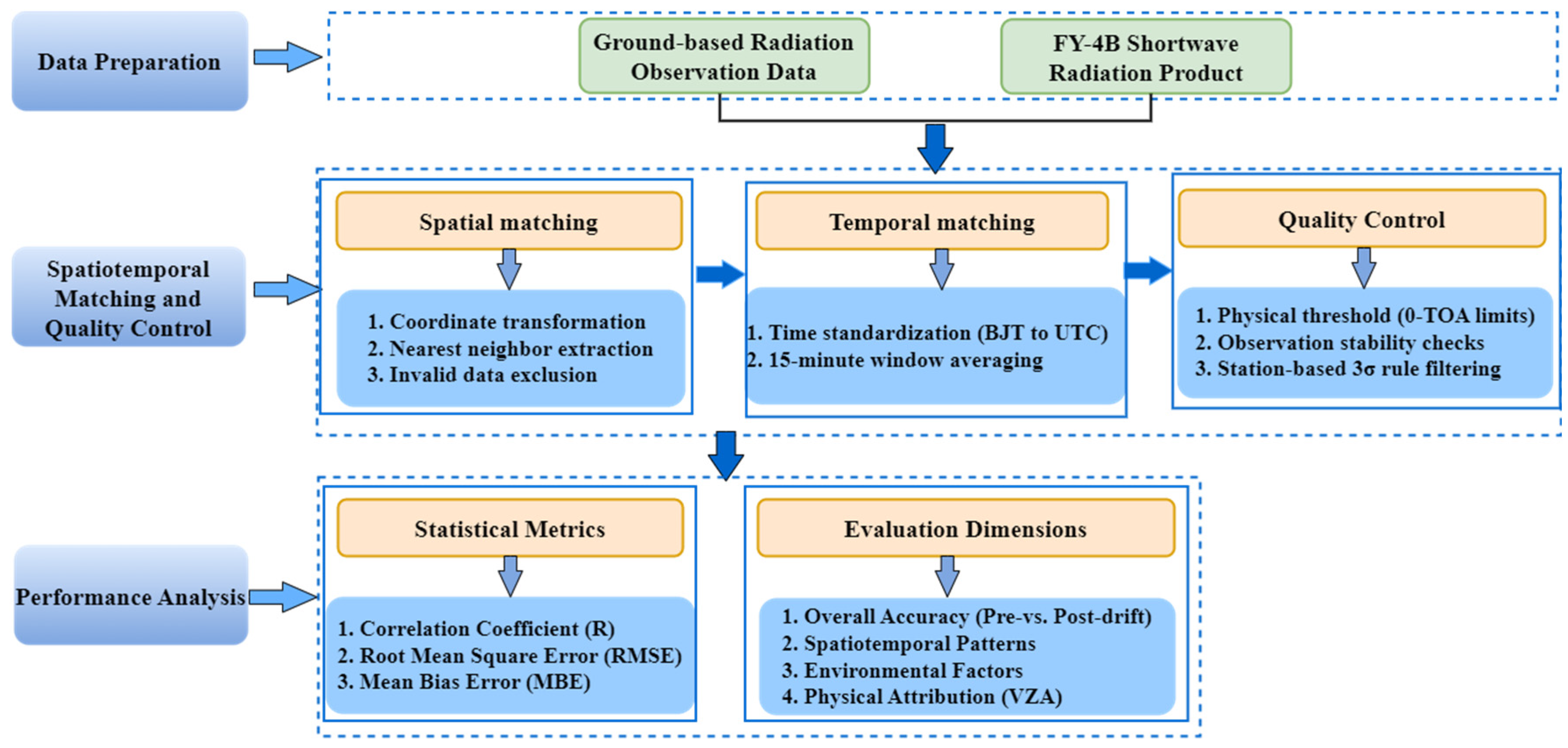
Quality control (QC) followed the sequence of first eliminating obvious anomalies, then controlling observation stability, and finally screening matching differences. First, a check based on physical and threshold limits was performed: the valid range for FY-4B is 0–1500 W/m2, and for ground observations, it is 0–2000 W/m2. Values exceeding the Top-of-Atmosphere (TOA) solar constant limit (1361 W/m2, adjusted for solar zenith angle) were treated as extreme anomalies; nighttime samples (e.g., radiation approaching 0 before sunrise or after sunset) were excluded from the evaluation. Secondly, observation stability was checked to remove constant values (unchanged over consecutive time steps) and obvious abrupt changes. Finally, after spatiotemporal matching, the 3σ rule (three-sigma rule) was applied to the differences between satellite and ground pairs to identify and remove gross errors, thereby reducing the impact of extreme anomalies on the evaluation results. The 3 σ rule was applied on a per-station basis to avoid distorting intrinsic regional characteristics. A flowchart of the comprehensive evaluation framework is shown in Figure 2. All data processing, statistical analysis, and visualization in this study were performed using Python (version 3.11; Python Software Foundation, Wilmington, DE, USA) with the NumPy (version 1.26), Pandas (version 2.1), and Matplotlib (version 3.8) libraries.

2.2.3. Statistical Metrics

To evaluate the consistency between FY-4B shortwave radiation products and ground-based observations, the correlation coefficient (R), root mean square error (RMSE), and mean bias error (MBE) were adopted [22,23]. The specific formulas are calculated as follows:
R = N i = 1 E i E ¯ ( O i O ¯ ) N i = 1 E i E ¯ 2 N i = 1 O i O ¯ 2 ,
R M S E = N i = 1 E i O i 2 N ,
M B E = N i = 1 ( E i O i ) N ,
where N is the number of matched samples, i is the index of the matched sample, E i is the satellite value with a mean of E ¯ , and O i is the observed ground value with a mean of O ¯ . To comprehensively analyze the discrepancies and patterns between FY-4B shortwave radiation products and ground-based observations, and combining relevant meteorological principles, this study analyzes the consistency of FY-4B products across different dimensions, including elevation, land cover type, and cloud amount.

3. Results

3.1. Overall Accuracy Assessment

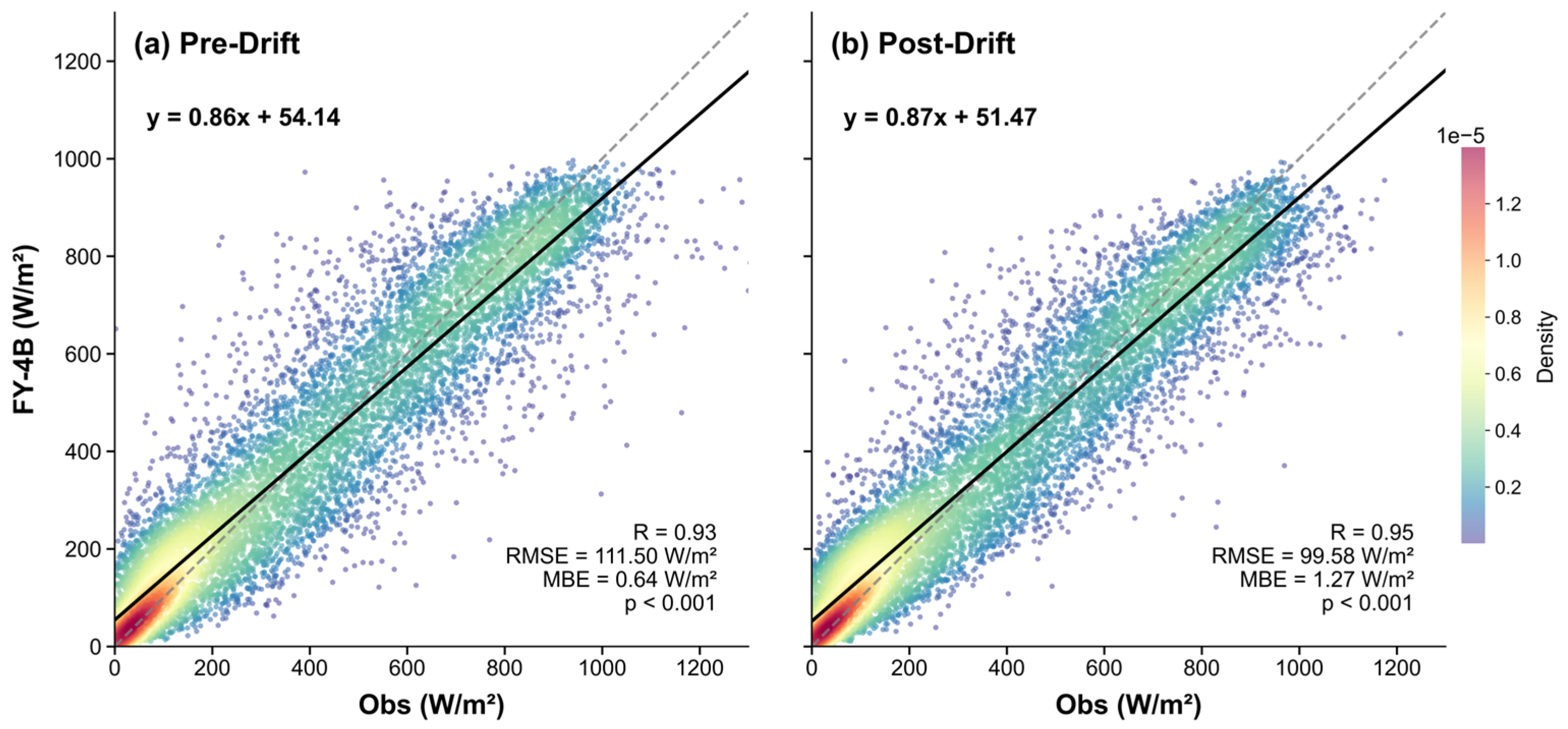
To evaluate the performance of FY-4B satellite radiation products before and after the orbital drift, Figure 3 presents the scatter plot comparison between FY-4B shortwave radiation estimates and ground-based observations, along with the corresponding statistical metrics. Overall, the scatter plots are closely distributed around the 1:1 line, indicating generally good agreement between FY-4B retrievals and ground observations in both periods. The most robust conclusion from Figure 3 is that the post-drift product shows slightly higher correlation and lower RMSE, while the overall systematic bias remains very small.
Following the orbital drift, the satellite–ground consistency significantly improved. The R increased from 0.93 to 0.95, while the RMSE decreased from 111.50 W/m2 to 99.58 W/m2, representing a reduction of approximately 11.8%. The MBE changed slightly from 0.64 W/m2 to 1.27 W/m2, but remained close to zero in both periods, indicating that the systematic bias was negligible relative to the overall random error. The dispersion at high radiation values (>1000 W/m2) increased slightly, indicating that factors such as cloud discrimination uncertainties, aerosol optical variability, or sensor non-linearity might amplify uncertainties under peak radiation conditions [24]. In summary, the FY-4B radiation products post-drift exhibited substantial improvements in correlation, RMSE, and regression slope while maintaining a near-zero systematic bias.
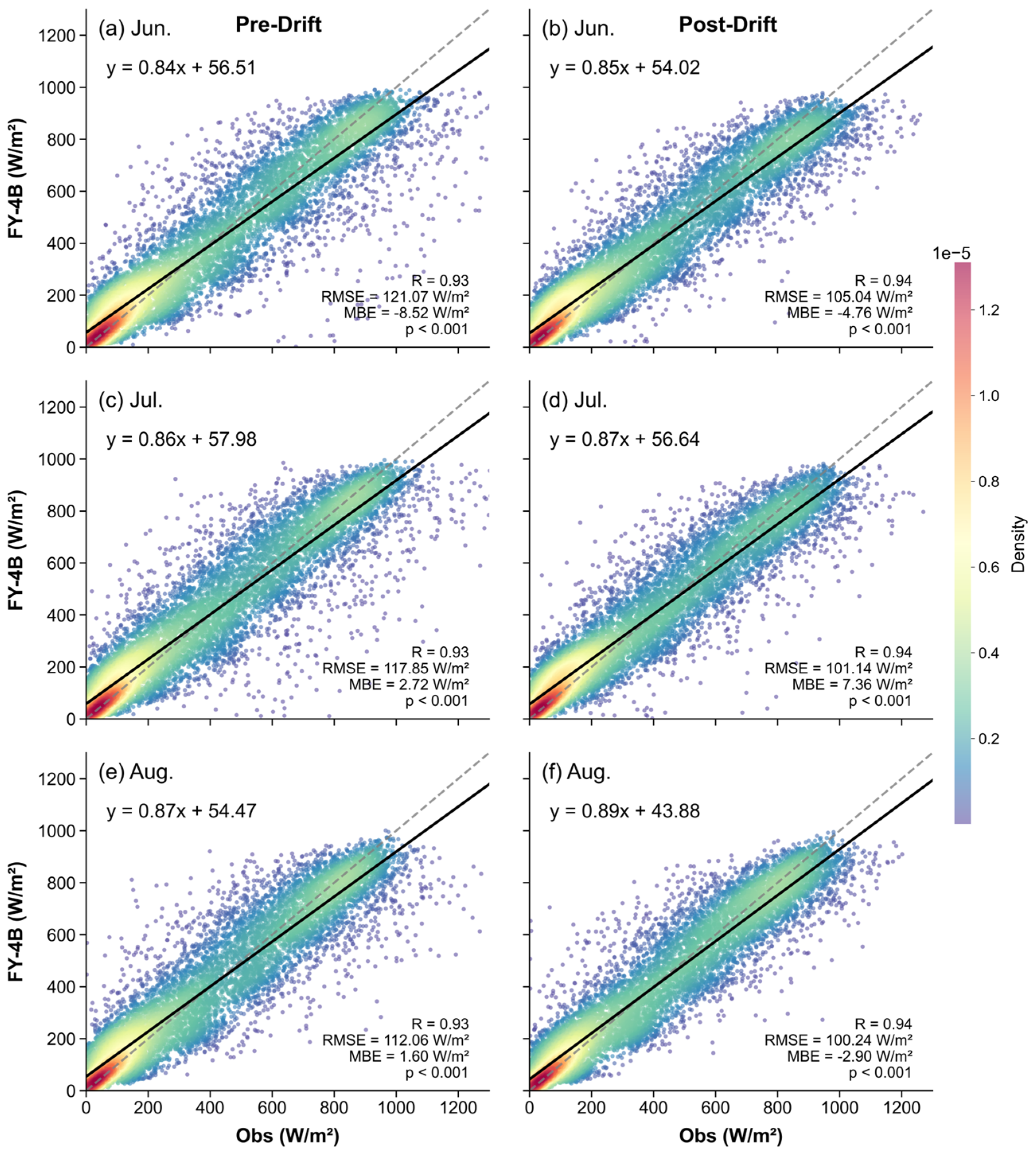
The monthly scatter plots for June–August (Figure 4) further illustrate that evaluation metrics improved consistently across all summer months after the drift, although the magnitude of improvement varied. The correlation coefficient (R) showed a stable and consistent increase from 0.93 to 0.94 for all three months. The RMSE for June and July decreased significantly from 121.07 and 117.85 W/m2 to 105.04 and 101.14 W/m2, respectively (a reduction of ~13–14%), while August saw a decrease from 112.06 W/m2 to 100.24 W/m2 (~11%). This demonstrates a comprehensive enhancement in product stability and seasonal robustness following the drift. Regarding bias, monthly variations (MBE) remained well within ±10 W/m2. Regression parameters also indicated an overall upward adjustment in slope post-drift (increasing from 0.84–0.87 to 0.85–0.89). Notably, in August, the slope rose to 0.89 and the intercept dropped to 43.88 W/m2, suggesting that the underestimation problem in high-value areas during summer is significantly alleviated.
These improvements are closely linked to the satellite’s orbital adjustment. The westward shift of the sub-satellite point to 105°E optimized the viewing geometry for Northwest China, reducing geometric distortions and atmospheric path lengths. Consequently, the post-drift FY-4B radiation products demonstrated higher correlation, lower RMSE, and regression relationships closer to ideal consistency.

3.2. Spatial Distribution of Errors

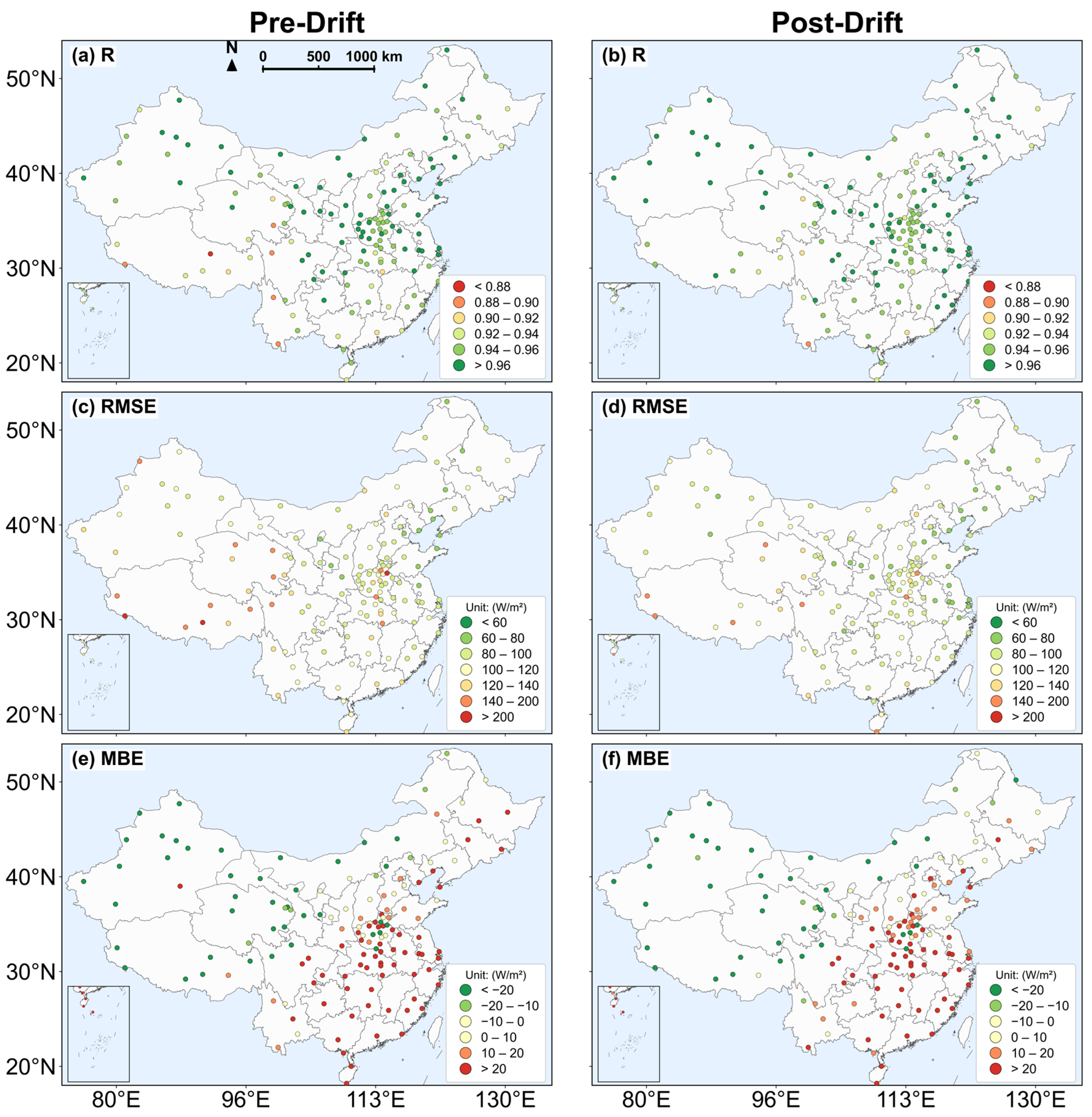
While the overall metrics confirm a nationwide improvement post-drift, it is crucial to investigate whether these performance gains are spatially uniform across the vast and heterogeneous Chinese territory. In terms of spatial distribution, the FY-4B shortwave radiation products exhibited a distinct “East–West disparity” (Figure 5). Before the drift, the plains in the eastern and central regions generally showed high consistency (R ≥ 0.93), whereas the western mountainous and plateau regions showed significantly lower correlations. The RMSE was generally below 110 W/m2 in the southeast coast, North China, and Central China, but was significantly elevated in the inland northwest and the Tibetan Plateau, reaching 150–200 W/m2 at some stations. It should be noted that the pre-drift and post-drift maps in Figure 5 are both based on the same set of 141 fully overlapping stations retained after station matching, thereby ensuring that the spatial comparison reflects changes in product performance rather than changes in station composition.
After the drift, FY-4B DSSR product quality improved significantly nationwide. In the eastern and central regions, R values rose above 0.95, RMSE generally decreased by 10–30 W/m2, and the positive bias converged. While consistency in the western and plateau regions also improved (R rebounded to 0.92–0.94) and RMSE dropped to 120–140 W/m2, systematic underestimation persisted. These spatial changes highlight a typical regional mode where high consistency and low error prevail in the eastern plains, while lower consistency and underestimation characterize the western plateau.
The aforementioned spatial distribution is closely related to terrain influence and atmospheric environment variations. The eastern region features gentle terrain and relatively stable aerosols, facilitating accurate retrievals. Conversely, in the Tibetan Plateau and other complex terrain areas, variations in slope, aspect, local shading, and sky view factor significantly modulate surface shortwave radiation. If the satellite retrieval algorithm ignores these three-dimensional effects, it is prone to systematic underestimation [25]. Furthermore, the high variability in snow cover and surface albedo on the plateau may lead satellites to misclassify snow or high-albedo areas as clouds [26]. Additionally, potential underestimation of aerosol loads in the eastern region in the retrieval algorithm could contribute to the observed overestimation of satellite radiation [27,28].
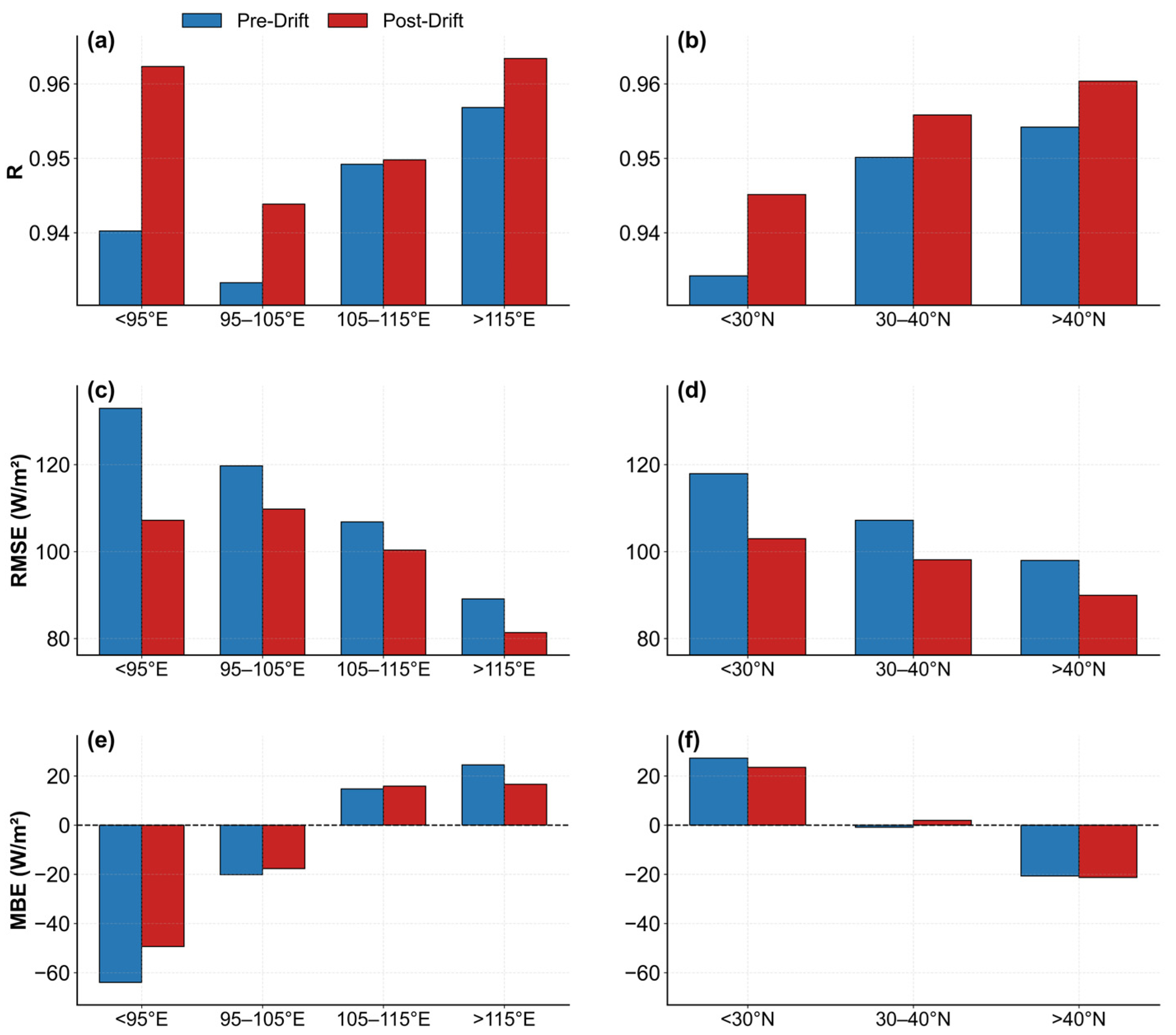
To provide a more structured quantitative analysis of these spatial patterns, Figure 6 presents the statistical metrics binned by longitude and latitude, offering a clear depiction of regional performance shifts. The longitudinal analysis (Figure 6a,c,e) starkly reveals the mitigation of the “East–West disparity.” Before the drift, the RMSE in the westernmost region (<95°E) was exceedingly high, averaging over 125 W/m2. After the drift, this value plummeted to approximately 107 W/m2, representing the most substantial improvement nationwide. Conversely, the easternmost region (>115°E), which already had the lowest error, also saw a further reduction in RMSE from ~89 W/m2 to ~82 W/m2. This demonstrates a convergence of accuracy across longitudes. Similarly, the pronounced negative Mean Bias Error (MBE) in the far west, which indicated severe underestimation, was reduced by more than half (from −58 W/m2 to −25 W/m2), while the slight positive bias in the east also converged closer to zero. The Correlation Coefficient (R) showed the most significant increase in the west, elevating from a modest 0.94 to a robust 0.965.
The latitudinal analysis (Figure 6b,d,f) indicates that while performance variations across latitudes were less pronounced than across longitudes, post-drift improvements were consistently observed. The RMSE decreased uniformly across all three latitude bands, with the southern region (<30°N), often characterized by complex weather systems, showing a notable reduction from ~118 W/m2 to ~102 W/m2. Biases across all latitude zones were relatively small but consistently shifted closer to the ideal value of zero after the drift. In summary, Figure 6 quantitatively confirms that the orbital drift did not merely enhance the overall national accuracy but fundamentally rebalanced the spatial error distribution. The most significant gains were realized in the western regions, which were previously most affected by large viewing angles, thereby effectively correcting the largest systematic weakness of the pre-drift product and achieving a more spatially homogeneous and reliable dataset.

3.3. Dependence on Environmental Factors

To further understand the sources of errors, we analyzed the satellite–ground consistency under different conditions of land cover, elevation, and cloud amount.

3.3.1. Land Cover Types

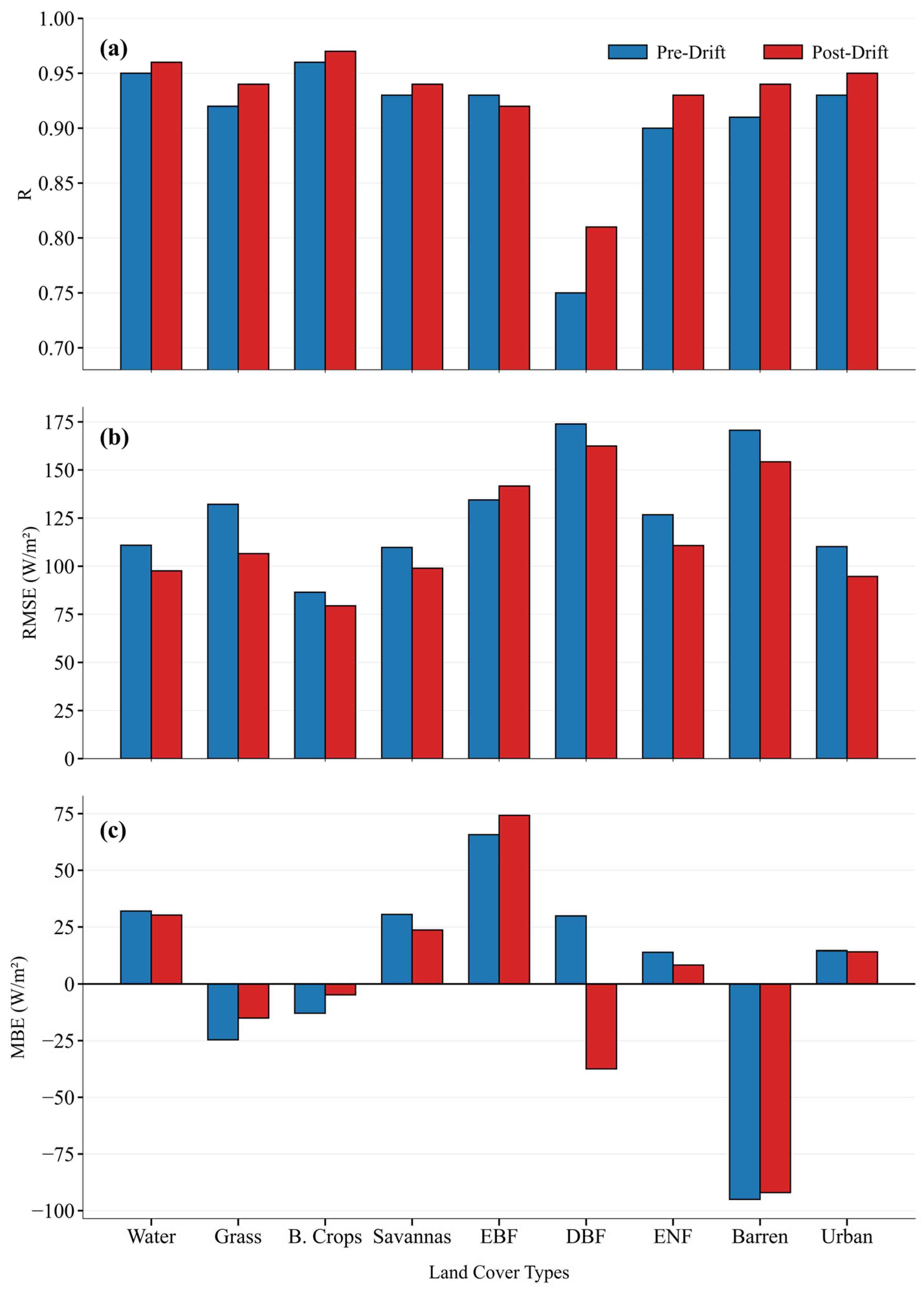
Figure 7 illustrates the performance discrepancies across different land surfaces. Pre-drift, water bodies, broadleaf crops, and urban areas exhibited robust performance (R > 0.93, RMSE: 90–120 W/m2). It is worth noting that the sample sizes varied across land covers (e.g., urban areas accounted for roughly 25% of samples, while DBF accounted for 10%), but sufficient temporal depth ensured statistical significance. In contrast, deciduous broadleaf forests (DBF) and non-vegetated lands showed significant errors, with RMSE reaching 173.9 W/m2 and 170.7 W/m2, respectively. Post-drift, improvements were substantial in homogeneous regions: R for water bodies and crops increased to 0.96–0.97, and RMSE dropped to 80–97 W/m2. Urban areas also maintained high accuracy (RMSE ~94.66 W/m2). However, challenges persisted in complex canopies: while correlation improved in forests, systematic biases remained unstable (e.g., DBF MBE shifted from +29.86 to −37.46 W/m2). Non-vegetated lands continued to suffer from severe underestimation (bias: −92.03 W/m2), indicating limited improvement over high-albedo surfaces.

3.3.2. Elevation Dependence

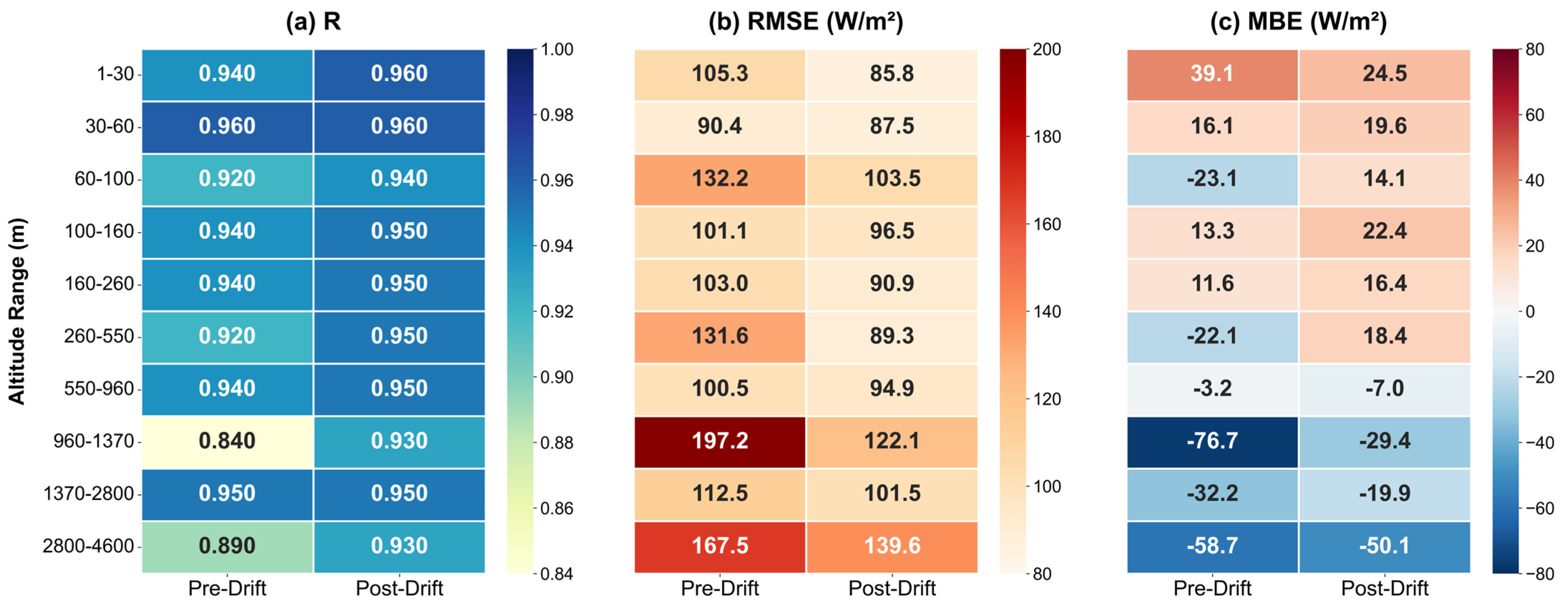
The error characteristics show a clear altitudinal gradient (Figure 8). Low-altitude regions (1–60 m) consistently performed best, maintaining high R (0.94–0.96) and low RMSE (85–105 W/m2) both pre- and post-drift. In medium-to-high altitudes (960–2800 m), the orbital drift brought significant gains: R rose from 0.84 to 0.93–0.95, and RMSE decreased from 150 W/m2 to 101–122 W/m2. However, in extremely high-altitude regions (>2800 m), despite a reduction in RMSE (from 167.5 to 139.6 W/m2), a strong negative bias persisted (−50 W/m2), highlighting the difficulty of retrieval over the Tibetan Plateau.

3.3.3. Cloud Conditions

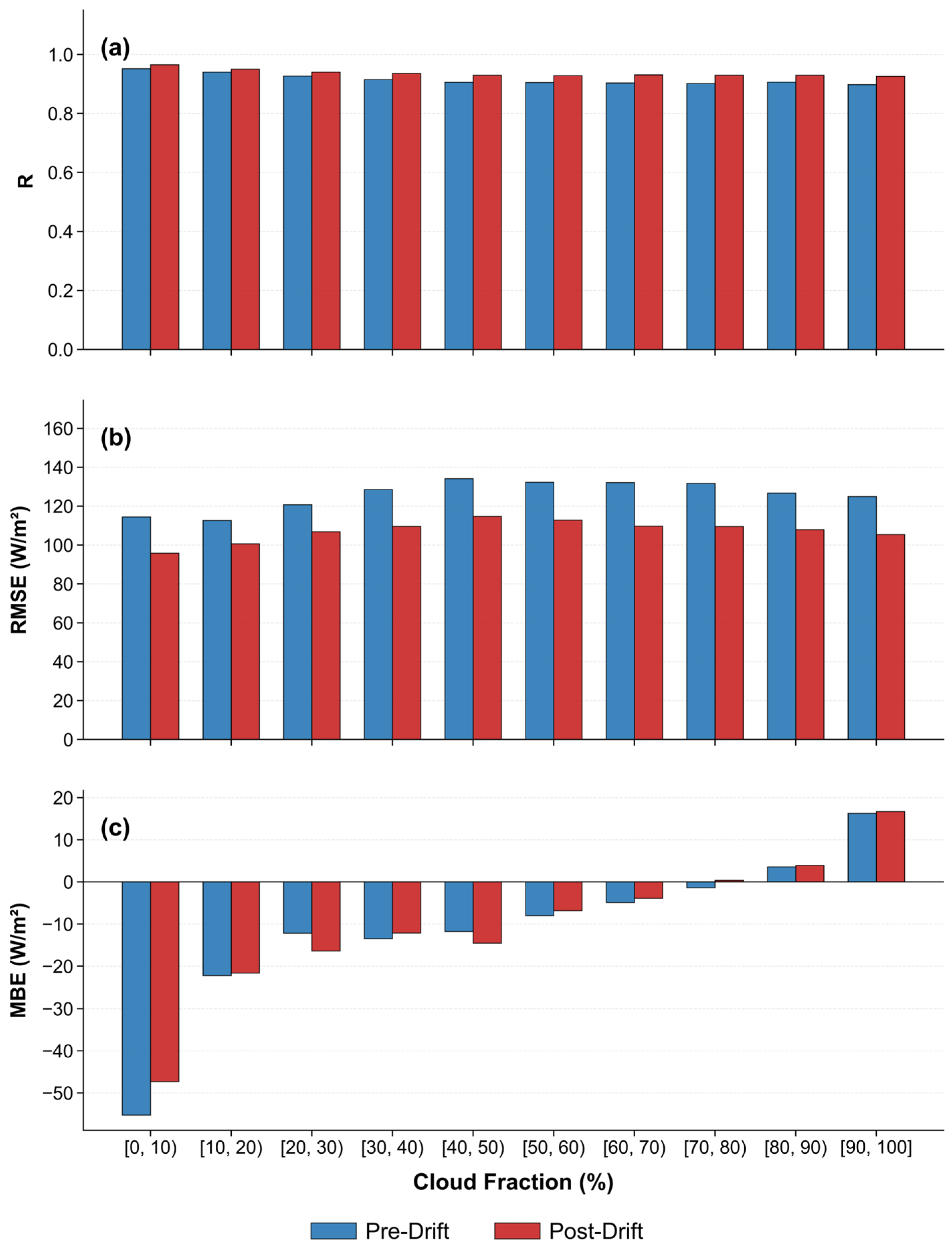
Categorized by ERA5 total cloud cover (Figure 9), the product shows marked sensitivity to sky conditions. To ensure statistical robustness, the evaluation under different cloud regimes was strictly constrained to the 141 common stations. The matched samples are heavily concentrated in clear-sky conditions (TCC < 0.1, N = 33,052 for pre-drift and N = 27,560 for post-drift) and overcast conditions (TCC > 0.9, N = 44,518 and N = 43,606), establishing a highly reliable statistical baseline. Post-drift, performance improved across almost all regimes. Under clear-sky conditions, R increased to over 0.96, and RMSE dropped from 114.7 W/m2 to 96.1 W/m2. Under overcast conditions, the RMSE was also reduced from 125.1 W/m2 to 105.4 W/m2. Regarding the systematic bias, the orbital drift effectively narrowed the errors: the underestimation in clear-sky conditions (MBE narrowed from −55.2 W/m2 to −47.4 W/m2) and the slight overestimation in overcast conditions were both stabilized. It is worth noting that notable error fluctuations and elevated RMSE persist in the transitional cloud cover zones (e.g., TCC between 40% and 70%, with sample sizes ranging from approximately 8600 to 9800 per bin). These residual errors are fundamentally driven by the physical characteristics of broken clouds. In these regimes, 3D cloud radiative effects (e.g., side illumination and scattering) and rapid temporal evolution of heterogeneous cloud heights severely amplify the spatial–temporal mismatch between the 4 km satellite pixels and the point-scale pyranometer measurements.

3.3.4. Diurnal Variations and Solar Zenith Angle (SZA) Effects

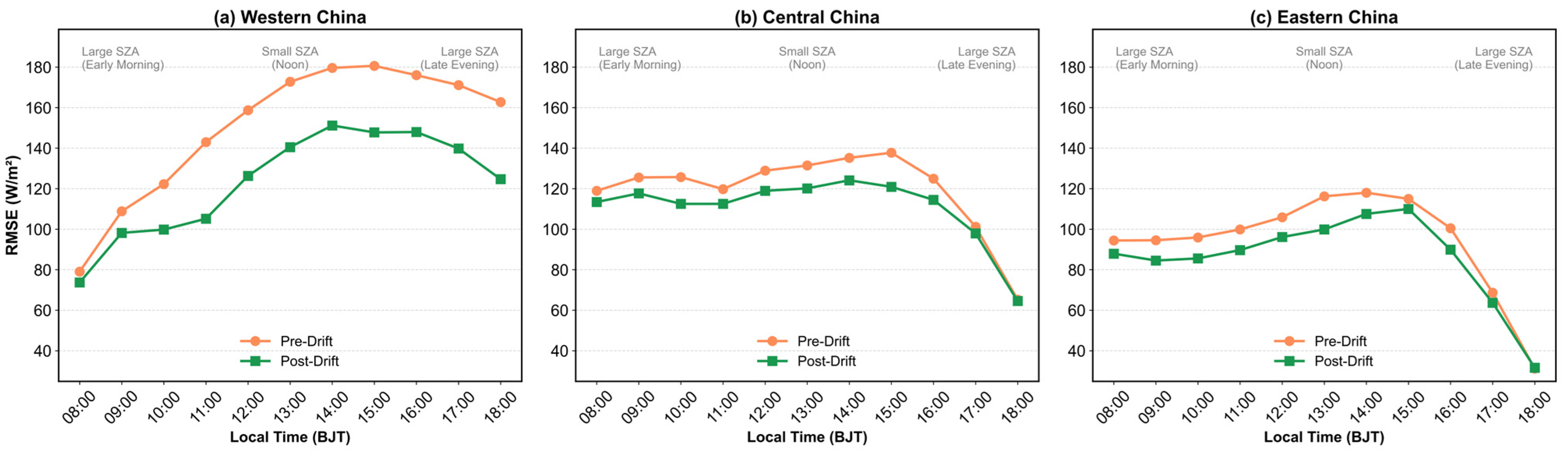
To further decouple the impacts of satellite observation geometry from varying solar illumination conditions, we evaluated the diurnal variation of RMSE across three distinct longitudinal zones (Figure 10). The Solar Zenith Angle (SZA) exhibits a typical ‘U-shape’ throughout the day, being largest at early morning and late evening, which results in inherently longer atmospheric optical paths. The orbital drift induced profound and distinct diurnal responses across the regions. In Western China (<100°E), prior to the drift, the combination of an extreme VZA (slant viewing from 133°E) and large SZA in the morning and evening caused a severe “double-slant path” error amplification, with RMSE peaking near 180 W/m2 (Figure 10a). Post-drift, the massive reduction in VZA effectively broke this amplification, dramatically flattening the diurnal curve and reducing early morning errors by over 40 W/m2. In Central China (100–115°E), which transitioned into a near-nadir optimal zone, the diurnal curve demonstrates a uniform and stable error reduction across all daytime hours (Figure 10b). Notably, in Eastern China (>115°E), despite a slight increase in VZA post-drift, the diurnal performance remained nearly identical and highly stable (Figure 10c). This confirms that the FY-4B retrieval algorithm is exceptionally robust to moderate geometric shifts, ensuring that the immense accuracy gains in the West did not compromise Eastern performance.

4. Discussion

4.1. Quantitative Attribution to Observation Geometry Optimization

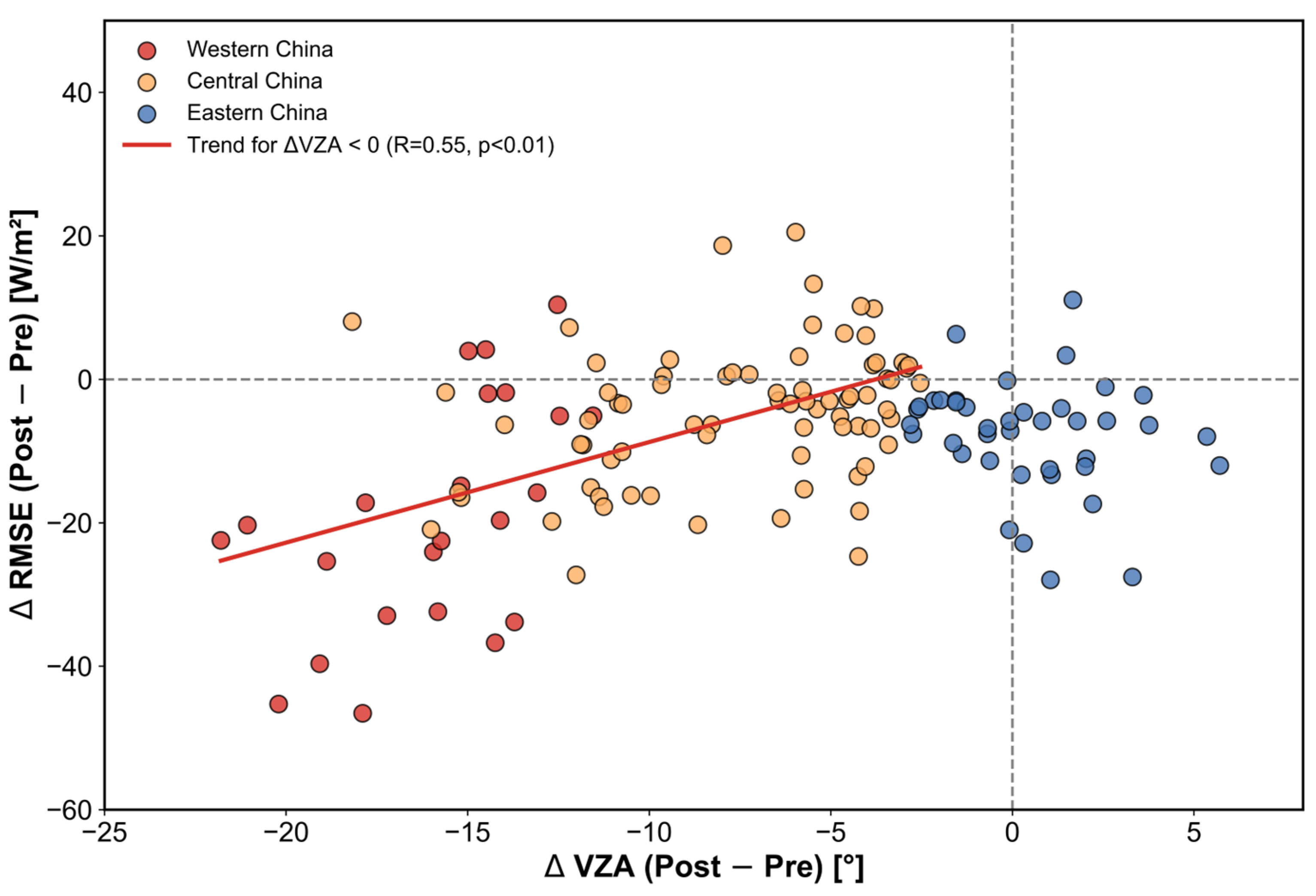
The qualitative observations of spatial and diurnal improvements can be fundamentally attributed to the optimization of the VZA. Figure 11 correlates the change in calculated VZA (ΔVZA = V Z A 105 ° E V Z A 133 ° E ) with the corresponding change in RMSE (ΔRMSE) for all common stations. The scatter plot reveals a compelling physical mechanism driven by spatial gradients. For stations in Western and Central China (ΔVZA < 0), the orbital drift induced a massive reduction in viewing angles (up to −25°). This reduction strongly and significantly correlates with the decrease in retrieval errors ( R = 0.55 ,   p < 0.01 ). This mathematically confirms that mitigating extreme viewing geometries directly removes major retrieval uncertainties related to long atmospheric optical paths and sub-pixel topographic distortions. Conversely, for stations in Eastern China, the VZA increased slightly (positive ΔVZA up to +5°). However, their ΔRMSE predominantly remained below or near zero. This global optimization strategy proves that shifting the nadir to 105°E established a balanced observing geometry for the entire Chinese landmass.

4.2. Physical Sources of Residual Errors

Despite the orbital optimization, challenges persist in regions with complex surface and atmospheric conditions. Our analysis identifies two primary physical sources for these residual errors:
(1)
Surface Anisotropy and Topographic Effects: The notable errors in forest areas (e.g., Deciduous Broadleaf Forests) and high-altitude terrains suggest limitations in the current algorithm’s handling of surface heterogeneity. Forests exhibit complex canopy structures that generate strong bidirectional reflectance distribution function (BRDF) effects, causing non-Lambertian reflection that satellites may misinterpret [29,30]. Similarly, in rugged terrains like the Tibetan Plateau, neglecting 3D topographic effects (e.g., slope, aspect, and mountain shadowing) leads to the systematic underestimation observed in our high-altitude results (Figure 8), consistent with previous studies on topographic radiative effects [31,32,33,34].
(2)
Cloud 3D Effects and Parallax: The performance disparity under varying cloud conditions (Figure 9) highlights the impact of cloud heterogeneity. While the orbital drift reduced general geometric mismatches, the cloud parallax effect where the satellite-observed cloud position shifts relative to the ground station remains a source of error under thick cloud conditions. Additionally, spatiotemporal mismatches are exacerbated by fast-moving or broken clouds, leading to the observed instability in transition zones [18]. Future algorithms must incorporate rigorous topographic corrections and 3D cloud radiative transfer models to address these physical limitations.
(3)
Spatial Representativeness: We acknowledge that collocating 4 km satellite pixels with point-based pyranometers introduces inherent spatial mismatch uncertainties [18]. However, by utilizing identical common stations for both years, applying rigorous 15 min temporal averaging, and employing per-station 3σ filtering, we effectively minimized random spatial noise. The resulting aggregated metrics reliably reflect the performance shifts of the satellite algorithm rather than localized sub-pixel heterogeneity.

4.3. Benchmarking Against International Standards

To contextualize the quality of the post-drift FY-4B product, we compared our metrics with existing validations of the Himawari-8/9 satellites, which are widely regarded as the benchmark for East Asian geostationary observations. The post-drift RMSE (99.24 W/m2) and Correlation Coefficient (0.95) of FY-4B are highly comparable to those reported for Himawari-8 over China (RMSE ~90–110 W/m2) [11,35]. This indicates that FY-4B has achieved a level of radiometric accuracy and product stability that aligns with international operational standards [36]. Furthermore, compared to its predecessor FY-4A [6,9,37], FY-4B demonstrates a clear generation-over-generation improvement. These validated high-fidelity records confirm that FY-4B is operationally ready to support critical applications, including photovoltaic energy assessment and data assimilation in numerical weather prediction models.

4.4. Temporal Scope, Limitations, and Future Directions

It is important to acknowledge that the temporal scope of this study is focused exclusively on the summer season (June to August) for both pre- and post-drift periods. As stated in our methodology, the core scientific objective of this manuscript is to isolate and evaluate the impact of the satellite’s orbital drift (specifically the optimization of the Viewing Zenith Angle) on satellite–ground measurement consistency. Summer was deliberately chosen because its complex, highly dynamic weather conditions—such as deep convection, broken clouds, and high aerosol–water vapor interactions—serve as the most stringent environment to test the fundamental stability of the retrieval algorithm. If the geometrical optimization yields significant improvements under these harsh conditions, the algorithmic robustness is strongly validated.
Consequently, providing a comprehensive full-year evaluation falls outside the immediate scope of verifying the pre- and post-drift physical mechanism. However, as insightfully suggested by the reviewers, surface shortwave radiation exhibits strong seasonal variations. Factors such as lower solar elevation angles, extended atmospheric optical paths, and high-albedo snow cover in winter could interact differently with the satellite’s viewing geometry. Recognizing this, our future work will definitely expand to incorporate full-year temporal datasets. Investigating how the VZA optimization performs across different seasons will be the next crucial step in comprehensively characterizing the FY-4B DSSR product.
Furthermore, regarding spatial representativeness, collocating 4 km satellite pixels with point-based pyranometers introduces inherent spatial mismatch uncertainties. However, by utilizing a strictly matched common set of first-order stations for both years, and relying on their superior instrument quality and representative spatial distribution, we effectively minimized random spatial noise. The relative differences quantified in this study reliably reflect the algorithmic performance shifts induced by the orbital drift.
Although the use of a strictly matched common-station set improves interannual comparability and reduces uncertainties associated with inconsistent spatial sampling, the number of available high-quality radiation stations remains limited relative to China’s vast climatic, geographic, and topographic diversity, especially in western high-altitude regions. Therefore, the present results should be interpreted as a rigorously controlled paired evaluation rather than a fully exhaustive spatial characterization of FY-4B DSSR performance over all of China. Future work will further extend the validation by incorporating longer temporal records and, where possible, additional high-quality ground observations.

5. Conclusions

This study systematically evaluated the FY-4B surface shortwave radiation product using ground observations from the CMA network. By comparing performance before and after the satellite’s orbital drift from 133°E to 105°E, and analyzing dependencies on environmental factors, we drew the following conclusions:
  • Significant improvement driven by Viewing Zenith Angle (VZA) optimization. Following the orbital drift, the overall accuracy of the FY-4B DSSR product improved significantly. R increased from 0.93 to 0.95, and RMSE decreased by 11.8% (from 111.5 to 99.58 W/m2). Crucially, the orbital maneuver optimized the VZA for the entire Chinese landmass, successfully mitigating the historical “East–West accuracy disparity” by reducing extreme slant-viewing atmospheric optical paths in Western China.
  • Performance variations across land covers. The product demonstrated high robustness over homogeneous surfaces such as water bodies, croplands, and urban areas (R > 0.94, RMSE: 80–100 W/m2). However, challenges persist over complex canopies. Specifically, forest regions exhibited a polarity shift in bias (from overestimation to underestimation), and non-vegetated lands remained systematically underestimated. These residual errors suggest limitations in the current algorithm’s handling of surface anisotropy (BRDF) and albedo variability.
  • Elevation dependence and topographic limitations. A clear altitudinal gradient in performance was observed. While the orbital drift significantly improved accuracy in medium-to-high altitude regions (960–2800 m) by optimizing the Viewing Zenith Angle, extremely high-altitude regions (>2800 m) continue to suffer from significant underestimation. This underscores the necessity of incorporating 3D topographic effects (e.g., mountain shadowing) into future retrieval algorithms.
  • Sensitivity to cloud regimes. The consistency between satellite and ground observations improved under all sky conditions post-drift. Notably, the systematic negative bias under overcast conditions was effectively mitigated, and clear-sky accuracy reached high levels (R = 0.97). However, instability remains in transition zones (cloud edges) and under low solar elevation angles, indicating room for improvement in cloud 3D radiative transfer modeling.
In summary, the orbital drift to 105°E has fundamentally optimized the viewing geometry (VZA) of FY-4B over China, elevating its DSSR product accuracy to a level comparable with international benchmarks. While the summer data utilized in this study provided a rigorous testbed for validating algorithmic stability under complex weather conditions, we recognize the importance of seasonal dynamics. Guided by the goal of continuous product improvement, our future research will focus on extending this analysis to a full-year assessment to investigate seasonal variations, particularly the impacts of winter solar geometry and snow cover, and further addressing 3D topographic corrections in complex terrains.

Author Contributions

Conceptualization, M.W. and W.Z.; methodology, M.W.; software, M.W.; validation, M.W., B.L. and Y.C.; formal analysis, Y.C.; investigation, M.W.; resources, W.Z.; data curation, M.W.; writing—original draft preparation, M.W.; writing—review and editing, W.Z.; visualization, M.W.; supervision, W.Z.; project administration, W.Z.; funding acquisition, M.W. and W.Z. All authors have read and agreed to the published version of the manuscript.

Funding

This research was funded by the Hubei Provincial Natural Science Foundation Youth Project (grant number 2023AFB543), the Natural Science Foundation of Hubei Province (grant number 2022CFD017), the Joint Research Project for Meteorological Capacity Improvement (grant number 24NLTSQ017), and the CMA Key Open Laboratory of Transforming Climate Resources to Economy (grant number 2025004K).

Data Availability Statement

Publicly available datasets were analyzed in this study. The FY-4B satellite data can be found here: (http://satellite.nsmc.org.cn, accessed on 1 January 2026). ERA5 reanalysis data can be found here: (https://cds.climate.copernicus.eu, accessed on 1 January 2026). MODIS Land Cover products are available here: (https://search.earthdata.nasa.gov, accessed on 1 January 2026). The ground-based radiation observations from the CMA network are available upon request from the China Meteorological Administration (http://data.cma.cn, accessed on 1 January 2026) due to privacy restrictions.

Acknowledgments

We express our sincere gratitude to the National Satellite Meteorological Center (NSMC) for providing the FY-4B satellite products and technical support. We also thank the China Meteorological Administration (CMA) for maintaining the high-quality ground radiation observation network, which served as the ground truth for this validation. We acknowledge the European Centre for Medium-Range Weather Forecasts (ECMWF) for providing the ERA5 reanalysis datasets and the NASA Land Processes Distributed Active Archive Center (LP DAAC) for the MODIS land cover products. During the preparation of this work, the authors used Claude (Claude 3.5 Sonnet, Anthropic, San Francisco, CA, USA) in order to improve readability and language editing. After using this tool/service, the authors reviewed and edited the content as needed and take full responsibility for the content of the publication.

Conflicts of Interest

The authors declare no conflicts of interest.

Abbreviations

The following abbreviations are used in this manuscript:
FY-4BFengyun-4B Satellite
AGRIAdvanced Geostationary Radiation Imager
DSSRDownward Surface Shortwave Radiation
CMAChina Meteorological Administration
NSMCNational Satellite Meteorological Center
VZAViewing Zenith Angle
SZASolar Zenith Angle
RMSERoot Mean Square Error
MBEMean Bias Error
UTCCoordinated Universal Time
BJTBeijing Time
ERA5ECMWF Reanalysis v5
MODISModerate Resolution Imaging Spectroradiometer
BRDFBidirectional Reflectance Distribution Function
NWPNumerical Weather Prediction

References

  1. Sharifi, E.; Steinacker, R.; Saghafian, B. Multi time-scale evaluation of high-resolution satellite-based precipitation products over northeast of Austria. Atmos. Res. 2018, 206, 46–63. [Google Scholar] [CrossRef]
  2. Tang, W.; Yang, K.; He, J.; Qin, J. Quality control and estimation of global solar radiation in China. Sol. Energy 2010, 84, 466–475. [Google Scholar] [CrossRef]
  3. Tang, W.J.; Yang, K.; Qin, J.; Cheng, J.; He, J. First effort for constructing a direct solar radiation data set in China for solar energy applications. J. Geophys. Res. Atmos. 2018, 123, 1724–1734. [Google Scholar] [CrossRef]
  4. Yang, J.; Zhang, Z.; Wei, C.; Lu, F.; Guo, Q. Introducing the new generation of Chinese geostationary weather satellites, Fengyun-4. Bull. Am. Meteorol. Soc. 2017, 98, 1637–1658. [Google Scholar] [CrossRef]
  5. Chen, L.; Xu, N.; Wang, J.S.; Shang, J.; Shou, Y.X.; Li, B.; Xu, R.H.; Wu, S.L.; Wang, X.; Zheng, W.; et al. FengYun satellites: From observations to quantitative applications. Natl. Remote Sens. Bull. 2025, 29, 1462–1479. [Google Scholar] [CrossRef]
  6. Yang, X.; Wei, L.; Ma, B.; Sun, R.; Li, Y.; Feng, S. Assessment of the Applicability and Calibration Methods of FY-4A Satellite Surface Solar Radiation Products in Henan Province. Plateau Meteorol. 2024, 43, 1600–1613. [Google Scholar] [CrossRef]
  7. Ding, L.G. Applicability of FY-4A surface solar radiation products in the Guizhou Plateau mountainous area. Plateau Meteorol. 2022, 41, 1550–1561. (In Chinese) [Google Scholar] [CrossRef]
  8. Liang, J.Q.; Shen, Y.B.; Hu, L.Q.; Wu, L.D.; Shi, Z.J. Applicability of FY-4A surface downward shortwave radiation products in the Shanxi Plateau. Meteorol. Mon. 2020, 46, 1575–1585. (In Chinese) [Google Scholar] [CrossRef]
  9. Wang, C.H. Validation and correction of FY-4A surface solar radiation products: A case study in Anhui Province. Meteorol. Mon. 2021, 47, 1123–1135. (In Chinese) [Google Scholar] [CrossRef]
  10. Liu, J.J.; Shi, C.X.; Jia, B.H.; Zhang, T. Retrieval and dataset evaluation of FY-2E surface solar radiation. J. Remote Sens. 2018, 33, 104–110. (In Chinese) [Google Scholar] [CrossRef]
  11. Liu, C.; Ren, L.Q.; Li, X.J.; Jia, B.; Yu, T.F.; Zhang, C.Q.; Xiao, J.H.; Zhao, C.Y.; Zhu, M. Solar energy resource assessment over the northern sandy regions of China during 1990–2019. Plateau Meteorol. 2021, 40, 1213–1223. (In Chinese) [Google Scholar] [CrossRef]
  12. Wang, X.; Min, M.; Wang, F.; Guo, J.; Li, B.; Tang, S. Intercomparisons of Cloud Mask Products Among Fengyun-4A, Himawari-8, and MODIS. IEEE Trans. Geosci. Remote Sens. 2019, 57, 8827–8839. [Google Scholar] [CrossRef]
  13. Habte, A.; Sengupta, M.; Lopez, A. Evaluation of the National Solar Radiation Database (NSRDB): 1998–2015; NREL/TP-5D00-67461; National Renewable Energy Laboratory (NREL): Golden, CO, USA, 2017.
  14. Letu, H.; Ma, R.; Xu, J.; Wang, T.; Shang, H.; Chen, L.; Nakajima, T.Y.; Shi, C.; Hashimoto, M.; Shi, J.; et al. Surface solar radiation compositions observed from Himawari-8/9 and Fengyun-4 series. Bull. Am. Meteorol. Soc. 2023, 104, E1772–E1789. [Google Scholar] [CrossRef]
  15. Tian, L.; Chen, L.; Zhang, P.; Hu, B.; Gao, Y.; Si, Y. The Ground-Level Particulate Matter Concentration Estimation Based on the New Generation of FengYun Geostationary Meteorological Satellite. Remote Sens. 2023, 15, 1459. [Google Scholar] [CrossRef]
  16. Huang, S.Y.; Xu, G.Q. Impacts of FY-4A LMIE lightning data on cloud initialization and NWP experiments. Plateau Meteorol. 2020, 39, 378–392. (In Chinese) [Google Scholar] [CrossRef]
  17. Yu, Y.; Shi, J.; Wang, T.; Letu, H.; Yuan, P.; Zhou, W.; Hu, L. Evaluation of the Himawari-8 Shortwave Downward Radiation (SWDR) Product and Its Comparison with the CERES-SYN, MERRA-2, and ERA-Interim Datasets. IEEE J. Sel. Top. Appl. Earth Obs. Remote Sens. 2019, 12, 519–532. [Google Scholar] [CrossRef]
  18. Urraca, R.; Lanconelli, C.; Gobron, N. Impact of the spatio-temporal mismatch between satellite and in situ measurements on validations of surface solar radiation. J. Geophys. Res. Atmos. 2024, 129, e2024JD041007. [Google Scholar] [CrossRef]
  19. Hersbach, H.; Bell, B.; Berrisford, P.; Hirahara, S.; Horányi, A.; Muñoz-Sabater, J.; Thépaut, J.N. The ERA5 global reanalysis. Q. J. R. Meteorol. Soc. 2020, 146, 1999–2049. [Google Scholar] [CrossRef]
  20. Xu, Y.; Liu, Y.; Wei, M.; Liu, J.J. Land-cover classification of the Yangtze River Delta region based on MODIS data. Acta Geogr. Sin. 2007, 62, 649–658. (In Chinese) [Google Scholar] [CrossRef]
  21. Hu, L.; Li, B.; Si, Y.; Zhang, Y.; Zhang, X.; Lu, F. Instruction Manual for FY-4B Surface Shortwave Radiation Product; National Satellite Meteorological Center: Beijing, China, 2023. (In Chinese) [Google Scholar]
  22. Ma, R.; Hu, L.; An, R.; He, J.; Han, X.; Wang, Z.M. Estimation of Downward Surface Shortwave Radiation from Himawari-8 Atmospheric Products. Natl. Remote Sens. Bull. 2019, 23, 924–934. (In Chinese) [Google Scholar] [CrossRef]
  23. Qin, W.; Wang, L.; Lin, A.; Zhang, M.; Xia, X.; Hu, B.; Niu, Z. Comparison of deterministic and data-driven models for solar radiation estimation in China. Renew. Sustain. Energy Rev. 2018, 81, 579–594. [Google Scholar] [CrossRef]
  24. Si, Y.; Gao, L.; Chen, L.; Tan, Q.; Zhang, X.; Li, B.; Zhang, X. An adaptive dark-target algorithm for retrieving land AOD applied to FY-4B/AGRI data. IEEE J. Sel. Top. Appl. Earth Obs. Remote Sens. 2024, 17, 3408251. [Google Scholar] [CrossRef]
  25. Wu, S.; Wen, J.; You, D.; Hao, D.; Lin, X.; Xiao, Q.; Liu, Q.; Gastellu-Etchegorry, J.P. Characterization of Remote Sensing Albedo Over Sloped Surfaces Based on DART Simulations and In Situ Observations. J. Geophys. Res. Atmos. 2018, 123, 8599–8622. [Google Scholar] [CrossRef]
  26. He, T.; Liang, S.; Song, D.X. Analysis of global land surface albedo climatology and spatial-temporal variation during 1981–2010 from multiple satellite products. J. Geophys. Res. Atmos. 2014, 119, 281–10298. [Google Scholar] [CrossRef]
  27. Xu, J.; Guo, J.; Zhao, C.; Min, M.; Li, J. Impact of aerosol optical depth on surface solar radiation in the Shanghai megacity, China. Atmos. Chem. Phys. 2011, 11, 3281–3295. [Google Scholar] [CrossRef]
  28. Song, Y.; Chen, G.; Wang, W.C. Aerosol Direct Radiative and Cloud Adjustment Effects on Surface Climate over Eastern China: Analyses of WRF Model Simulations. J. Clim. 2019, 32, 1293–1306. [Google Scholar] [CrossRef]
  29. Schaaf, C.B.; Gao, F.; Strahler, A.H.; Lucht, W.; Li, X.; Tsang, T.; Strugnell, N.C.; Zhang, X.Y.; Roy, D. First operational BRDF, albedo nadir reflectance products from MODIS. Remote Sens. Environ. 2002, 83, 135–148. [Google Scholar] [CrossRef]
  30. Yang, J.; Shuai, Y.; Duan, J.; Xie, D.; Zhang, Q.; Zhao, R. Impact of BRDF Spatiotemporal Smoothing on Land Surface Albedo Estimation. Remote Sens. 2022, 14, 2001. [Google Scholar] [CrossRef]
  31. Xian, Y.; Wang, T.; Leng, W.; Letu, H.; Shi, J.; Wang, G.; Yan, X.; Yuan, H.; Zheng, Y. Can topographic effects on solar radiation be ignored: Evidence from the Tibetan Plateau. Geophys. Res. Lett. 2024, 51, e2024GL108653. [Google Scholar] [CrossRef]
  32. Dubayah, R.; Rich, P.M. Topographic solar radiation models for GIS. Int. J. Geogr. Inf. Syst. 1995, 9, 405–419. [Google Scholar] [CrossRef]
  33. Ruiz-Arias, J.A.; Tovar-Pescador, J.; Pozo-Vázquez, D.; Alsamamra, H. A comparative analysis of DEM-based models to estimate the solar radiation in mountainous terrain. Int. J. Geogr. Inf. Sci. 2009, 23, 1049–1076. [Google Scholar] [CrossRef]
  34. Hao, D.; Bisht, G.; Gu, Y.; Lee, W.L.; Liou, K.N.; Leung, L.R. A Parameterization of Sub-Grid Topographical Effects on Solar Radiation in the E3SM Land Model Version 1.0: Implementation and Evaluation over the Tibetan Plateau. Geosci. Model Dev. 2021, 14, 6273–6293. [Google Scholar] [CrossRef]
  35. Damiani, A.; Irie, H.; Horio, T.; Takamura, T.; Khatri, P.; Takenaka, H.; Cordero, R.R. Evaluation of Himawari-8 surface downwelling solar radiation by ground-based measurements. Atmos. Meas. Tech. 2018, 11, 2501–2521. [Google Scholar] [CrossRef]
  36. Huang, G.; Li, Z.; Li, X.; Liang, S.; Yang, K.; Wang, D.; Zhang, Y. Estimating surface solar irradiance from satellites: Past, present, and future perspectives. Remote Sens. Environ. 2019, 233, 111371. [Google Scholar] [CrossRef]
  37. Chen, L.-H.; Zhang, Y.-L.; Song, Y.-Y. Accuracy analysis of FY-4A shortwave radiation products in the Heihe River Basin. Chin. J. Ecol. 2021, 40, 292–300. (In Chinese) [Google Scholar] [CrossRef]
Figure 1. (a) Schematic of the FY-4B viewing geometry before and after the orbital drift, showing the viewing zenith angle (VZA) contours corresponding to the sub-satellite points at 133.0°E and 105.0°E. The blue dashed contours denote the pre-drift VZA field (SSP: 133.0°E), and the red solid contours denote the post-drift VZA field (SSP: 105.0°E). The blue star and red star mark the FY-4B sub-satellite positions before and after the orbital drift, respectively. (b) Spatial distribution of the 141 common CMA first-order radiation stations used in this study, overlaid on the elevation background of China. The red dots indicate the locations of the common radiation stations.
Remotesensing 18 01454 g001
Figure 2. Flowchart of the comprehensive evaluation framework.
Remotesensing 18 01454 g002
Figure 3. Scatterplots of ground-based versus FY-4B satellite irradiance before (a) and after (b) the orbital drift. The solid black line denotes the 1:1 reference line, and the dashed gray line denotes the linear regression fit.
Remotesensing 18 01454 g003
Figure 4. Monthly comparisons of FY-4B satellite irradiance against ground-based observations. Pre-drift results for June, July, and August are shown in panels (a,c,e), respectively, while post-drift results for June, July, and August are shown in panels (b,d,f), respectively. In each panel, the solid black line denotes the 1:1 reference line, and the dashed gray line denotes the linear regression fit.
Remotesensing 18 01454 g004
Figure 5. Spatial distribution of station-based evaluation metrics for the same 141 common stations before ((a,c,e) Pre-Drift) and after ((b,d,f) Post-Drift) the FY-4B orbital adjustment.
Remotesensing 18 01454 g005
Figure 6. Binned statistical metrics of FY-4B DSSR products before (Pre-Drift) and after (Post-Drift) the orbital adjustment. The left column (a,c,e) shows results binned by longitude, and the right column (b,d,f) shows results binned by latitude. The rows display the R, RMSE, and MBE, respectively.
Remotesensing 18 01454 g006
Figure 7. Evaluation metrics of FY-4B shortwave radiation against ground-based observations under different land surface types. (a) R, (b) RMSE, (c) MBE.
Remotesensing 18 01454 g007
Figure 8. Evaluation metrics of FY-4B surface shortwave radiation against ground-based observations at different altitude ranges.
Remotesensing 18 01454 g008
Figure 9. Evaluation metrics of FY-4B surface shortwave radiation against ground-based observations under varying cloud conditions. (a) R, (b) RMSE, (c) MBE.
Remotesensing 18 01454 g009
Figure 10. Diurnal variation of RMSE for the pre-drift and post-drift periods. The data are stratified into three longitudinal zones based on station location: (a) Western China (<100°E), (b) Central China (100–115°E), and (c) Eastern China (>115°E).
Remotesensing 18 01454 g010
Figure 11. Scatter plot showing the change in ΔRMSE as a function of the change in ΔVZA. Each point represents a station, colored according to its region. The red line shows the linear regression fit for stations where VZA decreased (ΔVZA < 0), with the corresponding correlation coefficient (R) and p-value noted in the legend.
Remotesensing 18 01454 g011
Disclaimer/Publisher’s Note: The statements, opinions and data contained in all publications are solely those of the individual author(s) and contributor(s) and not of MDPI and/or the editor(s). MDPI and/or the editor(s) disclaim responsibility for any injury to people or property resulting from any ideas, methods, instructions or products referred to in the content.