Article

Comprehensive Evaluation of the GF-3 Series SAR Satellites for Soil Moisture and Surface Roughness Retrieval over Bare Soils

1
College of Information Technology, Jilin Agricultural University, Changchun 130118, China
2
Northeast Institute of Geography and Agroecology, Chinese Academy of Sciences, Changchun 130102, China
3
School of Geomatics and Prospecting Engineering, Jilin Jianzhu University, Changchun 130118, China
4
School of Remote Sensing and Information Engineering, North China Institute of Aerospace Engineering, Langfang 065000, China
5
Aerospace Information Research Institute, Chinese Academy of Sciences, Beijing 100094, China
6
College of Geographical Sciences, Harbin Normal University, Harbin 150025, China
7
College of Geoexploration Science and Technology, Jilin University, Changchun 130026, China
*
Author to whom correspondence should be addressed.
Remote Sens. 2026, 18(10), 1453; https://doi.org/10.3390/rs18101453
Submission received: 15 March 2026 / Revised: 27 April 2026 / Accepted: 1 May 2026 / Published: 7 May 2026

Highlights

What are the main findings?
  • A systematic evaluation of mv and s retrieval using the GF-3 series SAR satellites was conducted across 11 experimental areas.
  • The calibrated Oh94 model with prior constraints effectively mitigates the domain shift problem in unseen regions.
What are the implications of the main findings?
  • The proposed framework eliminates platform radiometric offsets, ensuring stable mv retrieval bias within 0.021 cm3·cm−3.
  • This study verifies the feasibility of synergistic mv mapping, supporting large-area operational applications of the GF-3 constellation.

Abstract

Accurate quantification of soil moisture (mv) is of great scientific significance for regional hydrological modeling, meteorological forecasting, and drought and flood disaster monitoring. Although C-band SAR aboard the GF-3 satellite constellation supports large-scale retrieval, existing studies are mostly confined to local validation under simple surface conditions. Its retrieval performance across varied surface roughness (s), mv, soil texture, and topography, as well as the synergistic retrieval ability of the satellite constellation, has not been fully investigated. Therefore, this study systematically evaluated four mv retrieval strategies using quality-controlled satellite-ground synchronous observation data from 11 arid-to-humid experimental areas (378 plots) in China: Oh94 model inversion (Strategy I), calibrated Oh94 model inversion (Strategy II), calibrated Oh94 model inversion with prior constraints on mv and s (Strategy III), and random forest inversion (Strategy IV). Subsequently, the measured satellite backscattering coefficients ( σ obs 0 ) were compared with model simulations ( σ sim 0 ), yielding initial biases of 2.08 dB, 0.78 dB, and −0.29 dB for VV, HH, and HV polarizations, respectively, and these biases were significantly reduced to −0.01 dB, 0.00 dB, and −0.06 dB after systematic deviation correction (SDC). Overall, the root-mean-square errors (RMSE) of mv retrieval for Strategies I–IV were 0.092, 0.078, 0.058, and 0.046 cm3·cm−3, respectively, while those for s retrieval were 0.620, 0.578, 0.610, and 0.403 cm. Strategy IV achieved the highest mv retrieval accuracy owing to the robust nonlinear predictive capacity of machine learning. Nevertheless, Strategy III exhibited superior transferability in spatially independent validation, with an RMSE of 0.054 cm3·cm−3, outperforming Strategy IV (0.065 cm3·cm−3). This demonstrates that Strategy III possesses a stronger generalization ability than purely data-driven models under domain shifts. By incorporating prior constraints, Strategy III effectively mitigated radiometric inconsistencies within the satellite constellation, and mv retrieval biases among GF-3, GF-3B, and GF-3C converged stably within 0.021 cm3·cm−3, with RMSE ranging from 0.046 to 0.079 cm3·cm−3. This study validates the feasibility of synergistic mv retrieval over bare surfaces using the GF-3 SAR constellation, providing critical technical support for large-area operational mapping.

1. Introduction

Soil moisture (mv) is a key state variable linking the surface water cycle, energy balance, and biogeochemical cycles, and the accurate quantification of its spatiotemporal distribution plays an important role in meteorological forecasting, hydrological modeling, agricultural irrigation regulation, and drought and flood disaster warning [1,2,3]. Traditional ground sampling and automatic observation methods for mv monitoring are labor-intensive and spatially limited, making it difficult to achieve large-scale, high-precision dynamic monitoring [4,5]. Optical and thermal infrared remote sensing are severely constrained by weather conditions, making it difficult to achieve continuous spatiotemporal monitoring at the regional scale during rainy seasons [6,7]. Microwave remote sensing, with its all-weather, day-and-night observation capabilities and sensitivity to the dielectric properties of the topsoil, is an effective approach to obtaining surface mv [8]. In particular synthetic aperture radar (SAR) observations combine the advantage of high spatial resolution, becoming the mainstream method for acquiring high-spatial-resolution mv data [9,10]. With the coordinated operation of Sentinel-1 and the domestic GF-3 series SAR satellites, C-band SAR data are widely used in the retrieval of mv in bare soil areas, providing reliable data support for mv monitoring [11,12].
Although C-band SAR backscattering coefficients ( σ 0 ) are sensitive to mv, in bare soil scenarios, mv retrieval is inherently an ill-posed inverse problem constrained nonlinearly by multiple surface parameters [13]. σ 0 lacks a unique correspondence with mv, constituting a complex response dictated by the nonlinear coupling of multiple surface scattering mechanisms [14,15]. Among many interfering factors, incoherent scattering caused by surface roughness (characterized by the surface root mean square height, s) often dominates. Especially when the C-band wavelength is comparable to the microscopic fluctuation scale of the surface, strong diffuse reflection components will significantly enhance the backscattering intensity, thereby obscuring the σ 0 variations caused by mv changes [16,17]. In addition, macroscopic terrain variations lead to different σ 0 under the same s and mv conditions by altering the local incidence angle [13,16]. Soil texture, salinity, and organic matter modulate the soil dielectric constant, rendering the σ 0 response to mv non-unique [18,19,20]. How to effectively decouple the effects of these factors, especially separating the scattering components under strong s backgrounds, is the key to achieving high-precision mv retrieval of bare soil surface [1,14].
Currently, SAR-based mv retrieval methods can be divided into three categories, each with its own focus on core mechanisms and applicable boundaries [21]. Physical scattering models represented by the Integral Equation Model (IEM/AIEM), Small Perturbation Model (SPM), and Geometrical Optics Model (GO) are built on rigorous electromagnetic scattering theory, capable of quantitatively characterizing the physical connection between surface parameters and σ 0 [20,21]. They possess clear interpretability and theoretical universality, but their low computational efficiency makes it difficult to achieve high-resolution spatial mapping [1,13]. In contrast, semi-empirical models (such as the Oh, Dubois, and Shi models) significantly improve computational efficiency while retaining certain physical meaning, and they often exhibit high retrieval accuracy after localized calibration [12,17,22]. However, simplified semi-empirical models cannot fully capture the nonlinear coupling characteristics of multiple surface parameters in complex scenarios [23]. Data-driven methods, represented by neural networks and Support Vector Regression (SVR), rely on their powerful nonlinear predictive capabilities to automatically capture complex coupling effects among surface parameters, performing excellently in both computational efficiency and fitting accuracy [23,24]. Nevertheless, such “black box” models lack physical constraints, and their generalization performance is highly dependent on the quality and distribution of training data. Their performance is prone to significant degradation when facing domain shift problems [25,26]. Given the limitations of a single method, Physics-Informed Machine Learning (PIML), which integrates physical mechanisms with data-driven advantages, has gradually become a new path to break the generalization bottlenecks of traditional models in recent years [27,28,29]. However, the operational viability of such approaches in SAR mv retrieval remains constrained by limited cross-scenario validation [27,28,29].
The variable s, topography, and soil properties are the core factors affecting the radar remote sensing retrieval of bare soil surface mv [1,14]. Decoupling strategies for s effects are mainly divided into three categories: (1) quantitatively decoupling the influence of s through measured or retrieved s parameters, which has a clear physical meaning but cumbersome parameter acquisition, making large-scale application difficult [14,17]; (2) the difference/ratio method, which utilizes polarization ratios (e.g., HH/VV or HV/VV) to exploit the varying sensitivities of different polarization channels to surface parameters; while computationally efficient, this approach provides limited decoupling capability and remains highly sensitive to specific observation geometries [11]; (3) the data-driven decoupling method (e.g., machine learning algorithms such as Random Forest and Neural Networks), which automatically decouples through models, achieving good processing results but relying heavily on training data and lacking interpretability [23,24]. Topographic effects are corrected through local incidence angle correction and topographic normalization methods to correct distortions, improving retrieval performance in complex terrain, but these heavily rely on Digital Elevation Model (DEM) accuracy, still leaving errors in areas with severe undulations [13,30]. The impact of soil properties is generally resolved through soil dielectric models; current dielectric models can account for the effects of soil texture, soil organic matter, and soil salinity [18,19,21]. A single method struggles to achieve complete nonlinear decoupling of multi-source parameters, and constructing a synergistic decoupling scheme remains the core difficulty in current research [12,31].
The coordinated observation of the GF-3 series SAR satellites achieves comprehensive full-polarization and multi- incidence angle observations, providing independent and controllable data support for mv monitoring [11,31]. Currently, mv retrieval research based on GF-3 observation data is in its infancy. Retrieval studies mainly focus on single-satellite data, achieving high-precision retrieval in specific regions through model improvement and calibration, but research on constellation synergistic retrieval is lacking [30,31,32]. In addition, constrained by the objective radiometric calibration residuals existing among different spaceborne radars and the strong nonlinear coupling effects of multiple parameters, such as s, retrieval algorithms designed for single satellites are difficult to directly extend to multi-satellite coordinated observations [30,31]. Therefore, exploring a synergistic decoupling scheme that accounts for payload radiometric inconsistencies and incorporates prior constraints to construct a robust GF-3 constellation synergistic retrieval framework is of great significance for promoting the large-area operational mv mapping of the GF-3 SAR constellation [11,30].
Comprehensive analysis shows that SAR remote sensing is the mainstream method for bare mv retrieval. However, ensuring seamless radiometric consistency and addressing the insufficient decoupling of confounding factors across the GF-3 constellation are critical prerequisites for high-precision mapping, especially given its complex quad-polarization and multi-mode configurations. Existing research has not yet formed a mature, high-precision retrieval system for mv, and there is a clear gap in the synergistic retrieval of the GF-3 constellation. Based on this, this study focuses on the consistency problem of multi-satellite mv retrieval for the GF-3 constellation, building a retrieval framework that ensures physical consistency by bridging the gap between satellite observations and theoretical scattering models based on a dry-wet dataset of satellite-ground synchronous observations. (1) The study quantitatively analyzes the deviation between the satellite observations and model simulations, constructing a systematic deviation correction (SDC) model considering the reference incidence angle ( θ ) to unify the radiometric baseline. (2) It proposes a constrained inversion method that incorporates prior knowledge of soil parameters into the cost function via regularization. This approach addresses the non-uniqueness (ill-posedness) of the inversion—where different combinations of moisture and roughness can yield the same radar signal—by ensuring that the retrieved results remain within physically realistic ranges, thereby improving generalization. (3) Through spatially independent validation, it evaluates the consistency and applicability of the four retrieval strategies in the multi-satellite network, providing theoretical and technical support for the operational application of the GF-3 series SAR satellites.

2. Study Areas and Data

2.1. Study Areas

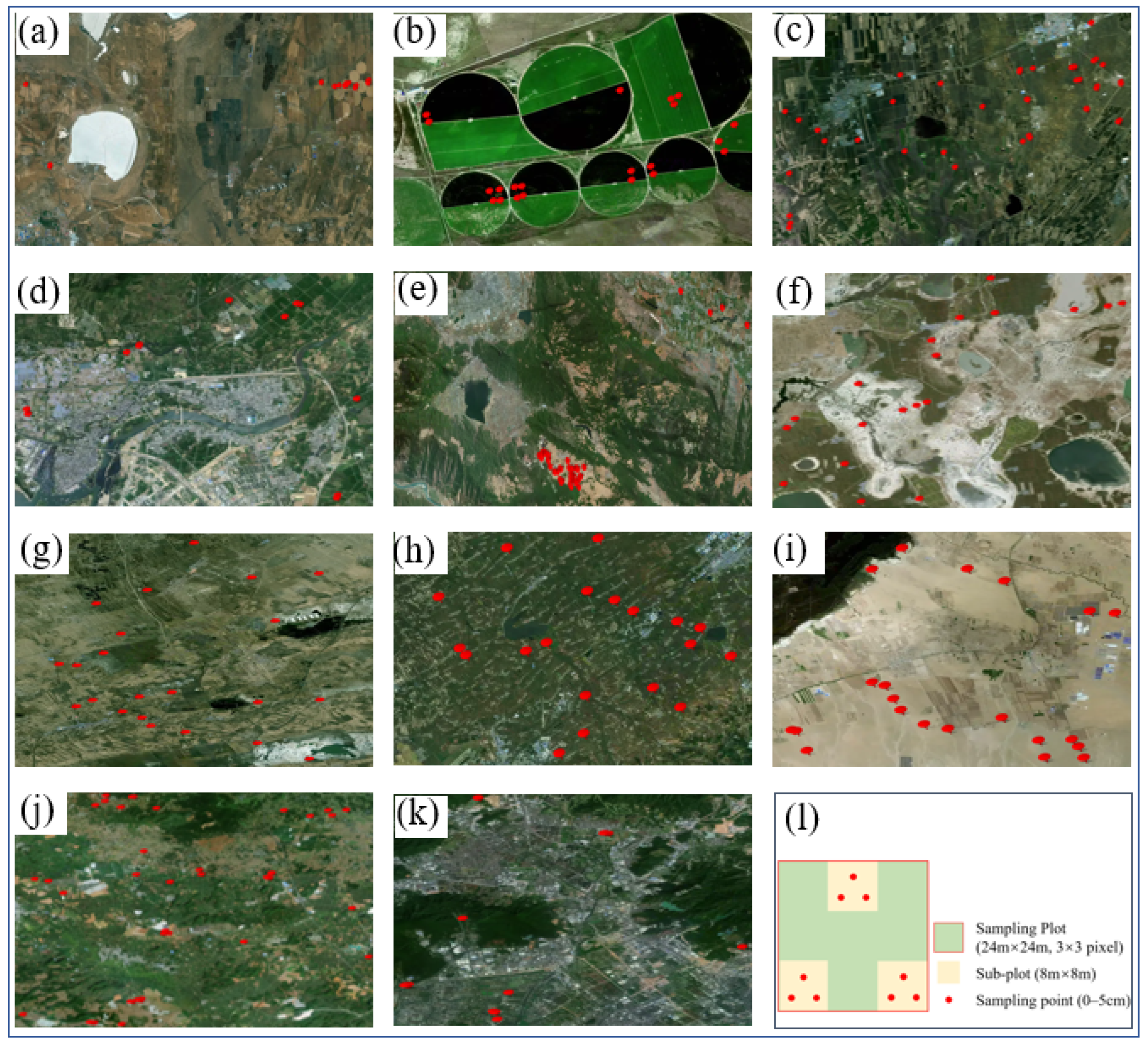
To fully evaluate the mv and s retrieval capabilities of the GF-3 series SAR satellites. This study selected 11 representative experimental areas across significant dry-wet climatic zones in China [33]. To account for local spatial heterogeneity, each area comprises multiple sampling plots, providing robust and representative ground-truth measurements of mv and s for satellite pixel validation. These areas include Bayannur and Xilinhot in the Inner Mongolia Autonomous Region; Guyuan in Hebei Province; Da’an, Qianguo, and Gongzhuling in Jilin Province; Youyi in Heilongjiang Province; Lijiang in Yunnan Province; Fusui in Guangxi Zhuang Autonomous Region; Sanya in Hainan Province; and Zhongshan in Guangdong Province (Figure 1). Among them, the Bayannur plot in Inner Mongolia is located in an arid region; Guyuan in Hebei, Xilinhot in Inner Mongolia, and the western Jilin plots (including Da’an, Qianguo, and Gongzhuling) belong to the semi-arid region; the Lijiang plot in Yunnan spans the climate transition zone between the semi-arid and sub-humid regions; the Youyi in Heilongjiang, Sanya in Hainan, and Fusui in Guangxi plots exhibit sub-humid region characteristics; and the Zhongshan plot in Guangdong is situated in a humid climate environment. The soil types cover a wide range, from sandy soils (e.g., Sanya) to clayey soils (e.g., Fusui), with the land cover mainly consisting of sparsely vegetated grasslands and croplands. Through data collection, a comprehensive experimental dataset spanning the gradient from arid to humid was constructed, providing reliable data support for evaluating the retrieval capabilities of the GF-3 series SAR satellites under complex surface conditions.

2.2. Ground Data

To ensure the quality of ground observation data, this study formulated standardized satellite-ground synchronous observation and data processing protocols. Ground sampling time was strictly limited to the near-synchronous window (±2 days) relative to the overpass of the GF-3 series SAR satellites, excluding any periods affected by precipitation or irrigation events. Based on the 8 m nominal resolution of the GF-3 SAR images, sampling plots of 24 m × 24 m were designed to correspond to the 3 × 3 satellite pixel scale [34]. The spatial distribution of the 11 study areas and the detailed nested sampling scheme are illustrated in Figure 2. Within each plot, three sub-sampling areas were set up through a triangular layout, and three sets of repeated samples were obtained within each sub-sampling area to measure mv and s. The plot boundaries were kept at a distance of more than 50 m from shelterbelts, roads, and tall objects to avoid geometric positioning errors and the influence of surrounding objects on radar signals. Spatially homogeneous plots were selected during sampling to minimize the impact of spatial heterogeneity on plot sampling results. Regarding ground data quality control, the three-sigma rule (3σ) was adopted to conduct consistency checks on the multi-point observation data within each plot [35]. After identifying and eliminating outliers that deviated from the statistical distribution, the arithmetic mean of the remaining valid samples was calculated and used as the ground reference value for the plot scale.
(1)
Soil Moisture and Soil Bulk Density
The mv and soil bulk density ( ρ b ) were measured synchronously using the cutting ring method [36]. At each sampling point, undisturbed topsoil from 0 to 5 cm was collected using a cutting ring with a volume of 200 cm3. After drying at 105 °C for 24 h to a constant weight, the bulk density was measured, and the gravimetric water content was converted to mv. Outliers caused by sampling errors, gravel, or root interference were eliminated using the 3σ rule, and the mean of valid samples within the plot served as the ground reference value. Statistics indicate that the variation range of mv across the 11 experimental areas was 0.013–0.358 cm3·cm−3, and the value range of ρ b was distributed between 1.03 g·cm−3 (Xilinhot) and 1.39 g·cm−3 (Bayannur).
(2)
Surface Root Mean Square Height (s)
A pin profiler (1 m length, 1 cm spacing) was used to measure the s. To improve measurement accuracy, an “end-to-end” method was adopted to obtain three sets of continuous profiles of 3 m length for each plot to ensure measurement accuracy [37]. For plots with obvious tillage ridges, profiles were collected parallel and perpendicular to the ridge direction, respectively. During the calculation of s, linear detrending and de-ridging methods were applied to reduce the influence of periodic fluctuations and tilt changes in surface elevation on the measurement accuracy [38]. Based on this, referring to the aforementioned mv data quality control strategy, the valid s values were obtained after eliminating measurement anomalies. The variation range of the 378 sets of s in the 11 experimental areas was 0.22–3.29 cm.
(3)
Soil Texture
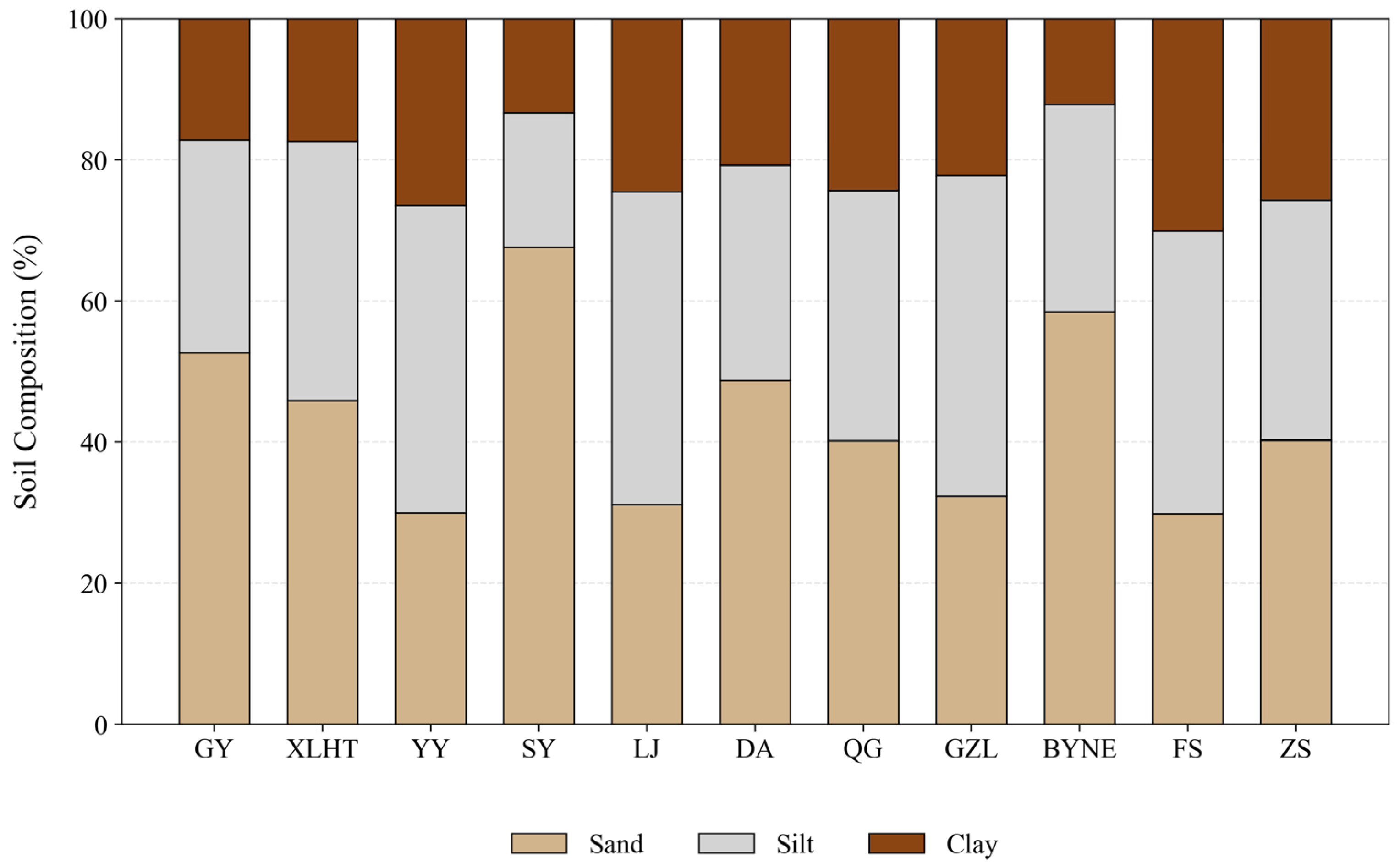
Since particle size analysis of soil samples was not conducted in the laboratory, this study adopted sand and clay contents from the second version of the China Soil Characteristics Dataset (CSDLv2) with a spatial resolution of 90 m as reference data [39]. The extracted soil particle size content at each sampling point was taken as the representative value of the plot. The sand content (S) ranged from 0.298 to 0.676, while the clay content (C) ranged from 0.122 to 0.301 (Figure 3).

2.3. GF-3 Series Satellite Imagery

The GF-3 series SAR satellite images used in this study were obtained as Level-1 complex image products from the China Centre for Resources Satellite Data and Application (CRESDA, http://www.cresda.cn). These datasets comprise full-polarimetric SAR observation data from the GF-3, GF-3B, and GF-3C satellites. All images were acquired in the quad-polarization stripmap I (QPSI) imaging mode with a nominal spatial resolution of 8 m. Preprocessing was conducted using the PIE-SAR7.0 software (PIESAT Information Technology Co., Ltd., Beijing, China; https://www.piesat.cn), encompassing complex data conversion, multi-look processing, and adaptive filtering. To ensure geometric accuracy, rational polynomial coefficient (RPC) orthorectification was performed using the ASTER Global Digital Elevation Model (GDEM) v3 with a 30 m spatial resolution [40], followed by geocoding to derive the full-polarimetric backscattering coefficients. The selected imagery covers the corresponding experimental areas mentioned above. Key acquisition parameters for each scene, including the acquisition date, satellite platform, and θ , are summarized in Table 1.

3. Methods

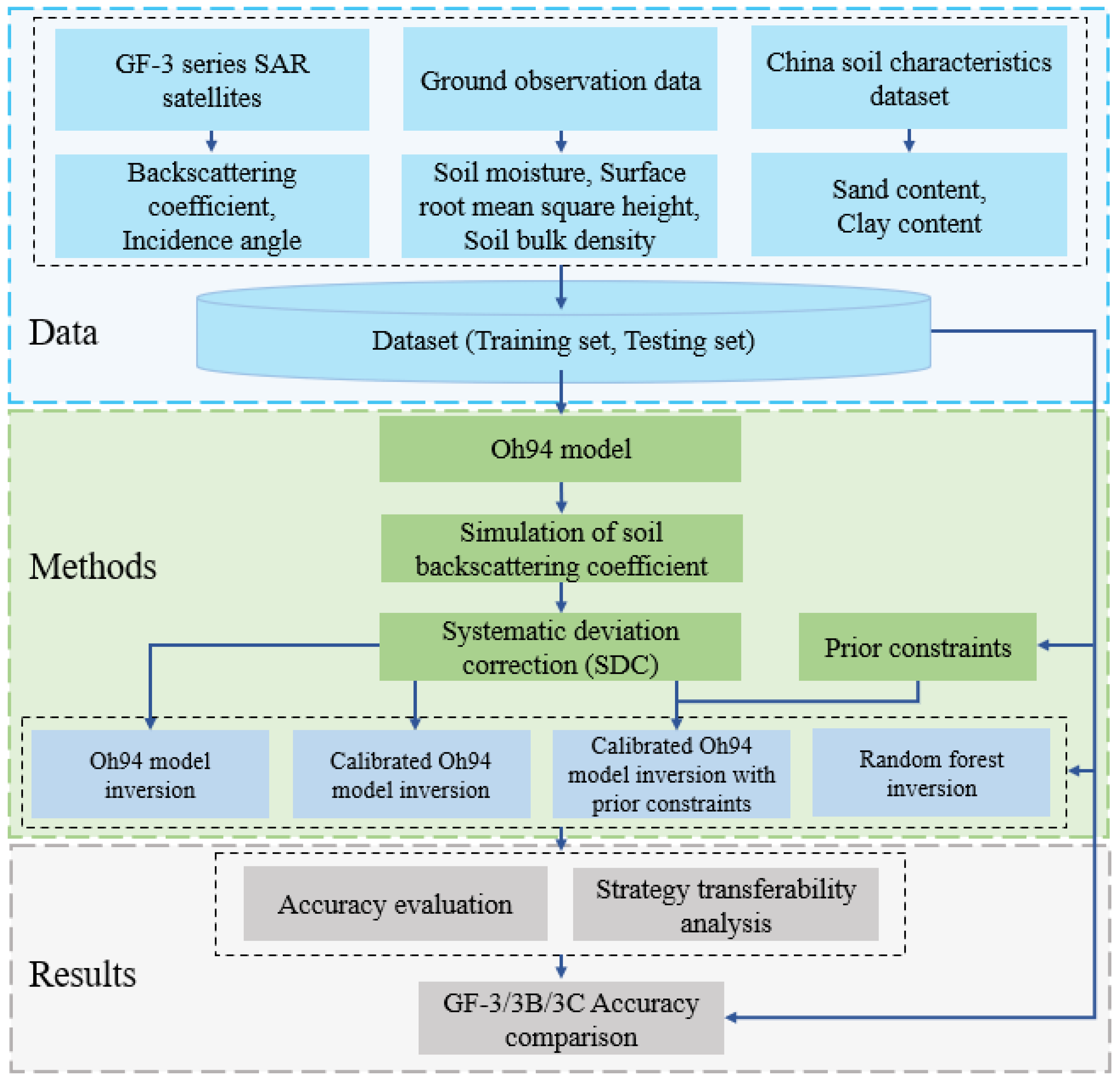
Based on the full-polarimetric radar observations of the GF-3 series SAR satellites and ground synchronous experimental data, the constructed satellite-ground synchronous observation dataset was randomly divided into a training set and a testing set at a ratio of 7:3 to ensure the independence of model construction and accuracy evaluation. The overall technical workflow for soil moisture and surface roughness retrieval using GF-3 series SAR data is illustrated in Figure 4. First, addressing the systematic differences between the SAR-observed σ 0 and the theoretical simulated values of the semi-empirical backscattering model proposed by Oh et al. (1994) [41] (hereinafter referred to as the Oh94 model), an SDC model considering the θ effect for soil backscattering coefficients was constructed. On this basis, combined with prior knowledge of mv and s, four retrieval strategies were implemented: Strategy I (Oh94 model inversion), Strategy II (calibrated Oh94 model inversion), Strategy III (calibrated Oh94 model inversion with prior constraints), and Strategy IV (random forest inversion). Finally, based on the testing set, the retrieval accuracy of these strategies was systematically compared, and the transferability of each strategy on unknown samples was evaluated to comprehensively assess the potential and reliability of the GF-3 series SAR satellites in retrieving mv and s.

3.1. Simulation of Soil Backscattering Coefficient Based on the Oh94 Model

This study adopted the Oh94 model, which was built based on measured data from L, C, and X multi-band fully polarized scatterometers. It established a nonlinear mapping relationship among the σ 0 , θ , the soil complex dielectric constant ( ε ), and s [16,41]. Previous studies have extensively evaluated the performance of the Oh model across various surface conditions, demonstrating its reliability compared to other theoretical or semi-empirical models [42]. The core mechanism of the Oh94 model lies in the introduction of two dimensionless parameters—the co-polarization ratio (p) and the cross-polarization ratio (q)—to quantitatively describe the comprehensive effects of s and ε on the backscattering signals [16,17]. Its empirical expressions are as follows:
p = σ H H 0 σ V V 0 = 1 2 θ π 1 3 Γ 0 exp ( k s ) 2
q = σ H V 0 σ V V 0 = 0.23 Γ 0 [ 1 exp ( k s ) ]
σ V V 0 = g   cos 3 θ p [ Γ V + Γ H ]
g = 0.7 1 exp 0.65 ( k s ) 1.8
where σ VV 0 , σ HH 0 , and σ HV 0 are the σ 0 for the different polarization channels, respectively; k is the electromagnetic wave number; Γ H and Γ V are the Fresnel power reflectivities for horizontal and vertical polarized waves, respectively; and Γ 0 is the reflectivity at θ = 0°. These Fresnel reflectivities are determined by ε and θ as follows:
Γ H = cos θ ε ( sin θ ) 2 cos θ + ε ( sin θ ) 2 2
Γ V = ε cos θ ε ( sin θ ) 2 ε cos θ + ε ( sin θ ) 2 2
Γ 0 = 1 ε 1 + ε 2
The ε is calculated using the Dobson dielectric mixing model, which treats soil as a four-phase mixed medium composed of a solid phase, a gas phase, bound water, and free water [18]. Its expression is:
ε α = 1 + ρ b ρ s ( ε s α 1 ) + m v β ε f w α m v
where α is a shape factor (0.65); ρ b is the soil bulk density; ρ s is the soil particle density (2.65 g·cm−3); ε s is the soil solid-phase dielectric constant; and ε fw is the free water dielectric constant. β is an empirical parameter dependent on soil texture, used to quantitatively characterize the effects of S and C [19], the calculation formula is:
β = 1.2748 0.519 S 0.152 C
For the imaginary part of ε , the ohmic loss caused by the movement of ions in the soil solution must be considered, particularly in high-salinity soils or low-frequency bands. This study adopted an empirical formula based on soil texture and ρ b to estimate the effective conductivity ( σ eff ) [19]:
σ e f f = 1.645 + 1.939 ρ b 2.013 S + 1.594 C
The ε fw is subsequently corrected by σ eff [18,19]:
ε f w , corrected = ε f w j σ e f f 2 π f ε 0 ρ s ρ b ρ s m v
where f is the radar observation frequency (GHz); ε 0 is the vacuum permittivity; and j is the imaginary unit. ε fw , corrected is substituted into Equation (8) for the final ε .
In summary, the Dobson model is utilized to convert the field-measured mv into ε . Combined with the field-measured s and θ , these parameters are substituted into the Oh94 model (Equations (1)–(4)) to calculate the simulated backscattering coefficients ( σ sim 0 ) for each sampling plot under the VV, HH, and HV polarization channels. These σ sim 0 values will serve as the baseline for quantifying and correcting the systematic deviations discussed in Section 3.2.

3.2. Correction Method for Oh Model Backscattering Coefficients

It should be noted that the systematic deviations between the satellite observations ( σ obs 0 ) and the Oh94 model simulations ( σ sim 0 ) are not entirely attributable to SAR system parameters, such as radiometric calibration residuals [13,30]. As a semi-empirical model, the Oh model inherently involves structural limitations that contribute to these discrepancies. As observed by Baghdadi and Zribi [42], the magnitude of these model-induced errors exhibits distinct dependencies on radar configurations, particularly polarization, incidence angle, and wavelength. Consequently, accounting for the combined effects of sensor inconsistencies and model limitations is essential for improving the retrieval accuracy of mv and s [31]. To quantify and correct this difference, this study utilized the synchronous satellite-ground dataset and the Oh94 model to calculate the σ sim 0 for 378 sampling plots. The deviation is:
Δ σ 0 = σ obs 0 σ sim 0
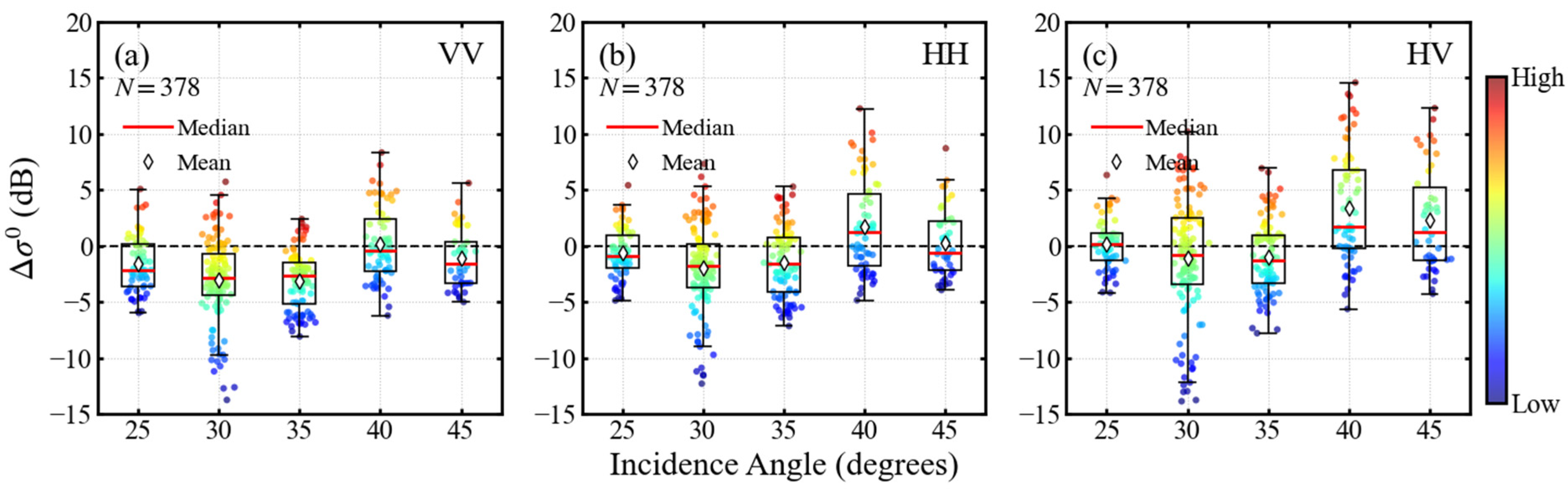
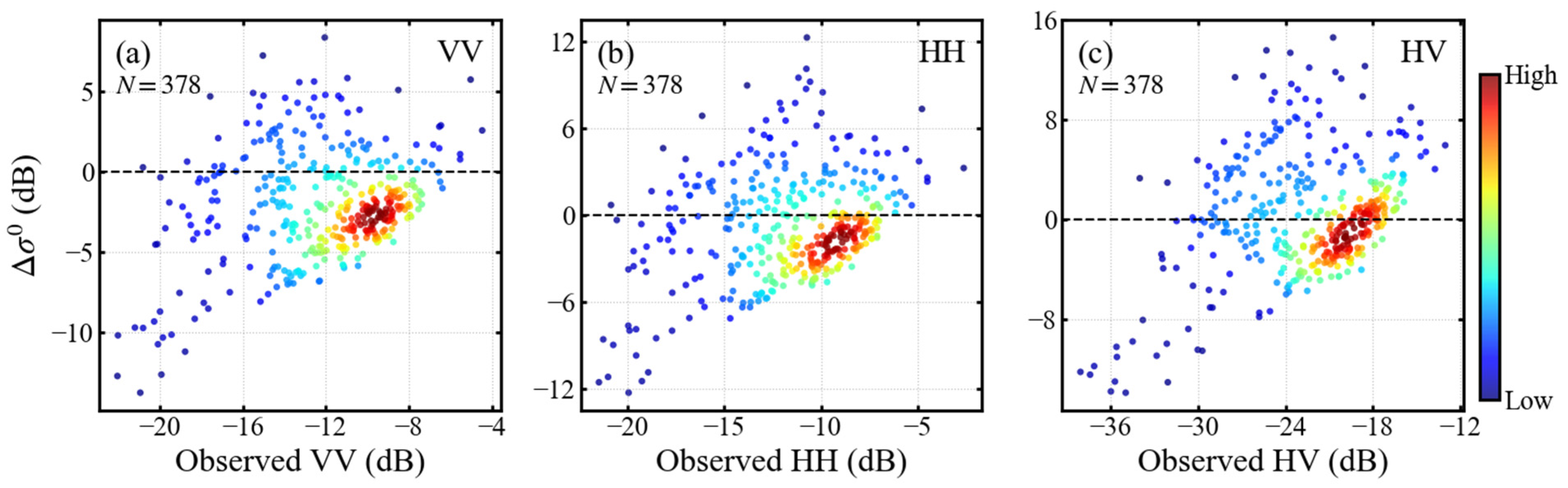
Results indicate that the relationship between Δ σ 0 and σ obs 0 is not linear but exhibits a nonlinear dependence. Specifically, Δ σ 0 is negative when σ obs 0 is below −12 dB and gradually transitions to positive values as σ obs 0 increases. Furthermore, Δ σ 0 shows a distinct sensitivity to variations in θ . In the low-to-medium θ range (25–35°), the median Δ σ 0 for both co-polarization and cross-polarization channels is predominantly negative. Conversely, when θ exceeds 40°, the median Δ σ 0 approaches zero or becomes positive, while the data dispersion increases concurrently. These nonlinear distribution patterns and their dependence on the reference incidence angle are clearly visualized in Figure 5 and Figure 6.
Based on the observed dependence of Δ σ 0 on σ obs 0 and θ , a systematic deviation correction (SDC) model for the Oh94 model was developed. This model utilizes multiple linear regression involving θ and σ obs 0 to predict Δ σ 0 (denoted as Δ σ 0 pp , pred ) [43]. The expression is as follows:
Δ σ p p , pred 0 = α p p σ p p , obs 0 + β p p θ + γ p p
where pp denotes the polarization channel (VV, HH, or HV), and α p p , β p p , and γ p p are the fitting coefficients. Subsequently, the calibrated backscattering coefficient ( Δ σ 0 pp , pred ) for each channel can be expressed as
σ p p , corr 0 = σ p p , sim 0 + Δ σ p p , pred 0
This SDC approach significantly improved the consistency between the Oh94 model simulations and the GF-3 SAR observations by minimizing systematic biases, thereby providing a more reliable forward modeling basis for the subsequent retrieval of mv and s [28].

3.3. Prior Knowledge Estimation of Surface Parameters Based on Radar Observations

To address the ill-posed problem of decoupling mv and s during the SAR retrieval process, to address the ill-posed problem of decoupling mv and s, this study leverages the distinct sensitivities of various radar polarization channels to generate a priori estimates for the surface parameters. This approach aims to constrain the solution space and provide reliable initial guesses and constraints for the inversion [12]. Theoretically, the VV-polarized backscattering coefficient ( σ VV , obs 0 ) is highly sensitive to variations in mv, whereas the HV-polarized backscattering coefficient ( σ H V , obs 0 ) responds more effectively to changes in s [17]. Synchronous satellite-ground observations indicate that the relationships between the surface parameters (mv and s) and the backscattering coefficients are nonlinear and exhibit signal saturation in high-moisture or high-roughness regimes (detailed in Section 4.1). This pattern is consistent with established research in the C-band [44,45]: Compared to linear models, exponential models can more accurately characterize the asymptotic saturation effect of SAR signals in high-value intervals. Consequently, this study established exponential relationship equations for the prior soil moisture ( m v , prior ) and prior surface roughness ( s prior ):
m v , prior   = α 1 e β 1 σ V V , obs   0 + γ 1
s prior   = α 2 e β 2 σ H V , obs   0 + γ 2
where σ VV , obs 0 and σ H V , obs 0 are the values observed by the GF-3 series SAR satellites; and α, β, γ (i = 1, 2) are the fitting coefficients for each empirical model.

3.4. Soil Moisture and Surface Roughness Retrieval Strategies

This study implemented four retrieval strategies, including semi-empirical model optimized solutions and data-driven regression. The design of these strategies follows a logical progression from “baseline evaluation” (Strategy I: Oh94 model inversion) to “deviation correction” (Strategy II: calibrated Oh94 model inversion) and “prior constraints” (Strategy III: calibrated Oh94 model inversion with prior constraints), finally establishing a “performance reference” (Strategy IV: random forest inversion). The objective is to hierarchically analyze the influence mechanisms of systematic deviations and retrieval ill-posedness on the accuracy of mv and s.
The retrieval process of mv and s was transformed into a nonlinear optimization problem, i.e., finding the optimal state vector x = [ m v ,   s ] T within physical boundaries ( 0.01 m v 0.60   cm 3 · cm 3 ,   0.05 s 5.0   cm ) to minimize the cost function [46]. The initial guess x 0 for iterative optimization was determined by the strategy type: Strategy I and II utilized a uniform initial guess (i.e., m v 0 = 0.1, s 0 = 1); whereas Strategy III directly employed the m v , prior and s prior estimated in Section 3.3 to facilitate algorithm convergence.
To mitigate outlier interference caused by coherent noise and observation uncertainty in GF-3 series SAR observations, this study adopted a Soft-L1 robust loss function to construct the objective function. The construction of this function is based on the normalized residual vector. For any polarization pp, the normalized residual ( z pp ) is defined as follows:
z p p = σ p p , obs 0 σ p p , sim 0 ( x ) σ unc
where σ unc represents the comprehensive observation uncertainty (set to 2.0 dB in this study) [47], which accounts for the combined effects of sensor radiometric residuals, speckle noise, and forward modeling uncertainties. Physically, this parameter defines the boundary between “normal fluctuation” ( | z | 1 ) and “abnormal outlier” ( | z | > 1 ) during the optimization process. Based on this, an adaptive residual weighting mechanism [35], utilizing a Soft-L1 robust loss function, was implemented to suppress the influence of outliers and enhance the reliability of the retrieval solutions:
L ( z ) = 2 ( 1 + z 2 1 )
The characteristic of this function is that for small normalized residuals ( | z | 1 ), the function approximately exhibits quadratic behavior ( L ( z ) z 2 ) to capture subtle signal variations and maintain convergence precision. Conversely, in regions with abnormally large residuals ( | z | > 1 ), the function smoothly transitions to linear behavior ( L ( z ) 2 | z | ), thereby effectively suppressing the weight of outliers in the total cost function. This mechanism prevents the optimization process from being dominated by abnormal values, subsequently enhancing the robustness of the retrieval. The Trust Region Reflective (TRF) algorithm was used for optimization, with a convergence tolerance set to 10−4.
(1)
Strategy I: Oh94 Model Inversion
This strategy was used to evaluate the basic retrieval capability of the Oh94 model under scenarios without deviation correction. Its cost function J 1 is defined as the sum of robust losses of normalized residuals for each polarization channel:
J 1 ( x ) min = p p { V V , H H } L σ p p , obs 0 σ p p , sim 0 ( x ) σ unc 2
where L ( · ) is the aforementioned Soft-L1 robust loss function; pp represents the polarization channel; σ pp , obs 0 is the satellite observed backscattering coefficient; σ pp , sim 0 the Oh94 model simulated backscattering coefficient; and σ unc represents the comprehensive observation uncertainty (2.0 dB). In this strategy, the retrieval process merely relied on the inherent semi-empirical scattering mechanisms of the Oh94 model without introducing additional deviation corrections, aiming to establish the model’s fundamental accuracy level.
(2)
Strategy II: Calibrated Oh94 Model Inversion
This strategy was used to evaluate the retrieval performance of the Oh94 model after deviation correction. This strategy integrated the SDC method from Section 3.2 during the iterative optimization process. During retrieval, the corrected simulated values ( σ pp , corr 0 ) were used to calculate the normalized residuals, constructing the cost function J 2 :
J 2 ( x ) min = p p { V V , H H } L σ p p , obs 0 σ p p , corr 0 ( x ) σ unc 2
where σ pp , corr 0 is the calibrated backscattering coefficient after systematic deviation correction. This strategy effectively mitigated the impact of systematic bias on the retrieval results of mv and s by correcting the simulation deviations of the Oh94 model, but the retrieval process still relied solely on SAR backscattering observations, without introducing external constraints.
(3)
Strategy III: Calibrated Oh94 Model Inversion with Prior Constraints
Addressing the ill-posed problems common in the dual-parameter retrieval of mv and s (e.g., the non-uniqueness of solutions caused by the strong nonlinear coupling of surface parameters), this strategy introduced the prior knowledge obtained in Section 3.3 under the Bayesian maximum a posteriori framework [46,48]. The total cost function J 3 builds upon Strategy II by adding prior regularization terms regarding state variables deviating from prior estimations. Following Bayesian inversion theory, its regularization terms were similarly incorporated into the robust penalty framework, and the objective function J 3 is expressed as:
J 3 ( x ) min = J 2 ( x ) + L m v m v , prior σ m v 2 + L s s prior σ s 2
where the first term on the right side of the equation is the observation residual term, characterizing the fit of the Oh94 model simulated values to the satellite observation data; the latter two terms are the prior regularization terms. m v , prior and s prior are the prior reference values obtained in Section 3.3; the denominators σ m v and σ s characterize the uncertainty of the prior parameters (i.e., regularization weights), which were set to 0.04 cm3·cm−3 and 0.8 cm in this study [49]. By providing moderate parameter constraints, the algorithm was able to ensure the responsiveness of the retrieved parameters to actual radar observation signals while circumventing the risk of solution space divergence, achieving a dynamic balance between observation information and prior knowledge.
(4)
Strategy IV: Random Forest Inversion
To evaluate the relative efficacy of semi-empirical model retrieval strategies across different surface scenarios, this study introduced the random forest (RF) algorithm to establish a data-driven accuracy reference [50]. The input feature vector, denoted as F , integrated the radar incidence angle ( θ ), multi-polarization backscattering coefficients ( σ HH 0 ,   σ VV 0 ,   σ HV 0 ), soil texture (sand S, clay C), and bulk density ( ρ b ) information, aiming to capture the complex nonlinear mapping between surface parameters and radar signals through a multi-source feature space:
F = θ , σ H H 0 , σ V V 0 , σ H V 0 , S , C , ρ b T
The RF model was constructed using an ensemble forest of 100 regression decision trees, utilizing the bagging method for sample reconstruction to enhance the generalization stability of the algorithm under the constraint of a limited number of ground plots (N = 378).

3.5. Accuracy Evaluation Metrics

R = i = 1 N ( y ret , i y ¯ ret ) ( y ref , i y ¯ ref ) i = 1 N ( y ret , i y ¯ ret ) 2 i = 1 N ( y ref , i y ¯ ref ) 2
RMSE = 1 N i = 1 N y ret , i y ref , i 2
Bias = 1 N i = 1 N y ret , i y ref , i
ubRMSE = RMSE 2 Bias 2
where N is the number of samples, y ret , i and y ref , i represent the model-retrieved value and ground-measured reference value of the i-th sample, respectively; y - ret and y - ref are the arithmetic means of the two, respectively.

4. Results

4.1. Oh94 Model Correction Effects

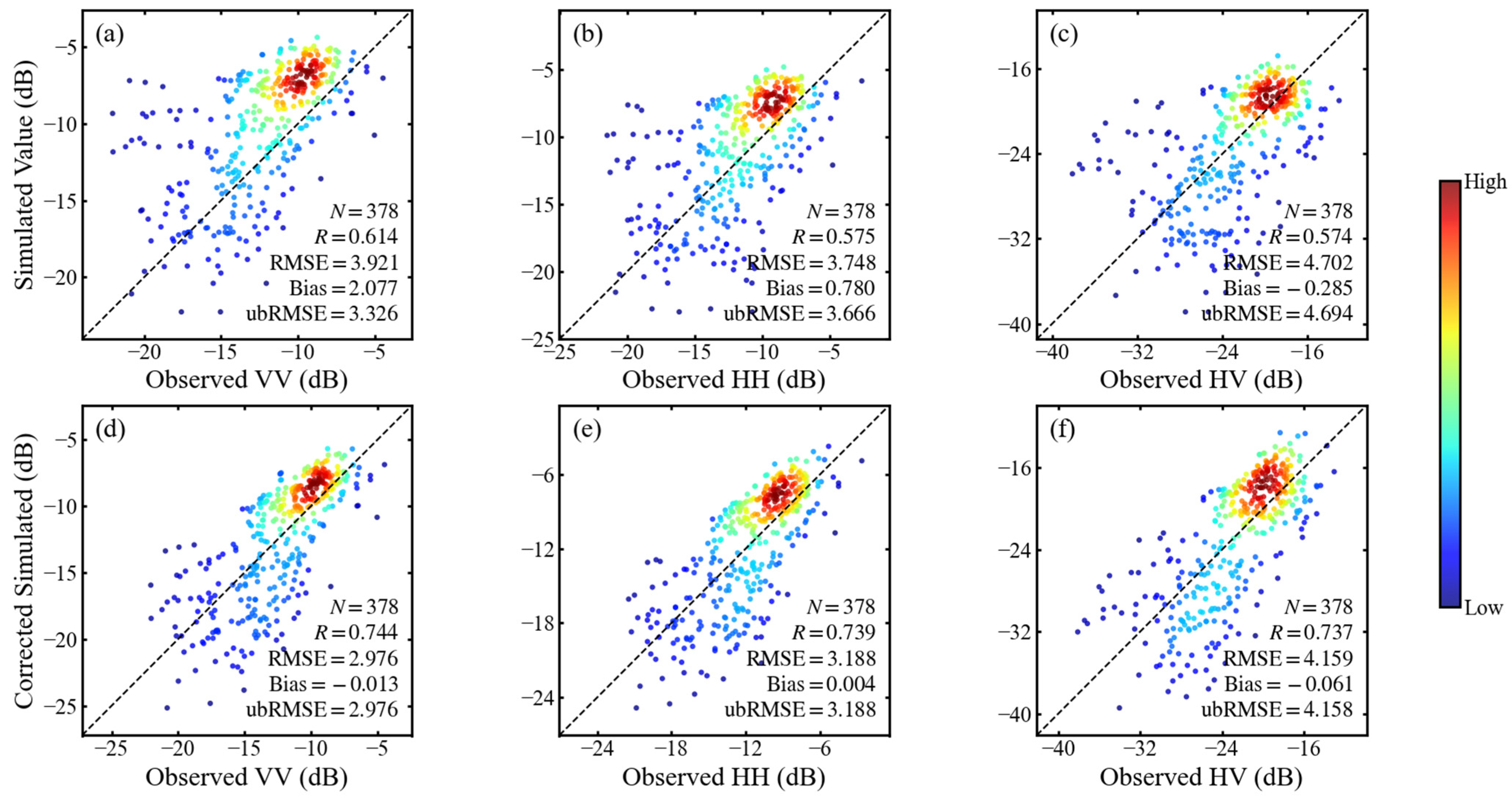
Table 2 and Figure 7 illustrate the improvement effect of the SDC method on the simulation accuracy of the Oh94 model. Before correction, a significant systematic bias existed between the Oh94 model simulations ( σ sim 0 ) and the GF-3 satellite observations ( σ obs 0 ), with the simulated values exhibiting inconsistent response characteristics across different polarization channels. The simulated co-polarized backscattering coefficients ( σ V V , sim 0 and σ HV , sim 0 ) showed positive biases (indicating model overestimation), among which σ V V , sim 0 had the largest deviation (bias = 2.08 dB), followed by σ HV , sim 0 ; conversely, the simulated cross-polarized backscattering coefficient ( σ HV , sim 0 ) showed a negative bias (bias = −0.29 dB). Additionally, the unbiased root mean square error (ubRMSE) of σ HV , sim 0 (4.69 dB) was significantly higher than that of the co-polarized components.
After correction using the SDC method, the consistency between the Oh94 model simulations and the GF-3 series SAR satellite observations was significantly improved, and the scatter points tended to be symmetrically distributed around the 1:1 reference line. Statistical results indicated that the systematic biases of the corrected backscattering coefficients ( σ corr 0 ) across all channels were effectively suppressed (bias reduced to <0.07 dB), and the overall RMSE decreased by 24.1%. Due to the Oh94 model’s limited capability in characterizing complex cross-polarization scattering mechanisms, σ HV , corr 0 still exhibited higher random dispersion; however, the SDC method overall effectively corrected the systematic bias between the model simulations and satellite observations. Detailed statistical results are presented in Table 2. The specific calibrated coefficients for each polarization channel used in the SDC model are summarized in Table 3.

4.2. Prior Estimation Results of Soil Moisture and Surface Roughness Based on Empirical Regression Models

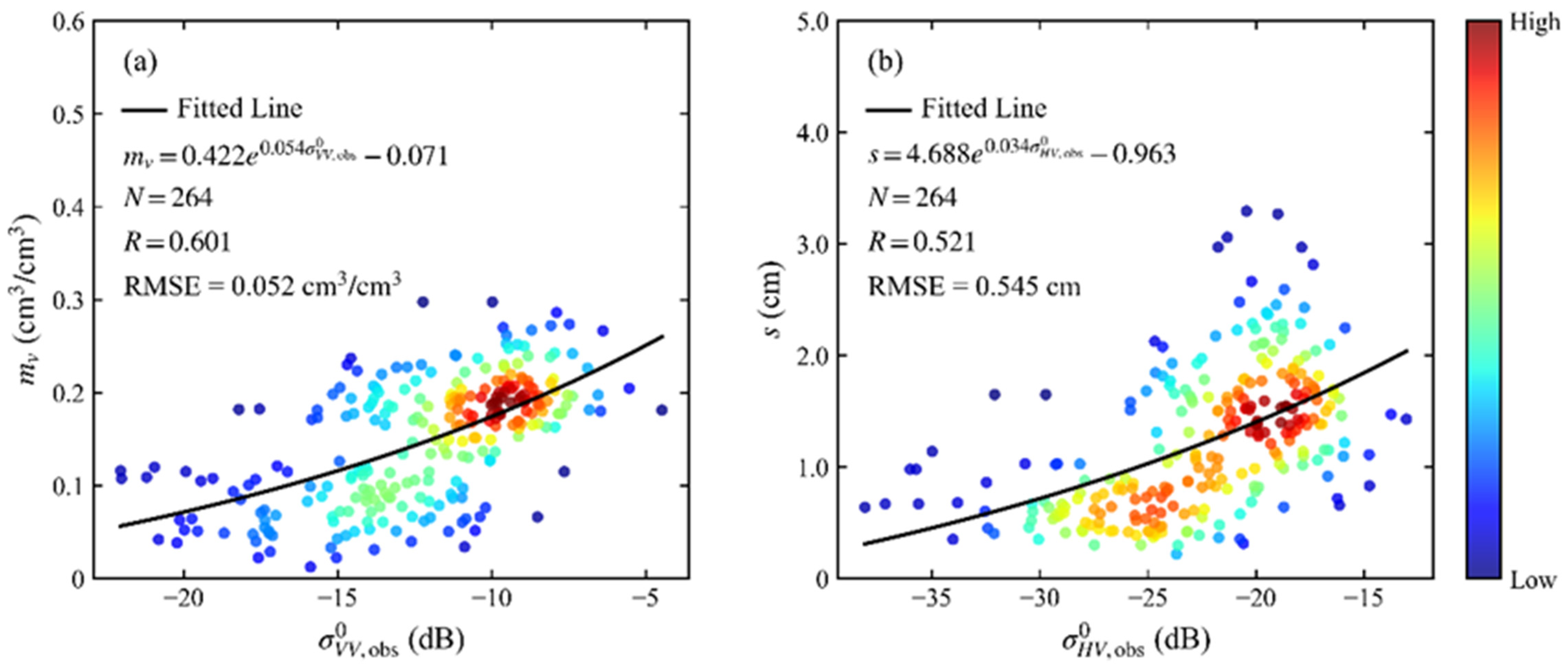
Based on the empirical regression models established in Section 3.3, this study evaluated the fitting accuracy of mv and s on the training set. mv and σ V V , obs 0 exhibited a clear positive correlation (Figure 8a). On the training set, the correlation coefficient (R) was 0.601, and the root mean square error (RMSE) was 0.052 cm3·cm−3, indicating that σ V V , obs 0 was highly sensitive to changes in mv. Figure 8b shows a strong dependence between s and σ HV , obs 0 (R = 0.521, RMSE = 0.545 cm). This aligned with the physical mechanism that cross-polarized backscattering is highly sensitive to surface geometric structures, thereby validating the feasibility of using cross-polarized components to extract prior values for s.
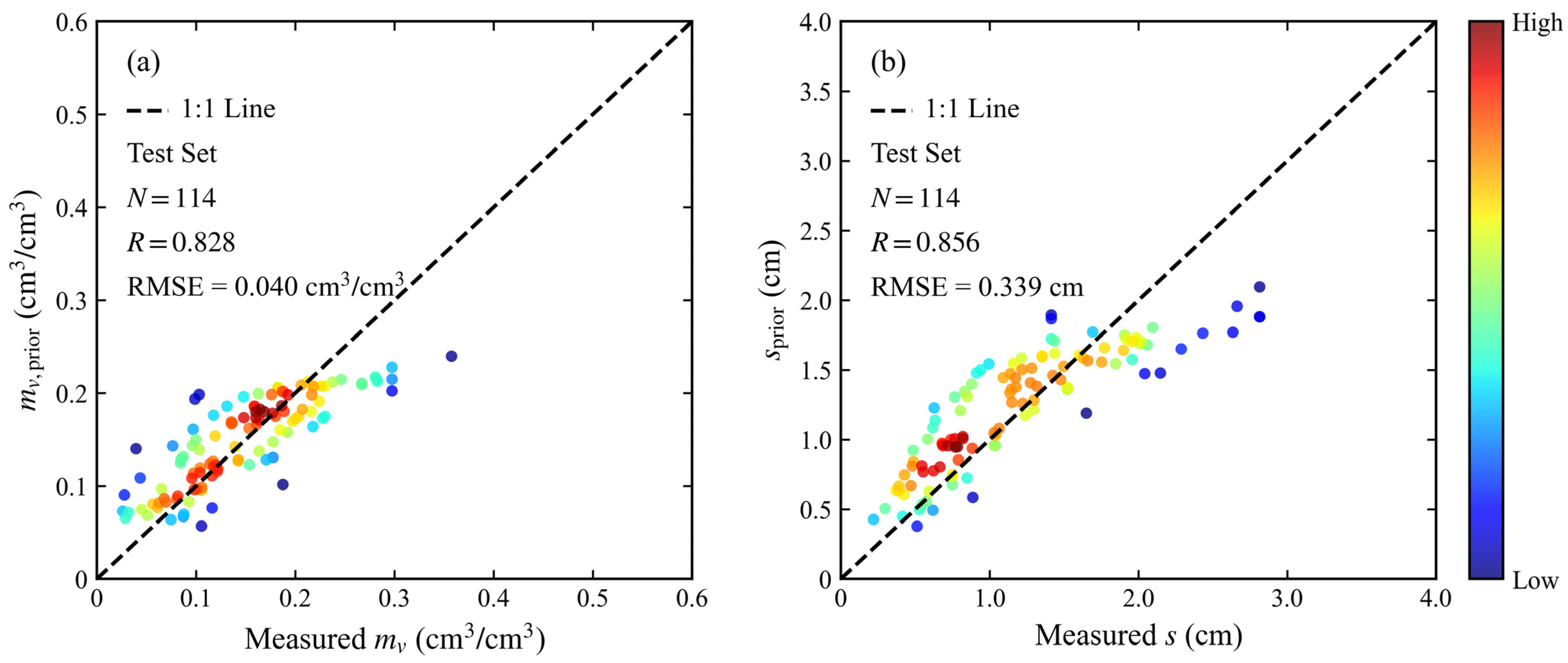
To evaluate the generalization capability of the empirical models and validate their reliability as retrieval constraints, an independent test set (N = 114) was utilized for validation. Figure 9 illustrates the comparison between the measured reference values and the estimated prior values for surface parameters. Statistical results indicated that the empirical models maintained high estimation accuracy on the test set, with an RMSE of 0.040 cm3·cm−3 (R = 0.828) for m v , prior and an RMSE of 0.339 cm (R = 0.856) for s prior . These results confirm that the established empirical relationships can provide robust initial constraints for subsequent inversion strategies.

4.3. Soil Moisture and Surface Roughness Retrieval Accuracy of Multiple Retrieval Strategies

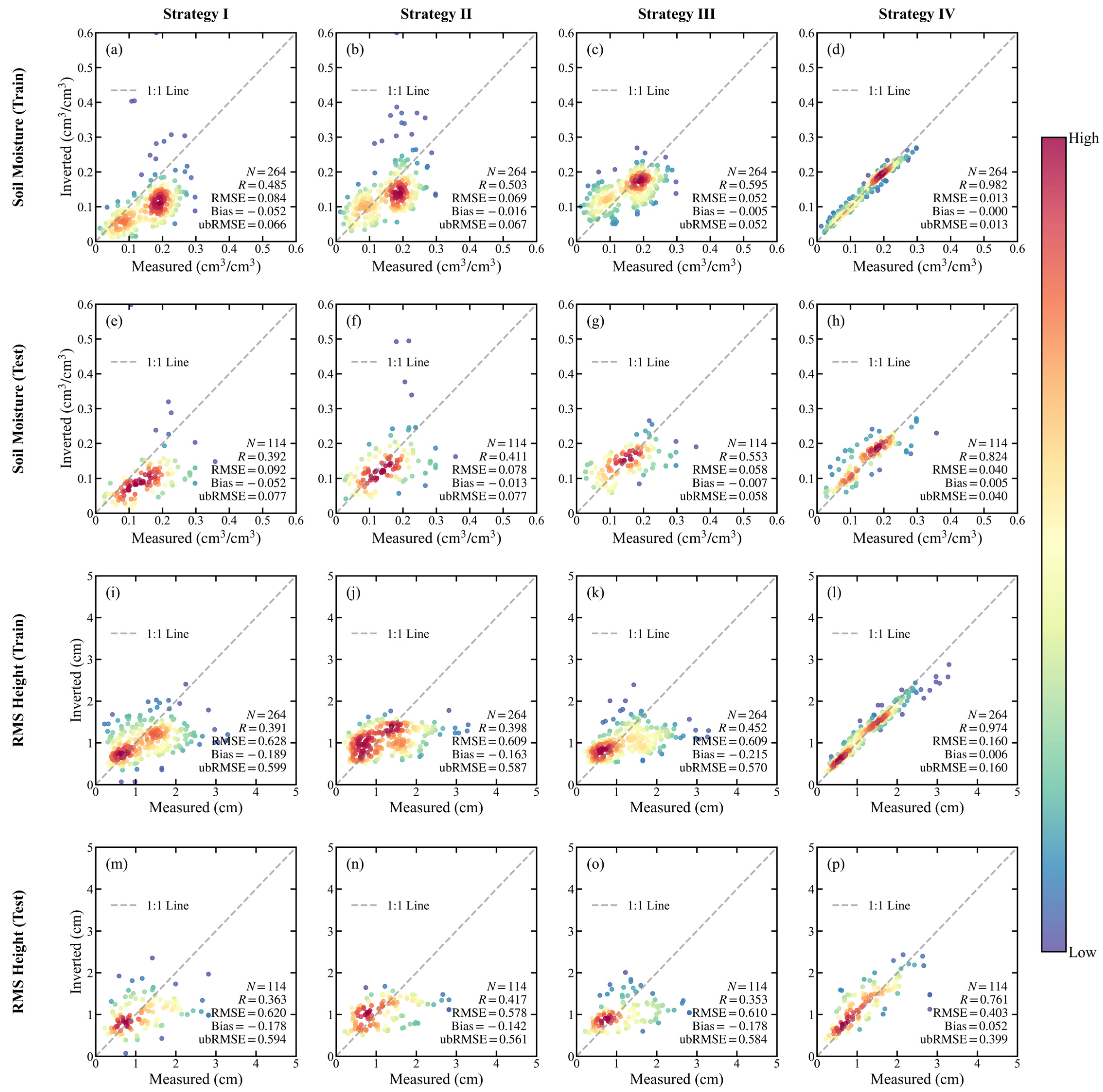
Figure 10 displays the comparison between the retrieval results and field measurements for the four strategies on the training and test sets. Overall, the retrieval accuracy improved progressively from Strategy I to Strategy IV.
Strategy I exhibited a significant underestimation trend in its mv retrieval results. On the training and test sets, the RMSE was 0.084 cm3·cm−3 and 0.092 cm3·cm−3, respectively, and the bias was −0.052 cm3·cm−3 in both. The correlation between the estimated s and the measured values was weak (Figure 10i,m); the R values for the training and test sets were only 0.391 and 0.363, and the RMSE values were 0.628 cm and 0.620 cm, respectively, showing higher random dispersion. This confirms that the retrieval performance for both parameters is significantly limited by two factors: the inherent systematic deviation between the Oh94 model and satellite observations (leading to the systematic underestimation of mv, and its inadequate characterization of complex surface scattering mechanisms (resulting in high random dispersion).
In Strategy II, the mv retrieval errors were effectively suppressed on both datasets, with the test set bias converging to −0.013 cm3·cm−3 and the RMSE dropping to 0.078 cm3·cm−3 (Figure 10f). However, the retrieval accuracy for s showed no obvious improvement (Figure 10n), with a test set R of 0.417 and RMSE of 0.578 cm. Specifically, its test set ubRMSE remained as high as 0.561 cm, demonstrating that while Strategy II suppressed systematic bias, the random dispersion of the results remained high, indicating that it did not effectively improve the retrieval quality of s.
Strategy III showed that the correction effects of introducing prior information varied between parameters. This strategy substantially reduced the random dispersion of mv, with the test set R improving from 0.411 (in Strategy II) to 0.553, and the RMSE further decreasing to 0.058 cm3·cm−3 (Figure 10g); additionally, its retrieval accuracy in the low-moisture range (<0.2 cm3·cm−3) outperformed Strategy II. However, its improvement on the s retrieval results was limited, with a test set R of 0.353 and RMSE of 0.610 cm (Figure 10o), suggesting that the constraint capability of this strategy was weaker on s than on mv.
Strategy IV, serving as a data-driven benchmark, achieved the highest accuracy on both datasets. For mv the test set R reached 0.824 with an RMSE of 0.040 cm3·cm−3 (Figure 10h); for s, the test set R reached 0.761 with an RMSE of 0.403 cm (Figure 10p). Comparisons indicate that while Strategy III is significantly superior to Strategy I and Strategy II in mv retrieval accuracy, a performance gap still exists compared to Strategy IV in characterizing complex surface variations.

5. Discussion

5.1. Transferability Assessment of Different Retrieval Strategies

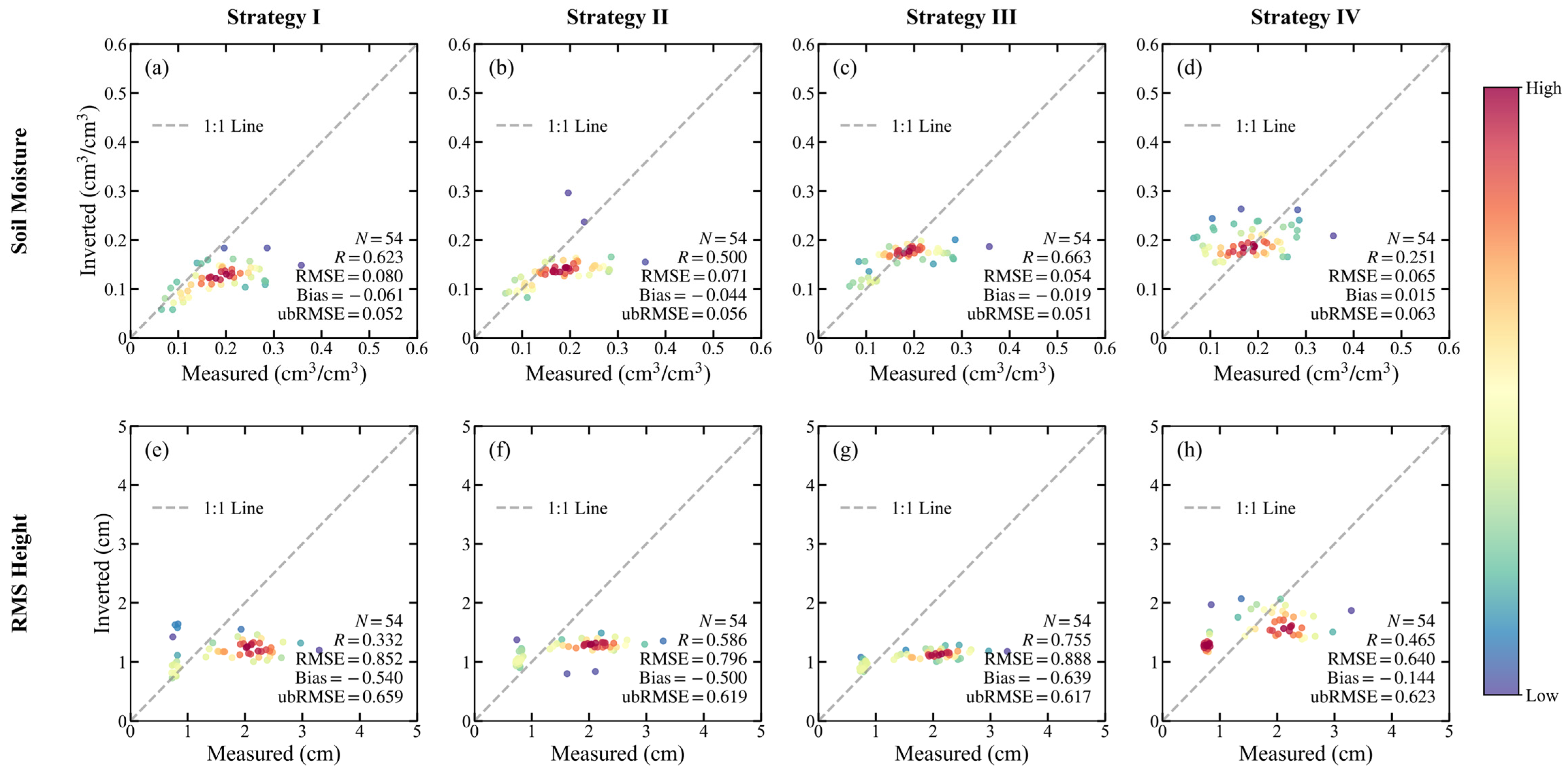
To evaluate the applicability and transferability of the four retrieval strategies in unseen regions, this study selected the geographically independent Youyi experimental area (N = 54), which possesses typical black soil characteristics, as the target domain for validation, while using the remaining plots (N = 324) as the source domain for parameter calibration.
Figure 11d,h, illustrate that Strategy IV exhibited a significant decline in performance during independent validation compared to its performance during the training and test stages. Compared to the high accuracy metrics of this strategy on the test set in Section 4.3 (RMSE = 0.040 cm3·cm−3, R = 0.824), its transfer test RMSE in the target domain increased to 0.065 cm3·cm−3, and the R was only 0.251. Analysis revealed that the retrieval results of Strategy IV lost sensitivity to moisture changes in the target domain; the retrieved values no longer fluctuated with the dynamic variations of the measured mv, but instead converged overall toward the statistical average level of the measured values in the source domain (approximately 0.24 cm3·cm−3). For purely data-driven models lacking explicit constraints from physical scattering mechanisms, when the environmental features of the target domain (such as soil texture and s) deviate from the feature space covered by the training set, it is difficult for the model to accurately decouple the mapping relationship between polarization responses and mv under unfamiliar scattering scenarios, resulting in the loss of response capability to moisture changes and ultimately outputting stable yet invalid predictions [14,51].
In contrast, Strategy III demonstrated stronger transferability in cross-regional validation. Its retrieval RMSE in the target domain was 0.054 cm3·cm−3, outperforming Strategy IV. This indicated that by establishing a physical baseline for retrieval through the Oh94 model and implementing initial value constraints combined with prior knowledge, the physical boundaries of the retrieval solutions could be effectively limited, further ensuring that the retrieval results matched the dynamic changing trends of measured mv [52,53].
Synthesizing the above results, in practical operational applications, the choice of retrieval strategy should highly depend on the completeness of measured data in the region to be monitored. In localized regions where measured data is abundant and sample features can comprehensively cover the environmental variability of the target area, Strategy IV is recommended to fully utilize its nonlinear mapping capability for polarization features to achieve better retrieval accuracy. However, for unseen regions lacking measured reference data or when conducting large-area, extensive dynamic monitoring, Strategy III should be prioritized. This strategy does not require secondary training in the target domain; leveraging the universality of physical mechanisms and the robustness of prior constraints, it can guarantee retrieval consistency under varying soil environmental conditions, making it a feasible solution for large-area operational applications of the GF-3 series SAR satellite constellation.

5.2. Consistency of Soil Moisture Retrieval Across GF-3 Series Satellites

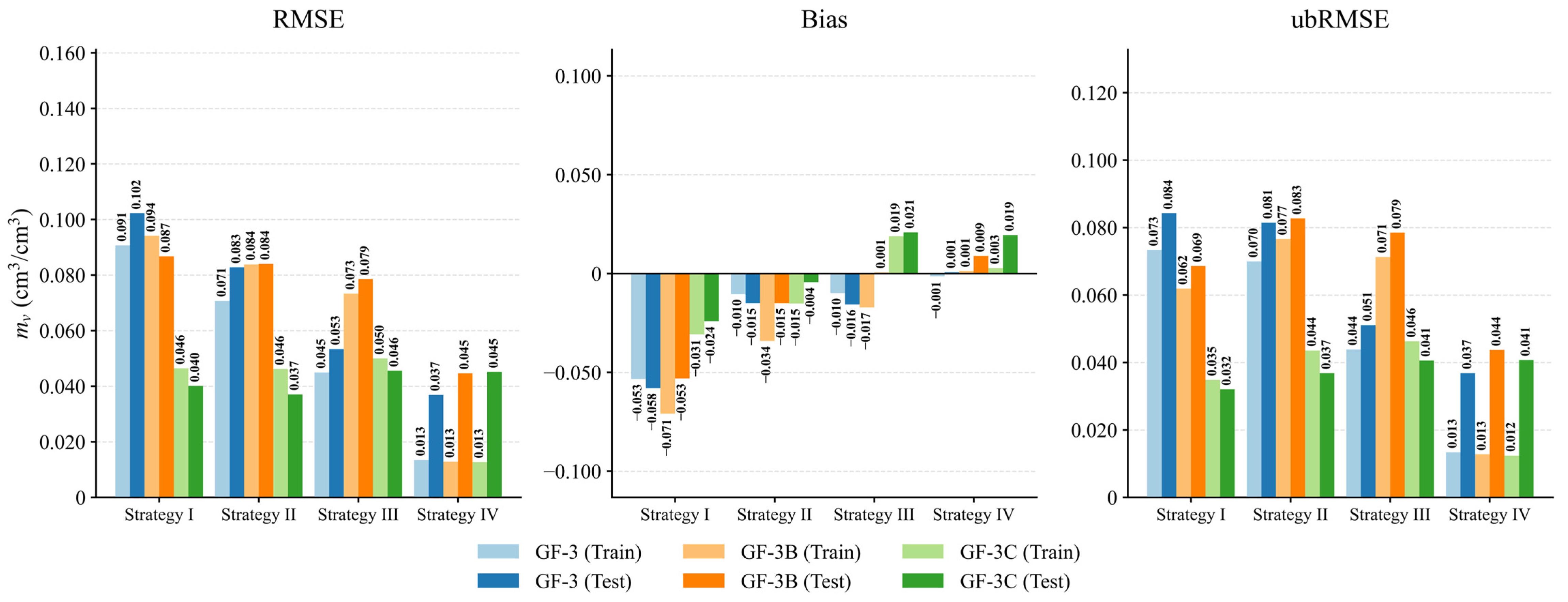
The GF-3 series SAR satellite constellation (GF-3/3B/3C) is essential for enabling large-scale, high-spatiotemporal-resolution soil moisture monitoring [54]. Building upon the results from Section 4.3, this study conducted specific accuracy validations for GF-3 (N = 69), GF-3B (N = 26), and GF-3C (N = 19), to evaluate the variations in mv retrieval accuracy among these satellites, thereby systematically assessing the performance consistency of the four retrieval strategies across different satellite platforms.
In Strategy I, due to the objective radiometric calibration residuals and inherent systematic offsets among the individual satellites [54], the retrieval bias across platforms exhibited distinct discrete characteristics, with the maximum systematic discrepancy reaching 0.034 cm3·cm−3 between GF-3 and GF-3C. Strategy II, which incorporated systematic deviation correction (SDC), effectively compensated for these radiometric offsets, driving the mv retrieval bias of each satellite to converge toward zero. The robust consistency of the retrieval accuracy across the different GF-3 series satellite platforms is visualized in Figure 12.
Strategy III secured superior performance in ensuring consistency across the constellation by regularizing the inversion process with prior constraints. By constraining retrieval solutions within physically plausible domains consistent with ground-truth references, this mechanistic approach enabled the systematic bias for all three satellites to stably converge within 0.021 cm3·cm−3 (RMSE: 0.046–0.079 cm3·cm−3).
In contrast, while the mv retrieval based on Strategy IV achieved high accuracy on the independent test set of the GF-3 platform (RMSE = 0.037 cm3·cm−3), its performance degraded when applied to GF-3B and GF-3C. This confirms that data-driven models, in the absence of explicit physical constraints, lack sufficient robustness against inter-platform domain shifts [53]. When the radiometric distribution of the target satellite deviates from the training domain, these models struggle to maintain stable retrieval results [53]. Overall, by integrating deviation correction and prior constraints, Strategy III effectively suppresses systematic discrepancies across the GF-3 constellation while maintaining high retrieval accuracy.

6. Conclusions

Based on a satellite-ground synchronous observation dataset comprising N = 378 plots across 11 experimental areas spanning significant dry-wet gradients, this study evaluated the bare soil surface mv retrieval performance of the GF-3 series SAR satellites.
Strategy IV demonstrated superior predictive performance within the training domain, achieving a testing set RMSE of 0.040 cm3·cm−3 for mv and 0.403 cm for s. However, its transferability was notably insufficient when addressing domain shift in unseen regions, with the target domain transfer RMSE for mv rising to 0.065 cm3·cm−3. In contrast, Strategy III effectively mitigated the over-reliance of data-driven models on specific training distributions in heterogeneous scenarios. Its mv retrieval showed stronger generalization performance during spatially independent validation (transfer RMSE of 0.054 cm3·cm−3), ensuring the physical consistency of retrieval results across different geographical settings. Although the improvement of Strategy III on s retrieval was limited (testing set RMSE of 0.610 cm), it offered clear advantages in alleviating the ill-posedness of multi-parameter inversion.
Addressing the demands of multi-satellite synergistic monitoring, the GF-3, GF-3B, and GF-3C satellites demonstrated significant synergistic potential under Strategy III. By integrating deviation correction and prior constraints, this strategy effectively addressed the systematic discrepancies caused by both platform radiometric offsets and model structural limitations. This enabled the mv retrieval systematic bias for all three satellites to stably converge to within 0.021 cm3·cm−3, with the RMSE ranging between 0.046 and 0.079 cm3·cm−3. These findings prove the feasibility of synergistic soil moisture mapping using the domestic GF-3 SAR constellation, providing a scientific basis for its operational networking.
Future research will focus on integrating multi-frequency or multi-incidence SAR data to enhance the robustness of parameter decoupling. Furthermore, the application of polarization decomposition technology to extract more representative physical scattering components as prior features will be explored to further broaden the operational monitoring capabilities of the domestic GF-3 constellation.

Author Contributions

Conceptualization, X.Z. and X.L. (Xiangdong Li).; methodology, X.Z. and X.L. (Xiangdong Li).; data curation, X.L. (Xiangdong Li), H.C., J.M. and X.Q.; writing—original draft preparation, X.L. (Xiangdong Li); writing—review and editing, X.Z., C.W., J.R., X.L. (Xinbiao Li), B.L., L.L. and X.W.; visualization, X.L. (Xiangdong Li) and J.M.; supervision, X.Z., H.C., C.W. and J.R. All authors have read and agreed to the published version of the manuscript.

Funding

This study is supported by the National Natural Science Foundation of China, grant number (42371381), the Science and Technology Development Plan Project of Jilin Province (YDZJ202501ZYTS466), and the Land Observation Satellite Supporting Platform of the National Civil space infrastructure Project (CASPLOS-CCSI).

Data Availability Statement

The data used to support the findings of this study are available from the corresponding author upon request.

Acknowledgments

We greatly appreciate the National Tibetan Plateau Data Center for their data support.

Conflicts of Interest

The authors declare no conflicts of interest.

References

  1. Li, Z.-L.; Leng, P.; Zhou, C.; Chen, K.-S.; Zhou, F.-C.; Shang, G.-F. Soil Moisture Retrieval from Remote Sensing Measurements: Current Knowledge and Directions for the Future. Earth-Sci. Rev. 2021, 218, 103673. [Google Scholar] [CrossRef]
  2. Chatterjee, S.; Desai, A.R.; Zhu, J.; Townsend, P.A.; Huang, J. Soil moisture as an essential component for delineating and forecasting agricultural rather than meteorological drought. Remote Sens. Environ. 2022, 269, 112833. [Google Scholar] [CrossRef]
  3. Zhao, B.; Dai, Q.; Zhuo, L.; Zhu, S.; Shen, Q.; Han, D. Assessing the potential of different satellite soil moisture products in landslide hazard assessment. Remote Sens. Environ. 2021, 264, 112583. [Google Scholar] [CrossRef]
  4. Zheng, C.; Jia, L.; Zhao, T. A 21-year dataset (2000–2020) of gap-free global daily surface soil moisture at 1 km grid resolution. Sci. Data 2023, 10, 139. [Google Scholar] [CrossRef]
  5. Ayari, E.; Kassouk, Z.; Lili-Chabaane, Z.; Baghdadi, N.; Zribi, M. Investigation of multi-frequency SAR data to retrieve the soil moisture within a drip irrigation context using modified water cloud model. Sensors 2022, 22, 580. [Google Scholar] [CrossRef]
  6. Shi, J.; Yang, H.; Hou, X.; Zhang, H.; Tang, G.; Zhou, H.; Wang, F. Coupling SAR and optical remote sensing data for soil moisture retrieval over dense vegetation covered areas. PLoS ONE 2025, 20, e0315971. [Google Scholar] [CrossRef]
  7. Demissie, W.A.; Sebastiani, L.; Rossetto, R. Integration of artificial intelligence and remote sensing for crop yield prediction and crop growth parameter estimation in Mediterranean agroecosystems: Methodologies, emerging technologies, research gaps, and future directions. Eur. J. Agron. 2026, 173, 127894. [Google Scholar] [CrossRef]
  8. Peng, J.; Loew, A. Recent advances in soil moisture estimation from remote sensing. Water 2017, 9, 530. [Google Scholar] [CrossRef]
  9. Roy, P.D.; Dey, S.; Bhogapurapu, N.; Chakraborty, S. Retrieval of surface soil moisture at field scale using Sentinel-1 SAR data. Sensors 2025, 25, 3065. [Google Scholar] [CrossRef]
  10. Zhu, L.; Dai, J.; Jin, J.; Yuan, S.; Xiong, Z.; Walker, J.P. Are the current expectations for SAR remote sensing of soil moisture using machine learning overoptimistic? IEEE Trans. Geosci. Remote Sens. 2025, 63, 4501815. [Google Scholar] [CrossRef]
  11. Baghdadi, N.N.; El Hajj, M.; Zribi, M.; Fayad, I. Coupling SAR C-Band and optical data for soil moisture and leaf area index retrieval over irrigated grasslands. IEEE J. Sel. Top. Appl. Earth Obs. Remote Sens. 2016, 9, 1229–1243. [Google Scholar] [CrossRef]
  12. Han, L.; Wang, C.; Yu, T.; Gu, X.; Liu, Q. High-Precision Soil Moisture Mapping Based on Multi-Model Coupling and Background Knowledge over Vegetated Areas Using Chinese GF-3 and GF-1 Satellite Data. Remote Sens. 2020, 12, 2123. [Google Scholar] [CrossRef]
  13. Choker, M.; Baghdadi, N.; Zribi, M.; El Hajj, M.; Paloscia, S.; Verhoest, N.E.C.; Lievens, H.; Mattia, F. Evaluation of the Oh, Dubois and IEM backscatter models using a large dataset of SAR data and experimental soil measurements. Water 2017, 9, 38. [Google Scholar] [CrossRef]
  14. Xu, Y.; Cai, S.; Huang, J.; Liu, J.; Shang, J.; Yang, Z.; Zhang, Z. A multimodal deep learning approach for soil moisture downscaling using remote sensing and weather data. J. Geophys. Res. Mach. Learn. Comput. 2025, 2, e2025JH000639. [Google Scholar] [CrossRef]
  15. Zhao, L.; Zhang, Q.; Li, Y.; Qi, Y.; Yuan, X.; Liu, J. China’s Gaofen-3 satellite system and its application and prospect. IEEE J. Sel. Top. Appl. Earth Obs. Remote Sens. 2021, 14, 11019–11028. [Google Scholar] [CrossRef]
  16. Oh, Y.; Sarabandi, K.; Ulaby, F.T. An empirical model and an inversion technique for radar scattering from bare soil surfaces. IEEE Trans. Geosci. Remote Sens. 1992, 30, 370–381. [Google Scholar] [CrossRef]
  17. Oh, Y. Quantitative retrieval of soil moisture content and surface roughness from multipolarized radar observations of bare soil surfaces. IEEE Trans. Geosci. Remote Sens. 2004, 42, 596–601. [Google Scholar] [CrossRef]
  18. Dobson, M.C.; Ulaby, F.T.; Hallikainen, M.T.; El-Rayes, M.A. Microwave dielectric behavior of wet soil—Part II: Dielectric mixing models. IEEE Trans. Geosci. Remote Sens. 1985, 23, 35–46. [Google Scholar] [CrossRef]
  19. Peplinski, N.R.; Ulaby, F.T.; Dobson, M.C. Dielectric properties of soils in the 0.3–1.3-GHz range. IEEE Trans. Geosci. Remote Sens. 1995, 33, 803–807. [Google Scholar] [CrossRef]
  20. Yi, Y.; Bakian-Dogaheh, K.; Moghaddam, M.; Mishra, U.; Kimball, J.S. Mapping surface organic soil properties in Arctic tundra using C-Band SAR data. IEEE J. Sel. Top. Appl. Earth Obs. Remote Sens. 2023, 16, 1403–1413. [Google Scholar] [CrossRef]
  21. Fung, A.K. Microwave Scattering and Emission Models and Their Applications; Artech House: Boston, MA, USA, 1994. [Google Scholar]
  22. Gharechelou, S.; Tateishi, R.; Sri Sumantyo, J.T.; Johnson, B.A. Soil moisture retrieval using polarimetric SAR data and experimental observations in an arid environment. ISPRS Int. J. Geo-Inf. 2021, 10, 711. [Google Scholar] [CrossRef]
  23. Adab, H.; Morbidelli, R.; Saltalippi, C.; Moradian, M.; Ghalhari, G.A.F. Machine learning to estimate surface soil moisture from remote sensing data. Water 2020, 12, 3223. [Google Scholar] [CrossRef]
  24. Mohseni, F.; Ahrari, A.; Haunert, J.H.; Montzka, C. The synergies of SMAP enhanced and MODIS products in a random forest regression for estimating 1 km soil moisture over Africa using Google Earth Engine. Big Earth Data 2024, 8, 33–57. [Google Scholar] [CrossRef]
  25. Zhu, L.; Cai, Q.; Jin, J.; Yuan, S.; Shen, X.; Walker, J.P. Multi-scale domain adaptation for high-resolution soil moisture retrieval from synthetic aperture radar in data-scarce regions. J. Hydrol. 2025, 657, 133073. [Google Scholar] [CrossRef]
  26. Zhang, W.; Chen, K.; Wang, J.; Shi, Y.; Guo, W. Easy domain adaptation method for filling the species gap in deep learning-based fruit detection. Hortic. Res. 2021, 8, 119. [Google Scholar] [CrossRef]
  27. Yu, Y.; Filippi, P.; Bishop, T.F.A. Field-scale soil moisture estimated from Sentinel-1 SAR data using a knowledge-guided deep learning approach. In Proceedings of the 2025 IEEE International Geoscience and Remote Sensing Symposium (IGARSS), Brisbane, Australia, 3–8 August 2025; pp. 193–198. [Google Scholar] [CrossRef]
  28. Zhang, J.; Xu, S.; Sun, J.; Ou, D.; Wu, X.; Wang, M. Unsupervised Adversarial Domain Adaptation for Agricultural Land Extraction of Remote Sensing Images. Remote Sens. 2022, 14, 6298. [Google Scholar] [CrossRef]
  29. Singh, A.; Gaurav, K. PIML-SM: Physics-informed machine learning to estimate surface soil moisture from multisensor satellite images by leveraging swarm intelligence. IEEE Trans. Geosci. Remote Sens. 2024, 62, 4416913. [Google Scholar] [CrossRef]
  30. Zhang, G.; Cui, H.; Wang, T.; Li, Z.; Jiang, B.; Li, X.; Wang, H.; Zhu, Y. Random cross-observation intensity consistency method for large-scale SAR image mosaics: An example of Gaofen-3 SAR images covering China. ISPRS J. Photogramm. Remote Sens. 2019, 156, 215–234. [Google Scholar] [CrossRef]
  31. Zhong, L.; Qiu, X.; Han, B.; Hu, Y.; Chen, A.; Ding, C. ScanSAR radiometric correction and analysis of GaoFen-3. In Proceedings of the 2019 6th Asia-Pacific Conference on Synthetic Aperture Radar (APSAR), Xiamen, China, 26–29 November 2019; pp. 1–4. [Google Scholar] [CrossRef]
  32. Zhang, L.; Meng, Q.; Yao, S.; Wang, Q.; Zeng, J.; Zhao, S.; Ma, J. Soil moisture retrieval from the Chinese GF-3 satellite and optical data over agricultural fields. Sensors 2018, 18, 2675. [Google Scholar] [CrossRef]
  33. Peng, S. 1-km Annual Arid Index Dataset for China (1901–2024) [Data Set]. National Tibetan Plateau/Third Pole Environment Data Center 2023. Available online: https://data.tpdc.ac.cn/en/data/faae7605-a0f2-4d18-b28f-5cee413766a2 (accessed on 8 October 2025).
  34. Wulder, M.A.; White, J.C.; Magnussen, S.; McDonald, S. Validation of a large area land cover product using purpose-acquired airborne video. Remote Sens. Environ. 2007, 106, 480–491. [Google Scholar] [CrossRef]
  35. Lehmann, R. 3σ-Rule for Outlier Detection from the Viewpoint of Geodetic Adjustment. J. Surv. Eng. 2013, 139, 3. [Google Scholar] [CrossRef]
  36. Al-Shammary, A.A.G.; Kouzani, A.Z.; Kaynak, A.; Khoo, S.Y.; Norton, M.; Gates, W. Soil Bulk Density Estimation Methods: A Review. Pedosphere 2018, 28, 581–596. [Google Scholar] [CrossRef]
  37. Baghdadi, N. Relationship between profile length and roughness variables for natural surfaces. Int. J. Remote Sens. 2000, 21, 3375–3381. [Google Scholar] [CrossRef]
  38. Verhoest, N.E.C.; Lievens, H.; Wagner, W.; Álvarez-Mozos, J.; Moran, M.S.; Mattia, F. On the Soil Roughness Parameterization Problem in Soil Moisture Retrieval of Bare Surfaces from Synthetic Aperture Radar. Sensors 2008, 8, 4213–4248. [Google Scholar] [CrossRef]
  39. Shi, G.; Shangguan, W. A China Dataset of Soil Properties for Land Surface Modeling (Version 2, CSDLv2) [Data Set]. National Tibetan Plateau/Third Pole Environment Data Center 2024. Available online: https://data.tpdc.ac.cn/en/data/46ddd893-3b2b-4bb3-b9e6-b043f3c5c3a2 (accessed on 16 October 2025).
  40. Abrams, M.; Crippen, R.; Fujisada, H. ASTER Global Digital Elevation Model (GDEM) and ASTER Global Water Body Dataset (ASTWBD). Remote Sens. 2020, 12, 1156. [Google Scholar] [CrossRef]
  41. Oh, Y.; Sarabandi, K. An Improved Numerical Simulation of Electromagnetic Scattering from Perfectly Conducting Random Surfaces. In Proceedings of the IEEE Antennas and Propagation Society International Symposium and URSI National Radio Science Meeting, Seattle, WA, USA, 20–24 June 1994; Volume 3, pp. 2024–2027. [Google Scholar] [CrossRef]
  42. Baghdadi, N.; Zribi, M. Evaluation of radar backscatter models IEM, OH and Dubois using experimental observations. Int. J. Remote Sens. 2006, 27, 3831–3852. [Google Scholar] [CrossRef]
  43. Ulaby, F.T.; Moore, R.K.; Fung, A.K. Microwave Remote Sensing: Active and Passive; Artech House: Boston, MA, USA, 1986; Volume III. [Google Scholar]
  44. Zribi, M.; Dechambre, M. A New Empirical Model to Retrieve Soil Moisture and Roughness from C-Band Radar Data. Remote Sens. Environ. 2003, 84, 42–52. [Google Scholar] [CrossRef]
  45. Baghdadi, N.; Holah, N.; Zribi, M. Soil moisture estimation using multi-incidence and multi-polarization ASAR data. Int. J. Remote Sens. 2006, 27, 1907–1920. [Google Scholar] [CrossRef]
  46. Notarnicola, C.; Angiulli, M.; Posa, F. Soil Moisture Retrieval from Remotely Sensed Data: Neural Network Approach versus Bayesian Method. IEEE Trans. Geosci. Remote Sens. 2008, 46, 547–557. [Google Scholar] [CrossRef]
  47. Beltramone, G. Identification of Seasonal Snow Phase Changes from C-Band SAR Time Series with Dynamic Thresholds. IEEE J. Sel. Top. Appl. Earth Obs. Remote Sens. 2023, 16, 6995–7008. [Google Scholar] [CrossRef]
  48. Satalino, G.; Mattia, F.; Davidson, M.W.J.; Le Toan, T.; Pasquariello, G.; Borgeaud, M. On Current Limits of Soil Moisture Retrieval from ERS-SAR Data. IEEE Trans. Geosci. Remote Sens. 2002, 40, 2438–2447. [Google Scholar] [CrossRef]
  49. Palmisano, D.; Mattia, F.; Balenzano, A.; Satalino, G.; Pierdicca, N.; Guarnieri, A.V.M. Sentinel-1 Sensitivity to Soil Moisture at High Incidence Angle and the Impact on Retrieval Over Seasonal Crops. IEEE Trans. Geosci. Remote Sens. 2021, 59, 7308–7321. [Google Scholar] [CrossRef]
  50. Gao, Q.; Zribi, M.; Escorihuela, M.J.; Baghdadi, N. Synergetic Use of Sentinel-1 and Sentinel-2 Data for Soil Moisture Mapping at 100 m Resolution. Sensors 2017, 17, 1966. [Google Scholar] [CrossRef] [PubMed]
  51. Lamichhane, M.; Mehan, S.; Mankin, K.R. Soil Moisture Prediction Using Remote Sensing and Machine Learning Algorithms: A Review on Progress, Challenges, and Opportunities. Remote Sens. 2025, 17, 2397. [Google Scholar] [CrossRef]
  52. Zhang, M.X.; Li, Q.; Wang, J.; Zhao, Y.; Chen, H. The potential use of multi-band SAR data for soil moisture retrieval over bare agricultural areas: Hebei, China. Remote Sens. 2016, 8, 7. [Google Scholar] [CrossRef]
  53. Izquierdo-Sanz, H.; Moltó, E. Hybrid Physical–Machine Learning Soil Moisture Modeling at Orchard Scale in Irrigated Citrus Orchards Using Sentinel-1 and Sentinel-2 and Agroclimatic Data. Agronomy 2026, 16, 541. [Google Scholar] [CrossRef]
  54. Zhou, Y.; Chen, X.; Yin, Q.; Ma, F.; Zhang, F. SAR radiometric cross-calibration based on multiple pseudoinvariant calibration sites with extensive backscattering coefficient range. IEEE J. Sel. Top. Appl. Earth Obs. Remote Sens. 2025, 18, 4836–4849. [Google Scholar] [CrossRef]
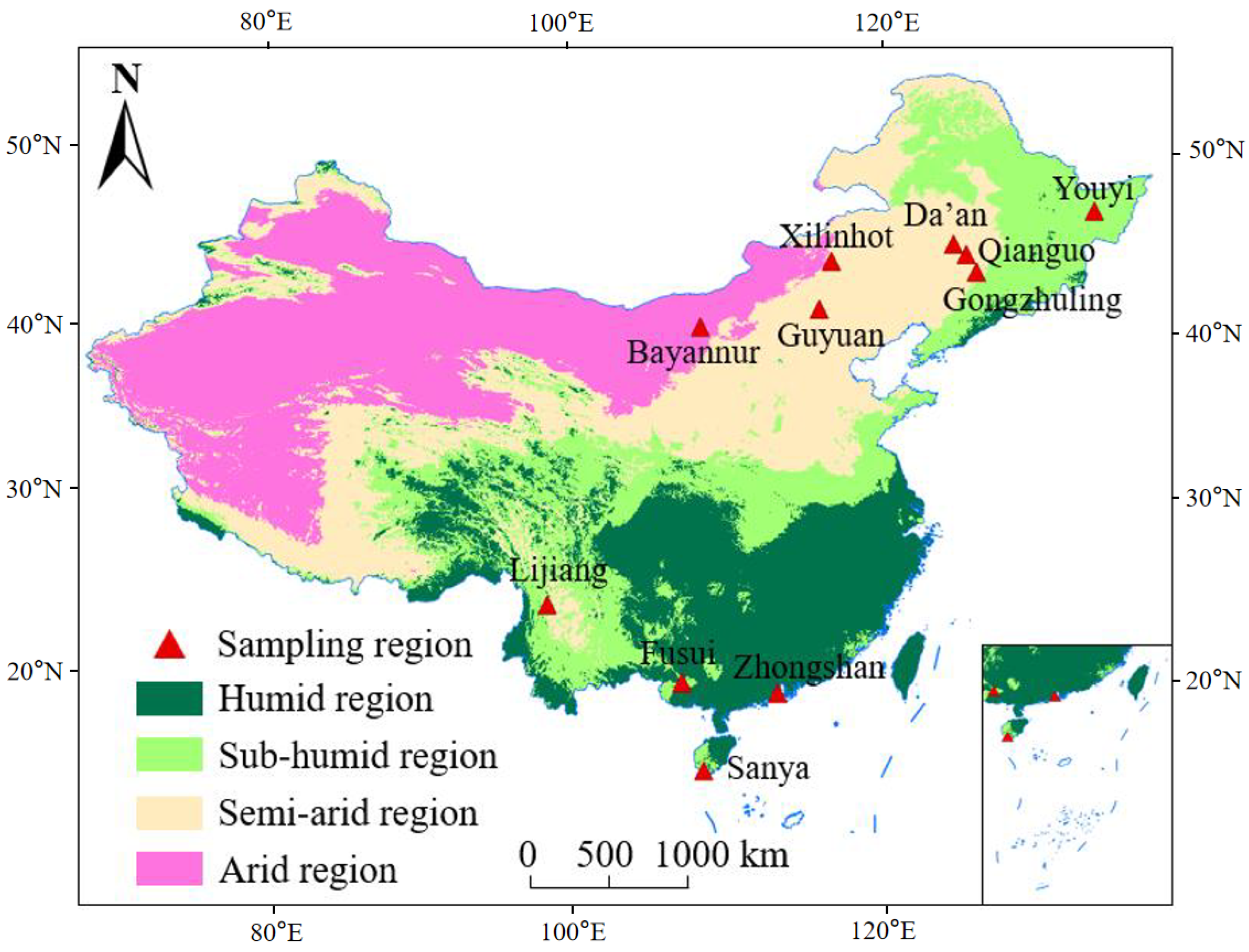
Figure 1. Spatial distribution of the study areas.
Remotesensing 18 01453 g001
Figure 2. Distribution map of the 11 experimental areas and 24 m multi-scale nested sampling plots and points. (a) Guyuan, Hebei Province (18 km × 4 km); (b) Xilinhot, Inner Mongolia Autonomous Region (3 km × 1 km); (c) Youyi, Heilongjiang Province (28 km × 16 km); (d) Sanya, Hainan Province (8 km × 8 km); (e) Lijiang, Yunnan Province (18 km × 46 km); (f) Da’an, Jilin Province (20 km × 20 km); (g) Qianguo, Jilin Province (15 km × 24 km); (h) Gongzhuling, Jilin Province (25 km × 23 km); (i) Bayannur, Inner Mongolia Autonomous Region (14 km × 14 km); (j) Fusui, Guangxi Zhuang Autonomous Region (14 km × 17 km); (k) Zhongshan, Guangdong Province (11 km × 13 km); (l) schematic diagram of the sampling plots and points.
Remotesensing 18 01453 g002
Figure 3. Comparison chart of soil texture (sand, silt, clay) distribution in each experimental area.
Remotesensing 18 01453 g003
Figure 4. Technical flowchart for mv and s retrieval.
Remotesensing 18 01453 g004
Figure 5. Scatter density plots showing the nonlinear dependence of the difference between satellite-observed and simulated backscattering coefficients on the satellite-observed backscattering coefficient for each polarization channel.
Remotesensing 18 01453 g005
Figure 6. Box plots illustrating the variations of the difference between satellite-observed and simulated backscattering coefficients with the radar incidence angle across different polarization channels.
Remotesensing 18 01453 g006
Figure 7. Scatter density plots of the simulated backscattering coefficients versus satellite-observed backscattering coefficients before and after systematic deviation correction for each polarization channel.
Remotesensing 18 01453 g007
Figure 8. Scatter density plots and fitted curves of satellite-observed Vertical-Vertical and Horizontal-Vertical polarized backscattering coefficients versus volumetric soil moisture and surface root mean square height.
Remotesensing 18 01453 g008
Figure 9. Scatter density plots of estimated prior volumetric soil moisture and prior surface root mean square height versus measured reference values on the testing set.
Remotesensing 18 01453 g009
Figure 10. Comparison of retrieved versus measured mv and s across the four retrieval strategies. (ad) mv on the training set; (eh) mv on the testing set; (il) s on the training set; (mp) s on the testing set. Columns from left to right correspond to Strategies I through IV.
Remotesensing 18 01453 g010
Figure 11. Spatial transferability validation of the four retrieval strategies in the Youyi experimental area.
Remotesensing 18 01453 g011
Figure 12. Performance consistency of the four retrieval strategies across the GF-3 constellation.
Remotesensing 18 01453 g012
Table 1. Main parameters of the experimental sites and the corresponding GF-3 series SAR imagery. Note: The number of samples exceeds the number of plots due to the availability of multi-temporal satellite observations for certain plots.
Experimental SiteCenter CoordinatesΘ (°)Number of PlotsNumber of Samplesmv (cm3/cm3)S (cm)Satellite PlatformSampling DateAcquisition Date
GY
(Hebei)
41.74°N, 115.84°E28.4–30.820200.098–0.1210.64–1.65GF-32020-10-15~162020-10-15~16
XLHT(Inner Mongolia)44.17°N, 116.54°E38.4–43.521210.038–0.1880.35–2.13GF-32022-10-04~052022-10-04~05
YY
(Heilongjiang)
46.71°N, 131.75°E25.5–39.654540.065–0.3580.72–3.29GF-3/3C2022-10-30;
2023-04-26~27
2022-10-29;
2023-04-26
SY
(Hainan)
18.38°N, 109.16°E35.5–37.114140.040–0.2070.85–1.99GF-32023-03-03~042023-03-03~04
LJ
(Yunnan)
26.77°N, 100.11°E23.4–45.4681060.154–0.2980.37–2.81GF-3/3B/3C2023-11-24~28;
2024-10-30~11-01
2023-11-24~28;
2024-11-01
DA
(Jilin)
45.04°N, 123.60°E23.4–24.619190.013–0.1040.41–0.89GF-3B2024-05-08~092024-05-08~09
QG
(Jilin)
44.51°N, 124.34°E28.0–29.323230.033–0.1640.39–1.16GF-3C2024-05-10~132024-05-10~13
GZL
(Jilin)
43.63°N, 124.93°E42.5–43.619190.055–0.1260.39–0.91GF-3B2024-05-21~232024-05-21~23
BYNE(Inner Mongolia)40.84°N, 108.96°E41.8–42.521340.022–0.1470.22–0.82GF-3/3C2024-08-19~202024-08-19~21
FS
(Guangxi)
22.84°N, 107.90°E28.6–29.640510.128–0.2270.58–3.27GF-32024-10-24~262024-10-24~26
ZS (Guangdong)22.31°N, 113.43°E41.5–42.017170.131–0.2390.94–2.25GF-32024-11-30~12-022024-11-30~12-02
Table 2. Statistical comparison of simulated backscattering coefficients before and after systematic deviation correction across polarization channels.
DatasetPolarizationR
Uncorr./Corr.
RMSE (dB)
Uncorr./Corr.
Bias (dB)
Uncorr./Corr.
ubRMSE (dB)
Uncorr./Corr.
Overall (N = 378)VV0.614/0.7443.921/2.9762.077/−0.0133.326/2.976
HH0.575/0.7393.748/3.1880.780/0.0043.666/3.188
HV0.574/0.7374.702/4.159−0.285/−0.0614.694/4.158
Train (N = 264)VV0.634/0.7553.874/2.9672.054/0.0003.284/2.967
HH0.587/0.7463.728/3.1920.709/0.0003.661/3.192
HV0.599/0.7534.624/4.103−0.251/0.0004.618/4.103
Test (N = 114)VV0.564/0.7174.028/2.9982.131/−0.0433.418/2.998
HH0.546/0.7213.794/3.1800.947/0.0123.674/3.180
HV0.511/0.6964.878/4.284−0.363/−0.2024.865/4.279
Table 3. Calibrated coefficients of the systematic deviation correction model for each polarization channel.
Polarizationαβγ
VV0.3910.192−3.758
HH0.4620.240−3.473
HV0.3550.2430.098
Disclaimer/Publisher’s Note: The statements, opinions and data contained in all publications are solely those of the individual author(s) and contributor(s) and not of MDPI and/or the editor(s). MDPI and/or the editor(s) disclaim responsibility for any injury to people or property resulting from any ideas, methods, instructions or products referred to in the content.