A Prior Knowledge-Guided Remote Sensing Framework for Maize Yield Estimation and Spatiotemporal Interpretability Analysis
 ,
,
Highlights
- The proposed prior knowledge-guided YFKD-XGBoost model achieved high-precision regional maize yield estimation by fusing multi-dimensional remote sensing features.
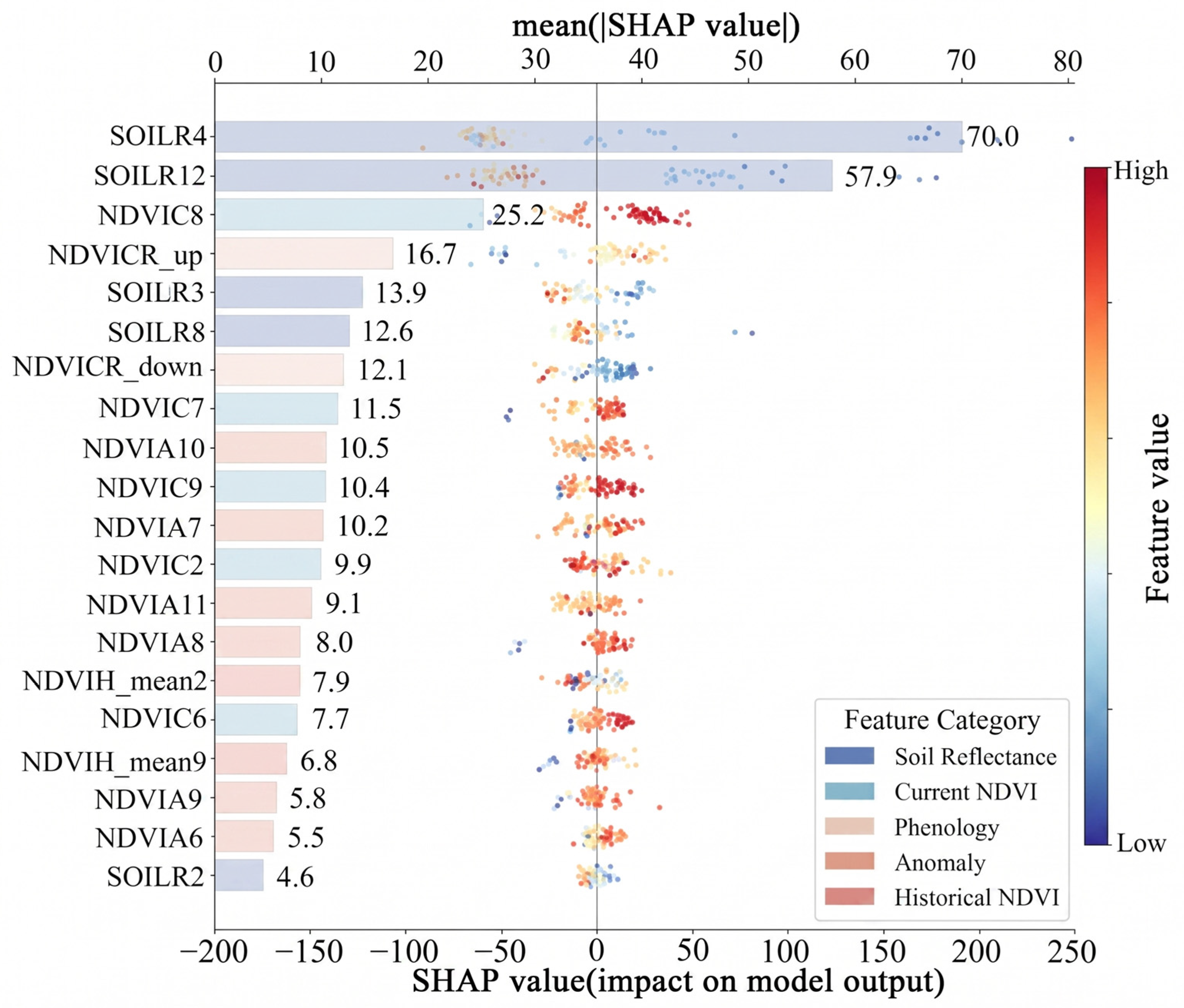
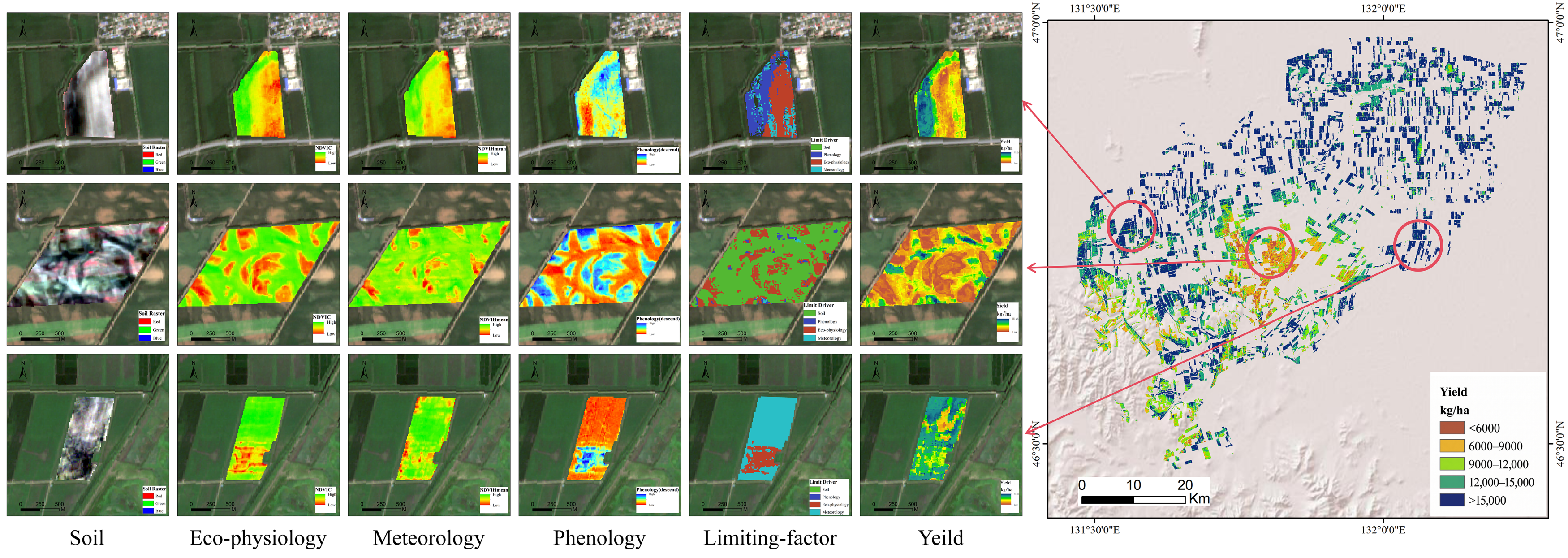
- SHAP analysis comprehensively revealed the driving factors of maize yield formation from global, temporal, and spatial perspectives.
- The framework successfully translates complex crop mechanistic parameters into observable remote sensing features, significantly enhancing the interpretability of machine learning models.
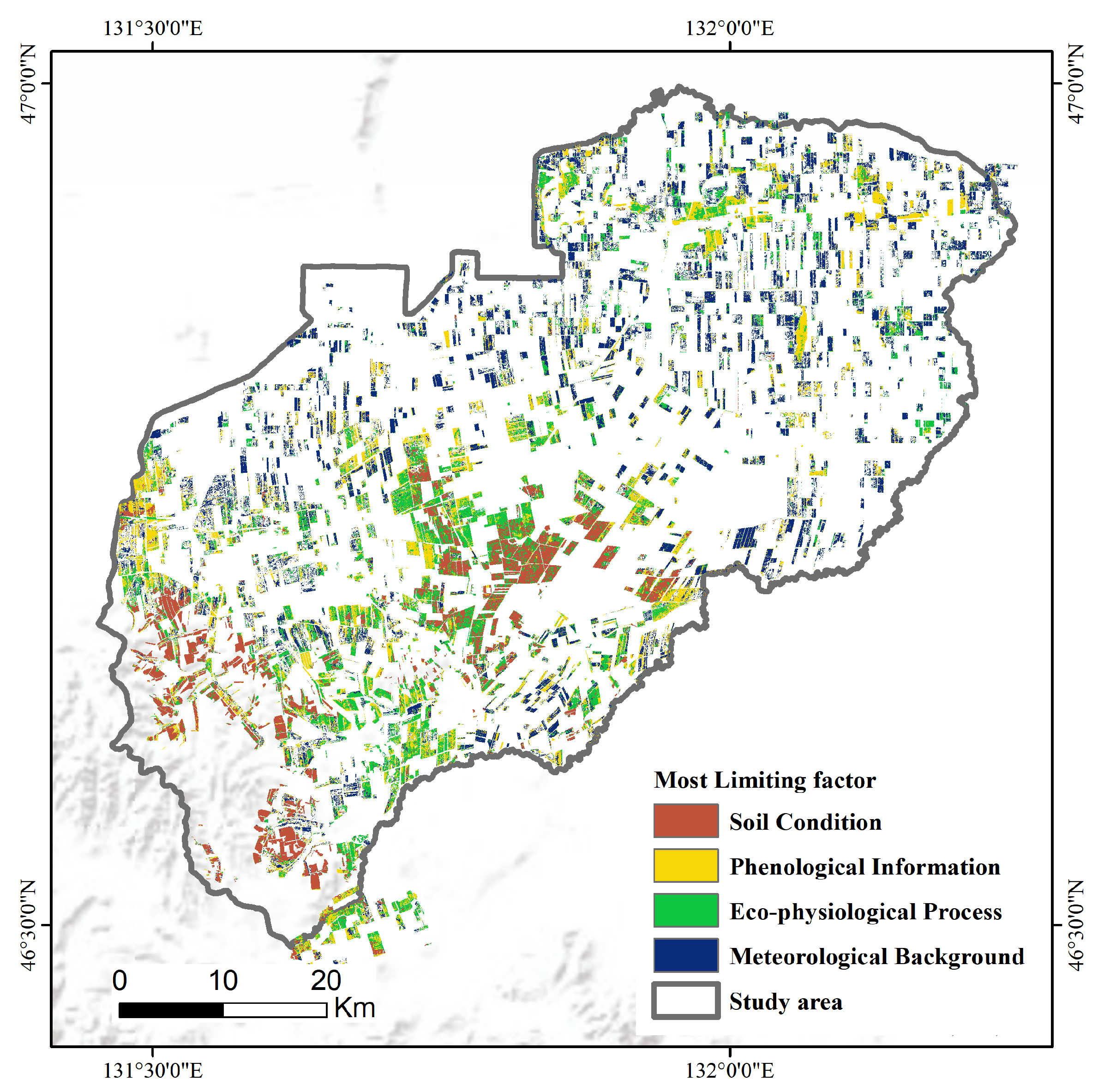
- The spatial diagnosis of specific yield-limiting factors provides a scalable, actionable tool to support site-specific, differentiated precision agriculture management and decision-making.
Abstract
1. Introduction
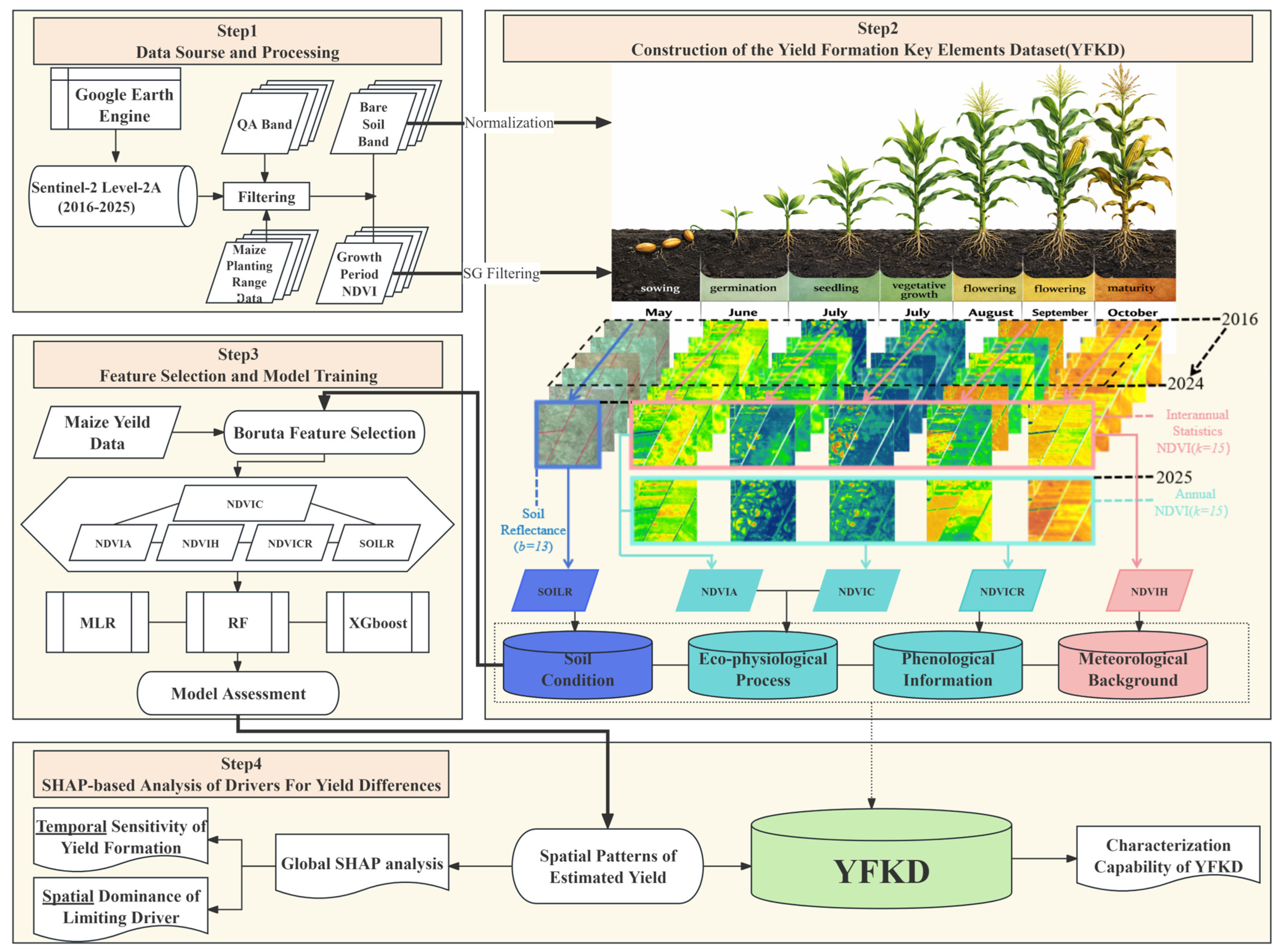
- To systematically characterize yield driving factors across four dimensions—Meteorological Background, Eco-physiological Process, Phenological Information, and Soil Conditions—using remote sensing data to construct the Yield-Formation Key Dataset (YFKD);
- To select optimal features for constructing feature sets, systematically compare the performance of Multiple Linear Regression (MLR), Random Forest (RF), and XGBoost models, and progressively evaluate the accuracy improvements driven by different feature groups within the YFKD;
- To employ SHAP analysis to comprehensively interpret the yield estimation results of the optimal model, and quantify the global relative contribution of the four dimensions: Meteorological Background, Eco-physiological Process, Phenological Information, and Soil Conditions;
- To reveal critical periods affecting yield, identify spatial yield-limiting factors, and systematically elucidate the factors underlying regional spatiotemporal yield variability.
2. Materials and Methods
2.1. Study Area
2.2. Data Sources and Preprocessing
2.2.1. Optical Remote Sensing Data
2.2.2. Vegetation Index Calculation
2.2.3. Yield Data
2.2.4. Crop Classification Data and Field Boundaries
2.3. Methodology
2.3.1. Construction of the Yield-Formation Key Dataset (YFKD)
- Meteorological Background ()
- 2.
- Eco-physiological Process ()
- 3.
- Phenological Information ()
- 4.
- Soil Conditions ()
2.3.2. Feature Selection and Predictor Set Construction
2.3.3. Experimental Design and Model Construction
2.3.4. Model Evaluation Metrics
2.3.5. Interpretation of Yield Drivers Using SHAP
- Global Contribution Analysis
- 2.
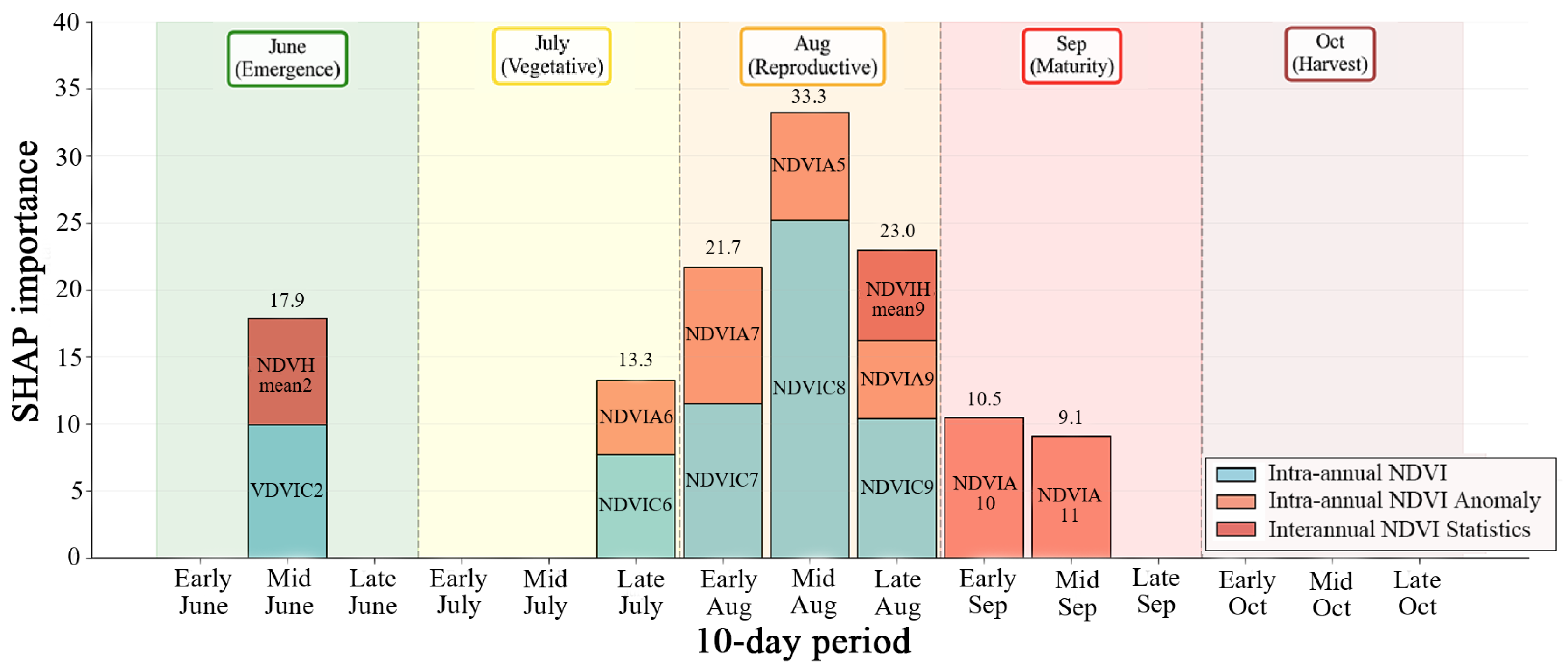
- Temporal Feature Importance Analysis
- 3.
- Spatial Pattern Analysis of Limiting Factors
3. Results
3.1. Optimal Feature Selection Results
3.2. Model Performance Comparison
3.3. Spatial Patterns of Estimated Yield
3.4. SHAP-Based Analysis of Yield Drivers
4. Discussion
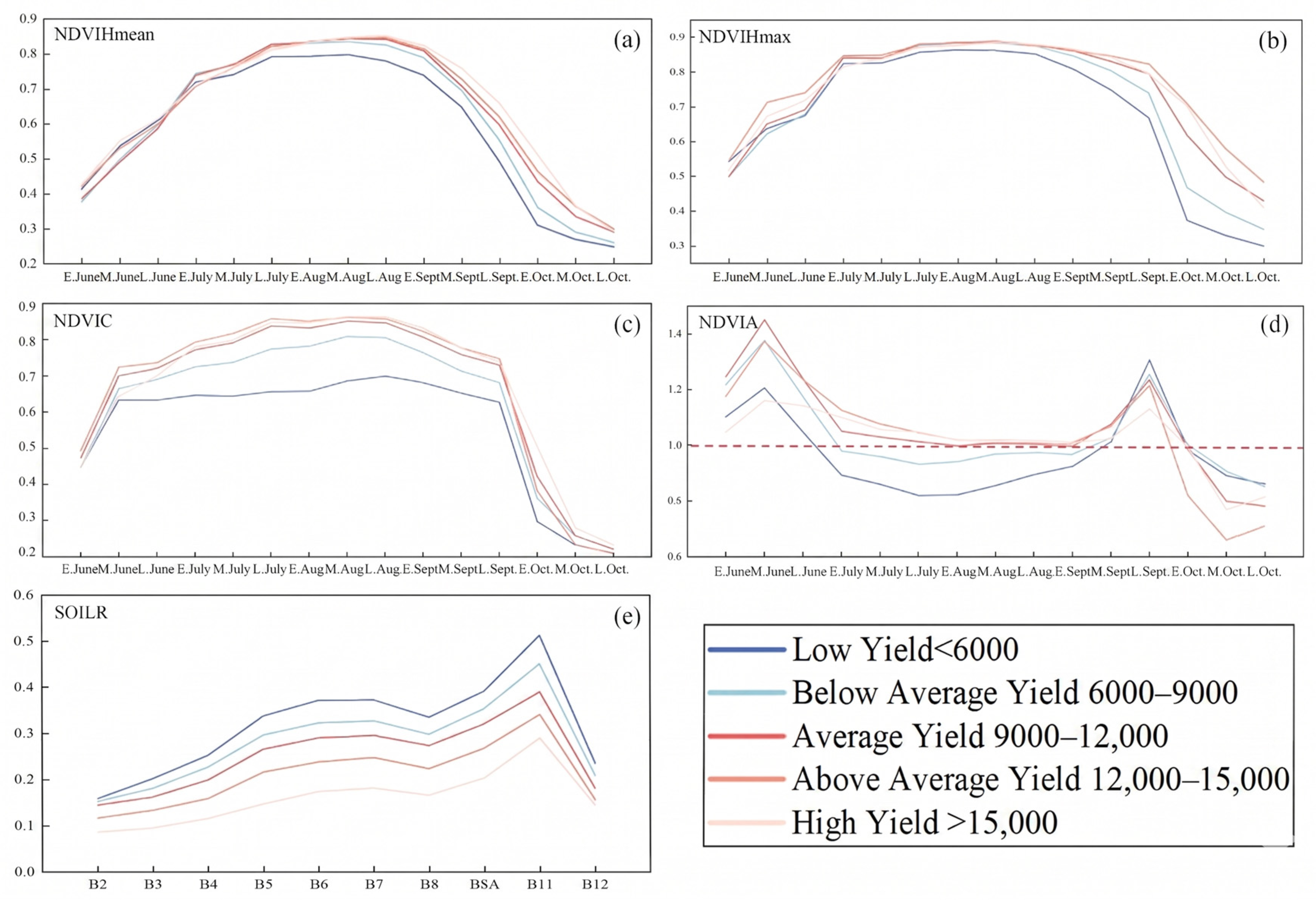
4.1. Spatiotemporal Characterization Capability of the YFKD
4.2. Analysis of Key Monitoring Time Windows for Yield Formation
4.3. Spatial Distribution Patterns of Regional Yield-Limiting Factors
4.4. Mechanism of Accuracy Enhancement via Multi-Dimensional Spatiotemporal Feature Fusion
5. Conclusions
Author Contributions
Funding
Data Availability Statement
Acknowledgments
Conflicts of Interest
References
- Kayad, A.; Sozzi, M.; Gatto, S.; Marinello, F.; Pirotti, F. Monitoring Within-Field Variability of Corn Yield using Sentinel-2 and Machine Learning Techniques. Remote Sens. 2019, 11, 2873. [Google Scholar] [CrossRef]
- Lu, C.; Leng, G.; Liao, X.; Tu, H.; Qiu, J.; Li, J.; Huang, S.; Peng, J. In-season maize yield prediction in Northeast China: The phase-dependent benefits of assimilating climate forecast and satellite observations. Agric. For. Meteorol. 2024, 358, 110242. [Google Scholar] [CrossRef]
- Maestrini, B.; Basso, B. Drivers of within-field spatial and temporal variability of crop yield across the US Midwest. Sci. Rep. 2018, 8, 14833. [Google Scholar] [CrossRef]
- Colaço, A.F.; Bramley, R.G.V. Do crop sensors promote improved nitrogen management in grain crops? Field Crops Res. 2018, 218, 126–140. [Google Scholar] [CrossRef]
- Jin, Z.; Azzari, G.; You, C.; Di Tommaso, S.; Aston, S.; Burke, M.; Lobell, D.B. Smallholder maize area and yield mapping at national scales with Google Earth Engine. Remote Sens. Environ. 2019, 228, 115–128. [Google Scholar] [CrossRef]
- Paudel, D.; Boogaard, H.; Wit, A.D.; Janssen, S.; Osinga, S.; Pylianidis, C.; Athanasiadis, I.N. Machine learning for large-scale crop yield forecasting. Agric. Syst. 2021, 187, 103016. [Google Scholar] [CrossRef]
- Kogan, F.N. Global Drought Watch from Space. Bull. Am. Meteorol. Soc. 1997, 78, 621–636. [Google Scholar] [CrossRef]
- Unganai, L.S.; Kogan, F.N. Drought Monitoring and Corn Yield Estimation in Southern Africa from AVHRR Data. Remote Sens. Environ. 1998, 63, 219–232. [Google Scholar] [CrossRef]
- Labus, M.P.; Nielsen, G.A.; Lawrence, R.L.; Engel, R.; Long, D.S. Wheat yield estimates using multi-temporal NDVI satellite imagery. Int. J. Remote Sens. 2002, 23, 4169–4180. [Google Scholar] [CrossRef]
- Moriondo, M.; Maselli, F.; Bindi, M. A simple model of regional wheat yield based on NDVI data. Eur. J. Agron. 2007, 26, 266–274. [Google Scholar] [CrossRef]
- Sakamoto, T.; Wardlow, B.D.; Gitelson, A.A.; Verma, S.B.; Suyker, A.E.; Arkebauer, T.J. A Two-Step Filtering approach for detecting maize and soybean phenology with time-series MODIS data. Remote Sens. Environ. 2010, 114, 2146–2159. [Google Scholar] [CrossRef]
- Chlingaryan, A.; Sukkarieh, S.; Whelan, B. Machine learning approaches for crop yield prediction and nitrogen status estimation in precision agriculture: A review. Comput. Electron. Agric. 2018, 151, 61–69. [Google Scholar] [CrossRef]
- Zhou, X.; Song, J.; Dang, Y.; Xiao, Z.; Yang, H. Real-time prediction of corn yield from single-phase SAR and optical remote sensing data using deep learning. Eur. J. Agron. 2025, 171, 127819. [Google Scholar] [CrossRef]
- Hu, T.; Liu, Z.; Hu, R.; Zeng, L.; Deng, K.; Dong, H.; Li, M.; Deng, Y.J. Yield prediction method for regenerated rice based on hyperspectral image and attention mechanisms. Smart Agric. Technol. 2025, 10, 100804. [Google Scholar] [CrossRef]
- Ji, Z.; Pan, Y.; Zhu, X.; Adem, E.S. Combining multi-source data, phenology information, and machine learning approaches to estimate crop yield in the United States. Field Crops Res. 2026, 336, 110219. [Google Scholar] [CrossRef]
- Zhang, M.; Zhang, B.; Zhao, C.; Chen, L.; Kuai, Y.; Wang, C.; Jiang, S.; Chen, D.; Zhu, Q.; Wang, Z.; et al. Tobacco yield estimation via multi-source data fusion and recurrent neural networks. Int. J. Appl. Earth Obs. Geoinf. 2025, 144, 104925. [Google Scholar] [CrossRef]
- Hu, W.S.; Li, H.C.; Deng, Y.J.; Sun, X.; Du, Q.; Plaza, A. Lightweight Tensor Attention-Driven ConvLSTM Neural Network for Hyperspectral Image Classification. IEEE J. Sel. Top. Signal Process. 2021, 15, 734–745. [Google Scholar] [CrossRef]
- Yang, J.; Liu, L.; Yang, Q.; Jia, X.; Peng, B.; Guan, K.; Jin, Z. Knowledge-guided graph machine learning improves corn yield mapping in the U.S. Midwest. Remote Sens. Environ. 2026, 335, 115287. [Google Scholar] [CrossRef]
- Hu, W.S.; Li, W.; Li, H.C.; Huang, F.H.; Tao, R. Global Clue-Guided Cross-Memory Quaternion Transformer Network for Multisource Remote Sensing Data Classification. IEEE Trans. Neural Netw. Learn. Syst. 2025, 36, 7357–7371. [Google Scholar] [CrossRef]
- Zhang, J.; Guan, K.; Chen, Z.; Hipple, J.; Huang, Y.; Peng, B.; Wang, S.; Xu, X.; Jin, Z.; Zhao, K.; et al. Aligning satellite-based phenology in a deep learning model for improved crop yield estimates over large regions. Agric. For. Meteorol. 2025, 372, 110675. [Google Scholar] [CrossRef]
- Deng, Y.J.; Zhang, L.W.; Ren, L.; Zhu, X.; Li, H.C.; Du, Q. Tensor Decomposition-Based Relaxed Linear Regression for Hyperspectral Image Classification. IEEE Trans. Geosci. Remote Sens. 2025, 63, 5514516. [Google Scholar] [CrossRef]
- Shariati, S.A.K.; Abbasi, A. Machine learning-based winter wheat yield prediction using multisource data. Agric. Water Manag. 2025, 322, 109951. [Google Scholar] [CrossRef]
- Bouras, E.H.; Jarlan, L.; Er-Raki, S.; Balaghi, R.; Amazirh, A.; Richard, B.; Khabba, S. Cereal Yield Forecasting with Satellite Drought-Based Indices, Weather Data and Regional Climate Indices Using Machine Learning in Morocco. Remote Sens. 2021, 13, 3101. [Google Scholar] [CrossRef]
- Dhaliwal, J.K.; Panday, D.; Saha, D.; Lee, J.; Jagadamma, S.; Schaeffer, S.; Mengistu, A. Predicting and interpreting cotton yield and its determinants under long-term conservation management practices using machine learning. Comput. Electron. Agric. 2022, 199, 107107. [Google Scholar] [CrossRef]
- Han, Y.; Wang, K.; Yang, F.; Pan, S.; Liu, Z.; Zhang, Q.; Zhang, Q. Prediction of maize cultivar yield based on machine learning algorithms for precise promotion and planting. Agric. For. Meteorol. 2024, 355, 110123. [Google Scholar] [CrossRef]
- Huber, F.; Yushchenko, A.; Stratmann, B.; Steinhage, V. Extreme Gradient Boosting for yield estimation compared with Deep Learning approaches. Comput. Electron. Agric. 2022, 202, 107346. [Google Scholar] [CrossRef]
- Zhu, B.; Wu, H.; Li, S.; Chen, L.; Song, K. A concise real-time identification method of maize phenological period based on remote sensing time information and segmented machine learning algorithm. Remote Sens. Environ. 2026, 338, 115349. [Google Scholar] [CrossRef]
- Li, Y.; Zeng, H.; Zhang, M.; Wu, B.; Qin, X. Global de-trending significantly improves the accuracy of XGBoost-based county-level maize and soybean yield prediction in the Midwestern United States. GIScience Remote Sens. 2024, 61, 2307481. [Google Scholar] [CrossRef]
- Zhou, W.; Zhou, W.; Cammarano, D.; Butterbach-Bahl, K.; Olesen, J.E.; Lin, Z.; Huang, T.; Cai, G.; Zhang, J.; Qiu, J.; et al. Unraveling the impact of environmental factors on wheat yield across the European Union via explainable machine learning. Comput. Electron. Agric. 2026, 241, 111268. [Google Scholar] [CrossRef]
- Xia, C.; Ren, C.; Wang, Y.; Wang, Z.; Jia, M.; Xi, Y.; Liu, P.; Ren, H.; Hou, Q.; Ruan, X. Decoding soil-topography buffering of maize yield spatial heterogeneity in extreme precipitation year using Sentinel-2 data and SHAP interpretability. Field Crops Res. 2026, 337, 110263. [Google Scholar] [CrossRef]
- Oikonomidis, A.; Catal, C.; Kassahun, A. Deep learning for crop yield prediction: A systematic literature review. N. Z. J. Crop Hortic. Sci. 2023, 51, 1–26. [Google Scholar] [CrossRef]
- Zhang, Y.; Luo, C.; Ma, Y.; Kong, D.; Wang, Y.; Zhang, W.; Liu, H. Effects of Farmland Scale on Soil Organic Matter Change in Black Soil Areas of China in the Past 40 Years. Land Degrad. Dev. 2026, 1–18. [Google Scholar] [CrossRef]
- Kong, D.; Luo, C.; Liu, H. Integrative remote sensing and machine learning approaches for SOC and TN spatial distribution: Unveiling C:N ratio in Black Soil region. Soil Tillage Res. 2026, 255, 106809. [Google Scholar] [CrossRef]
- Gorelick, N.; Hancher, M.; Dixon, M.; Ilyushchenko, S.; Thau, D.; Moore, R. Google Earth Engine: Planetary-scale geospatial analysis for everyone. Remote Sens. Environ. 2017, 202, 18–27. [Google Scholar] [CrossRef]
- Holben, B.N. Characteristics of maximum-value composite images from temporal AVHRR data. Int. J. Remote Sens. 1986, 7, 1417–1434. [Google Scholar] [CrossRef]
- Chen, J.; Jönsson, P.; Tamura, M.; Gu, Z.; Matsushita, B.; Eklundh, L. A simple method for reconstructing a high-quality NDVI time-series data set based on the Savitzky–Golay filter. Remote Sens. Environ. 2004, 91, 332–344. [Google Scholar] [CrossRef]
- Qiao, M.; He, X.; Cheng, X.; Li, P.; Zhao, Q.; Zhao, C.; Tian, Z. KSTAGE: A knowledge-guided spatial-temporal attention graph learning network for crop yield prediction. Inf. Sci. 2023, 619, 19–37. [Google Scholar] [CrossRef]
- Richardson, A.D.; Keenan, T.F.; Migliavacca, M.; Ryu, Y.; Sonnentag, O.; Toomey, M. Climate change, phenology, and phenological control of vegetation feedbacks to the climate system. Agric. For. Meteorol. 2013, 169, 156–173. [Google Scholar] [CrossRef]
- Rembold, F.; Meroni, M.; Otieno, V.; Kipkogei, O.; Mwangi, K.; de Sousa Afonso, J.M.; Ihadua, I.M.T.J.; José, A.E.A.; Zoungrana, L.E.; Taieb, A.H.; et al. New Functionalities and Regional/National Use Cases of the Anomaly Hotspots of Agricultural Production (ASAP) Platform. Remote Sens. 2023, 15, 4284. [Google Scholar] [CrossRef]
- Tucker, C.J. Red and photographic infrared linear combinations for monitoring vegetation. Remote Sens. Environ. 1979, 8, 127–150. [Google Scholar] [CrossRef]
- Vos, K.D.; Gebruers, S.; Degerickx, J.; Iordache, M.D.; Keune, J.; Di Giuseppe, F.; Pereira, F.V.; Wouters, H.; Swinnen, E.; Van Rossum, K.; et al. Predicting below-average NDVI anomalies for agricultural drought impact forecasting. Remote Sens. Environ. 2025, 330, 114980. [Google Scholar] [CrossRef]
- Meroni, M.; Schucknecht, A.; Fasbender, D.; Rembold, F.; Fava, F.; Mauclaire, M.; Goffner, D.; Di Lucchio, L.M.; Leonardi, U. Remote sensing monitoring of land restoration interventions in semi-arid environments with a before–after control-impact statistical design. Int. J. Appl. Earth Obs. Geoinf. 2017, 59, 42–52. [Google Scholar]
- Bolton, D.K.; Friedl, M.A. Forecasting crop yield using remotely sensed vegetation indices and crop phenology metrics. Agric. For. Meteorol. 2013, 173, 74–84. [Google Scholar] [CrossRef]
- Pei, J.; Tan, S.; Zou, Y.; Liao, C.; He, Y.; Wang, J.; Huang, H.; Wang, T.; Tian, H.; Fang, H.; et al. The role of phenology in crop yield prediction: Comparison of ground-based phenology and remotely sensed phenology. Agric. For. Meteorol. 2025, 361, 110340. [Google Scholar] [CrossRef]
- Wang, C.; Luo, C.; Meng, X.; Wang, C.; Liu, H. Intelligent mapping paradigm to overcome systematic bias in remote sensing SOC estimation: A case study of the black soil region in China and the United States. ISPRS J. Photogramm. Remote Sens. 2025, 230, 644–660. [Google Scholar] [CrossRef]
- Meng, X.; Bao, Y.; Zhang, X.; Luo, C.; Liu, H. A long-term global Mollisols SOC content prediction framework: Integrating prior knowledge, geographical partitioning, and deep learning models with spatio-temporal validation. Remote Sens. Environ. 2025, 318, 114592. [Google Scholar] [CrossRef]
- Dvorakova, K.; Heiden, U.; Pepers, K.; Staats, G.; van Os, G.; van Wesemael, B. Improving soil organic carbon predictions from a Sentinel–2 soil composite by assessing surface conditions and uncertainties. Geoderma 2023, 429, 116128. [Google Scholar] [CrossRef]
- Zhang, X.; Chen, S.; Xue, J.; Wang, N.; Xiao, Y.; Chen, Q.; Hong, Y.; Zhou, Y.; Teng, H.; Hu, B.; et al. Improving model parsimony and accuracy by modified greedy feature selection in digital soil mapping. Geoderma 2023, 432, 116383. [Google Scholar] [CrossRef]
- Luo, C.; Zhang, X.; Wang, Y.; Men, Z.; Liu, H. Regional soil organic matter mapping models based on the optimal time window, feature selection algorithm and Google Earth Engine. Soil Tillage Res. 2022, 219, 105325. [Google Scholar] [CrossRef]
- Iniyan, S.; Varma, V.A.; Naidu, C.T. Crop yield prediction using machine learning techniques. Adv. Eng. Softw. 2023, 175, 103326. [Google Scholar] [CrossRef]
- Belgiu, M.; Drăguţ, L. Random forest in remote sensing: A review of applications and future directions. ISPRS J. Photogramm. Remote Sens. 2016, 114, 24–31. [Google Scholar] [CrossRef]
- Chen, T.; Guestrin, C. XGBoost: A Scalable Tree Boosting System. In Proceedings of the 22nd ACM SIGKDD International Conference on Knowledge Discovery and Data Mining (KDD ‘16), New York, NY, USA, 13–17 August 2016; pp. 785–794. [Google Scholar]
- Sejuti, Z.A.; Islam, M.S. A hybrid CNN–KNN approach for identification of COVID-19 with 5-fold cross validation. Sens. Int. 2023, 4, 100229. [Google Scholar] [CrossRef]
- Wei, M.C.F.; Molin, J.P.; Longchamps, L. Predictive power vs interpretability: Machine learning approaches to unravel sugarcane yield drivers. Comput. Electron. Agric. 2026, 243, 111353. [Google Scholar] [CrossRef]
- Lundberg, S.M.; Lee, S.I. A unified approach to interpreting model predictions. In Advances in Neural Information Processing Systems 30; Curran Associates, Inc.: Red Hook, NY, New York, 2017. [Google Scholar]
- Wolanin, A.; Mateo-García, G.; Camps-Valls, G.; Gómez-Chova, L.; Meroni, M.; Duveiller, G.; Guanter, L. Estimating and understanding crop yields with explainable deep learning in the Indian Wheat Belt. Environ. Res. Lett. 2020, 15, 024019. [Google Scholar] [CrossRef]
- Han, Z.; Song, W. Interannual trends of vegetation and responses to climate change and human activities in the Great Mekong Subregion. Glob. Ecol. Conserv. 2022, 38, e02215. [Google Scholar] [CrossRef]
- Hansen, P.M.; Schjoerring, J.K. Reflectance measurement of canopy biomass and nitrogen status in wheat crops using normalized difference vegetation indices and partial least squares regression. Remote Sens. Environ. 2003, 86, 542–553. [Google Scholar] [CrossRef]
- Baumgardner, M.F.; Silva, L.R.F.; Biehl, L.L.; Stoner, E.R. Reflectance properties of soils. Adv. Agron. 1986, 38, 1–44. [Google Scholar]
- Zhang, X.; Zhang, Q. Monitoring interannual variation in global crop yield using long-term AVHRR and MODIS observations. ISPRS J. Photogramm. Remote Sens. 2016, 114, 191–205. [Google Scholar] [CrossRef]
- Basso, B.; Shuai, G.; Zhang, J.; Robertson, G.P. Yield stability analysis reveals sources of large-scale nitrogen loss from the US Midwest. Sci. Rep. 2019, 9, 5774. [Google Scholar] [CrossRef]





| Date | Dekads | |
|---|---|---|
| 1 | 0601–0610 | Early June |
| 2 | 0611–0620 | Middle June |
| 3 | 0621–0630 | Late June |
| 4 | 0701–0710 | Early July |
| 5 | 0711–0720 | Middle July |
| 6 | 0721–0731 | Late July |
| 7 | 0801–0810 | Early August |
| 8 | 0811–0820 | Middle August |
| 9 | 0821–0831 | Late August |
| 10 | 0901–0910 | Early September |
| 11 | 0911–0920 | Middle September |
| 12 | 0921–0930 | Late September |
| 13 | 1001–1010 | Early October |
| 14 | 1011–1020 | Middle October |
| 15 | 1021–1031 | Late October |
| YFKD | Group | Vairable | Number |
|---|---|---|---|
| Meteorological Background | Interannual NDVI Statistics | 15 | |
| 15 | |||
| 15 | |||
| 15 | |||
| 15 | |||
| Eco-physiological Process | Intra-annual NDVI | 15 | |
| Intra-annual NDVI Anomaly | 15 | ||
| Phenological Information | Intra-annual NDVI Change Rates | 2 | |
| Soil Conditions | Soil Spectral Reflectance | 13 |
| MLR | Random Forest | XGboost | ||||||||||
|---|---|---|---|---|---|---|---|---|---|---|---|---|
| RMSE | MAE | NRMSE | RMSE | MAE | NRMSE | RMSE | MAE | NRMSE | ||||
| 0.526 | 2806.55 | 2087.92 | 26.9% | 0.623 | 2503.14 | 1805.61 | 24.0% | 0.735 | 2096.08 | 1418.30 | 20.09% | |
| 0.453 | 3013.07 | 2346.77 | 28.8% | 0.589 | 2611.32 | 1843.83 | 25.3% | 0.644 | 2430.87 | 1768.52 | 23.30% | |
| 0.663 | 2366.55 | 1843.13 | 22.6% | 0.668 | 2349.07 | 1683.00 | 22.5% | 0.826 | 1698.19 | 1043.68 | 16.28% | |
| 0.617 | 2521.11 | 1938.27 | 24.1% | 0.669 | 2342.90 | 1706.81 | 22.4% | 0.831 | 1675.22 | 1050.96 | 16.06% | |
| 0.666 | 2355.75 | 1836.68 | 22.5% | 0.788 | 1877.88 | 1392.82 | 18.0% | 0.842 | 1615.40 | 1043.84 | 15.56% | |
| 0.691 | 2246.35 | 1749.55 | 21.4% | 0.764 | 1979.57 | 1425.23 | 18.8% | 0.865 | 1492.12 | 999.81 | 14.37% | |
| Yield Class | Observed Mean (kg/ha) | XGBoost Predicted Mean (kg/ha) | Bias |
|---|---|---|---|
| Low | 4357 | 4682 | 325 |
| Below Average | 7589 | 7421 | −168 |
| Average | 10,412 | 10,298 | −114 |
| Above Average | 13,387 | 13,512 | 125 |
| High | 17,894 | 17,456 | −438 |
Disclaimer/Publisher’s Note: The statements, opinions and data contained in all publications are solely those of the individual author(s) and contributor(s) and not of MDPI and/or the editor(s). MDPI and/or the editor(s) disclaim responsibility for any injury to people or property resulting from any ideas, methods, instructions or products referred to in the content. |
© 2026 by the authors. Licensee MDPI, Basel, Switzerland. This article is an open access article distributed under the terms and conditions of the Creative Commons Attribution (CC BY) license.
Share and Cite
Qi, B.; Zhang, X.; Chen, L.; Liu, H.; Meng, L.; Han, X.; An, Z.; Liu, J. A Prior Knowledge-Guided Remote Sensing Framework for Maize Yield Estimation and Spatiotemporal Interpretability Analysis. Remote Sens. 2026, 18, 1455. https://doi.org/10.3390/rs18101455
Qi B, Zhang X, Chen L, Liu H, Meng L, Han X, An Z, Liu J. A Prior Knowledge-Guided Remote Sensing Framework for Maize Yield Estimation and Spatiotemporal Interpretability Analysis. Remote Sensing. 2026; 18(10):1455. https://doi.org/10.3390/rs18101455
Chicago/Turabian StyleQi, Beisong, Xinle Zhang, Lu Chen, Huanjun Liu, Linghua Meng, Xinyi Han, Zeyu An, and Jiming Liu. 2026. "A Prior Knowledge-Guided Remote Sensing Framework for Maize Yield Estimation and Spatiotemporal Interpretability Analysis" Remote Sensing 18, no. 10: 1455. https://doi.org/10.3390/rs18101455
APA StyleQi, B., Zhang, X., Chen, L., Liu, H., Meng, L., Han, X., An, Z., & Liu, J. (2026). A Prior Knowledge-Guided Remote Sensing Framework for Maize Yield Estimation and Spatiotemporal Interpretability Analysis. Remote Sensing, 18(10), 1455. https://doi.org/10.3390/rs18101455