Figure 1.
Illustration of the radar surveillance process in KuRALS dataset. (a) The radar system is capable of detecting targets across a wide range of scenarios, including aerial UAVs, terrestrial pedestrians and cars, and marine ships. (b) To ensure detection algorithm optimization and evaluation, we provide precise annotations of target status through a combination of Global Positioning System (GPS) auto-labeling and algorithmic correction. By analyzing the radar range–Doppler (RD) spectrogram, the detection algorithm retrieves target distance, velocity and category information. Additionally, we calculate the azimuth and elevation of each target by utilizing the directional beam angle of the transmitted signal.
Figure 1.
Illustration of the radar surveillance process in KuRALS dataset. (a) The radar system is capable of detecting targets across a wide range of scenarios, including aerial UAVs, terrestrial pedestrians and cars, and marine ships. (b) To ensure detection algorithm optimization and evaluation, we provide precise annotations of target status through a combination of Global Positioning System (GPS) auto-labeling and algorithmic correction. By analyzing the radar range–Doppler (RD) spectrogram, the detection algorithm retrieves target distance, velocity and category information. Additionally, we calculate the azimuth and elevation of each target by utilizing the directional beam angle of the transmitted signal.
Figure 2.
Illustration of the preprocessing pipeline for PD radar data. In this process, narrow pulse wave and wide pulse wave data are integrated into a unified single-frame RD map.
Figure 2.
Illustration of the preprocessing pipeline for PD radar data. In this process, narrow pulse wave and wide pulse wave data are integrated into a unified single-frame RD map.
Figure 3.
Representative intermediate results during preprocessing of PD radar data: (a) original narrow pulse RD map, (b) original wide pulse RD map, (c) narrow pulse RD map after zero-frequency elimination, (d) wide pulse RD map after zero-frequency elimination and (e) fused RD map. The zero-frequency elimination effectively suppresses strong background clutter, while the fusion of narrow and wide pulse data provides comprehensive range coverage. Please note that the target’s peak position is indicated by a red asterisk.
Figure 3.
Representative intermediate results during preprocessing of PD radar data: (a) original narrow pulse RD map, (b) original wide pulse RD map, (c) narrow pulse RD map after zero-frequency elimination, (d) wide pulse RD map after zero-frequency elimination and (e) fused RD map. The zero-frequency elimination effectively suppresses strong background clutter, while the fusion of narrow and wide pulse data provides comprehensive range coverage. Please note that the target’s peak position is indicated by a red asterisk.
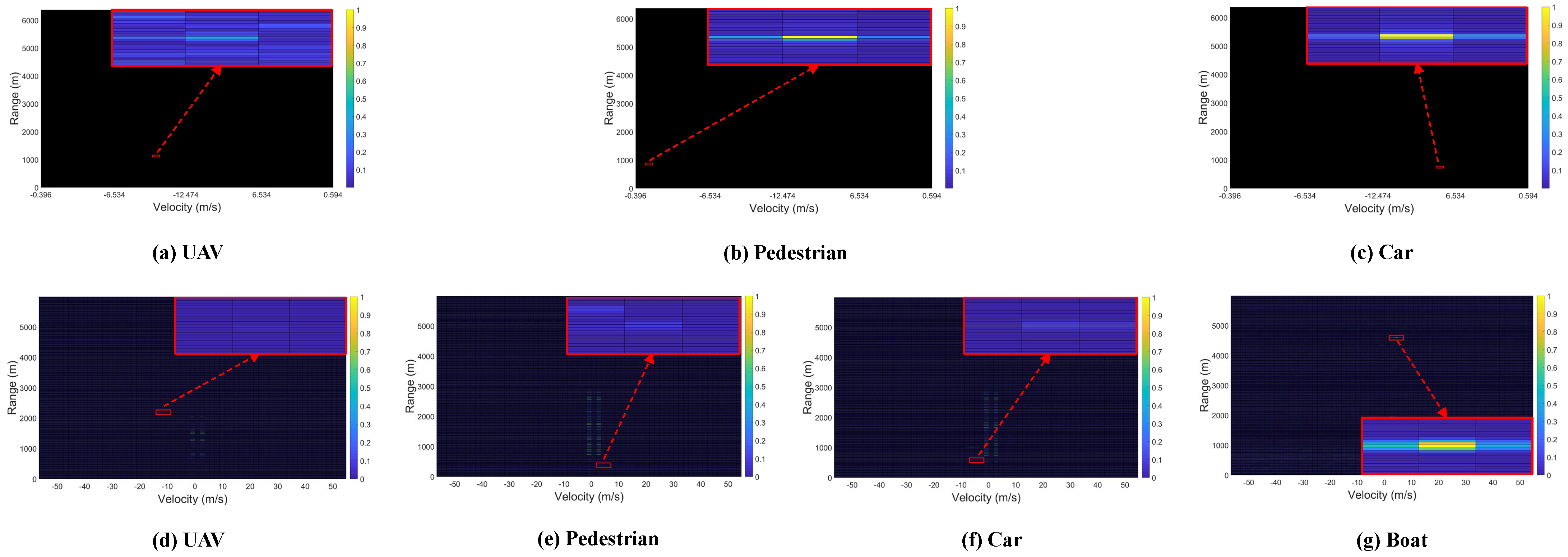
Figure 4.
Comparison of processed RD data frames containing different target categories collected by the CW radar and the PD radar in the range–Doppler 2D representation. RD data frames collected by the CW radar: (a) UAV, (b) pedestrian, (c) car. RD data frames collected by the PD radar: (d) UAV, (e) pedestrian, (f) car, (g) boat. To facilitate observation, we provide zoomed-in images of the targets outlined in red.
Figure 4.
Comparison of processed RD data frames containing different target categories collected by the CW radar and the PD radar in the range–Doppler 2D representation. RD data frames collected by the CW radar: (a) UAV, (b) pedestrian, (c) car. RD data frames collected by the PD radar: (d) UAV, (e) pedestrian, (f) car, (g) boat. To facilitate observation, we provide zoomed-in images of the targets outlined in red.
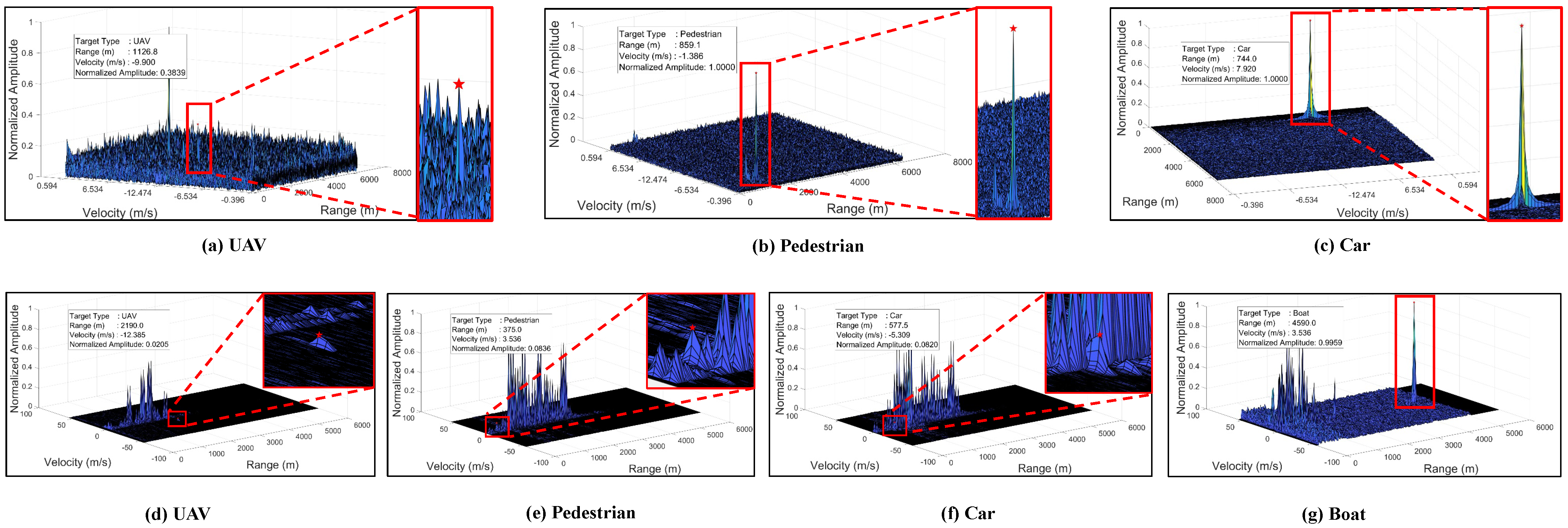
Figure 5.
Comparison of processed RD data frames containing different target categories collected by the CW radar and the PD radar in the range–Doppler–amplitude 3D representation. RD data frames collected by the CW radar: (a) UAV, (b) pedestrian, (c) car. RD data frames collected by the PD radar: (d) UAV, (e) pedestrian, (f) car, (g) boat. To facilitate observation, we provide zoomed-in images of the targets outlined in red, and the coordinates and amplitude of the target’s peak position are also presented. Please note that the target’s peak position is indicated by a red asterisk.
Figure 5.
Comparison of processed RD data frames containing different target categories collected by the CW radar and the PD radar in the range–Doppler–amplitude 3D representation. RD data frames collected by the CW radar: (a) UAV, (b) pedestrian, (c) car. RD data frames collected by the PD radar: (d) UAV, (e) pedestrian, (f) car, (g) boat. To facilitate observation, we provide zoomed-in images of the targets outlined in red, and the coordinates and amplitude of the target’s peak position are also presented. Please note that the target’s peak position is indicated by a red asterisk.
Figure 6.
Illustration of the RD map annotation pipeline. We first compute the real-world coordinates of the observed targets and transform them into the RD coordinate system. Subsequently, the peak responses in the RD map are leveraged to refine the target positions, which are then expanded into robust rectangular regions for annotation. Note that NMS denotes the non-maximum suppression operation.
Figure 6.
Illustration of the RD map annotation pipeline. We first compute the real-world coordinates of the observed targets and transform them into the RD coordinate system. Subsequently, the peak responses in the RD map are leveraged to refine the target positions, which are then expanded into robust rectangular regions for annotation. Note that NMS denotes the non-maximum suppression operation.
Figure 7.
Visualization of automatically annotated samples. The first and second rows correspond to one frame from the KuRALS-CW and KuRALS-PD datasets, respectively. First row: (a) RD map, (b) pixel-wise mask. Second row: (c) RD map, (d) pixel-wise mask. In the pixel-wise mask, different colors denote different classes. Black: background, red: UAV, yellow: pedestrian, cyan: car, green: boat. For better visualization, zoomed-in views of the targets outlined in white are provided.
Figure 7.
Visualization of automatically annotated samples. The first and second rows correspond to one frame from the KuRALS-CW and KuRALS-PD datasets, respectively. First row: (a) RD map, (b) pixel-wise mask. Second row: (c) RD map, (d) pixel-wise mask. In the pixel-wise mask, different colors denote different classes. Black: background, red: UAV, yellow: pedestrian, cyan: car, green: boat. For better visualization, zoomed-in views of the targets outlined in white are provided.
Figure 8.
Category distribution across KuRALS-CW dataset.
Figure 8.
Category distribution across KuRALS-CW dataset.
Figure 9.
Category distribution across KuRALS-PD dataset.
Figure 9.
Category distribution across KuRALS-PD dataset.
Figure 10.
Framework of KuRALS-Net. k and d are the kernel size and dilation rate of 2D convolution, respectively, and C is the number of classes. We indicate the channel numbers of input and output feature maps for each module above and below the module.
Figure 10.
Framework of KuRALS-Net. k and d are the kernel size and dilation rate of 2D convolution, respectively, and C is the number of classes. We indicate the channel numbers of input and output feature maps for each module above and below the module.
Figure 11.
Comparison between NBS loss and CE loss for background samples. represents the prediction probability for the background class. Superscript numbers in and indicate different settings of NBS loss, as explained in the main text. Compared to CE loss, NBS loss applies a suppression effect on the loss of noisy (low-probability) background samples.
Figure 11.
Comparison between NBS loss and CE loss for background samples. represents the prediction probability for the background class. Superscript numbers in and indicate different settings of NBS loss, as explained in the main text. Compared to CE loss, NBS loss applies a suppression effect on the loss of noisy (low-probability) background samples.
Figure 12.
Visual comparison of different models. The top row and the bottom row show the segmentation results of different models on a frame from KuRALS-PD test set and KuRALS-CW test set, respectively. Each row corresponds to the same radar frame. Top row: (a) RD map input, (b) pixel-wise annotation, (c) HRNet, (d) SegFormer-B1, (e) RSS-Net, (f) KuRALS-Net (ours). Bottom row: (g) RD map input, (h) pixel-wise annotation, (i) HRNet, (j) SegFormer-B1, (k) RSS-Net, (l) KuRALS-Net (ours). The vertical axis represents the range dimension of the RD map, while the horizontal axis represents the Doppler dimension. Please note that the ghost in this PD radar RD map corresponds to the remaining zero-frequency interference. To facilitate clearer observation of the input RD data and the segmentation results, we provide zoomed-in images of the target areas outlined in red. Different colors represent different classes. Black: background, red: UAV, yellow: pedestrian, cyan: car, green: boat.
Figure 12.
Visual comparison of different models. The top row and the bottom row show the segmentation results of different models on a frame from KuRALS-PD test set and KuRALS-CW test set, respectively. Each row corresponds to the same radar frame. Top row: (a) RD map input, (b) pixel-wise annotation, (c) HRNet, (d) SegFormer-B1, (e) RSS-Net, (f) KuRALS-Net (ours). Bottom row: (g) RD map input, (h) pixel-wise annotation, (i) HRNet, (j) SegFormer-B1, (k) RSS-Net, (l) KuRALS-Net (ours). The vertical axis represents the range dimension of the RD map, while the horizontal axis represents the Doppler dimension. Please note that the ghost in this PD radar RD map corresponds to the remaining zero-frequency interference. To facilitate clearer observation of the input RD data and the segmentation results, we provide zoomed-in images of the target areas outlined in red. Different colors represent different classes. Black: background, red: UAV, yellow: pedestrian, cyan: car, green: boat.
Figure 13.
Illustration of the ROC curves of 2D CA-CFAR on the KuRALS-PD and KuRALS-CW datasets. Note that CA-CFAR performs the binary discrimination between foreground and background classes.
Figure 13.
Illustration of the ROC curves of 2D CA-CFAR on the KuRALS-PD and KuRALS-CW datasets. Note that CA-CFAR performs the binary discrimination between foreground and background classes.
Figure 14.
Comparison of class-wise confusion matrices between CE loss and WCE loss on the KuRALS-CW dataset. The top row corresponds to results on the training set, and the bottom row corresponds to results on the test set. Red indicates performance degradations of WCE loss relative to CE loss, while green indicates improvements.
Figure 14.
Comparison of class-wise confusion matrices between CE loss and WCE loss on the KuRALS-CW dataset. The top row corresponds to results on the training set, and the bottom row corresponds to results on the test set. Red indicates performance degradations of WCE loss relative to CE loss, while green indicates improvements.
Figure 15.
Effect of the threshold parameter in NBS loss on the KuRALS-CW dataset. KuRALS-Net is trained with two versions of NBS loss using to evaluate the influence of this key parameter.
Figure 15.
Effect of the threshold parameter in NBS loss on the KuRALS-CW dataset. KuRALS-Net is trained with two versions of NBS loss using to evaluate the influence of this key parameter.
Figure 16.
Effect of the threshold parameter in NBS loss on the KuRALS-PD dataset.
Figure 16.
Effect of the threshold parameter in NBS loss on the KuRALS-PD dataset.
Table 1.
Parameter configurations for the CW radar.
Table 1.
Parameter configurations for the CW radar.
| Parameter | Value |
|---|
| Frequency | 16 GHz |
| Chirp Interval | 370 μs |
| Frame Rate | 21 FPS |
| Maximum Range | 6371.9 m |
| Range Resolution | 3.1128 m |
| Maximum Radial Velocity | 12.67 m/s |
| FFT Radial Velocity Resolution | 0.198 m/s |
| Field of View (Azimuth) | 360° |
| Azimuth Resolution | 7.1° |
| Number of Chirps per Frame | 128 |
| Number of Samples per Chirp | 2048 |
Table 2.
Parameter configurations for the PD radar.
Table 2.
Parameter configurations for the PD radar.
| Parameter | Value |
|---|
| Frequency | 16 GHz |
| Chirp Interval | 83.3 μs |
| Frame Rate | 188 FPS |
| Maximum Range | 5992.5 m |
| Range Resolution | 7.5 m |
| Maximum Radial Velocity | 56.61 m/s |
| FFT Radial Velocity Resolution | 1.769 m/s |
| Field of View (Azimuth) | 360° |
| Azimuth Resolution | 1.9° |
| Field of View (Elevation) | 25° |
| Elevation Resolution | 5° |
| Number of Chirps per Frame | 64 |
| Number of Samples per Chirp | 800 |
Table 3.
Detection range of the narrow and wide pulse wave PD radars in different observation scenarios.
Table 3.
Detection range of the narrow and wide pulse wave PD radars in different observation scenarios.
| Scenario | Detection Range (m) |
|---|
| Narrow Pulse Wave | Wide Pulse Wave |
|---|
| Aerial Scene | | |
| Land Surface | | |
| Sea Surface | | |
Table 4.
Scenario statistics for KuRALS dataset.
Table 4.
Scenario statistics for KuRALS dataset.
| Scenarios | KuRALS-CW | KuRALS-PD |
|---|
| # of Seqs | # of Frames | Duration | # of Seqs | # of Frames | Duration |
|---|
| Aerial Scene | 8 | 1544 | 60.2 min | 3 | 5671 | 4 min |
| Land Surface | 1 | 1042 | 20.4 min | 4 | 9781 | 13.6 min |
| Sea Surface | - | - | - | 2 | 203 | 21.2 min |
| Overall | 9 | 2586 | 80.6 min | 9 | 15,655 | 38.8 min |
Table 5.
Range and velocity distributions for KuRALS dataset.
Table 5.
Range and velocity distributions for KuRALS dataset.
| Category | KuRALS-CW | KuRALS-PD |
|---|
| Range (m) | Doppler Velocity (m/s) | Range (m) | Doppler Velocity (m/s) |
|---|
| UAV | | | | |
| Pedestrian | | | | |
| Car | | | | |
| Boat | - | - | | |
Table 6.
Quantitative comparison of background interference level between KuRALS-CW and KuRALS-PD datasets. Upward arrows (↑) indicate that higher values are better, while downward arrows (↓) indicate that lower values are better.
Table 6.
Quantitative comparison of background interference level between KuRALS-CW and KuRALS-PD datasets. Upward arrows (↑) indicate that higher values are better, while downward arrows (↓) indicate that lower values are better.
| Dataset | SNR ↑ | | |
|---|
| KuRALS-CW | 8.1 | 162.6 | 1.7 |
| KuRALS-PD | 26.5 | 37.5 | 0.1 |
Table 7.
RSS performance comparison of different models on KuRALS-PD dataset. Upward arrows (↑) indicate that higher values are better, while downward arrows (↓) indicate that lower values are better. The best and secondary results are marked with bold and underline, correspondingly. Bkg., Ped. and Boa. are abbreviations for background, pedestrian and boat, respectively.
Table 7.
RSS performance comparison of different models on KuRALS-PD dataset. Upward arrows (↑) indicate that higher values are better, while downward arrows (↓) indicate that lower values are better. The best and secondary results are marked with bold and underline, correspondingly. Bkg., Ped. and Boa. are abbreviations for background, pedestrian and boat, respectively.
| Frameworks | # Params. (M) ↓ | IoU (%) ↑ | Dice (%) ↑ |
|---|
| Bkg. | UAV | Ped. | Car | Boa. | mIoU | Bkg. | UAV | Ped. | Car | Boa. | mDice |
|---|
| FCN8s [26] | 134.3 | 99.9 | 24.3 | 6.3 | 10.9 | 15.0 | 31.3 | 99.9 | 39.1 | 11.9 | 19.6 | 26.1 | 39.3 |
| U-Net [27] | 17.3 | 99.9 | 43.0 | 12.2 | 44.0 | 34.0 | 46.6 | 99.9 | 60.1 | 21.8 | 61.1 | 50.7 | 58.7 |
| DeepLabv3+ [28] | 58.8 | 99.9 | 38.1 | 37.0 | 61.2 | 30.2 | 53.3 | 99.9 | 55.2 | 54.0 | 75.9 | 46.3 | 66.3 |
| HRNet [37] | 65.8 | 99.9 | 47.8 | 22.4 | 60.7 | 40.4 | 54.3 | 99.9 | 64.7 | 36.6 | 75.5 | 57.6 | 66.9 |
| Swin-T [38] | 59.8 | 99.9 | 51.5 | 10.2 | 37.1 | 63.8 | 52.5 | 99.9 | 68.0 | 18.4 | 54.1 | 77.9 | 63.7 |
| SegFormer-B0 [39] | 3.7 | 99.9 | 43.7 | 13.4 | 48.6 | 58.0 | 52.7 | 99.9 | 60.9 | 23.6 | 65.4 | 73.4 | 64.6 |
| SegFormer-B1 [39] | 13.7 | 99.9 | 46.3 | 16.8 | 45.6 | 54.3 | 52.6 | 99.9 | 63.3 | 28.7 | 62.6 | 70.3 | 65.0 |
| RSSNet [29] | 10.1 | 99.9 | 48.3 | 23.5 | 60.8 | 38.5 | 54.2 | 99.9 | 65.1 | 38.1 | 75.6 | 55.6 | 66.9 |
| KuRALS-Net (ours) | 1.1 | 99.9 | 45.7 | 33.5 | 62.3 | 59.0 | 60.1 | 99.9 | 62.7 | 50.1 | 76.7 | 74.2 | 72.8 |
Table 8.
RSS performance comparison of different models on KuRALS-CW dataset. The notation of bold, underline and arrows follows
Table 7. With much fewer parameters, KuRALS-Net achieves highly competitive performance compared to existing SoTA methods.
Table 8.
RSS performance comparison of different models on KuRALS-CW dataset. The notation of bold, underline and arrows follows
Table 7. With much fewer parameters, KuRALS-Net achieves highly competitive performance compared to existing SoTA methods.
| Frameworks | # Params. (M) ↓ | IoU (%) ↑ | Dice (%) ↑ |
|---|
| Bkg. | UAV | Ped. | Car | mIoU | Bkg. | UAV | Ped. | Car | mDice |
|---|
| FCN8s [26] | 134.3 | 99.9 | 21.6 | 7.0 | 4.5 | 33.3 | 99.9 | 35.5 | 13.0 | 8.6 | 39.3 |
| U-Net [27] | 17.3 | 99.9 | 55.6 | 26.0 | 7.2 | 47.2 | 99.9 | 71.4 | 41.2 | 13.4 | 56.5 |
| DeepLabv3+ [28] | 58.8 | 99.9 | 70.9 | 23.9 | 7.4 | 50.5 | 99.9 | 83.0 | 38.5 | 13.8 | 58.8 |
| HRNet [37] | 65.8 | 99.9 | 76.1 | 20.7 | 8.2 | 51.3 | 99.9 | 86.5 | 34.3 | 15.1 | 59.0 |
| Swin-T [38] | 59.8 | 99.9 | 79.0 | 22.1 | 6.4 | 51.9 | 99.9 | 88.2 | 36.2 | 12.0 | 59.1 |
| SegFormer-B0 [39] | 3.7 | 99.9 | 51.0 | 10.5 | 14.5 | 44.0 | 99.9 | 67.5 | 19.0 | 25.4 | 53.0 |
| SegFormer-B1 [39] | 13.7 | 99.9 | 55.8 | 14.9 | 24.4 | 48.8 | 99.9 | 71.6 | 25.9 | 39.3 | 59.2 |
| RSSNet [29] | 10.1 | 99.9 | 70.5 | 21.7 | 35.0 | 56.8 | 99.9 | 82.7 | 35.6 | 51.9 | 67.5 |
| KuRALS-Net (ours) | 1.2 | 99.9 | 71.5 | 30.1 | 21.6 | 55.8 | 99.9 | 83.3 | 46.3 | 35.5 | 66.3 |
Table 9.
Statistical RSS performance of KuRALS-Net under different random seeds on the KuRALS dataset.
Table 9.
Statistical RSS performance of KuRALS-Net under different random seeds on the KuRALS dataset.
| Dataset | IoU (%) | Dice (%) |
|---|
| Bkg. | UAV | ed. | Car | Boa. | mIoU | Bkg. | UAV | Ped. | Car | Boa. | mDice |
|---|
| KuRALS-PD | | | | | | | | | | | | |
| KuRALS-CW | | | | | - | | | | | | - | |
Table 10.
Complexity and runtime comparison. Runtime is counted on a workstation with an NVIDIA RTX 3090 GPU and an Intel Xeon E5-2620 v4 CPU. Please note that runtime and FPS are directly convertible to each other. The notation of bold, underline and arrows follows
Table 7.
Table 10.
Complexity and runtime comparison. Runtime is counted on a workstation with an NVIDIA RTX 3090 GPU and an Intel Xeon E5-2620 v4 CPU. Please note that runtime and FPS are directly convertible to each other. The notation of bold, underline and arrows follows
Table 7.
| Frameworks | KuRALS-PD | KuRALS-CW |
|---|
| # Params. (M) ↓ | MACs (G) ↓ | Memory (MB) ↓ | Runtime (ms) ↓ | FPS ↑ | # Params. (M) ↓ | MACs (G) ↓ | Memory (MB) ↓ | Runtime (ms) ↓ | FPS ↑ |
|---|
| FCN8s | 134.3 | 21.6 | 908.3 | 4.6 | 218 | 134.3 | 109.0 | 921.1 | 10.9 | 92 |
| U-Net | 17.3 | 31.4 | 183.9 | 4.4 | 227 | 17.3 | 153.8 | 638.3 | 15.9 | 63 |
| DeepLabv3+ | 58.8 | 49.0 | 296.6 | 19.3 | 52 | 58.8 | 250.5 | 379.8 | 31.7 | 32 |
| HRNet | 65.8 | 18.3 | 300.0 | 51.5 | 19 | 65.8 | 92.6 | 483.0 | 54.0 | 19 |
| Swin-T | 59.8 | 47.2 | 333.9 | 19.8 | 51 | 59.8 | 231.5 | 601.1 | 29.5 | 34 |
| SegFormer-B0 | 3.7 | 1.3 | 57.3 | 10.5 | 95 | 3.7 | 6.6 | 224.0 | 10.8 | 93 |
| SegFormer-B1 | 13.7 | 2.6 | 96.0 | 11.0 | 91 | 13.7 | 12.9 | 266.1 | 11.3 | 89 |
| RSSNet | 10.1 | 14.4 | 76.3 | 3.6 | 275 | 10.1 | 70.6 | 226.5 | 8.6 | 116 |
| KuRALS-Net (ours) | 1.1 | 32.3 | 122.0 | 5.5 | 181 | 1.2 | 154.4 | 540.7 | 18.7 | 53 |
Table 11.
Latency of the radar map generation and preprocessing processes. The data generation stage primarily consists of FFT operations, while the preprocessing stage includes zero-frequency elimination, normalization and fusion operations.
Table 11.
Latency of the radar map generation and preprocessing processes. The data generation stage primarily consists of FFT operations, while the preprocessing stage includes zero-frequency elimination, normalization and fusion operations.
| Operation | Runtime on KuRALS-PD | Runtime on KuRALS-CW |
|---|
| FFT | 0.2 ms | 1.1 ms |
| Preprocessing | 2.1 ms | 0.4 ms |
| Overall | 2.3 ms | 1.5 ms |
Table 12.
Surveillance performance evaluation of KuRALS-Net on the KuRALS dataset. Frg. is the abbreviation for foreground and denotes the overall performance across all foreground target classes. Upward arrows (↑) indicate that higher values are better, while downward arrows (↓) indicate that lower values are better.
Table 12.
Surveillance performance evaluation of KuRALS-Net on the KuRALS dataset. Frg. is the abbreviation for foreground and denotes the overall performance across all foreground target classes. Upward arrows (↑) indicate that higher values are better, while downward arrows (↓) indicate that lower values are better.
| Dataset | PD (%) ↑ | FAR ↓ |
|---|
| UAV | Ped. | Car | Boa. | Frg. | UAV | Ped. | Car | Boa. | Frg. |
|---|
| KuRALS-PD | 47.4 | 38.5 | 63.6 | 68.8 | 54.8 | | | | | |
| KuRALS-CW | 88.7 | 44.7 | 35.2 | - | 76.6 | | | | - | |
Table 13.
Investigation of KuRALS-Net module optimization on KuRALS-PD dataset. The notation of bold, underline and arrows follows
Table 7.
Table 13.
Investigation of KuRALS-Net module optimization on KuRALS-PD dataset. The notation of bold, underline and arrows follows
Table 7.
| Method | # Params. (M) ↓ | MACs (G) ↓ | Memory (MB) ↓ | FPS ↑ | mIoU (%) ↑ | mDice (%) ↑ |
|---|
| KuRALS-Net | 1.1 | 32.3 | 122.0 | 181 | 60.1 | 72.8 |
| KuRALS-Net w/o ASPP | 0.7 | 27.3 | 112.3 | 251 | 39.0 | 46.1 |
| KuRALS-Net (ASPP→ADA) | 1.3 | 30.8 | 192.8 | 73 | 57.6 | 70.2 |
| KuRALS-Net w/PKC | 1.1 | 33.4 | 539.5 | 64 | 61.0 | 73.4 |
| KuRALS-Net w/ | 1.1 | 33.5 | 762.5 | 56 | 61.3 | 74.3 |
| KuRALS-Net w/ | 1.1 | 33.4 | 565.2 | 57 | 63.7 | 75.9 |
Table 14.
Investigation of KuRALS-Net module optimization on KuRALS-CW dataset. The notation of bold, underline and arrows follows
Table 7.
Table 14.
Investigation of KuRALS-Net module optimization on KuRALS-CW dataset. The notation of bold, underline and arrows follows
Table 7.
| Method | # Params. (M) ↓ | MACs (G) ↓ | Memory (MB) ↓ | FPS ↑ | mIoU (%) ↑ | mDice (%) ↑ |
|---|
| KuRALS-Net | 1.2 | 154.4 | 540.7 | 53 | 55.8 | 66.3 |
| KuRALS-Net w/o ASPP | 0.8 | 135.8 | 516.0 | 67 | 47.4 | 54.0 |
| KuRALS-Net (ASPP→ADA) | 1.3 | 144.5 | 1076.6 | 22 | 56.2 | 66.1 |
| KuRALS-Net w/PKC | 1.2 | 157.1 | 1365.8 | 20 | 57.6 | 67.6 |
| KuRALS-Net w/ | 1.2 | 157.3 | 1916.6 | 21 | 59.5 | 68.8 |
| KuRALS-Net w/ | 1.2 | 157.1 | 1427.1 | 21 | 58.6 | 68.2 |
Table 15.
Performance comparison of KuRALS-Net trained with different losses on KuRALS-CW dataset. The notation of bold, underline and arrows follows
Table 7.
Table 15.
Performance comparison of KuRALS-Net trained with different losses on KuRALS-CW dataset. The notation of bold, underline and arrows follows
Table 7.
| Loss | IoU (%) ↑ | Dice (%) ↑ |
|---|
| Bkg. | UAV | Ped. | Car | mIoU | Bkg. | UAV | Ped. | Car | mDice |
|---|
| Dice | 99.9 | 4.4 | 14.1 | 0.0 | 29.6 | 99.9 | 8.5 | 24.7 | 0.0 | 33.3 |
| GDice | 99.9 | 80.2 | 34.3 | 0.0 | 53.6 | 99.9 | 89.0 | 51.1 | 0.0 | 60.0 |
| CE | 99.9 | 71.5 | 30.1 | 21.6 | 55.8 | 99.9 | 83.3 | 46.3 | 35.5 | 66.3 |
| wCE | 99.9 | 25.3 | 8.6 | 23.7 | 39.4 | 99.9 | 40.4 | 15.9 | 38.3 | 48.6 |
| Focal | 99.9 | 75.6 | 29.1 | 35.3 | 60.0 | 99.9 | 86.1 | 45.1 | 52.2 | 70.9 |
| (ours) | 99.9 | 81.0 | 28.6 | 50.4 | 65.0 | 99.9 | 89.5 | 44.5 | 67.0 | 75.3 |
| (ours) | 99.9 | 81.0 | 32.5 | 53.9 | 66.8 | 99.9 | 89.5 | 49.0 | 70.1 | 77.1 |
Table 16.
Performance comparison of KuRALS-Net trained with different losses on KuRALS-PD dataset. The notation of bold, underline and arrows follows
Table 7.
Table 16.
Performance comparison of KuRALS-Net trained with different losses on KuRALS-PD dataset. The notation of bold, underline and arrows follows
Table 7.
| Loss | IoU (%) ↑ | Dice (%) ↑ |
|---|
| Bkg. | UAV | Ped. | Car | Boa. | mIoU | Bkg. | UAV | Ped. | Car | Boa. | mDice |
|---|
| Dice | 99.6 | 0.0 | 0.3 | 42.5 | 0.0 | 28.5 | 99.8 | 0.0 | 0.6 | 59.7 | 0.0 | 32.0 |
| GDice | 99.9 | 26.5 | 30.7 | 33.6 | 0.0 | 38.2 | 99.9 | 41.9 | 47.0 | 50.3 | 0.0 | 47.8 |
| CE | 99.9 | 45.6 | 42.1 | 60.8 | 61.7 | 62.0 | 99.9 | 62.6 | 59.3 | 75.6 | 76.3 | 74.8 |
| wCE | 99.9 | 44.2 | 32.0 | 61.1 | 50.5 | 57.6 | 99.9 | 61.3 | 48.5 | 75.8 | 67.1 | 70.5 |
| Focal | 99.9 | 53.3 | 29.2 | 73.1 | 46.0 | 60.3 | 99.9 | 69.5 | 45.2 | 84.5 | 63.0 | 72.4 |
| (ours) | 99.9 | 46.2 | 34.3 | 71.1 | 66.9 | 63.7 | 99.9 | 63.2 | 51.1 | 83.1 | 80.2 | 75.5 |
| (ours) | 99.9 | 34.6 | 59.4 | 67.6 | 51.6 | 62.6 | 99.9 | 51.4 | 74.6 | 80.7 | 68.1 | 74.9 |
Table 17.
Illustration of the class imbalance and average CE loss comparison of background and foreground classes in KuRALS. In both KuRALS-CW and KuRALS-PD datasets, the number of background pixels significantly exceeds that of foreground pixels, yet its average CE loss is much lower than that of foreground pixels after training convergence.
Table 17.
Illustration of the class imbalance and average CE loss comparison of background and foreground classes in KuRALS. In both KuRALS-CW and KuRALS-PD datasets, the number of background pixels significantly exceeds that of foreground pixels, yet its average CE loss is much lower than that of foreground pixels after training convergence.
| | KuRALS-CW | KuRALS-PD |
|---|
| | Background | Foreground | Background | Foreground |
|---|
| # of Pixels | | | | |
| Average CE Loss | | | | |