


Abstract
Inverse synthetic aperture radar (ISAR) super-resolution imaging technology is widely applied in space target imaging. However, the performance limits of super-resolution imaging algorithms remain largely unexplored. Our work addresses this gap by deriving mathematical expressions for the upper and lower bounds of cross-range resolution in ISAR imaging based on the computational resolution limit (CRL) theory for line spectrum reconstruction. Leveraging these explicit expressions, we first explore influencing factors of these bounds, including the traditional Rayleigh limit, number of scatterers, and peak signal-to-noise ratio (PSNR) of the scatterers. Then, we elucidate the minimum resource requirements in ISAR imaging imposed by CRL theory to meet the desired cross-range resolution, without which studying super-resolution algorithms becomes unnecessary in practice. Furthermore, we analyze the tradeoffs between the cumulative rotation angle, radar transmit energy, and other factors that contribute to optimizing the resolution. Simulations are conducted to demonstrate these tradeoffs across various ISAR imaging scenarios, revealing their high dependence on specific imaging targets.
1. Introduction
Inverse synthetic aperture radar (ISAR) imaging techniques reconstruct high-resolution 2D images acquired by exploiting the Doppler differences of target scatterers observed by wideband radar. These techniques are widely applied in both military and civilian fields for purposes including target identification, aircraft traffic control, and air/space surveillance [1].
The most common ISAR imaging technique is the range–Doppler (RD) algorithm [2]. This time–frequency representation (TFR) method assumes that the space target conforms to a uniform rotation during the coherent processing interval (CPI), allowing the radar observation process to be modeled as a standard Fourier transform (FT) from the echoes to the ISAR image [3]. However, space targets adhere to non-uniform rotation, causing nonlinear Doppler effects and cross-terms in migration through the resolution cell (MTRC) that blur the imaging results produced by the RD algorithm. To address these limitations, alternative TFR methods have been proposed. The range instantaneous Doppler (RID) method [4,5,6,7] replaces linear Doppler analysis with a high-order spectrum transform kernel that is insensitive to the target’s time-variant phase terms, enabling the analysis of instantaneous Doppler shifts. The fractional and local polynomial Fourier transform methods [8,9,10,11] extend the RD and RID approaches, offering more precise time–frequency analysis. The synchrosqueezing transformation method [12,13] replaces FT with the continuous wavelet transform (CWT) or short-time Fourier transform (STFT), producing a sharper TFR by realigning the transform outcomes. Additionally, methods such as the adaptive joint time–frequency transform [14] and the S-method [15] are commonly used in TFR analysis. While these methods are generally simple and effective, a compromise between the CPI, TFR cross-term suppression, and cross-range resolution in one form or another is unavoidable [16].
Several compensation techniques have been developed to address nonuniform rotation and MTRC in space target ISAR imaging, thereby simplifying the complex imaging problem into a linear system suitable for FT processing. These techniques can be broadly categorized into parametric and nonparametric methods. Parametric methods estimate the target’s motion parameters through mathematical modeling, allowing compensation for phase errors induced by non-uniform rotation. For example, in [17], parameters such as the relative angular acceleration and relative angular jerk were estimated in order to compensate for non-uniform rotation, resulting in well-focused ISAR images. In contrast, nonparametric methods directly extract motion information from the echo signal to perform phase compensation without constructing a specific motion model. The matching Fourier transform (MFT) technique [18] compensates for the quadratic phase components caused by accelerated motion. The linear keystone transform [19] is a common tool for MTRC correction, and eliminates the coupling between fast frequency and slow time through linear interpolation. However, it does not account for high-order phase terms caused by nonuniform motion. To address this challenge, various improved keystone transform algorithms have been proposed to handle the complex motion of space targets in ISAR imaging [20,21,22,23,24]. For instance, [20] modeled target motion as a quartic function, introduced a fourth-order keystone transform to eliminate coupling between high-order phase terms and slow time, and proposed an MTRC-AHP algorithm to correct for MTRC and compensate for cross-range high-order phase errors.
Super-resolution algorithms provide another effective solution for the nonlinear imaging problem in ISAR and synthetic aperture radar (SAR) imaging [16,25]. They can be divided into two main categories, namely, point-source and distributed-source techniques [26]. Point-source techniques treat the image as a set of finite discrete points, aiming to reconstruct their locations and amplitudes; typical algorithms include MUSIC, ESPRIT, CLEAN, RELAX, and Bandwidth Extrapolation(BWE). On the other hand, distributed-source techniques model the echo signal from each scatterer as a continuous high-resolution function over a regular sampling grid and filter it based on the Point Spread Function (PSF) of the imaging system. Typical algorithms include least squares (LS), singular value decomposition (SVD), Capon’s minimum variance method (MVM), and amplitude and phase estimation of a sinusoid (APES). Furthermore, [7,27,28,29,30,31] have discussed applications of compressed sensing (CS), deep learning, and adaptive algorithms, demonstrating their effectiveness in ISAR and SAR super-resolution imaging. While these algorithms have proven successful in reconstructing high-quality ISAR or SAR images across various applications, their performance limits are seldom addressed.
The Rayleigh criterion [32] is commonly employed by TFR methods to evaluate the resolvability of two adjacent point sources. According to this criterion, two point sources are considered distinguishable if the minimum distance between their PSFs exceeds half the width of the main lobe. In [33], the authors examined the feasibility of distinguishing adjacent point sources based on the Rayleigh criterion and determined the minimum resolvable distance for stable reconstruction, known as the Rayleigh limit (RL). Additionally, [33] investigated the possibility of stably recovering point sources from noisy data below the RL, a challenge known as the super-resolution problem.
In the analysis of resolution limits for super-resolution algorithms, some researchers have emphasized the stability of specific algorithms to ensure reliability in practical applications. In [34], an explicit resolution estimation of the MUSIC algorithm was provided considering the perturbation of the noise–space correlation function when frequencies are separated pairwise by more than two Rayleigh limits in each direction. Several studies [35,36,37] have examined the stability of the MUSIC and ESPRIT algorithms in spectrum estimation problems under finite sampling and Gaussian white noise models, including when the minimum distance between adjacent point sources is below the RL. In [38], a compressive blind array calibration method using ESPRIT with random sub-arrays was proposed, thereby relaxing the signal model restrictions and providing a non-asymptotic error bound. Additionally, [39,40] derived the upper bound of the minimum resolvable distance required for stable recovery utilizing the LASSO algorithm and its improved variant, the BLASSO algorithm. Other researchers have focused on the intrinsic super-resolution capabilities of the imaging problem itself. A number of studies [41,42,43,44,45] have assumed specific distributions of point sources and applied mathematical tools to derive the minimax error for stable recovery. However, these theoretical error bounds rely on an indeterminate positive constant and cannot be directly applied to practical imaging problems.
Current research on super-resolution algorithm performance primarily focuses on scenarios with two-point sources. However, ISAR imaging targets typically have complicated structures involving more than two scatterers within a range cell, and the performance limits of super-resolution algorithms in such cases are rarely discussed. In [46,47,48], we introduced the concept of “computational resolution limits”, which define the minimum required distance between point sources in order to accurately resolve their number and locations under specific noise levels. By employing nonlinear approximation theory in Vandermonde space, we were able to successfully derive the theoretical computational resolution limit for signal reconstruction. The findings in [46] are particularly notable for providing a clear boundary value without indeterminate constants, making them directly applicable to practical imaging scenarios. Unfortunately, these results are based on uniform sampling and single frequency assumptions, limiting their application to ISAR imaging of space targets, which often exhibit nonlinear behaviors such as nonuniform rotation and sampling. To address this, we employ the parameterized MTRC-AHP compensation algorithm in [20], transforming the space target imaging problem into a linear system. This allows for analysis of the resolution limit in ISAR imaging using the mathematical tools from [46], offering a more comprehensive understanding of the applications and limitations of ISAR imaging algorithms. Moreover, with advancements in phased array technology, radar beam resources can be allocated more efficiently based on this resolution limit, thereby enhancing the imaging efficiency of wideband radars.
Therefore, this paper investigates the theoretical boundaries of super-resolution imaging algorithms for space targets as well as the key influencing factors and their associated tradeoffs. The primary novelties and contributions of this work are as follows:
- (1)
- Following model transformation from a nonlinear ISAR imaging problem into a linear spectrum estimation problem, we derive mathematical expressions for the upper and lower bounds of cross-range resolution in ISAR imaging based on the latest computational resolution limit theory of the line spectrum reconstruction problem.
- (2)
- We establish an explicit relationship between the performance of ISAR super-resolution imaging algorithms, traditional Rayleigh limit, number of scatterers, and peak SNR of the scatterers, facilitating a comprehensive analysis of the tradeoffs and constraints among these factors in ISAR imaging.
- (3)
- We analyze the minimum resource requirements for the desired cross-range resolution and explore the tradeoffs among various influencing factors across different space target ISAR imaging scenarios. Through detailed simulations, we assess the impact of these tradeoffs on imaging efficiency, providing insights into optimizing resource configuration for enhanced imaging performance.
The remainder of this study is organized as follows. In Section 2, the nonlinear ISAR imaging problem for space targets is transformed into a linear spectrum estimation problem using the MTRC-AHP algorithm [20]. We then derive the computational resolution limits of super-resolution ISAR imaging algorithms and compare them with the Rayleigh limit. Section 3 discusses tradeoffs and performance limits of influencing factors in detail based on the derived resolution boundaries. Section 4 illustrates the relationship between the super-resolution limit and the Rayleigh limit, explores the tradeoffs among various factors, and examines their impact on imaging efficiency across different scenarios. Finally, Section 5 concludes the study.
The mathematical notation of the symbols and operators used in this paper are summarized in Table 1.
Table 1.
Notation of symbols and operators.
2. Methodology
This section begins by presenting the 2D ISAR imaging model for space targets and redefining the cross-range imaging challenge as a line spectral estimation problem. Building on this framework, we then establish both the traditional Rayleigh resolution and the latest computational resolution methods for accurately recovering scatterer positions in the cross-range dimension.
2.1. ISAR Imaging Model
Assume a wideband radar employed to observe a space target emitting a linear frequency modulation (LFM) signal with a bandwidth of . After translation motion compensation and range compression, the one-dimensional (1D) range profile of scatterer q can be expressed as
where , is the fast time, is the slow time, is the echo matrix, is the scattering coefficient of scatterer q after range compression, and c respectively represent the carrier frequency and the speed of light, and is the instantaneous round-trip range of scatterer q relative to the target center along the radar line of sight (LOS). We define as the value of , where represents a variable, i.e., is the value of at slow time .
It should be noted here that we assume the electromagnetic scattering phases of each scatterer to be identical in (1). This assumption is made because phase differences among scatterers (excluding those induced by scatterer positions) lead to a better theoretical super-resolution limit, as illustrated in the two-point case discussed in [47]. In fact, most space targets are predominantly composed of components with repetitive structures and similar geometric layouts, such as satellite solar panels, antenna arrays, and bolts. Thus, the scattering characteristic-induced phases of scatterers on these components are generally identical due to their shared viewing angle in a specific ISAR image, meaning that assuming identical phases is more realistic when considering the existence of these components to derive universal super-resolution limits in space target ISAR imaging.
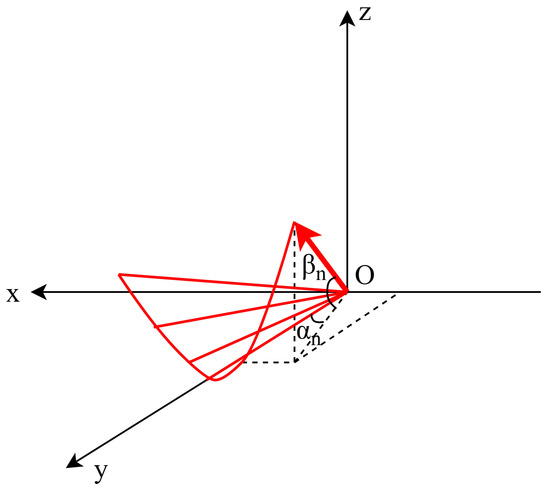
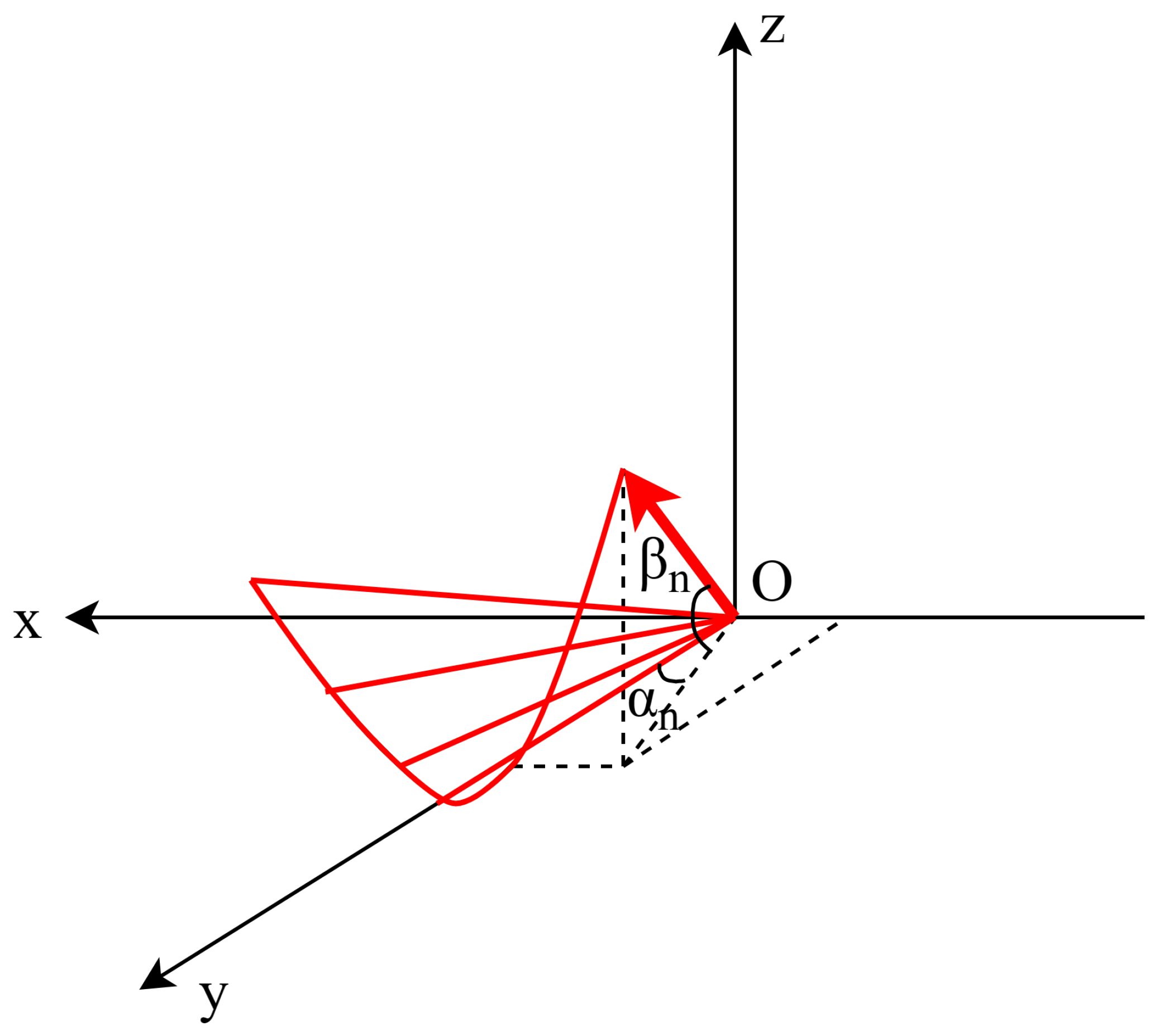
Figure 1 shows the trajectory of the radar LOS in the reference imaging coordinate system during the CPI of one ISAR image [20]. The system is defined as the imaging coordinate system at the intermediate time of CPI . In the system, the origin O is the target center, the -axis aligns with the radar LOS, known as the range direction of the ISAR image, the -axis points towards the direction of the target’s effective rotation vector, and the -axis, known as the cross-range or azimuth direction of the ISAR image, forms a right-hand Cartesian coordinate system with the -axis and -axis. Because the radar LOS rotates around the target center on a highly nonlinear curved surface, the ISAR imaging plane formed by the -axis and -axis exhibits spatial variation.
Figure 1.
Schematic diagram of the change of radar LOS in .
In , we assume that represents the coordinates of scatterer q on the target; consequently, can be expressed as
where and respectively represent the azimuth and elevation angles of the radar LOS depicted in Figure 1. Identity (2) decomposes into the sum of coordinates of scatterer q, each weighted by trigonometric functions of and .
Although the pulse signals are transmitted at a fixed pulse repetition frequency (PRF), exhibits nonlinearity concerning in both the azimuth and elevation dimensions. This nonlinearity arises primarily from two factors: the non-uniform translational motion between the target and radar, and the spatial variation of the ISAR imaging plane. Additionally, as indicated in (2), imaging scenarios with larger target sizes or cumulative angles will aggravate this nonlinearity. As a result, the highly nonlinear property of complicates the application of classical spectrum analysis or signal reconstruction techniques, making it difficult to accurately estimate the location, amplitude, and phase information of the target scatterers.
After translation motion compensation, the MTRC-AHP algorithm proposed in [20] can be applied to mitigate this nonlinearity. In the resulting 1D range profile obtained using the MTRC-AHP algorithm, becomes uniform in virtual slow time and the phase becomes linearly related to the scatterer coordinates. The new 1D range profile of scatterer q can be approximated as
where is the carrier wavelength, is the angular velocity of , and stands for the uniform virtual slow time, defined as , where is the CPI, , and is the PRF.
After performing FT along with for each scatterer on the target, the 2D ISAR image of the target can be formulated as
where is the 2D ISAR image, L is the total scatterer number of the target, is the Doppler frequency with a distribution range of , and represents the azimuth spectral amplitude of scatterer q.
2.2. Model Transformation
The objective of the cross-range imaging problem is to estimate the cross-range positions of the scatterers, which is essentially the same as the goal of the linear spectrum estimation problem. Therefore, the two mathematical models can be transformed into one another.
Assuming K scatterers within the mth range profile and defining as the equivalent cross-range coordinate of scatterer q, the scatterer set within this range profile can be modeled as
where .
Additionally, we define
In the linear spectrum estimation problem, the location information of the set is contained in the linear spectrum . We define the band-limited PSF of the spectral line by . With this, the noisy linear spectrum can be expressed as
where is the Doppler dimension noise. Compared to , it can be observed that the spectrum directly corresponds to the ISAR image in the cross-range dimension.
The measurement in the linear spectrum estimation problem consists of the noisy Fourier data of , provided by
where is the noise, which satisfies . In contrast to , it can be observed that the measurement corresponds to the cross-range profile of the signal echo.
From this, we can conclude that the location information of each scatterer is mapped to the Doppler frequency , corresponding to the peak of the sinc function envelope in the Doppler spectrum. Therefore, the nonlinear ISAR cross-range imaging problem can be reformulated as a linear spectrum estimation problem, where the objective is to estimate the scatterer locations from the uniformly sampled signal .
2.3. Cross-Range Resolution Limit
The cross-range resolution of a 2D ISAR image is defined as . After model transformation, the cross-range resolution is associated with the resolution of the linear spectrum problem (7), which is defined as . The relationship between and D can be expressed as
The resolution limit is traditionally measured by the Rayleigh criterion [32]. Later, [33] proposed a modified Rayleigh criterion, stating that point-like sources separated by at least can be resolved as distinct sources provided that , where denotes the cutoff frequency for the noisy Fourier data. Following the approach of [33], we define as the Rayleigh resolution limit.
However, the Rayleigh resolution limit is based on the presumed resolving ability of the human visual system, which at first glance seems arbitrary [46]. Recent studies [35,36,46,47,48,49] have shown that super-resolution algorithms can resolve adjacent points separated by distances below the Rayleigh limit. Specifically, [46,47,48] reconceptualized the resolution limit as the minimum separation required to stably resolve point source locations, introducing the concept of “computational resolution limits” to characterize this separation. This computational resolution theory offers an alternative approach to analyzing the resolution limit. Although [37,43,45] also considered the effect of the PSNR on the estimation of scatterers, they focused on the minimax error rate of the reconstructions, and their boundaries are not as tight as those presented in [46,47,48].
Based on these theories, we establish mathematical expressions for both the Rayleigh resolution limit and the computational resolution limit bounds in the context of cross-range ISAR imaging. A detailed analysis of their relationship is provided as well. It is important to emphasize that this work does not seek to derive an explicit formula for the resolution limit, but rather focuses on its theoretical boundaries. Any super-resolution algorithm should operate within the limits that we have established.
2.3.1. Rayleigh Limit
Note that the mathematical model presented in [33] corresponds to the linear spectrum estimation problem outlined in (8). This suggests that the cutoff frequency of is defined in the domain as , while the scatterer set can be resolved in its dual domain, that is, the domain.
Following the approach in [33], the Rayleigh limit for the linear spectrum estimation problem (8), denoted by , is provided by
2.3.2. Computational Resolution Limit
Following the approach in [46], in order to ensure accurate reconstruction of the scatterer set , the computational resolution limit for the linear spectrum estimation problem (8), denoted by , must satisfy the following constraints [46]:
When , the upper bound of can be improved to
Putting (9) into (12), the computational resolution limit for the cross-range ISAR imaging problem (8), denoted by , satisfies the following constraints:
where is the peak signal-to-noise ratio (PSNR) of the signal echo after coherent integration.
For conciseness, the lower bound of , known as the super-resolution limit, is denoted by , i.e.,
Similarly, the upper bound of is denoted by , expressed as
To better understand the meaning of these bounds, [48] provided a detailed explanation: without any additional prior information, stable location recovery from is achievable when exceeds the upper bound and impossible when falls below the lower bound; consequently, we can conclude that represents the optimal resolution capability of the imaging super-resolution algorithm, which no algorithm can surpass without additional prior information. In contrast, provides the criterion for whether a super-resolution algorithm can reliably achieve stable scatterer recovery
During the theoretical derivations of and , no additional assumptions regarding the super-resolution algorithm, noise statistical characteristic, or sampling interval were imposed, indicating that the MTRC-AHP interpolation operation [20] does not affect the validity of these equations. Consequently, and apply to any super-resolution algorithm or sparse sampling imaging scenario. Furthermore, because the computational resolution theory in [46,47,48] can be generalized to imaging scenarios with other band-limited PSFs, and are also relevant for radar waveform design and radar speed measurement.
In contrast to (11), both and depend not only on and but also establish a complex nonlinear relationship with both the PSNR and the number of scatterers. Therefore, in this work we establish the mathematical relationships between the performance of super-resolution ISAR imaging algorithms, the traditional Rayleigh limit, the number of scatterers, and the PSNR.
2.3.3. Relationship Between and
To gain a deeper understanding of the relationship between the Rayleigh limit and the computational resolution limit, we choose the ratio of the bounds for to (excluding the specific case where for the upper bound) as the metric. These ratios are formulated as follows:
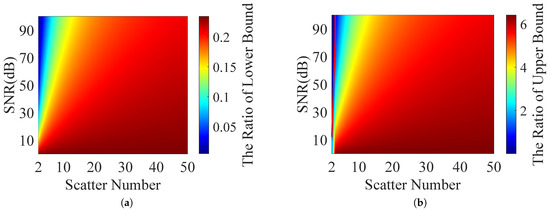
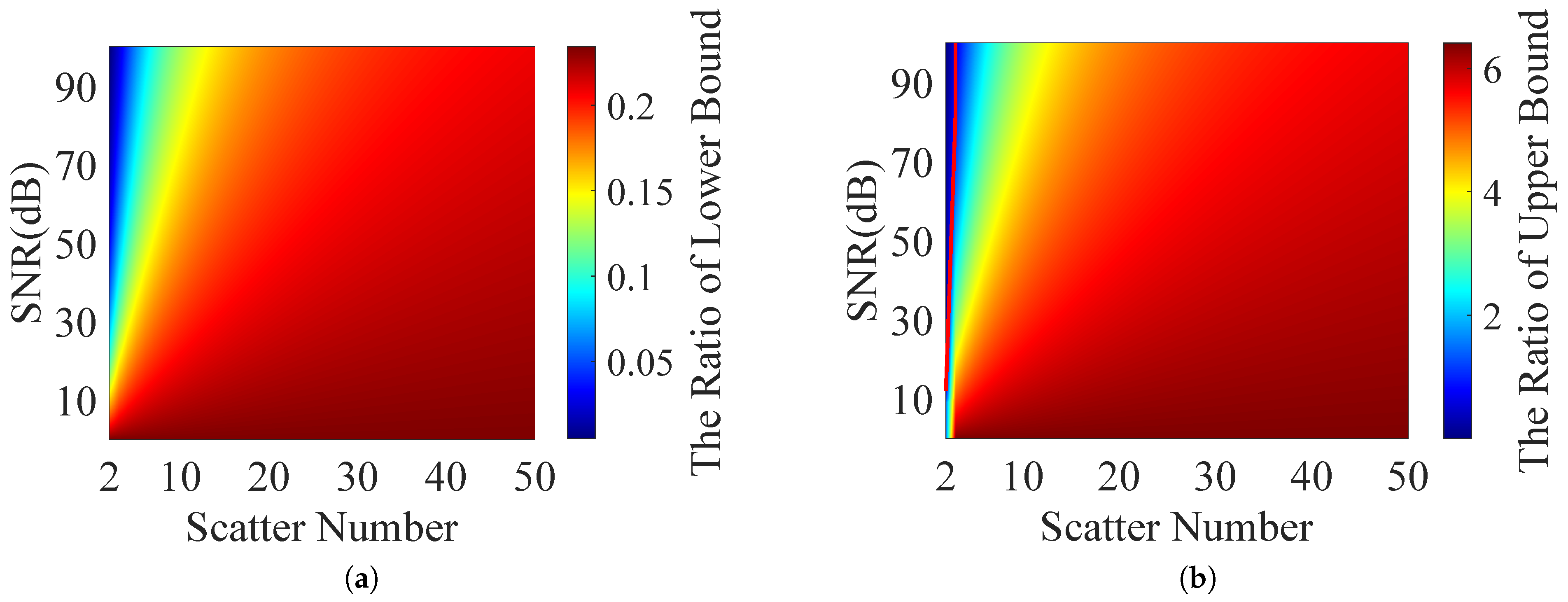
Without loss of generality, we can assume that the PSNR of radar echo is greater than 0 dB (i.e., ). Moreover, in typical azimuthal super-resolution imaging scenarios involving space targets, there are always at least two distinct scatterers (i.e., ). The variations of and when letting K range between 2 and 50 and letting range between 0 dB and 100 dB are illustrated in Figure 2.
Figure 2.
Ratio of the bounds for to : (a) ratio of to and (b) ratio of to .
As shown in Figure 2a, remains consistently below 1, with the super-resolution limit ranging from approximately 0.04 to 0.22 times the Rayleigh limit. This finding also aligns with the results presented in [51], where the author introduced a novel radar waveform based on a class of self-referential interference functions, achieving a resolution up to 100 times finer than the Rayleigh limit under extremely high PSNR conditions. Based on the simulation results in Figure 2a, unless additional information is available, the required to achieve the resolution reported in [51] should be at least 83 dB in practical applications. Figure 2b illustrates that generally remains above 1; however, when K is small and is high (within the red curve), there are regions where drops below 1. This suggests that the optimal super-resolution algorithm can indeed achieve a more stable recovery performance compared to the Rayleigh limit under these specific imaging conditions.
As the focus of this study is on space target ISAR imaging, typically falls below 50 dB, and the number of scatterers in a single range cell usually exceeds two; therefore, in the ISAR imaging problem discussed in this work, it is reasonable to conclude that
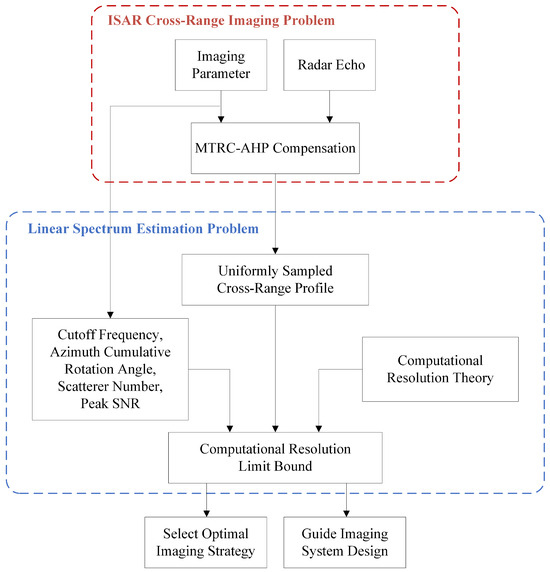
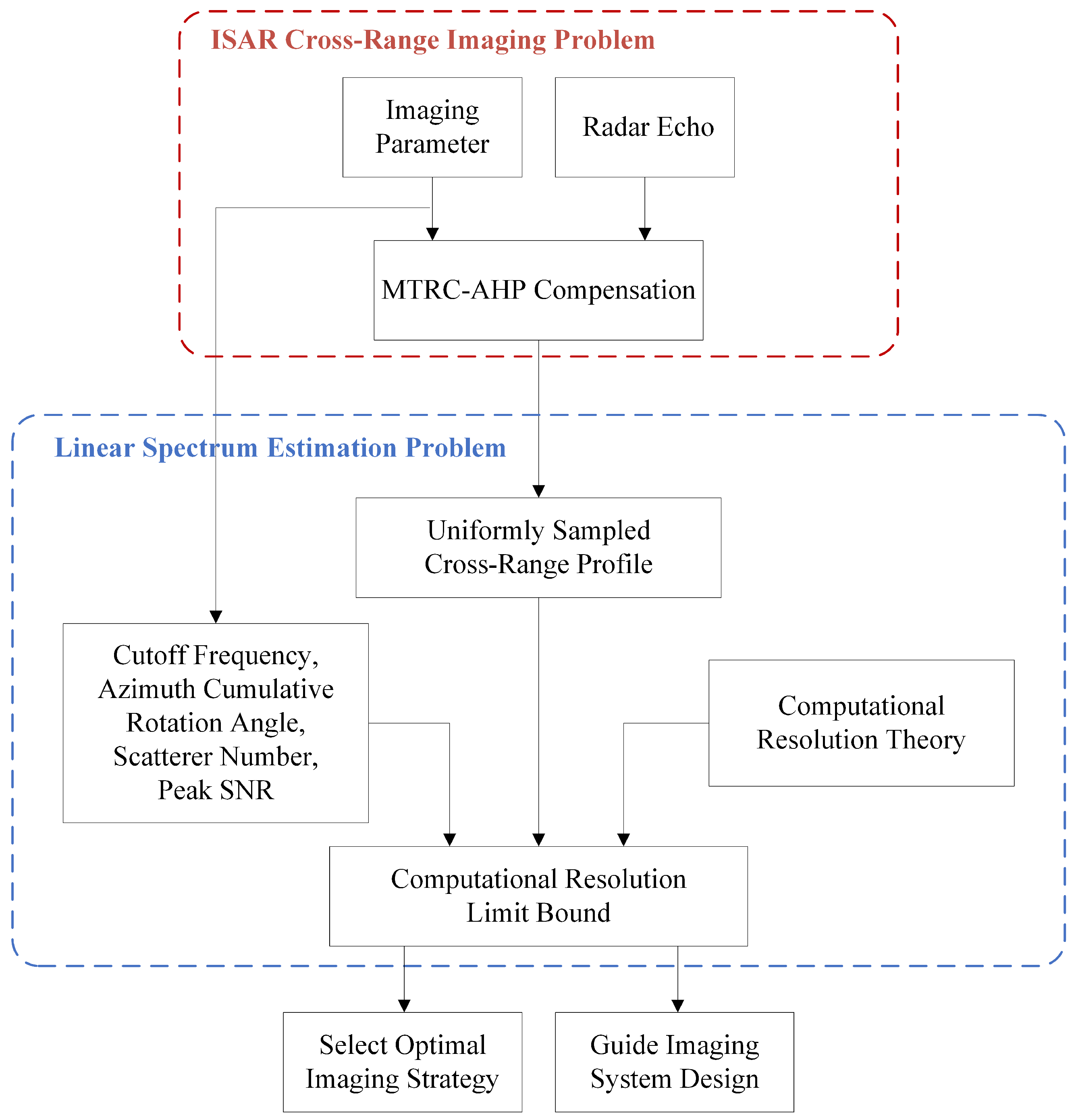
In addition, we provide a flow chart in Figure 3 to illustrate the calculation process for the resolution bounds outlined in (14). Note that this calculation process for resolution boundaries can operate in the complex domain. This is because the limits bounds depend on several parameters (number of scatterers, azimuth cumulative rotation angle, SNR, wavelength), which can be clearly obtained in both real and complex domains.
Figure 3.
Flow chart of the calculation for the resolution bounds.
2.4. Guidelines for Enhancing Imaging Efficiency
As shown in (15), is associated with the imaging resources of a super-resolution algorithm, such as the imaging time and transmitted energy, as well as its optimal resolution capability. This presents an opportunity to discuss the feasibility of improving imaging algorithms and the necessity of enhancing their imaging resources.
We denote the actual cross-range resolution by and the desired cross-range resolution by . For a given configuration of imaging resources, it may be the case that the theoretical optimal cross-range resolution meets the desired level while the actual cross-range resolution fails, expressed as
In this scenario, it is reasonable to explore a more advanced imaging algorithm in order to improve the actual cross-range resolution or conserve imaging resources.
Conversely, if the theoretical optimal cross-range resolution cannot meet the desired level, expressed as
then improving the super-resolution imaging algorithm becomes impractical. In this case, increasing the imaging resources is the only feasible approach to fulfill the resolution requirement. If even the maximum allocation of imaging resources provided by the radar system fails to meet the resolution requirement, then the only viable strategy is to accept the resulting suboptimal cross-range resolution.
3. Influencing Factors and Performance Limits
As shown in (14), both the lower and upper bounds of contain the terms and . The first term represents the conventional Rayleigh limit, while the second stands for a function of and K, thereby distinguishing the computational resolution limit from the Rayleigh limit. Excluding the case of , and maintain a fixed proportional relationship, indicating that the influencing factors , , and K have the same impact on both and . Because stands for the optimal resolution achievable by the most advanced super-resolution imaging algorithm, it defines the boundary between the unattainable performance region and the feasible region for radar systems. Therefore, analyzing is more crucial for the design of radar systems and imaging scenarios. This section focuses on the effects of influencing factors on and their tradeoffs, followed by the resulting performance limits in space target ISAR imaging.
3.1. Super-Resolution Influencing Factors
Referring to (15), when holding and K constant, the relationship between and can be formulated as
where is a positive value independent of .
As shown in (19), is inversely proportional to ; therefore, an increase in leads to a decrease in , simultaneously enhancing the resolution capability of the optimal imaging algorithm. As shown in (20), the improvement rate of with increasing is inversely proportional to the square of . As a result, as grows, the effect of the same incremental change in on improving super-resolution capability will gradually diminish.
Similarly, based on (15), when and K are held constant, the relationship between and can be formulated as
where and are positive values independent of .
As shown in (21), is inversely proportional to the th power of ; therefore, an increase in leads to a decrease in , improving the resolution capability of the optimal imaging algorithm. As shown in (22), the rate of decrease in with increasing is inversely proportional to the th power of . Consequently, as grows, the effect of the same incremental change in on enhancing super-resolution capability gradually diminishes. Additionally, increasing K results in a reduction in the exponent , in turn slowing the improvement rate of super-resolution capability. The polynomial increment in corresponds to the linear improvement of , and this improvement rate is also dependent on K.
Following the same approach as in (15) and keeping and fixed, the relationship between and K can then be formulated as
where is a positive value independent of K.
As shown in (23), increases exponentially with K, leading to a rapid decline in the resolution capability of the optimal imaging algorithm as K increases from a small value. However, the rate of this increase slows as K grows larger. As indicated in (24), is inversely proportional to ; consequently, the degradation in super-resolution capability occurs at a progressively slower rate with further increases in K.
3.2. Tradeoffs Between Super-Resolution Influencing Factors
In the same imaging scenario, a tradeoff exists between and subject to the constraints imposed by the target’s motion characteristic and the radar range equation. Understanding this tradeoff and its impact on imaging performance is crucial.
The primarily corresponds to , and their relationship can be formulated as
where are constants determined by the orbital elements, the radar’s LOS during the observation period, and the radar station’s latitude and longitude. A detailed description of these constants is provided in Appendix A. It is observed that the growth of with is approximately linear for each specific ISAR imaging scenario.
Assuming that and represent the transmitted power and the duty cycle, respectively, the average transmitted power, denoted by , is provided by , while the transmitted energy of the radar system, denoted by E, is provided by . According to the radar range equation in [52], the can be constructed as
where represents the radar cross section (RCS) of the target; is influenced by multiple factors, with a detailed description provided in Appendix B. Note that is determined by factors such as the radar system parameters and propagation effects, while depends on factors such as the observation perspective, scattering characteristics of the target, and radar wavelength. Although both and are multivariable functions, they can be treated as constants in a specific imaging scenario.
Based on (25) and (26), the tradeoff between and can be converted to a tradeoff between and in practical imaging scenarios. This tradeoff aids in selecting the most appropriate imaging strategy for different scenarios, thereby optimizing overall imaging efficiency.
Substituting (25) and (26) into (15) yields the explicit expression of :
where and are constrained by
when E is held constant.
As indicated in (27) and (28), for space targets in the same orbit, reducing to extend is an effective approach for improving imaging performance without expending additional energy resources. This effectively increases while holding E constant. By comparison, when improving imaging performance by increasing E while keeping constant, the resulting enhancement of follows . As K increases, the exponent term approaches zero, causing to converge towards the RL. At this stage, increasing E yields only marginal improvements in imaging resolution, making it the least favorable option.
When the super-resolution limit, scattering characteristic of the scatterers, and radar system parameters are all held constant, the tradeoff between , , and in a specific imaging scenario can be expressed as
This formula also establishes the equivalent relationship between the three influencing factors.
3.3. Parameter Limits
Within a given scenario, the target’s specific imaging requirements may impose constraints on the influencing factors. In this section, we analyze these constraints in the context of radar system implementations and ISAR imaging scenarios.
First, both and are constrained by the system’s hardware, which establishes a maximum achievable PSNR for scatterers, denoted as . Additionally, the sub-procedures of super-resolution imaging algorithms, such as range alignment and phase autofocus, impose a minimum requirement on the PSNR of scatterers, denoted as . Then, and determine the allowable variation of , which can be described as
The lower bound in (30) represents the minimum required to achieve the desired imaging resolution. Given the limited observation perspective of the radar’s LOS relative to synchronous orbit targets, this lower bound can assess the feasibility of ground-based radar imaging for such targets. The upper bound of , denoted as , stands for the maximum value below which the super-resolution imaging algorithm can operate effectively. When exceeds this upper bound, the efficiency of the ISAR imaging system declines even if the desired imaging resolution is surpassed. Similarly, the constraint for can be formulated as
which defines the minimum transmitted power required for the radar system.
It is important to note that is influenced by multiple factors in a specific imaging scenario, not only the ; for high Earth orbit (HEO) targets, is determined by the maximum variation of the radar LOS relative to the target, while for low Earth orbit (LEO) targets it reflects the maximum angle achievable under constant target scattering characteristics and the limitations of the imaging algorithm. Additionally, the data rate of the independent imaging frames constrains the maximum , and thereby determines .
4. Simulation
This section describes the results of simulations conducted to evaluate the effects and tradeoffs of the influencing factors on . Additionally, the observation efficiency and power constraints for super-resolution imaging of targets in different orbits are analyzed.
4.1. Imaging Scenario Setting
This subsection outlines the imaging scenario parameters used in the simulations. First, regarding the radar observation targets, three representative space targets in different orbits were selected, with their two-line orbital elements (TLE) provided in Table 2. COSMOS 2494 is a Russian satellite launched in 2013 as part of the Global Navigation Satellite System (GLONASS). NAVSTAR 81 is an American satelite launched in 2021 as part of the Global Positioning System (GPS). BeiDou 9 is a Chinese satellite launched in 2011 as part of the BeiDou Navigation Satellite System (BDS). Second, the radar system parameters are listed in Table 3. It is assumed that all targets operate in an Earth-oriented three-axis stabilized (EOAS) mode for attitude control. In the following simulations, unless otherwise specified, all radar parameters, target parameters, and imaging scenario settings remain consistent with this configuration.
Table 2.
Typical target TLE.
Table 3.
Radar system parameters.
4.2. Super-Resolution Method Performance
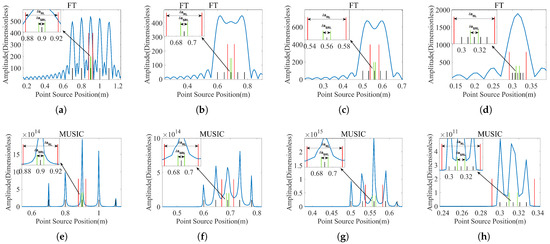
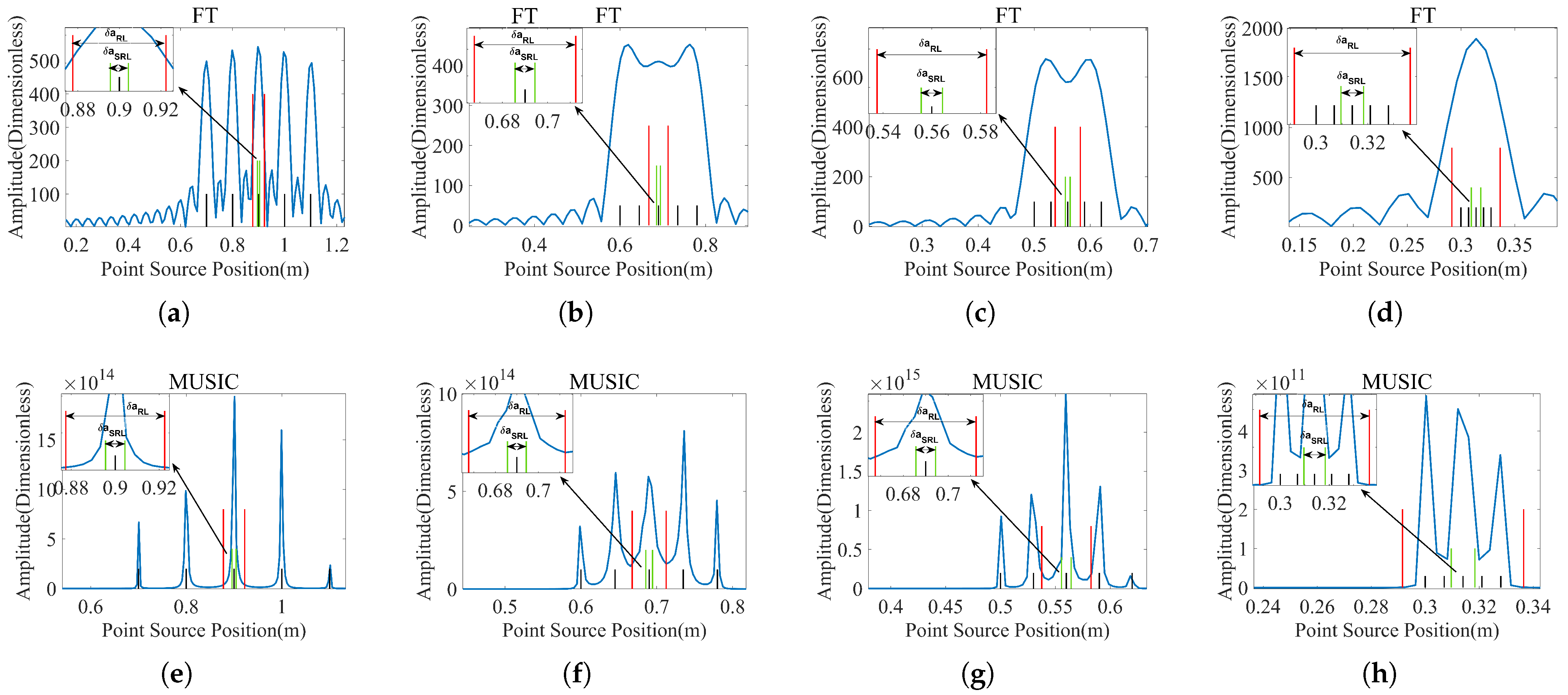
This subsection evaluates the performance improvement of super-resolution methods in comparison to the Rayleigh limit under various cross-range imaging conditions. The observation time is set to 10 s, with a target rotation rate of 0.5 rad/s and a PSNR of the echo at 20 dB. Under these settings, the Rayleigh Limit is calculated to be 0.045 m and the super-resolution limit is calculated to be 0.009 m.
We set four different point source distributions, with their separations set to 0.1 m, 0.45 m, 0.03 m, 0.007 m, respectively. The corresponding spectra computed using the FT method and super-resolution algorithm are shown in Figure 4. The estimation results from Figure 4 are summarized in Table 4.
Figure 4.
Imaging results under different separations using the FT and MUSIC methods: (a,e) ; (b,f) ; (c,g) ; (d,h) . (the black line represents the point source, the green line indicates the super-resolution limit, and the red line shows the Rayleigh limit).
Table 4.
Position estimation of point sources using the FT and MUSIC algorithms.
Because the resolution of the FT algorithm is limited by the Rayleigh criterion and the MUSIC algorithm is a super-resolution method with a theoretically optimal resolution capability constrained by , this simulation used both the FT and MUSIC algorithms to evaluate the performance of super-resolution techniques. In case 1, where the separation between point sources is greater than the Rayleigh limit, both FT and MUSIC successfully recover all point sources. In case 2, where the separation is set to the Rayleigh limit, it is evident that the FT method can only recover point sources separated by more than the Rayleigh limit, whereas the MUSIC method successfully recovers all point sources. In case 3, where the separation is set to be smaller than the Rayleigh limit but larger than the super-resolution limit, the imaging results show that the FT method fails to resolve point sources separated by less than the Rayleigh limit, while the MUSIC method can recover these sources. In case 4, where the separation is smaller than the super-resolution limit, the imaging results indicate that the MUSIC algorithm cannot resolve the second and fourth point sources, as the separations between these sources and their adjacent point sources are smaller than the super-resolution limit. These findings are consistent with the conclusions in Section 2.3.
4.3. Cross-Range Resolution Contrast
The following simulations demonstrate the relationship between the Rayleigh limit and the computational resolution limit of the cross-range resolution when imaging a representative LEO space target, namely, COSMOS 2494. Letting align with the range resolution in the ISAR image, denoted by , the azimuth cumulative rotation angle is then set to , approximating the ratio of the bandwidth carrier frequency following the Rayleigh criterion. We set based on the observation that the scatterer number within a range cell is typically less than 10. Additionally, we set to compare the effect of the scatterer number on the super-resolution limit relative to the case with .
The radar system recorded three visible passes over COSMOS 2494 within 12 h, starting from 12:00:00 on 5 July 2024. The CPIs of each visible pass are 646 s, 750 s, and 429 s, with corresponding zenith pass elevations of 15.55°, 61.54°, and 4.38°. For our simulation, we focus on scenarios where traditional algorithms struggle to achieve high-resolution imaging at lower elevation angles, while the pass with an elevation of 4.38° may even lower than the radar’s minimum operational angle, making it unsuitable for observation. Therefore, we selected the first pass with a duration of 646 s and a zenith pass elevation of 15.55°.
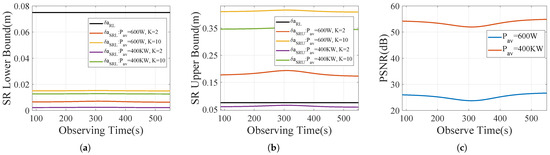
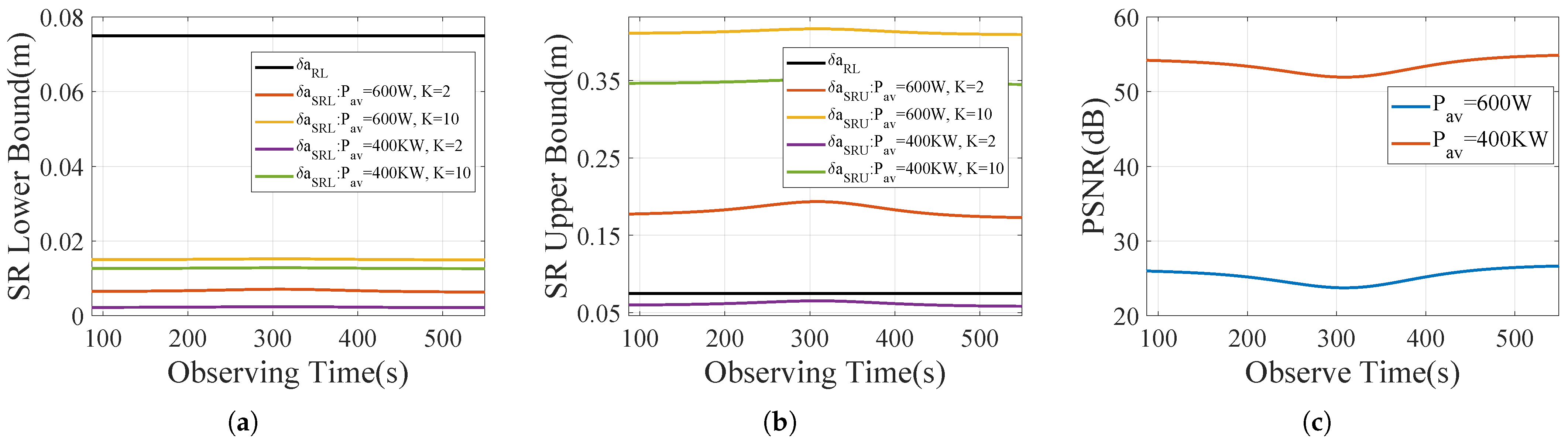
Figure 5a,b illustrates the relationship between and the upper and lower bounds of , as well as the influence of different average transmitted powers and the number of scatterers on these bounds. The number of scatterers K in a range cell was set to 2 and 10, respectively, while the radar average transmitted power was set to 600 W and 400 KW, respectively. It can be observed that when , lies between the upper and lower bounds of and is significantly smaller than . In imaging scenarios with small K and high PSNR (e.g., KW, ), both the upper and lower bounds of will be lower than the Rayleigh limit. As shown in Figure 5c, the PSNR of the scatterers ranges from 50 dB to 55 dB when KW; however, achieving such high PSNR values in real ISAR imaging scenarios is challenging, making this result more theoretical than practical.
Figure 5.
The Rayleigh limit and the computational resolution limit bounds under different imaging scenarios (during the first pass): (a) VS ; (b) VS ; (c) required PSNR for the desired under different .
4.4. Impacts of Influencing Factors on
Next, we simulated the impacts of the cumulative rotation angle, PSNR, and number of scatterers on the lower bound of the computational resolution limit. The ISAR image time is the 325th second after the beginning of the first pass of COSMOS 2494. Additionally, we set K = 2, 5, and 10 in order to compare the effect of the scatterer number on the super-resolution limit.
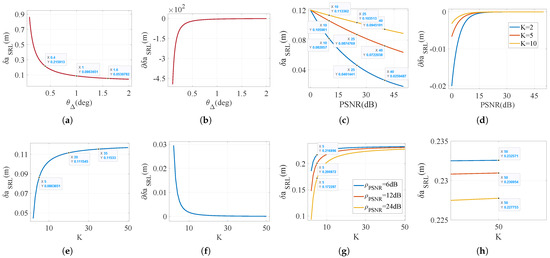
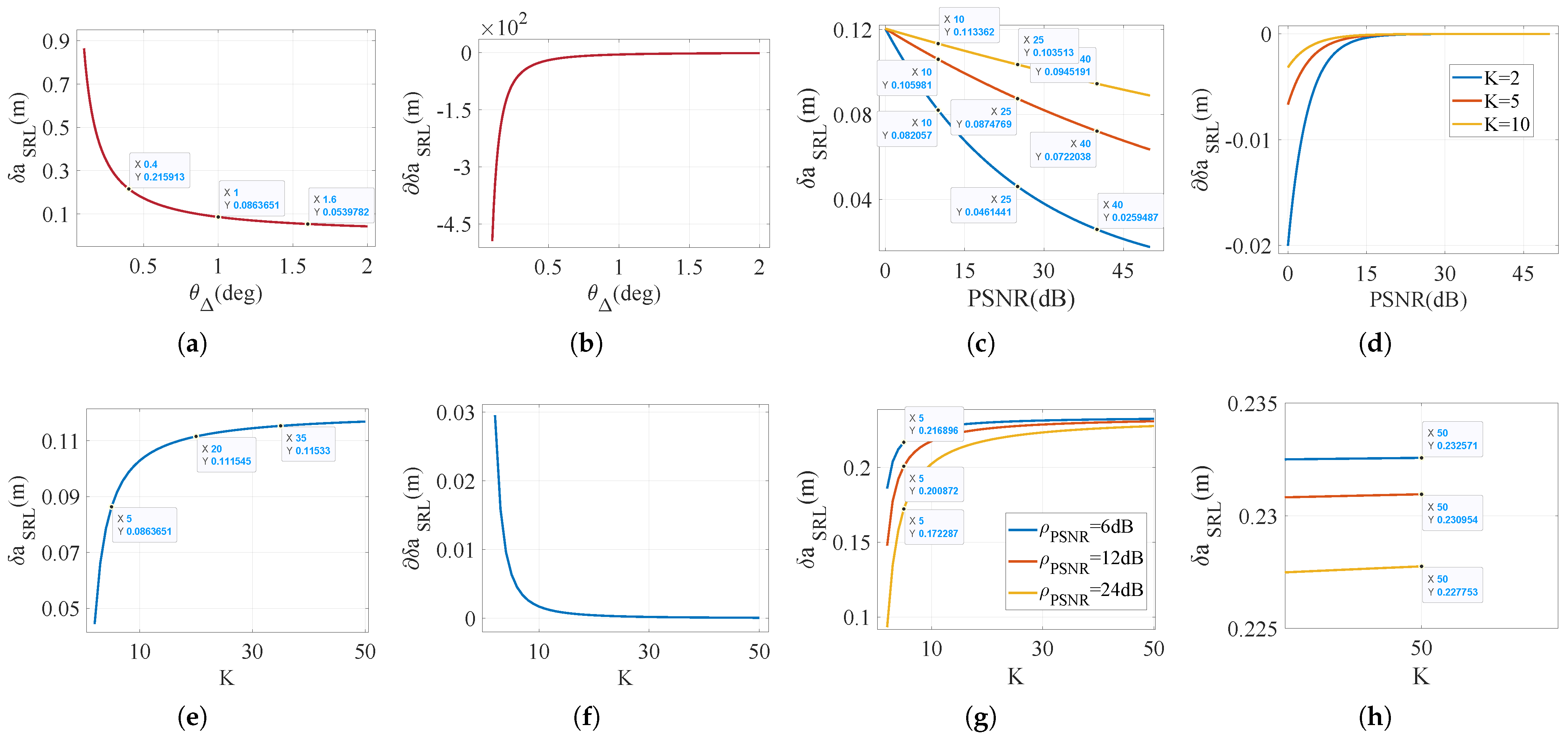
Figure 6a,b illustrates the impact of on when and . In Figure 6a, is 0.216 m at . As increases to , decreases to 0.086 m, marking a 60.00% reduction of compared to . Further increasing to reduces to 0.054 m, indicating a 37.2% decrease of relative to when . In Figure 6b, when exceeds , the improvement in super-resolution limit due to further increases in gradually diminishes. These results align with the conclusions in Section 3.1, highlighting the significance of the marginal income from the in imaging scenario design.
Figure 6.
Impacts of influencing factors on the super-resolution limit: (a,b) variations of and as increases when dB and ; (c,d) variations of and as increases when and ; (e,f) variations of and as K increases when dB and ; (g,h) constringency of the super-resolution limit and K with different .
Figure 6c,d illustrates the impact of on when while Table 5 summarizes the selected results for different cases shown in Figure 6c, with the percentages in the last column representing the reduction in compared to the previous row’s parameter settings. Additionally, as shown in Figure 6d, the improvement rate of diminishes as increases, demonstrating that enhancing by an order of magnitude results in approximately linear reduction of . Moreover, the rate of improvement due to increasing is also influenced by K.
Table 5.
Reduction rate of under different imaging scenarios (labeled points in Figure 6c).
Figure 6e,f illustrates the impact of the number of scatterers on the super-resolution limit when and . In Figure 6e, the is 0.086 m at . As K increases to 20, the rises to 0.112 m, reflecting a 29.2% increase compared to . At , the further increases to 0.115 m, representing only 3.4% growth relative to . In Figure 6f, as K exceeds 20, each subsequent increase in K leads to a progressively smaller decrease in , indicating a nonlinear relationship between K and . Initially, increasing K significantly degrades imaging performance; however, as K continues to grow, its negative impact on super-resolution imaging performance gradually diminishes.
Figure 6g,h shows the ratio of the super-resolution limit to the Rayleigh limit under different as K increases with a fixed . Table 6 presents selected results from Figure 6g,h. According to Figure 6g and Table 6, it is evident that the impact of the same increment of on becomes progressively weaker as K increases, causing the super-resolution limit to converge to times the Rayleigh limit. This demonstrates the crucial role of K in determining the performance of super-resolution algorithms. Superior performance on the part of super-resolution algorithms is primarily due to scatterer sparsity. However, this does not mean that (where N is the sampling number in the azimuth direction of ISAR image); rather, it reflects the relatively small value of K. If super-resolution algorithms perform well with larger when the value of K is large, this is mainly due to the benefit of high achieved through coherent integration as N increases.
Table 6.
Reduction rate of under different imaging scenarios (labeled points in Figure 6g,h).
4.5. Parameter Limits
The following simulations focus on the minimum requirements for , , and under constant transmitted energy to achieve a desired cross-range computational resolution limit. In these simulations, K was set to 10 and the desired cross-range super-resolution limit was aligned with the range resolution, meaning that . The ISAR imaging time is the first pass of COSMOS 2494, from 18:59:38 to 19:10:24.
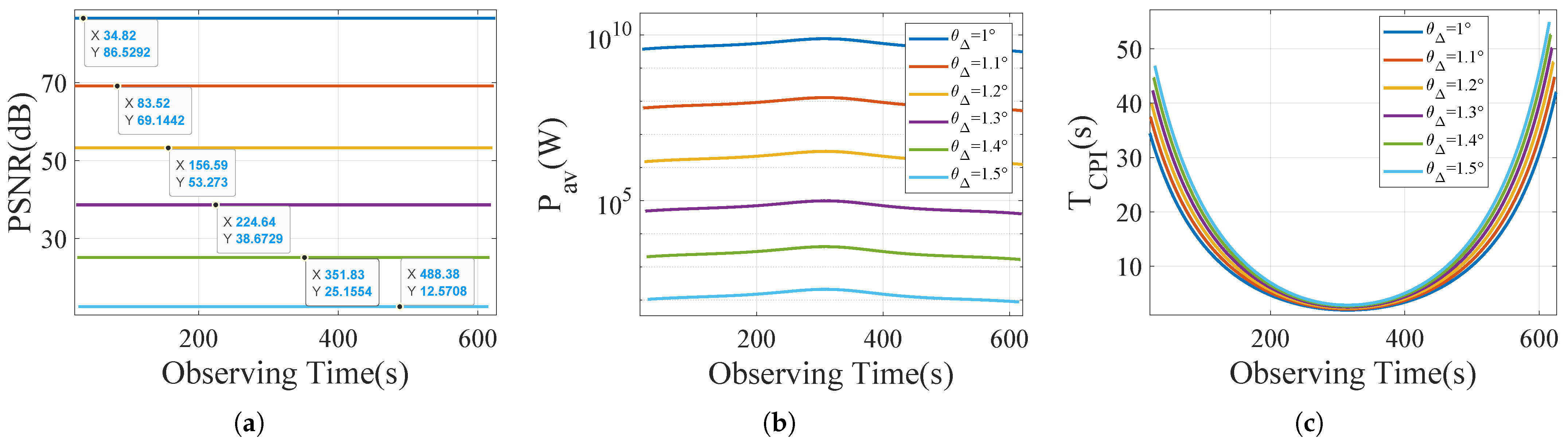
As described in (26) and (29), the minimum requirement for or to achieve the desired can be determined based on the relationship between and under different . Figure 7 shows the minimum requirements for , , and across these varying . As shown in Figure 7a, a smaller corresponds to a much higher , and this nonlinear relationship is consistent with the constraint provided in (15). Consequently, the minimum required for achieving the desired remains constant at different imaging times if both K and are unchanged. Additionally, the fluctuation of under a specific , as shown in Figure 7b, indicates that the minimum requirement for varies with the target’s effective rotation rate and the round-trip distance between the target and the radar.
Figure 7.
Minimum requirements for , , and under different : (a) required (the legend is consistent with (b)); (b) required ; (c) required .
Specifically, as shown in Figure 7, when falls below 1.2°, the minimum required is 53.27 dB, with the corresponding minimum required ranging from 1 MW to 10 MW. This imposes a significant burden on the radar system. Fortunately, extending the can effectively increase the , thereby reducing the required . A comparison of the results in Figure 7 reveals that when the is between 1.3° and 1.5°, the required minimum to obtain an ISAR image is within the 60 s and the required remains below 100 KW, which is more feasible for a operational radar system.
Note that these simulations provide a representative example illustrating the minimum requirements for and under different . Importantly, the minimum requirements in other imaging scenarios should be determined based on the specific imaging targets and radar system rather than directly applying these results. Moreover, their requirements should not exceed the limits discussed in Section 3.3.
4.6. Tradeoff Between and with Constant E
The following simulations focus on the tradeoff between and (changes with ) with constant E in super-resolution imaging and the resulting impact on super-resolution limit. The ISAR imaging time is the first pass of COSMOS 2494, from 18:59:38 to 19:10:24.
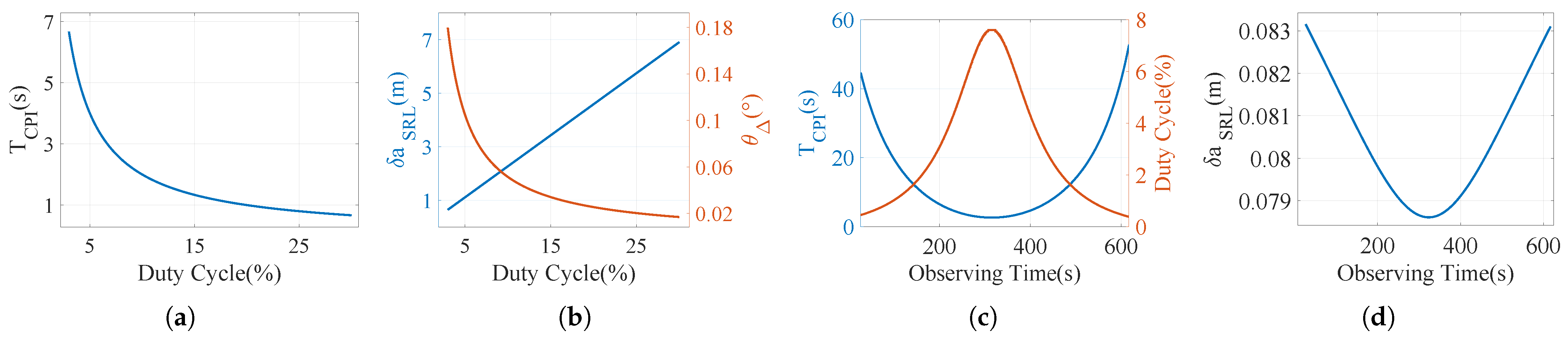
Figure 8a illustrates the tradeoff between and for constant E when KW, as shown in Equation (28). Figure 8b shows the variations of as increases with the fixed E, as shown in Equation (27). It’s evident that as increases, decreases with , resulting in a continuous decline in the super-resolution capability of the ISAR imaging system. When increases from 3% to 30% with constant E, the super-resolution limit degrades from 0.65 m to 6.90 m.
Figure 8.
Tradeoff between and with constant E and its impact on : (a) impact of on with constant E; (b) impact of on and with constant E; (c) requirements for and when and E is held constant; (d) when and E is held constant.
Figure 8c shows the requirements for and when and E is held constant, while the impact of these requirements on the super-resolution limit is depicted in Figure 8d. Although the is lower during the rise and set periods compared to the zenith time due to the round-trip distance [53], Figure 8d demonstrates that the super-resolution capability can be effectively maintained with minimal variation across the rise, set, and zenith times by adjusting the and . The changes in are small enough to be considered negligible, allowing the super-resolution capability to be regarded as consistent throughout.
It should be noted that, without causing azimuth ambiguity, it is preferable to reduce by lowering PRF rather than the pulse width. A larger pulse width ensures a higher of scatterers in a single pulse, thereby reducing the system’s coherence requirements for signal processing algorithms. Moreover, using fewer pulses decreases the computational burden of subsequent imaging processing.
For a multifunctional array radar with instantaneous beam-switching capability, this tradeoff allows for dynamic scheduling of radar waveforms based on the imaging scenario when performing ISAR imaging of multiple targets. This approach enables the radar to maintain the required imaging resolution for each target while significantly enhancing the overall imaging efficiency of the radar system.
4.7. Tradeoff Between and Under Different Orbits
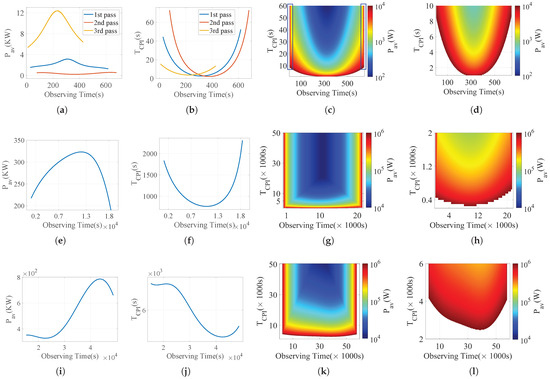
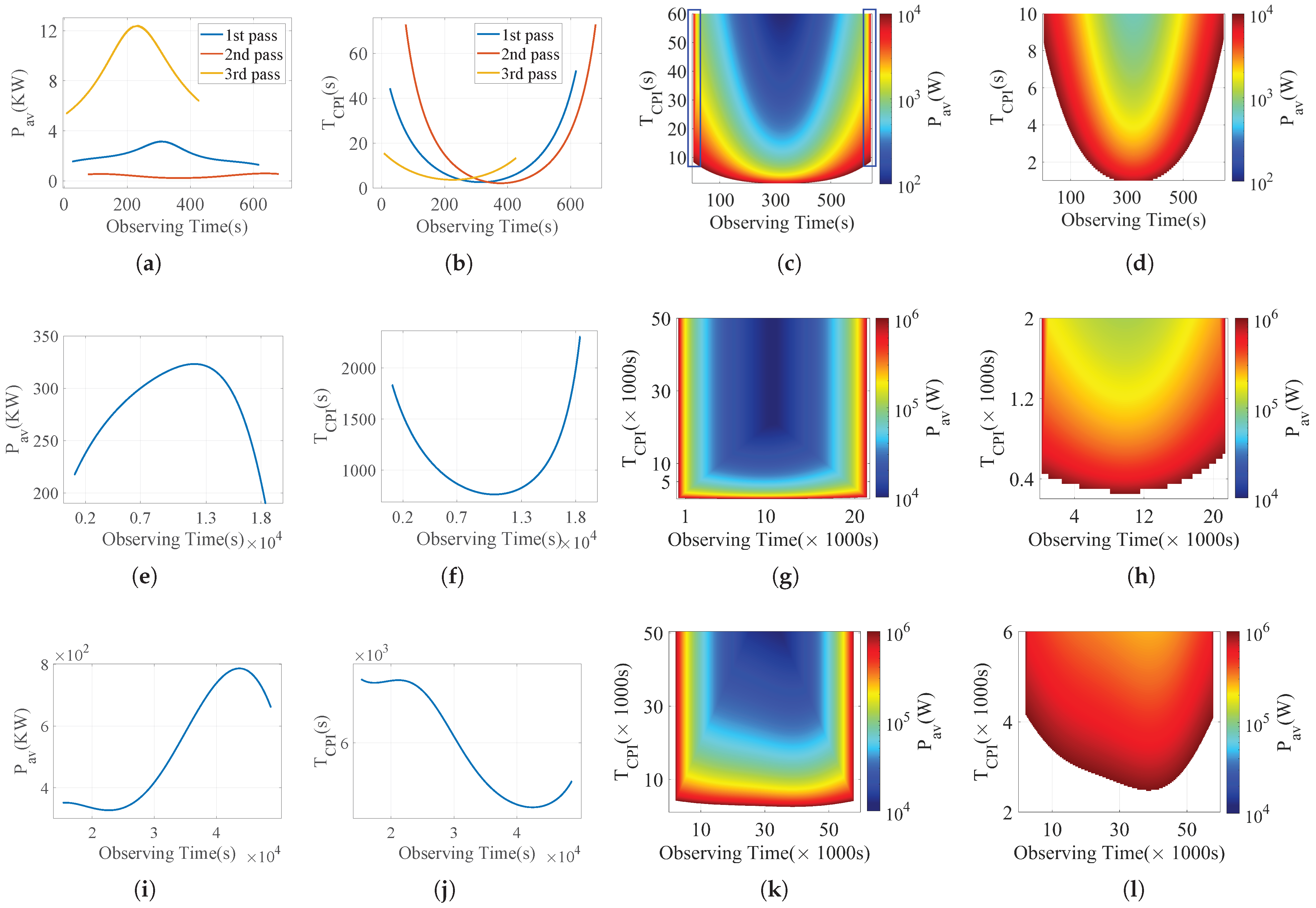
According to Kepler’s laws of planetary motion, a higher orbital altitude results in a lower relative angular velocity of the space target. Consequently, a short can meet the requirement for cross-range high-resolution ISAR imaging of an LEO target. In contrast, for HEO targets, such as medium Earth orbit (MEO) or inclined geosynchronous orbit (IGSO) satellites, a longer is needed in order to obtain the required . In certain cases, obtaining the necessary may not be feasible, meaning that increasing the is the only option to reduce the requirement, as shown in Equation (31). In this section, several simulations for LEO, MEO, and IGSO satellites are performed to analyze the requirements for and , as well as the tradeoffs between them, in order to achieve the desired cross-range resolution under different orbital altitudes and visible passes.
In the following simulations, the minimum was set to 24 dB, the K was set to 10, and the cross-range resolution was specified as . Under these conditions, the required for the desired super-resolution limit is calculated to be 1.39°. Additionally, the three satellites listed in Table 2 were observed continuously for 12, 12, and 24 h, respectively. The simulation results are shown in Figure 9.
Figure 9.
(a,b) Minimum requirement for and in different visible passes of COSMOS 2494; (c,d) tradeoff between and with constant (first pass of COSMOS 2494); (e,f) minimum requirement for and when imaging NAVSTAR 81; (g,h) tradeoff between and with constant when imaging NAVSTAR 81; (i,j) minimum requirement for and when imaging BeiDou 9; (k,l) tradeoff between and with constant when imaging BeiDou 9.
Figure 9a,b depicts the minimum and requirements for imaging COSMOS 2494. According to Figure 9a, the required average transmitted power can be met with KW when . Additionally, Figure 9b shows that the is shortest in the third visible pass due to its fast target rotation rate. Correspondingly, the required average transmitted power in the third visible pass is also the highest. This result can be attributed to two primary factors: first, due to the shorter in the third visible pass, a higher is needed to achieve sufficient PSNR, as indicated by (28); second, as shown by (26) and (27), the is inversely proportional to given that and are fixed. Consequently, the larger R in the third visible pass necessitates a higher . As illustrated in Figure 9a, the maximum difference in the required compared to other visible passes can reach nearly an order of magnitude.
Figure 9c,d depicts the tradeoff between and at different observation times during the first pass of COSMOS 2494. It is evident that the required decreases significantly as increases, dropping to as low as a few hundred Watts at zenith time. This reduction is partly due to the increase in with . More importantly, the LEO satellite’s higher rotational rate relative to the radar’s LOS allows a larger to be achieved within a short . Therefore, using a longer to reduce the average transmitted power proves to be a more efficient imaging strategy for LEO satellites. Conversely, increasing the can effectively shorten the required . For instance, when is increased to 10 KW, the required drops to below 10 s, and even less near zenith time. However, it is important to note that visibility constraints make it impossible to accumulate sufficient during the rise and set periods (the area within the blue rectangles). As a result, a higher is required at these moments, as indicated by the blue circles in Figure 9c.
Figure 9e,f illustrates the minimum and required for imaging NAVSTAR 81. As shown in Figure 9e, the required ranges from 190 KW to 320 KW when , which imposes a significant burden on wideband imaging radar systems [54]. Additionally, the required depicted in Figure 9f to achieve the same for an MEO satellite is significantly higher than for an LEO satellite, reaching up to 2300 s during the rise and set periods.
Figure 9g,h shows the tradeoff between and when imaging NAVSTAR 81 during the visible pass. It is evident that employing a long to reduce remains an effective imaging strategy for MEO satellites. When increases to 5000 s, as shown by the straight blue line in Figure 9g, the required at most observation times stays within 20 KW. While reducing leads to a dramatic increase in , after drops below 2000 s, the rapidly rises from 100 KW to 1 MW. If the falls below 300 s, imaging the target becomes impossible even with as high as 1 MW.
Figure 9i,j shows the required and at each observing time for BeiDou 9. As illustrated in Figure 9i, the required during this visible pass ranges from 320 KW to 790 KW when , exceeding the average transmitted power capabilities of most wideband imaging radars. Figure 9j shows that the required ranges from 3000 s to 9000 s.
Figure 9k,l presents the tradeoff between and when imaging BeiDou 9 during the visible pass. It is apparent that when reaches approximately 12,000 s, as shown by the straight blue line in Figure 9k, the required during most imaging times can be reduced to 200 KW, which is within the detection range of some imaging radars [54]. Additionally, when reaches 1 MW, the required for most imaging times can be reduced to less than 4000 s.
Furthermore, Figure 9j shows significant differences in the required by the target, indicating the presence of more efficient imaging arcs. As shown in Figure 9l, when imaging occurs at approximately 40,000 s relative to the start of this pass, the required is about 60% of that during rise and set periods. Although the relative change in resource demands is smaller than for an LEO target, the extremely high resource demands for imaging GEO targets make this difference considerable.
It is important to note that the IGSO target selected in this study is a high-inclination IGSO satellite, which can meet imaging requirements through long-term accumulation; thus, there is a compromise between and . For a geostationary orbit with small inclination and eccentricity, the target does not rotate relative to the radar LOS, meaning that ISAR imaging becomes infeasible.
5. Conclusions
This paper has investigated the performance limits of ISAR super-resolution imaging algorithms for space targets. It derives mathematical expressions for the upper and lower bounds of the computational resolution limit and establishes the relationships between algorithm performance, the traditional Rayleigh limit, the number of scatterers, and the PSNR. Based on these findings, we analyze the minimum resource requirements and tradeoffs between these factors as well as the constraints on imaging performance imposed by the azimuth cumulative rotation angle and radar average transmitted power.
Our simulation results demonstrate that the Rayleigh limit of cross-range resolution in ISAR images for space target imaging typically lies between the upper and lower bounds of super-resolution imaging algorithms. The super-resolution upper bound falls below the Rayleigh limit only when the number of scatterers is small and their PSNR is high. Additionally, a tradeoff exists between the azimuth cumulative rotation angle and radar transmitted energy, indicating that imaging efficiency can be significantly improved by increasing the azimuth cumulative rotation angle while reducing the radar’s duty cycle. Finally, for a given resolution, the tradeoff between imaging CPI length and average transmitted power as well as its impact on imaging efficiency are highly dependent on the specific imaging scenario. In future work, we will continue to improve super-resolution algorithms in order to bring their performance as close as possible to the optimal resolution established in this work.
Author Contributions
Conceptualization, X.H. and J.W.; methodology, X.H. and P.L.; software, X.H.; validation, X.H., P.L. and J.W.; formal analysis, X.H. and J.W.; investigation, X.H.; resources, J.W.; data curation, X.H.; writing—original draft preparation, X.H.; writing—review and editing, P.L. and J.W.; visualization, X.H. and J.W.; supervision, P.L. and J.W.; project administration, J.W.; funding acquisition, J.W. All authors have read and agreed to the published version of the manuscript.
Funding
This research was funded by the National Science Foundation of China, grant numbers 62071041 and 62201041.
Data Availability Statement
No new data were created or analyzed in this study. Data sharing is not applicable to this article.
Acknowledgments
Thanks to WenShuo Qian and HaiChen Hu for discussions and technical assistance, and to the anonymous reviewers for their careful reviews and constructive comments.
Conflicts of Interest
The authors declare no conflicts of interest.
Appendix A
To simplify the derivation, the Earth is approximated as an ideal sphere and the relative motion between the radar and the target is modeled as a two-body system. The orbits of space targets are assumed to be perfectly circular, and the targets are considered to maintain a stable three-axis attitude relative to the Earth throughout their orbital motion. Let , , and H represent the longitude, latitude, and altitude of the target, respectively, with denoting the Earth’s radius. The distance from the target to the Earth’s center is provided by .
Assume that is the start of the observation period and that is the end of the observation period; then, the true anomaly and the Greenwich sidereal time can be approximated as follows:
where represents the angular velocity of the target’s orbital motion and represents the angular velocity of the Earth’s rotation.
Let , a, e, i, , and represent the true anomaly, semi-major axis, eccentricity, inclination, longitude of the ascending node, and argument of periapsis, respectively. Using the law of cosines, the distance from the radar to the target centroid can be formulated as follows:
where
In the Earth-centered inertial (ECI) coordinate system, the position vectors of the space target and radar station can be expressed as follows:
where , , and denote the rotation matrices around the x-axis, y-axis, and z-axis, respectively. A positive Euler angle indicates a counterclockwise rotation along the radar LOS, while a negative Euler angle indicates a clockwise rotation along the radar LOS.
Therefore, in the ECI coordinate system, the radar LOS vector and radar LOS velocity vector can be expressed as
where
By combining Equation (A1) with trigonometric identities and the Taylor expansion, the following simplified relationships can be obtained:
Substituting (A7)–(A10) into (A5), the radar LOS vector at moment is
where the series of b is defined as follows:
The stellar coordinate system is defined as a coordinate system fixed to the space target, with the target’s centroid as the origin. The X-axis points from the origin to the geocenter, the Y-axis lies in the orbital plane and aligns with the direction of the target’s velocity, and the Z-axis is normal to the orbital plane. The coordinate transformation matrix , which converts from the ECI coordinate system () to the stellar coordinate system (), is provided by
Substituting (A8)–(A11) into (A12) yields the coordinate transformation matrix at time :
where the series of c is defined as
Assuming that the radar LOS vector in the time-invariant reference imaging coordinate system at is provided by , after the imaging accumulation time , the radar LOS vector at in is provided by . During this period, the cumulative rotation angle can be expressed as
where
Appendix B
The tracking radar range equation from [52] is provided by
where G is the antenna gain of the transmitter, is the effective area of the receiver, n is the pulse number, is the efficiency when adding together n pulses, represents the propagation effects of the electromagnetic waves, k is Boltzmann’s constant, is the standard temperature, is the noise figure of the receiver, stands for the required SNR if only one pulse is present, and represents the losses of the radar system. Let
and ; then, Equation (26) is obtained.
References
- Zhang, L.; Xing, M.; Qiu, C.W.; Li, J.; Bao, Z. Achieving higher resolution ISAR imaging with limited pulses via compressed sampling. IEEE Geosci. Remote Sens. Lett. 2009, 6, 567–571. [Google Scholar] [CrossRef] [Scilit]
- Son, J.S.; Thomas, G.; Flores, B. Range-Doppler Radar Imaging and Motion Compensation; Artech House, Inc.: Norwood, MA, USA, 2001. [Google Scholar]
- Ye, P.; Xing, M.D.; Xia, X.G.; Sun, G.C.; Li, Y.; Gao, Y. ISAR signal tracking and high-resolution imaging by Kalman filtering. Remote Sens. 2021, 13, 3389. [Google Scholar] [CrossRef] [Scilit]
- Berizzi, F.; Mese, E.D.; Diani, M.; Martorella, M. High-resolution ISAR imaging of maneuvering targets by means of the range instantaneous Doppler technique: Modeling and performance analysis. IEEE Trans. Image Process. 2001, 10, 1880–1890. [Google Scholar] [CrossRef] [Scilit] [PubMed]
- Wang, Y.; Huang, X.; Zhang, Q. Rotation parameters estimation and cross-range scaling research for range instantaneous Doppler ISAR images. IEEE Sens. J. 2020, 20, 7010–7020. [Google Scholar] [CrossRef] [Scilit]
- Wang, Y.; Lin, Y. ISAR imaging of non-uniformly rotating target via range-instantaneous-Doppler-derivatives algorithm. IEEE J. Sel. Top. Appl. Earth Obs. Remote Sens. 2013, 7, 167–176. [Google Scholar] [CrossRef] [Scilit]
- Huang, P.; Zhan, M.; Yang, Z.; Liu, X.; Liao, G.; Liu, Z.; Du, W. High-resolution ISAR imaging for maneuvering targets based on iterative adaptive processing. IEEE Trans. Comput. Imaging 2021, 7, 1093–1108. [Google Scholar] [CrossRef] [Scilit]
- Li, D.; Zhan, M.; Liu, H.; Liao, Y.; Liao, G. A robust translational motion compensation method for ISAR imaging based on keystone transform and fractional Fourier transform under low SNR environment. IEEE Trans. Aerosp. Electron. Syst. 2017, 53, 2140–2156. [Google Scholar] [CrossRef] [Scilit]
- Abratkiewicz, K. Windowed Two-Dimensional Fourier Transform Concentration and Its Application to ISAR Imaging. IEEE Trans. Image Process. 2023, 32, 6260–6273. [Google Scholar] [CrossRef] [Scilit]
- Djurović, I.; Thayaparan, T.; Stanković, L. Adaptive local polynomial Fourier transform in ISAR. EURASIP J. Adv. Signal Process. 2006, 2006, 36093. [Google Scholar] [CrossRef] [Scilit]
- Liu, F.; Feng, C.; Huang, D.; Guo, X. Fast ISAR imaging method for complex manoeuvring target based on local polynomial transform-fast chirp Fourier transform. IET Radar Sonar Navig. 2021, 15, 666–676. [Google Scholar] [CrossRef] [Scilit]
- Abratkiewicz, K.; Gambrych, J. Real-time variants of vertical synchrosqueezing: Application to radar remote sensing. IEEE J. Sel. Top. Appl. Earth Obs. Remote Sens. 2022, 15, 1760–1774. [Google Scholar] [CrossRef] [Scilit]
- Abratkiewicz, K.; Drozdowicz, J.; Samczyński, P. Vertical Synchrosqueezing for High-Resolution Radar Imaging. IEEE Trans. Geosci. Remote Sens. 2023, 61, 5221613. [Google Scholar] [CrossRef] [Scilit]
- Wang, Z.; Yang, W.; Chen, Z.; Zhao, Z.; Hu, H.; Qi, C. A novel adaptive joint time frequency algorithm by the neural network for the ISAR rotational compensation. Remote Sens. 2018, 10, 334. [Google Scholar] [CrossRef] [Scilit]
- Zang, B.; Zhu, M.; Zhou, X.; Zhong, L. Application of S-transform in ISAR imaging. Electronics 2019, 8, 676. [Google Scholar] [CrossRef] [Scilit]
- Vehmas, R.; Neuberger, N. Inverse synthetic aperture radar imaging: A historical perspective and state-of-the-art survey. IEEE Access 2021, 9, 113917–113943. [Google Scholar] [CrossRef] [Scilit]
- Wu, W.; Xu, S.; Hu, P.; Zou, J.; Chen, Z. Inverse synthetic aperture radar imaging of targets with complex motion based on optimized non-uniform rotation transform. Remote Sens. 2018, 10, 593. [Google Scholar] [CrossRef] [Scilit]
- Zuo, L.; Wang, B. ISAR imaging of non-uniform rotating targets based on optimized matching Fourier transform. IEEE Access 2020, 8, 64324–64330. [Google Scholar] [CrossRef] [Scilit]
- Zheng, J.; Su, T.; Liu, H.; Liao, G.; Liu, Z.; Liu, Q.H. Radar high-speed target detection based on the frequency-domain deramp-keystone transform. IEEE J. Sel. Top. Appl. Earth Obs. Remote Sens. 2015, 9, 285–294. [Google Scholar] [CrossRef] [Scilit]
- Yuan, Z.; Wang, J.; Zhao, L.; Gao, M. An MTRC-AHP compensation algorithm for Bi-ISAR imaging of space targets. IEEE Sens. J. 2019, 20, 2356–2367. [Google Scholar] [CrossRef] [Scilit]
- Liu, Y.; Xu, S.; Chen, Z.; Yuan, B. MTRC compensation in high-resolution ISAR imaging via improved polar format algorithm based on ICPF. EURASIP J. Adv. Signal Process. 2014, 2014, 179. [Google Scholar] [CrossRef] [Scilit]
- Liu, L.; Qi, M.S.; Zhou, F. A novel non-uniform rotational motion estimation and compensation method for maneuvering targets ISAR imaging utilizing particle swarm optimization. IEEE Sens. J. 2017, 18, 299–309. [Google Scholar] [CrossRef] [Scilit]
- Shao, S.; Liu, H.; Zhang, L.; Wang, P.; Wei, J. Ultrawideband ISAR imaging of maneuvering targets with joint high-order motion compensation and azimuth scaling. IEEE Trans. Geosci. Remote Sens. 2021, 60, 5214621. [Google Scholar] [CrossRef] [Scilit]
- Xing, M.; Wu, R.; Bao, Z. High resolution ISAR imaging of high speed moving targets. IEE Proc.-Radar Sonar Navig. 2005, 152, 58–67. [Google Scholar] [CrossRef] [Scilit]
- Chen, X.; Dong, Z.; Zhang, Z.; Tu, C.; Yi, T.; He, Z. Very High-Resolution Synthetic Aperture Radar Systems and Imaging: A Review. IEEE J. Sel. Top. Appl. Earth Obs. Remote Sens. 2024, 17, 7104–7123. [Google Scholar] [CrossRef] [Scilit]
- Giusti, E.; Cataldo, D.; Bacci, A.; Tomei, S.; Martorella, M. ISAR image resolution enhancement: Compressive sensing versus state-of-the-art super-resolution techniques. IEEE Trans. Aerosp. Electron. Syst. 2018, 54, 1983–1997. [Google Scholar] [CrossRef] [Scilit]
- Wu, K.; Cui, W.; Xu, X. Superresolution radar imaging via peak search and compressed sensing. IEEE Geosci. Remote Sens. Lett. 2022, 19, 1–5. [Google Scholar] [CrossRef] [Scilit]
- Tomei, S.; Bacci, A.; Giusti, E.; Martorella, M.; Berizzi, F. Compressive sensing-based inverse synthetic radar imaging imaging from incomplete data. IET Radar Sonar Navig. 2016, 10, 386–397. [Google Scholar] [CrossRef] [Scilit]
- Huang, X.; Ding, J.; Xu, Z. Real-time super-resolution ISAR imaging using unsupervised learning. IEEE Geosci. Remote Sens. Lett. 2021, 19, 4501505. [Google Scholar] [CrossRef] [Scilit]
- Zhang, C.; Zhang, Z.; Deng, Y.; Zhang, Y.; Chong, M.; Tan, Y.; Liu, P. Blind super-resolution for SAR images with speckle noise based on deep learning probabilistic degradation model and SAR priors. Remote Sens. 2023, 15, 330. [Google Scholar] [CrossRef] [Scilit]
- Wei, Y.; Li, Y.; Ding, Z.; Wang, Y.; Zeng, T.; Long, T. SAR parametric super-resolution image reconstruction methods based on ADMM and deep neural network. IEEE Trans. Geosci. Remote Sens. 2021, 59, 10197–10212. [Google Scholar] [CrossRef] [Scilit]
- Rayleigh. XXXI. Investigations in optics, with special reference to the spectroscope. Lond. Edinb. Dublin Philos. Mag. J. Sci. 1879, 8, 261–274. [Google Scholar] [CrossRef] [Scilit]
- Donoho, D.L. Superresolution via sparsity constraints. SIAM J. Math. Anal. 1992, 23, 1309–1331. [Google Scholar] [CrossRef] [Scilit]
- Liao, W. MUSIC for multidimensional spectral estimation: Stability and super-resolution. IEEE Trans. Signal Process. 2015, 63, 6395–6406. [Google Scholar] [CrossRef] [Scilit]
- Li, W.; Zhu, Z.; Gao, W.; Liao, W. Stability and super-resolution of MUSIC and ESPRIT for multi-snapshot spectral estimation. IEEE Trans. Signal Process. 2022, 70, 4555–4570. [Google Scholar] [CrossRef] [Scilit]
- Li, W.; Liao, W.; Fannjiang, A. Super-resolution limit of the ESPRIT algorithm. IEEE Trans. Inf. Theory 2020, 66, 4593–4608. [Google Scholar] [CrossRef] [Scilit]
- Li, W.; Liao, W. Stable super-resolution limit and smallest singular value of restricted Fourier matrices. Appl. Comput. Harmon. Anal. 2021, 51, 118–156. [Google Scholar] [CrossRef] [Scilit]
- Yang, Z. Nonasymptotic performance analysis of ESPRIT and spatial-smoothing ESPRIT. IEEE Trans. Inf. Theory 2022, 69, 666–681. [Google Scholar] [CrossRef] [Scilit]
- Morgenshtern, V.I.; Candes, E.J. Super-resolution of positive sources: The discrete setup. SIAM J. Imaging Sci. 2016, 9, 412–444. [Google Scholar] [CrossRef] [Scilit]
- Denoyelle, Q.; Duval, V.; Peyré, G. Support recovery for sparse super-resolution of positive measures. J. Fourier Anal. Appl. 2017, 23, 1153–1194. [Google Scholar] [CrossRef] [Scilit]
- Candès, E.J.; Fernandez-Granda, C. Towards a mathematical theory of super-resolution. Commun. Pure Appl. Math. 2014, 67, 906–956. [Google Scholar] [CrossRef] [Scilit]
- Demanet, L.; Nguyen, N. The recoverability limit for superresolution via sparsity. arXiv 2015, arXiv:1502.01385. [Google Scholar]
- Batenkov, D.; Demanet, L.; Goldman, G.; Yomdin, Y. Conditioning of partial nonuniform Fourier matrices with clustered nodes. SIAM J. Matrix Anal. Appl. 2020, 41, 199–220. [Google Scholar] [CrossRef] [Scilit]
- Qiao, H.; Shahsavari, S.; Pal, P. Super-resolution with noisy measurements: Reconciling upper and lower bounds. In Proceedings of the ICASSP 2020-2020 IEEE International Conference on Acoustics, Speech and Signal Processing (ICASSP), Barcelona, Spain, 4–8 May 2020; IEEE: Piscataway, NJ, USA, 2020; pp. 9304–9308. [Google Scholar]
- Batenkov, D.; Goldman, G.; Yomdin, Y. Super-resolution of near-colliding point sources. Inf. Inference J. IMA 2021, 10, 515–572. [Google Scholar]
- Liu, P.; Ammari, H. A mathematical theory of super-resolution and two-point resolution. Forum Math. Sigma 2024, 12, e83. [Google Scholar] [CrossRef] [Scilit]
- Liu, P.; He, Y.; Ammari, H. A mathematical theory of resolution limits for super-resolution of positive sources. arXiv 2022, arXiv:2211.13541. [Google Scholar]
- Liu, P.; Ammari, H. Super-resolution of positive near-colliding point sources. Inf. Inference J. IMA 2023, 12, 3087–3111. [Google Scholar] [CrossRef] [Scilit]
- Jordan, A.N.; Howell, J.C. Fundamental Limits on Subwavelength Range Resolution. Phys. Rev. Appl. 2023, 20, 064046. [Google Scholar] [CrossRef] [Scilit]
- Brown, W.M.; Fredricks, R.J. Range-Doppler imaging with motion through resolution cells. IEEE Trans. Aerosp. Electron. Syst. 1969, AES-5, 98–102. [Google Scholar] [CrossRef] [Scilit]
- Howell, J.C.; Jordan, A.N.; Šoda, B.; Kempf, A. Super interferometric range resolution. Phys. Rev. Lett. 2023, 131, 053803. [Google Scholar] [CrossRef] [Scilit]
- Skolnik, M.I. Radar Handbook; McGraw-Hill: New York, NY, USA, 1970. [Google Scholar]
- Yuan, Z.; Wang, J.; Zhao, L.; Xiong, D.; Gao, M. Phase unwrapping for bistatic InISAR imaging of space targets. IEEE Trans. Aerosp. Electron. Syst. 2018, 55, 1794–1805. [Google Scholar] [CrossRef] [Scilit]
- MacDonald, M.; Abouzahra, M.; Stambaugh, J. Overview of High-Power and Wideband Radar Technology Development at MIT Lincoln Laboratory. Remote Sens. 2024, 16, 1530. [Google Scholar] [CrossRef] [Scilit]

Disclaimer/Publisher’s Note: The statements, opinions and data contained in all publications are solely those of the individual author(s) and contributor(s) and not of MDPI and/or the editor(s). MDPI and/or the editor(s) disclaim responsibility for any injury to people or property resulting from any ideas, methods, instructions or products referred to in the content. |
© 2025 by the authors. Licensee MDPI, Basel, Switzerland. This article is an open access article distributed under the terms and conditions of the Creative Commons Attribution (CC BY) license (https://creativecommons.org/licenses/by/4.0/).