Article

Understanding Hydrological Changes at Chiang Saen in the Lancang–Mekong River by Integrating Satellite-Based Meteorological Observations into a Deep Learning Model

1
China Renewable Energy Engineering Institute, Beijing 100120, China
2
Ecosystem Study Commission for International Rivers, China Society for Hydropower Engineering, Beijing 100120, China
3
College of Water Sciences, Beijing Normal University, Beijing 100875, China
4
Department of Hydraulic Engineering, Tsinghua University, Beijing 100084, China
*
Author to whom correspondence should be addressed.
These authors contributed equally to this work.
Remote Sens. 2025, 17(24), 4002; https://doi.org/10.3390/rs17244002
Submission received: 23 October 2025 / Revised: 5 December 2025 / Accepted: 8 December 2025 / Published: 11 December 2025

Highlights

What are the main findings?
  • Driven by satellite-based meteorological dataset of MSWEP and MSWX, the developed deep learning model can accurately simulate natural streamflow at Chiang Saen station.
  • Changes in streamflow for the period of 1979–2021 show great seasonal variabilities, while the contributions of climate changes and human activities vary among seasons.
What are the implications of the main finding?
  • Global satellite-based meteorological products demonstrate sufficient accuracy for streamflow modeling using deep learning-based approaches, highlighting their great potential for streamflow simulation in data-sparse region lacking ground observation.
  • The streamflow variability at Chiang Saen is governed by complex interactions between climate change and human activities, providing decision support for sustainable transboundary water resource management.

Abstract

Understanding the temporal variation in streamflow in the Lancang–Mekong River and its driving mechanism is essential for water resource management of this important international river. In this study, streamflow at the Chiang Saen gauging station was simulated using a long short-term memory (LSTM) model driven by satellite-based Multi-Source Weighted-Ensemble Precipitation (MSWEP) and Multi-Source Weather (MSWX) datasets, with the aim of quantifying the contributions of climate change and human activities to streamflow variations. A key contribution of this work lies in the use of LSTM to reproduce naturalized streamflow conditions—using only climate inputs—thereby providing a data-driven alternative to conventional process-based modeling approaches in this data-scarce basin. The monthly precipitation and temperature data of Chiang Saen station from 1979 to 1991 are used for model training and validation. The natural streamflow of Chiang Saen station from 1992 to 2021 is reconstructed based on the trained model. The results show that the annual average precipitation of the basin from 1979 to 2021 only exhibits a statistically insignificant decreasing trend, while the annual average temperature shows a statistically significant upward trend, and the inter-annual variation in the annual average streamflow shows a non-significant downward trend. Periodic analysis shows that the main periodicity of precipitation, temperature, and streamflow data is 12 months, following annual periodicity in climate. LSTM simulations demonstrate high accuracy in predicting the streamflow in T month based on the MSWEP precipitation and MSWX temperature data in T-2, T-1, and T months. On an annual scale, the streamflow in the changing period (1992–2021) decreases by only 4.6% compared with the reference period (1979–1991). In spring, the streamflow in the changing period is 30.6% higher than that of the reference period, and climate change and human activities contribute 40.8% and 59.2%, respectively. Increases in streamflow (3.4%) are also detected in the winter, with human activity as the dominant contributing factor. For the summer, the streamflow in the changing period is −8.2% lower than that in the reference period, with a greater contribution from human activities (68.7%) than climate change (31.3%). The streamflow in autumn of the changing period is −12.1% lower than that in the reference period, with a greater contribution from human activities (90.2%) than climate change (9.8%). In general, the findings of this study indicate that the driving mechanisms behind streamflow changes at Chiang Saen are complex at different temporal scales, and they provide valuable insights for improving our understanding of hydrological changes within the Lancang–Mekong River Basin.

1. Introduction

As one of the most important cross-border rivers in Southeast Asia, changes in the Mekong River’s water resources directly affect the livelihoods, agricultural irrigation, and ecosystem stability of nearly 70 million people in the basin. In recent years, the intensification of climate change and the synergistic effect of human activities within the watershed have led to significant changes in the hydrological processes of the Mekong River [1,2,3]. Water resource management in the Mekong River Basin faces a dual challenge. On the one hand, climate change leads to changes in precipitation patterns, affecting river streamflow [4]. On the other hand, human water use further leads to changes in the distribution of water resources [5]. Importantly, these two drivers often interact in complex ways, resulting in non-additive hydrological responses; for instance, reservoir operations may mitigate climate-induced flow anomalies depending on the season and operational rules. Understanding hydrological process evolution patterns and their driving mechanisms is essential for optimizing water governance strategies in the Lancang–Mekong Basin, fostering the synergistic integration of ecosystem sustainability and regional development priorities.
Hydrological modeling is an effective tool for understanding and managing the dynamic changes in water resources and the complex interactions between the water cycle and driving factors [6]. Parsimonious empirical models are widely used for flood forecast [7,8], but their simple model structure is not sufficient for investigating the driving mechanism of long-term changes in water resources. Physically based distributed hydrological models can represent the spatial heterogeneity of hydrological processes within a basin and are capable of quantifying the contribution of possible driving factors of streamflow [9,10,11]. However, such modeling usually requires large amounts of data or parameters describing hydrological characteristics of the studied basins and therefore faces the problem of insufficient data. With the improvement of remote-sensing techniques in recent decades, satellite-based meteorological data has become a reliable source of the required data for hydrological modeling and is commonly used for such modeling at a large scale or in regions where ground gauging data is sparse [12,13].
Besides the above-mentioned traditional hydrological models, machine learning methods are also capable of quantifying the rainfall–runoff relationship and have been used effectively to study the dynamic changes and potential driving mechanisms of water resources in a high-dimensional data-driven manner [14,15,16,17,18,19]. For example, Yeditha et al. developed various machine learning models, including artificial neural networks, extreme learning machines, and long short-term memory models, for rainfall-runoff modeling. The developed model was used to predict streamflow one day in advance, and the results showed that all of the models could well reflect the dynamic changes in precipitation streamflow [20]. Zhu estimated land water storage based on the LightGBM model, and the results showed that, in the past 40 years, the northern region of China has shown a significant drying trend, which is mainly attributed to the influence of human activities [21]. Wang et al. analyzed the streamflow changes in eight stations in the Dahei River Basin in the upper reaches of the Yellow River in China using machine learning methods and explored their driving mechanisms. The results showed that the streamflow of seven stations showed a decreasing trend, while the streamflow in one station downstream of the urban area increased, with human activities being the main influencing factor [22].
The Chiang Saen Hydrological Station is the one of major gauging station on the Lancang River after it flows out of China, and it serves as an important node for both the upper Lancang River and the mainstem of the downstream Mekong River, playing a crucial role in reflecting hydrological changes in the Lancang–Mekong basin [23,24]. Understanding how climate change and human activities jointly influence streamflow is essential for sustainable water management in the Lancang–Mekong Basin. Existing studies have mainly relied on physically based hydrological models or statistical approaches. Recent advances in deep learning offer new opportunities for reconstructing long-term streamflow, yet their use for hydroclimatic attribution in the Mekong River remains limited, and seasonally resolved analyses based on the latest bias-corrected satellite datasets (e.g., MSWEP and MSWX) are still largely absent.
In this study, based on remote sensing meteorological data and in situ-gauged streamflow data for the period of 1979 to 2021, we aim to investigate the trends and periodicity of hydrometeorological elements in the annual and seasonal variations at the Chiang Saen station and analyze the relative contributions of climate change and human activities to seasonal streamflow changes. Firstly, the trends and periodicity of streamflow at Chiang Saen station, as well as upstream precipitation and temperature, are analyzed. Secondly, a monthly streamflow simulation model will be developed using the long-term and short-term memory neural network (LSTM). Finally, based on the model simulation, the influence contribution of human activity and climate changes on streamflow in the changing period (1992–2021) is explored at each scale. The findings from this study are expected to offer insights for adaptive management of water resources in the Lancang–Mekong River Basin and coordination between environmental protection and economic development.

2. Overview of the Study Area

The Lancang Mekong River is the longest river in Southeast Asia, the seventh longest in Asia, and the twelfth longest in the world, with a total length of 4880 km. It originates in the northern part of the Tanggula Mountains in Qinghai Province, China, and flows through the eastern part of the Xizang Autonomous Region and Yunnan Province. The reach in China is called Lancang River. After the Lancang River flows out of the Chinese border, it is called the Mekong River. It flows through Myanmar, Laos, Thailand, Cambodia, Vietnam, and finally empties into the South China Sea in Ho Chi Minh City, Vietnam. The capital of Laos, Vientiane, and the capital of Cambodia, Phnom Penh, are both located on riverbanks. About three-quarters of the Mekong River Basin is located in the five countries downstream of the Mekong River—Myanmar, Laos, Thailand, Cambodia, and Vietnam—as shown in Figure 1. The majority of the basin’s population and agricultural production are influenced by upstream water releases, subjecting downstream communities to the impacts of flow regime alterations from upstream water use and climate variability [25].
The Lancang—Mekong River Basin has a large span, creating complex climatic conditions. The southern part of Qinghai in upstream China belongs to a high-altitude climate with low temperatures and year-round ice and snow coverage. Xizang has a plateau temperate climate. The average temperature for many years has been between −4.0 °C and 6.0 °C. The middle and lower reaches have a subtropical or tropical climate, with an average annual temperature of around 10 °C. The downstream belongs to the tropical monsoon climate, with an average annual temperature of over 25 °C.
The streamflow of the Lancang–Mekong River mainly comes from precipitation within the basin. Influenced by the East Asian and South Asian monsoons, the spatial distribution of precipitation in the Lancang–Mekong River Basin is extremely uneven. The annual average precipitation distribution follows a clear east–west gradient, and the precipitation generally increases from northwest to southeast. During the year, the streamflow in April is usually the lowest, and from May to June, with the rainfall brought by the south wind, the streamflow begins to increase. Among them, the streamflow in the eastern and northern highlands increases particularly rapidly. The highest water level in the upper reaches of the Mekong River appears as early as August or September and as late as October in the south. The southern region is usually affected by the northeast monsoon from November to April of the following year.

3. Materials and Methods

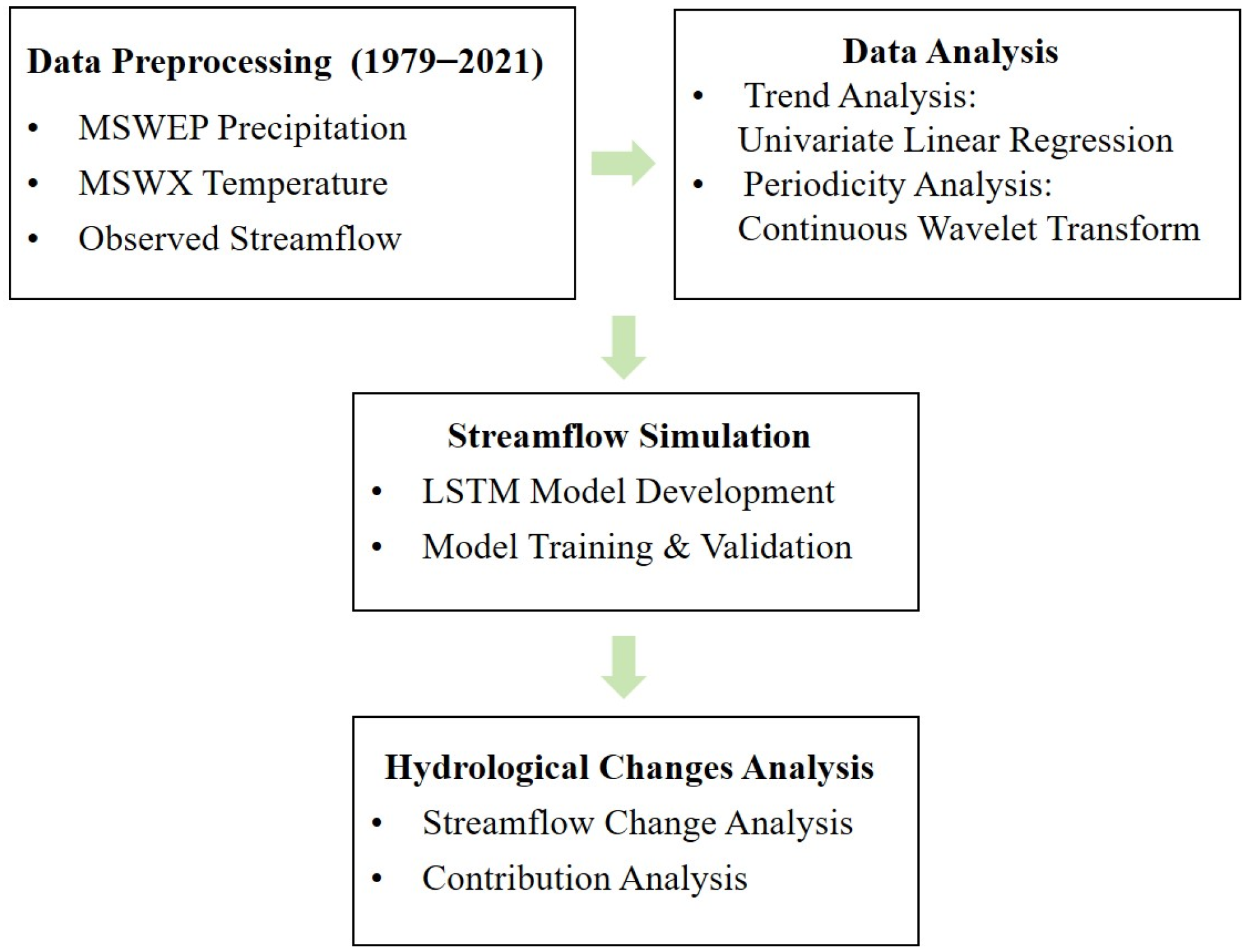
Figure 2 presents the overall workflow of this study. Firstly, data preprocessing was conducted to gain the monthly precipitation and temperature data for the upstream region of the Chiang Saen station for the period of 1979 to 2021. Then trend and periodicity analyses of hydrometeorological variables were carried out to characterize long-term and seasonal variations. An LSTM model was then constructed and trained using data from the reference period (1979–1991) to simulate natural streamflow conditions. Based on the trained model, long-term natural streamflow from 1992 to 2021 was reconstructed. Finally, attribution analysis was performed to quantify the respective contributions of climate change and human activities to streamflow variations at annual and seasonal scales.

3.1. Data Source and Preprocessing

The precipitation data is taken from the MSWEP dataset, published by Beck et al. in 2019 [26]. MSWEP integrates gauge observations, reanalysis fields, and multiple satellite precipitation products, which enables it to provide high-resolution, observation-constrained precipitation estimates with improved performance in data-sparse regions. This dataset has been widely recommended and successfully applied in studies of the Lancang–Mekong Basin [27,28,29], consistently demonstrating high reliability in representing precipitation patterns in tropical basins. It has also been widely applied in hydrological modeling and provides a temporal resolution of 3 h and a spatial resolution of 0.1°. For this reason, we used the latest version v2.8 for our analysis. The temperature data were derived from the MSWX dataset, released by Beck et al. in 2022 [30], with a temporal resolution of 3 h and a spatial resolution of 0.1°. Monthly precipitation and temperature data for the upstream region of the Chiang Saen station for the period of 1979 to 2021 were gained from MSWEP and MSWX dataset, respectively. Streamflow data is sourced from the Chiang Saen Hydrological Station for the period from 1979 to 2021, provided by the Mekong River Commission.

3.2. Trend Analysis Method

To explore the changing trends of hydrological and meteorological elements at the annual and seasonal scales, we used the univariate linear regression method [31,32] and conducted a significance test with a significance level of 0.05 by calculating the p-value. The calculation formulas are as follows:
y i = a + s l o p e × x i + ξ i
s l o p e = i = 1 n x i x ¯ y i y ¯ i = 1 n x i x ¯ 2
where yi represents variables for the ith year; a is the intercept; slope is the trend for the change in slope; xi is the time; ξi indicates error; n represents the total number of years during the research period; and x ¯ and y ¯ are the average values of x and y. To assess the goodness-of-fit of the regression model, the Coefficient of Determination (R2) was computed, which quantifies the proportion of variance in the dependent variable explained by the linear trend over time. An R2 value close to 1 indicates a strong linear relationship, whereas a value near 0 suggests little to no explanatory power of the temporal trend. Statistical significance of the trend was evaluated using a two-tailed t-test on the slope, with the null hypothesis H0: slope = 0 (no trend). The corresponding p-value was calculated, and trends were considered statistically significant at the α = 0.05 level if p < 0.05. A non-significant p-value (p ≥ 0.05) implies that the observed trend could plausibly arise from random inter-annual variability.

3.3. Periodic Analysis Method

The continuous wavelet transform (CWT), proposed by Jean Morlet and Alex Grossmann in the 1980s [31,32], is primarily employed to analyze the periodic patterns and potential frequency variations in time series data [33]. The CWT method performed a multi-scale decomposition of the original signal through the scaling and translation of the wavelet basis function, enabling the extraction of local information at different temporal and frequency scales. This technique has gained widespread application in examining time–frequency variations in non-stationary signals with multi-scale properties, particularly in meteorological and hydrological variables [34,35,36]. For a given time series (Xn, n = 1, …, N), the CWT is expressed as follows:
W n ( s ) = ( δ t s ) 1 / 2 n = 1 N x n ψ 0 [ n n δ t s ]
where the wavelet coefficient Wn(s) is complex, and s and δt represent the wavelet scale and the uniform time step, respectively. The indices n and n′ correspond to the localized and the translated time index of the time ordinate Xn, respectively. The function ψ0 (η) represents the wavelet function, with the Morlet wavelet being adopted in this study. The real part coefficients of the CWT are effective in representing the amplitude and phase information of the signal at specific scales and time locations, revealing the detailed temporal structure. The wavelet power spectrum, computed as the squared magnitude of the CWT coefficients |Wn(s)|2, serves as a measure for detecting dominant periodicities and their temporal variability. Peaks in the average wavelet power curve exceeding the 5% significance level are identified as principal periods. In this research, the significance of those period components is evaluated by comparing the wavelet power to a background white noise spectrum. CWT was applied to monthly time series data of precipitation, temperature, and streamflow spanning the period from 1979 to 2021 to determine the periodic structure.

3.4. Streamflow Simulation Using Long Short-Term Memory

The long-term and short-term memory neural network (LSTM) improves upon the use of a recurrent neural network (RNN). It uses a “gate mechanism” to save data information for a long time and selectively controls the influence of the input information at the current time and the historical information on the transmission state of the LSTM unit [37]. The input at each time point is weighted by the same weight coefficient with the state at the previous time point, so as to solve the problem of “gradient explosion” or “gradient disappearance”, where the RNN model is optimized by a gradient descent algorithm. LSTM neural networks include an input layer, hidden layer, and output layer, and the hidden layer contains the LSTM unit, including an input gate, output gate, and forgetting gate.
(1) Forget gate:
f t = σ ( W f · h t 1 ,   x t + b f )
where ft is the forget gate activation, σ denotes the sigmoid function, ht−1 is the previous hidden state, xt is the current input, and Wf and bf are the weight matrix and bias term, respectively.
(2) Input gate and candidate cell state:
i t = σ ( W i · h t 1 ,   x t + b i )
C ~ t = t a n h ( W c [ h t 1 , x t ] + b c )
C t = f t · C t 1 + i t · C ~ t
where Ct−1 represents the previous cell state.
(3) Output gate:
O t =   σ ( W o [ h t 1 , x t ] + b o )  
h t = O t · t a n h ( C t )  
These gated operations enable the LSTM to preserve or update information adaptively across time steps, allowing for effective modeling of nonlinear hydrological processes. The hyperparameters of the LSTM model were optimized through a manual tuning process. The final architecture comprises two stacked LSTM layers followed by a fully connected Dense layer, and each layer contains 64 hidden units. A dropout rate of 0.3 was applied to mitigate overfitting. Model training was conducted using the Adam optimizer with a fixed learning rate of 0.001 and mean squared error (MSE) as the loss function. The training was performed with a batch size of 32 for up to 200 epochs. To further prevent overfitting and improve model generalization, early stopping with a patience of 20 and model checkpointing were employed, restoring the best-performing weights based on validation loss.
For assessing the performance of machine learning models, we used the following evaluation indices: Nash–Sutcliffe Efficiency (NSE, Equation (10)); Kling–Gupta Efficiency (KGE, Equation (11)); and Coefficient of Determination (R2, Equation (14)).
N S E = 1 ( Q obs , i Q sim , i ) 2 ( Q obs , i Q obs , avg ) 2
K G E = 1 ( r 1 ) 2 + ( α 1 ) 2 + ( β 1 ) 2
α = σ s i m σ o b s
β = Q s i m Q o b s
R 2 = [ ( Q obs , i Q obs , avg ) ( Q sim , i   Q sim , avg ) ] 2 ( Q obs , i Q obs , avg ) 2 ( Q sim , i Q sim , avg ) 2
where Qobs,i and Qsim,i represent the measured and simulated streamflow at time step i, respectively; Qobs,avg represents the average of observed streamflow; r is the linear (Pearson) correlation coefficient between the simulated and observed streamflow; α is a measure of the relative variability in the simulated (σsim) and observed (σobs) standard deviation values (taken as a representation of the time step analyzed); and β is the ratio between the mean simulated (Qsim) and mean observed streamflow values (Qobs), which represents bias. The closer the NSE, KGE, and R2 values are to 1, the better the simulation accuracy is.
To account for the hysteresis effect in rainfall–runoff processes, three experimental schemes were designed based on different input combinations of monthly precipitation and temperature at Chiang Saen station from January 1979 to December 2021: To predict streamflow at month T, we constructed input structures that incorporate precipitation and temperature from contemporaneous conditions (T) as well as from lagged periods, progressively extending the window from T-1 to T up to T-2 to T. Thus, each input sample consists of a 3-month sequence of two meteorological variables, reflecting both immediate and short-term delayed hydrological responses in the basin.

3.5. Evaluation Method of the Influence of Climate Change and Human Activities on Streamflow

Streamflow variation (∆Q) is generally regarded as the combined result of climate change and human activities [22,38,39]. According to the cut-off point, the streamflow time series is divided into a reference period and a change period. Streamflow variation is shown in Equation (15), calculated as follows:
Q = Q A M Q B M = Q C C + Q H A
where QAM and QBM represent the measured streamflow in the change and reference periods, respectively. ∆QCC and ∆QHA denote the impacts of climate change and human activities on streamflow, respectively. The contribution of ∆QCC is calculated as Equation (16):
Q C C = Q A R Q B R
where QAR and QBR denote the reconstructed streamflow after and before the cut-off point, respectively. To further quantify the relative contributions of climate change and human activities to streamflow variation, an indicator η was introduced [22], which is calculated as shown in Equation (17):
η = Q A M Q B M Q B M
Finally, the relative contributions of climate change and human activities to streamflow variation are expressed as Equations (18) and (19):
Φ C C = Q A R Q B R Q × 100 %
Φ H A = 1 Φ C C
where ΦCC and ΦHA represent the relative contributions of climate change and human activities to runoff variation, respectively. In this study, human activities refer to anthropogenic disturbances that modify the natural hydrological regime, including hydropower reservoir operation, agricultural water use, and land use changes.
This study takes the Chiang Saen Hydrological Station in Thailand as the research object and constructs an LSTM model based on the rainfall–runoff relationship to simulate the station’s monthly natural streamflow. On this basis, the impacts of upstream cascade hydropower development and climate change on downstream river streamflow at Chiang Saen station is analyzed. Considering the influence of hydropower station construction that began in 1991, the year 1991 is taken as the cut-off point. The period January 1979–December 1991 is defined as the reference period, while January 1992–December 2021 is defined as the changing period. For the reference period (January 1979–December 1991), precipitation, temperature, and streamflow data were divided at a ratio of 7:3, with January 1979–January 1988 used as the training set and February 1988–December 1991 as the validation set. The trained model was then applied to reconstructed streamflow during the change period (January 1992–December 2021) to estimate the respective contributions of climate change and human activities. To further examine these impacts, seasonal contributions were evaluated for spring (March–May), summer (June–August), autumn (September–November), and winter (December–February).

4. Results

4.1. Trend Analysis

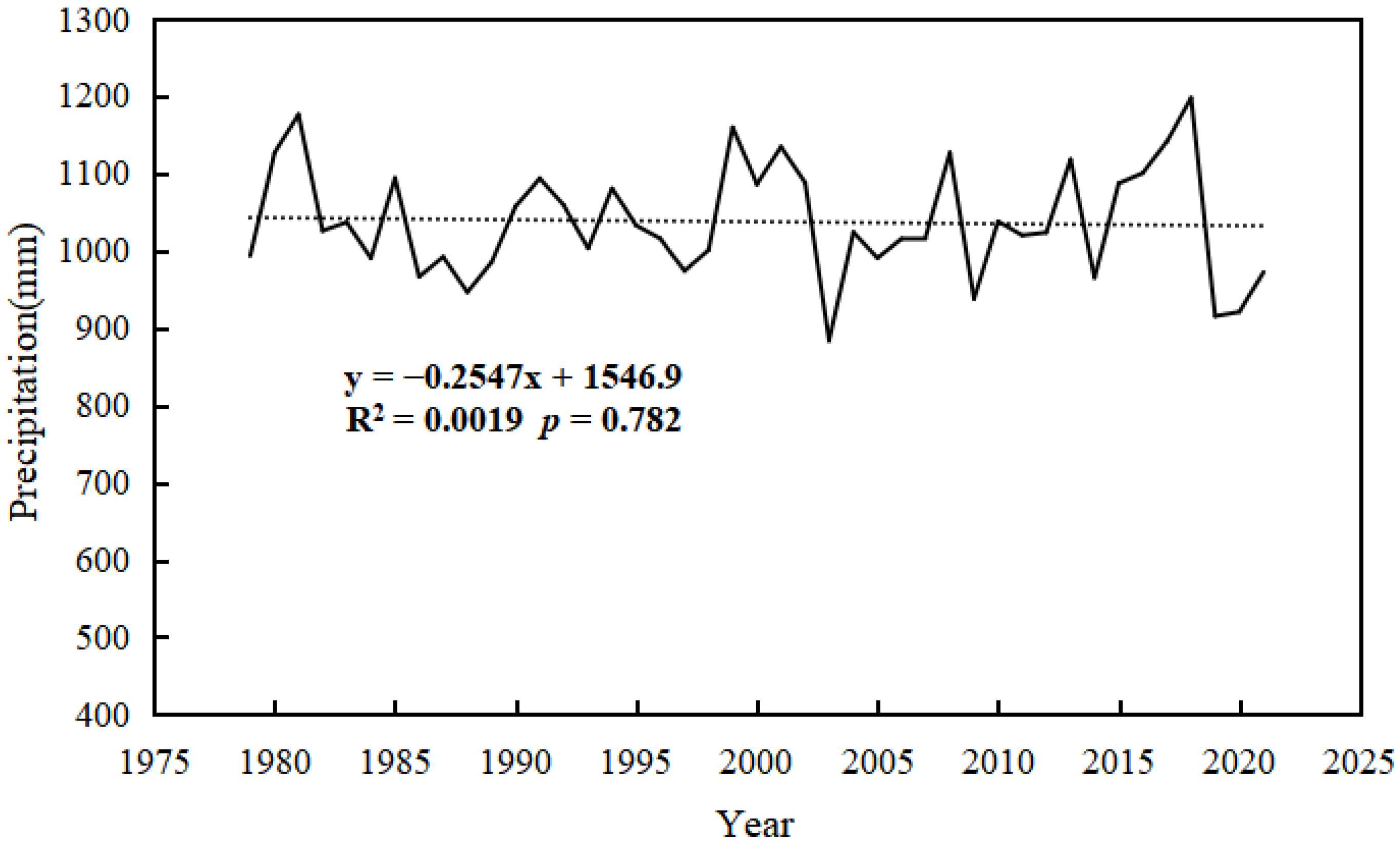
In this study, the linear trend analysis method is used to analyze the trend of precipitation, temperature, and streamflow data at annual and seasonal scales in the basin, and the results are shown in Figure 3, Figure 4, Figure 5, Figure 6, Figure 7 and Figure 8. Figure 3 shows the changing trend of annual total precipitation at Chiang Saen Hydrological Station from 1979 to 2021. The average annual precipitation over the years was 1037.4 mm. The maximum precipitation value was 1197.6 mm, which occurred in 2018. The minimum precipitation value was 883.8 mm and occurred in 2003. The annual precipitation showed only a statistically insignificant decreasing trend over the 43 years, with a slope of −0.255 mm/a.
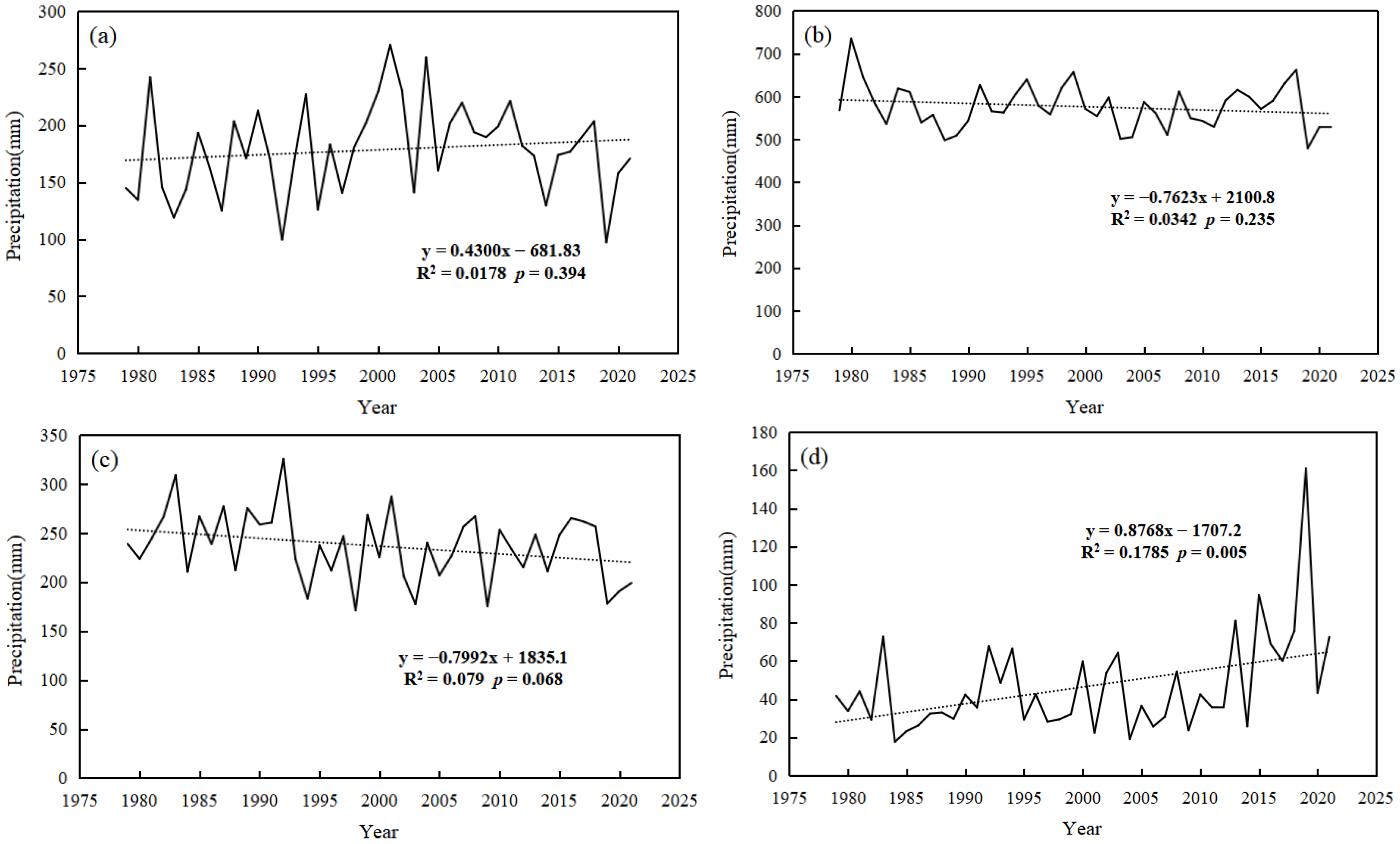
Figure 4 shows the changing trends of seasonal precipitation at Chiang Saen Hydrological Station during 1979–2021. As shown in the figure, the annual average precipitations in spring, summer, autumn, and winter were 178.2 mm, 576.1 mm, 236.7 mm, and 46.3 mm, respectively. The inter-annual variations in precipitation showed an insignificant increase of 0.430 mm/a in spring and a significant increase of 0.877 mm/a in winter. The precipitation in summer and autumn showed insignificant decreasing trends, with reduction rates of 0.762 mm/a and 0.799 mm/a.
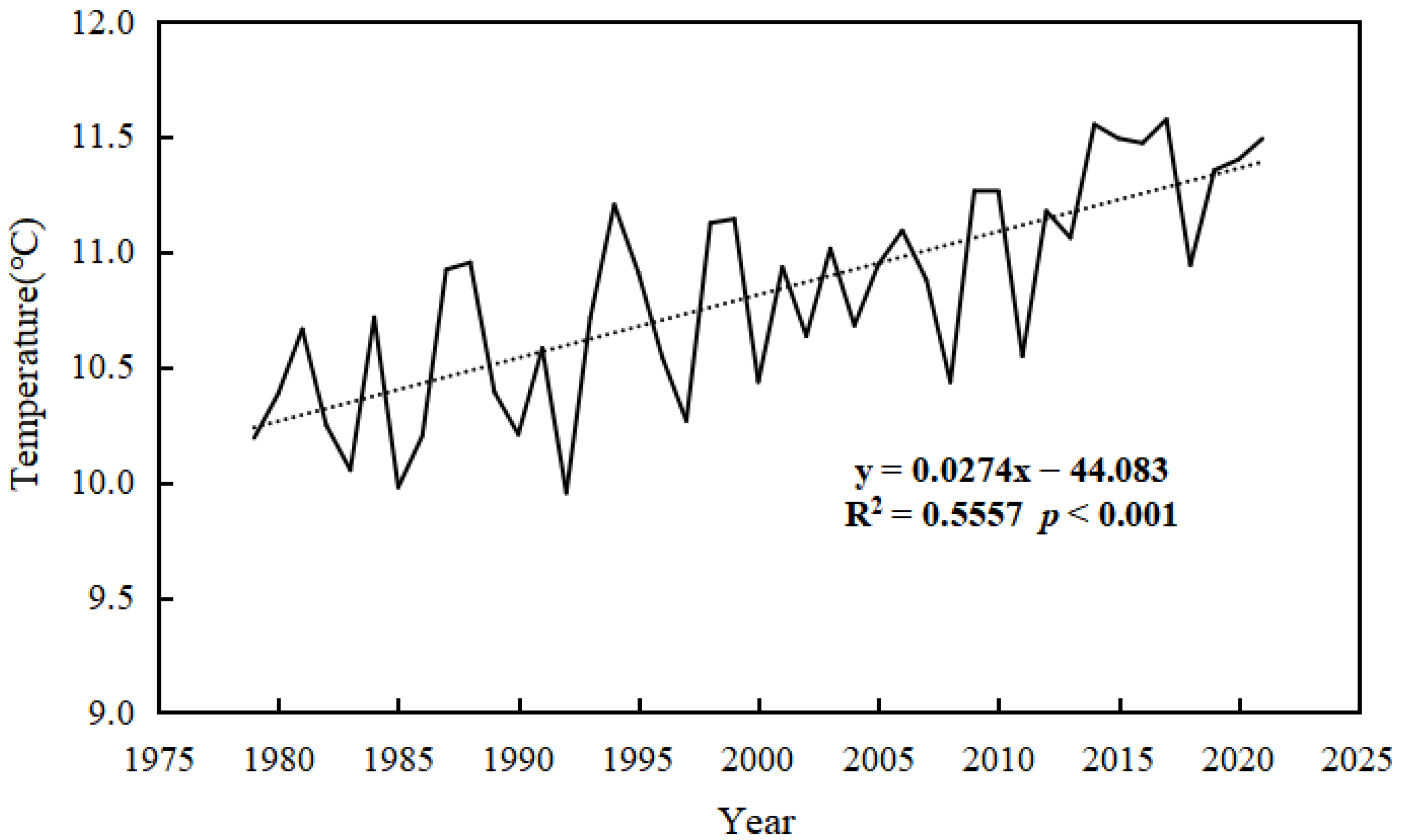
Figure 5 shows that, for the period of 1979–2021, the annual temperature took on a statistically significant increasing trend, with a slope of 0.027 °C/a. The average annual temperature over the years was 10.81 °C. The highest temperature value was 11.57 °C while the lowest temperature value was 9.95 °C, which occurred in 2017 and 1992, respectively.
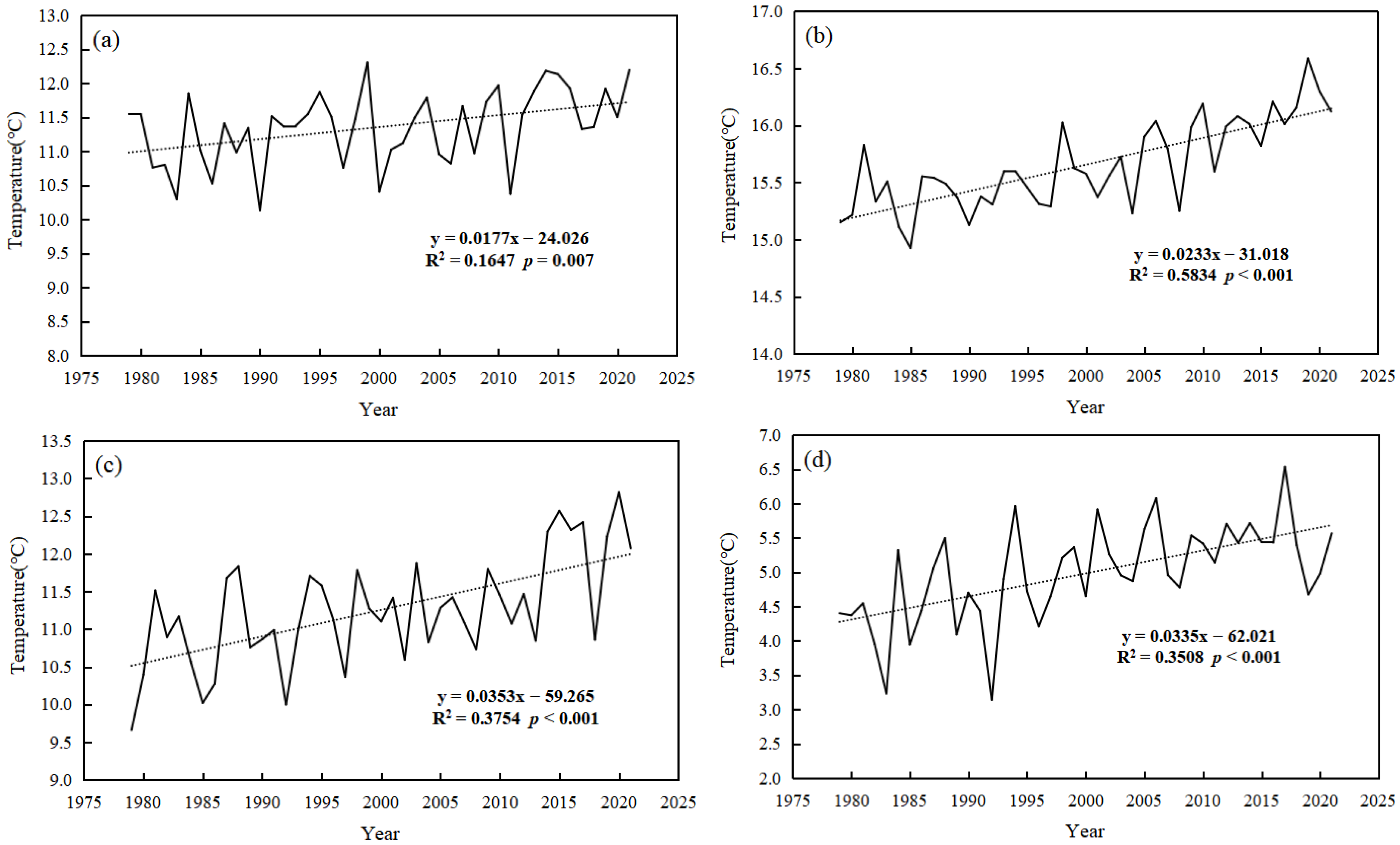
Figure 6 demonstrates that, for the period of 1979–2021, the annual average temperatures in spring, summer, autumn, and winter were 11.35 °C, 15.66 °C, 11.26 °C, and 4.98 °C. The temperature across all four seasons showed significant increasing trends, with slopes of 0.018 °C/a, 0.023 °C/a, 0.035 °C/a, and 0.034 °C/a, respectively.
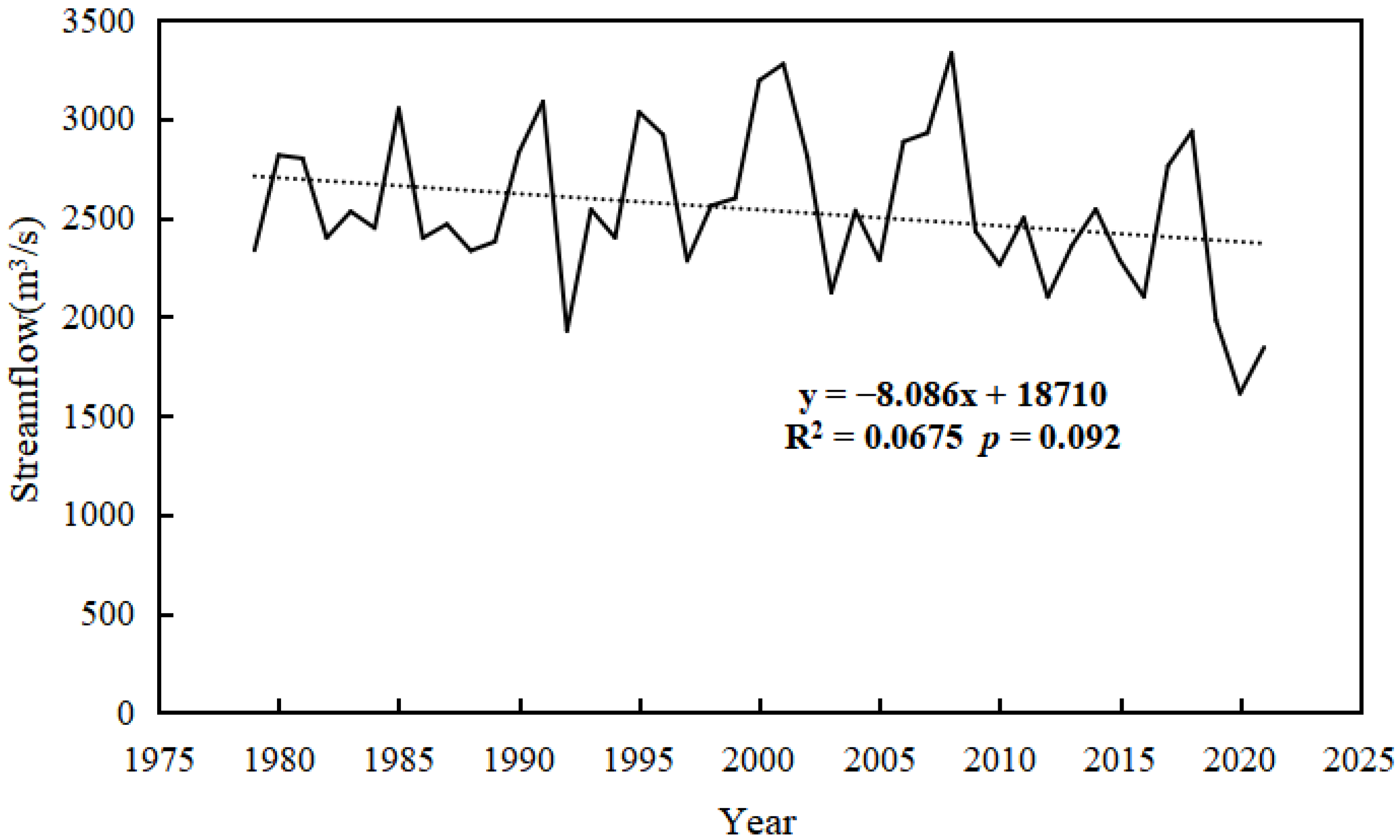
Figure 7 shows the changing trend of annual streamflow at Chiang Saen Hydrological Station from 1979 to 2021. The average annual streamflow over the past 43 years was 2538.9 m3/s. The maximum streamflow appeared in 2008, with a value of 3329.3 m3/s. The minimum streamflow appeared in 2020, with a value of 1611.9 m3/s. The inter-annual variation in annual streamflow took on an insignificant decreasing trend, with a decrease rate of 8.09 m3/a.
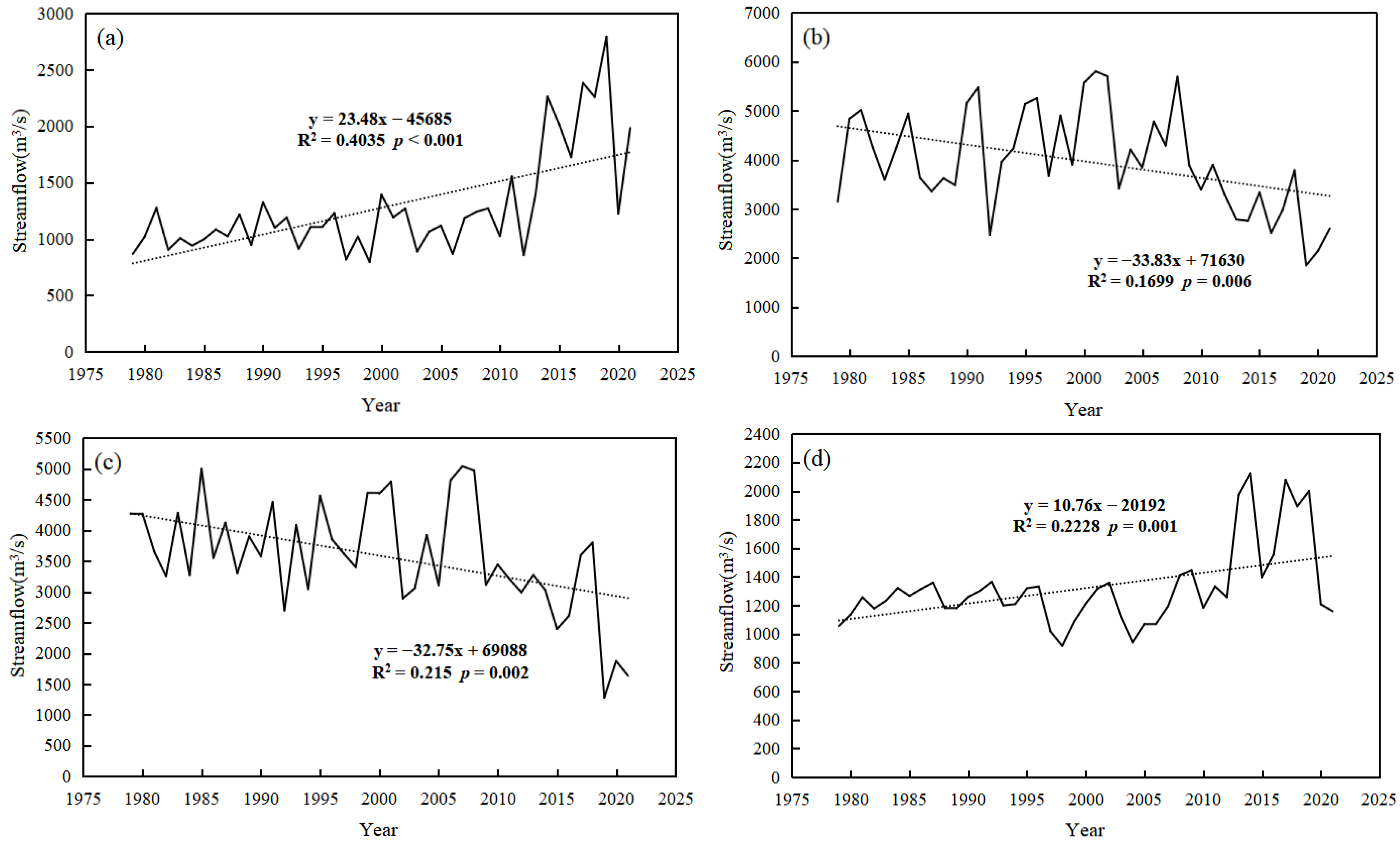
The changing trend of streamflow was also explored at a seasonal scale (Figure 8). For the period of 1979 to 2021, the annual average values of streamflow in the four seasons were 1275.3 m3/s, 3973.8 m3/s, 3585.5 m3/s, and 1321.0 m3/s respectively. The streamflow in spring and winter showed significant increasing trends with slopes of 23.5 m3/(s·a) and 10.8 m3/a, while the streamflow in summer and autumn showed significant decreasing trends with slopes of −33.8 m3/a and −32.8 m3/a.

4.2. Periodic Analysis

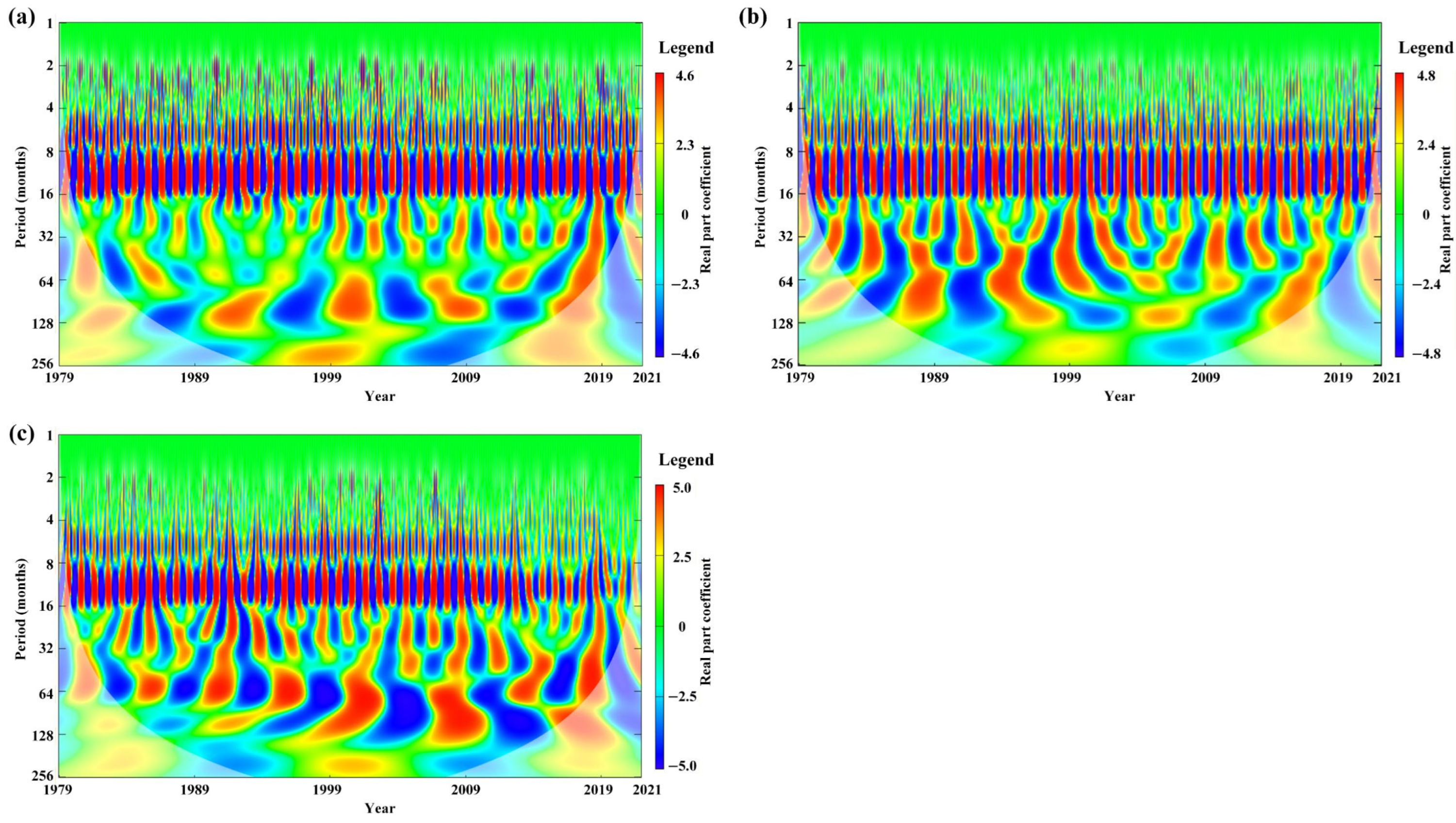
The real-part coefficients of the CWT for precipitation, temperature, and streamflow data at the Chiang Saen Hydrological Station were analyzed to explore the distribution and variation in periods of these hydrometeorological variables, as shown in Figure 9. For the precipitation data (Figure 9a), extremum centers were mainly distributed at the temporal scale of intra-annual time periods and decades, which revealed that the temporal structure of precipitation variability was dominated by multiple periodic components. One-year periods were consistently detected throughout the whole study period, indicating seasonal variations in precipitation. At the inter-annual temporal scales, periodic fluctuations only occurred in the period of 1999–2021. For the temperature data (Figure 9b), the oscillation patterns at the intra-annual temporal scales were similar to those of precipitation. Periods ranging from 4 months to decades were identified from 1979 to 2005, while periodicities larger than 16 months became weak after 2005. For the streamflow data (Figure 9c), significant alternations between positive and negative extremum centers were observed across temporal scales, varying from several months to over a decade. A significant transition in the multi-period temporal pattern occurred after 2012, characterized by the disappearance of the 6-month scale and an increase in the inter-annual scale variability. The results of the three variables suggest that their variations are influenced by both annual and inter-annual periods.
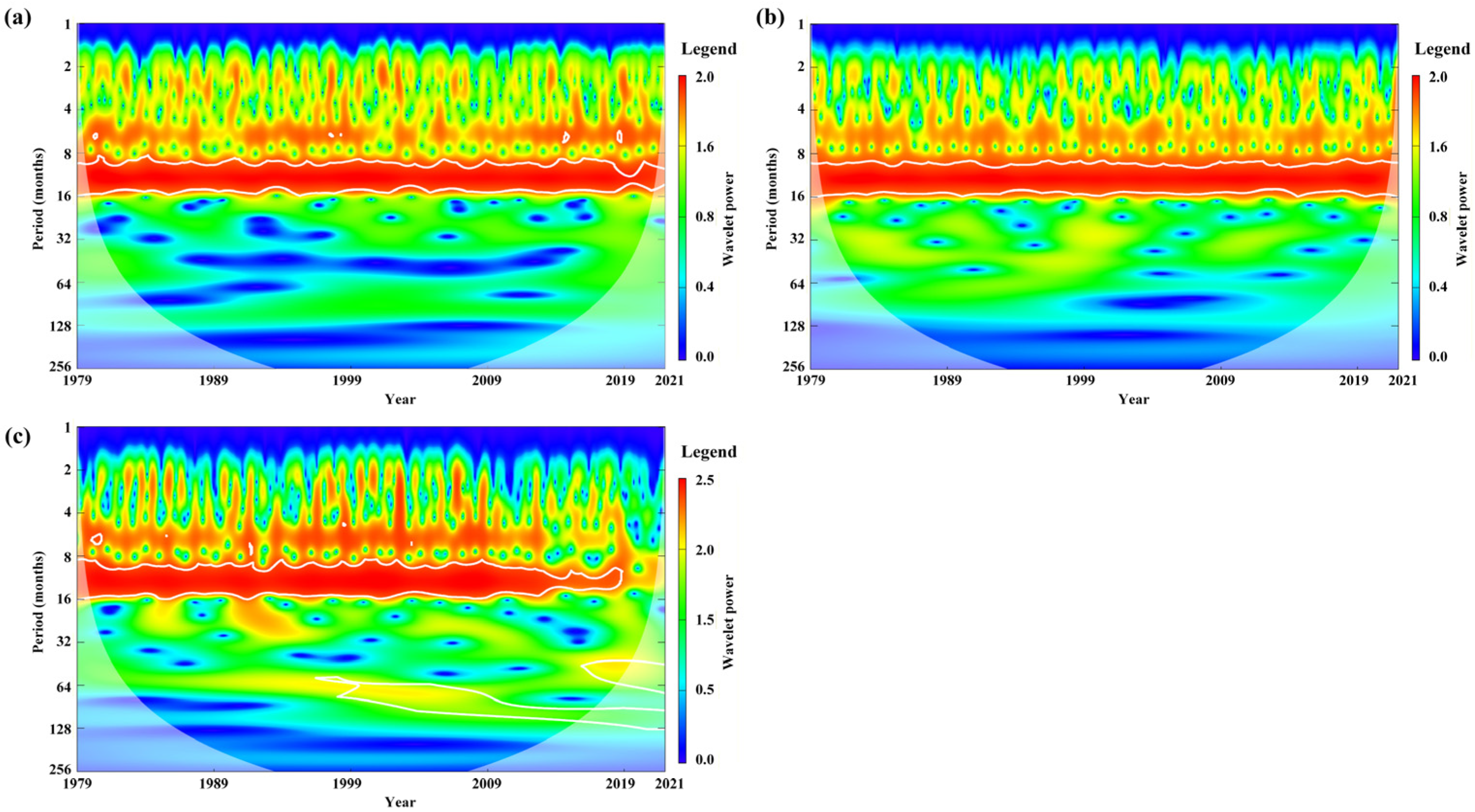
Figure 10 presents the CWT power spectrum of these hydrometeorological variables to explore the period significance and temporal dynamics. For the precipitation data (Figure 10a), a significant energy concentration at the 12-month scale was identified as the principal period. Additional significant periodic components within the 6-month scale were scattered in 2015 and 2019, indicating an intensification of precipitation variability during these periods. At the inter-annual scales, no clear periodic features were identified in the power spectrum. The temperature data (Figure 10b) shows a similar periodic structure to that of precipitation, with the principal period at 12 months. Compared to precipitation, temperature fluctuations were shaped by lower amplitudes in the short periods (2–4 months) and an increasing trend in periods exceeding 16 months. For the streamflow data (Figure 10c), the first principal period at 12 months showed high significance during most of the period of 1979–2021, while the significance only disappeared in 2019. The variation indicated that the time–frequency pattern of streamflow experienced an abrupt change during this period. Other significant areas observed at the 6-month and 66-month scale are mainly distributed from 1991 to 2021, reflecting both the intra-annual and the inter-annual variability of hydrological responses over multiple time scales. On the whole, it is found that the frequency patterns between precipitation and streamflow show similar fluctuations, particularly during the rainy season (June to September), indicating that precipitation variability plays a significant role in shaping streamflow dynamics.

4.3. Streamflow Reconstruction

Table 1 provides a detailed summary of the monthly simulation results for various input combinations of the developed LSTM. For the model only using satellite-based meteorological data of month T, the NSE of simulated streamflow in Chiang Saen Hydrological Station is 0.558 and 0.592 in the training and validation periods, respectively. When using data from month T and T-1 as inputs in the deep learning model, the NSE shows significant improvement compared to the model using data from month T alone, with an increase of 0.312 and 0.283 for the training and validation periods. The improved model performance indicates that, for such a large upstream area of Chiang Saen Hydrological Station, it is crucial to account for the time-lagged conversion of precipitation into river discharge when modeling hydrological responses.
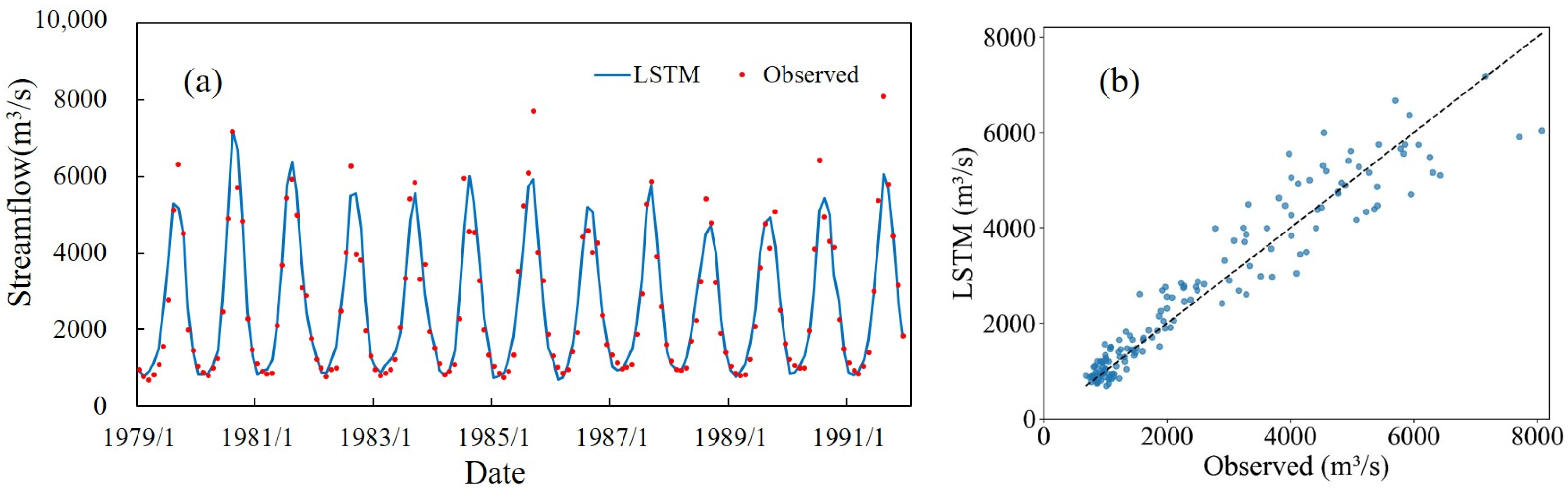
When the model uses input from months T, T-1, and T-2, the NSE reaches 0.916 and 0.901 for the training and validation periods, which also shows an improvement compared with the model using data from months T and T-1. However, the magnitude of improvement is much less than the previous comparison between the model using month T data and the model using data from months T and T-1. This implies that considering the time-lag effects of using input data with longer temporal coverage may not further improve the model simulation accuracy significantly. Therefore, the model with satellite-based meteorological data for months T, T-1, and T-2 was used to reconstruct the natural streamflow at Chiang Saen station. Figure 11 shows the simulated streamflow and observed streamflow for the training and validation periods. Generally, the temporal variation pattern at the monthly scale and the magnitude of the variation are well reproduced by the model. In the subsequent section, the model will be applied to evaluate the relative effects of climate change and human activity on streamflow.

4.4. Impacts of Climate Change and Human Activities on Streamflow

Table 2 presents the differences in observed streamflow between the reference (1979–1991) and change periods (1992–2021). The results show that, on an annual scale, the difference between the two periods is not significant, and the annual streamflow only decreases by about 4.6% compared with the reference period. However, the changes in the four seasons are quite diverse. In the summer, when the streamflow makes the greatest contribution to the annual streamflow, the magnitude of changes in streamflow are also low (−8.2%), similar to that of the annual scale. For the spring and winter, the streamflow exhibits an increase in the change period, with degrees of 30.6% and 3.4%, respectively. In the autumn, the average streamflow of the change period decreases by about −12.1% compared to the reference period. The divergent changing patterns and magnitudes at the seasonal scale indicate that the driving mechanism of streamflow differs among the four seasons.
Table 3 summarizes the relative contributions of climate change and human activities to streamflow variation as estimated by the LSTM model. The results indicate that, on an annual scale, both climate change and human activities make a positive contribution to the decrease in streamflow. However, the degree of change is only −4.6%, which implies that the individual impacts of climate change and human activities on streamflow are relatively minor. In the summer season, for which the average streamflow is highest among the four seasons, the contributions of climate change and human activities to the decrease in streamflow are 31.3% and 68.7%, respectively, indicating a joint influence between natural processes and flood control by upstream reservoir operation. A similar situation was also found in the autumn season: the average streamflow in the changing period is 12.1% lower than that in the reference period, for which human activities make a greater contribution (90.2%) than climate change (9.8%).
For winter, when the streamflow increases in the changing period by about 3.4% compared to the reference period, it is shown that climate change alone negatively contributes to this increase, which is caused by the human activity alone. Considering the location of Chiang Saen station, the water discharge from upstream cascade hydropower stations is one of the possible reasons for the increase in streamflow. In the spring season, the streamflow exhibits the largest magnitude of increase (30.6%). The contributions of climate change and human activity are both positive, with degrees of 40.8% and 59.2%, respectively. Similarly to winter, water releases from the upstream hydropower station could be a reason. Meanwhile, the Lancang–Mekong River originates from the Qinghai–Tibet Plateau, and the increased spring snowmelt due to climate warming is also one of the factors contributing to the flow increase at Chiang Saen station. In general, the differences in streamflow between the changing and reference periods vary among the four seasons, due to the different contribution patterns of climate change and human activities to these changes in different seasons. It is indicated that the driving mechanisms behind streamflow changes at Chiang Saen are complex at different temporal scales and vary across the annual climatic cycle.

5. Discussion

Although the downward trend in annual streamflow is not statistically significant (p > 0.05), which means that the data over the observation period do not provide sufficient evidence for a clear long-term increasing or decreasing trend, the changes in streamflow in the four seasons vary significantly, reflecting that seasonal hydrological changes are driven by multiple factors. First, the commissioning of hydropower reservoirs on the Lancang River has likely altered natural flow regimes by storing wet-season floodwaters and releasing water during the dry season. Li et al. showed that these operational practices have reshaped the hydrology of the Lancang–Mekong Basin, driven by reduced high-flow availability and altered seasonal water distribution [23]. Second, regional climate change may contribute: the observed decline in mean annual flow aligns with regional warming, which has increased potential evapotranspiration (PET) and consequently reduced runoff efficiency. However, the increases in both snow-melting and hydropower reservoir operations may contribute to the increases in streamflow in the spring season. Our findings are in line with previous evidence that both climatic warming and human regulation jointly contribute to streamflow reduction, and reservoir management can modify the climatic signal [23]. As demonstrated by Zhang et al. [1], human activities play a significant role in shaping the synchronization between runoff variation and climate change in the basin. For example, the 2019 Mekong drought caused by climate change was mitigated by hydropower reservoir operations [24]. Our study further reveals that the driving mechanisms behind streamflow changes at Chiang Saen vary in different seasons due to different combinations of climatic factors and human activities.
In this work, streamflow was reconstructed using an LSTM model. An LSTM operates as a data-driven black box: it learns internal state representations and gating dynamics that capture temporal dependencies and interactions present in the training set, rather than explicit, human-interpretable causal rules [40]. As only the precipitation and temperature are used as input, under the proposed modeling framework, it is difficult to explicitly separate the influences of each individual climate-driven and human-driven component on streamflow. Incorporating more information about human activities as model input, such as reservoir water surface area derived from high-resolution satellite images, may lead to a better quantification of the influence of hydropower generation on changes in streamflow under the data-driven modeling framework. For data-driven models, machine learning algorithms and model architectures may bring model simulation uncertainty [41]. Future studies could therefore compare multiple machine learning models or develop ensemble approaches that integrate diverse model structures to mitigate the influence of any single model’s inductive biases and reduce structural uncertainty in our inferences.

6. Conclusions

Using satellite-based meteorological observations and in situ-gauged streamflow, we analyzed the trends and periods of precipitation, air temperature, and streamflow at Chiang Saen Hydrological Station in the Lancang–Mekong River. A deep learning model, i.e., LSTM, was then developed to reconstruct the natural streamflow during the period of change, in order to explore the impacts of climate change and human activities on streamflow. The results of trend analysis show that the average annual precipitation in the basin only shows a statistically insignificant decreasing trend from 1979 to 2021, while precipitation in spring and winter shows an insignificant and significant upward trend, respectively. And the precipitation in summer and autumn shows an insignificant downward trend. The annual average temperature showed a statistically significant upward trend, with a slope of 0.027 °C/a, and all four seasons showed a significant upward trend. The inter-annual variation in annual average streamflow showed an insignificant decreasing trend. The streamflow in spring and winter showed a significant increasing trend, while the streamflow in summer and autumn showed an decreasing trend. Periodic analysis showed that the main periodicity of precipitation, temperature, and streamflow is 12 months, mirroring the annual periodicity in climate. The results of the LSTM model simulation show that the input combination of precipitation and temperature at T-2, T-1, and T months yields high accuracy, with the NSE, KGE, and R2 all exceeding 0.87 in both the training and validation periods. The annual streamflow exhibited a marginal decrease of 4.6% during the changing period (1992–2021) relative to the reference period (1979–1991). Notably, spring streamflow demonstrated a substantial rise (30.6%), attributed to climate (40.8%) and human activities (59.2%). Winter streamflow also increased (3.4%), predominantly driven by anthropogenic influences. Conversely, in summer, streamflow decreased by 8.2%, with human activities contributing significantly (68.7%) more than climate change (31.3%). Autumn streamflow decreased by 12.1%, with human activities contributing significantly (90.2%) more than climate change (9.8%). These findings indicate that the streamflow variability at Chiang Saen is regulated by complex interactions between climate change and human activities, exhibiting seasonal variation in response to inter-annual climate variations. Beyond reporting these hydrological shifts, this study highlights the broader methodological significance of applying an LSTM-based reconstruction approach in a transboundary basin. The model’s ability to incorporate multi-month lagged climatic inputs enables it to capture delayed hydrological responses that traditional statistical methods often fail to represent. This provides a robust naturalized streamflow baseline for distinguishing climate-driven and human-driven impacts. Such an approach offers practical value for improving water resource planning and supporting cooperative management frameworks in the Lancang–Mekong River Basin.

Author Contributions

Conceptualization, M.Z. and J.W.; data curation, methodology, simulation, formal analysis, and writing—original draft preparation, M.Z., J.W., Z.Y., Y.H. and H.G.; writing—review and editing, and supervision, M.Z., J.W., H.G., J.Z., W.W., Y.W., J.C., X.Y., Q.W. and W.S. All authors have read and agreed to the published version of the manuscript.

Funding

This research received no external funding.

Data Availability Statement

The data presented in this study are available on request from the corresponding author.

Conflicts of Interest

The authors declare no conflicts of interest.

References

  1. Zhang, K.; Morovati, K.; Tian, F.; Yu, L.; Liu, B.; Olivares, M.A. Regional Contributions of Climate Change and Human Activities to Altered Flow of the Lancang–Mekong River. J. Hydrol. Reg. Stud. 2023, 50, 101535. [Google Scholar] [CrossRef]
  2. Li, R.; Huang, H.; Wang, Z.; Zhao, R. Quantitative Assessment of the Impacts of Climate and Human Activities on Streamflow of the Lancang–Mekong River over the Recent Decades. Front. Earth Sci. 2023, 10, 1024037. [Google Scholar] [CrossRef]
  3. Han, X.; Li, Q.; Yang, X.; Xu, S.; Zou, Z.; Deng, M.; Wang, W. The Influence of Anthropogenic Climate Change on Meteorological Drought in the Lancang–Mekong River Basin. J. Hydrol. 2023, 626, 130334. [Google Scholar] [CrossRef]
  4. Wang, S.; Zhang, L.; She, D.; Wang, G.; Zhang, Q. Future Projections of Flooding Characteristics in the Lancang–Mekong River Basin under Climate Change. J. Hydrol. 2021, 602, 126774. [Google Scholar] [CrossRef]
  5. Chen, X.; Zheng, Y.; Xu, B.; Wang, L.; Han, F.; Zhang, C. Balancing Competing Interests in the Mekong River Basin via the Operation of Cascade Hydropower Reservoirs in China: Insights from System Modeling. J. Clean. Prod. 2020, 254, 120029. [Google Scholar] [CrossRef]
  6. Liu, Z.; Zhou, J.; Yang, X.; Zhao, Z.; Lv, Y. Research on Water Resource Modeling Based on Machine Learning Technologies. Water 2024, 16, 472. [Google Scholar] [CrossRef]
  7. Cantoni, E.; Tramblay, Y.; Grimaldi, S.; Salamon, P.; Dakhlaoui, H.; Dezetter, A.; Thiemig, V. Hydrological performance of the ERA5 reanalysis for flood modeling in Tunisia with the LISFLOOD and GR4J models. J. Hydrol. Reg. Stud. 2022, 42, 101169. [Google Scholar] [CrossRef]
  8. Darbandsari, P.; Coulibaly, P. Inter-comparison of lumped hydrological models in data-scarce watersheds using different precipitation forcing data sets: Case study of Northern Ontario, Canada. J. Hydrol. Reg. Stud. 2020, 31, 100730. [Google Scholar] [CrossRef]
  9. Beven, K.J.; Binley, A. The future of distributed models: Model training and uncertainty prediction. Hydrol. Process. 1992, 6, 279–298. [Google Scholar] [CrossRef]
  10. Pechlivanidis, I.; Jackson, B.; Mcintyre, N.; Wheater, H. Catchment scale hydrological modelling: A review of model types, training approaches and uncertainty analysis methods in the context of recent developments in technology and applications. Glob. Nest J. 2011, 13, 193–214. [Google Scholar]
  11. Wang, J.; Li, Z.; Zhou, L.; Ma, C.; Sun, W. Ensemble Streamflow Simulations in a Qinghai–Tibet Plateau Basin Using a Deep Learning Method with Remote Sensing Precipitation Data as Input. Remote Sens. 2025, 17, 967. [Google Scholar] [CrossRef]
  12. Chen, J.; Li, Z.; Li, L.; Wang, J.; Qi, W.; Xu, C.-Y.; Kim, J.-S. Evaluation of Multi-Satellite Precipitation Datasets and Their ErrorPropagation in Hydrological Modeling in a Monsoon-Prone Region. Remote Sens. 2020, 12, 3550. [Google Scholar] [CrossRef]
  13. Lu, D.; Yong, B. A Preliminary Assessment of the Gauge-Adjusted Near-Real-Time GSMaP Precipitation Estimate over Mainland China. Remote Sens. 2020, 12, 141. [Google Scholar] [CrossRef]
  14. Maity, R.; Srivastava, A.; Sarkar, S.; Khan, M.I. Revolutionizing the Future of Hydrological Science: Impact of Machine Learning and Deep Learning amidst Emerging Explainable AI and Transfer Learning. Appl. Comput. Geosci. 2024, 24, 100206. [Google Scholar] [CrossRef]
  15. Muñoz, P.; Muñoz, D.F.; Orellana-Alvear, J.; Célleri, R. Enhancing Runoff Forecasting through the Integration of Satellite Precipitation Data and Hydrological Knowledge into Machine Learning Models. Nat. Hazards 2024, 121, 3915–3937. [Google Scholar] [CrossRef]
  16. Li, R.; Feng, Q.; Cui, Y. Precipitation Recycling Impacts on Runoff in Arid Regions of China and Mongolia: A Machine Learning Approach. Hydrol. Sci. J. 2025, 70, 730–749. [Google Scholar] [CrossRef]
  17. Seka, A.M.; Guo, H.; Zhang, J.; Han, J.; Bayable, E.; Ayele, G.T.; Workneh, H.T.; Bayouli, O.T.; Muhirwa, F.; Reda, K.W. Evaluating the Future Total Water Storage Change and Hydrological Drought under Climate Change over Lake Basins, East Africa. J. Clean. Prod. 2024, 447, 141552. [Google Scholar] [CrossRef]
  18. Nguyen, Q.; Shrestha, S.; Ghimire, S.; Sundaram, S.M.; Xue, W.; Virdis, S.G.; Maharjan, M. Application of Machine Learning Models in Assessing the Hydrological Changes under Climate Change in the Transboundary 3S River Basin. J. Water Clim. Change 2023, 14, 2902–2918. [Google Scholar] [CrossRef]
  19. Yang, X.; Bao, Z.; Wang, G.; Liu, C.; Jin, J. Trends and Changes in Hydrologic Cycle in the Huanghuaihai River Basin from 1956 to 2018. Water 2022, 14, 2142. [Google Scholar] [CrossRef]
  20. Yeditha, P.K.; Rathinasamy, M.; Neelamsetty, S.S.; Bhattacharya, B.; Agarwal, A. Investigation of Satellite Precipitation Product Driven Rainfall–Runoff Model Using Deep Learning Approaches in Two Different Catchments of India. J. Hydroinform. 2022, 24, 16–37. [Google Scholar] [CrossRef]
  21. Zhu, E.; Wang, Y.; Yuan, X. Changes of Terrestrial Water Storage during 1981–2020 over China Based on Dynamic-Machine Learning Model. J. Hydrol. 2023, 621, 129576. [Google Scholar] [CrossRef]
  22. Wang, J.; Zhou, L.; Ma, C.; Sun, W. Analyzing the Effects of Climate Change and Human Activities on Streamflow in a North China Arid Basin: A Machine Learning Perspective Considering Model Structural Uncertainty. Theor. Appl. Climatol. 2025, 156, 345–360. [Google Scholar] [CrossRef]
  23. Li, D.; Long, D.; Zhao, J.; Lu, H.; Hong, Y. Observed changes in flow regimes in the Mekong River basin. J. Hydrol. 2017, 551, 217–232. [Google Scholar] [CrossRef]
  24. Wang, S.; Chen, F.; Hu, M.; Chen, Y.; Cao, H.; Yue, W.; Zhao, X. Past, Present and Future Changes in the Annual Streamflow of the Lancang-Mekong River and Their Driving Mechanisms. Sci. Total Environ. 2024, 947, 174707. [Google Scholar] [CrossRef] [PubMed]
  25. Hecht, J.S.; Lacombe, G.; Arias, M.E. Hydropower dams in the Mekong River Basin: A review of their hydrological impacts. J. Hydrol. 2019, 568, 285–300. [Google Scholar] [CrossRef]
  26. Beck, H.E.; Wood, E.F.; Pan, M.; Fisher, C.K.; Miralles, D.G.; Van Dijk, A.I.J.M.; McVicar, T.R.; Adler, R.F. MSWEP V2 Global 3-Hourly 0.1° Precipitation: Methodology and Quantitative Assessment. Bull. Am. Meteorol. Soc. 2019, 100, 473–500. [Google Scholar] [CrossRef]
  27. Tang, X.; Zhang, J.; Gao, C.; Ruben, G.B.; Wang, G. Assessing the uncertainties of four precipitation products for SWAT modeling in Mekong River Basin. Remote Sens. 2019, 11, 304. [Google Scholar] [CrossRef]
  28. Li, Q.; Zeng, T.; Chen, Q.; Han, X.; Weng, X.; He, P.; Zhou, Z.; Du, Y. Spatio-temporal changes in daily extreme precipitation for the Lancang–Mekong River Basin. Nat. Hazards 2023, 115, 641–672. [Google Scholar] [CrossRef]
  29. Sun, Z.; Liu, Y.; Zhang, J.; Chen, H.; Jin, J.; Liu, C.; Wang, G.; Tang, L. Spatiotemporal Projections of Precipitation in the Lancang–Mekong River Basin Based on CMIP6 Models. Remote Sens. 2023, 15, 4502. [Google Scholar] [CrossRef]
  30. Beck, H.E.; Van Dijk, A.I.J.M.; Larraondo, P.R.; McVicar, T.R.; Pan, M.; Dutra, E.; Miralles, D.G. MSWX: Global 3-Hourly 0.1° Bias-Corrected Meteorological Data Including Near-Real-Time Updates and Forecast Ensembles. Bull. Am. Meteorol. Soc. 2022, 103, E710–E732. [Google Scholar] [CrossRef]
  31. Grossmann, A.; Morlet, J. Decomposition of Hardy Functions into Square Integrable Wavelets of Constant Shape. SIAM J. Math. Anal. 1984, 15, 723–736. [Google Scholar] [CrossRef]
  32. Morlet, J.; Arens, G.; Fourgeau, E.; Glard, D. Wave Propagation and Sampling Theory—Part I: Complex Signal and Scattering in Multilayered Media. Geophysics 1982, 47, 203–221. [Google Scholar] [CrossRef]
  33. Torrence, C.; Compo, G.P. A Practical Guide to Wavelet Analysis. Bull. Am. Meteorol. Soc. 1998, 79, 61–78. [Google Scholar] [CrossRef]
  34. Bittner, D.; Engel, M.; Wohlmuth, B.; Labat, D.; Chiogna, G. Temporal Scale-Dependent Sensitivity Analysis for Hydrological Model Parameters Using the Discrete Wavelet Transform and Active Subspaces. Water Resour. Res. 2021, 57, e2020WR028511. [Google Scholar] [CrossRef]
  35. Cheng, V.Y.; Saber, A.; Arnillas, C.A.; Javed, A.; Richards, A.; Arhonditsis, G.B. Effects of Hydrological Forcing on Short- and Long-Term Water Level Fluctuations in Lake Huron–Michigan: A Continuous Wavelet Analysis. J. Hydrol. 2021, 603, 127164. [Google Scholar] [CrossRef]
  36. Li, J.; Huang, J.; Zheng, L.; Zheng, W. Study on a Mother Wavelet Optimization Framework Based on Change-Point Detection of Hydrological Time Series. Hydrol. Earth Syst. Sci. 2023, 27, 2325–2339. [Google Scholar] [CrossRef]
  37. Hochreiter, S.; Schmidhuber, J. Long Short-Term Memory. Neural Comput. 1997, 9, 1735–1780. [Google Scholar] [CrossRef] [PubMed]
  38. Bao, Z.; Zhang, J.; Wang, G.; Fu, G.; He, R.; Yan, X.; Jin, J.; Liu, Y.; Zhang, A. Attribution for decreasing streamflow of the Haihe River basin, northern China: Climate variability or human activities? J. Hydrol. 2012, 460–461, 117–129. [Google Scholar] [CrossRef]
  39. Tang, J.; Yin, X.A.; Yang, P.; Yang, Z. Assessment of contributions of climatic variation and human activities to streamflow changes in the Lancang River, China. Water Resour. Manag. 2014, 28, 2953–2966. [Google Scholar] [CrossRef]
  40. Lees, T.; Reece, S.; Kratzert, F.; Klotz, D.; Gauch, M.; De Bruijn, J.; Kumar Sahu, R.; Greve, P.; Slater, L.; Dadson, S. Hydrological concept formation inside long short-term memory (LSTM) networks. Hydrol. Earth Syst. Sci. 2021, 26, 3079–3101. [Google Scholar] [CrossRef]
  41. Rong, Y.; Wang, W.; Wu, P.; Wang, P.; Zhang, C.; Wang, C.; Huo, Z. A novel hybrid deep learning framework for evaluating field evapotranspiration considering the impact of soil salinity. Water Resour. Res. 2024, 60, e2023WR036809. [Google Scholar] [CrossRef]
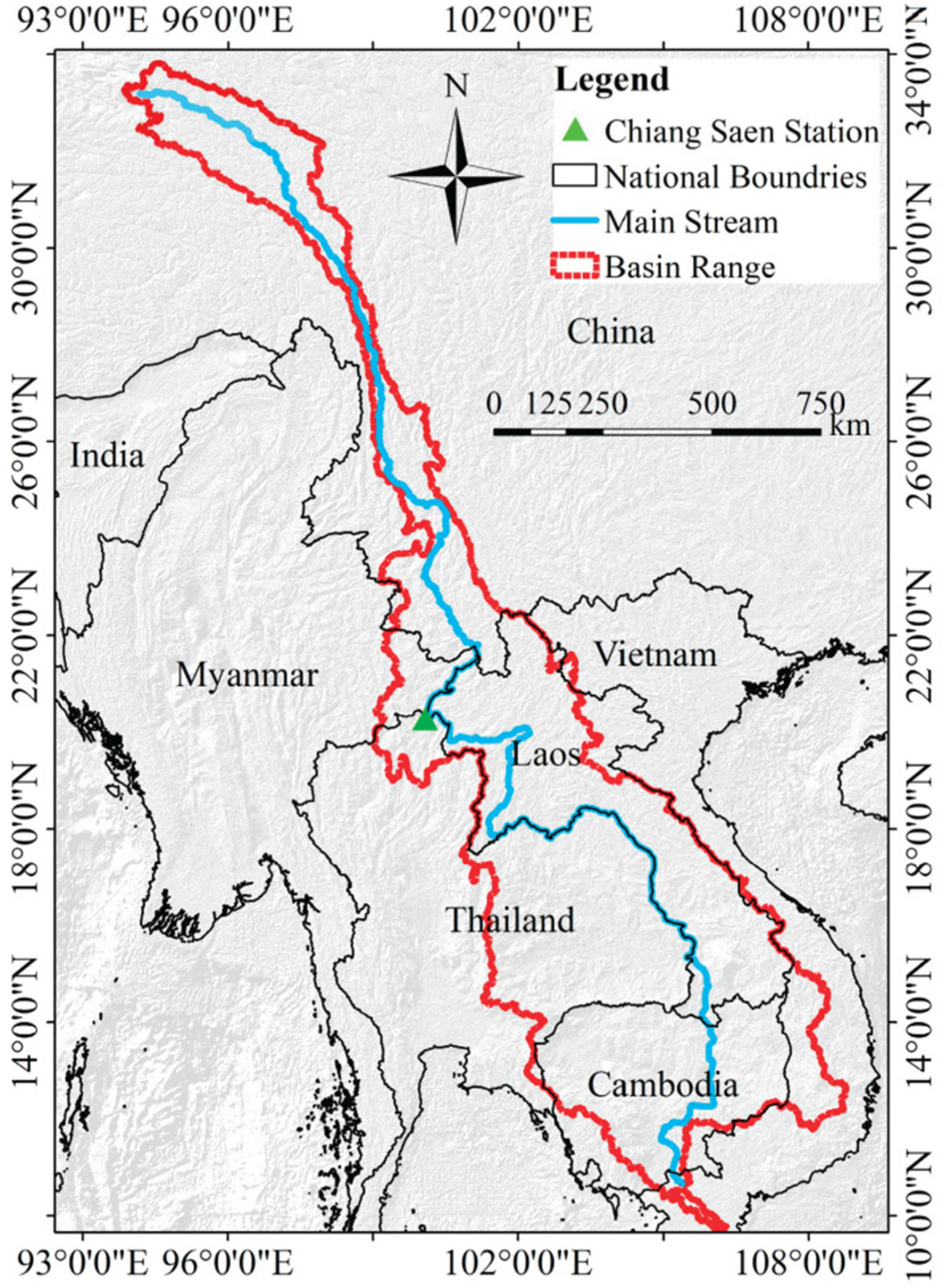
Figure 1. The Lancang–Mekong River Basin and the location of Chiang Saen station.
Remotesensing 17 04002 g001
Figure 2. Workflow of the study.
Remotesensing 17 04002 g002
Figure 3. Changing trend of annual total precipitation at Chiang Saen Hydrological Station during 1979–2021. The dashed line in the figure represents the trend derived from the linear regression analysis.
Remotesensing 17 04002 g003
Figure 4. Changing trends of precipitation in different seasons of (a) spring, (b) summer, (c) autumn, and (d) winter at Chiang Saen Hydrological Station during 1979–2021. The dashed line in the figure represents the trend derived from the linear regression analysis.
Remotesensing 17 04002 g004
Figure 5. Changing trend of annual temperature at Chiang Saen Hydrological Station during 1979–2021. The dashed line in the figure represents the trend derived from the linear regression analysis.
Remotesensing 17 04002 g005
Figure 6. Changing trends of temperature in different seasons of (a) spring, (b) summer, (c) autumn, and (d) winter at Chiang Saen Hydrological Station during 1979–2021. The dashed line in the figure represents the trend derived from the linear regression analysis.
Remotesensing 17 04002 g006
Figure 7. Changing trend of annual streamflow at Chiang Saen Hydrological Station during 1979–2021. The dashed line in the figure represents the trend derived from the linear regression analysis.
Remotesensing 17 04002 g007
Figure 8. Changing trends of streamflow in different seasons of (a) spring, (b) summer, (c) autumn, and (d) winter at Chiang Saen Hydrological Station during 1979–2021. The dashed line in the figure represents the trend derived from the linear regression analysis.
Remotesensing 17 04002 g008
Figure 9. The real-part coefficient of continuous wavelet transform for (a) precipitation, (b) temperature, and (c) streamflow at Chiang Saen Hydrological Station in Thailand during the period of 1979–2021. The cone of influence (COI) outlined by the white shading represents an area where edge effects become important.
Remotesensing 17 04002 g009
Figure 10. The wavelet power spectrum of (a) precipitation, (b) temperature, and (c) streamflow in Chiang Saen hydrological station in Thailand during the period 1979–2021. The cone of influence (COI) outlined by the white shading represents an area where edge effects become important.
Remotesensing 17 04002 g010
Figure 11. Comparison of model performance at the Chiang Saen Hydrological Station. (a) Time series of observed and LSTM-simulated monthly streamflow using inputs from months T, T-1, and T-2. (b) Scatter plot of observed vs. simulated monthly flow with a 1:1 reference line.
Remotesensing 17 04002 g011
Table 1. Performance metrics of machine learning model simulations with different input combinations.
NSEKGER2
TrainingValidationTrainingValidationTrainingValidation
T0.5580.5920.650.610.560.61
T-1, T0.8700.8750.910.850.880.88
T-2, T-1, T0.9160.9010.940.870.920.90
Table 2. Differences in streamflow between the reference period and changing period.
YearlySpringSummerAutumnWinter
QBM (m3/s)2653.81056.64214.73914.91327.6
QAM (m3/s)2532.01380.13869.43442.71373.2
QAMQBM (m3/s)−121.8323.6−345.3−472.245.6
η−4.6%30.6%−8.2%−12.1%3.4%
Table 3. The relative contributions of climate change (CC) and human activities (HA) to the changes at streamflow in Chiang Saen Hydrological Station.
YearlySpringSummerAutumnWinter
CC25.4%40.8%31.3%9.8%−63.9%
HA74.6%59.2%68.7%90.2%163.9%
Disclaimer/Publisher’s Note: The statements, opinions and data contained in all publications are solely those of the individual author(s) and contributor(s) and not of MDPI and/or the editor(s). MDPI and/or the editor(s) disclaim responsibility for any injury to people or property resulting from any ideas, methods, instructions or products referred to in the content.