Article

Spectral Indices Enable Early Detection of Top Kill in Quaking Aspen (Populus tremuloides) Saplings Exposed to Varying Fire Intensity Levels


1
Department of Earth and Spatial Sciences, College of Science, University of Idaho, Moscow, ID 83844, USA
2
Northwest Management Inc., Moscow, ID 83844, USA
3
Department of Forest, Rangeland and Fire Sciences, College of Natural Resources, University of Idaho, Moscow, ID 83844, USA
4
School of the Environment, Washington State University, Pullman, WA 99164, USA
5
College of Forestry, Central South University of Forestry and Technology, Changsha 410004, China
6
Department of Civil and Environmental Engineering, College of Engineering, University of Idaho, Moscow, ID 83844, USA
*
Author to whom correspondence should be addressed.
These authors contributed equally to this work.
Remote Sens. 2025, 17(24), 4005; https://doi.org/10.3390/rs17244005
Submission received: 3 November 2025 / Revised: 9 December 2025 / Accepted: 9 December 2025 / Published: 11 December 2025

Highlights

What are the main findings?
  • Fire intensity most strongly influenced the spectral changes at weeks 1–2 post-fire.
  • ΔCCI and ΔPRI were most effective at predicting aspen top kill.
What are the implications of the main findings?
  • Narrow band indices have potential to assess fire severity.
  • The findings advance knowledge of how deciduous species respond to fires.

Abstract

Spectral indices are widely used to assess vegetation fire severity following wildland fires. Although essential, ground-based assessments of how such indices change due to varying fire intensities remain limited, especially with deciduous tree species that exhibit resprouting. In this paper, we evaluate the efficacy of detecting post-fire physiological change and top kill in quaking aspen (Populus tremuloides) saplings using differenced spectral indices. Saplings (n = 64) were burned under controlled conditions over a range of discrete fire intensity levels from 0 to 4.0 MJ m−2, and reflectance was collected pre-fire and at six post-fire intervals up to 16 weeks. Ten spectral indices (CCI, CSI, MIRBI, NDVIL8, NBR, NBRL8, PRI, SAVI, SW-NIRratio, and SW-SWratio) were calculated, differenced from pre-fire, and related to the change in net photosynthesis and top kill. Fire intensity most strongly influenced the observed spectral changes at weeks 1–2 post-fire, especially for ΔCSI, ΔCCI, and ΔPRI. Pre- to post-fire change in net photosynthesis was strongly related (Tjur’s R2 > 0.5) with ΔCCI, ΔCSI, ΔNBRL8, and the ΔSW–NIR ratio at one week post-fire. Of the spectral indices assessed, ΔCCI and ΔPRI were most effective at predicting top kill. This study illustrates the potential of spectral indices for monitoring vegetation fire severity in deciduous tree species.

1. Introduction

Since the 1980s, the western United States has experienced an increase in wildland fires burning with higher degrees of impact on forested and woodland ecosystems [1,2]. Within these ecosystems, considerable research has focused on assessing fire severity on coniferous tree species using spectral indices derived from optical multispectral data [3,4,5]. However, research is limited on deciduous species in the northwestern United States regarding the efficacy of such spectral indices to assess vegetation fire severity [6]. Increasing our understanding of how fire impacts younger trees is also needed to assess impacts on future stand structure as this shapes the structural composition of that age cohort [7]. In this study, we follow [8] and define vegetation fire severity as the impact of fire intensity on quantitative morphological and physiological parameters including crown damage, top kill, mortality, and changes in net photosynthesis. Importantly, in deciduous species, top kill is often a better indicator of post-fire resilience than immediate fire-induced mortality due to the ability of many deciduous species to resprout [9,10,11].
Across North America, Populus tremuloides (quaking aspen, hereafter referred to as “aspen”) is a widespread deciduous tree species with an extensive biological range, and within the Rocky Mountains of Canada and the United States, it is commonly found in montane seral forests [9]. Wildland fires are a common and key disturbance process affecting aspen succession [10,11], where mature aspen stands can act to limit spread of wildland fires [12,13]. Aspen is a seral species that exhibits excellent establishment in post-fire sites [14,15]. Although even mature aspen trees exhibit thin bark, leading to abundant top kill in wildland fires across all intensities [16], prolific resprouting can occur for multiple years post-fire [7,17]. These features provide fire and land managers with the opportunity to implement aspen as a potential species for reducing wildfire impacts on a landscape [18]. Increasing the understanding of what fire intensities result in top kill and how the post-fire morphology and physiology of aspen saplings change over time could inform monitoring and modeling efforts to assess recovery and successional patterns [10].
The monitoring of vegetation fire severity at landscape scales has been widely conducted for decades using spectral indices, including differenced versions that assess changes between pre- and post-fire conditions and versions that incorporate use of both visible and thermal bands [19,20,21]. Although numerous spectral indices have been evaluated, they can be broadly described into three groups: vegetation indices that have been used to assess variations in vegetation productivity, vegetation fire severity indices that have been used to assess vegetation damage and mortality, and indices that highlight changes in soils and other ecosystem attributes [3,4]. Although spectral indices have been used at single points in time (e.g., immediately after or at one year post-fire), the preferred approach is to do a “like with like” comparison between a change in a measurable surface property (e.g., Δcrown damage and Δsurface cover change) and a difference between a post-fire and pre-fire measure of the spectral index [22].
Several studies have demonstrated that both static and differenced spectral indices derived from crown-level multispectral reflectance data can be used to quantify fire-induced change in tree physiology [3,23,24]. The importance of such laboratory and field studies is that they elucidate what may be a potential approach that could be scaled to airborne or satellite remote sensing [25,26]. Notably, in laboratory studies, [3] evaluated several spectral indices derived from crown-level reflectance to assess post-fire physiological changes in Larix occidentalis and Pinus contorta saplings and found that the differenced normalized differenced vegetation index (ΔNDVI) outperformed other vegetation and fire severity indices when assessing changes in net photosynthesis. In a later study, [24] examined the post-fire response of Pinus monticola and Pseudotsuga menziesii saplings and in contrast to [3] demonstrated that the photochemical reflective index (PRI) outperformed other indices, including ΔNDVI. Notably, ref. [24] also showed that the differenced normalized burn ratio (ΔNBR) and the differenced char soil index (ΔCSI) were reasonable predictors of crown damage and fire-induced tree mortality at a simulated canopy scale in Pinus monticola and Pseudotsuga menziesii saplings, respectively.
Multiple studies have assessed different indices [19,20,21,22,25,26] For example, other studies in different western North American ecosystems have sought to assess the relationship between fire severity spectral indices derived from satellite sensor observed reflectance and field-based fire severity metrics. Measurements at 50 field sites in western Montana and southern California [27] showed that ΔNBR and ΔNDVI performed equally well as predictors of severity as defined via changes to surface cover. In chaparral systems, ref. [28] built on an earlier idea [21,29] and demonstrated improved results between NBR and versions of this index that integrated thermal and emissive data to assess fire severity. In Pinus ponderosa forests, ref. [30] showed that ΔNBR and the short-wave infrared (SWIR) and midinfrared (MIR) reflectance index were each strongly related to field assessments of fire severity (r2 ~ 0.7). In Canadian grasslands, ref. [31] demonstrated that the use of the mid-infrared burn index (MIRBI) adapted for Landsat outperformed NBR in assessing the degrees of charred and damaged grasses. Although originally developed and applied in savannah and shrub systems [25,26,31,32], MIRBI has demonstrated utility in assessing low degrees of vegetation fire severity in conifer systems [33]. However, it remains an open question as to its potential effectiveness in assessing vegetation fire severity in deciduous species. Another common suite of spectral indices used to assess severity in temperate and deciduous forest species are the variants of the soil-adjusted vegetation index, SAVI [34,35,36,37], which have been demonstrated to be more effective than NDVI in single-species forest stands [38].
Regardless of the spectral index, a common approach to assessing the potential to scale application from leaf to landscape scales is to convert field-collected spectral reflectance into the band equivalent reflectance (BER) of a given satellite sensor [25]. The BER is effectively what that sensor would see if located in place of the spectroradiometer and is created by convolving the spectral reflectance with the spectra response functions of the sensor of interest [25,26,30,39,40,41]. In this study, the main objectives are to assess the ability of commonly used vegetation and fire severity spectral indices to detect post-fire physiological changes and predict top kill in aspen saplings. Given past studies [24], it was hypothesized that the differenced chlorophyll/carotenoid index (ΔCCI) and ΔPRI would provide the strongest relationship with physiology metrics and top kill given their sensitivity to foliar pigments. The CCI and PRI have each been widely used to assess seasonal variations and light use efficiency in boreal and temperate deciduous forests [42,43,44,45,46,47]. Although studies have assessed the effectiveness of NDVI and other broad band spectral indices to assess post-fire response in deciduous tree species [46,47,48,49,50], the novelty of the current paper is that only a limited number of studies have evaluated the potential effectiveness of these differenced narrow band spectral indices on deciduous species [51]. Following [3], we further assessed how the spectral indices changed with time following the experimental fires that spanned a range of fire intensities. For more information on ΔCCI and ΔPRI, see [52,53], respectively.

2. Materials and Methods

2.1. Plant Material

We purchased aspen saplings in 3.79 L pots from a nursery (Plants of the Wild, Tekoa, WA), transplanted them into 6.23 L pots (TP616 Treepots, Stuewe and Sons, Inc., Tangent, OR, USA), and then grew them for 2 years at the Washington State University Steffen Center in Pullman, WA, USA. Plants of the Wild is a commercial nursery, where such operations generally seek genetic diversity by sourcing from multiple locations to avoid a monoculture that would be taken out by a single disturbance agent.
We randomly selected individual saplings and then arranged them into eight groups of eight (unburned control group and seven levels of fire intensity). The saplings averaged a height of (m, standard error) ~1.75 m ± 0.04 m and a diameter at root collar of (mm, standard error) 12.2 ± 0.2 mm at the time of the burn experiment. Post-fire, they were kept in an enclosure located adjacent to the combustion laboratory to protect the saplings from wind stress and to facilitate measuring and monitoring. The plants were regularly watered to field capacity to ensure drought stress would not be an influencing factor in the top kill or net photosynthesis response of the trees. Following each measurement the plants were randomly rearranged in the enclosure to minimize impacts of position.

2.2. Experimental Fire Setup

We conducted experimental fires at the indoor combustion laboratory associated with the Idaho Fire Initiative for Research and Education (IFIRE), located in Moscow, Idaho, 8 miles from the Steffan Center. For fuel in these experiments, we used combinations of Pinus monticola needles and wood chips. Following [54], fuels were dried in ovens at 105 °C for at least 48 h to attain ~0% fuel moisture content; weighed (kg m−2); and homogenously distributed to create fire radiative energy (FRE) dosage levels of 0.3 MJ m−2, 0.6 MJ m−2, 1.0 MJ m−2, 1.5 MJ m−2, 2.0 MJ m−2, 3.0 MJ m−2, and 4.0 MJ m−2. Following past studies [24], fuels were evenly distributed and then lightly flattened with a steel plate to ensure a consistent bulk density within each treatment. The average burn times per group (duration ± standard error) in ascending order of FRE dosages levels were 325 ± 13, 489 ± 20, 557 ± 18, 685 ± 32, 784 ± 52, 979 ± 30, and 1870 ± 366 s. The proportions of needles to woodchips are described in Table 1 using established relations and were selected to ensure fire spread [55,56,57]. A control group of eight saplings remained unburned for comparative data but otherwise treated the same. This range of doses exceeded levels usually associated with 100% mortality of fire-resistant conifer saplings (i.e., 0.8–1.2 MJ m−2 [24]) as we sought to elicit both top kill and fire-induced tree mortality. We defined top kill as the complete death of all above-ground tissues, excluding regrowth from the stem base or roots [58]. Tree mortality was defined as death of all above-ground tissues, absence of resprouting, and cambium death [3,23]. Top kill was determined when the main stem died and was checked at each measurement increment.
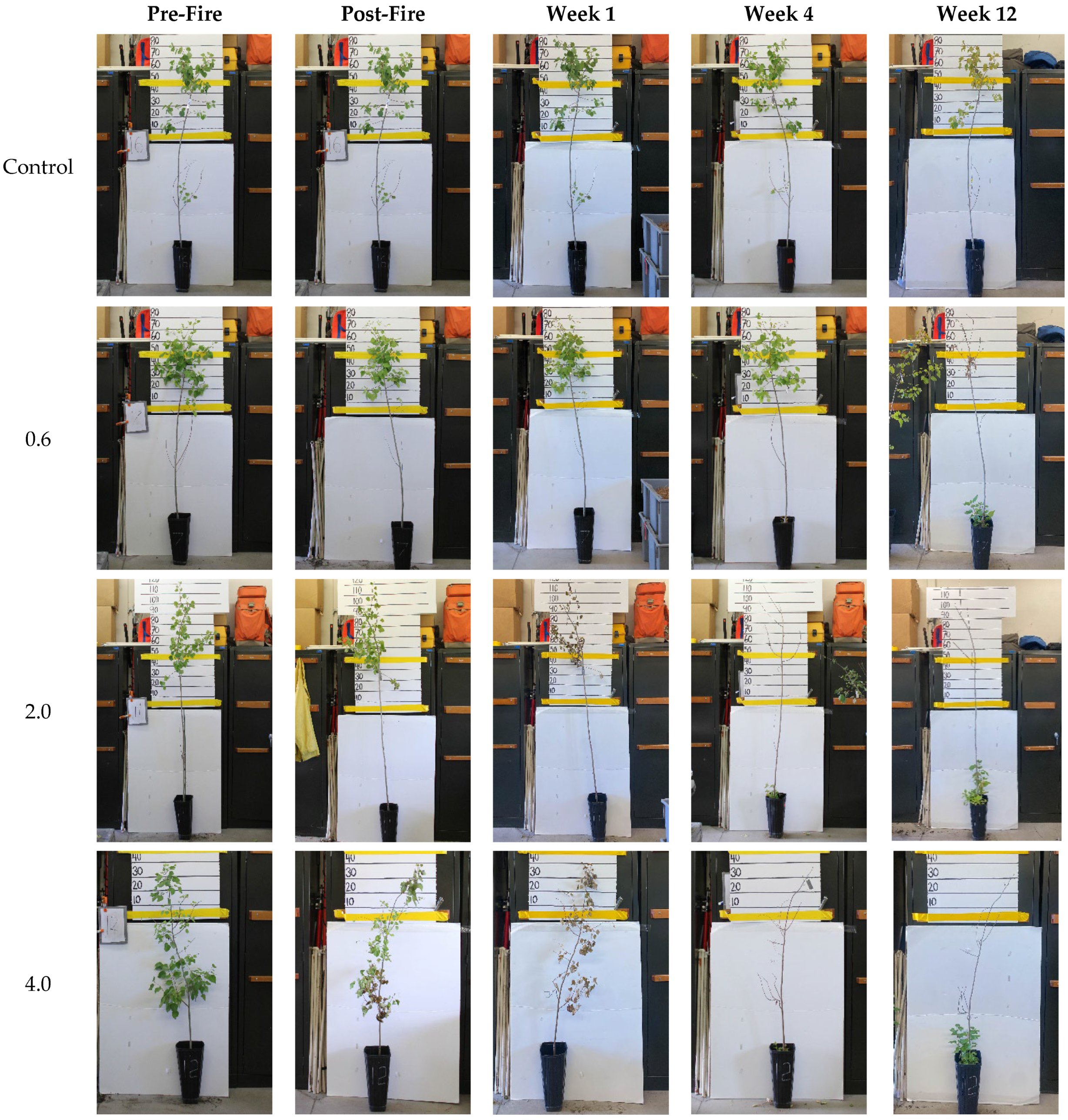
For each fire experiment, we carefully removed each sapling from its watering pot and placed it within a pre-cut burn pot that allowed the fuel to be continuously placed over the soil and concrete board. For each experiment, ~2 g of ethanol was applied to the edge of the fuel bed and ignited with a lighter. During the experimental fires, the combustion lab fan was kept on a low setting to minimize impacts of convection on the fire behavior, and the fires were allowed to naturally extinguish. No fires were restarted following initial ignition. Following the experiment, we returned saplings to their original pots. The control saplings were also removed and returned to their pots to ensure equal treatment. As shown in Figure 1, photographs were taken for each sapling pre- and post-fire.

2.3. Spectral and Photosynthesis Measurements

We collected spectral reflectance data with an Analytical Spectral Devices FieldSpec Pro spectroradiometer (Malvern Panalytical Ltd., Malvern, UK), using the contact probe attachment to minimize atmospheric water absorption effects. The contact probe, which enables reflectance measurements with a 10 mm spot size and an internal light source, was placed in direct contact with the leaves, and therefore, leaf angle and orientation was not a factor. A uniform <2% reflectance (0.3–2.5 microns) background was placed behind each leaf to normalize the impacts of background reflectance. Technical specifications are previously described in past studies [3,24,59]. The instrument collects an average of 10 measurements for each sample between 350 and 2500 nm. For each sapling, 3 samples were collected from the top, middle, and bottom of the canopy with foliage and averaged together to minimize background effects. Leaves were measured for reflectance so long as they were attached to the tree. Resprouting foliage was used in measurements if available as the bottom sample. Between each sapling measurement, we recalibrated the instrument for dark current and reflectance using a 100% reflective Lambertian Spectralon panel (Labsphere Inc., North Sutton, NH, USA). Following [60,61], all spectra were convolved with the spectral response functions of the Landsat 8 Operational Land Imager (OLI) [62] to generate BER associated with each of the OLI bands, given the widespread use of Landsat 8 to map vegetation cover and mortality [63,64,65]. Following conversion to BER, the spectral indices listed in Table 2 were calculated for each time step. The indices were selected following [24] and to enable cross-comparison and are shown in [Table 2]. The narrow band indices of CCI and PRI used the reflectance associated with the individual wavelengths and not the BER data.
We took measurements of light-saturated net photosynthesis (Anet) using an LI-6800 portable photosynthesis system (LI-COR Environmental, Lincoln, NE, USA). Following [71], measurements were taken with the chamber environment with a carbon dioxide level of 400 ppm and a constant photosynthetic photon flux density of 2000 umol−1 m−2 s−1. Measurements were taken at ~25 °C leaf temperature and 50% air humidity. Leaf samples from each sapling were selected to cover the 3 cm × 3 cm chamber and measured between 7:30 and 14:30 for pre-fire and at 1, 7, 14, 28, 42, and 56 days following the experimental fires.

2.4. Analysis and Statistics

We conducted statistical analyses in R (version 2024.12.0.467) to assess relationships between FRE, spectral index changes, photosynthetic responses, and observed top kill in the saplings. Spectral index changes (Δindex) were calculated as the difference between the pre-fire reflectance values and the values at six time points afterward: post-fire (within 4 h of burn completion), week 1, week 2, week 4, week 8, and week 16. Logistic regression models evaluated how spectral changes predicted top kill at each time point, with model performance assessed using Tjur r2. Linear regression models examined relationships between spectral and physiological changes at time points where photosynthesis measurements were available (weeks 1, 2, 4, and 8). The Tjur r2 value of each model was extracted to assess explanatory power, and the top-performing models were ranked by strength of relationship. Although other research has found strong predictive power in tree mortality classification at the landscape level [72], logistic regression is typically more appropriate to this experiment’s sample size (n = 64) and directly mechanistic approach.
To assess whether changes in reflectance were predictive of physiological damage, we modeled top kill as a binary variable (1 = top killed, 0 = no top kill) and as a function of spectral change. For each index and time point, a logistic regression model was fit using the delta of that index relative to the pre-fire value as the predictor. Following [73], the Tjur’s R2 was used to assess the explanatory power [74], which allowed identification of the spectral indices and time points most predictive of sapling damage. The Tjur’s R2 (or coefficient of discrimination) was used as it was developed specifically for logistic regression models where standard regression statistics are not appropriate [73,74]. The Tjur’s R2 statistic has values between 0 and 1, where higher values indicate that the model is more effective at separating the two classes (e.g., live and dead/top kill). This statistic is becoming more widely used in ecological studies [75].
We further assessed the models using AUC [76]. Although the Tjur R2 statistic is not yet widely applied, it was designed to measure the degree of separation between two clear states (e.g., live and dead or damaged and undamaged), and it is considered less sensitive than AUC to data prevalence [73,74], especially when considering binary states [76]. Given top kill is highly likely, it would be described as having a high prevalence, and therefore, a result of no top kill has a lower probability of being a true negative; likewise, mortality is not likely (i.e., low prevalence), and therefore, a result of mortality is less likely to be a true positive [73,76]. Model robustness was further assessed using leave-one-out cross-validation for the top-performing indices. Accuracy was calculated as the proportion of correctly classified observations where, given we are considering logistic regression, the predicted probabilities >0.5 were classified as top killed [73,74].
Photosynthesis measurements data were analyzed using linear mixed-effects models (LMMs) with random intercepts for individual saplings’ ID numbers to account for between-subject correlation [77]. The model tested the effects of FRE, time point, and their interaction on Anet. At later time points, sample sizes were reduced as some saplings could not be measured due to insufficient foliage size for the gas exchange chamber, particularly in higher FRE treatments; the LMM framework appropriately handles such missing data through maximum likelihood estimation [77]. Post hoc pairwise comparisons between time points within FRE levels used estimated marginal means with Tukey adjustment for multiple comparisons. Additionally, linear regression models examined relationships between changes in spectral indices (Δindex) and changes in photosynthesis (ΔAnet) at each time point where both measurements were available, with model performance assessed using R2.
Following [26,33], we also assessed the spectral separability of the different spectral indices to assess changes between the post-fire sample and the unburned controls. Spectral separability was evaluated using the M-statistic, where values >1.5 indicate reasonable separation [33]. Each of these prior studies used this approach to assess the spectral separability of burned versus unburned surfaces. In spectral separability analysis, the goal is to identify classes that exhibit well-separated means with low variance in each band associated with the given index as then the number of overlapping pixels in each class will be low, as indicated by a high statistic value [78]. The M-statistic is defined by [79,80]
Mij = (µi − µj)/(σi + σj)
where M is the separability statistic, µi and σi are the mean and standard deviation of the differenced index values associated with class i, and µj and σj are the mean and standard deviation of the differenced index values associated with class j. Following [33,78], we calculated the M-statistic for all the indices for each temporal data pair (e.g., differenced data created using week 16 and pre-fire for the burned plants could be class i, and differenced data created using week 16 and pre-fire for the unburned plants could be class j).

3. Results

No mortality occurred in any aspen saplings, even at the highest FRE dose (4.0 MJ m−2), with only top kill or resprouting observed. A visual assessment of how increasing the FRE dosage level impacted the canopy of the aspen saplings is shown in Figure 1. In this figure, a representative sample from each FRE dosage level was selected. A clear gradient of crown damage is observed, where the time following each fire treatment to when crown defoliation is observed decreases with increases in the FRE dosage level. In contrast to the prior studies that focused on non-resprouting species [7,81,82], prolific resprouting is clearly visible at 12 weeks post-fire in the images from the representative samples at FRE dosage levels exceeding 0.6 MJ m−2. All seven burn groups displayed resprouting at week three post-fire, with higher FRE groups having more individuals with resprouts and greater number of sprouts per tree.
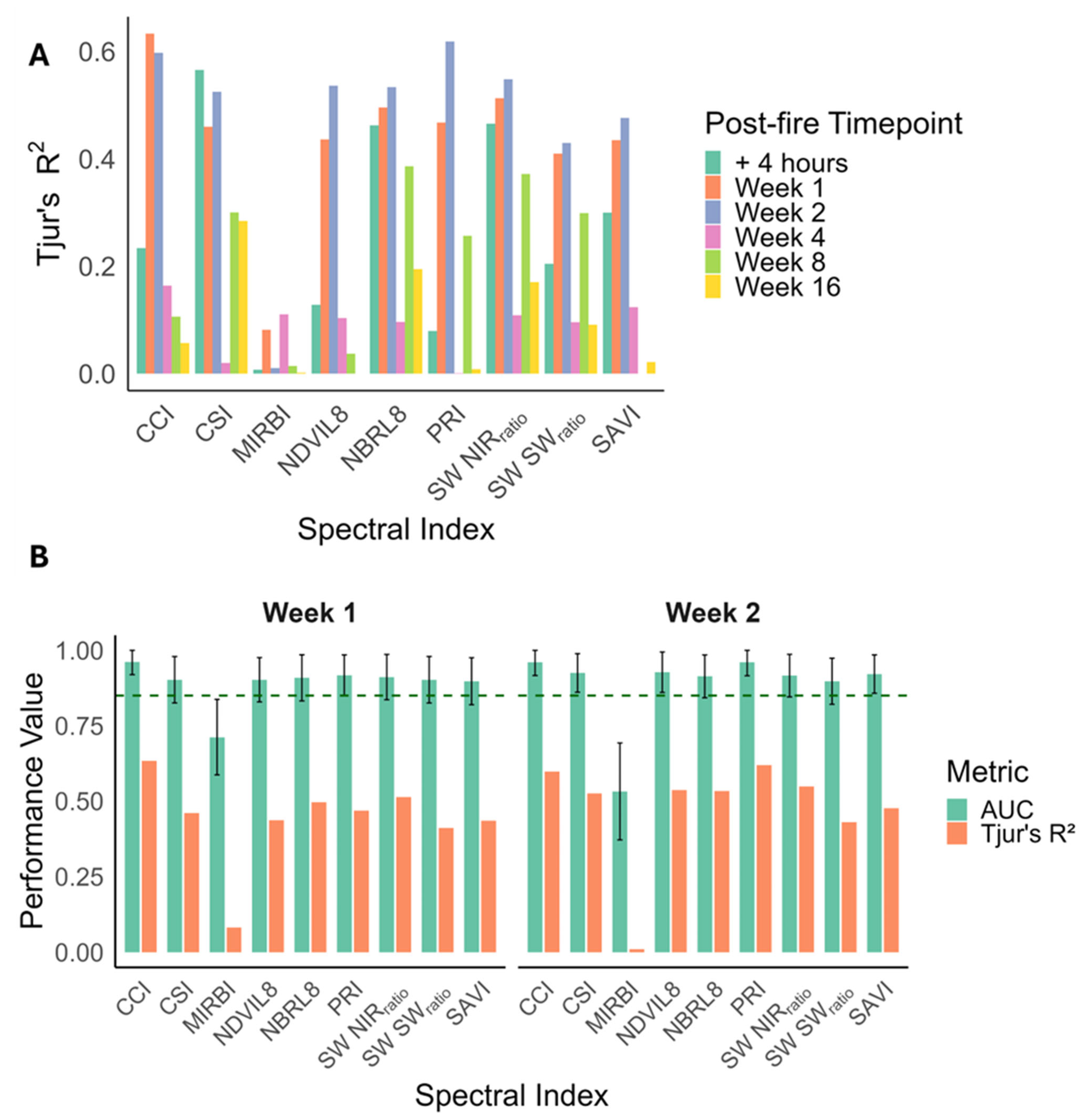
Figure 2 illustrates how the differenced spectral indices relate to the observed top kill in the aspen saplings. In terms of the assessed difference indices, ΔCCI (ranging from −0.55 to +0.12) is most effective at predicting top kill using the 1-week post-fire data (R2 = 0.63, AUC = 0.96) and 2-week post-fire data (R2 = 0.60, AUC = 0.96), ΔPRI (−0.12 to +0.04) at 2 weeks post-fire (R2 = 0.62, AUC = 0.96), and ΔCSI (−1.48 to +0.07) using the immediate post-fire data (R2 = 0.56, AUC = 0.94). All top-performing models showed statistical significance at p < 0.001. The data clearly shows that for most of the differenced spectral indices assessed, using the 1- and 2-week post-fire data produced the best relationships, with the efficacy dropping off rapidly with later dates. Leave-one-out cross-validation confirmed minimal overfitting for top-performing indices. Post-validation AUC values were as follows: post-burn ΔCSI = 0.92, week 1 ΔCCI = 0.94, and week 2 ΔPRI = 0.94, compared with original AUC values of 0.94, 0.96, and 0.96, respectively.
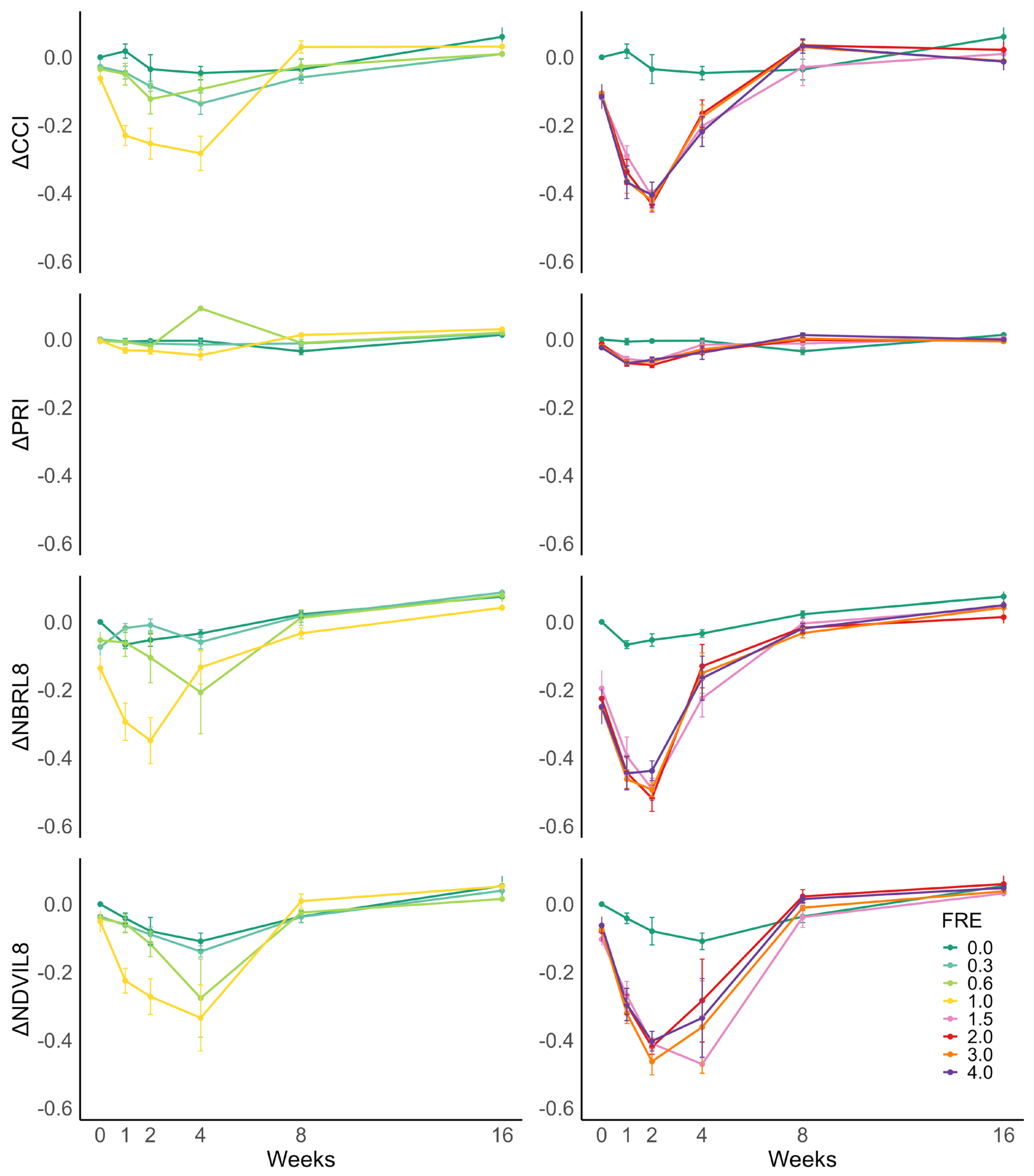
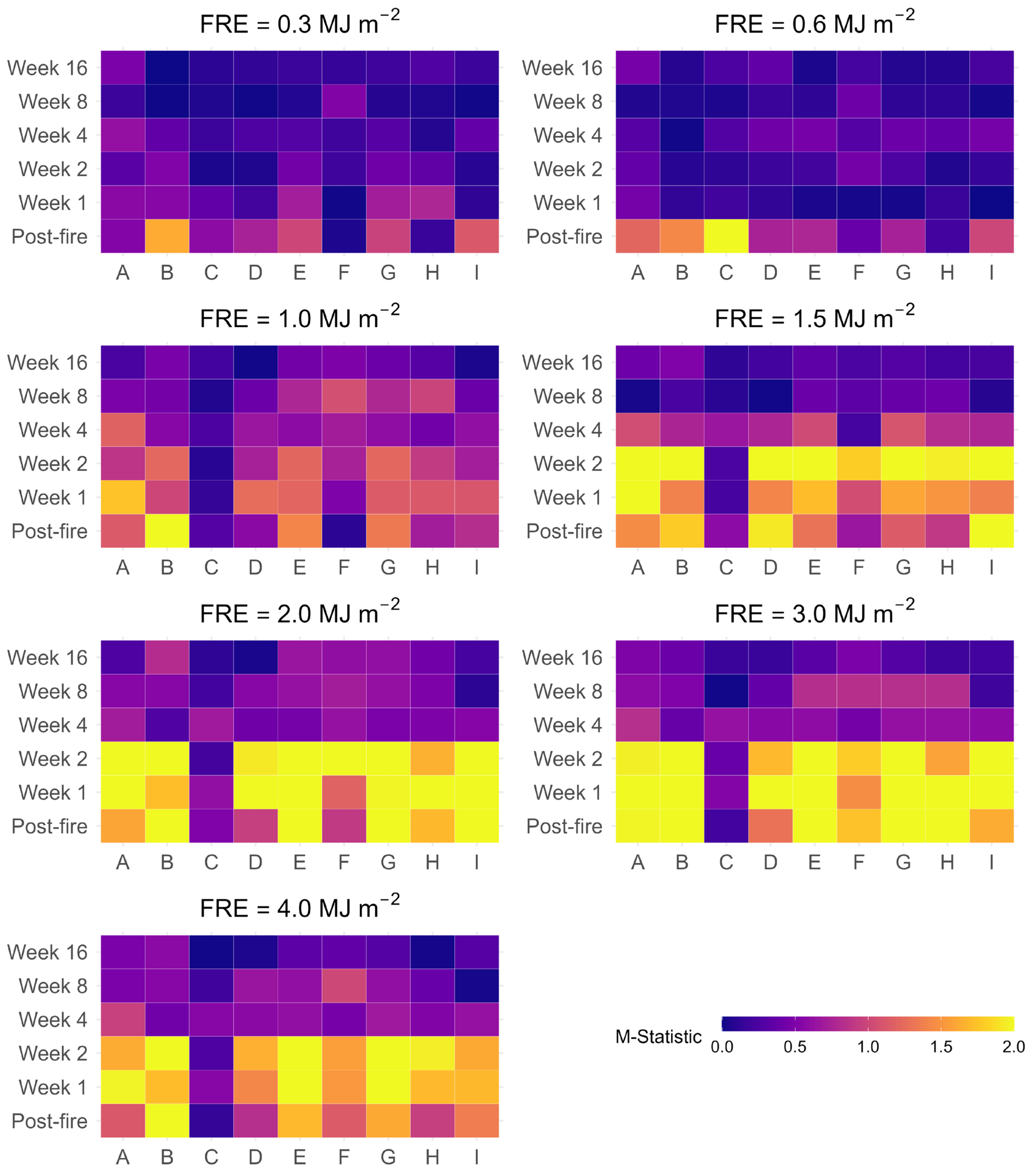
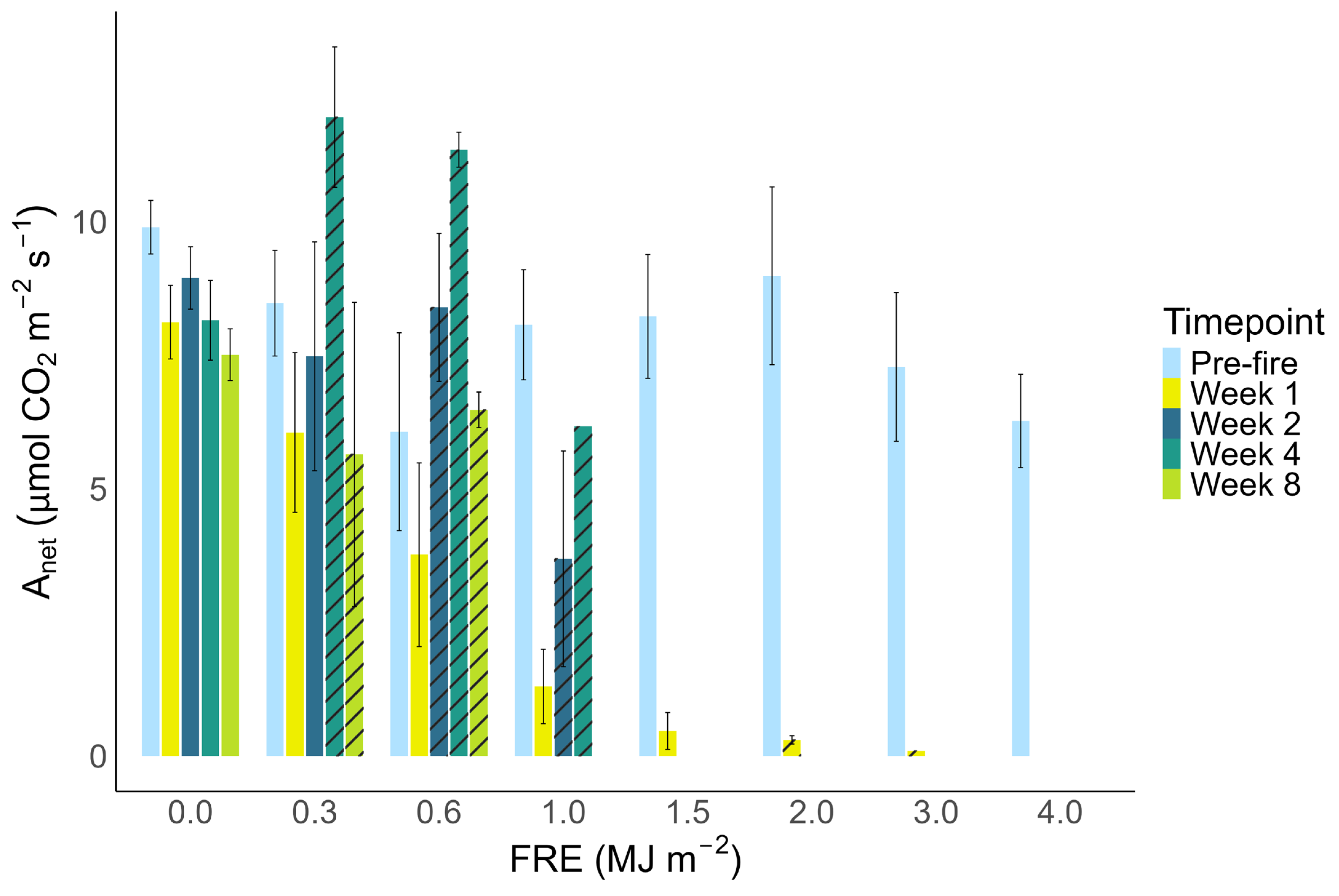
Figure 3 shows temporal trajectories of the top four differenced spectral indices with the time since fire as a function of the FRE dosage levels. In most cases, a dose-response relationship was not apparent for FRE < 1.5 MJ m−2, with FRE levels about this threshold each causing a binary response across spectral indices. In Figure 4, the spectral separability of the various differenced indices changes with both FRE dosage level and time since fire is presented. Except for ΔMIRBI, which underperformed in all cases, the other indices exhibit the highest spectral separation when using data created at 1 or 2 weeks post-fire. All metrics decrease in separability after one month, highlighting the need of early detection by spectral measures in the field. Figure 5 shows how net photosynthesis changes with different FRE levels over time. All fire treatments showed immediate photosynthetic stress at week 1, with a significant FRE × time point interaction (p < 0.001). For FRE ≥ 1.5 MJ m−2, measurements became impossible at later time points due to insufficient foliage for the LI-6800 chamber. By week 4, sample sizes were substantially reduced for moderate fire treatments (FRE = 0.3 and 0.6 MJ m−2: n = 2 of 4 original saplings; Figure 5, diagonal stripes). While measured individuals showed apparent recovery, linear mixed-effects modeling with post hoc comparisons found no significant difference between week 4 and pre-fire photosynthetic rates (FRE = 0.3: p = 0.997; FRE = 0.6: p = 0.956). Sample size reductions due to unmeasurable foliage likely represent individuals with minimal photosynthetic capacity, suggesting model estimates may be optimistic.
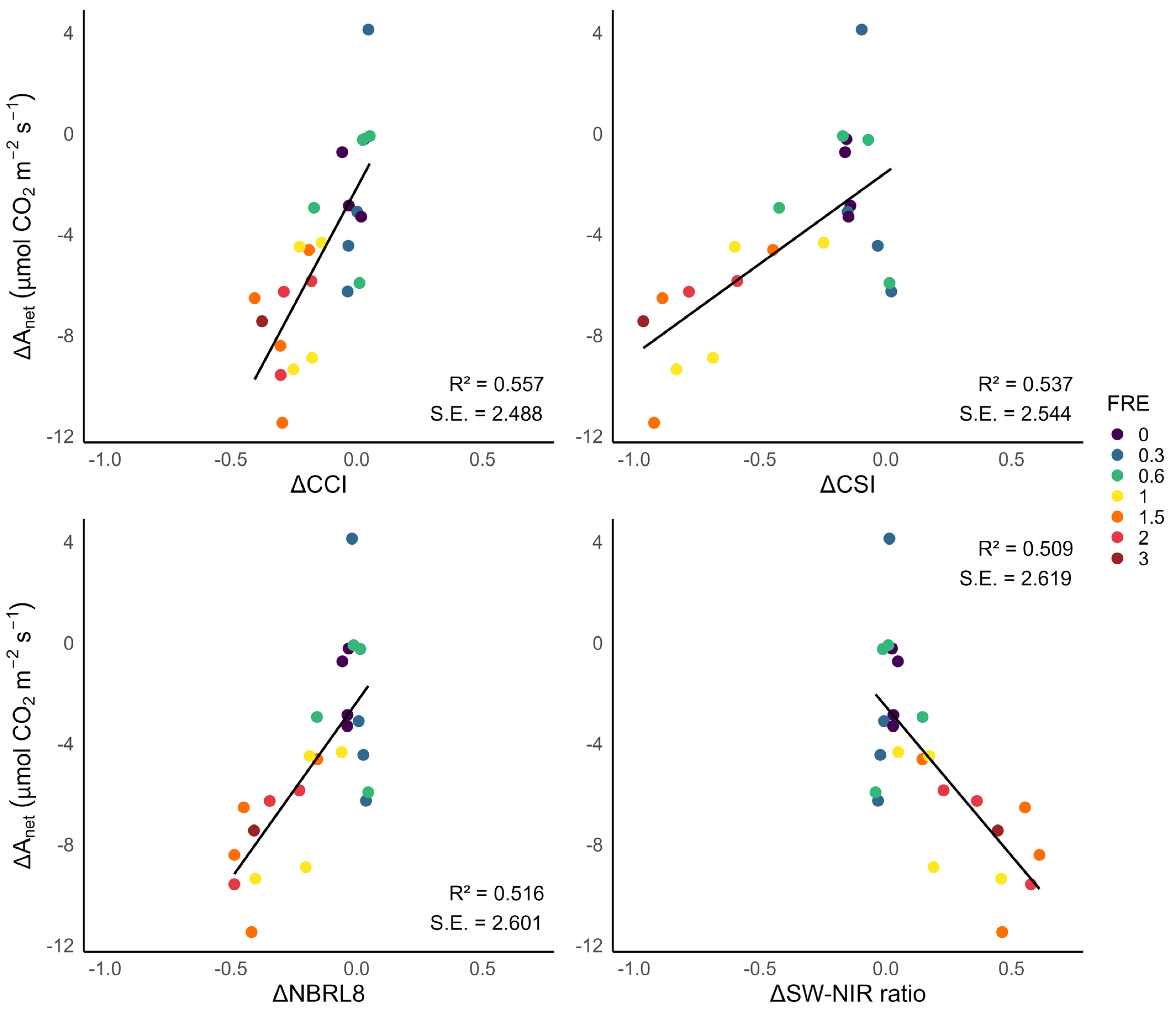
Figure 6 shows the regression relationships between the four best performing differenced spectral indices and observed pre- to post-fire changes in net photosynthesis post-fire. FRE most strongly predicted ΔAnet at week 1 (r2 ≈ 0.43), with predictive strength dropping sharply by week 2 and remaining weak thereafter. In each case, the best fit regression models were linear, with ΔCCI, ΔCSI, ΔNBRL8, and the ΔSW–NIR ratio performing best. ΔCSI exhibits the largest range of index values.

4. Discussion

In this study we directly built on prior pyro-ecophysiology studies [24,83,84] and assessed the ability of common differenced spectral indices to predict top kill in aspen saplings under a range of fire intensity levels. The hypothesis that the differenced chlorophyll/carotenoid index (ΔCCI) would provide the strongest relationship with physiology metrics and top kill was confirmed. As illustrated in Table 3 and Figure 2, ΔCCI more accurately predicts top kill at 4 h to 1 week post-fire as compared with ΔPRI, while at 2 weeks post-fire, each index performs similarly. This result is contrary to common understanding as ΔPRI is usually associated with detecting rapid (minutes to hours) changes in pigments associated with the xanthophyll cycle, while ΔCCI is usually associated with detecting longer-scale (days to weeks) changes in the pigments. The reduced effectiveness of ΔPRI after 2 weeks post-fire (Figure 2A) was somewhat expected given the plants likely initiated winter down-regulation processes [81,82]. In contrast, ΔCCI is expected to more effective over weekly and longer timescales due to its sensitivity to slower changes associated with the number of chlorophyll and carotenoid pigments in the leaf [47,52], which we, however, do not observe (Figure 2A). This unexpected result could potentially be due to thermal degradation and physical breakdown of the pigments due to the elevated heat incident on the leaves [85]. Research is therefore warranted to assess whether this result arises due to thermal degradation or other underlying physiological or molecular mechanisms within the leaves. Further research could also assess whether there is a threshold of ΔCCI that is associated with a threshold for chlorophyll content change or canopy damage that could serve as the basis of a prognostic indicator of fire-induced top kill.
Although some of the indices that would be associated with relatively coarse spatial resolution data (i.e., 30 m) such as NBR and CSI performed reasonably well, the results indicate that the prediction of top kill may be better assessed using sub-crown spatial resolution datasets (e.g., PlanetScope) and data with bands that could be used to calculate CCI and PRI. Use of higher spatial resolution datasets would also help overcome challenges associated with mixed pixels, although this may be of less concern given prior studies success in classifying aspen stands using multi-temporal Landsat MS datasets (e.g., [86]).
Notably, even at the highest FRE dosage levels, no saplings exhibited mortality, with either crown survival or resprouting observed in all cases. This is in sharp contrast to prior FRE dose-response studies on coniferous species, where fire-induced sapling mortality usually occurs around 1.0 MJ m−2 [3,7,24,71,82,87,88,89,90]. This demonstrates the high degree of fire resistance and adaptation to fire in aspen, even at the sapling life stage. The visual assessment shown in Figure 1 is consistent with results from prior similar studies in saplings of multiple conifer species [7,81,82], where there is a clear dose-response impact of fire intensity on the degree of canopy damage. However, there is a morphological basis for this contrast as coniferous saplings rely primarily on bark thickness to reduce heat-induced damage and generally survive until the cambial tissue is irrevocably damaged [89,91]. In contrast, aspen maintains extensive belowground carbohydrate reserves that enable rapid vegetative resprouting even after full crown loss, explaining the absence of mortality despite thin bark and complete canopy scorch [16]. Spectrally, both deciduous and coniferous studies show sharp early declines in pigment-sensitive indices such as ΔCCI and ΔPRI, yet in conifers these declines can potentially signify irreversible damage except when buds survive and produce new foliage [3], whereas in aspen they represent transient stress preceding recovery. This difference provides further evidence that spectral–physiological relationships derived from conifer studies may overestimate fire severity when applied to resprouting deciduous species, underscoring the importance of species-specific calibration of severity metrics. However, unlike non-resprouting species, this increase in canopy damage does not translate into an increase in post-fire mortality, providing more support to studies that have expressed concern with using measures of crown scorch to infer post-fire tree mortality (e.g., [92]).
The ability to detect aspen top kill from remote sensing has clear utility in helping monitor and predict aspen succession [10]. Figure 3 demonstrated that ΔCCI and ΔPRI using 1- and 2-week post-fire data, respectively were most effective at predicting top kill in aspen. In each case, these indices are related to foliar pigments, where CCI is often a more effective metric for deciduous and annual vegetation [93]. The broad band differenced indices ΔCSI, ΔSW-NIRratio, ΔNDVIL8, and ΔNBRL8 all show predictive power with Tjur r2 values between 0.5 and 0.6, demonstrating a distinct advantage favoring narrow band indices over broad band. ΔNDVI has also shown strong predictive power in aspen following post-freeze events, with correlation values as high as R = 0.82 [94]. The ineffectiveness of MIRBI is expected given it was developed for savannah grasses [25,26], and although it has been shown to have some utility in sage–steppe ecosystems [32], it was primarily developed as a burned area mapping index and not an index to assess fire severity. Furthermore, the reliance of MIRBI on the mid-infrared potentially makes it less sensitive for assessing spectral changes in the leaf structure of deciduous tree species. In contrast to our findings, ref. [33] reported strong performance using MIRBI and ΔMIRBI in distinguishing burn severity classes in conifer forests in central Oregon, with spectral separability values (M > 1.5) across short- and mid-infrared bands. The weaker MIRBI response observed here likely reflects fundamental differences in canopy structure and post-fire pigment recovery between broad-leafed aspen and the needle-dominated canopies of conifers.
In all the assessed indices, there is no significant difference between the FRE treatment groups and the control by 8 weeks post-fire, indicating a consistent recovery period that is independent of fire intensity. Photosynthetic recovery patterns were more complex. Interestingly, among measurable individuals at moderate fire intensities (FRE = 0.3 and 0.6 MJ m−2), week 4 photosynthetic rates equaled or exceeded pre-fire levels despite visible fire damage. However, linear mixed-effects modeling, which accounts for repeated measures and estimates population-level means including unmeasurable individuals, found no significant population-level recovery (FRE = 0.3: p = 0.997; FRE = 0.6: p = 0.956), as unmeasurable saplings likely had minimal photosynthetic capacity. Similar apparent recovery patterns among survivors followed by declines to pre-fire levels have been observed in multiple landscape-scale studies of recovery following low- and moderate-severity fires across a range of tree species [95]. Comparable patterns have also been documented in field studies of aspen regeneration, where moderate burn severity produces the highest sucker density and vigor, while both lower and higher severities result in reduced recruitment due to competition or root damage [96]. In each case, a higher degree of variation of net photosynthesis is observed in FRE < 1.0 MJ m−2 (Figure 6), like prior results associated with spectral variations at low fire intensities [61]. Furthermore, Figure 6 also shows that the broad band differenced indices ΔCSI and ΔNBRL8 are effective at predicting net photosynthesis change.

5. Conclusions

The results from this study highlight the potential of both differenced narrow band (e.g., ΔCCI) and differenced broad band (e.g., ΔNBR) spectral indices to predict top kill in fire-affected aspen as an early detection method (1–2 weeks). The results demonstrated that the ΔCCI spectral index outperformed all other spectral indices and may serve as the basis for a species-specific index for assessing top kill from remote sensing. However, the results of the current study alongside the results by [24] illustrate that although concerns have been raised as to the effectiveness of ΔNBR as an integrated measure of fire severity [8,26,97], there is potential for it to be used as an effective predictor of vegetation fire severity, when defined in terms of crown scorch, fire-induced tree mortality, or top kill. These results further the need to define vegetation fire severity as an actual surface change and not as an integrated ecosystem measure [20]. These findings also suggest that controlled laboratory studies could potentially provide valuable support for interpreting satellite and airborne fire severity assessment products. Relationships identified between ΔCCI, ΔPRI, and top kill could be used to inform calibration measures used by remote sensing models to improve their ability to map physiological damage in deciduous forests, particularly in areas difficult to examine with field validation, in situ experimentation, or satellite scanning [62,98].
This study also illustrates the high degree of fire resistance of aspen to fires, even at the sapling stage. Very few species have exhibited a similar high resistance to fires during the sapling life stage [24], with only Pinus palustris surviving similar FRE dosage levels [90]. Further research should assess if there is a threshold at which FRE does lead to whole-plant death in these and other resprouting species that are widely impacted by wildland fires, such as oaks, and if such thresholds change with tree age. Future work could also assess if timing (diurnal and seasonal) of fires has an impact on the ability of the species to resprout in response to fires. As described in detail in [99], although the controlled combustion experiments enable an improved understanding of the potential post-fire responses under repeatable levels of heat from fire, it has limited inference as it was conducted with laboratory fires using centralized plants. Therefore, future research should assess impacts of landscape fires on this species through use of opportunistic planned fires and wildfires to ensure the results translate to the natural environment. Further research could assess carbon allocation in the roots and sprouts to evaluate impacts of population regeneration. Future research is warranted to assess potential impacts on extreme heat from fires on the degradation of pigments and its impacts on ΔCCI, ΔPRI, and other indices that are associated with changes in pigments. Research is also warranted to assess the influence of diurnal and seasonal timing of fires on the potential of the aspen to resprout as this may impact the effectiveness of remote sensing to be used as a monitoring tool.

Supplementary Materials

The following supporting information can be downloaded at https://www.mdpi.com/article/10.3390/rs17244005/s1.

Author Contributions

S.W.R., L.M.B., H.D.A., A.M.S. and A.M.S.S. conceived the research and designed the experiments. S.W.R., L.M.B., A.M.S., S.L.S., R.Y., H.D.A., L.H., D.R.W., C.W.H. and A.M.S.S. assisted in conducting fire experiments and collecting data. S.W.R. and L.M.B. contributed equally to the manuscript. S.W.R., L.M.B., D.R.W., C.W.H. and A.M.S.S. wrote sections of the manuscript with input from A.M.S., H.D.A. and L.H. All authors have read and agreed to the published version of the manuscript.

Funding

Funding for this research was provided by the USDA National Institute for Food and Agriculture program under awards 2023-67013-39411 and 2024-67013-42313. Funding for this research was also provided by the National Science Foundation Established Program to Stimulate Competitive Research under awards 2242769 and 2316126. Adams was supported by the USDA National Institute for Food and Agriculture McIntire Stennis project 1019284. Smith was also supported by the National Aeronautics and Space Administration and the FireSense Implementation Team project under award 80NSSC24K1305.

Data Availability Statement

All raw spectral data are included in the Supplementary Materials. All other data is being provided in a companion paper and is available on request to the corresponding author.

Acknowledgments

Thanks to the extended Idaho Fire Initiative for Research and Education (IFIRE) pyroecophysiology team for their help collecting measurements during this project: Madeleine Stanley, Gabriella Eldridge, and Roshan Bhatta.

Conflicts of Interest

Aaron Sparks is currently employed by Northwest Management Inc. but participated in the study while previously employed at the University of Idaho. Northwest Management Inc. graciously allowed Dr. Sparks to participate in finalizing this paper. The remaining authors declare that the research was conducted in the absence of any commercial or financial relationships that could be construed as a potential conflict of interest.

Abbreviations

The following abbreviations are used in this manuscript:
CCIChlorophyll/carotenoid index
CSIChar soil index
MIRBIMid-infrared burn Index
NBRNormalized burn ratio
NDVINormalized differenced vegetation index
NDVIL8Normalized differenced vegetation index using Landsat Band 8
PRIPhotochemical reflective index
SAVISoil adjusted vegetation index
SW-NIRratioShortwave near-infrared ratio
SW-SWratioShortwave shortwave near-infrared ratio
ΔCCIDifferenced chlorophyll/carotenoid index
ΔCSIDifferenced char soil index
ΔMIRBIDifferenced mid-infrared burn index
ΔNBRDifferenced normalized burn ratio
ΔSAVIDifferenced normalized differenced soil adjusted vegetation index
ΔNDVIL8Differenced normalized differenced vegetation index using Landsat Band 8
ΔPRIDifferenced photochemical reflective index
ΔSW-NIRratioDifferenced shortwave near-infrared ratio
ΔSW-SWratioDifferenced shortwave shortwave near-infrared ratio
PCGPercentage crown that is green
WAWashington State
IFIREIdaho Fire Initiative for Research and Education
FREFire radiative energy
NHNew Hampshire
USAUnited States of America
OLIOperational Land Imager
BERBand-equivalent reflectance

References

  1. Abatzoglou, J.T.; Kolden, C.A.; Williams, A.P.; Lutz, J.A.; Smith, A.M.S. Climatic influences on interannual variability in regional burn severity across western US forests. Int. J. Wild. Fire 2017, 26, 269–275. [Google Scholar] [CrossRef]
  2. Parks, S.A.; Abatzoglou, J.T. Warmer and drier fire seasons contribute to increases in area burned at high severity in western US forests from 1985 to 2017. Geophys. Res. Lett. 2020, 47, e2020GL089858. [Google Scholar] [CrossRef]
  3. Sparks, A.M.; Kolden, C.A.; Talhelm, A.F.; Smith, A.M.S.; Apostol, K.G.; Johnson, D.M.; Boschetti, L. Spectral Indices Accurately Quantify Changes in Seedling Physiology Following Fire: Towards Mechanistic Assessments of Post-Fire Carbon Cycling. Remote Sens. 2016, 8, 572. [Google Scholar] [CrossRef]
  4. Parks, S.A.; Holsinger, L.M.; Koontz, M.J.; Collins, L.; Whitman, E.; Parisien, M.-A.; Loehman, R.A.; Barnes, J.L.; Bourdon, J.-F.; Boucher, J.; et al. Giving Ecological Meaning to Satellite-Derived Fire Severity Metrics across North American Forests. Remote Sens. 2019, 11, 1735. [Google Scholar] [CrossRef]
  5. Wasserman, T.N.; Mueller, S.E. Climate influences on future fire severity: A synthesis of climate-fire interactions and impacts on fire regimes, high-severity fire, and forests in the western United States. Fire Ecol. 2023, 19, 43. [Google Scholar] [CrossRef]
  6. Vanderhoof, M.; Hawbaker, T.; Ku, A.; Merriam, K.; Berryman, E.; Cattau, M. Tracking rates of postfire conifer regeneration vs. deciduous vegetation recovery across the western United States. Ecol. Appl. 2020, 31, e02237. [Google Scholar] [CrossRef]
  7. Kreider, M.R.; Yocom, L.L. Aspen seedling establishment, survival, and growth following a high-severity wildfire. For. Ecol. Manag. 2021, 493, 119248. [Google Scholar] [CrossRef]
  8. Smith, A.M.S.; Sparks, A.M.; Kolden, C.A.; Abatzoglou, J.T.; Talhelm, A.F.; Johnson, D.M.; Boschetti, L.; Lutz, J.A.; Apostol, K.G.; Yedinak, K.M.; et al. Towards a new paradigm in fire severity research using dose-response experiments. Int. J. Wildland Fire 2016, 25, 158–166. [Google Scholar] [CrossRef]
  9. Barbour, M.G.; Billings, W.D. North American Terrestrial Vegetation; Cambridge University Press: Cambridge, UK, 2000; p. 708. [Google Scholar]
  10. Strand, E.K.; Vierling, L.A.; Bunting, S.C.; Gessler, P.E. Quantifying successional rates in western aspen woodlands: Current conditions, future predictions. For. Ecol. Manag. 2009, 257, 1705–1715. [Google Scholar] [CrossRef]
  11. Turner, M.G.; Romme, W.H.; Gardner, R.H.; Hargrove, W.W. Effects of fire size and pattern on early succession in Yellowstone National Park. Ecol. Monogr. 1997, 67, 411–433. [Google Scholar] [CrossRef]
  12. Fechner, G.H.; Barrows, J.S. Aspen Stands as Wildfire Fuel Breaks; Eisenhower Consortium Bulletin 4; U.S. Department of Agriculture, Forest Service, Rocky Mountain Forest and Range Experiment Station: Fort Collins, CO, USA, 1976. [Google Scholar]
  13. Harris, M.P.; Coop, J.D.; Balik, J.A.; McFarland, J.R.; Parks, S.A.; Stevens-Rumann, C.S. Aspen impedes wildfire spread in southwestern United States landscapes. Ecol. Appl. 2025, 35, e70061. [Google Scholar] [CrossRef]
  14. Turner, M.G.; Romme, W.H.; Reed, R.A.; Tiskan, G.A. Post-fire aspen seedling recruitment across the Yellowstone (USA) Landscape. Landsc. Ecol. 2003, 18, 127–140. [Google Scholar] [CrossRef]
  15. Wan, H.Y.; Olson, A.C.; Muncey, K.D.; St. Clair, S.B. Legacy effects of fire size and severity on forest regeneration, recruitment, and wildlife activity in aspen forests. For. Ecol. Manag. 2014, 329, 59–68. [Google Scholar] [CrossRef]
  16. Brown, J.K.; DeByle, N.V. Fire damage, mortality, and suckering in aspen. Can. J. For. Res. 1987, 17, 1100–1109. [Google Scholar] [CrossRef]
  17. Eisenberg, C.; Eisenberg, C.; Eisenberg, C.; Anderson, C.L.; Collingwood, A.; Sissons, R.; Dunn, C.J.; Meigs, G.W.; Hibbs, D.E.; Murphy, S.; et al. Out of the Ashes: Ecological Resilience to Extreme Wildfire, Prescribed Burns, and Indigenous Burning in Ecosystems. Front. Ecol. Evol. 2019, 7, 00436. [Google Scholar] [CrossRef]
  18. Nesbit, K.A.; Yocom, L.L.; Trudgeon, A.M.; DeRose, R.J.; Rogers, P.C. Tamm review: Quaking aspen’s influence on fire occurrence, behavior, and severity. For. Ecol. Manag. 2023, 531, 120752. [Google Scholar] [CrossRef]
  19. Holden, Z.; Smith, A.M.S.; Morgan, P.; Rollins, M.G.; Gessler, P.E. Evaluation of novel thermally enhanced spectral indices for mapping fire perimeters and comparisons with fire atlas data. Int. J. Remote Sens. 2005, 26, 4801–4808. [Google Scholar] [CrossRef]
  20. Lentile, L.B.; Holden, Z.; Smith, A.M.S.; Falkowski, M.J.; Hudak, A.T.; Morgan, P.; Lewis, S.A.; Gessler, P.E.; Benson, N.C. Remote sensing techniques to assess active fire and post-fire effects. Int. J. Wildland Fire 2006, 15, 319–345. [Google Scholar] [CrossRef]
  21. Roy, D.P.; Boschetti, L.; Smith, A.M.S. Satellite remote sensing of fires; Chapter 5. In Fire Phenomena and the Earth System: An Interdisciplinary Guide to Fire Science; Belcher, C.M., Rein, G., Eds.; John Wiley & Sons, Ltd.: Chichester, UK, 2013; 368p, ISBN 978-0-470-65748-5. [Google Scholar]
  22. Lentile, L.B.; Smith, A.M.S.; Hudak, A.T.; Morgan, P.; Bobbitt, M.; Lewis, S.A.; Robichaud, P. Remote sensing for prediction of 1-year post-fire ecosystem condition. Int. J. Wildland Fire 2009, 18, 594–608. [Google Scholar] [CrossRef]
  23. Varner, J.M.; Hood, S.M.; Aubrey, D.P.; Yedinak, K.; Hiers, J.K.; Jolly, W.M.; Shearman, T.M.; McDaniel, J.K.; O’Brien, J.J.; Rowell, E.M. Tree crown injury from wildland fires: Causes, measurement and ecological and physiological consequences. New Phytol. 2021, 231, 1676–1685. [Google Scholar] [CrossRef]
  24. Sparks, A.M.; Blanco, A.S.; Wilson, D.R.; Schwilk, D.W.; Johnson, D.M.; Adams, H.D.; Bowman, D.M.J.S.; Hardman, D.D.; Smith, A.M.S. Fire intensity impacts on physiological performance and mortality in Pinus monticola and Pseudotsuga menziesii saplings: A dose-response analysis. Tree Physiol. 2023, 43, 1365–1382. [Google Scholar] [CrossRef] [PubMed]
  25. Trigg, S.; Flasse, S. An evaluation of different bi-spectral spaces for discriminating burned shrub-savannah. Int. J. Remote Sens. 2001, 22, 2641–2647. [Google Scholar] [CrossRef]
  26. Smith, A.M.S.; Lentile, L.B.; Hudak, A.T.; Morgan, P. Evaluation of linear spectral unmixing and dNBR for predicting post-fire recovery in a N. American ponderosa pine forest. Int. J. Remote Sens. 2007, 22, 5159–5166. [Google Scholar] [CrossRef]
  27. Hudak, A.T.; Morgan, P.; Bobbitt, M.J.; Smith, A.M.S.; Lewis, S.A.; Lentile, L.B.; Robichaud, P.R.; Clark, J.T.; McKinley, R.A. The relationship of multispectral satellite imagery to immediate fire effects. Fire Ecol. 2007, 3, 64–90. [Google Scholar] [CrossRef]
  28. Harris, S.; Veraverbeke, S.; Hook, S. Evaluating Spectral Indices for Assessing Fire Severity in Chaparral Ecosystems (Southern California) Using MODIS/ASTER (MASTER) Airborne Simulator Data. Remote Sens. 2011, 3, 2403–2419. [Google Scholar] [CrossRef]
  29. Pozo, D.; Olrno, F.J.; Alados-Arboledas, L. Fire detection and growth monitoring using a multitemporal technique on AVHRR mid-infrared and thermal channels. Remote Sens. Environ. 1997, 60, 111–120. [Google Scholar] [CrossRef]
  30. Veraverbeke, S.; Hook, S.; Hulley, G. An alternative spectral index for rapid fire severity assessments. Remote Sens. Environ. 2012, 123, 72–80. [Google Scholar] [CrossRef]
  31. Lu, B.; He, Y.; Tong, A. Evaluation of spectral indices for estimating burn severity in semiarid grasslands. Int. J. Wildland Fire 2015, 25, 147–157. [Google Scholar] [CrossRef]
  32. Sparks, A.M.; Boschetti, L.; Smith, A.M.S.; Tinkham, W.T.; Lannom, K.O.; Newingham, B.A. An accuracy assessment of the MTBS burned area polygons for shrub-steppe fires in the northern Great Basin, United States. Int. J. Wildland Fire 2015, 24, 70–78. [Google Scholar] [CrossRef]
  33. McCarley, T.R.; Smith, A.M.S.; Kolden, C.A.; Kreitler, J. Evaluating the mid-infrared bi-spectral index for assessing severity and area burned in a conifer forest. Int. J. Wildland Fire 2018, 27, 407–412. [Google Scholar] [CrossRef]
  34. Huete, A.R. A soil-adjusted vegetation index (SAVI). Remote Sens. Environ. 1988, 25, 295–309. [Google Scholar] [CrossRef]
  35. Baret, F.; Guyot, G. Potentials and limits of vegetation indices for LAI and APAR assessment. Remote Sens. Environ. 1991, 35, 161–173. [Google Scholar] [CrossRef]
  36. Qi, J.; Chehbouni, A.; Huete, A.R.; Kerr, Y.H.; Sorooshian, S. A modified soil adjusted vegetation index. Remote Sens. Environ. 1994, 48, 119–126. [Google Scholar] [CrossRef]
  37. Rondeaux, G.; Steve, M.; Baret, F. Optimization of Soil-Adjusted Vegetation Indices. Remote Sens. Environ. 1996, 55, 95–107. [Google Scholar] [CrossRef]
  38. Veraverbeke, S.; Gitas, I.; Katagis, T.; Polychronaki, A.; Somers, B.; Goossens, R. Assessing post-fire vegetation recovery using red–near infrared vegetation indices: Accounting for background and vegetation variability. ISPRS J. Photogramm. Remote Sens. 2012, 68, 28–39. [Google Scholar] [CrossRef]
  39. Lad, L.E.; Tinkham, W.T.; Sparks, A.M.; Smith, A.M.S. Evaluating Predictive Models of Tree Foliar Moisture Content using Multispectral UAS Data: A Laboratory Study. Remote Sens. 2023, 15, 5703. [Google Scholar] [CrossRef]
  40. Yang, Z.; Gong, C.; Ji, T.; Hu, Y.; Li, L. Water Quality Retrieval from ZY1-02D Hyperspectral Imagery in Urban Water Bodies and Comparison with Sentinel-2. Remote Sens. 2022, 14, 5029. [Google Scholar] [CrossRef]
  41. Sulik, J.J.; Long, D.S. Spectral considerations for modeling yield of canola. Remote Sens. Environ. 2016, 184, 161–174. [Google Scholar] [CrossRef]
  42. Soudani, K.; Hmimina, G.; Dufrene, E.; Berveiller, D.; Delpierre, N.; Ourcival, J.-C.; Rambal, S.; Jaffre, R. Relationships between photochemical reflectance index and light-use efficiency in deciduous and evergreen broadleaf forests. Remote Sens. Environ. 2014, 144, 73–84. [Google Scholar] [CrossRef]
  43. Drolet, D.G.; Huemmrich, K.F.; Hall, F.G.; Middleton, E.M.; Black, T.A.; Barr, A.G.; Margolis, H.A. A MODIS-derived photochemical reflectance index to detect inter-annual variations in the photosynthetic light-use efficiency of a boreal deciduous forest. Remote Sens. Environ. 2005, 98, 212–224. [Google Scholar] [CrossRef]
  44. Filella, I.; Zhang, C.; Seco, R.; Potosnak, M.; Guenther, A.; Karl, T.; Gamon, J.; Pallardy, S.; Gu, L.; Kim, S.; et al. A MODIS Photochemical Reflectance Index (PRI) as an Estimator of Isoprene Emissions in a Temperate Deciduous Forest. Remote Sens. 2018, 10, 557. [Google Scholar] [CrossRef]
  45. Zhang, C.; Filella, I.; Liu, D.; Ogaya, R.; Llusià, J.; Asensio, D.; Peñuelas, J. Photochemical Reflectance Index (PRI) for Detecting Responses of Diurnal and Seasonal Photosynthetic Activity to Experimental Drought and Warming in a Mediterranean Shrubland. Remote Sens. 2017, 9, 1189. [Google Scholar] [CrossRef]
  46. Song, G.; Wang, Q. Developing Hyperspectral Indices for Assessing Seasonal Variations in the Ratio of Chlorophyll to Carotenoid in Deciduous Forests. Remote Sens. 2022, 14, 1324. [Google Scholar] [CrossRef]
  47. Weng, C.Y.S.; D’Odorico, P.; Bhathena, Y.; Arain, M.A.; Ensminger, I. Carotenoid based vegetation indices for accurate monitoring of the phenology of photosynthesis at the leaf-scale in deciduous and evergreen trees. Remote Sens. Environ. 2019, 233, 11407. [Google Scholar] [CrossRef]
  48. Avetisyan, D.; Stankova, N.; Dimitrov, Z. Assessment of Spectral Vegetation Indices Performance for Post-Fire Monitoring of Different Forest Environments. Fire 2023, 6, 290. [Google Scholar] [CrossRef]
  49. Cuevas-Gonzalez, M.; Gerad, F.; Baltzer, H.; Riano, D. Analysing forest recovery after wildfire disturbance in boreal Siberia using remotely sensed vegetation indices. Glob. Change Biol. 2009, 15, 561–577. [Google Scholar] [CrossRef]
  50. Li, K.; Lu, Z.; Xu, W.; Wang, W.; Su, J.; Lv, Q.; Guo, W.; Johnson, M. Post-fire spectral recovery and driving factors across the boreal and temperate forests. Philos. Trans. R. Soc. B 2025, 380, 20230453. [Google Scholar] [CrossRef]
  51. Numata, I.; Cochrane, M.A.; Galvao, L.S. Analyzing the Impacts of Frequency and Severity of Forest Fire on the Recovery of Disturbed Forest using Landsat Time Series and EO-1 Hyperion in the Southern Brazilian Amazon. Earth Interact. 2011, 13, 1–17. [Google Scholar] [CrossRef]
  52. Gamon, J.A.; Huemmrich, K.F.; Wong, C.Y.S.; Ensminger, I.; Garrity, S.; Hollinger, D.Y.; Noormets, A.; Penuelas, J. A remotely sensed pigment index reveals photosynthetic phenology in evergreen conifers. Proc. Natl. Acad. Sci. USA 2016, 113, 13087–13092. [Google Scholar] [CrossRef]
  53. Gamon, J.A.; Peñuelas, J.; Field, C.B. A narrow-waveband spectral index that tracks diurnal changes in photosynthetic efficiency. Remote Sens. Environ. 1992, 41, 35–44. [Google Scholar] [CrossRef]
  54. Matthews, S. Effect of drying temperature on fuel moisture content measurements. Int. J. Wildland Fire 2010, 19, 800–802. [Google Scholar] [CrossRef]
  55. Brewer, N.W.; Smith, A.M.S.; Hatten, J.A.; Higuera, P.E.; Hudak, A.T.; Ottmar, R.D.; Tinkham, W.T. Fuel Moisture Influences on Fire-altered Carbon in Masticated Fuels: An Experimental Study. J. Geophys. Res. 2013, 118, 30–40. [Google Scholar] [CrossRef]
  56. Smith, A.M.S.; Tinkham, W.T.; Roy, D.P.; Boschetti, L.; Kumar, S.; Sparks, A.M.; Kremens, R.L.; Falkowski, M.J. Quantification of fuel moisture effects on biomass consumed derived from fire radiative energy retrievals. Geophys. Res. Lett. 2013, 40, 6298–6302. [Google Scholar] [CrossRef]
  57. Lyon, Z.D.; Morgan, P.; Stevens-Rumann, C.S.; Sparks, A.M.; Keefe, R.F.; Smith, A.M.S. Fire Behavior in Masticated Forest Fuels: Lab and Prescribed Fire Experiments. Int. J. Wild. Fire 2018, 27, 280–292. [Google Scholar] [CrossRef]
  58. Hoffmann, W.A.; Adasme, R.; Haridasan, M.; de Carvalho, M.T.; Geiger, E.L.; Pereira, M.A.B.; Gotsch, S.G.; Franco, A.C. Tree topkill, not mortality, governs the dynamics of savanna–forest boundaries under frequent fire in central Brazil. Ecology 2009, 90, 1326–1337. [Google Scholar] [CrossRef]
  59. Smith, A.M.S.; Eitel, J.U.H.; Hudak, A.T. Spectral Analysis of Charcoal on Soils: Implications for Wildland Fire Severity Mapping Methods. Int. J. Wildland Fire 2010, 19, 976–983. [Google Scholar] [CrossRef]
  60. Trigg, S.; Flasse, S. Characterizing the spectral-temporal response of burned savannah using in situ spectroradiometry and infrared thermometry. Int. J. Remote Sens. 2000, 21, 3161–3168. [Google Scholar] [CrossRef]
  61. Smith, A.M.S.; Wooster, M.J.; Drake, N.A.; Dipotso, F.M.; Falkowski, M.J.; Hudak, A.T. Testing the Potential of Multi-Spectral Remote Sensing for Retrospectively Estimating Fire Severity in African Savanna Environments. Remote Sens. Environ. 2005, 97, 92–115. [Google Scholar] [CrossRef]
  62. Roy, D.P.; Wulder, M.A.; Loveland, T.R.; Woodcock, C.E.; Allen, R.G.; Anderson, M.C.; Helder, D.; Irons, J.R.; Johnson, D.M.; Kennedy, R.; et al. Landsat-8: Science and product vision for terrestrial global change research. Remote Sens. Environ. 2014, 145, 154–172. [Google Scholar] [CrossRef]
  63. McCarley, T.R.; Kolden, C.A.; Vaillant, N.M.; Hudak, A.T.; Smith, A.M.S.; Wing, B.M.; Kellogg, B.S.; Kreitler, J. Multi-temporal LiDAR and Landsat quantification of fire-induced changes to forest structure. Remote Sens. Environ. 2017, 191, 419–432. [Google Scholar] [CrossRef]
  64. Furniss, T.J.; Kane, V.R.; Larson, A.J.; Lutz, J.A. Detecting tree mortality with Landsat-derived spectral indices: Improving ecological accuracy by examining uncertainty. Remote Sens. Environ. 2020, 237, 111497. [Google Scholar] [CrossRef]
  65. Tyukavina, A.; Potapov, P.; Hansen, M.C.; Pickens, A.H.; Stehman, S.V.; Turubanova, S.; Parker, D.; Zalles, V.; Lima, A.; Kommareddy, I.; et al. Global trends of forest loss due to fire from 2001 to 2019. Front. Remote Sens. 2022, 3, 825190. [Google Scholar] [CrossRef]
  66. Yinghai, K.; Jungho, I.; Junghee, L.; Huili, G.; Youngryel, R. Characteristics of Landsat 8 OLI-derived NDVI by comparison with multiple satellite sensors and in-situ observations. Remote Sens. Environ. 2015, 164, 298–313. [Google Scholar]
  67. Rouse, J.W., Jr.; Haas, R.H.; Schell, J.A.; Deering, D.W.; Harlan, J.C. Monitoring the Vernal Advancement and Retrogradation of Natural Vegetation; NASA/GSFC, Final Report; NASA: Greenbelt, MD, USA, 1974. [Google Scholar]
  68. Key, C.; Benson, N. Landscape Assessment: Ground Measure of Severity, the Composite Burn Index; and Remote Sensing of Severity, the Normalized Burn Ratio; General Technical Report; RMRS-GTR-164-CD; USDA Forest Service, Rocky Mountain Research Station: Ogden, UT, USA, 2006. [Google Scholar]
  69. Kushla, J.D.; Ripple, W.J. Assessing wildfire effects with Landsat thematic mapper data. Int. J. Rem. Sens. 1998, 19, 2493–2507. [Google Scholar] [CrossRef]
  70. Epting, S.; Verbyla, D.; Sorbel, B. Evaluation of remotely sensed indices for assessing burn severity in interior Alaska using Landsat TM and ETM+. Remote Sens. Environ. 2005, 96, 328–339. [Google Scholar] [CrossRef]
  71. Partelli-Feltrin, R.; Johnson, D.M.; Sparks, A.M.; Adams, H.D.; Kolden, C.A.; Nelson, A.S.; Smith, A.M.S. Drought increases vulnerability of Pinus ponderosa saplings to fire-induced mortality. Fire 2020, 3, 56. [Google Scholar] [CrossRef]
  72. Sparks, A.M.; Armstrong, R.; Smith, A.M.S.; Scharosch, S.; Corrao, M.V.; Monzka, T. Predicting fire-induced individual tree mortality at the landscape level using fire intensity and airborne laser scanning data. Remote Sens. Environ. 2025, 331, 115007. [Google Scholar] [CrossRef]
  73. Hughes, G.; Choudhury, R.A.; McRoberts, N. Summary measures of predictive power associated with logistic regression models of disease risk. Phytopathology 2019, 109, 712–715. [Google Scholar] [CrossRef]
  74. Tjur, T. Coefficients of Determination in Logistic Regression Models: A New Proposal: The Coefficient of Discrimination. Am. Stat. 2009, 63, 366–372. [Google Scholar] [CrossRef]
  75. Biddle, R.; Solis-Ponce, I.; Jones, M.; Marsden, S.; Pilgrim, M.; Devenish, C. The value of local community knowledge in species distribution modelling for a threatened Neotropical parrot. Biodivers. Conserv. 2021, 30, 1803–1823. [Google Scholar] [CrossRef]
  76. Muschelli, J. ROC and AUC with a Binary Predictor: A Potentially Misleading Metric. J. Classif. 2020, 37, 696–708. [Google Scholar] [CrossRef]
  77. Harrison, X.A.; Donaldson, L.; Correa-Cano, M.E.; Evans, J.; Fisher, D.N.; Goodwin, C.E.F.; Robinson, B.S.; Hodgson, D.J.; Inger, R. A brief introduction to mixed effects modelling and multi-model inference in ecology. PeerJ 2018, 6, e4794. [Google Scholar] [CrossRef] [PubMed]
  78. Smith, A.M.S.; Drake, N.A.; Wooster, M.J.; Hudak, A.T.; Holden, Z.A.; Gibbons, C.J. Production of Landsat ETM+ Reference Imagery of Burned Areas within Southern African Savannahs: Comparison of Methods and Application to MODIS. Int. J. Remote Sens. 2007, 28, 2753–2775. [Google Scholar] [CrossRef]
  79. Kaufman, Y.J.; Remer, L.A. Detection of forests using mid-IR reflectance: An application for aerosol studies. IEEE Trans. Geosci. Remote Sens. 1994, 32, 672–683. [Google Scholar] [CrossRef]
  80. Pereira, J.M.C. A comparative evaluation of NOAA/AVHRR vegetation indexes for burned surface detection and mapping. IEEE Trans. Geosci. Remote Sens. 1999, 37, 217–226. [Google Scholar] [CrossRef]
  81. Wong, C.Y.S.; Gamon, J.A. Three causes of variation in the photochemical reflectance index (PRI) in evergreen conifers. New Phytol. 2014, 206, 187–195. [Google Scholar] [CrossRef]
  82. Kováč, D.; Veselovská, P.; Klem, K.; Večeřová, K.; Ač, A.; Peñuelas, J.; Urban, O. Potential of Photochemical Reflectance Index for Indicating Photochemistry and Light Use Efficiency in Leaves of European Beech and Norway Spruce Trees. Remote Sens. 2018, 10, 1202. [Google Scholar] [CrossRef]
  83. Smith, A.M.S.; Talhelm, A.F.; Johnson, D.M.; Sparks, A.M.; Yedinak, K.M.; Apostol, K.G.; Tinkham, W.T.; Kolden, C.A.; Abatzoglou, J.T.; Lutz, J.A.; et al. Effects of fire radiative energy density doses on Pinus contorta and Larix occidentalis seedling physiology and mortality. Int. J. Wildland Fire 2017, 26, 82–94. [Google Scholar] [CrossRef]
  84. Blanco, A.S.; Wilson, D.R.; Hardman, D.D.; Rainsford, S.W.; Sparks, A.M.; Bhatta, R.P.; Adams, H.D.; Johnson, D.M.; Schwilk, D.W.; Lutz, J.A.; et al. Predicting the mortality of Pinus monticola and Pseudotsuga menziesii saplings using a pyro-ecophysiology fire severity approach. Int. J. Wildland Fire 2025, 34, WF25003. [Google Scholar] [CrossRef]
  85. Dhami, N.; Cazzonelli, C.I. Environmental impacts on carotenoid metabolism in leaves. Plant Growth Regul. 2020, 92, 455–477. [Google Scholar] [CrossRef]
  86. Wolter, P.T.; Mladenoff, D.J.; Host, G.E.; Crow, T.R. Improved forest classification in the northern lake states using multi-temporal Landsat imagery. Photogramm. Eng. Remote Sens. 1995, 61, 1129–1143. [Google Scholar]
  87. Sparks, A.M.; Talhelm, A.F.; Partelli-Feltrin, R.; Smith, A.M.S.; Johnson, D.M.; Kolden, C.A.; Boschetti, L. An experimental assessment of the impact of drought and fire on western larch mortality and recovery. Int. J. Wildland Fire 2018, 27, 490–497. [Google Scholar] [CrossRef]
  88. Partelli-Feltrin, R.; Smith, A.M.S.; Adams, H.D.; Kolden, C.A.; Johnson, D.M. Short- and long-term effects of fire on stem hydraulics in Pinus ponderosa saplings. Plant Cell Environ. 2021, 44, 696–705. [Google Scholar] [CrossRef] [PubMed]
  89. Partelli-Feltrin, R.; Smith, A.M.S.; Adams, H.D.; Thompson, A.; Kolden, C.A.; Yedinak, K.M.; Johnson, D.M. Death from hunger or thirst? Phloem dysfunction, rather than xylem hydraulic failure, as a driver of fire-induced conifer mortality. New Phytol. 2023, 237, 1154–1163. [Google Scholar] [CrossRef] [PubMed]
  90. Wilson, L.A.; Spencer, R.N.; Aubrey, D.P.; O’Brien, J.J.; Smith, A.M.S.; Thomas, R.W.; Johnson, D.M. Longleaf Pine Seedlings are Extremely Resilient to the Combined Effects of Experimental Fire and Drought. Fire 2022, 5, 128. [Google Scholar] [CrossRef]
  91. Hood, S.M.; Varner, J.M.; Van Mantgem, P.; Cansler, C.A. Fire and tree death: Understanding and improving modeling of fire-induced tree mortality. Environ. Res. Lett. 2018, 13, 113004. [Google Scholar] [CrossRef]
  92. Shearman, T.M.; Varner, J.M.; Hood, S.M.; van Mantgem, P.J.; Cansler, C.A.; Wright, M. Predictive accuracy of post-fire conifer death declines over time in models based on crown and bole injury. Ecol. Appl. 2023, 33, e2760. [Google Scholar] [CrossRef]
  93. Muraoka, H.; Noda, H.M.; Nagai, S.; Motohka, T.; Saitoh, T.M.; Nasahara, K.N.; Saigusa, N. Spectral vegetation indices as the indicator of canopy photosynthetic productivity in a deciduous broadleaf forest. J. Plant Ecol. 2013, 6, 393–407. [Google Scholar] [CrossRef]
  94. Wright, T.E.; Chikamoto, Y.; Birch, J.D.; Lutz, J.A. Remote Sensing Direction of Growing Season Freeze-Induced Defoliation of Montane Quaking Aspen (Populus tremuloides) in Southern Utah, USA. Remote Sens. 2024, 16, 3477. [Google Scholar] [CrossRef]
  95. Romme, W.H.; Boyce, M.S.; Gresswell, R.; Merrill, E.H.; Minshall, G.W.; Whitlock, C.; Turner, M.G. Twenty Years After the 1988 Yellowstone Fires: Lessons About Disturbance and Ecosystems. Ecosystems 2011, 14, 1196–1215. [Google Scholar] [CrossRef]
  96. McIlroy, S.K.; Shinneman, D.J. Post-fire aspen (Populus tremuloides) regeneration varies in response to winter precipitation across a regional climate gradient. For. Ecol. Manag. 2020, 455, 117681. [Google Scholar] [CrossRef]
  97. Kolden, C.A.; Smith, A.M.S.; Abatzoglou, J.T. Limitations and utilization of Monitoring Trends in Burn Severity products for assessing wildfire severity in the USA. Int. J. Wildland Fire 2015, 24, 1023–1028. [Google Scholar] [CrossRef]
  98. Smith, A.M.S.; Greenberg, J.; Vierling, L.A. Introduction to Special Section: The Remote Characterization of Vegetation Structure: New methods and applications to landscape-regional-global scale processes. J. Geophys. Res. 2018, 113, G03S91. [Google Scholar] [CrossRef]
  99. Smith, A.M.S.; Partelli-Feltrin, R.; Sparks, A.M.; Moberly, J.G.; Adams, H.D.; Schwilk, D.W.; Tinkham, W.T.; Kok, J.R.; Wilson, D.R.; Thompson, R.A.; et al. Methods to assess fire-induced tree mortality: Review of fire behavior proxy and real fire experiments. Int. J. Wildland Fire 2025, 34, WF24136. [Google Scholar] [CrossRef]
Figure 1. Photographic time series through week 12 of the post-fire canopy impacts under different FRE levels.
Remotesensing 17 04005 g001
Figure 2. (A) Comparison of different spectral indices to infer top kill, as assessed by AUC and Tjur’s R. (B). Comparison of Tjur’s R2 and AUC performance metrics for the overall strongest time points (week 1 and week 2). Error bars represent 95% confidence interval. A dashed horizontal line is placed at y = 0.85 as a visual indicator.
Remotesensing 17 04005 g002
Figure 3. Mean change in spectral reflectance for select indices: ΔCCI, ΔPRI, ΔNBRL8, and ΔNDVIL8. Colored lines represent treatment groups with points showing the mean values of all saplings in each respective group and error bars representing standard deviation.
Remotesensing 17 04005 g003
Figure 4. Spectral separability of top killed vs. surviving trees across time points and fire radiative energy (FRE) treatments. M-statistic values are shown for each spectral index at each post-fire time point, comparing control (FRE = 0) against increasing FRE treatments (MJ m−2). Higher M-values indicate greater separability between top killed and surviving saplings. Values from weeks 4–16 use measurements on resprouted leaves when possible. “Post-fire” refers to measurements taken within 6 h of burning. The color scale is capped at 2.0; higher values were rounded down to preserve meaningful visual contrast. Spectral indices are abbreviated as follows: A, ΔCCI; B, ΔCSI; C, ΔMIRBI; D, ΔNDVIL8; E, ΔNBRL8; F, ΔPRI; G, Δ SW-NIRratio; H, ΔSW-SWratio; and I, ΔSAVI.
Remotesensing 17 04005 g004
Figure 5. Net photosynthesis across FRE groups over time. Each bar represents the mean Anet (µmol CO2m−2s−1) value for a given FRE group in MJ m−2 with error bars representing ±1 standard error (SE). Diagonal stripes on bars indicate reduced sample size for the treatment group at that time point due to insufficient foliage for gas exchange chamber measurements. Time points include pre-fire and multiple weeks post-fire.
Remotesensing 17 04005 g005
Figure 6. Relationship between change in the top four spectral index values (ΔCCI, ΔCSI, ΔNBRL8, and the ΔSW-NIR ratio) and change in net photosynthesis (ΔPn) from pre-burn baseline measurements at one week post-fire. Points represent individual measurements colored by fire radiative energy (FRE) treatment level. Black lines show linear regression fit across all data points. R2 and standard error values indicate overall model performance.
Remotesensing 17 04005 g006
Table 1. Fire radiative energy (FRE) treatment levels and associated needle and wood fuel loads.
FRE (MJ m−2)0.00.30.61.01.52.03.04.0
Pre-fire needle load (kg m−2)0.0000.1000.1000.1800.2100.2400.2700.300
Pre-fire wood load (kg m−2)0.0000.0110.1210.1880.3430.4970.8351.174
Table 2. Spectral indices assessed in this study. Reflectance is denoted by ρ. Spectral index abbreviations are as follows: NDVI, normalized differenced vegetation index; PRI, photochemical reflectance index; CCI, chlorophyll/carotenoid index; CSI, char soil index; MIRBI, mid-infrared bispectral index; NBR, normalized burn ratio; SW-NIRratio, shortwave near-infrared ratio; and SW-SWratio, shortwave to shortwave near-infrared ratio. SAVI, optimized soil-adjusted vegetation index, where L = 0.75 for aspen. In all cases, the “differenced” index is the pre-fire value minus the post-fire value.
Spectral IndexFormulaReference
CCI ρ 531 ρ 645 ρ 531 + ρ 645 [52]
CSI ρ B 5 ρ B 6 [61]
MIRBI 10 ρ B 7 9.8 ρ B 6 + 2   [25]
NDVIL8 ρ B 5 ρ B 4 ρ B 5 + ρ B 4 [66,67]
NBRL8 ρ B 5 ρ B 7 ρ B 5 + ρ B 7 [68]
PRI ρ 531 ρ 570 ρ 531 + ρ 570 [53]
SW-NIRratio ρ B 7 ρ B 5 [69]
SW-SWratio ρ B 7 ρ B 6 [70]
SAVI ρ B 5   ρ B 4 ρ B 5   + ρ B 4 + 0.75   1.75 [37]
Table 3. Tjur r2 values for the 10 highest performing spectral index–time point combinations predicting tree top kill. Higher values indicate greater separability between surviving and top killed trees based on spectral index changes from pre-fire baseline.
RankTime PointIndexTjur R2AUCAccuracy
1Week 1CCI0.6330.9610.891
2Week 2PRI0.6190.9600.906
3Week 2CCI0.5980.9600.906
4Post-fireCSI0.5660.9450.859
5Week 2SW-NIRratio0.5480.9160.859
6Week 2NDVIL80.5360.9270.891
7Week 2NBRL80.5340.9140.875
8Week 2CSI0.5250.9250.844
9Week 1SW-NIRratio0.5130.9110.875
10Week 1NBRL80.4960.9090.875
Disclaimer/Publisher’s Note: The statements, opinions and data contained in all publications are solely those of the individual author(s) and contributor(s) and not of MDPI and/or the editor(s). MDPI and/or the editor(s) disclaim responsibility for any injury to people or property resulting from any ideas, methods, instructions or products referred to in the content.