
Article

InSAR-Based Multi-Source Monitoring and Modeling of Multi-Seam Mining-Induced Deformation and Hazard Chain Evolution in the Loess Gully Region

1
Key Laboratory of Western China’s Mineral Resources and Geological Engineering, Ministry of Education, School of Earth Science and Resources, Chang’an University, Xi’an 710054, China
2
New Energy Minerals and Resources Information Engineering Technology Innovation Center of the Ministry of Natural Resources, Xi’an 710054, China
3
Information Centre of the Ministry of Natural Resources, Beijing 100830, China
4
Institute of Mineral Resources Research, China Metallurgical Geology Bureau, Beiing 101300, China
*
Author to whom correspondence should be addressed.
Remote Sens. 2025, 17(24), 3993; https://doi.org/10.3390/rs17243993
Submission received: 21 October 2025 / Revised: 16 November 2025 / Accepted: 9 December 2025 / Published: 10 December 2025

Highlights

What are the main findings?
  • The InSAR-based multi-source monitoring and modeling framework captured the spatiotemporal evolution of multi-seam mining-induced deformation.
  • Multi-source observations demonstrated that fissure development, slope responses, and hazard-chain evolution are strongly synchronized with mining progression.
What are the implications of the main findings?
  • The adopted multi-source monitoring and modeling framework provides a practical reference for improving deformation assessment in multi-seam mining regions.
  • The clarified spatiotemporal evolution of hazard chains offers scientific guidance for mine planning and early warning in gully landform regions.

Abstract

In recent years, coal mining has shifted from surface to underground multi-seam and multi-panel operations, leading to enhanced ground deformation and elevated risks of secondary geo-hazards. However, the deformation mechanisms and spatiotemporal evolution of mining-induced ground movement in high-intensity repeated mining areas require further investigation. To gain further insight, this study focuses on elucidating the deformation mechanisms and hazard-chain evolution induced by downward multi-seam and multi-panel mining in the Hongyan coal mine, located in the loess gully region. An integrated InSAR-based multi-source monitoring and modeling framework was adopted, systematically combining InSAR, historical satellite imagery, UAV-based surveys, and ground observations with numerical simulations to characterize the spatiotemporal evolution of mining-induced deformation and examine the coupling processes within the hazard chain. The monitoring results show a strong spatiotemporal correlation between mining activities and ground deformation: subsidence basins and temporal variations correspond closely to the mining sequence, and the spatial distribution of fissures aligns with the advancing working faces. The analysis indicates mining-induced stress redistribution and stratum instability are the root causes of subsidence. Subsidence characteristics are affected by topography, mining sequence, and the cumulative impacts of multi-seam mining, leading to stepwise subsidence and subsidence basins. The overlying loess’s topography and characteristics affect the subsidence distribution. The “stress arch” formed in the goaf evolves with the multi-panel mining process, gradually collapsing during continuous mining and leading to stratum instability. Initially spreading stress and preventing rock movement, the upper residual pillars aggravate stratum damage following critical stratum failure. Mining exerts spatiotemporal control over hazard development, with the hazard chain evolving upward from the mining horizon, driven by fissure propagation and subsidence as the core processes, and reinforced by a bottom-up chain reaction and feedback among successive hazards. This study provides scientific insights for the planning and hazard prevention of multi-seam mining in loess gully regions.

1. Introduction

As one of the most important energy sources globally, coal has long held a significant position in the world energy consumption structure [1,2,3]. With the rapid development of industrialization and urbanization, the demand for coal continues to grow, leading to intensified exploitation and the expansion of multi-seam mining operations [4]. However, large-scale and repeated underground mining activities have caused extensive disturbances to the overburden strata and surface environment, resulting in a variety of mining-induced geological hazards, including surface subsidence, ground fissures, house damage, road collapse, and the destruction of farmland and water systems [5,6,7,8,9]. These hazards not only threaten infrastructure and human safety but also disrupt the ecological balance of mining areas, particularly in fragile environments such as loess gully regions. Therefore, analyzing deformation processes during coal mining is essential for understanding the mechanisms of these hazards and for developing effective strategies for risk prevention and ecological restoration.
Northern China possesses vast coal reserves with widespread distribution, thick layers, multi-seam development, and high quality [10]. Historically, coal mining in these regions focused on surface and shallow layers, but it has now predominantly shifted to underground mining [11]. Multi-seam coal mining induces substantial secondary disturbances in the overlying strata, disrupting the original stress equilibrium. Previous studies have demonstrated that, compared with single-seam mining, multi-seam operations result in more pronounced stratum movement and surface subsidence. This phenomenon primarily arises from the continuous disturbance of the overburden following the failure of key strata between adjacent seams [11,12,13,14]. However, research on stratum movement and ground deformation in high-intensity, repeatedly mined areas remains limited, despite its critical importance for guiding safe and efficient mining practices.
To analyze the deformation and mechanisms induced by coal mining, it is essential to understand the multi-hazard effects triggered by mining activities, which relies on precise measurement and monitoring of mining-induced deformation [5,6,15,16]. Traditional monitoring methods, such as GPS and leveling surveys, while widely used, provide only discrete point information and cannot fully represent the overall deformation in mining areas [15,17]. These methods are limited by their data collection range, high labor costs, and low efficiency. In recent years, with the advancement of remote sensing technologies, digital photogrammetry [18,19], laser scanning [20], and Structure-from-Motion [21] have been increasingly applied to deformation monitoring [22]. These methods have significantly improved the speed of data acquisition but still face limitations in spatial coverage and data acquisition. In contrast, Interferometric Synthetic Aperture Radar (InSAR) technology has demonstrated significant advantages in deformation monitoring and hazard identification [8,19,22]. InSAR technology offers high precision, continuous spatial coverage, and automated high-precision acquisition, particularly excelling in monitoring subtle deformations, which traditional methods cannot achieve [15].
Although InSAR technology provides reliable monitoring of surface deformation, it remains insufficient for directly elucidating the underlying mechanisms governing deformation and the evolution of hazard chains associated with multi-seam mining [15,23]. Numerical simulation methods can couple the evolution of deformation with the mechanisms of disaster development, effectively reproducing the progressive damage processes of overlying strata induced by coal mining. Moreover, these models can incorporate the influences of goafs and complex topography, allowing for more realistic and rigorous simulations of deformation mechanisms within discontinuous rock masses [2,11,15,22,24,25]. The capability of numerical simulation methods to analyze deformation development and disaster mechanisms is unattainable through physical modeling, empirical methods, or influence function methods [26]. Among various numerical simulation tools, FLAC3D has unique advantages in handling nonlinear large deformations and failures [27]. Thus, the integration of InSAR monitoring data with FLAC3D numerical simulations enables a more holistic interpretation of the geological hazards and their evolutionary mechanisms associated with coal mining activities.
However, existing studies on mining-induced hazards are often constrained by a single-method focus (e.g., relying solely on InSAR monitoring or numerical simulation) or a single-object perspective (e.g., examining only slope failure or surface subsidence). Such approaches lack comprehensive integration of multi-source datasets and fail to systematically capture the spatiotemporal evolution of mining-induced hazard chains. In particular, research focusing on loess gully regions characterized by intensive multi-seam mining remains limited, despite their pronounced susceptibility to complex ground deformation and cascading hazards. To bridge these gaps, this study adopts an InSAR-based, multi-source monitoring and modeling framework that integrates time-series InSAR analysis, historical satellite imagery, UAV-based surveys, ground observations, and numerical simulations to comprehensively investigate deformation mechanisms and hazard chain evolution.
Therefore, this study examined the deformation processes, mechanisms, and hazard chain development induced by multi-panel, multi-seam coal mining in a loess gully region, focusing on the Hongyan Coal Mine in northern Shaanxi Province, China. By utilizing the InSAR-based multi-source monitoring and modeling framework, the research explored the impact of past mining activities on current deformation, revealing the damage mechanisms impacting the topography and overlying strata as a result of prolonged mining activities. Additionally, the link between coal mining and the development of the hazard chain was further investigated through segmented simulations, monitoring data, mining records, and image recognition.

2. Study Area

2.1. Geologic Conditions

The Shennan coal mining area, one of the major coal production bases in China, is situated in the northern part of the Loess Plateau, near the southern margin of the Mu Us Desert, northwest of Shenmu County (Figure 1a). The region is characterized by typical loess gully landforms, underlain by geological formations that include Miocene loess of the Neogene, Middle to Late Pleistocene loess, and Holocene aeolian sand deposits. The topography generally slopes from west to east, with elevations ranging from 975 to 1326 m and a maximum relative relief of approximately 351 m.
The study area is located in the gently dipping zone on the eastern flank of the Ordos Basin. The regional structure is characterized by a westward-dipping monocline, with a general stratum inclination of approximately 1°. No major faults or volcanic activities are present within the area. The stratigraphy ranges from the Mesozoic Triassic and Middle Jurassic to the Cenozoic Miocene and Quaternary. The coal-bearing strata in the Middle Jurassic Yan’an Formation contain seven coal seams: 2−2, 3−1, 4−2, 4−3, 4−4, and 5−2 (Table 1).
Seam 2−2 is distributed only in the western part of the study area, with an average thickness of 7.95 m and a burial depth of 0 to 132 m. Seam 3−1 is found in the central and western parts, with an average thickness of 2.64 m and a burial depth of 0 to 165 m. Seam 4−2 is distributed throughout the study area, averaging 3.47 m in thickness and buried at depths of 0 to 205 m. Seam 4−3 also spans the entire area, with an average thickness of 1.23 m and burial depths of 31 to 228 m. Seam 4−4 has an average thickness of 0.90 m and is buried at depths ranging from 0 to 205 m. The main mineable seam, Seam 5−2, ranges from 5.23 to 6.25 m thick, with an average thickness of 5.79 m, and is buried at depths of 89 to 285 m. Specific details of the coal seams are presented in Table 1.

2.2. Mining Conditions

The development of the Shennan coal mining area began in the 1980s, coinciding with rapid economic growth and increasing energy demands, which drove large-scale coal extraction in northern Shaanxi. Major mines in the region, such as Zhangjiamao and Ningtiaota (Figure 1b), were established from the late 1980s to the early 2000s. Early coal production was primarily conducted via surface mining. Subsequently, shallow coal seams were extracted using the room-and-pillar method, while from the 2010s onward, deeper coal seams have been exploited through mechanized comprehensive mining. Among these, the Hongyan Coal Mine serves as a typical example of multi-seam underground mining. Prolonged and intensive mining activities have led to significant surface cracks, subsidence, and landslides in the study area.
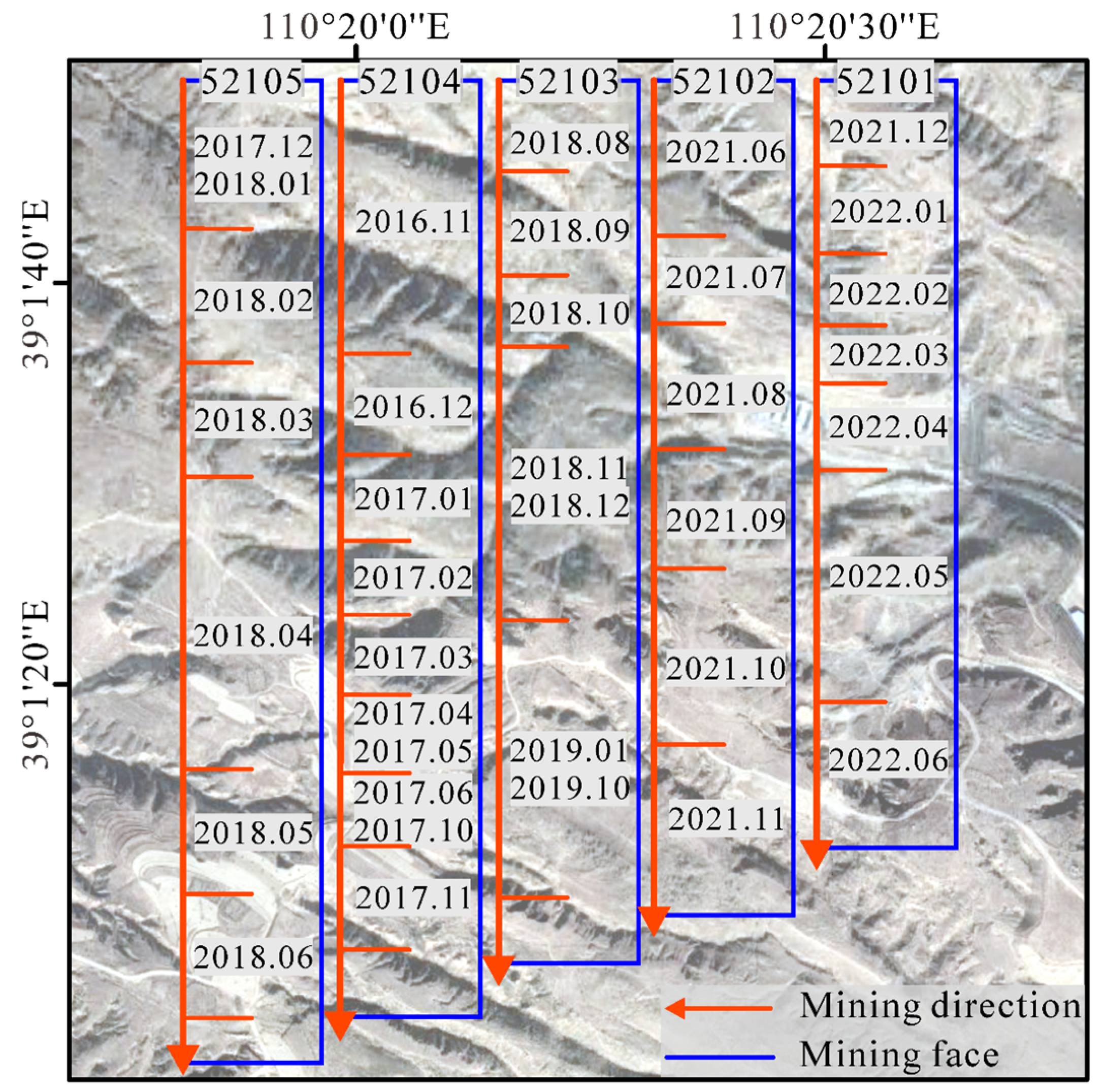
The Hongyan Coal Mine, one of the major mines within the Zhangjiamao mining area, commenced production in 1989. The upper coal seams, including seams 2−2, 3−1, and 4−2, were successively extracted using the room-and-pillar mining method with blasting. By 2016, these seams had been fully mined out. Subsequently, the lower seams (e.g., seam 5−2) were exploited by means of the longwall mining method, with full caving employed for roof control to accommodate surface subsidence. The mining sequence proceeded in a forward order, whereas the working faces were extracted in reverse. During the extraction of seam 5−2, five primary working faces, designated 52105 to 52101, were successively mined from late 2016 to mid-2022, across 32 time nodes corresponding to key stages of the mining process (Figure 1c and Figure 2).

3. Materials and Methods

3.1. Workflow

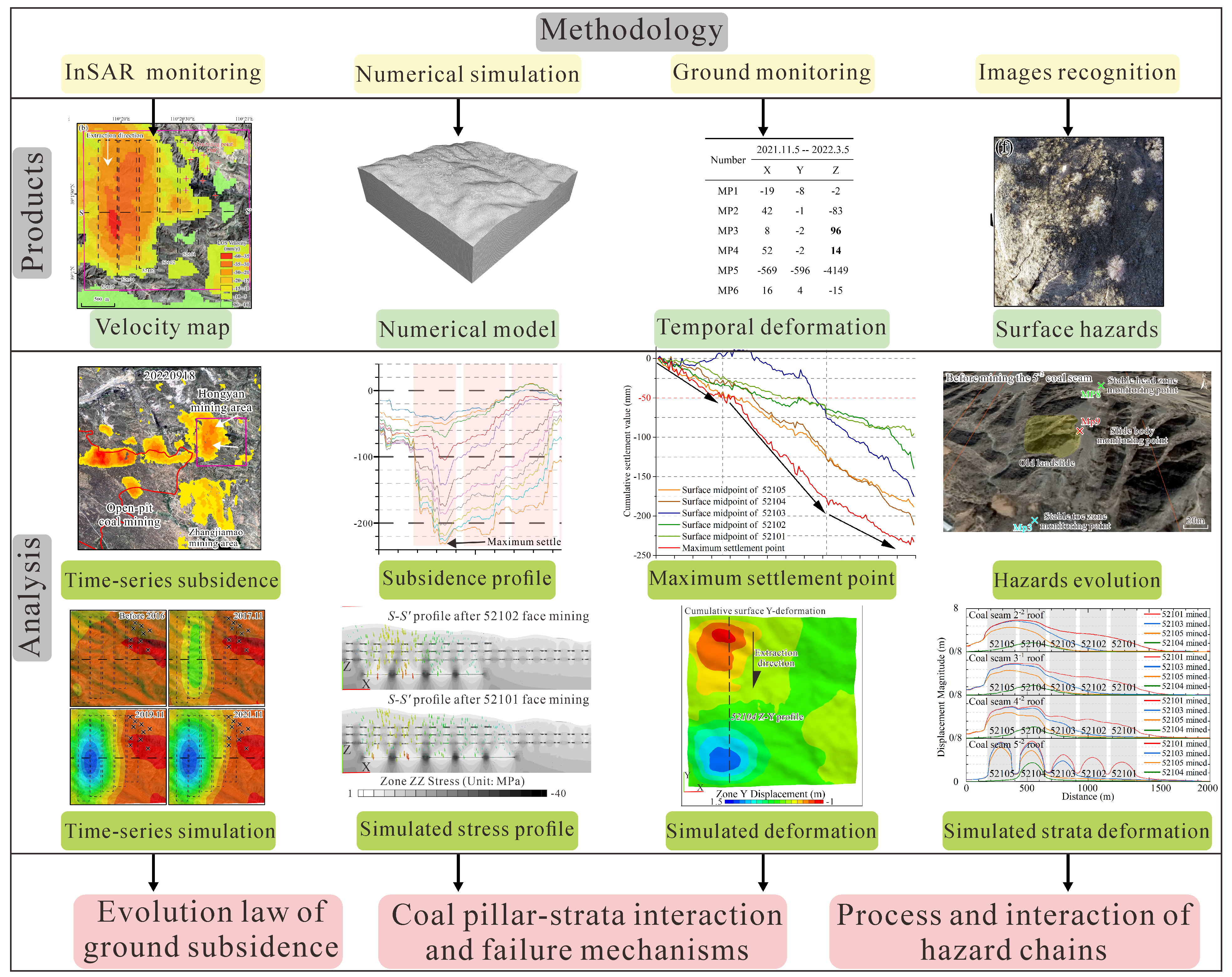
The proposed InSAR-based multi-source monitoring and modeling framework (Figure 3) systematically integrates InSAR time-series monitoring, numerical simulation, ground-based observation, and UAV/historical imagery recognition to investigate mining-induced deformation and hazard-chain development in the loess gully region. By combining multi-source datasets with numerical modeling, the framework provides both spatiotemporal observations and mechanical interpretations of deformation, enabling a comprehensive understanding of the processes and mechanisms driving surface subsidence and strata instability under multi-seam, multi-panel coal mining conditions.
InSAR monitoring provides continuous and high-resolution measurements of surface displacement, revealing the spatial and temporal evolution of subsidence and deformation patterns. Numerical simulations using FLAC3D reproduce the strata movement, stress redistribution, and deformation processes according to the actual excavation timeline of Coal Seam. Comparative simulations between the real sequential-mining and hypothetical single-seam scenarios identify the dominant factors controlling strata deformation and ground movement. Long-term total station monitoring captured the deformation of loess slopes and gullies from the crest, slope, and surrounding areas, providing direct evidence of surface movement induced by mining activities. In addition, these ground observations were used for the accuracy evaluation of the InSAR time-series results. UAV and historical imagery investigations characterize mining-induced geo-hazards such as fissures, landslides, clarifying their spatial correlation with mining panels and their temporal evolution.
The integration of these multi-source approaches enables a cross-validated and process-oriented analysis of mining-induced deformation. Through the coupling of observation products and simulation outputs, the framework elucidates the evolution law of ground subsidence, the interaction and failure mechanisms between coal pillars and overlying strata, and the processes and interactions within the hazard chain.

3.2. Site Investigations

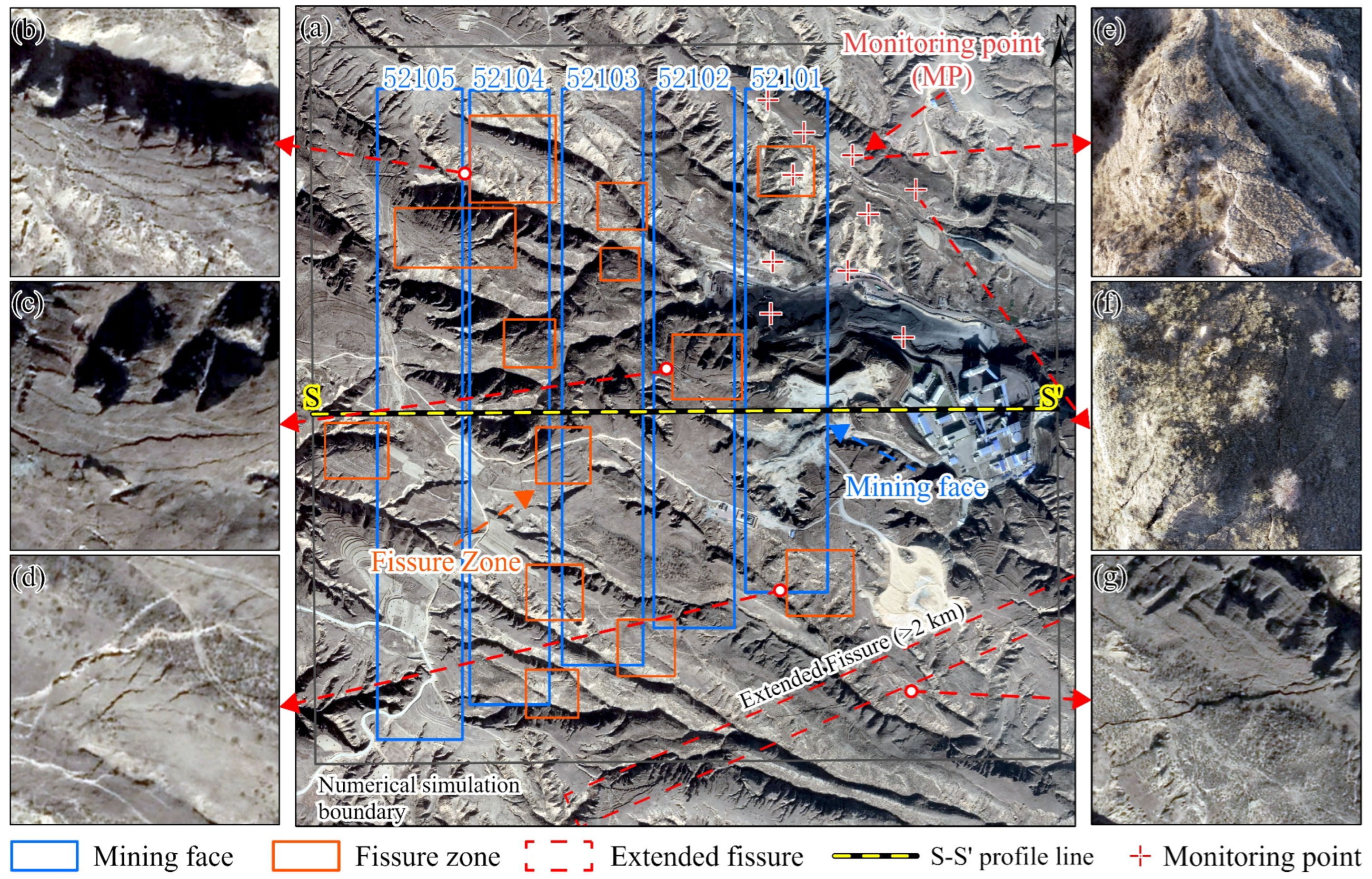
In this study, surface deformation of a loess ridge located at the northwestern end of the mining panel was monitored using a total station from November 2021 to June 2022, with three monitoring sessions conducted. The monitoring involved the installation of surface markers and precise displacement measurements to track deformation. Historical high-resolution remote sensing images were utilized to analyze geomorphological changes and geo-hazards (Figure 4). Additionally, UAV surveys were conducted to acquire orthophotos with a spatial resolution of 10 cm, which enabled detailed identification of ground fissures and landslides. These UAV-derived images provided essential high-resolution evidence for the analysis of fissure distribution patterns and multi-hazard interactions in Section 4.2. Unlike InSAR observations that primarily reveal deformation magnitudes, UAV orthophotos clearly depict the morphology and spatial extent of fissures and slope failures. Moreover, compared with historical satellite images that reflect long-term geomorphological changes but lack sufficient spatial detail, the UAV data effectively complement InSAR and historical imagery, supporting fine-scale analysis of mining-induced hazard chain evolution (Figure 4).

3.3. Combined Interferogram Stacking and SBAS Approach

In this study, we employed a combination of Interferogram Stacking and the Small Baseline Subset (SBAS) method within the framework of Time-Series Synthetic Aperture Radar Interferometry (TS-InSAR) [28] to analyze geo-hazards induced by coal mining. The processing was done using GAMMA-2017® Software developed by GAMMA for Remote Sensing AG, Muri bei Bern, Switzerland. Sentinel-1A satellite data, spanning from 12 March 2017 to 18 September 2022, and comprising 139 ascending track Single Look Complex (SLC) images acquired from the Alaska State Facility (ASF), were utilized in this study. These data were in the C-band (wavelength of 5.6 cm) with a pixel spacing of 2.3 m in range and 13.9 m in azimuth, with a 12-day revisit period [29]. To mitigate seasonal influences, the image from 22 July 2017 was designated as the master, while the other images served as slaves for pairwise interferometric processing, resulting in multi-temporal differential interferograms. For SBAS-InSAR, using a spatial and temporal baseline of 120 m and 90 days, 730 interferogram pairs were acquired. The SRTM DEM with a spatial resolution of 30 m was used for coregistration, flat-earth, and topographic phase removal. A 10:2 multi-looking process was applied to all Sentinel-1 interferograms, and phase unwrapping was conducted using the Minimum Cost Flow (MCF) method. Atmospheric errors were corrected using high-pass and low-pass filters to generate the Atmospheric Phase Screen (APS), and interferograms with low coherence and phase unwrapping errors were excluded.
Stacking was performed by aggregating phase information from multiple interferograms [30], effectively reducing random noise and atmospheric delays in individual interferograms. This process generated a smoother and more robust deformation rate map, reflecting long-term deformation trends by mitigating short-term atmospheric disturbances. Subsequently, SBAS time-series analysis was applied to the stacked results, capturing cumulative deformation and providing higher temporal and spatial resolution. Finally, to convert the Line of Sight (LOS) deformation to vertical deformation, the following formula was used:
Δ h = d L O S cos ( θ )
where Δ h represents the vertical deformation, dLOS represents the LOS deformation, and θ is the incidence angle.
The spatial resolution of the InSAR time-series monitoring results is approximately 24 m × 31 m (longitude × latitude) at 39°N, corresponding to 0.00027778° in both directions. To comprehensively assess the reliability of the SBAS-derived deformation measurements, this study employed an integrated approach combining external accuracy validation and internal quality assessment. The external accuracy evaluation utilized total-station observations from the Loess Ridge monitoring points, comparing the cumulative displacements measured over a six-month period (5 November 2021–28 May 2022) with the SBAS-derived results to quantify systematic bias and overall accuracy. The internal quality assessment was based on the weighted least-squares inversion framework of the SBAS algorithm, incorporating analyses of temporal coherence and deformation uncertainty obtained from error-propagation matrices to evaluate the stability and internal consistency of the time-series solutions. The reliability of SBAS deformation monitoring in the loess gully mining area was evaluated through the combined analysis of external and internal accuracy.

3.4. Simulation

3.4.1. Simulation Method and Parameters

FLAC3D (Fast Lagrangian Analysis of Continua in 3 Dimensions) is a 3-D finite-difference computer program renowned for its proficiency in addressing geological issues [31,32]. It employs the finite difference method (FDM), treating rock masses as equivalent continua discretized into a set of elements, and excels in handling nonlinear large deformations and failure problems [27]. FLAC3D can reproduce critical multi-seam coal mining behavior aspects, such as deformation mechanisms and locations. Therefore, this study utilizes FLAC3D to simulate multi-seam coal mining operations.
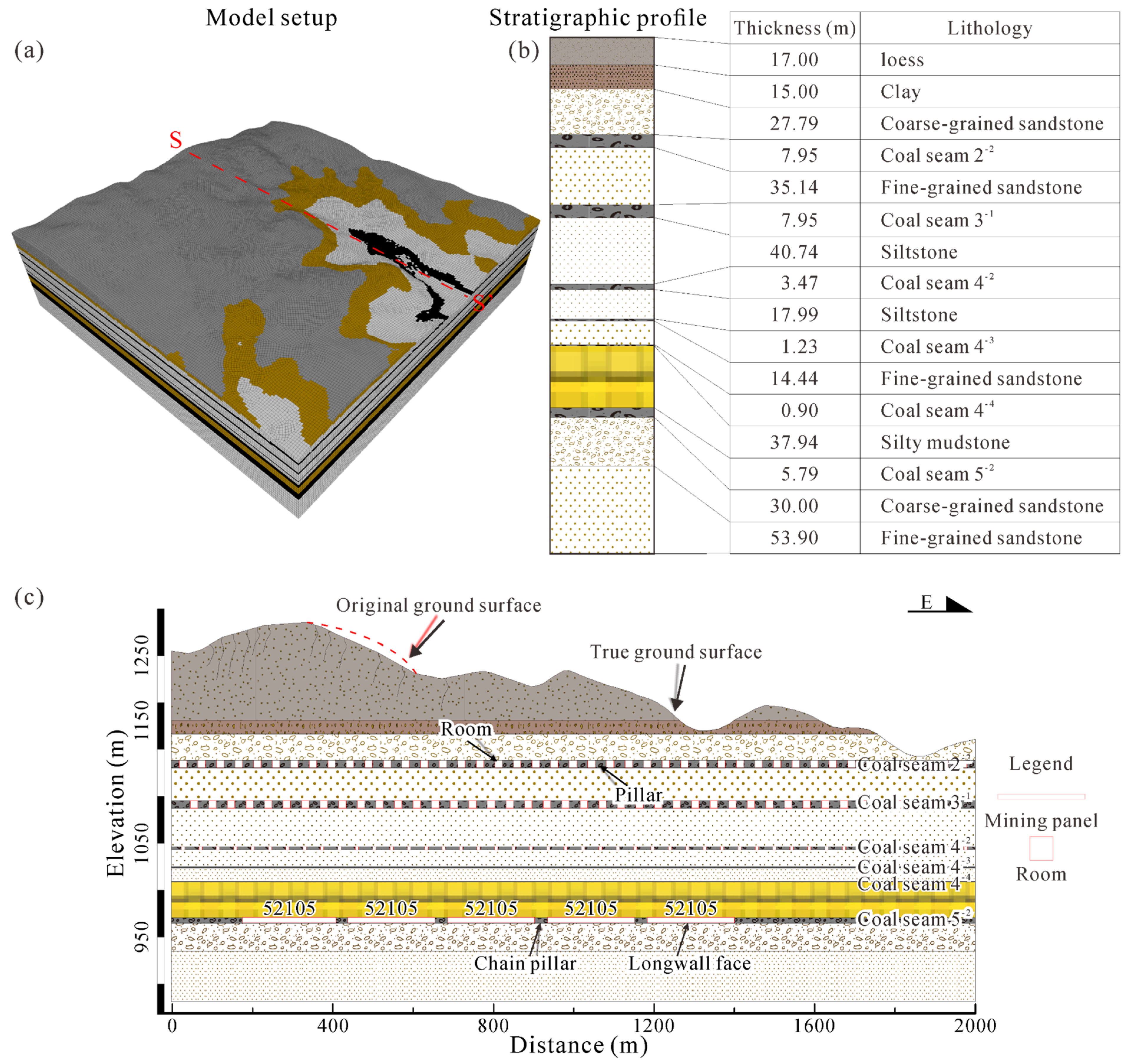
Simulation parameters play a crucial role in ensuring the accuracy and reliability of numerical simulations. The numerical model includes seven primary lithologies: loess, clay, Coarse-grained sandstone (CGS), fine-grained sandstone (FGS), siltstone, coal, and silty mudstone. The stratigraphic development and geomechanical parameters are detailed in Table 2 and Figure 5b. These parameters have been validated in previous studies of the Shennan mining area [33,34].
The surface morphology data used in this model is derived from a digital terrain model (DTM) with a 2-m resolution, produced during a surface survey conducted by the mining enterprise in 2016 prior to coal mining. This terrain information is utilized to analyze the impact of surface morphology on both surface and stratigraphic deformation.

3.4.2. Numerical Model and Modeling Scheme

To incorporate the mining scenario into the numerical simulation, each coal seam was excavated in a stepwise manner that followed the actual mining sequence and panel advancement shown in Figure 2. At each excavation step, the corresponding elements representing the mined-out area were removed, and the model was calculated to simulate stress redistribution and strata movement. This dynamic excavation procedure ensures that the simulation reflects the progressive disturbance process of multi-seam and multi-panel mining rather than a static excavation.
In FLAC3D, a three-dimensional geomechanical model was developed to replicate the geological and mining conditions of the Shennan coalfield (Figure 5). Two simulation scenarios were designed: (1) actual multi-seam mining, where Coal Seams 2−2, 3−1, and 4−2 were mined using the room-and-pillar method followed by longwall extraction of Seam 5−2 according to the timeline in Figure 2, enabling time-series analysis of strata movement under sequential extraction; and (2) a hypothetical single-seam scenario, in which the upper seams were assumed intact and only Seam 5−2 was mined. The comparison between these two models, combined with InSAR-derived ground deformation, allowed identification of the principal drivers of ground subsidence in multi-seam mining conditions.
To optimize both computational efficiency and simulation accuracy, hexahedral elements were used for mesh construction to optimize both computational efficiency and simulation accuracy. As shown in Figure 5a, the grid size of the coal seams and adjacent strata was unified to maintain stability and efficiency, with each grid cell representing 1 m × 1 m × 1 m in real scale to ensure sufficient spatial resolution. The coal seam thickness was moderately enlarged to ensure numerical stability and consistent stress distribution. Figure 5b,c depict the stratigraphic sequence and goaf distribution, with the room-and-pillar goaf uniformly set at a 50% extraction rate across the entire mining area, representing the actual full-seam extraction condition.
The Mohr–Coulomb constitutive model, governed by the Mohr–Coulomb yield criterion, was employed to represent the nonlinear deformation and failure behavior of rock masses. The model base was fixed in the vertical direction, while the lateral boundaries were constrained horizontally. Gravitational loading and the actual gully topography were incorporated to accurately reproduce the in situ stress state following longwall panel extraction. During coal extraction, simulated by sequential removal of coal elements, the surrounding rock masses were allowed to deform freely, resulting in stress redistribution, roof collapse, and progressive caving of the overlying strata.
In the FLAC3D model, the bottom boundary was fixed in the vertical direction to represent the stable bedrock foundation, and the lateral boundaries were constrained horizontally to prevent non-physical lateral deformation, while allowing vertical displacement. The upper surface was set as a free boundary corresponding to the actual topography. The initial stress field was generated under self-weight to establish a realistic equilibrium state before mining.
The model boundaries were placed more than 2 times the maximum mining depth away from the mined-out area to eliminate boundary effects. Sensitivity analysis indicated that further enlargement of the model had negligible influence on the calculated displacement and stress fields.
It should be noted that the FLAC3D model represents a simplified approximation of the complex geological environment. The assumption of layer homogeneity and isotropy, as well as the exclusion of local faults and joint sets, may lead to certain discrepancies from field conditions. Nevertheless, the simulation captures the primary deformation characteristics and provides a reasonable basis for analyzing the mechanisms of multi-seam mining-induced subsidence. A sensitivity analysis of mechanical parameters (±10%) confirmed that the overall deformation pattern remains stable, demonstrating the robustness of the model results.

4. Results

4.1. Surface Deformation

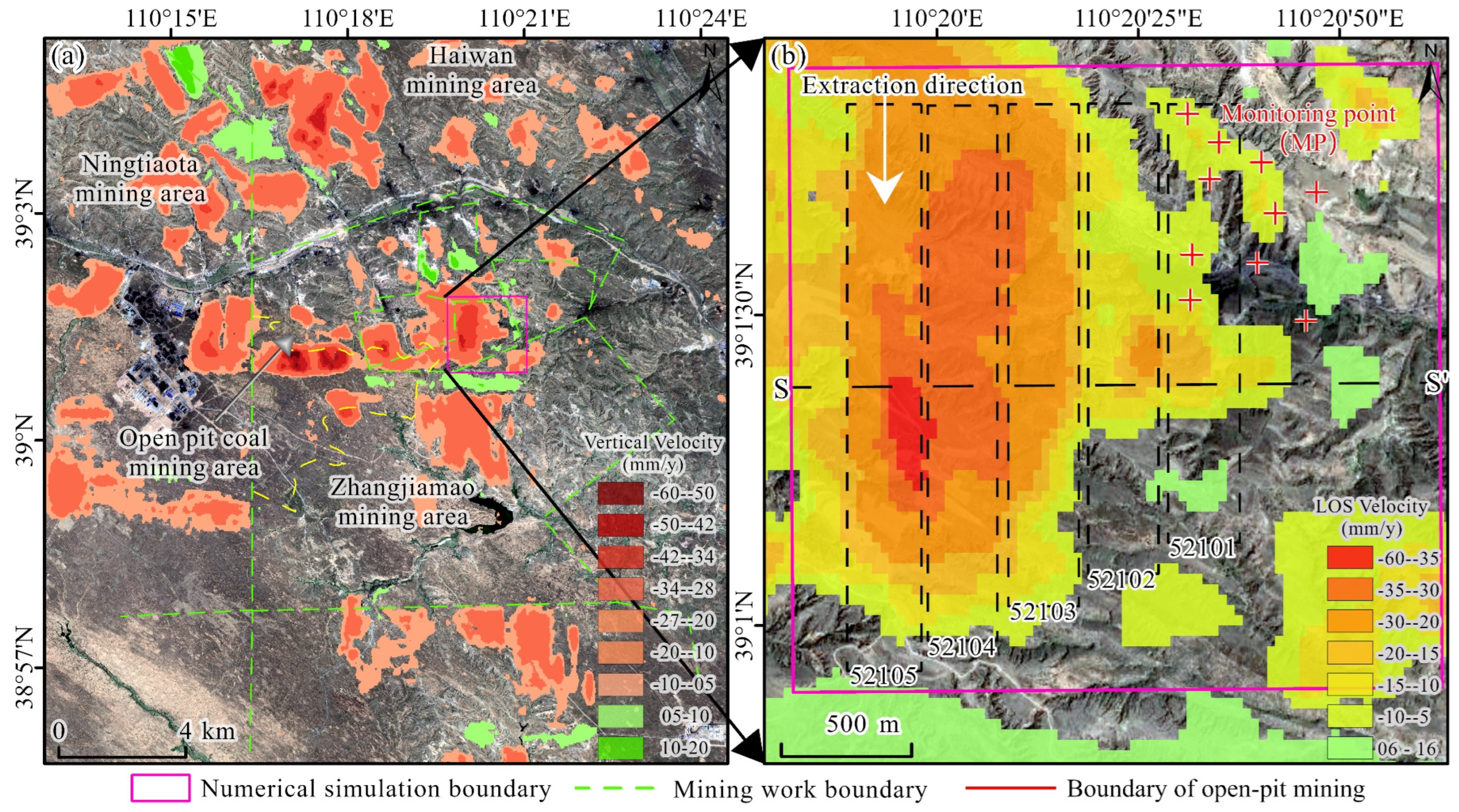
InSAR monitoring obtained the average deformation rate map of the mining area (Figure 6). Areas with deformation rates within ±5 mm/yr were considered stable, while regions exceeding this rate were classified as deformation zones. Figure 6a shows subsidence is concentrated in coal mines, all exhibiting uneven subsidence. The most significant subsidence occurs in the open-pit mining area, reaching −58 mm/yr. Additionally, uplift is observed around the mining boundaries of the Hongyan and Haiwan coal mines. Other regions remained stable during the monitoring period.
In the numerical simulation area of the Hongyan coal mine, the deformation rate in the LOS direction is shown in Figure 6b. The subsidence center is located at the boundary between panel 52105 and 52104, forming an irregular subsidence ring. The LOS deformation rate at the subsidence center is −38 mm/yr, with an average rate of −11 mm/yr. Notably, there is an uplift in some areas around the subsidence center, with a maximum uplift rate of 16 mm/yr, and the largest uplift area is located at the boundary between the Hongyan and Zhangjiamao coal mines. An independent small subsidence ring is also observed between mining panel 52102 and 52101, with a maximum subsidence rate of −28 mm/yr.
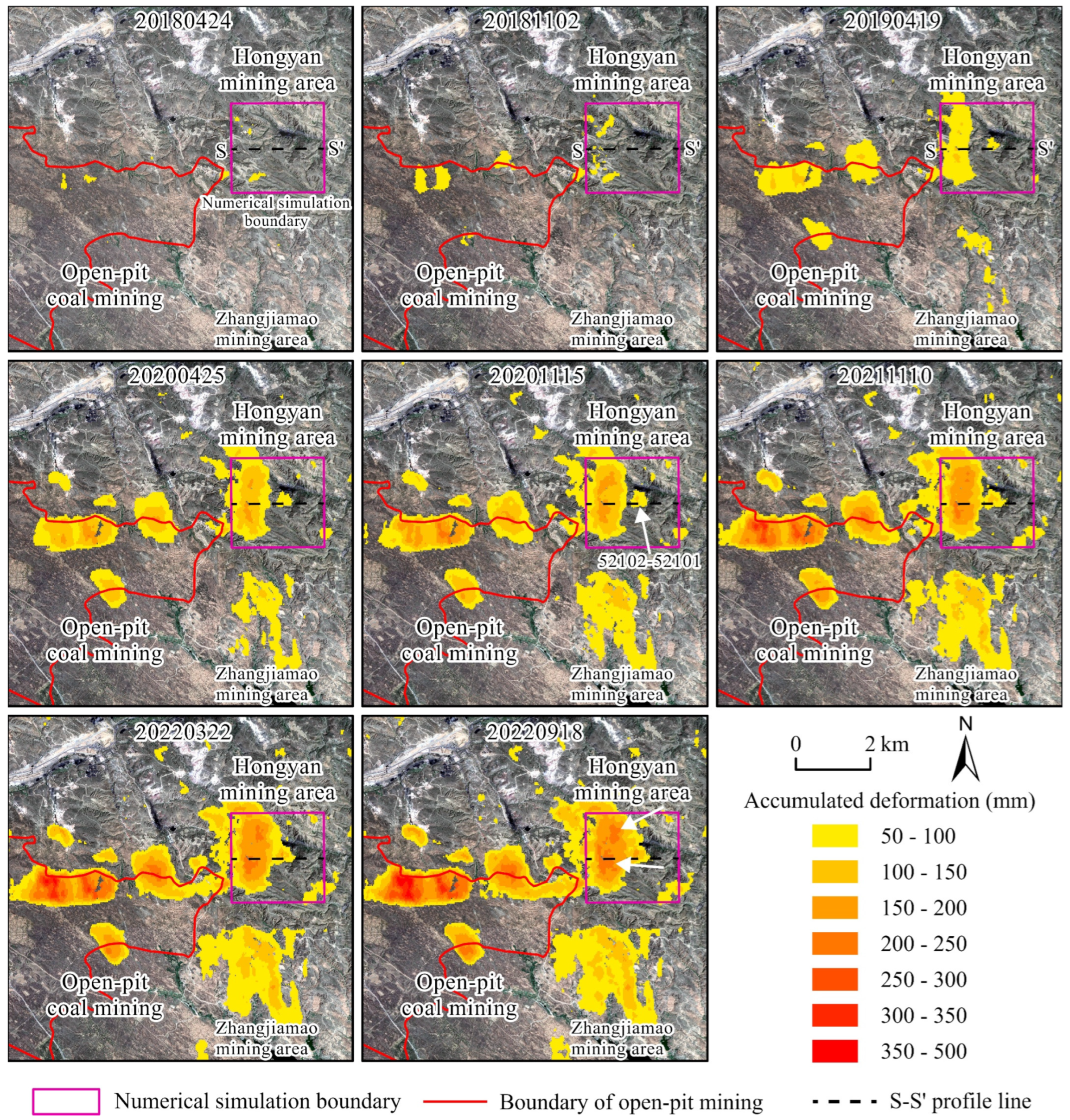
Figure 7 shows the cumulative subsidence in the study area from 2018 to 2022, reflecting the accumulation and spread of surface subsidence due to underground and open-pit mining activities. A threshold of 50 mm was set as the subsidence boundary to exclude errors while retaining significant subsidence information. The maximum subsidence value is 472 mm, located in the open-pit mining area, while the maximum cumulative subsidence within the simulation boundary is 232 mm, with an average subsidence of 60 mm and a maximum uplift of 100 mm.
Comparison of the actual longwall mining direction and progress revealed that the spatial distribution of deformation zones aligns with the mining direction (Figure 2 and Figure 7). However, surface subsidence is not entirely synchronized with mining activities, exhibiting a time-lag effect. The cumulative subsidence time series shows that after the initiation of mining activities, deformation first occurred at both ends of the longwall mining panel and then expanded toward the center. By April 2019, panel 52103 was being mined, and large-scale subsidence had already formed above panel 52105 and 52104, with subsidence continuing to expand North and South.
In 2020, no planned mining was conducted in the Hongyan coal mine, forming two distinct subsidence centers located at both ends of the mining panel. In November 2020, a subsidence zone with an area of approximately 9000 square meters appeared at the boundary between the unmined panels 52102 and 52101, with a maximum subsidence of over 120 mm, about 80 m away from the main subsidence basin and not yet connected. By November 2021, the subsidence zone had expanded, gradually approaching the main subsidence basin. In March 2022, the subsidence zone merged with the main subsidence center, with cumulative subsidence exceeding 150 mm. By June 2022, as mining of panel 52101 concluded, the subsidence area expanded, and the two subsidence centers converged toward panel 52103, with the scale of subsidence continuing to increase.
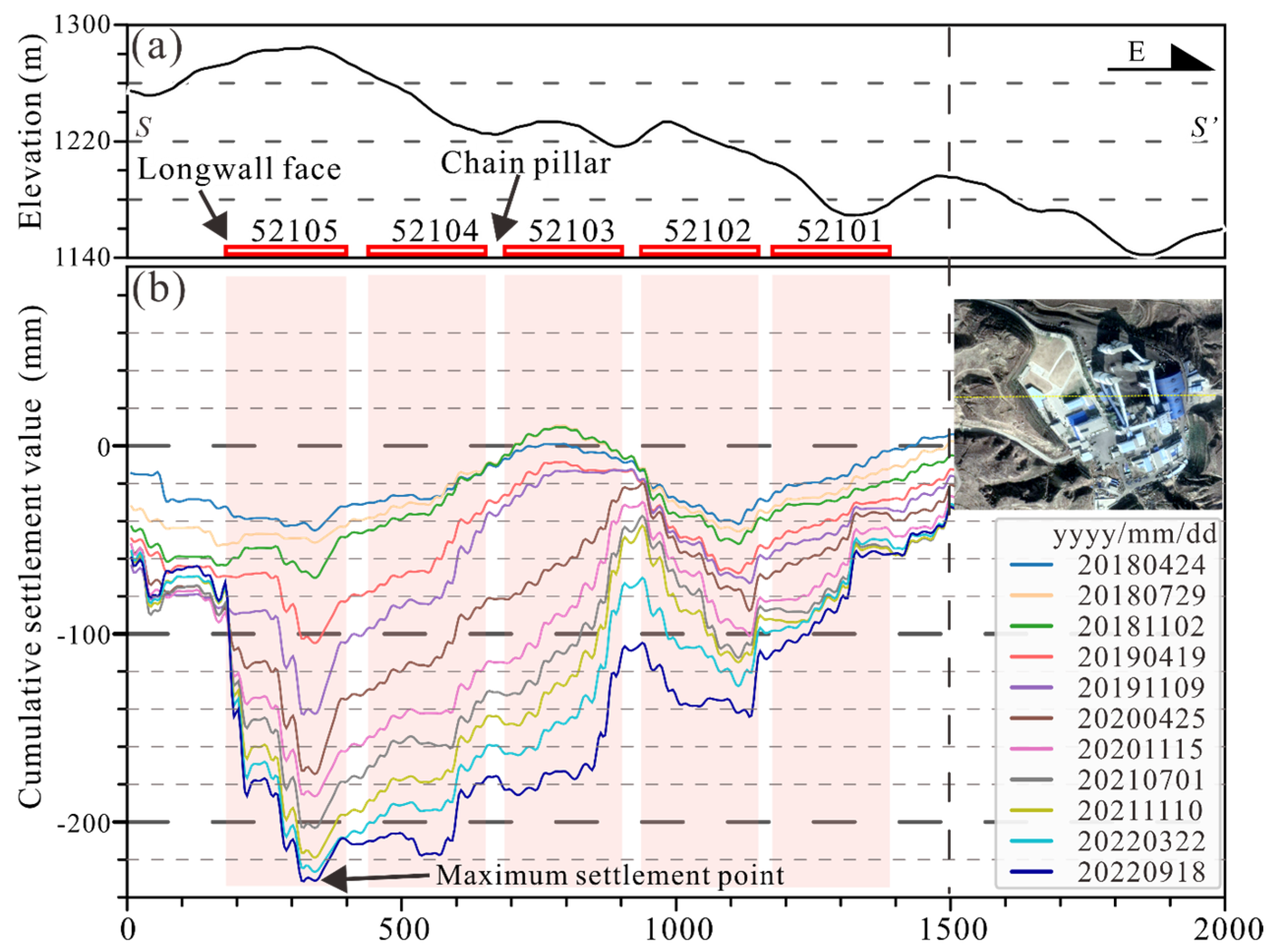
The subsidence process along the S–S′ profile, encompassing all mining panels, was analyzed based on SBAS results (Figure 8). The surface deformation evolved through three stages: during the first stage (early mining to March 2018), subsidence mainly occurred in panel 52104, with cumulative displacement below 50 mm; during the second stage (March 2018–April 2020), corresponding to the mining of panels 52105 and 52103, subsidence increased rapidly, forming a typical basin; in the third stage (after April 2020), associated with panels 52102 and 52101, the overall subsidence rate decreased, although deformation in panels 52103 and 52102 continued to increase. By September 2022, significant subsidence (>50 mm) was observed across all mined panels within 100 m along the profile, showing multiple subsidence centers, with a notably smaller magnitude at the boundary between panels 52103 and 52102. SBAS results beyond 1500 m are not discussed due to substantial disturbances from repeated reconstruction of the coal-mine site.
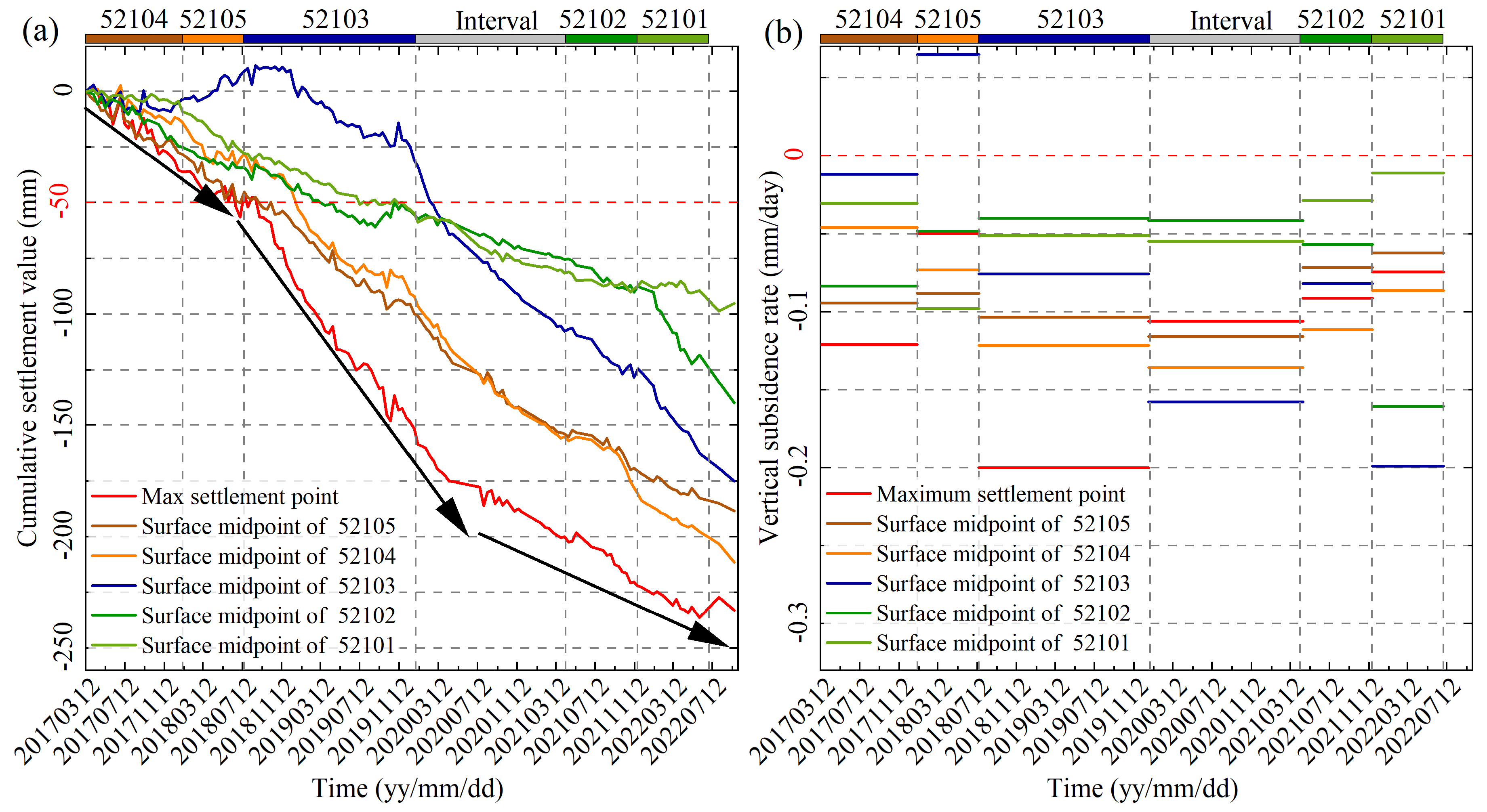
The maximum subsidence point and the midpoints of the five panels along the S-S′ profile were selected to construct cumulative subsidence curves (Figure 9a). The maximum subsidence point, located at the boundary between panels 52105 and 52104, exhibited the largest deformation. During low-activity periods, the panels showed minimal subsidence differences, with slowly increasing values and minor fluctuations, indicating negligible deformation. Between 2018 and 2020, subsidence in panels 52105 and 52104 increased markedly, and distinct deformation patterns began to develop across panels, with the maximum subsidence point showing the most rapid increase. Panel 52103 experienced slight subsidence before 2019, followed by minor uplift and subsequent acceleration, with post-2020 subsidence exceeding that of panels 52101 and 52102. During the mining of panels 52102 and 52101, subsidence in panels 52103 and 52102 accelerated, whereas panel 52101 showed relatively slow deformation. After 2021, the subsidence of panels 52105 and 52104 gradually stabilized.
The time-lag effect is evident not only in the asynchronous development between the surface subsidence and the mining face (Figure 7), but also in the delayed changes in subsidence rates at the monitoring points (Figure 9b). For panels 52105 and 52104, the highest average subsidence rates occur in 2020. Although panel 52103 was affected by the mining activities of the two preceding working faces—with subsidence rates below −0.05 mm/day before 2019 and only −0.07 mm/day during its own mining period—in 2020, its subsidence rate increased to −0.16 mm/day, with a peak of −0.20 mm/day. Panel 52102 exhibits a similar behavior: its subsidence rate was below −0.05 mm/day prior to mining, increased by about 20% during mining, and then rose to −0.16 mm/day after mining—approximately three times the rate during mining. Monitoring of the max subsidence points in panels 52104 and 52105 shows that the most dramatic subsidence did not occur during the mining period; instead, the subsidence rate time-series follows a U-shaped curve, with rates peaking after a period following mining and then gradually declining.
The expansion of the surface subsidence area gradually progresses with the advancement of mining activities, with the extent of surface deformation essentially matching the mining area. Furthermore, the temporal evolution of subsidence follows the timeline of mining activities, with the subsidence rate typically peaking after mining has ended, exhibiting a clear time-lag effect. These observations indicate that there is a spatiotemporal correlation between surface deformation in the study area and the mining activities in coal seam 5−2. Additionally, the subsidence in the Hongyan coal mine exhibits irregular characteristics with multiple subsidence centers and does not strictly extend along the working face boundaries. Panel 52103 serves as a subsidence transition zone, while the acceleration period of subsidence in panels 52101 and 52102 differs from that of panels 52104 and 52105, with significant differences in subsidence magnitude.
To avoid geometric distortion and incidence-angle effects, monitoring points located on the loess ridge top (MP1, MP3, MP8) were selected for accuracy assessment. The total-station measurements over six months recorded vertical displacements of 33 mm, 12 mm, and 67 mm, while the corresponding SBAS-derived vertical displacements (converted from LOS) were 19 mm, 27 mm, and 44 mm, yielding residuals of −14 mm, +15 mm, and −23 mm. The overall bias and mean absolute error (MAE) were −7.3 mm and 17.3 mm, respectively. Considering the local relief and the spatial resolution of the SBAS deformation map (~24 m × 31 m), these results demonstrate good agreement with ground observations and indicate centimeter-level accuracy in representing mining-induced subsidence patterns.
The study area, located in the loess gully region, is characterized by exposed loess surfaces with high coherence and negligible decorrelation. A total of 730 interferograms were generated, with more than 95% valid pairs, ensuring sufficient redundancy for time-series inversion. The temporal coherence ranges from 0.70 to 0.96, averaging 0.87, and 88% of pixels exhibit coherence above 0.75. The root-mean-square (RMS) residuals of the time-series fitting vary from 0.42 to 0.91 rad (mean 0.65 rad), corresponding to a cumulative displacement standard deviation of 3.8–8.5 mm (mean 6.1 mm). Approximately 91% of pixels have an uncertainty below ±10 mm, confirming the high internal precision and temporal stability of the results. Overall, the SBAS-derived deformation field in the unvegetated loess area exhibits excellent internal consistency and centimeter-level reliability, providing a robust basis for analyzing mining-induced subsidence and supporting numerical modeling.
The massive discrepancy between the ground-truth deformation (>5000 mm on landslides, Table 3) and the InSAR maximum (~472 mm, Figure 7) primarily arises from the fundamental differences in spatial resolution and measurement principles. InSAR provides pixel-averaged LOS deformation representing areal responses, whereas total-station measurements capture high-precision, point-wise three-dimensional displacements. In areas with rapid and highly heterogeneous slope deformation, an InSAR pixel cannot accurately correspond to a single ground point. Moreover, large displacements induce decorrelation—especially during acceleration or post-failure stages—when substantial changes in the sliding mass alter scattering characteristics, causing loss of coherence and underestimation of true deformation. Therefore, selecting ridge-top monitoring points for validation is appropriate, as this area has open terrain, favorable viewing geometry, high coherence, and moderate deformation aligned with the radar LOS. The results indicate that InSAR is more effective for capturing pre-failure subtle deformation and boundary activity, whereas UAV and total-station measurements reliably document large displacements (Figure 10). The complementary advantages of these techniques highlight the necessity of multi-source monitoring.

4.2. Mining-Induced Surface Multi-Hazards

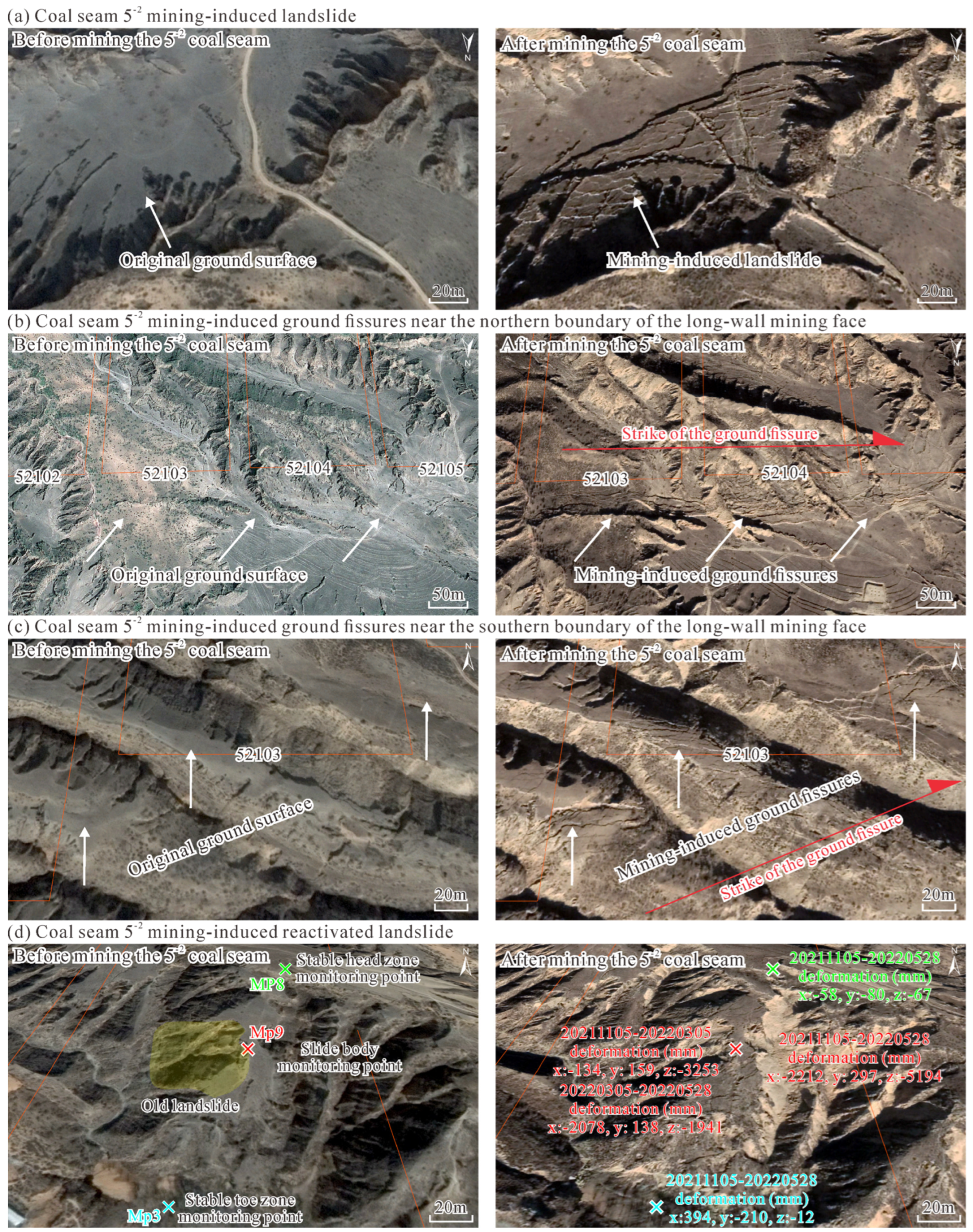
Coal mining not only causes surface subsidence but also induces various geo-hazards such as landslides and ground fissures. Ground fissures are the most evident form of surface damage and a major cause of environmental degradation in mining areas [35]. In the Hongyan coal mine, the development of ground fissures shows a high spatiotemporal correlation with mining activities. A fissure exceeding 2 km in length has developed on the southern side of the study area (Figure 4a), and dense fissure zones are present at both the front and rear ends of the working face, with fissures nearly perpendicular to the advancement direction. The densest fissures are near panel 52104 (Figure 10b,c). Fissures are classified based on topography into gully area fissures (Figure 4b,c), gentle slope area fissures (Figure 4d,g), and slope fissures (Figure 4e,f). Additionally, slope fissures at the mining edge often lead to landslides, particularly in areas with dense slope fissures (Figure 10a).
During the mining of panel 52101, comprehensive monitoring of the surface deformation of the loess ridge was conducted, with the monitoring point layout shown in Figure 1, where MP1 was located on the road, MP4 to MP10 were distributed around the loess ridge, including the gullies and ridge top, while MP2 was positioned at the foot of the slope 580 m in the mining direction. The monitoring results (Table 3) indicate significant sliding detected at the monitoring points at the slope foot and within the gullies, with horizontal displacement controlled by the terrain; monitoring points near the slope top primarily exhibited subsidence. The slope fissures trended northeast, and MP3, MP4, and MP8 transitioned from uplift to subsidence after mining activities passed through.
The old landslide at the northern end of panel 52101 was reactivated due to underground mining activities, resulting in a new landslide (Figure 10d). This study monitored the landslide front, head, and rear fissures, with the mining face passing all monitoring points in February 2022. The results showed that the ridge top (MP8) experienced a horizontal displacement of 99 mm and a vertical displacement of 67 mm; the landslide front (MP3) experienced a horizontal displacement of 446 mm, accompanied by 12 mm of subsidence; the rear fissure (MP9) showed a horizontal displacement of 2232 mm and vertical subsidence exceeding 5000 mm. The landslide was reactivated after mining passed, with over 60% of the displacement occurring before March 2022. During the mining period (March to June 2022), the landslide continued to develop, exhibiting significant displacement; after mining ended (June to November 2022), the landslide stabilized, with a subsidence of 40 mm recorded at MP9, accounting for less than 1%. The rear fissure moved northwest, the front continued to move southwest, and the displacement direction of the ridge top shifted from northeast to southwest after mining.
No significant surface collapse pits were observed in the study area. Ground fissures were primarily oriented east–west, nearly perpendicular to the mining face advancement direction, with their orientation and mechanical characteristics influenced by the terrain. The landslide was closely related to the terrain and fissure distribution, with the sliding direction mainly controlled by the slope aspect.

4.3. Simulated Underground Deformation

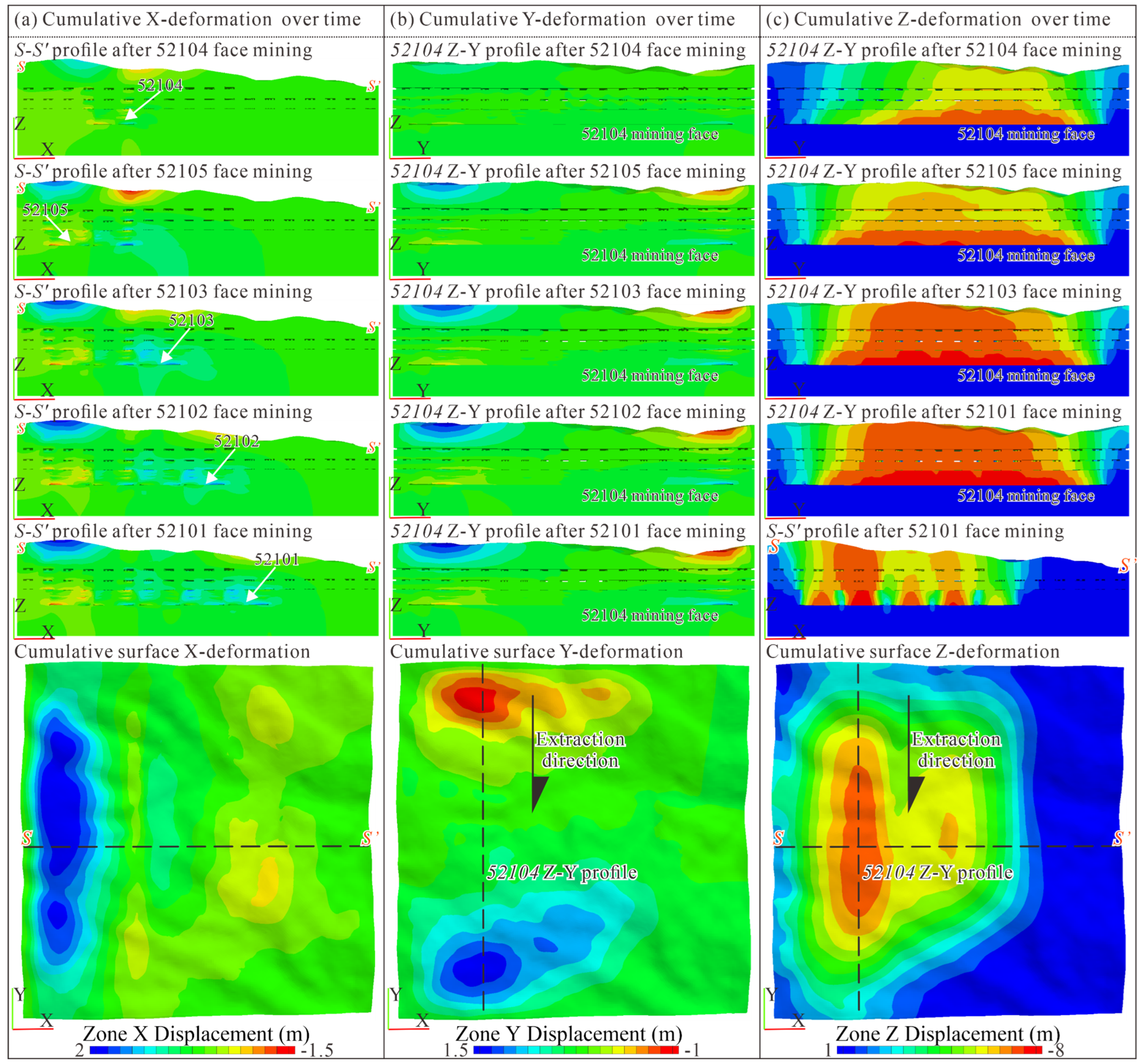
Figure 11 shows the time-series deformation characteristics of the overburden and residual coal pillars in the X, Y, and Z directions from the numerical simulation.
After the completion of mining panel 52104, deformation in the X direction was primarily concentrated on surface protrusions on both sides, showing convergent movement, while the rest of the strata and coal pillars had no significant displacement. The deformation in the X direction within the S-S′ profile gradually intensified as mining progressed. The surface protrusion above panel 52105 showed an increase in eastward displacement, while the protrusion above the right side of panel 52104 exhibited a rise in negative displacement (Figure 11a). The overburden above panel 52104 to 52101 experienced varying degrees of west–east movement, with the maximum deformation at the base of the residual coal pillars above panel 52103, decreasing eastward. The maximum cumulative deformation in the X direction was at the highest surface protrusion.
The profile illustrates the displacement variation in the Y direction through panel 52104 (Figure 11b). The profile shows distinct zoning characteristics. The northern end of the surface shifted southward, while the southern end moved northward. In contrast, the southern end of the subsurface shifted southward. The maximum surface displacement occurred at both the northern and southern ends of the panel, forming a ring structure that became narrower closer to the panel boundary.
Vertical deformation exhibited a clear ring-like distribution pattern. In the central mining direction, the maximum deformation occurred near the interval pillar between panel 52104 and 52105. Roof collapse began after the mining of panel 52105 and intensified during the mining of panel 52103, eventually stabilizing (Figure 11c). Deformation in the vertical direction was influenced by the interaction of multi-panel and the mining sequence, with the location of maximum deformation shifting from west to east and gradually stabilizing (Figure 12b).

5. Discussion

5.1. The Evolution Law of Ground Subsidence Induced by Multi-Seam Mining

A comparative assessment of SBAS-InSAR observations and numerical simulation results was conducted to analyze the spatiotemporal evolution of mining-induced subsidence (Figure 7, Figure 8 and Figure 11). SBAS-InSAR monitoring shows that the expansion of the subsidence basin exhibits clear stage-wise development that corresponds to the sequential advance of panels 52104 → 52105 → 52103 (Figure 7). The numerical simulation reproduces this temporal pattern, with roof breakage and stress redistribution occurring progressively as the working face advances, resulting in the west-to-east migration of the subsidence center—consistent with the InSAR-derived time-series deformation profile (Figure 8). Spatially, both datasets identify similar subsidence morphology, the same primary subsidence center between panels 52105 and 52104, and comparable ring-shaped settlement patterns (Figure 6 and Figure 11). The simulated subsidence basin (Figure 12a) also agrees well with the deformation rate distribution (Figure 6), as both reflect the overall surface settlement pattern.
Both methods reveal a consistent “multi-center subsidence” pattern caused by the cumulative effects of multi-panel extraction. SBAS-InSAR detects a secondary subsidence ring between panels 52102 and 52101 (Figure 6b), while the numerical simulation shows corresponding secondary vertical deformation in the same area (Figure 11c). In addition, both results indicate that panel 52103 functions as a transitional subsidence zone, with deformation markedly lower than that of adjacent panels, consistent with the simulated gradual bending of the overburden. Overall, the strong spatial agreement between SBAS-InSAR and the numerical model demonstrates that the simulated overburden response effectively captures the actual subsidence pattern, and the two datasets provide mutual qualitative validation of the subsidence evolution characteristics.
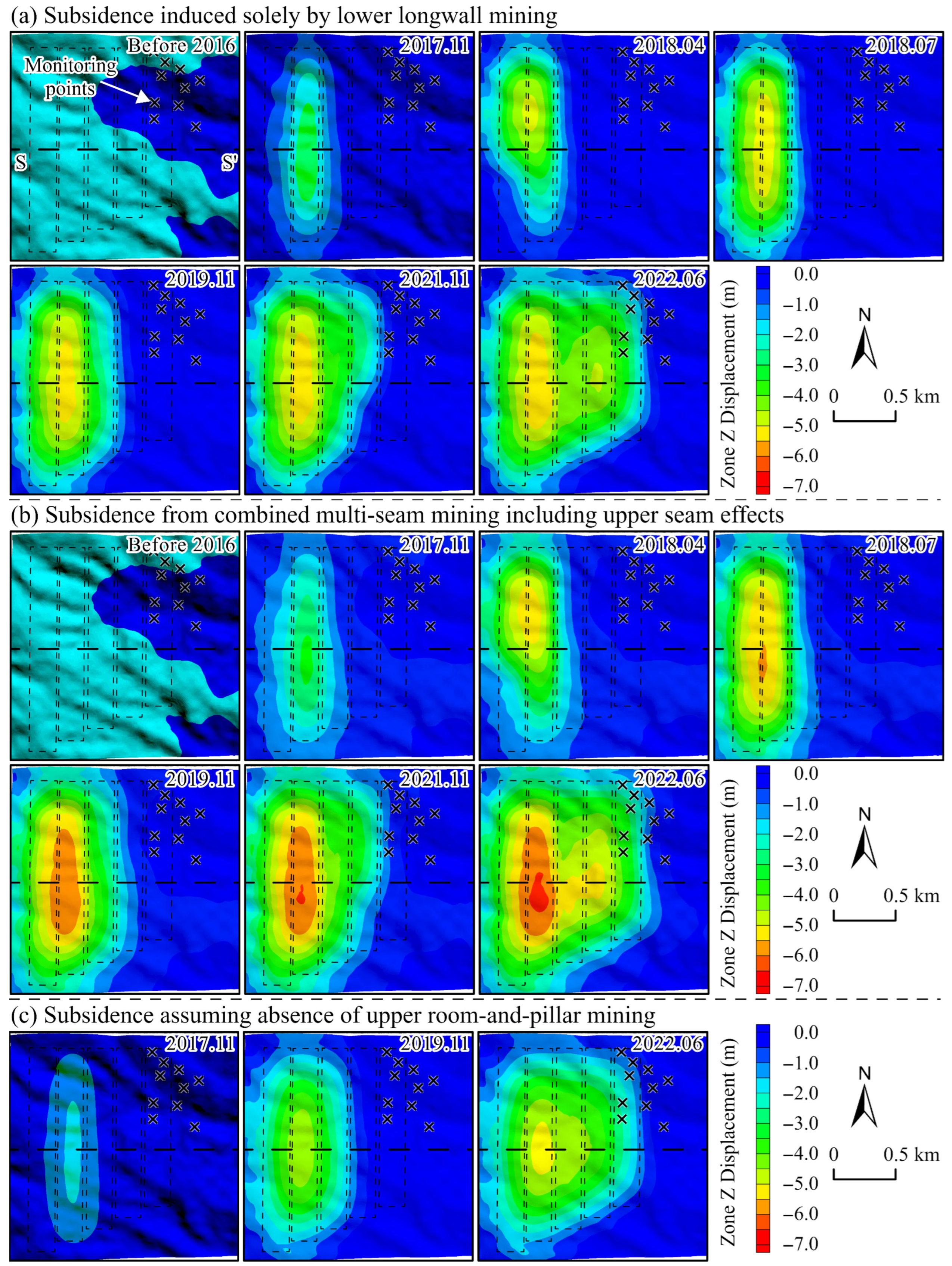
Surface subsidence caused solely by lower longwall mining is similar in extent to the subsidence basin of multi-seam mining, with the subsidence center located at the north–south center along the boundary between panel 52104 and 52105 (Figure 12a,b). The primary difference lies in the magnitude of subsidence, indicating that the main source of subsidence is from lower seam mining. However, under the assumption of the absence of upper room-and-pillar mining, the induced subsidence is more uniform, although it also shows a subsidence ring. The extent and magnitude of subsidence are smaller, and the subsidence center shifts to the boundary between panel 52104 and 52103 (Figure 12c). This indicates that although surface subsidence is mainly induced by the mining of Seam 5−2, the cumulative effect of multi-seam mining significantly impacts the subsidence process.
The fragile upper residual coal pillars become unstable under shear stress, causing subsidence in unmined areas. Additionally, in the loess hilly gully terrain, the formation of multiple subsidence centers is closely related to the structural characteristics and topography of the loess. Vertical joints in the loess reduce shear strength, making it prone to localized subsidence along joint planes under mining-induced stress, thereby exacerbating surface subsidence. InSAR monitoring effectively reflects the multiple subsidence centers caused by these factors. Therefore, InSAR monitoring results show multiple subsidence centers. In contrast, numerical simulation focuses on stratum deformation and stress distribution and does not fully account for the joint characteristics of the loess layer or the dynamic influence of the gully terrain.
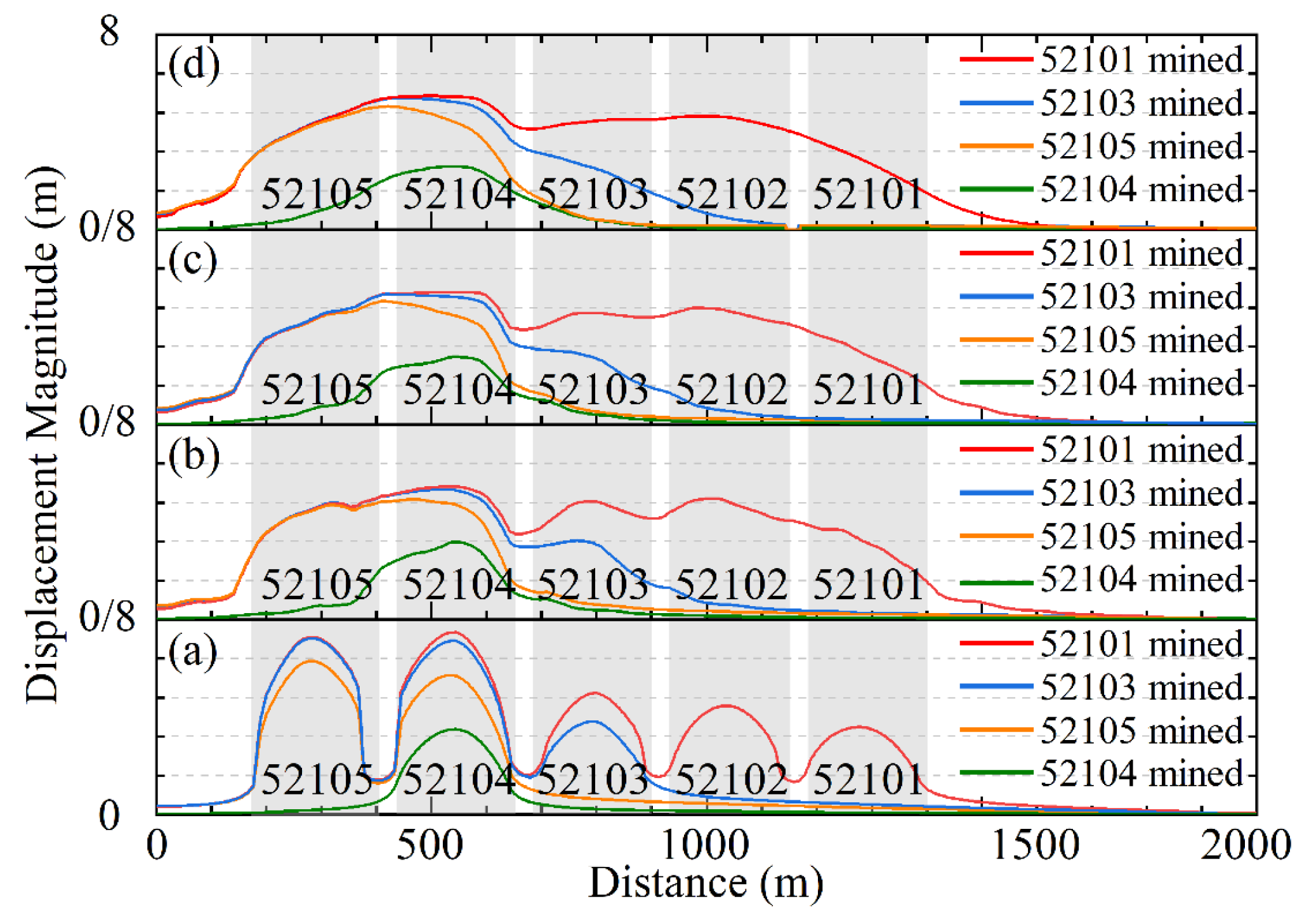
The subsidence caused by lower seam mining exhibits a time lag because the destruction of the overburden requires time to accumulate, and the support from upper coal pillars delays the onset of surface subsidence (Figure 13). After roof collapse, subsidence increases significantly. As stratum stress redistributes and gradually reaches a new equilibrium, the subsidence rate slows and stabilizes, forming a dynamic process. Thus, the extent and magnitude of surface subsidence increase rapidly over a certain period and then stabilize (Figure 9 and Figure 12). The subsidence induced by multi-seam mining manifests as stepwise subsidence underground and as uneven subsidence on the surface [11].
Moreover, the surface is covered by a loess layer ranging from several meters to nearly a hundred meters thick. Compared with bedrock, loess has no tensile strength and low cohesion, and it is easily affected by surface factors and external forces [36]. When the underlying bedrock deforms, the loess lacks the load-bearing capacity of a “beam” structure and subsides with the bedrock, applying its own weight to the underlying strata. Additionally, because the middle panel is mined first, the loess layer moves towards the goaf due to stress release in the underlying rock. Mining the side panels disperses stress in the goaf, expanding the range of subsidence (Figure 14a). The combined influence of the loess gully terrain and mining sequence results in irregular movement of the subsidence center.
During multi-panel coal mining, ground deformation monitoring commonly reveals two distinct deformation phenomena. The first is uplift at the mining boundary, caused by concentrated abutment pressure borne by coal pillars and unmined zones after extraction. This compressive stress induces bending and arching of the overlying strata, resulting in slight surface uplift detectable by InSAR. The outer side of the boundary corresponds to the arching zone, while the inner side transitions successively into the caving, fractured, and subsidence zones. The second phenomenon is a “uplift–then–subsidence” temporal pattern observed above the working face, reflecting the dynamic evolution of stress and structural responses in the overburden. Before mining reaches a given location, the overlying strata experience compressive and shear stresses, leading to minor arching. Once extraction proceeds, roof collapse, goaf compaction, and void closure occur, causing rapid surface subsidence. This process comprehensively represents the mechanical evolution of the overburden—from stress-induced arching and structural failure to progressive compaction of the mined-out area.
Overall, subsidence is mainly caused by stress redistribution and stratum instability due to multi-seam mining activities. The characteristics of the loess and terrain exacerbate uneven surface subsidence. The combination of multi-seam multi-panel mining, mining sequence, and geological conditions contributed to the unique subsidence characteristics.

5.2. Coal Pillar-Strata Interaction and Failure Mechanisms in Multi-Seam Mining

InSAR observations show that during the sequential mining of panels 52104 and 52105, uplift occurred in the panel 52103 area and persisted until around December 2018, after which it gradually transformed into subsidence (Figure 9). As mining advanced, large-scale subsidence developed above panels 52104 and 52105, and the 52103 area subsequently entered a significant subsidence stage, indicating a dynamic response of the overlying strata to the evolving goaf.
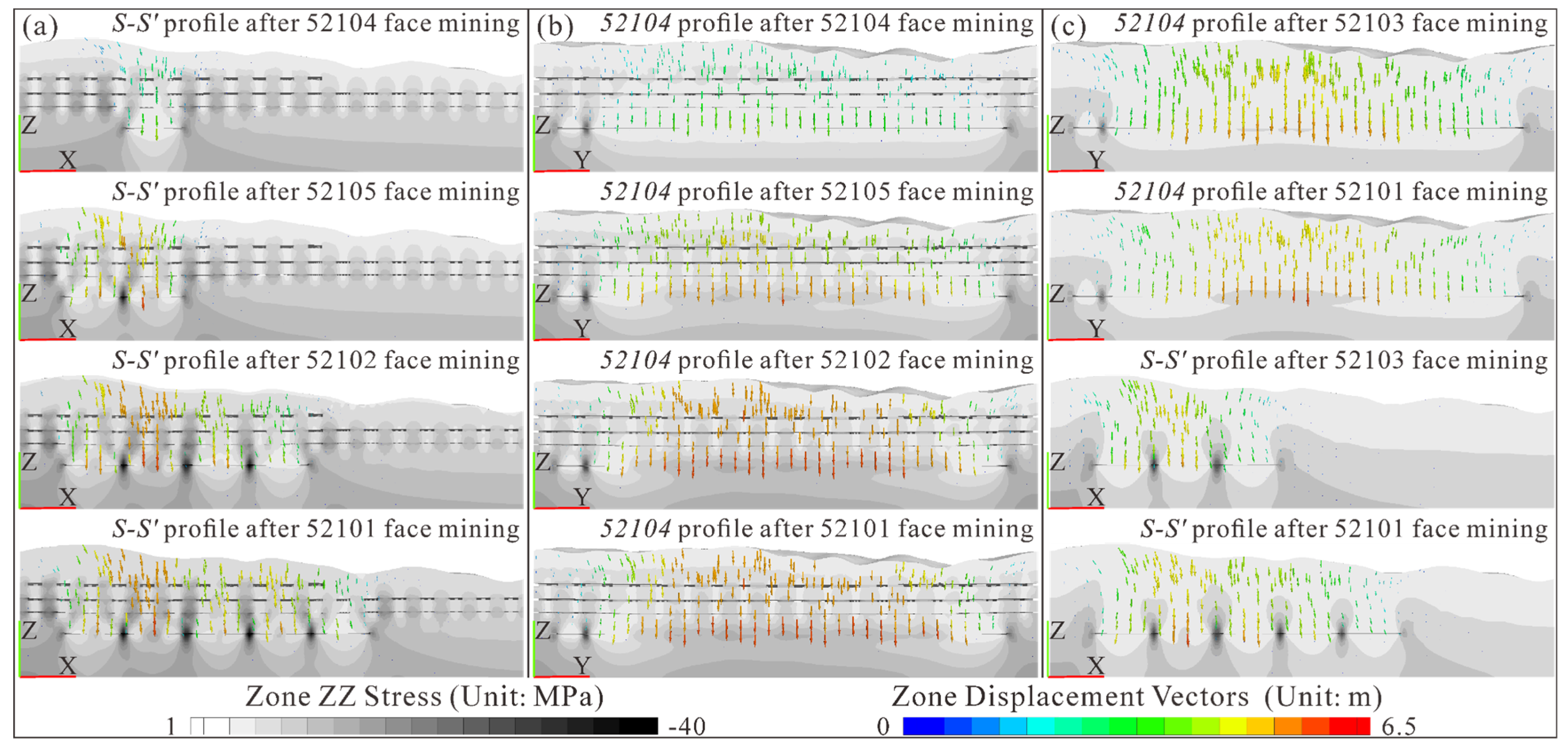
After lower seam extraction, stress reconstruction divides the mining area into a stress-release zone, a stress-increase zone, and a stress-stabilization zone [37]. The stress-release zone forms around the goaf, where loss of support induces instability of the overlying strata. The stress-increase zone occurs at the goaf margins, coal pillars, and adjacent unmined areas, where stress transferred from the goaf causes concentration and deformation (Figure 14a,b).
Stratum movement is another key factor controlling subsequent subsidence. Key strata have been shown to significantly influence overburden behavior [38]. The ~70.26 m interval between Seam 4−2 and Seam 5−2 consists of hard sandstone, forming key strata that effectively constrain subsidence. During the sequential mining of panels 52104 and 52105, these key strata bent and uplifted the strata on both sides of the goaf, producing the uplift observed above panel 52103. When mining of panel 52103 reached its midpoint (around December 2018), the key strata weakened, stress was released, and uplift converted to subsidence (Figure 9).
The upper residual coal pillars create a “grid-like” support system that disperses stress, reduces subsidence over the lower goaf, inhibits local stress concentration, and maintains overall stability. They also limit interlayer movement, restrain shear slipping, isolate the goaf from unmined blocks, and facilitate uniform stress transfer (Figure 13 and Figure 14a). However, once the key strata fail, this support system weakens, potentially causing secondary instability, stress concentration, and plastic deformation. Early in the process, residual pillars slow subsidence, but as the goaf expands, increased bending and stress transfer accelerate pillar failure and intensify deformation.
Stress redistribution in the goaf transfers overburden pressure to both sides, forming a stress-arch structure [39]. The formation, adjustment, and eventual failure of this arch are dynamic. As the goaf widens, its bearing capacity declines, and stress concentration at the arch foot triggers progressive instability. Gravity provides the driving stress for deformation, while the goaf supplies free space, making vertical deformation dominant. Resulting vertical strain shifts the roof centroid, generating lateral stresses that induce interlayer rock failure [40]. The most severe failure occurs at the arch crown, and the associated vertical strain increment constitutes the prerequisite for lateral bending moments.

5.3. The Process and Interaction of Mining-Induced Hazard Chain

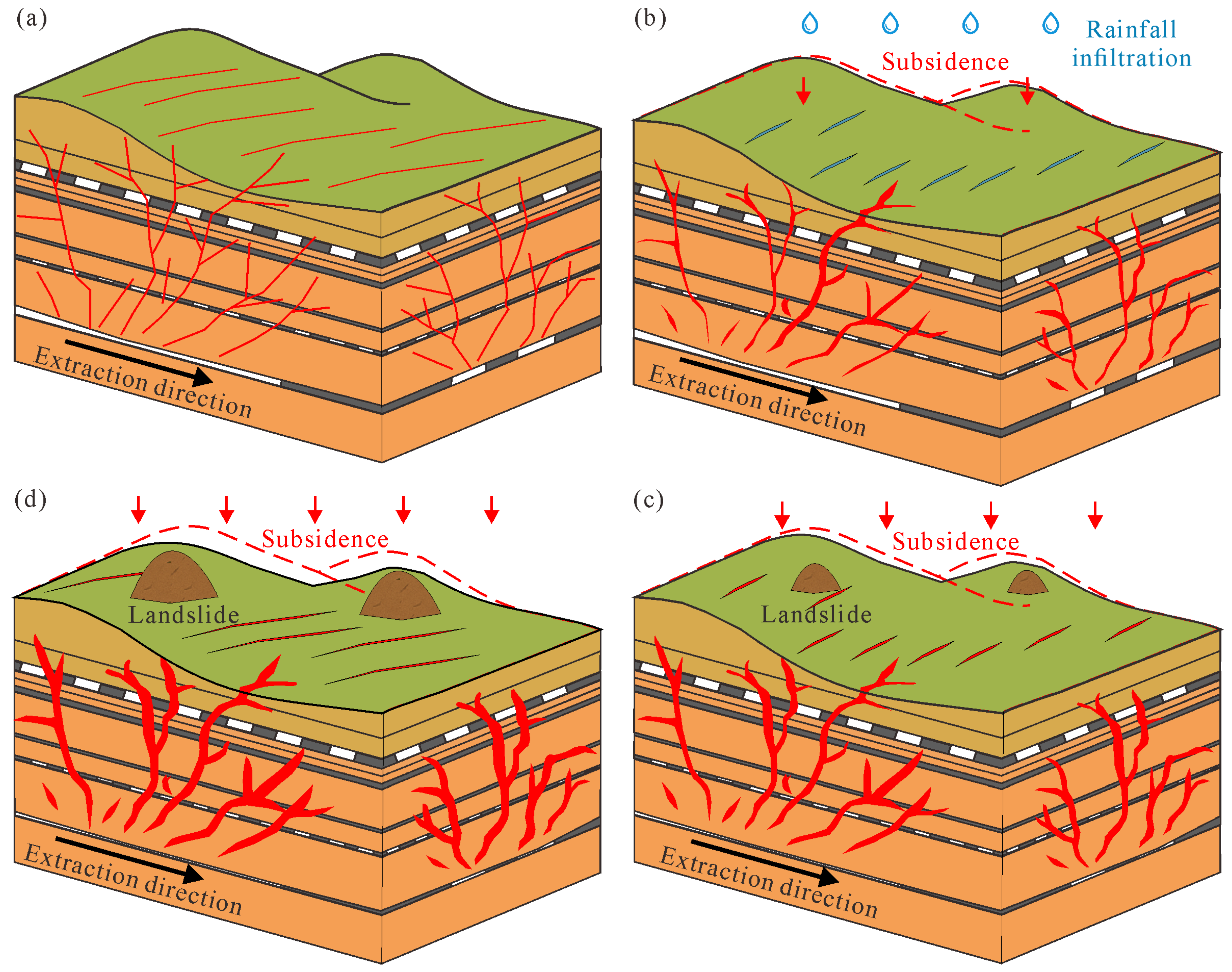
Multi-seam mining has significant spatiotemporal control over multi-hazards in the loess gully region (Figure 4 and Figure 10). The displacement of monitoring points changed direction with mining progress. The gravity of the slope and uneven subsidence induced by mining caused fissures; the spatiotemporal variations in subsidence, slope, and mining direction controlled the scale and direction of landslides. This process is characterized by subsidence-induced fissure expansion, eventually leading to landslides.
The formation and development of fissures are the basis for various hazards and hazard-chain evolution [2,15] and are closely related to mining conditions [3]. Fissures propagate from the goaf to the surface, exhibiting upward propagation and edge-to-center expansion characteristics, gradually inducing tensile fissures, collapse, and landslides (Figure 15) [17]. The overlying strata of the goaf undergo initial deformation under pressure, and as bending intensifies, collapse occurs once the tensile strength is exceeded. During this process, key strata develop vertical fissures, gradually expanding to the edges and upward [41]. After the key strata fissures penetrate, the key strata sink as a whole, leading to large-scale failure. The stratification and sliding of the overlying strata accelerate fissure penetration towards shallower layers. After the failure of the key strata, shear instability occurs in the coal pillars of the upper goaf, causing further fissure development and aggravating surface deformation [42].
Uneven subsidence causes tensile cracking in the soil layer, forming ground fissures. The surface on both sides of the goaf is in a positive curvature tensile stress zone, generating tensile fissures; the surface above the goaf is in a negative curvature compressive stress zone, mainly forming compressive fissures [36]. The activity and evolution of surface fissures are greatly influenced by mining, with fissures typically showing linear or arcuate distributions whose length and width expand with increasing subsidence [15,36]. Ground fissures are densely distributed at the edges of the goaf, particularly at the loess ridges and gully sides. Additionally, due to uncoordinated deformation in the middle of the working face, temporary fissures develop during mining, with tensile fissures forming in front of the working face and, after passage, turning into compressive strain, resulting in fissure closure or transformation into compressive fissures [36].
Mining-induced landslides are the result of deformation and failure of the overburden and slope stress imbalance [43,44], mainly as traction landslides caused by the leading goaf [6,45]. Fissure development is a process of gradual destabilization of slope stress equilibrium [15]. Before the overall deformation and failure of the slope, local failures such as rear fissure formation, localized subsidence, and toe uplift occur [46]. Mining-induced fissure development and deformation of the overlying strata are direct factors leading to landslide formation [45]. In addition, mining-induced slope fissures also provide channels for rainfall infiltration, further forming continuous fissures and sliding surfaces, ultimately triggering landslides [47].
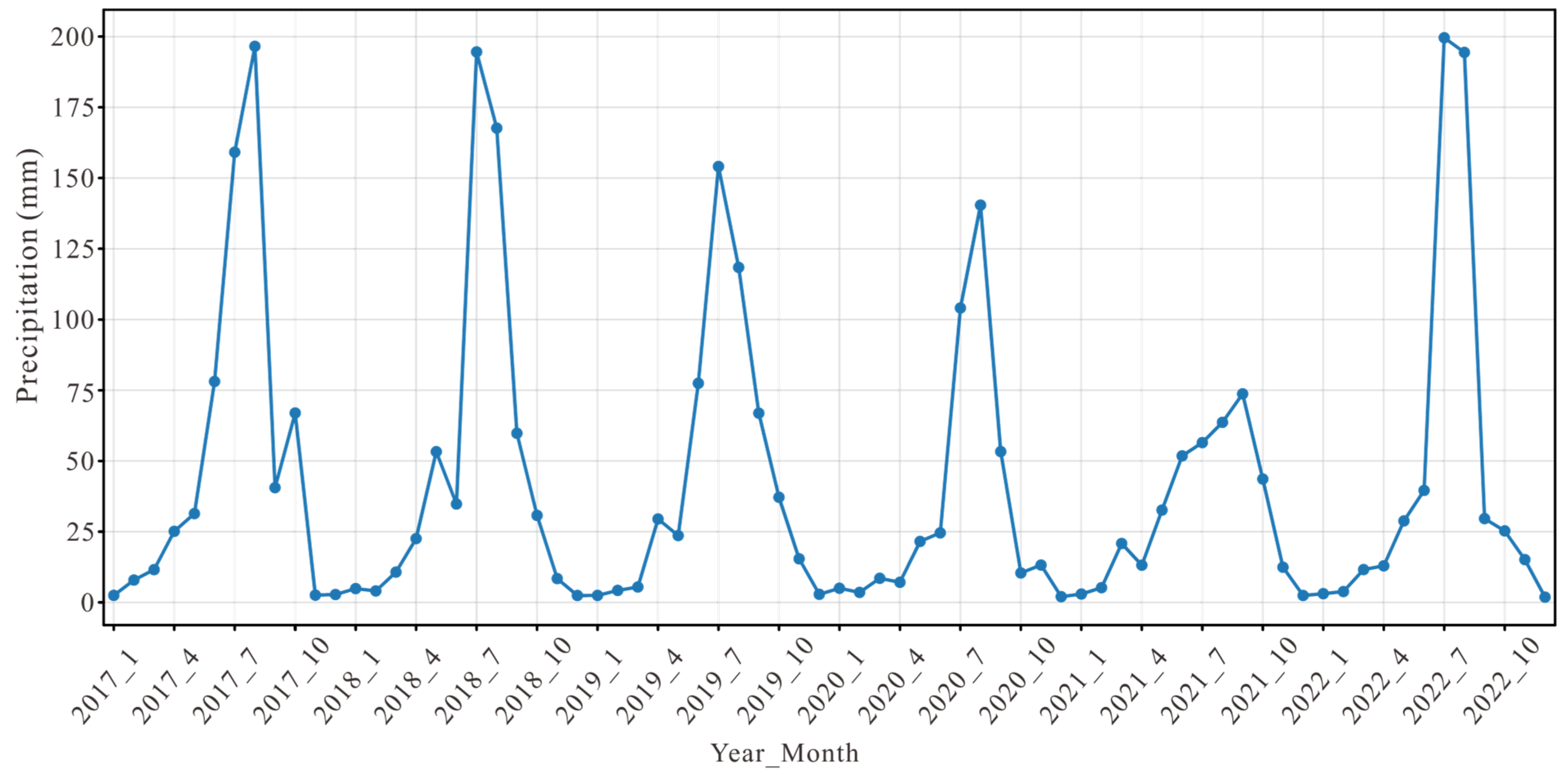
Precipitation in the study area is predominantly seen during the summer season (Figure 16). InSAR monitoring reveals that surface subsidence fluctuates slightly during the rainy season (Figure 9), but the overall trend remains consistent with mining progression, indicating that mining is the dominant driver of vertical deformation. However, the influence of precipitation should not be underestimated. Rainfall infiltration through mining-induced fissures increases rock mass saturation and pore water pressure, which reduces the effective stress and shear strength of slope materials. Over the long term, these hydrological effects accelerate the degradation of rock and soil mechanical properties [22], expand fissure networks, and promote the evolution of landslide and collapse hazards. Therefore, precipitation acts as a key external factor that amplifies mining-induced deformation and hazard-chain development.
The expansion of the goaf causes instability of the overlying strata and fissure development, weakening the support capacity of coal pillars, exacerbating subsidence, and forming ground fissures, thereby causing surface deformation. The expansion of subsidence and fissures leads to slope instability, triggering landslides, which in turn accelerate localized subsidence and fissure expansion, and enlarge the range of surface deformation. Subsidence is the core driving force of the hazard chain, and the entire hazard chain is formed through cyclic feedback among multiple hazards, resulting from the combined effects of topography, mining methods, stratum movement, and key structural failure.

5.4. Limitations and Future Work

InSAR performs better in flat terrain than in undulating terrain [11,48]. Since the current polar orbit and side-looking imaging mode of SAR satellites, InSAR is insensitive to north–south deformation, while the gully slopes in the study area are primarily oriented north–south, resulting in limitations in monitoring subsidence in the gully area. Equation (1) provides a simplified projection to obtain vertical deformation, but in loess gully regions, horizontal displacement is non-negligible, which may introduce errors. A complete validation of three-dimensional deformation still requires multi-geometry InSAR data or denser ground-based measurements.
On the other hand, although the numerical simulation considered topographic and geological factors to the greatest extent possible, it cannot fully reproduce the actual geological conditions. Features such as joints within the loess and strata, as well as irregularly distributed nodules and impurities, are difficult to characterize due to the lack of detailed field data, which introduces inherent limitations to the modeling accuracy. Moreover, for large-scale deformation simulations, computational resources and data availability restrict the mesh resolution from approaching the actual rock particle size. Consequently, the assumption of layer homogenization and the equivalent continuum approximation are widely adopted in geotechnical modeling. Although these simplifications may neglect small-scale heterogeneities, they are commonly accepted in similar studies and do not significantly affect the interpretation of large-scale deformation behavior [11,15].
The coupled InSAR–numerical simulation effectively revealed surface movement and stratum–coal pillar deformation. Future work will incorporate additional factors (e.g., in situ stress changes, rock mass discontinuities, groundwater seepage) to enhance simulation accuracy and fidelity. Inversion analysis using field data can further refine InSAR monitoring and simulations, yielding more precise surface–subsurface deformation characterization and a more comprehensive understanding of complex geological processes.

6. Conclusions

This study systematically analyzed the evolution pattern of surface deformation induced by multi-seam mining, the failure mechanisms of coal pillars and strata, their interactions, and the factors controlling deformation, using the InSAR-based multi-source monitoring and modeling framework. Combined with historical imagery and UAV surveys, the study investigated the characteristics of surface multi-hazard caused by multi-seam mining and discussed the development process of the hazard chain, its interactions, and influencing factors. A comprehensive analysis of the deformation and the resulting hazard chain process induced by multi-seam mining in the loess gully region was conducted.
The subsidence observed in the Hongyan coal mine resulted from stress redistribution and strata instability brought about by multi-seam mining. The unique characteristics of the loess and the topography further intensified the uneven nature of the subsidence. The combined effects of multi-seam mining, mining sequence, and geological conditions formed the unique subsidence characteristics. Stress redistribution in the goaf formed a stress arch structure, transferring the pressure of the overlying strata to both sides. The stress arch gradually destabilized as the goaf expanded, leading to stratum failure. Key strata play an essential role in controlling the movement of the overlying strata. Mining activities have significant spatiotemporal control over the development of the hazard chain, with a feedback loop between different hazards. Goaf expansion leads to strata instability and fissure development, weakening coal pillar support, exacerbating uneven subsidence, and forming ground fissures, which in turn cause surface deformation. The development of subsidence and fissures results in slope instability, triggering landslides, further accelerating localized subsidence and fissure expansion. The development of hazards is a bottom-up chain reaction, with fissure development as the foundation and subsidence as the core driving force.
The research results deepen the understanding of deformation and hazard chain development induced by multi-seam multi-panel mining in the loess gully region, providing a theoretical basis for addressing the environmental vulnerability of mining areas, with significant practical application value.

Author Contributions

Conceptualization, Q.Z., M.W. and L.L.; methodology, Q.Z. and Z.G.; software, Q.Z. and X.W.; validation, J.M. and Z.G.; formal analysis, L.L.; investigation, M.W. and X.W.; resources, L.L. and Z.G.; data curation, J.M.; writing—original draft preparation, Q.Z.; writing—review and editing, Q.Z., L.L. and T.A.; visualization, X.W. and J.M.; supervision, L.L.; project administration, L.L.; funding acquisition, L.L. and M.W. All authors have read and agreed to the published version of the manuscript.

Funding

This research was supported by the National Natural Science Foundation of China (Grant No. 42071258), the Natural Science Basic Research Program of Shaanxi Province (Grant Nos. 2023-JC-ZD-18 and 2024SF-YBXM-570), and the Scientific Innovation Practice Project for Postgraduates of Chang’an University (Grant No. 300103725041).

Data Availability Statement

The raw data supporting the conclusions of this article will be made available by the authors on request.

Acknowledgments

The authors would like to thank NASA for supplying SRTM DEM images.

Conflicts of Interest

The authors declare no conflicts of interest.

References

  1. Chen, X.; Li, L.; Wang, L.; Qi, L. The Current Situation and Prevention and Control Countermeasures for Typical Dynamic Disasters in Kilometer-Deep Mines in China. Saf. Sci. 2019, 115, 229–236. [Google Scholar] [CrossRef]
  2. Salmi, E.F.; Nazem, M.; Karakus, M. The Effect of Rock Mass Gradual Deterioration on the Mechanism of Post-Mining Subsidence over Shallow Abandoned Coal Mines. Int. J. Rock Mech. Min. Sci. 2017, 91, 59–71. [Google Scholar] [CrossRef]
  3. Yang, D.; Qiu, H.; Ma, S.; Liu, Z.; Du, C.; Zhu, Y.; Cao, M. Slow Surface Subsidence and Its Impact on Shallow Loess Landslides in a Coal Mining Area. Catena 2022, 209, 105830. [Google Scholar] [CrossRef]
  4. OECD. Key World Energy Statistics 2020; Organisation for Economic Co-Operation and Development: Paris, France, 2020. [Google Scholar]
  5. Bell, F.G.; Stacey, T.R.; Genske, D.D. Mining Subsidence and Its Effect on the Environment: Some Differing Examples. Environ. Geol. 2000, 40, 135–152. [Google Scholar] [CrossRef]
  6. Ergïnal, A.E.; Türkeş, M.; Ertek, T.A.; Baba, A.; Bayrakdar, C. Geomorphological Investigation of the Excavation-induced Dündar Landslide, Bursa—Turkey. Geogr. Ann. Ser. A Phys. Geogr. 2008, 90, 109–123. [Google Scholar] [CrossRef]
  7. Modeste, G.; Doubre, C.; Masson, F. Time Evolution of Mining-Related Residual Subsidence Monitored over a 24-Year Period Using InSAR in Southern Alsace, France. Int. J. Appl. Earth Obs. Geoinf. 2021, 102, 102392. [Google Scholar] [CrossRef]
  8. Strozzi, T.; Delaloye, R.; Poffet, D.; Hansmann, J.; Loew, S. Surface Subsidence and Uplift above a Headrace Tunnel in Metamorphic Basement Rocks of the Swiss Alps as Detected by Satellite SAR Interferometry. Remote Sens. Environ. 2011, 115, 1353–1360. [Google Scholar] [CrossRef]
  9. Zhu, D.; Chen, T.; Zhen, N.; Niu, R. Monitoring the Effects of Open-Pit Mining on the Eco-Environment Using a Moving Window-Based Remote Sensing Ecological Index. Environ. Sci. Pollut. Res. 2020, 27, 15716–15728. [Google Scholar] [CrossRef]
  10. Yang, Z.; Li, W.; Pei, Y.; Qiao, W.; Wu, Y. Classification of the Type of Eco-Geological Environment of a Coal Mine District: A Case Study of an Ecologically Fragile Region in Western China. J. Clean. Prod. 2018, 174, 1513–1526. [Google Scholar] [CrossRef]
  11. Liu, Y.; Yang, T.; Zhao, Y.; Ma, K.; Hou, X.; Zhao, Q.; Li, J. Characteristics of Strata Movement and Method for Runoff Disaster Management for Shallow Multiseam Mining in Gully Regions: A Case Study. Int. J. Rock Mech. Min. Sci. 2023, 172, 105608. [Google Scholar] [CrossRef]
  12. Cheng, G.; Yang, T.; Liu, H.; Wei, L.; Zhao, Y.; Liu, Y.; Qian, J. Characteristics of Stratum Movement Induced by Downward Longwall Mining Activities in Middle-Distance Multi-Seam. Int. J. Rock Mech. Min. Sci. 2020, 136, 104517. [Google Scholar] [CrossRef]
  13. Ghabraie, B.; Ren, G.; Smith, J.V. Characterising the Multi-Seam Subsidence Due to Varying Mining Configuration, Insights from Physical Modelling. Int. J. Rock Mech. Min. Sci. 2017, 93, 269–279. [Google Scholar] [CrossRef]
  14. Ju, J.; Xu, J. Structural Characteristics of Key Strata and Strata Behaviour of a Fully Mechanized Longwall Face with 7.0 m Height Chocks. Int. J. Rock Mech. Min. Sci. 2013, 58, 46–54. [Google Scholar] [CrossRef]
  15. Ma, S.; Qiu, H.; Yang, D.; Wang, J.; Zhu, Y.; Tang, B.; Sun, K.; Cao, M. Surface Multi-Hazard Effect of Underground Coal Mining. Landslides 2023, 20, 39–52. [Google Scholar] [CrossRef]
  16. Mhlongo, S.E.; Amponsah-Dacosta, F. A Review of Problems and Solutions of Abandoned Mines in South Africa. Int. J. Min. Reclam. Environ. 2016, 30, 279–294. [Google Scholar] [CrossRef]
  17. Cai, Y.; Jin, Y.; Wang, Z.; Chen, T.; Wang, Y.; Kong, W.; Xiao, W.; Li, X.; Lian, X.; Hu, H. A Review of Monitoring, Calculation, and Simulation Methods for Ground Subsidence Induced by Coal Mining. Int. J. Coal Sci. Technol. 2023, 10, 32. [Google Scholar] [CrossRef]
  18. Peternel, T.; Kumelj, Š.; Oštir, K.; Komac, M. Monitoring the Potoška Planina Landslide (NW Slovenia) Using UAV Photogrammetry and Tachymetric Measurements. Landslides 2017, 14, 395–406. [Google Scholar] [CrossRef]
  19. Yang, Z.; Li, Z.; Zhu, J.; Wang, Y.; Wu, L. Use of SAR/InSAR in Mining Deformation Monitoring, Parameter Inversion, and Forward Predictions: A Review. IEEE Geosci. Remote Sens. Mag. 2020, 8, 71–90. [Google Scholar] [CrossRef]
  20. Singh, S.K.; Banerjee, B.P.; Raval, S. A Review of Laser Scanning for Geological and Geotechnical Applications in Underground Mining. Int. J. Min. Sci. Technol. 2023, 33, 133–154. [Google Scholar] [CrossRef]
  21. Ren, H.; Zhao, Y.; Xiao, W.; Hu, Z. A Review of UAV Monitoring in Mining Areas: Current Status and Future Perspectives. Int. J. Coal Sci. Technol. 2019, 6, 320–333. [Google Scholar] [CrossRef]
  22. Lu, Y.; Jin, C.; Wang, Q.; Han, T.; Li, G.; Zhong, X.; Chen, G. Combining InSAR and Infrared Thermography with Numerical Simulation to Identify the Unstable Slope of Open-Pit: Qidashan Case Study, China. Landslides 2023, 20, 1961–1974. [Google Scholar] [CrossRef]
  23. Yan, S.; Liu, G.; Deng, K.; Wang, Y.; Zhang, S.; Zhao, F. Large Deformation Monitoring over a Coal Mining Region Using Pixel-Tracking Method with High-Resolution Radarsat-2 Imagery. Remote Sens. Lett. 2016, 7, 219–228. [Google Scholar] [CrossRef]
  24. Helm, P.R.; Davie, C.T.; Glendinning, S. Numerical Modelling of Shallow Abandoned Mine Working Subsidence Affecting Transport Infrastructure. Eng. Geol. 2013, 154, 6–19. [Google Scholar] [CrossRef]
  25. Zhou, W.; Qiu, H.; Wang, L.; Pei, Y.; Tang, B.; Ma, S.; Yang, D.; Cao, M. Combining Rainfall-Induced Shallow Landslides and Subsequent Debris Flows for Hazard Chain Prediction. Catena 2022, 213, 106199. [Google Scholar] [CrossRef]
  26. Behera, B.; Yadav, A.; Singh, G.S.P.; Sharma, S.K. Numerical Modeling Study of the Geo-Mechanical Response of Strata in Longwall Operations with Particular Reference to Indian Geo-Mining Conditions. Rock Mech. Rock Eng. 2020, 53, 1827–1856. [Google Scholar] [CrossRef]
  27. Vlachopoulos, N.; Diederichs, M.S. Appropriate Uses and Practical Limitations of 2D Numerical Analysis of Tunnels and Tunnel Support Response. Geotech. Geol. Eng. 2014, 32, 469–488. [Google Scholar] [CrossRef]
  28. Berardino, P.; Fornaro, G.; Lanari, R.; Sansosti, E. A New Algorithm for Surface Deformation Monitoring Based on Small Baseline Differential SAR Interferograms. IEEE Trans. Geosci. Remote Sens. 2002, 40, 2375–2383. [Google Scholar] [CrossRef]
  29. Torres, R.; Snoeij, P.; Geudtner, D.; Bibby, D.; Davidson, M.; Attema, E.; Potin, P.; Rommen, B.; Floury, N.; Brown, M.; et al. GMES Sentinel-1 Mission. Remote Sens. Environ. 2012, 120, 9–24. [Google Scholar] [CrossRef]
  30. Sandwell, D.T.; Price, E.J. Phase Gradient Approach to Stacking Interferograms. J. Geophys. Res. 1998, 103, 30183–30204. [Google Scholar] [CrossRef]
  31. Kumar, R.; Choudhury, D.; Bhargava, K. Simulation of Rock Subjected to Underground Blast Using FLAC3D. JGS Spec. Publ. 2016, 2, 508–511. [Google Scholar] [CrossRef]
  32. Shi, M.; Yang, H.; Wang, B.; Peng, J.; Gao, Z.; Zhang, B. Improving Boundary Constraint of Probability Integral Method in SBAS-InSAR for Deformation Monitoring in Mining Areas. Remote Sens. 2021, 13, 1497. [Google Scholar] [CrossRef]
  33. He, Y.; Huang, Q. Simulation Study on Spatial Form of the Suspended Roof Structure of Working Face in Shallow Coal Seam. Sustainability 2023, 15, 921. [Google Scholar] [CrossRef]
  34. Hu, M.; Zhao, W.; Lu, Z.; Ren, J.; Miao, Y. Research on the Reasonable Width of the Waterproof Coal Pillar during the Mining of a Shallow Coal Seam Located Close to a Reservoir. Adv. Civ. Eng. 2019, 2019, 3532784. [Google Scholar] [CrossRef]
  35. Li, X.; Wang, S.J.; Liu, T.Y.; Ma, F.S. Engineering Geology, Ground Surface Movement and Fissures Induced by Underground Mining in the Jinchuan Nickel Mine. Eng. Geol. 2004, 76, 93–107. [Google Scholar] [CrossRef]
  36. Yang, X.; Wen, G.; Dai, L.; Sun, H.; Li, X. Ground Subsidence and Surface Cracks Evolution from Shallow-Buried Close-Distance Multi-Seam Mining: A Case Study in Bulianta Coal Mine. Rock Mech. Rock Eng. 2019, 52, 2835–2852. [Google Scholar] [CrossRef]
  37. Yang, W.; Lin, B.; Qu, Y.; Li, Z.; Zhai, C.; Jia, L.; Zhao, W. Stress Evolution with Time and Space during Mining of a Coal Seam. Int. J. Rock Mech. Min. Sci. 2011, 48, 1145–1152. [Google Scholar] [CrossRef]
  38. Coggan, J.; Gao, F.; Stead, D.; Elmo, D. Numerical Modelling of the Effects of Weak Immediate Roof Lithology on Coal Mine Roadway Stability. Int. J. Coal Geol. 2012, 90–91, 100–109. [Google Scholar] [CrossRef]
  39. Xia, B.; Zhang, X.; Yu, B.; Jia, J. Weakening Effects of Hydraulic Fracture in Hard Roof under the Influence of Stress Arch. Int. J. Min. Sci. Technol. 2018, 28, 951–958. [Google Scholar] [CrossRef]
  40. Zhang, M.; Shimada, H.; Sasaoka, T.; Matsui, K.; Dou, L. Evolution and Effect of the Stress Concentration and Rock Failure in the Deep Multi-Seam Coal Mining. Environ. Earth Sci. 2014, 72, 629–643. [Google Scholar] [CrossRef]
  41. Guo, W.; Zhao, G.; Bai, E.; Guo, M.; Wang, Y. Effect of Overburden Bending Deformation and Alluvium Mechanical Parameters on Surface Subsidence Due to Longwall Mining. Bull. Eng. Geol. Environ. 2021, 80, 2751–2764. [Google Scholar] [CrossRef]
  42. Zhu, W.; Chen, L.; Zhou, Z.; Shen, B.; Xu, Y. Failure Propagation of Pillars and Roof in a Room and Pillar Mine Induced by Longwall Mining in the Lower Seam. Rock Mech. Rock Eng. 2019, 52, 1193–1209. [Google Scholar] [CrossRef]
  43. Jones, D.; Siddle, H.; Reddish, D.; Whittaker, B. Landslides and Undermining: Slope Stability Interaction with Mining Subsidence Behaviour. In Proceedings of the 7th ISRM Congress, Aachen, Germany, 16–20 September 1991. [Google Scholar]
  44. Marschalko, M.; Yilmaz, I.; Bednárik, M.; Kubečka, K. Influence of Underground Mining Activities on the Slope Deformation Genesis: Doubrava Vrchovec, Doubrava Ujala and Staric Case Studies from Czech Republic. Eng. Geol. 2012, 147–148, 37–51. [Google Scholar] [CrossRef]
  45. Marschalko, M.; Matěj, F.; Lubomír, T. Influence of Mining Activity on Selected Landslide in the Ostrava-Karviná Coalfield. Acta Montan. Slovaca 2008, 13, 58–65. [Google Scholar]
  46. Urciuoli, G.; Picarelli, L.; Leroueil, S. Local Soil Failure before General Slope Failure. Geotech. Geol. Eng. 2007, 25, 103–122. [Google Scholar] [CrossRef]
  47. Zhang, F.; Song, Y.; Zhao, H.; Han, Z.; Wang, D. Changes of Precipitation Infiltration Recharge in the Circumstances of Coal Mining Subsidence in the Shen-Dong Coal Field, China. Acta Geol. Sin. (Eng.) 2012, 86, 993–1003. [Google Scholar] [CrossRef]
  48. Wasowski, J.; Bovenga, F. Investigating Landslides and Unstable Slopes with Satellite Multi Temporal Interferometry: Current Issues and Future Perspectives. Eng. Geol. 2014, 174, 103–138. [Google Scholar] [CrossRef]
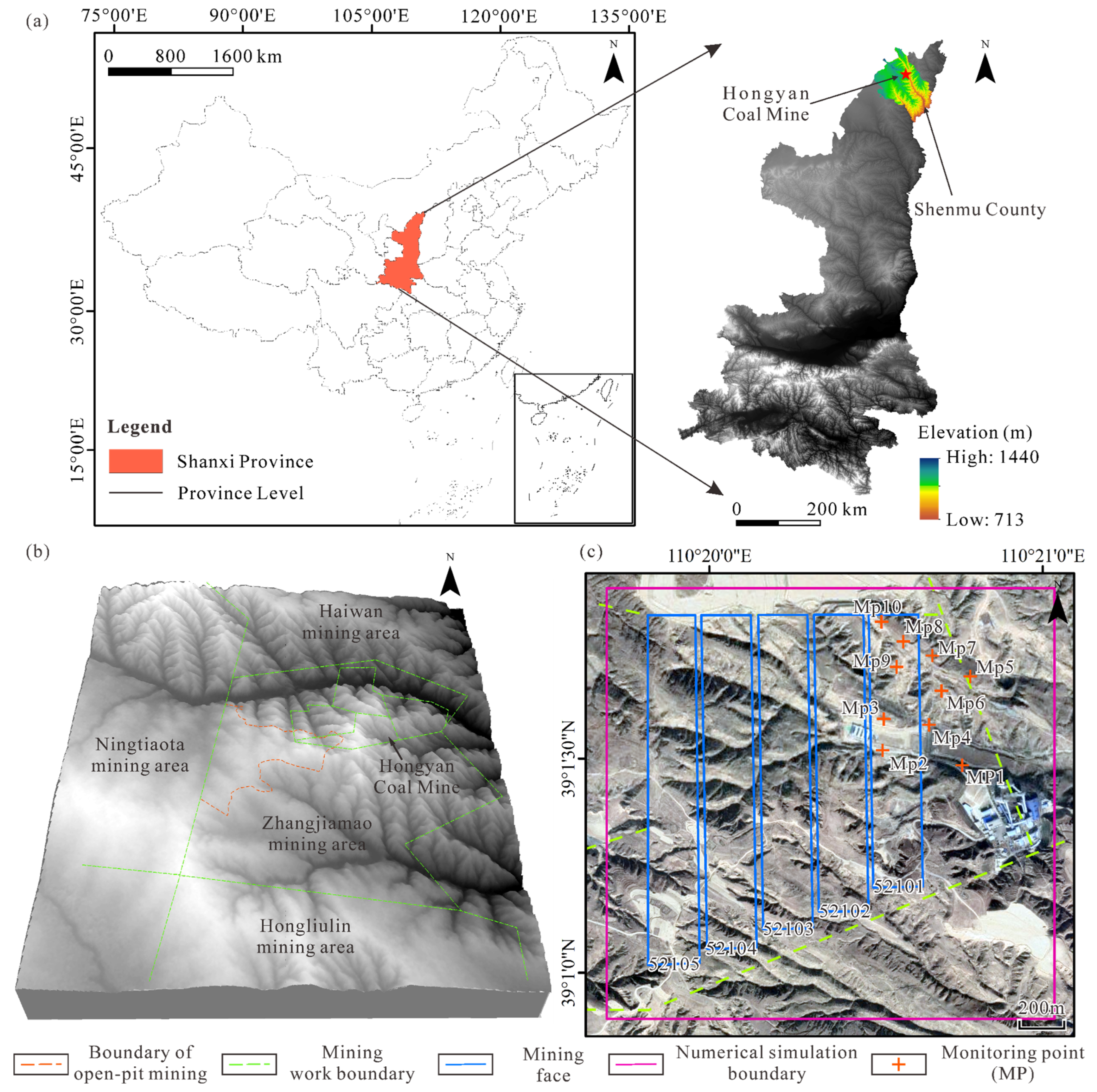
Figure 1. (a) Location of the study area, (b) distribution of coal mines in the study area, and (c) schematic of mining faces, subsidence monitoring points, and numerical simulation boundaries.
Remotesensing 17 03993 g001
Figure 2. Mining timeline of the Hongyan Coal Mine.
Remotesensing 17 03993 g002
Figure 3. Workflow of the InSAR-based multi-source monitoring and modeling framework.
Remotesensing 17 03993 g003
Figure 4. Location of monitoring points and identified geo-hazards derived from UAV and historical imagery. (a) Satellite image of the study area; (bg) UAV photographs showing fissure zones.
Remotesensing 17 03993 g004
Figure 5. (a) Numerical model setup; (b) stratigraphic profile; (c) profile from S to S′ and schematic diagram of coal seam mining simulation layout.
Remotesensing 17 03993 g005
Figure 6. Vertical (a) and LOS (b) deformation rate maps highlighting significant deformation zones (>5 mm/y).
Remotesensing 17 03993 g006
Figure 7. Time-series accumulated subsidence map of the study area (showing areas with cumulative deformation >50 mm).
Remotesensing 17 03993 g007
Figure 8. Surface subsidence along profile line S-S′ from 24 April 2018 to 18 September 2022. (a) Topographic profile. (b) Time-series subsidence along the profile.
Remotesensing 17 03993 g008
Figure 9. Subsidence alteration process of maximum settlement point and panel surface midpoint of profile line S-S′. (a) Surface cumulative subsidence alteration. (b) Vertical subsidence rate alteration. (Note: The upper colored blocks correspond to the mining face operational timeline).
Remotesensing 17 03993 g009
Figure 10. Mining-induced surface multi-hazards.
Remotesensing 17 03993 g010
Figure 11. Temporal evolution of coal seam 5−2 mining-induced deformation in X, Y, and Z directions.
Remotesensing 17 03993 g011
Figure 12. Time-series numerical simulation of cumulative surface subsidence. (a) Subsidence evolution induced by multi-seam mining attributed to Seam 5−2 extraction. (b) Time-series cumulative subsidence induced by overall multi-seam mining. (c) Hypothetical scenario of time-series subsidence with only Seam 5−2 extraction, representing the absence of upper room-and-pillar mining.
Remotesensing 17 03993 g012
Figure 13. Temporal variation in displacement magnitude along the roof of each coal seam on the S-S′ profile: (a) coal seam 5−2 roof, (b) coal seam 4−2 roof, (c) coal seam 3−1 roof, (d) coal seam 2−2 roof.
Remotesensing 17 03993 g013
Figure 14. Stress distribution and displacement vector characteristics: (a) stress and displacement vectors of the S-S′ profile, (b) stress and displacement vectors of the 52,104 Z-Y profile, (c) numerical simulation assuming absence of upper room-and-pillar mining.
Remotesensing 17 03993 g014
Figure 15. Schematic model of the evolution of multi-seam mining-induced hazard chains in the loess gully region. (a) Mining-induced fissure development. (b) Rainfall infiltration exacerbating fissures. (c) Mining-induced subsidence. (d) Subsidence further intensifying deformation and landslide initiation.
Remotesensing 17 03993 g015
Figure 16. Monthly precipitation trend in the study area.
Remotesensing 17 03993 g016
Table 1. Characteristics of coal seams in the study area. (Values above the underline show the min–max range; the value below shows the mean.)
Coal SeamThickness (m)Coal Seam StructureInterval (m)Mineability
2−26.93~9.83
7.95
Complex structure,
typically containing 2–3 intercalations
-Partially Mineable
33.66~37.81
35.14
3−11.74~2.87
2.64
Simple structure,
no intercalations or occasionally one
Mostly Mineable
37.30~45.27
40.74
4−23.09~3.86
3.47
Simple structure,
containing one intercalation
Mostly Mineable
14.37~21.20
17.99
4−30.94~1.55
1.23
Simple structure,
containing one intercalation
Mostly Mineable
13.09~16.29
14.44
4−40.80~0.95
0.90
Simple structure,
containing one intercalation
Partially Mineable
34.44~41.79
37.94
5−25.23~6.25
5.79
Simple structure,
locally containing 1–2 intercalations
Fully Mineable
-
Table 2. Mechanical properties of rock formation used in the calculation.
No.Rock StratumDensity
ρ (kg/m3)
Elastic
Modulus
E/Gpa
Poisson’s
Ratio
ν
Cohesion
C/Mpa
Internal
Friction Angle
φ/◦
Tensile Strength Rc/Mpa
1Loose layer18700.110 0.250.048 22.07_
2Clay19600.2500.350.85025.100.35
3CGS25607.0700.153.04033.004.34
4Coal Seams 2−212801.7400.303.72036.981.37
5FGS24500.8030.212.54038.131.87
6Coal Seams 3−112801.7400.303.72036.001.37
7Siltstone24700.8260.193.13039.291.75
8Coal Seams 4−213900.4350.211.16036.980.74
9Siltstone23200.8240.232.42038.601.24
10Coal Seams 4−313900.266 0.141.45037.600.82
11FGS24301.1120.172.64039.371.24
12Coal Seams 4−413900.266 0.141.45037.600.82
13Silty mudstone21501.0210.223.66038.690.65
14Coal Seams 5−213900.2660.141.45037.600.82
15CGS26905.6100.293.50033.003.70
16FGS24300.9710.204.43039.601.22
Table 3. Temporal displacement of monitoring points during the mining of panel 52101 (unit: mm).
Number5 November 2021–5 March 20225 March 2022–28 May 20225 November 2021–28 May 2022
XYZXYZXYZ
MP1−19 −8 −2 −16 −6 −31 −35 −14 −33
MP242 −1 −83 −358 722 −1314 −316 721 −1396
MP38 −2 96 386 −208 −107 394 −210 −12
MP452 −2 14 −998 2262 −2101 −946 2260 −2087
MP5−569 −596 −4149 −434 −91 −466 −1003 −687 −4615
MP616 4 −15 −124 −165 −149 −108 −161 −164
MP7−21 −431 −339 −164 −212 −206 −185 −643 −545
MP819 20 129 −77 −100 −196 −58 −80 −67
MP9−134 159 −3253 −2078 138 −1941 −2212 297 −5194
MP10−970 1913 −2059 −207 −50 −295 −1177 1863 −2354
X, Y, and Z denote displacements in the east–west, north–south, and vertical directions, respectively.
Disclaimer/Publisher’s Note: The statements, opinions and data contained in all publications are solely those of the individual author(s) and contributor(s) and not of MDPI and/or the editor(s). MDPI and/or the editor(s) disclaim responsibility for any injury to people or property resulting from any ideas, methods, instructions or products referred to in the content.